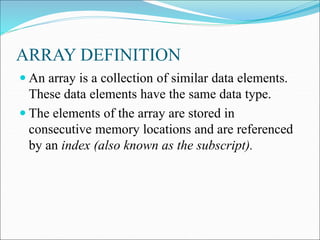
This document discusses arrays in C programming. It defines an array as a collection of similar data elements of the same type stored in consecutive memory locations. Arrays can be one-dimensional, two-dimensional, or multi-dimensional. In C, arrays are declared with the data type, name, and size. Elements are accessed using indices from 0 to size-1. Arrays can be initialized during declaration. Programs demonstrate taking input from the user to store in an array, accessing individual elements, changing element values, calculating addresses, and printing arrays.


![ARRAY DECLARATION
In C, arrays are declared using the following syntax:
type name[size];
Data type—the kind of values it can store, for example, int, char, float,
double.
Name—to identify the array.
Size—the maximum number of values that the array can hold.
For example,
int marks[10];//mark contains 10 elements.index starts from zero.
dataType arrayName[arraySize];
float marks[5];
It can hold 5 float values.
Note:the size and type of an array cannot be changed once it is declared.](https://image.slidesharecdn.com/array-200828014858/85/Array-5-320.jpg)


![Calculating the Length of an Array
The length of an array is given by the number of elements stored in it. The
general formula to calculate the length of an array is
Length = upper_bound – lower_bound + 1
where upper_bound is the index of the last element and lower_bound is the
index of the first element in the array.
Example : Let Age[5] be an array of integers such that
Age[0] = 2, Age[1] = 5, Age[2] = 3, Age[3] = 1, Age[4] = 7
Show the memory representation of the array and calculate its length.
Solution
The memory representation of the array Age[5] is given as below.
Age[ 0] Age[1] Age[2] Age[3] Age[4]
Length = upper_bound – lower_bound + 1
Here, lower_bound = 0, upper_bound = 4
Therefore, length = 4 – 0 + 1 = 5
2 5 3 1 7](https://image.slidesharecdn.com/array-200828014858/85/Array-8-320.jpg)
![ARRAY INITIALIZATION
It is possible to initialize an array during declaration.
For example,
int mark[5] = {19, 10, 8, 17, 9};
/*You can also initialize an array like this.*/
int mark[] = {19, 10, 8, 17, 9};
/*Here, we haven't specified the size. However, the
compiler knows its size is 5 as we are initializing it with
5 elements.*/](https://image.slidesharecdn.com/array-200828014858/85/Array-9-320.jpg)
![int mark[5] = {19, 10, 8, 17, 9};
mark[0] is equal to 19
mark[1] is equal to 10
mark[2] is equal to 8
mark[3] is equal to 17
mark[4] is equal to 9](https://image.slidesharecdn.com/array-200828014858/85/Array-10-320.jpg)

![Access Array Elements
You can access elements of an array by indices.
Suppose you declared an array mark as above. The first
element is mark[0], the second element is mark[1] and
so on.](https://image.slidesharecdn.com/array-200828014858/85/Array-12-320.jpg)
![Note:
Arrays have 0 as the first index, not 1. In this
example, mark[0] is the first element.
If the size of an array is n, to access the last element,
the n-1 index is used. In this example, mark[4]
Suppose the starting address of mark[0] is 2120d.
Then, the address of the mark[1] will be 2124d.
Similarly, the address of mark[2] will be 2128d and so
on.
This is because the size of a float is 4 bytes.](https://image.slidesharecdn.com/array-200828014858/85/Array-13-320.jpg)
![Calculating the Address of Array Elements
Base address, that is the address of the first element in the array.
FORMULA
Address of data element, A[k] = BA(A) + w(k – lower_bound)
Here, A is the array, k is the index of the element of which we have to calculate the
address, BA is the base address of the array A, and w is the size of one element in
memory, for example, size of int is 2.](https://image.slidesharecdn.com/array-200828014858/85/Array-14-320.jpg)
![CHANGE VALUE OF ARRAY ELEMENTS
int mark[5] = {19, 10, 8, 17, 9}
mark[2] = -1;
// make the value of the third element to -1
mark[4] = 0;
// make the value of the fifth element to 0
scanf("%d", &mark[2]); //take input and store it in the
3rd element
scanf("%d", &mark[i-1]);/ // take input and store it in
the ith element](https://image.slidesharecdn.com/array-200828014858/85/Array-15-320.jpg)
![PRINT AN INDIVIDUAL ELEMENT OF AN ARRAY
// print the first element of the array printf("%d",
mark[0]);
// print the third element of the array printf("%d",
mark[2]);
// print ith element of the array
printf("%d", mark[i-1]);](https://image.slidesharecdn.com/array-200828014858/85/Array-16-320.jpg)
![Program to take 5 values from the user and store them in an array
#include <stdio.h>
int main()
{
int values[5];
printf("Enter 5 integers: "); // taking input and storing it in an array
for(int i = 0; i < 5; ++i) // for loop to take 5 inputs from the user and store in array
{
scanf("%d", &values[i]);
}
printf("Displaying integers: "); // printing elements of an array
for(int i = 0; i < 5; ++i) //another for loop, these elements are displayed on the screen.
{
printf("%dn", values[i]);
}
return 0;
}](https://image.slidesharecdn.com/array-200828014858/85/Array-17-320.jpg)


![[ITP - Lecture 15] Arrays & its Types](https://cdn.slidesharecdn.com/ss_thumbnails/lecture-2223arraysitstypes-171215173139-thumbnail.jpg?width=640&height=640&fit=bounds)


