Franz Kline By .. Boo Ing and Tib
Franz Kline Franz Kline , born Franz Jozef Kline, (May 23, 1910 – May 13, 1962)  Kline was born in Wilkes Barre, Pennsylvania in 1910, the second of four children .  His parents were both immigrants  -  his father, a saloon keeper, came from Hamburg and his mother from Cornwall .  In 1917 his father committed suicide, and his mother remarried three years later .  From 1919 to 1925 Kline attended Girard College, Philadelphia, an institution for fatherless boys which he afterwards referred to as 'an orphanage' .  In retrospect, he also lengthened his stay there to 'eleven years', which hints that it may have been a traumatic experience .  After his mother withdrew him from Girard, Kline attended Lehighton High School .  Though not a big man, he was athletic and was Captain of Varsity Football in 1929 .  While at high school, he had an accident in football practice which immobilized him for a while, and this was when he developed an interest in drawing and decided to become a cartoonist and illustrator .  Franz Kline was a member of the second Abstract Expressionist   generation .  His warm and likeable personality made him popular; though memoirs of the time recall him as a hard drinker, he was not an 'ugly' drunk like Jackson Pollock and  ( on some occasions )  Willem de Kooning .  A leading figure at the Cedar Bar, the Abstract  Expressionists' downtown hangout in New York, he was also a companion of  the literary beats, especially of Jack  Kerouac .
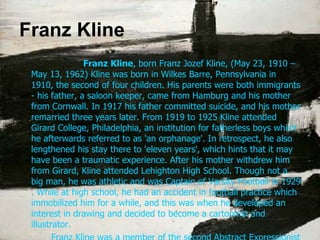
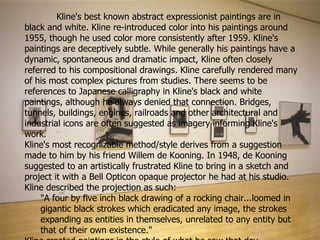
Kline's best known abstract expressionist paintings are in black and white .  Kline re - introduced color into his paintings around 1955, though he used color more consistently after 1959 .  Kline's paintings are deceptively subtle .  While generally his paintings have a dynamic, spontaneous and dramatic impact, Kline often closely referred to his compositional drawings .  Kline carefully rendered many of his most complex pictures from studies .  There seems to be references to Japanese calligraphy in Kline's black and white paintings, although he always denied that connection .  Bridges, tunnels, buildings, engines, railroads and other architectural and industrial icons are often suggested as imagery informing Kline's work . Kline's most recognizable method / style derives from a suggestion made to him by his friend Willem de Kooning .  In 1948, de Kooning suggested to an artistically frustrated Kline to bring in a sketch and project it with a Bell Opticon opaque projector he had at his studio .  Kline described the projection as such : " A four by five inch black drawing of a rocking chair ... loomed in gigantic black strokes which eradicated any image, the strokes expanding as entities in themselves, unrelated to any entity but that of their own existence ." Kline created paintings in the style of what he saw that day throughout his life. In 1950, he exhibited many works in this style at the  Charles Egan Gallery .
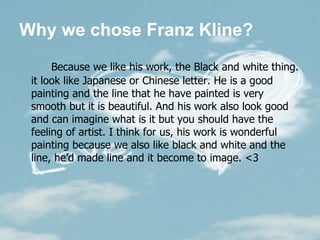
Why we chose Franz Kline? Because we like his work, the Black and white thing. it look like Japanese or Chinese letter. He is a good painting and the line that he have painted is very smooth but it is beautiful. And his work also look good and can imagine what is it but you should have the feeling of artist.   I think for us, his work is wonderful painting because we also like black and white and the line, he’d made line and it become to image. <3
A description of his work it ‘s Impressionist of Black and White. As with Jackson Pollock and other Abstract Expressionists, he was labeled an  “ action painter &quot;  because of his seemingly spontaneous and intense style, focusing less, or not at all, on figures or imagery, but on the actual brush strokes and use of canvas .  For most of Kline's  [ mature and representative ]  work, however, as the phrase goes,  &quot; spontaneity is practiced &quot;.  He would prepare many draft sketches – notably, commonly on refuse telephone book pages – before going to make his  &quot; spontaneous &quot;  work .
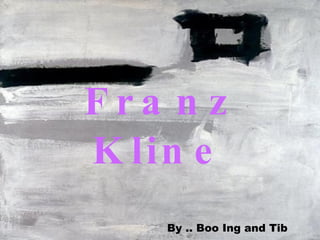
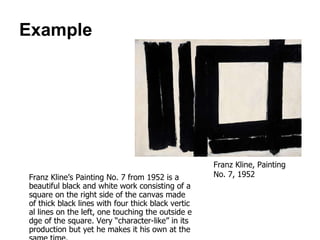
Example Franz Kline’s Painting No .  7  from 1952 is a beautiful black and white work consisting of a square on the right side of the canvas made of thick black lines with four thick black vertical lines on the left, one touching the outside edge of the square. Very “character-like” in its production but yet he makes it his own at the same time.  Franz Kline, Painting No .  7, 1952
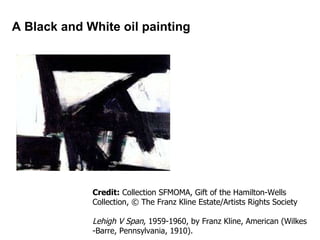
Credit :  Collection SFMOMA, Gift of the Hamilton-Wells Collection, © The Franz Kline Estate/Artists Rights Society  Lehigh V Span , 1959-1960, by Franz Kline, American (Wilkes-Barre, Pennsylvania, 1910).  A Black and White oil painting
Franz Kline
Our work
 
 
Thank you =D

Franz Kline

  • 1.
    Franz Kline By.. Boo Ing and Tib
  • 2.
    Franz Kline FranzKline , born Franz Jozef Kline, (May 23, 1910 – May 13, 1962) Kline was born in Wilkes Barre, Pennsylvania in 1910, the second of four children . His parents were both immigrants - his father, a saloon keeper, came from Hamburg and his mother from Cornwall . In 1917 his father committed suicide, and his mother remarried three years later . From 1919 to 1925 Kline attended Girard College, Philadelphia, an institution for fatherless boys which he afterwards referred to as 'an orphanage' . In retrospect, he also lengthened his stay there to 'eleven years', which hints that it may have been a traumatic experience . After his mother withdrew him from Girard, Kline attended Lehighton High School . Though not a big man, he was athletic and was Captain of Varsity Football in 1929 . While at high school, he had an accident in football practice which immobilized him for a while, and this was when he developed an interest in drawing and decided to become a cartoonist and illustrator . Franz Kline was a member of the second Abstract Expressionist generation . His warm and likeable personality made him popular; though memoirs of the time recall him as a hard drinker, he was not an 'ugly' drunk like Jackson Pollock and ( on some occasions ) Willem de Kooning . A leading figure at the Cedar Bar, the Abstract Expressionists' downtown hangout in New York, he was also a companion of the literary beats, especially of Jack Kerouac .
  • 3.
    Kline's best knownabstract expressionist paintings are in black and white . Kline re - introduced color into his paintings around 1955, though he used color more consistently after 1959 . Kline's paintings are deceptively subtle . While generally his paintings have a dynamic, spontaneous and dramatic impact, Kline often closely referred to his compositional drawings . Kline carefully rendered many of his most complex pictures from studies . There seems to be references to Japanese calligraphy in Kline's black and white paintings, although he always denied that connection . Bridges, tunnels, buildings, engines, railroads and other architectural and industrial icons are often suggested as imagery informing Kline's work . Kline's most recognizable method / style derives from a suggestion made to him by his friend Willem de Kooning . In 1948, de Kooning suggested to an artistically frustrated Kline to bring in a sketch and project it with a Bell Opticon opaque projector he had at his studio . Kline described the projection as such : &quot; A four by five inch black drawing of a rocking chair ... loomed in gigantic black strokes which eradicated any image, the strokes expanding as entities in themselves, unrelated to any entity but that of their own existence .&quot; Kline created paintings in the style of what he saw that day throughout his life. In 1950, he exhibited many works in this style at the Charles Egan Gallery .
  • 4.
    Why we choseFranz Kline? Because we like his work, the Black and white thing. it look like Japanese or Chinese letter. He is a good painting and the line that he have painted is very smooth but it is beautiful. And his work also look good and can imagine what is it but you should have the feeling of artist. I think for us, his work is wonderful painting because we also like black and white and the line, he’d made line and it become to image. <3
  • 5.
    A description ofhis work it ‘s Impressionist of Black and White. As with Jackson Pollock and other Abstract Expressionists, he was labeled an “ action painter &quot; because of his seemingly spontaneous and intense style, focusing less, or not at all, on figures or imagery, but on the actual brush strokes and use of canvas . For most of Kline's [ mature and representative ] work, however, as the phrase goes, &quot; spontaneity is practiced &quot;. He would prepare many draft sketches – notably, commonly on refuse telephone book pages – before going to make his &quot; spontaneous &quot; work .
  • 6.
    Example Franz Kline’s PaintingNo . 7 from 1952 is a beautiful black and white work consisting of a square on the right side of the canvas made of thick black lines with four thick black vertical lines on the left, one touching the outside edge of the square. Very “character-like” in its production but yet he makes it his own at the same time. Franz Kline, Painting No . 7, 1952
  • 7.
    Credit : Collection SFMOMA, Gift of the Hamilton-Wells Collection, © The Franz Kline Estate/Artists Rights Society Lehigh V Span , 1959-1960, by Franz Kline, American (Wilkes-Barre, Pennsylvania, 1910). A Black and White oil painting
  • 8.
  • 9.
  • 10.
  • 11.
  • 12.