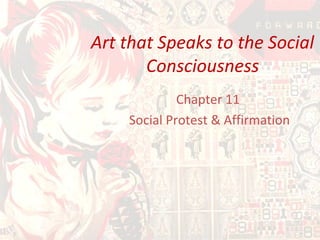
Art that Speaks to the Social
Consciousness
Chapter 11
Social Protest & Affirmation
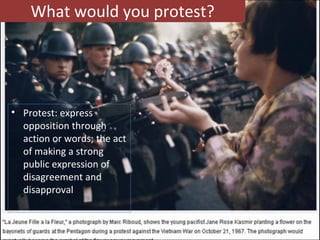
What would you protest?
• Protest: express
opposition through
action or words; the act
of making a strong
public expression of
disagreement and
disapproval
Art as Protest
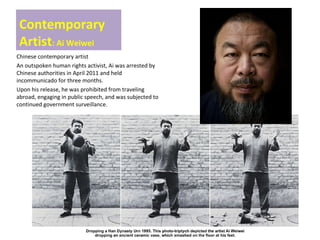
• Protests Against Military Action
• Fighting for the Oppressed
• Affirmation
• Representing the underrepresented
• Questioning the Status Quo
18th
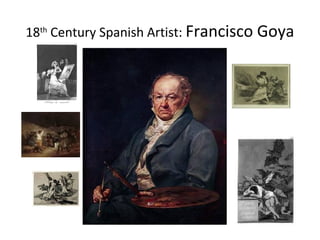
Century Spanish Artist: Francisco Goya
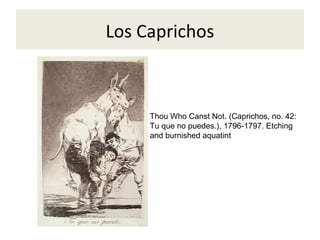
Los Caprichos
Thou Who Canst Not. (Caprichos, no. 42:
Tu que no puedes.), 1796-1797. Etching
and burnished aquatint
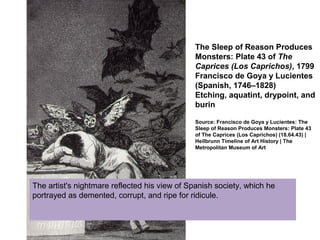
The Sleep of Reason Produces
Monsters: Plate 43 of The
Caprices (Los Caprichos), 1799
Francisco de Goya y Lucientes
(Spanish, 1746–1828)
Etching, aquatint, drypoint, and
burin
Source: Francisco de Goya y Lucientes: The
Sleep of Reason Produces Monsters: Plate 43
of The Caprices (Los Caprichos) (18.64.43) |
Heilbrunn Timeline of Art History | The
Metropolitan Museum of Art
The artist's nightmare reflected his view of Spanish society, which he
portrayed as demented, corrupt, and ripe for ridicule.
About Goya’s work…
• The 1808 invasion of Spain by Napoleon’s army and the succeeding French
occupation, which lasted until 1814, had a profound impact on Francisco Goya.
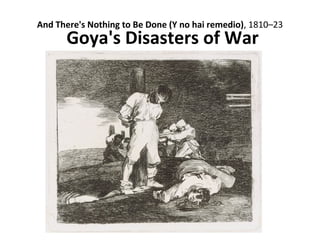
• A powerful anti-war statement, Goya is not only criticizing the nations that wage
war on one another, but is also admonishing us, the viewers, for being complicit in
acts of violence, which occur not between abstract entities like “countries,” but
between one human being standing a few feet away from another.
• n the gruesome Disasters of War series begun in the 1808, but published decades
later, Goya created images that were unambiguously anti-war.
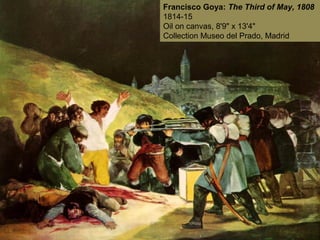
Francisco Goya: The Third of May, 1808
1814-15
Oil on canvas, 8'9" x 13'4"
Collection Museo del Prado, Madrid
And There's Nothing to Be Done (Y no hai remedio), 1810–23
Goya's Disasters of War
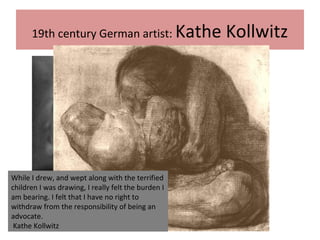
19th century German artist: Kathe Kollwitz
While I drew, and wept along with the terrified
children I was drawing, I really felt the burden I
am bearing. I felt that I have no right to
withdraw from the responsibility of being an
advocate.
Kathe Kollwitz
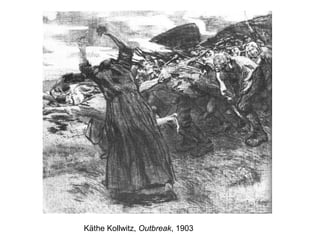
Käthe Kollwitz, Outbreak, 1903
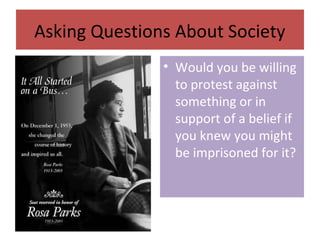
Asking Questions About Society
• Would you be willing
to protest against
something or in
support of a belief if
you knew you might
be imprisoned for it?
Contemporary
Artist: Ai Weiwei
Chinese contemporary artist
An outspoken human rights activist, Ai was arrested by
Chinese authorities in April 2011 and held
incommunicado for three months.
Upon his release, he was prohibited from traveling
abroad, engaging in public speech, and was subjected to
continued government surveillance.
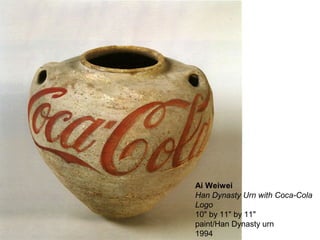
Ai Weiwei
Han Dynasty Urn with Coca-Cola
Logo
10" by 11" by 11"
paint/Han Dynasty urn
1994
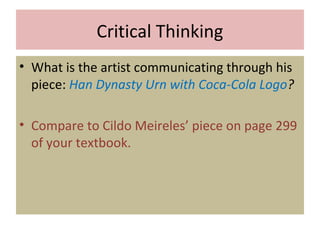
Critical Thinking
• What is the artist communicating through his
piece: Han Dynasty Urn with Coca-Cola Logo?
• Compare to Cildo Meireles’ piece on page 299
of your textbook.
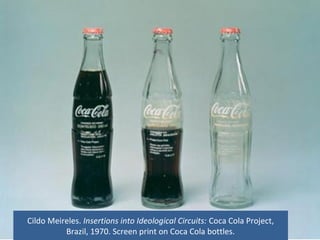
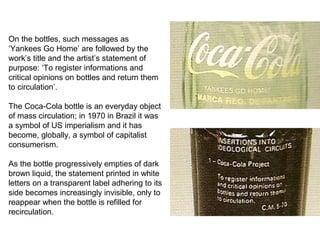
Cildo Meireles. Insertions into Ideological Circuits: Coca Cola Project,
Brazil, 1970. Screen print on Coca Cola bottles.
On the bottles, such messages as
‘Yankees Go Home’ are followed by the
work’s title and the artist’s statement of
purpose: ‘To register informations and
critical opinions on bottles and return them
to circulation’.
The Coca-Cola bottle is an everyday object
of mass circulation; in 1970 in Brazil it was
a symbol of US imperialism and it has
become, globally, a symbol of capitalist
consumerism.
As the bottle progressively empties of dark
brown liquid, the statement printed in white
letters on a transparent label adhering to its
side becomes increasingly invisible, only to
reappear when the bottle is refilled for
recirculation.
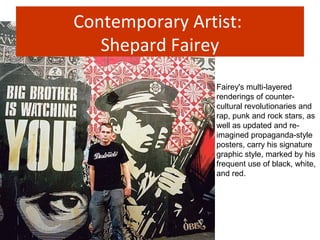
Contemporary Artist:
Shepard Fairey
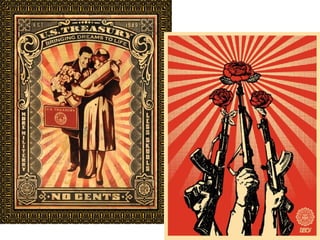
Fairey's multi-layered
renderings of counter-
cultural revolutionaries and
rap, punk and rock stars, as
well as updated and re-
imagined propaganda-style
posters, carry his signature
graphic style, marked by his
frequent use of black, white,
and red.
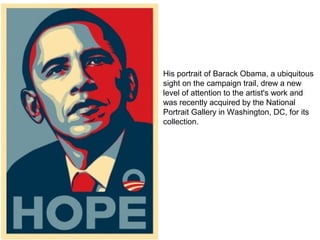
His portrait of Barack Obama, a ubiquitous
sight on the campaign trail, drew a new
level of attention to the artist's work and
was recently acquired by the National
Portrait Gallery in Washington, DC, for its
collection.
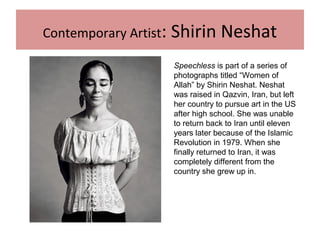
Contemporary Artist: Shirin Neshat
Speechless is part of a series of
photographs titled “Women of
Allah” by Shirin Neshat. Neshat
was raised in Qazvin, Iran, but left
her country to pursue art in the US
after high school. She was unable
to return back to Iran until eleven
years later because of the Islamic
Revolution in 1979. When she
finally returned to Iran, it was
completely different from the
country she grew up in.
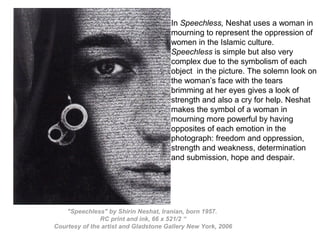
"Speechless" by Shirin Neshat, Iranian, born 1957.
RC print and ink, 66 x 521/2 “
Courtesy of the artist and Gladstone Gallery New York, 2006
In Speechless, Neshat uses a woman in
mourning to represent the oppression of
women in the Islamic culture.
Speechless is simple but also very
complex due to the symbolism of each
object in the picture. The solemn look on
the woman’s face with the tears
brimming at her eyes gives a look of
strength and also a cry for help. Neshat
makes the symbol of a woman in
mourning more powerful by having
opposites of each emotion in the
photograph: freedom and oppression,
strength and weakness, determination
and submission, hope and despair.
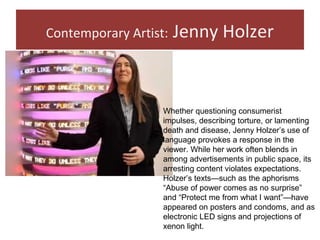
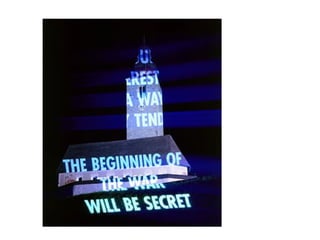
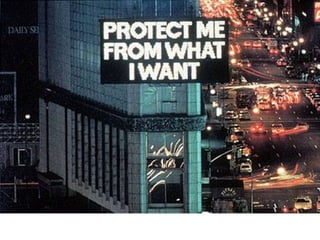
Contemporary Artist: Jenny Holzer
Whether questioning consumerist
impulses, describing torture, or lamenting
death and disease, Jenny Holzer’s use of
language provokes a response in the
viewer. While her work often blends in
among advertisements in public space, its
arresting content violates expectations.
Holzer’s texts—such as the aphorisms
“Abuse of power comes as no surprise”
and “Protect me from what I want”—have
appeared on posters and condoms, and as
electronic LED signs and projections of
xenon light.
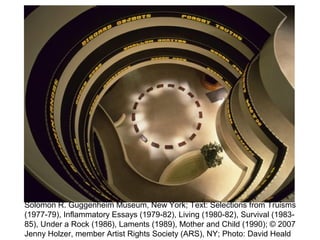
Solomon R. Guggenheim Museum, New York; Text: Selections from Truisms
(1977-79), Inflammatory Essays (1979-82), Living (1980-82), Survival (1983-
85), Under a Rock (1986), Laments (1989), Mother and Child (1990); © 2007
Jenny Holzer, member Artist Rights Society (ARS), NY; Photo: David Heald
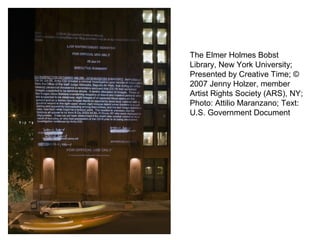
The Elmer Holmes Bobst
Library, New York University;
Presented by Creative Time; ©
2007 Jenny Holzer, member
Artist Rights Society (ARS), NY;
Photo: Attilio Maranzano; Text:
U.S. Government Document
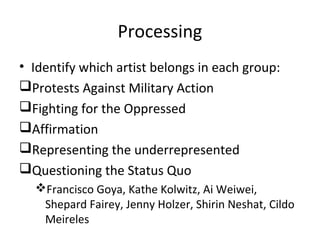
Processing
• Identify which artist belongs in each group:
Protests Against Military Action
Fighting for the Oppressed
Affirmation
Representing the underrepresented
Questioning the Status Quo
Francisco Goya, Kathe Kolwitz, Ai Weiwei,
Shepard Fairey, Jenny Holzer, Shirin Neshat, Cildo
Meireles

Chapter 11 social protest and affirmation

  • 1.
    Art that Speaksto the Social Consciousness Chapter 11 Social Protest & Affirmation
  • 2.
    What would youprotest? • Protest: express opposition through action or words; the act of making a strong public expression of disagreement and disapproval
  • 3.
    Art as Protest •Protests Against Military Action • Fighting for the Oppressed • Affirmation • Representing the underrepresented • Questioning the Status Quo
  • 4.
  • 5.
    Los Caprichos Thou WhoCanst Not. (Caprichos, no. 42: Tu que no puedes.), 1796-1797. Etching and burnished aquatint
  • 6.
    The Sleep ofReason Produces Monsters: Plate 43 of The Caprices (Los Caprichos), 1799 Francisco de Goya y Lucientes (Spanish, 1746–1828) Etching, aquatint, drypoint, and burin Source: Francisco de Goya y Lucientes: The Sleep of Reason Produces Monsters: Plate 43 of The Caprices (Los Caprichos) (18.64.43) | Heilbrunn Timeline of Art History | The Metropolitan Museum of Art The artist's nightmare reflected his view of Spanish society, which he portrayed as demented, corrupt, and ripe for ridicule.
  • 7.
    About Goya’s work… •The 1808 invasion of Spain by Napoleon’s army and the succeeding French occupation, which lasted until 1814, had a profound impact on Francisco Goya. • A powerful anti-war statement, Goya is not only criticizing the nations that wage war on one another, but is also admonishing us, the viewers, for being complicit in acts of violence, which occur not between abstract entities like “countries,” but between one human being standing a few feet away from another. • n the gruesome Disasters of War series begun in the 1808, but published decades later, Goya created images that were unambiguously anti-war.
  • 8.
    Francisco Goya: TheThird of May, 1808 1814-15 Oil on canvas, 8'9" x 13'4" Collection Museo del Prado, Madrid
  • 9.
    And There's Nothingto Be Done (Y no hai remedio), 1810–23 Goya's Disasters of War
  • 10.
    19th century Germanartist: Kathe Kollwitz While I drew, and wept along with the terrified children I was drawing, I really felt the burden I am bearing. I felt that I have no right to withdraw from the responsibility of being an advocate. Kathe Kollwitz
  • 11.
  • 12.
    Asking Questions AboutSociety • Would you be willing to protest against something or in support of a belief if you knew you might be imprisoned for it?
  • 13.
    Contemporary Artist: Ai Weiwei Chinesecontemporary artist An outspoken human rights activist, Ai was arrested by Chinese authorities in April 2011 and held incommunicado for three months. Upon his release, he was prohibited from traveling abroad, engaging in public speech, and was subjected to continued government surveillance.
  • 14.
    Ai Weiwei Han DynastyUrn with Coca-Cola Logo 10" by 11" by 11" paint/Han Dynasty urn 1994
  • 15.
    Critical Thinking • Whatis the artist communicating through his piece: Han Dynasty Urn with Coca-Cola Logo? • Compare to Cildo Meireles’ piece on page 299 of your textbook.
  • 16.
    Cildo Meireles. Insertionsinto Ideological Circuits: Coca Cola Project, Brazil, 1970. Screen print on Coca Cola bottles.
  • 17.
    On the bottles,such messages as ‘Yankees Go Home’ are followed by the work’s title and the artist’s statement of purpose: ‘To register informations and critical opinions on bottles and return them to circulation’. The Coca-Cola bottle is an everyday object of mass circulation; in 1970 in Brazil it was a symbol of US imperialism and it has become, globally, a symbol of capitalist consumerism. As the bottle progressively empties of dark brown liquid, the statement printed in white letters on a transparent label adhering to its side becomes increasingly invisible, only to reappear when the bottle is refilled for recirculation.
  • 18.
    Contemporary Artist: Shepard Fairey Fairey'smulti-layered renderings of counter- cultural revolutionaries and rap, punk and rock stars, as well as updated and re- imagined propaganda-style posters, carry his signature graphic style, marked by his frequent use of black, white, and red.
  • 19.
    His portrait ofBarack Obama, a ubiquitous sight on the campaign trail, drew a new level of attention to the artist's work and was recently acquired by the National Portrait Gallery in Washington, DC, for its collection.
  • 21.
    Contemporary Artist: ShirinNeshat Speechless is part of a series of photographs titled “Women of Allah” by Shirin Neshat. Neshat was raised in Qazvin, Iran, but left her country to pursue art in the US after high school. She was unable to return back to Iran until eleven years later because of the Islamic Revolution in 1979. When she finally returned to Iran, it was completely different from the country she grew up in.
  • 22.
    "Speechless" by ShirinNeshat, Iranian, born 1957. RC print and ink, 66 x 521/2 “ Courtesy of the artist and Gladstone Gallery New York, 2006 In Speechless, Neshat uses a woman in mourning to represent the oppression of women in the Islamic culture. Speechless is simple but also very complex due to the symbolism of each object in the picture. The solemn look on the woman’s face with the tears brimming at her eyes gives a look of strength and also a cry for help. Neshat makes the symbol of a woman in mourning more powerful by having opposites of each emotion in the photograph: freedom and oppression, strength and weakness, determination and submission, hope and despair.
  • 23.
    Contemporary Artist: JennyHolzer Whether questioning consumerist impulses, describing torture, or lamenting death and disease, Jenny Holzer’s use of language provokes a response in the viewer. While her work often blends in among advertisements in public space, its arresting content violates expectations. Holzer’s texts—such as the aphorisms “Abuse of power comes as no surprise” and “Protect me from what I want”—have appeared on posters and condoms, and as electronic LED signs and projections of xenon light.
  • 24.
    Solomon R. GuggenheimMuseum, New York; Text: Selections from Truisms (1977-79), Inflammatory Essays (1979-82), Living (1980-82), Survival (1983- 85), Under a Rock (1986), Laments (1989), Mother and Child (1990); © 2007 Jenny Holzer, member Artist Rights Society (ARS), NY; Photo: David Heald
  • 27.
    The Elmer HolmesBobst Library, New York University; Presented by Creative Time; © 2007 Jenny Holzer, member Artist Rights Society (ARS), NY; Photo: Attilio Maranzano; Text: U.S. Government Document
  • 28.
    Processing • Identify whichartist belongs in each group: Protests Against Military Action Fighting for the Oppressed Affirmation Representing the underrepresented Questioning the Status Quo Francisco Goya, Kathe Kolwitz, Ai Weiwei, Shepard Fairey, Jenny Holzer, Shirin Neshat, Cildo Meireles