Learning From the Future As ItLearning From the Future As It
Emerges: Being an Adaptive LeaderEmerges: Being an Adaptive Leader 11
Craig McDowell
craig@aspire2lead.co.nz
Asenz. Wellington. September 20121. Heifetz, Grashow & Linsky (2009)
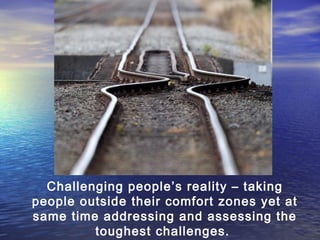
Challenging people’s reality – taking
people outside their comfort zones yet at
same time addressing and assessing the
toughest challenges.
Meanwhile, you still have to
lead!
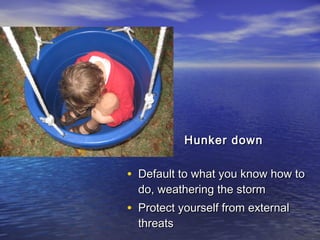
Hunker downHunker down
• Default to what you know how toDefault to what you know how to
do, weathering the stormdo, weathering the storm
• Protect yourself from externalProtect yourself from external
threatsthreats
Press resetPress reset
• Use turbulence to build on and bring closure toUse turbulence to build on and bring closure to
the past, changing rules of the game, reshapingthe past, changing rules of the game, reshaping
the organisation, redefine the work people dothe organisation, redefine the work people do
• Process of conservation as well as reinventionProcess of conservation as well as reinvention
Senge, Scharmer, Jaworski, Flowers (2004)
When have you had a choice of hunkeringWhen have you had a choice of hunkering
down or pressing reset?down or pressing reset?
What were the circumstances to yourWhat were the circumstances to your
decision?decision?
Foster Adaptation
Leadership: An improvisational and experimental art
Foster AdaptationFoster Adaptation
• Developing next practicesDeveloping next practices
• Run numerous experimentsRun numerous experiments
• Distinguish the essential from theDistinguish the essential from the
expendableexpendable
Foster AdaptationFoster Adaptation
Why is it so difficult for people toWhy is it so difficult for people to
leave something behind that hadleave something behind that had
been valued?been valued?
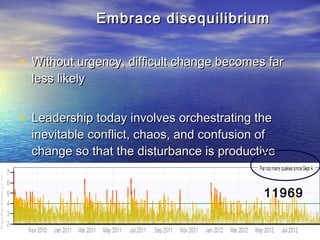
Embrace disequilibriumEmbrace disequilibrium
• Without urgency, difficult change becomes farWithout urgency, difficult change becomes far
less likelyless likely
• Leadership today involves orchestrating theLeadership today involves orchestrating the
inevitable conflict, chaos, and confusion ofinevitable conflict, chaos, and confusion of
change so that the disturbance is productivechange so that the disturbance is productive
rather than destructiverather than destructive
11969
Embrace disequilibrium
First-order Change
When change is viewed as:
An extension of the past
Within existing paradigms
Consistent with prevailing
values & norms
Implemented with existing
knowledge & skills
Embrace disequilibrium
First-order Change
When change is viewed as:
Second-order Change:
When change is viewed as:
An extension of the past A break with the past
Within existing paradigms Outside of existing paradigms
Consistent with prevailing
values & norms
Conflicting with prevailing
values & norms
Implemented with existing
knowledge & skills
Requiring new knowledge &
skills
Embrace disequilibriumEmbrace disequilibrium
• Keep your eyes on the thermostatKeep your eyes on the thermostat
• Depersonalise conflictDepersonalise conflict
• Have courageous conversationsHave courageous conversations
Embrace disequilibriumEmbrace disequilibrium
How does your ability and willingnessHow does your ability and willingness
to have courageous conversations,to have courageous conversations,
demonstrate authenticity and builddemonstrate authenticity and build
credibility and trust?credibility and trust?
“Stability is a liability, not an asset in today’s world.
Each view of the horizon is a glance through a
different turn of the kaleidoscope”
(Egon Zehnder, 2000)
Generate leadershipGenerate leadership
• Acknowledge interdependence of peopleAcknowledge interdependence of people
• Use leadership to generate moreUse leadership to generate more
leadership deep in organisationleadership deep in organisation
• Share leadership responsibilityShare leadership responsibility
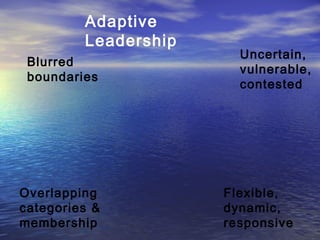
Adaptive
Leadership
Blurred
boundaries
Overlapping
categories &
membership
Flexible,
dynamic,
responsive
Uncertain,
vulnerable,
contested
Generate leadershipGenerate leadership
• Mobilise everyone to generate solutionsMobilise everyone to generate solutions
• Give up some authority and ownershipGive up some authority and ownership
Generate leadershipGenerate leadership
When have you had to give up someWhen have you had to give up some
authority and ownership to others inauthority and ownership to others in
order to generate leadership, andorder to generate leadership, and
how did this feel?how did this feel?
Taking care of yourselfTaking care of yourself
• Balance with your own thinkingBalance with your own thinking
and emotionsand emotions
• Be both optimisticBe both optimistic
and realisticand realistic
• Find a sanctuaryFind a sanctuary
Taking care of yourselfTaking care of yourself
• Reach out to confidantsReach out to confidants
• Bring more of yourBring more of your
emotional self to theemotional self to the
tabletable
• Don’t lose yourself inDon’t lose yourself in
your roleyour role
Ready to
Adapt?
Hunker Down or Press
Reset
Foster Adaptation
Embrace Disequlibrium
Generate Leadership
Take Care of Yourself
Hunker Down or Press
Reset
Foster Adaptation
Embrace Disequlibrium
Generate Leadership
Take Care of Yourself
Learning From the Future As ItLearning From the Future As It
Emerges: Being an Adaptive LeaderEmerges: Being an Adaptive Leader
Learning from
as it emerges -
adaptive leadership
Adaptive OrganisationAdaptive Organisation
• Elephants in the roomElephants in the room
• Shared responsibilityShared responsibility
• Independent judgementIndependent judgement
• Develop leadership capacityDevelop leadership capacity
• Institutionised reflection andInstitutionised reflection and
continuous learningcontinuous learning
Craig McDowell
craig@aspire2lead.co.nz
Asenz. Wellington. 2012
One thing you
would like to
explore further.
What is going
around in your
head?
What are three
ideas that you took
from the sessions?
What do you agree
with – what
“squared off”
your thinking /
philosophy?

Asenz Presentation Full(Craig McDowell)

  • 1.
    Learning From theFuture As ItLearning From the Future As It Emerges: Being an Adaptive LeaderEmerges: Being an Adaptive Leader 11 Craig McDowell craig@aspire2lead.co.nz Asenz. Wellington. September 20121. Heifetz, Grashow & Linsky (2009)
  • 2.
    Challenging people’s reality– taking people outside their comfort zones yet at same time addressing and assessing the toughest challenges.
  • 3.
    Meanwhile, you stillhave to lead!
  • 5.
    Hunker downHunker down •Default to what you know how toDefault to what you know how to do, weathering the stormdo, weathering the storm • Protect yourself from externalProtect yourself from external threatsthreats
  • 6.
    Press resetPress reset •Use turbulence to build on and bring closure toUse turbulence to build on and bring closure to the past, changing rules of the game, reshapingthe past, changing rules of the game, reshaping the organisation, redefine the work people dothe organisation, redefine the work people do • Process of conservation as well as reinventionProcess of conservation as well as reinvention
  • 7.
  • 8.
    When have youhad a choice of hunkeringWhen have you had a choice of hunkering down or pressing reset?down or pressing reset? What were the circumstances to yourWhat were the circumstances to your decision?decision?
  • 9.
    Foster Adaptation Leadership: Animprovisational and experimental art
  • 10.
    Foster AdaptationFoster Adaptation •Developing next practicesDeveloping next practices • Run numerous experimentsRun numerous experiments • Distinguish the essential from theDistinguish the essential from the expendableexpendable
  • 11.
    Foster AdaptationFoster Adaptation Whyis it so difficult for people toWhy is it so difficult for people to leave something behind that hadleave something behind that had been valued?been valued?
  • 12.
  • 13.
    Embrace disequilibriumEmbrace disequilibrium •Without urgency, difficult change becomes farWithout urgency, difficult change becomes far less likelyless likely • Leadership today involves orchestrating theLeadership today involves orchestrating the inevitable conflict, chaos, and confusion ofinevitable conflict, chaos, and confusion of change so that the disturbance is productivechange so that the disturbance is productive rather than destructiverather than destructive 11969
  • 14.
    Embrace disequilibrium First-order Change Whenchange is viewed as: An extension of the past Within existing paradigms Consistent with prevailing values & norms Implemented with existing knowledge & skills
  • 15.
    Embrace disequilibrium First-order Change Whenchange is viewed as: Second-order Change: When change is viewed as: An extension of the past A break with the past Within existing paradigms Outside of existing paradigms Consistent with prevailing values & norms Conflicting with prevailing values & norms Implemented with existing knowledge & skills Requiring new knowledge & skills
  • 16.
    Embrace disequilibriumEmbrace disequilibrium •Keep your eyes on the thermostatKeep your eyes on the thermostat • Depersonalise conflictDepersonalise conflict • Have courageous conversationsHave courageous conversations
  • 17.
    Embrace disequilibriumEmbrace disequilibrium Howdoes your ability and willingnessHow does your ability and willingness to have courageous conversations,to have courageous conversations, demonstrate authenticity and builddemonstrate authenticity and build credibility and trust?credibility and trust?
  • 18.
    “Stability is aliability, not an asset in today’s world. Each view of the horizon is a glance through a different turn of the kaleidoscope” (Egon Zehnder, 2000) Generate leadershipGenerate leadership • Acknowledge interdependence of peopleAcknowledge interdependence of people • Use leadership to generate moreUse leadership to generate more leadership deep in organisationleadership deep in organisation • Share leadership responsibilityShare leadership responsibility
  • 19.
  • 20.
    Generate leadershipGenerate leadership •Mobilise everyone to generate solutionsMobilise everyone to generate solutions • Give up some authority and ownershipGive up some authority and ownership
  • 21.
    Generate leadershipGenerate leadership Whenhave you had to give up someWhen have you had to give up some authority and ownership to others inauthority and ownership to others in order to generate leadership, andorder to generate leadership, and how did this feel?how did this feel?
  • 22.
    Taking care ofyourselfTaking care of yourself • Balance with your own thinkingBalance with your own thinking and emotionsand emotions • Be both optimisticBe both optimistic and realisticand realistic • Find a sanctuaryFind a sanctuary
  • 23.
    Taking care ofyourselfTaking care of yourself • Reach out to confidantsReach out to confidants • Bring more of yourBring more of your emotional self to theemotional self to the tabletable • Don’t lose yourself inDon’t lose yourself in your roleyour role
  • 24.
  • 25.
    Hunker Down orPress Reset Foster Adaptation Embrace Disequlibrium Generate Leadership Take Care of Yourself Hunker Down or Press Reset Foster Adaptation Embrace Disequlibrium Generate Leadership Take Care of Yourself Learning From the Future As ItLearning From the Future As It Emerges: Being an Adaptive LeaderEmerges: Being an Adaptive Leader Learning from as it emerges - adaptive leadership
  • 26.
  • 27.
    Adaptive OrganisationAdaptive Organisation •Elephants in the roomElephants in the room • Shared responsibilityShared responsibility • Independent judgementIndependent judgement • Develop leadership capacityDevelop leadership capacity • Institutionised reflection andInstitutionised reflection and continuous learningcontinuous learning
  • 28.
    Craig McDowell craig@aspire2lead.co.nz Asenz. Wellington.2012 One thing you would like to explore further. What is going around in your head? What are three ideas that you took from the sessions? What do you agree with – what “squared off” your thinking / philosophy?