










Sherif (1935)


The Autokinetic effect



On the next slide is a light. The light will move
and you have to say in which way it is
moving.
Sherif (1935)




The autokinetic effect is when a stationary
spot of light appears to move due to small
movements of the eye
Sherif told participants to estimate by how far
the spot of light had moved.





Asked individually
Then exposed to the estimates of two other
participants
Estimates tended to converge to a group norm
which was an average of these individuals’
estimates.
Issues with the previous research


Sherif and Jenness both used ambiguous
situations to investigate conformity.



Little was known about conformity in nonambiguous situations (where the answer was
clear)
Asch (1955)
Asch – Star study
Aims






Investigate the effects of group pressure on
individuals in unambiguous situations.
To test conformity when the correct answer
was clear and obvious.
When confronted with an obviously incorrect
answer, would individuals would give an
answer which perpetuated this error
(conformed) or would they would give an
independent response?
Asch continued


Used 123 participants.



All were American, male students.



The method was a laboratory experiment.
The Main study


Findings for the MAIN study


In a control study carried out before this
experiment, it was found that less than 1% of
people made errors when carrying out this task
when by themselves. This suggests that this task
is _____________.

unambiguous
Findings from the baseline study










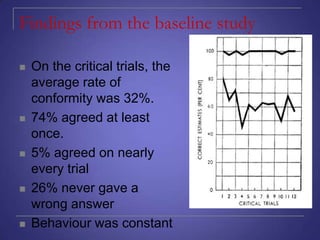
On the critical trials, the
average rate of
conformity was 32%.
74% agreed at least
once.
5% agreed on nearly
every trial
26% never gave a
wrong answer
Behaviour was constant
Those who did not conform…


Asch states “Those who strike out on the
path to independence, do not, as a
rule, succumb to the majority”.




confidence in their own judgment
capacity to recover from doubt
felt it was “their obligation to call the play as they
saw it”
Variations on the baseline procedure


Asch carried out a number of variations of the
same experiment. You need to know the
procedures for the MAIN study, and also
some of the variations.
Conclusions


The results from both the baseline study and
the variations suggest that there is a strong
tendency to conform to group pressures,
even in an unambiguous situation.
Conclusions






The pressure from the majority reduced when
the majority was smaller.
Pressure to conform was also reduced by the
presence of a dissenter, even if the dissenter
was giving a wrong answer.
Therefore, conformity depends a lot upon the
majority being unanimous. For example, when
the dissenter started to agree with the
majority, many participants began to conform.
Evaluate the methodology


Evaluate:






Method
Reliability
Validity
Sampling
Ethical issues
Alternative evidence


Do Sherif and Jenness
support, contradict, or
develop Asch’s results?



Perrin and Spencer (1980)
1 person conformed out of
396 trials







Higher pressure to conform in
the 1950s
Perrin and Spencer used
science students
Alternative evidence


Nicholson et al (1985)




32% of British students and 38% of US students
conformed at least once.
Provides some support.
Alternative Evidence


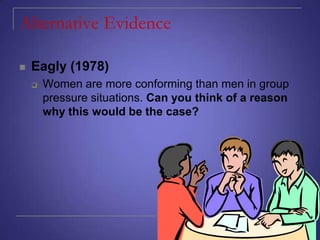
Eagly (1978)


Women are more conforming than men in group
pressure situations. Can you think of a reason
why this would be the case?
Some key terms


Reactance -sometimes called anti-conformity



Majority influence



Public compliance



Private acceptance/internalisation

Asch Conformity Social Psychology AS

  • 1.
    Sherif (1935)  The Autokineticeffect  On the next slide is a light. The light will move and you have to say in which way it is moving.
  • 3.
    Sherif (1935)   The autokineticeffect is when a stationary spot of light appears to move due to small movements of the eye Sherif told participants to estimate by how far the spot of light had moved.    Asked individually Then exposed to the estimates of two other participants Estimates tended to converge to a group norm which was an average of these individuals’ estimates.
  • 4.
    Issues with theprevious research  Sherif and Jenness both used ambiguous situations to investigate conformity.  Little was known about conformity in nonambiguous situations (where the answer was clear)
  • 5.
  • 6.
    Asch – Starstudy Aims    Investigate the effects of group pressure on individuals in unambiguous situations. To test conformity when the correct answer was clear and obvious. When confronted with an obviously incorrect answer, would individuals would give an answer which perpetuated this error (conformed) or would they would give an independent response?
  • 7.
    Asch continued  Used 123participants.  All were American, male students.  The method was a laboratory experiment.
  • 8.
    The Main study  Findingsfor the MAIN study  In a control study carried out before this experiment, it was found that less than 1% of people made errors when carrying out this task when by themselves. This suggests that this task is _____________. unambiguous
  • 9.
    Findings from thebaseline study      On the critical trials, the average rate of conformity was 32%. 74% agreed at least once. 5% agreed on nearly every trial 26% never gave a wrong answer Behaviour was constant
  • 10.
    Those who didnot conform…  Asch states “Those who strike out on the path to independence, do not, as a rule, succumb to the majority”.    confidence in their own judgment capacity to recover from doubt felt it was “their obligation to call the play as they saw it”
  • 11.
    Variations on thebaseline procedure  Asch carried out a number of variations of the same experiment. You need to know the procedures for the MAIN study, and also some of the variations.
  • 12.
    Conclusions  The results fromboth the baseline study and the variations suggest that there is a strong tendency to conform to group pressures, even in an unambiguous situation.
  • 13.
    Conclusions    The pressure fromthe majority reduced when the majority was smaller. Pressure to conform was also reduced by the presence of a dissenter, even if the dissenter was giving a wrong answer. Therefore, conformity depends a lot upon the majority being unanimous. For example, when the dissenter started to agree with the majority, many participants began to conform.
  • 14.
  • 15.
    Alternative evidence  Do Sherifand Jenness support, contradict, or develop Asch’s results?  Perrin and Spencer (1980) 1 person conformed out of 396 trials    Higher pressure to conform in the 1950s Perrin and Spencer used science students
  • 16.
    Alternative evidence  Nicholson etal (1985)   32% of British students and 38% of US students conformed at least once. Provides some support.
  • 17.
    Alternative Evidence  Eagly (1978)  Womenare more conforming than men in group pressure situations. Can you think of a reason why this would be the case?
  • 18.
    Some key terms  Reactance-sometimes called anti-conformity  Majority influence  Public compliance  Private acceptance/internalisation