ESHIT BANERJEE
11YAST2003
PRESIDENCY COLLEGE, BANGALORE
GREENBIOSYNTHESISOF SILVERNANOPARTICLES
USINGClitoriaternateaANDITS CHARACTERIZATION
AIM AND OBJECTIVE
Extraction of aqueous extract from Clitoria ternatea .
The aqueous extract for the biosynthesis of silver nanoparticles.
Statistical analysis of the aqueous extract using Ultraviolet-visible
spectroscopy.
Morphological analysis using FE-SEM .
Analysis using XRD to determine the element composition of the sample.
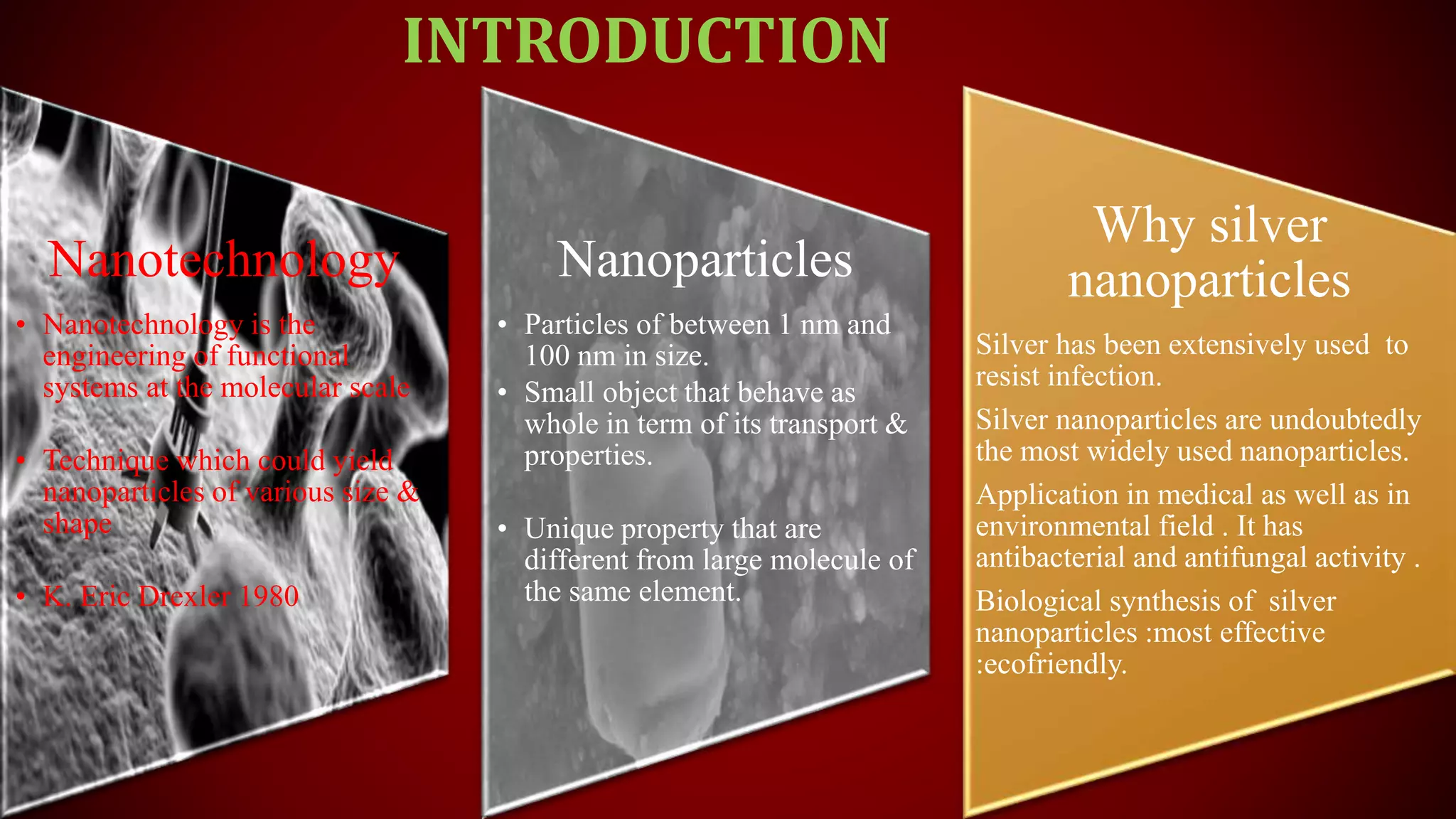
Nanotechnology
• Nanotechnology is the
engineering of functional
systems at the molecular scale
• Technique which could yield
nanoparticles of various size &
shape
• K. Eric Drexler 1980
Nanoparticles
• Particles of between 1 nm and
100 nm in size.
• Small object that behave as
whole in term of its transport &
properties.
• Unique property that are
different from large molecule of
the same element.
Why silver
nanoparticles
Silver has been extensively used to
resist infection.
Silver nanoparticles are undoubtedly
the most widely used nanoparticles.
Application in medical as well as in
environmental field . It has
antibacterial and antifungal activity .
Biological synthesis of silver
nanoparticles :most effective
:ecofriendly.
INTRODUCTION
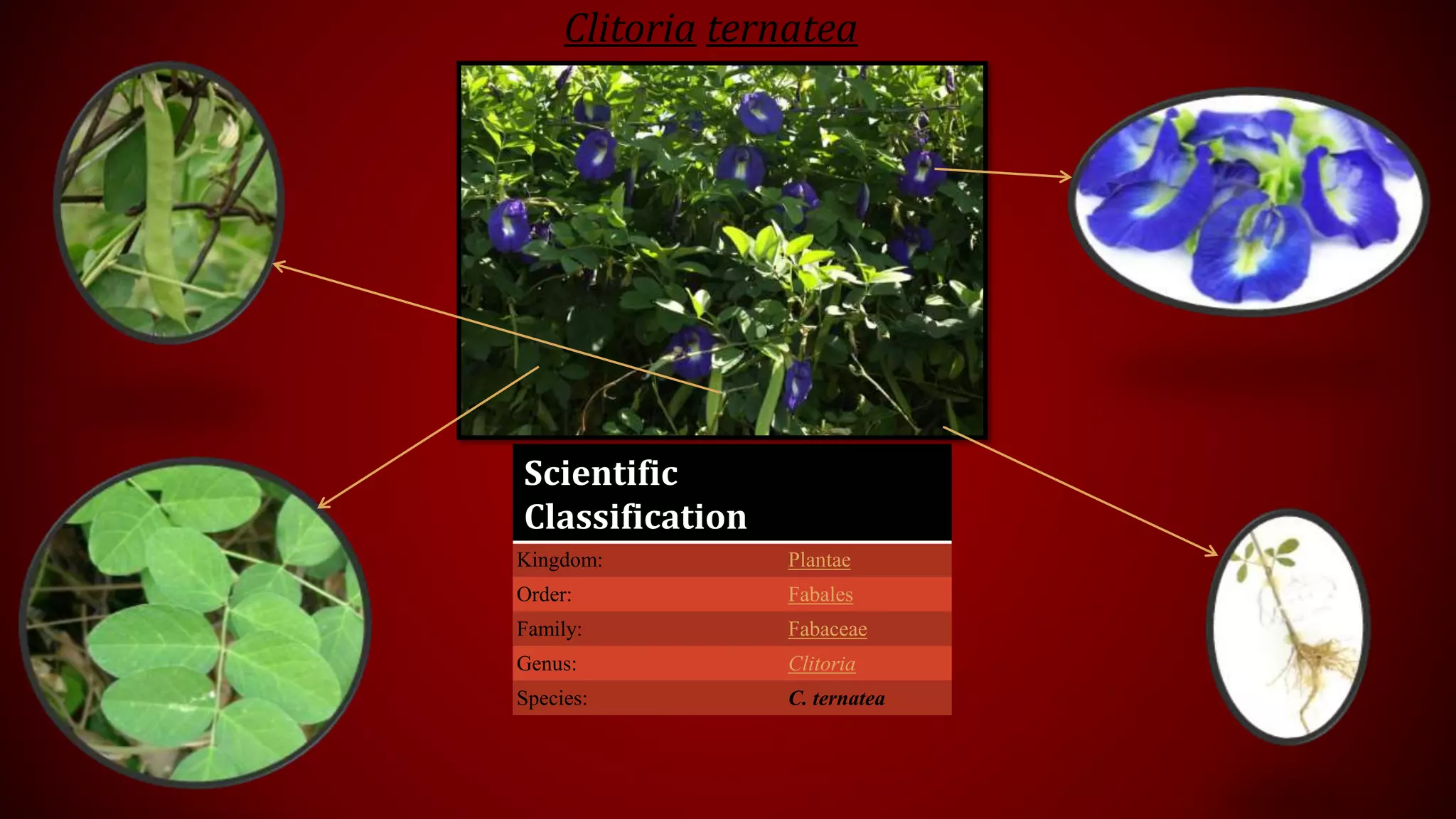
Scientific
Classification
Kingdom: Plantae
Order: Fabales
Family: Fabaceae
Genus: Clitoria
Species: C. ternatea
Clitoria ternatea
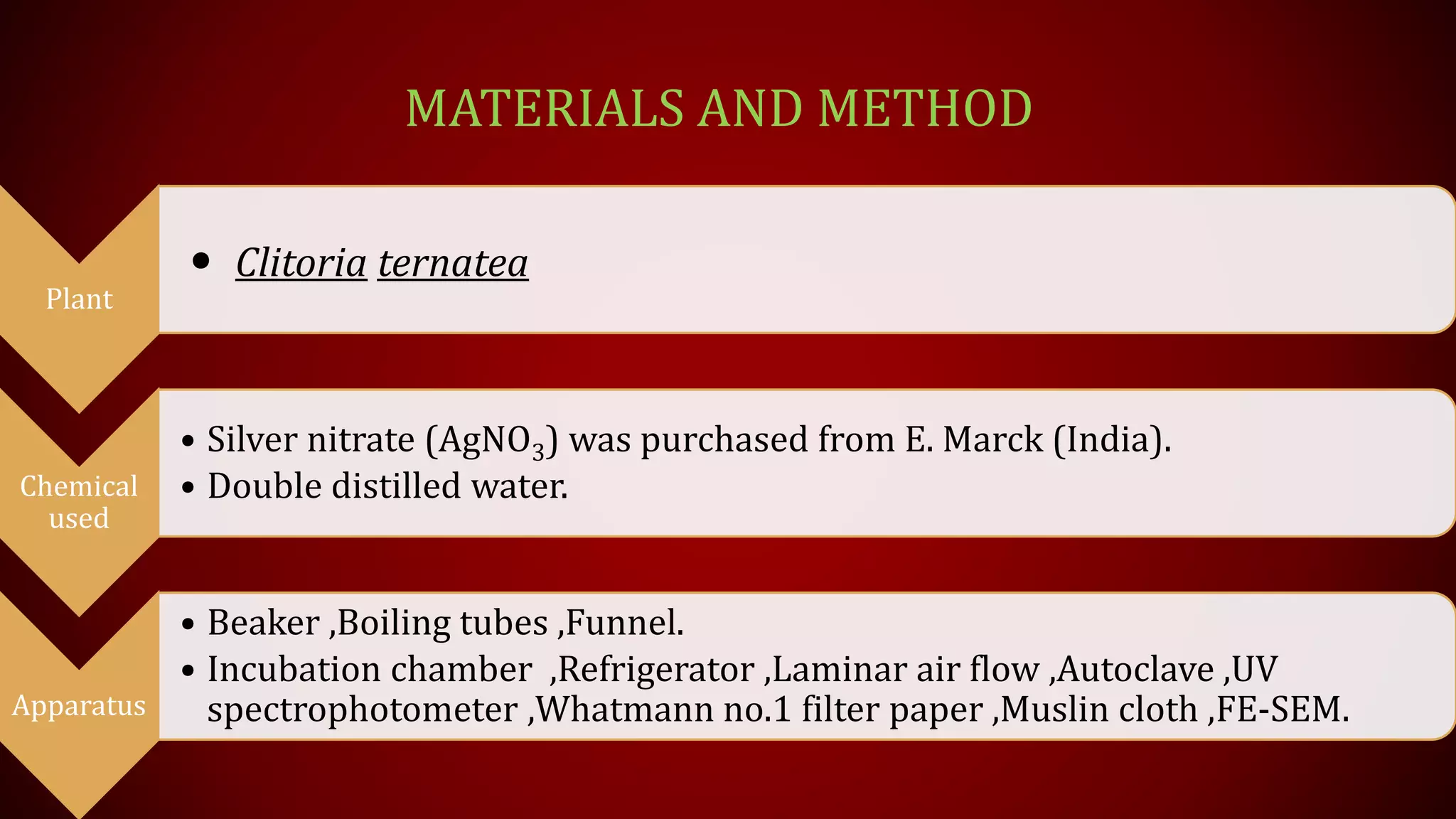
MATERIALS AND METHOD
Plant
• Clitoria ternatea
Chemical
used
• Silver nitrate (AgNO3) was purchased from E. Marck (India).
• Double distilled water.
Apparatus
• Beaker ,Boiling tubes ,Funnel.
• Incubation chamber ,Refrigerator ,Laminar air flow ,Autoclave ,UV
spectrophotometer ,Whatmann no.1 filter paper ,Muslin cloth ,FE-SEM.
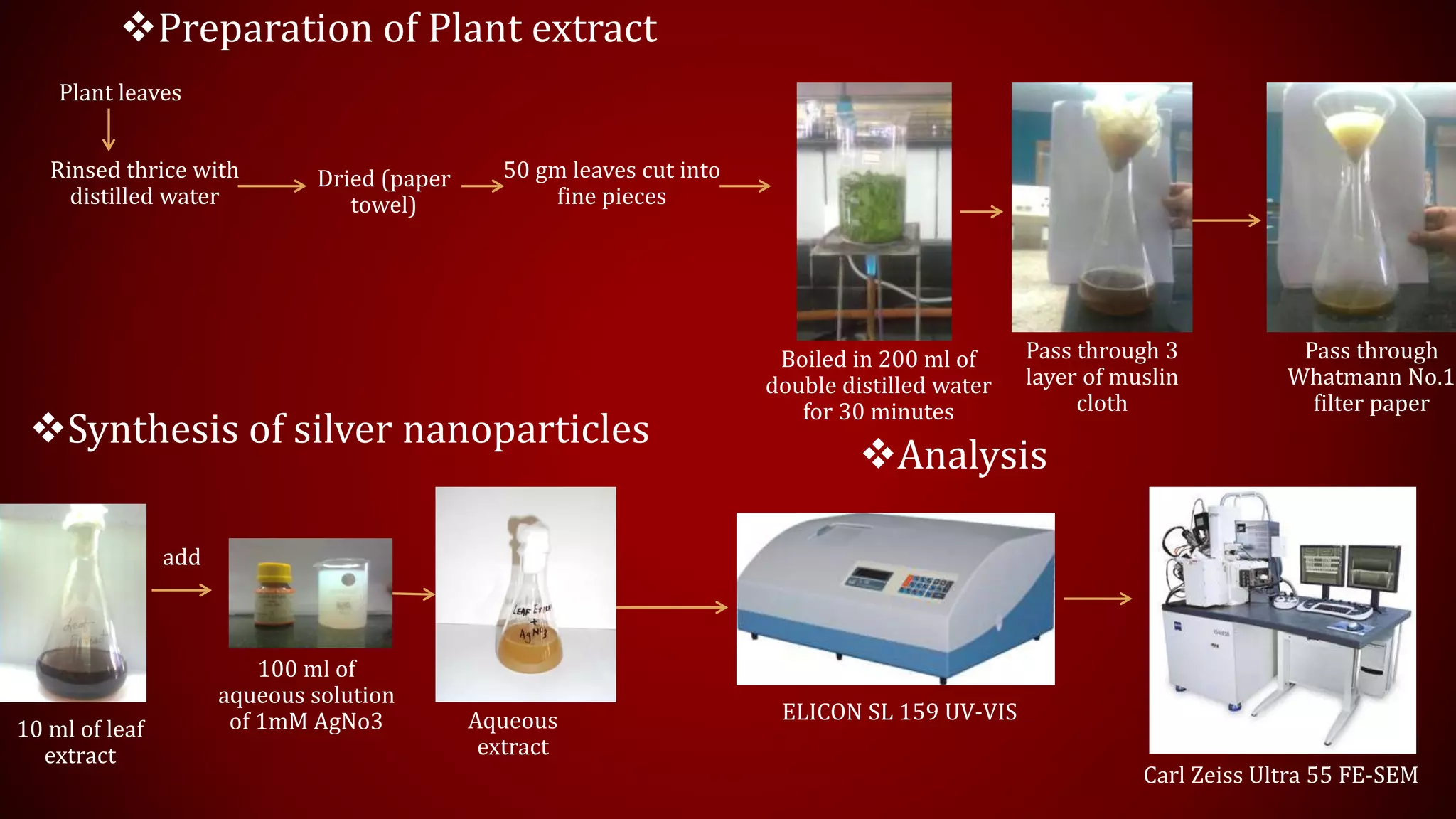
Preparation of Plant extract
Plant leaves
Rinsed thrice with
distilled water
Dried (paper
towel)
50 gm leaves cut into
fine pieces
Boiled in 200 ml of
double distilled water
for 30 minutes
Pass through 3
layer of muslin
cloth
Pass through
Whatmann No.1
filter paper
Synthesis of silver nanoparticles
10 ml of leaf
extract
100 ml of
aqueous solution
of 1mM AgNo3
add
Aqueous
extract
Carl Zeiss Ultra 55 FE-SEM
ELICON SL 159 UV-VIS
Analysis
RESULT AND DISCUSSION
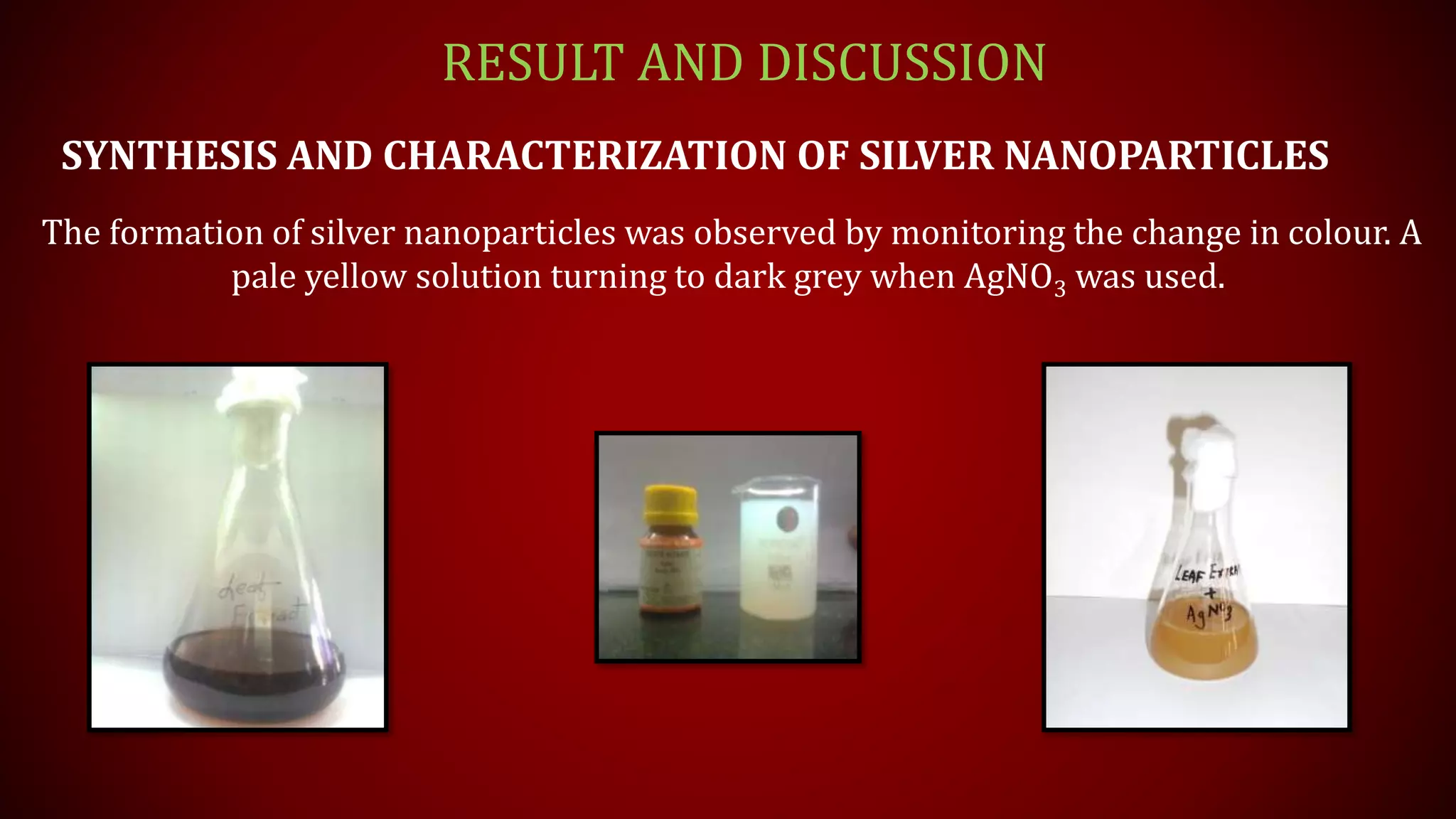
SYNTHESIS AND CHARACTERIZATION OF SILVER NANOPARTICLES
The formation of silver nanoparticles was observed by monitoring the change in colour. A
pale yellow solution turning to dark grey when AgNO3 was used.
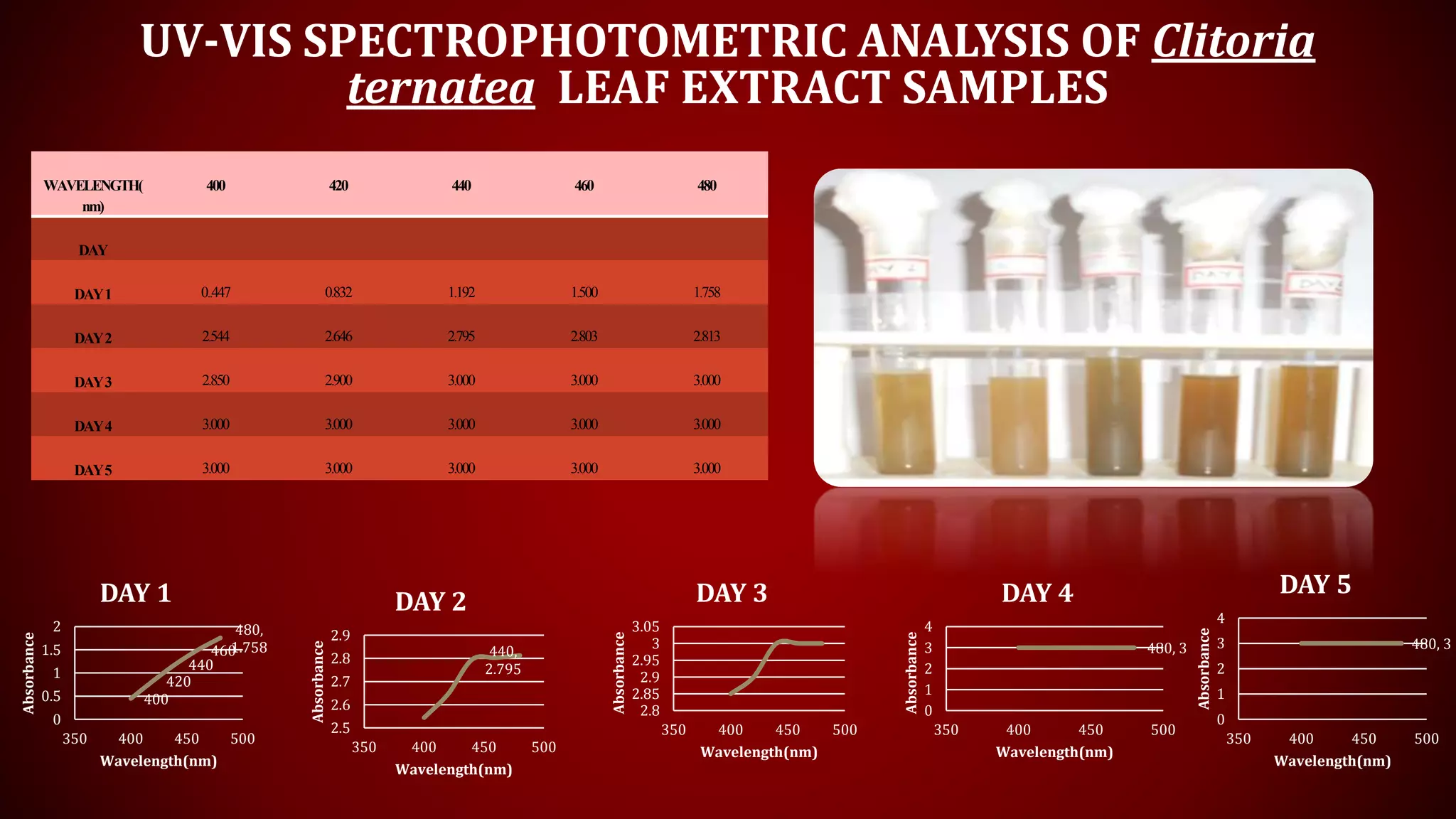
UV-VIS SPECTROPHOTOMETRIC ANALYSIS OF Clitoria
ternatea LEAF EXTRACT SAMPLES
WAVELENGTH(
nm)
400 420 440 460 480
DAY
DAY1 0..447 0.832 1.192 1.500 1.758
DAY2 2.544 2.646 2.795 2.803 2.813
DAY3 2.850 2.900 3.000 3.000 3.000
DAY4 3.000 3.000 3.000 3.000 3.000
DAY5 3.000 3.000 3.000 3.000 3.000
400
420
440
460
480,
1.758
0
0.5
1
1.5
2
350 400 450 500
Absorbance
Wavelength(nm)
DAY 1
440,
2.795
2.5
2.6
2.7
2.8
2.9
350 400 450 500
Absorbance
Wavelength(nm)
DAY 2
2.8
2.85
2.9
2.95
3
3.05
350 400 450 500
Absorbance
Wavelength(nm)
DAY 3
480, 3
0
1
2
3
4
350 400 450 500
Absorbance
Wavelength(nm)
DAY 4
480, 3
0
1
2
3
4
350 400 450 500
Absorbance
Wavelength(nm)
DAY 5
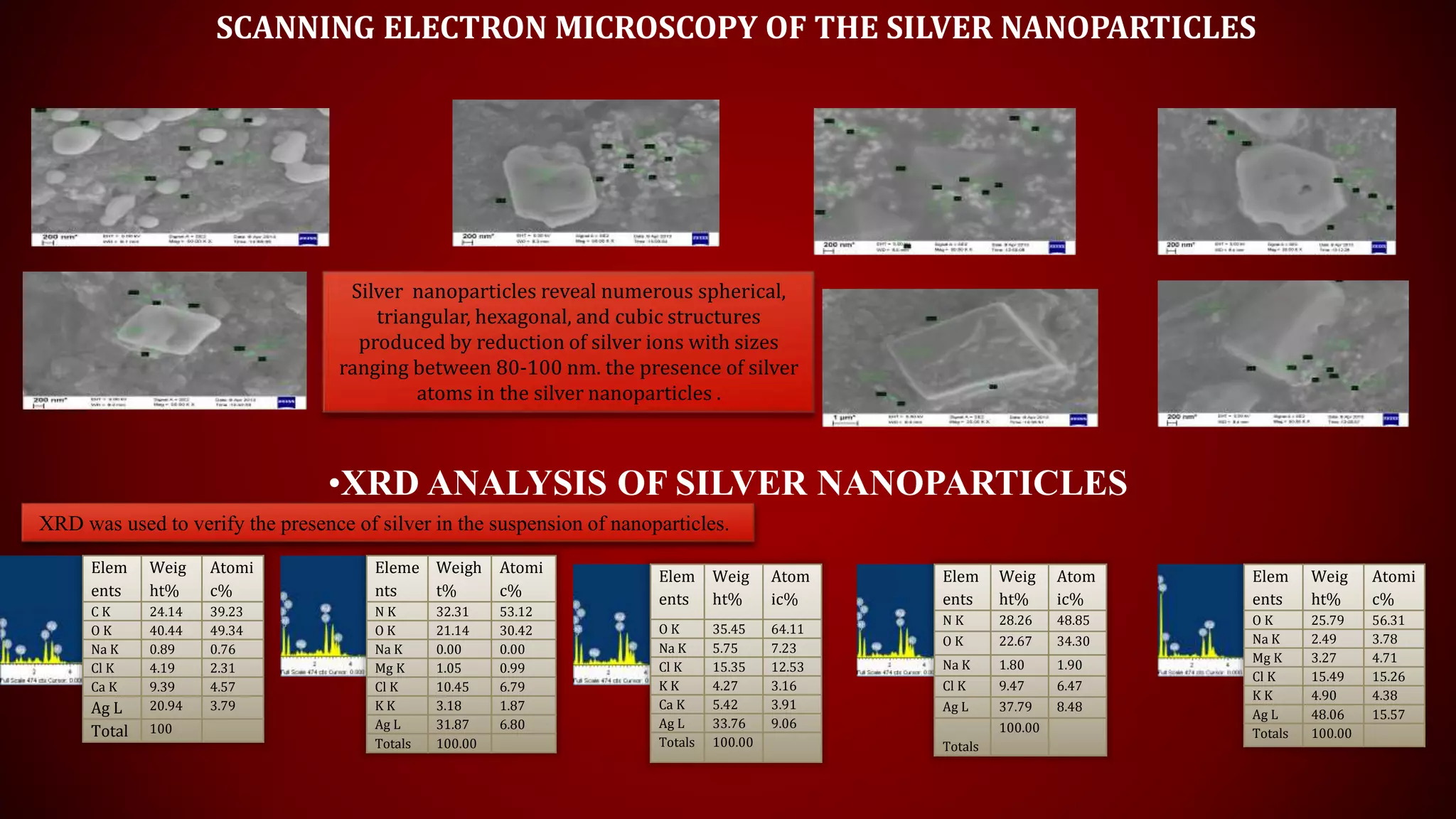
SCANNING ELECTRON MICROSCOPY OF THE SILVER NANOPARTICLES
•XRD ANALYSIS OF SILVER NANOPARTICLES
Silver nanoparticles reveal numerous spherical,
triangular, hexagonal, and cubic structures
produced by reduction of silver ions with sizes
ranging between 80-100 nm. the presence of silver
atoms in the silver nanoparticles .
XRD was used to verify the presence of silver in the suspension of nanoparticles.
Elem
ents
Weig
ht%
Atomi
c%
C K 24.14 39.23
O K 40.44 49.34
Na K 0.89 0.76
Cl K 4.19 2.31
Ca K 9.39 4.57
Ag L 20.94 3.79
Total 100
Eleme
nts
Weigh
t%
Atomi
c%
N K 32.31 53.12
O K 21.14 30.42
Na K 0.00 0.00
Mg K 1.05 0.99
Cl K 10.45 6.79
K K 3.18 1.87
Ag L 31.87 6.80
Totals 100.00
Elem
ents
Weig
ht%
Atom
ic%
O K 35.45 64.11
Na K 5.75 7.23
Cl K 15.35 12.53
K K 4.27 3.16
Ca K 5.42 3.91
Ag L 33.76 9.06
Totals 100.00
Elem
ents
Weig
ht%
Atom
ic%
N K 28.26 48.85
O K 22.67 34.30
Na K 1.80 1.90
Cl K 9.47 6.47
Ag L 37.79 8.48
Totals
100.00
Elem
ents
Weig
ht%
Atomi
c%
O K 25.79 56.31
Na K 2.49 3.78
Mg K 3.27 4.71
Cl K 15.49 15.26
K K 4.90 4.38
Ag L 48.06 15.57
Totals 100.00
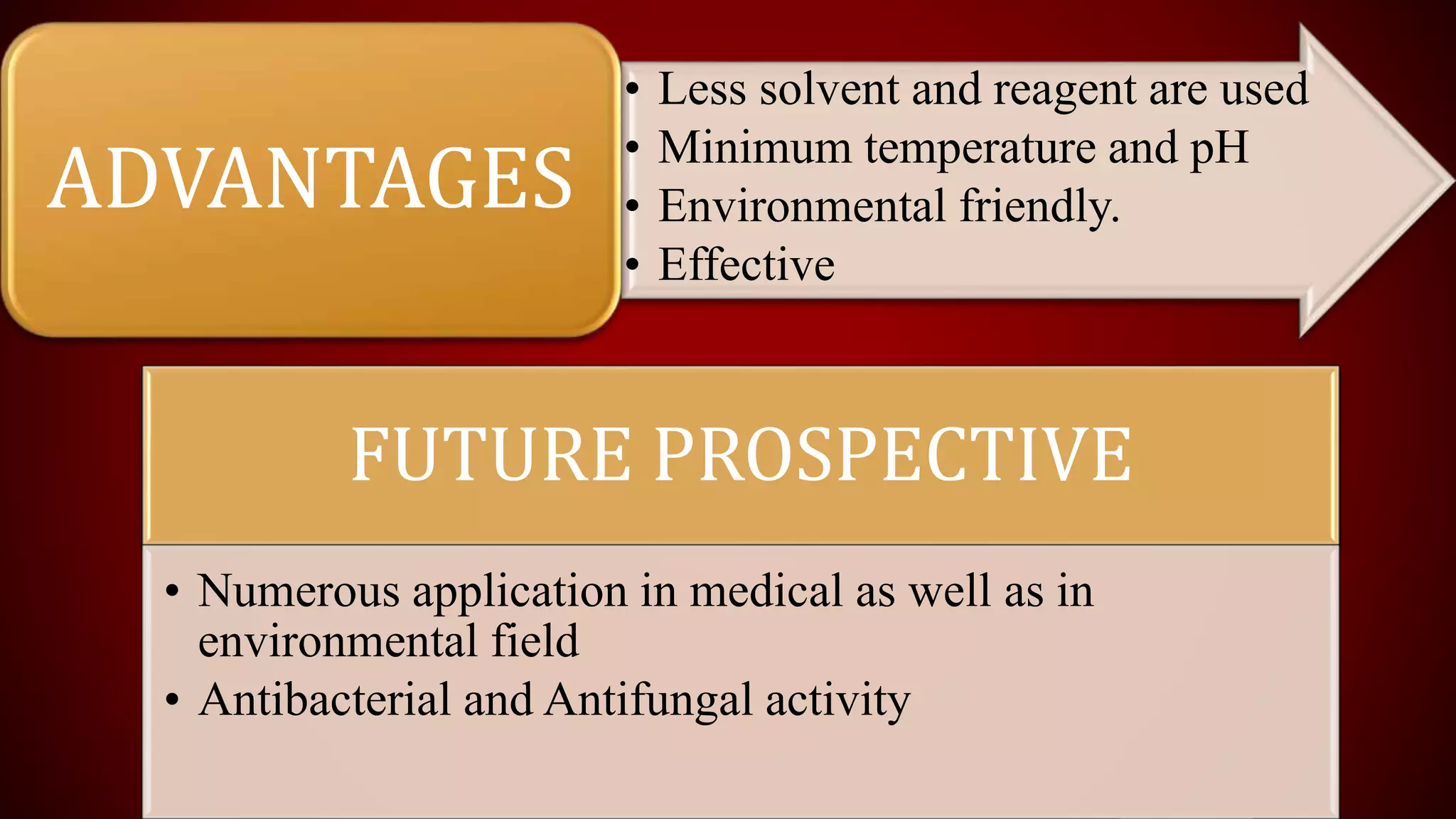
• Less solvent and reagent are used
• Minimum temperature and pH
• Environmental friendly.
• Effective
ADVANTAGES
FUTURE PROSPECTIVE
• Numerous application in medical as well as in
environmental field
• Antibacterial and Antifungal activity
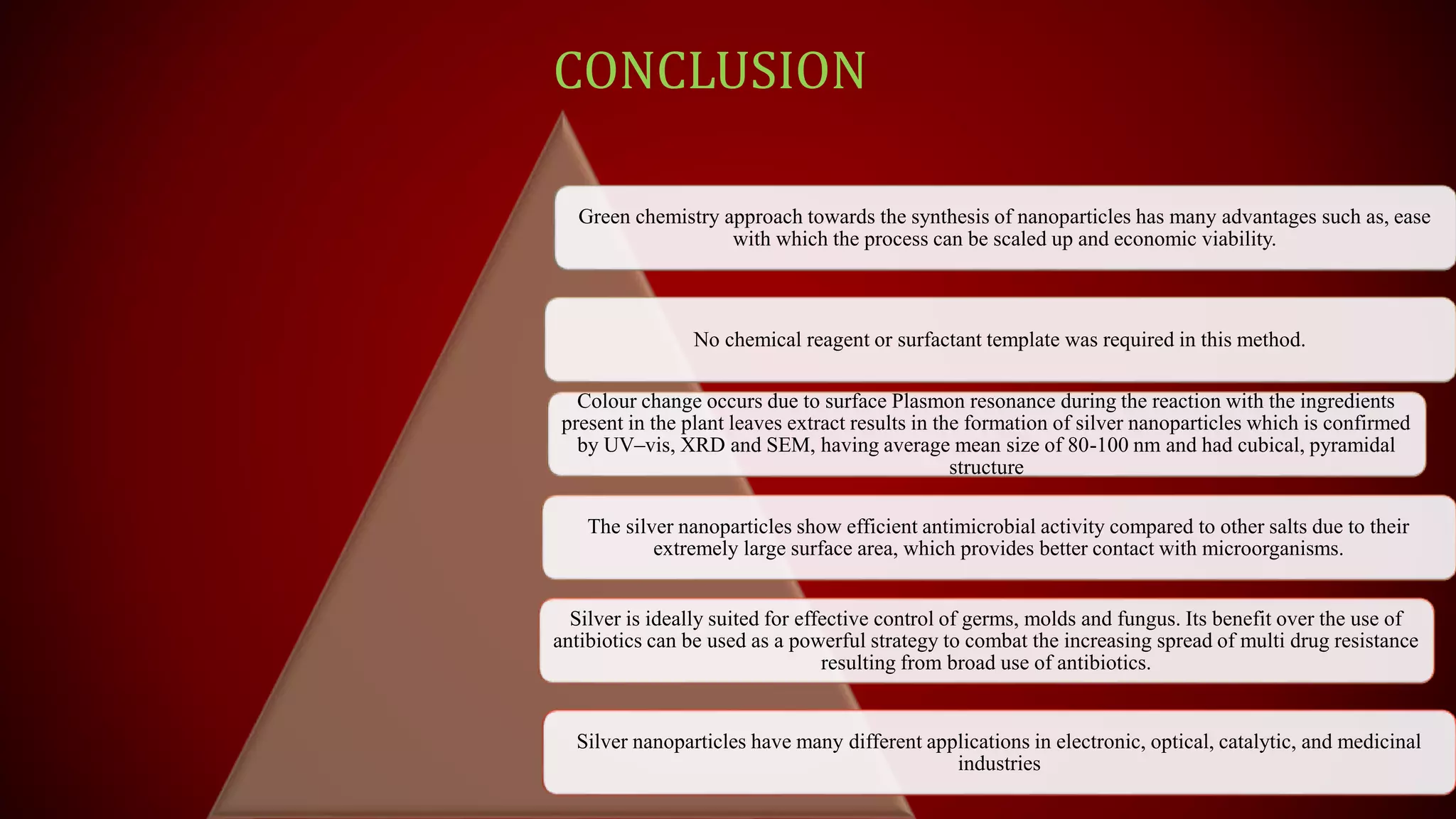
CONCLUSION
Green chemistry approach towards the synthesis of nanoparticles has many advantages such as, ease
with which the process can be scaled up and economic viability.
No chemical reagent or surfactant template was required in this method.
Colour change occurs due to surface Plasmon resonance during the reaction with the ingredients
present in the plant leaves extract results in the formation of silver nanoparticles which is confirmed
by UV–vis, XRD and SEM, having average mean size of 80-100 nm and had cubical, pyramidal
structure
The silver nanoparticles show efficient antimicrobial activity compared to other salts due to their
extremely large surface area, which provides better contact with microorganisms.
Silver is ideally suited for effective control of germs, molds and fungus. Its benefit over the use of
antibiotics can be used as a powerful strategy to combat the increasing spread of multi drug resistance
resulting from broad use of antibiotics.
Silver nanoparticles have many different applications in electronic, optical, catalytic, and medicinal
industries
Green biosynthesis of silver nanoparticles using Clitoria ternatea and its characterization

Green biosynthesis of silver nanoparticles using Clitoria ternatea and its characterization

  • 1.
    ESHIT BANERJEE 11YAST2003 PRESIDENCY COLLEGE,BANGALORE GREENBIOSYNTHESISOF SILVERNANOPARTICLES USINGClitoriaternateaANDITS CHARACTERIZATION
  • 2.
    AIM AND OBJECTIVE Extractionof aqueous extract from Clitoria ternatea . The aqueous extract for the biosynthesis of silver nanoparticles. Statistical analysis of the aqueous extract using Ultraviolet-visible spectroscopy. Morphological analysis using FE-SEM . Analysis using XRD to determine the element composition of the sample.
  • 3.
    Nanotechnology • Nanotechnology isthe engineering of functional systems at the molecular scale • Technique which could yield nanoparticles of various size & shape • K. Eric Drexler 1980 Nanoparticles • Particles of between 1 nm and 100 nm in size. • Small object that behave as whole in term of its transport & properties. • Unique property that are different from large molecule of the same element. Why silver nanoparticles Silver has been extensively used to resist infection. Silver nanoparticles are undoubtedly the most widely used nanoparticles. Application in medical as well as in environmental field . It has antibacterial and antifungal activity . Biological synthesis of silver nanoparticles :most effective :ecofriendly. INTRODUCTION
  • 4.
    Scientific Classification Kingdom: Plantae Order: Fabales Family:Fabaceae Genus: Clitoria Species: C. ternatea Clitoria ternatea
  • 5.
    MATERIALS AND METHOD Plant •Clitoria ternatea Chemical used • Silver nitrate (AgNO3) was purchased from E. Marck (India). • Double distilled water. Apparatus • Beaker ,Boiling tubes ,Funnel. • Incubation chamber ,Refrigerator ,Laminar air flow ,Autoclave ,UV spectrophotometer ,Whatmann no.1 filter paper ,Muslin cloth ,FE-SEM.
  • 6.
    Preparation of Plantextract Plant leaves Rinsed thrice with distilled water Dried (paper towel) 50 gm leaves cut into fine pieces Boiled in 200 ml of double distilled water for 30 minutes Pass through 3 layer of muslin cloth Pass through Whatmann No.1 filter paper Synthesis of silver nanoparticles 10 ml of leaf extract 100 ml of aqueous solution of 1mM AgNo3 add Aqueous extract Carl Zeiss Ultra 55 FE-SEM ELICON SL 159 UV-VIS Analysis
  • 7.
    RESULT AND DISCUSSION SYNTHESISAND CHARACTERIZATION OF SILVER NANOPARTICLES The formation of silver nanoparticles was observed by monitoring the change in colour. A pale yellow solution turning to dark grey when AgNO3 was used.
  • 8.
    UV-VIS SPECTROPHOTOMETRIC ANALYSISOF Clitoria ternatea LEAF EXTRACT SAMPLES WAVELENGTH( nm) 400 420 440 460 480 DAY DAY1 0..447 0.832 1.192 1.500 1.758 DAY2 2.544 2.646 2.795 2.803 2.813 DAY3 2.850 2.900 3.000 3.000 3.000 DAY4 3.000 3.000 3.000 3.000 3.000 DAY5 3.000 3.000 3.000 3.000 3.000 400 420 440 460 480, 1.758 0 0.5 1 1.5 2 350 400 450 500 Absorbance Wavelength(nm) DAY 1 440, 2.795 2.5 2.6 2.7 2.8 2.9 350 400 450 500 Absorbance Wavelength(nm) DAY 2 2.8 2.85 2.9 2.95 3 3.05 350 400 450 500 Absorbance Wavelength(nm) DAY 3 480, 3 0 1 2 3 4 350 400 450 500 Absorbance Wavelength(nm) DAY 4 480, 3 0 1 2 3 4 350 400 450 500 Absorbance Wavelength(nm) DAY 5
  • 9.
    SCANNING ELECTRON MICROSCOPYOF THE SILVER NANOPARTICLES •XRD ANALYSIS OF SILVER NANOPARTICLES Silver nanoparticles reveal numerous spherical, triangular, hexagonal, and cubic structures produced by reduction of silver ions with sizes ranging between 80-100 nm. the presence of silver atoms in the silver nanoparticles . XRD was used to verify the presence of silver in the suspension of nanoparticles. Elem ents Weig ht% Atomi c% C K 24.14 39.23 O K 40.44 49.34 Na K 0.89 0.76 Cl K 4.19 2.31 Ca K 9.39 4.57 Ag L 20.94 3.79 Total 100 Eleme nts Weigh t% Atomi c% N K 32.31 53.12 O K 21.14 30.42 Na K 0.00 0.00 Mg K 1.05 0.99 Cl K 10.45 6.79 K K 3.18 1.87 Ag L 31.87 6.80 Totals 100.00 Elem ents Weig ht% Atom ic% O K 35.45 64.11 Na K 5.75 7.23 Cl K 15.35 12.53 K K 4.27 3.16 Ca K 5.42 3.91 Ag L 33.76 9.06 Totals 100.00 Elem ents Weig ht% Atom ic% N K 28.26 48.85 O K 22.67 34.30 Na K 1.80 1.90 Cl K 9.47 6.47 Ag L 37.79 8.48 Totals 100.00 Elem ents Weig ht% Atomi c% O K 25.79 56.31 Na K 2.49 3.78 Mg K 3.27 4.71 Cl K 15.49 15.26 K K 4.90 4.38 Ag L 48.06 15.57 Totals 100.00
  • 10.
    • Less solventand reagent are used • Minimum temperature and pH • Environmental friendly. • Effective ADVANTAGES FUTURE PROSPECTIVE • Numerous application in medical as well as in environmental field • Antibacterial and Antifungal activity
  • 11.
    CONCLUSION Green chemistry approachtowards the synthesis of nanoparticles has many advantages such as, ease with which the process can be scaled up and economic viability. No chemical reagent or surfactant template was required in this method. Colour change occurs due to surface Plasmon resonance during the reaction with the ingredients present in the plant leaves extract results in the formation of silver nanoparticles which is confirmed by UV–vis, XRD and SEM, having average mean size of 80-100 nm and had cubical, pyramidal structure The silver nanoparticles show efficient antimicrobial activity compared to other salts due to their extremely large surface area, which provides better contact with microorganisms. Silver is ideally suited for effective control of germs, molds and fungus. Its benefit over the use of antibiotics can be used as a powerful strategy to combat the increasing spread of multi drug resistance resulting from broad use of antibiotics. Silver nanoparticles have many different applications in electronic, optical, catalytic, and medicinal industries