ASA 7.2 to 9.1
Command Migration
APPLIANCE MIGRATION FROM ASA 5540 TO ASA 5545-X
(DRAFT) V1.0
Migrated Features
 Real IP addresses in access lists
for several supported features, you must use the real, untranslated
IP address and ports
 NAT
The NAT feature has been redesigned for increased flexibility and
functionality
 Named Network and Service Objects
Network and service objects are automatically created for
NAT.
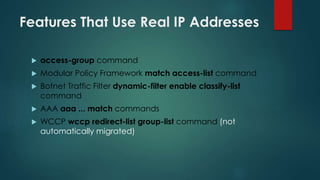
Features That Use Real IP Addresses
 access-group command
 Modular Policy Framework match access-list command
 Botnet Traffic Filter dynamic-filter enable classify-list
command
 AAA aaa ... match commands
 WCCP wccp redirect-list group-list command (not
automatically migrated)
Features That Use Real IP Addresses
ASDM
Real IP addresses are now used in the following features instead of
mapped addresses:
 Access Rules
 AAA Rules
 Service Policy Rules
 Botnet Traffic Filter classification
 WCCP redirection (not automatically migrated)
Features That Continue to Use
Mapped IP Addresses
The following features use access lists, but these access lists will
continue to use the mapped values as
seen on an interface:
 IPSec access lists
 capture command access lists
 Per-user access lists
 Routing protocol access lists
 All other feature access lists...
Sample Real IP Address Migration
Static NAT with ingress access group
Old Configuration
static (inside,outside) 172.23.57.1 10.50.50.50 netmask 255.255.255.255
access-list 1 permit ip any host 172.23.57.1
access-group 1 in interface outside
Migrated Configuration
access-list 1 permit ip any host 10.50.50.50
access-group 1 in interface outside
Sample Real IP Address Migration
Access group with deny/permit ACEs
Old Configuration
global (outside) 1 10.10.10.128-10.10.10.255
nat (inside) 1 172.16.10.0 255.255.255.0
access-list 100 extended deny ip any host 10.10.10.210
access-list 100 extended permit ip any 10.10.10.211
255.255.255.128
access-group 100 in interface outside
Migrated Configuration
access-list 100 extended deny ip any 172.16.10.0 255.255.255.0
access-group 100 in interface outside
NAT Migration
 The NAT feature has been redesigned for increased flexibility and
functionality
 Almost all NAT configurations will migrate seamlessly. In the rare
cases when user intervention is required, you will be notified. There
will never be an unreported loss of security after migration.
Old NAT Commands
The following commands are no longer supported; they are migrated
to new commands, and are then removed from the configuration.
 Alias
 Global
 nat (old version)
 nat-control
 Static
 sysopt nodnsalias—This command is not migrated; instead,
configure the dns option within the new NAT commands.
New NAT Commands
Network Object NAT (Typically used for regular NAT configurations)
 nat dynamic
object network name
nat [(real_ifc,mapped_ifc)] dynamic
{[mapped_inline_host_ip] [interface] |
[mapped_obj] [pat-pool mapped_obj [round-robin]]
[interface]} [dns]
 nat static
object network name
nat [(real_ifc,mapped_ifc)] static
{mapped_inline_ip | mapped_obj | interface}
[dns | service {tcp | udp} real_port mapped_port]
[no-proxy-arp] [route-lookup]
The no-proxy-arp, route-lookup, pat-pool, and round-robin keywords were added in
8.4(2).
Twice NAT (Typically used for policy NAT configurations)
 nat source dynamic
nat [(real_ifc,mapped_ifc)] [line | {after-object [line]}]
source dynamic {real_obj | any}
{[mapped_obj] [pat-pool mapped_obj [round-robin]] [interface]}
[destination static {mapped_obj | interface} {real_obj | any}]
[service {mapped_dest_svc_obj real_dest_svc_obj] [dns] [unidirectional][inactive]
[description desc]
 nat source static
nat [(real_ifc,mapped_ifc)] [line | {after-object [line]}]
source static {real_obj | any} {mapped_obj | interface | any}}
[destination static {mapped_obj | interface} {real_obj | any}]
[service {real_src_mapped_dest_svc_obj | any}
mapped_src_real_dest_svc_obj] [dns] [unidirectional | [no-proxy-arp]
[route-lookup]] [inactive] [description desc]
Preserving the Order of NAT Rules
The new NAT order uses a table with three sections:
 Section 1 (twice NAT rules)—These rules are assessed based on the
order they appear in the configuration. For migration purposes, this
section includes migrated policy NAT rules.
 Section 2 (network object NAT (generated) rules)—These rules are
assessed according to internal rules; the order they appear in the
configuration does not matter
 Section 3 (twice NAT rules that you specifically want to be evaluated
after the network object NAT
rules)
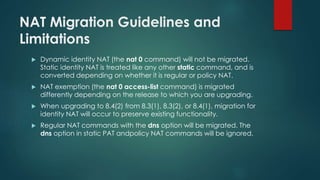
NAT Migration Guidelines and
Limitations
 Dynamic identity NAT (the nat 0 command) will not be migrated.
Static identity NAT is treated like any other static command, and is
converted depending on whether it is regular or policy NAT.
 NAT exemption (the nat 0 access-list command) is migrated
differently depending on the release to which you are upgrading.
 When upgrading to 8.4(2) from 8.3(1), 8.3(2), or 8.4(1), migration for
identity NAT will occur to preserve existing functionality.
 Regular NAT commands with the dns option will be migrated. The
dns option in static PAT andpolicy NAT commands will be ignored.
NAT Migration Guidelines and
Limitations
 Connection Settings in old NAT commands—Options such as conn-
max, emb-limit, norandomseq, or nailed will be moved to service
policies.
 The following naming conventions are used for the new service
policies:
 class-map—class-conn-param-protocol-n
 access-list—acl-conn-param-protocol-n
 policy-map—policy-conn-param-interface
Supported Features for Objects
Version 8.3 introduces named network and service objects for use with
the following features:
 NAT—You can no longer use a named IP address (using the name
command) in NAT.
 Access lists—access-list command. You can no longer use a named
IP address (using the name command) in an access list.
 Object groups—object-group network and object-group service
commands. Named IP addresses are still allowed in object groups,
as well as network objects.
Object Migration
New network and service objects (the object network and object
service commands) are substituted into existing commands in the
following cases:
 For each network object NAT command, an object network
command is created to represent the real IP address that you want
to translate.
 When new nat commands require an object instead of an inline
value, network and service objects are automatically created.
 If you use a named IP address in NAT (using the name command)
and the names command is enabled, then a network object is
created even if an inline IP address could be used in the new nat
command.
Object Migration
 If an access-list command includes an IP address that was used in NAT,
and the NAT migration created a network object for that IP address,
then the network object replaces the IP address in the
access-list command.
 If you use a named IP address in the access-list command (using the
name command) and the names command is enabled, then an object
replaces the name.
 For multiple global commands that share the same NAT ID, a network
object group is created that contains the network objects created for
the inline IP addresses.
Objects are not created for the following cases:
 A name command exists in the configuration, but is not used in a
nat or access-list command.
 An inline value that is still allowed in the nat command.
 name commands used under object-group commands.
 IP addresses used in access-list commands that are not used in NAT
or named with a name command.
name Command Naming
Conventions
When the names command is enabled, then for migrated name
commands, the same name is used for the object network command.
For example:
for the following name command used in NAT
name 10.1.1.1 test
An object network command is created:
object network test
host 10.1.1.1
Inline IP Address Naming
Conventions
For migrated IP addresses used inline, network objects are created
using the following naming convention:
 Hosts and subnets—obj-a.b.c.d.
 Ranges—obj-a.b.c.d-p.q.r.s
Inline Protocol Naming
Conventions
For migrated protocols used inline, service objects are created using
the following naming convention, obj-inline_text.
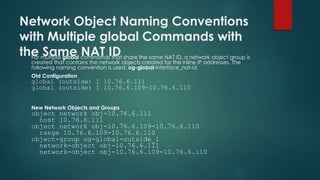
Network Object Naming Conventions
with Multiple global Commands with
the Same NAT IDFor multiple global commands that share the same NAT ID, a network object group is
created that contains the network objects created for the inline IP addresses. The
following naming convention is used: og-global-interface_nat-id.
Old Configuration
global (outside) 1 10.76.6.111
global (outside) 1 10.76.6.109-10.76.6.110
New Network Objects and Groups
object network obj-10.76.6.111
host 10.76.6.111
object network obj-10.76.6.109-10.76.6.110
range 10.76.6.109-10.76.6.110
object-group og-global-outside_1
network-object obj-10.76.6.111
network-object obj-10.76.6.109-10.76.6.110
Information About Activation Key
Compatibility
Your activation key remains compatible if you upgrade to the latest
version from any previous version.
Thank You

Asa 7 to 9 migration

  • 1.
    ASA 7.2 to9.1 Command Migration APPLIANCE MIGRATION FROM ASA 5540 TO ASA 5545-X (DRAFT) V1.0
  • 2.
    Migrated Features  RealIP addresses in access lists for several supported features, you must use the real, untranslated IP address and ports  NAT The NAT feature has been redesigned for increased flexibility and functionality  Named Network and Service Objects Network and service objects are automatically created for NAT.
  • 3.
    Features That UseReal IP Addresses  access-group command  Modular Policy Framework match access-list command  Botnet Traffic Filter dynamic-filter enable classify-list command  AAA aaa ... match commands  WCCP wccp redirect-list group-list command (not automatically migrated)
  • 4.
    Features That UseReal IP Addresses ASDM Real IP addresses are now used in the following features instead of mapped addresses:  Access Rules  AAA Rules  Service Policy Rules  Botnet Traffic Filter classification  WCCP redirection (not automatically migrated)
  • 5.
    Features That Continueto Use Mapped IP Addresses The following features use access lists, but these access lists will continue to use the mapped values as seen on an interface:  IPSec access lists  capture command access lists  Per-user access lists  Routing protocol access lists  All other feature access lists...
  • 6.
    Sample Real IPAddress Migration Static NAT with ingress access group Old Configuration static (inside,outside) 172.23.57.1 10.50.50.50 netmask 255.255.255.255 access-list 1 permit ip any host 172.23.57.1 access-group 1 in interface outside Migrated Configuration access-list 1 permit ip any host 10.50.50.50 access-group 1 in interface outside
  • 7.
    Sample Real IPAddress Migration Access group with deny/permit ACEs Old Configuration global (outside) 1 10.10.10.128-10.10.10.255 nat (inside) 1 172.16.10.0 255.255.255.0 access-list 100 extended deny ip any host 10.10.10.210 access-list 100 extended permit ip any 10.10.10.211 255.255.255.128 access-group 100 in interface outside Migrated Configuration access-list 100 extended deny ip any 172.16.10.0 255.255.255.0 access-group 100 in interface outside
  • 8.
    NAT Migration  TheNAT feature has been redesigned for increased flexibility and functionality  Almost all NAT configurations will migrate seamlessly. In the rare cases when user intervention is required, you will be notified. There will never be an unreported loss of security after migration.
  • 9.
    Old NAT Commands Thefollowing commands are no longer supported; they are migrated to new commands, and are then removed from the configuration.  Alias  Global  nat (old version)  nat-control  Static  sysopt nodnsalias—This command is not migrated; instead, configure the dns option within the new NAT commands.
  • 10.
    New NAT Commands NetworkObject NAT (Typically used for regular NAT configurations)  nat dynamic object network name nat [(real_ifc,mapped_ifc)] dynamic {[mapped_inline_host_ip] [interface] | [mapped_obj] [pat-pool mapped_obj [round-robin]] [interface]} [dns]  nat static object network name nat [(real_ifc,mapped_ifc)] static {mapped_inline_ip | mapped_obj | interface} [dns | service {tcp | udp} real_port mapped_port] [no-proxy-arp] [route-lookup] The no-proxy-arp, route-lookup, pat-pool, and round-robin keywords were added in 8.4(2).
  • 11.
    Twice NAT (Typicallyused for policy NAT configurations)  nat source dynamic nat [(real_ifc,mapped_ifc)] [line | {after-object [line]}] source dynamic {real_obj | any} {[mapped_obj] [pat-pool mapped_obj [round-robin]] [interface]} [destination static {mapped_obj | interface} {real_obj | any}] [service {mapped_dest_svc_obj real_dest_svc_obj] [dns] [unidirectional][inactive] [description desc]  nat source static nat [(real_ifc,mapped_ifc)] [line | {after-object [line]}] source static {real_obj | any} {mapped_obj | interface | any}} [destination static {mapped_obj | interface} {real_obj | any}] [service {real_src_mapped_dest_svc_obj | any} mapped_src_real_dest_svc_obj] [dns] [unidirectional | [no-proxy-arp] [route-lookup]] [inactive] [description desc]
  • 12.
    Preserving the Orderof NAT Rules The new NAT order uses a table with three sections:  Section 1 (twice NAT rules)—These rules are assessed based on the order they appear in the configuration. For migration purposes, this section includes migrated policy NAT rules.  Section 2 (network object NAT (generated) rules)—These rules are assessed according to internal rules; the order they appear in the configuration does not matter  Section 3 (twice NAT rules that you specifically want to be evaluated after the network object NAT rules)
  • 13.
    NAT Migration Guidelinesand Limitations  Dynamic identity NAT (the nat 0 command) will not be migrated. Static identity NAT is treated like any other static command, and is converted depending on whether it is regular or policy NAT.  NAT exemption (the nat 0 access-list command) is migrated differently depending on the release to which you are upgrading.  When upgrading to 8.4(2) from 8.3(1), 8.3(2), or 8.4(1), migration for identity NAT will occur to preserve existing functionality.  Regular NAT commands with the dns option will be migrated. The dns option in static PAT andpolicy NAT commands will be ignored.
  • 14.
    NAT Migration Guidelinesand Limitations  Connection Settings in old NAT commands—Options such as conn- max, emb-limit, norandomseq, or nailed will be moved to service policies.  The following naming conventions are used for the new service policies:  class-map—class-conn-param-protocol-n  access-list—acl-conn-param-protocol-n  policy-map—policy-conn-param-interface
  • 15.
    Supported Features forObjects Version 8.3 introduces named network and service objects for use with the following features:  NAT—You can no longer use a named IP address (using the name command) in NAT.  Access lists—access-list command. You can no longer use a named IP address (using the name command) in an access list.  Object groups—object-group network and object-group service commands. Named IP addresses are still allowed in object groups, as well as network objects.
  • 16.
    Object Migration New networkand service objects (the object network and object service commands) are substituted into existing commands in the following cases:  For each network object NAT command, an object network command is created to represent the real IP address that you want to translate.  When new nat commands require an object instead of an inline value, network and service objects are automatically created.  If you use a named IP address in NAT (using the name command) and the names command is enabled, then a network object is created even if an inline IP address could be used in the new nat command.
  • 17.
    Object Migration  Ifan access-list command includes an IP address that was used in NAT, and the NAT migration created a network object for that IP address, then the network object replaces the IP address in the access-list command.  If you use a named IP address in the access-list command (using the name command) and the names command is enabled, then an object replaces the name.  For multiple global commands that share the same NAT ID, a network object group is created that contains the network objects created for the inline IP addresses.
  • 18.
    Objects are notcreated for the following cases:  A name command exists in the configuration, but is not used in a nat or access-list command.  An inline value that is still allowed in the nat command.  name commands used under object-group commands.  IP addresses used in access-list commands that are not used in NAT or named with a name command.
  • 19.
    name Command Naming Conventions Whenthe names command is enabled, then for migrated name commands, the same name is used for the object network command. For example: for the following name command used in NAT name 10.1.1.1 test An object network command is created: object network test host 10.1.1.1
  • 20.
    Inline IP AddressNaming Conventions For migrated IP addresses used inline, network objects are created using the following naming convention:  Hosts and subnets—obj-a.b.c.d.  Ranges—obj-a.b.c.d-p.q.r.s
  • 21.
    Inline Protocol Naming Conventions Formigrated protocols used inline, service objects are created using the following naming convention, obj-inline_text.
  • 22.
    Network Object NamingConventions with Multiple global Commands with the Same NAT IDFor multiple global commands that share the same NAT ID, a network object group is created that contains the network objects created for the inline IP addresses. The following naming convention is used: og-global-interface_nat-id. Old Configuration global (outside) 1 10.76.6.111 global (outside) 1 10.76.6.109-10.76.6.110 New Network Objects and Groups object network obj-10.76.6.111 host 10.76.6.111 object network obj-10.76.6.109-10.76.6.110 range 10.76.6.109-10.76.6.110 object-group og-global-outside_1 network-object obj-10.76.6.111 network-object obj-10.76.6.109-10.76.6.110
  • 23.
    Information About ActivationKey Compatibility Your activation key remains compatible if you upgrade to the latest version from any previous version.
  • 24.