©2018 Edward Herlihy
All rights reserved
ASA 101:
Basic Keel Boat Sailing
Capt. Ed Herlihy
ASA Instructor ID:200605260
©2018 Edward Herlihy
All rights reserved
Objectives
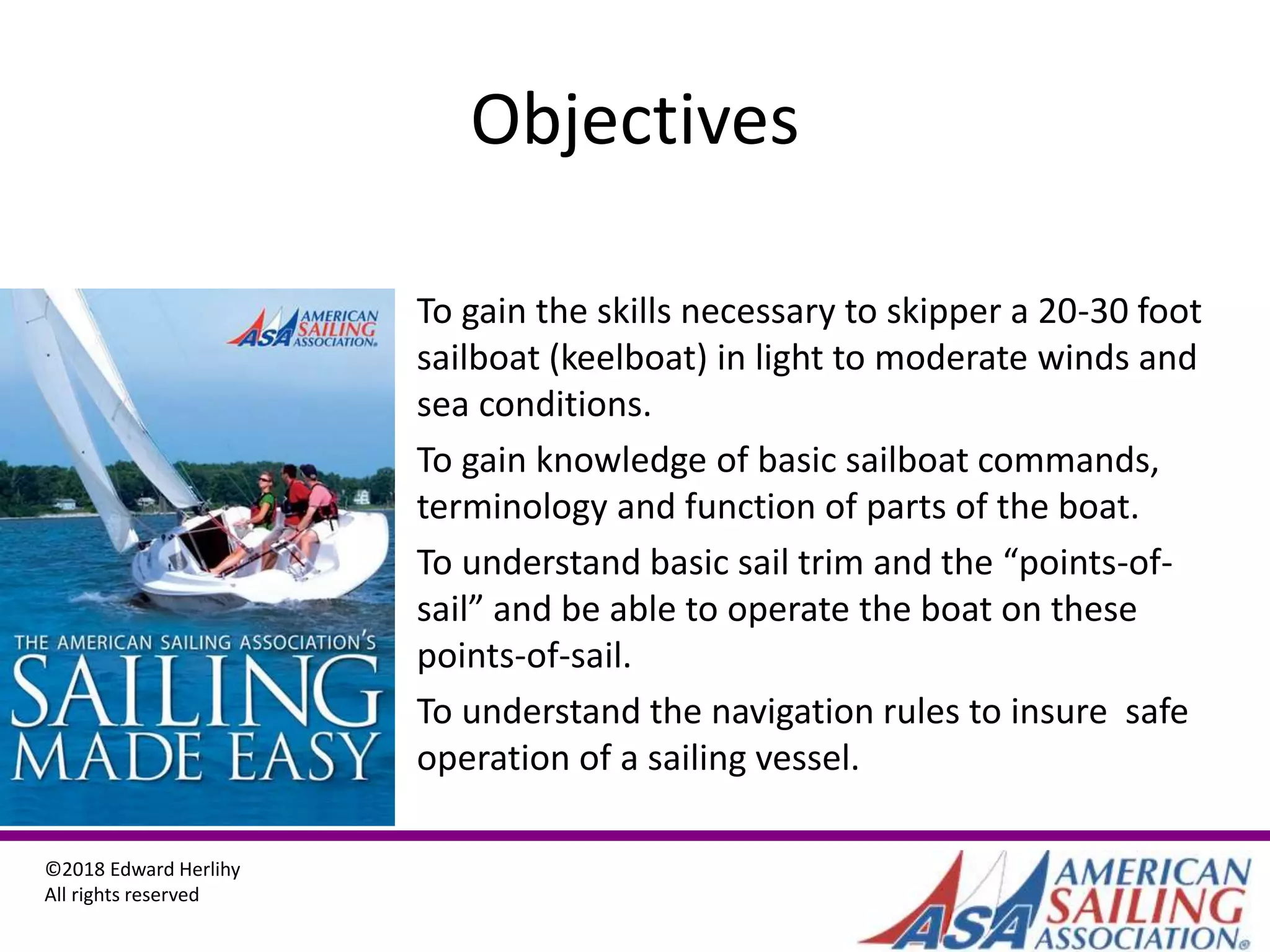
• To gain the skills necessary to skipper a 20-30 foot
sailboat (keelboat) in light to moderate winds and
sea conditions.
• To gain knowledge of basic sailboat commands,
terminology and function of parts of the boat.
• To understand basic sail trim and the “points-of-
sail” and be able to operate the boat on these
points-of-sail.
• To understand the navigation rules to insure safe
operation of a sailing vessel.
©2018 Edward Herlihy
All rights reserved
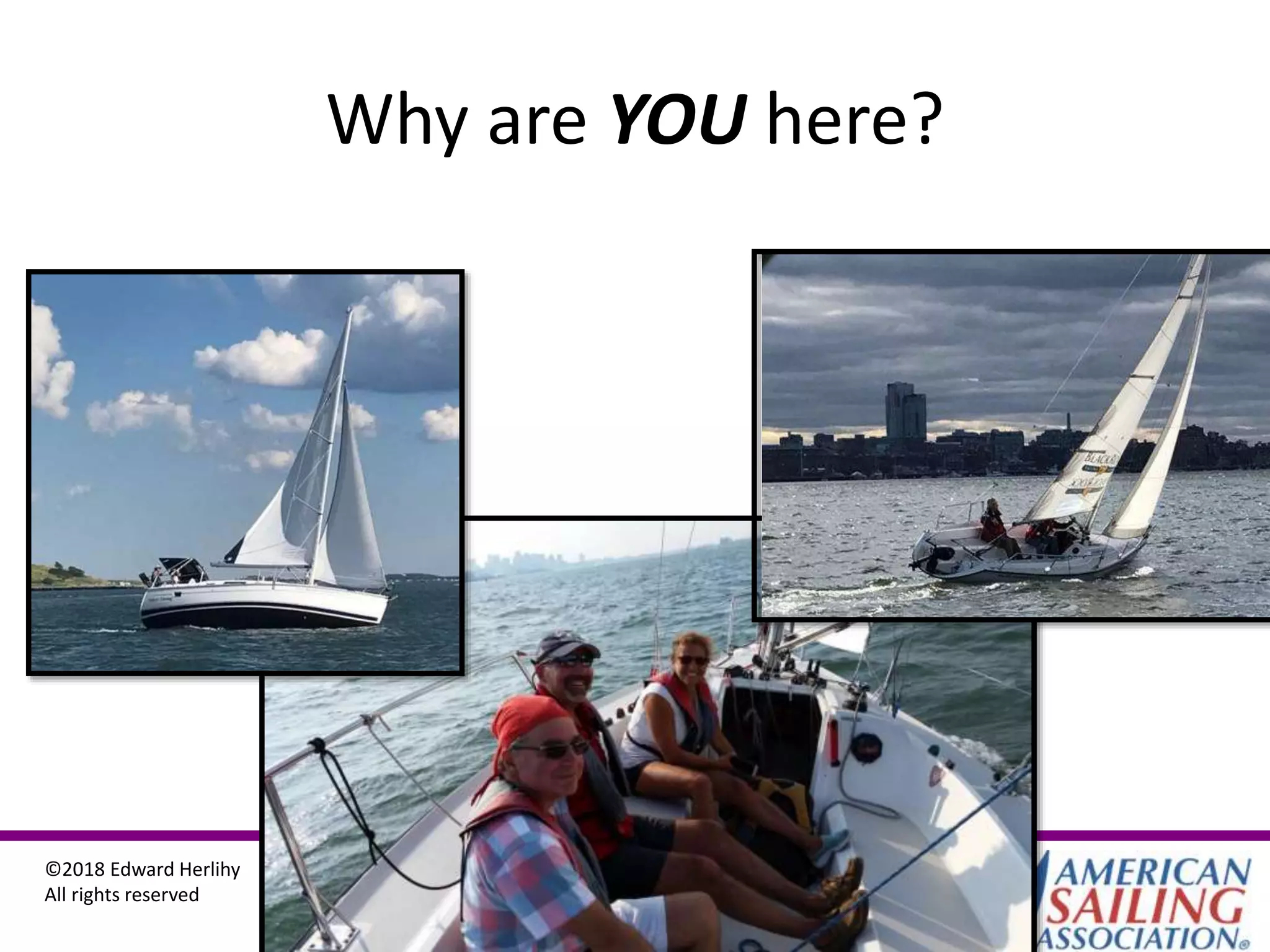
Why are YOU here?
©2018 Edward Herlihy
All rights reserved
Course Outline
• Parts of a boat
• Wind
• Sail Trim
• Tacking & Gybing
• Leeward and Windward
/ Above and Below /
The Grid System
• Mooring Grab & Crew
Overboard
• Running Lights
• Rules of the Road
• Federally Required
Equipment
• Aids to Navigation
• Preparation to get
under way
©2018 Edward Herlihy
All rights reserved
Overview
Every day:
2hr classroom/lecture, and 4+hr on the boat
Day 1 – Theory and skills
Day 2 – Skills
Day 3 – Theory, skills, and the test
©2018 Edward Herlihy
All rights reserved
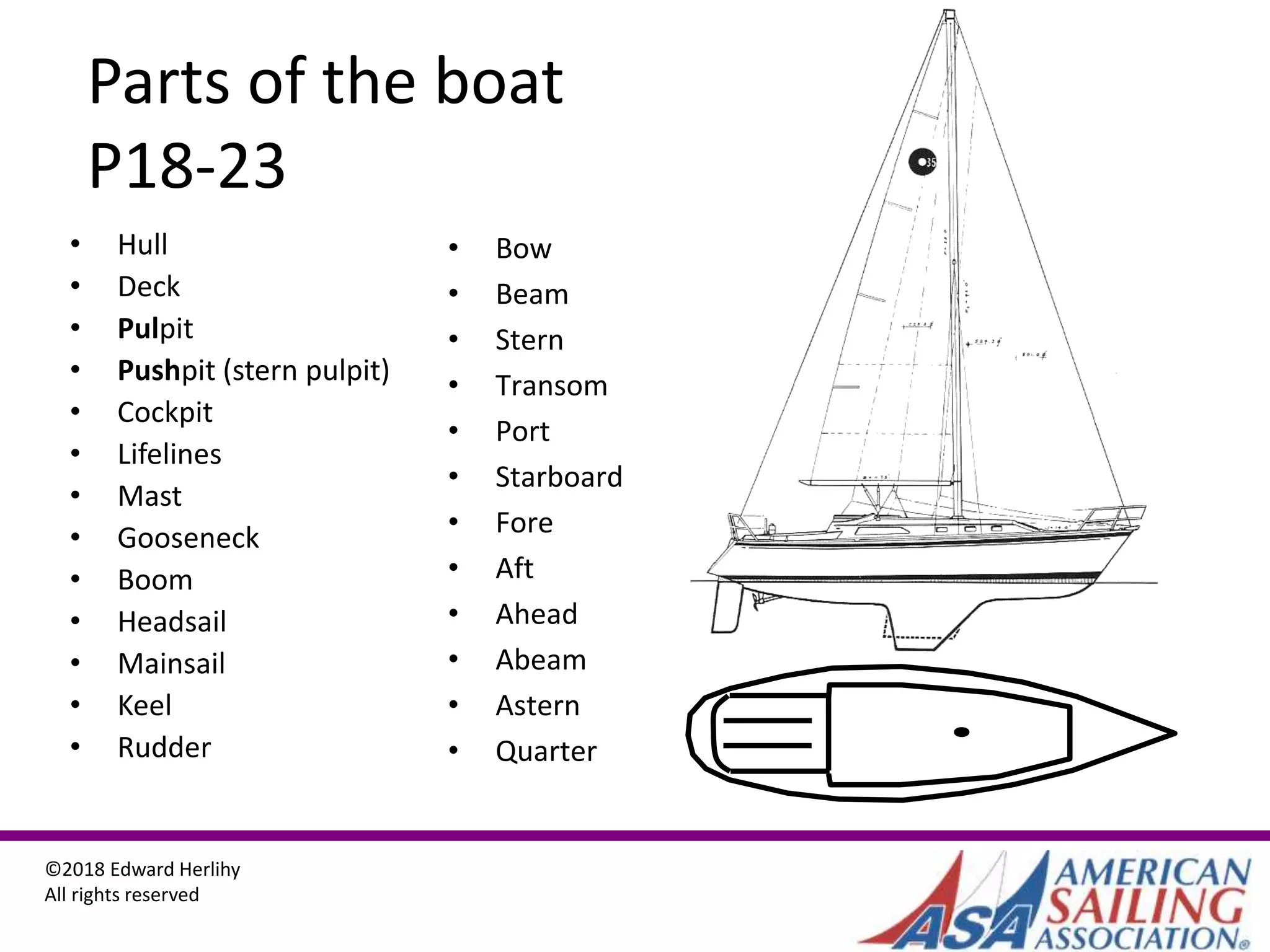
Parts of the boat
P18-23
• Hull
• Deck
• Pulpit
• Pushpit (stern pulpit)
• Cockpit
• Lifelines
• Mast
• Gooseneck
• Boom
• Headsail
• Mainsail
• Keel
• Rudder
• Bow
• Beam
• Stern
• Transom
• Port
• Starboard
• Fore
• Aft
• Ahead
• Abeam
• Astern
• Quarter
©2018 Edward Herlihy
All rights reserved
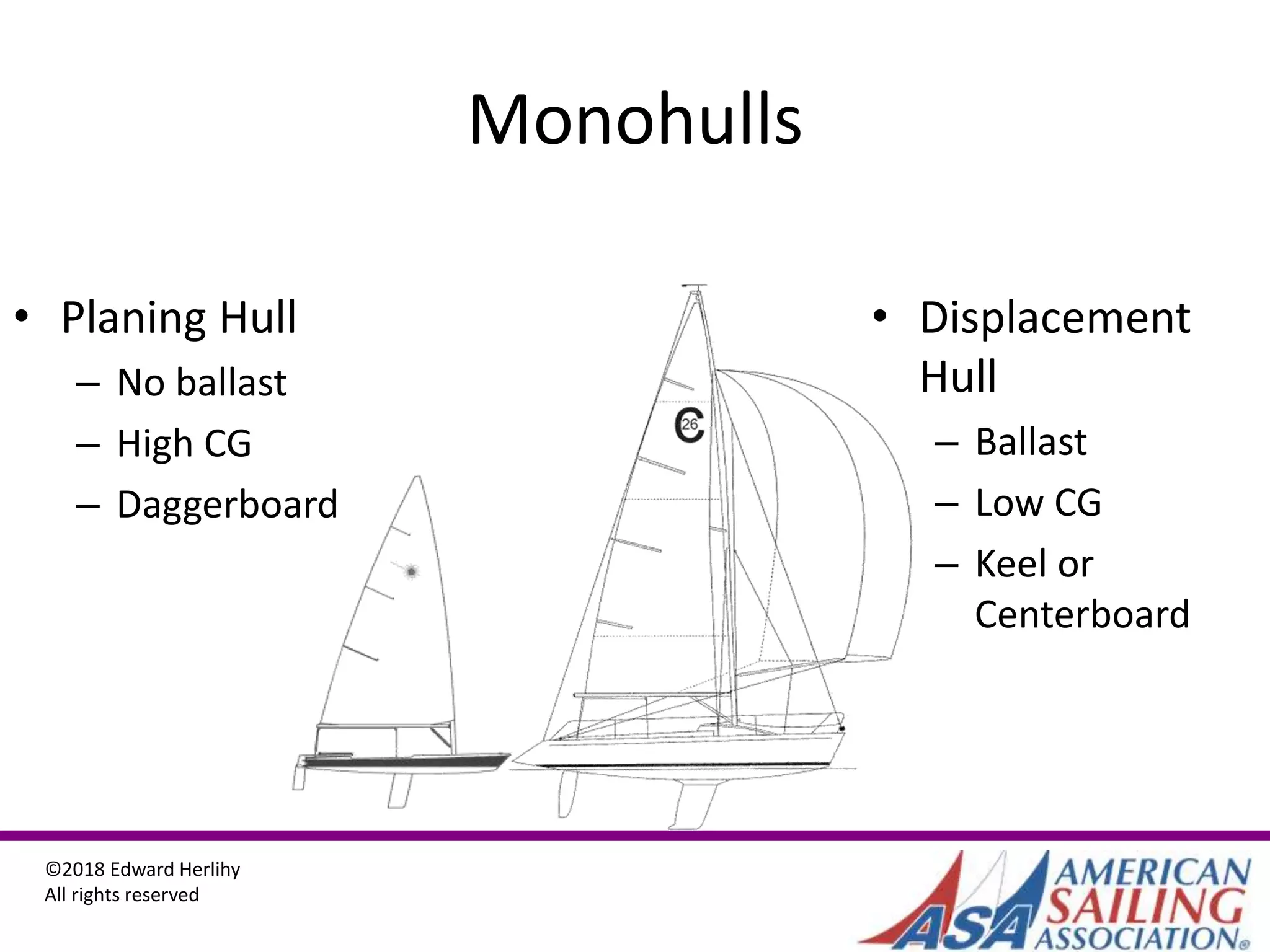
Monohulls
• Planing Hull
– No ballast
– High CG
– Daggerboard
• Displacement
Hull
– Ballast
– Low CG
– Keel or
Centerboard
©2018 Edward Herlihy
All rights reserved
Review: Parts of the Boat
©2018 Edward Herlihy
All rights reserved
Review: Parts of the Boat
©2018 Edward Herlihy
All rights reserved
Sails – The boat’s engine
P21
• Main Sail
– Reef Points
– Streamers
• Head Sail/Foresail
– Jib
– Genoa
– Telltales
Forestay or
Headstay
Foresail
or Headsail
Backstay
JibGenoa
Foot
Luff
TackClew
Head
Battens
©2018 Edward Herlihy
All rights reserved
Rigging
P22
• Standing Rigging
– Keeps the mast up
• Running Rigging
– Controls the sails
©2018 Edward Herlihy
All rights reserved
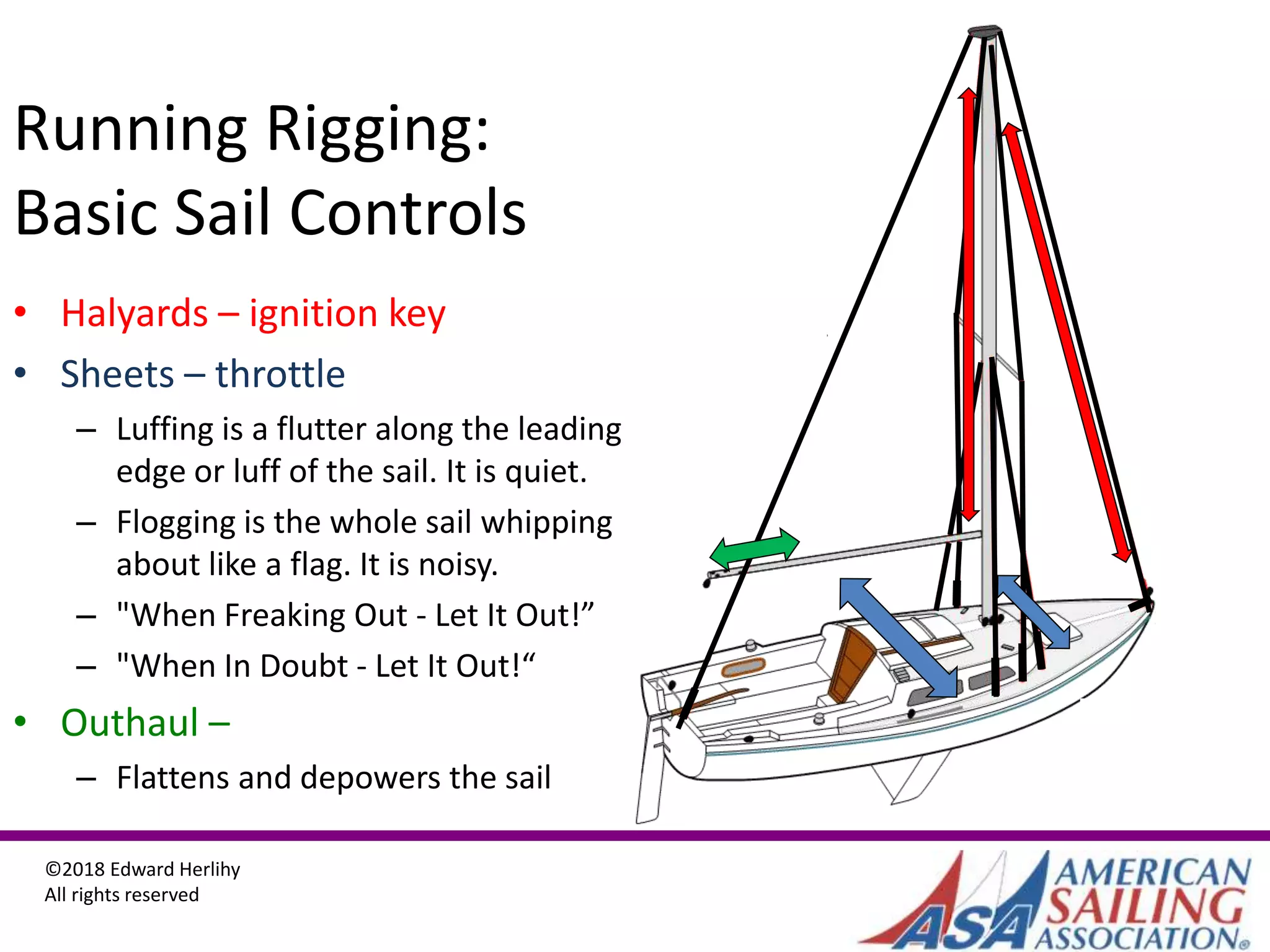
Running Rigging:
Basic Sail Controls
• Halyards – ignition key
• Sheets – throttle
– Luffing is a flutter along the leading
edge or luff of the sail. It is quiet.
– Flogging is the whole sail whipping
about like a flag. It is noisy.
– "When Freaking Out - Let It Out!”
– "When In Doubt - Let It Out!“
• Outhaul –
– Flattens and depowers the sail
©2018 Edward Herlihy
All rights reserved
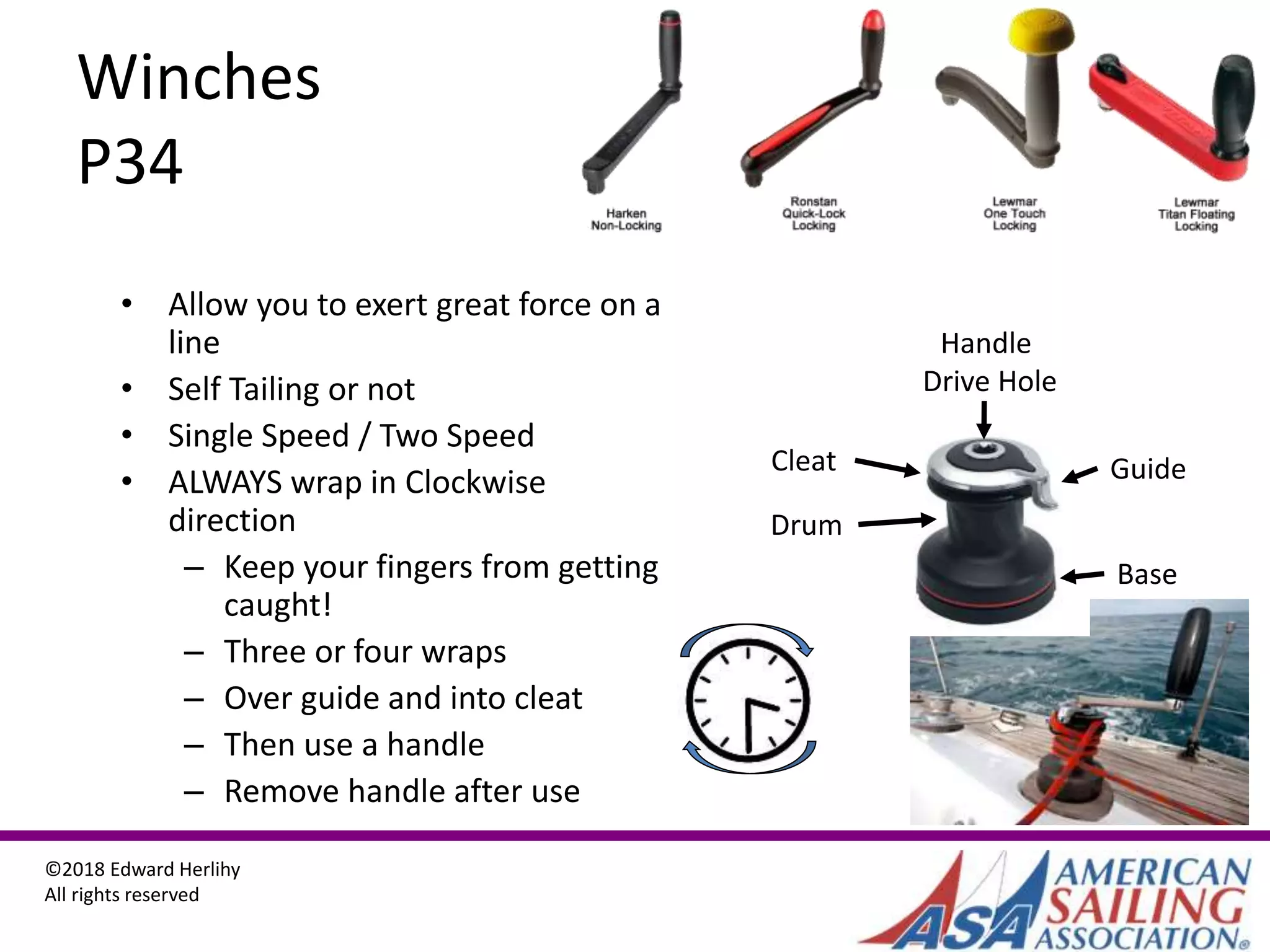
Winches
P34
• Allow you to exert great force on a
line
• Self Tailing or not
• Single Speed / Two Speed
• ALWAYS wrap in Clockwise
direction
– Keep your fingers from getting
caught!
– Three or four wraps
– Over guide and into cleat
– Then use a handle
– Remove handle after use
Drum
Base
GuideCleat
Handle
Drive Hole
©2018 Edward Herlihy
All rights reserved
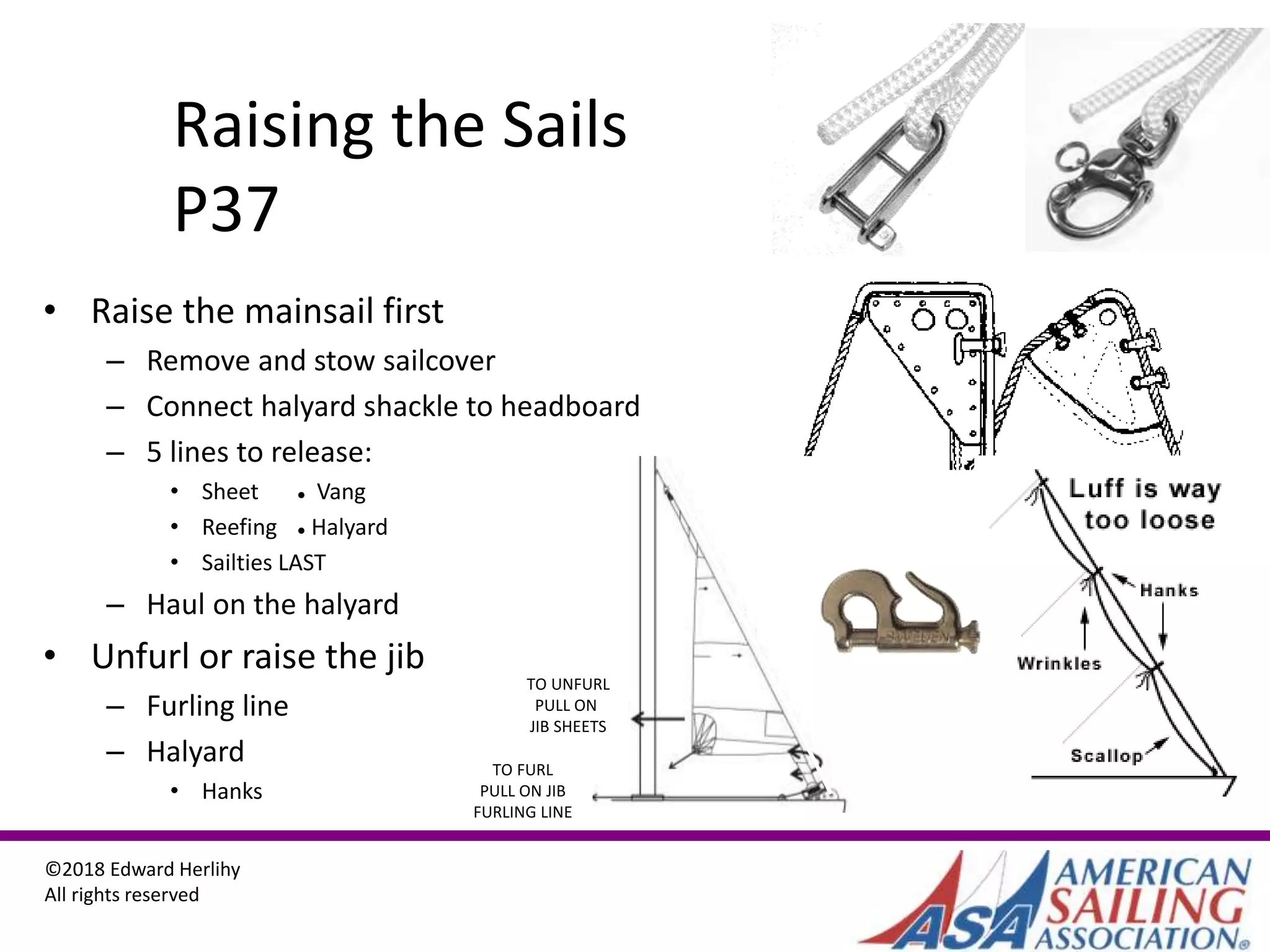
Raising the Sails
P37
• Raise the mainsail first
– Remove and stow sailcover
– Connect halyard shackle to headboard
– 5 lines to release:
• Sheet ● Vang
• Reefing ● Halyard
• Sailties LAST
– Haul on the halyard
• Unfurl or raise the jib
– Furling line
– Halyard
• Hanks
TO UNFURL
PULL ON
JIB SHEETS
TO FURL
PULL ON JIB
FURLING LINE
©2018 Edward Herlihy
All rights reserved
Wind – fuel for the sails
• Varies in strength
and direction.
• How do you find
where the wind is
coming from?
©2018 Edward Herlihy
All rights reserved
Managing the Sails:
• “Trim” – increase tension on a working sheet
• “Ease” – let some tension out of a working sheet
• “Blow” – release a working sheet
• Manage the jib from the LEEWARD side of the boat
• Sails are “SET” when they have the proper tension on
their working sheets
©2018 Edward Herlihy
All rights reserved
Sails are Wind Benders
• Sails can generate 1/3 of their power from
PUSH
• Sails can generate 2/3 of their power from
PULL
– Sails are most efficient when there is
LAMINAR air flow across them.
• When sailing upwind all power is PULL
• When sailing across the wind power is a
combination of PUSH & PULL
• When sailing downwind power is only PUSH
Coanda Effect (1910)
WING
FASTER moving air
... LESS Pressure
SLOWER moving air ... MORE Pressure
Bernoulli’s Principle (1738)
©2018 Edward Herlihy
All rights reserved
Points of Sail
• Luffing Arc / No Go Zone - ~45º on
either side of the "Eye of the Wind". In
the center of the luffing arc is IRONS or
THE EYE OF THE WIND.
• Sail Trim:
– Close Hauled – all in
– Close Reach - 1/4 Out
– Beam Reach - 1/2 Out
– Broad Reach - 3/4 Out
– Run - All Out
• Avoid luffing sails and over trimming
• Ease sails until sails luff, then trim in.
• "When Freaking Out - Let It Out!”
• "When In Doubt - Let It Out!"
Up and In
Down & Out
©2018 Edward Herlihy
All rights reserved
Steering a boat with a tiller
• Helmsperson usually sits opposite the sail (and boom)
– Visibility - Can see mainsail and ahead
– Balance – Counterweight to the force on the sail
• Helmsperson must CHANGE SIDES when the sail
changes sides (Tacks or Gybes)
• Head Up / Go Above (positive) –
Push tiller toward boom
• Fall Off / Go Below (negative) –
Pull tiller away from boom
©2018 Edward Herlihy
All rights reserved
Steering a boat with a tiller
Tacking (TTT) P48-49
Turning the bow of the boat through the wind from CLOSE HAULED
point of sail.
1. Look around - situational awareness - plan your tack.
2. HELM: "Make Ready to Tack" / "Ready About" / "Prepare to Tack“
3. CREW: uncleat jib sheet, and prepare to trim on opposite side
4. CREW: "READY!“
5. HELM: Sight 90º over your shoulder - Pick a specific object
6. HELM: "Tacking" / "Coming About“
7. HELM: Push Tiller slightly toward BOOM. (Tiller Toward Tack).
Boat will begin to turn
8. HELM: When Main & Boom flog, change side of boat WHILE
LOOKING FORWARD. (pass tiller behind your back)
9. CREW: When Jib collapses, trim on other side
10. HELM: Stop turning (center tiller) when pointed at object from
step 5.
©2018 Edward Herlihy
All rights reserved
Steering a boat with a tiller
Gybing (TAG) P50-51
Turning the stern of the boat through the wind from BROAD REACH
or RUN
1. Look around - situational awareness - plan your gybe.
2. HELM: "Make Ready to Gybe" / "Prepare to Gybe“
3. CREW: Uncleat jib sheet, and prepare to trim on opposite side
4. HELM: Trim Mainsheet ALL the way in
5. CREW: "READY!“
6. HELM: Sight a new predicted target
7. HELM: Change side of boat WHILE LOOKING FORWARD. (pass
tiller behind your back)
8. HELM: Push Tiller AWAY from BOOM. (Tiller Away Gybe) Say
"GYBING!“ or “GYBE HO!”
9. HELM: When boom switches sides, stop turning (center the
tiller)
10. CREW: Trim jib
©2018 Edward Herlihy
All rights reserved
Getting out of “Irons”
Sailing off a mooring
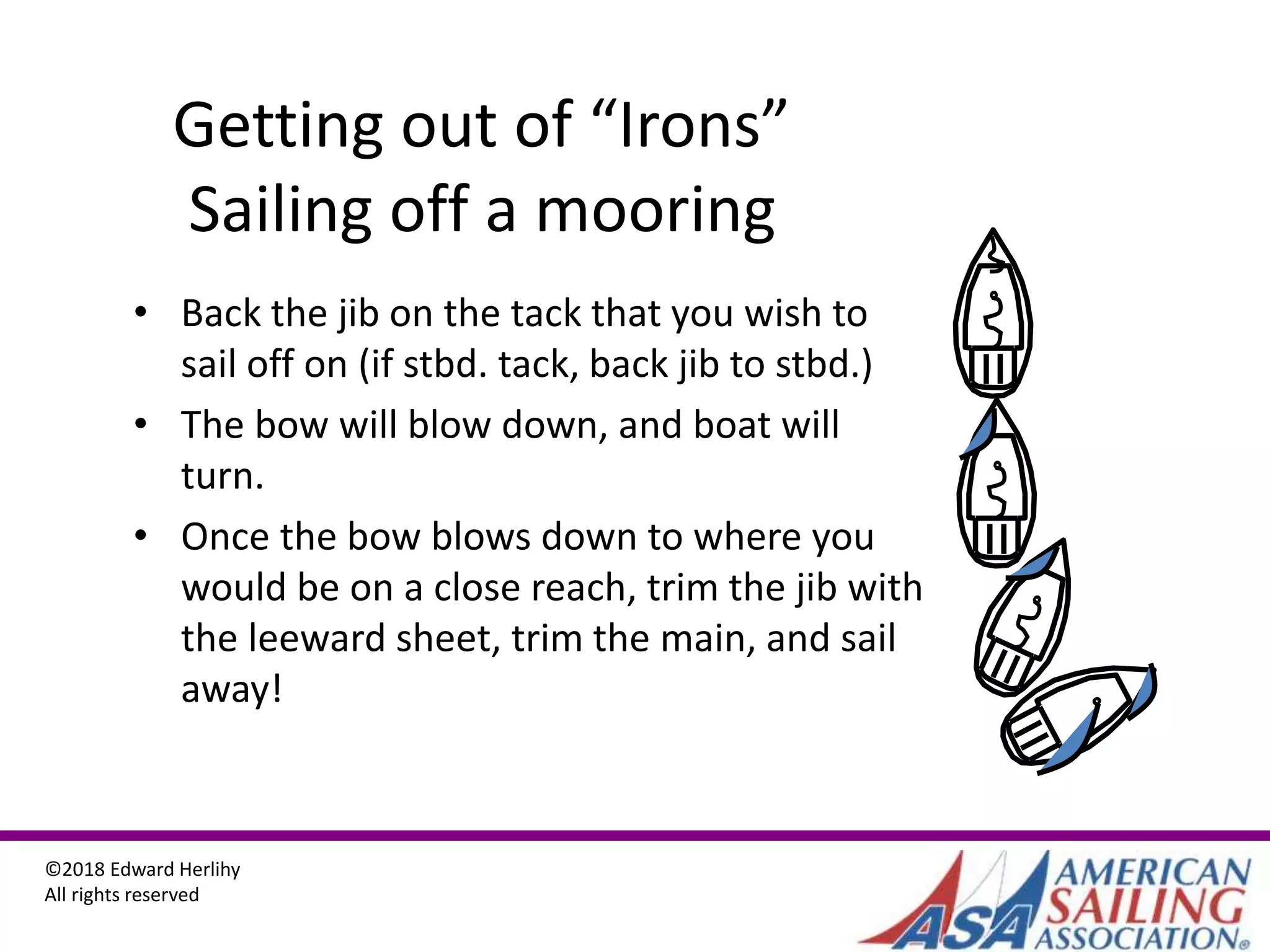
• Back the jib on the tack that you wish to
sail off on (if stbd. tack, back jib to stbd.)
• The bow will blow down, and boat will
turn.
• Once the bow blows down to where you
would be on a close reach, trim the jib with
the leeward sheet, trim the main, and sail
away!
©2018 Edward Herlihy
All rights reserved
Knots
1. Figure 8
2. Double Overhand
3. Clove Hitch
4. Cleat Hitch
5. Round Turn and
Two Half Hitches
6. Square Knot
1
2
3 4
5
6
©2018 Edward Herlihy
All rights reserved
Course Outline
 Parts of a boat
 Wind
 Sail Trim
 Tacking & Gybing
• Leeward and Windward
/ Above and Below /
The Grid System
• Mooring Grab & Crew
Overboard
• Running Lights
• Rules of the Road
• Federally Required
Equipment
• Aids to Navigation
• Preparation to get
under way
©2018 Edward Herlihy
All rights reserved
Let’s go Sailing!

Asa 101 day 1 2018 v2

  • 1.
    ©2018 Edward Herlihy Allrights reserved ASA 101: Basic Keel Boat Sailing Capt. Ed Herlihy ASA Instructor ID:200605260
  • 2.
    ©2018 Edward Herlihy Allrights reserved Objectives • To gain the skills necessary to skipper a 20-30 foot sailboat (keelboat) in light to moderate winds and sea conditions. • To gain knowledge of basic sailboat commands, terminology and function of parts of the boat. • To understand basic sail trim and the “points-of- sail” and be able to operate the boat on these points-of-sail. • To understand the navigation rules to insure safe operation of a sailing vessel.
  • 3.
    ©2018 Edward Herlihy Allrights reserved Why are YOU here?
  • 4.
    ©2018 Edward Herlihy Allrights reserved Course Outline • Parts of a boat • Wind • Sail Trim • Tacking & Gybing • Leeward and Windward / Above and Below / The Grid System • Mooring Grab & Crew Overboard • Running Lights • Rules of the Road • Federally Required Equipment • Aids to Navigation • Preparation to get under way
  • 5.
    ©2018 Edward Herlihy Allrights reserved Overview Every day: 2hr classroom/lecture, and 4+hr on the boat Day 1 – Theory and skills Day 2 – Skills Day 3 – Theory, skills, and the test
  • 6.
    ©2018 Edward Herlihy Allrights reserved Parts of the boat P18-23 • Hull • Deck • Pulpit • Pushpit (stern pulpit) • Cockpit • Lifelines • Mast • Gooseneck • Boom • Headsail • Mainsail • Keel • Rudder • Bow • Beam • Stern • Transom • Port • Starboard • Fore • Aft • Ahead • Abeam • Astern • Quarter
  • 7.
    ©2018 Edward Herlihy Allrights reserved Monohulls • Planing Hull – No ballast – High CG – Daggerboard • Displacement Hull – Ballast – Low CG – Keel or Centerboard
  • 8.
    ©2018 Edward Herlihy Allrights reserved Review: Parts of the Boat
  • 9.
    ©2018 Edward Herlihy Allrights reserved Review: Parts of the Boat
  • 10.
    ©2018 Edward Herlihy Allrights reserved Sails – The boat’s engine P21 • Main Sail – Reef Points – Streamers • Head Sail/Foresail – Jib – Genoa – Telltales Forestay or Headstay Foresail or Headsail Backstay JibGenoa Foot Luff TackClew Head Battens
  • 11.
    ©2018 Edward Herlihy Allrights reserved Rigging P22 • Standing Rigging – Keeps the mast up • Running Rigging – Controls the sails
  • 12.
    ©2018 Edward Herlihy Allrights reserved Running Rigging: Basic Sail Controls • Halyards – ignition key • Sheets – throttle – Luffing is a flutter along the leading edge or luff of the sail. It is quiet. – Flogging is the whole sail whipping about like a flag. It is noisy. – "When Freaking Out - Let It Out!” – "When In Doubt - Let It Out!“ • Outhaul – – Flattens and depowers the sail
  • 13.
    ©2018 Edward Herlihy Allrights reserved Winches P34 • Allow you to exert great force on a line • Self Tailing or not • Single Speed / Two Speed • ALWAYS wrap in Clockwise direction – Keep your fingers from getting caught! – Three or four wraps – Over guide and into cleat – Then use a handle – Remove handle after use Drum Base GuideCleat Handle Drive Hole
  • 14.
    ©2018 Edward Herlihy Allrights reserved Raising the Sails P37 • Raise the mainsail first – Remove and stow sailcover – Connect halyard shackle to headboard – 5 lines to release: • Sheet ● Vang • Reefing ● Halyard • Sailties LAST – Haul on the halyard • Unfurl or raise the jib – Furling line – Halyard • Hanks TO UNFURL PULL ON JIB SHEETS TO FURL PULL ON JIB FURLING LINE
  • 15.
    ©2018 Edward Herlihy Allrights reserved Wind – fuel for the sails • Varies in strength and direction. • How do you find where the wind is coming from?
  • 16.
    ©2018 Edward Herlihy Allrights reserved Managing the Sails: • “Trim” – increase tension on a working sheet • “Ease” – let some tension out of a working sheet • “Blow” – release a working sheet • Manage the jib from the LEEWARD side of the boat • Sails are “SET” when they have the proper tension on their working sheets
  • 17.
    ©2018 Edward Herlihy Allrights reserved Sails are Wind Benders • Sails can generate 1/3 of their power from PUSH • Sails can generate 2/3 of their power from PULL – Sails are most efficient when there is LAMINAR air flow across them. • When sailing upwind all power is PULL • When sailing across the wind power is a combination of PUSH & PULL • When sailing downwind power is only PUSH Coanda Effect (1910) WING FASTER moving air ... LESS Pressure SLOWER moving air ... MORE Pressure Bernoulli’s Principle (1738)
  • 18.
    ©2018 Edward Herlihy Allrights reserved Points of Sail • Luffing Arc / No Go Zone - ~45º on either side of the "Eye of the Wind". In the center of the luffing arc is IRONS or THE EYE OF THE WIND. • Sail Trim: – Close Hauled – all in – Close Reach - 1/4 Out – Beam Reach - 1/2 Out – Broad Reach - 3/4 Out – Run - All Out • Avoid luffing sails and over trimming • Ease sails until sails luff, then trim in. • "When Freaking Out - Let It Out!” • "When In Doubt - Let It Out!" Up and In Down & Out
  • 19.
    ©2018 Edward Herlihy Allrights reserved Steering a boat with a tiller • Helmsperson usually sits opposite the sail (and boom) – Visibility - Can see mainsail and ahead – Balance – Counterweight to the force on the sail • Helmsperson must CHANGE SIDES when the sail changes sides (Tacks or Gybes) • Head Up / Go Above (positive) – Push tiller toward boom • Fall Off / Go Below (negative) – Pull tiller away from boom
  • 20.
    ©2018 Edward Herlihy Allrights reserved Steering a boat with a tiller Tacking (TTT) P48-49 Turning the bow of the boat through the wind from CLOSE HAULED point of sail. 1. Look around - situational awareness - plan your tack. 2. HELM: "Make Ready to Tack" / "Ready About" / "Prepare to Tack“ 3. CREW: uncleat jib sheet, and prepare to trim on opposite side 4. CREW: "READY!“ 5. HELM: Sight 90º over your shoulder - Pick a specific object 6. HELM: "Tacking" / "Coming About“ 7. HELM: Push Tiller slightly toward BOOM. (Tiller Toward Tack). Boat will begin to turn 8. HELM: When Main & Boom flog, change side of boat WHILE LOOKING FORWARD. (pass tiller behind your back) 9. CREW: When Jib collapses, trim on other side 10. HELM: Stop turning (center tiller) when pointed at object from step 5.
  • 21.
    ©2018 Edward Herlihy Allrights reserved Steering a boat with a tiller Gybing (TAG) P50-51 Turning the stern of the boat through the wind from BROAD REACH or RUN 1. Look around - situational awareness - plan your gybe. 2. HELM: "Make Ready to Gybe" / "Prepare to Gybe“ 3. CREW: Uncleat jib sheet, and prepare to trim on opposite side 4. HELM: Trim Mainsheet ALL the way in 5. CREW: "READY!“ 6. HELM: Sight a new predicted target 7. HELM: Change side of boat WHILE LOOKING FORWARD. (pass tiller behind your back) 8. HELM: Push Tiller AWAY from BOOM. (Tiller Away Gybe) Say "GYBING!“ or “GYBE HO!” 9. HELM: When boom switches sides, stop turning (center the tiller) 10. CREW: Trim jib
  • 22.
    ©2018 Edward Herlihy Allrights reserved Getting out of “Irons” Sailing off a mooring • Back the jib on the tack that you wish to sail off on (if stbd. tack, back jib to stbd.) • The bow will blow down, and boat will turn. • Once the bow blows down to where you would be on a close reach, trim the jib with the leeward sheet, trim the main, and sail away!
  • 23.
    ©2018 Edward Herlihy Allrights reserved Knots 1. Figure 8 2. Double Overhand 3. Clove Hitch 4. Cleat Hitch 5. Round Turn and Two Half Hitches 6. Square Knot 1 2 3 4 5 6
  • 24.
    ©2018 Edward Herlihy Allrights reserved Course Outline  Parts of a boat  Wind  Sail Trim  Tacking & Gybing • Leeward and Windward / Above and Below / The Grid System • Mooring Grab & Crew Overboard • Running Lights • Rules of the Road • Federally Required Equipment • Aids to Navigation • Preparation to get under way
  • 25.
    ©2018 Edward Herlihy Allrights reserved Let’s go Sailing!