Artificial Intelligence
In Healthcare
Nicholas Gormley, Thomas Murphy, Ryan Temestini, &
Shihao Fei
AI Diagnostics
• Various dangerous medical conditions such as strokes, forms
of heart disease, and diabetic retinopathy are difficult to
diagnose accurately and quickly
• Artificial Intelligence is assisting doctors in making more
accurate decisions much quicker and the AI can even make
the diagnosis itself
Evolution Of Healthcare
Using AI
• What is the new technology innovation in Healthcare?
• Diagnostic medicine is using AI using Machine Learning(ML) to
make early detection and diagnosis, treatment, as well as
outcome prediction and prognosis evaluation of various
diseases independently and much more quickly.
• What will this new AI Diagnostics technology cost?
• Initial implementation costs are estimated to be 500k – 1M
per implementation, but is estimated to save billions within
the next 10 years
• How easy to use is AI Diagnostics?
• Diagnostic AI completes diagnostic tasks independently or can
simply offer doctors suggestions on a diagnosis/treatment
• How does AI Diagnostics compare to existing similar
products/services?
• Before AI Diagnostic, tasks were completed manually by a
doctor or a team of doctors at greatly reduced rate
• Who will use AI Diagnostics?
• All doctors in diagnostic medicine will hopefully utilize this
technology in the upcoming future
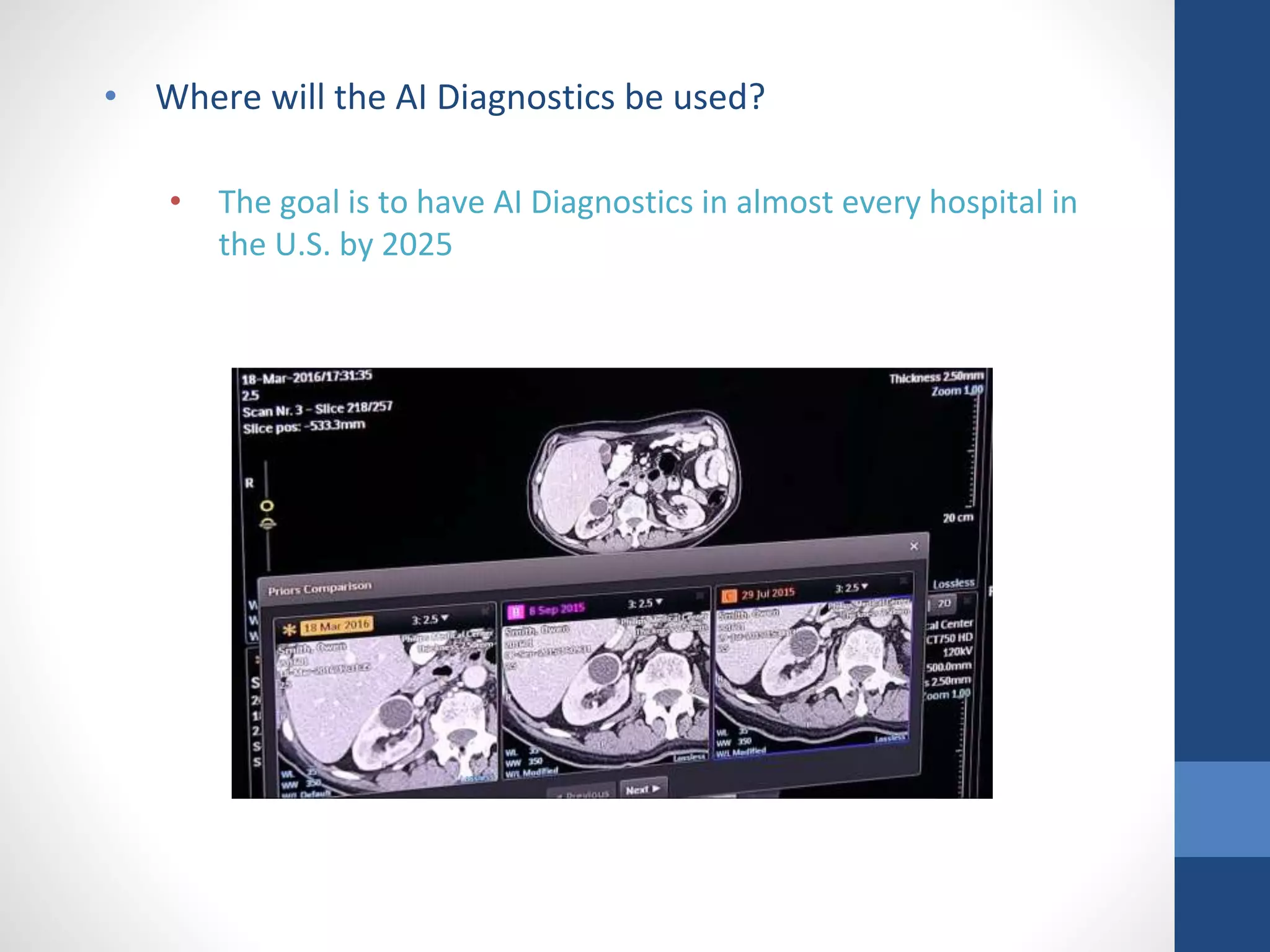
• Where will the AI Diagnostics be used?
• The goal is to have AI Diagnostics in almost every hospital in
the U.S. by 2025
Healthcare AI Is Disruptive
• The current sustaining innovation is for a skilled professional
to perform a diagnosis at a high cost and lengthy time
• Will target non-consumers due to the elimination of
unnecessary hospital procedures and doctor visits
Healthcare AI Is Disruptive
• Faster patient diagnosis will allow for better patient
outcomes
• More accessible to larger population
• Increase in the efficiency of patient diagnosis will allow for
reduced treatment cost
• More affordable
• High End Market/Sustaining Users will not use this service at
first due to concerns of the algorithm’s diagnosis accuracy
• Target non-consumers who are not at immediate risk of
misdiagnosis -> potential to work way up to mainstream users
Cost/Benefit Of Healthcare AI
• Per implementation, products
can cost $500k – $1 mil
• Majority of costs in AI in 2017 is
internal spending (R&D)
• Start-up funding has jumped
from $589 mil in 2012 to $5 bil
in 2017
• Can potentially create $150 bil
in annual savings for US health
care by 2026 (Accenture)
The Future Of AI &
Healthcare
• Artificial intelligence in healthcare is expected to reach 42%
global adoption by 2021 and 90% in the U.S. by 2025
• Reduced treatment costs, patient-centric treatment, and
more accessible quality care will be available to an estimated
70% of all patients by 2020
One Of AI’s Biggest Investors:
Healthcare
• Healthcare is currently one of the largest investors in AI
Works Cited
• https://www.cbinsights.com/research/artificial-intelligence-
healthcare-deals-funding-investors/
• https://www.forbes.com/sites/reenitadas/2016/03/30/top-5-
technologies-disrupting-healthcare-by-2020/#498003af6826
• https://spectrum.ieee.org/the-human-
os/biomedical/diagnostics/ai-diagnostics-move-into-the-clinic
• https://www.ncbi.nlm.nih.gov/pmc/articles/PMC5829945/
• https://towardsdatascience.com/can-ai-enable-a-10-minute-
mri-77218f0121fe

Ai in healthcare (3)

  • 1.
    Artificial Intelligence In Healthcare NicholasGormley, Thomas Murphy, Ryan Temestini, & Shihao Fei
  • 2.
    AI Diagnostics • Variousdangerous medical conditions such as strokes, forms of heart disease, and diabetic retinopathy are difficult to diagnose accurately and quickly • Artificial Intelligence is assisting doctors in making more accurate decisions much quicker and the AI can even make the diagnosis itself
  • 3.
    Evolution Of Healthcare UsingAI • What is the new technology innovation in Healthcare? • Diagnostic medicine is using AI using Machine Learning(ML) to make early detection and diagnosis, treatment, as well as outcome prediction and prognosis evaluation of various diseases independently and much more quickly. • What will this new AI Diagnostics technology cost? • Initial implementation costs are estimated to be 500k – 1M per implementation, but is estimated to save billions within the next 10 years
  • 4.
    • How easyto use is AI Diagnostics? • Diagnostic AI completes diagnostic tasks independently or can simply offer doctors suggestions on a diagnosis/treatment • How does AI Diagnostics compare to existing similar products/services? • Before AI Diagnostic, tasks were completed manually by a doctor or a team of doctors at greatly reduced rate • Who will use AI Diagnostics? • All doctors in diagnostic medicine will hopefully utilize this technology in the upcoming future
  • 5.
    • Where willthe AI Diagnostics be used? • The goal is to have AI Diagnostics in almost every hospital in the U.S. by 2025
  • 6.
    Healthcare AI IsDisruptive • The current sustaining innovation is for a skilled professional to perform a diagnosis at a high cost and lengthy time • Will target non-consumers due to the elimination of unnecessary hospital procedures and doctor visits
  • 7.
    Healthcare AI IsDisruptive • Faster patient diagnosis will allow for better patient outcomes • More accessible to larger population • Increase in the efficiency of patient diagnosis will allow for reduced treatment cost • More affordable • High End Market/Sustaining Users will not use this service at first due to concerns of the algorithm’s diagnosis accuracy • Target non-consumers who are not at immediate risk of misdiagnosis -> potential to work way up to mainstream users
  • 8.
    Cost/Benefit Of HealthcareAI • Per implementation, products can cost $500k – $1 mil • Majority of costs in AI in 2017 is internal spending (R&D) • Start-up funding has jumped from $589 mil in 2012 to $5 bil in 2017 • Can potentially create $150 bil in annual savings for US health care by 2026 (Accenture)
  • 9.
    The Future OfAI & Healthcare • Artificial intelligence in healthcare is expected to reach 42% global adoption by 2021 and 90% in the U.S. by 2025 • Reduced treatment costs, patient-centric treatment, and more accessible quality care will be available to an estimated 70% of all patients by 2020
  • 10.
    One Of AI’sBiggest Investors: Healthcare • Healthcare is currently one of the largest investors in AI
  • 11.
    Works Cited • https://www.cbinsights.com/research/artificial-intelligence- healthcare-deals-funding-investors/ •https://www.forbes.com/sites/reenitadas/2016/03/30/top-5- technologies-disrupting-healthcare-by-2020/#498003af6826 • https://spectrum.ieee.org/the-human- os/biomedical/diagnostics/ai-diagnostics-move-into-the-clinic • https://www.ncbi.nlm.nih.gov/pmc/articles/PMC5829945/ • https://towardsdatascience.com/can-ai-enable-a-10-minute- mri-77218f0121fe