Artificial Intelligence
in Medicine.
Sven Van Poucke, MD, PhD
Disclosure
Relevant financial arrangement or affiliation with RapidMiner that could be
perceived as a real or apparent conflict of interest in the context of the subject of
this presentation:
Academia License: RapidMiner Studio, Server, Radoop “RapidMiner Academia
provides free or substantially discounted use of the commercial version of our
platform to students, professors, researchers and other academics at educational
institutions.”
No reimbursement for consultancy and/or travel expenses.
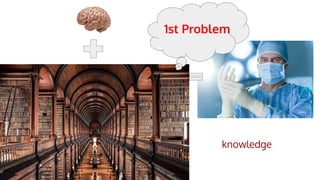
1st Problem
knowledge
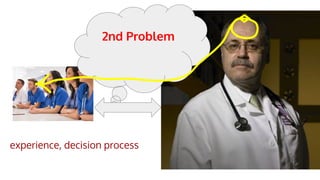
2nd Problem
experience, decision process
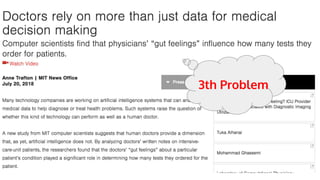
3th Problem
We already live in a world of “real-time”
predictive analytics.
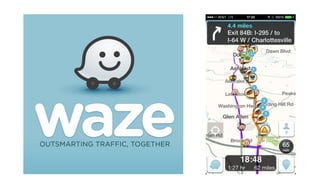
A simple predictive analysis is your arrival
time in Waze.
The myriad problems preventing machine learning from acting
on the wealth of electronic health records data (EHRs) will one
day give way to a fantastic revolution in digital health.
Approximately 80% of healthcare data is still unstructured and
housed in various silos across different health systems due to
complicated regulatory requirements.
Data variables are themselves spread across multiple reporting
areas of numerous softwares including clinical notes and
laboratory results generated during various hospital visits.
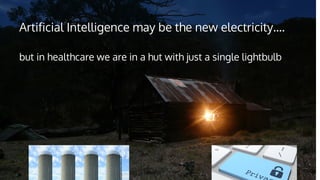
Artificial Intelligence may be the new electricity….
but in healthcare we are in a hut with just a single lightbulb
This is a problem for the future of digital medicine and
Machine learning (ML) offers a potential solution, but not
without its own set of unique challenges.
Mapping and validation of these data fields for ML applications
requires a significant amount of preprocessing.
Most of the models that have been researched to validate ML use
limited variables either due to limitations of the data sets or the
amount of preprocessing required to curate them.
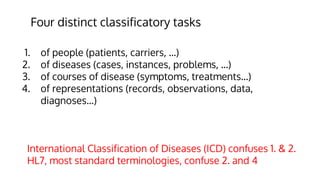
1. of people (patients, carriers, …)
2. of diseases (cases, instances, problems, …)
3. of courses of disease (symptoms, treatments…)
4. of representations (records, observations, data,
diagnoses…)
International Classification of Diseases (ICD) confuses 1. & 2.
HL7, most standard terminologies, confuse 2. and 4
Four distinct classificatory tasks
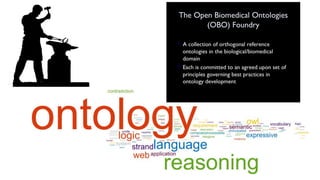
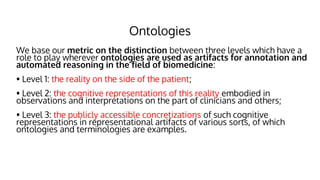
Ontologies
● We base our metric on the distinction between three levels which have a
role to play wherever ontologies are used as artifacts for annotation and
automated reasoning in the field of biomedicine:
● • Level 1: the reality on the side of the patient;
● • Level 2: the cognitive representations of this reality embodied in
observations and interpretations on the part of clinicians and others;
● • Level 3: the publicly accessible concretizations of such cognitive
representations in representational artifacts of various sorts, of which
ontologies and terminologies are examples.
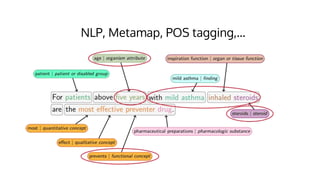
NLP, Metamap, POS tagging,...
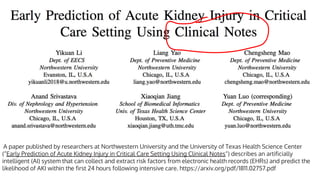
A paper published by researchers at Northwestern University and the University of Texas Health Science Center
(“Early Prediction of Acute Kidney Injury in Critical Care Setting Using Clinical Notes“) describes an artificially
intelligent (AI) system that can collect and extract risk factors from electronic health records (EHRs) and predict the
likelihood of AKI within the first 24 hours following intensive care. https://arxiv.org/pdf/1811.02757.pdf
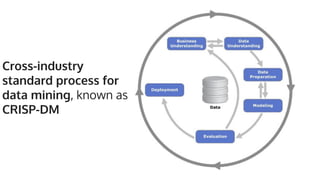
Cross-industry
standard process for
data mining, known as
CRISP-DM
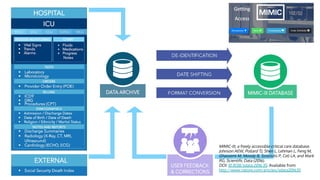
MIMIC-III, a freely accessible critical care database.
Johnson AEW, Pollard TJ, Shen L, Lehman L, Feng M,
Ghassemi M, Moody B, Szolovits P, Celi LA, and Mark
RG. Scientific Data (2016).
DOI: 10.1038/sdata.2016.35. Available from:
http://www.nature.com/articles/sdata201635
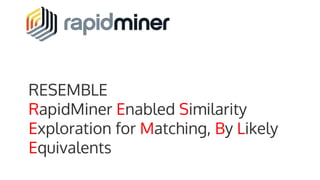
RESEMBLE
RapidMiner Enabled Similarity
Exploration for Matching, By Likely
Equivalents
https://www.linkedin.com/in/drsvenvanpoucke/
https://www.researchgate.net/profile/Sven_Van_Poucke

Artificial Intelligence in Medicine

  • 1.
  • 2.
    Disclosure Relevant financial arrangementor affiliation with RapidMiner that could be perceived as a real or apparent conflict of interest in the context of the subject of this presentation: Academia License: RapidMiner Studio, Server, Radoop “RapidMiner Academia provides free or substantially discounted use of the commercial version of our platform to students, professors, researchers and other academics at educational institutions.” No reimbursement for consultancy and/or travel expenses.
  • 5.
  • 6.
  • 7.
  • 18.
    We already livein a world of “real-time” predictive analytics. A simple predictive analysis is your arrival time in Waze.
  • 26.
    The myriad problemspreventing machine learning from acting on the wealth of electronic health records data (EHRs) will one day give way to a fantastic revolution in digital health. Approximately 80% of healthcare data is still unstructured and housed in various silos across different health systems due to complicated regulatory requirements. Data variables are themselves spread across multiple reporting areas of numerous softwares including clinical notes and laboratory results generated during various hospital visits.
  • 27.
    Artificial Intelligence maybe the new electricity…. but in healthcare we are in a hut with just a single lightbulb
  • 28.
    This is aproblem for the future of digital medicine and Machine learning (ML) offers a potential solution, but not without its own set of unique challenges. Mapping and validation of these data fields for ML applications requires a significant amount of preprocessing. Most of the models that have been researched to validate ML use limited variables either due to limitations of the data sets or the amount of preprocessing required to curate them.
  • 29.
    1. of people(patients, carriers, …) 2. of diseases (cases, instances, problems, …) 3. of courses of disease (symptoms, treatments…) 4. of representations (records, observations, data, diagnoses…) International Classification of Diseases (ICD) confuses 1. & 2. HL7, most standard terminologies, confuse 2. and 4 Four distinct classificatory tasks
  • 32.
    Ontologies ● We baseour metric on the distinction between three levels which have a role to play wherever ontologies are used as artifacts for annotation and automated reasoning in the field of biomedicine: ● • Level 1: the reality on the side of the patient; ● • Level 2: the cognitive representations of this reality embodied in observations and interpretations on the part of clinicians and others; ● • Level 3: the publicly accessible concretizations of such cognitive representations in representational artifacts of various sorts, of which ontologies and terminologies are examples.
  • 36.
    NLP, Metamap, POStagging,...
  • 38.
    A paper publishedby researchers at Northwestern University and the University of Texas Health Science Center (“Early Prediction of Acute Kidney Injury in Critical Care Setting Using Clinical Notes“) describes an artificially intelligent (AI) system that can collect and extract risk factors from electronic health records (EHRs) and predict the likelihood of AKI within the first 24 hours following intensive care. https://arxiv.org/pdf/1811.02757.pdf
  • 42.
  • 43.
    MIMIC-III, a freelyaccessible critical care database. Johnson AEW, Pollard TJ, Shen L, Lehman L, Feng M, Ghassemi M, Moody B, Szolovits P, Celi LA, and Mark RG. Scientific Data (2016). DOI: 10.1038/sdata.2016.35. Available from: http://www.nature.com/articles/sdata201635
  • 52.
    RESEMBLE RapidMiner Enabled Similarity Explorationfor Matching, By Likely Equivalents
  • 66.