AI In Healthcare Industry : Complete Guideliness
The post-pandemic healthcare industry is markedly different from the one before it. Today,
the expectations and regulatory requirements have increased exponentially. It would not be
wrong to say that the global healthcare industry stands at a critical juncture, grappling with
different challenges. Escalating costs, persistent workforce shortages, and the increasing
prevalence of chronic diseases are a few challenges straining existing systems. Patients often
face delays in diagnosis and treatment, while healthcare providers struggle with
administrative burdens and burnout. These issues compromise patient outcomes and hinder
the efficiency of healthcare delivery. Enters AI.
Artificial intelligence (AI) is a transformative force, offering innovative solutions to many of
healthcare's challenges. AI in healthcare industry promises to revolutionize everything from
disease prevention and diagnosis to personalized treatment and administrative efficiency. By
leveraging vast datasets and advanced algorithms, AI helps alleviate the pressures on
healthcare systems, empowering professionals and ultimately enhancing patient care.
Qualityze, a leading quality management software system provider, actively supports this
revolution. Qualityze helps healthcare organizations integrate AI-powered solutions to
improve compliance, streamline processes, and ensure the highest patient safety and care
standards.
How is AI Used in Healthcare?
AI's integration into healthcare is not a distant future but a present reality. It encompasses
various applications, ranging from sophisticated diagnostic tools to advanced drug discovery
platforms. AI analyzes complex medical data with remarkable speed and accuracy, providing
previously unattainable insights.
Here are some key applications of AI in healthcare:
• Medical Imaging and Diagnostics: AI algorithms excel at analyzing medical images like
X-rays, CT scans, and MRIs. AI detects subtle anomalies and patterns indicative of
diseases such as cancer, diabetic retinopathy, and neurological conditions, often
surpassing human capabilities in early detection.
• Drug Discovery and Development: The traditional drug discovery process is time-
consuming and expensive. AI dramatically accelerates this by analyzing vast chemical
and biological datasets, identifying potential drug candidates, predicting their
effectiveness, and optimizing molecular structures.
• Personalized Medicine: AI processes individual patient data, including genetic
information, medical history, lifestyle, and environmental factors. Comprehensive
analysis allows healthcare professionals to develop highly tailored treatment plans,
predict individual therapy responses, and minimize adverse effects.
• Predictive Analytics for Disease Outbreaks: AI models analyze epidemiological data,
social media trends, and environmental factors to predict disease outbreaks and their
potential spread. This predictive capacity enables public health officials to implement
targeted interventions, optimize resource allocation, and formulate proactive
strategies, mitigating the impact of health crises.
• Robotic-Assisted Surgery: AI enhances surgical precision by guiding robotic systems
during complex procedures. These AI-powered robots offer surgeons greater
dexterity, control, and visualization, leading to minimally invasive surgeries, faster
recovery times, and reduced patient risks.
• Virtual Health Assistants and Chatbots: AI-powered chatbots and virtual assistants
provide 24/7 support, answering basic medical questions, scheduling appointments,
sending medication reminders, and offering preliminary symptom assessments. These
tools improve patient engagement and streamline administrative workflows.
• Remote Patient Monitoring (RPM): AI integrates with wearable devices and sensors
to continuously monitor patients' vital signs, activity levels, and other health metrics
from a distance. AI algorithms analyze this real-time data, detecting early signs of
health deterioration and alerting healthcare providers for proactive intervention.
• Administrative Automation: Healthcare involves a significant amount of
administrative work. AI automates routine tasks such as data entry, billing, claims
processing, and electronic health record (EHR) management. It reduces the
administrative burden on healthcare staff, allowing them to focus more on direct
patient care.
As AI technologies evolve, their integration into clinical workflows will become even more
seamless, leading to a truly intelligent healthcare ecosystem. The AI-induced transformation
in healthcare will move beyond individual applications, creating interconnected systems that
optimize patient pathways and enhance overall health outcomes.
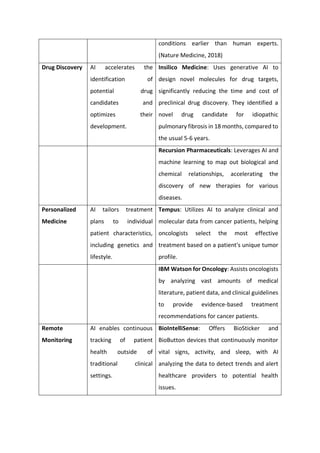
Examples of the Use of AI in Healthcare
AI's tangible impact on healthcare is evident through numerous innovative applications across
various medical domains. These examples demonstrate AI's power to enhance diagnosis,
personalize treatment, and optimize operational efficiency.
Here are specific examples illustrating AI's transformative role:
Application
Area
Description Examples in Practice
Diagnostics AI algorithms analyze
medical images and
patient data for early
and accurate disease
detection.
IDx-DR (Diabetic Retinopathy Detection): The
first FDA-approved AI system for
autonomously detecting diabetic retinopathy
from retinal images. It provides immediate
results, allowing for earlier intervention. (FDA,
2018)
Google's DeepMind AI in Ophthalmology:
Detects over 50 eye diseases from OCT scans
with high accuracy, often identifying
conditions earlier than human experts.
(Nature Medicine, 2018)
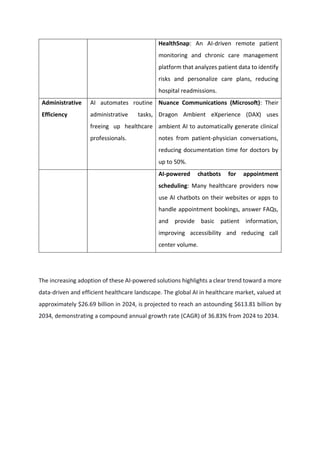
Drug Discovery AI accelerates the
identification of
potential drug
candidates and
optimizes their
development.
Insilico Medicine: Uses generative AI to
design novel molecules for drug targets,
significantly reducing the time and cost of
preclinical drug discovery. They identified a
novel drug candidate for idiopathic
pulmonary fibrosis in 18 months, compared to
the usual 5-6 years.
Recursion Pharmaceuticals: Leverages AI and
machine learning to map out biological and
chemical relationships, accelerating the
discovery of new therapies for various
diseases.
Personalized
Medicine
AI tailors treatment
plans to individual
patient characteristics,
including genetics and
lifestyle.
Tempus: Utilizes AI to analyze clinical and
molecular data from cancer patients, helping
oncologists select the most effective
treatment based on a patient's unique tumor
profile.
IBM Watson for Oncology: Assists oncologists
by analyzing vast amounts of medical
literature, patient data, and clinical guidelines
to provide evidence-based treatment
recommendations for cancer patients.
Remote
Monitoring
AI enables continuous
tracking of patient
health outside of
traditional clinical
settings.
BioIntelliSense: Offers BioSticker and
BioButton devices that continuously monitor
vital signs, activity, and sleep, with AI
analyzing the data to detect trends and alert
healthcare providers to potential health
issues.
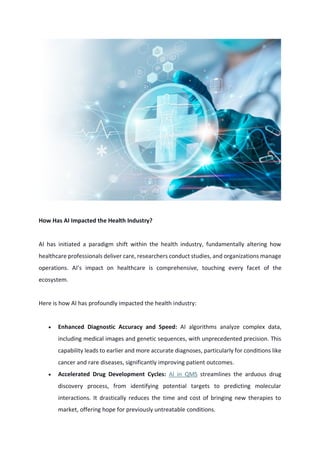
HealthSnap: An AI-driven remote patient
monitoring and chronic care management
platform that analyzes patient data to identify
risks and personalize care plans, reducing
hospital readmissions.
Administrative
Efficiency
AI automates routine
administrative tasks,
freeing up healthcare
professionals.
Nuance Communications (Microsoft): Their
Dragon Ambient eXperience (DAX) uses
ambient AI to automatically generate clinical
notes from patient-physician conversations,
reducing documentation time for doctors by
up to 50%.
AI-powered chatbots for appointment
scheduling: Many healthcare providers now
use AI chatbots on their websites or apps to
handle appointment bookings, answer FAQs,
and provide basic patient information,
improving accessibility and reducing call
center volume.
The increasing adoption of these AI-powered solutions highlights a clear trend toward a more
data-driven and efficient healthcare landscape. The global AI in healthcare market, valued at
approximately $26.69 billion in 2024, is projected to reach an astounding $613.81 billion by
2034, demonstrating a compound annual growth rate (CAGR) of 36.83% from 2024 to 2034.
How Has AI Impacted the Health Industry?
AI has initiated a paradigm shift within the health industry, fundamentally altering how
healthcare professionals deliver care, researchers conduct studies, and organizations manage
operations. AI’s impact on healthcare is comprehensive, touching every facet of the
ecosystem.
Here is how AI has profoundly impacted the health industry:
• Enhanced Diagnostic Accuracy and Speed: AI algorithms analyze complex data,
including medical images and genetic sequences, with unprecedented precision. This
capability leads to earlier and more accurate diagnoses, particularly for conditions like
cancer and rare diseases, significantly improving patient outcomes.
• Accelerated Drug Development Cycles: AI in QMS streamlines the arduous drug
discovery process, from identifying potential targets to predicting molecular
interactions. It drastically reduces the time and cost of bringing new therapies to
market, offering hope for previously untreatable conditions.
• Shift Towards Personalized Treatment: AI enables healthcare providers to move
beyond a "one-size-fits-all" approach. By analyzing individual patient data, AI
facilitates the creation of highly personalized treatment plans, optimizing therapeutic
efficacy and minimizing adverse reactions.
• Improved Operational Efficiency and Cost Reduction: AI automates numerous
administrative and clinical tasks, such as scheduling, billing, and data entry.
Automation reduces human error, streamlines workflows, and significantly cuts
operational costs for healthcare organizations.
• Increased Accessibility to Care: AI-powered telemedicine platforms, virtual assistants,
and remote monitoring solutions expand access to healthcare, especially for
individuals in remote areas or those with mobility limitations.
• Proactive Disease Management: AI's predictive capabilities allow for early
identification of individuals at high risk for certain conditions or disease progression.
This enables proactive interventions and preventative care strategies, shifting the
focus from reactive treatment to preventive health.
• Empowerment of Healthcare Professionals: AI tools augment the capabilities of
doctors, nurses, and researchers by providing data-driven insights and automating
routine tasks.
The ripple effect of AI's integration redefines professional roles, operational models, and
patient expectations. AI’s transformative influence naturally leads us to examine the specific
benefits AI brings to healthcare.
Benefits of AI in Healthcare
Integrating AI into the healthcare landscape yields many benefits, enhancing efficiency,
improving patient outcomes, and paving the way for a more proactive and personalized
approach to health. These advantages span clinical, operational, and financial dimensions.
Consider the compelling benefits AI offers to healthcare:
• Improved Patient Outcomes: AI's ability to facilitate early and accurate diagnoses and
personalized treatment plans directly translates to better health outcomes for
patients. Reduced misdiagnoses, timely interventions, and tailored therapies increase
success rates and improve quality of life.
• Reduced Costs: AI streamlines operations, automates administrative tasks, and
optimizes resource allocation, leading to significant cost savings across the healthcare
ecosystem. For example, AI can reduce diagnostic errors, minimize hospital
readmissions by identifying high-risk patients, and expedite drug development,
contributing to lower healthcare expenditures.
• Enhanced Efficiency and Productivity: Automating repetitive tasks with AI frees
healthcare professionals to focus on more complex cases and direct patient care.
Optimizing workflows improves overall productivity, reduces wait times, and allows
for more efficient allocation of staff and resources.
• Personalized and Precision Medicine: AI analyzes an individual's unique biological,
genetic, and lifestyle data to develop highly customized treatment and preventive
strategies.
• Faster Drug Discovery and Development: AI algorithms rapidly analyze vast chemical
and biological datasets, identifying potential drug candidates and predicting their
efficacy and safety profiles.
• Advanced Data Analysis and Insights: Healthcare generates enormous amounts of
data. AI systems process and analyze this "big data" to uncover hidden patterns,
predict disease progression, and identify optimal treatment pathways, providing
invaluable insights for clinical decision-making and public health initiatives.
• Increased Accessibility and Equity: AI-powered telemedicine and remote monitoring
solutions expand healthcare access to underserved populations and individuals in
rural areas.
• Reduced Human Error: While human expertise remains paramount, AI acts as a
powerful assistant, minimizing the potential for human error in tasks like dosage
calculations, diagnostic interpretations, and administrative processes, thereby
enhancing patient safety.
The many benefits of AI make a strong case for its continued adoption and integration into
healthcare systems worldwide. When harnessed effectively, the powerful technology
promises a future of more efficient, accessible, and ultimately healthier industries.
Understanding these broad benefits sets the stage for exploring how specific platforms like
Qualityze facilitate this transformation.
Explore AI in Healthcare with Qualityze
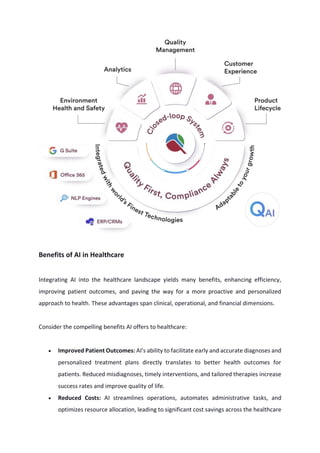
Qualityze understands AI's immense potential for transforming the healthcare industry. As a
comprehensive enterprise quality management system (EQMS) provider, Qualityze leverages
AI to empower healthcare organizations to achieve unparalleled quality, compliance, and
efficiency levels.
Here is how Qualityze helps healthcare organizations with AI integration:
• Proactive Quality Monitoring: Qualityze's AI-powered QMS continuously monitors
data from various sources within a healthcare setting, including patient vitals, lab
reports, incident logs, and equipment performance. The AI identifies subtle trends and
early warning signs of potential quality issues, such as an uptick in infections on a
specific ward or deviations in sterilization protocols.
• Intelligent Root Cause Analysis: Qualityze's AI-powered CAPA software performs
rapid and precise root cause analysis when quality deviations or incidents occur.
Analyzing historical data and correlating various factors can pinpoint the underlying
causes of non-conformances, enabling organizations to implement effective
corrective and preventive actions (CAPA) quickly and efficiently.
• Automated Compliance Management: Qualityze's AI-powered EQMS automates
compliance checks and documentation processes, ensuring adherence to standards
like HIPAA, GDPR, and FDA regulations. The system can flag potential compliance gaps,
generate necessary reports, and streamline audit preparations, reducing manual
effort and minimizing risk.
• Predictive Risk Assessment: Qualityze AI-powered EQMS Software conducts
predictive risk assessments. By analyzing vast datasets of past incidents, audit findings,
and operational data, the AI identifies areas of high risk within the healthcare system.
It allows organizations to allocate resources effectively, implement targeted risk
mitigation strategies, and prevent future quality issues.
Qualityze's AI-driven approach transforms quality management from a reactive necessity into
a proactive strategic advantage, ensuring that healthcare organizations consistently deliver
high-quality, safe, and compliant care. This comprehensive support reinforces AI's role as a
technological advancement and a fundamental enabler of excellence in healthcare.
Conclusion
The healthcare industry is in flux, confronting unprecedented challenges from rising costs and
workforce shortages to the complex demands of chronic disease management. Artificial
intelligence offers a robust pathway forward, providing innovative solutions reshaping the
care landscape. From accelerating drug discovery and enabling personalized medicine to
enhancing diagnostic accuracy and streamlining administrative workflows, AI is already
proving its immense value. The projected growth of AI in the healthcare market underscores
its transformative potential, moving healthcare from reactive treatment to proactive,
personalized care.
Qualityze EQMS Suite integrates AI into quality management systems, ensuring that
unwavering patient safety and operational excellence standards underpin technological
advancements. Embracing AI is no longer an option but a strategic imperative, promising a
future of more accessible, efficient, and higher-quality healthcare for everyone.