ARTIFICIAL
INTELLIGENCE
PRESENTED BY:
A.PRAMIDHA
CONTENTS:
• DEFINITION OF AI
• HISTORY OF AI
• PHILOSOPHY OF AI
• GOALS OF AI
• CURRENT STATUS OF AI
• FUTURE OF AI
• CONTRIBUTES TO AI
• CHALLENGES OF AI
• APPLICATIONS OF AI
• PROS AND CONS
• CONCLUSION
What is Artificial Intelligence?
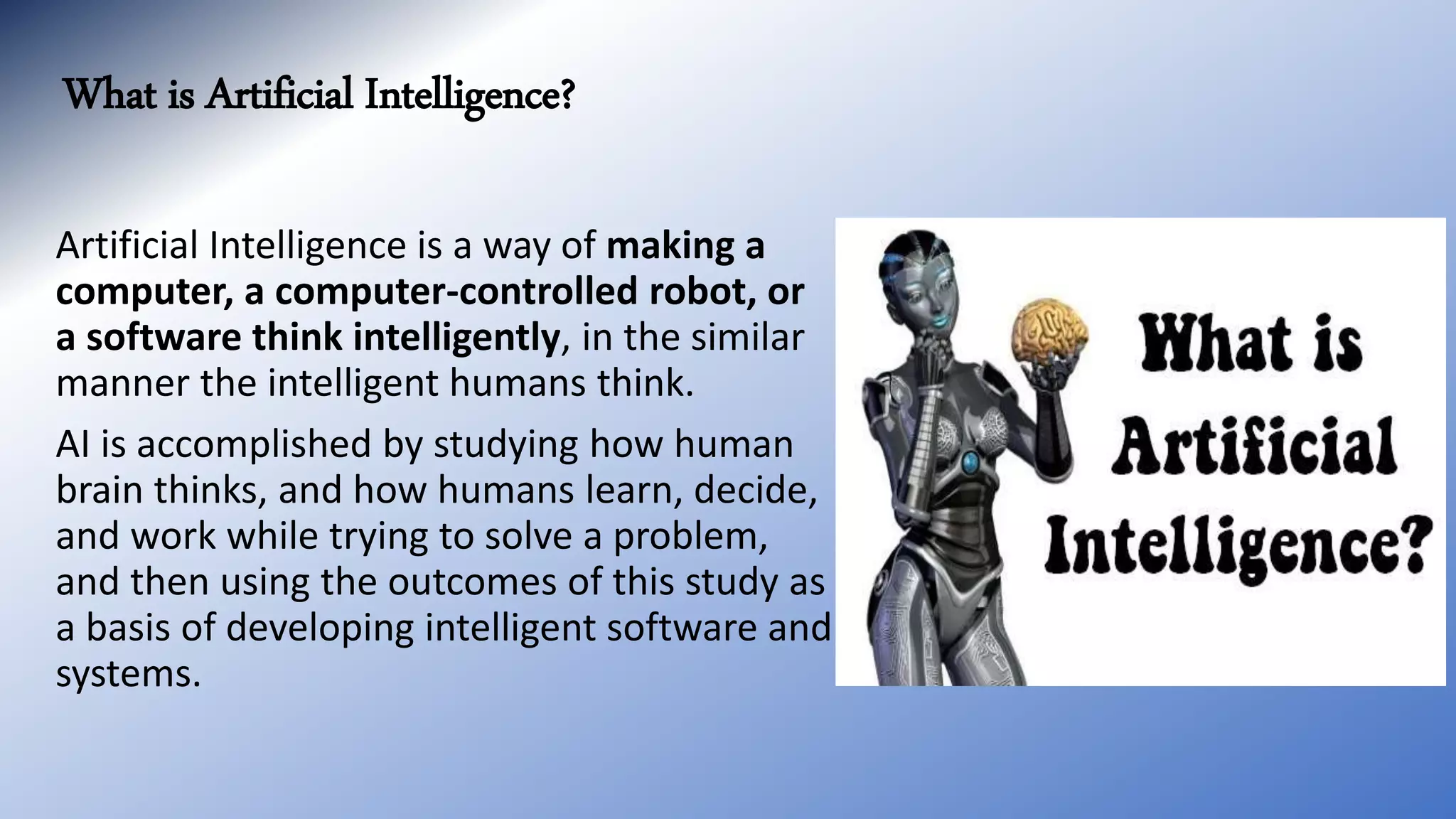
Artificial Intelligence is a way of making a
computer, a computer-controlled robot, or
a software think intelligently, in the similar
manner the intelligent humans think.
AI is accomplished by studying how human
brain thinks, and how humans learn, decide,
and work while trying to solve a problem,
and then using the outcomes of this study as
a basis of developing intelligent software and
systems.
PHILOSOPHY OF AI
• While exploiting the power of the computer systems, the curiosity of
human, lead him to wonder, “Can a machine think and behave like
humans do?”
• Thus, the development of AI started with the intention of creating
similar intelligence in machines that we find and regard high in
humans.
GOALS OF AI
• To Create Expert Systems − The systems which exhibit intelligent
behavior, learn, demonstrate, explain, and advice its users.
• To Implement Human Intelligence in Machines − Creating systems that
understand, think, learn, and behave like humans.
HISTORY OF AI
• 1943 – Foundations for neural networks were laid.
• 1950 – Alan Turing introduced turing test for evaluation of intelligence and
published Computing Machinery.
• 1955 – John McCarthy coined the term Artificial Intelligence. Demonstration
of first AI program at Carnegie Mellon University
• 1990 – Major advances in all areas of AI:
1. Scheduling
2. Data mining, web crawler
3. Virtual reality
4. Games
• 1997 – Deep blue chess program beats the then world chess champion, Garry
Kasparov
CURRENT STATUS OF AI
 AI have taken many shapes and forms over recent years
o Mobile phones(Siri/Cortana)
o Video games characters
o GPS/Voice Recognition
o Robotics
Google has been a major play on AI transcendence and deep learning
o Deep learning is a machine learning based on algorithms
FUTURE OF AI
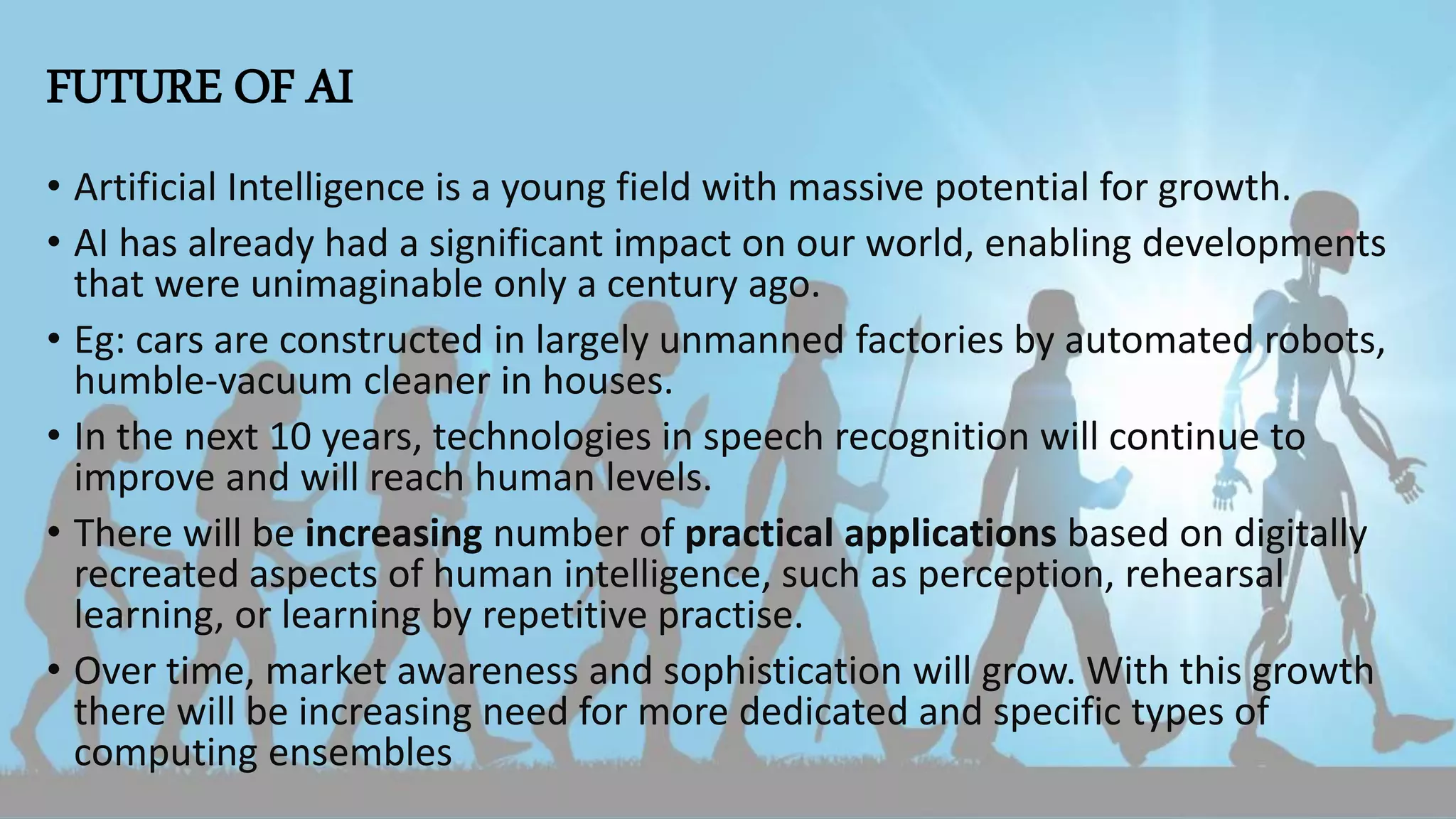
• Artificial Intelligence is a young field with massive potential for growth.
• AI has already had a significant impact on our world, enabling developments
that were unimaginable only a century ago.
• Eg: cars are constructed in largely unmanned factories by automated robots,
humble-vacuum cleaner in houses.
• In the next 10 years, technologies in speech recognition will continue to
improve and will reach human levels.
• There will be increasing number of practical applications based on digitally
recreated aspects of human intelligence, such as perception, rehearsal
learning, or learning by repetitive practise.
• Over time, market awareness and sophistication will grow. With this growth
there will be increasing need for more dedicated and specific types of
computing ensembles
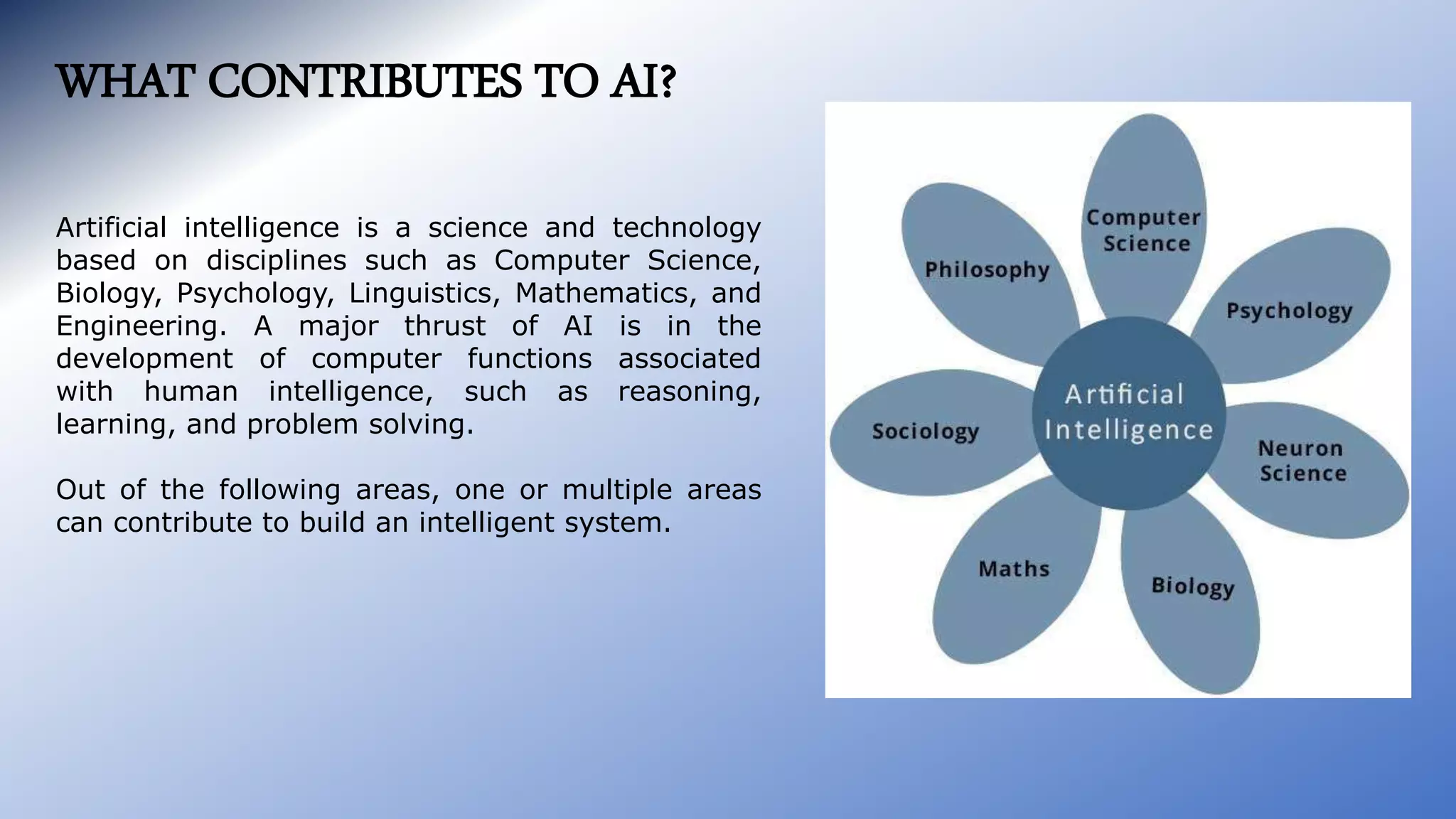
WHAT CONTRIBUTES TO AI?
Artificial intelligence is a science and technology
based on disciplines such as Computer Science,
Biology, Psychology, Linguistics, Mathematics, and
Engineering. A major thrust of AI is in the
development of computer functions associated
with human intelligence, such as reasoning,
learning, and problem solving.
Out of the following areas, one or multiple areas
can contribute to build an intelligent system.
CHALLENGES OF AI
• Computing Power
• Tolerance Power
• Intuitive Thinking
• Judging Power
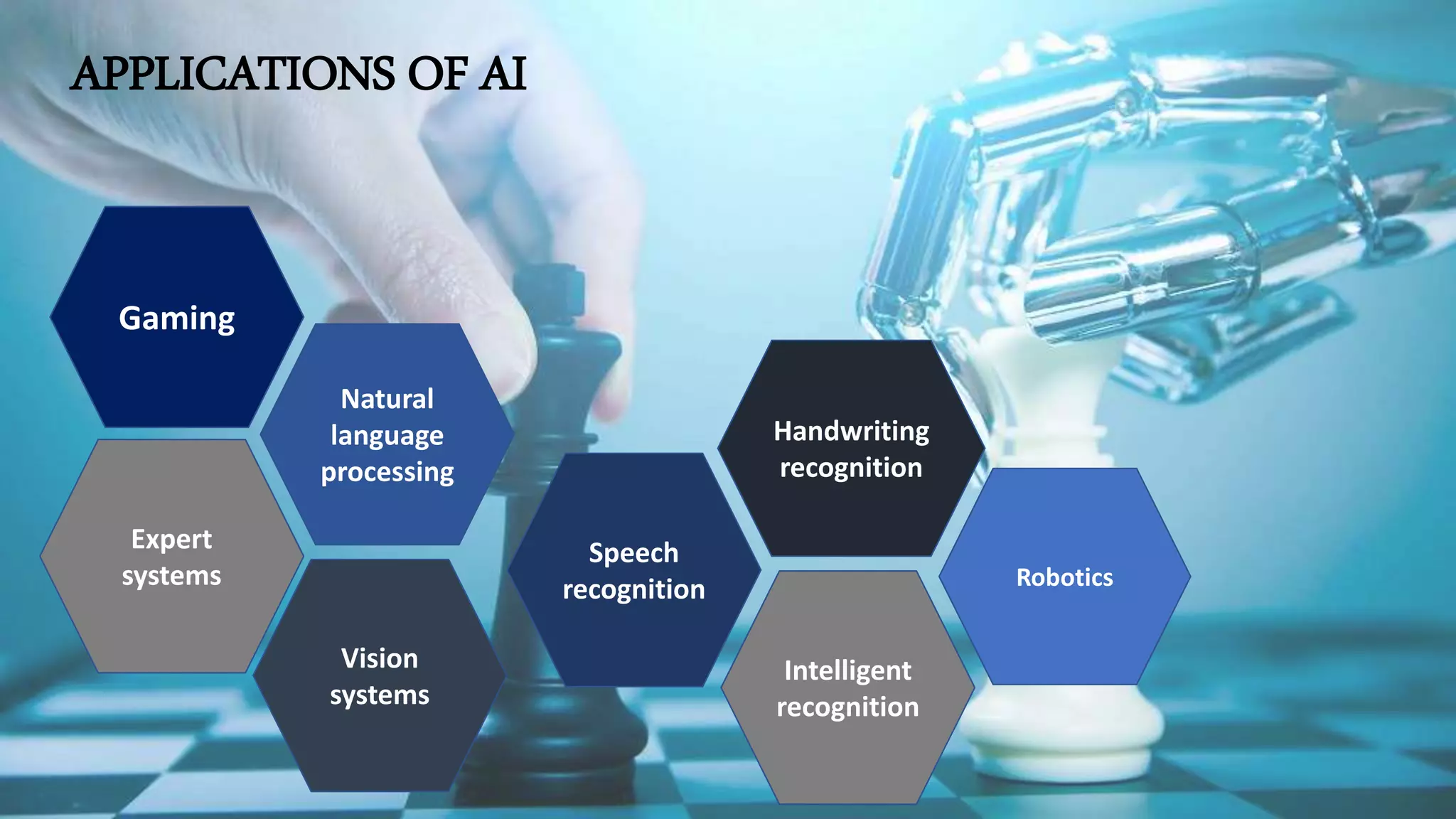
APPLICATIONS OF AI
Gaming
Natural
language
processing
Expert
systems
Vision
systems
Speech
recognition
Intelligent
recognition
Handwriting
recognition
Robotics
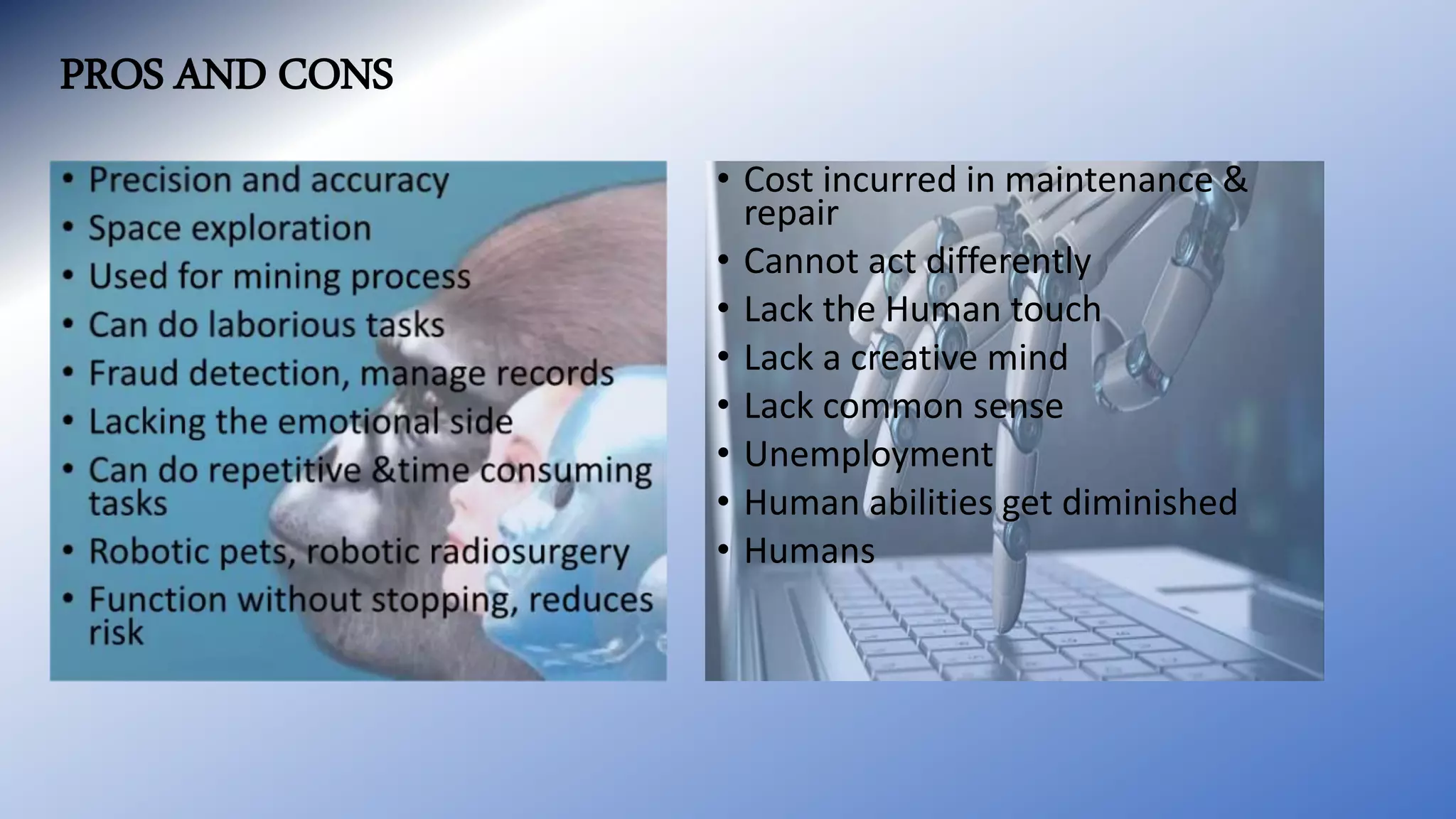
PROS AND CONS
• Cost incurred in maintenance &
repair
• Cannot act differently
• Lack the Human touch
• Lack a creative mind
• Lack common sense
• Unemployment
• Human abilities get diminished
• Humans
CONCLUSION
Finally we can say that the Artificial Intelligence is the Intelligence of
machines and the branch of Computer Science that aims to create it. AI
textbooks define the field as “The Study and Design of Intelligent
agents” when an intelligent agent is a system that perceives its
environment and takes actions that maximise the chances of its
success. John McCarthy who coined the term in 1995, defines it as
“The Science and Engineering of making Intelligent Machines.
THANK YOU !!

Artificial intelligence

  • 1.
  • 2.
    CONTENTS: • DEFINITION OFAI • HISTORY OF AI • PHILOSOPHY OF AI • GOALS OF AI • CURRENT STATUS OF AI • FUTURE OF AI • CONTRIBUTES TO AI • CHALLENGES OF AI • APPLICATIONS OF AI • PROS AND CONS • CONCLUSION
  • 3.
    What is ArtificialIntelligence? Artificial Intelligence is a way of making a computer, a computer-controlled robot, or a software think intelligently, in the similar manner the intelligent humans think. AI is accomplished by studying how human brain thinks, and how humans learn, decide, and work while trying to solve a problem, and then using the outcomes of this study as a basis of developing intelligent software and systems.
  • 4.
    PHILOSOPHY OF AI •While exploiting the power of the computer systems, the curiosity of human, lead him to wonder, “Can a machine think and behave like humans do?” • Thus, the development of AI started with the intention of creating similar intelligence in machines that we find and regard high in humans.
  • 5.
    GOALS OF AI •To Create Expert Systems − The systems which exhibit intelligent behavior, learn, demonstrate, explain, and advice its users. • To Implement Human Intelligence in Machines − Creating systems that understand, think, learn, and behave like humans.
  • 6.
    HISTORY OF AI •1943 – Foundations for neural networks were laid. • 1950 – Alan Turing introduced turing test for evaluation of intelligence and published Computing Machinery. • 1955 – John McCarthy coined the term Artificial Intelligence. Demonstration of first AI program at Carnegie Mellon University • 1990 – Major advances in all areas of AI: 1. Scheduling 2. Data mining, web crawler 3. Virtual reality 4. Games • 1997 – Deep blue chess program beats the then world chess champion, Garry Kasparov
  • 7.
    CURRENT STATUS OFAI  AI have taken many shapes and forms over recent years o Mobile phones(Siri/Cortana) o Video games characters o GPS/Voice Recognition o Robotics Google has been a major play on AI transcendence and deep learning o Deep learning is a machine learning based on algorithms
  • 8.
    FUTURE OF AI •Artificial Intelligence is a young field with massive potential for growth. • AI has already had a significant impact on our world, enabling developments that were unimaginable only a century ago. • Eg: cars are constructed in largely unmanned factories by automated robots, humble-vacuum cleaner in houses. • In the next 10 years, technologies in speech recognition will continue to improve and will reach human levels. • There will be increasing number of practical applications based on digitally recreated aspects of human intelligence, such as perception, rehearsal learning, or learning by repetitive practise. • Over time, market awareness and sophistication will grow. With this growth there will be increasing need for more dedicated and specific types of computing ensembles
  • 9.
    WHAT CONTRIBUTES TOAI? Artificial intelligence is a science and technology based on disciplines such as Computer Science, Biology, Psychology, Linguistics, Mathematics, and Engineering. A major thrust of AI is in the development of computer functions associated with human intelligence, such as reasoning, learning, and problem solving. Out of the following areas, one or multiple areas can contribute to build an intelligent system.
  • 10.
    CHALLENGES OF AI •Computing Power • Tolerance Power • Intuitive Thinking • Judging Power
  • 11.
  • 12.
    PROS AND CONS •Cost incurred in maintenance & repair • Cannot act differently • Lack the Human touch • Lack a creative mind • Lack common sense • Unemployment • Human abilities get diminished • Humans
  • 13.
    CONCLUSION Finally we cansay that the Artificial Intelligence is the Intelligence of machines and the branch of Computer Science that aims to create it. AI textbooks define the field as “The Study and Design of Intelligent agents” when an intelligent agent is a system that perceives its environment and takes actions that maximise the chances of its success. John McCarthy who coined the term in 1995, defines it as “The Science and Engineering of making Intelligent Machines.
  • 14.