SECTION 1
The legislative power shall be vested
in the Congress of the Philippines
which shall consist of a Senate and a
House of Representatives, except to
the extent reserved to the people by
the provision on initiative and
referendum.
SECTION 2
The Senate shall be composed of
twenty-four Senators who shall be
elected at large by the qualified
voters of the Philippines, as may be
provided by law.
SECTION 3
No person shall be a Senator unless he
is a natural-born citizen of the
Philippines, and, on the day of the
election, is at least thirty-five years of
age, able to read and write, a registered
voter, and a resident of the Philippines
for not less than two years immediately
preceding the day of the election.
SECTION 4
• The term of office of the Senators shall be six
years and shall commence, unless otherwise
provided by law, at noon on the thirtieth day of
June next following their election.
• No Senator shall serve for more than two
consecutive terms. Voluntary renunciation of
the office for any length of time shall not be
considered as an interruption in the continuity
of his service for the full term for which he was
elected.
SECTION 5
(1) The House of Representatives shall be
composed of not more than two hundred and
fifty members, unless otherwise fixed by law,
who shall be elected from legislative districts
apportioned among the provinces, cities, and
the Metropolitan Manila area in accordance
with the number of their respective inhabitants,
and on the basis of a uniform and progressive
ratio, and those who, as provided by law, shall
be elected through a party-list system of
registered national, regional, and sectoral
parties or organizations.
(2) The party-list representatives shall
constitute twenty per centum of the total
number of representatives including those
under the party list. For three consecutive
terms after the ratification of this
Constitution, one-half of the seats allocated
to party-list representatives shall be filled, as
provided by law, by selection or election
from the labor, peasant, urban poor,
indigenous cultural communities, women,
youth, and such other sectors as may be
provided by law, except the religious sector.
SECTION 5
(3) Each legislative district shall comprise,
as far as practicable, contiguous, compact
and adjacent territory. Each city with a
population of at least two hundred fifty
thousand, or each province, shall have at
least one representative.
(4) Within three years following the return
of every census, the Congress shall make
a reapportionment of legislative districts
based on the standards provided in this
section.
SECTION 5
SECTION 6
No person shall be a Member of the House of
Representatives unless he is a natural-born
citizen of the Philippines and, on the day of the
election, is at least twenty-five years of age,
able to read and write, and, except the party-
list representatives, a registered voter in the
district in which he shall be elected, and a
resident thereof for a period of not less than
one year immediately preceding the day of the
election.
SECTION 7
• The Members of the House of Representatives
shall be elected for a term of three years which
shall begin, unless otherwise provided by law, at
noon on the thirtieth day of June next following
their election.
• No member of the House of Representatives
shall serve for more than three consecutive
terms. Voluntary renunciation of the office for
any length of time shall not be considered as an
interruption in the continuity of his service for
the full term for which he was elected.
SECTION 8
Unless otherwise provided by law,
the regular election of the Senators
and the Members of the House of
Representatives shall be held on
the second Monday of May.
SECTION 9
In case of vacancy in the Senate or in
the House of Representatives, a special
election may be called to fill such
vacancy in the manner prescribed by
law, but the Senator or Member of the
House of Representatives thus elected
shall serve only for the unexpired term.
SECTION 10
The salaries of Senators and Members of
the House of Representatives shall be
determined by law. No increase in said
compensation shall take effect until after the
expiration of the full term of all the
Members of the Senate and the House of
Representatives approving such increase.
SECTION 11
A Senator or Member of the House of
Representatives shall, in all offenses
punishable by not more than six years
imprisonment, be privileged from
arrest while the Congress is in session.
No Member shall be questioned nor be
held liable in any other place for any
speech or debate in the Congress or in
any committee thereof.
SECTION 12
All Members of the Senate and the House
of Representatives shall, upon assumption
of office, make a full disclosure of their
financial and business interests. They shall
notify the House concerned of a potential
conflict of interest that may arise from the
filing of a proposed legislation of which
they are authors.
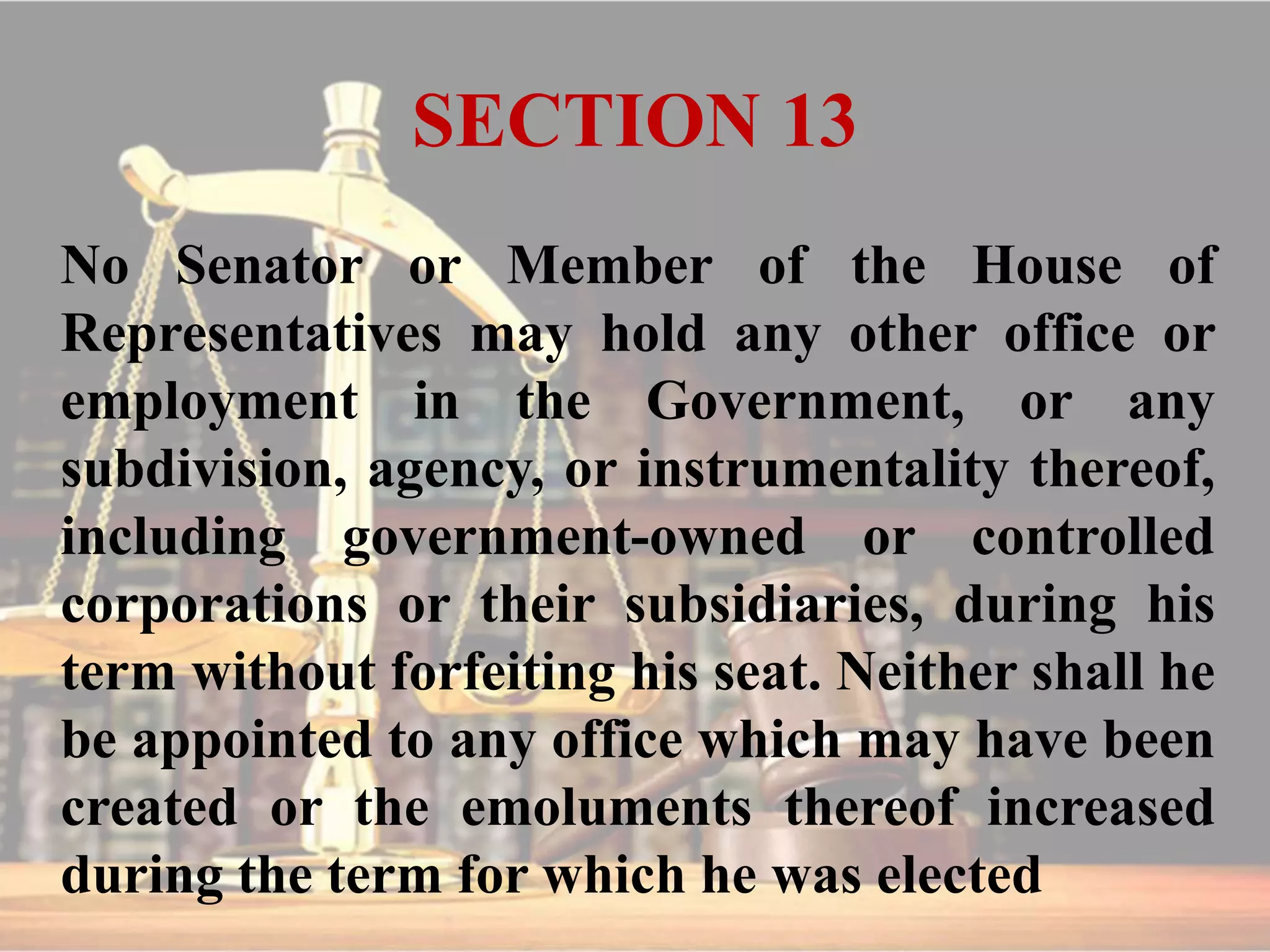
SECTION 13
No Senator or Member of the House of
Representatives may hold any other office or
employment in the Government, or any
subdivision, agency, or instrumentality thereof,
including government-owned or controlled
corporations or their subsidiaries, during his
term without forfeiting his seat. Neither shall he
be appointed to any office which may have been
created or the emoluments thereof increased
during the term for which he was elected
SECTION 14
No Senator or Member of the House of
Representatives may personally appear as counsel
before any court of justice or before the Electoral
Tribunals, or quasi-judicial and other
administrative bodies. Neither shall he, directly or
indirectly, be interested financially in any contract
with, or in any franchise or special privilege
granted by the Government, or any subdivision,
agency, or instrumentality thereof, including any
government-owned or controlled corporation, or its
subsidiary, during his term of office. He shall not
intervene in any matter before any office of the
Government for his pecuniary benefit or where he
may be called upon to act on account of his office.
SECTION 15
The Congress shall convene once every year on
the fourth Monday of July for its regular
session, unless a different date is fixed by law,
and shall continue to be in session for such
number of days as it may determine until thirty
days before the opening of its next regular
session, exclusive of Saturdays, Sundays, and
legal holidays. The President may call a special
session at any time.
SECTION 16
(1) The Senate shall elect its President and the
House of Representatives its Speaker, by a
majority vote of all its respective Members.
Each House shall choose such other officers as it
may deem necessary.
(2) A majority of each House shall constitute a
quorum to do business, but a smaller number
may adjourn from day to day and may compel
the attendance of absent Members in such
manner, and under such penalties, as such
House may provide.
(3) Each House may determine the
rules of its proceedings, punish its
Members for disorderly behavior,
and, with the concurrence of two-
thirds of all its Members, suspend
or expel a Member. A penalty of
suspension, when imposed, shall
not exceed sixty days.
SECTION16
(4) Each House shall keep a Journal of its
proceedings, and from time to time publish the
same, excepting such parts as may, in its
judgment, affect national security; and the yeas
and nays on any question shall, at the request of
one-fifth of the Members present, be entered in
the journal. Each House shall also keep a
Record of its proceedings.
(5) Neither House during the sessions of the
Congress shall, without the consent of the other,
adjourn for more than three days, nor to any
other place than that in which the two Houses
shall be sitting.
SECTION 17
The Senate and the House of Representatives shall each
have an Electoral Tribunal which shall be the sole judge
of all contests relating to the election, returns, and
qualifications of their respective Members. Each
Electoral Tribunal shall be composed of nine Members,
three of whom shall be Justices of the Supreme Court to
be designated by the Chief Justice, and the remaining six
shall be Members of the Senate or the House of
Representatives, as the case may be, who shall be chosen
on the basis of proportional representation from the
political parties and the parties or organizations
registered under the party-list system represented
therein. The senior Justice in the Electoral Tribunal shall
be its Chairman.
SECTION 18
There shall be a Commission on Appointments
consisting of the President of the Senate, as ex
officio Chairman, twelve Senators and twelve
Members of the House of Representatives, elected
by each House on the basis of proportional
representation from the political parties and
parties or organizations registered under the party-
list system represented therein. The Chairman of
the Commission shall not vote, except in case of a
tie. The Commission shall act on all appointments
submitted to it within thirty session days of the
Congress from their submission. The Commission
shall rule by a majority vote of all the Members.
SECTION 19
The Electoral Tribunals and the
Commission on Appointments shall be
constituted within thirty days after the
Senate and the House of Representatives
shall have been organized with the election
of the President and the Speaker. The
Commission on Appointments shall meet
only while the Congress is in session, at the
call of its Chairman or a majority of all its
Members, to discharge such powers and
functions as are herein conferred upon it.
SECTION 20
The records and books of accounts of the
Congress shall be preserved and be open to the
public in accordance with law, and such books
shall be audited by the Commission on Audit
which shall publish annually an itemized list of
amounts paid to and expenses incurred for
each Member.
SECTION 21
The Senate or the House of
Representatives or any of its respective
committees may conduct inquiries in
aid of legislation in accordance with its
duly published rules of procedure. The
rights of persons appearing in or
affected by such inquiries shall be
respected.
SECTION 22
The heads of departments may upon their own initiative,
with the consent of the President, or upon the request of
either House, as the rules of each House shall provide,
appear before and be heard by such House on any matter
pertaining to their departments.
Written questions shall be submitted to the President of
the Senate or the Speaker of the House of
Representatives at least three days before their scheduled
appearance. Interpellations shall not be limited to
written questions, but may cover matters related thereto.
When the security of the State or the public interest so
requires and the President so states in writing, the
appearance shall be conducted in executive session.
SECTION 23
(1) The Congress, by a vote of two-thirds of both
Houses in joint session assembled, voting
separately, shall have the sole power to declare the
existence of a state of war.
(2) In times of war or other national emergency, the
Congress may, by law, authorize the President, for
a limited period and subject to such restrictions as
it may prescribe, to exercise powers necessary and
proper to carry out a declared national policy.
Unless sooner withdrawn by resolution of the
Congress, such powers shall cease upon the next
adjournment thereof.
SECTION 24
All appropriation, revenue or tariff bills,
bills authorizing increase of the public
debt, bills of local application, and private
bills shall originate exclusively in the
House of Representatives, but the Senate
may propose or concur with amendments..
(1) The Congress may not increase the
appropriations recommended by the President
for the operation of the Government as specified
in the budget. The form, content, and manner of
preparation of the budget shall be prescribed by
law.
(2) No provision or enactment shall be embraced
in the general appropriations bill unless it
relates specifically to some particular
appropriation therein. Any such provision or
enactment shall be limited in its operation to the
appropriation to which it relates.
SECTION 25
SECTION 25
(3) The procedure in approving appropriations
for the Congress shall strictly follow the
procedure for approving appropriations for
other departments and agencies.
(4) A special appropriations bill shall specify the
purpose for which it is intended, and shall be
supported by funds actually available as
certified by the National Treasurer, or to be
raised by a corresponding revenue proposed
therein.
(5) No law shall be passed authorizing
any transfer of appropriations; however,
the President, the President of the Senate,
the Speaker of the House of
Representatives, the Chief Justice of the
Supreme Court, and the heads of
Constitutional Commissions may, by law,
be authorized to augment any item in the
general appropriations law for their
respective offices from savings in other
items of their respective appropriations.
SECTION 25
(6) Discretionary funds appropriated for particular
officials shall be disbursed only for public
purposes to be supported by appropriate
vouchers and subject to such guidelines as may be
prescribed by law.
(7) If, by the end of any fiscal year, the Congress
shall have failed to pass the general
appropriations bill for the ensuing fiscal year, the
general appropriations law for the preceding
fiscal year shall be deemed reenacted and shall
remain in force and effect until the general
appropriations bill is passed by the Congress.
SECTION 25
SECTION 26
(1) Every bill passed by the Congress shall embrace
only one subject which shall be expressed in the title
thereof.
(2) No bill passed by either House shall become a law
unless it has passed three readings on separate days,
and printed copies thereof in its final form have been
distributed to its Members three days before its
passage, except when the President certifies to the
necessity of its immediate enactment to meet a public
calamity or emergency. Upon the last reading of a
bill, no amendment thereto shall be allowed, and the
vote thereon shall be taken immediately thereafter,
and the yeas and nays entered in the Journal.
SECTION 27
(1) Every bill passed by the Congress shall, before it becomes a
law, be presented to the President. If he approves the same, he
shall sign it; otherwise, he shall veto it and return the same
with his objections to the House where it originated, which
shall enter the objections at large in its Journal and proceed
to reconsider it. If, after such reconsideration, two-thirds of
all the Members of such House shall agree to pass the bill, it
shall be sent, together with the objections, to the other House
by which it shall likewise be reconsidered, and if approved by
two-thirds of all the Members of that House, it shall become a
law. In all such cases, the votes of each House shall be
determined by yeas or nays, and the names of the Members
voting for or against shall be entered in its Journal. The
President shall communicate his veto of any bill to the House
where it originated within thirty days after the date of receipt
thereof; otherwise, it shall become a law as if he had signed it.
(2) The President shall have the
power to veto any particular item
or items in an appropriation,
revenue, or tariff bill, but the veto
shall not affect the item or items to
which he does not object.
SECTION 27
SECTION 28
(1) The rule of taxation shall be uniform and
equitable. The Congress shall evolve a
progressive system of taxation.
(2) The Congress may, by law, authorize the
President to fix within specified limits, and
subject to such limitations and restrictions
as it may impose, tariff rates, import and
export quotas, tonnage and wharfage dues,
and other duties or imposts within the
framework of the national development
program of the Government.
(3) Charitable institutions, churches and
parsonages or convents appurtenant
thereto, mosques, non-profit cemeteries,
and all lands, buildings, and
improvements, actually, directly, and
exclusively used for religious, charitable,
or educational purposes shall be exempt
from taxation.
(4) No law granting any tax exemption shall
be passed without the concurrence of a
majority of all the Members of the
Congress.
SECTION 28
SECTION 29
(1) No money shall be paid out of the Treasury
except in pursuance of an appropriation made by
law.
(2) No public money or property shall be
appropriated, applied, paid, or employed, directly
or indirectly, for the use, benefit, or support of any
sect, church, denomination, sectarian institution,
or system of religion, or of any priest, preacher,
minister, or other religious teacher, or dignitary as
such, except when such priest, preacher, minister,
or dignitary is assigned to the armed forces, or to
any penal institution, or government orphanage or
leprosarium.
(3) All money collected on any tax
levied for a special purpose shall be
treated as a special fund and paid
out for such purpose only. If the
purpose for which a special fund
was created has been fulfilled or
abandoned, the balance, if any,
shall be transferred to the general
funds of the Government.
SECTION 29
SECTION 30
No law shall be passed
increasing the appellate
jurisdiction of the Supreme
Court as provided in this
Constitution without its advice
and concurrence.
SECTION 31
No law granting a title of
royalty or nobility shall be
enacted
SECTION 32
The Congress shall, as early as possible,
provide for a system of initiative and
referendum, and the exceptions therefrom,
whereby the people can directly propose and
enact laws or approve or reject any act or law
or part thereof passed by the Congress or local
legislative body after the registration of a
petition therefor signed by at least ten per
centum of the total number of registered
voters, of which every legislative district must
be represented by at least three per centum of
the registered voters thereof.
Bill
It is a stationary proposal, which contains
subject matter embraced in its title,
introduced to a legislative body for
consideration and approval of its member.
2 kinds of Bill
1. Public or Government Bill
2. Private Bill
Three Types of Resolution
1. Joint Resolution
2. Concurrent Resolution
3. Simple Resolution
Resolution
1. First Reading
2. Committee Stage
3. Stage of Second Reading
4. Stage of Third Reading
5. Submission of Executive for Approval
Stages of Legislative Enactment

Article VI Complete Sections

  • 2.
    SECTION 1 The legislativepower shall be vested in the Congress of the Philippines which shall consist of a Senate and a House of Representatives, except to the extent reserved to the people by the provision on initiative and referendum.
  • 3.
    SECTION 2 The Senateshall be composed of twenty-four Senators who shall be elected at large by the qualified voters of the Philippines, as may be provided by law.
  • 4.
    SECTION 3 No personshall be a Senator unless he is a natural-born citizen of the Philippines, and, on the day of the election, is at least thirty-five years of age, able to read and write, a registered voter, and a resident of the Philippines for not less than two years immediately preceding the day of the election.
  • 5.
    SECTION 4 • Theterm of office of the Senators shall be six years and shall commence, unless otherwise provided by law, at noon on the thirtieth day of June next following their election. • No Senator shall serve for more than two consecutive terms. Voluntary renunciation of the office for any length of time shall not be considered as an interruption in the continuity of his service for the full term for which he was elected.
  • 6.
    SECTION 5 (1) TheHouse of Representatives shall be composed of not more than two hundred and fifty members, unless otherwise fixed by law, who shall be elected from legislative districts apportioned among the provinces, cities, and the Metropolitan Manila area in accordance with the number of their respective inhabitants, and on the basis of a uniform and progressive ratio, and those who, as provided by law, shall be elected through a party-list system of registered national, regional, and sectoral parties or organizations.
  • 7.
    (2) The party-listrepresentatives shall constitute twenty per centum of the total number of representatives including those under the party list. For three consecutive terms after the ratification of this Constitution, one-half of the seats allocated to party-list representatives shall be filled, as provided by law, by selection or election from the labor, peasant, urban poor, indigenous cultural communities, women, youth, and such other sectors as may be provided by law, except the religious sector. SECTION 5
  • 8.
    (3) Each legislativedistrict shall comprise, as far as practicable, contiguous, compact and adjacent territory. Each city with a population of at least two hundred fifty thousand, or each province, shall have at least one representative. (4) Within three years following the return of every census, the Congress shall make a reapportionment of legislative districts based on the standards provided in this section. SECTION 5
  • 9.
    SECTION 6 No personshall be a Member of the House of Representatives unless he is a natural-born citizen of the Philippines and, on the day of the election, is at least twenty-five years of age, able to read and write, and, except the party- list representatives, a registered voter in the district in which he shall be elected, and a resident thereof for a period of not less than one year immediately preceding the day of the election.
  • 10.
    SECTION 7 • TheMembers of the House of Representatives shall be elected for a term of three years which shall begin, unless otherwise provided by law, at noon on the thirtieth day of June next following their election. • No member of the House of Representatives shall serve for more than three consecutive terms. Voluntary renunciation of the office for any length of time shall not be considered as an interruption in the continuity of his service for the full term for which he was elected.
  • 11.
    SECTION 8 Unless otherwiseprovided by law, the regular election of the Senators and the Members of the House of Representatives shall be held on the second Monday of May.
  • 12.
    SECTION 9 In caseof vacancy in the Senate or in the House of Representatives, a special election may be called to fill such vacancy in the manner prescribed by law, but the Senator or Member of the House of Representatives thus elected shall serve only for the unexpired term.
  • 13.
    SECTION 10 The salariesof Senators and Members of the House of Representatives shall be determined by law. No increase in said compensation shall take effect until after the expiration of the full term of all the Members of the Senate and the House of Representatives approving such increase.
  • 14.
    SECTION 11 A Senatoror Member of the House of Representatives shall, in all offenses punishable by not more than six years imprisonment, be privileged from arrest while the Congress is in session. No Member shall be questioned nor be held liable in any other place for any speech or debate in the Congress or in any committee thereof.
  • 15.
    SECTION 12 All Membersof the Senate and the House of Representatives shall, upon assumption of office, make a full disclosure of their financial and business interests. They shall notify the House concerned of a potential conflict of interest that may arise from the filing of a proposed legislation of which they are authors.
  • 16.
    SECTION 13 No Senatoror Member of the House of Representatives may hold any other office or employment in the Government, or any subdivision, agency, or instrumentality thereof, including government-owned or controlled corporations or their subsidiaries, during his term without forfeiting his seat. Neither shall he be appointed to any office which may have been created or the emoluments thereof increased during the term for which he was elected
  • 17.
    SECTION 14 No Senatoror Member of the House of Representatives may personally appear as counsel before any court of justice or before the Electoral Tribunals, or quasi-judicial and other administrative bodies. Neither shall he, directly or indirectly, be interested financially in any contract with, or in any franchise or special privilege granted by the Government, or any subdivision, agency, or instrumentality thereof, including any government-owned or controlled corporation, or its subsidiary, during his term of office. He shall not intervene in any matter before any office of the Government for his pecuniary benefit or where he may be called upon to act on account of his office.
  • 18.
    SECTION 15 The Congressshall convene once every year on the fourth Monday of July for its regular session, unless a different date is fixed by law, and shall continue to be in session for such number of days as it may determine until thirty days before the opening of its next regular session, exclusive of Saturdays, Sundays, and legal holidays. The President may call a special session at any time.
  • 19.
    SECTION 16 (1) TheSenate shall elect its President and the House of Representatives its Speaker, by a majority vote of all its respective Members. Each House shall choose such other officers as it may deem necessary. (2) A majority of each House shall constitute a quorum to do business, but a smaller number may adjourn from day to day and may compel the attendance of absent Members in such manner, and under such penalties, as such House may provide.
  • 20.
    (3) Each Housemay determine the rules of its proceedings, punish its Members for disorderly behavior, and, with the concurrence of two- thirds of all its Members, suspend or expel a Member. A penalty of suspension, when imposed, shall not exceed sixty days.
  • 21.
    SECTION16 (4) Each Houseshall keep a Journal of its proceedings, and from time to time publish the same, excepting such parts as may, in its judgment, affect national security; and the yeas and nays on any question shall, at the request of one-fifth of the Members present, be entered in the journal. Each House shall also keep a Record of its proceedings. (5) Neither House during the sessions of the Congress shall, without the consent of the other, adjourn for more than three days, nor to any other place than that in which the two Houses shall be sitting.
  • 22.
    SECTION 17 The Senateand the House of Representatives shall each have an Electoral Tribunal which shall be the sole judge of all contests relating to the election, returns, and qualifications of their respective Members. Each Electoral Tribunal shall be composed of nine Members, three of whom shall be Justices of the Supreme Court to be designated by the Chief Justice, and the remaining six shall be Members of the Senate or the House of Representatives, as the case may be, who shall be chosen on the basis of proportional representation from the political parties and the parties or organizations registered under the party-list system represented therein. The senior Justice in the Electoral Tribunal shall be its Chairman.
  • 23.
    SECTION 18 There shallbe a Commission on Appointments consisting of the President of the Senate, as ex officio Chairman, twelve Senators and twelve Members of the House of Representatives, elected by each House on the basis of proportional representation from the political parties and parties or organizations registered under the party- list system represented therein. The Chairman of the Commission shall not vote, except in case of a tie. The Commission shall act on all appointments submitted to it within thirty session days of the Congress from their submission. The Commission shall rule by a majority vote of all the Members.
  • 24.
    SECTION 19 The ElectoralTribunals and the Commission on Appointments shall be constituted within thirty days after the Senate and the House of Representatives shall have been organized with the election of the President and the Speaker. The Commission on Appointments shall meet only while the Congress is in session, at the call of its Chairman or a majority of all its Members, to discharge such powers and functions as are herein conferred upon it.
  • 25.
    SECTION 20 The recordsand books of accounts of the Congress shall be preserved and be open to the public in accordance with law, and such books shall be audited by the Commission on Audit which shall publish annually an itemized list of amounts paid to and expenses incurred for each Member.
  • 26.
    SECTION 21 The Senateor the House of Representatives or any of its respective committees may conduct inquiries in aid of legislation in accordance with its duly published rules of procedure. The rights of persons appearing in or affected by such inquiries shall be respected.
  • 27.
    SECTION 22 The headsof departments may upon their own initiative, with the consent of the President, or upon the request of either House, as the rules of each House shall provide, appear before and be heard by such House on any matter pertaining to their departments. Written questions shall be submitted to the President of the Senate or the Speaker of the House of Representatives at least three days before their scheduled appearance. Interpellations shall not be limited to written questions, but may cover matters related thereto. When the security of the State or the public interest so requires and the President so states in writing, the appearance shall be conducted in executive session.
  • 28.
    SECTION 23 (1) TheCongress, by a vote of two-thirds of both Houses in joint session assembled, voting separately, shall have the sole power to declare the existence of a state of war. (2) In times of war or other national emergency, the Congress may, by law, authorize the President, for a limited period and subject to such restrictions as it may prescribe, to exercise powers necessary and proper to carry out a declared national policy. Unless sooner withdrawn by resolution of the Congress, such powers shall cease upon the next adjournment thereof.
  • 29.
    SECTION 24 All appropriation,revenue or tariff bills, bills authorizing increase of the public debt, bills of local application, and private bills shall originate exclusively in the House of Representatives, but the Senate may propose or concur with amendments..
  • 30.
    (1) The Congressmay not increase the appropriations recommended by the President for the operation of the Government as specified in the budget. The form, content, and manner of preparation of the budget shall be prescribed by law. (2) No provision or enactment shall be embraced in the general appropriations bill unless it relates specifically to some particular appropriation therein. Any such provision or enactment shall be limited in its operation to the appropriation to which it relates. SECTION 25
  • 31.
    SECTION 25 (3) Theprocedure in approving appropriations for the Congress shall strictly follow the procedure for approving appropriations for other departments and agencies. (4) A special appropriations bill shall specify the purpose for which it is intended, and shall be supported by funds actually available as certified by the National Treasurer, or to be raised by a corresponding revenue proposed therein.
  • 32.
    (5) No lawshall be passed authorizing any transfer of appropriations; however, the President, the President of the Senate, the Speaker of the House of Representatives, the Chief Justice of the Supreme Court, and the heads of Constitutional Commissions may, by law, be authorized to augment any item in the general appropriations law for their respective offices from savings in other items of their respective appropriations. SECTION 25
  • 33.
    (6) Discretionary fundsappropriated for particular officials shall be disbursed only for public purposes to be supported by appropriate vouchers and subject to such guidelines as may be prescribed by law. (7) If, by the end of any fiscal year, the Congress shall have failed to pass the general appropriations bill for the ensuing fiscal year, the general appropriations law for the preceding fiscal year shall be deemed reenacted and shall remain in force and effect until the general appropriations bill is passed by the Congress. SECTION 25
  • 34.
    SECTION 26 (1) Everybill passed by the Congress shall embrace only one subject which shall be expressed in the title thereof. (2) No bill passed by either House shall become a law unless it has passed three readings on separate days, and printed copies thereof in its final form have been distributed to its Members three days before its passage, except when the President certifies to the necessity of its immediate enactment to meet a public calamity or emergency. Upon the last reading of a bill, no amendment thereto shall be allowed, and the vote thereon shall be taken immediately thereafter, and the yeas and nays entered in the Journal.
  • 35.
    SECTION 27 (1) Everybill passed by the Congress shall, before it becomes a law, be presented to the President. If he approves the same, he shall sign it; otherwise, he shall veto it and return the same with his objections to the House where it originated, which shall enter the objections at large in its Journal and proceed to reconsider it. If, after such reconsideration, two-thirds of all the Members of such House shall agree to pass the bill, it shall be sent, together with the objections, to the other House by which it shall likewise be reconsidered, and if approved by two-thirds of all the Members of that House, it shall become a law. In all such cases, the votes of each House shall be determined by yeas or nays, and the names of the Members voting for or against shall be entered in its Journal. The President shall communicate his veto of any bill to the House where it originated within thirty days after the date of receipt thereof; otherwise, it shall become a law as if he had signed it.
  • 36.
    (2) The Presidentshall have the power to veto any particular item or items in an appropriation, revenue, or tariff bill, but the veto shall not affect the item or items to which he does not object. SECTION 27
  • 37.
    SECTION 28 (1) Therule of taxation shall be uniform and equitable. The Congress shall evolve a progressive system of taxation. (2) The Congress may, by law, authorize the President to fix within specified limits, and subject to such limitations and restrictions as it may impose, tariff rates, import and export quotas, tonnage and wharfage dues, and other duties or imposts within the framework of the national development program of the Government.
  • 38.
    (3) Charitable institutions,churches and parsonages or convents appurtenant thereto, mosques, non-profit cemeteries, and all lands, buildings, and improvements, actually, directly, and exclusively used for religious, charitable, or educational purposes shall be exempt from taxation. (4) No law granting any tax exemption shall be passed without the concurrence of a majority of all the Members of the Congress. SECTION 28
  • 39.
    SECTION 29 (1) Nomoney shall be paid out of the Treasury except in pursuance of an appropriation made by law. (2) No public money or property shall be appropriated, applied, paid, or employed, directly or indirectly, for the use, benefit, or support of any sect, church, denomination, sectarian institution, or system of religion, or of any priest, preacher, minister, or other religious teacher, or dignitary as such, except when such priest, preacher, minister, or dignitary is assigned to the armed forces, or to any penal institution, or government orphanage or leprosarium.
  • 40.
    (3) All moneycollected on any tax levied for a special purpose shall be treated as a special fund and paid out for such purpose only. If the purpose for which a special fund was created has been fulfilled or abandoned, the balance, if any, shall be transferred to the general funds of the Government. SECTION 29
  • 41.
    SECTION 30 No lawshall be passed increasing the appellate jurisdiction of the Supreme Court as provided in this Constitution without its advice and concurrence.
  • 42.
    SECTION 31 No lawgranting a title of royalty or nobility shall be enacted
  • 43.
    SECTION 32 The Congressshall, as early as possible, provide for a system of initiative and referendum, and the exceptions therefrom, whereby the people can directly propose and enact laws or approve or reject any act or law or part thereof passed by the Congress or local legislative body after the registration of a petition therefor signed by at least ten per centum of the total number of registered voters, of which every legislative district must be represented by at least three per centum of the registered voters thereof.
  • 44.
    Bill It is astationary proposal, which contains subject matter embraced in its title, introduced to a legislative body for consideration and approval of its member. 2 kinds of Bill 1. Public or Government Bill 2. Private Bill
  • 45.
    Three Types ofResolution 1. Joint Resolution 2. Concurrent Resolution 3. Simple Resolution Resolution
  • 46.
    1. First Reading 2.Committee Stage 3. Stage of Second Reading 4. Stage of Third Reading 5. Submission of Executive for Approval Stages of Legislative Enactment