ARTHROGRAPHIC HYDRODILATATION 
FOR FROZEN SHOULDER 
Christopher Manning 
Phil Wright 
Lennard Funk
Background 
Arthrographic Hydrodilatation 
A fine needle is inserted into the frozen shoulder joint and 
contrast medium is injected to ensure the needle is in the joint. 
Hydrodilatation is effective by several modes of action; 
• Long lasting local anaesthetic offers pain relief 
• Steroid provides an anti-inflammatory effect 
• Saline stretches the contracted joint capsule 
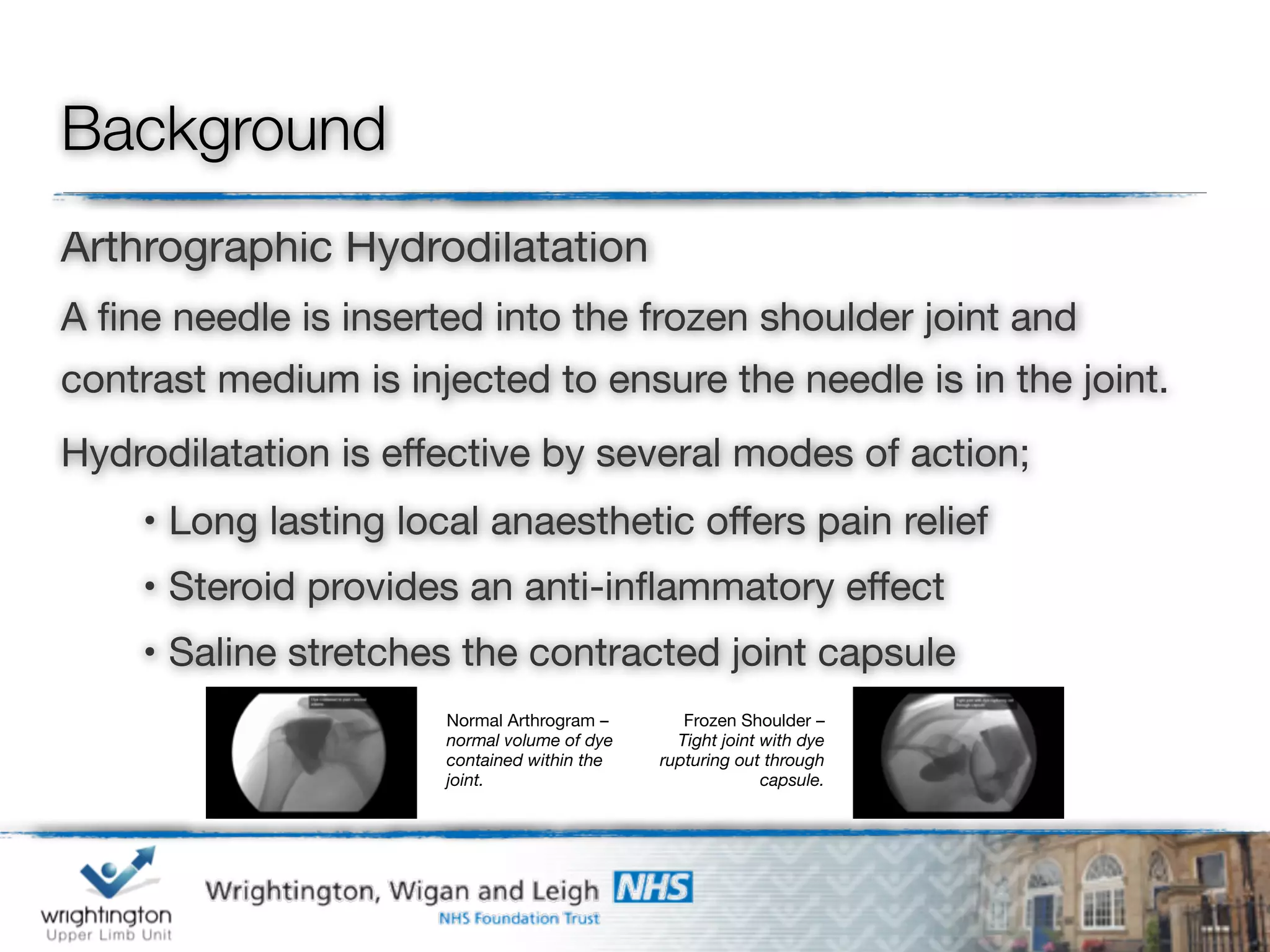
Normal Arthrogram – 
normal volume of dye 
contained within the 
joint. 
Frozen Shoulder – 
Tight joint with dye 
rupturing out through 
capsule.
Published Data 
• Published results for Hydrodilatation are supportive of its 
effectiveness and use despite differing; 
• Hydrodilatation technique 
• Physiotherapy regime 
• Sample size 
• Outcome measures used 
• Length of follow-up 
!! 
- Buchbinder, R., S. Green, et al. (2008). "Arthrographic distension for adhesive capsulitis (frozen shoulder)." Cochrane Database Syst Rev(1): CD007005. 
- Bell, S., J. Coghlan, et al. (2003). "Hydrodilatation in the management of shoulder capsulitis." Australas Radiol 47(3): 247-251. 
- Haolvfeficrseo.“n, L. and R. Maas (2002). "Shoulder joint capsule distension (hydroplasty): a case series of patients with "frozen shoulders" treated in a primary care 
- QuJraoisnht i, N. A., P. Johnston, et al. (2007). "Thawing the frozen shoulder. A randomised trial comparing manipulation under anaesthesia with hydrodilatation." J Bone
Aims 
To evaluate the efficacy of arthrographic 
hydrodilatation for the treatment of frozen shoulder, 
over a three year period.
Methods 
Fifty one patients were prospectively followed for a mean period of eight months 
post Hydrodilatation for Frozen Shoulder (30 primary, 21 secondary). 
Patients were evaluated for: 
1- Constant-Murley Score 
2- Oxford Shoulder Score 
3- Range of Movement 
4- Pain (Visual Analogue Scale)
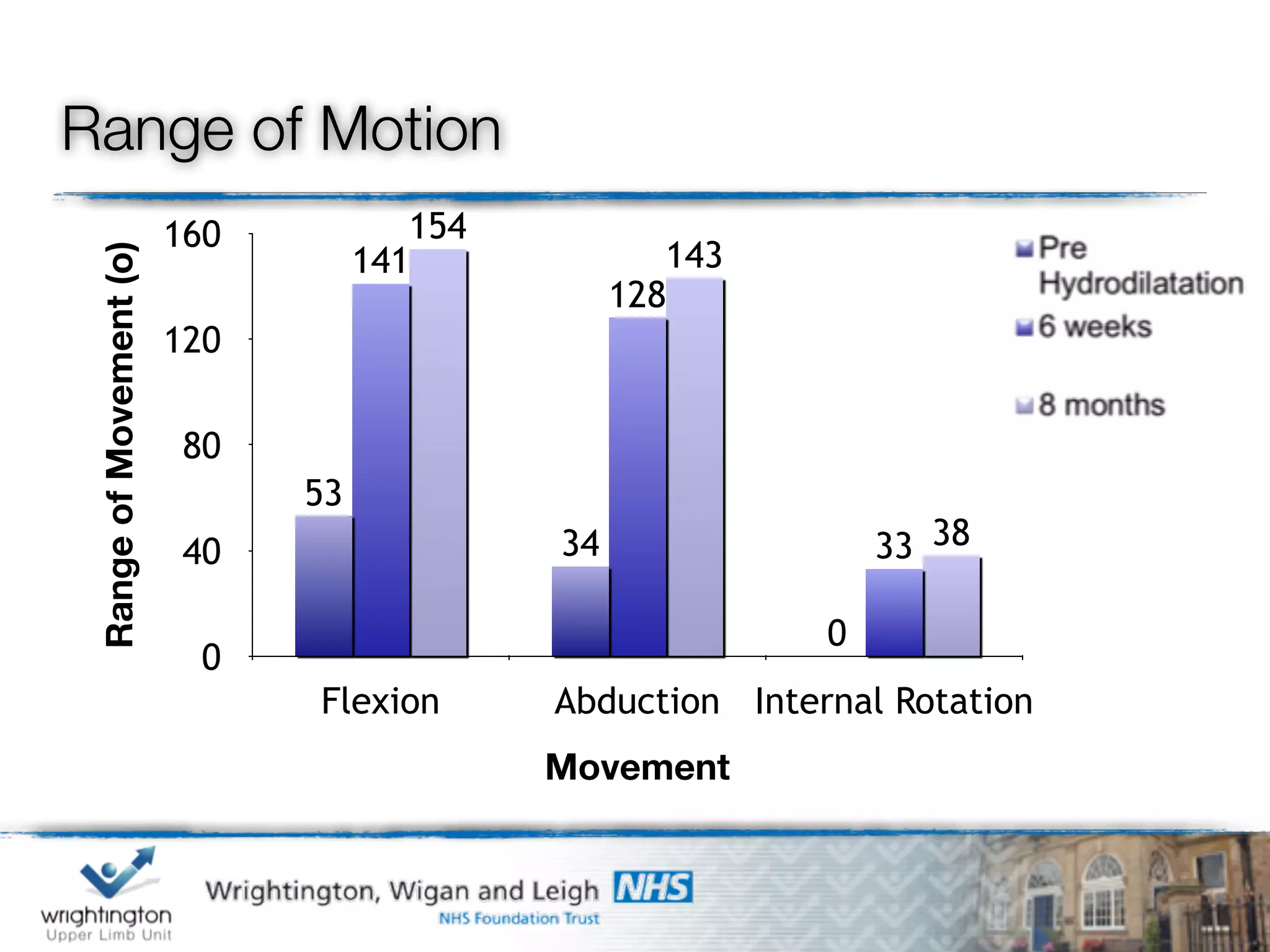
Range of Motion 
Range of Movement (o) 
160 
120 
80 
40 
0 
Flexion Abduction Internal Rotation 
Movement 
38 
143 
154 
33 
128 
141 
0 
34 
53
Outcome Scores 
90 
68 
45 
23 
0 
Constant-Murley Score Oxford Score 
Scoring Method 
44 
83 
40 
68 
24 25 
Pre Hydrodilatation 
6 weeks 
8 months
Pain Scores 
VAS 
9 
7 
5 
2 
0 
0 6 36
Results 
! 
• Patient satisfaction at 6 weeks and 8 months 
was 86%. 
! 
• 7 of the patients went on to have arthroscopic 
capsular release for ongoing stiffness.
Conclusion 
Arthrographic hydrodilatation is a safe and 
effective intervention for both primary and 
secondary frozen shoulder, with significant 
improvements in both pain and stiffness as early 
as six weeks post-procedure. 
For more details on this study, please see the 
Education section of www.shoulderdoc.co.uk

Arthrographic hydrodilatation for frozen shoulder

  • 1.
    ARTHROGRAPHIC HYDRODILATATION FORFROZEN SHOULDER Christopher Manning Phil Wright Lennard Funk
  • 2.
    Background Arthrographic Hydrodilatation A fine needle is inserted into the frozen shoulder joint and contrast medium is injected to ensure the needle is in the joint. Hydrodilatation is effective by several modes of action; • Long lasting local anaesthetic offers pain relief • Steroid provides an anti-inflammatory effect • Saline stretches the contracted joint capsule Normal Arthrogram – normal volume of dye contained within the joint. Frozen Shoulder – Tight joint with dye rupturing out through capsule.
  • 3.
    Published Data •Published results for Hydrodilatation are supportive of its effectiveness and use despite differing; • Hydrodilatation technique • Physiotherapy regime • Sample size • Outcome measures used • Length of follow-up !! - Buchbinder, R., S. Green, et al. (2008). "Arthrographic distension for adhesive capsulitis (frozen shoulder)." Cochrane Database Syst Rev(1): CD007005. - Bell, S., J. Coghlan, et al. (2003). "Hydrodilatation in the management of shoulder capsulitis." Australas Radiol 47(3): 247-251. - Haolvfeficrseo.“n, L. and R. Maas (2002). "Shoulder joint capsule distension (hydroplasty): a case series of patients with "frozen shoulders" treated in a primary care - QuJraoisnht i, N. A., P. Johnston, et al. (2007). "Thawing the frozen shoulder. A randomised trial comparing manipulation under anaesthesia with hydrodilatation." J Bone
  • 4.
    Aims To evaluatethe efficacy of arthrographic hydrodilatation for the treatment of frozen shoulder, over a three year period.
  • 5.
    Methods Fifty onepatients were prospectively followed for a mean period of eight months post Hydrodilatation for Frozen Shoulder (30 primary, 21 secondary). Patients were evaluated for: 1- Constant-Murley Score 2- Oxford Shoulder Score 3- Range of Movement 4- Pain (Visual Analogue Scale)
  • 6.
    Range of Motion Range of Movement (o) 160 120 80 40 0 Flexion Abduction Internal Rotation Movement 38 143 154 33 128 141 0 34 53
  • 7.
    Outcome Scores 90 68 45 23 0 Constant-Murley Score Oxford Score Scoring Method 44 83 40 68 24 25 Pre Hydrodilatation 6 weeks 8 months
  • 8.
    Pain Scores VAS 9 7 5 2 0 0 6 36
  • 9.
    Results ! •Patient satisfaction at 6 weeks and 8 months was 86%. ! • 7 of the patients went on to have arthroscopic capsular release for ongoing stiffness.
  • 10.
    Conclusion Arthrographic hydrodilatationis a safe and effective intervention for both primary and secondary frozen shoulder, with significant improvements in both pain and stiffness as early as six weeks post-procedure. For more details on this study, please see the Education section of www.shoulderdoc.co.uk