EE382N-4 Embedded Systems Architecture
The ARM Instruction Set Architecture
Mark McDermott
With help from our good friends at ARM
Fall 2008
8/22/2008
EE382N-4 Embedded Systems Architecture
Main features of the ARM Instruction Set
All instructions are 32 bits long.
Most instructions execute in a single cycle.
Most instructions can be conditionally executed.
A load/store architecture 
– Data processing instructions act only on registers
• Three operand format
• Combined ALU and shifter for high speed bit manipulation
– Specific memory access instructions with powerful auto‐indexing addressing 
modes.
• 32 bit and 8 bit data types
– and also 16 bit data types on ARM Architecture v4.
• Flexible multiple register load and store instructions
Instruction set extension via coprocessors
Very dense 16‐bit compressed instruction set (Thumb)
28/22/2008
EE382N-4 Embedded Systems Architecture
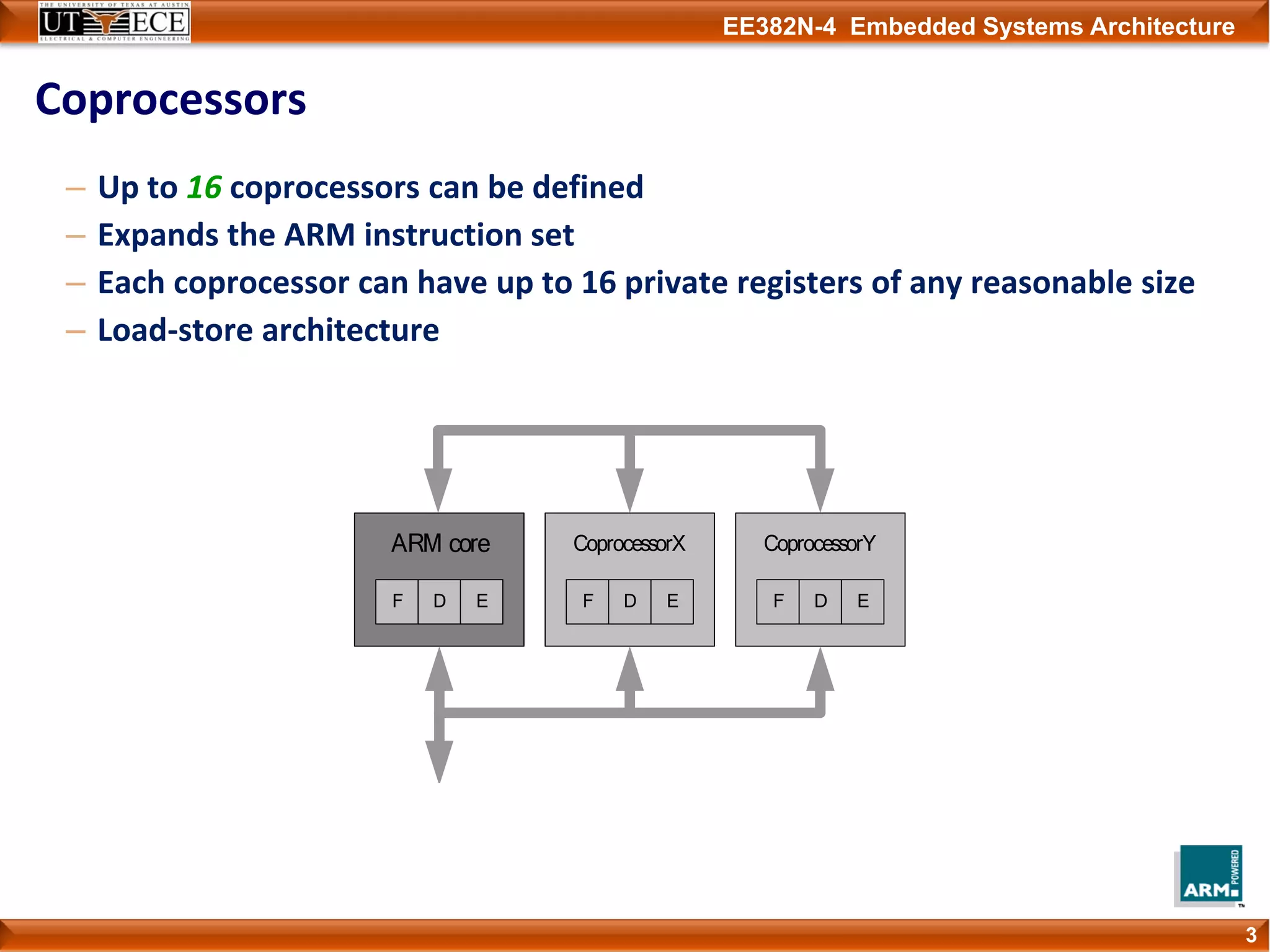
Coprocessors
3
– Up to 16 coprocessors can be defined
– Expands the ARM instruction set
– Each coprocessor can have up to 16 private registers of any reasonable size
– Load‐store architecture
EE382N-4 Embedded Systems Architecture
Thumb
Thumb is a 16‐bit instruction set
– Optimized for code density from C code
– Improved performance form narrow memory
– Subset of the functionality of the ARM instruction set
Core has two execution states – ARM and Thumb
– Switch between them using BX instruction
Thumb has characteristic features:
– Most Thumb instruction are executed unconditionally
– Many Thumb data process instruction use a 2‐address format
– Thumb instruction formats are less regular than ARM instruction formats, as 
a result of the dense encoding.
4
EE382N-4 Embedded Systems Architecture
Processor Modes
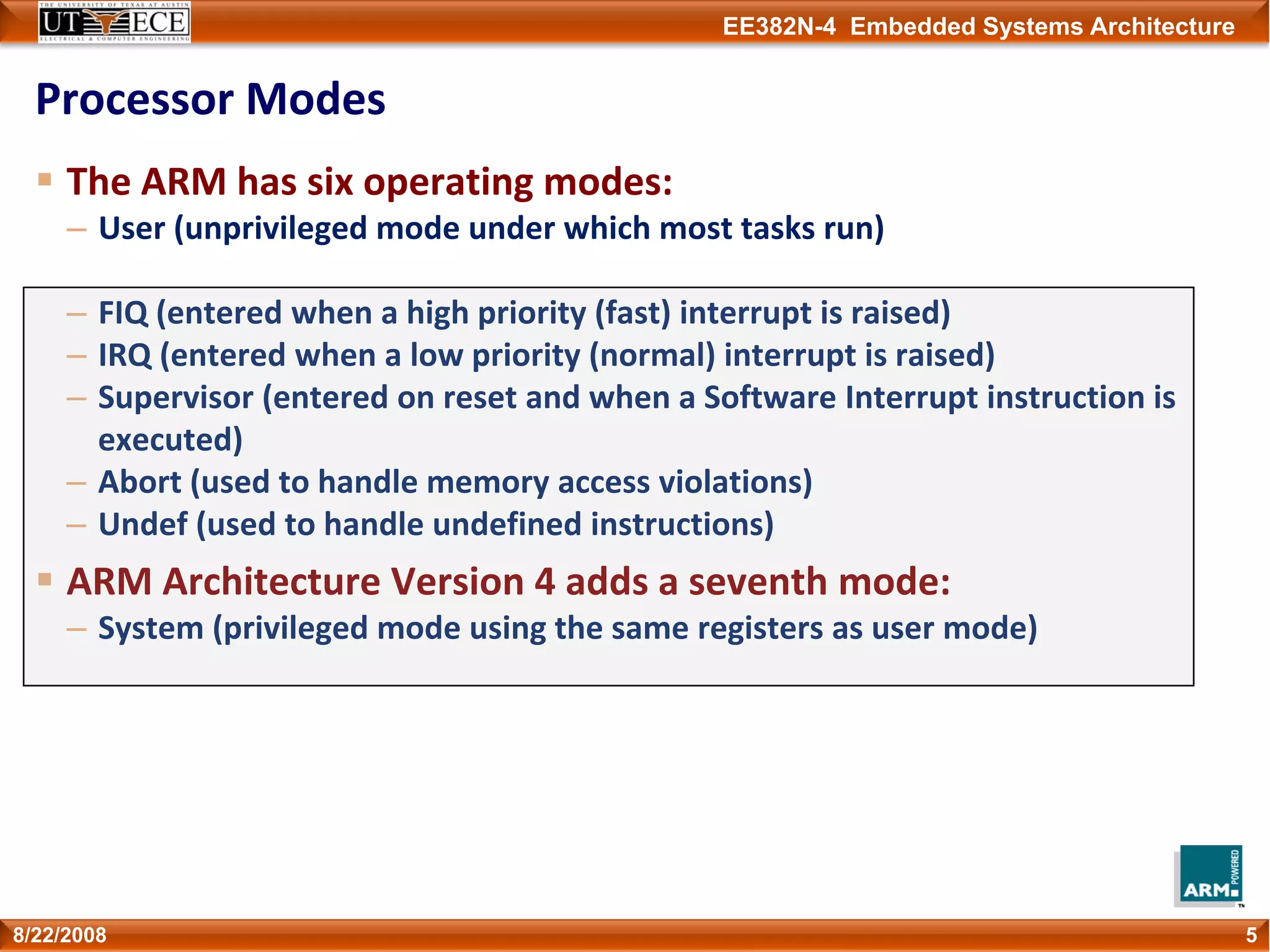
The ARM has six operating modes:
– User (unprivileged mode under which most tasks run)
– FIQ (entered when a high priority (fast) interrupt is raised)
– IRQ (entered when a low priority (normal) interrupt is raised)
– Supervisor (entered on reset and when a Software Interrupt instruction is 
executed)
– Abort (used to handle memory access violations)
– Undef (used to handle undefined instructions)
ARM Architecture Version 4 adds a seventh mode:
– System (privileged mode using the same registers as user mode)
58/22/2008
EE382N-4 Embedded Systems Architecture
The Registers
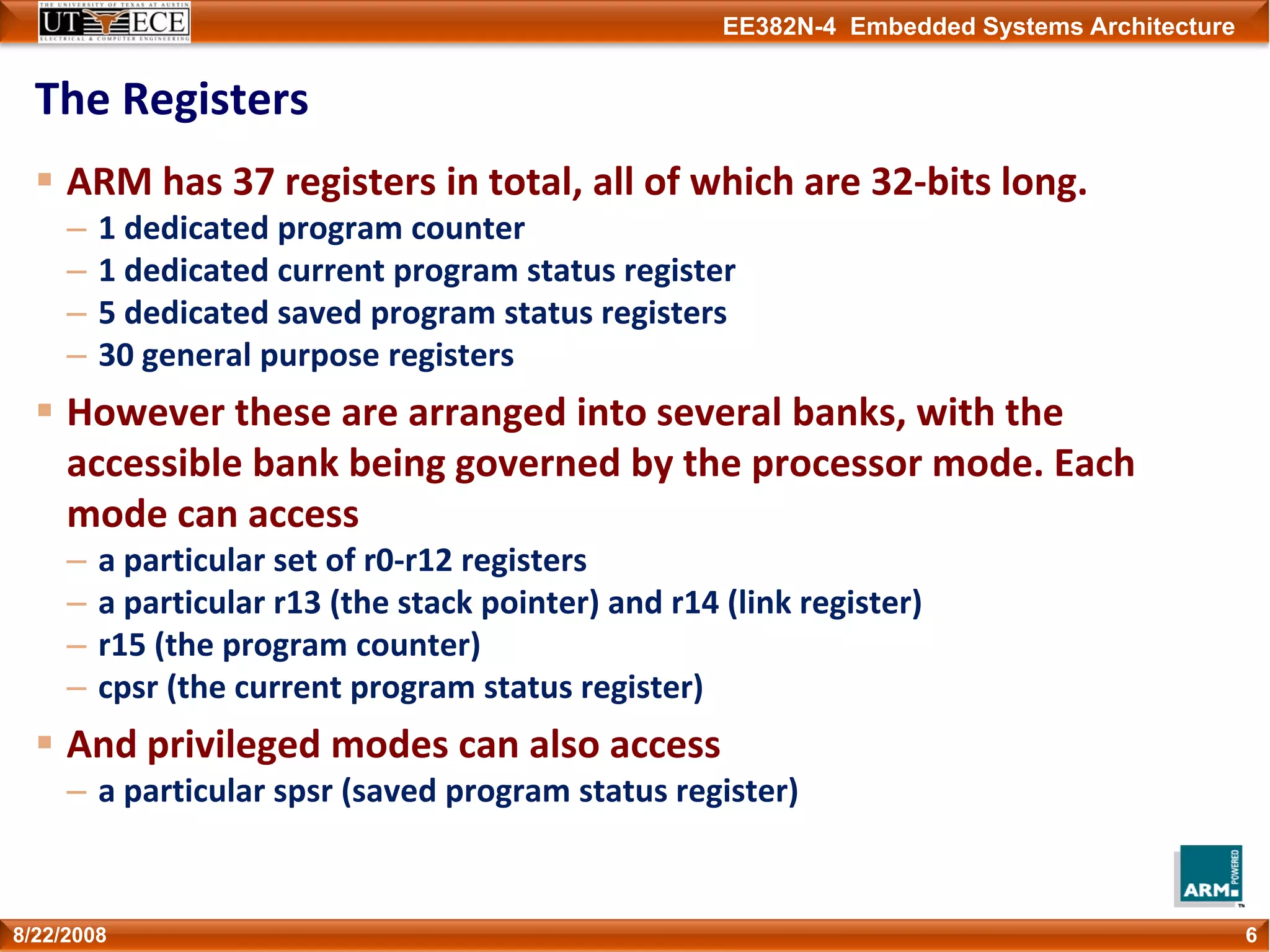
ARM has 37 registers in total, all of which are 32‐bits long.
– 1 dedicated program counter
– 1 dedicated current program status register
– 5 dedicated saved program status registers
– 30 general purpose registers
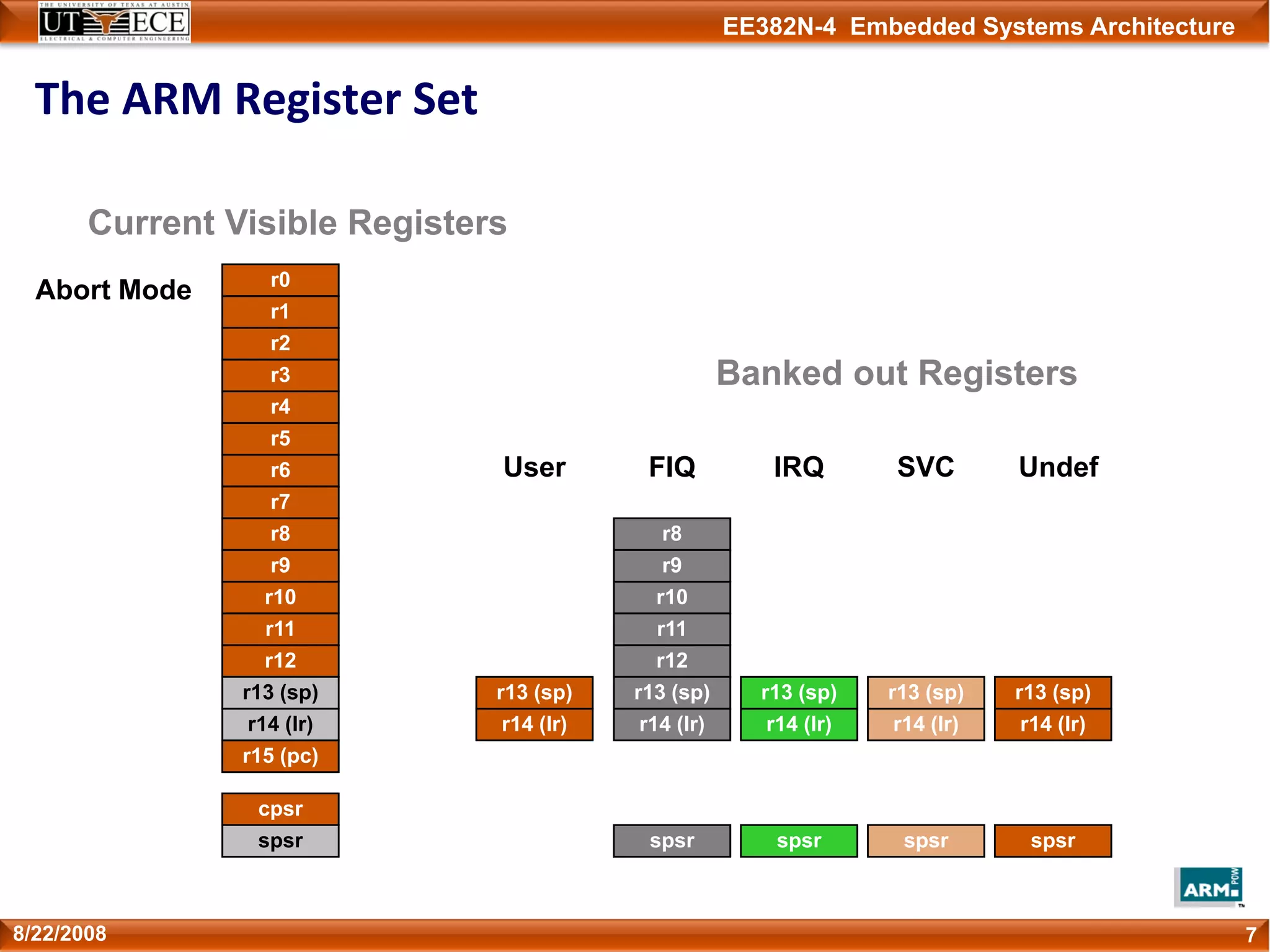
However these are arranged into several banks, with the 
accessible bank being governed by the processor mode. Each 
mode can access 
– a particular set of r0‐r12 registers
– a particular r13 (the stack pointer) and r14 (link register)
– r15 (the program counter)
– cpsr (the current program status register)
And privileged modes can also access
– a particular spsr (saved program status register)
68/22/2008
EE382N-4 Embedded Systems Architecture
r0
r1
r2
r3
r4
r5
r6
r7
r8
r9
r10
r11
r12
r13 (sp)
r14 (lr)
r15 (pc)
cpsr
r13 (sp)
r14 (lr)
spsr
r13 (sp)
r14 (lr)
spsr
r13 (sp)
r14 (lr)
spsr
r13 (sp)
r14 (lr)
spsr
r8
r9
r10
r11
r12
r13 (sp)
r14 (lr)
spsr
FIQ IRQ SVC Undef Abort
User Mode
r0
r1
r2
r3
r4
r5
r6
r7
r8
r9
r10
r11
r12
r13 (sp)
r14 (lr)
r15 (pc)
cpsr
r13 (sp)
r14 (lr)
spsr
r13 (sp)
r14 (lr)
spsr
r13 (sp)
r14 (lr)
spsr
r13 (sp)
r14 (lr)
spsr
r8
r9
r10
r11
r12
r13 (sp)
r14 (lr)
spsr
Current Visible Registers
Banked out Registers
FIQ IRQ SVC Undef Abort
r0
r1
r2
r3
r4
r5
r6
r7
r15 (pc)
cpsr
r13 (sp)
r14 (lr)
spsr
r13 (sp)
r14 (lr)
spsr
r13 (sp)
r14 (lr)
spsr
r13 (sp)
r14 (lr)
spsr
r8
r9
r10
r11
r12
r13 (sp)
r14 (lr)
spsr
Current Visible Registers
Banked out Registers
User IRQ SVC Undef Abort
r8
r9
r10
r11
r12
r13 (sp)
r14 (lr)
FIQ ModeIRQ Mode
r0
r1
r2
r3
r4
r5
r6
r7
r8
r9
r10
r11
r12
r15 (pc)
cpsr
r13 (sp)
r14 (lr)
spsr
r13 (sp)
r14 (lr)
spsr
r13 (sp)
r14 (lr)
spsr
r13 (sp)
r14 (lr)
spsr
r8
r9
r10
r11
r12
r13 (sp)
r14 (lr)
spsr
Current Visible Registers
Banked out Registers
User FIQ SVC Undef Abort
r13 (sp)
r14 (lr)
Undef Mode r0
r1
r2
r3
r4
r5
r6
r7
r8
r9
r10
r11
r12
r15 (pc)
cpsr
r13 (sp)
r14 (lr)
spsr
r13 (sp)
r14 (lr)
spsr
r13 (sp)
r14 (lr)
spsr
r13 (sp)
r14 (lr)
spsr
r8
r9
r10
r11
r12
r13 (sp)
r14 (lr)
spsr
Current Visible Registers
Banked out Registers
User FIQ IRQ SVC Abort
r13 (sp)
r14 (lr)
SVC Mode r0
r1
r2
r3
r4
r5
r6
r7
r8
r9
r10
r11
r12
r15 (pc)
cpsr
r13 (sp)
r14 (lr)
spsr
r13 (sp)
r14 (lr)
spsr
r13 (sp)
r14 (lr)
spsr
r13 (sp)
r14 (lr)
spsr
r8
r9
r10
r11
r12
r13 (sp)
r14 (lr)
spsr
Current Visible Registers
Banked out Registers
User FIQ IRQ Undef Abort
r13 (sp)
r14 (lr)
Abort Mode r0
r1
r2
r3
r4
r5
r6
r7
r8
r9
r10
r11
r12
r15 (pc)
cpsr
r13 (sp)
r14 (lr)
spsr
r13 (sp)
r14 (lr)
spsr
r13 (sp)
r14 (lr)
spsr
r13 (sp)
r14 (lr)
spsr
r8
r9
r10
r11
r12
r13 (sp)
r14 (lr)
spsr
Current Visible Registers
Banked out Registers
User FIQ IRQ SVC Undef
r13 (sp)
r14 (lr)
The ARM Register Set
78/22/2008
EE382N-4 Embedded Systems Architecture
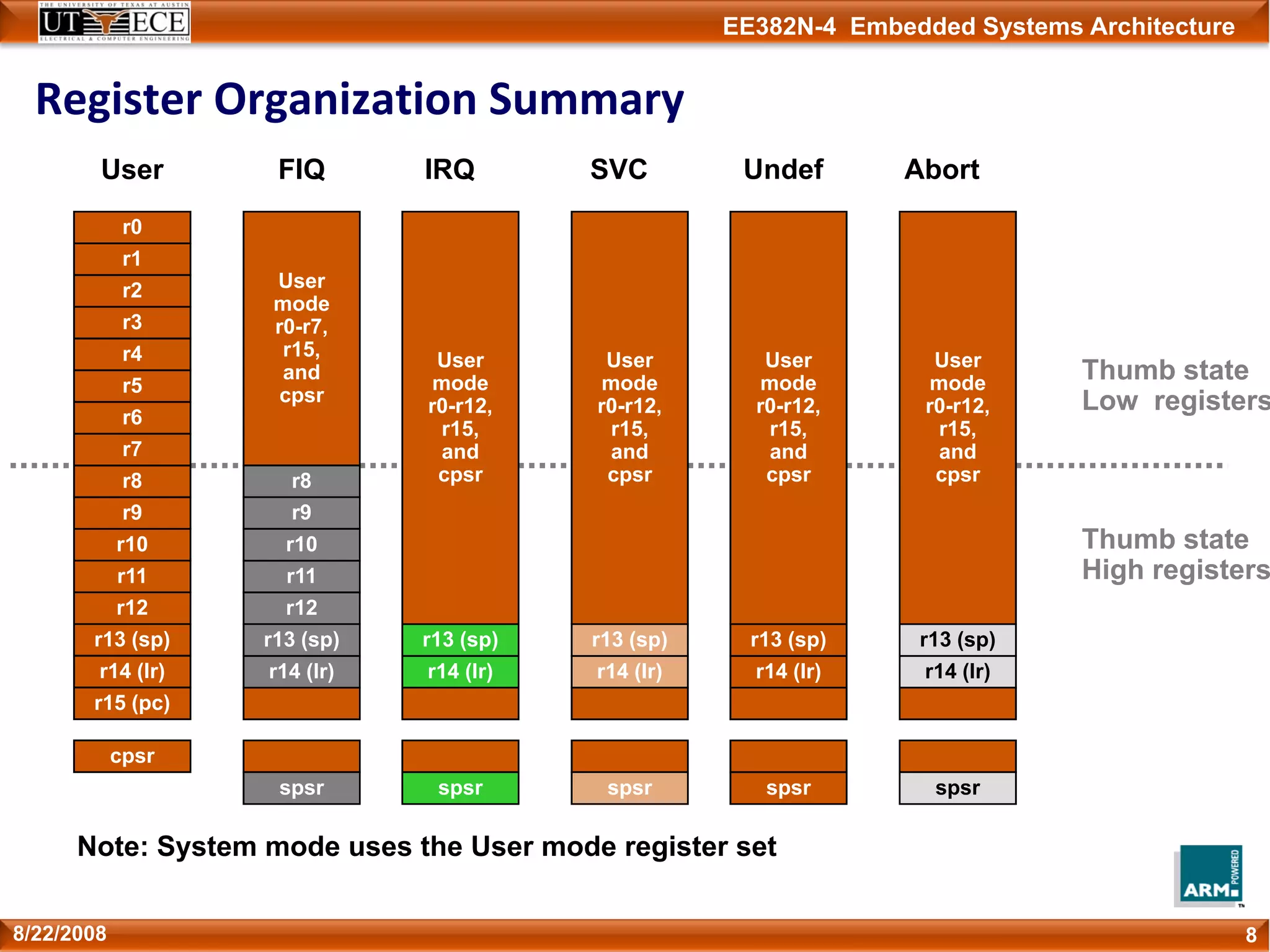
Register Organization Summary
88/22/2008
User
mode
r0-r7,
r15,
and
cpsr
r8
r9
r10
r11
r12
r13 (sp)
r14 (lr)
spsr
FIQ
r8
r9
r10
r11
r12
r13 (sp)
r14 (lr)
r15 (pc)
cpsr
r0
r1
r2
r3
r4
r5
r6
r7
User
r13 (sp)
r14 (lr)
spsr
IRQ
User
mode
r0-r12,
r15,
and
cpsr
r13 (sp)
r14 (lr)
spsr
Undef
User
mode
r0-r12,
r15,
and
cpsr
r13 (sp)
r14 (lr)
spsr
SVC
User
mode
r0-r12,
r15,
and
cpsr
r13 (sp)
r14 (lr)
spsr
Abort
User
mode
r0-r12,
r15,
and
cpsr
Thumb state
Low registers
Thumb state
High registers
Note: System mode uses the User mode register set
EE382N-4 Embedded Systems Architecture
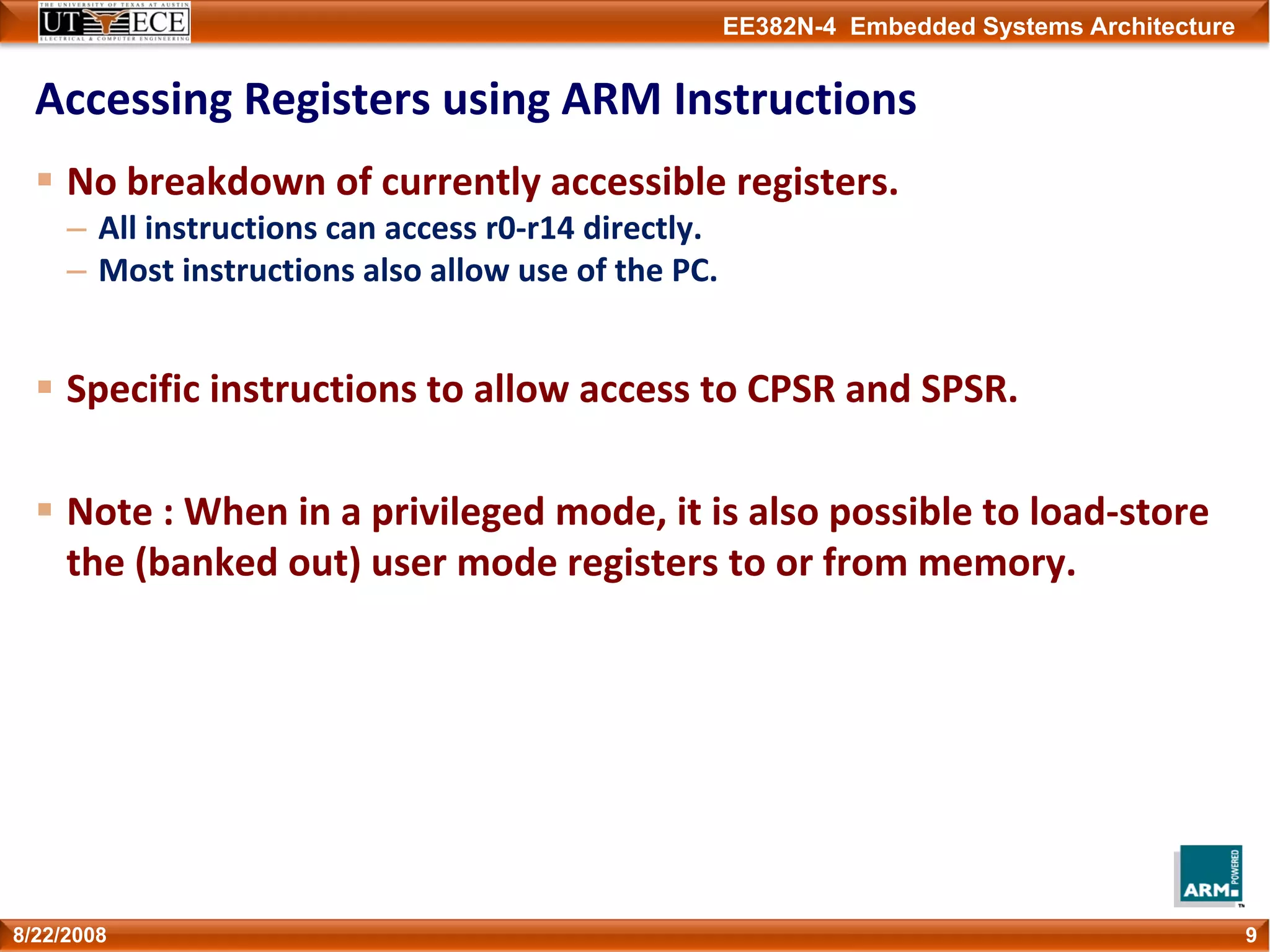
Accessing Registers using ARM Instructions
No breakdown of currently accessible registers.
– All instructions can access r0‐r14 directly.
– Most instructions also allow use of the PC.
Specific instructions to allow access to CPSR and SPSR.
Note : When in a privileged mode, it is also possible to load‐store 
the (banked out) user mode registers to or from memory. 
98/22/2008
EE382N-4 Embedded Systems Architecture
The Program Status Registers  (CPSR and SPSRs)
108/22/2008
Copies of the ALU status flags (latched if the
instruction has the "S" bit set).
N = Negative result from ALU flag.
Z = Zero result from ALU flag.
C = ALU operation Carried out
V = ALU operation oVerflowed
*     Interrupt Disable bits.
I = 1, disables the IRQ.
F = 1, disables the FIQ.
*     T Bit      (Architecture v4T only)
T = 0, Processor in ARM state
T = 1, Processor in Thumb state 
*      Condition Code Flags
ModeN Z C V
2831 8 4 0
I F T
*     Mode Bits
M[4:0] define the processor mode.
EE382N-4 Embedded Systems Architecture
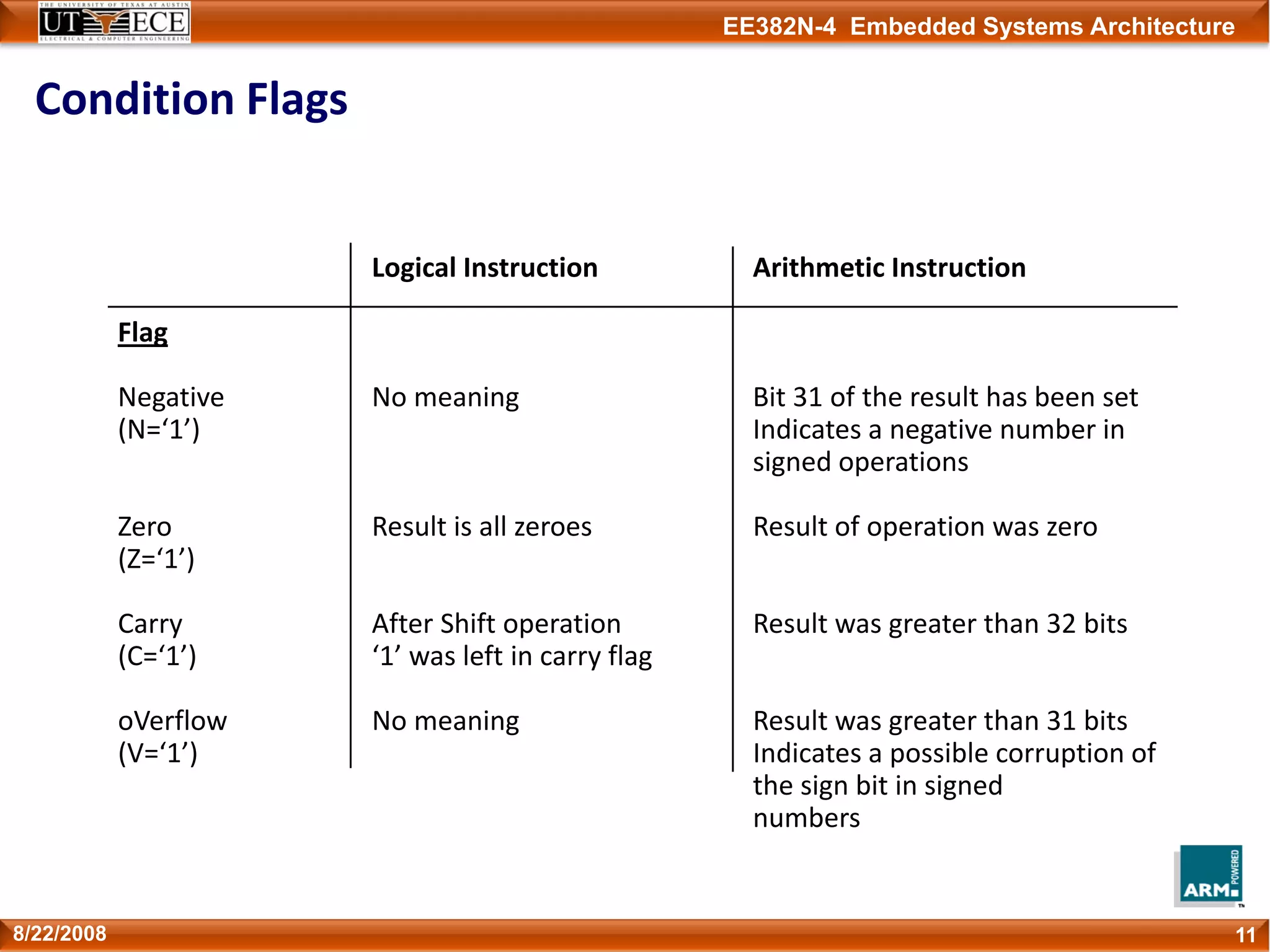
Logical Instruction Arithmetic Instruction
Flag
Negative No meaning Bit 31 of the result has been set
(N=‘1’) Indicates a negative number in
signed operations
Zero Result is all zeroes Result of operation was zero
(Z=‘1’)
Carry After Shift operation Result was greater than 32 bits
(C=‘1’) ‘1’ was left in carry flag
oVerflow No meaning Result was greater than 31 bits
(V=‘1’) Indicates a possible corruption of
the sign bit in signed 
numbers
Condition Flags
118/22/2008
EE382N-4 Embedded Systems Architecture
The Program Counter (R15)
When the processor is executing in ARM state:
– All instructions are 32 bits in length
– All instructions must be word aligned
– Therefore the PC value is stored in bits [31:2] with bits [1:0] equal to zero (as 
instruction cannot be halfword or byte aligned).
R14 is used as the subroutine link register (LR) and stores the 
return address when Branch with Link operations are performed, 
calculated from the PC.
Thus to return from a linked branch:
MOV r15,r14
or
MOV pc,lr
128/22/2008
EE382N-4 Embedded Systems Architecture
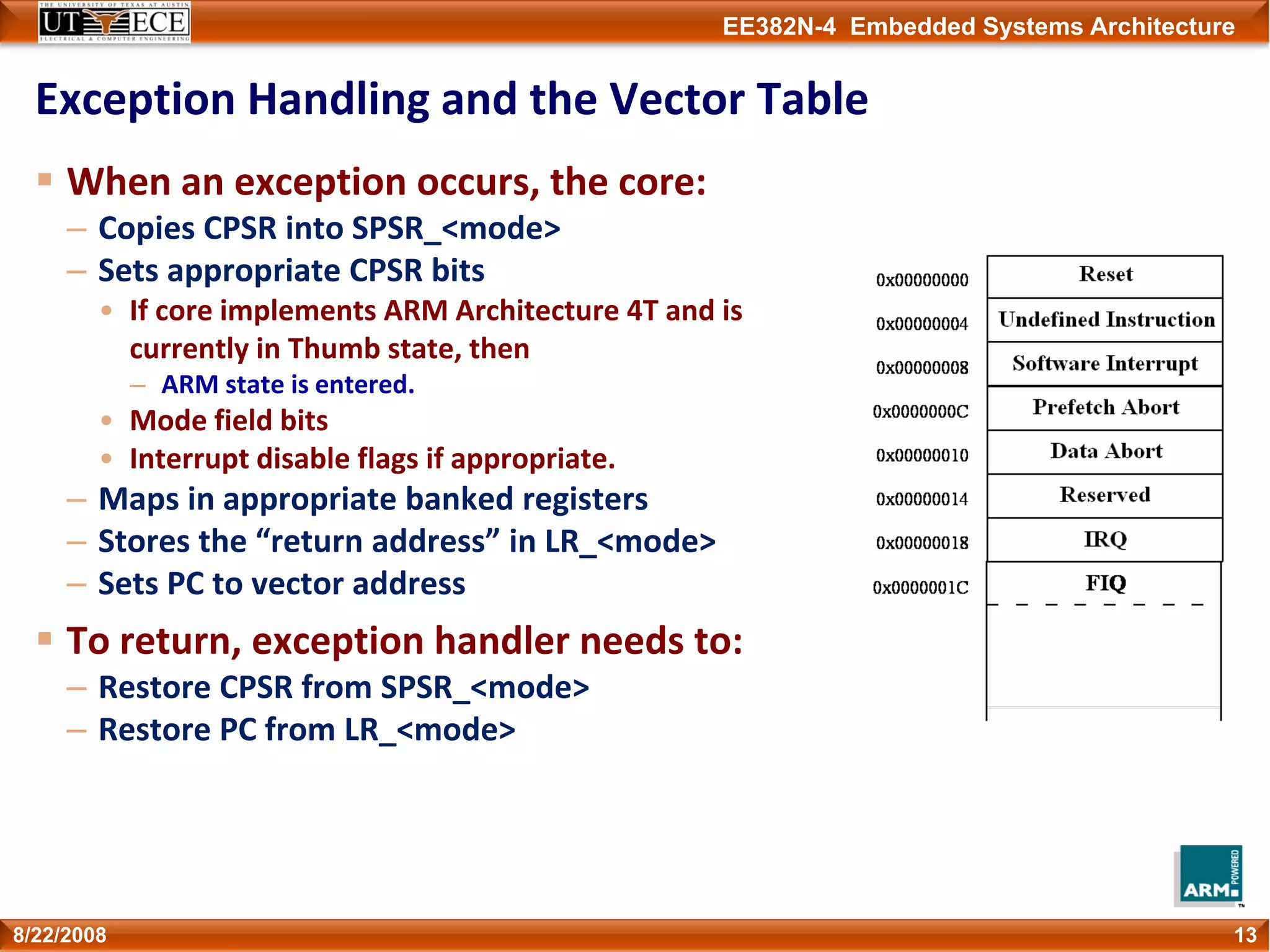
Exception Handling and the Vector Table
When an exception occurs, the core:
– Copies CPSR into SPSR_<mode>
– Sets appropriate CPSR bits 
• If core implements ARM Architecture 4T and is 
currently in Thumb state, then
– ARM state is entered.
• Mode field bits 
• Interrupt disable flags if appropriate.
– Maps in appropriate banked registers
– Stores the “return address” in LR_<mode>
– Sets PC to vector address
To return, exception handler needs to:
– Restore CPSR from SPSR_<mode>
– Restore PC from LR_<mode>
138/22/2008
EE382N-4 Embedded Systems Architecture
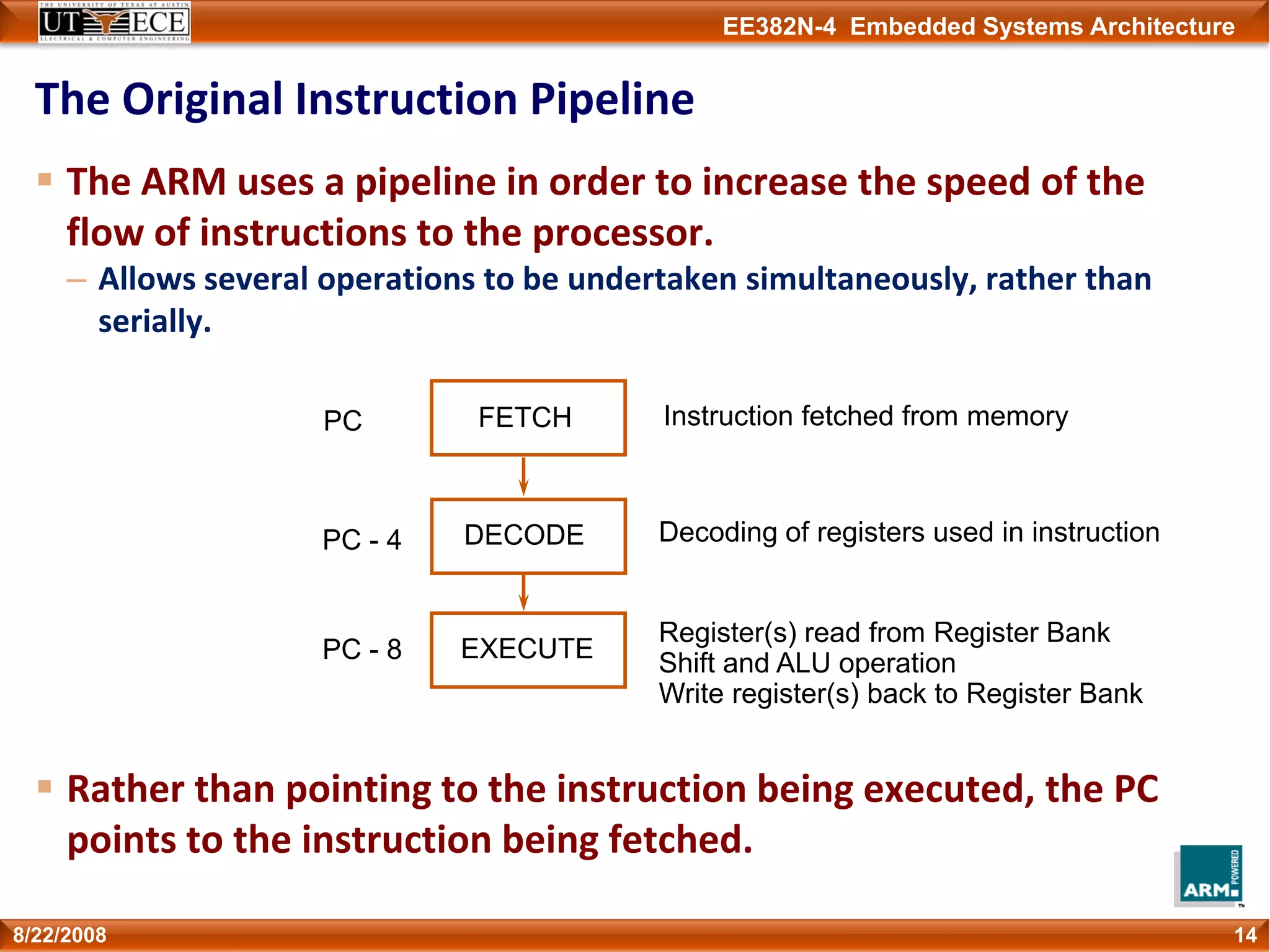
The Original Instruction Pipeline
The ARM uses a pipeline in order to increase the speed of the 
flow of instructions to the processor.
– Allows several operations to be undertaken simultaneously, rather than 
serially.
Rather than pointing to the instruction being executed, the PC 
points to the instruction being fetched.
148/22/2008
FETCH
DECODE
EXECUTE
Instruction fetched from memory
Decoding of registers used in instruction
Register(s) read from Register Bank
Shift and ALU operation
Write register(s) back to Register Bank
PC
PC - 4
PC - 8
EE382N-4 Embedded Systems Architecture
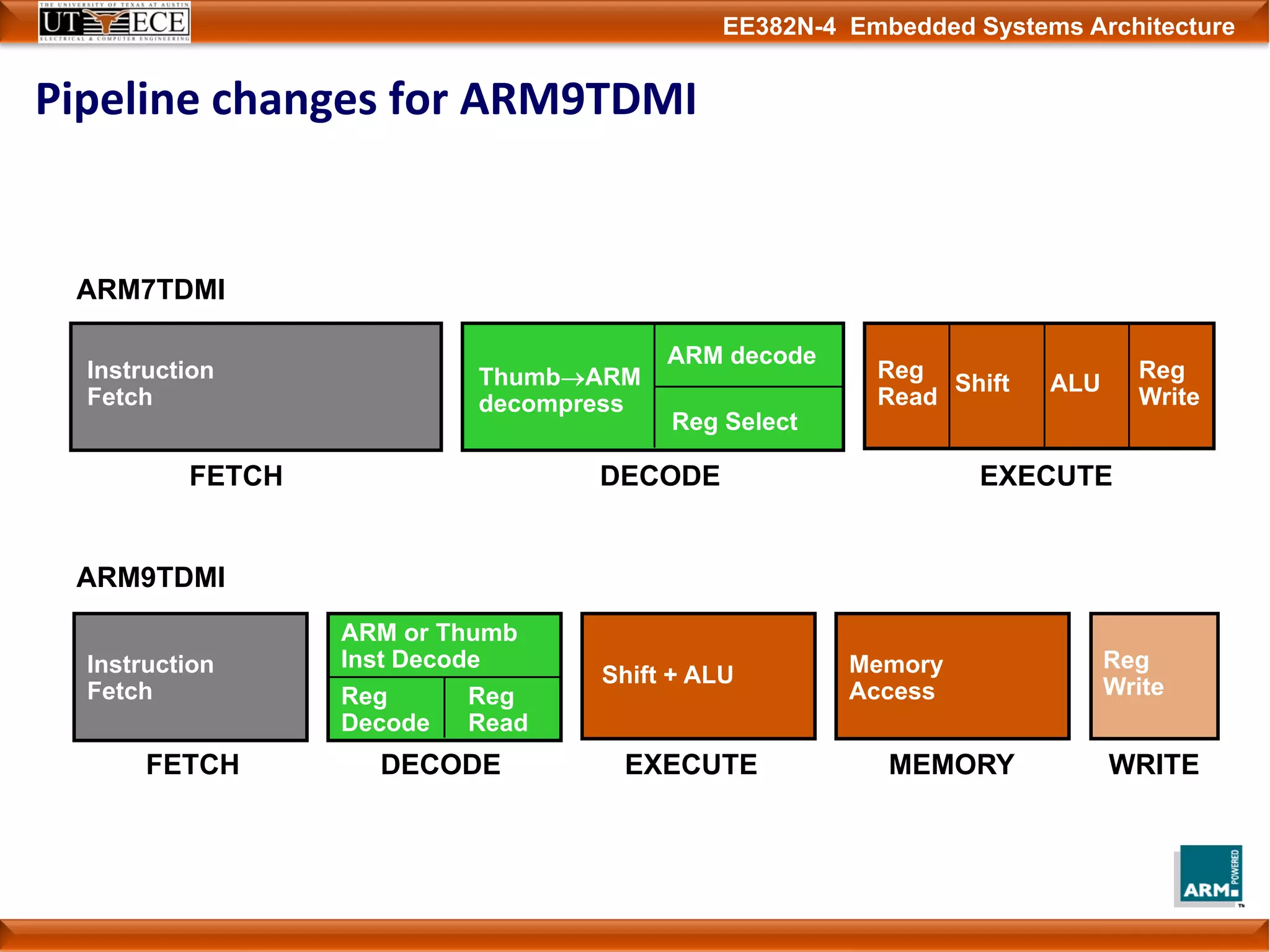
Pipeline changes for ARM9TDMI
Instruction
Fetch
Shift + ALU Memory
Access
Reg
WriteReg
Read
Reg
Decode
FETCH DECODE EXECUTE MEMORY WRITE
ARM9TDMI
ARM or Thumb
Inst Decode
Reg Select
Reg
Read
Shift ALU
Reg
Write
Thumb→ARM
decompress
ARM decode
Instruction
Fetch
FETCH DECODE EXECUTE
ARM7TDMI
EE382N-4 Embedded Systems Architecture
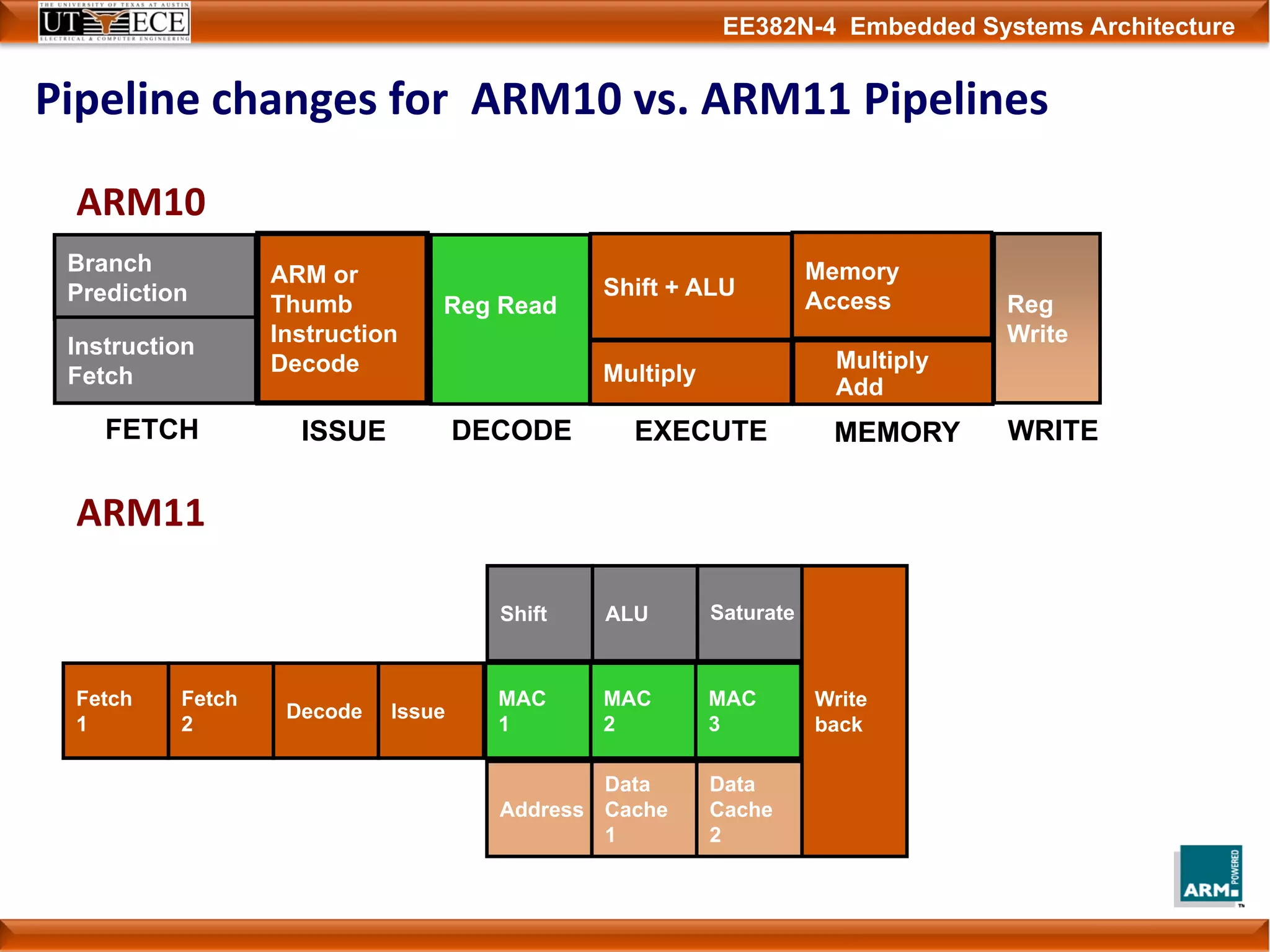
Pipeline changes for  ARM10 vs. ARM11 Pipelines
ARM11
Fetch
1
Fetch
2
Decode Issue
Shift ALU Saturate
Write
back
MAC
1
MAC
2
MAC
3
Address
Data
Cache
1
Data
Cache
2
Shift + ALU
Memory
Access Reg
Write
FETCH DECODE EXECUTE MEMORY WRITE
Reg Read
Multiply
Branch
Prediction
Instruction
Fetch
ISSUE
ARM or
Thumb
Instruction
Decode Multiply
Add
ARM10
EE382N-4 Embedded Systems Architecture
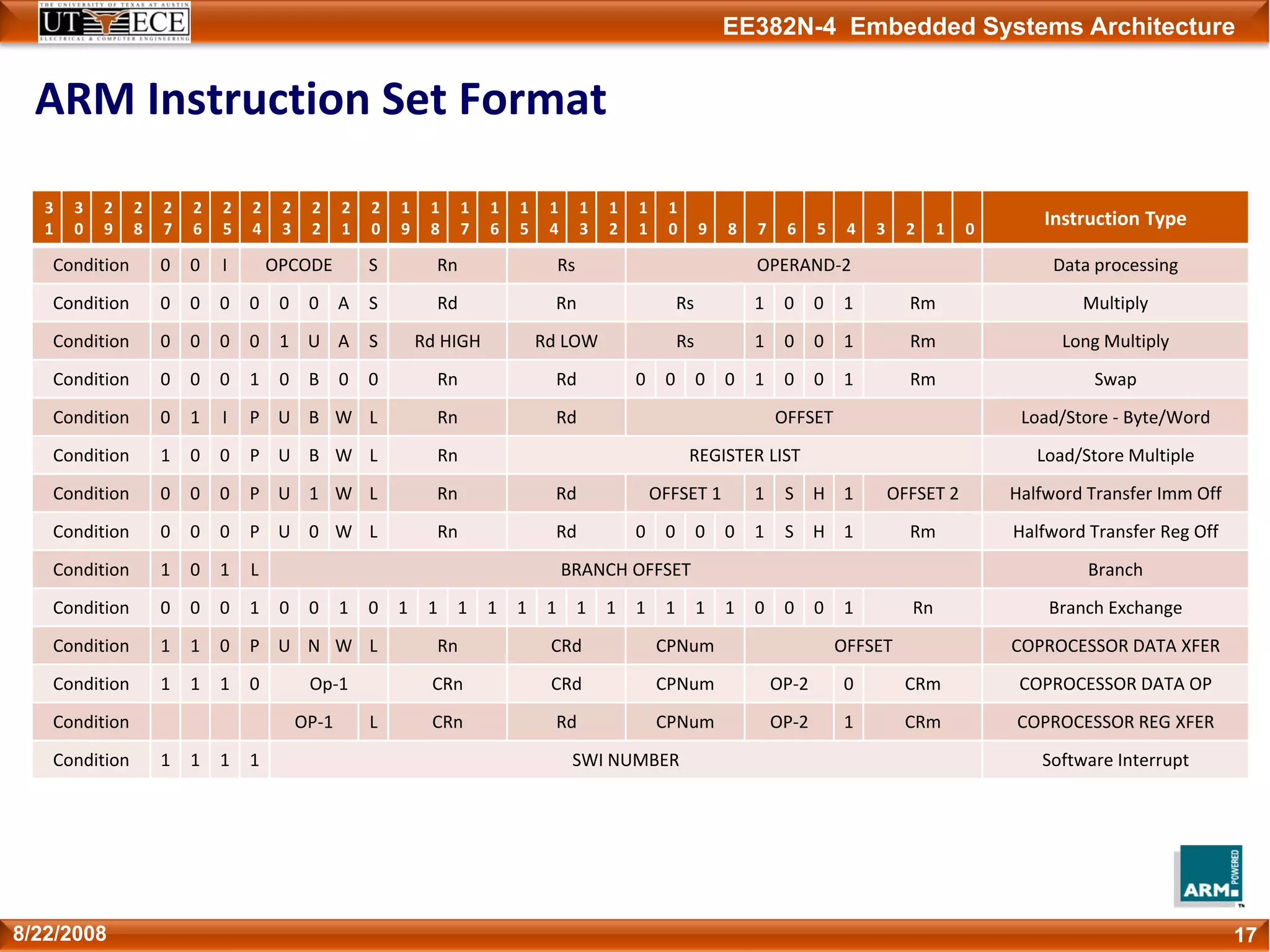
ARM Instruction Set Format
178/22/2008
3
1
3
0
2
9
2
8
2
7
2
6
2
5
2
4
2
3
2
2
2
1
2
0
1
9
1
8
1
7
1
6
1
5
1
4
1
3
1
2
1
1
1
0 9 8 7 6 5 4 3 2 1 0
Instruction Type
Condition 0 0 I OPCODE S Rn Rs OPERAND‐2 Data processing
Condition 0 0 0 0 0 0 A S Rd Rn Rs 1 0 0 1 Rm Multiply
Condition 0 0 0 0 1 U A S Rd HIGH Rd LOW Rs 1 0 0 1 Rm Long Multiply
Condition 0 0 0 1 0 B 0 0 Rn Rd 0 0 0 0 1 0 0 1 Rm Swap
Condition 0 1 I P U B W L Rn Rd OFFSET Load/Store ‐ Byte/Word
Condition 1 0 0 P U B W L Rn REGISTER LIST Load/Store Multiple
Condition 0 0 0 P U 1 W L Rn Rd OFFSET 1 1 S H 1 OFFSET 2 Halfword Transfer Imm Off
Condition 0 0 0 P U 0 W L Rn Rd 0 0 0 0 1 S H 1 Rm Halfword Transfer Reg Off
Condition 1 0 1 L BRANCH OFFSET Branch
Condition 0 0 0 1 0 0 1 0 1 1 1 1 1 1 1 1 1 1 1 1 0 0 0 1 Rn Branch Exchange
Condition 1 1 0 P U N W L Rn CRd CPNum OFFSET COPROCESSOR DATA XFER
Condition 1 1 1 0 Op‐1 CRn CRd CPNum OP‐2 0 CRm COPROCESSOR DATA OP
Condition OP‐1 L CRn Rd CPNum OP‐2 1 CRm COPROCESSOR REG XFER
Condition 1 1 1 1 SWI NUMBER Software Interrupt
EE382N-4 Embedded Systems Architecture
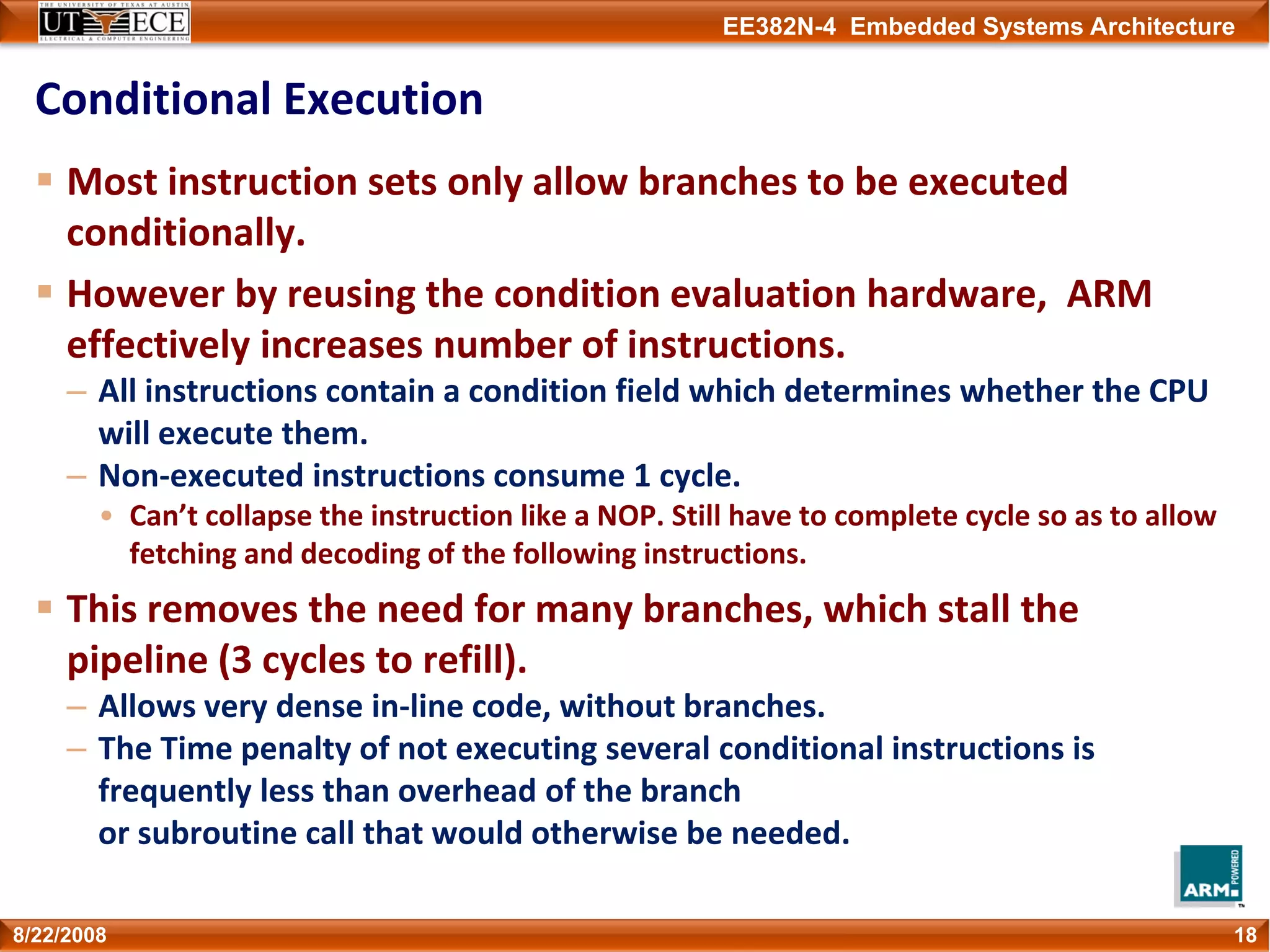
Conditional Execution
Most instruction sets only allow branches to be executed 
conditionally.
However by reusing the condition evaluation hardware,  ARM 
effectively increases number of instructions.
– All instructions contain a condition field which determines whether the CPU 
will execute them. 
– Non‐executed instructions consume 1 cycle.
• Can’t collapse the instruction like a NOP. Still have to complete cycle so as to allow 
fetching and decoding of the following instructions. 
This removes the need for many branches, which stall the 
pipeline (3 cycles to refill).
– Allows very dense in‐line code, without branches.
– The Time penalty of not executing several conditional instructions is 
frequently less than overhead of the branch 
or subroutine call that would otherwise be needed.
188/22/2008
EE382N-4 Embedded Systems Architecture
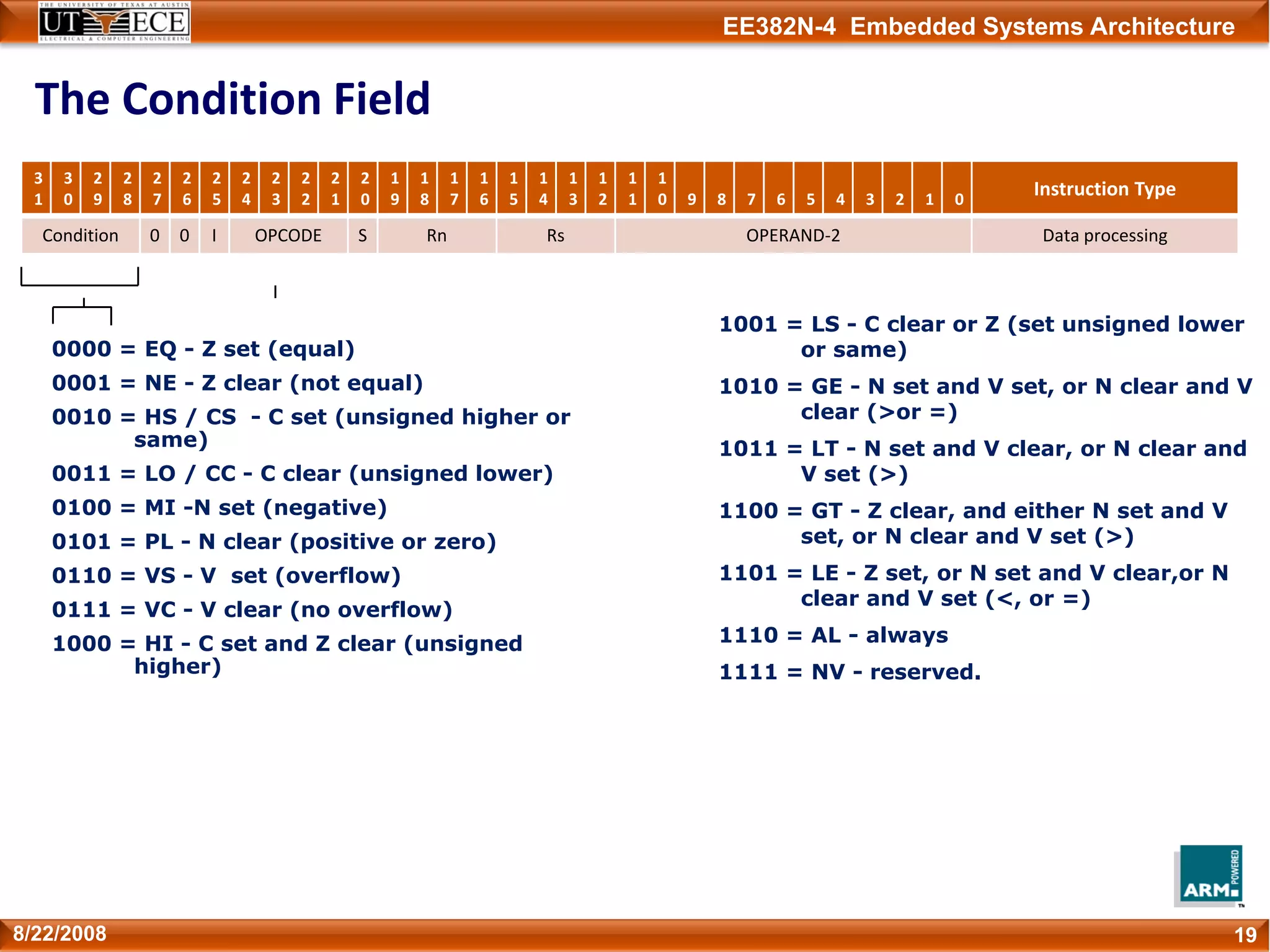
The Condition Field
198/22/2008
1001 = LS - C clear or Z (set unsigned lower
or same)
1010 = GE - N set and V set, or N clear and V
clear (>or =)
1011 = LT - N set and V clear, or N clear and
V set (>)
1100 = GT - Z clear, and either N set and V
set, or N clear and V set (>)
1101 = LE - Z set, or N set and V clear,or N
clear and V set (<, or =)
1110 = AL - always
1111 = NV - reserved.
0000 = EQ - Z set (equal)
0001 = NE - Z clear (not equal)
0010 = HS / CS - C set (unsigned higher or
same)
0011 = LO / CC - C clear (unsigned lower)
0100 = MI -N set (negative)
0101 = PL - N clear (positive or zero)
0110 = VS - V set (overflow)
0111 = VC - V clear (no overflow)
1000 = HI - C set and Z clear (unsigned
higher)
3
1
3
0
2
9
2
8
2
7
2
6
2
5
2
4
2
3
2
2
2
1
2
0
1
9
1
8
1
7
1
6
1
5
1
4
1
3
1
2
1
1
1
0 9 8 7 6 5 4 3 2 1 0
Instruction Type
Condition 0 0 I OPCODE S Rn Rs OPERAND‐2 Data processing
EE382N-4 Embedded Systems Architecture
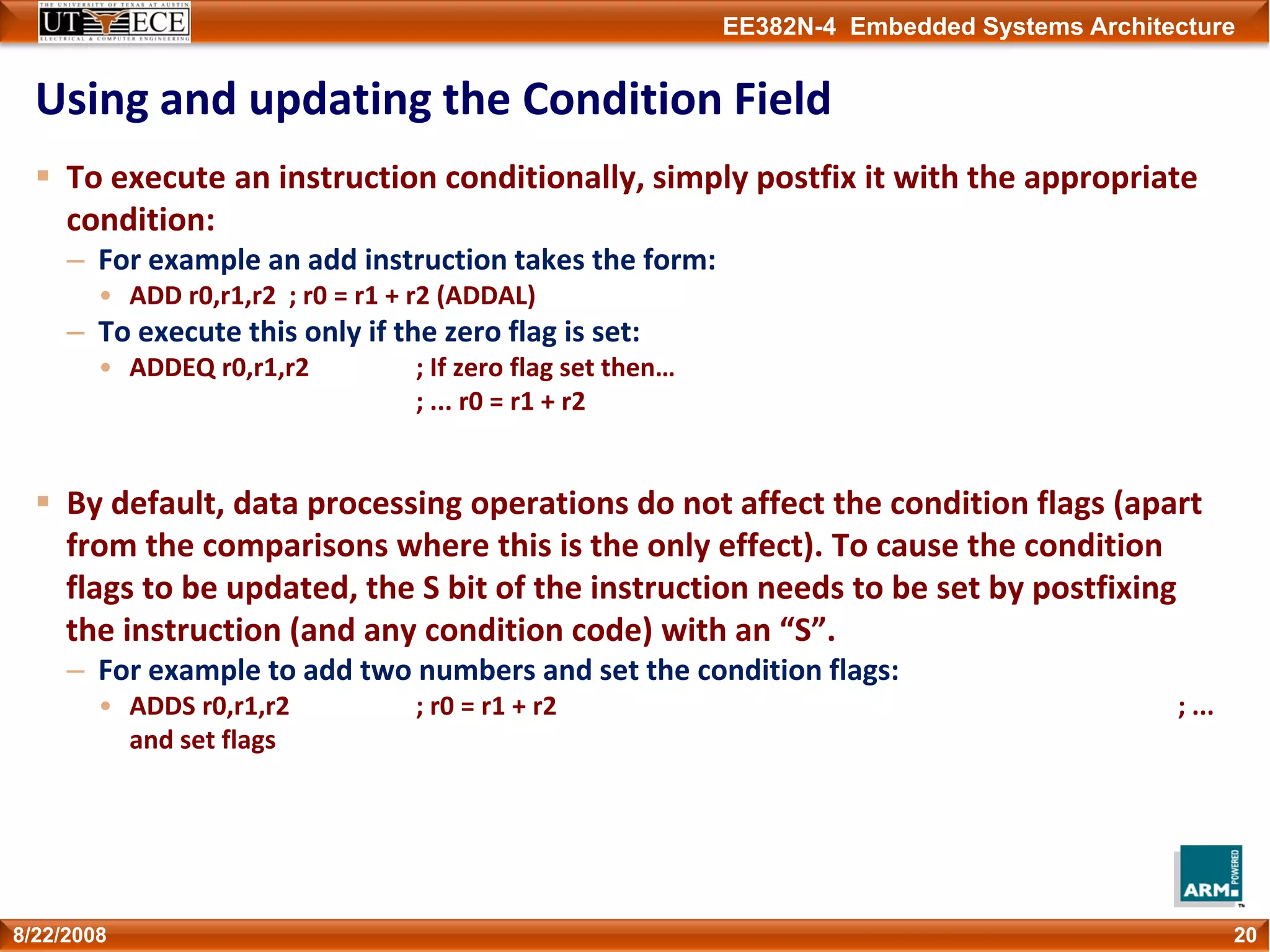
Using and updating the Condition Field
To execute an instruction conditionally, simply postfix it with the appropriate 
condition:
– For example an add instruction takes the form:
• ADD r0,r1,r2 ; r0 = r1 + r2 (ADDAL)
– To execute this only if the zero flag is set:
• ADDEQ r0,r1,r2 ; If zero flag set then…
; ... r0 = r1 + r2
By default, data processing operations do not affect the condition flags (apart 
from the comparisons where this is the only effect). To cause the condition 
flags to be updated, the S bit of the instruction needs to be set by postfixing 
the instruction (and any condition code) with an “S”.
– For example to add two numbers and set the condition flags:
• ADDS r0,r1,r2 ; r0 = r1 + r2  ; ... 
and set flags
208/22/2008
EE382N-4 Embedded Systems Architecture
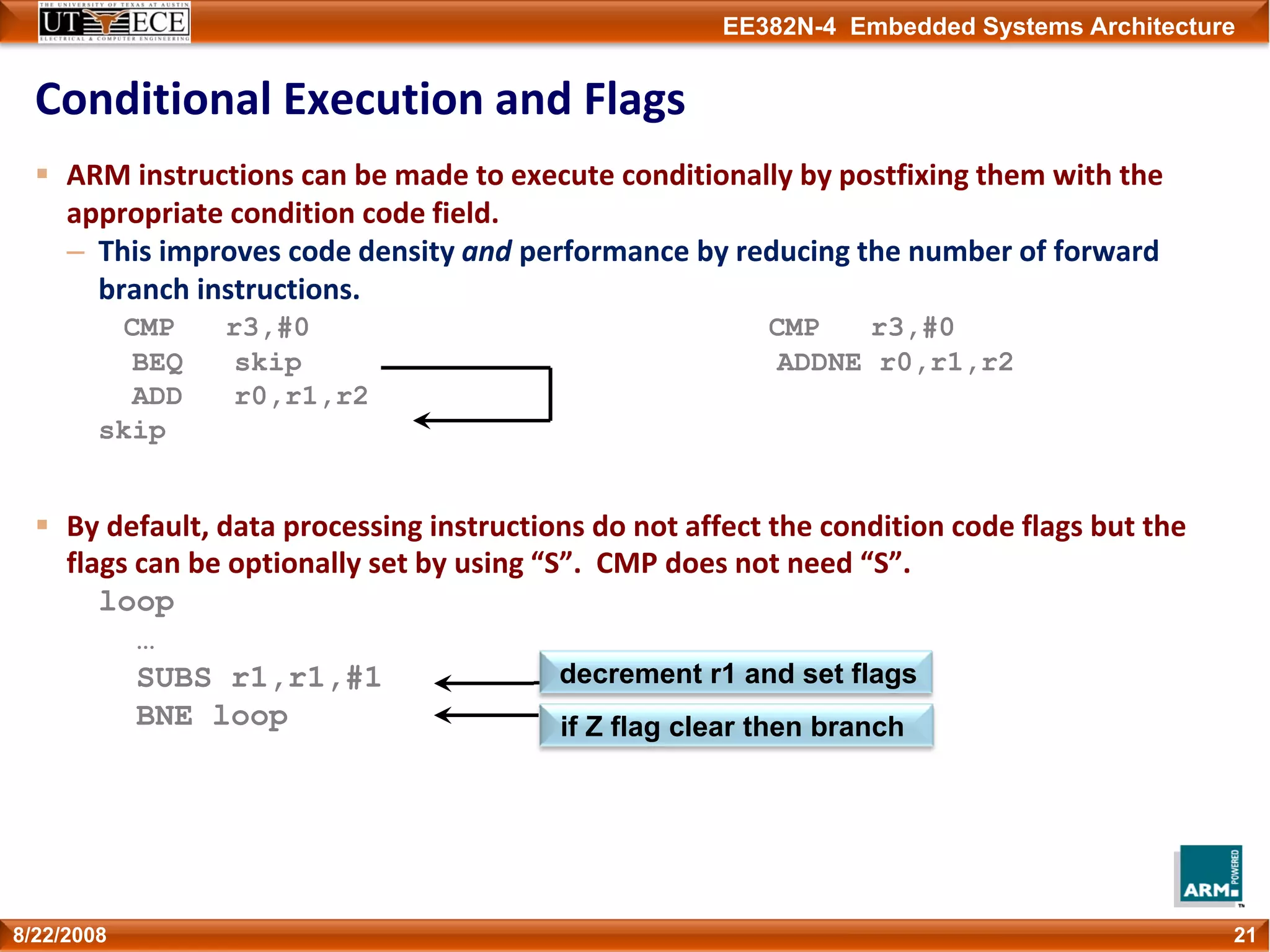
Conditional Execution and Flags
ARM instructions can be made to execute conditionally by postfixing them with the 
appropriate condition code field.
– This improves code density and performance by reducing the number of forward 
branch instructions.
CMP r3,#0 CMP r3,#0
BEQ skip ADDNE r0,r1,r2
ADD r0,r1,r2
skip
By default, data processing instructions do not affect the condition code flags but the 
flags can be optionally set by using “S”.  CMP does not need “S”.
loop
…
SUBS r1,r1,#1
BNE loop
218/22/2008
if Z flag clear then branch
decrement r1 and set flags
EE382N-4 Embedded Systems Architecture
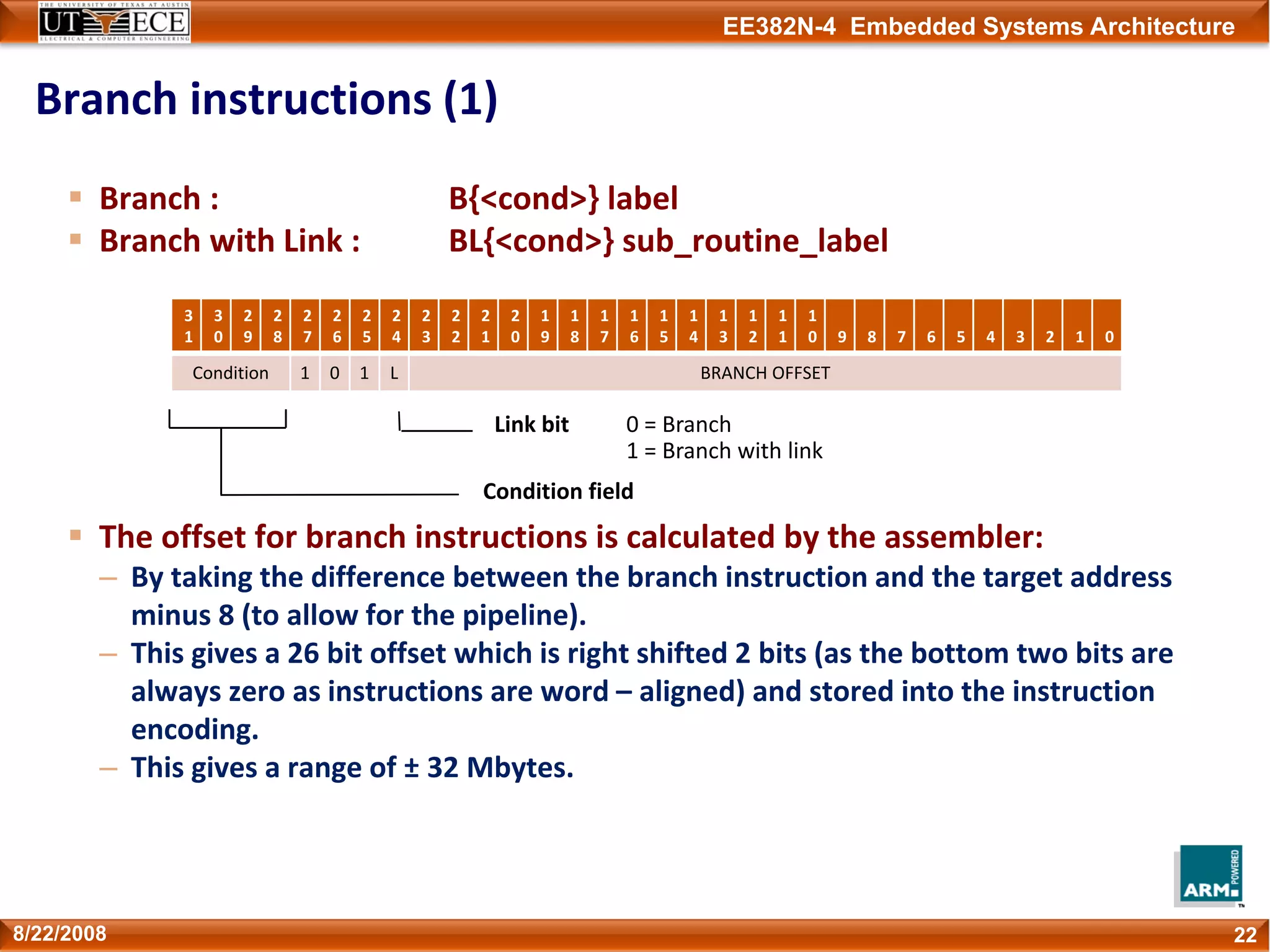
Branch instructions (1)
228/22/2008
Branch : B{<cond>} label
Branch with Link : BL{<cond>} sub_routine_label
The offset for branch instructions is calculated by the assembler:
– By taking the difference between the branch instruction and the target address 
minus 8 (to allow for the pipeline).
– This gives a 26 bit offset which is right shifted 2 bits (as the bottom two bits are 
always zero as instructions are word – aligned) and stored into the instruction 
encoding.
– This gives a range of ± 32 Mbytes.
Condition field
Link bit 0 = Branch
1 = Branch with link
3
1
3
0
2
9
2
8
2
7
2
6
2
5
2
4
2
3
2
2
2
1
2
0
1
9
1
8
1
7
1
6
1
5
1
4
1
3
1
2
1
1
1
0 9 8 7 6 5 4 3 2 1 0
Condition 1 0 1 L BRANCH OFFSET
EE382N-4 Embedded Systems Architecture
Branch instructions (2)
When executing the instruction, the processor:
– shifts the offset left two bits, sign extends it to 32 bits, and adds it to PC.
Execution then continues from the new PC, once the pipeline has 
been refilled.
The "Branch with link" instruction implements a subroutine call 
by writing PC‐4 into the LR of the current bank. 
– i.e. the address of the next instruction following the branch with link 
(allowing for the pipeline).
To return from subroutine, simply need to restore the PC from 
the LR:
– MOV pc, lr
– Again, pipeline has to refill before execution continues.
238/22/2008
EE382N-4 Embedded Systems Architecture
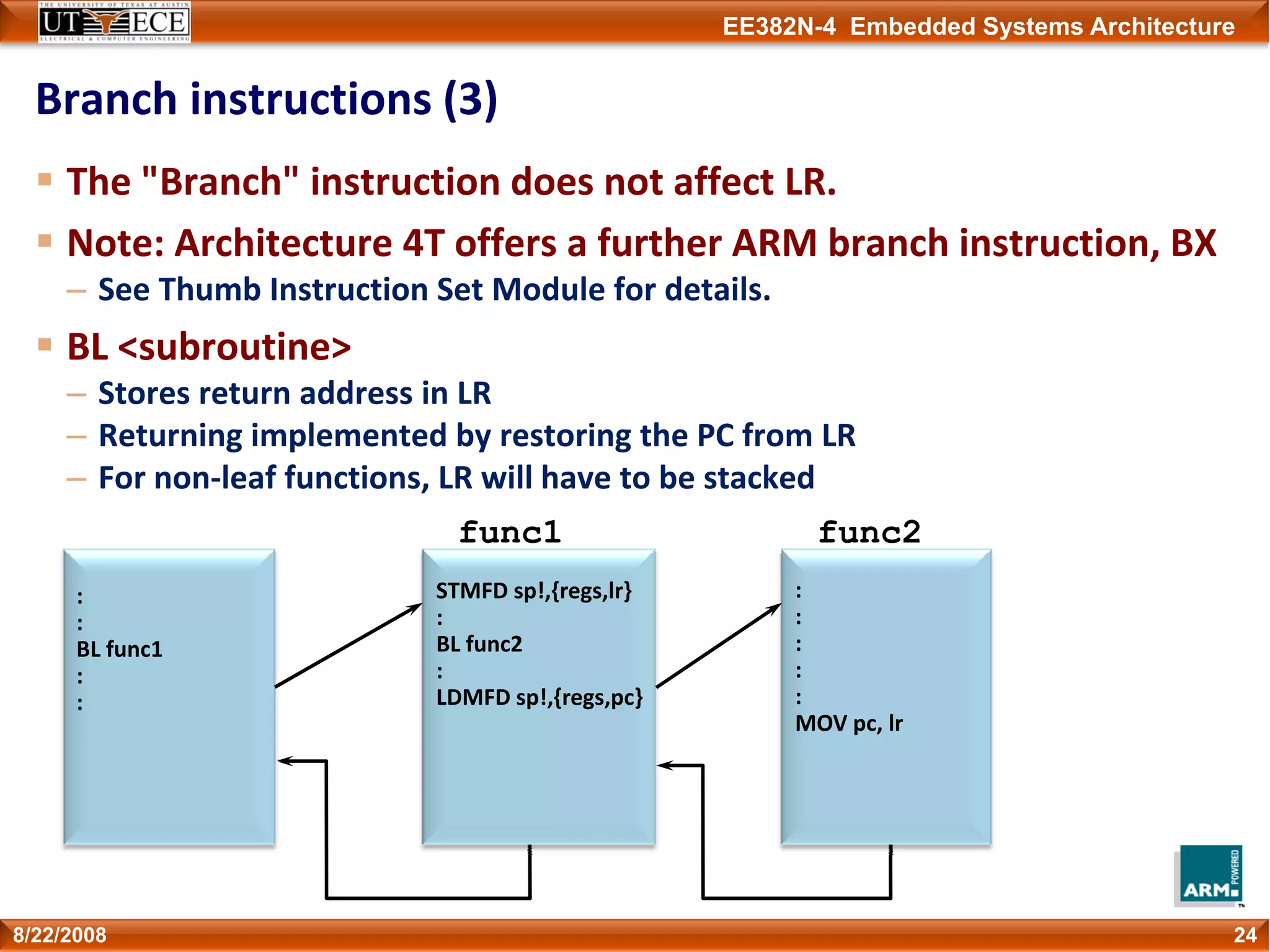
Branch instructions (3)
The "Branch" instruction does not affect LR.
Note: Architecture 4T offers a further ARM branch instruction, BX
– See Thumb Instruction Set Module for details.
BL <subroutine>
– Stores return address in LR
– Returning implemented by restoring the PC from LR
– For non‐leaf functions, LR will have to be stacked
248/22/2008
STMFD sp!,{regs,lr}
:
BL func2
:
LDMFD sp!,{regs,pc}
func1 func2
:
:
BL func1
:
:
:
:
:
:
:
MOV pc, lr
EE382N-4 Embedded Systems Architecture
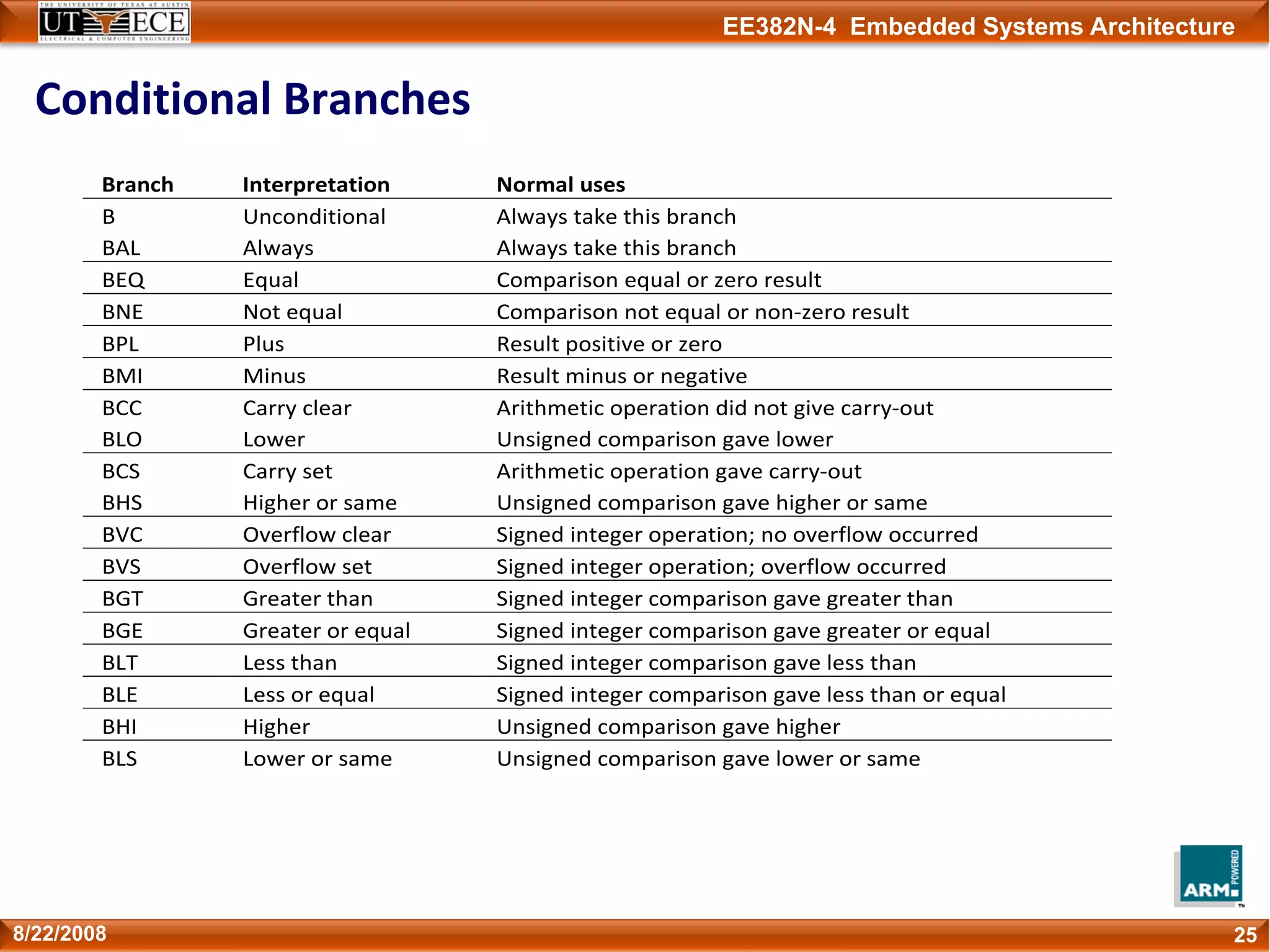
Conditional Branches
258/22/2008
Branch  Interpretation  Normal uses 
B 
BAL 
Unconditional 
Always 
Always take this branch 
BEQ  Equal  Comparison equal or zero result 
BNE  Not equal  Comparison not equal or non‐zero result 
BPL  Plus  Result positive or zero 
BMI  Minus  Result minus or negative 
BCC 
BLO 
Carry clear 
Lower 
Arithmetic operation did not give carry‐out 
Unsigned comparison gave lower 
BCS 
BHS 
Carry set 
Higher or same 
Arithmetic operation gave carry‐out 
Unsigned comparison gave higher or same 
BVC  Overflow clear  Signed integer operation; no overflow occurred 
BVS  Overflow set  Signed integer operation; overflow occurred 
BGT  Greater than  Signed integer comparison gave greater than 
BGE  Greater or equal  Signed integer comparison gave greater or equal 
BLT  Less than  Signed integer comparison gave less than 
BLE  Less or equal  Signed integer comparison gave less than or equal 
BHI  Higher  Unsigned comparison gave higher 
BLS  Lower or same  Unsigned comparison gave lower or same 
EE382N-4 Embedded Systems Architecture
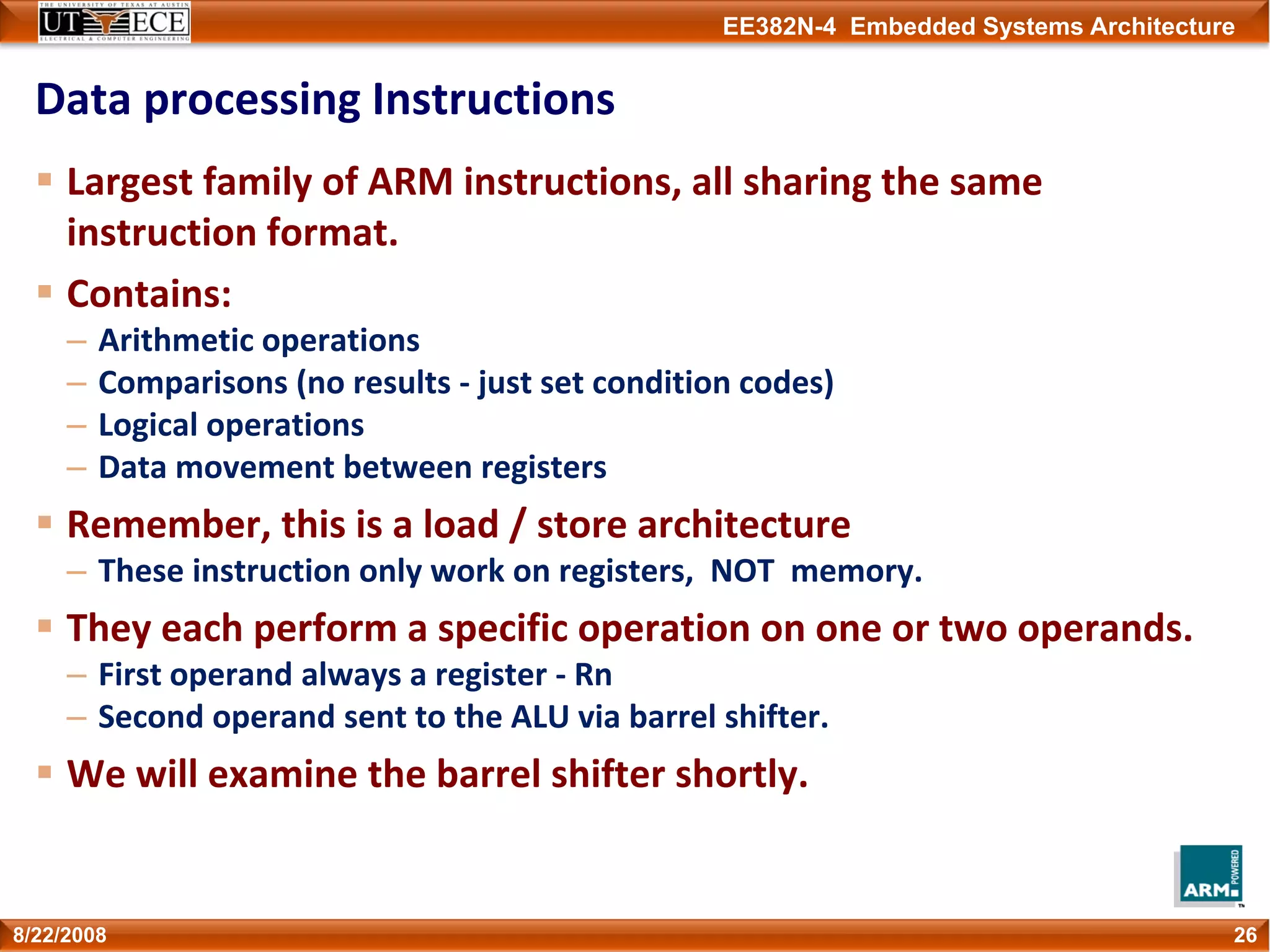
Data processing Instructions
Largest family of ARM instructions, all sharing the same 
instruction format.
Contains:
– Arithmetic operations
– Comparisons (no results ‐ just set condition codes) 
– Logical operations
– Data movement between registers
Remember, this is a load / store architecture
– These instruction only work on registers,  NOT  memory.
They each perform a specific operation on one or two operands.
– First operand always a register ‐ Rn
– Second operand sent to the ALU via barrel shifter.
We will examine the barrel shifter shortly.
268/22/2008
EE382N-4 Embedded Systems Architecture
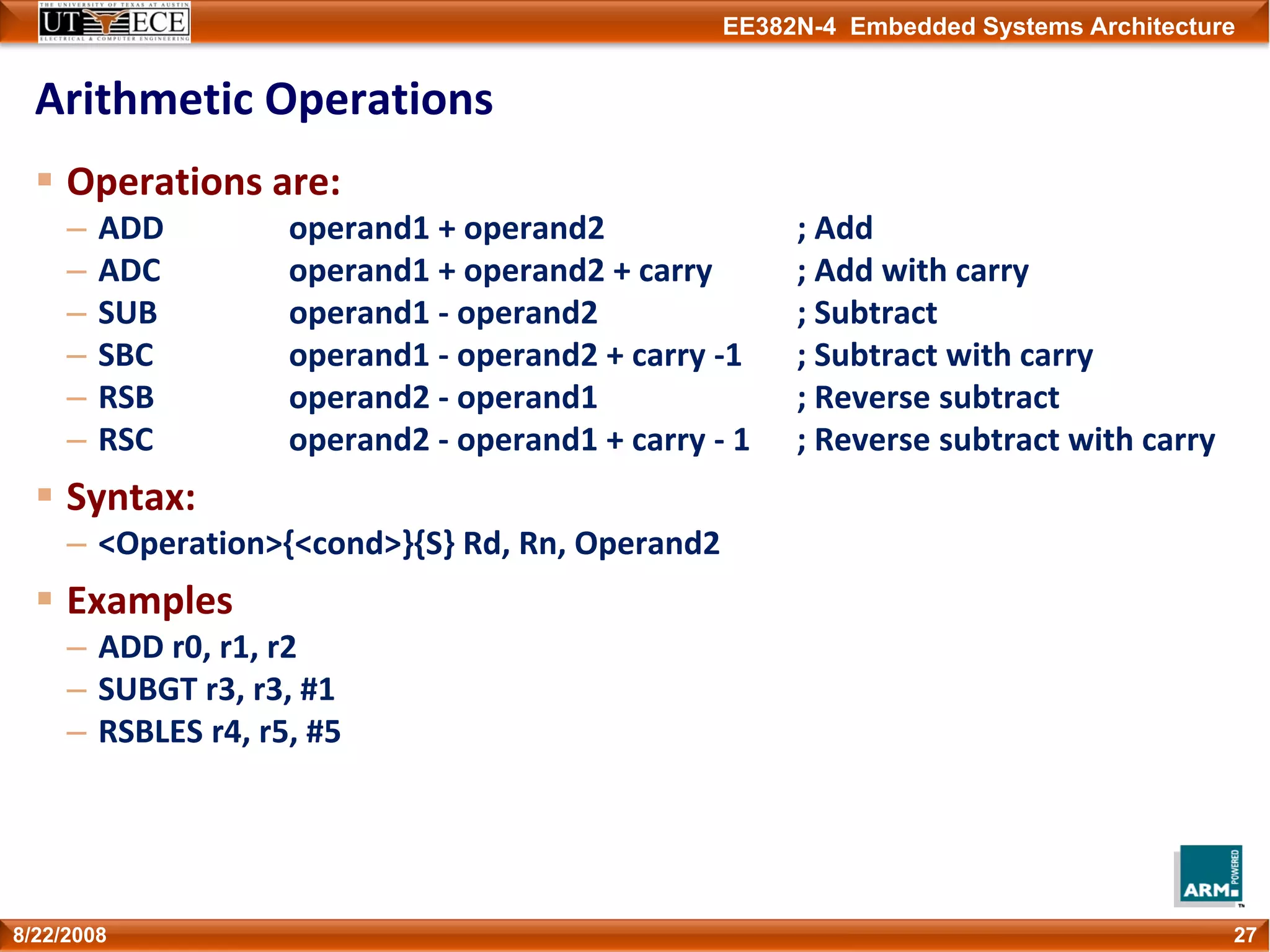
Arithmetic Operations
Operations are:
– ADD operand1 + operand2 ; Add
– ADC operand1 + operand2 + carry ; Add with carry
– SUB operand1 ‐ operand2 ; Subtract
– SBC operand1 ‐ operand2 + carry ‐1  ; Subtract with carry
– RSB operand2 ‐ operand1 ; Reverse subtract
– RSC operand2 ‐ operand1 + carry ‐ 1 ; Reverse subtract with carry
Syntax:
– <Operation>{<cond>}{S} Rd, Rn, Operand2
Examples
– ADD r0, r1, r2
– SUBGT r3, r3, #1
– RSBLES r4, r5, #5
278/22/2008
EE382N-4 Embedded Systems Architecture
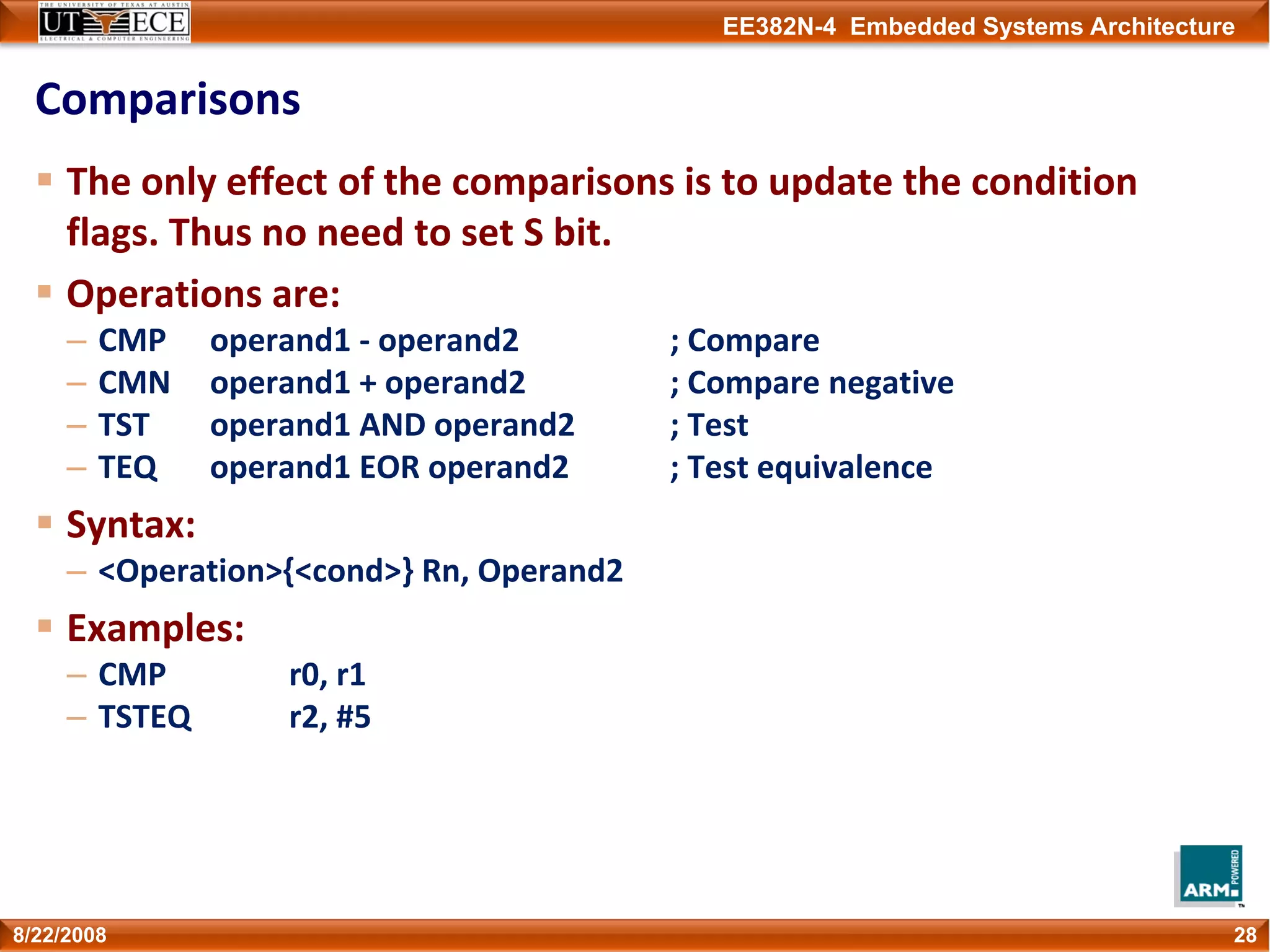
Comparisons
The only effect of the comparisons is to update the condition 
flags. Thus no need to set S bit.
Operations are:
– CMP operand1 ‐ operand2 ; Compare
– CMN operand1 + operand2 ; Compare negative
– TST operand1 AND operand2 ; Test
– TEQ operand1 EOR operand2 ; Test equivalence
Syntax:
– <Operation>{<cond>} Rn, Operand2
Examples:
– CMP r0, r1
– TSTEQ r2, #5
288/22/2008
EE382N-4 Embedded Systems Architecture
Logical Operations
Operations are:
AND operand1 AND operand2
EOR operand1 EOR operand2
ORR operand1 OR operand2
ORN    operand1 NOR operand2
BIC operand1 AND NOT operand2 [ie bit clear]
Syntax:
– <Operation>{<cond>}{S} Rd, Rn, Operand2
Examples:
AND r0, r1, r2
BICEQ r2, r3, #7
EORS r1,r3,r0
298/22/2008
EE382N-4 Embedded Systems Architecture
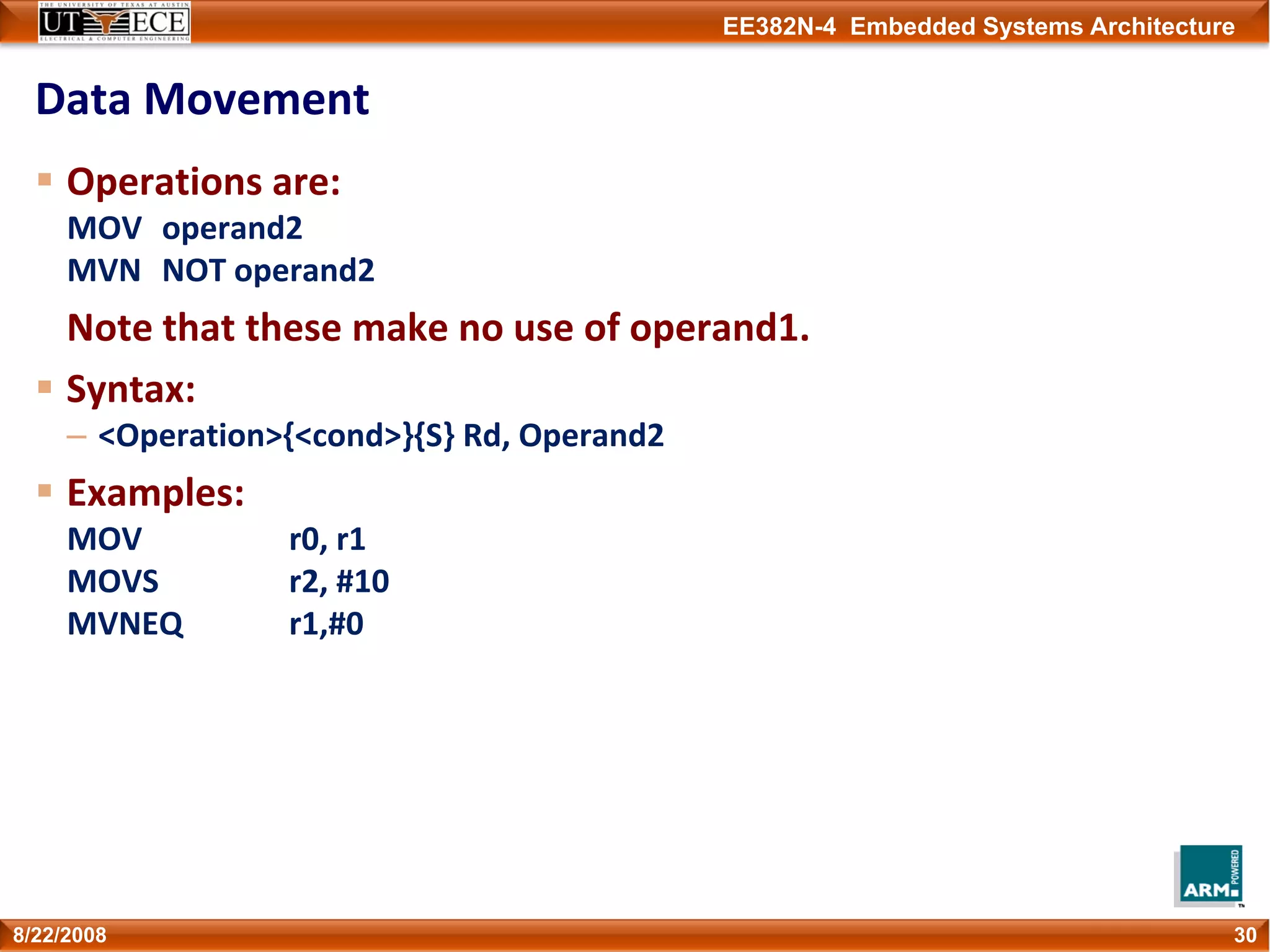
Data Movement
Operations are:
MOV operand2
MVN NOT operand2
Note that these make no use of operand1.
Syntax:
– <Operation>{<cond>}{S} Rd, Operand2
Examples:
MOV r0, r1
MOVS r2, #10
MVNEQ r1,#0
308/22/2008
EE382N-4 Embedded Systems Architecture
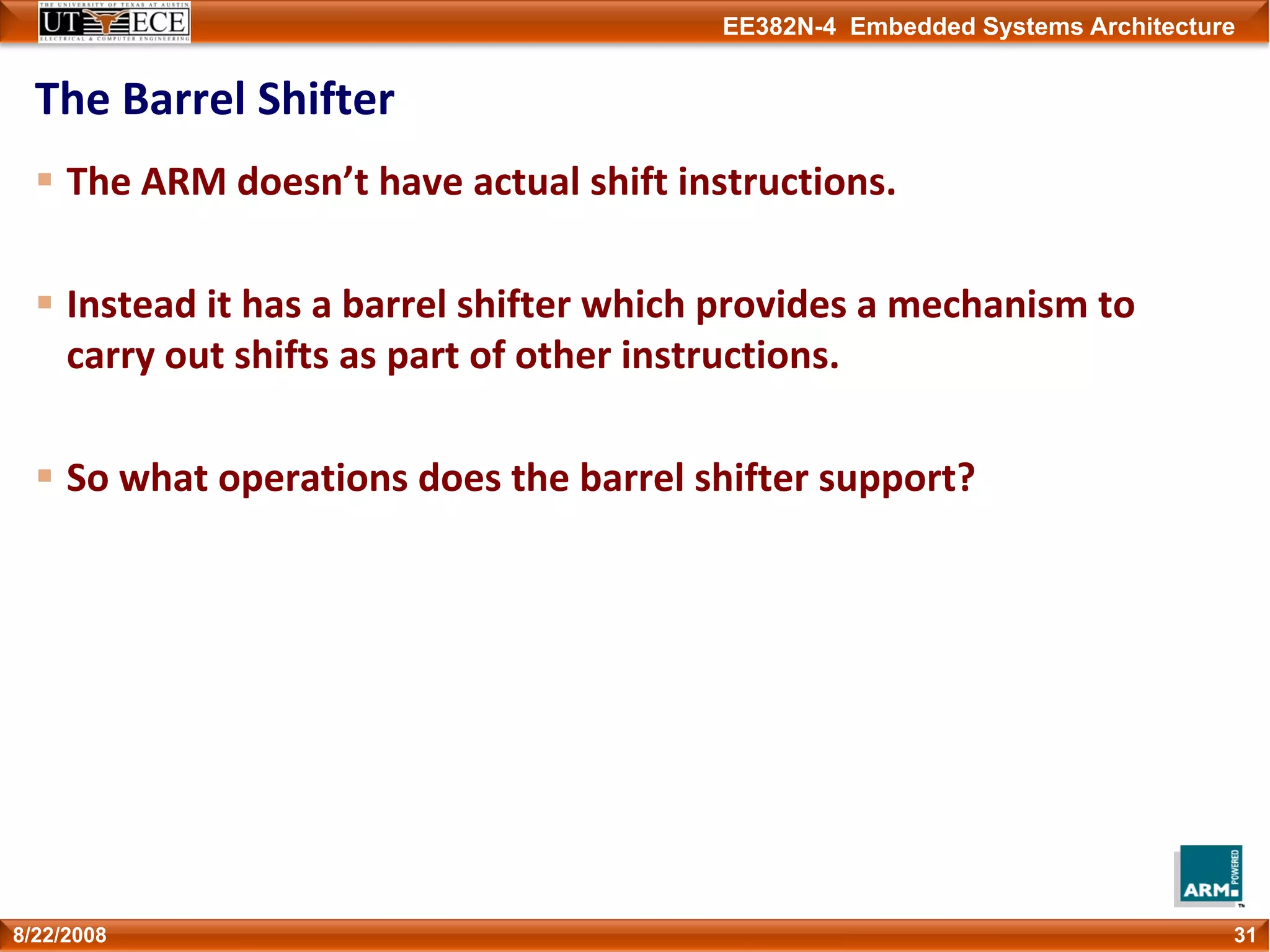
The Barrel Shifter
The ARM doesn’t have actual shift instructions.
Instead it has a barrel shifter which provides a mechanism to 
carry out shifts as part of other instructions.
So what operations does the barrel shifter support?
318/22/2008
EE382N-4 Embedded Systems Architecture
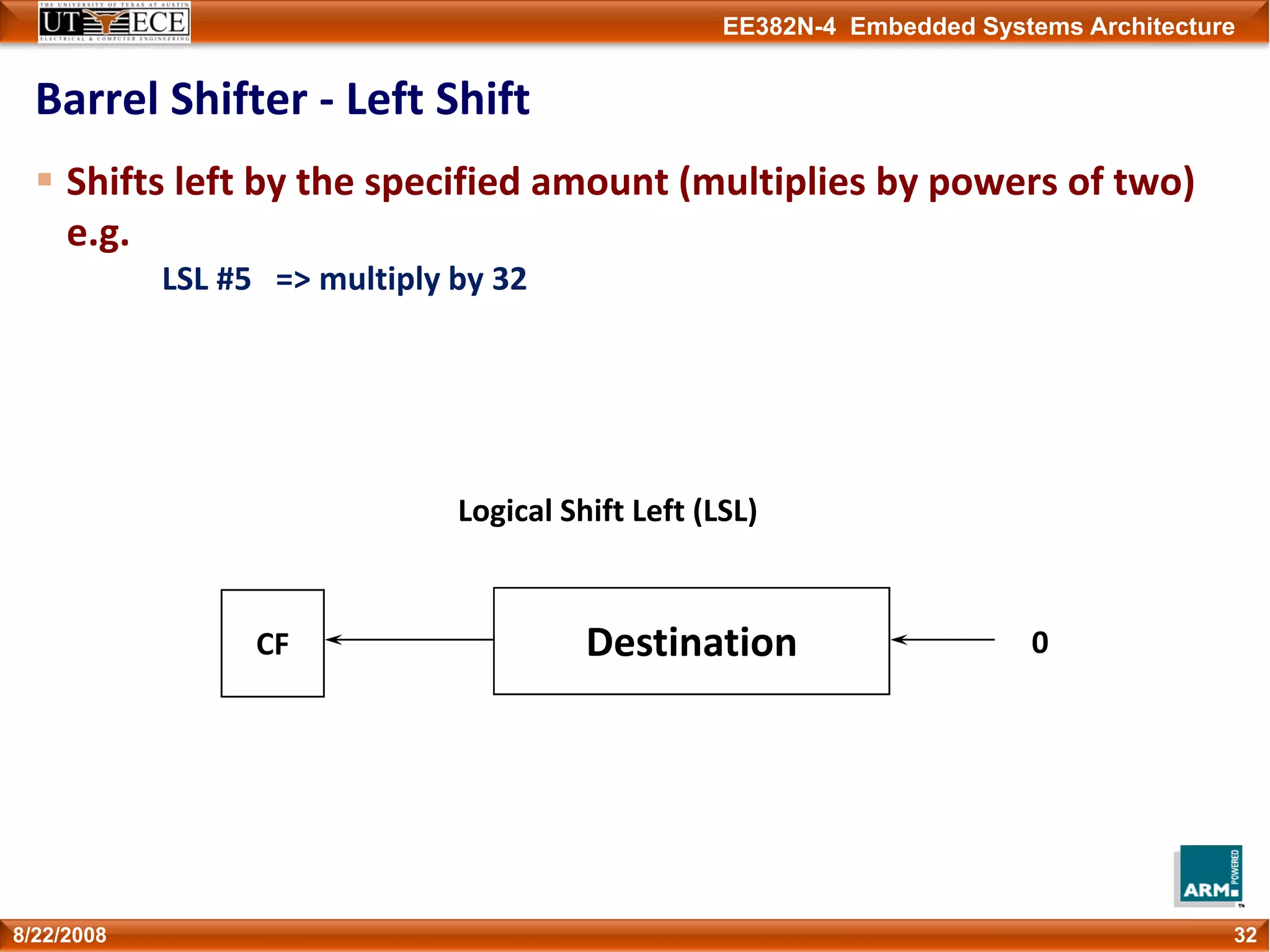
Barrel Shifter ‐ Left Shift
Shifts left by the specified amount (multiplies by powers of two) 
e.g. 
LSL #5   => multiply by 32
328/22/2008
Logical Shift Left (LSL)
DestinationCF 0
EE382N-4 Embedded Systems Architecture
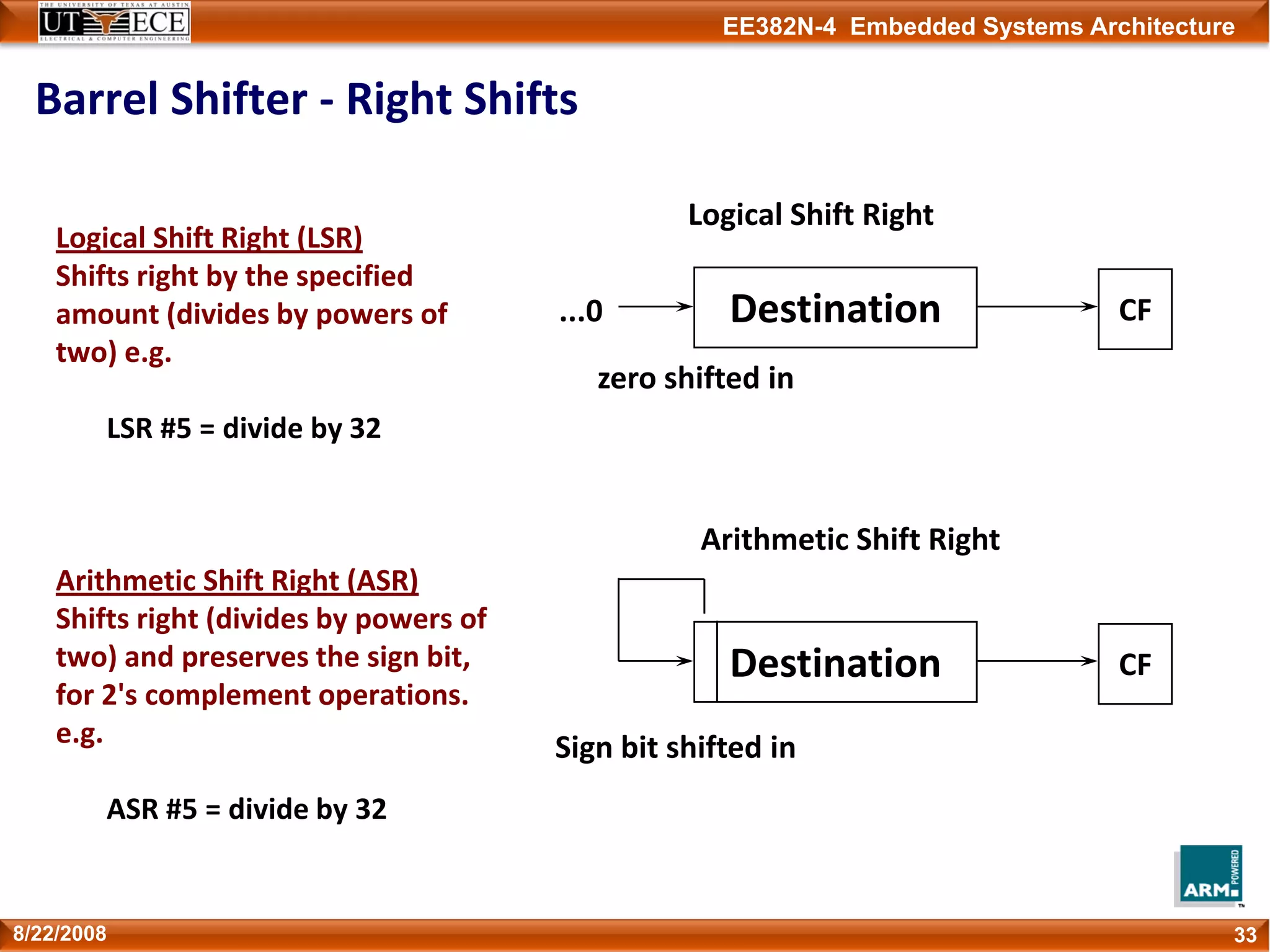
Barrel Shifter ‐ Right Shifts
338/22/2008
Logical Shift Right (LSR) 
Shifts right by the specified 
amount (divides by powers of 
two) e.g. 
LSR #5 = divide by 32
Arithmetic Shift Right (ASR)  
Shifts right (divides by powers of 
two) and preserves the sign bit, 
for 2's complement operations. 
e.g. 
ASR #5 = divide by 32
Destination CF
Destination CF
Logical Shift Right
Arithmetic Shift Right
...0
Sign bit shifted in
zero shifted in
EE382N-4 Embedded Systems Architecture
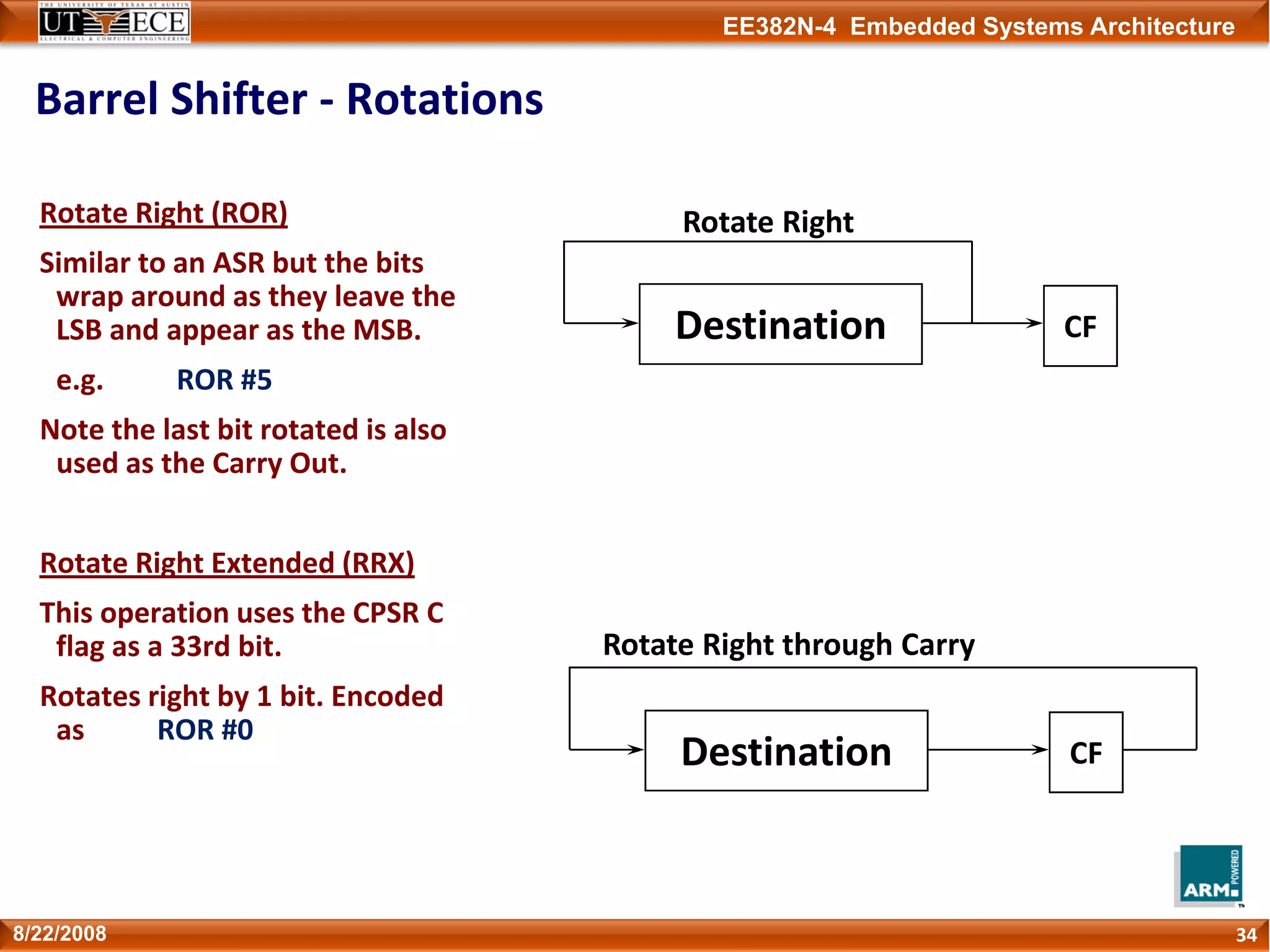
Barrel Shifter ‐ Rotations 
348/22/2008
Rotate Right (ROR)
Similar to an ASR but the bits 
wrap around as they leave the 
LSB and appear as the MSB.
e.g.          ROR #5
Note the last bit rotated is also 
used as the Carry Out.
Rotate Right Extended (RRX)
This operation uses the CPSR C 
flag as a 33rd bit. 
Rotates right by 1 bit. Encoded 
as          ROR #0
Destination CF
Rotate Right
Destination CF
Rotate Right through Carry
EE382N-4 Embedded Systems Architecture
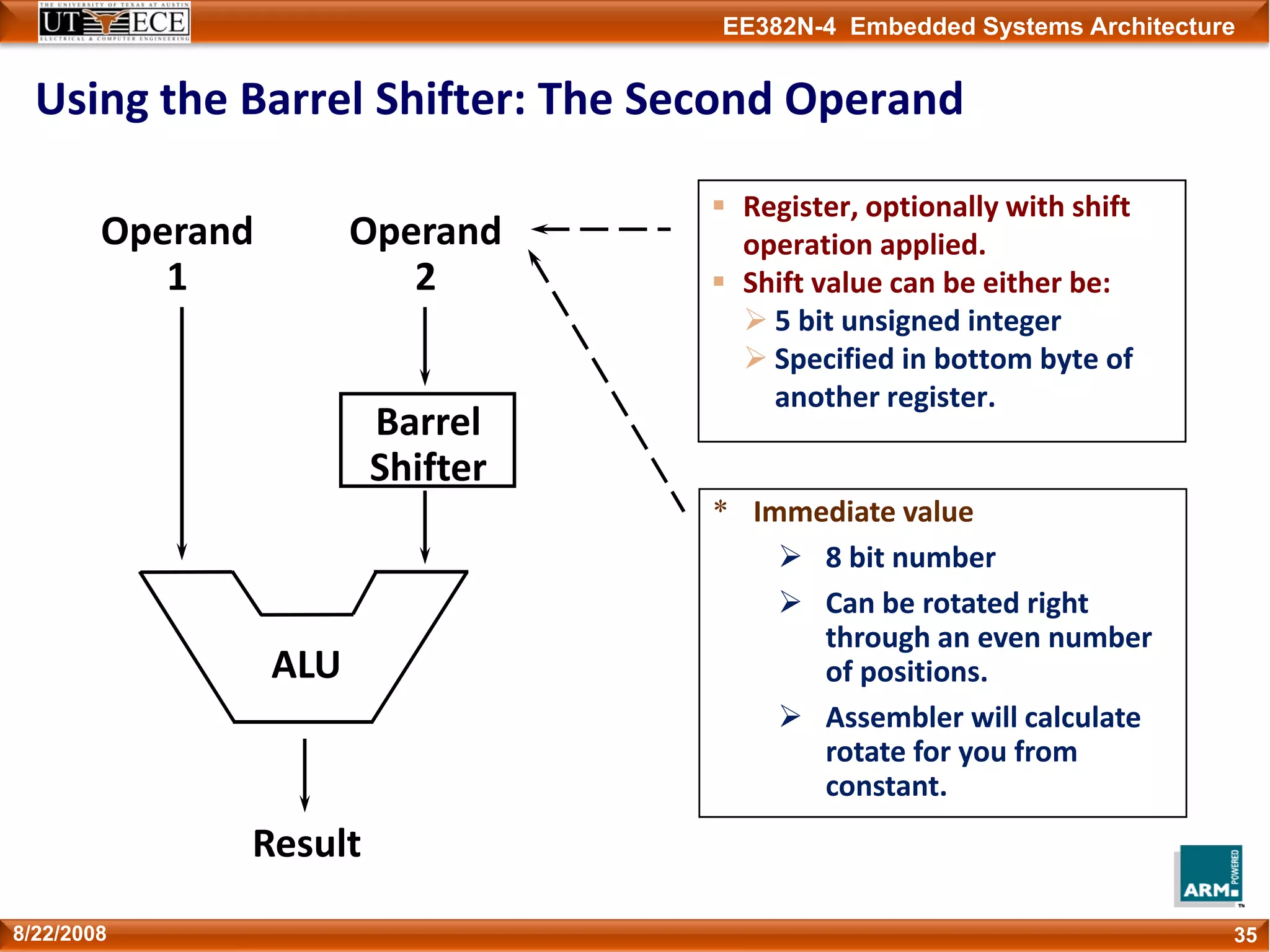
Using the Barrel Shifter: The Second Operand
358/22/2008
Register, optionally with shift 
operation applied.
Shift value can be either be:
5 bit unsigned integer
Specified in bottom byte of 
another register.
* Immediate value
8 bit number
Can be rotated right 
through an even number 
of positions.
Assembler will calculate 
rotate for you from 
constant.
Operand 
1
Result
ALU
Barrel 
Shifter
Operand 
2
EE382N-4 Embedded Systems Architecture
Second Operand : Shifted Register
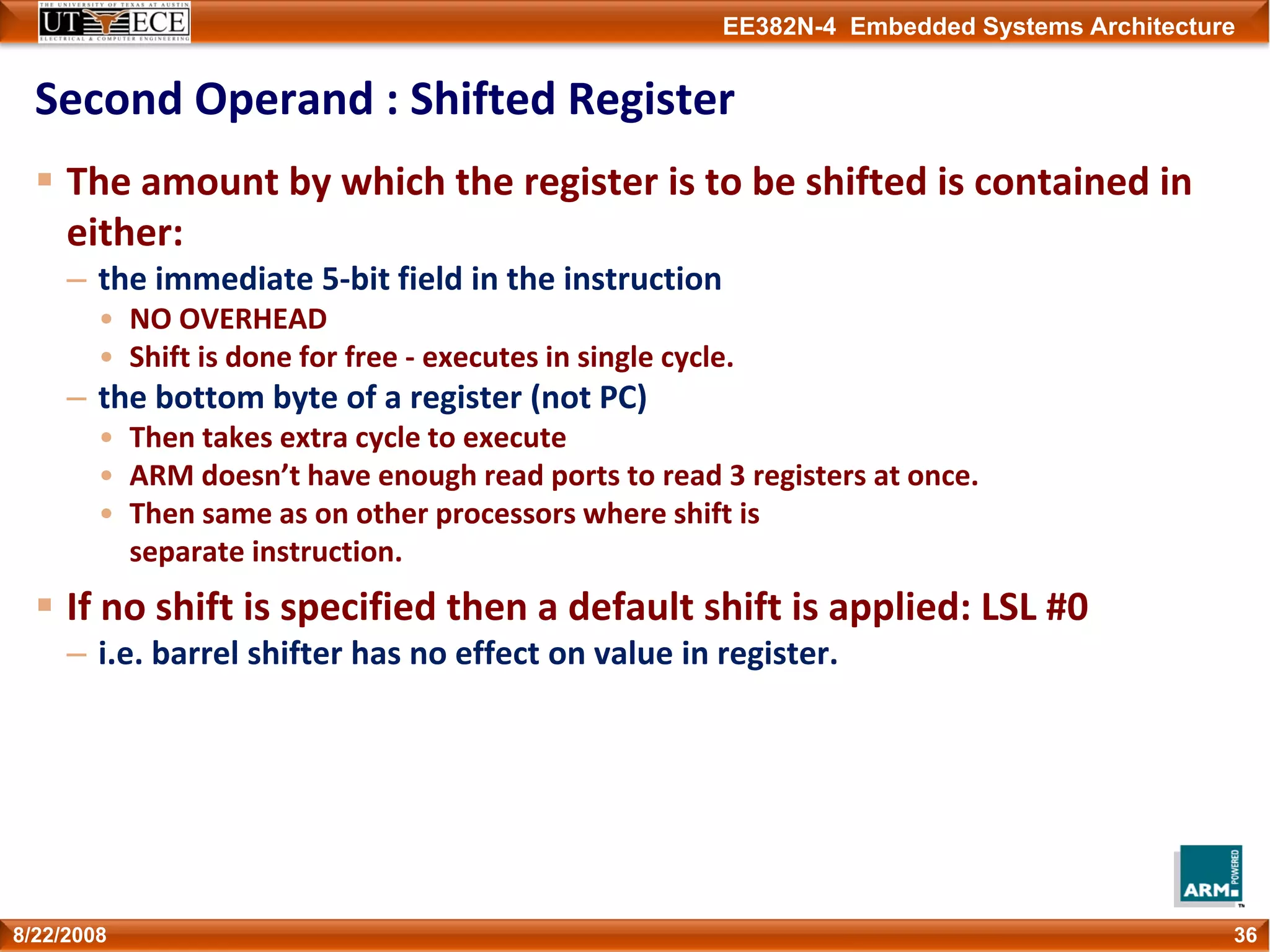
The amount by which the register is to be shifted is contained in 
either:   
– the immediate 5‐bit field in the instruction           
• NO OVERHEAD 
• Shift is done for free ‐ executes in single cycle.
– the bottom byte of a register (not PC)
• Then takes extra cycle to execute
• ARM doesn’t have enough read ports to read 3 registers at once.
• Then same as on other processors where shift is
separate instruction.
If no shift is specified then a default shift is applied: LSL #0
– i.e. barrel shifter has no effect on value in register.
368/22/2008
EE382N-4 Embedded Systems Architecture
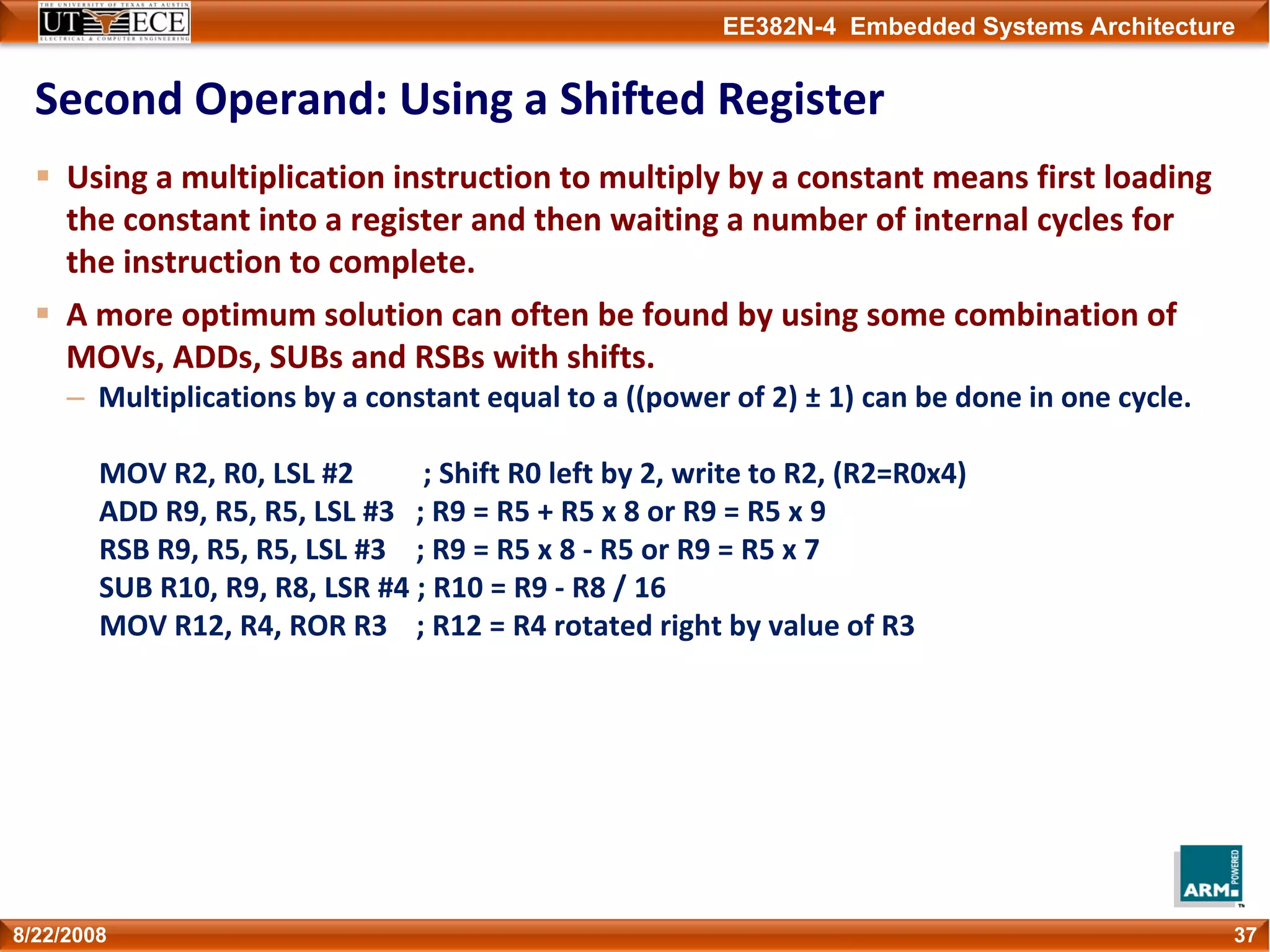
Second Operand: Using a Shifted Register
Using a multiplication instruction to multiply by a constant means first loading 
the constant into a register and then waiting a number of internal cycles for 
the instruction to complete.
A more optimum solution can often be found by using some combination of 
MOVs, ADDs, SUBs and RSBs with shifts.
– Multiplications by a constant equal to a ((power of 2) ± 1) can be done in one cycle.
MOV R2, R0, LSL #2 ; Shift R0 left by 2, write to R2, (R2=R0x4)
ADD R9, R5, R5, LSL #3  ; R9 = R5 + R5 x 8 or R9 = R5 x 9
RSB R9, R5, R5, LSL #3  ; R9 = R5 x 8 ‐ R5 or R9 = R5 x 7
SUB R10, R9, R8, LSR #4 ; R10 = R9 ‐ R8 / 16
MOV R12, R4, ROR R3  ; R12 = R4 rotated right by value of R3
378/22/2008
EE382N-4 Embedded Systems Architecture
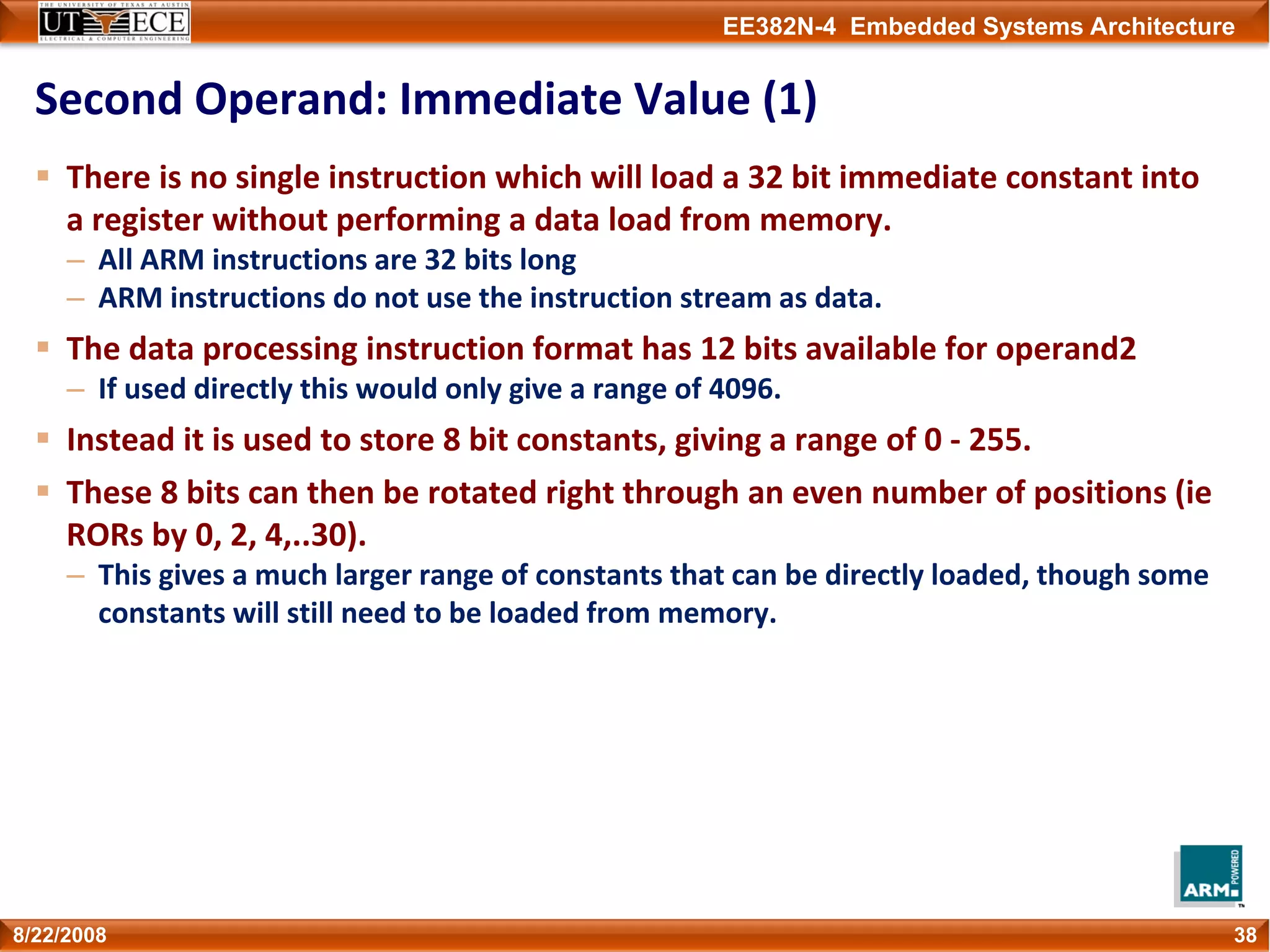
Second Operand: Immediate Value (1)
There is no single instruction which will load a 32 bit immediate constant into 
a register without performing a data load from memory.
– All ARM instructions are 32 bits long
– ARM instructions do not use the instruction stream as data.
The data processing instruction format has 12 bits available for operand2
– If used directly this would only give a range of 4096.
Instead it is used to store 8 bit constants, giving a range of 0 ‐ 255.
These 8 bits can then be rotated right through an even number of positions (ie 
RORs by 0, 2, 4,..30).
– This gives a much larger range of constants that can be directly loaded, though some 
constants will still need to be loaded from memory.
388/22/2008
EE382N-4 Embedded Systems Architecture
Second Operand:  Immediate Value (2)
This gives us:
– 0 ‐ 255 [0 ‐ 0xff]
– 256,260,264,..,1020 [0x100‐0x3fc, step 4, 0x40‐0xff ror 30]
– 1024,1040,1056,..,4080 [0x400‐0xff0, step 16, 0x40‐0xff ror 28]
– 4096,4160, 4224,..,16320 [0x1000‐0x3fc0, step 64, 0x40‐0xff ror 26]
These can be loaded using, for example:
– MOV r0, #0x40, 26 ; => MOV r0, #0x1000    (ie 4096)
To make this easier, the assembler will convert to this form for us if simply 
given the required constant:
– MOV r0, #4096 ; => MOV r0, #0x1000    (ie 0x40 ror 26)
The bitwise complements can also be formed using MVN:
– MOV r0, #0xFFFFFFFF  ; assembles to MVN r0, #0
If the required constant cannot be generated, an error will 
be reported.
398/22/2008
EE382N-4 Embedded Systems Architecture
Loading full 32 bit constants
Although the MOV/MVN mechanism will load a large range of constants into a 
register, sometimes this mechanism will not generate the required constant.
Therefore, the assembler also provides a method which will load ANY 32 bit 
constant:
– LDR rd,=numeric constant
If the constant can be constructed using either a MOV or MVN then this will be 
the instruction actually generated.
Otherwise, the assembler will produce an LDR instruction with a PC‐relative 
address to read the constant from a literal pool.
LDR r0,=0x42 ; generates   MOV r0,#0x42
LDR r0,=0x55555555 ; generate     LDR r0,[pc, offset to lit pool]
:
:
DCD  0x55555555
As this mechanism will always generate the best instruction for a given case, it 
is the recommended way of loading constants.
408/22/2008
EE382N-4 Embedded Systems Architecture
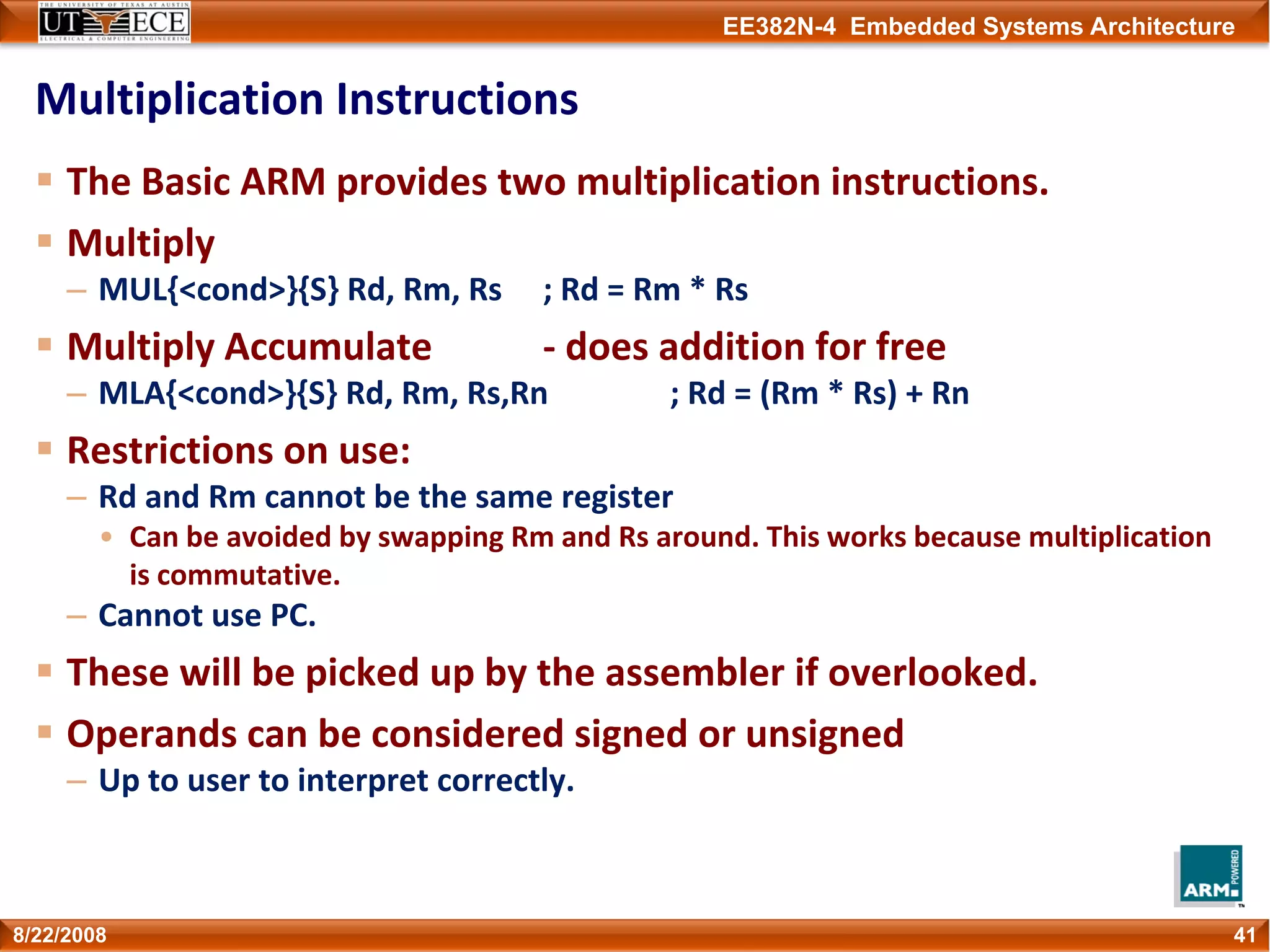
Multiplication Instructions
The Basic ARM provides two multiplication instructions.
Multiply
– MUL{<cond>}{S} Rd, Rm, Rs ; Rd = Rm * Rs
Multiply Accumulate ‐ does addition for free
– MLA{<cond>}{S} Rd, Rm, Rs,Rn ; Rd = (Rm * Rs) + Rn
Restrictions on use:
– Rd and Rm cannot be the same register
• Can be avoided by swapping Rm and Rs around. This works because multiplication 
is commutative.
– Cannot use PC.
These will be picked up by the assembler if overlooked.
Operands can be considered signed or unsigned
– Up to user to interpret correctly.
418/22/2008
EE382N-4 Embedded Systems Architecture
Multiplication Implementation
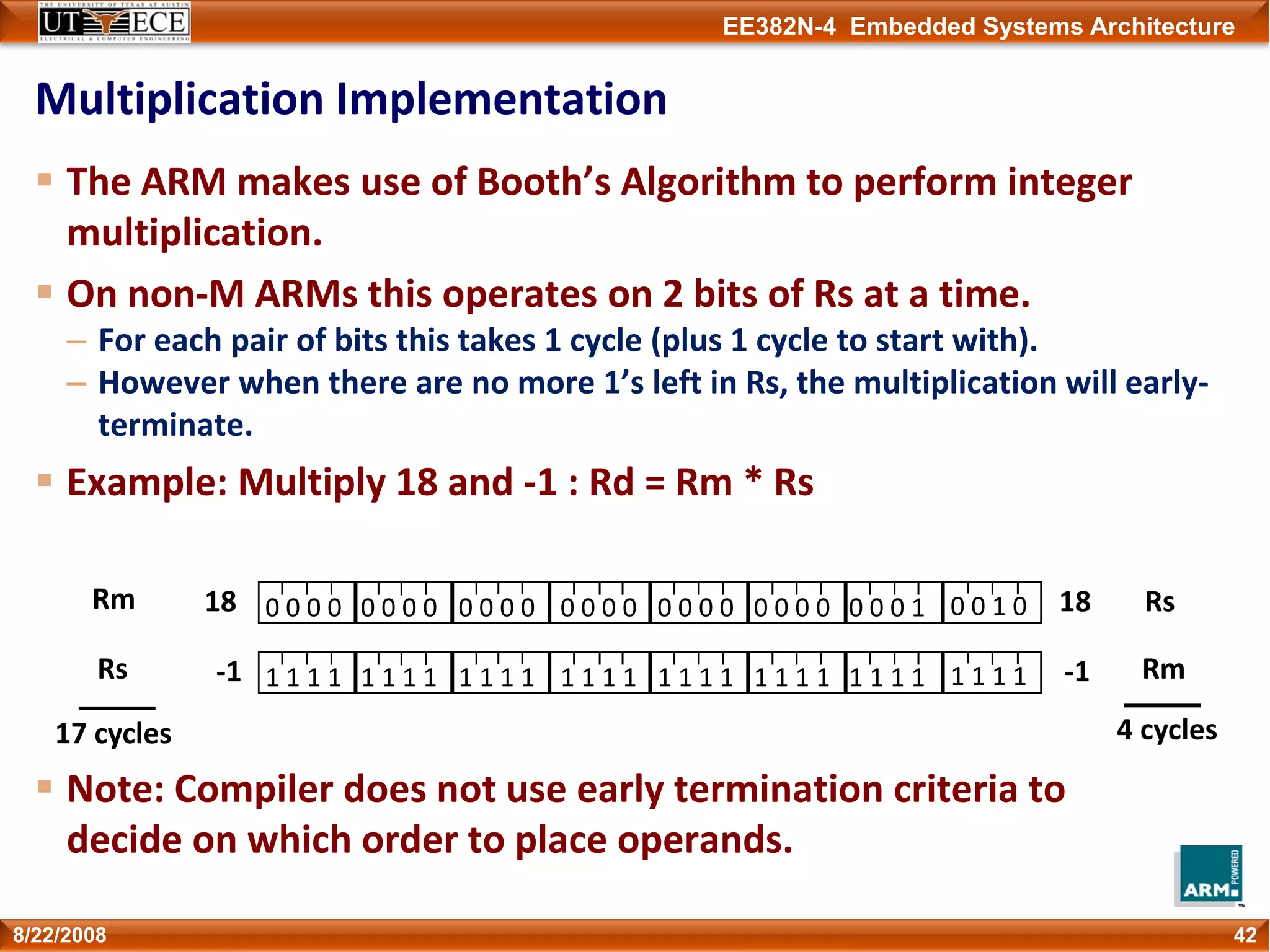
The ARM makes use of Booth’s Algorithm to perform integer 
multiplication. 
On non‐M ARMs this operates on 2 bits of Rs at a time.
– For each pair of bits this takes 1 cycle (plus 1 cycle to start with).
– However when there are no more 1’s left in Rs, the multiplication will early‐
terminate. 
Example: Multiply 18 and ‐1 : Rd = Rm * Rs
Note: Compiler does not use early termination criteria to 
decide on which order to place operands.
428/22/2008
0 0 0 0 0 0 1 00 0 0 10 0 0 00 0 0 00 0 0 0 0 0 0 0 0 0 0 0
1 1 1 1 1 1 1 11 1 1 11 1 1 11 1 1 11 1 1 1 1 1 1 1 1 1 1 1
Rm
Rs
17 cycles
Rs
Rm
4 cycles
18
‐1
18
‐1
EE382N-4 Embedded Systems Architecture
Extended Multiply Instructions
M variants of ARM cores contain extended multiplication 
hardware. This provides three enhancements:
– An 8 bit Booth’s Algorithm is used
• Multiplication is carried out faster (maximum for standard instructions is now 5 
cycles).
– Early termination method improved so that now completes multiplication 
when all remaining bit sets contain 
• all zeroes (as with non‐M ARMs), or
• all ones. 
– Thus the previous example would early terminate in 2 cycles in both 
cases.
– 64 bit results can now be produced from two 32bit operands
• Higher accuracy.
• Pair of registers used to store result.
438/22/2008
EE382N-4 Embedded Systems Architecture
Multiply‐Long & Multiply‐Accumulate Long
Instructions are
– MULL which gives RdHi,RdLo:=Rm*Rs              
– MLAL which gives RdHi,RdLo:=(Rm*Rs)+RdHi,RdLo
However the full 64 bit of the result now matter (lower precision 
multiply instructions simply throws top 32bits away)
– Need to specify whether operands are signed or unsigned
Therefore syntax of new instructions are:
– UMULL{<cond>}{S} RdLo,RdHi,Rm,Rs
– UMLAL{<cond>}{S} RdLo,RdHi,Rm,Rs
– SMULL{<cond>}{S} RdLo, RdHi, Rm, Rs
– SMLAL{<cond>}{S} RdLo, RdHi, Rm, Rs
Not generated by the compiler.
Warning : Unpredictable on non‐M ARMs.
448/22/2008
EE382N-4 Embedded Systems Architecture
Load / Store Instructions
The ARM is a Load / Store Architecture:
– Does not support memory to memory data processing operations.
– Must move data values into registers before using them.
This might sound inefficient, but in practice it isn’t:
– Load data values from memory into registers.
– Process data in registers using a number of data processing instructions 
which are not slowed down by memory access.
– Store results from registers out to memory.
The ARM has three sets of instructions which interact with main 
memory. These are:
– Single register data transfer (LDR / STR).
– Block data transfer (LDM/STM).
– Single Data Swap (SWP).
458/22/2008
EE382N-4 Embedded Systems Architecture
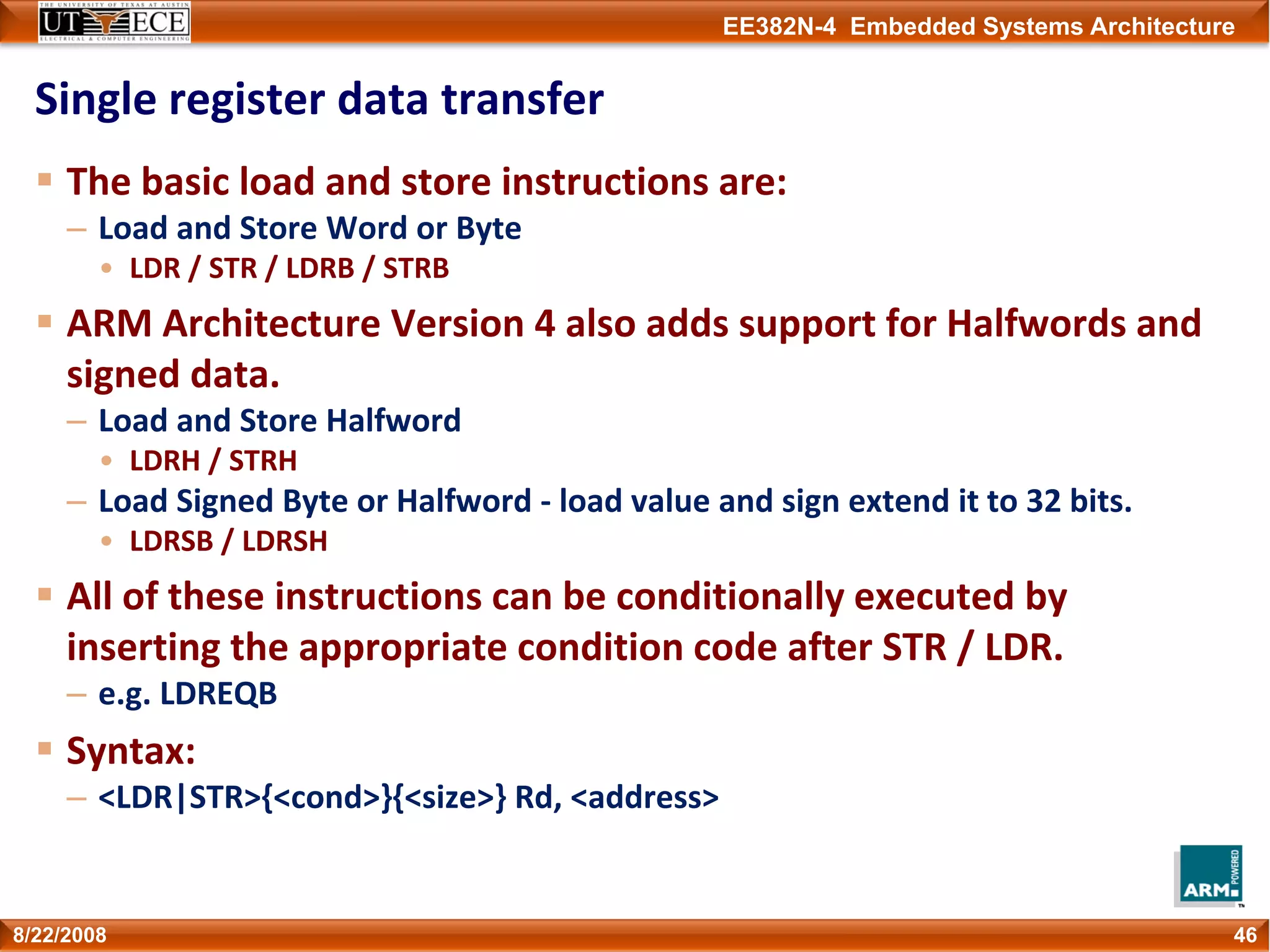
Single register data transfer
The basic load and store instructions are:
– Load and Store Word or Byte
• LDR / STR / LDRB / STRB
ARM Architecture Version 4 also adds support for Halfwords and 
signed data.
– Load and Store Halfword
• LDRH / STRH
– Load Signed Byte or Halfword ‐ load value and sign extend it to 32 bits.
• LDRSB / LDRSH
All of these instructions can be conditionally executed by 
inserting the appropriate condition code after STR / LDR.
– e.g. LDREQB
Syntax:
– <LDR|STR>{<cond>}{<size>} Rd, <address>
468/22/2008
EE382N-4 Embedded Systems Architecture
Load and Store Word or Byte:  Base Register
The memory location to be accessed is held in a base register
STR r0, [r1] ; Store contents of r0 to location pointed to
; by contents of r1.
LDR r2, [r1] ; Load r2 with contents of memory location
; pointed to by contents of r1.
478/22/2008
r1
0x200
Base
Register
Memory
0x50x200
r0
0x5
Source
Register
for STR
r2
0x5
Destination
Register
for LDR
EE382N-4 Embedded Systems Architecture
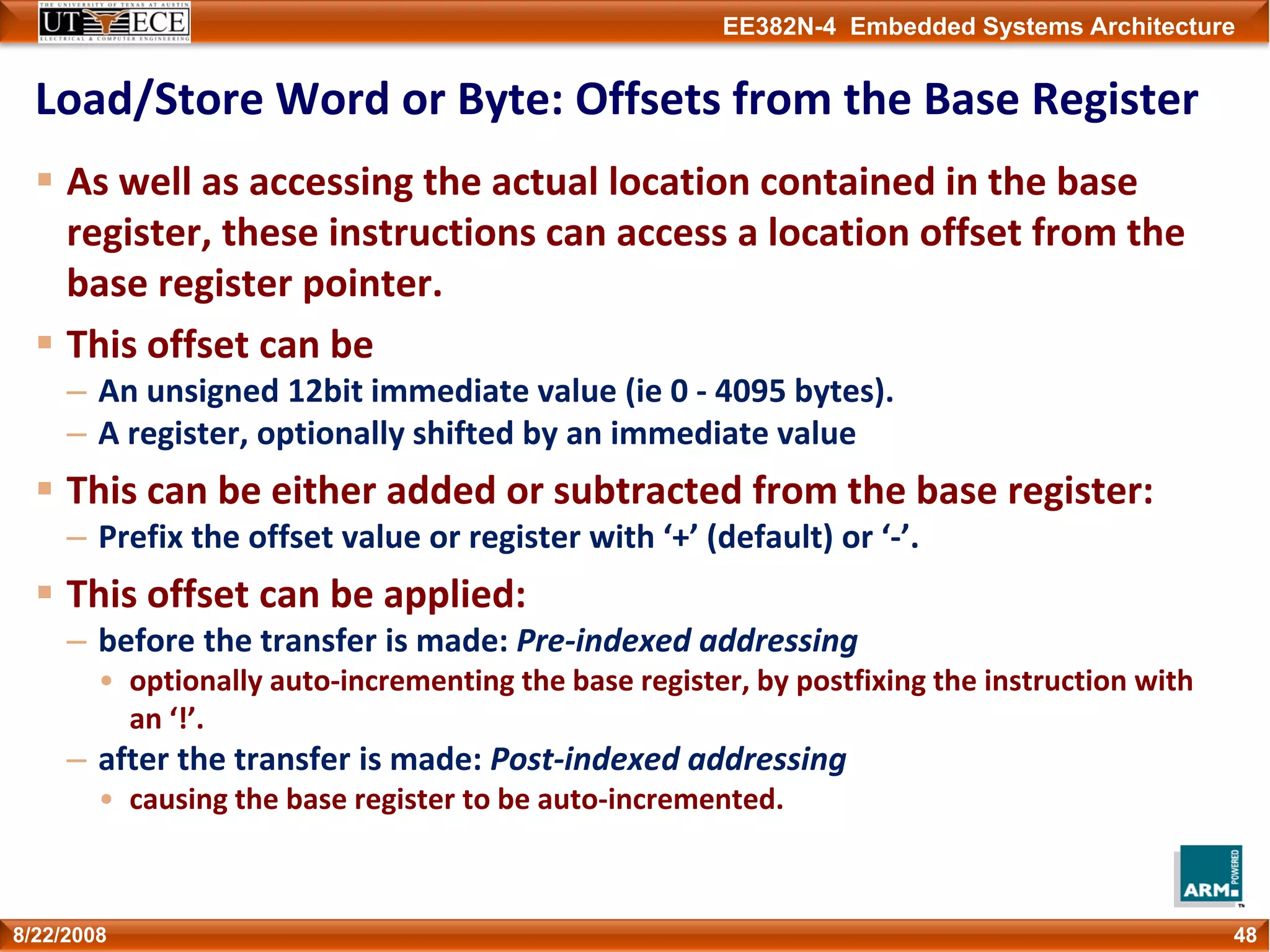
Load/Store Word or Byte: Offsets from the Base Register
As well as accessing the actual location contained in the base 
register, these instructions can access a location offset from the 
base register pointer.
This offset can be
– An unsigned 12bit immediate value (ie 0 ‐ 4095 bytes).
– A register, optionally shifted by an immediate value
This can be either added or subtracted from the base register:
– Prefix the offset value or register with ‘+’ (default) or ‘‐’.
This offset can be applied:
– before the transfer is made: Pre‐indexed addressing
• optionally auto‐incrementing the base register, by postfixing the instruction with 
an ‘!’.
– after the transfer is made: Post‐indexed addressing
• causing the base register to be auto‐incremented.
488/22/2008
EE382N-4 Embedded Systems Architecture
Load/Store Word or Byte: Pre‐indexed Addressing
Example: STR r0, [r1,#12]
– To store to location 0x1f4 instead use: STR r0, [r1,#‐12]
– To auto‐increment base pointer to 0x20c use: STR r0, [r1, #12]!
– If r2 contains 3, access 0x20c by multiplying this by 4:
• STR r0, [r1, r2, LSL #2]
498/22/2008
r1
0x200
Base
Register
Memory
0x5
0x200
r0
0x5
Source
Register
for STR
Offset
12 0x20c
EE382N-4 Embedded Systems Architecture
Load and Store Word or Byte: Post‐indexed Addressing
Example: STR r0, [r1], #12
– To auto‐increment the base register to location 0x1f4 instead use:
• STR r0, [r1], #‐12
– If r2 contains 3, auto‐increment base register to 0x20c by multiplying this by 
4:
• STR r0, [r1], r2, LSL #2
508/22/2008
r1
0x200
Original
Base
Register
Memory
0x50x200
r0
0x5
Source
Register
for STR
Offset
12 0x20c
r1
0x20c
Updated
Base
Register
EE382N-4 Embedded Systems Architecture
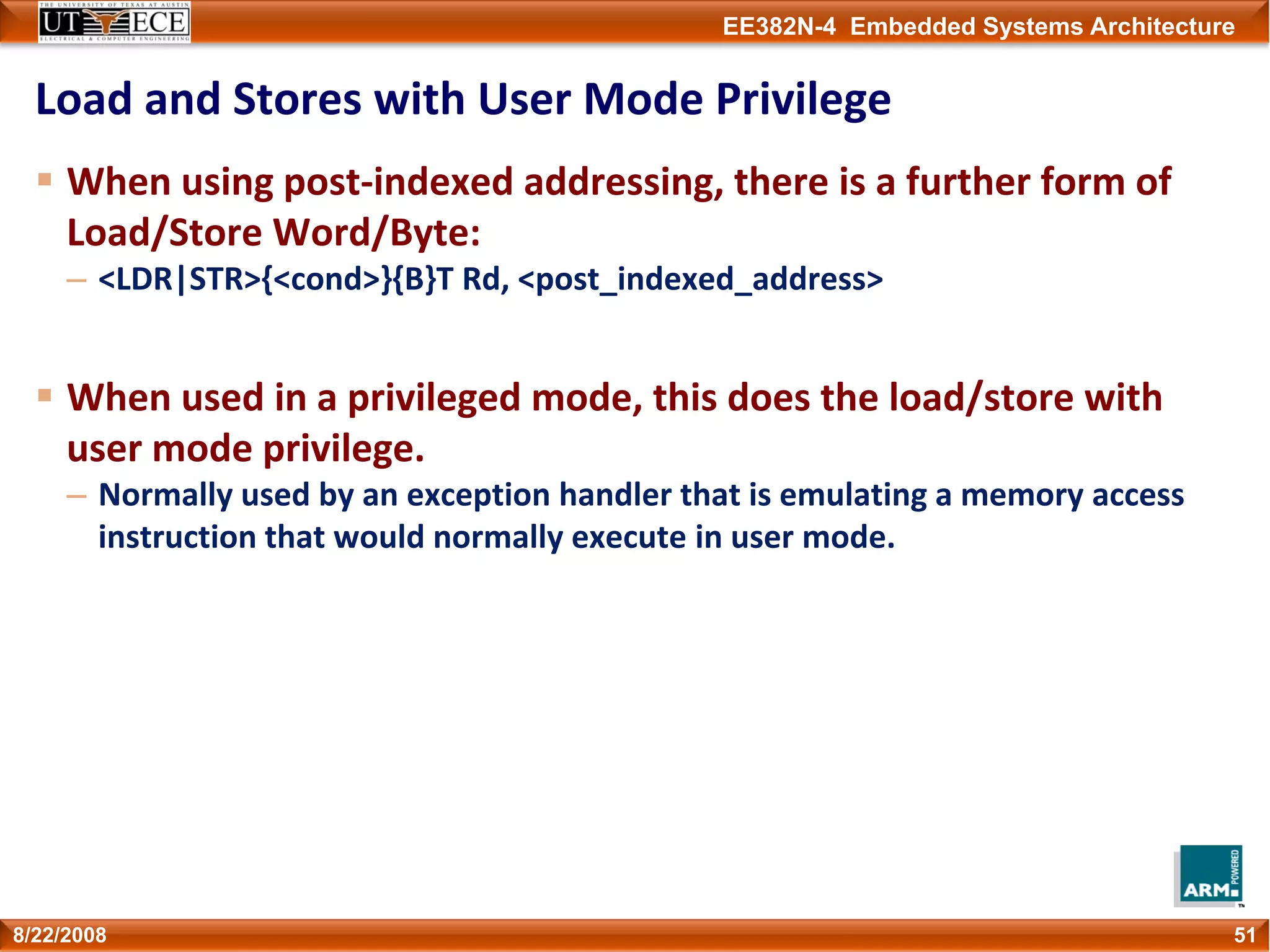
Load and Stores with User Mode Privilege
When using post‐indexed addressing, there is a further form of 
Load/Store Word/Byte:
– <LDR|STR>{<cond>}{B}T Rd, <post_indexed_address>
When used in a privileged mode, this does the load/store with 
user mode privilege.
– Normally used by an exception handler that is emulating a memory access 
instruction that would normally execute in user mode.
518/22/2008
EE382N-4 Embedded Systems Architecture
Example Usage of Addressing Modes
Imagine an array, the first element of which is pointed to by the contents of r0.
If we want to access a particular element,
then we can use pre‐indexed addressing:
– r1 is element we want.
– LDR r2, [r0, r1, LSL #2]
If we want to step through every
element of the array, for instance
to produce sum of elements in the
array, then we can use post‐indexed addressing within a loop:
– r1 is address of current element (initially equal to r0).
– LDR r2, [r1], #4
Use a further register to store the address of final element,
so that the loop can be correctly terminated.
528/22/2008
0
1
2
3
element
0
4
8
12
Memory
Offset
r0
Pointer to
start of array
EE382N-4 Embedded Systems Architecture
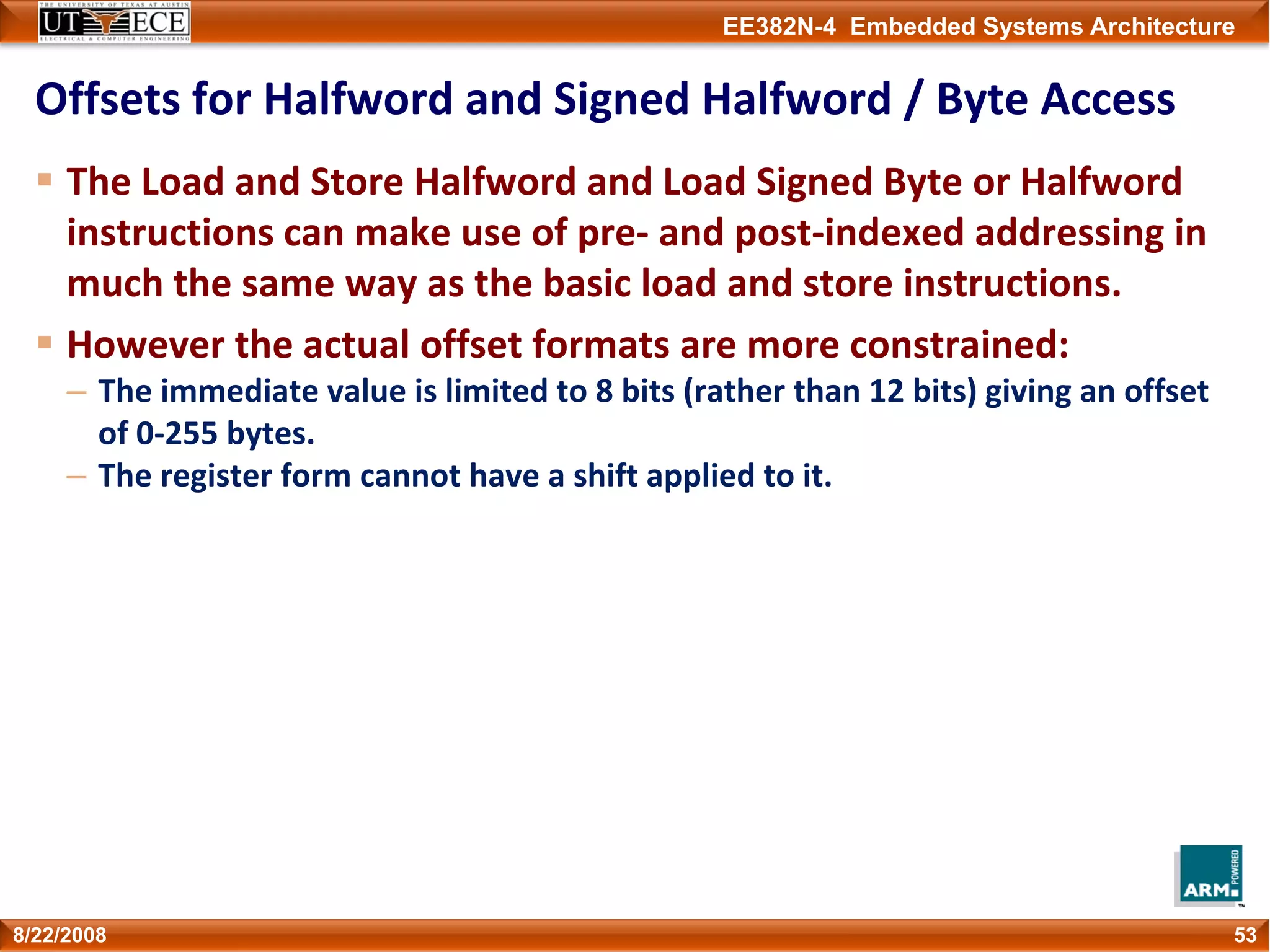
Offsets for Halfword and Signed Halfword / Byte Access
The Load and Store Halfword and Load Signed Byte or Halfword 
instructions can make use of pre‐ and post‐indexed addressing in 
much the same way as the basic load and store instructions.
However the actual offset formats are more constrained:
– The immediate value is limited to 8 bits (rather than 12 bits) giving an offset 
of 0‐255 bytes.
– The register form cannot have a shift applied to it.
538/22/2008
EE382N-4 Embedded Systems Architecture
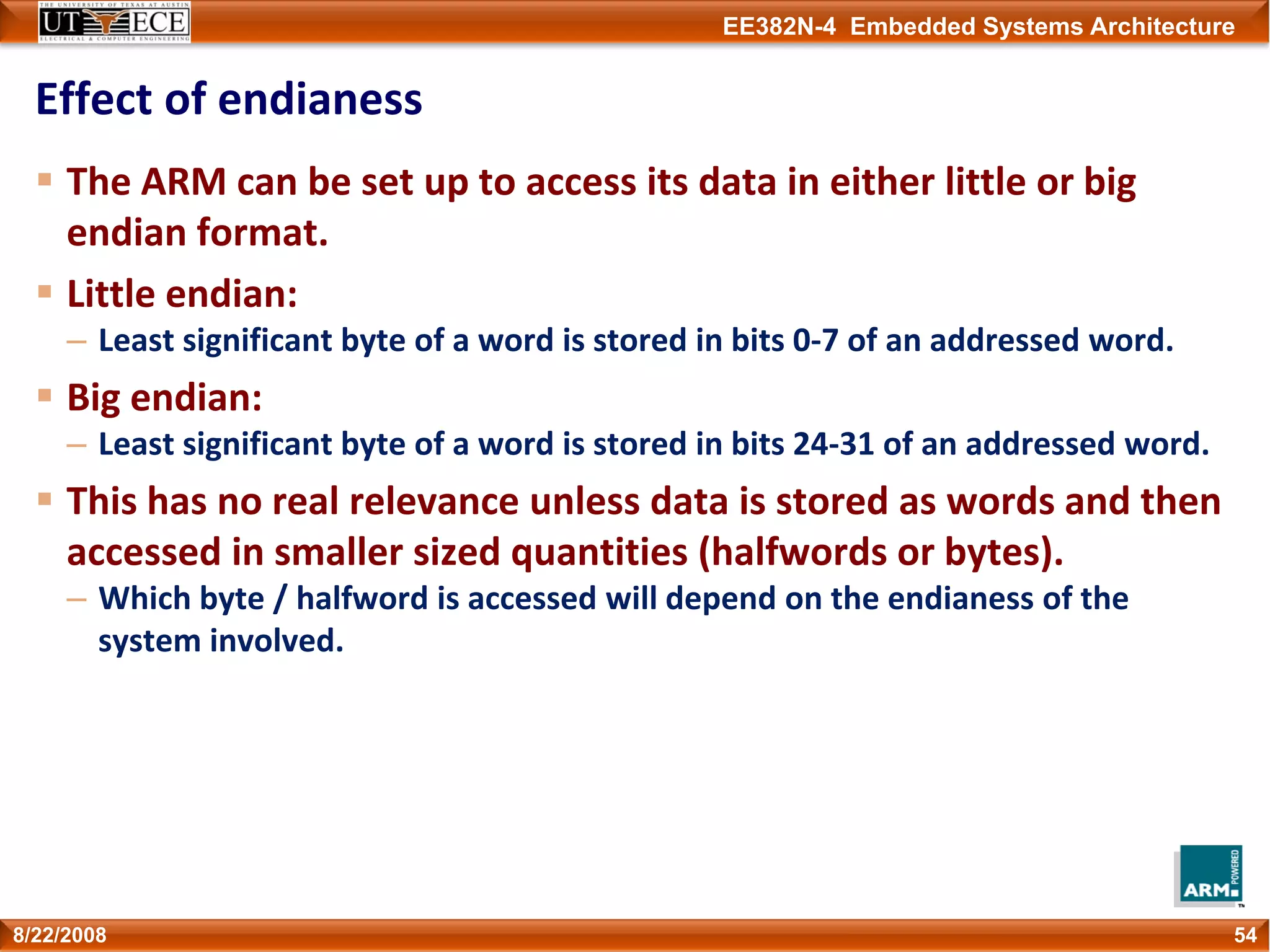
Effect of endianess
The ARM can be set up to access its data in either little or big 
endian format. 
Little endian:
– Least significant byte of a word is stored in bits 0‐7 of an addressed word.
Big endian:
– Least significant byte of a word is stored in bits 24‐31 of an addressed word.
This has no real relevance unless data is stored as words and then 
accessed in smaller sized quantities (halfwords or bytes).
– Which byte / halfword is accessed will depend on the endianess of the 
system involved.
548/22/2008
EE382N-4 Embedded Systems Architecture
YA Endianess Example
558/22/2008
Big-endianLittle-endian
r1 = 0x100
r0 = 0x11223344
31 24 23 16 15 8 7 0
11 22 33 44
31 24 23 16 15 8 7 0
11 22 33 44
31 24 23 16 15 8 7 0
44 33 22 11
31 24 23 16 15 8 7 0
00 00 00 44
31 24 23 16 15 8 7 0
00 00 00 11
r2 = 0x44 r2 = 0x11
STR r0, [r1]
LDRB r2, [r1]
r1 = 0x100Memory
EE382N-4 Embedded Systems Architecture
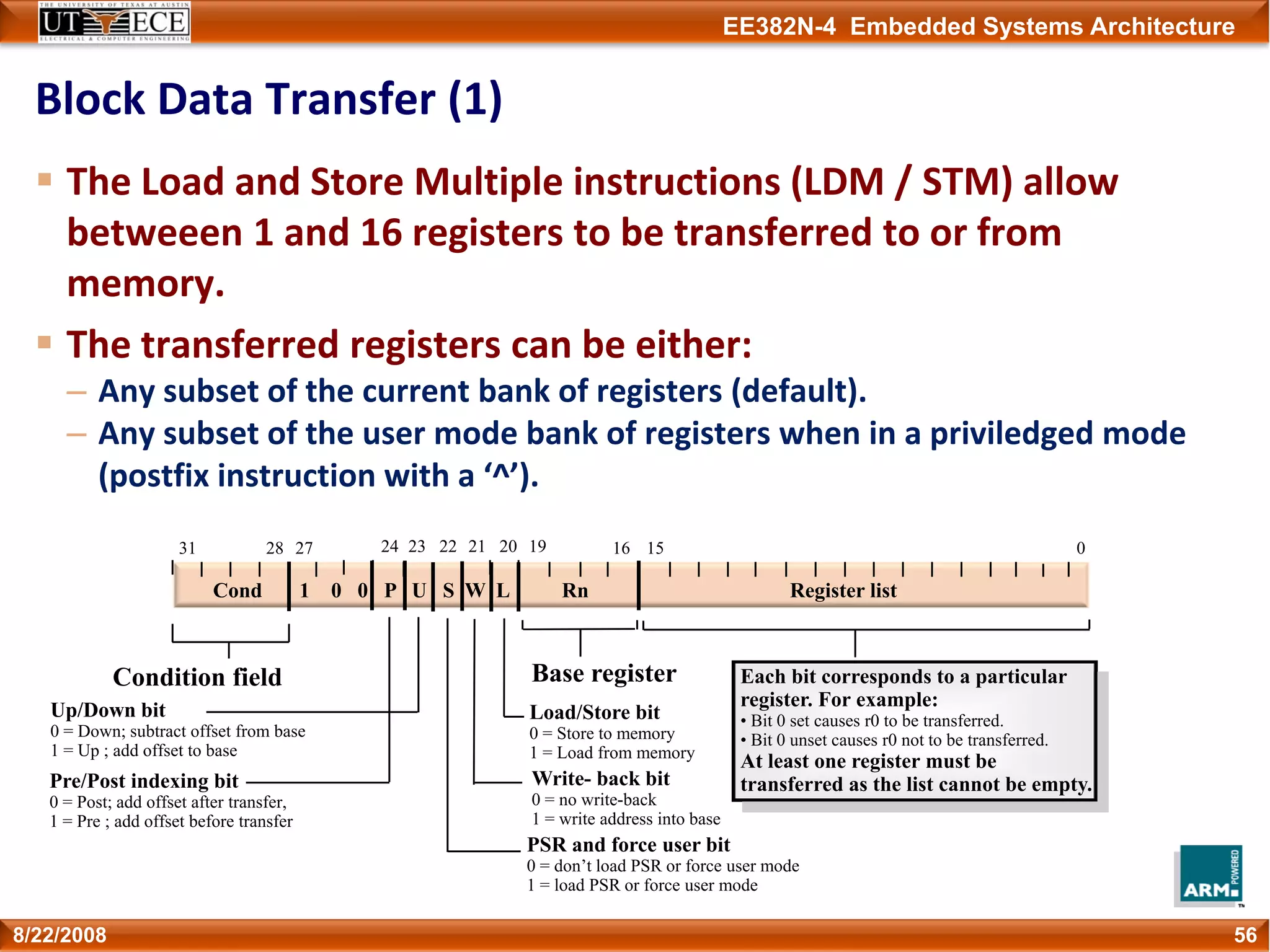
Block Data Transfer (1)
The Load and Store Multiple instructions (LDM / STM) allow 
betweeen 1 and 16 registers to be transferred to or from 
memory.
The transferred registers can be either:
– Any subset of the current bank of registers (default).
– Any subset of the user mode bank of registers when in a priviledged mode 
(postfix instruction with a ‘^’).
568/22/2008
Cond 1 0 0 P U S W L Rn Register list
Condition field Base register
Load/Store bit
0 = Store to memory
1 = Load from memory
Write- back bit
0 = no write-back
1 = write address into base
PSR and force user bit
0 = don’t load PSR or force user mode
1 = load PSR or force user mode
Up/Down bit
0 = Down; subtract offset from base
1 = Up ; add offset to base
Pre/Post indexing bit
0 = Post; add offset after transfer,
1 = Pre ; add offset before transfer
2831 22 16 023 21 1527 20 1924
Each bit corresponds to a particular
register. For example:
• Bit 0 set causes r0 to be transferred.
• Bit 0 unset causes r0 not to be transferred.
At least one register must be
transferred as the list cannot be empty.
EE382N-4 Embedded Systems Architecture
Block Data Transfer (2)
Base register used to determine where memory access should 
occur.
– 4 different addressing modes allow increment and decrement inclusive or 
exclusive of the base register location.
– Base register can be optionally updated following the transfer (by appending 
it with an ‘!’.
– Lowest register number is always transferred to/from lowest memory 
location accessed.
These instructions are very efficient for
– Saving and restoring context
• For this useful to view memory as a stack.
– Moving large blocks of data around memory
• For this useful to directly represent functionality of the instructions.
578/22/2008
EE382N-4 Embedded Systems Architecture
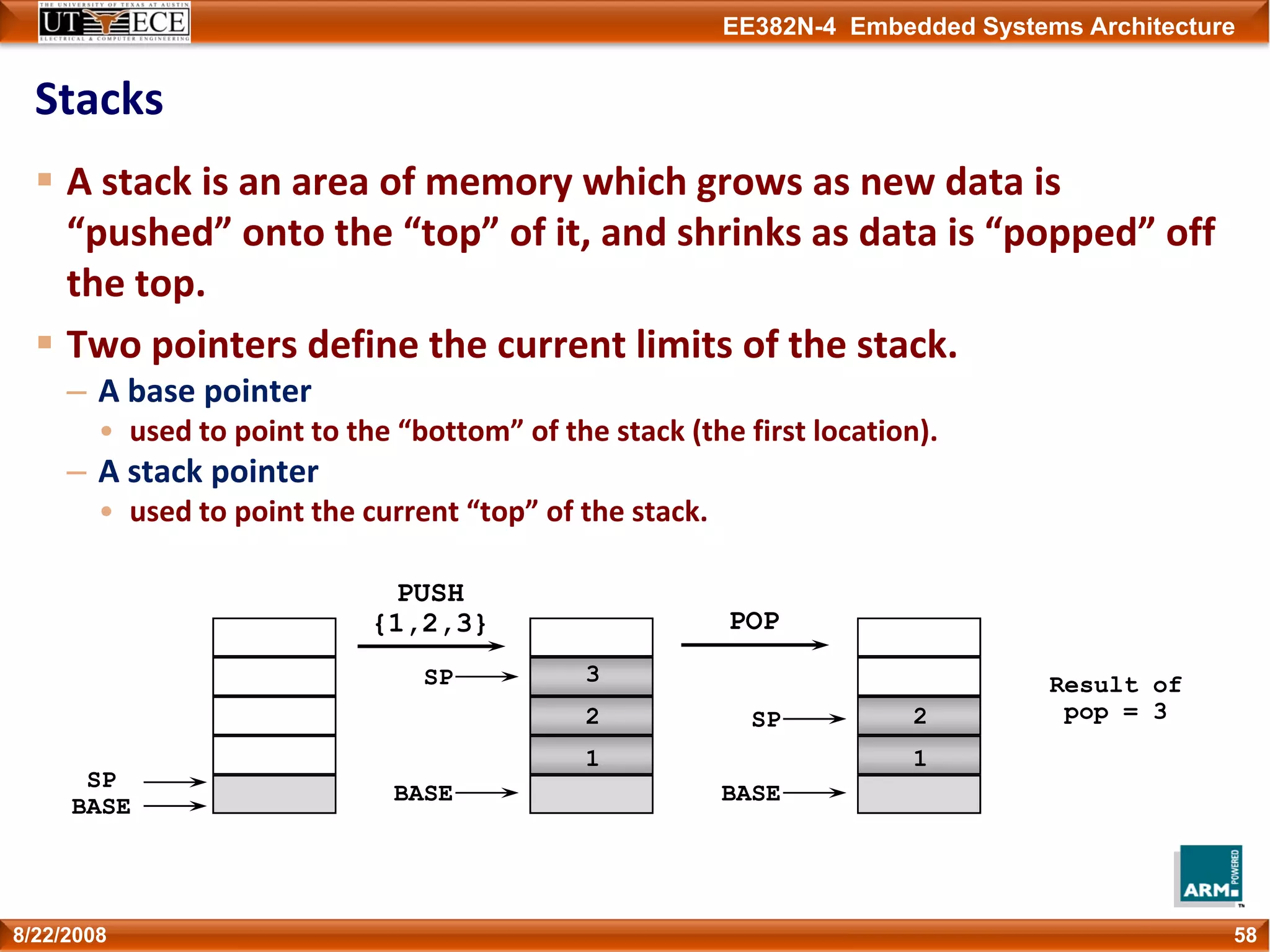
Stacks
A stack is an area of memory which grows as new data is 
“pushed” onto the “top” of it, and shrinks as data is “popped” off 
the top.
Two pointers define the current limits of the stack.
– A base pointer 
• used to point to the “bottom” of the stack (the first location).
– A stack pointer
• used to point the current “top” of the stack. 
588/22/2008
SP
BASE
PUSH
{1,2,3}
1
2
3
BASE
SP
POP
1
2
Result of
pop = 3
BASE
SP
EE382N-4 Embedded Systems Architecture
Stack Operation
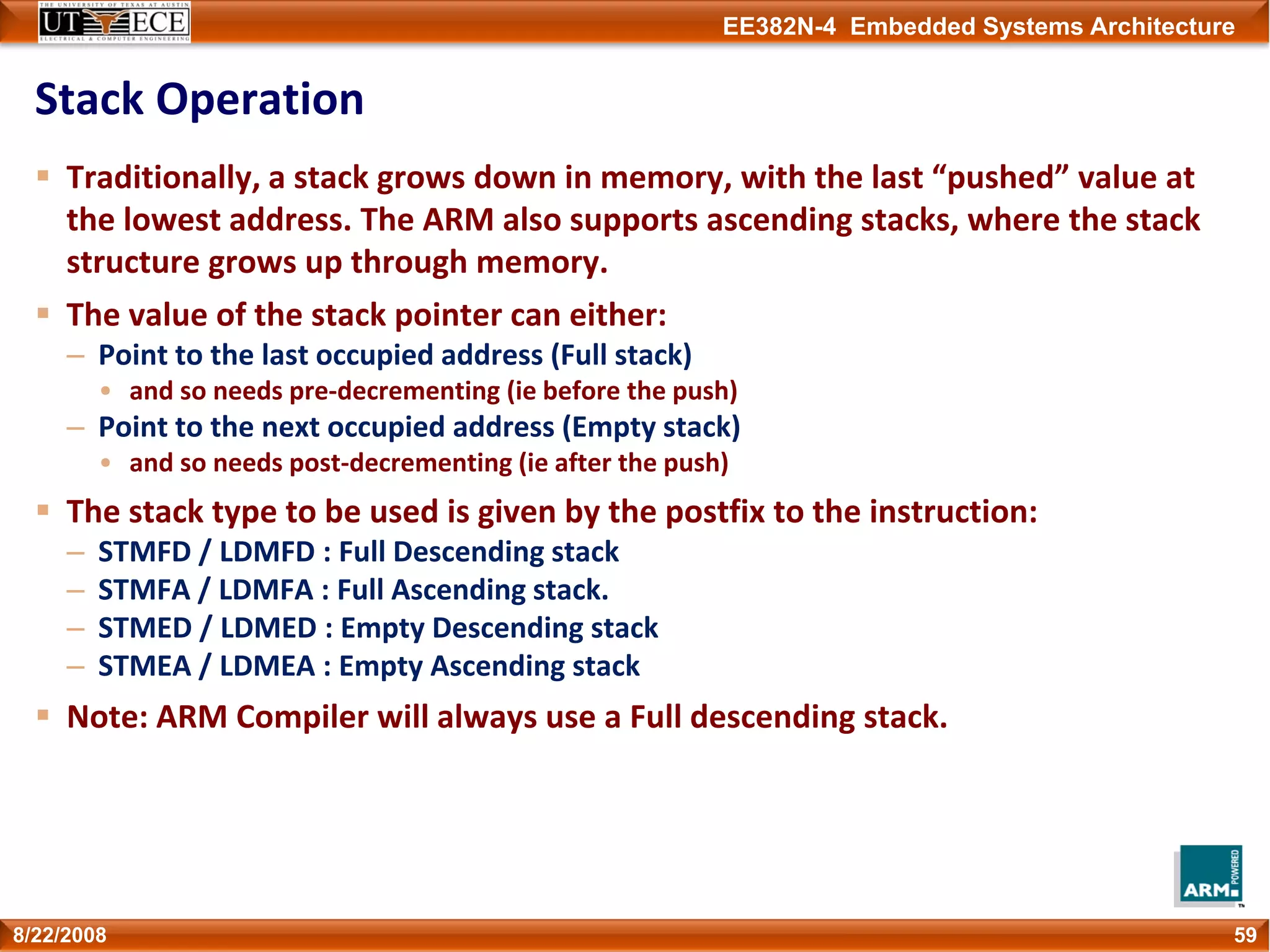
Traditionally, a stack grows down in memory, with the last “pushed” value at 
the lowest address. The ARM also supports ascending stacks, where the stack 
structure grows up through memory. 
The value of the stack pointer can either:
– Point to the last occupied address (Full stack)
• and so needs pre‐decrementing (ie before the push)
– Point to the next occupied address (Empty stack)
• and so needs post‐decrementing (ie after the push)
The stack type to be used is given by the postfix to the instruction:
– STMFD / LDMFD : Full Descending stack
– STMFA / LDMFA : Full Ascending stack.
– STMED / LDMED : Empty Descending stack
– STMEA / LDMEA : Empty Ascending stack
Note: ARM Compiler will always use a Full descending stack.
598/22/2008
EE382N-4 Embedded Systems Architecture
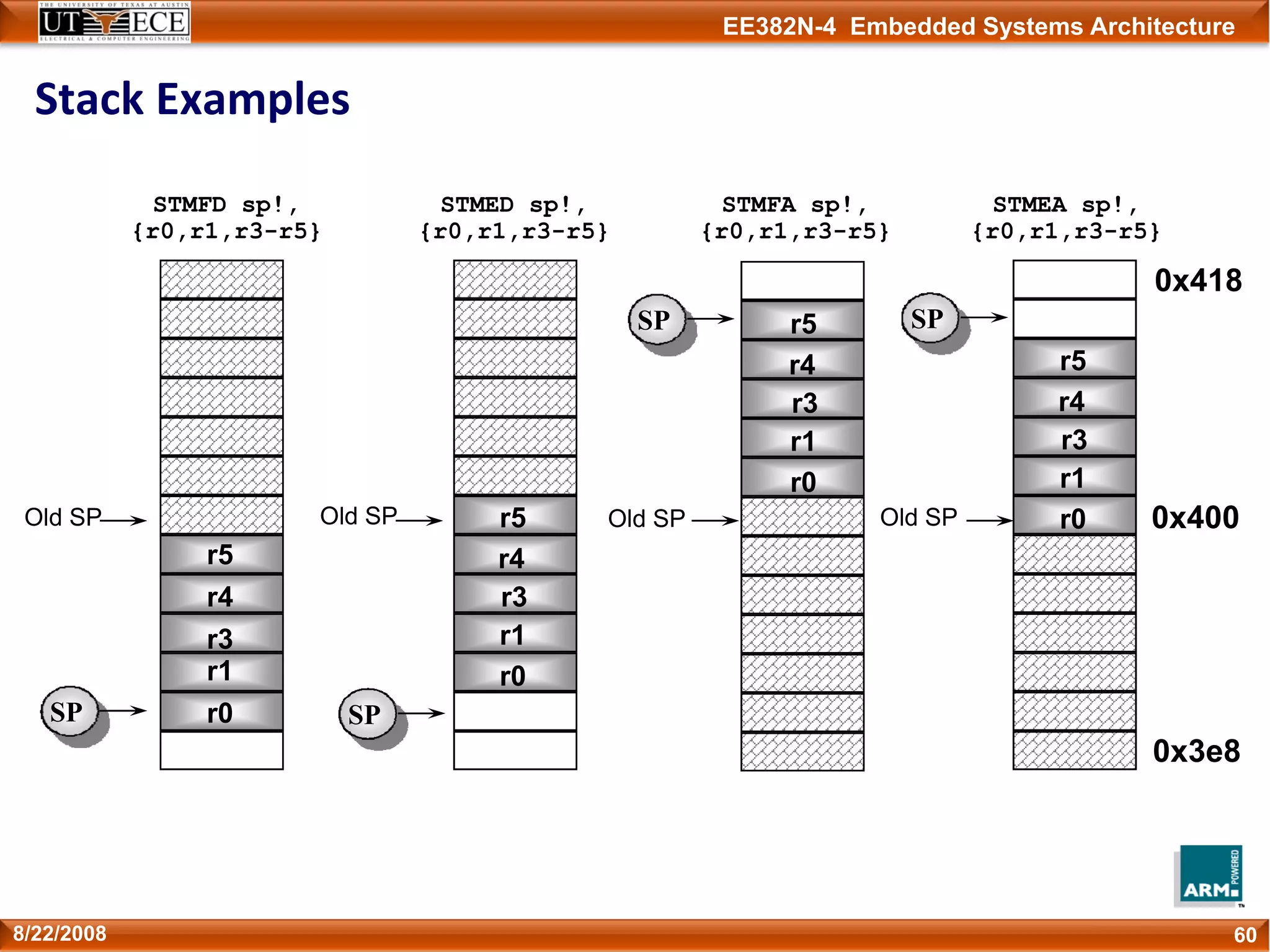
Stack Examples
608/22/2008
STMFD sp!,
{r0,r1,r3-r5}
r5
r4
r3
r1
r0SP
Old SP
STMED sp!,
{r0,r1,r3-r5}
r5
r4
r3
r1
r0
SP
Old SP
r5
r4
r3
r1
r0
STMFA sp!,
{r0,r1,r3-r5}
SP
Old SP 0x400
0x418
0x3e8
STMEA sp!,
{r0,r1,r3-r5}
r5
r4
r3
r1
r0
SP
Old SP
EE382N-4 Embedded Systems Architecture
Stacks and Subroutines
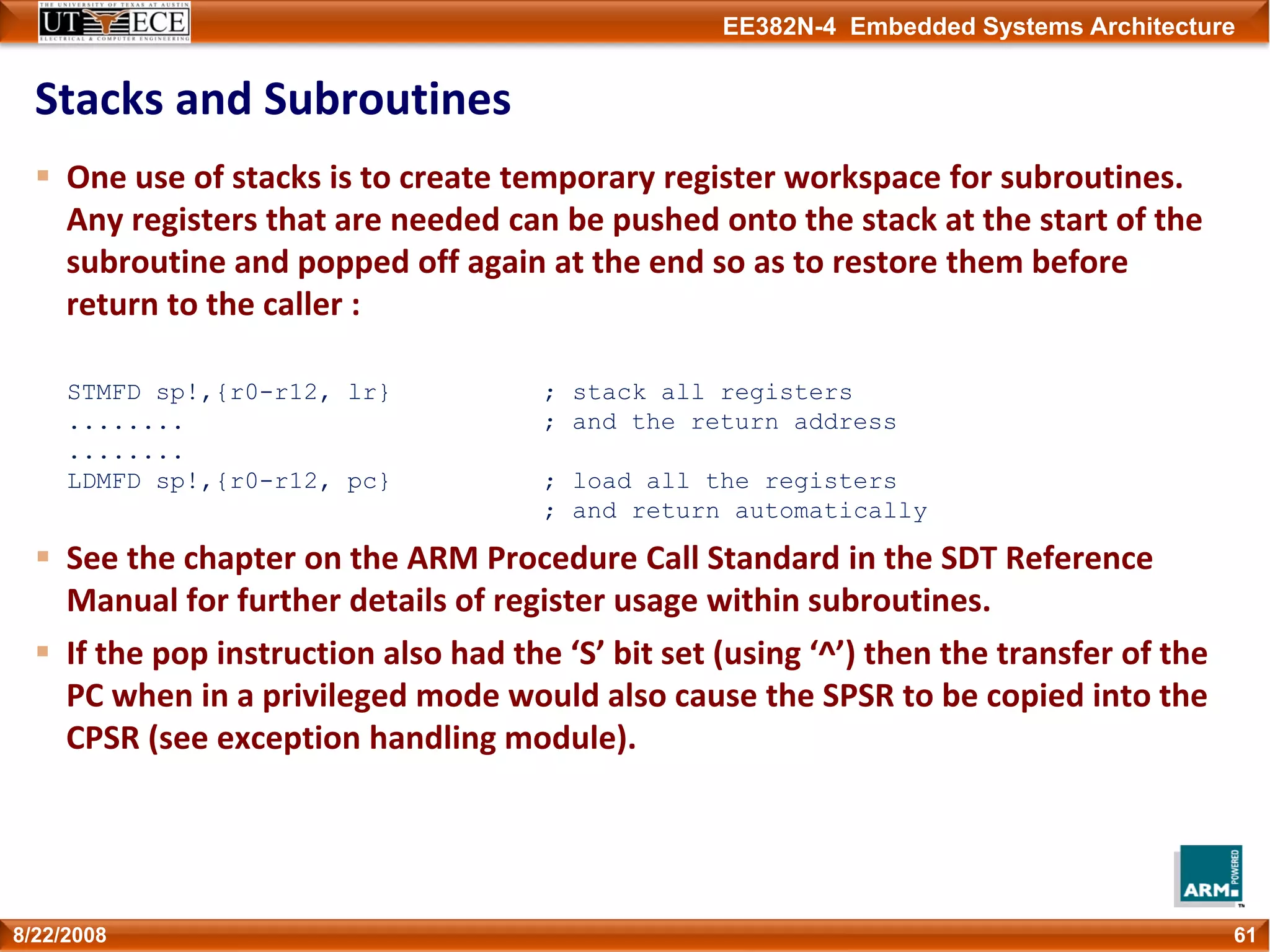
One use of stacks is to create temporary register workspace for subroutines. 
Any registers that are needed can be pushed onto the stack at the start of the 
subroutine and popped off again at the end so as to restore them before 
return to the caller :
STMFD sp!,{r0-r12, lr} ; stack all registers
........ ; and the return address
........
LDMFD sp!,{r0-r12, pc} ; load all the registers
; and return automatically
See the chapter on the ARM Procedure Call Standard in the SDT Reference 
Manual for further details of register usage within subroutines.
If the pop instruction also had the ‘S’ bit set (using ‘^’) then the transfer of the 
PC when in a privileged mode would also cause the SPSR to be copied into the 
CPSR (see exception handling module).
618/22/2008
EE382N-4 Embedded Systems Architecture
Direct functionality of Block Data Transfer
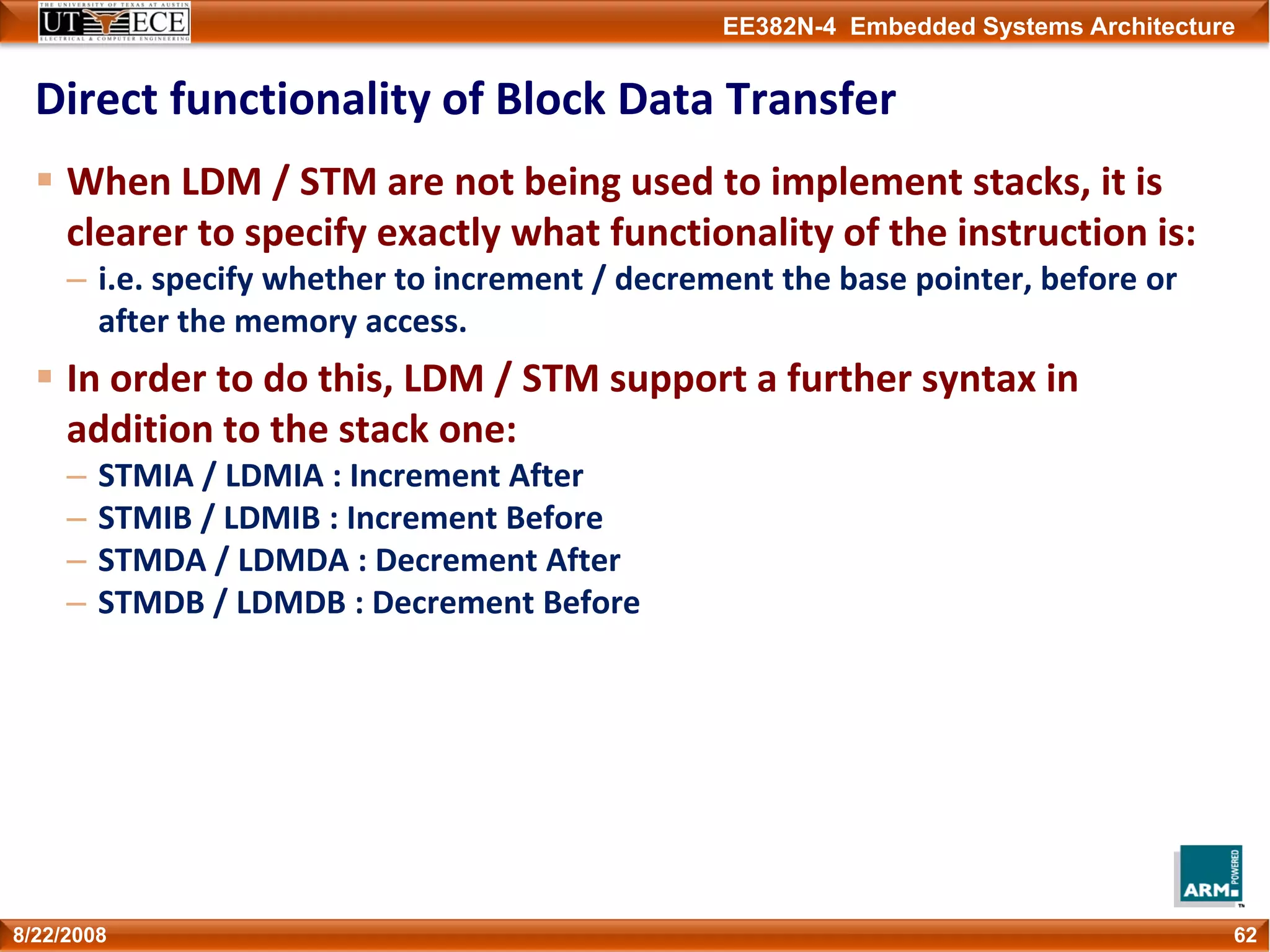
When LDM / STM are not being used to implement stacks, it is 
clearer to specify exactly what functionality of the instruction is:
– i.e. specify whether to increment / decrement the base pointer, before or 
after the memory access.
In order to do this, LDM / STM support a further syntax in 
addition to the stack one: 
– STMIA / LDMIA : Increment After
– STMIB / LDMIB : Increment Before
– STMDA / LDMDA : Decrement After
– STMDB / LDMDB : Decrement Before
628/22/2008
EE382N-4 Embedded Systems Architecture
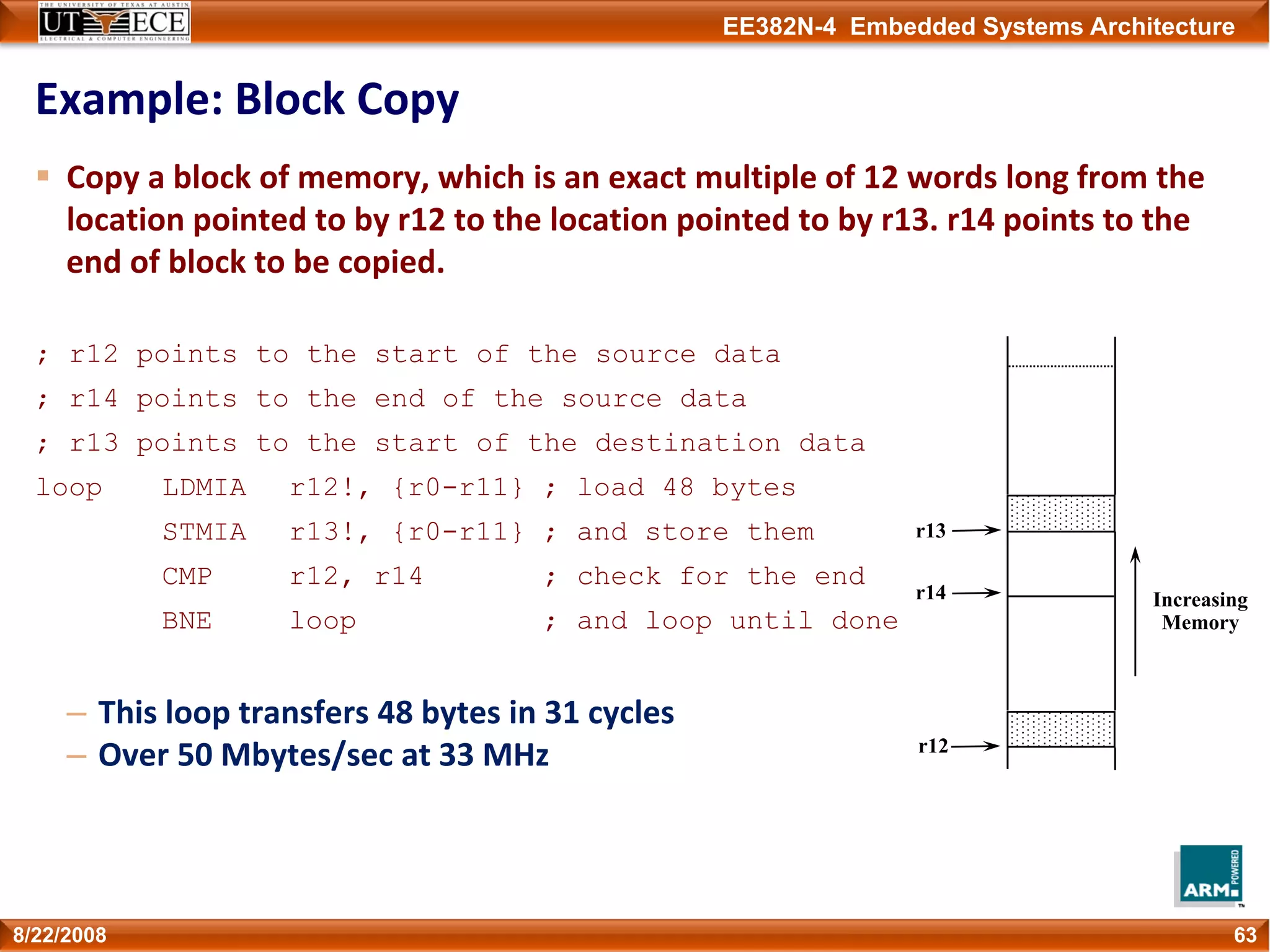
Example: Block Copy
Copy a block of memory, which is an exact multiple of 12 words long from the 
location pointed to by r12 to the location pointed to by r13. r14 points to the 
end of block to be copied.
; r12 points to the start of the source data
; r14 points to the end of the source data
; r13 points to the start of the destination data
loop LDMIA r12!, {r0-r11} ; load 48 bytes
STMIA r13!, {r0-r11} ; and store them
CMP r12, r14 ; check for the end
BNE loop ; and loop until done
– This loop transfers 48 bytes in 31 cycles
– Over 50 Mbytes/sec at 33 MHz
638/22/2008
r13
r14
r12
Increasing
Memory
EE382N-4 Embedded Systems Architecture
Swap and Swap Byte Instructions
Atomic operation of a memory read followed by a memory write 
which moves byte or word quantities between registers and 
memory. 
Syntax:
– SWP{<cond>}{B} Rd, Rm, [Rn]
To implement an actual swap of contents make Rd = Rm.
The compiler cannot produce this instruction.
648/22/2008
Rm Rd
Rn
32
1
temp
Memory
EE382N-4 Embedded Systems Architecture
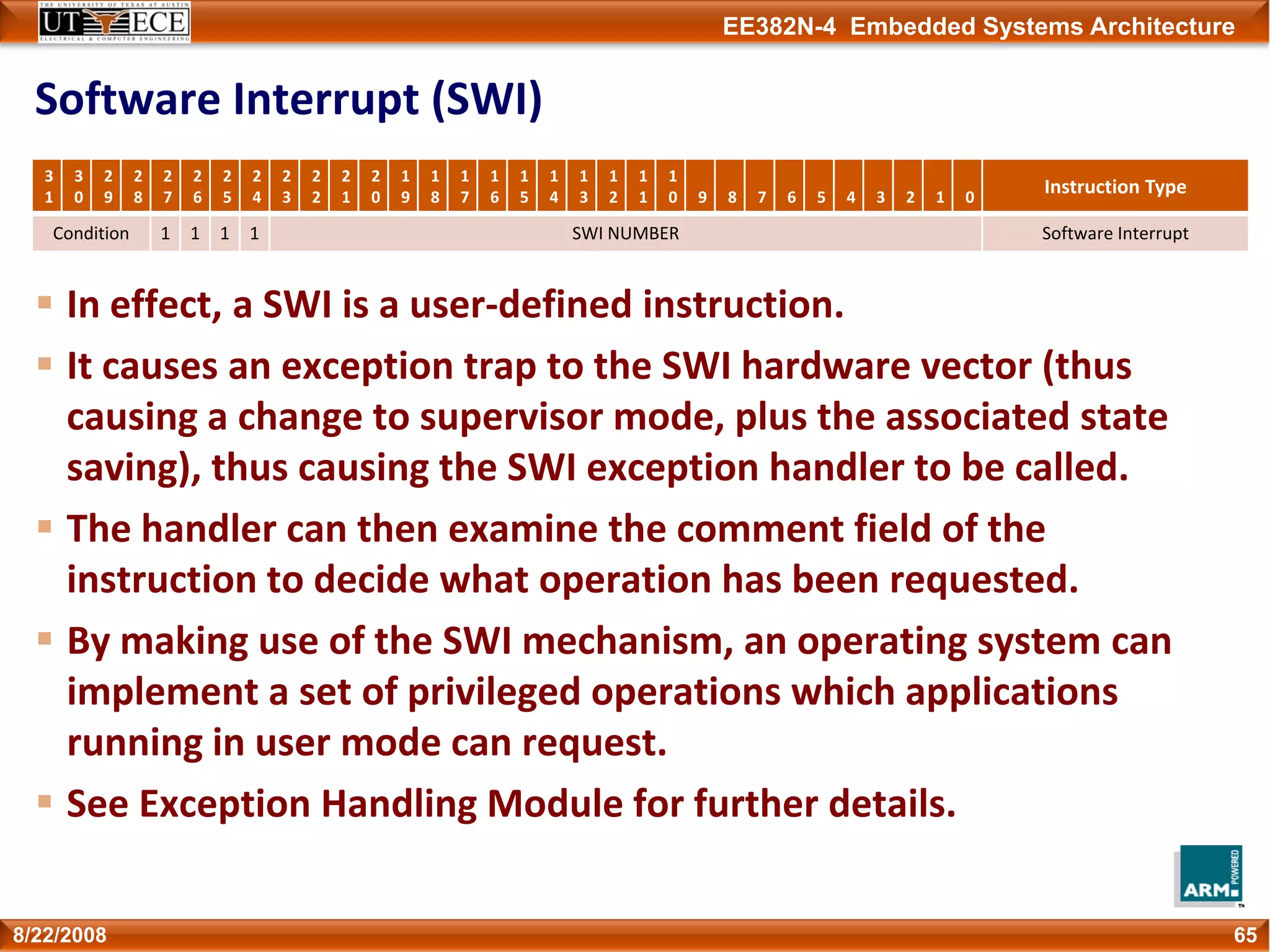
Software Interrupt (SWI)
In effect, a SWI is a user‐defined instruction.
It causes an exception trap to the SWI hardware vector (thus 
causing a change to supervisor mode, plus the associated state 
saving), thus causing the SWI exception handler to be called.
The handler can then examine the comment field of the 
instruction to decide what operation has been requested.
By making use of the SWI mechanism, an operating system can 
implement a set of privileged operations which applications 
running in user mode can request.
See Exception Handling Module for further details.
658/22/2008
3
1
3
0
2
9
2
8
2
7
2
6
2
5
2
4
2
3
2
2
2
1
2
0
1
9
1
8
1
7
1
6
1
5
1
4
1
3
1
2
1
1
1
0 9 8 7 6 5 4 3 2 1 0
Instruction Type
Condition 1 1 1 1 SWI NUMBER Software Interrupt
EE382N-4 Embedded Systems Architecture
Backup
8/22/2008
EE382N-4 Embedded Systems Architecture
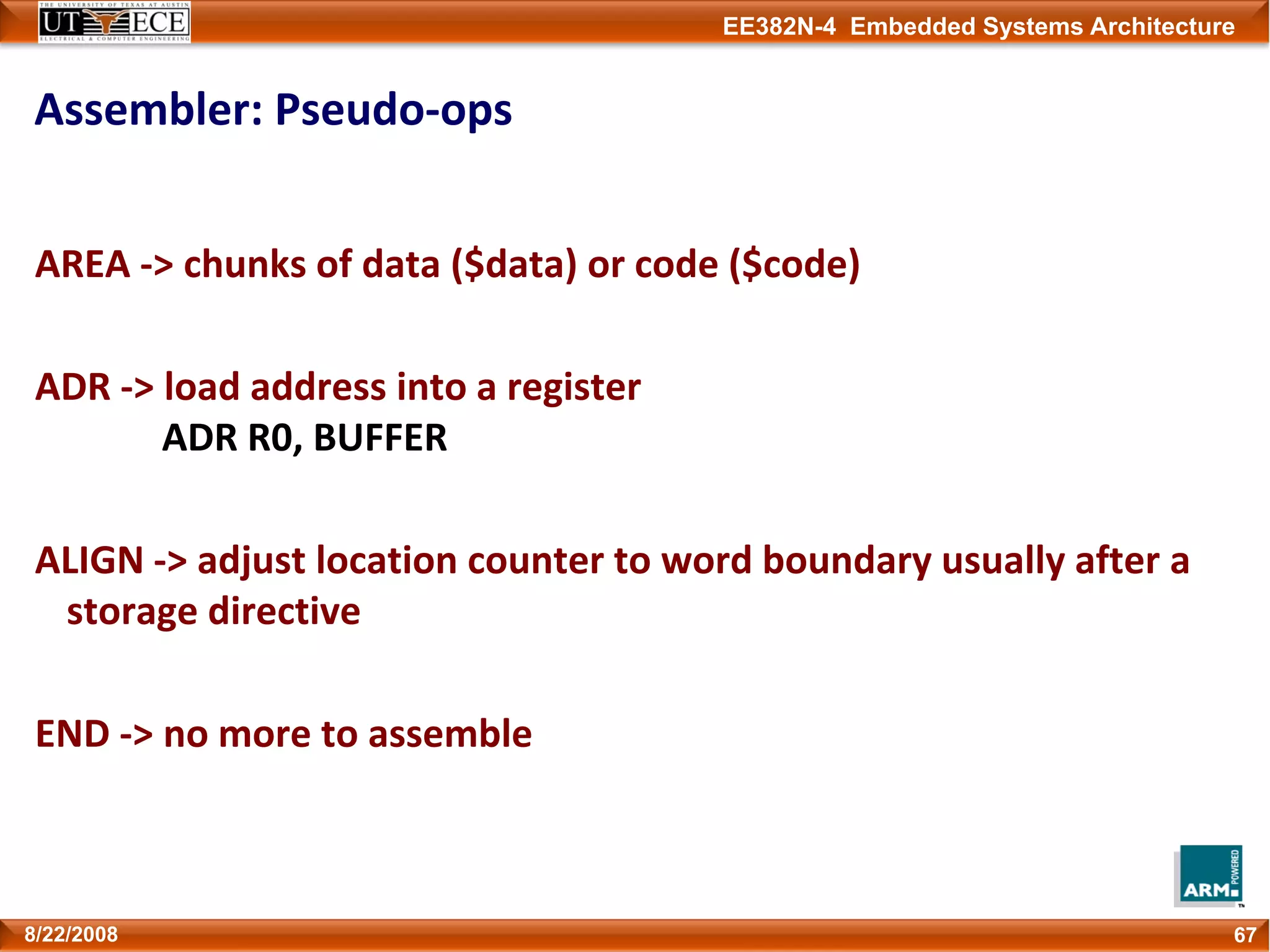
Assembler: Pseudo‐ops
AREA ‐> chunks of data ($data) or code ($code)
ADR ‐> load address into a register
ADR R0, BUFFER
ALIGN ‐> adjust location counter to word boundary usually after a 
storage directive
END ‐> no more to assemble
678/22/2008
EE382N-4 Embedded Systems Architecture
Assembler: Pseudo‐ops
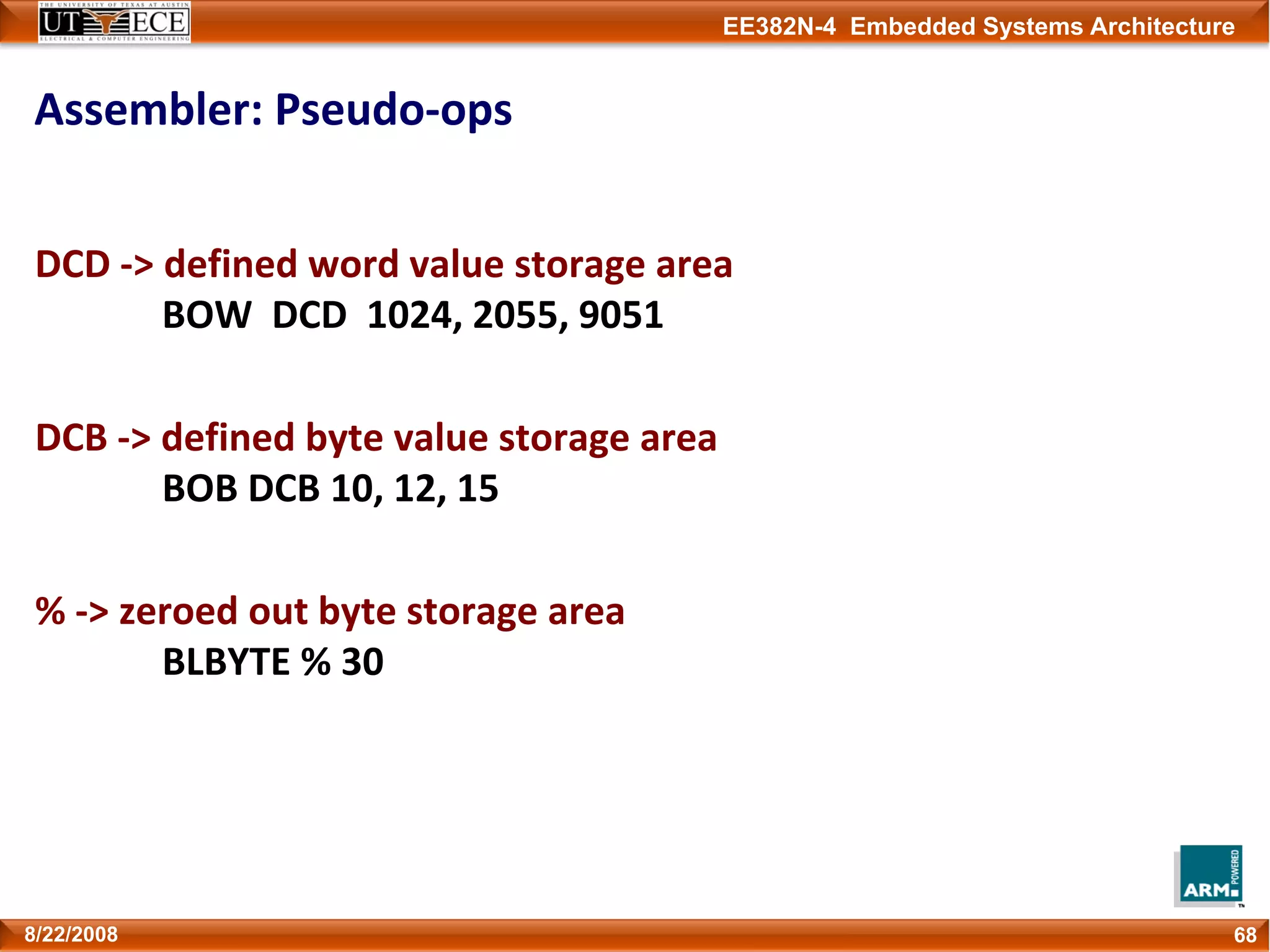
DCD ‐> defined word value storage area
BOW  DCD  1024, 2055, 9051
DCB ‐> defined byte value storage area
BOB DCB 10, 12, 15
% ‐> zeroed out byte storage area
BLBYTE % 30
688/22/2008
EE382N-4 Embedded Systems Architecture
Assembler: Pseudo‐ops
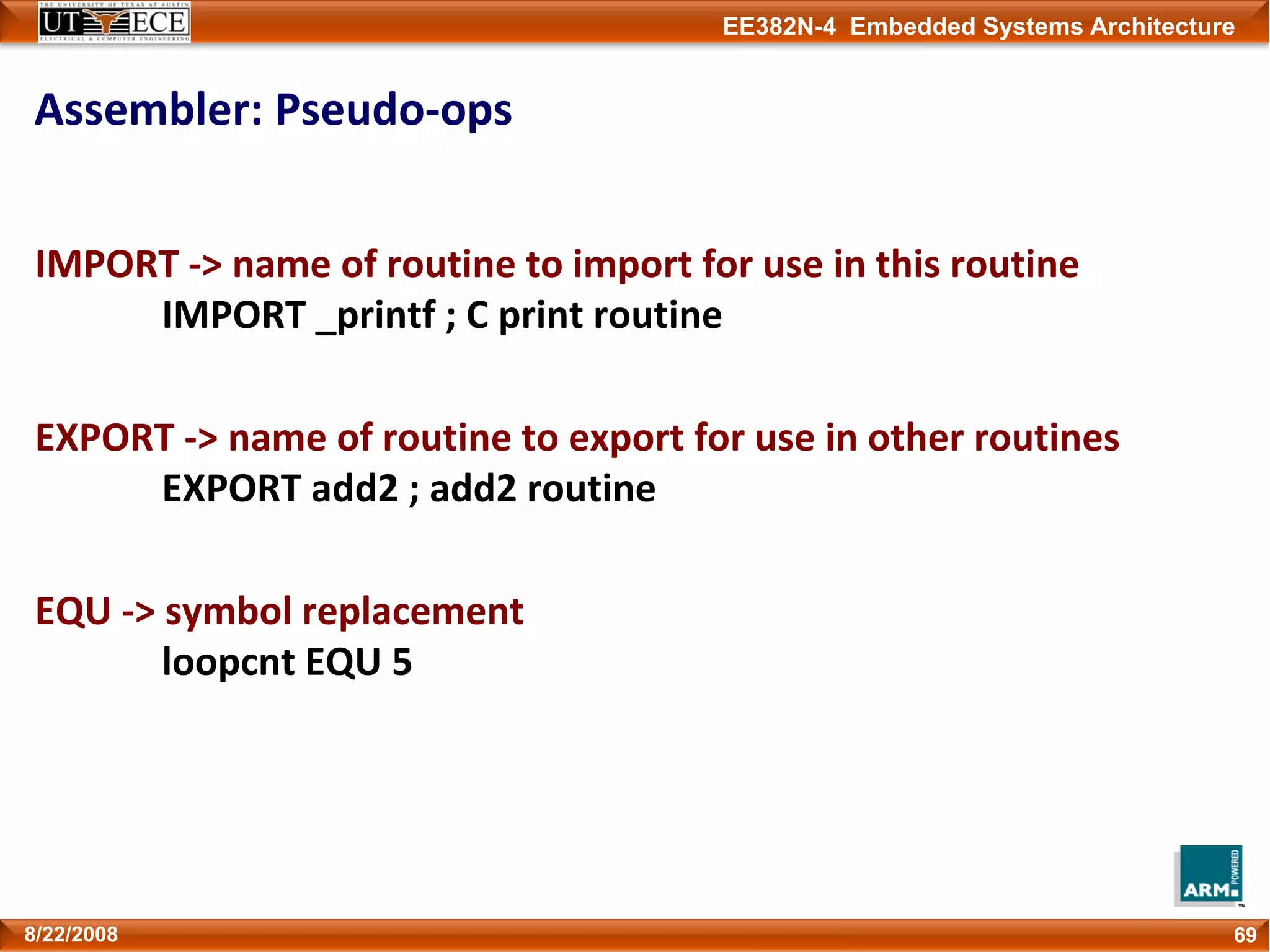
IMPORT ‐> name of routine to import for use in this routine
IMPORT _printf ; C print routine
EXPORT ‐> name of routine to export for use in other routines
EXPORT add2 ; add2 routine 
EQU ‐> symbol replacement
loopcnt EQU 5
698/22/2008
EE382N-4 Embedded Systems Architecture
Assembly Line Format
708/22/2008
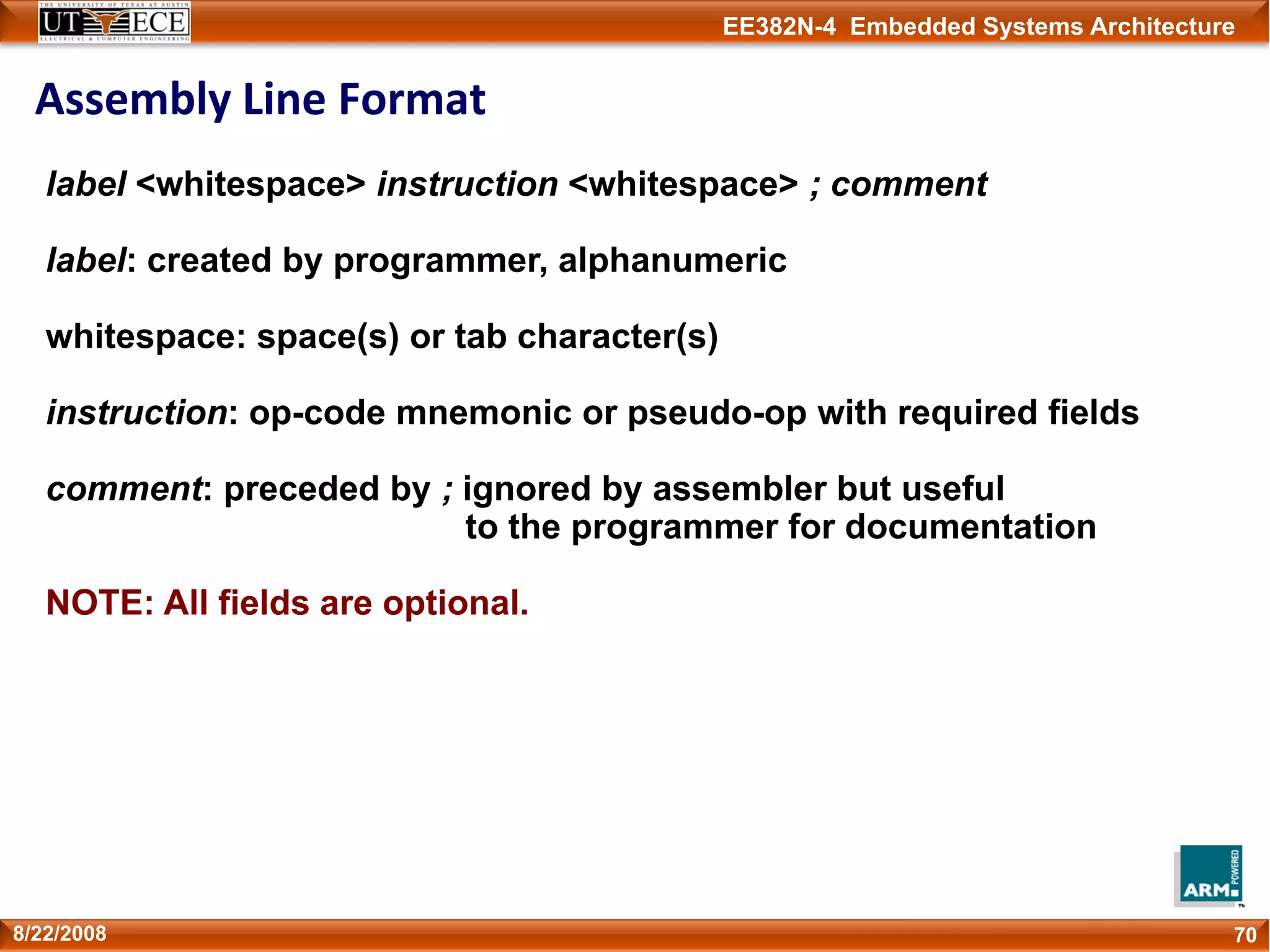
label <whitespace> instruction <whitespace> ; comment
label: created by programmer, alphanumeric
whitespace: space(s) or tab character(s)
instruction: op-code mnemonic or pseudo-op with required fields
comment: preceded by ; ignored by assembler but useful
to the programmer for documentation
NOTE: All fields are optional.
EE382N-4 Embedded Systems Architecture
Example: C assignments
C: 
x = (a + b) - c;
Assembler:
ADR r4,a ; get address for a
LDR r0,[r4] ; get value of a
ADR r4,b ; get address for b, reusing r4
LDR r1,[r4] ; get value of b
ADD r3,r0,r1 ; compute a+b
ADR r4,c ; get address for c
LDR r2,[r4] ; get value of c
SUB r3,r3,r2 ; complete computation of x
ADR r4,x ; get address for x
STR r3,[r4] ; store value of x
718/22/2008
© 2008 Wayne Wolf Computers as Components 2nd ed.
EE382N-4 Embedded Systems Architecture
Example: C assignment
C:
y = a*(b+c);
Assembler:
ADR r4,b ; get address for b
LDR r0,[r4] ; get value of b
ADR r4,c ; get address for c
LDR r1,[r4] ; get value of c
ADD r2,r0,r1 ; compute partial result
ADR r4,a ; get address for a
LDR r0,[r4] ; get value of a
MUL r2,r2,r0 ; compute final value for y
ADR r4,y ; get address for y
STR r2,[r4] ; store y
728/22/2008
© 2008 Wayne Wolf Computers as Components 2nd ed.
EE382N-4 Embedded Systems Architecture
Example: C assignment
C:
z = (a << 2) | (b & 15);
Assembler:
ADR r4,a ; get address for a
LDR r0,[r4] ; get value of a
MOV r0,r0,LSL 2 ; perform shift
ADR r4,b ; get address for b
LDR r1,[r4] ; get value of b
AND r1,r1,#15 ; perform AND
ORR r1,r0,r1 ; perform OR
ADR r4,z ; get address for z
STR r1,[r4] ; store value for z
738/22/2008
© 2008 Wayne Wolf Computers as Components 2nd ed.
EE382N-4 Embedded Systems Architecture
Example: if statement
C: 
if (a > b) { x = 5; y = c + d; } else x = c - d;
Assembler:
; compute and test condition
ADR r4,a ; get address for a
LDR r0,[r4] ; get value of a
ADR r4,b ; get address for b
LDR r1,[r4] ; get value for b
CMP r0,r1 ; compare a < b
BLE fblock ; if a ><= b, branch to false block
748/22/2008
© 2008 Wayne Wolf Computers as Components 2nd ed.
EE382N-4 Embedded Systems Architecture
if statement, cont’d.
; true block
MOV r0,#5 ; generate value for x
ADR r4,x ; get address for x
STR r0,[r4] ; store x
ADR r4,c ; get address for c
LDR r0,[r4] ; get value of c
ADR r4,d ; get address for d
LDR r1,[r4] ; get value of d
ADD r0,r0,r1 ; compute y
ADR r4,y ; get address for y
STR r0,[r4] ; store y
B after ; branch around false block
758/22/2008
© 2008 Wayne Wolf Computers as Components 2nd ed.
EE382N-4 Embedded Systems Architecture
if statement, cont’d.
; false block
fblock ADR r4,c ; get address for c
LDR r0,[r4] ; get value of c
ADR r4,d ; get address for d
LDR r1,[r4] ; get value for d
SUB r0,r0,r1 ; compute a-b
ADR r4,x ; get address for x
STR r0,[r4] ; store value of x
after ...
768/22/2008
© 2008 Wayne Wolf Computers as Components 2nd ed.
EE382N-4 Embedded Systems Architecture
Example: Conditional instruction implementation
; true block
MOVLT r0,#5 ; generate value for x
ADRLT r4,x ; get address for x
STRLT r0,[r4] ; store x
ADRLT r4,c ; get address for c
LDRLT r0,[r4] ; get value of c
ADRLT r4,d ; get address for d
LDRLT r1,[r4] ; get value of d
ADDLT r0,r0,r1 ; compute y
ADRLT r4,y ; get address for y
STRLT r0,[r4] ; store y
778/22/2008
© 2008 Wayne Wolf Computers as Components 2nd ed.
EE382N-4 Embedded Systems Architecture
Conditional instruction implementation, cont’d.
; false block
ADRGE r4,c ; get address for c
LDRGE r0,[r4] ; get value of c
ADRGE r4,d ; get address for d
LDRGE r1,[r4] ; get value for d
SUBGE r0,r0,r1 ; compute a-b
ADRGE r4,x ; get address for x
STRGE r0,[r4] ; store value of x
788/22/2008
© 2008 Wayne Wolf Computers as Components 2nd ed.
EE382N-4 Embedded Systems Architecture
Example: switch statement
C: 
switch (test) { case 0: … break; case 1: … }
Assembler:
ADR r2,test ; get address for test
LDR r0,[r2] ; load value for test
ADR r1,switchtab ; load address for switch table
LDR r1,[r1,r0,LSL #2] ; index switch table
switchtab DCD case0
DCD case1
...
798/22/2008
© 2008 Wayne Wolf Computers as Components 2nd ed.
EE382N-4 Embedded Systems Architecture
Example: FIR filter
C:
for (i=0, f=0; i<N; i++)
f = f + c[i]*x[i];
Assembler
; loop initiation code
MOV r0,#0 ; use r0 for I
MOV r8,#0 ; use separate index for arrays
ADR r2,N ; get address for N
LDR r1,[r2] ; get value of N
MOV r2,#0 ; use r2 for f
808/22/2008
© 2008 Wayne Wolf Computers as Components 2nd ed.
EE382N-4 Embedded Systems Architecture
FIR filter, cont’.d
ADR r3,c ; load r3 with base of c
ADR r5,x ; load r5 with base of x
; loop body
loop LDR r4,[r3,r8] ; get c[i]
LDR r6,[r5,r8] ; get x[i]
MUL r4,r4,r6 ; compute c[i]*x[i]
ADD r2,r2,r4 ; add into running sum
ADD r8,r8,#4 ; add one word offset to array index
ADD r0,r0,#1 ; add 1 to i
CMP r0,r1 ; exit?
BLT loop ; if i < N, continue
818/22/2008
© 2008 Wayne Wolf Computers as Components 2nd ed.
EE382N-4 Embedded Systems Architecture
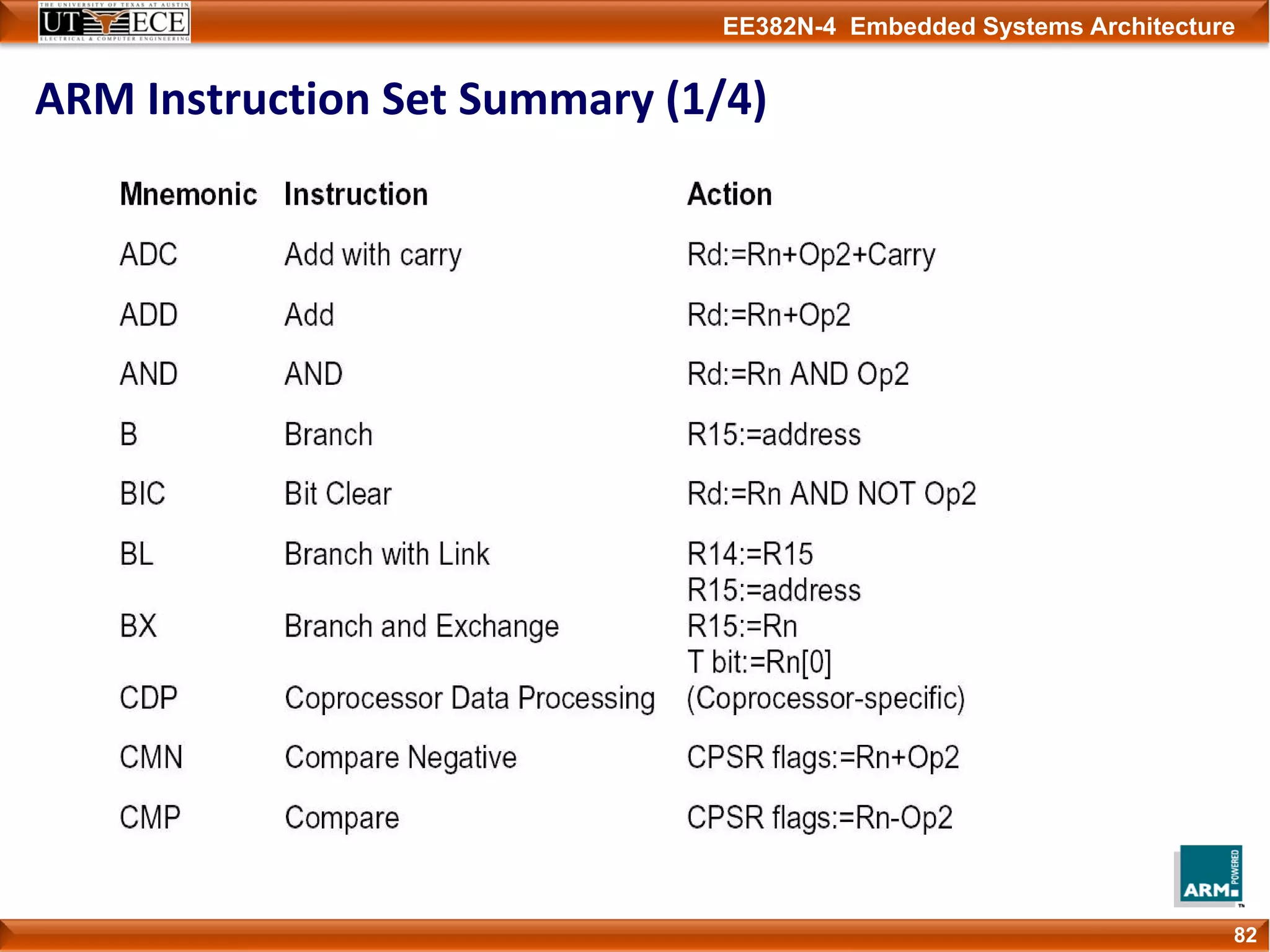
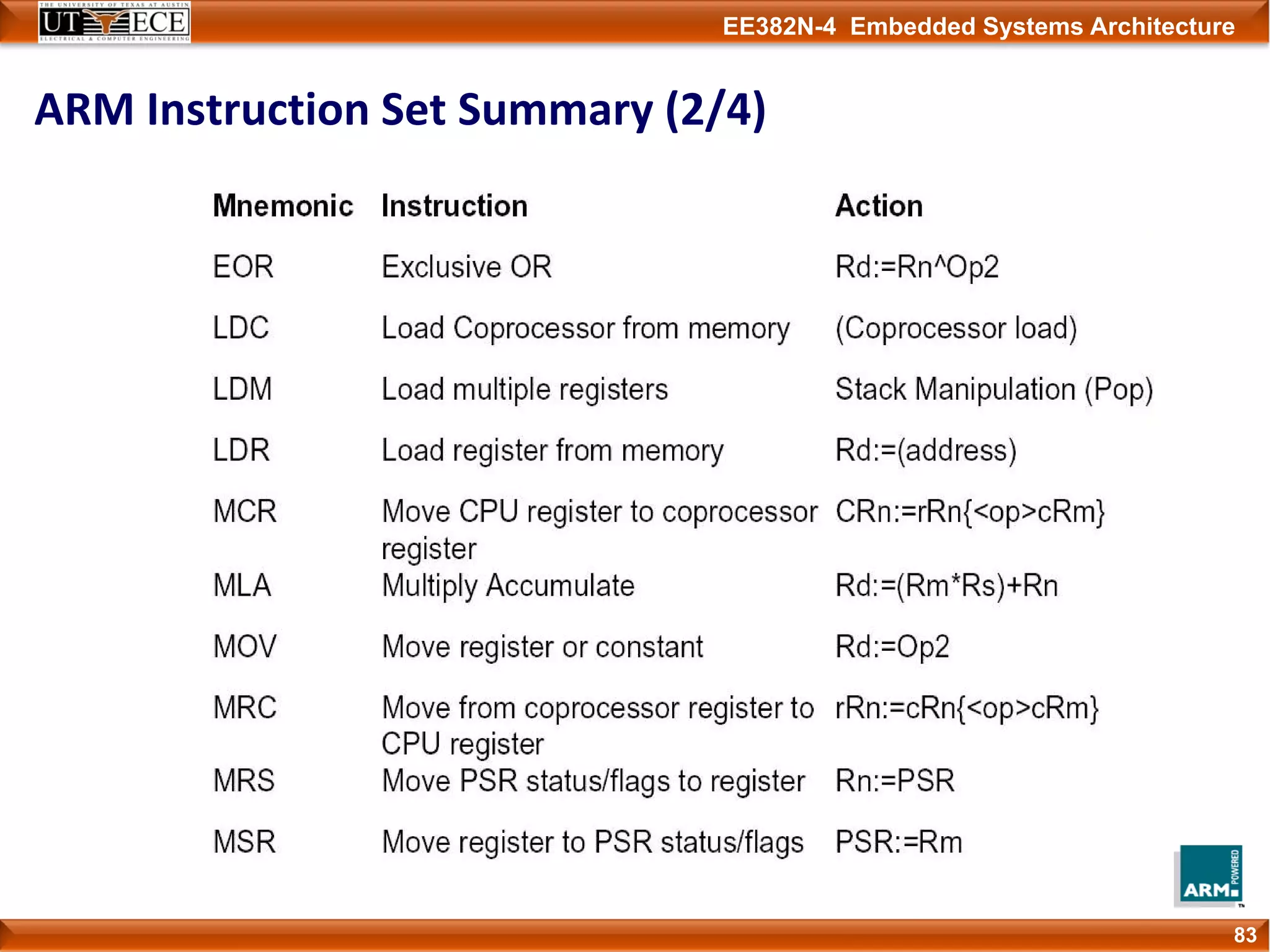
ARM Instruction Set Summary (1/4)
82
EE382N-4 Embedded Systems Architecture
83
ARM Instruction Set Summary (2/4)
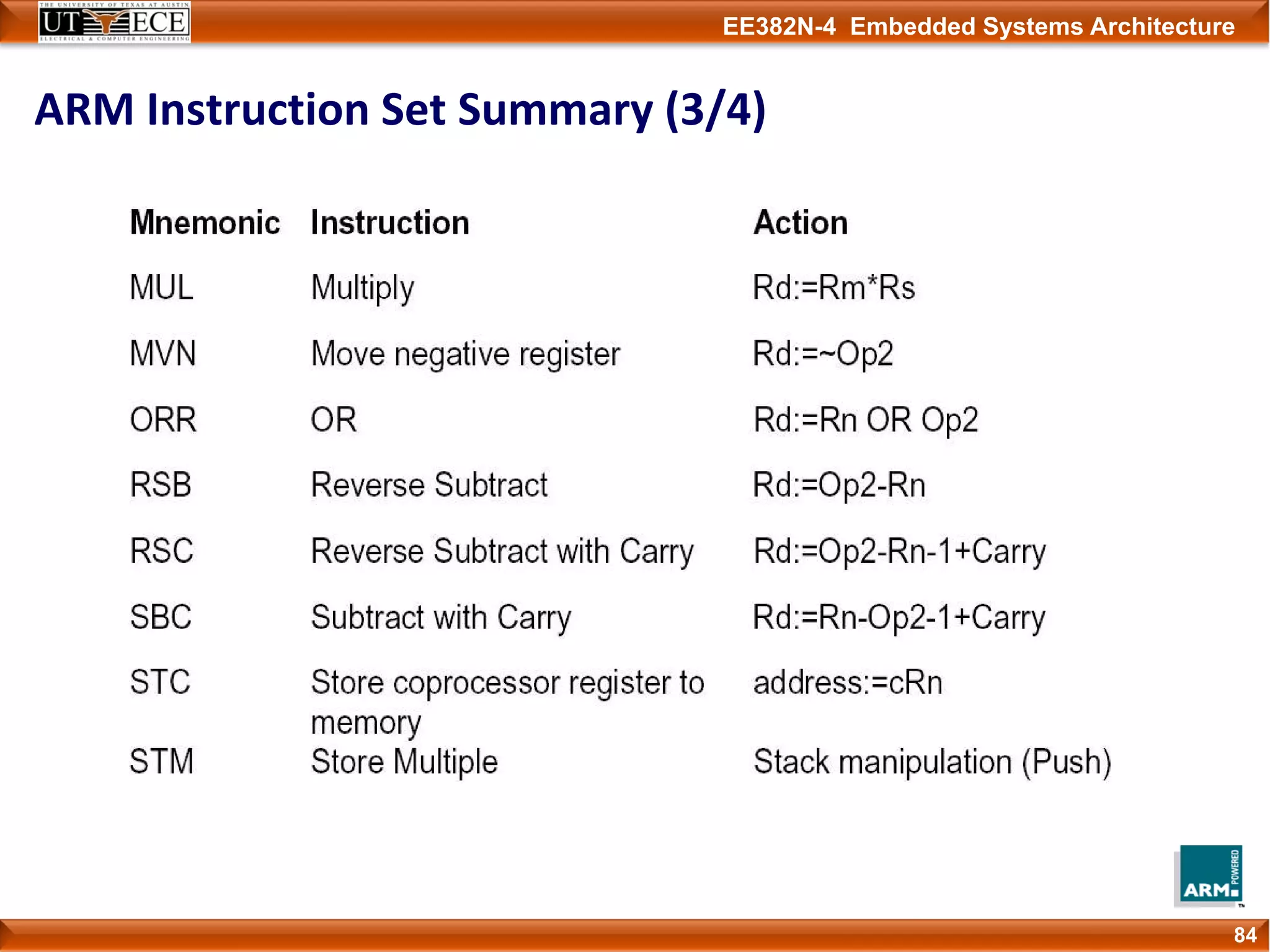
EE382N-4 Embedded Systems Architecture
84
ARM Instruction Set Summary (3/4)
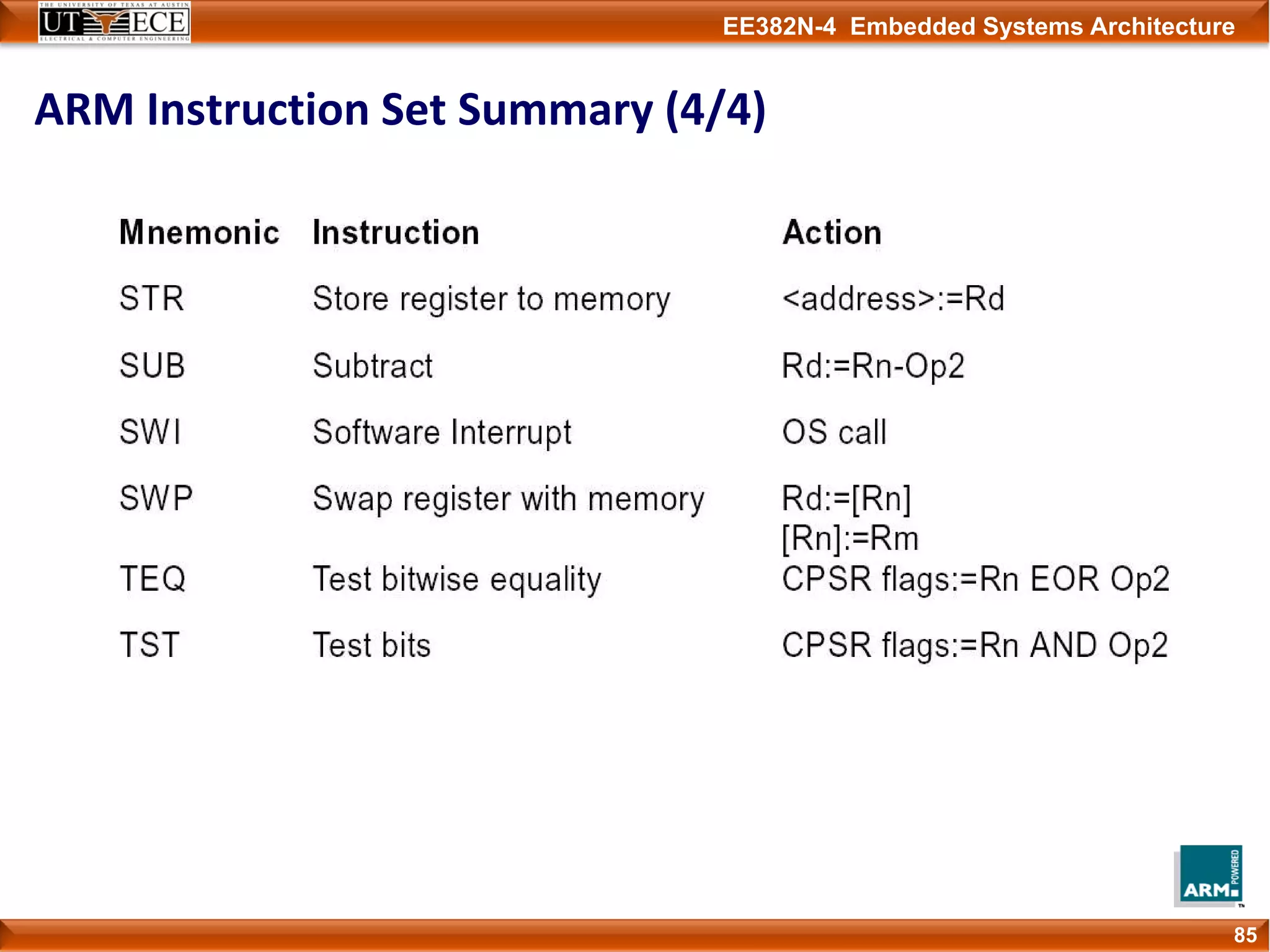
EE382N-4 Embedded Systems Architecture
85
ARM Instruction Set Summary (4/4)

ARM 7 Detailed instruction set

  • 1.
    EE382N-4 Embedded SystemsArchitecture The ARM Instruction Set Architecture Mark McDermott With help from our good friends at ARM Fall 2008 8/22/2008
  • 2.
    EE382N-4 Embedded SystemsArchitecture Main features of the ARM Instruction Set All instructions are 32 bits long. Most instructions execute in a single cycle. Most instructions can be conditionally executed. A load/store architecture  – Data processing instructions act only on registers • Three operand format • Combined ALU and shifter for high speed bit manipulation – Specific memory access instructions with powerful auto‐indexing addressing  modes. • 32 bit and 8 bit data types – and also 16 bit data types on ARM Architecture v4. • Flexible multiple register load and store instructions Instruction set extension via coprocessors Very dense 16‐bit compressed instruction set (Thumb) 28/22/2008
  • 3.
    EE382N-4 Embedded SystemsArchitecture Coprocessors 3 – Up to 16 coprocessors can be defined – Expands the ARM instruction set – Each coprocessor can have up to 16 private registers of any reasonable size – Load‐store architecture
  • 4.
    EE382N-4 Embedded SystemsArchitecture Thumb Thumb is a 16‐bit instruction set – Optimized for code density from C code – Improved performance form narrow memory – Subset of the functionality of the ARM instruction set Core has two execution states – ARM and Thumb – Switch between them using BX instruction Thumb has characteristic features: – Most Thumb instruction are executed unconditionally – Many Thumb data process instruction use a 2‐address format – Thumb instruction formats are less regular than ARM instruction formats, as  a result of the dense encoding. 4
  • 5.
    EE382N-4 Embedded SystemsArchitecture Processor Modes The ARM has six operating modes: – User (unprivileged mode under which most tasks run) – FIQ (entered when a high priority (fast) interrupt is raised) – IRQ (entered when a low priority (normal) interrupt is raised) – Supervisor (entered on reset and when a Software Interrupt instruction is  executed) – Abort (used to handle memory access violations) – Undef (used to handle undefined instructions) ARM Architecture Version 4 adds a seventh mode: – System (privileged mode using the same registers as user mode) 58/22/2008
  • 6.
    EE382N-4 Embedded SystemsArchitecture The Registers ARM has 37 registers in total, all of which are 32‐bits long. – 1 dedicated program counter – 1 dedicated current program status register – 5 dedicated saved program status registers – 30 general purpose registers However these are arranged into several banks, with the  accessible bank being governed by the processor mode. Each  mode can access  – a particular set of r0‐r12 registers – a particular r13 (the stack pointer) and r14 (link register) – r15 (the program counter) – cpsr (the current program status register) And privileged modes can also access – a particular spsr (saved program status register) 68/22/2008
  • 7.
    EE382N-4 Embedded SystemsArchitecture r0 r1 r2 r3 r4 r5 r6 r7 r8 r9 r10 r11 r12 r13 (sp) r14 (lr) r15 (pc) cpsr r13 (sp) r14 (lr) spsr r13 (sp) r14 (lr) spsr r13 (sp) r14 (lr) spsr r13 (sp) r14 (lr) spsr r8 r9 r10 r11 r12 r13 (sp) r14 (lr) spsr FIQ IRQ SVC Undef Abort User Mode r0 r1 r2 r3 r4 r5 r6 r7 r8 r9 r10 r11 r12 r13 (sp) r14 (lr) r15 (pc) cpsr r13 (sp) r14 (lr) spsr r13 (sp) r14 (lr) spsr r13 (sp) r14 (lr) spsr r13 (sp) r14 (lr) spsr r8 r9 r10 r11 r12 r13 (sp) r14 (lr) spsr Current Visible Registers Banked out Registers FIQ IRQ SVC Undef Abort r0 r1 r2 r3 r4 r5 r6 r7 r15 (pc) cpsr r13 (sp) r14 (lr) spsr r13 (sp) r14 (lr) spsr r13 (sp) r14 (lr) spsr r13 (sp) r14 (lr) spsr r8 r9 r10 r11 r12 r13 (sp) r14 (lr) spsr Current Visible Registers Banked out Registers User IRQ SVC Undef Abort r8 r9 r10 r11 r12 r13 (sp) r14 (lr) FIQ ModeIRQ Mode r0 r1 r2 r3 r4 r5 r6 r7 r8 r9 r10 r11 r12 r15 (pc) cpsr r13 (sp) r14 (lr) spsr r13 (sp) r14 (lr) spsr r13 (sp) r14 (lr) spsr r13 (sp) r14 (lr) spsr r8 r9 r10 r11 r12 r13 (sp) r14 (lr) spsr Current Visible Registers Banked out Registers User FIQ SVC Undef Abort r13 (sp) r14 (lr) Undef Mode r0 r1 r2 r3 r4 r5 r6 r7 r8 r9 r10 r11 r12 r15 (pc) cpsr r13 (sp) r14 (lr) spsr r13 (sp) r14 (lr) spsr r13 (sp) r14 (lr) spsr r13 (sp) r14 (lr) spsr r8 r9 r10 r11 r12 r13 (sp) r14 (lr) spsr Current Visible Registers Banked out Registers User FIQ IRQ SVC Abort r13 (sp) r14 (lr) SVC Mode r0 r1 r2 r3 r4 r5 r6 r7 r8 r9 r10 r11 r12 r15 (pc) cpsr r13 (sp) r14 (lr) spsr r13 (sp) r14 (lr) spsr r13 (sp) r14 (lr) spsr r13 (sp) r14 (lr) spsr r8 r9 r10 r11 r12 r13 (sp) r14 (lr) spsr Current Visible Registers Banked out Registers User FIQ IRQ Undef Abort r13 (sp) r14 (lr) Abort Mode r0 r1 r2 r3 r4 r5 r6 r7 r8 r9 r10 r11 r12 r15 (pc) cpsr r13 (sp) r14 (lr) spsr r13 (sp) r14 (lr) spsr r13 (sp) r14 (lr) spsr r13 (sp) r14 (lr) spsr r8 r9 r10 r11 r12 r13 (sp) r14 (lr) spsr Current Visible Registers Banked out Registers User FIQ IRQ SVC Undef r13 (sp) r14 (lr) The ARM Register Set 78/22/2008
  • 8.
    EE382N-4 Embedded SystemsArchitecture Register Organization Summary 88/22/2008 User mode r0-r7, r15, and cpsr r8 r9 r10 r11 r12 r13 (sp) r14 (lr) spsr FIQ r8 r9 r10 r11 r12 r13 (sp) r14 (lr) r15 (pc) cpsr r0 r1 r2 r3 r4 r5 r6 r7 User r13 (sp) r14 (lr) spsr IRQ User mode r0-r12, r15, and cpsr r13 (sp) r14 (lr) spsr Undef User mode r0-r12, r15, and cpsr r13 (sp) r14 (lr) spsr SVC User mode r0-r12, r15, and cpsr r13 (sp) r14 (lr) spsr Abort User mode r0-r12, r15, and cpsr Thumb state Low registers Thumb state High registers Note: System mode uses the User mode register set
  • 9.
    EE382N-4 Embedded SystemsArchitecture Accessing Registers using ARM Instructions No breakdown of currently accessible registers. – All instructions can access r0‐r14 directly. – Most instructions also allow use of the PC. Specific instructions to allow access to CPSR and SPSR. Note : When in a privileged mode, it is also possible to load‐store  the (banked out) user mode registers to or from memory.  98/22/2008
  • 10.
    EE382N-4 Embedded SystemsArchitecture The Program Status Registers  (CPSR and SPSRs) 108/22/2008 Copies of the ALU status flags (latched if the instruction has the "S" bit set). N = Negative result from ALU flag. Z = Zero result from ALU flag. C = ALU operation Carried out V = ALU operation oVerflowed *     Interrupt Disable bits. I = 1, disables the IRQ. F = 1, disables the FIQ. *     T Bit      (Architecture v4T only) T = 0, Processor in ARM state T = 1, Processor in Thumb state  *      Condition Code Flags ModeN Z C V 2831 8 4 0 I F T *     Mode Bits M[4:0] define the processor mode.
  • 11.
    EE382N-4 Embedded SystemsArchitecture Logical Instruction Arithmetic Instruction Flag Negative No meaning Bit 31 of the result has been set (N=‘1’) Indicates a negative number in signed operations Zero Result is all zeroes Result of operation was zero (Z=‘1’) Carry After Shift operation Result was greater than 32 bits (C=‘1’) ‘1’ was left in carry flag oVerflow No meaning Result was greater than 31 bits (V=‘1’) Indicates a possible corruption of the sign bit in signed  numbers Condition Flags 118/22/2008
  • 12.
    EE382N-4 Embedded SystemsArchitecture The Program Counter (R15) When the processor is executing in ARM state: – All instructions are 32 bits in length – All instructions must be word aligned – Therefore the PC value is stored in bits [31:2] with bits [1:0] equal to zero (as  instruction cannot be halfword or byte aligned). R14 is used as the subroutine link register (LR) and stores the  return address when Branch with Link operations are performed,  calculated from the PC. Thus to return from a linked branch: MOV r15,r14 or MOV pc,lr 128/22/2008
  • 13.
    EE382N-4 Embedded SystemsArchitecture Exception Handling and the Vector Table When an exception occurs, the core: – Copies CPSR into SPSR_<mode> – Sets appropriate CPSR bits  • If core implements ARM Architecture 4T and is  currently in Thumb state, then – ARM state is entered. • Mode field bits  • Interrupt disable flags if appropriate. – Maps in appropriate banked registers – Stores the “return address” in LR_<mode> – Sets PC to vector address To return, exception handler needs to: – Restore CPSR from SPSR_<mode> – Restore PC from LR_<mode> 138/22/2008
  • 14.
    EE382N-4 Embedded SystemsArchitecture The Original Instruction Pipeline The ARM uses a pipeline in order to increase the speed of the  flow of instructions to the processor. – Allows several operations to be undertaken simultaneously, rather than  serially. Rather than pointing to the instruction being executed, the PC  points to the instruction being fetched. 148/22/2008 FETCH DECODE EXECUTE Instruction fetched from memory Decoding of registers used in instruction Register(s) read from Register Bank Shift and ALU operation Write register(s) back to Register Bank PC PC - 4 PC - 8
  • 15.
    EE382N-4 Embedded SystemsArchitecture Pipeline changes for ARM9TDMI Instruction Fetch Shift + ALU Memory Access Reg WriteReg Read Reg Decode FETCH DECODE EXECUTE MEMORY WRITE ARM9TDMI ARM or Thumb Inst Decode Reg Select Reg Read Shift ALU Reg Write Thumb→ARM decompress ARM decode Instruction Fetch FETCH DECODE EXECUTE ARM7TDMI
  • 16.
    EE382N-4 Embedded SystemsArchitecture Pipeline changes for  ARM10 vs. ARM11 Pipelines ARM11 Fetch 1 Fetch 2 Decode Issue Shift ALU Saturate Write back MAC 1 MAC 2 MAC 3 Address Data Cache 1 Data Cache 2 Shift + ALU Memory Access Reg Write FETCH DECODE EXECUTE MEMORY WRITE Reg Read Multiply Branch Prediction Instruction Fetch ISSUE ARM or Thumb Instruction Decode Multiply Add ARM10
  • 17.
    EE382N-4 Embedded SystemsArchitecture ARM Instruction Set Format 178/22/2008 3 1 3 0 2 9 2 8 2 7 2 6 2 5 2 4 2 3 2 2 2 1 2 0 1 9 1 8 1 7 1 6 1 5 1 4 1 3 1 2 1 1 1 0 9 8 7 6 5 4 3 2 1 0 Instruction Type Condition 0 0 I OPCODE S Rn Rs OPERAND‐2 Data processing Condition 0 0 0 0 0 0 A S Rd Rn Rs 1 0 0 1 Rm Multiply Condition 0 0 0 0 1 U A S Rd HIGH Rd LOW Rs 1 0 0 1 Rm Long Multiply Condition 0 0 0 1 0 B 0 0 Rn Rd 0 0 0 0 1 0 0 1 Rm Swap Condition 0 1 I P U B W L Rn Rd OFFSET Load/Store ‐ Byte/Word Condition 1 0 0 P U B W L Rn REGISTER LIST Load/Store Multiple Condition 0 0 0 P U 1 W L Rn Rd OFFSET 1 1 S H 1 OFFSET 2 Halfword Transfer Imm Off Condition 0 0 0 P U 0 W L Rn Rd 0 0 0 0 1 S H 1 Rm Halfword Transfer Reg Off Condition 1 0 1 L BRANCH OFFSET Branch Condition 0 0 0 1 0 0 1 0 1 1 1 1 1 1 1 1 1 1 1 1 0 0 0 1 Rn Branch Exchange Condition 1 1 0 P U N W L Rn CRd CPNum OFFSET COPROCESSOR DATA XFER Condition 1 1 1 0 Op‐1 CRn CRd CPNum OP‐2 0 CRm COPROCESSOR DATA OP Condition OP‐1 L CRn Rd CPNum OP‐2 1 CRm COPROCESSOR REG XFER Condition 1 1 1 1 SWI NUMBER Software Interrupt
  • 18.
    EE382N-4 Embedded SystemsArchitecture Conditional Execution Most instruction sets only allow branches to be executed  conditionally. However by reusing the condition evaluation hardware,  ARM  effectively increases number of instructions. – All instructions contain a condition field which determines whether the CPU  will execute them.  – Non‐executed instructions consume 1 cycle. • Can’t collapse the instruction like a NOP. Still have to complete cycle so as to allow  fetching and decoding of the following instructions.  This removes the need for many branches, which stall the  pipeline (3 cycles to refill). – Allows very dense in‐line code, without branches. – The Time penalty of not executing several conditional instructions is  frequently less than overhead of the branch  or subroutine call that would otherwise be needed. 188/22/2008
  • 19.
    EE382N-4 Embedded SystemsArchitecture The Condition Field 198/22/2008 1001 = LS - C clear or Z (set unsigned lower or same) 1010 = GE - N set and V set, or N clear and V clear (>or =) 1011 = LT - N set and V clear, or N clear and V set (>) 1100 = GT - Z clear, and either N set and V set, or N clear and V set (>) 1101 = LE - Z set, or N set and V clear,or N clear and V set (<, or =) 1110 = AL - always 1111 = NV - reserved. 0000 = EQ - Z set (equal) 0001 = NE - Z clear (not equal) 0010 = HS / CS - C set (unsigned higher or same) 0011 = LO / CC - C clear (unsigned lower) 0100 = MI -N set (negative) 0101 = PL - N clear (positive or zero) 0110 = VS - V set (overflow) 0111 = VC - V clear (no overflow) 1000 = HI - C set and Z clear (unsigned higher) 3 1 3 0 2 9 2 8 2 7 2 6 2 5 2 4 2 3 2 2 2 1 2 0 1 9 1 8 1 7 1 6 1 5 1 4 1 3 1 2 1 1 1 0 9 8 7 6 5 4 3 2 1 0 Instruction Type Condition 0 0 I OPCODE S Rn Rs OPERAND‐2 Data processing
  • 20.
    EE382N-4 Embedded SystemsArchitecture Using and updating the Condition Field To execute an instruction conditionally, simply postfix it with the appropriate  condition: – For example an add instruction takes the form: • ADD r0,r1,r2 ; r0 = r1 + r2 (ADDAL) – To execute this only if the zero flag is set: • ADDEQ r0,r1,r2 ; If zero flag set then… ; ... r0 = r1 + r2 By default, data processing operations do not affect the condition flags (apart  from the comparisons where this is the only effect). To cause the condition  flags to be updated, the S bit of the instruction needs to be set by postfixing  the instruction (and any condition code) with an “S”. – For example to add two numbers and set the condition flags: • ADDS r0,r1,r2 ; r0 = r1 + r2  ; ...  and set flags 208/22/2008
  • 21.
    EE382N-4 Embedded SystemsArchitecture Conditional Execution and Flags ARM instructions can be made to execute conditionally by postfixing them with the  appropriate condition code field. – This improves code density and performance by reducing the number of forward  branch instructions. CMP r3,#0 CMP r3,#0 BEQ skip ADDNE r0,r1,r2 ADD r0,r1,r2 skip By default, data processing instructions do not affect the condition code flags but the  flags can be optionally set by using “S”.  CMP does not need “S”. loop … SUBS r1,r1,#1 BNE loop 218/22/2008 if Z flag clear then branch decrement r1 and set flags
  • 22.
    EE382N-4 Embedded SystemsArchitecture Branch instructions (1) 228/22/2008 Branch : B{<cond>} label Branch with Link : BL{<cond>} sub_routine_label The offset for branch instructions is calculated by the assembler: – By taking the difference between the branch instruction and the target address  minus 8 (to allow for the pipeline). – This gives a 26 bit offset which is right shifted 2 bits (as the bottom two bits are  always zero as instructions are word – aligned) and stored into the instruction  encoding. – This gives a range of ± 32 Mbytes. Condition field Link bit 0 = Branch 1 = Branch with link 3 1 3 0 2 9 2 8 2 7 2 6 2 5 2 4 2 3 2 2 2 1 2 0 1 9 1 8 1 7 1 6 1 5 1 4 1 3 1 2 1 1 1 0 9 8 7 6 5 4 3 2 1 0 Condition 1 0 1 L BRANCH OFFSET
  • 23.
    EE382N-4 Embedded SystemsArchitecture Branch instructions (2) When executing the instruction, the processor: – shifts the offset left two bits, sign extends it to 32 bits, and adds it to PC. Execution then continues from the new PC, once the pipeline has  been refilled. The "Branch with link" instruction implements a subroutine call  by writing PC‐4 into the LR of the current bank.  – i.e. the address of the next instruction following the branch with link  (allowing for the pipeline). To return from subroutine, simply need to restore the PC from  the LR: – MOV pc, lr – Again, pipeline has to refill before execution continues. 238/22/2008
  • 24.
    EE382N-4 Embedded SystemsArchitecture Branch instructions (3) The "Branch" instruction does not affect LR. Note: Architecture 4T offers a further ARM branch instruction, BX – See Thumb Instruction Set Module for details. BL <subroutine> – Stores return address in LR – Returning implemented by restoring the PC from LR – For non‐leaf functions, LR will have to be stacked 248/22/2008 STMFD sp!,{regs,lr} : BL func2 : LDMFD sp!,{regs,pc} func1 func2 : : BL func1 : : : : : : : MOV pc, lr
  • 25.
    EE382N-4 Embedded SystemsArchitecture Conditional Branches 258/22/2008 Branch  Interpretation  Normal uses  B  BAL  Unconditional  Always  Always take this branch  Always take this branch  BEQ  Equal  Comparison equal or zero result  BNE  Not equal  Comparison not equal or non‐zero result  BPL  Plus  Result positive or zero  BMI  Minus  Result minus or negative  BCC  BLO  Carry clear  Lower  Arithmetic operation did not give carry‐out  Unsigned comparison gave lower  BCS  BHS  Carry set  Higher or same  Arithmetic operation gave carry‐out  Unsigned comparison gave higher or same  BVC  Overflow clear  Signed integer operation; no overflow occurred  BVS  Overflow set  Signed integer operation; overflow occurred  BGT  Greater than  Signed integer comparison gave greater than  BGE  Greater or equal  Signed integer comparison gave greater or equal  BLT  Less than  Signed integer comparison gave less than  BLE  Less or equal  Signed integer comparison gave less than or equal  BHI  Higher  Unsigned comparison gave higher  BLS  Lower or same  Unsigned comparison gave lower or same 
  • 26.
    EE382N-4 Embedded SystemsArchitecture Data processing Instructions Largest family of ARM instructions, all sharing the same  instruction format. Contains: – Arithmetic operations – Comparisons (no results ‐ just set condition codes)  – Logical operations – Data movement between registers Remember, this is a load / store architecture – These instruction only work on registers,  NOT  memory. They each perform a specific operation on one or two operands. – First operand always a register ‐ Rn – Second operand sent to the ALU via barrel shifter. We will examine the barrel shifter shortly. 268/22/2008
  • 27.
    EE382N-4 Embedded SystemsArchitecture Arithmetic Operations Operations are: – ADD operand1 + operand2 ; Add – ADC operand1 + operand2 + carry ; Add with carry – SUB operand1 ‐ operand2 ; Subtract – SBC operand1 ‐ operand2 + carry ‐1  ; Subtract with carry – RSB operand2 ‐ operand1 ; Reverse subtract – RSC operand2 ‐ operand1 + carry ‐ 1 ; Reverse subtract with carry Syntax: – <Operation>{<cond>}{S} Rd, Rn, Operand2 Examples – ADD r0, r1, r2 – SUBGT r3, r3, #1 – RSBLES r4, r5, #5 278/22/2008
  • 28.
    EE382N-4 Embedded SystemsArchitecture Comparisons The only effect of the comparisons is to update the condition  flags. Thus no need to set S bit. Operations are: – CMP operand1 ‐ operand2 ; Compare – CMN operand1 + operand2 ; Compare negative – TST operand1 AND operand2 ; Test – TEQ operand1 EOR operand2 ; Test equivalence Syntax: – <Operation>{<cond>} Rn, Operand2 Examples: – CMP r0, r1 – TSTEQ r2, #5 288/22/2008
  • 29.
    EE382N-4 Embedded SystemsArchitecture Logical Operations Operations are: AND operand1 AND operand2 EOR operand1 EOR operand2 ORR operand1 OR operand2 ORN    operand1 NOR operand2 BIC operand1 AND NOT operand2 [ie bit clear] Syntax: – <Operation>{<cond>}{S} Rd, Rn, Operand2 Examples: AND r0, r1, r2 BICEQ r2, r3, #7 EORS r1,r3,r0 298/22/2008
  • 30.
    EE382N-4 Embedded SystemsArchitecture Data Movement Operations are: MOV operand2 MVN NOT operand2 Note that these make no use of operand1. Syntax: – <Operation>{<cond>}{S} Rd, Operand2 Examples: MOV r0, r1 MOVS r2, #10 MVNEQ r1,#0 308/22/2008
  • 31.
    EE382N-4 Embedded SystemsArchitecture The Barrel Shifter The ARM doesn’t have actual shift instructions. Instead it has a barrel shifter which provides a mechanism to  carry out shifts as part of other instructions. So what operations does the barrel shifter support? 318/22/2008
  • 32.
    EE382N-4 Embedded SystemsArchitecture Barrel Shifter ‐ Left Shift Shifts left by the specified amount (multiplies by powers of two)  e.g.  LSL #5   => multiply by 32 328/22/2008 Logical Shift Left (LSL) DestinationCF 0
  • 33.
    EE382N-4 Embedded SystemsArchitecture Barrel Shifter ‐ Right Shifts 338/22/2008 Logical Shift Right (LSR)  Shifts right by the specified  amount (divides by powers of  two) e.g.  LSR #5 = divide by 32 Arithmetic Shift Right (ASR)   Shifts right (divides by powers of  two) and preserves the sign bit,  for 2's complement operations.  e.g.  ASR #5 = divide by 32 Destination CF Destination CF Logical Shift Right Arithmetic Shift Right ...0 Sign bit shifted in zero shifted in
  • 34.
    EE382N-4 Embedded SystemsArchitecture Barrel Shifter ‐ Rotations  348/22/2008 Rotate Right (ROR) Similar to an ASR but the bits  wrap around as they leave the  LSB and appear as the MSB. e.g.          ROR #5 Note the last bit rotated is also  used as the Carry Out. Rotate Right Extended (RRX) This operation uses the CPSR C  flag as a 33rd bit.  Rotates right by 1 bit. Encoded  as          ROR #0 Destination CF Rotate Right Destination CF Rotate Right through Carry
  • 35.
    EE382N-4 Embedded SystemsArchitecture Using the Barrel Shifter: The Second Operand 358/22/2008 Register, optionally with shift  operation applied. Shift value can be either be: 5 bit unsigned integer Specified in bottom byte of  another register. * Immediate value 8 bit number Can be rotated right  through an even number  of positions. Assembler will calculate  rotate for you from  constant. Operand  1 Result ALU Barrel  Shifter Operand  2
  • 36.
    EE382N-4 Embedded SystemsArchitecture Second Operand : Shifted Register The amount by which the register is to be shifted is contained in  either:    – the immediate 5‐bit field in the instruction            • NO OVERHEAD  • Shift is done for free ‐ executes in single cycle. – the bottom byte of a register (not PC) • Then takes extra cycle to execute • ARM doesn’t have enough read ports to read 3 registers at once. • Then same as on other processors where shift is separate instruction. If no shift is specified then a default shift is applied: LSL #0 – i.e. barrel shifter has no effect on value in register. 368/22/2008
  • 37.
    EE382N-4 Embedded SystemsArchitecture Second Operand: Using a Shifted Register Using a multiplication instruction to multiply by a constant means first loading  the constant into a register and then waiting a number of internal cycles for  the instruction to complete. A more optimum solution can often be found by using some combination of  MOVs, ADDs, SUBs and RSBs with shifts. – Multiplications by a constant equal to a ((power of 2) ± 1) can be done in one cycle. MOV R2, R0, LSL #2 ; Shift R0 left by 2, write to R2, (R2=R0x4) ADD R9, R5, R5, LSL #3  ; R9 = R5 + R5 x 8 or R9 = R5 x 9 RSB R9, R5, R5, LSL #3  ; R9 = R5 x 8 ‐ R5 or R9 = R5 x 7 SUB R10, R9, R8, LSR #4 ; R10 = R9 ‐ R8 / 16 MOV R12, R4, ROR R3  ; R12 = R4 rotated right by value of R3 378/22/2008
  • 38.
    EE382N-4 Embedded SystemsArchitecture Second Operand: Immediate Value (1) There is no single instruction which will load a 32 bit immediate constant into  a register without performing a data load from memory. – All ARM instructions are 32 bits long – ARM instructions do not use the instruction stream as data. The data processing instruction format has 12 bits available for operand2 – If used directly this would only give a range of 4096. Instead it is used to store 8 bit constants, giving a range of 0 ‐ 255. These 8 bits can then be rotated right through an even number of positions (ie  RORs by 0, 2, 4,..30). – This gives a much larger range of constants that can be directly loaded, though some  constants will still need to be loaded from memory. 388/22/2008
  • 39.
    EE382N-4 Embedded SystemsArchitecture Second Operand:  Immediate Value (2) This gives us: – 0 ‐ 255 [0 ‐ 0xff] – 256,260,264,..,1020 [0x100‐0x3fc, step 4, 0x40‐0xff ror 30] – 1024,1040,1056,..,4080 [0x400‐0xff0, step 16, 0x40‐0xff ror 28] – 4096,4160, 4224,..,16320 [0x1000‐0x3fc0, step 64, 0x40‐0xff ror 26] These can be loaded using, for example: – MOV r0, #0x40, 26 ; => MOV r0, #0x1000    (ie 4096) To make this easier, the assembler will convert to this form for us if simply  given the required constant: – MOV r0, #4096 ; => MOV r0, #0x1000    (ie 0x40 ror 26) The bitwise complements can also be formed using MVN: – MOV r0, #0xFFFFFFFF  ; assembles to MVN r0, #0 If the required constant cannot be generated, an error will  be reported. 398/22/2008
  • 40.
    EE382N-4 Embedded SystemsArchitecture Loading full 32 bit constants Although the MOV/MVN mechanism will load a large range of constants into a  register, sometimes this mechanism will not generate the required constant. Therefore, the assembler also provides a method which will load ANY 32 bit  constant: – LDR rd,=numeric constant If the constant can be constructed using either a MOV or MVN then this will be  the instruction actually generated. Otherwise, the assembler will produce an LDR instruction with a PC‐relative  address to read the constant from a literal pool. LDR r0,=0x42 ; generates   MOV r0,#0x42 LDR r0,=0x55555555 ; generate     LDR r0,[pc, offset to lit pool] : : DCD  0x55555555 As this mechanism will always generate the best instruction for a given case, it  is the recommended way of loading constants. 408/22/2008
  • 41.
    EE382N-4 Embedded SystemsArchitecture Multiplication Instructions The Basic ARM provides two multiplication instructions. Multiply – MUL{<cond>}{S} Rd, Rm, Rs ; Rd = Rm * Rs Multiply Accumulate ‐ does addition for free – MLA{<cond>}{S} Rd, Rm, Rs,Rn ; Rd = (Rm * Rs) + Rn Restrictions on use: – Rd and Rm cannot be the same register • Can be avoided by swapping Rm and Rs around. This works because multiplication  is commutative. – Cannot use PC. These will be picked up by the assembler if overlooked. Operands can be considered signed or unsigned – Up to user to interpret correctly. 418/22/2008
  • 42.
    EE382N-4 Embedded SystemsArchitecture Multiplication Implementation The ARM makes use of Booth’s Algorithm to perform integer  multiplication.  On non‐M ARMs this operates on 2 bits of Rs at a time. – For each pair of bits this takes 1 cycle (plus 1 cycle to start with). – However when there are no more 1’s left in Rs, the multiplication will early‐ terminate.  Example: Multiply 18 and ‐1 : Rd = Rm * Rs Note: Compiler does not use early termination criteria to  decide on which order to place operands. 428/22/2008 0 0 0 0 0 0 1 00 0 0 10 0 0 00 0 0 00 0 0 0 0 0 0 0 0 0 0 0 1 1 1 1 1 1 1 11 1 1 11 1 1 11 1 1 11 1 1 1 1 1 1 1 1 1 1 1 Rm Rs 17 cycles Rs Rm 4 cycles 18 ‐1 18 ‐1
  • 43.
    EE382N-4 Embedded SystemsArchitecture Extended Multiply Instructions M variants of ARM cores contain extended multiplication  hardware. This provides three enhancements: – An 8 bit Booth’s Algorithm is used • Multiplication is carried out faster (maximum for standard instructions is now 5  cycles). – Early termination method improved so that now completes multiplication  when all remaining bit sets contain  • all zeroes (as with non‐M ARMs), or • all ones.  – Thus the previous example would early terminate in 2 cycles in both  cases. – 64 bit results can now be produced from two 32bit operands • Higher accuracy. • Pair of registers used to store result. 438/22/2008
  • 44.
    EE382N-4 Embedded SystemsArchitecture Multiply‐Long & Multiply‐Accumulate Long Instructions are – MULL which gives RdHi,RdLo:=Rm*Rs               – MLAL which gives RdHi,RdLo:=(Rm*Rs)+RdHi,RdLo However the full 64 bit of the result now matter (lower precision  multiply instructions simply throws top 32bits away) – Need to specify whether operands are signed or unsigned Therefore syntax of new instructions are: – UMULL{<cond>}{S} RdLo,RdHi,Rm,Rs – UMLAL{<cond>}{S} RdLo,RdHi,Rm,Rs – SMULL{<cond>}{S} RdLo, RdHi, Rm, Rs – SMLAL{<cond>}{S} RdLo, RdHi, Rm, Rs Not generated by the compiler. Warning : Unpredictable on non‐M ARMs. 448/22/2008
  • 45.
    EE382N-4 Embedded SystemsArchitecture Load / Store Instructions The ARM is a Load / Store Architecture: – Does not support memory to memory data processing operations. – Must move data values into registers before using them. This might sound inefficient, but in practice it isn’t: – Load data values from memory into registers. – Process data in registers using a number of data processing instructions  which are not slowed down by memory access. – Store results from registers out to memory. The ARM has three sets of instructions which interact with main  memory. These are: – Single register data transfer (LDR / STR). – Block data transfer (LDM/STM). – Single Data Swap (SWP). 458/22/2008
  • 46.
    EE382N-4 Embedded SystemsArchitecture Single register data transfer The basic load and store instructions are: – Load and Store Word or Byte • LDR / STR / LDRB / STRB ARM Architecture Version 4 also adds support for Halfwords and  signed data. – Load and Store Halfword • LDRH / STRH – Load Signed Byte or Halfword ‐ load value and sign extend it to 32 bits. • LDRSB / LDRSH All of these instructions can be conditionally executed by  inserting the appropriate condition code after STR / LDR. – e.g. LDREQB Syntax: – <LDR|STR>{<cond>}{<size>} Rd, <address> 468/22/2008
  • 47.
    EE382N-4 Embedded SystemsArchitecture Load and Store Word or Byte:  Base Register The memory location to be accessed is held in a base register STR r0, [r1] ; Store contents of r0 to location pointed to ; by contents of r1. LDR r2, [r1] ; Load r2 with contents of memory location ; pointed to by contents of r1. 478/22/2008 r1 0x200 Base Register Memory 0x50x200 r0 0x5 Source Register for STR r2 0x5 Destination Register for LDR
  • 48.
    EE382N-4 Embedded SystemsArchitecture Load/Store Word or Byte: Offsets from the Base Register As well as accessing the actual location contained in the base  register, these instructions can access a location offset from the  base register pointer. This offset can be – An unsigned 12bit immediate value (ie 0 ‐ 4095 bytes). – A register, optionally shifted by an immediate value This can be either added or subtracted from the base register: – Prefix the offset value or register with ‘+’ (default) or ‘‐’. This offset can be applied: – before the transfer is made: Pre‐indexed addressing • optionally auto‐incrementing the base register, by postfixing the instruction with  an ‘!’. – after the transfer is made: Post‐indexed addressing • causing the base register to be auto‐incremented. 488/22/2008
  • 49.
    EE382N-4 Embedded SystemsArchitecture Load/Store Word or Byte: Pre‐indexed Addressing Example: STR r0, [r1,#12] – To store to location 0x1f4 instead use: STR r0, [r1,#‐12] – To auto‐increment base pointer to 0x20c use: STR r0, [r1, #12]! – If r2 contains 3, access 0x20c by multiplying this by 4: • STR r0, [r1, r2, LSL #2] 498/22/2008 r1 0x200 Base Register Memory 0x5 0x200 r0 0x5 Source Register for STR Offset 12 0x20c
  • 50.
    EE382N-4 Embedded SystemsArchitecture Load and Store Word or Byte: Post‐indexed Addressing Example: STR r0, [r1], #12 – To auto‐increment the base register to location 0x1f4 instead use: • STR r0, [r1], #‐12 – If r2 contains 3, auto‐increment base register to 0x20c by multiplying this by  4: • STR r0, [r1], r2, LSL #2 508/22/2008 r1 0x200 Original Base Register Memory 0x50x200 r0 0x5 Source Register for STR Offset 12 0x20c r1 0x20c Updated Base Register
  • 51.
    EE382N-4 Embedded SystemsArchitecture Load and Stores with User Mode Privilege When using post‐indexed addressing, there is a further form of  Load/Store Word/Byte: – <LDR|STR>{<cond>}{B}T Rd, <post_indexed_address> When used in a privileged mode, this does the load/store with  user mode privilege. – Normally used by an exception handler that is emulating a memory access  instruction that would normally execute in user mode. 518/22/2008
  • 52.
    EE382N-4 Embedded SystemsArchitecture Example Usage of Addressing Modes Imagine an array, the first element of which is pointed to by the contents of r0. If we want to access a particular element, then we can use pre‐indexed addressing: – r1 is element we want. – LDR r2, [r0, r1, LSL #2] If we want to step through every element of the array, for instance to produce sum of elements in the array, then we can use post‐indexed addressing within a loop: – r1 is address of current element (initially equal to r0). – LDR r2, [r1], #4 Use a further register to store the address of final element, so that the loop can be correctly terminated. 528/22/2008 0 1 2 3 element 0 4 8 12 Memory Offset r0 Pointer to start of array
  • 53.
    EE382N-4 Embedded SystemsArchitecture Offsets for Halfword and Signed Halfword / Byte Access The Load and Store Halfword and Load Signed Byte or Halfword  instructions can make use of pre‐ and post‐indexed addressing in  much the same way as the basic load and store instructions. However the actual offset formats are more constrained: – The immediate value is limited to 8 bits (rather than 12 bits) giving an offset  of 0‐255 bytes. – The register form cannot have a shift applied to it. 538/22/2008
  • 54.
    EE382N-4 Embedded SystemsArchitecture Effect of endianess The ARM can be set up to access its data in either little or big  endian format.  Little endian: – Least significant byte of a word is stored in bits 0‐7 of an addressed word. Big endian: – Least significant byte of a word is stored in bits 24‐31 of an addressed word. This has no real relevance unless data is stored as words and then  accessed in smaller sized quantities (halfwords or bytes). – Which byte / halfword is accessed will depend on the endianess of the  system involved. 548/22/2008
  • 55.
    EE382N-4 Embedded SystemsArchitecture YA Endianess Example 558/22/2008 Big-endianLittle-endian r1 = 0x100 r0 = 0x11223344 31 24 23 16 15 8 7 0 11 22 33 44 31 24 23 16 15 8 7 0 11 22 33 44 31 24 23 16 15 8 7 0 44 33 22 11 31 24 23 16 15 8 7 0 00 00 00 44 31 24 23 16 15 8 7 0 00 00 00 11 r2 = 0x44 r2 = 0x11 STR r0, [r1] LDRB r2, [r1] r1 = 0x100Memory
  • 56.
    EE382N-4 Embedded SystemsArchitecture Block Data Transfer (1) The Load and Store Multiple instructions (LDM / STM) allow  betweeen 1 and 16 registers to be transferred to or from  memory. The transferred registers can be either: – Any subset of the current bank of registers (default). – Any subset of the user mode bank of registers when in a priviledged mode  (postfix instruction with a ‘^’). 568/22/2008 Cond 1 0 0 P U S W L Rn Register list Condition field Base register Load/Store bit 0 = Store to memory 1 = Load from memory Write- back bit 0 = no write-back 1 = write address into base PSR and force user bit 0 = don’t load PSR or force user mode 1 = load PSR or force user mode Up/Down bit 0 = Down; subtract offset from base 1 = Up ; add offset to base Pre/Post indexing bit 0 = Post; add offset after transfer, 1 = Pre ; add offset before transfer 2831 22 16 023 21 1527 20 1924 Each bit corresponds to a particular register. For example: • Bit 0 set causes r0 to be transferred. • Bit 0 unset causes r0 not to be transferred. At least one register must be transferred as the list cannot be empty.
  • 57.
    EE382N-4 Embedded SystemsArchitecture Block Data Transfer (2) Base register used to determine where memory access should  occur. – 4 different addressing modes allow increment and decrement inclusive or  exclusive of the base register location. – Base register can be optionally updated following the transfer (by appending  it with an ‘!’. – Lowest register number is always transferred to/from lowest memory  location accessed. These instructions are very efficient for – Saving and restoring context • For this useful to view memory as a stack. – Moving large blocks of data around memory • For this useful to directly represent functionality of the instructions. 578/22/2008
  • 58.
    EE382N-4 Embedded SystemsArchitecture Stacks A stack is an area of memory which grows as new data is  “pushed” onto the “top” of it, and shrinks as data is “popped” off  the top. Two pointers define the current limits of the stack. – A base pointer  • used to point to the “bottom” of the stack (the first location). – A stack pointer • used to point the current “top” of the stack.  588/22/2008 SP BASE PUSH {1,2,3} 1 2 3 BASE SP POP 1 2 Result of pop = 3 BASE SP
  • 59.
    EE382N-4 Embedded SystemsArchitecture Stack Operation Traditionally, a stack grows down in memory, with the last “pushed” value at  the lowest address. The ARM also supports ascending stacks, where the stack  structure grows up through memory.  The value of the stack pointer can either: – Point to the last occupied address (Full stack) • and so needs pre‐decrementing (ie before the push) – Point to the next occupied address (Empty stack) • and so needs post‐decrementing (ie after the push) The stack type to be used is given by the postfix to the instruction: – STMFD / LDMFD : Full Descending stack – STMFA / LDMFA : Full Ascending stack. – STMED / LDMED : Empty Descending stack – STMEA / LDMEA : Empty Ascending stack Note: ARM Compiler will always use a Full descending stack. 598/22/2008
  • 60.
    EE382N-4 Embedded SystemsArchitecture Stack Examples 608/22/2008 STMFD sp!, {r0,r1,r3-r5} r5 r4 r3 r1 r0SP Old SP STMED sp!, {r0,r1,r3-r5} r5 r4 r3 r1 r0 SP Old SP r5 r4 r3 r1 r0 STMFA sp!, {r0,r1,r3-r5} SP Old SP 0x400 0x418 0x3e8 STMEA sp!, {r0,r1,r3-r5} r5 r4 r3 r1 r0 SP Old SP
  • 61.
    EE382N-4 Embedded SystemsArchitecture Stacks and Subroutines One use of stacks is to create temporary register workspace for subroutines.  Any registers that are needed can be pushed onto the stack at the start of the  subroutine and popped off again at the end so as to restore them before  return to the caller : STMFD sp!,{r0-r12, lr} ; stack all registers ........ ; and the return address ........ LDMFD sp!,{r0-r12, pc} ; load all the registers ; and return automatically See the chapter on the ARM Procedure Call Standard in the SDT Reference  Manual for further details of register usage within subroutines. If the pop instruction also had the ‘S’ bit set (using ‘^’) then the transfer of the  PC when in a privileged mode would also cause the SPSR to be copied into the  CPSR (see exception handling module). 618/22/2008
  • 62.
    EE382N-4 Embedded SystemsArchitecture Direct functionality of Block Data Transfer When LDM / STM are not being used to implement stacks, it is  clearer to specify exactly what functionality of the instruction is: – i.e. specify whether to increment / decrement the base pointer, before or  after the memory access. In order to do this, LDM / STM support a further syntax in  addition to the stack one:  – STMIA / LDMIA : Increment After – STMIB / LDMIB : Increment Before – STMDA / LDMDA : Decrement After – STMDB / LDMDB : Decrement Before 628/22/2008
  • 63.
    EE382N-4 Embedded SystemsArchitecture Example: Block Copy Copy a block of memory, which is an exact multiple of 12 words long from the  location pointed to by r12 to the location pointed to by r13. r14 points to the  end of block to be copied. ; r12 points to the start of the source data ; r14 points to the end of the source data ; r13 points to the start of the destination data loop LDMIA r12!, {r0-r11} ; load 48 bytes STMIA r13!, {r0-r11} ; and store them CMP r12, r14 ; check for the end BNE loop ; and loop until done – This loop transfers 48 bytes in 31 cycles – Over 50 Mbytes/sec at 33 MHz 638/22/2008 r13 r14 r12 Increasing Memory
  • 64.
    EE382N-4 Embedded SystemsArchitecture Swap and Swap Byte Instructions Atomic operation of a memory read followed by a memory write  which moves byte or word quantities between registers and  memory.  Syntax: – SWP{<cond>}{B} Rd, Rm, [Rn] To implement an actual swap of contents make Rd = Rm. The compiler cannot produce this instruction. 648/22/2008 Rm Rd Rn 32 1 temp Memory
  • 65.
    EE382N-4 Embedded SystemsArchitecture Software Interrupt (SWI) In effect, a SWI is a user‐defined instruction. It causes an exception trap to the SWI hardware vector (thus  causing a change to supervisor mode, plus the associated state  saving), thus causing the SWI exception handler to be called. The handler can then examine the comment field of the  instruction to decide what operation has been requested. By making use of the SWI mechanism, an operating system can  implement a set of privileged operations which applications  running in user mode can request. See Exception Handling Module for further details. 658/22/2008 3 1 3 0 2 9 2 8 2 7 2 6 2 5 2 4 2 3 2 2 2 1 2 0 1 9 1 8 1 7 1 6 1 5 1 4 1 3 1 2 1 1 1 0 9 8 7 6 5 4 3 2 1 0 Instruction Type Condition 1 1 1 1 SWI NUMBER Software Interrupt
  • 66.
    EE382N-4 Embedded SystemsArchitecture Backup 8/22/2008
  • 67.
    EE382N-4 Embedded SystemsArchitecture Assembler: Pseudo‐ops AREA ‐> chunks of data ($data) or code ($code) ADR ‐> load address into a register ADR R0, BUFFER ALIGN ‐> adjust location counter to word boundary usually after a  storage directive END ‐> no more to assemble 678/22/2008
  • 68.
    EE382N-4 Embedded SystemsArchitecture Assembler: Pseudo‐ops DCD ‐> defined word value storage area BOW  DCD  1024, 2055, 9051 DCB ‐> defined byte value storage area BOB DCB 10, 12, 15 % ‐> zeroed out byte storage area BLBYTE % 30 688/22/2008
  • 69.
    EE382N-4 Embedded SystemsArchitecture Assembler: Pseudo‐ops IMPORT ‐> name of routine to import for use in this routine IMPORT _printf ; C print routine EXPORT ‐> name of routine to export for use in other routines EXPORT add2 ; add2 routine  EQU ‐> symbol replacement loopcnt EQU 5 698/22/2008
  • 70.
    EE382N-4 Embedded SystemsArchitecture Assembly Line Format 708/22/2008 label <whitespace> instruction <whitespace> ; comment label: created by programmer, alphanumeric whitespace: space(s) or tab character(s) instruction: op-code mnemonic or pseudo-op with required fields comment: preceded by ; ignored by assembler but useful to the programmer for documentation NOTE: All fields are optional.
  • 71.
    EE382N-4 Embedded SystemsArchitecture Example: C assignments C:  x = (a + b) - c; Assembler: ADR r4,a ; get address for a LDR r0,[r4] ; get value of a ADR r4,b ; get address for b, reusing r4 LDR r1,[r4] ; get value of b ADD r3,r0,r1 ; compute a+b ADR r4,c ; get address for c LDR r2,[r4] ; get value of c SUB r3,r3,r2 ; complete computation of x ADR r4,x ; get address for x STR r3,[r4] ; store value of x 718/22/2008 © 2008 Wayne Wolf Computers as Components 2nd ed.
  • 72.
    EE382N-4 Embedded SystemsArchitecture Example: C assignment C: y = a*(b+c); Assembler: ADR r4,b ; get address for b LDR r0,[r4] ; get value of b ADR r4,c ; get address for c LDR r1,[r4] ; get value of c ADD r2,r0,r1 ; compute partial result ADR r4,a ; get address for a LDR r0,[r4] ; get value of a MUL r2,r2,r0 ; compute final value for y ADR r4,y ; get address for y STR r2,[r4] ; store y 728/22/2008 © 2008 Wayne Wolf Computers as Components 2nd ed.
  • 73.
    EE382N-4 Embedded SystemsArchitecture Example: C assignment C: z = (a << 2) | (b & 15); Assembler: ADR r4,a ; get address for a LDR r0,[r4] ; get value of a MOV r0,r0,LSL 2 ; perform shift ADR r4,b ; get address for b LDR r1,[r4] ; get value of b AND r1,r1,#15 ; perform AND ORR r1,r0,r1 ; perform OR ADR r4,z ; get address for z STR r1,[r4] ; store value for z 738/22/2008 © 2008 Wayne Wolf Computers as Components 2nd ed.
  • 74.
    EE382N-4 Embedded SystemsArchitecture Example: if statement C:  if (a > b) { x = 5; y = c + d; } else x = c - d; Assembler: ; compute and test condition ADR r4,a ; get address for a LDR r0,[r4] ; get value of a ADR r4,b ; get address for b LDR r1,[r4] ; get value for b CMP r0,r1 ; compare a < b BLE fblock ; if a ><= b, branch to false block 748/22/2008 © 2008 Wayne Wolf Computers as Components 2nd ed.
  • 75.
    EE382N-4 Embedded SystemsArchitecture if statement, cont’d. ; true block MOV r0,#5 ; generate value for x ADR r4,x ; get address for x STR r0,[r4] ; store x ADR r4,c ; get address for c LDR r0,[r4] ; get value of c ADR r4,d ; get address for d LDR r1,[r4] ; get value of d ADD r0,r0,r1 ; compute y ADR r4,y ; get address for y STR r0,[r4] ; store y B after ; branch around false block 758/22/2008 © 2008 Wayne Wolf Computers as Components 2nd ed.
  • 76.
    EE382N-4 Embedded SystemsArchitecture if statement, cont’d. ; false block fblock ADR r4,c ; get address for c LDR r0,[r4] ; get value of c ADR r4,d ; get address for d LDR r1,[r4] ; get value for d SUB r0,r0,r1 ; compute a-b ADR r4,x ; get address for x STR r0,[r4] ; store value of x after ... 768/22/2008 © 2008 Wayne Wolf Computers as Components 2nd ed.
  • 77.
    EE382N-4 Embedded SystemsArchitecture Example: Conditional instruction implementation ; true block MOVLT r0,#5 ; generate value for x ADRLT r4,x ; get address for x STRLT r0,[r4] ; store x ADRLT r4,c ; get address for c LDRLT r0,[r4] ; get value of c ADRLT r4,d ; get address for d LDRLT r1,[r4] ; get value of d ADDLT r0,r0,r1 ; compute y ADRLT r4,y ; get address for y STRLT r0,[r4] ; store y 778/22/2008 © 2008 Wayne Wolf Computers as Components 2nd ed.
  • 78.
    EE382N-4 Embedded SystemsArchitecture Conditional instruction implementation, cont’d. ; false block ADRGE r4,c ; get address for c LDRGE r0,[r4] ; get value of c ADRGE r4,d ; get address for d LDRGE r1,[r4] ; get value for d SUBGE r0,r0,r1 ; compute a-b ADRGE r4,x ; get address for x STRGE r0,[r4] ; store value of x 788/22/2008 © 2008 Wayne Wolf Computers as Components 2nd ed.
  • 79.
    EE382N-4 Embedded SystemsArchitecture Example: switch statement C:  switch (test) { case 0: … break; case 1: … } Assembler: ADR r2,test ; get address for test LDR r0,[r2] ; load value for test ADR r1,switchtab ; load address for switch table LDR r1,[r1,r0,LSL #2] ; index switch table switchtab DCD case0 DCD case1 ... 798/22/2008 © 2008 Wayne Wolf Computers as Components 2nd ed.
  • 80.
    EE382N-4 Embedded SystemsArchitecture Example: FIR filter C: for (i=0, f=0; i<N; i++) f = f + c[i]*x[i]; Assembler ; loop initiation code MOV r0,#0 ; use r0 for I MOV r8,#0 ; use separate index for arrays ADR r2,N ; get address for N LDR r1,[r2] ; get value of N MOV r2,#0 ; use r2 for f 808/22/2008 © 2008 Wayne Wolf Computers as Components 2nd ed.
  • 81.
    EE382N-4 Embedded SystemsArchitecture FIR filter, cont’.d ADR r3,c ; load r3 with base of c ADR r5,x ; load r5 with base of x ; loop body loop LDR r4,[r3,r8] ; get c[i] LDR r6,[r5,r8] ; get x[i] MUL r4,r4,r6 ; compute c[i]*x[i] ADD r2,r2,r4 ; add into running sum ADD r8,r8,#4 ; add one word offset to array index ADD r0,r0,#1 ; add 1 to i CMP r0,r1 ; exit? BLT loop ; if i < N, continue 818/22/2008 © 2008 Wayne Wolf Computers as Components 2nd ed.
  • 82.
    EE382N-4 Embedded SystemsArchitecture ARM Instruction Set Summary (1/4) 82
  • 83.
    EE382N-4 Embedded SystemsArchitecture 83 ARM Instruction Set Summary (2/4)
  • 84.
    EE382N-4 Embedded SystemsArchitecture 84 ARM Instruction Set Summary (3/4)
  • 85.
    EE382N-4 Embedded SystemsArchitecture 85 ARM Instruction Set Summary (4/4)