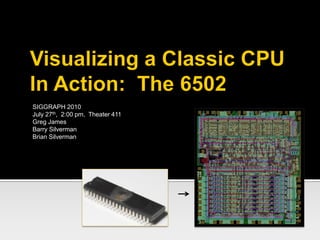
SIGGRAPH 2010
July 27th, 2:00 pm, Theater 411
Greg James
Barry Silverman
Brian Silverman
This project is an ongoing collaboration between Greg James, Barry Silverman, and
Brian Silverman, began in the summer of 2009. We seek to preserve, document, and
understand historic computer systems, and to present them in a highly visual manner for
education and inspiration.

We’re always looking for classic computer hardware in danger of being lost, especially
broken or non-functional components created before about 1986. Before recycling or
tossing your old computers or game systems, please check our website to see if they
could become a valuable contribution to computer history.
                                  www.visual6502.org


A presentation similar to this was given at SIGGRAPH 2010, July 27th 2:00 pm in the
“Visualization for Art and Design” track chaired by Esther Lim. The theme for this
SIGGRAPH was “The People Behind the Pixels,” and this work is very much in honor of
the architects and visionaries who enabled our first pixels.


This specific presentation is distributed under the Creative Commons “Attribution-NonCommercial-
NoDerivs 3.0 Unported” (http://creativecommons.org/licenses/by-nc-nd/3.0/) license where
applicable, with citation of 3rd party material, images, and governing licenses given. All un-cited
material and images are Copyright 2010, Greg James.
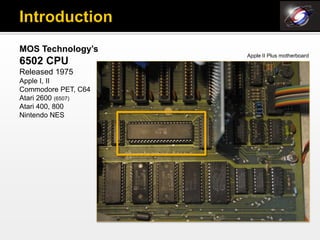
MOS Technology’s
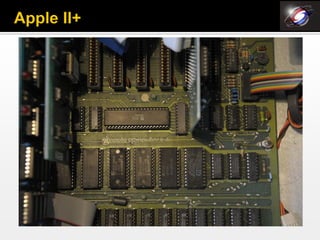
                     Apple II Plus motherboard
6502 CPU
Released 1975
Apple I, II
Commodore PET, C64
Atari 2600 (6507)
Atari 400, 800
Nintendo NES
Paul Allen, Bill Gates


Steve Wozniak, Steve Jobs
                                   Apple II


                                                 [Klein] CCL 1.3
                                                                   Commodore PET


                     Apple I   [Klein] CCL 1.3
Jobs, Wozniak, and …


[Klein] CCL 1.3
Jobs, Wozniak, and …


                         The 6502
[Klein] CCL 1.3
   Who’s seen a transistor?
     or a network of them doing work?

   Understand a CPU by seeing it operate

   Preservation
     Simulation, not emulation
     100% accurate model

   Honor the people behind my first pixels
     Their design achievements, hidden work.
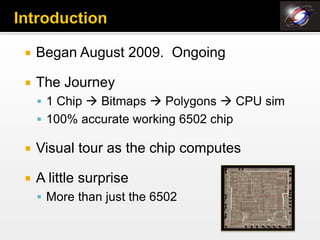
   Began August 2009. Ongoing

   The Journey
     1 Chip  Bitmaps  Polygons  CPU sim
     100% accurate working 6502 chip

   Visual tour as the chip computes

   A little surprise
     More than just the 6502
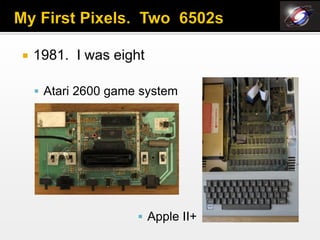
   1981. I was eight

     Atari 2600 game system


                      Apple II+
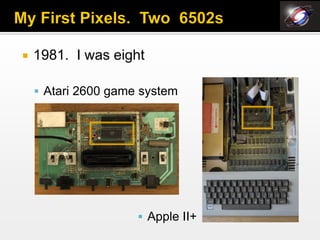
   1981. I was eight

     Atari 2600 game system


                      Apple II+
   Before ~1980, chip design was a very
    manual process


     [Volk’01] Used with permission   Wikimedia Commons, GFDL
   No digital representation

 Designs lost

 No computer
  optimization

 Interesting
  physical features


                      [Volk’01] Used with permission
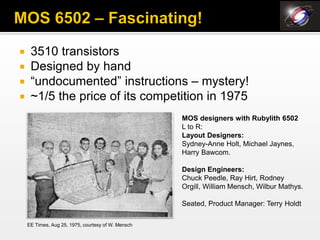
    3510 transistors
    Designed by hand
    “undocumented” instructions – mystery!
    ~1/5 the price of its competition in 1975
                                                    MOS designers with Rubylith 6502
                                                    L to R:
                                                    Layout Designers:
                                                    Sydney-Anne Holt, Michael Jaynes,
                                                    Harry Bawcom.

                                                    Design Engineers:
                                                    Chuck Peedle, Ray Hirt, Rodney
                                                    Orgill, William Mensch, Wilbur Mathys.

                                                    Seated, Product Manager: Terry Holdt

    EE Times, Aug 25, 1975, courtesy of W. Mensch
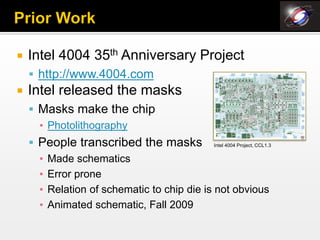
   Intel 4004 35th Anniversary Project
     http://www.4004.com
   Intel released the masks
     Masks make the chip
      ▪ Photolithography
     People transcribed the masks Intel 4004 Project, CCL1.3
      ▪ Made schematics
      ▪ Error prone
      ▪ Relation of schematic to chip die is not obvious
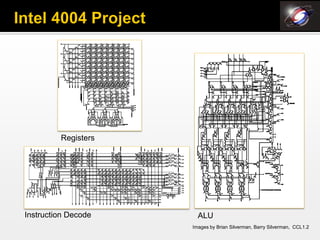
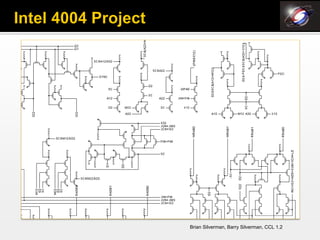
      ▪ Animated schematic, Fall 2009
Registers


Instruction Decode     ALU
                     Images by Brian Silverman, Barry Silverman, CCL1.2
Brian Silverman, Barry Silverman, CCL 1.2
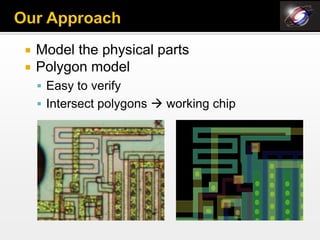
   Model the physical parts
   Polygon model
     Easy to verify
     Intersect polygons  working chip
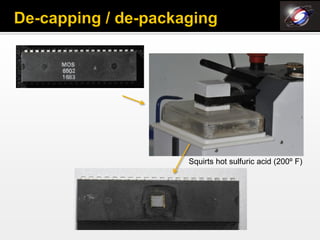
Squirts hot sulfuric acid (200º F)
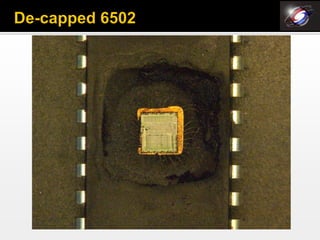
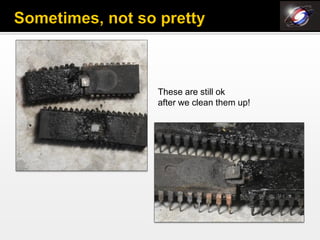
These are still ok
after we clean them up!
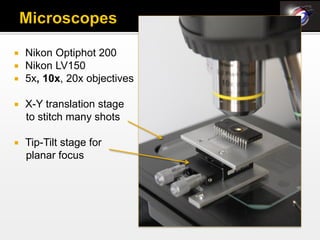
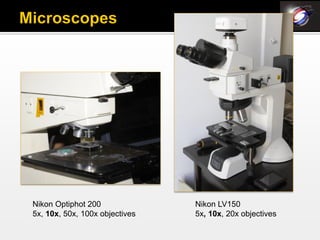
 Nikon Optiphot 200
 Nikon LV150
 5x, 10x, 20x objectives

   X-Y translation stage
    to stitch many shots

   Tip-Tilt stage for
    planar focus
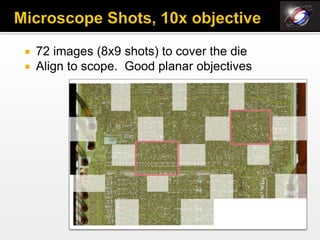
   72 images (8x9 shots) to cover the die
   Align to scope. Good planar objectives
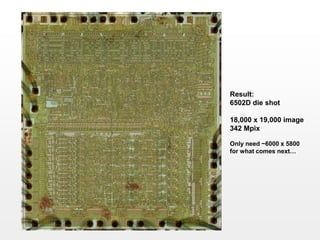
Result:
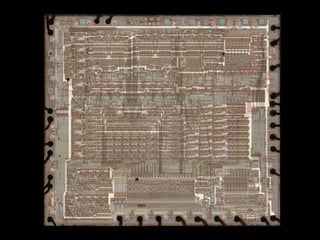
6502D die shot

18,000 x 19,000 image
342 Mpix

Only need ~6000 x 5800
for what comes next…
   Demo
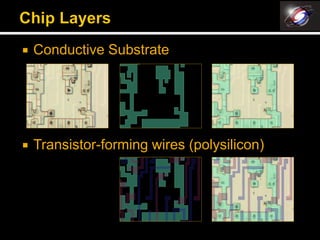
   Conductive Substrate


   Transistor-forming wires (polysilicon)
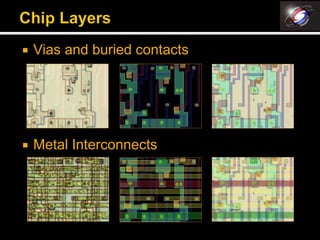
   Vias and buried contacts


   Metal Interconnects
   Demo
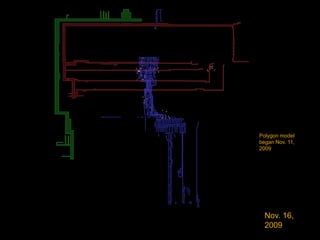
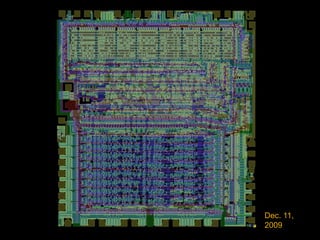
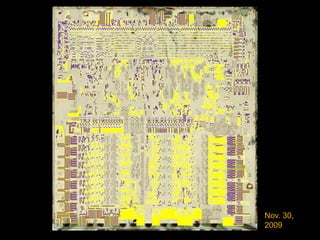
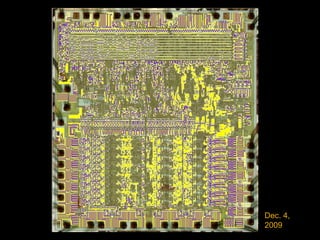
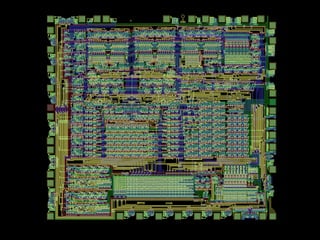
Polygon model
began Nov. 11,
2009


  Nov. 16,
  2009
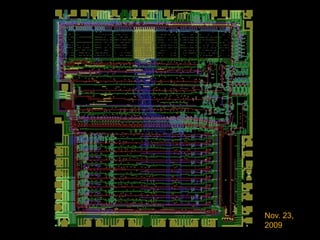
Nov. 23,
2009
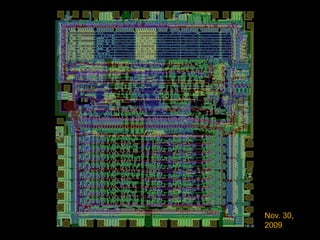
Nov. 30,
2009
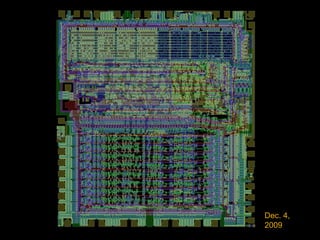
Dec. 4,
2009
Dec. 11,
2009
Nov. 30,
2009
Dec. 4,
2009
   Interactive 6502 chip simulation
   George Phillips, “Simplicity Betrayed”,
    Communications of the ACM, Vol. 53 No. 6,
    pages 52-58. Full text

   TRS-80 screen display
   Simple characters
     Byte in memory  character on screen


   Easy to approximate
   Extremely difficult to emulate accurately
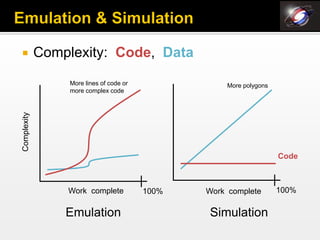
            Complexity: Code, Data
                  More lines of code or               More polygons
                  more complex code
Complexity


                                                                      Code


                 Work complete            100%   Work complete        100%

                 Emulation                       Simulation
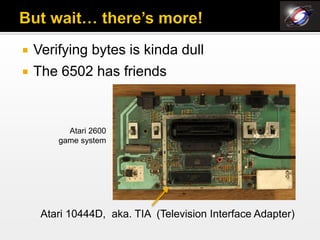
   Verifying bytes is kinda dull
   The 6502 has friends


          Atari 2600
        game system


     Atari 10444D, aka. TIA (Television Interface Adapter)
   Makes video signal
     Made my first pixels 


   Sprite engines. No framebuffer
     Framebuffers cost $60,000


   We know how it connects to the 6502
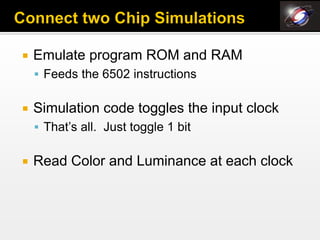
   Emulate program ROM and RAM
     Feeds the 6502 instructions


   Simulation code toggles the input clock
     That’s all. Just toggle 1 bit


   Read Color and Luminance at each clock
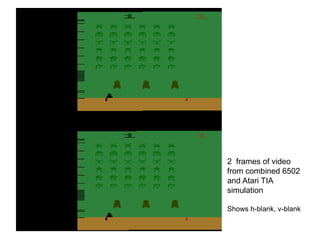
2 frames of video
from combined 6502
and Atari TIA
simulation

Shows h-blank, v-blank
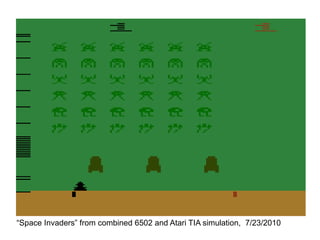
“Space Invaders” from combined 6502 and Atari TIA simulation, 7/23/2010
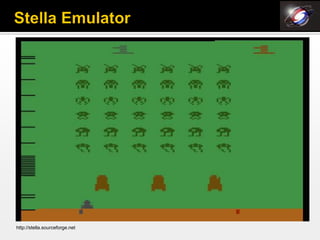
http://stella.sourceforge.net
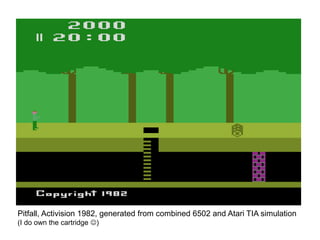
Pitfall, Activision 1982, generated from combined 6502 and Atari TIA simulation
(I do own the cartridge )
   It’s EASY to preserve historic hardware

   Parallelizable

   Guide for emulation

   Work from transistor-level simulation to
    coarse fast simulation?

   Lots more to do!
   Free for non-commercial use

   www.visual6502.org

   I’m late – nothing up there yet =/
   Check in a week or two
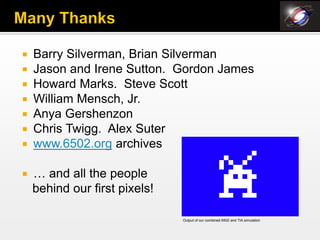
   Barry Silverman, Brian Silverman
   Jason and Irene Sutton. Gordon James
   Howard Marks. Steve Scott
   William Mensch, Jr.
   Anya Gershenzon
   Chris Twigg. Alex Suter
   www.6502.org archives

   … and all the people
    behind our first pixels!

                               Output of our combined 6502 and TIA simulation
   George Phillips, “Simplicity Betrayed,” Communications
    of the ACM, Vol. 53 No. 6, Pages 52-58

   Andrew Volk, Peter Stoll, Paul Metrovich, "Recollections
    of Early Chip Development at Intel", Intel Technology
    Journal Q1, 2001

   Tim McNemey, Intel 4004 Project, http://www.4004.com

   Erik Klein, http://www.vintage-computer.com

   “Stella” Atari 2600 emulator. stella.sourceforge.net

   Wikimedia Commons. www.wikipedia.org
Nikon Optiphot 200              Nikon LV150
5x, 10x, 50x, 100x objectives   5x, 10x, 20x objectives
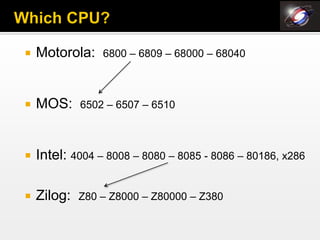
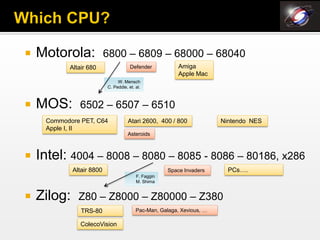
   Motorola:    6800 – 6809 – 68000 – 68040


   MOS:     6502 – 6507 – 6510


   Intel: 4004 – 8008 – 8080 – 8085 - 8086 – 80186, x286

   Zilog:   Z80 – Z8000 – Z80000 – Z380
   Motorola:              6800 – 6809 – 68000 – 68040
           Altair 680                  Defender           Amiga
                                                          Apple Mac
                                W. Mensch
                           C. Peddle, et. al.


   MOS:       6502 – 6507 – 6510
     Commodore PET, C64               Atari 2600, 400 / 800             Nintendo NES
     Apple I, II
                                      Asteroids


   Intel: 4004 – 8008 – 8080 – 8085 - 8086 – 80186, x286
             Altair 8800                              Space Invaders      PCs….
                                          F. Faggin
                                          M. Shima


   Zilog:     Z80 – Z8000 – Z80000 – Z380
                TRS-80                    Pac-Man, Galaga, Xevious, …

               ColecoVision
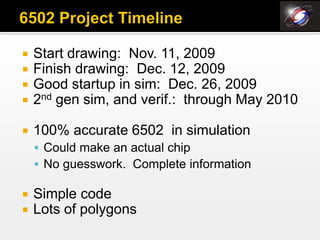
   Start drawing: Nov. 11, 2009
   Finish drawing: Dec. 12, 2009
   Good startup in sim: Dec. 26, 2009
   2nd gen sim, and verif.: through May 2010

   100% accurate 6502 in simulation
     Could make an actual chip
     No guesswork. Complete information

   Simple code
   Lots of polygons
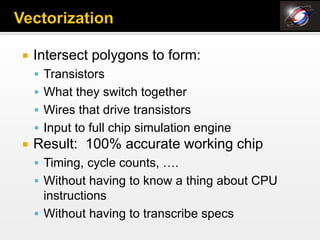
   Intersect polygons to form:
     Transistors
     What they switch together
     Wires that drive transistors
     Input to full chip simulation engine
   Result: 100% accurate working chip
     Timing, cycle counts, ….
     Without having to know a thing about CPU
      instructions
     Without having to transcribe specs
Byte Magazine, 1977 [Klein] CCL 1.3
Apple I motherboard, 1977
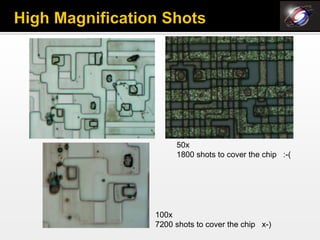
50x
     1800 shots to cover the chip :-(


100x
7200 shots to cover the chip x-)
   Released 1975
1961 – Steve Russel, MIT, first video game: Spacewars for PDP-1
1964 – First commercial graphics computer - IBM 2250 console, $125,000
1969 – Intel 1 kb RAM chip. Bell Labs first framebutter (3 bit)
1971 – Intel 4004
1972 – Atari founded, Pong. Xerox PARC 8-bit framebuffer.
            Intel 8008 8-bit processor
1973 – Triple I + Evans & Sutherland market first commercial framebuffer. Ethernet. Moore’s Law
1974 – Ed Catmull, Utah: Z-Buffer and texture mapping
            Computer Graphics Lab at NYIT opens
            Intel 8080 - 2 mHz, 10x faster than 8008, $150
1975 – Frank Crow: antialiasing
            Motorola 6800 selling for $175.
            Wozniak discovers MOS 6502, selling for $25, finished Apple I by 1976
1977 – Apple incorporated. Apple II released in April
            TRS-80
1978 – DEC VAX 11/780 @ 5 mhz. 16 kb RAM chip $500. Commodore PET $595. TRS-80 for $600
1979 – Atari 400/800 8-bit computers. Motorola 68000 processor. IBM 3279 color terminal
1982 – Atari hits $2 billion in revenue, making it the fastest growing company in history

Source: http://sophia.javeriana.edu.co/~ochavarr/computer_graphics_history/historia

6502 in action

  • 1.
    SIGGRAPH 2010 July 27th,2:00 pm, Theater 411 Greg James Barry Silverman Brian Silverman
  • 2.
    This project isan ongoing collaboration between Greg James, Barry Silverman, and Brian Silverman, began in the summer of 2009. We seek to preserve, document, and understand historic computer systems, and to present them in a highly visual manner for education and inspiration. We’re always looking for classic computer hardware in danger of being lost, especially broken or non-functional components created before about 1986. Before recycling or tossing your old computers or game systems, please check our website to see if they could become a valuable contribution to computer history. www.visual6502.org A presentation similar to this was given at SIGGRAPH 2010, July 27th 2:00 pm in the “Visualization for Art and Design” track chaired by Esther Lim. The theme for this SIGGRAPH was “The People Behind the Pixels,” and this work is very much in honor of the architects and visionaries who enabled our first pixels. This specific presentation is distributed under the Creative Commons “Attribution-NonCommercial- NoDerivs 3.0 Unported” (http://creativecommons.org/licenses/by-nc-nd/3.0/) license where applicable, with citation of 3rd party material, images, and governing licenses given. All un-cited material and images are Copyright 2010, Greg James.
  • 3.
    MOS Technology’s Apple II Plus motherboard 6502 CPU Released 1975 Apple I, II Commodore PET, C64 Atari 2600 (6507) Atari 400, 800 Nintendo NES
  • 4.
    Paul Allen, BillGates Steve Wozniak, Steve Jobs Apple II [Klein] CCL 1.3 Commodore PET Apple I [Klein] CCL 1.3
  • 5.
    Jobs, Wozniak, and… [Klein] CCL 1.3
  • 6.
    Jobs, Wozniak, and… The 6502 [Klein] CCL 1.3
  • 7.
    Who’s seen a transistor?  or a network of them doing work?  Understand a CPU by seeing it operate  Preservation  Simulation, not emulation  100% accurate model  Honor the people behind my first pixels  Their design achievements, hidden work.
  • 8.
    Began August 2009. Ongoing  The Journey  1 Chip  Bitmaps  Polygons  CPU sim  100% accurate working 6502 chip  Visual tour as the chip computes  A little surprise  More than just the 6502
  • 9.
    1981. I was eight  Atari 2600 game system  Apple II+
  • 10.
    1981. I was eight  Atari 2600 game system  Apple II+
  • 11.
    Before ~1980, chip design was a very manual process [Volk’01] Used with permission Wikimedia Commons, GFDL
  • 12.
    No digital representation  Designs lost  No computer optimization  Interesting physical features [Volk’01] Used with permission
  • 13.
    3510 transistors  Designed by hand  “undocumented” instructions – mystery!  ~1/5 the price of its competition in 1975 MOS designers with Rubylith 6502 L to R: Layout Designers: Sydney-Anne Holt, Michael Jaynes, Harry Bawcom. Design Engineers: Chuck Peedle, Ray Hirt, Rodney Orgill, William Mensch, Wilbur Mathys. Seated, Product Manager: Terry Holdt EE Times, Aug 25, 1975, courtesy of W. Mensch
  • 14.
    Intel 4004 35th Anniversary Project  http://www.4004.com  Intel released the masks  Masks make the chip ▪ Photolithography  People transcribed the masks Intel 4004 Project, CCL1.3 ▪ Made schematics ▪ Error prone ▪ Relation of schematic to chip die is not obvious ▪ Animated schematic, Fall 2009
  • 15.
    Registers Instruction Decode ALU Images by Brian Silverman, Barry Silverman, CCL1.2
  • 16.
    Brian Silverman, BarrySilverman, CCL 1.2
  • 17.
    Model the physical parts  Polygon model  Easy to verify  Intersect polygons  working chip
  • 19.
    Squirts hot sulfuricacid (200º F)
  • 21.
    These are stillok after we clean them up!
  • 22.
     Nikon Optiphot200  Nikon LV150  5x, 10x, 20x objectives  X-Y translation stage to stitch many shots  Tip-Tilt stage for planar focus
  • 23.
    72 images (8x9 shots) to cover the die  Align to scope. Good planar objectives
  • 24.
    Result: 6502D die shot 18,000x 19,000 image 342 Mpix Only need ~6000 x 5800 for what comes next…
  • 25.
    Demo
  • 26.
    Conductive Substrate  Transistor-forming wires (polysilicon)
  • 27.
    Vias and buried contacts  Metal Interconnects
  • 28.
    Demo
  • 29.
    Polygon model began Nov.11, 2009 Nov. 16, 2009
  • 30.
  • 31.
  • 32.
  • 33.
  • 34.
  • 35.
  • 36.
    Interactive 6502 chip simulation
  • 37.
    George Phillips, “Simplicity Betrayed”, Communications of the ACM, Vol. 53 No. 6, pages 52-58. Full text  TRS-80 screen display  Simple characters  Byte in memory  character on screen  Easy to approximate  Extremely difficult to emulate accurately
  • 38.
    Complexity: Code, Data More lines of code or More polygons more complex code Complexity Code Work complete 100% Work complete 100% Emulation Simulation
  • 39.
    Verifying bytes is kinda dull  The 6502 has friends Atari 2600 game system Atari 10444D, aka. TIA (Television Interface Adapter)
  • 40.
    Makes video signal  Made my first pixels   Sprite engines. No framebuffer  Framebuffers cost $60,000  We know how it connects to the 6502
  • 43.
    Emulate program ROM and RAM  Feeds the 6502 instructions  Simulation code toggles the input clock  That’s all. Just toggle 1 bit  Read Color and Luminance at each clock
  • 44.
    2 frames ofvideo from combined 6502 and Atari TIA simulation Shows h-blank, v-blank
  • 45.
    “Space Invaders” fromcombined 6502 and Atari TIA simulation, 7/23/2010
  • 46.
  • 47.
    Pitfall, Activision 1982,generated from combined 6502 and Atari TIA simulation (I do own the cartridge )
  • 48.
    It’s EASY to preserve historic hardware  Parallelizable  Guide for emulation  Work from transistor-level simulation to coarse fast simulation?  Lots more to do!
  • 49.
    Free for non-commercial use  www.visual6502.org  I’m late – nothing up there yet =/  Check in a week or two
  • 50.
    Barry Silverman, Brian Silverman  Jason and Irene Sutton. Gordon James  Howard Marks. Steve Scott  William Mensch, Jr.  Anya Gershenzon  Chris Twigg. Alex Suter  www.6502.org archives  … and all the people behind our first pixels! Output of our combined 6502 and TIA simulation
  • 51.
    George Phillips, “Simplicity Betrayed,” Communications of the ACM, Vol. 53 No. 6, Pages 52-58  Andrew Volk, Peter Stoll, Paul Metrovich, "Recollections of Early Chip Development at Intel", Intel Technology Journal Q1, 2001  Tim McNemey, Intel 4004 Project, http://www.4004.com  Erik Klein, http://www.vintage-computer.com  “Stella” Atari 2600 emulator. stella.sourceforge.net  Wikimedia Commons. www.wikipedia.org
  • 53.
    Nikon Optiphot 200 Nikon LV150 5x, 10x, 50x, 100x objectives 5x, 10x, 20x objectives
  • 54.
    Motorola: 6800 – 6809 – 68000 – 68040  MOS: 6502 – 6507 – 6510  Intel: 4004 – 8008 – 8080 – 8085 - 8086 – 80186, x286  Zilog: Z80 – Z8000 – Z80000 – Z380
  • 55.
    Motorola: 6800 – 6809 – 68000 – 68040 Altair 680 Defender Amiga Apple Mac W. Mensch C. Peddle, et. al.  MOS: 6502 – 6507 – 6510 Commodore PET, C64 Atari 2600, 400 / 800 Nintendo NES Apple I, II Asteroids  Intel: 4004 – 8008 – 8080 – 8085 - 8086 – 80186, x286 Altair 8800 Space Invaders PCs…. F. Faggin M. Shima  Zilog: Z80 – Z8000 – Z80000 – Z380 TRS-80 Pac-Man, Galaga, Xevious, … ColecoVision
  • 56.
    Start drawing: Nov. 11, 2009  Finish drawing: Dec. 12, 2009  Good startup in sim: Dec. 26, 2009  2nd gen sim, and verif.: through May 2010  100% accurate 6502 in simulation  Could make an actual chip  No guesswork. Complete information  Simple code  Lots of polygons
  • 57.
    Intersect polygons to form:  Transistors  What they switch together  Wires that drive transistors  Input to full chip simulation engine  Result: 100% accurate working chip  Timing, cycle counts, ….  Without having to know a thing about CPU instructions  Without having to transcribe specs
  • 58.
    Byte Magazine, 1977[Klein] CCL 1.3 Apple I motherboard, 1977
  • 64.
    50x 1800 shots to cover the chip :-( 100x 7200 shots to cover the chip x-)
  • 65.
    Released 1975 1961 – Steve Russel, MIT, first video game: Spacewars for PDP-1 1964 – First commercial graphics computer - IBM 2250 console, $125,000 1969 – Intel 1 kb RAM chip. Bell Labs first framebutter (3 bit) 1971 – Intel 4004 1972 – Atari founded, Pong. Xerox PARC 8-bit framebuffer. Intel 8008 8-bit processor 1973 – Triple I + Evans & Sutherland market first commercial framebuffer. Ethernet. Moore’s Law 1974 – Ed Catmull, Utah: Z-Buffer and texture mapping Computer Graphics Lab at NYIT opens Intel 8080 - 2 mHz, 10x faster than 8008, $150 1975 – Frank Crow: antialiasing Motorola 6800 selling for $175. Wozniak discovers MOS 6502, selling for $25, finished Apple I by 1976 1977 – Apple incorporated. Apple II released in April TRS-80 1978 – DEC VAX 11/780 @ 5 mhz. 16 kb RAM chip $500. Commodore PET $595. TRS-80 for $600 1979 – Atari 400/800 8-bit computers. Motorola 68000 processor. IBM 3279 color terminal 1982 – Atari hits $2 billion in revenue, making it the fastest growing company in history Source: http://sophia.javeriana.edu.co/~ochavarr/computer_graphics_history/historia