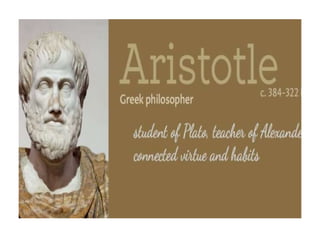
AristotleAristotle
Rey-Mark G. Basagre
Student, PhD Educational Foundations
Subject: Oriental and Western Philosophy
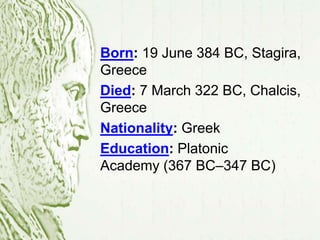
Born: 19 June 384 BC, Stagira,
Greece
Died: 7 March 322 BC, Chalcis,
Greece
Nationality: Greek
Education: Platonic
Academy (367 BC–347 BC)
Aristotle
Who Was Aristotle?
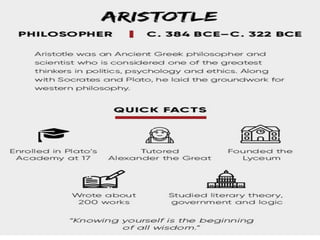
Aristotle (c. 384 B.C. to 322 B.C.) was an Ancient
Greek philosopher and scientist who is still considered
one of the greatest thinkers in politics, psychology and
ethics.
When Aristotle turned 17, he enrolled in Plato’s
Academy. In 338, he began tutoring Alexander the
Great. In 335, Aristotle founded his own school, the
Lyceum, in Athens, where he spent most of the rest of
his life studying, teaching and writing.
Some of his most notable works include Nichomachean
Ethics, Politics, Metaphysics, Poetics and Prior
Analytics
'Metaphysics‘
In his book Metaphysics, Aristotle
clarified the distinction between
matter and form.
To Aristotle, matter was the
physical substance of things, while
form was the unique nature of a
thing that gave it its identity.
'Politics‘
In Politics, Aristotle examined human
behavior in the context of society and
government. Aristotle believed the purpose
of government was make it possible for
citizens to achieve virtue and happiness.
Intended to help guide statesmen and
rulers, Politics explores, among other
themes, how and why cities come into
being; the roles of citizens and politicians;
wealth and the class system; the purpose of
the political system; types of governments
and democracies; and the roles of slavery
and women in the household and society.
'Rhetoric‘
In Rhetoric, Aristotle observes and analyzes
public speaking with scientific rigor in order
to teach readers how to be more effective
speakers. Aristotle believed rhetoric was
essential in politics and law and helped
defend truth and justice.
Good rhetoric, Aristotle believed, could
educate people and encourage them to
consider both sides of a debate. Aristotle’s
work explored how to construct an argument
and maximize its effect, as well as fallacious
reasoning to avoid (like generalizing from a
single example).
'Prior Analytics‘
In Prior Analytics, Aristotle explains the
syllogism as “a discourse in which, certain
things having been supposed, something
different from the things supposed results
of necessity because these things are so.”
Aristotle defined the main components of
reasoning in terms of inclusive and
exclusive relationships. These sorts of
relationships were visually grafted in the
future through the use of Venn diagrams.
Works on Science
Aristotle composed works on astronomy,
including On the Heavens, and earth
sciences, including Meteorology.
By meteorology, Aristotle didn’t simply
mean the study of weather. His more
expansive definition of meteorology
included “all the affectations we may call
common to air and water, and the kinds and
parts of the earth and the affectations of its
parts.”
In Meteorology, Aristotle identified the
water cycle and discussed topics ranging
from natural disasters to astrological
events. Although many of his views on the
Earth were controversial at the time, they
were re-adopted and popularized during the
late Middle Ages.
One of Aristotle’s more famous ideas of
natural philosophy is his addition of the
celestial “aether” to the four natural elements
suggested by Empedocles.
The “aether” is, according to Aristotle, the
“greater and lesser lights of heaven.” The
other four natural elements (fire, earth, air,
and water) are able to change and mix,
according to Aristotle.
These elements are capable of “generation
and destruction,” as opposed to the aether,
which is unchanging. Aristotle concludes that
these bodies cannot be composed of the
four elements, because they are not capable
of change.
Fire, earth, air, and water are terrestrial
elements while aether is a celestial
element. The most important point is that
Aristotle redefined natural elements to
include early ideas of phase transition.
Aristotle also made an important attempt to explain gravity.
His theory was that all bodies move toward their “natural
place.”
This was the way in which Aristotle described general
motion. Aristotle also believed that vacuums did not exist,
but that if they did, terrestrial motion in a vacuum would be
infinitely fast.
Aristotle described celestial motion in terms of crystal
spheres, which carried the sun, moon, and stars in
unchanging endless circular motion. In Metaphysics,
Aristotle says “that there must be an immortal, unchanging
being, ultimately responsible for all wholeness and
orderliness in the sensible world.
Highly significant was Aristotle’s argument that the Earth
was actually spherical because such a significant change
in the sky would not happen unless on a small sphere.
“Happiness depends on ourselves."
More than anybody else, Aristotle
enshrines happiness as a central
purpose of human life and a goal in
itself.
One of Aristotle's most influential works is
the Nicomachean Ethics
"What is the ultimate purpose of human
existence?"
What is that end or goal for which we should
direct all of our activities?
To be an ultimate end, an act must be self-
sufficient and final, "that which is always
desirable in itself and never for the sake of
something else" (Nicomachean Ethics, 1097a30-
34), and it must be attainable by man. Aristotle
claims that nearly everyone would agree that
happiness is the end which meets all these
requirements.
The main trouble is that happiness (especially
in modern America) is often conceived of as a
subjective state of mind, as when one says one
is happy when one is enjoying a cool beer on a
hot day, or is out "having fun" with one's friends.
For Aristotle, however, happiness is a final end
or goal that encompasses the totality of one's
life. It is not something that can be gained or
lost in a few hours, like pleasurable sensations.
It is more like the ultimate value of your life as
lived up to this moment, measuring how well
you have lived up to your full potential as a
human being.
Thus Aristotle gives us his definition of
happiness:
...the function of man is to live a certain
kind of life, and this activity implies a
rational principle, and the function of a
good man is the good and noble
performance of these, and if any action
is well performed it is performed in
accord with the appropriate excellence:
if this is the case, then happiness turns
out to be an activity of the soul in
accordance with virtue.
(Nicomachean Ethics, 1098a13)
The Pursuit of Happiness
as the Exercise of Virtue
He is happy who lives in accordance
with complete virtue and is
sufficiently equipped with external
goods, not for some chance period but
throughout a complete life.
(Nicomachean Ethics, 1101a10)
In conclusion, according to Aristotle, what is happiness?
•Happiness is the ultimate end and purpose of human
existence
•Happiness is not pleasure, nor is it virtue. It is the
exercise of virtue.
•Happiness cannot be achieved until the end of one's life.
Hence it is a goal and not a temporary state.
•Happiness is the perfection of human nature. Since man
is a rational animal, human happiness depends on the
exercise of his reason.
•Happiness depends on acquiring a moral character,
where one displays the virtues of courage, generosity,
justice, friendship, and citizenship in one's life. These
virtues involve striking a balance or "mean" between an
excess and a deficiency.
•Happiness requires intellectual contemplation, for this is
the ultimate realization of our rational capacities.
Philosophy
Aristotle’s work on philosophy influenced
ideas from late antiquity all the way
through the Renaissance. One of the main
focuses of Aristotle’s philosophy was his
systematic concept of logic.
Aristotle’s objective was to come up with a
universal process of reasoning that would
allow man to learn every conceivable thing
about reality. The initial process involved
describing objects based on their
characteristics, states of being and actions.
In his philosophical treatises, Aristotle also
discussed how man might next obtain
information about objects through
deduction and inference.
To Aristotle, a deduction was a reasonable
argument in which “when certain things are
laid down, something else follows out of
necessity in virtue of their being so.”
His theory of deduction is the basis of what
philosophers now call a syllogism, a logical
argument where the conclusion is inferred
from two or more other premises of a
certain form.
Aristotle

Aristotle

  • 1.
    AristotleAristotle Rey-Mark G. Basagre Student,PhD Educational Foundations Subject: Oriental and Western Philosophy
  • 4.
    Born: 19 June384 BC, Stagira, Greece Died: 7 March 322 BC, Chalcis, Greece Nationality: Greek Education: Platonic Academy (367 BC–347 BC)
  • 5.
    Aristotle Who Was Aristotle? Aristotle(c. 384 B.C. to 322 B.C.) was an Ancient Greek philosopher and scientist who is still considered one of the greatest thinkers in politics, psychology and ethics. When Aristotle turned 17, he enrolled in Plato’s Academy. In 338, he began tutoring Alexander the Great. In 335, Aristotle founded his own school, the Lyceum, in Athens, where he spent most of the rest of his life studying, teaching and writing. Some of his most notable works include Nichomachean Ethics, Politics, Metaphysics, Poetics and Prior Analytics
  • 6.
    'Metaphysics‘ In his bookMetaphysics, Aristotle clarified the distinction between matter and form. To Aristotle, matter was the physical substance of things, while form was the unique nature of a thing that gave it its identity.
  • 7.
    'Politics‘ In Politics, Aristotleexamined human behavior in the context of society and government. Aristotle believed the purpose of government was make it possible for citizens to achieve virtue and happiness. Intended to help guide statesmen and rulers, Politics explores, among other themes, how and why cities come into being; the roles of citizens and politicians; wealth and the class system; the purpose of the political system; types of governments and democracies; and the roles of slavery and women in the household and society.
  • 8.
    'Rhetoric‘ In Rhetoric, Aristotleobserves and analyzes public speaking with scientific rigor in order to teach readers how to be more effective speakers. Aristotle believed rhetoric was essential in politics and law and helped defend truth and justice. Good rhetoric, Aristotle believed, could educate people and encourage them to consider both sides of a debate. Aristotle’s work explored how to construct an argument and maximize its effect, as well as fallacious reasoning to avoid (like generalizing from a single example).
  • 9.
    'Prior Analytics‘ In PriorAnalytics, Aristotle explains the syllogism as “a discourse in which, certain things having been supposed, something different from the things supposed results of necessity because these things are so.” Aristotle defined the main components of reasoning in terms of inclusive and exclusive relationships. These sorts of relationships were visually grafted in the future through the use of Venn diagrams.
  • 10.
    Works on Science Aristotlecomposed works on astronomy, including On the Heavens, and earth sciences, including Meteorology. By meteorology, Aristotle didn’t simply mean the study of weather. His more expansive definition of meteorology included “all the affectations we may call common to air and water, and the kinds and parts of the earth and the affectations of its parts.” In Meteorology, Aristotle identified the water cycle and discussed topics ranging from natural disasters to astrological events. Although many of his views on the Earth were controversial at the time, they were re-adopted and popularized during the late Middle Ages.
  • 11.
    One of Aristotle’smore famous ideas of natural philosophy is his addition of the celestial “aether” to the four natural elements suggested by Empedocles. The “aether” is, according to Aristotle, the “greater and lesser lights of heaven.” The other four natural elements (fire, earth, air, and water) are able to change and mix, according to Aristotle. These elements are capable of “generation and destruction,” as opposed to the aether, which is unchanging. Aristotle concludes that these bodies cannot be composed of the four elements, because they are not capable of change.
  • 12.
    Fire, earth, air,and water are terrestrial elements while aether is a celestial element. The most important point is that Aristotle redefined natural elements to include early ideas of phase transition.
  • 13.
    Aristotle also madean important attempt to explain gravity. His theory was that all bodies move toward their “natural place.” This was the way in which Aristotle described general motion. Aristotle also believed that vacuums did not exist, but that if they did, terrestrial motion in a vacuum would be infinitely fast. Aristotle described celestial motion in terms of crystal spheres, which carried the sun, moon, and stars in unchanging endless circular motion. In Metaphysics, Aristotle says “that there must be an immortal, unchanging being, ultimately responsible for all wholeness and orderliness in the sensible world. Highly significant was Aristotle’s argument that the Earth was actually spherical because such a significant change in the sky would not happen unless on a small sphere.
  • 14.
    “Happiness depends onourselves." More than anybody else, Aristotle enshrines happiness as a central purpose of human life and a goal in itself.
  • 15.
    One of Aristotle'smost influential works is the Nicomachean Ethics "What is the ultimate purpose of human existence?" What is that end or goal for which we should direct all of our activities? To be an ultimate end, an act must be self- sufficient and final, "that which is always desirable in itself and never for the sake of something else" (Nicomachean Ethics, 1097a30- 34), and it must be attainable by man. Aristotle claims that nearly everyone would agree that happiness is the end which meets all these requirements.
  • 16.
    The main troubleis that happiness (especially in modern America) is often conceived of as a subjective state of mind, as when one says one is happy when one is enjoying a cool beer on a hot day, or is out "having fun" with one's friends. For Aristotle, however, happiness is a final end or goal that encompasses the totality of one's life. It is not something that can be gained or lost in a few hours, like pleasurable sensations. It is more like the ultimate value of your life as lived up to this moment, measuring how well you have lived up to your full potential as a human being.
  • 17.
    Thus Aristotle givesus his definition of happiness: ...the function of man is to live a certain kind of life, and this activity implies a rational principle, and the function of a good man is the good and noble performance of these, and if any action is well performed it is performed in accord with the appropriate excellence: if this is the case, then happiness turns out to be an activity of the soul in accordance with virtue. (Nicomachean Ethics, 1098a13)
  • 18.
    The Pursuit ofHappiness as the Exercise of Virtue He is happy who lives in accordance with complete virtue and is sufficiently equipped with external goods, not for some chance period but throughout a complete life. (Nicomachean Ethics, 1101a10)
  • 19.
    In conclusion, accordingto Aristotle, what is happiness? •Happiness is the ultimate end and purpose of human existence •Happiness is not pleasure, nor is it virtue. It is the exercise of virtue. •Happiness cannot be achieved until the end of one's life. Hence it is a goal and not a temporary state. •Happiness is the perfection of human nature. Since man is a rational animal, human happiness depends on the exercise of his reason. •Happiness depends on acquiring a moral character, where one displays the virtues of courage, generosity, justice, friendship, and citizenship in one's life. These virtues involve striking a balance or "mean" between an excess and a deficiency. •Happiness requires intellectual contemplation, for this is the ultimate realization of our rational capacities.
  • 20.
    Philosophy Aristotle’s work onphilosophy influenced ideas from late antiquity all the way through the Renaissance. One of the main focuses of Aristotle’s philosophy was his systematic concept of logic. Aristotle’s objective was to come up with a universal process of reasoning that would allow man to learn every conceivable thing about reality. The initial process involved describing objects based on their characteristics, states of being and actions.
  • 21.
    In his philosophicaltreatises, Aristotle also discussed how man might next obtain information about objects through deduction and inference. To Aristotle, a deduction was a reasonable argument in which “when certain things are laid down, something else follows out of necessity in virtue of their being so.” His theory of deduction is the basis of what philosophers now call a syllogism, a logical argument where the conclusion is inferred from two or more other premises of a certain form.