INTRODUCTION TO
GEOMETRY
MSJC ~ San Jacinto Campus
Math Center Workshop Series
Janice Levasseur
Geometry
• The word geometry comes from Greek
words meaning “to measure the Earth”
• Basically, Geometry is the study of shapes
and is one of the oldest branches of
mathematics
The Greeks and Euclid
• Our modern understanding of geometry
began with the Greeks over 2000 years
ago.
• The Greeks felt the need to go beyond
merely knowing certain facts to being able
to prove why they were true.
• Around 350 B.C., Euclid of Alexandria
wrote The Elements, in which he recorded
systematically all that was known about
Geometry at that time.
The Elements
• Knowing that you can’t define everything and
that you can’t prove everything, Euclid began by
stating three undefined terms:
 Point
 (Straight) Line
 Plane (Surface)
Actually, Euclid did attempt to define these basic
terms . . .
is that which has no part
is a line that lies evenly with the points
on itself
is a plane that lies evenly with the
straight lines on itself
Basic Terms & Definitions
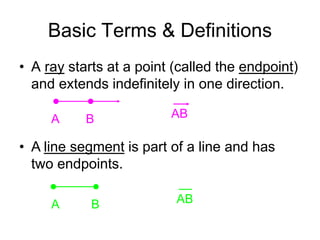
• A ray starts at a point (called the endpoint)
and extends indefinitely in one direction.
• A line segment is part of a line and has
two endpoints.
A B AB
B
A AB
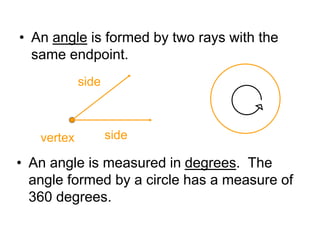
• An angle is formed by two rays with the
same endpoint.
• An angle is measured in degrees. The
angle formed by a circle has a measure of
360 degrees.
vertex
side
side
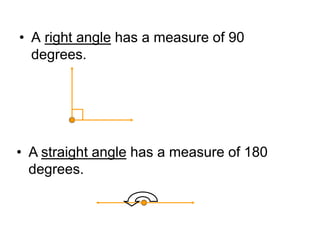
• A right angle has a measure of 90
degrees.
• A straight angle has a measure of 180
degrees.
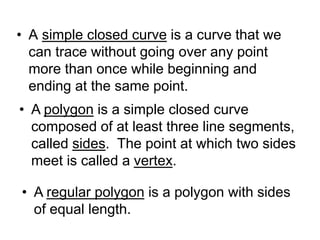
• A simple closed curve is a curve that we
can trace without going over any point
more than once while beginning and
ending at the same point.
• A polygon is a simple closed curve
composed of at least three line segments,
called sides. The point at which two sides
meet is called a vertex.
• A regular polygon is a polygon with sides
of equal length.
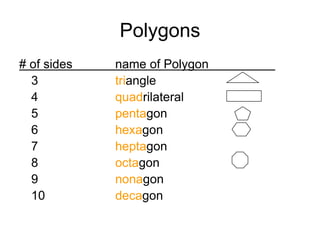
Polygons
# of sides name of Polygon
3 triangle
4 quadrilateral
5 pentagon
6 hexagon
7 heptagon
8 octagon
9 nonagon
10 decagon
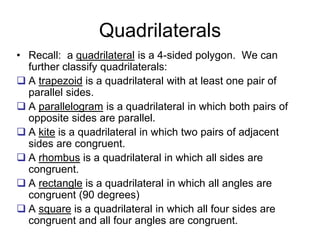
Quadrilaterals
• Recall: a quadrilateral is a 4-sided polygon. We can
further classify quadrilaterals:
 A trapezoid is a quadrilateral with at least one pair of
parallel sides.
 A parallelogram is a quadrilateral in which both pairs of
opposite sides are parallel.
 A kite is a quadrilateral in which two pairs of adjacent
sides are congruent.
 A rhombus is a quadrilateral in which all sides are
congruent.
 A rectangle is a quadrilateral in which all angles are
congruent (90 degrees)
 A square is a quadrilateral in which all four sides are
congruent and all four angles are congruent.
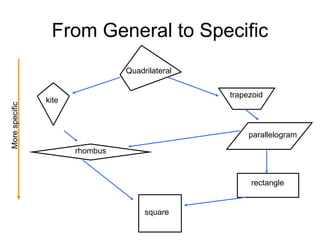
From General to Specific
Quadrilateral
trapezoid
kite
parallelogram
rhombus
rectangle
square
More
specific
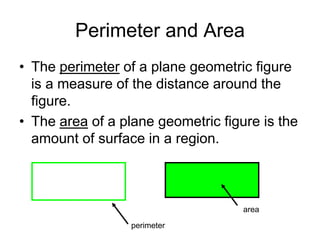
Perimeter and Area
• The perimeter of a plane geometric figure
is a measure of the distance around the
figure.
• The area of a plane geometric figure is the
amount of surface in a region.
perimeter
area
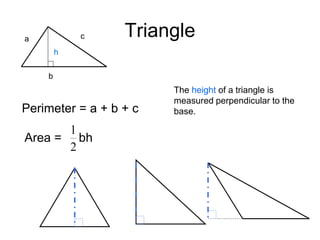
Triangle
h
b
a c
Perimeter = a + b + c
Area = bh
2
1
The height of a triangle is
measured perpendicular to the
base.
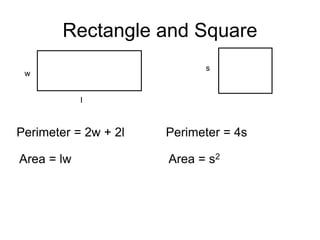
Rectangle and Square
w
l
s
Perimeter = 2w + 2l Perimeter = 4s
Area = lw Area = s2
Parallelogram
b
a h
Perimeter = 2a + 2b
Area = hb  Area of a parallelogram
= area of rectangle with
width = h and length = b
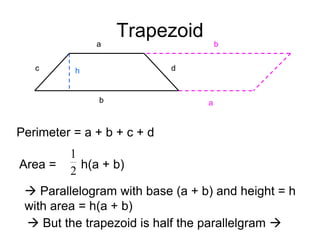
Trapezoid
c d
a
b
Perimeter = a + b + c + d
Area =
b
a
 Parallelogram with base (a + b) and height = h
with area = h(a + b)
 But the trapezoid is half the parallelgram 
h(a + b)
2
1
h
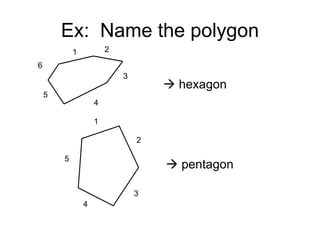
Ex: Name the polygon
3
2
1
4
5
6
 hexagon
1
2
3
4
5
 pentagon
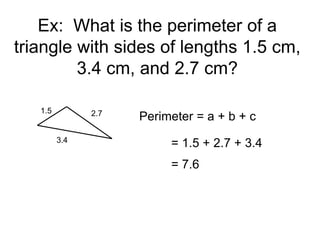
Ex: What is the perimeter of a
triangle with sides of lengths 1.5 cm,
3.4 cm, and 2.7 cm?
1.5 2.7
3.4
Perimeter = a + b + c
= 1.5 + 2.7 + 3.4
= 7.6
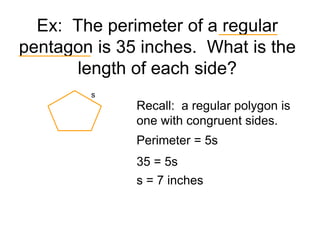
Ex: The perimeter of a regular
pentagon is 35 inches. What is the
length of each side?
Perimeter = 5s
35 = 5s
s = 7 inches
s
Recall: a regular polygon is
one with congruent sides.
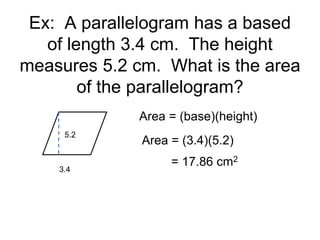
Ex: A parallelogram has a based
of length 3.4 cm. The height
measures 5.2 cm. What is the area
of the parallelogram?
3.4
5.2
Area = (base)(height)
Area = (3.4)(5.2)
= 17.86 cm2
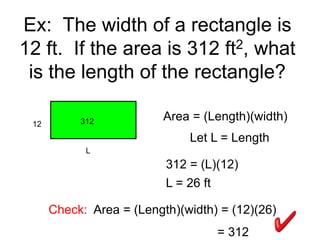
Ex: The width of a rectangle is
12 ft. If the area is 312 ft2, what
is the length of the rectangle?
12 312 Area = (Length)(width)
L = 26 ft
Let L = Length
L
312 = (L)(12)
Check: Area = (Length)(width) = (12)(26)
= 312
Circle
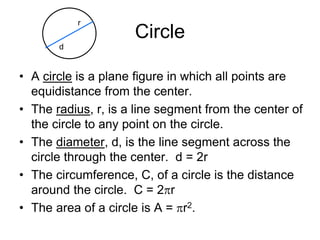
• A circle is a plane figure in which all points are
equidistance from the center.
• The radius, r, is a line segment from the center of
the circle to any point on the circle.
• The diameter, d, is the line segment across the
circle through the center. d = 2r
• The circumference, C, of a circle is the distance
around the circle. C = 2pr
• The area of a circle is A = pr2.
r
d
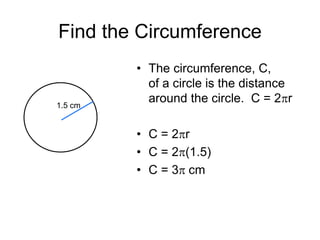
Find the Circumference
• The circumference, C,
of a circle is the distance
around the circle. C = 2pr
• C = 2pr
• C = 2p(1.5)
• C = 3p cm
1.5 cm
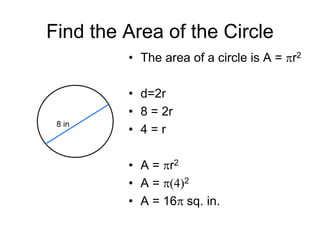
Find the Area of the Circle
• The area of a circle is A = pr2
• d=2r
• 8 = 2r
• 4 = r
• A = pr2
• A = p(4)2
• A = 16p sq. in.
8 in
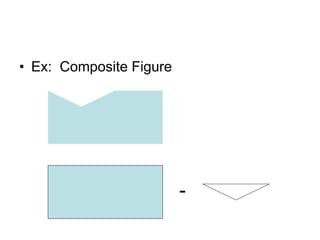
Composite Geometric Figures
• Composite Geometric Figures are made
from two or more geometric figures.
• Ex:
+
• Ex: Composite Figure
-
Ex: Find the perimeter of the
following composite figure
+
=
8
15
Rectangle with width = 8
and length = 15
Half a circle with diameter = 8
 radius = 4
Perimeter of composite figure = 38 + 4p.
Perimeter of partial rectangle
= 15 + 8 + 15 = 38
Circumference of half a circle
= (1/2)(2p4) = 4p.
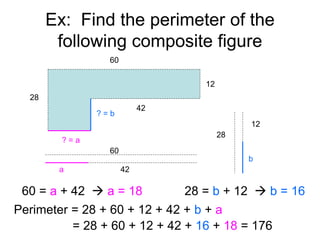
Ex: Find the perimeter of the
following composite figure
28
60
42
12
? = a
? = b
60
a 42
60 = a + 42  a = 18
28
b
12
28 = b + 12  b = 16
Perimeter = 28 + 60 + 12 + 42 + b + a
= 28 + 60 + 12 + 42 + 16 + 18 = 176
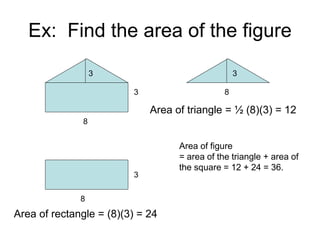
Ex: Find the area of the figure
3
3
8
8
Area of rectangle = (8)(3) = 24
3
8
Area of triangle = ½ (8)(3) = 12
Area of figure
= area of the triangle + area of
the square = 12 + 24 = 36.
3
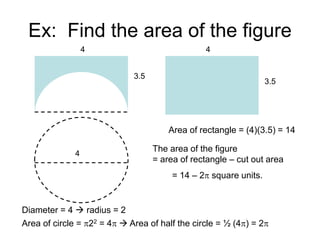
Ex: Find the area of the figure
4
3.5
4
3.5
Area of rectangle = (4)(3.5) = 14
4
Diameter = 4  radius = 2
Area of circle = p22 = 4p  Area of half the circle = ½ (4p) = 2p
The area of the figure
= area of rectangle – cut out area
= 14 – 2p square units.
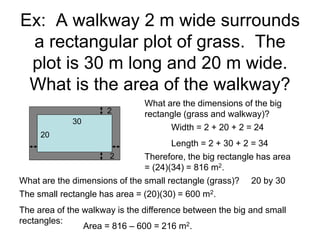
Ex: A walkway 2 m wide surrounds
a rectangular plot of grass. The
plot is 30 m long and 20 m wide.
What is the area of the walkway?
20
30
2
What are the dimensions of the big
rectangle (grass and walkway)?
Width = 2 + 20 + 2 = 24
Length = 2 + 30 + 2 = 34
The small rectangle has area = (20)(30) = 600 m2.
What are the dimensions of the small rectangle (grass)?
Therefore, the big rectangle has area
= (24)(34) = 816 m2.
The area of the walkway is the difference between the big and small
rectangles:
20 by 30
Area = 816 – 600 = 216 m2.
2
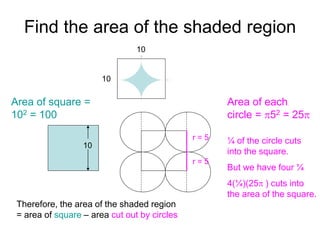
Find the area of the shaded region
10
10
10
r = 5
Area of each
circle = p52 = 25p
¼ of the circle cuts
into the square.
But we have four ¼
4(¼)(25p ) cuts into
the area of the square.
Area of square =
102 = 100
Therefore, the area of the shaded region
= area of square – area cut out by circles = 100 – 25p square units
r = 5
17 GEOMETRY.ppt

17 GEOMETRY.ppt

  • 1.
    INTRODUCTION TO GEOMETRY MSJC ~San Jacinto Campus Math Center Workshop Series Janice Levasseur
  • 2.
    Geometry • The wordgeometry comes from Greek words meaning “to measure the Earth” • Basically, Geometry is the study of shapes and is one of the oldest branches of mathematics
  • 3.
    The Greeks andEuclid • Our modern understanding of geometry began with the Greeks over 2000 years ago. • The Greeks felt the need to go beyond merely knowing certain facts to being able to prove why they were true. • Around 350 B.C., Euclid of Alexandria wrote The Elements, in which he recorded systematically all that was known about Geometry at that time.
  • 4.
    The Elements • Knowingthat you can’t define everything and that you can’t prove everything, Euclid began by stating three undefined terms:  Point  (Straight) Line  Plane (Surface) Actually, Euclid did attempt to define these basic terms . . . is that which has no part is a line that lies evenly with the points on itself is a plane that lies evenly with the straight lines on itself
  • 5.
    Basic Terms &Definitions • A ray starts at a point (called the endpoint) and extends indefinitely in one direction. • A line segment is part of a line and has two endpoints. A B AB B A AB
  • 6.
    • An angleis formed by two rays with the same endpoint. • An angle is measured in degrees. The angle formed by a circle has a measure of 360 degrees. vertex side side
  • 7.
    • A rightangle has a measure of 90 degrees. • A straight angle has a measure of 180 degrees.
  • 8.
    • A simpleclosed curve is a curve that we can trace without going over any point more than once while beginning and ending at the same point. • A polygon is a simple closed curve composed of at least three line segments, called sides. The point at which two sides meet is called a vertex. • A regular polygon is a polygon with sides of equal length.
  • 9.
    Polygons # of sidesname of Polygon 3 triangle 4 quadrilateral 5 pentagon 6 hexagon 7 heptagon 8 octagon 9 nonagon 10 decagon
  • 10.
    Quadrilaterals • Recall: aquadrilateral is a 4-sided polygon. We can further classify quadrilaterals:  A trapezoid is a quadrilateral with at least one pair of parallel sides.  A parallelogram is a quadrilateral in which both pairs of opposite sides are parallel.  A kite is a quadrilateral in which two pairs of adjacent sides are congruent.  A rhombus is a quadrilateral in which all sides are congruent.  A rectangle is a quadrilateral in which all angles are congruent (90 degrees)  A square is a quadrilateral in which all four sides are congruent and all four angles are congruent.
  • 11.
    From General toSpecific Quadrilateral trapezoid kite parallelogram rhombus rectangle square More specific
  • 12.
    Perimeter and Area •The perimeter of a plane geometric figure is a measure of the distance around the figure. • The area of a plane geometric figure is the amount of surface in a region. perimeter area
  • 13.
    Triangle h b a c Perimeter =a + b + c Area = bh 2 1 The height of a triangle is measured perpendicular to the base.
  • 14.
    Rectangle and Square w l s Perimeter= 2w + 2l Perimeter = 4s Area = lw Area = s2
  • 15.
    Parallelogram b a h Perimeter =2a + 2b Area = hb  Area of a parallelogram = area of rectangle with width = h and length = b
  • 16.
    Trapezoid c d a b Perimeter =a + b + c + d Area = b a  Parallelogram with base (a + b) and height = h with area = h(a + b)  But the trapezoid is half the parallelgram  h(a + b) 2 1 h
  • 17.
    Ex: Name thepolygon 3 2 1 4 5 6  hexagon 1 2 3 4 5  pentagon
  • 18.
    Ex: What isthe perimeter of a triangle with sides of lengths 1.5 cm, 3.4 cm, and 2.7 cm? 1.5 2.7 3.4 Perimeter = a + b + c = 1.5 + 2.7 + 3.4 = 7.6
  • 19.
    Ex: The perimeterof a regular pentagon is 35 inches. What is the length of each side? Perimeter = 5s 35 = 5s s = 7 inches s Recall: a regular polygon is one with congruent sides.
  • 20.
    Ex: A parallelogramhas a based of length 3.4 cm. The height measures 5.2 cm. What is the area of the parallelogram? 3.4 5.2 Area = (base)(height) Area = (3.4)(5.2) = 17.86 cm2
  • 21.
    Ex: The widthof a rectangle is 12 ft. If the area is 312 ft2, what is the length of the rectangle? 12 312 Area = (Length)(width) L = 26 ft Let L = Length L 312 = (L)(12) Check: Area = (Length)(width) = (12)(26) = 312
  • 22.
    Circle • A circleis a plane figure in which all points are equidistance from the center. • The radius, r, is a line segment from the center of the circle to any point on the circle. • The diameter, d, is the line segment across the circle through the center. d = 2r • The circumference, C, of a circle is the distance around the circle. C = 2pr • The area of a circle is A = pr2. r d
  • 23.
    Find the Circumference •The circumference, C, of a circle is the distance around the circle. C = 2pr • C = 2pr • C = 2p(1.5) • C = 3p cm 1.5 cm
  • 24.
    Find the Areaof the Circle • The area of a circle is A = pr2 • d=2r • 8 = 2r • 4 = r • A = pr2 • A = p(4)2 • A = 16p sq. in. 8 in
  • 25.
    Composite Geometric Figures •Composite Geometric Figures are made from two or more geometric figures. • Ex: +
  • 26.
  • 27.
    Ex: Find theperimeter of the following composite figure + = 8 15 Rectangle with width = 8 and length = 15 Half a circle with diameter = 8  radius = 4 Perimeter of composite figure = 38 + 4p. Perimeter of partial rectangle = 15 + 8 + 15 = 38 Circumference of half a circle = (1/2)(2p4) = 4p.
  • 28.
    Ex: Find theperimeter of the following composite figure 28 60 42 12 ? = a ? = b 60 a 42 60 = a + 42  a = 18 28 b 12 28 = b + 12  b = 16 Perimeter = 28 + 60 + 12 + 42 + b + a = 28 + 60 + 12 + 42 + 16 + 18 = 176
  • 29.
    Ex: Find thearea of the figure 3 3 8 8 Area of rectangle = (8)(3) = 24 3 8 Area of triangle = ½ (8)(3) = 12 Area of figure = area of the triangle + area of the square = 12 + 24 = 36. 3
  • 30.
    Ex: Find thearea of the figure 4 3.5 4 3.5 Area of rectangle = (4)(3.5) = 14 4 Diameter = 4  radius = 2 Area of circle = p22 = 4p  Area of half the circle = ½ (4p) = 2p The area of the figure = area of rectangle – cut out area = 14 – 2p square units.
  • 31.
    Ex: A walkway2 m wide surrounds a rectangular plot of grass. The plot is 30 m long and 20 m wide. What is the area of the walkway? 20 30 2 What are the dimensions of the big rectangle (grass and walkway)? Width = 2 + 20 + 2 = 24 Length = 2 + 30 + 2 = 34 The small rectangle has area = (20)(30) = 600 m2. What are the dimensions of the small rectangle (grass)? Therefore, the big rectangle has area = (24)(34) = 816 m2. The area of the walkway is the difference between the big and small rectangles: 20 by 30 Area = 816 – 600 = 216 m2. 2
  • 32.
    Find the areaof the shaded region 10 10 10 r = 5 Area of each circle = p52 = 25p ¼ of the circle cuts into the square. But we have four ¼ 4(¼)(25p ) cuts into the area of the square. Area of square = 102 = 100 Therefore, the area of the shaded region = area of square – area cut out by circles = 100 – 25p square units r = 5