ARE YOU TALKING
TO ME?

Session 1: Branding


March 2010
Welcome

 • Goals
  – Elements of marketing plan
  – Key concepts
  – First steps toward creating your
    own marketing plan
  – Q&A time, breakouts
  – Today: Branding
           Learning Circle 2010
What is a Brand?

  You already know.


         Learning Circle 2010
Branding Misconceptions

  • A brand is superficial
  • A brand is artificial
  • A brand is expensive - need
    Super Bowl campaign


            Learning Circle 2010
Branding Misconceptions

 • Branding is --
   –A logo
   –A tagline
   –An ad
 • You can dictate your brand
 • A brand is permanent


            Learning Circle 2010
So…what is it?

  A brand is a promise of the
  experience your customers
  will receive.


  A strong brand consistently
  delivers on that promise.


          Learning Circle 2010
In other words
 "What’s a brand? A singular idea or
  concept that you own inside the
  mind of the prospect.”
  – Al Ries, Ries & Ries
 “Customers must recognize that you
   stand for something.”
   – Howard Schultz, Starbucks
 "A brand is a living entity - and it is
   enriched or undermined
   cumulatively over time, the product
   of a thousand small gestures."
   – Michael Eisner, CEO Disney
             Learning Circle 2010
Breakout

• Meet n’ Greet


             Learning Circle 2010
Branding vs Marketing

  • Branding is the concept
  • Marketing is the process
    by which you create
    relationships with
    stakeholders


           Learning Circle 2010
Why Does It Matter?

  • Helps you stand out
  • Improves the perception of
    “worth”
  • Positions the organization as
    distinct and memorable in a
    positive way: easier to
    understand
  • Attracts and retains
    stakeholder loyalty and
    resources
            Learning Circle 2010
Why Does It Matter?
  Today’s consumers are --
  • Faced with many
    leisure/entertainment
    options
  • Busier than ever
  • Not necessarily informed
    about what you do and its
    significance
           Learning Circle 2010
Why Does It Matter?
  Today’s consumers are --
  • Skeptical
  • Used to being pursued
  • Expecting
    integrity/authenticity

  This is good news for you!

           Learning Circle 2010
Result:

  Branding makes it easier --
  and less costly -- to market
  your artistic product,
  because your message is
  uniform and consistent.


           Learning Circle 2010
Signs of a Strong Brand

• Offers a unique value
  proposition that makes you
  stand out from the
  competition.
• Relevant to the needs of the
  consumer by satisfying both
  emotional and functional
  needs.
             Learning Circle 2010
Signs of a Strong Brand

• Is credible and accepted by
  audiences because of visible
  evidence of your ability to
  deliver on the promise.
• Can evolve to meet the long-
  term needs of the organization.


             Learning Circle 2010
Does Mission Statement
= Brand Statement?

   No. It’s only the
   beginning.


          Learning Circle 2010
Mission vs Brand

  • Mission – all about YOU
  • Branding/positioning – all
    about THEM


           Learning Circle 2010
Defining Your Brand
  • What differentiates you?
  • Who are your stakeholders?
  • What do stakeholders value
    about your organization?
  • Who are your competitors?
  • What are competitors doing?
  • Why should someone come to
    your events, partner with you,
    fund you?
  • What does the research say?
            Learning Circle 2010
Defining Your Brand
  • Engage customers and prospects
  • Engage the staff and board
  • Don’t forget the media - critics
    have perceptions, too
  • Be aware of competitors – what
    makes you different?
  • Look from the outside-in, but
    you are who you are
             Learning Circle 2010
What Do Customers
Think?
 • Who are they? Who could they
   be?
 • What are their wants, needs,
   desires, attitudes, interests,
   barriers, concerns, pressures?
 • How could you benefit them?
   Solve a problem?
 • What, if any, position or image
   do you conjure in their minds?

            Learning Circle 2010
Why Attend? Examples
of Benefits
 • Social activity
 • Intellectual stimulation
 • Cultural information - “what’s
   going on”
 • Being moved - laugh, cry, be
   shocked, amazed
 • Being entertained (whatever that
   means)
 • Admire skilled performers
 • Sensory pleasures
 • Experience something new
            Learning Circle 2010
What Do Customers
Think?
 • How do you know?
 • How do you find out?


         Learning Circle 2010
How Do You Know?

• Customer surveys
 – Quantitative (numerical) results
• Customer focus groups or
  phone interviews
 – Qualitative (verbal) results
• Other research sources

              Learning Circle 2010
Case Study

         Jim Hirsch
     Executive Director
     Chicago Sinfonietta


        Learning Circle 2010
Two Branding Case Studies


The Old Town School of Folk
Music
&
The Chicago Sinfonietta
Old Town s story
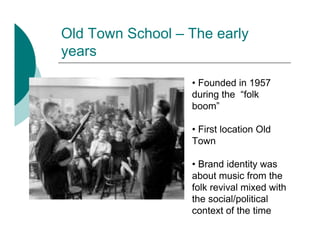
Old Town School – The early
years

                  • Founded in 1957
                  during the “folk
                  boom”

                  • First location Old
                  Town

                  • Brand identity was
                  about music from the
                  folk revival mixed with
                  the social/political
                  context of the time
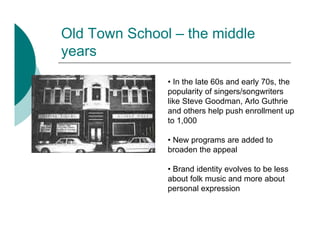
Old Town School – the middle
years
               • In the late 60s and early 70s, the
               popularity of singers/songwriters
               like Steve Goodman, Arlo Guthrie
               and others help push enrollment up
               to 1,000

               • New programs are added to
               broaden the appeal

               • Brand identity evolves to be less
               about folk music and more about
               personal expression
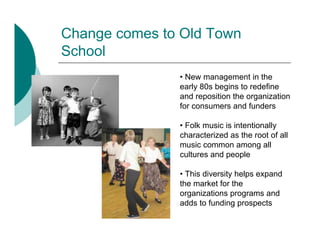
Change comes to Old Town
School
               • New management in the
               early 80s begins to redefine
               and reposition the organization
               for consumers and funders

               • Folk music is intentionally
               characterized as the root of all
               music common among all
               cultures and people

               • This diversity helps expand
               the market for the
               organizations programs and
               adds to funding prospects
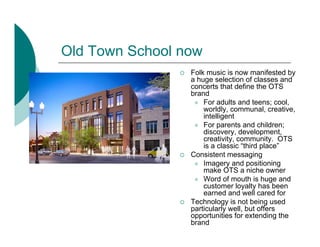
Old Town School now
                 Folk music is now manifested by
                 a huge selection of classes and
                 concerts that define the OTS
                 brand
                     For adults and teens; cool,
                     worldly, communal, creative,
                     intelligent
                     For parents and children;
                     discovery, development,
                     creativity, community. OTS
                     is a classic “third place”
                 Consistent messaging
                     Imagery and positioning
                     make OTS a niche owner
                     Word of mouth is huge and
                     customer loyalty has been
                     earned and well cared for
                 Technology is not being used
                 particularly well, but offers
                 opportunities for extending the
                 brand
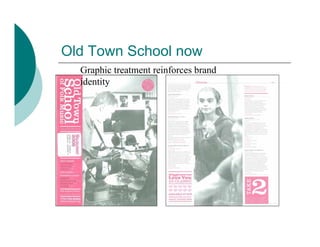
Old Town School now
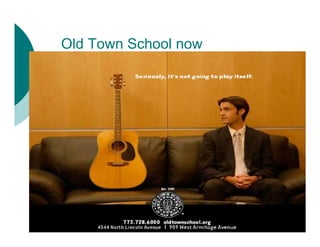
  Graphic treatment reinforces brand
  identity
Old Town School now


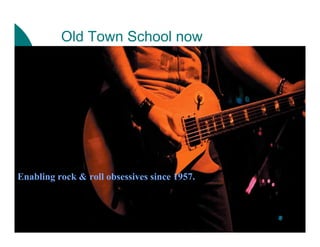
Enabling rock & roll obsessives since 1957.
Old Town School now
The Chicago Sinfonietta s story
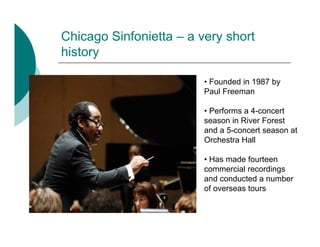
Chicago Sinfonietta – a very short
history

                         • Founded in 1987 by
                         Paul Freeman

                         • Performs a 4-concert
                         season in River Forest
                         and a 5-concert season at
                         Orchestra Hall

                         • Has made fourteen
                         commercial recordings
                         and conducted a number
                         of overseas tours

Are you talking to me?: Branding

  • 1.
    ARE YOU TALKING TOME? Session 1: Branding March 2010
  • 2.
    Welcome • Goals – Elements of marketing plan – Key concepts – First steps toward creating your own marketing plan – Q&A time, breakouts – Today: Branding Learning Circle 2010
  • 3.
    What is aBrand? You already know. Learning Circle 2010
  • 4.
    Branding Misconceptions • A brand is superficial • A brand is artificial • A brand is expensive - need Super Bowl campaign Learning Circle 2010
  • 5.
    Branding Misconceptions •Branding is -- –A logo –A tagline –An ad • You can dictate your brand • A brand is permanent Learning Circle 2010
  • 6.
    So…what is it? A brand is a promise of the experience your customers will receive. A strong brand consistently delivers on that promise. Learning Circle 2010
  • 7.
    In other words "What’s a brand? A singular idea or concept that you own inside the mind of the prospect.” – Al Ries, Ries & Ries “Customers must recognize that you stand for something.” – Howard Schultz, Starbucks "A brand is a living entity - and it is enriched or undermined cumulatively over time, the product of a thousand small gestures." – Michael Eisner, CEO Disney Learning Circle 2010
  • 8.
    Breakout • Meet n’Greet Learning Circle 2010
  • 9.
    Branding vs Marketing • Branding is the concept • Marketing is the process by which you create relationships with stakeholders Learning Circle 2010
  • 10.
    Why Does ItMatter? • Helps you stand out • Improves the perception of “worth” • Positions the organization as distinct and memorable in a positive way: easier to understand • Attracts and retains stakeholder loyalty and resources Learning Circle 2010
  • 11.
    Why Does ItMatter? Today’s consumers are -- • Faced with many leisure/entertainment options • Busier than ever • Not necessarily informed about what you do and its significance Learning Circle 2010
  • 12.
    Why Does ItMatter? Today’s consumers are -- • Skeptical • Used to being pursued • Expecting integrity/authenticity This is good news for you! Learning Circle 2010
  • 13.
    Result: Brandingmakes it easier -- and less costly -- to market your artistic product, because your message is uniform and consistent. Learning Circle 2010
  • 14.
    Signs of aStrong Brand • Offers a unique value proposition that makes you stand out from the competition. • Relevant to the needs of the consumer by satisfying both emotional and functional needs. Learning Circle 2010
  • 15.
    Signs of aStrong Brand • Is credible and accepted by audiences because of visible evidence of your ability to deliver on the promise. • Can evolve to meet the long- term needs of the organization. Learning Circle 2010
  • 16.
    Does Mission Statement =Brand Statement? No. It’s only the beginning. Learning Circle 2010
  • 17.
    Mission vs Brand • Mission – all about YOU • Branding/positioning – all about THEM Learning Circle 2010
  • 18.
    Defining Your Brand • What differentiates you? • Who are your stakeholders? • What do stakeholders value about your organization? • Who are your competitors? • What are competitors doing? • Why should someone come to your events, partner with you, fund you? • What does the research say? Learning Circle 2010
  • 19.
    Defining Your Brand • Engage customers and prospects • Engage the staff and board • Don’t forget the media - critics have perceptions, too • Be aware of competitors – what makes you different? • Look from the outside-in, but you are who you are Learning Circle 2010
  • 20.
    What Do Customers Think? • Who are they? Who could they be? • What are their wants, needs, desires, attitudes, interests, barriers, concerns, pressures? • How could you benefit them? Solve a problem? • What, if any, position or image do you conjure in their minds? Learning Circle 2010
  • 21.
    Why Attend? Examples ofBenefits • Social activity • Intellectual stimulation • Cultural information - “what’s going on” • Being moved - laugh, cry, be shocked, amazed • Being entertained (whatever that means) • Admire skilled performers • Sensory pleasures • Experience something new Learning Circle 2010
  • 22.
    What Do Customers Think? • How do you know? • How do you find out? Learning Circle 2010
  • 23.
    How Do YouKnow? • Customer surveys – Quantitative (numerical) results • Customer focus groups or phone interviews – Qualitative (verbal) results • Other research sources Learning Circle 2010
  • 24.
    Case Study Jim Hirsch Executive Director Chicago Sinfonietta Learning Circle 2010
  • 25.
    Two Branding CaseStudies The Old Town School of Folk Music & The Chicago Sinfonietta
  • 26.
  • 27.
    Old Town School– The early years • Founded in 1957 during the “folk boom” • First location Old Town • Brand identity was about music from the folk revival mixed with the social/political context of the time
  • 28.
    Old Town School– the middle years • In the late 60s and early 70s, the popularity of singers/songwriters like Steve Goodman, Arlo Guthrie and others help push enrollment up to 1,000 • New programs are added to broaden the appeal • Brand identity evolves to be less about folk music and more about personal expression
  • 29.
    Change comes toOld Town School • New management in the early 80s begins to redefine and reposition the organization for consumers and funders • Folk music is intentionally characterized as the root of all music common among all cultures and people • This diversity helps expand the market for the organizations programs and adds to funding prospects
  • 30.
    Old Town Schoolnow Folk music is now manifested by a huge selection of classes and concerts that define the OTS brand For adults and teens; cool, worldly, communal, creative, intelligent For parents and children; discovery, development, creativity, community. OTS is a classic “third place” Consistent messaging Imagery and positioning make OTS a niche owner Word of mouth is huge and customer loyalty has been earned and well cared for Technology is not being used particularly well, but offers opportunities for extending the brand
  • 31.
    Old Town Schoolnow Graphic treatment reinforces brand identity
  • 32.
    Old Town Schoolnow Enabling rock & roll obsessives since 1957.
  • 33.
  • 34.
  • 35.
    Chicago Sinfonietta –a very short history • Founded in 1987 by Paul Freeman • Performs a 4-concert season in River Forest and a 5-concert season at Orchestra Hall • Has made fourteen commercial recordings and conducted a number of overseas tours