Engaging Audiences through
Effective Collaboration
Session One: October 26
Kelley Lavin
The Lavin Group
klavin@comcast.net
The Arts Engagement Exchange (AEE) is an initiative of the
Chicago Community Trust and the Chicago Department of
Cultural Affairs supported by the Wallace Foundation.
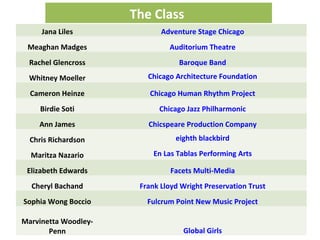
Jana Liles Adventure Stage Chicago
Meaghan Madges Auditorium Theatre
Rachel Glencross Baroque Band
Whitney Moeller Chicago Architecture Foundation
Cameron Heinze Chicago Human Rhythm Project
Birdie Soti Chicago Jazz Philharmonic
Ann James Chicspeare Production Company
Chris Richardson eighth blackbird
Maritza Nazario En Las Tablas Performing Arts
Elizabeth Edwards Facets Multi-Media
Cheryl Bachand Frank Lloyd Wright Preservation Trust
Sophia Wong Boccio Fulcrum Point New Music Project
Marvinetta Woodley-
Penn Global Girls
The Class
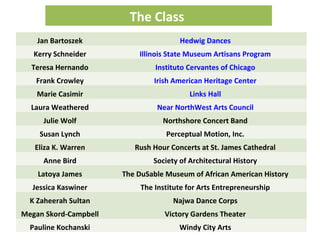
Jan Bartoszek Hedwig Dances
Kerry Schneider Illinois State Museum Artisans Program
Teresa Hernando Instituto Cervantes of Chicago
Frank Crowley Irish American Heritage Center
Marie Casimir Links Hall
Laura Weathered Near NorthWest Arts Council
Julie Wolf Northshore Concert Band
Susan Lynch Perceptual Motion, Inc.
Eliza K. Warren Rush Hour Concerts at St. James Cathedral
Anne Bird Society of Architectural History
Latoya James The DuSable Museum of African American History
Jessica Kaswiner The Institute for Arts Entrepreneurship
K Zaheerah Sultan Najwa Dance Corps
Megan Skord-Campbell Victory Gardens Theater
Pauline Kochanski Windy City Arts
The Class
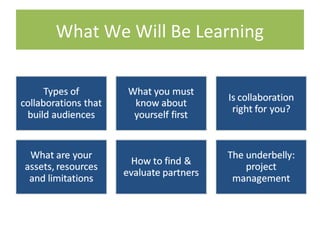
What We Will Be Learning
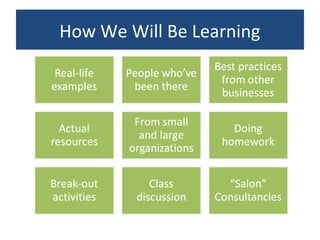
How We Will Be Learning
What is a collaboration?
• Working towards common goal or working
towards goals that are compatible with each
partner
• Greater strength in numbers
• Sharing skills
• Synergy
What is a collaboration?
• Joining forces with a partner to create a
solution to a problem that neither could
achieve on their own
• Leveraging resources by allying themselves
with organizations to carry out a common
mission
What is a strategic collaboration?
Distinct from short term, project-
oriented sponsorships, strategic
collaborations are intensive,
durable commitments created for
mutual gain; they require
significant investment by all parties
of time and energy.
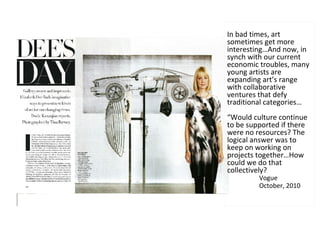
In bad times, art
sometimes get more
interesting…And now, in
synch with our current
economic troubles, many
young artists are
expanding art’s range
with collaborative
ventures that defy
traditional categories…
“Would culture continue
to be supported if there
were no resources? The
logical answer was to
keep on working on
projects together…How
could we do that
collectively?
Vogue
October, 2010
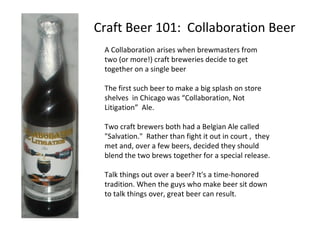
Craft Beer 101: Collaboration Beer
A Collaboration arises when brewmasters from
two (or more!) craft breweries decide to get
together on a single beer
The first such beer to make a big splash on store
shelves in Chicago was “Collaboration, Not
Litigation” Ale.
Two craft brewers both had a Belgian Ale called
"Salvation." Rather than fight it out in court , they
met and, over a few beers, decided they should
blend the two brews together for a special release.
Talk things out over a beer? It's a time-honored
tradition. When the guys who make beer sit down
to talk things over, great beer can result.
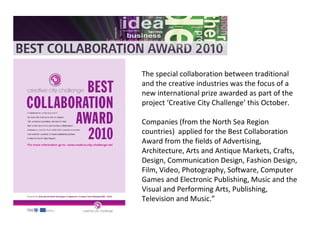
The special collaboration between traditional
and the creative industries was the focus of a
new international prize awarded as part of the
project ‘Creative City Challenge’ this October.
Companies (from the North Sea Region
countries) applied for the Best Collaboration
Award from the fields of Advertising,
Architecture, Arts and Antique Markets, Crafts,
Design, Communication Design, Fashion Design,
Film, Video, Photography, Software, Computer
Games and Electronic Publishing, Music and the
Visual and Performing Arts, Publishing,
Television and Music.”
What are some actual examples of arts
collaborations you’re aware of?
Such as these:
• Between like or cross discipline arts organization with the same or different
audiences
• Educational
• Non-profits other than arts-related groups
• Corporate and small business
• Neighborhood/community organizations
• Global or national
Class Contribution:
• White House, chefs from the country and public schools promoting healthy eating
• -HUD and NEA proposal
• -Puerto Rican Arts Center and local arts organizations and businesses
• -Chicago Reader and Chicago Architecture Foundation
• -Government municipalities and local organizations
Why did these groups collaborate?
• What problem(s) were they trying to solve?
• Were they responding to an opportunity
within their company?
• Did they have a plan, policy, mandate or grant
that needed to be implemented?
• Did they want to better utilize or capitalize on
a resource they have?
What factor would motivate your
company to collaborate?
• What problem(s) are you trying to solve?
• What opportunity within your company?
• Do you have a plan, policy, mandate or grant
that needed to be implemented?
• Do you want to better utilize or capitalize on a
unique resource?

Engaging Audiences through Effective Collaboration, Presentation: October 26

  • 1.
    Engaging Audiences through EffectiveCollaboration Session One: October 26 Kelley Lavin The Lavin Group klavin@comcast.net The Arts Engagement Exchange (AEE) is an initiative of the Chicago Community Trust and the Chicago Department of Cultural Affairs supported by the Wallace Foundation.
  • 2.
    Jana Liles AdventureStage Chicago Meaghan Madges Auditorium Theatre Rachel Glencross Baroque Band Whitney Moeller Chicago Architecture Foundation Cameron Heinze Chicago Human Rhythm Project Birdie Soti Chicago Jazz Philharmonic Ann James Chicspeare Production Company Chris Richardson eighth blackbird Maritza Nazario En Las Tablas Performing Arts Elizabeth Edwards Facets Multi-Media Cheryl Bachand Frank Lloyd Wright Preservation Trust Sophia Wong Boccio Fulcrum Point New Music Project Marvinetta Woodley- Penn Global Girls The Class
  • 3.
    Jan Bartoszek HedwigDances Kerry Schneider Illinois State Museum Artisans Program Teresa Hernando Instituto Cervantes of Chicago Frank Crowley Irish American Heritage Center Marie Casimir Links Hall Laura Weathered Near NorthWest Arts Council Julie Wolf Northshore Concert Band Susan Lynch Perceptual Motion, Inc. Eliza K. Warren Rush Hour Concerts at St. James Cathedral Anne Bird Society of Architectural History Latoya James The DuSable Museum of African American History Jessica Kaswiner The Institute for Arts Entrepreneurship K Zaheerah Sultan Najwa Dance Corps Megan Skord-Campbell Victory Gardens Theater Pauline Kochanski Windy City Arts The Class
  • 4.
    What We WillBe Learning
  • 5.
    How We WillBe Learning
  • 6.
    What is acollaboration? • Working towards common goal or working towards goals that are compatible with each partner • Greater strength in numbers • Sharing skills • Synergy
  • 7.
    What is acollaboration? • Joining forces with a partner to create a solution to a problem that neither could achieve on their own • Leveraging resources by allying themselves with organizations to carry out a common mission
  • 8.
    What is astrategic collaboration? Distinct from short term, project- oriented sponsorships, strategic collaborations are intensive, durable commitments created for mutual gain; they require significant investment by all parties of time and energy.
  • 9.
    In bad times,art sometimes get more interesting…And now, in synch with our current economic troubles, many young artists are expanding art’s range with collaborative ventures that defy traditional categories… “Would culture continue to be supported if there were no resources? The logical answer was to keep on working on projects together…How could we do that collectively? Vogue October, 2010
  • 10.
    Craft Beer 101:Collaboration Beer A Collaboration arises when brewmasters from two (or more!) craft breweries decide to get together on a single beer The first such beer to make a big splash on store shelves in Chicago was “Collaboration, Not Litigation” Ale. Two craft brewers both had a Belgian Ale called "Salvation." Rather than fight it out in court , they met and, over a few beers, decided they should blend the two brews together for a special release. Talk things out over a beer? It's a time-honored tradition. When the guys who make beer sit down to talk things over, great beer can result.
  • 11.
    The special collaborationbetween traditional and the creative industries was the focus of a new international prize awarded as part of the project ‘Creative City Challenge’ this October. Companies (from the North Sea Region countries) applied for the Best Collaboration Award from the fields of Advertising, Architecture, Arts and Antique Markets, Crafts, Design, Communication Design, Fashion Design, Film, Video, Photography, Software, Computer Games and Electronic Publishing, Music and the Visual and Performing Arts, Publishing, Television and Music.”
  • 12.
    What are someactual examples of arts collaborations you’re aware of? Such as these: • Between like or cross discipline arts organization with the same or different audiences • Educational • Non-profits other than arts-related groups • Corporate and small business • Neighborhood/community organizations • Global or national Class Contribution: • White House, chefs from the country and public schools promoting healthy eating • -HUD and NEA proposal • -Puerto Rican Arts Center and local arts organizations and businesses • -Chicago Reader and Chicago Architecture Foundation • -Government municipalities and local organizations
  • 13.
    Why did thesegroups collaborate? • What problem(s) were they trying to solve? • Were they responding to an opportunity within their company? • Did they have a plan, policy, mandate or grant that needed to be implemented? • Did they want to better utilize or capitalize on a resource they have?
  • 14.
    What factor wouldmotivate your company to collaborate? • What problem(s) are you trying to solve? • What opportunity within your company? • Do you have a plan, policy, mandate or grant that needed to be implemented? • Do you want to better utilize or capitalize on a unique resource?

Editor's Notes

  • #7 What is a collaboration? Host gets answers from the audience (25pp)  ON EASEL A collaboration is all those things and more, in fact the definition of collaboration still being addended according to Miriam Webster as it is a DYNAMIC word! Collaboration is simply working together, alliances, associations,, in concert, fraternization, joint effort, participation, partnership, and teamwork.   Not just “friends with benefits”  but real relationships that will increase audience base and further our companies artistic outreach. Joining forces with a partner to create a solution to a problem that neither partner could achieve on their own Leveraging resources by allying themselves with organizations to carry out a common mission
  • #8 What is a collaboration? Host gets answers from the audience (25pp)  ON EASEL A collaboration is all those things and more, in fact the definition of collaboration still being addended according to Miriam Webster as it is a DYNAMIC word! Collaboration is simply working together, alliances, associations,, in concert, fraternization, joint effort, participation, partnership, and teamwork.   Not just “friends with benefits”  but real relationships that will increase audience base and further our companies artistic outreach. Joining forces with a partner to create a solution to a problem that neither partner could achieve on their own Leveraging resources by allying themselves with organizations to carry out a common mission
  • #10 Here are a couple I just saw. Here’s one from the most recent issue of Vogue. Elizabeth Dee was the catalyst of last year’s X initiative in NY, an eye opening example of what can be done in a short time, with practically no money, to show a lot of cutting-edge art and create a community around it. She persuaded the owner of a four story industrial building that have been vacant since the DIA art foundation moved out in 2004 to let her have it for one year rentr free as an exhibtion space and put together a board and a program of more than 50 events-town hall meetings, performances, panel discussions, all free and open to the public. By the end of the year, more than 75,000 people had come.
  • #11 I just had to put this in. When looking for collaborations in Chicago, this article came up. Collaborations: birds do it, bees do it, even beer breweries do it. Apparently there is a category of collaborative beer making-which is exactly like it says here: when two craft breweries decide to get together on a single beer. This one “Collaboration Not Litigation” Beer came about when two different brewers named their beers “Salvation” Rather than fighting it out in court, the decided to blend the two together for a special release. The first appeared in 2007 and there have been three releases since. The Open Source movement has hit the brewing circuit. Flying Dog Ales formed the Open Source Beer project to collaborate with several homebrewers and beer fans on a committee on a recipe. Truly a beer brewed by committee. And finally, Reunion-A Beer for Hope is an annual series of beers, a diffferent style each time, sold as a fundraiser for bone cancer research. The first year Pete’s Wicked got back together to brew the first release. Following years, beers were collaborations of several breweries, all using their distribution sources to raiser more money. Three great collaboratiave ideas to learn from: resulting in great public relations, increased sales and distribution with totally new products.
  • #12 Perhaps Chicago needs to include an award like this?
  • #13 (Get answers from the audience put on easel) Here I brought three but we need more-small, large, any size   CorporateHP Arts Services, GE Council for Humanities, Arts Administration, Film Commission, Ford Motor Company Arts Council, Unions, Charitable Org.   Civic Transit, Museums, Parks, Public Installations, Sanitation, City Festivals, Art Schools ,Libraries, Historical Societies, Recreation Department, Hospitals/Health Centers   Peer Other like theater companies with different audience, cross disciplinary artists, arts clubs, private interest groups specializing in theater content,   Community Restaurants, local specialty stores, schools, Ethnic neighborhood groups, Community Boards, local festivals, bars, clubs, local fundraising efforts, Charities, Churches    
  • #14 Let’s go back to the examples you just gave and see if we can figure out what motivated these groups to collaborate. What problems were they trying to solve? Lack of core audience Losing core audience Lack of funds Lack of space Lack of specific skill set Lack of resources (other than money) Lack of exposure to target audience Lack of “credibility” with target audience Lack of technology Lack of “connected” board members Opportunity New and/or Expanded Space Diversity in Cast New Creative /Program/Curatorial Direction New Players/Staff New Skill Sets New Funding New Resources (other than money) New/Change of Brand New Technology Resource Programming Facilities Personnel (box office, back office, etc) Marketing/PR Niche Skill Sets Community Connections Communications Technology/Web
  • #15 Let’s go back to the examples you just gave and see if we can figure out what motivated these groups to collaborate. What problems were they trying to solve? Lack of core audience Losing core audience Lack of funds Lack of space Lack of specific skill set Lack of resources (other than money) Lack of exposure to target audience Lack of “credibility” with target audience Lack of technology Lack of “connected” board members Opportunity New and/or Expanded Space Diversity in Cast New Creative /Program/Curatorial Direction New Players/Staff New Skill Sets New Funding New Resources (other than money) New/Change of Brand New Technology Resource Programming Facilities Personnel (box office, back office, etc) Marketing/PR Niche Skill Sets Community Connections Communications Technology/Web