March 2010 ARE YOU TALKING  TO ME?  Session II:  Developing A Marketing Plan –  Analysis and Objectives
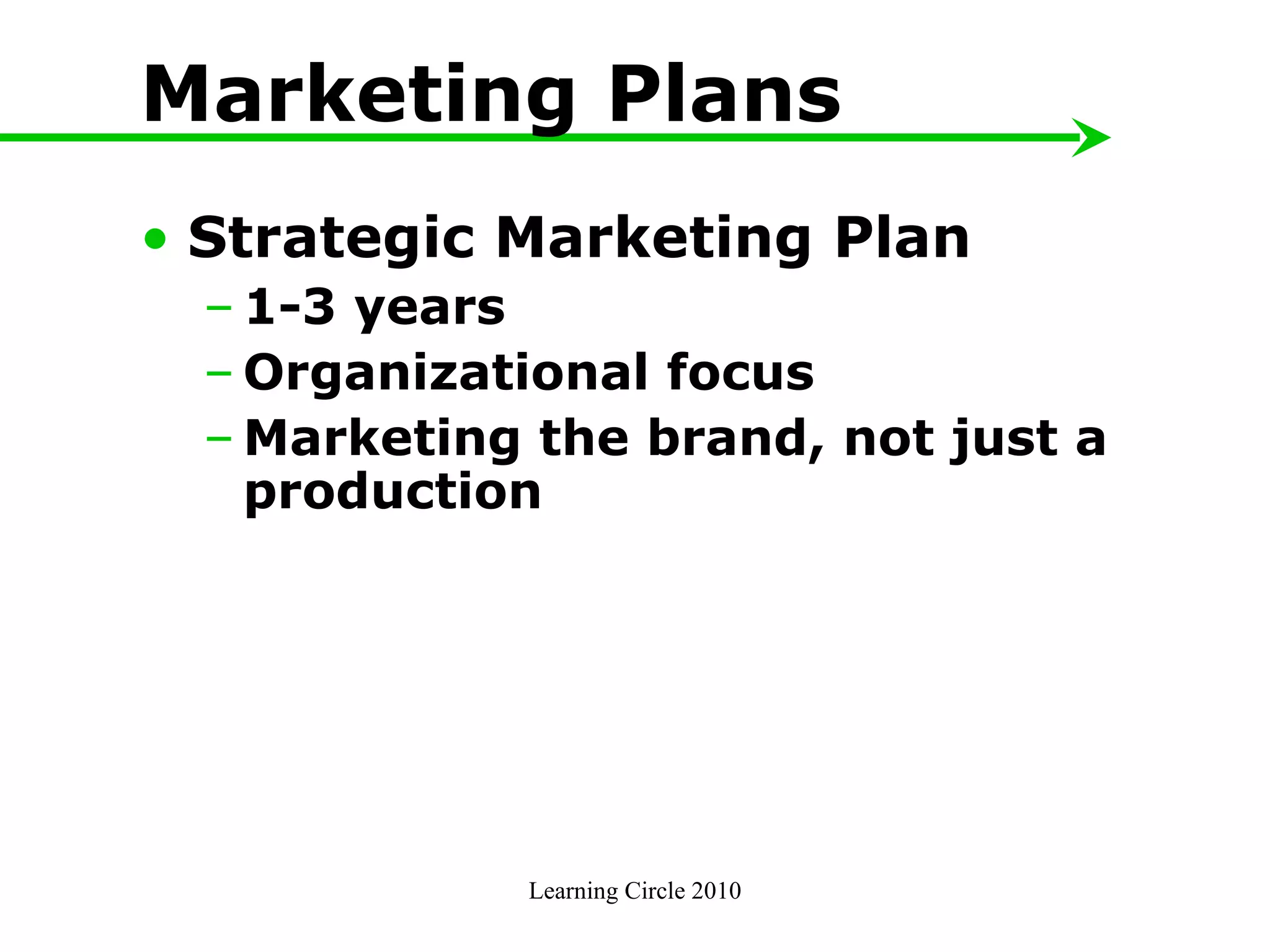
Marketing Plans Strategic Marketing Plan 1-3 years  Organizational focus Marketing the brand, not just a production Learning Circle 2010
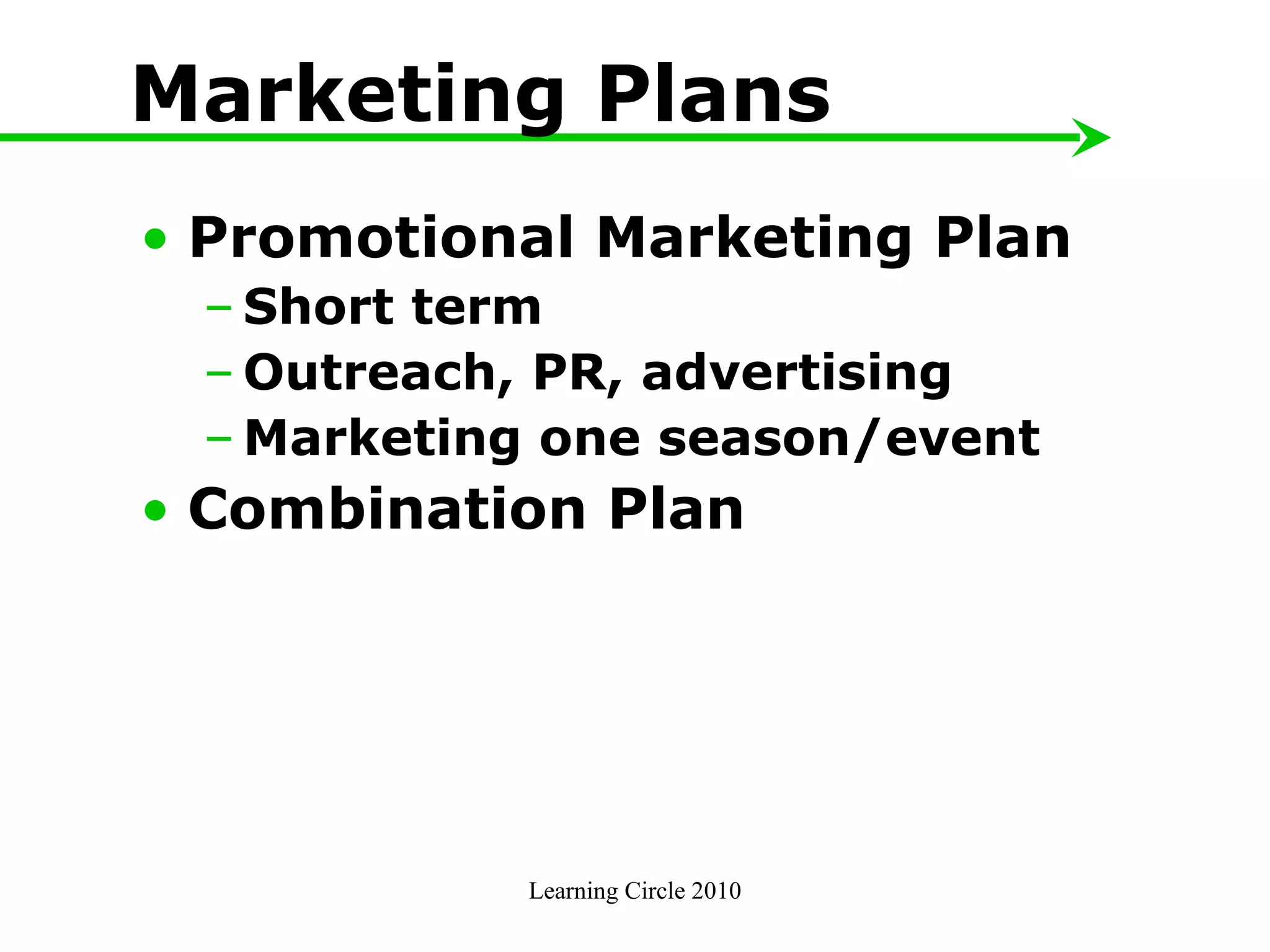
Marketing Plans Promotional Marketing Plan Short term Outreach, PR, advertising Marketing one season/event Combination Plan Learning Circle 2010
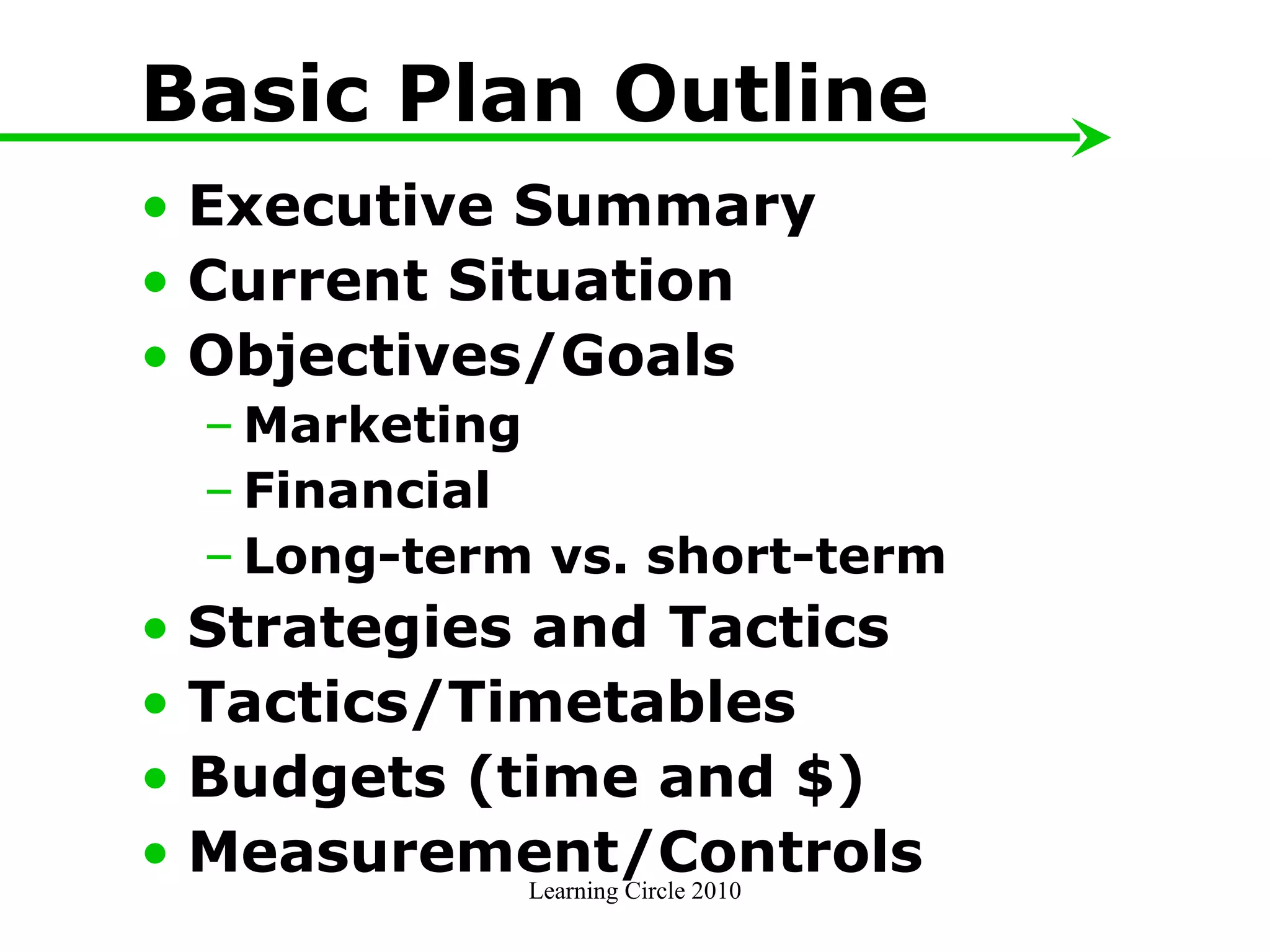
Basic Plan Outline Executive Summary Current Situation Objectives/Goals  Marketing  Financial Long-term vs. short-term Strategies and Tactics Tactics/Timetables  Budgets (time and $) Measurement/Controls Learning Circle 2010
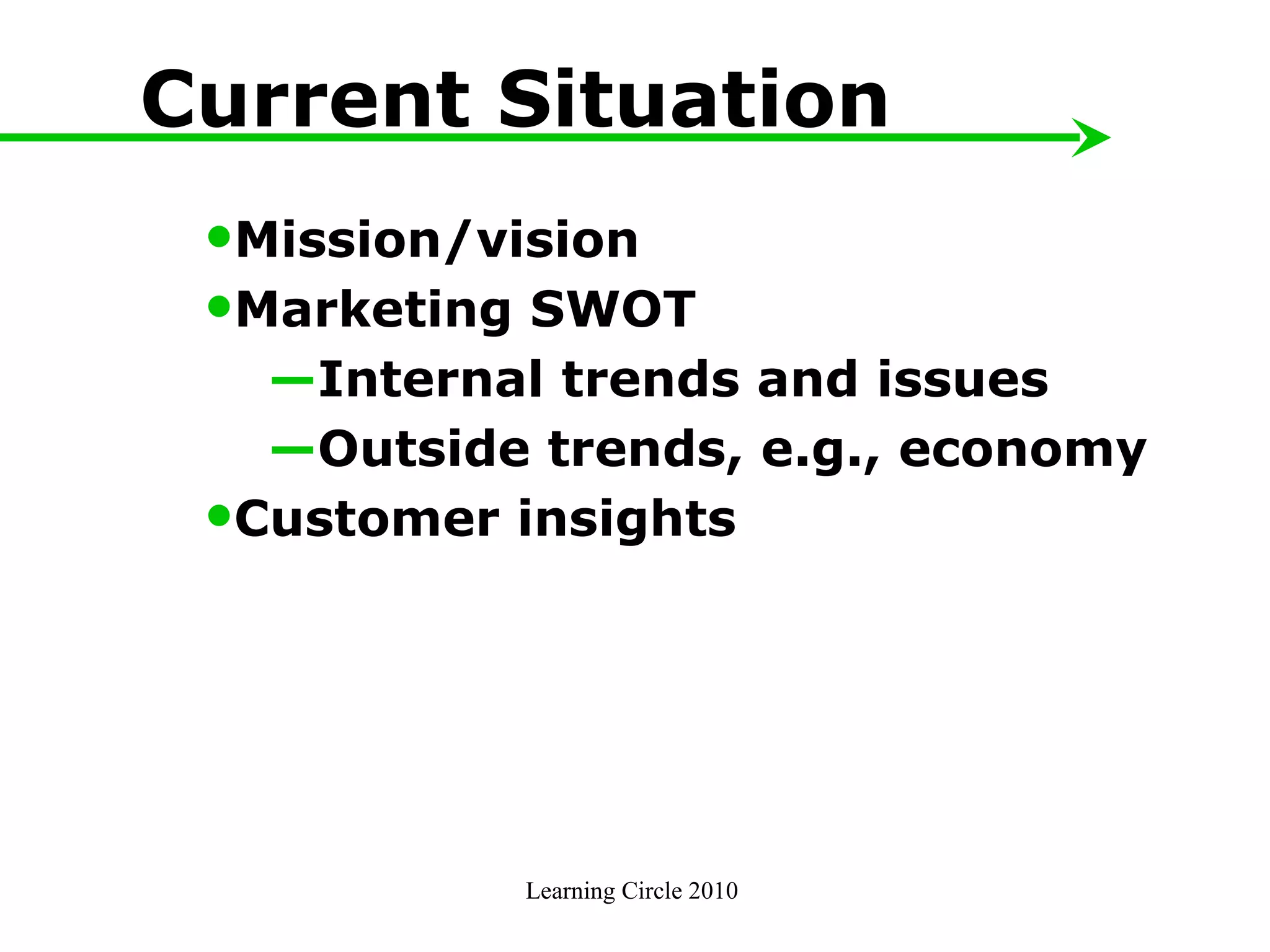
Learning Circle 2010  Current Situation Mission/vision  Marketing SWOT Internal trends and issues Outside trends, e.g., economy Customer insights
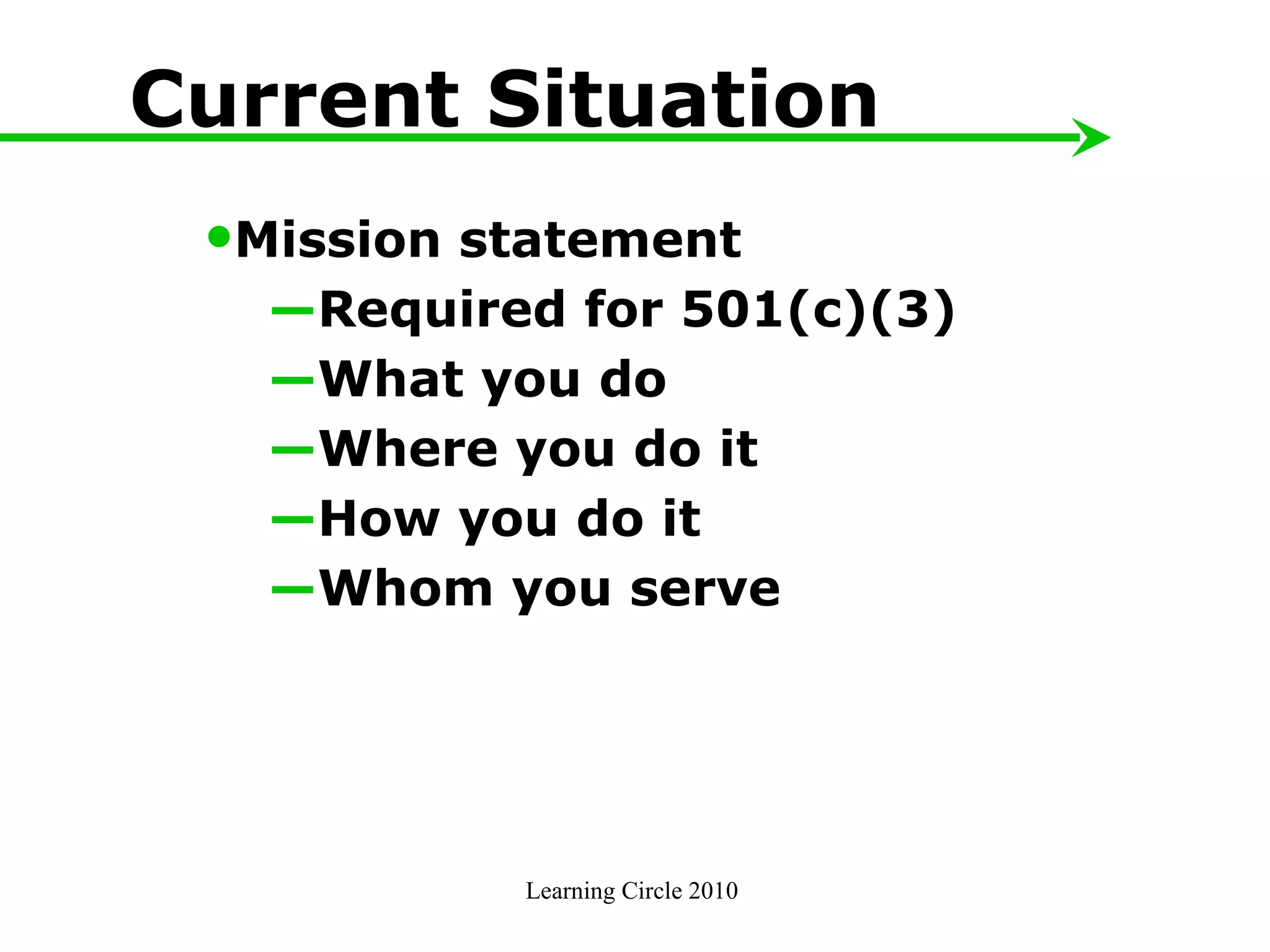
Learning Circle 2010  Current Situation Mission statement Required for 501(c)(3) What you do Where you do it How you do it Whom you serve
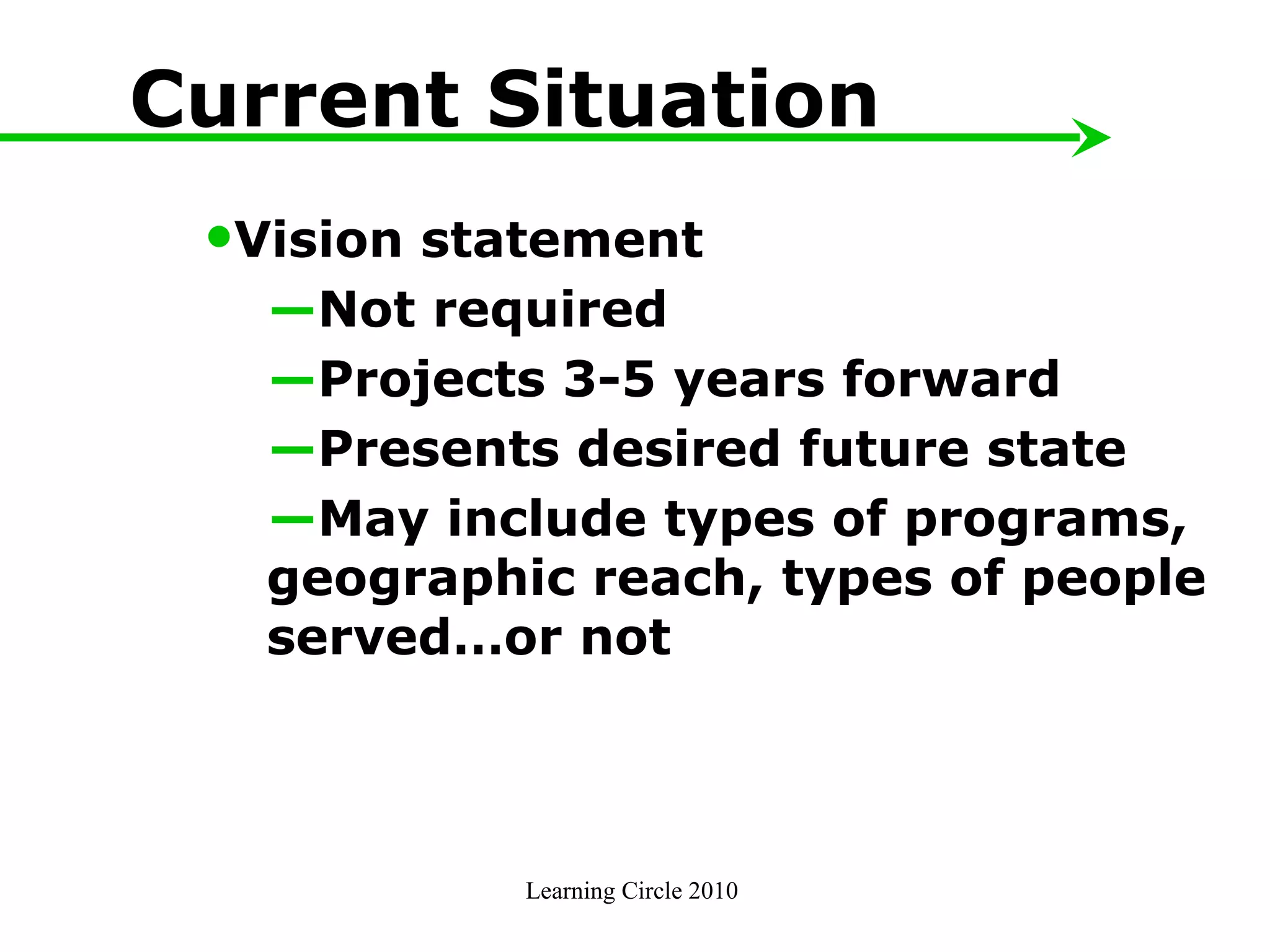
Learning Circle 2010  Current Situation Vision statement Not required Projects 3-5 years forward  Presents desired future state May include types of programs,  geographic reach, types of people  served…or not
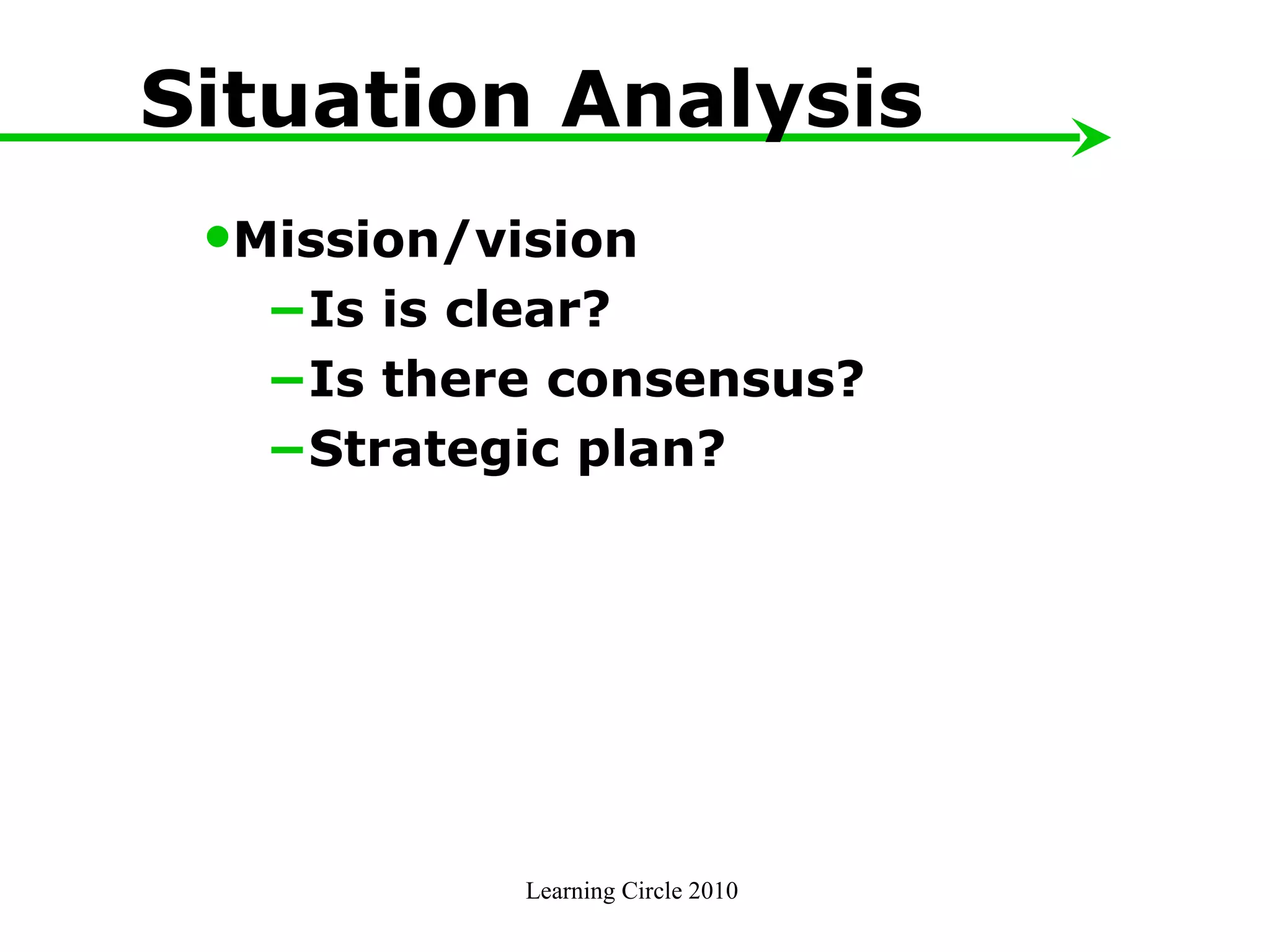
Learning Circle 2010  Situation Analysis Mission/vision − Is is clear? − Is there consensus? − Strategic plan?
Learning Circle 2010  Situation Analysis The SWOT  (Strengths, Opportunities, Weaknesses, Threats) Participation trends Internal trends and issues Marketing effectiveness Outside trends, e.g., economy The competition
The SWOT Purpose: To align  marketing strategy with  larger goals of the  organization  Overlaps with strategic planning Learning Circle 2010
The Competition Other groups like you  Other entertainment and leisure activities Life responsibilities, e.g., family care Snowbirds Learning Circle 2010
The Competition What are competitors’ strengths and weaknesses? What can you do better? How does your brand image compare (content and quality)?  Learning Circle 2010
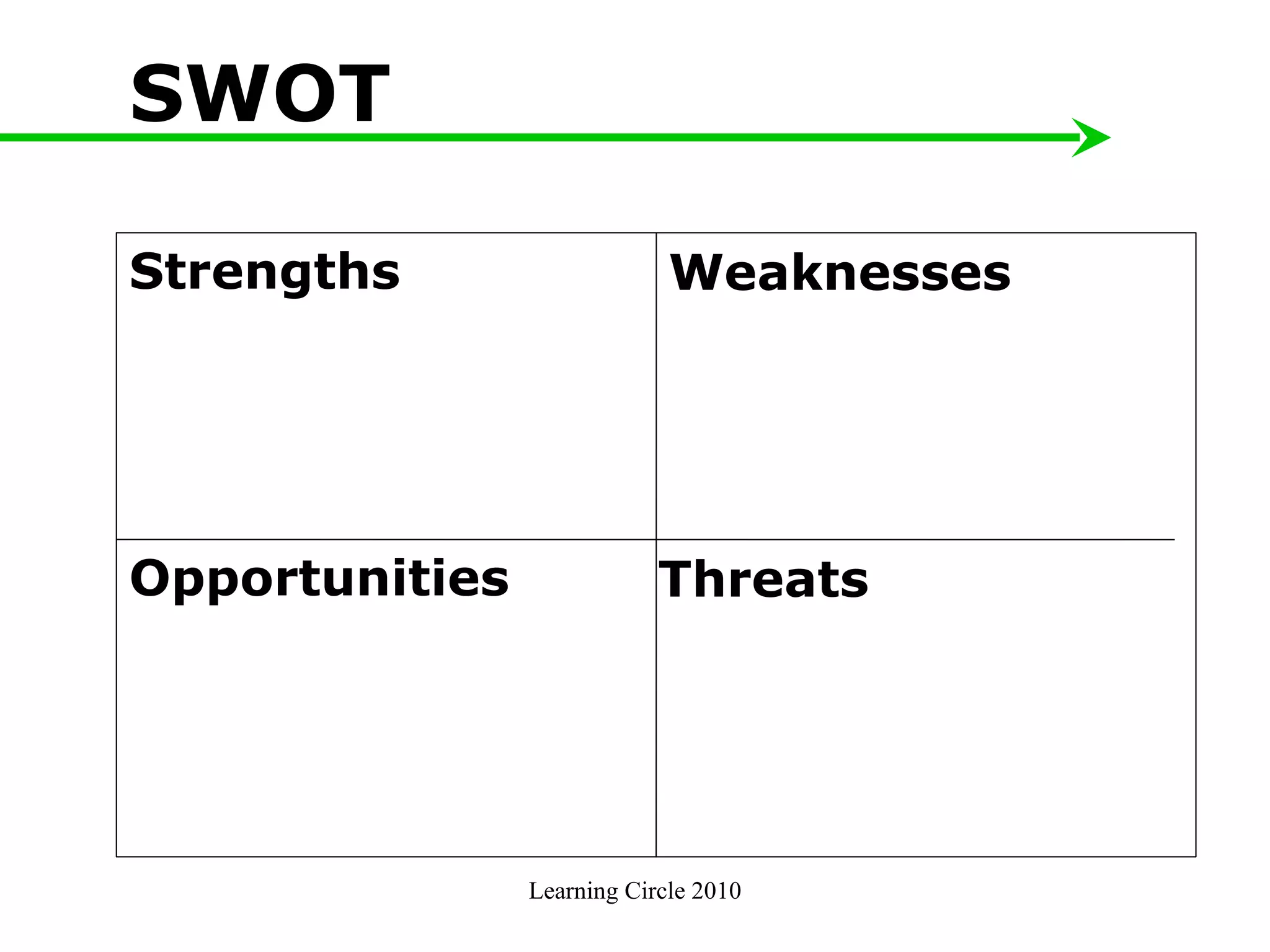
SWOT Learning Circle 2010 Strengths Weaknesses Opportunities Threats
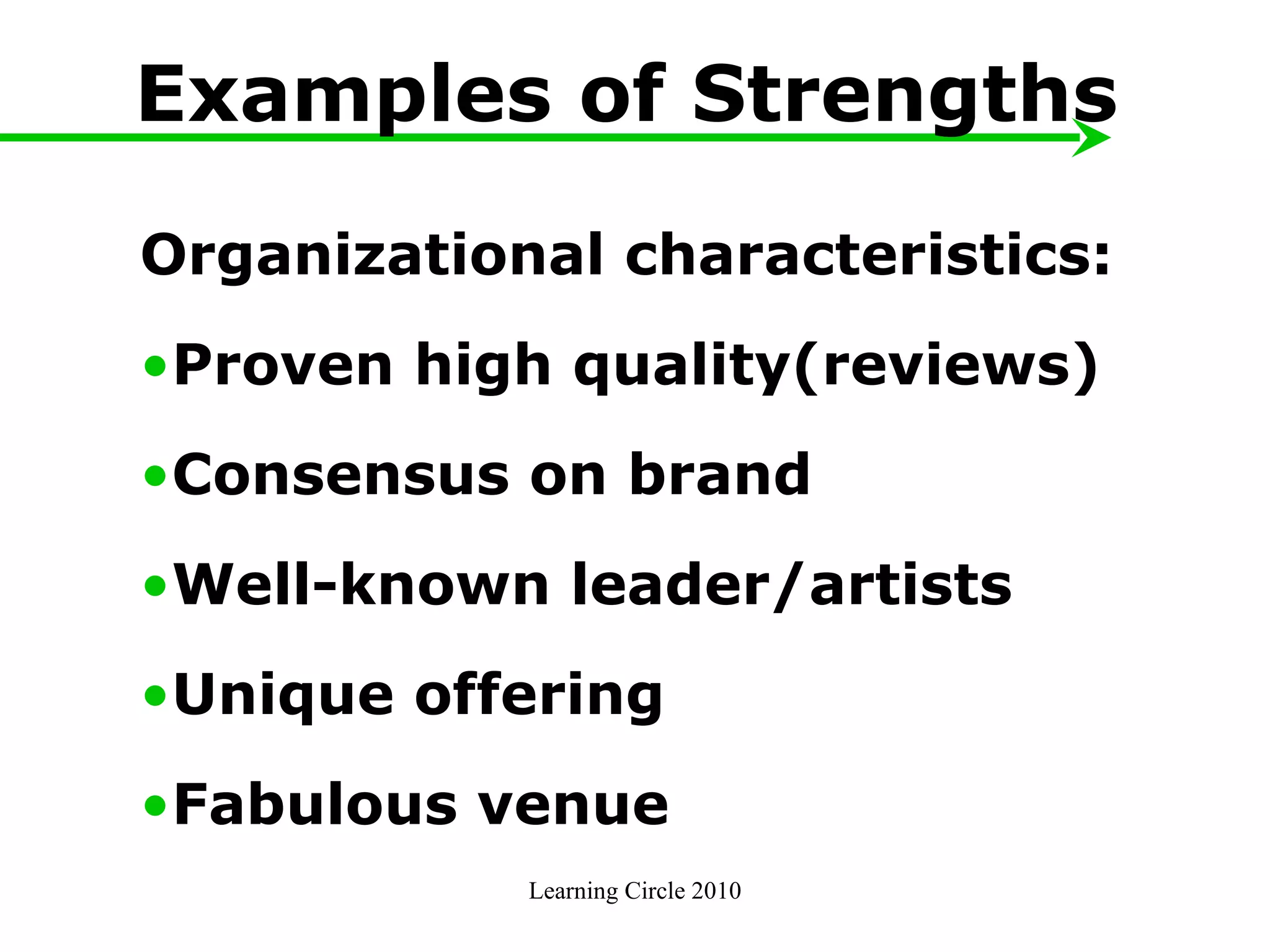
Examples of Strengths Organizational characteristics: Proven high quality(reviews) Consensus on brand  Well-known leader/artists Unique offering Fabulous venue Learning Circle 2010
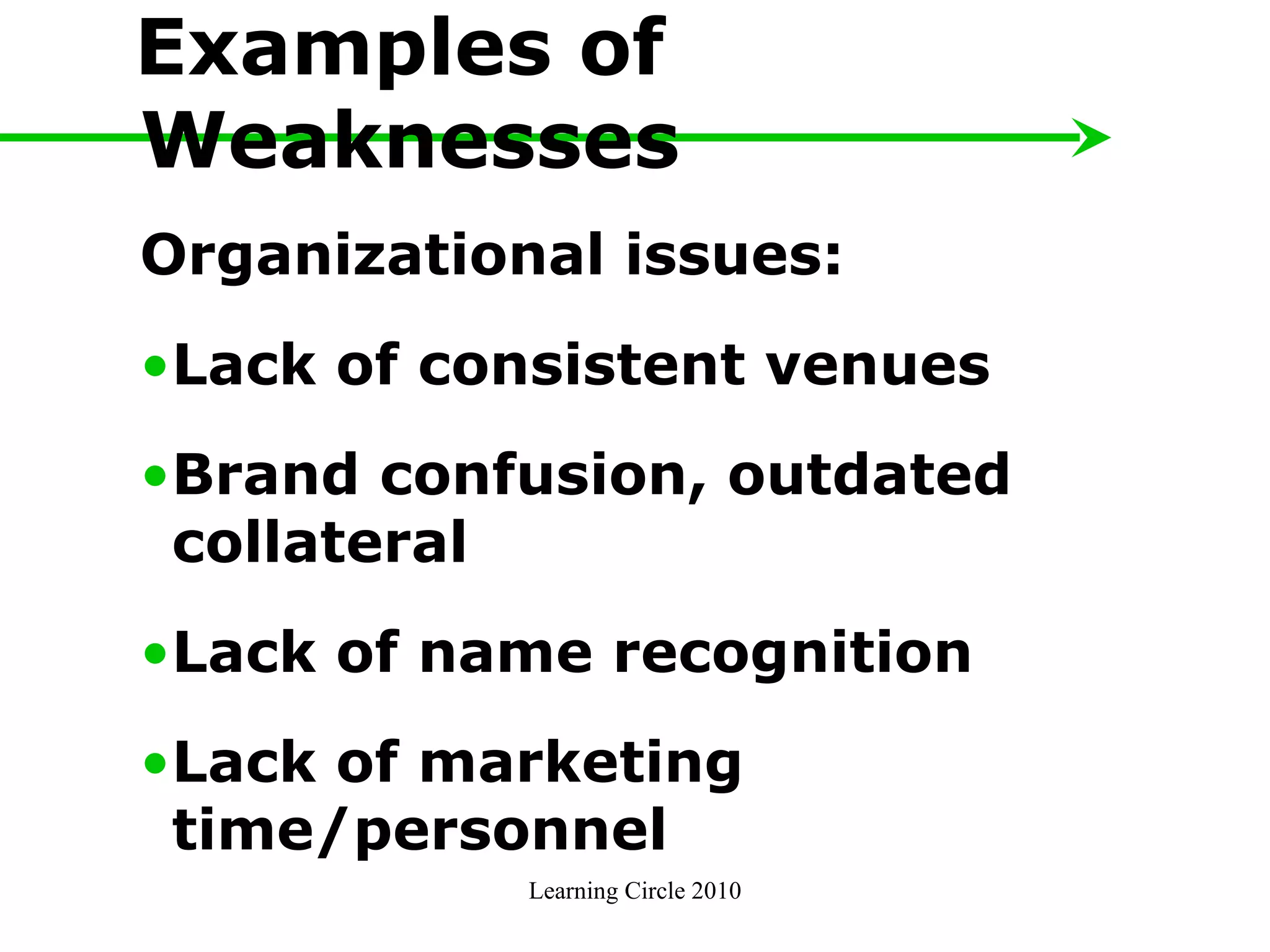
Examples of Weaknesses Organizational issues:  Lack of consistent venues Brand confusion, outdated collateral Lack of name recognition Lack of marketing time/personnel Learning Circle 2010
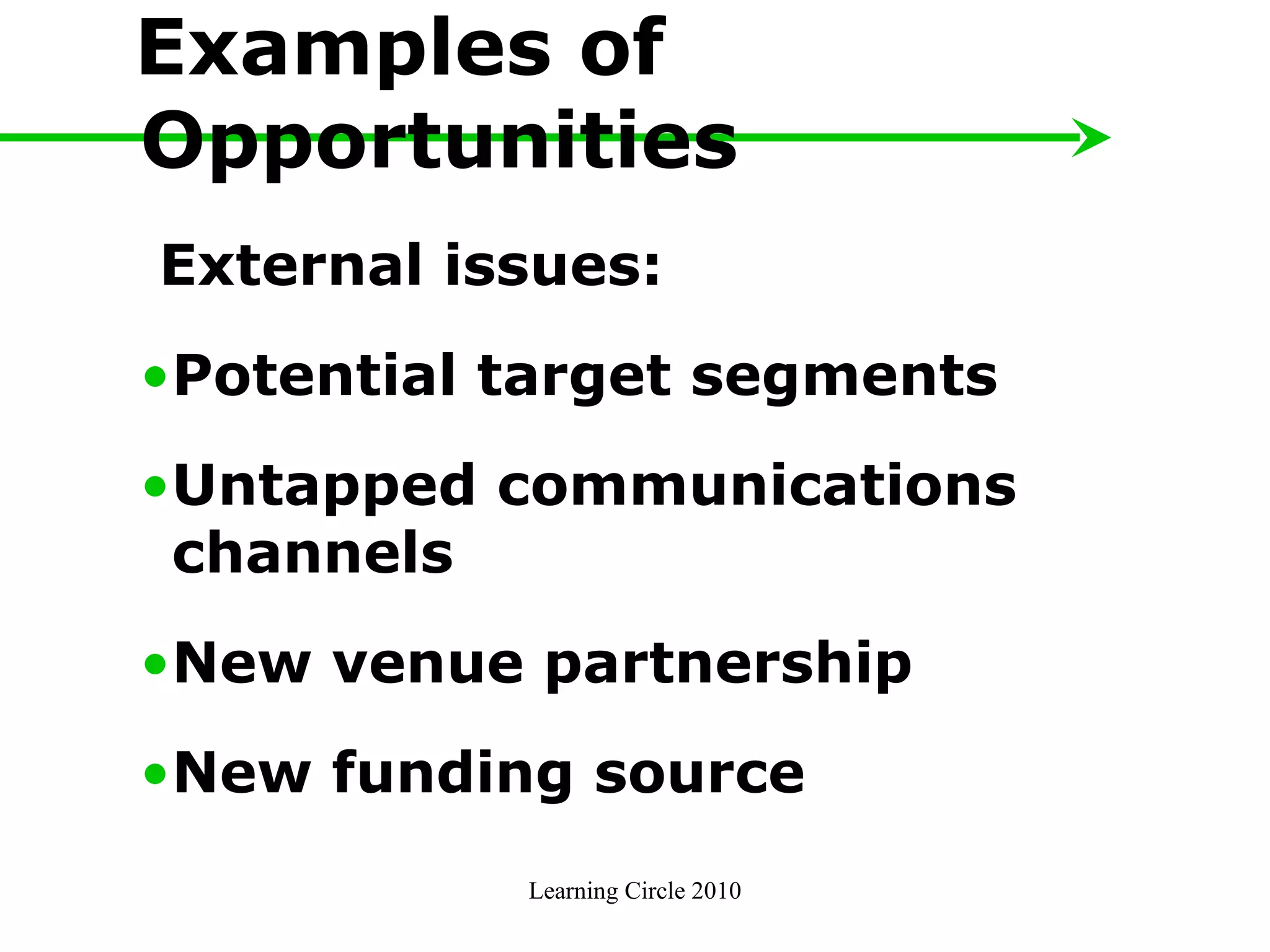
Examples of Opportunities External issues: Potential target segments Untapped communications channels  New venue partnership New funding source Learning Circle 2010
Examples of Threats External issues:  Venue change New competitor(s) Changing neighborhood  Shrinking review opportunities Learning Circle 2010
Group Exercise SWOT Learning Circle 2010
Learning Circle 2010  Customer Insights Who  are your stakeholders?  Who  could become your stakeholders?  What  do they need and want? How  do you reach them? Are you prepared to meet their needs  and wants?
Sources of Audience Information National/regional arts studies Internal database and records Audience surveys - stats Observation Informal interviews -  the “why” Focus groups - the “ why” Learning Circle 2010
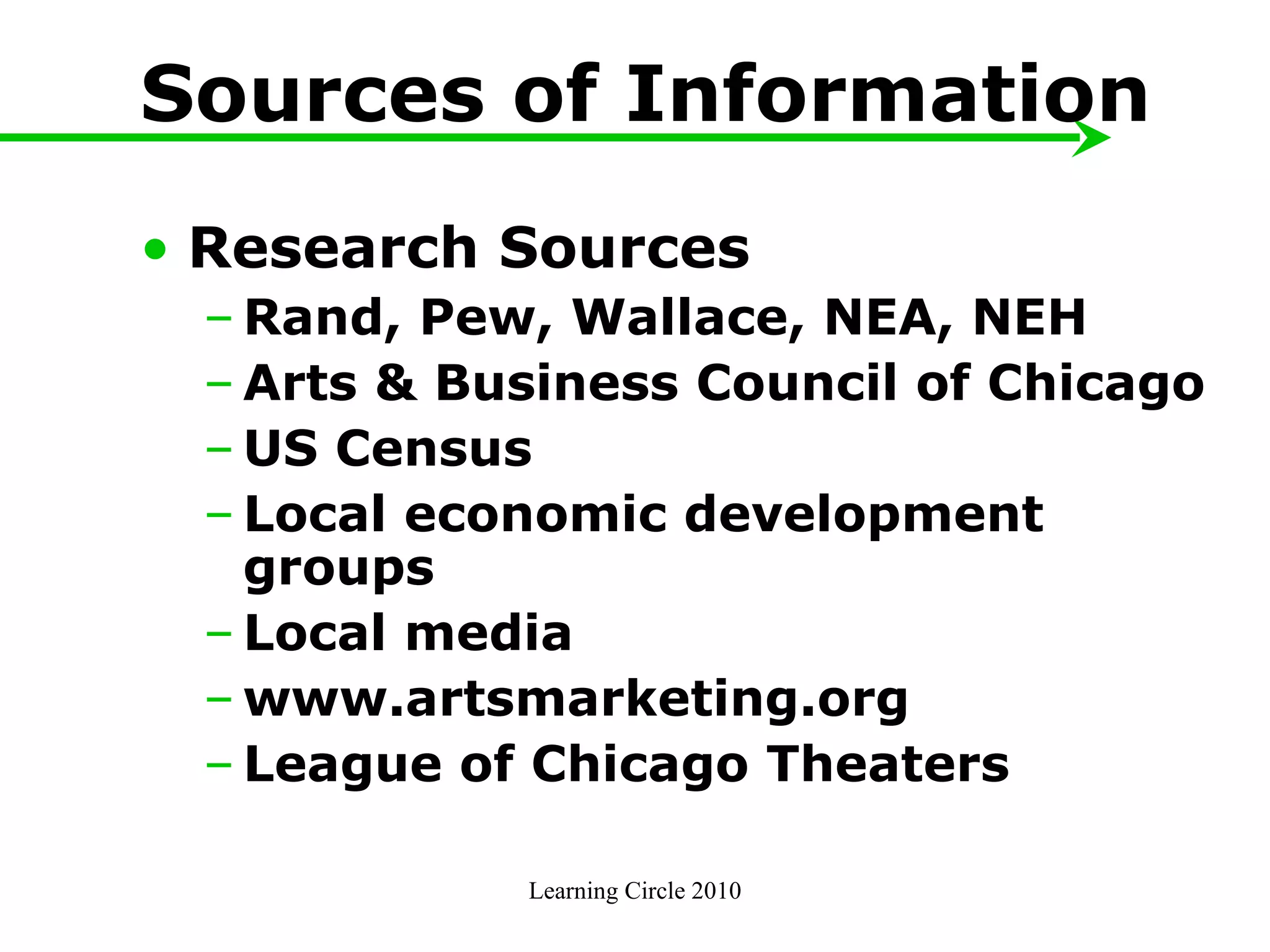
Sources of Information Research Sources Rand, Pew, Wallace, NEA, NEH Arts & Business Council of Chicago US Census Local economic development groups Local media www.artsmarketing.org League of Chicago Theaters Learning Circle 2010
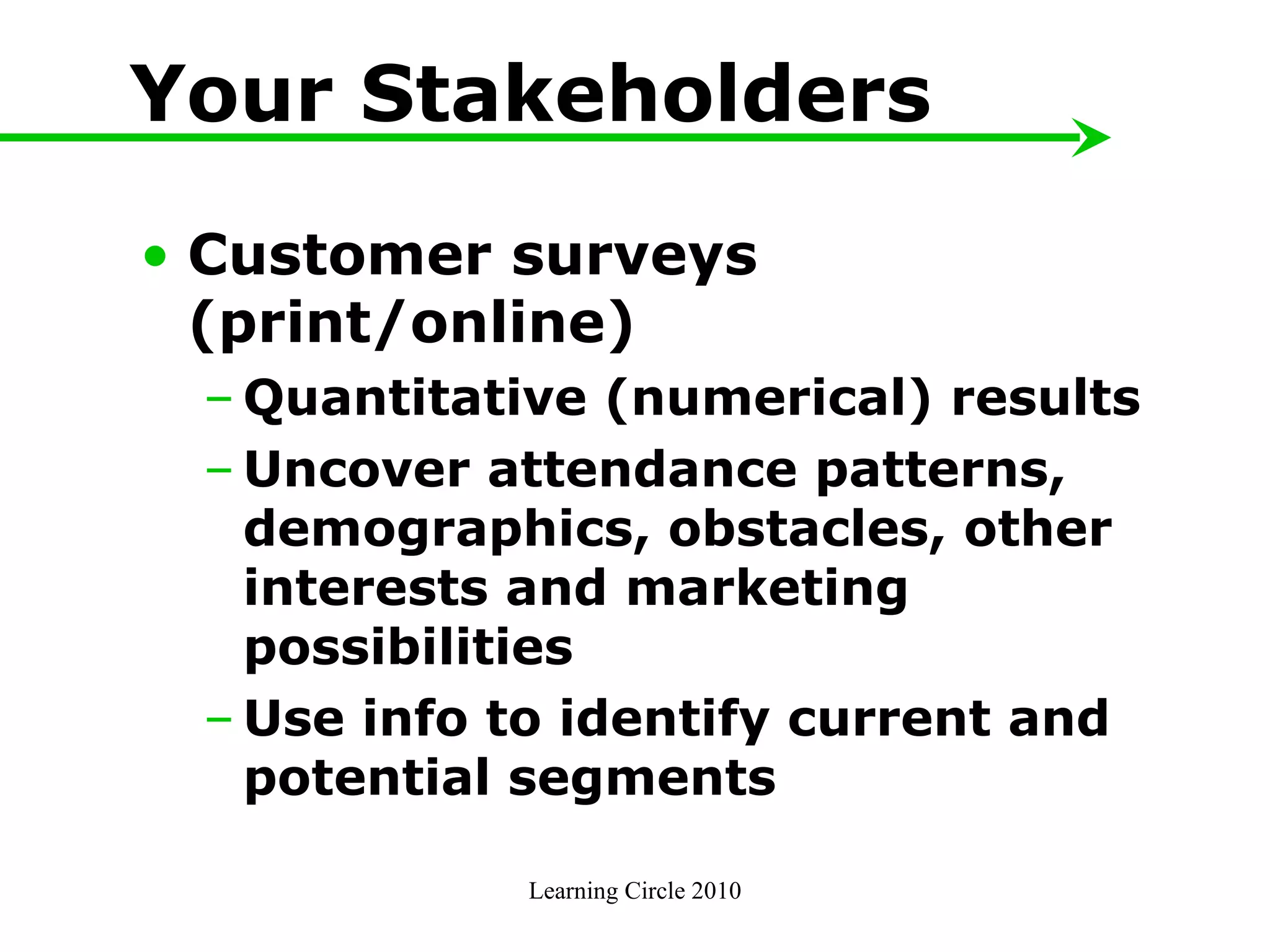
Your Stakeholders Customer surveys (print/online) Quantitative (numerical) results Uncover attendance patterns, demographics, obstacles, other interests and marketing possibilities Use info to identify current and potential segments  Learning Circle 2010
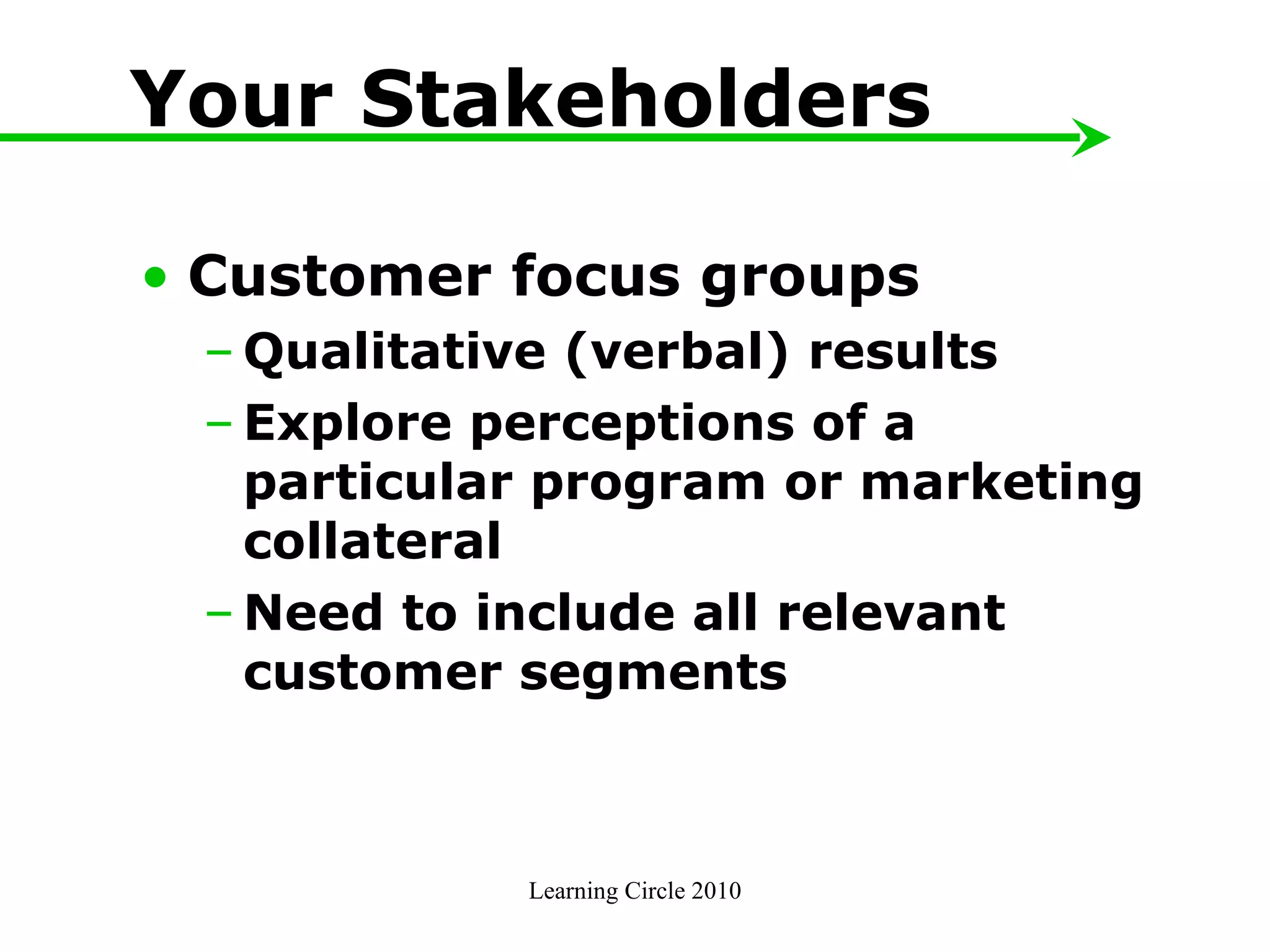
Your Stakeholders Customer focus groups Qualitative (verbal) results Explore perceptions of a particular program or marketing collateral Need to include all relevant customer segments  Learning Circle 2010
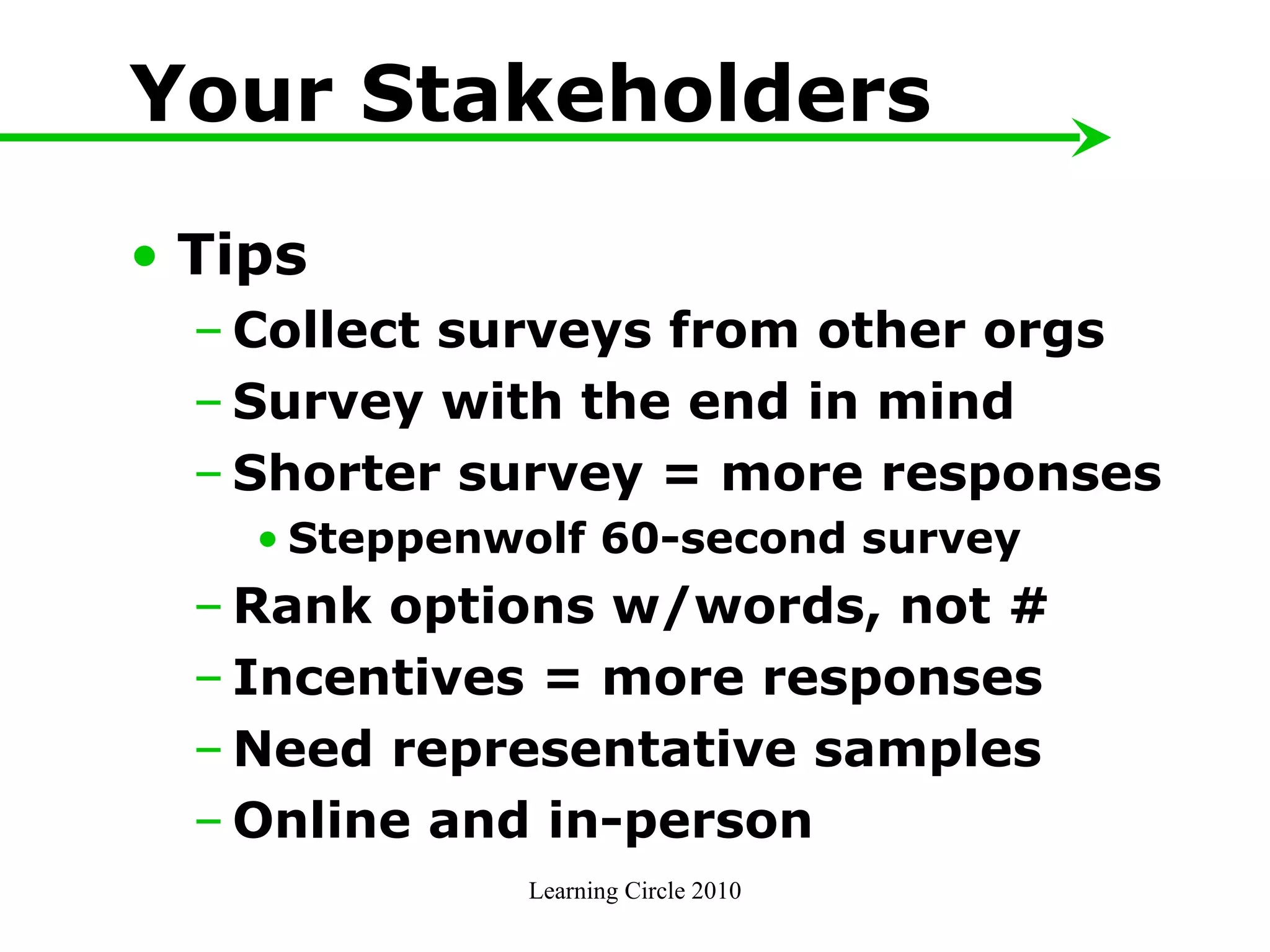
Your Stakeholders Tips  Collect surveys from other orgs Survey with the end in mind Shorter survey = more responses Steppenwolf 60-second survey Rank options w/words, not # Incentives = more responses Need representative samples Online and in-person  Learning Circle 2010
Your Stakeholders Tips  How will you compile and analyze it? BVAs, Arts Work, AEW resources may be available to assist Learning Circle 2010
Who Are Your Customers/Prospects? The Customer Segment Concept Categories of customers  Drive decisions to expand current segments or target new ones Understand the wants and needs of each segment Create strategies and tactics for reaching priority segments  Learning Circle 2010
Who Are Your Customers/Prospects? In the past… Age, income, gender, race, family status  Mass marketing  Learning Circle 2010
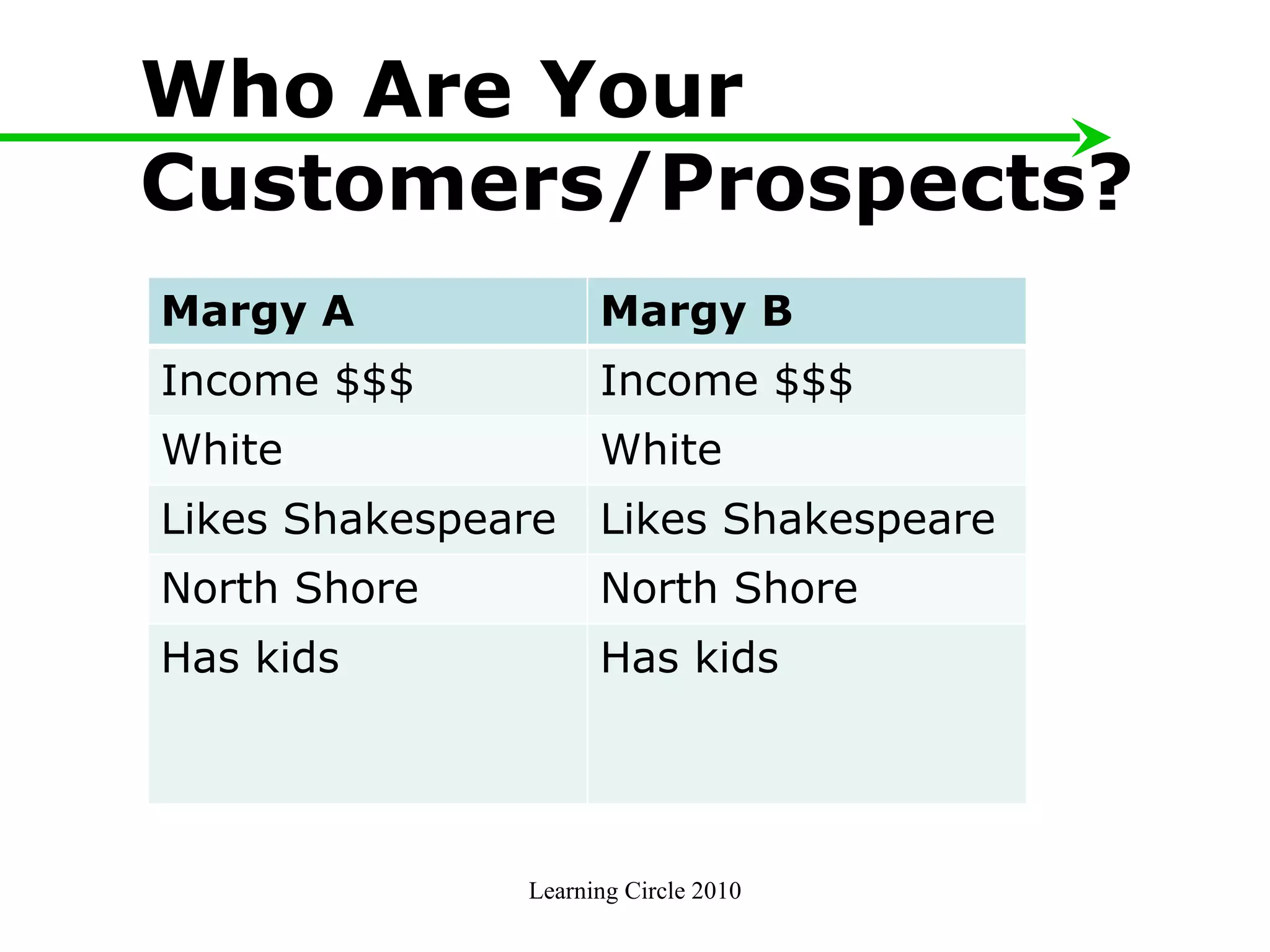
Who Are Your Customers/Prospects? The Two Margies Learning Circle 2010 Margy A Margy B Income $$$ Income $$$ White White Likes Shakespeare Likes Shakespeare North Shore North Shore Has kids Has kids
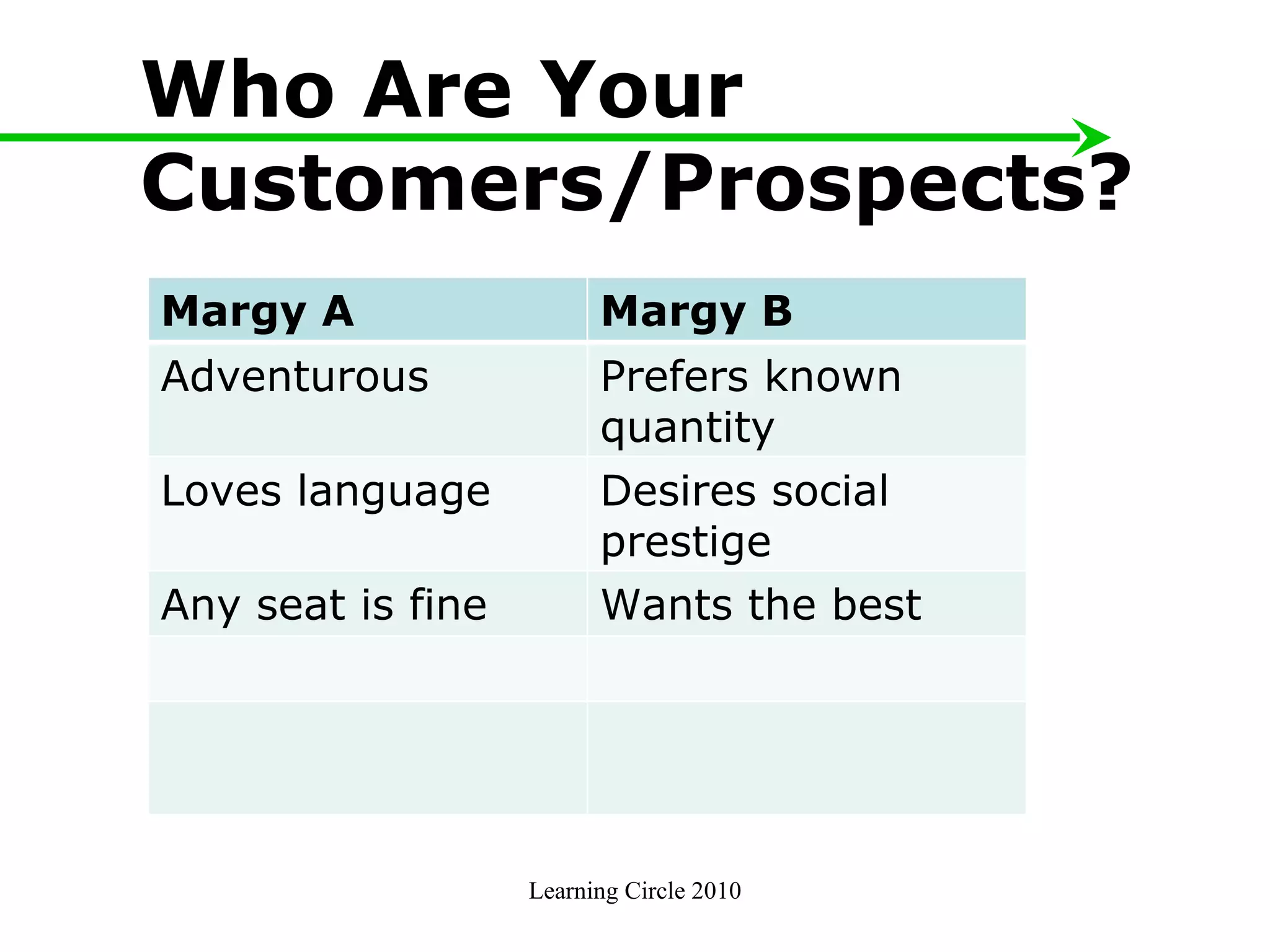
Who Are Your Customers/Prospects? The Two Margies Learning Circle 2010 Margy A Margy B Adventurous Prefers known quantity Loves language Desires social prestige Any seat is fine Wants the best
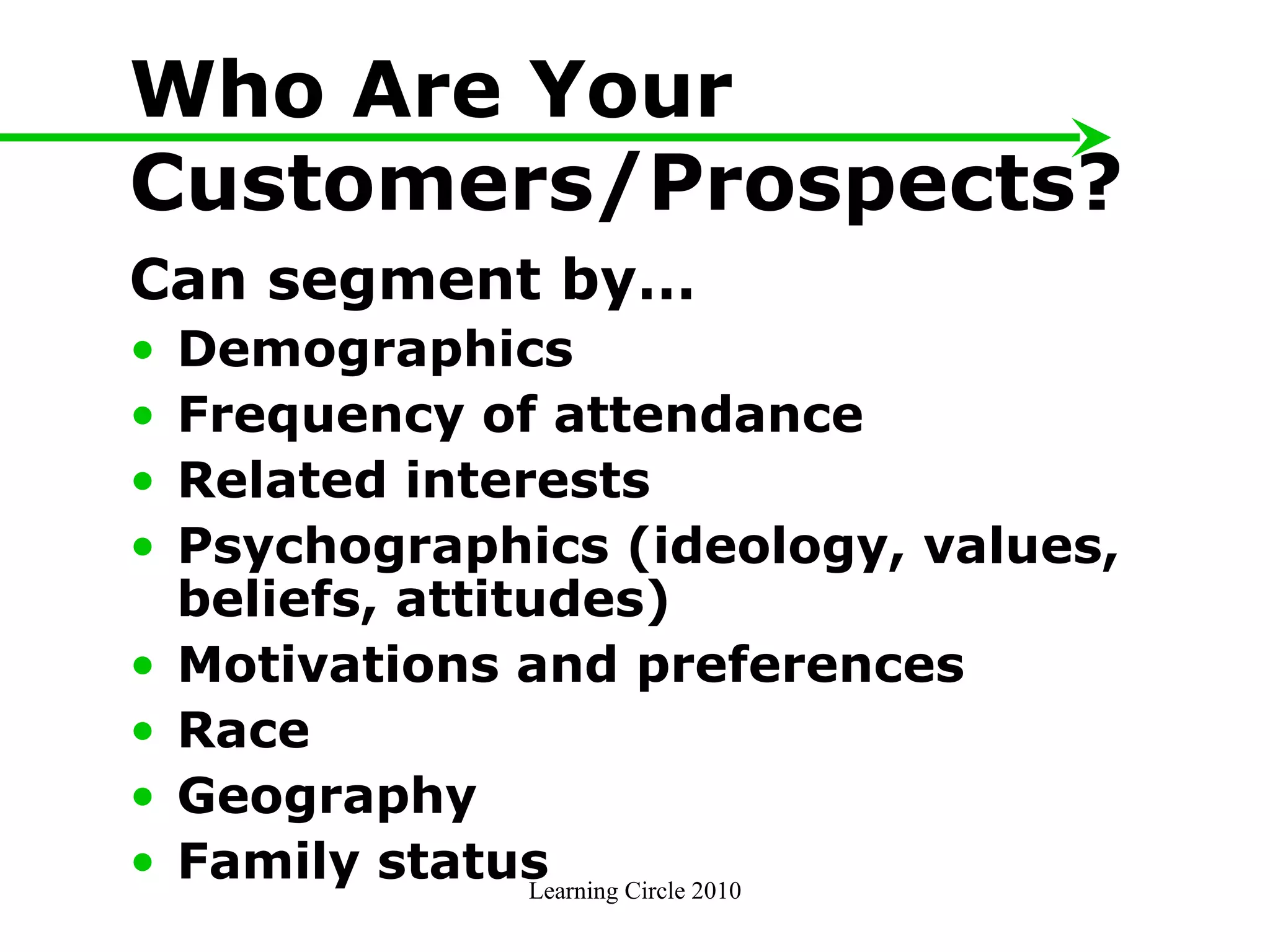
Who Are Your Customers/Prospects? Can segment by… Demographics Frequency of attendance  Related interests Psychographics (ideology, values, beliefs, attitudes) Motivations and preferences Race Geography  Family status Learning Circle 2010
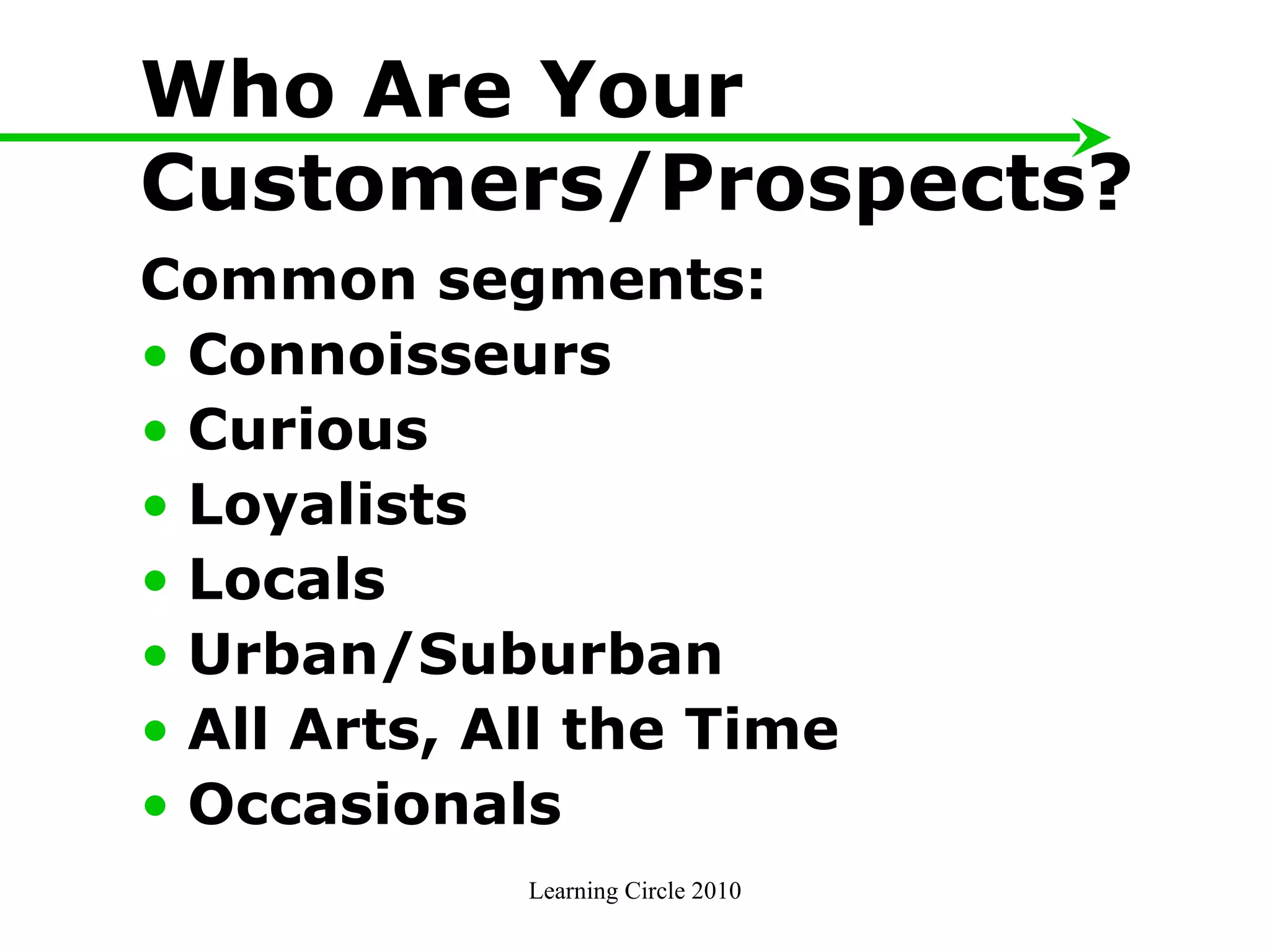
Who Are Your Customers/Prospects? Common segments: Connoisseurs  Curious Loyalists  Locals Urban/Suburban All Arts, All the Time Occasionals Learning Circle 2010
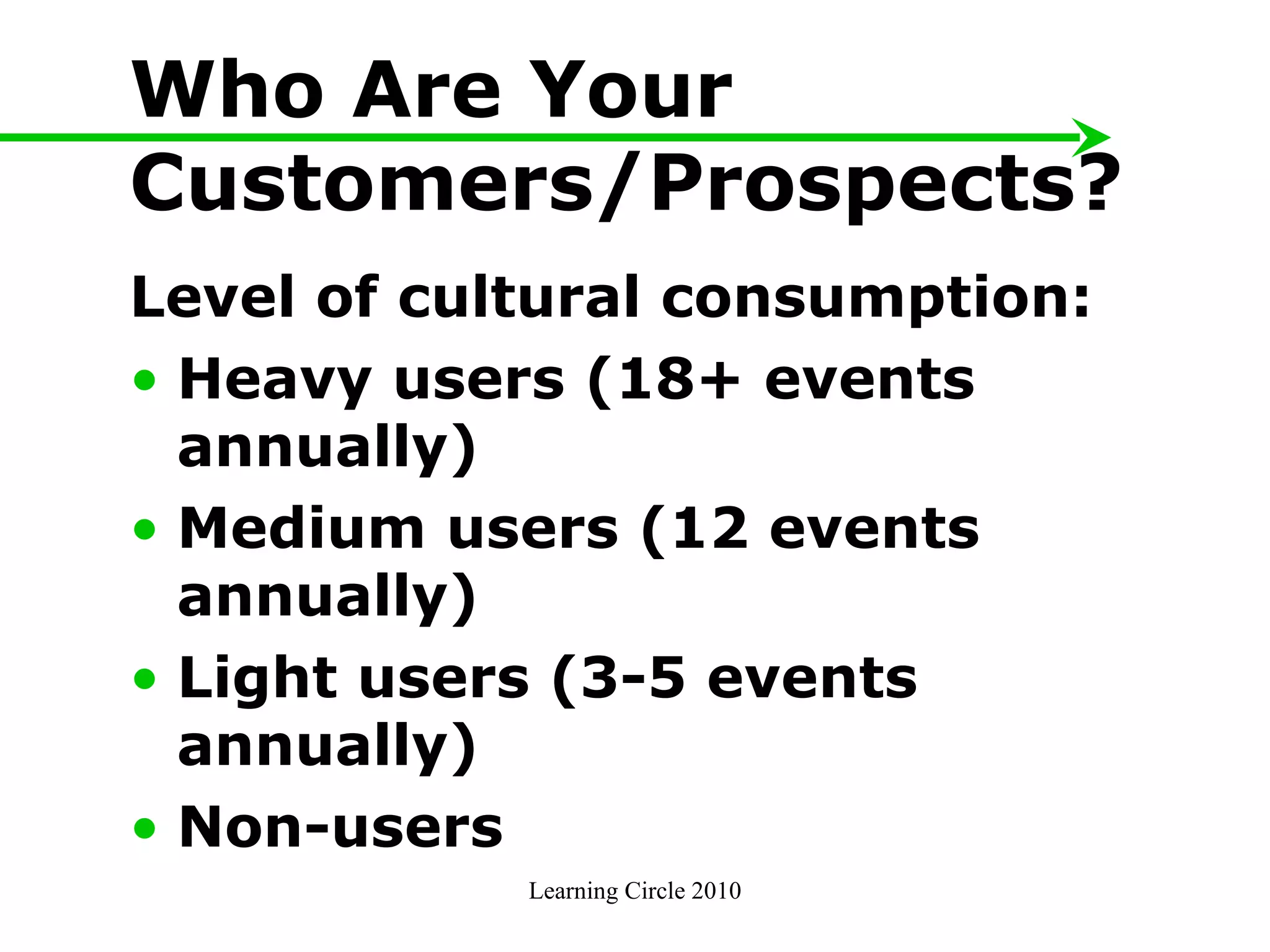
Who Are Your Customers/Prospects? Level of cultural consumption: Heavy users (18+ events annually) Medium users (12 events annually) Light users (3-5 events annually) Non-users Learning Circle 2010
Who Are Your Customers/Prospects?  Loyalty level: One-time attendees Multiple/repeat attendees Subscribers/members Group attendees Future attendees Leaning Circle 2110
Who Are Your Customers/Prospects? Psychographics Ideology, values, beliefs, attitudes Behaviors  Motivation for participation Factors that drive arts attendance/participation Learning Circle 2010
Why Attend? Examples of Benefits Love the artist/work  Prestigious venue/org Convenience – parking, transportation, accessibility Convenience – near home, near restaurants and coffee shops Price is right Tickets available at last minute Invited by friends/invited my friends Date night Learning Circle 2010
Why Not? Barriers  The particular work is too unfamiliar The work is a chestnut The art/artist/activity is unfamiliar Inconvenient – lack of train or parking Inconvenient – lack of babysitter Fear of being the only one “like me” Venue/neighborhood is scary Venue/neighborhood is too institutional I hate Ticketmaster Competing interests Learning Circle 2010
Prioritizing the Segments Potential size Potential value Ease of overcoming barriers Ease of communication – how will you reach them? Learning Circle 2010
Prioritizing the Segments Pursue more of the segment you have? Target additional segments? Learning Circle 2010
Exercise Segments Brainstorm  Learning Circle 2010
Creating Your Plan  Current Situation Objectives/Goals  Marketing  Financial Long-term vs short-term Strategies and Tactics Action Items/Timetables  Budgets Measurement/Controls Arts & Business Council 2004
Movement Foundation Thoughts? Learning Circle 2010
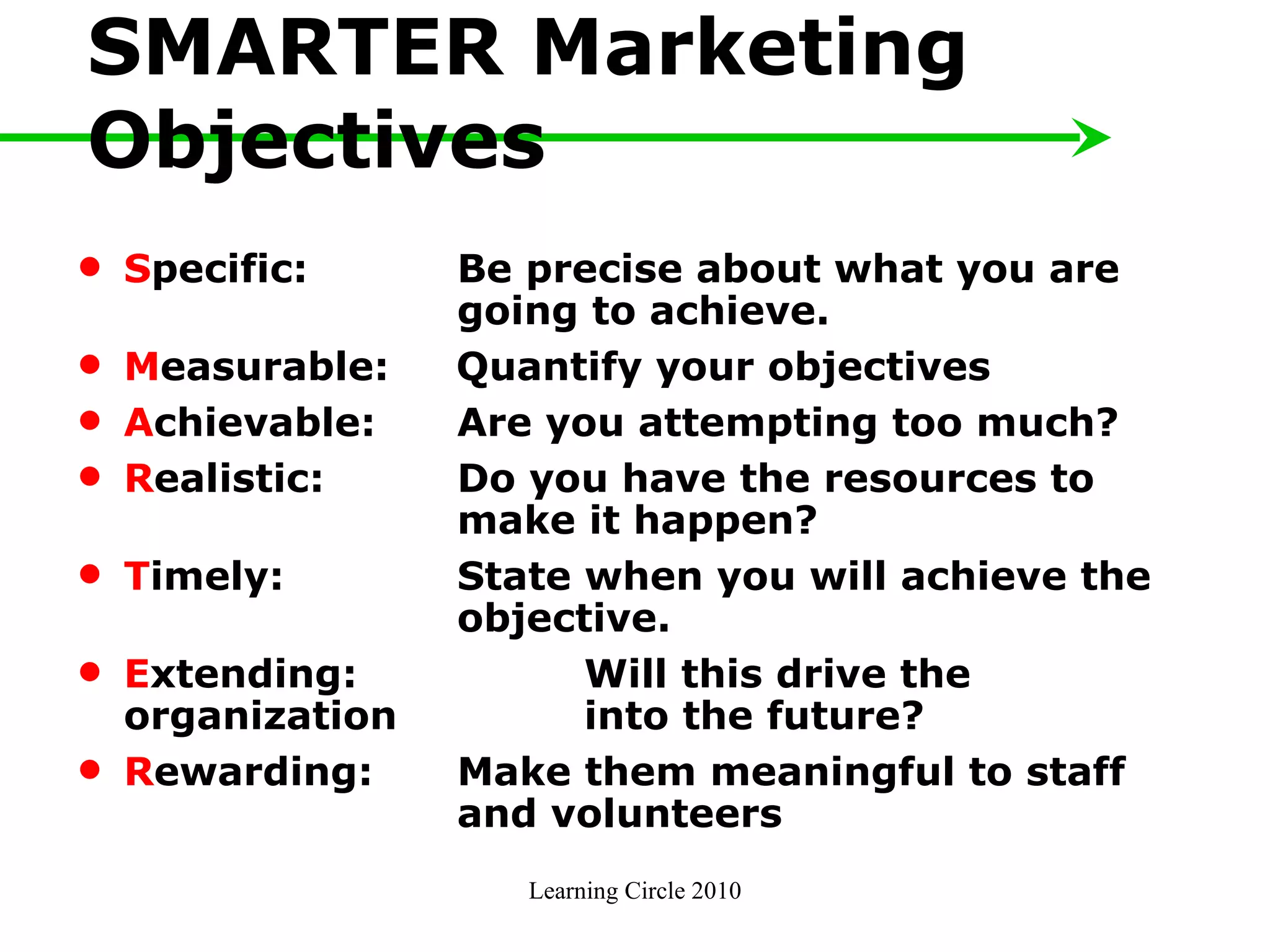
SMARTER Marketing Objectives Learning Circle 2010 S pecific:  Be precise about what you are  going to achieve. M easurable:  Quantify your objectives A chievable:  Are you attempting too much? R ealistic:  Do you have the resources to  make it happen? T imely:  State when you will achieve the  objective. E xtending:  Will this drive the organization  into the future? R ewarding:  Make them meaningful to staff  and volunteers
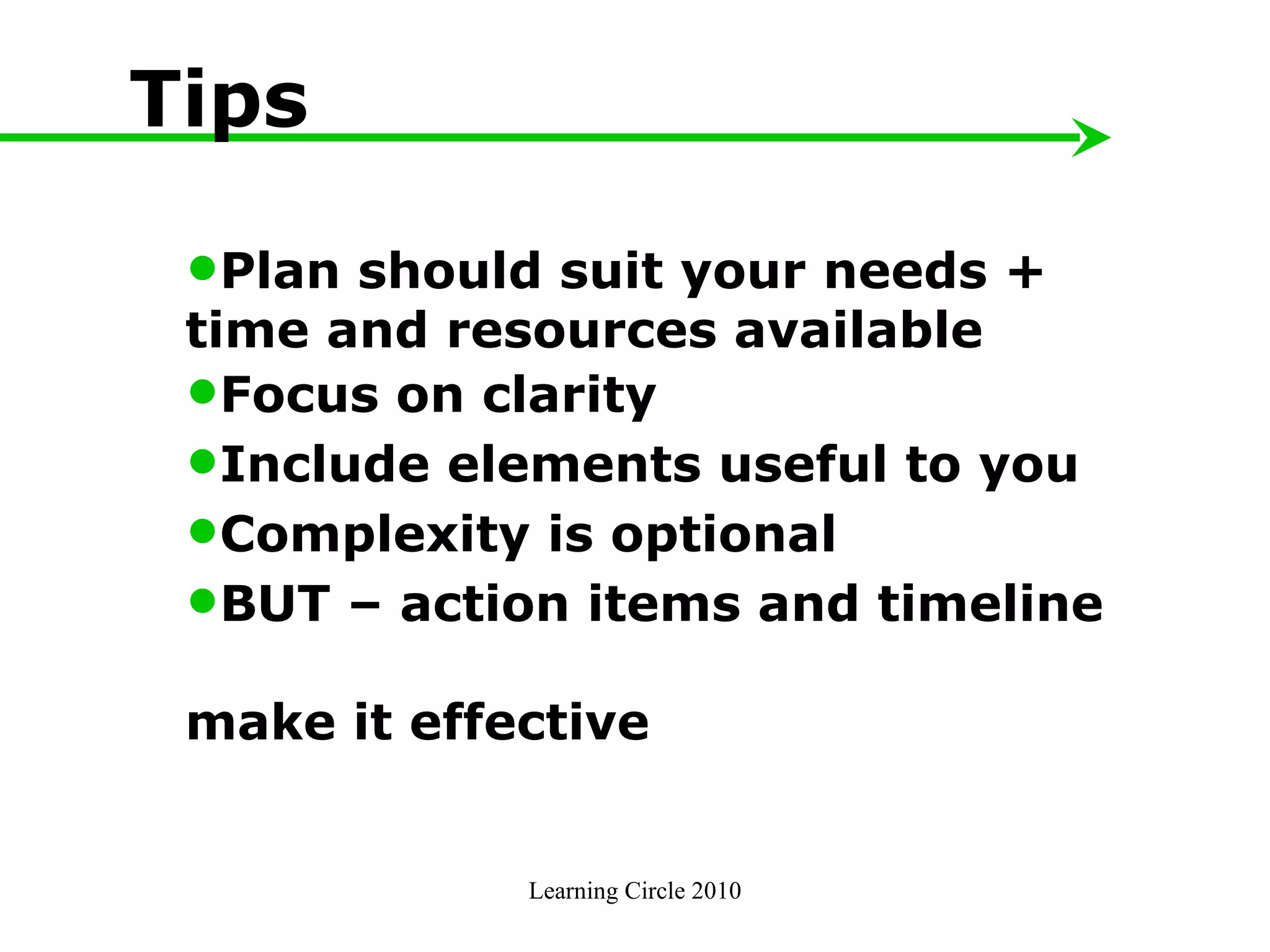
Learning Circle 2010 Tips Plan should suit your needs +  time and resources available Focus on clarity  Include elements useful to you Complexity is optional BUT – action items and timeline  make it effective
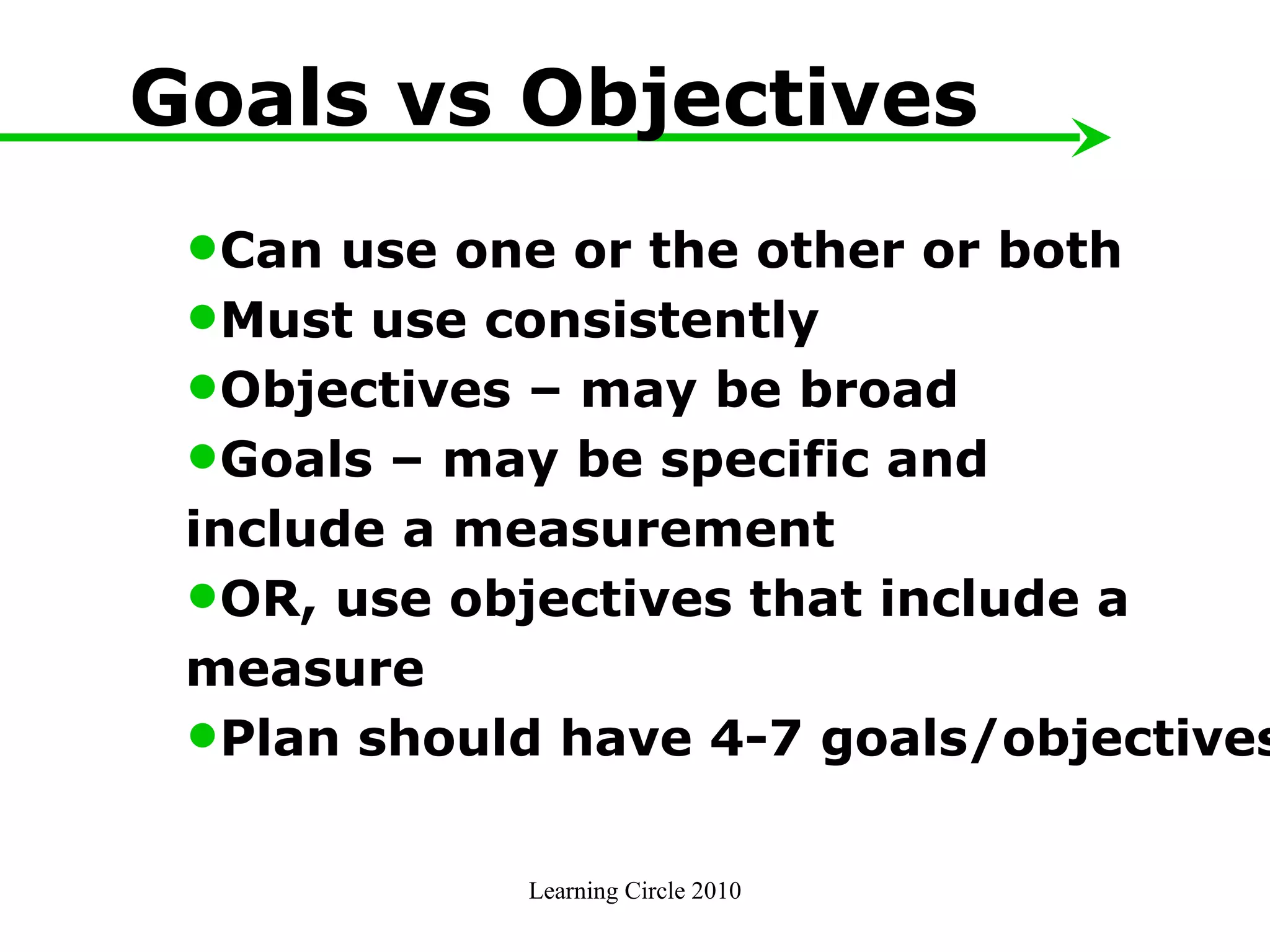
Learning Circle 2010 Goals vs Objectives Can use one or the other or both Must use consistently  Objectives – may be broad Goals – may be specific and include a measurement OR, use objectives that include a  measure  Plan should have 4-7 goals/objectives
Learning Circle 2010 Example Objectives Increase single ticket sales by x% Strengthen loyalty/engagement of  current audience  Create and sustain awareness of  new program X Reinvigorate our brand and brand  image
Learning Circle 2010 Strategies & Tactics Strategies: How you plan to accomplish your  objectives The overall design or program for  achieving goals/objectives Tactics: Specific actions to implement the  strategies
Learning Circle 2010 Exercise What are your objectives?
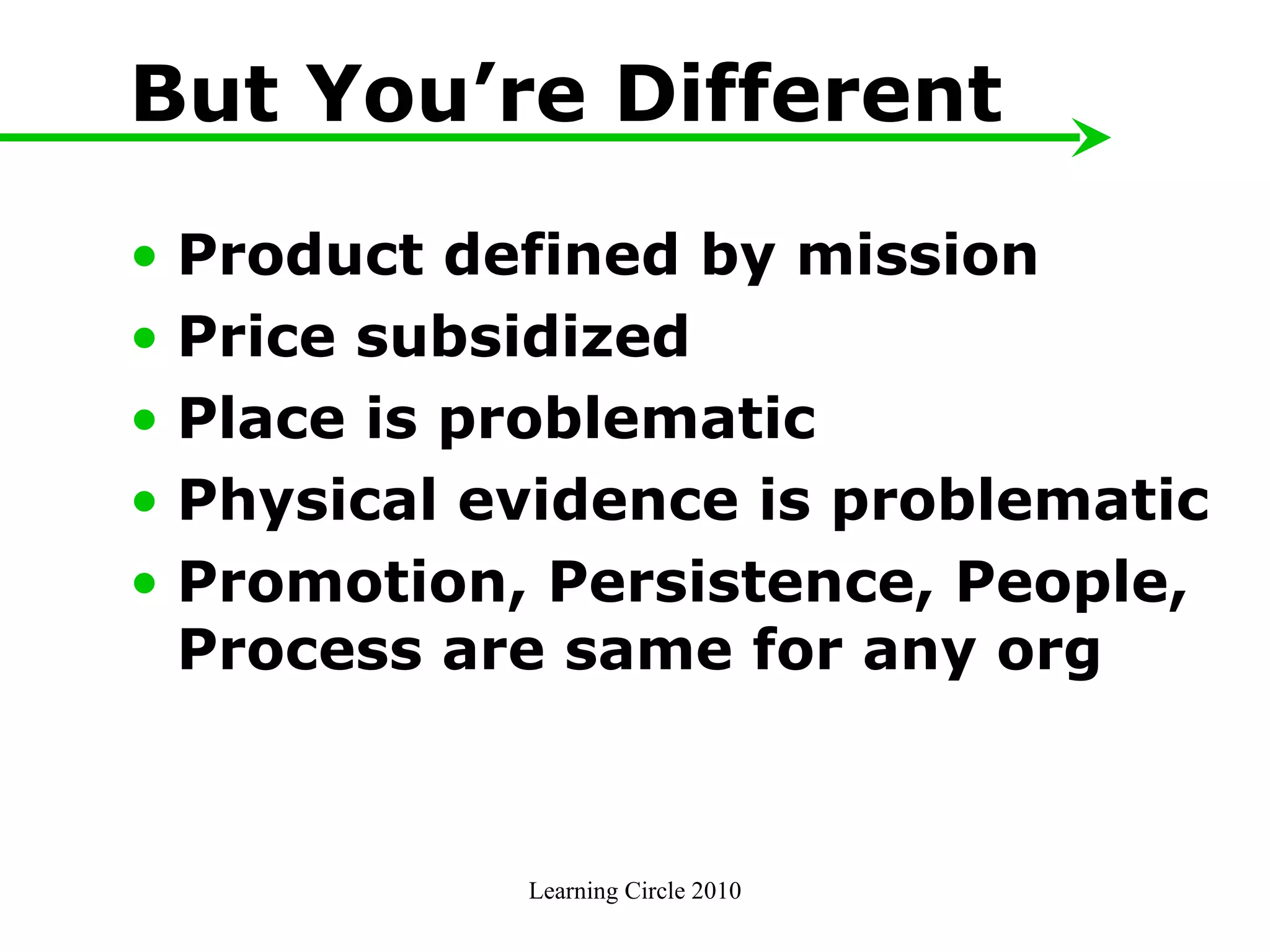
Learning Circle 2010 Marketing Mix The P’s and/or the C’s P’s: Product Price Place Promotion Physical Evidence  Persistence People And possibly Process
Learning Circle 2010 But You’re Different Product defined by mission  Price subsidized  Place is problematic Physical evidence is problematic  Promotion, Persistence, People, Process are same for any org
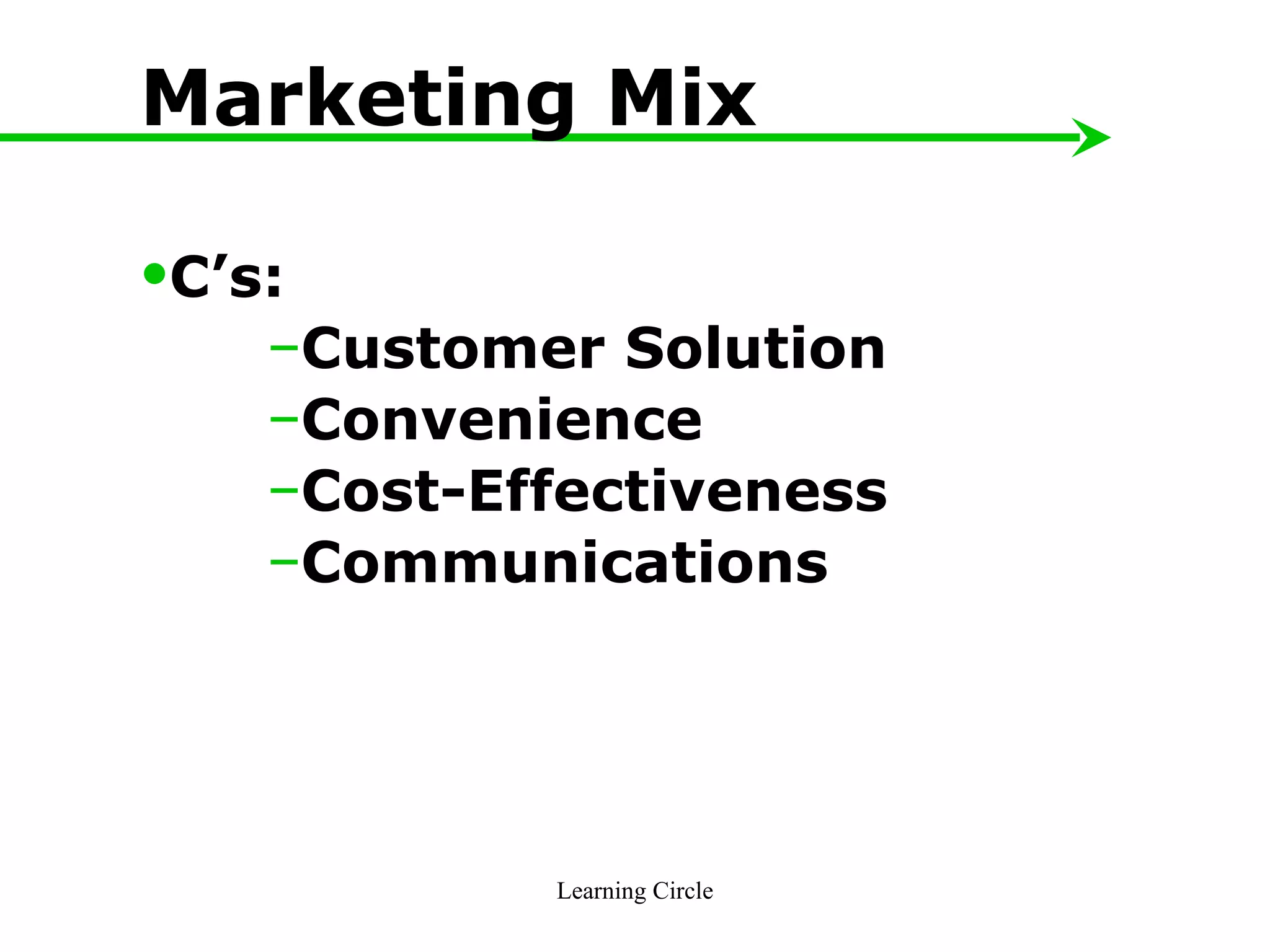
Learning Circle Marketing Mix C’s: Customer Solution Convenience Cost-Effectiveness Communications
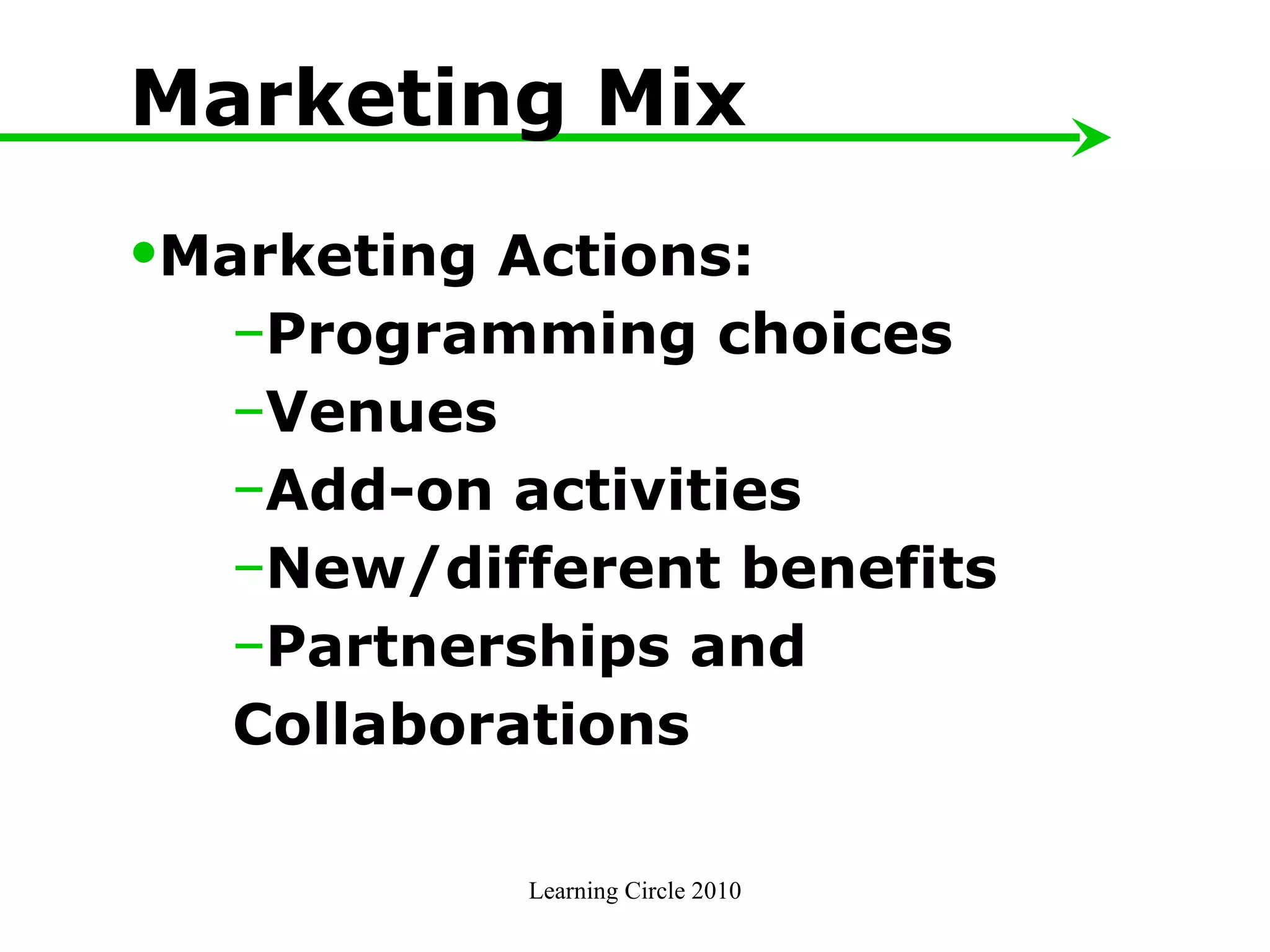
Learning Circle 2010 Marketing Mix Marketing Actions: Programming choices Venues Add-on activities New/different benefits Partnerships and  Collaborations
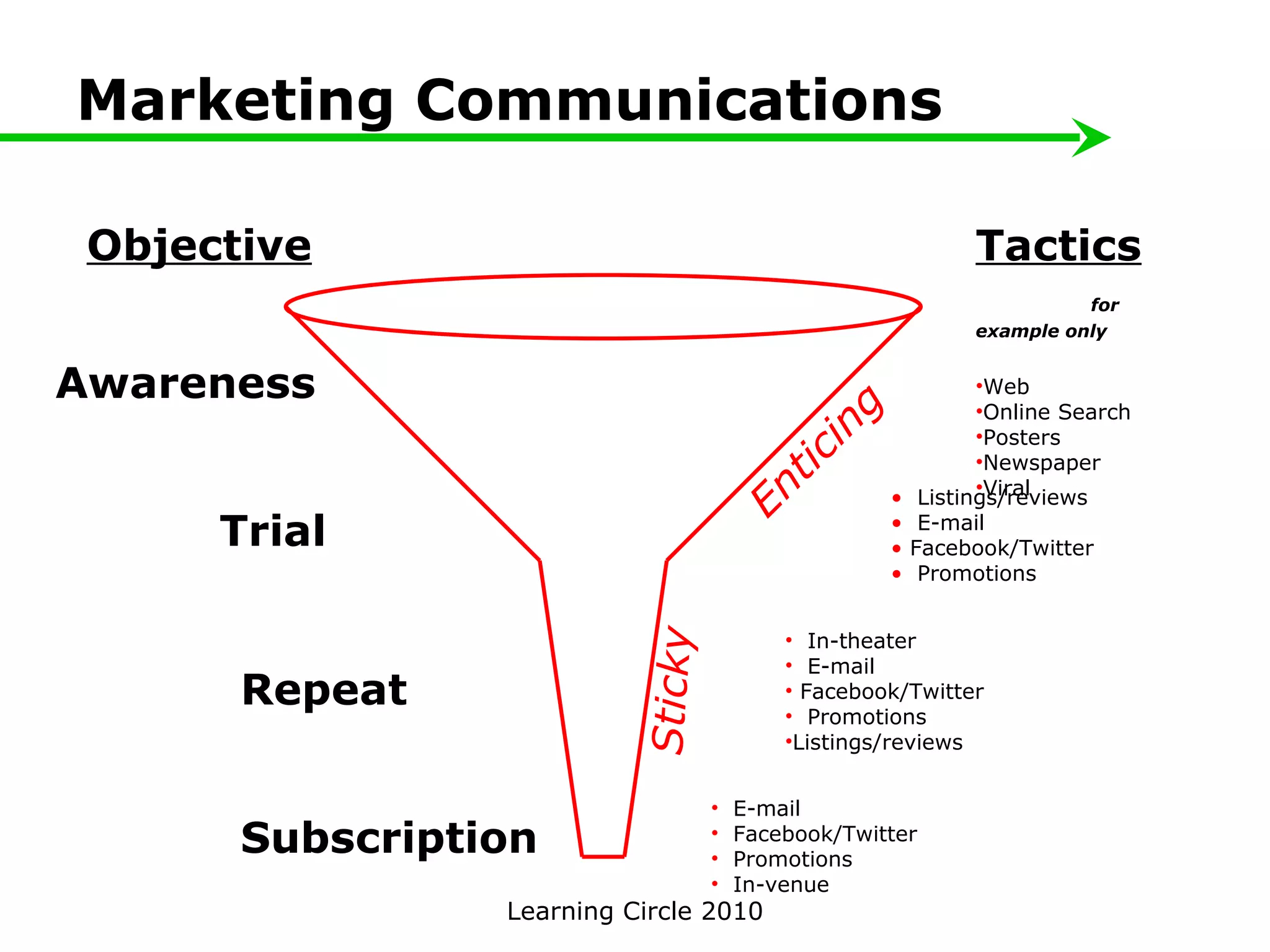
Learning Circle 2010 Marketing Communications  Awareness Trial Repeat  Subscription Enticing Sticky Tactics   for example only  Web Online Search Posters Newspaper Viral Objective Listings/reviews E-mail Facebook/Twitter Promotions In-theater E-mail Facebook/Twitter Promotions Listings/reviews E-mail Facebook/Twitter Promotions In-venue
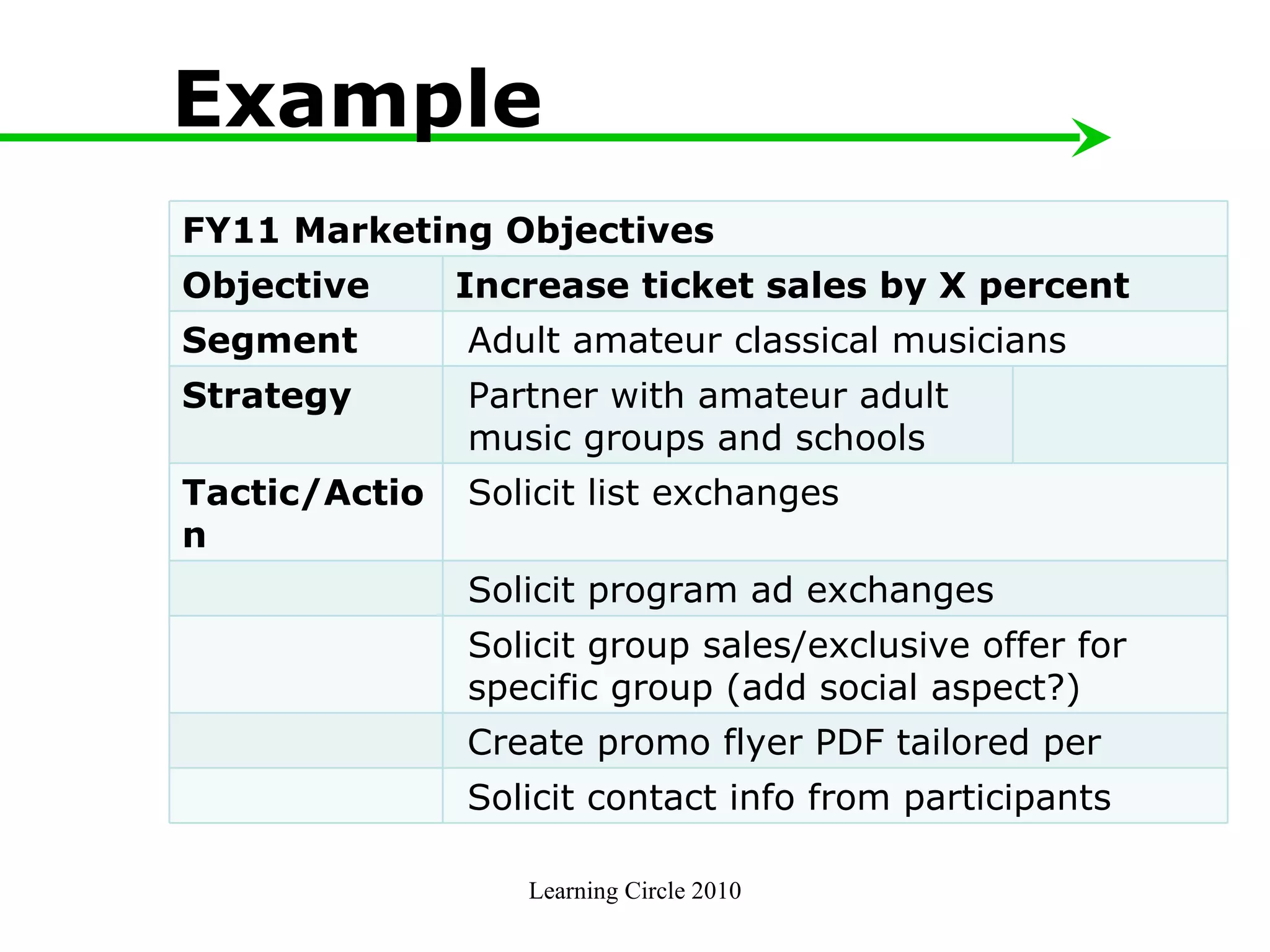
Learning Circle 2010 Example FY11 Marketing Objectives Objective Increase ticket sales by X percent Segment Adult amateur classical musicians Strategy Partner with amateur adult  music groups and schools Tactic/Action Solicit list exchanges Solicit program ad exchanges Solicit group sales/exclusive offer for  specific group (add social aspect?) Create promo flyer PDF tailored per group Solicit contact info from participants
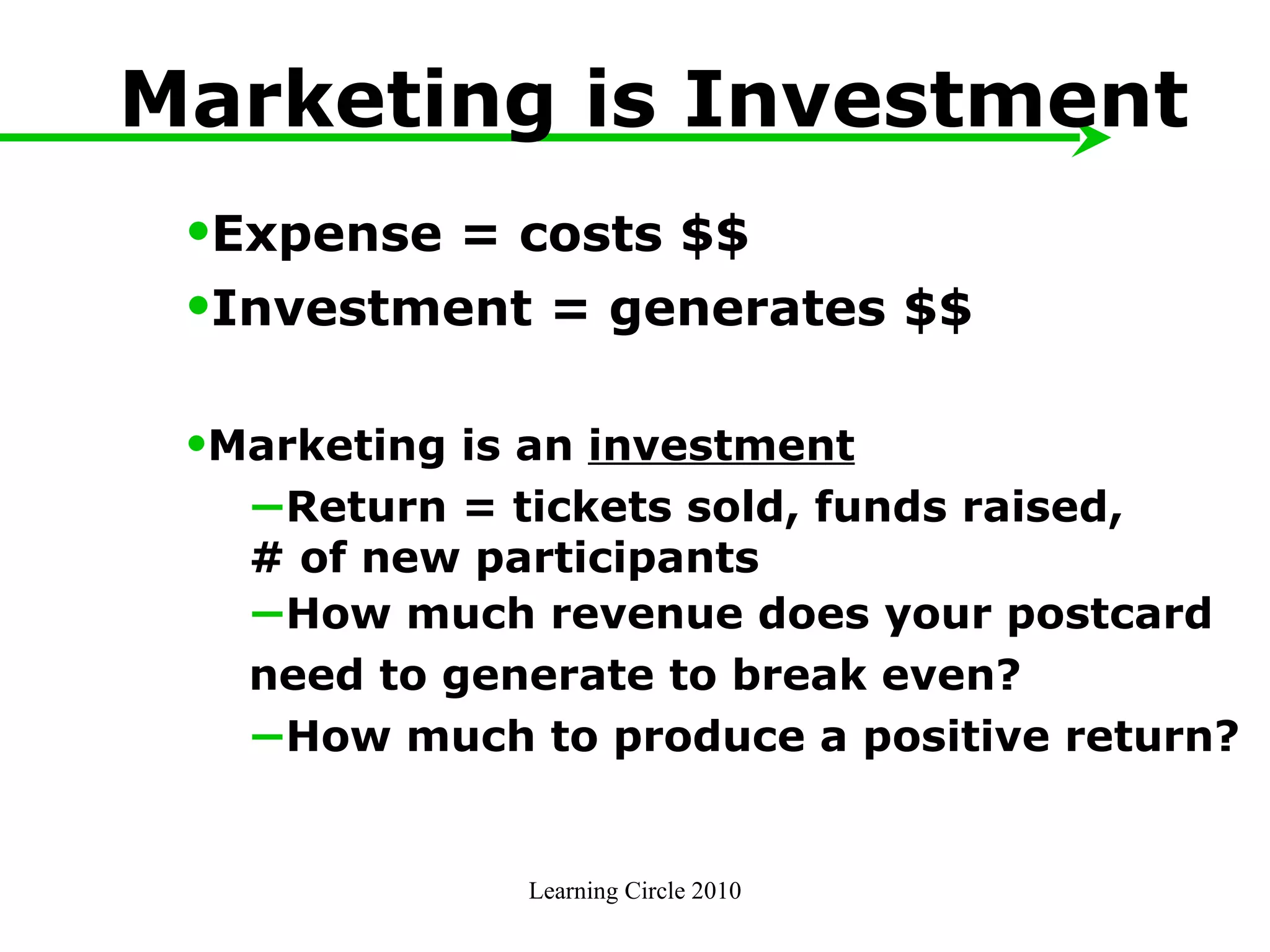
Learning Circle 2010 Marketing is Investment Expense = costs $$ Investment = generates $$ Marketing is an  investment Return = tickets sold, funds raised,  # of new participants How much revenue does your postcard  need to generate to break even?  How much to produce a positive return?
Learning Circle 2010 Homework

Are You Talking to Me: Analysis

  • 1.
    March 2010 AREYOU TALKING TO ME? Session II: Developing A Marketing Plan – Analysis and Objectives
  • 2.
    Marketing Plans StrategicMarketing Plan 1-3 years Organizational focus Marketing the brand, not just a production Learning Circle 2010
  • 3.
    Marketing Plans PromotionalMarketing Plan Short term Outreach, PR, advertising Marketing one season/event Combination Plan Learning Circle 2010
  • 4.
    Basic Plan OutlineExecutive Summary Current Situation Objectives/Goals Marketing Financial Long-term vs. short-term Strategies and Tactics Tactics/Timetables Budgets (time and $) Measurement/Controls Learning Circle 2010
  • 5.
    Learning Circle 2010 Current Situation Mission/vision Marketing SWOT Internal trends and issues Outside trends, e.g., economy Customer insights
  • 6.
    Learning Circle 2010 Current Situation Mission statement Required for 501(c)(3) What you do Where you do it How you do it Whom you serve
  • 7.
    Learning Circle 2010 Current Situation Vision statement Not required Projects 3-5 years forward Presents desired future state May include types of programs, geographic reach, types of people served…or not
  • 8.
    Learning Circle 2010 Situation Analysis Mission/vision − Is is clear? − Is there consensus? − Strategic plan?
  • 9.
    Learning Circle 2010 Situation Analysis The SWOT (Strengths, Opportunities, Weaknesses, Threats) Participation trends Internal trends and issues Marketing effectiveness Outside trends, e.g., economy The competition
  • 10.
    The SWOT Purpose:To align marketing strategy with larger goals of the organization Overlaps with strategic planning Learning Circle 2010
  • 11.
    The Competition Othergroups like you Other entertainment and leisure activities Life responsibilities, e.g., family care Snowbirds Learning Circle 2010
  • 12.
    The Competition Whatare competitors’ strengths and weaknesses? What can you do better? How does your brand image compare (content and quality)? Learning Circle 2010
  • 13.
    SWOT Learning Circle2010 Strengths Weaknesses Opportunities Threats
  • 14.
    Examples of StrengthsOrganizational characteristics: Proven high quality(reviews) Consensus on brand Well-known leader/artists Unique offering Fabulous venue Learning Circle 2010
  • 15.
    Examples of WeaknessesOrganizational issues: Lack of consistent venues Brand confusion, outdated collateral Lack of name recognition Lack of marketing time/personnel Learning Circle 2010
  • 16.
    Examples of OpportunitiesExternal issues: Potential target segments Untapped communications channels New venue partnership New funding source Learning Circle 2010
  • 17.
    Examples of ThreatsExternal issues: Venue change New competitor(s) Changing neighborhood Shrinking review opportunities Learning Circle 2010
  • 18.
    Group Exercise SWOTLearning Circle 2010
  • 19.
    Learning Circle 2010 Customer Insights Who are your stakeholders? Who could become your stakeholders? What do they need and want? How do you reach them? Are you prepared to meet their needs and wants?
  • 20.
    Sources of AudienceInformation National/regional arts studies Internal database and records Audience surveys - stats Observation Informal interviews - the “why” Focus groups - the “ why” Learning Circle 2010
  • 21.
    Sources of InformationResearch Sources Rand, Pew, Wallace, NEA, NEH Arts & Business Council of Chicago US Census Local economic development groups Local media www.artsmarketing.org League of Chicago Theaters Learning Circle 2010
  • 22.
    Your Stakeholders Customersurveys (print/online) Quantitative (numerical) results Uncover attendance patterns, demographics, obstacles, other interests and marketing possibilities Use info to identify current and potential segments Learning Circle 2010
  • 23.
    Your Stakeholders Customerfocus groups Qualitative (verbal) results Explore perceptions of a particular program or marketing collateral Need to include all relevant customer segments Learning Circle 2010
  • 24.
    Your Stakeholders Tips Collect surveys from other orgs Survey with the end in mind Shorter survey = more responses Steppenwolf 60-second survey Rank options w/words, not # Incentives = more responses Need representative samples Online and in-person Learning Circle 2010
  • 25.
    Your Stakeholders Tips How will you compile and analyze it? BVAs, Arts Work, AEW resources may be available to assist Learning Circle 2010
  • 26.
    Who Are YourCustomers/Prospects? The Customer Segment Concept Categories of customers Drive decisions to expand current segments or target new ones Understand the wants and needs of each segment Create strategies and tactics for reaching priority segments Learning Circle 2010
  • 27.
    Who Are YourCustomers/Prospects? In the past… Age, income, gender, race, family status Mass marketing Learning Circle 2010
  • 28.
    Who Are YourCustomers/Prospects? The Two Margies Learning Circle 2010 Margy A Margy B Income $$$ Income $$$ White White Likes Shakespeare Likes Shakespeare North Shore North Shore Has kids Has kids
  • 29.
    Who Are YourCustomers/Prospects? The Two Margies Learning Circle 2010 Margy A Margy B Adventurous Prefers known quantity Loves language Desires social prestige Any seat is fine Wants the best
  • 30.
    Who Are YourCustomers/Prospects? Can segment by… Demographics Frequency of attendance Related interests Psychographics (ideology, values, beliefs, attitudes) Motivations and preferences Race Geography Family status Learning Circle 2010
  • 31.
    Who Are YourCustomers/Prospects? Common segments: Connoisseurs Curious Loyalists Locals Urban/Suburban All Arts, All the Time Occasionals Learning Circle 2010
  • 32.
    Who Are YourCustomers/Prospects? Level of cultural consumption: Heavy users (18+ events annually) Medium users (12 events annually) Light users (3-5 events annually) Non-users Learning Circle 2010
  • 33.
    Who Are YourCustomers/Prospects? Loyalty level: One-time attendees Multiple/repeat attendees Subscribers/members Group attendees Future attendees Leaning Circle 2110
  • 34.
    Who Are YourCustomers/Prospects? Psychographics Ideology, values, beliefs, attitudes Behaviors Motivation for participation Factors that drive arts attendance/participation Learning Circle 2010
  • 35.
    Why Attend? Examplesof Benefits Love the artist/work Prestigious venue/org Convenience – parking, transportation, accessibility Convenience – near home, near restaurants and coffee shops Price is right Tickets available at last minute Invited by friends/invited my friends Date night Learning Circle 2010
  • 36.
    Why Not? Barriers The particular work is too unfamiliar The work is a chestnut The art/artist/activity is unfamiliar Inconvenient – lack of train or parking Inconvenient – lack of babysitter Fear of being the only one “like me” Venue/neighborhood is scary Venue/neighborhood is too institutional I hate Ticketmaster Competing interests Learning Circle 2010
  • 37.
    Prioritizing the SegmentsPotential size Potential value Ease of overcoming barriers Ease of communication – how will you reach them? Learning Circle 2010
  • 38.
    Prioritizing the SegmentsPursue more of the segment you have? Target additional segments? Learning Circle 2010
  • 39.
    Exercise Segments Brainstorm Learning Circle 2010
  • 40.
    Creating Your Plan Current Situation Objectives/Goals Marketing Financial Long-term vs short-term Strategies and Tactics Action Items/Timetables Budgets Measurement/Controls Arts & Business Council 2004
  • 41.
    Movement Foundation Thoughts?Learning Circle 2010
  • 42.
    SMARTER Marketing ObjectivesLearning Circle 2010 S pecific: Be precise about what you are going to achieve. M easurable: Quantify your objectives A chievable: Are you attempting too much? R ealistic: Do you have the resources to make it happen? T imely: State when you will achieve the objective. E xtending: Will this drive the organization into the future? R ewarding: Make them meaningful to staff and volunteers
  • 43.
    Learning Circle 2010Tips Plan should suit your needs + time and resources available Focus on clarity Include elements useful to you Complexity is optional BUT – action items and timeline make it effective
  • 44.
    Learning Circle 2010Goals vs Objectives Can use one or the other or both Must use consistently Objectives – may be broad Goals – may be specific and include a measurement OR, use objectives that include a measure Plan should have 4-7 goals/objectives
  • 45.
    Learning Circle 2010Example Objectives Increase single ticket sales by x% Strengthen loyalty/engagement of current audience Create and sustain awareness of new program X Reinvigorate our brand and brand image
  • 46.
    Learning Circle 2010Strategies & Tactics Strategies: How you plan to accomplish your objectives The overall design or program for achieving goals/objectives Tactics: Specific actions to implement the strategies
  • 47.
    Learning Circle 2010Exercise What are your objectives?
  • 48.
    Learning Circle 2010Marketing Mix The P’s and/or the C’s P’s: Product Price Place Promotion Physical Evidence Persistence People And possibly Process
  • 49.
    Learning Circle 2010But You’re Different Product defined by mission Price subsidized Place is problematic Physical evidence is problematic Promotion, Persistence, People, Process are same for any org
  • 50.
    Learning Circle MarketingMix C’s: Customer Solution Convenience Cost-Effectiveness Communications
  • 51.
    Learning Circle 2010Marketing Mix Marketing Actions: Programming choices Venues Add-on activities New/different benefits Partnerships and Collaborations
  • 52.
    Learning Circle 2010Marketing Communications Awareness Trial Repeat Subscription Enticing Sticky Tactics for example only Web Online Search Posters Newspaper Viral Objective Listings/reviews E-mail Facebook/Twitter Promotions In-theater E-mail Facebook/Twitter Promotions Listings/reviews E-mail Facebook/Twitter Promotions In-venue
  • 53.
    Learning Circle 2010Example FY11 Marketing Objectives Objective Increase ticket sales by X percent Segment Adult amateur classical musicians Strategy Partner with amateur adult music groups and schools Tactic/Action Solicit list exchanges Solicit program ad exchanges Solicit group sales/exclusive offer for specific group (add social aspect?) Create promo flyer PDF tailored per group Solicit contact info from participants
  • 54.
    Learning Circle 2010Marketing is Investment Expense = costs $$ Investment = generates $$ Marketing is an investment Return = tickets sold, funds raised, # of new participants How much revenue does your postcard need to generate to break even? How much to produce a positive return?
  • 55.

Editor's Notes

  • #12 Visit competing organizations - what kind of customer experience do they provide? What image do you get from their marketing materials?
  • #13 Visit competing organizations - what kind of customer experience do they provide? What image do you get from their marketing materials?
  • #21 Surveys can produce statistical info, but not necessarily the reasoning behind the answers - the “why” consumers hold these opinions
  • #23 A word about surveys: You’re generating numbers and data, but not engaging in a dialogue – not to probe for deeper impressions and understanding. Think about how you will use the information when designing the survey. A&BC Business Volunteers for the Arts can help with this. No point in gathering information just because you can. Also, plan for distilling the survey data – who will compile and analyze it? You may be able to get Arts Work funding for a consultant to assist. Again, don’t gather information that you can’t use.
  • #24 A couple of words about focus groups: Use a facilitator – A&BC Business Volunteers for the Arts can do this. Need objective 3 rd party so participants will be open. Include all customer segments --
  • #25 A word about surveys: You’re generating numbers and data, but not engaging in a dialogue – not to probe for deeper impressions and understanding. Think about how you will use the information when designing the survey. A&BC Business Volunteers for the Arts can help with this. No point in gathering information just because you can. Also, plan for distilling the survey data – who will compile and analyze it? You may be able to get Arts Work funding for a consultant to assist. Again, don’t gather information that you can’t use.
  • #26 A word about surveys: You’re generating numbers and data, but not engaging in a dialogue – not to probe for deeper impressions and understanding. Think about how you will use the information when designing the survey. A&BC Business Volunteers for the Arts can help with this. No point in gathering information just because you can. Also, plan for distilling the survey data – who will compile and analyze it? You may be able to get Arts Work funding for a consultant to assist. Again, don’t gather information that you can’t use.
  • #34 WHY: Not everyone will like every artistic effort. Segmentation helps build strong and satisfied customers by matching the segments needs and desires with your artistic product. Your goal is to identify a group of people who share a common need that your organization can satisfy.
  • #37 Perceptual barriers : perceived difficulty of the subject matter or style of performance, or belief it will be 'more of the same old... Practical difficulties : lack of transport, inadequate or expensive parking, cost of childcare, not being able to get through on the booking line, long queues, lack of time or money Social barriers : nowhere to eat or have a drink nearby, might feel out of place F ear of the unknown: not familiar with the artists or the venue, not sure whether they will enjoy or appreciate the work or show