An architectural pattern is a general, reusable solution to a
commonly occurring problem in software architecture within a
given context
- Wikipedia
COMMON ARCHITECTURAL PATTERNS
• Event-driven
• Peer-to-peer
• Service-oriented
• Monolithic
• Micro-services
• Etc.
ARCHITECTURAL PATTERNS
A critical analysis on when and how to embrace
Microservices
Asiri Liyanage
Senior Software Architect – Sysco
LABS
Are You Ready for Microservices?
• Inception and growth of an application
• How to identify a MS
• Things to be considered when moving to MS
• Things to be careful of
AGENDA
Growth of an Application
• MVP
• Add components one by one
• All the logical components are
bundled together
SYSTEM GROWTH
Source: Reactive-ms-architecture by Jonas Bonér
Feel the pain?
• Have to have large infra, just to cater a
small to medium app
• Hard to maintain
• Release cycle is too lengthy, have to build-
deploy entire app
• Too much of testing
↳ Unit testing? integration, performance, load
↳ Small code changes, huge test cycle
↳ No automation!!!
↳ No-trust on the codebase or application as a whole
(fear of code changes)
• Tied to a single language
• That technology suits better than the current
technology for the new task!
MONOLITH
source: http://bits.citrusbyte.com/microservices/
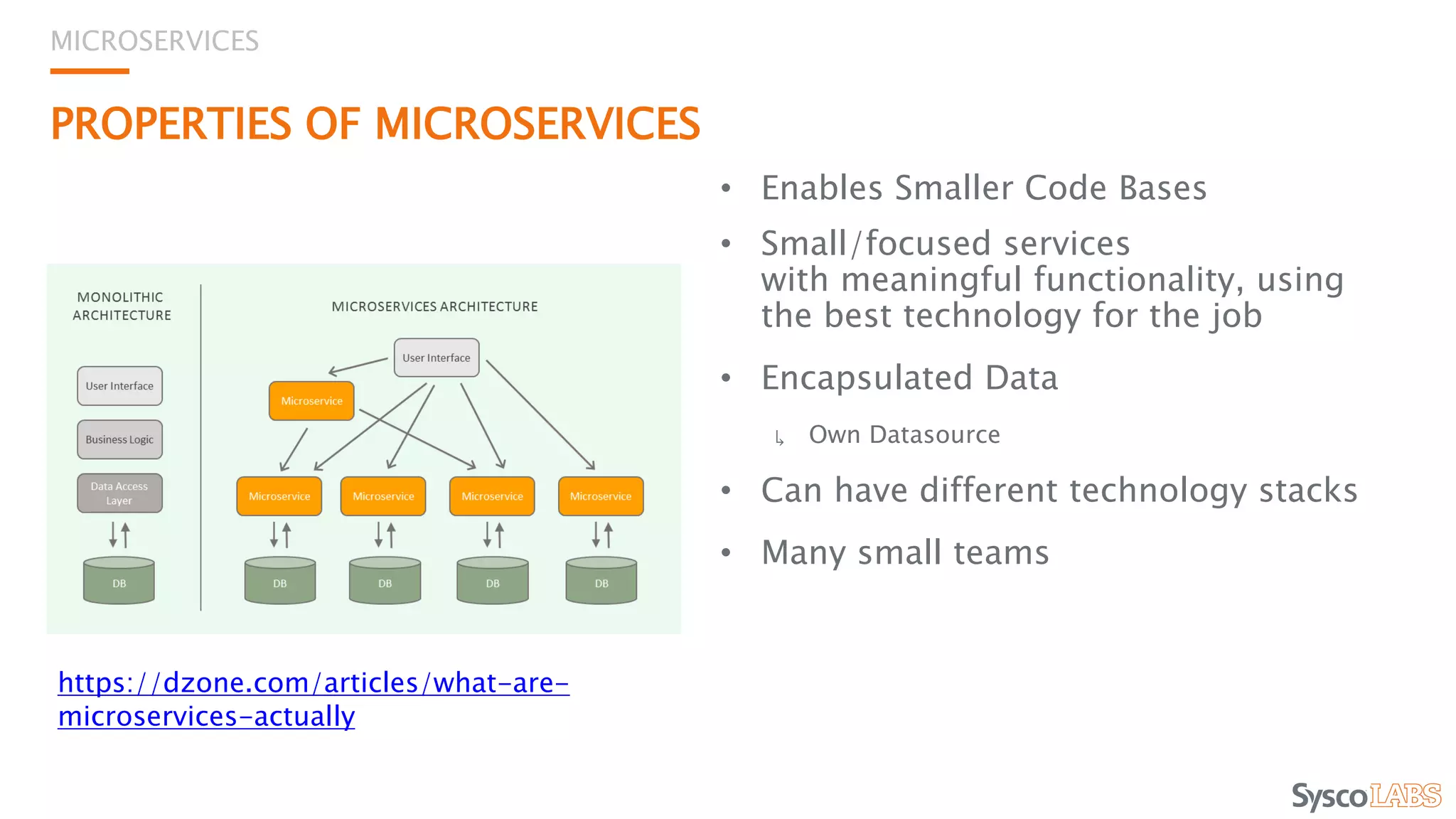
PROPERTIES OF MICROSERVICES
• Enables Smaller Code Bases
• Small/focused services
with meaningful functionality, using
the best technology for the job
• Encapsulated Data
↳ Own Datasource
• Can have different technology stacks
• Many small teams
MICROSERVICES
https://dzone.com/articles/what-are-
microservices-actually
PROPERTIES OF MICROSERVICES
• Can be scaled independently.
• Independently Deployable
↳ Service Instance per VM
↳ Service Instance per container
↳ Serverless deployment
MICROSERVICES
Source: http://danielcoding.net/wp-content/uploads/2016/08/load-balancer.png
Deployment
Instance per VM
Instance per Container
source: https://dzone.com/articles/why-container-based-deployment-is-preferred-for-mi
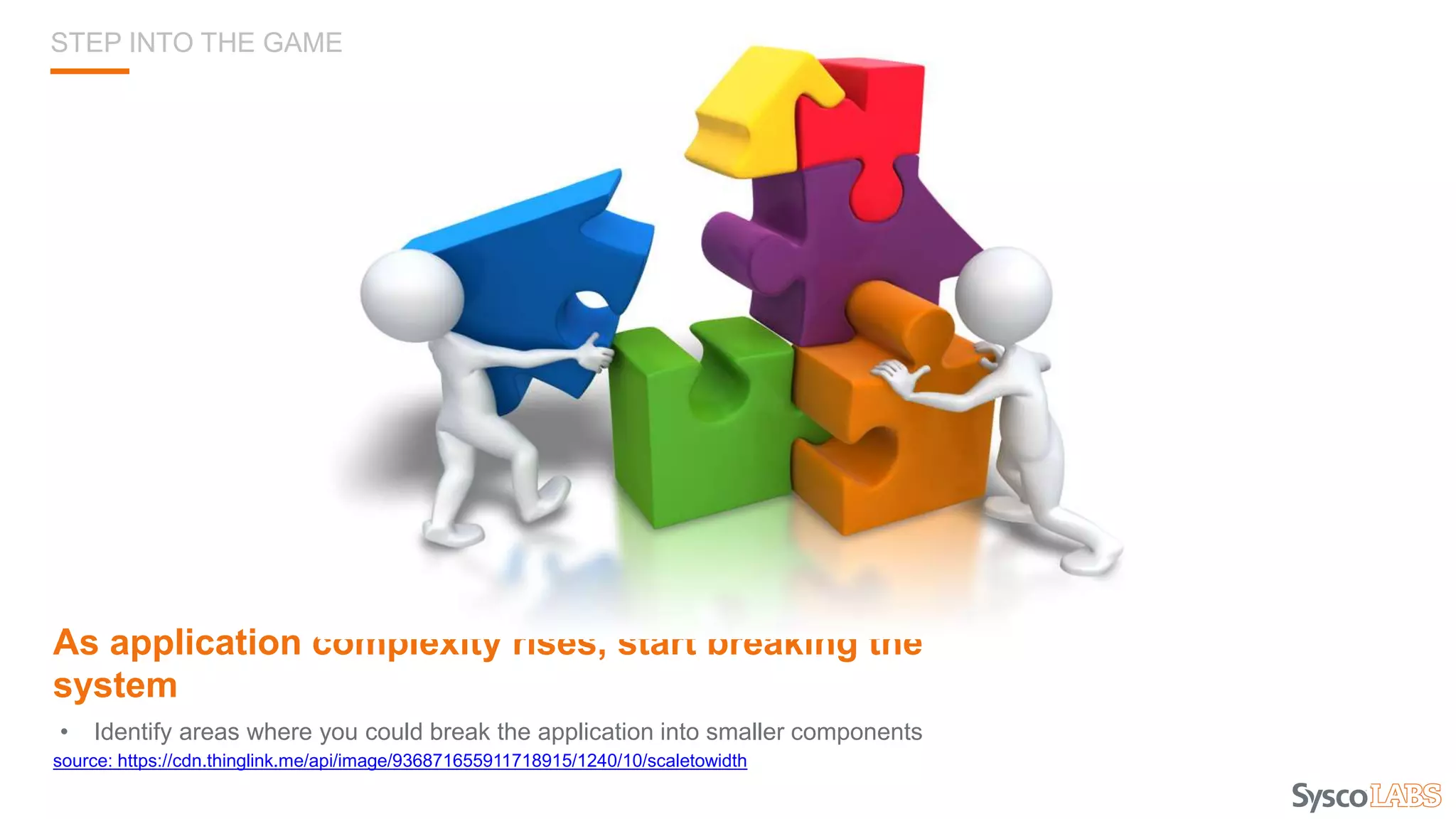
As application complexity rises, start breaking the
system
• Identify areas where you could break the application into smaller components
source: https://cdn.thinglink.me/api/image/936871655911718915/1240/10/scaletowidth
STEP INTO THE GAME
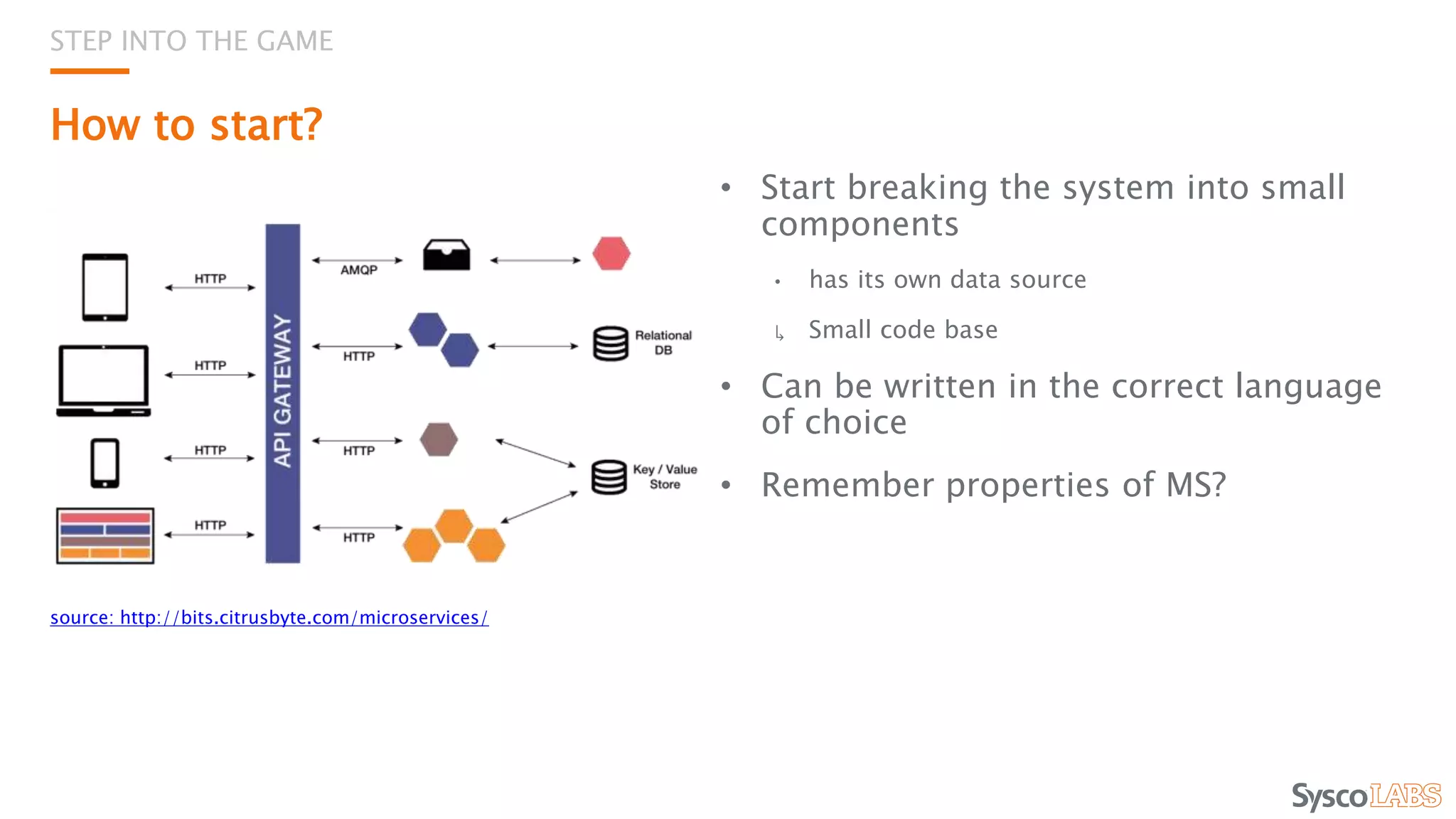
How to start?
• Start breaking the system into small
components
• has its own data source
↳ Small code base
• Can be written in the correct language
of choice
• Remember properties of MS?
STEP INTO THE GAME
source: http://bits.citrusbyte.com/microservices/
DIFFICULTIES ON STARTING AT THE
INCEPTION!
• Trial and error period with lot of uncertainty
• Many integration points
• Development and Debugging issues,
↳ Testing challenges
↳ Might lead to redundant implementations
↳ Versioning nightmare!
• No domain specialty
• Application (at least UI) consistency, data
and txn consistency, security, performance
• Many instances (or containers) have to be maintained
• For a startup, this may be an overkill
WHY NOT AT THE START OF THE APPLICATION DEVELOPMENT?
FOR A MATURED ORGANIZATION
• Integration points are handled through
different means (e.g.: API Gateways,
ESBs, etc)
• Domain specialty is there
↳ There is a matured team who understands the
technology as well the domain
• Controlled by processes
• Development, Deployment practices (CI / CD)
• Dev Ops culture etc.
↳ Engineering process
• Specialty in technology
ARE YOU READY?
source: https://martinfowler.com/bliki/images/microservice-
verdict/productivity.png
FOR A MATURED ORGANIZATION
• Central logging frameworks like graylog, logstash etc
↳ Helpful in Debugging and monitoring
• Proper versioning practices
↳ Can use semantic versioning x.x.x
↳ or duals
• Controlled through governance
↳ Maintain contracts
↳ Easy to fix bugs in the component
• For new features and enhancements, micro-services may
sound perfect for a matured organization
ARE YOU READY?
WHAT OTHER THINGS TO CONSIDER?
• API Gateway – fault-tolerant APIs
↳ Circuit-breaker pattern
• Design for auto-scaling
↳ Local status should not be
maintained
↳ Co-relation IDs
• Containerization
• Asynchronous message passing
ADDITIONAL THINGS THAT GO HAND IN HAND WITH
MICROSERVICES
Source: http://bit.ly/2xoUmzG
Don't even consider microservices unless you have a
system that's too complex to manage as a monolith.
- Martin Fowler
Be Careful
• Distributed systems are prone to
failures
• Eventual consistency - may be suitable
for FB but not for a payment app!
• Complexity in dependency
management, testing and debugging
• Complexity in release management
• Cost - if not properly designed, might
lead to higher costs
THINGS TO REMEMBER
Source: http://bit.ly/2h6m4rj
Be Careful
• Serialization between microservices
• Additional complexity in testing a
distributed system
• Increased complexity in deployment
• Increased network communication
• Skill of the team matters
• Microservices is NOT the only choice!
THINGS TO REMEMBER
Source: http://bit.ly/2wZYhn0
Thank you

Are you ready for Microservices

  • 2.
    An architectural patternis a general, reusable solution to a commonly occurring problem in software architecture within a given context - Wikipedia
  • 3.
    COMMON ARCHITECTURAL PATTERNS •Event-driven • Peer-to-peer • Service-oriented • Monolithic • Micro-services • Etc. ARCHITECTURAL PATTERNS
  • 4.
    A critical analysison when and how to embrace Microservices Asiri Liyanage Senior Software Architect – Sysco LABS Are You Ready for Microservices?
  • 5.
    Are You Readyfor Microservices? • Inception and growth of an application • How to identify a MS • Things to be considered when moving to MS • Things to be careful of AGENDA
  • 6.
    Growth of anApplication • MVP • Add components one by one • All the logical components are bundled together SYSTEM GROWTH Source: Reactive-ms-architecture by Jonas Bonér
  • 7.
    Feel the pain? •Have to have large infra, just to cater a small to medium app • Hard to maintain • Release cycle is too lengthy, have to build- deploy entire app • Too much of testing ↳ Unit testing? integration, performance, load ↳ Small code changes, huge test cycle ↳ No automation!!! ↳ No-trust on the codebase or application as a whole (fear of code changes) • Tied to a single language • That technology suits better than the current technology for the new task! MONOLITH source: http://bits.citrusbyte.com/microservices/
  • 8.
    PROPERTIES OF MICROSERVICES •Enables Smaller Code Bases • Small/focused services with meaningful functionality, using the best technology for the job • Encapsulated Data ↳ Own Datasource • Can have different technology stacks • Many small teams MICROSERVICES https://dzone.com/articles/what-are- microservices-actually
  • 9.
    PROPERTIES OF MICROSERVICES •Can be scaled independently. • Independently Deployable ↳ Service Instance per VM ↳ Service Instance per container ↳ Serverless deployment MICROSERVICES Source: http://danielcoding.net/wp-content/uploads/2016/08/load-balancer.png
  • 10.
    Deployment Instance per VM Instanceper Container source: https://dzone.com/articles/why-container-based-deployment-is-preferred-for-mi
  • 11.
    As application complexityrises, start breaking the system • Identify areas where you could break the application into smaller components source: https://cdn.thinglink.me/api/image/936871655911718915/1240/10/scaletowidth STEP INTO THE GAME
  • 12.
    How to start? •Start breaking the system into small components • has its own data source ↳ Small code base • Can be written in the correct language of choice • Remember properties of MS? STEP INTO THE GAME source: http://bits.citrusbyte.com/microservices/
  • 13.
    DIFFICULTIES ON STARTINGAT THE INCEPTION! • Trial and error period with lot of uncertainty • Many integration points • Development and Debugging issues, ↳ Testing challenges ↳ Might lead to redundant implementations ↳ Versioning nightmare! • No domain specialty • Application (at least UI) consistency, data and txn consistency, security, performance • Many instances (or containers) have to be maintained • For a startup, this may be an overkill WHY NOT AT THE START OF THE APPLICATION DEVELOPMENT?
  • 14.
    FOR A MATUREDORGANIZATION • Integration points are handled through different means (e.g.: API Gateways, ESBs, etc) • Domain specialty is there ↳ There is a matured team who understands the technology as well the domain • Controlled by processes • Development, Deployment practices (CI / CD) • Dev Ops culture etc. ↳ Engineering process • Specialty in technology ARE YOU READY? source: https://martinfowler.com/bliki/images/microservice- verdict/productivity.png
  • 15.
    FOR A MATUREDORGANIZATION • Central logging frameworks like graylog, logstash etc ↳ Helpful in Debugging and monitoring • Proper versioning practices ↳ Can use semantic versioning x.x.x ↳ or duals • Controlled through governance ↳ Maintain contracts ↳ Easy to fix bugs in the component • For new features and enhancements, micro-services may sound perfect for a matured organization ARE YOU READY?
  • 16.
    WHAT OTHER THINGSTO CONSIDER? • API Gateway – fault-tolerant APIs ↳ Circuit-breaker pattern • Design for auto-scaling ↳ Local status should not be maintained ↳ Co-relation IDs • Containerization • Asynchronous message passing ADDITIONAL THINGS THAT GO HAND IN HAND WITH MICROSERVICES Source: http://bit.ly/2xoUmzG
  • 17.
    Don't even considermicroservices unless you have a system that's too complex to manage as a monolith. - Martin Fowler
  • 18.
    Be Careful • Distributedsystems are prone to failures • Eventual consistency - may be suitable for FB but not for a payment app! • Complexity in dependency management, testing and debugging • Complexity in release management • Cost - if not properly designed, might lead to higher costs THINGS TO REMEMBER Source: http://bit.ly/2h6m4rj
  • 19.
    Be Careful • Serializationbetween microservices • Additional complexity in testing a distributed system • Increased complexity in deployment • Increased network communication • Skill of the team matters • Microservices is NOT the only choice! THINGS TO REMEMBER Source: http://bit.ly/2wZYhn0
  • 20.

Editor's Notes