

Principles of Application Architecture
9:25am/ Ballroom B
PRELIMINARIES
• Who am I?
• Steve Barbour
• @steverb
• steverb.com
• Why should you listen to me?
• You shouldn’t
• Ground rules for this talk
• I do NOT have all the answers
• Discussion and disagreement are welcome
• Keep it civil
• We do have a time limit
WHAT IS APPLICATION
ARCHITECTURE?
• High level breakdown of system into its parts.
• Things that are hard to change.
• Mostly concerned with the public interfaces, not the private
implementation.
• Whatever the important stuff is.
WHY SHOULD I CARE?
BAD ARCHITECTURE
• Overly Complex
• Error Prone
• Fragile
• Hard to understand
• Rigid
GOOD ARCHITECTURE
• Simple as possible
• Correct
• Robust
• Understandable
• Flexible
CONTINUUM
• The line between architecture and craftsmanship is blurry
• System
• Application
• Modules/Classes
• Functions
KEY PRINCIPLES / SOLID
SINGLE RESPONSIBILITY
• A component should have only one (business) reason
to change.
• Having separate components that do not overlap in
functionality makes the system/application easier to
understand, reason about, test and change.
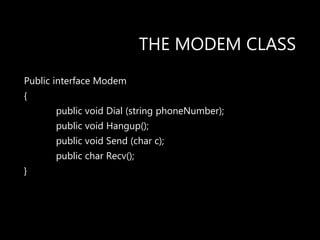
THE MODEM CLASS
Public interface Modem
{
public void Dial (string phoneNumber);
public void Hangup();
public void Send (char c);
public char Recv();
}
OPEN/CLOSED
• Entities should be open for extension but closed for
modification
• Open for Extension – Behavior can be extended
• Closed for Modification – Extending behavior doesn’t require
source changes to the entity.
• In C#, think abstract classes, or implementing interfaces.
THE SQUARE CIRCLE
PROBLEM
Void DrawAllShapes(Shapes list[])
{
foreach(shape in Shapes)
{
switch(shape.type)
{
case square:
DrawSquare(shape);
break;
case circle:
DrawCircle(shape);
break;
}
}
}
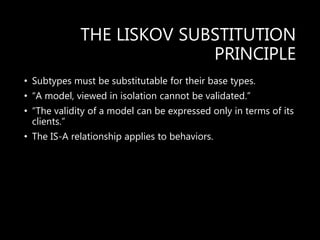
THE LISKOV SUBSTITUTION
PRINCIPLE
• Subtypes must be substitutable for their base types.
• “A model, viewed in isolation cannot be validated.”
• “The validity of a model can be expressed only in terms of its
clients.”
• The IS-A relationship applies to behaviors.
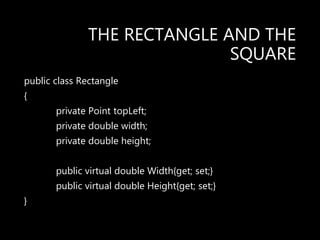
THE RECTANGLE AND THE
SQUARE
public class Rectangle
{
private Point topLeft;
private double width;
private double height;
public virtual double Width{get; set;}
public virtual double Height{get; set;}
}
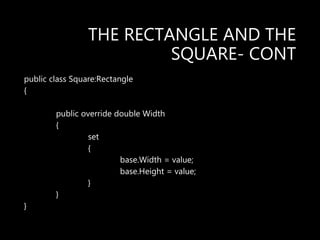
THE RECTANGLE AND THE
SQUARE- CONT
public class Square:Rectangle
{
public override double Width
{
set
{
base.Width = value;
base.Height = value;
}
}
}
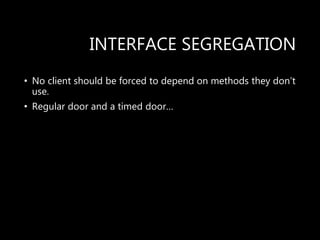
INTERFACE SEGREGATION
• No client should be forced to depend on methods they don’t
use.
• Regular door and a timed door…
DEPENDENCY INVERSION
• High level modules should not depend on low level modules.
They should both depend on abstractions
• Abstractions should not depend on details. Details should
depend on abstractions.
GOOD PRACTICES
• Don’t Repeat Yourself (DRY)
• You Ain’t Gonna Need It (YAGNI)
• Keep it stupid simple (KISS)
• Keep the design consistent within each layer.
• Prefer composition to inheritance.
• Be explicit about communication.
• Keep data formats consistent.
• Separate crosscutting code.
• Only talk to your immediate friends (LoD)?
BAD PRACTICES
• Premature Generalization
• Premature Optimization
• Pattern all the things!
• No non-functional requirements
• The one true way to do it
• Resume driven development
• Einstein syndrome
• Fire and forget
• Quality is job #987
PATTERNS
ARCHITECTURAL STYLES /
PATTERNS
• Patterns that are mostly concerned with how applications are
structured and developed.
• Principles that shape an application.
• You can and probably will mix and match styles.
• Conway’s Law
• “Software will reflect the organization that created it.”
LAYERS
• Functionality in each layers is related by common
responsibility.
• Communication is explicit and loosely coupled.
• Benefits
• Abstraction
• Isolation
• Manageability
• Reusability
• Testability
CLIENT/SERVER
• Segregates the system into two applications, client makes
requests to the server.
• Classically, the server is a database with application logic in
stored procedures.
• Benefits
• Security
• Centralized Access
• Maintainance
N-TIER / 3-TIER
• Like layers, but physically separated.
• Tiers are completely separate from other tiers and only
communicate with the tiers immediately adjacent.
• Benefits
• Maintainability
• Scalability
• Flexibility
• Availability
MESSAGE BUS
• Receive and send messages using a common bus.
• Communication is explicit and loosely coupled.
• Pub/Sub, Message Queueing.
• Benefits
• Extensibility
• Low Complexity
• Flexibility
• Loose Coupling
• Scalability
• Application Simplicity
MICROKERNEL
• Core System + Plug-ins
• Core traditionally contains minimal functionality
• Benefits
• Extensibility
• Ease of Deployment
• Testability
SERVICE ORIENTED
ARCHITECTURE
• Boundaries are explicit.
• Services are autonomous.
• Services share schema and contract, not class.
• Service compatibility is based on policy (transport, protocol
and security).
• Benefits
• Loose Coupling
• Ease of deployment (kinda)
• Testable
• Scalable
• Now for something completely different.
MICROSERVICES
• Functionality provided as (web) services
• Boundaries are explicit.
• Services are autonomous.
• Might not expose schema or contract.
• Generally little, restish services.
• Benefits
• Loose Coupling
• Ease of deployment (kinda)
• Testable
• Scalable
SO MANY ARCHITECTURAL
PATTERNS
• Monolithic (Big Ball of Mud)
• Blackboard (Shared Memory)
• Hexagonal
• CQRS
• Event Driven
• Peer to Peer
• REST
• Shared Nothing Architecture (Sharding)
• Space Based Architecture (Good Luck)
ARCHITECTURAL DESIGN
• How to document and communicate?
• How much documentation do we need?
• When do we design the architecture?
• How much time should we spend architecting?
WE HAVE ONLY SCRATCHED
THE SURFACE
• Software Architecture and Design from Microsoft Patterns and
Practices.
• Patterns of Enterprise Application Architecture by Martin Fowler.
• Martin Fowler's Catalog of Patterns
• Martin Fowler's Site, anything by Martin Fowler really.
• Agile Principles, Patterns and Practices in C# by Robert C. Martin
• Head First Design Patterns - A little light, but a good intro.
• Wikipedia
• O’Reilly
SERIOUSLY? YOU’RE NOT
DONE YET?
• @steverb
• steverb.com
• me@steverb.com
EXTRA SLIDES IN CASE I
TALK WAY TOO FAST
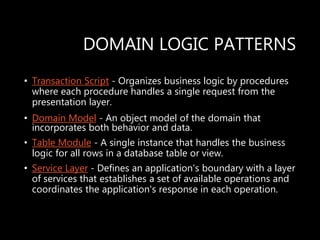
DOMAIN LOGIC PATTERNS
• Transaction Script - Organizes business logic by procedures
where each procedure handles a single request from the
presentation layer.
• Domain Model - An object model of the domain that
incorporates both behavior and data.
• Table Module - A single instance that handles the business
logic for all rows in a database table or view.
• Service Layer - Defines an application's boundary with a layer
of services that establishes a set of available operations and
coordinates the application's response in each operation.
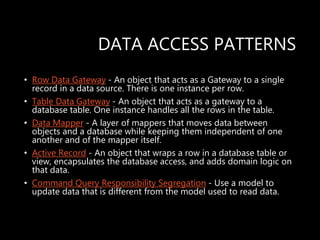
DATA ACCESS PATTERNS
• Row Data Gateway - An object that acts as a Gateway to a single
record in a data source. There is one instance per row.
• Table Data Gateway - An object that acts as a gateway to a
database table. One instance handles all the rows in the table.
• Data Mapper - A layer of mappers that moves data between
objects and a database while keeping them independent of one
another and of the mapper itself.
• Active Record - An object that wraps a row in a database table or
view, encapsulates the database access, and adds domain logic on
that data.
• Command Query Responsibility Segregation - Use a model to
update data that is different from the model used to read data.
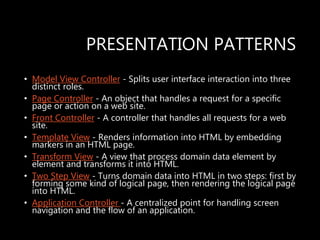
PRESENTATION PATTERNS
• Model View Controller - Splits user interface interaction into three
distinct roles.
• Page Controller - An object that handles a request for a specific
page or action on a web site.
• Front Controller - A controller that handles all requests for a web
site.
• Template View - Renders information into HTML by embedding
markers in an HTML page.
• Transform View - A view that process domain data element by
element and transforms it into HTML.
• Two Step View - Turns domain data into HTML in two steps: first by
forming some kind of logical page, then rendering the logical page
into HTML.
• Application Controller - A centralized point for handling screen
navigation and the flow of an application.

Architecture Principles CodeStock

  • 1.
    Principles of ApplicationArchitecture 9:25am/ Ballroom B
  • 2.
    PRELIMINARIES • Who amI? • Steve Barbour • @steverb • steverb.com • Why should you listen to me? • You shouldn’t • Ground rules for this talk • I do NOT have all the answers • Discussion and disagreement are welcome • Keep it civil • We do have a time limit
  • 3.
    WHAT IS APPLICATION ARCHITECTURE? •High level breakdown of system into its parts. • Things that are hard to change. • Mostly concerned with the public interfaces, not the private implementation. • Whatever the important stuff is.
  • 4.
  • 5.
    BAD ARCHITECTURE • OverlyComplex • Error Prone • Fragile • Hard to understand • Rigid
  • 6.
    GOOD ARCHITECTURE • Simpleas possible • Correct • Robust • Understandable • Flexible
  • 7.
    CONTINUUM • The linebetween architecture and craftsmanship is blurry • System • Application • Modules/Classes • Functions
  • 8.
  • 9.
    SINGLE RESPONSIBILITY • Acomponent should have only one (business) reason to change. • Having separate components that do not overlap in functionality makes the system/application easier to understand, reason about, test and change.
  • 10.
    THE MODEM CLASS Publicinterface Modem { public void Dial (string phoneNumber); public void Hangup(); public void Send (char c); public char Recv(); }
  • 11.
    OPEN/CLOSED • Entities shouldbe open for extension but closed for modification • Open for Extension – Behavior can be extended • Closed for Modification – Extending behavior doesn’t require source changes to the entity. • In C#, think abstract classes, or implementing interfaces.
  • 12.
    THE SQUARE CIRCLE PROBLEM VoidDrawAllShapes(Shapes list[]) { foreach(shape in Shapes) { switch(shape.type) { case square: DrawSquare(shape); break; case circle: DrawCircle(shape); break; } } }
  • 13.
    THE LISKOV SUBSTITUTION PRINCIPLE •Subtypes must be substitutable for their base types. • “A model, viewed in isolation cannot be validated.” • “The validity of a model can be expressed only in terms of its clients.” • The IS-A relationship applies to behaviors.
  • 14.
    THE RECTANGLE ANDTHE SQUARE public class Rectangle { private Point topLeft; private double width; private double height; public virtual double Width{get; set;} public virtual double Height{get; set;} }
  • 15.
    THE RECTANGLE ANDTHE SQUARE- CONT public class Square:Rectangle { public override double Width { set { base.Width = value; base.Height = value; } } }
  • 16.
    INTERFACE SEGREGATION • Noclient should be forced to depend on methods they don’t use. • Regular door and a timed door…
  • 17.
    DEPENDENCY INVERSION • Highlevel modules should not depend on low level modules. They should both depend on abstractions • Abstractions should not depend on details. Details should depend on abstractions.
  • 18.
    GOOD PRACTICES • Don’tRepeat Yourself (DRY) • You Ain’t Gonna Need It (YAGNI) • Keep it stupid simple (KISS) • Keep the design consistent within each layer. • Prefer composition to inheritance. • Be explicit about communication. • Keep data formats consistent. • Separate crosscutting code. • Only talk to your immediate friends (LoD)?
  • 19.
    BAD PRACTICES • PrematureGeneralization • Premature Optimization • Pattern all the things! • No non-functional requirements • The one true way to do it • Resume driven development • Einstein syndrome • Fire and forget • Quality is job #987
  • 20.
  • 21.
    ARCHITECTURAL STYLES / PATTERNS •Patterns that are mostly concerned with how applications are structured and developed. • Principles that shape an application. • You can and probably will mix and match styles. • Conway’s Law • “Software will reflect the organization that created it.”
  • 22.
    LAYERS • Functionality ineach layers is related by common responsibility. • Communication is explicit and loosely coupled. • Benefits • Abstraction • Isolation • Manageability • Reusability • Testability
  • 23.
    CLIENT/SERVER • Segregates thesystem into two applications, client makes requests to the server. • Classically, the server is a database with application logic in stored procedures. • Benefits • Security • Centralized Access • Maintainance
  • 24.
    N-TIER / 3-TIER •Like layers, but physically separated. • Tiers are completely separate from other tiers and only communicate with the tiers immediately adjacent. • Benefits • Maintainability • Scalability • Flexibility • Availability
  • 25.
    MESSAGE BUS • Receiveand send messages using a common bus. • Communication is explicit and loosely coupled. • Pub/Sub, Message Queueing. • Benefits • Extensibility • Low Complexity • Flexibility • Loose Coupling • Scalability • Application Simplicity
  • 26.
    MICROKERNEL • Core System+ Plug-ins • Core traditionally contains minimal functionality • Benefits • Extensibility • Ease of Deployment • Testability
  • 27.
    SERVICE ORIENTED ARCHITECTURE • Boundariesare explicit. • Services are autonomous. • Services share schema and contract, not class. • Service compatibility is based on policy (transport, protocol and security). • Benefits • Loose Coupling • Ease of deployment (kinda) • Testable • Scalable • Now for something completely different.
  • 28.
    MICROSERVICES • Functionality providedas (web) services • Boundaries are explicit. • Services are autonomous. • Might not expose schema or contract. • Generally little, restish services. • Benefits • Loose Coupling • Ease of deployment (kinda) • Testable • Scalable
  • 29.
    SO MANY ARCHITECTURAL PATTERNS •Monolithic (Big Ball of Mud) • Blackboard (Shared Memory) • Hexagonal • CQRS • Event Driven • Peer to Peer • REST • Shared Nothing Architecture (Sharding) • Space Based Architecture (Good Luck)
  • 30.
    ARCHITECTURAL DESIGN • Howto document and communicate? • How much documentation do we need? • When do we design the architecture? • How much time should we spend architecting?
  • 31.
    WE HAVE ONLYSCRATCHED THE SURFACE • Software Architecture and Design from Microsoft Patterns and Practices. • Patterns of Enterprise Application Architecture by Martin Fowler. • Martin Fowler's Catalog of Patterns • Martin Fowler's Site, anything by Martin Fowler really. • Agile Principles, Patterns and Practices in C# by Robert C. Martin • Head First Design Patterns - A little light, but a good intro. • Wikipedia • O’Reilly
  • 32.
    SERIOUSLY? YOU’RE NOT DONEYET? • @steverb • steverb.com • me@steverb.com
  • 33.
    EXTRA SLIDES INCASE I TALK WAY TOO FAST
  • 34.
    DOMAIN LOGIC PATTERNS •Transaction Script - Organizes business logic by procedures where each procedure handles a single request from the presentation layer. • Domain Model - An object model of the domain that incorporates both behavior and data. • Table Module - A single instance that handles the business logic for all rows in a database table or view. • Service Layer - Defines an application's boundary with a layer of services that establishes a set of available operations and coordinates the application's response in each operation.
  • 35.
    DATA ACCESS PATTERNS •Row Data Gateway - An object that acts as a Gateway to a single record in a data source. There is one instance per row. • Table Data Gateway - An object that acts as a gateway to a database table. One instance handles all the rows in the table. • Data Mapper - A layer of mappers that moves data between objects and a database while keeping them independent of one another and of the mapper itself. • Active Record - An object that wraps a row in a database table or view, encapsulates the database access, and adds domain logic on that data. • Command Query Responsibility Segregation - Use a model to update data that is different from the model used to read data.
  • 36.
    PRESENTATION PATTERNS • ModelView Controller - Splits user interface interaction into three distinct roles. • Page Controller - An object that handles a request for a specific page or action on a web site. • Front Controller - A controller that handles all requests for a web site. • Template View - Renders information into HTML by embedding markers in an HTML page. • Transform View - A view that process domain data element by element and transforms it into HTML. • Two Step View - Turns domain data into HTML in two steps: first by forming some kind of logical page, then rendering the logical page into HTML. • Application Controller - A centralized point for handling screen navigation and the flow of an application.