Stijn Volders
@ONE75
http://blog.one75.be
Context Mapping
Why a Context Map is essential for the success of your project
domaindriven.be – DDD Basics
What
• A simple diagram with Bounded Context’s who are involved in your
project an your relation with them
Why
• Get insight in inter-team communication an their bandwith
• Measure to which extent a vision could be shared
• Help to decide if DDD is appropriate
It’s all about relations
Relations fall into Patterns
• Partnership
• Customer/Supplier
• Big Ball of Mud
• Conformist
• Shared Kernel
• Separate Ways
All relations have their price
Definition: Partnership
When teams in 2 contexts succeed or fail together
• Co-ordintad planning of development and joint management of
integration
• Interdependent features should be scheduled so that they are
completed for the same release
Definition: Customer - Supplier
• 2 teams in an upstream/downstream relationship
• Upstream can succeed interdependently of the downstream team
• Downstream priorities factor into upstream planning
Definition: Big Ball of Mud
When you have to deal with a big, monolithic (legacy) system
• Often with large intermixed models
Definition: Conformist
• 2 teams in an upstream/downstream relationship
• Upstream has no motivation to provide for the downstream team’s
needs
• Downstream team doesn’t put effort in translation
Definition: Shared Kernel
Sharing a part of the model
• Very intimite interdependency
• Can leverage or undermine design work
• Must be kept small!
Definition: Separate Ways
Used to cut loose systems
• Integration is always expensive
• When there is little to zero interest/benefit in integration
Definition: Anticorruption Layer
• Isolating layer to limit impact of changes in an upstream system
• Requires little or no modification to the upstream system
• Translates in both directions between the 2 models
Definition: Open Host Service
When you want to open your system for integration
• Protocol that gives access to your system as a set of services
• Open for everyone that needs to integrate with your system
• New services can be added on request but need to serve a
“general” purpose
Definition: Published Language
When you want a common language for translation between 2
bounded contexts
• Often combined with Open Host Service
Upstream/Downstream
Upstream/Downstream
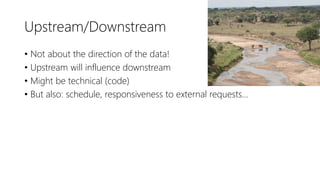
• Not about the direction of the data!
• Upstream will influence downstream
• Might be technical (code)
• But also: schedule, responsiveness to external requests...
Attention!
• Map the current situation, not the (desired) future
• If it’s a mess, show it. It’ll bring focus to the problems & risks
involved in your project.
Let’s try it!
Domain: Amazon
Step 1
• Draw each Context with the name (as known in the UL)
Step 2
• Define which models communicate
• Bandwith
Step 3
• Indicate the direction of the relation, if applicable
(Upstream/Downstream)
Step 4
• Put the name of the Pattern on the relationship
• Partnership
• Customer/Supplier
• Conformist
• Separate Ways
• Big Ball of Mud
• Shared Kernel
Step 5
• Indicate which BC’s have explicit translation or sharing
• Anti Corruption Layer
• Open Host/Published Language
Questions?
Stijn Volders
@ONE75
http://blog.one75.be

DDD Basics - Context mapping

  • 1.
  • 2.
    Context Mapping Why aContext Map is essential for the success of your project domaindriven.be – DDD Basics
  • 3.
    What • A simplediagram with Bounded Context’s who are involved in your project an your relation with them
  • 4.
    Why • Get insightin inter-team communication an their bandwith • Measure to which extent a vision could be shared • Help to decide if DDD is appropriate
  • 6.
  • 7.
    Relations fall intoPatterns • Partnership • Customer/Supplier • Big Ball of Mud • Conformist • Shared Kernel • Separate Ways
  • 8.
    All relations havetheir price
  • 10.
    Definition: Partnership When teamsin 2 contexts succeed or fail together • Co-ordintad planning of development and joint management of integration • Interdependent features should be scheduled so that they are completed for the same release
  • 11.
    Definition: Customer -Supplier • 2 teams in an upstream/downstream relationship • Upstream can succeed interdependently of the downstream team • Downstream priorities factor into upstream planning
  • 12.
    Definition: Big Ballof Mud When you have to deal with a big, monolithic (legacy) system • Often with large intermixed models
  • 13.
    Definition: Conformist • 2teams in an upstream/downstream relationship • Upstream has no motivation to provide for the downstream team’s needs • Downstream team doesn’t put effort in translation
  • 14.
    Definition: Shared Kernel Sharinga part of the model • Very intimite interdependency • Can leverage or undermine design work • Must be kept small!
  • 15.
    Definition: Separate Ways Usedto cut loose systems • Integration is always expensive • When there is little to zero interest/benefit in integration
  • 16.
    Definition: Anticorruption Layer •Isolating layer to limit impact of changes in an upstream system • Requires little or no modification to the upstream system • Translates in both directions between the 2 models
  • 17.
    Definition: Open HostService When you want to open your system for integration • Protocol that gives access to your system as a set of services • Open for everyone that needs to integrate with your system • New services can be added on request but need to serve a “general” purpose
  • 18.
    Definition: Published Language Whenyou want a common language for translation between 2 bounded contexts • Often combined with Open Host Service
  • 19.
  • 20.
    Upstream/Downstream • Not aboutthe direction of the data! • Upstream will influence downstream • Might be technical (code) • But also: schedule, responsiveness to external requests...
  • 21.
    Attention! • Map thecurrent situation, not the (desired) future • If it’s a mess, show it. It’ll bring focus to the problems & risks involved in your project.
  • 22.
  • 23.
  • 24.
    Step 1 • Draweach Context with the name (as known in the UL)
  • 25.
    Step 2 • Definewhich models communicate • Bandwith
  • 26.
    Step 3 • Indicatethe direction of the relation, if applicable (Upstream/Downstream)
  • 27.
    Step 4 • Putthe name of the Pattern on the relationship • Partnership • Customer/Supplier • Conformist • Separate Ways • Big Ball of Mud • Shared Kernel
  • 28.
    Step 5 • Indicatewhich BC’s have explicit translation or sharing • Anti Corruption Layer • Open Host/Published Language
  • 29.