.NET Architecture
  for Enterprises


 Wade Wegner
 Architect, Microsoft Corporation
 wade.wegner@microsoft.com
 http://www.architectingwith.net/
First, a story …
First, a story …
p e r s o n^ l
           a
There once was a developer …
… who really enjoyed coding …
Window Server
                                      Tibco
                       Apache
    Web Services
                             Python

 SQL Server                           HTML
                .NET
                                        SOA
JavaScript               BizTalk
       AS/400                         Oracle
                       IIS
… and then one day …
… through no fault of his own …
… someone called him an architect.
How did this happen?
Was he suddenly a
different person?
Did he now need to care
 about different things?
Goals
Goals


Leave with a better understanding
         of architecture
Goals


Leave with a better understanding
         of architecture
  s o f t w a ^r e
Goals


 Understand the practical aspects
     of architecture in .NET
What is architecture?
Why should I care?
How is software architecture
         different?
Determining how to do something
Making expensive and
hard-to-change decisions
Who is the architect?
Are there different types
      of architects?
Are architects project managers?
Should architects write code?
Do architects just focus
   on abstractions?
Poor software typically
has one of two causes …
… insufficient skills.
… contradictory and ambiguous
        requirements.
Anyone can write code
   that just works.
Our goal should be …
… to write good code
     that works.
Why?
For poorly written code
   “that just works”…
… maintenance is expensive
… maintenance is frustrating
… maintenance is time consuming
How do we write good code
       that works?
Tenets of Structured Design


                     Cohesion
Tenets of Structured Design


                      Coupling
Tenets of Structured Design


                  Low coupling &
                   High cohesion
Separation of Concerns


     Identifying the concerns
Separation of Concerns


           Modularity
Separation of Concerns


        Information hiding
So, what are some principles that
        make this easier?
Principles


    Find Pertinent Objects First
Principles

     To view all orders placed by a customer, the
     user indicates the customer ID. The program
     displays an error message if the customer does
     not exist. If the customer exists, the program
     displays name, address, date of birth, and all
     outstanding orders. For each order, the
     program gets ID, date, and all order items.


    Find Pertinent Objects First
Principles


        Favor Low Coupling
Principles


     Program to an interface, not an
            implementation


        Favor Low Coupling
Principles


         Favor Code Reuse
This is great, we know this …
   so, what else is there?
Advanced Principles


      Open/Closed Principle
Advanced Principles


   Liskov’s Substitution Principle
Advanced Principles


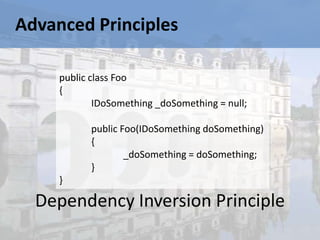
  Dependency Inversion Principle
Advanced Principles

     public class Foo
     {
             IDoSomething _doSomething = null;

           public Foo(IDoSomething doSomething)
           {
                   _doSomething = doSomething;
           }
     }

  Dependency Inversion Principle
Patterns
Patterns


           Design Patterns
Patterns


      Architectural Patterns
Patterns


           Antipatterns
Patterns are not …
Patterns are not …


             … a verb
Patterns are not …


          … superhuman
Patterns are not …


    … inherently good nor evil
Testability & Security
Testability
Testability


          Software Testing
Testability


         Software Contracts
Testability


              Unit Testing
Testability


    Dealing with Dependencies
Testability


              Fakes to Mocks
Security
Security


     Security as a requirement
Security


  Security Development Lifecycle
Security Development Lifecycle


             Layering
Security Development Lifecycle


        Componentization
Security Development Lifecycle


              Roles
Security


           Threat models
Okay, is this it?
Interesting, but abstract
How does this help me design my
            system?
Let’s look at the common layers of any
                 system …
The Business Layer
The Service Layer
The Data Access Layer
The Presentation Layer
The Business Layer
The Business Layer


            What is it?
The Business Layer


      Domain’s Object Model
The Business Layer


         Domain Entities
The Business Layer


          Business Rules
The Business Layer


            Validation
The Business Layer


   Business Process & Workflow
The Business Layer


     Where do you deploy it?
The Business Layer


          The Gray Areas
The Business Layer – Gray Areas


         Data Formatting
The Business Layer – Gray Areas


              CRUD
The Business Layer – Gray Areas


        Stored Procedures
The Business Layer


             Patterns
The Business Layer


   The Transaction Script Pattern
The Business Layer


    The Table Module Pattern
The Business Layer


    The Active Record Pattern
The Business Layer


    The Domain Model Pattern
The Service Layer
The Service Layer


            What is it?
The Service Layer


    What’s service orientation?
What about SOA?
The Services Layer


   Service-Oriented Architecture
The Services Layer


          Tenets of SOA
Tenets of SOA


      Boundaries Are Explicit
Tenets of SOA


    Services Are Autonomous
Tenets of SOA


    Use Contracts, Not Classes
Tenets of SOA


  Compatibility Is Based on Policy
What SOA is not …
SOA is not …


          … a revolution
SOA is not …


          … a technology
SOA is not …


         … a web service
SOA is not …


               … a goal
The Data Access Layer


            What is it?
The Data Access Layer


          Requirements
DAL: Requirements


     Database Independence
DAL: Requirements


     Configurable as a Plug-in
DAL: Requirements


    Persisting the Application’s
           Object Model
The Data Access Layer


         Responsibilities
DAL: Responsibilities


          CRUD services
DAL: Responsibilities


          Query services
DAL: Responsibilities


           Transactions
DAL: Responsibilities


           Concurrency
The Data Access Layer


    Separated Interface Pattern
The Data Access Layer


        The Plugin Pattern
The Data Access Layer


 Should you write your own DAL?
The Data Access Layer


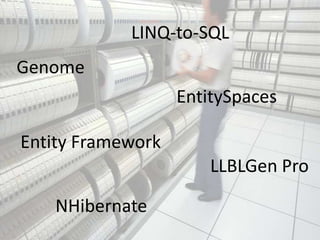
             O/RMs
LINQ-to-SQL
Genome
                   EntitySpaces

Entity Framework
                       LLBLGen Pro

   NHibernate
The Data Access Layer


       Using an O/RM Tool
The Data Access Layer


       Stored Procedures?
DAL: Stored Procedure Myth #1


   SPs are faster than SQL code
DAL: Stored Procedure Myth #2


SPs are more secure than SQL code
DAL: Stored Procedure Myth #3


  SPs can be used to fend off SQL
              injection
DAL: Stored Procedure Myth #4


SPs can be used to reduce brittleness
             of SQL code
Stop! What are you saying?
Do we still need DBAs?
The Presentation Layer


         Responsibilities
PL: Responsibilities


            Validation?
            Formatting?
              Styling?
             Usability?
PL: Responsibilities


    Independence from graphics
PL: Responsibilities


 Independence from UI Technology
PL: Responsibilities


             Testability
PL: Responsibilities


  Independence from data model
The Presentation Layer


             Patterns
PL: Patterns


   Model-View-Controller (MVC)
PL: Patterns


   Model-View-Presenter (MVP)
The Presentation Layer


    How do I choose a pattern?
Summary
Summary


     Defined Architecture
Summary


     Described Architects
Summary


          Maintainability
Summary


  Low coupling & high cohesion
Summary


Principles of software architecture
Summary


          Design patterns
Summary


Architecture patterns & antipatterns
Summary


     Testability & Security
Summary


      The Business Layer
Summary


      The Services Layer
Summary


     The Data Access Layer
Summary


    The Presentation Layer
Closing thoughts …
Closing thoughts …


           “It” depends
Closing thoughts …


          Requirements
Closing thoughts …


     Reuse is a nice side effect
Closing thoughts …


      Separation of Concerns
Closing thoughts …


         Maintainability
Closing thoughts …


      Don’t trust your users
Closing thoughts …


 Security and testability by design
wade.wegner@microsoft.com
                                                                   http://architectingwith.net


           © 2009 Microsoft Corporation. All rights reserved. Microsoft, Windows, Windows Vista and other product names are or may be registered trademarks and/or trademarks in the U.S. and/or other countries.
The information herein is for informational purposes only and represents the current view of Microsoft Corporation as of the date of this presentation. Because Microsoft must respond to changing market conditions, it should

 not be interpreted to be a commitment on the part of Microsoft, and Microsoft cannot guarantee the accuracy of any information provided after the date of this presentation. MICROSOFT MAKES NO WARRANTIES, EXPRESS,
                                                                           IMPLIED OR STATUTORY, AS TO THE INFORMATION IN THIS PRESENTATION.

.NET Architecture for Enterprises