Architectural Engineering: Structural
Option
Thesis Presentation
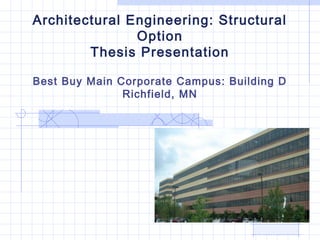
Best Buy Main Corporate Campus: Building D
Richfield, MN
Presentation Outline
•

•
•

•
•
•

Introduction
– Building description
– Existing structural conditions
Project Proposal
Building Redesign
– Columns
– PT floor system
– Lateral system
– Foundation
Cost Comparison
Architectural Comparison
Conclusions

Page 2

01/21/14
Introduction
•
•
•
•
•
•
•

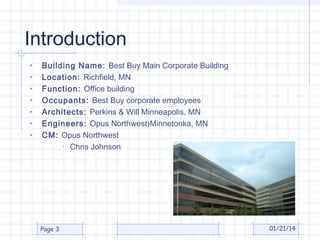
Building Name: Best Buy Main Corporate Building
Location: Richfield, MN
Function: Office building
Occupants: Best Buy corporate employees
Architects: Perkins & Will Minneapolis, MN
Engineers: Opus Northwest)Minnetonka, MN
CM: Opus Northwest
• Chris Johnson

Page 3

01/21/14
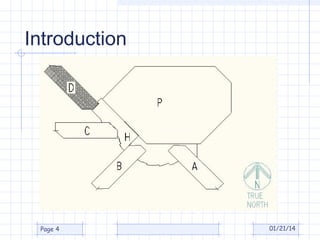
Introduction

Page 4

01/21/14
Building Description
Architecture
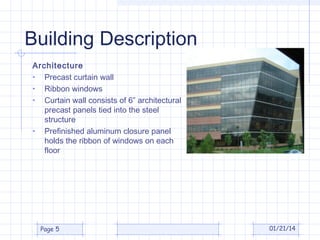
• Precast curtain wall
• Ribbon windows
• Curtain wall consists of 6” architectural
precast panels tied into the steel
structure
• Prefinished aluminum closure panel
holds the ribbon of windows on each
floor

Page 5

01/21/14
Structural System
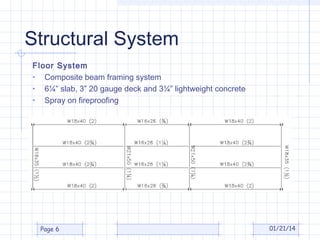
Floor System
• Composite beam framing system
• 6¼” slab, 3” 20 gauge deck and 3¼” lightweight concrete
• Spray on fireproofing

Page 6

01/21/14
Structural System

Page 7

01/21/14
Structural System
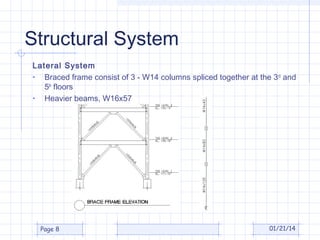
Lateral System
• Braced frame consist of 3 - W14 columns spliced together at the 3rd and
5th floors
• Heavier beams, W16x57

Page 8

01/21/14
Project Proposal
Proposed Solution:
• Redesign Best Buy Corporate Building D as a full concrete
system
• Floor system will be redesigned post-tensioned slab with beams
• Columns will also be redesigned into concrete
• Lateral bracing system will be shear walls
• Goal is to allow for a larger bay size in the short direction of the
building
• Cost Comparison of structural system
• The impact of the change in architecture on the tenant and
rentable area

Page 9

01/21/14
Project Proposal
Solution Method:
• Utilize ACI 318-05 Building Code Requirements for Structural
Concrete
• Utilize ADAPT-PT to design beams and slab
• Utilize PCA Column and ETABS to design columns and shear
walls
• Utilize RS Means Building Construction Cost Data for a
structural cost analysis
• Compare and contrast new vs. old architecture

Page 10

01/21/14
Building Redesign
•
•
•
•
•

Columns
PT floor system
PT beams
Shear Walls
Foundation

Page 11

01/21/14
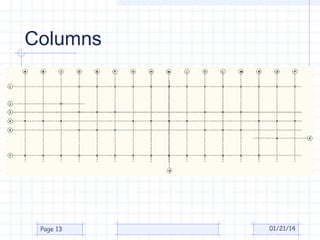
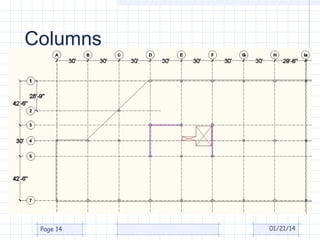
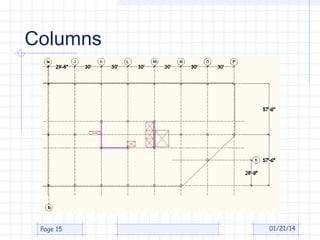
Columns
• Design floor layout to support larger

bays with fewer columns
• PCA Columns aided in design of
reinforcement
• ETABS used to verify column sizing

Page 12

01/21/14
Columns

Page 13

01/21/14
Columns

Page 14

01/21/14
Columns

Page 15

01/21/14
Columns
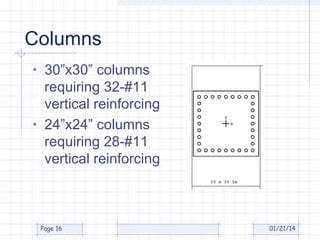
• 30”x30” columns

requiring 32-#11
vertical reinforcing
• 24”x24” columns
requiring 28-#11
vertical reinforcing

Page 16

01/21/14
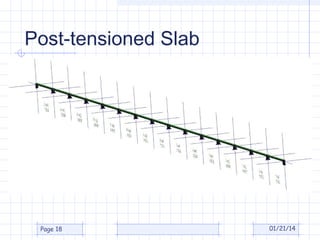
Post-tensioned Slab
• Design post-tensioned slab using

ADAPT-PT as an aid
• Keep slab thickness close to 8” as
recommended by span/depth ratio

Page 17

01/21/14
Post-tensioned Slab

Page 18

01/21/14
Post-tensioned Slab
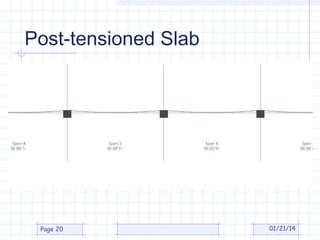
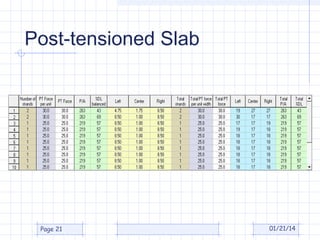
• Unit strip method
• Determined a 9.5” slab was required
• 2 tendons required for first and last 2

spans
• 1 tendon for the remaining spans

Page 19

01/21/14
Post-tensioned Slab

Page 20

01/21/14
Post-tensioned Slab

Page 21

01/21/14
Post-tensioned Beams
• Design post-tensioned beam using

ADAPT-PT as an aid
• Keep beam thickness close to 27” as
recommended by span/depth ratio

Page 22

01/21/14
Post-tensioned Beams

Page 23

01/21/14
Post-tensioned Beams
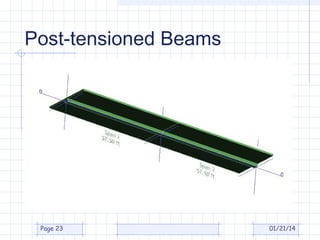
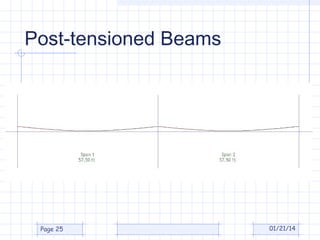
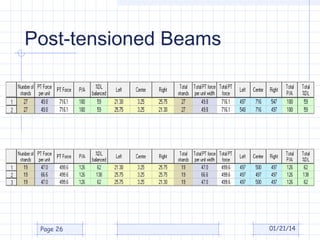
• 2 different beams had to be designed
• 2 span (57’6”,57’6”)
• 3 span (42’6”,30’,42’6”)
• Designed 28” deep for both spans
• 27 tendons needed for 2 span and 19

tendons for 3 span

Page 24

01/21/14
Post-tensioned Beams

Page 25

01/21/14
Post-tensioned Beams

Page 26

01/21/14
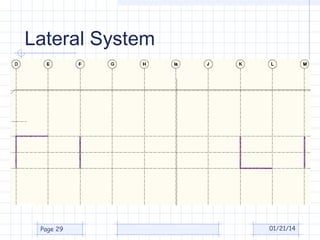
Lateral System
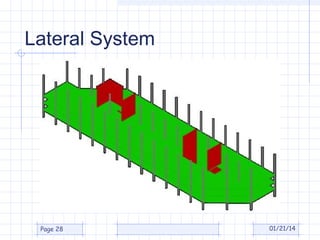
• Redesign braced frames into shear

walls while maintaining current location

Page 27

01/21/14
Lateral System

Page 28

01/21/14
Lateral System

Page 29

01/21/14
Lateral System
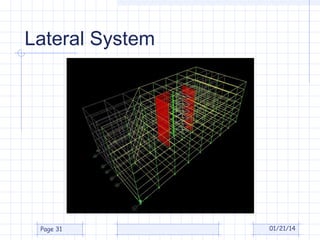
• ETABS assisted in the design
• Found that a 12” wall was a sufficient

thickness
• Boundary elements were designed to fit
inside the 12” wall

Page 30

01/21/14
Lateral System

Page 31

01/21/14
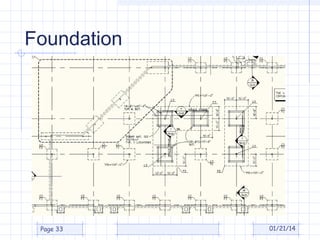
Foundation
• Considered, however, not redesigned
• Heavier concrete columns and shear

walls

– Larger piers and slabs
– Stronger concrete

Page 32

01/21/14
Foundation

Page 33

01/21/14
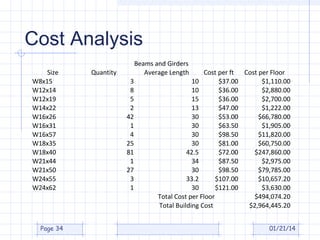
Cost Analysis
Size
W8x15
W12x14
W12x19
W14x22
W16x26
W16x31
W16x57
W18x35
W18x40
W21x44
W21x50
W24x55
W24x62

Page 34

Beams and Girders
Average Length

Quantity
3
8
5
2
42
1
4
25
81
1
27
3
1

Cost per ft Cost per Floor
10
$37.00
$1,110.00
10
$36.00
$2,880.00
15
$36.00
$2,700.00
13
$47.00
$1,222.00
30
$53.00
$66,780.00
30
$63.50
$1,905.00
30
$98.50
$11,820.00
30
$81.00
$60,750.00
42.5
$72.00
$247,860.00
34
$87.50
$2,975.00
30
$98.50
$79,785.00
33.2
$107.00
$10,657.20
30
$121.00
$3,630.00
Total Cost per Floor
$494,074.20
Total Building Cost
$2,964,445.20
01/21/14
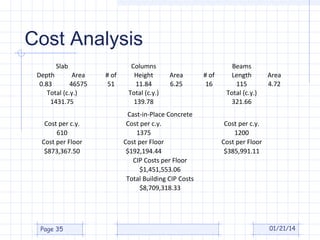
Cost Analysis
Slab
Depth
Area
0.83
46575
Total (c.y.)
1431.75
Cost per c.y.
610
Cost per Floor
$873,367.50

Page 35

# of
51

Columns
Height
11.84
Total (c.y.)
139.78

Area
6.25

Cast-in-Place Concrete
Cost per c.y.
1375
Cost per Floor
$192,194.44
CIP Costs per Floor
$1,451,553.06
Total Building CIP Costs
$8,709,318.33

# of
16

Beams
Length
115
Total (c.y.)
321.66

Area
4.72

Cost per c.y.
1200
Cost per Floor
$385,991.11

01/21/14
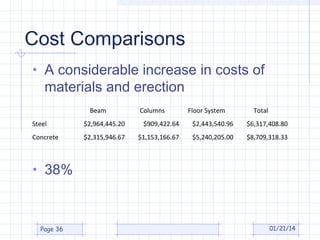
Cost Comparisons
• A considerable increase in costs of

materials and erection
Beam

Columns

Floor System

Total

Steel

$2,964,445.20

$909,422.64

$2,443,540.96

$6,317,408.80

Concrete

$2,315,946.67

$1,153,166.67

$5,240,205.00

$8,709,318.33

• 38%

Page 36

01/21/14
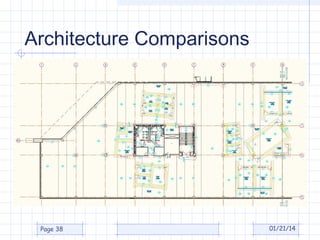
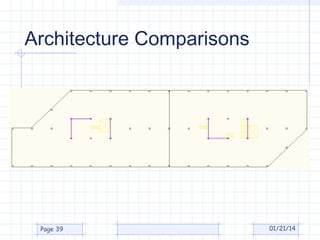
Architecture Comparisons
• Increased open space bays from 42’6”

to 57’6”
• No fireproofing
• Fewer columns for partitioned rooms to
work around

Page 37

01/21/14
Architecture Comparisons

Page 38

01/21/14
Architecture Comparisons

Page 39

01/21/14
Conclusions
• New floor system increased bay sizes

without sacrificing ceiling/floor height
• Cost of new system far exceeds cost of
existing system

Page 40

01/21/14
Acknowledgements
• Thesis Advisors:
– Dr. Thomas E. Boothby

• Industry Contacts:
– Gary R. Strand, P.E. - Simpson Gumpertz & Heger
– David B. Smith, P.E. - Holbert Apple Associates
– Richard Apple, P.E. - Holbert Apple Associates

• Other Mentors:
– Professor M. Kevin Parfitt
– Professor Moses Ling

Page 41

01/21/14
Questions

?
Page 42

01/21/14

Architecture presentation 3