EDITED BY DAVID ADLER
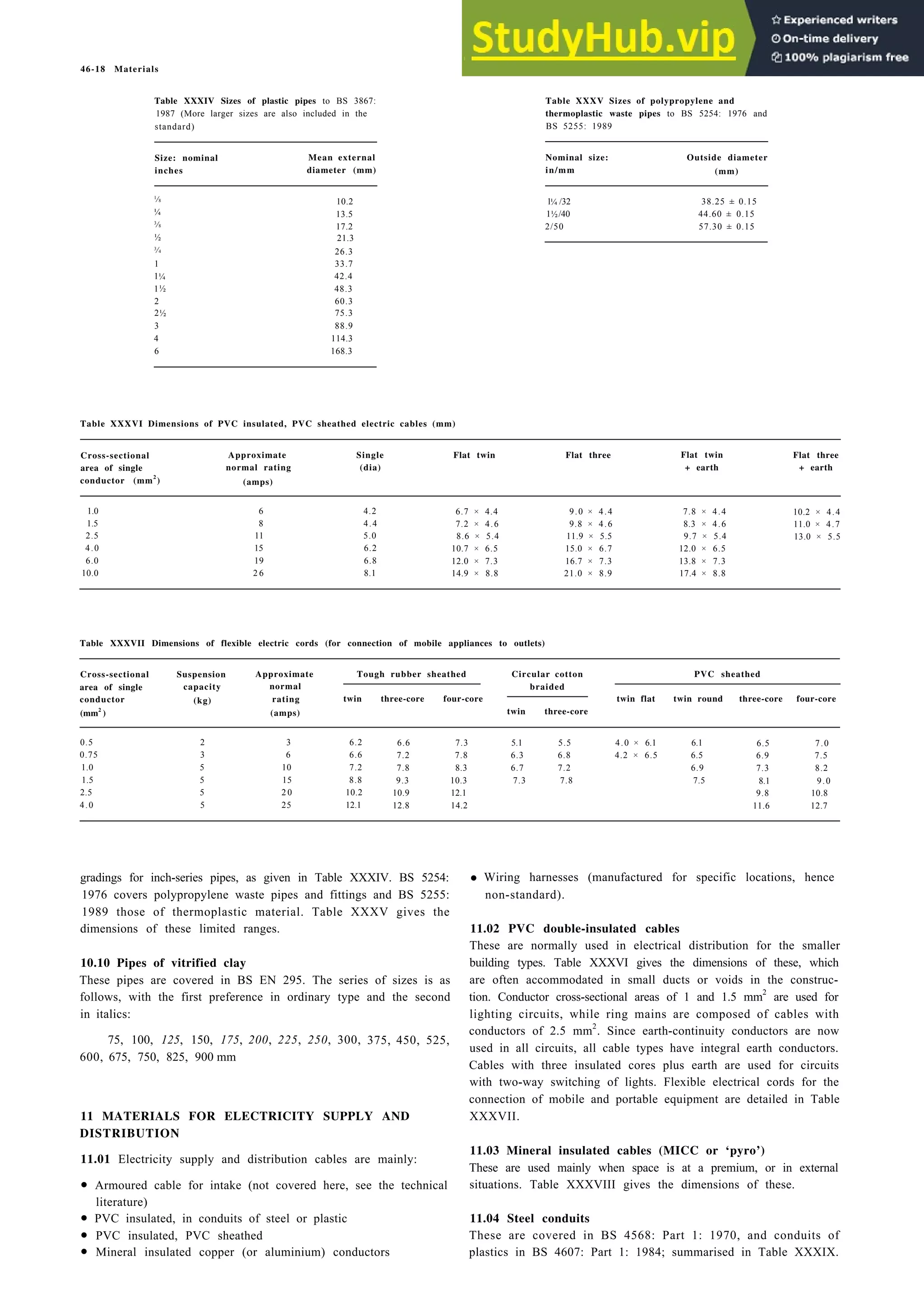
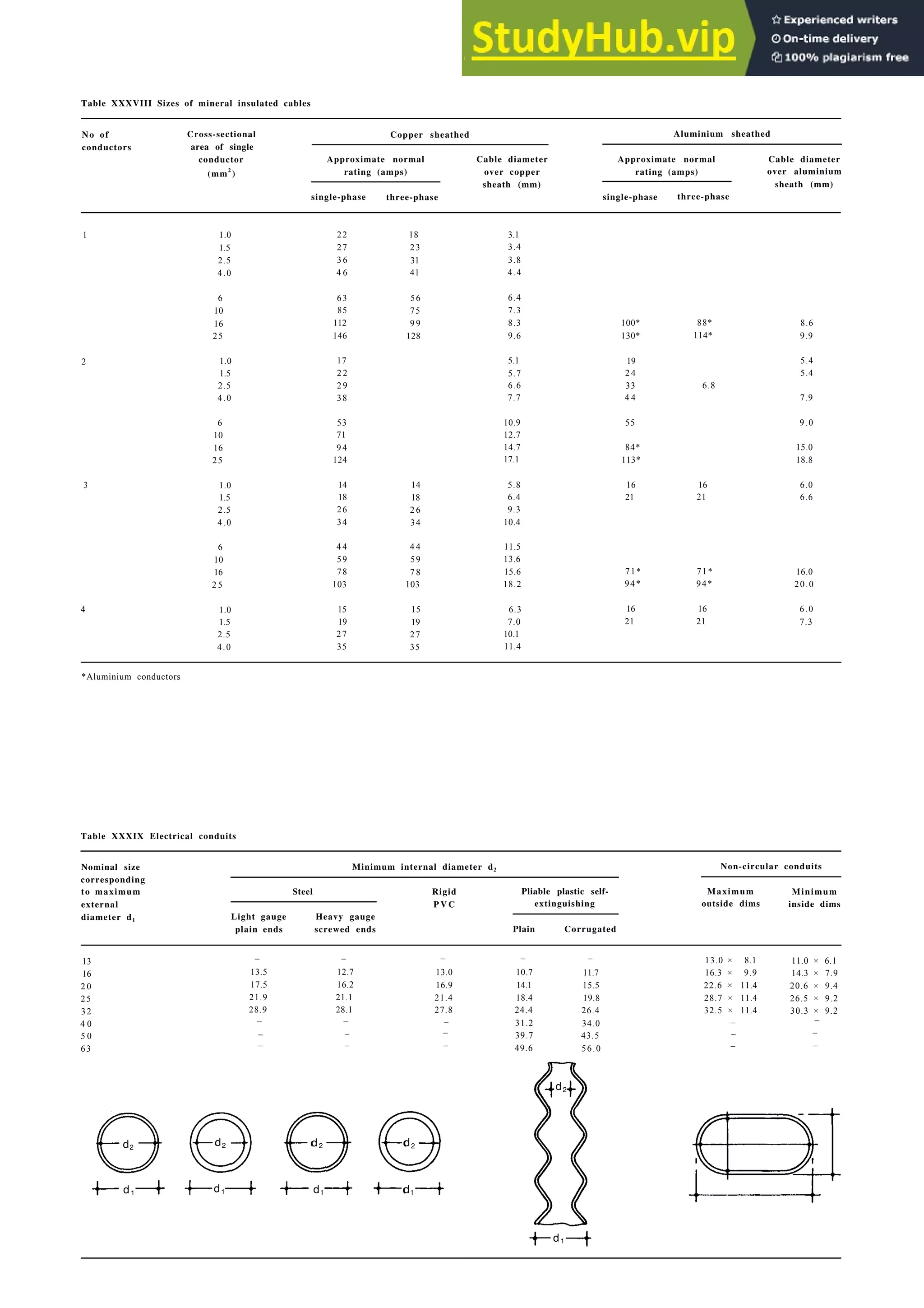
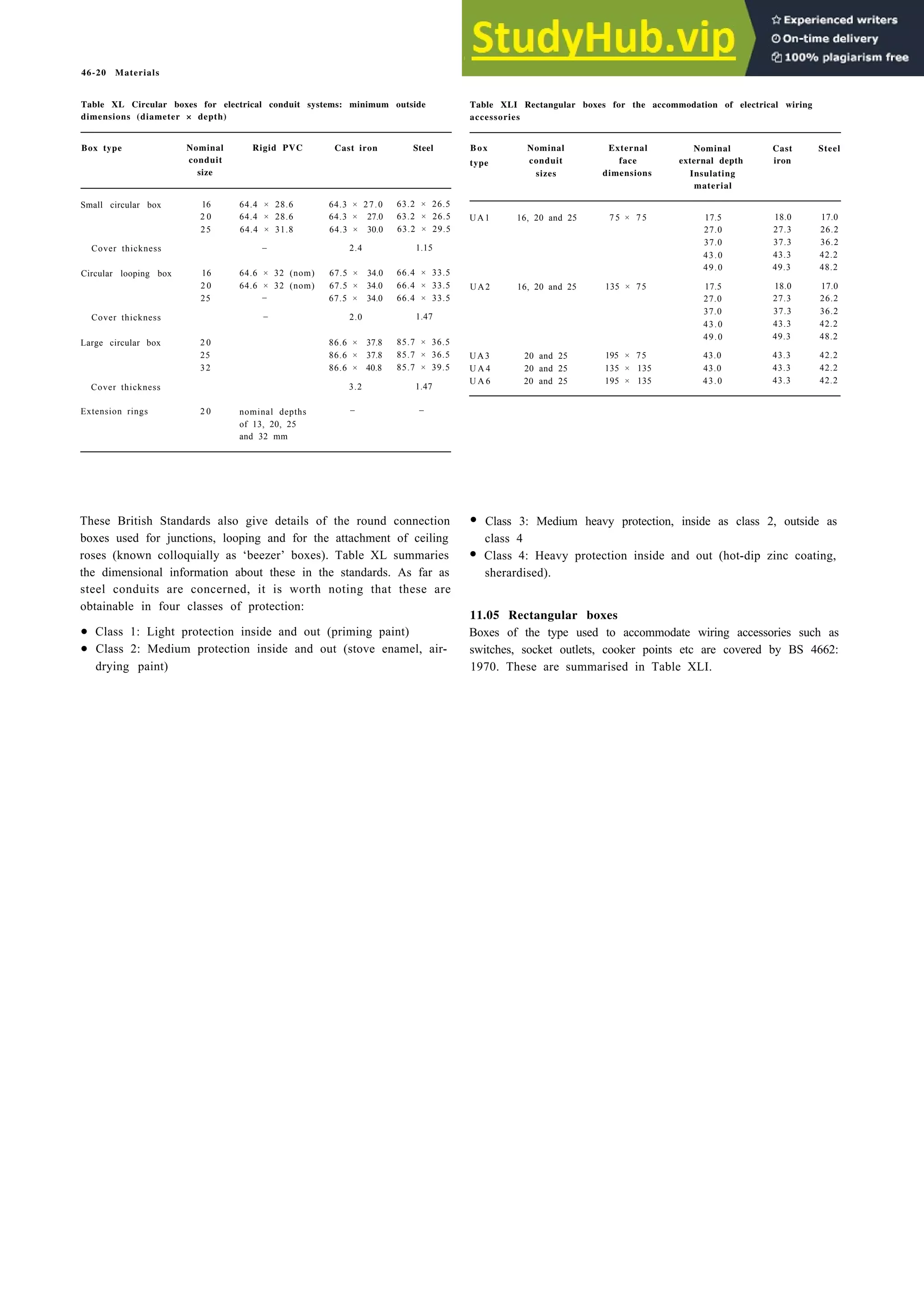
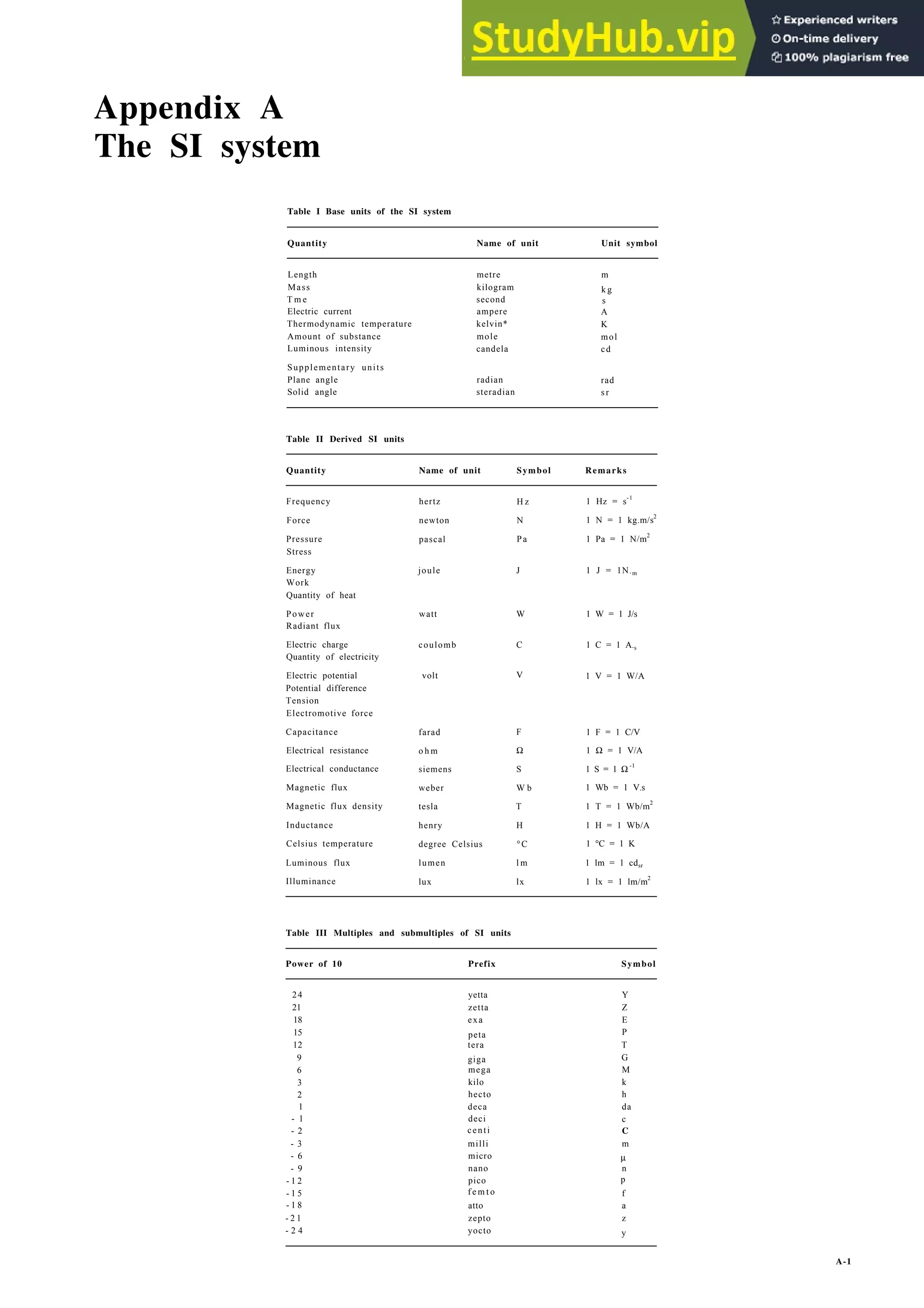
METRIC
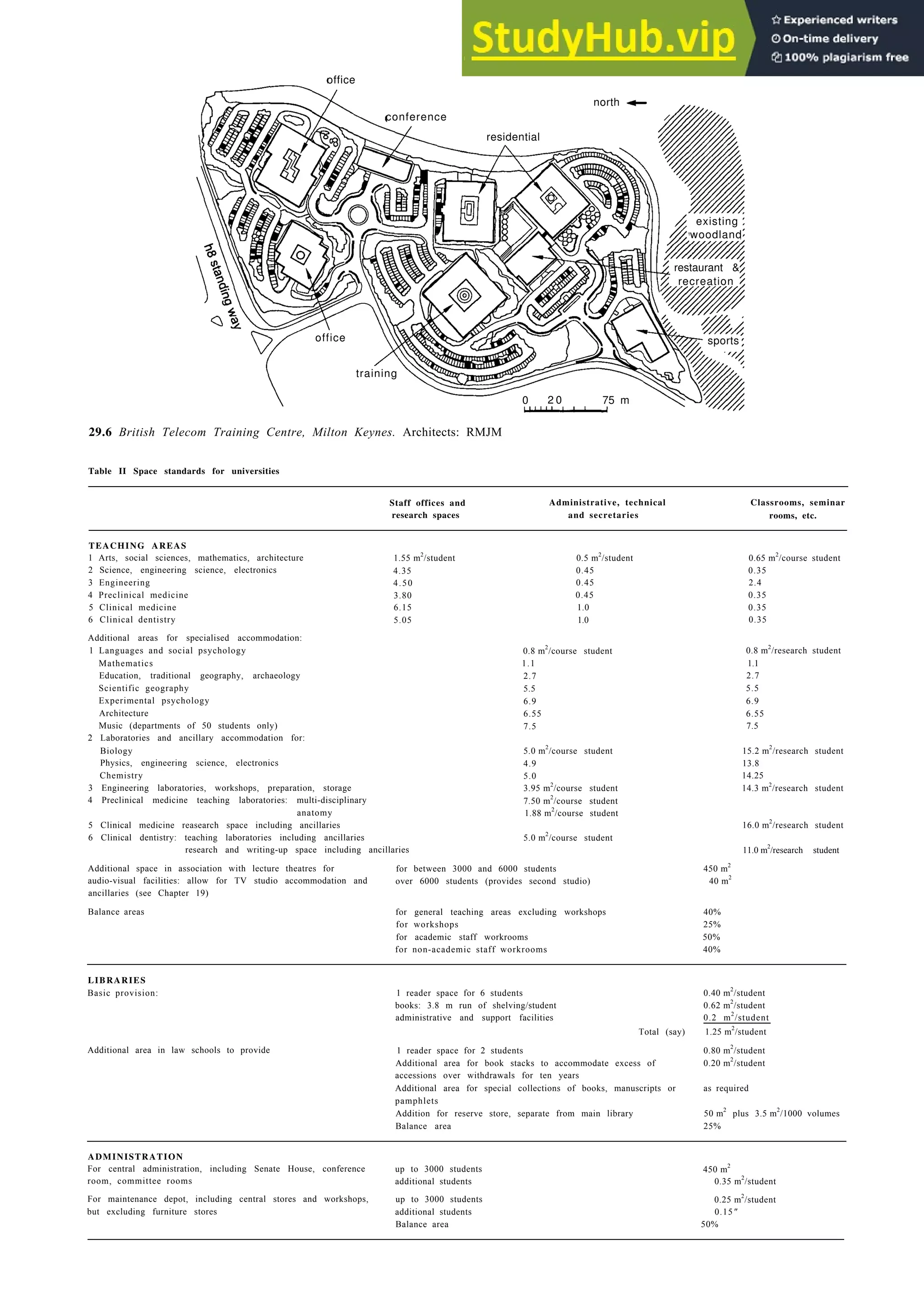
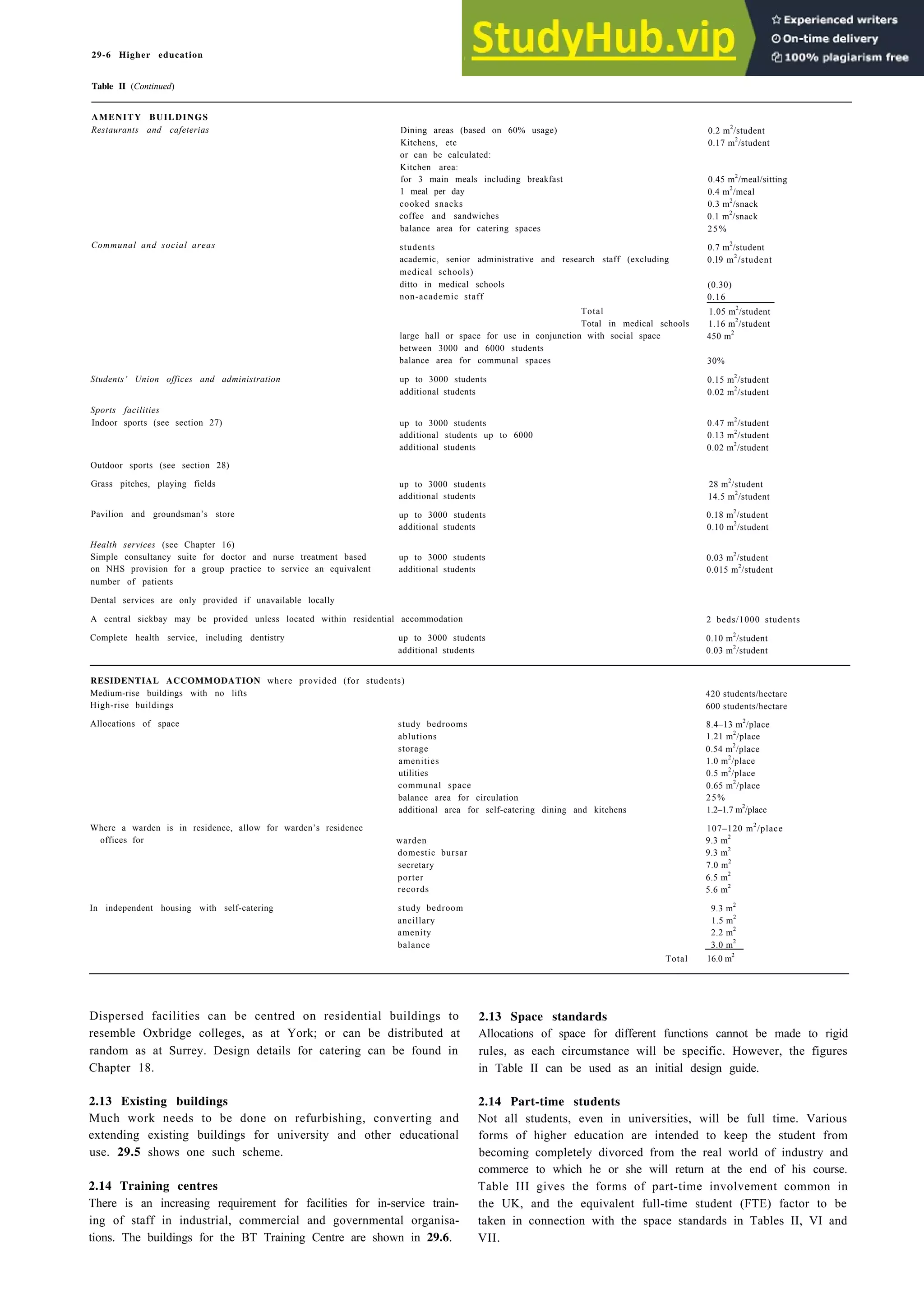
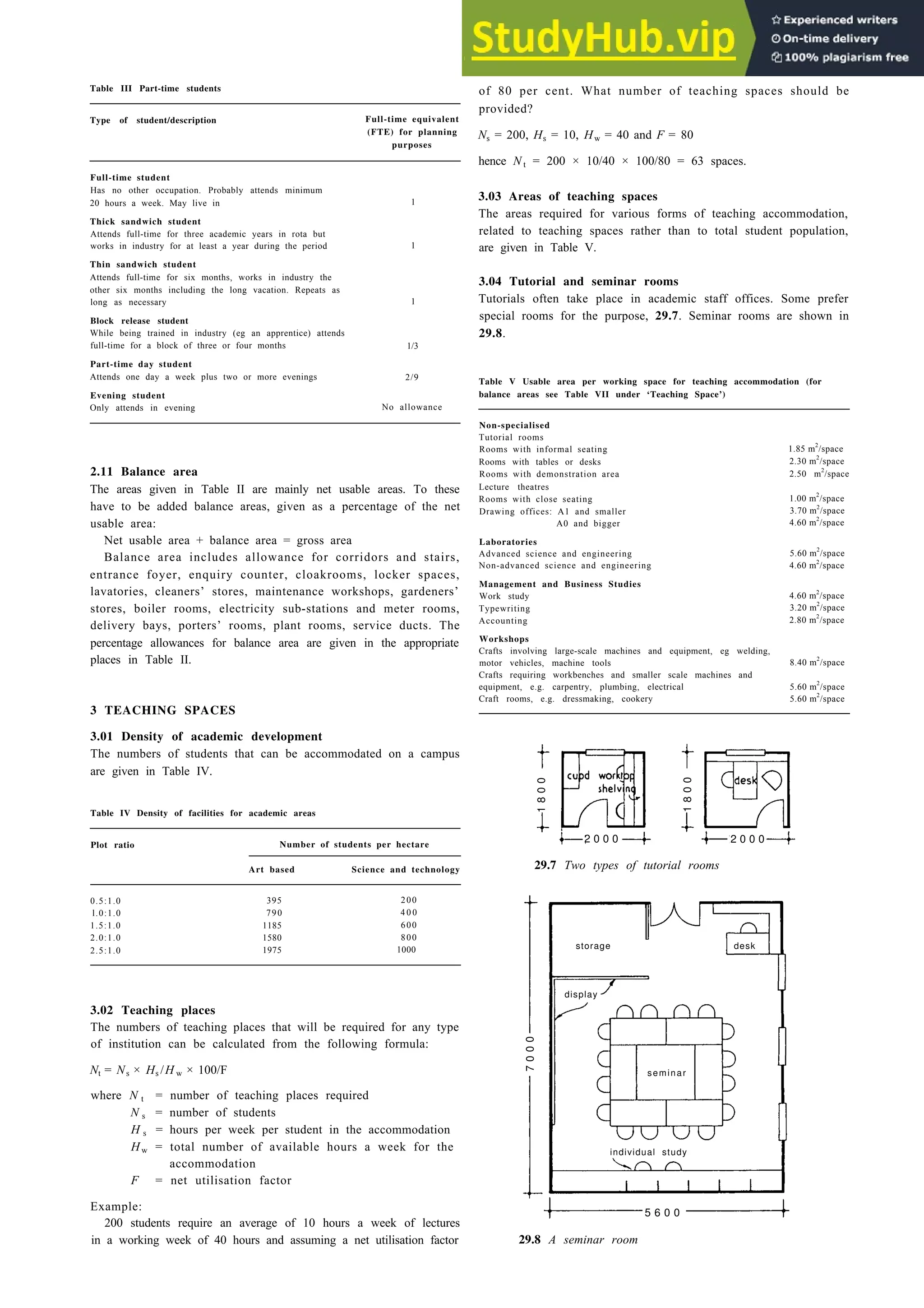
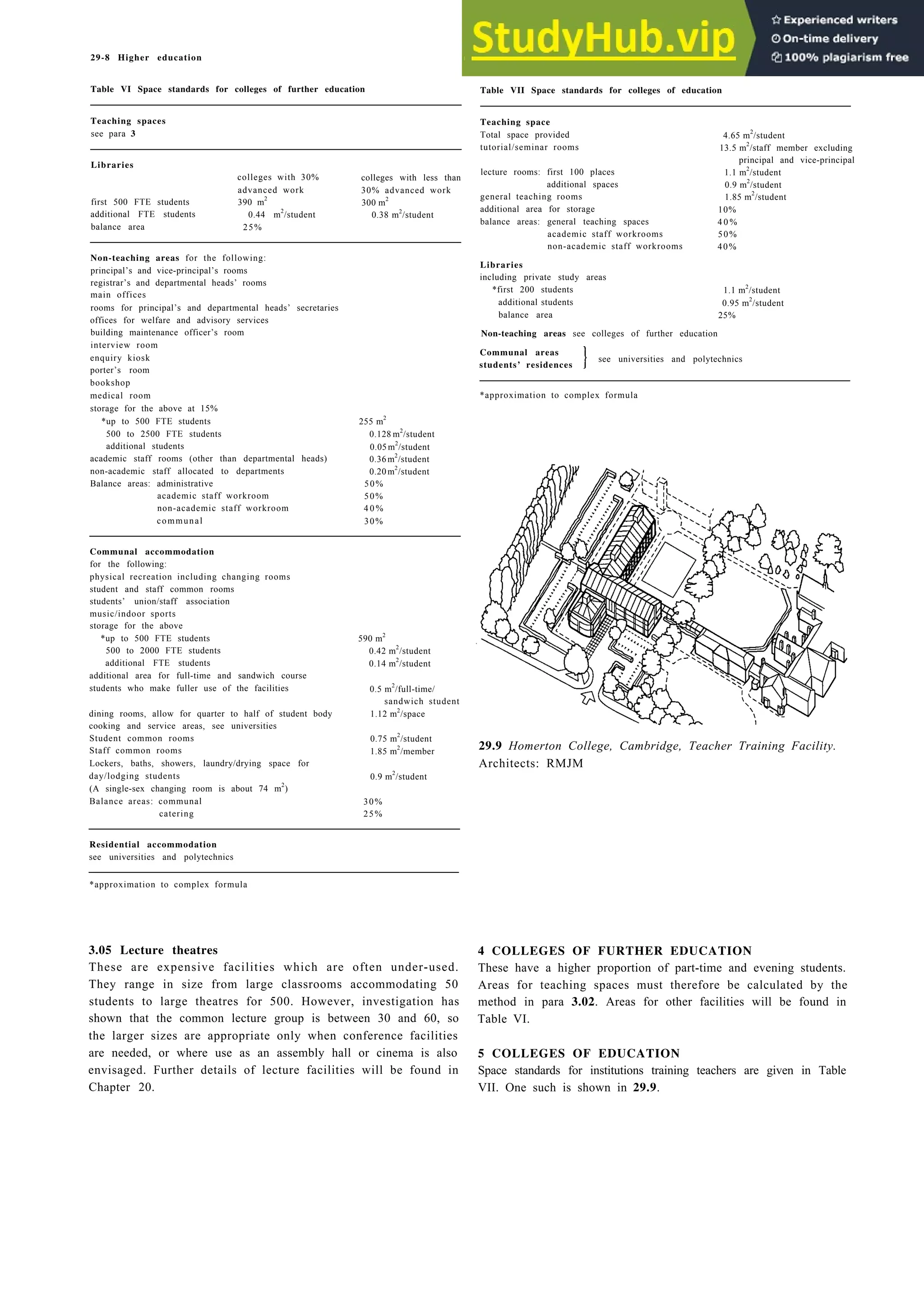
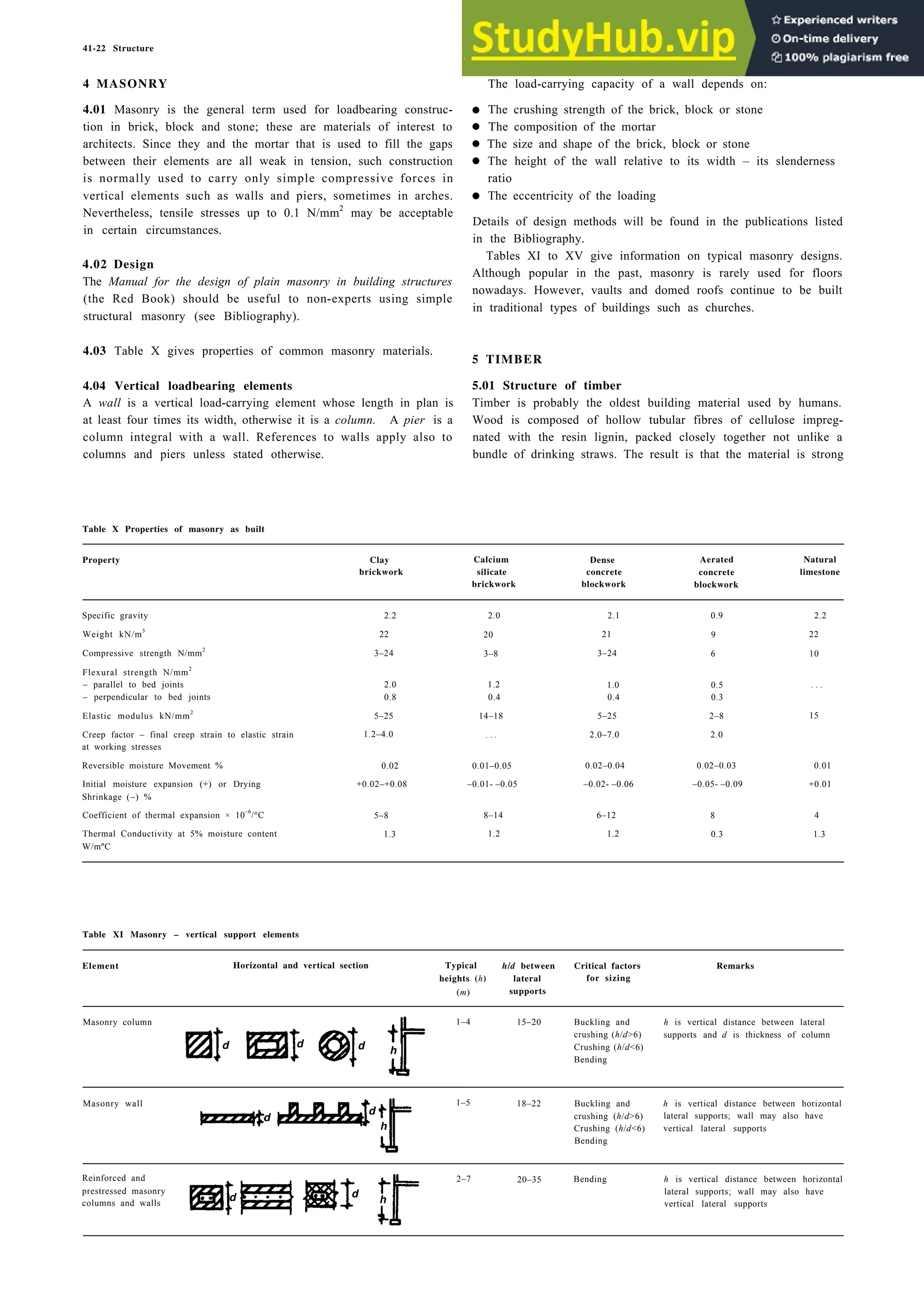
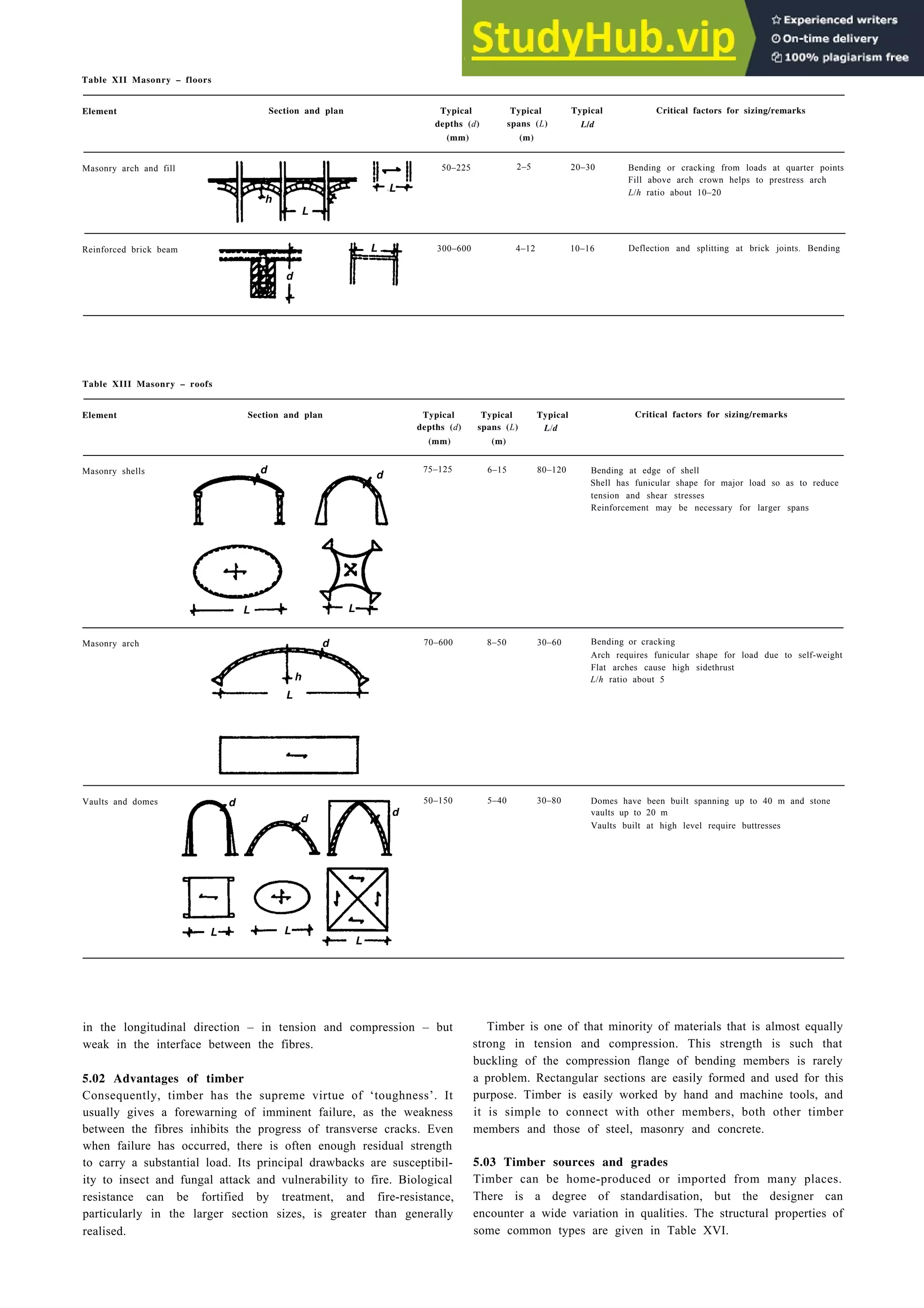
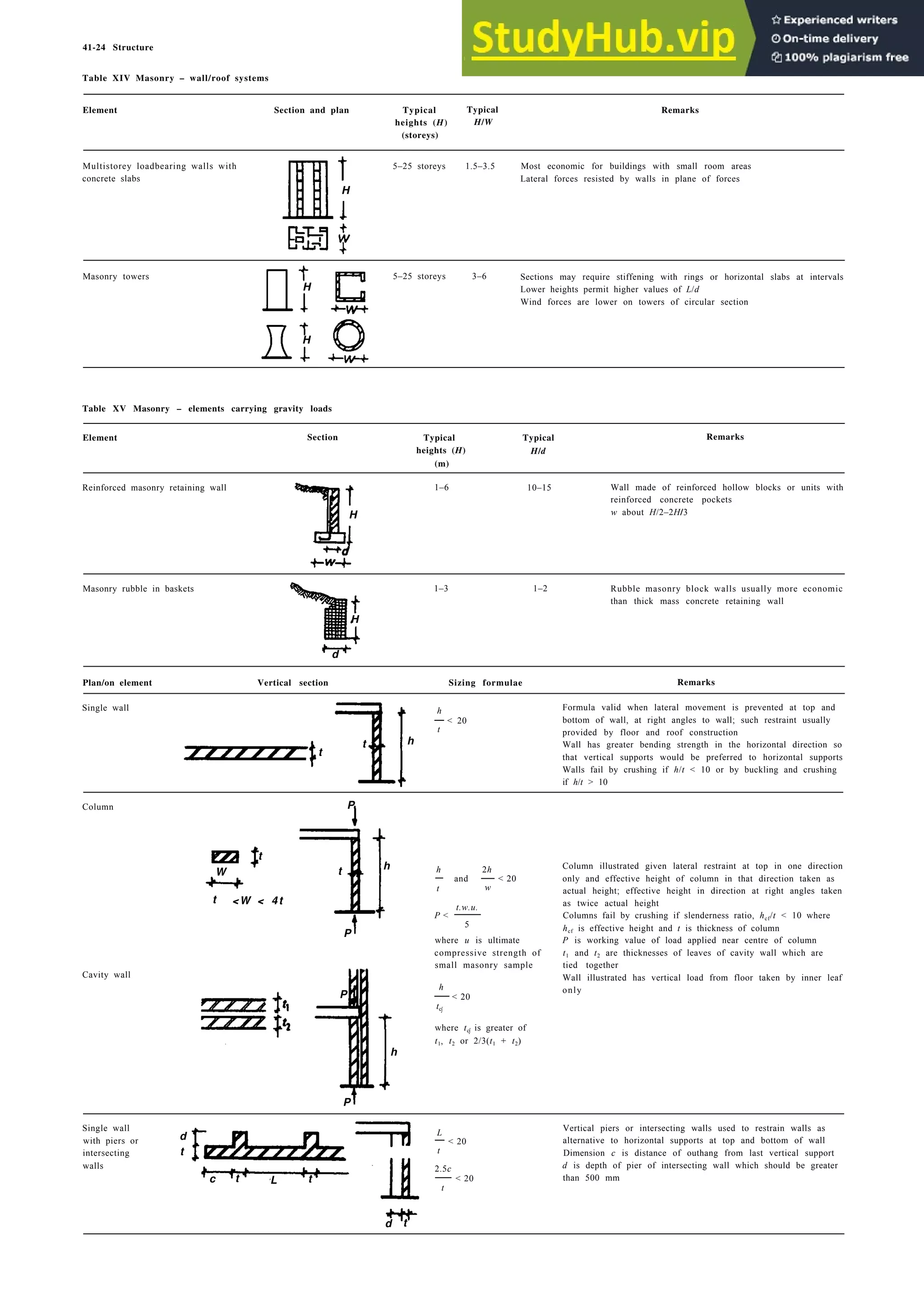
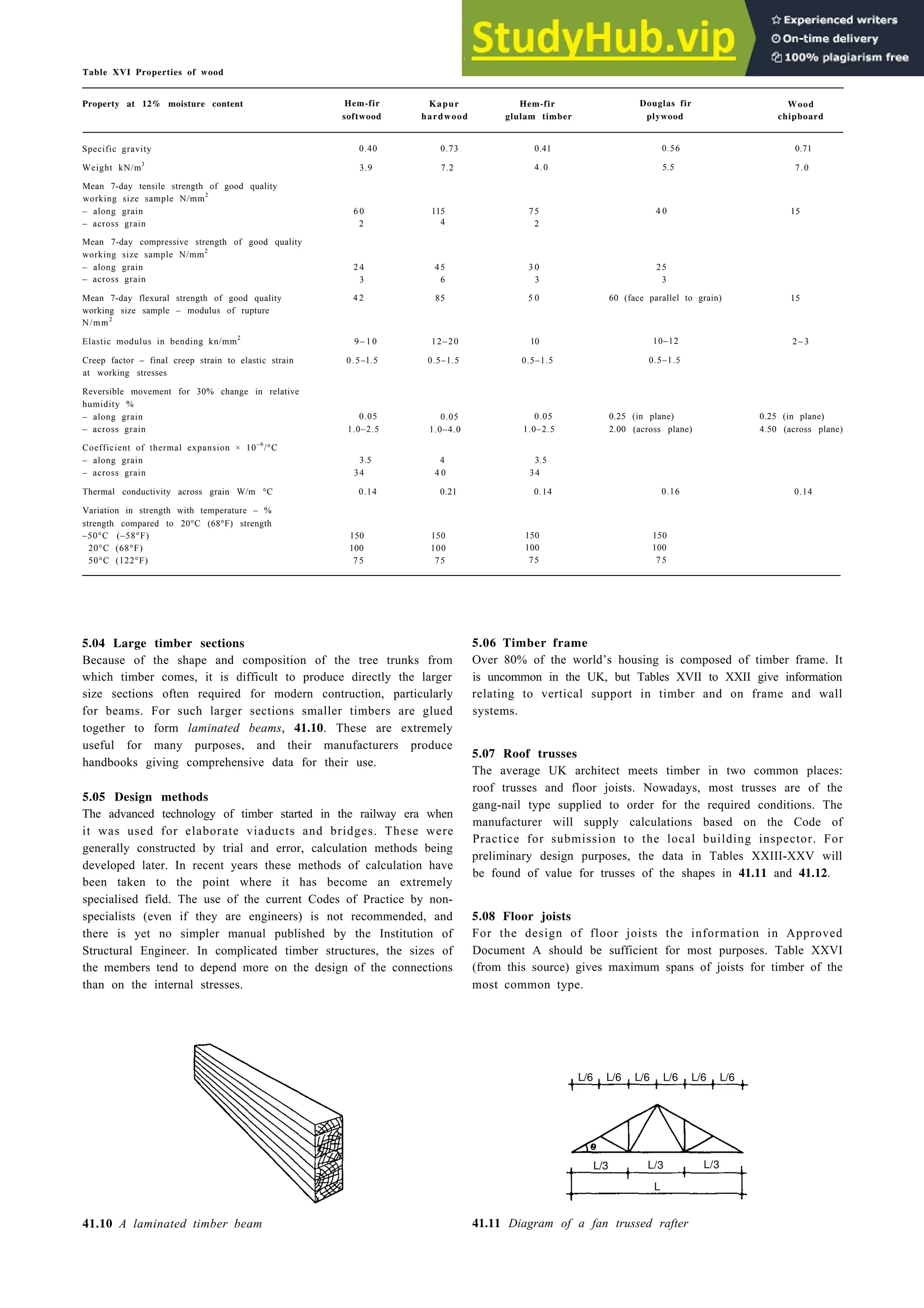
HANDBOOK
PLANNING
AND
DESIGN
DATA
SECOND EDITION Architectural
Press
This C D
Metric Handbook CD-ROM
Planning and Design Data
David Adler BSc DIC CEng MICE
Civil Engineering Consultant
is an invaluable time-saving tool for architects
and designers
has over 1700 symbols dealing with all the
principal building types
gives you additional search, select and
insert facilities
shows you space requirements between furniture
as well as standard sizing specifications
The drawings can be used with AutoCAD R12, R13, R14 and AutoCAD LT also with
MicroStation SE, MicroStation 95 and MicroStation TriForma and IntelliCAD 98.
CONTENTS: Notation; Design Data; Sanitary Installations; Transport; Mechanised
Movement; External Design; Workplaces; Public Buildings; High Street; Eating and
Drinking; Entertainment; Sport and Leisure; Learning and Research; Dwellings
0 7506 3293 3 C D - R o m 1999 £150.00 + VAT
ORDER YOUR COPY TODAY
Fax: +44 (0) 1865 314572 Credit Card Hot Line Tel: +44 (0) 1865 888 180
E-mail: bhuk.orders@repp.co.uk
Please add p&p at £3 for UK, £6 for Europe and £10 for Rest of World, and supply full delivery address & phone number with your order.
METRIC HANDBOOK
Planning and Design Data
EDITED BY
David Adler
Architectural Press
OXFORD AUCKLAND BOSTON JOHANNESBURG MELBOURNE NEW DELHI
Architectural Press
An imprint of Butterworth-Heinemann
Linacre House, Jordan Hill, Oxford OX2 8DP
A member of the Reed Elsevier plc group
First published as AJ Metric Handbook by The Architectural Press 1968
Second edition 1969
Third edition 1970
First published as New Metric Handbook 1979
Revised reprint 1981
Reprinted 1984, 1985, 1988, 1992, 1993, 1994, 1995, 1996, 1997, 1998
Second edition (as Metric Handbook) 1999
© Reed Educational and Professional Publishing Ltd 1979, 1999
All rights reserved. No part of this publication may be reproduced in
any material form (including photocopying or storing in any medium by
electronic means and whether or not transiently or incidentally to some
other use of this publication) without the written permission of the
copyright holder except in accordance with the provisions of the Copyright,
Designs and Patents Act 1988 or under the terms of a licence issued by the
Copyright Licensing Agency Ltd, 90 Tottenham Court Road, London,
England W1P 9HE. Applications for the copyright holder’s written
permission to reproduce any part of this publication should be addressed
to the publishers
British Library Cataloguing in Publication Data
Metric handbook. – 2nd ed.
1. Architecture – Handbooks, manuals, etc.
2. Architecture – Standards – Handbooks, manuals, etc.
I. Adler, David
721'.028
ISBN 0 7506 0899 4
Composition by Genesis Typesetting, Laser Quay, Rochester, Kent
Printed and bound in Great Britain
P
T
LANT A
REE
FOR EVERY TITLE THAT WE PUBLISH, BUTTERWORTH-HEINEMANN
WILL PAY FOR BTCV TO PLANT AND CARE FOR A TREE.
Contents
Preface vii
Acknowledgements viii
1 Notation, drawing office practice and dimensional
coordination
2
3
4
5
6
7
8
9
10
11
12
13
14
15
16
17
18
Basic design data
David Adler
Sanitary installations and cloakrooms
Alan Tye Design Ltd
Design for the vehicle
David Adler
Aids to pedestrian movement
David Adler
Landscape design
Michael Littlewood
Terminals and transport interchanges
Chris Blow
Factories
Jolyon Drury
Industrial storage buildings
Jolyon Drury
Farm buildings
John Weller
Offices
DEGW
Law courts
Christopher Rainford
Retail trading
Fred Lawson
Payment and counselling offices
Derek Montefiore
Public service buildings
Derek Montefiore
Primary health care
Ann Noble
Hospitals
Rosemary Glanville and Anthony Howard
Eating and drinking
Fred Lawson, John Rawson and Frank Bradbeer
19 Studios for sound and vision
David Binns
20 Auditoria
Ian Appleton and Joe Aveline
21 Community centres
Jim Tanner
22 Swimming
Gerald Perrin
23 Boating
John Rawson
24 Outdoor sports and stadia
Peter Ackroyd and Geraint John
25 Indoor sports
Peter Ackroyd
26 Equestrian design
Rod Sheard and Frank Bradbeer
27 Places of worship
Leslie Fairweather, Atba Al-Samarraie and David Adler
28 Schools
Guy Hawkins
29
30
31
32
33
34
35
36
37
38
Higher education
Laboratories
Tony Branton and Chris Bissell
Museums, art galleries and temporary exhibition spaces
Geoffrey Matthews
Libraries and information centres
Houses and flats
Ian Chown
Student housing and housing for young people
Liz Pride
Homes for old people
Ian Smith
Hotels
Fred Lawson and John Rawson
Tropical design
Martin Evans
Thermal environment
Phil Jones
vi Contents
39 Light
Joe Lynes
40 Sound
Neil Spring
41 Structure
David Adler
42 Fire
Beryl Menzies
43 Security
David Adler
44 Access for maintenance
45 Service distribution
46 Materials
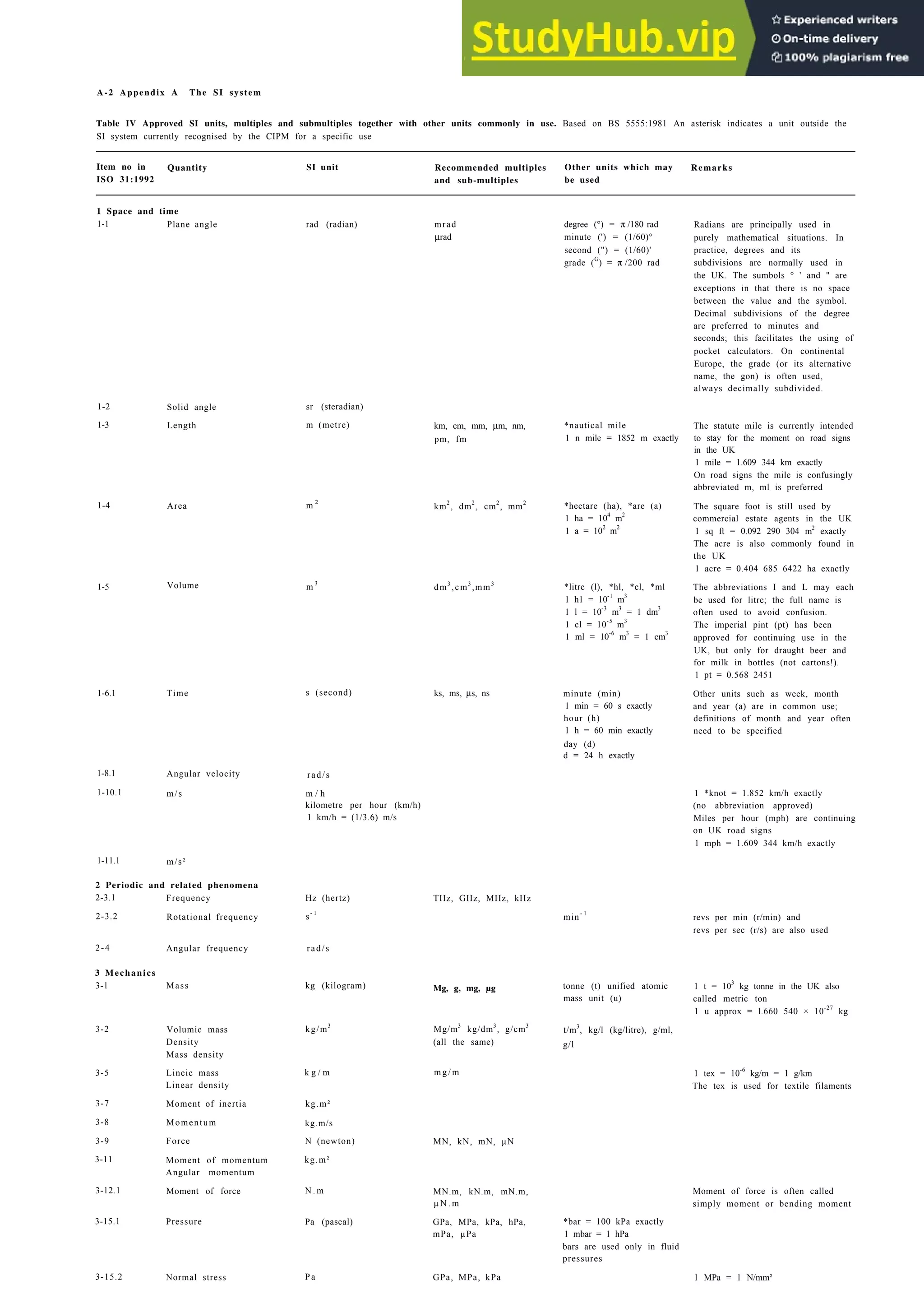
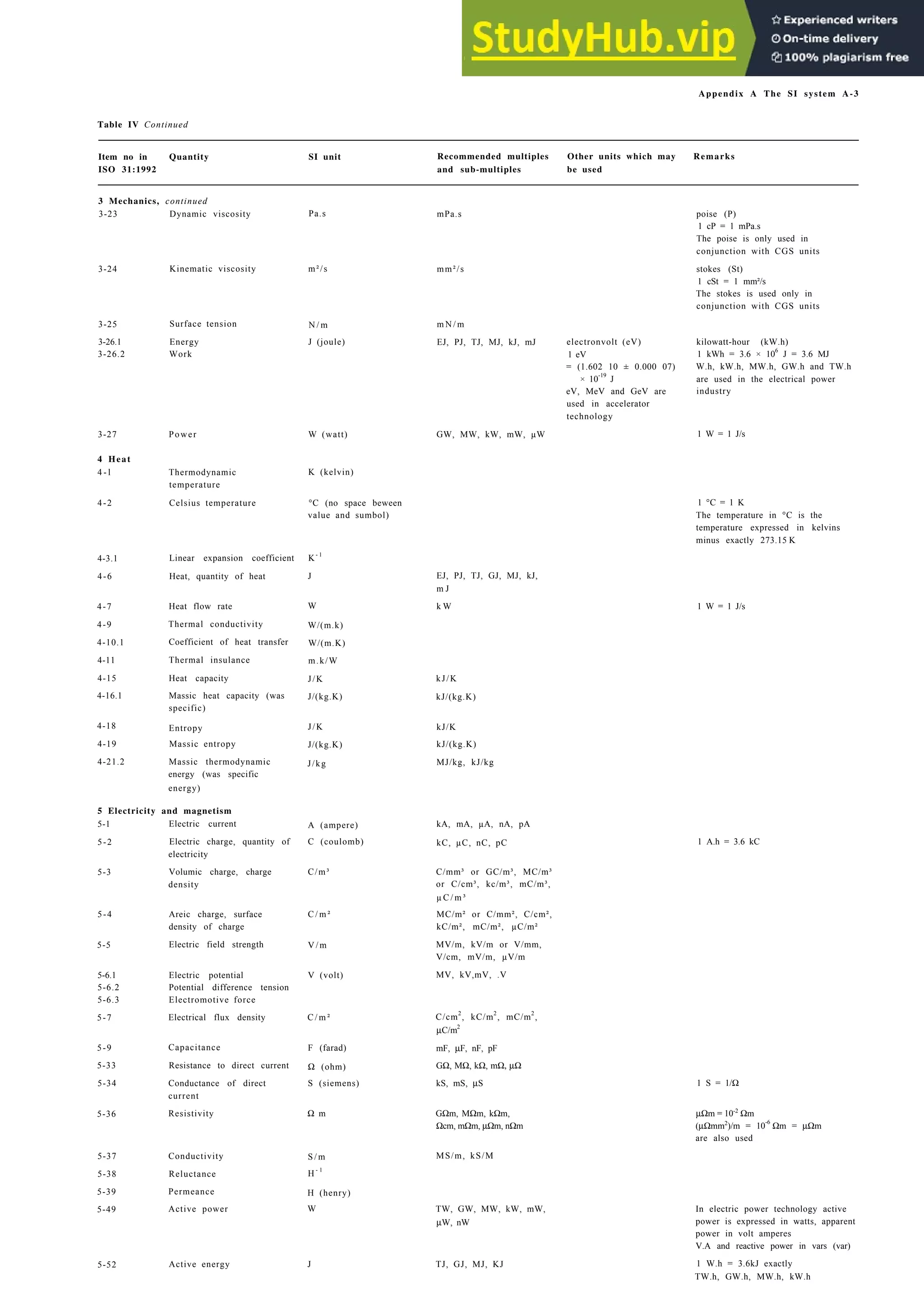
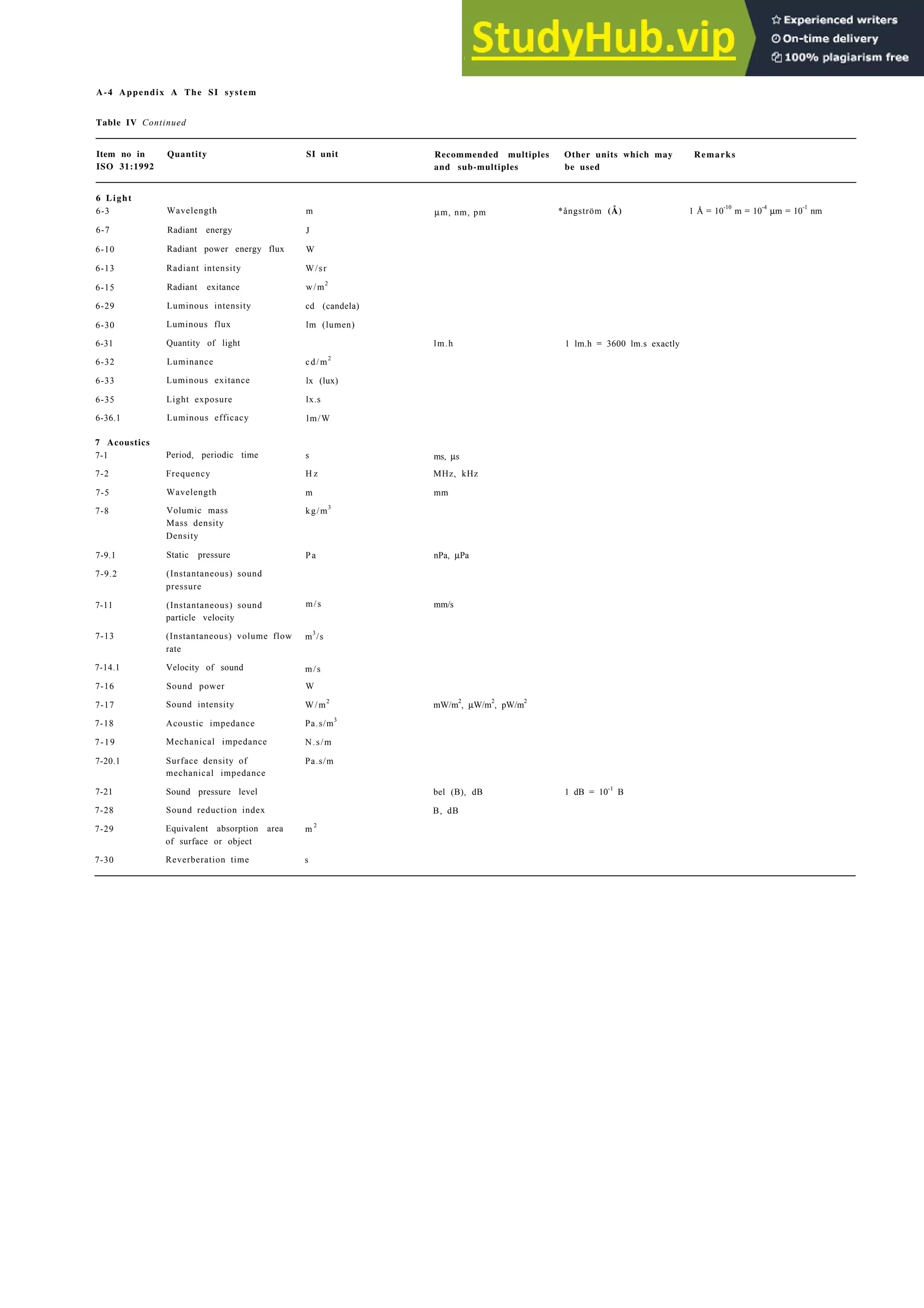
Appendix A The SI system
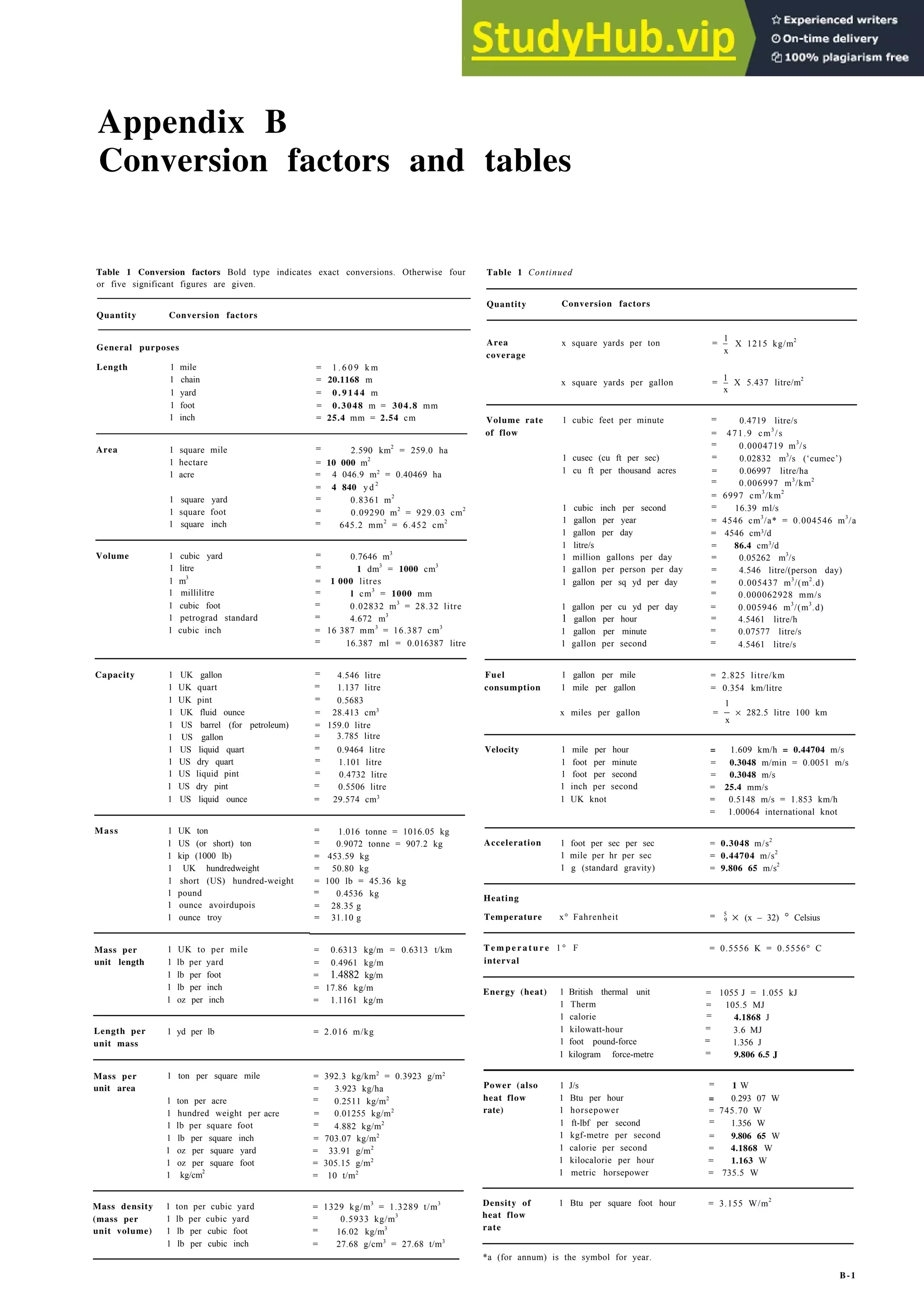
Appendix B Conversion factors and tables
Appendix C List of contributors
Index
Preface
Seventeen years have passed since the last main revision of the
Metric Handbook. While the changeover from the Imperial system
of measurement to metric in the building industry has passed into
the mists of time (it started over thirty years ago), we are still in the
throes of an almost equally traumatic change. This is the change
from our British system of standards and codes of practice to ones
that will eventually be common over most of Europe, and even in
some cases over the whole world.
This radical revision of our standards is still in process. While
the information in this new edition is as up to date as possible,
further changes occur almost daily. While the basic concepts of
design are constant so the information should be adequate for
initial design purposes, the latest and fullest information should be
consulted before finalisation. The bibliographies at the end of most
of the chapters should assist in this.
In a handbook covering such a wide field as this, it is inevitable
that not everything can be as detailed as one would prefer.
Statements are made that may require qualification. When
frequently repeated, it becomes tedious to continually read terms
such as generally, normally, in many cases. The actual use of such
terms has been restricted, but the reader should treat all statements
made in the book as covered by a general proviso. Each situation
is unique, and its problems may demand solutions that break rules
found in sources such as this.
Very many people have assisted me in the preparation of this
new edition, and I have built upon the many others who were
responsible for material in earlier editions, going back to the three
special editions of the Architects’ Journal in 1970 that started it
off. I thank all of those that I remember in the Acknowledgements
which follow, and apologise to those whom I fail to mention.
Fuller details of major contributors than can be included in the
chapter headings will be found in Appendix C at the end of the
book.
This new edition marks the honoured passing of the doyen of
architectural reference books. I refer to Planning, The Architect’s
Handbook which is now not to be republished since the recent
death of its distinguished last editor, Derek Mills CBE. Planning
evolved in the 1930s from weekly notes in the Architect and
Building News, and was a vade-mecum for generations of
architects – I myself found it invaluable as an engineering student
in the fifties. I have incorporated some of its material in this
new edition of the Metric Handbook, and I hope that this, while
something of a johnny-come-lately, will be regarded a worthy
successor.
A project of this scale is bound to contain errors, and I would
be grateful to be informed of any that are found. However,
neither I, the contributors nor the publishers can accept responsi-
bility for loss or damage resulting from inaccuracies or
omissions.
David Adler
November 1998
Acknowledgements
Organizations who have contributed and/or helped are: the
British Standards Institution, Department of Environment, Trans-
port and the Regions, Health and Safety Executive, Institution of
Structural Engineers, Steel Construction Institute, the late
lamented Greater London Council, County Councils of Cheshire,
Devon, Essex and Lancashire, and the Cyclists’ Touring Club.
Individuals who have made substantial contributions to the book
are generally named in the chapter headings. In addition, the editor
has received help from a large number of other people over the years
for this and for previous editions. He wishes to express his sincere
thanks to all of these. Some of those in the list below are
unfortunately no longer with us, but deserve to be remembered. If
anyone is omitted from the list (which is in alphabetical order), my
apologies – it will be due to a fallible memory!
Peter Ackroyd
Don Adie
Tanya Bocking
Brian Barclay
Brian Brookes
Geoff Burt
Ruth Cannock
John Carter
Mike Cash
Richard Chisnell
Mike Chrimes
Renata Corbani
Susan Cunningham
Betsy Dinesen
Francis Duffy
Peter Forbes
Brenda Goddard
Selwyn Goldsmith
Godfrey Golzen
John Gridley
Simon Inglis
Geraint John
John Jordan
John Keenan
Alexander Kira
David Knipe
Leslie Knopp
Sarah Kors
Mary Langshaw
David Lush
Jim McCluskey
Tony McKendry
Jay McMahan
Bruce Martin
Colin Moore
John Nelson
Anthony Noakes
George Noble
John Noble
Paul Noble
Julian Oseley
Oliver Palmer
Tim Pharoah
Esmond Reid
David Schreiber
Steve Scrivens
Jan Sliwa
Peter Stubbs
Patricia Tutt
Maritz Vandenberg
Neil Warnock-Smith
John Weller
Jeremy Wilson
David Wolchover
Zoë Youd
A special acknowledgement to my wife Jill Adler, who took on the
mammoth task of proof-reading.
Extracts from British Standards are reproduced with the
permission of BSI under licence number PD/19990450. Complete
copies can be obtained by post from BSI Customer Services,
389 Chiswick High Road, London, W4 4AL.
Crown Copyright is reproduced with the permission of the
Controller of Her Majesty’s Stationery Office.
1 Notation, drawing office practice and
dimensional coordination
CI/SfB (1976 revised) (A3t) and (F43)
UDC: 744 and 69.032
KEY POINT:
• For clear understanding the conventions must be followed.
Contents
1 Notation
2 Paper sizes
3 Ordnance survey maps
4 Drawings
5 Measuring instruments
6 Dimensional coordination
7 Planning
8 References
1 NOTATION
1.01 Decimal marker
The decimal marker (full stop) on the baseline is the standard
decimal point in the UK; but the marker at the halfway position is
also acceptable. It should be noted that Continental practice is to
use the comma on the baseline.
When the value to be expressed is less than unity it should be
preceded by zero (e.g. 0.6 not .6). Whole numbers may be
expressed without a decimal marker. The appropriate number of
decimal places should be chosen depending on the circumstances
in which the resulting value is to be used.
Thousand marker
To avoid confusion with the Continental decimal marker, no
thousand marker should be used. Where legibility needs to be
Table I Summary of symbols and notation
improved a space can be left in large groups of digits at every
thousand point. Where there are only four digits, a space between
the first digit and the others is not desirable (e.g. 15 000, 1500).
(However, the comma is used in currency, e.g. £115,000.)
1.02 Symbols
1 The main symbols should be used as shown in Table I. The same
symbol, i.e. m, mm, kg, should be used for singular and plural
values (1 kg, 10 kg), and no full stops or other punctuation
marks should be used after the symbol unless it occurs at the end
of a sentence. Use a ‘solidus’ or sloping line as a separator
between numerator and denominator, i.e. 3 kg/m3
or 3 kg/cu m
(three kilograms per cubic metre).
2 A single space should separate figures from symbols: 10 m, not
10m.
3 The unit should be written in full if there is any doubt about the
symbol. For example, the recognised unit symbol 1 for the unit
litre can be confused with the number 1 and it is less confusing
to write litre in full. Also, the unit symbol t for tonne may in
some circumstances be confused with the imperial ton, and the
unit tonne should then be written in full.
4 When symbols are raised to various powers, it is only the
symbol which is involved and not the number attached to it.
Thus 3 m3
equals 3 (m)3
and not 3 m × 3 m × 3 m (i.e. the
answer is 3 cubic metres and not 27 cubic metres).
5 Difficulty may be experienced when reproducing the squaring
and cubing indices m2
or mm2
, and m3
or mm3
. In such cases,
units may be written with the indices on the line instead of as
superscripts (m2, m3). Alternatively, particularly when the
Quantity Description Correct unit Acceptable Incorrect use Notes
symbol alternatives
Numerical values 0.1
0.01
0.001
.1
.01
.001
When the value is less than unity, the decimal
point should be preceded by zero
Length metre
millimetre
m m. M meter
mm m.m. mm.
MM M.M.
milli-metre
Area square
metre
m
2
sq m m.sq sm
sq.m sq m.
Volume cubic metre m 3
cubic millimetre mm3
litre (liquid volume) 1, ltr
cu m
cu mm
cu.m m.cu.
cu.mm. mm.cub.
mm.cu.
1. lit. Preferably write litre in full to avoid ‘l’ being
taken for figure ‘one’
Mass (weight) tonne t
kilogram k g
gram g
ton
Kg kG kg.
kilogramme
g. G.
Preferably write tonne in full to avoid being
mistaken for imperial ton
Force newton N N. n Note that when used in written text, the unit of
newton is spelled out in full and begins with a
lower-case letter ‘n’. When used as unit symbol,
in calculation or in a formula it is then expressed
as capital letter ‘N’
1-1
1-2 Notation, drawing office practice and dimensional coordination
841
general public is involved, the abbreviations ‘sq’ and ‘cu’ may
be used (sq m, cu m).
6 Units should not be hyphenated (milli-metres).
1.03 Notation
1189
594
297
1 As a rule the sizes of components should be expressed in
consistent and not mixed units, e.g. 1500 mm × 600 mm ×
25 mm thick and not 1.5 m × 600 mm × 25 mm thick. However,
for long thin components such as timbers, it is preferable to mix
the units, e.g. 100 mm × 75 mm × 10 m long.
2 It is important to distinguish clearly between the metric tonne
and the imperial ton. The tonne is equivalent to 2204.6 lb while
the ton is equal to 2240 lb – a difference of 1.6 per cent.
3 The interval of temperature should be referred to as degree
Celsius (°C) and not as centigrade. The word centigrade is used
by the Continental metric countries as a measure of plane angle
and equals 1/10 000th part of a right angle.
148
148
7 4
420 210
Examples
185
Correct use
33 m
10.100 m
50.750 kg
Incorrect use
3 cm 3 mm
10 m 100 mm*
50 kg 750g
*Note. Some metric values are expressed differently in certain countries. The value
of 10.100 m, for example, could mean ten thousand one hundred metres and not
ten metres one hundred millimetres, as in the UK.
2 PAPER SIZES
The International A-series of paper sizes is used for all drawings
and written material.
eq
2.01 Sizes in the A-series
The A range is derived from a rectangle A0, 1.1, of area 1 m2
with
sides x and y such that x:y = 1:√2 (i.e. x = 841 mm; y = 1189 mm).
The other sizes in the series are derived downwards by pro-
gressively halving the size above across its larger dimension. The
proportions of the sizes remain constant, 1.2.
2.04 Drawing boards
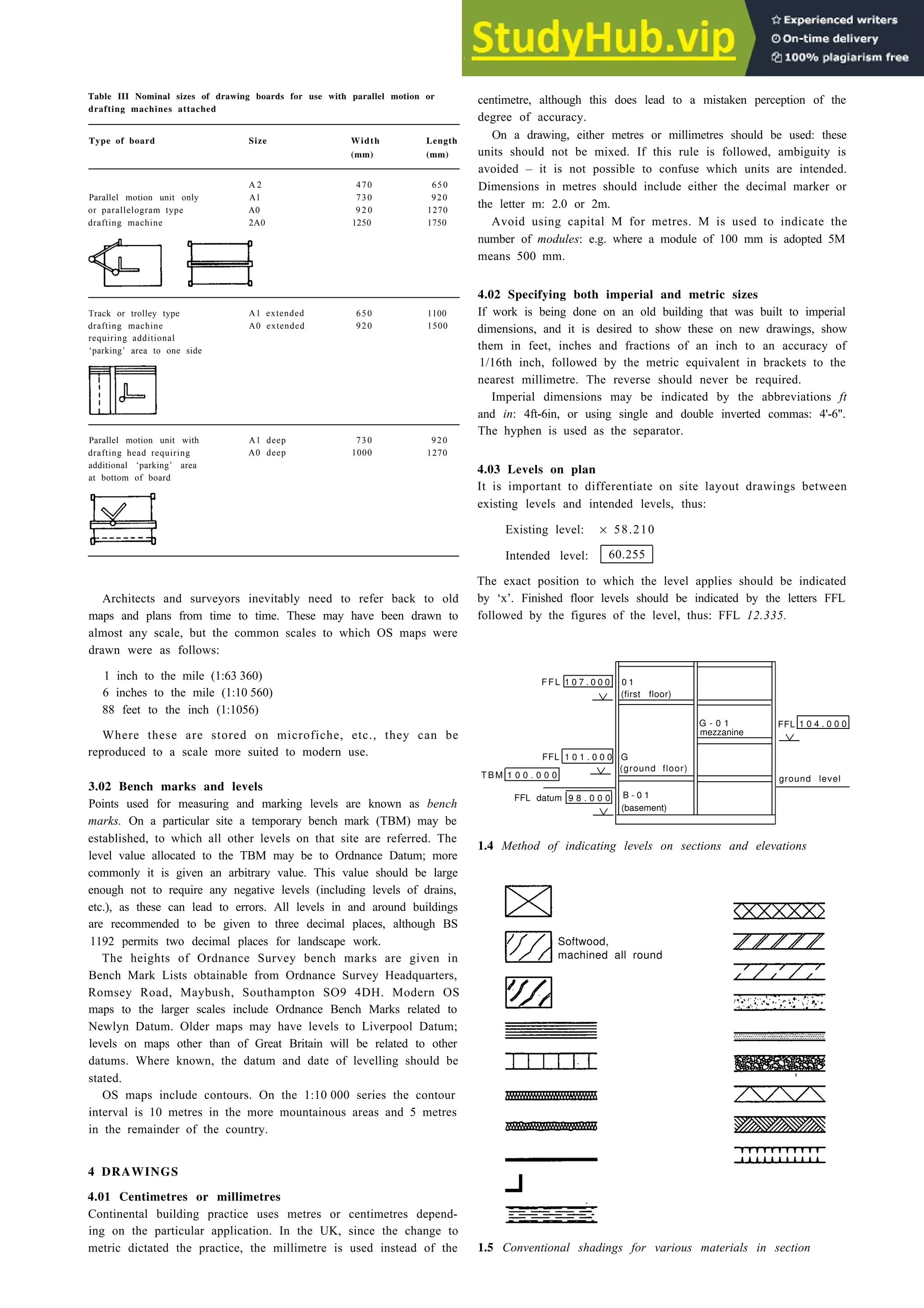
2.02 Trimmed sizes and tolerances Drawing boards are currently manufactured to fit A-size paper,
The A formats are trimmed sizes and therefore exact; stubs of tear- while vertical and horizontal filing cabinets and chests have
off books, index tabs, etc. are always additional to the A internal dimensions approximately corresponding to the board
dimensions. Printers purchase their paper in sizes allowing for the sizes listed in Table III. Boards, cabinets and chests designed for
following tolerances of the trimmed sizes: the pre-metric paper sizes are still in use.
• For dimensions up to and including 150 mm, +1.5 mm
• For dimensions greater than 150 mm up to and including
600 mm, +2 mm
3 ORDNANCE SURVEY MAPS
• For dimensions greater than 600 mm, +3 mm. Recommended
methods of folding the larger A-sized prints are given in 1.3.
3.01
Ordnance Survey maps are now based completely on metric
measurements and are immediately available to the following
scales:
Y
X
1.1 Derivation of the rectangle A0, which has a surface area of
1 m 2
1.2 A-sizes retain the same proportion (1:√ 2), each size being
half the size above
A size mm
A 0 841 × 1189
A 1 594 × 841
A 2 420 × 594
A 3 297 × 420
A 4 210 × 297
A 5 148 × 210
A 6 105 × 148
A 7 74 × 105
A 8 52 × 74
A 9 37 × 52
A 1 0 26 × 37
trimmed sizes
folding A1 size
1.3 A-series of paper sizes
2.03 Pre-metric paper sizes
Old drawings will frequently be found in the sizes common prior
to the changeover to metric. These sizes are given in Table II.
1:50 000, 1:25 000, 1:10 000, 1:25 000 and 1:1250.
However, new computer methods of storage and retrieval mean
that maps can be supplied to any desired scale.
Table II Pre-metric paper and drawing board sizes
Name
Half imperial
Imperial
Double elephant
Antiquarian
Paper size
559 × 381
762 × 559
1016 × 679
1346 × 787
Board size
594 × 405
813 × 584
1092 × 737
1372 × 813
measurements represent
297
297
eq
185
1189
841
594
594
420
210
841
105
105
210
Table III Nominal sizes of drawing boards for use with parallel motion or
drafting machines attached
Type of board Size Width
(mm)
Length
(mm)
Parallel motion unit only
or parallelogram type
drafting machine
A 2
A1
A0
2A0
470 650
730 920
9 2 0 1270
1250 1750
Track or trolley type
drafting machine
requiring additional
‘parking’ area to one side
A1 extended 650 1100
A0 extended 920 1500
Parallel motion unit with
drafting head requiring
additional ‘parking’ area
at bottom of board
A1 deep 730 920
A0 deep 1000 1270
Architects and surveyors inevitably need to refer back to old
maps and plans from time to time. These may have been drawn to
almost any scale, but the common scales to which OS maps were
drawn were as follows:
1 inch to the mile (1:63 360)
6 inches to the mile (1:10 560)
88 feet to the inch (1:1056)
Where these are stored on microfiche, etc., they can be
reproduced to a scale more suited to modern use.
FFL 1 0 7 . 0 0 0 0 1
(first floor)
G - 0 1 FFL 1 0 4 . 0 0 0
mezzanine
FFL 1 0 1 . 0 0 0 G
(ground floor)
T B M 1 0 0 . 0 0 0 ground level
FFL datum 9 8 . 0 0 0 B - 0 1
(basement)
3.02 Bench marks and levels
Points used for measuring and marking levels are known as bench
marks. On a particular site a temporary bench mark (TBM) may be
established, to which all other levels on that site are referred. The
level value allocated to the TBM may be to Ordnance Datum; more
commonly it is given an arbitrary value. This value should be large
enough not to require any negative levels (including levels of drains,
etc.), as these can lead to errors. All levels in and around buildings
are recommended to be given to three decimal places, although BS
1192 permits two decimal places for landscape work.
The heights of Ordnance Survey bench marks are given in
Bench Mark Lists obtainable from Ordnance Survey Headquarters,
Romsey Road, Maybush, Southampton SO9 4DH. Modern OS
maps to the larger scales include Ordnance Bench Marks related to
Newlyn Datum. Older maps may have levels to Liverpool Datum;
levels on maps other than of Great Britain will be related to other
datums. Where known, the datum and date of levelling should be
stated.
OS maps include contours. On the 1:10 000 series the contour
interval is 10 metres in the more mountainous areas and 5 metres
in the remainder of the country.
4 DRAWINGS
4.01 Centimetres or millimetres
Continental building practice uses metres or centimetres depend-
ing on the particular application. In the UK, since the change to
metric dictated the practice, the millimetre is used instead of the
Notation, drawing office practice and dimensional coordination l-3
centimetre, although this does lead to a mistaken perception of the
degree of accuracy.
On a drawing, either metres or millimetres should be used: these
units should not be mixed. If this rule is followed, ambiguity is
avoided – it is not possible to confuse which units are intended.
Dimensions in metres should include either the decimal marker or
the letter m: 2.0 or 2m.
Avoid using capital M for metres. M is used to indicate the
number of modules: e.g. where a module of 100 mm is adopted 5M
means 500 mm.
4.02 Specifying both imperial and metric sizes
If work is being done on an old building that was built to imperial
dimensions, and it is desired to show these on new drawings, show
them in feet, inches and fractions of an inch to an accuracy of
1/16th inch, followed by the metric equivalent in brackets to the
nearest millimetre. The reverse should never be required.
Imperial dimensions may be indicated by the abbreviations ft
and in: 4ft-6in, or using single and double inverted commas: 4'-6".
The hyphen is used as the separator.
4.03 Levels on plan
It is important to differentiate on site layout drawings between
existing levels and intended levels, thus:
Existing level: × 58.210
Intended level: 60.255
The exact position to which the level applies should be indicated
by ‘x’. Finished floor levels should be indicated by the letters FFL
followed by the figures of the level, thus: FFL 12.335.
1.4 Method of indicating levels on sections and elevations
Softwood,
machined all round
1.5 Conventional shadings for various materials in section
1-4 Notation, drawing office practice and dimensional coordination
4.04 Levels on section and elevation 4.06 Scales
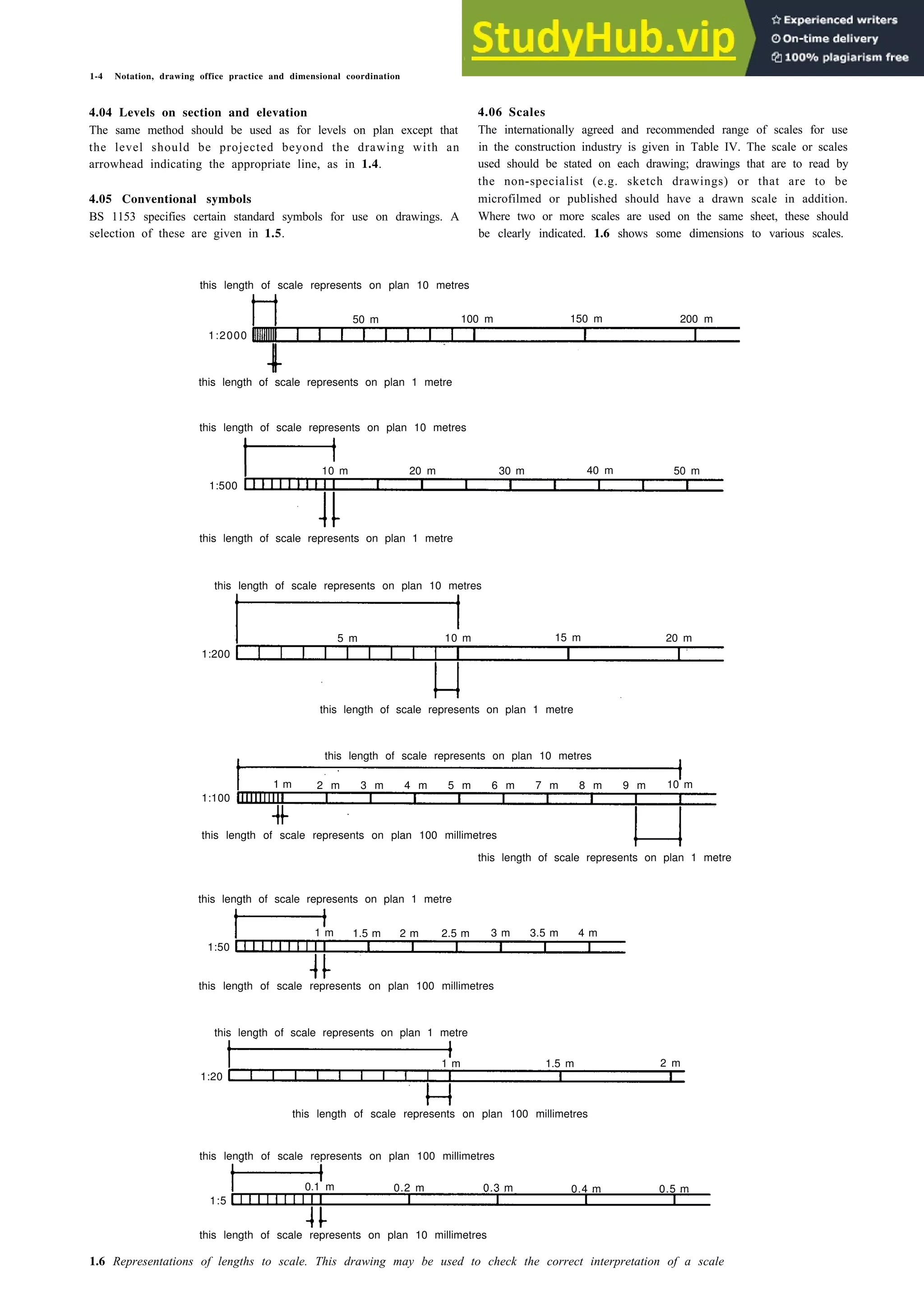
The same method should be used as for levels on plan except that The internationally agreed and recommended range of scales for use
the level should be projected beyond the drawing with an in the construction industry is given in Table IV. The scale or scales
arrowhead indicating the appropriate line, as in 1.4. used should be stated on each drawing; drawings that are to read by
the non-specialist (e.g. sketch drawings) or that are to be
4.05 Conventional symbols microfilmed or published should have a drawn scale in addition.
BS 1153 specifies certain standard symbols for use on drawings. A Where two or more scales are used on the same sheet, these should
selection of these are given in 1.5. be clearly indicated. 1.6 shows some dimensions to various scales.
this length of scale represents on plan 10 metres
50 m 100 m
1:2000
150 m 200 m
this length of scale represents on plan 1 metre
this length of scale represents on plan 10 metres
10 m 20 m 30 m 40 m 50 m
1:500
this length of scale represents on plan 1 metre
this length of scale represents on plan 10 metres
5 m 10 m 15 m 20 m
1:200
this length of scale represents on plan 1 metre
this length of scale represents on plan 10 metres
1 m 2 m 3 m 4 m 5 m 6 m 7 m 8 m 9 m 10 m
1:100
this length of scale represents on plan 100 millimetres
this length of scale represents on plan 1 metre
1 m 1.5 m 2 m 2.5 m 3 m 3.5 m 4 m
1:50
this length of scale represents on plan 100 millimetres
this length of scale represents on plan 1 metre
1 m
1:20
1.5 m 2 m
this length of scale represents on plan 100 millimetres
0.1 m 0.2 m 0.3 m 0.4 m 0.5 m
1:5
this length of scale represents on plan 10 millimetres
1.6 Representations of lengths to scale. This drawing may be used to check the correct interpretation of a scale
Notation, drawing office practice and dimensional coordination 1-5
Table IV preferred scales
Use Scale
Maps
Town surveys
Block plan
1 : 1 000 000
1 : 500 000
1 : 200 000
1 : 100 000
1 : 50 000
1 : 20 000
1 : 10 000
1 : 5000
1 : 2500
1 : 2000
1 : 2500
1 : 2000
1 : 1250
1 : 1000
Location drawings
Site plan
General location
Ranges
1 : 500
1 : 200
1 : 200
1 : 100
1 : 50
1 : 100
1 : 50
1 : 20
Component drawings
Assembly 1 : 20
1 : 10
1 : 5
Details 1 : 10
1 : 5
1 : 1
4.07 Types of drawings
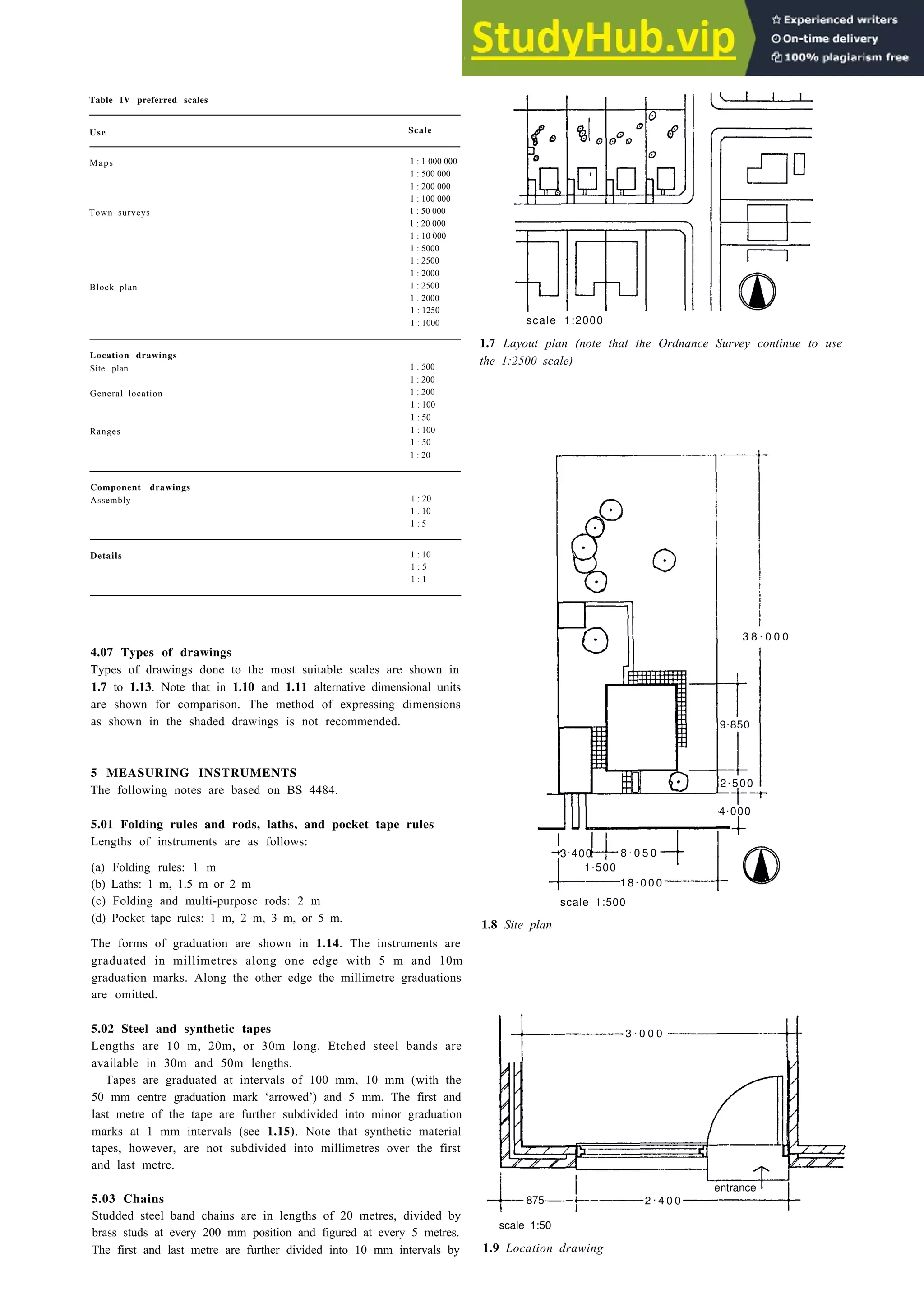
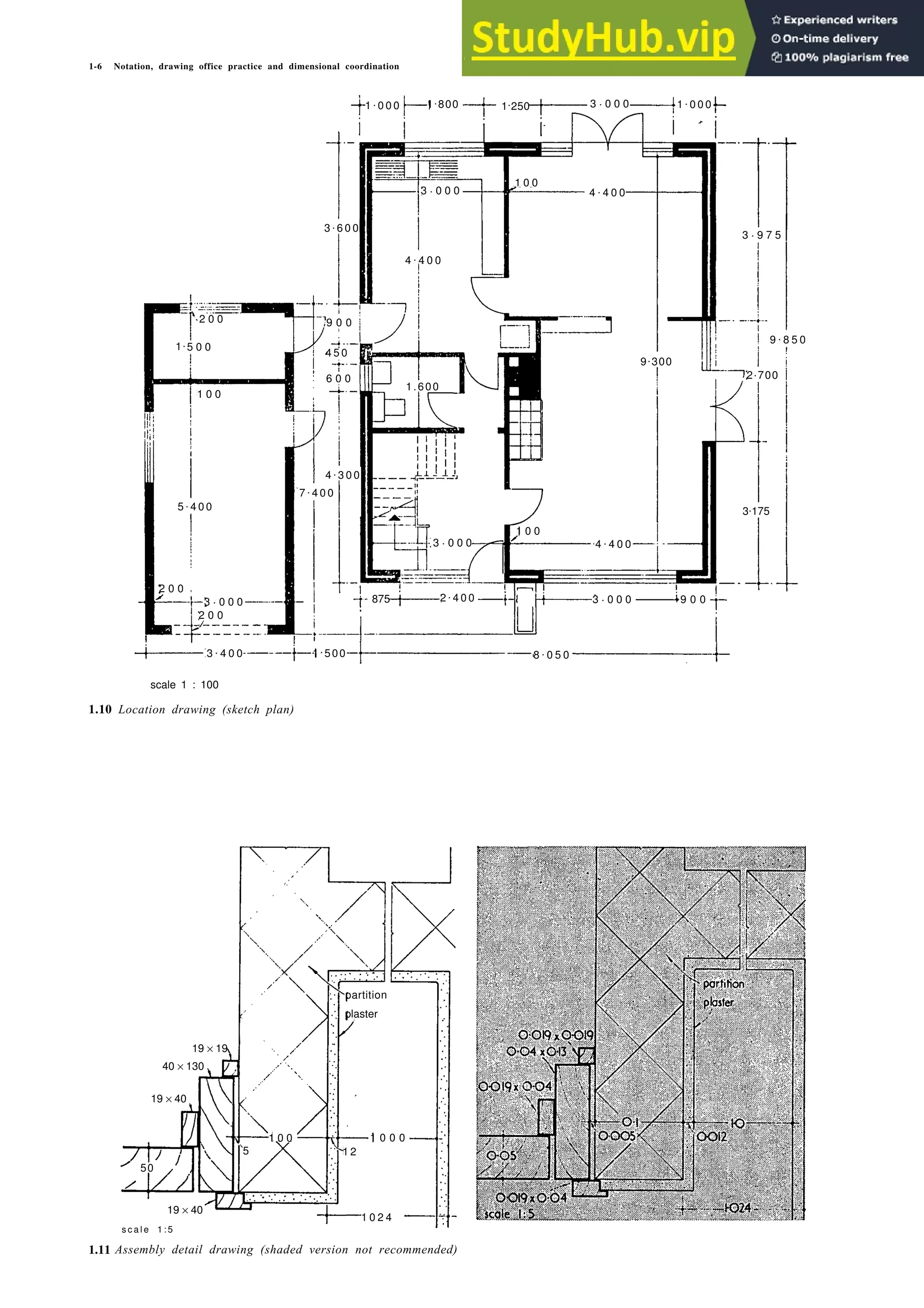
Types of drawings done to the most suitable scales are shown in
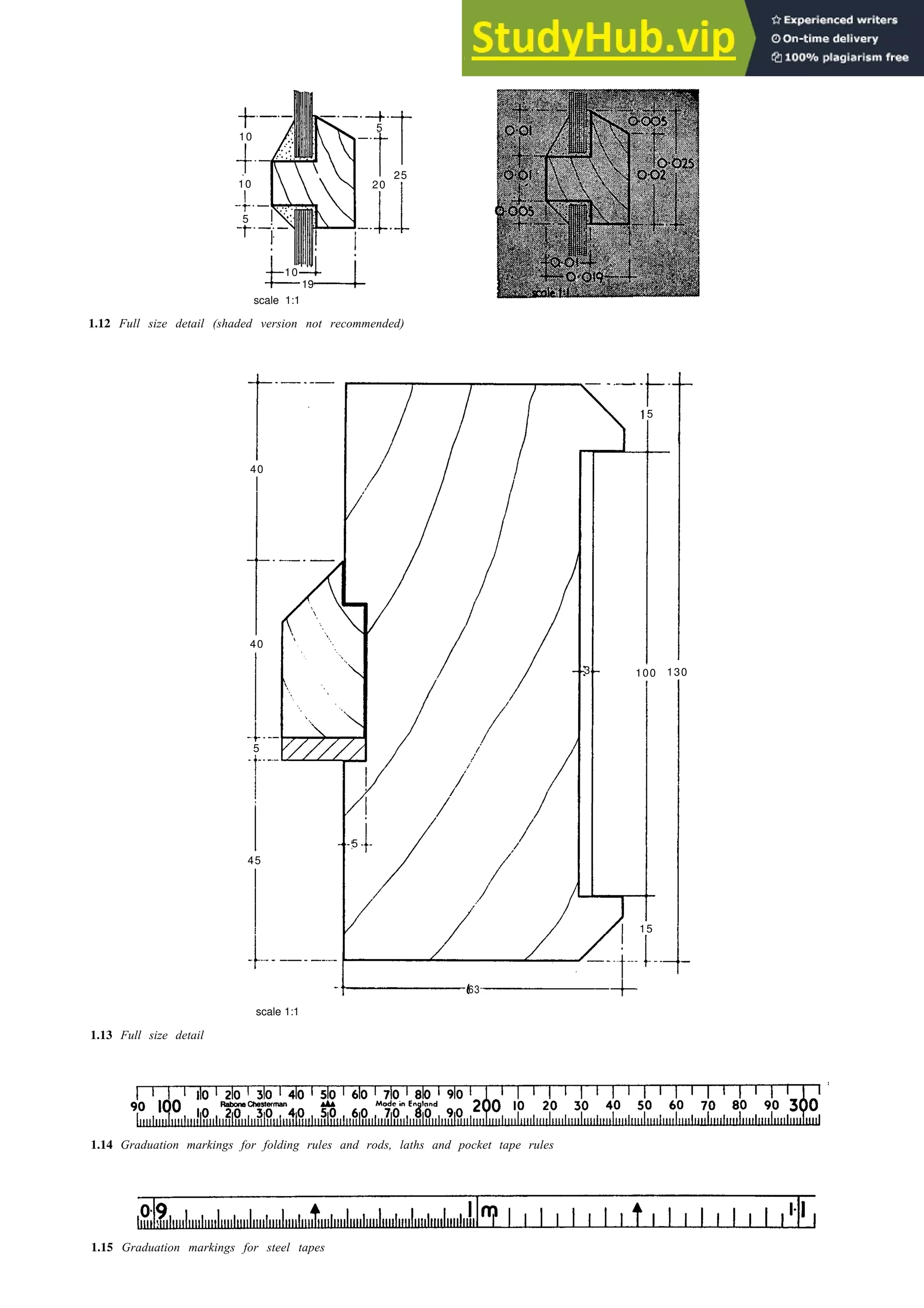
1.7 to 1.13. Note that in 1.10 and 1.11 alternative dimensional units
are shown for comparison. The method of expressing dimensions
as shown in the shaded drawings is not recommended.
5 MEASURING INSTRUMENTS
The following notes are based on BS 4484.
5.01 Folding rules and rods, laths, and pocket tape rules
Lengths of instruments are as follows:
(a) Folding rules: 1 m
(b) Laths: 1 m, 1.5 m or 2 m
(c) Folding and multi-purpose rods: 2 m
(d) Pocket tape rules: 1 m, 2 m, 3 m, or 5 m.
The forms of graduation are shown in 1.14. The instruments are
graduated in millimetres along one edge with 5 m and 10m
graduation marks. Along the other edge the millimetre graduations
are omitted.
5.02 Steel and synthetic tapes
Lengths are 10 m, 20m, or 30m long. Etched steel bands are
available in 30m and 50m lengths.
Tapes are graduated at intervals of 100 mm, 10 mm (with the
50 mm centre graduation mark ‘arrowed’) and 5 mm. The first and
last metre of the tape are further subdivided into minor graduation
marks at 1 mm intervals (see 1.15). Note that synthetic material
tapes, however, are not subdivided into millimetres over the first
and last metre.
5.03 Chains
Studded steel band chains are in lengths of 20 metres, divided by
brass studs at every 200 mm position and figured at every 5 metres.
The first and last metre are further divided into 10 mm intervals by
scale 1:2000
1.7 Layout plan (note that the Ordnance Survey continue to use
the 1:2500 scale)
3 8 . 0 0 0
9.850
2.500
4.000
3.400 8 . 0 5 0
1.500
1 8 . 0 0 0
scale 1:500
1.8 Site plan
3 . 0 0 0
entrance
875 2 . 4 0 0
scale 1:50
1.9 Location drawing
1-6 Notation, drawing office practice and dimensional coordination
1 . 0 0 0 1.800 1.250
1 0 0
4 . 4 0 0
3 . 6 0 0
4 . 4 0 0
9 0 0
9 . 8 5 0
4 5 0
9.300
6 0 0 2.700
1 0 0
1.600
4 . 3 0 0
7 . 4 0 0
5 . 4 0 0 3.175
1 0 0
4 . 4 0 0
3 . 0 0 0 875 2 . 4 0 0
2 0 0
1.10 Location drawing (sketch plan)
3 . 4 0 0 1.500 8 . 0 5 0
scale 1 : 100
partition
plaster
19 × 19
40 × 130
19 × 40
1 0 0 1 0 0 0
50
19 × 40
1 0 2 4
s c a l e 1 : 5
1.11 Assembly detail drawing (shaded version not recommended)
1 . 0 0 0
3 . 0 0 0
3 . 0 0 0
3 . 0 0 0
3 . 9 7 5
9 0 0
3 . 0 0 0
1.5 0 0
2 0 0
2 0 0
5 1 2
5
20
25
10
19
scale 1:1
1.12 Full size detail (shaded version not recommended)
40
5
45
Notation, drawing office practice and dimensional coordination 1-7
15
3 100 130
63
scale 1:1
1.13 Full size detail
1.14 Graduation markings for folding rules and rods, laths and pocket tape rules
1.15 Graduation markings for steel tapes
10
10
5
40
15
5
1-8 Notation, drawing office practice and dimensional coordination
swivel handle 5
1.16 Land chain markings
smaller brass studs with a small washer or other identification at
half-metre intervals. The markings appear on both sides of the
band.
Land chains are also in lengths of 20 metres, made up of links,
which from centre to centre of each middle connecting link
measure 200 mm. Tally markers are attached to the middle
connecting ring at every whole-metre position. Red markers are
used for 5 m positions, with raised numerals; yellow markers of a
different shape and with no markings are used for the rest, 1.16.
5.04 Levelling staffs
Lengths are 3 m, 4 m or 5 m long with a reading face not less than
38 mm wide. Graduation marks are 10 mm deep, spaced at 10 mm
intervals. At every 100 mm the graduation marks offset to the left
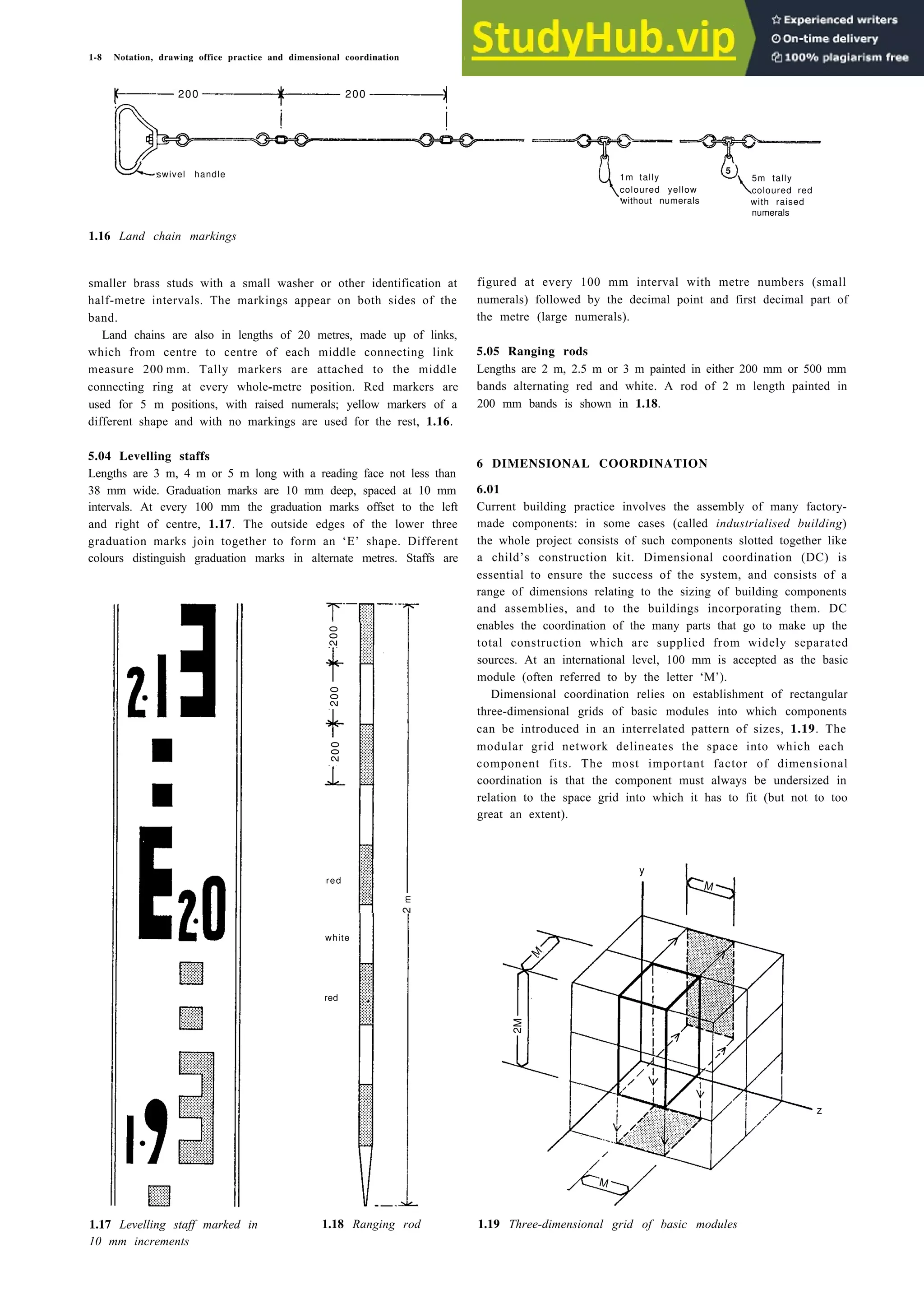
and right of centre, 1.17. The outside edges of the lower three
graduation marks join together to form an ‘E’ shape. Different
colours distinguish graduation marks in alternate metres. Staffs are
2M
y
2
m
red
200
white
red
z
1.17 Levelling staff marked in
10 mm increments
1.18 Ranging rod
figured at every 100 mm interval with metre numbers (small
numerals) followed by the decimal point and first decimal part of
the metre (large numerals).
5.05 Ranging rods
Lengths are 2 m, 2.5 m or 3 m painted in either 200 mm or 500 mm
bands alternating red and white. A rod of 2 m length painted in
200 mm bands is shown in 1.18.
6 DIMENSIONAL COORDINATION
6.01
Current building practice involves the assembly of many factory-
made components: in some cases (called industrialised building)
the whole project consists of such components slotted together like
a child’s construction kit. Dimensional coordination (DC) is
essential to ensure the success of the system, and consists of a
range of dimensions relating to the sizing of building components
and assemblies, and to the buildings incorporating them. DC
enables the coordination of the many parts that go to make up the
total construction which are supplied from widely separated
sources. At an international level, 100 mm is accepted as the basic
module (often referred to by the letter ‘M’).
Dimensional coordination relies on establishment of rectangular
three-dimensional grids of basic modules into which components
can be introduced in an interrelated pattern of sizes, 1.19. The
modular grid network delineates the space into which each
component fits. The most important factor of dimensional
coordination is that the component must always be undersized in
relation to the space grid into which it has to fit (but not to too
great an extent).
1.19 Three-dimensional grid of basic modules
200 200
1m tally
coloured yellow
without numerals
5m tally
coloured red
with raised
numerals
200
200
M
M
M
cylinder
component
tolerance
walls of cylinder
sealing rings
functional tolerance
working size
of component
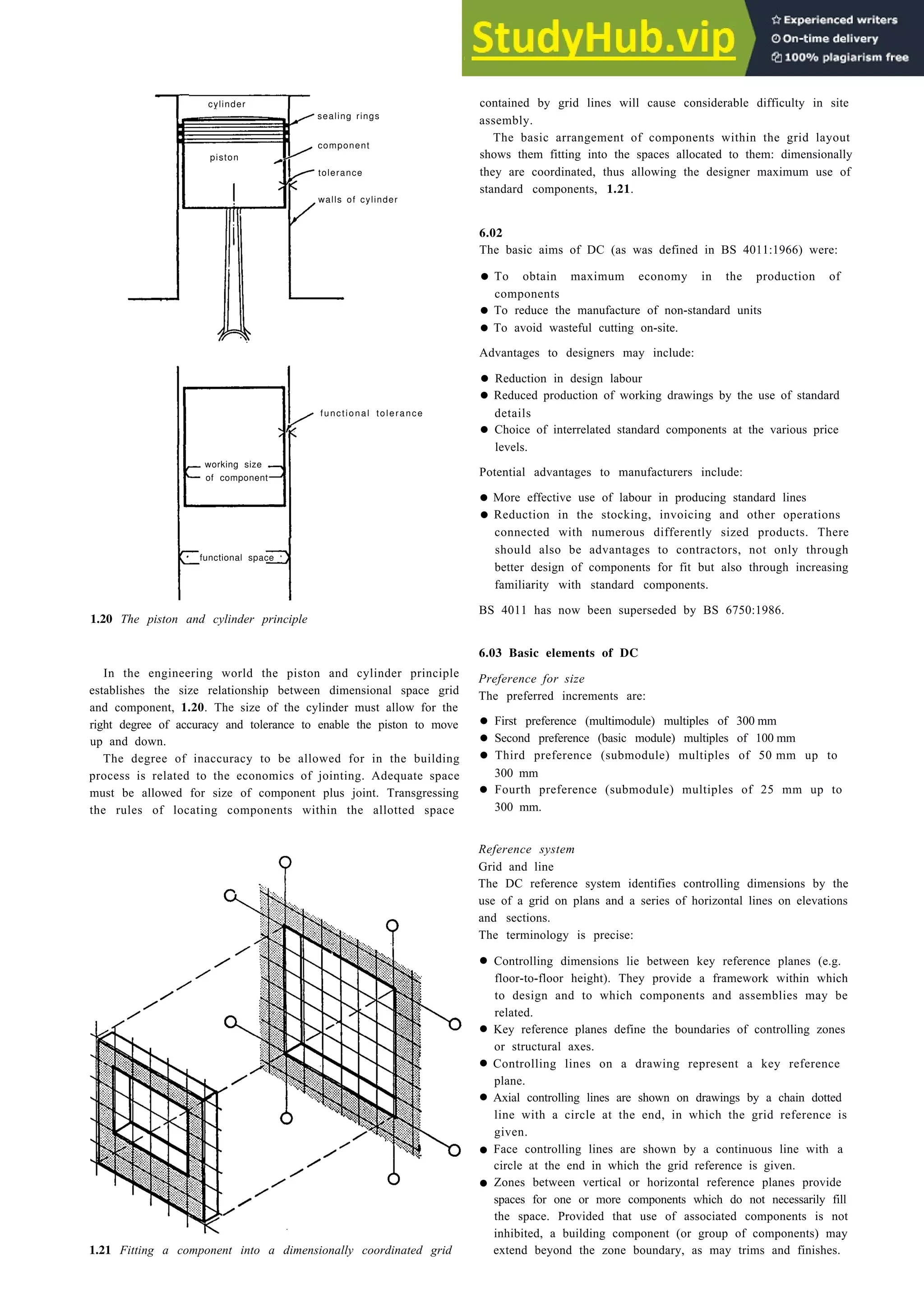
1.20 The piston and cylinder principle
In the engineering world the piston and cylinder principle
establishes the size relationship between dimensional space grid
and component, 1.20. The size of the cylinder must allow for the
right degree of accuracy and tolerance to enable the piston to move
up and down.
The degree of inaccuracy to be allowed for in the building
process is related to the economics of jointing. Adequate space
must be allowed for size of component plus joint. Transgressing
the rules of locating components within the allotted space
1.21 Fitting a component into a dimensionally coordinated grid
Notation, drawing office practice and dimensional coordination 1-9
contained by grid lines will cause considerable difficulty in site
assembly.
The basic arrangement of components within the grid layout
shows them fitting into the spaces allocated to them: dimensionally
they are coordinated, thus allowing the designer maximum use of
standard components, 1.21.
6.02
The basic aims of DC (as was defined in BS 4011:1966) were:
• To obtain maximum economy in the production of
components
• To reduce the manufacture of non-standard units
• To avoid wasteful cutting on-site.
Advantages to designers may include:
• Reduction in design labour
• Reduced production of working drawings by the use of standard
details
• Choice of interrelated standard components at the various price
levels.
Potential advantages to manufacturers include:
• More effective use of labour in producing standard lines
• Reduction in the stocking, invoicing and other operations
connected with numerous differently sized products. There
should also be advantages to contractors, not only through
better design of components for fit but also through increasing
familiarity with standard components.
BS 4011 has now been superseded by BS 6750:1986.
6.03 Basic elements of DC
Preference for size
The preferred increments are:
• First preference (multimodule) multiples of 300 mm
• Second preference (basic module) multiples of 100 mm
• Third preference (submodule) multiples of 50 mm up to
300 mm
• Fourth preference (submodule) multiples of 25 mm up to
300 mm.
Reference system
Grid and line
The DC reference system identifies controlling dimensions by the
use of a grid on plans and a series of horizontal lines on elevations
and sections.
The terminology is precise:
• Controlling dimensions lie between key reference planes (e.g.
floor-to-floor height). They provide a framework within which
to design and to which components and assemblies may be
related.
• Key reference planes define the boundaries of controlling zones
or structural axes.
• Controlling lines on a drawing represent a key reference
plane.
• Axial controlling lines are shown on drawings by a chain dotted
line with a circle at the end, in which the grid reference is
given.
• Face controlling lines are shown by a continuous line with a
circle at the end in which the grid reference is given.
• Zones between vertical or horizontal reference planes provide
spaces for one or more components which do not necessarily fill
the space. Provided that use of associated components is not
inhibited, a building component (or group of components) may
extend beyond the zone boundary, as may trims and finishes.
piston
functional space
1-10 Notation, drawing office practice and dimensional coordination
6.04 Drawings
A typical project will require three series of drawings:
1 General location drawings showing controlling lines with
identifiers
2 Assembly drawings showing the relationships between the
components and the controlling lines
3 Component drawings, where required.
Specialists such as structural and service engineers provide
assembly and component drawings in their own disciplines to fit in
with this system.
The representation of the dimensional coordination framework
should be consistent on all drawings. On general location drawings
a grid representing 300 mm (or a multiple of 300 mm) may be
used. Assembly details may use grids of 300 or 100 mm.
Reference lines
Reference lines or grids should be thin, to distinguish them from
other, particularly constructional, lines.
Gridded paper and scales
Table V gives the recommended range of scales for each type of
drawing related to appropriate paper grid sizes. Scale and the
increment represented by the grid should be indicated on all
gridded sheets.
Dimension lines
Different types of dimensions should be distinguished by the type
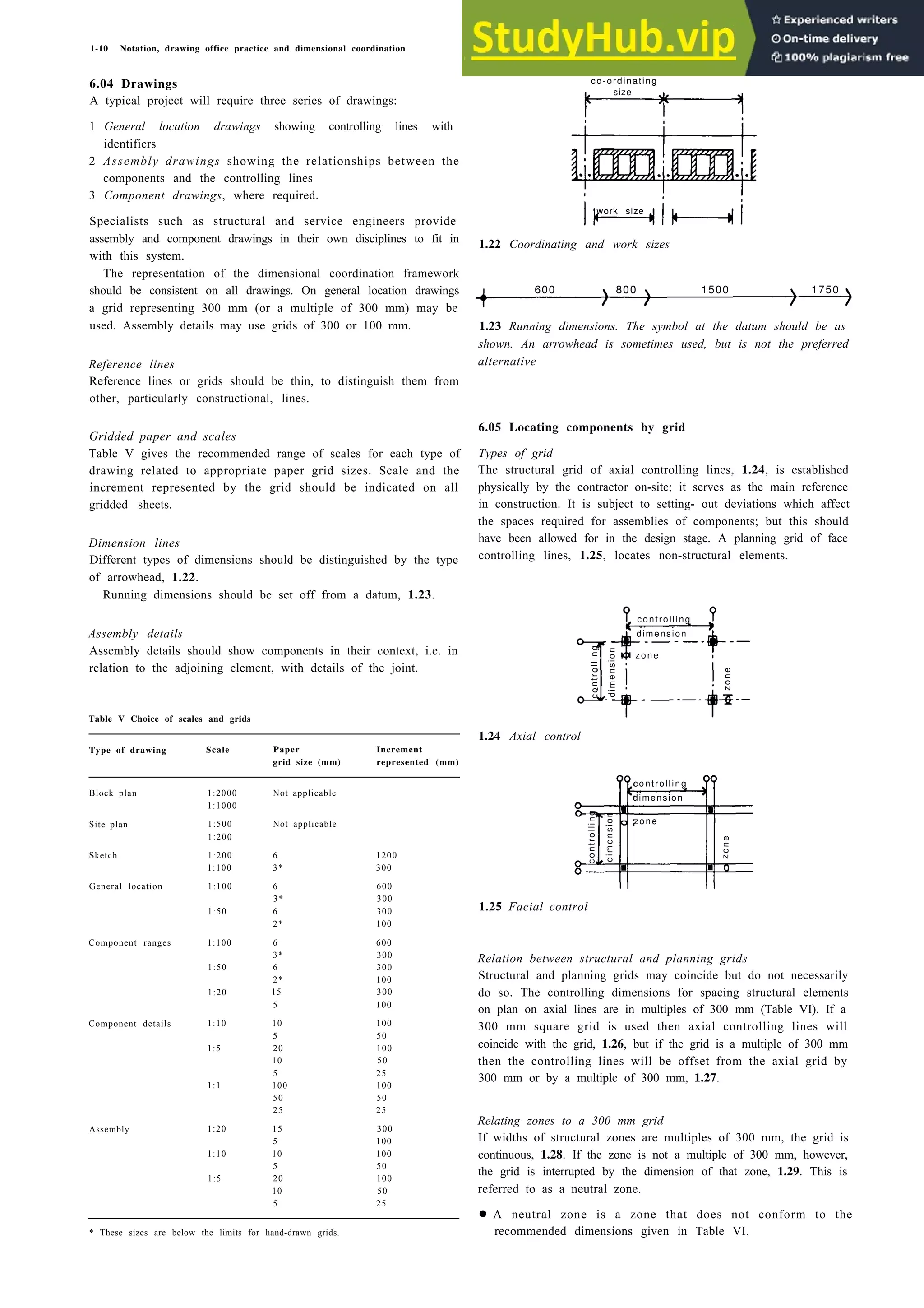
of arrowhead, 1.22.
Running dimensions should be set off from a datum, 1.23.
controlling
dimension
zone
Assembly details
Assembly details should show components in their context, i.e. in
relation to the adjoining element, with details of the joint.
Table V Choice of scales and grids
Type of drawing Scale Paper
grid size (mm)
Increment
represented (mm)
Block plan
Site plan
Sketch
General location
1:2000
1:1000
1:500
1:200
1:200
1:100
1:100
1:50
Component ranges 1:100
1:50
1:20
Component details 1:10
1:5
Assembly
1:1
1:20
1:10
1:5
Not applicable
Not applicable
6 1200
3* 300
6 600
3* 300
6 300
2* 100
6 600
3* 300
6 300
2* 100
15 300
5 100
10 100
5 50
20 100
10 50
5 25
100 100
50 50
25 25
15 300
5 100
10 100
5 50
20 100
10 50
5 25
* These sizes are below the limits for hand-drawn grids.
co-ordinating
size
work size
1.22 Coordinating and work sizes
600 800 1500 1750
1.23 Running dimensions. The symbol at the datum should be as
shown. An arrowhead is sometimes used, but is not the preferred
alternative
6.05 Locating components by grid
Types of grid
The structural grid of axial controlling lines, 1.24, is established
physically by the contractor on-site; it serves as the main reference
in construction. It is subject to setting- out deviations which affect
the spaces required for assemblies of components; but this should
have been allowed for in the design stage. A planning grid of face
controlling lines, 1.25, locates non-structural elements.
1.24 Axial control
1.25 Facial control
Relation between structural and planning grids
Structural and planning grids may coincide but do not necessarily
do so. The controlling dimensions for spacing structural elements
on plan on axial lines are in multiples of 300 mm (Table VI). If a
300 mm square grid is used then axial controlling lines will
coincide with the grid, 1.26, but if the grid is a multiple of 300 mm
then the controlling lines will be offset from the axial grid by
300 mm or by a multiple of 300 mm, 1.27.
Relating zones to a 300 mm grid
If widths of structural zones are multiples of 300 mm, the grid is
continuous, 1.28. If the zone is not a multiple of 300 mm, however,
the grid is interrupted by the dimension of that zone, 1.29. This is
referred to as a neutral zone.
• A neutral zone is a zone that does not conform to the
recommended dimensions given in Table VI.
c
o
n
t
r
o
l
l
i
n
g
controlling
dimension
zone
d
i
m
e
n
s
i
o
n
z
o
n
e
c
o
n
t
r
o
l
l
i
n
g
d
i
m
e
n
s
i
o
n
z
o
n
e
Notation, drawing office practice and dimensional coordination 1-11
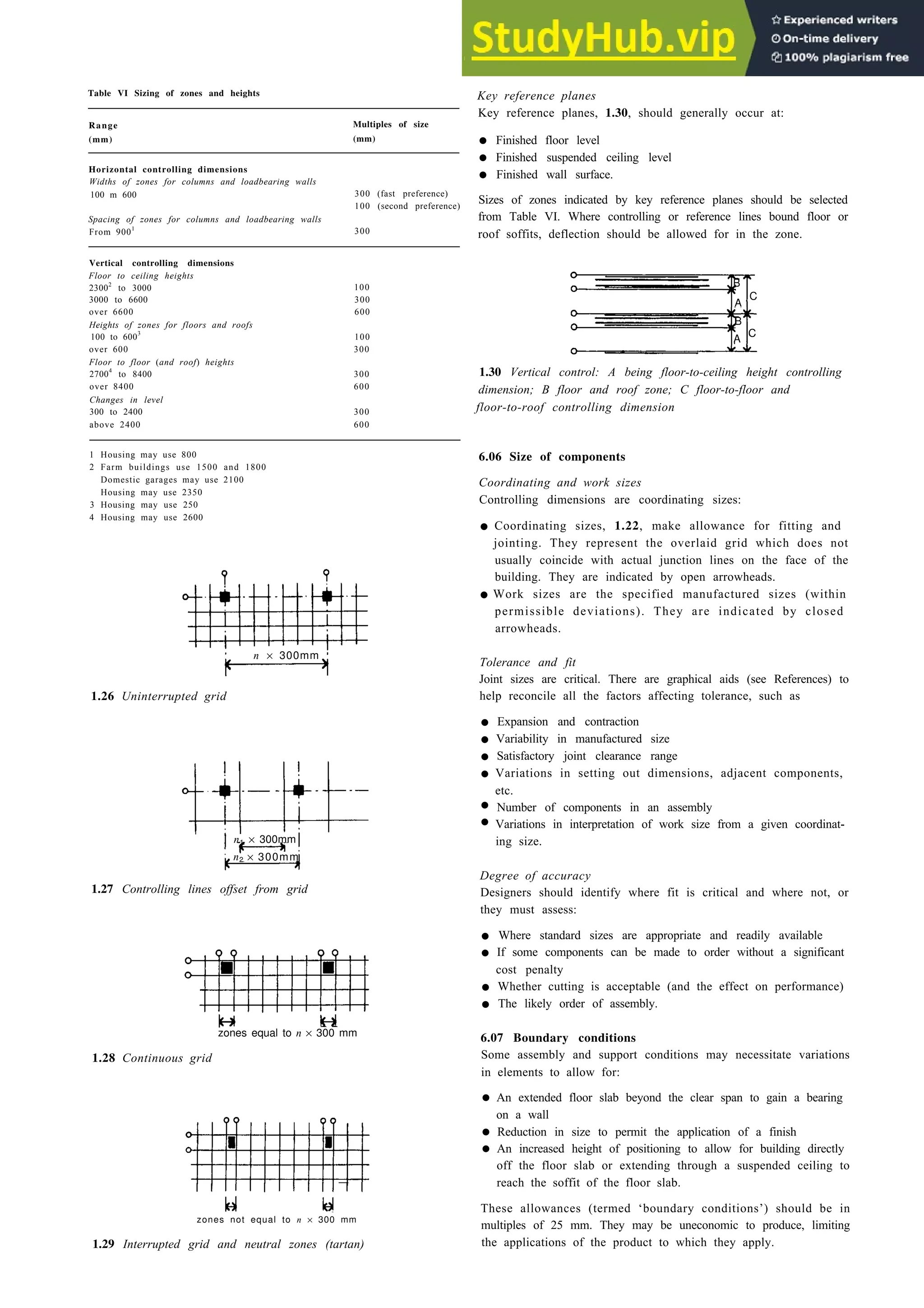
Table VI Sizing of zones and heights Key reference planes
Range Multiples of size
(mm) (mm)
Horizontal controlling dimensions
Widths of zones for columns and loadbearing walls
100 m 600 300 (fast preference)
100 (second preference)
Spacing of zones for columns and loadbearing walls
From 9001
300
Key reference planes, 1.30, should generally occur at:
• Finished floor level
• Finished suspended ceiling level
• Finished wall surface.
Sizes of zones indicated by key reference planes should be selected
from Table VI. Where controlling or reference lines bound floor or
roof soffits, deflection should be allowed for in the zone.
Vertical controlling dimensions
Floor to ceiling heights
23002
to 3000
3000 to 6600
over 6600
Heights of zones for floors and roofs
100 to 6003
over 600
Floor to floor (and roof) heights
27004
to 8400
over 8400
Changes in level
300 to 2400
above 2400
100
300
600
100
300
300
600
300
600
B
C
A
B
A
C
1.30 Vertical control: A being floor-to-ceiling height controlling
dimension; B floor and roof zone; C floor-to-floor and
floor-to-roof controlling dimension
1 Housing may use 800
2 Farm buildings use 1500 and 1800
Domestic garages may use 2100
Housing may use 2350
3 Housing may use 250
4 Housing may use 2600
× 300mm
1.26 Uninterrupted grid
n1 × 300mm
n2 × 300mm
1.27 Controlling lines offset from grid
zones equal to n × 300 mm
1.28 Continuous grid
zones not equal to n × 300 mm
1.29 Interrupted grid and neutral zones (tartan)
6.06 Size of components
Coordinating and work sizes
Controlling dimensions are coordinating sizes:
• Coordinating sizes, 1.22, make allowance for fitting and
jointing. They represent the overlaid grid which does not
usually coincide with actual junction lines on the face of the
building. They are indicated by open arrowheads.
• Work sizes are the specified manufactured sizes (within
permissible deviations). They are indicated by closed
arrowheads.
Tolerance and fit
Joint sizes are critical. There are graphical aids (see References) to
help reconcile all the factors affecting tolerance, such as
• Expansion and contraction
• Variability in manufactured size
• Satisfactory joint clearance range
• Variations in setting out dimensions, adjacent components,
etc.
• Number of components in an assembly
• Variations in interpretation of work size from a given coordinat-
ing size.
Degree of accuracy
Designers should identify where fit is critical and where not, or
they must assess:
• Where standard sizes are appropriate and readily available
• If some components can be made to order without a significant
cost penalty
• Whether cutting is acceptable (and the effect on performance)
• The likely order of assembly.
6.07 Boundary conditions
Some assembly and support conditions may necessitate variations
in elements to allow for:
• An extended floor slab beyond the clear span to gain a bearing
on a wall
• Reduction in size to permit the application of a finish
• An increased height of positioning to allow for building directly
off the floor slab or extending through a suspended ceiling to
reach the soffit of the floor slab.
These allowances (termed ‘boundary conditions’) should be in
multiples of 25 mm. They may be uneconomic to produce, limiting
the applications of the product to which they apply.
n
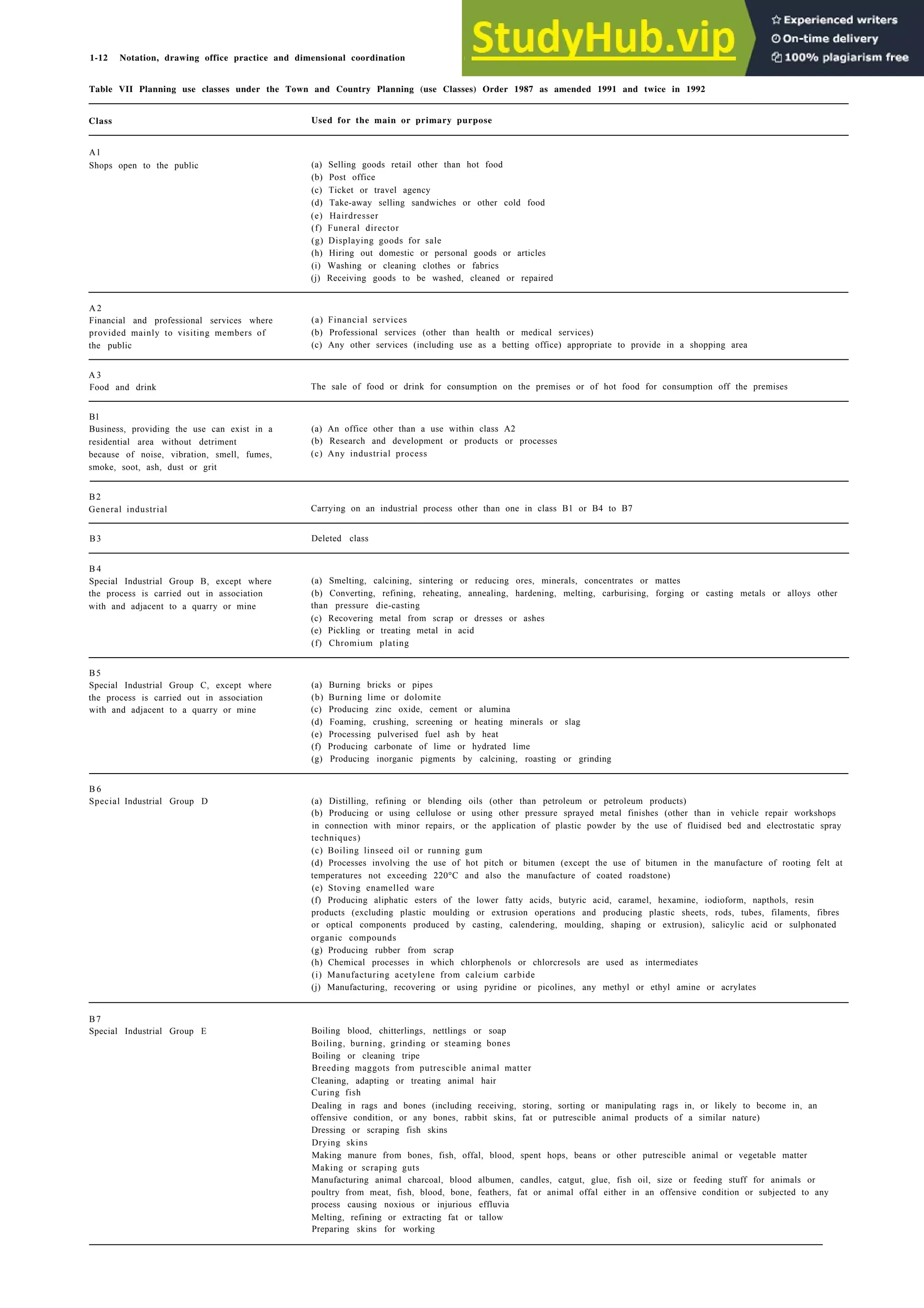
1-12 Notation, drawing office practice and dimensional coordination
Table VII Planning use classes under the Town and Country Planning (use Classes) Order 1987 as amended 1991 and twice in 1992
Class Used for the main or primary purpose
A1
Shops open to the public (a) Selling goods retail other than hot food
(b) Post office
(c) Ticket or travel agency
(d) Take-away selling sandwiches or other cold food
(e) Hairdresser
(f) Funeral director
(g) Displaying goods for sale
(h) Hiring out domestic or personal goods or articles
(i) Washing or cleaning clothes or fabrics
(j) Receiving goods to be washed, cleaned or repaired
A 2
Financial and professional services where
provided mainly to visiting members of
the public
(a) Financial services
(b) Professional services (other than health or medical services)
(c) Any other services (including use as a betting office) appropriate to provide in a shopping area
A 3
Food and drink The sale of food or drink for consumption on the premises or of hot food for consumption off the premises
B1
Business, providing the use can exist in a
residential area without detriment
because of noise, vibration, smell, fumes,
smoke, soot, ash, dust or grit
(a) An office other than a use within class A2
(b) Research and development or products or processes
(c) Any industrial process
B2
General industrial
B3
Carrying on an industrial process other than one in class B1 or B4 to B7
Deleted class
B 4
Special Industrial Group B, except where
the process is carried out in association
with and adjacent to a quarry or mine
(a) Smelting, calcining, sintering or reducing ores, minerals, concentrates or mattes
(b) Converting, refining, reheating, annealing, hardening, melting, carburising, forging or casting metals or alloys other
than pressure die-casting
(c) Recovering metal from scrap or dresses or ashes
(e) Pickling or treating metal in acid
(f) Chromium plating
B5
Special Industrial Group C, except where
the process is carried out in association
with and adjacent to a quarry or mine
(a) Burning bricks or pipes
(b) Burning lime or dolomite
(c) Producing zinc oxide, cement or alumina
(d) Foaming, crushing, screening or heating minerals or slag
(e) Processing pulverised fuel ash by heat
(f) Producing carbonate of lime or hydrated lime
(g) Producing inorganic pigments by calcining, roasting or grinding
B 6
Special Industrial Group D (a) Distilling, refining or blending oils (other than petroleum or petroleum products)
(b) Producing or using cellulose or using other pressure sprayed metal finishes (other than in vehicle repair workshops
in connection with minor repairs, or the application of plastic powder by the use of fluidised bed and electrostatic spray
techniques)
(c) Boiling linseed oil or running gum
(d) Processes involving the use of hot pitch or bitumen (except the use of bitumen in the manufacture of rooting felt at
temperatures not exceeding 220°C and also the manufacture of coated roadstone)
(e) Stoving enamelled ware
(f) Producing aliphatic esters of the lower fatty acids, butyric acid, caramel, hexamine, iodioform, napthols, resin
products (excluding plastic moulding or extrusion operations and producing plastic sheets, rods, tubes, filaments, fibres
or optical components produced by casting, calendering, moulding, shaping or extrusion), salicylic acid or sulphonated
organic compounds
(g) Producing rubber from scrap
(h) Chemical processes in which chlorphenols or chlorcresols are used as intermediates
(i) Manufacturing acetylene from calcium carbide
(j) Manufacturing, recovering or using pyridine or picolines, any methyl or ethyl amine or acrylates
B7
Special Industrial Group E Boiling blood, chitterlings, nettlings or soap
Boiling, burning, grinding or steaming bones
Boiling or cleaning tripe
Breeding maggots from putrescible animal matter
Cleaning, adapting or treating animal hair
Curing fish
Dealing in rags and bones (including receiving, storing, sorting or manipulating rags in, or likely to become in, an
offensive condition, or any bones, rabbit skins, fat or putrescible animal products of a similar nature)
Dressing or scraping fish skins
Drying skins
Making manure from bones, fish, offal, blood, spent hops, beans or other putrescible animal or vegetable matter
Making or scraping guts
Manufacturing animal charcoal, blood albumen, candles, catgut, glue, fish oil, size or feeding stuff for animals or
poultry from meat, fish, blood, bone, feathers, fat or animal offal either in an offensive condition or subjected to any
process causing noxious or injurious effluvia
Melting, refining or extracting fat or tallow
Preparing skins for working
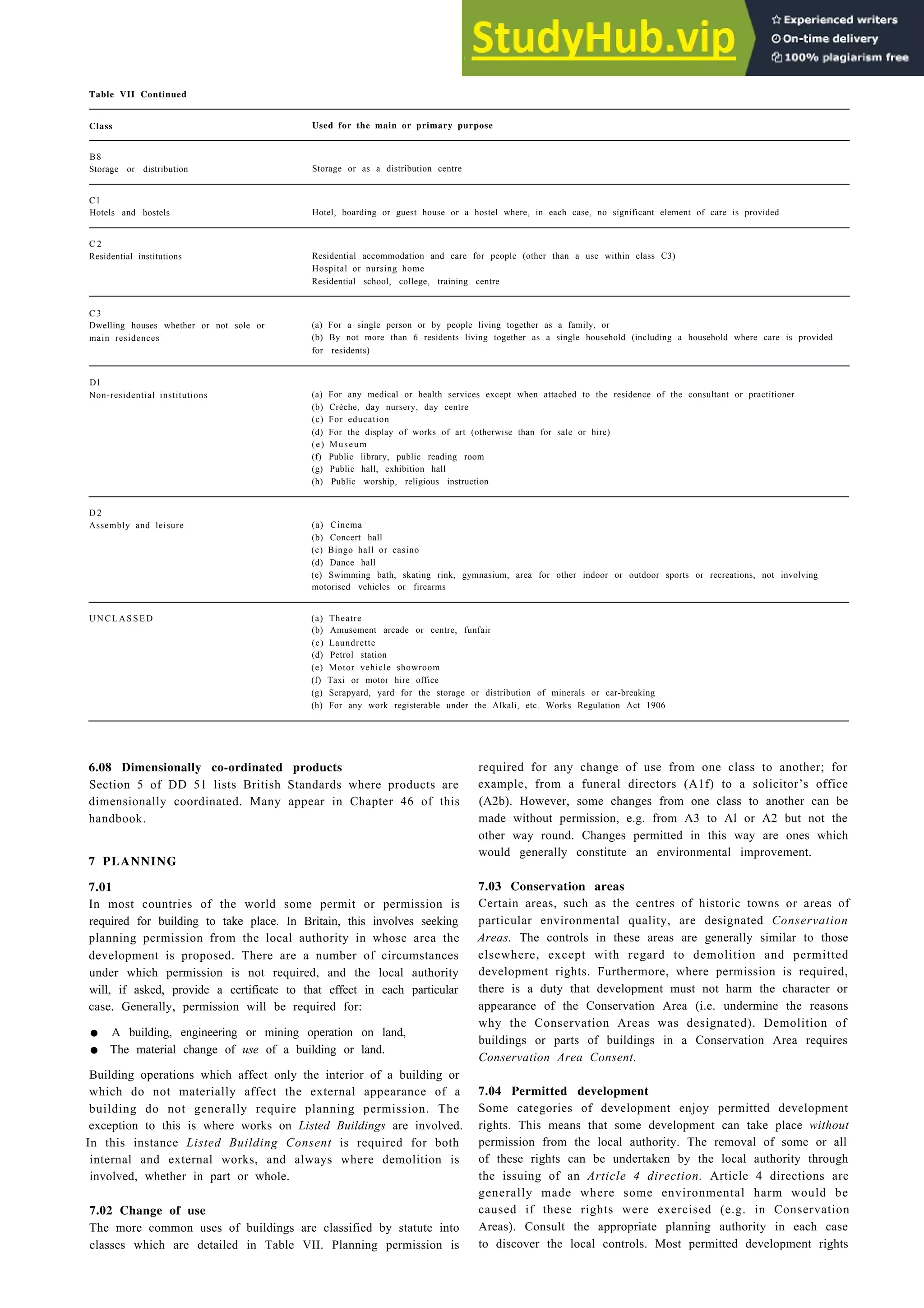
Notation, drawing office practice and dimensional coordination 1-13
Table VII Continued
Class Used for the main or primary purpose
B8
Storage or distribution Storage or as a distribution centre
C1
Hotels and hostels Hotel, boarding or guest house or a hostel where, in each case, no significant element of care is provided
C 2
Residential institutions Residential accommodation and care for people (other than a use within class C3)
Hospital or nursing home
Residential school, college, training centre
C 3
Dwelling houses whether or not sole or
main residences
(a) For a single person or by people living together as a family, or
(b) By not more than 6 residents living together as a single household (including a household where care is provided
for residents)
D1
Non-residential institutions (a) For any medical or health services except when attached to the residence of the consultant or practitioner
(b) Crèche, day nursery, day centre
(c) For education
(d) For the display of works of art (otherwise than for sale or hire)
(e) Museum
(f) Public library, public reading room
(g) Public hall, exhibition hall
(h) Public worship, religious instruction
D 2
Assembly and leisure (a) Cinema
(b) Concert hall
(c) Bingo hall or casino
(d) Dance hall
(e) Swimming bath, skating rink, gymnasium, area for other indoor or outdoor sports or recreations, not involving
motorised vehicles or firearms
U N C L A S S E D (a) Theatre
(b) Amusement arcade or centre, funfair
(c) Laundrette
(d) Petrol station
(e) Motor vehicle showroom
(f) Taxi or motor hire office
(g) Scrapyard, yard for the storage or distribution of minerals or car-breaking
(h) For any work registerable under the Alkali, etc. Works Regulation Act 1906
6.08 Dimensionally co-ordinated products
Section 5 of DD 51 lists British Standards where products are
dimensionally coordinated. Many appear in Chapter 46 of this
handbook.
7 PLANNING
7.01
In most countries of the world some permit or permission is
required for building to take place. In Britain, this involves seeking
planning permission from the local authority in whose area the
development is proposed. There are a number of circumstances
under which permission is not required, and the local authority
will, if asked, provide a certificate to that effect in each particular
case. Generally, permission will be required for:
• A building, engineering or mining operation on land,
• The material change of use of a building or land.
Building operations which affect only the interior of a building or
which do not materially affect the external appearance of a
building do not generally require planning permission. The
exception to this is where works on Listed Buildings are involved.
In this instance Listed Building Consent is required for both
internal and external works, and always where demolition is
involved, whether in part or whole.
7.02 Change of use
The more common uses of buildings are classified by statute into
classes which are detailed in Table VII. Planning permission is
required for any change of use from one class to another; for
example, from a funeral directors (A1f) to a solicitor’s office
(A2b). However, some changes from one class to another can be
made without permission, e.g. from A3 to Al or A2 but not the
other way round. Changes permitted in this way are ones which
would generally constitute an environmental improvement.
7.03 Conservation areas
Certain areas, such as the centres of historic towns or areas of
particular environmental quality, are designated Conservation
Areas. The controls in these areas are generally similar to those
elsewhere, except with regard to demolition and permitted
development rights. Furthermore, where permission is required,
there is a duty that development must not harm the character or
appearance of the Conservation Area (i.e. undermine the reasons
why the Conservation Areas was designated). Demolition of
buildings or parts of buildings in a Conservation Area requires
Conservation Area Consent.
7.04 Permitted development
Some categories of development enjoy permitted development
rights. This means that some development can take place without
permission from the local authority. The removal of some or all
of these rights can be undertaken by the local authority through
the issuing of an Article 4 direction. Article 4 directions are
generally made where some environmental harm would be
caused if these rights were exercised (e.g. in Conservation
Areas). Consult the appropriate planning authority in each case
to discover the local controls. Most permitted development rights
1-14 Notation, drawing office practice and dimensional coordination
apply only to single-family dwelling houses, and relate to such
matters as garden walls, porches, changes to windows, etc.
8 REFERENCES
British Standards Institution
BS 1192: Part 1: 1984 Construction drawing practice, recom-
mendations for general principles
BS 1192: Part 2: 1987 Construction drawing practice, recom-
mendations for architectural and engineering drawings
BS 1192: Part 3: 1987(1993) Construction drawing practice,
recommendations for symbols and other graphic conventions
BS 1192: Part 4: 1984 Construction drawing practice, recom-
mendations for landscape drawings
BS 4484: Part 1: 1969 Measuring instruments for constructional
works. Metric graduation and figuring of instruments for linear
measurement
BS 5606: 1990 Guide to accuracy in building
BS 6750: 1986 Modular co-ordination in building
International Organisation For Standardisation
ISO 1791: 1973 Modular co-ordination – vocabulary
ISO 1006: 1973 Modular co-ordination – basic module
ISO 2848: 1974 Modular co-ordination – principles and rules
ISO 1040: 1973 Modular co-ordination – multimodules for
horizontal co-ordinating dimensions
ISO R 1790: 1970 Modular co-ordination – reference lines of
horizontal controlling coordinating dimensions
ISO 1789: 1973 Modular co-ordination – storey heights and room
heights for residential buildings
ISO 2776: 1974 Modular co-ordination – co-ordinating sizes for
door-sets – external and internal
General
Graphical aids for tolerances and fits: handbook for manu-
facturers, designers and builders, Building Research Establish-
ment Report, London, HMSO, 1974
2 Basic design data
David Adler
KEY POINTS:
• Certain dimensions are crucial to individual use and health
• Satisfying the average situation is unlikely to help the majority
• Each case must be carefully considered with all classes of
users, particularly people with different disabilities, in mind
Contents
1 Introduction
2 Anthropometrics
3 Ergonomics
4 Disabled people
5 Circulation spaces
6 Activities
7 Furniture
8 Storage
9 References
1 INTRODUCTION
In this chapter will be found basic data which are needed for the
design of most types of buildings. However, some basic matters
are dealt with in later chapters, principally the following:
• Sanitary provision and activity spaces in Chapter 3
• Requirements for vehicles in Chapter 4
• External and landscape design in Chapter 6
• Eating and drinking in other than domestic situations in Chapter
18.
2 A N T H R O P O M E T R I C S
2.01
Anthropometrics is the science concerned with the measurement of
humankind. Inevitably it is bound up with statistics, as people vary
considerably in most dimensions. Anthropometrics is of crucial
importance to architects as the ultimate basis of the design of most
buildings must be the size of the people using them. Average
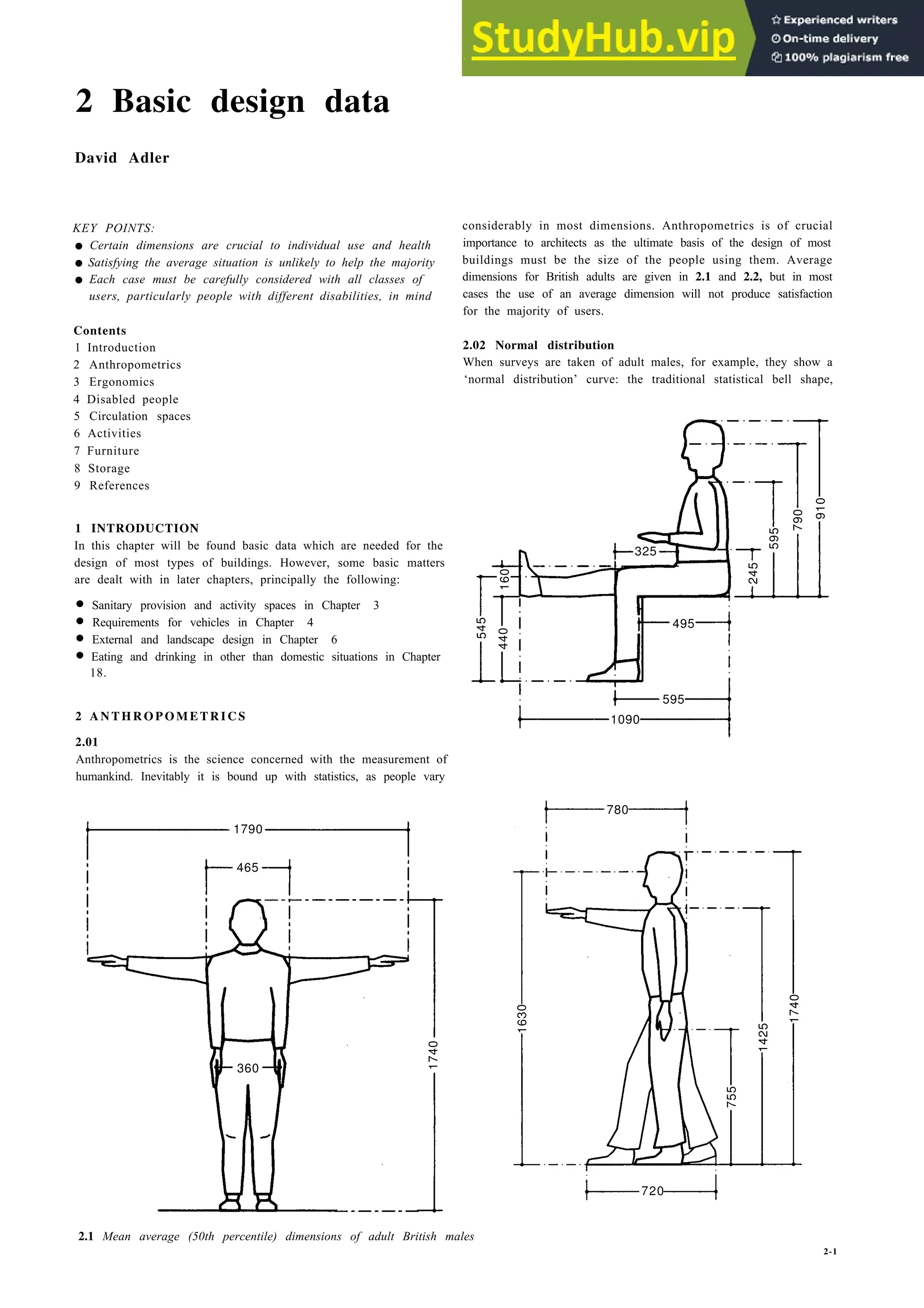
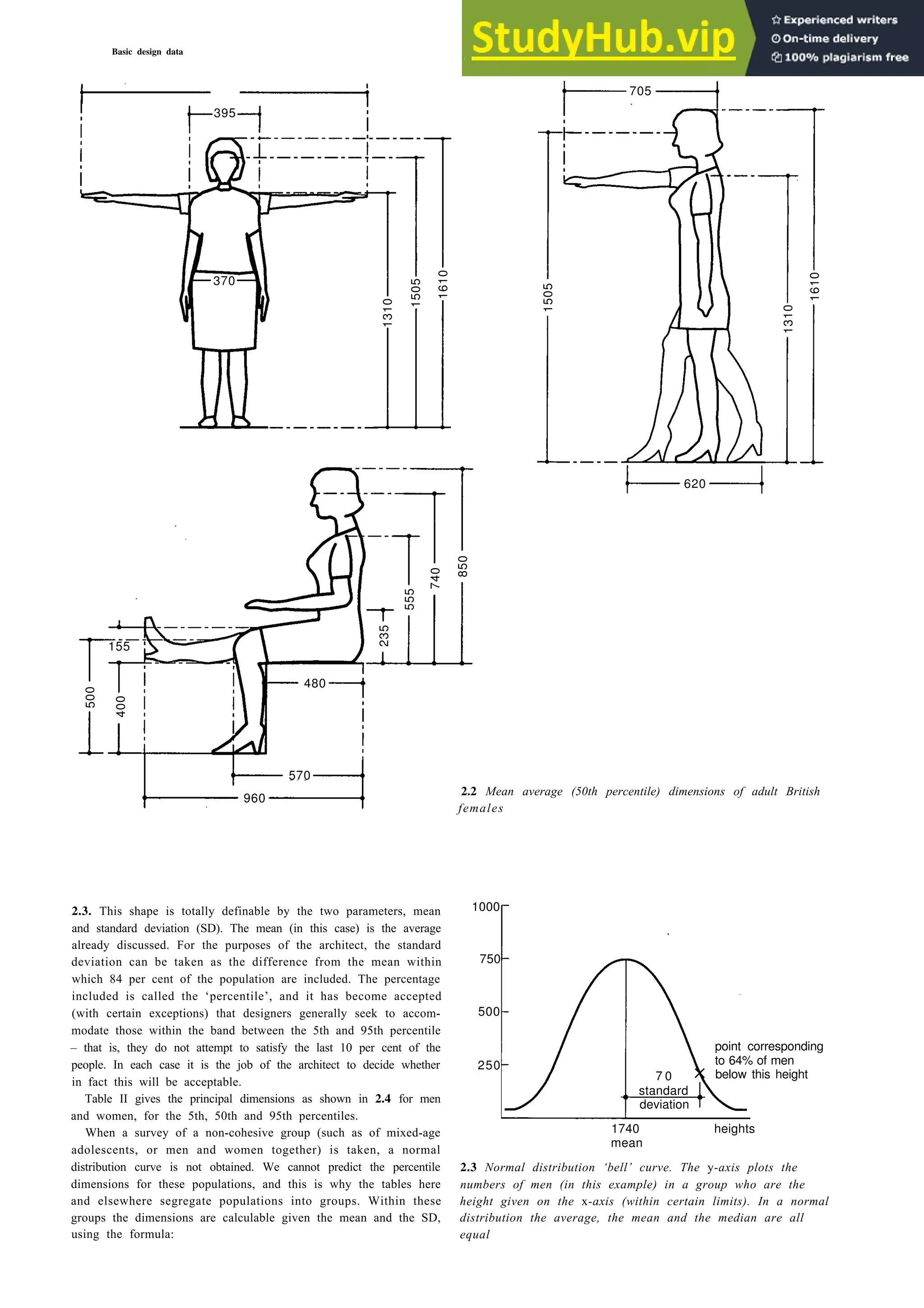
dimensions for British adults are given in 2.1 and 2.2, but in most
cases the use of an average dimension will not produce satisfaction
for the majority of users.
2.02 Normal distribution
When surveys are taken of adult males, for example, they show a
‘normal distribution’ curve: the traditional statistical bell shape,
2.1 Mean average (50th percentile) dimensions of adult British males
2-1
465
1790
360
1740
780
1630
1740
1425
755
720
910
790
325
160
595
245
545
495
440
1090
595
2-2 Basic design data
1605
1000
750
500
250
2.3. This shape is totally definable by the two parameters, mean
and standard deviation (SD). The mean (in this case) is the average
already discussed. For the purposes of the architect, the standard
deviation can be taken as the difference from the mean within
which 84 per cent of the population are included. The percentage
included is called the ‘percentile’, and it has become accepted
(with certain exceptions) that designers generally seek to accom-
modate those within the band between the 5th and 95th percentile
– that is, they do not attempt to satisfy the last 10 per cent of the
people. In each case it is the job of the architect to decide whether
in fact this will be acceptable.
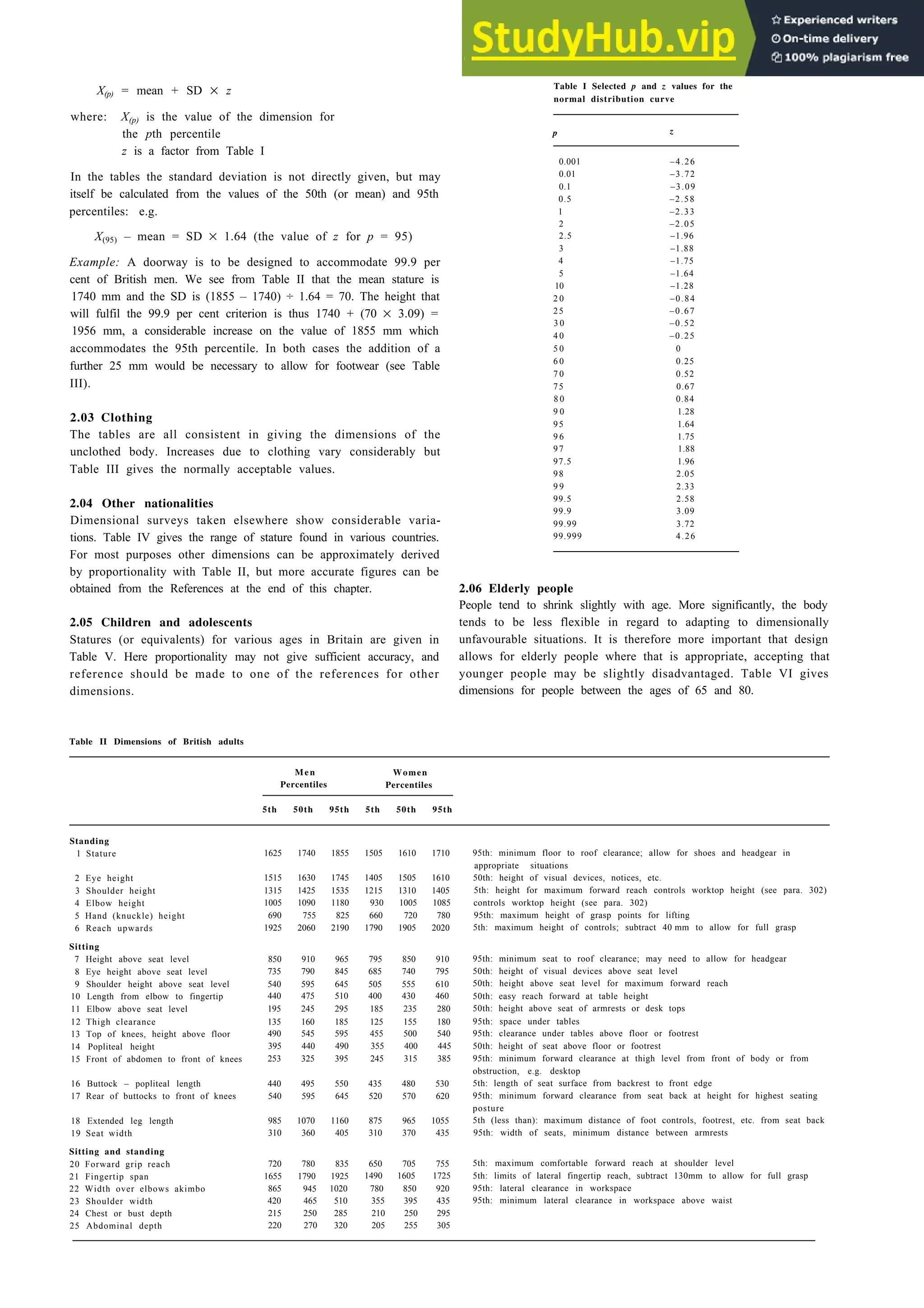
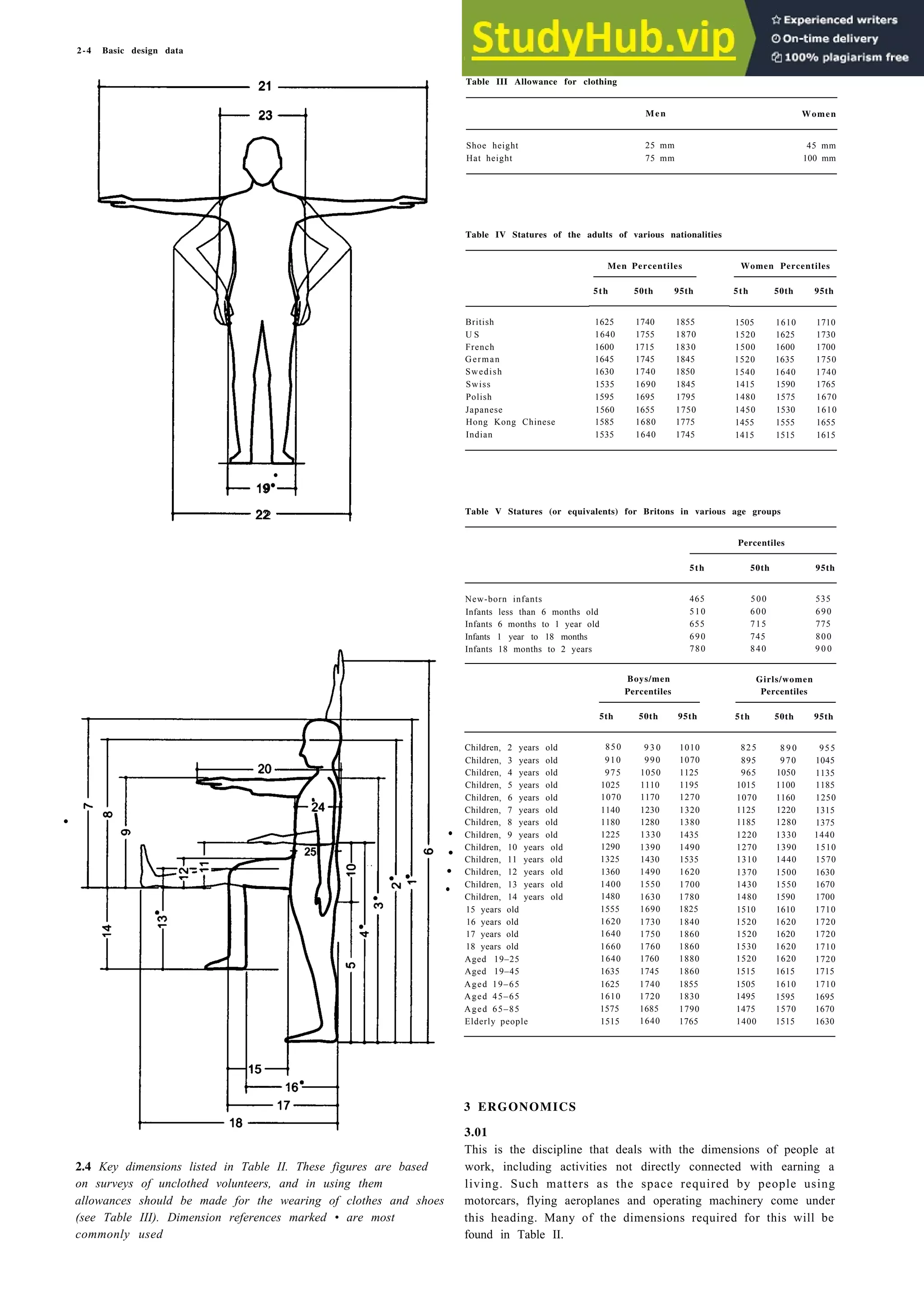
Table II gives the principal dimensions as shown in 2.4 for men
and women, for the 5th, 50th and 95th percentiles.
When a survey of a non-cohesive group (such as of mixed-age
adolescents, or men and women together) is taken, a normal
distribution curve is not obtained. We cannot predict the percentile
dimensions for these populations, and this is why the tables here
and elsewhere segregate populations into groups. Within these
groups the dimensions are calculable given the mean and the SD,
using the formula:
1740
mean
2.3 Normal distribution ‘bell’ curve. The y-axis plots the
numbers of men (in this example) in a group who are the
height given on the x-axis (within certain limits). In a normal
distribution the average, the mean and the median are all
equal
2.2 Mean average (50th percentile) dimensions of adult British
females
395
1310
1505
1610
370
705
1310
1610
1505
620
235
555
740
850
155
500
400
480
960
570
7 0
standard
deviation
point corresponding
to 64% of men
below this height
heights
X(p) = mean + SD × z
where: X(p) is the value of the dimension for
the pth percentile
z is a factor from Table I
In the tables the standard deviation is not directly given, but may
itself be calculated from the values of the 50th (or mean) and 95th
percentiles: e.g.
X(95) – mean = SD × 1.64 (the value of z for p = 95)
Example: A doorway is to be designed to accommodate 99.9 per
cent of British men. We see from Table II that the mean stature is
1740 mm and the SD is (1855 – 1740) ÷ 1.64 = 70. The height that
will fulfil the 99.9 per cent criterion is thus 1740 + (70 × 3.09) =
1956 mm, a considerable increase on the value of 1855 mm which
accommodates the 95th percentile. In both cases the addition of a
further 25 mm would be necessary to allow for footwear (see Table
III).
2.03 Clothing
The tables are all consistent in giving the dimensions of the
unclothed body. Increases due to clothing vary considerably but
Table III gives the normally acceptable values.
2.04 Other nationalities
Dimensional surveys taken elsewhere show considerable varia-
tions. Table IV gives the range of stature found in various countries.
For most purposes other dimensions can be approximately derived
by proportionality with Table II, but more accurate figures can be
obtained from the References at the end of this chapter.
2.05 Children and adolescents
Statures (or equivalents) for various ages in Britain are given in
Table V. Here proportionality may not give sufficient accuracy, and
reference should be made to one of the references for other
dimensions.
Table II Dimensions of British adults
Basic design data 2-3
Table I Selected p and z values for the
normal distribution curve
p z
0.001 –4.26
0.01 –3.72
0.1 –3.09
0.5 –2.58
1 –2.33
2 –2.05
2.5 –1.96
3 –1.88
4 –1.75
5 –1.64
10 –1.28
2 0 –0.84
25 –0.67
3 0 –0.52
4 0 –0.25
5 0 0
6 0 0.25
7 0 0.52
75 0.67
8 0 0.84
9 0 1.28
95 1.64
9 6 1.75
97 1.88
97.5 1.96
98 2.05
9 9 2.33
99.5 2.58
99.9 3.09
99.99 3.72
99.999 4.26
2.06 Elderly people
People tend to shrink slightly with age. More significantly, the body
tends to be less flexible in regard to adapting to dimensionally
unfavourable situations. It is therefore more important that design
allows for elderly people where that is appropriate, accepting that
younger people may be slightly disadvantaged. Table VI gives
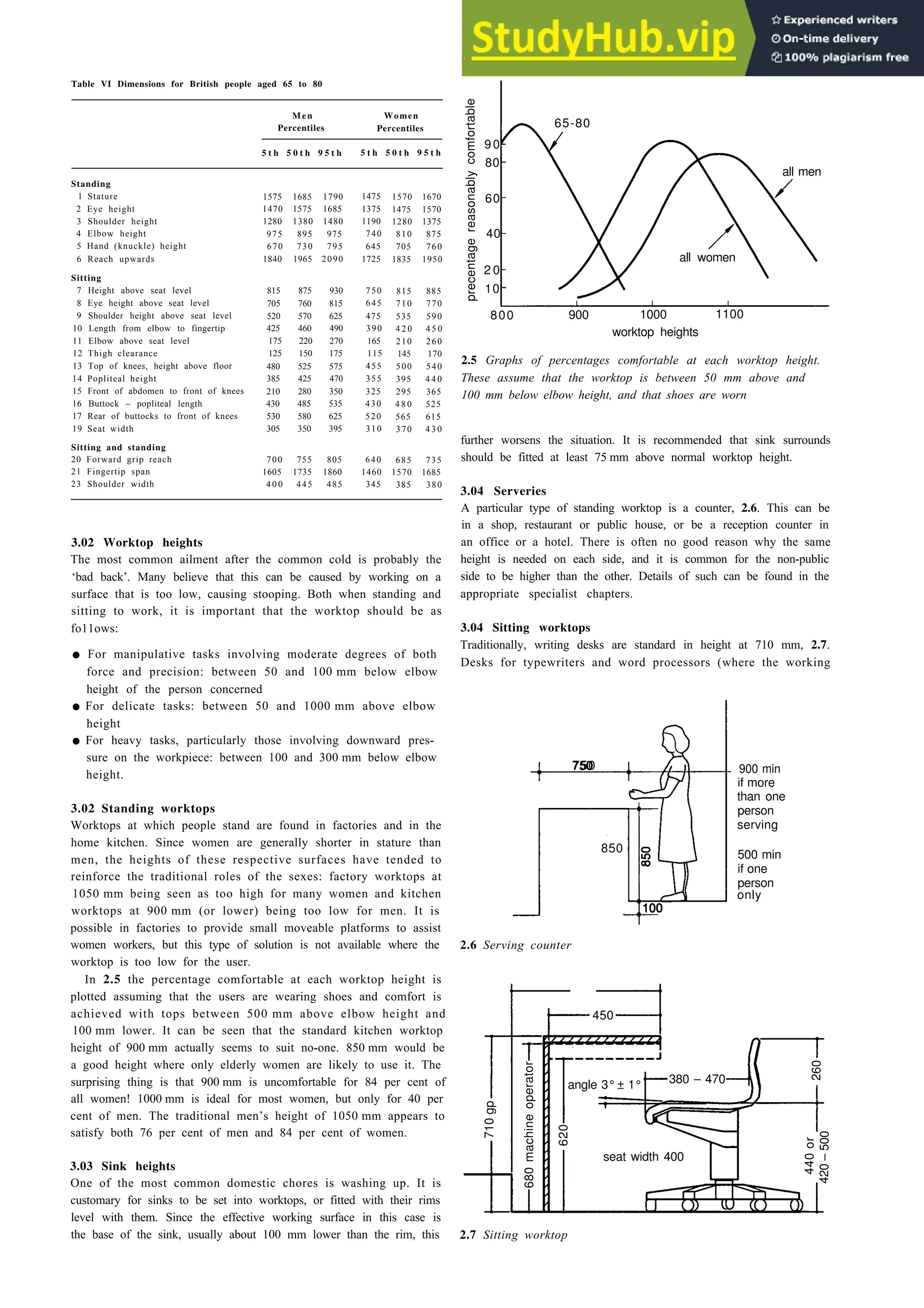
dimensions for people between the ages of 65 and 80.
Men Women
Percentiles Percentiles
5th 50th 95th 5th 50th 95th
Standing
1 Stature 1625 1740 1855 1505 1610 1710 95th: minimum floor to roof clearance; allow for shoes and headgear in
appropriate situations
2 Eye height
3 Shoulder height
4 Elbow height
5 Hand (knuckle) height
6 Reach upwards
1515 1630 1745 1405 1505 1610 50th: height of visual devices, notices, etc.
1315 1425 1535 1215 1310 1405 5th: height for maximum forward reach controls worktop height (see para. 302)
1005 1090 1180 930 1005 1085 controls worktop height (see para. 302)
690 755 825 660 720 780 95th: maximum height of grasp points for lifting
1925 2060 2190 1790 1905 2020 5th: maximum height of controls; subtract 40 mm to allow for full grasp
Sitting
7 Height above seat level 850 910 965 795 850 910
8 Eye height above seat level 735 790 845 685 740 795
9 Shoulder height above seat level 540 595 645 505 555 610
10 Length from elbow to fingertip 440 475 510 400 430 460
11 Elbow above seat level 195 245 295 185 235 280
12 Thigh clearance 135 160 185 125 155 180
13 Top of knees, height above floor 490 545 595 455 500 540
14 Popliteal height 395 440 490 355 400 445
15 Front of abdomen to front of knees 253 325 395 245 315 385
95th: minimum seat to roof clearance; may need to allow for headgear
50th: height of visual devices above seat level
50th: height above seat level for maximum forward reach
50th: easy reach forward at table height
50th: height above seat of armrests or desk tops
95th: space under tables
95th: clearance under tables above floor or footrest
50th: height of seat above floor or footrest
95th: minimum forward clearance at thigh level from front of body or from
obstruction, e.g. desktop
16 Buttock – popliteal length 440 495 550 435 480 530
17 Rear of buttocks to front of knees 540 595 645 520 570 620
5th: length of seat surface from backrest to front edge
95th: minimum forward clearance from seat back at height for highest seating
posture
18 Extended leg length 985 1070 1160 875 965 1055 5th (less than): maximum distance of foot controls, footrest, etc. from seat back
19 Seat width 310 360 405 310 370 435 95th: width of seats, minimum distance between armrests
Sitting and standing
20 Forward grip reach
21 Fingertip span
22 Width over elbows akimbo
23 Shoulder width
24 Chest or bust depth
25 Abdominal depth
720 780 835 650 705 755
1655 1790 1925 1490 1605 1725
865 945 1020 780 850 920
420 465 510 355 395 435
215 250 285 210 250 295
220 270 320 205 255 305
5th: maximum comfortable forward reach at shoulder level
5th: limits of lateral fingertip reach, subtract 130mm to allow for full grasp
95th: lateral clearance in workspace
95th: minimum lateral clearance in workspace above waist
2-4 Basic design data
21
23
Table III Allowance for clothing
Men Women
19
•
22 Table V Statures (or equivalents) for Britons in various age groups
Percentiles
New-born infants
Infants less than 6 months old
Infants 6 months to 1 year old
Infants 1 year to 18 months
Infants 18 months to 2 years
5th 50th 95th
465 500 535
510 600 690
655 715 775
690 745 800
780 840 9 0 0
Shoe height
Hat height
25 mm 45 mm
75 mm 100 mm
Table IV Statures of the adults of various nationalities
British
U S
French
German
Swedish
Swiss
Polish
Japanese
Hong Kong Chinese
Indian
Men Percentiles
5th 50th 95th
1625 1740 1855
1640 1755 1870
1600 1715 1830
1645 1745 1845
1630 1740 1850
1535 1690 1845
1595 1695 1795
1560 1655 1750
1585 1680 1775
1535 1640 1745
Women Percentiles
5th 50th 95th
1505 1610 1710
1520 1625 1730
1500 1600 1700
1520 1635 1750
1540 1640 1740
1415 1590 1765
1480 1575 1670
1450 1530 1610
1455 1555 1655
1415 1515 1615
•
•
•
•
•
2.4 Key dimensions listed in Table II. These figures are based
on surveys of unclothed volunteers, and in using them
allowances should be made for the wearing of clothes and shoes
(see Table III). Dimension references marked • are most
commonly used
Boys/men Girls/women
Percentiles Percentiles
5th 50th 95th 5th 50th 95th
Children, 2 years old
Children, 3 years old
Children, 4 years old
Children, 5 years old
Children, 6 years old
Children, 7 years old
Children, 8 years old
Children, 9 years old
Children, 10 years old
Children, 11 years old
Children, 12 years old
Children, 13 years old
Children, 14 years old
15 years old
16 years old
17 years old
18 years old
Aged 19–25
Aged 19–45
Aged 19–65
Aged 45–65
Aged 65–85
Elderly people
850
910
975
1025
1070
1140
1180
1225
1290
1325
1360
1400
1480
1555
1620
1640
1660
1640
1635
1625
1610
1575
1515
9 3 0 1010 825 8 9 0 955
990 1070 895 970 1045
1050 1125 965 1050 1135
1110 1195 1015 1100 1185
1170 1270 1070 1160 1250
1230 1320 1125 1220 1315
1280 1380 1185 1280 1375
1330 1435 1220 1330 1440
1390 1490 1270 1390 1510
1430 1535 1310 1440 1570
1490 1620 1370 1500 1630
1550 1700 1430 1550 1670
1630 1780 1480 1590 1700
1690 1825 1510 1610 1710
1730 1840 1520 1620 1720
1750 1860 1520 1620 1720
1760 1860 1530 1620 1710
1760 1880 1520 1620 1720
1745 1860 1515 1615 1715
1740 1855 1505 1610 1710
1720 1830 1495 1595 1695
1685 1790 1475 1570 1670
1640 1765 1400 1515 1630
3 ERGONOMICS
3.01
This is the discipline that deals with the dimensions of people at
work, including activities not directly connected with earning a
living. Such matters as the space required by people using
motorcars, flying aeroplanes and operating machinery come under
this heading. Many of the dimensions required for this will be
found in Table II.
precentage
reasonably
comfortable
Table VI Dimensions for British people aged 65 to 80
90
80
60
40
2 0
10
women aged
Men Women
Percentiles Percentiles
5 t h 5 0 t h 9 5 t h 5 t h 5 0 t h 9 5 t h
Standing
1 Stature
2 Eye height
3 Shoulder height
4 Elbow height
5 Hand (knuckle) height
6 Reach upwards
1575 1685 1790
1470 1575 1685
1280 1380 1480
975 895 975
670 730 795
1840 1965 2090
Sitting
7 Height above seat level 815 875 930
8 Eye height above seat level 705 760 815
9 Shoulder height above seat level 520 570 625
10 Length from elbow to fingertip 425 460 490
11 Elbow above seat level 175 220 270
12 Thigh clearance 125 150 175
13 Top of knees, height above floor 480 525 575
14 Popliteal height 385 425 470
15 Front of abdomen to front of knees 210 280 350
16 Buttock – popliteal length 430 485 535
17 Rear of buttocks to front of knees 530 580 625
19 Seat width 305 350 395
800 900 1000 1100
worktop heights
Sitting and standing
20 Forward grip reach
21 Fingertip span
23 Shoulder width
700 755 805
1605 1735 1860
4 0 0 445 485
1475 1570 1670
1375 1475 1570
1190 1280 1375
740 810 875
645 705 760
1725 1835 1950
750 815 885
645 710 770
475 535 590
390 4 2 0 4 5 0
165 210 260
115 145 170
455 500 540
355 395 4 4 0
325 295 365
430 4 8 0 525
520 565 615
310 370 4 3 0
640 685 735
1460 1570 1685
345 385 380
3.02 Worktop heights
The most common ailment after the common cold is probably the
‘bad back’. Many believe that this can be caused by working on a
surface that is too low, causing stooping. Both when standing and
sitting to work, it is important that the worktop should be as
fo11ows:
• For manipulative tasks involving moderate degrees of both
force and precision: between 50 and 100 mm below elbow
height of the person concerned
• For delicate tasks: between 50 and 1000 mm above elbow
height
• For heavy tasks, particularly those involving downward pres-
sure on the workpiece: between 100 and 300 mm below elbow
height.
750
3.02 Standing worktops
Worktops at which people stand are found in factories and in the
home kitchen. Since women are generally shorter in stature than
men, the heights of these respective surfaces have tended to
reinforce the traditional roles of the sexes: factory worktops at
1050 mm being seen as too high for many women and kitchen
worktops at 900 mm (or lower) being too low for men. It is
possible in factories to provide small moveable platforms to assist
women workers, but this type of solution is not available where the
worktop is too low for the user.
850
100
In 2.5 the percentage comfortable at each worktop height is
plotted assuming that the users are wearing shoes and comfort is
achieved with tops between 500 mm above elbow height and
100 mm lower. It can be seen that the standard kitchen worktop
height of 900 mm actually seems to suit no-one. 850 mm would be
a good height where only elderly women are likely to use it. The
surprising thing is that 900 mm is uncomfortable for 84 per cent of
all women! 1000 mm is ideal for most women, but only for 40 per
cent of men. The traditional men’s height of 1050 mm appears to
satisfy both 76 per cent of men and 84 per cent of women.
600
3.03 Sink heights
One of the most common domestic chores is washing up. It is
customary for sinks to be set into worktops, or fitted with their rims
level with them. Since the effective working surface in this case is
the base of the sink, usually about 100 mm lower than the rim, this
Basic design data 2-5
2.5 Graphs of percentages comfortable at each worktop height.
These assume that the worktop is between 50 mm above and
100 mm below elbow height, and that shoes are worn
further worsens the situation. It is recommended that sink surrounds
should be fitted at least 75 mm above normal worktop height.
3.04 Serveries
A particular type of standing worktop is a counter, 2.6. This can be
in a shop, restaurant or public house, or be a reception counter in
an office or a hotel. There is often no good reason why the same
height is needed on each side, and it is common for the non-public
side to be higher than the other. Details of such can be found in the
appropriate specialist chapters.
3.04 Sitting worktops
Traditionally, writing desks are standard in height at 710 mm, 2.7.
Desks for typewriters and word processors (where the working
900 min
if more
than one
person
serving
500 min
if one
person
only
2.6 Serving counter
2.7 Sitting worktop
all men
65-80
all women
450
380 – 470
710
gp
angle 3°± 1°
260
440
or
420
–
500
620
seat width 400
680
machine
operator
2-6 Basic design data
2.8 a Computer workstation
5
4
3
2
1
character
height
(mm)
200 400 600 800 1000 1200
viewing distance (mm)
b Viewing distance
surface is the top of the keyboard) are available 30 mm lower.
Chairs for sitting workers are now by legislation required to
provide for vertical adjustment so that each individual can find the
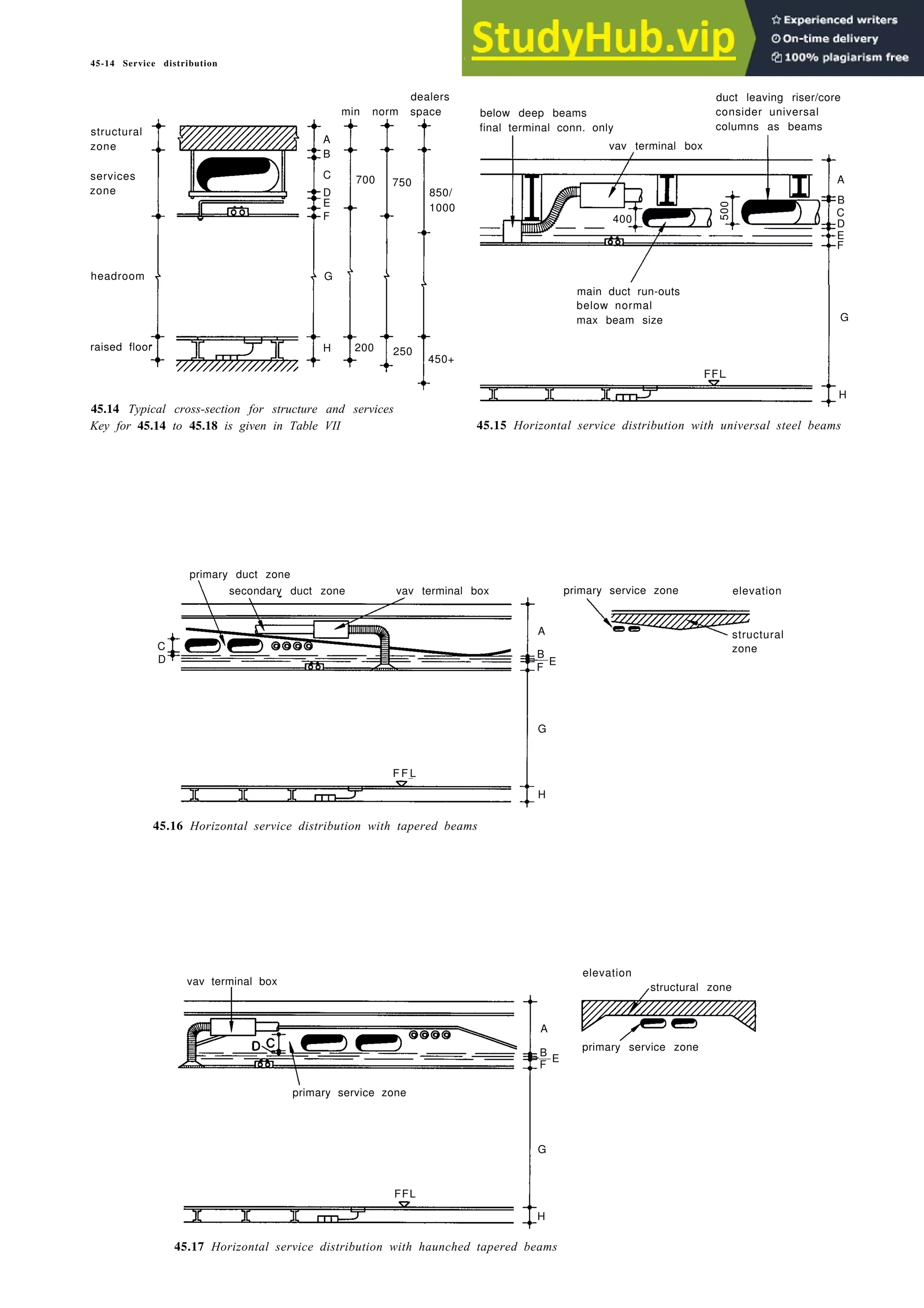
right relationship with the worktop. However, it is important that
the feet remain in contact with the ground, and where this is not
possible, footrests should be provided.
3.05 Computer work stations
Many office workers now work with visual display units (VDUs),
and these introduce further requirements for comfortable and
healthy working. People often find working at a screen tiring to the
eyes. 2.8 gives the recommended dimensions for minimising
fatigue; some people may need special spectacles. Most VDUs are
placed at or above eye level so that normal bifocals do not help.
Opticians are now used to supplying ‘intermediate’ spectacles with
the normal bifocal facility for viewing the keyboard and material
on the desk, with the upper part allowing focus on the near
distance. This permits the VDU to be placed between 900 to
1000 mm distant from the user.
accessibility
50%
accessibility
83%
inaccessible
not easily accessible
accessible
easily accessible
fixed
shelves
2.9 Accessibility of storage:
a Zones of accessibility.
adjustable wall
unit shelves
pull-out base
unit shelves
b Frequently needed
articles.
c Less frequently needed
articles higher
d Less frequently needed
articles lower
3.06 Storage
Two of the commonest operations at work and in the home is the
stowage and retrieval of items into and from storage. 2.9 shows the
recommended heights for various storage areas for general use;
2.10 gives particular requirements where elderly people are
concerned.
3.07 Maintenance
Buildings and the services and plant therein need constant
maintenance. Something frequently forgotten is the need for easy
access to certain areas. It is reasonable to assume that people
employed on maintenance work will be sufficiently agile and not
greatly above average size. The dimensions shown in 2.11 to 2.18
are therefore less than would be required for use by the general
public.
viewing distance
refer to 2.8b
47°
150
min
450
600
620
[781,5] [859,5]
[1075,5]
normal
minimum
distance
from screen
400 mm
minimum
distance
from touch
screen
300 mm
preferred
visual angle
between 20
and 22 minutes
700
1300
1900
500
2.10 Accessibility of storage used by elderly people:
a Maximum reach over worktop.
1550
1220
920
600
300
Basic design data 2-7
b Maximum reach to unobstructed wall-mounted cupboard
2.11 Body clearance: maintenance reach levels
min. 600 high × 400 mm wide
min 450 dia
or square
2.13 Body clearances
2.14 Service access: catwalk 2.15 Service access: stairs
2.12 Service accesses
1730
reach
max
e
1435
shelf max
1370
–3
sd
reach
max
–65
(hand
height)
sd
=
97
obstruction
350
reach max
1585
shelf
max
1520
reach
max
–
65
(hand
height)
mean
upward
reach
–
3
sd
min 2450
450
1350
800
700
1250
900
1100
700
1450
650 dia
(800 square
preferable)
min
1600
min 300
to 350
2150
opt
840
50°
35°
30°
20°
opt range
180 –186
opt
240
280
opt
tread
min 560
to 600
2-8 Basic design data
2.16 Service access: ramps
recommended for angles 50°to 75°
handrails are required on both sides if risers are not
left open or if there are no side walls
widths: 500 mm to 600 mm with handrails
600 mm min between side walls
angle W(mm) Q(mm)
50°– 55° 1620°– 1570° 880
57°– 60° 1500°– 1450° 900
63°– 66° 1370°– 1320° 910
69°– 72° 1270°– 1200° 920
74°– 77° 1150°– 1050° 950
recommended riser 180 mm to 250 mm
tread 75 mm to 150 mm
45 mm diam max for handrail
2.17 Service access: step ladders
4 DISABLED PEOPLE
4.01
At any one time about 8 per cent of people in Britain are in one
way or another disabled. The principal disabilities of concern to
the architect are those that mean the person has to use a wheelchair
for most or all of the time. That person is handicapped by this in
two significant ways: first, the eyes and arms are permanently at
sitting rather than standing level, and second, the wheelchair itself
takes up to five times the space needed by an ambulant person.
While people in wheelchairs constitute only about one quarter of
one per cent of the population, society has rightly decided that the
design of most buildings should take their needs into account.
There are other forms of disability that are of importance to the
building designer. People on crutches can be disadvantaged by
ramps provided for wheelchairs, and all ramps should normally be
Inclined
generally suitable for vertical movements
from 75°to 90°ladder frame should
extend 900 mm above platform
widths: 380 mm min, 450 mm desirable
600 mm min between side walls
150 mm toe space
angle R(mm) W(mm)
75.0°
78.0°
80.5°
83.0°
85.0°
87.5°
90.0°
330
335
340
350
360
370
380 max
300 min
1150
1050
1000
950
900
850
800
provide back guard over 6000 mm high
2.18 Service access: rung ladders
paralleled by steps. Provision for blind people needs to be made in
the design of signs, raised letters being preferable to Braille,
particularly in lifts. Lifts should ideally provide audible as well as
visual indication of floor level.
4.02 People in wheelchairs
Wheelchairs are of three main types:
• Manually self-propelled
• Propelled by motor
• Propelled by attendant
It is the manually self-propelled chair that is used by most active
disabled people, and needs to be routinely catered for in buildings.
2.19 gives the dimensions relevant to this type of chair, and 2.20
and 2.21 has dimensions of men and women in such a chair.
4.03 Ramps
The most common provision made for wheelchairs is a ramp.
However, most such ramps are difficult to use, both in mounting
and in descending. Except for very short ramps (less than 0.5 m)
they should be no steeper than 8 per cent (preferably 6 per cent)
and unbroken lengths of ramp no longer than 10 m. For a rise of
only 650 mm, therefore, a good ramp would take up a considerable
area, 2.22. The use of a chair lift or of ordinary lifts is therefore
often preferable to a ramp, although these suffer from the need for
adequate maintenance, and problems arise when they break down.
Details of lifts designed for use by elderly and disabled people are
given in Chapter 5.
4.04 Width of corridors
The other necessity for wheelchair users is adequate width and
design of corridors and doorways. The width of a corridor should
not be less than 900 mm for a self-propelled wheelchair, or 1.8 m
if two wheelchairs are likely to want to pass each other, 2.23 to
2.26.
max diam40 mm
2150
opt
850
(910 at 0°
)
20°
10°
0°
opt range
angle
900 900
380
W
R
angle
150
Vertical
Basic design data 2-9
2.19 DSS model 8G wheelchair, a common type
2.20 Dimensions of different percentiles of adult
male wheelchair users. These dimensions and
those in 2.21 relate to people who use standard
wheelchairs and have no major impairment of
upper limbs
965
560
490
710
1075
630
435
465
1075
eye level
head height
600 reach over
high table
shoulder height
1330
1035
690
elbow level
595 reach
over low table
thigh level at chair
obstruction
145
605
1220
foot height
vertical reach
1715
380
600
420
485
1410
1595
toe
projection
knuckle
height
oblique vertical reach
forward vertical reach
185
chair seat mean
2-10 Basic design data
forward reach
470
over low table,
900
min 760
800
2.21 Dimensions of adult female wheelchair users
1700
2.22 Wheelchair ramp of rise 650 mm
2.23 Forward movement for
self-propelled wheelchair
2.24 Forward movement for
wheelchair with attendant
2.25 Passing place for two
wheelchairs with attendants
maximum
290 over low table,
comfortable
head height
shoulder
550
reach over high table
1255
990
690
elbow
thigh
165
605
foot height
high reach
oblique reach
forward reach
eye height
1575
420
point of obstruction
575 (erect)
650 (back)
sitting
410
seat height
475
1155
1295
1465
knuckle
height
170
650
Basic design data 2-11
1800 800 900
2.28 Wheelchair forward turn through 90°
2.26 Passing place for two self-propelled wheelchairs
1400 – 1250 min
1700
large chair
1500
standard chair:
front propelling
wheels
1245
indoor chair: model 1
front propelling wheels
2.27 Wheelchair turning circles
2.29 Wheelchair turn through 180°
4.05 Turning space
Most wheelchairs require a space 1.4 m square to turn around. This
determines the minimum size of lift cars and circulation spaces in
rooms.
Turning circles for manœuvering in various ways are shown in
2.27 to 2.29.
4.06 Doorways
Since the minimum clear opening required is 750 mm, the standard
800 mm (coordinating size) doorset is not wide enough (clear
opening 670 mm); a minimum 900 mm set should be used in most
buildings. External doors should preferably be 1000 mm, although
the 900 mm size has a clear opening just wide enough for most
chairs. 2.30 illustrates wheelchairs using doorways.
Where a door opens off a corridor, it may be difficult for a
wheelchair to turn sufficiently to go through a minimum width
doorway unless the corridor is wide enough. 2.31 indicates
preferred widths of opening for various corridor widths.
Where double or single swing doors are used these can be
difficult for wheelchair users to open. In certain circumstances,
sliding doors can be easiest and are often fitted in housing
converted or specially built for wheelchair users.
In blocks of flats, offices, etc. the entrance doors are frequently
heavy with strong springs to combat the effects of wind. These are
not only difficult for wheelchair users, but often also for elderly,
ambulant disabled and even people with prams. Consideration
should be given to fitting such doors with mechanical opening and
closing systems.
Other doors often give problems to people in wheelchairs and
elderly people with limited strength. The doors to lavatories
designed for disabled people can be particularly difficult. As a rule,
1800
700
900
2-12 Basic design data
1200
1200
500 1000
2.30 Wheelchairs negotiating various doorways
corridor width clear doorway required
760 935
800 920
900 885
1000 855
1200 785
2.31 Width of doorways opening off narrow corridors
the force required to open such a door should not exceed 35 N
(based on a French standard).
4.07 People on crutches
2.32 gives generally accepted dimensions for a person using
crutches. However, such people vary greatly. Most people use
them for a short time following an accident, and will be inexpert
in their use. Users fall into two broad groups: those who have some
use of both legs and feet, and those who have use of only one leg.
The former can usually negotiate most obstacles such as steps and
staircases. However, those who can use only one leg require a
handhold wherever there are steps, even a single step at a building
threshold. There is little need for this to be provided for them on
both sides as two good arms are needed to use crutches. However,
elderly people may also need handholds, and many of these are
only able to use one of their hands.
Crutch users often find ramps more of a problem than steps.
Ideally, all wheelchair ramps should be adjacent to supplementary
steps as in 2.22.
4.08 People with other mobility impairments
Dimensions of people using walking sticks and walking frames are
given in 2.33 and 2.34.
775
clear
1900
775
clear
1200
775
clear
1200
1200
775
clear
775
clear
1200
1200
doorway width
(clear opening)
corridor
width
840
2.32 Crutch user
660
2.33 Stick user
760
2.34 Person using walking frame
Basic design data 2-13
4.09 Large people
Waiting areas, allowing 50 per cent seating, 50 per
cent standing without baggage, allowing
cross-flows (e.g. airport lounge)
Waiting areas, 25 per cent seating, 75 per cent
standing, without serious cross-flows (e.g. waiting
rooms, single access)
Pregnant women are not usually greatly disadvantaged except that
stairs can be very tiring. There are a very small number of people
who are so large that it is difficult to pass through a narrow
doorway. A single door other than a cupboard should not be
narrower than a 800 mm doorset with a clear opening width of
670 mm. In certain buildings such as football stadia, deliberately
narrow doorways are used to ensure control over entry. In these
cases, and also where turnstiles are used, additional provision for
large people should be made.
Waiting areas, 100 per cent standing, no cross-flows
(e.g. lift lobby)
Circulating people in corridors, reduced to halt by
obstruction
Standing people under very crowded conditions –
acceptable temporary densities
Problems may also arise where there is fixed seating as, for
example, in a theatre. A very small number of oversize seats or
benches could be provided, or a loose seat of appropriate size
could be used in a position normally occupied by a
wheelchair.
Table IX Flow capacities of corridors and staircases
General design purposes
People moving at good walking pace (1.3 m/s)
People moving at a shuffle (0.4 to 0.9 m/s)
People at a standstill due to obstruction
5 CIRCULATION SPACES
5.01
Many aspects of internal circulation derive from regulations
concerned with fire safety. These are covered in Chapter 42.
Increasingly, others relate to the needs of disabled people.
For lifts and escalators see Chapter 5.
As a guide to assessing space allowances, the areas listed in Table
VII may be used: these include requirements for both the activity
and the associated circulation. Waiting areas are given in Table VIII
and the flow capacities of corridors and staircases in Table IX.
5.02 Corridors
The properties of various corridor widths are shown in 2.35. Some
examples of space allowances from Germany are given in 2.36 to
2.39. In 2.40 to 2.48 a variety of other corridor users are shown,
and 2.49 details a number of obstructions commonly found in
corridors, and for which additional width may need to be allowed
for.
5.02 Internal stairs
Definitions of terms used in relation to staircases are shown in
2.50. The preferred form and dimensions of steps for ambulant
disabled and elderly people are shown in 2.51. The formula for
most staircases of twice the rise plus the going lies between 600
and 630 mm will give a suitable relationship. The rise should not
exceed 190 mm, and the going should not be less than 250 mm.
Table VII Minimum areas per person in various types of buildings
Occupancy Area per person (m2
)
Assembly halls (closely seated)
Dance halls
Restaurants (dining areas)
Retail shops and showrooms
0.46 m2
(based on movable seats, usually
armless, 450 mm centre to centre; with fixed
seating at 500 mm centre to centre will
increase to about 0.6 m2
)
0.55 m2
to 0.9 m2
0.9 m
2
to 1.1 m
2
Department stores, bazaars or
bargain sales areas
Offices
Factories
4.6 m2
to 7.0 m2
(including upper floors of
department stores except special sales areas)
0.9 m
2
(including counters, etc.)
0.46 m2
(gangway areas only)
9.3 m2
(excluding stairs and lavatories)
7 m
2
Table VIII Area per person to be allowed in various circulation areas
Occupancy Area per person (m2
)
Overall allowance for public areas in public-handling
buildings
2.3 to 2.8
1.1 to 1.4
0.65 to 0.9
0.5 to 0.65
0.2
Lift car capacities:
0.2 m2
(four-person car);
0.3 m2
(33-person car)
0.8 m2
per person
3.7 m
2
per person
0.27–0.37 m
2
per person
0.2 m
2
per person
800
adjustable
2-14 Basic design data
900
2.35 Corridor widths. a Edging
width: suitable for short
distances or occasional use.
b One person width (750
clearance would give comfort for
various postures).
1050 – 1200
d Two-person use in same
direction.
c Normally used by one person, but
occasional passing required.
1200 – 1400
e Two people passing
2.36 Space requirements between walls allowing 10 per cent for easy movement
2000
2.39 Greatest density possible 6
people per m2
2.38 Pace measurements
350 550 – 600
750 750 750 875 875 875 1250 625
1250 1875 2000 2125 2250
2.31 Space requirements for closely spaced groups
375 625 875 1000 1150 1700 2250
Basic design data 2-15
1125 1000 1125 875 825 875 1000 1750
800 1000 2125 875 750 1125 2375
2.40 Space for various body positions
L
900 700
250
average
Type L W
Food (small) 600 450
Railway 1850 1100
Baggage
(airport, hotel, etc.)
2500 800
2.41 Person with baggage
850
2.42 Person with tray
550
1100
2.43 Person with small child
2.44 Person with pram
2.46 Person with trolley
2.47 Person with luggage trolley
2.45 Person with pushchair 2.48 Single queue no baggage
1000
1450
450
450
450
1850
800
1700
1250
W
2-16 Basic design data
320 260 240 350
accepted fire hand
appliances:
45.720 reel (150 ft)
accepted fire hand accepted fire hand
appliances: appliances:
30.500 reel (100 ft) 22.860 reel (75 ft)
fire bucket
60
170
surface switch
250
4°(101.6 mm)
id.c.i.pipe
remote control gear
(wheel type)
2 gallon (9.1 litres)
extinguisher
P
radiators on wall brackets
type P(mm)
2 column 130
3 column 160
4column 230
5column 290
7 column 350
3½" hospital (90) 130
5" hospital (165) 170
7" hospital (180) 230
door on retainer:
P = door thickness + 80mm
(note furniture on door
= further protrusion)
Automat
cigarette dispenser
60 litre milk
dispenser
400 portion hot and
cold food dispenser
height 1750
600 cup capacity
hot and cold liquid
dispenser
830
760
920
vending machines
800
height 450 mm
each unit
check possible obstruction by: a) side-hung inward opening
b) bottom-hung inward opening; c) vertical pivotted;
d) horizontally pivotted (night and full ventilation)
windows
baggage lockers
2.49 Obstructions in corridors
pitch line
min 240
max 165
tread
stairs: ambulant disabled
2.50 Definitions of staircase terms
2.51 Preferred form and dimensions of steps for elderly and
ambulant disabled people
100
600
2 5 0
765 11 column
975 18 column
1250 24 column
P
4
6
0
660
700
450
450
doors 340
wide
riser
going
g
r waist
vertical
depth
soffit
nosing
θ = angle of pitch
Basic design data 2-17
Table X Regulations for internal steps and staircases
Building
Regulation
Minimum Maximum Minimum Maximum
Maximum rise rise going going Minimum clear Maximum rise
pitch (mm) (mm) (mm) (mm) width (mm) per flight
K1.3 Private stair
K1.3
B3.15
K1.3
B3.15
Institutional or assembly building with
floor area less than 100 m
2
Institutional and assembly stair
M2.21
B2.30
B2.30
K1.3
Buildings in which provision for
disabled people is mandatory
Common stair
Common stair also a firefighting stair
Other
42° 155 220 220
165 200 223
35.7° 135 180 250
32.7° 135 180 280
34.2°
37.2° 150
37.2° 150
37.2° 150
170 250
190 250
190 250
190 250
260
300
340
340
800 for 50 people 16 risers
900 for 100 people
1100 for 220 people
plus 5 mm per person
more than 220
1000 1800 mm
320 1000*
320 1100*
320
* Width in these cases may be encroached by stringers up to 30 mm and handrails up to 100 mm.
Table XI Design of staircases
This table is constructed on the following bases: Rise r is between 75 mm minimum and 220 mm maximum. Going g is greater than 220 mm minimum. In each box the
figures represent: Twice the rise plus the going (2r + g) between 600 and 660 mm.
The angle of pitch (tan
–1
r/g) less than 40° and more than 30°. Shaded boxes indicate pitch angles greater than 35° which are less suitable for elderly and disabled people
Floor-to-floor No of
risers
rise r Going g
220 230 240 250 260 270 280 290 300
2500 13 192.3
14 178.6
15 166.7
615 625 635 645 655
40.0° 38.7° 37.6° 36.5° 35.5°
607 617 627 637 647 657
35.5° 34.5° 33.5° 32.5° 31.6° 30.8°
603 613 623
31.7° 30.8° 29.9°
2600 13 200.0 640 650 660
39.8° 38.7° 37.6°
14 185.7 601 611 621 631 641 651 661
38.9° 37.7° 36.6° 35.5° 34.5° 33.6° 32.6°
15 173.3 597 607 617 627 637 647
34.7° 33.7° 32.7° 31.8° 30.9° 30.0°
16 162.5 605
30.1°
2700 14 192.9
15 180.0
16 168.8
17 158.8
616 6 2 6 636 6 4 6 6 5 6
40.0° 38.8° 37.7° 36.5° 35.5°
600 610 620 630 640 6 5 0 6 6 0
36.9° 35.8° 34.7° 33.7° 32.7° 31.8° 31.0°
598 608 618 628
33.0° 32.0° 31.1° 30.2°
598
29.6°
2800 14 200.0 640 6 5 0 6 6 0
39.8° 38.7° 37.6°
15 186.7 6 0 3 6 1 3 623 633 643 653
39.1° 37.9° 36.8° 3 5 . 7 ° 34.7° 33.7°
16 175.0 600 610 620 630 640 650
35.0° 33.9° 32.9° 32.0° 31.1° 30.3°
17 164.7 599 609 619
32.4° 31.4° 30.5°
2900 15 193.3 617 627 637 647 657
40.0° 38.8° 37.7° 36.6° 35.6°
16 181.2 602 612 622 632 642 652
37.1° 35.9° 34.9° 33.9° 32.9° 32.0°
17 170.6 601 611 621 631
33.3° 32.3° 31.4° 30.5°
18 161.1 602
29.2°
3000 15 200.0 640 650 660
39.8° 38.7° 37.6°
16 187.5 605 615 625 635 645 655
39.2° 38.0° 36.9° 35.8° 34.8° 33.8°
17 176.5 603 613 623 633 643 653
35.2° 34.2° 33.2° 32.2° 31.3° 30.5°
18 166.7 603 613 623
31.7° 30.8° 29.9°
2-18 Basic design data
Building Regulations allow that twice the rise plus the going
may be between 550 and 700 mm, and permits rises of up to
220 mm and goings of minimum 220 mm in private stairs. One
Continental source recommends that twice the rise plus the going
should lie between 630 and 660 mm.
Table X summarises the various statutory requirements for
internal staircases. Table XI covers the design of common types of
staircases. External stairs and steps should not be designed to
internal standards, as they will often appear to be precipitous. See
Chapter 6 for these.
2.52 to 2.57 show examples of different types of staircases, and
2.58 illustrates the moving of a wardrobe up a typical stair.
5.03 Handrails and balustrades
All staircases and steps should have handrails. If the staircase is less
than 1 m wide they are not mandatory on both sides, but should if
possible be so provided to allow for arthritic hands. The top of the
handrail should be between 900 and 1000 mm above the pitch line,
landing
4200
2.52 Straight flight staircase
2.53 Staircase with a short L at the top
2580
2.54 Staircase with with 90° turn at half-height
and of a design to facilitate proper gripping. It is important,
particularly for users of crutches, that they should extend at least one
tread depth beyond the last riser at both top and bottom of each
flight. In a multi-flight staircase, the handrails should be as
continuous as possible to assist blind people; they will deduce that a
break in the rail indicates a doorway or other way off the stairs.
Where there are likely to be small children, an additional
handrail at about 425 mm high may be provided. Care should be
taken to avoid designs that facilitate climbing over balustrades.
Open wells should be protected by walls or balustrades at least
900 mm high.
2.55 Staircase with short Ls at top and bottom
2.56 Staircase around a square well
2.57 Dog-leg staircase
2340
2114
2800
2600
f
–
f
318
2100
1680
2100
2800
560
3870
1590
1360
900
3000 1150
2100
2800
f
–
f
2900
f
–
f
1087
2100
544
1719
2520
1260
2100
2700
f
–
f
900 1320
2580
2100
1400
2800
f–
f
1
9
5
0
2275
Basic design data 2-19
6 ACTIVITIES
2.59 to 2.71 illustrate the space requirements of a number of
domestic activities; these are derived from data in Activities and
spaces by John Noble.
800
350 – 400 350 – 400
900
900
2.58 Moving a double wardrobe up a staircase, showing
minimum headroom, clearance, handrail height. Going 215 mm,
rise 190 mm
2.59 Passing between two
items of furniture, each
table height or lower
2.60 Passing between two
items of furniture, one
table height or lower, the
other higher on the wall
2000
600
2.61 Passing between the
wall and tall furniture
2.62 Watching television. Most
people prefer to sit a distance of
more than eight times the height
of the picture
2.63 Dressing in front of wardrobe
200 – 250
2.64 Making single bed
2.65 Making double bed
2.66 Circulation around twin beds
2000
1200
900
650 – 700 1500 650 – 700
500 – 550
500 550
650 – 700 900 500 900 650 – 700
550
2000
2000
2-20 Basic design data
1350
450
450 – 600
600 750 600
a
1350
2.67 Sitting at a dressing
table b
2.68 Getting a pram ready
1350 460
c
1500
600 900
d
600 750 600
e
900
2.69 Putting on coat 2.70 Helping on with
coat
750
f
600 1800 600 750
4550
2.71 Getting in and out of cars
950
1750
400
1850
a b c
g
d e
1300
f
450
2.73 Dining spaces: a Two people facing.
b Two people side by side. c Three people on
banquettes. d Three people on chairs. e Four
people. f Six people and sideboard. g Six
people and round table. h Serving trolley
2.72 Living space: a 3-seater sofa, b easy chair with arms,
c easy chair without arms, d occasional chair, e television set,
f coffee table
600
500
750
1400
650 – 700
700
450
750
600
1350
600
850 700
750
500 600
9
0
0
600
600
850
850
850
1350
450
750
600
600
850
750
500
500
450
750
450
1900
Basic design data 2-21
7 FURNITURE 8 STORAGE
The sizes of a number of common items of living room furniture
are given in 2.72 . A number of different dining room arrangements
are shown in 2.73 . Items of bedroom and kitchen furniture are
covered in 2.74 and 2.75 respectively.
The spaces required to store domestic items and materials are
shown in 2.76 to 2.88 . Various fuel storage facilities are covered in
2.89 to 2.9 1, and refuse containers are shown in 2.92.
900
2000
150
a
2000 300
300
b
600 450
400
200
d e
2.74 Bedroom furniture: a single bed, b double bed, c bedside
table, d dressing table, e wardrobe, f chest of drawers
250
650 650
480
a
600 650
c 550
600 600
90
600
d
b
600
e
600
f 60
g
1360
h
2.75 Kitchen: a cooker, b fridge-freezer, c dishwasher,
d washing machine, e sink with single drainer, f sink with
double drainer, g large storage cupboard, h wall-hung storage
cupboard
a 300
deep
b
c
d
2.76 Food storage: a tins and jars, b packets, c vegetable rack,
d bread bin
2.77 Wine storage: a metal rack for 75 bottles
2.78 Wardrobe for long coats and dresses
900
300
deep
900
1370
450 600
c
400
1100
1200
700
f
450 600
600
600
600
600
1000
1500
300
500
or
600
500
or
600
100
2-22 Basic design data
1650
550
plan
550
elevation
2.79
450
9 5 0
plan
950
elevation
1100mm desirable:
of which 400mm
should be full length
hanging and 700mm
1500mm desirable:
of which 900 mm
should be full length
hanging and 600mm
1500
3 0 0
550
plan
550
elevation
husband wife
desirable depth in each case 600mm (min 550mm)
450
950
plan
950
elevation
6 0 0
6 0 0
4p+ = 0.6m2
shelf space
under 4p
= 0.4m2
shelf space
child (10-14) child (under 10)
2.80 Optimum hanging space for a family of four
2.81 Alternative storage arrangements for mens’s clothing
2.82 Alternative storage arrangements for women’s clothing
2.83 Airing cupboard for linen including hot water sotrage
cylinder (not heavily lagged)
6 0 0
6 0
1 0 0 0
1 0 0 0
Half-height hanging for jackets etc.
may be half length
(min width o a 800mm)
may be half length
(min width o a 1400mm)
plan elevation
2.84 Alternative storage arrangements for household linen for a five-person family
Basic design data 2-23
1070.0287
×
380
–
460
wide
660 – 690 diameter
990 – 1100
410
970
380
790
2000
1200
clear space
450
700
2.85 Bicycles 2.86 Prams
300
550 550
2000
450
950
plan
9 5 0
elevation
800
760
1030
450
240
150
150
2-24 Basic design data
750
removable
cover
2500
760
2.87 Large toys
540
300
1020
760
260
height
2.88 Luggage
min 3000
from buildings
150
960
2.89 Domestic gas storage for rural area (propane gas).
Cylinders may now be buried if desired
1265 2250
1320
1200
750 2020
1360
1000
2.90 Domestic oil storage tank. This may need a bund in certain
circumstances. The oil flows to the boiler by gravity so the tank
bottom needs to be sufficiently elevated. If this is not possible
the fuel can be pumped, but the boiler must then be a pressure
jet type
Section Plan
capacity: 800 kg of coal and 450 kg of coke
2.91 Solid fuel storage
1620
2.92 Refuse sotrage: a dustbin, b wheely bin, c paladin bin,
d large bin
460
580
310
690
760
1350
430
2000 litres
1000 dia
3000
1000
1120 o/d
2500 litres
1225 litres
3042
1000
1300
9 REFERENCES
Official publications
The Building Regulations 1991, approved document B, fire safety,
HMSO, 1992
The Building Regulations 1991, approved document K, stairs,
ramps and guards, HMSO, 1992
The Building Regulations 1991, approved document M, access
and facilities for disabled people, HMSO, 1992
British Standards
BS 4467: 1991 Guide to dimensions in designing for elderly
people, BSI, 1991
BS 5459 Specification for performance requirements and tests for
office furniture:
Part 1: 1977 Desks and tables, BSI, 1977
Part 2: 1990 Office seating, BSI, 1990
BS 5619: 1978 Code of practice for design of housing for the
convenience of disabled people, BSI, 1978
BS 5810: 1979 Code of practice for access for the disabled to
buildings, BSI, 1979
BS 6180: 1995 Code of practice for barriers in and about
buildings, BSI, 1995
BS 7179: Part 5: 1990 Ergonomics of design and use of visual
display terminals in offices, specifications for VDT workstation,
BSI, 1990
Basic design data 2-25
Other publications
PD 6523: 1989 Information on access to and movement within and
around buildings and on certain facilities for disabled people,
London, BSI, 1989
Jane Randolph Cary, How to Create Interiors for the Disabled,
New York, Pantheon Books, 1978
Niels Diffrient, Alvin R. Tilley and Joan C. Bardagjy, Humanscale
1/2/3, a portfolio of information, Cambridge Massachusetts, MIT
Press, 1974
Henry Dreyfuss, The Measure of Man, Human Factors in Design,
2nd edn, New York, Whitney Library of Design, 1967
Selwyn Goldsmith, Designing for the Disabled, 3rd edn, London,
RIBA, 1976
Ernest J. McCormick and Mark S. Sanders, Human Factors in
Engineering and Design, 5th edn, New York, McGraw-Hill,
1982
John Noble, Activities and Spaces, Dimensional Data for Housing
Design, London, The Architectural Press, 1983
Julius Panero and Martin Zelnik, Human Dimension and Interior
Space, A Source Book of Design Reference Standards, New York,
Whitney Library of Design, 1979
Stephen Pheasant, Bodyspace, Anthropometry, Ergonomics and
Design, London, Taylor and Francis, 1986
Stephen Pheasant, Ergonomics, standards and guidelines for
designers, London, BSI, 1987
Peter Tregenza, The Design of Interior Circulation, People and
Buildings, London, Crosby Lockwood Staples, 1976
3 Sanitary installations and cloakrooms
Alan Tye Design Ltd
Alan Tye Design Ltd is a practice specialising in product design and architectural
components
KEY POINTS:
• women now demand parity with men: this means twice as
many appliances for them
•unisex facilities providing for babies and small children are
essential
• results of research into facilities for disabled people will
cause further changes
Contents
1 Introduction
2 Number of appliances required
3 Early planning
4 Detailed consideration of appliances
5 Saunas
6 Hydro-therapy spa baths
7 Public cloakrooms
8 References and bibliography
1 INTRODUCTION
1.01 Installation standards
Most sanitary installations are unsatisfactory. Professor Kira has
emphasised two key factors:
• At the production end, there are no installation manufacturers,
only material and appliance producers. Companies make
dissimilar products such as dinner plates and WCs because they
are ceramic, others make taps because they are metal and no one
can conceive of an integrated entirety.
• Prefabricated or pre-assembled bathrooms can achieve far
superior results than on-site work and is the best current
method; but far more work is needed in the design of products
and cleaning equipment.
• At the user end, the public are unaware of what to demand.
Manufacturers do not know what the user needs as they sell
through builders’ merchants who somewhat arbitrarily decide
and control what is to be sold.
Strong words, but in essence undeniably correct and one of the
reasons why sanitary installations are so inadequate. Architects
need to be much more critical and demanding about what
manufacturers supply.
Public and semi-public conveniences are places where one is
obliged to perform the most private functions in public with
strangers of the same sex.
Quite different gangways are needed on a Tube train where to
brush closely against Mr X is acceptable, as opposed to between
two urinal rows where to brush against the same Mr X is almost
criminal. Apart from the football club type of situation where
camaraderie permits closeness or the traditional factory where
closeness is born of economic necessity and lack of care, the
fundamental point of planning spacing in public installations is
that psychological not just physical clearances and spacing are
required.
The purely physical and unacceptably tight spacing of proprie-
tary sanitary wall systems naturally encourage users not to care
about installations which are not really designed for them.
CI/Sfb: 94
UDC: 696.1
Certainly more design work is needed on this subject; for at the
moment we generally both design and accept degrading and crude
installations.
1.02 Types of installation
Installations can be:
1 Public conveniences, provided by municipalities, transport
undertakings (including motorway service stations), shopping
centres etc. Use of these facilities are generally open to any
member of the public
2 Semi-public conveniences: theatres, stadia, refreshment houses,
etc. where use is restricted to patrons of the provider
3 Private multi-use installations for staff in offices, factories, etc.
and in hostels and old persons’ homes
4 Domestic facilities.
All these will be covered in this chapter, although types 1 and 2
tend to differ only in superficial ways such as the standard and type
of finishes.
1.03 Activity spaces
A number of different spaces are shown in the diagrams: space
occupied by the appliance itself, additional space required by the
user (the activity space), and further space required for luggage or
circulation. In many cases these latter spaces may overlap on
occasion. Common sense will dictate when this is appropriate, and
when it is not.
2 NUMBERS OF APPLIANCES REQUIRED
The recommendations given in Tables I to XIII are derived
principally from BS 6465: Part 1:1994, and are the minimum
requirements.
In all situations, attention is drawn to the necessity to provide
facilities for the disabled, baby changing and also for the disposal
of sanitary towels and continence aids.
A common mistake is inadequate numbers of WCs for females,
leading to long queues. Always err on the generous side.
Table XIV gives figures for various building types of the
numbers of appliances to be provided for a total of 100 people
evenly divided between the sexes. Toilets for wheelchair users are
not included.
3 EARLY PLANNING
3.01 Guide to planning areas
In the previous edition of this book, if you wished to establish an
overall sanitary installation area you could obtain the approximate
size of an installation for any number of persons from a graph.
This has not been included here, because:
• The numbers of items of equipment required in various building
types has been significantly altered in the new edition of BS
6465, and, in particular
3-1
3-2 Sanitary installations and cloakrooms
Table I Staff toilets in offices, shops, factories and other non-domestic
premises used as place of work
Sanitary appliances for any group of staff
Table IV Sanitary provision in public houses and licensed bars
Assume 4 persons per 3 m
2
of EDA (effective drinking area) and 75%/25%
male/female in public houses without public music and singing licences, 50%/50%
elsewhere.
Number of persons at work Number of WCs Number of washing
stations
Appliances For male customers
1 to 5
6 to 25
26 to 50
51 to 75
76 to 100
Above 100
1 1
2 2
3 3
4 4
5 5
One additional WC and washing station for
every unit or fraction of a unit of 25 persons
Alternative scale of provision of sanitary appliances for use by male staff only
Number of men at work Number of WCs Number of urinals
1 to 15 1 1
16 to 30 2 1
31 to 45 2 2
46 to 60 3 2
61 to 75 3 3
76 to 90 4 3
91 to 100 4 4
Above 100 One additional WC for every unit or fraction
of a unit 50 men provided at least an equal
number of additional urinals are provided
If public also use staff toilets, add 1 to each number of conveniences above
W C
Urinal
Wash basin
1 for up to 150 males plus 1 for up to 12 females plus
1 for every additional 150 1 for 13 to 30 females plus
males or part thereof 1 for every additional 25
females or part thereof
2 for up to 75 males plus 1
for every additional 75
males or part thereof
1 per WC and in addition 1 1 per 2 WCs
per 5 urinals or part thereof
Toilets for disabled 1 unisex
persons
Bucket/cleaners’ Adequate provision should be made for cleaning facilities
sink including at least one bucket/cleaners’ sink
Table V Sanitary provision in buildings used for public entertainment
Assume, unless otherwise indicated, equal numbers of male and female customers.
In cinema, multiplexes etc. where use is spread over all the time the building is
open, assume 75% of total capacity, otherwise use 100%.
If work involves heavy soiling of hands and forearms
Number of persons at work Number of washing stations
1 to 50 1 per 10
more than 50 1 additional per 20 or part of 20
Appliances Males
W C In single-screen cinemas,
theatres, concert halls and
similar premises without
licensed bars: 1 for up to
250 males plus 1 for every
additional 500 males or part
thereof
Table II Sanitary facilities for customers in shops and shopping malls having
a net sales area more than 1000 m
2
and assuming equal numbers of male and
female customers
Sales area of shop Appliances Male Female
1000 m2
to 2000 m2
W C 1 2
Urinal 1 Nil
Wash basin 1 2
Toilet for disabled people 1 unisex
Baby-changing facilities 1 unisex not in
disabled toilet
2001 m
2
to 4000 m
2
W C 1 4
Urinal 2 Nil
Wash basin 2 4
Toilet for disabled people 1 unisex
Baby-changing facilities 2 unisex
Greater than 4000 m2
In proportion to the size of the net sales area
Urinal In single-screen cinemas,
theatres, concert halls and
similar premises without
licensed bars: 2 for up to
100 males plus 1 for every
additional 80 males or part
thereof
Wash basins 1 per WC and in addition 1
per 5 urinals or part thereof
Toilets for disabled 1 unisex minimum
people
Bucket/cleaner’s
sink
Adequate provision should be made for cleaning facilities
including at least one cleaner’s sink
If premises include a licensed bar, additional provision as Table IV will be needed.
Table VI Sanitary provision in swimming pools
Assume 50% male and 50% female users.
Table III Sanitary provision in restaurants, cafés, canteens and fast food
outlets assuming equal numbers of male and female customers Appliances
Appliances For male customers For female customers
Male
W C
Urinal
Wash basin
Toilet for disabled
people
Bucket/cleaners’
sink
1 per 100 up to 400 males. 2 per 50 up to 200 females.
For over 400 males, add at For over 200, add at the
the rate of 1 per 250 males rate of 1 per 100 females or
of part thereof part thereof
1 per 50 males
1 per WC and in addition 1 1 per WC
per 5 urinals or part thereof
1 unisex compartment should be reasonably close by but
may be shared by other facilities (such as shops)
Adequate provision should be made for cleaning facilities
including at least one cleaners’ sink
W C 2 for up to 100 males plus
1 for every additional 100
males or part thereof
Urinal
Wash basin
1 per 20 males
1 per WC and in addition 1
per 5 urinals or part thereof
Shower
Toilets for disabled
people
1 per 10 males
1 unisex minimum
Toilets for spectators should be provided as Table V and for staff as Table 1.
For female customers
Females
For single-screen cinemas,
theatres, concert halls and
similar premises without
licensed bars:
2 for up to 40 females
3 for 41 to 70 females
4 for 71 to 100 females
plus 1 for every additional
40 females or part thereof
1, plus 1 per 2 WCs or part
thereof
For bathers
Female
1 per 5 females for up to
50 females plus 1 for every
additional 10 females or
part thereof
1, plus 1 per 2 WCs or part
thereof
1 per 10 females
–
Sanitary installations and cloakrooms 3-3
Table VII Sanitary provision in Stadia
Urinals W C s Wash hand basins
Male 1 per 70 males 1 for every 600 males, 1 per 300 males, but
but minimum of 2 per minimum of 2 per
toilet area toilet area
Female 1 for every 35 1 per 70 females, but
females, but minimum minimum of 2 per
of 2 per toilet area toilet area
For disabled Where there is provision for more than 10 spectators with
people disabilities, provide at least 2 suitable unisex compartments within
40 m travel distance. Generally 1 unisex special WC per 12–15
disabled spectators
Table VIII Minimum sanitary provision in stadia for different male:female
ratios
Capacity
of stand/
area
Type of
provision
90/10
Male:female ratio
85/15 80/20 75/25
500
Male urinals
Male WCs
Male whbs
Female WCs
Female whbs
450:50
7
2
2
2
2
425:75
7
2
2
375:125
6
2
2
3
2
400:100
6
2
2
3
2
4
2
1000
Male urinals
Male WCs
Male whbs
Female WCs
Female whbs
900:100
13
2
3
850:150
13
2
3
3
2
5
3
800:200 750:250
12 11
2 2
3 3
6 8
3 4
2000
Male urinals
Male WCs
Male whbs
Female WCs
Female whbs
1800:200
2 6
3
6
6
3
1700:300
25
3
6
9
5
1600:400 1500:500
23 22
3 3
6 5
12 15
6 8
3000
Male urinals
Male WCs
Male whbs
2700:300 2550:450 2400:600 2250:750
39 37 35 33
5 5 4 4
9 9 8 8
Female WCs 9
Female whbs 5
13
7
18 22
9 11
5000
Male urinals
Male WCs
Male whbs
4500:500 4250:750 4000:1000 3750:1250
65 61 58 5 4
8 8 7 7
15 15 14 13
Female WCs 15 22 2 9 36
Female whbs 8 11 15 18
• The ratio of provision for women as against provision for men,
plus the greater space required by them, means that in many
cases the area of female installations needs to exceed con-
siderably that for male installations, which tends to reverse what
has been the case until now.
• BS 6465: Part 2 has recently been issued. This gives design
sizes of appliances (which may not correspond exactly with
sizes available from manufacturers), and also recommends
activity and circulation dimensions.
3.1 Circulation through sanitary installation
These changes mean that there is no body of experience until
a number of installations conforming to the new BS 6465 have
been designed and built.
3.02 Planning the space
The planning of installations of types 1, 2 and 3 in 1.03 above
requires sensitivity to the requirements of privacy and discretion.
It is desirable that circulation of people through the sanitary area
space is essentially one way, 3.1. Single entry/exit plans can,
however, work satisfactorily provided that the paths of users do not
cross each other and the entry is wide enough. Placing the
appliances in order of use simplifies circulation and reduces the
distance walked. Hygiene should be encouraged by placing
washing and drying facilities between the WC and/or urinal and
the exit.
Vision is traditionally seriously considered in the planning of
lavatories, although sound and odour are sources of considerable
concern for many people and should also be considered,
particularly in larger installations.
3.03 Vision
In larger installations, vision should be obstructed by the
configuration of the entrance and in principle, entrance doors
should be avoided, 3.2. In smaller installations doors should open
inwards and be hung so as to screen the appliances and the user as
far as possible when opened. The doors to adjacent male and
female rooms should not be close to each other as this is
psychologically disturbing and aggravates vision problems. Con-
sideration should also be given to positioning of mirrors and to the
3.2 Various screening arrangements for small installations,
showing the areavisible from outside in each case
gap created by the hinges. Doors should be self-closing wherever
possible.
3.04 Noise
It is difficult and costly to satisfactorily insulate lavatories
acoustically and this problem should be tackled by planning
isolation if possible.
3.05 Odour
Except in extremely well-naturally ventilated installations, some
form of forced ventilation or air conditioning is desirable,
particularly so in confined areas. Manually switched fans which
continue to run for a set period after being switched off are useful
in domestic situations.
3.06 Vandalism
No unsupervised installation can resist vandals. Even with the
most vandal-resistant equipment (which would have to exclude all
3-4 Sanitary installations and cloakrooms
Table IX Sanitary provision in schools
T y p e o f s c h o o l A p p l i a n c e s N u m b e r r e c o m m e n d e d R e m a r k s
Special Fittings
WC only
Urinal and WC
Wash basin
Shower
1/10 of the number of pupils rounded up to the next
nearest whole number
Girls: all fittings
Boys: not more than 2/3 of fittings should be urinals
As for secondary school
Although not required by statute, it is suggested that sufficient showers should be provided for physical
education
Primary
Toilet for disabled person
Bucket/cleaner’s sink/slop hopper
Fittings
WC only
Urinal and WC
Wash basin
Shower
At least 1 unisex depending on nature of special school
At least one per floor
Aggregate of 1/10 of the number of pupils under 5
years old and 1/20 of the number of others. Not less
than 4. Rounded up to the nearest whole number
Girls: all fittings
Boys: not more than 2/3 of fittings should be urinals
As for secondary school
Although not required by statute, it is suggested that sufficient showers should be provided for physical
education
Toilet for disabled person At least 1 unisex unless number of disabled pupils exceeds 10. Then provide 1 per 20 disabled pupils or part
of 20
Bucket/cleaner’s sink/slop hopper
Secondary Fittings
WC only
Wash basin
Shower
Toilet for disabled person
Nursery and play W C
Washbasins
Sink
Boarding W C
Wash basin
At least one per floor
1/20 of the number of pupils. Not less than 4.
Rounded up to the nearest whole number
Girls: all fittings
1 in each washroom. At least 2 basins per 3 fittings
As for primary school
1 per 10 pupils (not less than 4)
1 per WC
1 per 40 pupils
See clause 7
See clause 7
1 per 5 boarding pupils
1 per 3 pupils for the first 60 boarding pupils; 1 per 4
pupils for the next 40 boarding pupils; 1 for every
additional 5 boarding pupils;
1 per 10 boarding pupils
May be provided as alternative to not more than 3/4
of the minimum number of baths
Where sanitary accommodation for day pupils is
accessible to, and suitable for the needs of boarders,
these requirements may be reduced to such an extent
as may be approved in each case. See clause 7
Bath
Shower
Toilet for disabled person As for primary school
Table X Sanitary provision in dwellings
Type of dwellings Appliances Number per dwelling Remarks
Dwellings on one level, e.g.
bungalows and flats
W C
Bath/shower
Wash basin
Sink 1
Dwellings on one or more levels
e.g. houses and maisonettes
W C
Bath/shower
Wash basin
Sink
1 for up to 5 persons Except for single person’s accommodation, where 1 WC is provided, the WC should be
2 for 6 or more in a separate compartment. Where 2 WCs are provided 1 may be in the bathroom
1
1
1 for up to 4 persons
2 for 5 or more
Except for single person’s accommodation, where 1 WC is provided, the WC should be
in a separate compartment. Where 2 WCs are provided 1 may be in the bathroom
For provision for disabled visitors see para. 4.06
Sanitary installations and cloakrooms 3-5
Table XI Sanitary provision in accommodation for elderly people and sheltered housing
Type of accommodation Appliances Number per dwelling Remarks
Self-contained for 1 or 2 elderly persons, or grouped
apartments for 2 less-active elderly persons
1
1
1
1
1
Grouped apartments for less-active elderly persons
Additional provisions for communal facilities
Common room for self-contained or grouped
apartments
The pantry or kitchen for self-contained or grouped
apartments
Laundry room for grouped apartment schemes
Cleaner’s room
W C
Bath/shower
Wash basin
Sink
W C
Wash basin
Sink
Bath/shower
W C
Wash basin
Sink
Sink
Washing machine
Tumble drier
Bucket/cleaner’s sink
An additional WC may be provided in the bathroom.
Bathroom within apartment
1
1
Not less than 1 per 4
apartments
Some may be Sitz baths or level access showers.
Minimum number required. Should be available for use by
visitors
Adjacent to common room
1 in each cleaner’s room
Table XII Sanitary provision in residential homes and nursing homes
Type of accommodation Appliances Number recommended Remarks
Residents W C 1 per 4 persons
Bath 1 per 10 persons
Wash basin 1 to each bedsitting room
Staff
Visitors
Kitchen
Toilets for disabled people
W C
Wash basin
W C
Wash basin
Sink
At least 2 for non-residential staff
1 In WC compartment
1
1
As appropriate
A minimum of 1 depending on the
number of disabled persons
Cleaner’s room
Other
Bucket/cleaner’s sink
Bed pan cleaning/disposal
Wash basin
An adjacent wash basin is also required
In WC compartment
1
As appropriate
I
In each cleaner’s room
Service area
In each medical room, hairdressing, chiropodist, non-residential staff
toilets and kitchen areas
Where en-suite facilities are provided, toilets for visitors and staff should also be provided.
Table XIII Sanitary provision in hotels
Type of accommodation Appliances/facilities Number required Remarks
Hotel with en-suite En-suite
accommodation
Staff bathroom
Bucket/cleaner’s sink
Hotels and guest houses
without en-suite
accommodation
W C
Wash basin
Bathroom
Bucket/cleaners’ sink
Tourist hostels W C
Wash basin
Bathroom
Bucket/cleaners’ sink
All hotels Toilet for disabled person
1 per residential guest bedroom
1 per 9 residential staff
1 per 30 bedrooms
1 per 9 guests
1 per bedroom
1 per 9 guests
1 per floor
Containing bath/shower, WC and wash basin
At least 1 on every floor
Containing: bath/shower, wash basin and additional WC
1 per 9 guests
1 per bedroom or 1 for every 9 guests in a dormitory
1 per 9 guests Containing: bath/shower, wash basin and additional WC
1 per floor
All hotels should provide at least 1 unisex
compartment for disabled people
Hotels incorporating other uses such as conference entertainment facilities, bars and restaurants may need additional provision as previous tables.
1
1
1
1
1
1
3-6 Sanitary installations and cloakrooms
Table XIV Comparison of requirements in different buildings types for 100
people evenly divided between the sexes
For men For women
Urinals WCs WHBs WCs WHBs
Workplaces
Workplaces where more dirty
conditions are met
Shop customers:
1000–2000 m2
2000–4000 m
2
Restaurants etc
Pubs etc.
Entertainment buildings
Swimming pools
Stadia
Schools:
Special
Primary and secondary
Nursery
Boarding
2 3 3 3
2 3 5 3
1 1 1 2 2
2 1 2 4 4
1 1 2 2 2
2 1 2 3 2
2 1 2 3 3
3 2 3 10 6
1 2 2 2 2
3 2 2 5
1 1 2 2
10 WCs and 10 WHBs for all
2 0 W C s and 3 0 W H B s for all
3
5
2
2
ceramics) an unsupervised facility will inevitably become sub-
standard. In such situations the use of an attendant will result in a
high standard being maintained, possibly with reduced costs. A
well-designed installation, easily kept clean, with an open layout,
a high level of general lighting and robust equipment sccurely
fixed will reduce the problem. Where vandal-resistant appliances
are thought necessary, stainless steel is considerably less prone to
damage than ceramics, but all designs should allow for individual
items to be replaced. Pipework, traps, cisterns, electrical supplies,
etc. should all be fully concealed and this is, of course, also highly
desirable for hygiene and appearance. The modular plastic panel is
not desirable in areas likely to be vandalised.
3.07 Ducts
As it is equally unacceptable to have pipes inside a room or outside
it, ducts are an inevitable detail of sanitary installations. Although
pipes are frequently buried into wall structures, notably in
Germany where appropriate pipework fittings exist, the UK
situation is that we consider access is needed to critical points such
as traps and cisterns. To achieve this access, ducts may be walk-in
or have access from one or other sides. For hygiene, cleaning
maintenance, structural soundness and planning flexibility, plan
3.3 is superior to 3.4.
7 0 0 600
600
Although if the appliance could be part of the wall, plan 3.4
would be very useful, in practice this plan usually results in the
adoption of a standard ceramic appliance on a sheet plastic panel
with its attendant impractical problems, details and module
(which, in addition, seldom correctly relate to required activity
spaces or correct operational heights).
3.3 Service duct, access from rear
3.4 Service duct, access from front 3.5b Bidet and activity space
On the other hand, 3.3 demands more detailed work from the
architect and it is not always possible to utilise adjacent room areas
for access.
Once the duct is provided it is logical and more hygienic to
bring the water supplies directly through the duct wall to wall-
mounted valves, rather than the pipework passing through the wall,
sanitaryware, then on to deck-mounted valves.
It is similarly illogical to have traps hanging from appliances in
the room if there is space in the duct for them, although some
sanitaryware makes this unavoidable. Ducts should avoid main-
tenance problems a n d n o t h a v e f e r r o u s m e t a l i n t h e i r
construction.
3.08 Tiles and modules
As UK manufacturers have never accepted the 100mm modular
tile (except as a special) and as UK manufacturers will not make
sanitaryware modular, it is difficult to find a reason for choosing
one module or another for the sanitary installation. It is, however,
obvious, in view of the quite differing requirements of the various
appliances and the individual situation, that any module should be
as small as practicable. The best module is probably that used in
Alvar Aalto’s office of 1 mm!
4 DETAILED CONSIDERATIONS OF APPLIANCES
4.01 WCs
The principal appliance in any installation is the water closet or
WC. This may be free-standing within a bathroom, or placed in a
compartment or cubicle by itself, or with a hand-rinse basin.
A WC compartment is totally enclosed by walls that reach down
to the floor and up to the ceiling, and has its own lighting and
ventilation system. A cubicle is enclosed by light partitions that do
not reach floor or ceiling. It shares the lighting and ventilation of
the larger space of which it is a part.
3.5a shows the appliance, complete with cistern, and its normal
activity space. If the cistern is at high level, or situated within a
3.5a WC and activity space. A duct mounted or high-level
cistern would allow the WC pan to be placd closer to the wall
6 5 0 600
800
800
800
400
500
400
800
duct, the space for the appliance is correspondingly reduced.
However, it may then be found difficult to accommodate a sanitary
bin in a place acceptable to the user. 3.5b shows a bidet and its
activity space.
700
1640
600
In the UK it is normal for a WC cubicle door to open inwards
(see 4.03). This causes difficulties in entering some cubicles
because there is nowhere to stand clear of the door swing. There is
also a danger of clothes soiling by contact with the edge of the WC
pan. BS 6465 now asks for a cylindrical volume 450 mm in
diameter clear of all obstructions such as WC pan, door swing or
toilet paper holder.
There are three basic types of WC compartment and cubicle
(excluding those also containing a hand-rinse basin):
•A compartment in a house or flat where the user will be in
indoor clothing and without impedimenta
•A cubicle in an office or factory, where the user is likely also to
be in light clothing with no impedimenta
•A cubicle or compartment in a public place, such as a shopping
centre or an airport, where the user may be in a coat and have
heavy luggage, shopping or even a baby carrier that cannot, for
security, be left outside.
540
4 5 0
3.6 shows a ‘standard’ WC cubicle with inward-opening door, the
leaf of which is 700 mm wide. It is seen that with a normal pan
central in the cubicle width, the cubicle is 1640 mm in depth. 3.7
shows an alternative where the pan is offset towards the door hinge
side to provide space for a sanitary bin. In this case the depth is
reduced to 1550 mm. These two designs are suitable for the first
two situations above.
3.8 to 3.10 show designs appropriate where there is likely to be
luggage etc.
700
1550
500
It is seen that the width of a ‘standard’ cubicle is 800 mm. This
width is also preferred by ambulant disabled people (see 4.05).
540
3.8 Public WC cubicle, inward-opening door
7 0 0
Luggage
zone overlap
150 mm
3.9 Public WC cubicle, outward-opening
door
Sanitary installations and cloakrooms 3-7
3.6 WC cubicle, inward-opening door, no sanitary bin zone
3.7 WC cubicle, inward-opening door, sanitary bin zone
900 Luggage zone
overlap 150 mm
6 0 0
350
450
800
800
450
disposal
bin zone
210
500
350
400
disposal
bin zone
4 5 0
Luggage zone
800
400
disposal
bin zone
600
Luggage
zone
800
900
3-8 Sanitary installations and cloakrooms
900
Luggage zone
overlap 150 mm
6 0 0
high level cistem
400
500
However, many women find this width too narrow for them, and
prefer a width of 900 mm as minimum, with a door opening
800 mm. A wider cubicle may also be needed for people who are
oversize.
WC compartments and cubicles may also have to accommodate
the following:
• Hand-rinse basin (see 4.03)
• Large toilet roll holder and dispenser
• Bin for the disposal of sanitary dressings or continence aids
• Dispenser for disposable toilet seat covers
• Brush
• Shelf
• Clothes hooks
4.02 Height of WCs
There is no standard height of pan, but most are around 400 mm to
the top of the pan, allow a further 25 mm for the seat. There was a
vogue for pans as low as 250 mm at one time, because of medical
advice that more of a squatting attitude was beneficial. However,
there now seems to be little movement towards the ‘health closet’,
as it is hampered by Western tradition, the difficulty of the elderly or
infirm to use a low-level WC and the uselessness of a low WC as a
seat or urinal which are common functions in domestic bathrooms.
800
4 0 0 6 0 0
A pan of height 355 mm is available for use in junior schools.
Slightly higher pans are recommended for WCs for disabled
people, and these are 450 mm to the top of the seat. People who
find a WC seat too low can use removeable seat raisers which are
available in a number of different heights.
4.03 Doors
Traditionally in the UK doors to WC compartments and cubicles
open inwards. The advantages claimed for this are:
• Privacy, particularly when the door lock is missing or broken
• Elimination of hazard to those outside the cubicle
• The doors are hung so that empty cubicles have open doors and
wall
are easily found.
The disadvantages are:
• Restriction of space within the compartment
• Difficulty of reaching anyone taken ill within (a not-uncommon
situation).
Inward-opening doors can be designed so that they can be lifted off
their hinges should access be necessary when someone has fallen
against one.
4.04 Squatting WCs
Some people prefer a squatting WC, 3.11. These are common in
continental public conveniences, and also where there is a
3.10 Alternative public WC cubicle, inward-opening
door, no sanitary bin
3.11 Squatting WC and activity space
3.12 Hand-rinse basin and activity space
substantial Asian population. They can be accommodated in a
‘standard’ cubicle, although there should be grip handles fixed to
the side walls. When intended for use by Muslims the compart-
ment should not face or back in the direction of Mecca, and a low
level cold water tap should be provided in addition to the flushing
cistern.
4.05 WC compartments with hand-rinse basins
It is often desirable, and may be mandatory, for a compartment or
cubicle to incorporate hand-rinsing facilities. 3.12 shows such an
appliance with its activity space – which may overlap that of the
WC. Where space is tight, a very small inset design may be used
as shown in 3.13.
350
400
Luggage zone
450
800
850
130
185
600
500
500
800
Sanitary installations and cloakrooms 3-9
600
600
1350
60
800
400
3.13 Recessed hand-rinse basin and activity space
600
800
200
activity
space
600
3.14 WC and washbasin compartment, appliances on same wall
800
600
wc activity
space overlaps
basin by 150 mm
400
1700
210 400
3.15 WC and washbasin compartment, inward-opening door,
appliances on adjacent walls
3.14 to 3.18 show alternative designs of compartments with
standard hand-rinse basins.
4.06 WC compartments for wheelchair users
Disabled people are remarkably adaptable and often of necessity
extremely determined to manage for themselves in buildings
designed primarily for able-bodied people. For many ambulant
disabled people the difficulties are surmountable, but for wheel-
chair users the problems are more serious. If an area is not
negotiable by a wheelchair the user is forbidden entry; this is
intolerable, and may be illegal, in any new building.
Therefore proper consideration should be given to the provision
of WC and washing facilities for disabled people. Selwyn
Goldsmith’s book Designing for the disabled is the most
comprehensive study available. There is hardly any ergonomic
3.16 WC and washbasin cubicle, outward-opening door,
appliances on adjacent walls
wc activity space
overlaps basin 100 mm
basin activity
space overlaps
wc 100 mm
3.17 WC and washbasin cubicle, sanitary bin zone, appliances
on adjacent walls
3.18 WC and washbasin cubicle, sanitary bin zone, appliances
on same wall
evidence on this subject and the standard plans should be regarded
as principles rather than unalterable working drawings.
WC compartments for disabled people are usually unisex;
situated outside male and female multi-user facilities; this has
several advantages:
• Husbands and wives can assist each other which is not possible
in single-sex compartments
1050
800
600
basin activity space
overlaps wc 150 mm
wc activity space
overlaps basin
150 mm
170 600
500
800
overlap
1300
400
1400
400
800
800
disposal
bin zone
450
1100
800
600
1050
800
600
600
400
basin activity
space overlaps
wc by 150 mm
450
800 800
540
1300
600
3-10 Sanitary installations and cloakrooms
Lateral Oblique
Backwards
Frontal
3.19 A disabled person can transfer from a wheelchair to a sanitary appliance in a variety of ways. Toilets and
be used by them should allow for a wheelchair turning circle of 1500 mm
With assistance
bathrooms likely to
2000
1000
250 9 5 0
• They avoid the cost of duplicated facilities; one decent unisex
facility is more economic than two inadequate single-sex
units
hand rinse
basin
• They simplify signposting and access for disabled people.
A WC compartment for general use by disabled people should
allow for frontal or lateral transfer from the wheelchair, with space
for an attendant to assist. 3.19 shows the various means of transfer
that a wheelchair user might have to employ.
In WCs for wheelchair users a hand-rinse basin should be
installed where it can be conveniently reached by a person seated
on the WC. However, it is desirable that the basin is also usable
from the wheelchair. These opposing criteria together with the
requirements for handrails and supports present a difficult problem
often resulting in a poor or even unworkable compromise.
Part M of the Building Regulations gives a standard design of
compartment for a wheelchair user, 3.20. Such standardisation is
recommended because of use by visually impaired people. The
handed version is permissible.
250
100 50
1500
1750
3.20 Wheelchair-accessible WC compartment from Approved
Document B
15 mm diameter support rails
3.21 WC cubicles for the wheelchair user (from Designing for
the disabled)
100
80
60
40
20
0
20
40
60
80
100
cm
40
20
0
20
40
60
80
100
cm
500
400
1500
hinged support rail
vertical rail
720-750 pull
rail
mirror 400 wide at
900-1800 above floor
direction of
approach
support rails
diam 0.035
1400
800
paper
holder
700
450
750
towel
dispenser
500
1500
600
750
200
200
150
150
basin
hinged
support rail
pull rail
mirror 400 mm wide x 900 mm
fixed 900 mm above floor
1000 mm
single leaf
doorset
600
5 0
750
250
750
450 to
top of seat
2000
cistern in duct (duct not full width
to allow for lateral transfer)
1800
handrinse basin
in worktop
accessible from
WC & wheelchair
rail along front
of worktop
3.22 An alternative facility (by Alan Tye Design)
Selwyn Goldsmith’s recommended WC compartment for chair-
bound users, 3.21, may be compared to an alternative plan by Alan
Tye Design, 3.22, embodying the principles of Selwyn Gold-
smith’s recommendations in a neat and pleasant facility.
There is controversy over the use of wheelchair-accessible WCs
by other people such as the ambulant disabled and pregnant
women. In some cases access to the WC is restricted to registered
disabled people with a RADAR key. Since many people are
temporarily disabled at some time in their lives, and are therefore
not eligible for registration, this should only apply where constant
abuse makes it essential. On the other hand, the combination of
wheelchair accessible toilet and baby-changing facility should be
deplored.
400 500
3.23 WC compartment for ambulant disabled person from
Approved Document M. the outward-opening door is preferred
for people using crutches, but an inward-opening door can be
used if the compartment is at least 200 mm deeper
Sanitary installations and cloakrooms 3-11
3.24 Inclined rails mounted on walls of WC
4.07 WC compartments for ambulant disabled
The standard facility for ambulant disabled people as given in
Building Regulation Approved Document M (1992) is shown in
3.23. The difference from a standard facility is principally in the
provision of support and grab rails. People with visual impairment
appreciate a standardised layout.
The narrow width is desirable as it allows the user to use the
support rails on both sides of the compartment to raise themselves.
In large public or semi-public conveniences, at least one cubicle
should provide for ambulant disabled people.
Alexander Kira points out that grab rails, 3.24, for able-bodied
people, the elderly and children would virtually obviate the need
for special provision for the disabled.
4.08 WC provision in domestic property
It is becoming clear that many people wish to stay in their own
homes as long as possible when increasing disability or age occurs.
Also, wheelchair users would like to make visits to their friends.
This has led the Access Committee for England to recommend that
all new houses and flats should be wheelchair accessible if
possible, and that they should have WCs at entrance level which
can be used by a wheelchair user, although the chair itself may not
be able to be fully accommodated inside the WC compartment
with the door shut. 3.25 and 3.26 show three ways of achieving
this.
3.25 Small wheelchair-accessible WC compartment at entrance
level in a family house
1800
800
vertical rail
2000
990
760
380
560
2 5 5
approx min
support rails
800
200
1500
support rails
450
to
250
top
of
seat
1425
250
min
1400
3-12 Sanitary installations and cloakrooms
350 700 700 350
1000
600 700
450 700
3.26 Even smaller WCs for entrance level WCs in family houses.
In these, transfer cannot be achieved with the door shut
4.09 Urinals
Although a number of female urinal designs have been produced,
none have been successful. However, they are ubiquitous in public
and semi-public facilities for men, and research shows that there is
often over-provision of WCs for men.
Urinals are of two types: slab and bowl. Slabs are rarely used
these days because they are more difficult to service and repair
than bowls. A bowl and its activity area are shown in 3.27.
Urinals are usually provided in ranges. In the past a centre-to-
centre dimension of 600 mm was common, but it is now accepted
that this is too close. It is also desirable to have small modesty
screens between bowls. 3.28 shows a range of urinals with activity
and circulation spaces.
Urinal bowls are usually fixed with their forward rims 610 mm
above floor level. One in each range should be lower at 510 mm
for use by small boys.
3.27 Single urinal and activity space
L = n(700) + t
3.28 Range of urinals, activity and circulation spaces
3.29 Domestic washbasin and activity spaces
3.30 Non-domestic washbasin and activity space
4.10 Washbasins
Washbasins come in a variety of sizes. The standard domestic
washbasin, 3.29 is for washing the face and the upper part of th e
body and for wet shaving as well as hand-rinsing. A slightl y
smaller washbasin, 3.30, is common in non-domestic situation s
such as factories, offices and schools where they are often used i n
ranges 3.31. Sometimes washbasins are set into a flat top forming
a vanitory unit, and the dimensions of these do not vary
significantly from the standard.
Hand-rinse basins have already been mentioned in connection
with WC compartments. When they are used in a range the
dimensions in 3.32 should be followed.
The traditional fixing height of basins is 785 or 800 mm to the
rim. For adults this height requires considerable bending as one is
actually washing one’s hands below the rim height. Alexander Kira
suggests a height of 865 to 915 mm, but for normal use by a wide
range of users 850 mm is preferred. The Department of Health
recommends 760 mm in hospitals.
In any case, these heights would be unsatisfactory for small
children, who need to be encouraged to wash their hands. A
washbasin fitted at 700 mm could be provided for them, and 3.33
shows a family bathroom provided with a second basin for the
children. A common alternative to provide a small step-up for
children to use the standard basin. This would not be appropriate
in a public convenience, where a lower washbasin should be
provided unless a dedicated children’s facility such as described in
1000
1300
400
500
600
1500
250
min
700
1000
600
800
400
400
500
700
Sanitary installations and cloakrooms 3-13
700
700 600 800
1100
3.31 Range of non-domestic washbasins, activity and circulation
spaces
600 600
3.32 Range of hand-rinse basins (non-recessed), activity and
circulation spaces
3.33 Family bathroom incorporating second washbasin for
children’s use
4.15 is nearby. Children also deserve and appreciate consideration
in the placement of dryers, towels, coat hooks and mirrors, etc.
As already shown, basins specifically for wheelchair users have
rims 750 mm high. Plumbing, etc. underneath such basins should
be arranged not to obstruct the knees of the user in the chair.
4.11 Baths and bathrooms
Baths are also available in many sizes, shapes and types; but the
standard one and its activity area are shown in 3.34. Baths are now
rarely found outside bathrooms; and bathrooms normally also
include at least a washbasin. The minimum width of a domestic
bathroom is illustrated in 3.35. All bathrooms should ideally be
large enough for undressing and dressing, and for someone to lend
a hand. Three domestic bathroom arrangements are shown in 3.36
to 3.38 and variations on these are also appropriate in non-
3.34 Bathtub and activity space
600/650
domestic bathroom width
3.35 Minimum width in domestic bathroom
1700
3.36 Minimum bathroom including WC
domestic situations such as hotels, schools etc. A matrix of
virtually all possible arrangements will be found in BS 6465: Part
2.
Baths can be provided for disabled people which have rims at
380 mm above the floor instead of the normal 500 mm. Alterna-
tively, the bath may be set with the trap below floor level. It should
have as flat a bottom as possible and should not be longer than
1.5 m; lying down is not encouraged.
Other special baths tip up or have openable sides. However, a
standard bath with a mobility aid is usually more practical,
particularly in the home. Lifting and lowering devices are
available that can be fixed to a floor, wall or ceiling – or can even
be simply sat on the floor. As suggested above, all bathrooms
should ideally provide for handrails; a pole is invaluable for
anyone less than fully agile 3.39. Adaptation of the standard bath
450
600
1700
400
700
700
400
400
600
L
=
n(600)
+
200
600
400
L
=
n(700)
+
100
2200
3-14 Sanitary installations and cloakrooms
800 1700
3.37 WC in separate compartment adjacent to bathroom
3.38 WC in separate compartment adjacent to bathroom also
containing WC
900 400
handle
rim
rail under
rim or
handle
450
900
3.39 Aids for getting in and out of the bath: pole, handle and
rim. Maximum height of rim from floor 380 mm
rim to make it easier to grasp is shown in 3.40. A seat at rim height
is useful for sitting on to wash legs and feet.
Bathroom and lavatory doors should preferably open out, with
locks operable from the outside in emergencies.
bath rim
panel face (if used)
timber handrail
mounted under rail
section
3.40 Bath rim adapted for easy gripping
cold tap to be on the right and the hot on the left, unless there are
compelling reasons otherwise: this is in order to assist visually
impaired people. Tops should be boldly colour coded, additional
tactile identification is currently under discussion.
4.13 Showers
It is becoming common to install showers which are more
economical in water and energy use than bathtubs. Disabled
people in particular often find it easier to shower than to get in and
out of a tub.
Showers come with and without trays and enclosures, 3.41 to
3.43. Trays are not altogether suitable for disabled people unless
they can be installed with the rim level with the floor and provided
with a duckboard. Continental practice of an impervious non-slip
bathroom floor laid to fall to a gulley has not been traditionally
followed in the UK, although this can be ideal for a wheelchair
user. A shower installation specifically designed for an elderly or
disabled person is shown in 3.44. The compartment should be well
heated, with a fold-away seat and with pegs for clothes on the dry
side, divided from the wet with a shower curtain. The water supply
should be automatically controlled to supply only between 35°C
3.41 Unenclosed shower with tray, and activity space. This is
for access from one side of the tray, and to facilitate initial
drying within the shower. A nearby area of 1100 X 900 will be
needed for final drying and dressing
4.12 Taps
Choose taps that can be manipulated by small and arthritic fingers.
Surgeons’ taps are not recommended, however, as in extreme cases
ordinary taps can be modified to provide similar facility. Under a 3.42 Enclosed shower with tray, and activity space adequate for
European standard it is now obligatory in new installations for the drying. A nearby dressing space is presumed
30 min
40
-
50
1600
1300
2100
1600
1700 1300
600
900
50 pole
380
bath floor
900 700
900
3.43 Unenclosed shower without tray, and activity space for
drying and dressing
seat
shower
curtain
grating
seat
vertical pole
floor channel
drain
handrail
adjustable shower fitting
with hand spray
shower plan
3.44 Plan of shower room for elderly or disabled person,
showing seats and aids
4 0 0
900 700 600
300 600 300
3.45 Range of unenclosed showers, activity and circulation
spaces
and 49°C. The shower head should be on the end of a flexible hose,
with a variety of positions available for clipping it on.
In sports centres and swimming pools showers are provided in
ranges as 3.45 or 3.46.
BS 6465: Part 2 recommends 900 mm square as the minimum
size for a shower enclosure, but most of the shower trays and
enclosures manufactured are between 700 mm and 800 mm
square.
4.14 Public conveniences
In addition to the appliances covered above, public installations
also include drying facilities 3.47 which could be electric hand
dryers or roller towels. Occasionally disposal for sanitary towels
and continence aids is provided outside cubicles, 3.48, although
this is not recommended practice.
The factors affecting the widths of public conveniences are
covered in 3.49 to 3.51. Appliances should be arranged so that the
Sanitary installations and cloakrooms 3-15
3.46 Range of semi-enclosed showers, activity and circulation
spaces
3.47 Range of hand dryers, activity and circulation spaces
3.48 Sanitary towel or continence aid disposal apliance not in a
cubicle and activity space
screens if
semi-enclosed
900 1200
900
900
900
900
900
900 700 600
drying
area
1000
1000
1000
600
300
650
600
350
250
600
7 0 0
3-16 Sanitary installations and cloakrooms
1200/1400
minimum public installation width
1700/2000
3.49 Minimum width in
a public in a public
installation with
appliances on one side
1200/1500
3.50 Minimum width in a public in
a public installation with
appliances on both sides
3.51 Width of a larger public
installation
soap
200 paper
liners
paper
towels
moulded plastic nappy
changing table
wc cisterns + disposal systems
in concealed duct where possible
200
door 750
n a p p y
dispenser
door 750
minimum 1500 mm
circulation space
nappy changing
area
2
cle
3.52 Layout for a public convenience including wheelchair access compartment, child’s WC and nappy-changing facility. This
design is suitable for a ladies’ facility, although nappy changing, child’s WC and wheelchair access would be ideally unisex
1500
200
600 800 750 900 900
sanitary systems
ar of wcs
2000
fully
accessible
coat hooks
1500
250
m i n
door 710
nappy
disposal
1000
mirror and
coat hooks
mirror
space is concentrated into larger areas, as it is psychologically and
practically preferable to be able to see the whole of the room on
entering. Narrow dead ends and corridors should be avoided and
the circulation pattern planned to ensure that washing facilities are
provided between WC/urinals and the exit to encourage hand
washing.
Circulation areas must be considered as being around both
appliance and activity spaces rather than merely around appli-
ances, although some encroachment of the circulation area into the
appliance/activity space will normally be acceptable depending on
the likelihood of full use of appliances.
4.15 Baby changing
A full public installation should include a baby-changing facility
and a child’s WC. An arrangement recommended by The
Continence Foundation and All Mod Cons, and designed by the
Women’s Design Service is shown in 3.52.
4.16 Miscellaneous sanitary appliances
Some other water-using appliances and their activity spaces are
shown in 3.53 to 3.56.
4.17 Cleaning manual/mechanical
Cleanliness can either be visual or bacteriologically sterile or both.
Most people are happy with visual cleanliness and would be
unhappy with a dirty-looking though sterile installation. Good
design and detailing therefore plays a vital part in sanitary
accommodation cleanliness.
3.53 Clothes washing machine and activity space
1200
3.54 Dishwasher and activity space
Sanitary installations and cloakrooms 3-17
3.55 Kitchen sink and activity space
3.56 Bucket/cleaners sink and activity space
Cleaning is rarely considered very seriously in sanitary areas,
for most proprietary appliances are badly designed and unclean-
able, producing dark shadows around down-to-floor appliances,
cubicle feet, etc. and too often one sees pipes and cistern
exposed.
Consider carefully the cleaning method to be employed, and be
critical of what manufacturers supply; for besides hygienic and
aesthetic factors, dirty installations encourage sloppy use and
vandalism. One should ensure that all surfaces are capable of
thorough cleansing; floor details should be coved wherever
possible and all possible interruptions of the floor, such as legs,
pedestals and pipes, avoided.
Wall-mounted appliances are preferred, although many wall-
mounted WCs leave so little floor clearance as actually to
aggravate the cleaning problem. Appliances designed to eliminate
uncleanable areas should be chosen; they should be cleanable not
only in the appliance itself but also at its junction with the
structural surfaces. Generally, the appliance is cleaned but the wall
is not, so all appliances need upstands. Appliances should not be
placed so close together that cleaning between them is hampered.
Wall-mounted valves over washbasins promote better cleaning
than deck-mounted ones.
5 SAUNAS
5.01 Origin of the sauna
The sauna, 3.57, is essentially Finnish and in its original form is a
one-room hut built of logs, with a rudimentary furnace or stove,
over which rocks are piled, in one comer. Steps lead up to a slatted
wooden platform along one side of the room where naked bathers
600 500
1300
500
400 8 0 0
800
600
6 0 0
1100
1200
1150
600
when
open
of door
position
600 850 (side loading)
750
3-18 Sanitary installations and cloakrooms
500 5 0 0
7900
2300
2300
2300
100
8 0
approx
area
m
2
6 0
4 0
20
3.57 Outdoor sauna with verandah, changing room, washing
room and sauna room
coals
230
sit or lie in the hot air under the roof. The stove heats the room by
convection and the rocks reach a high temperature. After sitting in
the dry heat for some minutes, the bather produces steam from
time to time by throwing small quantities of water onto the hot
rocks.
The temperature varies from 88°C to 110°C and, provided that
the moisture is properly absorbed by the wooden walls of the
room, the air will not become saturated. Because the human body
can stand a higher degree of dry heat than wet heat, the
temperature is higher in a sauna than in a Turkish bath. After
perspiration, bathers beat themselves with leafy birch twigs, wash
and plunge into a nearby lake or take a cold shower. The cycle is
repeated a few times until finally there is a period of rest while the
body cools down completely. The time taken for the complete
operation varies from 90 to 120 minutes.
180
130
5.02 Dimensions 230 290
The sauna room should be between 2.3 and 2.6 m high and have a
minimum floor area of 1.8 X 2.1 m. Benches should be 600 to
760 mm wide and the platform at least 460 mm wide. The stove
will take up 0.560 to 0.650 m2
of floor area and will stand about
1.070 m high. Outside the sauna room, showers are required and if
possible a cold 4-10°C plunge bath. Space for dressing and resting
should be provided. Cubicles will strictly limit the maximum
number of bathers, and an open layout is more flexible. Provision
should be made for clothes lockers and a few dressing cubicles,
and the rest of the area is occupied by resting couches/chairs and
small tables.
130 4 5 0
5 0 0
860 100
130
Of the total number of bathers in an establishment at any time,
20–25 per cent are likely to be in the sauna room, an equal number
in the shower/washing room and the remainder in the dressing/
resting areas.
380
350
6 HYDRO-THERAPY SPA BATHS
This healthy new development in bathroom equipment is an
alternative to the sauna. Spa baths or ‘swirlpools’ are small hydro-
therapy pools that provide turbulent hot water as massage for the
relief of aches, tensions and fatigue or simply for pleasure. These
pools are usually of one-piece glass-fibre construction, available in
a variety of sizes and shapes which are relatively easy and low-cost
to install and are used indoors or out.
7 PUBLIC CLOAKROOMS
7.01 Calculating cloakroom areas
In the early planning stages, if you merely wish to establish an
overall cloakroom area, you can obtain the size of a cloakroom to
suit any number of coats from the graph, 3.58 (courtesy of G. & S.
Allgood Ltd).
3.58 Approximate guide to areas of cloakroom accommodation
for use in early planning stage
700 800
530 300
3.59 Sizes of items commonly stored in cloakrooms
350
2750
4500
1400
200
400
600
800
1000
240 330
120
240
300
180
300
430
1 8 0
2 8 0
9 0
150
280
330
350
1320 1400
min 150
2 4 0 0 700 6 0 0
900 800 450
5200
3.60 Fixed rows of hooks. 0.08 m2
per user including counter,
0.1 m2
including 1200 mm on public side
2000 700 600
1700
1400
height for
school users
17 mm seniors
1200 mm juniors
750-900 mm infants
slatted
seats
(20 per side)
counter
1000 to 12000
protection
shoe
cages
3.61 Hinged rows of hooks, 0.007 m2
per user incuding counter,
0.09 m2
including 1200 mm on public side
Sanitary installations and cloakrooms 3-19
3.62 Method of calculating space required by each user: 6 rows
each 3600 mm long of double tier hangers at 150 mm centres =
300 hangers area of room = 5.7 X 5.2= 29.6 m2
Hewnce space
allowance 0.098 m2
per user
3.63 Hooks in line: 0.16 m2
per user including circulation
3.64 Hooks with seating: 0.02 m2
per user including circulation
7.02 Items commonly stored
Typical sizes of items stored are given in 3.59.
7.03 Attended storage
Typical arrangements and space requirements per user are shown
in 3.60 and 3.61.
3.65 Hooks with seating: 0.26 m2
per user including circulation
7.04 Unattended storage
The space allowances per user in 3.62 to 3.66 are based upon
hangers or hooks at 150 mm in rows 3600 mm long with 1050 mm
clear circulation space at ends of rows.
The proprietary system given in 3.67 provides unattended
locked storage for coats and umbrellas.
counter
900
to
1000
crs
hooks at 120 mm crs (20 per side)
1050
3600
5700
1050
850
crs
hooks staggered at 100 mm crs
min 1000
heating
heating
1700
3-20 Sanitary installations and cloakrooms
stiff wire
hanger
shoe cage
units:
top tier
lifted by
holding
bottom
of cage
400
3.66 Double tier hangers: 0.13 m2
per user including circulation
hangers at 90 mm crs
3.67 Proprietry system affording security: 0.16 m2
per user
including circulation
staggered
hooks
3.68 Mobile coat rack
a b c d
1700
standard
height
all types
lenght depth
reference size (mm)
A B C D E F
length 300 300 300 400 400 500
depth 300 400 500 400 500 500
3.69 Lockers: a type 1a with hut shelf; b type 1b withhat shelf
and vertical divider. Not available in A, B or C c type 2, two
tier; d type 3, three, four, five or six tier
type 2 (two teir) lockers
reference size D
(400 x 400 mm)
3.70 Cross-section of lockers with seats
150 mm for
‘bases or legs
3.71 Lockers with coat rail, hat and shoe racks
7.05 Mobile storage
These are proprietary units and the measurements shown in 3.68
are approximate.
7.06 Lockers
Lockers may be full height with a hat shelf and space to hang a
coat and store shoes or parcels; or half height to take a jacket; or
quarter height to take either parcels or folded clothes, 3.69 and
3.70. Combination units such as 3.71 are also available.
Note: Many of the units shown in this chapter are proprietary
systems and metric measurements are only approximate. Manu-
facturers should be consulted after preliminary planning stages.
8 REFERENCES AND BIBLIOGRAPHY
Official publications
The Building Regulations 1991 Approved document G, Hygiene,
HMSO, 1992
The Building Regulations 1991 Approved document M, Access and
facilities for disabled people, HMSO, 1992
Department of the Environment, Spaces in the home, bathroom
and Wcs, HMSO 1972
Department of the Environment, Sanitary provision for people
with special needs, volume I, DOE, 1992
British Standards
BS 5810:1979 Code of practice for access for the disabled to
buildings, BSI, 1979
BS 6465:Part 1:1994 Sanitary Installations Part 1 Code of
practice for scale of practice for scale of provision, selection
and installation of sanitary appliances, BSI, 1994
BS 6465:Part 2:1996 Sanitary Installations Part 2 Code of
practice for space requirements for sanitary appliances, BSI,
1996
1400
2550
1675
600
shoes
1200
seats
1700
250
hangers
rail for 12
each
unit
1500 1050
hats
450
450
300
2000
1500
6 5 0
Sanitary installations and cloakrooms 3-21
Other publications
Access Committee for England, Building Homes for Successive
Generations, ACE, 1992
A. Arstila, The Finnish Sauna, Weilin + Göös, 1983
S. Cavanagh and V. Ware, At Women’s Convenience, A Handbook
on the Design of Women’s Public Toilets, Womens Design
Service, 1990
S. Cunningham and C. Norton, Public In-Conveniences, Sugges-
tions for Improvements (2nd ed), All Mod Cons and The
Continence Foundation, 1995
S. Goldsmith, Designing for the Disabled (3rd ed), RIBA, 1976
The Football Trust, Toilet Facilities at Stadia, The Sports Council,
1993
J. Penton, Tourism for all – Providing Accessible Accommodation,
English Tourist Board
Prof. A. Kira, The Bathroom (rev ed), Bantam Books, New York,
1974
Dr C. Llewelyn Toilet Issues: a survey of the provision and
adequacy of public toilets in eighteen towns and cities, Welsh
Consumer Council, 1996
T. Palfreyman, Designing for Accessibility – An Introductory
Guide Centre for Accessible Environments 1996
I. Woolley, Sanitation Details (rev. ed) International Business
Publishing, 1990
4 Design for the vehicle
David Adler CI/SFb 12
UDC 656.1
The section on bikeways was written by Michael Littlewood, and that on service
stations is based on the chapter in the previous edition written by the late John
Carter
KEY POINTS:
•
•
•
•
users and people with visual impairment are becoming
essential
Contents
1 Vehicles
2 Roads in general
3 Roads in residential areas
4 Roads in industrial parks
5 Road design details
6 Bikeways and bicycle parking
7 Car parking
8 Loading/unloading
9 Service stations
10 References and Bibliography
1 VEHICLES
1.01 Scope
This section deals with data on:
•
•
•
weight
•
•
•
class includes those with draw-bar trailers (see 4.1).
4.1 Dimensions, weights and turning circoles of typical road vehicles:
2050
motor bicycle
bicycle
1350
small car (Mini) family saloon
1000
large car (Rolls Royce)
5700
1400
2000
large American car
4-1
Commercial vehicles are getting larger and heavier
More separate provision for bicyles is being made
More consideration is being given to the needs of pedestrians
Better facilities for disabled people including wheelchair
Automobiles: cars and small vans up to 2½ tonnes unladen
Commercial vehicles up to 10 tonnes unladen weight
Public Service Vehicles (PSVs): buses and coaches
‘Juggernauts’, large commercial vehicles maximum 40t. This
Cycles
Motor-cycles and scooters
1050
1700
600
2050
1050
3050
0.6 t
1410 950
800
1800
600
2250
1460
4500 1700 950
2.1 t
5350
1670
1900
2.2 t
1000
1.2 t
4-2 Design for the vehicle
*250
1900
2000
typical British hearse (Daimler, Mercedes)
in London area, Cockney funerals sometimes have elaborate floral arrangements up to 900 mm
high
6900 2000
250
1400
2000
American hearse (Cadillac)
6000
4400
2820
1780
t
760
1930
2 tonne van (long wheelbase for laundry etc) 1 tonne van, rear engine (smaller vans as cars)
8000
4000
3400
3100
2290
4000
3400
fire appliance, medium size
7400
4000
3200
460
dustcart, medium capacity
5900 2000 1000
1000
4.8 t
2240
2.5 t
430
8.3 t
3100
2290
10.8 t
3350
Design for the vehicle 4-3
2740
three-axle tipper or skip lorry; if under 5.64 m outer axle spread, 20.1 t
6300
2640
max
3100
2500
tipper, same size for two-axle skip lorries and truck mixers
11000
pantechnicon
6500
brewer’s dray (three axle, 400 mm wheels for low height loading)
2430
3580
max
16 tonne rigid
24 t
7000
3100
2500
1220
16.2 t
3100
2500
4230
460
4230
16.2 t
3100
2290
2290
920
12.1 t
16.2 t
8500
1160
3100
2500
4-4 Design for the vehicle
3930
2740
1320
five axle articulated with refrigerated body
15000
4220
2740
1320
four axle articulated with wide spread trailer axles
3100
2500
2480
15000
tractor with twin steer front bogie
15000
ISO container
4220
max
1320
2740
three axle tractor; second steered axle as part of rear bogie with wide spread trailer
axles, suitable for unevenly laden containers
4120
2920
15000
38 t
4120
1400
three axle tractor, typical TIR continental outfit
18000
4120
3100
2500
2920
two axle truck, three axle drawbar trailer, typical European vehicle
15000
32.5 t
3100
2500
3100
2500
32.5 t
1320
3100
2500
3100
2500
1400
38t (total)
1.02 Dimensions
The dimensions of some examples of each class are given in 4.1.
In any specific case, the manufacturer’s data should be
consulted.
1.03 Unit construction
In the field of the larger commercial vehicles, unit construction is
now almost universally employed. In this system a given chassis
can be fitted with a variety of body shells for specific purposes and
loads, mainly of standard dimensions. The body can be changed at
will, permitting one body to be loaded while the chassis is on the
road with another body delivering goods elsewhere.
end
elevation side elevations
2.59
over-height of a 360° turn in forward gear
•
•
2.43 6.09 9.14 12.19
2.43
standard height
half-height
ISO Container sizes
2.6
DB (German Railways) Container sizes
4.2 Dimensions of standard containers
350 mm
2690
5000
R5780
650 mm overhang
3920
1720
a private car
Design for the vehicle 4-5
A particular example is the standard container, which is used on
lorries, ships, railways or even as a storage unit in the open, 4.2. As
this system was first developed in the USA, the standard
dimensions are imperial, but the German railways developed a
parallel version.
1.04 Turning circles
Apart from the physical dimensions, it is necessary to know the
critical characteristics of the vehicle in motion, particularly when
manoeuvring while parking or preparing to load. These character-
istics are complicated, and usually the manufacturer will quote
solely the diameter of the turning circle, either between kerbs or
between walls.
Manoeuvring diagrams have been published for various vehicles
for the following operations:
•
•
of both the forward and reverse gears (three-point turn), in
T-form
•
•
•
4.3 shows the 90° turns for some of the common vehicles. The
other diagrams will be needed for the design of turn-rounds in cul-
de-sacs, etc. The use of the published turning circle sizes is not
sufficient for the following additional factors:
•
•
The distance required for the driver to turn the steering wheel
from straight ahead to full lock depends on the speed, which for
the purposes of 4.3 is between 8 and 16 km/h.
The radius of turn differs between a right-hand and a left-hand
turn.
2500
b pantechnicon
750 mm overhang
11000
7350
2450
2500
730 mm overhang 3810
2180
e fire appliance
d medium commercialvehicle
600 mm
overhang 4000
3270 9000
2400
c refuse collection vehicle
f largest commercial vehicles
4.3 Geometric characteristics of typical vehicles turning through 90°
2.43 6.09 9.14 12.19
2.43 6.09
.21
1
12.19
2.6 6 9 12
overhang
2380
12000
5420
220 mm overhang
6500
4950
Ditto in reverse gear
Causing the vehicle to face in the opposite direction by means
Turning through 90°
Causing the vehicle to face in the opposite direction by means
Ditto in Y-form
Ditto in a forward side turn
Ditto in a reverse side turn.
4-6 Design for the vehicle
• The path traversed by the rear wheels is different from that by
the front wheels. In a commercial vehicle travelling at slow
speed, the rear wheels follow a smaller arc to the front wheels,
the amount depending largely on the distance between the axles.
The divergence between the arcs of the wheels on the same side
of the vehicle is termed the ‘cut in’, and value of this determines
the total track width of the turning vehicle, always greater than
when on the straight.
• While few vehicles have a measurable side overhang of the
body beyond the wheel track, many have considerable overhang
at front and rear. This is important at the front: the extra width
beyond the wheel tracks described by the body is known as
‘cut-out’. Allowance should be made for front and rear
overhang when designing turn-rounds, etc. by having no
vertical obstructions within 1.2 m of the carriageway edge.
2 ROADS IN GENERAL
2.01 Hierarchy
The broad hierarchy of roads is:
• Motorways and trunk roads
• Distributors (primary, district and local)
• Access roads.
Table I Recommended carriageway widths
Road type Recommended carriageway width (m)
between kerbs or edge lines
Primary distributor
District distributor
Local distributor
and access road in
industrial district
Two-way, two lanes
Local distributor
and access road in
commercial district
Two-way, two lanes
Minimum two-way, two lane back
service road used occasionally by heavy
vehicles
Local distributor in Two-way, two lanes used by heavy
residential district vehicles minimum
Access road in
residential district
see text and 4.5
Where all vehicles are required to be
able to pass each other
Where a wide car can pass a
pantechnicon
Where two wide cars can pass each
other, but a pantechnicon can only pass a
cyclist
Where a single track only is provided, as
for a one-way system, or where passing
places are used
One-way, four lanes
Overall width for divided carriageway,
two lanes each way with central refuges
Two-way, four lanes total, no refuges
One-way, three lanes
Two-way, three lanes (recommended only
for tidal flow)
One-way, two lanes
One-way, two lanes
One-way, two lanes if the proportion of
heavy commercial traffic is fairly low
Two-way, two lanes
14.6
14.6
13.5
11
9
7.3
7.3
6.75
7.3
7.3
6.75
5
6
5.5
4.8
4.1
for all vehicles 3
for cars only (drives) 2.75
Rural roads One-way, four lanes 14.6
One-way, three lanes 11
Two-way, three lanes 10
One-way, two lanes 7.3
Two-way, two lanes 7.3
Motorway slip road 6
Minimum for two-way, two lanes 5.5
Minimum at junctions 4.5
Single-track between passing places 3.5
Overall at passing place 6
2.02
This chapter will generally deal only with roads and facilities
within development sites, such as industrial parks and housing
estates. Public roads are not normally the concern of the architect,
but Table I gives the recommended carriageway widths for most
road types.
2.03 Definitions
Carriageway: the area of road surface dedicated to vehicles
Carriageway width: the distance between the kerbs forming the
carriageway edges
Dual carriageway: a road with a central reservation, each
separate carriageway carrying traffic in the reverse direction
lane: a width of carriageway capable of carrying a single line of
vehicles, usually delineated with white-painted dashed lines on
the carriageway surface
Lane width: since the maximum vehicle width permitted is
2.5 m, and the minimum clearance between parallel vehicles is
0.5 m, the minimum lane width is 3 m. However, vehicles
travelling at speed require greater clearance and large vehicles
need greater widths on curves, so faster roads have wider lanes
Cycle track or cycle path: a completely separated right-of-way
primarily for the use of bicycles
Cycle lane: a portion of a roadway which has been designated by
striping, signing, and pavement markings for preferential or
exclusive use by cyclists
Shared roadway: a right-of-way designated by signs or
permanent markings as a bicycle route, but which is also shared
with pedestrians and motorists
Footway: an area of road devoted solely for the use of
pedestrians, including those in wheelchairs or with prams, and
running alongside the vehicular carriageway. In Britain the
footway is also called the ‘pavement’, in the USA the
‘sidewalk’
Footpath: a facility for pedestrians not forming part of a road.
Footway and footpath recomendations will be found in Chapter 6.
3 ROADS IN RESIDENTIAL AREAS
3.01 Environmental areas
This section focuses mainly on roads in residential areas and in
housing estates. However, the principles are the same in industrial
and business areas, only the details will differ.
An ‘environmental area’ is surrounded by distributor roads from
which access to the properties within is gained solely via the
access roads within it. The access road network is designed with
the following in mind:
• Road access to within 25 m (or 15 m in certain cases) of each
house
• Road access to all private garages, whether within curtilages or
in garage courts; and to all parking areas
• Through traffic from one distributor road to another, or to
another part of the same road (avoiding a traffic blockage) is
either impossible, or severly discouraged
• Necessary tradesmen, e.g. ‘milk-rounds’, calling at all or most
properties in sequence, are not unreasonably diverted
• In general, traffic is not allowed to proceed too fast, but
visibility at all times is at least the stopping distance for the
possible (not the legal) speed limit.
4.4 illustrates typical access road layouts.
3.02 Types of access road
Access roads in residential areas are of three types:
• Major access roads (or transitional). These are short lengths of
road connecting a distributor road with the minor access road
Design for the vehicle 4-7
with only one footway. Occasionally a single track ‘car way’
2.75 m wide is used for access to about 50 dwellings, in
conjunction with a separate footpath system.
• Shared private drives, mews courts, garage courts and housing
squares. Generally these facilities serve up to 20 dwellings, and
are designed for joint pedestrian/vehicle use with hard surfaces,
no upstand kerbs and no footways. Access to them from the
collector roads is marked by some device such as a short ramp
or rough surface material, with the purpose of slowing down the
traffic.
3.03 Designed controls
Conventionally roads were designed so that cars could be parked
on both sides, and two cars could still pass. This encouraged use by
vehicles trying to avoid congestion on main roads, with excessive
speed and consequent nuisance and danger to the inhabitants. 4.5
shows the characteristics of the various carriageway widths.
While legal penalties can apply to misuse of these roads, these
require enforcement resources which are rarely available. It is
therefore the designer’s responsibility to build-in the discourage-
ment required. Closures, narrowing and speed humps are now used
in existing roads; but these have unwanted side-effects such as
complications for ambulances, fire engines and even local buses.
In new developments it should be possible to avoid these measures
and still provide sufficient restraints.
4.6 to 4.8 show typical arrangements of humps. The slowing
effect of various ramps is detailed in 4.9. 4.10 and 4.11 give the
Department of Transport requirements for hump dimensions.
a b c
d e f
4.4 a and b are through roads, so tortuous as todiscourage through
trafic; c and d are non-through systems, but avoid the need for
hammer-head turnrounds; e is a cul-de-sac system, but will have
substantial traffic at the entrance; f is to be preferred on this
count, although both systems post problems for the ‘milk round’
network, the latter at a T-junction. They are normally 6 m wide,
have no direct access to property along their length, and serve
from 200 to 400 dwellings.
• Minor access or collector roads. These form the backbone of
the network, will serve up to 200 dwellings and be 5.5 m wide
5.5 5.5 5.5
all vehicles can
pass each other
lorry & cycle
can pass
3
car & lorry can
just pass
car & cycle
could pass
two cars can
just pass
4.5 Characteristics of various carriageway widths on two-way roads
two cars can pass
5.5
4.8 4.1
4-8 Design for the vehicle
footway
max 1000
min
ramp length
1700
max 1000
4.6 Cushion hump
footway
parking
max 1000
1700
1700
max 1000
4.7 Double cushion humps 4.8 Flat top hump used as a pedestrian crossing
There are considerable disadvantages to the use of humps.
Vehicles, such as delivery vans, that are continuously using roads
with humps find that maintenance costs on tyres, wheels and
suspensions are significantly increased. Buses and ambulances
find that their passengers experience discomfort and even danger.
An alternative slowing device to the hump is the ‘chicane’,
examples of which are shown in 4.12.
Once garages and visitors’ parking spaces are provided,
kerbside parking may be discouraged by constructing one-way
roads with minimum carriageway widths. However, occasional
access by large furniture vans (and, unfortunately, fire appliances)
will be necessary; and regular visits by refuse collection vehicles
have to be as trouble-free as possible. For example, local
authorities dislike cul-de-sacs with end turning areas permanently
obstructed by parked cars, and may well insist on residents
bringing their refuse to the entrance of the road.
Refuse vehicles and delivery vans blocking narrow roads cause
annoyance to other residents trying to pass; consider having at
least two routes of access/egress for most parts of the area.
parking
height
50 – 100 mm
ramp length
flat top
humps
cushions
(1 in 5) 10%
40 m
(1 in 3½)
28%
max.distance to next
traffic-calming measure
height of
vertical
shift
mm
100
90
80
70
60
50
40
30
20
10
100 200 300 400 500 600 700 800 9001000 mm
length of ramp
4.9 Results of research into ramp dimensions for 85 percentile speed of 32 kph (20 mph)
3000 – 5000 length
height
50 mm
– 70 mm
parking
3000 – 5000 length
max 1200
footway
ramp length
length 5000 – 15000
40 m
40 m
60 m
60 m
60 m
60 m
40 m
(1 in 4) (1 in 6)
28%
17%
(1 in 7½)
13%
20%
14%
(1 in 10)
(1 in 7)
(1 in 10)
10%
h = 50 mm min
100 mm max
(constant profile across width)
segment of circle
h surface
Design for the vehicle 4-9
4 ROADS IN INDUSTRIAL PARKS
These must provide for use by the largest vehicles, but otherwise
pose the same problems as roads in housing estates. Layout should
discourage traffic using the roads as a cut-through, and should also
ensure that the speed of the legitimate traffic is kept low. This is
not a simple matter, as corner radii cannot be too sharp when heavy
vehicles constitute a substantial proportion of the traffic.
3.7 m
channel
4.10 Dimensions of round toproad hump from the Highways
(Road Hump) Regulations 1990
h = 50 mm min
100 mm max
(constant profile across width)
2.5 m minimum
h
channel
150 min
300 max
4.11 Dimensions of flat-top hump from the same source
2.000
600
chicane with
inadequate
lateral shift
('racing line'
possible)
Y Y
400 400
4.12 Chicane types of traffic slowing device
chicane with
'racing line'
prevented
by divided
carriageway
5 ROAD DESIGN DETAILS
5.01 Visibility and stopping distance
It is an axiom of road design that the driver should be able to see
a distance at least as far as the distance he or she needs to stop in.
If the object seen is also a moving vehicle, the sight distance must
allow both vehicles to stop before colliding.
4.13 gives the design stopping distances for speeds up to
110 km/h (approx 70 mph). These distances are about 21
/4 times the
stopping distances given in the Highway Code for vehicles with
good brakes in ideal conditions. This is to allow for reduced brake
performance, poor weather conditions and impaired visibility.
When emerging from a side road onto a through road the driver
must be able to see a vehicle on the through road a distance of that
vehicle’s stopping distance. When crossing a footway the driver
should be able to see 2.4 m along it. Where small children are to be
expected this visibility should be to within 600 mm of the ground;
but where there are no small children (such as in industrial areas)
1050 mm will be sufficient. 4.14 and 4.15 indicate the areas that
must be free of obstruction, and Table II gives some recommended
standards in residential areas.
5.02 Curves
As mentioned in Section 1.04, when a vehicle travels round a
curve the road width it occupies is greater than the track width on
the straight. Table III combined with 4.16 indicates the magnitude
of this – the width of carriageway should be increased on curves to
compensate.
4.14 Required heights for unobstructed visibility
1.800 1.800
X = 2.4m
Y = stopping distance. car entering road
4.15 Required distances for unobstructed visibility
speed in km/h (mph in brackets)
10 20 30 40 50 60 70 80 90
(6) (12) (19) (25) (31) (37) (44) (50) (56)
100 110
(62) (68)
10 20 30 50 70 90 115 140 170 200 230
stopping distance in metres
4.13 Design stopping distances
road
200
0.6m minimum
road
surface
200
1050
Y Y
X = 2.4 m
Y = 2.4 m car crossing footway
400 400
X X
4-10 Design for the vehicle
Table II Recommended standards in junction design
Road A
Junction type
Road B
Radius Minimum Opposite Sightlines (m)
(m) junction
R spacing (m)
adjacent
Local distributor Any other road
Minor access road Major access road
Minor access road Minor access road
Minor access road entrance to mews or
garage court
Single track road entrance to mews or
garage court
Mews or garage court entrance to mews or
garage court
10 80
6
6 25
4.2 25
8 & 5 25
Offset
4.2
40
8
8
8
5 60 in 30 mph zone
80 in 40 mph zone
100 in 50 mph zone
2.4 40
2.4 40
2.4 40
Junctions must be
intervisible
2.4 10
Table III Outside turning radius of front axle (m)
Minimum radius 15 30 45 60 75–400 400+
R X Y X Y X Y X Y X Y X Y X Y
10.45 3.92 4.57 3.44 3.89 2.96 3.19 2.80 2.95 2.73 2.84 2.68 2.77 2.53 2.54 Pantechnicon
9.62 3.27 3.87 2.94 3.33 2.66 2.85 2.58 2.71 2.53 2.63 2.50 2.58 2.42 2.43 Refuse vehicle
7.91 3.15 3.88 2.67 3.06 2.42 2.61 2.34 2.47 2.30 2.40 2.27 2.35 2.19 2.20 Fire appliance
5.78 2.38 2.73 1.96 2.10 1.84 1.91 1.80 1.85 1.78 1.81 1.76 1.78 1.73 1.74 Private car
X = Maximum width of wheel path
Y = Maximum width of wheel path plus overhang
5500
12000
5500
R
3
0
0
0
0
12000
5500
4.16 Widening on bends; dimensions X and Y are given in Table III
road
B
R R
road A
X Y
Y Y
X
5500
5.03 Corners
Since the internal radius of turn of a large commercial vehicle is
about 8 m, it will be seen that a kerb radius of 10 m will be needed
for such vehicles to maintain a constant distance from the kerb
while turning the corner, also allowing some spare for the distance
covered while turning the steering wheel. A kerb radius of 10 m in
all cases would mean large areas of carriageway at junctions, and
would be inappropriate in scale in many places, particularly in
residential areas. Where traffic volumes are low there is no reason
why the occasional large vehicle should not encroach on the
opposite side of the road, provided that clear visibility is
maintained so that vehicles affected by the manoeuvre can take
avoiding action in time. 4.17 illustrates the effects of using radii of
10, 6 and 4 m.
6R
6 6
7.4 R
6 R
9.5
5.04 Turn-round areas
9 R
Where conventional arrangements are used in turn-round areas in
mews courts and housing squares, the minimum standards in 4.18
can be employed. Some local authorities require more generous
minimum standards for their refuse collection and fire-fighting
vehicles. In cases of doubt, use the specimen vehicle track
diagrams in 4.3.
10 R
5.05 Gradients
local 6.75 distributor
Acceptable gradients are hard to define. What would be quite
normal in the Peak district would be considered horrendous in
Lincolnshire. Consider the likelihood of snow and icy conditions
Design for the vehicle 4-11
4.18 Typical recommended dimensions for use in urban areas
no obstruction
obstruction
5
.
5
obstruction considerable
to through obstruction
road
5 . 5
& obstruction to
both roads
4.17 Junction design; the effect of kerb radius on traffic vlow at
the T-junction of two 5.5 m wide roads
in winter, when anything greater than about 12 per cent becomes
impassable without snow tyres or chains. Most general-purpose
roads are now constructed to 7 per cent or less. Ramps to lorry
loading bays and car parking garages are limited to 10 per cent.
Some car parks in basements or multi-storey have gradients up to
15 per cent (and occasionally beyond). These steep gradients
require vertical transition curves at each end to avoid damage to
vehicles. Also, steep gradients either up or down should be avoided
close to the back of pavement line or road edge, as it is difficult to
see clearly, or to take preventative action if needed.
5.06 Verges
Where there is no footway, a soft verge of 1 m width should be
provided for the accommodation of services (water, gas, elec-
tricity, communications, etc.) and to allow for vehicular
overhang.
6 BIKEWAYS AND CYCLE PARKING
6.01
For definitions see Section 2.02.
6.02 Gradients
Cyclists will avoid steep gradients. Studies show that if gradients
exceed 5 per cent there will be a sharp drop in the length of uphill
grade that cyclists will tolerate. 4.19 illustrates commonly
accepted maximum uphill grades based on length of grade;
downhill gradients of 6.5 per cent are acceptable.
6.03 Width
Factors to consider when determining widths for bikeways must
include:
• The dimensions of the cyclist and the bicycle
• Manoeuvring space required for balancing
• Additional clearance required to avoid obstacles.
4.5
4.5
4.5
4.5
9 R
9.2
8 R
5 R
10
. 9
6
. 4
5
.
5
1
0
R
1
0
R
6
R
6
R
4
R
4
R
5
.
5
5
.
5
5
.
5
5
.
5
no obstruction
no obstruction
no obstruction
obstructed
considerable
difficulty in turning obstruction to both roads
4-12 Design for the vehicle
8
7
6
5
4
3
2
1
50 100
length of slope (m)
4.19 Acceptable gradients for bikeways
2400
min
1500 min
4.20 Single-track cycle path 4.23 Cycle lane on all-purpose roadway
A width of 2.75 m is recommended for single-track bikeways,
although 1.8 m, 4.20, is acceptable. For two-way traffic 3.6 m is
advisable. 4.21 shows a two-way right-of-way based on US
practice. There should be no obstruction within 1.2 m of the edge
of the riding surface, as this could be a danger. If the path is
alongside a wall or fence, ensure that a line is painted on the
surface at least 300 mm from it.
In almost all cases two-way travel will occur on cycle paths
regardless of design intentions; appropriate widths should be
provided. 4.22 illustrates a typical path where cycles share with
pedestrians, and 4.23 a cycle lane on the near side of an all-purpose
road.
4.22 Cycle path shared with pedestrians
2400 min
6.04 Surfacings
A separate bikeway should have a smooth non-stick surface and
have a thickness capable of supporting maintenance vehicles.
Asphalt, concrete, gravel and stabilised earth are materials
commonly used.
6.05 Drainage
Surfaces should have a crossfall of at least 2 per cent to provide
positive drainage. Drainage grilles should have their slots diagonal
to the route of the cyclist and be designed and located to minimise
danger.
2%
graded
3000 min
paved
1200 min
graded
4.21 Two-way bicyle path on separated right of way
150 200
300
1200 min
3000 min
3000
min
max
gradients
%
Design for the vehicle 4-13
700 ± 50 550 min
700
±
50
R200 max
250 min
2500
200
800 700
1200
800 min crs 500 min
4.24 Basic Sheffield parking stand
45°
900
950
1350
950 900
1800 mm
750 mm
4.25 Wall bar, suitable for smallparking spaces where short-term
parking is required
4.26 It is important that arrays of Sheffield stands make best
use of space. Attempts at closer spacing than shown will not
succeed due to blocking of some positions by carelessly parked
cycles
4.27 An arrangement in an angle between two walls
6.06 Cycle parking
This should be located as close to destinations as possible without
interfering with pedestrian traffic; and where visual supervision,
lighting and shelter from inclement weather can be achieved. It is
essential to provide facilities for securely locking the bicycle frame
and the front wheel wheel to something immoveable. The
favourite is the Sheffield stand 4.24 or in certain situations, wall
bars 4.25. The groove in the concrete paving slab illustrated in the
previous edition of this book is to be deplored: it provides no
security, and can easily damage the wheel. In extreme cases,
lockers large enough to contain a bicycle can be provided. 4.26 to
4.29, show arrangements where larger numbers of cycles are
expected. See Section 7 for suggested scale of cycle parking
provision.
50 mm
embedded
50 mm
protection
12 mm H.S.
rod or tube
100 mm
minimum
400
700
minimum spacing
4-14 Design for the vehicle
2400
150
550
150
4.28 Circular array with a capacity for 32 cycles
4.29 Circular array with a capacity for 24 cycles
2800 – 3200
450
7 PARKING
7.01
A clear parking policy for each area is an essential. Many facilities
now provide little or no parking in order to discourage the use of
private transport. This is only effective if it is clearly impossible to
park on the adjacent roads, and if there is adequate public transport
available. Consider also the needs of disabled people.
There are no statutory requirements and few guidelines for the
scale of parking provision. Table IV gives recommendations, but
each specific case should be examined to determine expected
requirements. Some planning authorities now restrict parking
provision for cars in order to give a measure of restraint to
traffic.
Table IV also includes recommendations for the scale of bicycle
parking. These are quite generous so as to encourage greater use of
bicycles. However, account should be taken of the local conditions
– in places such as Cambridge where there are substantially more
bicycles than average, greater provision should be made.
5200
stirrup
grip
7.02 Domestic garages
The domestic garage is the basic provision for residential areas.
This can be:
• Within the envelope of the house or block of flats
• A separate detached building or
• One of a number in a garage court.
4.30 to 4.36 show a number of typical arrangements.
7.03 Car parks
Once the scale of provision has been decided, the form will depend
on the size and shape of the available area, and also on the type of
4.30 A domestic garage of minimum dimensions
4.31 A more generous garage permitting passenger access
line of galvanised
barrel over
800 min
4.32 Garage for a driver who is a wheelchair user (for an
ambulant disabled driver, a width of 2.8 m is adequate)
200
4900
2300
4900
550 – 950
2300
3300
3000
2900
Design for the vehicle 4-15
Table IV Parking and loading/unloading requirements
Type of building Car parking provision Loading/unloading provision Cycle parking
Banks
Offices
Normal housing Residents: one garage space for each occupancy,
(preferably within the curtilage)
Visitors: where houses are served directly from a road,
driveways provide a minimum of one car space within
curtilage of each
Where visitors cannot park within curtilage, one off-street
space per four dwellings
Minimum-cost
housing
Space should be provided, if not laid out, to allow for one
resident’s or visitor’s parking space per dwelling,
provided public transport is available
Old people’s
housing
Sheltered housing
One garage space per two dwellings
Resident and non-resident staff: one car space per two
members present at peak period
Visitors: use empty staff places, but provide one
additional place per five dwellings
Shops Staff: one car space (preferably in enclosed yard behind
shop) for each 100 m2
gross floor area
or, if known, one space per managerial staff plus one for
every four other staff
Customers: one space for each 25 m2
gross floor area. In
superstores with gross floor area exceeding 2000 m
2
allow one space per 10 m2
. (Not appropriate when goods
sold are obviously bulky, e.g. carpets, boats)
Staff: one space for each managerial or executive staff,
plus one per four others
Customers: one space per 10 m
2
of net public floor space
in banking hall
Staff: one space for each 25 m
2
of gross floor area, or
one space for each managerial and executive staff, plus
one space per four others
Visitors: 10% of staff parking provision
Production buildings
(factories)
Staff: one car space per 50 m
2
of gross floor area
Visitors: 10% of staff parking provision
Storage buildings
(warehouses)
Staff: one space per each 200 m2
of gross floor space
Restaurants and
cafés
Licensed clubs
Hotels, motels and
public houses
Resident staff: one space per household
Non-resident staff: one space for each three staff
members employed at peak period
Resident guests: one space per bedroom
Bar customers: one space for each 4 m2
of net public
space in bars
Occasional diners: no additional provision required
If conferences are held in the hotel, space required should
be assessed separately at one space for each five seats
Resident staff: one space per household
Non-resident staff: one space per three members
employed at peak period
Diners: one space for each two seats in dining area
(For transport cafés. the space should be a lorry space of
45 m2
, and the arrangement should be such that vehicles
can enter and leave without reversing)
Resident staff: one space per household
Non-resident staff: one space for each three members
employed at peak period
Performers: one space for each solo performer and/or
group expected at peak
Patrons: one space per two seats, or one space per 4 m
2
net public floor space
Refuse collection vehicle within 25 m of each disposal
point (dustbin position). Some authorities require
vehicle within 15 m. Where communal containers
(paladins) are used, maximum distance 9 m
Furniture removal vehicle as near as possible, not
further than 25 m
As above
As above
As above, plus provision for special passenger vehicle
with tail lift, etc
Minimum provision for daily loading/unloading 50 m2
See diagrams of loading bays.
General minima as follows:
Gross floor space not
exceeding:
500 m2
1000
2000
each additional
1000 m2
Minimum 25 m2
Minimum space
required:
50 m2
100
150
1 per 200 m2
with
minimum of 4
50 m2
2
General minima:
Gross floor space not Minimum space
exceeding: required:
100 m2
50 m2
500 100
1000 150
each additional
1000 m2
25 m2
See loading bay diagram. Provision to be
commensurate with expected traffic
1 per 200 m
2
with
minimum of 4
1 per 500 m
2
with
minimum of 4
General minima as follows:
Gross floor space not
exceeding:
100 m2
250
500
1000
2000
each additional
1000 m2
General minima as follows:
Gross floor space not
exceeding:
500 m2
1000
2000
each additional
1000 m2
General minima as follows:
Dining floor space not
exceeding:
100 m2
250
500
Minimum 50 m2
Minimum space
required:
70 m
2
140
170
200
300
50 m2
Minimum space
required:
140 m
2
170
200
25
Minimum space
required:
50 m2
75
100
1 per 1000 m2
with
minimum of 4
1 per 10 beds with
minimum of 4
1 per 25 m2
with
minimum of 4
1 per 25 m
2
with
minimum of 4
4-16 Design for the vehicle
Table IV (continued)
Type of building Car parking provision Loading/unloading provision Cycle parking
Dance halls and
discotheques
Cinemas
Staff: one space per three members at peak period
Performers: three spaces
Patrons: one space per 10 m
2
of net public floor space
Staff: one space per three members at peak period
Patrons: one space per 5 seats
Theatres
Swimming baths
Sports facilities and
playing fields
Marinas
Community centres
and assembly halls
Places of worship
Museums and public
art galleries
Public libraries
Hospitals
Health centres,
surgeries, clinics
Special schools,
day-care centres and
adult training
centres
Nursery and primary
schools
Secondary schools
Staff: one space per three members at peak period
Performers: one space per 10 m2
of gross dressing room
accommodation
Minimum 100 m2
Space required within site by main entrance for two
cars to pick up and set down patrons
Patrons: one space for each three seats
Staff: one space for every two members normally present
Patrons: one space per 10 m2
pool area
Minimum 50m2
Staff: one space per three members normally present
Players: one space for each two players able to use the
facility simultaneously, provided public transport is
reasonably close. Otherwise two spaces for each three
players
Minimum 50 m2
Spectators: provide only if more than three times the
number of players
Staff: one space per three members normally present
Boat-users: two spaces for each three mooring-berths. (If
other facilities are included, eg restaurant, shop etc,
provide additional spaces at 50% normal provision for
each additional facility)
Minimum 50 m
2
Staff: one space for each three members normally present
Patrons: one space for every five seats for which the
building is licensed
Minimum 50 m2
Worshippers: one space per ten seats in space for worship Minimum 50 m2
Staff: one space per two members normally on duty
Visitors: one space per 30 m2
of public display space
Staff: one space per three members normally on duty
Borrowers: one space for each 500 adult ticket holders
with a minimum of three spaces. If there are separate
reference facilities, provide additional spaces at one for
each ten seats
Staff: one space for each doctor and surgeon, plus one
space for each three others
Outpatients and visitors: one space for each three beds
Staff: one space per doctor etc
one space per two members of staff other than doctors
etc employed at peak period
Patients: two spaces per consulting room
Staff: one space for each two members normally present
Attenders: in many cases these will be transported to the
centre. For certain centres for the physically handicapped,
allow one space for special or adapted self-drive vehicle
per four attenders
Staff: one space per two members normally present
Visitors: two spaces
Hard surface play area used for parking on open days etc.
Staff: one space per two members normally present
Visitors: schools with up to 1000 pupils – four spaces,
larger schools – eight spaces.
Hard surface play area used for parking on occasion
Minimum 50 m2
Minimum 50 m2
Space required within site by main entrance for two
cars to pick up and set down patrons
Space provided within site close to main entrance for
two cars to set down and pick up worshippers
Minimum 50 m2
Minimum 50 m
2
If used as a base for a mobile library, provide another
50 m
2
to park this
General minima as follows:
Gross floor space not
exceeding:
1000 m
2
2000
4000
6000
every additional
2000 m2
Minimum space
required:
200 m2
300
400
500
100 m2
Sufficient for requirements specified, including if
necessary space for special vehicle for non-ambulant
patients
Minimum 30 m2
Accommodation for special passenger vehicle
Space provided within the site for cars and/or buses to
set down and pick up
Minimum 30 m2
Minimum 50 m2
Space provided within site for school buses to set
down and pick up
1 per 25 m2
with
minimum of 4
1 per 100 seats with
minimum of 4
1 per 100 seats with
minimum of 4
1 per 4 staff
1 per 4 staff
1 per 4 staff
1 per 4 staff
1 per 60 seats
minimum 4
1 per 300 m
2
minimum 4
1 per 300 m2
minimum 4
1 per 12 beds
4
1 per 6 staff
1 per 6 staff
1 per 6 staff
1 per 3 students
Design for the vehicle 4-17
Table IV (continued)
Type of building Car parking provision Loading/unloading provision Cycle parking
Sixth form colleges Staff: one space per two members normally present
Visitors: colleges with up to 1000 pupils – five spaces,
larger schools – ten
Minimum 50 m2
1 per 6 staff
1 per 3 students
Hard surface play area used for parking on occasion
Further education
colleges and
retraining centres
Staff: one space for each member normally present
Students and visitors: one space for each three students
normally present
Minimum 50 m2
1 per 6 staff
1 per 3 students
5000 2800
bench
5200
4900
4200
2300
4.33 A garage for two cars
4.36 Cross-section through a garage showing
raised storage area
4.34 A garage of minimum length
but width sufficient for a
workbench
4.35 A garage with a
workbench at the end
4.37 Basic parking dimensions. Standard European parking bay or stall 4.8 × 2.4,
allow 24 m2
per car, including half the clear zone but no access gangways
b echelon parking at 45° (other angles
can be used): 22.1 m2
per car or 19.2 m2
where interlocking in adjacent rows
3000
a in-line parking 20.1 m2
per car against kerb, 23.8 m2
against wall
2400
against
wall
1800
against
kerb
end bay with straight in access
30500 for 5 cars
6100
clear zone
4800
6100
clear zone
c head-on parking, 18.8 m2
per car
600
3600
bench
6000
2300
2000
min
storage
1700 for 5 cars
clear zone
2800
5100
4800
12000 for 5 cars
4-18 Design for the vehicle
4.38 Basic parking dimensions. Large European parking or American bay or stall
5.8 × 2.8, allow 33 m2
per car, including half the clear zone but no access
gangways
20000 for 5 cars
6000
clear zone
2800
against
wall
2000
against
kerb
35000 m for 5 cars
clear zone
3700
a in-line parking 27.0 m2
per car against kerb, 32.6 m2
per car against wall
4.39 Types of multi-storey car parks
vehicle expected. 4.37 and 4.38 give examples of various
arrangements, but again, these should be taken purely as a guide.
This type of car park assumes that vehicles arrive and leave in a
random fashion. In some situations, such as sporting events, a
dense arrangement can be adopted which means that all vehicles
have to leave approximately in the sequence in which they
arrived.
4.39 shows various types of multi-storey garage. No dimensions
are shown as these vary with the site. An additional type, not
illustrated, incorporates a mechanical stacking system operated by
b echelon parking at 45° (other angles
can be used): 32.0 m2
per car or 28.0 m2
where interlocking in adjacent rows
14000 for 5 cars
5800
7300
clear zone
c head-on parking, 26.5 m2
per car
attendants. In practice, this rarely shows any advantage over
conventional types.
Wherever public or private parking facilities are provided,
appropriate arrangements for disabled people, whether drivers or
passengers, should be made. Disabled parking bays should be as
close as possible to the place that the user needs to go, and
preferably under visual supervision to discourage misuse by
others. Bays should be at least 800 mm wider than standard, to
permit manoevring of wheelchairs for transfer, and any kerbs
should be ramped.
4000
7000
5800
Design for the vehicle 4-19
canopy over
if not under
a deck
X Y W L Area per
draw centres o/a width o/a length vehicle (m
2
)
forward for 5
1 5.0 27.4 22.5 123
2 4.4 28.4 20.1 114
3 4.0 29.4 18.5 109
4 3.7 30.4 17.3 105
5 3.4 31.4 16.1 101
6 3.0 32.4 14.5 94
in
4.40 Lorry parking and loading bays: head-on for the largest
vehicles
X
draw
forward
Y W L Area per
centres o/a width o/a length vehicle (m
2
)
for 5
gross net*
4 4.8 18.4 39.5 145 113
5 4.5 19.1 37.8 144 111
6 4.2 19.8 36.1 144 108
7 3.9 20.5 34.4 141 105
8 3.6 21.2 32.7 139 101
9 3.4 21.9 31.6 138 100
10 3.2 22.6 30.5 138 98
11 3.1 23.4 29.9 140 99
12 3.0 24.1 29.3 141 99
* Excluding the empty triangles at each end.
4.41 Lorry parking and loading bays: diagonal (45°) for the
largest vehicles
8 LOADING AND UNLOADING
4.40 to 4.45 show requirements for loading, unloading and parking
large vehicles.
4.42 Minimal loading docks appropriate for limited number of
vehicles per day, extremely high land costs or other physical
restraints
9 SERVICE STATIONS
9.01 Types of service station
There are three main types:
• Petrol company owned and operated (’co-co’). There are only a
few of these.
• Dealer-owned and operated. The petrol company may finance
the construction, extension or improvement in their house style,
in return for a agreement that only their petrol is sold. The
dealer may be free to sell products such as lubricating oils from
other companies. About 75 per cent of all service stations are of
this type.
• Company owned but dealer operated.
The two company-owned types account for less than a quarter of
all stations, but for nearly half of all petrol sales.
Petrol companies set great store by their visual image:
motivation is totally commercial, and all design decisions are so
influenced.
9.02 Petrol pumps
A pump is capable of dispensing up to 700 litres per hour to an
unbroken queue of customers if it gives a choice of products.
Single-product pumps have a slower output potential because
customers have to manoeuvre to the pump they require. When
calculating the number of pumps that will be required to service
the expected trade, allow for pump down-time and maintenance
averaging 10 per cent.
The range of available products has changed radically since the
previous edition of this book. Of leaded petrol, only 4–star is now
outside swept
radius = 11400
draw forward
before
turning = X
overall width required = W
vehicle length = 15000
overall
length
for
5
vehicles
=
L
2500
500
min
6.5
m
Y
crs
Y
crs
overall width required =W
turning
=
X
draw
forw
ard
before
3200
vehicle
length
=
15000
overall
length
for
5
vehicles
=
L
2
5
0
0
500
m
in
3
0
0
0
Y
c
r
s
R
6
0
0
0
20
m
allow 3.3 m
run for each
vehicle 8000
1.2 m high platform
5500
11000
2
8
0
0
3300
2000
25000
5700
out
50°
4-20 Design for the vehicle
safety kerb
6000
300
safety kerb
depth of load
accumulation &
sorting area
depends on type of
loads & throughput
3000 min
3000
1
8
0
0
0
loading &
manoeuvring
end
loading
80°
12500 min 4000 3000 min
4.43 Finger dock, where manoeuvring depth is limited and side
loading is required as well as end loading. Very fast turnround
times are possible although capacityis small
white line
4.44 Ramp on a sharp curve, such as access to a shopping
centre loading dock. Maximum gradients 10 per cent on
straight, 7 per cent on inner kerb
floor slab
vehicle
height
4500
opening
4750
ramp
effective opening basement level
4.45 Headroom criteria for covered loading docks
6.0 (min) 7.5 (recommended)
to allow car to pass to next pump
GLC area: I
6000 preferred
max access at
90° to road
preferred
other places:
consult LA
(car manoeuverability)
must have uninterrupted
view of each other
‘IN & OUT’ or both depends
on planning authority
4.46 Layout of petrol filling station. Petrol outlets such as service hoses, tank filler pipes,
ventpipes, etc, have normally to be more than 4.3 m from the property boundary, 4.3 m from
electrical equipment where sparking is possible, and 2 m froma ny flame or non-flameproof
electrical appliance
side
loading
GLC area:
4300 (min)
other places:
consult LA
7500 (min)
Pedestrians and drivers site
whether access to
height of
Design for the vehicle 4-21
canopy support
1200
rec
1100 min
600
min
4.41 Pump island. A kiosk is not advisable on the island unless electrical equipment such as
heater and cash register can be more than 1.2 m from the pump
top of pump
4267 4267
3048 3048
is greater
forecourt level
DIV 2 ZONE
DIV 1 ZONE
pump housing 229 any lighting
fitting below this
height to be
Div 1 Std.
4.48 Elevation of forecourt showing classification of areas: Division 1 – where a dangerous
atmosphere is likely in normal conditions, and where only flameproof electrical fittings to
CP1003 Part 1:1964 and BS 1259: 1958 can be used, Division 2 – where a dangerous
atmosphere is likely only in very abnormal conditions, and where only non-sparking electrical
fittings to CP1003 part 3: 1967 (sections 2 and 3) can be used
Table V Approximate sizes of petrol storage tanks 1524 from site boundary unless solid
wall 1524 beyond vent in every direction
Capacity (litres) Diameter (mm) Overall length (mm)
2 270 1 370 1 750
2 730 1 370 2 060
3 410 1 370 2 600
4 550 1 370 3 350
5 680 1 530 3 430
6 820 1 830 2 900
9 100 1 830 3 800
11 370 2 000 4 040
13 640 2 130 4 120
22 730 2 290 5 950
available, and there are now at least two types of lead-free petrol
as well as diesel sold by most stations. There is reason to believe
that further changes may be coming, so a flexible design approach
is needed.
As much as 90 per cent of one day’s sales may occur in the peak
period hour, which will vary from station to station. To meet this
factor, an efficient circulation pattern with no inbuilt delays or
obstructions is essential, 4.46. The lanes between the pump islands
should be sufficiently wide (7.5 m) to allow waiting cars to move
past cars being served. A pump island is shown in 4.47.
The requirements of the Department of Transport’s Model Code
of Principles (see References and Bibliography) with regard to the
safety zoning of forecourts are given in 4.48.
4.49 Installation of petrol storage tank
Most service stations are now designed for both self- and
attendant service. There are as yet few stations provided with
automatic dispensing and charging, although the number is
expected to increase.
are required in vehicle areas. Common sizes of tanks are given in
Table V. Tanks may be compartmented to hold the different
products.
9.03 Petrol storage
Choice of size is based on 4½ days forecast of sales plus one
road tanker load (25 000 litres), e.g. for a station selling 45 460
litres per week:
Tanks may be sited on or off the forecourt and vehicle 4½ days supply 29 500
manoeuvring space, but siting should allow for daily lifting of the Tanker load 25 000
inspection covers to check stocks by dipstick. Heavy-duty covers Total 54 500 litres
min 1524
from window
or other
opening
vent
fall 5%
cover 700 min
4000
max
in entry to basement
min
3650
300
min
125 – 225
housing or 1219,
which ever
1524
4-22 Design for the vehicle
25
a b
4.50 Methods of installing inspection covers to prevent water
ingress: 3a raising above general level
b surrounding with a sunken channel
65 mm vent pipe 65 mm fill pipe
bund wall
tank installed with
enclosing a
fall of 50 mm/m
volume equal to
tank capacity
in direction of arrow
450
oil-resistant
render
40 mm plug cock
for removal of sediment
4.51 Installation of an above-ground tank for diesel oil,
kerosene, etc
vent
gl
wl
900
mm
4.52 Petrol interceptor chamber
Criteria affecting the installation of tanks are given in 4.49+ Note
the interdependence of tank diameter, depth and distance of the
pump. More details are given in the Model Code of Principles.
The 4.0 m maximum suction lift is to prevent gravitation and
evaporation of the petrol. Petroleum regulations do not require
encasement of the tank, but it is advisable, particularly beneath
wheel loads (up to 11.5 tonnes) and to protect tanks against
corrosive ground water. Encasement in sand in a brick pit is hardly
less expensive than mass concrete, but the tank is easier to remove.
showroom and waiting room
I
test tune beam
equipment setter
work bench
600 1100
4.53 ‘One-stop’ service bay for
lubrication and mechanical services plan
wheel alignment
waste
oil
wheel
freeing
device
hose reels over
water (shared by two bays)
1.500m hiqh if lift is
oil used facilities must
also be provided, for
adjacent
bay
oil
grease
gear oil
air
consumable spares
store plugs, bulbs,
nuts, bolts etc
pit or preferably
twol level lift
static wheel
balancer
1900 1100 600
note: all servicing included except
brake tester and dynometer
gate valve
50 mm filter
check valve spring loaded to
suit pressure head exerted by
fuel tank
65 mm dip valve
rails
adjacent
bay
pit at lower level
trolley on rails
movable to other bays
Design for the vehicle 4-23
4.54 Service pits for private vehicles
dispenser for
3 grades of
engine oil
metal metal
grille floor grille floor
track
Side
wall
track pit track track pit
handrail
600
recommended
distance to side
2300
wall
1900 1900 1900 1900
plan at ground level
4.54a
side
wall
2600
450 x 150
duct to oil store
1900 1900 1900 1900
950 950 950 950
tool
cupboard
gulley
quarry tiles
waste oil
disposal unit non-slip
nosing
Underground
waste oil tank
Plan below ground level
4.54b
additional
oil reels
3600
dispenser for 3 grades
water of engine oil
457 × 152 RSJ
used as track
upstand edge
acts as guide
1500
tiles
tool
400
cross section
waste oil
disposal unit
lower level to
facilitate easy
movement about the pit
4.54c
metal grille floor
white glazed
cupboard
4-24 Design for the vehicle
water oil dispenser
steel angle movable
600 × 400 mounting
edging vehicle jack
plate containing grease under vehicle
and gear oil lighting
longitudinal section
4.54d
waste oil
disposal unit
The tanks must be held down during concreting, preferably by
strapping them down to the concrete base. They must be pressure
tested by the controlling authority both before and after
encasement.
Petrol must not escape from inspection chambers above or
below ground, and rainwater should not percolate into them. The
three alternatives are:
• Raising the cover above the general surface level, 4.50a
• Surrounding the cover with a channel, 4.50b
• Using a sealed cover.
Tanks may be required for various fuels other than petrol,
particularly in rural areas. These are usually rectangular tanks
above ground, 4.51. The controlling authority may require a
‘bund’ wall around the tank to contain spillage of the entire
contents in the event of a leak. The normal size of above-ground
tanks is about 2700 litres,
Interceptor chambers are used to ensure that no petrol enters the
main or rainwater drainage systems, 4.52. Petrol is lighter than
white glazed
wall tiles
lighting tools edging of
steel angles
1400
1400
200
100
5200 – 6700
plan
duck boards
on floor of pit
water and will float to the top and evaporate through the exhaust
manifold. The three chambers give it three channels in which to do
this. The chamber is situated between the last surface water
collecting inspection chamber and the sewer, and in a place where
the local authority silt collection vehicle can reach it. Vents must
be brought above ground before being connected to the manifold
and main vent stack.
Local authorities usually require the chamber to have a 275-litre
capacity, but some permit the use of smaller preformed plastic
chambers. A brick chamber should not be internally rendered, as
the render tends to fall off and block the pipes.
9.04 Vehicle servicing
The Conditions of Appointment of authorised examiners for the
DoT test (under section 45 of the Road Traffic Act 1988) include
appendices ‘Requirements for premises and equipment’. These are
very detailed, and the latest version should be consulted as the
regulations are increasingly stringent with the aim of reducing the
number of testing stations.
edging of MS angle guide
steel angles
200
lighting 300
space for tools
300
wall tiles
1100
on floor of pit
cross section
5200 to 6700
1700 1200 1700
lighting tools lighting
steps up
duck
gulley or sump
boards
floor of pit
laid to falls
1200 1700 1200
plan 4.55 Service pits for commercial vehicles
1100
tools lighting tools
white glazed
duck boards
900
Design for the vehicle 4-25
power unit containing
concrete floor laid to falls
water and detergent
vacuum cleaner unit tanks and pumps
where possible
equal
900 × 450
space should
grille panels be provided for
leathering off
900
etc of similar
size to the
3600
to
4600
wash bay and
3000
spray arch
water storage
tank over if
required by
local water
mud and grease gulley
6400 average 800
plan
101 × 76 RSJ over tank if
vacuum cleaner unit
required
increased
to
3300
3000
by
fitting
extension
pieces
to
spray
arch
grille
floor
500
mud and grease gulley
longitudinal section
water storage
101 × 76
tank if required
RSJ over
(fixed by
builder)
spray
arch
vacuum
3300
cleaner
unit
power
unit
glazed
cross section
50 fall
wall
tiles
9.05 Other facilities
4.56 Small washing bay with spray arch for automatic operation
At least three servicing bays are needed to be economically
viable, and they each require a space 9 m × 4 m, 4.53.
Hoists are preferable to pits except for heavy commercial
vehicles because of fire risk and drainage problems. They do
require a minimum headroom of 4.8 m, whereas pits, 4.54 and
4.55, only need 3.3 m.
An extract vent system in the servicing area may not draw air
from less than 1.2 m above floor level, to avoid drawing petrol
fumes into the system and through fan motors. All equipment
should be approved non-sparking apparatus.
An automatic car wash layout is shown in 4.56.
Depending on size and nature of business, a service station may
need all or some of the following:
• Office, essential for most, to keep the safe for takings, DoT test
certificate blanks, etc.
• Toilets, obligatory under the Workplace Directive. These may
be shared with customers
• Staff rest room
• Shop, to sell motor accessories, confectionery, and possibly
many other goods. Counters need space for self-service console
and cash register. Shop should be at least 3 m wide, and at least
25 m2
in area excluding goods storage
• Security design and detailing should ensure clear visibility from
the road of any parts liable to forced entry.
10 REFERENCES AND BIBLIOGRAPHY
ASCE, Bicycle transportation, a civil engineer’s notebook for
bicycle facilities, 1980
Avon County Council, Draft cycle parking standards, 1991
Cheshire County Council, Design aid, housing: roads
CTC, Technical note, cycle parking
Department of Transport/Welsh Office, Local Transport Note
1/89: Making way for cyclists, planning design and legal aspects
of providing for cyclists, Annex A, HMSO 1989
Department of Transport/Welsh Office, Statutory Instrument 1990
No 703 The Highways (Road Hump) Regulations 1990, HMSO
1990
900
900
equal
drained well
water supply
800
5500 to 8000
101 × 76 RSJ over
authority
spray
arch
2500
may
be
300
water storage
centre support
glazed wall
tiles
power unit
1200
500
grille
4-26 Design for the vehicle
Health and Safety Executive, Petrol filling stations: construction Departments of the Environment and Transport, Residential roads
and operation, HMSO 1990 and footpaths: layout considerations. Design Bulletin 32, second
Vehicle Inspectorate, MOT Testing scheme, conditions of appoint- edition. HMSO April 1992.
ment of authorised examiners and designated councils, class III Devon County Council, Traffic calming guidelines, December
and IV vehicles, rev Sept 1995 1973
M. Hudson, The Bicycle Planning Book Open Books/Friends of Essex County Council, A design guide for residential areas
the Earth, 1978 Lancashire County Council, Car parking standards, 1976
J. McCluskey, Road Form and Townscape, Architectural Press, York City Council, Cycle parking standards, 1989
1979
Sustrans, Making Ways for the Bicycle, A Guide to Traffic-Free
Path Construction, Sustrans Ltd, 1994
5 Aids to pedestrian movement
David Adler, with acknowledgements to Frank Williams,
contributor to the previous edition
KEY POINT:
• The needs of wheelchair users increasingly predominate
Contents
1 Introduction
2 Lifts
3 Passenger lifts
4 Wheelchair and stair lifts
5 Goods lifts
6 Service lifts and hoists
7 Escalators and passenger conveyors
8 People movers and light rail
9 Bibliography
1 INTRODUCTION
1.01
This chapter covers a variety of transport systems ranging from
domestic stairlifts to light railway systems. Motor vehicles, aircraft
and heavy rail have been dealt with in Chapter 4.
controls
machine
1.02 Definitions
vent
For the purpose of this general guide the following definitions
apply: cables
•
•
•
•
•
•
•
•
•
•
•
•
•
•
Cable car: a type of people mover consisting of cars suspended
from cables supported at a height above ground.
Car: the part of a lift installation designed to receive the people
and/or loads to be transported.
Escalator: a power-driven installation forming an endless
moving stairway for the conveyance of passengers in the
upward or downward direction.
Goods lift: a lift intended primarily for carrying goods
accompanied by personnel and having manually operated
collapsible doors.
Group: two to six passenger lifts with an integrated control
system and common call buttons on the landings.
Light rail (or tramway): a system consisting of single or
articulated light cars running on rails for the purpose of
transporting people between two or more places.
Passenger conveyor: power-driven installation forming an
endless moving walkway for conveyance of people either on the
same level, or between different levels on a gentle incline.
Passenger lift: a lift intended primarily for carrying people and
having automatic sliding doors.
People mover: an installation consisting of a series of cars
linked together at wide intervals for conveying people between
two or more places.
Pit: the space below the lowest level served by the car.
Service lift: a lift for transporting goods only (e.g. documents,
food) and having a car not exceeding 1400 mm height and 1
20m2
floor area.
2 car
shaft or
well
1
0
counter
weight
pit
buffer
vent
diverter
pulley
2
1
basement
machine
room
0
Shaft (or well): space in which the car and its counterweights
move.
Stairlift: an installation for transferring a seated person between
two or more levels.
Wheelchair lift: an installation for transferring a wheelchair and
its occupant between two levels.
CI/SfB: (66)
UDC: 621.876
2 LIFTS
2.01 Traction systems
There are two common types of traction: electric and hydraulic.
2.02 Electric traction
In this system the car is supported by cables passing over a drum
and balanced by counterweights, 5.1. The drum is driven by an
electric motor, which can be one of a variety of types depending on
the use and standard of service. The whole is controlled by an
elaborate system which is now almost completely electronic.
The machine room is normally placed on top of the shaft, and,
as shown in the figures and tables, requires additional space. In
cases where there are restrictions on the height of the building, the
machine rooms can be situated adjacent to the shaft at any
convenient level (such as in the basement, 5.2), with the cables
machine
room
5.1 Schematic diagram of a conventional electric traction lift
with high-level machine room
machine
5.2 Schematic diagram of an electric traction lift with
semi-basement machine room
5-1
5-2 Aids to pedestrian movement
2
remote
machine
room
1
0
ram
5.3 Schematic diagram of a direct-acting hydraulic
remote machine room
lift with
carried on diverter pulleys. The overrun height above the top level
served is increased by the small amount needed for these pulleys.
This type of system is best avoided if possible, as it will cost more
and the cables, being much longer, will need to be adjusted for
stretch at more frequent intervals.
2.03 Hydraulic traction
Despite its name, nowadays this is driven by oil-power. There are
different types of installation, but the most common consists of a
cylinder driven into the ground below the liftshaft to a depth
slightly more than the height of the building. The car is directly
attached to a ram raised in this cylinder by pumping oil into its
base, 5.3. The depth of the bore can be reduced by using a
telescopic ram.
There are two major advantages to a hydraulic system:
• There are fewer moving parts, therefore, in theory a more
reliable performance is given, and
• There is almost complete freedom in the placing of the machine
room and its size is smaller than for traction machines.
2.04 General considerations
Below the lift shaft, a space used by people should be avoided
wherever possible. Where there must be such a space, even a large
duct, the necessary safety provisions will involve a wider or deeper
well, additional structural support and/or additional lift
equipment.
Lift shafts have to be vented at the top, directly or by duct to
external air (not into machine rooms) for smoke-dispersal
purposes. There should be safe and convenient access to the
machine room for lift maintenance and for the handling of
replacement assemblies. Access via a ladder and trapdoor should
be avoided. No services installation or access route other than
those provided for lift equipment and lift personnel should share or
pass through the machine room or lift shaft.
B
R
3 PASSENGER LIFTS 2 lift machine room
3.01 Location
Passenger lifts should be within a reasonable walking distance
from the furthest part of the floor areas served (say, 70 m
maximum) and, where they are the only or main lifts, near an
entrance but with the stairs nearer to the entrance. A shorter
walking distance (say, 50 m maximum) is desirable in an office
building where interfloor journeys are to be catered for. The
location of goods and service lifts will depend on their function,
but they should not open into passenger lift lobbies or public
areas.
3.02 Single lift installations
Ideally, lifts should not be installed singly. No installation can be
guaranteed to give service at all times, and in most buildings there
are people who rely totally on using lifts. In addition, the life of a
normal lift in constant use is about 20 years; major overhaul or
replacement can take several months. In long blocks lifts can be
spaced out to ensure that when all are working the 60 m limit is
achieved, but another lift is usable at the cost of a longer walk.
Alternatively, an additional shaft can be provided when the block
is built into which a replacement lift can be installed when
necessary, maintaining the original lift service until it is finished.
Temporary floors and doors are often fitted in this shaft so that it
can be used for storage until it is required.
3.03 Planning passenger lifts
Cul-de-sac or recessed lobbies, 5.4 and 5.5, are essential to get the
maximum performance from lift groups. Clearly, having called for
lift service the waiting passengers should not have to walk further
than necessary to the responding lift car, and should not be
obstructed by passers-by. The lobbies for separate lifts or groups
should be adequately separated in order to promote the channelling
of their respective traffic and to discourage the duplication of calls
on the landing buttons.
Within a group it is preferable for all the lifts to serve all levels
in order to avoid a particularly annoying inconvenience to the
users. If only one or some lifts of a group serve a basement car
park, for example, a normal pushbutton system cannot ensure (at a
higher floor) that the responding lift car will be one that is able to
travel to the basement.
It used to be common practice for two lifts in tall social housing
blocks each to serve alternate floors. This proved most unsat-
isfactory, and should not be used today.
In very tall buildings (such as Canary Wharf) it is normal to
provide ‘sky lobbies’ near the halfway point. These are served by
non-stop express lifts from entrance level, and passengers can then
be carried on to upper floors; or more commonly change to a
second bank of normal lifts.
0.75B (minimum)
A A A
3 lift machine room
5.4 Plan of recessed lobby and machine room for multi-lift
installation
oil pipe
S
Aids to pedestrian movement 5-3
B
1.4B
(preferred)
cul
de
sac
lobby
travel
2 lift machine room
3 or 4 lift machine room
5 or 6 lift machine room
5.5 Plan of cul-de-sac lobby and machine room
3.04 Lift cars
A standard 8-person car is the minimum size normally acceptable
as it is necessary to have sufficient door width to pass self-
propelled wheelchairs. It is also the minimum suitable size for
moving furniture.
B
D
Controls should be low enough to be operated from a
wheelchair, and should be duplicated for those unable to stoop.
Buttons should be clearly marked, and have raised figures (not
necessarily Braille) to assist those with visual impairment. There
should be both visual and audible notification of floor level (this
facility is now generally available at small additional cost).
A
plan
3.05 Selecting type, size, speed and number
The standard passenger lifts are shown in 5.6 and Table I. Types 1
to 5 are inappropriate to the main lift service of such as a large
office building, especially in the single-speed motor form (speed
0.5 or 0.63 m/s), but their robust single-panel doors and associated
specification package makes them particularly suitable for munici-
pal housing and hostels. The doors of types 1 to 5 (which close
relatively slowly from the side) are particularly suited to the infirm
or for goods traffic. The quicker doors of types 6 to 8 maximise
handling capacity and service quality, by minimising journey and
waiting times.
The quality and quantity of the lift service needed by buildings
other than offices is essentially a matter for individual assessment
with the assistance of specialist advice and comparison with
similar cases. However, for preliminary purposes it may be
assumed that passenger lifts suited to an office building can be
stretched (in terms of population and visitors served) up to 100 per
cent for a hospital, hotel or shop. The passenger lift service (if any
is required) for a two- or three-storey building, including offices
but excluding hospitals and the like, will usually need to be only
nominal, i.e. not related to the population figures.
3.04 Lifts in offices
For lift types 6 to 8 Table II gives the configurations for a good
service when dealing with typical office building traffic. Table III
gives single-lift schemes for situations where the previous table
cannot be applied; as, for example, where only two lifts can be
justified and have to be separated for functional reasons instead of
being placed in the more efficient two-lift group.
S × R
for single lift
machine
room
top level
served
bottom
level
served
5.6 Passenger lifts, dimensions as in Table I. Prefer machine
room floor on one level with lift-shaft capping. (Also see 5.2
and 5.3)
The second column in Tables II and III gives the population per
floor (averaged) for which the lift or group of lifts is suitable. For
example, the second scheme in Table II is suitable for a population
averaging over 60 per floor, and up to and including an average of
69 people per floor. The third column is an extension of the
previous column, allowing 10 m2
per person, and therefore gives
some indication of the total net area for which the lift or group is
suitable. Dividing the area figure by 10 will give an indication of
the total population for which the lift or group is suitable.
The seventh column gives an indication of the likely costs,
excluding builders’ work, of the specific lift installation: based on
1 for a single 8-person, 1 m/s lift serving ground floor and three
upper levels.
It is advisable to work within the tabulated population figures
until any conditions that would reduce the suitability of the lifts
can be assessed with specialist advice. These conditions include
situations where:
• The floor-to-floor heights average more than 3.3 m
• There is more than one main floor, i.e. the lifts populate the
building from the ground floor and another level or levels
• There are levels below the ground floor requiring normal
service for passengers
• The distance from ground floor to first floor exceeds 3.3 m and/
or the stairs are located so as to be unattractive to people
entering the building
B
A A A A
H
Q
B B
N
P
pit
M
C
L
5-4 Aids to pedestrian movement
Table I Passenger lift dimensions
Type Load Speed Shaft size Car size Doors Pit Machine room Load
capacity (m/s) (nominal) (internal)
(persons/kg) M N P Q H R S W
A B C D E
1 Light traffic electric traction 5/400
2 Light traffic hydraulic 5/400
3 Residential electric traction
4 Occasional passenger
electric traction
5 Occasional passenger
hydraulic
6 General-purpose passenger
traffic – electric traction
7 Intensive passenger electric
traction
8 Bed and passenger electric
traction
8/630
10/800
13/1000
8/630
10/800
13/1000
8/630
13/1000
5/400
8/630
5/40
8/630
8/630
10/800
13/1000
16/1250
21/1600
13/1000
16/1250
21/1600
21/1600
24/1800
26/2000
33/2500
0.5 and 0.63
1.0
0.5 and 0.63
1.0
1.6
0.5 and 0.63
1.0
1.6
0.5 and 0.63
1.0
1.6
1800 1600 1100 950 2200 800 2000
1800 2100 1100 1400 2200 800 2000
1400
1500
1400
1700
1700
1500
1700
1700
1500
1700
1700
3900 2300 3200 2500
4000
4000 2600 3700 2500
4000
4200
4000 2600 3700 2500
4000
4200
4000 2600 4200 2500
4000 2600
4200 2700
3900 2300 2000 1800 –
4000
4000 2300 2000 1800 –
48
76
1900 2300 1350 1400 2200 800 2000 96
1800 2600 1100 2100 2200 800 2000 120
0.5 and 0.63
1.0
0.5 and 0.63
1.0
1800 1600 1100 950 2200 800 2000
1800 2100 1100 1400 2200 800 2000
1400
1500
1500
1700
0.5 and 0.63
1.0
1900 2300 1350 1400 2200 800 2000 1500
1700
4000 2300 2000 1900 –
0.5 and 0.63
1.0
1800 2600 1100 2100 2200 800 2000 1500
1700
4000 2300 2000 1800 –
0.5 and 0.63
1.0
2000 1900 1100 1400 2200 800 2000 1400
1700
4000 2600 3700 2200 76
0.5 and 0.63
1.0
2000 2600 1100 2100 2200 800 2000 1500
1700
4000 2400 4200 2400 120
0.5 and 0.63 1600 1700 900 1250 2200 800 2000 1400 3900 2300 3200 2200 48
0.5 and 0.63 1600 2100 1100 1400 2200 800 2000 1400 4000 2600 3700 2500 76
0.63 1600 1700 900 1250 2200 800 2000 1400 3900 2300 2000 1600 –
0.63 1600 2100 1100 1400 2200 800 2000 1400 4000 2300 2000 1600 –
1.0
1.6
1800 2100 1100 1400 2200 800 2000 1700
1.0
1.6
1900 2300 1350 1400 2200 800 2000 1700
4000 2600 3700 2500
4200
4000 2600 3700 2500
4200
76
96
1.0
1.6
2400 2300 1600 1400 2300 1100 2100
1100 2100
1100 2100
1800 4200 2700 4900 3200 120
1.0
1.6
2600 2300 1950 1400 2300 1900 4400 2700 4900 3200 150
1.0
1.6
2600 2600 1950 1750 2300 1900 4400 2800 5500 3200 192
2.5
3.5
2400 2300 1600 1400 2300 2800 9 400 4900 3200
3400 10400
120
2.5
3.5
2600 2300 1950 1400 2300 2800 9500 4900 3200
3400 10400
150
2.5
3.5
2600 2600 1950 1750 2300 2800 9 700 5500 3200
3400 10600
192
0.5 and 0.63
1.0
1.6
2.5
2400 3000 1400 2400 2300
1100 2100
1100 2100
1100 2100
1300 2100 1700
1700
1900
3200
4600 2800 5500 3200 192
0.5 and 0.63
1.0
1.6
2.5
2400 3000 1600 2400 2300 1300 2100 1700 4600 2900 5800 3200
1700 4600 2900
1900 4600 2900
3200 9 700
216
0.5 and 0.63
1.0
1.6
2.5
2400 3300 1500 2700 2300 1300 2100 1700 4600 2900 5800 3200
1700 4600 2900
1900 4600 2900
3200 9 700
0.5 and 0.63
1.0
1.6
2700 3300 1800 2700 2300 1300 2100 1800
1900
2100
4600 2900 5800 3500
240
300
Table II Selection table for a good passenger lift service
Based on the handling capacity of lift types (Table I) for typical office traffic
Levels Population
served per floor
Net area No. of Load Speed Cost
served lifts in (persons) (m/s) level
(m2
) group index
4 60 2 400 1 8
69 2 760 1 10
76 3 040 1 13
147 5 880 2 8
176 7 040 2 10
202 8 080 2 13
5 33 1 650 1 8
37 1 850 1 10
88 4 400 2 8
105 5 250 2 10
147 7 350 2 10
168 8 400 2 13
199 9 950 2 16
6 51 3 060 2 8
58 3 480 2 10
63 3 780 2 13
86 5 160 2 8
100 6 000 2 10
109 6 540 2 13
121 7 260 2 16
151 9 060 3 10
168 10 080 3 13
199 11 940 3 16
7 69 4 830 2 10
75 5 250 2 13
109 7 630 3 10
122 8 540 3 13
138 9 660 3 16
152 10 640 3 21
163 11 410 4 13
184 12 880 4 16
207 14 490 4 21
8 51 4 080 2 10
84 6 720 3 10
94 7 520 3 13
109 8 720 3 16
119 9 520 3 21
125 10 000 4 13
146 11 680 4 16
165 13 200 4 21
183 14 640 5 16
206 16 480 5 21
9 75 6 750 3 13
85 7 650 3 16
92 8 280 3 21
100 9 000 4 13
116 10 440 4 16
131 11 790 4 21
146 13 140 5 16
164 14 760 5 21
175 15 750 6 16
197 17 730 6 21
10 61 6 100 3 13
68 6 800 3 16
73 7 300 3 21
82 8 200 4 13
96 9 600 4 16
107 10 700 4 21
120 12 000 5 16
134 13 400 5 21
144 14 400 6 16
161 16 100 6 21
11 51 5 610 3 13
56 6 160 3 16
61 6 710 3 13
69 7 590 3 16
73 8 030 3 21
81 8 910 4 13
93 10 230 4 16
103 11 330 4 21
112 12 320 4 24
129 14 190 5 21
140 15 400 5 24
155 17 050 6 21
168 18 480 6 24
12 53
58
61
71
80
6 360
6 960
7 320
8 520
9 600
3 13
3 16
3 21
4 13
4 16
1.0
1.0
1.6
1.0
1.6
1.6
1.6
1.6
1.6
1.6
2.5
2.5
1.00 89 10 680 4 21 12.0
1.07 96 11 520 4 24 12.3
1.13 111 13 320 5 21 15.0
2.00 120 14 400 5 24 15.3
2.13 134 16 080 6 21 18.0
2.27 144 17 280 6 24 18.4
1.07
1.13
2.13
2.27
2.67
2.80
2.93
13 46 5 980 3 13
52 6 760 3 16
61 7 930 4 13
70 9 100 4 16
77 10 010 4 21
82 10 660 4 24
97 12 610 5 21
105 13 650 5 24
116 15 080 6 21
126 16 380 6 24
2.5
2.27
2.40
2.53
2.67
2.80
2.93
3.07
4.19
4.40
4.61
7.8
8.2
10.4
10.9
12.3
12.5
15.3
16.7
18.4
18.8
14 40 5 600 3 13
54 7 560 4 13
61 8 540 4 16
68 9 520 4 21
71 9 940 4 24
77 10 780 5 16
85 11 900 5 21
92 12 880 5 24
102 14 280 6 21
110 15 400 6 24
2.5
2.93
3.07
4.40
4.61
4.80
5.08
6.13
6.40
6.78
8.0
10.7
11.2
12.5
12.8
14.0
15.7
16.0
18.8
19.2
15 2.5
3.20
4.80
5.00
5.20
5.48
6.67
6.93
7.31
8.67
9.14
4 8 7 200 4 13
54 8 100 4 16
60 9 000 4 21
68 10 200 5 16
76 11 400 5 21
82 12 300 5 24
91 13 650 6 21
98 14 700 6 24
10.9
11.5
12.8
14.3
16.0
16.3
19.2
19.6
16 44 7 040 4 13
50 8 000 4 16
53 8 480 4 21
62 9 920 5 16
68 10 880 5 21
74 11 840 5 24
82 13 120 6 21
89 14 240 6 24
2.5 11.2
11.7
13.1
14.7
16.3
16.7
19.6
20.0
5.20
5.41
5.68
6.93
7.20
7.58
9.00
9.47
10.80
11.36
17 40 6 800 4 13
45 7 650 4 16
47 7 990 4 21
56 9 520 5 16
62 10 540 5 21
64 10 880 5 21
77 13 090 6 21
2.5
3.5
3.5
11.5
12.0
13.3
15.0
16.7
18.7
22.4
18
5.41
5.60
5.88
7.20
7.47
7.84
9.33
9.80
11.20
11.76
42
45
53
59
71
7 560
8 100
9 540
10 620
12 780
4 16
4 21
5 16
5 21
6 21
13.8
15.2
17.3
19.0
22.8
5.6
5.8
7.4
7.8
8.8
9.9
10.4
11.7
12.0
14.7
15.0
17.6
18.0
• There is a canteen above the ground floor, especially where it is
used by people not counted in the population served by the
affected lift or group
• There are large numbers of visitors
• There is a significant amount of goods traffic or other
‘requisitioning’ which restricts availability for normal pas-
senger traffic.
Firemen’s lift service, where required (unusual under seven
storeys), can usually be provided by the most suitably located
passenger lift of at least 8-person capacity.
7.6
8.0
9.0
10.1
10.7
3.05 Lifts in social housing
Lift access is recommended for dwellings where there is a climb of
more than two storeys to reach the front door 5.7. The climb is
measured from the ground, or from a main pedestrian deck. Where
there are dwelling entrances on storeys up to the sixth storey
Aids to pedestrian movement 5-5
Table II (Continued)
Levels Population
served per floor
Net area No. of
served lifts in
(m2
) group
Load Speed
(persons) (m/s)
Cost
level
index
5-6 Aids to pedestrian movement
Table III Selection table for separated lifts
Based on estimated handling capacity of lift types 6 and 7 in Table I
Levels Population
served per floor
Net area Load Speed Cost level
served (m2
) (persons) (m/s) index
5 64 3 200 8 1.60 1.27
70 3 500 10 1.33
77 3 850 13 1.40
3
6 40 2 400 8
44 2 640 10
47 2 820 13
2
7 29 2 030 10
31 2 170 13
1.60 1.33
1.40
1.47
1.60 1.47
1.53
1
0 entrance level
(counting the ground or pedestrian deck as the first) one lift is
usually sufficient. Where there are dwelling entrances above the
sixth storey, two lifts are provided to serve not less than 20
dwellings each, or more than 50. These numbers include the
numbers of dwellings at ground or deck level.
In order to avoid the provision of lifts in three-storey blocks of
flats, or four-storey maisonettes, it is frequent practice to have a
further storey-height climb beyond the dwelling entrance.
Blocks in hilly areas (or with well-used pedestrian decks as
principal access) can be provided with street access above the
lowest habited level; in this case a maximum of two storeys below
the street is acceptable without a lift. A lift-less block with six
levels of flats is therefore possible, 5.8. However, it is likely that
regulations regarding accessibility to residential accommodation
of all kinds for wheelchair users may eventually prohibit this
practice.
5
4
3
2
1
0
road level
There should be no direct lift access to enclosed underground or
underdeck garage spaces for safety reasons. An open area should
be provided between lift and garage. Stair access from the lift is
acceptable unless there are parking spaces for the cars of
wheelchair users in the garage.
For blocks not higher than 11 storeys including ground or deck
level, the type of lift normally used is the 8-passenger (630 kg) lift
5.7 A block of flats on four levels without lift service. The
entrance door of any flat is no more than two levels from the
entrance to the block.
5.8 A block of flats on six levels with no flat door more than
two levels from the entrance
635
85
737
400
900
680
490
205 pitch line
37
a b
5.9 A domestic stairlift. Such a device can usually be fitted to any domestic staircase. While normally used against a wall, it could
alternatively be installed on the side of the banisters. This one has a fixed seat, but a swivelling seat is available for where there is
insufficient space at the top or bottom of the flight for easy access to the seat. Note that the rail on which the lift travels projects
into the staircase width by 205 mm. This may affect the ability of the staircase to pass larger furniture items. (Courtesy of Stannah
Stairlifts Limited. a section, b elevation
160
with standard speed 0.5 m/s (Table I). For higher blocks a faster
speed may be necessary. For example, in a twenty-storey block, a
person on the top floor calling the lift from the bottom and
returning there, assuming four other 15-second stops en route, will
take approximately 5 minutes at a speed of 0.5 m/s, 4½ minutes at
0.63 m/s and 3 minutes at 1 m/s. In large blocks the slow speed
may well encourage overloading. If our passenger had just missed
the lift, trip times will be increased by half as much again.
Lifts should be located in the block so that the walk to the
dwelling entrance does not exceed 60 m. Habitable rooms,
particularly bedrooms, should not abut liftshafts or machinery
rooms as these often generate noise and vibration.
The standard lift car size is 1.1 × 1.4 × 2.2 m, and the door
width is 0.8 m. It will be seen that this will accommodate a
wheelchair and most items of furniture except the largest. It will
not accommodate a stretcher or a coffin unless this can be stood on
end. For this reason, in the past a stretcher recess was sometimes
provided in one lift of a tall block. This projected into the shaft for
Aids to pedestrian movement 5-7
only part of the car height, but usually for the full width. However,
stretcher recesses were a problem where vandalism was con-
cerned. They have mostly been taken out of use, and are never
used in modern installations. Patients are now always strapped to
stretchers, which can then be tipped. Coffins are very rarely taken
into or out of flats; body shells are used whenever a corpse is
removed.
3.06 Lifts in special housing for elderly and disabled people
It is now considered unsatisfactory to segregate people who are
less able-bodied, and all housing schemes should take their
requirements into account. However, where there is likely to be a
preponderance of such people, or some with more severe
disabilities, it may be necessary to provide accommodation
specifically for them.
There is some difference of opinion on the desirable scale of
provision in these cases. The Greater London Council did not
accommodate these people above the fifth storey from the
500
64
231
370
40
705
500 over seat
+ backplate
load plate
525
control push
buttons
55
guide
tubes
282
518 over
platform
60
600 from guide
wall
5.10 Details of stair lift for wheelchair, or for seated passenger. (Courtesy of Gimson Stairlifts Ltd)
220
370
over
seat
600
880
180
450
600
150
5-8 Aids to pedestrian movement
normal pedestrian or vehicular level, whichever is the lower.
However, the Department of the Environment permitted only
one lift up to four storeys, and two lifts for five- and six-storey
buildings only if there are at least 12 dwellings above fourth-
storey level.
Where a reliable lift service is provided, high-rise accom-
modation is both suitable and appreciated by the elderly, as
ground-floor flats can be subject to noise and security
problems.
Q
3.07 Private sector housing
The standards of lift accommodation in the private sector are
not usually markedly more generous than in social housing. A
faster speed might be provided, and the standard of finishing
will probably be more luxurious and less vandal-resistant.
B
bottom level served
N
3.08 Hostels
P pit
Where students and nurses are accommodated it may be
assumed that they are generally younger and fitter than the
general population. It is therefore uncommon to install lifts
unless more than four storey-heights have to be climbed.
However, a goods hoist should be provided for linen, etc. over
two storeys. For blocks higher than four storeys one lift will
probably be sufficient. Provided no communal facilities are
provided on upper floors there is no need at present for access
by students in wheelchairs who are accommodated at ground
level; in the future this may be found to be an unacceptable
limitation.
D
C
B
A
3.09 Hotels
Provision in hotels should be based on the scale laid down for
office buildings; although, depending on the facilities provided
(such as conference suites) and the grading of the hotel the
capacities may be adjusted upwards to a maximum of 100 per
cent. Hotel bedrooms should not abut shafts or machinery
rooms.
plan
b
4 WHEELCHAIR AND STAIR LIFTS
4.01
Details of a simple stairlift to transport someone from ground to
first floor in a common type of house are shown in 5.9. Staircases
in houses should be designed with the possible future need to
install such a lift borne in mind, and legislation is likely to
reinforce this. A more elaborate stairlift suitable for a public
building is shown in 5.10; this type will also take a wheelchair.
N
4.02
Wheelchair lifts are used in a variety of situations. They can be
used in public and semi-public buildings to transfer a wheelchair
between minor changes of level. In domestic property they can be
installed where a stairlift is not possible, or appropriate for the
user. They differ from standard lifts in that, moving relatively
slowly, they commonly have no permanent enclosure, and require
minimum pit depth. Motive power is often hydraulic.
S × A
for single lift H machine room
top level served
section a
5.11 Goods lift, dimensions as in
Table IV. Entrances can be front only
or front and back. Prefer machine
room floor on one level with lift
shaft capping
S selected serving height
section
5 GOODS LIFTS
Except for heavy industrial use (e.g. self-propelled trucks),
B
standard goods lifts as in 5.11 and Table IV are usually
satisfactory. The selected lift car size should allow for a person to
accompany the largest item or batch of goods to be catered for in
normal use (to operate the controls at the side of the car).
For over eight storeys, a requirement for a separate goods lift
service is usually met by a lift of the passenger type having
automatic side-opening doors, e.g. type 8 in Table I. plan
5.12 Medium-size service lift,
dimensions as in Table V. Note: speed
up to 0.5 m/s but prefer 0.38 m/s. Shaft
size includes 25 mm allowance for
out-of-plumb. Openings can be front and
rear as required. Car can be fitted with
shelves
machinery
space
S
travel
D
C
A
minimum
N
+
1500
Aids to pedestrian movement 5-9
Table IV Goods lifts
Type Load Speed Shaft size Car size Doors Pit Machine room Load
capacity (m/s) (nominal) (internal)
(persons/kg) M N P Q H R S W
A B C D E
9 General-purpose goods lifts, 500/6
electric traction
1000/13
l500/20
2000/26
2000/26
3000/40
3000/40
10 Heavy-duty goods electric 1500/20
traction
2000/26
2000/26
3000/40
3000/40
4000/53
5000/66
0.5
0.63 and 1.0
0.25
0.5
0.63 and 1.0
0.25
0.5
0.63 and 1.0
0.25
0.5
0.63 and 1.0
0.25
0.5
0.63 and 1.0
0.25
0.5
0.63
0.25
0.5
0.63
0.25
0.5
0.63 and 1.0
0.25
0.5
0.63 and 1.0
0.25
0.5
0.63 and 1.0
0.25
0.5
0.63 and 1.0
0.25
0.5
0.63 and 1.0
0.25
0.5
0.63
0.25
0.5
0.63
1800 1500 1100 1200 2000 2000
2100 2100 1400 1800 2000 2000
2500 2300 1700 2000 2300 2300
2500 2800 1700 2500 2300
1100
1400
1700
1700 2300
2800 2400 2000 2100 2300 2000 2300
3000 3300 2000 3000 2300
3500 2700 2500 2400 2300
2000
2500
2300
2300
2600 2400 1700 2000 2300 1700 2300
2600 2900 2300 1700 2300
2900 2500
1700 2000
2000 2100 2300 2000 2300
3000 3400 2000 3000 2300 2000 2300
3500 2800 2500 2400 2300 2500 2300
3500 3400
3600 4000
2500 3000 2500 2500 2500
2500 3600 2500 2500 2500
1400
1500
1500
3800 2400 3700 2000 60
2400 4300 2100 120
3800
4000
4100
4200
4100
4300
4500
4100
4300
4500
4200
4400
4500
4200
4400
4500
2700 4500 2500 180
2900 5100 2500 240
2900 4700 2800 240
2900 5600 3000 360
2900 5000 3500 360
4800 2700 4800 2600 180
4800 2900 5400 2600 240
4800 2900 5000 2900 240
4800 2900 5900 3000 360
4800 2900 5300 3500 360
5200 2900 6200 4000 480
5200 2900 6800 4000 600
1500
1700
1800
1500
1700
1800
1500
1700
1800
1500
1700
1800
1500
1700
1800
1500
1700
1800
1500
1700
1800
1500
1700
1800
1500
1700
1800
1500
1700
1800
1500
1700
1800
1500
1700
1800
6 SERVICE LIFTS AND HOISTS
machinery
space
There is no standard range from which to select service lifts, and
makers’ preferences on general arrangement, size and speed vary
considerably; but most makers can provide lifts similar to those
shown in 5.12 and 5.13. Where there are other lifts in the building
or associated buildings, a service lift by the same maker assists
management and minimises maintenance costs.
N
minimum
A maker’s own standard pre-assembled and clad unit might be
advantageous for such as an existing building where minimum
builder’s work and quick delivery are overriding factors. These
packages do have disadvantages for some applications, however,
e.g. insufficient fire resistance of cladding, unsafe for location
above a space used by people.
B
C
700 pit
travel
D
N
+
2000
7 ESCALATORS AND PASSENGER CONVEYORS
Dimensions, speed and finishes vary but a 30° incline is
section plan
A
available from all makers, 5.14. For preliminary purposes or an 5.13 Large service lift suitable for trolleys, dimensions as Table
approximate comparison with lifts’ performance (Tables II and VI. Note: speed 0.25 or 0.38 m/s. Shaft size includes 25 mm
III), allow a handling capacity of 1600 people in 30 minutes per allowance for out-of-plumb. Openings can be front and rear as
600 mm of step width. In many buildings, of course, a lift or required
5-10 Aids to pedestrian movement
2000
925
800
1200
2200 1000 2750
1600
min
1250 –
1550
900
5.14 Dimensions of 30° escalator, elevation and section
6000 min radius
to suit installation up to 200 m
10001000
840
1000
1800
4900
840
1000
4900
1800
6000 min radius
1720 – 2120
1400
single installation
5.15 A one-speed mechanised passenger conveyor system, may be flat, or up to 12° for prams, shopping trolleys, etc., or up to 15°
for special installations. Other systems available permit ‘valley’ and ‘hill’ longitudinal profiles; also surface laying of conveyor on
drive motor on existing floors. Capacity of system shown is 7200 persons per hour. Systems are available up to 8000 pph. Speed
range is 0.45 to 0.6 m/s. Tread widths 1000 to 1400 mm
10 mm
toughened
lighting
air
conditioning
belt return
255 level access
from high
level platform
400
access from
intermediate 2650 width at doors
level platform
5.16 Section through passenger conveyor at Charles de Gaulle
Airport, Paris
5.11 Manchester Metrolink: a typical modern tramway system.
Frontal view of a car, showing level access for wheelchairs from
a high-level platform
2250 1732H
1200
30°
600–
–
840
400
1000
maximum incline is 18 degrees
1000
1000
3420 – 4220
1400 1400
840
400
1000 1000
double installation
glass canopy
1150 1150
615 615
539 539
500
500
260
255
75
top of rail
lifts will also be needed for the infirm, wheelchairs, prams and/
or goods traffic.
If space permits a conveyor, 5.15 may be installed. This is able
to take prams and suitably designed trolleys, and so is appropriate
for supermarkets and air terminals etc. A more elaborate type is
shown in 5.16.
8 PEOPLE MOVERS AND LIGHT RAIL
There are a wide variety of these installations. 5.17 shows a typical
light rail car designed to facilitate use by wheelchair users.
9 BIBLIOGRAPHY
Official publications
The European Parliament/The Council/European Union, Directive
95/EC of the European Parliament and of the Council on the
Aids to pedestrian movement 5-11
approximation of the laws of the member states relating to lifts
(The Lifts Directive), 1995
British Standards
BS 2655: Part 8: 1971 Modernisation of lifts, escalators and
paternosters, BS, 1971
BS 5655: Lifts and service lifts (published in 12 parts at different
times covering different types of installation and specific compo-
nents), BSI
Other publications
M. Barry, Through the Cities, the Revolution in Light Rail, The
Frankfort Press, Dublin
E. Nömmik, (ed) Elevators make life easier, Swedish Council for
Building Research, 1986
S. Thorpe, Wheelchair Stairlifts and Platform Lifts, Centre for
Accessible Environments, 1993
6 Landscape design
Michael Littlewood
Michael Littlewood is a landscape architect and a consultant
KEY POINT:
• The design of space between buildings is as important as that
of the buildings themselves
Contents
1 Introduction
2 Walkways
3 Steps
4 Ramps
5 Landings
6 Handrails
7 Seating
8 Street furniture
9 Barriers
10 Gates and doors
11 Children’s play equipment
12 References
1 INTRODUCTION
1.01
The design of external spaces outside and between buildings,
whether urban or rural, public or private, covers a wide variety of
elements and requires considerable knowledge of the location,
materials and construction. All too often parsimony results in
schemes which are unsatisfactory both aesthetically and
practically.
1.02 Basic human dimensions
The space requirements of people outside buildings are generally
similar to those inside as illustrated in Chapter 2. A family group
of six people on a lawn or terrace occupy a rough circle 4 m
diameter; for ten people (the largest convenient simple group) the
dimension becomes 6 m, which is the minimum useful size.
2 WALKWAYS
2.01
Full physical ability is a temporary condition. Most people become
less than fully mobile at some time, perhaps carrying shopping or
parcels; pregnancy; a sprained ankle; a dizzy spell; a broken high-
heeled shoe; or just the normal course of ageing. Circulation routes
should be planned bearing this in mind, integrating a design that is
both functional and aesethetically pleasing, rather than adding on
facilities for ‘the disabled’.
2.02
Pedestrian routes should follow desire lines as directly as
possible.
The details are of secondary importance if the connections are
incomplete. Routes should be chosen by analysing and responding
to the context of the site. One way of achieving this is not to
provide paths in a newly created landscape scheme but to wait
until the users make worn tracks and then to pave these. Routes
should include loops rather than dead ends, incorporating places to
stop and rest. There should be coordination between parking,
paved and rest areas, building entries, etc. with adequate seating,
lighting and signage.
CI/Sfb 998
UDC 712
2.03 Widths of pedestrian routes
These vary with the purpose of the route, the intensity of use and
with the situation. As a general rule of thumb, provide 600 mm
width for each pedestrian walking abreast: which suggests 2 m
minimum for public walkways. The requirements of others than
600 wide –
one person only
800 wide – one
pram only
1 200
1 200 wide–two people
pass comfortably
900
900 wide–two
people just pass
1 150 wide – pram + child
1 700
1 700 wide – two prams or wheelchairs
pass comfortably
6.1 Characteristics of various footway widths
6-1
600
800 1 150
6-2 Landscape design
wall or fence
500 900 2200 3200 6.2 Pedestrians between walls or fences,
twisting single file double file three abreast minimum dimensions. Add 25 per cent for free
movement movement, prams, wheelchairs and bicycles
between cl of hedges
abreast
6.3 Narrow path across open space
between cl of clipped
hedge and herbaceous plants
max 700
200 1.4m 300
1.9m
6.4 Minimum path widths between low planting, but not suitable
for prams. Planting beds should be 600 mm wide for herbaceous
plants
between cl of hedges
6.5 Walking between clipped hedges with careful movement.
Planting beds should be 400 mm wide for clipped hedges
paving
or grass
6.6 Minimum dimensions for pedestrians between free-growing
shrubs. Where there are prams allow 3m between the centres of
planting
3m if stem is clean
4m if low foliage
path width 2.6m
three abreast
wide enough for
1.2m 1m
200 300
400
900
between cl of clipped
of
hedqe and herbaceous plants
700 700 700
2.1m
700 1.8m 700
3.2m
700 1m 700 1m min 1m
2.7m
between cl of shrubs
2.4m
cl of trunks
at ground level
pedestrians that use these paths must also be considered, 6.1.
Minimum requirements between walls or fences are shown in 6.2;
6.3 illustrates a path over open ground. Other situations are shown
in 6.4 to 6.6.
Pedestrians typically do not use the entire width of footpaths.
The edge adjacent to a kerbed roadway about 75 m wide tends to
be avoided, as is the 0.5 to 0.75 m width directly alongside a
building, 6.7. Only under conditions of congestion would these
edges be used.
Street furniture such as trees, bollards, direction signs, parking
meters, telephones, litter bins, fountains, sculpture and kiosks can
also reduce footpath effective width. They should preferably be
situated in the avoidance zones.
2.04 Slopes
6.8 and 6.9 provide longitudinal and cross-slope criteria for
footpaths under various circumstances. Longitudinal slope criteria
or gradients are based on user abilities and design objectives.
Cross-slope criteria are based on the need for positive drainage
(depending on paving material). Porous paving, for instance, does
not require as much of a cross-slope for drainage as does a non-
porous paving material.
2.05 Surfacing
The location of the footpath and its intensity of use will determine
the surfacing material and its thickness. Some paths are also
used for service vehicles and should be designed accordingly,
particularly the edge details. Several factors influence the
building kerb side
edge zone
zone
6.7 Zones avoided by pedestrians
6.8 Walking along a longitudinal slope: up to 3 per cent
preferred, generally 5 per cent maximum, 5–10 per cent
possible depending on climate. Between 5 per cent and 8 per
cent slopes are considered to be ramps
Landscape design 6-3
durability of paving materials; even high-quality materials can
wear out or disintegrate if subjected to extremes of heavy traffic or
inadequate maintenance. Surfacing irregularities should be
minimized.
Some footpaths or walkways are required to have high traction
ratings for safety use. Highly textured surfacings usually require
steeper slopes for drainage (i.e. 2 per cent minimum) but every
footpath must seek to achieve its design purpose in all weather
conditions. A multitude of design patterns is now possible with the
current wide range of unit pavers. Colour affects the degree to
which heat and light are absorbed or reflected, and requires
consideration.
The edges of a footpath play an extremely important part in both
its appearance and function. Flexible materials such as macadam
or sprayed chippings particularly need the support of an edging; so
do unit paving blocks and bricks.
2.06 Tactile warning strips
These are used to give advance notice to people with impaired
sight of abrupt grade changes, vehicular areas, dangerous exits,
pools or water fountains, and the like 6.10. They are recommended
at the top and bottom of steps and in front of doors that lead to
hazardous areas. However, such warnings should not be used at
emergency exits, as they can inhibit their proper use.
Street furniture, including trees, should be located within a
defined zone along the outer edge of walkways, leaving a clear
path without obstruction. A linear tactile warning strip can define
this zone. 6.11 shows a blind person using a white stick.
hazardous area
recessed grooves
915
direction of travel
6.9 Paths with cross-fall: 1 per cent minimum for drainage, 6.10 Tactile warning pavings. These have value as devices to
depending on material of finish; 2 per cent is typical, 3 per cent warn visually impaired people of hazards. They need to be in
maximum strips or areas large enough to be detectable
500mm 750mm
raised strips
6-4 Landscape design
6.11 Visually impaired person walking. The Typhlo cane is
primarily used by those with limited vision. It will detect objects
only within a specific range. Nothing should project into a
pedestrian pathway above a height of 680 mm
3 STEPS
3.01
Steps provide great opportunities for creating character and drama;
good examples abound. They can be divided into three main
types:
Those steps which are sculptural as they have been literally
carved out of the ground: earth or rock
Those which are part of an element or structure; a retaining wall
or a building – usually a plinth – eg the steps of St Paul’s,
London
The cantilevered kind, sometimes no more than a ladder
between levels.
3.02 Design
The design and materials of steps should aim to reinforce the
character of their site. However, steps constitute a formidable
barrier and safety hazard for those with visual or mobility
impairment. Forty-four per cent of all accidents to visually
impaired people occur at level changes. Locate any unexpected
level changes out of the main line of pedestrian traffic.
Never have a single step in a walkway, except for kerbs.
Preferably, use flights of at least three steps; their presence should
be announced conspicuously, with visual and textural warnings at
the top and bottom.
3.03 Nosing and shadow line profiles
Shadow lines are often included in steps for reasons of appearance.
They can be hazardous if large enough to catch the toes of
pedestrians. Nosings can also catch toes unless they are
rounded.
6.12 shows various nosing and shadow line profiles some of
which are hazardous, particularly to disabled people, and are
therefore not recommended. The nose of each step should be easy
to see, not obscured by confusing surfacing patterns. Treads should
be visually distant from one another. Open treads and shadow line
recesses can cause tripping and should be used with discretion.
3.04 Tread/riser
The steepness of a flight of steps has a crucial influence on its
character. Outdoor scale makes it difficult to have a rule for the
these profiles are these profiles can be
considered relatively safe hazardous
6.12 Various tread profiles
open risers
catch toes
of shoes,
braces, etc.
tread/riser ratio, although some guidance can be provided. Interior
standards such as given in Chapter 2 should not be used externally;
steps with those ratios become precipitous when descending. Also,
people tend to move faster outdoors than they do indoors.
Inherent to a particular tread–riser ratio is the ease at which the
steps can be used in relation to the person’s natural pace and his or
her sense of rhythm, 6.13.
In dimensionally tight situations an appropriate tread–riser ratio
has to be determined that will allow a given number of steps
(includine landings if necessary) to fit the available space. Risers
for outdoor stairways should be a minimum of 112 mm, a
maximum of 175 mm.
Most examples show a more generous tread–riser than that
achieved by formula. The steps to the Acropolis in Athens are
494 mm tread (going) × 173 mm rise; the Spanish Steps in Rome
are 400 × 150 mm.
3.05 Surfacings
Textured materials are most suitable for treads as they provide a
grip in wet and icy weather. It is also an advantage if they are in
6.13 Stair height and landing proportions: at least two,
preferably three steps to be provided. Longer flights should
preferably be in multiples of five treads to alternate the feet.
Landings should be long enough to allow an easy cadence, at
least three strides. Longer landings should be in multiples of
1.5 m. The rise between landings should not exceed 1.5 m so
that the next landing is visible: greater heights are
psychologically uninviting. If it unavoidable, provide a landing
at least every 20 treads to minimise fatigue
•
•
•
685
150 150
pace
750
edges should be
chamfered
shadow lines
should be kept
to a minimum
beveled
shadowline
chamfered
edges
rounded
nosings
beveled riser
square nosings
catch toes of
shoes, braces,
etc.
recesses catch
toes of shoes,
braces, etc.
1.5
1.5
maximum
1 2 3
Landscape design 6-5
a lighter colour than the risers, as the nosings will contrast with
their background.
3.06 Abutments
While many steps will have no abutments, others will have one or
two. In some instances they may be retaining walls, especially
where treads cannot fade away into adjoining ground. Where the
flight projects out from the slope or bank, the construction below
the treads should be carefully considered.
3.07 Landings
Long flights of steps are frightening and exhausting. Landings
should be provided after twelve to fourteen steps to provide a
pause or a change of direction. The height between stairway
landings is an important factor for psychological reasons as well as
for human endurance. The maximum should be 1.5 m for visual
coherence and invitation between adjacent levels. Lower heights
are preferred 6.14 and 6.15.
3.08 Landing widths
Landings should allow for the convenient movement of people,
especially for those who need assistance negotiating steps. Except
in the case of very wide steps, such as those in front of imposing
buildings, they should be at least as wide in both directions as the
flights they serve, and may be wider.
6.14 Seeing over the landing from the bottom of the flight of
steps
minimum width
6.15 Vertical height between landings should be minimised to
accommodate people with limited stamina. Note that the
minimum widths do not include the wall thicknesses
handrail
located
to project
beyond gutter
wall
face
gutter
section through tread at wall
tread with
nosing
projecting
beyond
gutter
gutter
plan
section through tread and riser
6.16 In areas of heavy rainfall and/or hard frosts, the treads to
a flight of steps might be given a slight backfall with tiny
gutters which themselves fall to larger gutters at the flight edge
3.09 Drainage
Surface water must be shed off steps as quickly as possible,
especially in winter, and treads should fall by at least 2 per cent. In
areas of heavy rainfall a detail such as shown in 6.16 could be
used.
Landings are needed to moderate the flow of water down stair
flights, and should incorporate gullies.
4 RAMPS
4.01 Pedestrian ramps
These are used to allow wheeled vehicles such as trolleys,
wheelchairs and buggies to change levels. The important criteria is
the angle of slope, the type of surfacing and the drainage of surface
water.
Ramps are essential for those who use wheelchairs. The angle of
slope may vary depending upon the location. A steep angle that is
satisfactory for a short length will be unacceptable for a longer
ramp. A zig-zag ramp which goes up a long bank needs to be
almost level at its bends; otherwise the gradients on the insides of
those bends will be very steep.
Ramps should have a landing at least every 9.0 m of length,
6.17. Visual and textural indications should be provided at top and
bottom.
4.02 Slopes
Outdoor ramps should generally be no steeper than 5 per cent;
when enclosed and protected the maximum gradient is 8.5 per
cent. Dropped kerbs are an exception, 12 per cent being acceptable
if the running distance less than 1 m.
1.5
maximum
1 2 3
textured pavement
10°
(460 mm)
plan view
(1.5 m)
minimum width
(3 m)
maximum stair height
(1.5m)
elevation
view
tread
2% fall
6-6 Landscape design
5%
450
coping
6.17 External ramps, straight and dog-leg
4.03 Widths
These are determined according to type and intensity of use. One-
way travel requires a minimum width of 900 mm clear, whereas
two-way travel needs 1500 mm, 6.18. Where turns occur at
landings adequate space for manoeuvring wheelchairs must be
provided.
4.04 Edges
Usually one or both sides of a ramp will be higher or lower than
adjacent ground. Where the side is lower than the ground, there
will be a bank or a retaining wall. The base of a bank will need
some form of kerbing.
Where the ramp is higher than adjacent ground, guarding will be
necessary. See Section 5 of this chapter for details.
4.05 Surfacing
The surfacing of the ramp depends on its slope and location. A
grassed ramp is suitable where the use is minimal and the slope is
gentle as in a garden. In an urban situation with steep slopes a
sealed surface of tarmac with chippings rolled in would be more
appropriate. On extreme slopes bricks or blocks can be used,
combined with drainage channels and gullies. A useful form of
surface is shown in 6.19.
Surfacings should have grip, with low kerbs (at least 50 mm
high) along the edges of ramps and landings for detection by
cane.
4.06 Drainage
Unless checked, rainwater will run rapidly down a ramp: landings
are used to break the flow. Gullies should be placed where they
will not cause problems to people or wheels. Linear drains are
helpful at the bottom of a ramp.
1500 clear
width min
6.18 Dimensional criteria for a two-way ramp for wheelchairs.
For one-way travel the minimum width is 900 mm
section
6.19 Diagonally rilled slabs can be used to pave a ramp
surface. This provides grip, and rainwater drains to the side
6.20 A perron, or stepped ramp. May be used where prams,
pushchairs and trolleys are expected but not suitable for most
wheelchair users
4.07 Ramped steps or perrons
These can be useful for long hills where a ramp would be too
steep. They are not suitable for wheelchairs. 50 mm risers can be
negotiated by prams and buggies. Allowing three paces on each
tread (2.2m) an overall gradient of 7 per cent can be achieved,
6.20.
5 HANDRAILS
5.01
Handrails should be provided to all stairways and ramps, and may
also be installed along paths to assist less mobile people. They are
important for safety, for support and for guidance of those with
visual difficulties.
In recreational settings, ropes with periodic knots have been
used as location devices enabling the visually impaired to enjoy
areas and places which were previously inaccessible.
Handrails should not be an afterthought, or seen purely as a
safety factor. It is preferable to provide handrails on both sides of
a stairway or ramp because some people have one-sided strength.
Extra-wide stairways should have centre railings no more than 6 m
apart.
The ends of railings should extend beyond the top and bottom
steps of stairways by 300 to 450 mm. They should be continuous
across intermediate landings and should be capable of supporting
114 kg of mass. Handrails should be easy and comfortable to grip,
6.21. There should be no sharp or protruding ends, edges or
fixings. When fixed to walls they can obtrude or be inset, 6.22.
9000 max
5%
450
450
1500
min
9000 max
5%
5%
9000 max 1500 min
450 brick
kerb
original
groundline
retaining
wall
weephole
land drain
smooth brick gutters
diagonal patterned paving flags
exposed aggregate
paving flags
brick on edge set in
concrete haunching
2.250
0.075
0.075
min
300 10000 max 300
min
1500 clear
width min
down
handrailings 37 mm min diameter
handrailings 37 mm min distance from wall
300 min extension of handrailings
down
Landscape design 6-7
25 to 30
diameter
25
6.21 Handrail profiles: preferred and deprecated. The preferred
profiles allow a secure and comfortable natural grip
6in
(150mm)
min
3in
(75mm)
min
6.22 Fixing handrails
6.24 A good park bench: from the GLC South Bank. Standard
length modules 1 m, 1.5 m, 2 m, 2.5 m and 3 m. Longer lengths
as special
SIDE VIEW
high back is important for support
450 max
750
6.25 Park bench seat, designed to suit people of limited
strength. Armrests and heelspace are especially important
6.23 Handrail heights
5.02 Height
Handrailing heights for outdoor steps and ramps range from 750 to
850 mm, 6.23. Below the top rail of handrailings there should be a
second rail at a height of 670 mm or lower for children and for
detection by cane users.
6 SEATING
6.01 Benches and other forms of outdoor seating
These are important. Reasons to sit vary widely, and many people
find it essential to find a readily available place to rest.
The placing should be carefully considered. Avoid situations
attractive to vagrants and alcoholics.
Benches should be designed for comfort. 6.24 illustrates
preferred height and the seating angle for outdoor benches.
Consider the needs of elderly and disabled people. Some, for
provide heel space
example, require armrests when getting into or out of a seated
for ease of getting up
position. Heel space is necessary when rising from the seat, 6.26 Wall seating. Although wall heights can vary, they should
6.25. be designed for a range of users
25
25
25
25
38 40
90
3 in
(75 mm)
min
wall
surface
should be
smooth
inadequate
clearance
too wide
670 max
750-800
slats sanded finish
50 × 30 normal size hardwood
all steelwork
hot dip
galvanized
and painted
810
60 × 40 steel
tube leg set
into 18 mix
concrete
foundation all
in aggregate
20 max
50 × 12 steel
strip support
profile
400
760
provide
armrests
for ease in
getting up
provide
hell space
for ease in
getting up
400
minimum
150
75
450-500
360 min
minimum
200
pitched surface
for drainage
460-560
6-8 Landscape design
Wheelchair users require places to stop and rest off the
pedestrian flow, and somewhere to set packages. These should be
adjacent to benches for their friends and carers.
Outdoor seating should be designed for easy maintenance and
cleaning, and materials should resist vandalism. Surfaces should
be pitched to shed water, but weep holes should not drain onto
walking surfaces where wetness or ice may constitute a hazard.
6.02 Wall seating
Walls designed for sitting on are typically 400–450 mm wide, and
between 350 and 550 mm in height, 400 mm being most common,
6.26. For the elderly, a greater height is preferred.
7 STREET FURNITURE
semi-open top
7.01
Street furniture should be carefully organised for safety and easier
negotiation for those with visual impairments. Elements should be
easily detectable by cane, either in themselves or by way of a
hazard strip. A linear textured surface can be used to separate a
zone with furniture from clear walking space.
900
maximum
to opening
hinged-door openings
7.02 Litter bins 6.27 Litter bins
Provide types that are usable by disabled people, 6.27. Open-top
varieties are the easiest but allow snow and rain to collect. Semi-
open tops prevent entry of snow and rain and are relatively easy to
operate. Hinged-door varieties prevent entry of snow and rain, but
many people find them difficult to use.
8.02
The type, size and the materials will largely be determined by the
prime purpose (see Table I). The site and local character should
influence the style, especially if it is not level. The design should
also consider scale, proportion, rhythm, colour and texture.
Practical matters, such as Building Regulations, accurate boundary
surveys, easements, fire and safety access as well as economic
factors, construction methods and maintenance, must not be
overlooked.
8 BARRIERS
8.01
The purposes of barriers are
Privacy
Safety
Security
Boundary definition
Circulation control
Environmental modification – climate, noise, etc
Appearance
900
maximum
to opening
open top
900
maximum
to opening
8.03 Posts and bollards
These are mainly used to prevent vehicles encroaching on
pedestrian areas. They should preferably not be placed in the main
line of pedestrian travel and should allow free pedestrian
movement, 6.28.
Table I Choice of barrier related to function
Form of enclosure Physical Visual Noise Windbreak To Durability Climbable Permanence Remarks
barrier barrier barrier define
(security) (privacy) space
Trees
Walls: brick, stone, concrete
Fences: timber
Fences: precast concrete
with timber panels
Fences: precast concrete
with wires
Metal: wrought iron and
mild steel
Chain link and woven wire
fence
Strained wire fence
Guard rails
Hedge bank
Ha-ha
Cattle-grid
Hedges, shrubs
Bollards ×
X
× (
X
×
X
×
High
High
L o w
M e d
High
High
Med
M e d
M e d
Med
High
High
M e d
High
X
X
High
High
L o w
Med
Med
High
Med
M e d
Low
Med
L o w
High
M e d
M e d
(i) If properly placed and
sized
(i) If properly placed and
sized
(i) Depending on design
(i) Woven wire can be a
directional visual barrier, e.g.
glare fences on motorway
(ii) Chain link if large mesh
(i) Only for the law abiding
(i) Unless very high
(ii) If high enough
(i) For animals
(ii) If spiky, e.g. hawthorn,
blackthorn
•
•
•
•
•
•
•
×
(i)
(i)
(i)
×
×
×
×(i)
×
×
×
×
×
×
×
×
×
×
×
×
×
×
×
×
×
×
×
×
×
×
×
×
×
×
×
×
×
×
×
×
×
×
(i)
(i)
(i)
(ii)
(ii)
(i)
(i)
(ii)
225 225 225
Landscape design 6-9
6.28 Various styles of precast concrete bollards. Some of these
can be supplied in alternatiove version with built-in lighting
counter rail
gravel board
6.31 Close boarded fence with capping and gravel board
8.04 Chain barriers
These, especially when lower than 790 mm in height, are
hazardous to pedestrians, cyclists, and motorcyclists since they are
difficult to see, 6.29. They are also difficult to detect by visually
impaired cane users unless they are lower than 670 mm.
8.05 Guardrails
These can also be hazardous. They should be constructed high
enough to be easily seen, but should also be designed for easy
detection by those who are visually impaired, 6.30.
6.32 Woven wood fence
8.06 Fences
The various types of fences are shown in Table II and 6.31 to 6.39.
They come in small, medium and tall heights (Table III), in closed,
open, ornamental and security types, and in various styles. Higher
fences should be designed with wind forces in mind – a plastic-
coated wire chain link is 14 per cent solid.
maxium height of link
in chain
6.33 Morticed post and rail fence
6.29 Chain barrier
6.30 Low barriers and the hazards they present
Table II Fencing
straining post intermediate post
strut
6.34 Fence of chestnut palings supported on straining and
intermediate posts
Material
Style
Closed
Timber
Open Ornamental
Metal
Security Open
Close boarded 6.31
Woven panels 6.32
Post and rail 6.33
Chestnut pale 6.34
Palisade/picket 6.35
Steel bar railings 6.36 Chain link 6.37 Post and wire 6.39
Steel palisade 6.38
ground
level
500
400
250 250
350
500
400
700
(600 min)
700 min
height
700
400 min
height
capping
morticed post
1800
boards omitted
to show rails
centre stump
1800 capping
1500
1800
100 × 100 mm post
600 mm min depth
900
morticed post and rail
2700
1000
Table III Heights of fencing
6-10 Landscape design
max 2.740 mm crs
6.35 Timber palisade fence
6.36 Mild steel railings, hairpin top
6.37 Chain link fencing on precast concrete posts
6.38 Pointed top round bar fencing
8.07 Walls
Walls, whether free-standing, retaining or screen, can be built in-
situ in concrete, concrete blocks, bricks, stone, timber and even
metal, either on their own or in combination. Table IV and 6.40 to
6.48 list the main types.
6.41 Brick perforated screen wall
Careful attention to detail is necessary for pleasing appearance,
especially brick walls. Damp-proof courses and copings must be
provided.
the wall as in 6.50 is more efftcient. By this method a half-brick
wall can be built up to 2.25 m high in Zone 1.
8.08 Open-screen walls
Heights should not exceed the safe limits given in Table V, Scale, texture and pattern should decide the type of open-screen
based on the wind strength zones in 6.49. Piers at intervals along unit required. Since any large area would become boring, an open
a wall can increase its capacity to withstand wind, but staggering screen is usually more successful when used sparingly as a
Type Height in (m)
House garden fronts and divisions
Minimum for children’s playgrounds; general agricultural
House gardens; playing fields; recreation grounds;
highways; railways
Commercial property
Industrial security fencing
0.9
1.2
1.5–l.8
1.8
2.1
6.39 Strained wire fence, end and corner posts braced
6.40 Brick wall (showing various bonds and pointing details)
900
varies 900-1400
150
675
75
400
2700
intermediate posts at
max 3.660 m crs
1800
strut
900-
1400
eye bolts barbed wire
staples
plain wire
450
intermediate
post 75 dia.
base plate
strut
100 × 100
straining post
150 × 150
900
1200
coping
dpc.
dpc.
coping as
selected
brick laid as
perforated
screen.
Minimum
overlap 50.
Screen to be
borded into
brickwork
piers at 2300
centres.
Table IV Walls
Landscape design 6-11
Material Solid Screen
Brick
stone
Concrete block
Composite
6.40
Drystone 6.42
Random rubble 6.43
Ashlar 6.44
6.45
Stone hedge 6.47
6.41
Not common
6.46
Ha-ha 6.48
variable
overlap joints-
avoid stacking variable
long vertical joints
batten both faces
header stones
to comprise
1/5 to 1/4 of wall
mortar and
stone chip
tilt stones downward toward
centre for added stability
6.42 Drystone wall
6.43 Random rubble stone wall
6.44 Ashlar stone wall
decorative element in a solid wall or in short lengths. These walls
look their best when there is strong contrast of light and shade and
especially when used with large foliage plants.
This type of walling is quite easy to erect and reinforcement is
not usually necessary. Concrete blocks are available in several
standard designs, but in general they are approximately 300 mm
square, and 90 mm thick.
6.45 Concrete block wall
precast concrete
coping
precast
concrete
scree
blocks
piers at
2400
centres
6.46 Perforated concrete block screen wall
top
soil
approved
150 fill
6.47 Hedge bank, appropriate in a rural context
stone/brick/
timber
batter 1 in 6
6.48 Ha-ha
6.49 Map of the United Kingdom showing zones for design of
garden walls
slope
single
tier wall
double
tier wall
slope
variable
190
290
concrete blocks
760
300
910
2.740
turf sods approx
380 × 180 × 150 mm
grass slope
1 in 3
drain
1.200 wall of
weephole
6-12 Landscape design
Table V Heights of masonry garden walls (from DOE leaflet Your garden walls)
Zone Maximum height (mm)
Wall type and thickness 1 2 3 4
Half brick (104 mm) 525 450 400 375
One brick (220 mm) 1450 1300 1175 1075
One and a half brick (330 mm) 2400 2175 2000 1825
100 mm block 450 400 350 325
200 mm block 1050 925 850 775
300 mm block 2000 1825 1650 1525
6.50 Staggered brick wall
8.09 Stone walls
The two basic methods of stone wall construction are dry wall and
mortar-laid. Dry stone walls have no mortar, the stones are
irregular in shape, and the stones are laid flat. Mortar-laid stone
walls have continuous footings (and therefore are stronger and can
be higher) and require fewer stones than dry walls.
Stonework patterns
Stonework can be random rubble or ashlar. The former has the
stone as found, or cut by the mason in the field, while for the latter
the stones are pre-cut and dressed before delivery to the site.
Stones for a wall should be similar in size, or, if in a variety of
shapes and sizes, should be evenly distributed to give a balanced
appearance to the wall.
Styles
The British Isles is fortunate in having a variety of styles for stone
walls based upon geographical regions. For new walls it is best to
retain the local character.
8.10 Stone and hedge banks
Stone hedges are built with two faces of battered rubble stonework
bedded on thin grass sods, with the centre filled with rammed
earth. With time a stone hedge disappears behind naturalising
vegetation. The construction of a hedge bank follows the same
principle as a stone hedge but using turf instead of stone to form
the faces. This limits height and so a simple post and wire fence is
often incorporated when stock has to be contained.
rubble
back
filling
8.11 Ha-has
These are useful devices for separating formal gardens from
livestock without a visual barrier, using a retaining wall in stone,
brick or timber with a link batter and the opposite ground graded
to a 33 per cent slope.
9 RETAINING WALLS
9.01
These are used to make an abrupt change of level where there is
insufficient room for a slope. Table V shows the principal types. In
general they require careful structural design combined with an
efficient drainage system.
9.02 Reinforced earth
This is a recent innovation consisting of a geotextile membrane
tied back into the soil with anchors, 6.51.
9.03 Masonry
Masonry structures for retaining ground can be constructed in
many materials, both on their own or reinforced with steel bars:
In-situ concrete, 6.52
Concrete blocks
Precast concrete
Brickwork
Natural stone.
9.04 Concrete crib
This is constructed of precast reinforced concrete units laid in
interlocking stretchers and headers to form vertical bins which are
filled with crushed stone or other granular material, 6.53. They are
a particularly utilitarian solution for retaining fills in situations
where excavation is not necessary. Reinforced projecting lugs on
the headers are typically used to lock the headers and stretchers
together.
9.03 Timber crib
Crib walls may be built of timber when a more natural appearance
of wood is desired, 6.54. All units should be pressure-treated with
a preservative. Used railway sleepers were commonly used in
geotextile
anchor spacing
varies with slope
6.51 Reinforced earth retaining structure
6.52 Mass concrete retaining wall. Note rubble backfill and
through pipes to facilitate drainage. Failure can occur if water
pressure is allowed to build up behind the wall
215
1585
215
103
1585
2250
215
•
•
•
•
•
g.l.
bank
expansion
joint
drainage pipes
lift
lift
g.l.
1
Landscape design 6-13
6.55 Timber retaining walls of vertical railway sleepers
6.53 Precast concrete crib wall
6.54 Timber crib wall 6.56 Gabion wall
filled with stone, the lid is closed and laced to the top edges of the
gabion. Each gabion is then laced to the adjacent gabions, 6.56.
Gabion walls, being flexible, can adapt to ground settlement.
Their permeability allows water to drain through, making gabions
especially suitable along stream and river banks where variations in
water depths occur between flood and dry weather conditions.
Volunteer vegetation establishes itself quickly in gabions, softening
the structure’s appearance in the landscape while also adding
durability.
early crib wall construction and continue to be employed for low
walls. However, timber units cut to size and pressure-treated with
copper salts or other non-bleeding preservatives are now widely
available.
9.04 Timber
Retaining walls can be constructed using timbers driven into the
ground, 6.55. Since the wall’s resistance to overturning depends
upon one-half of its height being below finished level, it is often
not economical or practical to use this type for retained heights
greater than 1.5 m. The timber units in the horizontal wall can be
of variable lengths over 1.5 m. The retained height should be less
than 10 times the thickness of the timbers, and at least 50 per cent
of their overall length should be buried below the lower ground
level in average soil.
A structural engineer will need to be consulted.
10 GATES AND DOORS
10.01
A gate must relate to the wall or fence in which it is placed, and
state visually that there is an entrance or exit. Its construction and
the supporting posts must be robust enough to withstand the effects
of gravity and use, and it must be convenient to open and close.
9.06 Gabions 10.02 Width
Gabions are rectangular baskets in standard sizes made of
galvanised steel wire or polyvinyl-coated (PVC) wire hexagonal
mesh which are filled with stone and tied together to form a wall.
Each gabion has a lid and is sub-divided into 1 m cells. After being
The appropriate width for a gate, or combination of gates, will be
partially a matter of appearance and partially a matter of functional
necessity: it must be wide enough for any vehicle needing to use
it. A gate which, due to functional necessity, has to be large will
1200 typ.
precast reinf.
concrete unit
(typ.)
crushed
stone
fill
strecher
header
450 × 225 conc.
footing (typ.)
compacted
granular fill 450
10" dia
underdrain
1
3
select
granular
fill
6
H=3.0
max
treated 150 × 200
timber units (typ.)
crushed
stone fill
header
strecher
225 × 450 conc.
footing (typ.)
compacted
granular fill 450
150 dia. underdrain
3
1
select
granular
fill
6
600
min
3000
max
150 × 150
(typ.) waler
(typ.) front or
back granular
fill
3
1
6
waler may be
placed on back
instead of on face
all timber treated
preferred location
h(1.8
max)
1/2
H
stone gradation
varied from 50
to 300 900 (typ.)
900
(typ.)
gabion
H
galvanized
steel
wire mesh
6
600
(typ.)
0.6 H
300
(typ.)
gabions wired
together
granular
fill
common
fill
6-14 Landscape design
Table VI Widths of gates
Passing Width (mm)
One person
Pram, pushchair, bicycle
Two people (just)
Wheelchair
Pram or pushchair plus a walking child
Two people (comfortably)
Two wheelchairs or prams
Small or medium car
Large car, ambulance, medium van, small or medium tractor
Car and bicycle, large tractor
Fire engine, dustcart, lorry
Two cars to pass (just)
Combine harvester, two cars (comfortably), car and lorry (just)
Any (normal) combination of two vehicles
600
800
900
1000
1150
1200
1700
2100
2400
3000
3600
4100
4800
5500
a traditional
b wood brace
c steel rod/wire with
turnbuckle
6.57 Single garden gates
d plywood panel
6.58 Farm type gate
6.59 Single and double farm gates
6.60 Steel bow kissing gate
195
200 × 200 × 8 m m.s.
plate welded to post
and whole galvanised
6.61 Medium-duty car park barrier gate
also have a degree of presence, even if that function is relatively
humble.
Table VI gives some minimal dimensions for the passage of
people and vehicles. These dimensions will allow people and
vehicles to pass through a gate and each other. Clearance is not
necessarily simply between gate posts – the open gate may, itself,
occupy some of the available space. The dimensions assume
straight travel but if a vehicle is also negotiating a bend, then
widths will need to be greater.
6.57 to 6.62 show gate designs of different sizes and in various
materials. 6.62 Angle framed gates with spiked top
900
900
3.6
3.0
1.2
1.2
2.7
1.8
680
915
101.6 75
65
1730
75
1740 1730
10
101.6
65 × 65 m.s. gate
galvanised after
manufacture
100 × 100 × 4.6
galv m.s. post
65
65
2000
450
1075
685
685
5500
2400
Landscape design 6-15
alternative entrances
perimeter of playground
6.63 Arrangement of barriers and impact absorbing surface for children’s swings. L = (0.866 ×
distance from swing pivot to swing seat) + 1.75
6.64 Arrangement of full-size swing in a park. Smaller sizes are
common
11 CHILDREN’S PLAY EQUIPMENT
11.01
There are now many suppliers of play equipment whose design
and appearance has changed dramatically over the last ten years.
However, what has not changed is the need for the safety of
children playing around the equipment.
6.63 to 6.67 show the distances required for safety around
conventional equipment. All equipment should have impact-
6.65 Large slide for park. These are now normally installed on
an earth mound to reduce the risk of falls
6.66 Roundabout
entrances approx 6000 wide
potential impact area
where H = height of
swing-crossbar
circulation space
1200
1750
area to be covered by
impact absorbing surface
under each swing
1800
3600 2600
8000
3600
230
0
6400
11000
10000
limit of
manufacturers
recommended
safety area
4270
max
30°
or 35°
18500
limit of manufacturers' recommended safety area
1400
16000
4000
3050
6700
6-16 Landscape design
6.67 Rocking horse. Only safe
designs of this device may now be
used
0.5 1.0 1.5
platform or ramp height above ground level (m)
6.68 Heights of guardrails for children’s play equipment
absorbing surfaces wherever a child can fall. To a small child,
falling on its head a distance of no more than 150 mm can be fatal.
There are a variety of impact-absorbing surfaces available,
including loose materials, foam rubbers, etc., but each has
disadvantages. Many are subject to damage by deliberate vandal-
ism, some are prone to fouling.
Wherever possible, guardrails should be provided even where
an impact-absorbing surface is used. 6.68 gives the recommended
heights of such guardrails.
12 REFERENCES
Charles W. Harris and Nicholas T. Dines, Time-saver Standards for
Landscape Architecture, McGraw-Hill, 1988
Michael Littlewood, Landscape Detailing , Butterworths, 1986
A. E. Weddle, Landscape Techniques, Van Nostrand Rheinhold,
1979
A. A. Pinder, Beazley’s Design and Detail of the Space between
Buildings, E. F. Spon, 1990
BTCV, Dry and Stone Walling, British Trust for Conservation
Volunteers, 1986
TRADA, Timber fencing, 1978
Fencing by Goodman, M. L. Goodman & Son (Bristol) Ltd,
1980
2750
600
5500
1.0
0.5
2750
minimum
height
of
guardrail
from
top
of
platform
or
ramp
(m)
7 Terminals and transport interchanges
Chris Blow CI/SfB 114, 124, 144
UDC 725.3
Chris Blow is a partner in Scott, Brownrigg and Turner Ltd responsible for the
design of many airport terminals
KEY POINTS:
• This building type is subject to constant evolution and change
• Terminals are now more like shopping malls than Victorian
railway stations
Contents
1 Introduction
2 Airport passenger terminals
3 Landside functions
4 Airside functions
5 Aircraft and apron requirements
6 Bus and coach stations
7 Railway stations
8 Bibliography
1 INTRODUCTION
1.01
This chapter addresses the aspects of passenger requirements
which are common to all terminals where passengers board
aeroplanes, buses and coaches or railway trains or transfer between
them. (Note that for practical purposes the consideration of
baggage systems is limited to the airports section.)
1.02 Space standards
One person’s congestion is another’s profit: space standards are
variable and subjective. The objective solution is to quote from the
concept of Standard of Service. The application of this is common
to all terminals and interchanges, and the differences arise, for
example, from the amounts of baggage involved. Table I shows
levels of service related to unit space standards in different types
of space. For many passengers the criterion by which terminals
such as airports are judged is the walking distance between one
mode of transport and another. Although there is an inevitability
about the length of a railway station platform or an airport pier,
design can mitigate the strain of walking distance by providing
passenger conveyors (see Chapter 5).
1.03 Security
In the case of air travel in particular but also in principle for long-
distance rail and sea travel, the checking of passengers and their
Table I Levels of service and space standards
possessions requires the installation and manning of suitable
equipment and the strategic location of the check point in order to
both ensure that no passengers evade or avoid the checking
procedure and that the procedure is carried out in the most efficient
manner.
1.04 Border controls
Quite apart from security considerations, many terminals occur at
national borders and therefore are the point of entry to or exit from
sovereign areas. Accordingly, customs and immigration controls
need to be conducted.
1.05 General legislation
Places of assembly of large numbers of people require special
consideration of means of escape in case of fire as well as the
normal controls on the standard of building construction.
1.06 Intermodal relationships
As the demand for efficient public transport systems returns after
a phase when priority has been given to personal transport in the
developed world, so the demand builds up for interchange between
different modes. On the one hand, this can be for the reason of
choice: allowing passengers to board Channel Tunnel trains in
London or to drive on to them at Cheriton. Otherwise it can be for
reasons of necessity: airports are located outside metropolitan
areas and therefore need adjacent bus stations and railway stations,
or even sea terminals in the case of Venice or Hong Kong.
1.07 Commercial opportunities
Wherever large numbers of people assemble and particularly wait,
they need catering and business facilities. If they are by their very
nature ‘moneyed’ there will be any number of shopping
opportunities.
1.08 Terminal operator’s requirements
The owner and/or the operator of the terminal will be out to make
the maximum return on his or her investment and this will
probably involve collecting revenue from the transport operator
and the commercial concessionaire rather than the passengers or
the public.
Level of service A B C D E F
Criteria Service level Excellent
Flow Free
Delays None
Subsystems In balance
Routes Direct
Comfort level Excellent
High
Stable
In balance
High
Good
Stable
Acceptable
In balance
Acceptable
Adequate
Unstable
Some
Acceptable for
short periods
Unacceptable
Unstable
Some
Not in balance
Unacceptable
Total breakdown
Congestion
Unacceptable
Total breakdown
Unacceptable
Area with trolley
per passenger (m
2
)
Check-in and
baggage reclaim
General waiting
concourses
Confined waiting
1.6 1.4 1.2 1.0 0.8 –
2.7 2.3 1.9 1.5 1.0 –
1.4 1.0 1.0 0.8 0.6 –
7-1
7-2 Terminals and transport interchanges
0 25 50 metres
7.1 Heathrow Terminal 4 cross section: Architects Scott Brownrigg & Turner, Guildford
Key: 3 Arrivals forecourt
1 Multi-storey car park 4 Departures concourse
2 Departures forecourt 5 Arrivals concourse
6 Airside concourse
7 Arrivals corridor
8 London Underground station
7.2 Heathrow Terminal 4 arrivals forecourt plan
2-28 represent bus bays
Key:
1 Taxis
2 Railair/Rickards/Alder Valley
3 Long-term car park
4 Car rental concession
5 Transfer to Terminal 1
6 Transfer to T2 and T3
7 Alder Valley/Careline
8 Staff car park
9 Jetlink
10 National Express
11 City of Oxford
12 Speed link
13 Flightline
14 Flightline/Airbus
15 Airbus
16 Flightlink
17 National Express
18 Southend/Premier
19-24 Group travel
25 Green line
26 London Country
27 Local hotels
28 Off airport car parking/rental
1.09 Transport operator’s requirements
On the other hand, the transport operator will want to get the
passengers through the building as quickly as possible. Functional
performance is paramount and related to speed, and the require-
ment for speed and efficiency is accentuated by the transfer
facility. For example, the transfer time between connecting flights
at airports is being increasingly reduced to provide a ‘hub’ and as
different transport systems are integrated interchange times
between, for example, train and plane need to be improved.
7.1 and 7.2 illustrate the interchange facilities at Heathrow
Terminal 4 air/rail/bus.
2 AIRPORT PASSENGER TERMINALS
2.01
The airport terminal has been an established building type for only
seventy years since London’s airport was at Croydon, but many
building forms have evolved. Each has been a response to the
needs of the moment, but the speed of development of air travel
has meant that buildings have rapidly become obsolete and needed
either replacement or reconstruction.
2.03 Airport terminal planning
There are two major influences on airport and terminal size:
• Population demand, and
• Airline traffic scheduling.
Other factors and forms are listed and described in this section.
2.04
Worldwide each metropolis and major population centre has by
now a giant airport in its vicinity. Most cities have airports
appropriate to their needs. Either because the numbers of
passengers, flights and choices of destination have increased to a
certain level or because of its ‘crossroads’ location, a particular
airport and its one or more terminals can take on a secondary
growth pattern. Traffic attracts more traffic, since a wide range of
airlines and destinations in turn attracts passengers from a larger
area, possibly away from what would otherwise be their nearest
airport, and also attracts airlines to feed connecting flights.
Ultimately high volumes of traffic attract airlines to use their
routes and facilities to the maximum by creating hubs, junctions
for radiating routes with convenient transfer facilities for pas-
sengers. (See Section 2.15 for more about hub terminals.)
2.02 2.05 Airport terminal capacity and size
A notable early example is the original terminal at Gatwick Passengers per year and passengers per hour are the key factors in
Airport, 7.3 which offered passengers in 1936 a direct and terminal design. Large peak concentrations will produce a high
sheltered route from railway to terminal and from terminal to hourly demand in relation to the annual traffic. A substantial
aeroplane. It was therefore an early true interchange facility. constant traffic level will produce a high annual rate in relation to
terminal 4
1 2 3 4 5 6 7 8
9 10 11 12 13 14 15 16 17 18
19 20 21 22 23 24 2 5 26 27 28
private pick up
multi-
storey
Terminals and transport interchanges 7-3
railway station
7.3 Gatwick Airport Terminal, 1936
the hourly demand. Table II gives examples of predicted figures
which determined the design of those terminals.
2.06
Sophisticated mathematical models can be used to represent the
flow of passengers. Where appropriate, standards are applied to
various future times; for example, five years on and a further
prediction ten years ahead.
2.07
The term standard busy rate (SBR) is used in terminal design, and
is the number of passengers predicted in the thirtieth busiest hour
of scheduled use. This means that for 29 hours in the year the
facilities will not match up to the requirement, but reasonable
standards and economy are balanced.
2.08
Other factors to be considered are:
• Aircraft movements: number of arrivals and departures per hour,
aircraft sizes, number of stands for each size or range of sizes,
passenger load factors
• Baggage quantities: number of pieces per passenger, by class of
travel and traffic (international/domestic)
• Visitors: number of accompanying visitors with departing and
arriving passengers by class of traffic (international/domestic)
Table II Annual and peak traffic at typical airport terminals
• Employees: number and proportion for airport, airline, conces-
sionaire, control authorities, etc. and proportion of males and
females
• Landside transport: number of passengers visitors and employ-
ees arriving by private vehicles (note ratio of owner-drivers), by
public transport (note ratios by bus, coach, hire car, taxi, train,
etc.)
2.09 Constraints on building form
In the 1930s multiple runways were common, but by the 1950s a
pattern was emerging of single or twin runways. As traffic has
grown so have the technical aids to support that growth. A single
runway can now manage between 30 and 40 aircraft movements
per hour, giving an airport capacity of about 25 million passengers
per year.
A runway’s capacity is affected by its independence from
neighbouring runways, by the mix of aircraft and by the air traffic
control system. Where a single runway is inadequate, a pair of
parallel, and therefore independent, runways separated by at least
1600 metres is used. This allows the terminal buildings to be
located between the runways, with minimal cross-runway aircraft
movements.
Short runway airports or STOLports (short take-off and
landing), limited to small aircraft, are appropriate for some
locations.
Type Passengers per year Passengers per hour at peak
Manchester Terminal 2 Phase 1 International terminals 6–9 million 1850–2500
Heathrow Terminal 4
Gatwick North Terminal (completed)
Zurich Terminal B Major city 6 million 3500
Hanover Major city 4 million 2000
50 m φ
Gatwick airport terminal 1936
100
m
tunnel
subway
7-4 Terminals and transport interchanges
2.10
Clearances are laid down between taxiing aircraft and both parked
aircraft and buildings: a series of imaginary surfaces are defined
based on standards of instrumentation. These surfaces define the
permissible height and position of buildings, and lines of sight
from control towers and other key installations.
2.11 Ownership of terminal
• Airport authority: terminals are built and owned by the airport
authority to ensure that the terminal is non-specific and
therefore likely to be more able to cope with changing
demands.
• Airline: terminals built by and for an airline tend to be designed
to meet that airline’s specific short- and medium-term
requirements
2.12 Type of traffic
• International: international terminals involve customs and
immigration procedures.
• Domestic: domestic terminals do not. They can therefore be
simpler buildings. However, increasing need for passenger and
baggage security has caused the grouping of facilities and
channelling of passengers, and has reduced the distinction
between the two types.
• Combined international/domestic, 7.4 is a flow diagram for
such a terminal.
2.13 Level organisation
• Side-by-side arrivals and departures on a single level, 7.5a.
Suitable for the smaller-scale operations where first-floor
movement of passengers from terminal to aircraft via telescopic
loading bridges is not justified.
• Side-by-side arrivals and departures on two levels, 7.5b. This
avoids the need for elevated roads because all kerbside
activity takes place at ground level. Escalators and lifts are
provided to take departing passengers up to the boarding
level.
• Vertical stacking of arrivals and departures, 7.5c. Most larger
terminals now adopt this configuration. Departures facilities
are invariably at the high level with the baggage handling and
arrivals facilities below. It is economic and convenient for
both passenger and baggage movement: departing passengers
arrive at an elevated forecourt and move either on the level
or down a ramp to the aircraft loading point. Arriving
passengers also move downwards to baggage reclaim and
landside facilities.
• Vertical segregation. High passenger volumes, particularly
with wide-bodied aircraft on long-haul routes, are best served
by unidirectional circulation. Segregation could be either
vertical or horizontal, but in practice the it has been found
most feasible to have departing routes at high level with
downwards circulation to the aircraft, and arriving passenger
routes below.
2.14 Centralised or decentralised?
Most terminals are centralised, 7.6 to 7.9 with groups of functions,
commercial, passenger and baggage processing, airline operations,
etc. Centralisation gives economy of management if not passenger
convenience. However, where control authorities are not needed as
in domestic terminals, or where the prime concern is for passenger
convenience, decentralisation has proved beneficial.
vip
arrivals
domestic
arrivals
international transfer transit international domestic v i p
arrivals arrivals departures departures departures
7.4 Diagram showing both passenger and vehicular flow patterns for a international plus domestic airport terminal
(vips e service)
vehicular access
to airside
vehicular egress
from airside
(vips e service)
vehicular access
passenger routes
vehicular routes
airside / landside barrier
baggage routes
possible connections
vehicular egress
primary security
position
secondary security
position
primary check-in position
secondary check-in position
short-term
car parking
(long term)
town centre
check in
Terminals and transport interchanges 7-5
7.5 Forms of typical terminals shown by cross-sections:
airside access to aircraft
walking / bus
a Single-level terminal, generally applicable to small or domestic terminals
Arrival and departure routes split horizontally as flow plan diagram 7.4
b Two-level terminal – loading bridge type (horizontal split)
departures routes
arrivals routes
baggage routes
c Two-level terminal – loading bridge type (vertical segregation)
Satellite configuration (centralised) Transporter configuration (centralised)
7.6 Satellite configuration: Charles 7.7 Transporter configuration:
de Gaulle, Paris, France Dulles, Washington, USA
7.8 Pier configuration:
Heathrow, London, UK
Linear configuration (de-centralised)
(departures & arrivals)
(possible admin & support facilities)
landside vehicular
access / egress
landside vehicular
access / egress
(possible admin & support facilities) airside access to aircraft
jetway
(departures)
4.5m (arrivals) 4.5m
10m
airside road
landside
vehicular
access / egress
(possible admin & support facilities) airside access to aircraft
ptv
3.97m
1.75m
(departures)
(arrivals)
c
l
inner taxiway c
l
inner taxiway c
l
inner taxiway
transporter route
subject to
airport layout
bldgs
service
c
l
inner taxiway
(terminal)
access egress
Pier configuration (centralised)
ptv's
(terminal)
access egress
(terminal)
access egress
7-6 Terminals and transport interchanges
egress egress
7.9 Linear: New Munich Airport, Germany, opened 1992
2.15 Hub terminals
A hub terminal is defined as one supporting a number of scheduled
flights converging on an airport all within a short space of time in
order to catch another series of onward flights also within a short
space of time.
The flights are the spokes and the terminal is the hub. Short
interchange periods can take place several times in one day.
The distinction needs to be drawn between transfer passengers
who change planes and transit passengers who stop at the airport
but do not change planes.
Most hub terminal experience worldwide is based on domestic
traffic where the movement of passengers is not governed by
frontiers with immigration and fiscal control. When and where
airlines operate a mixture of international and domestic routes in a
hub situation, passengers change from being international to
domestic and vice versa.
As well as the full normal range of facilities for originating
passengers, hub terminals need facilities for disembarkation and
reboarding of aircraft for the transfer passengers. Normally when
no flights have been delayed, transfer passengers move rapidly
between flights. Most will have no hold baggage, being business
travellers using frequent services on heavily trafficked routes
between business centres. The rest with hold baggage may need to
reclaim it for customs control. Especially for them, walking
distances and queueing times must be kept short.
2.16 Hub terminal baggage handling
Successful terminals are said to depend on their baggage systems;
hub terminals are no exception. Speed is even more vital in them;
the transfer passenger is there only because the airline is unable to
carry him or her directly from A to B. Transferring baggage from
one aircraft to many others in a short time is very different from
conventional manual or automatic sorting and make-up following
check-in.
2.18 Hub terminal types
Rarely will the whole operation be hub-based, so the systems for
interchange and for other passengers have to related. There are two
fundamentally different principles:
• The hub terminal is part of a larger terminal, sharing kerbside,
check-in, etc. with other airlines, or
• It is a unit terminal exclusive to the hub airline.
7.10 illustrates three forms as US examples applicable to Britain.
7.10c was the solution adopted for Birmingham.
Baltimore Washington International
7.10 Hub terminal forms from US examples
a Common landside with piers: Baltimore Washington
International Airport
Atlanta, Georgia
b Common landside with satellite: Atanta Airport, Georgia
c Unit terminal: O’Hare Airport, Chicago
2.19 Aircraft docking, terminal or remote
The number of aircraft parking places needed normally requires
extended structures such as piers or satellites to provide sufficient
frontage. Stands not thus connected physically to the terminal use
coaches to carry passengers to and from it. Often these are superior
types special to airport operation or mobile lounges which raise
and lower to serve terminal and aircraft doors.
3 LANDSIDE FUNCTIONS
3.01 Arriving at or leaving the terminal by car or public
transport
These are the factors to consider:
• Security: avoid vantage points useful to terrorists.
• Commercial: the whole forecourt or at least the private car
section may be incorporated into the short-term or nearest car
park. This will force motorists to pay for the privilege of
parking close to the check-in area.
• Baggage: baggage trolleys should be available for passenger
use. For heavy package tours traffic, with coaches setting down
large pre-sorted amounts of baggage, a dedicated area and route
to the baggage areas may be desirable.
• Airline needs: in large terminals shared by many airlines, signed
sections of forecourt may be appropriate.
• Predicted changes: allow for predictable changes in traffic mix
which may affect the modal split (the percentages of passengers
arriving by car or bus).
3.02 Quantities to be assessed
• Hourly passenger flows: in the case of a combined departures
and arrivals forecourt a planned two-way rate will be relevant.
access
terminal
Chicago, O'Hare
• Estimated dwell time: an average of 1.5 minutes may be
allowed for cars and taxis.
• Modal split: subject to local conditions, 50 per cent of
passengers may use private cars and taxis. Many buses and
coaches will call at the departures forecourt, but do not need
dedicated set-down positions. To provide the shortest route for
the greatest number of passengers, coach and bus bays should
be nearest to the doors. However, in a single-level forecourt,
designated pick-up and set-down bays for specific buses and
coaches may be appropriate.
3.03
Typical space calculation based on 2000 originating passengers/
hour:
• Number of passengers/hour at kerbside for cars + taxis: 1000
• Number of passengers per car or taxi: 1.7, say
• Number of cars and taxis: 1000/1.7 = 588 per hour
• Time spent at kerb by each vehicle: 1½ minutes, say
• Number of cars and taxis at one time: 588/40 = 16
• Length of kerb per vehicle: 6m + 10 per cent
• Length of kerbside for cars and taxis: 105.6m
• Overall rule of thumb: 1.0 m of total kerbside (including public
transport) per 10 passengers/hour
3.04 Waiting in a landside public concourse
Policy decisions to be applied:
• Security: entry to the concourse can be controlled by a security
comb, but this is unusual as it does involve searching
passengers and visitors alike.
• Commercial: shopping and catering facilities will be appro-
priate here, together with bureau de change (international
terminal only), flight insurance sales office (departures), hotel
bookings, car hire desks (arrivals) and post office. Provision for
spectators may be made as well as a car park pay station for the
benefit of car drivers seeing passengers off and meeting
passengers.
• Baggage: all circulation areas should make allowance for
baggage trolleys.
• Government controls: access to airside for staff.
• Airline needs: airlines require ticket sales desks and offices.
• Information systems: public display of information on flights
and information desk.
• Predictable situations: provision may be needed for exceptional
conditions occasioned by delayed flights, with additional
seating and extra catering space, which may also be usable as
airside.
3.05 Quantity factors to be assessed
• Hourly passenger flows: two-way flow will be relevant where
there is to be a combined departures and arrivals area.
• Visitor ratio: a common ratio in the West would be 0.5 to 0.2
visitors per passenger (with even lower ratios for certain
domestic traffic) and in the East or Africa 2.5 to 6 or even
higher.
• Estimated dwell time: a common time would be 20 minutes in
departures or, in arrivals, 10 minutes for passengers and 30
minutes for meeters and greeters.
3.06 Typical space calculation based on 2000 originating
passengers/hour
• Number of people per hour: 5000 (1.5 visitors/passenger)
• Number at one time (peaking factor, say 50 per cent in 20
minutes): 2500
• Space per person (level of service A): 2.7 m2
• Area required: 6750m2
. Some area may be in shops and
catering spaces.
Terminals and transport interchanges 7-7
• Typical space calculation based on 2000 terminating pas-
sengers/hour:
• Number of people per hour: 5000 (1.5 visitors/passenger)
• Number at one time (2000/6 + 3000/2): 1833
• Space per person (level of service A): 2.7 m2
• Area required: 4949 m2
.Some area may be in shops and catering
spaces.
3.07 Checking-in, with or without baggage
Here passengers show their tickets, have seats allocated and if
necessary have large items of baggage weighed (and possibly
security screened) for registration and loading into the aircraft
hold.
Policy decisions to be applied:
• Security: procedures are now being introduced whereby all
baggage is searched by the airline’s security staff at entry to
their check-in area, or by the check-in and security staff at the
desk by means of X-ray units at or near the desk. The constraint
is that the owner of the bag must be at hand at the moment of
search in the event of a problem arising.
• Baggage: one or more delivery points may be required for out-
of-gauge baggage.
• Government controls: a customs check facility for certain heavy
items of baggage may be provided in the check-in area.
• Airline needs: offices for airlines and handling agents will be
needed with close relationship with the check-in desks and
preferably with a visual link.
• Information systems: common user terminal equipment will
make it possible to allocate desks to any airline at any time,
thereby reducing the number of desks needed. Otherwise the
number of desks required is the sum total of those required by
each handling agent.
• Predicted changes: the biggest single change will arise from the
predicted advent of automated ticketing and issuing of boarding
passes. Information technology which links the manual (con-
ventional check-in system with baggage registration) and
automated system (where the passenger simply communicates
with a small machine) will make it possible to reduce the
number of check-in desks while retaining the necessary central
control which check-in clerks have always had.
3.08 Quantities to be assessed
• Hourly passenger flows: if CUTE is in use the total hourly flow
to all desks can be used to compute the number. Landside
transfer passengers to be included.
• Processing rate: commonly about 1.5 minutes/passenger, with
faster rates for domestic passengers.
• Estimated dwell time: this is dependent upon the number of
staffed check-in desks for each flight, but all check-in layouts
have to make provision for queueing. Assume a wait of 20
minutes is acceptable to passengers.
• Percentage of passengers using gate check-in: this is a new
facility and trends have yet to be established. Ten per cent usage
of gate-check-in would be a reasonable assumption where the
facility is provided, although it may only be available there for
certain flights.
3.09 Typical space calculation based on 2000 originating
passengers/hour: central check-in:
This will be irrespective of the configuration of desks, 7.11.
• Number of passengers per hour: 2000 excluding transfers and
including gate check-in numbers
• Equivalent number/hour (peak factor, say 50 per cent in 20
minutes): 3000
• Number of desks: 3000/40 = 76
• Queue depth might be 20 passengers at 0.8 m per person with
check-in desks at approximately 2.0m centres (max.)
7-8 Terminals and transport interchanges
7.11 Check-in installations without security control:
a Linear, with manual handling c Island
b Linear, with power handling
• Space per person (level of service A): 1.6 m2
• Total queueing area: 76 × 2.0 × 16 = 2432 m2
. Note that
a discrete area is only applicable if there is a security-based
separation between the landside public concourse and the
check-in area.
3.10 Pre-departure security check
Factors to be considered:
• Baggage: in the case of central security, take account of
baggage belonging to passengers using the gate check-in
facility.
• Government controls: security control will be the responsibility
either of the government or of the airport authority.
• Airline needs: some airlines conduct their own additional
security checks.
• Predictable changes: as the demand for security increases
changes can be expected.
3.11 Quantities to be assessed
• Hourly passenger flows: for central security and for gate
security allow for transfer passengers.
• Processing rate: X-ray units handle 600 items per hour, with
two X-ray units per metal detector archway.
• Estimated dwell time: this is not calculable, since a problem
item or passenger can rapidly cause a queue to build up. The
d X-ray unit search of passengers and baggage
security check should not unduly interrupt the flow of
passengers. In reality staffing levels cannot totally eliminate
queueing, and space for a long queue must be provided to avoid
obstructing other functions.
3.12 Typical space calculation
This is based on 2000 originating passengers/hour at a central
security check, 7.12.
Assume two items of baggage or hand baggage per passenger
One set of equipment consisting of a personnel metal detector
and two 2 X-ray units can handle 600 passengers per hour.
2000 passengers per hour, excluding transfers, require 4 sets.
4 AIRSIDE FUNCTIONS
4.01 Immigration check
Factors to be considered:
• Security: a central security control brings this area under
surveillance.
• Government controls: national policy determines the allocation
of separate channels for different passport holders. There may
also be customs checks here for which offices and detention
rooms will be required.
• Predictable changes: changes to border controls within the
European Union are an example of the effect of international
policy making.
primary conveyor
weighing
2400
600
ticketing typical pair
only (baggage only)
1100 3000
600
600
600
1100
2300
desk
counter access
storage
weighing
800 950 650 900 1600 800
secondary
conveyor
600
600
600
1200
2400
passenger
belt table
X-ray
1200
3600
2400
magnetometer
600 600
2200
alternative double
sided layout
1600
800
secondary
conveyor
nearest obstacle
7.12 Immigration control desks, booths or open plan
a Frontal presentation
b Side presentation
4.02 Quantities to be assessed
• Hourly passenger flows: include landside transfers.
• Processing rate: commonly 10 seconds/passenger for depar-
tures, 30 seconds/international passenger and 6 seconds/
domestic passenger for arrivals.
4.03 Typical space calculation based on 2000 originating
passengers/hour
• Number of passengers per hour: 2000 excluding transfers
• Number of desks required: 5.5, say 6
• Area required at 25m2
per desk: 150m2
, 7.12.
4.04 Airside public concourse
Here passengers wait, shop, eat, drink and move sooner or later to
their flight departure gate. That point may be the people-mover
leading to a satellite or the coach station serving remote stands.
Factors to be considered:
• Security: no further security checks will be needed where there
is comprehensive centralised security at entry to the airside.
Otherwise checks may be made at each gate or entry to a
lounge.
• Commercial: there will be shopping and catering facilities here,
particularly duty-free.
• Airline needs: airlines will have specific requirements at the
gates. They often have CIP (commercially important pas-
sengers) lounges for first-class and business-class passengers.
• Information systems: full information on flight numbers,
departure times, delays and gate numbers must be provided,
throughout but especially at the entries.
4.05 Quantities to be assessed
• Hourly passenger flows: include landside and airside
transfers.
• Estimated dwell time: commonly about 30 minutes.
4.06 Typical space calculation based on 2000 originating
passengers/hour
• Passengers per hour: 2000 excluding transfers.
• Passengers at one time: 1000
• Space per person (level of service A): 2.7 m2
Terminals and transport interchanges 7-9
• Area required: 2700 m2
. Some may be in shops and catering
spaces.
4.07 Gate holding areas
These should be able to hold 80 per cent of the number of
passengers boarding the largest aircraft which can dock here.
• Space per person (level of service A): 1.4 m2
.
• Area for 400–seater aircraft: 320 × 1.4 = 448 m2
.
4.08 Baggage reclaim
Here passengers await and reclaim their luggage which has been
unloaded from the aircraft while they have been through the
terminal and passing through the immigration control.
Factors to consider:
• Baggage: some means of delivering outsized luggage to the
passengers is required. Also some passengers need to claim
their baggage after they have passed through to the landside,
either because they have forgotten it or because for some reason
it has arrived on a different flight.
• Information systems: display the numbers of reclaim units
against the arriving flight numbers, particularly where pas-
sengers enter the reclaim area.
4.09 Quantities to be assessed
• Hourly passenger flows: passengers transferring on the landside
need to reclaim their baggage.
• Processing rate: there are several ways of calculating through-
put in baggage reclaim, but the one used here is from the IATA
Airport Terminals Reference Manual. Reclaim devices should
have a length of 30–40 m for narrow-bodied aircraft, 50–65 m
for wide-bodied. Average occupancy times are 20 and 45
minutes respectively.
• Estimated dwell time: Commonly about 30 minutes.
• Number of checked-in bags per passenger: average 1.0,
depending on whether the flight is long haul or short haul,
although the flow calculation method used does not depend
upon this factor.
4.10 Typical space calculation based on 2000 terminating
passengers/hour
• Number of passengers per hour: 2000 excluding transfers
• Number of passengers at one time: 1000
• Space per person (level of service A): 1.6 m2
• Area required: 1600 m2 (a minimum inclusive of waiting
area).
However, the important calculation is for the required number of
reclaim units and the space round each for a flight load of
passengers waiting:
Assume 50 per cent of passengers arrive by wide-bodied and 50
per cent by narrow-bodied aircraft.
• Number of passengers per narrow-bodied aircraft at 80 per cent
load factor: 100
• Number of passengers per wide-bodied aircraft at 80 per cent
load factor: 320
• Number of narrow-bodied devices: 1000 ÷ (3 × 100) = 3.3, say
4
• Number of wide-bodied devices: 1000 ÷ (1.33 × 320) = 2.35,
say 3
• Space per person (level of service A): 1.6 m2
• Waiting area for narrow-bodied device: 160 m2
• Waiting area for wide-bodied device: 512 m2
• Total waiting urea: 4 × 160 + 3 × 512 = 2176 m2
(excluding
central waiting space at entry to baggage reclaim area)
7.13 shows types of baggage reclaim installation.
passenger
1000
2000
12000
1200 2400 1200
passenger
lift-up flap
9900
900 900 900
1500
3000
7-10 Terminals and transport interchanges
7.13 Four types of baggage reclaim installation
920
6100
baggage carts
circular carousel racetrack
static roller
section
powered
roller section
oval carousel linear track
4.11 Inbound customs clearance
Factors for consideration:
5 AIRCRAFT AND APRON REQUIREMENTS
5.01 Baggage handling
• Security: customs officers are increasingly on the lookout for 7.14 shows a container and trailer used to assemble baggage. The
narcotics rather than contraband. manoeuvring of trains of these trailers determines the layout of
• Government controls: offices and search rooms will be baggage loading and unloading areas.
required. Determine type of surveillance.
• Predictable changes: changes to border controls within the
European Union post-1992, and the introduction of the blue
5.02 Loading bridges
channel for EU citizens moving freely between member states
7.15 shows three types of loading bridges, otherwise known as air-
are an example of the effect of international policy making.
bridges, air-jetties or jetways, which connect terminal to aircraft.
4.12 Quantities to be assessed
• Hourly passenger flows: include landside transfers.
• Processing rate: allow 2 minutes per passenger searched.
5.03 Apron servicing
7.16 shows apron servicing arrangements with all necessary
vehicles clustered around a parked aircraft. They determine the
space requirement. Alternatively, fuel can be supplied by sub-
apron hydrants and power by connection through the loading
bridge.
4.13 Space calculation based on 2000 terminating
passengers/hour
5.04
• Area required if rule of thumb is 0.5 m2
per passenger per hour: Office, workshop, store and staff facilities will be required
1000 m2
. adjacent to the apron.
6100
moving
conveyor
4570
9150
6100
13420
9150
9150
moving
conveyor
10680
4570
6100
6100
moving
conveyor
13720
17680
1 6100
1400
container with hard cover
7.14 Baggage handling transport: double container
dolly
Terminals and transport interchanges 7-11
6 BUS AND COACH STATIONS
6.01
A bus station is an area away from the general flow of road
vehicles, which enables buses and coaches, to set down and pick
up passengers in safety and comfort. The best locations are near
shopping centres or other transport terminals. An airport terminal
bus station is shown in 7.2.
Two particular trends have affected urban bus and coach
operations:
• One-driver buses for economy, and
• Deregulation with new companies with new operating methods
and equipment such as minibuses.
6.02 Vehicles
A variety of bus and coach types are now used, 7.17 to 7.19.
Turning dimensions are shown in 7.20 to 7.22. A kerbside bus stop
in a layby is shown in 7.23.
7.15 Loading bridge types: plans and elevations
height adjustable to
aircraft cill height
10000 clearance of
apron service road
radial drive
height
adjustable
to aircraft
cill height
building line of
terminal building
if no apron service
road provided
pedestal
container with fabric cover
4500
headroom
building
line
of
terminal
16400
11630
1370
3400
10000 clearance of
apron service road
building
line
of
terminal
4500
headroom
2400
clear
1700
9100 – 19400
7000 – 15500
15° max
15° max
2100 – 3600
7-12 Terminals and transport interchanges
7.15 Continued.
Loading bridge
types: plans and
elevations
7060
apron drive
15°
elevating
7.16 Servicing
arrangements for
passenger model
Boeing
747–100/200B +
C. Under normal
conditions external
electric power,
airstart and air
conditioning are
not required when
the auxiliary power
unit is used
4
5
0
0
460
height adjustable to
aircraft all height
C
L 747
1370 min 10680 max 25630
2.5°
125°rotation
175°rotation
25°
25°
7060
height adjustable to
aircraft all height
4
5
0
0
min 12200
max 23200
15°15°
6900
extended
2200
retracted
1400 clear
staging rack
transporter
terminating baggage
commissary
transporter
loader
commissary
fuel
commissary
transporter
loader
bulk cargo
tow tug
water injection
air / cond
fifth engine pod
cabin cleaner
fuel
cabin cleaner
air start
Terminals and transport interchanges 7-13
7.18 Articulated bus
7.19 Double-decker bus
7.20 Rigid 12 m vehicle turning
through 90°
7.17 Single-decker bus
8400
3100
1500
1100
2100
window head
I N alternative
a n d
window cill
O U T
d o o r
4 0 0
2 5 0 4 5 0
1 2 0 0 7 0 0 1200 1500 3400
2 4 0 0
11400
O U T
d o o r
3300
3150
3300
1200
2250
2500
including
rooflights
for
alternative
lower
height
bus/coach
I N OUT
door door
215
2550 6020 3230
5250
17050
3100
OUT door
window head
IN window cill
and
OUT
door
400 450 250
1500 1200
alternative
1200 700
2300 5500 2300
10100
120
225
250
4450
1500
1100
including
rooflights
for
alternative
lower
height
bus/coach
1600
750
1
1
5
0
7
0
0
4
5
0
0
4
3
5
0
line made by extreme
front nearside
bumper defining
outer profile
of swept area
line made
by front
nearside
wheel line made by rear off-side
wheel, defining inner profile
of swept area
25000
7.14 Terminals and transport interchanges
7.21 Rigid 12 m vehicle turning through 180°
7.22 17m articulated vehicle turning through 180°
A = 16.2 m B = 12.2 m C = 16.2 m
m
rigid vehicle. Three bus stops is the desirable maximum in a lay-by, the maximum comfortable distance for a passenger to walk.
Overall length is A + n B + C, where n is the number of buses to be accommodated. So for one stop 44.6 m, two stops 56.8 m and three
stops 69 m
liner made by extreme front
nearside bumper defining outer
profile of swept area
line made by front
nearside wheel
line made by rear off-side
wheel defining inner profile
of swept area
off set by 300°
front nearside
bumper defing outer
profile of swept area
line made by extreme
line made by rear off-side
wheel of trailer section defining
inner profile of swept area
2.6
m
transition length
transition angle
road kerb line
lay-by kerb line
absolute min
1.8 m recommended min pavement width 9.0 m, radius
18.0 m radius
illustrated
7.23 A lay-by with one bus stop, assuming normal urban speed of approach. The transition length of 16.2 m is the minimum for a 12
9.5 m straight
6.03 Factors affecting size of station
Apart from the physical site constraints, station size is governed by
the following:
• Number of bays to be incorporated (the term bay is used in bus
stations instead of bus stop), determined by the number of
services operated from the station; and by how practical it is,
related to the timetable, to use each bay for a number of service
routes.
• Vehicle approaches to the bays. Three types of manoeuvre are
used, 7.24. The ‘saw-tooth’ is further explored in 7.25 and
7.26.
The choice of manoeuvre will be influenced by the size and
shape of the available site, the bus operators’ present and
anticipated needs, and in particular the preference of their staff.
Some will accept the saw-tooth arrangement while others prefer
the drive-through.
The required area of the site is further increased by the need
for lay-over. This is when vehicles are parked after setting down
passengers, but which are not immediately required to collect
more passengers. The layout for this should be as for parking,
Terminals and transport interchanges 7-15
7.27 and 7.28, preferably so that no vehicle is boxed in or
interferes with other bus movements.
Economy of space may be achieved, again dependent upon
timetables, by using spare bays for lay-over purposes.
• Facilities for passengers: these will depend entirely upon
anticipated intensity of use and existing amenities. If, for
example, there are already public toilets, a bus and coach
information centre and cafés nearby, then these will not be
required on the station concourse. However, waiting room
facilities may be required with someone on hand to give
information and supervision. In more comprehensive schemes
consider:
Waiting room
Buffet
Public toilets
Kiosks
Enquiry and booking
Left luggage
Lost property.
7.24 Vehicle manoeuvres used in approaching parking bays:
passengers set down only
3 moves to 2 2 moves to 1 1 moves away
13000 min
a Shunting, where a vehicle only sets down passengers on the concourse
before moving off to park or pick up more passengers. This avoids waiting to
occupy a pre-determined bay, and reduces effective journey time
bay 1 bay 2 bay 3
b Drive-through bays are fixed positions for setting down and/or collecting passengers. They are
in a line, so a vehicle often has to approach its bay between two stationary vehicles. In practice
it is often necessary to to have isolated islands for additional bays, with the inevitable conflict
between passenger and vehicle circulation
bay 1 2 3 4 5 6
c ‘Saw-tooth’ layouts have fixed bay positions for setting down and/or collecting passengers
with the profile of the concourse made into an echelon or saw-tooth pattern. In theory the angle
of pitch between the vehicle front and the axis of the concourse can be anything from 1° to 90°;
in practice it lies between 20° and 50°. The vehicle arrives coming forward, and leaves in
reverse, thus reducing the conflicts between vehicle and passenger circulation, but demands
extra care in reversing
clearly defined
pedestrian
crossing
2000 minimum
6000 minimum
stationary stationary
4 5 6
3 2 1
recommended minimum
design dimensions
15000 for 50°pitch
17500 for 40°pitch
20000 for 30°pitch
15000
angle of pitch
7-16 Terminals and transport interchanges
3000 minimum
7.25 As the angle of pitch in saw-tooth bays increases so does
the distance between each bay
substantial barrier recommended
wide vehicle
7.26 Passenger safety and control are particularly important
when detailing saw-tooth bays
• Facilities for staff: there are invariably inspectors who, as well
as assisting passengers, are primarily concerned with organising
the movements of vehicles, and supervising their drivers and
conductors. If there is a depot near the station then staff
facilities will be provided there. If not, canteen and toilets
facilities will be needed for staff on the station site, so that
during breaks and between shifts they do not need to get back
to the depot until they return their vehicle for long-term parking.
Should the depot be even more remote, all facilities should be
provided at the station and only basic amenities at the depot. In
addition to those listed above these include a recreation area,
locker rooms and a facility for paying in takings. This would be
an office where drivers or conductors check, then hand over
monies taken as fares, which in turn are checked and accounted
for by clerical staff. Secure accommodation for any cash that
cannot be immediately banked will be needed.
• Facilities for vehicle maintenance: the inspection, repair and
servicing of buses and coaches is an integral part of an
operator’s responsibility. Normally such work would be carried
out at a local depot, with a repair workshop together with
fuelling, washing and garaging facilities. The provision of any
such facility within a station complex is unusual, but not
unique. For a new town bus station or one where it will be
difficult and time consuming to drive to and from the station
and depot because of traffic congestion, it would be advanta-
geous to provide at least a workshop.
vehicles boxed-in?
suggest discussion
with local tire officers
7.27 Bus garaging layout for where the buses are parked in a
pre-determined order to get the maximum number of buses in
the available space, subject to the fire officer’s limitations
allow 2000 to
boundary
3500 minimum: 4000 preferred
7.28 Coach park for random arrival and departure of vehicles.
The larger bay size (4 m) is necessary if coach parties enter and
leave the coaches in the park
4000 4000
4000
4256 4413 4618 4882
20° 25° 30° 35°
4000
4000
4
0
0
0
5222 5656 6223
40° 45° 50°
for passengers safety
and direction overhang beyond kerb varies
kerbline extended for
up to
alternative OUT door
for setting down
passengers in
45°
safety and
12 m long × 2.5 m
4000
bus/coach profile
illustrated is
based on a
comfort
2
2
0
0
kerbline
last bus IN
first bus OUT 5000 min
5000 min
first bus IN
last bus OUT
12000
12000
12000
9000
if kerb provided set back 2000 allow 1000 to boundary
12000
absolute minimum
16000 13000 R
minimum 18000
preferred
6000
min
12000
Terminals and transport interchanges 7-17
7.29 Relationship diagram for
different types of bus station:
a In a small town where all
services run through
b For a medium-sized town
with both terminal and in-
transit services.
c For a large new town
7-18 Terminals and transport interchanges
bus company offices
& passenger facilities
to railway station via
new shopping precinct
& pedestrian bridge
in
7.30 Bus station accommodating two bus companies, each with
different bay requirements.
6.03
Whatever facilities are to be provided on the station site, the final
arrangement must be carefully planned, 7.29.
6.04 Joint company use
If two or more bus and coach companies operate from the same
station, this can mean that different types of vehicle manoeuvre are
used on one site. 7.30 is based on a proposal for a new station
within a centre-town commercial development in the south-east of
England, and illustrates this. The predominant company (which is
a local one) favoured the saw-tooth layout, while the other
preferred the drive-through arrangement. Full use has been made
of a restricted site, and conflict between passenger and vehicular
circulation has been minimised.
7 RAILWAY STATIONS
7.01
This section covers platform and related bridges only. In other
respects railway stations have the common components of all
passenger terminals: concourses, ticket offices, commercial outlets
and catering and sanitary facilities.
7.02 Dimensional standards for railways
These have progressively converged in Europe ever since the days
of ‘the battle of the gauges’. However, the near-standardisation of
the wheel gauge has not been matched by the loading gauge.
Mainland Europe has built coaches and freight containers to larger
cross-sections than in the UK. The advent of the Channel Tunnel
in 1994 has highlighted the two principal standards for all-purpose
stock while at the same time setting new and quite different
standards for dedicated railway stock. The tunnel can accom-
modate 800-metre long trains of freight wagons 5.6 m high. but the
passenger coaches in these trains are built to the British standard to
fit under British, and therefore all bridge structures.
standard structure gauge kinematic envelope
7.31 Cross-section: controlling dimensions for railway structures, European (Berne gauge) standard
pedestrian
crossing
main passenger concourse passenger
island
concourse
spaces 1-13 are
saw-tooth bays
spaces 14-16 are
shunting bays
spaces 17-23 are
drive-through bays
spaces 24-28 are
lay-over bays
to town shopping centre
pedestrian crossing
clearance between kinematic
envelope and railway operational
structures above central level.
normal - 250. minimum 100.
on railways with existing or
proposed overhead electrification
the requirements for electrical
clearance, where these are
greater, shall apply.
columns
and other
fixed works
on platforms
recess for signal wires and
cables if required
this space to be kept clear as far
as possible of permanent obstructions
designed rail level
for double line standard gauge railway
standard dimension between structures
nearest face of signal post and other
related structures less than 2m in
length but excluding masts carrying
overhead line equipment on
electrified railways
nearest face of all other structures
including masts carrying overhead
line equipment on electrified railways
Terminals and transport interchanges 7-19
Berne gauge standard
Berne gauge minimum
current BR standard
7.32 Cross-section: controlling dimensions for railway structures, BR standard.
Note that clearance dimensions are valid for straight and level track only. Due allowance must be made for the effects of horizontal
and vertical curvature, including superelevation. Note that the DoT standard states that, to permit some flexibility in the design of
overhead equipment, the minimum dimension between rail level and the underside of structures should be increased, preferably to
4780 mm, or more, if this can be achieved with reasonable economy
platform
height
(mm)
1028
940
700
410
rail
level
wheel
diameter
(mm)
912
840
520
36
7.33 Container waggon floors have different heights, and may also vary up to 100 mm in laden and unladen conditions
7.31 and 7.32 show European and British platforms and bridge
structures in section. Platform heights in freight terminals are
shown in 7.33. Platform lengths can vary, but 250 m is common for
main-line stations. The Eurostar London–Paris and London–
Brussels services exceptionally use trains 400 m long.
8 BIBLIOGRAPHY
8.01 Books and articles
N. J. Ashford, Level of service design concept for airport
passenger terminals – a European view, Transportation Planning
and Technology, 1987
Ashford Stanton and Moore, Airport Operations, Wiley Inters-
cience, revised by Pitman, New York, 1991
Christopher J. Blow, Airport Terminals, Butterworth Architecture,
1991
Department of Transport, Railway construction and operations
requirements, structural and electrical clearances, HMSO, 1977
W. Hart, Airport Passenger Terminals, Wiley, New York, 1986
Institution of Civil Engineers, Proceedings of the World Airports
Conferences; London, 1973, 1976, 1979, 1983, 1987, 1991
International Air Transport Association, Airport Terminals Refer-
ence Manual, Montreal Canada, 1989. Supplemented by Airport
terminal capacity computer program
International Civil Aviation Organisation publications
8.02 Specialist journals
Airport Forum
Airports International
Jane’s Airport Review
3.600
3.500
3.400
Powell duffryn
rolling highway
Freightliner
Multifret
8 Factories
Jolyon Drury
The Jolyon Drury Consultancy advises on the design of production, distribution and
storage systems and facilities
KEY POINTS:
• Constant change is endemic
• Increasing demand for small units and starter
accommodation
CI/SfB 282
UDC 725.4
equipment, mechanical handling and motive power associated
with shifts of philosophy from individual craftsmanship to soulless
production line. The latest innovation is rapidly outdated, and the
buildings designed to accommodate it are often obsolete before
they are commissioned. The following will, in the future, probably
be considered landmarks in factory development:
Contents
1 Introduction
2 Classification of production building types
3 Adaptability
4 Working methods
5 Machine sizes
• Computer factory for IBM, Havant (1968), Arup Associates
• Diesel engine factory for Cummins, Darlington, Roche and
Dinkeloo, 8.2
6 Outline specification of a typical multi-strategy factory
7 Non-production accommodation
8 Bibliography
• Cigarette factory for Players, Nottingham, Arup Associates
• Car assembly plant for Volvo, Kalmar, 8.3
1 INTRODUCTION
2 CLASSIFICATION OF PRODUCTION BUILDING
TYPES
1.01 Functions of a factory
Factories can be classified as light, medium, heavy or bulk process
A factory is a complex network of functions, including materials
industry.
storage, component manufacture, assembly, interprocess storage,
packaging, despatch and transport interface all of which must work
2.01 Light industries
together, 8.1.
These include:
• High-precision work in laboratory-like conditions, 8.4, 8.5 and
1.02 History of factory development 8.6.
The history of factory development has been one of continually • Small-scale craft workshops as are now being encouraged in
changing requirements following improvements in production both urban and rural areas, 8.7.
labour
in
materials in materials
reception
check-off and
sorting
raw materials
& components
storage
sorting
time
check
car park for
production
labour
fuel in boiler plant
(energy
generation)
canteen
pre-process buffer store
food in
kitchen
ventilation
plant
etc
PRODUCTION
waste out
quality check
offices
on production
floor
lavatories
for labour and
staff
waste energy
recovery
inter-process storage
rest room and
first aid
general
waste materials
disposal
inspection testing etc security store
and tool room
administration
packaging security
toxic collection
car park for
staff and visitors
storage
research and
development
laboratories
prototype shop
product
product
despatch
load assembly
check-off
out
8.1 Relationship diagram for a typical factory
8-1
disposal
8-2 Factories
8.2 Cummins’ diesel engine factory at Darlington by Roche and Dinkeloo
b Factory building plan:
1 entrance hall and reception
2 offices
3 canteen
4 kitchen
5 first-aid post
6 training room
a Site plan:
1 factory area
2 brick-enclosed core
3 office area
4 main entrance
5 car parks
6 factory yard for incoming and
outgoing goods
7 stores building
8 pool
9 chimney
7 lavatory
8 electric power plant
9 machinery
10 boiler room
11 calibration
12 metallurgical laboratory
13 chemical laboratory
14 servicing
15 stores room for assembly
components
16 assembly
17 tool stores
18 tools issue
19 main hall
20 raw materials
component
manufacture
materials
store component testing packing
storage
despatch
materials
kit sort and
assembly
component
manufacture
a upper level
service drops air handling
b lower level
1 offices
2 assembly
3 parts storage
4 loading
8.3 Volvo car assembly plant at Kalmar:
Team assembly areas are disposed around the perimeter on each
level, automatically fed with materials
21 spares stores
22 stores of finished products
23 test cells
24 test stand
25 goods out
26 goods in
27 dynometer
28 inspection of incoming goods
8.4 Typical process flow diagram for light production and
assembly such as small electronic components’ manufacture,
and similar high-technology processes. ‘Kit sort’ refers to the
making up of kits of components for assemblers
8.5 Section through typical factories for light, high-technology
production; multi-storey construction, as new or conversion of
existing building: could be flatted units
8.6 Light production and assembly: single storey for small-scale
and high-technology assembly. High degree of service freedom
in roof zone
Factories 8-3
truss (or beam) with capacity to accept
services and 1 tonne point loads
goods-in
dual purpose store
packaging/check
batch
assembly
process
12000
a Section through unit
12000
b Part plan
typical units, staggered to
minimise access depth
c Units staggered in plan to reduce site depth required
8.7 Typical ‘nursery’ for light production and assembly, low
technology, may be built speculatively
components shipped as
sub assemblies
8.8 Process flow diagram for batch production and assembly.
Sometimes involves the assembly and shipping out of complete
sub-assemblies, more commonly the production and despatch of
batches of discrete components
Design will depend on circumstances, but will tend to approximate
to laboratory or office type design conforming to Planning B1
classification.
2.02 Medium industries
The greatest need for careful and thoughtful design is in this field.
These industries can be subdivided into:
• light–medium small-scale engineering and assembly, clothing
factories, paint shops, similar to 8.7.
• General–medium batch production of components for other
factories, medium-sized printing, 8.8 and 8.9.
• Heavy–medium industries requiring intensive use of buildings
and services as in mass production, 8.10 and 8.11.
2.03 Heavy industries
Industries such as steel-making and ship-building require spaces
(not necessarily enclosed) designed around the work or the
floor to accept production + handlinq plant
1t suspended off truss nodes
8.9 Section through typical purpose-built batch production building. The spans, typically 18 × 12 m and trussed roof construction
are selected for cheap and rapid adaptation to a variety of uses. Floor loading 25 kN/m2
6000
30°
6400
5t gantry crane roof slung
goods out
process process process
store
inter process storage
component sub-assembly
assembly
component
store
8-4 Factories
process
special element
store stores set at points
in production
secondary
component/
process
raw material
store
8.10 Process flow diagram for mass production and assembly. This applies to high-volume line assembly as in the motor industry,
with some components being built into sub-assemblies before final assembly on the main line
100 t
8.11 Materials flow for mass production does not have to
impose a predominantly linear building form. Group assembly
‘cells’ may feed onto a circulatory route, allowing personnel
and services to be grouped into specifically equipped zones
crane rail track
gantry crane
components/
materials
store
components from
other processes
sub-assembly/
test cell
process
large unit
assembly
hall
process
testing
disassembly
/packaging
8.12 Process flow diagram for typical heavy engineering. The
workpiece is the centre to which sub-assemblies are routed. It is
likely to be disassembled for shipment
a Section, and
b Part plan of traditional type. Heavy-duty gantry cranes
move the workpiece to the appropriate machine tools and
assembly areas
8.13
mechanical plant, 8.12. Traditionally it is difficult to build
adaptable structures, 8.13, but modern handling techniques enable
‘loose fit’ buildings to be designed 8.14.
3 ADAPTABILITY
3.01 Design for change
The industrial building usually has to change all or part of its use
several times during the payback period. Adaptability must
therefore be built-in: a minimal first cost will soon be negated by
the expense of fitting new processes or working methods into an
inherently unsuitable building.
In the recent past, factories were either designed rigidly around
a specific process or speculatively to a mean specification,
resulting in buildings that are unsuitable for many of the modern
processes.
process
secondary
process
production line
testing/
packaging
storage
despatch
packaging
store
secondary
process
secondary
process
special element
stores set at points
in production
process store process
Factories 8-5
c Section, and
no fixed overhead cranage
allows free planning: but
specialist floor needed
workpiece on
special base
static
work piece
d Part plan of recently developed workshop where large
workpieces remain static, being built up on special bases
that are likely to be employed for transport and installation.
Machine tools and components are brought to the
workpiece, air-cushion techniques are widely used
8.14
Adaptability must allow:
• Change of process to avoid obsolescence
• Change of process and product following change of
ownership.
Changes will normally only be within the broad groupings of
building types given in Section 2.02.
3.02 Design for extension
Apart from alterations within the envelope, there may also be
requirements for extension; and the design should anticipate this,
8.15 and 8.16.
wet services
4 WORKING METHODS
4.01 Alternative methods
The alternative methods of work organisation are:
• Linear assembly
• Team technology.
While the latter is a more recent introduction, there is no indication
that it will completely supplant the former. Consequently,
production buildings must be able to accommodate either or even
both in different areas, 8.17 and 8.18.
4.02 Linear assembly
In this method, machines are arranged along work-travel routes. At
each station components are added, until the work has been
car park first stage ultimate
entry heavy vehicle heavy vehicle
entry entry
1 first stage factory 4 various options for office expansion
2 first stage office 5 car park
3 factory expansion 6 heavy vehicle area
8.15 Small or medium-size factory development, with a
free-standing office building. The uneven boundary increases the
possibility of conflict when the factory and offices expand
simultaneously, and restricts commensurate expansion of car
parking
ancillary building zone
er
vehicle maintenance
vehicle
expansion
truck park
+
principal service road
8.16 A large plant with segregated development zones:
• The factory and associated car and truck parking. When the
factory expands the truck park becomes the expanded car
park and a new truck park is constructed adjacent to despatch
• The administration block and associated car parking,
separated from manufacturing by landscaping
• The ancillary area, incorporating individual growth provision
for each element within the zone boundary
8.17 Mass production buildings have to accept changes in
production technology. This plan shows a conventional line
assembly that may be adapted to the form in 8.18
ideally the feeder road should be private to allow as many feeder roads
access as required during development phases
gases store
expansion
gases storage
expansion
boiler house
waste processing
station
waste processing
expansion
house
boil
relocated
+ expansion phases II
8-6 Factories
despatch despatch despatch
1700
900
despatch despatch despatch
1800 750
1750
1500
2400 750
a Plate drill
2500
2400
1800 1250
2600
b Radial drill 1800 800
2400
1050
1200
750 750 950
c Adjustable multi-drill
8.19 Drilling machines
8.18 The factory can change to team assembly due to new
product. Note localisation of amenity and wet service areas to
identify with teams. Chance of opening courts adjacent to
amenity areas, though these may change position as production
demands
a General purpose chuck lathe
b Hydraulic copying lathe
8.20 Lathes
a Surface grinder
b Twist drill grinding machine
8.21 Grinding machines
Factories 8-7
2400
4500+
2000–
2600
2000
8.22 Cold sawing machine
900 1200
2600+
1600
3000
8.23 Gear cutting machine
completely assembled and finished. Supplies of components and
materials are needed at each station; and waste must be
removed.
groups, and all or a substantial part of the work is assembled
within the group. There is a need for storage of materials and
components. The main planning requirements are for unrestrictive
space and strong floors to enable the machines to be relocated at
will, with adaptable overhead services systems. Storage and
assembly spaces should be interchangeable.
4.03 Team technology 5 MACHINE SIZES
This appears to restore to the labour force a feeling of
responsibility and achievement. The machines are arranged in
The sizes of typical machines for light and medium duty industries
are shown in 8.19 to 8.24.
8.24 Hydraulic pedal press
8.19 to 8.24 The majority of machine tools do not exceed
7.5 kN /m2
in loading on the floor
6 OUTLINE SPECIFICATION OF A TYPICAL MULTI-STRATEGY FACTORY
Scope
Type of industries for
which appropriate
Size of project
Type of project
Buildings of this type are suitable for most manufacturing functions, excluding ‘light’, ‘heavy’ and
‘process’ industries.
Total area of production space can vary widely. Average size of all projects is 2500 m2
, so most are
smaller. This specification is suitable for projects from about 1000 m2
upwards.
Forty per cent of industrial projects are adaptations and extensions of existing premises. This specification
sets out the genera1 requirements of those projects, or parts of projects, free from special restraints.
Criterion Performance specification Design notes
Requirements of the process
Adaptability Should be designed for general-purpose use and Building positioned on site leaving maximum
not around a particular process. General-purpose possible room for extension, preferably in two
characteristics should be maintained wherever directions.
possible, e.g. in stores and production
warehousing as well as in production space itself.
Single-storey building designed as a large open
space. Standardised, mainly dry construction,
easily extended or modified. Framework able to
carry a variety of alternative roof and wall
claddings, services and handling equipment.
Those external walls not on or near site
boundaries designed for easy demolition.
8-8 Factories
Criterion Performance specification Design notes
Requirements of the process (continued)
Plan shape Probably not critical except where linear
flow-processes employed. Rectangular form
maximises usable area, facilitates extension.
Physical environment
Structural dimensions
Structural loadings
Provision for services
Process requirements will not usually be critical:
workplace environment and energy efficiency
very important.
Exact plan dimensions rarely critical, except
where flow processes employed. Aim should be
to optimise convenience for production layouts
provided by open space, e.g. the convenience of
stanchions for locating small equipment, switches,
etc. balanced against the potential adaptability:
freedom for service drops and the location of
equipment against the cost of greater spans and
the loss of overhead craneage.
Internal clear height probably most critical
dimension, for once built can only be modified
with difficulty. Height needed for high stacking,
overhead equipment, possibly facility to install
mezzanines (for works offices, lavatories, control
gear, extension of production space, etc.),
overhead conveyors, etc. Space for services
needed above clear height level.
Within economic restraints, design for heaviest
likely loads.
Facility to take any production service (water,
steam, gas, electrical power, etc.) to any point
within production area with minimum disturbance
to building, and therefore production.
Provision for movement
of materials and
equipment
It should be possible for the production engineer
to use the type of material-handling equipment
best suited to the product and production
methods. Use of fork-lift trucks or similar
wheeled materials-handling equipment will be
general; overhead conveyors may be used. Cranes
more usual in engineering than other industries.
Heaviest floor loading is likely to result from
wheels of fork-lift trucks (36 kN) and point loads
from stacked storage cages and from pallet
racking.
Rectangular plan form with ratio of long to short
sides between 1:1 (minimises internal travel
distances where no particular traffic routes are
dictated by process) and say, 3:1 (average 2:1).
See under ‘Environmental requirements of labour
force’. In general, the production process will not
require special dust-free conditions, nor will it
create a dusty or especially dirty atmosphere. If
there are toxic or corrosive hazards within the
general production space, these should be isolated
by local compartmentation and extraction
equipment. High standards of cleanliness (e.g.
very exact avoidance of foreign matter) or
hygiene (e.g. avoidance of bacterial
contamination) for some high-technology
factories.
Span 18 m; bay spacing 12 m or even 18 m
(which would permit production line to be turned
at right-angles if needed). These are proven
dimensions in USA but they are greater than
those found in many British factory buildings and
(excluding 18 m square bays) are unlikely to
increase costs significantly over smaller spans.
Internal clear height minimum 6 m. Main vehicle
entrance doors (ground level loading) 5 m.
For intensive manufacture, high stacking,
overhead hoists or mezzanine floors a minimum
height of 7.5 m is recommended.
Ideally point loads of 36 kN, but 25 kN sufficient
for general-purpose use for buildings less than
6 m high to eaves. For very dense storage,
typically mini-load automated component stores,
30 kN/m2
distributed loading.
Production and building services carried in roof
space above level indicated by ‘clear height’,
with vertical droppers as required to machine
positions. This eliminates overhead craneage, but
allows monorail hoists and conveyors. Roof
structure designed appropriately. Drainage used to
be below floor level, although alternative more
costly but flexible arrangements are preferable. A
permanent grid of drainage runs beneath the floor
(a minimum of, say, one run in the middle of
each 18 m span) will minimise disturbance.
Separate foundations will be provided for any
special or heavy equipment, especially that which
vibrates. Wherever possible, the upper surface of
such foundations will be at or below finished
floor level. Much equipment is now ‘stuck-down’
to the floor. Conventionally, an RC floor slab
with integral granolithic finish is used, although
deterioration of the floor finish is a common
problem in industrial buildings. Durable floors
can be obtained, but they require a suitable base,
good workmanship and close supervision.
Particular finishes may be needed to resist attack
from acids or oils used in certain processes.
Factories 8-9
Criterion Performance specification Design notes
Requirements of the process (continued)
Support for production There are two opposed points of view about
loads supports for such production loads as conveyors,
local hoists and other overhead equipment. One is
that since production loads cannot be
predetermined, they should not be allowed to bear
on the building structure, and should be loads
carried either on the plant or on a separate
structure, as and when this becomes necessary.
This can lead to substructures inhibiting floor
area and future flexibility. Although initially more
expensive the preferred alternative is to design
the roof structure to carry a general minimum of
local loads, and to provide the facility to suspend
conveyors, etc. at will.
Environmental requirements of the labour force
Visual environment Practically all visual tasks will be met by
illumination levels within the range of 200 to 750
lux; illumination in the middle of the range will
be most common. Limiting values of glare index
(as IES Code) are likely to be within 22-28.
Colour schemes should be designed both to assist
the distribution of light and to minimise fatigue.
Natural light design levels: warehouse, packing,
large assembly, heavy forging, casting, saw mills,
Daylight Factor 2% (say 10–15% floor area)
300–500 lux: Bench and machine work, fine
casting, motor repair, general office work,
average general purpose lighting, Daylight Factor
4–5% (say 12–15% floor area) 500 lux: Drawing
work, medium assembly, weaving, small
typesetting, Daylight Factor 6% (say, 15–20%
floor area) 500–750 lux: Small inspection and
assembly, small bench and machine work, 1000
lux + Daylight Factor 10%.
Thermal environment
Acoustic environment
Fire protection
Optimum values of temperature, air movement,
etc. will depend largely upon nature of work –
whether, for example, it is sedentary or active.
Main environmental problem will be to avoid
uncomfortable heat in summer. Minimum
temperatures: heavy work 10°, light work 13º C
sedentary 16°C.
Production processes highly variable in noise
output. Control by encapsulating machinery and
by using interspersed storage stacks.
Some industries are regarded as having
‘abnormal’ fire risk because of the process or
materials used; building design will be affected
by requirements for additional compartmentation.
Generally, fire hazard is classed as ‘moderate’ to
‘low’. The general requirement of fire safety, of a
maximum division of the production area into
self-contained fire-resisting compartments, is at
variance with the general production need for
open space, and should be carefully considered.
Design assumptions might be that bottom boom
of trusses (assumed spaced at 3 to 3.6 m centres)
carry uniformly distributed load of 8 kN/m run,
and a point load of 10 kN on any panel point at,
say, 3 m centres. Structural supports for heavier
loads are then provided on an ad hoc basis by the
production engineer.
Either daylight or ‘windowless’ design. If
daylight design, a monitor roof shape is a useful
compromise between even light level and energy
conservation. View windows in external walls.
Fluorescent lighting installation arranged in
regular pattern over whole production floor to
give 300 to 500 lux consistent illumination level
Emin
must be at least 0.7
Emax
wired in three phases to reduce flicker, and in
trunking for simple replacement. Point luminaires
may be used in areas of higher headroom, or to
provide a high and even intensity. Reflecting
surfaces decorated with colours of high
reflectivity (e.g. underside of roofs: Munsell value
9), but care that glare from surfaces does not
disturb machine operators, e.g. fork-lift truck
drivers.
For 10 per cent and over use PSALI (permanent
supplementary artificial lighting installation).
For a genera1 purpose building and for resale the
design level should not be below a Daylight
Factor of 5 per cent. The method of achieving
this must be checked against insulation
regulations.
For most light industry plant should be able to
provide air temperature of 18–21°C. Minimum
value of thermal insulation for roof and walls U
= 0–7 W/m2
°C
Mechanical ventilation, at least in factories of
average or greater size. Air-change rate (fresh air
supply) minimum 5 litres/second/person
Thermal insulation material can give a measure of
acoustic control, particularly in providing
absorption.
Fire division walls may be required to obtain
acceptable insurance rate. Areas will depend on
process, etc. ‘Fire curtains’ in roof space. Fire
vents in roof surface of total area not less than 1
per cent of floor area. Avoidance of combustible
materials in sheeted claddings. Sprinklers are also
being increasingly required by insurance
companies, both over the process and in the roof
depth to protect services.
8-10 Factories
Criterion Performance specification Design notes
Environmental requirements of the labour force (continued)
Explosion hazard Not normally considered critical, but can be
accommodated with blow-out panels, or placing
part of process outside the main building.
Building economics The cost of using a factory building is an
important element in the long-term cost of
manufacturing. Nevertheless, without adequate
justification, few managements are prepared to
pay more than the minimum to obtain their
essential specification, one reason being that
investment in plant, equipment, perhaps labour is
likely to show a higher return than investment in
buildings (see Sections 3.01, 3.02).
A ‘basic’ specification: concrete floor slab;
exposed structural framework and services;
simple finishes, such as painted steelwork,
untreated concrete, fairfaced brickwork;
self-finished insulating materials forming roof
lining.
7 NON-PRODUCTION ACCOMMODATION 7.03 Canteens
7.01 Offices
There is a tendency for administrative and production space to
be interchangeable. Two types of offices will be required in close
conjunction with the production space:
Staff are not allowed to eat in dirty or dusty surroundings. If the
process demands a clean environment the reverse may apply, and
the importation of food into the working area may need to be
discouraged.
• Foreman’s desk space in sight and proximity of work super-
vised. This is formed from easily demountable components to
allow for rapid relocation. Sometimes to avoid floor obstruc-
tions this accommodation is raised to mezzanine levels where
visibility is improved
Canteens are therefore nearly always now provided. See
Chapter 18 for details of design.
8 BIBLIOGRAPHY
• executive offices for the local administrative staff, or the
company headquarters where these are not elsewhere. This type
of accommodation is designed in accordance with Section 16,
Offices, Shops and Railway Premises Act 1963, and will depend
on the numbers to be accommodated. As a rough guide, allow
10–15 per cent of the production floor area, or 5 m2
per
person.
J. Drury, Architects’ Journal Handbook of Factory Design,
Architectural Press, 1977–8
O. W. Grube, Industrial Buildings and Factories
Pemberton, Plant Layout and Materials Handling, Macmillan
Factories Act 1961
Offices, Shops and Railway Premises Act, 1963, HMSO
Insulation Act 1972
7.02 Lavatories
For sanitary accommodation see Chapter 3. A first aid facility is
normally provided in conjunction with this.
Health and Safety at Work Act 1974, HMSO
Health and Safety Booklets, HMSO
Workplace Directive, published as Workplace (Health, Safety and
Welfare) Regulations, Approved Code of Practice, HMSO, 1992
9 Industrial storage buildings
Jolyon Drury CI/SfB 284
UDC 725.35
KEY POINT:
• Modern warehouses need the height to use mechanical aids
at maximum efficiency
Contents
1 Introduction
2 Identification of warehouse and storage types
3 Preliminary decisions
4 Height, area and type of handling system
5 Storage method
6 Disposition of the racking
7 Relationship of storage method, mechanical handling
equipment and building height
8 Outline specification
9 Security
10 Handling equipment
11 Bibliography
1 INTRODUCTION
Few industrial storage buildings are designed to make a profit
(steel stockholders and cash and carry stores are exceptions); the
majority perform the function of a valve or pipeline, limiting the
supply of a product to suit demand, to stabilise prices and allow
steady and economic manufacture within fluctuating market
conditions. Industrial storage is therefore a service at a cost that
must be minimised.
sorting
goods in
The payback period most frequently chosen for such a building
is 25 years. During that time, it is likely that the storage method
will need to change at least three times, and that the type of goods
handled will change even more frequently. Flexibility for expan-
sion and manner of use are therefore important design
considerations.
bulk
stock
bulk
s t o c k
active
stock
bulk
stock
individual
order pick sort for depot
2 IDENTIFICATION OF WAREHOUSE AND STORAGE
TYPES
The three main types are:
load accumulation
(direct delivery)
load accumulation
(transit)
• Transit between manufacture and the market, 9.1
• Distribution: similar to a transit unit, but accepts a wide variety
of goods from a number of manufacturers, sorts them into
orders and distributes them to a number of outlets, 9.2. A
components warehouse for a factory performs a similar
function.
loading
to clients'
warehouses
direct distribution to regional/area depots
• Repository: a warehouse used for stockholding, either as a
service (e.g. a furniture repository) or within a company (e.g. a
cold store), 9.3.
unload at
regional depot
sort
(store)
sort
(store)
sort
(store)
active stock
3 PRELIMINARY DECISIONS
The initial decision about what type of building is required will
involve a choice between these three types, dependent on the client
organisation’s needs. Such a study is generally undertaken in
cooperation with a specialist consultant. Other factors to be
considered at the pre-design stage are:
order
assembly
order
assembly
order
assembly
load
load load
despatch
1 The orientation of the loading bays and the heavy vehicle
marshalling areas. Future expansion must be taken into
account.
2 The orientation of the goods sorting and load accumulation
areas which must be related to the disposition of the storage
area, i.e. block stacks or racking and loading bays.
3 Will the required bulk of the building be acceptable in terms of
planning consent?
4 Are the existing roads suitable to meet increased demand?
5 Is there public transport for operatives?
6 Are there night operating restrictions which will entail special
features to muffle night noise?
Can this be catered for by any design measures/configurations?
4 HEIGHT, AREA AND TYPE OF HANDLING SYSTEM
The most economical way of gaining volume for storage is to use
height, 9.4 and Table I; this affects the choice of the handling
system to be employed. Consider:
• The type of unit load to be handled and the physical
characteristic of the goods - crushability, durability, the type of
unit loads that will be assembled after sorting (Table II)
• The speed of turnover. This will determine what storage method
is the most efficient.
9.1 Relationships in warehouse for transit between manufacturer
and market
9-2 Industrial storage buildings
empty pallet
check
check off/
inspection
goods in
pallet
repair
sorting
distribution
pallet
store
bulk block
stack very
fast
fast
mover
r a c k i n g
medium
mover
slow
mover
small
lines
back up
small
lines
picking
sequential
order pick
bulk order
pick
order assembly
load assembly
load
despatch
9.2 Relationships in distribution warehouse
goods in
check-off/
sorting
active stock bulk stock
order
picking
order assembly
loading
despatch
9.3 Relationships in a stockholding warehouse. The bulk stock
area is dominant
5 STORAGE METHOD
Storage methods (see Tables III to V) include:
1 Very fast throughput involving a limited number of products:
block stacking, 9.5, rather than racking. First in, first out, or first
in, last out configuration, depending on the shelf life of the
goods
2 A wider variety of goods, but still with fast turnover: drive-in
racking, 9.6, or ‘live’ (roll-through) storage, 9.7. Pallets are
placed into racking up to four positions deep, with the pallets’
3
edges resting on runners attached to the rack’s uprights. First in,
last out. Live racking involves inclined storage lanes. For heavy
pallets and shock-sensitive goods, braking and separating
equipment can be incorporated.
Pallet racking, 9.8, 9.9. For a wide variety of goods, the speed
of throughput decreases. Pallet racking is the solution with a
large variety of products, brands or pack sizes. Each pallet is
normally allotted a unique position in the racking.
Table I Typical internal clear heights for storage areas
Minimum clear internal
height* (m)
Type of storage
5 - 5 . 5
7.5
9 +
1 5 - 3 0
Minimum-cost low-rise block stacking
warehouse. Suitable for light industrial factory
use
Minimum for any industrial storage building
combining racking and block stacking
When narrow-aisle trucks are used
Fully automatic, computer-controlled warehouses
and stacker cranes are to be used
* Clearance for structural members, sprinklers, lighting must be added to obtain
overall height of buildings
Table II Classification of materials for handling and storage as unit loads
Description Examples Storage method
Materials not strong
enough to withstand
crushing – not suitable
as integral unit load
Automobile components, On pallet in rack
made-up textiles,
electrical appliance
components,
manufacturing chemists’
sundries, light
engineering products,
glassware
Materials strong enough
to withstand crushing –
suitable for unit loads
Casks and drums, sawn
and machined timber,
sheet materials
On pallet, or self-
palletised and block
stowed
Irregular-shaped
materials, strong in
themselves suitably
packed into unit loads
Goods in cases, crates or On post pallets and
cartons stacked, on pallets in
rack or self palletised
Bagged materials which
form a flat surface under
load
Grain, powder, and
similar
On pallet and block
stowed
Bagged materials which
do not form a flat
surface under load or
will not take pressure
Forgings, moulded or
machined parts, nuts and
bolts
On pallet in rack
Large irregular loose Moulded plastics; sheet On post pallets and
materials metal pressings stacked
Small irregular loose Machined and moulded In cage pallets and
materials parts, pressings, forgings stacked
Materials hot from
production process
Castings and forgings On post pallets and
stacked
Materials too long to be
handled other than by
side loader or boom
Steel sections, tubes,
timber
Horizontally in tube or
bar racks
Materials strong enough
to withstand crushing
but subject to damage
Partly machined
automotive parts,
painted finished
materials, books
Steel box pallets with
special partitions
Perishable goods Frozen meat, vegetables,
drink
Cartons, soft packs
pallets, box pallets, etc.
empty pallet
return
Industrial storage buildings 9-3
doors
1·2m high loading bank
makes fork lift operation
difficult
27m x 4·8m
roof lights hamper
fork lifts
loading exposed to
wind & rain
expensive site build-up often
leading to subsequent floor
troubles
racking & block storage
affected by roof pitch
maximum utilization of height for racking & block storage
lift truck cannot damage roof structure or services
space for
extension of 6000m3
site area 3700m2
site area 3700m2
1040m roadway
eliminates possible extension
portal frames at close centres
hinder free movement
in
doors too small & too many
with high security risk
out
area 1340m2
volume 8000m3
1 or 2 storey offices take too much site
a Traditional portal frame
9.4 Comparison between typical alternative structures
minimum obstruction by structure
area 1340m2
volume 12200m3
centralized labour force
loading & unloading under cover
canopy
585m2
of yard for
manoeuvring parking etc
offices do not intrude into site
Table III Mechanical handling
b Modern ‘big box’. This provides a much more flexible
solution at lower cost when operating efficiency is assessed.
Block Post
stacking pallets
Drive-in
racking
Beam pallet
racking
Gravity live
storage
Powered mobile
racking
Cubic space utilisation (%)
Effective use of installation capacity (%)
Accessibility of unit loads (%)
Order picking (%)
Speed of throughput
Load crushing
Stability of load
Ease of relocation
Speed of installation
Rotation of stock
100
75
10
Poor
Fastest
Bad
Poor
Not applicable
Not applicable
Poor
9 0
75
10
3 0
Good
Nil
Fair
Not applicable
Not applicable
Poor
65
75
3 0
3 0
Poor
Nil
Good
Fair
Good
Poor
3 5 - 5 0
100
100
100
Good
Nil
Good
Good
Fastest
Good
80
7 0
30
3 0
Good
Some
Fair
Difficult
Fair
Excellent
8 0
100
100
100
Quite good
Nil
Good
Difficult
Slowest
Good
4·5m
all loading
inside
9·1m
9-4 Industrial storage buildings
Table IV Manual handling
Long-span Tiered Raised
shelving shelving storage area
Cantilever Lightweight Fir tree
shelving live storage racking
Cubic space utilisation (%)
Effective use in
installation capacity (%)
Accessibility of goods
Ease of relocation
Load range (kN/m
2
Speed of picking
Speed of installation
Rotation of stock
45 45 80 5 0 65 25
95 95 5 0 100 70 7 0
Good Good Poor Good
Good Fair Difficult Fair
2 - 9 . 5 2 - 9 . 5 2.8-11 2 - 4 . 7
Excellent
Very difficult
Up to 0.2 kN
per m run of track
Very good
Slowest
Excellent
Good
Best
2.6-4.4 kN per arm
Good Fair Poor Good
Very good Good Fair Fair
Very good Good Poor Very good
Good
Fastest
Very good
Table V Load mounting
Load mounting
Heavy Flat Sacked/bagged
unstable load cards/sheets loads
Type of load
Small unit Drums
loads Reels
Barrels
Coils Casks Bales Textile
Raw materials
Special cradle
with/without pallet
Standard pallet
Flat board pallet +
decking supports
Direct mounting
on timber panels
Drum supports
Post pallets -
cage/bin
Coil supports
Skips/skeds
with skids
*
* * * * * * *
* * * *
* * * * * * *
*
* * * * *
* *
*
9 m max but
depends on load
gap passes through resistance of
stack & starts again goods
out
take out
put away any length
in
pallet width + 200 between
uprights
pallet height + 300 ( 200
clearance + 100 bearer rail)+350
when above 5000 mm
guide rails for forklift if lifting
higher than 5m
9.5 Method of block stacking for stock rotation. Where cartons 9.6 Drive-in racking for fork-lift. A maximum depth of six
are being stacked on pallets, a height of three pallets is the pallets, with fluorescent lighting in the racking structure.
normal maximum Four-pallet depth is preferable
any depth
max lift height
= max safe lift
including incline
clearance
(7·000 typical)
1
9.7 Roll-through racking
2
up to 6m high at 1·2 t per pallet for single
unrestrained rack, but bolted to floor
3
min 600 from
sprinklers to top
of storage when
ceilingisused
7·500 for general
storage : racking, block
stowage etc
9.8 Pallet racking
can be used ar double unit ( back to
back) with spacers : up to 12m high,
bolted to floor
50 100 50
8 0 0
1·000
1·200
pallet support beams tie 200 50
800
1·000
1·200
tie 450 mm with 250 column
1·700
2·100
2·500
1 · 2 0 0 1·200
800
1·000
1·200
50
typical 250 x 250
universal column
Industrial storage buildings 9-5
6 DISPOSITION OF THE RACKING
There are two common alternatives:
• The rack is oriented at 90° to the order assembly areas, with the
fast turnover stock in the bays nearest to it or
• One complete racking face is oriented along one side of the
order assembly area and reserved for very fast-moving stock.
7 RELATIONSHIP OF STORAGE METHOD,
MECHANICAL HANDLING EQUIPMENT AND
BUILDING HEIGHT
The effect of handling equipment on warehouse section is shown
in 9.10 to 9.13. These factors depend on site conditions:
1·200 typical
100
150
200 when higher
than 5·000 from (ft
grnd : pallet sits on floor
450 for each truck
300 for turret truck
bottom beams ( for use
with reach or turret
trucks)
section
For very constricted sites where a large volume of goods needs
to be held high-bay, automated warehouses can prove the most
economical solution. Such warehouses have been built up to
30 m high, the racking being used as the roof and wall cladding
supporting structure. Handling machines run on fixed tracks,
9.13, 9.14.
For medium- and large-scale installations where full automation
is not justified, storage areas up to 12 m high allow free-standing
racking (bolted to the floor) with aisle widths marginally wider
than the largest pallet, 9.15. ‘Narrow-aisle trucks’ used in this
type of plant are free path machines based on fork-lift
technology, 9.16.
Where the cost of high-bay stacking and high-lift machinery is
not justified, fork-lifts and reach trucks are used, 9.17. Reach
9.10 Section through small warehouse for fork-lift operation
100 75 75 75 100
9.9 Construction of
pallet racking
2·725
(depending on size of rack upright)
plan
50
rsc
150
50
9-6 Industrial storage buildings
racking over doors
where practicable
when sprinklers are located within
trussdepthapprox1/12spanforeconomy
150mm min between pallet and underside of support
beams for intermediate sprinklers (see 13.9)
trusses and no ceiling then
clearancesnotnecessary
approx
8m high
7·700 mm
high rack
9·300mm for
light storage
or bottles and
selected goods
lift
4·200, 4·500, mm
4·800, 5·100 6·500
average heights for turret
of external doors trucks
forklift
approx 4·300 aisle
width for 8m lift
2·800 for each truck for 6·500 lift +
9.11 Section through large warehouse for fork-lift or reach truck operation
half most height† 450mm
but not less than 4·300 for
2 stage most (nearest controlling
dimension 4·500)
2·200 cab/most clearance
10·800 lift to
top beam
12·300
1·200 typical
100
150
200 when higher
than 5·000 from fft
grnd : pallet sits on floor
450 for each truck
300 for turret truck
bottom beams ( for use
with reach or turret
300 base clearance
for turret truck guide
rails
13·000
clear
height
1·500
allow for 6·500
collapsed height
50 100 50
800 trucks)
1·000
1·200 section
2·100 1·600 aisle width
(1·000 deep pallet)
9.12 Section through warehouse for narrow aisle truck operation. Floor tolerance ±3 mm in 3 m run
1500 kg
·200
min 1·600
aisle width
stacker crane carried on structure
up to 15.000
for manually
controlled
order pickers
up to
30·000
for automated
stacker cranes
7·700 9.000
effective building
height height
m
m
2·000 between guide rails
high lift side loader : eg steel stock
9.13 Section through warehouse for stacker crane handling (left)
and steel stockholding with side loader (right)
trucks are suitable for conventional pallet weights (1 to 1.5
tonnes) over flat floors. They can lift to 9 m and operate in aisles
of about 2.8 m. A fork-lift truck can carry heavier loads but
requires aisles of 3.2 to 4 m width, 9.18. Heavier trucks are
required to lift greater heights and tend to require a greater aisle
width.
4 Mobile racking where pallet racking is mounted on mobile bases
and rests face to face may be suitable where storage is to be
installed in an existing structure or where the site is limited in
area and the turnover of products comparatively low. It is costly
to install and the floor slab has to accept double the normal
distributed load.
8 OUTLINE SPECIFICATION
8.01 Storage area
Pitched roofs, though strong on first cost, waste storage volume
and run the risk of being damaged by handling equipment: Three
factors favour the flat or low pitch roof type:
a
a Order picker
9.14 Dimensions of:
b
b Stacker crane
• The column pitch can be wide, 9.17 and 9.18.
•They are more adaptable to a change of use or changes dictated
by new processes
• They are more suitable for the installation of services such as
cooled air.
8.02 Order picking and assembly
Space demanded will vary with the type of business involved and
the method of order assembly, in turn generated by the method of
despatch and transport For instance, a brewery warehouse may
aisle width
min 2
1500 kg
up
to
20
up
to
30
Industrial storage buildings 9-7
9.15 Free path stacker/order picker with elevating cab, fixed mast and
rotating fork. The four-post mast gives extra stability. Out of the aisle can
also be used as a fork-lift truck. The free lift on the fork carriage also
allows differential movement between the pallet and the picking platform.
Minimum building height 2.2 m above top lifting level
4·26m
9·
working aisle
1·57m with
1200 pallet
5 0
100
reach truck
aisle width 5 0 100
1·200 100 1·200
2·800 (1·200 deep pallets)
2·500 (1·000 deep pallets)
transfer aisle 4·26m min
(4·53m with 1200 pallet)
14·000 (1·000 deep pallets)
16·100 (1·200 deep pallets)
9.17 Relationship to structure of reach truck aisles
250
1·650
100
1 200 1 200
1·650
100
1·200 1·200
250
1·650
1·200
4·300
turning aisle
19·000 ( for 1000 mm deep pallets)
21·000 ( for 1200 mm deep pallets)
(this round dimension is for feasibility guidance only:
it will vary with specific installations)
9.16 Relationship to structure of narrow-aisle truck aisles
100
1·200
1·200 150 1·200
16·100 (1·000 deep pallets)
18·200 (1·200 deep pallets)
50
fork lift truck
aisle width
(1·000 deep
pallets)
3·500
(1·200 deep
pallets)
3 · 2 0 0
1·200
100
50
9.18 Relationship to structure of fork-lift truck aisles. Note: 16 100 mm span is common to fork-lift
and reach truck requirements
5·34
m
lowered
height
3
m
max
stacking
height
9-8 Industrial storage buildings
further back-up stock
pallets if required
shelf for half pallet loads
(greater variety for lower
throughput stock)
pallet
(back-up stock)
200
100 shelf
200
pallet
(fast thro'
put stock)
1000 1000 800
typical
second level order picker
(a powered pallet truck with
a stepped platform)
150
9.19 Second level order picking, typically used for food distribution and supermarket
replenishment. The operative fills a roll pallet or cage from the pallet on the floor and the shelf
above it
2 nd level:
long span
shelving in
place of
pallets
sprinkler
a c
750-900m
swing clearance
dependent on
package size
b A
2 m +
2·15m 1·75 - 2m 2·15m 1.5m
1-1·2m (if other pickers are to pass) stacker
aisle
50mm 50mm
2·8m
overhang
for
handling
for picking from both
onto pallets or pallet
trucks : reach truck aisle
9.20 Reach truck aisle for second-level order picking
despatch whole pallet loads 9.7, but a pharmaceutical warehouse
may handle and assemble a very large number of small items
Therefore it may require a large area for order assembly, 9.19 to
9.21.
8.03 Loading bay and load accumulation area
The loading bay is the critical link between the storage and
distribution system (Table VI), 9.22. It usually combines inward
and despatch movements It must provide sufficient space for:
• Incoming goods to be checked off
• Empty unit load devices to be removed and
• Despatch loads to be accumulated (Table VII)
9.21 Stacker aisles for order picking:
a Pulling from lower levels – replenished by stacker truck
(9.25) b Alternating pick-up and replenishment aisles c
Multi-level alternative aisles, replenished by narrow aisle truck
A full vehicle length (12 m) should be allowed as the zone behind
the loading dock.
8.04 Office and amenity areas
Large warehouses can employ more than 100 order-picking staff
(mainly female) each shift. Extensive washing and changing
facilities will be required Also space for operatives to rest and
smoke outside the storage area.
8.05 Equipment maintenance areas
Most mechanical handling equipment for internal use is battery-
powered electric. The batteries need charging at night or after
550
1100
1700
2000
ground
level
eye
line
ground
level
face
picking
Industrial storage buildings 9-9
9.22 Combined arrival/despatch loading bays
3800 min (no aisle
between discharge channels)
5000 min preferred for
reach trucks empty unit load discharge channel
(eg roll pallets) sorting area behind
pallet accumulation: despatch
2500/3000 3500 9120
a Where available
6000 min preffered for
forklift trucks
leveller plate turning aisle one vehicle load
back wall for
loading bay
5000 preferable
for transverse
accumulation
incoming load
clearance
turning aisle
for loading
equipment 6000
transverse accumulation
3000 for one vehicle load
cross route behind dock circulation zone
to clear empty unit loads (eg roll pallets)
or full incoming loads
b Where depth is limited
shifts of about 12 hours. Requirements for maintenance areas • There is no direct access from loading bays to the warehouse,
are: especially through the order-picking zone, without supervision
• A distilled water supply
• 1 tonne hoisting tackle for removing batteries
• Fume extraction and
• Acid resistant floor.
Major services and repairs tend to be done off site.
9 SECURITY
Warehouses are, by definition, prone to theft. Most thefts are
carried out during working hours This can be minimised by
ensuring that:
• Access from office accommodation to the warehouse should be
visible from the office area
• The changing rooms, showers (necessary in cold stores) and
WCs should not have direct access from the warehouse, and
equally, should not be accessible from outside. Visiting drivers
should have segregated WC facilities
• If small, valuable goods are involved, a search room may be
required
• Operatives’ parking should be well separated from heavy
vehicles’ parking and away from the loading area.
10 HANDLING EQUIPMENT
Some typical handling equipment is shown in 9.23 to 9.27.
9-10 Industrial storage buildings
9.23 Manual pallet truck. For use inside the warehouse building
up orders, loading vehicles on raised docks or with tail-lifts,
general pallet handling. Increasingly used in retail premises for
handling bulk goods. Capacity up to 1500 kg generally and for
short-distance travel (operatives soon tire when pushing heavy
loads any distance). Forklengths available 0.8 to 1.6 m, widths
from 460 to 680 mm. Heights: lowered 83 mm, raised 203 mm.
Pallet width should be 150 mm over fork (typical length is
1.06 m for a 1.2 m pallet). Where gangways are narrow and
stability is important, a heavy truck should be used with
maximum width between forks. This device will turn in its own
length but needs additional clearance for overhangs. Normally
it requires level floors to operate satisfactorily, but large wheels
in nylon or with solid rubber tyres plus articulating axles are
available for use in older buildings; although instability may
occur. Steel wheels are available but are less popular. Where
loading ramps are used, pallet trucks with brakes should be
used. Adaptors are available for use as a stillage truck
9.24 Powered pallet truck. For internal transfer, loading
vehicles on docks, order build-up, transporting roll pallets to
load assembly position. For use with all types of pallet and
cages. Capacity 1800 to 3000 kg, forklengths 0.75 to 1.8 m,
speeds up to 3.6 km/h running light, widths up to 850 mm,
usually 760 mm. Long forks available to carry three roll pallets
at once. Special forks for drums and paper rolls. Will turn in its
own length but needs additional clearance for overhangs. Some
have 200° turn on the single power steering wheel. Aisle width
depends on forklength:
a (90° stacking aisle) = 1840 mm (truck + 1 m pallet)
b (intersecting aisle) = 1570 mm
Turning circle 1.78 m radius with 960 mm long forks. This
device requires level floors and a three-phase charging point. It
9.25 Power travel and lift pedestrian-controlled stacker truck.
When travelling the pallet rests on the stacker frame which has
travel wheels. Power lifting is independent of the travel frame,
and is directly into the rack. Only suitable for short travel
distances. Lifting range up to 3.6 m. Can be supplied with
attachments. Capacity up to 1500 kg at 600 mm centres, straddle
width 0.86 to 1.3 m, travel speed up to 4.8 km/h laden. Will turn
with full load on 2.1 m aisle
a Two-way entry pallet
b Four-way entry pallet
can manage ramps up to 10 per cent. Some larger-capacity units c Post pallet
can also be ridden on, and can tow non-powered pallet trucks if
long distances are involved 9.26 Types of pallet
accumulation
conveyors 12pallet
magazine
Industrial storage buildings 9-11
full pallets
m
9.27 Plan of typical palletising machine. Top right is buffer
track required for slower shrink wrapper
11 BIBLIOGRAPHY
Peter Falconer and Jolyon Drury, Industrial Storage and Distribu-
tion (AJ handbook of industrial storage), London, Architectural
Press, 1975
Factories Act 1961, HMSO
Offices, Shops and Railway Premises Act 1963, HMSO
Insulation Act 1972
Health and Safety at Work, etc. Act 1974, HMSO
Fire Offices Committee, Rules for automatic sprinkler installa-
tions, 29th edition, revised 1973
3·5 m 3·7 m 2·8
2·9m
10 Farm buildings
Based on information provided by John Weller and others CI/SfB 26
UDC 728.94
John Weller is an architect specialising in rural work
KEY POINTS:
• Farming is an industry subject to continual change
• Animal welfare and concern about pollution is leading to
legislative constraints, both domestic and European
Contents
1 Introduction
2 Farm animals
3 Farm machinery
4 Dairy cattle housing
5 Beef cattle and calf housing
6 Sheep housing
7 Pig housing
8 Poultry housing
9 Crop storage and effluent produced
10 Building legislation
1 INTRODUCTION
1.01 The agricultural economy
Agriculture in the UK and also in the rest of Europe (particularly
in the west) is becoming big business. Small farms and small
farmers are becoming increasingly rare; marginal land is coming
out of production. Owners of hitherto agricultural land are seeking
other revenue-earning uses such as golf courses.
1.02 Planning
Buildings, irrespective of the enterprise, should be planned in
terms of their functions for storage, processing or production.
Food, like other industrial processes, should be designed for
materials handling and flowline production. Superimposing linear
buildings within or over traditional courtyard forms is both a visual
and a tactical problem.
Stock housing produces effluents. Farm waste management is
an essential part of the building design and increasingly subject to
statutory control. Wastes should normally be recycled, provided
that this is done safely.
1.03 Building functions
Depending on managerial philosophy, building functions may be
specialist, semi-specialist or flexible in their form. Farmers tend to
equate flexibility with general-purpose layouts and with low
capital investments; this can be a false equation. The loss of
quality control, often difficult to evaluate, makes most ‘cheap
umbrellas’ poor performers for specific end products.
The demand for flexibility reflects two factors – lack of
confidence in politicians’ ability to maintain stable markets, and
the rapidity of technical change. UK food production is essentially
in the hands of the EU (via CAP, the Common Agricultural
Policy), which aims at market stability. Technical change is liable
to continue, although expansion of power demand may become
more selective.
1.04 Stock housing and storage requirements
In simple terms, most storage requirements are those of containers:
cylinders, bins and bunkers. Wide-span portals are suitable for
some layouts for cattle, bulk storage and implements. Compact and
insulated ‘boxes’ of low profile are best for calves, pigs or poultry.
They may include total or partial environmental control. In
contrast, ‘kennels’ are cheaply framed, semi-open, mono-pitch
structures suitable for some cattle and pig layouts.
1.05 Construction and procurement
Most buildings are partially or wholly prefabicated, or are
purchased under package deals. Standard frames can be obtained
‘off the shelf’, and infilled by ‘self-build’.
Performance specifications are rare. Overall costs are lower than
for most buildings of similar type, partly due to lower standards
being demanded (see BS 5502, Buildings and structures for
agriculture, in its many parts).
1.06 Lifespan of buildings
Most pre-1960 buildings are inefficient for modern production and
many traditional buildings are redundant. A few are suitable for
casual storage, administration, isolation units, or spare boxes. The
issue of redundancy is not easy to resolve. Some historic barns
have been dismantled and relocated. Tourism, recreation and craft
work are all encouraged in rural areas. A tenth of all farms have
some tourist income. In upland areas, it may be the principal
source of income. Farm planning should allow for alternative uses
for buildings and land.
The normal economic life for farm buildings is ten years, though
some are depreciated over five. This is a major design constraint.
Some estates may permit a longer term of 20 to 60 years,
especially for ‘umbrella’ enclosures. Grants are available for all
except plastic, cheap tents and for factory farms (i.e. without
supporting land). EU grants are more generous but require
carefully prepared development proposals.
1.07 Appearance
Farm building appearance, especially since many are exempt from
control and since most are cheap compared to other building types,
is a contentious issue. Simple forms, good colour, defined planes,
and coordinated fittings such as vent pipes and flues, combined
with careful siting and landscaping, make buildings acceptable.
However, large roof surfaces are likely to conflict with vernacular
buildings and can, near rising land, become dominant. Component
design is often poor and unrelated to the basic structure. Surrounds
to buildings, including yards, tanks, fences, etc. are often more
unsightly than the buildings.
1.08 Criteria
Farm management in relation to resources of land area and terrain,
climate, soil, capital, etc., is such that every farm building problem
is different, despite prefabrication, package deals and BS 5502. In
many enterprises, it is difficult to establish a good design brief, but
the basic layout, 10.1, shows the relationships between the
elements of the farm and the main service road. 10.2 shows a
typical farm.
10-1
10-2 Farm buildings
highway
Control
farm office/ farmhouse
weighbridge (large estates)
fuel storage (diesel and petrol)
mens’ room,canteen etc
implement storage (tractor lines)
poison lock-up
workshop
general storage or implements
hydrant and fire control
youngstock housing
dairy
(when cows)
livestock
isolation
estate yard
timber/forestry/building
main livesstock units
muck and/or
effluent out
to fields
livestock)
silobarns
tower silos
etc
out to postures
feed preparation
vegetable stores
(packing units)
10.1 Basic layout, mixed arable and stock farm. Although the
arrangement shown has been stylised, in fact farms are usually
linear to the main service road
10.2 Typical farm: Wilcove:
2 FARM ANIMALS
Average sizes and weights of animals are shown in 10.3. Width of
animal given is normal trough space allowed (i.e. about two-thirds
of overall width). Length given is normal standing (not fully
extended).
3 FARM MACHINERY
Average sizes and weights of tractors and other machinery are
given in 10.4.
4 DAIRY CATTLE HOUSING
Table I gives dimensions for cattle housing; examples suitable for
a 120-cattle unit are shown in 10.5 and 10.6. A typical cubicle
house is 27 m wide × 55 m long plus 10m turn area at one end
plus a 4 m road. A ‘kennel’ has the same basic dimensions but the
roof is lower and is held by the cubicle division and the passage is
not completely roofed, as 10.7. Various systems of milking parlour
are shown in 10.8. Rotary parlours are now considered obsolete,
and the current favourite is the herringbone, 10.9.
5 BEEF CATTLE AND CALF HOUSING
Strawed and slatted yards for beef cattle are shown in 10.10 and
10.11. A calf house is illustrated in 10.12, and 10.13 is a ‘general-
purpose’ strawed yard for cattle (700 mm/head for manger for
adults, 500 mm for yearlings).
a Site plan
c Part cross-section
straw barns
(when
bedded
from fields
out to fields
grain stores
from fields
200m
Upper
Wilcove
farm
North
Wilcove
0
silage clamp silage clamp
b Plan
turning area
access road
20m
0
slurry
pit
cows in
collection
area
dairy rotary
gate
feed area
10m
0
mill/mix unit
hen 2kg
400 x 200 x 350mm high
large ewe (downland) 75kg
1150 x 400 x 750mm high
1900 x 380 x 1100 mm high
large cow (Friesian) 500kg
2400 x 610 x 1500mm high
bull (small) or steer (large) 1000kg
2600 x 500 x 1800mm high
10.3 Farm animals: average size and weights
storage bin with two sides
of bottom at 60 degrees
approximate storage 30m3
or 20 tonnes of wheat
bulk tanker holds 25 to 30
tonnes when loaded
3000
inlet
6000 to
3800
300
up to 4m at 45°
auger with trolley
tractor
coupling
normal max
2000 but
upto 2230mm
tractor mounted passage
scraper blade
2000
large tipping trailer, 7 tonnes load
baconer (full grown) 100kg sow and litter
1400 x 300 x 650mm high 2500 x 1000mm
bulk hopper and tanker
with gravity loading
pipe diameter
225 to 400mm
2000kg
small tractor and cab 3-500 kg
large tractor & foreloader
retractable
3500 kg
(upto 5500kg
loaded)
5000 kg 2400
large crawler
10.4 Farm machinery: average weights and sizes
1600
small tipping trailer, 4 tonnes
load
overall heights:
1.
(30 tonnes per hour - wilted grass)
(30 tonnes per hour - wilted grass
or 60 tonnes per hour at 15m)
fan diameter
auger or
conveyer
forage blower
1-750
overall length 7 to 9 metres
2500 to 4500mm
(cutter bar 3000mm normal)
combine harvester
diameter 75 to 200mm
output 6 to 60 tonnes per hour
(dry wheat)
up to 10m normal
4 m at 45°
approx 1000
8000
3800
2500
3500
2-700
3-200
2400
1600
2700
3750 to
4250mm
1200 or 1375mm
3500 to 4000
approx
750
2.
pipes in I825mm lengths
1200mm diameter fan up to 20m
1375mm diameter fan up to 28m
1850
4000
calf (3 months) 100kg
Farm buildings 10-3
10-4 Farm buildings
Table I Dimensions of cattle housing
Mass of
cow (kg)
Dimensions of cubicles (m)
Length Length Minimum
including behind clear width
kerb trough between
partitions
Length of Length of
standing standing behind
without 0.75 to 0.9 wide
trough trough
Dimensions of cowsheds (m)
Clear width Gangway
between stall width
divisions of
a two-cow
standing
Minimum
width of
feed passage
(if any)
Longitudinal
fall along
gangway
and dung
channel
350–500 2.00 1.45 1.00 2.00 1.45
500–600 2.15 1.60 1.10 2.15 1.60
600–650 2.30 1.80 1.15 2.30 1.80
650–700 2.30 1.80 1.15
700–800 2.50 2.00 1.20
2.00
2.15
2.40
single 2.0
range:
double range: 3.0
0.9 1 per cent
adjustable
headrail
clear width between
divisions 2000 – 2400
50 mm tubular
top rail
10.5 Section showing cubicle division: dimensions for Friesian
cows
vent
cladding
wall or
cladding
75
40 fall base
2000 - 2300
(2150 recommended)
concrete
passage
(unless
slatted)
10.6 Alternative sections of cubicle house showing perimeter
10.7 Section through kennel
for beef or dairy cattle
bedding
440 to 480
tubular rail
or nylon ropet
150
vent ridge
frame at
4800 cl
vent boards
manger
feed road
min 2500
600
500
feed area
min 3000
750 150
2150
cubicle passage
3000
cubicle
2150
700
feed area
and feed road
min 3000
cubicle
2150
150
passage
3000
cubicle
2150 150
manger
vent boards
roof sheeting on purlins
75 air gap
rail
bedded area
2100 to 2200
scraped passage bedded area
2200 to 2500 2100 to 2200
200
open ridge
roof sheeting spans
dividing rafters
divisions
support roof at
1100 to 1200 crs
rail
1070
to
1200
min
2500
larger
than
4200
small
trailer
or
auger
3000
min
2000
max
2500
2000
to
2200
2600
min
2700
max
feeding to left of centreline, centre feeding to right
10.8 Milking parlour systems:
exit
raised
cow
standings
a
a abreast
Farm buildings 10-5
alternative exit
positions e
e trigon
exit entry
b
b tandem
entry
exit
c
c chute
entry
points
f
f polygon
entry
d
d herringbone
g
g rotary
operator area
operators pit
entry
points
operators
pit
cow standing
exits
operator area
operator
pit
platform
rotation
operators
area
entry
exit
exit
operator pit
cow
standings
exit
10-6 Farm buildings
10.9 Herringbone system milking parlour:
concrete floor with
slip resistant finish
laid to fall to gullies
connected to slurry
disposal system
a plan b section
10.10 Section through strawed yard for beef cattle with easy feeding
10.11 Section through slatted yard for beef using self-unloading trailers. Note: fully
slatted yards are not approved by Brambell Committee
collecting yard
IN IN
1650 1500 min
p i t
standing
diversion gate
operated from pit
milk room holding pen
possible extension
loft for concentrate
feed store
air
vents
chequer plate kerb
or solid stance
300 pit
COW
accommodation
or covered
dispersal area
vent board
reinforced
blockwork
ground level
650 mm run per head (500 kg)
min
1250
min
1500
max
1250
normal maximum
build up of bedding
bedded area
feed area
manger
rail
600
600
500
rammed floor
5500 – 6500 1000 3000 1000
150 mm concrete
fall
silage
channel
10000 – 14000
depending on storage
100 mm air gap
vent ridge
storage for straw and hay
REPEAT
vent flap
boards
reinforced
blockwork
ground level 1000 to 1500
render
approx 150
cattle area
plenum with
fan at ends
2750
manger
feed trailer passage
normal overall flame
11400 to 12900
render
max
1000
3660
min 3100
slat
3500
min 2900
slurry pit
900
1500
min
2500
min
eaves
height
min
5000
normal
max
2500
removable
sleeper
wall
up
to
3500
1500
4200
for
larger
trailer
3000
EXIT
Farm buildings 10-7
10.13 Plan of general purpose strawed yard for cattle
Table II Sheep housing
Type of sheep Age or mass Area per animal (m2
)
Perforated Solid floor
floor with straw
Length of trough (mm) depending on feeding system
Compounds/ Ad lib Big bale silage,
concentrates hay/silage self-feed
Pregnant ewes 45–60 kg 0.8 1.0 400 175 100
60–75 kg 0.9 1.2 460 200 150
75–90 kg 1.1 1.4 500 225 150
Ewes with lambs Individually penned
Groups, 45 kg ewe
Groups, 68 kg ewe
Grouped, 90 kg ewe
– 2.2
1.0 1.3 420 175 100
1.4 1.7 460 200 150
1.7 1.8 500 225 150
Lambs Individually penned
Group housed
Creep area at 2weeks
Creep area at 4 weeks
–
–
–
–
2.1
1.5
0.15
0.4
Hoggs 20–30 kg 0.5 0.7 300 125 100
30–40 kg 0.6 0.8 350 150 100
40–50 kg 0.8 0.9 400 175 100
insulated roof
air extract
removable division
75 mm fall
1250
min
1800
removable division
3 small
calves
2000
1000 per
single
4 month
calf
750 per
single
small calf
min 2300
max 2500
min 2300
1380 to 1500
feed
passage
4 to 5
large calves
4 months
windows
air
inlet
4500
to
5100
10.12 Plan and section of calf house
900
manger
scraped feed passage
strawed area for 4 groups of 10 to 12
3000
creep
1800
5700
to
muck
heap
3000
10-8 Farm buildings
6 SHEEP HOUSING 8 POULTRY HOUSING
Required dimensions are given in Table II. A section through sheep Dimensions are given in Table IV. Rearing, fattening and egg
housing is shown in 10.14. A dipping tank suitable for large breeds houses are shown in 10.21 to 10.25 and a pole barn for fattening
is shown in 10.15. turkeys in 10.26.
7 PIG HOUSING 9 CROP STORAGE AND EFFLUENT PRODUCED
Table III covers the dimensional requirements. Three types of Some typical feed and produce stores are shown in 10.27 to
fattening house are shown in 10.16 to 10.18, and two types of 10.34. Table V indicates the scope of manure likely to be
farrowing house in 10.19 and 10.20. produced.
10.14 Sheep housing, manger run per head:
fattening lamb 300 mm
ewe and lamb 400mm
yearling 500 mm
10.15 Sections through dipping tank for large breed ewes.
Allow 2.25 litres of solution per head
Table III Pig housing: dimensions required for ten animals
Typical age
(days)
Mass
(kg)
Type Lying area
(m2
)
Min dung area Total
(m2
) (m2
)
Trough length
(mm)
Lying pan depth
(mm)
0 1.5
2 0 5
35 9
65 2 0
115 5 0
140 7 0
160 85
185 110
210 140
Piglets
Early weaners
Weaners
Weaners
Porkers
Cutters
Baconers
Heavy hogs
Overweight
Dry sows
In-pig sows
Boar
0.7 0.3
1.5 0.6
3.5 1.0
4.6 1.6
5.5 2.0
6.7 2.3
8.5 3.0
15.0 5.0
15.0 5.0
1.3/litter 500
1.75/litter 500
1.0 600 1170
2.1 1750 860
4.5 2250 1560
6.2 2750 1280
7.5 3000 1840
9.0 4000 1680
11.5 5000 1700
20.0 3000
20.0 3000
8.0/boar 500/boar
– –
– –
– –
vent ridge
frame
manger
sheep area
removable pier
maximum panel
1850 x 1500 slats
dung pit
feed
passage
300 300
max 3800
900
to
1000
min 3600
windows and
baffled vents
150 mm blocks
min
1250
1250
1000
3 000 3 000
slipway
solution level
600
grooved
300
1 500
225
Farm buildings 10-9
10.16 Plan and section of fattening house with side dung passage
baffled air inlet
with free area of
4000 mm
2
per
50 kg liveweight
or machanical vent
at 80 m
3
minimum
per 50 kg liveweight
10.17 Plan and section of fattening house with centre slatted dung passage
internal shaft
850 x 850 mm
per 100 pigs
air extract
200
400
min
2000
insulated roof
pop hole
insulated floor
laid to fall
min
1900
gate
section
dung
passage
min
1000
up
125 mm
baffled
air inlet
0.3 m
2
each
baconer pen
lying area
(10 baconers)
0.5 m2 each
minimum
300 mm
run each
feed
passage
manger
gate
1000
100
normal
min 1500
300
min 800
300
plan
insulated roof
4 or 5 rails
manger
gate
1000
to 1500
normal
pit
slat
pop hole
maximum size
750 x 1000 mm
0.2 m
2
each
heavy hog pen
lying area
0.55 m
2
each
manger
400 mm
run each
gate
up 50 mm
dung passage
approx
300
centres
feed
passage
baffled
air inlet
section
1000 pref normal max 1700
100
gate
1380 to 1500
plan
500
1000
500
10-10 Farm buildings
section
kennel for 20 –- 25 baconers
plan
10.18 Plan and section of fattening house with strawed system and floor feeding
10.19 Plan and section of permanent crate farrowing house
min
3000 gate
vent flap
dung area
pop hole
cat walk
frame
straw store
min
2000
approx
1250
1250
4250
1220 610
hatch
insulation
vent
3000
3000
gate
dung area
flap
dwarf wall
cat
walk
straw store
hatch
post
repeat
vent ridge
1250 to 1500
sow passage
200
350
manger
min 1800
sow crate
reinforced
concrete
panel
brace
1000
feed passage
repeat
swing panel
slide gate
positions
250
insulated floor
open space beneath
each panel
1000
350
section
creep (lid over)
sow crate
40 mm fall
75 mm
fall
channel
plan
creep (lid over)
manger
bowl
repeat
500
610
500
Farm buildings 10­11
10.20 Plan and section of Soleri open front farrowing house
Table IV Poultry housing
System
Battery or tier brooder and cooling cage
Floorrearing on litter
Part wire or slatted floor rearing
Trough length (mm)
Species/cage numbers
One hen in cage
Two hens in cage
Three hens in cage
Four hens in cage
Layers
Broilers
Turkeys
Ducks
Birds in cages
Layers
Broilers
Turkeys
Ducks
0­4 weeks
0.1
0.075
0.055
0.043
0.025
0.09
0.09
0.015
100
30
30
36
55
4­8 weeks
0.1
0.09
0.09
0.09
0.09
0.09
0.14
Free range
0.09
40
50
73
122
9­16 weeks
0.1­0.43
0.1­0.43
0.1­0.43
0.1­0.43
0.18­0.28
0.37­0.46
0.09­0.14
60
75
73
Free range
10.21 Section through poultry broiler and rearing house. Roof insulated with minimum 25 mm rigid polyurethane or equivalent.
Stocking density 10 birds/m2
, RH 60 per cent, temperature 30°C
ridge inlet & side extract or ridge extract & side inlet
light weight timber frame a/c roof and timber
insulated wall panels lined as roof
space heating by calor gas or electric
chopped straw or wood shavings
concrete floor falls to door
12000 to 18000
225 to 450
1200 to
1350
vapour barrier & power
washable lining
plan
creep
removable rails
lying area
350
350
dungarea
up 100mm
bowl manger
1500
channel
fall
manger
insulated floor
section
250
removable rails
1000
insulated
roof
min 2500 min 2400
approx
2000
gate
10.22 Section through flat deck deep pit
battery house. Roof insulated with minimum
25 mm rigid polyurethane or equivalent.
Stocking at 100 mm trough per bird in
multibird cages for light hybrids, 125 mm for
heavier birds. RH 60 per cent, temperature
20-25°C. If falls to 12° does not harm output
but increases food conversion ratio
10.23 Section through California cage
deep pit battery house. Roof insulated with
minimum 25 mm rigid polyurethane or
equivalent
10.24 Section through cafeteria
cage battery house
10-12 Farm buildings
ridge inlet
walkways
nipple drinkers
auto feed belts
& egg collection
droppings pit access for
tractor with foreloader
7400
2400
2400
access fans
with light baffle
heated air introduced with
polythene ducting
stepped cages
1800
2400
exhaust opening
walkways
droppings pit
810 to 9300
900 2700 – 3300 900 2700 3300 900
ridge outlet fan
with light baffle
dropping belt nipple drinkers
and auto meal dispensers
2100
to
2400
air inlets with
anti-draught
baffles
widths overall 7400, 9500 and 11600
900 1200 900 1200 900 1200 900
cafeteria cages with rubber
Farm buildings 10-13
channel with chain
conveyor to
muck disposal
auto egg
collection tumbler
cross belt
conveyor for eggs
cross auger
delivers meal to
travelling dispenser
egg grading
and packing
10.25 Plan of end of cafeteria cage battery house showing gear
10.27 Tower silo for wilted grass with 40–50 per cent dry
matter. Wet grass is stored in towers of 6 m diameter × under
12 m height
10.26 Section through pole barn for fattening turkeys. Stocking density 30 kg/m2
Table V Average production of effluent
Production per head per week
Mass
k g
Output
litres
Volume
m 3
Total solids
k g
B O D
k g
BOD population
equivalent
M a n Adult 75 10 0.01
C o w Dairy 450 250 0.25
C o w Large dairy 550 380 0.38
Calf 3-month 100 200 0.20
Pig Porker 5 0 38 0.04
Pig Baconer 95 51 0.05
Pig Wet-fed 95 100 0.10
Pig Farrow sow 110 75 0.08
Poultry Adult layer 2.25 3.75 0.005
Sheep Adult ewe 75 35 0.04
Silage 30% dry matter tonne 3.20 0.001
Silage 20% dry matter tonne 37.00 0.04
0.57 0.41 1.0
21.20 4.20 10.2
32.22 6.13 14.8
19.05 2.54 6.2
3.00 1.20 2.0
3.50 1.40 3.4
3.50 1.40 3.4
3.60 1.45 3.6
1.27 0.09 0.13
3.81 0.70 1.7
–
–
–
–
–
–
5 to 9m diameter
popular sizes – 6.100m
6.860m
7.620m
chute 750mm
diameter
blowing/filling pipe
225 to 400mm
diameter
domes varies
1800 to 3000mm
normal range
14 to 21m
popular sizes
15.240m
16.760m
18.290m
230mm upstand
reinforced concrete
plinth 500mm wide
vented ridge with
hessian baffles
wire netting
hessian covering
pole barn frame
uninsulated sheet
cladding
hardcore
deep litter on blinded
uninsulated
sheeted sides
1200 to 18000
600
1800 to
2400
10-14 Farm buildings
sliding doors
4000 x 3500 high
10.28 Plan and section of storage for food grain., showing lateral system for 1200 tonnes storage
10.29 Grain drying and storage: section through a nest of bins
(square or rectangular) with roof. A bin 4.575 × 3.8 × 5 m
holds 60 tonnes of wheat
15000
fan chamber
300 × 6000
thrust resistant walls
main duct
100 000
plan
asbestos cement roof
2800
2000
3000
200
30° angle
of response
main air duct
1000
2000
(approx max depth 6000)
top conveyor
asbestos cement
cladding
thrust resistant
galvanized sheets
laterals at 1000
centres
125 mm reinforced
concrete on damp
proof course
screed on
hardcore
15000 overall of frame
max 18500
section
normal min
3000 x 3000
asbestos cement
roof
chuate
catwalk
bin
thrust resistant
galvanized sheets
perforated floor
plenum bottom conveyour
air duct passage
approx 2000 x 1000
max 750
normal max
4575 x 3800
max
5500
(normal
5000)
min
1800
top of grain
Farm buildings 10-15
10.30 Section through above-ground slurry storage.
Capacities: 4575 mm diameter – 50 m3
6100 mm diameter – 88 m2
6860 mm diameter – 110 m3
10.31 Section through Dutch barn for bale
storage. The capacities of a 4.575 m bay at
6.5 m span and 5.5 m high are:
wheat straw – 12 tonnes
barley straw – 14 tonnes
hay – 27 tonnes
10.32 Section through floor storage for potatoes. 9 × 30 m of floor space stores
500–550 tonnes. Movable laterals maximum 1.85 m centres. Free area of gable
vents 0.5 m2
/100 tonnes stored, main duct cross-section 1250 mm2
/tonne
10.33 Section through radial flow bins in a barn for grain drying and storage. The air
duct delivers 400 m3/h.t to dry and 100 m3
h/.t to store. Air temperature above 0°C, RH 75
per cent.
3000
2250
150
150 mm reinforced
concrete slab
slurry storage bin
150 mm fall
muck
spreader
sluice grating
pit
1750
225 mm reinforced
blockwork
3000
(width 1250)
4575 to 9150
(max 6500 for hay)
cladding on
exposed side
normal
max
5500
insulated asbestos
cement roof
9 x 30 m of floor space including
grading area gives storage room
for 500 to 550 tonnes of potatoes
moveable laterals to
be at max 1850 centres
10 000 to 12000 normal
main duct cross section
to be 1250 mm
2
per
tonne of crop stored
piers at 3000 centres
225 mm reinforced
blockwork
50 mm woodwool on
damp proof course
rendering
free area of gable vents
to be 0.5m
2
per 100 tonnes
of crop stored
approx
5000
max
3750
storage
min 600 loose straw insulation
4500
1750
insulated asbestos twin
wall cladding
extract fan in gable
min
3600
max
4200
grain walling
air duct
9400 to 18000 215 mm insulatng
block reinforced
frame at 4800 crs
10-16 Farm buildings
10.34 Onion store
10 BUILDING LEGISLATION
• Town and Country Planning Act 1990
General Development Order 1988 amended and extended
1991
Many farm buildings and developments are no longer classed as
Permitted Developments. Details of all schemes have to be sent
to the local planning authority together with a fee. The authority
will rule in each case whether further information needs to be
submitted for formal planning approval before work can
commence.
Particular developments normally requiring formal planning
approval include:
• Buildings for non-agricultural purposes
• Dwelling houses
• Conversions of farm buildings to commercial or industrial or
residential use
• Buildings not designed for agriculture, e.g. containers, lorry
bodies, etc:
• Buildings exceeding 465 m2
– in any 2-year period within
90 m – includes yards and slurry lagoons
• Buildings 12 m and over in height
• Buildings 3 m and over in height within 3 km of an airfield
• Buildings within 25 m from the metalled part of a classified
road
• Livestock buildings within 400 m of a ‘protected building’
• Caravan sites for which special rules apply
• Holiday cottages
• Recreational pursuits of a recurring nature, e.g.. adventure
games, canoeing, hang gliding, windsurfing, water skiing,
need consent if exceeding 28 days per year
• Farm shops: permission is needed for shops if produce is not
derived from the farm involved and for new buildings to be
used as shops. Particular care is required over access, parking
and advertising signs.
The Building Regulations 1985
Many agricultural building are exempt from the Building Regula-
tions 1985 – but not all. The following extract from the
Regulations details the buildings that are exempt – all others are
subject to Building Control and details must be submitted to the
Local Authority before work commences.
Schedule 3 – Exempt Buildings and Works
Regulation 9 – Greenhouses and Agricultural Buildings
1. A building used as a greenhouse unless the main purpose is for
retail packing or exhibiting.
2. (1) A building used for agriculture which is:
(a) Sited at a distance not less than one and a half times its own
height from any building containing sleeping accommoda-
tion, and
(b) provided with an exit which may be used in the case of fire
which is not more than 30 m from any point within the
building (unless the main purpose for which the building is
used is for retailing, packing and exhibiting).
(2) In this paragraph ‘agriculture’ includes horticulture, fruit
growing, seed growing, dairy farming, fish farming and the
breeding and keeping of livestock (including any creature kept for
the production of food, wool, skins or fur or for the purpose of
farming the land).
Other relevant legislation
The Environmental Assessment Regulations 1988
Health and Safety at Work Act, etc. 1974
Control of Substances Hazardous to Health Regulations 1988
(COSHH)
Electricity at Work Regulation 1989
The Noise at Work Regulations 1989
The Food Safety Act 1990
The Food Hygiene (HQ) Regulation 1990
Code of Practice for the Control of Salmonella
The Environmental Protection Act 1990
The Code of Good Agricultural Practice for the Protection of Air.
Control of Pollution Act 1974 – Water Act 1989
The Control of Pollution (Silage, Slurry and Agricultural Fuel Oil)
Regulations 1991
The Code of Good Agricultural Practice for the Protection of
Water July 1991
The Welfare of Livestock Regulations
The Building Standards (Scotland) Regulations 1988
11 BIBLIOGRAPHY
BS 5502 Code of practice for the design of buildings and
structures for agriculture.
Published in separate parts as follows:
Part 0: 1992 Introduction
Part 11: 1990 Guide to regulations and sources of information
Part 20: 1990 Code of practice for general design considerations
Part 21: 1990 Code of practice for the selection and use of
construction materials
Part 22: 1993 Code of practice for design, construction and
loading
Part 23: 1990 Code of practice for fire precautions
approx 1.800
top
conveyor
approx 2.000
to ridge
maximum
bin height
3.500
plenum 600mm
fan chamber lean-to
2m to eaves
penthouse
with louvres
elevator lorry turning
circle 15m
intake pit
750
1750 deep
min 3.000
approx 2.500
for bottom conveyor
allow 900mm between rows
bins would be more normal
diameter (3m diameter)
with 3 bins of 3.5m
approximately 13m
Farm buildings 10-17
Part 25: 1991 Code of practice for design and installation of
services and facilities
Part 30: 1992 Code of practice for control of infestation
Part 32: 1990 Guide to noise attenuation
Part 33: 1991 Guide to the control of odour pollution
Part 40: 1990 Code of practice for the design and construction of
cattle buildings
Part 41: 1990 Code of practice for design and construction of
sheep buildings and pens
Part 42: 1990 Code of practice for design and construction of pig
buildings
Part 43: 1990 Code of practice for design and construction of
poultry buildings
Part 49: 1990 Code of practice for design and construction of
milking premises
Part 50: 1993 Code of practice for design, construction and use of
storage tanks and reception pits for livestock slurry
Part 51: 1991 Code of practice for design and construction of
slatted, perforated and mesh floors for livestock
Part 52: 1991 Code of practice for design of alarm systems and and
emergency ventilation for livestock housing
Part 60: 1992 Code of practice for design and construction of
buildings for mushrooms
Part 65: 1992 Code of practice for design and construction of crop
processing buildings
Part 66: 1992 Code of practice for design and construction of
chitting houses
Part 70: 1991 Code of practice for design and construction of
ventilated on floor stores for combinable crops
Part 71: 1992 Code of practice for design and construction of
ventilated stores for potatoes and onions
Part 72: 1992 Code of practice for design and construction of
controlled environment stores for vegetables, fruit and flowers
Part 74: 1991 Code of practice for design and construction of bins
and silos for combinable crops
Part 75: 1993 Code of practice for the design and construction of
forage stores
Part 80: 1990 Code of practice for design and construction of
workshops, maintenance and inspection facilities
Part 81: 1989 Code of practice for design and construction of
chemical stores
Part 82: 1990 Code of practice for design of amenity buildings
11 Offices
•
•
•
•
•
•
•
•
•
DEGW
DEGW International Consultants are part of Twynstra Management Consultancy
and specialise in office planning and design
KEY POINTS:
Changing expectations
Occupants’ demands
Space standards
Time sharing
Atria, and their fire safety
Floor loadings
Building services
Information technology
Refurbishment
Contents
1 Introduction
2 Matching supply and demand
3 The standard method of office measurement
4 The time-based nature of the office environment
5 The shell
6 Building services
7 Scenery and setting
8 Bibliography
NOTE
Some important aspects of design relevant to offices will be found
elsewhere in this handbook. In particular:
Sanitary accommodation in Chapter 3
Car parking in Chapter 4
Lifts and escalators in Chapter 5
External works in Chapter 6
Counters and cash offices in Chapter 14
Eating and drinking areas in Chapter 18
Thermal environment in Chapter 38
Lighting in Chapter 39
Acoustics in Chapter 40
Fire safety in Chapter 42
Security in Chapter 44
Access for cleaning Chapter 45
More on service distribution in Chapter 46
CI/SfB 32
UDC 725.25
1 INTRODUCTION
1.01
Office design is at a turning point. For many decades, especially in
the developer-dominated Anglo-Saxon world, office users have
been passive. Vendors have concentrated on perfecting the
delivery of buildings at most profit, least risk and maximum
convenience for themselves. The buildings that result can satisfy
the relatively simple demands of highly routinised and unchanging
organisations. The key question is whether such office buildings
are capable, without substantial modification, of accommodating
the emerging requirements of organisations.
1.02
This is particularly relevant to the UK. British office buildings
were until the early 1980s a provincial variant of the North
American developer system, financed in much the same way but
much smaller, far less efficient in construction as well as plan
form, less serviced, and much more influenced by external
considerations forced upon the developers by the British town and
country planning system.
1.03
The contrast between the best new, North Americanised London
offices such as Broadgate or Canary Wharf with the best North
European offices such as SAS Frösundavik or Colonia – the sort of
buildings produced when the developer’s influence on office
building design is relatively weak – is very striking.
1.04
User influence on recent office design in Scandinavia, Germany,
and the Netherlands has been direct and considerable, resulting in
11.1 The scientifically planned bürolandschaft
office (1950s)
11-2 Offices
11.3 Robust office shell designs, self-regulating structural grids 11.4 The demand for higher standards, personal privacy – the
(1970s) ‘combi-office’
narrow and complex rather than deep plan forms, in very high
degrees of cellularisation, and above all in extremely high
standards of space, amenity and comfort for office workers.
Buildings which have been shaped by direct user influence –
through highly professional programming, through the competi-
tion system, and above all through Workers’ Council negotiation –
are sufficiently different from the supply-biased, developer-
oriented offices of the USA and the UK to demonstrate that an
Table I Planning and design criteria for different types of office building
11.2 The American influenced open plan with
centralised space standards and single status
workstations (1960s)
alternative kind of office is achievable, but at a cost, 11.1 to 11.4 .
A comparison of the types is given in Table I.
1.05 The new office
Ten years ago offices suffered the effects of the first wave of
distributed intelligence. Cable management, bigger heat gains,
finer zoning of air conditioning were the symptoms; the major
underlying problem was, and still is, how to accommodate
No of storeys
Typical floor area (m
2
)
Typical office depth (m)
Furthest distance from
perimeter aspect (m)
Efficiency: net to gross
Maximum cellularisation
(% of usable)
Type of core
Type of HVAC service
Bürolandschaft Traditional British
speculative
5 10
2000 1000
4 0 13.5
2 0 7
80%
2 0 % 70%
Semi-dispersed Semi-dispersed
Centralised Minimal
New ‘Broadgate’ type Traditional North New north European
of British speculative American speculative
10 8 0 5
3000 3000 multiples of 200
18 and 12 18 10
9 to 12 18 5
8 5 % 9 0 % 70% (lots of public circulation)
4 0 % 2 0 % 80%
Concentrated: extremely Concentrated: Dispersed: stairs more
compact extremely compact prominent than lifts
Floor by floor Centralised Decentralised: minimal
use of HVAC
Offices 11-3
accelerating organisational change within long-term architecture.
Today it is the indirect consequences of ubiquitous and addictive
information technology that is reshaping organisations, changing
their demography, and above all rescheduling their use of time.
Whereas in the early 1980s what mattered was the obsolescence of
particular office buildings, what matters now is the growing
obsolescence of the nine-to-five office work – and of all the
patterns of employment, location, and commuting that have shaped
our cities for a hundred years.
1.06
Re-engineering (or changing the organisation of) office work is
leading already to experiments in the intensification of space use –
time sharing the office. This is hardly good news for developers
whose enthusiasm in the late 1980s modernised the British office
stock, but led also to overbuilding. While office users are intent on
driving office space harder than ever before to succeed (or even to
survive), developers are considering whether to offer more
services to attract tenants (the intelligent building), to take
secondary office space out of circulation (change of use), or to
tailor-make offices to suit particular tenants.
1.07
Architects must get closer to the users, at both tactical facility
management level and at a strategic level. Users are now where the
real power lies – certainly no longer in the old, discredited,
institution-dominated real estate market – and users’ needs are
changing faster and more spectacularly than ever before.
2 MATCHING SUPPLY AND DEMAND
2.01
The design of office buildings has suffered from oversimplified
generalisations by architects, developers and clients, who have
preferred to use a ‘rule book’ providing easy answers, rather than
thinking the problems through. There is no such thing as the all-
purpose building, a hard lesson for architects in the modern
movement tradition of ‘universal space’. Equally, speculative
developers and funding institutions still have difficulty in coming
to terms with the fact that the different sectors of the market have
different requirements, and that those requirements are constantly
changing.
2.02
We need to examine the frame of reference for designing office
buildings. Those looking for premises have a choice between the
new and the old. There are additional options – even for those
seeking new, large, high-performance buildings which until
recently did not exist. Buildings must be designed to reflect the
requirements of the different sectors – horses suited to courses.
2.03
At one end of the spectrum are very large, rich and complex
organisations which have spent considerable sums on computing
and telecommunications. In recent years these firms have been
able to move offices at short intervals to ensure that their
accommodation kept pace with their growth and technological
requirements.
2.04
The demand for space from professional firms with distinct usage
and layout requirements puts them in the middle range. At the
other end of the spectrum are the many small service firms which
need only the simplest and cheapest accommodation. No one
design can accommodate equally well such a wide spectrum of
demand.
demand supply
space standards building form
furniture standards use planning grids
filling strategies structural grids
ancillary areas depth of space
support areas size of floors
design guidelines number of storeys
analysis
11.5 Reconciling demand and supply
2.05 Supply and demand
The essence of the design brief for office space is in the balance of
the economic model of supply and demand, 11.5. Producing a
viable statement of requirements for a client is begun by
investigating the demand for space. Depending on whether the
project involves existing space or whether it is being built to suit,
the final area requirement will be arrived at by reconciling space
demands, such as workspace standards, furniture and filing
strategies, with the supply issues of building form, planning and
structural grids and depth of space. Table I covers planning and
design criteria for various types of office.
2.06 Improving user satisfaction, health and comfort
A good building is an elusive thing, but it is one which satisfies
organisational needs at reasonable cost and without unnecessary
effort, and in which the inhabitants are happy to work. This brings
us to a good brief, good design, and good management. There must
be four key features:
• Adaptability to meet a range of space and servicing require-
ments. The building should not make it difficult for occupants
to do what they want. For example, in addition to the current
shell-and-core facilities, offices might accommodate a wider
range of choice in internal environmental services, from natural
ventilation and lighting upwards.
• Contact with the outside world. People like being near a
window with clear glass. In Scandinavia and Germany this is
now almost a right, and is having a major influence on office
design, with deep open plans giving way to more diverse
buildings with offices of a more domestic scale around a core or
‘street’ of common facilities. The degree to which similar views
and solutions will prevail in the UK is not yet clear. Cultural and
climatic differences make building types and their services
difficult to export, however international they may feel, and
new icons are just as likely to prove false gods as others have
in the past.
• Better, healthier and more productive internal environmental
quality. In all its aspects: heat, light, sound, colour, and air
quality. This last is the most difficult as natural ventilation is
more psychologically acceptable than any mechanical system,
however poor the outside air. And, of course, delight: a building
which both works and feels good to be in will be a much better
investment in the long run than one which is functional but
unloved.
• User control. Psychologists have observed that the human factor
– for example, the openable window – is disproportionately
significant to perceived wellbeing. The reasons may include
social as much as design and health issues. For example, one
writer observes that ‘individuals measure their worth within an
organisation as much by the control they possess over their
environment (in the broadest sense) as by expenditure, however
lavish, from an invisible and unfeeling corporate exchequer’.
Not nearly enough is known about the behavioural aspects of
both simple and advanced environmental control systems in
buildings.
11-4 Offices
building
supply
external walls
gross external core/common
area (GEA) primary circulation
gross average
area (GAA)
gross internal net office
area (GIA) area (NOA)
net internal
area (NIA)
3 STANDARD METHOD OF BUILDING
MEASUREMENT
3.01
An understanding of the terms used by clients to specify floor
areas, 11.6, 11.7 and 11.8, is essential:
11.6 The standard method of measurement in the Code of
Measuring Practice published by the Royal Institution of
Chartered Surveyors and the Incorporated Society of Valuers
and Auctioneers
Gross External Area (GEA): the floor area contained within the
building measured to the external face of the external walls
Gross Internal Area (GIA): the floor area contained within the
building measured to the internal face of the external walls
In all the above gross measures features such as atria are
measured at the filled floor level; the clear voids are not
included in the total area. Enclosed plant rooms on the roof are
included in all gross measures.
Net Internal Area ( NIA ): is GIA less the floor areas taken up
by:
• Common lobbies and foyers
• Enclosed plant on the roof
• Stairs and escalators
GEA and GIA
dimension
GIA dimension
note: internal projections not deducted from GIA
unit no 2
11.7 An example of dimensions
for GEA and GIA for an
industrial/warehouse end
terrace unit
11.8 An example of a multi-
letting office floor showing
NIAs
GEA dimension
add areas of external projections
GIA
dimension
GEA
dimension
open
sided
covered
loading
bay
(state
area
separately)
add
areas
of
external
projections
unit no 1
GIA
dimension
GEA
dimension
lift lift lift
lift lobby
toilets toilets
GEA dimension
GEA
dimension
Offices 11-5
• Mechanical and electrical services plant areas
• Lifts
Internal structure, such as columns
• Toilet areas
• Functions within the core enclosure
• Ducts and risers
• Car parking which was included in gross area
These areas are often referred to as core and/or common
areas.
3.02
An additional non-standard term encountered is Net Office Area
(NOA). This is the NIA less the main corridors or primary
circulation (as it is often called). These corridor routes are required
to maintain life safety in emergency situations such as a fire, but
do not include the routes used to access workstations off the main
corridor (i.e. secondary circulation is included in NOA).
3.03 The space budget
The components of the space budget, 11.9 are as follows:
Workspace: the area given over to workstations and their
immediate requirements, such as personal filing
organisation
demand
fit factor
support
ancillary
workplace
11.9 The space budget represents the organisation’s requirement
for net usable area
Ancillary: the area given over to functions that are managed by
and support a section or working group, including local meeting
places, project rooms, storage areas, shared terminals, refresh-
ment and copy areas
Support: the area given over to functions that are centrally
managed and support the whole organisation or building,
including mail, reprographics, network rooms, switchboard
rooms, library, conference, central meeting etc. The areas may
be on separate floors or otherwise distant from individual
departments or groups
Fit factor: buildings can rarely be 100 per cent efficient, for two
prime reasons:
• Building configurations, grids and obstructions
• Departmental integrity.
4 THE TIME-BASED NATURE OF THE OFFICE
ENVIRONMENT
4.01
Buildings are relatively permanent, while the organisations and
activities within them are continuously changing. To allow for
maximum flexibility, different time scales of building briefing and
design can be distinguished into separate functions of:
• The building shell – the structure and enclosure of the building,
11.10, lasting 50–75 years, while the functions within change
many times over. The ability of the shell to allow for change is
reflected in the depth of space, location of cores, floor-to-floor
height to allow capacity for services, and the floorplate
configuration.
• Building services – the heating, ventilation, and cabling
infrastructure of a building, 11.11, which have a life span of 15
years or less before the technology becomes obsolescent.
• Scenery – the fitting-out components of a building, such as
ceilings, lighting, finishes, 11.12, which adapt a building to a
specific organisation’s requirements. The life span of a fit-out is
between 5 and 7 years.
• Setting – the day-to-day re-arrangement of the furniture and
equipment, 11.13, to meet changing needs.
11.10 The building shell, expected life 60 years
11.11 Building services, expected life 15 years
11­6 Offices
11.12 Scenery, replaced after 7 years
11.13 Setting, changing from day to day
4.02
The traditional role of the office building has been to accom­
modate people and their (largely paper) files. It has also provided
a meeting place for customers, suppliers and consultants, as well as
for the organisation's own staff. To this role, developments in
technology have added the need to accommodate a wide variety of
new equipment.
4.03
Information technology is changing the role of the office building.
Computers make it possible for an increasing proportion of staff to
work away from the office, which becomes a communications
centre for the organisation. This has implications for the location
and aesthetics of the building; and other implications, too. For
instance, there is likely to be more travel outside rush hours. Office
buildings should provide more meeting rooms, and a less ordinary
desk space. Some of the office space will be allocated to staff on
a temporary rather than a permanent basis.
4.04
Many organisations, particularly in the services sector, already find
that up to 40 per cent of their staff are away from the building at
any one time, 11.14. It is not therefore appropriate to plan for 100
per cent occupancy by all employees. This leads to the concept of
"free addressing": an employee does not have a personally assigned
desk, but uses any convenient free desk when he or she is in the
office, and with mobile phones or new PABX technology they
keep their own extension numbers.
5 THE OFFICE SHELL
5.01
Research into the requirements of building owners and facilities
managers provides useful feedback into specification requirement!
which are high priority. These are:
• The ability to absorb change and minimise operating costs
• The freedom to address users' expectations for:
­ Opening windows
­ Environmentally friendly working spaces
• Local environmental control
This determines the quality and types of space available on each
level. Aspect, natural ventilation and lighting, zoning of space, and
support space should all be considered. Building depths are
generally described as being predominantly 'glass to core' or
'glass to glass'.
• Glass­to­core depths of 9­12 m allow room for cellular office
space or open plan plus storage.
• Glass­to­glass depths of 13.5­18 m allow two or three zones of
office and support space.
5.03 Floor depth
The dimensions provided in this section are guidelines based on
European case studies and good practice. In some circumstances,
such as inner­city sites, a different approach may be necessary to
stay within planning restrictions or to ensure financial viability.
5.02
• Ease of maintenance
• Opportunity to participate fully in design decisions
11.14 Time utilisation of traditional desks
100%
80%
60%
40%
20%
0% 8:30 9:30 10:30 11:30 12:30 13:30 14:30 15:30 16:30 17:30 18:30
temporarily unoccupied
owner occupied
visitor occupied
empty
Offices 11-7
5.04 Storey height (floor-to-floor height)
Related to floor depth and floor plate size, this has a major effect
on air conditioning, cable distribution, ability to use natural
ventilation and light, and on visual comfort.
• Floor-to-floor heights of 4–4.5 m provide maximum flexibility
and good visual comfort.
5.05
Floor depth and storey height are interrelated and assuming glass-
to-glass depths of 13.5–18 m should be thought of together. For
example, narrower buildings do not require such generous storey
heights because of the different servicing strategies that they
use.
5.06 Floor size and configuration
These affect internal communications and circulation routes
around the building. Small floors are inefficient in terms of the
ratio between core space and usable floor area. Large departments
have to be split over a number of floors, which is also inefficient.
Very large floors, on the other hand, produce circulation routes
with long distances between departments.
• Contiguous floor sizes between 500 m2
and 2500 m2
provide the
most usable spaces. Landlord efficiency, expressed by the ratio
of Net Internal Area to Gross Internal Area, should be 84–87
per cent if the building is mid- to high-rise, or 90 per cent + if
low-rise. Tenant efficiency, expressed by the ratio of usable area
to Net Internal Area, should be 85 per cent or above.
5.07 Floor loading
This determines the amount of equipment and storage that can be
placed in the work area, and the overall stability of the structure.
The tendency in the UK and certain other parts of Europe is to
overspecify floor loading, which can add significantly to the
construction costs of the building.
• A floor loading of 4kN/m2
is sufficient for general loading. If
necessary, specific areas can be designed for higher loading to
support heavy items.
5.08 Planning and partition grids
These determine how the organisation uses its space. The size of
the planning grid is less important in a completely open-plan
office. If part of the space is enclosed, however, the planning grid
will determine the size of the office modules and the overall
efficiency in the use of space.
• A 1.35 m grid allows 2.7 m wide offices; a 1.5 m grid will
provide 3 m wide offices, and relates better to building
components in 600 mm modules.
5.09 Building skin
The role is shifting from being a barrier to the environment to
being an integral part of the servicing strategy. Natural ventilation
is becoming increasingly important in Europe. See Section 6.
5.10 Communications infrastructure
Local- and wide-area communications are important, and the base
building shell should be designed to accommodate them. Of
particular significance are the entry points for external commu-
nications services including satellite services, and also the size and
positioning of vertical risers.
• Risers for voice, data and other services, should not take up less
than 2 per cent of Gross Floor Area (GFA), and there should be
the capacity to knock through another 2 per cent easily if the
need arises. The cores containing the risers should be widely
distributed to avoid cable bottlenecks. A communications room
measuring 2 × 1 m should serve each 500 m2
of GFA.
• There should be space for dual-service entries into the
building.
• Provide space on the roof, or nearby, with good sight-lines for
satellite or microwave dishes.
5.11 Access for goods and materials
Ease of access for the entry of goods must be at least as good as
for people to conflicts and bottlenecks. A clear strategy of entry
supported by appropriate signage should keep people and goods
separate. Typical materials which are regularly delivered are:
• Stationery and office supplies
• Office equipment, machinery and furniture
• Food and supplies to dining areas, vending machines, etc.
• Post and couriers
• Building maintenance supplies and equipment.
5.12
A summary of considerations in the design of shells is given in
Table II.
Table II Summary of building shell considerations
Depth of building
Location of cores
Floor-to-floor
heights
Floor size and shape
Perimeter detail and
planning grid
Construction
• Flexibility of layout options
• Amount of cellularisation
• Need for mechanical ventilation
• Spatial efficiency
• Ease of sub-letting
• Security
• Spatial efficiency
• Method of cable distribution
• Type of servicing
• Spatial efficiency
• Planning flexibility
• Size of working groups
• Flexibility of sub-division
• Efficient use of space
• Solar gain/heat loss/condensation
• Ease of adaptation
• Space for services
• Image
6 BUILDING SERVICES
6.01 Natural ventilation or air conditioning?
It is usually a straight choice between natural ventilation and full
air conditioning for both speculative and purpose-built offices. In
the UK many organisations choose the latter, although they get
twice the building services energy costs, and dearer maintenance
and management. Not all these are directly related to the air
conditioning system, but to the characteristics of the type of
buildings which are air conditioned. Apart from improved comfort
(not always realised), reasons for choosing air conditioning
include:
• Prestige
• Standard requirements, particularly for many multinationals
• Deeper plans, partly for alleged organisational needs and partly
to maximise usable area
• Flexibility to accommodate changing requirements, seldom
achieved except at a high cost
• Higher rents giving a better rate of return for landlords
• Poor external environment, particularly traffic noise.
6.02
Recent trends in offices have moved from traditional climate-
responsive forms, which were designed as coarse climate modi-
fiers, to climate-rejecting, sealed designs where the internal
11-8 Offices
environment is created largely or entirely artificially. This trend is
now being questioned and some pointers to the future are:
• Communications systems question the need for large, deep
spaces.
• Occupants are asking for environments to be more natural, with
greater outside awareness, more daylight, natural ventilation,
and better individual control, but often with mechanical and
electrical systems available on demand for when the natural
ones cannot cope. In essence, this includes opening windows
and solar control linked to a computerised building manage-
ment system. This system monitors the opening of windows so
that heating, ventilating and air-conditioning systems are
reconfigured accordingly.
• In difficult conditions it may not be possible to have opening
windows, but some form of solar protection should be
incorporated to minimise the cooling load.
• New materials, systems and design techniques permit closer
integration of natural and mechanical systems with intelligent
user-responsive controls, allowing buildings which are not fully
air conditioned to provide a higher level of environmental
control than hitherto.
senior
finance
sales
production
mail and
reason importance
code reason value closeness
1 personal contacts A absolutely necessary
2 use of steno pool E especially important
3 noise I important
4 number of visitors O average satisfies
5 convenience U unimportant
6 supervisory control X undesirable
7 movement of paper
reasons
which
govern
closeness
value
8 use of supplies
9 share same utilities
closeness
rating
11.15 Relationship chart for a small company
• Concern for the global environment implies greater energy
efficiency; ways of doing this are to use natural ventilation,
light and solar heat where possible in place of mechanical and
electrical systems.
• The energy consumption by desktop IT equipment will soon
fall, reducing cooling loads in the general office though not
necessarily in equipment rooms.
7 SCENERY AND SETTING OPTIONS
7.01
The arrangement used by an organisation depends on who needs to
be close to whom, and what facilities are better at a distance from,
for example, the directors’ suite. 11.15 shows a relationship chart
that is used to design the allocation of space.
7.01
The scenery and setting of the workplace need to be highly
adaptive, 11.16 to 11.22. They are also the least constrained area of
procurement, and one with the fastest turnover. Furniture is a
highly accessible tool which can add value to performance, of
doing the most with the least.
7.03 Key features
• Less provision of workstations for full-time individuals
• Furniture and settings for groups, project teams, and space
shared over time
• Furniture to support varied and intensive IT use
• Ability to support different users over time.
7.04
Layouts must balance the desire for cellularisation (common in
Germany and Scandinavian offices) against the need to keep costs
down and to add value with strongly interactive work patterns in
open-plan settings. Open areas should be designed and managed to
allow quiet and reflective work, and the flexible use of space at
different times. Using IT to allow mobile working within the office
suggests entirely new ways of planning space.
Managing the balance between:
Maximising communication and Need for quiet and reflection
Need for group/team and Confidentiality and individual
/project work work
Provision of open areas and Access to daylight, aspect,
for group work ventilation
7.05
11.23 to 11.38 give dimensions relevant to clerical-type work-
spaces. Standard dimensions for computer workspaces can be
found in Chapter 2 (2.8). Drawing offices nowadays are nearly all
run with computer aided design (CAD) workstations, but where
drawing boards are still used 11.39 to 11.42 indicate the required
dimensions.
7.06 Meeting rooms and spaces
These are key areas in any organisation. 11.43 to 11.45 cover a
number of configurations. Some provision may be needed for
televisual connection to remote sites.
7.07 Servicing strategy
Power and communication services can be taken to each
workstation and meeting place in one of three ways:
• In raised floors, 11.46
This is a popular arrangement for developers, which is
surprising as it is the most expensive method. Unless an
unacceptably low ceiling is provided, it means that the floor-to-
floor height is increased by the depth of the raised floor. Power
and telecommunication outlets are in sunken boxes accessed
1
2
vice president
3
vice president
vice president
4
5
vice president
6
7 general sales and
administration office
8
9
1 0
11
supply room
1 2
1 3 restroom men
1 4 restroom women
1 8
1 9
2 0
president
purchasing
accounting
production
planning
data
processing
reception
street door
rear door
1 5
1 6
1 7
11.16 Comparison of layout types. Layouts vary depending on: degree of enclosure, density of people, distribution of space
11.17 Open plan
Offices 11-9
open plan acoustic screen
screens furniture
fixed lines cellular
structure
3.7
22.5
3700
3700
11-10 Offices
4
2
0
0
11.18 Structured open plan
11.19 Group space
4.5
7.5
7.5
11.20 Self-regulatory – mixed
22.5
4.2
7.5
4700
5.5
1.5
1.5
5.4
13
22.5
Offices 11-11
11.21 Combi-office
11.22 Cellular
1000
11.23 Average reach of a person sitting at a desk. To reach
outer area user has to bend, but not stand up
11.25 With space for paper on one side
1200
600
11.24 Basic space for writing and typing 11.26 With space for paper on both sides
14
4
m
2.9 m
2.7
5.4
5.5
5
1.5
4.5
2700
4500
750
950
500
750
600
600
750
11-12 Offices
11.27 Paper plus space for pens and telephones
11.29 Space for papers plus area for references
11.28 Generous amount of space for paper
11.30 Space requirements of drawer filing cabinet
11.31 Space requirements of lateral filing units
11.32 Space and circulation requirements of filing and other office equipment
1200
7
5
0
4 5 0 550 600
drawer
open
aisle 1000
1600
500
8
5
0
1500
750 450
900
–
1000
1200
450 750 to 450
900
aisle
1200
850
600 1500 750 1200 450 700 1500 400 min 1500
1000
1000
450 1100 900 700 600 2000 600 1300 to 1500 600
1500
2000
1400
Offices 11-13
aisle
11.33 Desk and file spacing and layout
11.34 Desk with tables, file and chair, spacing and layout
1200 × 750
11.35 Desk with adjacent table, spacing and layout
11.36 Desk with shared table, spacing and layout
11.37 Desk, table and file, spacing and layout
desk
1500 × 750
file
700
× 450
900
1650
1650
900
2400
2850
desk desk file
1500 × 750 1500 × 750 700
aisle × 450 aisle
2400
900 900
table table
1500 × 750 1500 × 750
2400 2850
900 desk desk
file
1200 × 750
900
1200 × 750 700
× 450
aisle aisle
table table
1200 × 750 1200 × 750
2100 2550
2400
file 900
700
desk
1200 × 750
× 450
2100
2550
900
900
desk
1500 × 750
aisle table
1500
× 750
3150
900
1650
900
desk
1500 × 750
aisle
shared
table
1500
× 750
2775
900
1650
900
desk
1200 × 750
aisle table
1200
× 750
2850
900
1650
900
desk
aisle
shared
table
1200
× 750
2475
900
1650
900 file
desk
aisle
700
× 450
1500 × 750
table
1500
× 750
3600
900
1650
900
file
desk
aisle
1200 × 750
table
1200
× 750
3300
1650
900
11-14 Offices
table moves to
allow entry
11.42 Drawing board with mobile reference: area 6.0 m2
(Building Design Partnership design)
11.38 Desk, shared table and file, spacing and layout
11.39 Drawing board with front reference: area 7.0 m2
11.40 Drawing board with back reference: area 6.6m2
11.41 Drawing board with side reference: area 7.1 m2
900 file
desk
1500 × 750 shared
aisle table
1650
1500
× 750
900
file
3225
150 150
300 1100 750 900
drawing
board
half aisle
storage
unit reference
board
next drawing
board
3350
1800
900 file
desk
1200 × 750
shared
aisle
table
1200
× 750
file
2925
1650
900
1500 1500 900
drawing board reference table
half aisle
1
8
0
0
3900
1500 900
drawing board
half aisle
2
7
5
0
reference table
2400
2700 2200 3000 3000
1550
3000
2500
3000 2450 4500
3150
3300
3650 3500 3100
3150 3600
3600
3100
4100
4000
5250
3100
5100
3100
8100
7100
6100
3100
3100
11.43 Space requirements for informal
3100 meetings
3100
900 1500 900
drawing board
2
1
5
0
half
aisle reference
table
3300
Offices 11-15
11.44 Space requirements for formal meetings
concrete floor
AC ductwork
suspended
ceiling
raised floor
concrete floor
concrete floor
11.45 Modular furniture designed to allow for alternative 11.47 Power and communication servicing through suspended
configurations ceiling
through flaps with slots for the flexes. These boxes have a
capacity limited by their size, and usually only have room for
three power sockets and a double telephone socket. It is not that
easy or cheap to provide more boxes, or to move the ones that
are there, so that furniture and screen arrangements tend to be
fixed in relation to them. Sometimes boxes find themselves
within major traffic routes, where they cause a hazard.
• In suspended ceilings, 11.47
Usually suspended ceilings are only half-full of air conditioning
or ventilation ductwork, so the increase in depth to accom-
modate cabling is minimal. Power and telecommunication
outlets can be accommodated in ‘service poles’. These have
11.46 Power and communication servicing through raised floor
AC ductwork
concrete floor
suspended
ceiling
room for up to twenty miscellaneous outlets. They can be
positioned virtually anywhere, and easily moved, as they are
kept in place by simply being braced between the floor and the
concrete soffit of the floor above. The disadvantage is that a
multitude of service poles, apparently randomly placed, can
appear unsightly.
• In perimeter ducting connected to cable management systems
within furniture and screens, 11.48
This is a system particularly suitable for naturally ventilated
offices without suspended ceilings. It does make moving the
furniture and screens difficult, and can inhibit easy movement
between workspaces.
4800
4200
5700
4800
7200
6300
cables floor outlet box
cable tray
service pole
11-16 Offices
concrete floor
11.48 Power and communication servicing through perimeter cable ducts, and cable management
furniture
Two other methods have been used in the past, but are no longer
recommended. Ducts in the thickness of the floor screed require
service outlets above floor level; and these can only be adjacent
to the duct positions. These totally control the placing of
furniture and pedestrian routes. An even worse system is to have
the cables in the suspended ceiling below the floor in question.
This means that when changes have to be made, work is done
on a different floor which may be occupied by a totally different
organisation!
8 BIBLIOGRAPHY
S. Bailey, Offices, Butterworth Architecture, 1990. A step-by-step
guide through office briefing and design; a useful tool for early
stages of project design.
F. Becker, The Total Workplace: Facilities Management and the
Elastic Organisation, Van Nostrand Reinhold, 1990. The best
text so far on organisational change and the workplace.
Building Research Establishment (ref BRE 183), BREEAM 1/90:
an environmental assessment for new office designs, 1990
Environmental assessment for office buildings.
R. Crane and M. Dixon, Office Spaces, Architect’s Data Sheets,
ADT Press, 1991. An illustrative guide, if somewhat elementary,
to office layouts and space standards.
CSC Index, Intelligent Buildings: Designing and Managing the
IT Infrastructure, 1992. A detailed and up-to-date guide to the
application of information technology in buildings.
S. Curwell, C. March and R. Venables (eds), Buildings and Health:
the Rosehaugh guide, RIBA Publications, 1990. An excellent by-
product of the great office boom. The basics of making healthy
buildings.
F, Duffy, The Changing Workplace, Phaidon, 1992. An anthology
of writings taken from the past 25 years. A history of the
development of contemporary office design.
F. Duffy, A. Laing and V. Crisp, The Responsible Workplace,
Butterworth Architecture, 1992. The results of a joint BRE/DEGW
study into the trends in European office design. Contains a
strategic approach to developing better office designs.
W. Kleeman, Interior Design of the Electronic Office, Van
Nostrand Reinhold, 1991. This offers strategies to improve worker
productivity, from technical issues to design psychology.
A. Konya and J. Worthington, Fitting out the Workplace,
Architectural Press (out of print). A practical handbook for
designers covering all elements of workplace design.
Anthony Speight, The Architects’ Legal Handbook, 5th edn,
Butterworth Architecture, 1990. Revised version updated to
include changes in the law. An authoritative reference book.
J. Vischer, Environmental Quality in Offices, Van Nostrand
Reinhold, 1988. Discusses building diagnosis and the systematic
measurement of environmental quality in offices.
opening
windows
screen incorporating
cable way
perimeter
cable duct
furniture with
cable ways
concrete floor
12 Law courts
Christopher Rainford CI/Sfb: 317
UDC: 725.15
Christopher Rainford is the senior partner of Napper Architects, a practice
considerably involved in the design of court buildings
KEYPOINTS:
• the need for security against attacks from people both inside
and outside the complex, while ensuring full access to those
entitled makes design increasingly difficult.
Contents
1 Introduction
2 The court system
3 The courtroom
4 The courtroom environment
5 Outside the courtroom
1 INTRODUCTION
1.01
The judicial system of England and Wales is in direct line of
descent from that established by William I nearly a thousand years
ago, subsequently modified by Magna Carta and many other
reforms. Courthouses, therefore, are the visible manifestation of
one of the most fundamental set of principles upon which our
society is based.
How this is to be expressed in architectural terms is the
particular challenge facing the designer of a courthouse. He or she
will have to consider the contextual and environmental constraints
that apply to any urban structure, especially those on prominent
sites in town centres. Planning problems posed by the specific
requirements for a courthouse must also be addressed, such as the
four segregated circulation routes (for judge, jury, defendant in
custody and public), the servicing of the many and varied spaces
within a complex layout and the need for flexibility to accom-
modate future developments in information technology. Athough
courtrooms built 200 years ago are still able to cope, the law is
constantly evolving and both the courtrooms and the ancillaries
need to be receptive to inevitable change.
2 THE COURT SYSTEM
2.01
The Court Service (formerly the Lord Chancellor’s Department)
has existed in various forms for over 900 years. It took on its
present shape as a major government department with wide
responsibilities for the administration of justice in England and
Wales in 1972. Following the Courts Act 1971 it was given the
task of running a new system covering all courts above the level of
Magistrates’ Courts. It is directly responsible for
• The Court of Appeal
• The Royal Courts of Justice
• The High Court
• The Crown Court
• The County Court.
The Crown Court is a national court which sits at different centres.
Practically all its work is concerned with cases committed for trial
or sentence from the Magistrates’ Courts, or appeals against their
decisions. Cases for trial are heard before a judge and jury. Centres
are classified as first, second or third tier according to the nature
and complexity of the court business.
3 THE COURTROOM
3.01
The Crown Court sits in a courtroom, the design of which will
always be subject to the continuous adjustments dictated by changes
in attitudes to child witnesses, the need to protect witnesses and
jurors from possible intimidation and developments in technology.
3.02
The courtroom is the primary workspace and focal point in a
courthouse, which is developed around it. It is the only place where
all parties in a case are likely to meet. Of paramount importance is
the need to segregate judge, jury, defendant and others in the
courtroom and within the courthouse. Segregated circulation routes
are provided so that the judge, jury and defendants (if in custody)
make their way to the courtroom without meeting each other or any
other users such as members of the public.
3.03
Dedicated entrances are provided for:
• Judge
• Jury
• Defendants in custody
• Public, witnesses and defendants on bail.
Some prosecution witnesses have to be protected from intimidation;
a separate secure waiting room for them is often situated with its
entrance off the vestibule provided between the public entrance and
the courtroom itself. An alternative arrangement has a separate
access from the secure waiting area into the courtroom adjacent to
the witness box.
The public enter the court behind or to the side of the public
seating at the rear of the courtroom; neither public nor witnesses
pass areas dedicated to other participants (e.g. jury or defendants in
custody) on entering or leaving the courtroom.
3.04 Relationships within the courtroom
Courtroom layout incorporates specific and well-defined relation-
ships between the various participants by means of carefully
arranged sight-lines, distances and levels. There are four main
elements in Crown Court cases:
• Judge
• Jury
• Witness
• Counsel (barristers and solicitors).
Defendants do not take part except as witnesses. Each element
must be closely related, and be able to see and hear each other
clearly at all times without mechanical or electrical aids, and
without excessive turning from side to side. The basic positioning
of the occupants is shown in 12.1. The theory behind these
relationships can be summarised as follows:
12-1
12-2 Law courts
judge
judges' entrance
ramp
probation,
press,
retained
witnesses
jury entrance jury
12.1 Standard Crown Courtroom
M
clerk
ledge
witness box
(witness faces jury)
main
public
dock entrance
(public, witnesses
lawyers etc)
3.05 The judge
Presides over the courtroom, should be able to observe the whole
of it, to see clearly the principal participants as well as the
defendant in the dock and, when called, the antecedents and
probation officers.
3.06 The court clerk
Administers the case and needs to keep a watching eye over the
court. He or she often advises the judge and should be able to stand
up and speak to the judge without being overheard.
3.07 The exhibit table
This is in front of the counsel benches for the display of exhibits
put forward for evidence.
3.08 Counsel
These are barristers and solicitors who represent the defendant or
prosecution. They need to be able to see the jury, judge and witness
to whom they address their remarks. The barrister at each end of
the front bench should be able to keep every jury member and the
witness on the stand within about a 90° angle to obviate too much
turning to ensure that the judge, the other main party, shall have at
least a part face view. The counsel benches are wide enough to
hold the large, and numerous, documents and books that are often
in use.
3.09 The defendant
The defendant is assumed to be innocent until proved guilty and
current practice is to reduce any prison-like appearance of the dock
by lowering the barriers enclosing it as much as possible
compatible with security. Defendants sit in separate fixed seats and
if they are thought to be a security risk a prison officer will sit on
a seat immediately behind, or at each side of him. The dock is
controlled by a dock officer and situated at the back of the
courtroom.
3.10 The jury
This comprises twelve members of the public whose duty it is to
reach a verdict based on the evidence presented. The jury sit
opposite the witness stand and must be able to see the defendant in
the dock, as well as the judge and counsel. They must have a
writing surface and a place to put documents.
3.11 The witness
The witness waits outside the courtroom; and when called gives
evidence from the witness stand near to the judge’s bench. The
stand faces the jury who must be able to observe the his or her
face. The witness is questioned by the barristers and occasionally
by the judge.
If the judge directs that a witness should be retained, he or she
can wait seated within the courtroom.
3.12 The shorthand writer
This official keeps a transcript of the trial and consequently must
be able to see and hear everyone who speaks.
3.13 Probation and antecedents officers
These give evidence from their seats after the jury have reached a
verdict. This evidence is used to assist the judge in passing
sentence.
dock
entrance
M
M
M
M
M
M
M
M lawyers
3.14 The press
These are not party to the proceedings, but they should be able to
see the participants.
3.15 The public
These are in court to see that ‘justice is done’. They are placed at
the near end of the courtroom and have a general view of the
proceedings, but with the minimum possible direct eye contact
with the jury to reduce the risk of intimidation. A public gallery
over the jurors is the most effective method of eliminating possible
intimidation; but access to such a gallery and the increase in height
of the courtroom has to be considered. The glass screen between
the public and the dock is partially obscured to prevent members
of the public from seeing the defendants(s) (and vice versa) while
seated.
4 THE COURTROOM ENVIRONMENT
4.01
The design of Crown courtrooms should seek perfection for their
purpose. It should reflect the quiet dignity of the law rather than its
power. A well-detailed, comfortable and quiet courtroom with
efficient and simply managed ventilation, lighting and acoustics is
the ideal.
4.02 Ventilation
Well-balanced environmental conditions within the courtroom are
essential to the smooth running of the court. They keep the
participants comfortable and interested, and avoid distractions.
The current trend, supported by most users, is for natural
ventilation with openable windows. This will subject the court-
room to wider temperature fluctuations; but this can be minimised
by integrated automatic control systems.
4.03
Mechanical assistance (or in extreme cases full air conditioning)
will be necessary where there would be unacceptable noise
intrusion; or where the courtroom cannot have the height to induce
Law courts 12-3
air flow by the natural stack effect. It is normally more economical
and energy-efficient to have separate air handling units for each
courtroom, managed by time switches and occupancy sensors.
4.04 Lighting
Daylight is provided if possible; but direct sunlight must be
controlled and security risks avoided. The controlled use of
daylight alone improves environmental comfort, but when it
becomes for any reason insufficient, artificial lighting will be
required. A combination of up-lighters and down-lighters reduces
glare and contrast, and enhances the character of the courtroom.
Lighting levels and colour should ensure correct colour rendering,
and that all participants, exhibits and written evidence can be
clearly seen without strain or dazzle.
4.05 Acoustics
The acoustics and noise levels should ensure that the proceedings
can be heard in all parts of the courtroom; while avoiding
distraction and annoyance from movement by the public, press or
others. There may be a need for reflective or absorbent surface
treatment to walls and ceilings.
5 OUTSIDE THE COURTROOM
5.01 Functional relationships
Courthouse accommodation is divided into areas, each with its
own self-contained circulation. Movement between areas is
limited and restricted. Even those who need to move freely can
only enter certain restricted areas by passing through manned
control points or other secure doors. The relationship and pattern
of movement between the elements is shown in the functional
relationship diagram 12.2.
5.02 Judiciary
The judiciary (judges, recorders, etc.) arrive at the court building
and enter through a manned or otherwise restricted entry directly
into their own secure area of the building. This contains the
Judges’ Retiring Rooms and all areas devoted to judicial use.
restricted
car park
jury jury catering
public
court
office
non court
service
staff
crown
courtroom
court waiting
area
public/
common
services
main
entrance
circulation
judiciary
jury & potential jurors
custody
court service staff
public
advocates
catering
12.2 Functional relationship diagram for a Courthouse
vehicle
lock
judiciary
dining
dining
advocate
dining
dining
judiciary
custody
advocates
crown
12-4 Law courts
The only other users of this area in ‘working hours’ are the staff,
i.e. ushers, court clerks, security staff and invitees, i.e. legal
representatives, guests and some members of the public invited to
a Judge’s Room. Invitees will always be escorted, and access for
all will be either via the Judges’ entrance into court or through staff
areas. Each entrance will be via a self-locking, secure door.
5.03 Jurors
Persons, the number depending on the number and size of trials
programmed, are summoned to the court building. They enter
through the main public areas until they reach the reception area to
the Jury Assembly Suite where they are booked in.
They then wait in the lounge or dining area where refreshments
are available until called upon to form a jury panel. The period of
waiting is variable and can be all day. Highest usage is before
courts sit, and during lunch periods.
Egress from the Assembly Area, other than back past reception,
is into jury-restricted circulation, which leads to Court and Jury
Retiring Rooms. These should be adjacent or close to related Court
Rooms, and all capable of supervision by one jury bailiff.
Once jurors have entered the Jury Assembly Suite they remain
there, in court, or the Jury Retiring Room until sent home at the
end of the day, or on dismissal.
5.04 Defendants
The Custody area is a self-contained compartment within the court
building designated for the temporary use of prison governors in
the discharge of their duties to the court to produce and retain
prisoners in custody. It consists of the following principal parts,
each separate from its neighbour and all non-custody uses:
• The custody core
• The vehicle entrance
• The visitors’ entrance
• The courtroom entrance
• Three independent secure connecting routes:
– custody core to vehicle dock
– custody core to courtroom entrance
– custody core to visitors’ entrance.
While courts are sitting, the custody area is staffed and administered
by prison officers. A principal or senior officer is in charge,
supported by number of officers according to the number of courts
and the level of risk. Some officers have fixed duties, for instance
dock officer, cells officer; but the remainder are on escort duties.
Custody areas are designed and constructed to contain defend-
ants, and to produce them to the court. Containment requires the
meticulous and consistent application of passive security meas-
ures. Confinement and attendance at court for defendants is
stressful, and this is compounded by natural frustration and
anxiety.
The designer must:
• Give careful attention to all aspects of the design from the
overall plan and its approaches, down to fixtures, fittings,
fixings, finishes, alarms and communications
• Devise a layout that will achieve maximum control, make the
best use of staff resources and maintain an acceptable level of
safety and security
• Use the building fabric and the facilities within it to provide a
secure envelope
• Deny the public direct view or contact with defendants while
they are inside the custody area, except during authorised
visits.
5.05 Public
The public areas with their associated circulation form the central
core or axis from which most non- judicial functions of the court
building radiate.
Except for the judiciary and specified car park users, all users
enter the building by the main entrance door where space and
facilities for security checks are provided. The arrival concourse
contains the Information/Enquiry Point and the Cause List
Display, both of which should be clearly seen on entering.
Public circulation then leads to Court Waiting Areas. These may
be combined with associated circulation to form concourses off
which are located the courtrooms and consultation/waiting rooms.
Waiting areas should be visually interesting, preferably with
external views.
Public circulation also gives access to private and semi-private
accommodation occupied by Court Service (CS) staff, non-CS
staff, the Probation Service, Custody Visits and to refreshment
facilities. Access must also be available to the Crown Court Office
counters. Direct access from the arrivals concourse to the Jury
Assembly Area is desirable.
5.06 Advocates
Advocates enter the court building by the Main Entrance, reaching
their suite via the public circulation. This is the area reserved for
solicitors and barristers preparing for court, combining Lounge/
Study/Retiring Room for relaxation and quiet study in comfortable
conditions, and for assembly, discussion, robing, etc. Lounge and
Robing Room should if possible be contiguous otherwise direct
access should be provided.
The suite has easy access to courtrooms via the public concourse
where advocates meet clients, and to the Advocates’ Dining Room.
The Advocates’ Clerks’ room is closely related and shares the
same private ‘Advocates’ circulation.
5.07 Crown Court Office
The Crown Court Office is occupied by executive and admin-
istrative staff engaged in the general administration of Crown
Court business.
The General Office counter must be conveniently located to
allow easy access for the public and for the legal profession;
payment of expenses to jurors and witnesses may be made here.
There should be separate circulation to other staff areas and for
direct access to the judges restricted circulation by ushers. Within
the Crown Court offices, accommodation is provided for some
more specialised groups:
• Court Clerks who are responsible for business in specific
courtrooms and who spend part of their day in court
• Ushers who spend part of their time in court and also attending
to judge and/or jury but will also do minor clerical work
• Listing Staff who are responsible for the planning and
programming of the court timetable (lists of cases).
5.08 Non-courts Service Users
Non-courts Service Users includes Police, Crown Prosecution
Service, Probation Service and Shorthand Writers, concerned with
the running of the Court.
The Police area consists of two sections:
The Police Liaison Unit. This is the suite of offices for police staff
attached to the courts and providing antecedents, etc. Included is a
room where police witnesses can assemble and change if
necessary.
The Police Law and Order Unit. This suite of offices is for police
who maintain security or ‘Law and Order’ in the building
(currently under review).
The Crown Prosecuting Service is responsible for the prosecution
of defendants in court. It needs an office for law clerks to perform
casework arising during the progress of the case, and to consult
with members of the legal profession and witnesses.
The Probation Service, as attached to a Crown Court, will be
active where persons have been made subjects of probation orders
or inquiry reports at Court, although they may do some paperwork
on other cases. The Probation Suite is a separate individual unit
and where Night Reporting Facilities are required, must be able to
operate in isolation while full security to the remainder of the court
Building is maintained.
Shorthand writers are usually hired directly or via a service firm to
take notes and transcribe Court proceedings.
Law courts 12-5
5.09 Catering
Catering within Crown Courts involves self-service facilities for
advocates, jurors, public and court staff, together with waitress
service from a sideboard or servery for the Judiciary. The catering
area should be sited on one floor with easy access for all court
users, maximising usage and minimising operating costs. Multi-
level catering areas should be avoided as less convenient and more
expensive to operate.
13 Retail trading
Fred Lawson
Dr Fred Lawson is Visiting Professor, Department of Service Industries, University
of Bournemouth. He is an international consultant and author of several books on
planning and design
KEY POlNTS:
• Major changes have taken place in recent years
• More change can be expected
Contents
1 Introduction
2 Terminology
3 Markets
4 Shops and stores
5 Small shops
6 Departmental stores
7 Variety stores
8 Supermarkets
9 Hypermarkets and superstores
10 Shopping centres
11 Retail parks
12 Regional centres
13 Bibliography
1 INTRODUCTION
1.01
Retail premises consist of buildings or rooms where goods or
services are sold to the public.
1.02 Scale and polarisation of business
Compared with other countries in Europe, the UK has a high ratio
of retail outlets in relation to population. In 1991 there were over
240 000 retail businesses with 350 000 permanent outlets having a
turnover approaching £124 billion and employing 2.5 million
people.
13.1 and 13.2 indicate the magnitude of the retail sector for the
last year of figures at present available.
Polarisation of business has had dramatic impacts on shop
numbers: in 1960 there were 140 000 grocery shops with multiples
commanding about 20 per cent of total sales; by 1980 grocery
shops had reduced to 60 000 and by 1990 to around 50 000. In
1991 the five top multiple companies, with only 5 per cent of
grocery outlets, commanded over 61 per cent of total grocery
turnover. A similar concentration has occurred in the home
improvement business.
1.03 Changes in space
Total shopfloor space grew from 76 million m2
in 1971 to 93
million m2
in 1992; almost 1.7 m2
retail space per head of
population. About half of this growth was in the 1980s, mostly in
shopping centres, retail warehouse parks and stand-alone super-
stores/retail warehouses.
2 TERMINOLOGY
2.01 Shopping activities
Shopping activities vary with different needs and may be described
as essential, convenience, comparison, purposive (specific), leisure
or remote (mail order, teleshopping).
CI/SfB(1976): 34
UDC: 725.21 & 725.26
2.02 Selling methods
Personal service: individual service, usually over counters or
desks by staff in attendance. (Examples: high-value goods,
technical equipment, specialist boutiques and salons, delicatessen
shops, financial and travel agency services.)
Self-selection: by customers who handle, compare and select
goods prior to taking them to cash points for payment and
wrapping. (Examples: department stores, variety stores.)
Self-service: of prepackaged groceries and durables collected in
baskets or trolleys and taken to checkout points for cashing and
packing. (Examples: supermarkets, superstores, discount stores.)
Assisted service: self-selection by customers combined with
despatch of similar goods from stockroom to collection point or
home delivery. (Examples: hypermarket, warehouse stores, furni-
ture stores.)
2.03 Stock
Forward or displayed stock: held in sales area.
Support or reserve stock: in stockrooms ready for replenishing
sales. The method of replacing displayed stock is a critical
consideration in planning and organisation.
Amounts of stock in reserve are related to the stock-turn
(average time held prior to sale), weekly turnover, delivery
frequency and stock control. Electronic point of sale (EPOS)
monitoring is used to predict sales patterns, reduce reserve stock
and coordinate distribution and manufacture.
2.04 Areas
Gross leasable area (GLA): total enclosed floor area occupied by
a retailer. This is the total rented space and includes stockrooms,
staff facilities, staircases, preparation and support areas. It is
usually measured to outside of external walls and centre line
between premises.
Net sales area (NSA): internal floor space of a retail unit used
for selling and displaying goods and services. It includes areas
accessible to the public, e.g. counter space, checkout space and
window and display space. Net areas are used to calculate the
density of trading turnover (sales per m2
or ft2
).
The ratio of sales to ancillary space ranges from about 45:55 in
small shops and departmental stores to 60:40 in supermarkets.
2.05 Rents
Rents are based on gross floor area measured in ft2
or m2
(1ft2
=
0.0929 m2
). Three main types of rental agreement are used:
Guaranteed rent: with minimum annual rent guaranteed by the
tenant irrespective of sales
Percentage rent: based on a stated percentage of the gross sales
of the tenant
Turnover lease: the rent being related to the actual gross
turnover achieved by the tenant, based on the total trading receipts
less stated allowable deductions.
Rents are normally subject to review every four or five years.
Leases usually include the right to assign after an initial period
(five years) and may provide a landlord’s option to buy back.
Premiums may be charged when leases are sold for premises in good
trading positions with favourable lease and rent review conditions.
13.1
13­2 Retail trading
13.1 Analysis of the retail trade by sectors
(source: The retail pocket book 1994, NielsenlNTC Publications, Oxford, 1994)
3 MARKETS
3.01
A market is a public area, open or covered, provided with stalls,
where traders may sell their wares on recognised market days
subject to payment of a statutory charge. This franchise confers
sole and exclusive market rights over a distance of 10.73 km.
Markets make up less than one per cent of total retail sales in the
UK, but attract potential customers to the town area. The character
of markets relies on variety, mix of traders, simplicity and
liveliness.
3.02 Open markets
Markets may be set up in streets, squares and open spaces, 13.3.
Stands comprise erected stalls and fitted­out vans and trailers set
out in line along kerbs or back to back between aisles. Key
considerations are:
Vehicle parking and loading (near stalls)
Traffic control
Garbage storage and collection
Washing facilities
Protection of exposed food.
2.06 Retail operations
Independent: Shops and stores operated by individual or sole
trader with less than ten branches (usually one or two). May be
affiliated to a collective marketing and purchasing association.
Multiple: Mainly joint stock companies, with ten or more
branches operated as a chain of shops and stores including large
space users. Goods may include own­branded products.
Cooperative societies: Development has polarised into large
supermarkets/superstores and small convenience shops serving
local communities. Goods may be sourced through the Co­
operative Wholesale Society or competitive suppliers.
Concessions: Granted rights to use land or premises to carry on
a business ­ which may involve selling or promotion. The
agreement may be based on rent, fees or profit sharing. (Examples
are department stores, concourses in shopping centres, and
catering operations.)
Franchises: Contractual relationships between two parties for
the distribution of goods and services in which the franchisee sells
a product designed, supplied and controlled by and with the
support of the franchisor. (In the UK franchising has been mainly
used in fast­food brands, launderettes, car maintenance, bridal
wear and some electrical trading.)
food retailers
hire & repair 33 000
mixed retailers
391 000
852000
drink, tobacco
& confectionery
289000 clothing, footwear
& leather 312 000
household
goods
318000
other
non-food
273000
c Numbers employed, total 2 468 000
a Numbers of businesses, total 241 700
& confectionery
48400
drink, tobacco
clothing, footwear
& leather 48 400
household
goods
51 400
other non-food
41 700
mixed retailers 2 900
hire & repair 1500
food retailers
65200
b Numbers of outlets, total 348 900 d Annual turnover, total £132 700 million
clothing, footwear
& leather £12 800 M
drink, tobacco
& confectionery
£12700 M
food retailers
£48 200 M
hire & repair
£1 300 M
mixed retailers
£24 300 M
other
non-food
£12 700 M
household
goods
£20 600 M
hire & repair 5 700
mixed retailers 11 500
other non-food
57000
household
goods
68900
clothing, footwear
& leather 60 200
drink, tobacco
& confectionery
60 600
food retailers
85 100
a Numbers of businesses, total 241 700
c Numbers employed, total 2 468 000
Retail trading 13­3
d Annual turnover, total £133 700 million
b Numbers of outlets, total 348 900
13.2 Analysis of the retail trade by size of enterprise
(source: Business Monitor, SDA 25, Central Statistical Office,
London, 1994)
13.3 Markets
a Roadside, North End Road, Fulham
b Part of typical market square
shops
2800 3600
800
two way traffic (and buses)
shops
1500
1200
2600
8500
3700
3700
2500
4500 12000 max
cross
aisle
mam aisle
3500
4500
single outlet
retailers
215500
small multiples
65400
small multiples
£15 500 M
large multiples
£81 500 M
single outlet
retailers
£36 700 M
large multiples
68000
single outlet
retailers
215 500
small multiples
324 000
large multiples
1 319 000
single outlet
retailers
825 000
small multiples
25300
large multiples
9000
13-4 Retail trading
3.03 Covered markets
Permanent market stalls are sited in town centres and fringe areas
(associated with auction rooms). New projects include craft
markets (permanent or temporary) combined with workshops or
forming part of shopping centres. Redevelopment of existing
market halls often involves linkages with shopping centres and car
parks.
3.04 Planning
Halls are usually designed to give a large-span open space having
natural roof lighting, good ventilation and service connectlons.
One-floor trading is preferred. Any upper floor is usually limited to
a perimeter balcony served by escalators, stairs, goods and
disabled lifts. Perimeter stalls and other grouped layouts have
service corridors. Fish, meat and food stalls are sited in zoned
areas with more sophisticated ventilation, drainage and services.
Key considerations: Access and linkage to car parks, shopping
areas, goods delivery and parking bays. Mix of traders. Risk of fire
(incombustible materials, fire-resistant construction smoke evac-
uation) and means of escape.
4 SHOPS AND STORES
4.01 Locations
Main locations for retail development in the UK are:
High street: inner cities and towns, including backland develop-
ment of shopping centres, shopping malls and street frontages
Urban fringes: industrial wasteland, redevelopment areas
(superstores, retail parks, discount stores)
Out-of-town: near motorway/main road junctions, easy access to
large population catchment (retail complexes, regional centres,
discount warehouses)
Neighbourhood: association with estate development, filling
stations (convenience shops), nurseries (garden centres), tourist
attractions (souvenir shops, cáfes)
Out-of-town retail developments generally allow much lower
rents, easier access and parking, economical purpose-built ‘shed’
designs with flexible large-span spaces. Retail parks and com-
plexes also generate mutual benefit from association of stores and
services. Planning guidelines in the UK (1994) have stiffened
resistance to development on greenfield sites with policies directed
towards town-centre shopping and sensitive integration of new
frontages.
4.02 Range of shops and stores
Retail outlets can be broadly divided into small shops (less than
280 m2
sales area) and large space users. The latter include
supermarkets and stores which may specialise in food or non-food
lines or sell a wide variety of products (composite shops, variety
shops, departmental stores).
Distinctions between stores tend to become blurred with:
• Retail polarisation: trends towards both larger (one-stop
shopping) and smaller retailers (speciality and convenience
shops, financial, etc. services, franchised units, workshop-craft
outlets)
• Competition: innovation, market penetration and development
of new merchandise and selling methods, creaming of popular
lines
• Acquisition: merger of competing outlets, focusing of business
and market positioning of company products, rationalisation of
lines of goods and resources.
• Image and service improvement: extension of added value and
high-profit value lines. Improved customer services and design
environment.
4.03 Planning guidelines
Structural models Width (m)
Small shops 5.3 to 6.0
Large-space users 7.3 to 9.2
Notes
Mostly 5.4 m
Depending on beam depth.
Single-storey buildings –
larger spans
Clear ceiling
Small shops
Large-space users
Height(m) To underside of beams
3.3 to 3.8 Sales area
3.2 to 3.6 Non-sales area
3.6 minimum With floor: floor
spacing 4 to 5 m
Typical floor loading kN/m2
Shop sales area 5
Shop storage 10 Increase in loading docks
Car parking
Supermarkets,
superstores
Shopping centres
Car spaces per 100 m2 gross retail area
10–12
4–5
Goods and service docks m Notes
Typical provision for large-space user
Two 15 m articulated lorries: width 10.7 Allowing 1.5 m
each side
Minimum clearance height 4.7 Approach road –
5.00 m
Design load for service yard
(See also Chapter 4)
20 kN/m2
Deliveries may be controlled or random. Provision must be made
for manoeuvring space and waiting bays, for separate refuse
storage with compaction equipment, refrigerated garbage and
collection skips.
Staff facilities (general guide only)
Staff numbers: net sales areas, 1: 50 m2
to 1: 80 m2
Additions to the net sales area
Staff facilities
Offices
Net areas
10–15 per cent }
5–8 per cent }
Gross areas
25–30 per cent
Staff facilities include: restaurant with kitchen and servery, coffee
and recreation rooms, changing areas, toilets, personnel and
training and reception/control area.
4.04 Shop fittings
Shop fittings may be individual bespoke designs, fabricated or
modular units. While the range and style vary widely, fittings must
satisfy functional needs (including ergonomics) and be compatible
with the design, versatile, durable, stable and safe in use.
Display units can be broadly divided into wall-anchored fittings
and free-standing units, the latter being designed for perimeter or
central locations.
13.4 and 13.5 are examples of mobile display units, while 13.6
to 13.8 show units suitable for supermarkets.
Examples
Wall systems (slotted panels, frames, suspensions)
Fitted furniture (cupboards, wardrobes, trays)
Free-standing racks and garment rails
Gondolas and island displays
Cases (counters, showcases, wall cases)
Cabinets (front or top access)
Shelving systems (modular, adjustable)
Forms, mannequins, displays (counter or free-standing)
Bins, tables, risers
Counters (cash and wrap, checkout, service)
Retail trading 13-5
13.4 Storage and display racks for clothing shops
a Greetings cards
525
c Bins, used
everywhere
e Wall units for
stationery and books
b Paperback books
d Island display of
books
f Wall units for books
13.5 Storage and display fittings for stationery and bookshops:
400 to 760
13.6 Section through supermarket wall shelving
13.7 Section through supermarket shelving
Construction materials include hardwoods, laminates (lipped)
acrylics, toughened glass, polycarbonate, UPVC, chrome-plated
and stainless steel, anodised aluminum.
4.05 Environmental Standards
Lighting Standard
service
illuminances
(lux)
Conventional shops 500
Supermarkets 500
Covered shopping
centres 100–200
Lifts, main
circulation 150
Staffrooms 150
External covered
ways 30
Notes
Concentrated over
displays
Usually increased to
700–800 lux with three
levels of control: 100
per cent – sales, 50 per
cent – stacking, 30 per
cent – security
Malls, arcades, precincts
Luminaires include low-voltage units (displays), colour-balanced
fluorescent (sales areas), metal halide (high intensities).
1000
2000
1500 – 2500
2600 – 3600
1500
600
450
1350
750
1210
2200
to
2200
1500 high
1200 square
200
400
300
600 600
1100
600
650
250
1500
long
1150
800
1750
900
1400 min
900
2100
max
shelves
hook-
boards etc
650
2000
300
support at
1200 crs
400
225
13-6 Retail trading
m
1000 – 1600
(2000 for fruit & vegetables) 13.8 Plan and section through supermarket display cabinets
Temperatures: Design conditions
Temperature Air Ventilation
infiltration allowance
(°C) (Changes/ (W/m
3
°C)
hour)
Small shops 18 1 0.33
Large shops 18 ½ 0.17
Department stores 18 ¼ 0.08
Fitting rooms 21 1½ 0.50
Store rooms 15 ½ 0.17
Recommended outdoor supply rates for airconditioning spaces
Recommended Minimum
8 per person 5 per person, 3 per m2
of floor area
Occupancies in large stores: average: 1 person per 5–6m2
; peak
areas: 1 person per 1.8 m2
Air conditioning is usually designed for 18–21°C at 50 per cent
± 5 per cent RH (below-risk of static) pressurised to + 5 per cent
actual air volumes
Fresh air regulated by CO2 sensing.
In shed-type buildings design temperatures are 18°C with 10 per
cent fresh air. Air cooling used 18–22°C and mechanical cooling
above.
4.06 Energy management
Most multiple and large stores use energy management systems.
with remote station monitoring. Waste heat is recovered from
refrigeration for hot water supplies and cool air recycled from
refrigerated display areas. Refrigerants are changing to hcfc’s
(non-ozone reactive) with leakage-detection systems.
5 SMALL SHOPS
5.01
These are shops having a sales area less than 280 m2
and not more
than three stores, one of which may be a basement. Shops
employing fewer than 20 people or 10 above the ground floor do
not normally require a fire certificate.
5.02 Location
Display of food Cabinets (°C)
Fresh products (chilled) +8
Dairy products, cooked meats, ready meats +3
Fresh meats, poultry, fish 0
Frozen foods –18
(subject to EU regulations)
Convenience shops need to be near populated areas or stopping
places (filling stations, airports, railway stations).
Speciality shops are best grouped with other shops and large
space users to increase market exposure or in speciality areas
associated with tourist attractions, etc.
Financial, etc. services: shop units usually combined with
offices and ancillary rooms above (see Chapter 14).
5.03 Planning
Typical small shop plans are given in 13.9 to 13.12.
900
2200
max
1650
adjustable
shelving
buffer
guard
glass
fronted
cabinets
400
450
adjustable
shelving
800
400
840
450
400
600
well
buffer guard
2200 – 2400
for trolleys
(increase to 3000 for
delicatessen counter)
1200
1000 – 1600
(2600 for fresh meat)
1200
2400
3600
Retail trading 13-7
13.9 Baker’s shop, plan and section C cash register, W weighing
machine
Typical Minimum
Width of frontage 5.4 to 6.0 m 4.0 m
Depth 18.0 to 36.0 m 12.0 m
Height (depending on services) 3.0 m
Sales: ancillary areas 50:50 45:55
Staff facilities 1 wc plus 1 washbasin for each sex
(minimum)
Changing area with individual lockers
Restroom with small food-preparation
area
Office Files, safe, desk, terminals
5400
1 5 0 0
closed freezer
cabinet
filtering bench
7 9 0 0
W
6 0 0
1200 1200 1200 1200
chilled C chilled
2 7 0 0
display display
cabinet W cabinet
1 4 0 0
5.04 Servicing arrangements
• Stock replenishment and waste removal usually through a rear
service road
• In a shopping complex this may be accessed through a service
corridor and goods lift
• Some pedestrianised precincts allow vehicle access to front of
shops outside restricted hours.
5.05 Design
The design of the shop frontage, graphics and window display is a
major consideration. Multiple and franchised outlets usually
reflect a uniform brand image. In environmentally sensitive areas,
the scale and character of existing facades may need to be retained.
13.10 Butcher’s shop, plan and section
13.11 Fishmonger’s shop, plan
5500
75
850
C
600
sandwich counter
1500
counter with
glassed-in
display above
bread racking
200
1100
8300
600 700 700
5500
1150
75
1500
2800
refrigerator
2100
cold store
chilled
cabinet
900
700
C W
840 900
800
8300
chopping
block
W
chilled display
1200
800
1750
750
sandwiches
13-8 Retail trading
13.12 Greengrocer’s shop, plan and section
Interior layouts, fittings and design features depend on the nature
and volume of goods sold.
6 DEPARTMENT STORES
6.01
Department stores are large complex shops, invariably extending
over several floor levels, selling a wide variety of goods,
particularly clothes. Sales areas are grouped into departments
corresponding to different categories of shops but are flexible in
size and position. Departments may be operated directly by the
store or let to other traders and franchisees.
Main high street stores usually have more than 20 000 m2
sales
areas but ‘Junior’ department stores in new shopping centres are
less than 10 000 m2
over two floors. Sales:gross area ratios are
relatively low, 45:55.
6.02 Planning
A frontage to more than one street or mall is preferred for extended
window displays, customer entrances and emergency exits.
Separate staff entrances and goods delivery and despatch areas
(with customer collection bay) are essential.
Internal areas must be planned for maximum clear space to
allow for changes in seasonal sales and tenancy arrangements.
Exceptions are food areas (food halls, food-preparation kitchens)
which require permanently fitted equipment and special services.
6.03 Fire requirements
Compartmentation: most regulations permit up to 2000m2
and
7000 m3
or twice this size (4000 m2
) with automatic sprinkler
system.
Smoke evacuation: reservoir space with exhaust ventilation and
controlled airflows.
Construction: fire-resisting structures and limitations on surface
flame spread of lining materials.
Isolation: sprinklers, water curtains and physical separation of
escalators, lift shafts and voids.
Means of escape: travel distances to protected staircases and
adequate exits to street.
6.04 Locations
Locations for departments is rationalised by floor levels of related
goods but influenced by turnover values and unit selling times.
The ground floor is used for quick sales or small items to attract
customer interest.
Restaurants, toilets and customer services are usually accessed
through selling areas.
Subsidiary accommodation is needed to service departments on
each floor but main stock rooms, staff facilities and administration
are located in lower-value areas (rear, basement or upper floor).
Escalators and lifts are usually centrally positioned to create a
focus and draw customers through departments.
6.05 Trends
Department stores have relative high staffing and operating costs.
Life-cycle renovation may be used to remodel, divide and/or
extend stores as shopping centres. Junior department stores are
also sited in airports and regional shopping complexes.
7 VARIETY STORES
7.01
These are large-space users selling a wide range of non-food
goods, mainly by self-selection in an open sales area. In some
stores part of the area is used for self-service food sales. Includes
independent and multiple chain stores (Woolworths, Marks &
Spencer, Littlewood, etc.).
7.02 Size and location
Sales areas range from 500 to 15 000 m2
, most major stores being
between 10 000 and 15 000 m2
with sales:ancillary area ratios of
50:50.
Locations
• Prime high streets: serving sizeable catchment populations
• Shopping centres: multi-level links to upper and lower floors
• Regional shopping complexes and retail parks (space
allowing introduction of wider ranges of goods).
Major stores require catchments of 80 000 to 100 000.
7.03 Planning
A rectangular plan with one-level trading is preferred with frontages
on the high street and shopping mall. Sales floors in large stores are
on two levels (sometimes three) with food areas having access to
parking or collection points. Escalators, stairs and lifts for the
disabled and goods distribution are kept to the perimeter to allow
uninterrupted space for display and circulation planning.
7.04 Layout
Main aisles with distinctive flooring lead from entrances to
assemblies of display fittings and cash and wrap points positioned
for visibility and convenient access.
Displays include both perimeter and island fittings with related
goods grouped together for easy location and comparison. Stores
selling clothes and fashion goods must provide changing rooms
and multiple mirror points. The self-service areas for food goods
are planned on supermarket lines.
5400
1500
850
600
3700
900
W C W
400 removed at night
900
850
600
W C
1600
900
Retail trading 13-9
7.05 Facilities
Some stores provide a café or restaurant for customer use usually
located on the upper floor to promote other impulse buying. Toilets
and other customer services are in this vicinity.
Ancillary areas for staff and reserve stock are at the rear or on
a higher floor, with separate staff entrance, reception and control
leading to changing and associated facilities.
2000 clear
530 standard
(800 for
wheelchairs
8 SUPERMARKETS
8.01
Supermarkets sell food and regular domestic necessities on self-
service lines. The sales areas of large-space users range from 1000
to 2500 m2
although many small grocers also use self-service.
8.02 Planning
Sales are invariably on one floor, planned to allow trolley
circulation from car park through the store. Where required, upper
floors are limited to non-food goods. A simple rectangular plan is
preferred with 30 to 60 m frontage. (Minimum frontage (18 m)
may require double-banked checkouts.)
The position and layout of the checkout points govern entrance,
exit and circulation plans. Sales areas have large unobstructed
spaces with structural grids of 9.0 m or more (to suit stand spacing)
and 3.66 m clear ceiling heights.
8.03 Layout
A standard arrangement of parallel shelf racks and cabinets on
each side of circulation aisles is invariably adopted. The main
aisles are 2.2 to 2.5 m wide increasing to 2.8 to 3.2 m in front of
delicatessen counters and fresh/frozen meat cabinets. 3.0 m across
aisles are provided at the end of turns and a clear area 2.2 to 3.0 m
deep on each side of the checkout line.
Displays are grouped into food, non-food and off-licence
sections. Delicatessen, bakery and perishables prepared on the
premises need to be adjacent to the preparation areas, with easy
access to stores (refrigerated).
As a rule, refrigerated display cabinets are grouped together to
facilitate service connections and airflow recovery.
Demand goods (vegetables, fruit) are usually placed near the
entrance to initiate buying and promotional items displayed in bins
and in racks at the end of rows and checkout stations.
Space has to be allocated for customers to collect and restore
baskets and trolleys, 13.13 and 14. Where virtually all customers
arrive by car, trolley parks are normally situated within the car
parking area, often in lightly covered kiosks; and few (if any)
baskets are provided. In urban areas, substantial areas within the
13.13 Supermarket baskets
13.14 Supermarket trolleys
customer flow
13.15 Typical check-out
store curtilage have to be provided, and many customers will use
baskets.
In self-service shops, supermarkets and hypermarkets the
customer pays for his or her purchases at a checkout. These vary
greatly in design, depending on the type and quantities of
merchandise, and the policies of the company concerned. Some
contain automatic price-checking equipment and semi-automatic
packing arrangements. 13.15 shows a fairly standard basic
design.
Separate shop units (newsagents, florist, chemist, café) may be
sited independently of the checkout and direct access is required to
public toilets, public telephones and management offices.
8.04 Trends
The intensity of sales/m2
is a critical consideration with trends
towards increase of high added value (own-preparation bakery,
butchery) and profit margins (delicatessen, wines, plant sales,
made-up goods).
Technical equipment includes barcode scanning, EPOS mon-
itoring and stock control, cheque printing and the introduction of
liquid display shelf edge/labelling, robot packing and self-
checkout facilities.
With opposition to out-of-town location, some multiples are
developing convenience stores in town centres selling a limited
range of goods.
9 HYPERMARKETS, SUPERSTORES, DISCOUNT
STORES
9.01 Hypermarkets
These are very large stores on supermarket lines but with at least
2500 m2
sales floor. Examples include Savacentres which provide
11 000 m2
sales halls with 50 checkouts and gross floor areas of
20 000 m2
.
Compared with supermarkets the range of non-food lines is
extended up to 50 per cent of the area. Hypermarkets tend to be
built on derelict industrial land and urban fringes within large
catchments, 13.16.
Superstores are similar but tend to be larger with 5000 –
10 000 m2
of selling space. Located out of town, they occupy large
sites, with extensive parking, a petrol-filling station and an
associated square or arcade of small shops, 13.17. The overall
development often combines out-of-town shopping with commu-
nity facilities such as a village hall, public house, sports ground or/
and leisure centre.
Discount stores and warehouse clubs concentrate on lower costs
by limiting the range of goods (e.g. 650 compared to a
supermarket’s 3500 brand lines) and using simpler warehouse-
style buildings and fittings.
conveyor
cash register
920
to exit
10
baskets
in
350
430
200
280
850 420
6 trolleys in 1750
1000
13-10 Retail trading
17
y
r
1 soft drinks, wines, etc
2 groceries
3 pharmacy and cosmetics
4 dairy
5 fruit and vegetables
tyre, battery, car accessorie
s
furniture sales area over
storage
13.16 General layout of a major hypermarket
6 children’s clothing
7 clothing
8 household goods
9 fancy goods
10 shoes
11 electrical goods
12 furniture
13 fire-fighting and sprinkler
installation
14 electricity sub-station
15 butchery preparation
16 cooked meats counter
11 fruit and vegetable preparation
18 baker’s and pastry shop
19 changing rooms
20 lavatories
21 boutique
22 after sales service
23 furniture repair workshop
1 site entrance
2 bus
3 taxi
4 service road
5 service bay
6 staff car park
7 car parking
8 coach parking
9 perimeter exit road
10 petrol service station
11 adventure playground
12 open play space
13 sports pitches and athletic track
14 horticultural centre
15 riding school field
16 bridle path
17 cycle training and racing track
18 dry ski and toboggan slopes
19 site boundary
20 riding school
21 pavilion containing superstore,
leisure pool, sports hall,
restaurants, library, cinema,
exhibition gallery, etc
13.17 Superstore at Knowsley, Lancashire: site plan
Architects: Foster Associates
9.02 Planning 10.02 Locations
Large stores are basically constructed as large rectangular boxes New centres
having large-span clearances to allow mainly-one-level trading. If
required, upper storeys are confined to part of the building and • in new towns and expanding residential areas
used for non-food sales, and ancillary services. The sales:ancillary • out-of-town regional shopping centres
ratio is high 60:40, with maximum goods on display and highly
mechanised stock replenishment. Integrated centre
Compared with supermarkets, the stores use larger trolleys,
wider and level circulation routes and easier transfer to car park • in existing high street areas, to
areas (some with prepacking and mechanised conveyors). • open up backland for commercial use
• provide linkages with other developments, carparks, etc.
• extend pedestrianised areas.
10 SHOPPING CENTRES
10.03 Planning
Centres should, where practicable, follow existing street patterns
10.01 and be sensitively integrated into the existing street architecture.
These are planned shopping complex under one central manage-
ment which has a high degree of overall control, leasing units to Commercial and operational considerations
individual retailers.
Shopping centres may be: • Number, size and locations of large space users and other
attractions (magnets) which will increase pedestrian flows
• Open, in terraces, squares, piazzas or village-style groupings
• Distribution, number and size of small shop units, numbers of
• Partially covered, with canopies over frontages (3.6 m high for shopping levels
clearance) or setbacks creating arcades
• Servicing needs and access for goods vehicles
• Fully covered, single-level or multi-level shopping malls,
• Entrances and links with parking, public transport and other
converted warehouses, etc. shopping areas
181.50
shopping arcade main hypermarket entrance
storage
storag
Retail trading 13-11
13.18 L-shaped plan: Arndale Centre, Luton
13.19 T-shaped plan: Willowbrook Mall, New Jersey
• Focuses and features to provide an identity and sense of
place
• Environmental control in the mall and individual shops
• Fire regulations, safety and security requirements.
10.04 Plan forms
Shopping units are mainly one or two levels. Upper levels are
usually required to join multi-storey variety and department stores
and form galleries around a central square or atrium. Gross
leasable areas vary, many infilling centres fall within 25 000 and
50 000 m2
GLA providing 40 to 100 units. New regional centres
may provide up to 100 000 m2
GLA with 40 per cent allocated to
large space users (magnets).
Magnets are sited near the ends of malls and branches to attract
flows of shoppers past individual shops and have an effective
range of 90 to 120 m. It is not practical to extend a mall more than
350 m and large developments calls for more than one level with
concentrated plan forms. L, 13.18, T, 13.19, C and plans are
common but out-of-town centres may use cruciform, 13.20,
pinwheel 13.21 and figure-of-eight, 13.22 layouts extending out
from a central concourse. 13.20 Cruciform plan: La Puente, California
13-12 Retail trading
13.21 Pinwheel plan: Randhurst, Illinois
with incidental combustible material controlled, and have an
automatic sprinkler system installed.
Specific requirements apply to adjoining or facing frontages of
large space users (more than 2000 m2
).
Smoke control
Smoke reservoirs, 13.24, are created by downstand beams on
fascias at shop frontages and intervals along the mall. Smoke
detectors activate exhaust fans in the reservoirs and lower fresh air
supply fans to ensure clear escape routes. Further smoke ventilation
and smoke control facilities are shown in 13.25 to 13.27.
Escape routes
Maximum occupancy levels are estimated on the basis of:
• Shops, showrooms, supplementary areas – 7.0 m2
/person
• Supermarkets, department sales floors – 2.0 m2
/person
No more than 50 per cent of occupants should be assumed to
escape through the rear of a shop, the rest using the mall. Escape
routes from the mall must be provided at intervals with exits to
open streets directly or via separated structures.
13.22 Figure-of-eight plan: Sherway gardens, Toronto
10.05 Details
In the UK mall widths have progressively increased from 5.4 m to
8 m or 9 m. The average French centre uses a 16 m mall while
North American malls vary from 12 to 27 m. Galleries around
central courts are often 4 m wide. The preferred frontage for small
shops is 5.4 m to 7.3 m with a depth of 13 m to 39 m but smaller
units (1.8 × 3.6 m) are often required for service outlets and
specialised trades.
Glazed frontages are necessary when the mall remains open to
the public at night but otherwise Continental (fully or partly open)
frontages are more convenient with latticework shutters or fire
barriers (if required) to secure the shop at night.
10.06 Food courts and focuses
Large atria and glazed courtyards provide activity spaces which
are often landscaped and used as revenue-generating open
restaurants or food courts. Features such as water fountains,
kiosks, planted containers and children’s play centres also create
focuses for interest and direction.
10.07 Fire precautions
The design of shopping centres does not conform with conven-
tional compartmentation arrangements and specific requirements
will be stipulated by each fire authority.
Fire control
Fire separation walls are required between shops in different
tenancies, 13.23. Malls must be of non-combustible construction,
typically 50 to 60
dividing walls typically
2 hrs FR (England)
3 hrs FR (Scotland)
13.23 Plan of a mall showing fire separation between shop units
depth of reservoir to be
not less than half this
height
max length of smoke reservoir – 60 m
max area of reservoir –1000 m2
13.24 Section showing smoke reservoir
Controls
Automatic fire alarm and indication systems must be installed.
Access
Requirements of the fire authority for appliance access into the
mall must be adopted together with positions for hydrants, hoses
and extinguishers.
Retail trading 13-13
13.25 Detail cross-section through a shopping mall
13.26 Detail cross-section through central square
13.27 Detail longitudinal section along mall
13-14 Retail trading
10.08 Circulations
Vertical circulation between storeys requires escalators, featured
lifts and stairs designed to stimulate interest. These are usually
located in a spacious central concourse or atrium, at junctions or
corners and within the large space users.
Servicing shops
Vehicular access is required to loading docks and waiting bays
directly accessible to each of the larger stores, with service roads,
goods lifts and tunnels extending to the rear of shops. Service entry
is usually at basement and street level but may be at an upper level
on sloping sites.
10.09 Engineering services
The landlord is normally responsible for installing mains and
providing the communal services of the mall including comfort
cooling and heating or air-conditioning, lighting, cleaning, fire
control and security systems. As a rule, individual tenants instal
their own services and equipment subject to agreement. Food-
preparation areas, public toilets and plant areas require the
installation of specific ventilation, drainage and electrical
services.
Sections through a typical centre showing the complexity of
structure and servicing are illustrated in 13.25 to 13.27.
10.10 Other facilities
Public toilets including facilities for the disabled are installed and
maintained by the landlord. Access to a public car park is often a
primary consideration in letting units.
10.11
Some recent town-centre shopping centres are shown in 13.28 to
13.30.
11 RETAIL PARKS
These are centres of at least 4500 m2
sited outside a town
consisting of at least three single-storey units of 900 m2
. Retail
parks cover non-food goods (DIY, furniture, furnishings, consumer
durables, etc.). Buildings are generally of warehouse design and
benefit from the combined attraction, shared infrastructure,
parking and extra facilities (café/fast food outlets).
12 REGIONAL CENTRES
These are large multiple shopping complexes, located near major
highway junctions to serve a wide catchment area.
Examples include the Metro Centre, Gateshead – 250 shops;
Meadowhall, Sheffield – 230 shops (23 million visitors/year),
13.31; Brent Cross, London, Lakeside, Thurrock. A range of
leisure facilities, restaurants and amenities is provided for family
attraction.
Dolphin street
Fife road
a Ground-floor level
p l a n t
b Mall cross-section
13.28 Bentall Centre, Kingston-on-Thames
Retail trading 13-15
a First-floor level b Upper ground-floor level
Bridge street
c Ground-floor level
S t G e o r g e ' s R d
d Lower ground-floor level
e Section south–north
13.29 Bolton Market Place: a shopping centre on two levels linked to the refurbished existing Market Hall. Deliveries and storage
are in the basement, and car parking on three upper floors. Total area is 49 796 m2
Architects: Chapman Taylor & Partners
13-16 Retail trading
13.30 Buttermarket, Ipswich. Development of a shopping centre in a sensitive historic area, incorporating a church restored as an
amenity area, and two level basement parking. Completed in 1992 with 49 units. Built area 25 083 m2
, cost £37 million
Ground-floor plan
Architects: Building Design Partnership
13 BIBLIOGRAPHY J. Holyoak, ‘Spending on a grand scale’, Architects’ Journal 21
N. Beddington (1991) Shopping Centres, 2nd ed, Butterworth November 1990
Architecture, Oxford G. Johnson (ed.), Business Strategy and Retailing, Paul Chapman,
N. Beddington (1985) ‘Department stores, supermarkets and 1989
shops’, in Planning, The Architect’s Handbook (ed. E.D. Mills), P. McGoldrick, Retail Marketing, MacDonald and Evans, 1993
Butterworths, London Nielson, Retail Pocket Book, MC Publications, 1993
R. Burn, ‘Scots shop’, Building Services, July 1990 G. Philpott (ed.), Shop Spec: Shopfitting International, Nexus
N. Burns, ‘The price is right’, Building Services, October 1994 Communications, 1994
Chapman Taylor Partners, ‘Trading architecture: the Bolton G. Sivel and L. Dolon, ‘Annual supermarkets shape up as food
Market Place’, Architects’ Journal, 19 April 1989 price fighters’, The Times, 10 January 1995
Cox and Britain, Retail Management, MacDonald and Evans, R. Smith, ‘Development economics, 3, Initial cost estimating’,
1993 Architects’ Journal, 1 June 1988
G. Davies and J. Brooks, Positioning Strategy in Retailing, Paul A. Tammes and D. Brennan, ‘Architectural light: the retail show’,
Chapman, 1989 Architects’ Journal, 20 April 1988
M. Field, ‘Cathedrals of consumption’, Architects’ Journal, 2 Technical: Buildings Update: ‘Superstores profiting by design’,
December 1992 Architects’ Journal, 7 June 1989
S. Gilchrist, ‘Stores look for new ways to drive customers out of M. Teale, ‘A look to the future’, Building Services, May 1992
town’, The Times, 29 March 1994 D. Walters, Strategic Retailing Management, Prentice Hall, 1989
D. Gosling and B. Maitland, ‘Retail trading’, New Metric PERIODICALS
Handbook, (ed. P. Tutt and D. Adler) Butterworth Architecture, International Review of Retail Distribution and Consumer
1979 Research, Routledge
D. Harris and D. Walters, Retail Operations Management, Prentice International Journal of Retail and Distribution Management,
Hall., 1992 MCB
Retail trading 13-17
to London
a Site plan of the regional shopping centre
b First-floor level of the dome’s shopping mall with shops on two levels
13.31 Meadowhall Centre, Sheffield
14 Payment and counselling offices
Derek Montefiore
Derek Montefiore is a director of MHM Architects Ltd
KEY POINT:
• These are all facilities where security is a major
consideration
Contents
1 Introduction
2 General plans
3 Automatic teller machines and 24-hour public lobbies
4 Counters
5 Counselling
6 Provision for disabled people
1 INTRODUCTION
1.01
This chapter includes retail premises which do not involve the
selling of actual goods to the public. They are generally
characterised by the need for greater security for staff and premises
than shops selling goods; either because of the attraction to the
criminal of the money, etc. held in quantity, or (as in the case of
Benefit Agency offices) because the customers may be sufficiently
distressed to attack the staff.
1.02
In this general category are included:
•
•
•
•
The common factor between all these facilities is, as described
above, the particular need for security for both staff and public.
The methods of achieving such security vary both from time to
time, and also between different organisations – even within the
same sector.
1.03
While the need for additional security has affected all these
facilities, so has a new attitude to the customer. It has now been
accepted that he or she is not an interruption to the work of the
organisation, but its very raison d’être. A more welcoming aspect
is the common factor of current designs, with soft furnishings and
floor coverings taking the place of intimidating and fortress-like
interior designs.
Another change is the opening-up of the interiors to the street by
large shop windows. This both aids security and contributes to the
welcoming-in aspect. Supplementary customer facilities such as
lavatories, catering and even TV are provided where waiting times
are significant – mainly in government and local government
offices.
1.04 Banks
The great change in the last ten years has been the universal
adoption of the ATM, or automatic teller machine, commonly
known as a cash dispenser (or colloquially as ‘hole-in-the-wall’).
This has reduced the need for counter service and has led to a
shrinkage in both the number and size of bank branches. Further
CI/Sfb: 315, 336, 338
UDC: 725.12, 725.24
reductions may follow from similar automatic paying-in facilities
such are already provided by some building societies.
Bank sizes fall into three categories of key branches, middle-
range branches and sub-branches. Obviously staffing levels and
customer requirements vary between these types. It should be
noted that each bank company has a different opinion on priorities
and layouts, and has its own laid-down design policy and manual.
Consequently, the diagrams are indicative only.
1.05 Building societies
Building societies are becoming more like banks: some are even
abandoning mutual status. Their operation has also been stream-
lined by the provision of ATMs, and they also often have automatic
facilities for paying in funds.
1.06 Post offices
Post offices differ from the other types of facility in this section by
not having to provide any counselling facilities. However, they do
need to be able to handle quite bulky parcels (often in both
directions), and a special position is provided for passing these
through the security screen. The Post Office is continually
reassessing customer/staff relationships and is attempting to break
down physical barriers by opening up serving positions and
introducing more retail business.
Main post offices are usually sited in city and town centres as a
normal retail outlet, and there are occasional sub-post offices in
residential areas incorporated into shops. Some new main post
offices are franchised inside supermarkets, stationery shops, etc.
These are larger and more comprehensive than existing sub-post
offices.
A rule of thumb to access the allocation of space within a main
post office is 40 per cent customer area, 40 per cent staff area and
20 per cent welfare. Where a post shop is included, 45 m2
additional space is provided to the customer area. The sizes of
offices vary in each location and an operational assessment is
required to calculate the number of serving positions. Once this
has been done a factor of 26 m2
is used per serving position. To this
is added the additional space for the post shop if this is
required.
1.07 Public offices
The principal types of governmental and local government public
access offices are:
•
•
• offices
•
•
Rent and tax payment offices are very similar to banks and
building societies in their requirements. Housing offices, Law
Centres and CHC offices are similar in that they are concerned
principally with counselling small numbers of people, and will be
represented by CHC. DSS and Benefit Agency offices have to
provide counselling for larger numbers and require somewhat
different treatment.
14-1
Banks
Building societies
Post offices
Governmental and local governmental public access offices
Council housing offices
Council rate and rent payment
Department of Social Service (DSS) and Benefit Agency
Law Centres
Community Health Council (CHC) offices.
14-2 Payment and counselling offices
1.08 CHC (and similar) offices
The main function of a CHC office is to give guidance and
assistance to those members of the community who are finding it
difficult or frustrating to comprehend or understand their National
Health Service rights. Similar functions are provided in housing
offices and Law Centres.
CHC offices are situated in town centres or shopping precincts,
where access is easy.
The problem may result from language difficulties, frustration in
being unable to comprehend a form to be filled in, or queries on
access to or experiences of local health services. No money passes
hands, but the staff do have to deal occasionally with very distressed
individuals. In this respect a pleasing environmental atmosphere is
important, and the security of the counsellors must be considered.
Mothers and children are welcomed so that it is ideal to have a
corner for toys and nappy-changing area in the toilet facilities,
though it is emphasised that a crêche is not necessary.
1.09 Department of Social Security and Benefit Agency
Offices
Branch Benefit Agency Offices have been reappraising their image;
future designs are expected to be as user friendly as possible. More
so than most other organisations, they have to deal on occasions
with customers who become violent. Staff safety and security are
paramount, so that screens are an unfortunate but necessary part of
reception areas.
Both customer and staff areas are close carpeted; easily
replaceable carpet tiles are used in customer areas. Customer
surveys have identified that they give a high priority to personal
privacy. This is reflected in the design of reception points and
interview rooms.
Benefit Agency offices are situated in town centres or where lines
of transport converge such as at bus or railway stations.
2 GENERAL AREAS
2.01 Banks
The general arrangement for banks is shown in 14.1. The main
area is the banking hall. This is an open space divided by a security
screen into customer and staff areas.
There are two basically different arrangements used by banks:
• money is handled, plus a small number of cashiers’ points
behind the security screens
secure area
staff
back office
area
secure
lobby
counters
banking hall
counselling
and
interviews
reception
shutter
ATMs
24 hr
lobby
(key branches only)
night wall safe
for deposits
entrance
14.1 Relationship and zoning diagram for a
bank
Open counters and/or desks within the customer area where no
high
security
store
fire
escape
only
cashiers
shelving & units
area - display
ATMs
Payment and counselling offices 14-3
fire escape only
queuing
counters
COUNSELLING
cash
transfer
writing
shelf
BANKING
HALL
SECURITY
AREA
reception
enquires
PUBLIC LOBBY
glazed and barred screen
staff
writing shelf
writing
shelf
HIGH
SECURITY
writing shelf
night safe
14.2 Middle-range bank branch
• All positions behind security screens, with flexibility as to
whether they are used for handling money or for giving advice,
etc.
Some banks install staffed reception/enquiry facilities in prominent
positions adjacent to the entrance, or even outside within the
24-hour public lobby (see Section 3). In the customer area, there
must be sufficient space for queueing, and positions for writing. As
part of their more customer-related policies, bank managers and
staff now come out from behind the security screen to meet and talk
to them, and perhaps spend a considerable time helping them solve
problems. The counselling areas and interview rooms should open
directly off the banking hall and be closely connected to them.
The back-office area is often part of the banking hall, but is
generally (but not always) screened from the customers. With the
advent of computers there is less need for this space, which is
becoming minimal.
Despite the growth of transactions on paper and ‘plastic’, the
banks and other payment offices still have to deal with fairly large
sums of money. To cope with these there must be a secure back-
office area for staff and a high-security area (strong room or safes)
off the back-office area where deliveries are made and cash is
stored. The banks, for obvious reasons, are reticent about the details
here, both of the planning and also of the arrangements, ensuring
only authorised staff can gain access to the various areas. Architects
are often asked to provide space only, the fitting-out being done by
bank staff themselves after the main contract handover.
Staff facilities such as rest-rooms, toilets, etc. are also provided
behind the back office. A fire escape from the area behind the
security screen is essential, but this introduces a security risk. It is
not usual to provide any entrance to bank premises other than
through the front door. There is no reason why the security and staff
areas could not be on different levels to the banking hall.
Plans of some actual banks (which cannot, of course, be
identified) are given in 14.2, 14.3 and 14.4.
fire escape
HIGH
SECURITY
STAFF
CASHIERS
14.3 Bank
writing shelf
staff
writing
shelf
BANKING
HALL
reception
ATMs enquiries
ATMs
2.02 Building societies
The arrangement of building society offices is generally the same
as for banks, although the smaller offices dispense with some of
the areas. 14.5 is a plan of a building society office.
STAFF
BACK
OFFICE
display wall
24 HOUR
OFFICE
waiting
writing
shelf
SPECIALIST
SHOP
eg. share
agency
sales,
travel
ATMs
ATMs
ATM
SERVICE
ZONE
BACK
OFFICE
CASHIERS
COUNSELLING
14-4 Payment and counselling offices
security
syphon
balancing
/admin
HIGH
SECURITY
CASHIERS
fire escape
only
STAFF
queuing
writing shelf
staff
up to
specialist
banking/
counselling
etc
staff area
security
syphon
queue control
open plan
customer
counters
area
forms, display
telephones,
stamp vending
external mail boxes
& stamp vending
post shop
entrance
14.6 Relationship and zoning diagram for a post office
ATM
14.4 Bank
fire escape
2.03 Post offices
The arrangement of a typical main post office is shown in 14.6.
The balancing area was where the counter staff periodically
checked their book keeping and balance their day’s takings. With
the advent of universal computing systems much of this is no
longer necessary. However, a small area screened from public view
is usually provided. There are also safes or strong rooms as
necessary – dependent on the size of the post office.
The syphon zones are secure areas and cannot be entered except
by authorised personnel. The counter service consists of secure
transactions such as cash for pensions, social security, etc. and
non-secure transactions such as stamps, bill paying, vehicle
licences and passports. Behind the counters there are racks for
forms and each counter position has its own lockable facilities.
14.7 is a plan of a medium-size main post office.
There are proposals in hand which will radically change the way
Post Office Counters operate, and therefore the design of their
offices. Within the open customer area an operator will accept the
customer’s form and code it into a teller cash dispenser (TCD)
similar to an ATM, which will supply the customer. This will
reduce the number of fortress positions necessary, offer more
flexibility to the layout and provide quicker and pleasanter service.
Similarly, other transactions will be dealt with by automated
dispensers, saving both queueing and staff time and numbers.
TOILETS
TOILETS
MANAGER
INTERVIEW
STAFF
SECURE
AREA
counters
queuing
PUBLIC
AREA
reception/
enquiry
2.04 Community health council offices
14.8 is a zoning plan for a CHC office, and an actual office is
shown in 14.9. Near the entrance is an enquiry desk which also
doubles for reception interviews or individual counselling. Adja-
cent to this is a reception/waiting area with display walls and
brochure racks. There is also a private zone where further
counselling takes place around a low table. The office accom-
modation can be adjacent or on another floor and is generally
about the same area as the entrance waiting and consulting areas.
This office area also deals with telephone enquiries.
ATMs
entrance
14.5 Building society
SECURE BACK OFFICE
COUNSELLING
ATMs
welfare
deliveries & mail
dispatch
counters
COUNSELLING
ATM
display
SECURE
LOBBY
Payment and counselling offices 14-5
SORTING OFFICE
STRONG
ROOM
racks
TOILETS
TOILETS
parcels in
security
door security
door
stationery display
queuing
writing shelf
entrance to
parcels collect
14.7 A post office associated with a sorting office and a parcel-collect facility
entrance
to P. O.
counselling
and interviews
toilets
display waiting offices and staff
facilities
reception
customers staff
14.8 Relationship and zoning diagram for a Community Health
Council office
2.05 Benefit Agency offices • Benefit advisers
• Contribution Agency
• Child Support Agency
• Fraud investigators
14.10 is the zoning plan for a Benefit Agency office, while 14.11
illustrates one of these. The reception is the first port of call where
customers are advised on whether they can be dealt with at a
counter or make an appointment for interviewing. The counters
deal with general queries, clerical matters and queries on form
filling.
Depending on the depth of the interview taking place on the
premises, a counter or a separate interview room will be used.
Customers requiring counter service stay in the waiting area
until there is a position free. Queue control is by ticket, and waiting
times can be considerable if the office is particularly busy. Toilet
and baby-changing facilities for the customers are therefore
essential.
A psychological approach has to be considered within the
design to cope with extended waiting periods. It is helpful if
seats are arranged to avoid eye contact and thus the likelihood
of raising tension. They should also be spaced to avoid a rear
seat occupier using the seat in front as a footrest. It has also been
found that television helps to pass time and reduces tension.
Smoking and intoxicant drinking are forbidden on the premises,
and this has a marked effect on maintaining a cleaner and more
pleasant atmosphere and ambience. Offices are generally equip-
ped with machines vending soft drinks and snacks. A guard is
provided with a position from which all the customer areas of
the office are directly visible, or can be monitored by closed-
circuit television.
More detailed interviews are dealt with in sessions on an
appointment basis. There are four different organisations who all
use the counters or interview rooms, although they may also visit
customers’ homes:
BALANCING
STAFF
temp. barrier
writing shelf
post box
hatch
counters
14-6 Payment and counselling offices
fire escape
COUNSELLING
STAFF
files TOILETS
COUNSELLING
display rack
reception/
enquires
WAITING AREA
TOY/PLAY
table
entrance
14.9 Community Health Council counselling office
public access
syphon
lobby
toilet
waiting
interview/
counselling
reception
guard
control
staff
access
staff rooms district and
other agencies
offices, income support
and giro control
14.10 Relationship and zoning diagram for a Benefits Agency
office
COUNSELLING
STAFF, OTHER FLOORS etc
COUNSELLING
staff
entrance
GENERAL
OFFICE
RECEPTION CUBICLES
WAITING
female
SYPHON
male LOBBY
writing shelf
customer’s
entrance
14.11 A Benefits Agency office
3 AUTOMATIC TELLER MACHINES (ATMS) AND 24
HOUR LOBBIES
3.01
14.12 shows a current design of ATM. ATMs are usually installed
within the street frontage of the payment office, accessed by the
public from the highway. This sometimes leads to obstruction by
queues, and it is perhaps a matter of time before additional
planning rules will be imposed.
3.02
However, it is becoming more common with banks for lobbies to
be provided within the building, but generally accessible 24 hours
a day. Sometimes these lobbies are fully open to the street, in other
table
display
display
CUSTOMER
TOILET
(DISABLED)
up to
offices
GUARD
glazed screen
baby
changing disabled
telephones
counters
BA office
a Section
1050 1220
1950
b Plan
14.12 An ATM cash dispenser designed to be easy to use from a
wheelchair
cases access is obtained using a bank card, though this in itself can
involve other problems: such as the area being used for student
parties – this has yet to be overcome!
3.03
Only a few of the larger building society branches are using
lobbies at present, but as they become more like banks it is certain
that more will do so.
3.04
In the daytime the public lobby area is opened up to the banking
or building society hall, with perhaps a reception and enquiry desk.
Quick enquiries can be dealt with here, and behind the desk and in
a position of major visibility will be an information screen giving
latest marketing suggestions.
3.05
In 24-hour lobbies a number of machines both for drawing cash and
for paying-in are usually provided. Continuous video surveillance
and recording facilities are provided. Customers’ access to bank
night safes must be off the street – and not from within any 24–hour
public lobby. ATMs have to be arranged so that the information
projected can only be seen by the user, this is both a prudent security
precaution and also a Data Protection Act requirement.
3.06
Banks which operate a 24–hour lobby normally use a glass screen
between it and the banking hall. This permits vision into it, and
folds completely away during normal banking hours. Access for
staff and bullion and cash delivery to banks is always via the front
access. A door is provided in the glass screen for when the bank
itself is closed to the public.
3.07
ATMs require frequent filling with cash and also need occasional
maintenance. These functions are preferably done from the rear,
but for awkward situations (such as in 14.3) designs serviceable
from the front are available. Rear servicing can be from a service
corridor as in 14.2, or from one of the main bank or building
society areas as in 14.4.
Payment and counselling offices 14-7
3.4
As both banks and building societies seek to decrease their
overhead costs by reducing staff and closing branches, it is likely
that 24–hour lobbies will be installed in shopping areas with no
staffed branches associated with them. The design of such lobbies
need not vary significantly from the type in 14.2.
4 COUNTERS
4.01
The major changes in recent years in the design of counters have
been:
• The introduction of security screens
• The universal provision of computer terminals
Unfortunately, the perceived increase in lawnessness has extended
the use of security counters even beyond banks and the like. Such
facilities are now also provided in railway and bus stations.
Significantly, British Rail ticket office positions are twice as long
as those provided in banks, building societies and post offices,
although there appears to be little functional reason for this.
4.02 Security screens
Bank counters used to be open and post office counters used to
have wire grilles. Neither is now acceptable by staff as giving them
sufficient protection. Screens of bulletproof glass are now
ubiquitous. Communication is sometimes through protected aper-
tures above or through the screen, often by means of microphone/
speaker systems. Documents and cash are passed through trays,
carefully designed not to compromise the security arrangements.
An alternative system which is available but appears to be rarely
used is the rising shutter. This is a solid steel shutter contained
within the counter. It is operated by a compressed-air mechanism,
which when activated by a panic button, causes the shutter to shoot
vertically upwards instantaneously.
4.03
Where there is little fear of firearms, but the possibility still exists
of physical assault (such as in council housing offices), counters
can be designed to be higher and deeper than normal, making it
difficult for the enquirer to reach the staff. Staff can either stand or
sit on low platforms behind the counter.
4.04
Counter positions for bank, building society and post office staff
require much the same facilities:
• Cash storage tray
• Computer terminal
• Storage for forms, stamps, postal orders, cheques, etc.
• Personal storage (minimal)
In building societies where pass-books are used and cheques are
issued for customers’ use, space is also needed at the counter
position for a printer linked to the computer. In banks printers are
usually placed in the back area, and in some cases cashiers are not
even provided with personal terminals.
4.05
Counter designs are of two basic types:
•
•
Continuous counter, 14.13. This is used where no computer
terminal is required such as in some banks, or where the
terminal requires minimal space, such as in a post office.
L-shaped work position, 14.14, providing additional space for
terminal and printer. This design is appropriate for building
societies.
14-8 Payment and counselling offices
1050
security glazing
50
1500 clear
cup D unit
or kneehole
customer
side
14.13 Section through a counter of continuous type. Allow a
length of 1400 mm per staff member
460
staff pedestal, VDU,
printer, pamphlet and
form racks and
personal drawer
cash drawer
glazed screen
1200
a Section
ceiling
glazed screen
200
550
75
VDU
75
public 445 450
150 1600
b Plan c Elevation from the staff side
14.14 An L-shaped desk and counter 14.15 A counter in the Benefits Agency
reinforced glass
speak through
panel
cushioned
seat fixed
to floor
950 600
a Plan
customer's seat
bolted to floor
b Section
stool
chair
ceiling line
pass through slot
staff chair
drawer for
immediate
form etc
enquiries and
reception
interview 750
2600
overpanel
reinforced
glass
speak
through
panel
staff
side
transaction tray
2400
min
1000
1780
375
customer
side
1300
1300
staff
side
750
720
staff counter
400
840
260
1000
2600
1600
750
300 700
customer counter
375 300
75
staff
200
lockable
drawers for
personal papers
300
4.06
The two types of counter used in Benefit Agency offices are shown
in 14.15. The reception desks are for short-term enquiries and are,
therefore, at standing height. General counters are at sitting height
and the customers’ bench is large enough to sit two people. All
furniture is robust which allows for considerable wear and tear; all
seats are fixed to the floor and all covers are removable for
cleaning or replacing if damaged.
5 COUNSELLING
5.01
All these facilities except for post offices need provision for
counselling. Banks and building societies advising their customers
on their investments or loans are tending away from the ‘two sides
of a desk’ system as in 14.16 (although in some circumstances this
is still appropriate) and try to foster a more congenial atmosphere.
The pod in 14.17 is one example.
1000 800
VDU
customers
counsellor
14.16 At-desk counselling
counsellor
600
customers
table
100
150
counsellor’s
desk
14.17 Counselling pod
Payment and counselling offices 14-9
In CHC offices counselling is often carried out in even more
homely surroundings, sitting around low tables in easy chairs.
In Benefit Agency offices when the interview rooms with
security screens are not used, interviewers still prefer to sit behind
a desk rather than use a more informal method.
All these areas have to be private, so that no conversation can be
overheard. Equally they should not be oppressive or secretive.
Acoustic confidentiality is achieved by glazed screens, or by
distance. However, some bank customers may not wish to be
observed talking to their manager, so at least one of the counselling
rooms should not have clear glass between it and the banking
hall.
6 PROVISION FOR PEOPLE WITH DISABILITIES
6.01
All facilities are now very aware of the problems experienced by
people with disabilities. It is now unusual for payment or
counselling offices to be situated above ground-floor level, and
level access to the counters and ATMs for people in wheelchairs is
all but universal. ATMs and counters are at a height suitable for
people in wheelchairs – so they are often uncomfortable for
ambulant tall people to use!
6.02
However, ATMs are not at present suitable for people with severe
visual impairment, and they need to use the services of a cashier.
People with both hearing and seeing deprivation are not,
unfortunately, at present well catered for in most payment offices.
Sanitary facilities for the public are not provided in payment
offices; they generally are in counselling offices where waiting
times can be considerable. Where sanitary facilities are provided,
disabled toilets and baby-changing facilties need to be included
(the latter accessible to both men and women).
6.03
When planning banks or building society offices on more than one
level, it should not be forgotten that there may be disabled people
on the staff. All areas, including the high-security zone, should be
accessible to wheelchairs.
NOTE:
No references or bibliography has been provided for this chapter as
very little is available on the open market: most design manuals,
etc. are confidential to the firms using them.
900 min
100
visitors
VDU
15 Public service buildings
Derek Montefiore
KEY POINTS:
• Many of these functions are tightly controlled by regulation
• Flexibility is needed to accommodate likely future change
• Value-for-money is a major design criterion
Contents
1 Town halls
2 Fire stations
3 Ambulance stations
4 Police stations
5 References and bibliography
1 TOWN HALLS
1.01
Town halls have a variety of functions to fulfil, and many of their
parts are covered in other chapters of this handbook. The principal
constituents of a town hall are:
• A council chamber, with associated lobbies
• A civic suite, or mayor’s parlour
• A number of committee rooms
• An assembly hall (see Chapter 20)
• Offices (see Chapter 11)
• A public reception and information desk
• A cash reception and disbursal facility (see Chapter 14)
1.02 Elected members’ accommodation
The core of any town hall, county hall or city hall is the
accommodation for those elected by the public. Apart from the
council chamber itself, space is needed for the Mayor, the party
leaders and for informal gatherings of the members. In addition,
CI/SfB: 314, 372, 373, 374
UDC: 725.13, 725.191, 614.88, 725.188
delegations of the public and visiting dignitaries of all kinds have
to be received in suitable surroundings, 15.1. 15.2 is by no means
an over-elaborate arrangement; what cannot be seen from the
drawing is the magnificence of the finishes!
1.02 Council chamber
Few local government bodies emulate the House of Commons in
their council chambers. Their forms are mostly segmental or
horseshoe, 15.3, and the seating provides at least some accom-
modation for documentation, 15.4. They are sized to seat every
Councillor plus a number of Council officers, and incorporate
speech-reinforcement systems. Some chambers are tiered to aid
visibility, and have imposing seating for the Mayor; but others are
flat-floored with moveable equipment – rather more like a large
boardroom. Some provision for the general public is essential,
preferably well separated as in a gallery.
It is usual to have one or more lobbies immediately outside the
chamber for informal discussions. Voting is usually by a show of
hands, or using voting machines; not by trooping through lobbies.
1.03 Civic suite
Some provision for entertaining important guests is essential, and
this is often combined with the Mayor’s office. This needs easy
access to some form of catering facility.
1.04 Committee rooms
Local government business is conducted principally through
numerous committees and sub-committees. Meeting rooms of
various sizes are required; these (including the council chamber)
are often available for letting by outside organisations, producing
useful additional revenue for the Council. For this reason, if for no
other, they should be well designed and fitted out.
suite capable
of isolation
when required
party leaders
officer's
access
chief
executive
council
chamber
commitee
rooms
administration library
members'
sec.
press and public
access
control at common enquiries
reception, but cloaks,
capable of transfer wc's etc.
to this point when
main entrance
closed
interview and press
workrooms room
members’ suite
members'
lobby
assembly
hall
balcony
as required
members'
access
15.1 Relationship diagram for the elected members’ accommodation in town halls
mayor's suite
gallery
public
relations
15-2 Public service buildings
west
courtyard
east members'
terrace
lady members'
robing room
6.25
2.1 3.6
lobby
(public
gallery
over)
lift
mayoress's
parlour
secretaries
council ante-chamber
(double height)
2 3
mayor's parlour
41
members
lounge
6
15.2 Hammersmith Town Hall: Council Chamber suite
5
a Approximately 300 seats in
a five-tiered quadrant
b Approximately 60 seats in c Approximately 30 seats in
a three-tiered quadrant a two-tiered horseshoe
d Approximately 100 seats in
a three-tiered segment
Tiered
seating rows
in new
2
3
1
4
e Approximately 60 seats in
a three-tiered horseshoe
f Approximately 30 seats on
a level
15.3 Council chamber, various layout types:
(1 = mayor, 2 = ordinary members, 3 = officers, 4 = committee clerks, 5 = press and public)
terrace
west
lobby
(public
gallery
over)
east
12
lift
11
robing room
15.25
3 3
4
12
5.25
5 5 5
5
3
3
1
4
4
1
3
1
3
2
1
5
3
4 4
gallery
5
3
3
3
Public service buildings 15-3
375
where folding seat
not used, and seat
zone increased to 600,
writing surface should
limit of arms
to fixed seats
450
seat zone
be capable of
extension towards user,
across circulation zone
use of
folding seat
allows better
relationship
with writing
surface
seat
heig
ht
1200 min
writing
height
700
storage
possible
rise depends
on rake and
opportunity for
formation of
steps
a Section through fixed seating at 600 to 750 mm centres
Number of seats in a row limited to avoid disturbance
where storage
525 required, seat
zone and writing
surface increase
600
1500 min
opportunity
for formation
of steps
b Section through moveable seating at 750 to 900 mm centres
15.4 Council chamber seating
1.05 Assembly Hall
While not essential, this is a most valuable asset to a Town Hall;
it brings in further income and also familiarises the public with the
building and its occupants. It may be used for dances, exhibitions,
concerts and recitals; and should have some associated accom-
modation for artistes, etc.
1.06 Offices
The major need is for office space for the Council’s staff. They
may be centralised in one building, or dispersed over many, some
leased from the private sector. The principal requirement is for
flexibility as, like most organisations, change is the only
constant.
1.07 Public reception and information
The current philosophy is for a ‘one-stop shop’. Particularly where
the Council’s staff are centralised, the idea is that advice on all
matters (planning, building control, council tax, education, social
services, leisure) should be available from one counter. Where a
matter is more complex than the receptionist can deal with, other
staff members come to the enquirer instead of the reverse. A few
small interview rooms are available for such consultations adjacent
to the counter.
Literature relating to the facilities of the area should be
displayed in the reception area; some but not all of this will free.
It could be set out rather like a small bookshop.
1.08 Cash facility
Some Council business is still transacted with cash, and a secure
facility will be found necessary. Ideally this should be adjacent to
the public reception and information to continue the ‘one-stop
shop’ theme.
2 FIRE STATIONS
2.1
Fire stations are required to fulfil efficiently the functions laid
down by the national, regional and metropolitan bodies that
supervise their work. Each fire brigade has a detailed brief for the
design of new fire stations with the aim of dealing with each
incident as soon as possible after the emergency call is received in
the control room, 15.5, and this must be within the government’s
laid-down maximum response time.
Paramedics are now to be trained within the fire service;
provision needs to be made for them in new stations. Fire Rescue
Units may also need to be garaged.
Firefighters’ operational activities are grouped into:
Wet/Dirty: mobilisation, call out
training and drill
cleaning and maintenance.
Clean/dry: administration
public interface
stand-down/recreation
arrival for duty.
A fire station may be built as part of a commercial development,
but its long-term use must be assured, particularly in regard to ease
of access and egress, radio communications reception and Fire
Standards. Conversely, there must also be no interference with TV
reception in adjacent properties.
regional stations (100.)
including specialties such as
river boats, chemical
specialists etc.
direct telecom
and teleprinter
central
mobilising
centre
public police
999 calls calls
15.5 Diagram of communications centre control operations
450
375
300
seat zone
375
300
seat
heig
ht
450
writing
height
700
rise depends
on rake and
15-4 Public service buildings
sweep turning
circle circle
15.6 Hydraulic platform (cherry-picker), turntable ladder and
aerial ladder platform: appliance footprint (path):
Roadway width 6 m, turning circle 22.5 m, sweep circle 25.2 m.
Max. length 11.3 m, max. height 3.77 m, max. width 2.5 m, max.
width with jacks out 6.05 m
Laden weight 28.2 tonnes, max. loading weight on either front
axle 6.5 tonnes, on either rear axle 10.5 tonnes, max. single
pressure on one extended jack with boom extension at
maximum 12.4 tonnes
Max. length wheelbase 5.6 m, track of rear wheels 2 m,
minimum ground clearance 229 mm
2.2 Appliance areas
Most stations have two or three appliance bays. The usual
appliances are pump ladder appliances and turntable ladders
mounted on the basic chassis, and there are other appliances such
as bulk foam pods or mobile training pods mounted onto the
standard heavy-duty chassis. New stations must also be designed
to accommodate aerial ladder platforms (ALPS), which are very
large, 15.6. ALPS are like large ‘cherry-pickers’ with hydraulically
raised platforms but also incorporating ladders. Some will also
accommodate special appliances outside the normal categories.
The appliance area has a minimum headroom of 5 m. Appliances
always face outwards and have a direct rear access to avoid
reversing.
When a call is received the appliances need to get onto the road
as quickly as possible. A separate route and maximum visibility
are required for each appliance leaving the station. Appliances
must be able to turn without crossing the crown of the road, 15.7
and 15.8, which implies the need for a forecourt so that they can
start to turn on exiting the bay doors. A forecourt 9 m deep permits
appliances to pull clear of the automatic time-controlled doors.
Returning appliances should also be able to drive easily from the
return access to the covered washdown area, stopping on the centre
line of its respective appliance bay.
All areas traversed by appliances must be capable of bearing the
load of the heaviest appliance and the pressure of out-riggers; and
also withstand close turning movements and braking stress.
A
B
C
19000
central line of road
15.7 Hydraulic platform (long chassis model) turning circle:
Bay width with no forecourt 6.5 m
Bay width with forecourt 5.5 m
Minimum door width 4.2 m
Public service buildings 15-5
A
15000
15.8 Pump ladder turning circle:
A=Bay width with no forecourt 6.5m
central line of road
B=Bay width with forecourt 5.5 m
C=Minimum door width 4.2 m
2.3 Station building particularly when paramedics are accommodated on the station as
The public, particularly small boys, are not allowed into the fire they need to store drugs for immediate use.
station except when accompanied by a firefighter. While the Everything in a fire station has to be very robust with the
appliances are out on a call the station is empty. All doors are toughest finishes, easy to clean and maintenance free.
automatically operated on electric controls with photo-electric 15.9 is a room relationship diagram for one type of fire station.
cells and they close automatically after the appliances have left. Table I gives recommended areas for some of these spaces. 15.10
This is important to avoid theft or damage to the building, shows the necessary provisions to be made for rapid mobilisation,
g e n
plant and
store spare appliance parking
gymnasium
boiler
cleaner
civil
dirty/in
clothes
drying
locker room toilets
and showers fire gear
washdown area
store
appliance
wash store
laundry
s t o r e clean/out
catering
entrance
and fire
escape
kitchen,
kitchen courtyard
stores,
dining/ and/or
recreation/
catering o p e n
T V
rest room recreation
etc. a r e a
drillyard and
tower and/or
mockups
detective
gear storage
F o a m
storage
appliance room
spare
hose
store
sand/
foam/
wheel
store
lecture
room
station office reception watch
(admin)
maintenance
nonmobile
specials
store
telecom
public &
room
main entrance
appliance
bay
1
forecourt
15.9 Relationship diagram for a two-appliance fire station on one level
B
C
store
refuse
cleaning
fire gear
appliance
bay
2
out
battery
stor
e
room
private
study
room
watch officer
(senior officer)
junior
officers
breathing
apparatus
15-6 Public service buildings
Table I Fire station accommodation
Above
ground
level?
Two-appliance Three-appliance
OPERATIONAL
Appliance Room
Slide poles
Fire gear (uniform) store
Operational equipment and general storage
Split into wet, dry and clean zones
Operational equipment cleaning
Clothes drying room
The four spaces above need direct access to and from the appliances, and quick access from the rest
areas. There may also be a small laundry in this area
Breathing apparatus room
Storing, testing and overhauling equipment
Fuel storage/pump
Required so that the appliances can be refuelled in their station. Safety regulations are rigidly
followed.
Oil/paraffin/propane storage
Sand/foam/wheel store
Foam trailer garage
Spare hose store
Defective gear store
Maintenance of non-mobile specials store
CONTROL AND ADMINISTRATION
Watchroom or Operations Centre
A critical room off the appliance bay. Must include teleprinter, radio controls, telephones, maps and
route cards. Directly linked to Central Control.
Station office
Stationery store
Waiting/reception
with entrance lobby for the public to visit the station and see exhibitions, etc. There should be a
toilet here for wheelchair users
Station Commander’s office
Watch Commander’s room
with wash area/toilet/shower and office with couch
Commander’s locker and washroom
Fire safety office
AMENITY
Firefighters’ lockers and changing room
Ideally situated adjacent to the appliance room as the firefighters will change into uniform on arrival
and after duty change back.
Firefighters’ toilets and washrooms
Junior Officer study
Junior Office toilet
Lecture room
Doubles as a rest area with fold-down beds for emergencies and extra standby shifts, video and TV,
screens and whiteboards for teaching and debriefing. If a firefighter is killed or badly wounded a
debriefing may involve several fire stations so that this room should be sufficiently large.
Lecture Storage
Gymnasium
Needs direct or pole access to the appliance area
Quiet/Study Room
May double up as the Fire Prevention Office for public relations
Kitchen
Dining/TV viewing
Needs direct or pole access to the appliance area
Cleaner
Consumables
SERVICES
Electrical Intake
Standby Generator
Boiler Room
Refuse Chamber
Gas Meter
Communications
with BT/Mercury equipment linked to the Watchroom
Water Meter
Total
Total including 30% circulation (except to appliance room)
N
N
N
N
N
N
N
N
N
N
N
N
N
N
Y
Y
N
Y
Y
Y
Y
Y
Y
Y
4
Y
Y
Y
Y
Y
Y
Y
Y
N
N
N
N
N
Y
N
160 248
7 7
30 40
27 27
8 8
10 10
13 13
10 10
17 17
11
8 8
20 20
15 15
15 15
10 10
58 81
32 41
26 39
4
45 75
10 10
38 38
15 15
25 25
35 40
6 6
2 2
3 3
12 12
15 15
4 4
1 1
5 5
692 865
850 1050
and 15.11 the almost equally important arrangements for standing
down.
Lockers and ablutions
Toilet and changing facilities must allow for the fact that there are
now more women in the tire service.
Fire stations work on a four-watch duty system. Each watch
consists of from 12 to 15 firefighters and a station commander.
Each firefighter has their own locker and gear hanging space.
Taking into account junior officers and standby staff, at least 50
lockers should be allowed for; preferably a few more as there will
be some staff on sick or general leave, retaining their individual
lockers. Their temporary replacements will require their own
lockers. The area required relates to the specific need of the
particular station.
Under present policy men and women share locker rooms with
changing cubicles, but have separate ablutions. This simplifies
matters as the male/female ratio is never constant.
Public service buildings 15-7
washdown
1
2
3
4
(min 9m)
out out
appliances
5
15.10 Diagram of circulation routes for mobilisation:
1 Firefighters to appliances, rear access
2 Staircase or pole access when multi-storeyed
3 Firefighters to appliances, front access
4 Duty firefighters to watchrooms and appliances
On-site sleeping accommodation is no longer provided. This has
eliminated much of the need for recreational facilities, as the
firefighters are either on duty or away from the station with very
few waiting or resting periods.
Recreation
A fully equipped gymnasium is required to facilitate firefighters
achieving the level of physical fitness which their job demands.
Television and darts are two other activities for which space is
usually allocated within the dining/recreation area.
Station office
The administration in a fire station is covered by the station clerk
who is sometimes non-uniformed. He or she deals with day-to-day
routine and reports directly to the station commander.
Fire prevention office
The FPO relates to schools, scouts, etc. advises homes and
businesses on dealing with the risk of fire. It will have leaflets on
fire and smoke detectors, extinguishers, etc.
The function of the Fire Prevention Officer devolves on the fire
station commander in some smaller stations.
2.4 Training facilities
Not all stations can sustain the full range of necessary training.
Firefighting is now so hazardous, and includes many more dangers
than straightforward fires, that firefighters tend to go on special
courses to learn to deal with smoke, toxic fumes, ship fires, etc.
Static training for smoke and foam is required on each station.
Many existing stations have very restricted external space, limiting
the scope of on-station training to an unsatisfactory level. The
minimum provision should not be reduced, even on a restricted
site. The following three categories are a guide to what can be
achieved, with approximate areas:
in in
forecourt
15.11 Diagram of circulation routes on return to fire station:
1 External rear access
2 Operational equipment store
3 Operational equipment cleaning
4 Breathing apparatus room
5 Lockers and washroom
(a) Two-appliance station with minimal training facilities:
Site area approximately 945 m2
, the residual yard area approx-
imately 400 m2
.
Facilities on such a site will be adequate for continuation
training to be carried out at station level without the frequent need
to go elsewhere:
• Training facility of three floors (which could form part of
station accommodation), with the ability to test equipment
(particularly ladders)
• Small yard with a single hydrant and as much space as possible
for parking
• Gym and lecture facilities available nearby.
(b) Two appliance station with basic training facilities:
Site area approximately 1800 m2
, residual yard area approximately
700 m2
.
• Purpose-built training facility using a full range of standard
ladders
• Separate gym and lecture room
• Drill yard with a single hydrant and pumping well, sufficiently
large to enable the testing of ladders and the execution of drills
using ladders and hose. When not required for training purposes
it will provide car parking for station personnel.
(c) Three appliance station with full training facilities:
Where there is a demonstrable strategic area training need.
Site area approximately 3100 m2
, residual yard area approx-
imately 1400 m2
.
• Training tower of four floors, incorporating a dry rising main
and additional breathing apparatus training facilities
• Drill yard with two hydrants, pumping well and space for the
partying out of comprehensive drills such as water relays. The
forecourt
1
4
3
2
15-8 Public service buildings
yard will be sufficiently large to accommodate the turning circle
of the largest fire appliances, the testing of equipment and the
execution of combined drills
• Roof ladder training facilities
• Separate lecture room equipped with audio-visual aids
• Gymnasium enlarged for the training of physical training
instructors
• Derv pump and underground tank.
2.5 Drill yard
This area at the rear or side of the station serves several functions
that cannot take place inside the appliance bays and ancillary
accommodation:
• Vehicle return access to covered washdown area and appliance
bays
• Drill/practice/instruction
• Fuel delivery
• Essential car parking.
The drill yard size and shape will be determined by the site
constraints. Apart from routine training, it may also be used for
special instruction incorporating a mock-up ship, factory or traffic
situation to enable the trainees to gain experience of particular
difficult and dangerous conditions.
The drill yard and tower must not cause nuisance to adjoining
properties, and should not be overlooked by them. Firefighters
under drill or training would not appreciate an audience, and the
control of water jets in these situations is not always
predictable.
Training involves the use of ALPS. The drill yard must be
designed to take their heavy point loading as well as heavy
vehicles. It should have a minimum fall of 1:50 to drain off the
large quantities of water and foam to suitable gulleys.
2.6 Drill tower
Drill towers were previously used for drying hoses as well as
training. Hoses are now made of plastic and do not require drying
out. Thus towers are not always provided in new stations.
Where a tower is provided, it will include dry risers, firefighting
lids, sprinkler systems, different types of windows and artificial
smoke conduits for smoke exercises and use of breathing
apparatus. There is less use of hose reels, now that Building
Regulations have become so sophisticated.
A tower can be either part of the station building or free-
standing. A number of features must be provided:
• Up to three working faces, each at least 3.2 m wide in one plane
without copings or mouldings
• At least three drill platforms at heights approximately 3 m
centres, each with at least 4.65m2
clear non-slip (even when
wet), drainable working surface with a minimum width of
3.05 m across the face of the tower
• Orientation to avoid direct sunlight which could be dangerous
during certain drills
• Clearance at the base of the working faces of at least 6 m free
from hazards such as manholes, hydrant covers and bollards
• Ladders must continue through hatchways above drill platforms
level to a point where the top rung is at least 1.5 m above the
platform levels. The ladder apertures to be at least 840 ×
840 mm, and access only by stepping sideways (never back-
wards). Ladders must comply with Health and Safety Standards
as to rung spacings, wall distances and safety rails. Protected
stepping off points to be provided at least 760 mm width
• Instead of ladders, a staircase could be used. In the case of a
tower integrated into a station building, the staircase is
acceptable as a secondary means of escape
• Cleats and anchor plates or points should be provided on each
working face with shackle points of suspension fitted beyond
any sill projections capable of withstanding test loads of 1
tonne
• A section of roofing should also be available to train firefighters
in ladder craft, roof drills and particularly safe transfer of
personnel from vertical ladders to inclined roof ladders. Safety
walkways and protective railings should, however, be included
for the full width of the roof, and safety handrails fitted along
two of the inclined edges. In integrated towers the main
building roof can be utilised as a training roof.
3 AMBULANCE STATIONS
3.1
Ambulance stations are either control stations or their satellites.
The control stations contain larger store areas and a divisional
office, and may have dining, recreation and activity areas. On-site
sleeping accommodation is no longer required. Satellite stations
have from two to six ambulances and deal only with accident and
emergency calls. They do not require dining or recreation
facilities, as off-duty time is spent off the premises, but a rest room
will be needed for waiting and relaxing between calls.
Because drugs may be stored on the premises all doors need to
be lock controlled.
Like the police, more and more control equipment such as faxes,
trackers and radios are in the ambulance, permitting greater use of
these facilities with no need to return to base. However, to provide
adequate hospital cover, ambulances are stationed there for half-
hour periods.
3.2
Apart from accidents and emergencies, the larger stations also
cover:
• Patient transfer
• Hospital to hospital
• Home to hospital for consultancy
• Taxi service
3.3
Regions are split into about four divisions with a central control.
Each division normally consists of about six larger stations and
twelve satellites, varying according to population density. All
accident and emergency calls are received at central control.
3.4 Provision for vehicles
In small stations with less than seven ambulances, vehicles will be
reversed onto their parking bays. The station will have an easy-to-
open individual exit door to each bay, 15.12. Larger stations use
echelon parking with in-and-out access. There must be sufficient
space behind the parked ambulance to permit easy removal of
equipment.
Large stations require a fuel loading bay, but not the smaller
stations. The current trend is towards using petrol rather than
diesel, for smoother running and fewer fumes. A vehicle
washdown is required for each station.
3.5 Vehicle workshops
Vehicle maintenance is carried out in separate workshop buildings,
15.13, covering at least six stations. It does not need to be on the
same site as an ambulance station.
A workshop normally caters for up to six vehicles at a time, so
front access only is required. Larger workshops are designed for
echelon parking with a through-access system. All workshops will
be capable of carrying out day-to-day maintenance and repairs,
including the equivalent of MOT testing, standard servicing and
body repairs. They are not expected to replace engines or
crankshafts or do heavy repairs. Finishes must be robust and
durable and floor surfaces non-slip.
Public service buildings 15-9
gas cylinders
store
electrical intake
room
disposal
store
Sh
Cl
female
plant
roof light
fire cupboard
kitchenette
15.12 Layout of an ambulance station with six vehicles
m a i n locker/
changing
disabled
toilet
duty
room
rest room
equipment
store
toilets
staff room &
lockers tyre
store
2 no. vehicle hoist bays
electric intake room
body shop store
battery
shop
oil store
spare parts store
compressor
& boiler
room
office
2 no. general maintenance bays brake tester bay
roller rack
15.13 Layout of a workshop for servicing ambulance vehicles
3.6 Duty rooms 3.9 Stores
Duty rooms should be close to the garage, have adequate wall
space for maps and natural lighting and ventilation. Staff in the rest
room must be able to see what is happening in the duty room, so
it should be adjacent with a glazed screen between.
The main store needs to be a secure facility close to the garage. It
will accommodate the following in a single area or in separate
stores:
3.7
• Linen such as blankets, sheets, pillowcases and towels
• Medical supplies such as first-aid dressings, bandages and
splints
Lockers and changing facilities are linked to showers and toilets.
In the smaller stations unisex toilets and showers are acceptable.
Elsewhere they should be designed to facilitate adjustment when
the male/female ratio changes.
• Paramedic equipment such as defibulators and resuscitators
• Spare items to replace equipment normally stored in the
ambulance
• Trolleys, stretchers, etc. belonging to de-kitted vehicles
• Expendable items and documents, log books and files.
3.8
A toilet for wheelchair users and other disabled people is needed
although the ambulance operatives themselves need to be fully
able-bodied. This is because members of the public have come to
expect such a facility to be provided at an ambulance station!
A separate store within the main store is required for drugs. This
is separately lockable and alarmed to the duty room.
Blankets should be kept well ventilated and heated.
Dirty blankets, linen and contaminated clothes are temporarily
kept in containers in a disposal store until they can be sent to a
Cl
male
Sh
locker/
changing
store
oil
store
body shop
brake tester
15-10 Public service buildings
laundry. This disposal store should be near the ambulance parking, Because so much of the work has become extremely technical
but away from clean stores and other clean areas. The same place and specialised, many of the specialities are accommodated away
can also be used for storing general refuse awaiting removal. from the custody and public departments.
Medical materials including used needles must be in separate The different levels of the organisation require different building
containers for special disposal. types:
The gas store holds entonox and oxygen in small cylinders for
use by paramedics. This store must be warm and well ventilated
with easy access to the ambulances.
1 Headquarters buildings with control extending over a force
area,
2 Divisional HQs
3.10
Some regions still require a small blanket laundry in the larger
stations. However, due to health and safety legislation, with
stringent regulations relating to temperature controls, cleanliness
and hygiene, there is a strong move towards using contract
cleaning companies instead.
4 POLICE STATIONS
4.1
The police aim to foster public goodwill; their buildings should be
as pleasing and friendly to the visitor as possible compatible with
essential security requirements.
The Home Office has produced most detailed and compre-
hensive guides covering legislative requirements, cost and design.
New stations should be based on the Home Office Building Guide
1994, modified to suit the individual local requirements.
4.2 Organisation
Over the last few years there has been radical change in
organisation. Some forces still maintain divisions and sub-
divisions; others have gone over to regions and areas. Some police
forces collaborate with others to provide support services for their
joint use. Regional crime squads come under this heading.
security
zone
staff
entrance
prisoners &
police vehicles
vehicles
and secure vehicle
yard deck
catering
and
amenities
operational
3 sub-Divisional HQs, which may be located separately or may be
combined.
Headquarters buildings and police stations are all based on the
same principles, and only vary according to need. A facility like a
custody suite or communications centre is located in the most
suitable place regardless of the rank of the building.
4.3 Siting
Stations should be near public transport, readily available both to
the local inhabitants and easily found by strangers. They no longer
need to be near magistrates’ courts. However, when they are, they
should be totally separate with no shared facilities.
In busy shopping centres and high streets police posts with
direct communications to their headquarters are proving popular
with both police and public, who provide information there that
might never be otherwise obtained. The authorities are even
considering having police posts in supermarkets.
4.4 Design of the station
The zoning diagram, 15.14, is a guide to circulation.
The public area must be designed with an awareness of the
dangers posed by explosives and people with weapons. It should
still try to maintain a pleasing and welcoming atmosphere. It must
be easily accessible from the police area. Access and toilet
accommodation for disabled people is essential.
security zone
custody
prisoners
I.D.
parade
volunteers
public entrance
15.14 Relationship and zoning
diagram for a large police
station
Public service buildings 15-11
medical
examination
room
fire
bathroom
exit
waiting
entrance
hall
lounge
15.15 Plan of a victim examination suite
visitors
W C
entrance to
examination
suite
store
kitchenette
The reception counter should be located to permit officer-on-
duty supervision of the building entrance. A security screen
between counter area and waiting is desirable in some circum-
stances, so that only a limited number can enter at a time. This
provides both privacy and security. Where there is no screen a
privacy booth in or on the counter is desirable.
Waiting areas are provided with seating and notice boards for
posters on road safety and crime prevention, etc.
The public interview area is entered off the waiting area.
Interview rooms should be large enough to take several people at
a time and are fitted with taping equipment.
The victim examination suite should be adjacent to the public
entrance and is for interviewing and medical examination of
assault, child molestation or rape victims. It must be pleasantly
designed in order to reduce stress, 15.15.
Found property
This is an area accessible only to the police for storing unclaimed
stolen property and items handed in by the public or found by the
police. No live animals are kept there, although some stations do
have special facilities for animals.
People seeking lost property enquire for it at the reception
counter, so this should have easy access to the found property
store. Its size will depend on local requirements. Some forces use
warehouses due to the very large quantities that are collected.
Where no large store or warehouse is available, bulky items such
as bicycles are usually stored in out-buildings.
Assembly room, lockers, changing and drying rooms
They should be located close to the police entrance. Showers and
toilets should be adjacent to the lockers and to the drying areas
which should be operational in summer as well as winter.
refuse
kitchen
waste
toilet and
showers
m & f
cleaners
eating area
circulation
paper
control
shredder
armoury
telephone
exchange
message
switch rest
room
general
office entry
controlled entry urban traffic &
motorway control
modem
control local
room radio
security zone
public
viewing
15.16 Relationship diagram of
a Control Room suite
paper
communications
OI/c
control
communications
OI/c
OI/c
secure
15-12 Public service buildings
Report writing room
These should be adjacent to the assembly room. Booths and
acoustic treatment are advisable.
Communications and control are central to the police function.
Workload is extremely heavy and the working environment should
be designed to mitigate stress, 15.16. The control room deals with
force or area-wide facilities including VHF radio, and has direct
access to police resource information and criminal records.
Communications rooms are principally used for message transfer
and receipt of information.
4500
The location and design of the central control room should be
such as to frustrate any deliberate attempt to dislocate its vitally
important functions by physical or electronic attack. Its vehicular
access must ensure an uninterrupted road in an emergency; but no
parking should be allowed within 15 m of its perimeter.
3060
2570 7620
Major incident room
A force will on occasions need to work on serious crimes requiring
extensive investigation, civil emergencies or major incidents.
Accommodation with easy communication connections will be
required for temporary use by CID, traffic or uniformed branches;
when not so required, it will be designated for an alternative
function such as a gymnasium.
Criminal justice office
This is for documentation of cases to be brought before the
courts.
Criminal Investigation Department (CID)
In some cases CID would have their own unit separate from the
police station.
Operational group provides office accommodation for
kerb
wall
line
• Beat patrols
• Uniformed section
• Operational control
• General administration.
Administration covers general administration as opposed to
operational dependent administration and activities.
Traffic includes accommodation for motor patrols, traffic
wardens, garages and workshops.
Garages and workshops may be on the same site as the station,
or be a separate unit with attached accommodation for motor
patrols depending on the size of the area and the number of
vehicles. It is preferable not to have this unit in a busy city centre
where it would add to congestion, and also hinder police cars
quickly reaching the scene of an incident. If the police area
includes motorways the unit should be sited near an access point,
or even within a motorway service area.
The police car is becoming more ‘high tech’, with built-in
computers in addition to two-way radios. It is becoming an office
in its own right, so that there is less need for the occupants to
report in person to a police station.
Prisoners’ vehicle dock
This must be provided away from the main police vehicle yard;
totally secure and adjacent to the prisoners’ entrance to the
building, 15.17. 15.18 gives data for the prisoner transport
vehicle.
Identification parade facility
This has to be carefully sited outside the custody area but linked to
it by a secure access route. Witnesses should be rigidly segregated
from each other, and from all members of the parade before,
during and after the parade; there must be no possibility of
physical contact at any time, or visual contact except during the
parade itself, 15.19. Toilet facilities should be available for
witnesses and volunteers.
9600
15.17 Plan of a prisoner transport vehicle dock
a Dimensions
b Turning circles
15.18 A vehicle for transporting prisoners
Messing and recreation
Catering is usually provided by self-help appliances such as frozen
packaged food with grills or microwave ovens and hot/cold drink
dispensers. In large stations there may be a canteen, but 24-hour
operation is easier to control through packaged meals.
Toilets
Lavatory accommodation is related to size of station and
disposition of rooms. Separate provision is made for:
• Male sergeants, constables and civilian staff
• Female sergeants, constables and civilian staff
• Senior officers
• Chief constables and assistant chief constables have en-suite
facilities
• Visitors, usually located at the public entrance
• Disabled people, also close to the public entrance
• Cell accommodation.
Blast proofing is now mandatory for all police stations; no car
parking should be positioned within 15 m of the buildings, 10 m
for operational vehicles.
Mechanical ventilation and cooling is provided for information
and communications accommodation without natural ventilation.
Emergency electrical supply is essential throughout, not only for
power failure but also in the event of fire. In large stations it will
be necessary to ensure continuity of supply to the custody suite,
radios, computers, teleprinters, and communication service equip-
ment, and must have ‘direct on-line automatic start’.
An uninterrupted power supply (UPS) will be required for
computer areas.
3060
line
4.5 Custody suite
This includes detention rooms, charge desk(s) and ancillary
accommodation, 15.20 and 15. 21. The police have to be alert to the
possibility of someone in custody attempting suicide. Care needs
to be taken to avoid this eventuality particularly in the design of
the cells (see Section 4.6 below).
The custody area should be securely separated from other parts
of the building. It should be located on a single level to avoid
moving prisoners up and down stairs which should be avoided at
all costs. Where minor changes in level are unavoidable internally
or externally, ramps should be used.
Corridors and cells for female prisoners should be segregated
from those for male prisoners. Each should have separate access to
the exercise yard. Detention rooms for juveniles should also be
separate from adult areas.
Catering
Prisoners and police within the custody area need to be fed.
However, a kitchenette within the custody area is undesirable as it
would divert the custody officer from essential tasks and also be a
fire risk. The self-catering facility in the amenity area is also
unacceptable as it would take officers away from the custody area.
There is little alternative, therefore, to a staffed kitchen imme-
witnesses out
witnesses
statements
witnesses
statements
parade
room
volunteers
room
witnesses
assembly
suspects
volunteers
witnesses in
security zone
15.19 Plan of an identity parade suite
Public service buildings 15-13
diately outside the custody area preparing food in compliance with
food hygiene regulations and providing the meals close to the
users. If there is a canteen which is fully staffed for 24 hours, this
may be used.
Provision for disabled people is not required for the custody
suite which is exempt from the provisions of Part M of the
Building Regulations.
Detention suite
This is a facility where the WC is outside the cell, 15.22, where
additional washing facilities can be securely provided.
WCs
The compartment should have a stable-type hinged door, not a
sliding one, with an observation aperture. The cistern should be
outside the compartment with secured access and a protected
flushing pipe. The flushing device should be outside the reach of
a prisoner attempting suicide by drowning, and should not be a
chain or project from the wall. There should be no projecting toilet
roll holder, exposed overflow pipe, bracket, service pipe or
stopcock. Fittings should be not be able to be broken or extracted
to make tools or weapons.
vehicle entry
15.20 Relationship and zoning diagram for a custody suite
viewing
area
15-14 Public service buildings
cell 1
exercise yard
external gate
and grille
custody
office
cell 4 cell 3 cell 2 cell 1
charge
room
cell 5 cell 6 cell 7 cell 8 cell 9
lobby
1/2 privacy
doors
det.
room
holding
room
intoximeter
vehicle dock
prisoner’s entrance
det.
room
cleaner
solicitors
interview
taped taped taped
interview interview interview
basin
shower detention
suite lobby
W C
850
assistance
call button
2000
3000
detention room
assistance
call button
detention room
bed/bench
bed/bench
glazed brick window glazed brick window
15.22 Plan of a detention suite
custody
office
to front office
Washing facilities
Basins should not be inside cells. They should be supported on
metal stands, not cantilever brackets, and provided with captive
plugs without chains. Towel holders are not used as the towels could
be used to facilitate suicide, and the holder would provide points to
which a ligature could be attached. Facilities for female prisoners
must be properly screened. For use inside cells, prisoners are
provided with disinfectant/cologne-impregnated washpads as on
aircraft.
Cell corridor
The entrance should be fitted with an iron gate. The corridor
should have alarm pushes for the custody officer’s use if attacked.
There should be no exposed pipes, valves, electric cables or
conduit, and any thermometer should be outside the reach ofa
passing prisoner.
cell 2
cell 3
matron
female
bedding
male
bedding
surgeon
photography/
fingerprints
tape
store
15.21 Plan of a custody suite (for security reasons this is based
on the design principles, but is not an actual example)
wash
service
duct
750
15.23 Plan of a custody cell
Exercise yard
The walls should be high enough to prevent a prisoner escaping, at
least 3.6 m. There should be no ledges or other features which
enable a prisoner to climb. However, where for any reason the
height and detailing of the walls are deemed insufficient to prevent
escape, a top cover may be used. There should be no doors or
windows opening into the yard which might enable a prisoner to
reach the top cover, nor any unlockable inspection chamber covers
or gully gratings which could be lifted. Rainwater and soil pipes
should be flaunched up in cement mortar to obviate handholds.
4.6 Cell design
The Police Design Guides are explicit in their requirements
reflected in a typical design, 15.23.
Windows
Cell windows which are unguarded and with openable panes
should not overlook roads or other public areas. Windows
overlooking exercise yards should be both guarded and screened to
prevent observation. Windows to ancillary accommodation within
the cell suite such as blanket store, property store, cell corridor,
gaoler’s room, toilets, etc. should all be guarded. The glazing
should be of toughened opaque glass fitted flush to the wall with
no protrusions to facilitate injury or suicide, or ledges facilitating
escape and attacks on officers. The thickness of the glass increases
Public service buildings 15-15
with larger panes. Glass should not be replaced for ventilation
purposes with, for example, perforated zinc.
Ceilings
Most suspended ceilings can be easily broken, giving access to
other parts of the building and possibly providing improvised tools
or weapons.
Doors
All doors should be prisoner-proof and flush.
Cell furniture
These should not be of timber or able to be prised loose to make
a tool or a weapon.
Ventilation
Casings to trunking should be secure against breakage and use by
prisoners to facilitate suicide. Grilles under cell benches should be
securely fixed using non-withdrawable screws. High-level air
vents with perforations should not be larger than 4.7 mm diameter,
of a material that will break under load and fitted flush with the
wall surface.
Lighting
Cell light fittings should be fitted flush with the ceiling with
unwithdrawable screws. They should have twin lamp holders and
plastic lenses. Electrical supplies should not be exposed and the
switches should be outside the cell with cover plates that cannot be
removed to gain access to live parts.
Heating
Electric radiant heaters with exposed wiring should not be used to
heat cells, neither should exposed hot water radiators. There
should be no protrusions of any kind to which a ligature could be
attached.
Cell call system
This should comprise a press button within the cell fitted flush
with the wall operating a bell and indicator light externally. It
should be on a separate circuit from the lighting, and the indicator
light board should be under constant observation by the officer-in-
charge.
Maintenance
Damaged cells should be withdrawn from use.
5 REFERENCES AND BIBLIOGRAPHY
Home Office Building Guide 1994
NHS Estates, Health Building Note 44
control
viewer
600
H.O approved
handwash fitting
cell door
with service
hatch and
observation
viewer
600
wc push
button
assistance
call button
duct
access
door
900
850
service
duct
built in
bed/bench
2100 × 800
stainless
steel wc
low solid screen
130
2500
1200
ceil
window
16 Primary health care
Ann Noble
Ann Noble, after many years with the Medical Architecture Research Unit (MARU),
is now a consulting architect in the all-important field of health facilities
KEY POINT:
•We are in a period of major change, with more being
provided at primary level rather than in hospitals
Contents
1 Introduction
2 New building types
3 GP premises
4 The brief
5 Functional content
6 Design principles
7 Spaces
8 References and bibliography
1.0 INTRODUCTION
1.01
Until recently, primary health care has been delivered from one of
four building types:
• Health centres
• General medical practitioners’ (GPs’) premises
• Clinics or
• Dental practitioner premises
located conveniently for the population served.
Now the distinctions between acute and primary health care
services and between GP and health authority community services
are becoming increasingly blurred; as are the distinctions between
the different types of primary health care buildings.
1.2 Health Centres
A health centre was a building provided, equipped, maintained and
staffed (with the exception of family doctors and dentists who were
licensed tenants) by the local health authority. The purpose of the
health centre was to draw together a combination of traditionally
separate health services. Many health centres have been successful,
some have been unpopular, some have become overcrowded as the
activities and numbers of staff have expanded beyond the intended
use, some have suffered from poor management and some from a
lack of investment in building maintenance.
When in 1974 the responsibility for health centres was
transferred from local to health authorities, it was anticipated that
80 per cent of GPs would be working from within them by 1980.
The concept of primary health care teams gained acceptance but,
as a result of changes in national policy, health authorities were
subsequently discouraged from building more health centres, and
by 1984, only 28 per cent of GPs were practising from them.
Family doctors and dentists have been licensed tenants in health
centres; but after 1995 the NHS Trust owners will be looking to
change the lease arrangements.
1.03 General practice premises
GP premises are provided by the practitioners for their own use as
a surgery, and they are reimbursed by the NHS for providing these
facilities for NHS patients.
CI/Sfb: 423
UDC: 725.512
As an alternative to NHS investment in health centres, GPs are
encouraged to raise the capital to develop their own premises, and
given financial incentives to do so by means of a ‘cost rent
reimbursement’ scheme. The standards set for cost rent schemes
represent substantial improvements over many existing premises:
they require minimum space standards, facilities for a practice
nurse, access for disabled patients and the possibility of offices for
attached community nurses and health visitors. However, the range
of services they can accommodate is far smaller than for a health
centre.
1.04 Clinics
Clinics offer community health services such as ante-natal and
baby clinics or chiropody and speech therapy where there is not a
local health centre offering these. Many clinic buildings are of
poor quality and under-used.
1.05 New directions
The primary health care needs of a local population have not
changed significantly over the years: Finsbury Health Centre was
built in 1932 and continues in use in the 1990s. However, recent
trends are affecting the ways in which the services are organised
and financed and, consequently, the buildings from which they are
provided.
• There is an increasing emphasis on a wide range of primary
health care and associated professionals working as teams and
the advantages of their sharing accommodation.
• Changes in GP practice have led to many GPs offering an
increased range of services, such as immunisation, child
development, ante-natal care, family planning and minor
surgery: activities which have been traditionally carried out in
health centres and clinics, and for which many GP premises are
not suitable. Some GPs work closely with other health care
professionals such as acupuncturists and osteopaths, not
normally associated with NHS primary health care, as well as
with chiropodists, physiotherapists and dentists. These trends
have been developing for many years, usually with the GP
practice providing the accommodation.
• An increasing number of GP practices are designated as Fund
Holders, enabling them to manage clinical budgets for their
patients. This encourages them to provide diagnostic, thera-
peutic and out- patient consultants’ services for their patients
from their premises when this offers a more cost-effective way
of doing so than purchasing them from elsewhere.
• There is increasing pressure to move consultant out-patient
clinics, diagnostic and therapeutic activities out of acute
hospitals into less costly, community settings.
• As with other health buildings, increasing emphasis is being
placed on obtaining maximum and efficient use of all facilities,
on the sharing of resources and on reducing running costs.
• Information technology, theoretically, if not yet operationally,
makes information instantly available between primary, com-
munity, and acute health care locations, meaning that physical
proximity to sources of information (such as test results, X-ray
pictures, specialist opinion or medical records) is no longer a
determinant of accessibility to the information.
16-1
16-2 Primary health care
• More education at all levels of most health care professionals is
taking place in primary and community settings. In some cases,
educational centres are integrated into health buildings.
2 NEW BUILDING TYPES
2.01
As a result of these new directions, wider ranges of services,
activities and staff are being grouped together in different and
larger configurations, often in buildings undertaken as joint
ventures by different providers, with funding which reflects this. In
addition to health centres and GP premises, terms such as primary
health care centres, medical centres, resource centres and
polyclinics are coming into use. There is no standard definition of
services, staff, management, ownership or funding for any of these
but the term resource centre implies some specialised facilities
which are available for use by various practitioners and the term
polyclinic implies a grouping of specialist consultant facilities with
some diagnostic and treatment support.
2.02
Any of these building types could include general medical
practitioners (GPs), dental, ophthalmic and pharmaceutical practi-
tioners, community nursing services, specialist out-patient ser-
vices, community services, such as chiropody, physiotherapy and
speech therapy, non-acute beds, resource centres, educational
facilities, out-of-hours services for GPs, ‘drop-in treatment’ and
minor surgery facilities.
3 GP PREMISES
3.01
Notwithstanding the new building types, GP premises continue to
comprise the largest number of primary health care buildings. GPs
themselves may have limited experience and understanding of
their current and future needs and may need guidance to achieve
high standards of space and design. Without experienced financial
advice they may limit themselves unnecessarily.
3.02
GPs are reimbursed for the use of their premises by the Family
Health Services Authority (FHSA). This enables them either to
raise capital to invest in premises themselves or to pay rent. It is
imperative that the FHSA is involved in any development
proposal, as its support is crucial. Some FHSAs offer better advice
than others but the following points should be borne in mind:
•
•
•
•
The space required for both the delivery of health care and for
administrative support is frequently under-estimated by GPs.
There is no limit to the size of premises for which an FHSA can
reimburse GPs a current market rent (actual or as assessed by
the District Valuer); provided the FHSA agrees that the space is
both needed and used.
The ‘cost-rent scheme’ was introduced in the 1960s as a basis
for paying GP practices an enhanced reimbursement to
encourage new purpose-built developments. The area on which
the enhanced reimbursement can be made reflects the pattern of
GP practice at that time and so does not include any allowance
for facilities for minor surgery, for the increased role and
numbers of practice nurses, for group activities such as baby
clinics and relaxation classes, for bases for other primary health
team members or for increased practice administration.
The space standards included in the ‘Statement of Fees and
Allowances for GPs (known as the Red Book) set minimum
standards for acceptability of premises under the rent and rates
reimbursement schemes. These are not maximum or necessarily
desirable standards of provision, and in some cases are
misleading (in particular for consulting/examination rooms).
4 THE BRIEF
4.01
Decisions about which services are to be delivered from a
particular building have to be made within the overall strategy for
primary care provision for each locality, enabling the various
facilities within the area to support and complement each other.
For this reason, establishing a precise brief can be complicated,
particularly when the building is seen as a means of enabling
changes and developments in the delivery of services to take
place.
4.02
The brief should be expressed in the following terms:
1 A list of services to be delivered (the functional content)
2 The scope and scale of the specific activities and the number of
staff required for each of the services (e.g. the requirement for
physiotherapy could range from a staff team and a fully
equipped gymnasium to one physiotherapist using one treatment
table for two sessions a week)
3 The number of staff to be based in the building
4 The number of staff working in the building on a sessional
basis
5 The number of patients per session
6 Operational policies that affect the organisation and manage-
ment of the whole building or individual services (e.g. having
one shared or several separate reception points, or requiring to
close some areas while others remain open).
4.03
This information enables schedules of accommodation to be
developed and decisions about sharing or multi-use spaces to be
made.
5 FUNCTIONAL CONTENT
5.01
Content will vary considerably including combinations of the
following.
5.02 General practices
• General medical practice (varies between one and 30 GPs), in
one or more practice partnerships
• General dental practice
• General pharmaceutical practice
• General ophthalmic practice
• Others such as osteopath, acupuncturist.
5.03 Community and school health and dental services
• Maternity and child welfare
• Ophthalmic services
• Child guidance
• Speech therapy
• Physiotherapy
• Community nursing services
• Community health visiting services
• Chiropody
• Health education
• Social services
5.04 Services traditionally hospital-based
• Hospital out-patient services
• Hospital diagnostic services
• X-ray services
• Minor surgical procedures
• Accident and emergency (A & E) facilities (uncommon)
Primary health care 16-3
• Drop-in treatment facilities
• Beds (uncommon)
5.05 Education
• Post-graduate education centres
• Teaching facilities for medical students or any of the allied
professions
5.06 Space types
The activities generated by the range of services listed above do
not all need different types of spaces. Their activities will require
one or more of the following types of space:
• Entrance/waiting/reception/patient amenity
• Record storage/administration
• Consulting/examination rooms/interview rooms
• Treatment rooms (general and specialised)
• Diagnostic rooms (general and specialised)
• Large spaces with associated storage for group activities (baby
clinics, health education, relaxation classes)
• Staff office bases
• Seminar rooms/meeting rooms/library
• Staff facilities
• Support facilities (clean and dirty utility rooms, storage,
disposal, cleaners’ rooms)
• Non-acute in-patient wards with support
• Plant rooms
• Car-parking/drop off points •
•
5.07
To facilitate the multi-use of spaces, provide adequate and secure
equipment storage; size rooms so that their function can be
flexible. Where rooms are tailored too tightly to a specific
function, it limits their flexibility.
6 DESIGN PRINCIPLES
6.01 Location
The location of the building in relation to the people it serves is
crucial. If it serves a wider public than can walk to the building, it
should be adequately served by public transport, and have
appropriate facilities for those using private transport.
6.02 Circulation
The entrance to the building and the circulation within it should be
designed with due consideration for wheelchair users, parents with
small children, people with visual, audio or ambulatory dis-
abilities, and the physically frail who constitute a large proportion
of the users of primary care.
Everyone should be able to arrive at, move around and leave the
building without unnecessary effort, anxiety or embarrassment.
The pattern of circulation should be obvious to the visitor and
should not rely on complicated signs. Staff also need to work
efficiently, moving easily from one place and activity to another.
6.03 Zoning
To facilitate the translation of planning principles into the design,
group activities within the building into the following three
zones:
• Public zone: where callers are received and wait
• Clinical zone: where patients meet clinical staff
• Staff zone: where staff meet each other and work in private
Grouping spaces into these zones controls contact between staff
and callers, ensures privacy, minimises unnecessary movement
and increases security, 16.1.
staff zone
staff
clinical
reception
zone
public
16.1 Relationship and zoning diagram for a health centre
6.04 Privacy
Privacy and confidentiality are important aspects of the relation-
ship between a patient and staff members. Two places where these
aspects suffer from poor design are:
The reception desk, where one side of a telephone call can be
overheard by people waiting, and
Clinical rooms during consultations and treatments, where
personal topics must be discussed freely and in confidence
without fear of being seen or overheard; there should be no
waiting outside doors.
6.05 Security and supervision
Movement of the public about the premises should be supervised
by reception staff without disrupting their work. Supervision also
promotes security within the building. Sub-waiting areas should be
avoided unless they will be managed and supervised by staff.
Staff need security against personal assault; the equipment and
facilities need security against theft and vandalism. The degree and
types of security needed depends on the location and on the nature
of the services being provided.
6.06 Environment
The building should be comfortable, welcoming, with good natural
lighting and ventilation; and it should be easy to maintain and keep
clean.
6.07 Running costs
Staff salaries are the largest component of the running costs so the
design should facilitate efficient staffing. Energy-efficient, long-
life and low-maintenance approaches should be adopted for the
building.
6.08 Flexibility and growth
Designs should provide for the flexible use of some spaces from
day to day; and for the inevitable changes in the demand for
services and the pattern of delivery during the life of the building.
Provision for extending it should be considered, as should the
installation of hard standings and temporary building services
connections for special, mobile diagnostic units.
7 SPACES
7.01 Car parking
Car parking needs to be provided for staff and patients. The
number of places required will depend upon the functional content
public zone
16-4 Primary health care
patients and visitors call
at reception desk to entrance
make an enquiry, arrange
reception lobby
future appointment, or
area
collect prescriptions etc
patient's writing
WAITING desk
APPOINTMENTS/
receptionist dealing with ENQUIRIES
current session clerk's dealing with future
sessions, prescriptions etc
indicator signal from
consulting room
positioned inside office
telephonist (for
records
economy in staffing
records
in small centres,
secretaries telephone can be
located near
equipment)
of the building and on local circumstances. For traditional primary
health care buildings, an approximate guide would be four parking
spaces per consulting room (1.5 for staff, 2.5 for patients).
Provision for disabled parking must be made adjacent to all
buildings, and for patient transport by ambulance for some
buildings.
7.02 Main entrance
The main entrance should be clearly visible, identifiable and easily
accessible, preferably with a covered setting-down point from
cars.
7.03 Reception
The reception area, 16.2 and 16.3, should be visible from the main
entrance. Receptionists need to oversee the waiting area and the
main circulation routes. Allow 1.5 m counter length for each
receptionist, and space in front of the counter for patients to stand
without encroaching on circulation routes or waiting space.
Counter design should be open but providing some protection for
staff. Provision for people with disabilities should be incorporated,
e.g. with a lower section for wheelchair users and incorporating
aids to hearing.
7.04 Record storage
Record storage needs to be close to the reception area, but ideally
not part of it. Records should be out of sight of patients and
secure.
GP records will be kept centrally near reception. Other records
may be held at reception or in staff offices. The space required can
be extensive and needs to be calculated for the selected storage
system (lateral shelving, filing cabinets, carousels).
7.05 Administration and office bases
Some clerical/administration is usually associated with the record
storage. Offices are required for other administrative functions.
Some medical staff require offices for full-time use. Others,
such as health visitors, district nurses and midwives, need to return
to an office base once or twice a day. Consideration should be
given to flexible arrangements which meet this requirement, eg
16.2 Plan of a reception area for a smaller
health centre. Note the hatch overlooking the
waiting area for calling patients to their
appointments. All administrative functions are
taking place behind the enquiry desk, and
while visible and audible from it, tend also to
be visible and audible from the reception and
waiting areas
clinical zone
secretary
garden
with
play
equipment
records
doctors
waiting area
staff
play area reception/ zone
enquiries etc
prams prams
manager
main entrance
16.3 Plan of a reception area in a larger centre. Ideally, the
receptionists do not take phone calls that can be overheard by
patients
sometimes this is done by providing a run of work stations for use
by anyone, with mobile personal storage units, rather than personal
desks.
7.06 Waiting areas
Waiting areas should be visible from reception but sufficiently
separated to provide some privacy for patients at the reception
desk. Pram storage and WCs need to be near the reception and
reception
wc
rage
sto
waiting area. Part of the waiting area can be designed and
furnished for children. Some seating suitable for the elderly should
be provided.
Six seats should be allowed for each consulting room and
treatment room, allowing 1.4 m2
for each. This can be reduced for
larger premises, particularly when appointment systems are
operated. Arrangements can be made to screen off part of large
areas to provide space for other activities at times when it is not all
required for waiting.
Patients should not wait in corridors nor outside consulting or
treatment room doors. Sub-waiting areas should usually be
avoided.
10
7.07 Consulting/examination rooms
Consulting rooms are usually provided for each practitioner on a
personal basis. Where this results in under-use, they can be
scheduled for use by other staff or for other purposes. Combined
consulting/examination rooms are more economical of space than
having separate examination rooms but patterns of practice vary
and separate rooms may be required.
If the desk is free-standing and access is provided to both sides
of the couch, allow 17 m2
as a general rule, 16.4. If the desk is a
built-in work surface and access is provided to the foot and one
side of the couch only, allow 14–15 m2, 16.5.
300 mm
16.4 Combined consulting/examination room, 17 m2
3500
4000
16.5 Combined consulting/examination room, 14 m2
Primary health care 16-5
7.08 Treatment rooms
The increase in practice nurses, in addition to district and school
nurses, has resulted in enhanced requirements for treatment
facilities. Some GPs also use treatment rooms for some clinical
procedures, e.g. fitting contraceptive coils. In addition, GPs now
undertake minor surgery. As a result, the conventional provision of
a treatment room of 17 m2
for use by one nurse, 16.6, is being
replaced by treatment suites comprising several treatment rooms,
with separate clean and dirty utility rooms, a specimen WC
300 mm
16.6 Treatment room
Key to 16.4, 16.5, 16.6 and 16.11
1 Bracket for sphygmomanometer
2 Ceiling mounted curtain track
3 Coat hooks
4 High level storage
5 Worktop
6 Low level storage
7 Wash hand basin
8 Writing shelf
9 Mirror
10 Paper towel dispenser
11 Chair
12 Disposal bin
13 Instrument/equipment trolley
14 Examination couch
15 Mobile examination lamp
16 Swivel chair
17 Desk
18 Couch steps
19 Waste paper bin
20 Scales
21 Couch cover dispenser
22 Built-in work surface with storage under
23 Shelving
24 Sink and drainer
25 DDA cupboard
26 Refrigerator
27 Stool
28 Warning light
29 Lockable cupboard for scheduled poisons
30 Pedal waste bin
31 Dental equipment cabinet
32 Space for anæsthetic machine
33 Dental chair
34 Dental unit
300 mm
16-6 Primary health care
100
trolley for
chair nurse if
doctor required
nurse
1100
min working space for
doctor with trolley
800
min working space
for assisting
personnel
1100
min space for patient
changing
min
space
for
activities
at
a
l
t
e
r
n
a
t
i
v
e
foot
of
couch
p
o
s
i
t
i
o
n
800
600
t
r
o
l
l
e
y
alternative position
of doctor
minor surgery
treatment 1
4460 4300
C/E 1500 C/E
rooms 3460 3460 rooms
1500
dirty utility
1960
clean utility
2960
3500
treatment 2
treatment 3
3500
waiting
1960
specimens
nurse base
3
0
6
0
2
0
0
0
window to
waiting waiting room
16.7 Plan of a treatment suite in a converted building
16.8 Space requirements for treating a patient on a couch
additional space necessary min space necessary to treat patient
to treat patient in wheelchair in rotating chiropody chair only
900 1900
chair in
horizontal
position
min
space
for
access
to
patient
6 0 0
min space
for normal
circulation
patient seated
in chiropody
chair
modular
chiropody
unit
600
min space
for normal
circulation
patient seated
in wheelchair
600
min space
for normal
circulation
space
necessary
for
using
chiropody
chair
2500
space
necessary
to
position
and
alternative position
use
equipment
for working with
1000
normal working
space needed
900
wheelchair for chiropodist
patients
position of
to withdraw from chiropodist
cyrosurgical
patient unit
16.9 Space requirements for chiropody
1900
800
300 mm
16.10 Plan of a chiropody suite with two rooms
(sometimes with a hatch to the dirty utility room) and a nurse base,
16.7. A mix of treatment chairs and couches may be provided.
Couches in treatment areas must be accessible from both sides and
one end, 16.8.
7.09 Minor surgery
Treatment spaces used for surgical procedures need to be equipped
and finished to standards appropriate for the proposed procedures.
There may be requirements for general anaesthetic (not for GPs),
additional ventilation and a recovery space. Minor surgery
facilities can be provided as separate suites with their own clean
and dirty utility areas or as part of a larger treatment suite, sharing
support spaces.
7.10 Chiropody treatment rooms
Allow 11 m2
for a one-chair room plus changing facilities. Many
chiropody patients will be in wheelchairs, 16.9 and 16.10.
7.11 Speech therapy rooms
Requirements can range from rooms where individuals can be
assessed and treated to larger spaces for groups of adults and
children sometimes with viewing facilities. Noise levels need to be
low, 40 dBA is recommended and must not exceed 45 dBA.
300 mm
16.11 Plan of a dental surgery
Primary health care 16-7
1 chiropody couch
2 operator’s chair
3 unit with lamp and drill
4 instrument trolley
5 hand wash
6 instrument wash
7 auto clave
8 knee hole under
9 cupboard under mirror on wall
10 storage cupboards above and below
worktop (including lockable pharmacy
cupboard)
11 chair
12 curtain
13 grab rail
7.12 Dental suites
Allow 16.5 m2
for each surgery, 16.11, and 28 m2
for a laboratory
if required. If the throughput of patients warrant it, separate
waiting, reception and record storage may be required; but dental
staff should not be isolated from other staff.
7.13 Multi-purpose rooms
Large rooms will be required for health education, baby clinics,
relaxation classes, physiotherapy and other group activities.
Associated storage is essential for chairs, relaxation mats, baby
scales, etc. Hand-washing facilities are needed for some of the
activities. Tea-making facilities are desirable. Ideally, this room
should be accessible when the rest of the building is closed for
evening activities. Allow 40 m2
for eight relaxation mats.
7.14 Interview rooms
These are small rooms for two to four people to speak privately in
a relaxed atmosphere.
7.15 WCs for patients
These must include at least one WC for wheelchair users; and
facilities for baby changing. Patients may be required to produce
urine specimens. A hatch can be provided between a WC and the
dirty utility room (or treatment room if there is no separate dirty
utility room). Patients should not be required to walk through
public areas with specimens. The number and location of WCs
required will depend on the design.
7.16 WCs for staff
These should be conveniently near working areas and common
rooms.
7.17 Staff amenities
Kitchen and beverage facilities are usually provided. A shower is
desirable. Lockers are needed for staff with no secure office
base.
7.18 Out-patient consulting and diagnostic facilities
These should be to the same standards as in hospital out-patient
departments (see Chapter 17).
7.19 Beds
Ward provision should usually be to community hospital standards
with appropriate support facilities.
window 2400
4500
min
16-8 Primary health care
7.20 Educational facilities
Seminar and other teaching spaces should be to normal education
standards. A student or students in a clinical area requires the room
to be enlarged so that the clinical activity is not compromised.
7.21 Storage
Requirements for storage must be established and quantified for
each of the services.
7.22 Building service requirements
Space requirements for heating, ventilation, electricity, telephone,
security, computer, intercom and call systems will be determined
by the operational policies.
7.23 Grouping of spaces
In grouping rooms within the building, consider the activities that
spread across several spaces, e.g. a baby clinic may use the
waiting/multi-purpose, consulting/examination and treatment
rooms. Parts of the building may be in use when the rest is closed;
for example, GP Saturday and evening surgeries, educational
facilities, drop-in treatment facilities, health education or commu-
nity groups in a multi-purpose room.
8 REFERENCES AND BIBLIOGRAPHY
R. Cammock, Primary Health Care Buildings – Briefing and
Design Guides for Architects and their Clients, The Archi-
tectural Press, London, 1981
R. Cammock, Health Centres Handbook, MARU 1/73
Evaluating designs for GP premises (Information Sheet 2)
MARU 5/89, Medical Architecture Research Unit, School of
Architecture & Civil Engineering, Faculty of Environmental
Studies, South Bank University, Borough Road, London SE1
HBN 36 (Draft), Health Centres, October, DHSS, HMSO,
1987
HBN 46, General Medical Practice Premises, HMSO, 1989
HBN, Community Hospitals, HMSO
HBN, Out-patient Departments, HMSO
NHS GMS, Statement of Fees and Allowances for Standards of
Practice Accommodation and Procedural Requirements for GP
cost-rent schemes and improvement grants (only available
through GPs or FHSAs)
Scottish Out-patient Building Note
17 Hospitals
Rosemary Glanville and Anthony Howard
Rosemary Glanville is Director of the Medical Architecture Research Unit (MARU),
situated at South Bank University
CI/SfB: 41
UDC: 725.51
KEY POINTS:
• Health services are trying to move closer to the patient
• More work is being undertaken in the primary sector
• Shorter stays in hospital are the norm
Contents
1 Introduction
2 Types of health building
3 Determinants of hospital form
4 Key choices in conceptual design
5 Determinants of internal organisation
6 In-patient and day services
7 Diagnostic and treatment services
8 Support services
9 Environment
10 Bibliography
1 INTRODUCTION
1.01 The hospital and the National Health Service
The National Health Service, founded in 1948, is still a universal
and almost free service to users, organised under the Department
of Health and through the NHS Management Executive in 15
Regional and about 200 District Health Authorities: general
hospitals until recently were the direct responsibility of these
Districts. The primary care sector (general practice, community
nursing, etc.) is managed through Family Health Services
Authorities (FHSAs). From April 1996, DHAs and FHSAs will be
combined into Health Commissioning Agencies responsible for
assessing need and purchasing services across the health
spectrum.
However, in common with services abroad, the NHS is
undergoing profound changes with the introduction of business
methods and business ethics, dismantling of central planning
organisations and the creation of ‘purchaser’ organisations (health
authorities) who buy health services from ‘provider’ organisations
(primarily hospitals with self-governing trust status).
The motivation is part political (introduction of the free market
philosophy) and part economic. Economic problems derive from
the rising costs of running a health service combined with the
increasing health needs of an ageing population and with a
reducing proportion of that population able to contribute to costs.
Other dilemmas are emerging, such as that posed by medical
advances which enable life to be prolonged, at a cost, in situations
which would previously have been terminal.
1.02 The hospital and the community
In the search for ways of containing health service costs, health
care delivery through the hierarchy of the organisation and the
corresponding hierarchy of building types is also being reap-
praised. In general, health care is being devolved from the
expensive acute sector out towards primary care organisations,
community services and even into the home: the justification for
delivering health care at a particular level, rather than in a simpler
and cheaper environment, is being constantly questioned.
Similarly, the length of patient stay in hospital is being reduced;
patients are being required earlier than before to recover at home,
where they need additional community support; and many basic
diagnostic and treatment procedures are being tested in the primary
care setting. One consequence for the acute hospital is that patients
who remain are, on average, more dependent and the procedures,
on average, more sophisticated and complex.
Community Health Councils, representing patient interests,
have to some extent had their teeth drawn and it can be argued that
planning for clinical need – the raison d’ être of the NHS – has
been weakened by recent changes. Nevertheless, competition (and
the requirements of the Patients’ Charter) has focused the attention
of providers on the nature of the patient’s experience in hospital.
1.03 The hospital and the patient
Management concern for patients’ response to the hospital service
and environment encompasses such diverse issues as first
impressions, signposting, waiting times in out-patient and accident
departments and relationship with the ward nurse. It has recently
been extended to reassessment of the basic relationships between
treatment departments and the in-patient areas they serve. The idea
of a hospital organised so as to ameliorate some of the more
distressing aspects of patient stay – being shunted around the
hospital, waiting in strange departments, disorientation and lack of
a sense of place which is their own – has found expression in the
‘patient-focused hospital’.
The principle can be implemented to various degrees but, at its
most radical, involves partial decentralisation of diagnostic and
treatment functions, embedding outposts of these departments
within small ward groups. Most procedures can then be carried out
within these mini-hospitals and patients may not need to be moved
from their familiar environment.
The idea originated in the United States and, on the face of it,
satisfies not only concern about the patient experience but also the
principle of the cascade or devolution of care into the simplest
appropriate environment. It has, however, not yet been properly
evaluated – even in the American context – and certainly not tested
in the particular UK environment of nurse skills, organisation and
patient expectations.
1.04 Information technology
Technological developments in areas other than medical science
will play a role in these changes, perhaps the most probable and
significant being in IT (information technology) in which very
large quantities of data are sent through optical fibres. High-
definition images can now be cheaply transmitted between patient
and specialist, between diagnostic service and GP, between GP and
patient, and some procedures are increasingly being carried out
remotely, calling in question the need for proximity between many
elements of the service.
2 TYPES OF HEALTH BUILDING
2.01
It should now be clear that buildings which accommodate health
care delivery can no longer be described as strictly defined types
but rather as a spectrum: at one end we have the specialist,
teaching and research institutions; at the other end the patient’s
home. As we move along the spectrum we move towards
17-1
17-2 Hospitals
accommodation which is less specialist, less expensively equipped
and staffed, and cheaper to build.
In addition, the interdependence of the four parts of the service
– hospitals, primary care services, personal and community health
services and local authority services – will be strengthened by
initiatives such as the Community Care Act (which passed
responsibility for care of the elderly and the mentally ill to local
authorities) and pressures for joint working of health authorities,
community trusts, family health services authorities (responsible
for GP services) and local authorities.
Nevertheless, the building types which until recently defined the
built environment for health care are still there and can be used as
representative points to describe the whole. The designer should,
however, be prepared to respond to client requirements which
bridge individual definitions and call for new forms of facility.
2.02 General acute hospitals
The Ministry of Health Hospital Plan for England & Wales of 1962
initiated a building programme for a network of District General
Hospitals (DGHs) serving a population of 100 000 to 150 000.
These hospitals became identified with the Health Districts
established under the reorganisation of the NHS in the mid-1970s
and served by one or more DGHs.
Now that all general hospitals have been established as self-
governing NHS Trusts, their services can in theory be sold to any
purchaser (although this may be primarily a Health District) and
the term DGH is not strictly applicable. In addition, the length of
patient stay is shortening and ideas such as ‘patient hotels’ (with
lower staffing levels and simpler clinical facilities) are being
10
0 500 ft
17.1 Wexham Park Hospital. Planned almost entirely on one
floor.
Architects: Powell & Moya
Consultants: Llewelyn-Davies Weeks
1 Administration
2 Outpatients
3 Casualties
4 Physiotherapy
5 X-ray
6 Pathology/mortuary
7 Pharmacy
8 Dining/kitchens
9 Stores
10 Boilers/workshop
11 Central sterile supply department (CSSD)
12 Operating
13 General ward
14 Children’s ward
implemented on some hospital sites. General hospitals as a
consequence are having to accommodate higher-dependency in-
patients and this suggests the term ‘acute’ to distinguish such
hospitals from community hospitals or other intermediate forms of
care.
The other consequence of these changes is that the total number
of required beds is dropping and smaller hospitals in particular are
being closed.
The sizes of general hospitals can range from 300 to 1000 beds
– mostly between 500 and 800 beds – and they provide 24-hour
medical and nursing care of the sick and disabled. They also
supply out-patient services and many now provide day-care
facilities where patients are admitted for simple operations or
diagnostic testing, to be returned home the same day. Selected
hospitals will also incorporate an accident and emergency
department.
These are the patient areas of the hospital (the in-patient wards
taking up about half of the total floor area) which are supported,
first, by diagnostic and treatment facilities such as operating
theatres and radio-diagnostic departments and, second, by whole-
hospital maintenance and support services, providing supplies,
food and energy and maintaining the building fabric. 17.1 and 17.2
show contrasting hospitals.
2.03 Specialist hospitals
Although a small group of specialist hospitals, mainly in London,
are among the leading centres of post-graduate teaching and
research in their specialty, much more numerous are small
maternity hospitals and those for a few other specialties such as
children. These have been dwindling in number as the services are
incorporated into general hospitals so as to provide better specialist
back-up, better staff training and economies of scale. A recent
school of thought, however, argues for the grouping of woman and
child care in separate institutions.
Until recently, the greatest volume of specialty work was to be
found in institutions for the mentally ill, the mentally handicapped
and the elderly. As responsibility for their care devolved to Local
Authorities, most of the larger institutions closed.
The ‘hospice movement’ is concerned with care of the dying
and with teaching and research into pain control during terminal
care. To provide for in-patient care there are at present about 120
hospices housing some 2300 beds and many of these will
incorporate provision for day care and home support.
2.04 Community hospitals
All community hospitals, 17.3, have the common purpose of
providing a bridge between the community and the general acute
hospital which, particularly in rural areas, may be remote from
much of a dispersed population. They may, however, have
different origins, house different functions, be of different sizes
and be staffed in different ways.
The Ministry of Health Circular of 1974 – which, in response to
the public outcry over the policy of closing all small hospitals,
provided the only official recognition of this building type –
defined the community hospital as providing medical and nursing
care for out-patients, day patients and in-patients not needing
specialised facilities but not able to be cared for at home or in
residential accommodation.
The size was envisaged as lying between 50 and 150 beds,
serving a population of 30 000 to 100 000. Only minor surgical
procedures, dentistry and the simplest radiology were allowed for
and maternity provision was restricted to out-patient clinics. They
could receive terminal cases and patients for respite care. GPs
would be responsible for all day-to-day care but consultants would
also hold clinics. Health centres and group practice premises
would be associated with the hospitals wherever possible.
However, those recognised for practical purposes as community
hospitals by Regional Health Authorities are defined more broadly.
Hospitals 17-3
hospital street
17.2 York District Hospital site
plan
Architects: Llewelyn-Davies
Weeks
n
17.3 Community Hospital in Mold, Clwyd
Architect: William H. Simpson, Chief Architect, WHCSA
a Site plan
17-4 Hospitals
b General areas
They tend to be smaller, few have day hospitals and few have
primary care facilities attached although over half have full
operating facilities.
2.05 Intermediate care units
A recent development, not yet firmly established, is towards a
level of care lying between primary and secondary, currently
termed intermediate care. The distinction between intermediate
care units and community hospitals is best drawn by reference to
the type of patient for which each caters.
While the intermediate care unit, based on an acute hospital site,
is designed for patients requiring acute care but simpler proce-
dures, the community hospital provides for patients who are
undergoing rehabilitation, are taken in to provide respite for home
carers, are under the care of the GP or who otherwise are unlikely
to need specialist services.
c Detail plan:
1 entrance foyer 17 dirty utility
2 reception and records 18 linen
3 beverages 19 rest room
4 assisted shower 20 assisted bath
5 waiting 21 wheelchair bay
6 sister 22 kitchen
7 staff cloaks 23 staff dining and lounge
8 toilet 24 female staff cloaks
9 cleaner 25 male staff cloaks
10 store 26 geriatric day hospital
11 eight-bed ward 27 day dining room/chapel
12 single-bed ward 28 dirty utility
13 dayroom 29 clean utility and treatment
14 nurses’ base 30 occupational therapy
15 treatment room 31 office
16 clean utility 32 ADL bedroom
33 bathroom
34 kitchen
35 physiotherapy
36 wax treatment
37 common room
38 dental surgery
39 dental recovery
40 X-ray waiting
41 X-ray reception
42 X-ray
43 darkroom
44 changing
45 consulting room
46 consulting and minor treatment
47 treatment room
48 courtyard
Hospitals 17-5
d Plan of ward
3 DETERMINANTS OF HOSPITAL FORM
3.01 General
The following discussion is presented particularly in the context of
the general acute hospital but it is not difficult to extrapolate the
arguments to the other smaller building types described above.
Although the NHS and its estate are in a period of radical
change – and it is not easy to see when the position will stabilise
– certain determinants of hospital form, external to the design
process itself, are fundamental to the provision of the service.
3.02 Clinical need
For reasons outlined above we can no longer in health service
planning talk easily of ‘catchment populations’ geographically
defined, modified by cross-boundary flows. Discussion is rather in
terms of purchasers, providers and markets for services (including
the private sector). It is not entirely clear who now carries out the
process known as ‘health services planning’ although health
purchasing initiatives, as we saw in Section 1.01, are now the
province of the new Health Commissioning Agencies. Whatever
the mechanism, the health needs of the population determine the
type and amount of services required.
This description of needs will determine, through a combination
of planning and market forces, a pattern of health facilities as
described in Section 2. For each health building a functional
content can then be developed in terms of functional units, which
are the units of measurement for each type of accommodation
(Table I)
The size of a hospital is commonly indicated by numbers of
beds and a rough idea of bed numbers of different types related to
likely population need is given in Table II. However, the amount of
accommodation required to support the bed areas varies con-
siderably. The proportion of total area given over to wards ranges
from 25 per cent in teaching hospitals to 50 per cent in general
acute hospitals. These proportions are all changing further with the
trends in provision described in Section 1.
3.03 Growth and change
The only predictable characteristic of a hospital’s history is that it
will grow and change in unpredictable ways. While this is true of
all building types, it is particularly applicable to health buildings
because they are subject to so many forces for change: political,
demographic, operational, organisational, technological.
There are a three major ways in which hospitals can physically
change:
• Positive growth, which can take place at departmental or whole
hospital level, requiring space adjacent to growth points,
provision for extension of services and plan arrangements
which are not disrupted by extension of circulation routes;
• Negative growth requiring space to be taken over by other
functions and
• Rearrangement requiring structures and service runs which do
not get in the way and service feeds which can be extended or
modified to serve additional fittings.
It was John Weeks who first clearly formulated principles of
growth and change; he and others (in the UK, primarily the DHSS,
Chief Architect Howard Goodman) developed a number of design
17-6 Hospitals
Table I Contents of a general acute hospital of 600 beds
Department Size Area (m
2
) Access requirements Location Relationship Notes
In-patient services
1 Adult acute wards 4 0 0 b e d s 9 5 0 0
2 Children’s wards 75 beds 2800
3 Geriatric wards
Surgical beds to theatres
Isolation unit; theatre
Includes parents overnight
stay
Geriatric day hospital
Rehabilitation
4 Intensive therapy unit
5 Maternity dept
5.1 Wards
5.2 Delivery suite
80 beds 2200
8 beds 500
To outdoor play area
Level not important
Preferably ground floor
75 beds 2200
1700
5.3 Special care baby unit
6 Psychiatric dept
6.1 Wards
6.2 Day hospital
7 Isolation ward
20 cots 4 5 0
100 beds 2700
120 places 2000
20 beds 800
Level not important Accident dept; theatres
Ante-natal clinic in OPD
Delivery suite
Ambulance access may be Level not important Wards, theatres SCBU Area includes dept. admin,
required for dept as a etc.
whole
Delivery suite
External access Self-contained units may
need private internal access
Private external access for Level not important, but Children’s dept
infectious cases see ‘access’
Diagnosis and treatment
8 Operating dept
9 X-ray dept
10 Radiotherapy
11 Pathology dept
Level not important Surgical beds; accident dept Special ventilation needs
include refrigeration
Usually ground floor Accident dept; fracture Special ceiling heights and
clinic heavy equipment
Level not important X-ray dept
External supply access may Level not important but see Radio isotopes, outpatient Special attention to
be required ‘access’ dept ventilation of noxious
fumes
12 Mortuary and post-
mortem
Private external access for Level not important, but Morbid anatomy Special attention to
undertakers’ vehicles see ‘access’
Section of pathology
ventilation of post-mortem
area
13 Rehabilitation Ambulance access Ground floor Medical and geriatric beds
14 Accident and emergency
15 Out-patient department
including fracture clinic,
ante-natal, dental, clinical
measurement, ears, nose and
throat, eyes, children’s out-
patients and comprehensive
assessment
16 Geriatric day hospital
17 Adult day ward
Support services
18 Paramedical:
18.1 Pharmacy
18.2 Sterile supply dept
18.3 Medical illustration
18.4 Anaesthetics dept
19 Non-clinical:
19.1 Kitchens
19.2 Dining room
19.3 stores
19.4 Laundry
19.5 Boilerhouse – fuel
storage
800
500
150
200
External supply, access may Usually ground floor – see OPD. hospital supply routes
be required ‘access’
External supply access Usually ground floor – see Hospital supply routes, Special ventilation needs –
‘access’ operating dept wild heat problems
Level not important
Level not important Theatres, intensive therapy
1500 meals 1200 External supply access
770 meals 700
700
900
500
Supplies vehicle
Supplies vehicle
Fuel delivery vehicles
Ambulance access for
emergency cases
Usually ground floor – see Direct access to X-ray dept,
‘access’ fracture clinic, main
theatres, intensive therapy
unit
Pedestrian and ambulance Main reception and waiting Fracture clinic to accident
access for large numbers, area usually ground floor dept, convenient access to
approx. 300–400 morning but parts may be on other pharmacy, good access to
and afternoon levels medical records dept –
often adjacent
Ambulance access, access Usually ground floor – see Geriatric wards,
to outdoor area ‘access’ rehabilitation dept
Includes physiotherapy
gymnasium (extra height),
hydrotherapy pool (special
engineering requirements)
and occupational therapy
Relationships assume no
separate X-ray or theatres
in accident department
Level not important Theatres, X-ray, pathology Includes additional space
for ‘sitting’ cases
May be ground floor (for
supply access) above
ground (nearer to bed
areas)
Level not important but see
‘kitchens’
Usually in services area,
ground door
Hospital supply routes and
bed areas served – dining
room servery
Access from kitchen to
servery, good staff access
from whole hospital
Hospital supply routes Special height may be
needed for mechanical
handling
Ground floor, service area Hospital supply routes
Usually ground floor in Work and transport dept
services area but may be
elsewhere (e.g. rooftop)
depending on choice of fuel
Hospitals 17-7
Table I Continued
Department Size Area (m2
) Access requirements Location Relationship Notes
19.6 Works – transport dept
19.7 Administration
19.8 Main entrance
accommodation
650
800
200
19.9 Medical records 700
20 Staff:
20.1 Education centre
20.2 Non-resident staff
changing
1800
800
20.3 Occupational health
service
200
21 Miscellaneous: This will
include car parking, garages,
medical gas installation,
flammable stores,
recreational buildings
Vehicle parking Usually ground door in
services area
Level not important (tel.
exchange ground floor)
External access for in- Usually ground floor – see
patients, visitors, perhaps ‘access’
out-patients and staff
Usually ground floor – see
‘relationships’
Level not important
On route between staff
entrance and departments
served, level not important
Level not important
Boiler house
Includes telephone
exchange
In-patient reception area or Also includes facilities such
medical records main as bank, shops, etc.
hospital horizontal and
vertical communication
routes
Main entrance. OPD
hospital communication
routes
Hospital supply route for
clean and dirty linen
May be in OPD complex
Note: Not every department listed above would appear on every DGH site since some (e.g. laundry, education centre) will usually serve a group of hospitals
techniques which allowed future change to take place without
thwarting original planning intentions:
• Open-endedness allowing parts of the building to grow, 17.3
• Wide-span structures in which columns do not obstruct
rearrangements
• Deep plan buildings allowing more adjacency of departments
and hence potential movement of department boundaries,
17.4a
• ’Interstitial’ service floors providing freedom from vertical
service ducts, 17.4b
• Adjacency of ‘hard’ and ‘soft’ areas allowing the first
(expensive, highly serviced) to expand into the second (simple,
cheap) areas
• Lattice circulation arrangements providing efficient commu-
nication wherever the balance of future development lies,
17.5
• Loose fit space standards which follow the duffle-coat principle
of providing a small number of sizes to fit a large variety of
occupants. 4
4
Various combinations of these techniques have been tried although
not properly evaluated.
Table II Provision of beds
Service No of beds Comments
per 1000 pop
3.04 Location
As with other building types, hospital form is subject to site
density, plot ratio and other planning constraints. In some cases
density may also be influenced by site value.
3.05 Means of escape
Crown buildings now have to comply with requirements for fire
safety and means of escape: those for hospitals are set out in
Firecode published by the Department of Health. Some of the
requirements influence overall form and will be dealt with here;
others affect internal organisation and will be dealt with in Section
5.06 below.
1 vertical service shafts
2 courts
3 hospital street
4 surgical beds
5 maternity beds
6 operating department
7 delivery suite
8 dining
9 kitchen and supply core
10 intensive therapy unit
11 administrative department
12 special care baby unit
a Zoning plan of first floor
Acute medical and surgical 2
Maternity 0.3
Assumes increasing extent of
domiciliary care in community
Depending on birthrate and no.
of beds for ante-natal care
Geriatrics 1 to 1.5
Psychiatry 0.5
On basis of 10 beds per 1000
population over 65; areas with
good housing and social services
manage with less
Numbers required for DGH-
based service
engineering shafts
engineering
sub-floors
Children 0.5 Provides for all children
requiring acute or long-stay care
This table excludes provision for adults with severe learning difficulties.
b Section with exaggerated vertical scale
17.4 Greenwich District Hospital
17-8 Hospitals
A
basic sciences pharmacy
A
a Plan
•
•
•
clinical clinical
research teaching science care
x-ray
accident
b Section A-A
17.5 Leuven Hospital, Belgium
Compartmentation
Compartmentation of a large building into areas of limited size,
divided by fire-resisting partitions, allows escape away from the
fire source into a nearby place of relative safety. In a hospital it is
essential that this movement is horizontal. Lifts cannot generally
be used in a fire and staircase evacuation of physically dependent
patients takes far too long to be a practical means of escape in this
first stage.
The compartments are limited to 2000 m2
in area and a
minimum of two for each floor are required to satisfy the above
conditions. In general, the more compartments provided on each
floor, the safer the hospital.
Travel distances and escape routes
There is a limitation on maximum travel distance within a
compartment and to satisfy this requirement sub-compartments
can be provided. There is also a limit on travel distance to a major
escape route. The escape route is a protected, smoke-free path
leading to an unenclosed space at ground level and the main
hospital street is commonly designed to satisfy these criteria.
Relationship of departments by fire characteristics
The risk to human life is greatest in those areas where patients are
confined to bed and especially where they would be incapable, in
the event of a fire, of moving to a place of safety without
assistance. Those areas are termed ‘high life risk’ departments and
include wards, operating and rehabilitation departments. Elderly
and psychiatric patients are particularly vulnerable.
Departments posing the fire threat are those such as supply
zones, fuel stores and other materials stores containing large
quantities of flammable materials (‘high fire load’) and those in
which ignition is more likely such as kitchens, laundries,
laboratories and boiler houses (‘high fire risk’). The principle to be
followed is that high life risk departments should not be placed
above either high fire load or fire risk departments.
However, statistics show that laboratory fires are rarely serious
because of the presence of trained staff while laundries, boiler
houses and main supply areas tend to be zoned away from the main
hospital building. The main kitchen constitutes the major problem
because of its close relationship to patient areas. Either it can be
sited on an upper floor or a non-life risk department, such as
education or management, can be placed above it.
3.06 Phasing
It is unusual for money to be available for a hospital to be built in
a single contract: it then has to be built in a number of phases
which presents particular difficulties. This is so even on a
greenfield site, but more often a development will be on the site of
an existing hospital which has to be kept running while
construction work is under way. Phasing will influence the form of
the development in a number of ways:
Prioritising of departments: early phases will have to include
those departments for which there is an urgent service need,
which are having to be taken down to make way for the new
buildings or which provide the essential nucleus for a new
development. It may then be difficult to maintain ideal
relationships between departments in the completed
development
Location of departments on site: site availability will constrain
the location of early phases and, together with the prioritising of
need mentioned above, may prevent location of departments in
ideal positions relative to site entrance, parking or orientation.
Utilisation of departments: a department provided in an early
phase may not be fully used until completion of remaining
phases: the choice then is to build the department in multiple
phases or to temporarily use a part for some other purpose.
Either method presents planning complications and additional
capital (and possibly running) costs.
4 KEY CHOICES IN CONCEPTUAL DESIGN
4.01 Air conditioning and energy consumption
It is unusual in the UK for health buildings to be higher than three
or four storeys so it is rare in this temperate climate for general air
conditioning to be justified on grounds of environmental control.
The other reason for providing it is to allow deep planning of
spaces and, although there are difficulties in justifying the capital
expenditure, this is one approach to provision for future change
(see Section 3.03 and 17.4).
Certain departments such as operating theatres and intensive
care units require air conditioning for functional reasons, but there
are cogent reasons for providing natural ventilation in the rest of
the hospital – capital costs; revenue costs; patient and staff
environment in which daylighting is generally preferred; and
provision of local control.
4.02 Communication patterns
The dilemma in choice of communication pattern for a hospital is
between compactness and provision for growth. The simple spine
corridor, or street, advocated for example in Department of Health
Nucleus developments, 17.6, allows for unlimited growth at
almost any point, either of the street itself or of individual
departments. On the other hand, such streets can be up to 400 m
long in a completed development. Despite the argument that a
hospital is a series of villages (out-patient-/accident/radiography,
surgical beds/operating department/ITU) it is difficult in this
arrangement to avoid separation of some departments which
should be more closely related. In addition, there is the daunting
size of the institution as perceived by the users and the weakening
of the sense of the institutional community.
The simplest way of reducing interdepartmental distances is by
linking the ends of the street to form a ring, as in the ‘Best Buy’
developments, 17.7. Growth can still be achieved outwards, but
departments located in the core cannot grow without either
displacing other departments or breaking through the corridor
shell.
Hospitals 17-9
wards,
operating
AED, x-ray,
pharmacy,
rehabilitation
N
education,
pathology,
mortuary,
stores
hospital street
11.6 Maidstone District Hospital, a two-storey Nucleus design.
The heavy outline shows Stage 1, providing 300 beds
Architects: Powell, Moya and Partners
The principle is taken further in the lattice of horizontal and
vertical communication routes, 17.5, in which a number of route
options are available.
Attempts have recently been made to create a focus for the
hospital by means of a larger central space, such as an atrium, 17.2,
from which shorter circulation routes radiate. One problem with
this arrangement is reconciling it with a preference for natural
ventilation.
4.04 Differential fabric life and space standards
Equipment, mechanical services and internal layout will need to
change many times before the structural fabric decays and should
therefore be designed as far as possible for alteration and extension
without jeopardising the integrity of the structure.
Disruption caused by changes to the hospital layout can be
reduced by working to space standards which are not closely
tailor-made to functional requirements: in other words, by
providing spaces which are ‘loose fit’ for their present functions
and hence capable of accommodating alternative activities. This,
however, means persuading the client to invest against hypothet-
ical future change.
5 DETERMINANTS OF INTERNAL ORGANISATION
5.01 Hospital entrances
Since expensive security provision is required at each entrance, the
number of hospital entrances is usually restricted as far as
possible.
The Accident and Emergency (A&E) Department will need its
own entrance because it is open for 24 hours and because there are
clinical and aesthetic reasons for not allowing accident traffic to
mix with out-patients and visitors. Supply and catering depart-
ments will require heavy goods vehicle access with a loading bay.
Fuel will have to be delivered to storage facilities, probably
adjacent to the boiler house. The mortuary will need access for
hearses.
a Plan
court diagnostic treatment depts
hospital street ramps service zone
b Section
c Six-bed bay with day space
17.7 West Suffolk Hospital (Bury St Edmunds), a Mark 1 ‘Best
Buy’ design
In addition, certain departments such as day centres may have
their own entrances, depending on the degree of autonomy they are
given, and thought has to be given to patients who are brought in
by ambulance for rehabilitation.
Otherwise, all traffic, including out-patients, ‘cold’ (pre-
booked) admissions, staff and visitors should enter through a
common main entrance which will become one of the hubs of
hospital activity and may contain other facilities such as shops,
bank and cafeteria.
These external access points have, in their location around the
hospital street, to respect certain site features. The A&E Depart-
ment requires easy access from the public highway and will need
ambulance parking and some parking for cars. The main entrance,
probably leading directly to the out-patient department, will have
health records
r
17-10 Hospitals
a similar requirement but will need more extensive adjacent car
parking.
Loading bays for the supply centre could be placed more to the
rear of the site as could access to the mortuary and boiler house
fuel storage.
5.02 Whole hospital policies
Certain operational policies such as catering, supplies distribution,
staff changing and theatre transportation are hospital-wide. Their
direct effects are limited to minor differences in departmental
accommodation, such as whether staff changing is provided
locally, whether bed parks are needed in operating departments,
what type of catering activities are allowed for in wards and what
type of local linen storage is provided.
They do, however, have an influence on the amount and pattern
of interdepartmental traffic and this is dealt with below.
5.03 Traffic between departments
Traffic between hospital departments consists of patients, staff of
all kinds, visitors, beds, trollies with the materials they carry and
elevation (variable height bed)
a Plan b Elevation of the variable height bed
c Elevations of the variable height bed with balkan beam d Elevations of fixed height bed with balkan beam
smaller items such as specimens and reports. The smooth running
of the hospital requires that this traffic be allowed to move as
directly and conveniently as possible between origin and
destination.
After the constraints of external access described above, internal
traffic is the most important single determinant of department
location within the hospital. Although studies have shown that a
significant proportion of hospital traffic is unpredictable, its
frequency can be largely derived from operational policies and,
using weightings for urgency and bulk, values can be derived
representing the relative importance of proximity between pairs of
departments.
Despite this, no serious attempt has been made to provide traffic
data which could be adapted to the conditions of a particular brief
and used by the designer. The last official study was published by
the DHSS in 1965 as Building Bulletin No. 5 but the data were
provided in a form which can be used only with judgement. Table
III shows approximate relative values of interdepartmental rela-
tionships, derived primarily from traffic loads and types.
One critical factor is hospital policy with regard to the
movement of bed-bound patients. In some hospitals all such
17.8 King’s Fund bed; critical dimensions given. These are likely to occur frequently and /or importantly. They may be increased by
the various accessories which are available
Table III Interdepartmental relationships: relative importance in an AGH
1 2 3 4 5 6 7 8 9 10 11 12 13 14 15 16 17
1
2
3
4
5
6
7
8
9
10
11
12
13
14
15
16
17
Wards and special depts
Operating theatre suites
Pharmacy
Out-patients
Diagnostic X-ray
Pathology
Physical medicine
Accident and emergency
Administrative offices
Medical records
C S S D
Catering
Stores
Mortuary
Laundry
Outside the hospital
Maintenance services
* 686 151 10 259 157 214 262 84 252 45 667 204 17 153
* * 30 7 63 51 7 110 22 7 15 2 0 16 3 23
* * * 196 18 2 0 22 28 14 14 15 12 13 2 7
* * * * 244 154 52 10 56 976 9 25 16 – 13
* * * * * 10 10 210 2 2 13 3 23 1 1 – 10
* * * * * * 10 34 10 10 9 23 11 4 0 10
* * * * * * * 16 14 58 3 17 11 – 10
* * * * * * * * 25 58 9 16 14 10 13
* * * * * * * * * 29 8 4 2 23 – 31
* * * * * * * * * * 3 18 11 – 7
* * * * * * * * * * * 11 9 – 15
* * * * * * * * * * * * 50 1 38
* * * * * * * * * * * * * – 15
* * * * * * * * * * * * * * –
* * * * * * * * * * * * * * *
* * * * * * * * * * * * * * *
* * * * * * * * * * * * * * *
440 45
2 13
221 13
1950 14
154 18
120 15
1510 16
1307 16
52 3 6
973 12
3 10
4 2 37
161 10
81 1
10 19
* 51
* *
2400
2235
1060
960
2540
1805
2190
2660
2075
2480
2540
1410
620
2010 2660
2290
1590
1205
810
500
bed stripper
extension
410
840
Hospitals 17-11
500
17.9 Hospital trolley
patients are moved from ward to ward, X-ray, theatre etc on their
own beds. This means that corridors need to be wide enough, at
least in places, for two beds to pass. 17.8 gives dimensions of the
King’s Fund bed, used in many hospitals.
In other hospitals patients are transferred onto trolleys, 17.9 .
These trolleys being narrower than beds, even including for the
ancillary equipment that they may need, do not require such wide
corridors or doorways.
5.04 Clustering of departments
It has been argued that a study of traffic requirements suggests a
hospital operating more like a number of villages than a single
organism and Northwick Park Hospital was designed on this basis,
17.10 . Certainly there are clusters of departments which, once
established, satisfy t h e m a j o r requirements of internal
organisation.
Some of the major clusters are described below, but it is
important that the architect establishes client intentions through the
operational and planning policy statements since, for many crucial
decisions affecting departmental relationships, there are a number
of options.
THE OUT-PATIENT AND ACCIDENT AND EMERGENCY
CLUSTER , 17.11
Because of the urgent nature of a high proportion of accident
cases, the relationship with supporting departments is crucial. In
particular there should be direct access – by separate entrance if
necessary – to the X-ray Department for speedy diagnosis;
alternatively separate X-ray facilities can be provided within A&E.
Close proximity is also required to the Fracture Clinic because of
the weight of traffic.
As direct access as possible should be provided from the A&E
Department to the Operating Department although its location has
to respect the overriding needs of surgical wards and the Intensive
Therapy Unit (ITU).
We have already mentioned that out-patients should have access
to the OPD directly through the Main Entrance. The OPD has the
largest single daily requirement for provision of patients’ records
but whether this dictates a close relationship with Medical Records
2 2 22
16
9
1 2
3 10
14
2 2
22
8
6
11
13
21
4
12
19
2 0
5 7 11
21
22
main circulation routes
underground services 21
22
tunnel from boiler house
17.10 Northwick Park Hospital
Architects: Llewelyn-Davies Weeks
1 maternity 8 staff dining
2 psychological medicine 9 institute library
3 rehabilitation 10 clinical research institute
4 outpatients 11 central wards
5 accidents and emergency 12 chapel
6 administration 13 operating theatres
7 diagnostic and central services 14 isolation unit
15 radio chemistry
16 animal house
17 oxygen
18 maintenance department
19 substations
20 school of nursing
21 residential
22 car parks
2000
1800
550
1200
800
17-12 Hospitals
to operating theatres
intensive therapy unit
pharmacy x–ray
dispensary area department
medical fracture accident
records
out–patients'
department clinic emergency dept
main entry
to hospital
walking emerqency
casualties entrance
17.11 Relationship diagram of out-patient and accident cluster
day care intensive
unit therapy unit
Department depends on the organisation and form of the records
themselves.
There will be considerable traffic from the OPD to the X-ray
Department and to the Fracture Clinic (which is usually shared
with the A&E Department). Until recently, a large proportion of
out-patients called in at the Pharmacy with their prescriptions but
patients are now encouraged to use external community pharma-
cies and the location of the hospital department is not so critical,
although it should be reasonably easy to find.
The operating cluster , 17.12
The Operating Department has to be near both the departments it
serves and the departments that support it. Primarily it serves the
surgical wards and in the UK a horizontal relationship is preferred
because of the amount of traffic and vulnerability of the patient
during the return journey. However, with perhaps 40 per cent of
beds in surgical wards, this arrangement is difficult to achieve
entirely. Seriously ill patients may also be sent from the theatres to
the ITU which should be adjacent.
A number of departments may be provided with their own
theatres or may rely on the main Operating Department. Where
day surgery is carried out, perhaps 40 operations a day may be
performed and proximity of the Day Ward to the Department will
then be more important than for a surgical ward. Again, a small but
urgent amount of traffic would come from the A&E Department
and from the Maternity Delivery Suite. While it is unlikely they
could also be planned nearby, the route should be as direct as
possible.
The maternity cluster , 17.12
As discussed below, policy on maternity care can vary widely. At
its most centralised, the maternity department can incorporate the
ante-natal clinic for out-patients with its own entrance, maternity
wards (ante-natal, post-natal or combined), delivery suite and
special care baby unit.
However, the ante-natal clinic is more likely to be incorporated
into the main OPD. Delivery facilities may be combined with the
ward accommodation: wherever they are, they need convenient
access to an operating theatre for caesarian sections. The clinical
relationship between maternity and gynaecological wards, which
in turn need access to the operating department, can draw the
operating and maternity facilities into one cluster.
5.05 Decentralisation and patient-focused care
Decentralisation of some specialist functions is becoming possible
to some extent because of increased (but far from total)
acceptability of the multi-skilling of nursing staff, combined with
simplification of operation of diagnostic equipment. This trend is
epitomised in the idea of the ‘patient-focused hospital’ which has
been touched on in Section 1.03 above.
surgical
beds
gynaecology
beds maternity beds
operating delivery special
department suite care baby
unit
17.12 Relationship diagram of operating and maternity clusters
In that one of the aims of this principle is to reduce patient travel
to centralised diagnostic and treatment departments, many depart-
mental relationships would be affected and the form of the hospital
itself would need re-evaluating. It is, however, too early to
speculate on the eventual success and level of application.
5.06 Fire safety
The influence of fire safety and means of escape on conceptual
design was dealt with in Section 3.05 above. Clearly the fire
characteristics of departments and the need to maintain major
escape routes also affect the way in which departments are
arranged around the main circulation routes.
5.07 IT and other technology
Fibre optics
The potential role of media such as fibre optics in changing the
relationship between components of the health service has been
mentioned in Section 1.04 above. This comment applies equally
well within the hospital and this gives added force to the
arguments for investing in provision for such changes (see Section
3.03 above).
Mechanical transportation systems
Pneumatic tube systems for carrying paper and specimens went out
of favour some time ago after an evaluation by the Audit
Commission but improved versions with greater reliability and
more acceptable handling of specimens are now being installed.
Recent changes in the health service have also generated more
paperwork, for which they are particularly useful, and this trend
will probably continue.
Apart from lifts and electric tugs (for moving trains of trollies on
distribution and collection rounds) mechanisation of transport is
not common in hospitals. Escalators were used at Greenwich, 17.4 ,
and paternoster lifts (continuously moving, step-on and step-off
platforms) have found occasional application, but the investment is
rarely considered justified, and on health and safety grounds their
use is now frowned on.
5.08 Department sizes
The geometry of the hospital layout obviously depends partly on
the size of component departments. Table I shows, for a typical
600–bed hospital, functional content and areas for each depart-
ment. The table also gives location requirements, reflected in Table
III.
Hospitals 17-13
6 IN-PATIENT SERVICE
6.01 The ward concept
Beds for in-patients in hospitals are grouped, for effective
management, into wards of anything from 20 to 36 beds, under the
charge of a sister or charge nurse who is supported by a team of
qualified nurses, student nurses and aides. This team has to ensure
that patients are monitored, fed, allowed to sleep and use toilet
facilities, kept clean, treated if required and encouraged to move
around.
Patients will be taken from the ward to other departments for
more complex diagnostic testing and treatment. Doctors will visit
ward patients at least daily and other staff will come to administer
treatment such as physiotherapy.
The ward will be supplied with food, linen, pharmaceuticals and
sterile goods and will hold equipment such as wheelchairs, drip
stands and walking frames. Used returns and refuse in various
categories will be collected on a regular basis.
With so much claim on ground-floor locations, wards tend to be
on upper floors unless, like geriatric and children’s wards, they
have a particular need for access to outside space.
Wards occupy about half the total area of a hospital so it is not
possible for all wards to be adjacent to the most relevant
departments. For example, there will be about 10 surgical wards in
a 600-bed general hospital, all needing to be as close as possible to
the operating department. In the UK, location on the same floor is
generally considered satisfactory on the grounds that horizontal
travel is more reliable than vertical travel by lift.
Wards cater for many types of patient such as surgical, medical,
paediatric (children), elderly, intensive therapy but it is important
that a common general pattern be adopted as far as possible so that
changes of use can be made without disruption.
6.02 Management of in-patient services: ward types
• Adult acute wards accommodate general medical or general
surgical patients. Although a ward generally will accommodate
either one or the other (for doctors’ convenience and efficiency
of location) there is no significant difference in their facility
needs and the ward is standard in its area provision and layout.
Between half and three quarters of a hospital’s beds are to be
found in these wards.
• Children’s wards vary from adult acute wards in the greater
areas devoted to day/play space and the need for access to an
outside play area, the provision of education facilities and, of
course, the specially designed fittings and furniture.
• Wards for elderly people again have more day space than adult
acute wards because these patients spend longer in hospital and
are ambulant for more of the time.
• The intensive therapy unit holds seriously ill patients, often
transferred direct from the operating theatre. More space is
required around the bed for monitoring and other equipment, no
day space is required, and the bed areas are designed primarily
for efficient nursing. Because of the high staff/patient ratio, the
size of the ward is usually limited to about 20 patients.
6.03 Admission policy options
While ‘cold’ (planned) admissions can be made during daylight
hours, emergency admissions often have to be made at night when
other patients might be disturbed. Such patients might be held until
the next day in accident and emergency department observation
beds; in a special admission ward (which, however, is difficult to
preserve for this purpose when there is pressure on beds); or they
may be admitted direct to the ward.
6.04 Patient dependency
It is useful to think of patients as belonging to a ‘patient
dependency’ category, reflecting the amount of observation and
nursing attention they need: thus a patient just returned from a
major operation might be high dependency.
Wards used to be planned on the basis of ‘progressive patient
care’ whereby high-dependency patients occupied beds nearest to
the staff base while low-dependency patients were placed in more
remote locations; however, the system required patients to be
moved frequently. In addition, hospital stay is becoming shorter as
other ways are developed of caring for recuperating patients in the
community (see Sections 1.02 and 2.02): in this way expensive,
highly staffed beds are not occupied unnecessarily. As a con-
sequence, patients in the general hospital are, on average, of higher
dependency.
6.05 Adult acute ward: function and organisation
17.13 shows the relationship between core ward functions and the
following requirements, not necessarily in order of importance,
need satisfying in the layout of an acute ward:
• Observation of as many bedheads as possible by nurses both in
the course of their routine activities and from the nurses’ station
at night (this may or may not be at the staff base); at least one
of the observed beds should be in a single room.
• Proximity of sanitary facilities and day spaces to beds so as to
encourage early ambulation.
• Reduction of nurse walking distances by centralising rooms
associated with the most frequent nursing functions such as
provision and cleaning of bed pans, preparation and cleaning of
dressings trollies, bathing dependent patients, feeding
patients.
• Observation of the ward entrance by nurses during routine
activities.
• Facilities for carrying out dressings and other treatments: the
users’ preference for location may be the bedside, a treatment
room in each ward or a treatment room shared between two or
more wards. Shared treatment rooms in practice have been
found to cause problems of timetabling and, even where wards
have a treatment room, the sister may prefer to use the bed
delivery
clean
utility
treatment staff
room base
sluice/
disposal
san
beds
day
space
san
collection
17.13 Relationship diagram of core ward activities
17-14 Hospitals
space, considering that moving the patient involves nurses’ time
and can upset the patient.
• Privacy for patients when required; this has to be balanced
against their need for reassurance and stimulation through being
in contact with nursing and general ward activity.
• A restful and non-institutional atmosphere , although too quiet
an environment has been shown to have its own disadvantages
such as oppressiveness and lack of aural privacy; a ‘domestic’
environment, although difficult to achieve, is a worthwhile
objective.
dirty
linen balcony
fire escape
stair
bed pan
wash dirty utility
bath, showers
and wash room
day
space
• Protection from infection from other patients which is provided
primarily by nursing discipline, general cleanliness, bed spacing
and provision of appropriate mechanically ventilated accom-
modation (not necessarily on the ward) for infectious
procedures.
6.06 Staff activities
Apart from nursing staff of various grades (see Section 6.01), the
ward will be constantly visited by doctors, and patients will be
attended by physiotherapists and laboratory staff. Cleaners will be
either ward-based or hospital-based. Porters will deliver food and
supplies. Routine staff activities will include the following:
•
•
•
•
•
•
•
•
•
•
Reporting and administration : some discussions will be
confidential.
Making the bed and other activities at the bedside concerned
with patient comfort; disposal of dirty linen.
Renewing dressings and other treatments which can be carried
out in a ward environment, using a dressings trolley laid up in
the clean utility room, and disposing of waste afterwards in the
dirty utility room.
Dispensing medicines , mostly on a ward round twice daily.
Providing bed pans (either disposable or with a disposable
liner) from the dirty utility room, emptying and cleaning them
afterwards in a bed pan washer.
Bathing dependent patients in the assisted bathroom or
shower.
Serving food and helping some patients to eat; arranging for
crockery return to the central kitchen.
Encouraging early ambulation by helping patients walk to the
toilet or the day space or carrying out other physiotherapy
exercises.
Tending to flowers , arranging and changing water.
Cleaning the ward.
6.07 Design options
Although the Nightingale ward, 17.14 , provided excellent observa-
tion for nurses and some reassurance for patients, lack of privacy
and disturbance to patients was felt to be compromised. Since the
1955 Nuffield Report, the UK has adopted four-, five- or six-bed
bays or rooms as a basis for the general ward, 17.7c and 17.15 .
There is some use of this arrangement in other European countries
but two- and three-bed rooms are more common. In the United
States, insurance companies tend to require single or two-bed
rooms and it is not clear to what extent current changes in the
health service (discussed in Section 1) will eventually influence
ward planning in the UK, 17.16 .
In the four-bed ward, each patient has a corner; in the five-bed,
a local day space or WC cubicle can be provided. The deeper five-
and six-bed arrangements contribute to a more compact ward
although the innermost beds rely on supplementary artificial
lighting for a large part of the time. The provision of a day space
and WC to each bed bay is an obvious encouragement to early
ambulation: the WC tends to block observation when on the
corridor side, 17.17 .
In addition to the multi-bed rooms, about four single rooms are
required for very ill patients, for patients liable to disturb others,
for patients requiring quiet and possibly for patients liable to infect
others or to need protection from infection.
1 -
bedroom kitchen
linen and
staff coats
0 1 2 3 4
sister
metres
hospital corridor
17.14 Nightingale ward in St Thomas ’ Hospital
The staff base (a term preferred to ‘nurses’ station’ since nurses
are not long stationary there except at night) is the organisational
hub of the ward where the nurse-call system registers, paperwork
is done and staff report at change of shift. It needs for these reasons
to be centrally placed. Near to this hub are clean utility, dirty
utility, assisted bathroom and at least one single bedroom with
integral WC. Observation needs from the staff base were discussed
above, 17.18 and 17.19 .
Two questions need to be resolved as part of the provision of
day space provision: smoking and television. Where television is
provided in the bed bay, earphone sockets at the bedhead should be
provided; where it is not, one day room should be allocated for
television. Some hospitals are moving towards a total ban on
smoking but, where this is not the case, a separate day room is
required. There is evidence that central dayrooms tend to be
underused. Day rooms can be shared between two wards if the
layout permits.
Where a WC is provided to each bed bay, at least one more is
required for use when a patient’s own WC is occupied. This could
be a specimen-taking WC or in a bathroom. With higher-
dependency and more elderly patients, there is an argument for all
WCs to be designed for assistance by staff and some for
wheelchair use. For the same reason, handrails along corridors
used by patients are desirable.
Hospitals 17-15
17.15 Nucleus wards: pair of 28-bed wards (Department of Health)
space unusable
whether inside
room or outside
3300 min 3910
(better observation
& access)
a WC on corridor b WC on window
side wall
c Double room,
must be wider to
allow beds to pass
17.16 Single and double bedrooms:
17-16 Hospitals
17.17 Six-bed room with own WC and day space
6.08 Intensive therapy unit and coronary care unit, 17.20
The ITU is for patients who need treatment involving much
medical attention and complex equipment including life support
systems (in the UK taken to be between 1 and 2 per cent of acute
patients). Two single rooms are provided to cater for infectious and
other patients requiring separation; the remainder are placed in one
open room, for observation and swift attention, with as much as 3
metres between bed centres and a continuous bedhead service rail
for monitoring. A staff room and relatives’ room are required, with
windows if possible and with a totally non-clinical decor to
provide relief from the technological and stressful environment of
the unit. There may be a separate CCU but, where integral, it
should be planned in a separate zone. The Unit should be adjacent
to the operating department and accessible from the A&E and in-
patient areas.
6.09 Children’s accommodation
The needs of children are best met by having them together in
children’s units, nursed by staff with the relevant qualifications.
Accommodation is required for out-patient facilities; compre-
hensive assessment and care (for the investigation, treatment and
diagnosis of children who fail to develop physically or mentally);
in-patient facilities in twenty-bed wards; and a day care unit.
The out-patient unit and assessment accommodation should be
on one floor, either at ground level or served by a convenient lift,
near to public transport and car parking. The out-patient unit
should be near the plaster room and fracture clinic and could
adjoin the main OPD.
In the children’s ward, the need for observation is greater than
in an adult’s, but the need for privacy is less and more partitions
can be glazed. A number of bedrooms are needed in which a parent
can stay with the child. Play space is required and space for
teaching and physiotherapy, although these may double with other
functions such as eating. Avoiding an institutional atmosphere in
the design is important in adult wards but even more so in
children’s: a light and sunny atmosphere should be the aim.
The accommodation generally will need to provide for infants,
toddlers, school-age children and adolescents: the design should as
far as possible take account of their varying needs.
17.18 28-bed ward designed for patient observation and compactness
Architect: Tony Noakes
shared accommodation scale 1:500
Hospitals 17-17
adjoining
ward
17.19 Homerton Hospital , 28-bed L-shaped ward
Architects: YRM
to staff room
rking for
uipment
single room
single room
continuous
rail
17.20 Intensive therapy unit (ITU). Cubicle curtains are not
used but movable screens may be. The location of the bed
within the space varies with needs of patient, staff and
equipment
6.10 Accommodation for elderly people
More ‘acute’ elderly patients – those undergoing assessment or
rehabilitation – are in most respects satisfied by the design for
adult acute wards. Longer-stay elderly wards, including those for
the mentally infirm, should be more like home than hospital and
include a higher proportion of one- and two-bed rooms, with a
bed-sitting room atmosphere, and more day space. More storage
space is required for storing patients’ belongings, including
suitcases.
6.11 Maternity accommodation, 17.21
Policies concerning maternity care can vary widely and client
policy towards the whole maternity process should be established
at the outset. Nearly all births take place in hospital but current
trends are towards increasing ante-natal testing and, on that basis,
prioritising cases so that low-risk ones can be delivered in the
community (at home or in a community hospital) while higher-risk
cases are dealt with in the hospital where operating theatres and
other back-up facilities are closer to hand.
A strengthened community care service, with midwives accom-
modated in community clinics or local health care resource
centres, could deal with most of the ante-natal care process and
minimise the need for visits to the hospital ante-natal clinic. Such
buildings would incorporate spaces for ante-natal exercise classes
and mother and baby clinics.
A number of philosophies concerning delivery may be encoun-
tered. Traditionally, the woman would be admitted direct to the
delivery room or, if admitted early, to an ante-natal ward. During
17-18 Hospitals
1 clinic entrance and
pram park
2 admissions entrance
3 visitors’ entrance
4 service entrance
5 records
6 mothercraft
7 waiting and tea bar
8 children’s waiting
9 toilet
10 history taking
11 blood taking
12 medical social worker
13 health visitor
14 district midwife
15 medical staff
16 sub-waiting
17 examination
18 consulting
19 sister
20 cleaner
21 linen and equipment
22 consultant
paediatrician
23 clinette
24 clean utility
25 treatment
26 dirty utility
34 GPs’ coats
35 sluice
36 GP admissions
37 first-stage / delivery
38 soundproof lobby
39 sink room test
40 dayroom
41 equipment
42 pantry
43 toilet and shower
44 duty room
45 delivery
46 sterile room
47 scrub-up
48 sink room
49 theatre
50 anaesthetic
51 female changing
52 male changing
53 doctors’ duty room
54 milk pantry
55 demonstration
56 six cots
57 single cot
58 doctor/sister
59 gowning/scrub-up
60 dirty utility
61 mothers’ bedroom
62 visitors’ waiting
63 nurses’ cloak
64 midwifery
superintendent
65 consultant
66 clerical office
major delivery special babycare
27 porter
28 flying squad
29 nurses’ station
30 visitors
31 bath
32 utility
33 linen
17.21 Chase Farm Hospital, Enfield, maternity department
Architects: Stillman and Eastwick-Field
labour she would move to a separate delivery room – perhaps in a
suite, 17.21, central to all the maternity wards and near to the
neonatal unit for the nursing of small or ill babies – for delivery of
the baby, then returned to a post-natal ward which would be
designed to allow rest following birth and to allow the mother to
get to know her baby.
One radical alternative is the ‘complete stay room’ (or LDRP
room – labour, delivery, recovery and postpartum), 17.22, in which
the whole process is enacted and which may include accommoda-
tion for the mother’s partner. The provision of a birthing pool is
another option with planning implications.
Within this range there are many possible scenarios, each with
its own implications for ward facilities (such as day rooms and
sanitary provision) and for provision for abnormal delivery.
Occupancy of maternity wards is variable, throughout the year
and with population changes. In principle they should therefore be
planned for easy conversion to adult acute use, although this might
be difficult with some options such as the complete stay room. In
the post-natal ward, the baby will be nursed in a cot alongside the
mother.
The out-patient suite will incorporate a suite of consulting/
examination rooms and supporting facilities; waiting areas which
can double as space for classes and clinics; and a diagnostic
ultrasound room with associated changing and waiting areas.
The design approach in all maternity accommodation should
centre round the fact that the pregnant woman is not sick but
undergoing a natural function: there is no strong reason for the
environment to be particularly clinical in appearance.
Hospitals 17-19
17.22 Maternity ‘complete stay’ room
A resuscitation
B instrument trolley
C epidural trolley
D mobile foetal monitor
E kick bucket
F L/D/R bed
G wardrobe
H bedside cabinet
J medical gases panel
K clinical basin
L bidet
M WC
N bath/shower
P pass-through facility for clean and dirty linen
6.12 Accommodation for mentally ill people
The scope of facilities for mentally ill people on the hospital site
is subject to local initiative. It is, however, likely to include
accommodation for the assessment and short-term treatment of
adults, including the elderly, who are acutely mentally ill: this
group of patients is most likely to need the support of diagnostic
services and access to general acute facilities. They also gain from
sharing catering, supply and disposal services.
The primary elements in the department will be the wards of up
to thirty beds each and the day hospital which includes consulting,
treatment and social areas together with occupational therapy. Very
few adults will remain in the wards during the day but if ward and
day hospital are intended to share day, dining, sitting and
recreation facilities, experience has shown that full integration is
required for this to work successfully.
The department should ideally be integrated into the hospital so
as to facilitate communication but be independent enough to have
its own (not too clinical) environment. Its configuration is unlikely
to match that of other wards and evening activities may be
disturbing to other in-patient departments. One solution is to plan
it as a satellite with its own entrance, perhaps linked to the main
hospital and possibly sharing some accommodation with an
adjacent rehabilitation department.
Within wards, the current recommendation of Building Note 35
is for 30 per cent single rooms and this is based on two
assumptions: that patient observation is easier in multi-bed rooms
and that a measure of privacy can be provided in such rooms by
arrangements of furniture: both have been subjects of discussion.
The basis of the Building Note is that there is progressive patient
care from single rooms through well-observed multi-bed rooms to
a more hostel-like environment. Bed spacing in multi-bed wards
can be closer (2.0 m to 2.2 m) than in acute wards. Clinical
discussions and handover between shifts, because confidential,
tend to take place in the sister’s office which therefore needs to be
larger.
Psychiatric out-patient clinics are generally held in the main
OPD. Many patients never enter the psychiatric department but
others may attend the day hospital from one to three days a week,
undertaking various types of occupational therapy and group
therapy. They are also given a mid-day meal in two sittings. These
activities can be accommodated in a number of rooms with
comfortable sitting space for 10 to 20 people. Electra-convulsive
therapy (ECT) may need to be accommodated: it requires
treatment and recovery rooms but they would only be in use for
perhaps four hours a week and should be usable for other
purposes.
Environmental design generally, particularly of the interior, is of
even more importance in this department than elsewhere. Provid-
ing a non-institutional appearance, domestic scale and a ‘sense of
place’ should be high priorities. Soft floor coverings are appro-
priate for all non-wet areas; divan beds and careful choice of soft
furnishings are crucial in creating a suitable atmosphere. Sound
attenuation is needed for all rooms used for confidential inter-
viewing; noisy areas (e.g. music room, workshop) should be
located to reduce nuisance.
7 DIAGNOSTIC AND TREATMENT DEPARTMENTS
7.01 Accident and emergency department, 17.11 and 17.23
The distinctive operational characteristic of the accident and
emergency department (AED) is that patients arrive without
appointment at any time of the day or night: it has therefore to be
always open and always staffed by doctors and nurses. Patients
may be seriously ill or injured and brought in by ambulance; or
may be ‘casual’ attenders or other ‘walking sick’.
Since ambulance cases are often urgent and may be in a
condition distressing to other attenders, particularly children, a
separate entrance is required with ambulance parking, screened
from the walking entrance, with direct access to a fully equipped
resuscitation area and with separate trolley waiting area.
The registration desk will overlook the main waiting area for
walking patients which will in turn lead directly to the treatment
area. However, on arrival the patients will first be ‘triaged’ (sorted
to establish degree of urgency) in an adjacent cubicle.
The treatment area is an open space surrounded by cubicles. A
number of the cubicles will be for ambulant patients who will sit
for treatment, a roughly equal number will accommodate couches.
Although the two types will be used mainly for walking and
ambulance patients respectively, all should lead off a common
central working area with a supplies base. Some of the cubicles
will be for specialised purposes such as ENT, ophthalmic,
paediatric and holding of drugs or alcoholic patients. Also off this
area will be major treatment rooms (one of which might be a
plaster room – possibly shared with the orthopaedic and fracture
clinic – and one possibly of minor theatre standard), dirty utility
and stores.
Some key issues need to be resolved with the client: whether
X-ray facilities will be provided (this depends on the size of the
AED and whether the main X-ray department can be accessed
directly); and whether an observation/overnight stay/admission
ward is provided and, if so, its exact function and how it relates to
admission policy. With the blurring of the traditional boundaries
between acute and primary care, the role of the GP in the AED is
also currently open to discussion.
Also for discussion is whether a further separate entrance and
waiting area is required for children, leading directly to their own
treatment zone. This is difficult to achieve – creating a demand for
three non-intersecting patient routes – but pressure is currently
being applied to incorporate such provision.
Particular design issues are good signposting outside and
in; swift reassurance and welcome at reception and security of
staff.
17-20 Hospitals
walking entrance
ambulance
entrance
17.23 Royal Free Hospital accident and emergency department
1 waiting
2 refreshments
3 children’s play area
4 WC
5 female toilets and nappy-changing
6 WC and shower
7 reception
8 triage
9 men’s WC
10 ophthalmic room
11 minor injuries cubicle
12 specimen WC
13 dirty utility
14 treatment room
15 notes store
16 paediatric room
17 splints
18 XR boxes
19 sub-waiting
20 staff base
21 supplies base
22 linen
23 major injuries cubicle
24 whiteboard and notices
25 gynaecological room
26 patient cleanse and ID
27 secretaries (2)
28 patient observation cubicle
29 resuscitation
30 hosereel supply
31 trolley park
32 doctor
7.02 Out-patient department 17.11 and 17.24
The function of the OPD is to diagnose and treat home-based
patients and if necessary admit them as in-patients. It is one of the
largest departments in the hospital and is visited by the greatest
number of patients daily. It is therefore best accessed directly from
the main hospital entrance.
The patients’ first point of contact is the main OP reception desk
from which they are directed to the sub-waiting area serving the
33 consulting room
34 staff restroom and lockers
35 MI store
36 senior nursing manager
37 sister
38 teaching room
39 kitchen
40 four-bed ward bay
41 wheelchair-accessible WC
42 assisted bathroom
43 X-ray
44 relatives
45 isolation bedroom
46 psychology interview room
47 clean supplies
48 cleaner
suite of consulting rooms in which their clinic is being held. The
building block of the department is the consulting/examination
suite which can be a number of combined C/E rooms (‘Type A’ in
HBN 12) or some combination of consulting rooms and examina-
tion rooms (‘Type B’), 17.25 to 17.31.
In the Type A combined C/E room, the doctor will both consult
with the patient and examine the patient on a couch; while the
patient is dressing, the doctor may move to an adjoining C/E room
Hospitals 17-21
min space
for restricted
circulation
in curtained area
min space
for normal
100 circulation
in walled area
17.24 Greenwich Hospital outpatients’ department
1 sister
2 clean supply
3 dirty utility
4 electrocardiographic
technician
5 electrocardiography
6 toys
7 cleaner
8 clinical assistants
9 consulting/examination
rooms
10 treatment
11 pathology out-station
12 audiometry
13 reception
14 porter
clearance min space for min space
from wall sitting up for frequent
and radiator obliquely in an treatment
upright chair trolley circulation
17.26 Space requirement for room depth in consulting areas
Out-patient facilities for maternity patients, children, elderly and
psychiatric patients are discussed under the appropriate service in
Section 6.
to deal with another patient and the rooms should therefore have
interconnecting doors. In the Type B arrangement, the patient
moves to the separate room, undresses and waits for the doctor.
Because of the fixed ratio of consulting rooms to examination
rooms in the Type B provision, Type A is generally considered
more flexible and to have better utilisation. In a clinic where there
is rapid throughput a consultant, registrar and house officer may
occupy a string of six or seven combined C/E rooms; where the
throughput is slower (e.g. psychiatry), each doctor will occupy one
room only.
To provide such flexibility, strings of at least six rooms, and
preferably twelve, are required. This can, however, make it
difficult to provide an external view for the sub-waiting area, a
provision valued more highly in Scottish guidance.
Orthopaedic and fracture clinics are often provided as part of the
AED since many of their patients are receiving follow-up
treatment resulting from injuries and some accommodation, like
the plaster room, can be used in common.
7.03 Operating department, 17.12 and 17.32
An operating department consists of one or more operating suites
together with common ancillary accommodation such as changing
and rest rooms, reception, transfer and recovery areas. An
operating suite includes the operating theatre with it own
anaesthetic room, preparation room (for instrument trollies),
disposal room, scrub-up and gowning area and an exit area which
may be part of the circulation space. An operating theatre is the
room in which surgical operations and some diagnostic procedures
are carried out.
Infection control is one of the key criteria in operating
department design and this is one of the few departments requiring
air conditioning. To assist infection control, four access zones are
defined: operative zone (theatre and preparation room); restricted
space for additional chair
treatment trolley parking
where necessary
min space
for access equipment
parking zone
500
space for sitting in
an upright chair
800
window wall
alternative
location for
treatment
trolley
parking
min space for
acces &
examination by
doctor
preferred location for
x-ray viewer
1000 doctor min space for
access & withdrawal
from desk
handrinse basin 800 min door set
100 – 200 additional space
for radiator & vent zone if
required
possible
alternative
couch position
within exam. min
alternative door location
area preferred
2400 2400
5000
17.25 Consulting / examination room layout
17-22 Hospitals
add as required for
space for
furniture work tops
parking
fixed of permanently
equipment
stored or parked
or furniture
equipment
min space for access
min space for & withdrawal from desk
seated visitors
3000 min
space available
for equipment
parking of
furniture
min functional
requirement to
use visitor's
chair
•
access to examination
room 1
400 min
(600 preferred)
space for sitting
in an upright chair
mobile treatment
trolley parking
escort
100
window wall
17.27 Space requirements for room width in consulting areas
Dimension A:
• minimum 1200 mm, psychologically unsatisfactory. The space
in front of the desk should be larger than that behind
preferred minimum 1300 mm giving more flexibility in
arrangement and use of the space in front of the desk, and
psychologically more acceptable
1400 mm is the minimum permitting movement past a seated
visitor
•
• 1500 mm will permit passage behind a seated visitor
min space for
staff & equipment
circulation
(pref min 800)
doctor min space
for access &
withdrawal from desk
preferred location
for x-ray viewer
00
additional space for radiator &
vent zone if required on window
wall side of room
area 8.4 m2
and 8.7 m2
17.28 Separate consulting
room
zone for those related to activities in the operative zone who need
to be gowned (scrub-up, anaesthesia and utility rooms); limited
access zone for those who need to enter areas adjacent to the above
(recovery, mobile X-ray store, dark room, staff rest, cleaner); and
general access zone to which anyone is admitted (staff changing,
porters base, transfer area, stores).
Separate ‘clean’ and ‘dirty’ corridors are no longer required for
infection control reasons, although the four major components of
traffic (patients, staff, supplies and disposal) may be segregated, in
a number of possible combinations, into two corridors – on either
side of the theatre – for reasons of good workflow.
There are strong economic arguments for centralising operating
facilities in one department, located on the same floor as all – or
as many as possible – of the surgical beds and in particular of the
ITU. The journey from the AED should be as direct as possible.
7.04 X-ray department, 17.11 and 17.33
Also known as radiology, this is usually taken to refer to the use of
X-rays for diagnostic imaging; when used for treatment, the term
radiotherapy is used.
In addition to the conventional techniques for imaging bone
structures, supplemented in the case of soft organs by the use of
radio-opaque materials such as barium, an X-ray department will
now sometimes accommodate a computerised tomography (CT)
Hospitals 17-23
movement access
to paper rolls etc
min space for restricted
movement by wheelchair users
a Access at foot end of couch for wheelchair movement.
*2800 mm is also the preferred minimum dimension room length
when standing workspace at foot or head ends of couch is
required
900 door set
400
(500
pref)
(2500 preferred)
circulation
c No access across foot end of couch
17.29 Space requirements for room lengths in examination areas
2500
2600 pref min
a Access to one side of couch only. 1100 mm is the minimum
space for an ambulant patient changing
b Access to one side of couch only. 1400 mm is the minimum
space for a wheelchair patient changing
scanner which builds up three-dimensional images and, occasion-
ally, a unit for magnetic resonance imaging (MRI). Of even greater
impact in terms of throughput – and still growing – is imaging by
ultrasound, which is simpler (not needing the protective measures
demanded of X-rays), cheaper, faster and not requiring as much
space.
Each of these services requires its own reception, waiting and
changing areas. The X-ray services may in addition be grouped
into, for example, specialised rooms, general-purpose rooms and
barium rooms although the X-ray reception desk would probably
be common to all.
The department should be located next to the AED and near the
OPD with as direct an access as possible for in-patients. (Satellite
departments in, for example, the AED are not generally cost-
preferred min:600
restricted movement only:500
add as required for furniture
work tops fixed or permanently
stored or parked equipment
b Where wheelchair movement at foot end not required
d Minimum for restricted sideways access within curtained area
c Access to both sides of couch
600 mm is the essential unobstructed space for access and
examination
1100 mm is the space at the side of the couch for changing
1400 mm is the space at the side of the couch for wheelchair
access
800 mm to 1000 mm is the clear workspace at the side of the
bed or couch for examination and treatment, preferred minimum
900 mm
*add as required for furniture, workshop or equipment, which
may be fixed, permanently stored or parked.
17.30 Space requirements for room width in examination areas
effective.) The layout should allow access to some diagnostic
rooms outside working hours without opening the whole
department.
7.05 Pathology department
This department carries out tests on patients and patient speci-
mens; the test results are a crucial aid to diagnosis, patient
management and population screening for clinicians in hospitals,
in primary care and community care. Generally it incorporates four
main functions:
• Chemical pathology : study of the chemistry of living tissue
• Haematology : study of the functions and disorders of the blood,
including testing for compatibility in blood transfusions
17-24 Hospitals
handrinse basin within mobile treatment
exam area preferred trolley parking
400
600 min for
normal
circulation
900
2 8 0 0 m i n d e p t h
min space 2900 pref min
for restricted
access 600
600 preferred
for normal
circulation
800
access to 1400
consulting room
500 200
wheelchair patient change
6 0 0
min clear space for chair
& or equipment parking
2500
preferred min width 2600*
*preferred for access to
mirror & shelf etc 17.31 Separate examination room: area 7 m2
and 7.6 m2
hospital street
corridor
CENTRAL
DELIVERY SUITE
I . T . U
hospital street
lifts
17.32 Operating department with back
disposal corridor at King’s Lynn Hospital
Hospitals 17-25
17.33 X-ray department at King Edward Memorial Hospital, Ealing
• Histopathology: the study of diseased tissue (surgical and post-
mortem) and of cells (cytology)
• Microbiology: study of micro-organisms; including some
aspects of parasitology, virology and mycology
.
Both the balance and types of function in this department will
probably change at an increasing rate with changing legislation
(e.g. Health and Safety), medical and technological advances,
changes in demand (particularly if the market-orientated health
service survives) and in particular an increased demand from
primary care clinicians as more services are devolved from the
secondary sector. The size and composition of the pathology
department may also be affected by potential needs outside the
NHS if a Trust decides to market these services more widely.
The general planning criteria are not very different from those of
other kinds of laboratories. To allow for flexibility (ability to
change use without physical rearrangement) and adaptability
(ability to rearrange the physical elements to accommodate
different functions) the design should aim to incorporate modular
laboratories with standard bench and service provision (rather than
tailor-made for individual functions); a regular grid of service
outlets; removable partitions; and moveable laboratory furniture.
The mortuary is the responsibility of the pathologist. An
adjoining location is convenient but not essential: location to
provide screened access for the hearse is more important.
7.06 Rehabilitation department
To encourage an integrated approach to patient treatment, the
rehabilitation department encompasses a number of therapies:
• Physiotherapy: dealing with problems of mobility and function
using natural approaches such as movement and manual
therapy, supported by electrotherapy, cryotherapy and
hydrotherapy.
• Occupational therapy: improving patients’ function and mini-
mising handicaps through the holistic use of selected activities,
environment and equipment adaptation so they can achieve
independence in daily living and regain competence in work
and leisure.
• Speech therapy: dealing with communication problems, either
individually or in groups, if necessary by introducing alternative
methods of communication; family members may be involved
and family counselling plays an important part.
In addition, accommodation is needed for consultant medical
staff.
Patients may be disabled: the department may need its own
entrance if it is remote from the main entrance and must be near to
car parking. There are no strong internal relationships except
between hydrotherapy and physiotherapy and between the central
waiting space and all treatment areas.
17-26 Hospitals
8 SUPPORT SERVICES 8.02 Sterile services
The purpose of this department is to supply sterilised instru-
ments and packs for use in procedures in theatres and all
clinical departments. The workload of the department will be
affected not just by the needs of the hospital but also by the
extent to which the hospital is supplying other users and using
other suppliers.
The functions cover cleaning and disinfecting instruments,
trays and other items; preparing, packaging and sterilising trays
and packs; storing non-sterile materials and components; storing
processed goods and purchasing sterilised goods; distributing
processed goods to consumers. However, it is likely that packs
for use in basic procedures, and some supplementary packs, will
8.01 Pharmacy, 17.34
In the hospital pharmacy, drugs are received, stored, dispensed to
out-patients and issued to wards and other departments. If the
hospital holds its own bulk stores, reception will be run by the
pharmacist (and therefore reasonably accessible from the dis-
pensary) and adjacent to unloading, checking and storage areas:
these will be separated from other storage areas for security
reasons. The pharmacy is unlikely to include its own manufactur-
ing area, prepared drugs now being purchased from commercial
sources. There is also a tendency to limit out-patient dispensing
and to refer patients to community pharmacies (‘chemists’) but the
dispensing counter needs to be near the OPD. be purchased from a commercial source.
17.34 Pharmacy department in Nucleus standard Department of Health
Hospitals 17-27
Workflow is a progression from dirty to clean. Used items are
sorted, washed, dried and passed to a packing room where trays
and procedure packs are assembled under clean conditions
(personnel pass through a gowning room). The packaged goods
are moved through to the steriliser loading area and, after
sterilisation, to the cooling room and stores.
8.03 Catering
This service covers the preparation and delivery of meals to
patients and staff. In-patient meals will be delivered by trolley;
staff will be provided with meals in an adjacent cafeteria with
snack area and adjoining lounge, possibly supplemented by a call-
order service and vending machines; a patient cafeteria may also
be provided for out-patients, day patients and in-patients where
there is, for example, a unit for the mentally ill.
The content of the kitchen will depend on the extent to which
the hospital purchases prepared ingredients and prepared meals
and whether it is contracted to supply other institutions. The basic
flow is from general bulk stores to kitchen stores, preparation and
cooking areas. Where a patients’ tray service is provided, cooked
food is plated on a tray conveyor and the trays loaded onto trolleys;
the cooking area also serves the cafeteria servery. Day hospitals
are more likely to be served from bulk food trolleys. All crockery
is returned to the adjoining central wash-up.
The kitchen should be located on the same level as the staff
dining room and, if possible, on the ground floor. As a high-fire
risk area it should not be adjoining or under wards.
8.04 Supply and disposal services
Two principal factors will determine the content of the supplies
department: the extent to which the hospital keeps its own stores
(rather than receiving them from an area store) and the extent to
which various processes such as laundry, sterilising, food prepara-
tion are carried out in the hospital rather than purchased
commercially.
Distribution may be based on trains of trolleys pulled by a tug
(when ramps may be used to change levels rather than lifts) or
individual trolleys pushed by porters. The supply zone will
probably be on the periphery of the hospital because of its different
dimensional and construction requirements and the non-urgent
nature of its distribution requirements.
8.05 Estate maintenance and works operations
Estate maintenance workshops need ground-floor vehicular access
and access to hospital corridors but are likely to be noisy and best
located in an industrial zone away from wards and clinical
departments.
The department’s responsibility now includes the workshop for
maintenance of electronics and medical engineering (EME)
equipment. This has different location requirements, with access to
major user departments and remote from facilities which may cause
electromagnetic interference such as sub-stations, welding work-
shops in the estate maintenance department and physiotherapy.
8.06 Office accommodation
Since the formation of Trusts and the establishment of purchaser
and provider functions, it is not possible to generalise about the
office accommodation that will be required within a hospital. The
designer will have to establish with the client body what
accommodation will be required for Trust and District Health
Authority management purposes and for others such as community
services and social work staff. Consultant medical staff will need
office and support staff, shared where they are part-time, near to
their main place of work (wards, clinical departments, specialist
departments or management departments).
Offices should be grouped where possible to facilitate sharing of
spaces for reception, waiting, conference, office machines, storage,
utility and staff rooms.
8.07 Main entrance
The strategic questions concerning numbers of hospital entrances
were dealt with in Section 5.01. The general implication was that,
with certain exceptions, all staff, patients and visitors will use the
main entrance. This should be a determining factor in planning
parking space for cars and ambulances and public transport
facilities such as bus stops. It also suggests that routes to
departments, particularly wards, from the main entrance should be
direct and, if possible, short. Other interdepartmental traffic should
not cross the main entrance.
Since this department provides patients and visitors with their
first experience of the hospital, environmental considerations,
including decor, the use of natural light and courtyard views, are as
important here as anywhere. As a traffic focus, the main entrance
can provide the hospital with opportunities for income-generating
facilities such as shops, vending machines, displays areas and
stalls.
8.08 Health records
The health records department (HRD) encompasses the admissions
office (which maintains waiting lists, arranges admissions and
appointments and may be separately sited near the main entrance),
the library (which handles filing, storage and retrieval of health
records, both current and archived) and the office (which
communicates with health professionals, sorts and maintains the
notes and index). The content of the department will be affected by
computerisation of patient administration systems, waiting lists
and other functions.
Although there is considerable traffic to the HRD, particularly
from the OPD, it is only necessary to ensure that routes to it are
direct and that it is directly accessible from the main hospital
street.
8.09 Education centre
Education for nurses and technicians developed historically from
nurses’ training schools, needing practical rooms and demonstra-
tion areas, incorporating key ward areas with beds and dummy
patient. The education centre now includes facilities, in addition to
those for basic training of nurses, for the post-basic training of all
health professionals in an integrated manner. Education facilities
may also be needed for post-graduate medical and dental
education.
Educational requirements are constantly changing with increas-
ing professionalisation of services, the changing nature of clinical
and managerial roles, and increasing emphasis on financial
management and other matters such as health and safety.
While facilities for nursing and midwife education, on the one
hand (classrooms, demonstration rooms, discussion rooms, com-
mon rooms, staff rooms), and post-graduate medical and dental
education, on the other (common room, dining room, servery,
seminar room, offices), can be planned as separate zones within
the centre, much of the accommodation should be shared. This
includes the main entrance with refreshment facilities and display
area, library, audio-visual department, lecture hall and other
teaching accommodation.
9 ENVIRONMENT
9.01
While it is a truism that the designer needs to provide both a
satisfactory working environment for staff who spend their
working lives in the hospital and a pleasing, anxiety-reducing,
perhaps healing environment for patients who are the real clients,
it has to be recognised that these requirements have inherent
conflicts. Typical examples are the different air temperatures
required by the working nurse and the passive patient; ward
lighting levels at night for the sleeping patient and the working
17-28 Hospitals
nurse. The resolution of such problems needs careful analysis and
designer ingenuity.
9.02 Landscaping
Landscaping of areas close to the hospital building is to a large
extent determined by functional requirements for car parking and
access; privacy for ground-floor clinical rooms; sitting areas for
children, the elderly and staff. The design of car parking so as to
provide easy access to the main entrance while ameliorating the
impression of the hospital floating in a sea of cars is one problem
facing the designer. Service routes – particularly hearse access –
should be screened. Courtyards are particularly useful for creating
centres of visual interest as well as spaces for sitting out.
9.03 Interior design and lighting
Much has been done recently to encourage creation of internal
environments in hospitals which reconcile functional and aesthetic
needs, including preparation of a number of publications by the
Department of Health and development of organisations such as
Arts for Health, dedicated to encouraging expenditure of a modest
amount of money on the arts. There is, however, little analytical
(as opposed to illustrative) work dealing with the health building
environment and nothing to match the authoritative US publication
Hospital Interior Architecture by Jane Malkin.
There is strong preference for daylighting in most areas of the
hospital but this is difficult to achieve where the building has upper
storeys. The problem starts with the strategic layout where the
designer has to decide the extent to which external walls, perhaps
those adjoining courtyards, will be provided for main corridors
(benefitting all users) at the expense of departmental spaces. Wards
(and many other departments) tend to be deep and even the six-bed
room needs supplementary artificial lighting.
10 BIBLIOGRAPHY
A. Cox, and P. Groves, Hospitals and Health-care Facilities,
Butterworth Architecture, 1990
Department of Health, Health Building Notes (various), HMSO
P. James and W. Tatton-Brown, Hospitals: design and develop-
ment, Architectural Press, 1986
J. Kelly et al., Building for Mental Health, MARU, South Bank
University, 1990
J. Malkin, Hospital Interior Architecture, Van Nostrand Reinhold,
1992
A. Noble and R. Dixon, Ward Evaluation: St Thomas’ Hospital,
MARU, South Bank University, 1977
Nuffield Provincial Hospitals Trust, Studies in the Functions and
Design of Hospitals, Oxford University Press, 1955
J. D. Thompson and G. Goldin, The Hospital: a social and
architectural history, Yale University Press, 1975
18 Eating and drinking
Fred Lawson, John Rawson and Frank Bradbeer
Fred Lawson is a consultant in the field of hotel and catering design, John Rawson
and Frank Bradbeer are architects
Contents
1 Introduction
2 Basic planning
3 Public areas
4 Kitchens
5 Serveries
6 Restaurants
7 Cafeterias
8 Take-aways
9 Transport catering
10 Public houses
11 Bibliography
1 INTRODUCTION
1.01
Spaces for eating and drinking have to be looked at from two
points of view, that of the customer, and that of the proprietor.
•
•
The customer will choose a particular establishment, not only
because it sells food or drink but because it also sells:
– somewhere to entertain a guest in peace: as in good
restaurants
– entertainment: as in nightspots, or dinner-dancing venues
– fast service: as in cafés and fast-food outlets
The proprietor is running a labour-intensive business for profit
in a competitive environment. Efficiency of every part of the
operation must be maximised. Skilful planning can have a big
effect on labour requirements, and consequently on the cost of
operating.
1.02 Types of facility
Eating and drinking establishments fall into a number of broad
categories:
• Restaurants: commercial self-service and waiter service opera-
tions, possibly licensed for alcohol. Includes cafés and snack
bars
• Canteens: semi- or non-commercial operations in educational,
industrial, or government establishments
• Take-aways: fast-food outlets with or without customer seating
space
• Transport catering: kitchens providing pre-packed meals in
bulk, e.g. for airlines
• Public houses: alcohol sales with or without food service.
The differences between these operations lie in:
• Variety of food offered
• Method of service
• Space and facilities available to the customer
• Amount of food processed on site
• Emphasis on the sale of alcoholic drinks
• Decor and degree of sophistication
• Price level.
Boundaries between these factors can be blurred, and the whole
field is constantly changing.
CI/SfB(1976): 51
UDC: 725.71
1.03 Location
Location will determine success or failure of a facility. Food
service establishments should be located where people need to
obtain food, such as:
• Motorway service areas
• Hotels
• City centres
• Tourist attractions
• Main railway stations
• Airports
• Department stores
These are best served by different types of outlets. For instance,
chain fast-food outlets suit high street sites in city centres. Up-
market restaurants are in less expensive locations in or near good
hotels or major up-market residential areas.
A balance has to be found between:-
• The availability of customers
• Cost of the location
• Accessibility: customer parking and goods access
In a major location such as an airport or motorway service station
a selection of outlets will be provided. The customers can choose
between different types of meal depending on the time and money
they have available. In a city centre there will be a number of
different restaurants: fast-food, bistros, trattorias, ethnic, up-
market, etc. also giving choice.
Self-advertising of the establishment may be vital: those hidden
away in basements or on upper floors may not be able to catch
much passing trade, and may also have extra costs in goods
handling.
1.04 External planning
As in hotels, the external access is crucial. The entrances must be
clearly defined, and separated. Customers, staff and goods must
each be provided for. Parking must be available for customers and
deliveries. External appearance is very important. The building
should be self-advertising, and may need to be flood-lit at night.
2 BASIC PLANNING
2.01
Food supply and consumption can be thought of as three
overlapping industrial processing circles: for cooking, dishes, and
customers. Each circle rotates separately: the product (food) is
transferred from circle to circle.
1 The cooking circle. This consists of:
• Goods inwards: food supplies
• Storage
• Processing
– preparation
– cooking
– serving: food transferred to circle 2
– equipment cleaned and prepared for re-use
• Goods outwards: disposal of waste
18-1
18-2 Eating and drinking
2 The servery circle. Crockery and cutlery, whether recyclable or
disposable, has to be processed:
Table I Space allowances
Type of seating and service
• Goods inwards; supplies purchased
• Storage
• Processing
– servery: food added to dishes
– moved to table; food moves to circle 3.
– returned from table – dishwashing
– storage for re-use
• Goods outwards: breakages and disposables.
One of the main decisions in a food system is whether the
customers have access to the servery: In cheap establishments they
do: it is self-service, though returns may be handled by staff. In
higher-class ones, they do not: waiters carry plates from the
servery to the table. Consequently, the servery will be placed either
outside or inside the kitchen.
3 The customer circle. The customer is also processed:
• Customers inwards: parking, reception, cloakroom.
• Storage: bar, waiting area
• Processing
– food transferred from circle 2
– drinks provided
– billing and payment
• Customers outwards, coats returned.
The space provided for the customer varies from very little in fast-
food shops to considerable in the highest-class restaurants. The bill
will vary too. Food is not the only thing being sold. Part of the
charge will go towards space or entertainment.
3 PUBLIC AREAS
3 . 0 1
Detailed planning is complicated. Reference should be made to
specialist publications such as Restaurants, Clubs and Bars by
Fred Lawson (see Bibliography). Only the briefest outline can be
given here.
Commercial restaurants
Table service
• Square tables in rows
Parallel seating 2
Parallel seating 4
Diagonal seating 4*
• Rectangular tables in rows
Seating 4
Seating 6
• Circular tables in rows
Seating 4
Fixed banquette seating
• In booths seating 4
Waitress service
Including counter for self service
Counter seating
Tunnel counters
Single counters
Single counters used with wall units
Banquet groupings
Multiple rows
Single row
Self-service (trolley clearance)
Rectangular tables in rows
• Dining area only
Seating 4
Seating 6
Seating 8
• Including counter area
Seating 4
Seating 6
Seating 8
Self-service (self-clearance)
Rectangular tables in rows
• Dining area only
Seating 4
Seating 6
Seating 8
• Including counter service
Seating 4
Seating 6
Seating 8
Canteens (industrial and office)
Cafeteria service, tables for 4 to 6
Cafeteria service, tables for 8 or over
School dining rooms
Primary schools
Counter service
Family service
Secondary schools generally
Colleges of further education
3.02 Seating areas and table arrangements
There are significant differences in seating arrangements depend-
ing on:
* Economy in space is obtained with tables at 45°
• Types of customer: price level, expectations
• Type of establishment: self-service, waited service, counter
seating
• Grouping: table sharing, flexibility of arrangement
• Room characteristics: shape, obstructions, windows.
Furniture falls into four categories:
• Fitted counters or bars
In self-service restaurants tables will need to be in orderly lines
with wide aisles to allow easy circulation access with trolleys for
collecting returns. In waited restaurants a more flexible layout is
desirable, but circulation flows of staff and customers must not
conflict. Typical table arrangements are shown in 18.12; where
banquettes are used in 18.13. Service tables, trolley parks and cash
desks must also be accommodated.
• Fixed tables, usually pedestal or cantilevered
• Movable tables, with legs or pedestals
• Stackable tables
Area required per diner for various table arrangements is given in
Table I. Various layouts are given in 18.1. Formal dinner and
banquet arrangements are given in 18.2 and 18.3. An area for a
band platform is shown in 18.4.
3.03 Snack bars
Where meals are eaten at a counter, dimensional requirements are
shown in 18.14. Large short-order facilities can be planned as
18.15.
Minimum reasonable sizes for tables are given in Table II and
18.5. Upmarket restaurants will need to be more generous. Table
height is about 760 mm. Tables just for drinking can be smaller,
18.6 and 18.7.
4 KITCHENS
Arrangements of tables are shown in 18.8 and 18.9. Table legs
may inhibit the storage of chairs when not in full use, 18.10. Sizes
of chairs are given in 18.11.
4.01 Size and type
Kitchen sizes depend on the number of meals served at peak
periods of the day: normally lunch, but in some cases dinner. A
kitchen for a residential or commercial restaurant serving a varied
menu over a long period will be larger than a school or factory
kitchen serving a limited menu only at set times for the same
Area per diner (m2
)
1.7 to 2.0
1.3 t o 1.7
1.0 t o 1.2
1.3 to 1.5
1.0 to 1.3
0.9 to 1.4
0.7 to 1.0
0.9 t o 1.4
1.4 to 1.6
1.7 to 2.0
1.2 to 1.5
1.0 to 1.2
1.1 to 1.4
1.5 to 1.7
1.2 to 1.4
1.1 to 1.3
1.7 to 2.0
1.3 to 1.8
1.2 to 1.6
1.3 to 1.5
1.0 to 1.2
1.3 to 1.5
1.0 to 1.2
0.9 to 1.1
1.5 to 1.9
1.2 to 1.6
1.1 to 1.5
1.1 to 1.4
0.74 to 0.9
0.74
0.83
0.9
1.1
Eating and drinking 18-3
wall
200
700 900 900 900 900 700 700 900 900
2500
700
900
700
900
750 1900 service 450
max 1200 often
reduced to 900
d Banquette seating in booths, density 0.8
a Square tables, square layout, local density 1.4 (in m2
per
diner)
wall
150
250
1300 1300
250
1300
500 500 250
2050
500
3650
500
100
800
500
450
service
e Large booth in recess, density 0.86 for 10 people, or 1.1 if
only two people sit on bench seat
b Square tables, diagonal layout, local density 0.92
wall
50
300
300
1050 650 1050 1050 650
300 300 300
2000
A
750 700 750 700 B:1550
600
850
3650
c Circular tables, diagonal layout, density 0.82
f Counter service, density 1.26. (Dimensions A and B are
increased where more than one waiter is employed)
18.1 Layouts for restaurant tables:
900
900
2000 1500
750
1650 service
600 900
750 1500
900 service
18.2 Small formal dinner arrangement 18.3 Banquet layout. The U arrangement can be extended in
both directions to the limits of the banqueting room
50
900
service
2300
1700
250
900
service
1300
1800
2350
900
2800
50
1050
1050
3450
900
service
650
250
18-4 Eating and drinking
baby grand piano 1040
upright piano 660
min 2450
–2500
for band,
with
players
sited in
front of
number of seats
1 2 3 4 5 6 7 8
A
B
C
D
E
F
G
H
I
J
round
instrument 2500 – 2600 radius semi-circle
rests
min 900
3350
4400 – 4600
18.4 A band platform
18.5 Tables for various numbers of people (to be read together
with Table II)
Table II Table sizes for one to twelve diners (to be read in conjunction with 18.5)
Table type Length of table in mm for widths of table in 50 mm increments Round
No. o f
persons
R o w 400 450 500 550 600 650 700 750 800 850 900 950 1000 1050 1100 Diam.
(mm)
1 D 950 900 850 750 700 650
H 750 700 650
Round 7 5 0
2 A 750
E 950 900 850 800 750
D 1350 1250 1150 1100 1100 1100 1100
G 950 900 850 800 750
I 1300 1250 1050 950 900 850 800
Round 850
3 B 9 5 0 8 5 0
D 1800 1700 1700 1700 1700 1700 1700
E 1350 1350 1350 1350 1300 1100 1100 1100 1100 1100 1100 1100
F 1250 1200 1100 1050 950 900 850
Round 950
4 A 1150 1100 1100 1100 1100 1100 1100 1100
C 1100 1050 l000 950 900
Round 1050
5 B 1350 1350 1300 1300 1250 1200 1100 1100
Round 1100
6 A 1700 1700 1700 1700 1700 1700 1700 1700
C 1550 1550 1550 1450 1400 1250 1250 1200
Round 1200
7 B 1850 1800 1750 1750 1700 1700 1700 1700
Round 1300
8 A 2300 2300 2300 2300 2300 2300 2300 2300
C 1950 1900 1850 1750 1700 1700 1700 1700
J 1600
Round 1500
9 B 2400 2400 2350 2300 2300 2300 2300 2300
10 A 2850 2850 2850 2850 2850 2850 2850 2850
C 2550 2500 2400 2350 2300 2300 2300 2300
11 B 3000 2950 2 9 5 0 2 9 0 0 2850 2850 2850 2850
12 A 3450 3450 3450 3450 3450 3450 3450 3450
C 3100 3050 3000 2900 2850 2850 2850 2850
1300
1500
1600
1400
Eating and drinking 18-5
number of seats table size:
drinking mm
number of seats table size:
drinking mm
table size:
eating mm
table size:
eating mm
600 to
700
1 1
450 to
600
750
450 to
600
2
4
600
square
2
4
6
750
square
600
900
850
1050
750
square
–
–
–
–
–
900 x
950
1500 x
750
6
8
1400 x
950
1700 x
750
8
1150
1400
1200
1500
1750 x
900
2300 x 18.7 Recommended circular table sizes for various place
750 numbers
18.6 Recommended rectangular table sizes relating to place
numbers
≤ 450 450
450 –
500 ≥ 110,
preferably
150 – 200
800
≥ 600,
preferably
650 – 750
450 550 850 750
30 knee h 600
450
100
80
400
65
man woman waiter sitting eating getting
down up
18.8 Restaurant critical dimensions
470
450
780
900
≥300
380
18-6 Eating and drinking
200
420 – 460
250 – 280
390 – 420
290 270
580
270 290
1700
660 – 685
(610 to top
of knee) 5° to 7°
dependent on
seat friction
a Dr Akerblom’s recommendations
540
270 370
b Chair without arms to Erik Berglund’s recommendation
elbow room elbow room
18.9 Area required by an individual diner
580 580
c Chair with arms to Erik Berglund’s recommendation
580
200
980
200
may be
increased
a Allows comfort for diners, but chairs cannot be pushed under
tables
960 – 1000
480 –
500
480 –
500
b Allows stowage of chairs
1060 – 1080
240 – 240 –
250 250
580
c Chairs can be pushed inside table legs when diner
comfortably seated
18.10 Obstruction by table legs:
18.11 Heights of chairs and tables:
number of people. As an approximate guide the ratio of dining to
kitchen area will vary between:
• 3:1 where only one sitting
• 1:1 where two or three sittings per meal.
A ‘finishing kitchen’ for the cooking or heating up of ‘convenience
foods’ will be smaller than the equivalent conventional kitchen, in
which all the preparation and cooking processes are carried out.
Typical requirements for a finishing kitchen are given in Table III.
The ratio of total kitchen area to area required for servery, stores
offices and staff facilities, 18.16, will vary between:
• 2:1 for conventional kitchens
•1.5:1 for finishing kitchens as finishing kitchens have less
preparation space.
4.02 Staff accommodation
The employee ratios vary widely with the type of establishment.
The average for commercial restaurants is 7.6 seats per employee.
The number of meals sold per week per employee varies from 62
to 81 for full-menu table service to 151 for limited-menu table
service to 234 for fast-food outlets. The peak number of employees
may be relevant. The ratio of total employees to meals served over
the peak period of is one employee to: 8 meals in full-menu table
service, 20 meals in limited-menu table service and canteens, and
33 in fast-food outlets.
4.03 Safety and security
The Safety at Work Act will apply to kitchens. There will be risks
to be guarded against from burns, scalds, cuts, bruises, breakages
and electric shocks. All the usual fire protection will be necessary:
self-closing smoke-control doors will be needed between the
kitchen and dining room.
300
425
580
720
440
420
410
380
670
–
680
425
290 290
1200 clearance 300
500
600 350
clearance 200
250 300
630 400
800
1650
min 1600
400
900
service
Eating and drinking 18-7
service
900 waitress
1050 self service
1350 trolleys
550
75
1250
service
550
clearing trolleys corridor
625
400
200
1800 900
700
500 –
4 diners 1 person 2 diners
750 700 700
450
900
250
630
1350
2 persons
18.12 Minimum space between tables to allow for seating,
access and circulation
1300
module 1800
1200 1100
1650
900
medium high
service
900 stool
a Banquette seating along a wall
service
300
500
1300
750
1200
2700
1350
750
1200
module
1900
b Booth seating with banquettes
18.13
a High bar stool
b Bar stool spacing
c Medium-height bar stool
service diners
d High-density counter service
normal
stool height
service diners
e Medium-density counter service
18.14 Counter-eating facilities:
1650
350
300
600
400
0
110
module
2100
0
110
900
module
900
1900
780
900
1350
1650
2100
500 500 600 500
18-8 Eating and drinking
600
1200
cashier
1050 700
750
1500 900
1100
a Long U-form counter
c Paired U-form counters
750
cashier
b Multiple short U-forms counter
Table III Finishing kitchens for pre-cooked frozen meals
18.15 Counters for short-order restaurants
Area
Goods entry
Cold stores
Equipment Meals served per day – based on main meal period
50 100 200 400 600
Scales capacity k g 12.5 12.5 25.5 25.5 25.5
Trolleys for frozen meal trays and general use 2 2 3 4 5
Deep freeze room
(based on 7-day stock) m
3
m 3
1.3 2.5 5.0 10.0 15.0
Normal cold room 0.3 0.5 0.9 1.2 1.5
(based on daily delivery of dairy produce, otherwise 3 deliveries per week)
800 1000
25.5 25.5
6 7
20.0 22.0
1.9 2.2
Dry stores Shelving – width 450 mm
length m
(for canned and dried items, 3 deliveries per week)
6.1 9.1 15.2 21.3 27.4 33.5 39.6
Kitchen Convection oven capacity m3
0.09 0.18 0.37 1.02 1.10 1.47 1.84
(based on reheating all frozen meals in 1 hour, ie 2 reheatings of average 30 minutes each)
Boiling tank or pressure steamer
(For ‘boil-in-the-bag’ food where this is to be used. Provision depends on type of equipment, e.g. rotating boiling tank 100 mm (40'') diameter
produces a total of 120 bags/hour in 4 reheatings of approximately 15 minutes each)
Microwave oven
2 kilowatt units 1 1 1 1 2 2 3
(Depends on number of snacks required and availability of alternative call-order equipment. Based on 30-second cycle of reheating with 4
snack items/loading)
Supplementary equipment
Griller m
2
0.2 0.2 0.3 0.4 0.5 0.7 0.9
(For call order grills and toast. Based on surface area)
Griddle m
2
0.2 0.3 0.4 0.5 0.7 0.8 1.0
(for snack catering, particularly at breakfast)
Fryer kg/hr 10 25 45 9 0 135 180 225
(for ‘flashing off’ blanched frozen meals. Based on 15 minutes use before and 15 minutes during meal period)
Boiling rings N o 2 2 3 4 5 6 7
(for reheating of canned vegetables, soups, etc)
Wash-up (crockery,
cutlery, etc.)
Wash-sterilising unit m 2.7 3.4 3.7
length for dishwashing
Capacity of machine pieces/hr 1200 2400 3600
Sink for serving dishes, etc
(length) mm 600 600 750 900 1050
Burnishing machine – –
– hand hand
Waste disposal units 1 1 1 1 2
(based on 550 W machines assuming part refuse collection. For complete waste disposal 2230 W units employed)
4800 6000
1200 1200
hand hand
2 2
Source: Paper by D. J. Cottam given to Catering Teachers Association Annual Conference
Wolverhampton, October 1969. Based on equipment by Stotts of Oldham
6300
entrance
1050 700
300
cashier
750
750
1400
800
800
750
service
area
12250
store
service
area
cashier
1000
750
9 0 0
600
800
750
1 3 0 0
300
1000 1000 1800
1300
2200
1200
6000
1000
1200
2800
1300
Eating and drinking 18-9
m 2
60
40
20
m 2
60
40
20
m 2
60
40
20
0 400 800
meals/day
0 400 800
m2
50
40
30
20
10
m 2
60
40
20
m 2
60
40
20
m 2
60
40
20
0 400 800 0 400 800
0 200 600 1000
18.16 Kitchen space requirements for various functions
a Preparation
b Service
c Staff facilities
d Cooking
e Washing up
f Storage (total)
Control of all accesses to the building will be advisable to
reduce pilferage, owing to the value of the stocks. Substantial
locks, doors and door-frames will be needed, and facilities for
checking deliveries.
4.04 Goods access
For sizes of vehicles see Chapter 4. Typical delivery arrangements
are:
• Dry goods: weekly or fortnightly
• Frozen food: weekly
• Vegetables: twice weekly
• Perishable foods: daily
• Refuse and waste removal: daily
Bulk refuse containers may be used instead of bins. These are
0.57–0.85 m3
capacity. Refuse may be sited in a refrigerated area
to reduce nuisance from odour and flies, at a temperature of
2–5°C.
4.05 Storage area
Typical storage areas for conventional kitchens are given in 18.17
and in 18.18. Racks for storage of containers should approximate
to the heights and widths of the containers to be stored allowing
about 50 mm between packages for easy access. The top shelf
should not be higher than 1950 mm, 18.19. Shelves and open bins
must be kept at least 200 mm above the floor to allow a clear space
for access and cleaning and to deter rodents. Shelves for frequently
used or heavy items should be between 700 and 1500 mm high.
18.18 Storage space requirements. These figures are based on
the number of meals per day in a modern conventional kitchen
using a proportion of frozen foods. Where mainly pre-cooked
frozen meals are used, a separate vegetable store may not be
needed; more deep freeze space should be provided
a Vegetable store for three deliveries per week
b Dry goods store, three days’ supply
c Deep freeze, seven days’ supply: (1) conventional use, (2)
pre-cooked frozen meals
d Cold room, daily delivery of perishable food
e Goods entry area, including weighing and checking
f refuse store where bins are used
Containers may have to be returned to suppliers and space must
be allowed for their storage and collection.
4.06 Preparation areas
Kitchen layout is determined by:
• The sizes of equipment and fittings
• Space for access and circulation.
Some typical dimensions are:
• Work top and sink top height: 900 mm (865 will do)
• Wall bench width: 600–750 mm
• Island bench or table width: 900–1050 mm
• Length of work area within convenient reach: 1200–1800 mm
• Length for two people working together: 2400–3000 mm.
There are usually four main areas of food preparation:
• Vegetables
• Meat and fish
18.17 Total storage requirements in conventional kitchens,
segments are covered in detail in 18.18
a Limits for maximum reach for men and women
b Convenient reach for heavy or frequently used items
18.19 Heights for storage shelving
0 400 800
0 400 800
preparation
service
staff facilities
cooking
wash-up storage
(total)
&
equipment
cleaning reserves
15
20
5
0 400 800
m2
a
15
20
5
0 400 800
m2
b
15
20
5
0 400 800
m2
c
15
20
5
0 400 800
m2
d
15
20
5
0 400 800
m2
e
15
20
5
0 400 800
m2
f
meals/day
(2)
(1)
max
1950
max
1800
200
150
0
700
18-10 Eating and drinking
18.22 Kitchen equipment
a Separate rooms
b Bays
c Open plan kitchen
18.20 Alternative preparation area arrangements (see 18.36 for
key to number )
1350 1200
1350 1500
1095
748
18.21 Minimum space between equipment for working and
circulation
• Pastry
• General
a Convection steamer with two compartments
b Atmospheric steaming oven with steam generator in bas e
c Tiered convection ovens, each 65 litres rated 8.8 kW
Preparation areas may be segregated by:
• Separate rooms adjoining the main kitchen
lead to extended lines of circulation causing wasted time, and
• Low walls, approx 1200 mm high between these areas and main
increased cleaning, lighting and maintenance costs. Recommended
kitchen
dimensions are shown in 18.21.
• The arrangement of benches and fittings. Alternative arrange-
Details of typical equipment are given in Tables IV and V. Some
ments for preparation areas are shown in 18.20.
items are shown in 18.22. A typical kitchen layout is given in
18.23, with elevations of the equipment in 18.24.
Placing equipment around the walls is common in smaller
4.07 Cooking equipment kitchens and leads to savings in engineering services. Island
About 30 per cent of kitchen floor space is occupied by equipment, grouping will be necessary in larger kitchens: access for clean-
10 per cent by worksurfaces and 60 per cent by circulation. Too ing and maintenance is good, and the perimeter sites can be
little space will lead to obstruction and accidents. Too much will used for employees’ workspaces. But island sites will need
8 37 33 56
29 8
25
8
13
27
2 12
13
4
56 8 2
8 25
12 12 12 13
8
21 56 29
56 2
8
56 25
12 27 12 13
56 8 8 2
29
1575
940
914
1540
600 750
914
Eating and drinking 18-11
8 8 0
700
530
d Autoreverse convection oven
870
e Forced convection oven on stand, 145 litres, 9.2 kW
f Dual-purpose boiling pan, 90 litres. Direct fired or steam
jacketed
b Tilting kettle with swivel cold water feed, 40 litres capacity,
electric or steam heated
650 to 890
i Vacuum boiling pan with electric or steam heated jacket, 20,
90 or 135 litres
j Heavy-duty oven range, 200 litres, 18 kW (electric), hob with
three solid hotplates or griddle plate
g Tilting kettle and braising pan console:
Unit width Kettle Bratt pan
Capacity Rating Capacity Rating
1200 mm 70 litres 15 kW 68 litres 9 kW
1400 mm 200 litres 27 kW 89 litres 12 kW
1690
850 or 1550 800
900
770
8 3 0 -
9 7 0
850
900
700
950 to 980
900
920
18-12 Eating and drinking
1640
965
600
k Heavy-duty oven range, 150 litres, 16.5 kW, with drop-down
door and solid hob top with tapered heat
n High-pressure steamer on stand, 12 kW rating
870 to hob
(1000 overall)
700
300
850
(1000 opened)
l Bratt or braising pan with pillar support:
Capacity Width Rating
40 litres 900 mm 6.4 kW
80 1200 11.8
100 1400 14.8
1140
900
870
m Tilting Bratt pan with operating wheel and trunion
o Deep fryer with one basket 16 litres oil capacity, 9 kW. Output
22.7 kg chips per hour
p Combination fast food fryer with dual deep fryers and central
chip dump. Each fryer 21.5 kW. Automatic basket lifting, integral
oil filtration
q lnfrared (regethermic) oven system, 4.7 to 5.0 kW
870 to hob
900 800
900 to 1400 850
basket
raised
1350 450
900
770
Eating and drinking 18-13
Boiling Griddle Work Chip Deep
top top dump fryer
900 800
414
609
560
s Bulk loading system with mobile transporter
1520
910
500
t Tiered pastry or pizza oven
v Heavy duty boiling table with open gas burners
w Microwave oven, 2.6 kW supply, 1300 W output rings, 8 kW
rating
x Salamander grill, wall or stand mounted, 7.5 kW rating
900
y Medium-duty oven range, 84 litres with four radiant rings,
8 kW rating
u Tilting bratt pan
870
1500
3 tiers
900
540
640 650
933
1030
(overall)
1180
825
r Example of combined units with under-counter cupboards
18-14 Eating and drinking
300 540
900
850
630 660
z Griddle, counter or stand mounted, 8 kW
rating
aa Underfired grill, 37 kW
ab Two-tier general purpose
oven each 80 litres capacity
4 3 2 1
5 6
Vegetable preparation area
1 Trolley
2 Potato peeler
3 Double sink
4 Cutter /chipper with knife rack
5 Vegetable mill, with blade rack
6 Mobile table
General preparation area
7 Workbench with sink and wall shelving
8 Meat slicer
9 Marble pastry slab with flour bins under
bench
10 Food mixer
11 Refrigerator
12 Ultraviolet insect control (on wall)
13 Wash-hand basin
Main kitchen, primary cooking area
14 Mobile heated trolley
15 Mobile two-tier convection oven
16 Boiling unit
17 Two induction heaters
18 Mobile workbench with shelves over
Display kitchen – finishing area and servery
19 Tiled bench with access to time clocks and
refrigerator valves
20 Two induction heaters over bench with
chilled drawers
21 Boiling top
22 Grill/salamander mounted over tiled
worktop with inset heated pans
23 Two fryers with chilled drawers under
bench
24 Microwave convection oven on corner
shelving
25 Tiled heated worktop over deep freeze
cupboard
26 Gas broiler with shelving under
27 Tiled heated worktop
28 Tiled serving counter with shelf over
29 Microwave convection oven
30 Counter top with inset trays and cutting
board
31 Inset sink and waste bin in corner recess
Pantry and beverage area
32 Fitted wall units
33 Two toasters
34 Large toaster over refrigerator
35 Beverage stand fitted with glass/cup racks
and housing fruit juice dispenser, shake milk
dispenser and two coffee machines
36 Water boiler stand with inset sink and
drainer
37 Chest freezer
38 Wash-hand basin
39 Clean storage units
Dishwashing area
40 Carousel receiving unit with tray support
shelf. Trolley bins under
41 Rack slide for soiled dishes with inset sink
and basket shelves over
42 Conveyor dishwashing machine
43 Roller table for clean dishes
44 Mobile table
45 Double pot sink
46 Mobile pot racks
47 Mobile glass racks
18.23 Kitchens of Post House Hotel, Sevenoaks
The plans of one of the latest Post House hotels illustrate the considerable advances made in food services equipment and planning
in the 1980s. The facilities include separate main and display kitchens. Fortes, by far the largest hotel group in Great Britain, have
also been a leading innovator in developing efficient systems of food production consistent with high quality.
Development: Trust House Forte Ltd. Plans prepared by Stangard Ltd
400-600 600
1300
44
15
45 46 7 8 7 14
43
12
16
16
47 46 7 9 10 11 18 17
42
41
39 32 33
31
19 20 22
30
21
23
40 34 28
27 26 25 24
37 36 35
29
38
Eating and drinking 18-15
Table IV Kitchen equipment
Type Main features Typical size and rating
Ovens Transfer heat to food within an enclosure. May use hot air (circulated by natural or fan assisted
convection), infrared or microwave emission
(s) – small units
(m) – medium duty
(h) – heavy duty
General-purpose oven
Oven range
Forced convection oven
Pastry oven
(s)
( m )
(h)
(s)
(m)
( m )
(h)
(s)
(m)
( h )
Roasting cabinet
Rotary or reel ovens
Low-temperature ovens
Microwave ovens
Infra-red ovens
Steam ovens
Pressure steamers
Using hot air for baking, roasting or reheating. May be raised on stand or in tiers. Preloaded mobile
racks used for speed and convenience.
Working capacities:
Trayed dishes 65–75 kg/m3
(4–5 1b/ft3
)
Poultry, meats 110–130 kg/m
3
(7–8 1b/ft3
)
Ovens combined with boiling hob top. Oven capacity based on shelf area.
0.015m2
(24 in.2
) per meal
Hot air circulated at high velocities up to 4.5 m/s (900 ft/min.) with directional flows to provide rapid
heating, larger batch loadings, even temperatures. Normal cooking cycle: frozen food 25–35 min.
Tiered shallow ovens to give uniform heating for baking, pastry, pizza, etc.
Capacity based on area: 0.004 m2
(6 in.2
) per meal
Special cabinets for roasting meat, or mechanised spit roasting (poultry, joints, kebabs)
Specialised equipment for large-scale bakeries and continuous-cooking ovens
For slow cooking of meat, etc. at 107°C (225°F) to reduce moisture loss. Specialist applications
High-frequency (2450 MHz alternating electromagnetic waves used to generate heat in dipolar
molecules of food and water. Energy conversion factor high.
Typical cooking cycle: 45–60 seconds (reducing with quantity)
Interspaced rows of heating elements in quartz tubes emitting mainly radiant heat in waveband
l.5–5.0µ m. Mainly used for reheating frozen food. Heating cycle 20–25 minutes
Free steam at or near atmospheric pressure: 3.5 kN/m
2
(l/2 lb/in.2
).
Used for large-scale catering
Pressure steam up to 103 kN/m2
(15 lb/in.2
) using jets for rapid heating of frozen food. May have
option of free-vented steam
(m)
(m)
80 l. 11 kw
160 l. 14 kW
200 l. 16 kW
50 l.
110 l.
200 l.
300 l.
2.6 kW
6 k W
9.3 kW
13.3 kW
2 0 l. 0.6 kW
28 l. 1.3 kW
28 l. 2 kW
200 l. 9 kW
120 kW
Boiling and frying
Boiling tables
Halogen elements
Induction heaters
Boiling pans and kettles
Bratt pans
Deep-fat fryers
Pressure fat fryers
( s )
(m)
(s)
( m )
(h)
(m)
(m)
(h)
(m)
(h)
(s)
(m)
(m)
(h)
(s)
(m)
(s)
(m)
(h)
(s)
(m)
(h)
(s)
( m )
(m)
(m)
Griddles
Grilling
Salamanders, broilers
Grills, char-grills, char-
broilers
Water boilers, beverage-
making equipment
Holding units
Bains-marie
Chilled shelves, wells
and plates
Hot cupboards
May use loose pans and containers placed on or over external heat (gas burner, electric element, heated
plate).
Larger units incorporate heaters as part of design (with thermostatic control)
Usually provide four or six open burners or solid tops with tapered heat. Used as supplement or
alternative to oven range
Alternative to gas burners and electric radiant rings. Used in hobs to provide instantly adjustable heat
output
Electromagnetic alternating currents of 25 kHz directed through ceramic hob. Used to induce eddying
currents in steel pans producing indirect heating for boiling or frying
Containers heated directly or indirectly (preferred).
Emptied by tap or by tilting over drain.
Output 45 litre pan:
Root vegetables – 100–150 meals
Soup – 150–200 meals
Shallow tilting frying pans which are also used for stewing and braising. 150–350 mm (6–10 in.) deep.
Mounted on trunnions for emptying
Food immersed in heated oil. Frying temperatures typically 160–190°C (320–375°F).
Fume extraction required.
Cooking cycles: typically 6–7 minutes
Fryer fitted with sealed lid. Operated at 63 kN/m
2
(9 lb/in.2
), combining frying with pressure steaming
of moisture.
Output: 80–90 portions/hour
Shallow frying using surface contact with heated plate. Temperatures, 170–220°C (340–430°F)
Food exposed to elements emitting high intensity radiation in wave band 0.7–2.2 µm
Top heating over food on grating or branding plates
Bottom heating using red hot tiles, plates, or charcoal. Fume extraction required. May be featured in
display cooking
Includes boilers operated by steam pressure or expansion of water.
May be installed in kitchen, in vending units, under service counter or as café sets.
Capacity:
Per litre 4–5 cups
Per gallon 18–20 cups
Used to keep food hot or cold until served. Mainly incorporated into service counters
Heated well-fitted with loose containers (standardised sizes). May be dry or water filled.
Thermostatically controlled at about 74°C (165°F)
For cold storage and display of salads, dairy products and prepared sweets. Usually incorporates
under-counter refrigerator. Temperature about 3.5°C (37–41°F)
Heated cabinets to keep plates and food warm prior to service. May be under-counter units,
pass-through cabinets or mobile.
Temperature kept at 76–88°C (170–190°F). Capacity: Standard 1,200 mm (4ft) counter unit holds about
300 plates
2 ring
solid
1 ring
2 ring
4 ring
45 l.
90 l.
135 l.
0.28 m2
0.44 m2
5 l.
7 l.
16 l.
20 l.
0.17 m
2
0.4 m2
0.1 m2
0.25 m2
0.27 m
2
28 l./h
48 l./h
68 l./h
2 units
4/6 units
1.2 m wide
1.8 m wide
3.6 kW
11 kW
3.6 kW
7 kW
14 kW
7 kW
11.5 kW
14.5 kW
6.4 kW
12 kW
3 kW
5.8 kW
10 kW
20 kW
4 kW
7.5 kW
3 kW
5.7 kW
7.5 kW
2.8 kW
5.3 kW
7.5 kW
0.5 kW
2 kW
3 kW
4.5 kW
18-16 Eating and drinking
12
4 3 2 13 11 10 9 7
a Vegetable preparation area b General preparation area
45 46 7
c Potwash and preparation area
8 7
19 20 21
d, e Display kitchen, finishing area and servery
22 22 23
f Display kitchen, finishing area
29 24
27 26 25
g Beverage counter
18.24 Elevations of installed kitchen equipment:
Table V Ovens and cooking equipment sizes and capacity Table VI Range and sizes of tableware in general use
Oven type
and capacity
(m3
)
Internal* External* Loading
size (mm) size (mm) (kW)
Oven ranges
0.113 530 × 460 × 460
0.142 600 × 600 × 400
Forced-air convection ovens
0.113
0.198
0.283
Pastry ovens
1 deck 760 × 610 × 230
2 deck 760 × 910 × 230
Roasting cabinets
0.48 610 × 660 × 1220
0.85 840 × 760 × 1320
Atmospheric type steaming oven
0.17 450 × 530
Boiling tables
(Consult individual manufacturers
for number of plates etc.)
Gas-fired boiling pans
45 litres
90 litres
135 litres
180 litres
Tilting kettle
40 litres
Deep fat fryers
Single unit
Double unit
Shallow tilting frypan
Grillers
Grill area
410 × 380 × 230
560 × 380 × 230
760 × 380 × 230
760 × 810 × 870 11–14
910 × 870 × 870 12–15
810 × 810 × 870 8
1020 × 910 × 1370 10–12
1120 × 1170 × 1580 13–15
960 × 1090 × 1380
1270 × 1090 × 1680
14.4
14.4
1170 × 910 × 1600 8.5
1400 × 1020 × 1680 12
770 × 840 × 1520 6
1220 × 760 × 860 12.4
1680 × 760 × 860 21.2
2130 × 760 × 860 30.2
910 × 990 × 760 7
1040 × 1120 × 840 11
1190 × 1240 × 860 14.2
1190 × 1300 × 910 16.5
760 × 510 × 860 7.5
910 × 810 × 880 15.8
1830 × 810 × 880 31.5
1180 × 820 × 930 12
610 × 510 × 510
760 × 510 × 510
840 × 560 × 510
4
5
7
Eating and drinking 18-17
Type Range Size (rounded)
Pots Tea 430, 570, 850, 1140 ml
(related to cups and pint sizes)
Jugs Coffee, hot milk/water 280, 570, 850, 1140 ml
Cream 30, 40, 70 ml
Milk 140, 280, 430 ml
Cups Tea 170, 200, 230 ml
Coffee (demi-tasse) 110 ml
Saucers Size related to cups but should be interchangeable
Plates Side 165, 180 mm
Dessert 190, 205 mm
Fish/dessert 215, 230 mm
Meat 240, 255 mm
Oval meat 240, 255 mm*
Cereal/fruit 155, 165 mm
S u g a r 90 mm
Soup 215, 230 mm
Bowls
* Usually maximum size for a dishwashing machine
Table VII Allowances for dishwashing spaces (intermittent use)
Area/activity Space (mm)
Collection area for unsorted table ware
prior to sorting and scraping
Stacking area for tableware sorted and
stacked for manual washing
Loading onto racks for machine
washing
Draining and drying in racks or baskets
after washing and sterilising
* Width × depth × height
canopies and mechanical ventilation, as well as all other
services, which will lead to increased costs. The minimum aisle
width is 1050 mm, but may need to be up to 1500 mm to
accommodate cooker door swings or if trolleys are used.
Unloading baskets and racks for clean
crockery awaiting removal
Spray-type machines with mechanised
conveyor systems
Rotary conveyor type (600–1000)
meals/hour)
Flight-type escalator conveyor (over
1000 meals/hour)
600 length per 10 meals*
Minimum 900
Maximum 2400
300 length per 10 meals†
Minimum 900
Maximum 3600
Depends on rack/basket size
Minimum 1000
Manual process and brush type
machines:
Minimum 1200 Conveyor or spray
type machines up to 3600
100 length per 10 meals
Minimum 600
Maximum 2400
Space occupied by machine conveyor
system
Width Length
1500 3900 to 4800
750 to 1200 3900 to 7900
4.08 Dishwashing
Dishwashing is expensive in terms of space, equipment, labour
and energy. It is possible to use disposables, but there is an
image problem, and the cost of the disposables may be high.
Also the waste generated may require a compactor.
Methods of collection of used dishes include: self-removal,
trolleys or table collection. This must be decided at the initial
planning stage. Trolleys will require aisles minimum 1050 mm
wide.
Manual dishwashing in a double sink can cope with a
maximum of 50 meals per hour. Machines are of various sizes
and can deal with 100 to 1000 meals per hour. Space is required
for the loading and unloading of the racks that run through the
machine, and for storing the crockery.
Typical sizes of tableware are given in Table VI. Allowances
for dishwashing spaces are shown in Table VII. Dishwashing
equipment is shown in 18.25.
4.09
An elaborate kitchen designed for a variety of types of cuisine
is shown in 18.26, while a much simpler example is given in
18.27.
* Based on self-clearance. Smaller areas suitable where part stacking is provided
† Assumes some accumulation of dishes before washing up. The lengths relate to
tabling 750 mm wide
5 SERVERIES
5.01
Some typical self-service counter arrangements are shown in
18.28. The average rate is 6–9 person per minute. One cashier
can serve 9 customers per minute, but the rate depends on:
• Variety of menu: simpler menu gives faster throughput
• Whether beverage service is separate from the rest
• Whether there are bypass facilities, counter length depends on
menu and rate of service:
– school canteen:: between 9 and 11 metres would be
suitable for a menu offering two or three choices of main
dish and serving about 80 to 90 customers in 10
minutes
– public cafeteria: the same length would serve 60 to 70 in
10 minutes.
18-18 Eating and drinking
wash sterilising
sink sink
750
dirties drying
900 1500 1200 600
a Manual washing up with wash and sterilising sinks
plate & cup sterilising
saucer wash wash sink
755
dirties drying
2100-3500
vapour ducts
825
dirties 1500 2400 drying
e Medium-size automatic conveyor dishwasher
vapour extracts
600
1500
3 9 0 0 - 4 8 0 0
unloadinq loading
b Brush type dishwashing machine
f Rotary conveyor type dishwasher
agitated control sterilising
wash panel sink
600-750
1050 2 tank
dirties 1575 3 tank drying
vapour extracts 750-1200
3 9 0 0 - 7 8 0 0
c Agitated water type dishwasher
450-825
g Large ‘flight’ type dishwashing machine with continuous
escalator type conveyor
dirties 6 0 0 - 9 0 0 drying
d Small spray type dishwasher
18.25 Alternative layouts for wash-up areas, with equipment
dimensions:
18.26 Sheraton Muscat Hotel
This is a recently built 350-room hotel in the Middle East, and illustrates the careful planning of food service facilities by the
Sheraton Group. It offers a choice of Italian, French and Arabic restaurants in addition to banqueting for 250, a night club, various
bars and room service. Food preparation is separated into specialised areas with common storage and dishwashing services.
Development: Sheraton Corporation Food service consultants: David Humble Associates
access
Cold room Arabic cooking Coffee shop cooking
Store 42 4 6
1 3 5 4 3 2 1
38
7
39
10 Wash up
Chef 44 8 8 12
40
43
41
Service
9 9
Room Service 11 10 Beverages 11
service bar
20
22
23 Banquet
24 19 22
Pantry Arabic restaurant
37 12
18
36
Cold room 17
25 26
Banquet 27 28 12
cooking Bulk cooking
13 Italian restaurant
11
4
31 15
Ice 14
34 prod 33
3
16
3 0
3 5 5 10
3
Cold room
29
4
13 44
Cold room
French restaurant
Eating and drinking 18-19
Preparation area
1 Cabinet refrigerator
2 Workbench with sink and shelves
3 Wash-hand basin
4 Cabinet freezer
5 Mobile workbench
6 Mobile tray rack
7 Mobile proves
8 Workbench with sink
9 Workbench with cutter/slicer, can
opener and cupboards
10 Five-tier mobile rack
18.27 Seasons pizzeria, London
11 Double sink
12 Trolley park
13 Pizza preparation bench with roller
and tray racks
Central cooking area
14 Microwave convection oven
15 Steamer
16 Pasta cooker
17 Drainer
18 Heated bain-marie with infrared
lamps over counter
19 Pizza-cutting machine
20 Chilled bain-marie with refrigerated
cupboards under
21 Pizza oven
Back counter to servery
22 Post-mix, jet spray, ice well and drink
dispenser cabinet
23 Heated pass-through chute
24 Beverage station with boiler, tea and
coffee machines
25 Shake-machine
26 Ice maker
27 Cleaner’s sink
Key for 18.26
1 Sink with wall shelf
2 Griddles
3 Fryers with adjacent worktop
4 Hot top ranges (two) with overshelves
5 Refrigerator
6 Beverage and breakfast counter with
automatic boiler, conveyor toaster, fruit
juice and chocolate dispensers, espresso
and coffee machines
7 Wash-hand basin
8 Radiant broiler
9 Cold food counter with overshelf and
tray slide
10 Service racks and basket racks
11 Range-mounted broiler
12 Charcoal broiler
13 Hot and cold distribution counter with
overshelf and tray slide
14 Pass-through refrigerators
15 Hot cupboards
16 Pasta cooker
17 Griddle
18 Hot food counter with overshelf and
tray slide
19 Workbench with double sink and wall
shelf. Conveyor toaster
20 Worktable with overshelf and trolley
racks for Gastronorm containers
21 Worktable with refrigerator cupboard
and slicing machine
22 Combined mixer
23 Ice cream conservator
24 Workbench with double sink and wall
shelf
25 Worktables
26 Roasting oven
27 Pressure/pressureless steamer
28 Convection oven
29 Pasta machine
30 Worktable with weighing scales
31 Tilting kettles
32 Bratt pans
33 Hot food counter
34 Ice-making machines
35 Iceflaker
36 Cabinet refrigerators with adjacent
sink and workbench
37 Beverage service counter
38 Sink and workbench with egg boiler
and toaster
39 Trolley park
40 Pot wash area with triple sink and
racking
41 Stripping shelves and rack slide with
underbench waste containers
42 Flight dishwasher
43 Trolley park
44 Cashier desks
4 2 2 1 5 6 3 8 9
3 7
Preparation Cold room
12 11
10
4
15 16
1
13 14
1
2 6
27 17 19
21
18
22
Back Cooking
counter 23
20
Front
serving
counter 24
25
18-20 Eating and drinking
back fittings & hatches from kitchen
typical widths
servery 1050
counter 750
tray rail 300
customers 900
typical length 9150 – 11000
a Single-line counter, 60–90 customers per minute
floor
600
100
300 750
floor finish as
in kitchen
1100
b Divergent flow a Section through counter for hot food
300
b Section through cold food counter
c Refrigerated showcase
f Bypassing
18.29 Servery equipment:
g Free flow with counters in line
5.02 Equipment requirements and sizes
Servery equipment requirements are given in Table VIII and
shown in 18.29. British Standards for equipment are given in
the Bibliography. There are no universal standards for dimen-
sions of equipment but the European Catering Equipment
Manufacturers Association favours the Swiss ‘Gastro-norm’
system of dimensions, widely adopted on the Continent,
18.30.
6 RESTAURANTS
6.01
Commercial restaurants are notoriously subject to fashion. They
have a short life, not often over seven years. Money invested has
to be recovered fast. The facilities provided for the customer, and
the food available, may need to be frequently changed.
Full-service up-market restaurants are only 5 per cent of
establishments. The mid-market range includes steak and seafood
restaurants, grilles and rotisseries, and ethnic restaurants.
6.02 Ethnic restaurants
h Free flow with counters in perimeter
18.28 Alternative arrangements for self-service counters
In Britain there are about 4000 Chinese restaurants and 2000
Indian/Pakistani. Design is often symbolic rather than authentic.
Chinese cuisine is divided into: Canton, Peking, Szechuan and
glass ‘sneeze plate’
bain-marie in counter top
sliding
doors
to hot
cupboard
under
counter
finish as in
restaurant
c Convergent flow
d Multiple outlets
e Parallel flow
crush rail tray slide
750
850
900
300
450
900
750
1500-1750
1
3
7
5
Eating and drinking 18-21
Table VIII Equipment requirements for a self-service cafeteria
Equipment for servery Meals served per day – based on main meal period
50 100 200 400 600 800 1000
Trays
Tray storage length
Bread, rolls, butter, etc.*
Unheated counter with self-service
display above: length
Cold meats, salads, etc.*
Refrigerated counter
with dole plate and glass display above,
refrigerator under of capacity:
Hot foods
Hot cupboard with sectioned bain-marie
and heated service shelf: length
Beverages – hot drinks†
Counter length
Comprising water boiler capacity
Tea/coffee urns
No. X capacity
Storage racks under counter for cups/
saucers:
Reserve cup and saucer storage behind
counter:
Cold drinks, etc.†
Counter length
Comprising refrigerator capacity
Cold shelf length
Ice cream storage*
Squash dispenser
Iced water point
Cutlery†
Counter length
Cutlery boxes fitted in top-capacity
pieces
Reserve cutlery under
Cashier counter-cut away for cash desk
length
Standard cash desks
Automatic change machine
m
m
m
m
3
m
m
litres/hr
litres
capacity
capacity
m
m3
m
litres
m
m
0.45 0.45 0.60 1.35 0.60 1.35
0.45 0.45 0.75 1.20 1.65 1.80
0.45 0.75 0.90 1.20
0.06 0.06 0.08 0.08
1.80 2.30
0.11 0.11
0.9 1.5 2.4 3.6 4.9 6.1
0.9 1.1 1.2 1.4 1.5 1.8
5 5 115 170 225 340 455
1 × 15
5 0
2 × 15
100
2 × 25 2 × 45 2 × 70 2 × 90
150 200 250 350
– – 5 0 2 0 0 4 5 0
0.6 0.9
0.45 0.6
1 1
1.2 1.8
0.06 0.08
0.6 0.9
4.5 9.0
1 1
1 1
2.4
0.11
1.2
18.0
1
1
0.30
250
1.2
1
0.30
300
200
1.2
1
0.45
400
600
1.2
1
0.60
600
1400
1.2
1
3 5 0
2.1
0.08
1.2
13.5
1
1
0.60
900
2200
1.2
1
1
0.90
1000
3000
1.2
1
1
1 2
(1– single line
2–double line)
2 × 0.6
2 × 1.2
2 × 1.2
2 × 0.08
2 × 3.6
2 × 1.2
2 × 225
4 × 45
2 × 200
2 × 200
2 × 1.8
2 × 0.08
2 × 0.9
2 × 9.0
2
2
2 × 0.6
2 × 500
2 × 1400
2 × 1.2
2
1
1.35
2.30
2.60
0.14
7.3
2.1
570
2 × 115
4 5 0
5 5 0
2.7
0.11
1.5
22.5
1
1
0.90
1700
3800
1.2
1
1
2
2 × 0.6
2 × 1.5
2 × 1.5
2 × 0.11
2 × 4.3
2 × 1.5
2 × 285
4 × 70
2 × 250
2 × 250
2 × 2.1
2 × 0.08
2 × 1.2
2 × 13.5
2
2
2 × 0.6
2 × 650
2 × 1850
2 × 1.2
2
1
* Depends on type of meals and customer preferences
† May be located away from service counter
Based on equipment by Stotts of Oldham
Shanghai. The kitchens need to provide the extensive menus and ravioli. Spanish and Mexican restaurants are often also
required, which can be up to 300 items. Indian food is strongly taverna-style. Mexican food is more spicy than Spanish. Scandi-
spiced and much of it can be cooked by quite simple means navian food relies on smoked food and cold meats.
such as boiling. Japanese food is subtle: preparation and service
are seen as an art form. Greek restaurants are often designed as
peasant-style tavernas. Seafood and cheap meat is much used. 6.03
Greek music and dancing may be featured. Italian food is very A self service restaurant is shown in 18.31. Details of a self-service
popular and pizza has moved into the fast-food area. Pasta is the counter are given in 18.32 . A drive-in restaurant is shown in
other national dish and comes in many forms including lasagne 18.33.
162 162
325
325
650 = 2 × 325
325
1/6
1/6
1/2
2/3
2/1 1/1
1/3
1/4 1/4
108 108 108 162 162
18.30 Module sizes for Gastronorm containers
530
1/9
1/9
1/9
1/9
1/9
1/9
530
176
354
265
265
176
176
176
18-22 Eating and drinking
toilets
18.31 Self-service restaurant in Paris
Architect: Prunier
1 Trays
2 Cold buffet
3 Beverages
4 Hot meals
5 Cheese and desserts
6 Cashier
7 Refrigerator
8 Beverages cupboard
9 Ice
10 Hot cupboard
11 Street sales counter
7 CAFETERIAS
7.01
Cafeterias are self-service establishments, commonly run on a
non-commercial basis as a service to staff and others such as
students. They are characterised by:
• Scale of operation: usually fairly large, giving certain econo-
mies of scale
• Concentration of demand: a short service period demands a
high rate of service. Above 600 meals a day, free-flow and
multi-counter service is practical.
• Menus: balanced to meet nutritional standards. Degree of
choice will determine counter layout and/or length.
• Operation: also used in high-demand commercial services
(airports, stores, service stations)
• Space: counters add 0.2–0.3m2
to area per seat in the dining
room.
7.02
Two examples of cafeterias are shown in 18.34 and 18.35 . Both
use the standard key 18.36 .
8 TAKE-AWAYS
8.01
Fast food is the fastest growing sector accounting for about one
third of the market for meals outside the home. These outlets
usually concentrate on popular products such as pizza, ham-
burgers, chicken or baked potatoes. They rely on high-volume
sales and tight control of costs and margins to provide competitive
prices.
If high street locations are used trading may have to be over a
15-hour day, seven days a week. Investment costs are high:
sophisticated equipment is required so that untrained staff can use
it, and wear and tear is heavy. Most operators aim for a door time,
entering to leaving, of 3.5 minutes. The maximum queueing time
is 2.5 minutes, allowing for 1 minute from placing the order to
service.
8.02
Food will be delivered to the establishment ready-portioned and
frozen or chilled. The entire procedure is closely controlled:
unsold hot food is kept for only a fixed period before being
discarded. Employees will be categorised as till operators, backers
and crew. There is a move towards health-conscious markets, such
as making orange juice, salads and low-fat products available.
8.03
Many medium-price restaurants will supply meals to take away in
addition to in-house facilities. However, there are large numbers of
dedicated take-aways (called carry-outs in Scotland) occupying
standard shop units, most of which is taken up by storage and
preparation areas. A small public area will contain a counter and
little else; although some will provide a few seats, either for people
waiting or even for a very few to eat. Local authorities encourage
take-aways to provide and service refuse facilities in their
immediate vicinity to reduce the nuisance caused by the litter they
tend to generate.
9 TRANSPORT CATERING
9.01
Airport, station, ferry and cruise liner catering has much in
common with other commercial and canteen outlets. Airline in-
flight catering is provided by specialist sub-contractors who
prepackage everything for restocking planes, which must not take
servery
supplies
wash-
u p
restaurant
6
5
9
oven
4
3
8
2 7
1
ft
m
exit 10
’ grill
entrance 11
Eating and drinking 18-23
C
A a Elevation
9
b Elevation
300
380
4
d Section A-A
18.32 Self-service counter:
e Section B-B
1 Sneeze guard
2 Fan cooler
3 Tiled tray slide with inset nylon
runners
4 Refrigeration well
5 Two-tier shelves with fluorescent
tube lighting
f Section C-C
8 Electrical housing
9 Heated cupboard
10 Heated cupboard with plate
lowerator
6 Refrigerated base 11 Open cupboard with cup basket
7 Refrigeration compressor 12 Open cupboard with shelves
c Elevation
5
A
C
7 7 6 6 6 6 8
B
10
B
9 9 9
10
11 11 12 11 11 8
100
400
100
100
490
900
155
3 150
2
1 100
380
100
300
380
18-24 Eating and drinking
0 3 6 9 12 15 18 21 m
9 18 27 36 45 54 63 ft
18.33 Drive-in restaurant in California
Architect: Lauter
18.34 Staff catering facilities, Plessey, Liverpool. Designed to
provide up to 4000 meals within a period of 2½ hours.
Equipment by Oliver Toms Ltd, standard key, 18.36
more than 20 minutes. The requirements are tight: food should not
have strong flavours, it must be consumable in a small space, it
must not be damaged by changes in temperature and pressure.
Containers must be attractive, unbreakable and stackable, light and
cheap. Production is done in specialised conveyorised kitchens to
the exact demands of the airlines.
10 PUBLIC HOUSES
10.01 General
The requirements of public houses are different from other food-
service outlets in that alcohol sales are the dominant rather than a
subsidiary activity. Licences to sell alcoholic liquor will only be
granted if the applicant and the premises are suitable for the
purpose. The licensing justices will consider such things as safety,
means of escape, sanitary facilities and separation of bars from
other areas. Any structural alterations must also be approved by the
justices, who can require changes before a licence is renewed.
Most building work on licensed premises is in the alteration of
existing buildings. Few new pubs are built. Public houses consist
of two parts:
• Public areas: bars and lavatories, where the customers are
allowed. Often, particularly in older properties, the appeal to the
customers can lie in the age and eccentricity, or even the
inconvenience, of the layout. Optimum seating may not be
possible, or even desirable, and the clever designer will turn this
to advantage.
• Private areas: for staff, consisting of serveries, cellars, kitchen
and staff accommodation. Here, where the staff do their work,
and where the liquor is stored, specific dimensions and good
planning assume great importance, and closely affect the
efficient running of the establishment.
The relationships of the main spaces are shown in 18.37. Some
possible site layouts are shown in 18.38.
10.02 Drink delivery
Vehicles deliver drink in bulk by tanker, in barrels or kegs, and in
bottles in crates. For vehicle sizes see Chapter 4. The vehicular
access must be convenient for the cellars, owing to the quantity of
heavy goods handled. Empty containers will be returned.
service (under cover)
bar
garden
restaurant
Eating and drinking 18-25
9 0
dry goods
6 0 6 9
chef
6 8
1
5 3
8 2 2
6 7 7 0
9 6 4
6 9
2 7 5 2
41
4 1 9
5 0 5 3
9
8
4 7
5 2
5 5
4 2 4 3 6 9 5 8
6 4
1 3
3 5 2 1 6 9
5 3
1 9
6 6
6 6
1 2
2 0
1
store 72
wash up 7 1
7 3 7 6
m 5 10 20
ft 1 2 3 6
18.35 British Relay Ltd, Crawley
A self-service restaurant to serve 350 diners over a 1½-hour period. The island salad bar is designed to divide the flow and increase
the speed of service. Standard key, 18.36
10.03 Drink storage
Cellars may be below ground, at ground level, or in rare cases at
an upper level. They must be planned to store the following
economically:
• Kegs
• Bottles, usually in cases stacked on one another
• Wine and spirits, usually stacked on shelves in a separate store
• Bulk storage tanks
• CO2 canisters
The size of the standard metal keg or of the case containing two
dozen half-pint bottles is fairly standard. Wooden barrels on tilting
stillages are now extremely rare, 18.39 to 18.46.
Storage of empties is similar, except that it is easy to stack
empty cases higher, so less space is required. For the purposes of
design any beer other than bottles or cans, is referred to as
‘draught’. Draught beer from the cellar is usually delivered under
pressure. Beer travelling upwards one storey height is pumped
electrically. Bottles travelling upwards one storey height are
usually delivered by a case hoist, which is installed as a unit and
18-26 Eating and drinking
18.36 Standard key for kitchen and restaurant layouts
Storage areas
1 Shelving
2 Vegetable racks
3 Vegetable bins
4 Storage bins
Preparation areas
8 Worktable or bench
9 Workbench with cupboards/drawers
12 Single sink with drainer
13 Double sink unit
14 Mobile sink
15 Wash-hand basin (with dryer)
16 Marble-topped bench
19 Pot rack
20 Trolley
21 Mobile trays
22 Refrigerator
25 Potato peeler
26 Chipping machine
27 Mixing machine
28 Slicing machine/vegetable mill
29 Chopping block
Cooking area
34 Forced-air convection oven
35 Steaming oven/pressure steamer
36 Microwave oven
38 Boiling top with oven top
39 Boiling top with solid top
41 Oven range with boiling top
42 Griller or salamander
43 Deep fat fryer
46 Open-well bain-marie
47 Extraction hood over equipment
Serving area
50 Plate lowerator or dispenser
52 Hot cupboard with bain-marie top
53 Bench type bain-marie unit
54 Pass-through unit – heated
55 Pass-through unit – cold
56 Refrigerator under-cupboard/drawer
57 Refrigerated cupboard with doleplate
58 Refrigerated display cabinet
59 Milk dispenser
62 Counter unit – unheated
63 Counter unit with infrared lamps above
64 Counter display cabinet
65 Compressor or boiler under counter
66 Tray stand
67 Ice cream conservator
68 Cutlery stand
69 Tray rail
70 Cashier’s desk
Wash-up area
71 Receiving table for soiled dishes
72 Stacking table for clean dishes
73 Dishwashing machine – semi-automatic
76 Waste-disposal unit or scraping point
Dining areas
90 Beverage vending unit
91 Food vending unit
92 Waiter/waitress serving station
deliveries
18.37 Space relationship diagram for a public house
A Servery
B, C Drinking rooms
D Lavatories
E Off-sales
F Storage (cellars)
G Licensee’s entrance
H Licensee’s accommodation
private entrance
F
H public access
A
B C
D
public access public access
Eating and drinking 18-27
a Corner site with building clear of all boundaries
b Corner site with building set against back boundary
B
C
c Straight site with delivery access at side
18.38 Planning public houses for different sites (key as for 18.37)
fall
560
hw skid
760
weatherproof steel
flap by specialist
hw skid
2000
1070
45° min
appox
hw bumper
413 533 762
330 248 406 292
660 470
18.39 Cellar flap and barrel chute for use with below-ground
storage. Note: wooden barrels are no longer used, but kegs are
also rolled in
d Straight site with delivery access at rear, and storage at lower
level
e Restricted corner site
f Island site with storage at lower level
330 18.40 Keg with valve attachment
a b c
18.41 Metal barrels or kegs:
a Pin, 4.5 gall/20.5 litres
b Firkin, 9 gall/40.9 litres
c Barrel, 36gall/163.7 litres
G D D
G
B E C
A
F C
D
D
B E
G
A
F C
D
D
A
B G E
B D C
D
F
E
A
G
F A C
G
E B D
D
A
D D G
A
fall
stell
ring
line
of
external
of
wa
ll
1525
min
2000
optimum
swivell
ing
risers & goings
both 333 mm
18-28 Eating and drinking
425
200
1200
18.42 Bulk storage in typical CO2 canisters. Larger canisters
also exist
330
225
18.43 Case storage, each case contains 24 half-pint bottles.
Non-standard cases are normally smaller
900 preferred
760 min
510
330
330
upper level
950 950
lower level
900 pref
760 min
900 preferred
760 min
330 330
510
510
900 pref
760 min
18.44 Alternative plans of case storage
1000
1700
18.45 Keg storage
standard double doors
1500 wide
portable electric pump
cellar
tail board/cellar floor Ivl
18.46 Beer supplied through several storeys from ground-level
cellar. A standard electric cellar pump will raise beer up to 9 m
a Front elevation
b Side elevation
816 min
platform
660 min
c Plan at upper level
18.47 Small manual case hoist for two cases:
510
330
300
max
floor
depth
950
max
hoist
floor
to
floor
4000
350
flatform
460
min
trim
510
min
350
510
face of trim
2000
min
1200
Eating and drinking 18-29
can be manually or electrically operated. Manual operation is
simpler and cheaper, 18.47.
10.04 Drink dispensing
The servery consists of:
• The bar counter
• The back bar fitting
• The servery space between.
The length of the counter, 18.48, will vary, but the height and
width can be regarded as standard within narrow limits. The
counter needs to incorporate at least one sink. Glasses may b e
door to bar store 760 min
450
1000
min
600
dispense points & till central to total
length of counter with floor duct 300 x 150
typical under counter
sink 1500 × 450
wicket & flap
200 min
475 min for till
450–530
150
150
sink beer supply pipes
150 optional
150 100
44 41 41 88 83 80 61
50 mm dia optional foot rail 485
pillar supports at 1200 centres
18.48 Plan and section of a bar servery
b
350
114 76 108 76
225 225 225 225
108 92 89 76 127 60
c
18.49 Plan and elevation of a bar counter top, showing typical
centres of dispenser points. Sizes and heights tend to vary with
the brand
stored in racks above the counter, and standard heights are
important, 18.49 and 18.50. The servery space is governed by ease
of working and is usually of a standard width.
The backbar fitting will contain a sideboard top, often at the
same height as the bar counter. Below this bottled beer will be
stored often on cooled shelves. Above the sideboard top will be a
a Counter with glass shelf b Counter with glasses
over suspended over
width of shutter box depends on
total drop of shutter
void may be used for
extract vent trunk
height of roller depends
on size of light fitting
c Counter with roller shutter and flush lights. A lockable shutter
of this kind is used when the counter is accessible from a room
required for outside licensing hours, or when drink is not
required
18.50 Above counter canopies:
a
18.51 Sizes of pub glassware:
a Wine and spirit glasses
b Beer and soft drink glasses
c Bottles
1830
1830
varies
2030
min
1070
to
1090
990
to
1150
83
89
99
108
14
0
153
181
280
343
318
295
292
381
356
330
318
305
280
203
95
115
121
153
175
76 95 73
76 95
225 225
89 76
18-30 Eating and drinking
display fitting holding spirits, often in ‘optics’, wine and glasses.
Adjustable shelves are useful. The lowest shelf must be high
enough to accommodate bottles, siphons, the till, etc. Sizes of
bottles and glasses are shown in 18.51.
The sizes of special equipment such as coolers, glass washers,
etc. should be determined from consultation with the client as to
preferred manufacturers. The sizes of ducts for the beer pipes,
which are usually lagged, should be confirmed with the client.
10.05 Cooling
The temperature at which beer is kept and served is a critical
factor. The two are not always the same. Recent fashion has tended
towards colder dispensing, except for that of ‘real ale’. This
implies that two ‘cellars’ are needed: one naturally cool for the real
ale, the other at ambient temperature for beers cooled in the
pipeline or even at the bar. A ‘remote cooler’ is necessary for the
latter processes; this should be installed where the heat generated
from it does not unduly affect liquid stock. Requirements should
be checked with the client and the supplier.
18.52 a Rectangular cast iron base pub table
b Round ‘Britannia’ cast iron base table
18.53 a Low stool for use at a table
b High stool for sitting at the bar
400 – 500
max & min for lounge & pub bars
a Section through booth
b Plan of peninsular seating
18.54 Fixed seating of bench type:
18.55 Space required for darts
10.06 Bars
Sizes of cast iron tables are fairly standard, but other types are very
variable, 18.52. Fixed seating can be from minimal to opulent,
18.53. Stools are shown in 18.54. Cill heights should be decided on
with regard to fixed seating. Ceiling heights vary, and depend on
the effect required.
Space may be needed for:
• Dartboard, 18.55
• Fruit machine, 18.56
• Pool table, 18.57
These are becoming very popular. A larger size may be needed if
championship matches are likely to be played.
• Bar billiards, 18.58: this is becoming a rarity,
• Full-size billiards/snooker table, see Chapter 25
• Juke box – sizes vary considerably
• Piano or organ, 18.59
75
600 – 750
430 –
460
150 100
1200
500 600 500 500
500
760
450
1025
760
500
board 330 dia
1000
ladie
s
men
2150
2750
400 –
500
450
700 –
800
550
690
18.56 Large fruit machine, requires an electrical supply
Eating and drinking 18-31
1000 6 2 0
18.58 Space required for bar billiards
1100 1270 1300
18.57 Smallest size of pool table with cue space (for short cues)
now common
1.525
610
1.300
11 BIBLIOGRAPHY
S. Colgan, Restaurant Design, Ninety-Five Spaces That Work,
Whitney Library of Design, New York, 1987
B. Davis, The Traditional English Pub, Architectural Press, 1981
F. Lawson, Restaurants, Clubs and Bars, Architectural Press,
1987
F. Lawson, Principles of Catering Design (2nd ed), Architectural
Press, 1978 18.59 Public house piano
1
9
0
0
0
2
3
5
1
1
0
0
5
4
0
1
6
0
0
19 Studios for sound and vision
David Binns
David Binns is the senior partner of Sandy Brown Associates, architects and
acoustic consultants
KEY POINTS:
• Avoidance of extraneous sound is essential
• Production staff need both full observation and easy access
to the studio floor
Contents
1 Introduction
2 Studio types
3 Planning
4 Services
5 Acoustics
6 Statutory requirements
7 Bibliography
1 INTRODUCTION
1.01 Scope
A TV studio is an area in which activities are performed
specifically for observation. (Television cameras are also used
outside studios for surveillance in stores, banks and so on.) A
sound studio may be used for live broadcasts such as news
bulletins, but is most likely to be required for making
recordings.
1.02 Broadcasting studios
The greatest differences between studios will be in the ancillary
areas rather than the studio per se. These differences reflect the
nature and attitudes of the client: the BBC in the UK, for instance,
is a public service organisation whereas the independent com-
panies are not (although they must adhere to standards set by the
lndependent Broadcasting Authority).
1.03 Independent and educational studios
There are now many small independent studios, operating for
private commercial use, for making programmes under contract,
and for making educational and instructional videos. Some are
attached to higher-education institutions.
2 STUDIO TYPES
2.01 Sound studios
Small sound studios may be used for such purposes as local
broadcasting and for recording advertisements and jingles for
commercial radio. 19.1 shows the scheme for such a facility.
Where larger spaces are required, for example for recording
orchestral music, studoios primarily designed for TV might well
now be used. The principles behind both sound and TV studios are
similar, although sound studios are more likely to have direct
vision windows.
2.02 Multi-purpose TV production studios
Previously, TV studios differentiated between music and drama.
Now, all are multi-purpose largely due to economic pressures.
They have accepted acoustically ‘dead’ conditions, reverberation
or presence being added electronically. Greater use of zoom lenses
in preference to camera tracking means microphones are located
CI/SfB 528
Uniclass D527
UDC727.94
further from performers, necessitating low reverberation times and
background noise levels. Camera tracking requires a floor laid to
very precise tolerances (currently ±3 mm in 3 m). The floor is
normally heavy duty linoleum sheet laid on an asphalt mastic
screed; it requires a specialist floor laying contractor to achieve
these fine tolerances.
Studio length-to-breadth ratio should be in the region of 1:l.5.
The minimum practical floor area for a small commercial TV
studio would be 60 m2
with static cameras. TV station studios
range between 200 and 400 m2. The studio height is determined by
the clear space required below the lighting grid (a function of the
longest camera angle). The minimum height for a small studio is
4 m; in the larger studios 11 m to the grid with a clear height above
of 2.5 m, making something over 13.5 m overall. In these studios
an access gallery is required at grid level approximately 4.5 m
above studio floor level. This is normally to avoid obstruction of
access doors and observation window. Access to the galleries from
studio floor level is mandatory and direct access to lighting grid
level is desirable.
A cyclorama or backdrop cloth is suspended below lighting grid
level. It should be at least 1.25 m away from the walls to allow a
walkway around the studio and is on a sliding track with radiused
corners to enable it to be stored.
2.03 Interview and announcers’ studios
These studios range in size from 30 to 60 m2
with a height of 4 to
6 m. Static cameras and a simple form of lighting grid combined
with floor lighting stands are used.
2.04 Audience participation studios
Some productions require audience participation and fixed theatre-
type seating on terraces is provided. In smaller studios this is
demountable, so storage space has to be provided. Audiences place
more stringent demands on the planning of a TV complex, as
segregated access and emergency escape routes have to be
provided (see Chapter 20, Auditoria).
sound lock sl sl
viewing
observation
window
control desks
sound control production control
monitor racks
access to
racks
access to studio
15.0 m
19.1 Relationship diagram for sound recording studio suite
19-1
lighting control
s l
8.0
m
19-2 Studios for sound and vision
3 PLANNING
3.01 Layout
A typical layout for a TV broadcasting studio complex is shown in
19.2. Larger installations will have workshop facilities adjacent to
the scene dock and if flats and backdrops are made on-site a paint
frame will need to be the full height of the cyclorama curtain.
Further details of such facilities will be found in Chapter 20.
Equipment areas
Ancillary equipment areas will include separate areas for VTR
(video tape recording) and telecine (transference of filmed material
to video). The machine operator should be able to hear sound track
and cues above the noise of other machines in the room which are
usually enclosed in open-fronted cubicles with heavily acoustically
treated walls.
Master control room
Adjacent to these equipment areas will be the master control room,
which is the last monitoring link in the video and audio chain
before transmission. Here programme material, either recorded
(VTR and telecine) or live from the studios, will be linked with
continuity from the announcer’s studio.
Dressing rooms
Artists’ facilities adjoining the studio will include dressing rooms
with associated wardrobe and laundry, rest and refreshment areas
(see Chapter 20).
Rehearsal spaces
Separate rehearsal spaces are required as there is considerable
pressure on studio floor time (much of which is used in setting
and striking scenery, and setting up lighting and cameras for
productions). These need not be the full studio size as several sets
wardrobe laundry
production
& admin
offices dressing rooms
canteen artists’ assembly
electronic production
maintenance control
VTR
(video tape
recording)
telecine
apparatus
room
chillers
lamp
store
lamp store
workshops
electrical
carpentry
metalwork
stores
paint frame
tv studio scene
dock
transmitter link
master control
control studio
lines room studio
rehearsal
studio
sound dept
19.2 TV studio complex; block planning diagram
will occupy the studio floor and scenes are rehearsed individually,
often in remote assembly halls.
Service spaces
In addition to the areas detailed in 19.2, space will be required for
a sub-station, emergency generator and tape stores. The small
commercial and education studios which do not broadcast will
have simpler planning arrangements.
3.02 Control suites
TV control rooms do not now overlook the studio they monitor for
the following reasons:
• The cyclorama track and studio scenery are likely to interfere
with the producer’s view; production decisions are made off
monitor screens.
• The chroma of glass in the observation windows must be
adjusted to confirm colours reproduced by TV monitors. This is
done using an applied tinted finish which requires frequent
replacement.
• Windowless production suites do not need to be elevated, hence
production staff have direct access to the studio floor. A typical
control suite layout of this type is shown in 19.3.
Minimum clear height in the control room, including a false
ceiling for services, is 4 m.
8 m
sl viewing sl
control desks
sound control production control lighting control
monitor racks
sl
access to studio
15 m
observation window
sl = sound lock
19.3 Layout of a poduction control suite with no direct visual
access to studio
Separate control areas for production, lighting, and sound are
required with 25 dB insulation between each and visual contact via
observation windows. A viewing area for visitors separate from
that for production staff is desirable.
The disadvantages of such a layout is that the producer has no
direct visual contact with the floor manager or performers.
4 SERVICES
4.01 Lighting
Television studio lighting is highly specialised. The large produc-
tion studio will have a remotely operated lighting grid, whereas the
small studio will have a simple pre-set system.
Lamp support systems
There are three basic types of lamp support systems:
• The most elaborate is a grid of ‘railway’ tracks covering the
whole studio. On these tracks run carriers which have a
telescopic arm holding the lamp. The arm is motor driven
announcers’ external access
access to racks
sl
(either electrically or hydraulically) and lowers the lamp to
studio floor level for setting and adjustment. Each lamp can be
separately panned, tilted and dimmed remotely. An additional
overhead rail at the perimeter of the grid will carry carts on to
which the ‘monopole telescopes’ and lamps can be run off the
grid to a lamp store. Where several studios exist this rail will
interconnect them all via a central lamp store. The latest grids
are equipped with an electronic memory to enable a whole
production of lighting settings to be stored.
• A simpler form has lighting bars which can be raised or lowered
electrically or manually fixed direct to the studio. The bars take
several forms from the ‘lazy scissors’ principle to a simple bar
on cables and pulleys.
• The third and simplest type is a fixed barrel grid. As in the
second type no space is required above this grid for access as
lamps are clamped direct to the bars and set from studio floor
level.
Lighting to equipment and control areas needs to be carefully
studied to avoid reflections and provide correct levels for viewing.
Special fittings are often required.
4.02 Air conditioning
Air conditioning presents the designer with a number of unique
problems: the large volume, the high heat loads generated by
lamps, low background noise levels and the need to provide
comfortable conditions in parts of the studio obscured in all but
one plane by scenery. Low air speeds have to be used to achieve
the noise levels. The most successful system has been the ‘dump’
system where cooled air is fed from a large plenum chamber above
grid level and returns via natural convection of heat from the lamps
to a similar exhaust plenum at an even higher level. Plant rooms,
unless remote from the studios, require structural isolation to
prevent vibration transmission (see para 5.03); adequate space
must be allowed for attenuation. Mechanical engineers are familiar
with duct-borne noise problems, but do not normally investigate
noise break-in through duct walls or the architectural acoustic
problems. The architect should make certain that this forms part of
the specialist consultant’s brief.
4.03 Technical wiring
Extensive provision has to be made for power, audio and video
wiring connecting the studio to control suites and equipment areas.
Camera cables are approximately 50 mm in diameter and have a
minimum bending radius of 0.5 m. Power wiring, which may
include low-voltage power, has to be run in separate trunking
from audio wiring to avoid interference. Trunking is often
concealed within the acoustic finishes and all perforations of the
studio enclosure have to be sealed airtight to avoid sound
transmission.
4.04 Other services
Large production studios will require compressed air, gas, water
(including drainage) and a smoke-detection system, in addition to
electrical services.
reverberation
time
–
sec
5 ACOUSTICS
5.01 Identify standards
The standards to be achieved should be identified by the specialist
consultant and agreed with the client at the outset. The two main
sources are the BBC and the ISO (International Standards
Organisation).
2.0
1.0
0.8
0.6
0.4
0.2
0.1
3 4 6 8102 2 4 6 8103 2 4 6 8104 2 3
5.02 Airborne sound insulation
For every location a full one-third octave band, site noise level
survey must be carried out to determine the design of the enclosing
structures. Additionally, all internal transmission loss defined by
Studios for sound and vision 19-3
frequency should be established and can be extended to provide
the mechanical engineer with the requirements for in-duct cross-
talk attenuation. For this it will be necessary to establish the
maximum permissible noise levels from all sources in each
room.
5.03 Vibration isolation
The noise and vibration levels of all mechanical plant should be
studied and the architect must identify who should be responsible
for defining maximum permissible levels and designing to achieve
them. Structure-borne sound transmission, particularly on the
upper levels of framed buildings, may necessitate the ‘floating’ of
plant rooms and noise-protected areas.
This involves isolating the walls, floor and roof from the
surrounding structure. The walls are built off a secondary floor
bearing on steel spring or rubber carpet mountings designed to a
maximum natural frequency not exceeding 7 to 10 Hz. Footfall
impact noise often requires floors to be carpeted with heavy
underfelt or in extreme cases, the floating of studios.
5.04 Reverberation time
19.4 relates reverberation time to volume for television studios.
Calculation will indicate the amount and type of absorption
required. Details of a typical wide band modular absorber are
shown in 19.5. Approximately 200 mm should be added to the
clear studio height and to each wall thickness to accommodate the
acoustic treatment. Sound control rooms need to be similarly
treated, with the other production control rooms and technical
areas made as dead as possible.
5.05 Background noise levels
Maximum permissible background noise levels are shown in 19.6.
These should be related to the external ambient levels and to noise
from air-conditioning plant. In certain situations where plant
rooms are adjacent to noise-sensitive areas, maximum permissible
noise levels at intake and extract louvres should be specified to
limit this noise breaking back in through the external skin,
particularly at windows.
5.06 Special details
Acoustic doors and sound lock
Typical details for an acoustic door and an observation window are
shown in 19.7 and 19.8. All noise-sensitive areas should be
approached via a sound lock lobby consisting of acoustic doors,
with either end of the lobby treated to be acoustically dead. The
mean sound transmission loss of each door is 33 dB and sealing is
affected by means of magnetic seals.
Scenery doors
The transfer of scenery into the studio requires an opening in the
region of 5 m high by 5 m wide with a sound reduction index
between 50–60 dB. This door will almost certainly be of steel
volume in cubic metres
(a) highest acceptable reverberation time
(c) lowest practicable reverberation time
(b) optimum reverberation time
19.4 Reverbation times for TV studio
19-4 Studios for sound and vision
max clearance between boxes 19 mm
580mm
80mm
interlocked cardboard
partitions
ms flat ms flat
25 mm mirror plates
screwed to bottom of
box
staggered centres on
opposite sides
100mm
A
580mm
15mm
insulation
9.5mm plywood
6.5mm hardboard
25mm
183.5mm
jamb cover piece cover piece
magnetic seal screwed to frame at
100 crs thro’ continuous aluminium
flat bar
magnetic seal
110
top rail
6.5mm
cover
piece
ms flat with
plywood with wood-
wool centre core
polished plate glass
set in plastic
channels
magnetic seal
hw threshold
screwed to the floor
hw packing
19.5 Modular sound absorbing unit 19.7 Acoustic door construction
80
70
60
50
40
30
20
10
0
31.5 63 125 250 500 1000 2000 4000 8000
centre frequencies of octave bands (Hz)
19.6 Background noise levels 19.8 Observation window
50mm 19mm
&
screws
in mastic
6 mm glass set in non hardening
mastic to be removable
silica gell
crystals 15% perforated hardboard painted
f/r mineral wool slab
jamb
magnetic seal
hw cover strip fixed with brass cups
10 mm glass set in non
hardening mastic
to be fixed
wiring duct
A
50 mm
timber strip
sw lining bedded
lining to be removable
sound
pressure
level
of
octave
band
dB
above
20
x
10
-6
Pa
Studios for sound and vision 19-5
construction. Hinged doors have been used but the forces required
to ensure that the edge seals close airtight produce operational
difficulties. A ‘lift and slide’ door is more satisfactory. An electric
or hydraulic drive opens and closes the door while radius arms
lower it inwards and downward to compress the edge seals all
round. This type of door does not require an upstanding threshold
as does the hinged door, and this is a considerable operational
advantage.
6 STATUTORY REQUIREMENTS
Careful examination should be given at the planning stage to
means of escape and fire resistance. Statutory requirements vary
considerably in all parts of the world, but the most stringent are
those operated in the UK where Class O flame spread may be
required for all finishes and up to a four-hour fire separation for the
studio walls. This necessitates double steel roller shutters on all
perforations through walls. Smoke vents are sometimes required
and these must be designed to match the sound insulation of the
roof.
7 BIBLIOGRAPHY
Data for the acoustic design of studios, BBC monograph no 64,
Gilford, Burd and Spring
Christoper Gilford, Acoustics for radio and television studios,
Stevenage, Peter Peregrinus Ltd, 1972
London Weekend television centre, buildings illustrated, The
Architects’ Journal, 6 February 1974
F. C. McLean, The BBC television centre and its technical
facilities, Proceedings of the Institute of Electrical Engineers, vol.
109, part 13, no. 45, May 1962V.
S. Mankovsky, Acoustics of studios and auditoria, London, Focal
Press, 1971
20 Auditoria
lan Appleton and Joe Aveline
CI/SfB 52
lan Appleton is a partner in The Appleton Partnership. Joe Aveline is a theatre Uniclass D524, D525, D741
consultant and lectures widely on the development of theatre and theatre equipment UDC 725.8
KEY POINTS:
• Most auditoria are designed to fulfil a number of purposes
• The object is to ensure a near 100% of usage
• Every member of the audience should he able to see and
hear the whole performance
Contents
1 Introduction
2 Seating
3 Auditorium design
4 Theatres
5 Studio theatres
6 Concert halls
7 Conference halls
8 Cinemas
9 Multi­purpose auditoria
10 Support facilities
11 Legislation
12 Bibliography
1 INTRODUCTION
The three­dimensional volume of an auditorium is conditioned by
the need for all members of the audience to be able to see the
whole of the platform or stage; and to hear the actor, singer,
musician or speaker, 20.1. Seating density, floor rake and seating
Platform/stage
A B C
Auditorium
X
Y
(a)
(b)
Auditorium
Platform/stage
20.1 Visual and aural limitations: a Plan: for a performer at
centre stage B there is an arc Y beyond which visual and aural
perceptions are impaired. However, for performers nearer the
sides of the stage at A and C produce more restrictive curves X.
b Section: Similarly, visual and aural limits in section also set
an arc centred on the performer
layout are partly determined by this, partly to give the audience an
appropriate level of comfort and essentially to ensure a means of
escape in an emergency, such as a fire, within the time required by
safety considerations and by legislation.
2 SEATING
2.01 Design of the auditorium seat
The aim is to provide an appropriate standard of comfort. The
range of human body dimensions is wide; while in most auditoria
a single size of seat is provided, 20.2 and Table I. Tolerance levels
vary: young people can tolerate simple seating found less
comfortable by older people. Those attending concerts of classical
a
A
E
E
F
B C
D
I
K
H
J
G
+ +
b
20.2 Auditorium seating: definitions of terms and dimensional
information (to be read in conjunction with Table I): a Plan.
b Section
Table I Dimensions of auditorium seats
Dimension
A
B
C
D
E
F
G
H
I
J
K
Description
Overall seat depth
Tipped seat depth
(same as length of arm)
Seatway (unobstructed vertical
space between rows)
Back­to­back seat spacing
Seat width for seats with arms
Seat width for seats without
arms
Annrestwidth
Seat height
Armrest height
Seatbackheight
Seat inclination from horizontal
Back inclination from vertical
Minimum
600mm
425
305
760
500
450
50
430
600
800
7°
15°
Maximum
720mm
500
750
450
850
9°
20°
Drawn as
650mm
450
400
850
525
50
440
600
800
7°
15°
20­1
20-2 Auditoria
music seem to expect more comfort than those watching drama.
Seats are generally designed for the average person expected to use
it; this varies according to age and nationality. Minor variation is
achieved by the upholstery and adjustment of the back and seat pan
material when the seat is occupied: otherwise the seat selection is
a common size within the whole, or part of, the auditorium layout.
The best able to be achieved is in the order of 90% of the audience
within an acceptable range of comfort.
2.02 Working dimensions
20.5 a Fixed continuous 20.5 b Fixed seating with pedestal
Seat width: the minimum dimension as stipulated by legislation is
upholstered bench seating. support off floor or tread
500 mm with arms and 450 mm without. For seats with arms a
width of 525 mm is the least for reasonable comfort.
Seat height: 430–450 mm.
Seat inclination: an angle to the horizontal of 7–9°.
Back height: 800–850 mm above floor level (may be increased for
acoustic reasons).
Back inclination: angle to the vertical of 15–20°.
Seat depth: 600–720 mm for seat and back depth overall, reducing
to 425–500 mm when the seat is tipped. The seat depth varies and
depends on thickness of upholstery and backing and if the rear of 20.6 Fixed seating with cantilevered support off high riser
the seat contains the air-conditioning. For a modest seat with arms, without overlap of riser
the dimensions can be as low as 520 mm deep, 340 mm when
tipped. The ability of the seat to tip, activated silently by weight
when not occupied, allows a clearway (which is a critical
dimension) to pass along a row while limiting row to row distance.
Where space is severely limited such as in studio theatres, an
especially slim seat, 20.3 can be used.
Arm rests: 50 mm minimum width, with the length coinciding with
the tipped seat to avoid obstructing the clearway; the height about
600 mm above floor level; the upper surface may be sloped or 20.7 Fixed seating with bar support off floor or tread
not.
2.04 Other factors
Acoustics: upholstery to satisfy the acoustic requirements, usually
the level of absorbency when unoccupied, especially the case with
music, 20.8
Ventilation and heating: for air supply or extract under a seat,
allow space in floor or riser to receive grille, 20.9
Upholstery: thickness of padding should provide comfort and
avoid fatigue, but not encourage excessive relaxation; material of
padding and finish must satisfy fire regulations.
20.3 A slim ‘studio theatre’ seat for use when space is limited sound
absorbent
seat base
2.03 Supports
The permanent fixing of a seat can be:
• Side supports shared by adjacent seats, 20.4
• A pedestal or single vertical support, 20.5
• Cantilevered brackets fixed to riser (if of sufficient height) and
shared by adjacent seats, 20.6 or
• A bar supporting a group of seats with leg or bracket support, 20.8 Acoustic control seating (for when unoccupied)
20.7
20.4 a Tip-up seat.
20.4 b Fixed seating with side
support off floor or tread
a b
20.9 a Ventilation grille below seat in riser or floor.
b Ventilation grille incorporated into pedestal
grille grille in
pedestal
duct
duct
245
Auditoria 20-3
2.05 Writing surface
Conference use may require a writing surface for note-taking. The
writing surface may be:
• A tablet fixed to each seat, 20.10
• A removable tablet
• A tablet pivoted to slide away vertically, 20.11
• A writing shelf on the back of the row in front, which can be
fixed in position, hinged or retractable, 20.12
• A fixed table with loose seat, or
• A fixed table with fixed pivoting or sliding seat, 20.13.
Table seating has the advantage that delegates can pass behind the
row of seats, and assistants can sit behind the delegates.
In a theatre or concert hall where there is occasional con-
ference use every other row of seats can be used with temporary
tables, 20.14.
20.10 Fixed tablet arm
tablet in closed
position folded
under seat arm
into open
position
tablet in open
position
20.11 Folded writing tablet under seat arm
850 min
a
b
20.12 a Fixed writing surface and tip-up seat. b Fixed seat and
tip-up writing surface
20.13 Fixed writing surface, individual pivoting seats, section
and plan
20.14 Table added to every other row of fixed seating in theatre
or concert hall for occasional conference use
20.15 Controls and microphone
in seat arm
2.06 Wired services
These may be required for conference use. They can be
incorporated into the arm of the seat, 20.15 or into the rear of the
seat or table in front. Further details will be found in para 7.04.
For music, drama and cinema there may be provision for
earphones for people with hearing impairment, or this facility may
be provided by an induction loop.
3 AUDITORIUM DESIGN
3.01 Audience requirements
As stated above, every member of the audience should be able to
see and hear clearly whatever is happening on every part of the
stage or platform. This is an ideal rarely (if ever) totally attainable
in practice. However, a clear view for everyone of the main part of
the stage or platform is normally achievable in modern auditoria.
Where an existing building is undergoing renovation, further
compromises may well be necessary for some seats.
600
730 to
750
400+ 600+ 450+
tablet turning
300+ 250+ 300+
710 min
20-4 Auditoria
The greater the encirclement of the audience of platform or
stage, more people can be accommodated within the aural and
visual limitations up to 180° encirclement. With a full encircle-
ment, the distance from platform or stage is restricted to six
rows.
3.02 Visual limitations
Visual limitations determine the maximum distance from platform
or stage at which the audience is able to appreciate the
performance and for the performers or speaker to command an
audience. This distance varies according to function type and the
scale of the performance:
• For drama it is essential to discern facial expression, and the
maximum distance should be 20 m measured from the setting
line of a proscenium stage or geometric centre of an open
stage.
•For opera and musicals discerning facial expressions is less
critical and the distance can be 30 m.
•For dance the audience needs to appreciate the whole body of
dancers and facial expression: the distance should not exceed
20 m.
• For full symphonic concerts acoustic conditions predominate.
• For chamber concerts acoustic conditions also predominate but
visual definition assists achieving an intimate setting.
• For conference speaker and lecturer there are two scales:
discerning facial expression, restricted by 20 m; larger scale
where facial expression is not regarded as critical.
• For slide, video, television and overhead projection visual
limitations are determined by their respective technologies.
a b
3.03 Aural limitations
This refers to the distances across which speech, singing and music
can be clearly heard without the need for amplification, and
beyond which they cannot. For drama, opera and classical music
amplification is deprecated; but it is acceptable for variety and
pantomime and essential for rock music.
For amplified sound the auditorium requires a dead acoustic
with no reflected sound from the platform or stage and limited or
no reverberation; loudspeakers are positioned to provide full and
even coverage of the audience.
The volume and quality of the unamplified sound is dependent
on the volume, shape, size and internal finishes of the auditorium,
and on its resultant reverberation time. It is therefore not possible
to lay down limits as for visual appreciation. Even experts in
acoustics find that their predictions are not always borne out in
practice, although they should be consulted and their advice
followed wherever possible. It has been found feasible to improve
the acoustic of existing auditoria; for example, the famous ‘flying
saucers’ in the hitherto notorious Royal Albert Hall.
3.04 Levels in the auditorium
With a single level only, the pitch of the rake requires particular
attention to achieve a sense of enclosure. The Greek amphitheatre
is the exemplar.
Seating capacity within aural and visual limitations can be
increased by the addition of one or more balconies within the
overall permissible volume of the auditorium. Similarly, boxes,
side galleries and loges can be added to the side walls, especially
in the case of the proscenium format.
3.05 Number of seats in a row
With traditional seating the maximum number is 22 if there are
gangways at both ends of the row, and 11 for gangway at one end.
Thus in all but the smallest auditorium the gangways divide the
seating into blocks.
Rows with more than 22 seats are permitted if the audience is
not thereby imperilled. The term ‘continental seating’ is used for
rows of seats with an increased back-to-back dimension extending
the width of the auditorium with exits at both ends. This
arrangement is only appropriate to proscenium stages.
3.06 Row-to-row spacing
Spacing is controlled by the clearway between the leading edge of
the seat (in an upright position, if tippable) and the rear of the back
of the seat in front, 20.16. For traditional seating the minimum
clearway for people to pass along the row is 300 mm and this
dimension increases with the number of seats in a row. For
continental seating the clearway is not less than 400 mm and not
more than 500 mm. Legislation also dictates the minimum row-to-
row dimension at 760 mm: this is usually not adequate and the
minimum should be 850 mm for traditional seating.
row to row
20.16 a Row to row dimension and clearway with fixed seating.
b Row to row dimension and clearway with tipped-up seating
3.07 Gangways
As gangways are essential escape routes, their widths are
determined by the number of seats served. The minimum is
1100 mm. They can be ramped up to 10%, but only 8.5% if likely
to be used by people in wheelchairs. If the seating rake is steeper,
gangways must have steps extending the full width and these must
have consistent treads and risers in each run. This means that the
row-to-row spacing and row rise should be compatible with a
convenient gangway tread and riser; and this in turn means that the
shallow curve produced by sightline calculations should be
adjusted to a straight line.
3.08 Seating geometry
Seating is usually laid out in straight or curved rows focused
towards the platform or stage. Further forms are the angled row,
straight row with curved change of direction and straight rows
within emphasised blocks of seats, 20.17 and 20.18.
3.09 Seating density
Seats with arms and tippable seat can occupy a space as small as
500 mm wide (less for seats without arms) with a row-to-row
dimension of 760 mm; but can be as large as 750 mm wide by
1400 mm, 20.19. The area per seat therefore varies between
0.38m2
and 3.05m2
. Increased dimensions reduces seating
capacity. Minimum dimensions as laid down by legislation offer a
low standard of comfort and should not be taken as a norm, but the
social cohesion of the audience may be lost if the standards are
too high.
In conference halls where writing space is required, lower
densities are inevitable, 20.20.
3.10 Sightlines for a seated audience
For every member of the audience to have an uninterrupted view
of the platform or stage over the heads in front and clear of
overhangs the section and plan of the auditorium need to conform
to certain limitations set by vertical and horizontal sightlines.
dimension
clearway
row to row
dimension
clearway
Auditoria 20-5
20.17 Alternative auditorium seating arrangements:
a Straight rows on flat or
sloping floor.
b Straight rows with separate
blocks on flat or sloping floor
angled side
d Straight and angled rows on flat or sloping floor.
f Separated stepped blocks focused on stage. g Straight stepped rows and seperated angled side blocks
20.18 Setting-out of auditorium seating rows:
Stage performance area
c Curved rows on flat or sloping floor.
e As d but with curves at change of angle.
Extreme side
sight line
Setting out point
for seating rows
a Open stage and theatre-in-the-round layouts. b Proscenium layout.
Orchestra pit and
or forestage
Seating
arc
Stage:
performance
area
Extreme side
sight line
Seating
arc
Setting out point
for seating rows
20-6 Auditoria
20.18 continued
Setting out point
for seating rows
Setting out point
for seating rows
Stalls: lowest level of seating B a l c o n i e s : u p p e r s e a t i n g l e v e l s
c Proscenium and end stage layout 1: stalls. d Proscenium and end stage layout 1: balcony.
Seating out point
for seating rows
Setting out point
for seating rows
S t a l l : l o w e s t l e v e l o f s e a t i n g
e Proscenium and end stage layout 2: stalls.
B a l c o n i e s : u p p e r s e a t i n g l e v e l s
f Proscenium and end stage layout 2: balcony
Vertical sightlines, 20.21, may be calculated by establishing:
P Lowest and nearest point of sight on the platform or stage for
the audience to see clearly.
HD Horizontal distance between the eyes of the seated members
of the audience, which relates to the row spacing and can vary
from 760 mm to 1150 mm and more.
EH Average eye height at 1120 mm above the theoretical floor
level: the actual eye point will depend on seat dimensions.
E Distance from the centre of the eye to the top of the head,
taken as 100 mm as a minimum dimension for the calculations
of sightlines. For assurance that there is a clear view over the
heads of those in the row in front this dimension should be a
least 125 mm.
D Front row of seats: the distance from point P to the edge of the
average member of the audience in the front row. The
relationship is shown in 20.21.
The longitudinal section is a parabolic stepped floor as a
theoretical rake produced by the sightline calculation. This gives
every member of the audience similar viewing conditions. This
may be reduced to a single angle or series of angles.
Auditoria 20-7
Seat width 750
Seat width 500
Seat width 500
seat width 750
clearway
row
to
row
spacing
seat width 450
760
Line of seat back
in row in front
lift-up
writing
surface
20.20 Seating density in conference halls, from 0.34 m2
to
1.09 m2
per person
20.19 Seating density, from 0.38 m2
to 1.0.5 m2
per person
P
20.21 Graphic representation of vertical sightlines, P lowest and nearest point on stage clearly visible by audience, HD horizontal
distance between eyes in successive audience rows, EH average audience eye height above floor, E height between eye and top of
head, D distance from eye of person in front row to P
Horizontal plane
When applied as described the rake will also be steep. This is
satisfactory for a single tier of seating with no balconies and is
especially appropriate for open-stage formats. If a balcony or
balconies are introduced, the rake of the lower bank of seats can be
reduced, assuming vision to be every other row allowing for point
P being seen between heads in the row in front. The vertical
distance between point from eye to top of the head for calculation
purposes can be reduced to 65 mm if seats are staggered. This is
particularly applicable with the design of a large auditorium
where, within the visual and aural limitations, the aim is to
maximise the seating capacity. This implies a balance between
sightlines, height of auditorium and seating capacity. Reducing the
accumulative height of the lower level of seating allows more
height for balconies.
With the smaller auditorium, especially with the audience
partially or wholly surrounding the stage and a limited number of
rows of seats, an increased height of the rake to the seating
encourages a sense of enclosure of the stage, while providing good
sightlines. 20.22 shows how the eye position relates to the seat and
the stepped floor.
75*
Tread
20.22 Position of eye in relation to seat and stepped floor.
Dimensions vary according to upholstery thickness, and
inclinations of both seat and back. Working dimensions are
starred *
Row
to
row
spacing
in row in front
Line
of seat back
Seat
Seat
1400
fixed
seat
760
1450
writing
surface
fixed
H D H D D
E
E H
E H
E
2 5 0 *
A v e r a g e
eye location
EH
Riser
V
e
r
t
i
c
a
l
plane
20-8 Auditoria
handrail
20.23 Sightlines at transverse gangway; the angle of the rake line is constant
Cross-gangways
With cross-gangways the line of the auditorium rake must continue
so that the audience can see the performance area above the
gangway as below. With stepped rows there requires a handrail to
the upper side of the gangway and, if a steep rake, a handrail to the
lower side. See 20.23.
centre line of seat
to centre
stage
Horizontal sightlines
Given a particular size and shape of the platform or stage,
horizontal sightlines limit the width of the seating area in the
auditorium. This is more critical with the proscenium stage and
with film, video and slide projection.
Without head movement, the arc to view the whole platform or
stage on plan is 40° from the eye, 20.24. Debatable is an
acceptable head movement, where the seat is focused away from
the platform or stage, such as with side galleries requiring the head
to be turned by the member of the audience, 20.25.
The horizontal sightline of the performer may also need
consideration, 20.26.
3.11 Wheelchair location
Regulations require a minimum of six places for wheelchair users,
or 1/100th of the audience capacity, whichever if the greater. Their
location as discrete areas can be at the rear, front, side or within the
seating, 20.27. Wheelchairs can be centrally positioned by forming
a bay off a cross-gangway.
130°
20.24 The angle of horizontal vision for a stationary head is 40°
20.25 a The maximum comfortable amount the head can be
turned from the seat centreline is 30°.
20.25 b Where the head angle would exceed 30°, the seats may
be angled within the row
20.26 Horizontal sightlines of the performer
handrail
E
E
transverse gangway
rake line
steps in longitudinal
g a n g w a y
tread
gangway width 1100 min
150 tread
handrail
30°
c
l
e
a
r
w
a
y
to centre
stage
40°
40°
to centre
stage
40°
Auditoria 20-9
20.27 Designated wheelchair area, required dimensions
20.28 Plan of a box designed for a wheelchair plus loose chairs
A wheelchair user should be able to sit with a party of friends not
in wheelchairs, 20.28. Sightlines from the wheelchair should be
checked, as should the sightlines of those audience members
behind. Some wheelchair users can transfer into auditorium seats.
3.12 Means of escape
The aim is for all in the auditorium to be able to escape to a place of
safety within a set period of time. The escape route is from the seat,
along the clearway and gangway, and through exit doors
immediately, or through an enclosed corridor, to the place of safety.
Travel distance
The maximum travel distance from seat to exit within the
auditorium is determined by the need to evacuate from each level
of the auditorium within 2½ minutes. For traditional seating the
maximum travel distance is 18 m measured from the gangway, for
continental seating 15 m from any seat.
Exits
From each level of the auditorium two separate exits must be
provided for the first 500 seats with an additional exit for each
further 250 seats. Table II gives the minimum total of exit widths
required by legislation. Each exit from the auditorium must lead
directly to a place of safety.
Table II Total exit widths required by legislation
Numbers of people Minimum total exit width (m)
up to 200 2.2
201–300 2.4
301–400 2.8
401–500 3.2
501–750 4.8
751–1000 6.4
1001–2000 14.4
2001–3000 20.8
Exit routes
The route must be a consistent width the same as the exit. There
must be no bottlenecks and all doors within the route must open in
the direction of escape. Routes within the building should have
fire-resistant enclosures. There are special requirements for all
doors opening onto fire escape routes.
Stairs
Staircase flights should have at least two risers and not more than
16. All treads should be 275 mm and risers 180 mm.
Ramps
Wheelchair users should be provided with flat or ramped escape
routes which may be separate from other routes. Ramps should not
be longer than 4.5 m or steeper than 8.5%.
3.13 Circulation
While gangway lengths and widths are calculated as part of the fire
escape route, they also provide the circulation through the
auditorium, with possible additional gangways from the audience
entry points to individual rows and seats.
3.14 Entry points
The audience can enter the auditorium from the foyer at the rear,
at the sides of the seating or from vomitories within the seating
banks, 20.29; and the entry points need to connect directly with the
I
r
1
a
b
20.29 Audience vomitory: a public entrance to and exit from the
auditorium through a seating block as distinct from through the
side or rear walls: a Section. b Axonometric view
2700 min
1500
min
700 min
820
820
1400
1100
minimum
access
20-10 Auditoria
(a)
(b)
20.30 Performers’ vomitory: access to the stage through a block of seating, usually in an open stage or theatre-in-the round format.
a Section. b Section showing removable seating in place when vomitory not required
gangways. There should be a threshold space at the entry points for Handrails will also be required to stepped gangways:
ticket check, programme sales and for members of the audience to
orientate themselves. • Adjacent to enclosing wall, or
Sometimes, particularly in theatre-in-the-round, performers • If there is a drop at the side
make their entrances from within the audience area, 20.3 0.
3.15 Handrails
They are also needed:
Balcony handrails, 20.3 1, are specified by legislation covering • At landings
height, width and structure: they must also not interfere with • At the rear of rostra, and
sightlines. • Where there is a drop of more than 600 mm.
300 mm
m i n i m u m
2 5 0 m m
a b
20.31 The minimum balcony handrail height (BH) is set by legislation at 790 mm in front of fixed seating and 1100 mm at the ends
of gangways. Balcony fronts are used to support performance lighting and need socket outlets connected to stage lighting controls:
a Traditional balcony front incorporating shelf below handrail and adequate legroom. b Simpler front for side galleries with
minimum clearway allowing the audience to lean on the handrail. This front is removable as part of a flexible auditorium
headroom adequate
for performers with
tall headgear or properties
Handrail at foot of gangway
Handrail at front of
fixed seating
T o e
r e c e s s
1
100
min
790
min
more than 8%
ramp not
Auditoria 20-11
20.32 Loop guardrail at the end of a row where the rake is steep
Where the rake of a gangway is above 25° the ends of the rows
should have a loop rail, 20.32.
Rails are usually 900 mm above pitch line and 1200 mm above
landings, with infill panels that are solid or have no gap greater
than 100 mm.
3.16 Floors
The floor of the auditorium is an acoustic factor in the success of
an auditorium. Some venues now dispense with carpets as plain
wooden floorboards offer a better acoustic for orchestral music.
Consideration should be given as to whether the auditorium floor
should be flexible to account for acoustic variability.
3.17 Latecomers
A waiting area at the rear of the auditorium either within the
auditorium or in a separate enclosed space with viewing panel
and tannoyed sound, or elsewhere with a closed-circuit television
facility.
3.18 Attendants
Legislation dictates a number of attendants present at public
events, each requiring a seat in the auditorium.
3.19 Adaptation
In multi-purpose auditoria where different formats or uses are
combined or part of the raked seating will require to be moved.
This can be achieved by forming structure off a flat floor, and
methods include:
• Bleacher seating, 20.33: telescopic structure with tippable
upholstered seating with backs, able to be retracted into the
depth of a single and highest row; rows are straight and the
extended structure is a simple rectangular block, which places a
discipline on the seating layout.
• Rostra, 20.34: complete raked units with either permanent or
removable seats, on wheels or air palettes for ease of movement
into storage areas when not in use.
• Sectional rostra, 20.35: a set of boxes able to be built up to form
raked units with removable seats; storage requirements less than
complete rostra.
• Kit of parts, 20.36: scaffolding or equivalent set of components
able to form raked levels to receive seating; the most flexible
system, efficient storage requirements, but labour intensive.
• Hydraulic lifts, 20.37: mechanical method of raising sections of
the flat floor to form a rake floor to receive seating.
Loose seats, 20.38, secured in position when required for
performances, can be used with functions requiring a flat floor.
Following a number of failures of such flexible spectator
facilities, legislation has been tightened up and official inspections
are often necessary whenever seating arrangements are changed.
This means that it is not usually possible to stage a series of
different events within a short space of time.
a Extended b Retracted
20.33 a Bleacher seating: one of a number of proprietary
systems of permanently installed retractable systems. The length
of seating in a single unit is limited to 6 m. For tip-up seats
with arms the minimum riser height is 250 mm. b Bleacher
seating retracted
20.34 Large units on brakable casters or air cushions
20.35 Rostra: a set of metal or timber units built up to form a
stepped floor on a flat base. Seats are secured onto floor or
riser. Each rostrum unit collapsible for storage
20.36 Proprietary scaffolding-type system
20-12 Auditoria
20.37 Floor sections that can be raised and lowered
hydraulically
20.38 Loose seating, capable of removal. May or may not have
arms, and be stackable. Needs to be firmly fixed down when in
public use
3.20 Sound insulation from outside noise sources
The standards are expressed as Noise Rating (NR). To achieve the
appropriate rating auditorium design may require:
• Isolation of the auditorium structurally
• Sound locks to all doors at point of entry
• Services acoustically sealed, and
• Noise reduction to air conditioning/heating/ventilation system.
3.21 Air conditioning, heating and ventilation
The design depends on the internal standards required in the
auditorium, the thermal insulation of the enclosure and on the
external climatic conditions. Ventilation needs to provide fresh air
at a rate of change to achieve comfort conditions: rates are set
down by legislation and include a proportion of recycled
conditioned air which vary locally. A common condition is a
minimum air supply per occupant of 8 litres per second, 75% of
outside air and 25% recirculated.
Extract ductwork can be at ceiling level and under balconies
with supply below the seating.
Plant should be remote from auditorium to avoid noise
transmission.
3.22 Lighting
There are six different requirements for auditorium lighting.
Performance lighting
For theatre, opera and dance performance lighting is an integral
part of the staging of productions, with lighting positions not only
on the stage but also within the auditorium at ceiling level, on side
and rear walls and balcony fronts. Further details are given in para
4.11 below.
For classical music and serious jazz sufficient lighting for the
performers to see their music and the conductor (if any), and for
them to be seen by the audience is usually all that is required.
Similar lighting is required for the platform at conferences.
Pop music requires as complex lighting as for drama and opera
– perhaps even exceeding that with elaborate effects.
House lighting before and after performance and during
intervals
Illumination to enable the audience to move around, find their
seats and read programmes; decorative lighting to emphasis
architectural features. This form of lighting will also be required
during conferences.
House lighting during performance
For cinema lighting is only for exit signs and escape routes. For the
latter, small lights just above floor level have advantages in not
obscuring the screen and being most effective in smoke-logged
conditions.
For theatre a slightly higher level of illumination may be used,
particularly if the performance demands a contrast with a time of
almost total darkness. For classical music it is now usual to have
sufficient lighting for near-normal vision and following scores.
Pop music may nowadays require house lighting as sophisti-
cated as performance lighting, with strobe and laser facilities.
Certain lighting is required during performances to ensure safety
in emergency, particularly the statutory exit signs. Other lighting
may be required to come on automatically in emergency situations;
this may work off a separate protected supply. Alternatively, each
item can incorporate a battery and be programmed to come on
when a failure in the mains supply is detected.
House lighting at other times
It should not be forgotten that the seating area will also require a
working level of lighting for cleaning, maintenance and probably
during rehearsals and auditions.
Front-of-house lighting
Escape routes have to be adequately lit at all times, during
performances as well as before and after. Foyers, bars and ticket
offices require careful lighting design to enhance their attraction.
Backstage lighting
Corridors are escape routes for the performers and service staff,
and must be kept illuminated whenever the building is occupied.
Dressing rooms and workshops will have normal lighting for such
facilities, and may be fitted with proximity detectors to ensure that
lights are not left on when the rooms are unoccupied.
3.23 Fire protection
Fire precautions should be discussed with the local fire authority
and with fire insurers. Means of escape have already been covered
in para 3.12. However, it is important to consider four other factors:
Preventing fires occurring
• Non-combustibility of materials including finishes and seating
• Protection of electrical circuits
• Care with lighting, and
• Separation of hazardous processes such as scene-painting.
Detecting them early when they do occur
• Smoke and heat detectors backstage, in auditorium and all voids
• Alarms connected to the automatic detector system and central
indicator panel, and possibly direct link to local fire station.
These should be visual (flashing light) in auditorium and not
audible.
Preventing them spreading
• Enclosing walls and floors to be fire-resistant
• Self-closing firedoors to openings
• Either a safety curtain to the stage area or special on-stage
precautions.
Auditoria 20-13
Facilitating extinguishing
• Hose-reels
• Portable extinguishers
• Automatic sprinkler systems backstage (not allowed over
seating areas).
3.24 Ceiling zone 4.02 Types
Functional requirements cover:
• Acoustics: profiled reflector panels and possible adjustable
diffusers. For non-amplified music, reflectors also over concert
platform
•Lighting: bridges for access and support for auditorium lighting,
working lights and emergency lighting as well as performance
lighting
•Ventilation: air ducts and plenums, diffusers, noise attenuation
and monitoring equipment, supporting hangers and means of
access for servicing
Theatre structures are enormously varied and much alteration work
is done in theatres during their working lives. This work usually
includes upgrading or modernising the stage equipment, and
improving the seating quality. The reasons are market driven:
equipping to take larger or more complex productions, enabling
more productions within a given time and labour-saving measures.
Front-of-house improvements are made to attract greater attend-
ance through increased facilities and comfort.
•Production requirements: for operas, dance musicals and drama,
a grid and pulley suspension for suspending scenery over fore-
stage, including access by technicians
•Fire control: detection system in voids and fire dampers in ducts
and
•Structure: support for roof, ducts, lighting bridges, etc.
Theatres and studio spaces, which for these purposes also
include ‘fringe’ venues formed out of existing buildings, also see
themselves as fitting into a particular bracket, e.g. small, medium
or large scale. These categories are determined by a sliding scale
involving seating capacity, size of stage, backstage accommoda-
tion and even geographical location. The intended scale of use
should be apparent in any brief, or should be clarified. It will need
to be reflected in the design proposals.
Delivery
of scenery
Delivery
of costumes
Costume
store
4 THEATRE
4.01 Range
Theatre covers productions of drama, opera, ballet, musicals,
variety and pantomime, 20.39.
Access to
managerial
spaces Service to
refreshment
a r e a s
Public
entry
20.39 Relationship diagrams for buildings for opera, musicals, dance and drama. If for drama only, the orchestra pit and musicians
spaces may not be required: a Where the building serves only touring companies or with a resident company whose production
facilities are elsewhere.
Performers
spaces
Stage
door
S c e n e
dock
Stage
P e r f o r m a n c e
organization
Orchestra
pit
Managerial
s p a c e s
Auditorium
B o x
office
Musicians
Public
Public
entry
s p a c e s
s p a c e s
Delivery
of musical
instruments
20-14 Auditoria
Delivery
of
materials
Possible
public
entry
P R O D U C T I O N
FACILITIES
Wardrobe
Delivery
of costumes
Costume
store
Service to
refreshment
a r e a s
Public
entry
20.39 b Where production facilities are needed
Medium-scale theatres would normally be considered as those
with perhaps less than 1000-seat capacity, without a significant
array of stage machinery, but provided with proper fly suspen-
sion systems and orchestra pit facilities suitable for taking
smaller productions with cast not normally exceeding 20–25
individuals.
4.03 The proscenium
For most opera, dance and musicals, the formats are restricted to
the proscenium and end stage. The proscenium form is a
conventional arrangement placing the audience facing the stage,
viewing the performance through an architectural opening.
Scenery on the stage can be developed as a major design element.
The traditional position is for the orchestra to be located in a pit
between audience and stage, with the conductor in a pivotable
location controlling orchestra and singers. The auditorium formats,
20.40, include the horse-shoe, fan with or without balconies, and
courtyard. The latter consists of shallow balconies of no more than
three rows around three sides of the auditorium. The end stage is
similar to the proscenium format but without the architectural
opening, placing audience and performance in the same space and
suitable for small-scale productions.
For drama there is a wider range of formats: the initial
distinction is between the proscenium format and open stage
a b c
stage orchestra pit
stalls balconies
20.40 Auditorium formats for opera, dance and musicals on
proscenium stages: a Horse-shoe form, shallow rear and side
balconies. b Fan shape with 90° arc, with or without rear
balcony. c Shallow rear and side balconies
Rehearsal
spaces
Scenic
workshops
Performers
spaces
S t a g e
door
Performance
organization
Delivery
of scenery
S c e n e
d o c k
Recording
studio
C o m p a n y
organization
Orchestra
pit
Auditorium
Musicians
spaces
Delivery
of musical
instruments
Managerial
spaces
Access to
managerial
spaces
Box
office
S t a g e
S e r v i c e
t o r e f r e s h m e n t
a r e a s
Auditoria 20-15
a b
c d e
20.41 Auditorium formats for drama on open stages: a End
stage. b Fan shape, 90° arc with or without rear balcony.
c Thrust stage, 180° + arc, with or without rear balcony.
d Theatre-in-the-round. e Transverse: audience on sides of
stage
DP
20.42 a Vertical sightlines for proscenium stage.
Access from
scene dock
Emergency
exit Orchestra pit
fore stage
20.42 b Subtitle panel over proscenium opening: needs to be
visible to whole audience. These are increasingly essential for
opera, and when drama is performed in a language foreign to
most of the audience.
20.42 c Vertical sightlines for open stage
forms. The proscenium format is outlined above. There are five
variations of open stage formats, 20.41:
• End stage
• Fan-shape
• Thrust stage
• Theatre-in-the-round
• Transverse stage.
The viewing criteria in the auditorium will depend on the
performance volume on stage, 20.42.
4.04 Stage
Stage refers to the main performance area and its associated
flytower, side and rear stages and orchestra pit if these are
provided. The stage floor is a vital part of the working system. It
is essential that access can be made to the underside of the stage
floor, and that it be constructed of such material that screws, nails
etc can be used with relative ease.
4.05 Proscenium stage without flytower
For the smaller auditorium without a flytower, suspension of
scenery, curtains, pelmets, borders and lighting barrels above the
stage, 20.43, is necessary. Lines can be fitted to pulleys hung on a
grid, with flying from a side gallery above the stage, or from the
stage level. Side stages are required for stacking spaces for flats,
properties and rostra, as well as circulation routes within the
stage.
20.43 Stage layout and dimensions for a medium-size theatre
without flytower
4.06 Proscenium stage with flytower
The dimensions and shape of the performance area are determined
by the recommended proscenium opening as in Table III. A wider
opening can be reduced by screens or curtains, so that an all-
purpose stage should be sized for opera. Ideally, the depth of the
performance area front to rear should be equal to the proscenium
opening.
Table III Widths of proscenium opening in metres for various types of
performance
Small scale Medium scale Large scale
Drama 8 10 10
Opera 12 15 20
Dance 10 12 15
Musical 10 12 15
All-purpose 12 15 20
Highest upper sight line
Position of
proscenium
or pelmet
BF
PH
P Stage
H
Orchestra
pit
Bf
PH
P
Stage
H
D
DP
Position of pelmet,
suspension grid
and stage lighting
Stacking space
for flats and
properties
21400
3000 2000 9000 2000 3000
1200 1200
Circulation
Stacking
space for
flats and
properties
1200
9200
6500
20-16 Auditoria
Safety curtain
Stage
Orchestra pit
(a)
(b) (c)
Fore stage/
orchestra pit
Safety curtain
Suspension grid
Stage
Fore stage/
orchestra pit
20.44 Safety curtains, essential for a proscenium stage: a Simple flat design. b Cranked design for when orchestra pit is covered to
make a forestage. c Flat design where scenery and properties on forestage are fully incombustible
Raised stage
The height of the stage can be between 600 mm and 1100 mm with
a straight, angled or curved front edge. The floor to the
performance area, in part or total, may be a series of traps, that is
modular sections usually 1200mm square which can be removed
selectively.
Side and rear stages
Sizes should relate to the size of the performance area. These areas
may need to hold sets as on the performance area, with circulation
all round. The clear height required to be the highest scenery plus
1 m.
Stage basement
The space under the stage should be fully accessible with a
minimum headroom of 4.5 m.
Safety curtain
In the case of fire on the stage it must be separated from the
auditorium, with the proscenium opening being closed off by a
safety curtain. The normal form is a rigid curtain suspended
immediately behind the proscenium opening and dropping on the
stage from the flytower, 20.44. The fire seal must continue below
stage level.
Examples of existing fly-tower stages are shown in 20.45 to
20.48.
20.45 Opera House, Essen: stage layout for a proscenium stage
with a flytower for opera and dance
access
from
scene
dock
a
rear stage
20.46 Civic Theatre, Helsinki: a proscenium stage with flytower
for drama and dance: a Stage layout. b Plan at entrance level.
c Site plan
Stage
Safety curtain
access
from
s c e n e
d o c k
side
stage
cyclorama
side
stage
b
c
Scenery store Rear stage Scenery lift
Side stage
Vertically
Side stage
s l i d i n g
s h u t t e r s
O r c h e s t r a p i t
Auditoria 20-17
20.47 Lyttleton Theatre, Royal National Theatre, London:
proscenium stage with flytower for drama
Access
from
scene
dock
Line
of fly tower
20.48 Theatre Royal, Plymouth: stage for touring opera, dance,
musicals, drama and concerts
4.07 Stage machinery
Large dedicated buildings such as opera houses require an amount
of stage machinery to be installed:
Bridges are long lifts which span the width of the proscenium
opening, giving a rise and fall facility over the main acting area.
They are driven by screw jacks, scissors, chain or hydraulic
systems.
Revolving stages require to be set into the stage floor to provide a
flush fit surface, but this can sometimes be organised to coincide
with the system of lifts and bridges.
Wagon stages are large pallets capable of taking an entire set which
may be moved into place behind the proscenium fully built,
thereby saving labour during the performance period. If wagon
stages are used, sound separation shuttering needs to be provided
around the stage area to shut off the off-stage areas where work is
going on to the wagon stages. Depending on the flying configura-
tion, up to three wagon stage positions (left, right and upstage)
may be involved in an immediate off stage situation. It is also
possible to mount revolves in wagon stages. Much larger
installations have in fact extended the wagon principle so that they
are used as a system of gigantic palletised storage to store up to a
dozen or more sets fully erected in large spaces below the stage,
provision being made to have them lowered below the stage
surface.
4.08 Flytower
Where there is a space dedicated for use as a stage, then it is
essential to provide this with means of suspension overhead. This
suspension to be used for both scenic and lighting instruments.
The grid above the stage from where the suspensions come
should provide clear walking space above for personnel to move
about over the floor area. The received wisdom is to place the
pulleys supporting the suspension bridge at the high point (see
diagram) with the walking grid space below it. The key to
overhead suspension is the load and the frequency of suspension
points. Multi-use, intensively used venues will have bars sus-
pended every 200 mm with load capacity up to 500 kgf per bar.
Less intensively used installations may have bars 300 mm apart
and, depending on the nature of the performance to be given, the
load capacity may come down to 350 kgf per bar.
It is essential that the means of suspension can be lowered to the
floor. Depending on the frequency of usage, this suspension
system can either be winched, or in smaller installations be
operated using rope hand lines. In the theatre, all items suspended
overhead are ‘flown’. The space above the stage is referred to as
the ‘flys’. The greater the height over the stage is usually
considered the better, offering greater flexibility for designers both
of scenic and lighting disciplines. Where the scenic suspension
system is raised considerably above the stage it can then be
described as a flytower.
Conventionally the clear height of the flytower was 2½ times the
proscenium height. Nowadays greater heights are usually
demanded, with a minimum of 2½ the proscenium height to the
underside of the grid and a clear 2 m above the grid.
There are different means of suspension: the main ones are
counterweight and hydraulic systems.
Counterweight systems
A ‘cradle’ laden with weights travels up and down special places
vertically either side of the stage. There are two types:
• Single-purchase counterweights where the travel distance is
equal to the height of the grid above the stage, 20.49: a
continuous vertical wall running higher than the grid is required
for the guides.
•Double-purchase counterweights where the distance travelled
by the counterweights is halved in relation to the distance of the
suspension, 20.50. This allows the operation to occur from a
gallery above the stage level : an extra loading gallery is
necessary between the flying gallery and grid.
Hydraulic systems
These obviate the need for space for the cradles by containing the
entire system at the very highest point in the building, opening up
the possibility of side stages on either side.
It is important to locate flyfloors either side of the flytower to
provide horizontal access above the nominal height of the scenery.
Additional stage
lighting
galleries
Height to
allow for
highest
scenery
Motor room
in motorized
flying system
Guard over
counter-weight
machinery
20.49 Section through flytower showing single-purchase flying
system permitting only one side stage
Access from scene dock
Rear stage
Side stage
Vertically
sliding
shutters
Orchestra pit
over
Fly
gallery
Stage Side stage
Sub-stage
20.18 Auditoria
Hand lines
made fast
20.50 Section showing double-purchase flying system and side
stages
This is used by technicians to locate and control horizontal
movement of vertically suspended components. If the building is
likely to have dedicated usage by a single-occupancy user, then
certain suspension positions may be dedicated for lighting
systems, in which case a special provision may be made for
horizontal access by personnel to reach these positions as well as
their raise and lower facility. It will also be possible to feed the
necessary electrical supply from directly above the position in a
self-monitoring system which caters for the vertical movement.
20.51 shows a flytower stage with a rear stage.
slats
pit
20.51 Cross-section showing rear stage
An automatic smoke vent is required at the top of the flytower:
regulations require the cross-sectional area of the vent to be a
particular proportion of the stage – usually 10%.
For opera, the pit requires to hold a maximum of 100 musicians,
60 for musicals, 60–90 for dance. The numbers can be less with
touring companies. The pit should be horizontally reducible, with
the floor level vertically adjustable.
Where there is a multi-use facility orchestra lifts, 20.52, are
common. These can provide:
• A fore stage when elevated
• Two or three extra rows of seating when level with the
auditorium floor or
• The orchestra pit when in the down position.
20.52 Orchestra pit lifts:
a Lift in lowest position with seat waggons in store under fixed
seating.
b Lift partially raised for maximum additional seating.
c Half lift raised for seating and half fully raised for stage
extension.
4.09 Orchestra pit
A limiting factor is for the conductor to be seen both by the singers
and dancers on the stage, and by the musicians in the pit. The
audience needs a balance of performance from stage and
orchestra.
Allow 3.3 m2
average per player, 5 m2
for the piano, 10 m2
for
tympani and percussion, and 4m2
for the conductor. The
conductor’s eye level must not be lower than stage level when
seated on a high stool. To minimise the gulf between stage and
audience, the pit can extend under the stage front for a distance no
greater than 2 m.
d Lift fully raised for maximum stage size
4.10 Open-stage formats
End stage
For dance and opera, the minimum performance area is 10m ×
10 m, for drama 10 m × 8 m. Modest side stages with masking are
necessary for the storage of scenery as well as performers’
entrances. Orchestra pit can be formed between stage and
auditorium.
to cleats on
fly rail Automatic smoke vents
2000 minimum clear
headroom
Grid, with open metal slats
Suspended flying bars for
scenery, borders and
stage lighting
bar:
hand operated
gallery
Additional stage lighting
Suspended flying
Parapet
Structure
Steel suspension
wires and blocks
Loading gallery
Hemp hand line
Middle loading
gallery
Counter-weight
cradle running
in guide
Height to
allow for
highest
2150
scenery
minimum
Side stage
Fly gallery
Safety curtain:
raised
2.5H minimum
H Height of proscenium
W + 8000
2150
W
Proscenium opening minimum
Stage
Side stage
Sub-stage
Grid with open metal
Suspended flying bars
for scenery, borders and
stage lighting
Possible vertical shutter
to cut off rear stage
Safety curtain
in raised position
House
curtain
Auditorium
Orchestra
False proscenium
W – 1.5W
Depth of fly tower
Cross over gallery Height to
at rear of fly tower allow for
hung from roof highest
structure if shutter scenery
Stage Rear stage
Sub-stage Back cloth
storage
the line of the
fly tower
Alternative location
of cross over beyond
2.5 m
m a x i m u m
Orchestra
rail
Stage riser
Stage
90° fan
Dimensions vary, based on a circle or faceted circle, with
diameters ranging from 8 to 11 m, 20.53.
Thrust stage
The performance area as a peninsula projecting from rear setting,
20.54.
20.53 West Yorkshire Playhouse, Leeds: plan of a stage where
the audience encircles it by 90°. This theatre has a
single-purchase flying system and a retractable wagon stage
20.54 Tyrone Guthrie Theatre, Minneapolis: thrust stage with
steps at the edge permitting performers to access from various
parts of the auditorium. The stage has traps, a rear stage and a
backcloth flying system: a Plan. b Section
Auditoria 20-19
Theatre-in the-round
The performance area can be circular, square, polygon, rectangular
or elliptical, 20.55. The performers’ entry can be combined or
separate from the public access.
The stage is usually not raised, but can be 300–750 mm with
600 mm a favourite dimension. The minimum clear height over the
stage including scenery suspension grid and stage lighting is 6.5 m.
The whole or part of the performance area can receive traps as
previously described, with one ‘grave’ trap 1200 × 2400 mm as a
minimum. If there are traps a basement will be needed with access
for the performers and minimum ceiling height of 4.4m.
20.55 Theatre-in-the-round with a rectangular performance area
and performers entering at stage level from vomitories. The
audience enters from rear of seating
4.11 Auditorium lighting positions
There are three main factors governing these positions:
Ease of access is dependent upon the intended use of the
auditorium. For intensively used auditoria, staff will require almost
daily access to the instruments and this should be provided in such
a way that they are not required to use loose ladders in order to
carry out their functions. The access needs to be to the rear of the
instrument with ample room for the staff to reach around the
B1 A1
20.56 Method of locating theoretical positions of spotlights.
Spots at A will light a performer at stage edge at 55° in section,
about 45° to 50° after crossing, but as the performer moves in
from the edge the angle decreases. At Q it is only 40° in
section, about 35° after crossing and this is the minimum.
Another lighting position B must be provided to cover the area
Q to R within the same range of angles, and then C and D to
light areas R to S and S to T
Access
from scene dock
0
14
00
Rear stage
a
b
Plan
H2
H
A B C D
x y Q R S T
Eye level on stage 2H
Stage
20-20 Auditoria
900 mm
Minimum
20.57 Auditorium lighting bridge at ceiling level
instrument to the front and also sufficient free space for the
instrument to be readily demountable should repair be required.
Location. Over a third of the total number of instruments in a
modern rig are likely to be located in the auditorium area (front of
house), 20.56. The desired angle is normally between 42° and 44°
at an angle to a horizontal plane emanating at the stage front.
Lanterns are required at a high angle either side as well as across
the main front area of the stage. Depending on auditorium design,
lanterns are either housed on bridges which cross the auditorium,
20.57 or are attached to the auditorium structure itself. Provision
for instruments on the auditorium side of the proscenium arch in a
vertical plane is also recommended. Lighting design for theatre-in-
the-round is particularly complex, 20.58.
Integrity of design. Many people consider lanterns and their
relevant bulky cabling and paraphernalia to be unsightly in the
context of formal auditorium design and therefore steps need to be
taken to provide housings for the instruments such that they are not
normally in the view of the majority of the audience. However,
auditoria which carry a ‘high tech’ design ethic will find it just as
acceptable to place lanterns in exposed positions, provided they
are sympathetically arranged as they then become part of the
design integrity. When considering lighting positions, account
must be taken of the lanterns themselves intruding into the
audience’s line of sight, as well as providing a safe means of
suspension.
a
Follow spots
These are an integral part of much musical, ballet and operatic
work. An operator directs a movable beam of light onto one or
more performers during the course of the performance, 20.59.
Depending on the intended usage of the building, the provision of
specific chambers at least 2 m square for this work should be
located behind or over seating. The angle of the position to the
stage should be around 45° or more, because the whole point of
follow spotting is to isolate what is being lit in this way.
20.58 On thrust and theatre-in-the-round stages virtually all the
lighting comes from overhead to avoid glare in the eyes of the
audience: a Plan. b Section
Balustrade
lnfill
Kick
plate Quiet finish to floor
Auditorium ceiling
minimum
100 mm
clear height:
2100 mm
Trunking with
socket outlets
50 mm diameter
tube
1000 mm minimum
50 mm
minimum
900 mm
minimum
1100 mm
minimum
b
Auditoria 20-21
20.59 Follow spot, minimum size for equipment and operator
1.5 m × 2 m
A pair of instruments located in a high central position allows
the individual operators easy contact, especially if they are
separated by glass from the auditorium area. Provision should be
considered for two further spotlight positions, either side of the
auditorium, at a similarly high angle.
It must be noted that the position should be so that the lantern
can reach most of the main acting area of the stage. Sometimes the
lanterns are situated within the auditorium on specially constructed
platforms at the expense of a number of seats. Provision has to be
made for barricading the follow spot position from the audience.
20.60
Follow spots as instruments are becoming increasingly powerful
and correspondingly larger. Some are more than 2 m in length.
Therefore, the overall size of the proposed auditorium will be a
factor in determining the size of the follow spot situation. Its
position should allow for the instrument, the instrument to swing,
and the operator to stand either behind or beside the instrument
while this activity is going on. A place for the operator to sit and a
local means of isolating the instrument should also be catered for.
4.12 Spaces associated with the audience area
Lighting control room
A room centrally at the rear of the auditorium fully enclosed and
sound-proofed with an observation window and space for the
lighting control console and for the operator who needs to sit by the
console and view the performance through the observation window
which has an unrestricted view of the stage, 20.60. There should also
be space for an assistant, a worktop for plans and scripts. A
minimum size would be 3 m wide 4.5 m deep and 4.4 m high.
Dimmer rooms
Space is required for the dimmer racks which are the direct means
of control for all of the stage lighting instruments. The racks also
contain the individual fusing for each stage lighting circuit. Mains
cabling runs from the dimmer room to all outlets of the stage
lighting installation, and also to the house lights, but the
connection between the dimmer racks and the lighting control
itself is not a mains voltage line.
The dimmer room should be placed so that quick access may be
achieved either from the lighting control position or from the stage
Control room with direct view of the stage: a Section. b Vertical sightlines
Performance
speaker
location
Control window
or opening
desktop
light
Control
d e s k
Suspended floor for cable distribution
Minimum opening
for seated and
standing operators
Balcony ceiling
Cone of view from operator
able to see full performance
area on plan and section
avoiding balcony
and seated audience
Minimum opening
for sealed operator
Position of
proscenium,
false proscenium
Upper sight line
or pelmet
determined by
overhang
Control
rooms PH
Stage
View not to be
obscured by seated audience
20-22 Auditoria
area. The dimmer room will also normally contain the mains
isolation for the stage lighting system. In large installations which
have a three-phase supply, each single-phase installation should be
physically separated.
Sound control room
An open enclosure in a representative position within the
auditorium. The operator requires an interrupted view of the
performance area as well as being able to hear the performance.
The room contains a control desk, equipment racks, monitor
loudspeakers and worktop for scripts. The minimum size is 3 m
wide, 4.4 m deep and 4.4 m high.
Auditorium sound-mixing position
For the mixing of amplified sound from the stage by an operator
who requires to hear the same sound as the audience. The area
requires to be flat, set within the seating area: minimum area of 2 m
× 2 m, with mixer pad sound control desk and protective barrier.
TV, radio and recording control room
This is a separate soundproof control room, with observation
window and clear view of the stage. It will accommodate
announcers, and staff for balancing and directing transmissions and
recording. A minimum area of 2 m × 2 m, but should be larger.
Observation room
Those associated with production may need to check activities on
the stage from a room at the rear of the auditorium, with a clear
view of the stage through an observation window, minimum area,
2 m × 2 m
4.13 Stage-related spaces
Quick change
Separate rooms immediately off the stage, each with two make-up
positions and hanging rails.
Properties room
This is a store room, opening directly off a side stage for properties
for use during a performance. It requires a sink with hot and cold
running water. pinboard 4 5 0
Scene dock
At the same level as the stage for storage of scenery.
Loading bay
For the delivery of scenery and properties into the scene dock.
Allow for more than one pantechnicon to reverse.
Scenery
A repair and maintenance area at the side of the stage to maintain
scenery and properties in use on the stage.
Piano store
For a grand piano when not in use. A separate room kept at a tem-
perature similar to stage conditions; minimum area 4.5 m × 3.5 m.
5500
Lighting equipment
Requires direct access off the side stage for chandeliers, hand
properties, etc.
Sound equipment
Storage and maintenance space for such items as microphones,
speakers, stands and so on.
Stage manager
Located stage left (facing the audience). Control equipment includes
public address, safety curtain and/or drencher release, flytower vent
release, and communication with lighting and sound technicians, fly
gallery, conductor, etc. as well as cueing performers.
4.14 Spaces for actors, singers and dancers
Dressing rooms
Arrangements are illustrated in 20.61 to 20.69, covering single
shared and communal occupancy rooms.
Green room with kitchen and servery: 3.4m2
per occupant.
Laundry for repair and maintenance of costumes, 20m2
minimum.
Costume store, including skips and rails
Costume delivery.
Specialist make-up room: 10 m2
minimum per person.
Pre-pelformance practice room(s) (singers): 15 m2
minimum.
Pre-performance dance studio (dancers): 1000 m2
minimum.
Physiotherapy room (dancers): 15 m2
minimum.
Wig store and hairdresser’s room: 5–10m4
.
Waiting area for visitors and dressers.
Offices: children’s supervisor, company manager, touring man-
ager, etc. 10m2
minimum per office.
Toilets.
Performers’ assembly areas: at points of entry to stage.
150
750
1 5 0
4 5 0
plan
20.61 Single dressing room: a Elevation. b Plan. Dimension
marked • is minimum; a greater length is desirable to allow
space for flowers, etc
20.62 Single dressing room with en-suite WC and shower
drawer make-up
worktop
cupboard
6 0 0 1 0 0 0
elevation
shelf
lights
pinboard
mirror
chair
1600 min
table hanging space
lobby
chair
long
bed mirror sh.
easy basin
chair
wc
3000
Auditoria 20-23
bed
hanging
space
long
mirror
make-up
wc wb 1600 2300
20.63 A pair of single dressing rooms each 14.4 m2
250
450
3500
20.64 Single dressing room with piano, area 15.7 m2
6500
hanging space
a Elevation.
b Section.
1200 1200
per performer
c Plan
20.67 a–c Shared dressing room
lighting is accordinq to
preference or cost;
that shown is only a
diaqrammatic
representation
20.65 Single dressing room with piano and en-suite WC and
shower
20.68 Communal dressing room, area of each bay 8.3 m2
shower
wash-basin
hanging space
shelves for shoes,
gloves etc.
curtain
3000
600
shelf for
hats etc.
mobile
hanging rail
curtain
20.66 Dressing room for four, area 17.4 m2
20.69 Section through hanging space
long mirror
100
1600
s
4000
towel
rail
leg space
650
cupboard
500 700 500 700
shelf pinboard mirror
s
hanging
space
wc
wb
make-up
4500
piano
bed
table
piano
chair
long
mirror
easy
sh.
bed chair wc
basin
make - up worktop
chair
long mirror
wb
2300 2300
1500
3600
1800
4000
20-24 Auditoria
4.15 Spaces for musicians
Changing rooms: at least two rooms: area allocated.
Musical instruments store: large instruments and their cases.
Pre-performance practice room(s).
Musicians’ common room: 3.4m2
per occupant.
Conductor’s room.
Offices: orchestra manager, tour manager, etc.
Musicians’ assembly area: at point of entry to orchestra pit.
5 STUDIO THEATRES
5.01 Introduction
Studio theatres, by definition, do
machinery. They usually have some
seating either to provide for different
for other uses at different times.
not contain moving stage
form of mobile or movable
layouts or to clear the space
There are a number of well-developed, flexible seating systems
offering great variety and compliance with normal seating
regulations, with a foldaway and mobile facility. However,
bleacher seating systems demand a dedicated space into which the
seating can be concertina-ed when not in use. There is a significant
point load factor under the supporting wheels. Bleacher seating
arrangements do not offer flexible layout possibilities.
5.02 Access
Studio theatres should have different access points, allowing for
seating and performer flexibility. A passage around allows
performers to access any entrance. In all cases it is assumed that
audience circulation and amenities are located adjacent to
designated exits which should have immediate access to further
doors on the outer side of the passage leading to the regulatory
place of safety. Provision for drapes to be hung and moved around
the walls offers the potential for varying the acoustic as well as the
colour of the space. Either the walls or the drapes should be
black.
Height is a key factor.
5.03 Lighting grid
One of the great selling points for the studio theatre is the speed
and ease with which one can move from one production to another.
Frequently this is serviced by having a grid made up of 50 mm OD
tubing over the whole space from which lighting instruments can
be hung in any location. It is doubly advantageous if this can be
organised in such a way that there are walk gantries with lighting
tubes either side, allowing the personnel to effect all the lighting
changes without the use of access equipment and ladders, thereby
allowing for completely different functions to be carried out at
floor level simultaneously. If the gantry is not possible then it is
essential that all of the lighting grid can be accessed from below by
a mobile access system. From a desirable lighting point of view,
the head of the instrument should not be less than 4 m above the
nominal floor level.
6 CONCERT HALL
6.01 Introduction
A relationship diagram for a concert hall is shown in 20.70. For
orchestral and choral classical music in concert hall or recital room
there are three broad categories of relationships between audience
and platform, 20.71:
• Audience focused towards the orchestra and choir on the plat-
form, with or without choir stalls, in a single direction, 20.71a
• Audience on three sides semi-surrounding the platform, 20.71b,
and
• Audience surrounding the platform 20.71c.
Types of single-direction relationship include the rectangular box
as in the diagrams shown, variations on the rectangular box and the
fan-shaped auditorium, 20.72. The rectangular box is a simple
well-established form. It allows full cross-reflection of audience,
is central to the platform and receives a good sound balance. The
fan-shaped auditorium is a particular variation on the rectangular
box but suffers from the lack of side- and cross-reflection. Other
shapes, 20.73, include the coffin and elliptical.
20.70 Relationship diagram for buildings for orchestral and choral classical music with choir stalls, and for jazz and pop/rock
music without choir stalls
Possible
public
access
Rehearsal
spaces
Performers
entrance
Performers
spaces
Musical
Instruments
Managerial
spaces
Access to
managerial
spaces
Box
office
Choir
stalls
Platform
stage
Auditorium
Public Service to
spaces
refreshment
areas
Performance
organization
entry
Public
Public
entry
Auditoria 20-25
choir stalls
orchestra
platform
main
auditorium
balconies
a b c
20.71 Relationships between audience and platform in various
rectangular formats: a Single direction. b Audience partially
surrounding the platform. c Audience surrounding the platform.
With or without rear and side balconies
20.72 90° fan shape, with or without rear and side balconies, in
single direction relationship
a b
20.73 Orchestral and choral music formats for audience
surrounding the platform. With or without rear and side
balconies: a Coffin. b Elliptical
6.02 Viewing conditions
For vertical sightlines see 20.74.
6.03 Platform design
The music components include orchestra platform, choir stalls and
organ, 20.75.
Platform design relates to orchestra size:
• Symphony orchestra and choir
• Symphony orchestra, 80–120 musicians
• Chamber orchestra, 40–50 musicians
• Small ensemble
For a chamber orchestra, the platform can be 6 m deep, 9 m wide
and 900 mm high, for a full orchestra an area of 12 m × 12 m, with
a platform height of 1000 mm. Various configurations are shown in
20.76 and a section in 20.77.
6.04 Areas for individual musicians
• Violin players and small wind instruments 1000 × 600 mm; the
horns and bassoons, 1000 × 800 mm
• 1200 mm tiers for string and wind players, including cellos and
double base
• Tiers up to 2 m for percussion or concert grand piano: 2.75 m ×
1.6 m
• Choir: 0.38 m2
minimum per singer in choir stalls with seats.
The longitudinal section can be flat and stepped transversely,
rising from the conductor’s rostrum.
Acoustic
Highest upper sight line ceiling
H
Platform Choir stalls Organ
Architectural setting
D behind platform
20.74 Vertical sightlines through auditorium with concert
platform. These need to include choir stalls, architectural setting
behind the platform as well as the conductor, soloists and
orchestra. However, acoustic requirements of direct and
reflected sound may override sightline parameters
20.75 Components of the platform for classical music
Organ pipes
and box
Organ console
Choir stalls
Orchestra
platform
Conductor’s
rostrum
Piano lift
6.05 Associated spaces
• Lighting and control room
• Dimmers
• Television and radio transmission and recording control room
• Follow spot
• Observation room
See also para 6.08 below.
6.06 Platform-related spaces
• Piano store
• Storage of musical instruments
• Delivery of musical instruments
• Access for deliveries
• Parking provision for touring vans
• Offices
• Technicians changing
• Electrical workshop
• Electrical store
6.07 Performers’ spaces
• Changing rooms: not more than 20 people per room, 3.5 m 2
each
• Single rooms, 20.62, 19 m2
• Single room with piano, 20.65, 23.5 m2
• Single room with space for auditions 40 m2
• Shared rooms 2 m2
per occupant.
BF
P
20-26 Auditoria
(a) (c) (b)
20.76 Platform designs, each on multi-levels:
a Rectangular. b Trapezoidal. c Semi-circular.
d Wide shallow plan. e Design for a small
orchestra
(d) (e)
6.08 Associated spaces
• Conductor’s green room
• Pre-performance practice room(s)
• Orchestra assembly area
• Choir assembly area
• Musicians’ common room
• Orchestra manager’s office
• Other offices (e.g. tour manager)
• Toilets
7 CONFERENCE HALLS
7.01 Relationships
20.78 shows the relationships between the parts of a conference
suite.
7.02 Formats
Formats depend on use:
• Traditional lecture theatre formats with the audience focused
towards a platform on which is provision for a speaker or
speakers, possibly served by a range of audio-visual aids, 20.79.
The speaker is the controlling point with audience in a receptive
role. Slide, film and video projection limit the extent of
encirclement of the platform; 20.78 Relationship diagram for conference hall
20.77 Section through an orchestra platform showing piano store and lift
access to
managerial
spaces
possible
separate
public
entry
Piano lift
Piano store
Auditoria 20-27
platform
main hall
balconies
a
b
a b
20.79 Conference hall formats for lectures requiring projection 20.80 Conference hall formats for debating: a Fan with 180°
facilities: a Rectangular with or without rear balcony. b 60° fan arc (US Senate). b Audience in two facing banks (House of
with or without rear balcony Commons)
• Participation by each member of the audience which suggest the
debating formats of semi-circle, U-shape and circle, controlled
by a chairman, with little or no audio-visual aids, 20.80. The
need for equal distribution and viewing of all delegates’ facial
expressions implies a single row only. However, it is possible to
have up to six rows where delegates can still be aware of the
spoken contribution of each.
7.03 Functional requirements
With the lecture format the functional requirements include:
The plan shape of the conference hall can be:
• The audience needs to see and hear the speaker, chairman and
panel of speakers in the various positions on the platform
• They need a clear view of screens, chalkboard and other visual
displays: each has its own physical requirement
• Acoustic clarity of sound listening to speaker and to reproduced
sound, and
• Rectangular
• Fan-shapde, with angles of 135°, 90° or 60°. The last is best for
screening
• Hexagonal
• Circular
• Oval, or
• Coffin.
• Adequate presentation and viewing of any demonstrations.
With the debating format:
• Awareness of the whole audience by every member
• The audience able to hear all speakers and chairman, and
• A clear view of the chairman.
An example of a facility used only for lecturing is shown in 20.81.
extract
longitudinal section
p l a n
20.81 Lady Mitchell Hall, Cambridge. A large lecture theatre for 450 students. Architects: Casson, Conder and Partners:
a Longitudinal section. b Plan of auditorium
fan house
proj
room
entrance
hall
cloaks foyer
l a v s
extract plan
2
1
.
9
4
8
stage auditorium
green
room vent plan room
gallery
lobby
gallery
stage auditorium
20-28 Auditoria
7.04 Audience facilities
Seating design for conference use is covered earlier in this chapter
in para 2.05. In fully equipped conference halls each person in the
audience may be provided with:
• Voting buttons: yes, no and abstain
• Simultaneous translation headphones
• Headphones for the hard of hearing, and
• Small individual light.
The following is normally provided to be shared by two adjacent
participants:
• Microphone controlled by the chairman from the platform,
and
• Button for ‘request-to-speak’.
7.05 Platform
Height depends on hall capacity and sightlines:
• 300 mm up to 150 seating capacity
• 600 mm 150–300
• 750 mm over 300.
Steps are required from the auditorium to provide ease of access
for speakers onto the platform at ends of gangways and front rows.
Ramps may also be needed for wheelchair users.
1250
Size and shape depends on extent of audio-visual aids, lectern,
demonstration table, panel table and other equipment as well as
sightlines and size and shape of auditorium.
The platform may need to accommodate only a single speaker at
one time, with no (or limited) audio-visual aids as the least
provision, 20.82. In other cases it will require to allow for
scientific demonstrations, a panel of speakers with or without a
lectern, or major presentations as with commercial, political and
institutional organisations. For major political conferences there
can be as many as fifty people to accommodate on the platform.
removable
microphones
with shock-
mounted
heads
logo
rear
wall
1800
m a x
20.82 Section through lecture theatre showing platform and
front wall arrangements
The setting about the platform can be an architectural setting
common to all types of presentations or a shell in which complete
new settings can be constructed for each conference.
7.06 Lectern
This is the normal position for the speaker. The lectern, 20.83,
should have:
• A top sloping at 15° large enough for two A4 sheets
• An adjustable screened light to illuminate script
• A mounted microphone with switch
• A jack point for lapel microphone
conference
or venue
light
reading
20.83 Lectern: a Section. b Plan
• A microphone connection to simultaneous interpretation and/or
recording systems
• A level surface for pencils and glass of water and jug
• Controls for dimming house lights
• Controls for remote operation of slide and video projectors and
screens
• A manual or motorised raise and lower device for lectern stand
• A hand-operated light pointer
• A teleprompter screen (autocue)
• A clock
• Remote cueing
• Possibly red, yellow and green lights visible to both speaker and
audience to indicate time available to speaker
• A shelf below the top for brief-case, demonstration items, etc.
7.07 Other platform facilities
The chairman may introduce speakers from the lectern or a
separate position elsewhere on the platform, with or without a
lectern. It is usual for the chairman to remain in a prominent
position on the platform during speaking, questions and discus-
sion, unless slides or films are shown on a screen behind his seat.
Anyone on the platform in that case will move to a reserve seat in
the body of the hall.
Control panel
It is common to have a separate panel operable by the chairman.
Alternatively, it could be duplicated at the lectern. This panel
might incorporate:
• A buzzer to the projection room
• A telephone link to the projection room
• Remote operation to black out windows (if any)
logo
max
height
1050
max
height
shelf
storage shelf
microphone
600 min
reading shelf
light under
450
m i n
water
water w a t e r
projection axis -
+ 5°
screen
writing
board
35° max
1120
horizontal eye level
table
platform
Auditoria 20-29
• House lights dimmer
• Separate lighting over platform, and
• A teaching board light,
For the chairman only:
• Control for red, yellow and green lights on lectern
• Clock and/or timer
• Panel showing ‘request-to-speak’ indicators
• On/off control for individual audience microphones
• Voting numbers display (see para 704), and
• Control of large audience voting number panel.
Demonstration bench
A ‘laboratory’ fully serviced bench on the platform for the
scientific demonstrations, with the supply of electricity, gas, water
and drainage. The bench should be able to be wheeled off the
platform if to be used for non-demonstration presentations, with
plug-in services: the bench can be stored in the adjacent side
preparation room.
Panel table
For discussion and presentations by a panel of speakers and a
chairman, a long table, parallel to the front edge of the platform, is
a recognised format, with a chair and microphone for each
panellist, and possibly simultaneous translation earphones. The
table should be at least 750 mm deep, allowing 1 m length for each
person. The name and details of each panellist may be mounted on
the front edge of the table or on a stand in front of each. The lectern
may or may not be used.
Rear and side walls of platform
Either a permanent enclosure with all or some of the following (see
further details see below, para 7.09ff):
Each booth needs to be able to accommodate two or three seated
persons, minimum size 6.5 m wide and 6.4 m deep. The sound-
proof observation window can be full width of the booth, 800 mm
high, and may be inclined to avoid acoustic reflections on either
side. The translators need a clear working surface 500 mm wide in
front of the window for scripts, notes, microphone, channel-
selection buttons, indicator lights, etc.
• Chalkboards Translators’ ancillary rooms
• Projection screens A common room for translators should be located near the booths.
• Space for conference name, logo and setting This should have easy chairs, tables, telephones, cloakroom and
• Clock toilets.
suspended floor for cable distribution
• Fixed lectern, overhead projector, table
• Fixed or mobile demonstration table
Curtains, masking, sliding panels may be incorporated to cut off
sections of side and rear walls when not in use. Alternatively, there
may be a shell with rear and side walls and equipment constructed
for a particular conference: similar to theatre open stage with
suspension over platform for setting and lighting and lighting.
An easily visible place is needed for a person to stand to
translate the speaker’s words into sign language.
7.08 Translators’ booths
Conferences with international audiences will probably require
simultaneous interpretation by translators in booths of those
speaking in various languages.
Booths need to be located at the rear or perhaps the side of the
auditorium with an unobstructed view by the translator of the
speaker, chairman, projection screens and chalkboards as well as
any visual display, 20.84. The booths are soundproofed, with the
translator listening to the speech on headphones.
Booths should be located side by side with acoustic isolation
and small connecting windows. They should open off a corridor
giving discreet but secure access from the public areas. Booth
interior should have absorbent material to walls, floor and ceiling,
in dark matt colours.
balcony ceiling
cone view from
translator able to
see full platform
area on plan and
section, avoiding
balcony and
20.84 Section through translators’ booth at rear of auditorium
750
500
for
seated
translator
minimum
opening
for
seated
and
standing
viewing
minimum
opening
20-30 Auditoria
Simultaneous translation systems in the auditorium
Available methods are:
• Induction loop: magnetic field transmission generated by a
conductor looped around auditorium. Conference delegates
have portable receivers.
• Infra-red: modulated light signals radiated from a number of
sources. Delegates have portable receivers.
• Hard-wired: cable within underfloor trunking connected to
panels in arm rest or back of each seat for heavily used
conference facilities.
7.09 Audiovisual facilities
Writing boards
Conventional chalkboards are now uncommon as they have now
been superseded by overhead projectors for which material can be
pre-prepared. Where they are used they would be a black or white
chalkboard, fixed to a rear wall or moveable. The audience
viewing angle is critical to avoid glare and reflections. The
visibility tends to be restricted to twelve rows. Chalk and pen
channel to be incorporated, with a ledge for an eraser.
Boards can slide vertically or horizontally to increase writing
surface within a restricted space, 20.85, or they can revolve
vertically or horizontally, if made of a rubber or plastic material.
The extent of chalkboard may be nominal, 1 m × 3.5 m for
limited use by a speaker, or, in the case of the presentation of
complex and mathematical formulae, a board extending the full
width of the platform.
20°
max
screen
2500
4500
a b
20.85 Writing boards: vertically sliding: a Elevation. b Section
Small conference rooms are often equipped with whiteboards
which are written or drawn on using special felt-tipped pens. These
are permanently mounted on a wall, and have a ledge beneath for
the pens and the eraser.
Flipcharts
Commonly used in small conferences and seminars, particularly in
debating format. Al size portrait orientation on a board 750 ×
900 mm on a loose easel with ledge at 900 mm above platform. A
storage space for this and for the pens etc. is useful. Sometimes
they are fixed to a rear wall; good visibility is restricted to twelve
rows.
Overhead projector
This is now the most useful device used by speakers to illustrate
their lectures. 20.86 shows a projector on a stand. The image
surface is 250 × 250 mm for writing on or for prepared images. A
surface beside the projector is needed for the prepared acetate
sheets and pens. The lecturer can be standing or seated. The
projector may be located at a lower level in front of the platform
to assist sightlines from the front auditorium rows to see the screen
over the projector and speaker.
The screen needed to receive the image should be tipped
forward to an angle of 20–25° to the vertical to avoid ‘keystone’
a b
c
20.86 Overhead projector: a Elevation of a projector on a table
for a seated speaker. b Elevation of a projector on a table for a
standing speaker. c Plan of either
20.87 Overhead projector screen: tilting helps to avoid the
keystone effect
distortion, 20.87; the distance from the projector to the screen
equals the screen width. Such screens are available that can be
swung or rolled away when the main projection screen is used.
Projection room
A projection room, 20.88, may or may not be needed. Its
advantages are that:
• The operator and operations will not disturb the audience
• Noise is reduced or eliminated
• The equipment and the media are more secure from interference
and theft
• It is easier to lift the projection beam over the heads of the
audience.
The equipment needs to be grouped near the axis of the screen(s).
It is more convenient for it to be on loose mobile stands, and the
beam should be above the heads of a standing audience. Each port
should be provided with a separate black-out shutter. The room
should have separate extract ventilation and should open off a
ventilated lobby.
730-750
1200
max
1 2 0 0
projector
400
min
s i d e
table
s i d e
table
-
+5°
1800
pitch of raked floor
to auditorium
2
1
0
0
m
i
n
i
m
u
m
c
l
e
a
r
a
n
c
e
20.88 Section through projection room at rear of auditorium
(projecting slides)
Lighting control room
This is a limited requirement for conferences, but lighting control
could be incorporated into a projection room at the rear of the
auditorium, minimum size 2 m × 3.5 m. In some cases a dimmer
room may be needed (see para 4.10).
H
height
of
screen
screen
Sound control room
In this case an open room preferably at rear of the auditorium
adjacent to the lighting control room, minimum size 2 m × 3.5 m.
Here the amplified sound from one or more speakers can be mixed
and balanced. The sound control desk may alternatively be situated
within the auditorium.
Screens
Increasingly, back-projection screens are being used. In this case
the projection room will be behind the platform rather than behind
the audience. Back projection for video, film and slide requires
wide-angle lenses but allows more freedom for speaker. Where
conventional screens are used, they will be mounted above the
heads of seated people on the platform. If multiple slide projection
is to be used, a wide-screen format is necessary. Sometimes the
side screens are angled up to 60°; this tends to limit seating
positions with good visibility. Where wide flat screens are used
curtains should be provided to reduce the width of these for film
and video projection.
Slide projection
One, two and maybe more projected images from 35 mm slides,
20.89–20.91, able to be used individually or simultaneously; the
usual type of projector is the carousel. High-intensity projectors
allow some light in auditorium for note taking. Screen areas for
projecting slides should be square, as slides may be in portrait or
landscape format. For three-screen projection the side screens are
sometimes angled as much as 30° from the centre screen.
Video projection
Video projectors are now usually mounted at high level in the
auditorium, 20.92, on stands or behind the screen. Close-range
projectors can produce pictures up to 3 m high; they should be 3.5
Auditoria 20-31
10° maximum
projectors
20.89 Slide projection: multi-screen presentation
35° max
1120
projector
20.90 Back projection for slides and 16 mm film
20.91 Back projection of slides using mirrors
20.92 Video projector mounted at high level in auditorium
380 × 380
platform
projector
s t a n d
1320
max
full clear view
of screen
cone of beam
centred on screen
minimum
opening
for
projection
for
operators
and
projectors
minimum
opening
screen
twice width of screen
0.85 H
projector
mirror
mirror
410
1105
780
20-32 Auditoria
to 3.6 times the picture width from the screen. Video cassettes may
be loaded in a projection room, or from some position on the
platform.
For a large screen a long-range projector is used producing a
picture up to 7.5 m high. It should be housed in a projection room,
with room for control and back-up equipment consisting of racks
for VCR equipment, monitor screens, off-air times and ancillary
control unit.
For small conference and seminar rooms, conventional TV sets
can be used, 20.93. Sometimes a number of these each serving a
section of the audience are suspended at high level in a larger
conference facility, but this is a somewhat primitive arrangement.
a
television monitor
screen tilted
b
12 × screen width maxium
20.93 Television viewing: a Horizontal angles. b Vertical angles
Film projection
Where films are used they are rarely greater than 35 mm and are
usually 16 mm: 8 mm is now uncommon as video has taken its
place. Films can be projected from a position within the seating
area, but care must be taken that the beam is not interrupted by
standing or sitting members of the audience. It is preferable to use
a projection room where the beam can be at a higher level,
although here the video projector must be avoided. More details in
para 8.02 of this chapter.
Television and film cameras
Conferences are frequently televised and recorded. Speakers and
demonstrations are often projected oversize on screens both within
the main conference hall and in overflow venues. Cameras are
usually mobile, but require suitable floor surfaces.
A room may be required for recording and editing purposes, but
this may not need direct vision of the conference, and could in fact
be a remote studio.
Voting panel
This is a panel indicating electronically the numbers voting by
pressing buttons at each seat, mounted above the platform and
controlled by the chairman.
7.10 Platform: associated spaces
• Ante-room: reception and waiting areas for conference chair-
man and speakers, with lounge, changing facilities and toilets;
sound and light lobby onto platform; access for guests from
public areas
• Preparation room: preparation of scientific and other demon-
strations in room immediately off the platform
• Slide and video room: viewing room for speakers, to sort and
check slides, inspect videos and films, check overhead projector
material
•Studios: television, film and still photography preparation
•Recording room: separate facility with tape-recording equip-
ment linked to the auditorium and platform amplification
system for the recording of the conference proceedings.
7.11 Conference organisation offices
• Offices with desks and chairs
• General office, with desks and chairs, fax machines, telephones,
telex, photocopier, computers, typewriters, intercom, transla-
tions, secretarial work.
7.12 Press room
• General room: desks and chairs, telephones, fax machines,
telex, computers
• Television and radio interview rooms
8 CINEMAS
8.01 Types of film and method of projection
Four standard types of film are described by their width: 8 mm,
16 mm, 35 mm and 70 mm. Each has its appropriate type of
employment, screen size and auditorium conditions. These types
of film are described in Table IV
8.02 Methods of projection
There are three methods of film projection:
• Direct projection from the rear of the auditorium onto the
screen. The most common method by far
• Indirect projection, where the film projection requires one or
more mirrors. This method is used where lack of space or
structural difficulties make direct projection difficult to achieve.
Mirror projection requires a powerful light source and the
screen cannot be wider than 9 m
• Rear projection. Not possible with curved screen, but may be
applicable for the smaller auditorium. For this method the
picture needs to be reversed, for which mirrors are an economic
solution.
8.03 Auditorium design
Functional requirements include
• Every member of the audience requires an unobstructed view of
the whole picture area on the screen, without visual and
physical discomfort and picture distortion
• Picture sharpness and luminance need to be uniform and
satisfactory, and
• An auditorium giving distortion-free sound reproduction.
8.04 Viewing conditions
Viewing criteria are shown in plan, 20.94, and section, 20.95. The
size and shape of the screen must be related to the shape and rake
of the auditorium floor.
Seating rake is less critical than for concert halls and theatres as
the screen can be elevated and sound comes from overhead
speakers. Nevertheless, a rake of 5° (or less) is recommended.
Seating can be well upholstered with a tradition in new
commercial cinemas towards comfort, including pullman seats.
Short row lengths tend to encourage auditorium roving sales of
popcorn, ice-cream and confectionery.
45° max
horizontal 30° preffered
viewing viewing angle
angle
× screen width
3
30° max
30° max
Table IV Film type and application
Auditoria 20-33
Film type Projection Applications Print quality Light source/screen size
8 mm
Type 8R – a ‘silent’ film.
There have been several
attempts to add sound. Type
8S – more recent. Smaller
perforations allow a larger
picture area and sound track,
magnetically or
photographically recorded
l6 mm
Silent type – perforations
along both edges. Type with
sound – perforations along one
edge only leave room for
either photographic or
magnetic sound record
35 mm
Small, portable and
(particularly when the film is
contained within a cassette or
cartridge) very simple to
operate
Either relatively light and
readily portable, or heavy-duty
for permanent installations
Portable with incandescent
light source, or heavy duty for
permanent installations
In schools, in aircraft for
entertainment and in small
auditoria for instruction,
demonstration and advertising
For educational, scientific,
advertising. entertainment and
TV purposes
‘Standard’ type for commercial
cinemas; also for high-quality
lecture halls and TV
Satisfactory where prints made
from the original negatives and
sound recordings
Many prints made from
inferior internegs, so resultant
poor quality stopped shows of
this gauge
Good
Low-powered incandescent
source satisfactory for screens
up to 900 × 655 mm.
Tungsten-halogen lamp allows
screens up to 1350 × 982 mm
(35/40-person audience)
Incandescent source permits
screens up to 3 m × 2.2 m.
Xenon or carbon arc* screens
up to 6 m × 2.4 m. Power of
source limited by amount of
heat dissipated
Incandescent – 7 m × 5 m
screen. Xenon or carbon arc*
screen size proportional to
power of light source; if very
high, water-cooled film gates
provided
70 mm
Space for six magnetic sound
tracks
Specially designed, invariably
will also accommodate 35 mm
Production costs very high –
no films made in 70 mm
recently
High-quality photography and
sound
*In licensed premises, xenon and carbon arc projectors must be housed in separate projection rooms
8.05 Acoustics for films Masking
The sound track is an integral part of the audience experience and
the quality of sound reproduction has vastly improved. Cinemas
are now equipped with stereophonic sound systems which require
acoustically dead auditoria; the ideal is a zero reverberation time.
Hence all finishes – floor, walls, ceiling and seats – need to be
sound absorbent. Side walls should not be parallel, and a fan shape
is preferred. The auditorium should be structurally and enclosure-
wise insulated from external noise. A suitable ambient noise
standard for cinemas is NR30 to NR35. The volume per occupant
should be at least 1.25 m3
for large cinemas and 5 m3
per person
for small auditoria.
Mechanically adjustable black masking to the sides and top of the
screen is normally provided to contain the picture surface and
obtain maximum apparent brightness. The masking is usually wool
serge on metal rails, and the gear should be fixed at floor level for
ease of maintenance. Movement is remotely controlled from the
projection room.
Construction
8.06 Screens
Shape
8 mm and 16 mm film is projected with a screen ratio of 1:1.375
and 1:3.135 respectively. With 35 mm the screen ratio is also
1:3.375 but may vary between 1:1.65 and 1:1.85: the international
standard is 1:1.75. The ratio of 70 mm film is 1:2.2. Foreign-
language films call for 1:1.65 to allow for sub-titles.
Screen material is either PVC or metallised fabric, held by cord
lacing to hooks on a metal lattice frame 460 to 920 mm larger than
the maximum picture surface. The material needs to be flame-
resistant and is replaced at intervals. Sufficient space for
manoeuvring a rolled replacement which could be 1 m in diameter
will be necessary.
Temporary screens
Size
Screen size is dependent on light source, screen luminance picture
quality, method of projection, viewing conditions and seating
capacity. The maximum widths of 0.9 m for 8 mm film, 4 m for
16 mm and 6 m for 35 mm are accepted.
In some multi-use auditoria screens may require to be easily and
conveniently removed. A flat screen up to 6 m wide can be
incorporated into a proscenium stage of a theatre form either
housed, when rolled, in the stage or flown in the flytower. Curved
screens could be flown, but take up much valuable space in the
flytower; or they could be stored at the rear of the stage if fitted
with rollers or castors for ease of movement.
Speaker installation
Curvature
For uniform focus a large screen should be curved to keep its
surface equidistant from the centre of the lens.
Luminance
As a matt-white surface of A large screen cannot achieve an
adequate picture luminance, screen surfaces have been developed
with a partial specular reflection to increase luminance.
The speakers need to be located behind the screen, firmly fixed
to the platform or screen frame. One speaker is needed for
monophonic sound; for multi-channel and stereophonic sound
from 35 mm film, three speaker units are necessary: one centrally
placed and the others equidistant from it. 70 mm sound produc-
tion requires five symmetrically placed about the central
speaker.
Platform
Position
The centre of the screen should be on the central axis of the
auditorium seating, but it may be tilted from the vertical plane and
set forward from the structural wall to provide a clear space of at
least 3.4 m the loudspeakers.
The back of the screen frame, including the speaker, needs to be
covered with heavy felt to absorb sound. The screen is set over a
platform with a forestage, carpeted with black carpet to prevent
reflection of sound and light. The forestage edge can be vertical,
splayed or stepped.
20-34 Auditoria
less than perfect
viewing in the
shaded areas
a
2 w
projector
2.5
to
3w
C
20.94 Projection criteria for various formats: a 16 mm film. b 35 mm film. c 70 mm film
3w
centre of seating
row curvature
45°
width
optimum 30°
viewing area
w o f
screen
1
8 w
5w (NTS)
6w (NTS)
7w (NTS)
radius
rear seating front seating
row
w width of screen
25°
min
screen
b
2w
3w w
1.25 w radius
35
mm
wide
screen
for
70
mm
film
2.4 – 2.6w 0.5w
w
width
of
screen
row
rear seating
row
front seating
row
25°
min
radius
observation
eye point
proiector
optical
centre
projection
suite
2000
a
4° max tilt
projection axis
screen
45° max
1120
b
Auditoria 20-35
20.95 Vertical sightlines: a 16 mm and 35 mm film. b 70 mm film
Curtains Equipment for commercial cinemas includes:
Screen curtains usually move horizontally on rails supported by
steel tubes. Curtains overlap at centre when closed, and space is
required either side of the screen when open. Alternatively they
can be vertical festoon curtains.
• Either two projectors or one projector with long-running
equipment. Long-running projectors are common in multi-
auditorium complexes, with projecting covered by one pro-
jectionist moving from one cinema to another
• Effects lantern which may double as a spotlight
• Spotlights
8.07 Projection suite
A suite may include the following spaces. Manual operation has
been mainly replaced by automatic or remote control in commer-
cial cinemas. New developments will require changes in the layout
of equipment and this needs to be considered in the design.
Projection room
A projection room is not required for 8 mm film but is a statu-
tory requirement for 16 mm, 35 mm and 70 mm film. The
projectionist:
• Controls the film timing, focusing and direction
• Regulates the volume and tone of sound reproduction
• Adjusts the masking
• Plays music from records or tapes during intervals
• Controls house lights and screen curtains
• Repairs, replaces and rewinds film, and
• Takes charge of all technical equipment.
The minimum sizes of projection rooms are:
• Minimum equipment: 3.9 × 4 m,
• With effects lantern and spotlight: 3.9 × 7.5 m,
• Typical commercial cinema: 6.6 × 7.3 m.
Floor-to-ceiling height should be not less than 6.4 m.
• Music table: non-synchronous music desk with tape-deck,
storage and possible record player
• Rewind bench for the rewinding and storage of film having
been shown: 600 × 1200 mm minimum and 914 mm high. If
inflammable film, then a separate room for re-winding and
storing films is necessary
• Switchboard
• Amplifier. Unless there is a remote control system, controls and
change-over switches are fitted between projection ports. Racks
may be located against side or rear walls with rear access
requiring a 500 mm space for maintenance. Three amplifiers may
be necessary for stereophonic sound reproduction, with mono-
phonic sound only requiring one amplifier and a power pack
• Spares cabinet; and
• Fire extinguishers.
Ports
Each projector, effects lantern and follow spot, needs a separate
port with optical quality glass through the wall between projection
room and auditorium, 20.96. Each projectionist also requires an
observation port with plate glass. In cinemas with flammable films
all ports require fire shutters releasable from either the projection
room or the auditorium.
sight lines from rear to top of picture
35°
maximum
eye line
1.43 h
curtain
light
maximum tilt
16 mm 18°
35 mm 15°
border
screen
a n d
f r a m e
speaker
h
n
projectio
center line
20-36 Auditoria
1300
20.96 Ports in projection room wall. Broken lines show fire
shutters, suspension and release bars required when flammable
films are shown
Layout of equipment
A layout is shown in 20.97. Twin projectors are usually at 1.5 m
centres with a 1 m workspace between. Other pieces of equipment
are shown in 20.98.
Services
• Power supplies for projectors. 8 mm and 16 mm portable
equipment require a domestic 13 A power socket outlet. For
35 mm equipment with arcs up to 45 A, a single-phase supply is
required. Above this, a three-phase supply is necessary.
a 4000mm
b 3900mm
c 4600mm
lobbies may open on
to public parts of
premises if ventilated
and non-flammable
film is used
• Lighting: no light should be directed towards the screen through
ports. Task lighting at equipment during performances, general
lighting for cleaning and maintenance.
• Ventilation: the projection room, rewinding room and asso-
ciated lobbies need ventilation systems separate from the
auditorium, with steady volumes of air at low velocity.
Associated accommodation
• Staff room: a separate room for projectionist adjacent to
projection room, with sink and tea- and coffee-making
provision
• Toilet with convenient access for projectionist
• Workroom and store: a separate room for repair and main-
tenance of films and equipment adjacent to projection room
• Lobby: sound and light lock between projection suite and
access corridor
Dimmer and switchroom
If the dissipated power from dimming lights does not exceed 5 kW
the dimmers may be in the projection room. If greater, then a
separate room will be necessary for the dimmers associated with
the switchroom.
Automatic control allows controls to be remote from the
projection room, with a separate room located in the auditorium
such that the operator has a clear view of the screen: 2 × 2 m
minimum size.
music table
not required
by regulations
20.97 Projection room layout
turning circle
1117 dia
2250
projector
a Westrex type 5035 film carrier,
elevation.
b Plan. c Phillips ‘cakestand’ long-run
pedestal, elevation.
750
projector
d Plan
20.98 a–c Long-running film projection equipment
sub-switch board curtains masking, controls
min 2500 mm
2900 desirable
house lights
effects
projection fader and
port
observation
change-over
1600
b
a 3900mm : for minimum of equipment
b 5500mm : where effects lantern and spotliqht
c 7300mm : most modern commercial cinemas
over control masking house
and curtain controls Iights
house light controls if
resistance type and over 5kw
allow 760mm
rectifiers
and switch
room if
allow 900mm
effects
lantern
projector - 2
non-synchronous
air outlets
at high level
workshop staff
and store room
desirable but
sub switch
oard
lobby
fire
extinguisher
allow
1370mm
air vent at
low level
rewind inspection
bench panel
amplifier and
power pack
fader and change-
are included
required
lobby
projector - 1
2110
1320
dia
1500 1500
Auditoria 20-37
9 MULTI-PURPOSE AUDITORIA
9.01 Requirements 9.02 Physical restraints
Multi-purpose auditoria refer to an approach where compatible Problems can arise in combining different types of production in a
activities are combined within one volume. An example, 20.99, single auditorium. Required volumes and reverberation times
covers a single form with a modest level of flexibility while differ for speech and for music. To adjust the volume, arrange-
combining opera, dance, musicals and drama; as well as concerts, ments to lower the auditorium ceiling can be incorporated into the
conference and film shows. This is a multi-purpose proscenium design. Temporary alterations to the surface treatment of walls and
stage with flytower and a flexible proscenium zone; the seating in ceilings can alter reverberation times, as can electronic ‘assisted
the auditorium can remain constant. resonance’.
20.99 Multi-use stage with flytower and flexible proscenium usable in the following ways:
orchestra & choir
assembly in
side stages
acoustic shell around and
over platform and chair stalls
m a x i m u m
proscenium
width
forestage over
orchestra pit orchestra platform
auditorium
a For orchestral and choral music.
standing area
auditorium
c For jazz, pop and rock music.
crush
barrier
flown curtain & orchestra pit covered
projection screen & used for platform
& additional seating
rear stage
side stage
performance
area wide
proscenium
orchestra pit
auditorium
b For opera, dance and musicals.
side & rear stages
reduced
d For drama.
auditorium
loudspeaker on
wheeled units
behind screen
orchestra pit covered
& used for platform
e For conferences.
auditorium
f For cinema
side stage
performance
area
performance
area
forestage over
orchestra pit
wide
proscenium
forestage over
orchestra pit
flown screen
and mask
& additional seating
auditorium
20-38 Auditoria
10 SUPPORT FACILITIES
10.01 Entrance doors and lobbies
These require:
• Ease of access from car parking and public transport
• Canopy: to provide shelter at entrance
• Provision for posters and other information
• Draught lobby
• Automatic sliding doors
10.02 Entrance foyer
Box office, 20.100 (in theatre, concert hall, cinema): counter for the
sale of tickets; computer ticket dispenser
Registration (conference hall): counter or table
Reception and information: counter
Cloakroom (not usual in cinema): attended or unattended, see
Chapter 3
Creche: at least 6.5 m2
per child
First-aid room: bed, washhand basin
Toilets: see Chapter 3
Foyer and circulation: table, chairs, display stands
Performance area: within foyer or separate area
Space and display for exhibitions: see Chapter 31
Auditorium lobbies: barriers to sound and light at entry points into
the auditorium; the level of lighting should assist adaptation to and
from dark auditorium and the brighter foyer lighting, as with a
cinema.
8
a Plan.
b Section
20.100 Box office. KEY: 1 stationery drawer, 2 till drawer, 3
keyboard, 4 VDU, 5 mobile ticket printer, 7 telephone, 8 seating
layout plans, 9 footrest, 10 writing space, 11 leaflets, 12 upper
customer counter, 13 lower customer counter, 14 cable trunking,
15 pigeon holes for tickets and messages to be collected, 16
cheque writing upstund, 17 counter flap, 19 counter lighting, 20
display, 21 storage. 24 raised floor
10.03 Places to eat and drink
• Coffee bar
• Licensed bar
• Cafeteria
• Restaurant
• Banquet room
• Private room
• Associated spaces: bar store, cellar, kitchen, storage, staff
rooms, managers offices, delivery, refuse.
See Chapter 18.
10.04 Sales
• Shops and merchandise outlets: display cases, shelving; office,
storage, security; see Chapter 13
• Kiosk and other food outlets: display cases, shelving, micro-
wave oven, stockroom (confectionery, drinks, etc.) with pos-
sible refrigerator; security.
10.05 Meeting rooms
Break-out rooms, sponsors’ rooms; equipped for receptions, and
small group lectures, discussions and workshops.
10.06 VIP rooms
Reception rooms for distinguished visitors; lounge and toilets.
10.07 Exhibition hall
Displays including trade exhibitions; storage, deliveries, possible
separate public entrance, see Chapter 31.
10.08 Art gallery
Permanent and/or temporary exhibitions, see Chapter 31.
10.09 Office services
Conference halls: access by delegates to fax machines, telephones,
photocopiers, translators, secretarial work, see Chapter 11.
10.10 Outdoor areas
Gathering area at front doors; associated with foyer and places to
eat and drink as external terraces; store for outdoor furniture;
landscaping, see Chapter 6.
10.11 Signage
• External: name of venue, current and future events
• Internal: direction signs to the various public attractions.
10.12 Managerial spaces
Administrative offices
• Offices: functions may include policy, house management,
accounts. personnel, marketing, press and publicity, develop-
ment and community programmes, clerical work; see Chapter
11.
• Associated spaces may include boardroom, storage, strong
room, office services and equipment, entrance and reception,
toilets.
Box office: room for postal and telephone bookings, storage of
sales records and accounts; access to changing, relaxation and
toilet facilities.
Men’s and women’s stuff rest rooms: lockers, lounge chairs,
refreshments and toilets.
Sales and trays store: refrigerator for ice cream, shelves for
confectionery, programmes, documents and other items for sale or
distribution; storage of sales trays; table; washhand basin; located
directly off the public areas.
Maintenance workshop, office and store: for the maintenance of
the building fabric, equipment, emergency services, external
works.
5
3
4 0 0
4
10 2 1
9 7
11
8
12
15
350
13 1 6
645
15
12
17
13 1 21
1200 14
700
750
9
2 3
2 4
20
20 19
Auditoria 20-39
Entrance
Toilets Changing Practice
r o o m s studios
L o u n g e
Possible
separate
public
entrance
Rehearsal room/
rehearsal studio
C o n t r o l
r o o m
Scenery access
Access from dressing rooms
Equipment
20.101 Relationship diagram for a rehearsal room or studio
Cleaners’ stores: central storage of materials and equipment;
cupboards with sink, cleaning materials and equipment throughout
building.
Security control room: surveillance monitors, fire-detection sys-
tems, alarms, service monitors, paging systems, locking devices.
Refuse: external provision for dust-bins, well ventilated and easily
cleaned.
Catering facilities: the scale of the operation may justify the
inclusion of catering facilities for all staff.
10.13 Production spaces
For those opera, dance, musical and drama companies which
initiate their own productions, the following spaces are required:
• Offices for the functions of artistic policy, direction, production
development, instruction, design, production organisation, busi-
ness management, development programmes and clerical
work
• Associated spaces may include boardroom, library, music room,
audition room, working conference room, model-making facili-
ties, dark room, general storage, office services, refreshment
areas, toilets, entrance and reception.
10.14 Rehearsal spaces
A relationship diagram for a rehearsal suite is shown in 20.101.
• Rehearsal room or rehearsal studio able to accommodate largest
performing area on the stage plus 2 m on three sides and 3 m on
one long side as a minimum
• Practice studios for individual or small group practice, for
example for dancers, 20.102
• Associated spaces may include lounge, changing rooms, toilets,
storage of equipment.
10.15 Scenery workshops
The substantial facilities required where the manufacture and
maintenance of scenery is involved is well illustrated in 20.103.
Offices: for head of carpentry workshop, head of paint shop, and
head of property department.
Carpentry workshop: for the construction of scenery; power-
operated tools (such as woodworking machine, mortise, circular
and bandsaws and lathes); benches for carpentry, assembly and
canvassing; storage of raw materials such as timber, sheet
materials, rolls of materials, nails and screws and so on, including
polystyrene sheets which may require a separate fire-resistant
enclosure
Paint shop: for the painting of scenery, the method of painting
backcloths and flats (flat on the floor, on mobile frame or fixed
frame and gantry, and three-dimensional pieces: the extent of
benches for mixing paints and other preparation and cleaning
brushes; storage requirements for raw materials such as paints and
fire-proofing, and equipment such as brushes and spray equipment.
Paints may require to be stored in a fire-proof enclosure.
Metalwork shop: the use of metal in the preparation of scenery;
provision for welding, cutting and fabricating metalwork items;
bracket
curtain
track
curtain mirror
300
2400
min
barre
suspended timber floor
height
of mirror
1219
heating
838
floor level
gap as vent to
suspended floor
20.102 Section through wall barres in rehearsal studio for
dance practice
Recording
c o n t r o l
barre
bracket
r o o m
20-40 Auditoria
scene
paint shop
dock 2
crew
room
assembly •
•
office
20.103 Plan of workshops in the West Yorkshire Playhouse, Leeds
benches, welding screens and bending machinery; storage of raw
materials such as sheets, tubes and bars, bolts, nuts and screws.
Trial assembly area: area for the erection of a trial assembly of the
set under construction, the size of the performing area of the
stage.
Property department: worktops and storage of raw materials. Two
separate workshops may be required: one for polystyrene and
fibreglass work with associated fire-resistant requirements and
extraction of toxic gases, the other for work with other
materials.
Delivery and storage of raw materials to the carpentry workshop,
paint shop, metalwork shop and property department, including
unloading bay and parking of delivery vans and lorries.
Storage of scenery and properties for re-use.
10.16 Layout of workshops
A level floor is required through unloading bays, workshops,
scenery store and stage; giving a clear, broad passage of movement
of scenery onto the stage. Where a change of level is unavoidable
a lift will be inevitable but is not recommended. If touring
companies are anticipated, passage from the unloading bay to the
stage should be direct without interfering with the workshops.
The paint frame and backcloth storage should be placed so that
the rolled backcloths can be moved horizontally into position
under the flytower or grid with the painted surface facing the
audience. The large doors or roller shutters required for the
movement of scenery should not also be used for people. The
minimum dimensions of the openings should be determined by the
maximum size of scenery expected.
The carpentry shop should be isolated from the paint shop to
avoid noise and sawdust penetration, and both areas should be
acoustically insulated from the stage. Scenery storage located
between workshops and stage acts as a sound barrier.
10.17 Wardrobe
Space is required for:
• Making and fitting of performers’ costumes
• Making and fitting associated items such as wigs
• Storing, repairing and cleaning costumes
• Making millinery and accessories
• Dyeing cloth and spraying materials
• Storing rolls of cloth and pattern paper
• Storing small items such as sewing materials, dyestuffs
• Delivery of raw materials including unloading bay and parking
of delivery vans
• Office for costume supervisor.
Performers require easy access to the wardrobe for fitting
costumes, while the distribution of finished costumes for, and their
cleaning during, a production suggests a location close to the
dressing rooms.
10.18 Recording studio
For sound effects and music. An isolated space, with control room.
Associated areas may include a library of tapes and discs, entry
lounge and lobby. Further details may be found in Chapter 19.
10.19 Common facilities
Provision for resting, changing, refreshment, toilets and showers.
10.20 Transport
Van or vans for the collections and delivery of goods, with parking
spaces within the curtilage of the site.
10.21 Facilities for people with a disability
Access
• Dedicated car parking spaces at public and staff entrances
• Drop-off points at entrances
• Wheelchair users use main entrance
• External and internal ramped access, handrails and lifts comply
with Building Regulations
•Unrestricted access to all levels and non-public areas*
•Dedicated wheelchair spaces in auditorium seating areas
• Accessible toilets complying with Building Regulations
• Box office reception desk and information counter with
accessible height and width.
Facilities for people with sensory impairment
• Induction loop system or infra-red hearing provision in
auditorium
• Induction loop system in box office, reception desk and
information counter
• Visual fire alarm system
• Braille/large print/tactile signs
• Audio description provision
• Facilities for guide dogs.
11 LEGISLATION
The 1968 Theatres Act gives local authorities responsibility for
licensing places of public entertainment. There is no national
guideline or standard by which they work, and it is essential that
contact be made with the appropriate local authority before plans
are too far advanced. Before taking any decision they would
normally consult the fire authority and the Health and Safety
Executive as well as their own safety officer. There is a Home
Office Guideline on Safety in Places of Public Entertainment, but
it is only a Guideline.
The areas of particular concern will be inflammability of
materials, seating layout, emergency lighting levels, escape routes,
signage and building services.
12 BIBLIOGRAPHY
Ian Appleton, Buildings for the performing arts, Butterworth
Architecture, 1996
Roderick Ham (ed.), Theatre planning, Architectural Press, 1972
* Note: it would not normally be feasible or necessary to provide access
for people in wheelchairs to service spaces such as the grid over a stage, or
lighting walkways over an auditorium.
carpenters
GRP
(glass
reinforced
plastic)
props
sheet
workshop
material
store
metal shop
21 Community centres
Jim Tanner
Jim Tanner is a partner of Tanner and Partners
KEY POINTS:
• There is a need for a community facility in most areas
• Existing centres are often inadequate
Contents
1 Introduction
2 Planning and design
3 Elements of the plan
4 Bibliography
1 INTRODUCTION
1.01 Briefing
By their nature community buildings must serve a variety of
functions among which are:
•
•
•
•
•
•
•
•
•
Meetings
Child care (creche, day nursery, pre-school playgroup)
Childrens’ activities (scouts, guides)
Concerts and plays
Dances
Parties and receptions
Exhibitions
Sporting and leisure activities, and
Adult education.
The client, such as a church or a local authority, may have its own
specific requirements; but the financial viability of community
facilities usually depends on letting them out to other organisa-
tions. At the briefing and planning stage it is wise to consider
activities which could or should be accommodated.
1.02 Space requirement and arrangement
The following points should be borne in mind:
• Meetings can range from committee meetings of half a dozen
people to public meetings with an audience of a couple of
hundred. If this range is anticipated then accommodation should
include one or two smaller meeting rooms as well as the main
hall.
• Child care and childrens’ activities invariably require storage
for furniture and equipment. If scouts use the facilities on a
regular basis, for example, they are likely to need permanent
storage for camping equipment, such as tents and poles, and
cooking as well as games equipment.
• Some indoor sporting activities such as badminton, require
generous space provision. See Chapter 25. These are likely to
dictate the dimensions of the hall.
2 PLANNING AND DESIGN
2.01 Relationships
The principal plan elements and their relationship to each other are
illustrated in 21.1. 21.2 and 21.3 are typical examples of the
type.
CI/SfB 532
Uniclass F532
UDC 725.835
2.02 Space requirements
Table I gives recommended floor areas for various functions and
activities.
2.03 Design
Community centres are multi-purpose buildings. Needs and
priorities will often conflict; the skill of the designer in
consultation with the client, statutory authorities and specialists
must be exercised so that a balance is struck. All the following
factors should be considered.
2.04 Structure and construction
Most new-build self-contained community centres are domestic in
scale. The most economic forms of construction are those used in
domestic building: solid ground floors, masonry load-bearing
walls and lightweight flat roofs or framed pitched roofs. Alter-
native forms of construction are only occasionally justified: for a
difficult site or when only a short-life building is required. In the
latter case, it is worth considering proprietary off-the-peg build-
ings. The appearance of such a building is not always aesthetically
pleasing, but there are exceptions. Where the community facilities
are to be accommodated in a larger building also used for other
purposes, structure and construction will be determined by the
wider considerations.
2.05 Materials and finishes
For self-contained community centres it is worth while designing
for minimum maintenance, as upkeep funds are always limited.
Choice of finishes should be influenced by the following
considerations:
Nature of use may dictate forms of construction and finish which
are non-standard. For example, when regular provision for dancing
(particularly classical ballet) or indoor sport such as badminton or
gymnastics is required, the floor should provide some resilience
and specialist advice should be sought.
Durability: Some uses, particularly sporting activities, can be
exceptionally hard on surface finishes. The main hall may need to
be equipped with retractable bleacher seating as used in sports
access
deliveries
entrance
E
meeting access
room(s)
toilets store kitchen
M R
T S K
community
hall
CH
21.1 Elements of the plan of a community centre
21­1
21­2 Community centres
store
store or
space
for
stage
deliveries
kitchen car parking
hall (seating 134) foyer
car
parking
room
porch
21.2 Church centre for St James’s Church, Finchampstead. Architects: Nye, Saunders & Partners
female
wc
entrance male
pulpit choir
store
alter
narthex nave
hall
organ
font
choir
vestry
21.3 Community centre for St Francis Church, Westborough: an example of an addition to an existing building. Architects: Nye,
Saunders & Partners
centres and educational buildings. Pulling out and stacking back
such seating creates localised loading and wear. Resilient floors
Cleaning: Community facilities get heavy use and limited
are particularly vulnerable. The manufacturers of the seating and
operating budgets. The building should be easy to clean.
of the floor finishes should be consulted at an early stage. 2.06 Means of escape
Safety: Users of a community centre range from small children to Care in planning and signposting the means of escape in case of
elderly and disabled people. Finishes should be chosen with a fire is especially important because:
view to safety, all floors, ramps and steps should be non-slip.
• The users, such as audiences at occasional concerts and
Projections, sharp corners and angles should be avoided. meetings will not be familiar with the building layout.
meeting
room
hatch
lobby boiler
store or
office
meeting
female male
wc wc
meeting
room
meeting
room
wc
kitchen
store
Community centres 21-3
Table I Minimum floor areas for various activities Table II Requirements for child care
Function Area per person (m2
) Item Comment
Main hall:
Closely seated audience 0.46 (based on movable seats, usually armless,
450 mm centre to centre; with fixed seating
500 mm centre to centre will increase to 0.6 m2
)
Dances 0.55 to 0.9
Dining 0.9 to 1.1
Creche, day nursery or 0–2 years 3.15
pre-school playgroup 2–3 3
3–5 2.5
Children 5–8 years (out of 2.5
school and holiday schemes,
open access projects)
Meeting rooms 2.25 up to 4 people
2 6 people
1.55 8–12 people
1.25 20 people
Child care:
(creche, day nursery,
playgroup)
Regulation Child care for children in their early years (generally
defined as under-8) usually comes within the Children
Act 1989 (see Section 3) and local authorities are
responsible for approving and registering facilities. Many
of these authorities provide published requirements and
guidance on standards.
Staffing ratios 0–2 year olds 1:3
2–3 year olds 1:4
3–5 year olds 1:8
(minimum staff 2)
Outdoor play A safe area with easy access from the building is a usual
requirement
Catering The Pre-school Playgroups Association recommends that
children and adults should sit together during meals and
consequently separate dining accommodation for staff is
not required
• Small children are likely to be present in a creche or day care 2.10 Child care
centre.
• Elderly and disabled people may use the centre.
• Facilities for leisure or educational purposes may be used by
Table II is a checklist of design considerations where creches, day
nurseries or playgroups use the facility.
people with learning difficulties. 2.11 Disabled people
Early consultation with the local fire authority is essential.
2.07 Licensing
A licence will be required for certain uses and these invariably
have conditions attached. See Section 3.
There are statutory regulations relating to access for disabled
people. These apply not only those using wheelchairs but also
include people with visual and auditory impairments and those
using other types of walking aids. All these have difficulties with
steps and changes of direction, and the design of entrances,
circulation spaces and toilets should take this into account.
2.08 Noise
2.12 Legislation
A community centre is more likely to generate than to suffer from
high noise levels. They are commonly used at night and at the
weekend, and are often situated within residential communities.
They must therefore be designed to avoid nuisance. Where uses
take place simultaneously, sound separation will be necessary
between a noisy activity such as a dance and one requiring relative
quiet such as a lecture.
This is constantly changing. Table III gives some current examples
but is not exhaustive. The local authority will advise on the latest
requirements. It is particularly important to ensure full conformity
if the public are going to be charged for admission.
3 ELEMENTS OF THE PLAN
The basic principles of acoustic design should be applied: 3.01 Entrance
• Orientation, e.g. location of entrances, exits and windows
relative to adjoining buildings
•Layout
• Shape of rooms
• Double glazing, only viable in association with mechanical
This should be large enough to accommodate an influx of people,
such as prior to a meeting or concert. Signposting should be clear
as many will be unfamiliar with the building. Unless there is a
separate goods entrance, it should allow for for bulk delivery of
food and drink, display material and equipment. Consider the
ventilation
• Sound-absorbent finishes, balanced with requirements of dura- Table III Legislation
bility and cleanability, and
• Landscaping, including trees, to contain external noise. Legislation Comment
Unless unavoidable, noise-producing spaces should not be located
alongside quiet spaces. Absorbent surfaces may have to be
concentrated at ceiling level or provided by means of drapes and
wall hangings. Management can also play a significant part in
controlling noise and this should be discussed with the client at an
early stage.
Places of Public
Entertainment
Legislation requires that a licence is obtained for premises
which are to be used, regularly or occasionally for the
following purposes:
• Public music or public music and dancing
• Public performance of plays
• Cinematograph exhibitions to which the public are admitted
on payment
• Cinematograph exhibitions for children who are members
of a cinema club
2.9 Security • Indoor sports entertainment
Community centres are more than usually vulnerable to break-ins
and vandalism as they do not have resident caretakers or 24–hour
surveillance, are not continuously occupied, are visited by a large
number of people, contain expensive equipment and are isolated
from other buildings. Requirements for security can conflict with
those of means of escape, so it is important to consult with experts
and local authorities.
Statutory requirements must be satisfied in terms of means of
escape in case of fire and other safety considerations.
Administered by the local authority
The Children
Act 1989
Covers requirements for premises used by children in, for
instance, day nurseries, playgroups, creches, out-of-school
clubs, holiday play schemes, adventure playgrounds and
open-access projects.
Administered by the local authority
21-4 Community centres
arrangement of the doors, the durability of surfaces and easy
accesses to both the kitchen and the hall.
3.02 Hall
For sports purposes refer to Chapter 25, and for other uses Chapter
20. A rectangular shape is likely to be suitable for a wider range of
uses than a square or any other shape. If black-out is required, pay
special attention to size and location of windows; mechanical
ventilation may be needed.
3.03 Meeting rooms
If more than one, make them different sizes. Aternatively, have one
space that can be divided using sliding folding doors; although
some of these do not provide adequate sound insulation. At least
one meeting room should have direct access to the hall.
3.04 Toilets
Separate toilets will be needed for men, women and disabled
people. There may also be a need for smaller toilets for little
children. Unisex baby-changing facilities should be provided. If
considerable sports usage is expected, showers will be necessary
for each sex. See Chapter 3.
3.05 Kitchen
There should be little need for more than a domestic kitchen. If
catered functions are expected, provide space for setting out and
final preparations. See Chapter 18.
3.06 Storage
A separate store should be provided for each main use:
• Kitchen
• sports
• Seating and other furniture
• Creche/kindergarden
• Scouts.
The kitchen store should be directly accessible from the kitchen,
the others from the hall. Storage space should be as generous as
space and budget will allow.
3.07 Furniture
Refer to trade catalogues, and seek specialist advice.
4 BIBLIOGRAPHY
PPA Guidelines, published by the Pre-School Playgroups
Association
22 Swimming
Gerald Perrin
Gerald Perrin is senior partner of Perrin Consult, specialist architect in sport and
leisure since 1961
KEY POINTS : 1 INTRODUCTION
• Encouraging everyone to learn and enjoy swimming is a
priority
• Provision divides into leisure and competitive facilities
There has been a general trend away from pools designed
specifically for competition and diving towards shallow water,
free-form ‘fun’ pools with many features including water rides.
The introduction of compulsory competitive tendering (CCT) has
further increased the emphasis on income-producing dryside
provision, in the form of fitness rooms, health and beauty suites,
sunbeds, saunas and steam rooms. This dryside space around the
fun pool is often themed to represent ‘tropical paradises’ where
dense planting provides the backcloth for steel bands, travel
agencies, and poolside refreshments. Indoor/outdoor pools – often
seen in European countries – are becoming popular.
Contents
1 Introduction
2 Competition, learner, training and diving pools
3 Water activities
4 Leisure pools and water features
5 Movable floor pools
6 Pool details and lane markings
7 Changing provision
8 Provision for disabled people
9 Pool capacity analysis
10 Bibliography
CI/SfB 541
Uniclass F541
UDC 725.74
Demand for serious swimming facilities in the meantime has
reappeared in the form of 25 m pools with six or eight lanes, 22.1.
Many older 33.33 m pools have been converted into combined
competition and learner pools by means of causeways at the 25 m
22.1 25 metre pool complex
22-1
2 2 - 2 S w i m m i n g
17
000
steps
learner
pool
25m
POOL
7330 25 000
1000
33 330
lagoon
toddlers
jets
pool
25 m pool
wild water
22.2 Plan of 331
/3+ metre pool, showing use as 25 metre pool
plus learner pool
first aid
changing
disabled
spectator
entry
22.4 Plan of a leisure pool
10
-
12
lanes
21
m
to
25
m
22.3 Hybrid pool
mark, 22.2. Hybrid pools with 25 m training lanes down the centre
and free-form sides are becoming increasingly common, 22.3.
Another leisure pool is shown in 22.4.
The refurbishment of old Edwardian pools and buildings of
similar vintage (corn exchanges, sawmills, etc.) has increased the
present stock of good pools considerably, especially in the UK and
Holland.
2 COMPETITION, LEARNER, TRAINING AND DIVING
POOLS
2.01 Dimensions
Dimensions of these pools, are strictly laid down by major
governing bodies for swimming (FINA – international: ASA for
UK). Changes are made from time to time and it is advisable to
seek up-to-date information from the relevant authorities.
2.02 Competition pools
Competition pools are based upon long-course 50 m, 22.5, or
short-course 25 m, 22.6 requirements. Long-course pools have a
minimum width of 21 m or 25 m for Olympic competition. The
minimum depth of water may be 1 m, although 1.2 m is preferred
in 21 m wide pools. Olympic standard pools require a minimum
depth of 1.8 m.
1
2
3
4
5
6
7
8
9
10
11
12
50 m
22.5 Plan of 50 metre pool
main pool
parents
teaching pool
plastic rocks
beach
Im spring
board
slide
diving
pool
S w i m m i n g 2 2 - 3
22.6 25 m pool:
13 m
6 lanes
4000 900 to
8 lanes 3000
1800 to
2000 water level 3000
1200
surround
25 m 6000 19 000
a Plan. b Longitudinal section
2.03 Short-course pools
Short-course, 25 m, pools should have a width of 13 m for six-lane
competition, or 17 m for eight-lane. Minimum water depth should
be 0.9–1 m (preferably 1.2 m following recent court findings
relating to accidents in shallow water pools). Maximum depth may
be 1.8–2m. These pools are suitable for ASA National, District
and County standard competitions.
2.04 Training pools
Training pools of 25 m length may have four or five lanes (9 m and
11 m wide). Depths should be as for short-course pools. In both
cases the last 6 m of the deep end should be level.
2.05 Learner pools
Learner pools for beginners and non-swimmers, 22.7, should
preferably be separated from the main pool far safety reasons and
in order to maintain higher air and water temperatures. Steps along
one side form part of the water-acclimatisation process especially
for the young. Ramps are sometimes included for disabled non-
ambulant users, although with level deck pools these have become
largely unnecessary. Handrails should be provided where steps
lead down into the water.
steps
depth 400 max
slide geyser
4000 to 5000
Dimensions are based upon class size down one long side
(classes are of 30–35 pupils on average), with the width allowing
beginners to take at least three or four strokes before reaching the
side. Common dimensions are length 12–13 m, width 7–10 m and
depth 0.7 m at the foot of steps to 0.9–l.2 m at the deep end.
2.07 Pools for the very young (two months old)
These are frequently provided separately, 22.8, to acclimatise
children to water accompanied by parents. Shallow water, seat/
12 000 to 13 000
steps
hand rail
hooks
a Plan.
900 to
water level
1200 700
toe
water level 850
space 800
drain
550
200
b Section
22.7 Learner pool:
steps, and water features such as slides and play furniture make up
the main characteristics of these pools. There are no fixed
dimensions or shapes.
2.08 Hydrotherapy pools
These are commonly seen throughout Europe, particularly in
Germany and Austria, for the elderly or infirm, 22.9. The water is
heavily salinated to assist swimming and healing. The increasing
number of sports injuries clinics now appearing in the UK suggests
a wider role for this type of pool.
2.09 Diving pools
Diving pools attached to main competition pools have been
superseded by specialist diving facilities in separate self-contained
22.8 Plan of toddlers’ pool
a Plan.
b Section through pool
22.9 Hydrotherapy pool complex:
7000
to
10
000
22-4 Swimming
B K
H D
E
a Plan.
min. clearance
P
F
B
A
G
30°
max slope 30°
b Section
22.10 Diving pool (see Table I for dimensions):
spaces where diving can be carried on without interruption. The
minimum distance to other pools should be 5 m. The minimum
requirements for a diving pool are given in 22.10 and Table I.
Olympic or international standard competition diving requires
more rigorous standards, 22.11, and associated specialist facilities
such as sprays to ripple the water surface and lifts to the higher
diving boards. The FINA/ASA standards for these are shown in
22.12 and Table II. An example of this type is shown in 22.13.
National training status requires length 30 m, width 25 m and
depths as Table I.
All dimensions should be checked with the relevant authorities
as they may be amended from time to time.
Table I Minimum dimensions in metres for diving boards
Type of board S p r i n g S p r i n g Fixed Fixed* Fixed
A Board height*
B Clearance forward
C Clearance to sides
D Clearance behind
E Centre of adjoining board
F Clearance overhead
G Depth of water
H Depth maintained forward
J Depth maintained to sides
K Board length
M Board width
N Clearance forwards overhead
P Clearance sides and behind
overhead
1.0 3.0 5.0 7.5 10.0
7.5 9.0 10.25 11.0 13.5
2.5 3.5 3.8 4.5 4.5
1.5 1.5 1.25 1.5 1.5
2.5 2.5 2.5 2.5 2.5
4.6 4.6 3.0 3.2 3.4
3.0 3.5 3.8 4.1 4.5
5.3 6.0 6.0 8.0 10.5
2.2 2.7 3.0 3.0 3.0
4.8 4.8 5.0 6.0 6.0
0.5 0.5 2.0 2.0 2.0
5.0 5.0 5.0 5.0 6.0
2.75 2.75 2.75 2.75 2.75
*The 7.5 m board is mainly used for training.
A tolerance of ±0.l is permissible on board height. relate all dimensions to front
edge centre of each board.
3 WATER ACTIVITIES
A number of activities are currently associated with deep water in
hybrid or competition pools.
3.01 Water polo
Water depth at Olympic standard should be not less than 1.8 m, and
for lesser play, 1.2 m. The fields of play are:
• Olympic standard 30 × 20 m
• Club standard 25 × 10 m
500
a Plan. c Side elevation and pool cross-section
22.11 Olympic regulations diving platform assembly and pool:
b Elevation from pool.
M
S w i m m i n g 2 2 - 5
Table II FINA/ASA dimensions for diving facilities (see 22.12)
Length
Width
Height
Springboard
1 metre 3 metre
4.80 4.80
0.50 0.50
1.00 3.00
Horiz. Vert. Horiz. Vert.
1 metre
5.00
0.60
0.60–1.00
Horiz. Vert.
Platform
3 metre 5 metre 7.5 metre 10 metre
5.00 6.00 6.00 6.00
0.60 min 1.50 pref. 1.50 1.50 2.00
2.60–3.00 5.00 7.50 10.00
Horiz. Vert. Horiz. Vert. H o r i z . V e r t . H o r i z . V e r t .
A From plummet back
to pool wall
A/A From plummet back
to platform plummet
directly below
From plummet to
pool wall at side
B
C
D
E
F
G
H
J
K
L
M
N
From plummet to
adjacent plummet
From plummet to
pool wall ahead
From plummet to
board to ceiling
Clear overhead
behind and each side
of plummet
Clear overhead
ahead of plummet
Depth of water at
plummet
Distance and depth
ahead of plummet
Distance and depth
each side of
plummet
Maximum slope to
reduce dimensions
beyond full
requirements
Designation A – 1 A – 3 A–1 pl A–3 pl A–5 A–7.5 A–10
minimum 1.50 1.50 0.75 1.25 1.25 1.50 1.50
preferred 1.80 1.80 0.75 1.25 1.25 1.50 1.50
Designation
minimum
preferred
A/A5/1 A/A/.5/3,1 a/Al0/5,3,1/
0.75 0.75 0.75
1.25 1.25 1.25
Designation B – 1 B – 3 B–1 pl B–3 pl B – 5 B–7.5 B–10
minimum 2.50 3.50 2.30 2.80 3.25 4.25 5.25
preferred 2.50 3.50 2.30 2.90 3.75 4.50 5.25
Designation
minimum
preferred
Designation
minimum
preferred
Designation
minimum
preferred
Designation
minimum
preferred
Designation
minimum
preferred
Designation
minimum
preferred
Designation
minimum
preferred
Designation
minimum
preferred
Pool depth
Ceiling ht
C 1 – 1 C 3 – 3, 3 – 1 C1–1 pl C3–3 pl, 1 pl C 5 – 3, 5 – 1 C 7 . 5 – 5 , 3 , 1 C10–7.5,5,3,1
2.00 2.20 1.65 2.00 2.25 2.50 2.75
2.40 2.60 1.95 2.10 2.50 2.50 2.75
D - 1 D-3 D-1 pl D-3 pl D-5 D-7.5 D-10
9.00 10.25 8.00 9.50 10.25 11.00 13.50
9.00 10.25 8.00 9.50 10.25 11.00 12.50
E – 1 E – 3 E–1 pl E–3 pl E – 5 E–7.5 E–10
5.00 5.00 3.25 3.25 3.25 3.25 4.00
5.00 5.00 3.50 3.50 3.50 3.50 5.00
F–1 E – 1
2.50 5.00
2.50 5.00
G – l E – l
5.00 5.00
5.00 5.00
H – l
3.40
3.50
F – 3 E – 3 F – 1 p l E – 1 p l F–3 pl E–3 pl
2.50 5.00 2.75 3.25 2.75 3.25
2.50 5.00 2.75 3.50 2.75 3.50
G – 3 E – 3 G – 1 p l E – 1 p l G–3 pl E – 3 p l
5.00 5.00 5.00 3.25 5.00 3.25
5.00 5.00 5.00 3.50 5.00 3.50
H – 3 H – l p l H–3 pl
3.70 3.20 3.50
3.50 3.30 3.60
F – 5 E – 5 F – 7 . 5 E – 7 . 5
2.75 3 . 2 5 2 . 7 5 3.25
2.75 3 . 5 0 2 . 7 5 3.50
G – 5 E – 5 G – 7 . 5 E – 7 . 5
5.00 3 . 2 5 5 . 0 0 3.25
5.00 3 . 5 0 5 . 0 0 3.50
H – 5 H–7.5
3.70 4.10
3.80 4.50
F – 1 0 E –10
2.75 4.00
2.75 5.00
G – 1 0 E –10
6.00 4.00
6.00 5.00
H – 1 0
4.50
5.00
J – l K – l
5.00 3.30
5.00 3.40
L – l M – l
1.50 3.30
2.00 3.40
J – 3 K – 3 J – l p l K – l p l J–3 pl K–3 pl
6.00 3.60 4.50 3.10 5.50 3.40
6.00 3.70 4.50 3.20 5.50 3.50
L – 3 M – 3 L – 1 p l M – 1 p l L – 3 pl M – 3 p l
2.00 3.60 1.40 3.10 1.80 3.40
2.50 3.70 1.90 3.20 2.30 3.50
J – 5 K – 5 J – 7 . 5 K–7.5
6.00 3 . 6 0 8 . 0 0 4.00
6.00 3 . 7 0 8 . 0 0 4.40
L – 5 M – 5 L – 7 . 5 M–7.5
3.00 3 . 6 0 3 . 7 5 4.00
3.50 3 . 7 0 4 . 5 0 4.40
J – 1 0 K–10
11.00 4.25
11.00 4.75
L – 1 0 M–10
4.50 4.25
5.25 4.75
30 degrees Note: Dimensions C (plummet to adjacent plummet) apply to platforms with widths as detailed.
30 degrees If platform widths are increased then C is to be increased by half the additional width(s).
The standards are shown in 22.14. However, the game can be
played as a recreation in a standard pool, 22.15. The field is
marked above water level at the pool sides. Space should be
accessible for the free movement of the referee and goal judges at
goal lines.
3.02 Synchronised swimming
This has become progressively popular over recent years and is
now performed up to Olympic standard. Water should be not less
than 1.8–2 m. Provision should be made for underwater windows,
lighting and sound for coaching purposes.
3.03 Sub-aqua diving
Water should be not less than 1.5–2 m in depth with a high degree
of clarity. Other requirements are:
• Water depths up to 5.5 m for pressure valuation experience
• Compressor room of approximately 15 m2
• Club room, 22.16, for approximately 50 people
• Storage space for equipment of approximately 15 m, well
drained
• Specialist rooms for advanced training including seminar
rooms, club room, compressor store, equipment shop, separate
changing rooms and an office
• Snorkelling pool ranging in depth from 1.5 to 5 m, with a diving
pit 7 m deep, and
• Access to the pool using suitable ladders, 22.17.
Details from the British Sub-Aqua Club.
4 LEISURE POOLS AND WATER FEATURES
4.01 Fun pools
Fun pools, 22.18, with irregularly shaped sides and a considerable
amount of shallow water space approximately 350–400 m2
in area,
may have combinations of the following features:
• Wave-making machinery, 22.19
• Water cannons
• Underwater massage jets
• Waterfall
• Rapids/wild water, jungle river, lazy river/indoor-outdoor
rides
• Whirlpool
• Jacuzzi spa bath
• Plume/water rides
• Slides
• Lagoons with jacuzzi rest ledges
• Underwater lighting and sound.
22-6 Swimming
22.12 FINA/ASA dimensions for diving facilities (see Table II):
F G
30° max 30° max F F
platform or
springboard E
30° max platform 30° max
A/A
platform
under
platform
C C
platform
springboard
springboard
B
C B
L L
H
J
D
A
A
K
1.8 min
1.8 min
M
1.8 min H
M H
30° max
30° max
30° max
a Side view.
30° max
30 000
3000
access
ladder to
walway
in roof
10m
7.5m 25 000
5m
3m
1m
a Side view. b Frontal view
22.13 Ponds Forge, Sheffield: diving stages:
b Frontal view
300 min
mm depth
1.8 m
(2 m pref)
2 m 4 m half distance line 4 m 8 m
line line line line
a For men.
300 min
b For women
22.14 Water polo layouts:
1.000
300
300
300
22.15 Water polo layout for a 25 m × 12.5 m pool
400
a Section.
restaurant
games
toddlers
b Plan
6 0 0 0 3 6 0 0
22.16 Sub-aqua equipment store and compressor room:
main pool
sunken
viewing
terrace
diving
4.02 Dryside facilities
Dryside facilities usually associated with the above may include:
toddlers
& animals
corner
• Health and fitness suites plus separate changing, toilets and whirlpool
showers
• Beauty salon – massage, aromatherapy, manicure, hair
treatment
• Rapid-tan sunbeds
• Sauna, steam cabins
• Platform for concerts, receptions, fashion shows, steel bands
• Lighting to match
• Themed baths (Turkish, Roman, Japanese, Scandinavian)
• Creche, meetings room
• First aid room
• Equipment store
• Landscape features normally themed to represent a tropical
setting
• Food and drinks points
• Administration/supervision/control points
• Travel agency/displays.
Swimming 22-7
a Elevation.
b Plan
22.17 Access to the pool for sub-aqua diving. Specially designed
removable steps assist a heavily laden diver:
22.18 Layout of leisure pool De Mirandabad, Amsterdam.
Architects: Architektenburo Baanders, Frenken
4.03 Hybrid pools
These, 22.3, are similar to leisure pools, but have a central area
25 m in length marked out with four or six training lanes for
serious swimming. Depths at either end of this area must be the
same as for normal 25 m competition pools. Because the sides may
be free-form in shape and other features intrude (e.g. whirlpool,
flume rides), competitions cannot be judged properly.
2 2 - 8 S w i m m i n g
forward chamber min recommended length 25000
air compressor
1000
25 2 5
keep fit
club
training
static water level
club training
5 0
keep fit
or
1800 min
promenade level
grating 700-800
must be more than ½ of
wave height
a
1500
2300
public schools
swimmers
schools
non
swimmers or
1 0
public schools schools
non
swimmers
s w i m m e r s
¼
10 3 0 2 5 1 5 1 0
½ 12500 c
lessons
clubs,
public,
keep fit
3 0
lessons
or
clubs
5 0
public
1 0 1 0
control panel
22.19 a Section through a leisure pool showing wave making
machine room and ‘beaching’ of pool b Sectional plan of
wave-making machine room disabled
public
synchro
swimming/
water polo
3 0
1 0 1 0
50 m competition
pool
2.4–3.0 m deep
g
52 500
1250
10 000
50 000 (– 0.00 + 0.03)
2 5 m
competition
pool
constant
depth 3.0 m
30 m × 20 m
3.0 m deep
25 m × 17 m
for ladies
25 m
movable floor bulkhead
a Plan.
300
1300
2 5 0 0
3 0 0 0
5 0 0
3 0 0 0
30 000
25 m × 20 m
area
3.0 m deep
b Cross-section
l
22.20 A 50 metre pool with ultimate flexibility. This has two
movable floors and two laterally moving bulkheads:
5 MOVABLE FLOOR POOLS
22.20 shows a pool with movable floors; while 22.21 shows the
flexibility offered to 50 m and 25 m pools by movable floors.
Flexibility is further increased by the inclusion of two movable
floors and two laterally moving bulkheads.
6 POOL DETAILS AND LANE MARKINGS
6.01 Rest ledges
These are required around pool sides where the water depth
exceeds 1.2 m, 22.22.
6.02 Raised ends and touch pads
Where pools are to be predominately used for competitions and
serious training, raised ends should be provided, 22.23, equipped
with touchpads, 22.24.
5.30-8.30 am
b
9 am-12 noon and 12-4 pm
4–6 pm
d
e f
6–8 pm
h
2 × 25
competition
o r
training
pools
i
water polo
j k
synchronised swimming
22.21 Various arrangements of the pool above: a 5:30 to 8:30
am, club training and keep fit. b 5:30 to 8:30 am, alternative
for club training and keep fit. c 9 am to noon, public, school
swimmers and school non-swimmers. d 9 am to noon,
alternative for public, school swimmers and school
non-swimmers. e 4 to 6 pm, clubs and public. f 4 to 6 pm,
alternative for clubs, public, keep fit and lessons. g 6 to 8 pm,
synchro swimming or water polo, public and disabled people.
h 50 m competition pool 2.4 to 3 m deep. i 25 m competition
pool constant 3 m depth. j Twin 25 m competition or training
pools. k Water polo: 30m × 20m, or 25 m × 17m for women,
3 m deep. l Synchronised swimming: 25 m × 20 m by 3 m deep
6.03 Edge channels
The present preference for deck level pools requires edge channels
designed for overflow purposes, finger grip and demarcation
between water edge and pool surround, 22.25.
6.04 Lane rope anchorage
This is for fixing lane booms on level deck pools and is usually
behind edge channels on pool surrounds.
water level
S w i m m i n g 2 2 - 9
expansion point
plastic grille
overflow
channel
surround
static
water level
rest ledge
100-150
22.22 Rest ledge
525mm min water level
finger grip
backstroke
starting
grip
removable
starting
platform
normally
tiled on
all faces
level
deck
grille
22.23 Removable starting platform
5 0 0 ±5 0
3 0 0
water level
600±50
250±50 6 0 0
250±50
2400±50
400 ±50
600±50
water level
300
200±50 600
200±50
1900±50
22.24 a Touch pad to conform to FINA regulations. b Touch pad
for ASA Championship requirements in 25 m pools
finger grip
static contrastin gcoloured grille
22.25 Edge details for deck level pools
6.05 Start-recall
A recall rope and flags are required 15 m in front of the start for
competition use.
6.06 Lane markings in competition pools
These should be laid in accordance with FINA/ASA recommenda-
tions, 22.26 and Table III.
6.07 Backstroke turn indicators
These are required 5 m from end walls, 22.26.
6.08 Underwater windows
These may be considered for coaching and video. Underwater
lights may be required for environmental purposes.
7 CHANGING PROVISION
7.01 Facilities
Segregated changing facilities, 22.27 have been largely replaced
by the changing ‘village’ arangement, 22.28, which is based upon
separation of dry and wet footpaths to and from changing cubicles.
Minimum cubicles are shown in 22.29, but it is important to
provide a proportion of larger cubicles for the use of families and
disabled people.
Table III Dimensions of lane markings in metres
FINA/ASA
50 m pools
A S A
25 m pools
A Width of lane markings, end lines, targets 0.25 ± 0.05 0.2 ± 0.05
B Length of end wall targets 0.5 ± 0.05 0.5 ± 0.05
C Depth to centre of end wall targets 0.3 ± 0.05 0.3 ± 0.05
D Length of lane marker cross line 1.0 ± 0.05 0.8 ± 0.05
E Width of racing lanes 2.5 2.0
F Distance from cross line to end wall 2.0 ± 0.05 2.0 ± 0.05
G Touch pad 2.4 ± 0.05 1.9 ± 0.05
2 2 - 1 0 S w i m m i n g
Against the nominal length of 50.000 a tolerance of plus 30mm is allowed 300mm above and 800mm below the surface
of the water
a 50 metre pool to Olympic standard;
b 25 metre and 331/3 metre pools
22.26 Lane and other marking required for competitive swimming
poolside
poolside
22.27 Traditional layout of changing rooms 22.28 Changing village. No segregation. Average cubicle
occupancy 4 minutes
hairdrying
S w i m m i n g 2 2 - 1 1
7.02 Other arrangements
Toilets should be positioned between lockers and poolside. Pre-
cleanse footbaths are no longer mandatory although foot sprays are
still desirable. Showers are largely for after-swim shampooing.
Hairdrying facilities are desirable close to changing-room exits.
7.03 Sauna and steam rooms
These may also form part of the ‘village’, 22.28.
8 PROVISION FOR DISABLED PEOPLE
8.01 Disabled people
Consideration for disabled people is mandatory. As well as
wheelchair users this includes people with impaired vision and
those with learning difficulties. Wheelchair users may be provided
for either in the changing village or alternatively in rooms around
the pool, 22.30 and 22.31. The disappearance of the footbath has
eased wheelchair access to the poolside.
a Plan;
22.29 Changing cubicle:
b Section
Scale 1:25
22.30 Minimum changing provision for disabled people
22.31 Better provision for disabled people
8.02 Deck level pools
These also improve access into and out of the water for disabled
people. Chair hoists are still sometimes provided for this purpose
although they are often disliked by users for the attention they
cause.
8.03 Other arrangements
Shallow water spa (bubble) areas are much liked by those with
learning difficulties.
Large, clearly marked signs, colour-coded footpaths and rails
are required for visually impaired people.
9 POOL CAPACITY ANALYSIS
As a rule of thumb, pool capacities may be determined by dividing
the water surface area by 2. Thus a 25 x 13 m pool can
accommodate to reasonable comfort standards 325 ÷ 2 = 162
bathers.
Changing cubicles, lockers and car parking provision can be
based upon the same analysis plus the following allowances:
• Locker allowance based upon pool capacity, with a further 162
changing = 324 lockers, usually in two- to three-tier
compartments
• Changing cubicle provision may be based upon a time factor of
5–10-minute occupation per bather. Thus in any one hour 162
bathers in the pool plus a further 162 changing ready to enter
the pool = 324 bathers ÷ 10 minutes = 32 cubicles
• Car parking provision may be calculated thus: 324 bathers, 3
persons per car average = 101 spaces + a further allowance for
staff, disabled, etc., say 125–150 spaces.
10 BIBLIOGRAPHY
Geraint John and Kit Campbell, Ice rinks and swimming pools,
handbook of sports and recreational building design, volume 3,
2nd edn, Butterworth Architecture and the Sports Council, Oxford,
1996
23 Boating
John Rawson
John Rawson is an architect
KEY POINTS:
• Boating in all its forms is an increasingly popular pastime
• A chronic shortage of facilities tends to make them expensive
Contents
1 Introduction
2 Water resources
3 Access and transport to the water
4 Boats and waterbody needs
5 On-shore facilities
6 Boat storage
7 Bibliography
1 INTRODUCTION
There is great pressure on the available areas of enclosed and semi-
enclosed water. The various uses, which continually increase, are
not all compatible (see Table I).
There may be conflict between the wintering needs of wildfowl
and all forms of boating, and between the use of powered and
unpowered boats. It is possible to resolve this by closed seasons,
zoning, or timetabling.
A very large number of people own boats, but usage is variable.
Many people trail their boats to races or holiday areas. Weather,
Table I Compatibility of watersports
CI/SfB 546
Uniclass F5678
UDC 725.87
tides and currents govern their movements. Facilities that boat
owners value are sheltered slipways with easy road access, and
with no wash from passing ships.
Boating can be expensive; it is a leisure activity and so can
easily be discontinued. Small increases in charges can result in a
significant loss of boat owners.
2 WATER RESOURCES
There are a number of types of waterbodies the suitabilities of
which are given in Table II.
2.01 Natural lakes
Some areas are seriously overcrowded in the holiday season. It is
not easy to acquire waterside land for new facilities.
2.02 Artificial lakes
It is rare to make new lakes specifically for boating due to the
amount of earth moving required, but existing areas such as gravel
pits can be reshaped, as at the National Water Sports Centre,
Holme Pierrepoint, Nottingham. There is a small but steady
increase in lakes of this type, such as the recent adoption of a
balancing lake at Peterborough for rowing.
Fishing Swimming Sub-aqua Wildfowl Canoeing Rowing Sailing Water ski-ing Hydroplaning Power boats Cruising
Fishing
Swimming
Sub-aqua
Wildfowl
Canoeing
Rowing
Sailing
Water ski-ing
Hydroplaning
Power boats
Cruising
X
X
PZ
PZ
PZ
X
X
X
PZ
X X
Z
Z
Z PZ
Z PZ
Z PZ
Z PZ
PZ
Z Z
PZ PZ P Z
Z Z
PZ P Z
PZ P Z
PZ P Z
PZ PZ
X PZ P P Z
X PZ P P Z
X PZ P P Z
PZ Z
X
Z
X X
Z
PZ
X
PZ
P
PZ
PZ
PZ
N/A
P Z PZ
X X
P Z PZ
P P
P Z PZ
P Z PZ
P Z
N/A N/A
PZ
Z
Z
PZ
Z
N/A
N/A
N/A
X incompatible; P programming; Z zoning; N/A not applicable
Table II Areas suitable for watersports
Lakes Canal feeders and
compensation reservoirs
Water supply reservoirs Rivers Canals Sea
Fishing
Swimming
Surfing
Sub-aqua
Diving
Wildfowl
Canoeing
Sailing
Water ski-ing
Hydroplaning
Power boats
Cruising
X
X
X
X
X
X
X
X
X
X
X
X
X
X
X
X
X
X
X
X
X
X X X X
X X
X
X X
X X X
X X X
X X X X
X X X
X
X
X X X
X incompatible; P programming; Z zoning; N/A not applicable
23-1
23-2 Boating
2.03 Rivers
These are used intensively for purposes from wild-water canoeing
to rowing, depending on their characteristics. Few rivers in Britain
are wide enough for sailing, except where they become
estuaries.
2.04 Reservoirs
Not all reservoirs are yet used for recreation. There is sailing on
many; motor boating on fewer. It depends on what the water is
used for and the water treatment in use. The water companies have
to balance the revenue they might obtain from boating against the
cost of water treatment.
2.05 The sea
There is inadequate access. Port and marina facilities are limited,
and there are not enough slipways. Wind, currents and the tide all
cause difficulties. Areas where there is public access to shorelines
will require regular maintenance.
3 ACCESS AND TRANSPORT TO THE WATER
3.01 Facilities
Most foreshore is private and some lakes are private. For light
recreational use virtually no built facilities are necessary. The
smallest boats, canoes and sailboards, which can be carried, can be
launched from any bank or beach. Larger boats need facilities.
3.02 Launching places
These need to have good road access for vehicles towing trailers,
with adequate parking nearby. Backing cars with trailers attached
needs space and experience. Charging for parking greatly
decreases use.
At the seaside, beaches and slipways may not be usable at all
states of the tide. The speed of tidal currents may be faster than the
top speed of small boats. Craft which do not sail well upwind can
be swept out to sea in off-shore winds, unless they carry auxiliary
motors.
3.03 Transport on land
For movement on land, weight is more critical than length. The
smallest boats, punts, canoes, sailing dinghys, can be man-
handled, usually on trailers or trolleys. The next group, both sail
and power, up to about 20 ft long, can be moved by a car and
trailer. The larger boats need cranes, tractors, winches and low-
loaders.
Trailers come in a great range of sizes and designs, to fit all sizes
and shapes of boat. Regulations governing their design and
dimensions are complex. All new trailers must have automatic
brakes, which should not be immersed in water.
3.04 Slipways
There is a severe shortage of direct access from roads to water.
Launching, and particularly recovery, takes time and many people
may wish to do it at once. For this reason very wide slipways are
required. Also, they need parking areas adjacent where cars with
trailers attached can be left when boats are launched. There should
be space for cars towing trailers to turn in circles where possible,
as it is much quicker than backing with them. However large
slipways are, speed of throughput is important in busy periods.
Slipway gradients are critical, and about 1:8 is good. Too steep,
and vehicles may fail to tow laden trailers up the slope. Too
shallow, and it may not be possible to immerse a trailer deep
enough to float a boat off it, while it is still attached to a
vehicle.
Slipways need to be long, if there is a tide. They need to provide
a hard surface to at least 2 m below low water level, or below the
lowest draw-down level of a reservoir, as some boats have a quite
deep draught. Marine growths at the bottom of a slipway can make
launching difficult, or impossible, at low tide.
4 BOATS AND WATERBODY NEEDS
4.01 Types of boat
Boats are found in great variety, but there are two broad types:
powered and unpowered. These have different needs.
4.02 Unpowered
This covers rowing boats, punts, canoes, sailing dinghies and
sailing cruisers. The first three are human-powered, the others
wind-driven.
4.03 Rowing
There are various types of rowing boats, 22.1. Regulations laid
down by FISA (the International Rowing Federation) for inter-
national standard events require six rowing lanes for racing, at
13.5 m in width with circulation outside the lanes on each side of
the course. The optimum depth to reduce bias in certain lanes
should be in excess of 3.8 m, but for economic reasons 3.5 m is
considered acceptable to all classes. For domestic events 1000 m at
three lanes wide is a basic minimum. 23.2 shows a typical
layout.
Coaching can be done in an indoor tank facility, 23.3 or in pair-
oared skiffs with the coach as passenger; handling facilities for the
skiff may be needed. The modern trend is to start beginners in
20 000
a 8-oar skiff, 20.0 × 0.62 wide.
13 500
b 4-oar skiff, 13.5 × 0.57 wide.
11 000
c 2-oar skiff, 11.0 × 0.95 wide.
23.1 Various boats.
7000
d Single-oar skiff, 7.0 × 0.45 wide
Boating 23-3
5·200 max
a Plan.
rowing — 6 lanes at 13·5 m
8·1 slope canoeing – 9 lanes at 9 m 7·6:1 slope 8·1 slope
3·50 m deep
training track face markings (3 m min) access road
3·8 max
b Section through the 2000 m rowing course
23.2 The National Water Sports Centre at Holmes Pierrepoint:
23.3 Rowing tank
stable sculling boats and to use indoor rowing machines for basic
body movement coaching and fitness. In the past, the coach of an
eight used to cycle along the bank adjacent to the boat. However,
it is now also possible to use a fast motor boat. Facilities are
required for mooring and storing it.
Boats often have to be transported to races in other locations.
Many eights are now built with a joint in the middle to reduce the
length for transport. Access is required for trucks and/or trailers for
boats.
4.04 Canoeing
Kayaks, 23.4, are the usual form of canoe used. Users are
recommended to travel in groups of a minimum of three for safety
23.4 Canoe size
23.5 Optimist: together with the Mirror dinghy, the most widely
used boat for junior training. Length 2.36 m, beam 1.12 m,
draught 0.84 m, mass or displacement 35 kg, sail area 3.25 m2
.
For other boats below L/b/d/m/s = 2.36/1.12/0.84/35/3.25
reasons. Wild-water slalom is a popular form of racing. Kayaks
can be transported on car tops or on special trailers that carry up to
eight boats. Storage may be required for kayaks on cantilever
shelves, and for the special trailers.
4.05 Sailing
Sailing boats vary greatly in size from small dinghies, 23.5 and
23.6, catamarans, 23.7, to twin-masted schooners, 23.8. The larger
boats nowadays all include some form of auxiliary power, and
have requirements much as power boats.
Dinghy sailing is very popular as it is suitable for all ages, and
degrees of athleticism, can be recreational or racing, suitable for
large or small lakes, or even the sea, and the boats can always be
trailed behind a car.
A large open uninterrupted waterbody is required, well related
to the prevailing wind, with as few indentations as possible. Ideally
it should be of a shape to allow for a triangular racing course, with
one side of the triangle parallel to the prevailing wind. The
surrounding landform and buildings should not cause
windshadows.
The depth of the water should not be less than 1.5 m, though
1.0 m is acceptable for sailboards. Shallow water can encourage
reed growth.
The area of water required is:
• Small boats and training: 1.5 ha
• Club sailing: 6 ha+
• Open competition: 20 ha+
or alternatively
• Dinghies: 0.8 ha per boat
• Small boats such as Optimists: 0.2 ha per boat.
23-4 Boating
23.6 470: an Olympic boat. L/b/d/m/s = 4.7/1.68/0.97/120 min/9
main, 3.7 jib, 13 spinnaker
23.8 Nauticat 44: a big motor sailer with a schooner rig.
L/b/d/m/s = 13.28 o/a 11.79 w/1/3.68/1.83/18,000/28.4 main, 11
staysail, 27.5 jib, 8.9 forestaysail
4.06 Power boats
This covers small motor boats, fast ski boats, jet-skis, inflatables,
speedboats, and motor cruisers. They require access to fuel
supplies.
Power boats produce noise and wash. This may cause legal or
planning restrictions on their use, or prevent the use of lakes nearer
than 500 m from noise-sensitive areas for power boating. The wash
can damage banks, which should not be vertical; sloping shingle
beaches are preferable to prevent backwash. Marginal reedbeds
can also absorb backwash.
The area required should be enough to lay out a triangular racing
course with 400 m legs, or an oblong space of 800 m × 400 m. A
minimum depth of 2.0 m is required.
New EC regulations for pollution and emission control are
coming. Boats have already begun to change from petrol to calor
gas fuel.
23.7 Gougeon 32: a big, fast and stable catamaran; sailable
single-handed or with two; sleeps two adults and two adults and
two children. L/b/d/m/s = 9.75/2.54/1.3 (boards down)/500/17.4
5 ON-SHORE FACILITIES
main, 10.1 jib 5.01 Recreational rowing
An open beach, ideally on a lee shore, is required for instruction
and for the launching of sailing boats. Most minerals that are
quarried such as sand, gravel and clay make a suitable lake bottom.
Excessively alkaline water will cause corrosion of alloy equip-
ment. Algae can be a disadvantage.
One problem can be the occurrence of Weil’s disease, associated
with rats, that can cause serious illness through the infection of
cuts by contaminated water, but it is quite rare.
Commercial boat hire
A stretch of beach or a floating pontoon is all that is needed, but
a yard or shed adjacent is required, for gear storage, and an office.
Changing facilities may also be appropriate.
Private
Private wet boathouses are sized to accommodate the boats
required. Space around moored boats in boathouses has to be
generous as they can move in bad weather.
Boating 23-5
23.9 Boathouse for a racing club:
3.5
4 – 4.5
a Longitudinal section.
2.0
6.0
20.0 min – 22.5
b Plan.
2.0
0.6
0.8
0.4
1.1 2.3
c Cross-section
All boats need to be taken out of the water in the winter (even
GRP absorbs water). Winter boat storage should be under cover is
possible, but good tarpaulins may be enough. Sheds may be
required adjacent to the shore for the storage of lifejackets, oars,
canoes and sailboards.
5.02 Racing (rowing)
1.1
3.5
2.1
2.75
0.8
0.6
The boathouse
The racing eight, 20 m long, determines the layout of boathouses,
23.9. The standard storage bay accommodates eight boats on
special sliding racks. Several of these bays are usually placed side
by side in a suitable building. This needs to be over 20 m from the
water so that boats can be turned round. Boats can be launched
from a pontoon parallel to the shore by the whole crew moving to
one side of the boat. The height of the edge of the pontoon above
the water is critical as the riggers and oars of the boat project over
it. About 150 mm is acceptable.
Smaller boats – fours, pairs, sculls – can be accommodated on
special shelves within a building that is suitable for eights,
provided the shelves are spaced correctly. Changing facilities and
parking should be adjacent.
Oars can be stored in special racks with the oar handles in a
small pit, 23.10. This saves space and encourages crews to carry
oars vertically which is safer than horizontally.
23.10 Storage of oars
5.03 Sailing dinghies
Dinghies are too heavy to carry, but on a trailer the smallest can be
launched by one or two people. They are normally kept on a
simple launching trailer that can be pushed into the water by hand.
These trailers cannot be towed.
Road-legal trailers cannot be immersed, hence the double
piggyback trailer for boats that have to be driven to a launch site.
0.6
0.6
2.7
23-6 Boating
Clubhouses and dinghy parks adjacent to launching sites are
popular, as towing is obviated, masts can be left erect, and
changing facilities are available. Dinghy-sailing, particularly
racing, is a wet activity. Only the largest dinghies will lie safely
at moorings.
A number of sailing clubs are now buying special trimarans
for the use of people with spinal injuries. These require parking
adjacent to the boat-launching site, and a hard surface such as
concrete (not gravel) right into the water, for wheelchairs.
6 BOAT STORAGE
It is important to note that boats are used for only a very small
percentage of their lives. So storage and access to water is the
limiting factor in most places. They can be stored wet at:
• Swinging moorings
• Marina berths
or they can be stored dry in:
• Boat parks
• Dry-berthing systems.
5.04 Yachts and powerboats
This covers all sail and power boats over about 18 ft long, i.e.
larger than dinghies. The smaller ones can be trailed. Larger
ones generally move under their own power, racing or cruising
from a fixed base.
Sailing cruisers are designed for various degrees of seaworthi-
ness, from inland-only to ocean-going. They have high masts,
which conflict with bridges when afloat, and which have to be
removed for trailing on land. Many have auxiliary power for use
in emergency or in constricted spaces.
6.01 Moorings
The term ‘mooring’ generally means tying a boat to a fixed point,
such a buoy or post, which has no land access, 23.11 (also see
Table III).
Traditionally most yachts have been kept at swinging moorings,
which consist of single buoys fixed to ground tackle, in natural
harbours, lakes and rivers. These are scarce, relatively cheap,
space consuming, and not very convenient. Owners will need to
row out to the mooring in a dinghy, which they will want to keep
nearby.
Boats can be moored bow and stern, between pairs of buoys, for
closer packing. Adding further boats alongside the moored one
(‘rafting-up’) can be done only temporarily, and is unpopular with
owners.
5.05 Yacht club buildings
The design of yacht club buildings is not covered here. They
have not emerged as a distinctive building type. The facilities
required vary considerably in both quantity and quality. Few
new ones have been built and most use converted facilities (one
uses an old ship). Most need social facilities of some kind, often
with a bar. Clubhouses for dinghy sailors need extensive
changing facilities, where many crews can change for races. If
the location is suitable accommodation for a race officer can be
useful.
6.02 Marinas
Marinas have been built in suitable seaside cruising locations. To
be successful they must have convenient access from both land and
water.
Table III Moorings
References Type of mooring Examples Advantages Disadvantages Remarks
(Figure 23.11)
A Stem to quay, jetty or
pontoon, bows to piles
Chichester
La Grande
Motte
Rotterdam
Kristiansund
Deauville and the majority
of Mediterranean marinas
Jetty economy Not as convenient for
embarking as alongside
jetties or pontoons
B Ditto but bows moored to
anchors or buoys
Jetty economy Not suitable with large
tide range as excessive
space required for head
warps; danger of
propellers being entangled
in head warps
Particularly suitable for
large yachts in basins with
little tide range where
gangways can be attached
to sterns
C
D
Alongside finger piers or Cherbourg, Larnaca
catwalks one yacht on (Cyprus) and many
each side of each finger American marinas
Ditto but more than one
yacht on each side of each
finger
Port Hamble
Swanwick
Lymington
Convenient for embarking
and disembarking
Ditto, also allows
flexibility in
accommodating yachts of
different lengths
Finger piers must be
spaced wider apart than in
C though this may be
compensated for by the
larger number of craft
between jetties
Fingers may be long
enough for two or three
vessels, if more than three
then provision should be
made for turning at the
foot of the berths
E
F
Alongside quays, jetties or
pontoons single banked
Alongside quays jetties or
pontoons up to 3 or 4
abreast
Granville
St Malo
Ouistreham
St Rochelle
Ditto
Economical in space and
pontoons
Crew from outer yachts
have to climb over inner
berthed yachts
This is one of the most
economical and therefore
most frequently adopted
types
Not recommended except
for special situations such
as exist in the examples
quoted
Yarmouth
Hamble River
Cowes
Cheapest system as no
walkways, also high
density
No dry access to land;
difficulty in leaving
mooring if outer yachts
are not manned
G Between piles
H Star finger berths San Francisco
Boating 23-7
A B C D
E F G H
23.11 Types of mooring (see Table III)
allied sports & recreation
hardstanding
car / trailer parking
club/social
shops
moorings
&
boatside
facilities
hotel/motel
main
access
points
residential
sales service & information
marine workshop
service transport parking
boat building & repairs
lock keeper customs
harbourmaster
coastguard
boats
boat buildings
& repairs
loading stores
bay
workshop
car park
control
23.12 Relationship diagram for a marina for development into a
basin layout
harbour wall
service to :
hotel
motel
conference hall
residential
boat sales etc
access
23.13 Activities in a marina
a OFFSHORE b SEMI-RECESSED
Advantages Advantage
minimum quay wall, minimum good for cut and fill
land take, minimum dredging economics
Disadvantages Disadvantage
expensive in deep water, navigation hazard
vulnerable to weather and
currents, navigation hazards,
minimum enclosure, silting by
litoral drift
c BUILT-IN d LAND-LOCKED
Advantages Advantages
uninterrupted shoreline, large maximum enclosure, minimum
land/water interface, interruption of shoreline
considerable enclosure Disadvantages
Disadvantages maximum quay wall, distance
large land take, length of quay from open water
wall, amount of dredging
23.14 Types of land-to-water relationships, all with equal areas of land and water:
23-8 Boating
The interrelation between the amenities provided, 23.12, and the detailed breakdown of spaces and ratios is given in Table IV, and
main activities, 23.13, will control the basic layout. A marina may a checklist of accommodation and services in Table V.
be off-shore, landlocked or anything in between, 23.14 Marina pontoons are now standard items, 23.17. They are
There are many possible layouts, but generally, equal amounts arranged to rise and fall with changes in water level. Boats are
of space are allocated to land and water, 23.15 and 23.16. A usually moored stern to the pontoon, which often has access
water 50% land 50%
%
clearances 21·0
walkways
& piers 4·0
fuelling pier 2·0
lock 3·0
moorings 20·0
50%
5·0 shops
5·0 boatbuilding & repairs
2·5 slipway / haulout
2·5 harbourmaster / customs
2·5 boat storage *
0·5 hoistwell & travelator
4·0 allied sports
0·5 bulkhead walls
2·5 leisure area
1·0 club building
2·5 service loading bay
1·0 information centre / offices
2·0 landscaping
1·0 footpaths
1·0 staff parking
2·5 workshops stores
14·0 car / trailer parking †
50·0 %
not including dual use of car parking area
† assumes 4·7 m × 2·43 m (16' × 18') bays
23.15 One allocation of on- and off-shore space assuming a 50:50 land/water split. This is
appropriate to European standards
27% 28%
50%
moorings remainder
50%
clearances parking
23% 22%
water land
23.16 Principal space allocations based on the average of ten
American marinas. The difference between these figures and
those in [23.15] are mainly due to the use of a 2.7 × 5.8 m
parking bay
Table IV Spatial requirements and likely size ranges
Min. Max.
Land-to-water ratio 1:1 2:1
Density of boats/hectare (wet moorings) 62 162
Density of boats/hectare on hardstanding 25 75
Car-to-boat ratio 1:1 1:5:1
Density of cars/hectare (2.4 × 5.0 bays) 350 520
Ranges of boat length 4.8–13.7 m 4.3–21.3 m
Ranges of boat beam 1.8–4.3 m 1.5–6.0 m
Ranges of boat draught: inboard 0.64–1.27 m 0.48–1.65 m
outboard 0.30–0.56 m 0.20–0.64 m
sailing boats 1.14–1.77 m 1.00–2.16 m
Average boat length 5.5 m 9 m
Percentage total parking area to total water area 20% 50%
People-to-boats ratio 1.5:1 3:1
People-to-cars ratio 1:1 4.5:1
Cars-to-boats ratio 1:2 2:1
3050
walkway 2440 detachable
removable
services
deck sections
continuous
100 × 150 fender
protection skirt
through
rigid foam flotation bolts anchor
billets
diagonal bracing
foam frame
pile
23.17a Construction detail of floating pier, section A–A
23.17b Detail of anchor pile
top 3280
location of
mooring
3050 hardware
2440 2300
1830
1220
1370
610
0.0
finger pier
1830
securing
610 guide
0.0
1220
hinge
2440
Table V Checklist of marina accommodation and services
Social activities
Clubhouse, boat-owners’ lounge, public house, bar, snack bar, restaurant, offices,
committee rooms, starters’ post, lookout, viewing terraces, sunbathing, reading room,
navigational library, weather forecast board, chart room, television, children’s play space,
crèche, paddling pool
Shops
Food and general stores, tobacco, stationery, etc.
Bookshop
Chandlery, clothes
Hairdresser, beauty salon
Barber’s shop
Sauna
Masseur
Chemist
Laundry, launderette
Services and information
Marina office, information centre, caretaker’s maintenance workshop, storage and
staffroom
Banking
Post office, Giro
Visitors’ information service (e.g. doctors, restaurants, entertainment)
Flagpole, windsock,
Weather and tides information
Kennels
9750
mooring
piles
1830
boats 6100 to 6930 3650
walk-
way
as above 3650
boats 4880 to 6100 3050
A A as above 3050
anchor pile
and guide
transitional berth 2750
finger piers
boats under 4880 2750
as above 2750
6100
2400
7300
9150
Allied activities
Customs house
Harbourmaster’s office
Coastguard, weather station and information
Radar, communications mast
Sea Scouts
Lock-keeper’s accommodation
Police, security station
Boatside facilities
Storage lockers
Lavatories (public and private)
Showers, baths
Drying rooms, cabinets
Bottled gas service
Electricity, lighting and power
Plug-in telephone service
Dockside laundry service
Tannoy system
Litter bins
Mail service
General services
Gas, main, bottled or in bulk storage
Electricity, lighting and power to piers and grounds (see Safety equipment)
Sewage and refuse disposal
Water supply
Telephones
Centrally controlled security system
Boat services
Boat building, repair, maintenance yard, material store
New and second-hand boat and engine sales and hire
Launching and hauling equipment (fixed and mobile)
Hardstanding
Launching ramps and slips
Dry storage of boats
Covered moorings (wet and dry)
Information board of local services
Brokerage, insurance, marine surveyors
Divers’ service
Fuelling station or tender
Allied sporting activities: provision and instruction
Rowing
Scuba, skin-diving equipment and instruction
Water ski-ing, ski-kiting
Swimming
Fishing tackle (hire and sale of bait)
Sail training
Tennis, badminton and squash courts
Allied accommodation
Hotel, motel, holiday flats, public house, holiday inn
Transportation areas and services
Car parking and service (fuel, repairs and hire)
Trailer bays and hire
Bus bay
Transport to and from local centres
Carts for stores and baggage
Motor cycle/bicycle sheds (open and covered)
Boat trips and coach tours
Marina staff electric runabout
Marina workshops and transport areas
Safety equipment
First-aid post and observation platform
Fire-fighting equipment, fireboat
Life-saving equipment and instruction
Warning or flood lights to breakwaters, lock and harbour entrance
General security system, fences and lighting
De-icing or aeration equipment
Weather and tides information
Miscellaneous
Casual recreation area (e.g. picnic and kick-about areas)
Swimming pool
Vending machines, ice dispenser
Paved and grassed areas
Landscaping
Gardeners’ stores and sheds etc.
Boating 23-9
23.18 Layout of floating pier
fingers between alternate boats, 23.18. Services such as electricity
and water are supplied to each berth. Boats vary in size and layouts
have to accommodate this. Because of the necessity for locks to
connect a non-tidal marina to the tidal sea, access may be slow. See
the checklist of requirements in Table V. Marinas in non-tidal
situations, such as on canals, have fixed piers, 22.19.
British marinas are expensive; several thousand pounds a year
for storage only. Owners are beginning to resist the charges by
organising into berth-holder groups, or by berthing abroad. 22.20
shows a large facility.
A development of the marina is the marina village. Essentially
this is a housing estate with water frontage to every property. Each
boat is moored stern-to in front of a house with the bow tied to a
buoy. Houses are often in terraces, with varied shapes and sizes.
Car parking is adjacent to the house on the land side. Each house
includes a gear store for boat equipment. In spite of the expense of
this type of development because of civil engineering costs, these
places are even becoming popular with non-sailors who like the
marine environment. Adding housing to a marina can have a
considerable effect on its financial viability, but brings with it
environmental and pollution problems.
New anti-pollution legislation may soon be introduced to force
cruising boats to have sewage holding tanks. Marinas will need to
provide pumping-out facilities.
6.03 Boat parks
Many yacht clubs and boat builders run some sort of boat park.
This consists of an enclosed area of hard-standing adjacent to the
water. Dinghies are parked on their launching trailers with erect
masts.
T-head landing
23-10 Boating
Cruisers, both sail and power, are stored on cradles; or are
shored up depending on what handling facilities are available. A
modern straddle-carrier can carry a boat to a fixed cradle. A tractor
can tow a boat on a mobile cradle onto a slipway at low tide ready
for it to float off as the tide rises. Cruisers stored in this way are
launched in the spring, moored during the season, and recovered in
the autumn.
DIY maintenance is commonly done in boat parks. Electricity
for power tools, and water supplies are required. A mast crane may
be needed. Some sort of catering facility nearby is very popular.
6.04 Dry-berthing
Keeping a boat in the water is not desirable, but it is able to afford
instant availability. Storage on land is cheaper and is a sensible
23.19 Fixed finger pier:
lockers (typical location) boats 10 360 to 12 200
mooring as above
piles
finger pier boats
8530 to 10 360
walkway as above
boats
7300 to 8530
as above
4900
10 360
2750
11 580
13 400
a Layout
light standard
services duct
extended vertical bumpers
at 1800 mm centres
mooring hardware high
and low water level
finger pier
vertical bumpers
at 610 mm centres
low water level
b Construction detail
2750
4900
4900
4250
4250
3800
3800
removable lockers
open jointed deck
continuous joists
cross beams
finger pier
creosoted pine piles
continuous stringer
cross bracing
Boating 23-11
23.20 Southampton International Boat Show 1992
alternative provided convenient fast launching facilities can be
provided.
Dry-berthing for power boats launching is carried out by a
forklift which stacks boats on multi-level racks, rather like a
pigeon-hole car park. The operator launches the boats when
owners arrive to use them. The current maximum size of boat
stored this way in England is 33 ft long/4 tons weight.
Dry-sailing is becoming popular with the owners of racing
keelboats up to 30 ft long. The yard owner has launching
equipment and puts all the boats in the water every weekend,
taking them out during the week.
7 BIBLIOGRAPHY
Donald W Adie, Marinas, a working guide to their development
and design, Architectural Press, 1975
Geraint John and Kit Campbell, Outdoor sports, handbook of
sports and recreational building design, vol 1, 2nd edn, Butter-
worth Architecture and Sports Council, 1993
24 Outdoor sports and stadia
Peter Ackroyd and Geraint John
Peter Ackroyd was until his retirement an architect in the Sports Council Technical
Unit, where Geraint John was Chief Architect
CI/SfB: 564
UDC: 796, 725.82
Uniclass: F561
KEY POINT:
• Standards are constantly changing, so check with sports’
governing bodies
Contents
1 Introduction
2 Sports grounds
3 Athletics
4 Playing field sports
5 Sports requiring special conditions or construction
1 INTRODUCTION
A few sports (mainly those based in the USA) still quote critical
dimensions in imperial units. These dimensions are shown here in
metric equivalents to the second or third decimal point, which
should not be rounded off.
Sports are in alphabetical order under the appropriate classifica-
tion. Boundary lines are shown by a solid line, safety and other
marginal areas by tone, bounded by a broken line, the dimensions
of which can vary and should be checked with governing bodies of
sport. Court markings are usually indicated by fine lines. For water
sports such as rowing and canoeing see Chapter 23, Boating; for
water polo see Chapter 22, Swimming. For other information such
as detail dimensions, other activities etc. see Handbook of sport
and recreational building design. A bibliography will be found at
the end of Chapter 25.
2 SPORTS GROUNDS AND STADIA
2.01 Facilities
For higher levels of competition in most sports, purpose-built
facilities are usually provided. These incorporate special qualities
of turf and its sub-grade, together with appropriate facilities for the
players and for spectators.
While many sports events can be enjoyed by spectators situated
on the sidelines or the boundary of the playing or competing area,
there are a number of progressively more elaborate forms:
•
•
• overlooking part of a playing area and
• completely or substantially surrounded by seating, some even
provided with permanent or removable roofing.
2.02 Viewing slopes
These are not suitable for large numbers, and should not be steeper
than 17 per cent or 1:6.
2.03 Terraces
Details of a terrace are shown in 24.1. Barriers are provided at
intervals as a protection against crowd surge; the spacings are
given in Table I. Gaps are provided in the barriers, but these should
24.1 Details of terraces for standing spectators. a Section.
b Plan
Table 1 Spacing of barriers on sports grounds (from Guide 10 Safely at Sports
Grounds, Home Office, 1973)
Angle of terrace Peak areas Other areas
of ground* of ground
A B A B
5° 8.8% 1:11.4 5.0 3.3 8.4 5.6
10° 17.5% 1:5.7 4.3 2.9 6.7 4.5
15° 27% 1:3.7 3.8 2.6 5.6 3.7
20° 3 7 % 1:2.7 3.4 2.3 4.8 3.2
25° 47.6% 1:2.1 3.1 2.1 4.2 2.8
30° 58.8% 1:1.7 2.9 1.9 3.8 2.5
*Peak areas of ground are those where the crowd collects thickest, such as behind
the goals in association football.
Type A barriers are tested for 6 kN/m loading, or designed for 5 kN/m.
Type B barriers are tested for 4.3 kN/m, or designed for 3.4 kN/m.
Barrier foundations are designed for a factor of safety against overturning of 2.
24-1
Viewing slopes
Open terraces
Viewing stands (which despite their name incorporate seating)
Stadia which are generally playing and competing areas
24-2 Outdoor sports and stadia
be staggered as shown on the plan. Gangways should be sunk front. This will give a profile which is parabolic, with the rake
100–200 mm below the adjacent terrace to discourage standing in increasing with the viewing distance. In some countries, this is
them, and radial gangways should be ‘dog-legged’ for the same considered to be uneconomic to construct and unsafe for crowd
reason. No point on a terrace should be more than 6 m from a movement – the stairs in gangways become unequal and therefore
gangway; the normal capacity is between 27 and 54 persons per unacceptable. Nevertheless, the parabolic approach is acceptable
10 m2
. The front of the terrace should be no nearer the touchline
than: Stadium.
(1.75 ± H) cot A or 3 m, whichever is the greater
where 1.75 m is the height of an average male person
H m is the difference in level between the pitch and the
bottom of the terrace, and
A is the angle the terrace makes to the horizontal.
A straight rake with the necessary elevation between steps will
be satisfactory. However, a series of straight rakes tangential to the
theoretical parabolic curve is practical and widely used, 24.3. The
effect of lowering the eye level of the front spectator is quite
significant.
The following guidelines are suggested for C values:
2.04 Stands
The design of seating in stands and stadia is similar to that in
auditoria (see Chapter 20). The minimum area occupied by a seat
is 460 mm wide × 610 mm deep, the preferred 550 × 760. There
should be a minimum clearance of 305 mm between front and back
of empty seats, although this is included in the above areas. The
maximum run of seats with a gangway at each end is 28, half that
if only at one end. No seat in a stand should be further than 30 m
from an exit.
•
•
•
•
2.05 Sight-lines and rake of spectator tiers
The rake of spectator tiers is determined either mathematically or
graphically in section, where the principal factors are:
• eye to the top of the head which is known as the C value
•
• or the near touchline in football or rugby)
•
In determining the rake, the lines of sight from the eyes of
spectators in each row to the focus should be clear of, or at worst
tangential to, the top of the head of the spectators in the row in
24.2 Terms for calculating the suitable rake
24.3 Three straight tiers approximately tangential to the
theoretical curve in a single tier is economical in cost but not in
space. Separating and overlapping the tiers reduces the plan
area. The rake angle must not exceed 35º to the horizontal
150 mm is an ideal standard capable of giving excellent viewing
conditions
120 mm is the optimum standard for most spectators, giving
very good viewing
90 mm should be regarded as the minimum viewing standard
60 mm is a figure which means that good viewing can only be
achieved between the heads of spectators in the row in front. In
very large stadia, there may be some positions where this is the
best standard which can be achieved from some seats, but these
should be kept to a minimum.
Riser heights
Viewing standards will be affected by the riser height of each
seating row. The following calculation is used to determine the
riser height:
N =
( R + C ) × ( D + T )
– R
D
where N = riser height
R = height between eye and point of focus
C = viewing standard (C value)
D = distance from eye to point of focus (typically the near
touchline)
T = tread depth, ie depth of seating row.
2.06 Seating
In the move towards all-seated major stadia, it is important to give
some consideration to the seat where spectators will spend some
time. The time for sitting in the seat will vary with the stadium
type. The following are some examples:
Cricket
Football
Rugby
all day, perhaps even more than one day
1.5–2 hours
1.5–2 hours; for seven-a-side tournaments
perhaps all day
Pop concerts 3 hours or more
Athletics sometimes all day, e.g. Olympics
American football 3–4 hours
The need for comfort will vary and multi-purpose stadia should be
flexible.
Outdoor stadia seats should be weather-resistant and robust as
well as comfortable. Suitable materials include aluminium, some
timbers and the most common material for modem stadia, some
form of plastic. This has the greatest potential for moulding and
shaping for comfort.
Fire retardance also needs to be taken into account. With plastic,
additives can be introduced but they often limit colour choice and
sometimes will add only delay to fire resistance. The design of the
seat is as critical as the material itself in regard to fire resistance.
Double-skin forms avoiding edge details which can ignite easily
are best.
Colour is important. Some stadias use colour blocks to aid
management, but most now use patterns incorporating club
insignia which are can be seen when the stadium is not full. Some
The assumed constant of ‘the crown’, i.e. the distance from the
The tread depth or seating row depth
The point of focus (the middle of the innermost athletics track
The height of the spectator’s eye in the first row, 24.2.
distance to point of focus
in some countries and was used at the Munich Olympic
D
C
N
T
riser
height
tread depth or
seating row depth
point of focus
R
height
to
point
of
focus
Outdoor sports and stadia 24-3
colours are better at resisting fading under ultraviolet rays than
others.
The seat must be designed to drain and not hold water, and be
easy to clean itself, around and underneath. This is important to
avoid damage, as dirty seats encourage vandalism.
The fixings must be as few as consistent with strength (to assist
cleaning), corrosion resistant and robust. Spectators will occasion-
ally stand on seats, or rest their feet on them from behind, exerting
considerable force.
In existing stadia, particularly the older ones, the floor
construction will limit the fixing choices available. This can be an
important factor in re-equipping an existing stadium with seats,
because of the large number of fixing points required.
The life of a seat used to be considered as about twenty years,
but it is doubtful whether current models will need to be as long-
lasting.
Forms of seating
The quality of the seating will vary depending on the use, but also
to produce a range of seats available in the stadium. Standards of
comfort demanded by users tend to be rising.
The better quality will be on an individual seat basis with a
back, 24.4. The seat may fold back when not in use. This increases
the seat gangway, providing greater convenience and safety. VIP
seating in selected areas will require even higher standards.
Cheaper seating can be provided by the use of benches or seats
with no backs 24.5. This produces a more economical spacing of
rows.
Comfort and event usage
Upholstered versions of standard seats are widely available, while
some clubs may wish to upgrade their existing standard seating
with the addition of back pads and cushions or full covers.
Armrests cannot usually be added to existing standard seats.
800mm desirable
row width 780–800mm recommended
minimum clear seatway for tip-up and fixed seats
305mm 3 0 5 m m
width of seats
460–500mm for seats without
500mm for seats with arms
arms
24.4 Spacing between seating with backs, fixed and fold-up
row width 610mm min
recommended minimum clear seatway
4 0 0 m m
width of seats 460–500mm
24.5 Spacing between benches without backs. These allow closer
spacing but are less comfortable and are increasingly
unacceptable
free standing shelf
seatway
305mm min
integrated shelf
24.6 Two options for press box seating: integrated or
free-standing writing shelf
If the stadium is to be used for events other than football – for
example, pop concerts, American football, public gatherings – it
may be worth considering higher-grade seats in sections where
customers will sit for a longer period than 90 minutes, perhaps at
higher admission prices.
Press box seating
Seats in the press box should be provided with integrated writing
shelves or tablets, 24.6. However, consult with regular press box
users to determine how much space they need for computers,
monitors, telephones, fax machines or other equipment.
Note that the requirement for a minimum seatway of 305 mm
applies in this case to the distance between the rearmost projection
on the shelf and the front of the seat.
2.06 Exits from sports grounds
Large numbers of spectators in sports grounds are a source of
danger to themselves, particularly from:
• Tripping, slipping and falling
• Crowd pressure on terraces and exits and
• Fire and hooliganism.
All spectators should be able to leave a sports ground within 8
minutes. If there are combustible stands (such as constructed of
timber) spectators must be able to be cleared from them within 2½
minutes.
The flow through an exit is about 40 persons per minute per unit
of width of 550 mm. Where there are narrowings in the exit route
there should be ‘reservoir’ areas to accommodate those that are
waiting to pass. These should not be less than 15 m from an
incombustible building, nor 4.5 m from one that is combustible, and
should be designed to hold 54 persons per 10 m2
. Nowhere should
an exit or escape route be less than 1.1 m wide, minimum
headroom 2.4 m. Steps should be a minimum of 280 mm going
(305 mm preferred). No flight should have less than three or more
than 16 risers and two flights with more than 12 risers should have
a turn between. Ramps should not be be steeper than 10 per cent
(1:10).
3 ATHLETICS
3.01 Athletics stadia
Facilities at a stadium capable of staging national and international
meetings should include:
• A 400 m, eight-lane floodlit track with one ten-lane straight of
sufficient length to permit a 110 m hurdles to be run with space
for the athletes to pull up after passing the tape
• A steeplechase water jump
• Full provision for all field events
• A separate warming-up area (desirable)
fixed seat
24-4 Outdoor sports and stadia
•
•
•
•
•
•
•
•
Changing and washing facilities for 200 athletes in the
proportion two-thirds male to one-third female
Additional separate changing accommodation for boys and girls
is desirable
A covered stand to seat least 2000 spectators
Appropriate toilet and car parking facilities
An announcer’s box and provision for the press, broadcasting
and television
Officials’ room
Equipment rooms and store
The perimeter of the track not covered by the stand should, if
possible, be terraced to provide further spectator
accommodation.
A typical district athletics centre is shown in 24.7. Athletics
centres for national and international level competitions vary with
the money available – Olympic facilities now require Croesus’s
purse! Famous examples of less affluent centres are shown in the
Handbook of sport and recreational building design.
3.02 All-weather surfacing
• Where surface is all-weather, six lanes are acceptable on
circuit.
• Runways for long and triple jumps and pole vault should be all-
weather, and a the width may be reduced to 0.9 m. For the high
jump an all-weather take-off strip 5 m wide is acceptable.
Wherever possible, regional athletic stadia should be associated 3.03 Layout
with other sports provision. An indoor sports centre or sports hall • The layout for the field events may be varied to suit local
alongside the stadium is a distinct advantage. Consult the AAA requirements.
and NPFA regarding regional and local track gradings with • Where space allows, additional throwing facilities may be sited
specifications for minimum facilities. outside the track, provided there is proper control and safety.
24.7 Plan of Copthall Sports Centre, courtesy of the London Borough of Barnet. This is an example of a good district athletics
centre. KEY: A Transport office, B Public telephones, C Police kiosk, D Billeting enquiries and lost property, E box office, F
Souvenir sales, G Refreshments, H First aid
Outdoor sports and stadia 24-5
e
finish line for all races
length of track 400 m on a line 300 mm track side of inside kerb
24.8 Layout guide for 400-metre running tracks and field events. This layout with alternative sitings for field events, is based on
NPFA diagram 13b. Different arrangements are possible to suit particular circumstances. For high-level competition, however,
alternatives for the throwing circles are limited if maximum distances are to be thrown safely
86.79
24.9 200 metre running track. *Radius is measured to the track side of raised or
flagged edge. If only a chalk line the radius is 23.67 m
100m start
1.22m lane width
back straight
b:
hammer and discus 40°
h g
36.5m radius
to track side
of kerb
high jump
a
f
2 0 m
radius
2 0 m
g
1 8 m
2m safety
8 4 . 3 9 m
95 m
radius
80 m radius
49m radius
to track side
of kerb
3 . 6 6 m
100 × 64m
Association football pitch
3 m b home straight
d
110m start combined long jump, triple jump and pole vault
2 m 2 5 m
a radius
c
c
25.01 straight
6 lanes at 1.22 = 7.32
24-6 Outdoor sports and stadia
24.10 300 metre running track.
*Radius is measured to the track
side of raised or flagged edge. If
only a chalk line the radius is
34.8m
40.04 straight
24.11 400-metre running track: the standard
7-lane club track. For 6-lane all-weather
surfaces, reduce overall dimensions by 2.44 m.
For major competiton tracks and regional
facilities, 8 all-weather lanes with a 10-lane
sprint straight is required: increase overall
dimensions by 2.44 m. and sprint straight as
shown
126.52
7 lanes at 1.22 = 8.54
34.70 radius*
92.52
115.61 bend length
20.0-25.0 radius
65°
21.48-26.86
Outdoor sports and stadia 24-7
•
•
•
•
On cinder tracks the straight sprint and hurdle are run on the six
outer lanes, thus avoiding the inner lane which is subject to
heavy use during long-distance events.
If the central area is not required for winter games the distances
from the shot circle to the inner edge of the track and the javelin
runway should be increased to 10 m.
The safety radius for the throws should be adjusted according to
the standards expected to be attained by the competitors.
The triple jump landing area should be increased to 3.35 m
where space and funds permit.
A recommended layout guide is shown in 24.8.
3.04 Orientation
Siting for pole vault and all jump approaches should be such that
the jumpers do not run towards the sun. The arc to be avoided for
these events is approximately south-west to north-west (225° to
315°) in the UK. This also applies to grandstand siting.
3.05 Safety precautions
Detailed specifications and safety for field events are set out in the
National Handbook. Extension wings should be provided to the
safety throwing cage for the protection of the jumps and inner
running lanes.
3.06 Discus and hammer circles
Hammer throwers prefer a smoother finish to the concrete than
discus throwers. For this reason, also to allow simultaneous
training in each event, separate cage-protected circles are often
provided.
3.07 Javelin runway
In order not to restrict the use of the running track, the runway
should wherever possible be laid down clear of the track by
extending it further into the arena. This necessitates the reinstate-
ment of the winter games pitch.
3.08 Tracks without a raised border
Where a track is marked out on grass or on a hard porous area
without a raised or flagged border, the track length must be
measured along a line 20 cm instead of 30 cm from the track side
of the inner edge. This has the effect in the example shown of
increasing the radius to the inner edge from 36.50 m to 36.60 m
and of reducing the width of the first lane to 1.12 m.
3.09 Formula for other track proportions
Where a track of wider or narrower proportions or of different
length is required, the appropriate dimension can be calculated
from the following formula:
L = 2P + 2(π R + 300 mm)
where L = length of track in metres
P = length of parallels or distances apart of centres of
curves in metres
R = radius to track side of inner kerb in metres
π = 3.1416 (not 22/7)
The radius of the semicircles should not normally be less than
32 m or more than 42 m for a 400-metre circuit.
3.10 Alternative surfacing for areas
If preferred thc spaces at each end of the winter games pitch can
be hard surfaced to the same specification as the track with the
following advantages:
• Maintenance is simplified
• Runways do not have to be separately constructed and edged
and their position can be varied as required
4
landing area
(air bed)
38.8
7.3 11.0 senior 45.
landing area (sand pit)
81.6
24.15 Triple jump
24.12 High jump 9.0min 11.0 senior
1.83 2.44
landing area (sand pit)
1.22
24.16 Combined triple and long jump
24.13 Pole vault
9.0min 1.0min 45.0 runway
24.14 Long jump: to avoid adverse wind conditions, landing
areas are at both ends 24.17 Shot
( 4 0 . 0 m i n )
5 . 0 45.0 runway
landing area (air bed)
( 4 0 . 0 m i n )
landing area (sand pit)
6 5 . 0
1.22
5 5. 0
9.0 junior (40.0 min) 1.22
0 runway
45.0 runway
9.0 junior 40.0 min
7 5 . 0
24-8 Outdoor sports and stadia
24.18 Javelin
3.
. 2 8 8
3 0 y d ( 2 7 . 4 3 2
4 0 y d ( 3 6 . 5 7 6
5 0 m
8 0 m
9 0 m
line l i n e
24.19 Discus and hammer: discus base is 2.5 m dia., hammer
base 2.135 m dia.
men
24.20 Archery, clout. The arrows ae shot high into the air to fall
into circles marked on the ground, or a circular cloth pegged
down, the centre of each being marked by a flag. The various
shooting distances are clearly defined on the grass by white
lines, tapes or spots and are always measured in yards. Archers
move up and back to the distance position, and the waiting line
moves accordingly. The overall distance for clout archery is
about 230 m
24.21 Archery, target: club archery 100 m, championships over
150 m depending on the number of targets. Some competitions
are shot over metric distances and some will always be shot
over imperial lengths. Metric and imperial competitions take
place during the same meeting. The waiting and safety lines are
moved to positions behind the correct shooting line for each
competition. In this example, shooting is over a distance of 50 m
women
safety waiting
6 0 y d ( 5 4 . 8 6 4
7 0 y d ( 6 4 . 0 0 8
80yd(73.152
9 0 y d ( 8 2 . 2 9 6
1 0 0 y d ( 9 1 . 4 4 0
. 7 2 0
5 0 y d ( 4 5
2 0 y d ( 1 8
66 crs
1 0 m
2 0 m
3 0 m
4 0 m
6 0 m
7 0 m shooting
4.570
36.5
runway
80.0-95.0
radius
safety
boundary
48.0
70.0 radius
65.0 min
safety cage
2.74 x 2.74
x 3.35 high
70.0
grass line
Outdoor sports and stadia 24-9
24.22 Baseball: full-size diamond. Little league, for young
players, is two thirds the size 9 L 9
1.5 82.3 - 100.58 1.5
24.23 Bicycle polo
5–10 95–110 5–10
24.24 Camogie
1.8-3.7 1.8-3.7
24.25 Football, American 24.27 Football, Australian
• Portable landing areas for high jump practice and coaching can
be placed where most convenient.
3.11 Running tracks
Layouts for running tracks scale 1:1000 are given in 24.9 to
24.11.
3.12 Field events
The important dimensions for the main field events are shown in
24.12 to 24.19 (scale 1:1000).
4 PLAYING FIELD SPORTS
4.01 Playing fields
Games and recreations that take place on ordinary playing fields
are shown in alphabetical order in 24.20 to 24.42 (scale 1:2000
except where shown otherwise).
24.26 Football, Association (Soccer). The NPFA gives the
following recommended sizes:
L B
International: 100–110 m 64–75 m
Senior: 96–100 m 60–64 m
Junior: 90 m 45–55 m
For five-a-side Association Football see Chapter 25
150-185
7
0
6 0
91.4-109.7
3
130-150
6
B
6
24.10 Outdoor sports and stadia
24.28 Football, Canadian
24.32 Handball
24.29 Football, Gaelic
24.33 Hockey. For county and club matches the NPFA gives a
pitch size of 90 X 55 m in an overall space of 95 X 60.4 m,
allowing for circulation about the pitch
24.30 Football, Rugby League
24.34 Hurling (a similar pitch to that of Gaelic Fotball)
24.35 Korfball
24.31 Football, Rugby Union
144 max
100-122
128-146
145-74 91-110
128-146
60-140
Outdoor sports and stadia 24-11
24.36 Lacrosse, men’s
100 min, 110 recommended 46
rope
off
boundaries not marked on ground
ditch
200-380mm
24.37 Lacrosse, women’s. The ground has no measured or
marked-out boundaries. The women’s indoor seven-a-side game
has been superseded by Pop-Lacrosse
24.38 Netball
1.5
access for
wheelchair
users
18.29-27.44
3.66
0.3 m upstand
24.39 Petanque. Additional space is needed for competition
oficials and players’ sitting out
12
92.29-119.44
17
24.40 Rounders. An outfield boundary consisting of a circle
about 50 m diameter is used.
24.41 Shinty
24.42 Tug-of-war
24.43 Bowls. Greens should not be shorter
than 30.2 m in the play direction. For
domestic play the rink should be a
36.58-40.23 minimum of 4.3 m wide. The square above
square is suitable for six rinks
24.44 Crown bowls: played mainly in
rises in northern England and Wales and in
middle the Isle of Man. The ‘crown’, which
203 - 457mm
need not be central, is between 0.25
and 0.46 higher than the edges
24.45 Cricket. The central square of about 22 m side is able to
take the wickets in either direction. This would be special turf
and grass species, and is kept roped off when not in use. The
outfield, however, can be used for other games when not
required for cricket
1.5 15.0
35.58
(27.43-54.86)
24-12 Outdoor sports and stadia
C 4.27 NeC 3.66
R 3.66 10.97 R 3.05
25.6
24.46 Croquet. This can be played on an ordinary field, but the
good game demands turf similar to a bowls green
4.75
min
24.47 Curling. This Scottish game is played on ice
24.48 Cycle racing 3331
/3 metre trac
k
5 SPORTS REQUIRING SPECIAL CONDITIONS OR
CONSTRUCTION
A selection of special constructions are given in 24.43 to 24.50
(scale 1:2000 except where shown otherwise).
24.49 Lawn tennis. The surface may be grass, suitable asphalt
or a modern composition. The surrounds are of wire netting 3 to
4 m high
40 recommended
24.50 Roller hockey. This demands a surface suitable for roller
skating: strip wood, terrazzo, smooth concrete or a suitable
asphalt
BIBLIOGRAPHICAL NOTE
Forthcoming revised edition of AAA/NPFA Facilities for Athletics
containing technical requirements and specifications for all grades
of outdoor athletics.
144.35
48.16
20
recommended
25 Indoor sports
Peter Ackroyd
KEY POINT: 3.02 Sizes
• Because of the British climate, more and more indoor
facilities for sport are needed
Contents
1 Introduction
2 Sports centres
3 Sports halls
4 Ancillary halls
5 Projectile halls
6 Special spaces
7 Bibliography
Only the largest of halls will satisfy all required standards of play
for all indoor sports, and therefore it will be necessary to decide on
upon the range of sports and levels before determining the floor
area. Table I shows what can be accommodated in the various
standard sizes of hall.
delivery /access
store
other
activity
spaces
access to outside areas
1 INTRODUCTION
Indoor sporting activity can be competitive, recreational or for
training purposes. Most facilities are designed to cater for all three,
and are either general-purpose spaces such as sports halls or
special to one activity or range of activities, such as a squash court
or ice rink. The different sports and activities will be found in
alphabetical order in paragraphs 3, 4, 5 and 6: whichever is
appropriate. However, swimming is covered in Chapter 22 and
equestrian sports in Chapter 26.
ambulance
vehicle
access
In this chapter the information given about each activity will
generally be confined to the required overall sizes at the various
recognised levels:
N – international and national competition
C – county and club competition and
R – recreational.
25.1 Space and circulation diagram of a large wet and dry
sports centre
For further information such as detailed dimensions, equipment,
environmental installations, etc. refer to the Handbook of sports
and recreational building design.
2 SPORTS CENTRES
Some sports centres are large complexes encompassing wet and
dry sports. 25.1 shows the possible elements of such a complex,
some of which are omitted in smaller centres. 25.2 is a plan of a
large centre. The essential elements of a small dry sports centre are
shown in 25.3, and a plan of a centre in 25.4.
3 SPORTS HALLS
3.01 Use of facilities
Sports halls are general-purpose spaces intended to cater for a
great variety of activities. Some of these can take place
simultaneously, but others need exclusive use for a time. In
general, all the activities in paragraphs 3, 4 and 5 and even some
of those in paragraph 6 can take place in a suitable sports hall.
However, the demand for time in sports halls is so great that those
activities that can be carried on in less expensive accommodation
tend to be confined to projectile halls and ancillary halls. In this
section information about the activities will be found under the
most appropriate space.
25.2 Dunstable leisure centre: a leisure pool and dry facilities
on a school site
25-1
CI/SfB: 562
UDC: 725.85
Uniclass: F562
S P O R T S H A L L S
first
cleaner
changing
showers admin
POOLS
spectators
entrance
& control
store
lavs
refuse
sports hall bowls hall
equipment st
learner pool entrance
main pool
deliveries/
refreshment
lavs
view
aid
plant
Table I Definition of sizes: maximum number of courts related to standards of play
Large hallfr
Medium hallsfr
Small halls Community halls
36.5 × 32 32 × 26 29 × 26 32 × 23 32 × 17 2 9 . 5 × 16.5 2 6 × 16.5 22.5 × 16.5 17.0–20.0 17.0–8.5
× 9.1 m × 7.6–9.1 m × 7.6–9.1 m × 7.6–9.1 m × 6.7–7.6 m × 6.7–7.6 m × 6.7–7.6 m × 6.7–7.6 m × 15.6 × 6.7 m × 6.7 m
1168 m
2
832 m2
754 m2
736 m2
544 m2
486.75 m2
429 m2
371.25 m2
265.2–321 m2
144.5 m2
No. Standard No. Standard No. Standard No. Standard No. Standard No. Standard No. Standard No. Standard No. Standard No. Standard
Aikido 4
6
Archery (length
of shoot)
N
–
R 1
Badminton 8
Basketball 2
Bowls (portable
non-competitive rinks)
Boxing (training rings)
7 – –
Cricket six-a-side
pitches ns
Cricket nets
Fencing (pistes)
– – –
–
6
7
8
1
–
1
1
1
4
5
6
8
1
–
1
1
2
4
C
R
–
–
C
R *
P
–
R *
–
R
–
Five-a-side football
9
12
1
2
8
12
14
1
2
Gymnastics (Olympic)
Handball
Mini handball
Hockey
Judo
1
P
R
R
N
R
1
4
6
N
C
s
30 m
25 m
18 m
20 yd
N
N
R
N
R
N
C
N
N
C
N
R *
N
N *
C *
N
R
4 N
s
25 m
18 m
20 yd
5 N †
6(2*) R
1 N
2 C*/R
5 R
6 N
12 R
1 C
6 N
8(3*) N
9 C
1 C
2 R*
– C
1 C
1 R
2 N
4 C
4
3/4
4
1
2
5
4
9
N
18 m
20 yd
N C
R*
N
R*
R *
N
R
–
C
N
C
R*
P
R*
R
N
C
2
+3(*)
s
25 m
4
6
1
4
6
8
1
C
R
18 m
20 yd
N1
R
N
R
N
R
C
N
N
C
C
C
C
R
N
R
2
3(1*)
N
R
4
s
25 m
18 m
20 yd
C**
1 C**
3 R
3 C
6 R
1 R
4
3/4
2/3
1
–
1
1
2
3
C
N/C
R *
R *
2
3
4
1
3
3
5
–
4
3/4*
+2
1
–
1
1
1
1
2
N
18 m
20 yd
C**
R *
C**
R *
C
R
C
N/C
R *
R *
P
R *
C
R
N
C
2
3
1
–
2
5
–
4
3/4*
+1
1
–
–
1
1
1
2
N
18 m
15 yd
C**
C**
C
R
R
N / C
R
R *
1
2
3
1
1
–
2
4
–
–
3
4
1
–
–
1
1
1
2
N
R
18 m
15 yd
R
R *
Mini BB
C
R
–
–
N
C*
R *
P
–
C
R
N
R
1
–
2
–
1
–
2
4
–
–
3
1
–
–
1
–
1/2
–
–
Mini BB
–
– –
– –
1 R 1
– –
– –
– –
2 R
– –
– –
– –
2 R
– –
– –
– –
1 R *
– –
– –
– –
P
–
C
R
N
R
Karate 4
12
N *
C/R
Keep fit; Movement
and dance; Yoga. ns
Kendo
N 2/4 N / C 2
R 6 R 4/6
Lacrosse F
Lawn tennis
N 2
C 4
C * 1
R * –
1
1
1
1
–
–
–
–
Micro korfball
Netball
4 N 2
6 R * 4
1 N 1
1 N * 1
2 R
1 C 1
1 N 1
2 C*/R
C 1
R –
–
–
–
–
–
– –
– –
– –
– –
– –
– –
Table tennisc/c 10 N 6 N 6
Trampolining
15/21 C/C
12 N R
–
–
Tug of war
Volleyball
– –
1
C
2
3
Weight lifting contests
Wrestling
– N
2 N
3 R
– N
4 N
12 C
10/15 C/C 10/12
8 N † 8
12 R
– C –
1 N † 1
2 C
3 R * 2
– N –
2 N 6
6 C
N *
C
R
–
C
–
N
C/C
N †
R
N †
R
N
C
2 N
6 R
2 N
4 R
1 C *
1 R *
1 C
1 R
6 N
10/12 C/C
4 N †
8 C*/R
– C
2* N†/C
2 R
– N
2 N
6 C
2
6
2
7/9
14
4
6
–
N 2 N*/C
R * 3 R
N 2
2
C * 1
R *
N *
C
R
–
–
R *
R
C/C 7
R 12
C * * 4
R
C –
C** 1
–
C/C
R
C * *
R
C**
–
C
R *
– C
N * 3
C 8
1/2
3
N 1
R 2
1
2
N/C 1
R 2
N 1
C 2
P –
N 1
R *
P –
– –
–
–
–
–
–
6/7 C/C 4 C / C 3 – 6
10 R 8 R 6 – 8
4 C** 4 R 2
–
1 C** 1
C – C
2 C 2
6 R 6
C** 1
– C
C 2
R 4
N 2
R –
R
–
–
–
–
–
C/C 4
R –
R 1
– –
R* –
– –
C 2 R
R – –
R *
–
R *
–
K e y
N National/international standard
C County/club standard
R Recreational standard
P Practice area only
c/c For table tennis there are two grades of minimum space allowances for inter-county/inter-club standards of play
fr Fire regulations and maximum compartment volumes should be checked. Halls of 7000m3
or over need a DOE waiver. ‘Volume’ can include an unenclosed structural roof spaces ns No standards have yet been laid down
S Area behind shooting line is below safety standard recommended. Acceptable space can be provided with a slight lengthening of the hall; or existing spaces may be used for practice purposes
*Below minimum space standard recommended by the governing body concerned, but capable of providing purposeful and enjoyable activity.
**Recreational standard where the hall is less than 7.6 m clear height for badminton and trampolining, or less than 7.0 m for basketball and volleyball 6.7 m height is suitable for mini basketball and mini volleyball
†County/club standard where the hall is less than 9.0 m clear height
–
–
–
– –
–
–
25-4 Indoor sports
admin lavs
entrance
delivery access/
refuse
& control
changing refreshment
showers
lavs
possible viewing
cleaner
SPORTS
sports delivery/
HALL hall access
store
staff
changing
first aid ambulance
essential links
secondary links
16 16
judo
badminton
tennis(R)
basketball
& 4 badminton
32
25.3 Main elements of a dry sports centre
(SPORTS HALL)
Gal. Gal.
Bar Lounge
a
badminton
& court ball games as below
18.25
volleyball
tennis(R)
basketball
& badminton as above
32
court markings
line of extended curtains
retracted curtains
clear space zone division without curtains
SPORTS HALL
Equip. St.
b
25.4 Harpenden, a small compactly designed centre. The social
areas have been positioned to take advantage of the parkland
site. a First floor. b Ground floor
The same floor area may provide for international standard in
one or two sports and at the same time offer a wide variety of other
activities at a lower standard. Typical arrangements are shown in
25.5 to 25.18.
25.5 Alternative arrangements for large sports halls
25.6 Alternative arrangements for large sports halls
3.03 Height
The height of the underside of the roof structure, or the ceiling if
there is one, above the floor is specified by each sport’s governing
body, and this is a critical design factor. Badminton, tennis and
18.25
36.5
18.25
volleyball
18.25
36.5
Indoor sports 25-5
spectators volleyball
tennis
cricket nets basketball
36.5
9
26
25.7 Alternative arrangements for large sports halls
gymnastics
trampolining
keep fit
judo
karate table tennis
fencing
2 badminton karate
26
17 9
25.8 Alternative arrangements for medium-size halls
4 badminton (3x
)
basketball x
volleyball x
soccer
hockey
bowls
cricket 6.a.side
cricket
archery
fencing x
or
spectators
x
to N & C standard in given location
25.9 Alternative arrangements for medium-size halls
4 badminton x
tennis
basketball x
netball
volleyball x
soccer
hockey
archery
bowls
badminton
cricket
archery
fencing x
spectators
cricket 6.a.side
table tennis x
to N & C standard in given location
25.10 Alternative arrangements for medium-size halls
16
16
32
29
17
14 18
26
32
17 9
x
32
25-6 Indoor sports
17 9
table tennis
karate
(small group)
2 badminton
gymnastics
judo
karate
trampolining
15
14
archery
basketball
volleyball
soccer
26
25.11 Alternative arrangements for medium-size halls
basketball
volleyball
29.5
archery
26
25.12 Alternative arrangements for medium-size halls
10.5 6
16.5
17 9
2 badminton
karate
(small group)
fencing
table tennis
basketball
archery
volleyball
soccer
hockey
26
25.13 Alternative arrangements for medium-size halls 25.16 For small halls
4 badminton
basketball
volleyball
bowls
archery
cricket 6.a.side
25.14 For small halls
bowls cricket nets
archery
badminton
or
table tennis
spectators
25.15 For small halls
gymnastics
trampolining
keep fit
judo
karate
table tennis
2 badminton
29
29.5
16.5
16.5
Indoor sports 25-7
store store
spectators
25.17 Wycombe sports centre: plan of court markings and equipment fixings in sports hall
s t o r e
basketball
netball
cricket nets
25.18 Tamworth sports centre: plan of court markings and equipment fixings
beam
25-8 Indoor sports
trampolining require an unrestricted height of 9.1 m for inter-
national competition, while 7.6 is necessary at C level in all sports
except those for which height is not critical. However, a height
greater than justified by the intended use will increase running
costs in heating, lighting and maintenance.
3.04 Construction
The construction and fabric of the hall should be such as to
minimise damage, both accidental and from vandalism. Sports
halls should only be naturally lit from above; any form of vertical
glazing will produce some glare.
3.05 Activities
The sizes required for various activities in the sports hall are
shown in 25.19 to 25.32, (scale 1:500).
4 ANCILLARY HALLS
To economise in the use of the large sports halls, larger centres
have practice halls suitable for some smaller-scale activities. The
two suggested sizes are:
height
N 9.1
C 7.6
R 67-7.6
18.3 min 27.4 max
goal outside
rebound walls all around
t o 2 . 0 m h i g h ( 1 . 2 2 m )
30.5
min
36.5
max
1.5-
13.4 0.8
1.2-2.1
6.1
0.9-2.0 between
undivided courts
1.2-2.2
height
N 9.1
C 7.6
R 6.7-7.6
25.19 Badminton, a doubles court for all standards of play.
Where courts are placed side by side, tournaments are held with
seating and play on alternate courts. Heights lower than 7.6 m
are discouraged by the Badminton Association of England
1.05
min
2.05
preferred
1.05
min-4.0
for
match
table
&
benches
1.05 min
2.05 preferred
26
±
2
height
N 7 . 0
C 7 . 0
R 6.7
1.05 min
2.05 preferred
25.20 Basketball. At a recreational level this game can be
played in a school gymnasium 21.3 × 12.2 m
• 15 × 12 × 3.5 to 4.5 m
• 21–24 × 12 × 4.5 m with a divider.
Sizes for various activities in this type of hall are given in 25.33 to
25.40 (scale 1:500). For yoga, each person will lie on the floor on
a mat or blanket and will ideally need a clear area of 2.5 m
diameter.
25.21 Five-a-side football. This needs rebound walls all round
to about a height of 2 m, but can be adapted to the available
space. In a medium-size sports hall 25.10, the playing area is
the size of the hall. At a recreational level the game may be
played in a small size hall, about 30 × 15 m being regarded as
a reasonable minimum. Depending on age and sizes of players,
their numbers on the pitch could be reduced as necessary for
satisfaction. This game can also be played out of doors, but
difficulties may be experienced in installing suitably robust
rebound walls
25.22 Men’s gymnastics. See 25.54 for special practice spaces
goal inside
2.3
14±1
Indoor sports 25-9
25.26 Korfball. In halls of smaller dimensions, allow for full
safety margins, keep pitch width about 18–20 m, and maximum
possible length up to 40 m
25.23 Women’s gymnastics. See 25.54
height
N 9.0
C 7.6-9.0
R 7.6
height
N 7.6
C 7.6-6.7
R 6.7
25.24 Handball, seven-a-side
25.27 Netball
height
7.6
25.25 Hockey. Team sizes are adjusted according
to the size of the available pitch. Side boards
should be provided 100 × 100 mm with a 20 mm
inward tilt
25-10 Indoor sports
18.0 approx
(not essential)
25.28 Pop Lacrosse. This has superseded indoor women’s
lacrosse. It can also be played out of doors, when there is no
boundary. The size approximates to four badminton courts, and
could be played on a five-a-side football pitch. For further
details, refer to the English Lacrosse Union, Ashton-under-Lyne,
Lancs, or the All England Women’s Lacrosse Association,
Birmingham
25.30 Trampoline. The ‘bed’ is 0.95 to 1.05 m above the ground.
Synchronised competitions must be parallel to each other and
2 m apart. Note extended length of end frame units from that
previously published
25.31 Tug-of-war
height
N 10.67
C 9.0
R 8.0
height
N 9.1
C 7.0
R 7.0
(6.7 min)
25.32 Volleyball
25.29 Tennis 25.33 Aikido
30.0
approx
rebound walls all round
Indoor sports 25-11
25.34 Boxing. A ring for recreational purposes may be only
3.6 m square. For competitions, in addition to the ring and
spectator accommodation the following are needed:
• Medical examination room
• Weighing room
• Gloving-up room
• Administrative facilities
• Lighting above the ring
• Water supply to each ‘corner’
wall or tournament
court
25.35 Fencing pistes
height
N 7.6
C 4.5
R 3.5
25.36 Judo
25.38 Kendo
25.39 Table tennis. See Table III for overall dimensions. The
table is 0.76 m high, and normally requires a space 1.4 × 1.6 ×
0.5 m for storage. When in use, each table requires individual
lighting
25.40 Wrestling
30.3
3.6
section a
firing line
4.8-5.3
4.25 target zone 1.05
plan b
25.37 Karate. Regional competitions require three international
size combat areas
5 PROJECTILE HALLS
25.41 to 25.43 show plans and sections of a range of projectile
rooms, and Table II shows which sports can be covered by them.
The spaces required are given in 25.44 to 25.48 (scale 1:500).
25.41 Small projectile hall: a Section. b Plan
Where the projectile room is to be used for firearms shooting,
the construction must be to safety standards and robust enough to
withstand the use. It may be found that this use will severely
restrict the projectile hall’s use for other activities.
25-12 Indoor sports
Table II Projectile halls
Large Medium Small
30.3 × 12.8 × 4.6 30.3 × 9.75 × 3.6-4.6 30.3 × 5.3 × 3.6
Air rifle
Archery
Bowls
Cricket
Fencing
Golf practice
Pistol shooting
Rifle shooting
Table squash
Table tennis
12 firing points
3 details × 6 archers 3 targets
2/4.5 × 27 m roll-up rinks (if no shooting)
3 nets 6-a-side cricket
1 piste 4 practice pistes
4 ranges
7 firing points 10 with side screens
12 firing points ranges 25 m, 25 yd, 15 yd
15 tables
15 tables
8 firing points
3 details of 4 archers range 18 m
1 roll-up rink (if no shooting)
2 nets
1 piste
3 ranges
5 firing points
9 firing points
8 tables
8 tables
4 firing points
2 details of 4 archers
1 rink
1 net
1 piste
1 range
3 firing points
4 firing points
4 tables
4 tables
Table III Dimensions for table tennis playing space (m)
Standard of play L W Ceiling height Clear height below lights
International matches
Inter-league and inter-county matches
Practice and inter-club matches
Tournaments (more than one table)
Recreational play
14.0 7.0 4.20 4.05
11.0–14.0 min 5.50–7.0 min 4.20 4.05
10.0 5.0 4.20 4.05
8.0 5.0 4.20 4.05
7.6 4.6 – 2.7
30.3
section
a
firing line
9.14-9.75
4.25 target zone 1.05
plan b
5 range 2
3 archers shoot
to each target boss
7
.
5
target line
line shooting stop net
line
5
.
0
2 archers shoot to
each target boss
25.42 Medium-Projectile hall: a Section. b Plan
25.44 Archery. International and national shoots require ranges
of 30,25 and 18 m, and of 20 yards (18.288 m). For club and
recreational shoots 15 yards (13.716 m) will do, but 30 m is
preferred for competition practice. Archers stand no closer
together than 1.25 m when on the shooting line, with two or
three to each target. The minimum ceiling height is 3 m. Where
there is no public access the distance between the side wall and
the first target should be at least 1.2 m. Where spectator
accommodation is required, advice should be sought from the
Grand National Archery Society. Storage is required for straw
bosses and stands, preferably at the target end; and lockable
storage for portable bow racks and tackle boxes
30.3
4.6
12.8
4 . 2 5 target zone 1.05
plan b
32 min 37.49 desirable
4.55
roll down carpet (storage required 4.55 × 0.75 × 0.75)
25.43 Large projectile hall: a Section. b Plan 25.45 Bowling. A single rink in a projectile hall. See also 25.52
3.6-4.6
waiting
a
firing line
section
Indoor sports 25-13
Table IV Dimensions for indoor athletics tracks (m)
Lap length Length of
straight (s)
Length of
bend (B)*
Radius of
bend (R)†
Overall length (L1 )
6-track 4-track
Overall width (W)
6-track 4-track
Space for sprint
straight (L2 )
200 35‡ 65 20.49 88 84 53 4 9 75.98
5 0 5 0 15.716 93.44 89.44 43.44 39.44 81.44
52.25 47.75 15.0 94.25 90.25 42 38 82.25
65 35‡ 10.94 98.88 94.88 33.88 29.88 86.88
160 35‡ 45 14.124 75.25 71.25 40.25 36.25 63.25
4 0 4 0 12.532 77.06 73.06 37.06 33.06 65.06
4 5 35‡ 10.941 78.88 74.88 33.88 29.88 66.88
*Measured 200 mm from inside of outer white line around flat-edged track, or 300 mm inside a raised border or edge framework.
†Nett radius allowing for 200 mm deduction. The smaller the radius, the greater the inclination of the banking, 10°–18° max.
‡A European Athletic Association regulation minimum dimension.
3
.
65pref.
33.5
bowlers mat batmans mat
3
.
05min
height
3.65 9.15 20.117
1.4 6.7 0 . 6
0
.
9
2
.
45
2
.
45
mat putting
carpet
driving height
range
3.0
8.7
25.47 Golf practice
25.46 Cricket practice nets. For the six-a-side game (not
illustrated) the playing area is 30.4–36.5 × 18.9–30.4 ×
6.1–7.6 m high
forward firing point 11° 2.750
11° min
section target lights floor or ceiling mounted
a
7° target centres
0.6
7°
2.125 2.125
min
30.3
plan * dependent on the design of bullet catcher
b
25.48 Shooting range, small-bore target. For rifle shooting,
ranges at 25 m, 25 yd and 15 yd are required at minimum 1.05 m
centres. Pistols (where permitted) use 25 m and 25 yd at 1.8 m
centres, or 1.15 m with side screens: a Section. b Plan
6
.
0
(6
tracks
at
1
.
0
each)
15.0 min 60.0 sprint straight 5.0 preferred
run-out collected start
space
25.49 Athletics: requirements for straight sprint
6 SPECIAL SPACES some of these, semi-portable equipment is now being produced,
There are a number of activities that need spaces permanently and but these are generally designed for special occasions such as
exclusively reserved for them. This may be due to the weight or national championships. The critical sizes for these special spaces
size of the equipment, such as billiards/snooker, or because the are given in 25.49 to 25.59 (scale 1:500 except where shown
playing area is closely defined, such as squash or real tennis. For otherwise).
11
.
0
25 3.050*
80.0
flank lines of fire
25-14 Indoor sports
bend
length
B
(may
be
banked)
overall
width
W
25.50 Athletics: indoor tracks 200 and 160 metre laps, with straight sprint in centre. See Table IV for dimensions. It is no longer
considered satisfactory to fit a running track inside the cycle track in 25.53. If spectator accommodation is needed around the track,
a building of considerable clear span is necessary as supports in the central area are not acceptable
25.51 Billiards and snooker. The
agreed international size, due to
become mandatory in 2025, of 3.5 ×
1.75 m measured inside the cushions,
has had little acceptance, even in
major competitions
25.52 Bowling. Four rinks are the minimum for recreation,
six are required for tournaments
41
.
34
54
.
34
6
.
5
5.0 100.23 5.0
[24.48] can be used internally
sprint straight L2
overall length L1
6
.
5
110.23
straight S
6.5m clear height over 10.5m width
Indoor sports 25-15
2
.
0
section
scrap plastic foamfill
3 layers of 100mm plastic foam slabs
with a layer of 150mm foam spacers on
18.288
9
.
144
a
a timber grid creating 250mm ventilation
space beneath foam.
a
15.0
special parallel bars
beam
beam
low side
mini
trampoline
&
double
horse
mini
trampoline
low
bar
32
.
0
asymmetric
bar
vault
run-up
rings side
horse
horizontal
bar
plan
33.604
12
.
192
b
25.54 Gymnastics practice: training hall at Lilleshall Hall NSC:
a Cross-section. b Plan
b
25.56 Rackets, or racquets: a Section. b Plan
25.57 Real (or royal) tennis. The dimensions are those at
Hampton Court which is reputed to be the widest and among
the longest
56.0-61.0
7-8.5 rad
3.66
1.83
4.57
a 5.49
8.53
b
25.58 Rugby fives: a Section. b Plan
25.55 Ice hockey. Rinks are usually sized to accommodate the
‘pad’; this should be surrounded by a 1.2 m high barrier
9.754
5
.
64
a
6
.
4
b
7 BIBLIOGRAPHY
Geraint John and Helen Heard (eds) Handbook of sports and
recreational building design, Vol. 2, Indoor Sports, 2nd edn,
Architectural Press 1995
The Oxford Companion to Sports and Games, Oxford University
Press, 1976, also as a Paladin paperback
Rules of the Game, Paddington Press, 1974, also as republished by
Literary Guild and Bantam Books
Information published by the ruling bodies for each particular
sport.
25.59 Squash. All dimensions are highly critical and are to
internal finished surfaces, which are plastered to a special
specification: a Section. b Plan
6.0
4.0
26.0-31.0
9
.
144
26 Equestrian design
Rod Sheard and Frank Bradbeer
Rod Sheard is Senior Vice President in Hok & Lobb, a practice specialising in
leisure facilities. Frank Bradbeer is an architect whose passions include good
architecture of all periods, organs and horses
Contents
1 General considerations
2 Stabling and care of the horse
1 GENERAL CONSIDERATIONS
1.01 Horse riding today
Facilities for keeping horses are mainly constructed for recreational
riding, equestrian sport and breeding purposes. The use of horses for
commercial haulage is unusual nowadays, and together with police
or military facilities there is likely to be a specific brief.
1.02 Planning elements in private stables
Private stables range from a stable for one horse to large
complexes to accommodate a thousand horses or more, complete
with full health and training facilities. The principal elements
remain the same, 26.1, and are based on the physical and
psychological requirements of the horses.
1 Boxes
• Loose boxes
• *Sick box/boxes (50 per cent larger)
• *Utility box/boxes
2 Stores
• Feed
• Hay
• Bedding
• Equipment (wheelbarrows, mowers, etc)
CI/SfB: 565
UDC: 725.88
Uniclass: F5676
3 Housekeeping
• Tack room
• *Cleaning room
• *Drying room
• Staff lavatories/showers
• *Staff rest room
• *Office
• *Vet room
4 External facilities
• Midden
• *Washdown area
• Trailer parking
• Staff parking
• *Carriage store
5 Health/exercise
• Sand roll
• Lungeing yard
• Treadmill
• Weighing machine/weigh bridge
• Equine pool
*In many cases the accommodation will not require these items
because of their small-scale activities.
A typical plan is shown in 26.2.
tack &
room
feed
store
hay
loose boxes store
bedding
box
store
midden
(manure
compound)
26.1 Relationships between elements of the plan 26.2 Plan of Porter’s Field Riding School, Leyton
26-1
cleaning
sick
bench seating for 100
26-2 Equestrian design
1.03 Dimensional criteria
Dimensionally standardised criteria may be applied:
• The size of the horse, with and without rider, 26.3 to 26.5,
Tables I and II
• Stabling and care of the horse, 26.6 to 26.9
• Tack rooms, 26.10
height
of
withers
ie.
accepted
height
of
horse
2000
1200
26.3 Measurement of the height of a horse at the withers.
Traditionally the height was measured in hands (4 inches), but a
hand is equivalent to a decimeter (100 mm) within the limits of
accuracy attainable. Table I gives the heights of a number of
breeds of horses and ponies
2500
26.4 The led horse. a Front view. b Plan
E
F D
A C
B
26.5 Dimensions of the horse and rider, see Table II
Table I Common breeds of horses and ponies, with heights in hands and equivalent metric measure, 26.3 (I hand = 4 inches, 12.2 hands = 12 hands + 2 inches)
Breed Height in hands Height in mm Breed
Horses
Cleveland bay
Clydesdale
Morgan
Percheron
Shire
Suffolk
Tennessee Walker
Thoroughbred
16 1625
16 1625
14–15 1420–1525
16–16.3 1625–1700
17 1725
16 1625
15.2 1575
16 1625
Height in hands Height in mm
Ponies
Connemara 14.2 1475
Dartmoor 12 1220
Exmoor 12.2 1270
Fell 13.1 1345
Highland 12.2–14.2 1270–1475
New Forest 14.2 1475
Shetland 39 to 42 inches* 990–1065
Welsh 12 1220
*Shetland ponies are always described in inches.
5 0 0
2500 3600
2000
a
b
2500 3600
3600
Equestrian design 26-3
Table II Typical dimensions of horse or pony and rider, 26.5
Dimension Thoroughbred New Forest pony Welsh pony
A 1600 1450 1200
B 550 500 415
C 900 815 675
D 1620 1470 1215
E* 2450 2225 1840
F 1625 1475 1220
* Assuming that the rider is in proportion to the horse or pony
500 500
service
alley
2500 3600
2 0 0
3 0 0
to
6 0 0
good bad
26.8 Height of the manger
6000 preferred
2500 min
3600
26.6 Arrangements of stables. a Stalls on one side. b Loose
boxes on one side. c Stalls on both sides. d Loose boxes on both
sides: doors should not be directly opposite one another
1.5 H
2500
average
0.8 H
1300 H
average
a b
26.7 The stable door. It is essential for the horse’s mental
well-being for it to see out – horses are inclined to be very
inquisitive! H is the height at the withers (see 26.3). a Front
view. b Section
26.9 Veterinary box ‘Stallapotheke’.
a section.
hose
2750 3500
b Plan
• Schooling, 26.11 and 26.12
• The dressage arena, 26.13
• Polo, 26.14
• Transportation, 26.15 to 26.17
2 STABLING AND THE CARE OF THE HORSE
2.01 Environmental conditions
The principal requirements can be identified as follows:
1 Dryness and warmth.
2 Adequate ventilation without draughts
3 Adequate supply of water and good drainage
4 Good daylight and good artificial light
2
0
0
0
3600
26-4 Equestrian design
600 330
225
1100
a b
550 550
500
1650 500
650
500
500
1650
500
650
c
20 20
1150 850
1650
800
1200
4 0 0
d
26.11 Rails for the outside school
125
2500 mirror
2000
2160
26.12 Indoor school: batter to walls and arrangement of mirror
tilted to give self-vision
26.10 Tack rooms. a Saddles and bridles together, side view. b
Saddles and bridles, front view. c Saddles only. d Bridles only,
when kept separate
60 . 0
M R B P F
A
20.0
low barrier
H S E V K
public must be 20.0
min away
26.13 Dressage arena
950
300
20°
40.0 x 20.0 arena
for less advance tests
Equestrian design 26-5
27.43 228.5 min-274.32 max 27.43
26.14 Polo
a
2500
1500 2500
b
26.15 Ramp for loading horses into horse-boxes or trailers. a
Section. b Plan
Siting
• On well-drained ground
• Avoid the tops of hills and hollows
• Protected from severe prevailing winds
• Avoid sites hemmed in without free circulation of air
Temperature
The stable should moderate extremes of exterior conditions.
Therefore a degree of air circulation is helpful and adequate
ventilation essential. However, care should be taken to avoid
draughts.
Size
Unless a particularly small breed is kept the standard dimensions
should be adhered to.
Noise
Sudden noise may startle horses and disrupt sleep during the night,
therefore relationship to public roads or urban developments
requires careful consideration.
2.02 Detail design
Floor
The floor should be impervious to moisture, hard wearing, non-
slip, easily cleaned and protect the horse from any ground
moisture. Selection of floor finish can vary from dense concrete,
granolithic concrete or engineering brick-laid herringbone pattern
to proprietary rubber mats and seamless rubber flooring.
Walls
The walls should be smooth for cleanliness and, wherever
possible, free from projections. It is preferable that masonry walls
5500
26.16 Large trailer 26.17 Small trailer
are protected up to at least 120 mm by stout timber or plywood
panelling on battens. Masonry should be painted white or a light
shade to encourage cleanliness. Horses are gregarious animals and
therefore it is normal for the partitions to be solid up to
1200–1500 mm and have a metal grille up to 2100 mm above floor
level.
Ceilings
The ceiling should not be less than 3050 mm high and care should
be exercised in the choice of materials to avoid the build-up of
condensation.
Fire resistance
In large installations the fire resistance of the structure and the
location of fire separation barriers should be carefully considered
bearing in mind the difficulty of evacuating frightened horses and
the often rural location.
Doors and windows
Doors to loose boxes should be positioned to one side of the box
to allow the horse to keep clear of the draught when the upper half
is left open. Doors to two adjoining boxes should not be placed
next to each other. The door should open back to 180 degrees and
any exposed edges be protected with a galvanised steel capping to
avoid ‘crib biting’. There should be no sharp arisses and a
minimum clear width of 1200 mm. Windows should, where
possible, be fitted at high level. Any low-level windows should
have Georgian wired glass and a steel protective grille.
Fittings
Usually these will consist of a manger, drinking water receptacle
and two tie rings. The exact position of these items will depend to
some extent on the management of the stables, and to whether
automatic replenishment is incorporated. Tie rings are generally
fixed between 1525 and 1800 mm in order to avoid a horse
dropping a leg over the tie.
Services
An exterior quality plug socket will be required (one per six stalls
maximum) for portable equipment. This should be sited outside
the stall. Artificial lighting should provide illumination to both
sides of the horse switched from outside the stalls.
Drainage
The floor should be laid to a fall of between 1:80 and 1:60 to a
gulley outside the stall or loose box. Channels may be formed to
enhance drainage. Good housekeeping is the key to drainage and
all gullies should be equipped with a removable perforated bucket
to collect bedding and feed that may wash down the gulley.
Midden
The midden must be arranged so that effluent does not run away
into groundwater. There should be a gulley and an adjacent water
supply to enable regular periodic cleaning. For hygiene reasons it
should be sited away from the stables.
1750
1200 9.14
182.88
9.14
27 Places of worship
Leslie Fairweather, Atba Al-Samarraie and David Adler
Leslie Fairweather was editor of The Architects’ Journal
Atba Al-Samarraie is Principal Structural Engineer and Consultant in Practice at
Bullen Consultant’s Bradford office. His passion is beautiful buildings, architecture
in general and Islamic architecture in particular. He has designed a number of
mosques
Contents
1 Introduction
PART A Guide to Christian denominations
2 Church of England
3 Roman Catholic Church
4 United Reform Church
5 The Salvation Army
6 Methodist Church
7 Society of Friends
8 Pastoral Centres
PART B Design data
9 Altar or communion table
10 Sanctuary furniture and pulpit
11 Font
12 Reservation of the Sacrament
13 Entrance areas
14 Congregational and choir seating
15 Vestries and sacristies
16 Confessional
17 Organ and choir
PART C Non-Christian places of worship
18 Synagogues
19 Mosques
20 Hindu temples
21 Sikh Gurdwaras
PART D
22 Crematoria
23 Bibliography
Part A Guide to denominations
1 INTRODUCTION
1.01 Scope
This chapter will cover churches and places of worship for various
Christian denominations, synagogues, mosques and Hindu tem-
ples. Places of local worship only are dealt with, not larger
buildings like cathedrals or those with social spaces, which are not
significantly different from social spaces in secular buildings, and
for which Chapter 21 (Community Centres) provides further
advice.
1.02 History and tradition
In the architecture of places of worship the architect is bound to be
more concerned with tradition than in other fields. Users are more
conscious of history (and more sensitive about it) than most other
CI/Sfb: 6
UDC: 726
Uniclass: F6
clients: they will not allow an architect to ignore established
precedents and will expect a full understanding of them.
In recent years, changes in Christian worship have taken place.
These are largely connected with the changes in the understanding
of ecclesiastical history brought about by the liturgical
movement.
Exact details of the forms of worship and building procedures
should be discussed with the local religious community, and the
architectural implications thoroughly understood. A fairly detailed
general guide to the history, procedures and forms of worship
(with architectural implications) of the Church of England, the
Roman Catholic Church, the Presbyterian Church, the Salvation
Army, the Methodist Church and the Society of Friends, is given
in Church buildings, originally published as a series in The
Architects’ Journal and later in book form (now out of print).
2 CHURCH OF ENGLAND
2.01 The buildings, and how they are used for worship
After the Reformation the Church of England inherited many
medieval, mostly Gothic, buildings, strongly directional in their
east-west orientation and with the main action remote from the
congregation. The people therefore had lost the sense that they
were engaged with the clergy in a common action and tended to
become spectators with an individualistic rather than a corporate
response to the liturgy. The church has now moved into a period of
experiment in which it greater fuller expression of the corporate
nature of worship and the equal importance of the Word (which
must be heard) and of Sacrament within a building which remains
true to the Anglican sense of proportion.
2.02 Altar, priest and people
During the period of the Oxford Movement’s influence the ‘north
end position’, 27.1, was largely superseded by the ‘eastward
position’ in which the priest would face the altar with his back to
the people, 27.2. This way of celebrating the Eucharist is contrary
to the spirit of the Anglican liturgy. The eastward position has
largely been replaced by the one in which the priest faces the
people across the altar, 27.3.
2.03 The main services
The six main services of the Church of England are:
• The Eucharist
• The offices of matins and evensong
• Baptism
• Confirmation
• The solemnisation of matrimony and
• Burial of the dead.
If the architectural requirements of these are catered for, so will
those for almost any other service likely to take place in the
church.
27-1
27-2 Places of worship
27.1 Communion table is placed against east wall, priest stands
at north end
27.2 Eastward position: priest faces altar with his back to the
congregation
27.3 One of the many variations of plan where the priest faces
the congregation across the altar. The seating may extend
around three sides of the altar
2.04 Church design
Apart from the altar, the general principles of layout and design are
the same as for the Roman Catholic Church and the Methodist
church. These are shown, with separate altar details, in para 9.
3 ROMAN CATHOLIC CHURCH
All take part in the full worship and sacramental act. The
sanctuary or chancel area is therefore now simply where the
central act takes place, but the congregation are essentially
participants in that act and the nearer they are to it, the better.
There is now a fairly general departure from the earlier rectangular
form of church in favour of a more open form where the sense of
gathering the people round the Word and sacrament, as represented
by the pulpit and communion table, can be expressed.
3.01 Worship as a corporate act Present thinking seeks to emphasise the close links between the
The term ‘Roman Catholic’ (or to members simply ‘Catholic’) worship room and the rooms for secular purposes, so that there
denotes the Christian community which has continuously accepted may not be a complete divorce between the weekday and Sunday
the authority of the Pope. The chief problem of a community activities of the congregation. The economic situation may well
which is building a Catholic church is that, though its building
must suit the liturgy as it now is, community and architect must
also make some estimate of what the total ultimate change in form
of services is likely to be.
The corporate nature of Catholic worship is again now being
stressed. Catholic churchgoing has for centuries been highly
individualistic. The congregation should participate in the liturgi-
cal action and not merely watch it. Baptism is being restored as the
corporate act of the local assembly: but it is still conducted as a
private ceremony held at a time to suit the parents and which only
they and their friends attend. The architect must make corporate
baptism possible in a church, even though it may not be practised
for some time.
The existence of societies within the parish is always important
in its social life and the architect should find out which they are,
what they do, and whether they are to be accommodated in any
way.
3.02 The main services
The six main services of the Catholic church are:
• Mass
• The Easter liturgy (Holy Week ceremonies)
• Baptism
• Marriage
• Burial of the dead and
• Devotions.
Other liturgical activities include: blessing, dedication, consecra-
tion, confirmation, ordination.
3.03 Church design
Apart from the altar, the general principles of layout and design are
the same as for the Church of England. These are shown, with
separate altar details, in paragraph 9.
4 UNITED REFORM CHURCH
4.01 Origins and buildings
This is an amalgamation of the Presbyterian Church and the
Congregationalists. The Presbyterian Church of Scotland claims to
be a continuation of the Celtic church.
During the reformation one of the leaders, John Knox, became
greatly influenced by the Swiss, John Calvin, and it was basically
his system of church government and structure, as well as much of
his theology, which he brought into the church. This system of
church government by courts, basically goverment by the
members of the church congregation, is known as ‘presbyterian’;
as opposed to ‘episcopalian’ which is government by an appointed
hierarchy.
The Reformation established the doctrine of ‘the priesthood of
all believers’: it was not necessary for any human being to come
between God and a worshipper, and the only mediator accepted
was Jesus Christ. There is therefore no good theological reason for
a chancel in its literal sense of a ‘railed-off area’ in a Presbyterian
church.
Places of worship 27-3
lead to multi-purpose buildings where only a portion is kept
entirely for worship, while the rest is used for other purposes, with
the use of partitions and screens.
4.02 The main services
The types of services normally held are:
• Normal morning public worship
• Evening worship which increasingly is taking a variety of
forms, or may be largely a repetition of the morning service
• As above with the addition of one or other of the sacraments,
Holy Communion or baptism
• As above, with ordination of elders or admission of new
communicants
• Marriages.
Funeral services are very infrequent.
The ordinary conduct of worship is left almost entirely to the
minister who may choose to remain in the pulpit for the whole
service or may take part of the service from a prayer desk or a
lectern, or from behind the table, using the pulpit only for
preaching. The minister may move from the pulpit to the
communion table to receive the offering, and will certainly do so
to administer the sacrament. The font will, of course, be used for
administering baptism, and the front of the sanctuary steps for
admission of new communicants or for ordination of elders.
4.03 Church design
The Kirk session normally sit among the congregation. While
there is great variety in the way services are conducted, most of the
speaking is normally done by the minister. The congregation sit for
prayers and do not kneel in the pews. The pews are seen as an
extension of the communion table, so the congregation is, in effect,
sitting around the table. Worshippers remain in their seats
throughout the services, the elements of communion being passed
around by the elders.
Baptism must take place in the face of the congregation and the
font should therefore be visible to all. It should be in advance of,
and probably to one side of, the altar and at a slightly lower level.
The font can be movable but it should have a permanent site in the
sanctuary. It need not be at the entrance to the church. There are no
special design requirements for Christmas or Easter services.
A central aisle is desirable for ma
Architecture Ebook  Metric Handbook Planning and Design Data.pdf

Architecture Ebook Metric Handbook Planning and Design Data.pdf

  • 1.
    EDITED BY DAVIDADLER METRIC HANDBOOK PLANNING AND DESIGN DATA SECOND EDITION Architectural Press
  • 2.
    This C D MetricHandbook CD-ROM Planning and Design Data David Adler BSc DIC CEng MICE Civil Engineering Consultant is an invaluable time-saving tool for architects and designers has over 1700 symbols dealing with all the principal building types gives you additional search, select and insert facilities shows you space requirements between furniture as well as standard sizing specifications The drawings can be used with AutoCAD R12, R13, R14 and AutoCAD LT also with MicroStation SE, MicroStation 95 and MicroStation TriForma and IntelliCAD 98. CONTENTS: Notation; Design Data; Sanitary Installations; Transport; Mechanised Movement; External Design; Workplaces; Public Buildings; High Street; Eating and Drinking; Entertainment; Sport and Leisure; Learning and Research; Dwellings 0 7506 3293 3 C D - R o m 1999 £150.00 + VAT ORDER YOUR COPY TODAY Fax: +44 (0) 1865 314572 Credit Card Hot Line Tel: +44 (0) 1865 888 180 E-mail: bhuk.orders@repp.co.uk Please add p&p at £3 for UK, £6 for Europe and £10 for Rest of World, and supply full delivery address & phone number with your order.
  • 3.
    METRIC HANDBOOK Planning andDesign Data EDITED BY David Adler Architectural Press OXFORD AUCKLAND BOSTON JOHANNESBURG MELBOURNE NEW DELHI
  • 4.
    Architectural Press An imprintof Butterworth-Heinemann Linacre House, Jordan Hill, Oxford OX2 8DP A member of the Reed Elsevier plc group First published as AJ Metric Handbook by The Architectural Press 1968 Second edition 1969 Third edition 1970 First published as New Metric Handbook 1979 Revised reprint 1981 Reprinted 1984, 1985, 1988, 1992, 1993, 1994, 1995, 1996, 1997, 1998 Second edition (as Metric Handbook) 1999 © Reed Educational and Professional Publishing Ltd 1979, 1999 All rights reserved. No part of this publication may be reproduced in any material form (including photocopying or storing in any medium by electronic means and whether or not transiently or incidentally to some other use of this publication) without the written permission of the copyright holder except in accordance with the provisions of the Copyright, Designs and Patents Act 1988 or under the terms of a licence issued by the Copyright Licensing Agency Ltd, 90 Tottenham Court Road, London, England W1P 9HE. Applications for the copyright holder’s written permission to reproduce any part of this publication should be addressed to the publishers British Library Cataloguing in Publication Data Metric handbook. – 2nd ed. 1. Architecture – Handbooks, manuals, etc. 2. Architecture – Standards – Handbooks, manuals, etc. I. Adler, David 721'.028 ISBN 0 7506 0899 4 Composition by Genesis Typesetting, Laser Quay, Rochester, Kent Printed and bound in Great Britain P T LANT A REE FOR EVERY TITLE THAT WE PUBLISH, BUTTERWORTH-HEINEMANN WILL PAY FOR BTCV TO PLANT AND CARE FOR A TREE.
  • 5.
    Contents Preface vii Acknowledgements viii 1Notation, drawing office practice and dimensional coordination 2 3 4 5 6 7 8 9 10 11 12 13 14 15 16 17 18 Basic design data David Adler Sanitary installations and cloakrooms Alan Tye Design Ltd Design for the vehicle David Adler Aids to pedestrian movement David Adler Landscape design Michael Littlewood Terminals and transport interchanges Chris Blow Factories Jolyon Drury Industrial storage buildings Jolyon Drury Farm buildings John Weller Offices DEGW Law courts Christopher Rainford Retail trading Fred Lawson Payment and counselling offices Derek Montefiore Public service buildings Derek Montefiore Primary health care Ann Noble Hospitals Rosemary Glanville and Anthony Howard Eating and drinking Fred Lawson, John Rawson and Frank Bradbeer 19 Studios for sound and vision David Binns 20 Auditoria Ian Appleton and Joe Aveline 21 Community centres Jim Tanner 22 Swimming Gerald Perrin 23 Boating John Rawson 24 Outdoor sports and stadia Peter Ackroyd and Geraint John 25 Indoor sports Peter Ackroyd 26 Equestrian design Rod Sheard and Frank Bradbeer 27 Places of worship Leslie Fairweather, Atba Al-Samarraie and David Adler 28 Schools Guy Hawkins 29 30 31 32 33 34 35 36 37 38 Higher education Laboratories Tony Branton and Chris Bissell Museums, art galleries and temporary exhibition spaces Geoffrey Matthews Libraries and information centres Houses and flats Ian Chown Student housing and housing for young people Liz Pride Homes for old people Ian Smith Hotels Fred Lawson and John Rawson Tropical design Martin Evans Thermal environment Phil Jones
  • 6.
    vi Contents 39 Light JoeLynes 40 Sound Neil Spring 41 Structure David Adler 42 Fire Beryl Menzies 43 Security David Adler 44 Access for maintenance 45 Service distribution 46 Materials Appendix A The SI system Appendix B Conversion factors and tables Appendix C List of contributors Index
  • 7.
    Preface Seventeen years havepassed since the last main revision of the Metric Handbook. While the changeover from the Imperial system of measurement to metric in the building industry has passed into the mists of time (it started over thirty years ago), we are still in the throes of an almost equally traumatic change. This is the change from our British system of standards and codes of practice to ones that will eventually be common over most of Europe, and even in some cases over the whole world. This radical revision of our standards is still in process. While the information in this new edition is as up to date as possible, further changes occur almost daily. While the basic concepts of design are constant so the information should be adequate for initial design purposes, the latest and fullest information should be consulted before finalisation. The bibliographies at the end of most of the chapters should assist in this. In a handbook covering such a wide field as this, it is inevitable that not everything can be as detailed as one would prefer. Statements are made that may require qualification. When frequently repeated, it becomes tedious to continually read terms such as generally, normally, in many cases. The actual use of such terms has been restricted, but the reader should treat all statements made in the book as covered by a general proviso. Each situation is unique, and its problems may demand solutions that break rules found in sources such as this. Very many people have assisted me in the preparation of this new edition, and I have built upon the many others who were responsible for material in earlier editions, going back to the three special editions of the Architects’ Journal in 1970 that started it off. I thank all of those that I remember in the Acknowledgements which follow, and apologise to those whom I fail to mention. Fuller details of major contributors than can be included in the chapter headings will be found in Appendix C at the end of the book. This new edition marks the honoured passing of the doyen of architectural reference books. I refer to Planning, The Architect’s Handbook which is now not to be republished since the recent death of its distinguished last editor, Derek Mills CBE. Planning evolved in the 1930s from weekly notes in the Architect and Building News, and was a vade-mecum for generations of architects – I myself found it invaluable as an engineering student in the fifties. I have incorporated some of its material in this new edition of the Metric Handbook, and I hope that this, while something of a johnny-come-lately, will be regarded a worthy successor. A project of this scale is bound to contain errors, and I would be grateful to be informed of any that are found. However, neither I, the contributors nor the publishers can accept responsi- bility for loss or damage resulting from inaccuracies or omissions. David Adler November 1998
  • 8.
    Acknowledgements Organizations who havecontributed and/or helped are: the British Standards Institution, Department of Environment, Trans- port and the Regions, Health and Safety Executive, Institution of Structural Engineers, Steel Construction Institute, the late lamented Greater London Council, County Councils of Cheshire, Devon, Essex and Lancashire, and the Cyclists’ Touring Club. Individuals who have made substantial contributions to the book are generally named in the chapter headings. In addition, the editor has received help from a large number of other people over the years for this and for previous editions. He wishes to express his sincere thanks to all of these. Some of those in the list below are unfortunately no longer with us, but deserve to be remembered. If anyone is omitted from the list (which is in alphabetical order), my apologies – it will be due to a fallible memory! Peter Ackroyd Don Adie Tanya Bocking Brian Barclay Brian Brookes Geoff Burt Ruth Cannock John Carter Mike Cash Richard Chisnell Mike Chrimes Renata Corbani Susan Cunningham Betsy Dinesen Francis Duffy Peter Forbes Brenda Goddard Selwyn Goldsmith Godfrey Golzen John Gridley Simon Inglis Geraint John John Jordan John Keenan Alexander Kira David Knipe Leslie Knopp Sarah Kors Mary Langshaw David Lush Jim McCluskey Tony McKendry Jay McMahan Bruce Martin Colin Moore John Nelson Anthony Noakes George Noble John Noble Paul Noble Julian Oseley Oliver Palmer Tim Pharoah Esmond Reid David Schreiber Steve Scrivens Jan Sliwa Peter Stubbs Patricia Tutt Maritz Vandenberg Neil Warnock-Smith John Weller Jeremy Wilson David Wolchover Zoë Youd A special acknowledgement to my wife Jill Adler, who took on the mammoth task of proof-reading. Extracts from British Standards are reproduced with the permission of BSI under licence number PD/19990450. Complete copies can be obtained by post from BSI Customer Services, 389 Chiswick High Road, London, W4 4AL. Crown Copyright is reproduced with the permission of the Controller of Her Majesty’s Stationery Office.
  • 9.
    1 Notation, drawingoffice practice and dimensional coordination CI/SfB (1976 revised) (A3t) and (F43) UDC: 744 and 69.032 KEY POINT: • For clear understanding the conventions must be followed. Contents 1 Notation 2 Paper sizes 3 Ordnance survey maps 4 Drawings 5 Measuring instruments 6 Dimensional coordination 7 Planning 8 References 1 NOTATION 1.01 Decimal marker The decimal marker (full stop) on the baseline is the standard decimal point in the UK; but the marker at the halfway position is also acceptable. It should be noted that Continental practice is to use the comma on the baseline. When the value to be expressed is less than unity it should be preceded by zero (e.g. 0.6 not .6). Whole numbers may be expressed without a decimal marker. The appropriate number of decimal places should be chosen depending on the circumstances in which the resulting value is to be used. Thousand marker To avoid confusion with the Continental decimal marker, no thousand marker should be used. Where legibility needs to be Table I Summary of symbols and notation improved a space can be left in large groups of digits at every thousand point. Where there are only four digits, a space between the first digit and the others is not desirable (e.g. 15 000, 1500). (However, the comma is used in currency, e.g. £115,000.) 1.02 Symbols 1 The main symbols should be used as shown in Table I. The same symbol, i.e. m, mm, kg, should be used for singular and plural values (1 kg, 10 kg), and no full stops or other punctuation marks should be used after the symbol unless it occurs at the end of a sentence. Use a ‘solidus’ or sloping line as a separator between numerator and denominator, i.e. 3 kg/m3 or 3 kg/cu m (three kilograms per cubic metre). 2 A single space should separate figures from symbols: 10 m, not 10m. 3 The unit should be written in full if there is any doubt about the symbol. For example, the recognised unit symbol 1 for the unit litre can be confused with the number 1 and it is less confusing to write litre in full. Also, the unit symbol t for tonne may in some circumstances be confused with the imperial ton, and the unit tonne should then be written in full. 4 When symbols are raised to various powers, it is only the symbol which is involved and not the number attached to it. Thus 3 m3 equals 3 (m)3 and not 3 m × 3 m × 3 m (i.e. the answer is 3 cubic metres and not 27 cubic metres). 5 Difficulty may be experienced when reproducing the squaring and cubing indices m2 or mm2 , and m3 or mm3 . In such cases, units may be written with the indices on the line instead of as superscripts (m2, m3). Alternatively, particularly when the Quantity Description Correct unit Acceptable Incorrect use Notes symbol alternatives Numerical values 0.1 0.01 0.001 .1 .01 .001 When the value is less than unity, the decimal point should be preceded by zero Length metre millimetre m m. M meter mm m.m. mm. MM M.M. milli-metre Area square metre m 2 sq m m.sq sm sq.m sq m. Volume cubic metre m 3 cubic millimetre mm3 litre (liquid volume) 1, ltr cu m cu mm cu.m m.cu. cu.mm. mm.cub. mm.cu. 1. lit. Preferably write litre in full to avoid ‘l’ being taken for figure ‘one’ Mass (weight) tonne t kilogram k g gram g ton Kg kG kg. kilogramme g. G. Preferably write tonne in full to avoid being mistaken for imperial ton Force newton N N. n Note that when used in written text, the unit of newton is spelled out in full and begins with a lower-case letter ‘n’. When used as unit symbol, in calculation or in a formula it is then expressed as capital letter ‘N’ 1-1
  • 10.
    1-2 Notation, drawingoffice practice and dimensional coordination 841 general public is involved, the abbreviations ‘sq’ and ‘cu’ may be used (sq m, cu m). 6 Units should not be hyphenated (milli-metres). 1.03 Notation 1189 594 297 1 As a rule the sizes of components should be expressed in consistent and not mixed units, e.g. 1500 mm × 600 mm × 25 mm thick and not 1.5 m × 600 mm × 25 mm thick. However, for long thin components such as timbers, it is preferable to mix the units, e.g. 100 mm × 75 mm × 10 m long. 2 It is important to distinguish clearly between the metric tonne and the imperial ton. The tonne is equivalent to 2204.6 lb while the ton is equal to 2240 lb – a difference of 1.6 per cent. 3 The interval of temperature should be referred to as degree Celsius (°C) and not as centigrade. The word centigrade is used by the Continental metric countries as a measure of plane angle and equals 1/10 000th part of a right angle. 148 148 7 4 420 210 Examples 185 Correct use 33 m 10.100 m 50.750 kg Incorrect use 3 cm 3 mm 10 m 100 mm* 50 kg 750g *Note. Some metric values are expressed differently in certain countries. The value of 10.100 m, for example, could mean ten thousand one hundred metres and not ten metres one hundred millimetres, as in the UK. 2 PAPER SIZES The International A-series of paper sizes is used for all drawings and written material. eq 2.01 Sizes in the A-series The A range is derived from a rectangle A0, 1.1, of area 1 m2 with sides x and y such that x:y = 1:√2 (i.e. x = 841 mm; y = 1189 mm). The other sizes in the series are derived downwards by pro- gressively halving the size above across its larger dimension. The proportions of the sizes remain constant, 1.2. 2.04 Drawing boards 2.02 Trimmed sizes and tolerances Drawing boards are currently manufactured to fit A-size paper, The A formats are trimmed sizes and therefore exact; stubs of tear- while vertical and horizontal filing cabinets and chests have off books, index tabs, etc. are always additional to the A internal dimensions approximately corresponding to the board dimensions. Printers purchase their paper in sizes allowing for the sizes listed in Table III. Boards, cabinets and chests designed for following tolerances of the trimmed sizes: the pre-metric paper sizes are still in use. • For dimensions up to and including 150 mm, +1.5 mm • For dimensions greater than 150 mm up to and including 600 mm, +2 mm 3 ORDNANCE SURVEY MAPS • For dimensions greater than 600 mm, +3 mm. Recommended methods of folding the larger A-sized prints are given in 1.3. 3.01 Ordnance Survey maps are now based completely on metric measurements and are immediately available to the following scales: Y X 1.1 Derivation of the rectangle A0, which has a surface area of 1 m 2 1.2 A-sizes retain the same proportion (1:√ 2), each size being half the size above A size mm A 0 841 × 1189 A 1 594 × 841 A 2 420 × 594 A 3 297 × 420 A 4 210 × 297 A 5 148 × 210 A 6 105 × 148 A 7 74 × 105 A 8 52 × 74 A 9 37 × 52 A 1 0 26 × 37 trimmed sizes folding A1 size 1.3 A-series of paper sizes 2.03 Pre-metric paper sizes Old drawings will frequently be found in the sizes common prior to the changeover to metric. These sizes are given in Table II. 1:50 000, 1:25 000, 1:10 000, 1:25 000 and 1:1250. However, new computer methods of storage and retrieval mean that maps can be supplied to any desired scale. Table II Pre-metric paper and drawing board sizes Name Half imperial Imperial Double elephant Antiquarian Paper size 559 × 381 762 × 559 1016 × 679 1346 × 787 Board size 594 × 405 813 × 584 1092 × 737 1372 × 813 measurements represent 297 297 eq 185 1189 841 594 594 420 210 841 105 105 210
  • 11.
    Table III Nominalsizes of drawing boards for use with parallel motion or drafting machines attached Type of board Size Width (mm) Length (mm) Parallel motion unit only or parallelogram type drafting machine A 2 A1 A0 2A0 470 650 730 920 9 2 0 1270 1250 1750 Track or trolley type drafting machine requiring additional ‘parking’ area to one side A1 extended 650 1100 A0 extended 920 1500 Parallel motion unit with drafting head requiring additional ‘parking’ area at bottom of board A1 deep 730 920 A0 deep 1000 1270 Architects and surveyors inevitably need to refer back to old maps and plans from time to time. These may have been drawn to almost any scale, but the common scales to which OS maps were drawn were as follows: 1 inch to the mile (1:63 360) 6 inches to the mile (1:10 560) 88 feet to the inch (1:1056) Where these are stored on microfiche, etc., they can be reproduced to a scale more suited to modern use. FFL 1 0 7 . 0 0 0 0 1 (first floor) G - 0 1 FFL 1 0 4 . 0 0 0 mezzanine FFL 1 0 1 . 0 0 0 G (ground floor) T B M 1 0 0 . 0 0 0 ground level FFL datum 9 8 . 0 0 0 B - 0 1 (basement) 3.02 Bench marks and levels Points used for measuring and marking levels are known as bench marks. On a particular site a temporary bench mark (TBM) may be established, to which all other levels on that site are referred. The level value allocated to the TBM may be to Ordnance Datum; more commonly it is given an arbitrary value. This value should be large enough not to require any negative levels (including levels of drains, etc.), as these can lead to errors. All levels in and around buildings are recommended to be given to three decimal places, although BS 1192 permits two decimal places for landscape work. The heights of Ordnance Survey bench marks are given in Bench Mark Lists obtainable from Ordnance Survey Headquarters, Romsey Road, Maybush, Southampton SO9 4DH. Modern OS maps to the larger scales include Ordnance Bench Marks related to Newlyn Datum. Older maps may have levels to Liverpool Datum; levels on maps other than of Great Britain will be related to other datums. Where known, the datum and date of levelling should be stated. OS maps include contours. On the 1:10 000 series the contour interval is 10 metres in the more mountainous areas and 5 metres in the remainder of the country. 4 DRAWINGS 4.01 Centimetres or millimetres Continental building practice uses metres or centimetres depend- ing on the particular application. In the UK, since the change to metric dictated the practice, the millimetre is used instead of the Notation, drawing office practice and dimensional coordination l-3 centimetre, although this does lead to a mistaken perception of the degree of accuracy. On a drawing, either metres or millimetres should be used: these units should not be mixed. If this rule is followed, ambiguity is avoided – it is not possible to confuse which units are intended. Dimensions in metres should include either the decimal marker or the letter m: 2.0 or 2m. Avoid using capital M for metres. M is used to indicate the number of modules: e.g. where a module of 100 mm is adopted 5M means 500 mm. 4.02 Specifying both imperial and metric sizes If work is being done on an old building that was built to imperial dimensions, and it is desired to show these on new drawings, show them in feet, inches and fractions of an inch to an accuracy of 1/16th inch, followed by the metric equivalent in brackets to the nearest millimetre. The reverse should never be required. Imperial dimensions may be indicated by the abbreviations ft and in: 4ft-6in, or using single and double inverted commas: 4'-6". The hyphen is used as the separator. 4.03 Levels on plan It is important to differentiate on site layout drawings between existing levels and intended levels, thus: Existing level: × 58.210 Intended level: 60.255 The exact position to which the level applies should be indicated by ‘x’. Finished floor levels should be indicated by the letters FFL followed by the figures of the level, thus: FFL 12.335. 1.4 Method of indicating levels on sections and elevations Softwood, machined all round 1.5 Conventional shadings for various materials in section
  • 12.
    1-4 Notation, drawingoffice practice and dimensional coordination 4.04 Levels on section and elevation 4.06 Scales The same method should be used as for levels on plan except that The internationally agreed and recommended range of scales for use the level should be projected beyond the drawing with an in the construction industry is given in Table IV. The scale or scales arrowhead indicating the appropriate line, as in 1.4. used should be stated on each drawing; drawings that are to read by the non-specialist (e.g. sketch drawings) or that are to be 4.05 Conventional symbols microfilmed or published should have a drawn scale in addition. BS 1153 specifies certain standard symbols for use on drawings. A Where two or more scales are used on the same sheet, these should selection of these are given in 1.5. be clearly indicated. 1.6 shows some dimensions to various scales. this length of scale represents on plan 10 metres 50 m 100 m 1:2000 150 m 200 m this length of scale represents on plan 1 metre this length of scale represents on plan 10 metres 10 m 20 m 30 m 40 m 50 m 1:500 this length of scale represents on plan 1 metre this length of scale represents on plan 10 metres 5 m 10 m 15 m 20 m 1:200 this length of scale represents on plan 1 metre this length of scale represents on plan 10 metres 1 m 2 m 3 m 4 m 5 m 6 m 7 m 8 m 9 m 10 m 1:100 this length of scale represents on plan 100 millimetres this length of scale represents on plan 1 metre this length of scale represents on plan 1 metre 1 m 1.5 m 2 m 2.5 m 3 m 3.5 m 4 m 1:50 this length of scale represents on plan 100 millimetres this length of scale represents on plan 1 metre 1 m 1:20 1.5 m 2 m this length of scale represents on plan 100 millimetres this length of scale represents on plan 100 millimetres 0.1 m 0.2 m 0.3 m 0.4 m 0.5 m 1:5 this length of scale represents on plan 10 millimetres 1.6 Representations of lengths to scale. This drawing may be used to check the correct interpretation of a scale
  • 13.
    Notation, drawing officepractice and dimensional coordination 1-5 Table IV preferred scales Use Scale Maps Town surveys Block plan 1 : 1 000 000 1 : 500 000 1 : 200 000 1 : 100 000 1 : 50 000 1 : 20 000 1 : 10 000 1 : 5000 1 : 2500 1 : 2000 1 : 2500 1 : 2000 1 : 1250 1 : 1000 Location drawings Site plan General location Ranges 1 : 500 1 : 200 1 : 200 1 : 100 1 : 50 1 : 100 1 : 50 1 : 20 Component drawings Assembly 1 : 20 1 : 10 1 : 5 Details 1 : 10 1 : 5 1 : 1 4.07 Types of drawings Types of drawings done to the most suitable scales are shown in 1.7 to 1.13. Note that in 1.10 and 1.11 alternative dimensional units are shown for comparison. The method of expressing dimensions as shown in the shaded drawings is not recommended. 5 MEASURING INSTRUMENTS The following notes are based on BS 4484. 5.01 Folding rules and rods, laths, and pocket tape rules Lengths of instruments are as follows: (a) Folding rules: 1 m (b) Laths: 1 m, 1.5 m or 2 m (c) Folding and multi-purpose rods: 2 m (d) Pocket tape rules: 1 m, 2 m, 3 m, or 5 m. The forms of graduation are shown in 1.14. The instruments are graduated in millimetres along one edge with 5 m and 10m graduation marks. Along the other edge the millimetre graduations are omitted. 5.02 Steel and synthetic tapes Lengths are 10 m, 20m, or 30m long. Etched steel bands are available in 30m and 50m lengths. Tapes are graduated at intervals of 100 mm, 10 mm (with the 50 mm centre graduation mark ‘arrowed’) and 5 mm. The first and last metre of the tape are further subdivided into minor graduation marks at 1 mm intervals (see 1.15). Note that synthetic material tapes, however, are not subdivided into millimetres over the first and last metre. 5.03 Chains Studded steel band chains are in lengths of 20 metres, divided by brass studs at every 200 mm position and figured at every 5 metres. The first and last metre are further divided into 10 mm intervals by scale 1:2000 1.7 Layout plan (note that the Ordnance Survey continue to use the 1:2500 scale) 3 8 . 0 0 0 9.850 2.500 4.000 3.400 8 . 0 5 0 1.500 1 8 . 0 0 0 scale 1:500 1.8 Site plan 3 . 0 0 0 entrance 875 2 . 4 0 0 scale 1:50 1.9 Location drawing
  • 14.
    1-6 Notation, drawingoffice practice and dimensional coordination 1 . 0 0 0 1.800 1.250 1 0 0 4 . 4 0 0 3 . 6 0 0 4 . 4 0 0 9 0 0 9 . 8 5 0 4 5 0 9.300 6 0 0 2.700 1 0 0 1.600 4 . 3 0 0 7 . 4 0 0 5 . 4 0 0 3.175 1 0 0 4 . 4 0 0 3 . 0 0 0 875 2 . 4 0 0 2 0 0 1.10 Location drawing (sketch plan) 3 . 4 0 0 1.500 8 . 0 5 0 scale 1 : 100 partition plaster 19 × 19 40 × 130 19 × 40 1 0 0 1 0 0 0 50 19 × 40 1 0 2 4 s c a l e 1 : 5 1.11 Assembly detail drawing (shaded version not recommended) 1 . 0 0 0 3 . 0 0 0 3 . 0 0 0 3 . 0 0 0 3 . 9 7 5 9 0 0 3 . 0 0 0 1.5 0 0 2 0 0 2 0 0 5 1 2
  • 15.
    5 20 25 10 19 scale 1:1 1.12 Fullsize detail (shaded version not recommended) 40 5 45 Notation, drawing office practice and dimensional coordination 1-7 15 3 100 130 63 scale 1:1 1.13 Full size detail 1.14 Graduation markings for folding rules and rods, laths and pocket tape rules 1.15 Graduation markings for steel tapes 10 10 5 40 15 5
  • 16.
    1-8 Notation, drawingoffice practice and dimensional coordination swivel handle 5 1.16 Land chain markings smaller brass studs with a small washer or other identification at half-metre intervals. The markings appear on both sides of the band. Land chains are also in lengths of 20 metres, made up of links, which from centre to centre of each middle connecting link measure 200 mm. Tally markers are attached to the middle connecting ring at every whole-metre position. Red markers are used for 5 m positions, with raised numerals; yellow markers of a different shape and with no markings are used for the rest, 1.16. 5.04 Levelling staffs Lengths are 3 m, 4 m or 5 m long with a reading face not less than 38 mm wide. Graduation marks are 10 mm deep, spaced at 10 mm intervals. At every 100 mm the graduation marks offset to the left and right of centre, 1.17. The outside edges of the lower three graduation marks join together to form an ‘E’ shape. Different colours distinguish graduation marks in alternate metres. Staffs are 2M y 2 m red 200 white red z 1.17 Levelling staff marked in 10 mm increments 1.18 Ranging rod figured at every 100 mm interval with metre numbers (small numerals) followed by the decimal point and first decimal part of the metre (large numerals). 5.05 Ranging rods Lengths are 2 m, 2.5 m or 3 m painted in either 200 mm or 500 mm bands alternating red and white. A rod of 2 m length painted in 200 mm bands is shown in 1.18. 6 DIMENSIONAL COORDINATION 6.01 Current building practice involves the assembly of many factory- made components: in some cases (called industrialised building) the whole project consists of such components slotted together like a child’s construction kit. Dimensional coordination (DC) is essential to ensure the success of the system, and consists of a range of dimensions relating to the sizing of building components and assemblies, and to the buildings incorporating them. DC enables the coordination of the many parts that go to make up the total construction which are supplied from widely separated sources. At an international level, 100 mm is accepted as the basic module (often referred to by the letter ‘M’). Dimensional coordination relies on establishment of rectangular three-dimensional grids of basic modules into which components can be introduced in an interrelated pattern of sizes, 1.19. The modular grid network delineates the space into which each component fits. The most important factor of dimensional coordination is that the component must always be undersized in relation to the space grid into which it has to fit (but not to too great an extent). 1.19 Three-dimensional grid of basic modules 200 200 1m tally coloured yellow without numerals 5m tally coloured red with raised numerals 200 200 M M M
  • 17.
    cylinder component tolerance walls of cylinder sealingrings functional tolerance working size of component 1.20 The piston and cylinder principle In the engineering world the piston and cylinder principle establishes the size relationship between dimensional space grid and component, 1.20. The size of the cylinder must allow for the right degree of accuracy and tolerance to enable the piston to move up and down. The degree of inaccuracy to be allowed for in the building process is related to the economics of jointing. Adequate space must be allowed for size of component plus joint. Transgressing the rules of locating components within the allotted space 1.21 Fitting a component into a dimensionally coordinated grid Notation, drawing office practice and dimensional coordination 1-9 contained by grid lines will cause considerable difficulty in site assembly. The basic arrangement of components within the grid layout shows them fitting into the spaces allocated to them: dimensionally they are coordinated, thus allowing the designer maximum use of standard components, 1.21. 6.02 The basic aims of DC (as was defined in BS 4011:1966) were: • To obtain maximum economy in the production of components • To reduce the manufacture of non-standard units • To avoid wasteful cutting on-site. Advantages to designers may include: • Reduction in design labour • Reduced production of working drawings by the use of standard details • Choice of interrelated standard components at the various price levels. Potential advantages to manufacturers include: • More effective use of labour in producing standard lines • Reduction in the stocking, invoicing and other operations connected with numerous differently sized products. There should also be advantages to contractors, not only through better design of components for fit but also through increasing familiarity with standard components. BS 4011 has now been superseded by BS 6750:1986. 6.03 Basic elements of DC Preference for size The preferred increments are: • First preference (multimodule) multiples of 300 mm • Second preference (basic module) multiples of 100 mm • Third preference (submodule) multiples of 50 mm up to 300 mm • Fourth preference (submodule) multiples of 25 mm up to 300 mm. Reference system Grid and line The DC reference system identifies controlling dimensions by the use of a grid on plans and a series of horizontal lines on elevations and sections. The terminology is precise: • Controlling dimensions lie between key reference planes (e.g. floor-to-floor height). They provide a framework within which to design and to which components and assemblies may be related. • Key reference planes define the boundaries of controlling zones or structural axes. • Controlling lines on a drawing represent a key reference plane. • Axial controlling lines are shown on drawings by a chain dotted line with a circle at the end, in which the grid reference is given. • Face controlling lines are shown by a continuous line with a circle at the end in which the grid reference is given. • Zones between vertical or horizontal reference planes provide spaces for one or more components which do not necessarily fill the space. Provided that use of associated components is not inhibited, a building component (or group of components) may extend beyond the zone boundary, as may trims and finishes. piston functional space
  • 18.
    1-10 Notation, drawingoffice practice and dimensional coordination 6.04 Drawings A typical project will require three series of drawings: 1 General location drawings showing controlling lines with identifiers 2 Assembly drawings showing the relationships between the components and the controlling lines 3 Component drawings, where required. Specialists such as structural and service engineers provide assembly and component drawings in their own disciplines to fit in with this system. The representation of the dimensional coordination framework should be consistent on all drawings. On general location drawings a grid representing 300 mm (or a multiple of 300 mm) may be used. Assembly details may use grids of 300 or 100 mm. Reference lines Reference lines or grids should be thin, to distinguish them from other, particularly constructional, lines. Gridded paper and scales Table V gives the recommended range of scales for each type of drawing related to appropriate paper grid sizes. Scale and the increment represented by the grid should be indicated on all gridded sheets. Dimension lines Different types of dimensions should be distinguished by the type of arrowhead, 1.22. Running dimensions should be set off from a datum, 1.23. controlling dimension zone Assembly details Assembly details should show components in their context, i.e. in relation to the adjoining element, with details of the joint. Table V Choice of scales and grids Type of drawing Scale Paper grid size (mm) Increment represented (mm) Block plan Site plan Sketch General location 1:2000 1:1000 1:500 1:200 1:200 1:100 1:100 1:50 Component ranges 1:100 1:50 1:20 Component details 1:10 1:5 Assembly 1:1 1:20 1:10 1:5 Not applicable Not applicable 6 1200 3* 300 6 600 3* 300 6 300 2* 100 6 600 3* 300 6 300 2* 100 15 300 5 100 10 100 5 50 20 100 10 50 5 25 100 100 50 50 25 25 15 300 5 100 10 100 5 50 20 100 10 50 5 25 * These sizes are below the limits for hand-drawn grids. co-ordinating size work size 1.22 Coordinating and work sizes 600 800 1500 1750 1.23 Running dimensions. The symbol at the datum should be as shown. An arrowhead is sometimes used, but is not the preferred alternative 6.05 Locating components by grid Types of grid The structural grid of axial controlling lines, 1.24, is established physically by the contractor on-site; it serves as the main reference in construction. It is subject to setting- out deviations which affect the spaces required for assemblies of components; but this should have been allowed for in the design stage. A planning grid of face controlling lines, 1.25, locates non-structural elements. 1.24 Axial control 1.25 Facial control Relation between structural and planning grids Structural and planning grids may coincide but do not necessarily do so. The controlling dimensions for spacing structural elements on plan on axial lines are in multiples of 300 mm (Table VI). If a 300 mm square grid is used then axial controlling lines will coincide with the grid, 1.26, but if the grid is a multiple of 300 mm then the controlling lines will be offset from the axial grid by 300 mm or by a multiple of 300 mm, 1.27. Relating zones to a 300 mm grid If widths of structural zones are multiples of 300 mm, the grid is continuous, 1.28. If the zone is not a multiple of 300 mm, however, the grid is interrupted by the dimension of that zone, 1.29. This is referred to as a neutral zone. • A neutral zone is a zone that does not conform to the recommended dimensions given in Table VI. c o n t r o l l i n g controlling dimension zone d i m e n s i o n z o n e c o n t r o l l i n g d i m e n s i o n z o n e
  • 19.
    Notation, drawing officepractice and dimensional coordination 1-11 Table VI Sizing of zones and heights Key reference planes Range Multiples of size (mm) (mm) Horizontal controlling dimensions Widths of zones for columns and loadbearing walls 100 m 600 300 (fast preference) 100 (second preference) Spacing of zones for columns and loadbearing walls From 9001 300 Key reference planes, 1.30, should generally occur at: • Finished floor level • Finished suspended ceiling level • Finished wall surface. Sizes of zones indicated by key reference planes should be selected from Table VI. Where controlling or reference lines bound floor or roof soffits, deflection should be allowed for in the zone. Vertical controlling dimensions Floor to ceiling heights 23002 to 3000 3000 to 6600 over 6600 Heights of zones for floors and roofs 100 to 6003 over 600 Floor to floor (and roof) heights 27004 to 8400 over 8400 Changes in level 300 to 2400 above 2400 100 300 600 100 300 300 600 300 600 B C A B A C 1.30 Vertical control: A being floor-to-ceiling height controlling dimension; B floor and roof zone; C floor-to-floor and floor-to-roof controlling dimension 1 Housing may use 800 2 Farm buildings use 1500 and 1800 Domestic garages may use 2100 Housing may use 2350 3 Housing may use 250 4 Housing may use 2600 × 300mm 1.26 Uninterrupted grid n1 × 300mm n2 × 300mm 1.27 Controlling lines offset from grid zones equal to n × 300 mm 1.28 Continuous grid zones not equal to n × 300 mm 1.29 Interrupted grid and neutral zones (tartan) 6.06 Size of components Coordinating and work sizes Controlling dimensions are coordinating sizes: • Coordinating sizes, 1.22, make allowance for fitting and jointing. They represent the overlaid grid which does not usually coincide with actual junction lines on the face of the building. They are indicated by open arrowheads. • Work sizes are the specified manufactured sizes (within permissible deviations). They are indicated by closed arrowheads. Tolerance and fit Joint sizes are critical. There are graphical aids (see References) to help reconcile all the factors affecting tolerance, such as • Expansion and contraction • Variability in manufactured size • Satisfactory joint clearance range • Variations in setting out dimensions, adjacent components, etc. • Number of components in an assembly • Variations in interpretation of work size from a given coordinat- ing size. Degree of accuracy Designers should identify where fit is critical and where not, or they must assess: • Where standard sizes are appropriate and readily available • If some components can be made to order without a significant cost penalty • Whether cutting is acceptable (and the effect on performance) • The likely order of assembly. 6.07 Boundary conditions Some assembly and support conditions may necessitate variations in elements to allow for: • An extended floor slab beyond the clear span to gain a bearing on a wall • Reduction in size to permit the application of a finish • An increased height of positioning to allow for building directly off the floor slab or extending through a suspended ceiling to reach the soffit of the floor slab. These allowances (termed ‘boundary conditions’) should be in multiples of 25 mm. They may be uneconomic to produce, limiting the applications of the product to which they apply. n
  • 20.
    1-12 Notation, drawingoffice practice and dimensional coordination Table VII Planning use classes under the Town and Country Planning (use Classes) Order 1987 as amended 1991 and twice in 1992 Class Used for the main or primary purpose A1 Shops open to the public (a) Selling goods retail other than hot food (b) Post office (c) Ticket or travel agency (d) Take-away selling sandwiches or other cold food (e) Hairdresser (f) Funeral director (g) Displaying goods for sale (h) Hiring out domestic or personal goods or articles (i) Washing or cleaning clothes or fabrics (j) Receiving goods to be washed, cleaned or repaired A 2 Financial and professional services where provided mainly to visiting members of the public (a) Financial services (b) Professional services (other than health or medical services) (c) Any other services (including use as a betting office) appropriate to provide in a shopping area A 3 Food and drink The sale of food or drink for consumption on the premises or of hot food for consumption off the premises B1 Business, providing the use can exist in a residential area without detriment because of noise, vibration, smell, fumes, smoke, soot, ash, dust or grit (a) An office other than a use within class A2 (b) Research and development or products or processes (c) Any industrial process B2 General industrial B3 Carrying on an industrial process other than one in class B1 or B4 to B7 Deleted class B 4 Special Industrial Group B, except where the process is carried out in association with and adjacent to a quarry or mine (a) Smelting, calcining, sintering or reducing ores, minerals, concentrates or mattes (b) Converting, refining, reheating, annealing, hardening, melting, carburising, forging or casting metals or alloys other than pressure die-casting (c) Recovering metal from scrap or dresses or ashes (e) Pickling or treating metal in acid (f) Chromium plating B5 Special Industrial Group C, except where the process is carried out in association with and adjacent to a quarry or mine (a) Burning bricks or pipes (b) Burning lime or dolomite (c) Producing zinc oxide, cement or alumina (d) Foaming, crushing, screening or heating minerals or slag (e) Processing pulverised fuel ash by heat (f) Producing carbonate of lime or hydrated lime (g) Producing inorganic pigments by calcining, roasting or grinding B 6 Special Industrial Group D (a) Distilling, refining or blending oils (other than petroleum or petroleum products) (b) Producing or using cellulose or using other pressure sprayed metal finishes (other than in vehicle repair workshops in connection with minor repairs, or the application of plastic powder by the use of fluidised bed and electrostatic spray techniques) (c) Boiling linseed oil or running gum (d) Processes involving the use of hot pitch or bitumen (except the use of bitumen in the manufacture of rooting felt at temperatures not exceeding 220°C and also the manufacture of coated roadstone) (e) Stoving enamelled ware (f) Producing aliphatic esters of the lower fatty acids, butyric acid, caramel, hexamine, iodioform, napthols, resin products (excluding plastic moulding or extrusion operations and producing plastic sheets, rods, tubes, filaments, fibres or optical components produced by casting, calendering, moulding, shaping or extrusion), salicylic acid or sulphonated organic compounds (g) Producing rubber from scrap (h) Chemical processes in which chlorphenols or chlorcresols are used as intermediates (i) Manufacturing acetylene from calcium carbide (j) Manufacturing, recovering or using pyridine or picolines, any methyl or ethyl amine or acrylates B7 Special Industrial Group E Boiling blood, chitterlings, nettlings or soap Boiling, burning, grinding or steaming bones Boiling or cleaning tripe Breeding maggots from putrescible animal matter Cleaning, adapting or treating animal hair Curing fish Dealing in rags and bones (including receiving, storing, sorting or manipulating rags in, or likely to become in, an offensive condition, or any bones, rabbit skins, fat or putrescible animal products of a similar nature) Dressing or scraping fish skins Drying skins Making manure from bones, fish, offal, blood, spent hops, beans or other putrescible animal or vegetable matter Making or scraping guts Manufacturing animal charcoal, blood albumen, candles, catgut, glue, fish oil, size or feeding stuff for animals or poultry from meat, fish, blood, bone, feathers, fat or animal offal either in an offensive condition or subjected to any process causing noxious or injurious effluvia Melting, refining or extracting fat or tallow Preparing skins for working
  • 21.
    Notation, drawing officepractice and dimensional coordination 1-13 Table VII Continued Class Used for the main or primary purpose B8 Storage or distribution Storage or as a distribution centre C1 Hotels and hostels Hotel, boarding or guest house or a hostel where, in each case, no significant element of care is provided C 2 Residential institutions Residential accommodation and care for people (other than a use within class C3) Hospital or nursing home Residential school, college, training centre C 3 Dwelling houses whether or not sole or main residences (a) For a single person or by people living together as a family, or (b) By not more than 6 residents living together as a single household (including a household where care is provided for residents) D1 Non-residential institutions (a) For any medical or health services except when attached to the residence of the consultant or practitioner (b) Crèche, day nursery, day centre (c) For education (d) For the display of works of art (otherwise than for sale or hire) (e) Museum (f) Public library, public reading room (g) Public hall, exhibition hall (h) Public worship, religious instruction D 2 Assembly and leisure (a) Cinema (b) Concert hall (c) Bingo hall or casino (d) Dance hall (e) Swimming bath, skating rink, gymnasium, area for other indoor or outdoor sports or recreations, not involving motorised vehicles or firearms U N C L A S S E D (a) Theatre (b) Amusement arcade or centre, funfair (c) Laundrette (d) Petrol station (e) Motor vehicle showroom (f) Taxi or motor hire office (g) Scrapyard, yard for the storage or distribution of minerals or car-breaking (h) For any work registerable under the Alkali, etc. Works Regulation Act 1906 6.08 Dimensionally co-ordinated products Section 5 of DD 51 lists British Standards where products are dimensionally coordinated. Many appear in Chapter 46 of this handbook. 7 PLANNING 7.01 In most countries of the world some permit or permission is required for building to take place. In Britain, this involves seeking planning permission from the local authority in whose area the development is proposed. There are a number of circumstances under which permission is not required, and the local authority will, if asked, provide a certificate to that effect in each particular case. Generally, permission will be required for: • A building, engineering or mining operation on land, • The material change of use of a building or land. Building operations which affect only the interior of a building or which do not materially affect the external appearance of a building do not generally require planning permission. The exception to this is where works on Listed Buildings are involved. In this instance Listed Building Consent is required for both internal and external works, and always where demolition is involved, whether in part or whole. 7.02 Change of use The more common uses of buildings are classified by statute into classes which are detailed in Table VII. Planning permission is required for any change of use from one class to another; for example, from a funeral directors (A1f) to a solicitor’s office (A2b). However, some changes from one class to another can be made without permission, e.g. from A3 to Al or A2 but not the other way round. Changes permitted in this way are ones which would generally constitute an environmental improvement. 7.03 Conservation areas Certain areas, such as the centres of historic towns or areas of particular environmental quality, are designated Conservation Areas. The controls in these areas are generally similar to those elsewhere, except with regard to demolition and permitted development rights. Furthermore, where permission is required, there is a duty that development must not harm the character or appearance of the Conservation Area (i.e. undermine the reasons why the Conservation Areas was designated). Demolition of buildings or parts of buildings in a Conservation Area requires Conservation Area Consent. 7.04 Permitted development Some categories of development enjoy permitted development rights. This means that some development can take place without permission from the local authority. The removal of some or all of these rights can be undertaken by the local authority through the issuing of an Article 4 direction. Article 4 directions are generally made where some environmental harm would be caused if these rights were exercised (e.g. in Conservation Areas). Consult the appropriate planning authority in each case to discover the local controls. Most permitted development rights
  • 22.
    1-14 Notation, drawingoffice practice and dimensional coordination apply only to single-family dwelling houses, and relate to such matters as garden walls, porches, changes to windows, etc. 8 REFERENCES British Standards Institution BS 1192: Part 1: 1984 Construction drawing practice, recom- mendations for general principles BS 1192: Part 2: 1987 Construction drawing practice, recom- mendations for architectural and engineering drawings BS 1192: Part 3: 1987(1993) Construction drawing practice, recommendations for symbols and other graphic conventions BS 1192: Part 4: 1984 Construction drawing practice, recom- mendations for landscape drawings BS 4484: Part 1: 1969 Measuring instruments for constructional works. Metric graduation and figuring of instruments for linear measurement BS 5606: 1990 Guide to accuracy in building BS 6750: 1986 Modular co-ordination in building International Organisation For Standardisation ISO 1791: 1973 Modular co-ordination – vocabulary ISO 1006: 1973 Modular co-ordination – basic module ISO 2848: 1974 Modular co-ordination – principles and rules ISO 1040: 1973 Modular co-ordination – multimodules for horizontal co-ordinating dimensions ISO R 1790: 1970 Modular co-ordination – reference lines of horizontal controlling coordinating dimensions ISO 1789: 1973 Modular co-ordination – storey heights and room heights for residential buildings ISO 2776: 1974 Modular co-ordination – co-ordinating sizes for door-sets – external and internal General Graphical aids for tolerances and fits: handbook for manu- facturers, designers and builders, Building Research Establish- ment Report, London, HMSO, 1974
  • 23.
    2 Basic designdata David Adler KEY POINTS: • Certain dimensions are crucial to individual use and health • Satisfying the average situation is unlikely to help the majority • Each case must be carefully considered with all classes of users, particularly people with different disabilities, in mind Contents 1 Introduction 2 Anthropometrics 3 Ergonomics 4 Disabled people 5 Circulation spaces 6 Activities 7 Furniture 8 Storage 9 References 1 INTRODUCTION In this chapter will be found basic data which are needed for the design of most types of buildings. However, some basic matters are dealt with in later chapters, principally the following: • Sanitary provision and activity spaces in Chapter 3 • Requirements for vehicles in Chapter 4 • External and landscape design in Chapter 6 • Eating and drinking in other than domestic situations in Chapter 18. 2 A N T H R O P O M E T R I C S 2.01 Anthropometrics is the science concerned with the measurement of humankind. Inevitably it is bound up with statistics, as people vary considerably in most dimensions. Anthropometrics is of crucial importance to architects as the ultimate basis of the design of most buildings must be the size of the people using them. Average dimensions for British adults are given in 2.1 and 2.2, but in most cases the use of an average dimension will not produce satisfaction for the majority of users. 2.02 Normal distribution When surveys are taken of adult males, for example, they show a ‘normal distribution’ curve: the traditional statistical bell shape, 2.1 Mean average (50th percentile) dimensions of adult British males 2-1 465 1790 360 1740 780 1630 1740 1425 755 720 910 790 325 160 595 245 545 495 440 1090 595
  • 24.
    2-2 Basic designdata 1605 1000 750 500 250 2.3. This shape is totally definable by the two parameters, mean and standard deviation (SD). The mean (in this case) is the average already discussed. For the purposes of the architect, the standard deviation can be taken as the difference from the mean within which 84 per cent of the population are included. The percentage included is called the ‘percentile’, and it has become accepted (with certain exceptions) that designers generally seek to accom- modate those within the band between the 5th and 95th percentile – that is, they do not attempt to satisfy the last 10 per cent of the people. In each case it is the job of the architect to decide whether in fact this will be acceptable. Table II gives the principal dimensions as shown in 2.4 for men and women, for the 5th, 50th and 95th percentiles. When a survey of a non-cohesive group (such as of mixed-age adolescents, or men and women together) is taken, a normal distribution curve is not obtained. We cannot predict the percentile dimensions for these populations, and this is why the tables here and elsewhere segregate populations into groups. Within these groups the dimensions are calculable given the mean and the SD, using the formula: 1740 mean 2.3 Normal distribution ‘bell’ curve. The y-axis plots the numbers of men (in this example) in a group who are the height given on the x-axis (within certain limits). In a normal distribution the average, the mean and the median are all equal 2.2 Mean average (50th percentile) dimensions of adult British females 395 1310 1505 1610 370 705 1310 1610 1505 620 235 555 740 850 155 500 400 480 960 570 7 0 standard deviation point corresponding to 64% of men below this height heights
  • 25.
    X(p) = mean+ SD × z where: X(p) is the value of the dimension for the pth percentile z is a factor from Table I In the tables the standard deviation is not directly given, but may itself be calculated from the values of the 50th (or mean) and 95th percentiles: e.g. X(95) – mean = SD × 1.64 (the value of z for p = 95) Example: A doorway is to be designed to accommodate 99.9 per cent of British men. We see from Table II that the mean stature is 1740 mm and the SD is (1855 – 1740) ÷ 1.64 = 70. The height that will fulfil the 99.9 per cent criterion is thus 1740 + (70 × 3.09) = 1956 mm, a considerable increase on the value of 1855 mm which accommodates the 95th percentile. In both cases the addition of a further 25 mm would be necessary to allow for footwear (see Table III). 2.03 Clothing The tables are all consistent in giving the dimensions of the unclothed body. Increases due to clothing vary considerably but Table III gives the normally acceptable values. 2.04 Other nationalities Dimensional surveys taken elsewhere show considerable varia- tions. Table IV gives the range of stature found in various countries. For most purposes other dimensions can be approximately derived by proportionality with Table II, but more accurate figures can be obtained from the References at the end of this chapter. 2.05 Children and adolescents Statures (or equivalents) for various ages in Britain are given in Table V. Here proportionality may not give sufficient accuracy, and reference should be made to one of the references for other dimensions. Table II Dimensions of British adults Basic design data 2-3 Table I Selected p and z values for the normal distribution curve p z 0.001 –4.26 0.01 –3.72 0.1 –3.09 0.5 –2.58 1 –2.33 2 –2.05 2.5 –1.96 3 –1.88 4 –1.75 5 –1.64 10 –1.28 2 0 –0.84 25 –0.67 3 0 –0.52 4 0 –0.25 5 0 0 6 0 0.25 7 0 0.52 75 0.67 8 0 0.84 9 0 1.28 95 1.64 9 6 1.75 97 1.88 97.5 1.96 98 2.05 9 9 2.33 99.5 2.58 99.9 3.09 99.99 3.72 99.999 4.26 2.06 Elderly people People tend to shrink slightly with age. More significantly, the body tends to be less flexible in regard to adapting to dimensionally unfavourable situations. It is therefore more important that design allows for elderly people where that is appropriate, accepting that younger people may be slightly disadvantaged. Table VI gives dimensions for people between the ages of 65 and 80. Men Women Percentiles Percentiles 5th 50th 95th 5th 50th 95th Standing 1 Stature 1625 1740 1855 1505 1610 1710 95th: minimum floor to roof clearance; allow for shoes and headgear in appropriate situations 2 Eye height 3 Shoulder height 4 Elbow height 5 Hand (knuckle) height 6 Reach upwards 1515 1630 1745 1405 1505 1610 50th: height of visual devices, notices, etc. 1315 1425 1535 1215 1310 1405 5th: height for maximum forward reach controls worktop height (see para. 302) 1005 1090 1180 930 1005 1085 controls worktop height (see para. 302) 690 755 825 660 720 780 95th: maximum height of grasp points for lifting 1925 2060 2190 1790 1905 2020 5th: maximum height of controls; subtract 40 mm to allow for full grasp Sitting 7 Height above seat level 850 910 965 795 850 910 8 Eye height above seat level 735 790 845 685 740 795 9 Shoulder height above seat level 540 595 645 505 555 610 10 Length from elbow to fingertip 440 475 510 400 430 460 11 Elbow above seat level 195 245 295 185 235 280 12 Thigh clearance 135 160 185 125 155 180 13 Top of knees, height above floor 490 545 595 455 500 540 14 Popliteal height 395 440 490 355 400 445 15 Front of abdomen to front of knees 253 325 395 245 315 385 95th: minimum seat to roof clearance; may need to allow for headgear 50th: height of visual devices above seat level 50th: height above seat level for maximum forward reach 50th: easy reach forward at table height 50th: height above seat of armrests or desk tops 95th: space under tables 95th: clearance under tables above floor or footrest 50th: height of seat above floor or footrest 95th: minimum forward clearance at thigh level from front of body or from obstruction, e.g. desktop 16 Buttock – popliteal length 440 495 550 435 480 530 17 Rear of buttocks to front of knees 540 595 645 520 570 620 5th: length of seat surface from backrest to front edge 95th: minimum forward clearance from seat back at height for highest seating posture 18 Extended leg length 985 1070 1160 875 965 1055 5th (less than): maximum distance of foot controls, footrest, etc. from seat back 19 Seat width 310 360 405 310 370 435 95th: width of seats, minimum distance between armrests Sitting and standing 20 Forward grip reach 21 Fingertip span 22 Width over elbows akimbo 23 Shoulder width 24 Chest or bust depth 25 Abdominal depth 720 780 835 650 705 755 1655 1790 1925 1490 1605 1725 865 945 1020 780 850 920 420 465 510 355 395 435 215 250 285 210 250 295 220 270 320 205 255 305 5th: maximum comfortable forward reach at shoulder level 5th: limits of lateral fingertip reach, subtract 130mm to allow for full grasp 95th: lateral clearance in workspace 95th: minimum lateral clearance in workspace above waist
  • 26.
    2-4 Basic designdata 21 23 Table III Allowance for clothing Men Women 19 • 22 Table V Statures (or equivalents) for Britons in various age groups Percentiles New-born infants Infants less than 6 months old Infants 6 months to 1 year old Infants 1 year to 18 months Infants 18 months to 2 years 5th 50th 95th 465 500 535 510 600 690 655 715 775 690 745 800 780 840 9 0 0 Shoe height Hat height 25 mm 45 mm 75 mm 100 mm Table IV Statures of the adults of various nationalities British U S French German Swedish Swiss Polish Japanese Hong Kong Chinese Indian Men Percentiles 5th 50th 95th 1625 1740 1855 1640 1755 1870 1600 1715 1830 1645 1745 1845 1630 1740 1850 1535 1690 1845 1595 1695 1795 1560 1655 1750 1585 1680 1775 1535 1640 1745 Women Percentiles 5th 50th 95th 1505 1610 1710 1520 1625 1730 1500 1600 1700 1520 1635 1750 1540 1640 1740 1415 1590 1765 1480 1575 1670 1450 1530 1610 1455 1555 1655 1415 1515 1615 • • • • • 2.4 Key dimensions listed in Table II. These figures are based on surveys of unclothed volunteers, and in using them allowances should be made for the wearing of clothes and shoes (see Table III). Dimension references marked • are most commonly used Boys/men Girls/women Percentiles Percentiles 5th 50th 95th 5th 50th 95th Children, 2 years old Children, 3 years old Children, 4 years old Children, 5 years old Children, 6 years old Children, 7 years old Children, 8 years old Children, 9 years old Children, 10 years old Children, 11 years old Children, 12 years old Children, 13 years old Children, 14 years old 15 years old 16 years old 17 years old 18 years old Aged 19–25 Aged 19–45 Aged 19–65 Aged 45–65 Aged 65–85 Elderly people 850 910 975 1025 1070 1140 1180 1225 1290 1325 1360 1400 1480 1555 1620 1640 1660 1640 1635 1625 1610 1575 1515 9 3 0 1010 825 8 9 0 955 990 1070 895 970 1045 1050 1125 965 1050 1135 1110 1195 1015 1100 1185 1170 1270 1070 1160 1250 1230 1320 1125 1220 1315 1280 1380 1185 1280 1375 1330 1435 1220 1330 1440 1390 1490 1270 1390 1510 1430 1535 1310 1440 1570 1490 1620 1370 1500 1630 1550 1700 1430 1550 1670 1630 1780 1480 1590 1700 1690 1825 1510 1610 1710 1730 1840 1520 1620 1720 1750 1860 1520 1620 1720 1760 1860 1530 1620 1710 1760 1880 1520 1620 1720 1745 1860 1515 1615 1715 1740 1855 1505 1610 1710 1720 1830 1495 1595 1695 1685 1790 1475 1570 1670 1640 1765 1400 1515 1630 3 ERGONOMICS 3.01 This is the discipline that deals with the dimensions of people at work, including activities not directly connected with earning a living. Such matters as the space required by people using motorcars, flying aeroplanes and operating machinery come under this heading. Many of the dimensions required for this will be found in Table II.
  • 27.
    precentage reasonably comfortable Table VI Dimensionsfor British people aged 65 to 80 90 80 60 40 2 0 10 women aged Men Women Percentiles Percentiles 5 t h 5 0 t h 9 5 t h 5 t h 5 0 t h 9 5 t h Standing 1 Stature 2 Eye height 3 Shoulder height 4 Elbow height 5 Hand (knuckle) height 6 Reach upwards 1575 1685 1790 1470 1575 1685 1280 1380 1480 975 895 975 670 730 795 1840 1965 2090 Sitting 7 Height above seat level 815 875 930 8 Eye height above seat level 705 760 815 9 Shoulder height above seat level 520 570 625 10 Length from elbow to fingertip 425 460 490 11 Elbow above seat level 175 220 270 12 Thigh clearance 125 150 175 13 Top of knees, height above floor 480 525 575 14 Popliteal height 385 425 470 15 Front of abdomen to front of knees 210 280 350 16 Buttock – popliteal length 430 485 535 17 Rear of buttocks to front of knees 530 580 625 19 Seat width 305 350 395 800 900 1000 1100 worktop heights Sitting and standing 20 Forward grip reach 21 Fingertip span 23 Shoulder width 700 755 805 1605 1735 1860 4 0 0 445 485 1475 1570 1670 1375 1475 1570 1190 1280 1375 740 810 875 645 705 760 1725 1835 1950 750 815 885 645 710 770 475 535 590 390 4 2 0 4 5 0 165 210 260 115 145 170 455 500 540 355 395 4 4 0 325 295 365 430 4 8 0 525 520 565 615 310 370 4 3 0 640 685 735 1460 1570 1685 345 385 380 3.02 Worktop heights The most common ailment after the common cold is probably the ‘bad back’. Many believe that this can be caused by working on a surface that is too low, causing stooping. Both when standing and sitting to work, it is important that the worktop should be as fo11ows: • For manipulative tasks involving moderate degrees of both force and precision: between 50 and 100 mm below elbow height of the person concerned • For delicate tasks: between 50 and 1000 mm above elbow height • For heavy tasks, particularly those involving downward pres- sure on the workpiece: between 100 and 300 mm below elbow height. 750 3.02 Standing worktops Worktops at which people stand are found in factories and in the home kitchen. Since women are generally shorter in stature than men, the heights of these respective surfaces have tended to reinforce the traditional roles of the sexes: factory worktops at 1050 mm being seen as too high for many women and kitchen worktops at 900 mm (or lower) being too low for men. It is possible in factories to provide small moveable platforms to assist women workers, but this type of solution is not available where the worktop is too low for the user. 850 100 In 2.5 the percentage comfortable at each worktop height is plotted assuming that the users are wearing shoes and comfort is achieved with tops between 500 mm above elbow height and 100 mm lower. It can be seen that the standard kitchen worktop height of 900 mm actually seems to suit no-one. 850 mm would be a good height where only elderly women are likely to use it. The surprising thing is that 900 mm is uncomfortable for 84 per cent of all women! 1000 mm is ideal for most women, but only for 40 per cent of men. The traditional men’s height of 1050 mm appears to satisfy both 76 per cent of men and 84 per cent of women. 600 3.03 Sink heights One of the most common domestic chores is washing up. It is customary for sinks to be set into worktops, or fitted with their rims level with them. Since the effective working surface in this case is the base of the sink, usually about 100 mm lower than the rim, this Basic design data 2-5 2.5 Graphs of percentages comfortable at each worktop height. These assume that the worktop is between 50 mm above and 100 mm below elbow height, and that shoes are worn further worsens the situation. It is recommended that sink surrounds should be fitted at least 75 mm above normal worktop height. 3.04 Serveries A particular type of standing worktop is a counter, 2.6. This can be in a shop, restaurant or public house, or be a reception counter in an office or a hotel. There is often no good reason why the same height is needed on each side, and it is common for the non-public side to be higher than the other. Details of such can be found in the appropriate specialist chapters. 3.04 Sitting worktops Traditionally, writing desks are standard in height at 710 mm, 2.7. Desks for typewriters and word processors (where the working 900 min if more than one person serving 500 min if one person only 2.6 Serving counter 2.7 Sitting worktop all men 65-80 all women 450 380 – 470 710 gp angle 3°± 1° 260 440 or 420 – 500 620 seat width 400 680 machine operator
  • 28.
    2-6 Basic designdata 2.8 a Computer workstation 5 4 3 2 1 character height (mm) 200 400 600 800 1000 1200 viewing distance (mm) b Viewing distance surface is the top of the keyboard) are available 30 mm lower. Chairs for sitting workers are now by legislation required to provide for vertical adjustment so that each individual can find the right relationship with the worktop. However, it is important that the feet remain in contact with the ground, and where this is not possible, footrests should be provided. 3.05 Computer work stations Many office workers now work with visual display units (VDUs), and these introduce further requirements for comfortable and healthy working. People often find working at a screen tiring to the eyes. 2.8 gives the recommended dimensions for minimising fatigue; some people may need special spectacles. Most VDUs are placed at or above eye level so that normal bifocals do not help. Opticians are now used to supplying ‘intermediate’ spectacles with the normal bifocal facility for viewing the keyboard and material on the desk, with the upper part allowing focus on the near distance. This permits the VDU to be placed between 900 to 1000 mm distant from the user. accessibility 50% accessibility 83% inaccessible not easily accessible accessible easily accessible fixed shelves 2.9 Accessibility of storage: a Zones of accessibility. adjustable wall unit shelves pull-out base unit shelves b Frequently needed articles. c Less frequently needed articles higher d Less frequently needed articles lower 3.06 Storage Two of the commonest operations at work and in the home is the stowage and retrieval of items into and from storage. 2.9 shows the recommended heights for various storage areas for general use; 2.10 gives particular requirements where elderly people are concerned. 3.07 Maintenance Buildings and the services and plant therein need constant maintenance. Something frequently forgotten is the need for easy access to certain areas. It is reasonable to assume that people employed on maintenance work will be sufficiently agile and not greatly above average size. The dimensions shown in 2.11 to 2.18 are therefore less than would be required for use by the general public. viewing distance refer to 2.8b 47° 150 min 450 600 620 [781,5] [859,5] [1075,5] normal minimum distance from screen 400 mm minimum distance from touch screen 300 mm preferred visual angle between 20 and 22 minutes 700 1300 1900 500
  • 29.
    2.10 Accessibility ofstorage used by elderly people: a Maximum reach over worktop. 1550 1220 920 600 300 Basic design data 2-7 b Maximum reach to unobstructed wall-mounted cupboard 2.11 Body clearance: maintenance reach levels min. 600 high × 400 mm wide min 450 dia or square 2.13 Body clearances 2.14 Service access: catwalk 2.15 Service access: stairs 2.12 Service accesses 1730 reach max e 1435 shelf max 1370 –3 sd reach max –65 (hand height) sd = 97 obstruction 350 reach max 1585 shelf max 1520 reach max – 65 (hand height) mean upward reach – 3 sd min 2450 450 1350 800 700 1250 900 1100 700 1450 650 dia (800 square preferable) min 1600 min 300 to 350 2150 opt 840 50° 35° 30° 20° opt range 180 –186 opt 240 280 opt tread min 560 to 600
  • 30.
    2-8 Basic designdata 2.16 Service access: ramps recommended for angles 50°to 75° handrails are required on both sides if risers are not left open or if there are no side walls widths: 500 mm to 600 mm with handrails 600 mm min between side walls angle W(mm) Q(mm) 50°– 55° 1620°– 1570° 880 57°– 60° 1500°– 1450° 900 63°– 66° 1370°– 1320° 910 69°– 72° 1270°– 1200° 920 74°– 77° 1150°– 1050° 950 recommended riser 180 mm to 250 mm tread 75 mm to 150 mm 45 mm diam max for handrail 2.17 Service access: step ladders 4 DISABLED PEOPLE 4.01 At any one time about 8 per cent of people in Britain are in one way or another disabled. The principal disabilities of concern to the architect are those that mean the person has to use a wheelchair for most or all of the time. That person is handicapped by this in two significant ways: first, the eyes and arms are permanently at sitting rather than standing level, and second, the wheelchair itself takes up to five times the space needed by an ambulant person. While people in wheelchairs constitute only about one quarter of one per cent of the population, society has rightly decided that the design of most buildings should take their needs into account. There are other forms of disability that are of importance to the building designer. People on crutches can be disadvantaged by ramps provided for wheelchairs, and all ramps should normally be Inclined generally suitable for vertical movements from 75°to 90°ladder frame should extend 900 mm above platform widths: 380 mm min, 450 mm desirable 600 mm min between side walls 150 mm toe space angle R(mm) W(mm) 75.0° 78.0° 80.5° 83.0° 85.0° 87.5° 90.0° 330 335 340 350 360 370 380 max 300 min 1150 1050 1000 950 900 850 800 provide back guard over 6000 mm high 2.18 Service access: rung ladders paralleled by steps. Provision for blind people needs to be made in the design of signs, raised letters being preferable to Braille, particularly in lifts. Lifts should ideally provide audible as well as visual indication of floor level. 4.02 People in wheelchairs Wheelchairs are of three main types: • Manually self-propelled • Propelled by motor • Propelled by attendant It is the manually self-propelled chair that is used by most active disabled people, and needs to be routinely catered for in buildings. 2.19 gives the dimensions relevant to this type of chair, and 2.20 and 2.21 has dimensions of men and women in such a chair. 4.03 Ramps The most common provision made for wheelchairs is a ramp. However, most such ramps are difficult to use, both in mounting and in descending. Except for very short ramps (less than 0.5 m) they should be no steeper than 8 per cent (preferably 6 per cent) and unbroken lengths of ramp no longer than 10 m. For a rise of only 650 mm, therefore, a good ramp would take up a considerable area, 2.22. The use of a chair lift or of ordinary lifts is therefore often preferable to a ramp, although these suffer from the need for adequate maintenance, and problems arise when they break down. Details of lifts designed for use by elderly and disabled people are given in Chapter 5. 4.04 Width of corridors The other necessity for wheelchair users is adequate width and design of corridors and doorways. The width of a corridor should not be less than 900 mm for a self-propelled wheelchair, or 1.8 m if two wheelchairs are likely to want to pass each other, 2.23 to 2.26. max diam40 mm 2150 opt 850 (910 at 0° ) 20° 10° 0° opt range angle 900 900 380 W R angle 150 Vertical
  • 31.
    Basic design data2-9 2.19 DSS model 8G wheelchair, a common type 2.20 Dimensions of different percentiles of adult male wheelchair users. These dimensions and those in 2.21 relate to people who use standard wheelchairs and have no major impairment of upper limbs 965 560 490 710 1075 630 435 465 1075 eye level head height 600 reach over high table shoulder height 1330 1035 690 elbow level 595 reach over low table thigh level at chair obstruction 145 605 1220 foot height vertical reach 1715 380 600 420 485 1410 1595 toe projection knuckle height oblique vertical reach forward vertical reach 185 chair seat mean
  • 32.
    2-10 Basic designdata forward reach 470 over low table, 900 min 760 800 2.21 Dimensions of adult female wheelchair users 1700 2.22 Wheelchair ramp of rise 650 mm 2.23 Forward movement for self-propelled wheelchair 2.24 Forward movement for wheelchair with attendant 2.25 Passing place for two wheelchairs with attendants maximum 290 over low table, comfortable head height shoulder 550 reach over high table 1255 990 690 elbow thigh 165 605 foot height high reach oblique reach forward reach eye height 1575 420 point of obstruction 575 (erect) 650 (back) sitting 410 seat height 475 1155 1295 1465 knuckle height 170 650
  • 33.
    Basic design data2-11 1800 800 900 2.28 Wheelchair forward turn through 90° 2.26 Passing place for two self-propelled wheelchairs 1400 – 1250 min 1700 large chair 1500 standard chair: front propelling wheels 1245 indoor chair: model 1 front propelling wheels 2.27 Wheelchair turning circles 2.29 Wheelchair turn through 180° 4.05 Turning space Most wheelchairs require a space 1.4 m square to turn around. This determines the minimum size of lift cars and circulation spaces in rooms. Turning circles for manœuvering in various ways are shown in 2.27 to 2.29. 4.06 Doorways Since the minimum clear opening required is 750 mm, the standard 800 mm (coordinating size) doorset is not wide enough (clear opening 670 mm); a minimum 900 mm set should be used in most buildings. External doors should preferably be 1000 mm, although the 900 mm size has a clear opening just wide enough for most chairs. 2.30 illustrates wheelchairs using doorways. Where a door opens off a corridor, it may be difficult for a wheelchair to turn sufficiently to go through a minimum width doorway unless the corridor is wide enough. 2.31 indicates preferred widths of opening for various corridor widths. Where double or single swing doors are used these can be difficult for wheelchair users to open. In certain circumstances, sliding doors can be easiest and are often fitted in housing converted or specially built for wheelchair users. In blocks of flats, offices, etc. the entrance doors are frequently heavy with strong springs to combat the effects of wind. These are not only difficult for wheelchair users, but often also for elderly, ambulant disabled and even people with prams. Consideration should be given to fitting such doors with mechanical opening and closing systems. Other doors often give problems to people in wheelchairs and elderly people with limited strength. The doors to lavatories designed for disabled people can be particularly difficult. As a rule, 1800 700 900
  • 34.
    2-12 Basic designdata 1200 1200 500 1000 2.30 Wheelchairs negotiating various doorways corridor width clear doorway required 760 935 800 920 900 885 1000 855 1200 785 2.31 Width of doorways opening off narrow corridors the force required to open such a door should not exceed 35 N (based on a French standard). 4.07 People on crutches 2.32 gives generally accepted dimensions for a person using crutches. However, such people vary greatly. Most people use them for a short time following an accident, and will be inexpert in their use. Users fall into two broad groups: those who have some use of both legs and feet, and those who have use of only one leg. The former can usually negotiate most obstacles such as steps and staircases. However, those who can use only one leg require a handhold wherever there are steps, even a single step at a building threshold. There is little need for this to be provided for them on both sides as two good arms are needed to use crutches. However, elderly people may also need handholds, and many of these are only able to use one of their hands. Crutch users often find ramps more of a problem than steps. Ideally, all wheelchair ramps should be adjacent to supplementary steps as in 2.22. 4.08 People with other mobility impairments Dimensions of people using walking sticks and walking frames are given in 2.33 and 2.34. 775 clear 1900 775 clear 1200 775 clear 1200 1200 775 clear 775 clear 1200 1200 doorway width (clear opening) corridor width
  • 35.
    840 2.32 Crutch user 660 2.33Stick user 760 2.34 Person using walking frame Basic design data 2-13 4.09 Large people Waiting areas, allowing 50 per cent seating, 50 per cent standing without baggage, allowing cross-flows (e.g. airport lounge) Waiting areas, 25 per cent seating, 75 per cent standing, without serious cross-flows (e.g. waiting rooms, single access) Pregnant women are not usually greatly disadvantaged except that stairs can be very tiring. There are a very small number of people who are so large that it is difficult to pass through a narrow doorway. A single door other than a cupboard should not be narrower than a 800 mm doorset with a clear opening width of 670 mm. In certain buildings such as football stadia, deliberately narrow doorways are used to ensure control over entry. In these cases, and also where turnstiles are used, additional provision for large people should be made. Waiting areas, 100 per cent standing, no cross-flows (e.g. lift lobby) Circulating people in corridors, reduced to halt by obstruction Standing people under very crowded conditions – acceptable temporary densities Problems may also arise where there is fixed seating as, for example, in a theatre. A very small number of oversize seats or benches could be provided, or a loose seat of appropriate size could be used in a position normally occupied by a wheelchair. Table IX Flow capacities of corridors and staircases General design purposes People moving at good walking pace (1.3 m/s) People moving at a shuffle (0.4 to 0.9 m/s) People at a standstill due to obstruction 5 CIRCULATION SPACES 5.01 Many aspects of internal circulation derive from regulations concerned with fire safety. These are covered in Chapter 42. Increasingly, others relate to the needs of disabled people. For lifts and escalators see Chapter 5. As a guide to assessing space allowances, the areas listed in Table VII may be used: these include requirements for both the activity and the associated circulation. Waiting areas are given in Table VIII and the flow capacities of corridors and staircases in Table IX. 5.02 Corridors The properties of various corridor widths are shown in 2.35. Some examples of space allowances from Germany are given in 2.36 to 2.39. In 2.40 to 2.48 a variety of other corridor users are shown, and 2.49 details a number of obstructions commonly found in corridors, and for which additional width may need to be allowed for. 5.02 Internal stairs Definitions of terms used in relation to staircases are shown in 2.50. The preferred form and dimensions of steps for ambulant disabled and elderly people are shown in 2.51. The formula for most staircases of twice the rise plus the going lies between 600 and 630 mm will give a suitable relationship. The rise should not exceed 190 mm, and the going should not be less than 250 mm. Table VII Minimum areas per person in various types of buildings Occupancy Area per person (m2 ) Assembly halls (closely seated) Dance halls Restaurants (dining areas) Retail shops and showrooms 0.46 m2 (based on movable seats, usually armless, 450 mm centre to centre; with fixed seating at 500 mm centre to centre will increase to about 0.6 m2 ) 0.55 m2 to 0.9 m2 0.9 m 2 to 1.1 m 2 Department stores, bazaars or bargain sales areas Offices Factories 4.6 m2 to 7.0 m2 (including upper floors of department stores except special sales areas) 0.9 m 2 (including counters, etc.) 0.46 m2 (gangway areas only) 9.3 m2 (excluding stairs and lavatories) 7 m 2 Table VIII Area per person to be allowed in various circulation areas Occupancy Area per person (m2 ) Overall allowance for public areas in public-handling buildings 2.3 to 2.8 1.1 to 1.4 0.65 to 0.9 0.5 to 0.65 0.2 Lift car capacities: 0.2 m2 (four-person car); 0.3 m2 (33-person car) 0.8 m2 per person 3.7 m 2 per person 0.27–0.37 m 2 per person 0.2 m 2 per person 800 adjustable
  • 36.
    2-14 Basic designdata 900 2.35 Corridor widths. a Edging width: suitable for short distances or occasional use. b One person width (750 clearance would give comfort for various postures). 1050 – 1200 d Two-person use in same direction. c Normally used by one person, but occasional passing required. 1200 – 1400 e Two people passing 2.36 Space requirements between walls allowing 10 per cent for easy movement 2000 2.39 Greatest density possible 6 people per m2 2.38 Pace measurements 350 550 – 600 750 750 750 875 875 875 1250 625 1250 1875 2000 2125 2250 2.31 Space requirements for closely spaced groups 375 625 875 1000 1150 1700 2250
  • 37.
    Basic design data2-15 1125 1000 1125 875 825 875 1000 1750 800 1000 2125 875 750 1125 2375 2.40 Space for various body positions L 900 700 250 average Type L W Food (small) 600 450 Railway 1850 1100 Baggage (airport, hotel, etc.) 2500 800 2.41 Person with baggage 850 2.42 Person with tray 550 1100 2.43 Person with small child 2.44 Person with pram 2.46 Person with trolley 2.47 Person with luggage trolley 2.45 Person with pushchair 2.48 Single queue no baggage 1000 1450 450 450 450 1850 800 1700 1250 W
  • 38.
    2-16 Basic designdata 320 260 240 350 accepted fire hand appliances: 45.720 reel (150 ft) accepted fire hand accepted fire hand appliances: appliances: 30.500 reel (100 ft) 22.860 reel (75 ft) fire bucket 60 170 surface switch 250 4°(101.6 mm) id.c.i.pipe remote control gear (wheel type) 2 gallon (9.1 litres) extinguisher P radiators on wall brackets type P(mm) 2 column 130 3 column 160 4column 230 5column 290 7 column 350 3½" hospital (90) 130 5" hospital (165) 170 7" hospital (180) 230 door on retainer: P = door thickness + 80mm (note furniture on door = further protrusion) Automat cigarette dispenser 60 litre milk dispenser 400 portion hot and cold food dispenser height 1750 600 cup capacity hot and cold liquid dispenser 830 760 920 vending machines 800 height 450 mm each unit check possible obstruction by: a) side-hung inward opening b) bottom-hung inward opening; c) vertical pivotted; d) horizontally pivotted (night and full ventilation) windows baggage lockers 2.49 Obstructions in corridors pitch line min 240 max 165 tread stairs: ambulant disabled 2.50 Definitions of staircase terms 2.51 Preferred form and dimensions of steps for elderly and ambulant disabled people 100 600 2 5 0 765 11 column 975 18 column 1250 24 column P 4 6 0 660 700 450 450 doors 340 wide riser going g r waist vertical depth soffit nosing θ = angle of pitch
  • 39.
    Basic design data2-17 Table X Regulations for internal steps and staircases Building Regulation Minimum Maximum Minimum Maximum Maximum rise rise going going Minimum clear Maximum rise pitch (mm) (mm) (mm) (mm) width (mm) per flight K1.3 Private stair K1.3 B3.15 K1.3 B3.15 Institutional or assembly building with floor area less than 100 m 2 Institutional and assembly stair M2.21 B2.30 B2.30 K1.3 Buildings in which provision for disabled people is mandatory Common stair Common stair also a firefighting stair Other 42° 155 220 220 165 200 223 35.7° 135 180 250 32.7° 135 180 280 34.2° 37.2° 150 37.2° 150 37.2° 150 170 250 190 250 190 250 190 250 260 300 340 340 800 for 50 people 16 risers 900 for 100 people 1100 for 220 people plus 5 mm per person more than 220 1000 1800 mm 320 1000* 320 1100* 320 * Width in these cases may be encroached by stringers up to 30 mm and handrails up to 100 mm. Table XI Design of staircases This table is constructed on the following bases: Rise r is between 75 mm minimum and 220 mm maximum. Going g is greater than 220 mm minimum. In each box the figures represent: Twice the rise plus the going (2r + g) between 600 and 660 mm. The angle of pitch (tan –1 r/g) less than 40° and more than 30°. Shaded boxes indicate pitch angles greater than 35° which are less suitable for elderly and disabled people Floor-to-floor No of risers rise r Going g 220 230 240 250 260 270 280 290 300 2500 13 192.3 14 178.6 15 166.7 615 625 635 645 655 40.0° 38.7° 37.6° 36.5° 35.5° 607 617 627 637 647 657 35.5° 34.5° 33.5° 32.5° 31.6° 30.8° 603 613 623 31.7° 30.8° 29.9° 2600 13 200.0 640 650 660 39.8° 38.7° 37.6° 14 185.7 601 611 621 631 641 651 661 38.9° 37.7° 36.6° 35.5° 34.5° 33.6° 32.6° 15 173.3 597 607 617 627 637 647 34.7° 33.7° 32.7° 31.8° 30.9° 30.0° 16 162.5 605 30.1° 2700 14 192.9 15 180.0 16 168.8 17 158.8 616 6 2 6 636 6 4 6 6 5 6 40.0° 38.8° 37.7° 36.5° 35.5° 600 610 620 630 640 6 5 0 6 6 0 36.9° 35.8° 34.7° 33.7° 32.7° 31.8° 31.0° 598 608 618 628 33.0° 32.0° 31.1° 30.2° 598 29.6° 2800 14 200.0 640 6 5 0 6 6 0 39.8° 38.7° 37.6° 15 186.7 6 0 3 6 1 3 623 633 643 653 39.1° 37.9° 36.8° 3 5 . 7 ° 34.7° 33.7° 16 175.0 600 610 620 630 640 650 35.0° 33.9° 32.9° 32.0° 31.1° 30.3° 17 164.7 599 609 619 32.4° 31.4° 30.5° 2900 15 193.3 617 627 637 647 657 40.0° 38.8° 37.7° 36.6° 35.6° 16 181.2 602 612 622 632 642 652 37.1° 35.9° 34.9° 33.9° 32.9° 32.0° 17 170.6 601 611 621 631 33.3° 32.3° 31.4° 30.5° 18 161.1 602 29.2° 3000 15 200.0 640 650 660 39.8° 38.7° 37.6° 16 187.5 605 615 625 635 645 655 39.2° 38.0° 36.9° 35.8° 34.8° 33.8° 17 176.5 603 613 623 633 643 653 35.2° 34.2° 33.2° 32.2° 31.3° 30.5° 18 166.7 603 613 623 31.7° 30.8° 29.9°
  • 40.
    2-18 Basic designdata Building Regulations allow that twice the rise plus the going may be between 550 and 700 mm, and permits rises of up to 220 mm and goings of minimum 220 mm in private stairs. One Continental source recommends that twice the rise plus the going should lie between 630 and 660 mm. Table X summarises the various statutory requirements for internal staircases. Table XI covers the design of common types of staircases. External stairs and steps should not be designed to internal standards, as they will often appear to be precipitous. See Chapter 6 for these. 2.52 to 2.57 show examples of different types of staircases, and 2.58 illustrates the moving of a wardrobe up a typical stair. 5.03 Handrails and balustrades All staircases and steps should have handrails. If the staircase is less than 1 m wide they are not mandatory on both sides, but should if possible be so provided to allow for arthritic hands. The top of the handrail should be between 900 and 1000 mm above the pitch line, landing 4200 2.52 Straight flight staircase 2.53 Staircase with a short L at the top 2580 2.54 Staircase with with 90° turn at half-height and of a design to facilitate proper gripping. It is important, particularly for users of crutches, that they should extend at least one tread depth beyond the last riser at both top and bottom of each flight. In a multi-flight staircase, the handrails should be as continuous as possible to assist blind people; they will deduce that a break in the rail indicates a doorway or other way off the stairs. Where there are likely to be small children, an additional handrail at about 425 mm high may be provided. Care should be taken to avoid designs that facilitate climbing over balustrades. Open wells should be protected by walls or balustrades at least 900 mm high. 2.55 Staircase with short Ls at top and bottom 2.56 Staircase around a square well 2.57 Dog-leg staircase 2340 2114 2800 2600 f – f 318 2100 1680 2100 2800 560 3870 1590 1360 900 3000 1150 2100 2800 f – f 2900 f – f 1087 2100 544 1719 2520 1260 2100 2700 f – f 900 1320 2580 2100 1400 2800 f– f 1 9 5 0 2275
  • 41.
    Basic design data2-19 6 ACTIVITIES 2.59 to 2.71 illustrate the space requirements of a number of domestic activities; these are derived from data in Activities and spaces by John Noble. 800 350 – 400 350 – 400 900 900 2.58 Moving a double wardrobe up a staircase, showing minimum headroom, clearance, handrail height. Going 215 mm, rise 190 mm 2.59 Passing between two items of furniture, each table height or lower 2.60 Passing between two items of furniture, one table height or lower, the other higher on the wall 2000 600 2.61 Passing between the wall and tall furniture 2.62 Watching television. Most people prefer to sit a distance of more than eight times the height of the picture 2.63 Dressing in front of wardrobe 200 – 250 2.64 Making single bed 2.65 Making double bed 2.66 Circulation around twin beds 2000 1200 900 650 – 700 1500 650 – 700 500 – 550 500 550 650 – 700 900 500 900 650 – 700 550 2000 2000
  • 42.
    2-20 Basic designdata 1350 450 450 – 600 600 750 600 a 1350 2.67 Sitting at a dressing table b 2.68 Getting a pram ready 1350 460 c 1500 600 900 d 600 750 600 e 900 2.69 Putting on coat 2.70 Helping on with coat 750 f 600 1800 600 750 4550 2.71 Getting in and out of cars 950 1750 400 1850 a b c g d e 1300 f 450 2.73 Dining spaces: a Two people facing. b Two people side by side. c Three people on banquettes. d Three people on chairs. e Four people. f Six people and sideboard. g Six people and round table. h Serving trolley 2.72 Living space: a 3-seater sofa, b easy chair with arms, c easy chair without arms, d occasional chair, e television set, f coffee table 600 500 750 1400 650 – 700 700 450 750 600 1350 600 850 700 750 500 600 9 0 0 600 600 850 850 850 1350 450 750 600 600 850 750 500 500 450 750 450 1900
  • 43.
    Basic design data2-21 7 FURNITURE 8 STORAGE The sizes of a number of common items of living room furniture are given in 2.72 . A number of different dining room arrangements are shown in 2.73 . Items of bedroom and kitchen furniture are covered in 2.74 and 2.75 respectively. The spaces required to store domestic items and materials are shown in 2.76 to 2.88 . Various fuel storage facilities are covered in 2.89 to 2.9 1, and refuse containers are shown in 2.92. 900 2000 150 a 2000 300 300 b 600 450 400 200 d e 2.74 Bedroom furniture: a single bed, b double bed, c bedside table, d dressing table, e wardrobe, f chest of drawers 250 650 650 480 a 600 650 c 550 600 600 90 600 d b 600 e 600 f 60 g 1360 h 2.75 Kitchen: a cooker, b fridge-freezer, c dishwasher, d washing machine, e sink with single drainer, f sink with double drainer, g large storage cupboard, h wall-hung storage cupboard a 300 deep b c d 2.76 Food storage: a tins and jars, b packets, c vegetable rack, d bread bin 2.77 Wine storage: a metal rack for 75 bottles 2.78 Wardrobe for long coats and dresses 900 300 deep 900 1370 450 600 c 400 1100 1200 700 f 450 600 600 600 600 600 1000 1500 300 500 or 600 500 or 600 100
  • 44.
    2-22 Basic designdata 1650 550 plan 550 elevation 2.79 450 9 5 0 plan 950 elevation 1100mm desirable: of which 400mm should be full length hanging and 700mm 1500mm desirable: of which 900 mm should be full length hanging and 600mm 1500 3 0 0 550 plan 550 elevation husband wife desirable depth in each case 600mm (min 550mm) 450 950 plan 950 elevation 6 0 0 6 0 0 4p+ = 0.6m2 shelf space under 4p = 0.4m2 shelf space child (10-14) child (under 10) 2.80 Optimum hanging space for a family of four 2.81 Alternative storage arrangements for mens’s clothing 2.82 Alternative storage arrangements for women’s clothing 2.83 Airing cupboard for linen including hot water sotrage cylinder (not heavily lagged) 6 0 0 6 0 1 0 0 0 1 0 0 0 Half-height hanging for jackets etc. may be half length (min width o a 800mm) may be half length (min width o a 1400mm)
  • 45.
    plan elevation 2.84 Alternativestorage arrangements for household linen for a five-person family Basic design data 2-23 1070.0287 × 380 – 460 wide 660 – 690 diameter 990 – 1100 410 970 380 790 2000 1200 clear space 450 700 2.85 Bicycles 2.86 Prams 300 550 550 2000 450 950 plan 9 5 0 elevation 800 760 1030 450 240 150 150
  • 46.
    2-24 Basic designdata 750 removable cover 2500 760 2.87 Large toys 540 300 1020 760 260 height 2.88 Luggage min 3000 from buildings 150 960 2.89 Domestic gas storage for rural area (propane gas). Cylinders may now be buried if desired 1265 2250 1320 1200 750 2020 1360 1000 2.90 Domestic oil storage tank. This may need a bund in certain circumstances. The oil flows to the boiler by gravity so the tank bottom needs to be sufficiently elevated. If this is not possible the fuel can be pumped, but the boiler must then be a pressure jet type Section Plan capacity: 800 kg of coal and 450 kg of coke 2.91 Solid fuel storage 1620 2.92 Refuse sotrage: a dustbin, b wheely bin, c paladin bin, d large bin 460 580 310 690 760 1350 430 2000 litres 1000 dia 3000 1000 1120 o/d 2500 litres 1225 litres 3042 1000 1300
  • 47.
    9 REFERENCES Official publications TheBuilding Regulations 1991, approved document B, fire safety, HMSO, 1992 The Building Regulations 1991, approved document K, stairs, ramps and guards, HMSO, 1992 The Building Regulations 1991, approved document M, access and facilities for disabled people, HMSO, 1992 British Standards BS 4467: 1991 Guide to dimensions in designing for elderly people, BSI, 1991 BS 5459 Specification for performance requirements and tests for office furniture: Part 1: 1977 Desks and tables, BSI, 1977 Part 2: 1990 Office seating, BSI, 1990 BS 5619: 1978 Code of practice for design of housing for the convenience of disabled people, BSI, 1978 BS 5810: 1979 Code of practice for access for the disabled to buildings, BSI, 1979 BS 6180: 1995 Code of practice for barriers in and about buildings, BSI, 1995 BS 7179: Part 5: 1990 Ergonomics of design and use of visual display terminals in offices, specifications for VDT workstation, BSI, 1990 Basic design data 2-25 Other publications PD 6523: 1989 Information on access to and movement within and around buildings and on certain facilities for disabled people, London, BSI, 1989 Jane Randolph Cary, How to Create Interiors for the Disabled, New York, Pantheon Books, 1978 Niels Diffrient, Alvin R. Tilley and Joan C. Bardagjy, Humanscale 1/2/3, a portfolio of information, Cambridge Massachusetts, MIT Press, 1974 Henry Dreyfuss, The Measure of Man, Human Factors in Design, 2nd edn, New York, Whitney Library of Design, 1967 Selwyn Goldsmith, Designing for the Disabled, 3rd edn, London, RIBA, 1976 Ernest J. McCormick and Mark S. Sanders, Human Factors in Engineering and Design, 5th edn, New York, McGraw-Hill, 1982 John Noble, Activities and Spaces, Dimensional Data for Housing Design, London, The Architectural Press, 1983 Julius Panero and Martin Zelnik, Human Dimension and Interior Space, A Source Book of Design Reference Standards, New York, Whitney Library of Design, 1979 Stephen Pheasant, Bodyspace, Anthropometry, Ergonomics and Design, London, Taylor and Francis, 1986 Stephen Pheasant, Ergonomics, standards and guidelines for designers, London, BSI, 1987 Peter Tregenza, The Design of Interior Circulation, People and Buildings, London, Crosby Lockwood Staples, 1976
  • 49.
    3 Sanitary installationsand cloakrooms Alan Tye Design Ltd Alan Tye Design Ltd is a practice specialising in product design and architectural components KEY POINTS: • women now demand parity with men: this means twice as many appliances for them •unisex facilities providing for babies and small children are essential • results of research into facilities for disabled people will cause further changes Contents 1 Introduction 2 Number of appliances required 3 Early planning 4 Detailed consideration of appliances 5 Saunas 6 Hydro-therapy spa baths 7 Public cloakrooms 8 References and bibliography 1 INTRODUCTION 1.01 Installation standards Most sanitary installations are unsatisfactory. Professor Kira has emphasised two key factors: • At the production end, there are no installation manufacturers, only material and appliance producers. Companies make dissimilar products such as dinner plates and WCs because they are ceramic, others make taps because they are metal and no one can conceive of an integrated entirety. • Prefabricated or pre-assembled bathrooms can achieve far superior results than on-site work and is the best current method; but far more work is needed in the design of products and cleaning equipment. • At the user end, the public are unaware of what to demand. Manufacturers do not know what the user needs as they sell through builders’ merchants who somewhat arbitrarily decide and control what is to be sold. Strong words, but in essence undeniably correct and one of the reasons why sanitary installations are so inadequate. Architects need to be much more critical and demanding about what manufacturers supply. Public and semi-public conveniences are places where one is obliged to perform the most private functions in public with strangers of the same sex. Quite different gangways are needed on a Tube train where to brush closely against Mr X is acceptable, as opposed to between two urinal rows where to brush against the same Mr X is almost criminal. Apart from the football club type of situation where camaraderie permits closeness or the traditional factory where closeness is born of economic necessity and lack of care, the fundamental point of planning spacing in public installations is that psychological not just physical clearances and spacing are required. The purely physical and unacceptably tight spacing of proprie- tary sanitary wall systems naturally encourage users not to care about installations which are not really designed for them. CI/Sfb: 94 UDC: 696.1 Certainly more design work is needed on this subject; for at the moment we generally both design and accept degrading and crude installations. 1.02 Types of installation Installations can be: 1 Public conveniences, provided by municipalities, transport undertakings (including motorway service stations), shopping centres etc. Use of these facilities are generally open to any member of the public 2 Semi-public conveniences: theatres, stadia, refreshment houses, etc. where use is restricted to patrons of the provider 3 Private multi-use installations for staff in offices, factories, etc. and in hostels and old persons’ homes 4 Domestic facilities. All these will be covered in this chapter, although types 1 and 2 tend to differ only in superficial ways such as the standard and type of finishes. 1.03 Activity spaces A number of different spaces are shown in the diagrams: space occupied by the appliance itself, additional space required by the user (the activity space), and further space required for luggage or circulation. In many cases these latter spaces may overlap on occasion. Common sense will dictate when this is appropriate, and when it is not. 2 NUMBERS OF APPLIANCES REQUIRED The recommendations given in Tables I to XIII are derived principally from BS 6465: Part 1:1994, and are the minimum requirements. In all situations, attention is drawn to the necessity to provide facilities for the disabled, baby changing and also for the disposal of sanitary towels and continence aids. A common mistake is inadequate numbers of WCs for females, leading to long queues. Always err on the generous side. Table XIV gives figures for various building types of the numbers of appliances to be provided for a total of 100 people evenly divided between the sexes. Toilets for wheelchair users are not included. 3 EARLY PLANNING 3.01 Guide to planning areas In the previous edition of this book, if you wished to establish an overall sanitary installation area you could obtain the approximate size of an installation for any number of persons from a graph. This has not been included here, because: • The numbers of items of equipment required in various building types has been significantly altered in the new edition of BS 6465, and, in particular 3-1
  • 50.
    3-2 Sanitary installationsand cloakrooms Table I Staff toilets in offices, shops, factories and other non-domestic premises used as place of work Sanitary appliances for any group of staff Table IV Sanitary provision in public houses and licensed bars Assume 4 persons per 3 m 2 of EDA (effective drinking area) and 75%/25% male/female in public houses without public music and singing licences, 50%/50% elsewhere. Number of persons at work Number of WCs Number of washing stations Appliances For male customers 1 to 5 6 to 25 26 to 50 51 to 75 76 to 100 Above 100 1 1 2 2 3 3 4 4 5 5 One additional WC and washing station for every unit or fraction of a unit of 25 persons Alternative scale of provision of sanitary appliances for use by male staff only Number of men at work Number of WCs Number of urinals 1 to 15 1 1 16 to 30 2 1 31 to 45 2 2 46 to 60 3 2 61 to 75 3 3 76 to 90 4 3 91 to 100 4 4 Above 100 One additional WC for every unit or fraction of a unit 50 men provided at least an equal number of additional urinals are provided If public also use staff toilets, add 1 to each number of conveniences above W C Urinal Wash basin 1 for up to 150 males plus 1 for up to 12 females plus 1 for every additional 150 1 for 13 to 30 females plus males or part thereof 1 for every additional 25 females or part thereof 2 for up to 75 males plus 1 for every additional 75 males or part thereof 1 per WC and in addition 1 1 per 2 WCs per 5 urinals or part thereof Toilets for disabled 1 unisex persons Bucket/cleaners’ Adequate provision should be made for cleaning facilities sink including at least one bucket/cleaners’ sink Table V Sanitary provision in buildings used for public entertainment Assume, unless otherwise indicated, equal numbers of male and female customers. In cinema, multiplexes etc. where use is spread over all the time the building is open, assume 75% of total capacity, otherwise use 100%. If work involves heavy soiling of hands and forearms Number of persons at work Number of washing stations 1 to 50 1 per 10 more than 50 1 additional per 20 or part of 20 Appliances Males W C In single-screen cinemas, theatres, concert halls and similar premises without licensed bars: 1 for up to 250 males plus 1 for every additional 500 males or part thereof Table II Sanitary facilities for customers in shops and shopping malls having a net sales area more than 1000 m 2 and assuming equal numbers of male and female customers Sales area of shop Appliances Male Female 1000 m2 to 2000 m2 W C 1 2 Urinal 1 Nil Wash basin 1 2 Toilet for disabled people 1 unisex Baby-changing facilities 1 unisex not in disabled toilet 2001 m 2 to 4000 m 2 W C 1 4 Urinal 2 Nil Wash basin 2 4 Toilet for disabled people 1 unisex Baby-changing facilities 2 unisex Greater than 4000 m2 In proportion to the size of the net sales area Urinal In single-screen cinemas, theatres, concert halls and similar premises without licensed bars: 2 for up to 100 males plus 1 for every additional 80 males or part thereof Wash basins 1 per WC and in addition 1 per 5 urinals or part thereof Toilets for disabled 1 unisex minimum people Bucket/cleaner’s sink Adequate provision should be made for cleaning facilities including at least one cleaner’s sink If premises include a licensed bar, additional provision as Table IV will be needed. Table VI Sanitary provision in swimming pools Assume 50% male and 50% female users. Table III Sanitary provision in restaurants, cafés, canteens and fast food outlets assuming equal numbers of male and female customers Appliances Appliances For male customers For female customers Male W C Urinal Wash basin Toilet for disabled people Bucket/cleaners’ sink 1 per 100 up to 400 males. 2 per 50 up to 200 females. For over 400 males, add at For over 200, add at the the rate of 1 per 250 males rate of 1 per 100 females or of part thereof part thereof 1 per 50 males 1 per WC and in addition 1 1 per WC per 5 urinals or part thereof 1 unisex compartment should be reasonably close by but may be shared by other facilities (such as shops) Adequate provision should be made for cleaning facilities including at least one cleaners’ sink W C 2 for up to 100 males plus 1 for every additional 100 males or part thereof Urinal Wash basin 1 per 20 males 1 per WC and in addition 1 per 5 urinals or part thereof Shower Toilets for disabled people 1 per 10 males 1 unisex minimum Toilets for spectators should be provided as Table V and for staff as Table 1. For female customers Females For single-screen cinemas, theatres, concert halls and similar premises without licensed bars: 2 for up to 40 females 3 for 41 to 70 females 4 for 71 to 100 females plus 1 for every additional 40 females or part thereof 1, plus 1 per 2 WCs or part thereof For bathers Female 1 per 5 females for up to 50 females plus 1 for every additional 10 females or part thereof 1, plus 1 per 2 WCs or part thereof 1 per 10 females –
  • 51.
    Sanitary installations andcloakrooms 3-3 Table VII Sanitary provision in Stadia Urinals W C s Wash hand basins Male 1 per 70 males 1 for every 600 males, 1 per 300 males, but but minimum of 2 per minimum of 2 per toilet area toilet area Female 1 for every 35 1 per 70 females, but females, but minimum minimum of 2 per of 2 per toilet area toilet area For disabled Where there is provision for more than 10 spectators with people disabilities, provide at least 2 suitable unisex compartments within 40 m travel distance. Generally 1 unisex special WC per 12–15 disabled spectators Table VIII Minimum sanitary provision in stadia for different male:female ratios Capacity of stand/ area Type of provision 90/10 Male:female ratio 85/15 80/20 75/25 500 Male urinals Male WCs Male whbs Female WCs Female whbs 450:50 7 2 2 2 2 425:75 7 2 2 375:125 6 2 2 3 2 400:100 6 2 2 3 2 4 2 1000 Male urinals Male WCs Male whbs Female WCs Female whbs 900:100 13 2 3 850:150 13 2 3 3 2 5 3 800:200 750:250 12 11 2 2 3 3 6 8 3 4 2000 Male urinals Male WCs Male whbs Female WCs Female whbs 1800:200 2 6 3 6 6 3 1700:300 25 3 6 9 5 1600:400 1500:500 23 22 3 3 6 5 12 15 6 8 3000 Male urinals Male WCs Male whbs 2700:300 2550:450 2400:600 2250:750 39 37 35 33 5 5 4 4 9 9 8 8 Female WCs 9 Female whbs 5 13 7 18 22 9 11 5000 Male urinals Male WCs Male whbs 4500:500 4250:750 4000:1000 3750:1250 65 61 58 5 4 8 8 7 7 15 15 14 13 Female WCs 15 22 2 9 36 Female whbs 8 11 15 18 • The ratio of provision for women as against provision for men, plus the greater space required by them, means that in many cases the area of female installations needs to exceed con- siderably that for male installations, which tends to reverse what has been the case until now. • BS 6465: Part 2 has recently been issued. This gives design sizes of appliances (which may not correspond exactly with sizes available from manufacturers), and also recommends activity and circulation dimensions. 3.1 Circulation through sanitary installation These changes mean that there is no body of experience until a number of installations conforming to the new BS 6465 have been designed and built. 3.02 Planning the space The planning of installations of types 1, 2 and 3 in 1.03 above requires sensitivity to the requirements of privacy and discretion. It is desirable that circulation of people through the sanitary area space is essentially one way, 3.1. Single entry/exit plans can, however, work satisfactorily provided that the paths of users do not cross each other and the entry is wide enough. Placing the appliances in order of use simplifies circulation and reduces the distance walked. Hygiene should be encouraged by placing washing and drying facilities between the WC and/or urinal and the exit. Vision is traditionally seriously considered in the planning of lavatories, although sound and odour are sources of considerable concern for many people and should also be considered, particularly in larger installations. 3.03 Vision In larger installations, vision should be obstructed by the configuration of the entrance and in principle, entrance doors should be avoided, 3.2. In smaller installations doors should open inwards and be hung so as to screen the appliances and the user as far as possible when opened. The doors to adjacent male and female rooms should not be close to each other as this is psychologically disturbing and aggravates vision problems. Con- sideration should also be given to positioning of mirrors and to the 3.2 Various screening arrangements for small installations, showing the areavisible from outside in each case gap created by the hinges. Doors should be self-closing wherever possible. 3.04 Noise It is difficult and costly to satisfactorily insulate lavatories acoustically and this problem should be tackled by planning isolation if possible. 3.05 Odour Except in extremely well-naturally ventilated installations, some form of forced ventilation or air conditioning is desirable, particularly so in confined areas. Manually switched fans which continue to run for a set period after being switched off are useful in domestic situations. 3.06 Vandalism No unsupervised installation can resist vandals. Even with the most vandal-resistant equipment (which would have to exclude all
  • 52.
    3-4 Sanitary installationsand cloakrooms Table IX Sanitary provision in schools T y p e o f s c h o o l A p p l i a n c e s N u m b e r r e c o m m e n d e d R e m a r k s Special Fittings WC only Urinal and WC Wash basin Shower 1/10 of the number of pupils rounded up to the next nearest whole number Girls: all fittings Boys: not more than 2/3 of fittings should be urinals As for secondary school Although not required by statute, it is suggested that sufficient showers should be provided for physical education Primary Toilet for disabled person Bucket/cleaner’s sink/slop hopper Fittings WC only Urinal and WC Wash basin Shower At least 1 unisex depending on nature of special school At least one per floor Aggregate of 1/10 of the number of pupils under 5 years old and 1/20 of the number of others. Not less than 4. Rounded up to the nearest whole number Girls: all fittings Boys: not more than 2/3 of fittings should be urinals As for secondary school Although not required by statute, it is suggested that sufficient showers should be provided for physical education Toilet for disabled person At least 1 unisex unless number of disabled pupils exceeds 10. Then provide 1 per 20 disabled pupils or part of 20 Bucket/cleaner’s sink/slop hopper Secondary Fittings WC only Wash basin Shower Toilet for disabled person Nursery and play W C Washbasins Sink Boarding W C Wash basin At least one per floor 1/20 of the number of pupils. Not less than 4. Rounded up to the nearest whole number Girls: all fittings 1 in each washroom. At least 2 basins per 3 fittings As for primary school As for primary school 1 per 10 pupils (not less than 4) 1 per WC 1 per 40 pupils See clause 7 See clause 7 1 per 5 boarding pupils 1 per 3 pupils for the first 60 boarding pupils; 1 per 4 pupils for the next 40 boarding pupils; 1 for every additional 5 boarding pupils; 1 per 10 boarding pupils May be provided as alternative to not more than 3/4 of the minimum number of baths Where sanitary accommodation for day pupils is accessible to, and suitable for the needs of boarders, these requirements may be reduced to such an extent as may be approved in each case. See clause 7 Bath Shower Toilet for disabled person As for primary school Table X Sanitary provision in dwellings Type of dwellings Appliances Number per dwelling Remarks Dwellings on one level, e.g. bungalows and flats W C Bath/shower Wash basin Sink 1 Dwellings on one or more levels e.g. houses and maisonettes W C Bath/shower Wash basin Sink 1 for up to 5 persons Except for single person’s accommodation, where 1 WC is provided, the WC should be 2 for 6 or more in a separate compartment. Where 2 WCs are provided 1 may be in the bathroom 1 1 1 for up to 4 persons 2 for 5 or more Except for single person’s accommodation, where 1 WC is provided, the WC should be in a separate compartment. Where 2 WCs are provided 1 may be in the bathroom For provision for disabled visitors see para. 4.06
  • 53.
    Sanitary installations andcloakrooms 3-5 Table XI Sanitary provision in accommodation for elderly people and sheltered housing Type of accommodation Appliances Number per dwelling Remarks Self-contained for 1 or 2 elderly persons, or grouped apartments for 2 less-active elderly persons 1 1 1 1 1 Grouped apartments for less-active elderly persons Additional provisions for communal facilities Common room for self-contained or grouped apartments The pantry or kitchen for self-contained or grouped apartments Laundry room for grouped apartment schemes Cleaner’s room W C Bath/shower Wash basin Sink W C Wash basin Sink Bath/shower W C Wash basin Sink Sink Washing machine Tumble drier Bucket/cleaner’s sink An additional WC may be provided in the bathroom. Bathroom within apartment 1 1 Not less than 1 per 4 apartments Some may be Sitz baths or level access showers. Minimum number required. Should be available for use by visitors Adjacent to common room 1 in each cleaner’s room Table XII Sanitary provision in residential homes and nursing homes Type of accommodation Appliances Number recommended Remarks Residents W C 1 per 4 persons Bath 1 per 10 persons Wash basin 1 to each bedsitting room Staff Visitors Kitchen Toilets for disabled people W C Wash basin W C Wash basin Sink At least 2 for non-residential staff 1 In WC compartment 1 1 As appropriate A minimum of 1 depending on the number of disabled persons Cleaner’s room Other Bucket/cleaner’s sink Bed pan cleaning/disposal Wash basin An adjacent wash basin is also required In WC compartment 1 As appropriate I In each cleaner’s room Service area In each medical room, hairdressing, chiropodist, non-residential staff toilets and kitchen areas Where en-suite facilities are provided, toilets for visitors and staff should also be provided. Table XIII Sanitary provision in hotels Type of accommodation Appliances/facilities Number required Remarks Hotel with en-suite En-suite accommodation Staff bathroom Bucket/cleaner’s sink Hotels and guest houses without en-suite accommodation W C Wash basin Bathroom Bucket/cleaners’ sink Tourist hostels W C Wash basin Bathroom Bucket/cleaners’ sink All hotels Toilet for disabled person 1 per residential guest bedroom 1 per 9 residential staff 1 per 30 bedrooms 1 per 9 guests 1 per bedroom 1 per 9 guests 1 per floor Containing bath/shower, WC and wash basin At least 1 on every floor Containing: bath/shower, wash basin and additional WC 1 per 9 guests 1 per bedroom or 1 for every 9 guests in a dormitory 1 per 9 guests Containing: bath/shower, wash basin and additional WC 1 per floor All hotels should provide at least 1 unisex compartment for disabled people Hotels incorporating other uses such as conference entertainment facilities, bars and restaurants may need additional provision as previous tables. 1 1 1 1 1 1
  • 54.
    3-6 Sanitary installationsand cloakrooms Table XIV Comparison of requirements in different buildings types for 100 people evenly divided between the sexes For men For women Urinals WCs WHBs WCs WHBs Workplaces Workplaces where more dirty conditions are met Shop customers: 1000–2000 m2 2000–4000 m 2 Restaurants etc Pubs etc. Entertainment buildings Swimming pools Stadia Schools: Special Primary and secondary Nursery Boarding 2 3 3 3 2 3 5 3 1 1 1 2 2 2 1 2 4 4 1 1 2 2 2 2 1 2 3 2 2 1 2 3 3 3 2 3 10 6 1 2 2 2 2 3 2 2 5 1 1 2 2 10 WCs and 10 WHBs for all 2 0 W C s and 3 0 W H B s for all 3 5 2 2 ceramics) an unsupervised facility will inevitably become sub- standard. In such situations the use of an attendant will result in a high standard being maintained, possibly with reduced costs. A well-designed installation, easily kept clean, with an open layout, a high level of general lighting and robust equipment sccurely fixed will reduce the problem. Where vandal-resistant appliances are thought necessary, stainless steel is considerably less prone to damage than ceramics, but all designs should allow for individual items to be replaced. Pipework, traps, cisterns, electrical supplies, etc. should all be fully concealed and this is, of course, also highly desirable for hygiene and appearance. The modular plastic panel is not desirable in areas likely to be vandalised. 3.07 Ducts As it is equally unacceptable to have pipes inside a room or outside it, ducts are an inevitable detail of sanitary installations. Although pipes are frequently buried into wall structures, notably in Germany where appropriate pipework fittings exist, the UK situation is that we consider access is needed to critical points such as traps and cisterns. To achieve this access, ducts may be walk-in or have access from one or other sides. For hygiene, cleaning maintenance, structural soundness and planning flexibility, plan 3.3 is superior to 3.4. 7 0 0 600 600 Although if the appliance could be part of the wall, plan 3.4 would be very useful, in practice this plan usually results in the adoption of a standard ceramic appliance on a sheet plastic panel with its attendant impractical problems, details and module (which, in addition, seldom correctly relate to required activity spaces or correct operational heights). 3.3 Service duct, access from rear 3.4 Service duct, access from front 3.5b Bidet and activity space On the other hand, 3.3 demands more detailed work from the architect and it is not always possible to utilise adjacent room areas for access. Once the duct is provided it is logical and more hygienic to bring the water supplies directly through the duct wall to wall- mounted valves, rather than the pipework passing through the wall, sanitaryware, then on to deck-mounted valves. It is similarly illogical to have traps hanging from appliances in the room if there is space in the duct for them, although some sanitaryware makes this unavoidable. Ducts should avoid main- tenance problems a n d n o t h a v e f e r r o u s m e t a l i n t h e i r construction. 3.08 Tiles and modules As UK manufacturers have never accepted the 100mm modular tile (except as a special) and as UK manufacturers will not make sanitaryware modular, it is difficult to find a reason for choosing one module or another for the sanitary installation. It is, however, obvious, in view of the quite differing requirements of the various appliances and the individual situation, that any module should be as small as practicable. The best module is probably that used in Alvar Aalto’s office of 1 mm! 4 DETAILED CONSIDERATIONS OF APPLIANCES 4.01 WCs The principal appliance in any installation is the water closet or WC. This may be free-standing within a bathroom, or placed in a compartment or cubicle by itself, or with a hand-rinse basin. A WC compartment is totally enclosed by walls that reach down to the floor and up to the ceiling, and has its own lighting and ventilation system. A cubicle is enclosed by light partitions that do not reach floor or ceiling. It shares the lighting and ventilation of the larger space of which it is a part. 3.5a shows the appliance, complete with cistern, and its normal activity space. If the cistern is at high level, or situated within a 3.5a WC and activity space. A duct mounted or high-level cistern would allow the WC pan to be placd closer to the wall 6 5 0 600 800 800 800 400 500 400 800
  • 55.
    duct, the spacefor the appliance is correspondingly reduced. However, it may then be found difficult to accommodate a sanitary bin in a place acceptable to the user. 3.5b shows a bidet and its activity space. 700 1640 600 In the UK it is normal for a WC cubicle door to open inwards (see 4.03). This causes difficulties in entering some cubicles because there is nowhere to stand clear of the door swing. There is also a danger of clothes soiling by contact with the edge of the WC pan. BS 6465 now asks for a cylindrical volume 450 mm in diameter clear of all obstructions such as WC pan, door swing or toilet paper holder. There are three basic types of WC compartment and cubicle (excluding those also containing a hand-rinse basin): •A compartment in a house or flat where the user will be in indoor clothing and without impedimenta •A cubicle in an office or factory, where the user is likely also to be in light clothing with no impedimenta •A cubicle or compartment in a public place, such as a shopping centre or an airport, where the user may be in a coat and have heavy luggage, shopping or even a baby carrier that cannot, for security, be left outside. 540 4 5 0 3.6 shows a ‘standard’ WC cubicle with inward-opening door, the leaf of which is 700 mm wide. It is seen that with a normal pan central in the cubicle width, the cubicle is 1640 mm in depth. 3.7 shows an alternative where the pan is offset towards the door hinge side to provide space for a sanitary bin. In this case the depth is reduced to 1550 mm. These two designs are suitable for the first two situations above. 3.8 to 3.10 show designs appropriate where there is likely to be luggage etc. 700 1550 500 It is seen that the width of a ‘standard’ cubicle is 800 mm. This width is also preferred by ambulant disabled people (see 4.05). 540 3.8 Public WC cubicle, inward-opening door 7 0 0 Luggage zone overlap 150 mm 3.9 Public WC cubicle, outward-opening door Sanitary installations and cloakrooms 3-7 3.6 WC cubicle, inward-opening door, no sanitary bin zone 3.7 WC cubicle, inward-opening door, sanitary bin zone 900 Luggage zone overlap 150 mm 6 0 0 350 450 800 800 450 disposal bin zone 210 500 350 400 disposal bin zone 4 5 0 Luggage zone 800 400 disposal bin zone 600 Luggage zone 800 900
  • 56.
    3-8 Sanitary installationsand cloakrooms 900 Luggage zone overlap 150 mm 6 0 0 high level cistem 400 500 However, many women find this width too narrow for them, and prefer a width of 900 mm as minimum, with a door opening 800 mm. A wider cubicle may also be needed for people who are oversize. WC compartments and cubicles may also have to accommodate the following: • Hand-rinse basin (see 4.03) • Large toilet roll holder and dispenser • Bin for the disposal of sanitary dressings or continence aids • Dispenser for disposable toilet seat covers • Brush • Shelf • Clothes hooks 4.02 Height of WCs There is no standard height of pan, but most are around 400 mm to the top of the pan, allow a further 25 mm for the seat. There was a vogue for pans as low as 250 mm at one time, because of medical advice that more of a squatting attitude was beneficial. However, there now seems to be little movement towards the ‘health closet’, as it is hampered by Western tradition, the difficulty of the elderly or infirm to use a low-level WC and the uselessness of a low WC as a seat or urinal which are common functions in domestic bathrooms. 800 4 0 0 6 0 0 A pan of height 355 mm is available for use in junior schools. Slightly higher pans are recommended for WCs for disabled people, and these are 450 mm to the top of the seat. People who find a WC seat too low can use removeable seat raisers which are available in a number of different heights. 4.03 Doors Traditionally in the UK doors to WC compartments and cubicles open inwards. The advantages claimed for this are: • Privacy, particularly when the door lock is missing or broken • Elimination of hazard to those outside the cubicle • The doors are hung so that empty cubicles have open doors and wall are easily found. The disadvantages are: • Restriction of space within the compartment • Difficulty of reaching anyone taken ill within (a not-uncommon situation). Inward-opening doors can be designed so that they can be lifted off their hinges should access be necessary when someone has fallen against one. 4.04 Squatting WCs Some people prefer a squatting WC, 3.11. These are common in continental public conveniences, and also where there is a 3.10 Alternative public WC cubicle, inward-opening door, no sanitary bin 3.11 Squatting WC and activity space 3.12 Hand-rinse basin and activity space substantial Asian population. They can be accommodated in a ‘standard’ cubicle, although there should be grip handles fixed to the side walls. When intended for use by Muslims the compart- ment should not face or back in the direction of Mecca, and a low level cold water tap should be provided in addition to the flushing cistern. 4.05 WC compartments with hand-rinse basins It is often desirable, and may be mandatory, for a compartment or cubicle to incorporate hand-rinsing facilities. 3.12 shows such an appliance with its activity space – which may overlap that of the WC. Where space is tight, a very small inset design may be used as shown in 3.13. 350 400 Luggage zone 450 800 850 130 185 600 500 500 800
  • 57.
    Sanitary installations andcloakrooms 3-9 600 600 1350 60 800 400 3.13 Recessed hand-rinse basin and activity space 600 800 200 activity space 600 3.14 WC and washbasin compartment, appliances on same wall 800 600 wc activity space overlaps basin by 150 mm 400 1700 210 400 3.15 WC and washbasin compartment, inward-opening door, appliances on adjacent walls 3.14 to 3.18 show alternative designs of compartments with standard hand-rinse basins. 4.06 WC compartments for wheelchair users Disabled people are remarkably adaptable and often of necessity extremely determined to manage for themselves in buildings designed primarily for able-bodied people. For many ambulant disabled people the difficulties are surmountable, but for wheel- chair users the problems are more serious. If an area is not negotiable by a wheelchair the user is forbidden entry; this is intolerable, and may be illegal, in any new building. Therefore proper consideration should be given to the provision of WC and washing facilities for disabled people. Selwyn Goldsmith’s book Designing for the disabled is the most comprehensive study available. There is hardly any ergonomic 3.16 WC and washbasin cubicle, outward-opening door, appliances on adjacent walls wc activity space overlaps basin 100 mm basin activity space overlaps wc 100 mm 3.17 WC and washbasin cubicle, sanitary bin zone, appliances on adjacent walls 3.18 WC and washbasin cubicle, sanitary bin zone, appliances on same wall evidence on this subject and the standard plans should be regarded as principles rather than unalterable working drawings. WC compartments for disabled people are usually unisex; situated outside male and female multi-user facilities; this has several advantages: • Husbands and wives can assist each other which is not possible in single-sex compartments 1050 800 600 basin activity space overlaps wc 150 mm wc activity space overlaps basin 150 mm 170 600 500 800 overlap 1300 400 1400 400 800 800 disposal bin zone 450 1100 800 600 1050 800 600 600 400 basin activity space overlaps wc by 150 mm 450 800 800 540 1300 600
  • 58.
    3-10 Sanitary installationsand cloakrooms Lateral Oblique Backwards Frontal 3.19 A disabled person can transfer from a wheelchair to a sanitary appliance in a variety of ways. Toilets and be used by them should allow for a wheelchair turning circle of 1500 mm With assistance bathrooms likely to 2000 1000 250 9 5 0 • They avoid the cost of duplicated facilities; one decent unisex facility is more economic than two inadequate single-sex units hand rinse basin • They simplify signposting and access for disabled people. A WC compartment for general use by disabled people should allow for frontal or lateral transfer from the wheelchair, with space for an attendant to assist. 3.19 shows the various means of transfer that a wheelchair user might have to employ. In WCs for wheelchair users a hand-rinse basin should be installed where it can be conveniently reached by a person seated on the WC. However, it is desirable that the basin is also usable from the wheelchair. These opposing criteria together with the requirements for handrails and supports present a difficult problem often resulting in a poor or even unworkable compromise. Part M of the Building Regulations gives a standard design of compartment for a wheelchair user, 3.20. Such standardisation is recommended because of use by visually impaired people. The handed version is permissible. 250 100 50 1500 1750 3.20 Wheelchair-accessible WC compartment from Approved Document B 15 mm diameter support rails 3.21 WC cubicles for the wheelchair user (from Designing for the disabled) 100 80 60 40 20 0 20 40 60 80 100 cm 40 20 0 20 40 60 80 100 cm 500 400 1500 hinged support rail vertical rail 720-750 pull rail mirror 400 wide at 900-1800 above floor direction of approach support rails diam 0.035 1400 800 paper holder 700 450 750 towel dispenser 500 1500 600 750 200 200 150 150 basin hinged support rail pull rail mirror 400 mm wide x 900 mm fixed 900 mm above floor 1000 mm single leaf doorset 600 5 0 750 250 750 450 to top of seat 2000
  • 59.
    cistern in duct(duct not full width to allow for lateral transfer) 1800 handrinse basin in worktop accessible from WC & wheelchair rail along front of worktop 3.22 An alternative facility (by Alan Tye Design) Selwyn Goldsmith’s recommended WC compartment for chair- bound users, 3.21, may be compared to an alternative plan by Alan Tye Design, 3.22, embodying the principles of Selwyn Gold- smith’s recommendations in a neat and pleasant facility. There is controversy over the use of wheelchair-accessible WCs by other people such as the ambulant disabled and pregnant women. In some cases access to the WC is restricted to registered disabled people with a RADAR key. Since many people are temporarily disabled at some time in their lives, and are therefore not eligible for registration, this should only apply where constant abuse makes it essential. On the other hand, the combination of wheelchair accessible toilet and baby-changing facility should be deplored. 400 500 3.23 WC compartment for ambulant disabled person from Approved Document M. the outward-opening door is preferred for people using crutches, but an inward-opening door can be used if the compartment is at least 200 mm deeper Sanitary installations and cloakrooms 3-11 3.24 Inclined rails mounted on walls of WC 4.07 WC compartments for ambulant disabled The standard facility for ambulant disabled people as given in Building Regulation Approved Document M (1992) is shown in 3.23. The difference from a standard facility is principally in the provision of support and grab rails. People with visual impairment appreciate a standardised layout. The narrow width is desirable as it allows the user to use the support rails on both sides of the compartment to raise themselves. In large public or semi-public conveniences, at least one cubicle should provide for ambulant disabled people. Alexander Kira points out that grab rails, 3.24, for able-bodied people, the elderly and children would virtually obviate the need for special provision for the disabled. 4.08 WC provision in domestic property It is becoming clear that many people wish to stay in their own homes as long as possible when increasing disability or age occurs. Also, wheelchair users would like to make visits to their friends. This has led the Access Committee for England to recommend that all new houses and flats should be wheelchair accessible if possible, and that they should have WCs at entrance level which can be used by a wheelchair user, although the chair itself may not be able to be fully accommodated inside the WC compartment with the door shut. 3.25 and 3.26 show three ways of achieving this. 3.25 Small wheelchair-accessible WC compartment at entrance level in a family house 1800 800 vertical rail 2000 990 760 380 560 2 5 5 approx min support rails 800 200 1500 support rails 450 to 250 top of seat 1425 250 min 1400
  • 60.
    3-12 Sanitary installationsand cloakrooms 350 700 700 350 1000 600 700 450 700 3.26 Even smaller WCs for entrance level WCs in family houses. In these, transfer cannot be achieved with the door shut 4.09 Urinals Although a number of female urinal designs have been produced, none have been successful. However, they are ubiquitous in public and semi-public facilities for men, and research shows that there is often over-provision of WCs for men. Urinals are of two types: slab and bowl. Slabs are rarely used these days because they are more difficult to service and repair than bowls. A bowl and its activity area are shown in 3.27. Urinals are usually provided in ranges. In the past a centre-to- centre dimension of 600 mm was common, but it is now accepted that this is too close. It is also desirable to have small modesty screens between bowls. 3.28 shows a range of urinals with activity and circulation spaces. Urinal bowls are usually fixed with their forward rims 610 mm above floor level. One in each range should be lower at 510 mm for use by small boys. 3.27 Single urinal and activity space L = n(700) + t 3.28 Range of urinals, activity and circulation spaces 3.29 Domestic washbasin and activity spaces 3.30 Non-domestic washbasin and activity space 4.10 Washbasins Washbasins come in a variety of sizes. The standard domestic washbasin, 3.29 is for washing the face and the upper part of th e body and for wet shaving as well as hand-rinsing. A slightl y smaller washbasin, 3.30, is common in non-domestic situation s such as factories, offices and schools where they are often used i n ranges 3.31. Sometimes washbasins are set into a flat top forming a vanitory unit, and the dimensions of these do not vary significantly from the standard. Hand-rinse basins have already been mentioned in connection with WC compartments. When they are used in a range the dimensions in 3.32 should be followed. The traditional fixing height of basins is 785 or 800 mm to the rim. For adults this height requires considerable bending as one is actually washing one’s hands below the rim height. Alexander Kira suggests a height of 865 to 915 mm, but for normal use by a wide range of users 850 mm is preferred. The Department of Health recommends 760 mm in hospitals. In any case, these heights would be unsatisfactory for small children, who need to be encouraged to wash their hands. A washbasin fitted at 700 mm could be provided for them, and 3.33 shows a family bathroom provided with a second basin for the children. A common alternative to provide a small step-up for children to use the standard basin. This would not be appropriate in a public convenience, where a lower washbasin should be provided unless a dedicated children’s facility such as described in 1000 1300 400 500 600 1500 250 min 700 1000 600 800 400 400 500 700
  • 61.
    Sanitary installations andcloakrooms 3-13 700 700 600 800 1100 3.31 Range of non-domestic washbasins, activity and circulation spaces 600 600 3.32 Range of hand-rinse basins (non-recessed), activity and circulation spaces 3.33 Family bathroom incorporating second washbasin for children’s use 4.15 is nearby. Children also deserve and appreciate consideration in the placement of dryers, towels, coat hooks and mirrors, etc. As already shown, basins specifically for wheelchair users have rims 750 mm high. Plumbing, etc. underneath such basins should be arranged not to obstruct the knees of the user in the chair. 4.11 Baths and bathrooms Baths are also available in many sizes, shapes and types; but the standard one and its activity area are shown in 3.34. Baths are now rarely found outside bathrooms; and bathrooms normally also include at least a washbasin. The minimum width of a domestic bathroom is illustrated in 3.35. All bathrooms should ideally be large enough for undressing and dressing, and for someone to lend a hand. Three domestic bathroom arrangements are shown in 3.36 to 3.38 and variations on these are also appropriate in non- 3.34 Bathtub and activity space 600/650 domestic bathroom width 3.35 Minimum width in domestic bathroom 1700 3.36 Minimum bathroom including WC domestic situations such as hotels, schools etc. A matrix of virtually all possible arrangements will be found in BS 6465: Part 2. Baths can be provided for disabled people which have rims at 380 mm above the floor instead of the normal 500 mm. Alterna- tively, the bath may be set with the trap below floor level. It should have as flat a bottom as possible and should not be longer than 1.5 m; lying down is not encouraged. Other special baths tip up or have openable sides. However, a standard bath with a mobility aid is usually more practical, particularly in the home. Lifting and lowering devices are available that can be fixed to a floor, wall or ceiling – or can even be simply sat on the floor. As suggested above, all bathrooms should ideally provide for handrails; a pole is invaluable for anyone less than fully agile 3.39. Adaptation of the standard bath 450 600 1700 400 700 700 400 400 600 L = n(600) + 200 600 400 L = n(700) + 100 2200
  • 62.
    3-14 Sanitary installationsand cloakrooms 800 1700 3.37 WC in separate compartment adjacent to bathroom 3.38 WC in separate compartment adjacent to bathroom also containing WC 900 400 handle rim rail under rim or handle 450 900 3.39 Aids for getting in and out of the bath: pole, handle and rim. Maximum height of rim from floor 380 mm rim to make it easier to grasp is shown in 3.40. A seat at rim height is useful for sitting on to wash legs and feet. Bathroom and lavatory doors should preferably open out, with locks operable from the outside in emergencies. bath rim panel face (if used) timber handrail mounted under rail section 3.40 Bath rim adapted for easy gripping cold tap to be on the right and the hot on the left, unless there are compelling reasons otherwise: this is in order to assist visually impaired people. Tops should be boldly colour coded, additional tactile identification is currently under discussion. 4.13 Showers It is becoming common to install showers which are more economical in water and energy use than bathtubs. Disabled people in particular often find it easier to shower than to get in and out of a tub. Showers come with and without trays and enclosures, 3.41 to 3.43. Trays are not altogether suitable for disabled people unless they can be installed with the rim level with the floor and provided with a duckboard. Continental practice of an impervious non-slip bathroom floor laid to fall to a gulley has not been traditionally followed in the UK, although this can be ideal for a wheelchair user. A shower installation specifically designed for an elderly or disabled person is shown in 3.44. The compartment should be well heated, with a fold-away seat and with pegs for clothes on the dry side, divided from the wet with a shower curtain. The water supply should be automatically controlled to supply only between 35°C 3.41 Unenclosed shower with tray, and activity space. This is for access from one side of the tray, and to facilitate initial drying within the shower. A nearby area of 1100 X 900 will be needed for final drying and dressing 4.12 Taps Choose taps that can be manipulated by small and arthritic fingers. Surgeons’ taps are not recommended, however, as in extreme cases ordinary taps can be modified to provide similar facility. Under a 3.42 Enclosed shower with tray, and activity space adequate for European standard it is now obligatory in new installations for the drying. A nearby dressing space is presumed 30 min 40 - 50 1600 1300 2100 1600 1700 1300 600 900 50 pole 380 bath floor 900 700 900
  • 63.
    3.43 Unenclosed showerwithout tray, and activity space for drying and dressing seat shower curtain grating seat vertical pole floor channel drain handrail adjustable shower fitting with hand spray shower plan 3.44 Plan of shower room for elderly or disabled person, showing seats and aids 4 0 0 900 700 600 300 600 300 3.45 Range of unenclosed showers, activity and circulation spaces and 49°C. The shower head should be on the end of a flexible hose, with a variety of positions available for clipping it on. In sports centres and swimming pools showers are provided in ranges as 3.45 or 3.46. BS 6465: Part 2 recommends 900 mm square as the minimum size for a shower enclosure, but most of the shower trays and enclosures manufactured are between 700 mm and 800 mm square. 4.14 Public conveniences In addition to the appliances covered above, public installations also include drying facilities 3.47 which could be electric hand dryers or roller towels. Occasionally disposal for sanitary towels and continence aids is provided outside cubicles, 3.48, although this is not recommended practice. The factors affecting the widths of public conveniences are covered in 3.49 to 3.51. Appliances should be arranged so that the Sanitary installations and cloakrooms 3-15 3.46 Range of semi-enclosed showers, activity and circulation spaces 3.47 Range of hand dryers, activity and circulation spaces 3.48 Sanitary towel or continence aid disposal apliance not in a cubicle and activity space screens if semi-enclosed 900 1200 900 900 900 900 900 900 700 600 drying area 1000 1000 1000 600 300 650 600 350 250 600 7 0 0
  • 64.
    3-16 Sanitary installationsand cloakrooms 1200/1400 minimum public installation width 1700/2000 3.49 Minimum width in a public in a public installation with appliances on one side 1200/1500 3.50 Minimum width in a public in a public installation with appliances on both sides 3.51 Width of a larger public installation soap 200 paper liners paper towels moulded plastic nappy changing table wc cisterns + disposal systems in concealed duct where possible 200 door 750 n a p p y dispenser door 750 minimum 1500 mm circulation space nappy changing area 2 cle 3.52 Layout for a public convenience including wheelchair access compartment, child’s WC and nappy-changing facility. This design is suitable for a ladies’ facility, although nappy changing, child’s WC and wheelchair access would be ideally unisex 1500 200 600 800 750 900 900 sanitary systems ar of wcs 2000 fully accessible coat hooks 1500 250 m i n door 710 nappy disposal 1000 mirror and coat hooks mirror
  • 65.
    space is concentratedinto larger areas, as it is psychologically and practically preferable to be able to see the whole of the room on entering. Narrow dead ends and corridors should be avoided and the circulation pattern planned to ensure that washing facilities are provided between WC/urinals and the exit to encourage hand washing. Circulation areas must be considered as being around both appliance and activity spaces rather than merely around appli- ances, although some encroachment of the circulation area into the appliance/activity space will normally be acceptable depending on the likelihood of full use of appliances. 4.15 Baby changing A full public installation should include a baby-changing facility and a child’s WC. An arrangement recommended by The Continence Foundation and All Mod Cons, and designed by the Women’s Design Service is shown in 3.52. 4.16 Miscellaneous sanitary appliances Some other water-using appliances and their activity spaces are shown in 3.53 to 3.56. 4.17 Cleaning manual/mechanical Cleanliness can either be visual or bacteriologically sterile or both. Most people are happy with visual cleanliness and would be unhappy with a dirty-looking though sterile installation. Good design and detailing therefore plays a vital part in sanitary accommodation cleanliness. 3.53 Clothes washing machine and activity space 1200 3.54 Dishwasher and activity space Sanitary installations and cloakrooms 3-17 3.55 Kitchen sink and activity space 3.56 Bucket/cleaners sink and activity space Cleaning is rarely considered very seriously in sanitary areas, for most proprietary appliances are badly designed and unclean- able, producing dark shadows around down-to-floor appliances, cubicle feet, etc. and too often one sees pipes and cistern exposed. Consider carefully the cleaning method to be employed, and be critical of what manufacturers supply; for besides hygienic and aesthetic factors, dirty installations encourage sloppy use and vandalism. One should ensure that all surfaces are capable of thorough cleansing; floor details should be coved wherever possible and all possible interruptions of the floor, such as legs, pedestals and pipes, avoided. Wall-mounted appliances are preferred, although many wall- mounted WCs leave so little floor clearance as actually to aggravate the cleaning problem. Appliances designed to eliminate uncleanable areas should be chosen; they should be cleanable not only in the appliance itself but also at its junction with the structural surfaces. Generally, the appliance is cleaned but the wall is not, so all appliances need upstands. Appliances should not be placed so close together that cleaning between them is hampered. Wall-mounted valves over washbasins promote better cleaning than deck-mounted ones. 5 SAUNAS 5.01 Origin of the sauna The sauna, 3.57, is essentially Finnish and in its original form is a one-room hut built of logs, with a rudimentary furnace or stove, over which rocks are piled, in one comer. Steps lead up to a slatted wooden platform along one side of the room where naked bathers 600 500 1300 500 400 8 0 0 800 600 6 0 0 1100 1200 1150 600 when open of door position 600 850 (side loading) 750
  • 66.
    3-18 Sanitary installationsand cloakrooms 500 5 0 0 7900 2300 2300 2300 100 8 0 approx area m 2 6 0 4 0 20 3.57 Outdoor sauna with verandah, changing room, washing room and sauna room coals 230 sit or lie in the hot air under the roof. The stove heats the room by convection and the rocks reach a high temperature. After sitting in the dry heat for some minutes, the bather produces steam from time to time by throwing small quantities of water onto the hot rocks. The temperature varies from 88°C to 110°C and, provided that the moisture is properly absorbed by the wooden walls of the room, the air will not become saturated. Because the human body can stand a higher degree of dry heat than wet heat, the temperature is higher in a sauna than in a Turkish bath. After perspiration, bathers beat themselves with leafy birch twigs, wash and plunge into a nearby lake or take a cold shower. The cycle is repeated a few times until finally there is a period of rest while the body cools down completely. The time taken for the complete operation varies from 90 to 120 minutes. 180 130 5.02 Dimensions 230 290 The sauna room should be between 2.3 and 2.6 m high and have a minimum floor area of 1.8 X 2.1 m. Benches should be 600 to 760 mm wide and the platform at least 460 mm wide. The stove will take up 0.560 to 0.650 m2 of floor area and will stand about 1.070 m high. Outside the sauna room, showers are required and if possible a cold 4-10°C plunge bath. Space for dressing and resting should be provided. Cubicles will strictly limit the maximum number of bathers, and an open layout is more flexible. Provision should be made for clothes lockers and a few dressing cubicles, and the rest of the area is occupied by resting couches/chairs and small tables. 130 4 5 0 5 0 0 860 100 130 Of the total number of bathers in an establishment at any time, 20–25 per cent are likely to be in the sauna room, an equal number in the shower/washing room and the remainder in the dressing/ resting areas. 380 350 6 HYDRO-THERAPY SPA BATHS This healthy new development in bathroom equipment is an alternative to the sauna. Spa baths or ‘swirlpools’ are small hydro- therapy pools that provide turbulent hot water as massage for the relief of aches, tensions and fatigue or simply for pleasure. These pools are usually of one-piece glass-fibre construction, available in a variety of sizes and shapes which are relatively easy and low-cost to install and are used indoors or out. 7 PUBLIC CLOAKROOMS 7.01 Calculating cloakroom areas In the early planning stages, if you merely wish to establish an overall cloakroom area, you can obtain the size of a cloakroom to suit any number of coats from the graph, 3.58 (courtesy of G. & S. Allgood Ltd). 3.58 Approximate guide to areas of cloakroom accommodation for use in early planning stage 700 800 530 300 3.59 Sizes of items commonly stored in cloakrooms 350 2750 4500 1400 200 400 600 800 1000 240 330 120 240 300 180 300 430 1 8 0 2 8 0 9 0 150 280 330 350 1320 1400 min 150
  • 67.
    2 4 00 700 6 0 0 900 800 450 5200 3.60 Fixed rows of hooks. 0.08 m2 per user including counter, 0.1 m2 including 1200 mm on public side 2000 700 600 1700 1400 height for school users 17 mm seniors 1200 mm juniors 750-900 mm infants slatted seats (20 per side) counter 1000 to 12000 protection shoe cages 3.61 Hinged rows of hooks, 0.007 m2 per user incuding counter, 0.09 m2 including 1200 mm on public side Sanitary installations and cloakrooms 3-19 3.62 Method of calculating space required by each user: 6 rows each 3600 mm long of double tier hangers at 150 mm centres = 300 hangers area of room = 5.7 X 5.2= 29.6 m2 Hewnce space allowance 0.098 m2 per user 3.63 Hooks in line: 0.16 m2 per user including circulation 3.64 Hooks with seating: 0.02 m2 per user including circulation 7.02 Items commonly stored Typical sizes of items stored are given in 3.59. 7.03 Attended storage Typical arrangements and space requirements per user are shown in 3.60 and 3.61. 3.65 Hooks with seating: 0.26 m2 per user including circulation 7.04 Unattended storage The space allowances per user in 3.62 to 3.66 are based upon hangers or hooks at 150 mm in rows 3600 mm long with 1050 mm clear circulation space at ends of rows. The proprietary system given in 3.67 provides unattended locked storage for coats and umbrellas. counter 900 to 1000 crs hooks at 120 mm crs (20 per side) 1050 3600 5700 1050 850 crs hooks staggered at 100 mm crs min 1000 heating heating 1700
  • 68.
    3-20 Sanitary installationsand cloakrooms stiff wire hanger shoe cage units: top tier lifted by holding bottom of cage 400 3.66 Double tier hangers: 0.13 m2 per user including circulation hangers at 90 mm crs 3.67 Proprietry system affording security: 0.16 m2 per user including circulation staggered hooks 3.68 Mobile coat rack a b c d 1700 standard height all types lenght depth reference size (mm) A B C D E F length 300 300 300 400 400 500 depth 300 400 500 400 500 500 3.69 Lockers: a type 1a with hut shelf; b type 1b withhat shelf and vertical divider. Not available in A, B or C c type 2, two tier; d type 3, three, four, five or six tier type 2 (two teir) lockers reference size D (400 x 400 mm) 3.70 Cross-section of lockers with seats 150 mm for ‘bases or legs 3.71 Lockers with coat rail, hat and shoe racks 7.05 Mobile storage These are proprietary units and the measurements shown in 3.68 are approximate. 7.06 Lockers Lockers may be full height with a hat shelf and space to hang a coat and store shoes or parcels; or half height to take a jacket; or quarter height to take either parcels or folded clothes, 3.69 and 3.70. Combination units such as 3.71 are also available. Note: Many of the units shown in this chapter are proprietary systems and metric measurements are only approximate. Manu- facturers should be consulted after preliminary planning stages. 8 REFERENCES AND BIBLIOGRAPHY Official publications The Building Regulations 1991 Approved document G, Hygiene, HMSO, 1992 The Building Regulations 1991 Approved document M, Access and facilities for disabled people, HMSO, 1992 Department of the Environment, Spaces in the home, bathroom and Wcs, HMSO 1972 Department of the Environment, Sanitary provision for people with special needs, volume I, DOE, 1992 British Standards BS 5810:1979 Code of practice for access for the disabled to buildings, BSI, 1979 BS 6465:Part 1:1994 Sanitary Installations Part 1 Code of practice for scale of practice for scale of provision, selection and installation of sanitary appliances, BSI, 1994 BS 6465:Part 2:1996 Sanitary Installations Part 2 Code of practice for space requirements for sanitary appliances, BSI, 1996 1400 2550 1675 600 shoes 1200 seats 1700 250 hangers rail for 12 each unit 1500 1050 hats 450 450 300 2000 1500 6 5 0
  • 69.
    Sanitary installations andcloakrooms 3-21 Other publications Access Committee for England, Building Homes for Successive Generations, ACE, 1992 A. Arstila, The Finnish Sauna, Weilin + Göös, 1983 S. Cavanagh and V. Ware, At Women’s Convenience, A Handbook on the Design of Women’s Public Toilets, Womens Design Service, 1990 S. Cunningham and C. Norton, Public In-Conveniences, Sugges- tions for Improvements (2nd ed), All Mod Cons and The Continence Foundation, 1995 S. Goldsmith, Designing for the Disabled (3rd ed), RIBA, 1976 The Football Trust, Toilet Facilities at Stadia, The Sports Council, 1993 J. Penton, Tourism for all – Providing Accessible Accommodation, English Tourist Board Prof. A. Kira, The Bathroom (rev ed), Bantam Books, New York, 1974 Dr C. Llewelyn Toilet Issues: a survey of the provision and adequacy of public toilets in eighteen towns and cities, Welsh Consumer Council, 1996 T. Palfreyman, Designing for Accessibility – An Introductory Guide Centre for Accessible Environments 1996 I. Woolley, Sanitation Details (rev. ed) International Business Publishing, 1990
  • 71.
    4 Design forthe vehicle David Adler CI/SFb 12 UDC 656.1 The section on bikeways was written by Michael Littlewood, and that on service stations is based on the chapter in the previous edition written by the late John Carter KEY POINTS: • • • • users and people with visual impairment are becoming essential Contents 1 Vehicles 2 Roads in general 3 Roads in residential areas 4 Roads in industrial parks 5 Road design details 6 Bikeways and bicycle parking 7 Car parking 8 Loading/unloading 9 Service stations 10 References and Bibliography 1 VEHICLES 1.01 Scope This section deals with data on: • • • weight • • • class includes those with draw-bar trailers (see 4.1). 4.1 Dimensions, weights and turning circoles of typical road vehicles: 2050 motor bicycle bicycle 1350 small car (Mini) family saloon 1000 large car (Rolls Royce) 5700 1400 2000 large American car 4-1 Commercial vehicles are getting larger and heavier More separate provision for bicyles is being made More consideration is being given to the needs of pedestrians Better facilities for disabled people including wheelchair Automobiles: cars and small vans up to 2½ tonnes unladen Commercial vehicles up to 10 tonnes unladen weight Public Service Vehicles (PSVs): buses and coaches ‘Juggernauts’, large commercial vehicles maximum 40t. This Cycles Motor-cycles and scooters 1050 1700 600 2050 1050 3050 0.6 t 1410 950 800 1800 600 2250 1460 4500 1700 950 2.1 t 5350 1670 1900 2.2 t 1000 1.2 t
  • 72.
    4-2 Design forthe vehicle *250 1900 2000 typical British hearse (Daimler, Mercedes) in London area, Cockney funerals sometimes have elaborate floral arrangements up to 900 mm high 6900 2000 250 1400 2000 American hearse (Cadillac) 6000 4400 2820 1780 t 760 1930 2 tonne van (long wheelbase for laundry etc) 1 tonne van, rear engine (smaller vans as cars) 8000 4000 3400 3100 2290 4000 3400 fire appliance, medium size 7400 4000 3200 460 dustcart, medium capacity 5900 2000 1000 1000 4.8 t 2240 2.5 t 430 8.3 t 3100 2290 10.8 t
  • 73.
    3350 Design for thevehicle 4-3 2740 three-axle tipper or skip lorry; if under 5.64 m outer axle spread, 20.1 t 6300 2640 max 3100 2500 tipper, same size for two-axle skip lorries and truck mixers 11000 pantechnicon 6500 brewer’s dray (three axle, 400 mm wheels for low height loading) 2430 3580 max 16 tonne rigid 24 t 7000 3100 2500 1220 16.2 t 3100 2500 4230 460 4230 16.2 t 3100 2290 2290 920 12.1 t 16.2 t 8500 1160 3100 2500
  • 74.
    4-4 Design forthe vehicle 3930 2740 1320 five axle articulated with refrigerated body 15000 4220 2740 1320 four axle articulated with wide spread trailer axles 3100 2500 2480 15000 tractor with twin steer front bogie 15000 ISO container 4220 max 1320 2740 three axle tractor; second steered axle as part of rear bogie with wide spread trailer axles, suitable for unevenly laden containers 4120 2920 15000 38 t 4120 1400 three axle tractor, typical TIR continental outfit 18000 4120 3100 2500 2920 two axle truck, three axle drawbar trailer, typical European vehicle 15000 32.5 t 3100 2500 3100 2500 32.5 t 1320 3100 2500 3100 2500 1400 38t (total)
  • 75.
    1.02 Dimensions The dimensionsof some examples of each class are given in 4.1. In any specific case, the manufacturer’s data should be consulted. 1.03 Unit construction In the field of the larger commercial vehicles, unit construction is now almost universally employed. In this system a given chassis can be fitted with a variety of body shells for specific purposes and loads, mainly of standard dimensions. The body can be changed at will, permitting one body to be loaded while the chassis is on the road with another body delivering goods elsewhere. end elevation side elevations 2.59 over-height of a 360° turn in forward gear • • 2.43 6.09 9.14 12.19 2.43 standard height half-height ISO Container sizes 2.6 DB (German Railways) Container sizes 4.2 Dimensions of standard containers 350 mm 2690 5000 R5780 650 mm overhang 3920 1720 a private car Design for the vehicle 4-5 A particular example is the standard container, which is used on lorries, ships, railways or even as a storage unit in the open, 4.2. As this system was first developed in the USA, the standard dimensions are imperial, but the German railways developed a parallel version. 1.04 Turning circles Apart from the physical dimensions, it is necessary to know the critical characteristics of the vehicle in motion, particularly when manoeuvring while parking or preparing to load. These character- istics are complicated, and usually the manufacturer will quote solely the diameter of the turning circle, either between kerbs or between walls. Manoeuvring diagrams have been published for various vehicles for the following operations: • • of both the forward and reverse gears (three-point turn), in T-form • • • 4.3 shows the 90° turns for some of the common vehicles. The other diagrams will be needed for the design of turn-rounds in cul- de-sacs, etc. The use of the published turning circle sizes is not sufficient for the following additional factors: • • The distance required for the driver to turn the steering wheel from straight ahead to full lock depends on the speed, which for the purposes of 4.3 is between 8 and 16 km/h. The radius of turn differs between a right-hand and a left-hand turn. 2500 b pantechnicon 750 mm overhang 11000 7350 2450 2500 730 mm overhang 3810 2180 e fire appliance d medium commercialvehicle 600 mm overhang 4000 3270 9000 2400 c refuse collection vehicle f largest commercial vehicles 4.3 Geometric characteristics of typical vehicles turning through 90° 2.43 6.09 9.14 12.19 2.43 6.09 .21 1 12.19 2.6 6 9 12 overhang 2380 12000 5420 220 mm overhang 6500 4950 Ditto in reverse gear Causing the vehicle to face in the opposite direction by means Turning through 90° Causing the vehicle to face in the opposite direction by means Ditto in Y-form Ditto in a forward side turn Ditto in a reverse side turn.
  • 76.
    4-6 Design forthe vehicle • The path traversed by the rear wheels is different from that by the front wheels. In a commercial vehicle travelling at slow speed, the rear wheels follow a smaller arc to the front wheels, the amount depending largely on the distance between the axles. The divergence between the arcs of the wheels on the same side of the vehicle is termed the ‘cut in’, and value of this determines the total track width of the turning vehicle, always greater than when on the straight. • While few vehicles have a measurable side overhang of the body beyond the wheel track, many have considerable overhang at front and rear. This is important at the front: the extra width beyond the wheel tracks described by the body is known as ‘cut-out’. Allowance should be made for front and rear overhang when designing turn-rounds, etc. by having no vertical obstructions within 1.2 m of the carriageway edge. 2 ROADS IN GENERAL 2.01 Hierarchy The broad hierarchy of roads is: • Motorways and trunk roads • Distributors (primary, district and local) • Access roads. Table I Recommended carriageway widths Road type Recommended carriageway width (m) between kerbs or edge lines Primary distributor District distributor Local distributor and access road in industrial district Two-way, two lanes Local distributor and access road in commercial district Two-way, two lanes Minimum two-way, two lane back service road used occasionally by heavy vehicles Local distributor in Two-way, two lanes used by heavy residential district vehicles minimum Access road in residential district see text and 4.5 Where all vehicles are required to be able to pass each other Where a wide car can pass a pantechnicon Where two wide cars can pass each other, but a pantechnicon can only pass a cyclist Where a single track only is provided, as for a one-way system, or where passing places are used One-way, four lanes Overall width for divided carriageway, two lanes each way with central refuges Two-way, four lanes total, no refuges One-way, three lanes Two-way, three lanes (recommended only for tidal flow) One-way, two lanes One-way, two lanes One-way, two lanes if the proportion of heavy commercial traffic is fairly low Two-way, two lanes 14.6 14.6 13.5 11 9 7.3 7.3 6.75 7.3 7.3 6.75 5 6 5.5 4.8 4.1 for all vehicles 3 for cars only (drives) 2.75 Rural roads One-way, four lanes 14.6 One-way, three lanes 11 Two-way, three lanes 10 One-way, two lanes 7.3 Two-way, two lanes 7.3 Motorway slip road 6 Minimum for two-way, two lanes 5.5 Minimum at junctions 4.5 Single-track between passing places 3.5 Overall at passing place 6 2.02 This chapter will generally deal only with roads and facilities within development sites, such as industrial parks and housing estates. Public roads are not normally the concern of the architect, but Table I gives the recommended carriageway widths for most road types. 2.03 Definitions Carriageway: the area of road surface dedicated to vehicles Carriageway width: the distance between the kerbs forming the carriageway edges Dual carriageway: a road with a central reservation, each separate carriageway carrying traffic in the reverse direction lane: a width of carriageway capable of carrying a single line of vehicles, usually delineated with white-painted dashed lines on the carriageway surface Lane width: since the maximum vehicle width permitted is 2.5 m, and the minimum clearance between parallel vehicles is 0.5 m, the minimum lane width is 3 m. However, vehicles travelling at speed require greater clearance and large vehicles need greater widths on curves, so faster roads have wider lanes Cycle track or cycle path: a completely separated right-of-way primarily for the use of bicycles Cycle lane: a portion of a roadway which has been designated by striping, signing, and pavement markings for preferential or exclusive use by cyclists Shared roadway: a right-of-way designated by signs or permanent markings as a bicycle route, but which is also shared with pedestrians and motorists Footway: an area of road devoted solely for the use of pedestrians, including those in wheelchairs or with prams, and running alongside the vehicular carriageway. In Britain the footway is also called the ‘pavement’, in the USA the ‘sidewalk’ Footpath: a facility for pedestrians not forming part of a road. Footway and footpath recomendations will be found in Chapter 6. 3 ROADS IN RESIDENTIAL AREAS 3.01 Environmental areas This section focuses mainly on roads in residential areas and in housing estates. However, the principles are the same in industrial and business areas, only the details will differ. An ‘environmental area’ is surrounded by distributor roads from which access to the properties within is gained solely via the access roads within it. The access road network is designed with the following in mind: • Road access to within 25 m (or 15 m in certain cases) of each house • Road access to all private garages, whether within curtilages or in garage courts; and to all parking areas • Through traffic from one distributor road to another, or to another part of the same road (avoiding a traffic blockage) is either impossible, or severly discouraged • Necessary tradesmen, e.g. ‘milk-rounds’, calling at all or most properties in sequence, are not unreasonably diverted • In general, traffic is not allowed to proceed too fast, but visibility at all times is at least the stopping distance for the possible (not the legal) speed limit. 4.4 illustrates typical access road layouts. 3.02 Types of access road Access roads in residential areas are of three types: • Major access roads (or transitional). These are short lengths of road connecting a distributor road with the minor access road
  • 77.
    Design for thevehicle 4-7 with only one footway. Occasionally a single track ‘car way’ 2.75 m wide is used for access to about 50 dwellings, in conjunction with a separate footpath system. • Shared private drives, mews courts, garage courts and housing squares. Generally these facilities serve up to 20 dwellings, and are designed for joint pedestrian/vehicle use with hard surfaces, no upstand kerbs and no footways. Access to them from the collector roads is marked by some device such as a short ramp or rough surface material, with the purpose of slowing down the traffic. 3.03 Designed controls Conventionally roads were designed so that cars could be parked on both sides, and two cars could still pass. This encouraged use by vehicles trying to avoid congestion on main roads, with excessive speed and consequent nuisance and danger to the inhabitants. 4.5 shows the characteristics of the various carriageway widths. While legal penalties can apply to misuse of these roads, these require enforcement resources which are rarely available. It is therefore the designer’s responsibility to build-in the discourage- ment required. Closures, narrowing and speed humps are now used in existing roads; but these have unwanted side-effects such as complications for ambulances, fire engines and even local buses. In new developments it should be possible to avoid these measures and still provide sufficient restraints. 4.6 to 4.8 show typical arrangements of humps. The slowing effect of various ramps is detailed in 4.9. 4.10 and 4.11 give the Department of Transport requirements for hump dimensions. a b c d e f 4.4 a and b are through roads, so tortuous as todiscourage through trafic; c and d are non-through systems, but avoid the need for hammer-head turnrounds; e is a cul-de-sac system, but will have substantial traffic at the entrance; f is to be preferred on this count, although both systems post problems for the ‘milk round’ network, the latter at a T-junction. They are normally 6 m wide, have no direct access to property along their length, and serve from 200 to 400 dwellings. • Minor access or collector roads. These form the backbone of the network, will serve up to 200 dwellings and be 5.5 m wide 5.5 5.5 5.5 all vehicles can pass each other lorry & cycle can pass 3 car & lorry can just pass car & cycle could pass two cars can just pass 4.5 Characteristics of various carriageway widths on two-way roads two cars can pass 5.5 4.8 4.1
  • 78.
    4-8 Design forthe vehicle footway max 1000 min ramp length 1700 max 1000 4.6 Cushion hump footway parking max 1000 1700 1700 max 1000 4.7 Double cushion humps 4.8 Flat top hump used as a pedestrian crossing There are considerable disadvantages to the use of humps. Vehicles, such as delivery vans, that are continuously using roads with humps find that maintenance costs on tyres, wheels and suspensions are significantly increased. Buses and ambulances find that their passengers experience discomfort and even danger. An alternative slowing device to the hump is the ‘chicane’, examples of which are shown in 4.12. Once garages and visitors’ parking spaces are provided, kerbside parking may be discouraged by constructing one-way roads with minimum carriageway widths. However, occasional access by large furniture vans (and, unfortunately, fire appliances) will be necessary; and regular visits by refuse collection vehicles have to be as trouble-free as possible. For example, local authorities dislike cul-de-sacs with end turning areas permanently obstructed by parked cars, and may well insist on residents bringing their refuse to the entrance of the road. Refuse vehicles and delivery vans blocking narrow roads cause annoyance to other residents trying to pass; consider having at least two routes of access/egress for most parts of the area. parking height 50 – 100 mm ramp length flat top humps cushions (1 in 5) 10% 40 m (1 in 3½) 28% max.distance to next traffic-calming measure height of vertical shift mm 100 90 80 70 60 50 40 30 20 10 100 200 300 400 500 600 700 800 9001000 mm length of ramp 4.9 Results of research into ramp dimensions for 85 percentile speed of 32 kph (20 mph) 3000 – 5000 length height 50 mm – 70 mm parking 3000 – 5000 length max 1200 footway ramp length length 5000 – 15000 40 m 40 m 60 m 60 m 60 m 60 m 40 m (1 in 4) (1 in 6) 28% 17% (1 in 7½) 13% 20% 14% (1 in 10) (1 in 7) (1 in 10) 10%
  • 79.
    h = 50mm min 100 mm max (constant profile across width) segment of circle h surface Design for the vehicle 4-9 4 ROADS IN INDUSTRIAL PARKS These must provide for use by the largest vehicles, but otherwise pose the same problems as roads in housing estates. Layout should discourage traffic using the roads as a cut-through, and should also ensure that the speed of the legitimate traffic is kept low. This is not a simple matter, as corner radii cannot be too sharp when heavy vehicles constitute a substantial proportion of the traffic. 3.7 m channel 4.10 Dimensions of round toproad hump from the Highways (Road Hump) Regulations 1990 h = 50 mm min 100 mm max (constant profile across width) 2.5 m minimum h channel 150 min 300 max 4.11 Dimensions of flat-top hump from the same source 2.000 600 chicane with inadequate lateral shift ('racing line' possible) Y Y 400 400 4.12 Chicane types of traffic slowing device chicane with 'racing line' prevented by divided carriageway 5 ROAD DESIGN DETAILS 5.01 Visibility and stopping distance It is an axiom of road design that the driver should be able to see a distance at least as far as the distance he or she needs to stop in. If the object seen is also a moving vehicle, the sight distance must allow both vehicles to stop before colliding. 4.13 gives the design stopping distances for speeds up to 110 km/h (approx 70 mph). These distances are about 21 /4 times the stopping distances given in the Highway Code for vehicles with good brakes in ideal conditions. This is to allow for reduced brake performance, poor weather conditions and impaired visibility. When emerging from a side road onto a through road the driver must be able to see a vehicle on the through road a distance of that vehicle’s stopping distance. When crossing a footway the driver should be able to see 2.4 m along it. Where small children are to be expected this visibility should be to within 600 mm of the ground; but where there are no small children (such as in industrial areas) 1050 mm will be sufficient. 4.14 and 4.15 indicate the areas that must be free of obstruction, and Table II gives some recommended standards in residential areas. 5.02 Curves As mentioned in Section 1.04, when a vehicle travels round a curve the road width it occupies is greater than the track width on the straight. Table III combined with 4.16 indicates the magnitude of this – the width of carriageway should be increased on curves to compensate. 4.14 Required heights for unobstructed visibility 1.800 1.800 X = 2.4m Y = stopping distance. car entering road 4.15 Required distances for unobstructed visibility speed in km/h (mph in brackets) 10 20 30 40 50 60 70 80 90 (6) (12) (19) (25) (31) (37) (44) (50) (56) 100 110 (62) (68) 10 20 30 50 70 90 115 140 170 200 230 stopping distance in metres 4.13 Design stopping distances road 200 0.6m minimum road surface 200 1050 Y Y X = 2.4 m Y = 2.4 m car crossing footway 400 400 X X
  • 80.
    4-10 Design forthe vehicle Table II Recommended standards in junction design Road A Junction type Road B Radius Minimum Opposite Sightlines (m) (m) junction R spacing (m) adjacent Local distributor Any other road Minor access road Major access road Minor access road Minor access road Minor access road entrance to mews or garage court Single track road entrance to mews or garage court Mews or garage court entrance to mews or garage court 10 80 6 6 25 4.2 25 8 & 5 25 Offset 4.2 40 8 8 8 5 60 in 30 mph zone 80 in 40 mph zone 100 in 50 mph zone 2.4 40 2.4 40 2.4 40 Junctions must be intervisible 2.4 10 Table III Outside turning radius of front axle (m) Minimum radius 15 30 45 60 75–400 400+ R X Y X Y X Y X Y X Y X Y X Y 10.45 3.92 4.57 3.44 3.89 2.96 3.19 2.80 2.95 2.73 2.84 2.68 2.77 2.53 2.54 Pantechnicon 9.62 3.27 3.87 2.94 3.33 2.66 2.85 2.58 2.71 2.53 2.63 2.50 2.58 2.42 2.43 Refuse vehicle 7.91 3.15 3.88 2.67 3.06 2.42 2.61 2.34 2.47 2.30 2.40 2.27 2.35 2.19 2.20 Fire appliance 5.78 2.38 2.73 1.96 2.10 1.84 1.91 1.80 1.85 1.78 1.81 1.76 1.78 1.73 1.74 Private car X = Maximum width of wheel path Y = Maximum width of wheel path plus overhang 5500 12000 5500 R 3 0 0 0 0 12000 5500 4.16 Widening on bends; dimensions X and Y are given in Table III road B R R road A X Y Y Y X 5500
  • 81.
    5.03 Corners Since theinternal radius of turn of a large commercial vehicle is about 8 m, it will be seen that a kerb radius of 10 m will be needed for such vehicles to maintain a constant distance from the kerb while turning the corner, also allowing some spare for the distance covered while turning the steering wheel. A kerb radius of 10 m in all cases would mean large areas of carriageway at junctions, and would be inappropriate in scale in many places, particularly in residential areas. Where traffic volumes are low there is no reason why the occasional large vehicle should not encroach on the opposite side of the road, provided that clear visibility is maintained so that vehicles affected by the manoeuvre can take avoiding action in time. 4.17 illustrates the effects of using radii of 10, 6 and 4 m. 6R 6 6 7.4 R 6 R 9.5 5.04 Turn-round areas 9 R Where conventional arrangements are used in turn-round areas in mews courts and housing squares, the minimum standards in 4.18 can be employed. Some local authorities require more generous minimum standards for their refuse collection and fire-fighting vehicles. In cases of doubt, use the specimen vehicle track diagrams in 4.3. 10 R 5.05 Gradients local 6.75 distributor Acceptable gradients are hard to define. What would be quite normal in the Peak district would be considered horrendous in Lincolnshire. Consider the likelihood of snow and icy conditions Design for the vehicle 4-11 4.18 Typical recommended dimensions for use in urban areas no obstruction obstruction 5 . 5 obstruction considerable to through obstruction road 5 . 5 & obstruction to both roads 4.17 Junction design; the effect of kerb radius on traffic vlow at the T-junction of two 5.5 m wide roads in winter, when anything greater than about 12 per cent becomes impassable without snow tyres or chains. Most general-purpose roads are now constructed to 7 per cent or less. Ramps to lorry loading bays and car parking garages are limited to 10 per cent. Some car parks in basements or multi-storey have gradients up to 15 per cent (and occasionally beyond). These steep gradients require vertical transition curves at each end to avoid damage to vehicles. Also, steep gradients either up or down should be avoided close to the back of pavement line or road edge, as it is difficult to see clearly, or to take preventative action if needed. 5.06 Verges Where there is no footway, a soft verge of 1 m width should be provided for the accommodation of services (water, gas, elec- tricity, communications, etc.) and to allow for vehicular overhang. 6 BIKEWAYS AND CYCLE PARKING 6.01 For definitions see Section 2.02. 6.02 Gradients Cyclists will avoid steep gradients. Studies show that if gradients exceed 5 per cent there will be a sharp drop in the length of uphill grade that cyclists will tolerate. 4.19 illustrates commonly accepted maximum uphill grades based on length of grade; downhill gradients of 6.5 per cent are acceptable. 6.03 Width Factors to consider when determining widths for bikeways must include: • The dimensions of the cyclist and the bicycle • Manoeuvring space required for balancing • Additional clearance required to avoid obstacles. 4.5 4.5 4.5 4.5 9 R 9.2 8 R 5 R 10 . 9 6 . 4 5 . 5 1 0 R 1 0 R 6 R 6 R 4 R 4 R 5 . 5 5 . 5 5 . 5 5 . 5 no obstruction no obstruction no obstruction obstructed considerable difficulty in turning obstruction to both roads
  • 82.
    4-12 Design forthe vehicle 8 7 6 5 4 3 2 1 50 100 length of slope (m) 4.19 Acceptable gradients for bikeways 2400 min 1500 min 4.20 Single-track cycle path 4.23 Cycle lane on all-purpose roadway A width of 2.75 m is recommended for single-track bikeways, although 1.8 m, 4.20, is acceptable. For two-way traffic 3.6 m is advisable. 4.21 shows a two-way right-of-way based on US practice. There should be no obstruction within 1.2 m of the edge of the riding surface, as this could be a danger. If the path is alongside a wall or fence, ensure that a line is painted on the surface at least 300 mm from it. In almost all cases two-way travel will occur on cycle paths regardless of design intentions; appropriate widths should be provided. 4.22 illustrates a typical path where cycles share with pedestrians, and 4.23 a cycle lane on the near side of an all-purpose road. 4.22 Cycle path shared with pedestrians 2400 min 6.04 Surfacings A separate bikeway should have a smooth non-stick surface and have a thickness capable of supporting maintenance vehicles. Asphalt, concrete, gravel and stabilised earth are materials commonly used. 6.05 Drainage Surfaces should have a crossfall of at least 2 per cent to provide positive drainage. Drainage grilles should have their slots diagonal to the route of the cyclist and be designed and located to minimise danger. 2% graded 3000 min paved 1200 min graded 4.21 Two-way bicyle path on separated right of way 150 200 300 1200 min 3000 min 3000 min max gradients %
  • 83.
    Design for thevehicle 4-13 700 ± 50 550 min 700 ± 50 R200 max 250 min 2500 200 800 700 1200 800 min crs 500 min 4.24 Basic Sheffield parking stand 45° 900 950 1350 950 900 1800 mm 750 mm 4.25 Wall bar, suitable for smallparking spaces where short-term parking is required 4.26 It is important that arrays of Sheffield stands make best use of space. Attempts at closer spacing than shown will not succeed due to blocking of some positions by carelessly parked cycles 4.27 An arrangement in an angle between two walls 6.06 Cycle parking This should be located as close to destinations as possible without interfering with pedestrian traffic; and where visual supervision, lighting and shelter from inclement weather can be achieved. It is essential to provide facilities for securely locking the bicycle frame and the front wheel wheel to something immoveable. The favourite is the Sheffield stand 4.24 or in certain situations, wall bars 4.25. The groove in the concrete paving slab illustrated in the previous edition of this book is to be deplored: it provides no security, and can easily damage the wheel. In extreme cases, lockers large enough to contain a bicycle can be provided. 4.26 to 4.29, show arrangements where larger numbers of cycles are expected. See Section 7 for suggested scale of cycle parking provision. 50 mm embedded 50 mm protection 12 mm H.S. rod or tube 100 mm minimum 400 700 minimum spacing
  • 84.
    4-14 Design forthe vehicle 2400 150 550 150 4.28 Circular array with a capacity for 32 cycles 4.29 Circular array with a capacity for 24 cycles 2800 – 3200 450 7 PARKING 7.01 A clear parking policy for each area is an essential. Many facilities now provide little or no parking in order to discourage the use of private transport. This is only effective if it is clearly impossible to park on the adjacent roads, and if there is adequate public transport available. Consider also the needs of disabled people. There are no statutory requirements and few guidelines for the scale of parking provision. Table IV gives recommendations, but each specific case should be examined to determine expected requirements. Some planning authorities now restrict parking provision for cars in order to give a measure of restraint to traffic. Table IV also includes recommendations for the scale of bicycle parking. These are quite generous so as to encourage greater use of bicycles. However, account should be taken of the local conditions – in places such as Cambridge where there are substantially more bicycles than average, greater provision should be made. 5200 stirrup grip 7.02 Domestic garages The domestic garage is the basic provision for residential areas. This can be: • Within the envelope of the house or block of flats • A separate detached building or • One of a number in a garage court. 4.30 to 4.36 show a number of typical arrangements. 7.03 Car parks Once the scale of provision has been decided, the form will depend on the size and shape of the available area, and also on the type of 4.30 A domestic garage of minimum dimensions 4.31 A more generous garage permitting passenger access line of galvanised barrel over 800 min 4.32 Garage for a driver who is a wheelchair user (for an ambulant disabled driver, a width of 2.8 m is adequate) 200 4900 2300 4900 550 – 950 2300 3300 3000 2900
  • 85.
    Design for thevehicle 4-15 Table IV Parking and loading/unloading requirements Type of building Car parking provision Loading/unloading provision Cycle parking Banks Offices Normal housing Residents: one garage space for each occupancy, (preferably within the curtilage) Visitors: where houses are served directly from a road, driveways provide a minimum of one car space within curtilage of each Where visitors cannot park within curtilage, one off-street space per four dwellings Minimum-cost housing Space should be provided, if not laid out, to allow for one resident’s or visitor’s parking space per dwelling, provided public transport is available Old people’s housing Sheltered housing One garage space per two dwellings Resident and non-resident staff: one car space per two members present at peak period Visitors: use empty staff places, but provide one additional place per five dwellings Shops Staff: one car space (preferably in enclosed yard behind shop) for each 100 m2 gross floor area or, if known, one space per managerial staff plus one for every four other staff Customers: one space for each 25 m2 gross floor area. In superstores with gross floor area exceeding 2000 m 2 allow one space per 10 m2 . (Not appropriate when goods sold are obviously bulky, e.g. carpets, boats) Staff: one space for each managerial or executive staff, plus one per four others Customers: one space per 10 m 2 of net public floor space in banking hall Staff: one space for each 25 m 2 of gross floor area, or one space for each managerial and executive staff, plus one space per four others Visitors: 10% of staff parking provision Production buildings (factories) Staff: one car space per 50 m 2 of gross floor area Visitors: 10% of staff parking provision Storage buildings (warehouses) Staff: one space per each 200 m2 of gross floor space Restaurants and cafés Licensed clubs Hotels, motels and public houses Resident staff: one space per household Non-resident staff: one space for each three staff members employed at peak period Resident guests: one space per bedroom Bar customers: one space for each 4 m2 of net public space in bars Occasional diners: no additional provision required If conferences are held in the hotel, space required should be assessed separately at one space for each five seats Resident staff: one space per household Non-resident staff: one space per three members employed at peak period Diners: one space for each two seats in dining area (For transport cafés. the space should be a lorry space of 45 m2 , and the arrangement should be such that vehicles can enter and leave without reversing) Resident staff: one space per household Non-resident staff: one space for each three members employed at peak period Performers: one space for each solo performer and/or group expected at peak Patrons: one space per two seats, or one space per 4 m 2 net public floor space Refuse collection vehicle within 25 m of each disposal point (dustbin position). Some authorities require vehicle within 15 m. Where communal containers (paladins) are used, maximum distance 9 m Furniture removal vehicle as near as possible, not further than 25 m As above As above As above, plus provision for special passenger vehicle with tail lift, etc Minimum provision for daily loading/unloading 50 m2 See diagrams of loading bays. General minima as follows: Gross floor space not exceeding: 500 m2 1000 2000 each additional 1000 m2 Minimum 25 m2 Minimum space required: 50 m2 100 150 1 per 200 m2 with minimum of 4 50 m2 2 General minima: Gross floor space not Minimum space exceeding: required: 100 m2 50 m2 500 100 1000 150 each additional 1000 m2 25 m2 See loading bay diagram. Provision to be commensurate with expected traffic 1 per 200 m 2 with minimum of 4 1 per 500 m 2 with minimum of 4 General minima as follows: Gross floor space not exceeding: 100 m2 250 500 1000 2000 each additional 1000 m2 General minima as follows: Gross floor space not exceeding: 500 m2 1000 2000 each additional 1000 m2 General minima as follows: Dining floor space not exceeding: 100 m2 250 500 Minimum 50 m2 Minimum space required: 70 m 2 140 170 200 300 50 m2 Minimum space required: 140 m 2 170 200 25 Minimum space required: 50 m2 75 100 1 per 1000 m2 with minimum of 4 1 per 10 beds with minimum of 4 1 per 25 m2 with minimum of 4 1 per 25 m 2 with minimum of 4
  • 86.
    4-16 Design forthe vehicle Table IV (continued) Type of building Car parking provision Loading/unloading provision Cycle parking Dance halls and discotheques Cinemas Staff: one space per three members at peak period Performers: three spaces Patrons: one space per 10 m 2 of net public floor space Staff: one space per three members at peak period Patrons: one space per 5 seats Theatres Swimming baths Sports facilities and playing fields Marinas Community centres and assembly halls Places of worship Museums and public art galleries Public libraries Hospitals Health centres, surgeries, clinics Special schools, day-care centres and adult training centres Nursery and primary schools Secondary schools Staff: one space per three members at peak period Performers: one space per 10 m2 of gross dressing room accommodation Minimum 100 m2 Space required within site by main entrance for two cars to pick up and set down patrons Patrons: one space for each three seats Staff: one space for every two members normally present Patrons: one space per 10 m2 pool area Minimum 50m2 Staff: one space per three members normally present Players: one space for each two players able to use the facility simultaneously, provided public transport is reasonably close. Otherwise two spaces for each three players Minimum 50 m2 Spectators: provide only if more than three times the number of players Staff: one space per three members normally present Boat-users: two spaces for each three mooring-berths. (If other facilities are included, eg restaurant, shop etc, provide additional spaces at 50% normal provision for each additional facility) Minimum 50 m 2 Staff: one space for each three members normally present Patrons: one space for every five seats for which the building is licensed Minimum 50 m2 Worshippers: one space per ten seats in space for worship Minimum 50 m2 Staff: one space per two members normally on duty Visitors: one space per 30 m2 of public display space Staff: one space per three members normally on duty Borrowers: one space for each 500 adult ticket holders with a minimum of three spaces. If there are separate reference facilities, provide additional spaces at one for each ten seats Staff: one space for each doctor and surgeon, plus one space for each three others Outpatients and visitors: one space for each three beds Staff: one space per doctor etc one space per two members of staff other than doctors etc employed at peak period Patients: two spaces per consulting room Staff: one space for each two members normally present Attenders: in many cases these will be transported to the centre. For certain centres for the physically handicapped, allow one space for special or adapted self-drive vehicle per four attenders Staff: one space per two members normally present Visitors: two spaces Hard surface play area used for parking on open days etc. Staff: one space per two members normally present Visitors: schools with up to 1000 pupils – four spaces, larger schools – eight spaces. Hard surface play area used for parking on occasion Minimum 50 m2 Minimum 50 m2 Space required within site by main entrance for two cars to pick up and set down patrons Space provided within site close to main entrance for two cars to set down and pick up worshippers Minimum 50 m2 Minimum 50 m 2 If used as a base for a mobile library, provide another 50 m 2 to park this General minima as follows: Gross floor space not exceeding: 1000 m 2 2000 4000 6000 every additional 2000 m2 Minimum space required: 200 m2 300 400 500 100 m2 Sufficient for requirements specified, including if necessary space for special vehicle for non-ambulant patients Minimum 30 m2 Accommodation for special passenger vehicle Space provided within the site for cars and/or buses to set down and pick up Minimum 30 m2 Minimum 50 m2 Space provided within site for school buses to set down and pick up 1 per 25 m2 with minimum of 4 1 per 100 seats with minimum of 4 1 per 100 seats with minimum of 4 1 per 4 staff 1 per 4 staff 1 per 4 staff 1 per 4 staff 1 per 60 seats minimum 4 1 per 300 m 2 minimum 4 1 per 300 m2 minimum 4 1 per 12 beds 4 1 per 6 staff 1 per 6 staff 1 per 6 staff 1 per 3 students
  • 87.
    Design for thevehicle 4-17 Table IV (continued) Type of building Car parking provision Loading/unloading provision Cycle parking Sixth form colleges Staff: one space per two members normally present Visitors: colleges with up to 1000 pupils – five spaces, larger schools – ten Minimum 50 m2 1 per 6 staff 1 per 3 students Hard surface play area used for parking on occasion Further education colleges and retraining centres Staff: one space for each member normally present Students and visitors: one space for each three students normally present Minimum 50 m2 1 per 6 staff 1 per 3 students 5000 2800 bench 5200 4900 4200 2300 4.33 A garage for two cars 4.36 Cross-section through a garage showing raised storage area 4.34 A garage of minimum length but width sufficient for a workbench 4.35 A garage with a workbench at the end 4.37 Basic parking dimensions. Standard European parking bay or stall 4.8 × 2.4, allow 24 m2 per car, including half the clear zone but no access gangways b echelon parking at 45° (other angles can be used): 22.1 m2 per car or 19.2 m2 where interlocking in adjacent rows 3000 a in-line parking 20.1 m2 per car against kerb, 23.8 m2 against wall 2400 against wall 1800 against kerb end bay with straight in access 30500 for 5 cars 6100 clear zone 4800 6100 clear zone c head-on parking, 18.8 m2 per car 600 3600 bench 6000 2300 2000 min storage 1700 for 5 cars clear zone 2800 5100 4800 12000 for 5 cars
  • 88.
    4-18 Design forthe vehicle 4.38 Basic parking dimensions. Large European parking or American bay or stall 5.8 × 2.8, allow 33 m2 per car, including half the clear zone but no access gangways 20000 for 5 cars 6000 clear zone 2800 against wall 2000 against kerb 35000 m for 5 cars clear zone 3700 a in-line parking 27.0 m2 per car against kerb, 32.6 m2 per car against wall 4.39 Types of multi-storey car parks vehicle expected. 4.37 and 4.38 give examples of various arrangements, but again, these should be taken purely as a guide. This type of car park assumes that vehicles arrive and leave in a random fashion. In some situations, such as sporting events, a dense arrangement can be adopted which means that all vehicles have to leave approximately in the sequence in which they arrived. 4.39 shows various types of multi-storey garage. No dimensions are shown as these vary with the site. An additional type, not illustrated, incorporates a mechanical stacking system operated by b echelon parking at 45° (other angles can be used): 32.0 m2 per car or 28.0 m2 where interlocking in adjacent rows 14000 for 5 cars 5800 7300 clear zone c head-on parking, 26.5 m2 per car attendants. In practice, this rarely shows any advantage over conventional types. Wherever public or private parking facilities are provided, appropriate arrangements for disabled people, whether drivers or passengers, should be made. Disabled parking bays should be as close as possible to the place that the user needs to go, and preferably under visual supervision to discourage misuse by others. Bays should be at least 800 mm wider than standard, to permit manoevring of wheelchairs for transfer, and any kerbs should be ramped. 4000 7000 5800
  • 89.
    Design for thevehicle 4-19 canopy over if not under a deck X Y W L Area per draw centres o/a width o/a length vehicle (m 2 ) forward for 5 1 5.0 27.4 22.5 123 2 4.4 28.4 20.1 114 3 4.0 29.4 18.5 109 4 3.7 30.4 17.3 105 5 3.4 31.4 16.1 101 6 3.0 32.4 14.5 94 in 4.40 Lorry parking and loading bays: head-on for the largest vehicles X draw forward Y W L Area per centres o/a width o/a length vehicle (m 2 ) for 5 gross net* 4 4.8 18.4 39.5 145 113 5 4.5 19.1 37.8 144 111 6 4.2 19.8 36.1 144 108 7 3.9 20.5 34.4 141 105 8 3.6 21.2 32.7 139 101 9 3.4 21.9 31.6 138 100 10 3.2 22.6 30.5 138 98 11 3.1 23.4 29.9 140 99 12 3.0 24.1 29.3 141 99 * Excluding the empty triangles at each end. 4.41 Lorry parking and loading bays: diagonal (45°) for the largest vehicles 8 LOADING AND UNLOADING 4.40 to 4.45 show requirements for loading, unloading and parking large vehicles. 4.42 Minimal loading docks appropriate for limited number of vehicles per day, extremely high land costs or other physical restraints 9 SERVICE STATIONS 9.01 Types of service station There are three main types: • Petrol company owned and operated (’co-co’). There are only a few of these. • Dealer-owned and operated. The petrol company may finance the construction, extension or improvement in their house style, in return for a agreement that only their petrol is sold. The dealer may be free to sell products such as lubricating oils from other companies. About 75 per cent of all service stations are of this type. • Company owned but dealer operated. The two company-owned types account for less than a quarter of all stations, but for nearly half of all petrol sales. Petrol companies set great store by their visual image: motivation is totally commercial, and all design decisions are so influenced. 9.02 Petrol pumps A pump is capable of dispensing up to 700 litres per hour to an unbroken queue of customers if it gives a choice of products. Single-product pumps have a slower output potential because customers have to manoeuvre to the pump they require. When calculating the number of pumps that will be required to service the expected trade, allow for pump down-time and maintenance averaging 10 per cent. The range of available products has changed radically since the previous edition of this book. Of leaded petrol, only 4–star is now outside swept radius = 11400 draw forward before turning = X overall width required = W vehicle length = 15000 overall length for 5 vehicles = L 2500 500 min 6.5 m Y crs Y crs overall width required =W turning = X draw forw ard before 3200 vehicle length = 15000 overall length for 5 vehicles = L 2 5 0 0 500 m in 3 0 0 0 Y c r s R 6 0 0 0 20 m allow 3.3 m run for each vehicle 8000 1.2 m high platform 5500 11000 2 8 0 0 3300 2000 25000 5700 out 50°
  • 90.
    4-20 Design forthe vehicle safety kerb 6000 300 safety kerb depth of load accumulation & sorting area depends on type of loads & throughput 3000 min 3000 1 8 0 0 0 loading & manoeuvring end loading 80° 12500 min 4000 3000 min 4.43 Finger dock, where manoeuvring depth is limited and side loading is required as well as end loading. Very fast turnround times are possible although capacityis small white line 4.44 Ramp on a sharp curve, such as access to a shopping centre loading dock. Maximum gradients 10 per cent on straight, 7 per cent on inner kerb floor slab vehicle height 4500 opening 4750 ramp effective opening basement level 4.45 Headroom criteria for covered loading docks 6.0 (min) 7.5 (recommended) to allow car to pass to next pump GLC area: I 6000 preferred max access at 90° to road preferred other places: consult LA (car manoeuverability) must have uninterrupted view of each other ‘IN & OUT’ or both depends on planning authority 4.46 Layout of petrol filling station. Petrol outlets such as service hoses, tank filler pipes, ventpipes, etc, have normally to be more than 4.3 m from the property boundary, 4.3 m from electrical equipment where sparking is possible, and 2 m froma ny flame or non-flameproof electrical appliance side loading GLC area: 4300 (min) other places: consult LA 7500 (min) Pedestrians and drivers site whether access to height of
  • 91.
    Design for thevehicle 4-21 canopy support 1200 rec 1100 min 600 min 4.41 Pump island. A kiosk is not advisable on the island unless electrical equipment such as heater and cash register can be more than 1.2 m from the pump top of pump 4267 4267 3048 3048 is greater forecourt level DIV 2 ZONE DIV 1 ZONE pump housing 229 any lighting fitting below this height to be Div 1 Std. 4.48 Elevation of forecourt showing classification of areas: Division 1 – where a dangerous atmosphere is likely in normal conditions, and where only flameproof electrical fittings to CP1003 Part 1:1964 and BS 1259: 1958 can be used, Division 2 – where a dangerous atmosphere is likely only in very abnormal conditions, and where only non-sparking electrical fittings to CP1003 part 3: 1967 (sections 2 and 3) can be used Table V Approximate sizes of petrol storage tanks 1524 from site boundary unless solid wall 1524 beyond vent in every direction Capacity (litres) Diameter (mm) Overall length (mm) 2 270 1 370 1 750 2 730 1 370 2 060 3 410 1 370 2 600 4 550 1 370 3 350 5 680 1 530 3 430 6 820 1 830 2 900 9 100 1 830 3 800 11 370 2 000 4 040 13 640 2 130 4 120 22 730 2 290 5 950 available, and there are now at least two types of lead-free petrol as well as diesel sold by most stations. There is reason to believe that further changes may be coming, so a flexible design approach is needed. As much as 90 per cent of one day’s sales may occur in the peak period hour, which will vary from station to station. To meet this factor, an efficient circulation pattern with no inbuilt delays or obstructions is essential, 4.46. The lanes between the pump islands should be sufficiently wide (7.5 m) to allow waiting cars to move past cars being served. A pump island is shown in 4.47. The requirements of the Department of Transport’s Model Code of Principles (see References and Bibliography) with regard to the safety zoning of forecourts are given in 4.48. 4.49 Installation of petrol storage tank Most service stations are now designed for both self- and attendant service. There are as yet few stations provided with automatic dispensing and charging, although the number is expected to increase. are required in vehicle areas. Common sizes of tanks are given in Table V. Tanks may be compartmented to hold the different products. 9.03 Petrol storage Choice of size is based on 4½ days forecast of sales plus one road tanker load (25 000 litres), e.g. for a station selling 45 460 litres per week: Tanks may be sited on or off the forecourt and vehicle 4½ days supply 29 500 manoeuvring space, but siting should allow for daily lifting of the Tanker load 25 000 inspection covers to check stocks by dipstick. Heavy-duty covers Total 54 500 litres min 1524 from window or other opening vent fall 5% cover 700 min 4000 max in entry to basement min 3650 300 min 125 – 225 housing or 1219, which ever 1524
  • 92.
    4-22 Design forthe vehicle 25 a b 4.50 Methods of installing inspection covers to prevent water ingress: 3a raising above general level b surrounding with a sunken channel 65 mm vent pipe 65 mm fill pipe bund wall tank installed with enclosing a fall of 50 mm/m volume equal to tank capacity in direction of arrow 450 oil-resistant render 40 mm plug cock for removal of sediment 4.51 Installation of an above-ground tank for diesel oil, kerosene, etc vent gl wl 900 mm 4.52 Petrol interceptor chamber Criteria affecting the installation of tanks are given in 4.49+ Note the interdependence of tank diameter, depth and distance of the pump. More details are given in the Model Code of Principles. The 4.0 m maximum suction lift is to prevent gravitation and evaporation of the petrol. Petroleum regulations do not require encasement of the tank, but it is advisable, particularly beneath wheel loads (up to 11.5 tonnes) and to protect tanks against corrosive ground water. Encasement in sand in a brick pit is hardly less expensive than mass concrete, but the tank is easier to remove. showroom and waiting room I test tune beam equipment setter work bench 600 1100 4.53 ‘One-stop’ service bay for lubrication and mechanical services plan wheel alignment waste oil wheel freeing device hose reels over water (shared by two bays) 1.500m hiqh if lift is oil used facilities must also be provided, for adjacent bay oil grease gear oil air consumable spares store plugs, bulbs, nuts, bolts etc pit or preferably twol level lift static wheel balancer 1900 1100 600 note: all servicing included except brake tester and dynometer gate valve 50 mm filter check valve spring loaded to suit pressure head exerted by fuel tank 65 mm dip valve rails adjacent bay pit at lower level trolley on rails movable to other bays
  • 93.
    Design for thevehicle 4-23 4.54 Service pits for private vehicles dispenser for 3 grades of engine oil metal metal grille floor grille floor track Side wall track pit track track pit handrail 600 recommended distance to side 2300 wall 1900 1900 1900 1900 plan at ground level 4.54a side wall 2600 450 x 150 duct to oil store 1900 1900 1900 1900 950 950 950 950 tool cupboard gulley quarry tiles waste oil disposal unit non-slip nosing Underground waste oil tank Plan below ground level 4.54b additional oil reels 3600 dispenser for 3 grades water of engine oil 457 × 152 RSJ used as track upstand edge acts as guide 1500 tiles tool 400 cross section waste oil disposal unit lower level to facilitate easy movement about the pit 4.54c metal grille floor white glazed cupboard
  • 94.
    4-24 Design forthe vehicle water oil dispenser steel angle movable 600 × 400 mounting edging vehicle jack plate containing grease under vehicle and gear oil lighting longitudinal section 4.54d waste oil disposal unit The tanks must be held down during concreting, preferably by strapping them down to the concrete base. They must be pressure tested by the controlling authority both before and after encasement. Petrol must not escape from inspection chambers above or below ground, and rainwater should not percolate into them. The three alternatives are: • Raising the cover above the general surface level, 4.50a • Surrounding the cover with a channel, 4.50b • Using a sealed cover. Tanks may be required for various fuels other than petrol, particularly in rural areas. These are usually rectangular tanks above ground, 4.51. The controlling authority may require a ‘bund’ wall around the tank to contain spillage of the entire contents in the event of a leak. The normal size of above-ground tanks is about 2700 litres, Interceptor chambers are used to ensure that no petrol enters the main or rainwater drainage systems, 4.52. Petrol is lighter than white glazed wall tiles lighting tools edging of steel angles 1400 1400 200 100 5200 – 6700 plan duck boards on floor of pit water and will float to the top and evaporate through the exhaust manifold. The three chambers give it three channels in which to do this. The chamber is situated between the last surface water collecting inspection chamber and the sewer, and in a place where the local authority silt collection vehicle can reach it. Vents must be brought above ground before being connected to the manifold and main vent stack. Local authorities usually require the chamber to have a 275-litre capacity, but some permit the use of smaller preformed plastic chambers. A brick chamber should not be internally rendered, as the render tends to fall off and block the pipes. 9.04 Vehicle servicing The Conditions of Appointment of authorised examiners for the DoT test (under section 45 of the Road Traffic Act 1988) include appendices ‘Requirements for premises and equipment’. These are very detailed, and the latest version should be consulted as the regulations are increasingly stringent with the aim of reducing the number of testing stations. edging of MS angle guide steel angles 200 lighting 300 space for tools 300 wall tiles 1100 on floor of pit cross section 5200 to 6700 1700 1200 1700 lighting tools lighting steps up duck gulley or sump boards floor of pit laid to falls 1200 1700 1200 plan 4.55 Service pits for commercial vehicles 1100 tools lighting tools white glazed duck boards 900
  • 95.
    Design for thevehicle 4-25 power unit containing concrete floor laid to falls water and detergent vacuum cleaner unit tanks and pumps where possible equal 900 × 450 space should grille panels be provided for leathering off 900 etc of similar size to the 3600 to 4600 wash bay and 3000 spray arch water storage tank over if required by local water mud and grease gulley 6400 average 800 plan 101 × 76 RSJ over tank if vacuum cleaner unit required increased to 3300 3000 by fitting extension pieces to spray arch grille floor 500 mud and grease gulley longitudinal section water storage 101 × 76 tank if required RSJ over (fixed by builder) spray arch vacuum 3300 cleaner unit power unit glazed cross section 50 fall wall tiles 9.05 Other facilities 4.56 Small washing bay with spray arch for automatic operation At least three servicing bays are needed to be economically viable, and they each require a space 9 m × 4 m, 4.53. Hoists are preferable to pits except for heavy commercial vehicles because of fire risk and drainage problems. They do require a minimum headroom of 4.8 m, whereas pits, 4.54 and 4.55, only need 3.3 m. An extract vent system in the servicing area may not draw air from less than 1.2 m above floor level, to avoid drawing petrol fumes into the system and through fan motors. All equipment should be approved non-sparking apparatus. An automatic car wash layout is shown in 4.56. Depending on size and nature of business, a service station may need all or some of the following: • Office, essential for most, to keep the safe for takings, DoT test certificate blanks, etc. • Toilets, obligatory under the Workplace Directive. These may be shared with customers • Staff rest room • Shop, to sell motor accessories, confectionery, and possibly many other goods. Counters need space for self-service console and cash register. Shop should be at least 3 m wide, and at least 25 m2 in area excluding goods storage • Security design and detailing should ensure clear visibility from the road of any parts liable to forced entry. 10 REFERENCES AND BIBLIOGRAPHY ASCE, Bicycle transportation, a civil engineer’s notebook for bicycle facilities, 1980 Avon County Council, Draft cycle parking standards, 1991 Cheshire County Council, Design aid, housing: roads CTC, Technical note, cycle parking Department of Transport/Welsh Office, Local Transport Note 1/89: Making way for cyclists, planning design and legal aspects of providing for cyclists, Annex A, HMSO 1989 Department of Transport/Welsh Office, Statutory Instrument 1990 No 703 The Highways (Road Hump) Regulations 1990, HMSO 1990 900 900 equal drained well water supply 800 5500 to 8000 101 × 76 RSJ over authority spray arch 2500 may be 300 water storage centre support glazed wall tiles power unit 1200 500 grille
  • 96.
    4-26 Design forthe vehicle Health and Safety Executive, Petrol filling stations: construction Departments of the Environment and Transport, Residential roads and operation, HMSO 1990 and footpaths: layout considerations. Design Bulletin 32, second Vehicle Inspectorate, MOT Testing scheme, conditions of appoint- edition. HMSO April 1992. ment of authorised examiners and designated councils, class III Devon County Council, Traffic calming guidelines, December and IV vehicles, rev Sept 1995 1973 M. Hudson, The Bicycle Planning Book Open Books/Friends of Essex County Council, A design guide for residential areas the Earth, 1978 Lancashire County Council, Car parking standards, 1976 J. McCluskey, Road Form and Townscape, Architectural Press, York City Council, Cycle parking standards, 1989 1979 Sustrans, Making Ways for the Bicycle, A Guide to Traffic-Free Path Construction, Sustrans Ltd, 1994
  • 97.
    5 Aids topedestrian movement David Adler, with acknowledgements to Frank Williams, contributor to the previous edition KEY POINT: • The needs of wheelchair users increasingly predominate Contents 1 Introduction 2 Lifts 3 Passenger lifts 4 Wheelchair and stair lifts 5 Goods lifts 6 Service lifts and hoists 7 Escalators and passenger conveyors 8 People movers and light rail 9 Bibliography 1 INTRODUCTION 1.01 This chapter covers a variety of transport systems ranging from domestic stairlifts to light railway systems. Motor vehicles, aircraft and heavy rail have been dealt with in Chapter 4. controls machine 1.02 Definitions vent For the purpose of this general guide the following definitions apply: cables • • • • • • • • • • • • • • Cable car: a type of people mover consisting of cars suspended from cables supported at a height above ground. Car: the part of a lift installation designed to receive the people and/or loads to be transported. Escalator: a power-driven installation forming an endless moving stairway for the conveyance of passengers in the upward or downward direction. Goods lift: a lift intended primarily for carrying goods accompanied by personnel and having manually operated collapsible doors. Group: two to six passenger lifts with an integrated control system and common call buttons on the landings. Light rail (or tramway): a system consisting of single or articulated light cars running on rails for the purpose of transporting people between two or more places. Passenger conveyor: power-driven installation forming an endless moving walkway for conveyance of people either on the same level, or between different levels on a gentle incline. Passenger lift: a lift intended primarily for carrying people and having automatic sliding doors. People mover: an installation consisting of a series of cars linked together at wide intervals for conveying people between two or more places. Pit: the space below the lowest level served by the car. Service lift: a lift for transporting goods only (e.g. documents, food) and having a car not exceeding 1400 mm height and 1 20m2 floor area. 2 car shaft or well 1 0 counter weight pit buffer vent diverter pulley 2 1 basement machine room 0 Shaft (or well): space in which the car and its counterweights move. Stairlift: an installation for transferring a seated person between two or more levels. Wheelchair lift: an installation for transferring a wheelchair and its occupant between two levels. CI/SfB: (66) UDC: 621.876 2 LIFTS 2.01 Traction systems There are two common types of traction: electric and hydraulic. 2.02 Electric traction In this system the car is supported by cables passing over a drum and balanced by counterweights, 5.1. The drum is driven by an electric motor, which can be one of a variety of types depending on the use and standard of service. The whole is controlled by an elaborate system which is now almost completely electronic. The machine room is normally placed on top of the shaft, and, as shown in the figures and tables, requires additional space. In cases where there are restrictions on the height of the building, the machine rooms can be situated adjacent to the shaft at any convenient level (such as in the basement, 5.2), with the cables machine room 5.1 Schematic diagram of a conventional electric traction lift with high-level machine room machine 5.2 Schematic diagram of an electric traction lift with semi-basement machine room 5-1
  • 98.
    5-2 Aids topedestrian movement 2 remote machine room 1 0 ram 5.3 Schematic diagram of a direct-acting hydraulic remote machine room lift with carried on diverter pulleys. The overrun height above the top level served is increased by the small amount needed for these pulleys. This type of system is best avoided if possible, as it will cost more and the cables, being much longer, will need to be adjusted for stretch at more frequent intervals. 2.03 Hydraulic traction Despite its name, nowadays this is driven by oil-power. There are different types of installation, but the most common consists of a cylinder driven into the ground below the liftshaft to a depth slightly more than the height of the building. The car is directly attached to a ram raised in this cylinder by pumping oil into its base, 5.3. The depth of the bore can be reduced by using a telescopic ram. There are two major advantages to a hydraulic system: • There are fewer moving parts, therefore, in theory a more reliable performance is given, and • There is almost complete freedom in the placing of the machine room and its size is smaller than for traction machines. 2.04 General considerations Below the lift shaft, a space used by people should be avoided wherever possible. Where there must be such a space, even a large duct, the necessary safety provisions will involve a wider or deeper well, additional structural support and/or additional lift equipment. Lift shafts have to be vented at the top, directly or by duct to external air (not into machine rooms) for smoke-dispersal purposes. There should be safe and convenient access to the machine room for lift maintenance and for the handling of replacement assemblies. Access via a ladder and trapdoor should be avoided. No services installation or access route other than those provided for lift equipment and lift personnel should share or pass through the machine room or lift shaft. B R 3 PASSENGER LIFTS 2 lift machine room 3.01 Location Passenger lifts should be within a reasonable walking distance from the furthest part of the floor areas served (say, 70 m maximum) and, where they are the only or main lifts, near an entrance but with the stairs nearer to the entrance. A shorter walking distance (say, 50 m maximum) is desirable in an office building where interfloor journeys are to be catered for. The location of goods and service lifts will depend on their function, but they should not open into passenger lift lobbies or public areas. 3.02 Single lift installations Ideally, lifts should not be installed singly. No installation can be guaranteed to give service at all times, and in most buildings there are people who rely totally on using lifts. In addition, the life of a normal lift in constant use is about 20 years; major overhaul or replacement can take several months. In long blocks lifts can be spaced out to ensure that when all are working the 60 m limit is achieved, but another lift is usable at the cost of a longer walk. Alternatively, an additional shaft can be provided when the block is built into which a replacement lift can be installed when necessary, maintaining the original lift service until it is finished. Temporary floors and doors are often fitted in this shaft so that it can be used for storage until it is required. 3.03 Planning passenger lifts Cul-de-sac or recessed lobbies, 5.4 and 5.5, are essential to get the maximum performance from lift groups. Clearly, having called for lift service the waiting passengers should not have to walk further than necessary to the responding lift car, and should not be obstructed by passers-by. The lobbies for separate lifts or groups should be adequately separated in order to promote the channelling of their respective traffic and to discourage the duplication of calls on the landing buttons. Within a group it is preferable for all the lifts to serve all levels in order to avoid a particularly annoying inconvenience to the users. If only one or some lifts of a group serve a basement car park, for example, a normal pushbutton system cannot ensure (at a higher floor) that the responding lift car will be one that is able to travel to the basement. It used to be common practice for two lifts in tall social housing blocks each to serve alternate floors. This proved most unsat- isfactory, and should not be used today. In very tall buildings (such as Canary Wharf) it is normal to provide ‘sky lobbies’ near the halfway point. These are served by non-stop express lifts from entrance level, and passengers can then be carried on to upper floors; or more commonly change to a second bank of normal lifts. 0.75B (minimum) A A A 3 lift machine room 5.4 Plan of recessed lobby and machine room for multi-lift installation oil pipe S
  • 99.
    Aids to pedestrianmovement 5-3 B 1.4B (preferred) cul de sac lobby travel 2 lift machine room 3 or 4 lift machine room 5 or 6 lift machine room 5.5 Plan of cul-de-sac lobby and machine room 3.04 Lift cars A standard 8-person car is the minimum size normally acceptable as it is necessary to have sufficient door width to pass self- propelled wheelchairs. It is also the minimum suitable size for moving furniture. B D Controls should be low enough to be operated from a wheelchair, and should be duplicated for those unable to stoop. Buttons should be clearly marked, and have raised figures (not necessarily Braille) to assist those with visual impairment. There should be both visual and audible notification of floor level (this facility is now generally available at small additional cost). A plan 3.05 Selecting type, size, speed and number The standard passenger lifts are shown in 5.6 and Table I. Types 1 to 5 are inappropriate to the main lift service of such as a large office building, especially in the single-speed motor form (speed 0.5 or 0.63 m/s), but their robust single-panel doors and associated specification package makes them particularly suitable for munici- pal housing and hostels. The doors of types 1 to 5 (which close relatively slowly from the side) are particularly suited to the infirm or for goods traffic. The quicker doors of types 6 to 8 maximise handling capacity and service quality, by minimising journey and waiting times. The quality and quantity of the lift service needed by buildings other than offices is essentially a matter for individual assessment with the assistance of specialist advice and comparison with similar cases. However, for preliminary purposes it may be assumed that passenger lifts suited to an office building can be stretched (in terms of population and visitors served) up to 100 per cent for a hospital, hotel or shop. The passenger lift service (if any is required) for a two- or three-storey building, including offices but excluding hospitals and the like, will usually need to be only nominal, i.e. not related to the population figures. 3.04 Lifts in offices For lift types 6 to 8 Table II gives the configurations for a good service when dealing with typical office building traffic. Table III gives single-lift schemes for situations where the previous table cannot be applied; as, for example, where only two lifts can be justified and have to be separated for functional reasons instead of being placed in the more efficient two-lift group. S × R for single lift machine room top level served bottom level served 5.6 Passenger lifts, dimensions as in Table I. Prefer machine room floor on one level with lift-shaft capping. (Also see 5.2 and 5.3) The second column in Tables II and III gives the population per floor (averaged) for which the lift or group of lifts is suitable. For example, the second scheme in Table II is suitable for a population averaging over 60 per floor, and up to and including an average of 69 people per floor. The third column is an extension of the previous column, allowing 10 m2 per person, and therefore gives some indication of the total net area for which the lift or group is suitable. Dividing the area figure by 10 will give an indication of the total population for which the lift or group is suitable. The seventh column gives an indication of the likely costs, excluding builders’ work, of the specific lift installation: based on 1 for a single 8-person, 1 m/s lift serving ground floor and three upper levels. It is advisable to work within the tabulated population figures until any conditions that would reduce the suitability of the lifts can be assessed with specialist advice. These conditions include situations where: • The floor-to-floor heights average more than 3.3 m • There is more than one main floor, i.e. the lifts populate the building from the ground floor and another level or levels • There are levels below the ground floor requiring normal service for passengers • The distance from ground floor to first floor exceeds 3.3 m and/ or the stairs are located so as to be unattractive to people entering the building B A A A A H Q B B N P pit M C L
  • 100.
    5-4 Aids topedestrian movement Table I Passenger lift dimensions Type Load Speed Shaft size Car size Doors Pit Machine room Load capacity (m/s) (nominal) (internal) (persons/kg) M N P Q H R S W A B C D E 1 Light traffic electric traction 5/400 2 Light traffic hydraulic 5/400 3 Residential electric traction 4 Occasional passenger electric traction 5 Occasional passenger hydraulic 6 General-purpose passenger traffic – electric traction 7 Intensive passenger electric traction 8 Bed and passenger electric traction 8/630 10/800 13/1000 8/630 10/800 13/1000 8/630 13/1000 5/400 8/630 5/40 8/630 8/630 10/800 13/1000 16/1250 21/1600 13/1000 16/1250 21/1600 21/1600 24/1800 26/2000 33/2500 0.5 and 0.63 1.0 0.5 and 0.63 1.0 1.6 0.5 and 0.63 1.0 1.6 0.5 and 0.63 1.0 1.6 1800 1600 1100 950 2200 800 2000 1800 2100 1100 1400 2200 800 2000 1400 1500 1400 1700 1700 1500 1700 1700 1500 1700 1700 3900 2300 3200 2500 4000 4000 2600 3700 2500 4000 4200 4000 2600 3700 2500 4000 4200 4000 2600 4200 2500 4000 2600 4200 2700 3900 2300 2000 1800 – 4000 4000 2300 2000 1800 – 48 76 1900 2300 1350 1400 2200 800 2000 96 1800 2600 1100 2100 2200 800 2000 120 0.5 and 0.63 1.0 0.5 and 0.63 1.0 1800 1600 1100 950 2200 800 2000 1800 2100 1100 1400 2200 800 2000 1400 1500 1500 1700 0.5 and 0.63 1.0 1900 2300 1350 1400 2200 800 2000 1500 1700 4000 2300 2000 1900 – 0.5 and 0.63 1.0 1800 2600 1100 2100 2200 800 2000 1500 1700 4000 2300 2000 1800 – 0.5 and 0.63 1.0 2000 1900 1100 1400 2200 800 2000 1400 1700 4000 2600 3700 2200 76 0.5 and 0.63 1.0 2000 2600 1100 2100 2200 800 2000 1500 1700 4000 2400 4200 2400 120 0.5 and 0.63 1600 1700 900 1250 2200 800 2000 1400 3900 2300 3200 2200 48 0.5 and 0.63 1600 2100 1100 1400 2200 800 2000 1400 4000 2600 3700 2500 76 0.63 1600 1700 900 1250 2200 800 2000 1400 3900 2300 2000 1600 – 0.63 1600 2100 1100 1400 2200 800 2000 1400 4000 2300 2000 1600 – 1.0 1.6 1800 2100 1100 1400 2200 800 2000 1700 1.0 1.6 1900 2300 1350 1400 2200 800 2000 1700 4000 2600 3700 2500 4200 4000 2600 3700 2500 4200 76 96 1.0 1.6 2400 2300 1600 1400 2300 1100 2100 1100 2100 1100 2100 1800 4200 2700 4900 3200 120 1.0 1.6 2600 2300 1950 1400 2300 1900 4400 2700 4900 3200 150 1.0 1.6 2600 2600 1950 1750 2300 1900 4400 2800 5500 3200 192 2.5 3.5 2400 2300 1600 1400 2300 2800 9 400 4900 3200 3400 10400 120 2.5 3.5 2600 2300 1950 1400 2300 2800 9500 4900 3200 3400 10400 150 2.5 3.5 2600 2600 1950 1750 2300 2800 9 700 5500 3200 3400 10600 192 0.5 and 0.63 1.0 1.6 2.5 2400 3000 1400 2400 2300 1100 2100 1100 2100 1100 2100 1300 2100 1700 1700 1900 3200 4600 2800 5500 3200 192 0.5 and 0.63 1.0 1.6 2.5 2400 3000 1600 2400 2300 1300 2100 1700 4600 2900 5800 3200 1700 4600 2900 1900 4600 2900 3200 9 700 216 0.5 and 0.63 1.0 1.6 2.5 2400 3300 1500 2700 2300 1300 2100 1700 4600 2900 5800 3200 1700 4600 2900 1900 4600 2900 3200 9 700 0.5 and 0.63 1.0 1.6 2700 3300 1800 2700 2300 1300 2100 1800 1900 2100 4600 2900 5800 3500 240 300
  • 101.
    Table II Selectiontable for a good passenger lift service Based on the handling capacity of lift types (Table I) for typical office traffic Levels Population served per floor Net area No. of Load Speed Cost served lifts in (persons) (m/s) level (m2 ) group index 4 60 2 400 1 8 69 2 760 1 10 76 3 040 1 13 147 5 880 2 8 176 7 040 2 10 202 8 080 2 13 5 33 1 650 1 8 37 1 850 1 10 88 4 400 2 8 105 5 250 2 10 147 7 350 2 10 168 8 400 2 13 199 9 950 2 16 6 51 3 060 2 8 58 3 480 2 10 63 3 780 2 13 86 5 160 2 8 100 6 000 2 10 109 6 540 2 13 121 7 260 2 16 151 9 060 3 10 168 10 080 3 13 199 11 940 3 16 7 69 4 830 2 10 75 5 250 2 13 109 7 630 3 10 122 8 540 3 13 138 9 660 3 16 152 10 640 3 21 163 11 410 4 13 184 12 880 4 16 207 14 490 4 21 8 51 4 080 2 10 84 6 720 3 10 94 7 520 3 13 109 8 720 3 16 119 9 520 3 21 125 10 000 4 13 146 11 680 4 16 165 13 200 4 21 183 14 640 5 16 206 16 480 5 21 9 75 6 750 3 13 85 7 650 3 16 92 8 280 3 21 100 9 000 4 13 116 10 440 4 16 131 11 790 4 21 146 13 140 5 16 164 14 760 5 21 175 15 750 6 16 197 17 730 6 21 10 61 6 100 3 13 68 6 800 3 16 73 7 300 3 21 82 8 200 4 13 96 9 600 4 16 107 10 700 4 21 120 12 000 5 16 134 13 400 5 21 144 14 400 6 16 161 16 100 6 21 11 51 5 610 3 13 56 6 160 3 16 61 6 710 3 13 69 7 590 3 16 73 8 030 3 21 81 8 910 4 13 93 10 230 4 16 103 11 330 4 21 112 12 320 4 24 129 14 190 5 21 140 15 400 5 24 155 17 050 6 21 168 18 480 6 24 12 53 58 61 71 80 6 360 6 960 7 320 8 520 9 600 3 13 3 16 3 21 4 13 4 16 1.0 1.0 1.6 1.0 1.6 1.6 1.6 1.6 1.6 1.6 2.5 2.5 1.00 89 10 680 4 21 12.0 1.07 96 11 520 4 24 12.3 1.13 111 13 320 5 21 15.0 2.00 120 14 400 5 24 15.3 2.13 134 16 080 6 21 18.0 2.27 144 17 280 6 24 18.4 1.07 1.13 2.13 2.27 2.67 2.80 2.93 13 46 5 980 3 13 52 6 760 3 16 61 7 930 4 13 70 9 100 4 16 77 10 010 4 21 82 10 660 4 24 97 12 610 5 21 105 13 650 5 24 116 15 080 6 21 126 16 380 6 24 2.5 2.27 2.40 2.53 2.67 2.80 2.93 3.07 4.19 4.40 4.61 7.8 8.2 10.4 10.9 12.3 12.5 15.3 16.7 18.4 18.8 14 40 5 600 3 13 54 7 560 4 13 61 8 540 4 16 68 9 520 4 21 71 9 940 4 24 77 10 780 5 16 85 11 900 5 21 92 12 880 5 24 102 14 280 6 21 110 15 400 6 24 2.5 2.93 3.07 4.40 4.61 4.80 5.08 6.13 6.40 6.78 8.0 10.7 11.2 12.5 12.8 14.0 15.7 16.0 18.8 19.2 15 2.5 3.20 4.80 5.00 5.20 5.48 6.67 6.93 7.31 8.67 9.14 4 8 7 200 4 13 54 8 100 4 16 60 9 000 4 21 68 10 200 5 16 76 11 400 5 21 82 12 300 5 24 91 13 650 6 21 98 14 700 6 24 10.9 11.5 12.8 14.3 16.0 16.3 19.2 19.6 16 44 7 040 4 13 50 8 000 4 16 53 8 480 4 21 62 9 920 5 16 68 10 880 5 21 74 11 840 5 24 82 13 120 6 21 89 14 240 6 24 2.5 11.2 11.7 13.1 14.7 16.3 16.7 19.6 20.0 5.20 5.41 5.68 6.93 7.20 7.58 9.00 9.47 10.80 11.36 17 40 6 800 4 13 45 7 650 4 16 47 7 990 4 21 56 9 520 5 16 62 10 540 5 21 64 10 880 5 21 77 13 090 6 21 2.5 3.5 3.5 11.5 12.0 13.3 15.0 16.7 18.7 22.4 18 5.41 5.60 5.88 7.20 7.47 7.84 9.33 9.80 11.20 11.76 42 45 53 59 71 7 560 8 100 9 540 10 620 12 780 4 16 4 21 5 16 5 21 6 21 13.8 15.2 17.3 19.0 22.8 5.6 5.8 7.4 7.8 8.8 9.9 10.4 11.7 12.0 14.7 15.0 17.6 18.0 • There is a canteen above the ground floor, especially where it is used by people not counted in the population served by the affected lift or group • There are large numbers of visitors • There is a significant amount of goods traffic or other ‘requisitioning’ which restricts availability for normal pas- senger traffic. Firemen’s lift service, where required (unusual under seven storeys), can usually be provided by the most suitably located passenger lift of at least 8-person capacity. 7.6 8.0 9.0 10.1 10.7 3.05 Lifts in social housing Lift access is recommended for dwellings where there is a climb of more than two storeys to reach the front door 5.7. The climb is measured from the ground, or from a main pedestrian deck. Where there are dwelling entrances on storeys up to the sixth storey Aids to pedestrian movement 5-5 Table II (Continued) Levels Population served per floor Net area No. of served lifts in (m2 ) group Load Speed (persons) (m/s) Cost level index
  • 102.
    5-6 Aids topedestrian movement Table III Selection table for separated lifts Based on estimated handling capacity of lift types 6 and 7 in Table I Levels Population served per floor Net area Load Speed Cost level served (m2 ) (persons) (m/s) index 5 64 3 200 8 1.60 1.27 70 3 500 10 1.33 77 3 850 13 1.40 3 6 40 2 400 8 44 2 640 10 47 2 820 13 2 7 29 2 030 10 31 2 170 13 1.60 1.33 1.40 1.47 1.60 1.47 1.53 1 0 entrance level (counting the ground or pedestrian deck as the first) one lift is usually sufficient. Where there are dwelling entrances above the sixth storey, two lifts are provided to serve not less than 20 dwellings each, or more than 50. These numbers include the numbers of dwellings at ground or deck level. In order to avoid the provision of lifts in three-storey blocks of flats, or four-storey maisonettes, it is frequent practice to have a further storey-height climb beyond the dwelling entrance. Blocks in hilly areas (or with well-used pedestrian decks as principal access) can be provided with street access above the lowest habited level; in this case a maximum of two storeys below the street is acceptable without a lift. A lift-less block with six levels of flats is therefore possible, 5.8. However, it is likely that regulations regarding accessibility to residential accommodation of all kinds for wheelchair users may eventually prohibit this practice. 5 4 3 2 1 0 road level There should be no direct lift access to enclosed underground or underdeck garage spaces for safety reasons. An open area should be provided between lift and garage. Stair access from the lift is acceptable unless there are parking spaces for the cars of wheelchair users in the garage. For blocks not higher than 11 storeys including ground or deck level, the type of lift normally used is the 8-passenger (630 kg) lift 5.7 A block of flats on four levels without lift service. The entrance door of any flat is no more than two levels from the entrance to the block. 5.8 A block of flats on six levels with no flat door more than two levels from the entrance 635 85 737 400 900 680 490 205 pitch line 37 a b 5.9 A domestic stairlift. Such a device can usually be fitted to any domestic staircase. While normally used against a wall, it could alternatively be installed on the side of the banisters. This one has a fixed seat, but a swivelling seat is available for where there is insufficient space at the top or bottom of the flight for easy access to the seat. Note that the rail on which the lift travels projects into the staircase width by 205 mm. This may affect the ability of the staircase to pass larger furniture items. (Courtesy of Stannah Stairlifts Limited. a section, b elevation 160
  • 103.
    with standard speed0.5 m/s (Table I). For higher blocks a faster speed may be necessary. For example, in a twenty-storey block, a person on the top floor calling the lift from the bottom and returning there, assuming four other 15-second stops en route, will take approximately 5 minutes at a speed of 0.5 m/s, 4½ minutes at 0.63 m/s and 3 minutes at 1 m/s. In large blocks the slow speed may well encourage overloading. If our passenger had just missed the lift, trip times will be increased by half as much again. Lifts should be located in the block so that the walk to the dwelling entrance does not exceed 60 m. Habitable rooms, particularly bedrooms, should not abut liftshafts or machinery rooms as these often generate noise and vibration. The standard lift car size is 1.1 × 1.4 × 2.2 m, and the door width is 0.8 m. It will be seen that this will accommodate a wheelchair and most items of furniture except the largest. It will not accommodate a stretcher or a coffin unless this can be stood on end. For this reason, in the past a stretcher recess was sometimes provided in one lift of a tall block. This projected into the shaft for Aids to pedestrian movement 5-7 only part of the car height, but usually for the full width. However, stretcher recesses were a problem where vandalism was con- cerned. They have mostly been taken out of use, and are never used in modern installations. Patients are now always strapped to stretchers, which can then be tipped. Coffins are very rarely taken into or out of flats; body shells are used whenever a corpse is removed. 3.06 Lifts in special housing for elderly and disabled people It is now considered unsatisfactory to segregate people who are less able-bodied, and all housing schemes should take their requirements into account. However, where there is likely to be a preponderance of such people, or some with more severe disabilities, it may be necessary to provide accommodation specifically for them. There is some difference of opinion on the desirable scale of provision in these cases. The Greater London Council did not accommodate these people above the fifth storey from the 500 64 231 370 40 705 500 over seat + backplate load plate 525 control push buttons 55 guide tubes 282 518 over platform 60 600 from guide wall 5.10 Details of stair lift for wheelchair, or for seated passenger. (Courtesy of Gimson Stairlifts Ltd) 220 370 over seat 600 880 180 450 600 150
  • 104.
    5-8 Aids topedestrian movement normal pedestrian or vehicular level, whichever is the lower. However, the Department of the Environment permitted only one lift up to four storeys, and two lifts for five- and six-storey buildings only if there are at least 12 dwellings above fourth- storey level. Where a reliable lift service is provided, high-rise accom- modation is both suitable and appreciated by the elderly, as ground-floor flats can be subject to noise and security problems. Q 3.07 Private sector housing The standards of lift accommodation in the private sector are not usually markedly more generous than in social housing. A faster speed might be provided, and the standard of finishing will probably be more luxurious and less vandal-resistant. B bottom level served N 3.08 Hostels P pit Where students and nurses are accommodated it may be assumed that they are generally younger and fitter than the general population. It is therefore uncommon to install lifts unless more than four storey-heights have to be climbed. However, a goods hoist should be provided for linen, etc. over two storeys. For blocks higher than four storeys one lift will probably be sufficient. Provided no communal facilities are provided on upper floors there is no need at present for access by students in wheelchairs who are accommodated at ground level; in the future this may be found to be an unacceptable limitation. D C B A 3.09 Hotels Provision in hotels should be based on the scale laid down for office buildings; although, depending on the facilities provided (such as conference suites) and the grading of the hotel the capacities may be adjusted upwards to a maximum of 100 per cent. Hotel bedrooms should not abut shafts or machinery rooms. plan b 4 WHEELCHAIR AND STAIR LIFTS 4.01 Details of a simple stairlift to transport someone from ground to first floor in a common type of house are shown in 5.9. Staircases in houses should be designed with the possible future need to install such a lift borne in mind, and legislation is likely to reinforce this. A more elaborate stairlift suitable for a public building is shown in 5.10; this type will also take a wheelchair. N 4.02 Wheelchair lifts are used in a variety of situations. They can be used in public and semi-public buildings to transfer a wheelchair between minor changes of level. In domestic property they can be installed where a stairlift is not possible, or appropriate for the user. They differ from standard lifts in that, moving relatively slowly, they commonly have no permanent enclosure, and require minimum pit depth. Motive power is often hydraulic. S × A for single lift H machine room top level served section a 5.11 Goods lift, dimensions as in Table IV. Entrances can be front only or front and back. Prefer machine room floor on one level with lift shaft capping S selected serving height section 5 GOODS LIFTS Except for heavy industrial use (e.g. self-propelled trucks), B standard goods lifts as in 5.11 and Table IV are usually satisfactory. The selected lift car size should allow for a person to accompany the largest item or batch of goods to be catered for in normal use (to operate the controls at the side of the car). For over eight storeys, a requirement for a separate goods lift service is usually met by a lift of the passenger type having automatic side-opening doors, e.g. type 8 in Table I. plan 5.12 Medium-size service lift, dimensions as in Table V. Note: speed up to 0.5 m/s but prefer 0.38 m/s. Shaft size includes 25 mm allowance for out-of-plumb. Openings can be front and rear as required. Car can be fitted with shelves machinery space S travel D C A minimum N + 1500
  • 105.
    Aids to pedestrianmovement 5-9 Table IV Goods lifts Type Load Speed Shaft size Car size Doors Pit Machine room Load capacity (m/s) (nominal) (internal) (persons/kg) M N P Q H R S W A B C D E 9 General-purpose goods lifts, 500/6 electric traction 1000/13 l500/20 2000/26 2000/26 3000/40 3000/40 10 Heavy-duty goods electric 1500/20 traction 2000/26 2000/26 3000/40 3000/40 4000/53 5000/66 0.5 0.63 and 1.0 0.25 0.5 0.63 and 1.0 0.25 0.5 0.63 and 1.0 0.25 0.5 0.63 and 1.0 0.25 0.5 0.63 and 1.0 0.25 0.5 0.63 0.25 0.5 0.63 0.25 0.5 0.63 and 1.0 0.25 0.5 0.63 and 1.0 0.25 0.5 0.63 and 1.0 0.25 0.5 0.63 and 1.0 0.25 0.5 0.63 and 1.0 0.25 0.5 0.63 0.25 0.5 0.63 1800 1500 1100 1200 2000 2000 2100 2100 1400 1800 2000 2000 2500 2300 1700 2000 2300 2300 2500 2800 1700 2500 2300 1100 1400 1700 1700 2300 2800 2400 2000 2100 2300 2000 2300 3000 3300 2000 3000 2300 3500 2700 2500 2400 2300 2000 2500 2300 2300 2600 2400 1700 2000 2300 1700 2300 2600 2900 2300 1700 2300 2900 2500 1700 2000 2000 2100 2300 2000 2300 3000 3400 2000 3000 2300 2000 2300 3500 2800 2500 2400 2300 2500 2300 3500 3400 3600 4000 2500 3000 2500 2500 2500 2500 3600 2500 2500 2500 1400 1500 1500 3800 2400 3700 2000 60 2400 4300 2100 120 3800 4000 4100 4200 4100 4300 4500 4100 4300 4500 4200 4400 4500 4200 4400 4500 2700 4500 2500 180 2900 5100 2500 240 2900 4700 2800 240 2900 5600 3000 360 2900 5000 3500 360 4800 2700 4800 2600 180 4800 2900 5400 2600 240 4800 2900 5000 2900 240 4800 2900 5900 3000 360 4800 2900 5300 3500 360 5200 2900 6200 4000 480 5200 2900 6800 4000 600 1500 1700 1800 1500 1700 1800 1500 1700 1800 1500 1700 1800 1500 1700 1800 1500 1700 1800 1500 1700 1800 1500 1700 1800 1500 1700 1800 1500 1700 1800 1500 1700 1800 1500 1700 1800 6 SERVICE LIFTS AND HOISTS machinery space There is no standard range from which to select service lifts, and makers’ preferences on general arrangement, size and speed vary considerably; but most makers can provide lifts similar to those shown in 5.12 and 5.13. Where there are other lifts in the building or associated buildings, a service lift by the same maker assists management and minimises maintenance costs. N minimum A maker’s own standard pre-assembled and clad unit might be advantageous for such as an existing building where minimum builder’s work and quick delivery are overriding factors. These packages do have disadvantages for some applications, however, e.g. insufficient fire resistance of cladding, unsafe for location above a space used by people. B C 700 pit travel D N + 2000 7 ESCALATORS AND PASSENGER CONVEYORS Dimensions, speed and finishes vary but a 30° incline is section plan A available from all makers, 5.14. For preliminary purposes or an 5.13 Large service lift suitable for trolleys, dimensions as Table approximate comparison with lifts’ performance (Tables II and VI. Note: speed 0.25 or 0.38 m/s. Shaft size includes 25 mm III), allow a handling capacity of 1600 people in 30 minutes per allowance for out-of-plumb. Openings can be front and rear as 600 mm of step width. In many buildings, of course, a lift or required
  • 106.
    5-10 Aids topedestrian movement 2000 925 800 1200 2200 1000 2750 1600 min 1250 – 1550 900 5.14 Dimensions of 30° escalator, elevation and section 6000 min radius to suit installation up to 200 m 10001000 840 1000 1800 4900 840 1000 4900 1800 6000 min radius 1720 – 2120 1400 single installation 5.15 A one-speed mechanised passenger conveyor system, may be flat, or up to 12° for prams, shopping trolleys, etc., or up to 15° for special installations. Other systems available permit ‘valley’ and ‘hill’ longitudinal profiles; also surface laying of conveyor on drive motor on existing floors. Capacity of system shown is 7200 persons per hour. Systems are available up to 8000 pph. Speed range is 0.45 to 0.6 m/s. Tread widths 1000 to 1400 mm 10 mm toughened lighting air conditioning belt return 255 level access from high level platform 400 access from intermediate 2650 width at doors level platform 5.16 Section through passenger conveyor at Charles de Gaulle Airport, Paris 5.11 Manchester Metrolink: a typical modern tramway system. Frontal view of a car, showing level access for wheelchairs from a high-level platform 2250 1732H 1200 30° 600– – 840 400 1000 maximum incline is 18 degrees 1000 1000 3420 – 4220 1400 1400 840 400 1000 1000 double installation glass canopy 1150 1150 615 615 539 539 500 500 260 255 75 top of rail
  • 107.
    lifts will alsobe needed for the infirm, wheelchairs, prams and/ or goods traffic. If space permits a conveyor, 5.15 may be installed. This is able to take prams and suitably designed trolleys, and so is appropriate for supermarkets and air terminals etc. A more elaborate type is shown in 5.16. 8 PEOPLE MOVERS AND LIGHT RAIL There are a wide variety of these installations. 5.17 shows a typical light rail car designed to facilitate use by wheelchair users. 9 BIBLIOGRAPHY Official publications The European Parliament/The Council/European Union, Directive 95/EC of the European Parliament and of the Council on the Aids to pedestrian movement 5-11 approximation of the laws of the member states relating to lifts (The Lifts Directive), 1995 British Standards BS 2655: Part 8: 1971 Modernisation of lifts, escalators and paternosters, BS, 1971 BS 5655: Lifts and service lifts (published in 12 parts at different times covering different types of installation and specific compo- nents), BSI Other publications M. Barry, Through the Cities, the Revolution in Light Rail, The Frankfort Press, Dublin E. Nömmik, (ed) Elevators make life easier, Swedish Council for Building Research, 1986 S. Thorpe, Wheelchair Stairlifts and Platform Lifts, Centre for Accessible Environments, 1993
  • 109.
    6 Landscape design MichaelLittlewood Michael Littlewood is a landscape architect and a consultant KEY POINT: • The design of space between buildings is as important as that of the buildings themselves Contents 1 Introduction 2 Walkways 3 Steps 4 Ramps 5 Landings 6 Handrails 7 Seating 8 Street furniture 9 Barriers 10 Gates and doors 11 Children’s play equipment 12 References 1 INTRODUCTION 1.01 The design of external spaces outside and between buildings, whether urban or rural, public or private, covers a wide variety of elements and requires considerable knowledge of the location, materials and construction. All too often parsimony results in schemes which are unsatisfactory both aesthetically and practically. 1.02 Basic human dimensions The space requirements of people outside buildings are generally similar to those inside as illustrated in Chapter 2. A family group of six people on a lawn or terrace occupy a rough circle 4 m diameter; for ten people (the largest convenient simple group) the dimension becomes 6 m, which is the minimum useful size. 2 WALKWAYS 2.01 Full physical ability is a temporary condition. Most people become less than fully mobile at some time, perhaps carrying shopping or parcels; pregnancy; a sprained ankle; a dizzy spell; a broken high- heeled shoe; or just the normal course of ageing. Circulation routes should be planned bearing this in mind, integrating a design that is both functional and aesethetically pleasing, rather than adding on facilities for ‘the disabled’. 2.02 Pedestrian routes should follow desire lines as directly as possible. The details are of secondary importance if the connections are incomplete. Routes should be chosen by analysing and responding to the context of the site. One way of achieving this is not to provide paths in a newly created landscape scheme but to wait until the users make worn tracks and then to pave these. Routes should include loops rather than dead ends, incorporating places to stop and rest. There should be coordination between parking, paved and rest areas, building entries, etc. with adequate seating, lighting and signage. CI/Sfb 998 UDC 712 2.03 Widths of pedestrian routes These vary with the purpose of the route, the intensity of use and with the situation. As a general rule of thumb, provide 600 mm width for each pedestrian walking abreast: which suggests 2 m minimum for public walkways. The requirements of others than 600 wide – one person only 800 wide – one pram only 1 200 1 200 wide–two people pass comfortably 900 900 wide–two people just pass 1 150 wide – pram + child 1 700 1 700 wide – two prams or wheelchairs pass comfortably 6.1 Characteristics of various footway widths 6-1 600 800 1 150
  • 110.
    6-2 Landscape design wallor fence 500 900 2200 3200 6.2 Pedestrians between walls or fences, twisting single file double file three abreast minimum dimensions. Add 25 per cent for free movement movement, prams, wheelchairs and bicycles between cl of hedges abreast 6.3 Narrow path across open space between cl of clipped hedge and herbaceous plants max 700 200 1.4m 300 1.9m 6.4 Minimum path widths between low planting, but not suitable for prams. Planting beds should be 600 mm wide for herbaceous plants between cl of hedges 6.5 Walking between clipped hedges with careful movement. Planting beds should be 400 mm wide for clipped hedges paving or grass 6.6 Minimum dimensions for pedestrians between free-growing shrubs. Where there are prams allow 3m between the centres of planting 3m if stem is clean 4m if low foliage path width 2.6m three abreast wide enough for 1.2m 1m 200 300 400 900 between cl of clipped of hedqe and herbaceous plants 700 700 700 2.1m 700 1.8m 700 3.2m 700 1m 700 1m min 1m 2.7m between cl of shrubs 2.4m cl of trunks at ground level
  • 111.
    pedestrians that usethese paths must also be considered, 6.1. Minimum requirements between walls or fences are shown in 6.2; 6.3 illustrates a path over open ground. Other situations are shown in 6.4 to 6.6. Pedestrians typically do not use the entire width of footpaths. The edge adjacent to a kerbed roadway about 75 m wide tends to be avoided, as is the 0.5 to 0.75 m width directly alongside a building, 6.7. Only under conditions of congestion would these edges be used. Street furniture such as trees, bollards, direction signs, parking meters, telephones, litter bins, fountains, sculpture and kiosks can also reduce footpath effective width. They should preferably be situated in the avoidance zones. 2.04 Slopes 6.8 and 6.9 provide longitudinal and cross-slope criteria for footpaths under various circumstances. Longitudinal slope criteria or gradients are based on user abilities and design objectives. Cross-slope criteria are based on the need for positive drainage (depending on paving material). Porous paving, for instance, does not require as much of a cross-slope for drainage as does a non- porous paving material. 2.05 Surfacing The location of the footpath and its intensity of use will determine the surfacing material and its thickness. Some paths are also used for service vehicles and should be designed accordingly, particularly the edge details. Several factors influence the building kerb side edge zone zone 6.7 Zones avoided by pedestrians 6.8 Walking along a longitudinal slope: up to 3 per cent preferred, generally 5 per cent maximum, 5–10 per cent possible depending on climate. Between 5 per cent and 8 per cent slopes are considered to be ramps Landscape design 6-3 durability of paving materials; even high-quality materials can wear out or disintegrate if subjected to extremes of heavy traffic or inadequate maintenance. Surfacing irregularities should be minimized. Some footpaths or walkways are required to have high traction ratings for safety use. Highly textured surfacings usually require steeper slopes for drainage (i.e. 2 per cent minimum) but every footpath must seek to achieve its design purpose in all weather conditions. A multitude of design patterns is now possible with the current wide range of unit pavers. Colour affects the degree to which heat and light are absorbed or reflected, and requires consideration. The edges of a footpath play an extremely important part in both its appearance and function. Flexible materials such as macadam or sprayed chippings particularly need the support of an edging; so do unit paving blocks and bricks. 2.06 Tactile warning strips These are used to give advance notice to people with impaired sight of abrupt grade changes, vehicular areas, dangerous exits, pools or water fountains, and the like 6.10. They are recommended at the top and bottom of steps and in front of doors that lead to hazardous areas. However, such warnings should not be used at emergency exits, as they can inhibit their proper use. Street furniture, including trees, should be located within a defined zone along the outer edge of walkways, leaving a clear path without obstruction. A linear tactile warning strip can define this zone. 6.11 shows a blind person using a white stick. hazardous area recessed grooves 915 direction of travel 6.9 Paths with cross-fall: 1 per cent minimum for drainage, 6.10 Tactile warning pavings. These have value as devices to depending on material of finish; 2 per cent is typical, 3 per cent warn visually impaired people of hazards. They need to be in maximum strips or areas large enough to be detectable 500mm 750mm raised strips
  • 112.
    6-4 Landscape design 6.11Visually impaired person walking. The Typhlo cane is primarily used by those with limited vision. It will detect objects only within a specific range. Nothing should project into a pedestrian pathway above a height of 680 mm 3 STEPS 3.01 Steps provide great opportunities for creating character and drama; good examples abound. They can be divided into three main types: Those steps which are sculptural as they have been literally carved out of the ground: earth or rock Those which are part of an element or structure; a retaining wall or a building – usually a plinth – eg the steps of St Paul’s, London The cantilevered kind, sometimes no more than a ladder between levels. 3.02 Design The design and materials of steps should aim to reinforce the character of their site. However, steps constitute a formidable barrier and safety hazard for those with visual or mobility impairment. Forty-four per cent of all accidents to visually impaired people occur at level changes. Locate any unexpected level changes out of the main line of pedestrian traffic. Never have a single step in a walkway, except for kerbs. Preferably, use flights of at least three steps; their presence should be announced conspicuously, with visual and textural warnings at the top and bottom. 3.03 Nosing and shadow line profiles Shadow lines are often included in steps for reasons of appearance. They can be hazardous if large enough to catch the toes of pedestrians. Nosings can also catch toes unless they are rounded. 6.12 shows various nosing and shadow line profiles some of which are hazardous, particularly to disabled people, and are therefore not recommended. The nose of each step should be easy to see, not obscured by confusing surfacing patterns. Treads should be visually distant from one another. Open treads and shadow line recesses can cause tripping and should be used with discretion. 3.04 Tread/riser The steepness of a flight of steps has a crucial influence on its character. Outdoor scale makes it difficult to have a rule for the these profiles are these profiles can be considered relatively safe hazardous 6.12 Various tread profiles open risers catch toes of shoes, braces, etc. tread/riser ratio, although some guidance can be provided. Interior standards such as given in Chapter 2 should not be used externally; steps with those ratios become precipitous when descending. Also, people tend to move faster outdoors than they do indoors. Inherent to a particular tread–riser ratio is the ease at which the steps can be used in relation to the person’s natural pace and his or her sense of rhythm, 6.13. In dimensionally tight situations an appropriate tread–riser ratio has to be determined that will allow a given number of steps (includine landings if necessary) to fit the available space. Risers for outdoor stairways should be a minimum of 112 mm, a maximum of 175 mm. Most examples show a more generous tread–riser than that achieved by formula. The steps to the Acropolis in Athens are 494 mm tread (going) × 173 mm rise; the Spanish Steps in Rome are 400 × 150 mm. 3.05 Surfacings Textured materials are most suitable for treads as they provide a grip in wet and icy weather. It is also an advantage if they are in 6.13 Stair height and landing proportions: at least two, preferably three steps to be provided. Longer flights should preferably be in multiples of five treads to alternate the feet. Landings should be long enough to allow an easy cadence, at least three strides. Longer landings should be in multiples of 1.5 m. The rise between landings should not exceed 1.5 m so that the next landing is visible: greater heights are psychologically uninviting. If it unavoidable, provide a landing at least every 20 treads to minimise fatigue • • • 685 150 150 pace 750 edges should be chamfered shadow lines should be kept to a minimum beveled shadowline chamfered edges rounded nosings beveled riser square nosings catch toes of shoes, braces, etc. recesses catch toes of shoes, braces, etc. 1.5 1.5 maximum 1 2 3
  • 113.
    Landscape design 6-5 alighter colour than the risers, as the nosings will contrast with their background. 3.06 Abutments While many steps will have no abutments, others will have one or two. In some instances they may be retaining walls, especially where treads cannot fade away into adjoining ground. Where the flight projects out from the slope or bank, the construction below the treads should be carefully considered. 3.07 Landings Long flights of steps are frightening and exhausting. Landings should be provided after twelve to fourteen steps to provide a pause or a change of direction. The height between stairway landings is an important factor for psychological reasons as well as for human endurance. The maximum should be 1.5 m for visual coherence and invitation between adjacent levels. Lower heights are preferred 6.14 and 6.15. 3.08 Landing widths Landings should allow for the convenient movement of people, especially for those who need assistance negotiating steps. Except in the case of very wide steps, such as those in front of imposing buildings, they should be at least as wide in both directions as the flights they serve, and may be wider. 6.14 Seeing over the landing from the bottom of the flight of steps minimum width 6.15 Vertical height between landings should be minimised to accommodate people with limited stamina. Note that the minimum widths do not include the wall thicknesses handrail located to project beyond gutter wall face gutter section through tread at wall tread with nosing projecting beyond gutter gutter plan section through tread and riser 6.16 In areas of heavy rainfall and/or hard frosts, the treads to a flight of steps might be given a slight backfall with tiny gutters which themselves fall to larger gutters at the flight edge 3.09 Drainage Surface water must be shed off steps as quickly as possible, especially in winter, and treads should fall by at least 2 per cent. In areas of heavy rainfall a detail such as shown in 6.16 could be used. Landings are needed to moderate the flow of water down stair flights, and should incorporate gullies. 4 RAMPS 4.01 Pedestrian ramps These are used to allow wheeled vehicles such as trolleys, wheelchairs and buggies to change levels. The important criteria is the angle of slope, the type of surfacing and the drainage of surface water. Ramps are essential for those who use wheelchairs. The angle of slope may vary depending upon the location. A steep angle that is satisfactory for a short length will be unacceptable for a longer ramp. A zig-zag ramp which goes up a long bank needs to be almost level at its bends; otherwise the gradients on the insides of those bends will be very steep. Ramps should have a landing at least every 9.0 m of length, 6.17. Visual and textural indications should be provided at top and bottom. 4.02 Slopes Outdoor ramps should generally be no steeper than 5 per cent; when enclosed and protected the maximum gradient is 8.5 per cent. Dropped kerbs are an exception, 12 per cent being acceptable if the running distance less than 1 m. 1.5 maximum 1 2 3 textured pavement 10° (460 mm) plan view (1.5 m) minimum width (3 m) maximum stair height (1.5m) elevation view tread 2% fall
  • 114.
    6-6 Landscape design 5% 450 coping 6.17External ramps, straight and dog-leg 4.03 Widths These are determined according to type and intensity of use. One- way travel requires a minimum width of 900 mm clear, whereas two-way travel needs 1500 mm, 6.18. Where turns occur at landings adequate space for manoeuvring wheelchairs must be provided. 4.04 Edges Usually one or both sides of a ramp will be higher or lower than adjacent ground. Where the side is lower than the ground, there will be a bank or a retaining wall. The base of a bank will need some form of kerbing. Where the ramp is higher than adjacent ground, guarding will be necessary. See Section 5 of this chapter for details. 4.05 Surfacing The surfacing of the ramp depends on its slope and location. A grassed ramp is suitable where the use is minimal and the slope is gentle as in a garden. In an urban situation with steep slopes a sealed surface of tarmac with chippings rolled in would be more appropriate. On extreme slopes bricks or blocks can be used, combined with drainage channels and gullies. A useful form of surface is shown in 6.19. Surfacings should have grip, with low kerbs (at least 50 mm high) along the edges of ramps and landings for detection by cane. 4.06 Drainage Unless checked, rainwater will run rapidly down a ramp: landings are used to break the flow. Gullies should be placed where they will not cause problems to people or wheels. Linear drains are helpful at the bottom of a ramp. 1500 clear width min 6.18 Dimensional criteria for a two-way ramp for wheelchairs. For one-way travel the minimum width is 900 mm section 6.19 Diagonally rilled slabs can be used to pave a ramp surface. This provides grip, and rainwater drains to the side 6.20 A perron, or stepped ramp. May be used where prams, pushchairs and trolleys are expected but not suitable for most wheelchair users 4.07 Ramped steps or perrons These can be useful for long hills where a ramp would be too steep. They are not suitable for wheelchairs. 50 mm risers can be negotiated by prams and buggies. Allowing three paces on each tread (2.2m) an overall gradient of 7 per cent can be achieved, 6.20. 5 HANDRAILS 5.01 Handrails should be provided to all stairways and ramps, and may also be installed along paths to assist less mobile people. They are important for safety, for support and for guidance of those with visual difficulties. In recreational settings, ropes with periodic knots have been used as location devices enabling the visually impaired to enjoy areas and places which were previously inaccessible. Handrails should not be an afterthought, or seen purely as a safety factor. It is preferable to provide handrails on both sides of a stairway or ramp because some people have one-sided strength. Extra-wide stairways should have centre railings no more than 6 m apart. The ends of railings should extend beyond the top and bottom steps of stairways by 300 to 450 mm. They should be continuous across intermediate landings and should be capable of supporting 114 kg of mass. Handrails should be easy and comfortable to grip, 6.21. There should be no sharp or protruding ends, edges or fixings. When fixed to walls they can obtrude or be inset, 6.22. 9000 max 5% 450 450 1500 min 9000 max 5% 5% 9000 max 1500 min 450 brick kerb original groundline retaining wall weephole land drain smooth brick gutters diagonal patterned paving flags exposed aggregate paving flags brick on edge set in concrete haunching 2.250 0.075 0.075 min 300 10000 max 300 min 1500 clear width min down handrailings 37 mm min diameter handrailings 37 mm min distance from wall 300 min extension of handrailings down
  • 115.
    Landscape design 6-7 25to 30 diameter 25 6.21 Handrail profiles: preferred and deprecated. The preferred profiles allow a secure and comfortable natural grip 6in (150mm) min 3in (75mm) min 6.22 Fixing handrails 6.24 A good park bench: from the GLC South Bank. Standard length modules 1 m, 1.5 m, 2 m, 2.5 m and 3 m. Longer lengths as special SIDE VIEW high back is important for support 450 max 750 6.25 Park bench seat, designed to suit people of limited strength. Armrests and heelspace are especially important 6.23 Handrail heights 5.02 Height Handrailing heights for outdoor steps and ramps range from 750 to 850 mm, 6.23. Below the top rail of handrailings there should be a second rail at a height of 670 mm or lower for children and for detection by cane users. 6 SEATING 6.01 Benches and other forms of outdoor seating These are important. Reasons to sit vary widely, and many people find it essential to find a readily available place to rest. The placing should be carefully considered. Avoid situations attractive to vagrants and alcoholics. Benches should be designed for comfort. 6.24 illustrates preferred height and the seating angle for outdoor benches. Consider the needs of elderly and disabled people. Some, for provide heel space example, require armrests when getting into or out of a seated for ease of getting up position. Heel space is necessary when rising from the seat, 6.26 Wall seating. Although wall heights can vary, they should 6.25. be designed for a range of users 25 25 25 25 38 40 90 3 in (75 mm) min wall surface should be smooth inadequate clearance too wide 670 max 750-800 slats sanded finish 50 × 30 normal size hardwood all steelwork hot dip galvanized and painted 810 60 × 40 steel tube leg set into 18 mix concrete foundation all in aggregate 20 max 50 × 12 steel strip support profile 400 760 provide armrests for ease in getting up provide hell space for ease in getting up 400 minimum 150 75 450-500 360 min minimum 200 pitched surface for drainage 460-560
  • 116.
    6-8 Landscape design Wheelchairusers require places to stop and rest off the pedestrian flow, and somewhere to set packages. These should be adjacent to benches for their friends and carers. Outdoor seating should be designed for easy maintenance and cleaning, and materials should resist vandalism. Surfaces should be pitched to shed water, but weep holes should not drain onto walking surfaces where wetness or ice may constitute a hazard. 6.02 Wall seating Walls designed for sitting on are typically 400–450 mm wide, and between 350 and 550 mm in height, 400 mm being most common, 6.26. For the elderly, a greater height is preferred. 7 STREET FURNITURE semi-open top 7.01 Street furniture should be carefully organised for safety and easier negotiation for those with visual impairments. Elements should be easily detectable by cane, either in themselves or by way of a hazard strip. A linear textured surface can be used to separate a zone with furniture from clear walking space. 900 maximum to opening hinged-door openings 7.02 Litter bins 6.27 Litter bins Provide types that are usable by disabled people, 6.27. Open-top varieties are the easiest but allow snow and rain to collect. Semi- open tops prevent entry of snow and rain and are relatively easy to operate. Hinged-door varieties prevent entry of snow and rain, but many people find them difficult to use. 8.02 The type, size and the materials will largely be determined by the prime purpose (see Table I). The site and local character should influence the style, especially if it is not level. The design should also consider scale, proportion, rhythm, colour and texture. Practical matters, such as Building Regulations, accurate boundary surveys, easements, fire and safety access as well as economic factors, construction methods and maintenance, must not be overlooked. 8 BARRIERS 8.01 The purposes of barriers are Privacy Safety Security Boundary definition Circulation control Environmental modification – climate, noise, etc Appearance 900 maximum to opening open top 900 maximum to opening 8.03 Posts and bollards These are mainly used to prevent vehicles encroaching on pedestrian areas. They should preferably not be placed in the main line of pedestrian travel and should allow free pedestrian movement, 6.28. Table I Choice of barrier related to function Form of enclosure Physical Visual Noise Windbreak To Durability Climbable Permanence Remarks barrier barrier barrier define (security) (privacy) space Trees Walls: brick, stone, concrete Fences: timber Fences: precast concrete with timber panels Fences: precast concrete with wires Metal: wrought iron and mild steel Chain link and woven wire fence Strained wire fence Guard rails Hedge bank Ha-ha Cattle-grid Hedges, shrubs Bollards × X × ( X × X × High High L o w M e d High High Med M e d M e d Med High High M e d High X X High High L o w Med Med High Med M e d Low Med L o w High M e d M e d (i) If properly placed and sized (i) If properly placed and sized (i) Depending on design (i) Depending on design (i) Woven wire can be a directional visual barrier, e.g. glare fences on motorway (ii) Chain link if large mesh (i) Only for the law abiding (i) Unless very high (ii) If high enough (i) For animals (ii) If spiky, e.g. hawthorn, blackthorn • • • • • • • × (i) (i) (i) × × × ×(i) × × × × × × × × × × × × × × × × × × × × × × × × × × × × × × × × × × (i) (i) (i) (ii) (ii) (i) (i) (ii)
  • 117.
    225 225 225 Landscapedesign 6-9 6.28 Various styles of precast concrete bollards. Some of these can be supplied in alternatiove version with built-in lighting counter rail gravel board 6.31 Close boarded fence with capping and gravel board 8.04 Chain barriers These, especially when lower than 790 mm in height, are hazardous to pedestrians, cyclists, and motorcyclists since they are difficult to see, 6.29. They are also difficult to detect by visually impaired cane users unless they are lower than 670 mm. 8.05 Guardrails These can also be hazardous. They should be constructed high enough to be easily seen, but should also be designed for easy detection by those who are visually impaired, 6.30. 6.32 Woven wood fence 8.06 Fences The various types of fences are shown in Table II and 6.31 to 6.39. They come in small, medium and tall heights (Table III), in closed, open, ornamental and security types, and in various styles. Higher fences should be designed with wind forces in mind – a plastic- coated wire chain link is 14 per cent solid. maxium height of link in chain 6.33 Morticed post and rail fence 6.29 Chain barrier 6.30 Low barriers and the hazards they present Table II Fencing straining post intermediate post strut 6.34 Fence of chestnut palings supported on straining and intermediate posts Material Style Closed Timber Open Ornamental Metal Security Open Close boarded 6.31 Woven panels 6.32 Post and rail 6.33 Chestnut pale 6.34 Palisade/picket 6.35 Steel bar railings 6.36 Chain link 6.37 Post and wire 6.39 Steel palisade 6.38 ground level 500 400 250 250 350 500 400 700 (600 min) 700 min height 700 400 min height capping morticed post 1800 boards omitted to show rails centre stump 1800 capping 1500 1800 100 × 100 mm post 600 mm min depth 900 morticed post and rail 2700 1000
  • 118.
    Table III Heightsof fencing 6-10 Landscape design max 2.740 mm crs 6.35 Timber palisade fence 6.36 Mild steel railings, hairpin top 6.37 Chain link fencing on precast concrete posts 6.38 Pointed top round bar fencing 8.07 Walls Walls, whether free-standing, retaining or screen, can be built in- situ in concrete, concrete blocks, bricks, stone, timber and even metal, either on their own or in combination. Table IV and 6.40 to 6.48 list the main types. 6.41 Brick perforated screen wall Careful attention to detail is necessary for pleasing appearance, especially brick walls. Damp-proof courses and copings must be provided. the wall as in 6.50 is more efftcient. By this method a half-brick wall can be built up to 2.25 m high in Zone 1. 8.08 Open-screen walls Heights should not exceed the safe limits given in Table V, Scale, texture and pattern should decide the type of open-screen based on the wind strength zones in 6.49. Piers at intervals along unit required. Since any large area would become boring, an open a wall can increase its capacity to withstand wind, but staggering screen is usually more successful when used sparingly as a Type Height in (m) House garden fronts and divisions Minimum for children’s playgrounds; general agricultural House gardens; playing fields; recreation grounds; highways; railways Commercial property Industrial security fencing 0.9 1.2 1.5–l.8 1.8 2.1 6.39 Strained wire fence, end and corner posts braced 6.40 Brick wall (showing various bonds and pointing details) 900 varies 900-1400 150 675 75 400 2700 intermediate posts at max 3.660 m crs 1800 strut 900- 1400 eye bolts barbed wire staples plain wire 450 intermediate post 75 dia. base plate strut 100 × 100 straining post 150 × 150 900 1200 coping dpc. dpc. coping as selected brick laid as perforated screen. Minimum overlap 50. Screen to be borded into brickwork piers at 2300 centres.
  • 119.
    Table IV Walls Landscapedesign 6-11 Material Solid Screen Brick stone Concrete block Composite 6.40 Drystone 6.42 Random rubble 6.43 Ashlar 6.44 6.45 Stone hedge 6.47 6.41 Not common 6.46 Ha-ha 6.48 variable overlap joints- avoid stacking variable long vertical joints batten both faces header stones to comprise 1/5 to 1/4 of wall mortar and stone chip tilt stones downward toward centre for added stability 6.42 Drystone wall 6.43 Random rubble stone wall 6.44 Ashlar stone wall decorative element in a solid wall or in short lengths. These walls look their best when there is strong contrast of light and shade and especially when used with large foliage plants. This type of walling is quite easy to erect and reinforcement is not usually necessary. Concrete blocks are available in several standard designs, but in general they are approximately 300 mm square, and 90 mm thick. 6.45 Concrete block wall precast concrete coping precast concrete scree blocks piers at 2400 centres 6.46 Perforated concrete block screen wall top soil approved 150 fill 6.47 Hedge bank, appropriate in a rural context stone/brick/ timber batter 1 in 6 6.48 Ha-ha 6.49 Map of the United Kingdom showing zones for design of garden walls slope single tier wall double tier wall slope variable 190 290 concrete blocks 760 300 910 2.740 turf sods approx 380 × 180 × 150 mm grass slope 1 in 3 drain 1.200 wall of weephole
  • 120.
    6-12 Landscape design TableV Heights of masonry garden walls (from DOE leaflet Your garden walls) Zone Maximum height (mm) Wall type and thickness 1 2 3 4 Half brick (104 mm) 525 450 400 375 One brick (220 mm) 1450 1300 1175 1075 One and a half brick (330 mm) 2400 2175 2000 1825 100 mm block 450 400 350 325 200 mm block 1050 925 850 775 300 mm block 2000 1825 1650 1525 6.50 Staggered brick wall 8.09 Stone walls The two basic methods of stone wall construction are dry wall and mortar-laid. Dry stone walls have no mortar, the stones are irregular in shape, and the stones are laid flat. Mortar-laid stone walls have continuous footings (and therefore are stronger and can be higher) and require fewer stones than dry walls. Stonework patterns Stonework can be random rubble or ashlar. The former has the stone as found, or cut by the mason in the field, while for the latter the stones are pre-cut and dressed before delivery to the site. Stones for a wall should be similar in size, or, if in a variety of shapes and sizes, should be evenly distributed to give a balanced appearance to the wall. Styles The British Isles is fortunate in having a variety of styles for stone walls based upon geographical regions. For new walls it is best to retain the local character. 8.10 Stone and hedge banks Stone hedges are built with two faces of battered rubble stonework bedded on thin grass sods, with the centre filled with rammed earth. With time a stone hedge disappears behind naturalising vegetation. The construction of a hedge bank follows the same principle as a stone hedge but using turf instead of stone to form the faces. This limits height and so a simple post and wire fence is often incorporated when stock has to be contained. rubble back filling 8.11 Ha-has These are useful devices for separating formal gardens from livestock without a visual barrier, using a retaining wall in stone, brick or timber with a link batter and the opposite ground graded to a 33 per cent slope. 9 RETAINING WALLS 9.01 These are used to make an abrupt change of level where there is insufficient room for a slope. Table V shows the principal types. In general they require careful structural design combined with an efficient drainage system. 9.02 Reinforced earth This is a recent innovation consisting of a geotextile membrane tied back into the soil with anchors, 6.51. 9.03 Masonry Masonry structures for retaining ground can be constructed in many materials, both on their own or reinforced with steel bars: In-situ concrete, 6.52 Concrete blocks Precast concrete Brickwork Natural stone. 9.04 Concrete crib This is constructed of precast reinforced concrete units laid in interlocking stretchers and headers to form vertical bins which are filled with crushed stone or other granular material, 6.53. They are a particularly utilitarian solution for retaining fills in situations where excavation is not necessary. Reinforced projecting lugs on the headers are typically used to lock the headers and stretchers together. 9.03 Timber crib Crib walls may be built of timber when a more natural appearance of wood is desired, 6.54. All units should be pressure-treated with a preservative. Used railway sleepers were commonly used in geotextile anchor spacing varies with slope 6.51 Reinforced earth retaining structure 6.52 Mass concrete retaining wall. Note rubble backfill and through pipes to facilitate drainage. Failure can occur if water pressure is allowed to build up behind the wall 215 1585 215 103 1585 2250 215 • • • • • g.l. bank expansion joint drainage pipes lift lift g.l.
  • 121.
    1 Landscape design 6-13 6.55Timber retaining walls of vertical railway sleepers 6.53 Precast concrete crib wall 6.54 Timber crib wall 6.56 Gabion wall filled with stone, the lid is closed and laced to the top edges of the gabion. Each gabion is then laced to the adjacent gabions, 6.56. Gabion walls, being flexible, can adapt to ground settlement. Their permeability allows water to drain through, making gabions especially suitable along stream and river banks where variations in water depths occur between flood and dry weather conditions. Volunteer vegetation establishes itself quickly in gabions, softening the structure’s appearance in the landscape while also adding durability. early crib wall construction and continue to be employed for low walls. However, timber units cut to size and pressure-treated with copper salts or other non-bleeding preservatives are now widely available. 9.04 Timber Retaining walls can be constructed using timbers driven into the ground, 6.55. Since the wall’s resistance to overturning depends upon one-half of its height being below finished level, it is often not economical or practical to use this type for retained heights greater than 1.5 m. The timber units in the horizontal wall can be of variable lengths over 1.5 m. The retained height should be less than 10 times the thickness of the timbers, and at least 50 per cent of their overall length should be buried below the lower ground level in average soil. A structural engineer will need to be consulted. 10 GATES AND DOORS 10.01 A gate must relate to the wall or fence in which it is placed, and state visually that there is an entrance or exit. Its construction and the supporting posts must be robust enough to withstand the effects of gravity and use, and it must be convenient to open and close. 9.06 Gabions 10.02 Width Gabions are rectangular baskets in standard sizes made of galvanised steel wire or polyvinyl-coated (PVC) wire hexagonal mesh which are filled with stone and tied together to form a wall. Each gabion has a lid and is sub-divided into 1 m cells. After being The appropriate width for a gate, or combination of gates, will be partially a matter of appearance and partially a matter of functional necessity: it must be wide enough for any vehicle needing to use it. A gate which, due to functional necessity, has to be large will 1200 typ. precast reinf. concrete unit (typ.) crushed stone fill strecher header 450 × 225 conc. footing (typ.) compacted granular fill 450 10" dia underdrain 1 3 select granular fill 6 H=3.0 max treated 150 × 200 timber units (typ.) crushed stone fill header strecher 225 × 450 conc. footing (typ.) compacted granular fill 450 150 dia. underdrain 3 1 select granular fill 6 600 min 3000 max 150 × 150 (typ.) waler (typ.) front or back granular fill 3 1 6 waler may be placed on back instead of on face all timber treated preferred location h(1.8 max) 1/2 H stone gradation varied from 50 to 300 900 (typ.) 900 (typ.) gabion H galvanized steel wire mesh 6 600 (typ.) 0.6 H 300 (typ.) gabions wired together granular fill common fill
  • 122.
    6-14 Landscape design TableVI Widths of gates Passing Width (mm) One person Pram, pushchair, bicycle Two people (just) Wheelchair Pram or pushchair plus a walking child Two people (comfortably) Two wheelchairs or prams Small or medium car Large car, ambulance, medium van, small or medium tractor Car and bicycle, large tractor Fire engine, dustcart, lorry Two cars to pass (just) Combine harvester, two cars (comfortably), car and lorry (just) Any (normal) combination of two vehicles 600 800 900 1000 1150 1200 1700 2100 2400 3000 3600 4100 4800 5500 a traditional b wood brace c steel rod/wire with turnbuckle 6.57 Single garden gates d plywood panel 6.58 Farm type gate 6.59 Single and double farm gates 6.60 Steel bow kissing gate 195 200 × 200 × 8 m m.s. plate welded to post and whole galvanised 6.61 Medium-duty car park barrier gate also have a degree of presence, even if that function is relatively humble. Table VI gives some minimal dimensions for the passage of people and vehicles. These dimensions will allow people and vehicles to pass through a gate and each other. Clearance is not necessarily simply between gate posts – the open gate may, itself, occupy some of the available space. The dimensions assume straight travel but if a vehicle is also negotiating a bend, then widths will need to be greater. 6.57 to 6.62 show gate designs of different sizes and in various materials. 6.62 Angle framed gates with spiked top 900 900 3.6 3.0 1.2 1.2 2.7 1.8 680 915 101.6 75 65 1730 75 1740 1730 10 101.6 65 × 65 m.s. gate galvanised after manufacture 100 × 100 × 4.6 galv m.s. post 65 65 2000 450 1075 685 685 5500 2400
  • 123.
    Landscape design 6-15 alternativeentrances perimeter of playground 6.63 Arrangement of barriers and impact absorbing surface for children’s swings. L = (0.866 × distance from swing pivot to swing seat) + 1.75 6.64 Arrangement of full-size swing in a park. Smaller sizes are common 11 CHILDREN’S PLAY EQUIPMENT 11.01 There are now many suppliers of play equipment whose design and appearance has changed dramatically over the last ten years. However, what has not changed is the need for the safety of children playing around the equipment. 6.63 to 6.67 show the distances required for safety around conventional equipment. All equipment should have impact- 6.65 Large slide for park. These are now normally installed on an earth mound to reduce the risk of falls 6.66 Roundabout entrances approx 6000 wide potential impact area where H = height of swing-crossbar circulation space 1200 1750 area to be covered by impact absorbing surface under each swing 1800 3600 2600 8000 3600 230 0 6400 11000 10000 limit of manufacturers recommended safety area 4270 max 30° or 35° 18500 limit of manufacturers' recommended safety area 1400 16000 4000 3050 6700
  • 124.
    6-16 Landscape design 6.67Rocking horse. Only safe designs of this device may now be used 0.5 1.0 1.5 platform or ramp height above ground level (m) 6.68 Heights of guardrails for children’s play equipment absorbing surfaces wherever a child can fall. To a small child, falling on its head a distance of no more than 150 mm can be fatal. There are a variety of impact-absorbing surfaces available, including loose materials, foam rubbers, etc., but each has disadvantages. Many are subject to damage by deliberate vandal- ism, some are prone to fouling. Wherever possible, guardrails should be provided even where an impact-absorbing surface is used. 6.68 gives the recommended heights of such guardrails. 12 REFERENCES Charles W. Harris and Nicholas T. Dines, Time-saver Standards for Landscape Architecture, McGraw-Hill, 1988 Michael Littlewood, Landscape Detailing , Butterworths, 1986 A. E. Weddle, Landscape Techniques, Van Nostrand Rheinhold, 1979 A. A. Pinder, Beazley’s Design and Detail of the Space between Buildings, E. F. Spon, 1990 BTCV, Dry and Stone Walling, British Trust for Conservation Volunteers, 1986 TRADA, Timber fencing, 1978 Fencing by Goodman, M. L. Goodman & Son (Bristol) Ltd, 1980 2750 600 5500 1.0 0.5 2750 minimum height of guardrail from top of platform or ramp (m)
  • 125.
    7 Terminals andtransport interchanges Chris Blow CI/SfB 114, 124, 144 UDC 725.3 Chris Blow is a partner in Scott, Brownrigg and Turner Ltd responsible for the design of many airport terminals KEY POINTS: • This building type is subject to constant evolution and change • Terminals are now more like shopping malls than Victorian railway stations Contents 1 Introduction 2 Airport passenger terminals 3 Landside functions 4 Airside functions 5 Aircraft and apron requirements 6 Bus and coach stations 7 Railway stations 8 Bibliography 1 INTRODUCTION 1.01 This chapter addresses the aspects of passenger requirements which are common to all terminals where passengers board aeroplanes, buses and coaches or railway trains or transfer between them. (Note that for practical purposes the consideration of baggage systems is limited to the airports section.) 1.02 Space standards One person’s congestion is another’s profit: space standards are variable and subjective. The objective solution is to quote from the concept of Standard of Service. The application of this is common to all terminals and interchanges, and the differences arise, for example, from the amounts of baggage involved. Table I shows levels of service related to unit space standards in different types of space. For many passengers the criterion by which terminals such as airports are judged is the walking distance between one mode of transport and another. Although there is an inevitability about the length of a railway station platform or an airport pier, design can mitigate the strain of walking distance by providing passenger conveyors (see Chapter 5). 1.03 Security In the case of air travel in particular but also in principle for long- distance rail and sea travel, the checking of passengers and their Table I Levels of service and space standards possessions requires the installation and manning of suitable equipment and the strategic location of the check point in order to both ensure that no passengers evade or avoid the checking procedure and that the procedure is carried out in the most efficient manner. 1.04 Border controls Quite apart from security considerations, many terminals occur at national borders and therefore are the point of entry to or exit from sovereign areas. Accordingly, customs and immigration controls need to be conducted. 1.05 General legislation Places of assembly of large numbers of people require special consideration of means of escape in case of fire as well as the normal controls on the standard of building construction. 1.06 Intermodal relationships As the demand for efficient public transport systems returns after a phase when priority has been given to personal transport in the developed world, so the demand builds up for interchange between different modes. On the one hand, this can be for the reason of choice: allowing passengers to board Channel Tunnel trains in London or to drive on to them at Cheriton. Otherwise it can be for reasons of necessity: airports are located outside metropolitan areas and therefore need adjacent bus stations and railway stations, or even sea terminals in the case of Venice or Hong Kong. 1.07 Commercial opportunities Wherever large numbers of people assemble and particularly wait, they need catering and business facilities. If they are by their very nature ‘moneyed’ there will be any number of shopping opportunities. 1.08 Terminal operator’s requirements The owner and/or the operator of the terminal will be out to make the maximum return on his or her investment and this will probably involve collecting revenue from the transport operator and the commercial concessionaire rather than the passengers or the public. Level of service A B C D E F Criteria Service level Excellent Flow Free Delays None Subsystems In balance Routes Direct Comfort level Excellent High Stable In balance High Good Stable Acceptable In balance Acceptable Adequate Unstable Some Acceptable for short periods Unacceptable Unstable Some Not in balance Unacceptable Total breakdown Congestion Unacceptable Total breakdown Unacceptable Area with trolley per passenger (m 2 ) Check-in and baggage reclaim General waiting concourses Confined waiting 1.6 1.4 1.2 1.0 0.8 – 2.7 2.3 1.9 1.5 1.0 – 1.4 1.0 1.0 0.8 0.6 – 7-1
  • 126.
    7-2 Terminals andtransport interchanges 0 25 50 metres 7.1 Heathrow Terminal 4 cross section: Architects Scott Brownrigg & Turner, Guildford Key: 3 Arrivals forecourt 1 Multi-storey car park 4 Departures concourse 2 Departures forecourt 5 Arrivals concourse 6 Airside concourse 7 Arrivals corridor 8 London Underground station 7.2 Heathrow Terminal 4 arrivals forecourt plan 2-28 represent bus bays Key: 1 Taxis 2 Railair/Rickards/Alder Valley 3 Long-term car park 4 Car rental concession 5 Transfer to Terminal 1 6 Transfer to T2 and T3 7 Alder Valley/Careline 8 Staff car park 9 Jetlink 10 National Express 11 City of Oxford 12 Speed link 13 Flightline 14 Flightline/Airbus 15 Airbus 16 Flightlink 17 National Express 18 Southend/Premier 19-24 Group travel 25 Green line 26 London Country 27 Local hotels 28 Off airport car parking/rental 1.09 Transport operator’s requirements On the other hand, the transport operator will want to get the passengers through the building as quickly as possible. Functional performance is paramount and related to speed, and the require- ment for speed and efficiency is accentuated by the transfer facility. For example, the transfer time between connecting flights at airports is being increasingly reduced to provide a ‘hub’ and as different transport systems are integrated interchange times between, for example, train and plane need to be improved. 7.1 and 7.2 illustrate the interchange facilities at Heathrow Terminal 4 air/rail/bus. 2 AIRPORT PASSENGER TERMINALS 2.01 The airport terminal has been an established building type for only seventy years since London’s airport was at Croydon, but many building forms have evolved. Each has been a response to the needs of the moment, but the speed of development of air travel has meant that buildings have rapidly become obsolete and needed either replacement or reconstruction. 2.03 Airport terminal planning There are two major influences on airport and terminal size: • Population demand, and • Airline traffic scheduling. Other factors and forms are listed and described in this section. 2.04 Worldwide each metropolis and major population centre has by now a giant airport in its vicinity. Most cities have airports appropriate to their needs. Either because the numbers of passengers, flights and choices of destination have increased to a certain level or because of its ‘crossroads’ location, a particular airport and its one or more terminals can take on a secondary growth pattern. Traffic attracts more traffic, since a wide range of airlines and destinations in turn attracts passengers from a larger area, possibly away from what would otherwise be their nearest airport, and also attracts airlines to feed connecting flights. Ultimately high volumes of traffic attract airlines to use their routes and facilities to the maximum by creating hubs, junctions for radiating routes with convenient transfer facilities for pas- sengers. (See Section 2.15 for more about hub terminals.) 2.02 2.05 Airport terminal capacity and size A notable early example is the original terminal at Gatwick Passengers per year and passengers per hour are the key factors in Airport, 7.3 which offered passengers in 1936 a direct and terminal design. Large peak concentrations will produce a high sheltered route from railway to terminal and from terminal to hourly demand in relation to the annual traffic. A substantial aeroplane. It was therefore an early true interchange facility. constant traffic level will produce a high annual rate in relation to terminal 4 1 2 3 4 5 6 7 8 9 10 11 12 13 14 15 16 17 18 19 20 21 22 23 24 2 5 26 27 28 private pick up multi- storey
  • 127.
    Terminals and transportinterchanges 7-3 railway station 7.3 Gatwick Airport Terminal, 1936 the hourly demand. Table II gives examples of predicted figures which determined the design of those terminals. 2.06 Sophisticated mathematical models can be used to represent the flow of passengers. Where appropriate, standards are applied to various future times; for example, five years on and a further prediction ten years ahead. 2.07 The term standard busy rate (SBR) is used in terminal design, and is the number of passengers predicted in the thirtieth busiest hour of scheduled use. This means that for 29 hours in the year the facilities will not match up to the requirement, but reasonable standards and economy are balanced. 2.08 Other factors to be considered are: • Aircraft movements: number of arrivals and departures per hour, aircraft sizes, number of stands for each size or range of sizes, passenger load factors • Baggage quantities: number of pieces per passenger, by class of travel and traffic (international/domestic) • Visitors: number of accompanying visitors with departing and arriving passengers by class of traffic (international/domestic) Table II Annual and peak traffic at typical airport terminals • Employees: number and proportion for airport, airline, conces- sionaire, control authorities, etc. and proportion of males and females • Landside transport: number of passengers visitors and employ- ees arriving by private vehicles (note ratio of owner-drivers), by public transport (note ratios by bus, coach, hire car, taxi, train, etc.) 2.09 Constraints on building form In the 1930s multiple runways were common, but by the 1950s a pattern was emerging of single or twin runways. As traffic has grown so have the technical aids to support that growth. A single runway can now manage between 30 and 40 aircraft movements per hour, giving an airport capacity of about 25 million passengers per year. A runway’s capacity is affected by its independence from neighbouring runways, by the mix of aircraft and by the air traffic control system. Where a single runway is inadequate, a pair of parallel, and therefore independent, runways separated by at least 1600 metres is used. This allows the terminal buildings to be located between the runways, with minimal cross-runway aircraft movements. Short runway airports or STOLports (short take-off and landing), limited to small aircraft, are appropriate for some locations. Type Passengers per year Passengers per hour at peak Manchester Terminal 2 Phase 1 International terminals 6–9 million 1850–2500 Heathrow Terminal 4 Gatwick North Terminal (completed) Zurich Terminal B Major city 6 million 3500 Hanover Major city 4 million 2000 50 m φ Gatwick airport terminal 1936 100 m tunnel subway
  • 128.
    7-4 Terminals andtransport interchanges 2.10 Clearances are laid down between taxiing aircraft and both parked aircraft and buildings: a series of imaginary surfaces are defined based on standards of instrumentation. These surfaces define the permissible height and position of buildings, and lines of sight from control towers and other key installations. 2.11 Ownership of terminal • Airport authority: terminals are built and owned by the airport authority to ensure that the terminal is non-specific and therefore likely to be more able to cope with changing demands. • Airline: terminals built by and for an airline tend to be designed to meet that airline’s specific short- and medium-term requirements 2.12 Type of traffic • International: international terminals involve customs and immigration procedures. • Domestic: domestic terminals do not. They can therefore be simpler buildings. However, increasing need for passenger and baggage security has caused the grouping of facilities and channelling of passengers, and has reduced the distinction between the two types. • Combined international/domestic, 7.4 is a flow diagram for such a terminal. 2.13 Level organisation • Side-by-side arrivals and departures on a single level, 7.5a. Suitable for the smaller-scale operations where first-floor movement of passengers from terminal to aircraft via telescopic loading bridges is not justified. • Side-by-side arrivals and departures on two levels, 7.5b. This avoids the need for elevated roads because all kerbside activity takes place at ground level. Escalators and lifts are provided to take departing passengers up to the boarding level. • Vertical stacking of arrivals and departures, 7.5c. Most larger terminals now adopt this configuration. Departures facilities are invariably at the high level with the baggage handling and arrivals facilities below. It is economic and convenient for both passenger and baggage movement: departing passengers arrive at an elevated forecourt and move either on the level or down a ramp to the aircraft loading point. Arriving passengers also move downwards to baggage reclaim and landside facilities. • Vertical segregation. High passenger volumes, particularly with wide-bodied aircraft on long-haul routes, are best served by unidirectional circulation. Segregation could be either vertical or horizontal, but in practice the it has been found most feasible to have departing routes at high level with downwards circulation to the aircraft, and arriving passenger routes below. 2.14 Centralised or decentralised? Most terminals are centralised, 7.6 to 7.9 with groups of functions, commercial, passenger and baggage processing, airline operations, etc. Centralisation gives economy of management if not passenger convenience. However, where control authorities are not needed as in domestic terminals, or where the prime concern is for passenger convenience, decentralisation has proved beneficial. vip arrivals domestic arrivals international transfer transit international domestic v i p arrivals arrivals departures departures departures 7.4 Diagram showing both passenger and vehicular flow patterns for a international plus domestic airport terminal (vips e service) vehicular access to airside vehicular egress from airside (vips e service) vehicular access passenger routes vehicular routes airside / landside barrier baggage routes possible connections vehicular egress primary security position secondary security position primary check-in position secondary check-in position short-term car parking (long term) town centre check in
  • 129.
    Terminals and transportinterchanges 7-5 7.5 Forms of typical terminals shown by cross-sections: airside access to aircraft walking / bus a Single-level terminal, generally applicable to small or domestic terminals Arrival and departure routes split horizontally as flow plan diagram 7.4 b Two-level terminal – loading bridge type (horizontal split) departures routes arrivals routes baggage routes c Two-level terminal – loading bridge type (vertical segregation) Satellite configuration (centralised) Transporter configuration (centralised) 7.6 Satellite configuration: Charles 7.7 Transporter configuration: de Gaulle, Paris, France Dulles, Washington, USA 7.8 Pier configuration: Heathrow, London, UK Linear configuration (de-centralised) (departures & arrivals) (possible admin & support facilities) landside vehicular access / egress landside vehicular access / egress (possible admin & support facilities) airside access to aircraft jetway (departures) 4.5m (arrivals) 4.5m 10m airside road landside vehicular access / egress (possible admin & support facilities) airside access to aircraft ptv 3.97m 1.75m (departures) (arrivals) c l inner taxiway c l inner taxiway c l inner taxiway transporter route subject to airport layout bldgs service c l inner taxiway (terminal) access egress Pier configuration (centralised) ptv's (terminal) access egress (terminal) access egress
  • 130.
    7-6 Terminals andtransport interchanges egress egress 7.9 Linear: New Munich Airport, Germany, opened 1992 2.15 Hub terminals A hub terminal is defined as one supporting a number of scheduled flights converging on an airport all within a short space of time in order to catch another series of onward flights also within a short space of time. The flights are the spokes and the terminal is the hub. Short interchange periods can take place several times in one day. The distinction needs to be drawn between transfer passengers who change planes and transit passengers who stop at the airport but do not change planes. Most hub terminal experience worldwide is based on domestic traffic where the movement of passengers is not governed by frontiers with immigration and fiscal control. When and where airlines operate a mixture of international and domestic routes in a hub situation, passengers change from being international to domestic and vice versa. As well as the full normal range of facilities for originating passengers, hub terminals need facilities for disembarkation and reboarding of aircraft for the transfer passengers. Normally when no flights have been delayed, transfer passengers move rapidly between flights. Most will have no hold baggage, being business travellers using frequent services on heavily trafficked routes between business centres. The rest with hold baggage may need to reclaim it for customs control. Especially for them, walking distances and queueing times must be kept short. 2.16 Hub terminal baggage handling Successful terminals are said to depend on their baggage systems; hub terminals are no exception. Speed is even more vital in them; the transfer passenger is there only because the airline is unable to carry him or her directly from A to B. Transferring baggage from one aircraft to many others in a short time is very different from conventional manual or automatic sorting and make-up following check-in. 2.18 Hub terminal types Rarely will the whole operation be hub-based, so the systems for interchange and for other passengers have to related. There are two fundamentally different principles: • The hub terminal is part of a larger terminal, sharing kerbside, check-in, etc. with other airlines, or • It is a unit terminal exclusive to the hub airline. 7.10 illustrates three forms as US examples applicable to Britain. 7.10c was the solution adopted for Birmingham. Baltimore Washington International 7.10 Hub terminal forms from US examples a Common landside with piers: Baltimore Washington International Airport Atlanta, Georgia b Common landside with satellite: Atanta Airport, Georgia c Unit terminal: O’Hare Airport, Chicago 2.19 Aircraft docking, terminal or remote The number of aircraft parking places needed normally requires extended structures such as piers or satellites to provide sufficient frontage. Stands not thus connected physically to the terminal use coaches to carry passengers to and from it. Often these are superior types special to airport operation or mobile lounges which raise and lower to serve terminal and aircraft doors. 3 LANDSIDE FUNCTIONS 3.01 Arriving at or leaving the terminal by car or public transport These are the factors to consider: • Security: avoid vantage points useful to terrorists. • Commercial: the whole forecourt or at least the private car section may be incorporated into the short-term or nearest car park. This will force motorists to pay for the privilege of parking close to the check-in area. • Baggage: baggage trolleys should be available for passenger use. For heavy package tours traffic, with coaches setting down large pre-sorted amounts of baggage, a dedicated area and route to the baggage areas may be desirable. • Airline needs: in large terminals shared by many airlines, signed sections of forecourt may be appropriate. • Predicted changes: allow for predictable changes in traffic mix which may affect the modal split (the percentages of passengers arriving by car or bus). 3.02 Quantities to be assessed • Hourly passenger flows: in the case of a combined departures and arrivals forecourt a planned two-way rate will be relevant. access terminal Chicago, O'Hare
  • 131.
    • Estimated dwelltime: an average of 1.5 minutes may be allowed for cars and taxis. • Modal split: subject to local conditions, 50 per cent of passengers may use private cars and taxis. Many buses and coaches will call at the departures forecourt, but do not need dedicated set-down positions. To provide the shortest route for the greatest number of passengers, coach and bus bays should be nearest to the doors. However, in a single-level forecourt, designated pick-up and set-down bays for specific buses and coaches may be appropriate. 3.03 Typical space calculation based on 2000 originating passengers/ hour: • Number of passengers/hour at kerbside for cars + taxis: 1000 • Number of passengers per car or taxi: 1.7, say • Number of cars and taxis: 1000/1.7 = 588 per hour • Time spent at kerb by each vehicle: 1½ minutes, say • Number of cars and taxis at one time: 588/40 = 16 • Length of kerb per vehicle: 6m + 10 per cent • Length of kerbside for cars and taxis: 105.6m • Overall rule of thumb: 1.0 m of total kerbside (including public transport) per 10 passengers/hour 3.04 Waiting in a landside public concourse Policy decisions to be applied: • Security: entry to the concourse can be controlled by a security comb, but this is unusual as it does involve searching passengers and visitors alike. • Commercial: shopping and catering facilities will be appro- priate here, together with bureau de change (international terminal only), flight insurance sales office (departures), hotel bookings, car hire desks (arrivals) and post office. Provision for spectators may be made as well as a car park pay station for the benefit of car drivers seeing passengers off and meeting passengers. • Baggage: all circulation areas should make allowance for baggage trolleys. • Government controls: access to airside for staff. • Airline needs: airlines require ticket sales desks and offices. • Information systems: public display of information on flights and information desk. • Predictable situations: provision may be needed for exceptional conditions occasioned by delayed flights, with additional seating and extra catering space, which may also be usable as airside. 3.05 Quantity factors to be assessed • Hourly passenger flows: two-way flow will be relevant where there is to be a combined departures and arrivals area. • Visitor ratio: a common ratio in the West would be 0.5 to 0.2 visitors per passenger (with even lower ratios for certain domestic traffic) and in the East or Africa 2.5 to 6 or even higher. • Estimated dwell time: a common time would be 20 minutes in departures or, in arrivals, 10 minutes for passengers and 30 minutes for meeters and greeters. 3.06 Typical space calculation based on 2000 originating passengers/hour • Number of people per hour: 5000 (1.5 visitors/passenger) • Number at one time (peaking factor, say 50 per cent in 20 minutes): 2500 • Space per person (level of service A): 2.7 m2 • Area required: 6750m2 . Some area may be in shops and catering spaces. Terminals and transport interchanges 7-7 • Typical space calculation based on 2000 terminating pas- sengers/hour: • Number of people per hour: 5000 (1.5 visitors/passenger) • Number at one time (2000/6 + 3000/2): 1833 • Space per person (level of service A): 2.7 m2 • Area required: 4949 m2 .Some area may be in shops and catering spaces. 3.07 Checking-in, with or without baggage Here passengers show their tickets, have seats allocated and if necessary have large items of baggage weighed (and possibly security screened) for registration and loading into the aircraft hold. Policy decisions to be applied: • Security: procedures are now being introduced whereby all baggage is searched by the airline’s security staff at entry to their check-in area, or by the check-in and security staff at the desk by means of X-ray units at or near the desk. The constraint is that the owner of the bag must be at hand at the moment of search in the event of a problem arising. • Baggage: one or more delivery points may be required for out- of-gauge baggage. • Government controls: a customs check facility for certain heavy items of baggage may be provided in the check-in area. • Airline needs: offices for airlines and handling agents will be needed with close relationship with the check-in desks and preferably with a visual link. • Information systems: common user terminal equipment will make it possible to allocate desks to any airline at any time, thereby reducing the number of desks needed. Otherwise the number of desks required is the sum total of those required by each handling agent. • Predicted changes: the biggest single change will arise from the predicted advent of automated ticketing and issuing of boarding passes. Information technology which links the manual (con- ventional check-in system with baggage registration) and automated system (where the passenger simply communicates with a small machine) will make it possible to reduce the number of check-in desks while retaining the necessary central control which check-in clerks have always had. 3.08 Quantities to be assessed • Hourly passenger flows: if CUTE is in use the total hourly flow to all desks can be used to compute the number. Landside transfer passengers to be included. • Processing rate: commonly about 1.5 minutes/passenger, with faster rates for domestic passengers. • Estimated dwell time: this is dependent upon the number of staffed check-in desks for each flight, but all check-in layouts have to make provision for queueing. Assume a wait of 20 minutes is acceptable to passengers. • Percentage of passengers using gate check-in: this is a new facility and trends have yet to be established. Ten per cent usage of gate-check-in would be a reasonable assumption where the facility is provided, although it may only be available there for certain flights. 3.09 Typical space calculation based on 2000 originating passengers/hour: central check-in: This will be irrespective of the configuration of desks, 7.11. • Number of passengers per hour: 2000 excluding transfers and including gate check-in numbers • Equivalent number/hour (peak factor, say 50 per cent in 20 minutes): 3000 • Number of desks: 3000/40 = 76 • Queue depth might be 20 passengers at 0.8 m per person with check-in desks at approximately 2.0m centres (max.)
  • 132.
    7-8 Terminals andtransport interchanges 7.11 Check-in installations without security control: a Linear, with manual handling c Island b Linear, with power handling • Space per person (level of service A): 1.6 m2 • Total queueing area: 76 × 2.0 × 16 = 2432 m2 . Note that a discrete area is only applicable if there is a security-based separation between the landside public concourse and the check-in area. 3.10 Pre-departure security check Factors to be considered: • Baggage: in the case of central security, take account of baggage belonging to passengers using the gate check-in facility. • Government controls: security control will be the responsibility either of the government or of the airport authority. • Airline needs: some airlines conduct their own additional security checks. • Predictable changes: as the demand for security increases changes can be expected. 3.11 Quantities to be assessed • Hourly passenger flows: for central security and for gate security allow for transfer passengers. • Processing rate: X-ray units handle 600 items per hour, with two X-ray units per metal detector archway. • Estimated dwell time: this is not calculable, since a problem item or passenger can rapidly cause a queue to build up. The d X-ray unit search of passengers and baggage security check should not unduly interrupt the flow of passengers. In reality staffing levels cannot totally eliminate queueing, and space for a long queue must be provided to avoid obstructing other functions. 3.12 Typical space calculation This is based on 2000 originating passengers/hour at a central security check, 7.12. Assume two items of baggage or hand baggage per passenger One set of equipment consisting of a personnel metal detector and two 2 X-ray units can handle 600 passengers per hour. 2000 passengers per hour, excluding transfers, require 4 sets. 4 AIRSIDE FUNCTIONS 4.01 Immigration check Factors to be considered: • Security: a central security control brings this area under surveillance. • Government controls: national policy determines the allocation of separate channels for different passport holders. There may also be customs checks here for which offices and detention rooms will be required. • Predictable changes: changes to border controls within the European Union are an example of the effect of international policy making. primary conveyor weighing 2400 600 ticketing typical pair only (baggage only) 1100 3000 600 600 600 1100 2300 desk counter access storage weighing 800 950 650 900 1600 800 secondary conveyor 600 600 600 1200 2400 passenger belt table X-ray 1200 3600 2400 magnetometer 600 600 2200 alternative double sided layout 1600 800 secondary conveyor nearest obstacle
  • 133.
    7.12 Immigration controldesks, booths or open plan a Frontal presentation b Side presentation 4.02 Quantities to be assessed • Hourly passenger flows: include landside transfers. • Processing rate: commonly 10 seconds/passenger for depar- tures, 30 seconds/international passenger and 6 seconds/ domestic passenger for arrivals. 4.03 Typical space calculation based on 2000 originating passengers/hour • Number of passengers per hour: 2000 excluding transfers • Number of desks required: 5.5, say 6 • Area required at 25m2 per desk: 150m2 , 7.12. 4.04 Airside public concourse Here passengers wait, shop, eat, drink and move sooner or later to their flight departure gate. That point may be the people-mover leading to a satellite or the coach station serving remote stands. Factors to be considered: • Security: no further security checks will be needed where there is comprehensive centralised security at entry to the airside. Otherwise checks may be made at each gate or entry to a lounge. • Commercial: there will be shopping and catering facilities here, particularly duty-free. • Airline needs: airlines will have specific requirements at the gates. They often have CIP (commercially important pas- sengers) lounges for first-class and business-class passengers. • Information systems: full information on flight numbers, departure times, delays and gate numbers must be provided, throughout but especially at the entries. 4.05 Quantities to be assessed • Hourly passenger flows: include landside and airside transfers. • Estimated dwell time: commonly about 30 minutes. 4.06 Typical space calculation based on 2000 originating passengers/hour • Passengers per hour: 2000 excluding transfers. • Passengers at one time: 1000 • Space per person (level of service A): 2.7 m2 Terminals and transport interchanges 7-9 • Area required: 2700 m2 . Some may be in shops and catering spaces. 4.07 Gate holding areas These should be able to hold 80 per cent of the number of passengers boarding the largest aircraft which can dock here. • Space per person (level of service A): 1.4 m2 . • Area for 400–seater aircraft: 320 × 1.4 = 448 m2 . 4.08 Baggage reclaim Here passengers await and reclaim their luggage which has been unloaded from the aircraft while they have been through the terminal and passing through the immigration control. Factors to consider: • Baggage: some means of delivering outsized luggage to the passengers is required. Also some passengers need to claim their baggage after they have passed through to the landside, either because they have forgotten it or because for some reason it has arrived on a different flight. • Information systems: display the numbers of reclaim units against the arriving flight numbers, particularly where pas- sengers enter the reclaim area. 4.09 Quantities to be assessed • Hourly passenger flows: passengers transferring on the landside need to reclaim their baggage. • Processing rate: there are several ways of calculating through- put in baggage reclaim, but the one used here is from the IATA Airport Terminals Reference Manual. Reclaim devices should have a length of 30–40 m for narrow-bodied aircraft, 50–65 m for wide-bodied. Average occupancy times are 20 and 45 minutes respectively. • Estimated dwell time: Commonly about 30 minutes. • Number of checked-in bags per passenger: average 1.0, depending on whether the flight is long haul or short haul, although the flow calculation method used does not depend upon this factor. 4.10 Typical space calculation based on 2000 terminating passengers/hour • Number of passengers per hour: 2000 excluding transfers • Number of passengers at one time: 1000 • Space per person (level of service A): 1.6 m2 • Area required: 1600 m2 (a minimum inclusive of waiting area). However, the important calculation is for the required number of reclaim units and the space round each for a flight load of passengers waiting: Assume 50 per cent of passengers arrive by wide-bodied and 50 per cent by narrow-bodied aircraft. • Number of passengers per narrow-bodied aircraft at 80 per cent load factor: 100 • Number of passengers per wide-bodied aircraft at 80 per cent load factor: 320 • Number of narrow-bodied devices: 1000 ÷ (3 × 100) = 3.3, say 4 • Number of wide-bodied devices: 1000 ÷ (1.33 × 320) = 2.35, say 3 • Space per person (level of service A): 1.6 m2 • Waiting area for narrow-bodied device: 160 m2 • Waiting area for wide-bodied device: 512 m2 • Total waiting urea: 4 × 160 + 3 × 512 = 2176 m2 (excluding central waiting space at entry to baggage reclaim area) 7.13 shows types of baggage reclaim installation. passenger 1000 2000 12000 1200 2400 1200 passenger lift-up flap 9900 900 900 900 1500 3000
  • 134.
    7-10 Terminals andtransport interchanges 7.13 Four types of baggage reclaim installation 920 6100 baggage carts circular carousel racetrack static roller section powered roller section oval carousel linear track 4.11 Inbound customs clearance Factors for consideration: 5 AIRCRAFT AND APRON REQUIREMENTS 5.01 Baggage handling • Security: customs officers are increasingly on the lookout for 7.14 shows a container and trailer used to assemble baggage. The narcotics rather than contraband. manoeuvring of trains of these trailers determines the layout of • Government controls: offices and search rooms will be baggage loading and unloading areas. required. Determine type of surveillance. • Predictable changes: changes to border controls within the European Union post-1992, and the introduction of the blue 5.02 Loading bridges channel for EU citizens moving freely between member states 7.15 shows three types of loading bridges, otherwise known as air- are an example of the effect of international policy making. bridges, air-jetties or jetways, which connect terminal to aircraft. 4.12 Quantities to be assessed • Hourly passenger flows: include landside transfers. • Processing rate: allow 2 minutes per passenger searched. 5.03 Apron servicing 7.16 shows apron servicing arrangements with all necessary vehicles clustered around a parked aircraft. They determine the space requirement. Alternatively, fuel can be supplied by sub- apron hydrants and power by connection through the loading bridge. 4.13 Space calculation based on 2000 terminating passengers/hour 5.04 • Area required if rule of thumb is 0.5 m2 per passenger per hour: Office, workshop, store and staff facilities will be required 1000 m2 . adjacent to the apron. 6100 moving conveyor 4570 9150 6100 13420 9150 9150 moving conveyor 10680 4570 6100 6100 moving conveyor 13720 17680 1 6100 1400
  • 135.
    container with hardcover 7.14 Baggage handling transport: double container dolly Terminals and transport interchanges 7-11 6 BUS AND COACH STATIONS 6.01 A bus station is an area away from the general flow of road vehicles, which enables buses and coaches, to set down and pick up passengers in safety and comfort. The best locations are near shopping centres or other transport terminals. An airport terminal bus station is shown in 7.2. Two particular trends have affected urban bus and coach operations: • One-driver buses for economy, and • Deregulation with new companies with new operating methods and equipment such as minibuses. 6.02 Vehicles A variety of bus and coach types are now used, 7.17 to 7.19. Turning dimensions are shown in 7.20 to 7.22. A kerbside bus stop in a layby is shown in 7.23. 7.15 Loading bridge types: plans and elevations height adjustable to aircraft cill height 10000 clearance of apron service road radial drive height adjustable to aircraft cill height building line of terminal building if no apron service road provided pedestal container with fabric cover 4500 headroom building line of terminal 16400 11630 1370 3400 10000 clearance of apron service road building line of terminal 4500 headroom 2400 clear 1700 9100 – 19400 7000 – 15500 15° max 15° max 2100 – 3600
  • 136.
    7-12 Terminals andtransport interchanges 7.15 Continued. Loading bridge types: plans and elevations 7060 apron drive 15° elevating 7.16 Servicing arrangements for passenger model Boeing 747–100/200B + C. Under normal conditions external electric power, airstart and air conditioning are not required when the auxiliary power unit is used 4 5 0 0 460 height adjustable to aircraft all height C L 747 1370 min 10680 max 25630 2.5° 125°rotation 175°rotation 25° 25° 7060 height adjustable to aircraft all height 4 5 0 0 min 12200 max 23200 15°15° 6900 extended 2200 retracted 1400 clear staging rack transporter terminating baggage commissary transporter loader commissary fuel commissary transporter loader bulk cargo tow tug water injection air / cond fifth engine pod cabin cleaner fuel cabin cleaner air start
  • 137.
    Terminals and transportinterchanges 7-13 7.18 Articulated bus 7.19 Double-decker bus 7.20 Rigid 12 m vehicle turning through 90° 7.17 Single-decker bus 8400 3100 1500 1100 2100 window head I N alternative a n d window cill O U T d o o r 4 0 0 2 5 0 4 5 0 1 2 0 0 7 0 0 1200 1500 3400 2 4 0 0 11400 O U T d o o r 3300 3150 3300 1200 2250 2500 including rooflights for alternative lower height bus/coach I N OUT door door 215 2550 6020 3230 5250 17050 3100 OUT door window head IN window cill and OUT door 400 450 250 1500 1200 alternative 1200 700 2300 5500 2300 10100 120 225 250 4450 1500 1100 including rooflights for alternative lower height bus/coach 1600 750 1 1 5 0 7 0 0 4 5 0 0 4 3 5 0 line made by extreme front nearside bumper defining outer profile of swept area line made by front nearside wheel line made by rear off-side wheel, defining inner profile of swept area 25000
  • 138.
    7.14 Terminals andtransport interchanges 7.21 Rigid 12 m vehicle turning through 180° 7.22 17m articulated vehicle turning through 180° A = 16.2 m B = 12.2 m C = 16.2 m m rigid vehicle. Three bus stops is the desirable maximum in a lay-by, the maximum comfortable distance for a passenger to walk. Overall length is A + n B + C, where n is the number of buses to be accommodated. So for one stop 44.6 m, two stops 56.8 m and three stops 69 m liner made by extreme front nearside bumper defining outer profile of swept area line made by front nearside wheel line made by rear off-side wheel defining inner profile of swept area off set by 300° front nearside bumper defing outer profile of swept area line made by extreme line made by rear off-side wheel of trailer section defining inner profile of swept area 2.6 m transition length transition angle road kerb line lay-by kerb line absolute min 1.8 m recommended min pavement width 9.0 m, radius 18.0 m radius illustrated 7.23 A lay-by with one bus stop, assuming normal urban speed of approach. The transition length of 16.2 m is the minimum for a 12 9.5 m straight
  • 139.
    6.03 Factors affectingsize of station Apart from the physical site constraints, station size is governed by the following: • Number of bays to be incorporated (the term bay is used in bus stations instead of bus stop), determined by the number of services operated from the station; and by how practical it is, related to the timetable, to use each bay for a number of service routes. • Vehicle approaches to the bays. Three types of manoeuvre are used, 7.24. The ‘saw-tooth’ is further explored in 7.25 and 7.26. The choice of manoeuvre will be influenced by the size and shape of the available site, the bus operators’ present and anticipated needs, and in particular the preference of their staff. Some will accept the saw-tooth arrangement while others prefer the drive-through. The required area of the site is further increased by the need for lay-over. This is when vehicles are parked after setting down passengers, but which are not immediately required to collect more passengers. The layout for this should be as for parking, Terminals and transport interchanges 7-15 7.27 and 7.28, preferably so that no vehicle is boxed in or interferes with other bus movements. Economy of space may be achieved, again dependent upon timetables, by using spare bays for lay-over purposes. • Facilities for passengers: these will depend entirely upon anticipated intensity of use and existing amenities. If, for example, there are already public toilets, a bus and coach information centre and cafés nearby, then these will not be required on the station concourse. However, waiting room facilities may be required with someone on hand to give information and supervision. In more comprehensive schemes consider: Waiting room Buffet Public toilets Kiosks Enquiry and booking Left luggage Lost property. 7.24 Vehicle manoeuvres used in approaching parking bays: passengers set down only 3 moves to 2 2 moves to 1 1 moves away 13000 min a Shunting, where a vehicle only sets down passengers on the concourse before moving off to park or pick up more passengers. This avoids waiting to occupy a pre-determined bay, and reduces effective journey time bay 1 bay 2 bay 3 b Drive-through bays are fixed positions for setting down and/or collecting passengers. They are in a line, so a vehicle often has to approach its bay between two stationary vehicles. In practice it is often necessary to to have isolated islands for additional bays, with the inevitable conflict between passenger and vehicle circulation bay 1 2 3 4 5 6 c ‘Saw-tooth’ layouts have fixed bay positions for setting down and/or collecting passengers with the profile of the concourse made into an echelon or saw-tooth pattern. In theory the angle of pitch between the vehicle front and the axis of the concourse can be anything from 1° to 90°; in practice it lies between 20° and 50°. The vehicle arrives coming forward, and leaves in reverse, thus reducing the conflicts between vehicle and passenger circulation, but demands extra care in reversing clearly defined pedestrian crossing 2000 minimum 6000 minimum stationary stationary 4 5 6 3 2 1 recommended minimum design dimensions 15000 for 50°pitch 17500 for 40°pitch 20000 for 30°pitch 15000 angle of pitch
  • 140.
    7-16 Terminals andtransport interchanges 3000 minimum 7.25 As the angle of pitch in saw-tooth bays increases so does the distance between each bay substantial barrier recommended wide vehicle 7.26 Passenger safety and control are particularly important when detailing saw-tooth bays • Facilities for staff: there are invariably inspectors who, as well as assisting passengers, are primarily concerned with organising the movements of vehicles, and supervising their drivers and conductors. If there is a depot near the station then staff facilities will be provided there. If not, canteen and toilets facilities will be needed for staff on the station site, so that during breaks and between shifts they do not need to get back to the depot until they return their vehicle for long-term parking. Should the depot be even more remote, all facilities should be provided at the station and only basic amenities at the depot. In addition to those listed above these include a recreation area, locker rooms and a facility for paying in takings. This would be an office where drivers or conductors check, then hand over monies taken as fares, which in turn are checked and accounted for by clerical staff. Secure accommodation for any cash that cannot be immediately banked will be needed. • Facilities for vehicle maintenance: the inspection, repair and servicing of buses and coaches is an integral part of an operator’s responsibility. Normally such work would be carried out at a local depot, with a repair workshop together with fuelling, washing and garaging facilities. The provision of any such facility within a station complex is unusual, but not unique. For a new town bus station or one where it will be difficult and time consuming to drive to and from the station and depot because of traffic congestion, it would be advanta- geous to provide at least a workshop. vehicles boxed-in? suggest discussion with local tire officers 7.27 Bus garaging layout for where the buses are parked in a pre-determined order to get the maximum number of buses in the available space, subject to the fire officer’s limitations allow 2000 to boundary 3500 minimum: 4000 preferred 7.28 Coach park for random arrival and departure of vehicles. The larger bay size (4 m) is necessary if coach parties enter and leave the coaches in the park 4000 4000 4000 4256 4413 4618 4882 20° 25° 30° 35° 4000 4000 4 0 0 0 5222 5656 6223 40° 45° 50° for passengers safety and direction overhang beyond kerb varies kerbline extended for up to alternative OUT door for setting down passengers in 45° safety and 12 m long × 2.5 m 4000 bus/coach profile illustrated is based on a comfort 2 2 0 0 kerbline last bus IN first bus OUT 5000 min 5000 min first bus IN last bus OUT 12000 12000 12000 9000 if kerb provided set back 2000 allow 1000 to boundary 12000 absolute minimum 16000 13000 R minimum 18000 preferred 6000 min 12000
  • 141.
    Terminals and transportinterchanges 7-17 7.29 Relationship diagram for different types of bus station: a In a small town where all services run through b For a medium-sized town with both terminal and in- transit services. c For a large new town
  • 142.
    7-18 Terminals andtransport interchanges bus company offices & passenger facilities to railway station via new shopping precinct & pedestrian bridge in 7.30 Bus station accommodating two bus companies, each with different bay requirements. 6.03 Whatever facilities are to be provided on the station site, the final arrangement must be carefully planned, 7.29. 6.04 Joint company use If two or more bus and coach companies operate from the same station, this can mean that different types of vehicle manoeuvre are used on one site. 7.30 is based on a proposal for a new station within a centre-town commercial development in the south-east of England, and illustrates this. The predominant company (which is a local one) favoured the saw-tooth layout, while the other preferred the drive-through arrangement. Full use has been made of a restricted site, and conflict between passenger and vehicular circulation has been minimised. 7 RAILWAY STATIONS 7.01 This section covers platform and related bridges only. In other respects railway stations have the common components of all passenger terminals: concourses, ticket offices, commercial outlets and catering and sanitary facilities. 7.02 Dimensional standards for railways These have progressively converged in Europe ever since the days of ‘the battle of the gauges’. However, the near-standardisation of the wheel gauge has not been matched by the loading gauge. Mainland Europe has built coaches and freight containers to larger cross-sections than in the UK. The advent of the Channel Tunnel in 1994 has highlighted the two principal standards for all-purpose stock while at the same time setting new and quite different standards for dedicated railway stock. The tunnel can accom- modate 800-metre long trains of freight wagons 5.6 m high. but the passenger coaches in these trains are built to the British standard to fit under British, and therefore all bridge structures. standard structure gauge kinematic envelope 7.31 Cross-section: controlling dimensions for railway structures, European (Berne gauge) standard pedestrian crossing main passenger concourse passenger island concourse spaces 1-13 are saw-tooth bays spaces 14-16 are shunting bays spaces 17-23 are drive-through bays spaces 24-28 are lay-over bays to town shopping centre pedestrian crossing clearance between kinematic envelope and railway operational structures above central level. normal - 250. minimum 100. on railways with existing or proposed overhead electrification the requirements for electrical clearance, where these are greater, shall apply. columns and other fixed works on platforms recess for signal wires and cables if required this space to be kept clear as far as possible of permanent obstructions designed rail level for double line standard gauge railway standard dimension between structures nearest face of signal post and other related structures less than 2m in length but excluding masts carrying overhead line equipment on electrified railways nearest face of all other structures including masts carrying overhead line equipment on electrified railways
  • 143.
    Terminals and transportinterchanges 7-19 Berne gauge standard Berne gauge minimum current BR standard 7.32 Cross-section: controlling dimensions for railway structures, BR standard. Note that clearance dimensions are valid for straight and level track only. Due allowance must be made for the effects of horizontal and vertical curvature, including superelevation. Note that the DoT standard states that, to permit some flexibility in the design of overhead equipment, the minimum dimension between rail level and the underside of structures should be increased, preferably to 4780 mm, or more, if this can be achieved with reasonable economy platform height (mm) 1028 940 700 410 rail level wheel diameter (mm) 912 840 520 36 7.33 Container waggon floors have different heights, and may also vary up to 100 mm in laden and unladen conditions 7.31 and 7.32 show European and British platforms and bridge structures in section. Platform heights in freight terminals are shown in 7.33. Platform lengths can vary, but 250 m is common for main-line stations. The Eurostar London–Paris and London– Brussels services exceptionally use trains 400 m long. 8 BIBLIOGRAPHY 8.01 Books and articles N. J. Ashford, Level of service design concept for airport passenger terminals – a European view, Transportation Planning and Technology, 1987 Ashford Stanton and Moore, Airport Operations, Wiley Inters- cience, revised by Pitman, New York, 1991 Christopher J. Blow, Airport Terminals, Butterworth Architecture, 1991 Department of Transport, Railway construction and operations requirements, structural and electrical clearances, HMSO, 1977 W. Hart, Airport Passenger Terminals, Wiley, New York, 1986 Institution of Civil Engineers, Proceedings of the World Airports Conferences; London, 1973, 1976, 1979, 1983, 1987, 1991 International Air Transport Association, Airport Terminals Refer- ence Manual, Montreal Canada, 1989. Supplemented by Airport terminal capacity computer program International Civil Aviation Organisation publications 8.02 Specialist journals Airport Forum Airports International Jane’s Airport Review 3.600 3.500 3.400 Powell duffryn rolling highway Freightliner Multifret
  • 145.
    8 Factories Jolyon Drury TheJolyon Drury Consultancy advises on the design of production, distribution and storage systems and facilities KEY POINTS: • Constant change is endemic • Increasing demand for small units and starter accommodation CI/SfB 282 UDC 725.4 equipment, mechanical handling and motive power associated with shifts of philosophy from individual craftsmanship to soulless production line. The latest innovation is rapidly outdated, and the buildings designed to accommodate it are often obsolete before they are commissioned. The following will, in the future, probably be considered landmarks in factory development: Contents 1 Introduction 2 Classification of production building types 3 Adaptability 4 Working methods 5 Machine sizes • Computer factory for IBM, Havant (1968), Arup Associates • Diesel engine factory for Cummins, Darlington, Roche and Dinkeloo, 8.2 6 Outline specification of a typical multi-strategy factory 7 Non-production accommodation 8 Bibliography • Cigarette factory for Players, Nottingham, Arup Associates • Car assembly plant for Volvo, Kalmar, 8.3 1 INTRODUCTION 2 CLASSIFICATION OF PRODUCTION BUILDING TYPES 1.01 Functions of a factory Factories can be classified as light, medium, heavy or bulk process A factory is a complex network of functions, including materials industry. storage, component manufacture, assembly, interprocess storage, packaging, despatch and transport interface all of which must work 2.01 Light industries together, 8.1. These include: • High-precision work in laboratory-like conditions, 8.4, 8.5 and 1.02 History of factory development 8.6. The history of factory development has been one of continually • Small-scale craft workshops as are now being encouraged in changing requirements following improvements in production both urban and rural areas, 8.7. labour in materials in materials reception check-off and sorting raw materials & components storage sorting time check car park for production labour fuel in boiler plant (energy generation) canteen pre-process buffer store food in kitchen ventilation plant etc PRODUCTION waste out quality check offices on production floor lavatories for labour and staff waste energy recovery inter-process storage rest room and first aid general waste materials disposal inspection testing etc security store and tool room administration packaging security toxic collection car park for staff and visitors storage research and development laboratories prototype shop product product despatch load assembly check-off out 8.1 Relationship diagram for a typical factory 8-1 disposal
  • 146.
    8-2 Factories 8.2 Cummins’diesel engine factory at Darlington by Roche and Dinkeloo b Factory building plan: 1 entrance hall and reception 2 offices 3 canteen 4 kitchen 5 first-aid post 6 training room a Site plan: 1 factory area 2 brick-enclosed core 3 office area 4 main entrance 5 car parks 6 factory yard for incoming and outgoing goods 7 stores building 8 pool 9 chimney 7 lavatory 8 electric power plant 9 machinery 10 boiler room 11 calibration 12 metallurgical laboratory 13 chemical laboratory 14 servicing 15 stores room for assembly components 16 assembly 17 tool stores 18 tools issue 19 main hall 20 raw materials component manufacture materials store component testing packing storage despatch materials kit sort and assembly component manufacture a upper level service drops air handling b lower level 1 offices 2 assembly 3 parts storage 4 loading 8.3 Volvo car assembly plant at Kalmar: Team assembly areas are disposed around the perimeter on each level, automatically fed with materials 21 spares stores 22 stores of finished products 23 test cells 24 test stand 25 goods out 26 goods in 27 dynometer 28 inspection of incoming goods 8.4 Typical process flow diagram for light production and assembly such as small electronic components’ manufacture, and similar high-technology processes. ‘Kit sort’ refers to the making up of kits of components for assemblers 8.5 Section through typical factories for light, high-technology production; multi-storey construction, as new or conversion of existing building: could be flatted units 8.6 Light production and assembly: single storey for small-scale and high-technology assembly. High degree of service freedom in roof zone
  • 147.
    Factories 8-3 truss (orbeam) with capacity to accept services and 1 tonne point loads goods-in dual purpose store packaging/check batch assembly process 12000 a Section through unit 12000 b Part plan typical units, staggered to minimise access depth c Units staggered in plan to reduce site depth required 8.7 Typical ‘nursery’ for light production and assembly, low technology, may be built speculatively components shipped as sub assemblies 8.8 Process flow diagram for batch production and assembly. Sometimes involves the assembly and shipping out of complete sub-assemblies, more commonly the production and despatch of batches of discrete components Design will depend on circumstances, but will tend to approximate to laboratory or office type design conforming to Planning B1 classification. 2.02 Medium industries The greatest need for careful and thoughtful design is in this field. These industries can be subdivided into: • light–medium small-scale engineering and assembly, clothing factories, paint shops, similar to 8.7. • General–medium batch production of components for other factories, medium-sized printing, 8.8 and 8.9. • Heavy–medium industries requiring intensive use of buildings and services as in mass production, 8.10 and 8.11. 2.03 Heavy industries Industries such as steel-making and ship-building require spaces (not necessarily enclosed) designed around the work or the floor to accept production + handlinq plant 1t suspended off truss nodes 8.9 Section through typical purpose-built batch production building. The spans, typically 18 × 12 m and trussed roof construction are selected for cheap and rapid adaptation to a variety of uses. Floor loading 25 kN/m2 6000 30° 6400 5t gantry crane roof slung goods out process process process process process process store inter process storage component sub-assembly assembly component store
  • 148.
    8-4 Factories process special element storestores set at points in production secondary component/ process raw material store 8.10 Process flow diagram for mass production and assembly. This applies to high-volume line assembly as in the motor industry, with some components being built into sub-assemblies before final assembly on the main line 100 t 8.11 Materials flow for mass production does not have to impose a predominantly linear building form. Group assembly ‘cells’ may feed onto a circulatory route, allowing personnel and services to be grouped into specifically equipped zones crane rail track gantry crane components/ materials store components from other processes sub-assembly/ test cell process large unit assembly hall process testing disassembly /packaging 8.12 Process flow diagram for typical heavy engineering. The workpiece is the centre to which sub-assemblies are routed. It is likely to be disassembled for shipment a Section, and b Part plan of traditional type. Heavy-duty gantry cranes move the workpiece to the appropriate machine tools and assembly areas 8.13 mechanical plant, 8.12. Traditionally it is difficult to build adaptable structures, 8.13, but modern handling techniques enable ‘loose fit’ buildings to be designed 8.14. 3 ADAPTABILITY 3.01 Design for change The industrial building usually has to change all or part of its use several times during the payback period. Adaptability must therefore be built-in: a minimal first cost will soon be negated by the expense of fitting new processes or working methods into an inherently unsuitable building. In the recent past, factories were either designed rigidly around a specific process or speculatively to a mean specification, resulting in buildings that are unsuitable for many of the modern processes. process secondary process production line testing/ packaging storage despatch packaging store secondary process secondary process special element stores set at points in production process store process
  • 149.
    Factories 8-5 c Section,and no fixed overhead cranage allows free planning: but specialist floor needed workpiece on special base static work piece d Part plan of recently developed workshop where large workpieces remain static, being built up on special bases that are likely to be employed for transport and installation. Machine tools and components are brought to the workpiece, air-cushion techniques are widely used 8.14 Adaptability must allow: • Change of process to avoid obsolescence • Change of process and product following change of ownership. Changes will normally only be within the broad groupings of building types given in Section 2.02. 3.02 Design for extension Apart from alterations within the envelope, there may also be requirements for extension; and the design should anticipate this, 8.15 and 8.16. wet services 4 WORKING METHODS 4.01 Alternative methods The alternative methods of work organisation are: • Linear assembly • Team technology. While the latter is a more recent introduction, there is no indication that it will completely supplant the former. Consequently, production buildings must be able to accommodate either or even both in different areas, 8.17 and 8.18. 4.02 Linear assembly In this method, machines are arranged along work-travel routes. At each station components are added, until the work has been car park first stage ultimate entry heavy vehicle heavy vehicle entry entry 1 first stage factory 4 various options for office expansion 2 first stage office 5 car park 3 factory expansion 6 heavy vehicle area 8.15 Small or medium-size factory development, with a free-standing office building. The uneven boundary increases the possibility of conflict when the factory and offices expand simultaneously, and restricts commensurate expansion of car parking ancillary building zone er vehicle maintenance vehicle expansion truck park + principal service road 8.16 A large plant with segregated development zones: • The factory and associated car and truck parking. When the factory expands the truck park becomes the expanded car park and a new truck park is constructed adjacent to despatch • The administration block and associated car parking, separated from manufacturing by landscaping • The ancillary area, incorporating individual growth provision for each element within the zone boundary 8.17 Mass production buildings have to accept changes in production technology. This plan shows a conventional line assembly that may be adapted to the form in 8.18 ideally the feeder road should be private to allow as many feeder roads access as required during development phases gases store expansion gases storage expansion boiler house waste processing station waste processing expansion house boil relocated + expansion phases II
  • 150.
    8-6 Factories despatch despatchdespatch 1700 900 despatch despatch despatch 1800 750 1750 1500 2400 750 a Plate drill 2500 2400 1800 1250 2600 b Radial drill 1800 800 2400 1050 1200 750 750 950 c Adjustable multi-drill 8.19 Drilling machines 8.18 The factory can change to team assembly due to new product. Note localisation of amenity and wet service areas to identify with teams. Chance of opening courts adjacent to amenity areas, though these may change position as production demands a General purpose chuck lathe b Hydraulic copying lathe 8.20 Lathes a Surface grinder b Twist drill grinding machine 8.21 Grinding machines
  • 151.
    Factories 8-7 2400 4500+ 2000– 2600 2000 8.22 Coldsawing machine 900 1200 2600+ 1600 3000 8.23 Gear cutting machine completely assembled and finished. Supplies of components and materials are needed at each station; and waste must be removed. groups, and all or a substantial part of the work is assembled within the group. There is a need for storage of materials and components. The main planning requirements are for unrestrictive space and strong floors to enable the machines to be relocated at will, with adaptable overhead services systems. Storage and assembly spaces should be interchangeable. 4.03 Team technology 5 MACHINE SIZES This appears to restore to the labour force a feeling of responsibility and achievement. The machines are arranged in The sizes of typical machines for light and medium duty industries are shown in 8.19 to 8.24. 8.24 Hydraulic pedal press 8.19 to 8.24 The majority of machine tools do not exceed 7.5 kN /m2 in loading on the floor 6 OUTLINE SPECIFICATION OF A TYPICAL MULTI-STRATEGY FACTORY Scope Type of industries for which appropriate Size of project Type of project Buildings of this type are suitable for most manufacturing functions, excluding ‘light’, ‘heavy’ and ‘process’ industries. Total area of production space can vary widely. Average size of all projects is 2500 m2 , so most are smaller. This specification is suitable for projects from about 1000 m2 upwards. Forty per cent of industrial projects are adaptations and extensions of existing premises. This specification sets out the genera1 requirements of those projects, or parts of projects, free from special restraints. Criterion Performance specification Design notes Requirements of the process Adaptability Should be designed for general-purpose use and Building positioned on site leaving maximum not around a particular process. General-purpose possible room for extension, preferably in two characteristics should be maintained wherever directions. possible, e.g. in stores and production warehousing as well as in production space itself. Single-storey building designed as a large open space. Standardised, mainly dry construction, easily extended or modified. Framework able to carry a variety of alternative roof and wall claddings, services and handling equipment. Those external walls not on or near site boundaries designed for easy demolition.
  • 152.
    8-8 Factories Criterion Performancespecification Design notes Requirements of the process (continued) Plan shape Probably not critical except where linear flow-processes employed. Rectangular form maximises usable area, facilitates extension. Physical environment Structural dimensions Structural loadings Provision for services Process requirements will not usually be critical: workplace environment and energy efficiency very important. Exact plan dimensions rarely critical, except where flow processes employed. Aim should be to optimise convenience for production layouts provided by open space, e.g. the convenience of stanchions for locating small equipment, switches, etc. balanced against the potential adaptability: freedom for service drops and the location of equipment against the cost of greater spans and the loss of overhead craneage. Internal clear height probably most critical dimension, for once built can only be modified with difficulty. Height needed for high stacking, overhead equipment, possibly facility to install mezzanines (for works offices, lavatories, control gear, extension of production space, etc.), overhead conveyors, etc. Space for services needed above clear height level. Within economic restraints, design for heaviest likely loads. Facility to take any production service (water, steam, gas, electrical power, etc.) to any point within production area with minimum disturbance to building, and therefore production. Provision for movement of materials and equipment It should be possible for the production engineer to use the type of material-handling equipment best suited to the product and production methods. Use of fork-lift trucks or similar wheeled materials-handling equipment will be general; overhead conveyors may be used. Cranes more usual in engineering than other industries. Heaviest floor loading is likely to result from wheels of fork-lift trucks (36 kN) and point loads from stacked storage cages and from pallet racking. Rectangular plan form with ratio of long to short sides between 1:1 (minimises internal travel distances where no particular traffic routes are dictated by process) and say, 3:1 (average 2:1). See under ‘Environmental requirements of labour force’. In general, the production process will not require special dust-free conditions, nor will it create a dusty or especially dirty atmosphere. If there are toxic or corrosive hazards within the general production space, these should be isolated by local compartmentation and extraction equipment. High standards of cleanliness (e.g. very exact avoidance of foreign matter) or hygiene (e.g. avoidance of bacterial contamination) for some high-technology factories. Span 18 m; bay spacing 12 m or even 18 m (which would permit production line to be turned at right-angles if needed). These are proven dimensions in USA but they are greater than those found in many British factory buildings and (excluding 18 m square bays) are unlikely to increase costs significantly over smaller spans. Internal clear height minimum 6 m. Main vehicle entrance doors (ground level loading) 5 m. For intensive manufacture, high stacking, overhead hoists or mezzanine floors a minimum height of 7.5 m is recommended. Ideally point loads of 36 kN, but 25 kN sufficient for general-purpose use for buildings less than 6 m high to eaves. For very dense storage, typically mini-load automated component stores, 30 kN/m2 distributed loading. Production and building services carried in roof space above level indicated by ‘clear height’, with vertical droppers as required to machine positions. This eliminates overhead craneage, but allows monorail hoists and conveyors. Roof structure designed appropriately. Drainage used to be below floor level, although alternative more costly but flexible arrangements are preferable. A permanent grid of drainage runs beneath the floor (a minimum of, say, one run in the middle of each 18 m span) will minimise disturbance. Separate foundations will be provided for any special or heavy equipment, especially that which vibrates. Wherever possible, the upper surface of such foundations will be at or below finished floor level. Much equipment is now ‘stuck-down’ to the floor. Conventionally, an RC floor slab with integral granolithic finish is used, although deterioration of the floor finish is a common problem in industrial buildings. Durable floors can be obtained, but they require a suitable base, good workmanship and close supervision. Particular finishes may be needed to resist attack from acids or oils used in certain processes.
  • 153.
    Factories 8-9 Criterion Performancespecification Design notes Requirements of the process (continued) Support for production There are two opposed points of view about loads supports for such production loads as conveyors, local hoists and other overhead equipment. One is that since production loads cannot be predetermined, they should not be allowed to bear on the building structure, and should be loads carried either on the plant or on a separate structure, as and when this becomes necessary. This can lead to substructures inhibiting floor area and future flexibility. Although initially more expensive the preferred alternative is to design the roof structure to carry a general minimum of local loads, and to provide the facility to suspend conveyors, etc. at will. Environmental requirements of the labour force Visual environment Practically all visual tasks will be met by illumination levels within the range of 200 to 750 lux; illumination in the middle of the range will be most common. Limiting values of glare index (as IES Code) are likely to be within 22-28. Colour schemes should be designed both to assist the distribution of light and to minimise fatigue. Natural light design levels: warehouse, packing, large assembly, heavy forging, casting, saw mills, Daylight Factor 2% (say 10–15% floor area) 300–500 lux: Bench and machine work, fine casting, motor repair, general office work, average general purpose lighting, Daylight Factor 4–5% (say 12–15% floor area) 500 lux: Drawing work, medium assembly, weaving, small typesetting, Daylight Factor 6% (say, 15–20% floor area) 500–750 lux: Small inspection and assembly, small bench and machine work, 1000 lux + Daylight Factor 10%. Thermal environment Acoustic environment Fire protection Optimum values of temperature, air movement, etc. will depend largely upon nature of work – whether, for example, it is sedentary or active. Main environmental problem will be to avoid uncomfortable heat in summer. Minimum temperatures: heavy work 10°, light work 13º C sedentary 16°C. Production processes highly variable in noise output. Control by encapsulating machinery and by using interspersed storage stacks. Some industries are regarded as having ‘abnormal’ fire risk because of the process or materials used; building design will be affected by requirements for additional compartmentation. Generally, fire hazard is classed as ‘moderate’ to ‘low’. The general requirement of fire safety, of a maximum division of the production area into self-contained fire-resisting compartments, is at variance with the general production need for open space, and should be carefully considered. Design assumptions might be that bottom boom of trusses (assumed spaced at 3 to 3.6 m centres) carry uniformly distributed load of 8 kN/m run, and a point load of 10 kN on any panel point at, say, 3 m centres. Structural supports for heavier loads are then provided on an ad hoc basis by the production engineer. Either daylight or ‘windowless’ design. If daylight design, a monitor roof shape is a useful compromise between even light level and energy conservation. View windows in external walls. Fluorescent lighting installation arranged in regular pattern over whole production floor to give 300 to 500 lux consistent illumination level Emin must be at least 0.7 Emax wired in three phases to reduce flicker, and in trunking for simple replacement. Point luminaires may be used in areas of higher headroom, or to provide a high and even intensity. Reflecting surfaces decorated with colours of high reflectivity (e.g. underside of roofs: Munsell value 9), but care that glare from surfaces does not disturb machine operators, e.g. fork-lift truck drivers. For 10 per cent and over use PSALI (permanent supplementary artificial lighting installation). For a genera1 purpose building and for resale the design level should not be below a Daylight Factor of 5 per cent. The method of achieving this must be checked against insulation regulations. For most light industry plant should be able to provide air temperature of 18–21°C. Minimum value of thermal insulation for roof and walls U = 0–7 W/m2 °C Mechanical ventilation, at least in factories of average or greater size. Air-change rate (fresh air supply) minimum 5 litres/second/person Thermal insulation material can give a measure of acoustic control, particularly in providing absorption. Fire division walls may be required to obtain acceptable insurance rate. Areas will depend on process, etc. ‘Fire curtains’ in roof space. Fire vents in roof surface of total area not less than 1 per cent of floor area. Avoidance of combustible materials in sheeted claddings. Sprinklers are also being increasingly required by insurance companies, both over the process and in the roof depth to protect services.
  • 154.
    8-10 Factories Criterion Performancespecification Design notes Environmental requirements of the labour force (continued) Explosion hazard Not normally considered critical, but can be accommodated with blow-out panels, or placing part of process outside the main building. Building economics The cost of using a factory building is an important element in the long-term cost of manufacturing. Nevertheless, without adequate justification, few managements are prepared to pay more than the minimum to obtain their essential specification, one reason being that investment in plant, equipment, perhaps labour is likely to show a higher return than investment in buildings (see Sections 3.01, 3.02). A ‘basic’ specification: concrete floor slab; exposed structural framework and services; simple finishes, such as painted steelwork, untreated concrete, fairfaced brickwork; self-finished insulating materials forming roof lining. 7 NON-PRODUCTION ACCOMMODATION 7.03 Canteens 7.01 Offices There is a tendency for administrative and production space to be interchangeable. Two types of offices will be required in close conjunction with the production space: Staff are not allowed to eat in dirty or dusty surroundings. If the process demands a clean environment the reverse may apply, and the importation of food into the working area may need to be discouraged. • Foreman’s desk space in sight and proximity of work super- vised. This is formed from easily demountable components to allow for rapid relocation. Sometimes to avoid floor obstruc- tions this accommodation is raised to mezzanine levels where visibility is improved Canteens are therefore nearly always now provided. See Chapter 18 for details of design. 8 BIBLIOGRAPHY • executive offices for the local administrative staff, or the company headquarters where these are not elsewhere. This type of accommodation is designed in accordance with Section 16, Offices, Shops and Railway Premises Act 1963, and will depend on the numbers to be accommodated. As a rough guide, allow 10–15 per cent of the production floor area, or 5 m2 per person. J. Drury, Architects’ Journal Handbook of Factory Design, Architectural Press, 1977–8 O. W. Grube, Industrial Buildings and Factories Pemberton, Plant Layout and Materials Handling, Macmillan Factories Act 1961 Offices, Shops and Railway Premises Act, 1963, HMSO Insulation Act 1972 7.02 Lavatories For sanitary accommodation see Chapter 3. A first aid facility is normally provided in conjunction with this. Health and Safety at Work Act 1974, HMSO Health and Safety Booklets, HMSO Workplace Directive, published as Workplace (Health, Safety and Welfare) Regulations, Approved Code of Practice, HMSO, 1992
  • 155.
    9 Industrial storagebuildings Jolyon Drury CI/SfB 284 UDC 725.35 KEY POINT: • Modern warehouses need the height to use mechanical aids at maximum efficiency Contents 1 Introduction 2 Identification of warehouse and storage types 3 Preliminary decisions 4 Height, area and type of handling system 5 Storage method 6 Disposition of the racking 7 Relationship of storage method, mechanical handling equipment and building height 8 Outline specification 9 Security 10 Handling equipment 11 Bibliography 1 INTRODUCTION Few industrial storage buildings are designed to make a profit (steel stockholders and cash and carry stores are exceptions); the majority perform the function of a valve or pipeline, limiting the supply of a product to suit demand, to stabilise prices and allow steady and economic manufacture within fluctuating market conditions. Industrial storage is therefore a service at a cost that must be minimised. sorting goods in The payback period most frequently chosen for such a building is 25 years. During that time, it is likely that the storage method will need to change at least three times, and that the type of goods handled will change even more frequently. Flexibility for expan- sion and manner of use are therefore important design considerations. bulk stock bulk s t o c k active stock bulk stock individual order pick sort for depot 2 IDENTIFICATION OF WAREHOUSE AND STORAGE TYPES The three main types are: load accumulation (direct delivery) load accumulation (transit) • Transit between manufacture and the market, 9.1 • Distribution: similar to a transit unit, but accepts a wide variety of goods from a number of manufacturers, sorts them into orders and distributes them to a number of outlets, 9.2. A components warehouse for a factory performs a similar function. loading to clients' warehouses direct distribution to regional/area depots • Repository: a warehouse used for stockholding, either as a service (e.g. a furniture repository) or within a company (e.g. a cold store), 9.3. unload at regional depot sort (store) sort (store) sort (store) active stock 3 PRELIMINARY DECISIONS The initial decision about what type of building is required will involve a choice between these three types, dependent on the client organisation’s needs. Such a study is generally undertaken in cooperation with a specialist consultant. Other factors to be considered at the pre-design stage are: order assembly order assembly order assembly load load load despatch 1 The orientation of the loading bays and the heavy vehicle marshalling areas. Future expansion must be taken into account. 2 The orientation of the goods sorting and load accumulation areas which must be related to the disposition of the storage area, i.e. block stacks or racking and loading bays. 3 Will the required bulk of the building be acceptable in terms of planning consent? 4 Are the existing roads suitable to meet increased demand? 5 Is there public transport for operatives? 6 Are there night operating restrictions which will entail special features to muffle night noise? Can this be catered for by any design measures/configurations? 4 HEIGHT, AREA AND TYPE OF HANDLING SYSTEM The most economical way of gaining volume for storage is to use height, 9.4 and Table I; this affects the choice of the handling system to be employed. Consider: • The type of unit load to be handled and the physical characteristic of the goods - crushability, durability, the type of unit loads that will be assembled after sorting (Table II) • The speed of turnover. This will determine what storage method is the most efficient. 9.1 Relationships in warehouse for transit between manufacturer and market
  • 156.
    9-2 Industrial storagebuildings empty pallet check check off/ inspection goods in pallet repair sorting distribution pallet store bulk block stack very fast fast mover r a c k i n g medium mover slow mover small lines back up small lines picking sequential order pick bulk order pick order assembly load assembly load despatch 9.2 Relationships in distribution warehouse goods in check-off/ sorting active stock bulk stock order picking order assembly loading despatch 9.3 Relationships in a stockholding warehouse. The bulk stock area is dominant 5 STORAGE METHOD Storage methods (see Tables III to V) include: 1 Very fast throughput involving a limited number of products: block stacking, 9.5, rather than racking. First in, first out, or first in, last out configuration, depending on the shelf life of the goods 2 A wider variety of goods, but still with fast turnover: drive-in racking, 9.6, or ‘live’ (roll-through) storage, 9.7. Pallets are placed into racking up to four positions deep, with the pallets’ 3 edges resting on runners attached to the rack’s uprights. First in, last out. Live racking involves inclined storage lanes. For heavy pallets and shock-sensitive goods, braking and separating equipment can be incorporated. Pallet racking, 9.8, 9.9. For a wide variety of goods, the speed of throughput decreases. Pallet racking is the solution with a large variety of products, brands or pack sizes. Each pallet is normally allotted a unique position in the racking. Table I Typical internal clear heights for storage areas Minimum clear internal height* (m) Type of storage 5 - 5 . 5 7.5 9 + 1 5 - 3 0 Minimum-cost low-rise block stacking warehouse. Suitable for light industrial factory use Minimum for any industrial storage building combining racking and block stacking When narrow-aisle trucks are used Fully automatic, computer-controlled warehouses and stacker cranes are to be used * Clearance for structural members, sprinklers, lighting must be added to obtain overall height of buildings Table II Classification of materials for handling and storage as unit loads Description Examples Storage method Materials not strong enough to withstand crushing – not suitable as integral unit load Automobile components, On pallet in rack made-up textiles, electrical appliance components, manufacturing chemists’ sundries, light engineering products, glassware Materials strong enough to withstand crushing – suitable for unit loads Casks and drums, sawn and machined timber, sheet materials On pallet, or self- palletised and block stowed Irregular-shaped materials, strong in themselves suitably packed into unit loads Goods in cases, crates or On post pallets and cartons stacked, on pallets in rack or self palletised Bagged materials which form a flat surface under load Grain, powder, and similar On pallet and block stowed Bagged materials which do not form a flat surface under load or will not take pressure Forgings, moulded or machined parts, nuts and bolts On pallet in rack Large irregular loose Moulded plastics; sheet On post pallets and materials metal pressings stacked Small irregular loose Machined and moulded In cage pallets and materials parts, pressings, forgings stacked Materials hot from production process Castings and forgings On post pallets and stacked Materials too long to be handled other than by side loader or boom Steel sections, tubes, timber Horizontally in tube or bar racks Materials strong enough to withstand crushing but subject to damage Partly machined automotive parts, painted finished materials, books Steel box pallets with special partitions Perishable goods Frozen meat, vegetables, drink Cartons, soft packs pallets, box pallets, etc. empty pallet return
  • 157.
    Industrial storage buildings9-3 doors 1·2m high loading bank makes fork lift operation difficult 27m x 4·8m roof lights hamper fork lifts loading exposed to wind & rain expensive site build-up often leading to subsequent floor troubles racking & block storage affected by roof pitch maximum utilization of height for racking & block storage lift truck cannot damage roof structure or services space for extension of 6000m3 site area 3700m2 site area 3700m2 1040m roadway eliminates possible extension portal frames at close centres hinder free movement in doors too small & too many with high security risk out area 1340m2 volume 8000m3 1 or 2 storey offices take too much site a Traditional portal frame 9.4 Comparison between typical alternative structures minimum obstruction by structure area 1340m2 volume 12200m3 centralized labour force loading & unloading under cover canopy 585m2 of yard for manoeuvring parking etc offices do not intrude into site Table III Mechanical handling b Modern ‘big box’. This provides a much more flexible solution at lower cost when operating efficiency is assessed. Block Post stacking pallets Drive-in racking Beam pallet racking Gravity live storage Powered mobile racking Cubic space utilisation (%) Effective use of installation capacity (%) Accessibility of unit loads (%) Order picking (%) Speed of throughput Load crushing Stability of load Ease of relocation Speed of installation Rotation of stock 100 75 10 Poor Fastest Bad Poor Not applicable Not applicable Poor 9 0 75 10 3 0 Good Nil Fair Not applicable Not applicable Poor 65 75 3 0 3 0 Poor Nil Good Fair Good Poor 3 5 - 5 0 100 100 100 Good Nil Good Good Fastest Good 80 7 0 30 3 0 Good Some Fair Difficult Fair Excellent 8 0 100 100 100 Quite good Nil Good Difficult Slowest Good 4·5m all loading inside 9·1m
  • 158.
    9-4 Industrial storagebuildings Table IV Manual handling Long-span Tiered Raised shelving shelving storage area Cantilever Lightweight Fir tree shelving live storage racking Cubic space utilisation (%) Effective use in installation capacity (%) Accessibility of goods Ease of relocation Load range (kN/m 2 Speed of picking Speed of installation Rotation of stock 45 45 80 5 0 65 25 95 95 5 0 100 70 7 0 Good Good Poor Good Good Fair Difficult Fair 2 - 9 . 5 2 - 9 . 5 2.8-11 2 - 4 . 7 Excellent Very difficult Up to 0.2 kN per m run of track Very good Slowest Excellent Good Best 2.6-4.4 kN per arm Good Fair Poor Good Very good Good Fair Fair Very good Good Poor Very good Good Fastest Very good Table V Load mounting Load mounting Heavy Flat Sacked/bagged unstable load cards/sheets loads Type of load Small unit Drums loads Reels Barrels Coils Casks Bales Textile Raw materials Special cradle with/without pallet Standard pallet Flat board pallet + decking supports Direct mounting on timber panels Drum supports Post pallets - cage/bin Coil supports Skips/skeds with skids * * * * * * * * * * * * * * * * * * * * * * * * * * * * 9 m max but depends on load gap passes through resistance of stack & starts again goods out take out put away any length in pallet width + 200 between uprights pallet height + 300 ( 200 clearance + 100 bearer rail)+350 when above 5000 mm guide rails for forklift if lifting higher than 5m 9.5 Method of block stacking for stock rotation. Where cartons 9.6 Drive-in racking for fork-lift. A maximum depth of six are being stacked on pallets, a height of three pallets is the pallets, with fluorescent lighting in the racking structure. normal maximum Four-pallet depth is preferable any depth
  • 159.
    max lift height =max safe lift including incline clearance (7·000 typical) 1 9.7 Roll-through racking 2 up to 6m high at 1·2 t per pallet for single unrestrained rack, but bolted to floor 3 min 600 from sprinklers to top of storage when ceilingisused 7·500 for general storage : racking, block stowage etc 9.8 Pallet racking can be used ar double unit ( back to back) with spacers : up to 12m high, bolted to floor 50 100 50 8 0 0 1·000 1·200 pallet support beams tie 200 50 800 1·000 1·200 tie 450 mm with 250 column 1·700 2·100 2·500 1 · 2 0 0 1·200 800 1·000 1·200 50 typical 250 x 250 universal column Industrial storage buildings 9-5 6 DISPOSITION OF THE RACKING There are two common alternatives: • The rack is oriented at 90° to the order assembly areas, with the fast turnover stock in the bays nearest to it or • One complete racking face is oriented along one side of the order assembly area and reserved for very fast-moving stock. 7 RELATIONSHIP OF STORAGE METHOD, MECHANICAL HANDLING EQUIPMENT AND BUILDING HEIGHT The effect of handling equipment on warehouse section is shown in 9.10 to 9.13. These factors depend on site conditions: 1·200 typical 100 150 200 when higher than 5·000 from (ft grnd : pallet sits on floor 450 for each truck 300 for turret truck bottom beams ( for use with reach or turret trucks) section For very constricted sites where a large volume of goods needs to be held high-bay, automated warehouses can prove the most economical solution. Such warehouses have been built up to 30 m high, the racking being used as the roof and wall cladding supporting structure. Handling machines run on fixed tracks, 9.13, 9.14. For medium- and large-scale installations where full automation is not justified, storage areas up to 12 m high allow free-standing racking (bolted to the floor) with aisle widths marginally wider than the largest pallet, 9.15. ‘Narrow-aisle trucks’ used in this type of plant are free path machines based on fork-lift technology, 9.16. Where the cost of high-bay stacking and high-lift machinery is not justified, fork-lifts and reach trucks are used, 9.17. Reach 9.10 Section through small warehouse for fork-lift operation 100 75 75 75 100 9.9 Construction of pallet racking 2·725 (depending on size of rack upright) plan 50 rsc 150 50
  • 160.
    9-6 Industrial storagebuildings racking over doors where practicable when sprinklers are located within trussdepthapprox1/12spanforeconomy 150mm min between pallet and underside of support beams for intermediate sprinklers (see 13.9) trusses and no ceiling then clearancesnotnecessary approx 8m high 7·700 mm high rack 9·300mm for light storage or bottles and selected goods lift 4·200, 4·500, mm 4·800, 5·100 6·500 average heights for turret of external doors trucks forklift approx 4·300 aisle width for 8m lift 2·800 for each truck for 6·500 lift + 9.11 Section through large warehouse for fork-lift or reach truck operation half most height† 450mm but not less than 4·300 for 2 stage most (nearest controlling dimension 4·500) 2·200 cab/most clearance 10·800 lift to top beam 12·300 1·200 typical 100 150 200 when higher than 5·000 from fft grnd : pallet sits on floor 450 for each truck 300 for turret truck bottom beams ( for use with reach or turret 300 base clearance for turret truck guide rails 13·000 clear height 1·500 allow for 6·500 collapsed height 50 100 50 800 trucks) 1·000 1·200 section 2·100 1·600 aisle width (1·000 deep pallet) 9.12 Section through warehouse for narrow aisle truck operation. Floor tolerance ±3 mm in 3 m run 1500 kg ·200 min 1·600 aisle width stacker crane carried on structure up to 15.000 for manually controlled order pickers up to 30·000 for automated stacker cranes 7·700 9.000 effective building height height m m 2·000 between guide rails high lift side loader : eg steel stock 9.13 Section through warehouse for stacker crane handling (left) and steel stockholding with side loader (right) trucks are suitable for conventional pallet weights (1 to 1.5 tonnes) over flat floors. They can lift to 9 m and operate in aisles of about 2.8 m. A fork-lift truck can carry heavier loads but requires aisles of 3.2 to 4 m width, 9.18. Heavier trucks are required to lift greater heights and tend to require a greater aisle width. 4 Mobile racking where pallet racking is mounted on mobile bases and rests face to face may be suitable where storage is to be installed in an existing structure or where the site is limited in area and the turnover of products comparatively low. It is costly to install and the floor slab has to accept double the normal distributed load. 8 OUTLINE SPECIFICATION 8.01 Storage area Pitched roofs, though strong on first cost, waste storage volume and run the risk of being damaged by handling equipment: Three factors favour the flat or low pitch roof type: a a Order picker 9.14 Dimensions of: b b Stacker crane • The column pitch can be wide, 9.17 and 9.18. •They are more adaptable to a change of use or changes dictated by new processes • They are more suitable for the installation of services such as cooled air. 8.02 Order picking and assembly Space demanded will vary with the type of business involved and the method of order assembly, in turn generated by the method of despatch and transport For instance, a brewery warehouse may aisle width min 2 1500 kg up to 20 up to 30
  • 161.
    Industrial storage buildings9-7 9.15 Free path stacker/order picker with elevating cab, fixed mast and rotating fork. The four-post mast gives extra stability. Out of the aisle can also be used as a fork-lift truck. The free lift on the fork carriage also allows differential movement between the pallet and the picking platform. Minimum building height 2.2 m above top lifting level 4·26m 9· working aisle 1·57m with 1200 pallet 5 0 100 reach truck aisle width 5 0 100 1·200 100 1·200 2·800 (1·200 deep pallets) 2·500 (1·000 deep pallets) transfer aisle 4·26m min (4·53m with 1200 pallet) 14·000 (1·000 deep pallets) 16·100 (1·200 deep pallets) 9.17 Relationship to structure of reach truck aisles 250 1·650 100 1 200 1 200 1·650 100 1·200 1·200 250 1·650 1·200 4·300 turning aisle 19·000 ( for 1000 mm deep pallets) 21·000 ( for 1200 mm deep pallets) (this round dimension is for feasibility guidance only: it will vary with specific installations) 9.16 Relationship to structure of narrow-aisle truck aisles 100 1·200 1·200 150 1·200 16·100 (1·000 deep pallets) 18·200 (1·200 deep pallets) 50 fork lift truck aisle width (1·000 deep pallets) 3·500 (1·200 deep pallets) 3 · 2 0 0 1·200 100 50 9.18 Relationship to structure of fork-lift truck aisles. Note: 16 100 mm span is common to fork-lift and reach truck requirements 5·34 m lowered height 3 m max stacking height
  • 162.
    9-8 Industrial storagebuildings further back-up stock pallets if required shelf for half pallet loads (greater variety for lower throughput stock) pallet (back-up stock) 200 100 shelf 200 pallet (fast thro' put stock) 1000 1000 800 typical second level order picker (a powered pallet truck with a stepped platform) 150 9.19 Second level order picking, typically used for food distribution and supermarket replenishment. The operative fills a roll pallet or cage from the pallet on the floor and the shelf above it 2 nd level: long span shelving in place of pallets sprinkler a c 750-900m swing clearance dependent on package size b A 2 m + 2·15m 1·75 - 2m 2·15m 1.5m 1-1·2m (if other pickers are to pass) stacker aisle 50mm 50mm 2·8m overhang for handling for picking from both onto pallets or pallet trucks : reach truck aisle 9.20 Reach truck aisle for second-level order picking despatch whole pallet loads 9.7, but a pharmaceutical warehouse may handle and assemble a very large number of small items Therefore it may require a large area for order assembly, 9.19 to 9.21. 8.03 Loading bay and load accumulation area The loading bay is the critical link between the storage and distribution system (Table VI), 9.22. It usually combines inward and despatch movements It must provide sufficient space for: • Incoming goods to be checked off • Empty unit load devices to be removed and • Despatch loads to be accumulated (Table VII) 9.21 Stacker aisles for order picking: a Pulling from lower levels – replenished by stacker truck (9.25) b Alternating pick-up and replenishment aisles c Multi-level alternative aisles, replenished by narrow aisle truck A full vehicle length (12 m) should be allowed as the zone behind the loading dock. 8.04 Office and amenity areas Large warehouses can employ more than 100 order-picking staff (mainly female) each shift. Extensive washing and changing facilities will be required Also space for operatives to rest and smoke outside the storage area. 8.05 Equipment maintenance areas Most mechanical handling equipment for internal use is battery- powered electric. The batteries need charging at night or after 550 1100 1700 2000 ground level eye line ground level face picking
  • 163.
    Industrial storage buildings9-9 9.22 Combined arrival/despatch loading bays 3800 min (no aisle between discharge channels) 5000 min preferred for reach trucks empty unit load discharge channel (eg roll pallets) sorting area behind pallet accumulation: despatch 2500/3000 3500 9120 a Where available 6000 min preffered for forklift trucks leveller plate turning aisle one vehicle load back wall for loading bay 5000 preferable for transverse accumulation incoming load clearance turning aisle for loading equipment 6000 transverse accumulation 3000 for one vehicle load cross route behind dock circulation zone to clear empty unit loads (eg roll pallets) or full incoming loads b Where depth is limited shifts of about 12 hours. Requirements for maintenance areas • There is no direct access from loading bays to the warehouse, are: especially through the order-picking zone, without supervision • A distilled water supply • 1 tonne hoisting tackle for removing batteries • Fume extraction and • Acid resistant floor. Major services and repairs tend to be done off site. 9 SECURITY Warehouses are, by definition, prone to theft. Most thefts are carried out during working hours This can be minimised by ensuring that: • Access from office accommodation to the warehouse should be visible from the office area • The changing rooms, showers (necessary in cold stores) and WCs should not have direct access from the warehouse, and equally, should not be accessible from outside. Visiting drivers should have segregated WC facilities • If small, valuable goods are involved, a search room may be required • Operatives’ parking should be well separated from heavy vehicles’ parking and away from the loading area. 10 HANDLING EQUIPMENT Some typical handling equipment is shown in 9.23 to 9.27.
  • 164.
    9-10 Industrial storagebuildings 9.23 Manual pallet truck. For use inside the warehouse building up orders, loading vehicles on raised docks or with tail-lifts, general pallet handling. Increasingly used in retail premises for handling bulk goods. Capacity up to 1500 kg generally and for short-distance travel (operatives soon tire when pushing heavy loads any distance). Forklengths available 0.8 to 1.6 m, widths from 460 to 680 mm. Heights: lowered 83 mm, raised 203 mm. Pallet width should be 150 mm over fork (typical length is 1.06 m for a 1.2 m pallet). Where gangways are narrow and stability is important, a heavy truck should be used with maximum width between forks. This device will turn in its own length but needs additional clearance for overhangs. Normally it requires level floors to operate satisfactorily, but large wheels in nylon or with solid rubber tyres plus articulating axles are available for use in older buildings; although instability may occur. Steel wheels are available but are less popular. Where loading ramps are used, pallet trucks with brakes should be used. Adaptors are available for use as a stillage truck 9.24 Powered pallet truck. For internal transfer, loading vehicles on docks, order build-up, transporting roll pallets to load assembly position. For use with all types of pallet and cages. Capacity 1800 to 3000 kg, forklengths 0.75 to 1.8 m, speeds up to 3.6 km/h running light, widths up to 850 mm, usually 760 mm. Long forks available to carry three roll pallets at once. Special forks for drums and paper rolls. Will turn in its own length but needs additional clearance for overhangs. Some have 200° turn on the single power steering wheel. Aisle width depends on forklength: a (90° stacking aisle) = 1840 mm (truck + 1 m pallet) b (intersecting aisle) = 1570 mm Turning circle 1.78 m radius with 960 mm long forks. This device requires level floors and a three-phase charging point. It 9.25 Power travel and lift pedestrian-controlled stacker truck. When travelling the pallet rests on the stacker frame which has travel wheels. Power lifting is independent of the travel frame, and is directly into the rack. Only suitable for short travel distances. Lifting range up to 3.6 m. Can be supplied with attachments. Capacity up to 1500 kg at 600 mm centres, straddle width 0.86 to 1.3 m, travel speed up to 4.8 km/h laden. Will turn with full load on 2.1 m aisle a Two-way entry pallet b Four-way entry pallet can manage ramps up to 10 per cent. Some larger-capacity units c Post pallet can also be ridden on, and can tow non-powered pallet trucks if long distances are involved 9.26 Types of pallet
  • 165.
    accumulation conveyors 12pallet magazine Industrial storagebuildings 9-11 full pallets m 9.27 Plan of typical palletising machine. Top right is buffer track required for slower shrink wrapper 11 BIBLIOGRAPHY Peter Falconer and Jolyon Drury, Industrial Storage and Distribu- tion (AJ handbook of industrial storage), London, Architectural Press, 1975 Factories Act 1961, HMSO Offices, Shops and Railway Premises Act 1963, HMSO Insulation Act 1972 Health and Safety at Work, etc. Act 1974, HMSO Fire Offices Committee, Rules for automatic sprinkler installa- tions, 29th edition, revised 1973 3·5 m 3·7 m 2·8 2·9m
  • 167.
    10 Farm buildings Basedon information provided by John Weller and others CI/SfB 26 UDC 728.94 John Weller is an architect specialising in rural work KEY POINTS: • Farming is an industry subject to continual change • Animal welfare and concern about pollution is leading to legislative constraints, both domestic and European Contents 1 Introduction 2 Farm animals 3 Farm machinery 4 Dairy cattle housing 5 Beef cattle and calf housing 6 Sheep housing 7 Pig housing 8 Poultry housing 9 Crop storage and effluent produced 10 Building legislation 1 INTRODUCTION 1.01 The agricultural economy Agriculture in the UK and also in the rest of Europe (particularly in the west) is becoming big business. Small farms and small farmers are becoming increasingly rare; marginal land is coming out of production. Owners of hitherto agricultural land are seeking other revenue-earning uses such as golf courses. 1.02 Planning Buildings, irrespective of the enterprise, should be planned in terms of their functions for storage, processing or production. Food, like other industrial processes, should be designed for materials handling and flowline production. Superimposing linear buildings within or over traditional courtyard forms is both a visual and a tactical problem. Stock housing produces effluents. Farm waste management is an essential part of the building design and increasingly subject to statutory control. Wastes should normally be recycled, provided that this is done safely. 1.03 Building functions Depending on managerial philosophy, building functions may be specialist, semi-specialist or flexible in their form. Farmers tend to equate flexibility with general-purpose layouts and with low capital investments; this can be a false equation. The loss of quality control, often difficult to evaluate, makes most ‘cheap umbrellas’ poor performers for specific end products. The demand for flexibility reflects two factors – lack of confidence in politicians’ ability to maintain stable markets, and the rapidity of technical change. UK food production is essentially in the hands of the EU (via CAP, the Common Agricultural Policy), which aims at market stability. Technical change is liable to continue, although expansion of power demand may become more selective. 1.04 Stock housing and storage requirements In simple terms, most storage requirements are those of containers: cylinders, bins and bunkers. Wide-span portals are suitable for some layouts for cattle, bulk storage and implements. Compact and insulated ‘boxes’ of low profile are best for calves, pigs or poultry. They may include total or partial environmental control. In contrast, ‘kennels’ are cheaply framed, semi-open, mono-pitch structures suitable for some cattle and pig layouts. 1.05 Construction and procurement Most buildings are partially or wholly prefabicated, or are purchased under package deals. Standard frames can be obtained ‘off the shelf’, and infilled by ‘self-build’. Performance specifications are rare. Overall costs are lower than for most buildings of similar type, partly due to lower standards being demanded (see BS 5502, Buildings and structures for agriculture, in its many parts). 1.06 Lifespan of buildings Most pre-1960 buildings are inefficient for modern production and many traditional buildings are redundant. A few are suitable for casual storage, administration, isolation units, or spare boxes. The issue of redundancy is not easy to resolve. Some historic barns have been dismantled and relocated. Tourism, recreation and craft work are all encouraged in rural areas. A tenth of all farms have some tourist income. In upland areas, it may be the principal source of income. Farm planning should allow for alternative uses for buildings and land. The normal economic life for farm buildings is ten years, though some are depreciated over five. This is a major design constraint. Some estates may permit a longer term of 20 to 60 years, especially for ‘umbrella’ enclosures. Grants are available for all except plastic, cheap tents and for factory farms (i.e. without supporting land). EU grants are more generous but require carefully prepared development proposals. 1.07 Appearance Farm building appearance, especially since many are exempt from control and since most are cheap compared to other building types, is a contentious issue. Simple forms, good colour, defined planes, and coordinated fittings such as vent pipes and flues, combined with careful siting and landscaping, make buildings acceptable. However, large roof surfaces are likely to conflict with vernacular buildings and can, near rising land, become dominant. Component design is often poor and unrelated to the basic structure. Surrounds to buildings, including yards, tanks, fences, etc. are often more unsightly than the buildings. 1.08 Criteria Farm management in relation to resources of land area and terrain, climate, soil, capital, etc., is such that every farm building problem is different, despite prefabrication, package deals and BS 5502. In many enterprises, it is difficult to establish a good design brief, but the basic layout, 10.1, shows the relationships between the elements of the farm and the main service road. 10.2 shows a typical farm. 10-1
  • 168.
    10-2 Farm buildings highway Control farmoffice/ farmhouse weighbridge (large estates) fuel storage (diesel and petrol) mens’ room,canteen etc implement storage (tractor lines) poison lock-up workshop general storage or implements hydrant and fire control youngstock housing dairy (when cows) livestock isolation estate yard timber/forestry/building main livesstock units muck and/or effluent out to fields livestock) silobarns tower silos etc out to postures feed preparation vegetable stores (packing units) 10.1 Basic layout, mixed arable and stock farm. Although the arrangement shown has been stylised, in fact farms are usually linear to the main service road 10.2 Typical farm: Wilcove: 2 FARM ANIMALS Average sizes and weights of animals are shown in 10.3. Width of animal given is normal trough space allowed (i.e. about two-thirds of overall width). Length given is normal standing (not fully extended). 3 FARM MACHINERY Average sizes and weights of tractors and other machinery are given in 10.4. 4 DAIRY CATTLE HOUSING Table I gives dimensions for cattle housing; examples suitable for a 120-cattle unit are shown in 10.5 and 10.6. A typical cubicle house is 27 m wide × 55 m long plus 10m turn area at one end plus a 4 m road. A ‘kennel’ has the same basic dimensions but the roof is lower and is held by the cubicle division and the passage is not completely roofed, as 10.7. Various systems of milking parlour are shown in 10.8. Rotary parlours are now considered obsolete, and the current favourite is the herringbone, 10.9. 5 BEEF CATTLE AND CALF HOUSING Strawed and slatted yards for beef cattle are shown in 10.10 and 10.11. A calf house is illustrated in 10.12, and 10.13 is a ‘general- purpose’ strawed yard for cattle (700 mm/head for manger for adults, 500 mm for yearlings). a Site plan c Part cross-section straw barns (when bedded from fields out to fields grain stores from fields 200m Upper Wilcove farm North Wilcove 0 silage clamp silage clamp b Plan turning area access road 20m 0 slurry pit cows in collection area dairy rotary gate feed area 10m 0 mill/mix unit
  • 169.
    hen 2kg 400 x200 x 350mm high large ewe (downland) 75kg 1150 x 400 x 750mm high 1900 x 380 x 1100 mm high large cow (Friesian) 500kg 2400 x 610 x 1500mm high bull (small) or steer (large) 1000kg 2600 x 500 x 1800mm high 10.3 Farm animals: average size and weights storage bin with two sides of bottom at 60 degrees approximate storage 30m3 or 20 tonnes of wheat bulk tanker holds 25 to 30 tonnes when loaded 3000 inlet 6000 to 3800 300 up to 4m at 45° auger with trolley tractor coupling normal max 2000 but upto 2230mm tractor mounted passage scraper blade 2000 large tipping trailer, 7 tonnes load baconer (full grown) 100kg sow and litter 1400 x 300 x 650mm high 2500 x 1000mm bulk hopper and tanker with gravity loading pipe diameter 225 to 400mm 2000kg small tractor and cab 3-500 kg large tractor & foreloader retractable 3500 kg (upto 5500kg loaded) 5000 kg 2400 large crawler 10.4 Farm machinery: average weights and sizes 1600 small tipping trailer, 4 tonnes load overall heights: 1. (30 tonnes per hour - wilted grass) (30 tonnes per hour - wilted grass or 60 tonnes per hour at 15m) fan diameter auger or conveyer forage blower 1-750 overall length 7 to 9 metres 2500 to 4500mm (cutter bar 3000mm normal) combine harvester diameter 75 to 200mm output 6 to 60 tonnes per hour (dry wheat) up to 10m normal 4 m at 45° approx 1000 8000 3800 2500 3500 2-700 3-200 2400 1600 2700 3750 to 4250mm 1200 or 1375mm 3500 to 4000 approx 750 2. pipes in I825mm lengths 1200mm diameter fan up to 20m 1375mm diameter fan up to 28m 1850 4000 calf (3 months) 100kg Farm buildings 10-3
  • 170.
    10-4 Farm buildings TableI Dimensions of cattle housing Mass of cow (kg) Dimensions of cubicles (m) Length Length Minimum including behind clear width kerb trough between partitions Length of Length of standing standing behind without 0.75 to 0.9 wide trough trough Dimensions of cowsheds (m) Clear width Gangway between stall width divisions of a two-cow standing Minimum width of feed passage (if any) Longitudinal fall along gangway and dung channel 350–500 2.00 1.45 1.00 2.00 1.45 500–600 2.15 1.60 1.10 2.15 1.60 600–650 2.30 1.80 1.15 2.30 1.80 650–700 2.30 1.80 1.15 700–800 2.50 2.00 1.20 2.00 2.15 2.40 single 2.0 range: double range: 3.0 0.9 1 per cent adjustable headrail clear width between divisions 2000 – 2400 50 mm tubular top rail 10.5 Section showing cubicle division: dimensions for Friesian cows vent cladding wall or cladding 75 40 fall base 2000 - 2300 (2150 recommended) concrete passage (unless slatted) 10.6 Alternative sections of cubicle house showing perimeter 10.7 Section through kennel for beef or dairy cattle bedding 440 to 480 tubular rail or nylon ropet 150 vent ridge frame at 4800 cl vent boards manger feed road min 2500 600 500 feed area min 3000 750 150 2150 cubicle passage 3000 cubicle 2150 700 feed area and feed road min 3000 cubicle 2150 150 passage 3000 cubicle 2150 150 manger vent boards roof sheeting on purlins 75 air gap rail bedded area 2100 to 2200 scraped passage bedded area 2200 to 2500 2100 to 2200 200 open ridge roof sheeting spans dividing rafters divisions support roof at 1100 to 1200 crs rail 1070 to 1200 min 2500 larger than 4200 small trailer or auger 3000 min 2000 max 2500 2000 to 2200 2600 min 2700 max feeding to left of centreline, centre feeding to right
  • 171.
    10.8 Milking parloursystems: exit raised cow standings a a abreast Farm buildings 10-5 alternative exit positions e e trigon exit entry b b tandem entry exit c c chute entry points f f polygon entry d d herringbone g g rotary operator area operators pit entry points operators pit cow standing exits operator area operator pit platform rotation operators area entry exit exit operator pit cow standings exit
  • 172.
    10-6 Farm buildings 10.9Herringbone system milking parlour: concrete floor with slip resistant finish laid to fall to gullies connected to slurry disposal system a plan b section 10.10 Section through strawed yard for beef cattle with easy feeding 10.11 Section through slatted yard for beef using self-unloading trailers. Note: fully slatted yards are not approved by Brambell Committee collecting yard IN IN 1650 1500 min p i t standing diversion gate operated from pit milk room holding pen possible extension loft for concentrate feed store air vents chequer plate kerb or solid stance 300 pit COW accommodation or covered dispersal area vent board reinforced blockwork ground level 650 mm run per head (500 kg) min 1250 min 1500 max 1250 normal maximum build up of bedding bedded area feed area manger rail 600 600 500 rammed floor 5500 – 6500 1000 3000 1000 150 mm concrete fall silage channel 10000 – 14000 depending on storage 100 mm air gap vent ridge storage for straw and hay REPEAT vent flap boards reinforced blockwork ground level 1000 to 1500 render approx 150 cattle area plenum with fan at ends 2750 manger feed trailer passage normal overall flame 11400 to 12900 render max 1000 3660 min 3100 slat 3500 min 2900 slurry pit 900 1500 min 2500 min eaves height min 5000 normal max 2500 removable sleeper wall up to 3500 1500 4200 for larger trailer 3000 EXIT
  • 173.
    Farm buildings 10-7 10.13Plan of general purpose strawed yard for cattle Table II Sheep housing Type of sheep Age or mass Area per animal (m2 ) Perforated Solid floor floor with straw Length of trough (mm) depending on feeding system Compounds/ Ad lib Big bale silage, concentrates hay/silage self-feed Pregnant ewes 45–60 kg 0.8 1.0 400 175 100 60–75 kg 0.9 1.2 460 200 150 75–90 kg 1.1 1.4 500 225 150 Ewes with lambs Individually penned Groups, 45 kg ewe Groups, 68 kg ewe Grouped, 90 kg ewe – 2.2 1.0 1.3 420 175 100 1.4 1.7 460 200 150 1.7 1.8 500 225 150 Lambs Individually penned Group housed Creep area at 2weeks Creep area at 4 weeks – – – – 2.1 1.5 0.15 0.4 Hoggs 20–30 kg 0.5 0.7 300 125 100 30–40 kg 0.6 0.8 350 150 100 40–50 kg 0.8 0.9 400 175 100 insulated roof air extract removable division 75 mm fall 1250 min 1800 removable division 3 small calves 2000 1000 per single 4 month calf 750 per single small calf min 2300 max 2500 min 2300 1380 to 1500 feed passage 4 to 5 large calves 4 months windows air inlet 4500 to 5100 10.12 Plan and section of calf house 900 manger scraped feed passage strawed area for 4 groups of 10 to 12 3000 creep 1800 5700 to muck heap 3000
  • 174.
    10-8 Farm buildings 6SHEEP HOUSING 8 POULTRY HOUSING Required dimensions are given in Table II. A section through sheep Dimensions are given in Table IV. Rearing, fattening and egg housing is shown in 10.14. A dipping tank suitable for large breeds houses are shown in 10.21 to 10.25 and a pole barn for fattening is shown in 10.15. turkeys in 10.26. 7 PIG HOUSING 9 CROP STORAGE AND EFFLUENT PRODUCED Table III covers the dimensional requirements. Three types of Some typical feed and produce stores are shown in 10.27 to fattening house are shown in 10.16 to 10.18, and two types of 10.34. Table V indicates the scope of manure likely to be farrowing house in 10.19 and 10.20. produced. 10.14 Sheep housing, manger run per head: fattening lamb 300 mm ewe and lamb 400mm yearling 500 mm 10.15 Sections through dipping tank for large breed ewes. Allow 2.25 litres of solution per head Table III Pig housing: dimensions required for ten animals Typical age (days) Mass (kg) Type Lying area (m2 ) Min dung area Total (m2 ) (m2 ) Trough length (mm) Lying pan depth (mm) 0 1.5 2 0 5 35 9 65 2 0 115 5 0 140 7 0 160 85 185 110 210 140 Piglets Early weaners Weaners Weaners Porkers Cutters Baconers Heavy hogs Overweight Dry sows In-pig sows Boar 0.7 0.3 1.5 0.6 3.5 1.0 4.6 1.6 5.5 2.0 6.7 2.3 8.5 3.0 15.0 5.0 15.0 5.0 1.3/litter 500 1.75/litter 500 1.0 600 1170 2.1 1750 860 4.5 2250 1560 6.2 2750 1280 7.5 3000 1840 9.0 4000 1680 11.5 5000 1700 20.0 3000 20.0 3000 8.0/boar 500/boar – – – – – – vent ridge frame manger sheep area removable pier maximum panel 1850 x 1500 slats dung pit feed passage 300 300 max 3800 900 to 1000 min 3600 windows and baffled vents 150 mm blocks min 1250 1250 1000 3 000 3 000 slipway solution level 600 grooved 300 1 500 225
  • 175.
    Farm buildings 10-9 10.16Plan and section of fattening house with side dung passage baffled air inlet with free area of 4000 mm 2 per 50 kg liveweight or machanical vent at 80 m 3 minimum per 50 kg liveweight 10.17 Plan and section of fattening house with centre slatted dung passage internal shaft 850 x 850 mm per 100 pigs air extract 200 400 min 2000 insulated roof pop hole insulated floor laid to fall min 1900 gate section dung passage min 1000 up 125 mm baffled air inlet 0.3 m 2 each baconer pen lying area (10 baconers) 0.5 m2 each minimum 300 mm run each feed passage manger gate 1000 100 normal min 1500 300 min 800 300 plan insulated roof 4 or 5 rails manger gate 1000 to 1500 normal pit slat pop hole maximum size 750 x 1000 mm 0.2 m 2 each heavy hog pen lying area 0.55 m 2 each manger 400 mm run each gate up 50 mm dung passage approx 300 centres feed passage baffled air inlet section 1000 pref normal max 1700 100 gate 1380 to 1500 plan 500 1000 500
  • 176.
    10-10 Farm buildings section kennelfor 20 –- 25 baconers plan 10.18 Plan and section of fattening house with strawed system and floor feeding 10.19 Plan and section of permanent crate farrowing house min 3000 gate vent flap dung area pop hole cat walk frame straw store min 2000 approx 1250 1250 4250 1220 610 hatch insulation vent 3000 3000 gate dung area flap dwarf wall cat walk straw store hatch post repeat vent ridge 1250 to 1500 sow passage 200 350 manger min 1800 sow crate reinforced concrete panel brace 1000 feed passage repeat swing panel slide gate positions 250 insulated floor open space beneath each panel 1000 350 section creep (lid over) sow crate 40 mm fall 75 mm fall channel plan creep (lid over) manger bowl repeat 500 610 500
  • 177.
    Farm buildings 10­11 10.20Plan and section of Soleri open front farrowing house Table IV Poultry housing System Battery or tier brooder and cooling cage Floorrearing on litter Part wire or slatted floor rearing Trough length (mm) Species/cage numbers One hen in cage Two hens in cage Three hens in cage Four hens in cage Layers Broilers Turkeys Ducks Birds in cages Layers Broilers Turkeys Ducks 0­4 weeks 0.1 0.075 0.055 0.043 0.025 0.09 0.09 0.015 100 30 30 36 55 4­8 weeks 0.1 0.09 0.09 0.09 0.09 0.09 0.14 Free range 0.09 40 50 73 122 9­16 weeks 0.1­0.43 0.1­0.43 0.1­0.43 0.1­0.43 0.18­0.28 0.37­0.46 0.09­0.14 60 75 73 Free range 10.21 Section through poultry broiler and rearing house. Roof insulated with minimum 25 mm rigid polyurethane or equivalent. Stocking density 10 birds/m2 , RH 60 per cent, temperature 30°C ridge inlet & side extract or ridge extract & side inlet light weight timber frame a/c roof and timber insulated wall panels lined as roof space heating by calor gas or electric chopped straw or wood shavings concrete floor falls to door 12000 to 18000 225 to 450 1200 to 1350 vapour barrier & power washable lining plan creep removable rails lying area 350 350 dungarea up 100mm bowl manger 1500 channel fall manger insulated floor section 250 removable rails 1000 insulated roof min 2500 min 2400 approx 2000 gate
  • 178.
    10.22 Section throughflat deck deep pit battery house. Roof insulated with minimum 25 mm rigid polyurethane or equivalent. Stocking at 100 mm trough per bird in multibird cages for light hybrids, 125 mm for heavier birds. RH 60 per cent, temperature 20-25°C. If falls to 12° does not harm output but increases food conversion ratio 10.23 Section through California cage deep pit battery house. Roof insulated with minimum 25 mm rigid polyurethane or equivalent 10.24 Section through cafeteria cage battery house 10-12 Farm buildings ridge inlet walkways nipple drinkers auto feed belts & egg collection droppings pit access for tractor with foreloader 7400 2400 2400 access fans with light baffle heated air introduced with polythene ducting stepped cages 1800 2400 exhaust opening walkways droppings pit 810 to 9300 900 2700 – 3300 900 2700 3300 900 ridge outlet fan with light baffle dropping belt nipple drinkers and auto meal dispensers 2100 to 2400 air inlets with anti-draught baffles widths overall 7400, 9500 and 11600 900 1200 900 1200 900 1200 900 cafeteria cages with rubber
  • 179.
    Farm buildings 10-13 channelwith chain conveyor to muck disposal auto egg collection tumbler cross belt conveyor for eggs cross auger delivers meal to travelling dispenser travelling dispenser egg grading and packing 10.25 Plan of end of cafeteria cage battery house showing gear 10.27 Tower silo for wilted grass with 40–50 per cent dry matter. Wet grass is stored in towers of 6 m diameter × under 12 m height 10.26 Section through pole barn for fattening turkeys. Stocking density 30 kg/m2 Table V Average production of effluent Production per head per week Mass k g Output litres Volume m 3 Total solids k g B O D k g BOD population equivalent M a n Adult 75 10 0.01 C o w Dairy 450 250 0.25 C o w Large dairy 550 380 0.38 Calf 3-month 100 200 0.20 Pig Porker 5 0 38 0.04 Pig Baconer 95 51 0.05 Pig Wet-fed 95 100 0.10 Pig Farrow sow 110 75 0.08 Poultry Adult layer 2.25 3.75 0.005 Sheep Adult ewe 75 35 0.04 Silage 30% dry matter tonne 3.20 0.001 Silage 20% dry matter tonne 37.00 0.04 0.57 0.41 1.0 21.20 4.20 10.2 32.22 6.13 14.8 19.05 2.54 6.2 3.00 1.20 2.0 3.50 1.40 3.4 3.50 1.40 3.4 3.60 1.45 3.6 1.27 0.09 0.13 3.81 0.70 1.7 – – – – – – 5 to 9m diameter popular sizes – 6.100m 6.860m 7.620m chute 750mm diameter blowing/filling pipe 225 to 400mm diameter domes varies 1800 to 3000mm normal range 14 to 21m popular sizes 15.240m 16.760m 18.290m 230mm upstand reinforced concrete plinth 500mm wide vented ridge with hessian baffles wire netting hessian covering pole barn frame uninsulated sheet cladding hardcore deep litter on blinded uninsulated sheeted sides 1200 to 18000 600 1800 to 2400
  • 180.
    10-14 Farm buildings slidingdoors 4000 x 3500 high 10.28 Plan and section of storage for food grain., showing lateral system for 1200 tonnes storage 10.29 Grain drying and storage: section through a nest of bins (square or rectangular) with roof. A bin 4.575 × 3.8 × 5 m holds 60 tonnes of wheat 15000 fan chamber 300 × 6000 thrust resistant walls main duct 100 000 plan asbestos cement roof 2800 2000 3000 200 30° angle of response main air duct 1000 2000 (approx max depth 6000) top conveyor asbestos cement cladding thrust resistant galvanized sheets laterals at 1000 centres 125 mm reinforced concrete on damp proof course screed on hardcore 15000 overall of frame max 18500 section normal min 3000 x 3000 asbestos cement roof chuate catwalk bin thrust resistant galvanized sheets perforated floor plenum bottom conveyour air duct passage approx 2000 x 1000 max 750 normal max 4575 x 3800 max 5500 (normal 5000) min 1800 top of grain
  • 181.
    Farm buildings 10-15 10.30Section through above-ground slurry storage. Capacities: 4575 mm diameter – 50 m3 6100 mm diameter – 88 m2 6860 mm diameter – 110 m3 10.31 Section through Dutch barn for bale storage. The capacities of a 4.575 m bay at 6.5 m span and 5.5 m high are: wheat straw – 12 tonnes barley straw – 14 tonnes hay – 27 tonnes 10.32 Section through floor storage for potatoes. 9 × 30 m of floor space stores 500–550 tonnes. Movable laterals maximum 1.85 m centres. Free area of gable vents 0.5 m2 /100 tonnes stored, main duct cross-section 1250 mm2 /tonne 10.33 Section through radial flow bins in a barn for grain drying and storage. The air duct delivers 400 m3/h.t to dry and 100 m3 h/.t to store. Air temperature above 0°C, RH 75 per cent. 3000 2250 150 150 mm reinforced concrete slab slurry storage bin 150 mm fall muck spreader sluice grating pit 1750 225 mm reinforced blockwork 3000 (width 1250) 4575 to 9150 (max 6500 for hay) cladding on exposed side normal max 5500 insulated asbestos cement roof 9 x 30 m of floor space including grading area gives storage room for 500 to 550 tonnes of potatoes moveable laterals to be at max 1850 centres 10 000 to 12000 normal main duct cross section to be 1250 mm 2 per tonne of crop stored piers at 3000 centres 225 mm reinforced blockwork 50 mm woodwool on damp proof course rendering free area of gable vents to be 0.5m 2 per 100 tonnes of crop stored approx 5000 max 3750 storage min 600 loose straw insulation 4500 1750 insulated asbestos twin wall cladding extract fan in gable min 3600 max 4200 grain walling air duct 9400 to 18000 215 mm insulatng block reinforced frame at 4800 crs
  • 182.
    10-16 Farm buildings 10.34Onion store 10 BUILDING LEGISLATION • Town and Country Planning Act 1990 General Development Order 1988 amended and extended 1991 Many farm buildings and developments are no longer classed as Permitted Developments. Details of all schemes have to be sent to the local planning authority together with a fee. The authority will rule in each case whether further information needs to be submitted for formal planning approval before work can commence. Particular developments normally requiring formal planning approval include: • Buildings for non-agricultural purposes • Dwelling houses • Conversions of farm buildings to commercial or industrial or residential use • Buildings not designed for agriculture, e.g. containers, lorry bodies, etc: • Buildings exceeding 465 m2 – in any 2-year period within 90 m – includes yards and slurry lagoons • Buildings 12 m and over in height • Buildings 3 m and over in height within 3 km of an airfield • Buildings within 25 m from the metalled part of a classified road • Livestock buildings within 400 m of a ‘protected building’ • Caravan sites for which special rules apply • Holiday cottages • Recreational pursuits of a recurring nature, e.g.. adventure games, canoeing, hang gliding, windsurfing, water skiing, need consent if exceeding 28 days per year • Farm shops: permission is needed for shops if produce is not derived from the farm involved and for new buildings to be used as shops. Particular care is required over access, parking and advertising signs. The Building Regulations 1985 Many agricultural building are exempt from the Building Regula- tions 1985 – but not all. The following extract from the Regulations details the buildings that are exempt – all others are subject to Building Control and details must be submitted to the Local Authority before work commences. Schedule 3 – Exempt Buildings and Works Regulation 9 – Greenhouses and Agricultural Buildings 1. A building used as a greenhouse unless the main purpose is for retail packing or exhibiting. 2. (1) A building used for agriculture which is: (a) Sited at a distance not less than one and a half times its own height from any building containing sleeping accommoda- tion, and (b) provided with an exit which may be used in the case of fire which is not more than 30 m from any point within the building (unless the main purpose for which the building is used is for retailing, packing and exhibiting). (2) In this paragraph ‘agriculture’ includes horticulture, fruit growing, seed growing, dairy farming, fish farming and the breeding and keeping of livestock (including any creature kept for the production of food, wool, skins or fur or for the purpose of farming the land). Other relevant legislation The Environmental Assessment Regulations 1988 Health and Safety at Work Act, etc. 1974 Control of Substances Hazardous to Health Regulations 1988 (COSHH) Electricity at Work Regulation 1989 The Noise at Work Regulations 1989 The Food Safety Act 1990 The Food Hygiene (HQ) Regulation 1990 Code of Practice for the Control of Salmonella The Environmental Protection Act 1990 The Code of Good Agricultural Practice for the Protection of Air. Control of Pollution Act 1974 – Water Act 1989 The Control of Pollution (Silage, Slurry and Agricultural Fuel Oil) Regulations 1991 The Code of Good Agricultural Practice for the Protection of Water July 1991 The Welfare of Livestock Regulations The Building Standards (Scotland) Regulations 1988 11 BIBLIOGRAPHY BS 5502 Code of practice for the design of buildings and structures for agriculture. Published in separate parts as follows: Part 0: 1992 Introduction Part 11: 1990 Guide to regulations and sources of information Part 20: 1990 Code of practice for general design considerations Part 21: 1990 Code of practice for the selection and use of construction materials Part 22: 1993 Code of practice for design, construction and loading Part 23: 1990 Code of practice for fire precautions approx 1.800 top conveyor approx 2.000 to ridge maximum bin height 3.500 plenum 600mm fan chamber lean-to 2m to eaves penthouse with louvres elevator lorry turning circle 15m intake pit 750 1750 deep min 3.000 approx 2.500 for bottom conveyor allow 900mm between rows bins would be more normal diameter (3m diameter) with 3 bins of 3.5m approximately 13m
  • 183.
    Farm buildings 10-17 Part25: 1991 Code of practice for design and installation of services and facilities Part 30: 1992 Code of practice for control of infestation Part 32: 1990 Guide to noise attenuation Part 33: 1991 Guide to the control of odour pollution Part 40: 1990 Code of practice for the design and construction of cattle buildings Part 41: 1990 Code of practice for design and construction of sheep buildings and pens Part 42: 1990 Code of practice for design and construction of pig buildings Part 43: 1990 Code of practice for design and construction of poultry buildings Part 49: 1990 Code of practice for design and construction of milking premises Part 50: 1993 Code of practice for design, construction and use of storage tanks and reception pits for livestock slurry Part 51: 1991 Code of practice for design and construction of slatted, perforated and mesh floors for livestock Part 52: 1991 Code of practice for design of alarm systems and and emergency ventilation for livestock housing Part 60: 1992 Code of practice for design and construction of buildings for mushrooms Part 65: 1992 Code of practice for design and construction of crop processing buildings Part 66: 1992 Code of practice for design and construction of chitting houses Part 70: 1991 Code of practice for design and construction of ventilated on floor stores for combinable crops Part 71: 1992 Code of practice for design and construction of ventilated stores for potatoes and onions Part 72: 1992 Code of practice for design and construction of controlled environment stores for vegetables, fruit and flowers Part 74: 1991 Code of practice for design and construction of bins and silos for combinable crops Part 75: 1993 Code of practice for the design and construction of forage stores Part 80: 1990 Code of practice for design and construction of workshops, maintenance and inspection facilities Part 81: 1989 Code of practice for design and construction of chemical stores Part 82: 1990 Code of practice for design of amenity buildings
  • 185.
    11 Offices • • • • • • • • • DEGW DEGW InternationalConsultants are part of Twynstra Management Consultancy and specialise in office planning and design KEY POINTS: Changing expectations Occupants’ demands Space standards Time sharing Atria, and their fire safety Floor loadings Building services Information technology Refurbishment Contents 1 Introduction 2 Matching supply and demand 3 The standard method of office measurement 4 The time-based nature of the office environment 5 The shell 6 Building services 7 Scenery and setting 8 Bibliography NOTE Some important aspects of design relevant to offices will be found elsewhere in this handbook. In particular: Sanitary accommodation in Chapter 3 Car parking in Chapter 4 Lifts and escalators in Chapter 5 External works in Chapter 6 Counters and cash offices in Chapter 14 Eating and drinking areas in Chapter 18 Thermal environment in Chapter 38 Lighting in Chapter 39 Acoustics in Chapter 40 Fire safety in Chapter 42 Security in Chapter 44 Access for cleaning Chapter 45 More on service distribution in Chapter 46 CI/SfB 32 UDC 725.25 1 INTRODUCTION 1.01 Office design is at a turning point. For many decades, especially in the developer-dominated Anglo-Saxon world, office users have been passive. Vendors have concentrated on perfecting the delivery of buildings at most profit, least risk and maximum convenience for themselves. The buildings that result can satisfy the relatively simple demands of highly routinised and unchanging organisations. The key question is whether such office buildings are capable, without substantial modification, of accommodating the emerging requirements of organisations. 1.02 This is particularly relevant to the UK. British office buildings were until the early 1980s a provincial variant of the North American developer system, financed in much the same way but much smaller, far less efficient in construction as well as plan form, less serviced, and much more influenced by external considerations forced upon the developers by the British town and country planning system. 1.03 The contrast between the best new, North Americanised London offices such as Broadgate or Canary Wharf with the best North European offices such as SAS Frösundavik or Colonia – the sort of buildings produced when the developer’s influence on office building design is relatively weak – is very striking. 1.04 User influence on recent office design in Scandinavia, Germany, and the Netherlands has been direct and considerable, resulting in 11.1 The scientifically planned bürolandschaft office (1950s)
  • 186.
    11-2 Offices 11.3 Robustoffice shell designs, self-regulating structural grids 11.4 The demand for higher standards, personal privacy – the (1970s) ‘combi-office’ narrow and complex rather than deep plan forms, in very high degrees of cellularisation, and above all in extremely high standards of space, amenity and comfort for office workers. Buildings which have been shaped by direct user influence – through highly professional programming, through the competi- tion system, and above all through Workers’ Council negotiation – are sufficiently different from the supply-biased, developer- oriented offices of the USA and the UK to demonstrate that an Table I Planning and design criteria for different types of office building 11.2 The American influenced open plan with centralised space standards and single status workstations (1960s) alternative kind of office is achievable, but at a cost, 11.1 to 11.4 . A comparison of the types is given in Table I. 1.05 The new office Ten years ago offices suffered the effects of the first wave of distributed intelligence. Cable management, bigger heat gains, finer zoning of air conditioning were the symptoms; the major underlying problem was, and still is, how to accommodate No of storeys Typical floor area (m 2 ) Typical office depth (m) Furthest distance from perimeter aspect (m) Efficiency: net to gross Maximum cellularisation (% of usable) Type of core Type of HVAC service Bürolandschaft Traditional British speculative 5 10 2000 1000 4 0 13.5 2 0 7 80% 2 0 % 70% Semi-dispersed Semi-dispersed Centralised Minimal New ‘Broadgate’ type Traditional North New north European of British speculative American speculative 10 8 0 5 3000 3000 multiples of 200 18 and 12 18 10 9 to 12 18 5 8 5 % 9 0 % 70% (lots of public circulation) 4 0 % 2 0 % 80% Concentrated: extremely Concentrated: Dispersed: stairs more compact extremely compact prominent than lifts Floor by floor Centralised Decentralised: minimal use of HVAC
  • 187.
    Offices 11-3 accelerating organisationalchange within long-term architecture. Today it is the indirect consequences of ubiquitous and addictive information technology that is reshaping organisations, changing their demography, and above all rescheduling their use of time. Whereas in the early 1980s what mattered was the obsolescence of particular office buildings, what matters now is the growing obsolescence of the nine-to-five office work – and of all the patterns of employment, location, and commuting that have shaped our cities for a hundred years. 1.06 Re-engineering (or changing the organisation of) office work is leading already to experiments in the intensification of space use – time sharing the office. This is hardly good news for developers whose enthusiasm in the late 1980s modernised the British office stock, but led also to overbuilding. While office users are intent on driving office space harder than ever before to succeed (or even to survive), developers are considering whether to offer more services to attract tenants (the intelligent building), to take secondary office space out of circulation (change of use), or to tailor-make offices to suit particular tenants. 1.07 Architects must get closer to the users, at both tactical facility management level and at a strategic level. Users are now where the real power lies – certainly no longer in the old, discredited, institution-dominated real estate market – and users’ needs are changing faster and more spectacularly than ever before. 2 MATCHING SUPPLY AND DEMAND 2.01 The design of office buildings has suffered from oversimplified generalisations by architects, developers and clients, who have preferred to use a ‘rule book’ providing easy answers, rather than thinking the problems through. There is no such thing as the all- purpose building, a hard lesson for architects in the modern movement tradition of ‘universal space’. Equally, speculative developers and funding institutions still have difficulty in coming to terms with the fact that the different sectors of the market have different requirements, and that those requirements are constantly changing. 2.02 We need to examine the frame of reference for designing office buildings. Those looking for premises have a choice between the new and the old. There are additional options – even for those seeking new, large, high-performance buildings which until recently did not exist. Buildings must be designed to reflect the requirements of the different sectors – horses suited to courses. 2.03 At one end of the spectrum are very large, rich and complex organisations which have spent considerable sums on computing and telecommunications. In recent years these firms have been able to move offices at short intervals to ensure that their accommodation kept pace with their growth and technological requirements. 2.04 The demand for space from professional firms with distinct usage and layout requirements puts them in the middle range. At the other end of the spectrum are the many small service firms which need only the simplest and cheapest accommodation. No one design can accommodate equally well such a wide spectrum of demand. demand supply space standards building form furniture standards use planning grids filling strategies structural grids ancillary areas depth of space support areas size of floors design guidelines number of storeys analysis 11.5 Reconciling demand and supply 2.05 Supply and demand The essence of the design brief for office space is in the balance of the economic model of supply and demand, 11.5. Producing a viable statement of requirements for a client is begun by investigating the demand for space. Depending on whether the project involves existing space or whether it is being built to suit, the final area requirement will be arrived at by reconciling space demands, such as workspace standards, furniture and filing strategies, with the supply issues of building form, planning and structural grids and depth of space. Table I covers planning and design criteria for various types of office. 2.06 Improving user satisfaction, health and comfort A good building is an elusive thing, but it is one which satisfies organisational needs at reasonable cost and without unnecessary effort, and in which the inhabitants are happy to work. This brings us to a good brief, good design, and good management. There must be four key features: • Adaptability to meet a range of space and servicing require- ments. The building should not make it difficult for occupants to do what they want. For example, in addition to the current shell-and-core facilities, offices might accommodate a wider range of choice in internal environmental services, from natural ventilation and lighting upwards. • Contact with the outside world. People like being near a window with clear glass. In Scandinavia and Germany this is now almost a right, and is having a major influence on office design, with deep open plans giving way to more diverse buildings with offices of a more domestic scale around a core or ‘street’ of common facilities. The degree to which similar views and solutions will prevail in the UK is not yet clear. Cultural and climatic differences make building types and their services difficult to export, however international they may feel, and new icons are just as likely to prove false gods as others have in the past. • Better, healthier and more productive internal environmental quality. In all its aspects: heat, light, sound, colour, and air quality. This last is the most difficult as natural ventilation is more psychologically acceptable than any mechanical system, however poor the outside air. And, of course, delight: a building which both works and feels good to be in will be a much better investment in the long run than one which is functional but unloved. • User control. Psychologists have observed that the human factor – for example, the openable window – is disproportionately significant to perceived wellbeing. The reasons may include social as much as design and health issues. For example, one writer observes that ‘individuals measure their worth within an organisation as much by the control they possess over their environment (in the broadest sense) as by expenditure, however lavish, from an invisible and unfeeling corporate exchequer’. Not nearly enough is known about the behavioural aspects of both simple and advanced environmental control systems in buildings.
  • 188.
    11-4 Offices building supply external walls grossexternal core/common area (GEA) primary circulation gross average area (GAA) gross internal net office area (GIA) area (NOA) net internal area (NIA) 3 STANDARD METHOD OF BUILDING MEASUREMENT 3.01 An understanding of the terms used by clients to specify floor areas, 11.6, 11.7 and 11.8, is essential: 11.6 The standard method of measurement in the Code of Measuring Practice published by the Royal Institution of Chartered Surveyors and the Incorporated Society of Valuers and Auctioneers Gross External Area (GEA): the floor area contained within the building measured to the external face of the external walls Gross Internal Area (GIA): the floor area contained within the building measured to the internal face of the external walls In all the above gross measures features such as atria are measured at the filled floor level; the clear voids are not included in the total area. Enclosed plant rooms on the roof are included in all gross measures. Net Internal Area ( NIA ): is GIA less the floor areas taken up by: • Common lobbies and foyers • Enclosed plant on the roof • Stairs and escalators GEA and GIA dimension GIA dimension note: internal projections not deducted from GIA unit no 2 11.7 An example of dimensions for GEA and GIA for an industrial/warehouse end terrace unit 11.8 An example of a multi- letting office floor showing NIAs GEA dimension add areas of external projections GIA dimension GEA dimension open sided covered loading bay (state area separately) add areas of external projections unit no 1 GIA dimension GEA dimension lift lift lift lift lobby toilets toilets GEA dimension GEA dimension
  • 189.
    Offices 11-5 • Mechanicaland electrical services plant areas • Lifts Internal structure, such as columns • Toilet areas • Functions within the core enclosure • Ducts and risers • Car parking which was included in gross area These areas are often referred to as core and/or common areas. 3.02 An additional non-standard term encountered is Net Office Area (NOA). This is the NIA less the main corridors or primary circulation (as it is often called). These corridor routes are required to maintain life safety in emergency situations such as a fire, but do not include the routes used to access workstations off the main corridor (i.e. secondary circulation is included in NOA). 3.03 The space budget The components of the space budget, 11.9 are as follows: Workspace: the area given over to workstations and their immediate requirements, such as personal filing organisation demand fit factor support ancillary workplace 11.9 The space budget represents the organisation’s requirement for net usable area Ancillary: the area given over to functions that are managed by and support a section or working group, including local meeting places, project rooms, storage areas, shared terminals, refresh- ment and copy areas Support: the area given over to functions that are centrally managed and support the whole organisation or building, including mail, reprographics, network rooms, switchboard rooms, library, conference, central meeting etc. The areas may be on separate floors or otherwise distant from individual departments or groups Fit factor: buildings can rarely be 100 per cent efficient, for two prime reasons: • Building configurations, grids and obstructions • Departmental integrity. 4 THE TIME-BASED NATURE OF THE OFFICE ENVIRONMENT 4.01 Buildings are relatively permanent, while the organisations and activities within them are continuously changing. To allow for maximum flexibility, different time scales of building briefing and design can be distinguished into separate functions of: • The building shell – the structure and enclosure of the building, 11.10, lasting 50–75 years, while the functions within change many times over. The ability of the shell to allow for change is reflected in the depth of space, location of cores, floor-to-floor height to allow capacity for services, and the floorplate configuration. • Building services – the heating, ventilation, and cabling infrastructure of a building, 11.11, which have a life span of 15 years or less before the technology becomes obsolescent. • Scenery – the fitting-out components of a building, such as ceilings, lighting, finishes, 11.12, which adapt a building to a specific organisation’s requirements. The life span of a fit-out is between 5 and 7 years. • Setting – the day-to-day re-arrangement of the furniture and equipment, 11.13, to meet changing needs. 11.10 The building shell, expected life 60 years 11.11 Building services, expected life 15 years
  • 190.
    11­6 Offices 11.12 Scenery,replaced after 7 years 11.13 Setting, changing from day to day 4.02 The traditional role of the office building has been to accom­ modate people and their (largely paper) files. It has also provided a meeting place for customers, suppliers and consultants, as well as for the organisation's own staff. To this role, developments in technology have added the need to accommodate a wide variety of new equipment. 4.03 Information technology is changing the role of the office building. Computers make it possible for an increasing proportion of staff to work away from the office, which becomes a communications centre for the organisation. This has implications for the location and aesthetics of the building; and other implications, too. For instance, there is likely to be more travel outside rush hours. Office buildings should provide more meeting rooms, and a less ordinary desk space. Some of the office space will be allocated to staff on a temporary rather than a permanent basis. 4.04 Many organisations, particularly in the services sector, already find that up to 40 per cent of their staff are away from the building at any one time, 11.14. It is not therefore appropriate to plan for 100 per cent occupancy by all employees. This leads to the concept of "free addressing": an employee does not have a personally assigned desk, but uses any convenient free desk when he or she is in the office, and with mobile phones or new PABX technology they keep their own extension numbers. 5 THE OFFICE SHELL 5.01 Research into the requirements of building owners and facilities managers provides useful feedback into specification requirement! which are high priority. These are: • The ability to absorb change and minimise operating costs • The freedom to address users' expectations for: ­ Opening windows ­ Environmentally friendly working spaces • Local environmental control This determines the quality and types of space available on each level. Aspect, natural ventilation and lighting, zoning of space, and support space should all be considered. Building depths are generally described as being predominantly 'glass to core' or 'glass to glass'. • Glass­to­core depths of 9­12 m allow room for cellular office space or open plan plus storage. • Glass­to­glass depths of 13.5­18 m allow two or three zones of office and support space. 5.03 Floor depth The dimensions provided in this section are guidelines based on European case studies and good practice. In some circumstances, such as inner­city sites, a different approach may be necessary to stay within planning restrictions or to ensure financial viability. 5.02 • Ease of maintenance • Opportunity to participate fully in design decisions 11.14 Time utilisation of traditional desks 100% 80% 60% 40% 20% 0% 8:30 9:30 10:30 11:30 12:30 13:30 14:30 15:30 16:30 17:30 18:30 temporarily unoccupied owner occupied visitor occupied empty
  • 191.
    Offices 11-7 5.04 Storeyheight (floor-to-floor height) Related to floor depth and floor plate size, this has a major effect on air conditioning, cable distribution, ability to use natural ventilation and light, and on visual comfort. • Floor-to-floor heights of 4–4.5 m provide maximum flexibility and good visual comfort. 5.05 Floor depth and storey height are interrelated and assuming glass- to-glass depths of 13.5–18 m should be thought of together. For example, narrower buildings do not require such generous storey heights because of the different servicing strategies that they use. 5.06 Floor size and configuration These affect internal communications and circulation routes around the building. Small floors are inefficient in terms of the ratio between core space and usable floor area. Large departments have to be split over a number of floors, which is also inefficient. Very large floors, on the other hand, produce circulation routes with long distances between departments. • Contiguous floor sizes between 500 m2 and 2500 m2 provide the most usable spaces. Landlord efficiency, expressed by the ratio of Net Internal Area to Gross Internal Area, should be 84–87 per cent if the building is mid- to high-rise, or 90 per cent + if low-rise. Tenant efficiency, expressed by the ratio of usable area to Net Internal Area, should be 85 per cent or above. 5.07 Floor loading This determines the amount of equipment and storage that can be placed in the work area, and the overall stability of the structure. The tendency in the UK and certain other parts of Europe is to overspecify floor loading, which can add significantly to the construction costs of the building. • A floor loading of 4kN/m2 is sufficient for general loading. If necessary, specific areas can be designed for higher loading to support heavy items. 5.08 Planning and partition grids These determine how the organisation uses its space. The size of the planning grid is less important in a completely open-plan office. If part of the space is enclosed, however, the planning grid will determine the size of the office modules and the overall efficiency in the use of space. • A 1.35 m grid allows 2.7 m wide offices; a 1.5 m grid will provide 3 m wide offices, and relates better to building components in 600 mm modules. 5.09 Building skin The role is shifting from being a barrier to the environment to being an integral part of the servicing strategy. Natural ventilation is becoming increasingly important in Europe. See Section 6. 5.10 Communications infrastructure Local- and wide-area communications are important, and the base building shell should be designed to accommodate them. Of particular significance are the entry points for external commu- nications services including satellite services, and also the size and positioning of vertical risers. • Risers for voice, data and other services, should not take up less than 2 per cent of Gross Floor Area (GFA), and there should be the capacity to knock through another 2 per cent easily if the need arises. The cores containing the risers should be widely distributed to avoid cable bottlenecks. A communications room measuring 2 × 1 m should serve each 500 m2 of GFA. • There should be space for dual-service entries into the building. • Provide space on the roof, or nearby, with good sight-lines for satellite or microwave dishes. 5.11 Access for goods and materials Ease of access for the entry of goods must be at least as good as for people to conflicts and bottlenecks. A clear strategy of entry supported by appropriate signage should keep people and goods separate. Typical materials which are regularly delivered are: • Stationery and office supplies • Office equipment, machinery and furniture • Food and supplies to dining areas, vending machines, etc. • Post and couriers • Building maintenance supplies and equipment. 5.12 A summary of considerations in the design of shells is given in Table II. Table II Summary of building shell considerations Depth of building Location of cores Floor-to-floor heights Floor size and shape Perimeter detail and planning grid Construction • Flexibility of layout options • Amount of cellularisation • Need for mechanical ventilation • Spatial efficiency • Ease of sub-letting • Security • Spatial efficiency • Method of cable distribution • Type of servicing • Spatial efficiency • Planning flexibility • Size of working groups • Flexibility of sub-division • Efficient use of space • Solar gain/heat loss/condensation • Ease of adaptation • Space for services • Image 6 BUILDING SERVICES 6.01 Natural ventilation or air conditioning? It is usually a straight choice between natural ventilation and full air conditioning for both speculative and purpose-built offices. In the UK many organisations choose the latter, although they get twice the building services energy costs, and dearer maintenance and management. Not all these are directly related to the air conditioning system, but to the characteristics of the type of buildings which are air conditioned. Apart from improved comfort (not always realised), reasons for choosing air conditioning include: • Prestige • Standard requirements, particularly for many multinationals • Deeper plans, partly for alleged organisational needs and partly to maximise usable area • Flexibility to accommodate changing requirements, seldom achieved except at a high cost • Higher rents giving a better rate of return for landlords • Poor external environment, particularly traffic noise. 6.02 Recent trends in offices have moved from traditional climate- responsive forms, which were designed as coarse climate modi- fiers, to climate-rejecting, sealed designs where the internal
  • 192.
    11-8 Offices environment iscreated largely or entirely artificially. This trend is now being questioned and some pointers to the future are: • Communications systems question the need for large, deep spaces. • Occupants are asking for environments to be more natural, with greater outside awareness, more daylight, natural ventilation, and better individual control, but often with mechanical and electrical systems available on demand for when the natural ones cannot cope. In essence, this includes opening windows and solar control linked to a computerised building manage- ment system. This system monitors the opening of windows so that heating, ventilating and air-conditioning systems are reconfigured accordingly. • In difficult conditions it may not be possible to have opening windows, but some form of solar protection should be incorporated to minimise the cooling load. • New materials, systems and design techniques permit closer integration of natural and mechanical systems with intelligent user-responsive controls, allowing buildings which are not fully air conditioned to provide a higher level of environmental control than hitherto. senior finance sales production mail and reason importance code reason value closeness 1 personal contacts A absolutely necessary 2 use of steno pool E especially important 3 noise I important 4 number of visitors O average satisfies 5 convenience U unimportant 6 supervisory control X undesirable 7 movement of paper reasons which govern closeness value 8 use of supplies 9 share same utilities closeness rating 11.15 Relationship chart for a small company • Concern for the global environment implies greater energy efficiency; ways of doing this are to use natural ventilation, light and solar heat where possible in place of mechanical and electrical systems. • The energy consumption by desktop IT equipment will soon fall, reducing cooling loads in the general office though not necessarily in equipment rooms. 7 SCENERY AND SETTING OPTIONS 7.01 The arrangement used by an organisation depends on who needs to be close to whom, and what facilities are better at a distance from, for example, the directors’ suite. 11.15 shows a relationship chart that is used to design the allocation of space. 7.01 The scenery and setting of the workplace need to be highly adaptive, 11.16 to 11.22. They are also the least constrained area of procurement, and one with the fastest turnover. Furniture is a highly accessible tool which can add value to performance, of doing the most with the least. 7.03 Key features • Less provision of workstations for full-time individuals • Furniture and settings for groups, project teams, and space shared over time • Furniture to support varied and intensive IT use • Ability to support different users over time. 7.04 Layouts must balance the desire for cellularisation (common in Germany and Scandinavian offices) against the need to keep costs down and to add value with strongly interactive work patterns in open-plan settings. Open areas should be designed and managed to allow quiet and reflective work, and the flexible use of space at different times. Using IT to allow mobile working within the office suggests entirely new ways of planning space. Managing the balance between: Maximising communication and Need for quiet and reflection Need for group/team and Confidentiality and individual /project work work Provision of open areas and Access to daylight, aspect, for group work ventilation 7.05 11.23 to 11.38 give dimensions relevant to clerical-type work- spaces. Standard dimensions for computer workspaces can be found in Chapter 2 (2.8). Drawing offices nowadays are nearly all run with computer aided design (CAD) workstations, but where drawing boards are still used 11.39 to 11.42 indicate the required dimensions. 7.06 Meeting rooms and spaces These are key areas in any organisation. 11.43 to 11.45 cover a number of configurations. Some provision may be needed for televisual connection to remote sites. 7.07 Servicing strategy Power and communication services can be taken to each workstation and meeting place in one of three ways: • In raised floors, 11.46 This is a popular arrangement for developers, which is surprising as it is the most expensive method. Unless an unacceptably low ceiling is provided, it means that the floor-to- floor height is increased by the depth of the raised floor. Power and telecommunication outlets are in sunken boxes accessed 1 2 vice president 3 vice president vice president 4 5 vice president 6 7 general sales and administration office 8 9 1 0 11 supply room 1 2 1 3 restroom men 1 4 restroom women 1 8 1 9 2 0 president purchasing accounting production planning data processing reception street door rear door 1 5 1 6 1 7
  • 193.
    11.16 Comparison oflayout types. Layouts vary depending on: degree of enclosure, density of people, distribution of space 11.17 Open plan Offices 11-9 open plan acoustic screen screens furniture fixed lines cellular structure 3.7 22.5 3700 3700
  • 194.
    11-10 Offices 4 2 0 0 11.18 Structuredopen plan 11.19 Group space 4.5 7.5 7.5 11.20 Self-regulatory – mixed 22.5 4.2 7.5 4700 5.5 1.5 1.5 5.4 13 22.5
  • 195.
    Offices 11-11 11.21 Combi-office 11.22Cellular 1000 11.23 Average reach of a person sitting at a desk. To reach outer area user has to bend, but not stand up 11.25 With space for paper on one side 1200 600 11.24 Basic space for writing and typing 11.26 With space for paper on both sides 14 4 m 2.9 m 2.7 5.4 5.5 5 1.5 4.5 2700 4500 750 950 500 750 600 600 750
  • 196.
    11-12 Offices 11.27 Paperplus space for pens and telephones 11.29 Space for papers plus area for references 11.28 Generous amount of space for paper 11.30 Space requirements of drawer filing cabinet 11.31 Space requirements of lateral filing units 11.32 Space and circulation requirements of filing and other office equipment 1200 7 5 0 4 5 0 550 600 drawer open aisle 1000 1600 500 8 5 0 1500 750 450 900 – 1000 1200 450 750 to 450 900 aisle 1200 850 600 1500 750 1200 450 700 1500 400 min 1500 1000 1000 450 1100 900 700 600 2000 600 1300 to 1500 600 1500 2000 1400
  • 197.
    Offices 11-13 aisle 11.33 Deskand file spacing and layout 11.34 Desk with tables, file and chair, spacing and layout 1200 × 750 11.35 Desk with adjacent table, spacing and layout 11.36 Desk with shared table, spacing and layout 11.37 Desk, table and file, spacing and layout desk 1500 × 750 file 700 × 450 900 1650 1650 900 2400 2850 desk desk file 1500 × 750 1500 × 750 700 aisle × 450 aisle 2400 900 900 table table 1500 × 750 1500 × 750 2400 2850 900 desk desk file 1200 × 750 900 1200 × 750 700 × 450 aisle aisle table table 1200 × 750 1200 × 750 2100 2550 2400 file 900 700 desk 1200 × 750 × 450 2100 2550 900 900 desk 1500 × 750 aisle table 1500 × 750 3150 900 1650 900 desk 1500 × 750 aisle shared table 1500 × 750 2775 900 1650 900 desk 1200 × 750 aisle table 1200 × 750 2850 900 1650 900 desk aisle shared table 1200 × 750 2475 900 1650 900 file desk aisle 700 × 450 1500 × 750 table 1500 × 750 3600 900 1650 900 file desk aisle 1200 × 750 table 1200 × 750 3300 1650 900
  • 198.
    11-14 Offices table movesto allow entry 11.42 Drawing board with mobile reference: area 6.0 m2 (Building Design Partnership design) 11.38 Desk, shared table and file, spacing and layout 11.39 Drawing board with front reference: area 7.0 m2 11.40 Drawing board with back reference: area 6.6m2 11.41 Drawing board with side reference: area 7.1 m2 900 file desk 1500 × 750 shared aisle table 1650 1500 × 750 900 file 3225 150 150 300 1100 750 900 drawing board half aisle storage unit reference board next drawing board 3350 1800 900 file desk 1200 × 750 shared aisle table 1200 × 750 file 2925 1650 900 1500 1500 900 drawing board reference table half aisle 1 8 0 0 3900 1500 900 drawing board half aisle 2 7 5 0 reference table 2400 2700 2200 3000 3000 1550 3000 2500 3000 2450 4500 3150 3300 3650 3500 3100 3150 3600 3600 3100 4100 4000 5250 3100 5100 3100 8100 7100 6100 3100 3100 11.43 Space requirements for informal 3100 meetings 3100 900 1500 900 drawing board 2 1 5 0 half aisle reference table 3300
  • 199.
    Offices 11-15 11.44 Spacerequirements for formal meetings concrete floor AC ductwork suspended ceiling raised floor concrete floor concrete floor 11.45 Modular furniture designed to allow for alternative 11.47 Power and communication servicing through suspended configurations ceiling through flaps with slots for the flexes. These boxes have a capacity limited by their size, and usually only have room for three power sockets and a double telephone socket. It is not that easy or cheap to provide more boxes, or to move the ones that are there, so that furniture and screen arrangements tend to be fixed in relation to them. Sometimes boxes find themselves within major traffic routes, where they cause a hazard. • In suspended ceilings, 11.47 Usually suspended ceilings are only half-full of air conditioning or ventilation ductwork, so the increase in depth to accom- modate cabling is minimal. Power and telecommunication outlets can be accommodated in ‘service poles’. These have 11.46 Power and communication servicing through raised floor AC ductwork concrete floor suspended ceiling room for up to twenty miscellaneous outlets. They can be positioned virtually anywhere, and easily moved, as they are kept in place by simply being braced between the floor and the concrete soffit of the floor above. The disadvantage is that a multitude of service poles, apparently randomly placed, can appear unsightly. • In perimeter ducting connected to cable management systems within furniture and screens, 11.48 This is a system particularly suitable for naturally ventilated offices without suspended ceilings. It does make moving the furniture and screens difficult, and can inhibit easy movement between workspaces. 4800 4200 5700 4800 7200 6300 cables floor outlet box cable tray service pole
  • 200.
    11-16 Offices concrete floor 11.48Power and communication servicing through perimeter cable ducts, and cable management furniture Two other methods have been used in the past, but are no longer recommended. Ducts in the thickness of the floor screed require service outlets above floor level; and these can only be adjacent to the duct positions. These totally control the placing of furniture and pedestrian routes. An even worse system is to have the cables in the suspended ceiling below the floor in question. This means that when changes have to be made, work is done on a different floor which may be occupied by a totally different organisation! 8 BIBLIOGRAPHY S. Bailey, Offices, Butterworth Architecture, 1990. A step-by-step guide through office briefing and design; a useful tool for early stages of project design. F. Becker, The Total Workplace: Facilities Management and the Elastic Organisation, Van Nostrand Reinhold, 1990. The best text so far on organisational change and the workplace. Building Research Establishment (ref BRE 183), BREEAM 1/90: an environmental assessment for new office designs, 1990 Environmental assessment for office buildings. R. Crane and M. Dixon, Office Spaces, Architect’s Data Sheets, ADT Press, 1991. An illustrative guide, if somewhat elementary, to office layouts and space standards. CSC Index, Intelligent Buildings: Designing and Managing the IT Infrastructure, 1992. A detailed and up-to-date guide to the application of information technology in buildings. S. Curwell, C. March and R. Venables (eds), Buildings and Health: the Rosehaugh guide, RIBA Publications, 1990. An excellent by- product of the great office boom. The basics of making healthy buildings. F, Duffy, The Changing Workplace, Phaidon, 1992. An anthology of writings taken from the past 25 years. A history of the development of contemporary office design. F. Duffy, A. Laing and V. Crisp, The Responsible Workplace, Butterworth Architecture, 1992. The results of a joint BRE/DEGW study into the trends in European office design. Contains a strategic approach to developing better office designs. W. Kleeman, Interior Design of the Electronic Office, Van Nostrand Reinhold, 1991. This offers strategies to improve worker productivity, from technical issues to design psychology. A. Konya and J. Worthington, Fitting out the Workplace, Architectural Press (out of print). A practical handbook for designers covering all elements of workplace design. Anthony Speight, The Architects’ Legal Handbook, 5th edn, Butterworth Architecture, 1990. Revised version updated to include changes in the law. An authoritative reference book. J. Vischer, Environmental Quality in Offices, Van Nostrand Reinhold, 1988. Discusses building diagnosis and the systematic measurement of environmental quality in offices. opening windows screen incorporating cable way perimeter cable duct furniture with cable ways concrete floor
  • 201.
    12 Law courts ChristopherRainford CI/Sfb: 317 UDC: 725.15 Christopher Rainford is the senior partner of Napper Architects, a practice considerably involved in the design of court buildings KEYPOINTS: • the need for security against attacks from people both inside and outside the complex, while ensuring full access to those entitled makes design increasingly difficult. Contents 1 Introduction 2 The court system 3 The courtroom 4 The courtroom environment 5 Outside the courtroom 1 INTRODUCTION 1.01 The judicial system of England and Wales is in direct line of descent from that established by William I nearly a thousand years ago, subsequently modified by Magna Carta and many other reforms. Courthouses, therefore, are the visible manifestation of one of the most fundamental set of principles upon which our society is based. How this is to be expressed in architectural terms is the particular challenge facing the designer of a courthouse. He or she will have to consider the contextual and environmental constraints that apply to any urban structure, especially those on prominent sites in town centres. Planning problems posed by the specific requirements for a courthouse must also be addressed, such as the four segregated circulation routes (for judge, jury, defendant in custody and public), the servicing of the many and varied spaces within a complex layout and the need for flexibility to accom- modate future developments in information technology. Athough courtrooms built 200 years ago are still able to cope, the law is constantly evolving and both the courtrooms and the ancillaries need to be receptive to inevitable change. 2 THE COURT SYSTEM 2.01 The Court Service (formerly the Lord Chancellor’s Department) has existed in various forms for over 900 years. It took on its present shape as a major government department with wide responsibilities for the administration of justice in England and Wales in 1972. Following the Courts Act 1971 it was given the task of running a new system covering all courts above the level of Magistrates’ Courts. It is directly responsible for • The Court of Appeal • The Royal Courts of Justice • The High Court • The Crown Court • The County Court. The Crown Court is a national court which sits at different centres. Practically all its work is concerned with cases committed for trial or sentence from the Magistrates’ Courts, or appeals against their decisions. Cases for trial are heard before a judge and jury. Centres are classified as first, second or third tier according to the nature and complexity of the court business. 3 THE COURTROOM 3.01 The Crown Court sits in a courtroom, the design of which will always be subject to the continuous adjustments dictated by changes in attitudes to child witnesses, the need to protect witnesses and jurors from possible intimidation and developments in technology. 3.02 The courtroom is the primary workspace and focal point in a courthouse, which is developed around it. It is the only place where all parties in a case are likely to meet. Of paramount importance is the need to segregate judge, jury, defendant and others in the courtroom and within the courthouse. Segregated circulation routes are provided so that the judge, jury and defendants (if in custody) make their way to the courtroom without meeting each other or any other users such as members of the public. 3.03 Dedicated entrances are provided for: • Judge • Jury • Defendants in custody • Public, witnesses and defendants on bail. Some prosecution witnesses have to be protected from intimidation; a separate secure waiting room for them is often situated with its entrance off the vestibule provided between the public entrance and the courtroom itself. An alternative arrangement has a separate access from the secure waiting area into the courtroom adjacent to the witness box. The public enter the court behind or to the side of the public seating at the rear of the courtroom; neither public nor witnesses pass areas dedicated to other participants (e.g. jury or defendants in custody) on entering or leaving the courtroom. 3.04 Relationships within the courtroom Courtroom layout incorporates specific and well-defined relation- ships between the various participants by means of carefully arranged sight-lines, distances and levels. There are four main elements in Crown Court cases: • Judge • Jury • Witness • Counsel (barristers and solicitors). Defendants do not take part except as witnesses. Each element must be closely related, and be able to see and hear each other clearly at all times without mechanical or electrical aids, and without excessive turning from side to side. The basic positioning of the occupants is shown in 12.1. The theory behind these relationships can be summarised as follows: 12-1
  • 202.
    12-2 Law courts judge judges'entrance ramp probation, press, retained witnesses jury entrance jury 12.1 Standard Crown Courtroom M clerk ledge witness box (witness faces jury) main public dock entrance (public, witnesses lawyers etc) 3.05 The judge Presides over the courtroom, should be able to observe the whole of it, to see clearly the principal participants as well as the defendant in the dock and, when called, the antecedents and probation officers. 3.06 The court clerk Administers the case and needs to keep a watching eye over the court. He or she often advises the judge and should be able to stand up and speak to the judge without being overheard. 3.07 The exhibit table This is in front of the counsel benches for the display of exhibits put forward for evidence. 3.08 Counsel These are barristers and solicitors who represent the defendant or prosecution. They need to be able to see the jury, judge and witness to whom they address their remarks. The barrister at each end of the front bench should be able to keep every jury member and the witness on the stand within about a 90° angle to obviate too much turning to ensure that the judge, the other main party, shall have at least a part face view. The counsel benches are wide enough to hold the large, and numerous, documents and books that are often in use. 3.09 The defendant The defendant is assumed to be innocent until proved guilty and current practice is to reduce any prison-like appearance of the dock by lowering the barriers enclosing it as much as possible compatible with security. Defendants sit in separate fixed seats and if they are thought to be a security risk a prison officer will sit on a seat immediately behind, or at each side of him. The dock is controlled by a dock officer and situated at the back of the courtroom. 3.10 The jury This comprises twelve members of the public whose duty it is to reach a verdict based on the evidence presented. The jury sit opposite the witness stand and must be able to see the defendant in the dock, as well as the judge and counsel. They must have a writing surface and a place to put documents. 3.11 The witness The witness waits outside the courtroom; and when called gives evidence from the witness stand near to the judge’s bench. The stand faces the jury who must be able to observe the his or her face. The witness is questioned by the barristers and occasionally by the judge. If the judge directs that a witness should be retained, he or she can wait seated within the courtroom. 3.12 The shorthand writer This official keeps a transcript of the trial and consequently must be able to see and hear everyone who speaks. 3.13 Probation and antecedents officers These give evidence from their seats after the jury have reached a verdict. This evidence is used to assist the judge in passing sentence. dock entrance M M M M M M M M lawyers
  • 203.
    3.14 The press Theseare not party to the proceedings, but they should be able to see the participants. 3.15 The public These are in court to see that ‘justice is done’. They are placed at the near end of the courtroom and have a general view of the proceedings, but with the minimum possible direct eye contact with the jury to reduce the risk of intimidation. A public gallery over the jurors is the most effective method of eliminating possible intimidation; but access to such a gallery and the increase in height of the courtroom has to be considered. The glass screen between the public and the dock is partially obscured to prevent members of the public from seeing the defendants(s) (and vice versa) while seated. 4 THE COURTROOM ENVIRONMENT 4.01 The design of Crown courtrooms should seek perfection for their purpose. It should reflect the quiet dignity of the law rather than its power. A well-detailed, comfortable and quiet courtroom with efficient and simply managed ventilation, lighting and acoustics is the ideal. 4.02 Ventilation Well-balanced environmental conditions within the courtroom are essential to the smooth running of the court. They keep the participants comfortable and interested, and avoid distractions. The current trend, supported by most users, is for natural ventilation with openable windows. This will subject the court- room to wider temperature fluctuations; but this can be minimised by integrated automatic control systems. 4.03 Mechanical assistance (or in extreme cases full air conditioning) will be necessary where there would be unacceptable noise intrusion; or where the courtroom cannot have the height to induce Law courts 12-3 air flow by the natural stack effect. It is normally more economical and energy-efficient to have separate air handling units for each courtroom, managed by time switches and occupancy sensors. 4.04 Lighting Daylight is provided if possible; but direct sunlight must be controlled and security risks avoided. The controlled use of daylight alone improves environmental comfort, but when it becomes for any reason insufficient, artificial lighting will be required. A combination of up-lighters and down-lighters reduces glare and contrast, and enhances the character of the courtroom. Lighting levels and colour should ensure correct colour rendering, and that all participants, exhibits and written evidence can be clearly seen without strain or dazzle. 4.05 Acoustics The acoustics and noise levels should ensure that the proceedings can be heard in all parts of the courtroom; while avoiding distraction and annoyance from movement by the public, press or others. There may be a need for reflective or absorbent surface treatment to walls and ceilings. 5 OUTSIDE THE COURTROOM 5.01 Functional relationships Courthouse accommodation is divided into areas, each with its own self-contained circulation. Movement between areas is limited and restricted. Even those who need to move freely can only enter certain restricted areas by passing through manned control points or other secure doors. The relationship and pattern of movement between the elements is shown in the functional relationship diagram 12.2. 5.02 Judiciary The judiciary (judges, recorders, etc.) arrive at the court building and enter through a manned or otherwise restricted entry directly into their own secure area of the building. This contains the Judges’ Retiring Rooms and all areas devoted to judicial use. restricted car park jury jury catering public court office non court service staff crown courtroom court waiting area public/ common services main entrance circulation judiciary jury & potential jurors custody court service staff public advocates catering 12.2 Functional relationship diagram for a Courthouse vehicle lock judiciary dining dining advocate dining dining judiciary custody advocates crown
  • 204.
    12-4 Law courts Theonly other users of this area in ‘working hours’ are the staff, i.e. ushers, court clerks, security staff and invitees, i.e. legal representatives, guests and some members of the public invited to a Judge’s Room. Invitees will always be escorted, and access for all will be either via the Judges’ entrance into court or through staff areas. Each entrance will be via a self-locking, secure door. 5.03 Jurors Persons, the number depending on the number and size of trials programmed, are summoned to the court building. They enter through the main public areas until they reach the reception area to the Jury Assembly Suite where they are booked in. They then wait in the lounge or dining area where refreshments are available until called upon to form a jury panel. The period of waiting is variable and can be all day. Highest usage is before courts sit, and during lunch periods. Egress from the Assembly Area, other than back past reception, is into jury-restricted circulation, which leads to Court and Jury Retiring Rooms. These should be adjacent or close to related Court Rooms, and all capable of supervision by one jury bailiff. Once jurors have entered the Jury Assembly Suite they remain there, in court, or the Jury Retiring Room until sent home at the end of the day, or on dismissal. 5.04 Defendants The Custody area is a self-contained compartment within the court building designated for the temporary use of prison governors in the discharge of their duties to the court to produce and retain prisoners in custody. It consists of the following principal parts, each separate from its neighbour and all non-custody uses: • The custody core • The vehicle entrance • The visitors’ entrance • The courtroom entrance • Three independent secure connecting routes: – custody core to vehicle dock – custody core to courtroom entrance – custody core to visitors’ entrance. While courts are sitting, the custody area is staffed and administered by prison officers. A principal or senior officer is in charge, supported by number of officers according to the number of courts and the level of risk. Some officers have fixed duties, for instance dock officer, cells officer; but the remainder are on escort duties. Custody areas are designed and constructed to contain defend- ants, and to produce them to the court. Containment requires the meticulous and consistent application of passive security meas- ures. Confinement and attendance at court for defendants is stressful, and this is compounded by natural frustration and anxiety. The designer must: • Give careful attention to all aspects of the design from the overall plan and its approaches, down to fixtures, fittings, fixings, finishes, alarms and communications • Devise a layout that will achieve maximum control, make the best use of staff resources and maintain an acceptable level of safety and security • Use the building fabric and the facilities within it to provide a secure envelope • Deny the public direct view or contact with defendants while they are inside the custody area, except during authorised visits. 5.05 Public The public areas with their associated circulation form the central core or axis from which most non- judicial functions of the court building radiate. Except for the judiciary and specified car park users, all users enter the building by the main entrance door where space and facilities for security checks are provided. The arrival concourse contains the Information/Enquiry Point and the Cause List Display, both of which should be clearly seen on entering. Public circulation then leads to Court Waiting Areas. These may be combined with associated circulation to form concourses off which are located the courtrooms and consultation/waiting rooms. Waiting areas should be visually interesting, preferably with external views. Public circulation also gives access to private and semi-private accommodation occupied by Court Service (CS) staff, non-CS staff, the Probation Service, Custody Visits and to refreshment facilities. Access must also be available to the Crown Court Office counters. Direct access from the arrivals concourse to the Jury Assembly Area is desirable. 5.06 Advocates Advocates enter the court building by the Main Entrance, reaching their suite via the public circulation. This is the area reserved for solicitors and barristers preparing for court, combining Lounge/ Study/Retiring Room for relaxation and quiet study in comfortable conditions, and for assembly, discussion, robing, etc. Lounge and Robing Room should if possible be contiguous otherwise direct access should be provided. The suite has easy access to courtrooms via the public concourse where advocates meet clients, and to the Advocates’ Dining Room. The Advocates’ Clerks’ room is closely related and shares the same private ‘Advocates’ circulation. 5.07 Crown Court Office The Crown Court Office is occupied by executive and admin- istrative staff engaged in the general administration of Crown Court business. The General Office counter must be conveniently located to allow easy access for the public and for the legal profession; payment of expenses to jurors and witnesses may be made here. There should be separate circulation to other staff areas and for direct access to the judges restricted circulation by ushers. Within the Crown Court offices, accommodation is provided for some more specialised groups: • Court Clerks who are responsible for business in specific courtrooms and who spend part of their day in court • Ushers who spend part of their time in court and also attending to judge and/or jury but will also do minor clerical work • Listing Staff who are responsible for the planning and programming of the court timetable (lists of cases). 5.08 Non-courts Service Users Non-courts Service Users includes Police, Crown Prosecution Service, Probation Service and Shorthand Writers, concerned with the running of the Court. The Police area consists of two sections: The Police Liaison Unit. This is the suite of offices for police staff attached to the courts and providing antecedents, etc. Included is a room where police witnesses can assemble and change if necessary. The Police Law and Order Unit. This suite of offices is for police who maintain security or ‘Law and Order’ in the building (currently under review). The Crown Prosecuting Service is responsible for the prosecution of defendants in court. It needs an office for law clerks to perform casework arising during the progress of the case, and to consult with members of the legal profession and witnesses.
  • 205.
    The Probation Service,as attached to a Crown Court, will be active where persons have been made subjects of probation orders or inquiry reports at Court, although they may do some paperwork on other cases. The Probation Suite is a separate individual unit and where Night Reporting Facilities are required, must be able to operate in isolation while full security to the remainder of the court Building is maintained. Shorthand writers are usually hired directly or via a service firm to take notes and transcribe Court proceedings. Law courts 12-5 5.09 Catering Catering within Crown Courts involves self-service facilities for advocates, jurors, public and court staff, together with waitress service from a sideboard or servery for the Judiciary. The catering area should be sited on one floor with easy access for all court users, maximising usage and minimising operating costs. Multi- level catering areas should be avoided as less convenient and more expensive to operate.
  • 207.
    13 Retail trading FredLawson Dr Fred Lawson is Visiting Professor, Department of Service Industries, University of Bournemouth. He is an international consultant and author of several books on planning and design KEY POlNTS: • Major changes have taken place in recent years • More change can be expected Contents 1 Introduction 2 Terminology 3 Markets 4 Shops and stores 5 Small shops 6 Departmental stores 7 Variety stores 8 Supermarkets 9 Hypermarkets and superstores 10 Shopping centres 11 Retail parks 12 Regional centres 13 Bibliography 1 INTRODUCTION 1.01 Retail premises consist of buildings or rooms where goods or services are sold to the public. 1.02 Scale and polarisation of business Compared with other countries in Europe, the UK has a high ratio of retail outlets in relation to population. In 1991 there were over 240 000 retail businesses with 350 000 permanent outlets having a turnover approaching £124 billion and employing 2.5 million people. 13.1 and 13.2 indicate the magnitude of the retail sector for the last year of figures at present available. Polarisation of business has had dramatic impacts on shop numbers: in 1960 there were 140 000 grocery shops with multiples commanding about 20 per cent of total sales; by 1980 grocery shops had reduced to 60 000 and by 1990 to around 50 000. In 1991 the five top multiple companies, with only 5 per cent of grocery outlets, commanded over 61 per cent of total grocery turnover. A similar concentration has occurred in the home improvement business. 1.03 Changes in space Total shopfloor space grew from 76 million m2 in 1971 to 93 million m2 in 1992; almost 1.7 m2 retail space per head of population. About half of this growth was in the 1980s, mostly in shopping centres, retail warehouse parks and stand-alone super- stores/retail warehouses. 2 TERMINOLOGY 2.01 Shopping activities Shopping activities vary with different needs and may be described as essential, convenience, comparison, purposive (specific), leisure or remote (mail order, teleshopping). CI/SfB(1976): 34 UDC: 725.21 & 725.26 2.02 Selling methods Personal service: individual service, usually over counters or desks by staff in attendance. (Examples: high-value goods, technical equipment, specialist boutiques and salons, delicatessen shops, financial and travel agency services.) Self-selection: by customers who handle, compare and select goods prior to taking them to cash points for payment and wrapping. (Examples: department stores, variety stores.) Self-service: of prepackaged groceries and durables collected in baskets or trolleys and taken to checkout points for cashing and packing. (Examples: supermarkets, superstores, discount stores.) Assisted service: self-selection by customers combined with despatch of similar goods from stockroom to collection point or home delivery. (Examples: hypermarket, warehouse stores, furni- ture stores.) 2.03 Stock Forward or displayed stock: held in sales area. Support or reserve stock: in stockrooms ready for replenishing sales. The method of replacing displayed stock is a critical consideration in planning and organisation. Amounts of stock in reserve are related to the stock-turn (average time held prior to sale), weekly turnover, delivery frequency and stock control. Electronic point of sale (EPOS) monitoring is used to predict sales patterns, reduce reserve stock and coordinate distribution and manufacture. 2.04 Areas Gross leasable area (GLA): total enclosed floor area occupied by a retailer. This is the total rented space and includes stockrooms, staff facilities, staircases, preparation and support areas. It is usually measured to outside of external walls and centre line between premises. Net sales area (NSA): internal floor space of a retail unit used for selling and displaying goods and services. It includes areas accessible to the public, e.g. counter space, checkout space and window and display space. Net areas are used to calculate the density of trading turnover (sales per m2 or ft2 ). The ratio of sales to ancillary space ranges from about 45:55 in small shops and departmental stores to 60:40 in supermarkets. 2.05 Rents Rents are based on gross floor area measured in ft2 or m2 (1ft2 = 0.0929 m2 ). Three main types of rental agreement are used: Guaranteed rent: with minimum annual rent guaranteed by the tenant irrespective of sales Percentage rent: based on a stated percentage of the gross sales of the tenant Turnover lease: the rent being related to the actual gross turnover achieved by the tenant, based on the total trading receipts less stated allowable deductions. Rents are normally subject to review every four or five years. Leases usually include the right to assign after an initial period (five years) and may provide a landlord’s option to buy back. Premiums may be charged when leases are sold for premises in good trading positions with favourable lease and rent review conditions. 13.1
  • 208.
    13­2 Retail trading 13.1Analysis of the retail trade by sectors (source: The retail pocket book 1994, NielsenlNTC Publications, Oxford, 1994) 3 MARKETS 3.01 A market is a public area, open or covered, provided with stalls, where traders may sell their wares on recognised market days subject to payment of a statutory charge. This franchise confers sole and exclusive market rights over a distance of 10.73 km. Markets make up less than one per cent of total retail sales in the UK, but attract potential customers to the town area. The character of markets relies on variety, mix of traders, simplicity and liveliness. 3.02 Open markets Markets may be set up in streets, squares and open spaces, 13.3. Stands comprise erected stalls and fitted­out vans and trailers set out in line along kerbs or back to back between aisles. Key considerations are: Vehicle parking and loading (near stalls) Traffic control Garbage storage and collection Washing facilities Protection of exposed food. 2.06 Retail operations Independent: Shops and stores operated by individual or sole trader with less than ten branches (usually one or two). May be affiliated to a collective marketing and purchasing association. Multiple: Mainly joint stock companies, with ten or more branches operated as a chain of shops and stores including large space users. Goods may include own­branded products. Cooperative societies: Development has polarised into large supermarkets/superstores and small convenience shops serving local communities. Goods may be sourced through the Co­ operative Wholesale Society or competitive suppliers. Concessions: Granted rights to use land or premises to carry on a business ­ which may involve selling or promotion. The agreement may be based on rent, fees or profit sharing. (Examples are department stores, concourses in shopping centres, and catering operations.) Franchises: Contractual relationships between two parties for the distribution of goods and services in which the franchisee sells a product designed, supplied and controlled by and with the support of the franchisor. (In the UK franchising has been mainly used in fast­food brands, launderettes, car maintenance, bridal wear and some electrical trading.) food retailers hire & repair 33 000 mixed retailers 391 000 852000 drink, tobacco & confectionery 289000 clothing, footwear & leather 312 000 household goods 318000 other non-food 273000 c Numbers employed, total 2 468 000 a Numbers of businesses, total 241 700 & confectionery 48400 drink, tobacco clothing, footwear & leather 48 400 household goods 51 400 other non-food 41 700 mixed retailers 2 900 hire & repair 1500 food retailers 65200 b Numbers of outlets, total 348 900 d Annual turnover, total £132 700 million clothing, footwear & leather £12 800 M drink, tobacco & confectionery £12700 M food retailers £48 200 M hire & repair £1 300 M mixed retailers £24 300 M other non-food £12 700 M household goods £20 600 M hire & repair 5 700 mixed retailers 11 500 other non-food 57000 household goods 68900 clothing, footwear & leather 60 200 drink, tobacco & confectionery 60 600 food retailers 85 100
  • 209.
    a Numbers ofbusinesses, total 241 700 c Numbers employed, total 2 468 000 Retail trading 13­3 d Annual turnover, total £133 700 million b Numbers of outlets, total 348 900 13.2 Analysis of the retail trade by size of enterprise (source: Business Monitor, SDA 25, Central Statistical Office, London, 1994) 13.3 Markets a Roadside, North End Road, Fulham b Part of typical market square shops 2800 3600 800 two way traffic (and buses) shops 1500 1200 2600 8500 3700 3700 2500 4500 12000 max cross aisle mam aisle 3500 4500 single outlet retailers 215500 small multiples 65400 small multiples £15 500 M large multiples £81 500 M single outlet retailers £36 700 M large multiples 68000 single outlet retailers 215 500 small multiples 324 000 large multiples 1 319 000 single outlet retailers 825 000 small multiples 25300 large multiples 9000
  • 210.
    13-4 Retail trading 3.03Covered markets Permanent market stalls are sited in town centres and fringe areas (associated with auction rooms). New projects include craft markets (permanent or temporary) combined with workshops or forming part of shopping centres. Redevelopment of existing market halls often involves linkages with shopping centres and car parks. 3.04 Planning Halls are usually designed to give a large-span open space having natural roof lighting, good ventilation and service connectlons. One-floor trading is preferred. Any upper floor is usually limited to a perimeter balcony served by escalators, stairs, goods and disabled lifts. Perimeter stalls and other grouped layouts have service corridors. Fish, meat and food stalls are sited in zoned areas with more sophisticated ventilation, drainage and services. Key considerations: Access and linkage to car parks, shopping areas, goods delivery and parking bays. Mix of traders. Risk of fire (incombustible materials, fire-resistant construction smoke evac- uation) and means of escape. 4 SHOPS AND STORES 4.01 Locations Main locations for retail development in the UK are: High street: inner cities and towns, including backland develop- ment of shopping centres, shopping malls and street frontages Urban fringes: industrial wasteland, redevelopment areas (superstores, retail parks, discount stores) Out-of-town: near motorway/main road junctions, easy access to large population catchment (retail complexes, regional centres, discount warehouses) Neighbourhood: association with estate development, filling stations (convenience shops), nurseries (garden centres), tourist attractions (souvenir shops, cáfes) Out-of-town retail developments generally allow much lower rents, easier access and parking, economical purpose-built ‘shed’ designs with flexible large-span spaces. Retail parks and com- plexes also generate mutual benefit from association of stores and services. Planning guidelines in the UK (1994) have stiffened resistance to development on greenfield sites with policies directed towards town-centre shopping and sensitive integration of new frontages. 4.02 Range of shops and stores Retail outlets can be broadly divided into small shops (less than 280 m2 sales area) and large space users. The latter include supermarkets and stores which may specialise in food or non-food lines or sell a wide variety of products (composite shops, variety shops, departmental stores). Distinctions between stores tend to become blurred with: • Retail polarisation: trends towards both larger (one-stop shopping) and smaller retailers (speciality and convenience shops, financial, etc. services, franchised units, workshop-craft outlets) • Competition: innovation, market penetration and development of new merchandise and selling methods, creaming of popular lines • Acquisition: merger of competing outlets, focusing of business and market positioning of company products, rationalisation of lines of goods and resources. • Image and service improvement: extension of added value and high-profit value lines. Improved customer services and design environment. 4.03 Planning guidelines Structural models Width (m) Small shops 5.3 to 6.0 Large-space users 7.3 to 9.2 Notes Mostly 5.4 m Depending on beam depth. Single-storey buildings – larger spans Clear ceiling Small shops Large-space users Height(m) To underside of beams 3.3 to 3.8 Sales area 3.2 to 3.6 Non-sales area 3.6 minimum With floor: floor spacing 4 to 5 m Typical floor loading kN/m2 Shop sales area 5 Shop storage 10 Increase in loading docks Car parking Supermarkets, superstores Shopping centres Car spaces per 100 m2 gross retail area 10–12 4–5 Goods and service docks m Notes Typical provision for large-space user Two 15 m articulated lorries: width 10.7 Allowing 1.5 m each side Minimum clearance height 4.7 Approach road – 5.00 m Design load for service yard (See also Chapter 4) 20 kN/m2 Deliveries may be controlled or random. Provision must be made for manoeuvring space and waiting bays, for separate refuse storage with compaction equipment, refrigerated garbage and collection skips. Staff facilities (general guide only) Staff numbers: net sales areas, 1: 50 m2 to 1: 80 m2 Additions to the net sales area Staff facilities Offices Net areas 10–15 per cent } 5–8 per cent } Gross areas 25–30 per cent Staff facilities include: restaurant with kitchen and servery, coffee and recreation rooms, changing areas, toilets, personnel and training and reception/control area. 4.04 Shop fittings Shop fittings may be individual bespoke designs, fabricated or modular units. While the range and style vary widely, fittings must satisfy functional needs (including ergonomics) and be compatible with the design, versatile, durable, stable and safe in use. Display units can be broadly divided into wall-anchored fittings and free-standing units, the latter being designed for perimeter or central locations. 13.4 and 13.5 are examples of mobile display units, while 13.6 to 13.8 show units suitable for supermarkets. Examples Wall systems (slotted panels, frames, suspensions) Fitted furniture (cupboards, wardrobes, trays) Free-standing racks and garment rails Gondolas and island displays Cases (counters, showcases, wall cases) Cabinets (front or top access) Shelving systems (modular, adjustable) Forms, mannequins, displays (counter or free-standing) Bins, tables, risers Counters (cash and wrap, checkout, service)
  • 211.
    Retail trading 13-5 13.4Storage and display racks for clothing shops a Greetings cards 525 c Bins, used everywhere e Wall units for stationery and books b Paperback books d Island display of books f Wall units for books 13.5 Storage and display fittings for stationery and bookshops: 400 to 760 13.6 Section through supermarket wall shelving 13.7 Section through supermarket shelving Construction materials include hardwoods, laminates (lipped) acrylics, toughened glass, polycarbonate, UPVC, chrome-plated and stainless steel, anodised aluminum. 4.05 Environmental Standards Lighting Standard service illuminances (lux) Conventional shops 500 Supermarkets 500 Covered shopping centres 100–200 Lifts, main circulation 150 Staffrooms 150 External covered ways 30 Notes Concentrated over displays Usually increased to 700–800 lux with three levels of control: 100 per cent – sales, 50 per cent – stacking, 30 per cent – security Malls, arcades, precincts Luminaires include low-voltage units (displays), colour-balanced fluorescent (sales areas), metal halide (high intensities). 1000 2000 1500 – 2500 2600 – 3600 1500 600 450 1350 750 1210 2200 to 2200 1500 high 1200 square 200 400 300 600 600 1100 600 650 250 1500 long 1150 800 1750 900 1400 min 900 2100 max shelves hook- boards etc 650 2000 300 support at 1200 crs 400 225
  • 212.
    13-6 Retail trading m 1000– 1600 (2000 for fruit & vegetables) 13.8 Plan and section through supermarket display cabinets Temperatures: Design conditions Temperature Air Ventilation infiltration allowance (°C) (Changes/ (W/m 3 °C) hour) Small shops 18 1 0.33 Large shops 18 ½ 0.17 Department stores 18 ¼ 0.08 Fitting rooms 21 1½ 0.50 Store rooms 15 ½ 0.17 Recommended outdoor supply rates for airconditioning spaces Recommended Minimum 8 per person 5 per person, 3 per m2 of floor area Occupancies in large stores: average: 1 person per 5–6m2 ; peak areas: 1 person per 1.8 m2 Air conditioning is usually designed for 18–21°C at 50 per cent ± 5 per cent RH (below-risk of static) pressurised to + 5 per cent actual air volumes Fresh air regulated by CO2 sensing. In shed-type buildings design temperatures are 18°C with 10 per cent fresh air. Air cooling used 18–22°C and mechanical cooling above. 4.06 Energy management Most multiple and large stores use energy management systems. with remote station monitoring. Waste heat is recovered from refrigeration for hot water supplies and cool air recycled from refrigerated display areas. Refrigerants are changing to hcfc’s (non-ozone reactive) with leakage-detection systems. 5 SMALL SHOPS 5.01 These are shops having a sales area less than 280 m2 and not more than three stores, one of which may be a basement. Shops employing fewer than 20 people or 10 above the ground floor do not normally require a fire certificate. 5.02 Location Display of food Cabinets (°C) Fresh products (chilled) +8 Dairy products, cooked meats, ready meats +3 Fresh meats, poultry, fish 0 Frozen foods –18 (subject to EU regulations) Convenience shops need to be near populated areas or stopping places (filling stations, airports, railway stations). Speciality shops are best grouped with other shops and large space users to increase market exposure or in speciality areas associated with tourist attractions, etc. Financial, etc. services: shop units usually combined with offices and ancillary rooms above (see Chapter 14). 5.03 Planning Typical small shop plans are given in 13.9 to 13.12. 900 2200 max 1650 adjustable shelving buffer guard glass fronted cabinets 400 450 adjustable shelving 800 400 840 450 400 600 well buffer guard 2200 – 2400 for trolleys (increase to 3000 for delicatessen counter) 1200 1000 – 1600 (2600 for fresh meat) 1200 2400 3600
  • 213.
    Retail trading 13-7 13.9Baker’s shop, plan and section C cash register, W weighing machine Typical Minimum Width of frontage 5.4 to 6.0 m 4.0 m Depth 18.0 to 36.0 m 12.0 m Height (depending on services) 3.0 m Sales: ancillary areas 50:50 45:55 Staff facilities 1 wc plus 1 washbasin for each sex (minimum) Changing area with individual lockers Restroom with small food-preparation area Office Files, safe, desk, terminals 5400 1 5 0 0 closed freezer cabinet filtering bench 7 9 0 0 W 6 0 0 1200 1200 1200 1200 chilled C chilled 2 7 0 0 display display cabinet W cabinet 1 4 0 0 5.04 Servicing arrangements • Stock replenishment and waste removal usually through a rear service road • In a shopping complex this may be accessed through a service corridor and goods lift • Some pedestrianised precincts allow vehicle access to front of shops outside restricted hours. 5.05 Design The design of the shop frontage, graphics and window display is a major consideration. Multiple and franchised outlets usually reflect a uniform brand image. In environmentally sensitive areas, the scale and character of existing facades may need to be retained. 13.10 Butcher’s shop, plan and section 13.11 Fishmonger’s shop, plan 5500 75 850 C 600 sandwich counter 1500 counter with glassed-in display above bread racking 200 1100 8300 600 700 700 5500 1150 75 1500 2800 refrigerator 2100 cold store chilled cabinet 900 700 C W 840 900 800 8300 chopping block W chilled display 1200 800 1750 750 sandwiches
  • 214.
    13-8 Retail trading 13.12Greengrocer’s shop, plan and section Interior layouts, fittings and design features depend on the nature and volume of goods sold. 6 DEPARTMENT STORES 6.01 Department stores are large complex shops, invariably extending over several floor levels, selling a wide variety of goods, particularly clothes. Sales areas are grouped into departments corresponding to different categories of shops but are flexible in size and position. Departments may be operated directly by the store or let to other traders and franchisees. Main high street stores usually have more than 20 000 m2 sales areas but ‘Junior’ department stores in new shopping centres are less than 10 000 m2 over two floors. Sales:gross area ratios are relatively low, 45:55. 6.02 Planning A frontage to more than one street or mall is preferred for extended window displays, customer entrances and emergency exits. Separate staff entrances and goods delivery and despatch areas (with customer collection bay) are essential. Internal areas must be planned for maximum clear space to allow for changes in seasonal sales and tenancy arrangements. Exceptions are food areas (food halls, food-preparation kitchens) which require permanently fitted equipment and special services. 6.03 Fire requirements Compartmentation: most regulations permit up to 2000m2 and 7000 m3 or twice this size (4000 m2 ) with automatic sprinkler system. Smoke evacuation: reservoir space with exhaust ventilation and controlled airflows. Construction: fire-resisting structures and limitations on surface flame spread of lining materials. Isolation: sprinklers, water curtains and physical separation of escalators, lift shafts and voids. Means of escape: travel distances to protected staircases and adequate exits to street. 6.04 Locations Locations for departments is rationalised by floor levels of related goods but influenced by turnover values and unit selling times. The ground floor is used for quick sales or small items to attract customer interest. Restaurants, toilets and customer services are usually accessed through selling areas. Subsidiary accommodation is needed to service departments on each floor but main stock rooms, staff facilities and administration are located in lower-value areas (rear, basement or upper floor). Escalators and lifts are usually centrally positioned to create a focus and draw customers through departments. 6.05 Trends Department stores have relative high staffing and operating costs. Life-cycle renovation may be used to remodel, divide and/or extend stores as shopping centres. Junior department stores are also sited in airports and regional shopping complexes. 7 VARIETY STORES 7.01 These are large-space users selling a wide range of non-food goods, mainly by self-selection in an open sales area. In some stores part of the area is used for self-service food sales. Includes independent and multiple chain stores (Woolworths, Marks & Spencer, Littlewood, etc.). 7.02 Size and location Sales areas range from 500 to 15 000 m2 , most major stores being between 10 000 and 15 000 m2 with sales:ancillary area ratios of 50:50. Locations • Prime high streets: serving sizeable catchment populations • Shopping centres: multi-level links to upper and lower floors • Regional shopping complexes and retail parks (space allowing introduction of wider ranges of goods). Major stores require catchments of 80 000 to 100 000. 7.03 Planning A rectangular plan with one-level trading is preferred with frontages on the high street and shopping mall. Sales floors in large stores are on two levels (sometimes three) with food areas having access to parking or collection points. Escalators, stairs and lifts for the disabled and goods distribution are kept to the perimeter to allow uninterrupted space for display and circulation planning. 7.04 Layout Main aisles with distinctive flooring lead from entrances to assemblies of display fittings and cash and wrap points positioned for visibility and convenient access. Displays include both perimeter and island fittings with related goods grouped together for easy location and comparison. Stores selling clothes and fashion goods must provide changing rooms and multiple mirror points. The self-service areas for food goods are planned on supermarket lines. 5400 1500 850 600 3700 900 W C W 400 removed at night 900 850 600 W C 1600 900
  • 215.
    Retail trading 13-9 7.05Facilities Some stores provide a café or restaurant for customer use usually located on the upper floor to promote other impulse buying. Toilets and other customer services are in this vicinity. Ancillary areas for staff and reserve stock are at the rear or on a higher floor, with separate staff entrance, reception and control leading to changing and associated facilities. 2000 clear 530 standard (800 for wheelchairs 8 SUPERMARKETS 8.01 Supermarkets sell food and regular domestic necessities on self- service lines. The sales areas of large-space users range from 1000 to 2500 m2 although many small grocers also use self-service. 8.02 Planning Sales are invariably on one floor, planned to allow trolley circulation from car park through the store. Where required, upper floors are limited to non-food goods. A simple rectangular plan is preferred with 30 to 60 m frontage. (Minimum frontage (18 m) may require double-banked checkouts.) The position and layout of the checkout points govern entrance, exit and circulation plans. Sales areas have large unobstructed spaces with structural grids of 9.0 m or more (to suit stand spacing) and 3.66 m clear ceiling heights. 8.03 Layout A standard arrangement of parallel shelf racks and cabinets on each side of circulation aisles is invariably adopted. The main aisles are 2.2 to 2.5 m wide increasing to 2.8 to 3.2 m in front of delicatessen counters and fresh/frozen meat cabinets. 3.0 m across aisles are provided at the end of turns and a clear area 2.2 to 3.0 m deep on each side of the checkout line. Displays are grouped into food, non-food and off-licence sections. Delicatessen, bakery and perishables prepared on the premises need to be adjacent to the preparation areas, with easy access to stores (refrigerated). As a rule, refrigerated display cabinets are grouped together to facilitate service connections and airflow recovery. Demand goods (vegetables, fruit) are usually placed near the entrance to initiate buying and promotional items displayed in bins and in racks at the end of rows and checkout stations. Space has to be allocated for customers to collect and restore baskets and trolleys, 13.13 and 14. Where virtually all customers arrive by car, trolley parks are normally situated within the car parking area, often in lightly covered kiosks; and few (if any) baskets are provided. In urban areas, substantial areas within the 13.13 Supermarket baskets 13.14 Supermarket trolleys customer flow 13.15 Typical check-out store curtilage have to be provided, and many customers will use baskets. In self-service shops, supermarkets and hypermarkets the customer pays for his or her purchases at a checkout. These vary greatly in design, depending on the type and quantities of merchandise, and the policies of the company concerned. Some contain automatic price-checking equipment and semi-automatic packing arrangements. 13.15 shows a fairly standard basic design. Separate shop units (newsagents, florist, chemist, café) may be sited independently of the checkout and direct access is required to public toilets, public telephones and management offices. 8.04 Trends The intensity of sales/m2 is a critical consideration with trends towards increase of high added value (own-preparation bakery, butchery) and profit margins (delicatessen, wines, plant sales, made-up goods). Technical equipment includes barcode scanning, EPOS mon- itoring and stock control, cheque printing and the introduction of liquid display shelf edge/labelling, robot packing and self- checkout facilities. With opposition to out-of-town location, some multiples are developing convenience stores in town centres selling a limited range of goods. 9 HYPERMARKETS, SUPERSTORES, DISCOUNT STORES 9.01 Hypermarkets These are very large stores on supermarket lines but with at least 2500 m2 sales floor. Examples include Savacentres which provide 11 000 m2 sales halls with 50 checkouts and gross floor areas of 20 000 m2 . Compared with supermarkets the range of non-food lines is extended up to 50 per cent of the area. Hypermarkets tend to be built on derelict industrial land and urban fringes within large catchments, 13.16. Superstores are similar but tend to be larger with 5000 – 10 000 m2 of selling space. Located out of town, they occupy large sites, with extensive parking, a petrol-filling station and an associated square or arcade of small shops, 13.17. The overall development often combines out-of-town shopping with commu- nity facilities such as a village hall, public house, sports ground or/ and leisure centre. Discount stores and warehouse clubs concentrate on lower costs by limiting the range of goods (e.g. 650 compared to a supermarket’s 3500 brand lines) and using simpler warehouse- style buildings and fittings. conveyor cash register 920 to exit 10 baskets in 350 430 200 280 850 420 6 trolleys in 1750 1000
  • 216.
    13-10 Retail trading 17 y r 1soft drinks, wines, etc 2 groceries 3 pharmacy and cosmetics 4 dairy 5 fruit and vegetables tyre, battery, car accessorie s furniture sales area over storage 13.16 General layout of a major hypermarket 6 children’s clothing 7 clothing 8 household goods 9 fancy goods 10 shoes 11 electrical goods 12 furniture 13 fire-fighting and sprinkler installation 14 electricity sub-station 15 butchery preparation 16 cooked meats counter 11 fruit and vegetable preparation 18 baker’s and pastry shop 19 changing rooms 20 lavatories 21 boutique 22 after sales service 23 furniture repair workshop 1 site entrance 2 bus 3 taxi 4 service road 5 service bay 6 staff car park 7 car parking 8 coach parking 9 perimeter exit road 10 petrol service station 11 adventure playground 12 open play space 13 sports pitches and athletic track 14 horticultural centre 15 riding school field 16 bridle path 17 cycle training and racing track 18 dry ski and toboggan slopes 19 site boundary 20 riding school 21 pavilion containing superstore, leisure pool, sports hall, restaurants, library, cinema, exhibition gallery, etc 13.17 Superstore at Knowsley, Lancashire: site plan Architects: Foster Associates 9.02 Planning 10.02 Locations Large stores are basically constructed as large rectangular boxes New centres having large-span clearances to allow mainly-one-level trading. If required, upper storeys are confined to part of the building and • in new towns and expanding residential areas used for non-food sales, and ancillary services. The sales:ancillary • out-of-town regional shopping centres ratio is high 60:40, with maximum goods on display and highly mechanised stock replenishment. Integrated centre Compared with supermarkets, the stores use larger trolleys, wider and level circulation routes and easier transfer to car park • in existing high street areas, to areas (some with prepacking and mechanised conveyors). • open up backland for commercial use • provide linkages with other developments, carparks, etc. • extend pedestrianised areas. 10 SHOPPING CENTRES 10.03 Planning Centres should, where practicable, follow existing street patterns 10.01 and be sensitively integrated into the existing street architecture. These are planned shopping complex under one central manage- ment which has a high degree of overall control, leasing units to Commercial and operational considerations individual retailers. Shopping centres may be: • Number, size and locations of large space users and other attractions (magnets) which will increase pedestrian flows • Open, in terraces, squares, piazzas or village-style groupings • Distribution, number and size of small shop units, numbers of • Partially covered, with canopies over frontages (3.6 m high for shopping levels clearance) or setbacks creating arcades • Servicing needs and access for goods vehicles • Fully covered, single-level or multi-level shopping malls, • Entrances and links with parking, public transport and other converted warehouses, etc. shopping areas 181.50 shopping arcade main hypermarket entrance storage storag
  • 217.
    Retail trading 13-11 13.18L-shaped plan: Arndale Centre, Luton 13.19 T-shaped plan: Willowbrook Mall, New Jersey • Focuses and features to provide an identity and sense of place • Environmental control in the mall and individual shops • Fire regulations, safety and security requirements. 10.04 Plan forms Shopping units are mainly one or two levels. Upper levels are usually required to join multi-storey variety and department stores and form galleries around a central square or atrium. Gross leasable areas vary, many infilling centres fall within 25 000 and 50 000 m2 GLA providing 40 to 100 units. New regional centres may provide up to 100 000 m2 GLA with 40 per cent allocated to large space users (magnets). Magnets are sited near the ends of malls and branches to attract flows of shoppers past individual shops and have an effective range of 90 to 120 m. It is not practical to extend a mall more than 350 m and large developments calls for more than one level with concentrated plan forms. L, 13.18, T, 13.19, C and plans are common but out-of-town centres may use cruciform, 13.20, pinwheel 13.21 and figure-of-eight, 13.22 layouts extending out from a central concourse. 13.20 Cruciform plan: La Puente, California
  • 218.
    13-12 Retail trading 13.21Pinwheel plan: Randhurst, Illinois with incidental combustible material controlled, and have an automatic sprinkler system installed. Specific requirements apply to adjoining or facing frontages of large space users (more than 2000 m2 ). Smoke control Smoke reservoirs, 13.24, are created by downstand beams on fascias at shop frontages and intervals along the mall. Smoke detectors activate exhaust fans in the reservoirs and lower fresh air supply fans to ensure clear escape routes. Further smoke ventilation and smoke control facilities are shown in 13.25 to 13.27. Escape routes Maximum occupancy levels are estimated on the basis of: • Shops, showrooms, supplementary areas – 7.0 m2 /person • Supermarkets, department sales floors – 2.0 m2 /person No more than 50 per cent of occupants should be assumed to escape through the rear of a shop, the rest using the mall. Escape routes from the mall must be provided at intervals with exits to open streets directly or via separated structures. 13.22 Figure-of-eight plan: Sherway gardens, Toronto 10.05 Details In the UK mall widths have progressively increased from 5.4 m to 8 m or 9 m. The average French centre uses a 16 m mall while North American malls vary from 12 to 27 m. Galleries around central courts are often 4 m wide. The preferred frontage for small shops is 5.4 m to 7.3 m with a depth of 13 m to 39 m but smaller units (1.8 × 3.6 m) are often required for service outlets and specialised trades. Glazed frontages are necessary when the mall remains open to the public at night but otherwise Continental (fully or partly open) frontages are more convenient with latticework shutters or fire barriers (if required) to secure the shop at night. 10.06 Food courts and focuses Large atria and glazed courtyards provide activity spaces which are often landscaped and used as revenue-generating open restaurants or food courts. Features such as water fountains, kiosks, planted containers and children’s play centres also create focuses for interest and direction. 10.07 Fire precautions The design of shopping centres does not conform with conven- tional compartmentation arrangements and specific requirements will be stipulated by each fire authority. Fire control Fire separation walls are required between shops in different tenancies, 13.23. Malls must be of non-combustible construction, typically 50 to 60 dividing walls typically 2 hrs FR (England) 3 hrs FR (Scotland) 13.23 Plan of a mall showing fire separation between shop units depth of reservoir to be not less than half this height max length of smoke reservoir – 60 m max area of reservoir –1000 m2 13.24 Section showing smoke reservoir Controls Automatic fire alarm and indication systems must be installed. Access Requirements of the fire authority for appliance access into the mall must be adopted together with positions for hydrants, hoses and extinguishers.
  • 219.
    Retail trading 13-13 13.25Detail cross-section through a shopping mall 13.26 Detail cross-section through central square 13.27 Detail longitudinal section along mall
  • 220.
    13-14 Retail trading 10.08Circulations Vertical circulation between storeys requires escalators, featured lifts and stairs designed to stimulate interest. These are usually located in a spacious central concourse or atrium, at junctions or corners and within the large space users. Servicing shops Vehicular access is required to loading docks and waiting bays directly accessible to each of the larger stores, with service roads, goods lifts and tunnels extending to the rear of shops. Service entry is usually at basement and street level but may be at an upper level on sloping sites. 10.09 Engineering services The landlord is normally responsible for installing mains and providing the communal services of the mall including comfort cooling and heating or air-conditioning, lighting, cleaning, fire control and security systems. As a rule, individual tenants instal their own services and equipment subject to agreement. Food- preparation areas, public toilets and plant areas require the installation of specific ventilation, drainage and electrical services. Sections through a typical centre showing the complexity of structure and servicing are illustrated in 13.25 to 13.27. 10.10 Other facilities Public toilets including facilities for the disabled are installed and maintained by the landlord. Access to a public car park is often a primary consideration in letting units. 10.11 Some recent town-centre shopping centres are shown in 13.28 to 13.30. 11 RETAIL PARKS These are centres of at least 4500 m2 sited outside a town consisting of at least three single-storey units of 900 m2 . Retail parks cover non-food goods (DIY, furniture, furnishings, consumer durables, etc.). Buildings are generally of warehouse design and benefit from the combined attraction, shared infrastructure, parking and extra facilities (café/fast food outlets). 12 REGIONAL CENTRES These are large multiple shopping complexes, located near major highway junctions to serve a wide catchment area. Examples include the Metro Centre, Gateshead – 250 shops; Meadowhall, Sheffield – 230 shops (23 million visitors/year), 13.31; Brent Cross, London, Lakeside, Thurrock. A range of leisure facilities, restaurants and amenities is provided for family attraction. Dolphin street Fife road a Ground-floor level p l a n t b Mall cross-section 13.28 Bentall Centre, Kingston-on-Thames
  • 221.
    Retail trading 13-15 aFirst-floor level b Upper ground-floor level Bridge street c Ground-floor level S t G e o r g e ' s R d d Lower ground-floor level e Section south–north 13.29 Bolton Market Place: a shopping centre on two levels linked to the refurbished existing Market Hall. Deliveries and storage are in the basement, and car parking on three upper floors. Total area is 49 796 m2 Architects: Chapman Taylor & Partners
  • 222.
    13-16 Retail trading 13.30Buttermarket, Ipswich. Development of a shopping centre in a sensitive historic area, incorporating a church restored as an amenity area, and two level basement parking. Completed in 1992 with 49 units. Built area 25 083 m2 , cost £37 million Ground-floor plan Architects: Building Design Partnership 13 BIBLIOGRAPHY J. Holyoak, ‘Spending on a grand scale’, Architects’ Journal 21 N. Beddington (1991) Shopping Centres, 2nd ed, Butterworth November 1990 Architecture, Oxford G. Johnson (ed.), Business Strategy and Retailing, Paul Chapman, N. Beddington (1985) ‘Department stores, supermarkets and 1989 shops’, in Planning, The Architect’s Handbook (ed. E.D. Mills), P. McGoldrick, Retail Marketing, MacDonald and Evans, 1993 Butterworths, London Nielson, Retail Pocket Book, MC Publications, 1993 R. Burn, ‘Scots shop’, Building Services, July 1990 G. Philpott (ed.), Shop Spec: Shopfitting International, Nexus N. Burns, ‘The price is right’, Building Services, October 1994 Communications, 1994 Chapman Taylor Partners, ‘Trading architecture: the Bolton G. Sivel and L. Dolon, ‘Annual supermarkets shape up as food Market Place’, Architects’ Journal, 19 April 1989 price fighters’, The Times, 10 January 1995 Cox and Britain, Retail Management, MacDonald and Evans, R. Smith, ‘Development economics, 3, Initial cost estimating’, 1993 Architects’ Journal, 1 June 1988 G. Davies and J. Brooks, Positioning Strategy in Retailing, Paul A. Tammes and D. Brennan, ‘Architectural light: the retail show’, Chapman, 1989 Architects’ Journal, 20 April 1988 M. Field, ‘Cathedrals of consumption’, Architects’ Journal, 2 Technical: Buildings Update: ‘Superstores profiting by design’, December 1992 Architects’ Journal, 7 June 1989 S. Gilchrist, ‘Stores look for new ways to drive customers out of M. Teale, ‘A look to the future’, Building Services, May 1992 town’, The Times, 29 March 1994 D. Walters, Strategic Retailing Management, Prentice Hall, 1989 D. Gosling and B. Maitland, ‘Retail trading’, New Metric PERIODICALS Handbook, (ed. P. Tutt and D. Adler) Butterworth Architecture, International Review of Retail Distribution and Consumer 1979 Research, Routledge D. Harris and D. Walters, Retail Operations Management, Prentice International Journal of Retail and Distribution Management, Hall., 1992 MCB
  • 223.
    Retail trading 13-17 toLondon a Site plan of the regional shopping centre b First-floor level of the dome’s shopping mall with shops on two levels 13.31 Meadowhall Centre, Sheffield
  • 225.
    14 Payment andcounselling offices Derek Montefiore Derek Montefiore is a director of MHM Architects Ltd KEY POINT: • These are all facilities where security is a major consideration Contents 1 Introduction 2 General plans 3 Automatic teller machines and 24-hour public lobbies 4 Counters 5 Counselling 6 Provision for disabled people 1 INTRODUCTION 1.01 This chapter includes retail premises which do not involve the selling of actual goods to the public. They are generally characterised by the need for greater security for staff and premises than shops selling goods; either because of the attraction to the criminal of the money, etc. held in quantity, or (as in the case of Benefit Agency offices) because the customers may be sufficiently distressed to attack the staff. 1.02 In this general category are included: • • • • The common factor between all these facilities is, as described above, the particular need for security for both staff and public. The methods of achieving such security vary both from time to time, and also between different organisations – even within the same sector. 1.03 While the need for additional security has affected all these facilities, so has a new attitude to the customer. It has now been accepted that he or she is not an interruption to the work of the organisation, but its very raison d’être. A more welcoming aspect is the common factor of current designs, with soft furnishings and floor coverings taking the place of intimidating and fortress-like interior designs. Another change is the opening-up of the interiors to the street by large shop windows. This both aids security and contributes to the welcoming-in aspect. Supplementary customer facilities such as lavatories, catering and even TV are provided where waiting times are significant – mainly in government and local government offices. 1.04 Banks The great change in the last ten years has been the universal adoption of the ATM, or automatic teller machine, commonly known as a cash dispenser (or colloquially as ‘hole-in-the-wall’). This has reduced the need for counter service and has led to a shrinkage in both the number and size of bank branches. Further CI/Sfb: 315, 336, 338 UDC: 725.12, 725.24 reductions may follow from similar automatic paying-in facilities such are already provided by some building societies. Bank sizes fall into three categories of key branches, middle- range branches and sub-branches. Obviously staffing levels and customer requirements vary between these types. It should be noted that each bank company has a different opinion on priorities and layouts, and has its own laid-down design policy and manual. Consequently, the diagrams are indicative only. 1.05 Building societies Building societies are becoming more like banks: some are even abandoning mutual status. Their operation has also been stream- lined by the provision of ATMs, and they also often have automatic facilities for paying in funds. 1.06 Post offices Post offices differ from the other types of facility in this section by not having to provide any counselling facilities. However, they do need to be able to handle quite bulky parcels (often in both directions), and a special position is provided for passing these through the security screen. The Post Office is continually reassessing customer/staff relationships and is attempting to break down physical barriers by opening up serving positions and introducing more retail business. Main post offices are usually sited in city and town centres as a normal retail outlet, and there are occasional sub-post offices in residential areas incorporated into shops. Some new main post offices are franchised inside supermarkets, stationery shops, etc. These are larger and more comprehensive than existing sub-post offices. A rule of thumb to access the allocation of space within a main post office is 40 per cent customer area, 40 per cent staff area and 20 per cent welfare. Where a post shop is included, 45 m2 additional space is provided to the customer area. The sizes of offices vary in each location and an operational assessment is required to calculate the number of serving positions. Once this has been done a factor of 26 m2 is used per serving position. To this is added the additional space for the post shop if this is required. 1.07 Public offices The principal types of governmental and local government public access offices are: • • • offices • • Rent and tax payment offices are very similar to banks and building societies in their requirements. Housing offices, Law Centres and CHC offices are similar in that they are concerned principally with counselling small numbers of people, and will be represented by CHC. DSS and Benefit Agency offices have to provide counselling for larger numbers and require somewhat different treatment. 14-1 Banks Building societies Post offices Governmental and local governmental public access offices Council housing offices Council rate and rent payment Department of Social Service (DSS) and Benefit Agency Law Centres Community Health Council (CHC) offices.
  • 226.
    14-2 Payment andcounselling offices 1.08 CHC (and similar) offices The main function of a CHC office is to give guidance and assistance to those members of the community who are finding it difficult or frustrating to comprehend or understand their National Health Service rights. Similar functions are provided in housing offices and Law Centres. CHC offices are situated in town centres or shopping precincts, where access is easy. The problem may result from language difficulties, frustration in being unable to comprehend a form to be filled in, or queries on access to or experiences of local health services. No money passes hands, but the staff do have to deal occasionally with very distressed individuals. In this respect a pleasing environmental atmosphere is important, and the security of the counsellors must be considered. Mothers and children are welcomed so that it is ideal to have a corner for toys and nappy-changing area in the toilet facilities, though it is emphasised that a crêche is not necessary. 1.09 Department of Social Security and Benefit Agency Offices Branch Benefit Agency Offices have been reappraising their image; future designs are expected to be as user friendly as possible. More so than most other organisations, they have to deal on occasions with customers who become violent. Staff safety and security are paramount, so that screens are an unfortunate but necessary part of reception areas. Both customer and staff areas are close carpeted; easily replaceable carpet tiles are used in customer areas. Customer surveys have identified that they give a high priority to personal privacy. This is reflected in the design of reception points and interview rooms. Benefit Agency offices are situated in town centres or where lines of transport converge such as at bus or railway stations. 2 GENERAL AREAS 2.01 Banks The general arrangement for banks is shown in 14.1. The main area is the banking hall. This is an open space divided by a security screen into customer and staff areas. There are two basically different arrangements used by banks: • money is handled, plus a small number of cashiers’ points behind the security screens secure area staff back office area secure lobby counters banking hall counselling and interviews reception shutter ATMs 24 hr lobby (key branches only) night wall safe for deposits entrance 14.1 Relationship and zoning diagram for a bank Open counters and/or desks within the customer area where no high security store fire escape only cashiers shelving & units area - display ATMs
  • 227.
    Payment and counsellingoffices 14-3 fire escape only queuing counters COUNSELLING cash transfer writing shelf BANKING HALL SECURITY AREA reception enquires PUBLIC LOBBY glazed and barred screen staff writing shelf writing shelf HIGH SECURITY writing shelf night safe 14.2 Middle-range bank branch • All positions behind security screens, with flexibility as to whether they are used for handling money or for giving advice, etc. Some banks install staffed reception/enquiry facilities in prominent positions adjacent to the entrance, or even outside within the 24-hour public lobby (see Section 3). In the customer area, there must be sufficient space for queueing, and positions for writing. As part of their more customer-related policies, bank managers and staff now come out from behind the security screen to meet and talk to them, and perhaps spend a considerable time helping them solve problems. The counselling areas and interview rooms should open directly off the banking hall and be closely connected to them. The back-office area is often part of the banking hall, but is generally (but not always) screened from the customers. With the advent of computers there is less need for this space, which is becoming minimal. Despite the growth of transactions on paper and ‘plastic’, the banks and other payment offices still have to deal with fairly large sums of money. To cope with these there must be a secure back- office area for staff and a high-security area (strong room or safes) off the back-office area where deliveries are made and cash is stored. The banks, for obvious reasons, are reticent about the details here, both of the planning and also of the arrangements, ensuring only authorised staff can gain access to the various areas. Architects are often asked to provide space only, the fitting-out being done by bank staff themselves after the main contract handover. Staff facilities such as rest-rooms, toilets, etc. are also provided behind the back office. A fire escape from the area behind the security screen is essential, but this introduces a security risk. It is not usual to provide any entrance to bank premises other than through the front door. There is no reason why the security and staff areas could not be on different levels to the banking hall. Plans of some actual banks (which cannot, of course, be identified) are given in 14.2, 14.3 and 14.4. fire escape HIGH SECURITY STAFF CASHIERS 14.3 Bank writing shelf staff writing shelf BANKING HALL reception ATMs enquiries ATMs 2.02 Building societies The arrangement of building society offices is generally the same as for banks, although the smaller offices dispense with some of the areas. 14.5 is a plan of a building society office. STAFF BACK OFFICE display wall 24 HOUR OFFICE waiting writing shelf SPECIALIST SHOP eg. share agency sales, travel ATMs ATMs ATM SERVICE ZONE BACK OFFICE CASHIERS COUNSELLING
  • 228.
    14-4 Payment andcounselling offices security syphon balancing /admin HIGH SECURITY CASHIERS fire escape only STAFF queuing writing shelf staff up to specialist banking/ counselling etc staff area security syphon queue control open plan customer counters area forms, display telephones, stamp vending external mail boxes & stamp vending post shop entrance 14.6 Relationship and zoning diagram for a post office ATM 14.4 Bank fire escape 2.03 Post offices The arrangement of a typical main post office is shown in 14.6. The balancing area was where the counter staff periodically checked their book keeping and balance their day’s takings. With the advent of universal computing systems much of this is no longer necessary. However, a small area screened from public view is usually provided. There are also safes or strong rooms as necessary – dependent on the size of the post office. The syphon zones are secure areas and cannot be entered except by authorised personnel. The counter service consists of secure transactions such as cash for pensions, social security, etc. and non-secure transactions such as stamps, bill paying, vehicle licences and passports. Behind the counters there are racks for forms and each counter position has its own lockable facilities. 14.7 is a plan of a medium-size main post office. There are proposals in hand which will radically change the way Post Office Counters operate, and therefore the design of their offices. Within the open customer area an operator will accept the customer’s form and code it into a teller cash dispenser (TCD) similar to an ATM, which will supply the customer. This will reduce the number of fortress positions necessary, offer more flexibility to the layout and provide quicker and pleasanter service. Similarly, other transactions will be dealt with by automated dispensers, saving both queueing and staff time and numbers. TOILETS TOILETS MANAGER INTERVIEW STAFF SECURE AREA counters queuing PUBLIC AREA reception/ enquiry 2.04 Community health council offices 14.8 is a zoning plan for a CHC office, and an actual office is shown in 14.9. Near the entrance is an enquiry desk which also doubles for reception interviews or individual counselling. Adja- cent to this is a reception/waiting area with display walls and brochure racks. There is also a private zone where further counselling takes place around a low table. The office accom- modation can be adjacent or on another floor and is generally about the same area as the entrance waiting and consulting areas. This office area also deals with telephone enquiries. ATMs entrance 14.5 Building society SECURE BACK OFFICE COUNSELLING ATMs welfare deliveries & mail dispatch counters COUNSELLING ATM display SECURE LOBBY
  • 229.
    Payment and counsellingoffices 14-5 SORTING OFFICE STRONG ROOM racks TOILETS TOILETS parcels in security door security door stationery display queuing writing shelf entrance to parcels collect 14.7 A post office associated with a sorting office and a parcel-collect facility entrance to P. O. counselling and interviews toilets display waiting offices and staff facilities reception customers staff 14.8 Relationship and zoning diagram for a Community Health Council office 2.05 Benefit Agency offices • Benefit advisers • Contribution Agency • Child Support Agency • Fraud investigators 14.10 is the zoning plan for a Benefit Agency office, while 14.11 illustrates one of these. The reception is the first port of call where customers are advised on whether they can be dealt with at a counter or make an appointment for interviewing. The counters deal with general queries, clerical matters and queries on form filling. Depending on the depth of the interview taking place on the premises, a counter or a separate interview room will be used. Customers requiring counter service stay in the waiting area until there is a position free. Queue control is by ticket, and waiting times can be considerable if the office is particularly busy. Toilet and baby-changing facilities for the customers are therefore essential. A psychological approach has to be considered within the design to cope with extended waiting periods. It is helpful if seats are arranged to avoid eye contact and thus the likelihood of raising tension. They should also be spaced to avoid a rear seat occupier using the seat in front as a footrest. It has also been found that television helps to pass time and reduces tension. Smoking and intoxicant drinking are forbidden on the premises, and this has a marked effect on maintaining a cleaner and more pleasant atmosphere and ambience. Offices are generally equip- ped with machines vending soft drinks and snacks. A guard is provided with a position from which all the customer areas of the office are directly visible, or can be monitored by closed- circuit television. More detailed interviews are dealt with in sessions on an appointment basis. There are four different organisations who all use the counters or interview rooms, although they may also visit customers’ homes: BALANCING STAFF temp. barrier writing shelf post box hatch counters
  • 230.
    14-6 Payment andcounselling offices fire escape COUNSELLING STAFF files TOILETS COUNSELLING display rack reception/ enquires WAITING AREA TOY/PLAY table entrance 14.9 Community Health Council counselling office public access syphon lobby toilet waiting interview/ counselling reception guard control staff access staff rooms district and other agencies offices, income support and giro control 14.10 Relationship and zoning diagram for a Benefits Agency office COUNSELLING STAFF, OTHER FLOORS etc COUNSELLING staff entrance GENERAL OFFICE RECEPTION CUBICLES WAITING female SYPHON male LOBBY writing shelf customer’s entrance 14.11 A Benefits Agency office 3 AUTOMATIC TELLER MACHINES (ATMS) AND 24 HOUR LOBBIES 3.01 14.12 shows a current design of ATM. ATMs are usually installed within the street frontage of the payment office, accessed by the public from the highway. This sometimes leads to obstruction by queues, and it is perhaps a matter of time before additional planning rules will be imposed. 3.02 However, it is becoming more common with banks for lobbies to be provided within the building, but generally accessible 24 hours a day. Sometimes these lobbies are fully open to the street, in other table display display CUSTOMER TOILET (DISABLED) up to offices GUARD glazed screen baby changing disabled telephones counters BA office
  • 231.
    a Section 1050 1220 1950 bPlan 14.12 An ATM cash dispenser designed to be easy to use from a wheelchair cases access is obtained using a bank card, though this in itself can involve other problems: such as the area being used for student parties – this has yet to be overcome! 3.03 Only a few of the larger building society branches are using lobbies at present, but as they become more like banks it is certain that more will do so. 3.04 In the daytime the public lobby area is opened up to the banking or building society hall, with perhaps a reception and enquiry desk. Quick enquiries can be dealt with here, and behind the desk and in a position of major visibility will be an information screen giving latest marketing suggestions. 3.05 In 24-hour lobbies a number of machines both for drawing cash and for paying-in are usually provided. Continuous video surveillance and recording facilities are provided. Customers’ access to bank night safes must be off the street – and not from within any 24–hour public lobby. ATMs have to be arranged so that the information projected can only be seen by the user, this is both a prudent security precaution and also a Data Protection Act requirement. 3.06 Banks which operate a 24–hour lobby normally use a glass screen between it and the banking hall. This permits vision into it, and folds completely away during normal banking hours. Access for staff and bullion and cash delivery to banks is always via the front access. A door is provided in the glass screen for when the bank itself is closed to the public. 3.07 ATMs require frequent filling with cash and also need occasional maintenance. These functions are preferably done from the rear, but for awkward situations (such as in 14.3) designs serviceable from the front are available. Rear servicing can be from a service corridor as in 14.2, or from one of the main bank or building society areas as in 14.4. Payment and counselling offices 14-7 3.4 As both banks and building societies seek to decrease their overhead costs by reducing staff and closing branches, it is likely that 24–hour lobbies will be installed in shopping areas with no staffed branches associated with them. The design of such lobbies need not vary significantly from the type in 14.2. 4 COUNTERS 4.01 The major changes in recent years in the design of counters have been: • The introduction of security screens • The universal provision of computer terminals Unfortunately, the perceived increase in lawnessness has extended the use of security counters even beyond banks and the like. Such facilities are now also provided in railway and bus stations. Significantly, British Rail ticket office positions are twice as long as those provided in banks, building societies and post offices, although there appears to be little functional reason for this. 4.02 Security screens Bank counters used to be open and post office counters used to have wire grilles. Neither is now acceptable by staff as giving them sufficient protection. Screens of bulletproof glass are now ubiquitous. Communication is sometimes through protected aper- tures above or through the screen, often by means of microphone/ speaker systems. Documents and cash are passed through trays, carefully designed not to compromise the security arrangements. An alternative system which is available but appears to be rarely used is the rising shutter. This is a solid steel shutter contained within the counter. It is operated by a compressed-air mechanism, which when activated by a panic button, causes the shutter to shoot vertically upwards instantaneously. 4.03 Where there is little fear of firearms, but the possibility still exists of physical assault (such as in council housing offices), counters can be designed to be higher and deeper than normal, making it difficult for the enquirer to reach the staff. Staff can either stand or sit on low platforms behind the counter. 4.04 Counter positions for bank, building society and post office staff require much the same facilities: • Cash storage tray • Computer terminal • Storage for forms, stamps, postal orders, cheques, etc. • Personal storage (minimal) In building societies where pass-books are used and cheques are issued for customers’ use, space is also needed at the counter position for a printer linked to the computer. In banks printers are usually placed in the back area, and in some cases cashiers are not even provided with personal terminals. 4.05 Counter designs are of two basic types: • • Continuous counter, 14.13. This is used where no computer terminal is required such as in some banks, or where the terminal requires minimal space, such as in a post office. L-shaped work position, 14.14, providing additional space for terminal and printer. This design is appropriate for building societies.
  • 232.
    14-8 Payment andcounselling offices 1050 security glazing 50 1500 clear cup D unit or kneehole customer side 14.13 Section through a counter of continuous type. Allow a length of 1400 mm per staff member 460 staff pedestal, VDU, printer, pamphlet and form racks and personal drawer cash drawer glazed screen 1200 a Section ceiling glazed screen 200 550 75 VDU 75 public 445 450 150 1600 b Plan c Elevation from the staff side 14.14 An L-shaped desk and counter 14.15 A counter in the Benefits Agency reinforced glass speak through panel cushioned seat fixed to floor 950 600 a Plan customer's seat bolted to floor b Section stool chair ceiling line pass through slot staff chair drawer for immediate form etc enquiries and reception interview 750 2600 overpanel reinforced glass speak through panel staff side transaction tray 2400 min 1000 1780 375 customer side 1300 1300 staff side 750 720 staff counter 400 840 260 1000 2600 1600 750 300 700 customer counter 375 300 75 staff 200 lockable drawers for personal papers 300
  • 233.
    4.06 The two typesof counter used in Benefit Agency offices are shown in 14.15. The reception desks are for short-term enquiries and are, therefore, at standing height. General counters are at sitting height and the customers’ bench is large enough to sit two people. All furniture is robust which allows for considerable wear and tear; all seats are fixed to the floor and all covers are removable for cleaning or replacing if damaged. 5 COUNSELLING 5.01 All these facilities except for post offices need provision for counselling. Banks and building societies advising their customers on their investments or loans are tending away from the ‘two sides of a desk’ system as in 14.16 (although in some circumstances this is still appropriate) and try to foster a more congenial atmosphere. The pod in 14.17 is one example. 1000 800 VDU customers counsellor 14.16 At-desk counselling counsellor 600 customers table 100 150 counsellor’s desk 14.17 Counselling pod Payment and counselling offices 14-9 In CHC offices counselling is often carried out in even more homely surroundings, sitting around low tables in easy chairs. In Benefit Agency offices when the interview rooms with security screens are not used, interviewers still prefer to sit behind a desk rather than use a more informal method. All these areas have to be private, so that no conversation can be overheard. Equally they should not be oppressive or secretive. Acoustic confidentiality is achieved by glazed screens, or by distance. However, some bank customers may not wish to be observed talking to their manager, so at least one of the counselling rooms should not have clear glass between it and the banking hall. 6 PROVISION FOR PEOPLE WITH DISABILITIES 6.01 All facilities are now very aware of the problems experienced by people with disabilities. It is now unusual for payment or counselling offices to be situated above ground-floor level, and level access to the counters and ATMs for people in wheelchairs is all but universal. ATMs and counters are at a height suitable for people in wheelchairs – so they are often uncomfortable for ambulant tall people to use! 6.02 However, ATMs are not at present suitable for people with severe visual impairment, and they need to use the services of a cashier. People with both hearing and seeing deprivation are not, unfortunately, at present well catered for in most payment offices. Sanitary facilities for the public are not provided in payment offices; they generally are in counselling offices where waiting times can be considerable. Where sanitary facilities are provided, disabled toilets and baby-changing facilties need to be included (the latter accessible to both men and women). 6.03 When planning banks or building society offices on more than one level, it should not be forgotten that there may be disabled people on the staff. All areas, including the high-security zone, should be accessible to wheelchairs. NOTE: No references or bibliography has been provided for this chapter as very little is available on the open market: most design manuals, etc. are confidential to the firms using them. 900 min 100 visitors VDU
  • 235.
    15 Public servicebuildings Derek Montefiore KEY POINTS: • Many of these functions are tightly controlled by regulation • Flexibility is needed to accommodate likely future change • Value-for-money is a major design criterion Contents 1 Town halls 2 Fire stations 3 Ambulance stations 4 Police stations 5 References and bibliography 1 TOWN HALLS 1.01 Town halls have a variety of functions to fulfil, and many of their parts are covered in other chapters of this handbook. The principal constituents of a town hall are: • A council chamber, with associated lobbies • A civic suite, or mayor’s parlour • A number of committee rooms • An assembly hall (see Chapter 20) • Offices (see Chapter 11) • A public reception and information desk • A cash reception and disbursal facility (see Chapter 14) 1.02 Elected members’ accommodation The core of any town hall, county hall or city hall is the accommodation for those elected by the public. Apart from the council chamber itself, space is needed for the Mayor, the party leaders and for informal gatherings of the members. In addition, CI/SfB: 314, 372, 373, 374 UDC: 725.13, 725.191, 614.88, 725.188 delegations of the public and visiting dignitaries of all kinds have to be received in suitable surroundings, 15.1. 15.2 is by no means an over-elaborate arrangement; what cannot be seen from the drawing is the magnificence of the finishes! 1.02 Council chamber Few local government bodies emulate the House of Commons in their council chambers. Their forms are mostly segmental or horseshoe, 15.3, and the seating provides at least some accom- modation for documentation, 15.4. They are sized to seat every Councillor plus a number of Council officers, and incorporate speech-reinforcement systems. Some chambers are tiered to aid visibility, and have imposing seating for the Mayor; but others are flat-floored with moveable equipment – rather more like a large boardroom. Some provision for the general public is essential, preferably well separated as in a gallery. It is usual to have one or more lobbies immediately outside the chamber for informal discussions. Voting is usually by a show of hands, or using voting machines; not by trooping through lobbies. 1.03 Civic suite Some provision for entertaining important guests is essential, and this is often combined with the Mayor’s office. This needs easy access to some form of catering facility. 1.04 Committee rooms Local government business is conducted principally through numerous committees and sub-committees. Meeting rooms of various sizes are required; these (including the council chamber) are often available for letting by outside organisations, producing useful additional revenue for the Council. For this reason, if for no other, they should be well designed and fitted out. suite capable of isolation when required party leaders officer's access chief executive council chamber commitee rooms administration library members' sec. press and public access control at common enquiries reception, but cloaks, capable of transfer wc's etc. to this point when main entrance closed interview and press workrooms room members’ suite members' lobby assembly hall balcony as required members' access 15.1 Relationship diagram for the elected members’ accommodation in town halls mayor's suite gallery public relations
  • 236.
    15-2 Public servicebuildings west courtyard east members' terrace lady members' robing room 6.25 2.1 3.6 lobby (public gallery over) lift mayoress's parlour secretaries council ante-chamber (double height) 2 3 mayor's parlour 41 members lounge 6 15.2 Hammersmith Town Hall: Council Chamber suite 5 a Approximately 300 seats in a five-tiered quadrant b Approximately 60 seats in c Approximately 30 seats in a three-tiered quadrant a two-tiered horseshoe d Approximately 100 seats in a three-tiered segment Tiered seating rows in new 2 3 1 4 e Approximately 60 seats in a three-tiered horseshoe f Approximately 30 seats on a level 15.3 Council chamber, various layout types: (1 = mayor, 2 = ordinary members, 3 = officers, 4 = committee clerks, 5 = press and public) terrace west lobby (public gallery over) east 12 lift 11 robing room 15.25 3 3 4 12 5.25 5 5 5 5 3 3 1 4 4 1 3 1 3 2 1 5 3 4 4 gallery 5 3 3 3
  • 237.
    Public service buildings15-3 375 where folding seat not used, and seat zone increased to 600, writing surface should limit of arms to fixed seats 450 seat zone be capable of extension towards user, across circulation zone use of folding seat allows better relationship with writing surface seat heig ht 1200 min writing height 700 storage possible rise depends on rake and opportunity for formation of steps a Section through fixed seating at 600 to 750 mm centres Number of seats in a row limited to avoid disturbance where storage 525 required, seat zone and writing surface increase 600 1500 min opportunity for formation of steps b Section through moveable seating at 750 to 900 mm centres 15.4 Council chamber seating 1.05 Assembly Hall While not essential, this is a most valuable asset to a Town Hall; it brings in further income and also familiarises the public with the building and its occupants. It may be used for dances, exhibitions, concerts and recitals; and should have some associated accom- modation for artistes, etc. 1.06 Offices The major need is for office space for the Council’s staff. They may be centralised in one building, or dispersed over many, some leased from the private sector. The principal requirement is for flexibility as, like most organisations, change is the only constant. 1.07 Public reception and information The current philosophy is for a ‘one-stop shop’. Particularly where the Council’s staff are centralised, the idea is that advice on all matters (planning, building control, council tax, education, social services, leisure) should be available from one counter. Where a matter is more complex than the receptionist can deal with, other staff members come to the enquirer instead of the reverse. A few small interview rooms are available for such consultations adjacent to the counter. Literature relating to the facilities of the area should be displayed in the reception area; some but not all of this will free. It could be set out rather like a small bookshop. 1.08 Cash facility Some Council business is still transacted with cash, and a secure facility will be found necessary. Ideally this should be adjacent to the public reception and information to continue the ‘one-stop shop’ theme. 2 FIRE STATIONS 2.1 Fire stations are required to fulfil efficiently the functions laid down by the national, regional and metropolitan bodies that supervise their work. Each fire brigade has a detailed brief for the design of new fire stations with the aim of dealing with each incident as soon as possible after the emergency call is received in the control room, 15.5, and this must be within the government’s laid-down maximum response time. Paramedics are now to be trained within the fire service; provision needs to be made for them in new stations. Fire Rescue Units may also need to be garaged. Firefighters’ operational activities are grouped into: Wet/Dirty: mobilisation, call out training and drill cleaning and maintenance. Clean/dry: administration public interface stand-down/recreation arrival for duty. A fire station may be built as part of a commercial development, but its long-term use must be assured, particularly in regard to ease of access and egress, radio communications reception and Fire Standards. Conversely, there must also be no interference with TV reception in adjacent properties. regional stations (100.) including specialties such as river boats, chemical specialists etc. direct telecom and teleprinter central mobilising centre public police 999 calls calls 15.5 Diagram of communications centre control operations 450 375 300 seat zone 375 300 seat heig ht 450 writing height 700 rise depends on rake and
  • 238.
    15-4 Public servicebuildings sweep turning circle circle 15.6 Hydraulic platform (cherry-picker), turntable ladder and aerial ladder platform: appliance footprint (path): Roadway width 6 m, turning circle 22.5 m, sweep circle 25.2 m. Max. length 11.3 m, max. height 3.77 m, max. width 2.5 m, max. width with jacks out 6.05 m Laden weight 28.2 tonnes, max. loading weight on either front axle 6.5 tonnes, on either rear axle 10.5 tonnes, max. single pressure on one extended jack with boom extension at maximum 12.4 tonnes Max. length wheelbase 5.6 m, track of rear wheels 2 m, minimum ground clearance 229 mm 2.2 Appliance areas Most stations have two or three appliance bays. The usual appliances are pump ladder appliances and turntable ladders mounted on the basic chassis, and there are other appliances such as bulk foam pods or mobile training pods mounted onto the standard heavy-duty chassis. New stations must also be designed to accommodate aerial ladder platforms (ALPS), which are very large, 15.6. ALPS are like large ‘cherry-pickers’ with hydraulically raised platforms but also incorporating ladders. Some will also accommodate special appliances outside the normal categories. The appliance area has a minimum headroom of 5 m. Appliances always face outwards and have a direct rear access to avoid reversing. When a call is received the appliances need to get onto the road as quickly as possible. A separate route and maximum visibility are required for each appliance leaving the station. Appliances must be able to turn without crossing the crown of the road, 15.7 and 15.8, which implies the need for a forecourt so that they can start to turn on exiting the bay doors. A forecourt 9 m deep permits appliances to pull clear of the automatic time-controlled doors. Returning appliances should also be able to drive easily from the return access to the covered washdown area, stopping on the centre line of its respective appliance bay. All areas traversed by appliances must be capable of bearing the load of the heaviest appliance and the pressure of out-riggers; and also withstand close turning movements and braking stress. A B C 19000 central line of road 15.7 Hydraulic platform (long chassis model) turning circle: Bay width with no forecourt 6.5 m Bay width with forecourt 5.5 m Minimum door width 4.2 m
  • 239.
    Public service buildings15-5 A 15000 15.8 Pump ladder turning circle: A=Bay width with no forecourt 6.5m central line of road B=Bay width with forecourt 5.5 m C=Minimum door width 4.2 m 2.3 Station building particularly when paramedics are accommodated on the station as The public, particularly small boys, are not allowed into the fire they need to store drugs for immediate use. station except when accompanied by a firefighter. While the Everything in a fire station has to be very robust with the appliances are out on a call the station is empty. All doors are toughest finishes, easy to clean and maintenance free. automatically operated on electric controls with photo-electric 15.9 is a room relationship diagram for one type of fire station. cells and they close automatically after the appliances have left. Table I gives recommended areas for some of these spaces. 15.10 This is important to avoid theft or damage to the building, shows the necessary provisions to be made for rapid mobilisation, g e n plant and store spare appliance parking gymnasium boiler cleaner civil dirty/in clothes drying locker room toilets and showers fire gear washdown area store appliance wash store laundry s t o r e clean/out catering entrance and fire escape kitchen, kitchen courtyard stores, dining/ and/or recreation/ catering o p e n T V rest room recreation etc. a r e a drillyard and tower and/or mockups detective gear storage F o a m storage appliance room spare hose store sand/ foam/ wheel store lecture room station office reception watch (admin) maintenance nonmobile specials store telecom public & room main entrance appliance bay 1 forecourt 15.9 Relationship diagram for a two-appliance fire station on one level B C store refuse cleaning fire gear appliance bay 2 out battery stor e room private study room watch officer (senior officer) junior officers breathing apparatus
  • 240.
    15-6 Public servicebuildings Table I Fire station accommodation Above ground level? Two-appliance Three-appliance OPERATIONAL Appliance Room Slide poles Fire gear (uniform) store Operational equipment and general storage Split into wet, dry and clean zones Operational equipment cleaning Clothes drying room The four spaces above need direct access to and from the appliances, and quick access from the rest areas. There may also be a small laundry in this area Breathing apparatus room Storing, testing and overhauling equipment Fuel storage/pump Required so that the appliances can be refuelled in their station. Safety regulations are rigidly followed. Oil/paraffin/propane storage Sand/foam/wheel store Foam trailer garage Spare hose store Defective gear store Maintenance of non-mobile specials store CONTROL AND ADMINISTRATION Watchroom or Operations Centre A critical room off the appliance bay. Must include teleprinter, radio controls, telephones, maps and route cards. Directly linked to Central Control. Station office Stationery store Waiting/reception with entrance lobby for the public to visit the station and see exhibitions, etc. There should be a toilet here for wheelchair users Station Commander’s office Watch Commander’s room with wash area/toilet/shower and office with couch Commander’s locker and washroom Fire safety office AMENITY Firefighters’ lockers and changing room Ideally situated adjacent to the appliance room as the firefighters will change into uniform on arrival and after duty change back. Firefighters’ toilets and washrooms Junior Officer study Junior Office toilet Lecture room Doubles as a rest area with fold-down beds for emergencies and extra standby shifts, video and TV, screens and whiteboards for teaching and debriefing. If a firefighter is killed or badly wounded a debriefing may involve several fire stations so that this room should be sufficiently large. Lecture Storage Gymnasium Needs direct or pole access to the appliance area Quiet/Study Room May double up as the Fire Prevention Office for public relations Kitchen Dining/TV viewing Needs direct or pole access to the appliance area Cleaner Consumables SERVICES Electrical Intake Standby Generator Boiler Room Refuse Chamber Gas Meter Communications with BT/Mercury equipment linked to the Watchroom Water Meter Total Total including 30% circulation (except to appliance room) N N N N N N N N N N N N N N Y Y N Y Y Y Y Y Y Y 4 Y Y Y Y Y Y Y Y N N N N N Y N 160 248 7 7 30 40 27 27 8 8 10 10 13 13 10 10 17 17 11 8 8 20 20 15 15 15 15 10 10 58 81 32 41 26 39 4 45 75 10 10 38 38 15 15 25 25 35 40 6 6 2 2 3 3 12 12 15 15 4 4 1 1 5 5 692 865 850 1050 and 15.11 the almost equally important arrangements for standing down. Lockers and ablutions Toilet and changing facilities must allow for the fact that there are now more women in the tire service. Fire stations work on a four-watch duty system. Each watch consists of from 12 to 15 firefighters and a station commander. Each firefighter has their own locker and gear hanging space. Taking into account junior officers and standby staff, at least 50 lockers should be allowed for; preferably a few more as there will be some staff on sick or general leave, retaining their individual lockers. Their temporary replacements will require their own lockers. The area required relates to the specific need of the particular station. Under present policy men and women share locker rooms with changing cubicles, but have separate ablutions. This simplifies matters as the male/female ratio is never constant.
  • 241.
    Public service buildings15-7 washdown 1 2 3 4 (min 9m) out out appliances 5 15.10 Diagram of circulation routes for mobilisation: 1 Firefighters to appliances, rear access 2 Staircase or pole access when multi-storeyed 3 Firefighters to appliances, front access 4 Duty firefighters to watchrooms and appliances On-site sleeping accommodation is no longer provided. This has eliminated much of the need for recreational facilities, as the firefighters are either on duty or away from the station with very few waiting or resting periods. Recreation A fully equipped gymnasium is required to facilitate firefighters achieving the level of physical fitness which their job demands. Television and darts are two other activities for which space is usually allocated within the dining/recreation area. Station office The administration in a fire station is covered by the station clerk who is sometimes non-uniformed. He or she deals with day-to-day routine and reports directly to the station commander. Fire prevention office The FPO relates to schools, scouts, etc. advises homes and businesses on dealing with the risk of fire. It will have leaflets on fire and smoke detectors, extinguishers, etc. The function of the Fire Prevention Officer devolves on the fire station commander in some smaller stations. 2.4 Training facilities Not all stations can sustain the full range of necessary training. Firefighting is now so hazardous, and includes many more dangers than straightforward fires, that firefighters tend to go on special courses to learn to deal with smoke, toxic fumes, ship fires, etc. Static training for smoke and foam is required on each station. Many existing stations have very restricted external space, limiting the scope of on-station training to an unsatisfactory level. The minimum provision should not be reduced, even on a restricted site. The following three categories are a guide to what can be achieved, with approximate areas: in in forecourt 15.11 Diagram of circulation routes on return to fire station: 1 External rear access 2 Operational equipment store 3 Operational equipment cleaning 4 Breathing apparatus room 5 Lockers and washroom (a) Two-appliance station with minimal training facilities: Site area approximately 945 m2 , the residual yard area approx- imately 400 m2 . Facilities on such a site will be adequate for continuation training to be carried out at station level without the frequent need to go elsewhere: • Training facility of three floors (which could form part of station accommodation), with the ability to test equipment (particularly ladders) • Small yard with a single hydrant and as much space as possible for parking • Gym and lecture facilities available nearby. (b) Two appliance station with basic training facilities: Site area approximately 1800 m2 , residual yard area approximately 700 m2 . • Purpose-built training facility using a full range of standard ladders • Separate gym and lecture room • Drill yard with a single hydrant and pumping well, sufficiently large to enable the testing of ladders and the execution of drills using ladders and hose. When not required for training purposes it will provide car parking for station personnel. (c) Three appliance station with full training facilities: Where there is a demonstrable strategic area training need. Site area approximately 3100 m2 , residual yard area approx- imately 1400 m2 . • Training tower of four floors, incorporating a dry rising main and additional breathing apparatus training facilities • Drill yard with two hydrants, pumping well and space for the partying out of comprehensive drills such as water relays. The forecourt 1 4 3 2
  • 242.
    15-8 Public servicebuildings yard will be sufficiently large to accommodate the turning circle of the largest fire appliances, the testing of equipment and the execution of combined drills • Roof ladder training facilities • Separate lecture room equipped with audio-visual aids • Gymnasium enlarged for the training of physical training instructors • Derv pump and underground tank. 2.5 Drill yard This area at the rear or side of the station serves several functions that cannot take place inside the appliance bays and ancillary accommodation: • Vehicle return access to covered washdown area and appliance bays • Drill/practice/instruction • Fuel delivery • Essential car parking. The drill yard size and shape will be determined by the site constraints. Apart from routine training, it may also be used for special instruction incorporating a mock-up ship, factory or traffic situation to enable the trainees to gain experience of particular difficult and dangerous conditions. The drill yard and tower must not cause nuisance to adjoining properties, and should not be overlooked by them. Firefighters under drill or training would not appreciate an audience, and the control of water jets in these situations is not always predictable. Training involves the use of ALPS. The drill yard must be designed to take their heavy point loading as well as heavy vehicles. It should have a minimum fall of 1:50 to drain off the large quantities of water and foam to suitable gulleys. 2.6 Drill tower Drill towers were previously used for drying hoses as well as training. Hoses are now made of plastic and do not require drying out. Thus towers are not always provided in new stations. Where a tower is provided, it will include dry risers, firefighting lids, sprinkler systems, different types of windows and artificial smoke conduits for smoke exercises and use of breathing apparatus. There is less use of hose reels, now that Building Regulations have become so sophisticated. A tower can be either part of the station building or free- standing. A number of features must be provided: • Up to three working faces, each at least 3.2 m wide in one plane without copings or mouldings • At least three drill platforms at heights approximately 3 m centres, each with at least 4.65m2 clear non-slip (even when wet), drainable working surface with a minimum width of 3.05 m across the face of the tower • Orientation to avoid direct sunlight which could be dangerous during certain drills • Clearance at the base of the working faces of at least 6 m free from hazards such as manholes, hydrant covers and bollards • Ladders must continue through hatchways above drill platforms level to a point where the top rung is at least 1.5 m above the platform levels. The ladder apertures to be at least 840 × 840 mm, and access only by stepping sideways (never back- wards). Ladders must comply with Health and Safety Standards as to rung spacings, wall distances and safety rails. Protected stepping off points to be provided at least 760 mm width • Instead of ladders, a staircase could be used. In the case of a tower integrated into a station building, the staircase is acceptable as a secondary means of escape • Cleats and anchor plates or points should be provided on each working face with shackle points of suspension fitted beyond any sill projections capable of withstanding test loads of 1 tonne • A section of roofing should also be available to train firefighters in ladder craft, roof drills and particularly safe transfer of personnel from vertical ladders to inclined roof ladders. Safety walkways and protective railings should, however, be included for the full width of the roof, and safety handrails fitted along two of the inclined edges. In integrated towers the main building roof can be utilised as a training roof. 3 AMBULANCE STATIONS 3.1 Ambulance stations are either control stations or their satellites. The control stations contain larger store areas and a divisional office, and may have dining, recreation and activity areas. On-site sleeping accommodation is no longer required. Satellite stations have from two to six ambulances and deal only with accident and emergency calls. They do not require dining or recreation facilities, as off-duty time is spent off the premises, but a rest room will be needed for waiting and relaxing between calls. Because drugs may be stored on the premises all doors need to be lock controlled. Like the police, more and more control equipment such as faxes, trackers and radios are in the ambulance, permitting greater use of these facilities with no need to return to base. However, to provide adequate hospital cover, ambulances are stationed there for half- hour periods. 3.2 Apart from accidents and emergencies, the larger stations also cover: • Patient transfer • Hospital to hospital • Home to hospital for consultancy • Taxi service 3.3 Regions are split into about four divisions with a central control. Each division normally consists of about six larger stations and twelve satellites, varying according to population density. All accident and emergency calls are received at central control. 3.4 Provision for vehicles In small stations with less than seven ambulances, vehicles will be reversed onto their parking bays. The station will have an easy-to- open individual exit door to each bay, 15.12. Larger stations use echelon parking with in-and-out access. There must be sufficient space behind the parked ambulance to permit easy removal of equipment. Large stations require a fuel loading bay, but not the smaller stations. The current trend is towards using petrol rather than diesel, for smoother running and fewer fumes. A vehicle washdown is required for each station. 3.5 Vehicle workshops Vehicle maintenance is carried out in separate workshop buildings, 15.13, covering at least six stations. It does not need to be on the same site as an ambulance station. A workshop normally caters for up to six vehicles at a time, so front access only is required. Larger workshops are designed for echelon parking with a through-access system. All workshops will be capable of carrying out day-to-day maintenance and repairs, including the equivalent of MOT testing, standard servicing and body repairs. They are not expected to replace engines or crankshafts or do heavy repairs. Finishes must be robust and durable and floor surfaces non-slip.
  • 243.
    Public service buildings15-9 gas cylinders store electrical intake room disposal store Sh Cl female plant roof light fire cupboard kitchenette 15.12 Layout of an ambulance station with six vehicles m a i n locker/ changing disabled toilet duty room rest room equipment store toilets staff room & lockers tyre store 2 no. vehicle hoist bays electric intake room body shop store battery shop oil store spare parts store compressor & boiler room office 2 no. general maintenance bays brake tester bay roller rack 15.13 Layout of a workshop for servicing ambulance vehicles 3.6 Duty rooms 3.9 Stores Duty rooms should be close to the garage, have adequate wall space for maps and natural lighting and ventilation. Staff in the rest room must be able to see what is happening in the duty room, so it should be adjacent with a glazed screen between. The main store needs to be a secure facility close to the garage. It will accommodate the following in a single area or in separate stores: 3.7 • Linen such as blankets, sheets, pillowcases and towels • Medical supplies such as first-aid dressings, bandages and splints Lockers and changing facilities are linked to showers and toilets. In the smaller stations unisex toilets and showers are acceptable. Elsewhere they should be designed to facilitate adjustment when the male/female ratio changes. • Paramedic equipment such as defibulators and resuscitators • Spare items to replace equipment normally stored in the ambulance • Trolleys, stretchers, etc. belonging to de-kitted vehicles • Expendable items and documents, log books and files. 3.8 A toilet for wheelchair users and other disabled people is needed although the ambulance operatives themselves need to be fully able-bodied. This is because members of the public have come to expect such a facility to be provided at an ambulance station! A separate store within the main store is required for drugs. This is separately lockable and alarmed to the duty room. Blankets should be kept well ventilated and heated. Dirty blankets, linen and contaminated clothes are temporarily kept in containers in a disposal store until they can be sent to a Cl male Sh locker/ changing store oil store body shop brake tester
  • 244.
    15-10 Public servicebuildings laundry. This disposal store should be near the ambulance parking, Because so much of the work has become extremely technical but away from clean stores and other clean areas. The same place and specialised, many of the specialities are accommodated away can also be used for storing general refuse awaiting removal. from the custody and public departments. Medical materials including used needles must be in separate The different levels of the organisation require different building containers for special disposal. types: The gas store holds entonox and oxygen in small cylinders for use by paramedics. This store must be warm and well ventilated with easy access to the ambulances. 1 Headquarters buildings with control extending over a force area, 2 Divisional HQs 3.10 Some regions still require a small blanket laundry in the larger stations. However, due to health and safety legislation, with stringent regulations relating to temperature controls, cleanliness and hygiene, there is a strong move towards using contract cleaning companies instead. 4 POLICE STATIONS 4.1 The police aim to foster public goodwill; their buildings should be as pleasing and friendly to the visitor as possible compatible with essential security requirements. The Home Office has produced most detailed and compre- hensive guides covering legislative requirements, cost and design. New stations should be based on the Home Office Building Guide 1994, modified to suit the individual local requirements. 4.2 Organisation Over the last few years there has been radical change in organisation. Some forces still maintain divisions and sub- divisions; others have gone over to regions and areas. Some police forces collaborate with others to provide support services for their joint use. Regional crime squads come under this heading. security zone staff entrance prisoners & police vehicles vehicles and secure vehicle yard deck catering and amenities operational 3 sub-Divisional HQs, which may be located separately or may be combined. Headquarters buildings and police stations are all based on the same principles, and only vary according to need. A facility like a custody suite or communications centre is located in the most suitable place regardless of the rank of the building. 4.3 Siting Stations should be near public transport, readily available both to the local inhabitants and easily found by strangers. They no longer need to be near magistrates’ courts. However, when they are, they should be totally separate with no shared facilities. In busy shopping centres and high streets police posts with direct communications to their headquarters are proving popular with both police and public, who provide information there that might never be otherwise obtained. The authorities are even considering having police posts in supermarkets. 4.4 Design of the station The zoning diagram, 15.14, is a guide to circulation. The public area must be designed with an awareness of the dangers posed by explosives and people with weapons. It should still try to maintain a pleasing and welcoming atmosphere. It must be easily accessible from the police area. Access and toilet accommodation for disabled people is essential. security zone custody prisoners I.D. parade volunteers public entrance 15.14 Relationship and zoning diagram for a large police station
  • 245.
    Public service buildings15-11 medical examination room fire bathroom exit waiting entrance hall lounge 15.15 Plan of a victim examination suite visitors W C entrance to examination suite store kitchenette The reception counter should be located to permit officer-on- duty supervision of the building entrance. A security screen between counter area and waiting is desirable in some circum- stances, so that only a limited number can enter at a time. This provides both privacy and security. Where there is no screen a privacy booth in or on the counter is desirable. Waiting areas are provided with seating and notice boards for posters on road safety and crime prevention, etc. The public interview area is entered off the waiting area. Interview rooms should be large enough to take several people at a time and are fitted with taping equipment. The victim examination suite should be adjacent to the public entrance and is for interviewing and medical examination of assault, child molestation or rape victims. It must be pleasantly designed in order to reduce stress, 15.15. Found property This is an area accessible only to the police for storing unclaimed stolen property and items handed in by the public or found by the police. No live animals are kept there, although some stations do have special facilities for animals. People seeking lost property enquire for it at the reception counter, so this should have easy access to the found property store. Its size will depend on local requirements. Some forces use warehouses due to the very large quantities that are collected. Where no large store or warehouse is available, bulky items such as bicycles are usually stored in out-buildings. Assembly room, lockers, changing and drying rooms They should be located close to the police entrance. Showers and toilets should be adjacent to the lockers and to the drying areas which should be operational in summer as well as winter. refuse kitchen waste toilet and showers m & f cleaners eating area circulation paper control shredder armoury telephone exchange message switch rest room general office entry controlled entry urban traffic & motorway control modem control local room radio security zone public viewing 15.16 Relationship diagram of a Control Room suite paper communications OI/c control communications OI/c OI/c secure
  • 246.
    15-12 Public servicebuildings Report writing room These should be adjacent to the assembly room. Booths and acoustic treatment are advisable. Communications and control are central to the police function. Workload is extremely heavy and the working environment should be designed to mitigate stress, 15.16. The control room deals with force or area-wide facilities including VHF radio, and has direct access to police resource information and criminal records. Communications rooms are principally used for message transfer and receipt of information. 4500 The location and design of the central control room should be such as to frustrate any deliberate attempt to dislocate its vitally important functions by physical or electronic attack. Its vehicular access must ensure an uninterrupted road in an emergency; but no parking should be allowed within 15 m of its perimeter. 3060 2570 7620 Major incident room A force will on occasions need to work on serious crimes requiring extensive investigation, civil emergencies or major incidents. Accommodation with easy communication connections will be required for temporary use by CID, traffic or uniformed branches; when not so required, it will be designated for an alternative function such as a gymnasium. Criminal justice office This is for documentation of cases to be brought before the courts. Criminal Investigation Department (CID) In some cases CID would have their own unit separate from the police station. Operational group provides office accommodation for kerb wall line • Beat patrols • Uniformed section • Operational control • General administration. Administration covers general administration as opposed to operational dependent administration and activities. Traffic includes accommodation for motor patrols, traffic wardens, garages and workshops. Garages and workshops may be on the same site as the station, or be a separate unit with attached accommodation for motor patrols depending on the size of the area and the number of vehicles. It is preferable not to have this unit in a busy city centre where it would add to congestion, and also hinder police cars quickly reaching the scene of an incident. If the police area includes motorways the unit should be sited near an access point, or even within a motorway service area. The police car is becoming more ‘high tech’, with built-in computers in addition to two-way radios. It is becoming an office in its own right, so that there is less need for the occupants to report in person to a police station. Prisoners’ vehicle dock This must be provided away from the main police vehicle yard; totally secure and adjacent to the prisoners’ entrance to the building, 15.17. 15.18 gives data for the prisoner transport vehicle. Identification parade facility This has to be carefully sited outside the custody area but linked to it by a secure access route. Witnesses should be rigidly segregated from each other, and from all members of the parade before, during and after the parade; there must be no possibility of physical contact at any time, or visual contact except during the parade itself, 15.19. Toilet facilities should be available for witnesses and volunteers. 9600 15.17 Plan of a prisoner transport vehicle dock a Dimensions b Turning circles 15.18 A vehicle for transporting prisoners Messing and recreation Catering is usually provided by self-help appliances such as frozen packaged food with grills or microwave ovens and hot/cold drink dispensers. In large stations there may be a canteen, but 24-hour operation is easier to control through packaged meals. Toilets Lavatory accommodation is related to size of station and disposition of rooms. Separate provision is made for: • Male sergeants, constables and civilian staff • Female sergeants, constables and civilian staff • Senior officers • Chief constables and assistant chief constables have en-suite facilities • Visitors, usually located at the public entrance • Disabled people, also close to the public entrance • Cell accommodation. Blast proofing is now mandatory for all police stations; no car parking should be positioned within 15 m of the buildings, 10 m for operational vehicles. Mechanical ventilation and cooling is provided for information and communications accommodation without natural ventilation. Emergency electrical supply is essential throughout, not only for power failure but also in the event of fire. In large stations it will be necessary to ensure continuity of supply to the custody suite, radios, computers, teleprinters, and communication service equip- ment, and must have ‘direct on-line automatic start’. An uninterrupted power supply (UPS) will be required for computer areas. 3060 line
  • 247.
    4.5 Custody suite Thisincludes detention rooms, charge desk(s) and ancillary accommodation, 15.20 and 15. 21. The police have to be alert to the possibility of someone in custody attempting suicide. Care needs to be taken to avoid this eventuality particularly in the design of the cells (see Section 4.6 below). The custody area should be securely separated from other parts of the building. It should be located on a single level to avoid moving prisoners up and down stairs which should be avoided at all costs. Where minor changes in level are unavoidable internally or externally, ramps should be used. Corridors and cells for female prisoners should be segregated from those for male prisoners. Each should have separate access to the exercise yard. Detention rooms for juveniles should also be separate from adult areas. Catering Prisoners and police within the custody area need to be fed. However, a kitchenette within the custody area is undesirable as it would divert the custody officer from essential tasks and also be a fire risk. The self-catering facility in the amenity area is also unacceptable as it would take officers away from the custody area. There is little alternative, therefore, to a staffed kitchen imme- witnesses out witnesses statements witnesses statements parade room volunteers room witnesses assembly suspects volunteers witnesses in security zone 15.19 Plan of an identity parade suite Public service buildings 15-13 diately outside the custody area preparing food in compliance with food hygiene regulations and providing the meals close to the users. If there is a canteen which is fully staffed for 24 hours, this may be used. Provision for disabled people is not required for the custody suite which is exempt from the provisions of Part M of the Building Regulations. Detention suite This is a facility where the WC is outside the cell, 15.22, where additional washing facilities can be securely provided. WCs The compartment should have a stable-type hinged door, not a sliding one, with an observation aperture. The cistern should be outside the compartment with secured access and a protected flushing pipe. The flushing device should be outside the reach of a prisoner attempting suicide by drowning, and should not be a chain or project from the wall. There should be no projecting toilet roll holder, exposed overflow pipe, bracket, service pipe or stopcock. Fittings should be not be able to be broken or extracted to make tools or weapons. vehicle entry 15.20 Relationship and zoning diagram for a custody suite viewing area
  • 248.
    15-14 Public servicebuildings cell 1 exercise yard external gate and grille custody office cell 4 cell 3 cell 2 cell 1 charge room cell 5 cell 6 cell 7 cell 8 cell 9 lobby 1/2 privacy doors det. room holding room intoximeter vehicle dock prisoner’s entrance det. room cleaner solicitors interview taped taped taped interview interview interview basin shower detention suite lobby W C 850 assistance call button 2000 3000 detention room assistance call button detention room bed/bench bed/bench glazed brick window glazed brick window 15.22 Plan of a detention suite custody office to front office Washing facilities Basins should not be inside cells. They should be supported on metal stands, not cantilever brackets, and provided with captive plugs without chains. Towel holders are not used as the towels could be used to facilitate suicide, and the holder would provide points to which a ligature could be attached. Facilities for female prisoners must be properly screened. For use inside cells, prisoners are provided with disinfectant/cologne-impregnated washpads as on aircraft. Cell corridor The entrance should be fitted with an iron gate. The corridor should have alarm pushes for the custody officer’s use if attacked. There should be no exposed pipes, valves, electric cables or conduit, and any thermometer should be outside the reach ofa passing prisoner. cell 2 cell 3 matron female bedding male bedding surgeon photography/ fingerprints tape store 15.21 Plan of a custody suite (for security reasons this is based on the design principles, but is not an actual example) wash service duct 750
  • 249.
    15.23 Plan ofa custody cell Exercise yard The walls should be high enough to prevent a prisoner escaping, at least 3.6 m. There should be no ledges or other features which enable a prisoner to climb. However, where for any reason the height and detailing of the walls are deemed insufficient to prevent escape, a top cover may be used. There should be no doors or windows opening into the yard which might enable a prisoner to reach the top cover, nor any unlockable inspection chamber covers or gully gratings which could be lifted. Rainwater and soil pipes should be flaunched up in cement mortar to obviate handholds. 4.6 Cell design The Police Design Guides are explicit in their requirements reflected in a typical design, 15.23. Windows Cell windows which are unguarded and with openable panes should not overlook roads or other public areas. Windows overlooking exercise yards should be both guarded and screened to prevent observation. Windows to ancillary accommodation within the cell suite such as blanket store, property store, cell corridor, gaoler’s room, toilets, etc. should all be guarded. The glazing should be of toughened opaque glass fitted flush to the wall with no protrusions to facilitate injury or suicide, or ledges facilitating escape and attacks on officers. The thickness of the glass increases Public service buildings 15-15 with larger panes. Glass should not be replaced for ventilation purposes with, for example, perforated zinc. Ceilings Most suspended ceilings can be easily broken, giving access to other parts of the building and possibly providing improvised tools or weapons. Doors All doors should be prisoner-proof and flush. Cell furniture These should not be of timber or able to be prised loose to make a tool or a weapon. Ventilation Casings to trunking should be secure against breakage and use by prisoners to facilitate suicide. Grilles under cell benches should be securely fixed using non-withdrawable screws. High-level air vents with perforations should not be larger than 4.7 mm diameter, of a material that will break under load and fitted flush with the wall surface. Lighting Cell light fittings should be fitted flush with the ceiling with unwithdrawable screws. They should have twin lamp holders and plastic lenses. Electrical supplies should not be exposed and the switches should be outside the cell with cover plates that cannot be removed to gain access to live parts. Heating Electric radiant heaters with exposed wiring should not be used to heat cells, neither should exposed hot water radiators. There should be no protrusions of any kind to which a ligature could be attached. Cell call system This should comprise a press button within the cell fitted flush with the wall operating a bell and indicator light externally. It should be on a separate circuit from the lighting, and the indicator light board should be under constant observation by the officer-in- charge. Maintenance Damaged cells should be withdrawn from use. 5 REFERENCES AND BIBLIOGRAPHY Home Office Building Guide 1994 NHS Estates, Health Building Note 44 control viewer 600 H.O approved handwash fitting cell door with service hatch and observation viewer 600 wc push button assistance call button duct access door 900 850 service duct built in bed/bench 2100 × 800 stainless steel wc low solid screen 130 2500 1200 ceil window
  • 251.
    16 Primary healthcare Ann Noble Ann Noble, after many years with the Medical Architecture Research Unit (MARU), is now a consulting architect in the all-important field of health facilities KEY POINT: •We are in a period of major change, with more being provided at primary level rather than in hospitals Contents 1 Introduction 2 New building types 3 GP premises 4 The brief 5 Functional content 6 Design principles 7 Spaces 8 References and bibliography 1.0 INTRODUCTION 1.01 Until recently, primary health care has been delivered from one of four building types: • Health centres • General medical practitioners’ (GPs’) premises • Clinics or • Dental practitioner premises located conveniently for the population served. Now the distinctions between acute and primary health care services and between GP and health authority community services are becoming increasingly blurred; as are the distinctions between the different types of primary health care buildings. 1.2 Health Centres A health centre was a building provided, equipped, maintained and staffed (with the exception of family doctors and dentists who were licensed tenants) by the local health authority. The purpose of the health centre was to draw together a combination of traditionally separate health services. Many health centres have been successful, some have been unpopular, some have become overcrowded as the activities and numbers of staff have expanded beyond the intended use, some have suffered from poor management and some from a lack of investment in building maintenance. When in 1974 the responsibility for health centres was transferred from local to health authorities, it was anticipated that 80 per cent of GPs would be working from within them by 1980. The concept of primary health care teams gained acceptance but, as a result of changes in national policy, health authorities were subsequently discouraged from building more health centres, and by 1984, only 28 per cent of GPs were practising from them. Family doctors and dentists have been licensed tenants in health centres; but after 1995 the NHS Trust owners will be looking to change the lease arrangements. 1.03 General practice premises GP premises are provided by the practitioners for their own use as a surgery, and they are reimbursed by the NHS for providing these facilities for NHS patients. CI/Sfb: 423 UDC: 725.512 As an alternative to NHS investment in health centres, GPs are encouraged to raise the capital to develop their own premises, and given financial incentives to do so by means of a ‘cost rent reimbursement’ scheme. The standards set for cost rent schemes represent substantial improvements over many existing premises: they require minimum space standards, facilities for a practice nurse, access for disabled patients and the possibility of offices for attached community nurses and health visitors. However, the range of services they can accommodate is far smaller than for a health centre. 1.04 Clinics Clinics offer community health services such as ante-natal and baby clinics or chiropody and speech therapy where there is not a local health centre offering these. Many clinic buildings are of poor quality and under-used. 1.05 New directions The primary health care needs of a local population have not changed significantly over the years: Finsbury Health Centre was built in 1932 and continues in use in the 1990s. However, recent trends are affecting the ways in which the services are organised and financed and, consequently, the buildings from which they are provided. • There is an increasing emphasis on a wide range of primary health care and associated professionals working as teams and the advantages of their sharing accommodation. • Changes in GP practice have led to many GPs offering an increased range of services, such as immunisation, child development, ante-natal care, family planning and minor surgery: activities which have been traditionally carried out in health centres and clinics, and for which many GP premises are not suitable. Some GPs work closely with other health care professionals such as acupuncturists and osteopaths, not normally associated with NHS primary health care, as well as with chiropodists, physiotherapists and dentists. These trends have been developing for many years, usually with the GP practice providing the accommodation. • An increasing number of GP practices are designated as Fund Holders, enabling them to manage clinical budgets for their patients. This encourages them to provide diagnostic, thera- peutic and out- patient consultants’ services for their patients from their premises when this offers a more cost-effective way of doing so than purchasing them from elsewhere. • There is increasing pressure to move consultant out-patient clinics, diagnostic and therapeutic activities out of acute hospitals into less costly, community settings. • As with other health buildings, increasing emphasis is being placed on obtaining maximum and efficient use of all facilities, on the sharing of resources and on reducing running costs. • Information technology, theoretically, if not yet operationally, makes information instantly available between primary, com- munity, and acute health care locations, meaning that physical proximity to sources of information (such as test results, X-ray pictures, specialist opinion or medical records) is no longer a determinant of accessibility to the information. 16-1
  • 252.
    16-2 Primary healthcare • More education at all levels of most health care professionals is taking place in primary and community settings. In some cases, educational centres are integrated into health buildings. 2 NEW BUILDING TYPES 2.01 As a result of these new directions, wider ranges of services, activities and staff are being grouped together in different and larger configurations, often in buildings undertaken as joint ventures by different providers, with funding which reflects this. In addition to health centres and GP premises, terms such as primary health care centres, medical centres, resource centres and polyclinics are coming into use. There is no standard definition of services, staff, management, ownership or funding for any of these but the term resource centre implies some specialised facilities which are available for use by various practitioners and the term polyclinic implies a grouping of specialist consultant facilities with some diagnostic and treatment support. 2.02 Any of these building types could include general medical practitioners (GPs), dental, ophthalmic and pharmaceutical practi- tioners, community nursing services, specialist out-patient ser- vices, community services, such as chiropody, physiotherapy and speech therapy, non-acute beds, resource centres, educational facilities, out-of-hours services for GPs, ‘drop-in treatment’ and minor surgery facilities. 3 GP PREMISES 3.01 Notwithstanding the new building types, GP premises continue to comprise the largest number of primary health care buildings. GPs themselves may have limited experience and understanding of their current and future needs and may need guidance to achieve high standards of space and design. Without experienced financial advice they may limit themselves unnecessarily. 3.02 GPs are reimbursed for the use of their premises by the Family Health Services Authority (FHSA). This enables them either to raise capital to invest in premises themselves or to pay rent. It is imperative that the FHSA is involved in any development proposal, as its support is crucial. Some FHSAs offer better advice than others but the following points should be borne in mind: • • • • The space required for both the delivery of health care and for administrative support is frequently under-estimated by GPs. There is no limit to the size of premises for which an FHSA can reimburse GPs a current market rent (actual or as assessed by the District Valuer); provided the FHSA agrees that the space is both needed and used. The ‘cost-rent scheme’ was introduced in the 1960s as a basis for paying GP practices an enhanced reimbursement to encourage new purpose-built developments. The area on which the enhanced reimbursement can be made reflects the pattern of GP practice at that time and so does not include any allowance for facilities for minor surgery, for the increased role and numbers of practice nurses, for group activities such as baby clinics and relaxation classes, for bases for other primary health team members or for increased practice administration. The space standards included in the ‘Statement of Fees and Allowances for GPs (known as the Red Book) set minimum standards for acceptability of premises under the rent and rates reimbursement schemes. These are not maximum or necessarily desirable standards of provision, and in some cases are misleading (in particular for consulting/examination rooms). 4 THE BRIEF 4.01 Decisions about which services are to be delivered from a particular building have to be made within the overall strategy for primary care provision for each locality, enabling the various facilities within the area to support and complement each other. For this reason, establishing a precise brief can be complicated, particularly when the building is seen as a means of enabling changes and developments in the delivery of services to take place. 4.02 The brief should be expressed in the following terms: 1 A list of services to be delivered (the functional content) 2 The scope and scale of the specific activities and the number of staff required for each of the services (e.g. the requirement for physiotherapy could range from a staff team and a fully equipped gymnasium to one physiotherapist using one treatment table for two sessions a week) 3 The number of staff to be based in the building 4 The number of staff working in the building on a sessional basis 5 The number of patients per session 6 Operational policies that affect the organisation and manage- ment of the whole building or individual services (e.g. having one shared or several separate reception points, or requiring to close some areas while others remain open). 4.03 This information enables schedules of accommodation to be developed and decisions about sharing or multi-use spaces to be made. 5 FUNCTIONAL CONTENT 5.01 Content will vary considerably including combinations of the following. 5.02 General practices • General medical practice (varies between one and 30 GPs), in one or more practice partnerships • General dental practice • General pharmaceutical practice • General ophthalmic practice • Others such as osteopath, acupuncturist. 5.03 Community and school health and dental services • Maternity and child welfare • Ophthalmic services • Child guidance • Speech therapy • Physiotherapy • Community nursing services • Community health visiting services • Chiropody • Health education • Social services 5.04 Services traditionally hospital-based • Hospital out-patient services • Hospital diagnostic services • X-ray services • Minor surgical procedures • Accident and emergency (A & E) facilities (uncommon)
  • 253.
    Primary health care16-3 • Drop-in treatment facilities • Beds (uncommon) 5.05 Education • Post-graduate education centres • Teaching facilities for medical students or any of the allied professions 5.06 Space types The activities generated by the range of services listed above do not all need different types of spaces. Their activities will require one or more of the following types of space: • Entrance/waiting/reception/patient amenity • Record storage/administration • Consulting/examination rooms/interview rooms • Treatment rooms (general and specialised) • Diagnostic rooms (general and specialised) • Large spaces with associated storage for group activities (baby clinics, health education, relaxation classes) • Staff office bases • Seminar rooms/meeting rooms/library • Staff facilities • Support facilities (clean and dirty utility rooms, storage, disposal, cleaners’ rooms) • Non-acute in-patient wards with support • Plant rooms • Car-parking/drop off points • • 5.07 To facilitate the multi-use of spaces, provide adequate and secure equipment storage; size rooms so that their function can be flexible. Where rooms are tailored too tightly to a specific function, it limits their flexibility. 6 DESIGN PRINCIPLES 6.01 Location The location of the building in relation to the people it serves is crucial. If it serves a wider public than can walk to the building, it should be adequately served by public transport, and have appropriate facilities for those using private transport. 6.02 Circulation The entrance to the building and the circulation within it should be designed with due consideration for wheelchair users, parents with small children, people with visual, audio or ambulatory dis- abilities, and the physically frail who constitute a large proportion of the users of primary care. Everyone should be able to arrive at, move around and leave the building without unnecessary effort, anxiety or embarrassment. The pattern of circulation should be obvious to the visitor and should not rely on complicated signs. Staff also need to work efficiently, moving easily from one place and activity to another. 6.03 Zoning To facilitate the translation of planning principles into the design, group activities within the building into the following three zones: • Public zone: where callers are received and wait • Clinical zone: where patients meet clinical staff • Staff zone: where staff meet each other and work in private Grouping spaces into these zones controls contact between staff and callers, ensures privacy, minimises unnecessary movement and increases security, 16.1. staff zone staff clinical reception zone public 16.1 Relationship and zoning diagram for a health centre 6.04 Privacy Privacy and confidentiality are important aspects of the relation- ship between a patient and staff members. Two places where these aspects suffer from poor design are: The reception desk, where one side of a telephone call can be overheard by people waiting, and Clinical rooms during consultations and treatments, where personal topics must be discussed freely and in confidence without fear of being seen or overheard; there should be no waiting outside doors. 6.05 Security and supervision Movement of the public about the premises should be supervised by reception staff without disrupting their work. Supervision also promotes security within the building. Sub-waiting areas should be avoided unless they will be managed and supervised by staff. Staff need security against personal assault; the equipment and facilities need security against theft and vandalism. The degree and types of security needed depends on the location and on the nature of the services being provided. 6.06 Environment The building should be comfortable, welcoming, with good natural lighting and ventilation; and it should be easy to maintain and keep clean. 6.07 Running costs Staff salaries are the largest component of the running costs so the design should facilitate efficient staffing. Energy-efficient, long- life and low-maintenance approaches should be adopted for the building. 6.08 Flexibility and growth Designs should provide for the flexible use of some spaces from day to day; and for the inevitable changes in the demand for services and the pattern of delivery during the life of the building. Provision for extending it should be considered, as should the installation of hard standings and temporary building services connections for special, mobile diagnostic units. 7 SPACES 7.01 Car parking Car parking needs to be provided for staff and patients. The number of places required will depend upon the functional content public zone
  • 254.
    16-4 Primary healthcare patients and visitors call at reception desk to entrance make an enquiry, arrange reception lobby future appointment, or area collect prescriptions etc patient's writing WAITING desk APPOINTMENTS/ receptionist dealing with ENQUIRIES current session clerk's dealing with future sessions, prescriptions etc indicator signal from consulting room positioned inside office telephonist (for records economy in staffing records in small centres, secretaries telephone can be located near equipment) of the building and on local circumstances. For traditional primary health care buildings, an approximate guide would be four parking spaces per consulting room (1.5 for staff, 2.5 for patients). Provision for disabled parking must be made adjacent to all buildings, and for patient transport by ambulance for some buildings. 7.02 Main entrance The main entrance should be clearly visible, identifiable and easily accessible, preferably with a covered setting-down point from cars. 7.03 Reception The reception area, 16.2 and 16.3, should be visible from the main entrance. Receptionists need to oversee the waiting area and the main circulation routes. Allow 1.5 m counter length for each receptionist, and space in front of the counter for patients to stand without encroaching on circulation routes or waiting space. Counter design should be open but providing some protection for staff. Provision for people with disabilities should be incorporated, e.g. with a lower section for wheelchair users and incorporating aids to hearing. 7.04 Record storage Record storage needs to be close to the reception area, but ideally not part of it. Records should be out of sight of patients and secure. GP records will be kept centrally near reception. Other records may be held at reception or in staff offices. The space required can be extensive and needs to be calculated for the selected storage system (lateral shelving, filing cabinets, carousels). 7.05 Administration and office bases Some clerical/administration is usually associated with the record storage. Offices are required for other administrative functions. Some medical staff require offices for full-time use. Others, such as health visitors, district nurses and midwives, need to return to an office base once or twice a day. Consideration should be given to flexible arrangements which meet this requirement, eg 16.2 Plan of a reception area for a smaller health centre. Note the hatch overlooking the waiting area for calling patients to their appointments. All administrative functions are taking place behind the enquiry desk, and while visible and audible from it, tend also to be visible and audible from the reception and waiting areas clinical zone secretary garden with play equipment records doctors waiting area staff play area reception/ zone enquiries etc prams prams manager main entrance 16.3 Plan of a reception area in a larger centre. Ideally, the receptionists do not take phone calls that can be overheard by patients sometimes this is done by providing a run of work stations for use by anyone, with mobile personal storage units, rather than personal desks. 7.06 Waiting areas Waiting areas should be visible from reception but sufficiently separated to provide some privacy for patients at the reception desk. Pram storage and WCs need to be near the reception and reception wc rage sto
  • 255.
    waiting area. Partof the waiting area can be designed and furnished for children. Some seating suitable for the elderly should be provided. Six seats should be allowed for each consulting room and treatment room, allowing 1.4 m2 for each. This can be reduced for larger premises, particularly when appointment systems are operated. Arrangements can be made to screen off part of large areas to provide space for other activities at times when it is not all required for waiting. Patients should not wait in corridors nor outside consulting or treatment room doors. Sub-waiting areas should usually be avoided. 10 7.07 Consulting/examination rooms Consulting rooms are usually provided for each practitioner on a personal basis. Where this results in under-use, they can be scheduled for use by other staff or for other purposes. Combined consulting/examination rooms are more economical of space than having separate examination rooms but patterns of practice vary and separate rooms may be required. If the desk is free-standing and access is provided to both sides of the couch, allow 17 m2 as a general rule, 16.4. If the desk is a built-in work surface and access is provided to the foot and one side of the couch only, allow 14–15 m2, 16.5. 300 mm 16.4 Combined consulting/examination room, 17 m2 3500 4000 16.5 Combined consulting/examination room, 14 m2 Primary health care 16-5 7.08 Treatment rooms The increase in practice nurses, in addition to district and school nurses, has resulted in enhanced requirements for treatment facilities. Some GPs also use treatment rooms for some clinical procedures, e.g. fitting contraceptive coils. In addition, GPs now undertake minor surgery. As a result, the conventional provision of a treatment room of 17 m2 for use by one nurse, 16.6, is being replaced by treatment suites comprising several treatment rooms, with separate clean and dirty utility rooms, a specimen WC 300 mm 16.6 Treatment room Key to 16.4, 16.5, 16.6 and 16.11 1 Bracket for sphygmomanometer 2 Ceiling mounted curtain track 3 Coat hooks 4 High level storage 5 Worktop 6 Low level storage 7 Wash hand basin 8 Writing shelf 9 Mirror 10 Paper towel dispenser 11 Chair 12 Disposal bin 13 Instrument/equipment trolley 14 Examination couch 15 Mobile examination lamp 16 Swivel chair 17 Desk 18 Couch steps 19 Waste paper bin 20 Scales 21 Couch cover dispenser 22 Built-in work surface with storage under 23 Shelving 24 Sink and drainer 25 DDA cupboard 26 Refrigerator 27 Stool 28 Warning light 29 Lockable cupboard for scheduled poisons 30 Pedal waste bin 31 Dental equipment cabinet 32 Space for anæsthetic machine 33 Dental chair 34 Dental unit 300 mm
  • 256.
    16-6 Primary healthcare 100 trolley for chair nurse if doctor required nurse 1100 min working space for doctor with trolley 800 min working space for assisting personnel 1100 min space for patient changing min space for activities at a l t e r n a t i v e foot of couch p o s i t i o n 800 600 t r o l l e y alternative position of doctor minor surgery treatment 1 4460 4300 C/E 1500 C/E rooms 3460 3460 rooms 1500 dirty utility 1960 clean utility 2960 3500 treatment 2 treatment 3 3500 waiting 1960 specimens nurse base 3 0 6 0 2 0 0 0 window to waiting waiting room 16.7 Plan of a treatment suite in a converted building 16.8 Space requirements for treating a patient on a couch additional space necessary min space necessary to treat patient to treat patient in wheelchair in rotating chiropody chair only 900 1900 chair in horizontal position min space for access to patient 6 0 0 min space for normal circulation patient seated in chiropody chair modular chiropody unit 600 min space for normal circulation patient seated in wheelchair 600 min space for normal circulation space necessary for using chiropody chair 2500 space necessary to position and alternative position use equipment for working with 1000 normal working space needed 900 wheelchair for chiropodist patients position of to withdraw from chiropodist cyrosurgical patient unit 16.9 Space requirements for chiropody 1900 800
  • 257.
    300 mm 16.10 Planof a chiropody suite with two rooms (sometimes with a hatch to the dirty utility room) and a nurse base, 16.7. A mix of treatment chairs and couches may be provided. Couches in treatment areas must be accessible from both sides and one end, 16.8. 7.09 Minor surgery Treatment spaces used for surgical procedures need to be equipped and finished to standards appropriate for the proposed procedures. There may be requirements for general anaesthetic (not for GPs), additional ventilation and a recovery space. Minor surgery facilities can be provided as separate suites with their own clean and dirty utility areas or as part of a larger treatment suite, sharing support spaces. 7.10 Chiropody treatment rooms Allow 11 m2 for a one-chair room plus changing facilities. Many chiropody patients will be in wheelchairs, 16.9 and 16.10. 7.11 Speech therapy rooms Requirements can range from rooms where individuals can be assessed and treated to larger spaces for groups of adults and children sometimes with viewing facilities. Noise levels need to be low, 40 dBA is recommended and must not exceed 45 dBA. 300 mm 16.11 Plan of a dental surgery Primary health care 16-7 1 chiropody couch 2 operator’s chair 3 unit with lamp and drill 4 instrument trolley 5 hand wash 6 instrument wash 7 auto clave 8 knee hole under 9 cupboard under mirror on wall 10 storage cupboards above and below worktop (including lockable pharmacy cupboard) 11 chair 12 curtain 13 grab rail 7.12 Dental suites Allow 16.5 m2 for each surgery, 16.11, and 28 m2 for a laboratory if required. If the throughput of patients warrant it, separate waiting, reception and record storage may be required; but dental staff should not be isolated from other staff. 7.13 Multi-purpose rooms Large rooms will be required for health education, baby clinics, relaxation classes, physiotherapy and other group activities. Associated storage is essential for chairs, relaxation mats, baby scales, etc. Hand-washing facilities are needed for some of the activities. Tea-making facilities are desirable. Ideally, this room should be accessible when the rest of the building is closed for evening activities. Allow 40 m2 for eight relaxation mats. 7.14 Interview rooms These are small rooms for two to four people to speak privately in a relaxed atmosphere. 7.15 WCs for patients These must include at least one WC for wheelchair users; and facilities for baby changing. Patients may be required to produce urine specimens. A hatch can be provided between a WC and the dirty utility room (or treatment room if there is no separate dirty utility room). Patients should not be required to walk through public areas with specimens. The number and location of WCs required will depend on the design. 7.16 WCs for staff These should be conveniently near working areas and common rooms. 7.17 Staff amenities Kitchen and beverage facilities are usually provided. A shower is desirable. Lockers are needed for staff with no secure office base. 7.18 Out-patient consulting and diagnostic facilities These should be to the same standards as in hospital out-patient departments (see Chapter 17). 7.19 Beds Ward provision should usually be to community hospital standards with appropriate support facilities. window 2400 4500 min
  • 258.
    16-8 Primary healthcare 7.20 Educational facilities Seminar and other teaching spaces should be to normal education standards. A student or students in a clinical area requires the room to be enlarged so that the clinical activity is not compromised. 7.21 Storage Requirements for storage must be established and quantified for each of the services. 7.22 Building service requirements Space requirements for heating, ventilation, electricity, telephone, security, computer, intercom and call systems will be determined by the operational policies. 7.23 Grouping of spaces In grouping rooms within the building, consider the activities that spread across several spaces, e.g. a baby clinic may use the waiting/multi-purpose, consulting/examination and treatment rooms. Parts of the building may be in use when the rest is closed; for example, GP Saturday and evening surgeries, educational facilities, drop-in treatment facilities, health education or commu- nity groups in a multi-purpose room. 8 REFERENCES AND BIBLIOGRAPHY R. Cammock, Primary Health Care Buildings – Briefing and Design Guides for Architects and their Clients, The Archi- tectural Press, London, 1981 R. Cammock, Health Centres Handbook, MARU 1/73 Evaluating designs for GP premises (Information Sheet 2) MARU 5/89, Medical Architecture Research Unit, School of Architecture & Civil Engineering, Faculty of Environmental Studies, South Bank University, Borough Road, London SE1 HBN 36 (Draft), Health Centres, October, DHSS, HMSO, 1987 HBN 46, General Medical Practice Premises, HMSO, 1989 HBN, Community Hospitals, HMSO HBN, Out-patient Departments, HMSO NHS GMS, Statement of Fees and Allowances for Standards of Practice Accommodation and Procedural Requirements for GP cost-rent schemes and improvement grants (only available through GPs or FHSAs) Scottish Out-patient Building Note
  • 259.
    17 Hospitals Rosemary Glanvilleand Anthony Howard Rosemary Glanville is Director of the Medical Architecture Research Unit (MARU), situated at South Bank University CI/SfB: 41 UDC: 725.51 KEY POINTS: • Health services are trying to move closer to the patient • More work is being undertaken in the primary sector • Shorter stays in hospital are the norm Contents 1 Introduction 2 Types of health building 3 Determinants of hospital form 4 Key choices in conceptual design 5 Determinants of internal organisation 6 In-patient and day services 7 Diagnostic and treatment services 8 Support services 9 Environment 10 Bibliography 1 INTRODUCTION 1.01 The hospital and the National Health Service The National Health Service, founded in 1948, is still a universal and almost free service to users, organised under the Department of Health and through the NHS Management Executive in 15 Regional and about 200 District Health Authorities: general hospitals until recently were the direct responsibility of these Districts. The primary care sector (general practice, community nursing, etc.) is managed through Family Health Services Authorities (FHSAs). From April 1996, DHAs and FHSAs will be combined into Health Commissioning Agencies responsible for assessing need and purchasing services across the health spectrum. However, in common with services abroad, the NHS is undergoing profound changes with the introduction of business methods and business ethics, dismantling of central planning organisations and the creation of ‘purchaser’ organisations (health authorities) who buy health services from ‘provider’ organisations (primarily hospitals with self-governing trust status). The motivation is part political (introduction of the free market philosophy) and part economic. Economic problems derive from the rising costs of running a health service combined with the increasing health needs of an ageing population and with a reducing proportion of that population able to contribute to costs. Other dilemmas are emerging, such as that posed by medical advances which enable life to be prolonged, at a cost, in situations which would previously have been terminal. 1.02 The hospital and the community In the search for ways of containing health service costs, health care delivery through the hierarchy of the organisation and the corresponding hierarchy of building types is also being reap- praised. In general, health care is being devolved from the expensive acute sector out towards primary care organisations, community services and even into the home: the justification for delivering health care at a particular level, rather than in a simpler and cheaper environment, is being constantly questioned. Similarly, the length of patient stay in hospital is being reduced; patients are being required earlier than before to recover at home, where they need additional community support; and many basic diagnostic and treatment procedures are being tested in the primary care setting. One consequence for the acute hospital is that patients who remain are, on average, more dependent and the procedures, on average, more sophisticated and complex. Community Health Councils, representing patient interests, have to some extent had their teeth drawn and it can be argued that planning for clinical need – the raison d’ être of the NHS – has been weakened by recent changes. Nevertheless, competition (and the requirements of the Patients’ Charter) has focused the attention of providers on the nature of the patient’s experience in hospital. 1.03 The hospital and the patient Management concern for patients’ response to the hospital service and environment encompasses such diverse issues as first impressions, signposting, waiting times in out-patient and accident departments and relationship with the ward nurse. It has recently been extended to reassessment of the basic relationships between treatment departments and the in-patient areas they serve. The idea of a hospital organised so as to ameliorate some of the more distressing aspects of patient stay – being shunted around the hospital, waiting in strange departments, disorientation and lack of a sense of place which is their own – has found expression in the ‘patient-focused hospital’. The principle can be implemented to various degrees but, at its most radical, involves partial decentralisation of diagnostic and treatment functions, embedding outposts of these departments within small ward groups. Most procedures can then be carried out within these mini-hospitals and patients may not need to be moved from their familiar environment. The idea originated in the United States and, on the face of it, satisfies not only concern about the patient experience but also the principle of the cascade or devolution of care into the simplest appropriate environment. It has, however, not yet been properly evaluated – even in the American context – and certainly not tested in the particular UK environment of nurse skills, organisation and patient expectations. 1.04 Information technology Technological developments in areas other than medical science will play a role in these changes, perhaps the most probable and significant being in IT (information technology) in which very large quantities of data are sent through optical fibres. High- definition images can now be cheaply transmitted between patient and specialist, between diagnostic service and GP, between GP and patient, and some procedures are increasingly being carried out remotely, calling in question the need for proximity between many elements of the service. 2 TYPES OF HEALTH BUILDING 2.01 It should now be clear that buildings which accommodate health care delivery can no longer be described as strictly defined types but rather as a spectrum: at one end we have the specialist, teaching and research institutions; at the other end the patient’s home. As we move along the spectrum we move towards 17-1
  • 260.
    17-2 Hospitals accommodation whichis less specialist, less expensively equipped and staffed, and cheaper to build. In addition, the interdependence of the four parts of the service – hospitals, primary care services, personal and community health services and local authority services – will be strengthened by initiatives such as the Community Care Act (which passed responsibility for care of the elderly and the mentally ill to local authorities) and pressures for joint working of health authorities, community trusts, family health services authorities (responsible for GP services) and local authorities. Nevertheless, the building types which until recently defined the built environment for health care are still there and can be used as representative points to describe the whole. The designer should, however, be prepared to respond to client requirements which bridge individual definitions and call for new forms of facility. 2.02 General acute hospitals The Ministry of Health Hospital Plan for England & Wales of 1962 initiated a building programme for a network of District General Hospitals (DGHs) serving a population of 100 000 to 150 000. These hospitals became identified with the Health Districts established under the reorganisation of the NHS in the mid-1970s and served by one or more DGHs. Now that all general hospitals have been established as self- governing NHS Trusts, their services can in theory be sold to any purchaser (although this may be primarily a Health District) and the term DGH is not strictly applicable. In addition, the length of patient stay is shortening and ideas such as ‘patient hotels’ (with lower staffing levels and simpler clinical facilities) are being 10 0 500 ft 17.1 Wexham Park Hospital. Planned almost entirely on one floor. Architects: Powell & Moya Consultants: Llewelyn-Davies Weeks 1 Administration 2 Outpatients 3 Casualties 4 Physiotherapy 5 X-ray 6 Pathology/mortuary 7 Pharmacy 8 Dining/kitchens 9 Stores 10 Boilers/workshop 11 Central sterile supply department (CSSD) 12 Operating 13 General ward 14 Children’s ward implemented on some hospital sites. General hospitals as a consequence are having to accommodate higher-dependency in- patients and this suggests the term ‘acute’ to distinguish such hospitals from community hospitals or other intermediate forms of care. The other consequence of these changes is that the total number of required beds is dropping and smaller hospitals in particular are being closed. The sizes of general hospitals can range from 300 to 1000 beds – mostly between 500 and 800 beds – and they provide 24-hour medical and nursing care of the sick and disabled. They also supply out-patient services and many now provide day-care facilities where patients are admitted for simple operations or diagnostic testing, to be returned home the same day. Selected hospitals will also incorporate an accident and emergency department. These are the patient areas of the hospital (the in-patient wards taking up about half of the total floor area) which are supported, first, by diagnostic and treatment facilities such as operating theatres and radio-diagnostic departments and, second, by whole- hospital maintenance and support services, providing supplies, food and energy and maintaining the building fabric. 17.1 and 17.2 show contrasting hospitals. 2.03 Specialist hospitals Although a small group of specialist hospitals, mainly in London, are among the leading centres of post-graduate teaching and research in their specialty, much more numerous are small maternity hospitals and those for a few other specialties such as children. These have been dwindling in number as the services are incorporated into general hospitals so as to provide better specialist back-up, better staff training and economies of scale. A recent school of thought, however, argues for the grouping of woman and child care in separate institutions. Until recently, the greatest volume of specialty work was to be found in institutions for the mentally ill, the mentally handicapped and the elderly. As responsibility for their care devolved to Local Authorities, most of the larger institutions closed. The ‘hospice movement’ is concerned with care of the dying and with teaching and research into pain control during terminal care. To provide for in-patient care there are at present about 120 hospices housing some 2300 beds and many of these will incorporate provision for day care and home support. 2.04 Community hospitals All community hospitals, 17.3, have the common purpose of providing a bridge between the community and the general acute hospital which, particularly in rural areas, may be remote from much of a dispersed population. They may, however, have different origins, house different functions, be of different sizes and be staffed in different ways. The Ministry of Health Circular of 1974 – which, in response to the public outcry over the policy of closing all small hospitals, provided the only official recognition of this building type – defined the community hospital as providing medical and nursing care for out-patients, day patients and in-patients not needing specialised facilities but not able to be cared for at home or in residential accommodation. The size was envisaged as lying between 50 and 150 beds, serving a population of 30 000 to 100 000. Only minor surgical procedures, dentistry and the simplest radiology were allowed for and maternity provision was restricted to out-patient clinics. They could receive terminal cases and patients for respite care. GPs would be responsible for all day-to-day care but consultants would also hold clinics. Health centres and group practice premises would be associated with the hospitals wherever possible. However, those recognised for practical purposes as community hospitals by Regional Health Authorities are defined more broadly.
  • 261.
    Hospitals 17-3 hospital street 17.2York District Hospital site plan Architects: Llewelyn-Davies Weeks n 17.3 Community Hospital in Mold, Clwyd Architect: William H. Simpson, Chief Architect, WHCSA a Site plan
  • 262.
    17-4 Hospitals b Generalareas They tend to be smaller, few have day hospitals and few have primary care facilities attached although over half have full operating facilities. 2.05 Intermediate care units A recent development, not yet firmly established, is towards a level of care lying between primary and secondary, currently termed intermediate care. The distinction between intermediate care units and community hospitals is best drawn by reference to the type of patient for which each caters. While the intermediate care unit, based on an acute hospital site, is designed for patients requiring acute care but simpler proce- dures, the community hospital provides for patients who are undergoing rehabilitation, are taken in to provide respite for home carers, are under the care of the GP or who otherwise are unlikely to need specialist services. c Detail plan: 1 entrance foyer 17 dirty utility 2 reception and records 18 linen 3 beverages 19 rest room 4 assisted shower 20 assisted bath 5 waiting 21 wheelchair bay 6 sister 22 kitchen 7 staff cloaks 23 staff dining and lounge 8 toilet 24 female staff cloaks 9 cleaner 25 male staff cloaks 10 store 26 geriatric day hospital 11 eight-bed ward 27 day dining room/chapel 12 single-bed ward 28 dirty utility 13 dayroom 29 clean utility and treatment 14 nurses’ base 30 occupational therapy 15 treatment room 31 office 16 clean utility 32 ADL bedroom 33 bathroom 34 kitchen 35 physiotherapy 36 wax treatment 37 common room 38 dental surgery 39 dental recovery 40 X-ray waiting 41 X-ray reception 42 X-ray 43 darkroom 44 changing 45 consulting room 46 consulting and minor treatment 47 treatment room 48 courtyard
  • 263.
    Hospitals 17-5 d Planof ward 3 DETERMINANTS OF HOSPITAL FORM 3.01 General The following discussion is presented particularly in the context of the general acute hospital but it is not difficult to extrapolate the arguments to the other smaller building types described above. Although the NHS and its estate are in a period of radical change – and it is not easy to see when the position will stabilise – certain determinants of hospital form, external to the design process itself, are fundamental to the provision of the service. 3.02 Clinical need For reasons outlined above we can no longer in health service planning talk easily of ‘catchment populations’ geographically defined, modified by cross-boundary flows. Discussion is rather in terms of purchasers, providers and markets for services (including the private sector). It is not entirely clear who now carries out the process known as ‘health services planning’ although health purchasing initiatives, as we saw in Section 1.01, are now the province of the new Health Commissioning Agencies. Whatever the mechanism, the health needs of the population determine the type and amount of services required. This description of needs will determine, through a combination of planning and market forces, a pattern of health facilities as described in Section 2. For each health building a functional content can then be developed in terms of functional units, which are the units of measurement for each type of accommodation (Table I) The size of a hospital is commonly indicated by numbers of beds and a rough idea of bed numbers of different types related to likely population need is given in Table II. However, the amount of accommodation required to support the bed areas varies con- siderably. The proportion of total area given over to wards ranges from 25 per cent in teaching hospitals to 50 per cent in general acute hospitals. These proportions are all changing further with the trends in provision described in Section 1. 3.03 Growth and change The only predictable characteristic of a hospital’s history is that it will grow and change in unpredictable ways. While this is true of all building types, it is particularly applicable to health buildings because they are subject to so many forces for change: political, demographic, operational, organisational, technological. There are a three major ways in which hospitals can physically change: • Positive growth, which can take place at departmental or whole hospital level, requiring space adjacent to growth points, provision for extension of services and plan arrangements which are not disrupted by extension of circulation routes; • Negative growth requiring space to be taken over by other functions and • Rearrangement requiring structures and service runs which do not get in the way and service feeds which can be extended or modified to serve additional fittings. It was John Weeks who first clearly formulated principles of growth and change; he and others (in the UK, primarily the DHSS, Chief Architect Howard Goodman) developed a number of design
  • 264.
    17-6 Hospitals Table IContents of a general acute hospital of 600 beds Department Size Area (m 2 ) Access requirements Location Relationship Notes In-patient services 1 Adult acute wards 4 0 0 b e d s 9 5 0 0 2 Children’s wards 75 beds 2800 3 Geriatric wards Surgical beds to theatres Isolation unit; theatre Includes parents overnight stay Geriatric day hospital Rehabilitation 4 Intensive therapy unit 5 Maternity dept 5.1 Wards 5.2 Delivery suite 80 beds 2200 8 beds 500 To outdoor play area Level not important Preferably ground floor Preferably ground floor 75 beds 2200 1700 5.3 Special care baby unit 6 Psychiatric dept 6.1 Wards 6.2 Day hospital 7 Isolation ward 20 cots 4 5 0 100 beds 2700 120 places 2000 20 beds 800 Level not important Accident dept; theatres Ante-natal clinic in OPD Delivery suite Ambulance access may be Level not important Wards, theatres SCBU Area includes dept. admin, required for dept as a etc. whole Delivery suite External access Self-contained units may need private internal access Private external access for Level not important, but Children’s dept infectious cases see ‘access’ Diagnosis and treatment 8 Operating dept 9 X-ray dept 10 Radiotherapy 11 Pathology dept Level not important Surgical beds; accident dept Special ventilation needs include refrigeration Usually ground floor Accident dept; fracture Special ceiling heights and clinic heavy equipment Level not important X-ray dept External supply access may Level not important but see Radio isotopes, outpatient Special attention to be required ‘access’ dept ventilation of noxious fumes 12 Mortuary and post- mortem Private external access for Level not important, but Morbid anatomy Special attention to undertakers’ vehicles see ‘access’ Section of pathology ventilation of post-mortem area 13 Rehabilitation Ambulance access Ground floor Medical and geriatric beds 14 Accident and emergency 15 Out-patient department including fracture clinic, ante-natal, dental, clinical measurement, ears, nose and throat, eyes, children’s out- patients and comprehensive assessment 16 Geriatric day hospital 17 Adult day ward Support services 18 Paramedical: 18.1 Pharmacy 18.2 Sterile supply dept 18.3 Medical illustration 18.4 Anaesthetics dept 19 Non-clinical: 19.1 Kitchens 19.2 Dining room 19.3 stores 19.4 Laundry 19.5 Boilerhouse – fuel storage 800 500 150 200 External supply, access may Usually ground floor – see OPD. hospital supply routes be required ‘access’ External supply access Usually ground floor – see Hospital supply routes, Special ventilation needs – ‘access’ operating dept wild heat problems Level not important Level not important Theatres, intensive therapy 1500 meals 1200 External supply access 770 meals 700 700 900 500 Supplies vehicle Supplies vehicle Fuel delivery vehicles Ambulance access for emergency cases Usually ground floor – see Direct access to X-ray dept, ‘access’ fracture clinic, main theatres, intensive therapy unit Pedestrian and ambulance Main reception and waiting Fracture clinic to accident access for large numbers, area usually ground floor dept, convenient access to approx. 300–400 morning but parts may be on other pharmacy, good access to and afternoon levels medical records dept – often adjacent Ambulance access, access Usually ground floor – see Geriatric wards, to outdoor area ‘access’ rehabilitation dept Includes physiotherapy gymnasium (extra height), hydrotherapy pool (special engineering requirements) and occupational therapy Relationships assume no separate X-ray or theatres in accident department Level not important Theatres, X-ray, pathology Includes additional space for ‘sitting’ cases May be ground floor (for supply access) above ground (nearer to bed areas) Level not important but see ‘kitchens’ Usually in services area, ground door Hospital supply routes and bed areas served – dining room servery Access from kitchen to servery, good staff access from whole hospital Hospital supply routes Special height may be needed for mechanical handling Ground floor, service area Hospital supply routes Usually ground floor in Work and transport dept services area but may be elsewhere (e.g. rooftop) depending on choice of fuel
  • 265.
    Hospitals 17-7 Table IContinued Department Size Area (m2 ) Access requirements Location Relationship Notes 19.6 Works – transport dept 19.7 Administration 19.8 Main entrance accommodation 650 800 200 19.9 Medical records 700 20 Staff: 20.1 Education centre 20.2 Non-resident staff changing 1800 800 20.3 Occupational health service 200 21 Miscellaneous: This will include car parking, garages, medical gas installation, flammable stores, recreational buildings Vehicle parking Usually ground door in services area Level not important (tel. exchange ground floor) External access for in- Usually ground floor – see patients, visitors, perhaps ‘access’ out-patients and staff Usually ground floor – see ‘relationships’ Level not important On route between staff entrance and departments served, level not important Level not important Boiler house Includes telephone exchange In-patient reception area or Also includes facilities such medical records main as bank, shops, etc. hospital horizontal and vertical communication routes Main entrance. OPD hospital communication routes Hospital supply route for clean and dirty linen May be in OPD complex Note: Not every department listed above would appear on every DGH site since some (e.g. laundry, education centre) will usually serve a group of hospitals techniques which allowed future change to take place without thwarting original planning intentions: • Open-endedness allowing parts of the building to grow, 17.3 • Wide-span structures in which columns do not obstruct rearrangements • Deep plan buildings allowing more adjacency of departments and hence potential movement of department boundaries, 17.4a • ’Interstitial’ service floors providing freedom from vertical service ducts, 17.4b • Adjacency of ‘hard’ and ‘soft’ areas allowing the first (expensive, highly serviced) to expand into the second (simple, cheap) areas • Lattice circulation arrangements providing efficient commu- nication wherever the balance of future development lies, 17.5 • Loose fit space standards which follow the duffle-coat principle of providing a small number of sizes to fit a large variety of occupants. 4 4 Various combinations of these techniques have been tried although not properly evaluated. Table II Provision of beds Service No of beds Comments per 1000 pop 3.04 Location As with other building types, hospital form is subject to site density, plot ratio and other planning constraints. In some cases density may also be influenced by site value. 3.05 Means of escape Crown buildings now have to comply with requirements for fire safety and means of escape: those for hospitals are set out in Firecode published by the Department of Health. Some of the requirements influence overall form and will be dealt with here; others affect internal organisation and will be dealt with in Section 5.06 below. 1 vertical service shafts 2 courts 3 hospital street 4 surgical beds 5 maternity beds 6 operating department 7 delivery suite 8 dining 9 kitchen and supply core 10 intensive therapy unit 11 administrative department 12 special care baby unit a Zoning plan of first floor Acute medical and surgical 2 Maternity 0.3 Assumes increasing extent of domiciliary care in community Depending on birthrate and no. of beds for ante-natal care Geriatrics 1 to 1.5 Psychiatry 0.5 On basis of 10 beds per 1000 population over 65; areas with good housing and social services manage with less Numbers required for DGH- based service engineering shafts engineering sub-floors Children 0.5 Provides for all children requiring acute or long-stay care This table excludes provision for adults with severe learning difficulties. b Section with exaggerated vertical scale 17.4 Greenwich District Hospital
  • 266.
    17-8 Hospitals A basic sciencespharmacy A a Plan • • • clinical clinical research teaching science care x-ray accident b Section A-A 17.5 Leuven Hospital, Belgium Compartmentation Compartmentation of a large building into areas of limited size, divided by fire-resisting partitions, allows escape away from the fire source into a nearby place of relative safety. In a hospital it is essential that this movement is horizontal. Lifts cannot generally be used in a fire and staircase evacuation of physically dependent patients takes far too long to be a practical means of escape in this first stage. The compartments are limited to 2000 m2 in area and a minimum of two for each floor are required to satisfy the above conditions. In general, the more compartments provided on each floor, the safer the hospital. Travel distances and escape routes There is a limitation on maximum travel distance within a compartment and to satisfy this requirement sub-compartments can be provided. There is also a limit on travel distance to a major escape route. The escape route is a protected, smoke-free path leading to an unenclosed space at ground level and the main hospital street is commonly designed to satisfy these criteria. Relationship of departments by fire characteristics The risk to human life is greatest in those areas where patients are confined to bed and especially where they would be incapable, in the event of a fire, of moving to a place of safety without assistance. Those areas are termed ‘high life risk’ departments and include wards, operating and rehabilitation departments. Elderly and psychiatric patients are particularly vulnerable. Departments posing the fire threat are those such as supply zones, fuel stores and other materials stores containing large quantities of flammable materials (‘high fire load’) and those in which ignition is more likely such as kitchens, laundries, laboratories and boiler houses (‘high fire risk’). The principle to be followed is that high life risk departments should not be placed above either high fire load or fire risk departments. However, statistics show that laboratory fires are rarely serious because of the presence of trained staff while laundries, boiler houses and main supply areas tend to be zoned away from the main hospital building. The main kitchen constitutes the major problem because of its close relationship to patient areas. Either it can be sited on an upper floor or a non-life risk department, such as education or management, can be placed above it. 3.06 Phasing It is unusual for money to be available for a hospital to be built in a single contract: it then has to be built in a number of phases which presents particular difficulties. This is so even on a greenfield site, but more often a development will be on the site of an existing hospital which has to be kept running while construction work is under way. Phasing will influence the form of the development in a number of ways: Prioritising of departments: early phases will have to include those departments for which there is an urgent service need, which are having to be taken down to make way for the new buildings or which provide the essential nucleus for a new development. It may then be difficult to maintain ideal relationships between departments in the completed development Location of departments on site: site availability will constrain the location of early phases and, together with the prioritising of need mentioned above, may prevent location of departments in ideal positions relative to site entrance, parking or orientation. Utilisation of departments: a department provided in an early phase may not be fully used until completion of remaining phases: the choice then is to build the department in multiple phases or to temporarily use a part for some other purpose. Either method presents planning complications and additional capital (and possibly running) costs. 4 KEY CHOICES IN CONCEPTUAL DESIGN 4.01 Air conditioning and energy consumption It is unusual in the UK for health buildings to be higher than three or four storeys so it is rare in this temperate climate for general air conditioning to be justified on grounds of environmental control. The other reason for providing it is to allow deep planning of spaces and, although there are difficulties in justifying the capital expenditure, this is one approach to provision for future change (see Section 3.03 and 17.4). Certain departments such as operating theatres and intensive care units require air conditioning for functional reasons, but there are cogent reasons for providing natural ventilation in the rest of the hospital – capital costs; revenue costs; patient and staff environment in which daylighting is generally preferred; and provision of local control. 4.02 Communication patterns The dilemma in choice of communication pattern for a hospital is between compactness and provision for growth. The simple spine corridor, or street, advocated for example in Department of Health Nucleus developments, 17.6, allows for unlimited growth at almost any point, either of the street itself or of individual departments. On the other hand, such streets can be up to 400 m long in a completed development. Despite the argument that a hospital is a series of villages (out-patient-/accident/radiography, surgical beds/operating department/ITU) it is difficult in this arrangement to avoid separation of some departments which should be more closely related. In addition, there is the daunting size of the institution as perceived by the users and the weakening of the sense of the institutional community. The simplest way of reducing interdepartmental distances is by linking the ends of the street to form a ring, as in the ‘Best Buy’ developments, 17.7. Growth can still be achieved outwards, but departments located in the core cannot grow without either displacing other departments or breaking through the corridor shell.
  • 267.
    Hospitals 17-9 wards, operating AED, x-ray, pharmacy, rehabilitation N education, pathology, mortuary, stores hospitalstreet 11.6 Maidstone District Hospital, a two-storey Nucleus design. The heavy outline shows Stage 1, providing 300 beds Architects: Powell, Moya and Partners The principle is taken further in the lattice of horizontal and vertical communication routes, 17.5, in which a number of route options are available. Attempts have recently been made to create a focus for the hospital by means of a larger central space, such as an atrium, 17.2, from which shorter circulation routes radiate. One problem with this arrangement is reconciling it with a preference for natural ventilation. 4.04 Differential fabric life and space standards Equipment, mechanical services and internal layout will need to change many times before the structural fabric decays and should therefore be designed as far as possible for alteration and extension without jeopardising the integrity of the structure. Disruption caused by changes to the hospital layout can be reduced by working to space standards which are not closely tailor-made to functional requirements: in other words, by providing spaces which are ‘loose fit’ for their present functions and hence capable of accommodating alternative activities. This, however, means persuading the client to invest against hypothet- ical future change. 5 DETERMINANTS OF INTERNAL ORGANISATION 5.01 Hospital entrances Since expensive security provision is required at each entrance, the number of hospital entrances is usually restricted as far as possible. The Accident and Emergency (A&E) Department will need its own entrance because it is open for 24 hours and because there are clinical and aesthetic reasons for not allowing accident traffic to mix with out-patients and visitors. Supply and catering depart- ments will require heavy goods vehicle access with a loading bay. Fuel will have to be delivered to storage facilities, probably adjacent to the boiler house. The mortuary will need access for hearses. a Plan court diagnostic treatment depts hospital street ramps service zone b Section c Six-bed bay with day space 17.7 West Suffolk Hospital (Bury St Edmunds), a Mark 1 ‘Best Buy’ design In addition, certain departments such as day centres may have their own entrances, depending on the degree of autonomy they are given, and thought has to be given to patients who are brought in by ambulance for rehabilitation. Otherwise, all traffic, including out-patients, ‘cold’ (pre- booked) admissions, staff and visitors should enter through a common main entrance which will become one of the hubs of hospital activity and may contain other facilities such as shops, bank and cafeteria. These external access points have, in their location around the hospital street, to respect certain site features. The A&E Depart- ment requires easy access from the public highway and will need ambulance parking and some parking for cars. The main entrance, probably leading directly to the out-patient department, will have health records r
  • 268.
    17-10 Hospitals a similarrequirement but will need more extensive adjacent car parking. Loading bays for the supply centre could be placed more to the rear of the site as could access to the mortuary and boiler house fuel storage. 5.02 Whole hospital policies Certain operational policies such as catering, supplies distribution, staff changing and theatre transportation are hospital-wide. Their direct effects are limited to minor differences in departmental accommodation, such as whether staff changing is provided locally, whether bed parks are needed in operating departments, what type of catering activities are allowed for in wards and what type of local linen storage is provided. They do, however, have an influence on the amount and pattern of interdepartmental traffic and this is dealt with below. 5.03 Traffic between departments Traffic between hospital departments consists of patients, staff of all kinds, visitors, beds, trollies with the materials they carry and elevation (variable height bed) a Plan b Elevation of the variable height bed c Elevations of the variable height bed with balkan beam d Elevations of fixed height bed with balkan beam smaller items such as specimens and reports. The smooth running of the hospital requires that this traffic be allowed to move as directly and conveniently as possible between origin and destination. After the constraints of external access described above, internal traffic is the most important single determinant of department location within the hospital. Although studies have shown that a significant proportion of hospital traffic is unpredictable, its frequency can be largely derived from operational policies and, using weightings for urgency and bulk, values can be derived representing the relative importance of proximity between pairs of departments. Despite this, no serious attempt has been made to provide traffic data which could be adapted to the conditions of a particular brief and used by the designer. The last official study was published by the DHSS in 1965 as Building Bulletin No. 5 but the data were provided in a form which can be used only with judgement. Table III shows approximate relative values of interdepartmental rela- tionships, derived primarily from traffic loads and types. One critical factor is hospital policy with regard to the movement of bed-bound patients. In some hospitals all such 17.8 King’s Fund bed; critical dimensions given. These are likely to occur frequently and /or importantly. They may be increased by the various accessories which are available Table III Interdepartmental relationships: relative importance in an AGH 1 2 3 4 5 6 7 8 9 10 11 12 13 14 15 16 17 1 2 3 4 5 6 7 8 9 10 11 12 13 14 15 16 17 Wards and special depts Operating theatre suites Pharmacy Out-patients Diagnostic X-ray Pathology Physical medicine Accident and emergency Administrative offices Medical records C S S D Catering Stores Mortuary Laundry Outside the hospital Maintenance services * 686 151 10 259 157 214 262 84 252 45 667 204 17 153 * * 30 7 63 51 7 110 22 7 15 2 0 16 3 23 * * * 196 18 2 0 22 28 14 14 15 12 13 2 7 * * * * 244 154 52 10 56 976 9 25 16 – 13 * * * * * 10 10 210 2 2 13 3 23 1 1 – 10 * * * * * * 10 34 10 10 9 23 11 4 0 10 * * * * * * * 16 14 58 3 17 11 – 10 * * * * * * * * 25 58 9 16 14 10 13 * * * * * * * * * 29 8 4 2 23 – 31 * * * * * * * * * * 3 18 11 – 7 * * * * * * * * * * * 11 9 – 15 * * * * * * * * * * * * 50 1 38 * * * * * * * * * * * * * – 15 * * * * * * * * * * * * * * – * * * * * * * * * * * * * * * * * * * * * * * * * * * * * * * * * * * * * * * * * * * * * 440 45 2 13 221 13 1950 14 154 18 120 15 1510 16 1307 16 52 3 6 973 12 3 10 4 2 37 161 10 81 1 10 19 * 51 * * 2400 2235 1060 960 2540 1805 2190 2660 2075 2480 2540 1410 620 2010 2660 2290 1590 1205 810 500 bed stripper extension 410 840
  • 269.
    Hospitals 17-11 500 17.9 Hospitaltrolley patients are moved from ward to ward, X-ray, theatre etc on their own beds. This means that corridors need to be wide enough, at least in places, for two beds to pass. 17.8 gives dimensions of the King’s Fund bed, used in many hospitals. In other hospitals patients are transferred onto trolleys, 17.9 . These trolleys being narrower than beds, even including for the ancillary equipment that they may need, do not require such wide corridors or doorways. 5.04 Clustering of departments It has been argued that a study of traffic requirements suggests a hospital operating more like a number of villages than a single organism and Northwick Park Hospital was designed on this basis, 17.10 . Certainly there are clusters of departments which, once established, satisfy t h e m a j o r requirements of internal organisation. Some of the major clusters are described below, but it is important that the architect establishes client intentions through the operational and planning policy statements since, for many crucial decisions affecting departmental relationships, there are a number of options. THE OUT-PATIENT AND ACCIDENT AND EMERGENCY CLUSTER , 17.11 Because of the urgent nature of a high proportion of accident cases, the relationship with supporting departments is crucial. In particular there should be direct access – by separate entrance if necessary – to the X-ray Department for speedy diagnosis; alternatively separate X-ray facilities can be provided within A&E. Close proximity is also required to the Fracture Clinic because of the weight of traffic. As direct access as possible should be provided from the A&E Department to the Operating Department although its location has to respect the overriding needs of surgical wards and the Intensive Therapy Unit (ITU). We have already mentioned that out-patients should have access to the OPD directly through the Main Entrance. The OPD has the largest single daily requirement for provision of patients’ records but whether this dictates a close relationship with Medical Records 2 2 22 16 9 1 2 3 10 14 2 2 22 8 6 11 13 21 4 12 19 2 0 5 7 11 21 22 main circulation routes underground services 21 22 tunnel from boiler house 17.10 Northwick Park Hospital Architects: Llewelyn-Davies Weeks 1 maternity 8 staff dining 2 psychological medicine 9 institute library 3 rehabilitation 10 clinical research institute 4 outpatients 11 central wards 5 accidents and emergency 12 chapel 6 administration 13 operating theatres 7 diagnostic and central services 14 isolation unit 15 radio chemistry 16 animal house 17 oxygen 18 maintenance department 19 substations 20 school of nursing 21 residential 22 car parks 2000 1800 550 1200 800
  • 270.
    17-12 Hospitals to operatingtheatres intensive therapy unit pharmacy x–ray dispensary area department medical fracture accident records out–patients' department clinic emergency dept main entry to hospital walking emerqency casualties entrance 17.11 Relationship diagram of out-patient and accident cluster day care intensive unit therapy unit Department depends on the organisation and form of the records themselves. There will be considerable traffic from the OPD to the X-ray Department and to the Fracture Clinic (which is usually shared with the A&E Department). Until recently, a large proportion of out-patients called in at the Pharmacy with their prescriptions but patients are now encouraged to use external community pharma- cies and the location of the hospital department is not so critical, although it should be reasonably easy to find. The operating cluster , 17.12 The Operating Department has to be near both the departments it serves and the departments that support it. Primarily it serves the surgical wards and in the UK a horizontal relationship is preferred because of the amount of traffic and vulnerability of the patient during the return journey. However, with perhaps 40 per cent of beds in surgical wards, this arrangement is difficult to achieve entirely. Seriously ill patients may also be sent from the theatres to the ITU which should be adjacent. A number of departments may be provided with their own theatres or may rely on the main Operating Department. Where day surgery is carried out, perhaps 40 operations a day may be performed and proximity of the Day Ward to the Department will then be more important than for a surgical ward. Again, a small but urgent amount of traffic would come from the A&E Department and from the Maternity Delivery Suite. While it is unlikely they could also be planned nearby, the route should be as direct as possible. The maternity cluster , 17.12 As discussed below, policy on maternity care can vary widely. At its most centralised, the maternity department can incorporate the ante-natal clinic for out-patients with its own entrance, maternity wards (ante-natal, post-natal or combined), delivery suite and special care baby unit. However, the ante-natal clinic is more likely to be incorporated into the main OPD. Delivery facilities may be combined with the ward accommodation: wherever they are, they need convenient access to an operating theatre for caesarian sections. The clinical relationship between maternity and gynaecological wards, which in turn need access to the operating department, can draw the operating and maternity facilities into one cluster. 5.05 Decentralisation and patient-focused care Decentralisation of some specialist functions is becoming possible to some extent because of increased (but far from total) acceptability of the multi-skilling of nursing staff, combined with simplification of operation of diagnostic equipment. This trend is epitomised in the idea of the ‘patient-focused hospital’ which has been touched on in Section 1.03 above. surgical beds gynaecology beds maternity beds operating delivery special department suite care baby unit 17.12 Relationship diagram of operating and maternity clusters In that one of the aims of this principle is to reduce patient travel to centralised diagnostic and treatment departments, many depart- mental relationships would be affected and the form of the hospital itself would need re-evaluating. It is, however, too early to speculate on the eventual success and level of application. 5.06 Fire safety The influence of fire safety and means of escape on conceptual design was dealt with in Section 3.05 above. Clearly the fire characteristics of departments and the need to maintain major escape routes also affect the way in which departments are arranged around the main circulation routes. 5.07 IT and other technology Fibre optics The potential role of media such as fibre optics in changing the relationship between components of the health service has been mentioned in Section 1.04 above. This comment applies equally well within the hospital and this gives added force to the arguments for investing in provision for such changes (see Section 3.03 above). Mechanical transportation systems Pneumatic tube systems for carrying paper and specimens went out of favour some time ago after an evaluation by the Audit Commission but improved versions with greater reliability and more acceptable handling of specimens are now being installed. Recent changes in the health service have also generated more paperwork, for which they are particularly useful, and this trend will probably continue. Apart from lifts and electric tugs (for moving trains of trollies on distribution and collection rounds) mechanisation of transport is not common in hospitals. Escalators were used at Greenwich, 17.4 , and paternoster lifts (continuously moving, step-on and step-off platforms) have found occasional application, but the investment is rarely considered justified, and on health and safety grounds their use is now frowned on. 5.08 Department sizes The geometry of the hospital layout obviously depends partly on the size of component departments. Table I shows, for a typical 600–bed hospital, functional content and areas for each depart- ment. The table also gives location requirements, reflected in Table III.
  • 271.
    Hospitals 17-13 6 IN-PATIENTSERVICE 6.01 The ward concept Beds for in-patients in hospitals are grouped, for effective management, into wards of anything from 20 to 36 beds, under the charge of a sister or charge nurse who is supported by a team of qualified nurses, student nurses and aides. This team has to ensure that patients are monitored, fed, allowed to sleep and use toilet facilities, kept clean, treated if required and encouraged to move around. Patients will be taken from the ward to other departments for more complex diagnostic testing and treatment. Doctors will visit ward patients at least daily and other staff will come to administer treatment such as physiotherapy. The ward will be supplied with food, linen, pharmaceuticals and sterile goods and will hold equipment such as wheelchairs, drip stands and walking frames. Used returns and refuse in various categories will be collected on a regular basis. With so much claim on ground-floor locations, wards tend to be on upper floors unless, like geriatric and children’s wards, they have a particular need for access to outside space. Wards occupy about half the total area of a hospital so it is not possible for all wards to be adjacent to the most relevant departments. For example, there will be about 10 surgical wards in a 600-bed general hospital, all needing to be as close as possible to the operating department. In the UK, location on the same floor is generally considered satisfactory on the grounds that horizontal travel is more reliable than vertical travel by lift. Wards cater for many types of patient such as surgical, medical, paediatric (children), elderly, intensive therapy but it is important that a common general pattern be adopted as far as possible so that changes of use can be made without disruption. 6.02 Management of in-patient services: ward types • Adult acute wards accommodate general medical or general surgical patients. Although a ward generally will accommodate either one or the other (for doctors’ convenience and efficiency of location) there is no significant difference in their facility needs and the ward is standard in its area provision and layout. Between half and three quarters of a hospital’s beds are to be found in these wards. • Children’s wards vary from adult acute wards in the greater areas devoted to day/play space and the need for access to an outside play area, the provision of education facilities and, of course, the specially designed fittings and furniture. • Wards for elderly people again have more day space than adult acute wards because these patients spend longer in hospital and are ambulant for more of the time. • The intensive therapy unit holds seriously ill patients, often transferred direct from the operating theatre. More space is required around the bed for monitoring and other equipment, no day space is required, and the bed areas are designed primarily for efficient nursing. Because of the high staff/patient ratio, the size of the ward is usually limited to about 20 patients. 6.03 Admission policy options While ‘cold’ (planned) admissions can be made during daylight hours, emergency admissions often have to be made at night when other patients might be disturbed. Such patients might be held until the next day in accident and emergency department observation beds; in a special admission ward (which, however, is difficult to preserve for this purpose when there is pressure on beds); or they may be admitted direct to the ward. 6.04 Patient dependency It is useful to think of patients as belonging to a ‘patient dependency’ category, reflecting the amount of observation and nursing attention they need: thus a patient just returned from a major operation might be high dependency. Wards used to be planned on the basis of ‘progressive patient care’ whereby high-dependency patients occupied beds nearest to the staff base while low-dependency patients were placed in more remote locations; however, the system required patients to be moved frequently. In addition, hospital stay is becoming shorter as other ways are developed of caring for recuperating patients in the community (see Sections 1.02 and 2.02): in this way expensive, highly staffed beds are not occupied unnecessarily. As a con- sequence, patients in the general hospital are, on average, of higher dependency. 6.05 Adult acute ward: function and organisation 17.13 shows the relationship between core ward functions and the following requirements, not necessarily in order of importance, need satisfying in the layout of an acute ward: • Observation of as many bedheads as possible by nurses both in the course of their routine activities and from the nurses’ station at night (this may or may not be at the staff base); at least one of the observed beds should be in a single room. • Proximity of sanitary facilities and day spaces to beds so as to encourage early ambulation. • Reduction of nurse walking distances by centralising rooms associated with the most frequent nursing functions such as provision and cleaning of bed pans, preparation and cleaning of dressings trollies, bathing dependent patients, feeding patients. • Observation of the ward entrance by nurses during routine activities. • Facilities for carrying out dressings and other treatments: the users’ preference for location may be the bedside, a treatment room in each ward or a treatment room shared between two or more wards. Shared treatment rooms in practice have been found to cause problems of timetabling and, even where wards have a treatment room, the sister may prefer to use the bed delivery clean utility treatment staff room base sluice/ disposal san beds day space san collection 17.13 Relationship diagram of core ward activities
  • 272.
    17-14 Hospitals space, consideringthat moving the patient involves nurses’ time and can upset the patient. • Privacy for patients when required; this has to be balanced against their need for reassurance and stimulation through being in contact with nursing and general ward activity. • A restful and non-institutional atmosphere , although too quiet an environment has been shown to have its own disadvantages such as oppressiveness and lack of aural privacy; a ‘domestic’ environment, although difficult to achieve, is a worthwhile objective. dirty linen balcony fire escape stair bed pan wash dirty utility bath, showers and wash room day space • Protection from infection from other patients which is provided primarily by nursing discipline, general cleanliness, bed spacing and provision of appropriate mechanically ventilated accom- modation (not necessarily on the ward) for infectious procedures. 6.06 Staff activities Apart from nursing staff of various grades (see Section 6.01), the ward will be constantly visited by doctors, and patients will be attended by physiotherapists and laboratory staff. Cleaners will be either ward-based or hospital-based. Porters will deliver food and supplies. Routine staff activities will include the following: • • • • • • • • • • Reporting and administration : some discussions will be confidential. Making the bed and other activities at the bedside concerned with patient comfort; disposal of dirty linen. Renewing dressings and other treatments which can be carried out in a ward environment, using a dressings trolley laid up in the clean utility room, and disposing of waste afterwards in the dirty utility room. Dispensing medicines , mostly on a ward round twice daily. Providing bed pans (either disposable or with a disposable liner) from the dirty utility room, emptying and cleaning them afterwards in a bed pan washer. Bathing dependent patients in the assisted bathroom or shower. Serving food and helping some patients to eat; arranging for crockery return to the central kitchen. Encouraging early ambulation by helping patients walk to the toilet or the day space or carrying out other physiotherapy exercises. Tending to flowers , arranging and changing water. Cleaning the ward. 6.07 Design options Although the Nightingale ward, 17.14 , provided excellent observa- tion for nurses and some reassurance for patients, lack of privacy and disturbance to patients was felt to be compromised. Since the 1955 Nuffield Report, the UK has adopted four-, five- or six-bed bays or rooms as a basis for the general ward, 17.7c and 17.15 . There is some use of this arrangement in other European countries but two- and three-bed rooms are more common. In the United States, insurance companies tend to require single or two-bed rooms and it is not clear to what extent current changes in the health service (discussed in Section 1) will eventually influence ward planning in the UK, 17.16 . In the four-bed ward, each patient has a corner; in the five-bed, a local day space or WC cubicle can be provided. The deeper five- and six-bed arrangements contribute to a more compact ward although the innermost beds rely on supplementary artificial lighting for a large part of the time. The provision of a day space and WC to each bed bay is an obvious encouragement to early ambulation: the WC tends to block observation when on the corridor side, 17.17 . In addition to the multi-bed rooms, about four single rooms are required for very ill patients, for patients liable to disturb others, for patients requiring quiet and possibly for patients liable to infect others or to need protection from infection. 1 - bedroom kitchen linen and staff coats 0 1 2 3 4 sister metres hospital corridor 17.14 Nightingale ward in St Thomas ’ Hospital The staff base (a term preferred to ‘nurses’ station’ since nurses are not long stationary there except at night) is the organisational hub of the ward where the nurse-call system registers, paperwork is done and staff report at change of shift. It needs for these reasons to be centrally placed. Near to this hub are clean utility, dirty utility, assisted bathroom and at least one single bedroom with integral WC. Observation needs from the staff base were discussed above, 17.18 and 17.19 . Two questions need to be resolved as part of the provision of day space provision: smoking and television. Where television is provided in the bed bay, earphone sockets at the bedhead should be provided; where it is not, one day room should be allocated for television. Some hospitals are moving towards a total ban on smoking but, where this is not the case, a separate day room is required. There is evidence that central dayrooms tend to be underused. Day rooms can be shared between two wards if the layout permits. Where a WC is provided to each bed bay, at least one more is required for use when a patient’s own WC is occupied. This could be a specimen-taking WC or in a bathroom. With higher- dependency and more elderly patients, there is an argument for all WCs to be designed for assistance by staff and some for wheelchair use. For the same reason, handrails along corridors used by patients are desirable.
  • 273.
    Hospitals 17-15 17.15 Nucleuswards: pair of 28-bed wards (Department of Health) space unusable whether inside room or outside 3300 min 3910 (better observation & access) a WC on corridor b WC on window side wall c Double room, must be wider to allow beds to pass 17.16 Single and double bedrooms:
  • 274.
    17-16 Hospitals 17.17 Six-bedroom with own WC and day space 6.08 Intensive therapy unit and coronary care unit, 17.20 The ITU is for patients who need treatment involving much medical attention and complex equipment including life support systems (in the UK taken to be between 1 and 2 per cent of acute patients). Two single rooms are provided to cater for infectious and other patients requiring separation; the remainder are placed in one open room, for observation and swift attention, with as much as 3 metres between bed centres and a continuous bedhead service rail for monitoring. A staff room and relatives’ room are required, with windows if possible and with a totally non-clinical decor to provide relief from the technological and stressful environment of the unit. There may be a separate CCU but, where integral, it should be planned in a separate zone. The Unit should be adjacent to the operating department and accessible from the A&E and in- patient areas. 6.09 Children’s accommodation The needs of children are best met by having them together in children’s units, nursed by staff with the relevant qualifications. Accommodation is required for out-patient facilities; compre- hensive assessment and care (for the investigation, treatment and diagnosis of children who fail to develop physically or mentally); in-patient facilities in twenty-bed wards; and a day care unit. The out-patient unit and assessment accommodation should be on one floor, either at ground level or served by a convenient lift, near to public transport and car parking. The out-patient unit should be near the plaster room and fracture clinic and could adjoin the main OPD. In the children’s ward, the need for observation is greater than in an adult’s, but the need for privacy is less and more partitions can be glazed. A number of bedrooms are needed in which a parent can stay with the child. Play space is required and space for teaching and physiotherapy, although these may double with other functions such as eating. Avoiding an institutional atmosphere in the design is important in adult wards but even more so in children’s: a light and sunny atmosphere should be the aim. The accommodation generally will need to provide for infants, toddlers, school-age children and adolescents: the design should as far as possible take account of their varying needs. 17.18 28-bed ward designed for patient observation and compactness Architect: Tony Noakes
  • 275.
    shared accommodation scale1:500 Hospitals 17-17 adjoining ward 17.19 Homerton Hospital , 28-bed L-shaped ward Architects: YRM to staff room rking for uipment single room single room continuous rail 17.20 Intensive therapy unit (ITU). Cubicle curtains are not used but movable screens may be. The location of the bed within the space varies with needs of patient, staff and equipment 6.10 Accommodation for elderly people More ‘acute’ elderly patients – those undergoing assessment or rehabilitation – are in most respects satisfied by the design for adult acute wards. Longer-stay elderly wards, including those for the mentally infirm, should be more like home than hospital and include a higher proportion of one- and two-bed rooms, with a bed-sitting room atmosphere, and more day space. More storage space is required for storing patients’ belongings, including suitcases. 6.11 Maternity accommodation, 17.21 Policies concerning maternity care can vary widely and client policy towards the whole maternity process should be established at the outset. Nearly all births take place in hospital but current trends are towards increasing ante-natal testing and, on that basis, prioritising cases so that low-risk ones can be delivered in the community (at home or in a community hospital) while higher-risk cases are dealt with in the hospital where operating theatres and other back-up facilities are closer to hand. A strengthened community care service, with midwives accom- modated in community clinics or local health care resource centres, could deal with most of the ante-natal care process and minimise the need for visits to the hospital ante-natal clinic. Such buildings would incorporate spaces for ante-natal exercise classes and mother and baby clinics. A number of philosophies concerning delivery may be encoun- tered. Traditionally, the woman would be admitted direct to the delivery room or, if admitted early, to an ante-natal ward. During
  • 276.
    17-18 Hospitals 1 clinicentrance and pram park 2 admissions entrance 3 visitors’ entrance 4 service entrance 5 records 6 mothercraft 7 waiting and tea bar 8 children’s waiting 9 toilet 10 history taking 11 blood taking 12 medical social worker 13 health visitor 14 district midwife 15 medical staff 16 sub-waiting 17 examination 18 consulting 19 sister 20 cleaner 21 linen and equipment 22 consultant paediatrician 23 clinette 24 clean utility 25 treatment 26 dirty utility 34 GPs’ coats 35 sluice 36 GP admissions 37 first-stage / delivery 38 soundproof lobby 39 sink room test 40 dayroom 41 equipment 42 pantry 43 toilet and shower 44 duty room 45 delivery 46 sterile room 47 scrub-up 48 sink room 49 theatre 50 anaesthetic 51 female changing 52 male changing 53 doctors’ duty room 54 milk pantry 55 demonstration 56 six cots 57 single cot 58 doctor/sister 59 gowning/scrub-up 60 dirty utility 61 mothers’ bedroom 62 visitors’ waiting 63 nurses’ cloak 64 midwifery superintendent 65 consultant 66 clerical office major delivery special babycare 27 porter 28 flying squad 29 nurses’ station 30 visitors 31 bath 32 utility 33 linen 17.21 Chase Farm Hospital, Enfield, maternity department Architects: Stillman and Eastwick-Field labour she would move to a separate delivery room – perhaps in a suite, 17.21, central to all the maternity wards and near to the neonatal unit for the nursing of small or ill babies – for delivery of the baby, then returned to a post-natal ward which would be designed to allow rest following birth and to allow the mother to get to know her baby. One radical alternative is the ‘complete stay room’ (or LDRP room – labour, delivery, recovery and postpartum), 17.22, in which the whole process is enacted and which may include accommoda- tion for the mother’s partner. The provision of a birthing pool is another option with planning implications. Within this range there are many possible scenarios, each with its own implications for ward facilities (such as day rooms and sanitary provision) and for provision for abnormal delivery. Occupancy of maternity wards is variable, throughout the year and with population changes. In principle they should therefore be planned for easy conversion to adult acute use, although this might be difficult with some options such as the complete stay room. In the post-natal ward, the baby will be nursed in a cot alongside the mother. The out-patient suite will incorporate a suite of consulting/ examination rooms and supporting facilities; waiting areas which can double as space for classes and clinics; and a diagnostic ultrasound room with associated changing and waiting areas. The design approach in all maternity accommodation should centre round the fact that the pregnant woman is not sick but undergoing a natural function: there is no strong reason for the environment to be particularly clinical in appearance.
  • 277.
    Hospitals 17-19 17.22 Maternity‘complete stay’ room A resuscitation B instrument trolley C epidural trolley D mobile foetal monitor E kick bucket F L/D/R bed G wardrobe H bedside cabinet J medical gases panel K clinical basin L bidet M WC N bath/shower P pass-through facility for clean and dirty linen 6.12 Accommodation for mentally ill people The scope of facilities for mentally ill people on the hospital site is subject to local initiative. It is, however, likely to include accommodation for the assessment and short-term treatment of adults, including the elderly, who are acutely mentally ill: this group of patients is most likely to need the support of diagnostic services and access to general acute facilities. They also gain from sharing catering, supply and disposal services. The primary elements in the department will be the wards of up to thirty beds each and the day hospital which includes consulting, treatment and social areas together with occupational therapy. Very few adults will remain in the wards during the day but if ward and day hospital are intended to share day, dining, sitting and recreation facilities, experience has shown that full integration is required for this to work successfully. The department should ideally be integrated into the hospital so as to facilitate communication but be independent enough to have its own (not too clinical) environment. Its configuration is unlikely to match that of other wards and evening activities may be disturbing to other in-patient departments. One solution is to plan it as a satellite with its own entrance, perhaps linked to the main hospital and possibly sharing some accommodation with an adjacent rehabilitation department. Within wards, the current recommendation of Building Note 35 is for 30 per cent single rooms and this is based on two assumptions: that patient observation is easier in multi-bed rooms and that a measure of privacy can be provided in such rooms by arrangements of furniture: both have been subjects of discussion. The basis of the Building Note is that there is progressive patient care from single rooms through well-observed multi-bed rooms to a more hostel-like environment. Bed spacing in multi-bed wards can be closer (2.0 m to 2.2 m) than in acute wards. Clinical discussions and handover between shifts, because confidential, tend to take place in the sister’s office which therefore needs to be larger. Psychiatric out-patient clinics are generally held in the main OPD. Many patients never enter the psychiatric department but others may attend the day hospital from one to three days a week, undertaking various types of occupational therapy and group therapy. They are also given a mid-day meal in two sittings. These activities can be accommodated in a number of rooms with comfortable sitting space for 10 to 20 people. Electra-convulsive therapy (ECT) may need to be accommodated: it requires treatment and recovery rooms but they would only be in use for perhaps four hours a week and should be usable for other purposes. Environmental design generally, particularly of the interior, is of even more importance in this department than elsewhere. Provid- ing a non-institutional appearance, domestic scale and a ‘sense of place’ should be high priorities. Soft floor coverings are appro- priate for all non-wet areas; divan beds and careful choice of soft furnishings are crucial in creating a suitable atmosphere. Sound attenuation is needed for all rooms used for confidential inter- viewing; noisy areas (e.g. music room, workshop) should be located to reduce nuisance. 7 DIAGNOSTIC AND TREATMENT DEPARTMENTS 7.01 Accident and emergency department, 17.11 and 17.23 The distinctive operational characteristic of the accident and emergency department (AED) is that patients arrive without appointment at any time of the day or night: it has therefore to be always open and always staffed by doctors and nurses. Patients may be seriously ill or injured and brought in by ambulance; or may be ‘casual’ attenders or other ‘walking sick’. Since ambulance cases are often urgent and may be in a condition distressing to other attenders, particularly children, a separate entrance is required with ambulance parking, screened from the walking entrance, with direct access to a fully equipped resuscitation area and with separate trolley waiting area. The registration desk will overlook the main waiting area for walking patients which will in turn lead directly to the treatment area. However, on arrival the patients will first be ‘triaged’ (sorted to establish degree of urgency) in an adjacent cubicle. The treatment area is an open space surrounded by cubicles. A number of the cubicles will be for ambulant patients who will sit for treatment, a roughly equal number will accommodate couches. Although the two types will be used mainly for walking and ambulance patients respectively, all should lead off a common central working area with a supplies base. Some of the cubicles will be for specialised purposes such as ENT, ophthalmic, paediatric and holding of drugs or alcoholic patients. Also off this area will be major treatment rooms (one of which might be a plaster room – possibly shared with the orthopaedic and fracture clinic – and one possibly of minor theatre standard), dirty utility and stores. Some key issues need to be resolved with the client: whether X-ray facilities will be provided (this depends on the size of the AED and whether the main X-ray department can be accessed directly); and whether an observation/overnight stay/admission ward is provided and, if so, its exact function and how it relates to admission policy. With the blurring of the traditional boundaries between acute and primary care, the role of the GP in the AED is also currently open to discussion. Also for discussion is whether a further separate entrance and waiting area is required for children, leading directly to their own treatment zone. This is difficult to achieve – creating a demand for three non-intersecting patient routes – but pressure is currently being applied to incorporate such provision. Particular design issues are good signposting outside and in; swift reassurance and welcome at reception and security of staff.
  • 278.
    17-20 Hospitals walking entrance ambulance entrance 17.23Royal Free Hospital accident and emergency department 1 waiting 2 refreshments 3 children’s play area 4 WC 5 female toilets and nappy-changing 6 WC and shower 7 reception 8 triage 9 men’s WC 10 ophthalmic room 11 minor injuries cubicle 12 specimen WC 13 dirty utility 14 treatment room 15 notes store 16 paediatric room 17 splints 18 XR boxes 19 sub-waiting 20 staff base 21 supplies base 22 linen 23 major injuries cubicle 24 whiteboard and notices 25 gynaecological room 26 patient cleanse and ID 27 secretaries (2) 28 patient observation cubicle 29 resuscitation 30 hosereel supply 31 trolley park 32 doctor 7.02 Out-patient department 17.11 and 17.24 The function of the OPD is to diagnose and treat home-based patients and if necessary admit them as in-patients. It is one of the largest departments in the hospital and is visited by the greatest number of patients daily. It is therefore best accessed directly from the main hospital entrance. The patients’ first point of contact is the main OP reception desk from which they are directed to the sub-waiting area serving the 33 consulting room 34 staff restroom and lockers 35 MI store 36 senior nursing manager 37 sister 38 teaching room 39 kitchen 40 four-bed ward bay 41 wheelchair-accessible WC 42 assisted bathroom 43 X-ray 44 relatives 45 isolation bedroom 46 psychology interview room 47 clean supplies 48 cleaner suite of consulting rooms in which their clinic is being held. The building block of the department is the consulting/examination suite which can be a number of combined C/E rooms (‘Type A’ in HBN 12) or some combination of consulting rooms and examina- tion rooms (‘Type B’), 17.25 to 17.31. In the Type A combined C/E room, the doctor will both consult with the patient and examine the patient on a couch; while the patient is dressing, the doctor may move to an adjoining C/E room
  • 279.
    Hospitals 17-21 min space forrestricted circulation in curtained area min space for normal 100 circulation in walled area 17.24 Greenwich Hospital outpatients’ department 1 sister 2 clean supply 3 dirty utility 4 electrocardiographic technician 5 electrocardiography 6 toys 7 cleaner 8 clinical assistants 9 consulting/examination rooms 10 treatment 11 pathology out-station 12 audiometry 13 reception 14 porter clearance min space for min space from wall sitting up for frequent and radiator obliquely in an treatment upright chair trolley circulation 17.26 Space requirement for room depth in consulting areas Out-patient facilities for maternity patients, children, elderly and psychiatric patients are discussed under the appropriate service in Section 6. to deal with another patient and the rooms should therefore have interconnecting doors. In the Type B arrangement, the patient moves to the separate room, undresses and waits for the doctor. Because of the fixed ratio of consulting rooms to examination rooms in the Type B provision, Type A is generally considered more flexible and to have better utilisation. In a clinic where there is rapid throughput a consultant, registrar and house officer may occupy a string of six or seven combined C/E rooms; where the throughput is slower (e.g. psychiatry), each doctor will occupy one room only. To provide such flexibility, strings of at least six rooms, and preferably twelve, are required. This can, however, make it difficult to provide an external view for the sub-waiting area, a provision valued more highly in Scottish guidance. Orthopaedic and fracture clinics are often provided as part of the AED since many of their patients are receiving follow-up treatment resulting from injuries and some accommodation, like the plaster room, can be used in common. 7.03 Operating department, 17.12 and 17.32 An operating department consists of one or more operating suites together with common ancillary accommodation such as changing and rest rooms, reception, transfer and recovery areas. An operating suite includes the operating theatre with it own anaesthetic room, preparation room (for instrument trollies), disposal room, scrub-up and gowning area and an exit area which may be part of the circulation space. An operating theatre is the room in which surgical operations and some diagnostic procedures are carried out. Infection control is one of the key criteria in operating department design and this is one of the few departments requiring air conditioning. To assist infection control, four access zones are defined: operative zone (theatre and preparation room); restricted space for additional chair treatment trolley parking where necessary min space for access equipment parking zone 500 space for sitting in an upright chair 800 window wall alternative location for treatment trolley parking min space for acces & examination by doctor preferred location for x-ray viewer 1000 doctor min space for access & withdrawal from desk handrinse basin 800 min door set 100 – 200 additional space for radiator & vent zone if required possible alternative couch position within exam. min alternative door location area preferred 2400 2400 5000 17.25 Consulting / examination room layout
  • 280.
    17-22 Hospitals add asrequired for space for furniture work tops parking fixed of permanently equipment stored or parked or furniture equipment min space for access min space for & withdrawal from desk seated visitors 3000 min space available for equipment parking of furniture min functional requirement to use visitor's chair • access to examination room 1 400 min (600 preferred) space for sitting in an upright chair mobile treatment trolley parking escort 100 window wall 17.27 Space requirements for room width in consulting areas Dimension A: • minimum 1200 mm, psychologically unsatisfactory. The space in front of the desk should be larger than that behind preferred minimum 1300 mm giving more flexibility in arrangement and use of the space in front of the desk, and psychologically more acceptable 1400 mm is the minimum permitting movement past a seated visitor • • 1500 mm will permit passage behind a seated visitor min space for staff & equipment circulation (pref min 800) doctor min space for access & withdrawal from desk preferred location for x-ray viewer 00 additional space for radiator & vent zone if required on window wall side of room area 8.4 m2 and 8.7 m2 17.28 Separate consulting room zone for those related to activities in the operative zone who need to be gowned (scrub-up, anaesthesia and utility rooms); limited access zone for those who need to enter areas adjacent to the above (recovery, mobile X-ray store, dark room, staff rest, cleaner); and general access zone to which anyone is admitted (staff changing, porters base, transfer area, stores). Separate ‘clean’ and ‘dirty’ corridors are no longer required for infection control reasons, although the four major components of traffic (patients, staff, supplies and disposal) may be segregated, in a number of possible combinations, into two corridors – on either side of the theatre – for reasons of good workflow. There are strong economic arguments for centralising operating facilities in one department, located on the same floor as all – or as many as possible – of the surgical beds and in particular of the ITU. The journey from the AED should be as direct as possible. 7.04 X-ray department, 17.11 and 17.33 Also known as radiology, this is usually taken to refer to the use of X-rays for diagnostic imaging; when used for treatment, the term radiotherapy is used. In addition to the conventional techniques for imaging bone structures, supplemented in the case of soft organs by the use of radio-opaque materials such as barium, an X-ray department will now sometimes accommodate a computerised tomography (CT)
  • 281.
    Hospitals 17-23 movement access topaper rolls etc min space for restricted movement by wheelchair users a Access at foot end of couch for wheelchair movement. *2800 mm is also the preferred minimum dimension room length when standing workspace at foot or head ends of couch is required 900 door set 400 (500 pref) (2500 preferred) circulation c No access across foot end of couch 17.29 Space requirements for room lengths in examination areas 2500 2600 pref min a Access to one side of couch only. 1100 mm is the minimum space for an ambulant patient changing b Access to one side of couch only. 1400 mm is the minimum space for a wheelchair patient changing scanner which builds up three-dimensional images and, occasion- ally, a unit for magnetic resonance imaging (MRI). Of even greater impact in terms of throughput – and still growing – is imaging by ultrasound, which is simpler (not needing the protective measures demanded of X-rays), cheaper, faster and not requiring as much space. Each of these services requires its own reception, waiting and changing areas. The X-ray services may in addition be grouped into, for example, specialised rooms, general-purpose rooms and barium rooms although the X-ray reception desk would probably be common to all. The department should be located next to the AED and near the OPD with as direct an access as possible for in-patients. (Satellite departments in, for example, the AED are not generally cost- preferred min:600 restricted movement only:500 add as required for furniture work tops fixed or permanently stored or parked equipment b Where wheelchair movement at foot end not required d Minimum for restricted sideways access within curtained area c Access to both sides of couch 600 mm is the essential unobstructed space for access and examination 1100 mm is the space at the side of the couch for changing 1400 mm is the space at the side of the couch for wheelchair access 800 mm to 1000 mm is the clear workspace at the side of the bed or couch for examination and treatment, preferred minimum 900 mm *add as required for furniture, workshop or equipment, which may be fixed, permanently stored or parked. 17.30 Space requirements for room width in examination areas effective.) The layout should allow access to some diagnostic rooms outside working hours without opening the whole department. 7.05 Pathology department This department carries out tests on patients and patient speci- mens; the test results are a crucial aid to diagnosis, patient management and population screening for clinicians in hospitals, in primary care and community care. Generally it incorporates four main functions: • Chemical pathology : study of the chemistry of living tissue • Haematology : study of the functions and disorders of the blood, including testing for compatibility in blood transfusions
  • 282.
    17-24 Hospitals handrinse basinwithin mobile treatment exam area preferred trolley parking 400 600 min for normal circulation 900 2 8 0 0 m i n d e p t h min space 2900 pref min for restricted access 600 600 preferred for normal circulation 800 access to 1400 consulting room 500 200 wheelchair patient change 6 0 0 min clear space for chair & or equipment parking 2500 preferred min width 2600* *preferred for access to mirror & shelf etc 17.31 Separate examination room: area 7 m2 and 7.6 m2 hospital street corridor CENTRAL DELIVERY SUITE I . T . U hospital street lifts 17.32 Operating department with back disposal corridor at King’s Lynn Hospital
  • 283.
    Hospitals 17-25 17.33 X-raydepartment at King Edward Memorial Hospital, Ealing • Histopathology: the study of diseased tissue (surgical and post- mortem) and of cells (cytology) • Microbiology: study of micro-organisms; including some aspects of parasitology, virology and mycology . Both the balance and types of function in this department will probably change at an increasing rate with changing legislation (e.g. Health and Safety), medical and technological advances, changes in demand (particularly if the market-orientated health service survives) and in particular an increased demand from primary care clinicians as more services are devolved from the secondary sector. The size and composition of the pathology department may also be affected by potential needs outside the NHS if a Trust decides to market these services more widely. The general planning criteria are not very different from those of other kinds of laboratories. To allow for flexibility (ability to change use without physical rearrangement) and adaptability (ability to rearrange the physical elements to accommodate different functions) the design should aim to incorporate modular laboratories with standard bench and service provision (rather than tailor-made for individual functions); a regular grid of service outlets; removable partitions; and moveable laboratory furniture. The mortuary is the responsibility of the pathologist. An adjoining location is convenient but not essential: location to provide screened access for the hearse is more important. 7.06 Rehabilitation department To encourage an integrated approach to patient treatment, the rehabilitation department encompasses a number of therapies: • Physiotherapy: dealing with problems of mobility and function using natural approaches such as movement and manual therapy, supported by electrotherapy, cryotherapy and hydrotherapy. • Occupational therapy: improving patients’ function and mini- mising handicaps through the holistic use of selected activities, environment and equipment adaptation so they can achieve independence in daily living and regain competence in work and leisure. • Speech therapy: dealing with communication problems, either individually or in groups, if necessary by introducing alternative methods of communication; family members may be involved and family counselling plays an important part. In addition, accommodation is needed for consultant medical staff. Patients may be disabled: the department may need its own entrance if it is remote from the main entrance and must be near to car parking. There are no strong internal relationships except between hydrotherapy and physiotherapy and between the central waiting space and all treatment areas.
  • 284.
    17-26 Hospitals 8 SUPPORTSERVICES 8.02 Sterile services The purpose of this department is to supply sterilised instru- ments and packs for use in procedures in theatres and all clinical departments. The workload of the department will be affected not just by the needs of the hospital but also by the extent to which the hospital is supplying other users and using other suppliers. The functions cover cleaning and disinfecting instruments, trays and other items; preparing, packaging and sterilising trays and packs; storing non-sterile materials and components; storing processed goods and purchasing sterilised goods; distributing processed goods to consumers. However, it is likely that packs for use in basic procedures, and some supplementary packs, will 8.01 Pharmacy, 17.34 In the hospital pharmacy, drugs are received, stored, dispensed to out-patients and issued to wards and other departments. If the hospital holds its own bulk stores, reception will be run by the pharmacist (and therefore reasonably accessible from the dis- pensary) and adjacent to unloading, checking and storage areas: these will be separated from other storage areas for security reasons. The pharmacy is unlikely to include its own manufactur- ing area, prepared drugs now being purchased from commercial sources. There is also a tendency to limit out-patient dispensing and to refer patients to community pharmacies (‘chemists’) but the dispensing counter needs to be near the OPD. be purchased from a commercial source. 17.34 Pharmacy department in Nucleus standard Department of Health
  • 285.
    Hospitals 17-27 Workflow isa progression from dirty to clean. Used items are sorted, washed, dried and passed to a packing room where trays and procedure packs are assembled under clean conditions (personnel pass through a gowning room). The packaged goods are moved through to the steriliser loading area and, after sterilisation, to the cooling room and stores. 8.03 Catering This service covers the preparation and delivery of meals to patients and staff. In-patient meals will be delivered by trolley; staff will be provided with meals in an adjacent cafeteria with snack area and adjoining lounge, possibly supplemented by a call- order service and vending machines; a patient cafeteria may also be provided for out-patients, day patients and in-patients where there is, for example, a unit for the mentally ill. The content of the kitchen will depend on the extent to which the hospital purchases prepared ingredients and prepared meals and whether it is contracted to supply other institutions. The basic flow is from general bulk stores to kitchen stores, preparation and cooking areas. Where a patients’ tray service is provided, cooked food is plated on a tray conveyor and the trays loaded onto trolleys; the cooking area also serves the cafeteria servery. Day hospitals are more likely to be served from bulk food trolleys. All crockery is returned to the adjoining central wash-up. The kitchen should be located on the same level as the staff dining room and, if possible, on the ground floor. As a high-fire risk area it should not be adjoining or under wards. 8.04 Supply and disposal services Two principal factors will determine the content of the supplies department: the extent to which the hospital keeps its own stores (rather than receiving them from an area store) and the extent to which various processes such as laundry, sterilising, food prepara- tion are carried out in the hospital rather than purchased commercially. Distribution may be based on trains of trolleys pulled by a tug (when ramps may be used to change levels rather than lifts) or individual trolleys pushed by porters. The supply zone will probably be on the periphery of the hospital because of its different dimensional and construction requirements and the non-urgent nature of its distribution requirements. 8.05 Estate maintenance and works operations Estate maintenance workshops need ground-floor vehicular access and access to hospital corridors but are likely to be noisy and best located in an industrial zone away from wards and clinical departments. The department’s responsibility now includes the workshop for maintenance of electronics and medical engineering (EME) equipment. This has different location requirements, with access to major user departments and remote from facilities which may cause electromagnetic interference such as sub-stations, welding work- shops in the estate maintenance department and physiotherapy. 8.06 Office accommodation Since the formation of Trusts and the establishment of purchaser and provider functions, it is not possible to generalise about the office accommodation that will be required within a hospital. The designer will have to establish with the client body what accommodation will be required for Trust and District Health Authority management purposes and for others such as community services and social work staff. Consultant medical staff will need office and support staff, shared where they are part-time, near to their main place of work (wards, clinical departments, specialist departments or management departments). Offices should be grouped where possible to facilitate sharing of spaces for reception, waiting, conference, office machines, storage, utility and staff rooms. 8.07 Main entrance The strategic questions concerning numbers of hospital entrances were dealt with in Section 5.01. The general implication was that, with certain exceptions, all staff, patients and visitors will use the main entrance. This should be a determining factor in planning parking space for cars and ambulances and public transport facilities such as bus stops. It also suggests that routes to departments, particularly wards, from the main entrance should be direct and, if possible, short. Other interdepartmental traffic should not cross the main entrance. Since this department provides patients and visitors with their first experience of the hospital, environmental considerations, including decor, the use of natural light and courtyard views, are as important here as anywhere. As a traffic focus, the main entrance can provide the hospital with opportunities for income-generating facilities such as shops, vending machines, displays areas and stalls. 8.08 Health records The health records department (HRD) encompasses the admissions office (which maintains waiting lists, arranges admissions and appointments and may be separately sited near the main entrance), the library (which handles filing, storage and retrieval of health records, both current and archived) and the office (which communicates with health professionals, sorts and maintains the notes and index). The content of the department will be affected by computerisation of patient administration systems, waiting lists and other functions. Although there is considerable traffic to the HRD, particularly from the OPD, it is only necessary to ensure that routes to it are direct and that it is directly accessible from the main hospital street. 8.09 Education centre Education for nurses and technicians developed historically from nurses’ training schools, needing practical rooms and demonstra- tion areas, incorporating key ward areas with beds and dummy patient. The education centre now includes facilities, in addition to those for basic training of nurses, for the post-basic training of all health professionals in an integrated manner. Education facilities may also be needed for post-graduate medical and dental education. Educational requirements are constantly changing with increas- ing professionalisation of services, the changing nature of clinical and managerial roles, and increasing emphasis on financial management and other matters such as health and safety. While facilities for nursing and midwife education, on the one hand (classrooms, demonstration rooms, discussion rooms, com- mon rooms, staff rooms), and post-graduate medical and dental education, on the other (common room, dining room, servery, seminar room, offices), can be planned as separate zones within the centre, much of the accommodation should be shared. This includes the main entrance with refreshment facilities and display area, library, audio-visual department, lecture hall and other teaching accommodation. 9 ENVIRONMENT 9.01 While it is a truism that the designer needs to provide both a satisfactory working environment for staff who spend their working lives in the hospital and a pleasing, anxiety-reducing, perhaps healing environment for patients who are the real clients, it has to be recognised that these requirements have inherent conflicts. Typical examples are the different air temperatures required by the working nurse and the passive patient; ward lighting levels at night for the sleeping patient and the working
  • 286.
    17-28 Hospitals nurse. Theresolution of such problems needs careful analysis and designer ingenuity. 9.02 Landscaping Landscaping of areas close to the hospital building is to a large extent determined by functional requirements for car parking and access; privacy for ground-floor clinical rooms; sitting areas for children, the elderly and staff. The design of car parking so as to provide easy access to the main entrance while ameliorating the impression of the hospital floating in a sea of cars is one problem facing the designer. Service routes – particularly hearse access – should be screened. Courtyards are particularly useful for creating centres of visual interest as well as spaces for sitting out. 9.03 Interior design and lighting Much has been done recently to encourage creation of internal environments in hospitals which reconcile functional and aesthetic needs, including preparation of a number of publications by the Department of Health and development of organisations such as Arts for Health, dedicated to encouraging expenditure of a modest amount of money on the arts. There is, however, little analytical (as opposed to illustrative) work dealing with the health building environment and nothing to match the authoritative US publication Hospital Interior Architecture by Jane Malkin. There is strong preference for daylighting in most areas of the hospital but this is difficult to achieve where the building has upper storeys. The problem starts with the strategic layout where the designer has to decide the extent to which external walls, perhaps those adjoining courtyards, will be provided for main corridors (benefitting all users) at the expense of departmental spaces. Wards (and many other departments) tend to be deep and even the six-bed room needs supplementary artificial lighting. 10 BIBLIOGRAPHY A. Cox, and P. Groves, Hospitals and Health-care Facilities, Butterworth Architecture, 1990 Department of Health, Health Building Notes (various), HMSO P. James and W. Tatton-Brown, Hospitals: design and develop- ment, Architectural Press, 1986 J. Kelly et al., Building for Mental Health, MARU, South Bank University, 1990 J. Malkin, Hospital Interior Architecture, Van Nostrand Reinhold, 1992 A. Noble and R. Dixon, Ward Evaluation: St Thomas’ Hospital, MARU, South Bank University, 1977 Nuffield Provincial Hospitals Trust, Studies in the Functions and Design of Hospitals, Oxford University Press, 1955 J. D. Thompson and G. Goldin, The Hospital: a social and architectural history, Yale University Press, 1975
  • 287.
    18 Eating anddrinking Fred Lawson, John Rawson and Frank Bradbeer Fred Lawson is a consultant in the field of hotel and catering design, John Rawson and Frank Bradbeer are architects Contents 1 Introduction 2 Basic planning 3 Public areas 4 Kitchens 5 Serveries 6 Restaurants 7 Cafeterias 8 Take-aways 9 Transport catering 10 Public houses 11 Bibliography 1 INTRODUCTION 1.01 Spaces for eating and drinking have to be looked at from two points of view, that of the customer, and that of the proprietor. • • The customer will choose a particular establishment, not only because it sells food or drink but because it also sells: – somewhere to entertain a guest in peace: as in good restaurants – entertainment: as in nightspots, or dinner-dancing venues – fast service: as in cafés and fast-food outlets The proprietor is running a labour-intensive business for profit in a competitive environment. Efficiency of every part of the operation must be maximised. Skilful planning can have a big effect on labour requirements, and consequently on the cost of operating. 1.02 Types of facility Eating and drinking establishments fall into a number of broad categories: • Restaurants: commercial self-service and waiter service opera- tions, possibly licensed for alcohol. Includes cafés and snack bars • Canteens: semi- or non-commercial operations in educational, industrial, or government establishments • Take-aways: fast-food outlets with or without customer seating space • Transport catering: kitchens providing pre-packed meals in bulk, e.g. for airlines • Public houses: alcohol sales with or without food service. The differences between these operations lie in: • Variety of food offered • Method of service • Space and facilities available to the customer • Amount of food processed on site • Emphasis on the sale of alcoholic drinks • Decor and degree of sophistication • Price level. Boundaries between these factors can be blurred, and the whole field is constantly changing. CI/SfB(1976): 51 UDC: 725.71 1.03 Location Location will determine success or failure of a facility. Food service establishments should be located where people need to obtain food, such as: • Motorway service areas • Hotels • City centres • Tourist attractions • Main railway stations • Airports • Department stores These are best served by different types of outlets. For instance, chain fast-food outlets suit high street sites in city centres. Up- market restaurants are in less expensive locations in or near good hotels or major up-market residential areas. A balance has to be found between:- • The availability of customers • Cost of the location • Accessibility: customer parking and goods access In a major location such as an airport or motorway service station a selection of outlets will be provided. The customers can choose between different types of meal depending on the time and money they have available. In a city centre there will be a number of different restaurants: fast-food, bistros, trattorias, ethnic, up- market, etc. also giving choice. Self-advertising of the establishment may be vital: those hidden away in basements or on upper floors may not be able to catch much passing trade, and may also have extra costs in goods handling. 1.04 External planning As in hotels, the external access is crucial. The entrances must be clearly defined, and separated. Customers, staff and goods must each be provided for. Parking must be available for customers and deliveries. External appearance is very important. The building should be self-advertising, and may need to be flood-lit at night. 2 BASIC PLANNING 2.01 Food supply and consumption can be thought of as three overlapping industrial processing circles: for cooking, dishes, and customers. Each circle rotates separately: the product (food) is transferred from circle to circle. 1 The cooking circle. This consists of: • Goods inwards: food supplies • Storage • Processing – preparation – cooking – serving: food transferred to circle 2 – equipment cleaned and prepared for re-use • Goods outwards: disposal of waste 18-1
  • 288.
    18-2 Eating anddrinking 2 The servery circle. Crockery and cutlery, whether recyclable or disposable, has to be processed: Table I Space allowances Type of seating and service • Goods inwards; supplies purchased • Storage • Processing – servery: food added to dishes – moved to table; food moves to circle 3. – returned from table – dishwashing – storage for re-use • Goods outwards: breakages and disposables. One of the main decisions in a food system is whether the customers have access to the servery: In cheap establishments they do: it is self-service, though returns may be handled by staff. In higher-class ones, they do not: waiters carry plates from the servery to the table. Consequently, the servery will be placed either outside or inside the kitchen. 3 The customer circle. The customer is also processed: • Customers inwards: parking, reception, cloakroom. • Storage: bar, waiting area • Processing – food transferred from circle 2 – drinks provided – billing and payment • Customers outwards, coats returned. The space provided for the customer varies from very little in fast- food shops to considerable in the highest-class restaurants. The bill will vary too. Food is not the only thing being sold. Part of the charge will go towards space or entertainment. 3 PUBLIC AREAS 3 . 0 1 Detailed planning is complicated. Reference should be made to specialist publications such as Restaurants, Clubs and Bars by Fred Lawson (see Bibliography). Only the briefest outline can be given here. Commercial restaurants Table service • Square tables in rows Parallel seating 2 Parallel seating 4 Diagonal seating 4* • Rectangular tables in rows Seating 4 Seating 6 • Circular tables in rows Seating 4 Fixed banquette seating • In booths seating 4 Waitress service Including counter for self service Counter seating Tunnel counters Single counters Single counters used with wall units Banquet groupings Multiple rows Single row Self-service (trolley clearance) Rectangular tables in rows • Dining area only Seating 4 Seating 6 Seating 8 • Including counter area Seating 4 Seating 6 Seating 8 Self-service (self-clearance) Rectangular tables in rows • Dining area only Seating 4 Seating 6 Seating 8 • Including counter service Seating 4 Seating 6 Seating 8 Canteens (industrial and office) Cafeteria service, tables for 4 to 6 Cafeteria service, tables for 8 or over School dining rooms Primary schools Counter service Family service Secondary schools generally Colleges of further education 3.02 Seating areas and table arrangements There are significant differences in seating arrangements depend- ing on: * Economy in space is obtained with tables at 45° • Types of customer: price level, expectations • Type of establishment: self-service, waited service, counter seating • Grouping: table sharing, flexibility of arrangement • Room characteristics: shape, obstructions, windows. Furniture falls into four categories: • Fitted counters or bars In self-service restaurants tables will need to be in orderly lines with wide aisles to allow easy circulation access with trolleys for collecting returns. In waited restaurants a more flexible layout is desirable, but circulation flows of staff and customers must not conflict. Typical table arrangements are shown in 18.12; where banquettes are used in 18.13. Service tables, trolley parks and cash desks must also be accommodated. • Fixed tables, usually pedestal or cantilevered • Movable tables, with legs or pedestals • Stackable tables Area required per diner for various table arrangements is given in Table I. Various layouts are given in 18.1. Formal dinner and banquet arrangements are given in 18.2 and 18.3. An area for a band platform is shown in 18.4. 3.03 Snack bars Where meals are eaten at a counter, dimensional requirements are shown in 18.14. Large short-order facilities can be planned as 18.15. Minimum reasonable sizes for tables are given in Table II and 18.5. Upmarket restaurants will need to be more generous. Table height is about 760 mm. Tables just for drinking can be smaller, 18.6 and 18.7. 4 KITCHENS Arrangements of tables are shown in 18.8 and 18.9. Table legs may inhibit the storage of chairs when not in full use, 18.10. Sizes of chairs are given in 18.11. 4.01 Size and type Kitchen sizes depend on the number of meals served at peak periods of the day: normally lunch, but in some cases dinner. A kitchen for a residential or commercial restaurant serving a varied menu over a long period will be larger than a school or factory kitchen serving a limited menu only at set times for the same Area per diner (m2 ) 1.7 to 2.0 1.3 t o 1.7 1.0 t o 1.2 1.3 to 1.5 1.0 to 1.3 0.9 to 1.4 0.7 to 1.0 0.9 t o 1.4 1.4 to 1.6 1.7 to 2.0 1.2 to 1.5 1.0 to 1.2 1.1 to 1.4 1.5 to 1.7 1.2 to 1.4 1.1 to 1.3 1.7 to 2.0 1.3 to 1.8 1.2 to 1.6 1.3 to 1.5 1.0 to 1.2 1.3 to 1.5 1.0 to 1.2 0.9 to 1.1 1.5 to 1.9 1.2 to 1.6 1.1 to 1.5 1.1 to 1.4 0.74 to 0.9 0.74 0.83 0.9 1.1
  • 289.
    Eating and drinking18-3 wall 200 700 900 900 900 900 700 700 900 900 2500 700 900 700 900 750 1900 service 450 max 1200 often reduced to 900 d Banquette seating in booths, density 0.8 a Square tables, square layout, local density 1.4 (in m2 per diner) wall 150 250 1300 1300 250 1300 500 500 250 2050 500 3650 500 100 800 500 450 service e Large booth in recess, density 0.86 for 10 people, or 1.1 if only two people sit on bench seat b Square tables, diagonal layout, local density 0.92 wall 50 300 300 1050 650 1050 1050 650 300 300 300 2000 A 750 700 750 700 B:1550 600 850 3650 c Circular tables, diagonal layout, density 0.82 f Counter service, density 1.26. (Dimensions A and B are increased where more than one waiter is employed) 18.1 Layouts for restaurant tables: 900 900 2000 1500 750 1650 service 600 900 750 1500 900 service 18.2 Small formal dinner arrangement 18.3 Banquet layout. The U arrangement can be extended in both directions to the limits of the banqueting room 50 900 service 2300 1700 250 900 service 1300 1800 2350 900 2800 50 1050 1050 3450 900 service 650 250
  • 290.
    18-4 Eating anddrinking baby grand piano 1040 upright piano 660 min 2450 –2500 for band, with players sited in front of number of seats 1 2 3 4 5 6 7 8 A B C D E F G H I J round instrument 2500 – 2600 radius semi-circle rests min 900 3350 4400 – 4600 18.4 A band platform 18.5 Tables for various numbers of people (to be read together with Table II) Table II Table sizes for one to twelve diners (to be read in conjunction with 18.5) Table type Length of table in mm for widths of table in 50 mm increments Round No. o f persons R o w 400 450 500 550 600 650 700 750 800 850 900 950 1000 1050 1100 Diam. (mm) 1 D 950 900 850 750 700 650 H 750 700 650 Round 7 5 0 2 A 750 E 950 900 850 800 750 D 1350 1250 1150 1100 1100 1100 1100 G 950 900 850 800 750 I 1300 1250 1050 950 900 850 800 Round 850 3 B 9 5 0 8 5 0 D 1800 1700 1700 1700 1700 1700 1700 E 1350 1350 1350 1350 1300 1100 1100 1100 1100 1100 1100 1100 F 1250 1200 1100 1050 950 900 850 Round 950 4 A 1150 1100 1100 1100 1100 1100 1100 1100 C 1100 1050 l000 950 900 Round 1050 5 B 1350 1350 1300 1300 1250 1200 1100 1100 Round 1100 6 A 1700 1700 1700 1700 1700 1700 1700 1700 C 1550 1550 1550 1450 1400 1250 1250 1200 Round 1200 7 B 1850 1800 1750 1750 1700 1700 1700 1700 Round 1300 8 A 2300 2300 2300 2300 2300 2300 2300 2300 C 1950 1900 1850 1750 1700 1700 1700 1700 J 1600 Round 1500 9 B 2400 2400 2350 2300 2300 2300 2300 2300 10 A 2850 2850 2850 2850 2850 2850 2850 2850 C 2550 2500 2400 2350 2300 2300 2300 2300 11 B 3000 2950 2 9 5 0 2 9 0 0 2850 2850 2850 2850 12 A 3450 3450 3450 3450 3450 3450 3450 3450 C 3100 3050 3000 2900 2850 2850 2850 2850 1300 1500 1600 1400
  • 291.
    Eating and drinking18-5 number of seats table size: drinking mm number of seats table size: drinking mm table size: eating mm table size: eating mm 600 to 700 1 1 450 to 600 750 450 to 600 2 4 600 square 2 4 6 750 square 600 900 850 1050 750 square – – – – – 900 x 950 1500 x 750 6 8 1400 x 950 1700 x 750 8 1150 1400 1200 1500 1750 x 900 2300 x 18.7 Recommended circular table sizes for various place 750 numbers 18.6 Recommended rectangular table sizes relating to place numbers ≤ 450 450 450 – 500 ≥ 110, preferably 150 – 200 800 ≥ 600, preferably 650 – 750 450 550 850 750 30 knee h 600 450 100 80 400 65 man woman waiter sitting eating getting down up 18.8 Restaurant critical dimensions 470 450 780 900 ≥300 380
  • 292.
    18-6 Eating anddrinking 200 420 – 460 250 – 280 390 – 420 290 270 580 270 290 1700 660 – 685 (610 to top of knee) 5° to 7° dependent on seat friction a Dr Akerblom’s recommendations 540 270 370 b Chair without arms to Erik Berglund’s recommendation elbow room elbow room 18.9 Area required by an individual diner 580 580 c Chair with arms to Erik Berglund’s recommendation 580 200 980 200 may be increased a Allows comfort for diners, but chairs cannot be pushed under tables 960 – 1000 480 – 500 480 – 500 b Allows stowage of chairs 1060 – 1080 240 – 240 – 250 250 580 c Chairs can be pushed inside table legs when diner comfortably seated 18.10 Obstruction by table legs: 18.11 Heights of chairs and tables: number of people. As an approximate guide the ratio of dining to kitchen area will vary between: • 3:1 where only one sitting • 1:1 where two or three sittings per meal. A ‘finishing kitchen’ for the cooking or heating up of ‘convenience foods’ will be smaller than the equivalent conventional kitchen, in which all the preparation and cooking processes are carried out. Typical requirements for a finishing kitchen are given in Table III. The ratio of total kitchen area to area required for servery, stores offices and staff facilities, 18.16, will vary between: • 2:1 for conventional kitchens •1.5:1 for finishing kitchens as finishing kitchens have less preparation space. 4.02 Staff accommodation The employee ratios vary widely with the type of establishment. The average for commercial restaurants is 7.6 seats per employee. The number of meals sold per week per employee varies from 62 to 81 for full-menu table service to 151 for limited-menu table service to 234 for fast-food outlets. The peak number of employees may be relevant. The ratio of total employees to meals served over the peak period of is one employee to: 8 meals in full-menu table service, 20 meals in limited-menu table service and canteens, and 33 in fast-food outlets. 4.03 Safety and security The Safety at Work Act will apply to kitchens. There will be risks to be guarded against from burns, scalds, cuts, bruises, breakages and electric shocks. All the usual fire protection will be necessary: self-closing smoke-control doors will be needed between the kitchen and dining room. 300 425 580 720 440 420 410 380 670 – 680 425 290 290
  • 293.
    1200 clearance 300 500 600350 clearance 200 250 300 630 400 800 1650 min 1600 400 900 service Eating and drinking 18-7 service 900 waitress 1050 self service 1350 trolleys 550 75 1250 service 550 clearing trolleys corridor 625 400 200 1800 900 700 500 – 4 diners 1 person 2 diners 750 700 700 450 900 250 630 1350 2 persons 18.12 Minimum space between tables to allow for seating, access and circulation 1300 module 1800 1200 1100 1650 900 medium high service 900 stool a Banquette seating along a wall service 300 500 1300 750 1200 2700 1350 750 1200 module 1900 b Booth seating with banquettes 18.13 a High bar stool b Bar stool spacing c Medium-height bar stool service diners d High-density counter service normal stool height service diners e Medium-density counter service 18.14 Counter-eating facilities: 1650 350 300 600 400 0 110 module 2100 0 110 900 module 900 1900 780 900 1350 1650 2100 500 500 600 500
  • 294.
    18-8 Eating anddrinking 600 1200 cashier 1050 700 750 1500 900 1100 a Long U-form counter c Paired U-form counters 750 cashier b Multiple short U-forms counter Table III Finishing kitchens for pre-cooked frozen meals 18.15 Counters for short-order restaurants Area Goods entry Cold stores Equipment Meals served per day – based on main meal period 50 100 200 400 600 Scales capacity k g 12.5 12.5 25.5 25.5 25.5 Trolleys for frozen meal trays and general use 2 2 3 4 5 Deep freeze room (based on 7-day stock) m 3 m 3 1.3 2.5 5.0 10.0 15.0 Normal cold room 0.3 0.5 0.9 1.2 1.5 (based on daily delivery of dairy produce, otherwise 3 deliveries per week) 800 1000 25.5 25.5 6 7 20.0 22.0 1.9 2.2 Dry stores Shelving – width 450 mm length m (for canned and dried items, 3 deliveries per week) 6.1 9.1 15.2 21.3 27.4 33.5 39.6 Kitchen Convection oven capacity m3 0.09 0.18 0.37 1.02 1.10 1.47 1.84 (based on reheating all frozen meals in 1 hour, ie 2 reheatings of average 30 minutes each) Boiling tank or pressure steamer (For ‘boil-in-the-bag’ food where this is to be used. Provision depends on type of equipment, e.g. rotating boiling tank 100 mm (40'') diameter produces a total of 120 bags/hour in 4 reheatings of approximately 15 minutes each) Microwave oven 2 kilowatt units 1 1 1 1 2 2 3 (Depends on number of snacks required and availability of alternative call-order equipment. Based on 30-second cycle of reheating with 4 snack items/loading) Supplementary equipment Griller m 2 0.2 0.2 0.3 0.4 0.5 0.7 0.9 (For call order grills and toast. Based on surface area) Griddle m 2 0.2 0.3 0.4 0.5 0.7 0.8 1.0 (for snack catering, particularly at breakfast) Fryer kg/hr 10 25 45 9 0 135 180 225 (for ‘flashing off’ blanched frozen meals. Based on 15 minutes use before and 15 minutes during meal period) Boiling rings N o 2 2 3 4 5 6 7 (for reheating of canned vegetables, soups, etc) Wash-up (crockery, cutlery, etc.) Wash-sterilising unit m 2.7 3.4 3.7 length for dishwashing Capacity of machine pieces/hr 1200 2400 3600 Sink for serving dishes, etc (length) mm 600 600 750 900 1050 Burnishing machine – – – hand hand Waste disposal units 1 1 1 1 2 (based on 550 W machines assuming part refuse collection. For complete waste disposal 2230 W units employed) 4800 6000 1200 1200 hand hand 2 2 Source: Paper by D. J. Cottam given to Catering Teachers Association Annual Conference Wolverhampton, October 1969. Based on equipment by Stotts of Oldham 6300 entrance 1050 700 300 cashier 750 750 1400 800 800 750 service area 12250 store service area cashier 1000 750 9 0 0 600 800 750 1 3 0 0 300 1000 1000 1800 1300 2200 1200 6000 1000 1200 2800 1300
  • 295.
    Eating and drinking18-9 m 2 60 40 20 m 2 60 40 20 m 2 60 40 20 0 400 800 meals/day 0 400 800 m2 50 40 30 20 10 m 2 60 40 20 m 2 60 40 20 m 2 60 40 20 0 400 800 0 400 800 0 200 600 1000 18.16 Kitchen space requirements for various functions a Preparation b Service c Staff facilities d Cooking e Washing up f Storage (total) Control of all accesses to the building will be advisable to reduce pilferage, owing to the value of the stocks. Substantial locks, doors and door-frames will be needed, and facilities for checking deliveries. 4.04 Goods access For sizes of vehicles see Chapter 4. Typical delivery arrangements are: • Dry goods: weekly or fortnightly • Frozen food: weekly • Vegetables: twice weekly • Perishable foods: daily • Refuse and waste removal: daily Bulk refuse containers may be used instead of bins. These are 0.57–0.85 m3 capacity. Refuse may be sited in a refrigerated area to reduce nuisance from odour and flies, at a temperature of 2–5°C. 4.05 Storage area Typical storage areas for conventional kitchens are given in 18.17 and in 18.18. Racks for storage of containers should approximate to the heights and widths of the containers to be stored allowing about 50 mm between packages for easy access. The top shelf should not be higher than 1950 mm, 18.19. Shelves and open bins must be kept at least 200 mm above the floor to allow a clear space for access and cleaning and to deter rodents. Shelves for frequently used or heavy items should be between 700 and 1500 mm high. 18.18 Storage space requirements. These figures are based on the number of meals per day in a modern conventional kitchen using a proportion of frozen foods. Where mainly pre-cooked frozen meals are used, a separate vegetable store may not be needed; more deep freeze space should be provided a Vegetable store for three deliveries per week b Dry goods store, three days’ supply c Deep freeze, seven days’ supply: (1) conventional use, (2) pre-cooked frozen meals d Cold room, daily delivery of perishable food e Goods entry area, including weighing and checking f refuse store where bins are used Containers may have to be returned to suppliers and space must be allowed for their storage and collection. 4.06 Preparation areas Kitchen layout is determined by: • The sizes of equipment and fittings • Space for access and circulation. Some typical dimensions are: • Work top and sink top height: 900 mm (865 will do) • Wall bench width: 600–750 mm • Island bench or table width: 900–1050 mm • Length of work area within convenient reach: 1200–1800 mm • Length for two people working together: 2400–3000 mm. There are usually four main areas of food preparation: • Vegetables • Meat and fish 18.17 Total storage requirements in conventional kitchens, segments are covered in detail in 18.18 a Limits for maximum reach for men and women b Convenient reach for heavy or frequently used items 18.19 Heights for storage shelving 0 400 800 0 400 800 preparation service staff facilities cooking wash-up storage (total) & equipment cleaning reserves 15 20 5 0 400 800 m2 a 15 20 5 0 400 800 m2 b 15 20 5 0 400 800 m2 c 15 20 5 0 400 800 m2 d 15 20 5 0 400 800 m2 e 15 20 5 0 400 800 m2 f meals/day (2) (1) max 1950 max 1800 200 150 0 700
  • 296.
    18-10 Eating anddrinking 18.22 Kitchen equipment a Separate rooms b Bays c Open plan kitchen 18.20 Alternative preparation area arrangements (see 18.36 for key to number ) 1350 1200 1350 1500 1095 748 18.21 Minimum space between equipment for working and circulation • Pastry • General a Convection steamer with two compartments b Atmospheric steaming oven with steam generator in bas e c Tiered convection ovens, each 65 litres rated 8.8 kW Preparation areas may be segregated by: • Separate rooms adjoining the main kitchen lead to extended lines of circulation causing wasted time, and • Low walls, approx 1200 mm high between these areas and main increased cleaning, lighting and maintenance costs. Recommended kitchen dimensions are shown in 18.21. • The arrangement of benches and fittings. Alternative arrange- Details of typical equipment are given in Tables IV and V. Some ments for preparation areas are shown in 18.20. items are shown in 18.22. A typical kitchen layout is given in 18.23, with elevations of the equipment in 18.24. Placing equipment around the walls is common in smaller 4.07 Cooking equipment kitchens and leads to savings in engineering services. Island About 30 per cent of kitchen floor space is occupied by equipment, grouping will be necessary in larger kitchens: access for clean- 10 per cent by worksurfaces and 60 per cent by circulation. Too ing and maintenance is good, and the perimeter sites can be little space will lead to obstruction and accidents. Too much will used for employees’ workspaces. But island sites will need 8 37 33 56 29 8 25 8 13 27 2 12 13 4 56 8 2 8 25 12 12 12 13 8 21 56 29 56 2 8 56 25 12 27 12 13 56 8 8 2 29 1575 940 914 1540 600 750 914
  • 297.
    Eating and drinking18-11 8 8 0 700 530 d Autoreverse convection oven 870 e Forced convection oven on stand, 145 litres, 9.2 kW f Dual-purpose boiling pan, 90 litres. Direct fired or steam jacketed b Tilting kettle with swivel cold water feed, 40 litres capacity, electric or steam heated 650 to 890 i Vacuum boiling pan with electric or steam heated jacket, 20, 90 or 135 litres j Heavy-duty oven range, 200 litres, 18 kW (electric), hob with three solid hotplates or griddle plate g Tilting kettle and braising pan console: Unit width Kettle Bratt pan Capacity Rating Capacity Rating 1200 mm 70 litres 15 kW 68 litres 9 kW 1400 mm 200 litres 27 kW 89 litres 12 kW 1690 850 or 1550 800 900 770 8 3 0 - 9 7 0 850 900 700 950 to 980 900 920
  • 298.
    18-12 Eating anddrinking 1640 965 600 k Heavy-duty oven range, 150 litres, 16.5 kW, with drop-down door and solid hob top with tapered heat n High-pressure steamer on stand, 12 kW rating 870 to hob (1000 overall) 700 300 850 (1000 opened) l Bratt or braising pan with pillar support: Capacity Width Rating 40 litres 900 mm 6.4 kW 80 1200 11.8 100 1400 14.8 1140 900 870 m Tilting Bratt pan with operating wheel and trunion o Deep fryer with one basket 16 litres oil capacity, 9 kW. Output 22.7 kg chips per hour p Combination fast food fryer with dual deep fryers and central chip dump. Each fryer 21.5 kW. Automatic basket lifting, integral oil filtration q lnfrared (regethermic) oven system, 4.7 to 5.0 kW 870 to hob 900 800 900 to 1400 850 basket raised 1350 450 900 770
  • 299.
    Eating and drinking18-13 Boiling Griddle Work Chip Deep top top dump fryer 900 800 414 609 560 s Bulk loading system with mobile transporter 1520 910 500 t Tiered pastry or pizza oven v Heavy duty boiling table with open gas burners w Microwave oven, 2.6 kW supply, 1300 W output rings, 8 kW rating x Salamander grill, wall or stand mounted, 7.5 kW rating 900 y Medium-duty oven range, 84 litres with four radiant rings, 8 kW rating u Tilting bratt pan 870 1500 3 tiers 900 540 640 650 933 1030 (overall) 1180 825 r Example of combined units with under-counter cupboards
  • 300.
    18-14 Eating anddrinking 300 540 900 850 630 660 z Griddle, counter or stand mounted, 8 kW rating aa Underfired grill, 37 kW ab Two-tier general purpose oven each 80 litres capacity 4 3 2 1 5 6 Vegetable preparation area 1 Trolley 2 Potato peeler 3 Double sink 4 Cutter /chipper with knife rack 5 Vegetable mill, with blade rack 6 Mobile table General preparation area 7 Workbench with sink and wall shelving 8 Meat slicer 9 Marble pastry slab with flour bins under bench 10 Food mixer 11 Refrigerator 12 Ultraviolet insect control (on wall) 13 Wash-hand basin Main kitchen, primary cooking area 14 Mobile heated trolley 15 Mobile two-tier convection oven 16 Boiling unit 17 Two induction heaters 18 Mobile workbench with shelves over Display kitchen – finishing area and servery 19 Tiled bench with access to time clocks and refrigerator valves 20 Two induction heaters over bench with chilled drawers 21 Boiling top 22 Grill/salamander mounted over tiled worktop with inset heated pans 23 Two fryers with chilled drawers under bench 24 Microwave convection oven on corner shelving 25 Tiled heated worktop over deep freeze cupboard 26 Gas broiler with shelving under 27 Tiled heated worktop 28 Tiled serving counter with shelf over 29 Microwave convection oven 30 Counter top with inset trays and cutting board 31 Inset sink and waste bin in corner recess Pantry and beverage area 32 Fitted wall units 33 Two toasters 34 Large toaster over refrigerator 35 Beverage stand fitted with glass/cup racks and housing fruit juice dispenser, shake milk dispenser and two coffee machines 36 Water boiler stand with inset sink and drainer 37 Chest freezer 38 Wash-hand basin 39 Clean storage units Dishwashing area 40 Carousel receiving unit with tray support shelf. Trolley bins under 41 Rack slide for soiled dishes with inset sink and basket shelves over 42 Conveyor dishwashing machine 43 Roller table for clean dishes 44 Mobile table 45 Double pot sink 46 Mobile pot racks 47 Mobile glass racks 18.23 Kitchens of Post House Hotel, Sevenoaks The plans of one of the latest Post House hotels illustrate the considerable advances made in food services equipment and planning in the 1980s. The facilities include separate main and display kitchens. Fortes, by far the largest hotel group in Great Britain, have also been a leading innovator in developing efficient systems of food production consistent with high quality. Development: Trust House Forte Ltd. Plans prepared by Stangard Ltd 400-600 600 1300 44 15 45 46 7 8 7 14 43 12 16 16 47 46 7 9 10 11 18 17 42 41 39 32 33 31 19 20 22 30 21 23 40 34 28 27 26 25 24 37 36 35 29 38
  • 301.
    Eating and drinking18-15 Table IV Kitchen equipment Type Main features Typical size and rating Ovens Transfer heat to food within an enclosure. May use hot air (circulated by natural or fan assisted convection), infrared or microwave emission (s) – small units (m) – medium duty (h) – heavy duty General-purpose oven Oven range Forced convection oven Pastry oven (s) ( m ) (h) (s) (m) ( m ) (h) (s) (m) ( h ) Roasting cabinet Rotary or reel ovens Low-temperature ovens Microwave ovens Infra-red ovens Steam ovens Pressure steamers Using hot air for baking, roasting or reheating. May be raised on stand or in tiers. Preloaded mobile racks used for speed and convenience. Working capacities: Trayed dishes 65–75 kg/m3 (4–5 1b/ft3 ) Poultry, meats 110–130 kg/m 3 (7–8 1b/ft3 ) Ovens combined with boiling hob top. Oven capacity based on shelf area. 0.015m2 (24 in.2 ) per meal Hot air circulated at high velocities up to 4.5 m/s (900 ft/min.) with directional flows to provide rapid heating, larger batch loadings, even temperatures. Normal cooking cycle: frozen food 25–35 min. Tiered shallow ovens to give uniform heating for baking, pastry, pizza, etc. Capacity based on area: 0.004 m2 (6 in.2 ) per meal Special cabinets for roasting meat, or mechanised spit roasting (poultry, joints, kebabs) Specialised equipment for large-scale bakeries and continuous-cooking ovens For slow cooking of meat, etc. at 107°C (225°F) to reduce moisture loss. Specialist applications High-frequency (2450 MHz alternating electromagnetic waves used to generate heat in dipolar molecules of food and water. Energy conversion factor high. Typical cooking cycle: 45–60 seconds (reducing with quantity) Interspaced rows of heating elements in quartz tubes emitting mainly radiant heat in waveband l.5–5.0µ m. Mainly used for reheating frozen food. Heating cycle 20–25 minutes Free steam at or near atmospheric pressure: 3.5 kN/m 2 (l/2 lb/in.2 ). Used for large-scale catering Pressure steam up to 103 kN/m2 (15 lb/in.2 ) using jets for rapid heating of frozen food. May have option of free-vented steam (m) (m) 80 l. 11 kw 160 l. 14 kW 200 l. 16 kW 50 l. 110 l. 200 l. 300 l. 2.6 kW 6 k W 9.3 kW 13.3 kW 2 0 l. 0.6 kW 28 l. 1.3 kW 28 l. 2 kW 200 l. 9 kW 120 kW Boiling and frying Boiling tables Halogen elements Induction heaters Boiling pans and kettles Bratt pans Deep-fat fryers Pressure fat fryers ( s ) (m) (s) ( m ) (h) (m) (m) (h) (m) (h) (s) (m) (m) (h) (s) (m) (s) (m) (h) (s) (m) (h) (s) ( m ) (m) (m) Griddles Grilling Salamanders, broilers Grills, char-grills, char- broilers Water boilers, beverage- making equipment Holding units Bains-marie Chilled shelves, wells and plates Hot cupboards May use loose pans and containers placed on or over external heat (gas burner, electric element, heated plate). Larger units incorporate heaters as part of design (with thermostatic control) Usually provide four or six open burners or solid tops with tapered heat. Used as supplement or alternative to oven range Alternative to gas burners and electric radiant rings. Used in hobs to provide instantly adjustable heat output Electromagnetic alternating currents of 25 kHz directed through ceramic hob. Used to induce eddying currents in steel pans producing indirect heating for boiling or frying Containers heated directly or indirectly (preferred). Emptied by tap or by tilting over drain. Output 45 litre pan: Root vegetables – 100–150 meals Soup – 150–200 meals Shallow tilting frying pans which are also used for stewing and braising. 150–350 mm (6–10 in.) deep. Mounted on trunnions for emptying Food immersed in heated oil. Frying temperatures typically 160–190°C (320–375°F). Fume extraction required. Cooking cycles: typically 6–7 minutes Fryer fitted with sealed lid. Operated at 63 kN/m 2 (9 lb/in.2 ), combining frying with pressure steaming of moisture. Output: 80–90 portions/hour Shallow frying using surface contact with heated plate. Temperatures, 170–220°C (340–430°F) Food exposed to elements emitting high intensity radiation in wave band 0.7–2.2 µm Top heating over food on grating or branding plates Bottom heating using red hot tiles, plates, or charcoal. Fume extraction required. May be featured in display cooking Includes boilers operated by steam pressure or expansion of water. May be installed in kitchen, in vending units, under service counter or as café sets. Capacity: Per litre 4–5 cups Per gallon 18–20 cups Used to keep food hot or cold until served. Mainly incorporated into service counters Heated well-fitted with loose containers (standardised sizes). May be dry or water filled. Thermostatically controlled at about 74°C (165°F) For cold storage and display of salads, dairy products and prepared sweets. Usually incorporates under-counter refrigerator. Temperature about 3.5°C (37–41°F) Heated cabinets to keep plates and food warm prior to service. May be under-counter units, pass-through cabinets or mobile. Temperature kept at 76–88°C (170–190°F). Capacity: Standard 1,200 mm (4ft) counter unit holds about 300 plates 2 ring solid 1 ring 2 ring 4 ring 45 l. 90 l. 135 l. 0.28 m2 0.44 m2 5 l. 7 l. 16 l. 20 l. 0.17 m 2 0.4 m2 0.1 m2 0.25 m2 0.27 m 2 28 l./h 48 l./h 68 l./h 2 units 4/6 units 1.2 m wide 1.8 m wide 3.6 kW 11 kW 3.6 kW 7 kW 14 kW 7 kW 11.5 kW 14.5 kW 6.4 kW 12 kW 3 kW 5.8 kW 10 kW 20 kW 4 kW 7.5 kW 3 kW 5.7 kW 7.5 kW 2.8 kW 5.3 kW 7.5 kW 0.5 kW 2 kW 3 kW 4.5 kW
  • 302.
    18-16 Eating anddrinking 12 4 3 2 13 11 10 9 7 a Vegetable preparation area b General preparation area 45 46 7 c Potwash and preparation area 8 7 19 20 21 d, e Display kitchen, finishing area and servery 22 22 23 f Display kitchen, finishing area 29 24 27 26 25 g Beverage counter 18.24 Elevations of installed kitchen equipment:
  • 303.
    Table V Ovensand cooking equipment sizes and capacity Table VI Range and sizes of tableware in general use Oven type and capacity (m3 ) Internal* External* Loading size (mm) size (mm) (kW) Oven ranges 0.113 530 × 460 × 460 0.142 600 × 600 × 400 Forced-air convection ovens 0.113 0.198 0.283 Pastry ovens 1 deck 760 × 610 × 230 2 deck 760 × 910 × 230 Roasting cabinets 0.48 610 × 660 × 1220 0.85 840 × 760 × 1320 Atmospheric type steaming oven 0.17 450 × 530 Boiling tables (Consult individual manufacturers for number of plates etc.) Gas-fired boiling pans 45 litres 90 litres 135 litres 180 litres Tilting kettle 40 litres Deep fat fryers Single unit Double unit Shallow tilting frypan Grillers Grill area 410 × 380 × 230 560 × 380 × 230 760 × 380 × 230 760 × 810 × 870 11–14 910 × 870 × 870 12–15 810 × 810 × 870 8 1020 × 910 × 1370 10–12 1120 × 1170 × 1580 13–15 960 × 1090 × 1380 1270 × 1090 × 1680 14.4 14.4 1170 × 910 × 1600 8.5 1400 × 1020 × 1680 12 770 × 840 × 1520 6 1220 × 760 × 860 12.4 1680 × 760 × 860 21.2 2130 × 760 × 860 30.2 910 × 990 × 760 7 1040 × 1120 × 840 11 1190 × 1240 × 860 14.2 1190 × 1300 × 910 16.5 760 × 510 × 860 7.5 910 × 810 × 880 15.8 1830 × 810 × 880 31.5 1180 × 820 × 930 12 610 × 510 × 510 760 × 510 × 510 840 × 560 × 510 4 5 7 Eating and drinking 18-17 Type Range Size (rounded) Pots Tea 430, 570, 850, 1140 ml (related to cups and pint sizes) Jugs Coffee, hot milk/water 280, 570, 850, 1140 ml Cream 30, 40, 70 ml Milk 140, 280, 430 ml Cups Tea 170, 200, 230 ml Coffee (demi-tasse) 110 ml Saucers Size related to cups but should be interchangeable Plates Side 165, 180 mm Dessert 190, 205 mm Fish/dessert 215, 230 mm Meat 240, 255 mm Oval meat 240, 255 mm* Cereal/fruit 155, 165 mm S u g a r 90 mm Soup 215, 230 mm Bowls * Usually maximum size for a dishwashing machine Table VII Allowances for dishwashing spaces (intermittent use) Area/activity Space (mm) Collection area for unsorted table ware prior to sorting and scraping Stacking area for tableware sorted and stacked for manual washing Loading onto racks for machine washing Draining and drying in racks or baskets after washing and sterilising * Width × depth × height canopies and mechanical ventilation, as well as all other services, which will lead to increased costs. The minimum aisle width is 1050 mm, but may need to be up to 1500 mm to accommodate cooker door swings or if trolleys are used. Unloading baskets and racks for clean crockery awaiting removal Spray-type machines with mechanised conveyor systems Rotary conveyor type (600–1000) meals/hour) Flight-type escalator conveyor (over 1000 meals/hour) 600 length per 10 meals* Minimum 900 Maximum 2400 300 length per 10 meals† Minimum 900 Maximum 3600 Depends on rack/basket size Minimum 1000 Manual process and brush type machines: Minimum 1200 Conveyor or spray type machines up to 3600 100 length per 10 meals Minimum 600 Maximum 2400 Space occupied by machine conveyor system Width Length 1500 3900 to 4800 750 to 1200 3900 to 7900 4.08 Dishwashing Dishwashing is expensive in terms of space, equipment, labour and energy. It is possible to use disposables, but there is an image problem, and the cost of the disposables may be high. Also the waste generated may require a compactor. Methods of collection of used dishes include: self-removal, trolleys or table collection. This must be decided at the initial planning stage. Trolleys will require aisles minimum 1050 mm wide. Manual dishwashing in a double sink can cope with a maximum of 50 meals per hour. Machines are of various sizes and can deal with 100 to 1000 meals per hour. Space is required for the loading and unloading of the racks that run through the machine, and for storing the crockery. Typical sizes of tableware are given in Table VI. Allowances for dishwashing spaces are shown in Table VII. Dishwashing equipment is shown in 18.25. 4.09 An elaborate kitchen designed for a variety of types of cuisine is shown in 18.26, while a much simpler example is given in 18.27. * Based on self-clearance. Smaller areas suitable where part stacking is provided † Assumes some accumulation of dishes before washing up. The lengths relate to tabling 750 mm wide 5 SERVERIES 5.01 Some typical self-service counter arrangements are shown in 18.28. The average rate is 6–9 person per minute. One cashier can serve 9 customers per minute, but the rate depends on: • Variety of menu: simpler menu gives faster throughput • Whether beverage service is separate from the rest • Whether there are bypass facilities, counter length depends on menu and rate of service: – school canteen:: between 9 and 11 metres would be suitable for a menu offering two or three choices of main dish and serving about 80 to 90 customers in 10 minutes – public cafeteria: the same length would serve 60 to 70 in 10 minutes.
  • 304.
    18-18 Eating anddrinking wash sterilising sink sink 750 dirties drying 900 1500 1200 600 a Manual washing up with wash and sterilising sinks plate & cup sterilising saucer wash wash sink 755 dirties drying 2100-3500 vapour ducts 825 dirties 1500 2400 drying e Medium-size automatic conveyor dishwasher vapour extracts 600 1500 3 9 0 0 - 4 8 0 0 unloadinq loading b Brush type dishwashing machine f Rotary conveyor type dishwasher agitated control sterilising wash panel sink 600-750 1050 2 tank dirties 1575 3 tank drying vapour extracts 750-1200 3 9 0 0 - 7 8 0 0 c Agitated water type dishwasher 450-825 g Large ‘flight’ type dishwashing machine with continuous escalator type conveyor dirties 6 0 0 - 9 0 0 drying d Small spray type dishwasher 18.25 Alternative layouts for wash-up areas, with equipment dimensions: 18.26 Sheraton Muscat Hotel This is a recently built 350-room hotel in the Middle East, and illustrates the careful planning of food service facilities by the Sheraton Group. It offers a choice of Italian, French and Arabic restaurants in addition to banqueting for 250, a night club, various bars and room service. Food preparation is separated into specialised areas with common storage and dishwashing services. Development: Sheraton Corporation Food service consultants: David Humble Associates access Cold room Arabic cooking Coffee shop cooking Store 42 4 6 1 3 5 4 3 2 1 38 7 39 10 Wash up Chef 44 8 8 12 40 43 41 Service 9 9 Room Service 11 10 Beverages 11 service bar 20 22 23 Banquet 24 19 22 Pantry Arabic restaurant 37 12 18 36 Cold room 17 25 26 Banquet 27 28 12 cooking Bulk cooking 13 Italian restaurant 11 4 31 15 Ice 14 34 prod 33 3 16 3 0 3 5 5 10 3 Cold room 29 4 13 44 Cold room French restaurant
  • 305.
    Eating and drinking18-19 Preparation area 1 Cabinet refrigerator 2 Workbench with sink and shelves 3 Wash-hand basin 4 Cabinet freezer 5 Mobile workbench 6 Mobile tray rack 7 Mobile proves 8 Workbench with sink 9 Workbench with cutter/slicer, can opener and cupboards 10 Five-tier mobile rack 18.27 Seasons pizzeria, London 11 Double sink 12 Trolley park 13 Pizza preparation bench with roller and tray racks Central cooking area 14 Microwave convection oven 15 Steamer 16 Pasta cooker 17 Drainer 18 Heated bain-marie with infrared lamps over counter 19 Pizza-cutting machine 20 Chilled bain-marie with refrigerated cupboards under 21 Pizza oven Back counter to servery 22 Post-mix, jet spray, ice well and drink dispenser cabinet 23 Heated pass-through chute 24 Beverage station with boiler, tea and coffee machines 25 Shake-machine 26 Ice maker 27 Cleaner’s sink Key for 18.26 1 Sink with wall shelf 2 Griddles 3 Fryers with adjacent worktop 4 Hot top ranges (two) with overshelves 5 Refrigerator 6 Beverage and breakfast counter with automatic boiler, conveyor toaster, fruit juice and chocolate dispensers, espresso and coffee machines 7 Wash-hand basin 8 Radiant broiler 9 Cold food counter with overshelf and tray slide 10 Service racks and basket racks 11 Range-mounted broiler 12 Charcoal broiler 13 Hot and cold distribution counter with overshelf and tray slide 14 Pass-through refrigerators 15 Hot cupboards 16 Pasta cooker 17 Griddle 18 Hot food counter with overshelf and tray slide 19 Workbench with double sink and wall shelf. Conveyor toaster 20 Worktable with overshelf and trolley racks for Gastronorm containers 21 Worktable with refrigerator cupboard and slicing machine 22 Combined mixer 23 Ice cream conservator 24 Workbench with double sink and wall shelf 25 Worktables 26 Roasting oven 27 Pressure/pressureless steamer 28 Convection oven 29 Pasta machine 30 Worktable with weighing scales 31 Tilting kettles 32 Bratt pans 33 Hot food counter 34 Ice-making machines 35 Iceflaker 36 Cabinet refrigerators with adjacent sink and workbench 37 Beverage service counter 38 Sink and workbench with egg boiler and toaster 39 Trolley park 40 Pot wash area with triple sink and racking 41 Stripping shelves and rack slide with underbench waste containers 42 Flight dishwasher 43 Trolley park 44 Cashier desks 4 2 2 1 5 6 3 8 9 3 7 Preparation Cold room 12 11 10 4 15 16 1 13 14 1 2 6 27 17 19 21 18 22 Back Cooking counter 23 20 Front serving counter 24 25
  • 306.
    18-20 Eating anddrinking back fittings & hatches from kitchen typical widths servery 1050 counter 750 tray rail 300 customers 900 typical length 9150 – 11000 a Single-line counter, 60–90 customers per minute floor 600 100 300 750 floor finish as in kitchen 1100 b Divergent flow a Section through counter for hot food 300 b Section through cold food counter c Refrigerated showcase f Bypassing 18.29 Servery equipment: g Free flow with counters in line 5.02 Equipment requirements and sizes Servery equipment requirements are given in Table VIII and shown in 18.29. British Standards for equipment are given in the Bibliography. There are no universal standards for dimen- sions of equipment but the European Catering Equipment Manufacturers Association favours the Swiss ‘Gastro-norm’ system of dimensions, widely adopted on the Continent, 18.30. 6 RESTAURANTS 6.01 Commercial restaurants are notoriously subject to fashion. They have a short life, not often over seven years. Money invested has to be recovered fast. The facilities provided for the customer, and the food available, may need to be frequently changed. Full-service up-market restaurants are only 5 per cent of establishments. The mid-market range includes steak and seafood restaurants, grilles and rotisseries, and ethnic restaurants. 6.02 Ethnic restaurants h Free flow with counters in perimeter 18.28 Alternative arrangements for self-service counters In Britain there are about 4000 Chinese restaurants and 2000 Indian/Pakistani. Design is often symbolic rather than authentic. Chinese cuisine is divided into: Canton, Peking, Szechuan and glass ‘sneeze plate’ bain-marie in counter top sliding doors to hot cupboard under counter finish as in restaurant c Convergent flow d Multiple outlets e Parallel flow crush rail tray slide 750 850 900 300 450 900 750 1500-1750 1 3 7 5
  • 307.
    Eating and drinking18-21 Table VIII Equipment requirements for a self-service cafeteria Equipment for servery Meals served per day – based on main meal period 50 100 200 400 600 800 1000 Trays Tray storage length Bread, rolls, butter, etc.* Unheated counter with self-service display above: length Cold meats, salads, etc.* Refrigerated counter with dole plate and glass display above, refrigerator under of capacity: Hot foods Hot cupboard with sectioned bain-marie and heated service shelf: length Beverages – hot drinks† Counter length Comprising water boiler capacity Tea/coffee urns No. X capacity Storage racks under counter for cups/ saucers: Reserve cup and saucer storage behind counter: Cold drinks, etc.† Counter length Comprising refrigerator capacity Cold shelf length Ice cream storage* Squash dispenser Iced water point Cutlery† Counter length Cutlery boxes fitted in top-capacity pieces Reserve cutlery under Cashier counter-cut away for cash desk length Standard cash desks Automatic change machine m m m m 3 m m litres/hr litres capacity capacity m m3 m litres m m 0.45 0.45 0.60 1.35 0.60 1.35 0.45 0.45 0.75 1.20 1.65 1.80 0.45 0.75 0.90 1.20 0.06 0.06 0.08 0.08 1.80 2.30 0.11 0.11 0.9 1.5 2.4 3.6 4.9 6.1 0.9 1.1 1.2 1.4 1.5 1.8 5 5 115 170 225 340 455 1 × 15 5 0 2 × 15 100 2 × 25 2 × 45 2 × 70 2 × 90 150 200 250 350 – – 5 0 2 0 0 4 5 0 0.6 0.9 0.45 0.6 1 1 1.2 1.8 0.06 0.08 0.6 0.9 4.5 9.0 1 1 1 1 2.4 0.11 1.2 18.0 1 1 0.30 250 1.2 1 0.30 300 200 1.2 1 0.45 400 600 1.2 1 0.60 600 1400 1.2 1 3 5 0 2.1 0.08 1.2 13.5 1 1 0.60 900 2200 1.2 1 1 0.90 1000 3000 1.2 1 1 1 2 (1– single line 2–double line) 2 × 0.6 2 × 1.2 2 × 1.2 2 × 0.08 2 × 3.6 2 × 1.2 2 × 225 4 × 45 2 × 200 2 × 200 2 × 1.8 2 × 0.08 2 × 0.9 2 × 9.0 2 2 2 × 0.6 2 × 500 2 × 1400 2 × 1.2 2 1 1.35 2.30 2.60 0.14 7.3 2.1 570 2 × 115 4 5 0 5 5 0 2.7 0.11 1.5 22.5 1 1 0.90 1700 3800 1.2 1 1 2 2 × 0.6 2 × 1.5 2 × 1.5 2 × 0.11 2 × 4.3 2 × 1.5 2 × 285 4 × 70 2 × 250 2 × 250 2 × 2.1 2 × 0.08 2 × 1.2 2 × 13.5 2 2 2 × 0.6 2 × 650 2 × 1850 2 × 1.2 2 1 * Depends on type of meals and customer preferences † May be located away from service counter Based on equipment by Stotts of Oldham Shanghai. The kitchens need to provide the extensive menus and ravioli. Spanish and Mexican restaurants are often also required, which can be up to 300 items. Indian food is strongly taverna-style. Mexican food is more spicy than Spanish. Scandi- spiced and much of it can be cooked by quite simple means navian food relies on smoked food and cold meats. such as boiling. Japanese food is subtle: preparation and service are seen as an art form. Greek restaurants are often designed as peasant-style tavernas. Seafood and cheap meat is much used. 6.03 Greek music and dancing may be featured. Italian food is very A self service restaurant is shown in 18.31. Details of a self-service popular and pizza has moved into the fast-food area. Pasta is the counter are given in 18.32 . A drive-in restaurant is shown in other national dish and comes in many forms including lasagne 18.33. 162 162 325 325 650 = 2 × 325 325 1/6 1/6 1/2 2/3 2/1 1/1 1/3 1/4 1/4 108 108 108 162 162 18.30 Module sizes for Gastronorm containers 530 1/9 1/9 1/9 1/9 1/9 1/9 530 176 354 265 265 176 176 176
  • 308.
    18-22 Eating anddrinking toilets 18.31 Self-service restaurant in Paris Architect: Prunier 1 Trays 2 Cold buffet 3 Beverages 4 Hot meals 5 Cheese and desserts 6 Cashier 7 Refrigerator 8 Beverages cupboard 9 Ice 10 Hot cupboard 11 Street sales counter 7 CAFETERIAS 7.01 Cafeterias are self-service establishments, commonly run on a non-commercial basis as a service to staff and others such as students. They are characterised by: • Scale of operation: usually fairly large, giving certain econo- mies of scale • Concentration of demand: a short service period demands a high rate of service. Above 600 meals a day, free-flow and multi-counter service is practical. • Menus: balanced to meet nutritional standards. Degree of choice will determine counter layout and/or length. • Operation: also used in high-demand commercial services (airports, stores, service stations) • Space: counters add 0.2–0.3m2 to area per seat in the dining room. 7.02 Two examples of cafeterias are shown in 18.34 and 18.35 . Both use the standard key 18.36 . 8 TAKE-AWAYS 8.01 Fast food is the fastest growing sector accounting for about one third of the market for meals outside the home. These outlets usually concentrate on popular products such as pizza, ham- burgers, chicken or baked potatoes. They rely on high-volume sales and tight control of costs and margins to provide competitive prices. If high street locations are used trading may have to be over a 15-hour day, seven days a week. Investment costs are high: sophisticated equipment is required so that untrained staff can use it, and wear and tear is heavy. Most operators aim for a door time, entering to leaving, of 3.5 minutes. The maximum queueing time is 2.5 minutes, allowing for 1 minute from placing the order to service. 8.02 Food will be delivered to the establishment ready-portioned and frozen or chilled. The entire procedure is closely controlled: unsold hot food is kept for only a fixed period before being discarded. Employees will be categorised as till operators, backers and crew. There is a move towards health-conscious markets, such as making orange juice, salads and low-fat products available. 8.03 Many medium-price restaurants will supply meals to take away in addition to in-house facilities. However, there are large numbers of dedicated take-aways (called carry-outs in Scotland) occupying standard shop units, most of which is taken up by storage and preparation areas. A small public area will contain a counter and little else; although some will provide a few seats, either for people waiting or even for a very few to eat. Local authorities encourage take-aways to provide and service refuse facilities in their immediate vicinity to reduce the nuisance caused by the litter they tend to generate. 9 TRANSPORT CATERING 9.01 Airport, station, ferry and cruise liner catering has much in common with other commercial and canteen outlets. Airline in- flight catering is provided by specialist sub-contractors who prepackage everything for restocking planes, which must not take servery supplies wash- u p restaurant 6 5 9 oven 4 3 8 2 7 1 ft m exit 10 ’ grill entrance 11
  • 309.
    Eating and drinking18-23 C A a Elevation 9 b Elevation 300 380 4 d Section A-A 18.32 Self-service counter: e Section B-B 1 Sneeze guard 2 Fan cooler 3 Tiled tray slide with inset nylon runners 4 Refrigeration well 5 Two-tier shelves with fluorescent tube lighting f Section C-C 8 Electrical housing 9 Heated cupboard 10 Heated cupboard with plate lowerator 6 Refrigerated base 11 Open cupboard with cup basket 7 Refrigeration compressor 12 Open cupboard with shelves c Elevation 5 A C 7 7 6 6 6 6 8 B 10 B 9 9 9 10 11 11 12 11 11 8 100 400 100 100 490 900 155 3 150 2 1 100 380 100 300 380
  • 310.
    18-24 Eating anddrinking 0 3 6 9 12 15 18 21 m 9 18 27 36 45 54 63 ft 18.33 Drive-in restaurant in California Architect: Lauter 18.34 Staff catering facilities, Plessey, Liverpool. Designed to provide up to 4000 meals within a period of 2½ hours. Equipment by Oliver Toms Ltd, standard key, 18.36 more than 20 minutes. The requirements are tight: food should not have strong flavours, it must be consumable in a small space, it must not be damaged by changes in temperature and pressure. Containers must be attractive, unbreakable and stackable, light and cheap. Production is done in specialised conveyorised kitchens to the exact demands of the airlines. 10 PUBLIC HOUSES 10.01 General The requirements of public houses are different from other food- service outlets in that alcohol sales are the dominant rather than a subsidiary activity. Licences to sell alcoholic liquor will only be granted if the applicant and the premises are suitable for the purpose. The licensing justices will consider such things as safety, means of escape, sanitary facilities and separation of bars from other areas. Any structural alterations must also be approved by the justices, who can require changes before a licence is renewed. Most building work on licensed premises is in the alteration of existing buildings. Few new pubs are built. Public houses consist of two parts: • Public areas: bars and lavatories, where the customers are allowed. Often, particularly in older properties, the appeal to the customers can lie in the age and eccentricity, or even the inconvenience, of the layout. Optimum seating may not be possible, or even desirable, and the clever designer will turn this to advantage. • Private areas: for staff, consisting of serveries, cellars, kitchen and staff accommodation. Here, where the staff do their work, and where the liquor is stored, specific dimensions and good planning assume great importance, and closely affect the efficient running of the establishment. The relationships of the main spaces are shown in 18.37. Some possible site layouts are shown in 18.38. 10.02 Drink delivery Vehicles deliver drink in bulk by tanker, in barrels or kegs, and in bottles in crates. For vehicle sizes see Chapter 4. The vehicular access must be convenient for the cellars, owing to the quantity of heavy goods handled. Empty containers will be returned. service (under cover) bar garden restaurant
  • 311.
    Eating and drinking18-25 9 0 dry goods 6 0 6 9 chef 6 8 1 5 3 8 2 2 6 7 7 0 9 6 4 6 9 2 7 5 2 41 4 1 9 5 0 5 3 9 8 4 7 5 2 5 5 4 2 4 3 6 9 5 8 6 4 1 3 3 5 2 1 6 9 5 3 1 9 6 6 6 6 1 2 2 0 1 store 72 wash up 7 1 7 3 7 6 m 5 10 20 ft 1 2 3 6 18.35 British Relay Ltd, Crawley A self-service restaurant to serve 350 diners over a 1½-hour period. The island salad bar is designed to divide the flow and increase the speed of service. Standard key, 18.36 10.03 Drink storage Cellars may be below ground, at ground level, or in rare cases at an upper level. They must be planned to store the following economically: • Kegs • Bottles, usually in cases stacked on one another • Wine and spirits, usually stacked on shelves in a separate store • Bulk storage tanks • CO2 canisters The size of the standard metal keg or of the case containing two dozen half-pint bottles is fairly standard. Wooden barrels on tilting stillages are now extremely rare, 18.39 to 18.46. Storage of empties is similar, except that it is easy to stack empty cases higher, so less space is required. For the purposes of design any beer other than bottles or cans, is referred to as ‘draught’. Draught beer from the cellar is usually delivered under pressure. Beer travelling upwards one storey height is pumped electrically. Bottles travelling upwards one storey height are usually delivered by a case hoist, which is installed as a unit and
  • 312.
    18-26 Eating anddrinking 18.36 Standard key for kitchen and restaurant layouts Storage areas 1 Shelving 2 Vegetable racks 3 Vegetable bins 4 Storage bins Preparation areas 8 Worktable or bench 9 Workbench with cupboards/drawers 12 Single sink with drainer 13 Double sink unit 14 Mobile sink 15 Wash-hand basin (with dryer) 16 Marble-topped bench 19 Pot rack 20 Trolley 21 Mobile trays 22 Refrigerator 25 Potato peeler 26 Chipping machine 27 Mixing machine 28 Slicing machine/vegetable mill 29 Chopping block Cooking area 34 Forced-air convection oven 35 Steaming oven/pressure steamer 36 Microwave oven 38 Boiling top with oven top 39 Boiling top with solid top 41 Oven range with boiling top 42 Griller or salamander 43 Deep fat fryer 46 Open-well bain-marie 47 Extraction hood over equipment Serving area 50 Plate lowerator or dispenser 52 Hot cupboard with bain-marie top 53 Bench type bain-marie unit 54 Pass-through unit – heated 55 Pass-through unit – cold 56 Refrigerator under-cupboard/drawer 57 Refrigerated cupboard with doleplate 58 Refrigerated display cabinet 59 Milk dispenser 62 Counter unit – unheated 63 Counter unit with infrared lamps above 64 Counter display cabinet 65 Compressor or boiler under counter 66 Tray stand 67 Ice cream conservator 68 Cutlery stand 69 Tray rail 70 Cashier’s desk Wash-up area 71 Receiving table for soiled dishes 72 Stacking table for clean dishes 73 Dishwashing machine – semi-automatic 76 Waste-disposal unit or scraping point Dining areas 90 Beverage vending unit 91 Food vending unit 92 Waiter/waitress serving station deliveries 18.37 Space relationship diagram for a public house A Servery B, C Drinking rooms D Lavatories E Off-sales F Storage (cellars) G Licensee’s entrance H Licensee’s accommodation private entrance F H public access A B C D public access public access
  • 313.
    Eating and drinking18-27 a Corner site with building clear of all boundaries b Corner site with building set against back boundary B C c Straight site with delivery access at side 18.38 Planning public houses for different sites (key as for 18.37) fall 560 hw skid 760 weatherproof steel flap by specialist hw skid 2000 1070 45° min appox hw bumper 413 533 762 330 248 406 292 660 470 18.39 Cellar flap and barrel chute for use with below-ground storage. Note: wooden barrels are no longer used, but kegs are also rolled in d Straight site with delivery access at rear, and storage at lower level e Restricted corner site f Island site with storage at lower level 330 18.40 Keg with valve attachment a b c 18.41 Metal barrels or kegs: a Pin, 4.5 gall/20.5 litres b Firkin, 9 gall/40.9 litres c Barrel, 36gall/163.7 litres G D D G B E C A F C D D B E G A F C D D A B G E B D C D F E A G F A C G E B D D A D D G A fall stell ring line of external of wa ll 1525 min 2000 optimum swivell ing risers & goings both 333 mm
  • 314.
    18-28 Eating anddrinking 425 200 1200 18.42 Bulk storage in typical CO2 canisters. Larger canisters also exist 330 225 18.43 Case storage, each case contains 24 half-pint bottles. Non-standard cases are normally smaller 900 preferred 760 min 510 330 330 upper level 950 950 lower level 900 pref 760 min 900 preferred 760 min 330 330 510 510 900 pref 760 min 18.44 Alternative plans of case storage 1000 1700 18.45 Keg storage standard double doors 1500 wide portable electric pump cellar tail board/cellar floor Ivl 18.46 Beer supplied through several storeys from ground-level cellar. A standard electric cellar pump will raise beer up to 9 m a Front elevation b Side elevation 816 min platform 660 min c Plan at upper level 18.47 Small manual case hoist for two cases: 510 330 300 max floor depth 950 max hoist floor to floor 4000 350 flatform 460 min trim 510 min 350 510 face of trim 2000 min 1200
  • 315.
    Eating and drinking18-29 can be manually or electrically operated. Manual operation is simpler and cheaper, 18.47. 10.04 Drink dispensing The servery consists of: • The bar counter • The back bar fitting • The servery space between. The length of the counter, 18.48, will vary, but the height and width can be regarded as standard within narrow limits. The counter needs to incorporate at least one sink. Glasses may b e door to bar store 760 min 450 1000 min 600 dispense points & till central to total length of counter with floor duct 300 x 150 typical under counter sink 1500 × 450 wicket & flap 200 min 475 min for till 450–530 150 150 sink beer supply pipes 150 optional 150 100 44 41 41 88 83 80 61 50 mm dia optional foot rail 485 pillar supports at 1200 centres 18.48 Plan and section of a bar servery b 350 114 76 108 76 225 225 225 225 108 92 89 76 127 60 c 18.49 Plan and elevation of a bar counter top, showing typical centres of dispenser points. Sizes and heights tend to vary with the brand stored in racks above the counter, and standard heights are important, 18.49 and 18.50. The servery space is governed by ease of working and is usually of a standard width. The backbar fitting will contain a sideboard top, often at the same height as the bar counter. Below this bottled beer will be stored often on cooled shelves. Above the sideboard top will be a a Counter with glass shelf b Counter with glasses over suspended over width of shutter box depends on total drop of shutter void may be used for extract vent trunk height of roller depends on size of light fitting c Counter with roller shutter and flush lights. A lockable shutter of this kind is used when the counter is accessible from a room required for outside licensing hours, or when drink is not required 18.50 Above counter canopies: a 18.51 Sizes of pub glassware: a Wine and spirit glasses b Beer and soft drink glasses c Bottles 1830 1830 varies 2030 min 1070 to 1090 990 to 1150 83 89 99 108 14 0 153 181 280 343 318 295 292 381 356 330 318 305 280 203 95 115 121 153 175 76 95 73 76 95 225 225 89 76
  • 316.
    18-30 Eating anddrinking display fitting holding spirits, often in ‘optics’, wine and glasses. Adjustable shelves are useful. The lowest shelf must be high enough to accommodate bottles, siphons, the till, etc. Sizes of bottles and glasses are shown in 18.51. The sizes of special equipment such as coolers, glass washers, etc. should be determined from consultation with the client as to preferred manufacturers. The sizes of ducts for the beer pipes, which are usually lagged, should be confirmed with the client. 10.05 Cooling The temperature at which beer is kept and served is a critical factor. The two are not always the same. Recent fashion has tended towards colder dispensing, except for that of ‘real ale’. This implies that two ‘cellars’ are needed: one naturally cool for the real ale, the other at ambient temperature for beers cooled in the pipeline or even at the bar. A ‘remote cooler’ is necessary for the latter processes; this should be installed where the heat generated from it does not unduly affect liquid stock. Requirements should be checked with the client and the supplier. 18.52 a Rectangular cast iron base pub table b Round ‘Britannia’ cast iron base table 18.53 a Low stool for use at a table b High stool for sitting at the bar 400 – 500 max & min for lounge & pub bars a Section through booth b Plan of peninsular seating 18.54 Fixed seating of bench type: 18.55 Space required for darts 10.06 Bars Sizes of cast iron tables are fairly standard, but other types are very variable, 18.52. Fixed seating can be from minimal to opulent, 18.53. Stools are shown in 18.54. Cill heights should be decided on with regard to fixed seating. Ceiling heights vary, and depend on the effect required. Space may be needed for: • Dartboard, 18.55 • Fruit machine, 18.56 • Pool table, 18.57 These are becoming very popular. A larger size may be needed if championship matches are likely to be played. • Bar billiards, 18.58: this is becoming a rarity, • Full-size billiards/snooker table, see Chapter 25 • Juke box – sizes vary considerably • Piano or organ, 18.59 75 600 – 750 430 – 460 150 100 1200 500 600 500 500 500 760 450 1025 760 500 board 330 dia 1000 ladie s men 2150 2750 400 – 500 450 700 – 800 550
  • 317.
    690 18.56 Large fruitmachine, requires an electrical supply Eating and drinking 18-31 1000 6 2 0 18.58 Space required for bar billiards 1100 1270 1300 18.57 Smallest size of pool table with cue space (for short cues) now common 1.525 610 1.300 11 BIBLIOGRAPHY S. Colgan, Restaurant Design, Ninety-Five Spaces That Work, Whitney Library of Design, New York, 1987 B. Davis, The Traditional English Pub, Architectural Press, 1981 F. Lawson, Restaurants, Clubs and Bars, Architectural Press, 1987 F. Lawson, Principles of Catering Design (2nd ed), Architectural Press, 1978 18.59 Public house piano 1 9 0 0 0 2 3 5 1 1 0 0 5 4 0 1 6 0 0
  • 319.
    19 Studios forsound and vision David Binns David Binns is the senior partner of Sandy Brown Associates, architects and acoustic consultants KEY POINTS: • Avoidance of extraneous sound is essential • Production staff need both full observation and easy access to the studio floor Contents 1 Introduction 2 Studio types 3 Planning 4 Services 5 Acoustics 6 Statutory requirements 7 Bibliography 1 INTRODUCTION 1.01 Scope A TV studio is an area in which activities are performed specifically for observation. (Television cameras are also used outside studios for surveillance in stores, banks and so on.) A sound studio may be used for live broadcasts such as news bulletins, but is most likely to be required for making recordings. 1.02 Broadcasting studios The greatest differences between studios will be in the ancillary areas rather than the studio per se. These differences reflect the nature and attitudes of the client: the BBC in the UK, for instance, is a public service organisation whereas the independent com- panies are not (although they must adhere to standards set by the lndependent Broadcasting Authority). 1.03 Independent and educational studios There are now many small independent studios, operating for private commercial use, for making programmes under contract, and for making educational and instructional videos. Some are attached to higher-education institutions. 2 STUDIO TYPES 2.01 Sound studios Small sound studios may be used for such purposes as local broadcasting and for recording advertisements and jingles for commercial radio. 19.1 shows the scheme for such a facility. Where larger spaces are required, for example for recording orchestral music, studoios primarily designed for TV might well now be used. The principles behind both sound and TV studios are similar, although sound studios are more likely to have direct vision windows. 2.02 Multi-purpose TV production studios Previously, TV studios differentiated between music and drama. Now, all are multi-purpose largely due to economic pressures. They have accepted acoustically ‘dead’ conditions, reverberation or presence being added electronically. Greater use of zoom lenses in preference to camera tracking means microphones are located CI/SfB 528 Uniclass D527 UDC727.94 further from performers, necessitating low reverberation times and background noise levels. Camera tracking requires a floor laid to very precise tolerances (currently ±3 mm in 3 m). The floor is normally heavy duty linoleum sheet laid on an asphalt mastic screed; it requires a specialist floor laying contractor to achieve these fine tolerances. Studio length-to-breadth ratio should be in the region of 1:l.5. The minimum practical floor area for a small commercial TV studio would be 60 m2 with static cameras. TV station studios range between 200 and 400 m2. The studio height is determined by the clear space required below the lighting grid (a function of the longest camera angle). The minimum height for a small studio is 4 m; in the larger studios 11 m to the grid with a clear height above of 2.5 m, making something over 13.5 m overall. In these studios an access gallery is required at grid level approximately 4.5 m above studio floor level. This is normally to avoid obstruction of access doors and observation window. Access to the galleries from studio floor level is mandatory and direct access to lighting grid level is desirable. A cyclorama or backdrop cloth is suspended below lighting grid level. It should be at least 1.25 m away from the walls to allow a walkway around the studio and is on a sliding track with radiused corners to enable it to be stored. 2.03 Interview and announcers’ studios These studios range in size from 30 to 60 m2 with a height of 4 to 6 m. Static cameras and a simple form of lighting grid combined with floor lighting stands are used. 2.04 Audience participation studios Some productions require audience participation and fixed theatre- type seating on terraces is provided. In smaller studios this is demountable, so storage space has to be provided. Audiences place more stringent demands on the planning of a TV complex, as segregated access and emergency escape routes have to be provided (see Chapter 20, Auditoria). sound lock sl sl viewing observation window control desks sound control production control monitor racks access to racks access to studio 15.0 m 19.1 Relationship diagram for sound recording studio suite 19-1 lighting control s l 8.0 m
  • 320.
    19-2 Studios forsound and vision 3 PLANNING 3.01 Layout A typical layout for a TV broadcasting studio complex is shown in 19.2. Larger installations will have workshop facilities adjacent to the scene dock and if flats and backdrops are made on-site a paint frame will need to be the full height of the cyclorama curtain. Further details of such facilities will be found in Chapter 20. Equipment areas Ancillary equipment areas will include separate areas for VTR (video tape recording) and telecine (transference of filmed material to video). The machine operator should be able to hear sound track and cues above the noise of other machines in the room which are usually enclosed in open-fronted cubicles with heavily acoustically treated walls. Master control room Adjacent to these equipment areas will be the master control room, which is the last monitoring link in the video and audio chain before transmission. Here programme material, either recorded (VTR and telecine) or live from the studios, will be linked with continuity from the announcer’s studio. Dressing rooms Artists’ facilities adjoining the studio will include dressing rooms with associated wardrobe and laundry, rest and refreshment areas (see Chapter 20). Rehearsal spaces Separate rehearsal spaces are required as there is considerable pressure on studio floor time (much of which is used in setting and striking scenery, and setting up lighting and cameras for productions). These need not be the full studio size as several sets wardrobe laundry production & admin offices dressing rooms canteen artists’ assembly electronic production maintenance control VTR (video tape recording) telecine apparatus room chillers lamp store lamp store workshops electrical carpentry metalwork stores paint frame tv studio scene dock transmitter link master control control studio lines room studio rehearsal studio sound dept 19.2 TV studio complex; block planning diagram will occupy the studio floor and scenes are rehearsed individually, often in remote assembly halls. Service spaces In addition to the areas detailed in 19.2, space will be required for a sub-station, emergency generator and tape stores. The small commercial and education studios which do not broadcast will have simpler planning arrangements. 3.02 Control suites TV control rooms do not now overlook the studio they monitor for the following reasons: • The cyclorama track and studio scenery are likely to interfere with the producer’s view; production decisions are made off monitor screens. • The chroma of glass in the observation windows must be adjusted to confirm colours reproduced by TV monitors. This is done using an applied tinted finish which requires frequent replacement. • Windowless production suites do not need to be elevated, hence production staff have direct access to the studio floor. A typical control suite layout of this type is shown in 19.3. Minimum clear height in the control room, including a false ceiling for services, is 4 m. 8 m sl viewing sl control desks sound control production control lighting control monitor racks sl access to studio 15 m observation window sl = sound lock 19.3 Layout of a poduction control suite with no direct visual access to studio Separate control areas for production, lighting, and sound are required with 25 dB insulation between each and visual contact via observation windows. A viewing area for visitors separate from that for production staff is desirable. The disadvantages of such a layout is that the producer has no direct visual contact with the floor manager or performers. 4 SERVICES 4.01 Lighting Television studio lighting is highly specialised. The large produc- tion studio will have a remotely operated lighting grid, whereas the small studio will have a simple pre-set system. Lamp support systems There are three basic types of lamp support systems: • The most elaborate is a grid of ‘railway’ tracks covering the whole studio. On these tracks run carriers which have a telescopic arm holding the lamp. The arm is motor driven announcers’ external access access to racks sl
  • 321.
    (either electrically orhydraulically) and lowers the lamp to studio floor level for setting and adjustment. Each lamp can be separately panned, tilted and dimmed remotely. An additional overhead rail at the perimeter of the grid will carry carts on to which the ‘monopole telescopes’ and lamps can be run off the grid to a lamp store. Where several studios exist this rail will interconnect them all via a central lamp store. The latest grids are equipped with an electronic memory to enable a whole production of lighting settings to be stored. • A simpler form has lighting bars which can be raised or lowered electrically or manually fixed direct to the studio. The bars take several forms from the ‘lazy scissors’ principle to a simple bar on cables and pulleys. • The third and simplest type is a fixed barrel grid. As in the second type no space is required above this grid for access as lamps are clamped direct to the bars and set from studio floor level. Lighting to equipment and control areas needs to be carefully studied to avoid reflections and provide correct levels for viewing. Special fittings are often required. 4.02 Air conditioning Air conditioning presents the designer with a number of unique problems: the large volume, the high heat loads generated by lamps, low background noise levels and the need to provide comfortable conditions in parts of the studio obscured in all but one plane by scenery. Low air speeds have to be used to achieve the noise levels. The most successful system has been the ‘dump’ system where cooled air is fed from a large plenum chamber above grid level and returns via natural convection of heat from the lamps to a similar exhaust plenum at an even higher level. Plant rooms, unless remote from the studios, require structural isolation to prevent vibration transmission (see para 5.03); adequate space must be allowed for attenuation. Mechanical engineers are familiar with duct-borne noise problems, but do not normally investigate noise break-in through duct walls or the architectural acoustic problems. The architect should make certain that this forms part of the specialist consultant’s brief. 4.03 Technical wiring Extensive provision has to be made for power, audio and video wiring connecting the studio to control suites and equipment areas. Camera cables are approximately 50 mm in diameter and have a minimum bending radius of 0.5 m. Power wiring, which may include low-voltage power, has to be run in separate trunking from audio wiring to avoid interference. Trunking is often concealed within the acoustic finishes and all perforations of the studio enclosure have to be sealed airtight to avoid sound transmission. 4.04 Other services Large production studios will require compressed air, gas, water (including drainage) and a smoke-detection system, in addition to electrical services. reverberation time – sec 5 ACOUSTICS 5.01 Identify standards The standards to be achieved should be identified by the specialist consultant and agreed with the client at the outset. The two main sources are the BBC and the ISO (International Standards Organisation). 2.0 1.0 0.8 0.6 0.4 0.2 0.1 3 4 6 8102 2 4 6 8103 2 4 6 8104 2 3 5.02 Airborne sound insulation For every location a full one-third octave band, site noise level survey must be carried out to determine the design of the enclosing structures. Additionally, all internal transmission loss defined by Studios for sound and vision 19-3 frequency should be established and can be extended to provide the mechanical engineer with the requirements for in-duct cross- talk attenuation. For this it will be necessary to establish the maximum permissible noise levels from all sources in each room. 5.03 Vibration isolation The noise and vibration levels of all mechanical plant should be studied and the architect must identify who should be responsible for defining maximum permissible levels and designing to achieve them. Structure-borne sound transmission, particularly on the upper levels of framed buildings, may necessitate the ‘floating’ of plant rooms and noise-protected areas. This involves isolating the walls, floor and roof from the surrounding structure. The walls are built off a secondary floor bearing on steel spring or rubber carpet mountings designed to a maximum natural frequency not exceeding 7 to 10 Hz. Footfall impact noise often requires floors to be carpeted with heavy underfelt or in extreme cases, the floating of studios. 5.04 Reverberation time 19.4 relates reverberation time to volume for television studios. Calculation will indicate the amount and type of absorption required. Details of a typical wide band modular absorber are shown in 19.5. Approximately 200 mm should be added to the clear studio height and to each wall thickness to accommodate the acoustic treatment. Sound control rooms need to be similarly treated, with the other production control rooms and technical areas made as dead as possible. 5.05 Background noise levels Maximum permissible background noise levels are shown in 19.6. These should be related to the external ambient levels and to noise from air-conditioning plant. In certain situations where plant rooms are adjacent to noise-sensitive areas, maximum permissible noise levels at intake and extract louvres should be specified to limit this noise breaking back in through the external skin, particularly at windows. 5.06 Special details Acoustic doors and sound lock Typical details for an acoustic door and an observation window are shown in 19.7 and 19.8. All noise-sensitive areas should be approached via a sound lock lobby consisting of acoustic doors, with either end of the lobby treated to be acoustically dead. The mean sound transmission loss of each door is 33 dB and sealing is affected by means of magnetic seals. Scenery doors The transfer of scenery into the studio requires an opening in the region of 5 m high by 5 m wide with a sound reduction index between 50–60 dB. This door will almost certainly be of steel volume in cubic metres (a) highest acceptable reverberation time (c) lowest practicable reverberation time (b) optimum reverberation time 19.4 Reverbation times for TV studio
  • 322.
    19-4 Studios forsound and vision max clearance between boxes 19 mm 580mm 80mm interlocked cardboard partitions ms flat ms flat 25 mm mirror plates screwed to bottom of box staggered centres on opposite sides 100mm A 580mm 15mm insulation 9.5mm plywood 6.5mm hardboard 25mm 183.5mm jamb cover piece cover piece magnetic seal screwed to frame at 100 crs thro’ continuous aluminium flat bar magnetic seal 110 top rail 6.5mm cover piece ms flat with plywood with wood- wool centre core polished plate glass set in plastic channels magnetic seal hw threshold screwed to the floor hw packing 19.5 Modular sound absorbing unit 19.7 Acoustic door construction 80 70 60 50 40 30 20 10 0 31.5 63 125 250 500 1000 2000 4000 8000 centre frequencies of octave bands (Hz) 19.6 Background noise levels 19.8 Observation window 50mm 19mm & screws in mastic 6 mm glass set in non hardening mastic to be removable silica gell crystals 15% perforated hardboard painted f/r mineral wool slab jamb magnetic seal hw cover strip fixed with brass cups 10 mm glass set in non hardening mastic to be fixed wiring duct A 50 mm timber strip sw lining bedded lining to be removable sound pressure level of octave band dB above 20 x 10 -6 Pa
  • 323.
    Studios for soundand vision 19-5 construction. Hinged doors have been used but the forces required to ensure that the edge seals close airtight produce operational difficulties. A ‘lift and slide’ door is more satisfactory. An electric or hydraulic drive opens and closes the door while radius arms lower it inwards and downward to compress the edge seals all round. This type of door does not require an upstanding threshold as does the hinged door, and this is a considerable operational advantage. 6 STATUTORY REQUIREMENTS Careful examination should be given at the planning stage to means of escape and fire resistance. Statutory requirements vary considerably in all parts of the world, but the most stringent are those operated in the UK where Class O flame spread may be required for all finishes and up to a four-hour fire separation for the studio walls. This necessitates double steel roller shutters on all perforations through walls. Smoke vents are sometimes required and these must be designed to match the sound insulation of the roof. 7 BIBLIOGRAPHY Data for the acoustic design of studios, BBC monograph no 64, Gilford, Burd and Spring Christoper Gilford, Acoustics for radio and television studios, Stevenage, Peter Peregrinus Ltd, 1972 London Weekend television centre, buildings illustrated, The Architects’ Journal, 6 February 1974 F. C. McLean, The BBC television centre and its technical facilities, Proceedings of the Institute of Electrical Engineers, vol. 109, part 13, no. 45, May 1962V. S. Mankovsky, Acoustics of studios and auditoria, London, Focal Press, 1971
  • 325.
    20 Auditoria lan Appletonand Joe Aveline CI/SfB 52 lan Appleton is a partner in The Appleton Partnership. Joe Aveline is a theatre Uniclass D524, D525, D741 consultant and lectures widely on the development of theatre and theatre equipment UDC 725.8 KEY POINTS: • Most auditoria are designed to fulfil a number of purposes • The object is to ensure a near 100% of usage • Every member of the audience should he able to see and hear the whole performance Contents 1 Introduction 2 Seating 3 Auditorium design 4 Theatres 5 Studio theatres 6 Concert halls 7 Conference halls 8 Cinemas 9 Multi­purpose auditoria 10 Support facilities 11 Legislation 12 Bibliography 1 INTRODUCTION The three­dimensional volume of an auditorium is conditioned by the need for all members of the audience to be able to see the whole of the platform or stage; and to hear the actor, singer, musician or speaker, 20.1. Seating density, floor rake and seating Platform/stage A B C Auditorium X Y (a) (b) Auditorium Platform/stage 20.1 Visual and aural limitations: a Plan: for a performer at centre stage B there is an arc Y beyond which visual and aural perceptions are impaired. However, for performers nearer the sides of the stage at A and C produce more restrictive curves X. b Section: Similarly, visual and aural limits in section also set an arc centred on the performer layout are partly determined by this, partly to give the audience an appropriate level of comfort and essentially to ensure a means of escape in an emergency, such as a fire, within the time required by safety considerations and by legislation. 2 SEATING 2.01 Design of the auditorium seat The aim is to provide an appropriate standard of comfort. The range of human body dimensions is wide; while in most auditoria a single size of seat is provided, 20.2 and Table I. Tolerance levels vary: young people can tolerate simple seating found less comfortable by older people. Those attending concerts of classical a A E E F B C D I K H J G + + b 20.2 Auditorium seating: definitions of terms and dimensional information (to be read in conjunction with Table I): a Plan. b Section Table I Dimensions of auditorium seats Dimension A B C D E F G H I J K Description Overall seat depth Tipped seat depth (same as length of arm) Seatway (unobstructed vertical space between rows) Back­to­back seat spacing Seat width for seats with arms Seat width for seats without arms Annrestwidth Seat height Armrest height Seatbackheight Seat inclination from horizontal Back inclination from vertical Minimum 600mm 425 305 760 500 450 50 430 600 800 7° 15° Maximum 720mm 500 750 450 850 9° 20° Drawn as 650mm 450 400 850 525 50 440 600 800 7° 15° 20­1
  • 326.
    20-2 Auditoria music seemto expect more comfort than those watching drama. Seats are generally designed for the average person expected to use it; this varies according to age and nationality. Minor variation is achieved by the upholstery and adjustment of the back and seat pan material when the seat is occupied: otherwise the seat selection is a common size within the whole, or part of, the auditorium layout. The best able to be achieved is in the order of 90% of the audience within an acceptable range of comfort. 2.02 Working dimensions 20.5 a Fixed continuous 20.5 b Fixed seating with pedestal Seat width: the minimum dimension as stipulated by legislation is upholstered bench seating. support off floor or tread 500 mm with arms and 450 mm without. For seats with arms a width of 525 mm is the least for reasonable comfort. Seat height: 430–450 mm. Seat inclination: an angle to the horizontal of 7–9°. Back height: 800–850 mm above floor level (may be increased for acoustic reasons). Back inclination: angle to the vertical of 15–20°. Seat depth: 600–720 mm for seat and back depth overall, reducing to 425–500 mm when the seat is tipped. The seat depth varies and depends on thickness of upholstery and backing and if the rear of 20.6 Fixed seating with cantilevered support off high riser the seat contains the air-conditioning. For a modest seat with arms, without overlap of riser the dimensions can be as low as 520 mm deep, 340 mm when tipped. The ability of the seat to tip, activated silently by weight when not occupied, allows a clearway (which is a critical dimension) to pass along a row while limiting row to row distance. Where space is severely limited such as in studio theatres, an especially slim seat, 20.3 can be used. Arm rests: 50 mm minimum width, with the length coinciding with the tipped seat to avoid obstructing the clearway; the height about 600 mm above floor level; the upper surface may be sloped or 20.7 Fixed seating with bar support off floor or tread not. 2.04 Other factors Acoustics: upholstery to satisfy the acoustic requirements, usually the level of absorbency when unoccupied, especially the case with music, 20.8 Ventilation and heating: for air supply or extract under a seat, allow space in floor or riser to receive grille, 20.9 Upholstery: thickness of padding should provide comfort and avoid fatigue, but not encourage excessive relaxation; material of padding and finish must satisfy fire regulations. 20.3 A slim ‘studio theatre’ seat for use when space is limited sound absorbent seat base 2.03 Supports The permanent fixing of a seat can be: • Side supports shared by adjacent seats, 20.4 • A pedestal or single vertical support, 20.5 • Cantilevered brackets fixed to riser (if of sufficient height) and shared by adjacent seats, 20.6 or • A bar supporting a group of seats with leg or bracket support, 20.8 Acoustic control seating (for when unoccupied) 20.7 20.4 a Tip-up seat. 20.4 b Fixed seating with side support off floor or tread a b 20.9 a Ventilation grille below seat in riser or floor. b Ventilation grille incorporated into pedestal grille grille in pedestal duct duct 245
  • 327.
    Auditoria 20-3 2.05 Writingsurface Conference use may require a writing surface for note-taking. The writing surface may be: • A tablet fixed to each seat, 20.10 • A removable tablet • A tablet pivoted to slide away vertically, 20.11 • A writing shelf on the back of the row in front, which can be fixed in position, hinged or retractable, 20.12 • A fixed table with loose seat, or • A fixed table with fixed pivoting or sliding seat, 20.13. Table seating has the advantage that delegates can pass behind the row of seats, and assistants can sit behind the delegates. In a theatre or concert hall where there is occasional con- ference use every other row of seats can be used with temporary tables, 20.14. 20.10 Fixed tablet arm tablet in closed position folded under seat arm into open position tablet in open position 20.11 Folded writing tablet under seat arm 850 min a b 20.12 a Fixed writing surface and tip-up seat. b Fixed seat and tip-up writing surface 20.13 Fixed writing surface, individual pivoting seats, section and plan 20.14 Table added to every other row of fixed seating in theatre or concert hall for occasional conference use 20.15 Controls and microphone in seat arm 2.06 Wired services These may be required for conference use. They can be incorporated into the arm of the seat, 20.15 or into the rear of the seat or table in front. Further details will be found in para 7.04. For music, drama and cinema there may be provision for earphones for people with hearing impairment, or this facility may be provided by an induction loop. 3 AUDITORIUM DESIGN 3.01 Audience requirements As stated above, every member of the audience should be able to see and hear clearly whatever is happening on every part of the stage or platform. This is an ideal rarely (if ever) totally attainable in practice. However, a clear view for everyone of the main part of the stage or platform is normally achievable in modern auditoria. Where an existing building is undergoing renovation, further compromises may well be necessary for some seats. 600 730 to 750 400+ 600+ 450+ tablet turning 300+ 250+ 300+ 710 min
  • 328.
    20-4 Auditoria The greaterthe encirclement of the audience of platform or stage, more people can be accommodated within the aural and visual limitations up to 180° encirclement. With a full encircle- ment, the distance from platform or stage is restricted to six rows. 3.02 Visual limitations Visual limitations determine the maximum distance from platform or stage at which the audience is able to appreciate the performance and for the performers or speaker to command an audience. This distance varies according to function type and the scale of the performance: • For drama it is essential to discern facial expression, and the maximum distance should be 20 m measured from the setting line of a proscenium stage or geometric centre of an open stage. •For opera and musicals discerning facial expressions is less critical and the distance can be 30 m. •For dance the audience needs to appreciate the whole body of dancers and facial expression: the distance should not exceed 20 m. • For full symphonic concerts acoustic conditions predominate. • For chamber concerts acoustic conditions also predominate but visual definition assists achieving an intimate setting. • For conference speaker and lecturer there are two scales: discerning facial expression, restricted by 20 m; larger scale where facial expression is not regarded as critical. • For slide, video, television and overhead projection visual limitations are determined by their respective technologies. a b 3.03 Aural limitations This refers to the distances across which speech, singing and music can be clearly heard without the need for amplification, and beyond which they cannot. For drama, opera and classical music amplification is deprecated; but it is acceptable for variety and pantomime and essential for rock music. For amplified sound the auditorium requires a dead acoustic with no reflected sound from the platform or stage and limited or no reverberation; loudspeakers are positioned to provide full and even coverage of the audience. The volume and quality of the unamplified sound is dependent on the volume, shape, size and internal finishes of the auditorium, and on its resultant reverberation time. It is therefore not possible to lay down limits as for visual appreciation. Even experts in acoustics find that their predictions are not always borne out in practice, although they should be consulted and their advice followed wherever possible. It has been found feasible to improve the acoustic of existing auditoria; for example, the famous ‘flying saucers’ in the hitherto notorious Royal Albert Hall. 3.04 Levels in the auditorium With a single level only, the pitch of the rake requires particular attention to achieve a sense of enclosure. The Greek amphitheatre is the exemplar. Seating capacity within aural and visual limitations can be increased by the addition of one or more balconies within the overall permissible volume of the auditorium. Similarly, boxes, side galleries and loges can be added to the side walls, especially in the case of the proscenium format. 3.05 Number of seats in a row With traditional seating the maximum number is 22 if there are gangways at both ends of the row, and 11 for gangway at one end. Thus in all but the smallest auditorium the gangways divide the seating into blocks. Rows with more than 22 seats are permitted if the audience is not thereby imperilled. The term ‘continental seating’ is used for rows of seats with an increased back-to-back dimension extending the width of the auditorium with exits at both ends. This arrangement is only appropriate to proscenium stages. 3.06 Row-to-row spacing Spacing is controlled by the clearway between the leading edge of the seat (in an upright position, if tippable) and the rear of the back of the seat in front, 20.16. For traditional seating the minimum clearway for people to pass along the row is 300 mm and this dimension increases with the number of seats in a row. For continental seating the clearway is not less than 400 mm and not more than 500 mm. Legislation also dictates the minimum row-to- row dimension at 760 mm: this is usually not adequate and the minimum should be 850 mm for traditional seating. row to row 20.16 a Row to row dimension and clearway with fixed seating. b Row to row dimension and clearway with tipped-up seating 3.07 Gangways As gangways are essential escape routes, their widths are determined by the number of seats served. The minimum is 1100 mm. They can be ramped up to 10%, but only 8.5% if likely to be used by people in wheelchairs. If the seating rake is steeper, gangways must have steps extending the full width and these must have consistent treads and risers in each run. This means that the row-to-row spacing and row rise should be compatible with a convenient gangway tread and riser; and this in turn means that the shallow curve produced by sightline calculations should be adjusted to a straight line. 3.08 Seating geometry Seating is usually laid out in straight or curved rows focused towards the platform or stage. Further forms are the angled row, straight row with curved change of direction and straight rows within emphasised blocks of seats, 20.17 and 20.18. 3.09 Seating density Seats with arms and tippable seat can occupy a space as small as 500 mm wide (less for seats without arms) with a row-to-row dimension of 760 mm; but can be as large as 750 mm wide by 1400 mm, 20.19. The area per seat therefore varies between 0.38m2 and 3.05m2 . Increased dimensions reduces seating capacity. Minimum dimensions as laid down by legislation offer a low standard of comfort and should not be taken as a norm, but the social cohesion of the audience may be lost if the standards are too high. In conference halls where writing space is required, lower densities are inevitable, 20.20. 3.10 Sightlines for a seated audience For every member of the audience to have an uninterrupted view of the platform or stage over the heads in front and clear of overhangs the section and plan of the auditorium need to conform to certain limitations set by vertical and horizontal sightlines. dimension clearway row to row dimension clearway
  • 329.
    Auditoria 20-5 20.17 Alternativeauditorium seating arrangements: a Straight rows on flat or sloping floor. b Straight rows with separate blocks on flat or sloping floor angled side d Straight and angled rows on flat or sloping floor. f Separated stepped blocks focused on stage. g Straight stepped rows and seperated angled side blocks 20.18 Setting-out of auditorium seating rows: Stage performance area c Curved rows on flat or sloping floor. e As d but with curves at change of angle. Extreme side sight line Setting out point for seating rows a Open stage and theatre-in-the-round layouts. b Proscenium layout. Orchestra pit and or forestage Seating arc Stage: performance area Extreme side sight line Seating arc Setting out point for seating rows
  • 330.
    20-6 Auditoria 20.18 continued Settingout point for seating rows Setting out point for seating rows Stalls: lowest level of seating B a l c o n i e s : u p p e r s e a t i n g l e v e l s c Proscenium and end stage layout 1: stalls. d Proscenium and end stage layout 1: balcony. Seating out point for seating rows Setting out point for seating rows S t a l l : l o w e s t l e v e l o f s e a t i n g e Proscenium and end stage layout 2: stalls. B a l c o n i e s : u p p e r s e a t i n g l e v e l s f Proscenium and end stage layout 2: balcony Vertical sightlines, 20.21, may be calculated by establishing: P Lowest and nearest point of sight on the platform or stage for the audience to see clearly. HD Horizontal distance between the eyes of the seated members of the audience, which relates to the row spacing and can vary from 760 mm to 1150 mm and more. EH Average eye height at 1120 mm above the theoretical floor level: the actual eye point will depend on seat dimensions. E Distance from the centre of the eye to the top of the head, taken as 100 mm as a minimum dimension for the calculations of sightlines. For assurance that there is a clear view over the heads of those in the row in front this dimension should be a least 125 mm. D Front row of seats: the distance from point P to the edge of the average member of the audience in the front row. The relationship is shown in 20.21. The longitudinal section is a parabolic stepped floor as a theoretical rake produced by the sightline calculation. This gives every member of the audience similar viewing conditions. This may be reduced to a single angle or series of angles.
  • 331.
    Auditoria 20-7 Seat width750 Seat width 500 Seat width 500 seat width 750 clearway row to row spacing seat width 450 760 Line of seat back in row in front lift-up writing surface 20.20 Seating density in conference halls, from 0.34 m2 to 1.09 m2 per person 20.19 Seating density, from 0.38 m2 to 1.0.5 m2 per person P 20.21 Graphic representation of vertical sightlines, P lowest and nearest point on stage clearly visible by audience, HD horizontal distance between eyes in successive audience rows, EH average audience eye height above floor, E height between eye and top of head, D distance from eye of person in front row to P Horizontal plane When applied as described the rake will also be steep. This is satisfactory for a single tier of seating with no balconies and is especially appropriate for open-stage formats. If a balcony or balconies are introduced, the rake of the lower bank of seats can be reduced, assuming vision to be every other row allowing for point P being seen between heads in the row in front. The vertical distance between point from eye to top of the head for calculation purposes can be reduced to 65 mm if seats are staggered. This is particularly applicable with the design of a large auditorium where, within the visual and aural limitations, the aim is to maximise the seating capacity. This implies a balance between sightlines, height of auditorium and seating capacity. Reducing the accumulative height of the lower level of seating allows more height for balconies. With the smaller auditorium, especially with the audience partially or wholly surrounding the stage and a limited number of rows of seats, an increased height of the rake to the seating encourages a sense of enclosure of the stage, while providing good sightlines. 20.22 shows how the eye position relates to the seat and the stepped floor. 75* Tread 20.22 Position of eye in relation to seat and stepped floor. Dimensions vary according to upholstery thickness, and inclinations of both seat and back. Working dimensions are starred * Row to row spacing in row in front Line of seat back Seat Seat 1400 fixed seat 760 1450 writing surface fixed H D H D D E E H E H E 2 5 0 * A v e r a g e eye location EH Riser V e r t i c a l plane
  • 332.
    20-8 Auditoria handrail 20.23 Sightlinesat transverse gangway; the angle of the rake line is constant Cross-gangways With cross-gangways the line of the auditorium rake must continue so that the audience can see the performance area above the gangway as below. With stepped rows there requires a handrail to the upper side of the gangway and, if a steep rake, a handrail to the lower side. See 20.23. centre line of seat to centre stage Horizontal sightlines Given a particular size and shape of the platform or stage, horizontal sightlines limit the width of the seating area in the auditorium. This is more critical with the proscenium stage and with film, video and slide projection. Without head movement, the arc to view the whole platform or stage on plan is 40° from the eye, 20.24. Debatable is an acceptable head movement, where the seat is focused away from the platform or stage, such as with side galleries requiring the head to be turned by the member of the audience, 20.25. The horizontal sightline of the performer may also need consideration, 20.26. 3.11 Wheelchair location Regulations require a minimum of six places for wheelchair users, or 1/100th of the audience capacity, whichever if the greater. Their location as discrete areas can be at the rear, front, side or within the seating, 20.27. Wheelchairs can be centrally positioned by forming a bay off a cross-gangway. 130° 20.24 The angle of horizontal vision for a stationary head is 40° 20.25 a The maximum comfortable amount the head can be turned from the seat centreline is 30°. 20.25 b Where the head angle would exceed 30°, the seats may be angled within the row 20.26 Horizontal sightlines of the performer handrail E E transverse gangway rake line steps in longitudinal g a n g w a y tread gangway width 1100 min 150 tread handrail 30° c l e a r w a y to centre stage 40° 40° to centre stage 40°
  • 333.
    Auditoria 20-9 20.27 Designatedwheelchair area, required dimensions 20.28 Plan of a box designed for a wheelchair plus loose chairs A wheelchair user should be able to sit with a party of friends not in wheelchairs, 20.28. Sightlines from the wheelchair should be checked, as should the sightlines of those audience members behind. Some wheelchair users can transfer into auditorium seats. 3.12 Means of escape The aim is for all in the auditorium to be able to escape to a place of safety within a set period of time. The escape route is from the seat, along the clearway and gangway, and through exit doors immediately, or through an enclosed corridor, to the place of safety. Travel distance The maximum travel distance from seat to exit within the auditorium is determined by the need to evacuate from each level of the auditorium within 2½ minutes. For traditional seating the maximum travel distance is 18 m measured from the gangway, for continental seating 15 m from any seat. Exits From each level of the auditorium two separate exits must be provided for the first 500 seats with an additional exit for each further 250 seats. Table II gives the minimum total of exit widths required by legislation. Each exit from the auditorium must lead directly to a place of safety. Table II Total exit widths required by legislation Numbers of people Minimum total exit width (m) up to 200 2.2 201–300 2.4 301–400 2.8 401–500 3.2 501–750 4.8 751–1000 6.4 1001–2000 14.4 2001–3000 20.8 Exit routes The route must be a consistent width the same as the exit. There must be no bottlenecks and all doors within the route must open in the direction of escape. Routes within the building should have fire-resistant enclosures. There are special requirements for all doors opening onto fire escape routes. Stairs Staircase flights should have at least two risers and not more than 16. All treads should be 275 mm and risers 180 mm. Ramps Wheelchair users should be provided with flat or ramped escape routes which may be separate from other routes. Ramps should not be longer than 4.5 m or steeper than 8.5%. 3.13 Circulation While gangway lengths and widths are calculated as part of the fire escape route, they also provide the circulation through the auditorium, with possible additional gangways from the audience entry points to individual rows and seats. 3.14 Entry points The audience can enter the auditorium from the foyer at the rear, at the sides of the seating or from vomitories within the seating banks, 20.29; and the entry points need to connect directly with the I r 1 a b 20.29 Audience vomitory: a public entrance to and exit from the auditorium through a seating block as distinct from through the side or rear walls: a Section. b Axonometric view 2700 min 1500 min 700 min 820 820 1400 1100 minimum access
  • 334.
    20-10 Auditoria (a) (b) 20.30 Performers’vomitory: access to the stage through a block of seating, usually in an open stage or theatre-in-the round format. a Section. b Section showing removable seating in place when vomitory not required gangways. There should be a threshold space at the entry points for Handrails will also be required to stepped gangways: ticket check, programme sales and for members of the audience to orientate themselves. • Adjacent to enclosing wall, or Sometimes, particularly in theatre-in-the-round, performers • If there is a drop at the side make their entrances from within the audience area, 20.3 0. 3.15 Handrails They are also needed: Balcony handrails, 20.3 1, are specified by legislation covering • At landings height, width and structure: they must also not interfere with • At the rear of rostra, and sightlines. • Where there is a drop of more than 600 mm. 300 mm m i n i m u m 2 5 0 m m a b 20.31 The minimum balcony handrail height (BH) is set by legislation at 790 mm in front of fixed seating and 1100 mm at the ends of gangways. Balcony fronts are used to support performance lighting and need socket outlets connected to stage lighting controls: a Traditional balcony front incorporating shelf below handrail and adequate legroom. b Simpler front for side galleries with minimum clearway allowing the audience to lean on the handrail. This front is removable as part of a flexible auditorium headroom adequate for performers with tall headgear or properties Handrail at foot of gangway Handrail at front of fixed seating T o e r e c e s s 1 100 min 790 min more than 8% ramp not
  • 335.
    Auditoria 20-11 20.32 Loopguardrail at the end of a row where the rake is steep Where the rake of a gangway is above 25° the ends of the rows should have a loop rail, 20.32. Rails are usually 900 mm above pitch line and 1200 mm above landings, with infill panels that are solid or have no gap greater than 100 mm. 3.16 Floors The floor of the auditorium is an acoustic factor in the success of an auditorium. Some venues now dispense with carpets as plain wooden floorboards offer a better acoustic for orchestral music. Consideration should be given as to whether the auditorium floor should be flexible to account for acoustic variability. 3.17 Latecomers A waiting area at the rear of the auditorium either within the auditorium or in a separate enclosed space with viewing panel and tannoyed sound, or elsewhere with a closed-circuit television facility. 3.18 Attendants Legislation dictates a number of attendants present at public events, each requiring a seat in the auditorium. 3.19 Adaptation In multi-purpose auditoria where different formats or uses are combined or part of the raked seating will require to be moved. This can be achieved by forming structure off a flat floor, and methods include: • Bleacher seating, 20.33: telescopic structure with tippable upholstered seating with backs, able to be retracted into the depth of a single and highest row; rows are straight and the extended structure is a simple rectangular block, which places a discipline on the seating layout. • Rostra, 20.34: complete raked units with either permanent or removable seats, on wheels or air palettes for ease of movement into storage areas when not in use. • Sectional rostra, 20.35: a set of boxes able to be built up to form raked units with removable seats; storage requirements less than complete rostra. • Kit of parts, 20.36: scaffolding or equivalent set of components able to form raked levels to receive seating; the most flexible system, efficient storage requirements, but labour intensive. • Hydraulic lifts, 20.37: mechanical method of raising sections of the flat floor to form a rake floor to receive seating. Loose seats, 20.38, secured in position when required for performances, can be used with functions requiring a flat floor. Following a number of failures of such flexible spectator facilities, legislation has been tightened up and official inspections are often necessary whenever seating arrangements are changed. This means that it is not usually possible to stage a series of different events within a short space of time. a Extended b Retracted 20.33 a Bleacher seating: one of a number of proprietary systems of permanently installed retractable systems. The length of seating in a single unit is limited to 6 m. For tip-up seats with arms the minimum riser height is 250 mm. b Bleacher seating retracted 20.34 Large units on brakable casters or air cushions 20.35 Rostra: a set of metal or timber units built up to form a stepped floor on a flat base. Seats are secured onto floor or riser. Each rostrum unit collapsible for storage 20.36 Proprietary scaffolding-type system
  • 336.
    20-12 Auditoria 20.37 Floorsections that can be raised and lowered hydraulically 20.38 Loose seating, capable of removal. May or may not have arms, and be stackable. Needs to be firmly fixed down when in public use 3.20 Sound insulation from outside noise sources The standards are expressed as Noise Rating (NR). To achieve the appropriate rating auditorium design may require: • Isolation of the auditorium structurally • Sound locks to all doors at point of entry • Services acoustically sealed, and • Noise reduction to air conditioning/heating/ventilation system. 3.21 Air conditioning, heating and ventilation The design depends on the internal standards required in the auditorium, the thermal insulation of the enclosure and on the external climatic conditions. Ventilation needs to provide fresh air at a rate of change to achieve comfort conditions: rates are set down by legislation and include a proportion of recycled conditioned air which vary locally. A common condition is a minimum air supply per occupant of 8 litres per second, 75% of outside air and 25% recirculated. Extract ductwork can be at ceiling level and under balconies with supply below the seating. Plant should be remote from auditorium to avoid noise transmission. 3.22 Lighting There are six different requirements for auditorium lighting. Performance lighting For theatre, opera and dance performance lighting is an integral part of the staging of productions, with lighting positions not only on the stage but also within the auditorium at ceiling level, on side and rear walls and balcony fronts. Further details are given in para 4.11 below. For classical music and serious jazz sufficient lighting for the performers to see their music and the conductor (if any), and for them to be seen by the audience is usually all that is required. Similar lighting is required for the platform at conferences. Pop music requires as complex lighting as for drama and opera – perhaps even exceeding that with elaborate effects. House lighting before and after performance and during intervals Illumination to enable the audience to move around, find their seats and read programmes; decorative lighting to emphasis architectural features. This form of lighting will also be required during conferences. House lighting during performance For cinema lighting is only for exit signs and escape routes. For the latter, small lights just above floor level have advantages in not obscuring the screen and being most effective in smoke-logged conditions. For theatre a slightly higher level of illumination may be used, particularly if the performance demands a contrast with a time of almost total darkness. For classical music it is now usual to have sufficient lighting for near-normal vision and following scores. Pop music may nowadays require house lighting as sophisti- cated as performance lighting, with strobe and laser facilities. Certain lighting is required during performances to ensure safety in emergency, particularly the statutory exit signs. Other lighting may be required to come on automatically in emergency situations; this may work off a separate protected supply. Alternatively, each item can incorporate a battery and be programmed to come on when a failure in the mains supply is detected. House lighting at other times It should not be forgotten that the seating area will also require a working level of lighting for cleaning, maintenance and probably during rehearsals and auditions. Front-of-house lighting Escape routes have to be adequately lit at all times, during performances as well as before and after. Foyers, bars and ticket offices require careful lighting design to enhance their attraction. Backstage lighting Corridors are escape routes for the performers and service staff, and must be kept illuminated whenever the building is occupied. Dressing rooms and workshops will have normal lighting for such facilities, and may be fitted with proximity detectors to ensure that lights are not left on when the rooms are unoccupied. 3.23 Fire protection Fire precautions should be discussed with the local fire authority and with fire insurers. Means of escape have already been covered in para 3.12. However, it is important to consider four other factors: Preventing fires occurring • Non-combustibility of materials including finishes and seating • Protection of electrical circuits • Care with lighting, and • Separation of hazardous processes such as scene-painting. Detecting them early when they do occur • Smoke and heat detectors backstage, in auditorium and all voids • Alarms connected to the automatic detector system and central indicator panel, and possibly direct link to local fire station. These should be visual (flashing light) in auditorium and not audible. Preventing them spreading • Enclosing walls and floors to be fire-resistant • Self-closing firedoors to openings • Either a safety curtain to the stage area or special on-stage precautions.
  • 337.
    Auditoria 20-13 Facilitating extinguishing •Hose-reels • Portable extinguishers • Automatic sprinkler systems backstage (not allowed over seating areas). 3.24 Ceiling zone 4.02 Types Functional requirements cover: • Acoustics: profiled reflector panels and possible adjustable diffusers. For non-amplified music, reflectors also over concert platform •Lighting: bridges for access and support for auditorium lighting, working lights and emergency lighting as well as performance lighting •Ventilation: air ducts and plenums, diffusers, noise attenuation and monitoring equipment, supporting hangers and means of access for servicing Theatre structures are enormously varied and much alteration work is done in theatres during their working lives. This work usually includes upgrading or modernising the stage equipment, and improving the seating quality. The reasons are market driven: equipping to take larger or more complex productions, enabling more productions within a given time and labour-saving measures. Front-of-house improvements are made to attract greater attend- ance through increased facilities and comfort. •Production requirements: for operas, dance musicals and drama, a grid and pulley suspension for suspending scenery over fore- stage, including access by technicians •Fire control: detection system in voids and fire dampers in ducts and •Structure: support for roof, ducts, lighting bridges, etc. Theatres and studio spaces, which for these purposes also include ‘fringe’ venues formed out of existing buildings, also see themselves as fitting into a particular bracket, e.g. small, medium or large scale. These categories are determined by a sliding scale involving seating capacity, size of stage, backstage accommoda- tion and even geographical location. The intended scale of use should be apparent in any brief, or should be clarified. It will need to be reflected in the design proposals. Delivery of scenery Delivery of costumes Costume store 4 THEATRE 4.01 Range Theatre covers productions of drama, opera, ballet, musicals, variety and pantomime, 20.39. Access to managerial spaces Service to refreshment a r e a s Public entry 20.39 Relationship diagrams for buildings for opera, musicals, dance and drama. If for drama only, the orchestra pit and musicians spaces may not be required: a Where the building serves only touring companies or with a resident company whose production facilities are elsewhere. Performers spaces Stage door S c e n e dock Stage P e r f o r m a n c e organization Orchestra pit Managerial s p a c e s Auditorium B o x office Musicians Public Public entry s p a c e s s p a c e s Delivery of musical instruments
  • 338.
    20-14 Auditoria Delivery of materials Possible public entry P RO D U C T I O N FACILITIES Wardrobe Delivery of costumes Costume store Service to refreshment a r e a s Public entry 20.39 b Where production facilities are needed Medium-scale theatres would normally be considered as those with perhaps less than 1000-seat capacity, without a significant array of stage machinery, but provided with proper fly suspen- sion systems and orchestra pit facilities suitable for taking smaller productions with cast not normally exceeding 20–25 individuals. 4.03 The proscenium For most opera, dance and musicals, the formats are restricted to the proscenium and end stage. The proscenium form is a conventional arrangement placing the audience facing the stage, viewing the performance through an architectural opening. Scenery on the stage can be developed as a major design element. The traditional position is for the orchestra to be located in a pit between audience and stage, with the conductor in a pivotable location controlling orchestra and singers. The auditorium formats, 20.40, include the horse-shoe, fan with or without balconies, and courtyard. The latter consists of shallow balconies of no more than three rows around three sides of the auditorium. The end stage is similar to the proscenium format but without the architectural opening, placing audience and performance in the same space and suitable for small-scale productions. For drama there is a wider range of formats: the initial distinction is between the proscenium format and open stage a b c stage orchestra pit stalls balconies 20.40 Auditorium formats for opera, dance and musicals on proscenium stages: a Horse-shoe form, shallow rear and side balconies. b Fan shape with 90° arc, with or without rear balcony. c Shallow rear and side balconies Rehearsal spaces Scenic workshops Performers spaces S t a g e door Performance organization Delivery of scenery S c e n e d o c k Recording studio C o m p a n y organization Orchestra pit Auditorium Musicians spaces Delivery of musical instruments Managerial spaces Access to managerial spaces Box office S t a g e S e r v i c e t o r e f r e s h m e n t a r e a s
  • 339.
    Auditoria 20-15 a b cd e 20.41 Auditorium formats for drama on open stages: a End stage. b Fan shape, 90° arc with or without rear balcony. c Thrust stage, 180° + arc, with or without rear balcony. d Theatre-in-the-round. e Transverse: audience on sides of stage DP 20.42 a Vertical sightlines for proscenium stage. Access from scene dock Emergency exit Orchestra pit fore stage 20.42 b Subtitle panel over proscenium opening: needs to be visible to whole audience. These are increasingly essential for opera, and when drama is performed in a language foreign to most of the audience. 20.42 c Vertical sightlines for open stage forms. The proscenium format is outlined above. There are five variations of open stage formats, 20.41: • End stage • Fan-shape • Thrust stage • Theatre-in-the-round • Transverse stage. The viewing criteria in the auditorium will depend on the performance volume on stage, 20.42. 4.04 Stage Stage refers to the main performance area and its associated flytower, side and rear stages and orchestra pit if these are provided. The stage floor is a vital part of the working system. It is essential that access can be made to the underside of the stage floor, and that it be constructed of such material that screws, nails etc can be used with relative ease. 4.05 Proscenium stage without flytower For the smaller auditorium without a flytower, suspension of scenery, curtains, pelmets, borders and lighting barrels above the stage, 20.43, is necessary. Lines can be fitted to pulleys hung on a grid, with flying from a side gallery above the stage, or from the stage level. Side stages are required for stacking spaces for flats, properties and rostra, as well as circulation routes within the stage. 20.43 Stage layout and dimensions for a medium-size theatre without flytower 4.06 Proscenium stage with flytower The dimensions and shape of the performance area are determined by the recommended proscenium opening as in Table III. A wider opening can be reduced by screens or curtains, so that an all- purpose stage should be sized for opera. Ideally, the depth of the performance area front to rear should be equal to the proscenium opening. Table III Widths of proscenium opening in metres for various types of performance Small scale Medium scale Large scale Drama 8 10 10 Opera 12 15 20 Dance 10 12 15 Musical 10 12 15 All-purpose 12 15 20 Highest upper sight line Position of proscenium or pelmet BF PH P Stage H Orchestra pit Bf PH P Stage H D DP Position of pelmet, suspension grid and stage lighting Stacking space for flats and properties 21400 3000 2000 9000 2000 3000 1200 1200 Circulation Stacking space for flats and properties 1200 9200 6500
  • 340.
    20-16 Auditoria Safety curtain Stage Orchestrapit (a) (b) (c) Fore stage/ orchestra pit Safety curtain Suspension grid Stage Fore stage/ orchestra pit 20.44 Safety curtains, essential for a proscenium stage: a Simple flat design. b Cranked design for when orchestra pit is covered to make a forestage. c Flat design where scenery and properties on forestage are fully incombustible Raised stage The height of the stage can be between 600 mm and 1100 mm with a straight, angled or curved front edge. The floor to the performance area, in part or total, may be a series of traps, that is modular sections usually 1200mm square which can be removed selectively. Side and rear stages Sizes should relate to the size of the performance area. These areas may need to hold sets as on the performance area, with circulation all round. The clear height required to be the highest scenery plus 1 m. Stage basement The space under the stage should be fully accessible with a minimum headroom of 4.5 m. Safety curtain In the case of fire on the stage it must be separated from the auditorium, with the proscenium opening being closed off by a safety curtain. The normal form is a rigid curtain suspended immediately behind the proscenium opening and dropping on the stage from the flytower, 20.44. The fire seal must continue below stage level. Examples of existing fly-tower stages are shown in 20.45 to 20.48. 20.45 Opera House, Essen: stage layout for a proscenium stage with a flytower for opera and dance access from scene dock a rear stage 20.46 Civic Theatre, Helsinki: a proscenium stage with flytower for drama and dance: a Stage layout. b Plan at entrance level. c Site plan Stage Safety curtain access from s c e n e d o c k side stage cyclorama side stage b c Scenery store Rear stage Scenery lift Side stage Vertically Side stage s l i d i n g s h u t t e r s O r c h e s t r a p i t
  • 341.
    Auditoria 20-17 20.47 LyttletonTheatre, Royal National Theatre, London: proscenium stage with flytower for drama Access from scene dock Line of fly tower 20.48 Theatre Royal, Plymouth: stage for touring opera, dance, musicals, drama and concerts 4.07 Stage machinery Large dedicated buildings such as opera houses require an amount of stage machinery to be installed: Bridges are long lifts which span the width of the proscenium opening, giving a rise and fall facility over the main acting area. They are driven by screw jacks, scissors, chain or hydraulic systems. Revolving stages require to be set into the stage floor to provide a flush fit surface, but this can sometimes be organised to coincide with the system of lifts and bridges. Wagon stages are large pallets capable of taking an entire set which may be moved into place behind the proscenium fully built, thereby saving labour during the performance period. If wagon stages are used, sound separation shuttering needs to be provided around the stage area to shut off the off-stage areas where work is going on to the wagon stages. Depending on the flying configura- tion, up to three wagon stage positions (left, right and upstage) may be involved in an immediate off stage situation. It is also possible to mount revolves in wagon stages. Much larger installations have in fact extended the wagon principle so that they are used as a system of gigantic palletised storage to store up to a dozen or more sets fully erected in large spaces below the stage, provision being made to have them lowered below the stage surface. 4.08 Flytower Where there is a space dedicated for use as a stage, then it is essential to provide this with means of suspension overhead. This suspension to be used for both scenic and lighting instruments. The grid above the stage from where the suspensions come should provide clear walking space above for personnel to move about over the floor area. The received wisdom is to place the pulleys supporting the suspension bridge at the high point (see diagram) with the walking grid space below it. The key to overhead suspension is the load and the frequency of suspension points. Multi-use, intensively used venues will have bars sus- pended every 200 mm with load capacity up to 500 kgf per bar. Less intensively used installations may have bars 300 mm apart and, depending on the nature of the performance to be given, the load capacity may come down to 350 kgf per bar. It is essential that the means of suspension can be lowered to the floor. Depending on the frequency of usage, this suspension system can either be winched, or in smaller installations be operated using rope hand lines. In the theatre, all items suspended overhead are ‘flown’. The space above the stage is referred to as the ‘flys’. The greater the height over the stage is usually considered the better, offering greater flexibility for designers both of scenic and lighting disciplines. Where the scenic suspension system is raised considerably above the stage it can then be described as a flytower. Conventionally the clear height of the flytower was 2½ times the proscenium height. Nowadays greater heights are usually demanded, with a minimum of 2½ the proscenium height to the underside of the grid and a clear 2 m above the grid. There are different means of suspension: the main ones are counterweight and hydraulic systems. Counterweight systems A ‘cradle’ laden with weights travels up and down special places vertically either side of the stage. There are two types: • Single-purchase counterweights where the travel distance is equal to the height of the grid above the stage, 20.49: a continuous vertical wall running higher than the grid is required for the guides. •Double-purchase counterweights where the distance travelled by the counterweights is halved in relation to the distance of the suspension, 20.50. This allows the operation to occur from a gallery above the stage level : an extra loading gallery is necessary between the flying gallery and grid. Hydraulic systems These obviate the need for space for the cradles by containing the entire system at the very highest point in the building, opening up the possibility of side stages on either side. It is important to locate flyfloors either side of the flytower to provide horizontal access above the nominal height of the scenery. Additional stage lighting galleries Height to allow for highest scenery Motor room in motorized flying system Guard over counter-weight machinery 20.49 Section through flytower showing single-purchase flying system permitting only one side stage Access from scene dock Rear stage Side stage Vertically sliding shutters Orchestra pit over Fly gallery Stage Side stage Sub-stage
  • 342.
    20.18 Auditoria Hand lines madefast 20.50 Section showing double-purchase flying system and side stages This is used by technicians to locate and control horizontal movement of vertically suspended components. If the building is likely to have dedicated usage by a single-occupancy user, then certain suspension positions may be dedicated for lighting systems, in which case a special provision may be made for horizontal access by personnel to reach these positions as well as their raise and lower facility. It will also be possible to feed the necessary electrical supply from directly above the position in a self-monitoring system which caters for the vertical movement. 20.51 shows a flytower stage with a rear stage. slats pit 20.51 Cross-section showing rear stage An automatic smoke vent is required at the top of the flytower: regulations require the cross-sectional area of the vent to be a particular proportion of the stage – usually 10%. For opera, the pit requires to hold a maximum of 100 musicians, 60 for musicals, 60–90 for dance. The numbers can be less with touring companies. The pit should be horizontally reducible, with the floor level vertically adjustable. Where there is a multi-use facility orchestra lifts, 20.52, are common. These can provide: • A fore stage when elevated • Two or three extra rows of seating when level with the auditorium floor or • The orchestra pit when in the down position. 20.52 Orchestra pit lifts: a Lift in lowest position with seat waggons in store under fixed seating. b Lift partially raised for maximum additional seating. c Half lift raised for seating and half fully raised for stage extension. 4.09 Orchestra pit A limiting factor is for the conductor to be seen both by the singers and dancers on the stage, and by the musicians in the pit. The audience needs a balance of performance from stage and orchestra. Allow 3.3 m2 average per player, 5 m2 for the piano, 10 m2 for tympani and percussion, and 4m2 for the conductor. The conductor’s eye level must not be lower than stage level when seated on a high stool. To minimise the gulf between stage and audience, the pit can extend under the stage front for a distance no greater than 2 m. d Lift fully raised for maximum stage size 4.10 Open-stage formats End stage For dance and opera, the minimum performance area is 10m × 10 m, for drama 10 m × 8 m. Modest side stages with masking are necessary for the storage of scenery as well as performers’ entrances. Orchestra pit can be formed between stage and auditorium. to cleats on fly rail Automatic smoke vents 2000 minimum clear headroom Grid, with open metal slats Suspended flying bars for scenery, borders and stage lighting bar: hand operated gallery Additional stage lighting Suspended flying Parapet Structure Steel suspension wires and blocks Loading gallery Hemp hand line Middle loading gallery Counter-weight cradle running in guide Height to allow for highest 2150 scenery minimum Side stage Fly gallery Safety curtain: raised 2.5H minimum H Height of proscenium W + 8000 2150 W Proscenium opening minimum Stage Side stage Sub-stage Grid with open metal Suspended flying bars for scenery, borders and stage lighting Possible vertical shutter to cut off rear stage Safety curtain in raised position House curtain Auditorium Orchestra False proscenium W – 1.5W Depth of fly tower Cross over gallery Height to at rear of fly tower allow for hung from roof highest structure if shutter scenery Stage Rear stage Sub-stage Back cloth storage the line of the fly tower Alternative location of cross over beyond 2.5 m m a x i m u m Orchestra rail Stage riser Stage
  • 343.
    90° fan Dimensions vary,based on a circle or faceted circle, with diameters ranging from 8 to 11 m, 20.53. Thrust stage The performance area as a peninsula projecting from rear setting, 20.54. 20.53 West Yorkshire Playhouse, Leeds: plan of a stage where the audience encircles it by 90°. This theatre has a single-purchase flying system and a retractable wagon stage 20.54 Tyrone Guthrie Theatre, Minneapolis: thrust stage with steps at the edge permitting performers to access from various parts of the auditorium. The stage has traps, a rear stage and a backcloth flying system: a Plan. b Section Auditoria 20-19 Theatre-in the-round The performance area can be circular, square, polygon, rectangular or elliptical, 20.55. The performers’ entry can be combined or separate from the public access. The stage is usually not raised, but can be 300–750 mm with 600 mm a favourite dimension. The minimum clear height over the stage including scenery suspension grid and stage lighting is 6.5 m. The whole or part of the performance area can receive traps as previously described, with one ‘grave’ trap 1200 × 2400 mm as a minimum. If there are traps a basement will be needed with access for the performers and minimum ceiling height of 4.4m. 20.55 Theatre-in-the-round with a rectangular performance area and performers entering at stage level from vomitories. The audience enters from rear of seating 4.11 Auditorium lighting positions There are three main factors governing these positions: Ease of access is dependent upon the intended use of the auditorium. For intensively used auditoria, staff will require almost daily access to the instruments and this should be provided in such a way that they are not required to use loose ladders in order to carry out their functions. The access needs to be to the rear of the instrument with ample room for the staff to reach around the B1 A1 20.56 Method of locating theoretical positions of spotlights. Spots at A will light a performer at stage edge at 55° in section, about 45° to 50° after crossing, but as the performer moves in from the edge the angle decreases. At Q it is only 40° in section, about 35° after crossing and this is the minimum. Another lighting position B must be provided to cover the area Q to R within the same range of angles, and then C and D to light areas R to S and S to T Access from scene dock 0 14 00 Rear stage a b Plan H2 H A B C D x y Q R S T Eye level on stage 2H Stage
  • 344.
    20-20 Auditoria 900 mm Minimum 20.57Auditorium lighting bridge at ceiling level instrument to the front and also sufficient free space for the instrument to be readily demountable should repair be required. Location. Over a third of the total number of instruments in a modern rig are likely to be located in the auditorium area (front of house), 20.56. The desired angle is normally between 42° and 44° at an angle to a horizontal plane emanating at the stage front. Lanterns are required at a high angle either side as well as across the main front area of the stage. Depending on auditorium design, lanterns are either housed on bridges which cross the auditorium, 20.57 or are attached to the auditorium structure itself. Provision for instruments on the auditorium side of the proscenium arch in a vertical plane is also recommended. Lighting design for theatre-in- the-round is particularly complex, 20.58. Integrity of design. Many people consider lanterns and their relevant bulky cabling and paraphernalia to be unsightly in the context of formal auditorium design and therefore steps need to be taken to provide housings for the instruments such that they are not normally in the view of the majority of the audience. However, auditoria which carry a ‘high tech’ design ethic will find it just as acceptable to place lanterns in exposed positions, provided they are sympathetically arranged as they then become part of the design integrity. When considering lighting positions, account must be taken of the lanterns themselves intruding into the audience’s line of sight, as well as providing a safe means of suspension. a Follow spots These are an integral part of much musical, ballet and operatic work. An operator directs a movable beam of light onto one or more performers during the course of the performance, 20.59. Depending on the intended usage of the building, the provision of specific chambers at least 2 m square for this work should be located behind or over seating. The angle of the position to the stage should be around 45° or more, because the whole point of follow spotting is to isolate what is being lit in this way. 20.58 On thrust and theatre-in-the-round stages virtually all the lighting comes from overhead to avoid glare in the eyes of the audience: a Plan. b Section Balustrade lnfill Kick plate Quiet finish to floor Auditorium ceiling minimum 100 mm clear height: 2100 mm Trunking with socket outlets 50 mm diameter tube 1000 mm minimum 50 mm minimum 900 mm minimum 1100 mm minimum b
  • 345.
    Auditoria 20-21 20.59 Followspot, minimum size for equipment and operator 1.5 m × 2 m A pair of instruments located in a high central position allows the individual operators easy contact, especially if they are separated by glass from the auditorium area. Provision should be considered for two further spotlight positions, either side of the auditorium, at a similarly high angle. It must be noted that the position should be so that the lantern can reach most of the main acting area of the stage. Sometimes the lanterns are situated within the auditorium on specially constructed platforms at the expense of a number of seats. Provision has to be made for barricading the follow spot position from the audience. 20.60 Follow spots as instruments are becoming increasingly powerful and correspondingly larger. Some are more than 2 m in length. Therefore, the overall size of the proposed auditorium will be a factor in determining the size of the follow spot situation. Its position should allow for the instrument, the instrument to swing, and the operator to stand either behind or beside the instrument while this activity is going on. A place for the operator to sit and a local means of isolating the instrument should also be catered for. 4.12 Spaces associated with the audience area Lighting control room A room centrally at the rear of the auditorium fully enclosed and sound-proofed with an observation window and space for the lighting control console and for the operator who needs to sit by the console and view the performance through the observation window which has an unrestricted view of the stage, 20.60. There should also be space for an assistant, a worktop for plans and scripts. A minimum size would be 3 m wide 4.5 m deep and 4.4 m high. Dimmer rooms Space is required for the dimmer racks which are the direct means of control for all of the stage lighting instruments. The racks also contain the individual fusing for each stage lighting circuit. Mains cabling runs from the dimmer room to all outlets of the stage lighting installation, and also to the house lights, but the connection between the dimmer racks and the lighting control itself is not a mains voltage line. The dimmer room should be placed so that quick access may be achieved either from the lighting control position or from the stage Control room with direct view of the stage: a Section. b Vertical sightlines Performance speaker location Control window or opening desktop light Control d e s k Suspended floor for cable distribution Minimum opening for seated and standing operators Balcony ceiling Cone of view from operator able to see full performance area on plan and section avoiding balcony and seated audience Minimum opening for sealed operator Position of proscenium, false proscenium Upper sight line or pelmet determined by overhang Control rooms PH Stage View not to be obscured by seated audience
  • 346.
    20-22 Auditoria area. Thedimmer room will also normally contain the mains isolation for the stage lighting system. In large installations which have a three-phase supply, each single-phase installation should be physically separated. Sound control room An open enclosure in a representative position within the auditorium. The operator requires an interrupted view of the performance area as well as being able to hear the performance. The room contains a control desk, equipment racks, monitor loudspeakers and worktop for scripts. The minimum size is 3 m wide, 4.4 m deep and 4.4 m high. Auditorium sound-mixing position For the mixing of amplified sound from the stage by an operator who requires to hear the same sound as the audience. The area requires to be flat, set within the seating area: minimum area of 2 m × 2 m, with mixer pad sound control desk and protective barrier. TV, radio and recording control room This is a separate soundproof control room, with observation window and clear view of the stage. It will accommodate announcers, and staff for balancing and directing transmissions and recording. A minimum area of 2 m × 2 m, but should be larger. Observation room Those associated with production may need to check activities on the stage from a room at the rear of the auditorium, with a clear view of the stage through an observation window, minimum area, 2 m × 2 m 4.13 Stage-related spaces Quick change Separate rooms immediately off the stage, each with two make-up positions and hanging rails. Properties room This is a store room, opening directly off a side stage for properties for use during a performance. It requires a sink with hot and cold running water. pinboard 4 5 0 Scene dock At the same level as the stage for storage of scenery. Loading bay For the delivery of scenery and properties into the scene dock. Allow for more than one pantechnicon to reverse. Scenery A repair and maintenance area at the side of the stage to maintain scenery and properties in use on the stage. Piano store For a grand piano when not in use. A separate room kept at a tem- perature similar to stage conditions; minimum area 4.5 m × 3.5 m. 5500 Lighting equipment Requires direct access off the side stage for chandeliers, hand properties, etc. Sound equipment Storage and maintenance space for such items as microphones, speakers, stands and so on. Stage manager Located stage left (facing the audience). Control equipment includes public address, safety curtain and/or drencher release, flytower vent release, and communication with lighting and sound technicians, fly gallery, conductor, etc. as well as cueing performers. 4.14 Spaces for actors, singers and dancers Dressing rooms Arrangements are illustrated in 20.61 to 20.69, covering single shared and communal occupancy rooms. Green room with kitchen and servery: 3.4m2 per occupant. Laundry for repair and maintenance of costumes, 20m2 minimum. Costume store, including skips and rails Costume delivery. Specialist make-up room: 10 m2 minimum per person. Pre-pelformance practice room(s) (singers): 15 m2 minimum. Pre-performance dance studio (dancers): 1000 m2 minimum. Physiotherapy room (dancers): 15 m2 minimum. Wig store and hairdresser’s room: 5–10m4 . Waiting area for visitors and dressers. Offices: children’s supervisor, company manager, touring man- ager, etc. 10m2 minimum per office. Toilets. Performers’ assembly areas: at points of entry to stage. 150 750 1 5 0 4 5 0 plan 20.61 Single dressing room: a Elevation. b Plan. Dimension marked • is minimum; a greater length is desirable to allow space for flowers, etc 20.62 Single dressing room with en-suite WC and shower drawer make-up worktop cupboard 6 0 0 1 0 0 0 elevation shelf lights pinboard mirror chair 1600 min table hanging space lobby chair long bed mirror sh. easy basin chair wc 3000
  • 347.
    Auditoria 20-23 bed hanging space long mirror make-up wc wb1600 2300 20.63 A pair of single dressing rooms each 14.4 m2 250 450 3500 20.64 Single dressing room with piano, area 15.7 m2 6500 hanging space a Elevation. b Section. 1200 1200 per performer c Plan 20.67 a–c Shared dressing room lighting is accordinq to preference or cost; that shown is only a diaqrammatic representation 20.65 Single dressing room with piano and en-suite WC and shower 20.68 Communal dressing room, area of each bay 8.3 m2 shower wash-basin hanging space shelves for shoes, gloves etc. curtain 3000 600 shelf for hats etc. mobile hanging rail curtain 20.66 Dressing room for four, area 17.4 m2 20.69 Section through hanging space long mirror 100 1600 s 4000 towel rail leg space 650 cupboard 500 700 500 700 shelf pinboard mirror s hanging space wc wb make-up 4500 piano bed table piano chair long mirror easy sh. bed chair wc basin make - up worktop chair long mirror wb 2300 2300 1500 3600 1800 4000
  • 348.
    20-24 Auditoria 4.15 Spacesfor musicians Changing rooms: at least two rooms: area allocated. Musical instruments store: large instruments and their cases. Pre-performance practice room(s). Musicians’ common room: 3.4m2 per occupant. Conductor’s room. Offices: orchestra manager, tour manager, etc. Musicians’ assembly area: at point of entry to orchestra pit. 5 STUDIO THEATRES 5.01 Introduction Studio theatres, by definition, do machinery. They usually have some seating either to provide for different for other uses at different times. not contain moving stage form of mobile or movable layouts or to clear the space There are a number of well-developed, flexible seating systems offering great variety and compliance with normal seating regulations, with a foldaway and mobile facility. However, bleacher seating systems demand a dedicated space into which the seating can be concertina-ed when not in use. There is a significant point load factor under the supporting wheels. Bleacher seating arrangements do not offer flexible layout possibilities. 5.02 Access Studio theatres should have different access points, allowing for seating and performer flexibility. A passage around allows performers to access any entrance. In all cases it is assumed that audience circulation and amenities are located adjacent to designated exits which should have immediate access to further doors on the outer side of the passage leading to the regulatory place of safety. Provision for drapes to be hung and moved around the walls offers the potential for varying the acoustic as well as the colour of the space. Either the walls or the drapes should be black. Height is a key factor. 5.03 Lighting grid One of the great selling points for the studio theatre is the speed and ease with which one can move from one production to another. Frequently this is serviced by having a grid made up of 50 mm OD tubing over the whole space from which lighting instruments can be hung in any location. It is doubly advantageous if this can be organised in such a way that there are walk gantries with lighting tubes either side, allowing the personnel to effect all the lighting changes without the use of access equipment and ladders, thereby allowing for completely different functions to be carried out at floor level simultaneously. If the gantry is not possible then it is essential that all of the lighting grid can be accessed from below by a mobile access system. From a desirable lighting point of view, the head of the instrument should not be less than 4 m above the nominal floor level. 6 CONCERT HALL 6.01 Introduction A relationship diagram for a concert hall is shown in 20.70. For orchestral and choral classical music in concert hall or recital room there are three broad categories of relationships between audience and platform, 20.71: • Audience focused towards the orchestra and choir on the plat- form, with or without choir stalls, in a single direction, 20.71a • Audience on three sides semi-surrounding the platform, 20.71b, and • Audience surrounding the platform 20.71c. Types of single-direction relationship include the rectangular box as in the diagrams shown, variations on the rectangular box and the fan-shaped auditorium, 20.72. The rectangular box is a simple well-established form. It allows full cross-reflection of audience, is central to the platform and receives a good sound balance. The fan-shaped auditorium is a particular variation on the rectangular box but suffers from the lack of side- and cross-reflection. Other shapes, 20.73, include the coffin and elliptical. 20.70 Relationship diagram for buildings for orchestral and choral classical music with choir stalls, and for jazz and pop/rock music without choir stalls Possible public access Rehearsal spaces Performers entrance Performers spaces Musical Instruments Managerial spaces Access to managerial spaces Box office Choir stalls Platform stage Auditorium Public Service to spaces refreshment areas Performance organization entry Public Public entry
  • 349.
    Auditoria 20-25 choir stalls orchestra platform main auditorium balconies ab c 20.71 Relationships between audience and platform in various rectangular formats: a Single direction. b Audience partially surrounding the platform. c Audience surrounding the platform. With or without rear and side balconies 20.72 90° fan shape, with or without rear and side balconies, in single direction relationship a b 20.73 Orchestral and choral music formats for audience surrounding the platform. With or without rear and side balconies: a Coffin. b Elliptical 6.02 Viewing conditions For vertical sightlines see 20.74. 6.03 Platform design The music components include orchestra platform, choir stalls and organ, 20.75. Platform design relates to orchestra size: • Symphony orchestra and choir • Symphony orchestra, 80–120 musicians • Chamber orchestra, 40–50 musicians • Small ensemble For a chamber orchestra, the platform can be 6 m deep, 9 m wide and 900 mm high, for a full orchestra an area of 12 m × 12 m, with a platform height of 1000 mm. Various configurations are shown in 20.76 and a section in 20.77. 6.04 Areas for individual musicians • Violin players and small wind instruments 1000 × 600 mm; the horns and bassoons, 1000 × 800 mm • 1200 mm tiers for string and wind players, including cellos and double base • Tiers up to 2 m for percussion or concert grand piano: 2.75 m × 1.6 m • Choir: 0.38 m2 minimum per singer in choir stalls with seats. The longitudinal section can be flat and stepped transversely, rising from the conductor’s rostrum. Acoustic Highest upper sight line ceiling H Platform Choir stalls Organ Architectural setting D behind platform 20.74 Vertical sightlines through auditorium with concert platform. These need to include choir stalls, architectural setting behind the platform as well as the conductor, soloists and orchestra. However, acoustic requirements of direct and reflected sound may override sightline parameters 20.75 Components of the platform for classical music Organ pipes and box Organ console Choir stalls Orchestra platform Conductor’s rostrum Piano lift 6.05 Associated spaces • Lighting and control room • Dimmers • Television and radio transmission and recording control room • Follow spot • Observation room See also para 6.08 below. 6.06 Platform-related spaces • Piano store • Storage of musical instruments • Delivery of musical instruments • Access for deliveries • Parking provision for touring vans • Offices • Technicians changing • Electrical workshop • Electrical store 6.07 Performers’ spaces • Changing rooms: not more than 20 people per room, 3.5 m 2 each • Single rooms, 20.62, 19 m2 • Single room with piano, 20.65, 23.5 m2 • Single room with space for auditions 40 m2 • Shared rooms 2 m2 per occupant. BF P
  • 350.
    20-26 Auditoria (a) (c)(b) 20.76 Platform designs, each on multi-levels: a Rectangular. b Trapezoidal. c Semi-circular. d Wide shallow plan. e Design for a small orchestra (d) (e) 6.08 Associated spaces • Conductor’s green room • Pre-performance practice room(s) • Orchestra assembly area • Choir assembly area • Musicians’ common room • Orchestra manager’s office • Other offices (e.g. tour manager) • Toilets 7 CONFERENCE HALLS 7.01 Relationships 20.78 shows the relationships between the parts of a conference suite. 7.02 Formats Formats depend on use: • Traditional lecture theatre formats with the audience focused towards a platform on which is provision for a speaker or speakers, possibly served by a range of audio-visual aids, 20.79. The speaker is the controlling point with audience in a receptive role. Slide, film and video projection limit the extent of encirclement of the platform; 20.78 Relationship diagram for conference hall 20.77 Section through an orchestra platform showing piano store and lift access to managerial spaces possible separate public entry Piano lift Piano store
  • 351.
    Auditoria 20-27 platform main hall balconies a b ab 20.79 Conference hall formats for lectures requiring projection 20.80 Conference hall formats for debating: a Fan with 180° facilities: a Rectangular with or without rear balcony. b 60° fan arc (US Senate). b Audience in two facing banks (House of with or without rear balcony Commons) • Participation by each member of the audience which suggest the debating formats of semi-circle, U-shape and circle, controlled by a chairman, with little or no audio-visual aids, 20.80. The need for equal distribution and viewing of all delegates’ facial expressions implies a single row only. However, it is possible to have up to six rows where delegates can still be aware of the spoken contribution of each. 7.03 Functional requirements With the lecture format the functional requirements include: The plan shape of the conference hall can be: • The audience needs to see and hear the speaker, chairman and panel of speakers in the various positions on the platform • They need a clear view of screens, chalkboard and other visual displays: each has its own physical requirement • Acoustic clarity of sound listening to speaker and to reproduced sound, and • Rectangular • Fan-shapde, with angles of 135°, 90° or 60°. The last is best for screening • Hexagonal • Circular • Oval, or • Coffin. • Adequate presentation and viewing of any demonstrations. With the debating format: • Awareness of the whole audience by every member • The audience able to hear all speakers and chairman, and • A clear view of the chairman. An example of a facility used only for lecturing is shown in 20.81. extract longitudinal section p l a n 20.81 Lady Mitchell Hall, Cambridge. A large lecture theatre for 450 students. Architects: Casson, Conder and Partners: a Longitudinal section. b Plan of auditorium fan house proj room entrance hall cloaks foyer l a v s extract plan 2 1 . 9 4 8 stage auditorium green room vent plan room gallery lobby gallery stage auditorium
  • 352.
    20-28 Auditoria 7.04 Audiencefacilities Seating design for conference use is covered earlier in this chapter in para 2.05. In fully equipped conference halls each person in the audience may be provided with: • Voting buttons: yes, no and abstain • Simultaneous translation headphones • Headphones for the hard of hearing, and • Small individual light. The following is normally provided to be shared by two adjacent participants: • Microphone controlled by the chairman from the platform, and • Button for ‘request-to-speak’. 7.05 Platform Height depends on hall capacity and sightlines: • 300 mm up to 150 seating capacity • 600 mm 150–300 • 750 mm over 300. Steps are required from the auditorium to provide ease of access for speakers onto the platform at ends of gangways and front rows. Ramps may also be needed for wheelchair users. 1250 Size and shape depends on extent of audio-visual aids, lectern, demonstration table, panel table and other equipment as well as sightlines and size and shape of auditorium. The platform may need to accommodate only a single speaker at one time, with no (or limited) audio-visual aids as the least provision, 20.82. In other cases it will require to allow for scientific demonstrations, a panel of speakers with or without a lectern, or major presentations as with commercial, political and institutional organisations. For major political conferences there can be as many as fifty people to accommodate on the platform. removable microphones with shock- mounted heads logo rear wall 1800 m a x 20.82 Section through lecture theatre showing platform and front wall arrangements The setting about the platform can be an architectural setting common to all types of presentations or a shell in which complete new settings can be constructed for each conference. 7.06 Lectern This is the normal position for the speaker. The lectern, 20.83, should have: • A top sloping at 15° large enough for two A4 sheets • An adjustable screened light to illuminate script • A mounted microphone with switch • A jack point for lapel microphone conference or venue light reading 20.83 Lectern: a Section. b Plan • A microphone connection to simultaneous interpretation and/or recording systems • A level surface for pencils and glass of water and jug • Controls for dimming house lights • Controls for remote operation of slide and video projectors and screens • A manual or motorised raise and lower device for lectern stand • A hand-operated light pointer • A teleprompter screen (autocue) • A clock • Remote cueing • Possibly red, yellow and green lights visible to both speaker and audience to indicate time available to speaker • A shelf below the top for brief-case, demonstration items, etc. 7.07 Other platform facilities The chairman may introduce speakers from the lectern or a separate position elsewhere on the platform, with or without a lectern. It is usual for the chairman to remain in a prominent position on the platform during speaking, questions and discus- sion, unless slides or films are shown on a screen behind his seat. Anyone on the platform in that case will move to a reserve seat in the body of the hall. Control panel It is common to have a separate panel operable by the chairman. Alternatively, it could be duplicated at the lectern. This panel might incorporate: • A buzzer to the projection room • A telephone link to the projection room • Remote operation to black out windows (if any) logo max height 1050 max height shelf storage shelf microphone 600 min reading shelf light under 450 m i n water water w a t e r projection axis - + 5° screen writing board 35° max 1120 horizontal eye level table platform
  • 353.
    Auditoria 20-29 • Houselights dimmer • Separate lighting over platform, and • A teaching board light, For the chairman only: • Control for red, yellow and green lights on lectern • Clock and/or timer • Panel showing ‘request-to-speak’ indicators • On/off control for individual audience microphones • Voting numbers display (see para 704), and • Control of large audience voting number panel. Demonstration bench A ‘laboratory’ fully serviced bench on the platform for the scientific demonstrations, with the supply of electricity, gas, water and drainage. The bench should be able to be wheeled off the platform if to be used for non-demonstration presentations, with plug-in services: the bench can be stored in the adjacent side preparation room. Panel table For discussion and presentations by a panel of speakers and a chairman, a long table, parallel to the front edge of the platform, is a recognised format, with a chair and microphone for each panellist, and possibly simultaneous translation earphones. The table should be at least 750 mm deep, allowing 1 m length for each person. The name and details of each panellist may be mounted on the front edge of the table or on a stand in front of each. The lectern may or may not be used. Rear and side walls of platform Either a permanent enclosure with all or some of the following (see further details see below, para 7.09ff): Each booth needs to be able to accommodate two or three seated persons, minimum size 6.5 m wide and 6.4 m deep. The sound- proof observation window can be full width of the booth, 800 mm high, and may be inclined to avoid acoustic reflections on either side. The translators need a clear working surface 500 mm wide in front of the window for scripts, notes, microphone, channel- selection buttons, indicator lights, etc. • Chalkboards Translators’ ancillary rooms • Projection screens A common room for translators should be located near the booths. • Space for conference name, logo and setting This should have easy chairs, tables, telephones, cloakroom and • Clock toilets. suspended floor for cable distribution • Fixed lectern, overhead projector, table • Fixed or mobile demonstration table Curtains, masking, sliding panels may be incorporated to cut off sections of side and rear walls when not in use. Alternatively, there may be a shell with rear and side walls and equipment constructed for a particular conference: similar to theatre open stage with suspension over platform for setting and lighting and lighting. An easily visible place is needed for a person to stand to translate the speaker’s words into sign language. 7.08 Translators’ booths Conferences with international audiences will probably require simultaneous interpretation by translators in booths of those speaking in various languages. Booths need to be located at the rear or perhaps the side of the auditorium with an unobstructed view by the translator of the speaker, chairman, projection screens and chalkboards as well as any visual display, 20.84. The booths are soundproofed, with the translator listening to the speech on headphones. Booths should be located side by side with acoustic isolation and small connecting windows. They should open off a corridor giving discreet but secure access from the public areas. Booth interior should have absorbent material to walls, floor and ceiling, in dark matt colours. balcony ceiling cone view from translator able to see full platform area on plan and section, avoiding balcony and 20.84 Section through translators’ booth at rear of auditorium 750 500 for seated translator minimum opening for seated and standing viewing minimum opening
  • 354.
    20-30 Auditoria Simultaneous translationsystems in the auditorium Available methods are: • Induction loop: magnetic field transmission generated by a conductor looped around auditorium. Conference delegates have portable receivers. • Infra-red: modulated light signals radiated from a number of sources. Delegates have portable receivers. • Hard-wired: cable within underfloor trunking connected to panels in arm rest or back of each seat for heavily used conference facilities. 7.09 Audiovisual facilities Writing boards Conventional chalkboards are now uncommon as they have now been superseded by overhead projectors for which material can be pre-prepared. Where they are used they would be a black or white chalkboard, fixed to a rear wall or moveable. The audience viewing angle is critical to avoid glare and reflections. The visibility tends to be restricted to twelve rows. Chalk and pen channel to be incorporated, with a ledge for an eraser. Boards can slide vertically or horizontally to increase writing surface within a restricted space, 20.85, or they can revolve vertically or horizontally, if made of a rubber or plastic material. The extent of chalkboard may be nominal, 1 m × 3.5 m for limited use by a speaker, or, in the case of the presentation of complex and mathematical formulae, a board extending the full width of the platform. 20° max screen 2500 4500 a b 20.85 Writing boards: vertically sliding: a Elevation. b Section Small conference rooms are often equipped with whiteboards which are written or drawn on using special felt-tipped pens. These are permanently mounted on a wall, and have a ledge beneath for the pens and the eraser. Flipcharts Commonly used in small conferences and seminars, particularly in debating format. Al size portrait orientation on a board 750 × 900 mm on a loose easel with ledge at 900 mm above platform. A storage space for this and for the pens etc. is useful. Sometimes they are fixed to a rear wall; good visibility is restricted to twelve rows. Overhead projector This is now the most useful device used by speakers to illustrate their lectures. 20.86 shows a projector on a stand. The image surface is 250 × 250 mm for writing on or for prepared images. A surface beside the projector is needed for the prepared acetate sheets and pens. The lecturer can be standing or seated. The projector may be located at a lower level in front of the platform to assist sightlines from the front auditorium rows to see the screen over the projector and speaker. The screen needed to receive the image should be tipped forward to an angle of 20–25° to the vertical to avoid ‘keystone’ a b c 20.86 Overhead projector: a Elevation of a projector on a table for a seated speaker. b Elevation of a projector on a table for a standing speaker. c Plan of either 20.87 Overhead projector screen: tilting helps to avoid the keystone effect distortion, 20.87; the distance from the projector to the screen equals the screen width. Such screens are available that can be swung or rolled away when the main projection screen is used. Projection room A projection room, 20.88, may or may not be needed. Its advantages are that: • The operator and operations will not disturb the audience • Noise is reduced or eliminated • The equipment and the media are more secure from interference and theft • It is easier to lift the projection beam over the heads of the audience. The equipment needs to be grouped near the axis of the screen(s). It is more convenient for it to be on loose mobile stands, and the beam should be above the heads of a standing audience. Each port should be provided with a separate black-out shutter. The room should have separate extract ventilation and should open off a ventilated lobby. 730-750 1200 max 1 2 0 0 projector 400 min s i d e table s i d e table - +5° 1800
  • 355.
    pitch of rakedfloor to auditorium 2 1 0 0 m i n i m u m c l e a r a n c e 20.88 Section through projection room at rear of auditorium (projecting slides) Lighting control room This is a limited requirement for conferences, but lighting control could be incorporated into a projection room at the rear of the auditorium, minimum size 2 m × 3.5 m. In some cases a dimmer room may be needed (see para 4.10). H height of screen screen Sound control room In this case an open room preferably at rear of the auditorium adjacent to the lighting control room, minimum size 2 m × 3.5 m. Here the amplified sound from one or more speakers can be mixed and balanced. The sound control desk may alternatively be situated within the auditorium. Screens Increasingly, back-projection screens are being used. In this case the projection room will be behind the platform rather than behind the audience. Back projection for video, film and slide requires wide-angle lenses but allows more freedom for speaker. Where conventional screens are used, they will be mounted above the heads of seated people on the platform. If multiple slide projection is to be used, a wide-screen format is necessary. Sometimes the side screens are angled up to 60°; this tends to limit seating positions with good visibility. Where wide flat screens are used curtains should be provided to reduce the width of these for film and video projection. Slide projection One, two and maybe more projected images from 35 mm slides, 20.89–20.91, able to be used individually or simultaneously; the usual type of projector is the carousel. High-intensity projectors allow some light in auditorium for note taking. Screen areas for projecting slides should be square, as slides may be in portrait or landscape format. For three-screen projection the side screens are sometimes angled as much as 30° from the centre screen. Video projection Video projectors are now usually mounted at high level in the auditorium, 20.92, on stands or behind the screen. Close-range projectors can produce pictures up to 3 m high; they should be 3.5 Auditoria 20-31 10° maximum projectors 20.89 Slide projection: multi-screen presentation 35° max 1120 projector 20.90 Back projection for slides and 16 mm film 20.91 Back projection of slides using mirrors 20.92 Video projector mounted at high level in auditorium 380 × 380 platform projector s t a n d 1320 max full clear view of screen cone of beam centred on screen minimum opening for projection for operators and projectors minimum opening screen twice width of screen 0.85 H projector mirror mirror 410 1105 780
  • 356.
    20-32 Auditoria to 3.6times the picture width from the screen. Video cassettes may be loaded in a projection room, or from some position on the platform. For a large screen a long-range projector is used producing a picture up to 7.5 m high. It should be housed in a projection room, with room for control and back-up equipment consisting of racks for VCR equipment, monitor screens, off-air times and ancillary control unit. For small conference and seminar rooms, conventional TV sets can be used, 20.93. Sometimes a number of these each serving a section of the audience are suspended at high level in a larger conference facility, but this is a somewhat primitive arrangement. a television monitor screen tilted b 12 × screen width maxium 20.93 Television viewing: a Horizontal angles. b Vertical angles Film projection Where films are used they are rarely greater than 35 mm and are usually 16 mm: 8 mm is now uncommon as video has taken its place. Films can be projected from a position within the seating area, but care must be taken that the beam is not interrupted by standing or sitting members of the audience. It is preferable to use a projection room where the beam can be at a higher level, although here the video projector must be avoided. More details in para 8.02 of this chapter. Television and film cameras Conferences are frequently televised and recorded. Speakers and demonstrations are often projected oversize on screens both within the main conference hall and in overflow venues. Cameras are usually mobile, but require suitable floor surfaces. A room may be required for recording and editing purposes, but this may not need direct vision of the conference, and could in fact be a remote studio. Voting panel This is a panel indicating electronically the numbers voting by pressing buttons at each seat, mounted above the platform and controlled by the chairman. 7.10 Platform: associated spaces • Ante-room: reception and waiting areas for conference chair- man and speakers, with lounge, changing facilities and toilets; sound and light lobby onto platform; access for guests from public areas • Preparation room: preparation of scientific and other demon- strations in room immediately off the platform • Slide and video room: viewing room for speakers, to sort and check slides, inspect videos and films, check overhead projector material •Studios: television, film and still photography preparation •Recording room: separate facility with tape-recording equip- ment linked to the auditorium and platform amplification system for the recording of the conference proceedings. 7.11 Conference organisation offices • Offices with desks and chairs • General office, with desks and chairs, fax machines, telephones, telex, photocopier, computers, typewriters, intercom, transla- tions, secretarial work. 7.12 Press room • General room: desks and chairs, telephones, fax machines, telex, computers • Television and radio interview rooms 8 CINEMAS 8.01 Types of film and method of projection Four standard types of film are described by their width: 8 mm, 16 mm, 35 mm and 70 mm. Each has its appropriate type of employment, screen size and auditorium conditions. These types of film are described in Table IV 8.02 Methods of projection There are three methods of film projection: • Direct projection from the rear of the auditorium onto the screen. The most common method by far • Indirect projection, where the film projection requires one or more mirrors. This method is used where lack of space or structural difficulties make direct projection difficult to achieve. Mirror projection requires a powerful light source and the screen cannot be wider than 9 m • Rear projection. Not possible with curved screen, but may be applicable for the smaller auditorium. For this method the picture needs to be reversed, for which mirrors are an economic solution. 8.03 Auditorium design Functional requirements include • Every member of the audience requires an unobstructed view of the whole picture area on the screen, without visual and physical discomfort and picture distortion • Picture sharpness and luminance need to be uniform and satisfactory, and • An auditorium giving distortion-free sound reproduction. 8.04 Viewing conditions Viewing criteria are shown in plan, 20.94, and section, 20.95. The size and shape of the screen must be related to the shape and rake of the auditorium floor. Seating rake is less critical than for concert halls and theatres as the screen can be elevated and sound comes from overhead speakers. Nevertheless, a rake of 5° (or less) is recommended. Seating can be well upholstered with a tradition in new commercial cinemas towards comfort, including pullman seats. Short row lengths tend to encourage auditorium roving sales of popcorn, ice-cream and confectionery. 45° max horizontal 30° preffered viewing viewing angle angle × screen width 3 30° max 30° max
  • 357.
    Table IV Filmtype and application Auditoria 20-33 Film type Projection Applications Print quality Light source/screen size 8 mm Type 8R – a ‘silent’ film. There have been several attempts to add sound. Type 8S – more recent. Smaller perforations allow a larger picture area and sound track, magnetically or photographically recorded l6 mm Silent type – perforations along both edges. Type with sound – perforations along one edge only leave room for either photographic or magnetic sound record 35 mm Small, portable and (particularly when the film is contained within a cassette or cartridge) very simple to operate Either relatively light and readily portable, or heavy-duty for permanent installations Portable with incandescent light source, or heavy duty for permanent installations In schools, in aircraft for entertainment and in small auditoria for instruction, demonstration and advertising For educational, scientific, advertising. entertainment and TV purposes ‘Standard’ type for commercial cinemas; also for high-quality lecture halls and TV Satisfactory where prints made from the original negatives and sound recordings Many prints made from inferior internegs, so resultant poor quality stopped shows of this gauge Good Low-powered incandescent source satisfactory for screens up to 900 × 655 mm. Tungsten-halogen lamp allows screens up to 1350 × 982 mm (35/40-person audience) Incandescent source permits screens up to 3 m × 2.2 m. Xenon or carbon arc* screens up to 6 m × 2.4 m. Power of source limited by amount of heat dissipated Incandescent – 7 m × 5 m screen. Xenon or carbon arc* screen size proportional to power of light source; if very high, water-cooled film gates provided 70 mm Space for six magnetic sound tracks Specially designed, invariably will also accommodate 35 mm Production costs very high – no films made in 70 mm recently High-quality photography and sound *In licensed premises, xenon and carbon arc projectors must be housed in separate projection rooms 8.05 Acoustics for films Masking The sound track is an integral part of the audience experience and the quality of sound reproduction has vastly improved. Cinemas are now equipped with stereophonic sound systems which require acoustically dead auditoria; the ideal is a zero reverberation time. Hence all finishes – floor, walls, ceiling and seats – need to be sound absorbent. Side walls should not be parallel, and a fan shape is preferred. The auditorium should be structurally and enclosure- wise insulated from external noise. A suitable ambient noise standard for cinemas is NR30 to NR35. The volume per occupant should be at least 1.25 m3 for large cinemas and 5 m3 per person for small auditoria. Mechanically adjustable black masking to the sides and top of the screen is normally provided to contain the picture surface and obtain maximum apparent brightness. The masking is usually wool serge on metal rails, and the gear should be fixed at floor level for ease of maintenance. Movement is remotely controlled from the projection room. Construction 8.06 Screens Shape 8 mm and 16 mm film is projected with a screen ratio of 1:1.375 and 1:3.135 respectively. With 35 mm the screen ratio is also 1:3.375 but may vary between 1:1.65 and 1:1.85: the international standard is 1:1.75. The ratio of 70 mm film is 1:2.2. Foreign- language films call for 1:1.65 to allow for sub-titles. Screen material is either PVC or metallised fabric, held by cord lacing to hooks on a metal lattice frame 460 to 920 mm larger than the maximum picture surface. The material needs to be flame- resistant and is replaced at intervals. Sufficient space for manoeuvring a rolled replacement which could be 1 m in diameter will be necessary. Temporary screens Size Screen size is dependent on light source, screen luminance picture quality, method of projection, viewing conditions and seating capacity. The maximum widths of 0.9 m for 8 mm film, 4 m for 16 mm and 6 m for 35 mm are accepted. In some multi-use auditoria screens may require to be easily and conveniently removed. A flat screen up to 6 m wide can be incorporated into a proscenium stage of a theatre form either housed, when rolled, in the stage or flown in the flytower. Curved screens could be flown, but take up much valuable space in the flytower; or they could be stored at the rear of the stage if fitted with rollers or castors for ease of movement. Speaker installation Curvature For uniform focus a large screen should be curved to keep its surface equidistant from the centre of the lens. Luminance As a matt-white surface of A large screen cannot achieve an adequate picture luminance, screen surfaces have been developed with a partial specular reflection to increase luminance. The speakers need to be located behind the screen, firmly fixed to the platform or screen frame. One speaker is needed for monophonic sound; for multi-channel and stereophonic sound from 35 mm film, three speaker units are necessary: one centrally placed and the others equidistant from it. 70 mm sound produc- tion requires five symmetrically placed about the central speaker. Platform Position The centre of the screen should be on the central axis of the auditorium seating, but it may be tilted from the vertical plane and set forward from the structural wall to provide a clear space of at least 3.4 m the loudspeakers. The back of the screen frame, including the speaker, needs to be covered with heavy felt to absorb sound. The screen is set over a platform with a forestage, carpeted with black carpet to prevent reflection of sound and light. The forestage edge can be vertical, splayed or stepped.
  • 358.
    20-34 Auditoria less thanperfect viewing in the shaded areas a 2 w projector 2.5 to 3w C 20.94 Projection criteria for various formats: a 16 mm film. b 35 mm film. c 70 mm film 3w centre of seating row curvature 45° width optimum 30° viewing area w o f screen 1 8 w 5w (NTS) 6w (NTS) 7w (NTS) radius rear seating front seating row w width of screen 25° min screen b 2w 3w w 1.25 w radius 35 mm wide screen for 70 mm film 2.4 – 2.6w 0.5w w width of screen row rear seating row front seating row 25° min radius
  • 359.
    observation eye point proiector optical centre projection suite 2000 a 4° maxtilt projection axis screen 45° max 1120 b Auditoria 20-35 20.95 Vertical sightlines: a 16 mm and 35 mm film. b 70 mm film Curtains Equipment for commercial cinemas includes: Screen curtains usually move horizontally on rails supported by steel tubes. Curtains overlap at centre when closed, and space is required either side of the screen when open. Alternatively they can be vertical festoon curtains. • Either two projectors or one projector with long-running equipment. Long-running projectors are common in multi- auditorium complexes, with projecting covered by one pro- jectionist moving from one cinema to another • Effects lantern which may double as a spotlight • Spotlights 8.07 Projection suite A suite may include the following spaces. Manual operation has been mainly replaced by automatic or remote control in commer- cial cinemas. New developments will require changes in the layout of equipment and this needs to be considered in the design. Projection room A projection room is not required for 8 mm film but is a statu- tory requirement for 16 mm, 35 mm and 70 mm film. The projectionist: • Controls the film timing, focusing and direction • Regulates the volume and tone of sound reproduction • Adjusts the masking • Plays music from records or tapes during intervals • Controls house lights and screen curtains • Repairs, replaces and rewinds film, and • Takes charge of all technical equipment. The minimum sizes of projection rooms are: • Minimum equipment: 3.9 × 4 m, • With effects lantern and spotlight: 3.9 × 7.5 m, • Typical commercial cinema: 6.6 × 7.3 m. Floor-to-ceiling height should be not less than 6.4 m. • Music table: non-synchronous music desk with tape-deck, storage and possible record player • Rewind bench for the rewinding and storage of film having been shown: 600 × 1200 mm minimum and 914 mm high. If inflammable film, then a separate room for re-winding and storing films is necessary • Switchboard • Amplifier. Unless there is a remote control system, controls and change-over switches are fitted between projection ports. Racks may be located against side or rear walls with rear access requiring a 500 mm space for maintenance. Three amplifiers may be necessary for stereophonic sound reproduction, with mono- phonic sound only requiring one amplifier and a power pack • Spares cabinet; and • Fire extinguishers. Ports Each projector, effects lantern and follow spot, needs a separate port with optical quality glass through the wall between projection room and auditorium, 20.96. Each projectionist also requires an observation port with plate glass. In cinemas with flammable films all ports require fire shutters releasable from either the projection room or the auditorium. sight lines from rear to top of picture 35° maximum eye line 1.43 h curtain light maximum tilt 16 mm 18° 35 mm 15° border screen a n d f r a m e speaker h n projectio center line
  • 360.
    20-36 Auditoria 1300 20.96 Portsin projection room wall. Broken lines show fire shutters, suspension and release bars required when flammable films are shown Layout of equipment A layout is shown in 20.97. Twin projectors are usually at 1.5 m centres with a 1 m workspace between. Other pieces of equipment are shown in 20.98. Services • Power supplies for projectors. 8 mm and 16 mm portable equipment require a domestic 13 A power socket outlet. For 35 mm equipment with arcs up to 45 A, a single-phase supply is required. Above this, a three-phase supply is necessary. a 4000mm b 3900mm c 4600mm lobbies may open on to public parts of premises if ventilated and non-flammable film is used • Lighting: no light should be directed towards the screen through ports. Task lighting at equipment during performances, general lighting for cleaning and maintenance. • Ventilation: the projection room, rewinding room and asso- ciated lobbies need ventilation systems separate from the auditorium, with steady volumes of air at low velocity. Associated accommodation • Staff room: a separate room for projectionist adjacent to projection room, with sink and tea- and coffee-making provision • Toilet with convenient access for projectionist • Workroom and store: a separate room for repair and main- tenance of films and equipment adjacent to projection room • Lobby: sound and light lock between projection suite and access corridor Dimmer and switchroom If the dissipated power from dimming lights does not exceed 5 kW the dimmers may be in the projection room. If greater, then a separate room will be necessary for the dimmers associated with the switchroom. Automatic control allows controls to be remote from the projection room, with a separate room located in the auditorium such that the operator has a clear view of the screen: 2 × 2 m minimum size. music table not required by regulations 20.97 Projection room layout turning circle 1117 dia 2250 projector a Westrex type 5035 film carrier, elevation. b Plan. c Phillips ‘cakestand’ long-run pedestal, elevation. 750 projector d Plan 20.98 a–c Long-running film projection equipment sub-switch board curtains masking, controls min 2500 mm 2900 desirable house lights effects projection fader and port observation change-over 1600 b a 3900mm : for minimum of equipment b 5500mm : where effects lantern and spotliqht c 7300mm : most modern commercial cinemas over control masking house and curtain controls Iights house light controls if resistance type and over 5kw allow 760mm rectifiers and switch room if allow 900mm effects lantern projector - 2 non-synchronous air outlets at high level workshop staff and store room desirable but sub switch oard lobby fire extinguisher allow 1370mm air vent at low level rewind inspection bench panel amplifier and power pack fader and change- are included required lobby projector - 1 2110 1320 dia 1500 1500
  • 361.
    Auditoria 20-37 9 MULTI-PURPOSEAUDITORIA 9.01 Requirements 9.02 Physical restraints Multi-purpose auditoria refer to an approach where compatible Problems can arise in combining different types of production in a activities are combined within one volume. An example, 20.99, single auditorium. Required volumes and reverberation times covers a single form with a modest level of flexibility while differ for speech and for music. To adjust the volume, arrange- combining opera, dance, musicals and drama; as well as concerts, ments to lower the auditorium ceiling can be incorporated into the conference and film shows. This is a multi-purpose proscenium design. Temporary alterations to the surface treatment of walls and stage with flytower and a flexible proscenium zone; the seating in ceilings can alter reverberation times, as can electronic ‘assisted the auditorium can remain constant. resonance’. 20.99 Multi-use stage with flytower and flexible proscenium usable in the following ways: orchestra & choir assembly in side stages acoustic shell around and over platform and chair stalls m a x i m u m proscenium width forestage over orchestra pit orchestra platform auditorium a For orchestral and choral music. standing area auditorium c For jazz, pop and rock music. crush barrier flown curtain & orchestra pit covered projection screen & used for platform & additional seating rear stage side stage performance area wide proscenium orchestra pit auditorium b For opera, dance and musicals. side & rear stages reduced d For drama. auditorium loudspeaker on wheeled units behind screen orchestra pit covered & used for platform e For conferences. auditorium f For cinema side stage performance area performance area forestage over orchestra pit wide proscenium forestage over orchestra pit flown screen and mask & additional seating auditorium
  • 362.
    20-38 Auditoria 10 SUPPORTFACILITIES 10.01 Entrance doors and lobbies These require: • Ease of access from car parking and public transport • Canopy: to provide shelter at entrance • Provision for posters and other information • Draught lobby • Automatic sliding doors 10.02 Entrance foyer Box office, 20.100 (in theatre, concert hall, cinema): counter for the sale of tickets; computer ticket dispenser Registration (conference hall): counter or table Reception and information: counter Cloakroom (not usual in cinema): attended or unattended, see Chapter 3 Creche: at least 6.5 m2 per child First-aid room: bed, washhand basin Toilets: see Chapter 3 Foyer and circulation: table, chairs, display stands Performance area: within foyer or separate area Space and display for exhibitions: see Chapter 31 Auditorium lobbies: barriers to sound and light at entry points into the auditorium; the level of lighting should assist adaptation to and from dark auditorium and the brighter foyer lighting, as with a cinema. 8 a Plan. b Section 20.100 Box office. KEY: 1 stationery drawer, 2 till drawer, 3 keyboard, 4 VDU, 5 mobile ticket printer, 7 telephone, 8 seating layout plans, 9 footrest, 10 writing space, 11 leaflets, 12 upper customer counter, 13 lower customer counter, 14 cable trunking, 15 pigeon holes for tickets and messages to be collected, 16 cheque writing upstund, 17 counter flap, 19 counter lighting, 20 display, 21 storage. 24 raised floor 10.03 Places to eat and drink • Coffee bar • Licensed bar • Cafeteria • Restaurant • Banquet room • Private room • Associated spaces: bar store, cellar, kitchen, storage, staff rooms, managers offices, delivery, refuse. See Chapter 18. 10.04 Sales • Shops and merchandise outlets: display cases, shelving; office, storage, security; see Chapter 13 • Kiosk and other food outlets: display cases, shelving, micro- wave oven, stockroom (confectionery, drinks, etc.) with pos- sible refrigerator; security. 10.05 Meeting rooms Break-out rooms, sponsors’ rooms; equipped for receptions, and small group lectures, discussions and workshops. 10.06 VIP rooms Reception rooms for distinguished visitors; lounge and toilets. 10.07 Exhibition hall Displays including trade exhibitions; storage, deliveries, possible separate public entrance, see Chapter 31. 10.08 Art gallery Permanent and/or temporary exhibitions, see Chapter 31. 10.09 Office services Conference halls: access by delegates to fax machines, telephones, photocopiers, translators, secretarial work, see Chapter 11. 10.10 Outdoor areas Gathering area at front doors; associated with foyer and places to eat and drink as external terraces; store for outdoor furniture; landscaping, see Chapter 6. 10.11 Signage • External: name of venue, current and future events • Internal: direction signs to the various public attractions. 10.12 Managerial spaces Administrative offices • Offices: functions may include policy, house management, accounts. personnel, marketing, press and publicity, develop- ment and community programmes, clerical work; see Chapter 11. • Associated spaces may include boardroom, storage, strong room, office services and equipment, entrance and reception, toilets. Box office: room for postal and telephone bookings, storage of sales records and accounts; access to changing, relaxation and toilet facilities. Men’s and women’s stuff rest rooms: lockers, lounge chairs, refreshments and toilets. Sales and trays store: refrigerator for ice cream, shelves for confectionery, programmes, documents and other items for sale or distribution; storage of sales trays; table; washhand basin; located directly off the public areas. Maintenance workshop, office and store: for the maintenance of the building fabric, equipment, emergency services, external works. 5 3 4 0 0 4 10 2 1 9 7 11 8 12 15 350 13 1 6 645 15 12 17 13 1 21 1200 14 700 750 9 2 3 2 4 20 20 19
  • 363.
    Auditoria 20-39 Entrance Toilets ChangingPractice r o o m s studios L o u n g e Possible separate public entrance Rehearsal room/ rehearsal studio C o n t r o l r o o m Scenery access Access from dressing rooms Equipment 20.101 Relationship diagram for a rehearsal room or studio Cleaners’ stores: central storage of materials and equipment; cupboards with sink, cleaning materials and equipment throughout building. Security control room: surveillance monitors, fire-detection sys- tems, alarms, service monitors, paging systems, locking devices. Refuse: external provision for dust-bins, well ventilated and easily cleaned. Catering facilities: the scale of the operation may justify the inclusion of catering facilities for all staff. 10.13 Production spaces For those opera, dance, musical and drama companies which initiate their own productions, the following spaces are required: • Offices for the functions of artistic policy, direction, production development, instruction, design, production organisation, busi- ness management, development programmes and clerical work • Associated spaces may include boardroom, library, music room, audition room, working conference room, model-making facili- ties, dark room, general storage, office services, refreshment areas, toilets, entrance and reception. 10.14 Rehearsal spaces A relationship diagram for a rehearsal suite is shown in 20.101. • Rehearsal room or rehearsal studio able to accommodate largest performing area on the stage plus 2 m on three sides and 3 m on one long side as a minimum • Practice studios for individual or small group practice, for example for dancers, 20.102 • Associated spaces may include lounge, changing rooms, toilets, storage of equipment. 10.15 Scenery workshops The substantial facilities required where the manufacture and maintenance of scenery is involved is well illustrated in 20.103. Offices: for head of carpentry workshop, head of paint shop, and head of property department. Carpentry workshop: for the construction of scenery; power- operated tools (such as woodworking machine, mortise, circular and bandsaws and lathes); benches for carpentry, assembly and canvassing; storage of raw materials such as timber, sheet materials, rolls of materials, nails and screws and so on, including polystyrene sheets which may require a separate fire-resistant enclosure Paint shop: for the painting of scenery, the method of painting backcloths and flats (flat on the floor, on mobile frame or fixed frame and gantry, and three-dimensional pieces: the extent of benches for mixing paints and other preparation and cleaning brushes; storage requirements for raw materials such as paints and fire-proofing, and equipment such as brushes and spray equipment. Paints may require to be stored in a fire-proof enclosure. Metalwork shop: the use of metal in the preparation of scenery; provision for welding, cutting and fabricating metalwork items; bracket curtain track curtain mirror 300 2400 min barre suspended timber floor height of mirror 1219 heating 838 floor level gap as vent to suspended floor 20.102 Section through wall barres in rehearsal studio for dance practice Recording c o n t r o l barre bracket r o o m
  • 364.
    20-40 Auditoria scene paint shop dock2 crew room assembly • • office 20.103 Plan of workshops in the West Yorkshire Playhouse, Leeds benches, welding screens and bending machinery; storage of raw materials such as sheets, tubes and bars, bolts, nuts and screws. Trial assembly area: area for the erection of a trial assembly of the set under construction, the size of the performing area of the stage. Property department: worktops and storage of raw materials. Two separate workshops may be required: one for polystyrene and fibreglass work with associated fire-resistant requirements and extraction of toxic gases, the other for work with other materials. Delivery and storage of raw materials to the carpentry workshop, paint shop, metalwork shop and property department, including unloading bay and parking of delivery vans and lorries. Storage of scenery and properties for re-use. 10.16 Layout of workshops A level floor is required through unloading bays, workshops, scenery store and stage; giving a clear, broad passage of movement of scenery onto the stage. Where a change of level is unavoidable a lift will be inevitable but is not recommended. If touring companies are anticipated, passage from the unloading bay to the stage should be direct without interfering with the workshops. The paint frame and backcloth storage should be placed so that the rolled backcloths can be moved horizontally into position under the flytower or grid with the painted surface facing the audience. The large doors or roller shutters required for the movement of scenery should not also be used for people. The minimum dimensions of the openings should be determined by the maximum size of scenery expected. The carpentry shop should be isolated from the paint shop to avoid noise and sawdust penetration, and both areas should be acoustically insulated from the stage. Scenery storage located between workshops and stage acts as a sound barrier. 10.17 Wardrobe Space is required for: • Making and fitting of performers’ costumes • Making and fitting associated items such as wigs • Storing, repairing and cleaning costumes • Making millinery and accessories • Dyeing cloth and spraying materials • Storing rolls of cloth and pattern paper • Storing small items such as sewing materials, dyestuffs • Delivery of raw materials including unloading bay and parking of delivery vans • Office for costume supervisor. Performers require easy access to the wardrobe for fitting costumes, while the distribution of finished costumes for, and their cleaning during, a production suggests a location close to the dressing rooms. 10.18 Recording studio For sound effects and music. An isolated space, with control room. Associated areas may include a library of tapes and discs, entry lounge and lobby. Further details may be found in Chapter 19. 10.19 Common facilities Provision for resting, changing, refreshment, toilets and showers. 10.20 Transport Van or vans for the collections and delivery of goods, with parking spaces within the curtilage of the site. 10.21 Facilities for people with a disability Access • Dedicated car parking spaces at public and staff entrances • Drop-off points at entrances • Wheelchair users use main entrance • External and internal ramped access, handrails and lifts comply with Building Regulations •Unrestricted access to all levels and non-public areas* •Dedicated wheelchair spaces in auditorium seating areas • Accessible toilets complying with Building Regulations • Box office reception desk and information counter with accessible height and width. Facilities for people with sensory impairment • Induction loop system or infra-red hearing provision in auditorium • Induction loop system in box office, reception desk and information counter • Visual fire alarm system • Braille/large print/tactile signs • Audio description provision • Facilities for guide dogs. 11 LEGISLATION The 1968 Theatres Act gives local authorities responsibility for licensing places of public entertainment. There is no national guideline or standard by which they work, and it is essential that contact be made with the appropriate local authority before plans are too far advanced. Before taking any decision they would normally consult the fire authority and the Health and Safety Executive as well as their own safety officer. There is a Home Office Guideline on Safety in Places of Public Entertainment, but it is only a Guideline. The areas of particular concern will be inflammability of materials, seating layout, emergency lighting levels, escape routes, signage and building services. 12 BIBLIOGRAPHY Ian Appleton, Buildings for the performing arts, Butterworth Architecture, 1996 Roderick Ham (ed.), Theatre planning, Architectural Press, 1972 * Note: it would not normally be feasible or necessary to provide access for people in wheelchairs to service spaces such as the grid over a stage, or lighting walkways over an auditorium. carpenters GRP (glass reinforced plastic) props sheet workshop material store metal shop
  • 365.
    21 Community centres JimTanner Jim Tanner is a partner of Tanner and Partners KEY POINTS: • There is a need for a community facility in most areas • Existing centres are often inadequate Contents 1 Introduction 2 Planning and design 3 Elements of the plan 4 Bibliography 1 INTRODUCTION 1.01 Briefing By their nature community buildings must serve a variety of functions among which are: • • • • • • • • • Meetings Child care (creche, day nursery, pre-school playgroup) Childrens’ activities (scouts, guides) Concerts and plays Dances Parties and receptions Exhibitions Sporting and leisure activities, and Adult education. The client, such as a church or a local authority, may have its own specific requirements; but the financial viability of community facilities usually depends on letting them out to other organisa- tions. At the briefing and planning stage it is wise to consider activities which could or should be accommodated. 1.02 Space requirement and arrangement The following points should be borne in mind: • Meetings can range from committee meetings of half a dozen people to public meetings with an audience of a couple of hundred. If this range is anticipated then accommodation should include one or two smaller meeting rooms as well as the main hall. • Child care and childrens’ activities invariably require storage for furniture and equipment. If scouts use the facilities on a regular basis, for example, they are likely to need permanent storage for camping equipment, such as tents and poles, and cooking as well as games equipment. • Some indoor sporting activities such as badminton, require generous space provision. See Chapter 25. These are likely to dictate the dimensions of the hall. 2 PLANNING AND DESIGN 2.01 Relationships The principal plan elements and their relationship to each other are illustrated in 21.1. 21.2 and 21.3 are typical examples of the type. CI/SfB 532 Uniclass F532 UDC 725.835 2.02 Space requirements Table I gives recommended floor areas for various functions and activities. 2.03 Design Community centres are multi-purpose buildings. Needs and priorities will often conflict; the skill of the designer in consultation with the client, statutory authorities and specialists must be exercised so that a balance is struck. All the following factors should be considered. 2.04 Structure and construction Most new-build self-contained community centres are domestic in scale. The most economic forms of construction are those used in domestic building: solid ground floors, masonry load-bearing walls and lightweight flat roofs or framed pitched roofs. Alter- native forms of construction are only occasionally justified: for a difficult site or when only a short-life building is required. In the latter case, it is worth considering proprietary off-the-peg build- ings. The appearance of such a building is not always aesthetically pleasing, but there are exceptions. Where the community facilities are to be accommodated in a larger building also used for other purposes, structure and construction will be determined by the wider considerations. 2.05 Materials and finishes For self-contained community centres it is worth while designing for minimum maintenance, as upkeep funds are always limited. Choice of finishes should be influenced by the following considerations: Nature of use may dictate forms of construction and finish which are non-standard. For example, when regular provision for dancing (particularly classical ballet) or indoor sport such as badminton or gymnastics is required, the floor should provide some resilience and specialist advice should be sought. Durability: Some uses, particularly sporting activities, can be exceptionally hard on surface finishes. The main hall may need to be equipped with retractable bleacher seating as used in sports access deliveries entrance E meeting access room(s) toilets store kitchen M R T S K community hall CH 21.1 Elements of the plan of a community centre 21­1
  • 366.
    21­2 Community centres store storeor space for stage deliveries kitchen car parking hall (seating 134) foyer car parking room porch 21.2 Church centre for St James’s Church, Finchampstead. Architects: Nye, Saunders & Partners female wc entrance male pulpit choir store alter narthex nave hall organ font choir vestry 21.3 Community centre for St Francis Church, Westborough: an example of an addition to an existing building. Architects: Nye, Saunders & Partners centres and educational buildings. Pulling out and stacking back such seating creates localised loading and wear. Resilient floors Cleaning: Community facilities get heavy use and limited are particularly vulnerable. The manufacturers of the seating and operating budgets. The building should be easy to clean. of the floor finishes should be consulted at an early stage. 2.06 Means of escape Safety: Users of a community centre range from small children to Care in planning and signposting the means of escape in case of elderly and disabled people. Finishes should be chosen with a fire is especially important because: view to safety, all floors, ramps and steps should be non-slip. • The users, such as audiences at occasional concerts and Projections, sharp corners and angles should be avoided. meetings will not be familiar with the building layout. meeting room hatch lobby boiler store or office meeting female male wc wc meeting room meeting room wc kitchen store
  • 367.
    Community centres 21-3 TableI Minimum floor areas for various activities Table II Requirements for child care Function Area per person (m2 ) Item Comment Main hall: Closely seated audience 0.46 (based on movable seats, usually armless, 450 mm centre to centre; with fixed seating 500 mm centre to centre will increase to 0.6 m2 ) Dances 0.55 to 0.9 Dining 0.9 to 1.1 Creche, day nursery or 0–2 years 3.15 pre-school playgroup 2–3 3 3–5 2.5 Children 5–8 years (out of 2.5 school and holiday schemes, open access projects) Meeting rooms 2.25 up to 4 people 2 6 people 1.55 8–12 people 1.25 20 people Child care: (creche, day nursery, playgroup) Regulation Child care for children in their early years (generally defined as under-8) usually comes within the Children Act 1989 (see Section 3) and local authorities are responsible for approving and registering facilities. Many of these authorities provide published requirements and guidance on standards. Staffing ratios 0–2 year olds 1:3 2–3 year olds 1:4 3–5 year olds 1:8 (minimum staff 2) Outdoor play A safe area with easy access from the building is a usual requirement Catering The Pre-school Playgroups Association recommends that children and adults should sit together during meals and consequently separate dining accommodation for staff is not required • Small children are likely to be present in a creche or day care 2.10 Child care centre. • Elderly and disabled people may use the centre. • Facilities for leisure or educational purposes may be used by Table II is a checklist of design considerations where creches, day nurseries or playgroups use the facility. people with learning difficulties. 2.11 Disabled people Early consultation with the local fire authority is essential. 2.07 Licensing A licence will be required for certain uses and these invariably have conditions attached. See Section 3. There are statutory regulations relating to access for disabled people. These apply not only those using wheelchairs but also include people with visual and auditory impairments and those using other types of walking aids. All these have difficulties with steps and changes of direction, and the design of entrances, circulation spaces and toilets should take this into account. 2.08 Noise 2.12 Legislation A community centre is more likely to generate than to suffer from high noise levels. They are commonly used at night and at the weekend, and are often situated within residential communities. They must therefore be designed to avoid nuisance. Where uses take place simultaneously, sound separation will be necessary between a noisy activity such as a dance and one requiring relative quiet such as a lecture. This is constantly changing. Table III gives some current examples but is not exhaustive. The local authority will advise on the latest requirements. It is particularly important to ensure full conformity if the public are going to be charged for admission. 3 ELEMENTS OF THE PLAN The basic principles of acoustic design should be applied: 3.01 Entrance • Orientation, e.g. location of entrances, exits and windows relative to adjoining buildings •Layout • Shape of rooms • Double glazing, only viable in association with mechanical This should be large enough to accommodate an influx of people, such as prior to a meeting or concert. Signposting should be clear as many will be unfamiliar with the building. Unless there is a separate goods entrance, it should allow for for bulk delivery of food and drink, display material and equipment. Consider the ventilation • Sound-absorbent finishes, balanced with requirements of dura- Table III Legislation bility and cleanability, and • Landscaping, including trees, to contain external noise. Legislation Comment Unless unavoidable, noise-producing spaces should not be located alongside quiet spaces. Absorbent surfaces may have to be concentrated at ceiling level or provided by means of drapes and wall hangings. Management can also play a significant part in controlling noise and this should be discussed with the client at an early stage. Places of Public Entertainment Legislation requires that a licence is obtained for premises which are to be used, regularly or occasionally for the following purposes: • Public music or public music and dancing • Public performance of plays • Cinematograph exhibitions to which the public are admitted on payment • Cinematograph exhibitions for children who are members of a cinema club 2.9 Security • Indoor sports entertainment Community centres are more than usually vulnerable to break-ins and vandalism as they do not have resident caretakers or 24–hour surveillance, are not continuously occupied, are visited by a large number of people, contain expensive equipment and are isolated from other buildings. Requirements for security can conflict with those of means of escape, so it is important to consult with experts and local authorities. Statutory requirements must be satisfied in terms of means of escape in case of fire and other safety considerations. Administered by the local authority The Children Act 1989 Covers requirements for premises used by children in, for instance, day nurseries, playgroups, creches, out-of-school clubs, holiday play schemes, adventure playgrounds and open-access projects. Administered by the local authority
  • 368.
    21-4 Community centres arrangementof the doors, the durability of surfaces and easy accesses to both the kitchen and the hall. 3.02 Hall For sports purposes refer to Chapter 25, and for other uses Chapter 20. A rectangular shape is likely to be suitable for a wider range of uses than a square or any other shape. If black-out is required, pay special attention to size and location of windows; mechanical ventilation may be needed. 3.03 Meeting rooms If more than one, make them different sizes. Aternatively, have one space that can be divided using sliding folding doors; although some of these do not provide adequate sound insulation. At least one meeting room should have direct access to the hall. 3.04 Toilets Separate toilets will be needed for men, women and disabled people. There may also be a need for smaller toilets for little children. Unisex baby-changing facilities should be provided. If considerable sports usage is expected, showers will be necessary for each sex. See Chapter 3. 3.05 Kitchen There should be little need for more than a domestic kitchen. If catered functions are expected, provide space for setting out and final preparations. See Chapter 18. 3.06 Storage A separate store should be provided for each main use: • Kitchen • sports • Seating and other furniture • Creche/kindergarden • Scouts. The kitchen store should be directly accessible from the kitchen, the others from the hall. Storage space should be as generous as space and budget will allow. 3.07 Furniture Refer to trade catalogues, and seek specialist advice. 4 BIBLIOGRAPHY PPA Guidelines, published by the Pre-School Playgroups Association
  • 369.
    22 Swimming Gerald Perrin GeraldPerrin is senior partner of Perrin Consult, specialist architect in sport and leisure since 1961 KEY POINTS : 1 INTRODUCTION • Encouraging everyone to learn and enjoy swimming is a priority • Provision divides into leisure and competitive facilities There has been a general trend away from pools designed specifically for competition and diving towards shallow water, free-form ‘fun’ pools with many features including water rides. The introduction of compulsory competitive tendering (CCT) has further increased the emphasis on income-producing dryside provision, in the form of fitness rooms, health and beauty suites, sunbeds, saunas and steam rooms. This dryside space around the fun pool is often themed to represent ‘tropical paradises’ where dense planting provides the backcloth for steel bands, travel agencies, and poolside refreshments. Indoor/outdoor pools – often seen in European countries – are becoming popular. Contents 1 Introduction 2 Competition, learner, training and diving pools 3 Water activities 4 Leisure pools and water features 5 Movable floor pools 6 Pool details and lane markings 7 Changing provision 8 Provision for disabled people 9 Pool capacity analysis 10 Bibliography CI/SfB 541 Uniclass F541 UDC 725.74 Demand for serious swimming facilities in the meantime has reappeared in the form of 25 m pools with six or eight lanes, 22.1. Many older 33.33 m pools have been converted into combined competition and learner pools by means of causeways at the 25 m 22.1 25 metre pool complex 22-1
  • 370.
    2 2 -2 S w i m m i n g 17 000 steps learner pool 25m POOL 7330 25 000 1000 33 330 lagoon toddlers jets pool 25 m pool wild water 22.2 Plan of 331 /3+ metre pool, showing use as 25 metre pool plus learner pool first aid changing disabled spectator entry 22.4 Plan of a leisure pool 10 - 12 lanes 21 m to 25 m 22.3 Hybrid pool mark, 22.2. Hybrid pools with 25 m training lanes down the centre and free-form sides are becoming increasingly common, 22.3. Another leisure pool is shown in 22.4. The refurbishment of old Edwardian pools and buildings of similar vintage (corn exchanges, sawmills, etc.) has increased the present stock of good pools considerably, especially in the UK and Holland. 2 COMPETITION, LEARNER, TRAINING AND DIVING POOLS 2.01 Dimensions Dimensions of these pools, are strictly laid down by major governing bodies for swimming (FINA – international: ASA for UK). Changes are made from time to time and it is advisable to seek up-to-date information from the relevant authorities. 2.02 Competition pools Competition pools are based upon long-course 50 m, 22.5, or short-course 25 m, 22.6 requirements. Long-course pools have a minimum width of 21 m or 25 m for Olympic competition. The minimum depth of water may be 1 m, although 1.2 m is preferred in 21 m wide pools. Olympic standard pools require a minimum depth of 1.8 m. 1 2 3 4 5 6 7 8 9 10 11 12 50 m 22.5 Plan of 50 metre pool main pool parents teaching pool plastic rocks beach Im spring board slide diving pool
  • 371.
    S w im m i n g 2 2 - 3 22.6 25 m pool: 13 m 6 lanes 4000 900 to 8 lanes 3000 1800 to 2000 water level 3000 1200 surround 25 m 6000 19 000 a Plan. b Longitudinal section 2.03 Short-course pools Short-course, 25 m, pools should have a width of 13 m for six-lane competition, or 17 m for eight-lane. Minimum water depth should be 0.9–1 m (preferably 1.2 m following recent court findings relating to accidents in shallow water pools). Maximum depth may be 1.8–2m. These pools are suitable for ASA National, District and County standard competitions. 2.04 Training pools Training pools of 25 m length may have four or five lanes (9 m and 11 m wide). Depths should be as for short-course pools. In both cases the last 6 m of the deep end should be level. 2.05 Learner pools Learner pools for beginners and non-swimmers, 22.7, should preferably be separated from the main pool far safety reasons and in order to maintain higher air and water temperatures. Steps along one side form part of the water-acclimatisation process especially for the young. Ramps are sometimes included for disabled non- ambulant users, although with level deck pools these have become largely unnecessary. Handrails should be provided where steps lead down into the water. steps depth 400 max slide geyser 4000 to 5000 Dimensions are based upon class size down one long side (classes are of 30–35 pupils on average), with the width allowing beginners to take at least three or four strokes before reaching the side. Common dimensions are length 12–13 m, width 7–10 m and depth 0.7 m at the foot of steps to 0.9–l.2 m at the deep end. 2.07 Pools for the very young (two months old) These are frequently provided separately, 22.8, to acclimatise children to water accompanied by parents. Shallow water, seat/ 12 000 to 13 000 steps hand rail hooks a Plan. 900 to water level 1200 700 toe water level 850 space 800 drain 550 200 b Section 22.7 Learner pool: steps, and water features such as slides and play furniture make up the main characteristics of these pools. There are no fixed dimensions or shapes. 2.08 Hydrotherapy pools These are commonly seen throughout Europe, particularly in Germany and Austria, for the elderly or infirm, 22.9. The water is heavily salinated to assist swimming and healing. The increasing number of sports injuries clinics now appearing in the UK suggests a wider role for this type of pool. 2.09 Diving pools Diving pools attached to main competition pools have been superseded by specialist diving facilities in separate self-contained 22.8 Plan of toddlers’ pool a Plan. b Section through pool 22.9 Hydrotherapy pool complex: 7000 to 10 000
  • 372.
    22-4 Swimming B K HD E a Plan. min. clearance P F B A G 30° max slope 30° b Section 22.10 Diving pool (see Table I for dimensions): spaces where diving can be carried on without interruption. The minimum distance to other pools should be 5 m. The minimum requirements for a diving pool are given in 22.10 and Table I. Olympic or international standard competition diving requires more rigorous standards, 22.11, and associated specialist facilities such as sprays to ripple the water surface and lifts to the higher diving boards. The FINA/ASA standards for these are shown in 22.12 and Table II. An example of this type is shown in 22.13. National training status requires length 30 m, width 25 m and depths as Table I. All dimensions should be checked with the relevant authorities as they may be amended from time to time. Table I Minimum dimensions in metres for diving boards Type of board S p r i n g S p r i n g Fixed Fixed* Fixed A Board height* B Clearance forward C Clearance to sides D Clearance behind E Centre of adjoining board F Clearance overhead G Depth of water H Depth maintained forward J Depth maintained to sides K Board length M Board width N Clearance forwards overhead P Clearance sides and behind overhead 1.0 3.0 5.0 7.5 10.0 7.5 9.0 10.25 11.0 13.5 2.5 3.5 3.8 4.5 4.5 1.5 1.5 1.25 1.5 1.5 2.5 2.5 2.5 2.5 2.5 4.6 4.6 3.0 3.2 3.4 3.0 3.5 3.8 4.1 4.5 5.3 6.0 6.0 8.0 10.5 2.2 2.7 3.0 3.0 3.0 4.8 4.8 5.0 6.0 6.0 0.5 0.5 2.0 2.0 2.0 5.0 5.0 5.0 5.0 6.0 2.75 2.75 2.75 2.75 2.75 *The 7.5 m board is mainly used for training. A tolerance of ±0.l is permissible on board height. relate all dimensions to front edge centre of each board. 3 WATER ACTIVITIES A number of activities are currently associated with deep water in hybrid or competition pools. 3.01 Water polo Water depth at Olympic standard should be not less than 1.8 m, and for lesser play, 1.2 m. The fields of play are: • Olympic standard 30 × 20 m • Club standard 25 × 10 m 500 a Plan. c Side elevation and pool cross-section 22.11 Olympic regulations diving platform assembly and pool: b Elevation from pool. M
  • 373.
    S w im m i n g 2 2 - 5 Table II FINA/ASA dimensions for diving facilities (see 22.12) Length Width Height Springboard 1 metre 3 metre 4.80 4.80 0.50 0.50 1.00 3.00 Horiz. Vert. Horiz. Vert. 1 metre 5.00 0.60 0.60–1.00 Horiz. Vert. Platform 3 metre 5 metre 7.5 metre 10 metre 5.00 6.00 6.00 6.00 0.60 min 1.50 pref. 1.50 1.50 2.00 2.60–3.00 5.00 7.50 10.00 Horiz. Vert. Horiz. Vert. H o r i z . V e r t . H o r i z . V e r t . A From plummet back to pool wall A/A From plummet back to platform plummet directly below From plummet to pool wall at side B C D E F G H J K L M N From plummet to adjacent plummet From plummet to pool wall ahead From plummet to board to ceiling Clear overhead behind and each side of plummet Clear overhead ahead of plummet Depth of water at plummet Distance and depth ahead of plummet Distance and depth each side of plummet Maximum slope to reduce dimensions beyond full requirements Designation A – 1 A – 3 A–1 pl A–3 pl A–5 A–7.5 A–10 minimum 1.50 1.50 0.75 1.25 1.25 1.50 1.50 preferred 1.80 1.80 0.75 1.25 1.25 1.50 1.50 Designation minimum preferred A/A5/1 A/A/.5/3,1 a/Al0/5,3,1/ 0.75 0.75 0.75 1.25 1.25 1.25 Designation B – 1 B – 3 B–1 pl B–3 pl B – 5 B–7.5 B–10 minimum 2.50 3.50 2.30 2.80 3.25 4.25 5.25 preferred 2.50 3.50 2.30 2.90 3.75 4.50 5.25 Designation minimum preferred Designation minimum preferred Designation minimum preferred Designation minimum preferred Designation minimum preferred Designation minimum preferred Designation minimum preferred Designation minimum preferred Pool depth Ceiling ht C 1 – 1 C 3 – 3, 3 – 1 C1–1 pl C3–3 pl, 1 pl C 5 – 3, 5 – 1 C 7 . 5 – 5 , 3 , 1 C10–7.5,5,3,1 2.00 2.20 1.65 2.00 2.25 2.50 2.75 2.40 2.60 1.95 2.10 2.50 2.50 2.75 D - 1 D-3 D-1 pl D-3 pl D-5 D-7.5 D-10 9.00 10.25 8.00 9.50 10.25 11.00 13.50 9.00 10.25 8.00 9.50 10.25 11.00 12.50 E – 1 E – 3 E–1 pl E–3 pl E – 5 E–7.5 E–10 5.00 5.00 3.25 3.25 3.25 3.25 4.00 5.00 5.00 3.50 3.50 3.50 3.50 5.00 F–1 E – 1 2.50 5.00 2.50 5.00 G – l E – l 5.00 5.00 5.00 5.00 H – l 3.40 3.50 F – 3 E – 3 F – 1 p l E – 1 p l F–3 pl E–3 pl 2.50 5.00 2.75 3.25 2.75 3.25 2.50 5.00 2.75 3.50 2.75 3.50 G – 3 E – 3 G – 1 p l E – 1 p l G–3 pl E – 3 p l 5.00 5.00 5.00 3.25 5.00 3.25 5.00 5.00 5.00 3.50 5.00 3.50 H – 3 H – l p l H–3 pl 3.70 3.20 3.50 3.50 3.30 3.60 F – 5 E – 5 F – 7 . 5 E – 7 . 5 2.75 3 . 2 5 2 . 7 5 3.25 2.75 3 . 5 0 2 . 7 5 3.50 G – 5 E – 5 G – 7 . 5 E – 7 . 5 5.00 3 . 2 5 5 . 0 0 3.25 5.00 3 . 5 0 5 . 0 0 3.50 H – 5 H–7.5 3.70 4.10 3.80 4.50 F – 1 0 E –10 2.75 4.00 2.75 5.00 G – 1 0 E –10 6.00 4.00 6.00 5.00 H – 1 0 4.50 5.00 J – l K – l 5.00 3.30 5.00 3.40 L – l M – l 1.50 3.30 2.00 3.40 J – 3 K – 3 J – l p l K – l p l J–3 pl K–3 pl 6.00 3.60 4.50 3.10 5.50 3.40 6.00 3.70 4.50 3.20 5.50 3.50 L – 3 M – 3 L – 1 p l M – 1 p l L – 3 pl M – 3 p l 2.00 3.60 1.40 3.10 1.80 3.40 2.50 3.70 1.90 3.20 2.30 3.50 J – 5 K – 5 J – 7 . 5 K–7.5 6.00 3 . 6 0 8 . 0 0 4.00 6.00 3 . 7 0 8 . 0 0 4.40 L – 5 M – 5 L – 7 . 5 M–7.5 3.00 3 . 6 0 3 . 7 5 4.00 3.50 3 . 7 0 4 . 5 0 4.40 J – 1 0 K–10 11.00 4.25 11.00 4.75 L – 1 0 M–10 4.50 4.25 5.25 4.75 30 degrees Note: Dimensions C (plummet to adjacent plummet) apply to platforms with widths as detailed. 30 degrees If platform widths are increased then C is to be increased by half the additional width(s). The standards are shown in 22.14. However, the game can be played as a recreation in a standard pool, 22.15. The field is marked above water level at the pool sides. Space should be accessible for the free movement of the referee and goal judges at goal lines. 3.02 Synchronised swimming This has become progressively popular over recent years and is now performed up to Olympic standard. Water should be not less than 1.8–2 m. Provision should be made for underwater windows, lighting and sound for coaching purposes. 3.03 Sub-aqua diving Water should be not less than 1.5–2 m in depth with a high degree of clarity. Other requirements are: • Water depths up to 5.5 m for pressure valuation experience • Compressor room of approximately 15 m2 • Club room, 22.16, for approximately 50 people • Storage space for equipment of approximately 15 m, well drained • Specialist rooms for advanced training including seminar rooms, club room, compressor store, equipment shop, separate changing rooms and an office • Snorkelling pool ranging in depth from 1.5 to 5 m, with a diving pit 7 m deep, and • Access to the pool using suitable ladders, 22.17. Details from the British Sub-Aqua Club. 4 LEISURE POOLS AND WATER FEATURES 4.01 Fun pools Fun pools, 22.18, with irregularly shaped sides and a considerable amount of shallow water space approximately 350–400 m2 in area, may have combinations of the following features: • Wave-making machinery, 22.19 • Water cannons • Underwater massage jets • Waterfall • Rapids/wild water, jungle river, lazy river/indoor-outdoor rides • Whirlpool • Jacuzzi spa bath • Plume/water rides • Slides • Lagoons with jacuzzi rest ledges • Underwater lighting and sound.
  • 374.
    22-6 Swimming 22.12 FINA/ASAdimensions for diving facilities (see Table II): F G 30° max 30° max F F platform or springboard E 30° max platform 30° max A/A platform under platform C C platform springboard springboard B C B L L H J D A A K 1.8 min 1.8 min M 1.8 min H M H 30° max 30° max 30° max a Side view. 30° max 30 000 3000 access ladder to walway in roof 10m 7.5m 25 000 5m 3m 1m a Side view. b Frontal view 22.13 Ponds Forge, Sheffield: diving stages: b Frontal view 300 min mm depth 1.8 m (2 m pref) 2 m 4 m half distance line 4 m 8 m line line line line a For men. 300 min b For women 22.14 Water polo layouts:
  • 375.
    1.000 300 300 300 22.15 Water pololayout for a 25 m × 12.5 m pool 400 a Section. restaurant games toddlers b Plan 6 0 0 0 3 6 0 0 22.16 Sub-aqua equipment store and compressor room: main pool sunken viewing terrace diving 4.02 Dryside facilities Dryside facilities usually associated with the above may include: toddlers & animals corner • Health and fitness suites plus separate changing, toilets and whirlpool showers • Beauty salon – massage, aromatherapy, manicure, hair treatment • Rapid-tan sunbeds • Sauna, steam cabins • Platform for concerts, receptions, fashion shows, steel bands • Lighting to match • Themed baths (Turkish, Roman, Japanese, Scandinavian) • Creche, meetings room • First aid room • Equipment store • Landscape features normally themed to represent a tropical setting • Food and drinks points • Administration/supervision/control points • Travel agency/displays. Swimming 22-7 a Elevation. b Plan 22.17 Access to the pool for sub-aqua diving. Specially designed removable steps assist a heavily laden diver: 22.18 Layout of leisure pool De Mirandabad, Amsterdam. Architects: Architektenburo Baanders, Frenken 4.03 Hybrid pools These, 22.3, are similar to leisure pools, but have a central area 25 m in length marked out with four or six training lanes for serious swimming. Depths at either end of this area must be the same as for normal 25 m competition pools. Because the sides may be free-form in shape and other features intrude (e.g. whirlpool, flume rides), competitions cannot be judged properly.
  • 376.
    2 2 -8 S w i m m i n g forward chamber min recommended length 25000 air compressor 1000 25 2 5 keep fit club training static water level club training 5 0 keep fit or 1800 min promenade level grating 700-800 must be more than ½ of wave height a 1500 2300 public schools swimmers schools non swimmers or 1 0 public schools schools non swimmers s w i m m e r s ¼ 10 3 0 2 5 1 5 1 0 ½ 12500 c lessons clubs, public, keep fit 3 0 lessons or clubs 5 0 public 1 0 1 0 control panel 22.19 a Section through a leisure pool showing wave making machine room and ‘beaching’ of pool b Sectional plan of wave-making machine room disabled public synchro swimming/ water polo 3 0 1 0 1 0 50 m competition pool 2.4–3.0 m deep g 52 500 1250 10 000 50 000 (– 0.00 + 0.03) 2 5 m competition pool constant depth 3.0 m 30 m × 20 m 3.0 m deep 25 m × 17 m for ladies 25 m movable floor bulkhead a Plan. 300 1300 2 5 0 0 3 0 0 0 5 0 0 3 0 0 0 30 000 25 m × 20 m area 3.0 m deep b Cross-section l 22.20 A 50 metre pool with ultimate flexibility. This has two movable floors and two laterally moving bulkheads: 5 MOVABLE FLOOR POOLS 22.20 shows a pool with movable floors; while 22.21 shows the flexibility offered to 50 m and 25 m pools by movable floors. Flexibility is further increased by the inclusion of two movable floors and two laterally moving bulkheads. 6 POOL DETAILS AND LANE MARKINGS 6.01 Rest ledges These are required around pool sides where the water depth exceeds 1.2 m, 22.22. 6.02 Raised ends and touch pads Where pools are to be predominately used for competitions and serious training, raised ends should be provided, 22.23, equipped with touchpads, 22.24. 5.30-8.30 am b 9 am-12 noon and 12-4 pm 4–6 pm d e f 6–8 pm h 2 × 25 competition o r training pools i water polo j k synchronised swimming 22.21 Various arrangements of the pool above: a 5:30 to 8:30 am, club training and keep fit. b 5:30 to 8:30 am, alternative for club training and keep fit. c 9 am to noon, public, school swimmers and school non-swimmers. d 9 am to noon, alternative for public, school swimmers and school non-swimmers. e 4 to 6 pm, clubs and public. f 4 to 6 pm, alternative for clubs, public, keep fit and lessons. g 6 to 8 pm, synchro swimming or water polo, public and disabled people. h 50 m competition pool 2.4 to 3 m deep. i 25 m competition pool constant 3 m depth. j Twin 25 m competition or training pools. k Water polo: 30m × 20m, or 25 m × 17m for women, 3 m deep. l Synchronised swimming: 25 m × 20 m by 3 m deep 6.03 Edge channels The present preference for deck level pools requires edge channels designed for overflow purposes, finger grip and demarcation between water edge and pool surround, 22.25. 6.04 Lane rope anchorage This is for fixing lane booms on level deck pools and is usually behind edge channels on pool surrounds.
  • 377.
    water level S wi m m i n g 2 2 - 9 expansion point plastic grille overflow channel surround static water level rest ledge 100-150 22.22 Rest ledge 525mm min water level finger grip backstroke starting grip removable starting platform normally tiled on all faces level deck grille 22.23 Removable starting platform 5 0 0 ±5 0 3 0 0 water level 600±50 250±50 6 0 0 250±50 2400±50 400 ±50 600±50 water level 300 200±50 600 200±50 1900±50 22.24 a Touch pad to conform to FINA regulations. b Touch pad for ASA Championship requirements in 25 m pools finger grip static contrastin gcoloured grille 22.25 Edge details for deck level pools 6.05 Start-recall A recall rope and flags are required 15 m in front of the start for competition use. 6.06 Lane markings in competition pools These should be laid in accordance with FINA/ASA recommenda- tions, 22.26 and Table III. 6.07 Backstroke turn indicators These are required 5 m from end walls, 22.26. 6.08 Underwater windows These may be considered for coaching and video. Underwater lights may be required for environmental purposes. 7 CHANGING PROVISION 7.01 Facilities Segregated changing facilities, 22.27 have been largely replaced by the changing ‘village’ arangement, 22.28, which is based upon separation of dry and wet footpaths to and from changing cubicles. Minimum cubicles are shown in 22.29, but it is important to provide a proportion of larger cubicles for the use of families and disabled people. Table III Dimensions of lane markings in metres FINA/ASA 50 m pools A S A 25 m pools A Width of lane markings, end lines, targets 0.25 ± 0.05 0.2 ± 0.05 B Length of end wall targets 0.5 ± 0.05 0.5 ± 0.05 C Depth to centre of end wall targets 0.3 ± 0.05 0.3 ± 0.05 D Length of lane marker cross line 1.0 ± 0.05 0.8 ± 0.05 E Width of racing lanes 2.5 2.0 F Distance from cross line to end wall 2.0 ± 0.05 2.0 ± 0.05 G Touch pad 2.4 ± 0.05 1.9 ± 0.05
  • 378.
    2 2 -1 0 S w i m m i n g Against the nominal length of 50.000 a tolerance of plus 30mm is allowed 300mm above and 800mm below the surface of the water a 50 metre pool to Olympic standard; b 25 metre and 331/3 metre pools 22.26 Lane and other marking required for competitive swimming poolside poolside 22.27 Traditional layout of changing rooms 22.28 Changing village. No segregation. Average cubicle occupancy 4 minutes hairdrying
  • 379.
    S w im m i n g 2 2 - 1 1 7.02 Other arrangements Toilets should be positioned between lockers and poolside. Pre- cleanse footbaths are no longer mandatory although foot sprays are still desirable. Showers are largely for after-swim shampooing. Hairdrying facilities are desirable close to changing-room exits. 7.03 Sauna and steam rooms These may also form part of the ‘village’, 22.28. 8 PROVISION FOR DISABLED PEOPLE 8.01 Disabled people Consideration for disabled people is mandatory. As well as wheelchair users this includes people with impaired vision and those with learning difficulties. Wheelchair users may be provided for either in the changing village or alternatively in rooms around the pool, 22.30 and 22.31. The disappearance of the footbath has eased wheelchair access to the poolside. a Plan; 22.29 Changing cubicle: b Section Scale 1:25 22.30 Minimum changing provision for disabled people 22.31 Better provision for disabled people 8.02 Deck level pools These also improve access into and out of the water for disabled people. Chair hoists are still sometimes provided for this purpose although they are often disliked by users for the attention they cause. 8.03 Other arrangements Shallow water spa (bubble) areas are much liked by those with learning difficulties. Large, clearly marked signs, colour-coded footpaths and rails are required for visually impaired people. 9 POOL CAPACITY ANALYSIS As a rule of thumb, pool capacities may be determined by dividing the water surface area by 2. Thus a 25 x 13 m pool can accommodate to reasonable comfort standards 325 ÷ 2 = 162 bathers. Changing cubicles, lockers and car parking provision can be based upon the same analysis plus the following allowances: • Locker allowance based upon pool capacity, with a further 162 changing = 324 lockers, usually in two- to three-tier compartments • Changing cubicle provision may be based upon a time factor of 5–10-minute occupation per bather. Thus in any one hour 162 bathers in the pool plus a further 162 changing ready to enter the pool = 324 bathers ÷ 10 minutes = 32 cubicles • Car parking provision may be calculated thus: 324 bathers, 3 persons per car average = 101 spaces + a further allowance for staff, disabled, etc., say 125–150 spaces. 10 BIBLIOGRAPHY Geraint John and Kit Campbell, Ice rinks and swimming pools, handbook of sports and recreational building design, volume 3, 2nd edn, Butterworth Architecture and the Sports Council, Oxford, 1996
  • 381.
    23 Boating John Rawson JohnRawson is an architect KEY POINTS: • Boating in all its forms is an increasingly popular pastime • A chronic shortage of facilities tends to make them expensive Contents 1 Introduction 2 Water resources 3 Access and transport to the water 4 Boats and waterbody needs 5 On-shore facilities 6 Boat storage 7 Bibliography 1 INTRODUCTION There is great pressure on the available areas of enclosed and semi- enclosed water. The various uses, which continually increase, are not all compatible (see Table I). There may be conflict between the wintering needs of wildfowl and all forms of boating, and between the use of powered and unpowered boats. It is possible to resolve this by closed seasons, zoning, or timetabling. A very large number of people own boats, but usage is variable. Many people trail their boats to races or holiday areas. Weather, Table I Compatibility of watersports CI/SfB 546 Uniclass F5678 UDC 725.87 tides and currents govern their movements. Facilities that boat owners value are sheltered slipways with easy road access, and with no wash from passing ships. Boating can be expensive; it is a leisure activity and so can easily be discontinued. Small increases in charges can result in a significant loss of boat owners. 2 WATER RESOURCES There are a number of types of waterbodies the suitabilities of which are given in Table II. 2.01 Natural lakes Some areas are seriously overcrowded in the holiday season. It is not easy to acquire waterside land for new facilities. 2.02 Artificial lakes It is rare to make new lakes specifically for boating due to the amount of earth moving required, but existing areas such as gravel pits can be reshaped, as at the National Water Sports Centre, Holme Pierrepoint, Nottingham. There is a small but steady increase in lakes of this type, such as the recent adoption of a balancing lake at Peterborough for rowing. Fishing Swimming Sub-aqua Wildfowl Canoeing Rowing Sailing Water ski-ing Hydroplaning Power boats Cruising Fishing Swimming Sub-aqua Wildfowl Canoeing Rowing Sailing Water ski-ing Hydroplaning Power boats Cruising X X PZ PZ PZ X X X PZ X X Z Z Z PZ Z PZ Z PZ Z PZ PZ Z Z PZ PZ P Z Z Z PZ P Z PZ P Z PZ P Z PZ PZ X PZ P P Z X PZ P P Z X PZ P P Z PZ Z X Z X X Z PZ X PZ P PZ PZ PZ N/A P Z PZ X X P Z PZ P P P Z PZ P Z PZ P Z N/A N/A PZ Z Z PZ Z N/A N/A N/A X incompatible; P programming; Z zoning; N/A not applicable Table II Areas suitable for watersports Lakes Canal feeders and compensation reservoirs Water supply reservoirs Rivers Canals Sea Fishing Swimming Surfing Sub-aqua Diving Wildfowl Canoeing Sailing Water ski-ing Hydroplaning Power boats Cruising X X X X X X X X X X X X X X X X X X X X X X X X X X X X X X X X X X X X X X X X X X X X X X X X X incompatible; P programming; Z zoning; N/A not applicable 23-1
  • 382.
    23-2 Boating 2.03 Rivers Theseare used intensively for purposes from wild-water canoeing to rowing, depending on their characteristics. Few rivers in Britain are wide enough for sailing, except where they become estuaries. 2.04 Reservoirs Not all reservoirs are yet used for recreation. There is sailing on many; motor boating on fewer. It depends on what the water is used for and the water treatment in use. The water companies have to balance the revenue they might obtain from boating against the cost of water treatment. 2.05 The sea There is inadequate access. Port and marina facilities are limited, and there are not enough slipways. Wind, currents and the tide all cause difficulties. Areas where there is public access to shorelines will require regular maintenance. 3 ACCESS AND TRANSPORT TO THE WATER 3.01 Facilities Most foreshore is private and some lakes are private. For light recreational use virtually no built facilities are necessary. The smallest boats, canoes and sailboards, which can be carried, can be launched from any bank or beach. Larger boats need facilities. 3.02 Launching places These need to have good road access for vehicles towing trailers, with adequate parking nearby. Backing cars with trailers attached needs space and experience. Charging for parking greatly decreases use. At the seaside, beaches and slipways may not be usable at all states of the tide. The speed of tidal currents may be faster than the top speed of small boats. Craft which do not sail well upwind can be swept out to sea in off-shore winds, unless they carry auxiliary motors. 3.03 Transport on land For movement on land, weight is more critical than length. The smallest boats, punts, canoes, sailing dinghys, can be man- handled, usually on trailers or trolleys. The next group, both sail and power, up to about 20 ft long, can be moved by a car and trailer. The larger boats need cranes, tractors, winches and low- loaders. Trailers come in a great range of sizes and designs, to fit all sizes and shapes of boat. Regulations governing their design and dimensions are complex. All new trailers must have automatic brakes, which should not be immersed in water. 3.04 Slipways There is a severe shortage of direct access from roads to water. Launching, and particularly recovery, takes time and many people may wish to do it at once. For this reason very wide slipways are required. Also, they need parking areas adjacent where cars with trailers attached can be left when boats are launched. There should be space for cars towing trailers to turn in circles where possible, as it is much quicker than backing with them. However large slipways are, speed of throughput is important in busy periods. Slipway gradients are critical, and about 1:8 is good. Too steep, and vehicles may fail to tow laden trailers up the slope. Too shallow, and it may not be possible to immerse a trailer deep enough to float a boat off it, while it is still attached to a vehicle. Slipways need to be long, if there is a tide. They need to provide a hard surface to at least 2 m below low water level, or below the lowest draw-down level of a reservoir, as some boats have a quite deep draught. Marine growths at the bottom of a slipway can make launching difficult, or impossible, at low tide. 4 BOATS AND WATERBODY NEEDS 4.01 Types of boat Boats are found in great variety, but there are two broad types: powered and unpowered. These have different needs. 4.02 Unpowered This covers rowing boats, punts, canoes, sailing dinghies and sailing cruisers. The first three are human-powered, the others wind-driven. 4.03 Rowing There are various types of rowing boats, 22.1. Regulations laid down by FISA (the International Rowing Federation) for inter- national standard events require six rowing lanes for racing, at 13.5 m in width with circulation outside the lanes on each side of the course. The optimum depth to reduce bias in certain lanes should be in excess of 3.8 m, but for economic reasons 3.5 m is considered acceptable to all classes. For domestic events 1000 m at three lanes wide is a basic minimum. 23.2 shows a typical layout. Coaching can be done in an indoor tank facility, 23.3 or in pair- oared skiffs with the coach as passenger; handling facilities for the skiff may be needed. The modern trend is to start beginners in 20 000 a 8-oar skiff, 20.0 × 0.62 wide. 13 500 b 4-oar skiff, 13.5 × 0.57 wide. 11 000 c 2-oar skiff, 11.0 × 0.95 wide. 23.1 Various boats. 7000 d Single-oar skiff, 7.0 × 0.45 wide
  • 383.
    Boating 23-3 5·200 max aPlan. rowing — 6 lanes at 13·5 m 8·1 slope canoeing – 9 lanes at 9 m 7·6:1 slope 8·1 slope 3·50 m deep training track face markings (3 m min) access road 3·8 max b Section through the 2000 m rowing course 23.2 The National Water Sports Centre at Holmes Pierrepoint: 23.3 Rowing tank stable sculling boats and to use indoor rowing machines for basic body movement coaching and fitness. In the past, the coach of an eight used to cycle along the bank adjacent to the boat. However, it is now also possible to use a fast motor boat. Facilities are required for mooring and storing it. Boats often have to be transported to races in other locations. Many eights are now built with a joint in the middle to reduce the length for transport. Access is required for trucks and/or trailers for boats. 4.04 Canoeing Kayaks, 23.4, are the usual form of canoe used. Users are recommended to travel in groups of a minimum of three for safety 23.4 Canoe size 23.5 Optimist: together with the Mirror dinghy, the most widely used boat for junior training. Length 2.36 m, beam 1.12 m, draught 0.84 m, mass or displacement 35 kg, sail area 3.25 m2 . For other boats below L/b/d/m/s = 2.36/1.12/0.84/35/3.25 reasons. Wild-water slalom is a popular form of racing. Kayaks can be transported on car tops or on special trailers that carry up to eight boats. Storage may be required for kayaks on cantilever shelves, and for the special trailers. 4.05 Sailing Sailing boats vary greatly in size from small dinghies, 23.5 and 23.6, catamarans, 23.7, to twin-masted schooners, 23.8. The larger boats nowadays all include some form of auxiliary power, and have requirements much as power boats. Dinghy sailing is very popular as it is suitable for all ages, and degrees of athleticism, can be recreational or racing, suitable for large or small lakes, or even the sea, and the boats can always be trailed behind a car. A large open uninterrupted waterbody is required, well related to the prevailing wind, with as few indentations as possible. Ideally it should be of a shape to allow for a triangular racing course, with one side of the triangle parallel to the prevailing wind. The surrounding landform and buildings should not cause windshadows. The depth of the water should not be less than 1.5 m, though 1.0 m is acceptable for sailboards. Shallow water can encourage reed growth. The area of water required is: • Small boats and training: 1.5 ha • Club sailing: 6 ha+ • Open competition: 20 ha+ or alternatively • Dinghies: 0.8 ha per boat • Small boats such as Optimists: 0.2 ha per boat.
  • 384.
    23-4 Boating 23.6 470:an Olympic boat. L/b/d/m/s = 4.7/1.68/0.97/120 min/9 main, 3.7 jib, 13 spinnaker 23.8 Nauticat 44: a big motor sailer with a schooner rig. L/b/d/m/s = 13.28 o/a 11.79 w/1/3.68/1.83/18,000/28.4 main, 11 staysail, 27.5 jib, 8.9 forestaysail 4.06 Power boats This covers small motor boats, fast ski boats, jet-skis, inflatables, speedboats, and motor cruisers. They require access to fuel supplies. Power boats produce noise and wash. This may cause legal or planning restrictions on their use, or prevent the use of lakes nearer than 500 m from noise-sensitive areas for power boating. The wash can damage banks, which should not be vertical; sloping shingle beaches are preferable to prevent backwash. Marginal reedbeds can also absorb backwash. The area required should be enough to lay out a triangular racing course with 400 m legs, or an oblong space of 800 m × 400 m. A minimum depth of 2.0 m is required. New EC regulations for pollution and emission control are coming. Boats have already begun to change from petrol to calor gas fuel. 23.7 Gougeon 32: a big, fast and stable catamaran; sailable single-handed or with two; sleeps two adults and two adults and two children. L/b/d/m/s = 9.75/2.54/1.3 (boards down)/500/17.4 5 ON-SHORE FACILITIES main, 10.1 jib 5.01 Recreational rowing An open beach, ideally on a lee shore, is required for instruction and for the launching of sailing boats. Most minerals that are quarried such as sand, gravel and clay make a suitable lake bottom. Excessively alkaline water will cause corrosion of alloy equip- ment. Algae can be a disadvantage. One problem can be the occurrence of Weil’s disease, associated with rats, that can cause serious illness through the infection of cuts by contaminated water, but it is quite rare. Commercial boat hire A stretch of beach or a floating pontoon is all that is needed, but a yard or shed adjacent is required, for gear storage, and an office. Changing facilities may also be appropriate. Private Private wet boathouses are sized to accommodate the boats required. Space around moored boats in boathouses has to be generous as they can move in bad weather.
  • 385.
    Boating 23-5 23.9 Boathousefor a racing club: 3.5 4 – 4.5 a Longitudinal section. 2.0 6.0 20.0 min – 22.5 b Plan. 2.0 0.6 0.8 0.4 1.1 2.3 c Cross-section All boats need to be taken out of the water in the winter (even GRP absorbs water). Winter boat storage should be under cover is possible, but good tarpaulins may be enough. Sheds may be required adjacent to the shore for the storage of lifejackets, oars, canoes and sailboards. 5.02 Racing (rowing) 1.1 3.5 2.1 2.75 0.8 0.6 The boathouse The racing eight, 20 m long, determines the layout of boathouses, 23.9. The standard storage bay accommodates eight boats on special sliding racks. Several of these bays are usually placed side by side in a suitable building. This needs to be over 20 m from the water so that boats can be turned round. Boats can be launched from a pontoon parallel to the shore by the whole crew moving to one side of the boat. The height of the edge of the pontoon above the water is critical as the riggers and oars of the boat project over it. About 150 mm is acceptable. Smaller boats – fours, pairs, sculls – can be accommodated on special shelves within a building that is suitable for eights, provided the shelves are spaced correctly. Changing facilities and parking should be adjacent. Oars can be stored in special racks with the oar handles in a small pit, 23.10. This saves space and encourages crews to carry oars vertically which is safer than horizontally. 23.10 Storage of oars 5.03 Sailing dinghies Dinghies are too heavy to carry, but on a trailer the smallest can be launched by one or two people. They are normally kept on a simple launching trailer that can be pushed into the water by hand. These trailers cannot be towed. Road-legal trailers cannot be immersed, hence the double piggyback trailer for boats that have to be driven to a launch site. 0.6 0.6 2.7
  • 386.
    23-6 Boating Clubhouses anddinghy parks adjacent to launching sites are popular, as towing is obviated, masts can be left erect, and changing facilities are available. Dinghy-sailing, particularly racing, is a wet activity. Only the largest dinghies will lie safely at moorings. A number of sailing clubs are now buying special trimarans for the use of people with spinal injuries. These require parking adjacent to the boat-launching site, and a hard surface such as concrete (not gravel) right into the water, for wheelchairs. 6 BOAT STORAGE It is important to note that boats are used for only a very small percentage of their lives. So storage and access to water is the limiting factor in most places. They can be stored wet at: • Swinging moorings • Marina berths or they can be stored dry in: • Boat parks • Dry-berthing systems. 5.04 Yachts and powerboats This covers all sail and power boats over about 18 ft long, i.e. larger than dinghies. The smaller ones can be trailed. Larger ones generally move under their own power, racing or cruising from a fixed base. Sailing cruisers are designed for various degrees of seaworthi- ness, from inland-only to ocean-going. They have high masts, which conflict with bridges when afloat, and which have to be removed for trailing on land. Many have auxiliary power for use in emergency or in constricted spaces. 6.01 Moorings The term ‘mooring’ generally means tying a boat to a fixed point, such a buoy or post, which has no land access, 23.11 (also see Table III). Traditionally most yachts have been kept at swinging moorings, which consist of single buoys fixed to ground tackle, in natural harbours, lakes and rivers. These are scarce, relatively cheap, space consuming, and not very convenient. Owners will need to row out to the mooring in a dinghy, which they will want to keep nearby. Boats can be moored bow and stern, between pairs of buoys, for closer packing. Adding further boats alongside the moored one (‘rafting-up’) can be done only temporarily, and is unpopular with owners. 5.05 Yacht club buildings The design of yacht club buildings is not covered here. They have not emerged as a distinctive building type. The facilities required vary considerably in both quantity and quality. Few new ones have been built and most use converted facilities (one uses an old ship). Most need social facilities of some kind, often with a bar. Clubhouses for dinghy sailors need extensive changing facilities, where many crews can change for races. If the location is suitable accommodation for a race officer can be useful. 6.02 Marinas Marinas have been built in suitable seaside cruising locations. To be successful they must have convenient access from both land and water. Table III Moorings References Type of mooring Examples Advantages Disadvantages Remarks (Figure 23.11) A Stem to quay, jetty or pontoon, bows to piles Chichester La Grande Motte Rotterdam Kristiansund Deauville and the majority of Mediterranean marinas Jetty economy Not as convenient for embarking as alongside jetties or pontoons B Ditto but bows moored to anchors or buoys Jetty economy Not suitable with large tide range as excessive space required for head warps; danger of propellers being entangled in head warps Particularly suitable for large yachts in basins with little tide range where gangways can be attached to sterns C D Alongside finger piers or Cherbourg, Larnaca catwalks one yacht on (Cyprus) and many each side of each finger American marinas Ditto but more than one yacht on each side of each finger Port Hamble Swanwick Lymington Convenient for embarking and disembarking Ditto, also allows flexibility in accommodating yachts of different lengths Finger piers must be spaced wider apart than in C though this may be compensated for by the larger number of craft between jetties Fingers may be long enough for two or three vessels, if more than three then provision should be made for turning at the foot of the berths E F Alongside quays, jetties or pontoons single banked Alongside quays jetties or pontoons up to 3 or 4 abreast Granville St Malo Ouistreham St Rochelle Ditto Economical in space and pontoons Crew from outer yachts have to climb over inner berthed yachts This is one of the most economical and therefore most frequently adopted types Not recommended except for special situations such as exist in the examples quoted Yarmouth Hamble River Cowes Cheapest system as no walkways, also high density No dry access to land; difficulty in leaving mooring if outer yachts are not manned G Between piles H Star finger berths San Francisco
  • 387.
    Boating 23-7 A BC D E F G H 23.11 Types of mooring (see Table III) allied sports & recreation hardstanding car / trailer parking club/social shops moorings & boatside facilities hotel/motel main access points residential sales service & information marine workshop service transport parking boat building & repairs lock keeper customs harbourmaster coastguard boats boat buildings & repairs loading stores bay workshop car park control 23.12 Relationship diagram for a marina for development into a basin layout harbour wall service to : hotel motel conference hall residential boat sales etc access 23.13 Activities in a marina a OFFSHORE b SEMI-RECESSED Advantages Advantage minimum quay wall, minimum good for cut and fill land take, minimum dredging economics Disadvantages Disadvantage expensive in deep water, navigation hazard vulnerable to weather and currents, navigation hazards, minimum enclosure, silting by litoral drift c BUILT-IN d LAND-LOCKED Advantages Advantages uninterrupted shoreline, large maximum enclosure, minimum land/water interface, interruption of shoreline considerable enclosure Disadvantages Disadvantages maximum quay wall, distance large land take, length of quay from open water wall, amount of dredging 23.14 Types of land-to-water relationships, all with equal areas of land and water:
  • 388.
    23-8 Boating The interrelationbetween the amenities provided, 23.12, and the detailed breakdown of spaces and ratios is given in Table IV, and main activities, 23.13, will control the basic layout. A marina may a checklist of accommodation and services in Table V. be off-shore, landlocked or anything in between, 23.14 Marina pontoons are now standard items, 23.17. They are There are many possible layouts, but generally, equal amounts arranged to rise and fall with changes in water level. Boats are of space are allocated to land and water, 23.15 and 23.16. A usually moored stern to the pontoon, which often has access water 50% land 50% % clearances 21·0 walkways & piers 4·0 fuelling pier 2·0 lock 3·0 moorings 20·0 50% 5·0 shops 5·0 boatbuilding & repairs 2·5 slipway / haulout 2·5 harbourmaster / customs 2·5 boat storage * 0·5 hoistwell & travelator 4·0 allied sports 0·5 bulkhead walls 2·5 leisure area 1·0 club building 2·5 service loading bay 1·0 information centre / offices 2·0 landscaping 1·0 footpaths 1·0 staff parking 2·5 workshops stores 14·0 car / trailer parking † 50·0 % not including dual use of car parking area † assumes 4·7 m × 2·43 m (16' × 18') bays 23.15 One allocation of on- and off-shore space assuming a 50:50 land/water split. This is appropriate to European standards 27% 28% 50% moorings remainder 50% clearances parking 23% 22% water land 23.16 Principal space allocations based on the average of ten American marinas. The difference between these figures and those in [23.15] are mainly due to the use of a 2.7 × 5.8 m parking bay Table IV Spatial requirements and likely size ranges Min. Max. Land-to-water ratio 1:1 2:1 Density of boats/hectare (wet moorings) 62 162 Density of boats/hectare on hardstanding 25 75 Car-to-boat ratio 1:1 1:5:1 Density of cars/hectare (2.4 × 5.0 bays) 350 520 Ranges of boat length 4.8–13.7 m 4.3–21.3 m Ranges of boat beam 1.8–4.3 m 1.5–6.0 m Ranges of boat draught: inboard 0.64–1.27 m 0.48–1.65 m outboard 0.30–0.56 m 0.20–0.64 m sailing boats 1.14–1.77 m 1.00–2.16 m Average boat length 5.5 m 9 m Percentage total parking area to total water area 20% 50% People-to-boats ratio 1.5:1 3:1 People-to-cars ratio 1:1 4.5:1 Cars-to-boats ratio 1:2 2:1 3050 walkway 2440 detachable removable services deck sections continuous 100 × 150 fender protection skirt through rigid foam flotation bolts anchor billets diagonal bracing foam frame pile 23.17a Construction detail of floating pier, section A–A 23.17b Detail of anchor pile top 3280 location of mooring 3050 hardware 2440 2300 1830 1220 1370 610 0.0 finger pier 1830 securing 610 guide 0.0 1220 hinge 2440
  • 389.
    Table V Checklistof marina accommodation and services Social activities Clubhouse, boat-owners’ lounge, public house, bar, snack bar, restaurant, offices, committee rooms, starters’ post, lookout, viewing terraces, sunbathing, reading room, navigational library, weather forecast board, chart room, television, children’s play space, crèche, paddling pool Shops Food and general stores, tobacco, stationery, etc. Bookshop Chandlery, clothes Hairdresser, beauty salon Barber’s shop Sauna Masseur Chemist Laundry, launderette Services and information Marina office, information centre, caretaker’s maintenance workshop, storage and staffroom Banking Post office, Giro Visitors’ information service (e.g. doctors, restaurants, entertainment) Flagpole, windsock, Weather and tides information Kennels 9750 mooring piles 1830 boats 6100 to 6930 3650 walk- way as above 3650 boats 4880 to 6100 3050 A A as above 3050 anchor pile and guide transitional berth 2750 finger piers boats under 4880 2750 as above 2750 6100 2400 7300 9150 Allied activities Customs house Harbourmaster’s office Coastguard, weather station and information Radar, communications mast Sea Scouts Lock-keeper’s accommodation Police, security station Boatside facilities Storage lockers Lavatories (public and private) Showers, baths Drying rooms, cabinets Bottled gas service Electricity, lighting and power Plug-in telephone service Dockside laundry service Tannoy system Litter bins Mail service General services Gas, main, bottled or in bulk storage Electricity, lighting and power to piers and grounds (see Safety equipment) Sewage and refuse disposal Water supply Telephones Centrally controlled security system Boat services Boat building, repair, maintenance yard, material store New and second-hand boat and engine sales and hire Launching and hauling equipment (fixed and mobile) Hardstanding Launching ramps and slips Dry storage of boats Covered moorings (wet and dry) Information board of local services Brokerage, insurance, marine surveyors Divers’ service Fuelling station or tender Allied sporting activities: provision and instruction Rowing Scuba, skin-diving equipment and instruction Water ski-ing, ski-kiting Swimming Fishing tackle (hire and sale of bait) Sail training Tennis, badminton and squash courts Allied accommodation Hotel, motel, holiday flats, public house, holiday inn Transportation areas and services Car parking and service (fuel, repairs and hire) Trailer bays and hire Bus bay Transport to and from local centres Carts for stores and baggage Motor cycle/bicycle sheds (open and covered) Boat trips and coach tours Marina staff electric runabout Marina workshops and transport areas Safety equipment First-aid post and observation platform Fire-fighting equipment, fireboat Life-saving equipment and instruction Warning or flood lights to breakwaters, lock and harbour entrance General security system, fences and lighting De-icing or aeration equipment Weather and tides information Miscellaneous Casual recreation area (e.g. picnic and kick-about areas) Swimming pool Vending machines, ice dispenser Paved and grassed areas Landscaping Gardeners’ stores and sheds etc. Boating 23-9 23.18 Layout of floating pier fingers between alternate boats, 23.18. Services such as electricity and water are supplied to each berth. Boats vary in size and layouts have to accommodate this. Because of the necessity for locks to connect a non-tidal marina to the tidal sea, access may be slow. See the checklist of requirements in Table V. Marinas in non-tidal situations, such as on canals, have fixed piers, 22.19. British marinas are expensive; several thousand pounds a year for storage only. Owners are beginning to resist the charges by organising into berth-holder groups, or by berthing abroad. 22.20 shows a large facility. A development of the marina is the marina village. Essentially this is a housing estate with water frontage to every property. Each boat is moored stern-to in front of a house with the bow tied to a buoy. Houses are often in terraces, with varied shapes and sizes. Car parking is adjacent to the house on the land side. Each house includes a gear store for boat equipment. In spite of the expense of this type of development because of civil engineering costs, these places are even becoming popular with non-sailors who like the marine environment. Adding housing to a marina can have a considerable effect on its financial viability, but brings with it environmental and pollution problems. New anti-pollution legislation may soon be introduced to force cruising boats to have sewage holding tanks. Marinas will need to provide pumping-out facilities. 6.03 Boat parks Many yacht clubs and boat builders run some sort of boat park. This consists of an enclosed area of hard-standing adjacent to the water. Dinghies are parked on their launching trailers with erect masts. T-head landing
  • 390.
    23-10 Boating Cruisers, bothsail and power, are stored on cradles; or are shored up depending on what handling facilities are available. A modern straddle-carrier can carry a boat to a fixed cradle. A tractor can tow a boat on a mobile cradle onto a slipway at low tide ready for it to float off as the tide rises. Cruisers stored in this way are launched in the spring, moored during the season, and recovered in the autumn. DIY maintenance is commonly done in boat parks. Electricity for power tools, and water supplies are required. A mast crane may be needed. Some sort of catering facility nearby is very popular. 6.04 Dry-berthing Keeping a boat in the water is not desirable, but it is able to afford instant availability. Storage on land is cheaper and is a sensible 23.19 Fixed finger pier: lockers (typical location) boats 10 360 to 12 200 mooring as above piles finger pier boats 8530 to 10 360 walkway as above boats 7300 to 8530 as above 4900 10 360 2750 11 580 13 400 a Layout light standard services duct extended vertical bumpers at 1800 mm centres mooring hardware high and low water level finger pier vertical bumpers at 610 mm centres low water level b Construction detail 2750 4900 4900 4250 4250 3800 3800 removable lockers open jointed deck continuous joists cross beams finger pier creosoted pine piles continuous stringer cross bracing
  • 391.
    Boating 23-11 23.20 SouthamptonInternational Boat Show 1992 alternative provided convenient fast launching facilities can be provided. Dry-berthing for power boats launching is carried out by a forklift which stacks boats on multi-level racks, rather like a pigeon-hole car park. The operator launches the boats when owners arrive to use them. The current maximum size of boat stored this way in England is 33 ft long/4 tons weight. Dry-sailing is becoming popular with the owners of racing keelboats up to 30 ft long. The yard owner has launching equipment and puts all the boats in the water every weekend, taking them out during the week. 7 BIBLIOGRAPHY Donald W Adie, Marinas, a working guide to their development and design, Architectural Press, 1975 Geraint John and Kit Campbell, Outdoor sports, handbook of sports and recreational building design, vol 1, 2nd edn, Butter- worth Architecture and Sports Council, 1993
  • 393.
    24 Outdoor sportsand stadia Peter Ackroyd and Geraint John Peter Ackroyd was until his retirement an architect in the Sports Council Technical Unit, where Geraint John was Chief Architect CI/SfB: 564 UDC: 796, 725.82 Uniclass: F561 KEY POINT: • Standards are constantly changing, so check with sports’ governing bodies Contents 1 Introduction 2 Sports grounds 3 Athletics 4 Playing field sports 5 Sports requiring special conditions or construction 1 INTRODUCTION A few sports (mainly those based in the USA) still quote critical dimensions in imperial units. These dimensions are shown here in metric equivalents to the second or third decimal point, which should not be rounded off. Sports are in alphabetical order under the appropriate classifica- tion. Boundary lines are shown by a solid line, safety and other marginal areas by tone, bounded by a broken line, the dimensions of which can vary and should be checked with governing bodies of sport. Court markings are usually indicated by fine lines. For water sports such as rowing and canoeing see Chapter 23, Boating; for water polo see Chapter 22, Swimming. For other information such as detail dimensions, other activities etc. see Handbook of sport and recreational building design. A bibliography will be found at the end of Chapter 25. 2 SPORTS GROUNDS AND STADIA 2.01 Facilities For higher levels of competition in most sports, purpose-built facilities are usually provided. These incorporate special qualities of turf and its sub-grade, together with appropriate facilities for the players and for spectators. While many sports events can be enjoyed by spectators situated on the sidelines or the boundary of the playing or competing area, there are a number of progressively more elaborate forms: • • • overlooking part of a playing area and • completely or substantially surrounded by seating, some even provided with permanent or removable roofing. 2.02 Viewing slopes These are not suitable for large numbers, and should not be steeper than 17 per cent or 1:6. 2.03 Terraces Details of a terrace are shown in 24.1. Barriers are provided at intervals as a protection against crowd surge; the spacings are given in Table I. Gaps are provided in the barriers, but these should 24.1 Details of terraces for standing spectators. a Section. b Plan Table 1 Spacing of barriers on sports grounds (from Guide 10 Safely at Sports Grounds, Home Office, 1973) Angle of terrace Peak areas Other areas of ground* of ground A B A B 5° 8.8% 1:11.4 5.0 3.3 8.4 5.6 10° 17.5% 1:5.7 4.3 2.9 6.7 4.5 15° 27% 1:3.7 3.8 2.6 5.6 3.7 20° 3 7 % 1:2.7 3.4 2.3 4.8 3.2 25° 47.6% 1:2.1 3.1 2.1 4.2 2.8 30° 58.8% 1:1.7 2.9 1.9 3.8 2.5 *Peak areas of ground are those where the crowd collects thickest, such as behind the goals in association football. Type A barriers are tested for 6 kN/m loading, or designed for 5 kN/m. Type B barriers are tested for 4.3 kN/m, or designed for 3.4 kN/m. Barrier foundations are designed for a factor of safety against overturning of 2. 24-1 Viewing slopes Open terraces Viewing stands (which despite their name incorporate seating) Stadia which are generally playing and competing areas
  • 394.
    24-2 Outdoor sportsand stadia be staggered as shown on the plan. Gangways should be sunk front. This will give a profile which is parabolic, with the rake 100–200 mm below the adjacent terrace to discourage standing in increasing with the viewing distance. In some countries, this is them, and radial gangways should be ‘dog-legged’ for the same considered to be uneconomic to construct and unsafe for crowd reason. No point on a terrace should be more than 6 m from a movement – the stairs in gangways become unequal and therefore gangway; the normal capacity is between 27 and 54 persons per unacceptable. Nevertheless, the parabolic approach is acceptable 10 m2 . The front of the terrace should be no nearer the touchline than: Stadium. (1.75 ± H) cot A or 3 m, whichever is the greater where 1.75 m is the height of an average male person H m is the difference in level between the pitch and the bottom of the terrace, and A is the angle the terrace makes to the horizontal. A straight rake with the necessary elevation between steps will be satisfactory. However, a series of straight rakes tangential to the theoretical parabolic curve is practical and widely used, 24.3. The effect of lowering the eye level of the front spectator is quite significant. The following guidelines are suggested for C values: 2.04 Stands The design of seating in stands and stadia is similar to that in auditoria (see Chapter 20). The minimum area occupied by a seat is 460 mm wide × 610 mm deep, the preferred 550 × 760. There should be a minimum clearance of 305 mm between front and back of empty seats, although this is included in the above areas. The maximum run of seats with a gangway at each end is 28, half that if only at one end. No seat in a stand should be further than 30 m from an exit. • • • • 2.05 Sight-lines and rake of spectator tiers The rake of spectator tiers is determined either mathematically or graphically in section, where the principal factors are: • eye to the top of the head which is known as the C value • • or the near touchline in football or rugby) • In determining the rake, the lines of sight from the eyes of spectators in each row to the focus should be clear of, or at worst tangential to, the top of the head of the spectators in the row in 24.2 Terms for calculating the suitable rake 24.3 Three straight tiers approximately tangential to the theoretical curve in a single tier is economical in cost but not in space. Separating and overlapping the tiers reduces the plan area. The rake angle must not exceed 35º to the horizontal 150 mm is an ideal standard capable of giving excellent viewing conditions 120 mm is the optimum standard for most spectators, giving very good viewing 90 mm should be regarded as the minimum viewing standard 60 mm is a figure which means that good viewing can only be achieved between the heads of spectators in the row in front. In very large stadia, there may be some positions where this is the best standard which can be achieved from some seats, but these should be kept to a minimum. Riser heights Viewing standards will be affected by the riser height of each seating row. The following calculation is used to determine the riser height: N = ( R + C ) × ( D + T ) – R D where N = riser height R = height between eye and point of focus C = viewing standard (C value) D = distance from eye to point of focus (typically the near touchline) T = tread depth, ie depth of seating row. 2.06 Seating In the move towards all-seated major stadia, it is important to give some consideration to the seat where spectators will spend some time. The time for sitting in the seat will vary with the stadium type. The following are some examples: Cricket Football Rugby all day, perhaps even more than one day 1.5–2 hours 1.5–2 hours; for seven-a-side tournaments perhaps all day Pop concerts 3 hours or more Athletics sometimes all day, e.g. Olympics American football 3–4 hours The need for comfort will vary and multi-purpose stadia should be flexible. Outdoor stadia seats should be weather-resistant and robust as well as comfortable. Suitable materials include aluminium, some timbers and the most common material for modem stadia, some form of plastic. This has the greatest potential for moulding and shaping for comfort. Fire retardance also needs to be taken into account. With plastic, additives can be introduced but they often limit colour choice and sometimes will add only delay to fire resistance. The design of the seat is as critical as the material itself in regard to fire resistance. Double-skin forms avoiding edge details which can ignite easily are best. Colour is important. Some stadias use colour blocks to aid management, but most now use patterns incorporating club insignia which are can be seen when the stadium is not full. Some The assumed constant of ‘the crown’, i.e. the distance from the The tread depth or seating row depth The point of focus (the middle of the innermost athletics track The height of the spectator’s eye in the first row, 24.2. distance to point of focus in some countries and was used at the Munich Olympic D C N T riser height tread depth or seating row depth point of focus R height to point of focus
  • 395.
    Outdoor sports andstadia 24-3 colours are better at resisting fading under ultraviolet rays than others. The seat must be designed to drain and not hold water, and be easy to clean itself, around and underneath. This is important to avoid damage, as dirty seats encourage vandalism. The fixings must be as few as consistent with strength (to assist cleaning), corrosion resistant and robust. Spectators will occasion- ally stand on seats, or rest their feet on them from behind, exerting considerable force. In existing stadia, particularly the older ones, the floor construction will limit the fixing choices available. This can be an important factor in re-equipping an existing stadium with seats, because of the large number of fixing points required. The life of a seat used to be considered as about twenty years, but it is doubtful whether current models will need to be as long- lasting. Forms of seating The quality of the seating will vary depending on the use, but also to produce a range of seats available in the stadium. Standards of comfort demanded by users tend to be rising. The better quality will be on an individual seat basis with a back, 24.4. The seat may fold back when not in use. This increases the seat gangway, providing greater convenience and safety. VIP seating in selected areas will require even higher standards. Cheaper seating can be provided by the use of benches or seats with no backs 24.5. This produces a more economical spacing of rows. Comfort and event usage Upholstered versions of standard seats are widely available, while some clubs may wish to upgrade their existing standard seating with the addition of back pads and cushions or full covers. Armrests cannot usually be added to existing standard seats. 800mm desirable row width 780–800mm recommended minimum clear seatway for tip-up and fixed seats 305mm 3 0 5 m m width of seats 460–500mm for seats without 500mm for seats with arms arms 24.4 Spacing between seating with backs, fixed and fold-up row width 610mm min recommended minimum clear seatway 4 0 0 m m width of seats 460–500mm 24.5 Spacing between benches without backs. These allow closer spacing but are less comfortable and are increasingly unacceptable free standing shelf seatway 305mm min integrated shelf 24.6 Two options for press box seating: integrated or free-standing writing shelf If the stadium is to be used for events other than football – for example, pop concerts, American football, public gatherings – it may be worth considering higher-grade seats in sections where customers will sit for a longer period than 90 minutes, perhaps at higher admission prices. Press box seating Seats in the press box should be provided with integrated writing shelves or tablets, 24.6. However, consult with regular press box users to determine how much space they need for computers, monitors, telephones, fax machines or other equipment. Note that the requirement for a minimum seatway of 305 mm applies in this case to the distance between the rearmost projection on the shelf and the front of the seat. 2.06 Exits from sports grounds Large numbers of spectators in sports grounds are a source of danger to themselves, particularly from: • Tripping, slipping and falling • Crowd pressure on terraces and exits and • Fire and hooliganism. All spectators should be able to leave a sports ground within 8 minutes. If there are combustible stands (such as constructed of timber) spectators must be able to be cleared from them within 2½ minutes. The flow through an exit is about 40 persons per minute per unit of width of 550 mm. Where there are narrowings in the exit route there should be ‘reservoir’ areas to accommodate those that are waiting to pass. These should not be less than 15 m from an incombustible building, nor 4.5 m from one that is combustible, and should be designed to hold 54 persons per 10 m2 . Nowhere should an exit or escape route be less than 1.1 m wide, minimum headroom 2.4 m. Steps should be a minimum of 280 mm going (305 mm preferred). No flight should have less than three or more than 16 risers and two flights with more than 12 risers should have a turn between. Ramps should not be be steeper than 10 per cent (1:10). 3 ATHLETICS 3.01 Athletics stadia Facilities at a stadium capable of staging national and international meetings should include: • A 400 m, eight-lane floodlit track with one ten-lane straight of sufficient length to permit a 110 m hurdles to be run with space for the athletes to pull up after passing the tape • A steeplechase water jump • Full provision for all field events • A separate warming-up area (desirable) fixed seat
  • 396.
    24-4 Outdoor sportsand stadia • • • • • • • • Changing and washing facilities for 200 athletes in the proportion two-thirds male to one-third female Additional separate changing accommodation for boys and girls is desirable A covered stand to seat least 2000 spectators Appropriate toilet and car parking facilities An announcer’s box and provision for the press, broadcasting and television Officials’ room Equipment rooms and store The perimeter of the track not covered by the stand should, if possible, be terraced to provide further spectator accommodation. A typical district athletics centre is shown in 24.7. Athletics centres for national and international level competitions vary with the money available – Olympic facilities now require Croesus’s purse! Famous examples of less affluent centres are shown in the Handbook of sport and recreational building design. 3.02 All-weather surfacing • Where surface is all-weather, six lanes are acceptable on circuit. • Runways for long and triple jumps and pole vault should be all- weather, and a the width may be reduced to 0.9 m. For the high jump an all-weather take-off strip 5 m wide is acceptable. Wherever possible, regional athletic stadia should be associated 3.03 Layout with other sports provision. An indoor sports centre or sports hall • The layout for the field events may be varied to suit local alongside the stadium is a distinct advantage. Consult the AAA requirements. and NPFA regarding regional and local track gradings with • Where space allows, additional throwing facilities may be sited specifications for minimum facilities. outside the track, provided there is proper control and safety. 24.7 Plan of Copthall Sports Centre, courtesy of the London Borough of Barnet. This is an example of a good district athletics centre. KEY: A Transport office, B Public telephones, C Police kiosk, D Billeting enquiries and lost property, E box office, F Souvenir sales, G Refreshments, H First aid
  • 397.
    Outdoor sports andstadia 24-5 e finish line for all races length of track 400 m on a line 300 mm track side of inside kerb 24.8 Layout guide for 400-metre running tracks and field events. This layout with alternative sitings for field events, is based on NPFA diagram 13b. Different arrangements are possible to suit particular circumstances. For high-level competition, however, alternatives for the throwing circles are limited if maximum distances are to be thrown safely 86.79 24.9 200 metre running track. *Radius is measured to the track side of raised or flagged edge. If only a chalk line the radius is 23.67 m 100m start 1.22m lane width back straight b: hammer and discus 40° h g 36.5m radius to track side of kerb high jump a f 2 0 m radius 2 0 m g 1 8 m 2m safety 8 4 . 3 9 m 95 m radius 80 m radius 49m radius to track side of kerb 3 . 6 6 m 100 × 64m Association football pitch 3 m b home straight d 110m start combined long jump, triple jump and pole vault 2 m 2 5 m a radius c c 25.01 straight 6 lanes at 1.22 = 7.32
  • 398.
    24-6 Outdoor sportsand stadia 24.10 300 metre running track. *Radius is measured to the track side of raised or flagged edge. If only a chalk line the radius is 34.8m 40.04 straight 24.11 400-metre running track: the standard 7-lane club track. For 6-lane all-weather surfaces, reduce overall dimensions by 2.44 m. For major competiton tracks and regional facilities, 8 all-weather lanes with a 10-lane sprint straight is required: increase overall dimensions by 2.44 m. and sprint straight as shown 126.52 7 lanes at 1.22 = 8.54 34.70 radius* 92.52 115.61 bend length
  • 399.
    20.0-25.0 radius 65° 21.48-26.86 Outdoor sportsand stadia 24-7 • • • • On cinder tracks the straight sprint and hurdle are run on the six outer lanes, thus avoiding the inner lane which is subject to heavy use during long-distance events. If the central area is not required for winter games the distances from the shot circle to the inner edge of the track and the javelin runway should be increased to 10 m. The safety radius for the throws should be adjusted according to the standards expected to be attained by the competitors. The triple jump landing area should be increased to 3.35 m where space and funds permit. A recommended layout guide is shown in 24.8. 3.04 Orientation Siting for pole vault and all jump approaches should be such that the jumpers do not run towards the sun. The arc to be avoided for these events is approximately south-west to north-west (225° to 315°) in the UK. This also applies to grandstand siting. 3.05 Safety precautions Detailed specifications and safety for field events are set out in the National Handbook. Extension wings should be provided to the safety throwing cage for the protection of the jumps and inner running lanes. 3.06 Discus and hammer circles Hammer throwers prefer a smoother finish to the concrete than discus throwers. For this reason, also to allow simultaneous training in each event, separate cage-protected circles are often provided. 3.07 Javelin runway In order not to restrict the use of the running track, the runway should wherever possible be laid down clear of the track by extending it further into the arena. This necessitates the reinstate- ment of the winter games pitch. 3.08 Tracks without a raised border Where a track is marked out on grass or on a hard porous area without a raised or flagged border, the track length must be measured along a line 20 cm instead of 30 cm from the track side of the inner edge. This has the effect in the example shown of increasing the radius to the inner edge from 36.50 m to 36.60 m and of reducing the width of the first lane to 1.12 m. 3.09 Formula for other track proportions Where a track of wider or narrower proportions or of different length is required, the appropriate dimension can be calculated from the following formula: L = 2P + 2(π R + 300 mm) where L = length of track in metres P = length of parallels or distances apart of centres of curves in metres R = radius to track side of inner kerb in metres π = 3.1416 (not 22/7) The radius of the semicircles should not normally be less than 32 m or more than 42 m for a 400-metre circuit. 3.10 Alternative surfacing for areas If preferred thc spaces at each end of the winter games pitch can be hard surfaced to the same specification as the track with the following advantages: • Maintenance is simplified • Runways do not have to be separately constructed and edged and their position can be varied as required 4 landing area (air bed) 38.8 7.3 11.0 senior 45. landing area (sand pit) 81.6 24.15 Triple jump 24.12 High jump 9.0min 11.0 senior 1.83 2.44 landing area (sand pit) 1.22 24.16 Combined triple and long jump 24.13 Pole vault 9.0min 1.0min 45.0 runway 24.14 Long jump: to avoid adverse wind conditions, landing areas are at both ends 24.17 Shot ( 4 0 . 0 m i n ) 5 . 0 45.0 runway landing area (air bed) ( 4 0 . 0 m i n ) landing area (sand pit) 6 5 . 0 1.22 5 5. 0 9.0 junior (40.0 min) 1.22 0 runway 45.0 runway 9.0 junior 40.0 min 7 5 . 0
  • 400.
    24-8 Outdoor sportsand stadia 24.18 Javelin 3. . 2 8 8 3 0 y d ( 2 7 . 4 3 2 4 0 y d ( 3 6 . 5 7 6 5 0 m 8 0 m 9 0 m line l i n e 24.19 Discus and hammer: discus base is 2.5 m dia., hammer base 2.135 m dia. men 24.20 Archery, clout. The arrows ae shot high into the air to fall into circles marked on the ground, or a circular cloth pegged down, the centre of each being marked by a flag. The various shooting distances are clearly defined on the grass by white lines, tapes or spots and are always measured in yards. Archers move up and back to the distance position, and the waiting line moves accordingly. The overall distance for clout archery is about 230 m 24.21 Archery, target: club archery 100 m, championships over 150 m depending on the number of targets. Some competitions are shot over metric distances and some will always be shot over imperial lengths. Metric and imperial competitions take place during the same meeting. The waiting and safety lines are moved to positions behind the correct shooting line for each competition. In this example, shooting is over a distance of 50 m women safety waiting 6 0 y d ( 5 4 . 8 6 4 7 0 y d ( 6 4 . 0 0 8 80yd(73.152 9 0 y d ( 8 2 . 2 9 6 1 0 0 y d ( 9 1 . 4 4 0 . 7 2 0 5 0 y d ( 4 5 2 0 y d ( 1 8 66 crs 1 0 m 2 0 m 3 0 m 4 0 m 6 0 m 7 0 m shooting 4.570 36.5 runway 80.0-95.0 radius safety boundary 48.0 70.0 radius 65.0 min safety cage 2.74 x 2.74 x 3.35 high 70.0
  • 401.
    grass line Outdoor sportsand stadia 24-9 24.22 Baseball: full-size diamond. Little league, for young players, is two thirds the size 9 L 9 1.5 82.3 - 100.58 1.5 24.23 Bicycle polo 5–10 95–110 5–10 24.24 Camogie 1.8-3.7 1.8-3.7 24.25 Football, American 24.27 Football, Australian • Portable landing areas for high jump practice and coaching can be placed where most convenient. 3.11 Running tracks Layouts for running tracks scale 1:1000 are given in 24.9 to 24.11. 3.12 Field events The important dimensions for the main field events are shown in 24.12 to 24.19 (scale 1:1000). 4 PLAYING FIELD SPORTS 4.01 Playing fields Games and recreations that take place on ordinary playing fields are shown in alphabetical order in 24.20 to 24.42 (scale 1:2000 except where shown otherwise). 24.26 Football, Association (Soccer). The NPFA gives the following recommended sizes: L B International: 100–110 m 64–75 m Senior: 96–100 m 60–64 m Junior: 90 m 45–55 m For five-a-side Association Football see Chapter 25 150-185 7 0 6 0 91.4-109.7 3 130-150 6 B 6
  • 402.
    24.10 Outdoor sportsand stadia 24.28 Football, Canadian 24.32 Handball 24.29 Football, Gaelic 24.33 Hockey. For county and club matches the NPFA gives a pitch size of 90 X 55 m in an overall space of 95 X 60.4 m, allowing for circulation about the pitch 24.30 Football, Rugby League 24.34 Hurling (a similar pitch to that of Gaelic Fotball) 24.35 Korfball 24.31 Football, Rugby Union 144 max 100-122 128-146 145-74 91-110 128-146 60-140
  • 403.
    Outdoor sports andstadia 24-11 24.36 Lacrosse, men’s 100 min, 110 recommended 46 rope off boundaries not marked on ground ditch 200-380mm 24.37 Lacrosse, women’s. The ground has no measured or marked-out boundaries. The women’s indoor seven-a-side game has been superseded by Pop-Lacrosse 24.38 Netball 1.5 access for wheelchair users 18.29-27.44 3.66 0.3 m upstand 24.39 Petanque. Additional space is needed for competition oficials and players’ sitting out 12 92.29-119.44 17 24.40 Rounders. An outfield boundary consisting of a circle about 50 m diameter is used. 24.41 Shinty 24.42 Tug-of-war 24.43 Bowls. Greens should not be shorter than 30.2 m in the play direction. For domestic play the rink should be a 36.58-40.23 minimum of 4.3 m wide. The square above square is suitable for six rinks 24.44 Crown bowls: played mainly in rises in northern England and Wales and in middle the Isle of Man. The ‘crown’, which 203 - 457mm need not be central, is between 0.25 and 0.46 higher than the edges 24.45 Cricket. The central square of about 22 m side is able to take the wickets in either direction. This would be special turf and grass species, and is kept roped off when not in use. The outfield, however, can be used for other games when not required for cricket 1.5 15.0 35.58 (27.43-54.86)
  • 404.
    24-12 Outdoor sportsand stadia C 4.27 NeC 3.66 R 3.66 10.97 R 3.05 25.6 24.46 Croquet. This can be played on an ordinary field, but the good game demands turf similar to a bowls green 4.75 min 24.47 Curling. This Scottish game is played on ice 24.48 Cycle racing 3331 /3 metre trac k 5 SPORTS REQUIRING SPECIAL CONDITIONS OR CONSTRUCTION A selection of special constructions are given in 24.43 to 24.50 (scale 1:2000 except where shown otherwise). 24.49 Lawn tennis. The surface may be grass, suitable asphalt or a modern composition. The surrounds are of wire netting 3 to 4 m high 40 recommended 24.50 Roller hockey. This demands a surface suitable for roller skating: strip wood, terrazzo, smooth concrete or a suitable asphalt BIBLIOGRAPHICAL NOTE Forthcoming revised edition of AAA/NPFA Facilities for Athletics containing technical requirements and specifications for all grades of outdoor athletics. 144.35 48.16 20 recommended
  • 405.
    25 Indoor sports PeterAckroyd KEY POINT: 3.02 Sizes • Because of the British climate, more and more indoor facilities for sport are needed Contents 1 Introduction 2 Sports centres 3 Sports halls 4 Ancillary halls 5 Projectile halls 6 Special spaces 7 Bibliography Only the largest of halls will satisfy all required standards of play for all indoor sports, and therefore it will be necessary to decide on upon the range of sports and levels before determining the floor area. Table I shows what can be accommodated in the various standard sizes of hall. delivery /access store other activity spaces access to outside areas 1 INTRODUCTION Indoor sporting activity can be competitive, recreational or for training purposes. Most facilities are designed to cater for all three, and are either general-purpose spaces such as sports halls or special to one activity or range of activities, such as a squash court or ice rink. The different sports and activities will be found in alphabetical order in paragraphs 3, 4, 5 and 6: whichever is appropriate. However, swimming is covered in Chapter 22 and equestrian sports in Chapter 26. ambulance vehicle access In this chapter the information given about each activity will generally be confined to the required overall sizes at the various recognised levels: N – international and national competition C – county and club competition and R – recreational. 25.1 Space and circulation diagram of a large wet and dry sports centre For further information such as detailed dimensions, equipment, environmental installations, etc. refer to the Handbook of sports and recreational building design. 2 SPORTS CENTRES Some sports centres are large complexes encompassing wet and dry sports. 25.1 shows the possible elements of such a complex, some of which are omitted in smaller centres. 25.2 is a plan of a large centre. The essential elements of a small dry sports centre are shown in 25.3, and a plan of a centre in 25.4. 3 SPORTS HALLS 3.01 Use of facilities Sports halls are general-purpose spaces intended to cater for a great variety of activities. Some of these can take place simultaneously, but others need exclusive use for a time. In general, all the activities in paragraphs 3, 4 and 5 and even some of those in paragraph 6 can take place in a suitable sports hall. However, the demand for time in sports halls is so great that those activities that can be carried on in less expensive accommodation tend to be confined to projectile halls and ancillary halls. In this section information about the activities will be found under the most appropriate space. 25.2 Dunstable leisure centre: a leisure pool and dry facilities on a school site 25-1 CI/SfB: 562 UDC: 725.85 Uniclass: F562 S P O R T S H A L L S first cleaner changing showers admin POOLS spectators entrance & control store lavs refuse sports hall bowls hall equipment st learner pool entrance main pool deliveries/ refreshment lavs view aid plant
  • 406.
    Table I Definitionof sizes: maximum number of courts related to standards of play Large hallfr Medium hallsfr Small halls Community halls 36.5 × 32 32 × 26 29 × 26 32 × 23 32 × 17 2 9 . 5 × 16.5 2 6 × 16.5 22.5 × 16.5 17.0–20.0 17.0–8.5 × 9.1 m × 7.6–9.1 m × 7.6–9.1 m × 7.6–9.1 m × 6.7–7.6 m × 6.7–7.6 m × 6.7–7.6 m × 6.7–7.6 m × 15.6 × 6.7 m × 6.7 m 1168 m 2 832 m2 754 m2 736 m2 544 m2 486.75 m2 429 m2 371.25 m2 265.2–321 m2 144.5 m2 No. Standard No. Standard No. Standard No. Standard No. Standard No. Standard No. Standard No. Standard No. Standard No. Standard Aikido 4 6 Archery (length of shoot) N – R 1 Badminton 8 Basketball 2 Bowls (portable non-competitive rinks) Boxing (training rings) 7 – – Cricket six-a-side pitches ns Cricket nets Fencing (pistes) – – – – 6 7 8 1 – 1 1 1 4 5 6 8 1 – 1 1 2 4 C R – – C R * P – R * – R – Five-a-side football 9 12 1 2 8 12 14 1 2 Gymnastics (Olympic) Handball Mini handball Hockey Judo 1 P R R N R 1 4 6 N C s 30 m 25 m 18 m 20 yd N N R N R N C N N C N R * N N * C * N R 4 N s 25 m 18 m 20 yd 5 N † 6(2*) R 1 N 2 C*/R 5 R 6 N 12 R 1 C 6 N 8(3*) N 9 C 1 C 2 R* – C 1 C 1 R 2 N 4 C 4 3/4 4 1 2 5 4 9 N 18 m 20 yd N C R* N R* R * N R – C N C R* P R* R N C 2 +3(*) s 25 m 4 6 1 4 6 8 1 C R 18 m 20 yd N1 R N R N R C N N C C C C R N R 2 3(1*) N R 4 s 25 m 18 m 20 yd C** 1 C** 3 R 3 C 6 R 1 R 4 3/4 2/3 1 – 1 1 2 3 C N/C R * R * 2 3 4 1 3 3 5 – 4 3/4* +2 1 – 1 1 1 1 2 N 18 m 20 yd C** R * C** R * C R C N/C R * R * P R * C R N C 2 3 1 – 2 5 – 4 3/4* +1 1 – – 1 1 1 2 N 18 m 15 yd C** C** C R R N / C R R * 1 2 3 1 1 – 2 4 – – 3 4 1 – – 1 1 1 2 N R 18 m 15 yd R R * Mini BB C R – – N C* R * P – C R N R 1 – 2 – 1 – 2 4 – – 3 1 – – 1 – 1/2 – – Mini BB – – – – – 1 R 1 – – – – – – 2 R – – – – – – 2 R – – – – – – 1 R * – – – – – – P – C R N R
  • 407.
    Karate 4 12 N * C/R Keepfit; Movement and dance; Yoga. ns Kendo N 2/4 N / C 2 R 6 R 4/6 Lacrosse F Lawn tennis N 2 C 4 C * 1 R * – 1 1 1 1 – – – – Micro korfball Netball 4 N 2 6 R * 4 1 N 1 1 N * 1 2 R 1 C 1 1 N 1 2 C*/R C 1 R – – – – – – – – – – – – – – – – – – Table tennisc/c 10 N 6 N 6 Trampolining 15/21 C/C 12 N R – – Tug of war Volleyball – – 1 C 2 3 Weight lifting contests Wrestling – N 2 N 3 R – N 4 N 12 C 10/15 C/C 10/12 8 N † 8 12 R – C – 1 N † 1 2 C 3 R * 2 – N – 2 N 6 6 C N * C R – C – N C/C N † R N † R N C 2 N 6 R 2 N 4 R 1 C * 1 R * 1 C 1 R 6 N 10/12 C/C 4 N † 8 C*/R – C 2* N†/C 2 R – N 2 N 6 C 2 6 2 7/9 14 4 6 – N 2 N*/C R * 3 R N 2 2 C * 1 R * N * C R – – R * R C/C 7 R 12 C * * 4 R C – C** 1 – C/C R C * * R C** – C R * – C N * 3 C 8 1/2 3 N 1 R 2 1 2 N/C 1 R 2 N 1 C 2 P – N 1 R * P – – – – – – – – 6/7 C/C 4 C / C 3 – 6 10 R 8 R 6 – 8 4 C** 4 R 2 – 1 C** 1 C – C 2 C 2 6 R 6 C** 1 – C C 2 R 4 N 2 R – R – – – – – C/C 4 R – R 1 – – R* – – – C 2 R R – – R * – R * – K e y N National/international standard C County/club standard R Recreational standard P Practice area only c/c For table tennis there are two grades of minimum space allowances for inter-county/inter-club standards of play fr Fire regulations and maximum compartment volumes should be checked. Halls of 7000m3 or over need a DOE waiver. ‘Volume’ can include an unenclosed structural roof spaces ns No standards have yet been laid down S Area behind shooting line is below safety standard recommended. Acceptable space can be provided with a slight lengthening of the hall; or existing spaces may be used for practice purposes *Below minimum space standard recommended by the governing body concerned, but capable of providing purposeful and enjoyable activity. **Recreational standard where the hall is less than 7.6 m clear height for badminton and trampolining, or less than 7.0 m for basketball and volleyball 6.7 m height is suitable for mini basketball and mini volleyball †County/club standard where the hall is less than 9.0 m clear height – – – – – – –
  • 408.
    25-4 Indoor sports adminlavs entrance delivery access/ refuse & control changing refreshment showers lavs possible viewing cleaner SPORTS sports delivery/ HALL hall access store staff changing first aid ambulance essential links secondary links 16 16 judo badminton tennis(R) basketball & 4 badminton 32 25.3 Main elements of a dry sports centre (SPORTS HALL) Gal. Gal. Bar Lounge a badminton & court ball games as below 18.25 volleyball tennis(R) basketball & badminton as above 32 court markings line of extended curtains retracted curtains clear space zone division without curtains SPORTS HALL Equip. St. b 25.4 Harpenden, a small compactly designed centre. The social areas have been positioned to take advantage of the parkland site. a First floor. b Ground floor The same floor area may provide for international standard in one or two sports and at the same time offer a wide variety of other activities at a lower standard. Typical arrangements are shown in 25.5 to 25.18. 25.5 Alternative arrangements for large sports halls 25.6 Alternative arrangements for large sports halls 3.03 Height The height of the underside of the roof structure, or the ceiling if there is one, above the floor is specified by each sport’s governing body, and this is a critical design factor. Badminton, tennis and 18.25 36.5 18.25 volleyball 18.25 36.5
  • 409.
    Indoor sports 25-5 spectatorsvolleyball tennis cricket nets basketball 36.5 9 26 25.7 Alternative arrangements for large sports halls gymnastics trampolining keep fit judo karate table tennis fencing 2 badminton karate 26 17 9 25.8 Alternative arrangements for medium-size halls 4 badminton (3x ) basketball x volleyball x soccer hockey bowls cricket 6.a.side cricket archery fencing x or spectators x to N & C standard in given location 25.9 Alternative arrangements for medium-size halls 4 badminton x tennis basketball x netball volleyball x soccer hockey archery bowls badminton cricket archery fencing x spectators cricket 6.a.side table tennis x to N & C standard in given location 25.10 Alternative arrangements for medium-size halls 16 16 32 29 17 14 18 26 32 17 9 x 32
  • 410.
    25-6 Indoor sports 179 table tennis karate (small group) 2 badminton gymnastics judo karate trampolining 15 14 archery basketball volleyball soccer 26 25.11 Alternative arrangements for medium-size halls basketball volleyball 29.5 archery 26 25.12 Alternative arrangements for medium-size halls 10.5 6 16.5 17 9 2 badminton karate (small group) fencing table tennis basketball archery volleyball soccer hockey 26 25.13 Alternative arrangements for medium-size halls 25.16 For small halls 4 badminton basketball volleyball bowls archery cricket 6.a.side 25.14 For small halls bowls cricket nets archery badminton or table tennis spectators 25.15 For small halls gymnastics trampolining keep fit judo karate table tennis 2 badminton 29 29.5 16.5 16.5
  • 411.
    Indoor sports 25-7 storestore spectators 25.17 Wycombe sports centre: plan of court markings and equipment fixings in sports hall s t o r e basketball netball cricket nets 25.18 Tamworth sports centre: plan of court markings and equipment fixings beam
  • 412.
    25-8 Indoor sports trampoliningrequire an unrestricted height of 9.1 m for inter- national competition, while 7.6 is necessary at C level in all sports except those for which height is not critical. However, a height greater than justified by the intended use will increase running costs in heating, lighting and maintenance. 3.04 Construction The construction and fabric of the hall should be such as to minimise damage, both accidental and from vandalism. Sports halls should only be naturally lit from above; any form of vertical glazing will produce some glare. 3.05 Activities The sizes required for various activities in the sports hall are shown in 25.19 to 25.32, (scale 1:500). 4 ANCILLARY HALLS To economise in the use of the large sports halls, larger centres have practice halls suitable for some smaller-scale activities. The two suggested sizes are: height N 9.1 C 7.6 R 67-7.6 18.3 min 27.4 max goal outside rebound walls all around t o 2 . 0 m h i g h ( 1 . 2 2 m ) 30.5 min 36.5 max 1.5- 13.4 0.8 1.2-2.1 6.1 0.9-2.0 between undivided courts 1.2-2.2 height N 9.1 C 7.6 R 6.7-7.6 25.19 Badminton, a doubles court for all standards of play. Where courts are placed side by side, tournaments are held with seating and play on alternate courts. Heights lower than 7.6 m are discouraged by the Badminton Association of England 1.05 min 2.05 preferred 1.05 min-4.0 for match table & benches 1.05 min 2.05 preferred 26 ± 2 height N 7 . 0 C 7 . 0 R 6.7 1.05 min 2.05 preferred 25.20 Basketball. At a recreational level this game can be played in a school gymnasium 21.3 × 12.2 m • 15 × 12 × 3.5 to 4.5 m • 21–24 × 12 × 4.5 m with a divider. Sizes for various activities in this type of hall are given in 25.33 to 25.40 (scale 1:500). For yoga, each person will lie on the floor on a mat or blanket and will ideally need a clear area of 2.5 m diameter. 25.21 Five-a-side football. This needs rebound walls all round to about a height of 2 m, but can be adapted to the available space. In a medium-size sports hall 25.10, the playing area is the size of the hall. At a recreational level the game may be played in a small size hall, about 30 × 15 m being regarded as a reasonable minimum. Depending on age and sizes of players, their numbers on the pitch could be reduced as necessary for satisfaction. This game can also be played out of doors, but difficulties may be experienced in installing suitably robust rebound walls 25.22 Men’s gymnastics. See 25.54 for special practice spaces goal inside 2.3 14±1
  • 413.
    Indoor sports 25-9 25.26Korfball. In halls of smaller dimensions, allow for full safety margins, keep pitch width about 18–20 m, and maximum possible length up to 40 m 25.23 Women’s gymnastics. See 25.54 height N 9.0 C 7.6-9.0 R 7.6 height N 7.6 C 7.6-6.7 R 6.7 25.24 Handball, seven-a-side 25.27 Netball height 7.6 25.25 Hockey. Team sizes are adjusted according to the size of the available pitch. Side boards should be provided 100 × 100 mm with a 20 mm inward tilt
  • 414.
    25-10 Indoor sports 18.0approx (not essential) 25.28 Pop Lacrosse. This has superseded indoor women’s lacrosse. It can also be played out of doors, when there is no boundary. The size approximates to four badminton courts, and could be played on a five-a-side football pitch. For further details, refer to the English Lacrosse Union, Ashton-under-Lyne, Lancs, or the All England Women’s Lacrosse Association, Birmingham 25.30 Trampoline. The ‘bed’ is 0.95 to 1.05 m above the ground. Synchronised competitions must be parallel to each other and 2 m apart. Note extended length of end frame units from that previously published 25.31 Tug-of-war height N 10.67 C 9.0 R 8.0 height N 9.1 C 7.0 R 7.0 (6.7 min) 25.32 Volleyball 25.29 Tennis 25.33 Aikido 30.0 approx rebound walls all round
  • 415.
    Indoor sports 25-11 25.34Boxing. A ring for recreational purposes may be only 3.6 m square. For competitions, in addition to the ring and spectator accommodation the following are needed: • Medical examination room • Weighing room • Gloving-up room • Administrative facilities • Lighting above the ring • Water supply to each ‘corner’ wall or tournament court 25.35 Fencing pistes height N 7.6 C 4.5 R 3.5 25.36 Judo 25.38 Kendo 25.39 Table tennis. See Table III for overall dimensions. The table is 0.76 m high, and normally requires a space 1.4 × 1.6 × 0.5 m for storage. When in use, each table requires individual lighting 25.40 Wrestling 30.3 3.6 section a firing line 4.8-5.3 4.25 target zone 1.05 plan b 25.37 Karate. Regional competitions require three international size combat areas 5 PROJECTILE HALLS 25.41 to 25.43 show plans and sections of a range of projectile rooms, and Table II shows which sports can be covered by them. The spaces required are given in 25.44 to 25.48 (scale 1:500). 25.41 Small projectile hall: a Section. b Plan Where the projectile room is to be used for firearms shooting, the construction must be to safety standards and robust enough to withstand the use. It may be found that this use will severely restrict the projectile hall’s use for other activities.
  • 416.
    25-12 Indoor sports TableII Projectile halls Large Medium Small 30.3 × 12.8 × 4.6 30.3 × 9.75 × 3.6-4.6 30.3 × 5.3 × 3.6 Air rifle Archery Bowls Cricket Fencing Golf practice Pistol shooting Rifle shooting Table squash Table tennis 12 firing points 3 details × 6 archers 3 targets 2/4.5 × 27 m roll-up rinks (if no shooting) 3 nets 6-a-side cricket 1 piste 4 practice pistes 4 ranges 7 firing points 10 with side screens 12 firing points ranges 25 m, 25 yd, 15 yd 15 tables 15 tables 8 firing points 3 details of 4 archers range 18 m 1 roll-up rink (if no shooting) 2 nets 1 piste 3 ranges 5 firing points 9 firing points 8 tables 8 tables 4 firing points 2 details of 4 archers 1 rink 1 net 1 piste 1 range 3 firing points 4 firing points 4 tables 4 tables Table III Dimensions for table tennis playing space (m) Standard of play L W Ceiling height Clear height below lights International matches Inter-league and inter-county matches Practice and inter-club matches Tournaments (more than one table) Recreational play 14.0 7.0 4.20 4.05 11.0–14.0 min 5.50–7.0 min 4.20 4.05 10.0 5.0 4.20 4.05 8.0 5.0 4.20 4.05 7.6 4.6 – 2.7 30.3 section a firing line 9.14-9.75 4.25 target zone 1.05 plan b 5 range 2 3 archers shoot to each target boss 7 . 5 target line line shooting stop net line 5 . 0 2 archers shoot to each target boss 25.42 Medium-Projectile hall: a Section. b Plan 25.44 Archery. International and national shoots require ranges of 30,25 and 18 m, and of 20 yards (18.288 m). For club and recreational shoots 15 yards (13.716 m) will do, but 30 m is preferred for competition practice. Archers stand no closer together than 1.25 m when on the shooting line, with two or three to each target. The minimum ceiling height is 3 m. Where there is no public access the distance between the side wall and the first target should be at least 1.2 m. Where spectator accommodation is required, advice should be sought from the Grand National Archery Society. Storage is required for straw bosses and stands, preferably at the target end; and lockable storage for portable bow racks and tackle boxes 30.3 4.6 12.8 4 . 2 5 target zone 1.05 plan b 32 min 37.49 desirable 4.55 roll down carpet (storage required 4.55 × 0.75 × 0.75) 25.43 Large projectile hall: a Section. b Plan 25.45 Bowling. A single rink in a projectile hall. See also 25.52 3.6-4.6 waiting a firing line section
  • 417.
    Indoor sports 25-13 TableIV Dimensions for indoor athletics tracks (m) Lap length Length of straight (s) Length of bend (B)* Radius of bend (R)† Overall length (L1 ) 6-track 4-track Overall width (W) 6-track 4-track Space for sprint straight (L2 ) 200 35‡ 65 20.49 88 84 53 4 9 75.98 5 0 5 0 15.716 93.44 89.44 43.44 39.44 81.44 52.25 47.75 15.0 94.25 90.25 42 38 82.25 65 35‡ 10.94 98.88 94.88 33.88 29.88 86.88 160 35‡ 45 14.124 75.25 71.25 40.25 36.25 63.25 4 0 4 0 12.532 77.06 73.06 37.06 33.06 65.06 4 5 35‡ 10.941 78.88 74.88 33.88 29.88 66.88 *Measured 200 mm from inside of outer white line around flat-edged track, or 300 mm inside a raised border or edge framework. †Nett radius allowing for 200 mm deduction. The smaller the radius, the greater the inclination of the banking, 10°–18° max. ‡A European Athletic Association regulation minimum dimension. 3 . 65pref. 33.5 bowlers mat batmans mat 3 . 05min height 3.65 9.15 20.117 1.4 6.7 0 . 6 0 . 9 2 . 45 2 . 45 mat putting carpet driving height range 3.0 8.7 25.47 Golf practice 25.46 Cricket practice nets. For the six-a-side game (not illustrated) the playing area is 30.4–36.5 × 18.9–30.4 × 6.1–7.6 m high forward firing point 11° 2.750 11° min section target lights floor or ceiling mounted a 7° target centres 0.6 7° 2.125 2.125 min 30.3 plan * dependent on the design of bullet catcher b 25.48 Shooting range, small-bore target. For rifle shooting, ranges at 25 m, 25 yd and 15 yd are required at minimum 1.05 m centres. Pistols (where permitted) use 25 m and 25 yd at 1.8 m centres, or 1.15 m with side screens: a Section. b Plan 6 . 0 (6 tracks at 1 . 0 each) 15.0 min 60.0 sprint straight 5.0 preferred run-out collected start space 25.49 Athletics: requirements for straight sprint 6 SPECIAL SPACES some of these, semi-portable equipment is now being produced, There are a number of activities that need spaces permanently and but these are generally designed for special occasions such as exclusively reserved for them. This may be due to the weight or national championships. The critical sizes for these special spaces size of the equipment, such as billiards/snooker, or because the are given in 25.49 to 25.59 (scale 1:500 except where shown playing area is closely defined, such as squash or real tennis. For otherwise). 11 . 0 25 3.050* 80.0 flank lines of fire
  • 418.
    25-14 Indoor sports bend length B (may be banked) overall width W 25.50Athletics: indoor tracks 200 and 160 metre laps, with straight sprint in centre. See Table IV for dimensions. It is no longer considered satisfactory to fit a running track inside the cycle track in 25.53. If spectator accommodation is needed around the track, a building of considerable clear span is necessary as supports in the central area are not acceptable 25.51 Billiards and snooker. The agreed international size, due to become mandatory in 2025, of 3.5 × 1.75 m measured inside the cushions, has had little acceptance, even in major competitions 25.52 Bowling. Four rinks are the minimum for recreation, six are required for tournaments 41 . 34 54 . 34 6 . 5 5.0 100.23 5.0 [24.48] can be used internally sprint straight L2 overall length L1 6 . 5 110.23 straight S
  • 419.
    6.5m clear heightover 10.5m width Indoor sports 25-15 2 . 0 section scrap plastic foamfill 3 layers of 100mm plastic foam slabs with a layer of 150mm foam spacers on 18.288 9 . 144 a a timber grid creating 250mm ventilation space beneath foam. a 15.0 special parallel bars beam beam low side mini trampoline & double horse mini trampoline low bar 32 . 0 asymmetric bar vault run-up rings side horse horizontal bar plan 33.604 12 . 192 b 25.54 Gymnastics practice: training hall at Lilleshall Hall NSC: a Cross-section. b Plan b 25.56 Rackets, or racquets: a Section. b Plan 25.57 Real (or royal) tennis. The dimensions are those at Hampton Court which is reputed to be the widest and among the longest 56.0-61.0 7-8.5 rad 3.66 1.83 4.57 a 5.49 8.53 b 25.58 Rugby fives: a Section. b Plan 25.55 Ice hockey. Rinks are usually sized to accommodate the ‘pad’; this should be surrounded by a 1.2 m high barrier 9.754 5 . 64 a 6 . 4 b 7 BIBLIOGRAPHY Geraint John and Helen Heard (eds) Handbook of sports and recreational building design, Vol. 2, Indoor Sports, 2nd edn, Architectural Press 1995 The Oxford Companion to Sports and Games, Oxford University Press, 1976, also as a Paladin paperback Rules of the Game, Paddington Press, 1974, also as republished by Literary Guild and Bantam Books Information published by the ruling bodies for each particular sport. 25.59 Squash. All dimensions are highly critical and are to internal finished surfaces, which are plastered to a special specification: a Section. b Plan 6.0 4.0 26.0-31.0 9 . 144
  • 421.
    26 Equestrian design RodSheard and Frank Bradbeer Rod Sheard is Senior Vice President in Hok & Lobb, a practice specialising in leisure facilities. Frank Bradbeer is an architect whose passions include good architecture of all periods, organs and horses Contents 1 General considerations 2 Stabling and care of the horse 1 GENERAL CONSIDERATIONS 1.01 Horse riding today Facilities for keeping horses are mainly constructed for recreational riding, equestrian sport and breeding purposes. The use of horses for commercial haulage is unusual nowadays, and together with police or military facilities there is likely to be a specific brief. 1.02 Planning elements in private stables Private stables range from a stable for one horse to large complexes to accommodate a thousand horses or more, complete with full health and training facilities. The principal elements remain the same, 26.1, and are based on the physical and psychological requirements of the horses. 1 Boxes • Loose boxes • *Sick box/boxes (50 per cent larger) • *Utility box/boxes 2 Stores • Feed • Hay • Bedding • Equipment (wheelbarrows, mowers, etc) CI/SfB: 565 UDC: 725.88 Uniclass: F5676 3 Housekeeping • Tack room • *Cleaning room • *Drying room • Staff lavatories/showers • *Staff rest room • *Office • *Vet room 4 External facilities • Midden • *Washdown area • Trailer parking • Staff parking • *Carriage store 5 Health/exercise • Sand roll • Lungeing yard • Treadmill • Weighing machine/weigh bridge • Equine pool *In many cases the accommodation will not require these items because of their small-scale activities. A typical plan is shown in 26.2. tack & room feed store hay loose boxes store bedding box store midden (manure compound) 26.1 Relationships between elements of the plan 26.2 Plan of Porter’s Field Riding School, Leyton 26-1 cleaning sick bench seating for 100
  • 422.
    26-2 Equestrian design 1.03Dimensional criteria Dimensionally standardised criteria may be applied: • The size of the horse, with and without rider, 26.3 to 26.5, Tables I and II • Stabling and care of the horse, 26.6 to 26.9 • Tack rooms, 26.10 height of withers ie. accepted height of horse 2000 1200 26.3 Measurement of the height of a horse at the withers. Traditionally the height was measured in hands (4 inches), but a hand is equivalent to a decimeter (100 mm) within the limits of accuracy attainable. Table I gives the heights of a number of breeds of horses and ponies 2500 26.4 The led horse. a Front view. b Plan E F D A C B 26.5 Dimensions of the horse and rider, see Table II Table I Common breeds of horses and ponies, with heights in hands and equivalent metric measure, 26.3 (I hand = 4 inches, 12.2 hands = 12 hands + 2 inches) Breed Height in hands Height in mm Breed Horses Cleveland bay Clydesdale Morgan Percheron Shire Suffolk Tennessee Walker Thoroughbred 16 1625 16 1625 14–15 1420–1525 16–16.3 1625–1700 17 1725 16 1625 15.2 1575 16 1625 Height in hands Height in mm Ponies Connemara 14.2 1475 Dartmoor 12 1220 Exmoor 12.2 1270 Fell 13.1 1345 Highland 12.2–14.2 1270–1475 New Forest 14.2 1475 Shetland 39 to 42 inches* 990–1065 Welsh 12 1220 *Shetland ponies are always described in inches.
  • 423.
    5 0 0 25003600 2000 a b 2500 3600 3600 Equestrian design 26-3 Table II Typical dimensions of horse or pony and rider, 26.5 Dimension Thoroughbred New Forest pony Welsh pony A 1600 1450 1200 B 550 500 415 C 900 815 675 D 1620 1470 1215 E* 2450 2225 1840 F 1625 1475 1220 * Assuming that the rider is in proportion to the horse or pony 500 500 service alley 2500 3600 2 0 0 3 0 0 to 6 0 0 good bad 26.8 Height of the manger 6000 preferred 2500 min 3600 26.6 Arrangements of stables. a Stalls on one side. b Loose boxes on one side. c Stalls on both sides. d Loose boxes on both sides: doors should not be directly opposite one another 1.5 H 2500 average 0.8 H 1300 H average a b 26.7 The stable door. It is essential for the horse’s mental well-being for it to see out – horses are inclined to be very inquisitive! H is the height at the withers (see 26.3). a Front view. b Section 26.9 Veterinary box ‘Stallapotheke’. a section. hose 2750 3500 b Plan • Schooling, 26.11 and 26.12 • The dressage arena, 26.13 • Polo, 26.14 • Transportation, 26.15 to 26.17 2 STABLING AND THE CARE OF THE HORSE 2.01 Environmental conditions The principal requirements can be identified as follows: 1 Dryness and warmth. 2 Adequate ventilation without draughts 3 Adequate supply of water and good drainage 4 Good daylight and good artificial light 2 0 0 0 3600
  • 424.
    26-4 Equestrian design 600330 225 1100 a b 550 550 500 1650 500 650 500 500 1650 500 650 c 20 20 1150 850 1650 800 1200 4 0 0 d 26.11 Rails for the outside school 125 2500 mirror 2000 2160 26.12 Indoor school: batter to walls and arrangement of mirror tilted to give self-vision 26.10 Tack rooms. a Saddles and bridles together, side view. b Saddles and bridles, front view. c Saddles only. d Bridles only, when kept separate 60 . 0 M R B P F A 20.0 low barrier H S E V K public must be 20.0 min away 26.13 Dressage arena 950 300 20° 40.0 x 20.0 arena for less advance tests
  • 425.
    Equestrian design 26-5 27.43228.5 min-274.32 max 27.43 26.14 Polo a 2500 1500 2500 b 26.15 Ramp for loading horses into horse-boxes or trailers. a Section. b Plan Siting • On well-drained ground • Avoid the tops of hills and hollows • Protected from severe prevailing winds • Avoid sites hemmed in without free circulation of air Temperature The stable should moderate extremes of exterior conditions. Therefore a degree of air circulation is helpful and adequate ventilation essential. However, care should be taken to avoid draughts. Size Unless a particularly small breed is kept the standard dimensions should be adhered to. Noise Sudden noise may startle horses and disrupt sleep during the night, therefore relationship to public roads or urban developments requires careful consideration. 2.02 Detail design Floor The floor should be impervious to moisture, hard wearing, non- slip, easily cleaned and protect the horse from any ground moisture. Selection of floor finish can vary from dense concrete, granolithic concrete or engineering brick-laid herringbone pattern to proprietary rubber mats and seamless rubber flooring. Walls The walls should be smooth for cleanliness and, wherever possible, free from projections. It is preferable that masonry walls 5500 26.16 Large trailer 26.17 Small trailer are protected up to at least 120 mm by stout timber or plywood panelling on battens. Masonry should be painted white or a light shade to encourage cleanliness. Horses are gregarious animals and therefore it is normal for the partitions to be solid up to 1200–1500 mm and have a metal grille up to 2100 mm above floor level. Ceilings The ceiling should not be less than 3050 mm high and care should be exercised in the choice of materials to avoid the build-up of condensation. Fire resistance In large installations the fire resistance of the structure and the location of fire separation barriers should be carefully considered bearing in mind the difficulty of evacuating frightened horses and the often rural location. Doors and windows Doors to loose boxes should be positioned to one side of the box to allow the horse to keep clear of the draught when the upper half is left open. Doors to two adjoining boxes should not be placed next to each other. The door should open back to 180 degrees and any exposed edges be protected with a galvanised steel capping to avoid ‘crib biting’. There should be no sharp arisses and a minimum clear width of 1200 mm. Windows should, where possible, be fitted at high level. Any low-level windows should have Georgian wired glass and a steel protective grille. Fittings Usually these will consist of a manger, drinking water receptacle and two tie rings. The exact position of these items will depend to some extent on the management of the stables, and to whether automatic replenishment is incorporated. Tie rings are generally fixed between 1525 and 1800 mm in order to avoid a horse dropping a leg over the tie. Services An exterior quality plug socket will be required (one per six stalls maximum) for portable equipment. This should be sited outside the stall. Artificial lighting should provide illumination to both sides of the horse switched from outside the stalls. Drainage The floor should be laid to a fall of between 1:80 and 1:60 to a gulley outside the stall or loose box. Channels may be formed to enhance drainage. Good housekeeping is the key to drainage and all gullies should be equipped with a removable perforated bucket to collect bedding and feed that may wash down the gulley. Midden The midden must be arranged so that effluent does not run away into groundwater. There should be a gulley and an adjacent water supply to enable regular periodic cleaning. For hygiene reasons it should be sited away from the stables. 1750 1200 9.14 182.88 9.14
  • 427.
    27 Places ofworship Leslie Fairweather, Atba Al-Samarraie and David Adler Leslie Fairweather was editor of The Architects’ Journal Atba Al-Samarraie is Principal Structural Engineer and Consultant in Practice at Bullen Consultant’s Bradford office. His passion is beautiful buildings, architecture in general and Islamic architecture in particular. He has designed a number of mosques Contents 1 Introduction PART A Guide to Christian denominations 2 Church of England 3 Roman Catholic Church 4 United Reform Church 5 The Salvation Army 6 Methodist Church 7 Society of Friends 8 Pastoral Centres PART B Design data 9 Altar or communion table 10 Sanctuary furniture and pulpit 11 Font 12 Reservation of the Sacrament 13 Entrance areas 14 Congregational and choir seating 15 Vestries and sacristies 16 Confessional 17 Organ and choir PART C Non-Christian places of worship 18 Synagogues 19 Mosques 20 Hindu temples 21 Sikh Gurdwaras PART D 22 Crematoria 23 Bibliography Part A Guide to denominations 1 INTRODUCTION 1.01 Scope This chapter will cover churches and places of worship for various Christian denominations, synagogues, mosques and Hindu tem- ples. Places of local worship only are dealt with, not larger buildings like cathedrals or those with social spaces, which are not significantly different from social spaces in secular buildings, and for which Chapter 21 (Community Centres) provides further advice. 1.02 History and tradition In the architecture of places of worship the architect is bound to be more concerned with tradition than in other fields. Users are more conscious of history (and more sensitive about it) than most other CI/Sfb: 6 UDC: 726 Uniclass: F6 clients: they will not allow an architect to ignore established precedents and will expect a full understanding of them. In recent years, changes in Christian worship have taken place. These are largely connected with the changes in the understanding of ecclesiastical history brought about by the liturgical movement. Exact details of the forms of worship and building procedures should be discussed with the local religious community, and the architectural implications thoroughly understood. A fairly detailed general guide to the history, procedures and forms of worship (with architectural implications) of the Church of England, the Roman Catholic Church, the Presbyterian Church, the Salvation Army, the Methodist Church and the Society of Friends, is given in Church buildings, originally published as a series in The Architects’ Journal and later in book form (now out of print). 2 CHURCH OF ENGLAND 2.01 The buildings, and how they are used for worship After the Reformation the Church of England inherited many medieval, mostly Gothic, buildings, strongly directional in their east-west orientation and with the main action remote from the congregation. The people therefore had lost the sense that they were engaged with the clergy in a common action and tended to become spectators with an individualistic rather than a corporate response to the liturgy. The church has now moved into a period of experiment in which it greater fuller expression of the corporate nature of worship and the equal importance of the Word (which must be heard) and of Sacrament within a building which remains true to the Anglican sense of proportion. 2.02 Altar, priest and people During the period of the Oxford Movement’s influence the ‘north end position’, 27.1, was largely superseded by the ‘eastward position’ in which the priest would face the altar with his back to the people, 27.2. This way of celebrating the Eucharist is contrary to the spirit of the Anglican liturgy. The eastward position has largely been replaced by the one in which the priest faces the people across the altar, 27.3. 2.03 The main services The six main services of the Church of England are: • The Eucharist • The offices of matins and evensong • Baptism • Confirmation • The solemnisation of matrimony and • Burial of the dead. If the architectural requirements of these are catered for, so will those for almost any other service likely to take place in the church. 27-1
  • 428.
    27-2 Places ofworship 27.1 Communion table is placed against east wall, priest stands at north end 27.2 Eastward position: priest faces altar with his back to the congregation 27.3 One of the many variations of plan where the priest faces the congregation across the altar. The seating may extend around three sides of the altar 2.04 Church design Apart from the altar, the general principles of layout and design are the same as for the Roman Catholic Church and the Methodist church. These are shown, with separate altar details, in para 9. 3 ROMAN CATHOLIC CHURCH All take part in the full worship and sacramental act. The sanctuary or chancel area is therefore now simply where the central act takes place, but the congregation are essentially participants in that act and the nearer they are to it, the better. There is now a fairly general departure from the earlier rectangular form of church in favour of a more open form where the sense of gathering the people round the Word and sacrament, as represented by the pulpit and communion table, can be expressed. 3.01 Worship as a corporate act Present thinking seeks to emphasise the close links between the The term ‘Roman Catholic’ (or to members simply ‘Catholic’) worship room and the rooms for secular purposes, so that there denotes the Christian community which has continuously accepted may not be a complete divorce between the weekday and Sunday the authority of the Pope. The chief problem of a community activities of the congregation. The economic situation may well which is building a Catholic church is that, though its building must suit the liturgy as it now is, community and architect must also make some estimate of what the total ultimate change in form of services is likely to be. The corporate nature of Catholic worship is again now being stressed. Catholic churchgoing has for centuries been highly individualistic. The congregation should participate in the liturgi- cal action and not merely watch it. Baptism is being restored as the corporate act of the local assembly: but it is still conducted as a private ceremony held at a time to suit the parents and which only they and their friends attend. The architect must make corporate baptism possible in a church, even though it may not be practised for some time. The existence of societies within the parish is always important in its social life and the architect should find out which they are, what they do, and whether they are to be accommodated in any way. 3.02 The main services The six main services of the Catholic church are: • Mass • The Easter liturgy (Holy Week ceremonies) • Baptism • Marriage • Burial of the dead and • Devotions. Other liturgical activities include: blessing, dedication, consecra- tion, confirmation, ordination. 3.03 Church design Apart from the altar, the general principles of layout and design are the same as for the Church of England. These are shown, with separate altar details, in paragraph 9. 4 UNITED REFORM CHURCH 4.01 Origins and buildings This is an amalgamation of the Presbyterian Church and the Congregationalists. The Presbyterian Church of Scotland claims to be a continuation of the Celtic church. During the reformation one of the leaders, John Knox, became greatly influenced by the Swiss, John Calvin, and it was basically his system of church government and structure, as well as much of his theology, which he brought into the church. This system of church government by courts, basically goverment by the members of the church congregation, is known as ‘presbyterian’; as opposed to ‘episcopalian’ which is government by an appointed hierarchy. The Reformation established the doctrine of ‘the priesthood of all believers’: it was not necessary for any human being to come between God and a worshipper, and the only mediator accepted was Jesus Christ. There is therefore no good theological reason for a chancel in its literal sense of a ‘railed-off area’ in a Presbyterian church.
  • 429.
    Places of worship27-3 lead to multi-purpose buildings where only a portion is kept entirely for worship, while the rest is used for other purposes, with the use of partitions and screens. 4.02 The main services The types of services normally held are: • Normal morning public worship • Evening worship which increasingly is taking a variety of forms, or may be largely a repetition of the morning service • As above with the addition of one or other of the sacraments, Holy Communion or baptism • As above, with ordination of elders or admission of new communicants • Marriages. Funeral services are very infrequent. The ordinary conduct of worship is left almost entirely to the minister who may choose to remain in the pulpit for the whole service or may take part of the service from a prayer desk or a lectern, or from behind the table, using the pulpit only for preaching. The minister may move from the pulpit to the communion table to receive the offering, and will certainly do so to administer the sacrament. The font will, of course, be used for administering baptism, and the front of the sanctuary steps for admission of new communicants or for ordination of elders. 4.03 Church design The Kirk session normally sit among the congregation. While there is great variety in the way services are conducted, most of the speaking is normally done by the minister. The congregation sit for prayers and do not kneel in the pews. The pews are seen as an extension of the communion table, so the congregation is, in effect, sitting around the table. Worshippers remain in their seats throughout the services, the elements of communion being passed around by the elders. Baptism must take place in the face of the congregation and the font should therefore be visible to all. It should be in advance of, and probably to one side of, the altar and at a slightly lower level. The font can be movable but it should have a permanent site in the sanctuary. It need not be at the entrance to the church. There are no special design requirements for Christmas or Easter services. A central aisle is desirable for ma