AND
CENTRAL

ASIA
VERNACULAR ARCHITECTURE
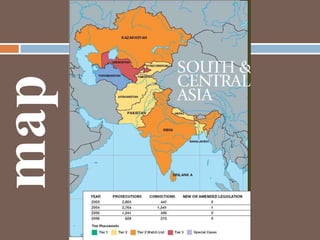
map
INDIA

Indian’s Vernacular
Architecture

South Asia

is the informal, functional
architecture of structures, often in
rural areas of India, built of local
materials and designed to meet the
needs of the local people.
It has been estimated that
worldwide close to 90% of all
building is vernacular.
INDIA

Indian’s Vernacular
Architecture

South Asia

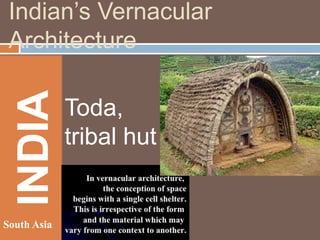
Toda,
tribal hut
INDIA

3 categories:

South Asia
Houses of Goa : Museum

INDIA

Goan architect Gerald da Cunha

South Asia
INDIA

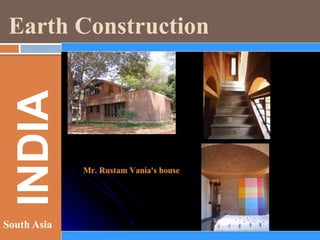
Earth Construction

South Asia
INDIA

Mr. Rustam Vania’s house

South Asia
INDIA

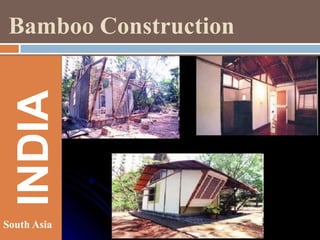
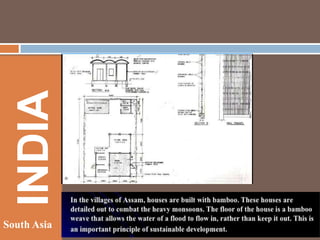
Bamboo Construction

South Asia
INDIA
South Asia
INDIA

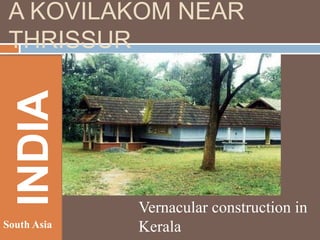
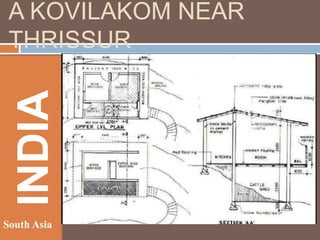
A KOVILAKOM NEAR
THRISSUR

South Asia

Vernacular construction in
Kerala
INDIA

A KOVILAKOM NEAR
THRISSUR

South Asia
INDIA

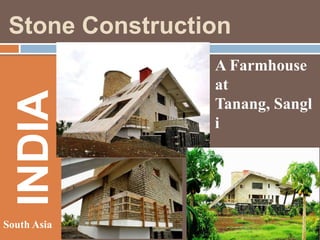
Stone Construction

South Asia

A Farmhouse
at
Tanang, Sangl
i
INDIA

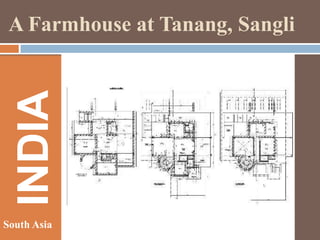
A Farmhouse at Tanang, Sangli

South Asia
INDIA

A Farmhouse at Tanang, Sangli

South Asia
PAKISTAN

NEO-VERNACULAR ARCHITECTURE

South Asia

This means to take the best features of
traditional architecture and combine it
with the modern requirements.
Most of the traditional architecture
originated on the bases (need and
availability)
pakistan

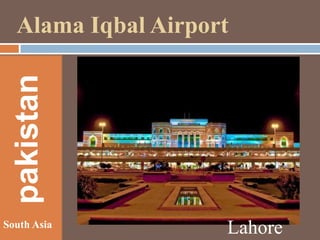
Alama Iqbal Airport

South Asia

Lahore
pakistan

the Aga Khan Hospital

South Asia
Sri Lanka
South Asia

Sri Lanka can be affected by a
multitude of natural disasters such
as cyclones, minor
earthquakes, Tsunami, floods and
landslides. Although it is relatively
easier to avoid the sites prone to
floods and landslides, the built
environments must have sufficient
robustness against cyclones and
Sri Lanka
South Asia

Real examples are drawn from the
tsunami reconstruction activities
carried out in various parts of Sri
Lanka where alternative
materials such as Compressed
Stabilized Earth bricks and
blocks, rammed earth, chip
concrete block sand micro concrete
tiles have been used.
Sri Lanka

Building materials

South Asia

The present trend in the Sri Lankan
housing industry is to use
conventional building materials
such as bricks, cement sand
blocks, concrete and timber etc. for
permanent housing.

Earth can be used for
construction of walls in many ways.
Sri Lanka

Vaasthu culture

South Asia

Broad field of science, which
includes the construction of
houses, public, and religious
buildings as well as direct
surroundings.
It takes into the account of energy
flow, human health aspects and
color combinations that have best
effects on the residents of the
Sri Lanka

Vaasthu culture

South Asia

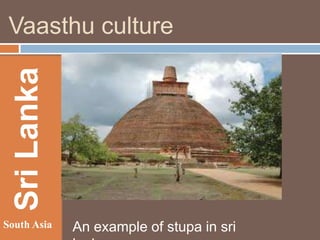
An example of stupa in sri
Sri Lanka

Vaasthu culture

South Asia

Avoiding bumidosa – land/soil
qualities that
Will make the construction faulty.

Comparing the horoscope and
designs.
Placing of doors and window accdg. To
the correct natural direction.

Placing the house to get the max.
sunlight and air.
Placing rooms accdg. To correct
Sri Lanka

BY: ARCH’T. GEOFFREY
BAWA

South Asia
Sri Lanka

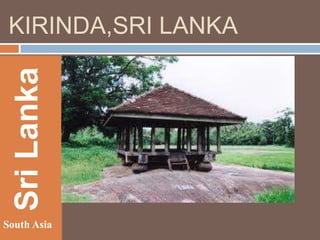
KIRINDA,SRI LANKA

South Asia
Bangladesh

Traditional House of Bangladesh
Typology
of house
according
to
materials
and
location.
Bangladesh

Traditional House of Bangladesh
Traditional Houses
represent the heritage of a
country and also reflects
traditional forms and
values, fundamental to the
culture of the people of that
country. It possesses distinct
characteristics as regards
planning, use of materials
Bangladesh

Traditional House of Bangladesh
Till now the housing in
Bangladesh remains traditional.
For centuries traditional house
has been using locally available
materials. It is only from that
late 19th century that traditional
house began to change in the
use of housing materials.
Bangladesh

Traditional House of Bangladesh
The full planning concept
has been developed by the
people according to need.
This traditional house has
been changed along with
time to fulfil the demand of
the user.
Bangladesh

Traditional House of Bangladesh
Almost all of houses in different parts of
Bangladesh were built with mud bricks.
The house forms, building styles and
materials used in construction had
significant variations in different areas
of Bengal.
Historically, bamboo had been the most
important building material for housing in
Bangladesh.
Bangladesh
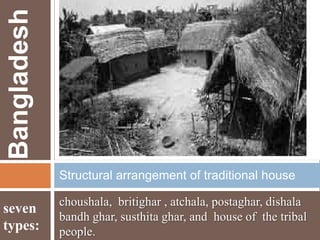
Structural arrangement of traditional house

seven
types:

choushala, britighar , atchala, postaghar, dishala
bandh ghar, susthita ghar, and house of the tribal
people.
Bangladesh

Types of Traditional House


KUTCHA HOUSE: Which are
made of totally organic materials such as
bamboo house, mud house, jute stick and
catkin grass house, etc.



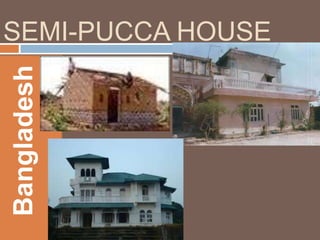
SEMI-PUCCA HOUSE: Which are
made of mixed with some organic and
inorganic materials such as steel
house, wooden house etc.
Bangladesh

KUTCHA HOUSE
• Walls: Organic materials like jute
stick, catkin
grass, straw, bamboo mats, etc. Split are
bamboo framing. In some areas wall are
made
by earth.
• Foundation: Earthen plinth with bamboo or
timber posts.
• Roof: Thatch-rice or wheat or maize
straw, catkin grass, etc with split bamboo
Bangladesh

KUTCHA HOUSEs
Bangladesh

SEMI-PUCCA HOUSE:
• Walls: Bamboo mats, CI sheet, Timber or
bamboo framing. In some areas wall are made
by earth. Sometimes part or full brick.

• Foundation: Earthen plinth; Brick
perimeter wall with earth infill; Brick and
concrete also use.

• Roof: CI sheet with timber or bamboo
framing.
Bangladesh

SEMI-PUCCA HOUSE
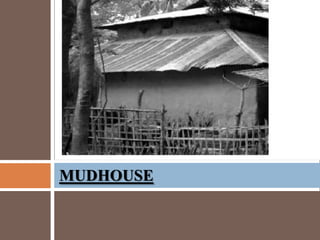
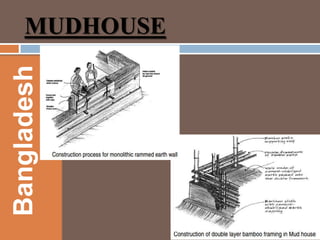
MUDHOUSE
Bangladesh
MUDHOUSE
Bangladesh

BAMBOO HOUSE
Bangladesh
BAMBOO HOUSE
Bangladesh

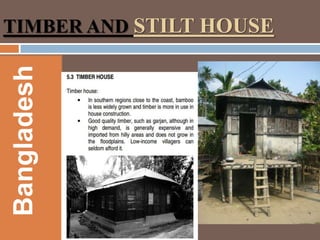
TIMBER AND STILT HOUSE
NEPAL

VERNACULAR ARCHITECTURE
ECONOMICAL CONSTRUCTION
was and in many places still is a
necessity due to limited resources.
NEPAL is a country full of antiques
and incredible blend of art, culture and
region.
NEPAL

VERNACULAR ARCHITECTURE
With the great variation of topography and
natural environment and equally large
number of diverse ethnicity, rural
vernacular architecture of Nepal can be
Varied.

Permanent human settlements are
found only in those high valleys
where severe climate and terrain
are slightly mitigated by
permanent sources of water and
Micro climate conditions
NEPAL

VERNACULAR ARCHITECTURE
Three broad vernacular
architectural divisions:

-Terai
-Middle hills
-High Mountain
NEPAL

VERNACULAR ARCHITECTURE

Hilly
Stone is the most common
material used in construction
work. Since the temperature
in this area falls below
freezing in winter and 25
degree is not common in the
Hot months.
NEPAL

VERNACULAR ARCHITECTURE

Stone is also the most
common material for wall
and exterior paving and
also used as roof
cladding.
NEPAL

VERNACULAR ARCHITECTURE
A typical dwelling has a
foundation of builders laid in
mud mortar.

Stone wall, half meter thick
has few openings set in
from the corners.
Verandahs are widely used in
hilly region.
NEPAL

VERNACULAR ARCHITECTURE

Nepal Hotel
NEPAL

VERNACULAR ARCHITECTURE

Katinpur
temple
house
NEPAL

VERNACULAR ARCHITECTURE

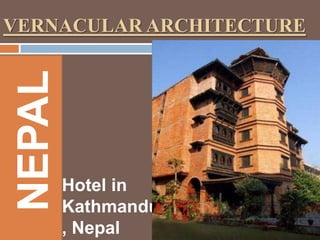
Hotel in
Kathmandu
, Nepal
NEPAL

VERNACULAR ARCHITECTURE

Ceilings are low, to prevent
warm air from rising to a level
where its benefit will be lots.
Buildings are situated around a
courtyard which is protected
from the wind by building wall.
RESEARCH BY:
Krztyn Delgado, a second year college
of Bachelor in Science in Architecture.

THANK YOU!

Vernacular Architecture