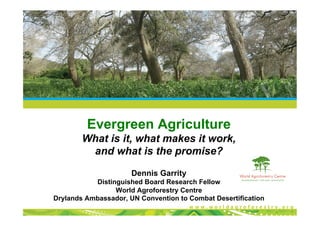
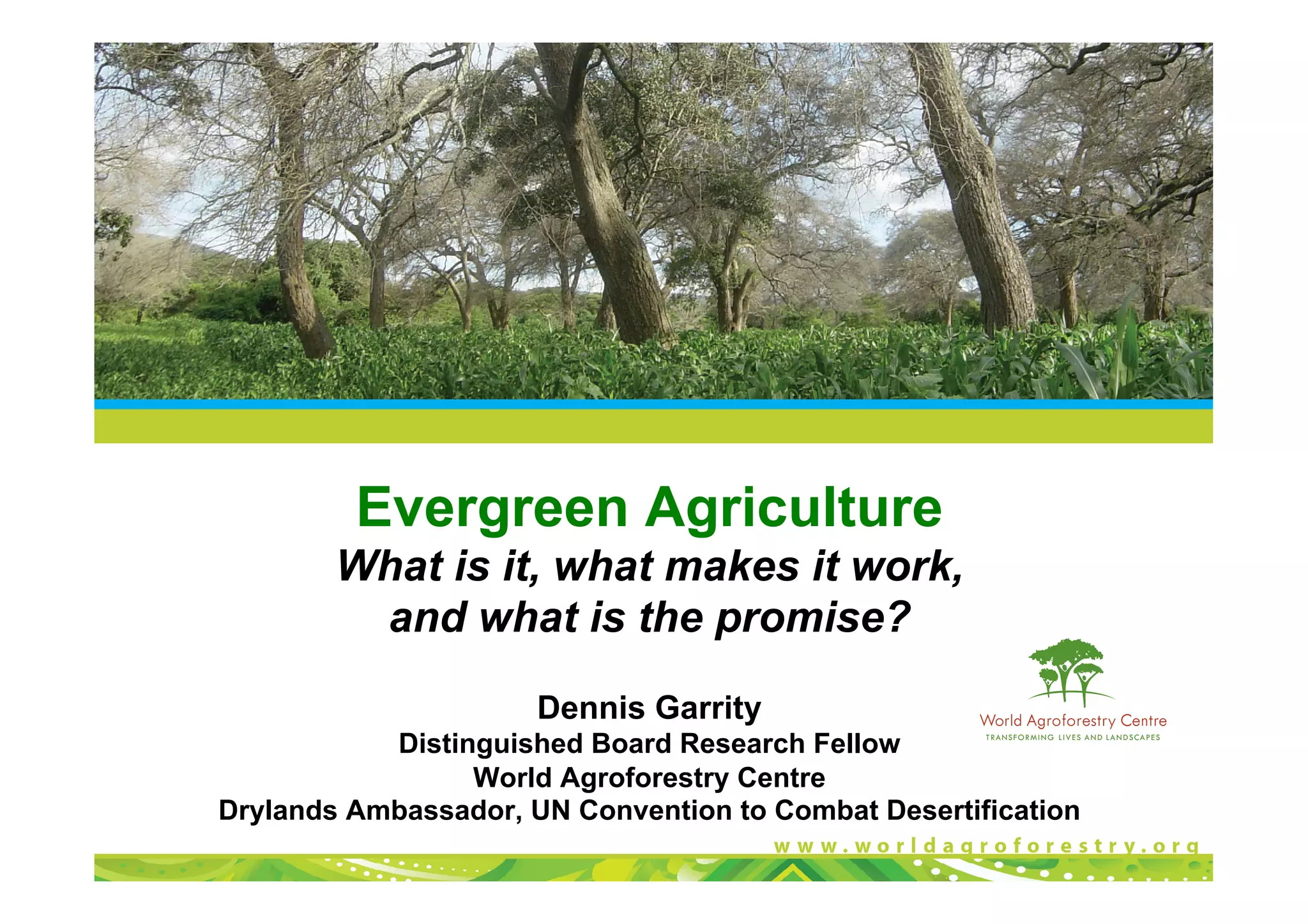
Evergreen Agriculture
        What is it, what makes it work,
         and what is the promise?

                      Dennis Garrity
           Distinguished Board Research Fellow
                 World Agroforestry Centre
Drylands Ambassador, UN Convention to Combat Desertification
Two Major Types of
     Evergreen Agriculture
(1) Farmer-Managed Natural
    Regeneration of Indigenous Trees on
    Farmlands, as in the Sahel
(2) Trees planted in annual cropping
    systems, as in Eastern and Southern
    Africa and South Asia
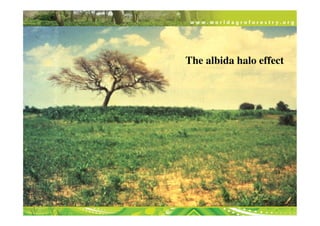
The albida halo effect
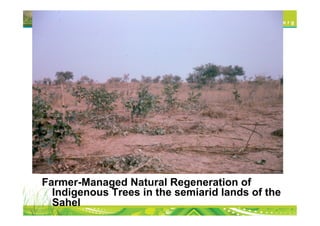
Farmer-Managed Natural Regeneration of
  Indigenous Trees in the semiarid lands of the
  Sahel
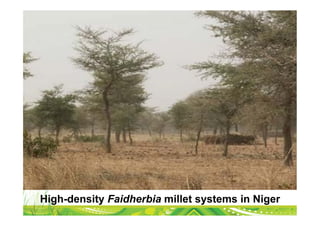
High-density Faidherbia millet systems in Niger
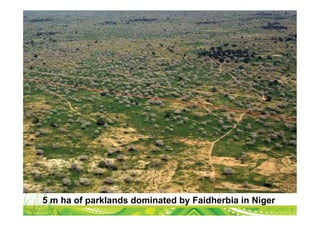
5 m ha of parklands dominated by Faidherbia in Niger
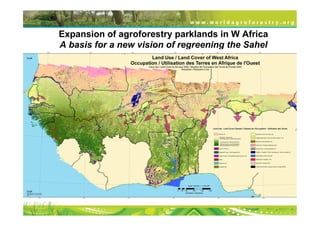
Expansion of agroforestry parklands in W Africa
A basis for a new vision of regreening the Sahel
Key examples of Evergreen Agriculture
        in Eastern and Southern Africa
•    Faidherbia albida in maize production systems
•    Fodder shrubs for balanced dairy nutrition
•    Mango and other fruits intercropped in maize
     systems
•    Grevillia robusta intercropped in maize for
     timber, fodder & fuel
•    Intercropped coppicing leguminous trees in
     maize (eg Gliricidia in Malawi)
•    Relay-cropped leguminous species managed as
     annual green manure (eg Tephrosia)
•    Improved fallows with leguminous species (eg
     Sesbania sesban)
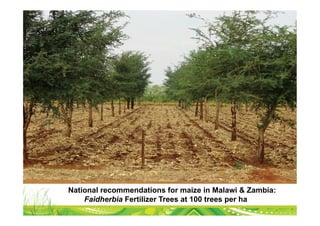
National recommendations for maize in Malawi & Zambia:
    Faidherbia Fertilizer Trees at 100 trees per ha
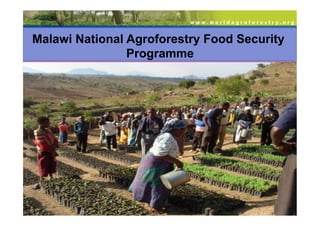
Malawi National Agroforestry Food Security
                Programme
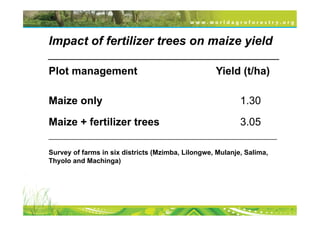
Impact of fertilizer trees on maize yield
_______________________________________
Plot management                                    Yield (t/ha)

Maize only                                                 1.30

Maize + fertilizer trees                                   3.05
____________________________________________________________

Survey of farms in six districts (Mzimba, Lilongwe, Mulanje, Salima,
Thyolo and Machinga)
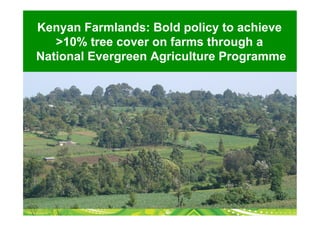
Kenyan Farmlands: Bold policy to achieve
   >10% tree cover on farms through a
National Evergreen Agriculture Programme
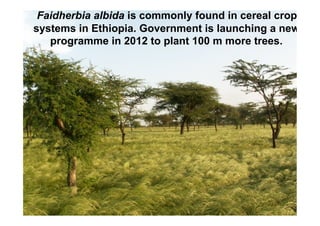
Faidherbia albida is commonly found in cereal crop
systems in Ethiopia. Government is launching a new
   programme in 2012 to plant 100 m more trees.
For More Information

       World Agroforestry Centre
       www.worldagroforestry.org	


      Evergreen Agriculture page
      www.worldagroforestry.org/	

      evergreen_agriculture	


       Email contacts:
       d.garrity@cgiar.org	

      – 
The Next Phase
Accelerate the ongoing national scaling-
   up programmes in Malawi, Zambia,
   Burkina Faso and Niger
National Agroforestry Food Security
   Programmes being developed for
   Senegal, Ethiopia, Rwanda, and Kenya
Preparatory work for new programmes
   under way in Tanzania, Mali, and 12
   other countries
What are the key research issues?
Quality genetics
•    More complete germplasm collection & characterization
•    More extensive provenance trials
•    Identification of superior seed sources
Propagation and agronomy
•   Better propagation and tree establishment methods
•   Determine optimum tree densities
•   Elucidate optimum soil fertility synergies between organic
    and inorganic nutrient sources
Carbon sequestration and climate change
•   Carbon estimates (soil & above-ground) and modeling
•   Methodologies for smallholder carbon projects
Biodiversity effects of agroforests on croplands
Economics, social & cultural aspects
Policy reform
Targeting & Scaling-up methodologies

Evergreen Agriculture from Agriculture and Rural Development Day (ARDD) 2011

  • 1.
    Evergreen Agriculture What is it, what makes it work, and what is the promise? Dennis Garrity Distinguished Board Research Fellow World Agroforestry Centre Drylands Ambassador, UN Convention to Combat Desertification
  • 2.
    Two Major Typesof Evergreen Agriculture (1) Farmer-Managed Natural Regeneration of Indigenous Trees on Farmlands, as in the Sahel (2) Trees planted in annual cropping systems, as in Eastern and Southern Africa and South Asia
  • 3.
  • 4.
    Farmer-Managed Natural Regenerationof Indigenous Trees in the semiarid lands of the Sahel
  • 5.
  • 6.
    5 m haof parklands dominated by Faidherbia in Niger
  • 7.
    Expansion of agroforestryparklands in W Africa A basis for a new vision of regreening the Sahel
  • 8.
    Key examples ofEvergreen Agriculture in Eastern and Southern Africa •  Faidherbia albida in maize production systems •  Fodder shrubs for balanced dairy nutrition •  Mango and other fruits intercropped in maize systems •  Grevillia robusta intercropped in maize for timber, fodder & fuel •  Intercropped coppicing leguminous trees in maize (eg Gliricidia in Malawi) •  Relay-cropped leguminous species managed as annual green manure (eg Tephrosia) •  Improved fallows with leguminous species (eg Sesbania sesban)
  • 9.
    National recommendations formaize in Malawi & Zambia: Faidherbia Fertilizer Trees at 100 trees per ha
  • 10.
    Malawi National AgroforestryFood Security Programme
  • 11.
    Impact of fertilizertrees on maize yield _______________________________________ Plot management Yield (t/ha) Maize only 1.30 Maize + fertilizer trees 3.05 ____________________________________________________________ Survey of farms in six districts (Mzimba, Lilongwe, Mulanje, Salima, Thyolo and Machinga)
  • 12.
    Kenyan Farmlands: Boldpolicy to achieve >10% tree cover on farms through a National Evergreen Agriculture Programme
  • 13.
    Faidherbia albida iscommonly found in cereal crop systems in Ethiopia. Government is launching a new programme in 2012 to plant 100 m more trees.
  • 15.
    For More Information World Agroforestry Centre www.worldagroforestry.org Evergreen Agriculture page www.worldagroforestry.org/ evergreen_agriculture Email contacts: d.garrity@cgiar.org – 
  • 16.
    The Next Phase Acceleratethe ongoing national scaling- up programmes in Malawi, Zambia, Burkina Faso and Niger National Agroforestry Food Security Programmes being developed for Senegal, Ethiopia, Rwanda, and Kenya Preparatory work for new programmes under way in Tanzania, Mali, and 12 other countries
  • 17.
    What are thekey research issues? Quality genetics •  More complete germplasm collection & characterization •  More extensive provenance trials •  Identification of superior seed sources Propagation and agronomy •  Better propagation and tree establishment methods •  Determine optimum tree densities •  Elucidate optimum soil fertility synergies between organic and inorganic nutrient sources Carbon sequestration and climate change •  Carbon estimates (soil & above-ground) and modeling •  Methodologies for smallholder carbon projects Biodiversity effects of agroforests on croplands Economics, social & cultural aspects Policy reform Targeting & Scaling-up methodologies