SCIENCE
TERM - I
1.Chemical Reactions and Equations s-1-9
2. Acids, Bases and Salts s-10-16
3. Metals and Non-Metals s-17-24
4. Life Processes s-25-34
5. Light-Reflection and Refraction s-35-50
6. The Human Eye and the Colourful World s-51-62
TERM - II
7. Carbon and Its Compounds s-63-73
8. Periodic Classification of Elements s-74-84
9. How Do Organisms Reproduce s-85-93
10. Heredity and Evolution s-94-105
11. Electricity s-106-125
12. Magnetic Effects of Electric Current s-126-135
13. Our Environment s-136-146
Contents
3.
Acids, Bases and
Salts
Chemical
Reactionsand
Equations
1
Multiple Choice Questions (MCQs)
DIRECTIONS : This section contains multiple choice
questions. Each question has four choices (a), (b), (c) and (d)
out of which only one is correct.
1. Which of the following is a decomposition reaction?
(a)
Heat
2
2HgO 2Hg O
→ +
(b)
Heat
3 2
CaCO CaO CO
→ +
(c) Electrolysis
2 2 2
2H O H O
→ +
(d) All of these
2. On the basis of following features, identify the correct
option.
(i) This reaction occurs during corrosion.
(ii) This reaction occurs during respiration.
(a) Decomposition reaction
(b) Redox reaction
(c) Combination reaction
(d) Endothermic reaction
3. Which of the following is not a physical change?
(a) Boiling of water to give water vapour.
(b) Melting of ice to give water.
(c) Dissolution of salt in water.
(d) Combustion of Liquefied Petroleum Gas (LPG).
4. Which of the following can be decomposed by the action
of light?
(a) NaCl (b) KCl
(c) AgCl (d) CuCl
5. In which of the following the identity of initial substance
remains unchanged?
(a) Curdling of milk
(b) Formation of crystals by process of crystallisation
(c) Fermentation of grapes
(d) Digestion of food
6. Which of the following reactions involves the combination
of two elements?
(a) CaO + CO2 → CaCO3
(b) 4Na + O2 → 2Na2O
(c) 2 2 3
1
SO O SO
2
+ →
(d) NH3 + HCl → NH4Cl
7. When hydrogen sulphide gas is passed through a blue
solution of copper sulphate, a black precipitate of copper
sulphide is obtained and the sulphuric acid so formed
remains in the solution. The reaction is an example of –
(a) a combination reaction
(b) a displacement reaction
(c) a decomposition reaction
(d) a double decomposition reaction
8. What happens when copper rod is dipped in iron sulphate
solution?
(a) Copper displaces iron
(b) Blue colour of copper sulphate solution is obtained
(c) No reaction takes place
(d) Reaction is exothermic
9. A student added dilute HCl to a test tube containing zinc
granules and made following observations which one is
correct?
(a) The zinc surface became dull and black.
(b) A gas evolved which burns with a pop sound.
(c) The solution remained colourless.
(d) The solution becomes green in colour.
10. A dilute solution of sodium carbonate was added to two
test tubes (A) containing dil HCl and (B) containing dilute
NaOH. The correct observation was –
(a) a brown coloured gas liberated in test tube A.
(b) a brown coloured gas liberated in test tube B.
(c) a colourless gas liberated in test tube A.
(d) a colourless gas liberated in test tube B.
4.
S-2 Science
20. Inthe equation, NaOH + HNO3 → NaNO3 + H2O
nitric acid is acting as –
(a) an oxidising agent (b) an acid
(c) a nitrating agent (d) a dehydrating agent
21. Fe2O3 + 2Al → Al2O3 + 2Fe
The above reaction is an example of a –
(a) combination reaction
(b) double displacement reaction
(c) decomposition reaction
(d) displacement reaction
22. White silver chloride in sunlight turns to –
(a) grey (b) yellow
(c) remain white (d) red
23. Black and white photography uses –
(a) decomposition of silver chloride.
(b) decomposition of silver bromide.
(c) both
(d) none of these
24. When copper powder is heated it gets coated with –
(a) black copper oxide (b) yellow copper oxide
(c) red copper oxide (d) None of these
25. Combination of phosphorus and oxygen is an example
of–
(a) oxidation (b) reduction
(c) rancidity (d) None of these
26. Rusting of iron is an example of –
(a) reduction (b) redox
(c) oxidation (d) dissociation
27. Which of the following does not corrode when exposed to
the atmosphere?
(a) Iron (b) Copper
(c) Gold (d) Silver
28. Take about 1.0g CaCO3 in a test tube. Heat it over a flame,
a colourless gas comes out. The reaction is called a
(a) decomposition reaction
(b) displacement reaction
(c) double decomposition reaction
(d) double displacement reaction
29. Hydrogen sulphide (H2S) is a strong reducing agent.
Which of the following reactions shows its reducing
action?
(a) Cd(NO3)2 + H2S → CdS + + 2HNO3
(b) CuSO4 + H2S → CuS + H2SO4
(c) 2FeCl3 + H2S → 2FeCl2 + 2HCl + S
(d) Pb(NO3)2 + H2S → PbS + 2CH3COOH
11. A balanced chemical equation is in accordance with –
(a) Avogadro’s law
(b) law of multiple proportion
(c) law of conservation of mass
(d) law of gaseous volumes.
12. The equation
Cu + xHNO3 → Cu(NO3)2 + yNO2 + 2H2O
The values of x and y are –
(a) 3 and 5 (b) 8 and 6
(c) 4 and 2 (d) 7 and 1
13. Zn + H2SO4(dil) → ZnSO4 + H2↑
Above reaction is –
(a) decomposition reaction
(b) single displacement reaction
(c) combination reaction
(d) synthesis reaction
14. The reaction in which two compounds exchange their
ions to form two new compounds is –
(a) a displacement reaction
(b) a decomposition reaction
(c) an isomerization reaction
(d) a double displacement reaction
15. When the gases sulphur dioxide and hydrogen sulphide
mix in the presence of water, the reaction is
SO2 + 2H2S → 2H2O + 2S. Here hydrogen sulphide is
acting as –
(a) an oxidising agent (b) a reducing agent
(c) a dehydrating agent (d) a catalyst
16. CuO + H2 → H2O + Cu, reaction is an example of –
(a) redox reaction (b) synthesis reaction
(c) neutralisation (d) analysis reaction
17. A substance which oxidises itself and reduces other is
known as –
(a) oxidising agent (b) reducing agent
(c) both of these (d) none of these
18. A redox reaction is one in which –
(a) both the substances are reduced.
(b) both the substances are oxidised.
(c) an acid is neutralised by the base.
(d) one substance is oxidised while the other is reduced.
19. In the following equations :
Na2CO3 + x HCl → 2 NaCl + CO2 + H2O, the value of x
is–
(a) 1 (b) 2
(c) 3 (d) 4
5.
S-3
Chemical Reactions andEquations
30. 2CuI → Cu + CuI2, the reaction is –
(a) redox (b) neutralisation
(c) oxidation (d) reduction
31. When copper turnings are added to silver nitrate solution,
a blue coloured solution is formed after some time. It is
because, copper –
(a) displaces silver from the solution
(b) forms a blue coloured complex with AgNO3
(c) is oxidised to Cu2+
(d) is reduced to Cu2+
32. Zn2+(aq) + 2e– → Zn(s). This is –
(a) oxidation (b) reduction
(c) redox reaction (d) none of these
33. A substance A reacts with another substance B to produce
the product C and a gas D. If a mixture of the gas D and
ammonia is passed through an aqueous solution of C,
baking soda is formed. The substances A and B are
(a) HCl and NaOH (b) HCl and Na2CO3
(c) Na and HCl (d) Na2CO3 and H2O
34. Chemically the ‘water gas’ is
(a) H2O (gaseous) (b) CO2 + H2
(c) CH4 + H2O (d) CO + H2
35. The oxidation number of sulphur is –4 in
(a) H2S (b) CS2
(c) Na2SO4 (d) Na2SO3
36. Identify the endothermic process from the following
(a) Addition of conc. HCl to water
(b) CH4(g) +2O2(g) → CO2(g) + 2H2O(1)
(c) H2O(1) → H2O(g)
(d) CaO(s) + H2O(1) → Ca(OH)2(aq)
37. The schematic diagram is given below
A
(solid)
B
(vapour)
HCl
(vapour)
+
heat NaOH(aq)
C
(Gas)
conc. HCl
D
H O
2
shake well
E(aq)
(acidic solution)
heat
cool
→ →
→
→
→
Which of the following is a correct statement ?
(a) A and E are chemically same.
(b) A and D are chemically same.
(c) D and E are chemically same.
(d) C and E are chemically same.
38. The oxidation states of P atom in POCl3, H2PO3 and
H2P2O6, respectively are
(a) + 5, + 4, + 4 (b) + 5, + 5, + 4
(c) + 4, + 4, + 5 (d) + 3, + 4, + 5
39. The process of respiration is :
(a) Oxidation reaction which is endothermic
(b) Reduction reaction which is endothermic
(c) Combination reaction which is exothermic
(d) Oxidation reaction which is exothermic
40. Silver articles become black when exposed to air. It is due
to the formation of
(a) Silver oxide (b) Silver nitrate
(c) Silver chloride (d) Silve sulphide
41. A test tube along with calcium carbonate in it initially
weighed 30.08 g. A heating experiment was performed
on this test tube till calcium carbonate completely
decomposed with evolution of a gas. Loss of weight
during this experiment was 4.40 g. What is the weight of
the empty test tube in this experiment?
(a) 20.08 g (b) 21.00 g
(c) 24.50 g (d) 2.008 g
42. Match chemical reactions given in the List I with the type
of chemical reactions given in List II and select the correct
answer using the options given below:
List I
(Chemical reactions)
List II
(Type of Chemical
reactions)
A. Formation of NH3
from N2 and H2
I. Decomposition
B. Calcination of zinc
carbonate.
II. Double displacement
C. Reaction of aqueous
BaCl2 solution with
dilute H2SO4
III. Combination
D. Rancidity of oils IV. Redox
V. Displacement
(a) A-I, B-V, C-III, D-IV (b) A-III, B-IV, C-V, D-I
(c) A-IV, B-III, C-V, D-I (d) A-III, B-I, C-II, D-IV
43.
Cu Al Fe Zn
A B C D
If we added FeSO4 to above four test tubes, in which test
tube we observe black residue?
(a) “A” and “B” (b) “B” and “C”
(c) “A” and “C” (d) “B” and “D”
6.
S-4 Science
DIRECTIONS :Study the given case/passage and answer the
following questions.
Case/Passage - 1
The reaction between MnO2 with HCl is depicted in the
following diagram. It was observed that a gas with bleaching
abilities was released . [From CBSE Question Bank-2021]
MnO (s)
2
Reactants
HCl (aq)
Products
44. The chemical reaction between MnO2 and HCl is an
example of:
(a) displacement reaction
(b) combination reaction
(c) redox reaction
(d) decomposition reaction.
45. Chlorine gas reacts with _____ to form bleaching powder.
(a) dry Ca(OH)2
(b) dil. solution of Ca(OH)2
(c) conc. solution of Ca(OH)2
(d) dry CaO
46. Identify the correct statement from the following:
(a) MnO2 is getting reduced whereas HCl is getting
oxidized
(b) MnO2 is getting oxidized whereas HCl is getting
reduced.
(c) MnO2 and HCl both are getting reduced.
(d) MnO2 and HCl both are getting oxidized.
47. In the above discussed reaction, what is the nature of
MnO2?
(a) Acidic oxide (b) Basic oxide
(c) Neutral oxide (d) Amphoteric oxide
48. What will happen if we take dry HCl gas instead of
aqueous solution of HCl?
(a) Reaction will occur faster.
(b) Reaction will not occur.
(c) Reaction rate will be slow.
(d) Reaction rate will remain the same.
Case/Passage - 2
Chemistry in Automobiles:
For an internal combustion engine to move a vehicle down
the road, it must convert the energy stored in the fuel into
mechanical energy to drive the wheels. In your car, the
distributor and battery provide this starting energy by creating
an electrical “spark”, which helps in combustion of fuels like
gasoline. Below is the reaction depicting complete combustion
of gasoline in full supply of air:
[From CBSE Question Bank-2021]
2C8H18(I) + 25O2(g) → 16 ‘X’ + Y
49. Which of the following are the products obtained from the
reaction mentioned in the above case?
Product ‘X’ Product ‘Y’
(a) CO2 H2O2
(b) H2O CO
(c) CH3OH H2O
(d) CO2 H2O
50. Identify the types of chemical reaction occurring during
the combustion of fuel:
(a) Oxidation Endothermic reaction
(b) Decomposition Exothermic reaction
(c) Oxidation Exothermic reaction
(d) Combination Endothermic reaction
51. On the basis of evolution/absorption of energy, which of
the following processes are similar to combustion of fuel?
(i) Photosynthesis in plants
(ii) Respiration in the human body
(iii) Decomposition of vegetable matter
(iv) Decomposition of ferrous sulphate.
(a) (ii) (iii) (b) (i) (ii)
(c) (iii) (iv) (d) (ii) (i)
52. ‘A student while walking on the road observed that a
cloud of black smoke belched out from the exhaust stack
of moving trucks on the road.’ Choose the correct reason
for the production of black smoke:
(a) Limited supply of air leads to incomplete combustion
of fuel.
(b) Rich supply of air leads to complete combustion of
fuel.
(c) Rich supply of air leads to a combination reaction.
(d) Limited supply of air leads to complete combustion
of fuel.
53. ‘Although nitrogen is the most abundant gas in the
atmosphere, it does not take part in combustion’. Identify
the correct reason for this statement.
(a) Nitrogen is a reactive gas
(b) Nitrogen is an inert gas
(c) Nitrogen is an explosive gas
(d) Only hydrocarbons can take part in combustion
7.
S-5
Chemical Reactions andEquations
Assertion Reason
DIRECTIONS : Each of these questions contains an assertion
followed by reason. Read them carefully and answer the question
on the basis of following options. You have to select the one that
best describes the two statements.
(a) If both Assertion and Reason are correct and Reason is
the correct explanation of Assertion.
(b) If both Assertion and Reason are correct, but Reason is
not the correct explanation of Assertion.
(c) If Assertion is correct but Reason is incorrect.
(d) If Assertion is incorrect but Reason is correct.
54. Assertion : Chlorine gas react with potassium iodide
solution to form potassium chloride and iodine.
Reason : Chlorine is more reactive than iodine therefore
displaces iodine from potassium iodide.
55. Assertion : When copper strip is placed in ferrous
sulphate solution, colour of the solution changes.
Reason : Iron is more reactive than copper.
56. Assertion : Decomposition of vegetable matter into
compost is an endothermic reaction.
Reason : Heat is required in an endothermic reaction.
57. Assertion : Reaction of sodium sulphate with barium
chloride is a precipitation reaction.
Reason : Precipitation reaction produces insoluble salt.
58. Assertion: When a mixture of hydrogen and chlorine is
placed in sunlight, hydrogen chloride is formed.
Reason : It is an example of combination reaction.
59. Assertion : Stannous chloride gives grey precipitate with
mercuric chloride, but stannic chloride does not do so.
Reason : Stannous chloride is a powerful oxidising agent
which oxidises mercuric chloride to mercury.
60. Assertion : Corrosion of iron is commonly known as
rusting.
Reason : Corrosion of iron occurs in presence of water
and air.
61. Assertion : In a reaction
Zn(s) + CuSO4 (aq) → ZnSO4 (aq) + Cu(s),
Zn is a reductant but itself get oxidized.
Reason : In a redox reaction, oxidant is reduced by
accepting electrons and reductant is oxidized by losing
electrons.
62. Assertion : A reducing agent is a substance which can
either accept electron.
Reason : A substance which helps in oxidation is known
as reducing agent.
63. Assertion : The balancing of chemical equations is based
on law of conservation of mass.
Reason : Total mass of reactants is equal to total mass of
products.
Match the Following
DIRECTIONS : Each question contains statements given in
two columns which have to be matched. Statements (A, B, C, D)
incolumnIhavetobematchedwithstatements(p,q,r,s)incolumnII.
64. Column II gives type of reaction mention in column I,
match them correctly.
Column I Column II
(A) C + O2 → CO2 (p) Displacement
(B) AgBr light
→ Ag + Br (q) Combination
(C) Zn + CuSO4 → ZnSO4 + Cu (r) Decomposition
(D) CH3CH2OH Cu
→ (s) Oxidation
CH3CHO + H2
65. Column I Column II
(A) KClO3
∆
→ (p) O2
(B) ZnCO3
∆
→ (q) H2O
(C) H2CO3
∆
→ (r) CO2
(D) C2H6
∆
→ (s) ZnO
A B C D
(a) p s, r q, r q, r
(b) p q, r s, r r, p
(c) q, r s, p p, s r
(d) r q s p
Fill in the Blanks
DIRECTIONS : Complete the following statements with an
appropriate word / term to be filled in the blank space(s).
66. In a .................... reaction two or more substances combine
to form a new single substance.
67. Reactions in which heat is given out along with the
products are called ....................... reactions.
8.
S-6 Science
68. Reactionsin which energy is absorbed are known as
........... reactions.
69. When an element displaces another element from its
compound, a ..................... reaction occurs.
70. Two different atoms or groups of atoms (ions) are
exchanged in .................... reactions.
71. Precipitation reactions produce .................... salts.
72. Reduction is the ................. of oxygen or gain of hydrogen.
73. The digestion of food in the body is an example of .........
reaction.
74. The addition of oxygen to a substance is called ...........
75. When calcium carbonate is heated, it decomposes to give
.................. and ................. .
76. The new substances produced in a reaction are called as
....................
True / False
DIRECTIONS : Read the following statements and write your
answer as true or false.
77. The number of atoms of each element is conserved in any
chemical reaction.
78. Oxidation is the loss of electrons from a substance.
79. Reduction is the gain of electrons by a substance.
80. A complete chemical equation represents the reactants,
products and their physical states symbolically.
81. A magnesium ribbon burns with a dazzling flame in air
(oxygen) and changes into a white substance, magnesium
oxide.
82. Rusting is a double decomposition reaction.
83. The reaction between nitrogen and hydrogen to give
ammonia is an example of a combination reaction.
84. Action of heat on ferrous sulphate is an example of
decomposition reaction.
85. The formation of Cu and H2O in the reaction of copper
oxide with hydrogen is an example of a redox reaction.
9.
S-7
Chemical Reactions andEquations
ANSWER KEY SOLUTIONS
1. (d) A decomposition reaction is a type of chemical
reaction in which a single compound breaks down
into two or more elements or new compounds.
2. (b) Both are redox reactions. Redox reactions are
characterised by the transfer of electrons between
chemical species. One species undergoes oxidation
while another species undergoes reduction.
3. (d) Combustion of liquefied petroleum gas is a chemical
change. As it is an irreversible reaction and new
products (carbon dioxide and water vapours) are
formed during the change. Also, a lot of heat is
released during this reaction.
4. (c)
5. (b) Formation of crystals by process of crystallization.
6. (b) Except (b) all other reactions involve compounds.
4 2 2 4
(blue) (black)
(double decomposition reaction)
CuSO H S CuS H SO
+
→ +
7. (d)
8. (c) Iron is more reactive than copper, hence Cu will not
displace iron from iron sulphate, hence no reaction
will take place.
9. (b) Zn + 2HCl → ZnCl2 + H2
Hydrogen gas burns with a pop sound.
10. (c) Na2CO3 + 2HCl → 2NaCl + H2O + CO2
Na2CO3 + NaOH → no reaction
11. (c)
12. (c) Cu + 4HNO3 → Cu(NO3)2 + 2NO2 + 2H2O
13. (b) 14. (d)
15. (b) Here H2S is behaves as a reducing agent and oxidises
to H2O.
16. (a) CuO + H2 Cu + H O
2
Oxidation
Reduction
→
17. (b) 18. (d)
19. (b) Na2CO3 + 2HCl → 2NaCl + CO2 + H2O
20. (b) The reaction represents a neutralisation reaction in
which base (NaOH) reacts with an acid (HNO3) to
form salt (NaNO3) and water (H2O).
21. (d)
22. (a) White silver chloride in sunlight turns to grey.
23. (b)
24. (a) 2
Black
2Cu O 2CuO
∆
+
→
25. (a) (Oxidation)
2 2 3
4P 3O 2P O
+
→
(Oxidation)
2 2 5
4P 5O 2P O
+
→
26. (b) 2Fe(s) + O2(g) + 4H+(aq) → 2Fe2+(aq) + 2H2O(l)
27. (c) Gold is least reactive hence does not corrode at all.
28. (a) 3 2
CaCO CaO CO
∆
→ +
29. (c) FeCl + H S
3 2 FeCl + HCl + S
2
Reduction
Oxidation
In the given reaction H2S undergoes oxidation,
hence behave as a reducing agent.
30. (a)
1 0 2
2
2CuI Cu CuI
+ +
→ +
reduction
oxidation
. Oxidation and reduction both
occur so the reaction is redo
31. (a) Cu is more reactive than Ag.
0 1
3 3
Cu 2AgNO CuNO 2Ag
+
+
→ +
32. (b)
2 0
Zn(aq) 2e Zn(s)
+
−
+
→ ; reduction
33. (b) 2 3 2 2
(A) (B) (C) (D)
HCl Na CO NaCl(aq) CO H O
+
→ + +
2 3 3 4
Baking soda
CO NH NaCl(aq) NaHCO NH Cl
+ +
→ +
Hence A B are HCl and Na2CO3
34. (d) Water gas → CO + H2
35. (*) Let the oxidation state of S be x
(i) H2S
2 + x = 0
x = –2
10.
S-8 Science
(ii)CS2
4 + 2x = 0 ⇒ x = –2
(iii) Na2SO4
2(+1) + x + 4(–2) = 0
2 + x – 8 = 0
x = + 6
(iv) Na2SO3
2(+1) + x + 3(– 2) = 0
2 + x – 6 = 0
x = + 4
None of these, option is correct.
36. (c) Conversion of liquid to gas is endothermic process.
37. (b)
(solid) A
heat
cool
(vapour)
HCl
NH3
NH Cl
4
B +
(vapour)
C D
heat NaOH (aq.)
HCl (con)
NH (g)
3
NH Cl
4
(shake
well)
H O
2
E H l
C
(acidic soln.)
→
A = NH4Cl; D = NH4Cl
Hence correct statement is: A and D are chemically
same.
38. (a) Let the oxidation state of P-atom in POCl3, H2PO3
and H4P2O6 be x.
(i) POCl3
x + 1(–2) + 3(–1) = 0
x – 2 – 3 = 0
x = + 5
(ii) H2PO3
2(1) + x + 3(–2) = 0
2 + x – 6 = 0
x = + 4
(iii) H4P2O6
4(1) + 2x + 6(–2) = 0
4 + 2x – 12 = 0
2x = 8
x = + 4.
39. (d) Respiration is oxidation and exothermic process.
40. (d) Layer of silver sulphide deposited on the silver
articles when exposed to air.
41. (a) On thermal decomposition of calcium carbonate
3 2
44 g
100 g 56 g
CaCO CaO CO
∆
→ +
44 g CO2 is formed from 100 g CaCO3
4.40 g CO is formed from
100
44
44
× = 10 g CaCO3
If mass of CaCO3 is 10 g, then weight of empty test
tube = 30.08 – 10.0 = 20.08 g
42. (d) A-III, B-I, C-II, D-IV
43. (d) Zn and Al are more reactive than iron, therefore they
will displace iron from its salt solution giving black
residue, while Cu being less reactive than iron will
not able to displace iron from its salt solution.
FeSO4 + 2Al → Al2(SO4)3 + 3Fe
FeSO4 + Zn → ZnSO4 + Fe
FeSO4 + Cu → No reaction
FeSO4 + Fe → No reaction
44. (c) redox reaction
45. (a) dry Ca(OH)2
46. (a) MnO2 is getting reduced whereas HCl is getting
oxidized
47. (b) Basic oxide
48. (b) Reaction will not occur
49. (d)
50. (c)
51. (a)
52. (a)
53. (b)
54. (a) Chlorine displaces iodine from potassium iodide
solution.
55. (d) When copper strip is placed in FeSO4 solution,
colour of the solution does not change.
56. (d) Decomposition of vegetable matter into compost is
an exothermic reaction.
57. (a) Na2SO4(aq) + BaCl2(aq) →
4
Precipitate
BaSO (s) 2NaCl(aq)
+
58. (a) A combination reaction is a reaction where two or
more elements or compounds combine to form a
single compound. Hydrogen and chlorine combine
to give hydrogen chloride.
59. (c) SnCl + 2HgCl
2 2 SnCl + Hg Cl
4 2 2
Reduction
Oxidation (Reducing agent)
+2 +2 +4 +1
→
Hg2Cl2 + SnCl2 → 2Hg + SnCl4
60. (b) Corrosion occurs due to oxidation of iron.
11.
S-9
Chemical Reactions andEquations
61. (a)
62. (d) Areducing agent is a substance which oxidizes itself
but reduces others i.e., looses electrons.
63. (a)
64. A → (q) B → (r) C → (p) D → (s)
65. (a)
66. combination 67. exothermic
68. endothermic 69. displacement
70. double displacement 71. insoluble
72. loss 73. Decomposition reaction
74. oxidation 75. CaO (s) and CO2 (g)
76. products
77. True 78. True 79. True 80. True
81. True 82. False 83. True 84. True
85. True
12.
Acids, Bases and
Salts
MultipleChoice Questions (MCQs)
DIRECTIONS : This section contains multiple choice
questions. Each question has four choices (a), (b), (c) and (d)
out of which only one is correct.
1. During the preparation of hydrogen chloride gas on a
humid day, the gas is usually passed through the guard
tube containing calcium chloride. The role of calcium
chloride taken in the guard tube is to:
(a) absorb the evolved gas.
(b) moisten the gas.
(c) absorb moisture from the gas.
(d) absorb Cl– ions from the evolved gas.
2. To protect tooth decay we are advised to brush our teeth
regularly. The nature of the tooth paste commonly used is:
(a) Acidic (b) Neutral
(c) Basic (d) Corrosive
3. Which of the following is not a mineral acid?
(a) Hydrochloric acid (b) Citric acid
(c) Sulphuric acid (d) Nitric acid
4. Which of the following acid is present in sour milk ?
(a) glycolic acid (b) lactic acid
(c) citric acid (d) tartaric acid
5. An aqueous solution ‘A’ turns phenolphthalein solution
pink. On addition of an aqueous solution ‘B’ to ‘A’, the
pink colour disappears. The following statement is true
for solution ‘A’ and ‘B’.
(a) A is strongly basic and B is a weak base.
(b) A is strongly acidic and B is a weak acid.
(c) A has pH greater than 7 and B has pH less than 7.
(d) A has pH less than 7 and B has pH greater than 7.
6. The product of complete neutralization of H3PO3 with
NaOH is :
(a) NaH2PO3 (b) Na2HPO3
(c) Na3PO3 (d) Na3(HPO3)2
7. Chemical A is used for water softening to remove
temporary hardness. ‘A’ reacts with sodium carbonate to
generate caustic soda. What is ‘A’?
(a) Gypsum (b) Slaked lime
(c) Quick lime (d) Lime stone
8. An aqueous solution turns red litmus solution blue.
Excess addition of which of the following solution would
reverse the change?
(a) Baking powder
(b) Lime
(c) Ammonium hydroxide solution
(d) Hydrochloric acid
9. A blue litmus paper was first dipped in dil. HCl and then
in dil. NaOH solution. It was observed that the colour of
the litmus paper –
(a) changed to red.
(b) changed first to red and then to blue.
(c) changed blue to colourless.
(d) remains blue in both the solutions.
10. The acid used in making vinegar is –
(a) formic acid (b) acetic acid
(c) sulphuric acid (d) nitric acid
11. CuO + (X) → CuSO4 + H2O. Here (X) is –
(a) CuSO4 (b) HCl
(c) H2SO4 (d) HNO3
12. Reaction of an acid with a base is known as –
(a) decomposition (b) combination
(c) redox reaction (d) neutralization
Acids, Bases
and Salts
2
13.
Acids, Bases andSalts S-11
24. When an oxide of a non–metal reacts with water which of
the following is formed?
(a) Acid (b) Base
(c) Salt (d) None of these
25. ‘Alum’ is an example of –
(a) single salt (b) double salt
(c) acids (d) none of these
26. Which of the following statements is correct about an
aqueous solution of an acid and of a base?
(i) Higher the pH, stronger the acid
(ii) Higher the pH, weaker the acid
(iii) Lower the pH, stronger the base
(iv) Lower the pH, weaker the base
(a) (i) and (iii) (b) (ii) and (iii)
(c) (i) and (iv) (d) (ii) and (iv)
27. A sample of soil is mixed with water and allowed to
settle. The clear supernatant solution turns the pH paper
yellowish-orange. Which of the following would change
the colour of this pH paper to greenish-blue?
(a) Lemon juice (b) Vinegar
(c) Common salt (d) An antacid
28. Plaster of paris is obtained –
(a) by adding water to calcium sulphate.
(b) by adding sulphuric acid to calcium hydroxide.
(c) by heating gypsum to a very high temperature.
(d) by heating gypsum to 373 K.
29. What is the term for the positive and negative ions of a
compound breaking apart in solution –
(a) Conglomeration (b) Oxidation
(c) Dissociation (d) None of the Above
30. Of the aqueous solutions listed below, which would be
the best conductor of an electric current?
(a) HCl (b) H3PO4
(c) HOCl (d) CH3COOH
31. Common salt besides being used in kitchen can also be
used as the raw material for making
(i) washing soda (ii) bleaching powder
(iii) baking soda (iv) slaked lime
(a) (i) and (ii) (b) (i), (ii) and (iv)
(c) (i) and (iii) (d) (i), (iii) and (iv)
32. Which salt can be classified as an acid salt?
(a) Na2SO4 (b) BiOCl
(c) Pb(OH)Cl (d) Na2HPO4
13. When CO2 is passed through lime water, it turns milky.
The milkiness in due to formation of –
(a) CaCO3 (b) Ca(OH)2
(c) H2O (d) CO2
14. Antacids contain –
(a) weak base (b) weak acid
(c) strong base (d) strong acid
15. 2NaOH + MgSO4 ––––→ ?
(a) MgO + Na2SO4 (b) Mg(OH)2 + Na2SO4
(c) Mg(OH)2 + Na2O (d) MgO + Na2O
16. Bleaching powder gives smell of chlorine because it –
(a) is unstable.
(b) gives chlorine on exposure to atmosphere.
(c) is a mixture of chlorine and slaked lime.
(d) contains excess of chlorine.
17. Plaster of paris is made from –
(a) lime stone (b) slaked lime
(c) quick lime (d) gypsum
18. Chemical formula of baking soda is –
(a) MgSO4 (b) Na2CO3
(c) NaHCO3 (d) MgCO3
19. Washing soda has the formula –
(a) Na2CO3.7H2O (b) Na2CO3.10H2O
(c) Na2CO3.H2O (d) Na2CO3
20. Plaster of Paris hardens by –
(a) giving of CO2
(b) changing into CaCO3
(c) combining with water
(d) giving out water
21. Which of the following is acidic in nature?
(a) apple juice (b) soap solution
(c) slaked lime (d) lime
22. The reaction of metal with acid results in the formation
of–
(a) only hydrogen gas
(b) only salt
(c) both salt and hydrogen gas
(d) none of these
23. Which of the following acid does not react with metals?
(a) sulphuric acid (b) phosphoric acid
(c) carbonic acid (d) nitric acid
14.
S-12 Science
33. Anelement X reacts with dilute H2SO4 as well as with
NaOH to produce salt and H2(g). Hence, it may be
concluded that:
I. X is an electropositive element.
II. oxide of X is basic in nature.
III. oxide of X is acidic in nature.
IV. X is an electronegative element.
(a) I, II, III (b) IV, I, II
(c) III, IV, I (d) II, III, IV
34. The turmeric solution will turn red by an aqueous solution
of -
(a) potassium acetate (b) copper sulphate
(c) sodium sulphate (d) ferric chloride
35. The correct order of increasing pH values of the aqueous
solutions of baking soda, rock salt, washing soda and
slaked lime is
(a) Baking Soda Rock Salt Washing Soda Slaked
lime
(b) Rock Salt Baking Soda Washing Soda Slaked
lime
(c) Slaked lime Washing Soda Rock Salt Baking
Soda
(d) Washing Soda Baking Soda Rock Salt Slaked
lime
36. You are provided with aqueous solutions of three salts —
A, B and C, 2-3 drops of blue litmus solution, red litmus
solution and phenolphthalein were added to each of these
solution in separate experiments. The change in colours
of different indicators were recorded in the following
table:
Sample With blue
litmus
solution
With red
litmus
solution
With
phenolphtha-
lein
solution
A No change No change No change
B Turns red No change No change
C No change Turns blue Turns pink
On the basis of above observations, identify A, B, and C
from the following options:
(a) A = NH4 Cl, B = NaCl, C = CH3COONa
(b) A = NH4 Cl, B = CH3 COONa, C = NaCl
(c) A = NaCl, B = NH4 Cl, C = CH3 COONa
(d) A = CH3 COONa, B = NH4 Cl, C = NaCl
37. Aqua regia is the mixture of conc. HCl and conc. HNO3
in the ratio:
(a) 1 : 3 (b) 2 : 3
(c) 3 : 1 (d) 3 : 2
38. The chemical formula of ‘Plaster of Paris’ is
(a) 4 2
1
CaSO . H O
2
(b) CaSO4.2H2O
(c) CaSO4.H2O (d) 4 2
3
CaSO . H O
2
39. A solution turns red litmus blue. Its pH is likely to be –
(a) 2 (b) 4
(c) 5 (d) 10
40. A solution reacts with crushed egg-shells to give a gas
that turns lime water milky. The solution contains –
(a) NaCl (b) HCl
(c) LiCl (d) KCl
41. 10 mL of a solution of NaOH is found to be completely
neutralised by 8 mL of a given solution of HCl. If we take
20 mL of the same solution of NaOH, the amount of
HCl solution (the same solution as before) required to
neutralise will be –
(a) 4 mL (b) 8 mL
(c) 12 mL (d) 16 mL
42. Which of the following type of medicines is used for
treating indigestion ?
(a) Antibiotic (b) Analgesic
(c) Antacid (d) Antiseptic
43. Which of the following reaction does not results in the
evolution of H2 gas?
(a) dilute sulphuric acid reacts with zinc granules.
(b) dilute hydrochloric acid reacts with magnesium ribbon.
(c) dilute sulphuric acid reacts with aluminium powder.
(d) dilute hydrochloric acid with diute sodium hydroxide
solution.
DIRECTIONS : Study the given case/passage and answer the
following questions.
Case/Passage - 1
Marble’s popularity began in ancient Rome and Greece, where
white and off-white marble were used to construct a variety
of structures, from hand-held sculptures to massive pillars and
buildings.
[From CBSE Question Bank-2021]
15.
Acids, Bases andSalts S-13
44. The substance not likely to contain CaCO3 is
(a) Dolomite (b) A marble statue
(c) Calcined gypsum (d) Sea shells.
45. A student added 10g of calcium carbonate in a rigid
container, secured it tightly and started to heat it. After
some time, an increase in pressure was observed, the
pressure reading was then noted at intervals of 5 mins
and plotted against time, in a graph as shown below.
During which time interval did maximum decomposition
took place?
1.25
1.00
0.75
0.50
0.25
Pressure
(atm)
(a) 15-20 min (b) 10-15 min
(c) 5-10 min (d) 0-5 min
46. Gas A, obtained above is a reactant for a very important
biochemical process which occurs in the presence of
sunlight. Identify the name of the process -
(a) Respiration (b) Photosynthesis
(c) Transpiration (d) Photolysis
47. Marble statues are corroded or stained when they
repeatedly come into contact with polluted rain water.
Identify the main reason.
(a) decomposition of calcium carbonate to calcium
oxide
(b) polluted water is basic in nature hence it reacts with
calcium carbonate
(c) polluted water is acidic in nature hence it reacts with
calciumcarbonate
(d) calcium carbonate dissolves in water to give calcium
hydroxide.
48. Calcium oxide can be reduced to calcium, by heating
with sodium metal. Which compound would act as an
oxidizing agent in the above process?
(a) sodium (b) sodium oxide
(c) calcium (d) calcium oxide
Case/Passage - 2
Frothing in Yamuna:
The primary reason behind the formation of the toxic foam is
high phosphate content in the wastewater because of detergents
used in dyeing industries, dhobi ghats and households.
Yamuna’s pollution level is so bad that parts of it have been
labelled ‘dead’ as there is no oxygen in it for aquatic life to
survive.
[From CBSE Question Bank-2021]
49. Predict the pH value of the water of river Yamuna if the
reason for froth is high content of detergents dissolved in
it.
(a) 10-11 (b) 5-7
(c) 2-5 (d) 7
50. Which of the following statements is correct for the water
with detergents dissolved in it?
(a) low concentration of hydroxide ion (OH– )and high
concentration of hydronium ion (H3O+)
(b) high concentration of hydroxide ion (OH–)and low
concentration of hydronium ion (H3O+)
(c) high concentration of hydroxide ion (OH–) as well
as hydronium ion (H3O+)
(d) equal concentration of both hydroxide ion (OH–)
and hydronium ion (H3O+).
The table provides the pH value of four solutions P, Q, R
and S
Solution pH value
P 2
Q 9
R 5
S 11
51. Which of the following correctly represents the solutions
in increasing order of their hydronium ion concentration?
(a) P Q R S (b) P S Q R
(c) S Q R P (d) S P Q R
52. High content of phosphate ion in river Yamuna may lead to:
(a) decreased level of dissolved oxygen and increased
growth of algae
(b) decreased level of dissolved oxygen and no effect of
growth of algae
16.
S-14 Science
(c) increasedlevel of dissolved oxygen and increased
growth of algae
(d) decreased level of dissolved oxygen and decreased
growth of algae
53. If a sample of water containing detergents is provided to
you, which of the following methods will you adopt to
neutralize it?
(a) Treating the water with baking soda
(b) Treating the water with vinegar
(c) Treating the water with caustic soda
(d) Treating the water with washing soda
Assertion Reason
DIRECTIONS : Each of these questions contains an assertion
followed by reason. Read them carefully and answer the question
on the basis of following options. You have to select the one that
best describes the two statements.
(a) If both Assertion and Reason are correct and Reason is
the correct explanation of Assertion.
(b) If both Assertion and Reason are correct, but Reason is
not the correct explanation of Assertion.
(c) If Assertion is correct but Reason is incorrect.
(d) If Assertion is incorrect but Reason is correct.
54. Assertion : Aqueous solution of ammonium nitrate turns
blue litmus red.
Reason : Ammonium nitrate is salt of strong acid and
strong base.
55. Assertion : All alkalis are bases but all bases are not
alkali.
Reason : Water soluble bases are alkali.
56. Assertion : Magnesium hydroxide is used as antacid.
Reason : Magnesium hydroxide is a strong base.
57. Assertion : Dry HCl gas does not change the colour of
blue litmus paper to red.
Reason : Dry HCl gas is strongly basic.
58. Assertion : Sodium hydrogen carbonate is used in fire
extinguisher.
Reason : Sodium hydrogen carbonate is a mild base.
59. Assertion : H2CO3 is a strong acid.
Reason : A strong acid dissociates completely or almost
completely in water.
60. Assertion : Salts are the products of an acid-base reaction.
Reason : Salt may be acidic or basic.
61. Assertion : On adding H2SO4 to water the resulting
aqueous solution get corrosive.
Reason : Hydronium ions are responsible for corrosive
action.
Match the Following
DIRECTIONS : Each question contains statements given in
two columns which have to be matched. Statements (A, B, C, D)
incolumnIhavetobematchedwithstatements(p,q,r,s)incolumnII.
62. Column II gives nature of acids and bases mention in
column I, match them correctly.
Column I Column II
(A) HCl (p) Strong acid
(B) HCN (q) Weak acid
(C) NaOH (r) Weak base
(D) NH4OH (s) Strong base
63. Match the salts given in column I with the corresponding
acid and base given in column II.
Column I Column II
(A) KNO3 (p) Nitric acid, Silver
hydroxide
(B) AgNO3 (q) Hydrochloric
acid, Magnesium
hydroxide
(C) MgCl2 (r) Carbonic
acid, Ammonium
hydroxide
(D) (NH4)2CO3 (s) Nitric acid,
Potassium hydroxide
64. Column I Column II
(A) NaHCO3 (p) Baking soda
(B) NaOH (q) Alkaline
(C) KHSO4 (r) Acidic salt
(D) Ca(OH)2 (s) Bitter taste
Fill in the Blanks
DIRECTIONS : Complete the following statements with an
appropriate word / term to be filled in the blank space(s).
65. Oxy acids contains ........ atoms in addition to hydrogen
atom.
66. An acid that contains more than one acidic hydrogen
atom is called a .............. .
67. When an acid reacts with a metal, ............. gas is evolved
and a corresponding ............. is formed.
68. When an acid reacts with a metal carbonate or metal
hydrogen carbonate, it gives the corresponding salt,
.......... gas and ............... .
17.
Acids, Bases andSalts S-15
69. .......................... is the fixed number of water molecules
chemically attached to each formula unit of a salt in its
crystalline form.
70. ENO contains .......... and is ........... in nature.
71. Anhydrous sodium carbonate is commonly known as
............... .
72. Soda–acid fire extinguisher contains a solution of sodium
hydrogen carbonate and ............... .
73. An alkali reacts with ammonium salts to produce
corresponding salt, water and evolve .................. .
74. Zn(OH)2 is a ................. base.
True / False
DIRECTIONS : Read the following statements and write your
answer as true or false.
75. Acidic nature of a substance is due to the formation of
H+(aq) ions in solution.
76. Mixing concentrated acids or bases with water is a highly
endothermic process.
77. Acids and bases neutralise each other to form
corresponding salts and water.
78. The colour of caustic soda turns pink when phenolphthalein
is added.
79. Hydrogen chloride gas turns the blue litmus red.
80. Sodium hydrogen carbonate is used in fire extinguisher.
81. Washing soda on strong heating gives sodium oxide and
carbon dioxide.
82. Plaster of paris is obtained by heating gypsum at 373 K in
a kiln.
83. Bleaching powder is used for disinfecting drinking water.
84. Solution of sodium hydrogen carbonate is alkaline in
nature.
18.
S-16 Science
1. (c)Calcium chloride is good dehydrating agent so it is
used to absorb moisture from the hydrogen chloride
gas.
2. (c) The tooth paste commonly used is basic which help
in neutralisation of the extra acid formed during
tooth decay.
3. (b) Citric acid is an example of organic acid or edible
acid while HCl, H2SO4 and HNO3 are mineral acids.
4. (b) Lactic acid is present in sour milk.
5. (c) Aqueous solution of A is basic while that of B is
acidic. Therefore A has pH greater than 7 and B has
pH less than 7.
6. (b) H3PO3 is a dibasic acid.
–
3 3 2 3
H PO H PO
+
Η +
2–
2 3 3
H PO H HPO
+
+
7. (b) Chemical ‘A’ is calcium hydroxide (slaked lime).
Ca(OH)2 + Na2CO3 → 2NaOH + CaCO3 ↓
8. (d) The given solution is basic in nature when excess of
HCl is added, it becomes acidic.
9. (b) In acid, blue litmus changes to red and in basic
solution red litmus changes to blue. Hence blue
litmus first changes its color to red and then to blue.
10. (b) 6 - 12% acetic acid is known as vinegar.
11. (c) CuO + H2SO4 → CuSO4 + H2O
12. (d)
13. (a) Ca(OH)2 + CO2 → CaCO3 + H2O
14. (a) Antacids are weak bases which are given when a
patient is suffering from acidity. These antacids
neutralise the acid and give relief to patient.
15. (b) 2NaOH + MgSO4 → Mg(OH)2 + Na2SO4
16. (b) 17. (d) 18. (c) 19. (b)
20. (c) 21. (a) 22. (c)
23. (c) Carbonic acid is a weak and so it does not react with
metal.
24. (a) A non metal oxide forms acid on treatment with
water. e.g.,
2 2 2 3
(Carbonic acid)
CO H O H CO
+
→
25. (b) 26. (d) 27. (d) 28. (d)
29. (c) Acids and bases go through a process of dissociation
when they are put into solution. They break apart
into positively and negatively charged particles.
30. (a) HCl is a strong acid.
31. (c)
32. (d) Because it can furnish H+ ions in solution.
33. (a) Element X can react with both acid and base. It
shows that element X is amphoteric in nature and is
an electropositive element.
34. (a) 3 2 3
Strong base
CH COOK H O KOH CH COOH
+
→ +
The solution will be basic in nature so it turns
turmeric to red.
35. (b) Rock Salt (NaCl) Baking Soda (NaHCO3)
Washing Soda (Na2CO3) Slaked lime (CaCO3)
36. (c) A neutral salt brings no change with blue
litmus solution, red litmus solution and with
phenolphthalein solution. An acidic salt turns blue
litmus to red and brings no change in red litmus
solution as well as in phenolphthalein solution.
Basic salt turns red litmus to blue and also turns
phenolphthalein solution pink.
Sample Solution With
blue
litmus
solution
With
red
litmus
solution
With
phenol-
phthalein
solution
A Neutral salt
(NaCl)
No change No
change
No change
B Acidic salt
(NH4Cl)
Turns red No
change
No change
C Basic salt
(CH3COONa)
No change Turns
blue
Turns pink
37. (c) Aqua-regia is 3 part conc. HCl and 1 part conc.
HNO3.
38. (a) Plaster of paris is calcium sulphate hemihydrate.
39. (d) The red litmus solution turns blue in basic solution.
The pH of basic solution is more than 7.
ANSWER KEY SOLUTIONS
19.
Acids, Bases andSalts S-17
40. (b) Since the gas produced turns lime water milky so
the gas is CO2. The egg-shell is made of CaCO3
which reacts with an acid (dil. HCl) to produce CO2.
CaCO3 + 2HCl → CaCl2 + H2O + CO2↑
41. (d) Since 10 mL of NaOH requires HCl = 8mL
20 mL of NaOH will require HCl
8
10
= × 20 mL
= 16 mL
42. (c) We use antacids for treating indigestion.
43. (d) Zinc + Sulphuric acid →
Zinc sulphate + Hydrogen
Zn(s) + H2SO4(aq) → ZnSO4(aq) + H2(g)
(b) Magnesium + Hydrochloric acid →
Magnesium chloride + Hydrogen
Mg(s) + 2HCl(aq) → MgCl2(aq) + H2(g)
(c) Aluminium + Sulphuric acid →
Aluminium sulphate + Hydrogen
2Al(s) + 3H2SO4(aq) → Al2(SO4)3(aq) + 3H2(g)
(d) dilute Hydrochloric acid + dilute sodium hydroxide
→ sodiumchloride + water
2HCl + 2NaOH → 2NaCHl + 2H2O
44. (c) Calcined gypsum is CaSO4 ⋅ H2O
45. (d) 0-5 min
46. (b) Gas is CO2 which is a important reactant in
photosynthesis process.
47. (c) polluted water is acidic in nature hence it reacts with
calcium carbonate
48. (d) calcium oxide
49. (a)
50. (b)
51. (c)
52. (a)
53. (b)
54. (c) Ammonium nitrate is salt of strong acid and weak
base.
55. (a) Bases generate hydroxide ions in water hence water
soluble bases are called alkalis.
56. (c) Magnesium hydroxide is a mild base and neutralise
the excess acid in the stomach.
57. (c) Dry HCl gas does not show acidic character in
absence of water. Therefore do not change the
colour of blue litmus in dry condition.
58. (b) Sodium hydrogen carbonate react with acid present
in fire extinguisher to produce carbon dioxide gas.
59. (d) H2CO3 (carbonic acid) is a weak acid.
60. (b)
61. (a) Because H2SO4 is a strong acid, it readily forms
hydronium ions when dissolved in water which are
responsible for its corrosive action.
62. A → (p); B → (q); C → (s); D → (r)
63. A → (s); B → (p); C → (q); D → (r)
64. A → (p, q, r); B → (q, s); C → (q, r); D → (q, s)
65. Oxygen 66. Polyprotic acid
67. Hydrogen, salt 68. Carbon dioxide, water
69. Water of crystallisation
70. Sodium hydrogen carbonate, basic
71. Soda ash 72. Sulphuric acid
73. Ammonia 74. Diacidic
75. True 76. False 77. True 78. True
79. False 80. True 81. False 82. True
83. True 84. True
20.
Acids, Bases and
Salts
Metalsand
Non-Metals
3
Multiple Choice Questions (MCQs)
DIRECTIONS : This section contains multiple choice
questions. Each question has four choices (a), (b), (c) and (d)
out of which only one is correct.
1. Which of the following metal is liquid at ordinary
temperature?
(a) Aluminium (b) Mercury
(c) Magnesium (d) Potassium
2. The atomic number of an element Y is 16. The number of
electrons in Y2– ion will be:
(a) 16 (b) 17
(c) 18 (d) 20
3. Which of the following elements will form basic oxides?
(a) Barium (b) Aluminium
(c) Carbon (d) Phosphorus
4. Which one of the following is not correct regarding the
electrolytic refining of copper?
(a) Basic Cu(OH)2 solution is used as cathode.
(b) Acidified CuSO4 solution is used as electrolyte.
(c) Impure Cu is taken as cathode
(d) Cu2+ ion gets collected at anode.
5. Which of the following compound is covalent in nature?
(a) Carbon tetrachloride (b) Ammonium chloride
(c) Lithium chloride (d) Calcium chloride
6. A student by mistake used a wet gas jar to collect sulphur
dioxide. Which one of the following tests of the gas is
likely to fail ?
(a) Odour
(b) Effect on acidified K2Cr2O7 solution
(c) Solubility test
(d) None of these
7. Silicon is used in :
(a) solar energy devices (b) semiconductors
(c) transistors (d) all of these
8. Which of the following is not a characteristics of metal ?
(a) Malleable (b) Electropositive nature
(c) Ductile (d) None of these
9. Zn + H2O (Steam) –––→ A + B, In the equation A and B
are –
(a) Zn, H only (b) ZnH2 and O2
(c) ZnO2 O2 (d) ZnO H2
10. Removal of impurities from ore is known as –
(a) crushing and grinding (b) concentration of ore
(c) calcination (d) roasting
11. Froth floatation method is used for the concentration of–
(a) oxide ores (b) sulphide ores
(c) sulphate ores (d) halide ores
12. Heating of concentrated ore in absence of air for
conversion into oxide ore is known as –
(a) roasting (b) calcination
(c) reduction (d) none of these
13. Pure gold is –
(a) 24 carats (b) 22 carats
(c) 20 carats (d) 18 carats
14. What is anode mud ?
(a) Fan of anode
(b) Metal of anode
(c) Impurities collected at anode in electrolysis during
purification of metals
(d) All of these
15. Which of the following pairs will give displacement
reactions?
(a) ZnSO4 solution and aluminium metal
(b) MgCl2 solution and aluminium metal
(c) FeSO4 solution and silver metal
(d) AgNO3 solution and copper metal.
21.
Metals and Non-MetalsS-19
26. The process to heat the ore in the presence of excess
supply of air below its melting point is called –
(a) roasting (b) calcination
(c) smelting (d) liquation
27. Graphite is a/an –
(a) alloy (b) metal
(c) metalloid (d) non-metal
28. One of the constituents of amalgam is –
(a) aluminium (b) copper
(c) iron (d) mercury
29. Which of the following metal reacts with water/steam to
produce oxide instead of hydroxide ?
(a) Sodium (b) Potassium
(c) Calcium (d) Magnesium
30. The white phosphorus is stored
(a) in air (b) under water
(c) under kerosene (d) under CS2
31. Sodium is obtained by the electrolysis of –
(a) an aqueous solution of sodium chloride
(b) an aqueous solution of sodium hydroxide
(c) fused sodium chloride
(d) fused sodium sulphate
32. In the combined state, zinc is mainly found as –
(a) chloride (b) bromide
(c) oxide (d) sulphide
33. Which of the following is incorrect?
(a) Chalcocite – Copper
(b) Magnetite – Iron
(c) Calamine – Aluminium
(d) Galena – Lead
34. Among Mg, Cu, Fe, Zn the metal that does not produce
hydrogen gas in reaction with hydrochloric acid is
(a) Cu (b) Zn
(c) Mg (d) Fe
35. The major products of the following reaction,
ZnS(s) + O2(g) Heat
→ ..........are
(a) ZnO and SO2 (b) ZnSO4 and SO3
(c) ZnSO4 and SO2 (d) Zn and SO2
36. Choose the incorrect pair
(a) NO - Neutral oxide (b) Cl2O7 - Acidic oxide
(c) MgO - Basic Oxide (d) P4O10 - Basic oxide
37. Metal present in chloroplast is
(a) Iron (b) Copper
(c) Magnesium (d) Cobalt
16. Which of the following is a chemical method for
preventing an iron frying pan from rusting?
(a) applying grease
(b) applying paint
(c) applying a coating of zinc
(d) all of the above
17. An element reacts with oxygen to give a compound with
a high melting point. This compound is also soluble in
water. The element is likely to be –
(a) calcium (b) carbon
(c) silicon (d) iron
18. Aluminium does not oxidise readily in air because –
(a) it is high in the electrochemical series.
(b) it is low in the electrochemical series.
(c) the metal does not combine with oxygen.
(d) the metal is covered with a layer of oxide which
does not rub off.
19. The correct order of increasing chemical reactivity is –
(a) Zn Fe Mg K
(b) Fe Mg Zn K
(c) Fe Mg K Zn
(d) Fe Zn Mg K
20. The least malleable is –
(a) aluminium (b) silver
(c) gold (d) carbon
21. The metal that reacts with cold water is –
(a) mercury (b) sodium
(c) zinc (d) tungsten
22. The only metal that is liquid at room temperature is –
(a) mercury (b) sodium
(c) zinc (d) tungsten
23. The process of extraction of metal from its ores, is known
as –
(a) concentration (b) calcination
(c) purification (d) metallurgy
24. The compound from which metal is extracted economically
is –
(a) slag (b) gangue
(c) ore (d) mineral
25. The process to remove unwanted impurities from the ore
is called –
(a) purification (b) calcination
(c) bassemerisation (d) concentration
22.
Science
S-20
38. Magnesium ribbonis rubbed with sand paper before
making it to burn. The reason of rubbing the ribbon is to:
(a) remove moisture condensed over the surface of
ribbon.
(b) generate heat due to exothermic reaction.
(c) remove magnesium oxide formed over the surface
of magnesium.
(d) mix silicon from sand paper (silicon dioxide) with
magnesium for lowering ignition temperature of the
ribbon.
39. The element that cannot be used as a reducing agent is
(a) carbon (b) aluminium
(c) sulphur (d) sodium
40. Al2O3 reacts with
(a) only water (b) only acids
(c) only alkalis (d) both acids and alkalis
41. Which of the following is an example of neutral oxide?
(a) Fe2O3 (b) Al2O3
(c) C O (d) NO2
42. Ametal‘M’ofmoderatereactivityispresentasitssulphide
‘X’. On heating in air, ‘X’ converts into its oxide ‘Y’and
a gas evolves. On heating ‘Y’ and ‘X’ together, the metal
‘M’ is produced. ‘X’ and ‘Y’ respectively are
(a) ‘X’ cuprous sulphide, ‘Y’ cuprous oxide
(b) ‘X’ cupric sulphide, ‘Y’ cupric oxide
(c) ‘X’ sodium sulphide, ‘Y’ sodium oxide
(d) ‘X’ calcium sulphide, ‘Y’ calcium oxide
43. Which of the following metals react with conc. sulphuric
acid but does not react with a solution of ferrous sulphate?
(a) Cu (b) Zn
(c) Fe (d) Mg
44. The formula of phosphate salt of a metal is MPO4. The
formula of its nitrate salt will be
(a) MNO3 (b) M(NO3)2
(c) M2(NO3)3 (d) M(NO3)3
45. Solder is an alloy of
(a) Pb and Sn (b) Zn and Pb
(c) Pb and Zn (d) Zn and Sn
46. The following observations are given for four metals:
I. Metal H does not react with dilute HCl.
II. Metal K reacts with warm water.
III. Metal L does not react with water but displaces
metal H from its aqueous salt solution.
IV. Metal M reacts with cold water.
Choose the correct decreasing order of reactivity of these
metals amongst the following:
(a) M L H K (b) K M H L
(c) M K L H (d) L H K M
47. ______ gas is evolved when Mn react with very dilute
HNO3
(a) NO2 (b) H2
(c) N2O (d) NO
48. _____________ alloy is used for welding electrical wires
(a) Solder (b) Germen silver
(c) Stainless steel (d) Gun metal
49. Aqueous solution of CsO2 is :
(a) Basic (b) Neutral
(c) Acidic (d) Amphoteric
50. Which of the following will give displacement reactions ?
(a) NaCl solution and copper metal
(b) MgCl2 solution and aluminium metal
(c) FeSO4 solution and silver metal
(d) AgNO3 solution and copper metal
51. Which of the following methods is suitable for preventing
an iron frying pan from rusting ?
(a) Applying grease
(b) Applying paint
(c) Applying a coat of zinc
(d) All the above
52. An element can react with oxygen to give a compound
with high melting point. This compound is also water
soluble. The element is likely to be
(a) Calcium (b) Carbon
(c) Silicon (d) Iron
53. Food cans are coated with tin and not with zinc because
(a) zinc is costlier than tin.
(b) zinc has higher melting point than tin.
(c) zinc is more reactive than tin.
(d) zinc is less reactive than tin.
DIRECTIONS : Study the given case/passage and answer the
following questions.
Case/Passage - 1
Metals are electropositive elements. They can easily lose
electrons to form ions. Metals show distinguished physical
as well as chemical properties. Generally most of the metals
are ductile and malleable with exception such as mercury.
23.
Metals and Non-MetalsS-21
These properties make them valuable for commercial as well
as domestic uses. Reaction of a metal with water is one of
important chemical property. Metals like sodium and potassium
reacts with cold water while magnesium reacts with hot water.
Metals like aluminium, zinc do not react with hot/cold water
but they easily react with steam. When a metal react with hot/
cold water the products are metal hydroxide and hydrogen,
and when it react with steam, the product are metal oxide and
hydrogen. Some metals like sodium, potassium react violently
with water.
54. When zinc reacts with steam it produces:
(a) Zn(OH)2 (b) ZnO
(c) O2 (d) ZnO2
55. Most ductile metal among the following is:
(a) Au (b) Ag
(c) Cu (d) Al
56. During the reaction of calcium with water, pieces of
metal start floating due to the formation of:
(a) Ca(OH)2 (b) CO2
(c) H2 (d) none of these
57. Consider the reactions:
Na(s) + H2O (l) → NaOH (aq) + H2 (g) ..........(i)
Ca(s) + H2O (l) → Ca(OH)2(aq) + H2(g).........(ii)
(a) Reaction (i) is endothermic reaction.
(b) Reaction (ii) is endothermic reaction.
(c) Reaction (ii) is more exothermic than reaction (i).
(d) Reaction (i) is more exothermic than reaction (ii).
58. Metals can be converted into thin sheet by hammering.
This property is known as:
(a) Ductility (b) Sonorous
(c) Malleability (d) Both (a) and (c)
Case/Passage - 2
Elements can be classified as metals or non-metals on the
basis of their properties. The easiest way to start grouping
substances is by comparing their physical properties. Metals,
in their pure state, have a shining surface. This property is
called metallic luster. metals are generally hard. The hardness
varies from metal to metal. some metals are used for making
cooking vessels.
59. Metals generally are
(a) reducing agents
(b) oxidising agent
(c) both oxidising and reducing agents
(d) None of these
60. The most abundant metal in the earth’s crust is -
(a) iron (b) copper
(c) aluminium (d) mercury
61. The metal that reacts with cold water is -
(a) mercury (b) sodium
(c) zinc (d) tungsten
62. Metal present in chloroplast is
(a) Iron (b) Copper
(c) Magnesium (d) Cobalt
63. Which of the following metal(s) catch fire on reaction
with water?
(a) Sodium (b) Potassium
(c) Magnesium (d) both (a) and (b)
Case/Passage - 3
The huge annual loss due to corrosion is a national waste and
should be minimized.
Following are some methods which are helpful to prevent
corrosion
(i) Coating the iron surface with paint or oil or grease
prevents moist oxygen from coming in contact with
the metal and thus effectively prevents rusting of
iron.
(ii) Galvanisation : Iron is blasted with fine sand to make the
surface rough dipped in molten zinc and then cooled. A
thin layer of zinc forms on the iron surface. Since zinc is
more reactive than iron, it acts as a sacrificial metal and is
preferentially oxidised thus preventing oxidation of iron.
(iii) Electroplating with tin, nickel or chromium also prevents
rusting.
(iv) Alloying (mixing iron in its molten state with other
metals) prevents rusting. Stainless steel is an alloy of iron
with Cr or Ni.
64. The most durable metal plating on iron to protect against
corrosion is :
(a) nickel plating (b) copper plating
(c) tin plating (d) zinc plating
65. The most convenient method to protect the bottom of
ship made of iron is :
(a) coating it with red lead oxide.
(b) white tin plating.
(c) connecting it with Mg block.
(d) connecting it with Pb block.
66. The best way to prevent rusting of iron is :
(a) making it cathode
(b) putting in saline water
(c) both of these
(d) none of these
24.
Science
S-22
Case/Passage - 4
Somemetals are chemically very reactive, whereas others
are less reactive or unreactive. On the basis of vigourness of
reactions of various metals with oxygen, water and acids, as
well as displacement reactions, the metals have been arranged
in a group or series according to their chemical reactivity.
The arrangement of metals in a vertical column in the order
of decreasing reactivities is called reactivity series of metals
(or activity series of metals). In reactivity series, the most
reactive metal is placed at the top whereas the least reactive
metal is placed at the bottom. As we come down in the series,
the chemical reactivity of metals decreases. Since the metals
placed at the bottom of the reactivity series (like silver and
gold) are less reactive, so they are usually found in free state
(native state) in nature.
67. When metal Z is added to dilute HCl solution, there is no
evolution of gas. Metal is :
(a) K (b) Na
(c) Ag (d) Zn
68. Copper sulphate solution can be safely kept in a container
made of :
(a) aluminium (b) lead
(c) silver (d) zinc
69. Metal always found in free state is :
(a) gold (b) silver
(c) copper (d) sodium
Assertion Reason
DIRECTIONS : Each of these questions contains an assertion
followed by reason. Read them carefully and answer the question
on the basis of following options. You have to select the one that
best describes the two statements.
(a) If both Assertion and Reason are correct and Reason is
the correct explanation of Assertion.
(b) If both Assertion and Reason are correct, but Reason is
not the correct explanation of Assertion.
(c) If Assertion is correct but Reason is incorrect.
(d) If Assertion is incorrect but Reason is correct.
70. Assertion: Metals are electropositive elements.
Reason: Metals form positive ions by losing electrons.
71. Assertion: Electric wires are made up of copper.
Reason: Non metals are bad conductor of electricity.
72. Assertion: Potassium oxide is a basic oxide.
Reason: Solution of potassium oxide in water turns red
litmus blue.
73. Assertion: Sodium, potassium and magnesium are never
found as free elements in nature.
Reason: Sodium, potassium and magnesium are reactive
elements.
74. Assertion: Carbonate ores are changed into oxides by
roasting process.
Reason: It is easier to obtain a metal from its oxides.
75. Assertion : Iron is found in the free state in nature.
Reason : Iron is highly reactive element.
76. Assertion : Different metals have different reactivities
with water and dilute acids.
Reason : Reactivity of a metal depends on its position in
the reactivity series.
77. Assertion : Zinc becomes dull in moist air.
Reason : Zinc is coated by a thin film of its basic
carbonate in moist air.
78. Assertion : Zinc is used in the galvanisation of iron.
Reason : Its coating on iron articles increases their life by
protecting them from rusting.
79. Assertion : Nitrate ores are rarely available.
Reason: Bond dissociation energy of nitrogen is very high.
Match the Following
DIRECTIONS : Each question contains statements given in
two columns which have to be matched. Statements (A, B, C, D)
incolumnIhavetobematchedwithstatements(p,q,r,s)incolumnII.
80. Column-I Column-II
(A) CaO (p) Amphoteric oxide
(B) Al2O3 (q) Neutral oxide
(C) SO2 (r) Basic oxide
(D) H2O (s) Acidic oxide
81. Column-I Column-II
(A) Iodine (p) Liquid metal
(B) Diamond (q) Liquid non-metal
(C) Mercury (r) Lustrous
(D) Bromine (s) Hardest substance
82. Column-I Column-II
(A) Good conductor of (p) Hydrogen
electricity
(B) Food preservative (q) Copper
(C) Allotrope of carbon (r) Nitrogen
(D) Manufacture of (s) Graphite
ammonia
25.
Metals and Non-MetalsS-23
83. Column-I Column - II
(Position of the Metal (Related Reduction
in the Activity Series) Process)
A. The bottom of the series (p) Electrolysis
B. The top of the series (q) Reduction by heat
alone
C. The lower regions of (r) Found in native
the series state
D. The middle of the (s) Reduction using
series carbon or some
other reducing agent
Fill in the Blanks
DIRECTIONS : Complete the following statements with an
appropriate word / term to be filled in the blank space(s).
84. Metals combine with oxygen to form ......... oxides.
85. Metals above hydrogen in the activity series can displace
............. from dilute acids.
86. The surface of some metals, such as iron, is corroded
when they are exposed to moist air for a long period of
time. This phenomenon is known as ................... .
87. The best conductors of electricity are copper and ............
88. Manganese and ............... react with very dilute nitric
acid to evolve hydrogen gas.
89. An alloy of any metal with mercury is called ......................
the electrical conductivity of an alloy is ........... than that
of pure metals.
90. Stainless steel contains ..............., ............. and ..............
91. Froth floatation process is used for the concentration of
.............. ores.
92. The method of removing volatile matter from carbonate
ores is known as ...................... .
93. Bronze is an alloy of copper and ................... .
94. The main ore of copper is ...................... .
95. In electrolytic refining, impure metal is used as ................. .
True / False
DIRECTIONS : Read the following statements and write your
answer as true or false.
96. Metals can form positive ions by losing electrons to non-
metals.
97. Different metals have same reactivities with water and
dilute acids.
98. A more reactive metal displaces a less reactive metal
from its salt solution.
99. Metals occur in nature only as free elements.
100. Aluminium is the most abundant metal in the earth’s
crust.
101. Mercury and zinc are purified by liquation method.
102. The presence of carbon in pig iron makes it very soft and
malleable.
103. Roasting is done for sulphide ores.
104. Reaction that takes place in aluminothermic process is
also known as thermite reaction.
26.
Science
S-24
1. (b) Mercuryis liquid metal at ordinary temperature.
2. (c) The number of electrons is Y2– ion = 16 + 2 = 18
3. (a) Barium will form basic oxide. Aluminium will form
amphoteric oxide while carbon and phosphorus will
form acidic oxides.
4. (a) In the process of electrolytic refining, impure metal
is made anode and is connected to the positive
terminal of battery. Pure metal is made cathode and
is connected to the negative terminal of the battery.
Cu2+ ions from the solution are deposited on the
cathode while Cu from impure anode dissolves into
the solution and the impurities settle down below
anode as anode mud.
5. (a) Carbon tetrachloride is a covalent compound.
6. (d) 7. (d)
8. (d) All are characteristics of metal.
9. (d) 10. (b) 11. (b)
12. (b) Calcination involves heating of the ore below its
fusion temperature in absence of air.
13. (a) 14. (c)
15. (d) Copper is more reactive than silver hence displaces
silver from silver nitrate solution.
16. (c)
17. (a) 2Ca + O2 → CaO (ionic compound)
CaO + H2O → Ca(OH)2
18. (d) 19. (d) 20. (d) 21. (b)
22. (a) 23. (d) 24. (c) 25. (d)
26. (a) 27. (d) 28. (d) 29. (d)
30. (b) 31. (c) 32. (d) 33. (c)
34. (a) Cu does not produce hydrogen gas on reaction with
hydrochloric acid. Cu is present below hydrogen in
reactivity series, i.e. it is less reactive than hydrogen.
35. (a) 2ZnS(s) + 3O2(g) ∆
→ 2ZnO + 2SO2
The sulphide ore is heated in presence of air to
produce its oxide form at a temperature below the
melting point of the metal. The process is known as
roasting.
36. (d) Non-metals oxides are acidic in nature.
37. (c) In chloroplast Mg is present.
38. (c) When magnesium is exposed to air, a layer of oxide
is formed on its surface and it gets corroded. So, as
to remove the layer, magnesium ribbon is rubbed.
39. (c) Sulphur has a tendency to gain electrons. It is a non-
metal and cannot be used as reducing agent.
40. (d) Al2O3 is an amphoteric oxide, so it can react with
both acids and alkalis, e.g.
41. (c) Fe2O3 is basic
Al2O3 is amphoteric
CO is neutral
NO2 is acidic
42. (a) Cu2S + 3 O2 → 2 Cu2O + 2SO2
2 Cu2O + Cu2S → 6 Cu + SO2
X = Cuprous sulphide, Y = Cuprous oxide
43. (a) Cu reacts with conc. H2SO4 on heating but does not
react with FeSO4 as it is less reactive than Fe.
44. (d) As M(NO3)3.
45. (a) Solder is an alloy of Pb and Sn.
46. (c) Metals below hydrogen in a reactivity series does
not react with dilute HCl. Medium reactive metals
reacts with warm water and highly reactive metals
react with cold water.
As per the given information H, K, L and M can be
identified as Cu, Mg, Pb and K/Na respectively. So
their reactivity order will be M K L H i.e.
K Mg Pb Cu.
47. (b) Mn + 2HNO3 → Mn (NO3)2 + H2.
Hydrogen gas is evolved when Mn reacts with very
dilute HNO3.
48. (a) Solder alloy is used for welding electrical wires.
The constituents of solder alloy are lead and tin.
49. (a) 2CsO2 + 2H2O → 2CsOH + H2O2 + O2
CsO2 is the oxide of alkali metal. It is a basic oxide.
Due to formation of CsOH its aqueous solution is
basic.
50. (d) Copper will displace silver from silver nitrate
solution because copper lies above silver in
reactivity series of metals.
ANSWER KEY SOLUTIONS
27.
Metals and Non-MetalsS-25
51. (d) All the above methods are helpful in preventing iron
pan from rusting.
52. (a) Calcium (Ca) combines with oxygen to form
calcium oxide (CaO) which has a high melting point
and dissolves in water to form Ca(OH)2.
53. (c) Zinc is more reactive than tin (zinc is above tin in
reactivity series) so it will react with organic acids
(present in food) to form poisonous compounds. To
avoid this food cans are coated with tin and not with
zinc.
54. (b) Zn(s) + H2O(g) → ZnO(s) + H2(g)
Steam
55. (a) Gold is most ductile metal.
56. (c) Hydrogen gas is formed during the reaction which
get stick to the surface of the metal and make them
float.
57. (d) Reaction (i) is more exothermic than reaction (ii).
58. (c) Malleability.
59. (a)
As metals are electropositive in nature and have
tendency to lose electrons.
60. (c)
61. (b)
It is because of extremely high reactivity of sodium.
62. (c) In chloroplast Mg is present.
63. (d)
Sodium and potassium both are extremely reactive
and react with water so vigorously. The reaction
is highly exothermic so the hydrogen evolved will
catch fire.
64. (d) This is because zinc has higher oxidation potential
than Ni, Cu and Sn. The process of coating of
iron surface with zinc is known as galvanization.
Galvanized iron sheets maintain their lustrue due
to the formation of protective layer of basic zinc
carbonate.
65. (c) To protect the bottom of the ship it is connected with
more reactive metal than iron like magnesium. This
technique is called cathodic protection.
66. (a) Cathodic protection is best method to prevent iron
from rusting. In this method iron is made cathode by
application of external current.
Saline water is highly conducting and hence
accelerates the formation of rust.
67. (c) Ag does not displace hydrogen from acids since it is
below hydrogen in activity series.
68. (c) Since silver is less reactive than copper it does not
react with copper sulphate solution.
69. (a) Gold is a noble metal.
70. (a) Metals lose electrons to form positive ions therefore
they are known as electropositive elements.
71. (b) Electric wires are made up of copper metal because
metal are good conductor of electricity.
72. (b) Potassium is a metal and hence, it forms basic oxide.
It turns red litmus blue.
73. (a) Sodium, potassium and magnesium are reactive
elements and found at the top of the reactivity series.
They do not occur in free state.
74. (d) Carbonate ores are changed into oxides by
calcination process.
75. (d)
76. (a) The metals placed at the top of the series are most
reactive.
77. (a) 78. (a)
79. (a) The bond dissociation energy of N2 is very high due
to presence of triple bond between two nitrogen
atoms. Therefore, nitrate ores are rarely available.
80. A → (r); B → (p); C → (s); D → (q)
81. A → (r); B → (s); C → (p); D → (q)
82. A → (q, s); B → (r); C → (s); D → (r, p)
83. A → (r); B → (p); C → (q); D → (s)
84. basic 85. hydrogen
86. corrosion 87. silver 88. magnesium
89. amalgam, less 90. iron, chromium, carbon
91. sulphide 92. calcination 93. tin
94. copper pyrite 95. anode
96. True 97. False 98. True
99. False 100. True 101. False
102. False 103. True 104. True
28.
Acids, Bases and
Salts
LifeProcesses
4
Multiple Choice Questions (MCQs)
DIRECTIONS : This section contains multiple choice
questions. Each question has four choices (a), (b), (c) and (d)
out of which only one is correct.
1. A pacemaker is meant for
(a) transporting liver.
(b) transplanting heart.
(c) initiation of heart beats.
(d) regulation of blood flow.
2. Root cap has no role in water absorption because:
(a) It has no direct connection with the vascular system
(b) It has no cells containing chloroplasts
(c) It has no root hairs
(d) It has loosely arranged cells.
3. Veins can be differentiated from arteries because the
veins
(a) have valves
(b) have hard walls.
(c) have pure blood in them.
(d) have thick walls.
4. The function of the glomerulus and Bowman’s capsule of
the nephron is to
(a) reabsorb water into the blood.
(b) eliminate ammonia from the body.
(c) reabsorb salts and amino acids.
(d) filter the blood and collect the filtrate.
5. An advantage of excreting nitrogenous wastes in the
form of uric acid is that –
(a) It is less toxic and reduces water loss and the
subsequent need for water.
(b) The formation of uric acid requires a great deal of
energy.
(c) Uric acid is the first metabolic breakdown products
of acids.
(d) Uric acid may be excreted through the lungs.
6. In the following sketch of stomatal apparatus, parts I, II,
III and IV were labelled differently by four students. The
correct labelling is:
I
II
III
IV
(a) I-guard cell, II-stoma, III-starch granule, IV-nucleus
(b) I-cytoplasm II-nucleus, III-stoma, IV-chloroplast
(c) I-guard cell, II-starch, III-nucleus, IV-stoma
(d) I-cytoplasm, II-chloroplast, III-stoma, IV-nucleus
7. The correct order of air reaching from atmosphere to the
lungs is through
(a) external nares, larynx, trachea and air sac.
(b) larynx, trachea, air sac and external nares.
(c) trachea, air sac, external nares and larynx.
(d) air sac, trachea, larynx and external nares.
8. The rate at which oxygen moves from the alveoli of our
lungs into our blood
(a) depends on the difference in oxygen concentration
between the alveoli and the blood.
(b) depends on the color of the alveoli.
(c) depends on the availability of energy to transport
gases across the membrane.
(d) none of the above
9. Major function of contractile vacuole is
(a) Excretion (b) Circulation
(c) Osmoregulation (d) All of these
10. Heart beat can be initiated by
(a) Sino-auricular node
(b) Atrio-ventricular node
(c) Sodium ion
(d) Purkinje’s fibres
29.
Life Processes S-27
21.In respiration, air passes through
(a) Pharynx → nasal cavity → larynx → trachea →
bronchi → bronchioles
(b) Nasal cavity → pharynx → larynx → trachea →
bronchi → bronchioles
(c) Larynx → nasal cavity → pharynx → trachea
(d) Larynx → pharynx → trachea → lungs
22. During deficiency of oxygen in tissues of human beings,
pyruvic acid is converted into lactic acid in the
(a) cytoplasm (b) chloroplast
(c) mitochondria (d) golgi body
23. Choose the function of the pancreatic juice from the
following?
(a) Trypsin digests proteins and lipase digests
carbohydrates.
(b) Trypsin digests emulsified fats and lipase proteins.
(c) Trypsin and lipase digest fats.
(d) Trypsin digests proteins and lipase emulsify fats.
24. Choose the correct statement that describes arteries.
(a) They have thick elastic walls, blood flows under
high pressure, collect blood from different organs
and bring it back to the heart.
(b) They have thin walls with valves inside, blood flows
under low pressure and carry blood away from the
heart to various organs of the body.
(c) They have thick elastic walls, blood flows under
low pressure, carry blood from the heart to various
organs of the body.
(d) They have thick elastic walls without valves inside,
blood flows under high pressure and carry blood
away from the heart to different parts of the body.
25.
Pseudopodia
Food particle
Food vacuole
Which activity is illustrated in the diagram of an Amoeba
shown above?
(a) Ingestion (b) Digestion
(c) Egestion (d) Assimilation
26. From the given picture of the
A
B
C
D
digestive system, identify the part
labelled as gastric gland.
(a) A
(b) B
(c) C
(d) D
11. Digestion of food in human starts from
(a) Duodenum (b) Small intestine
(c) Mouth (d) Large intestine
12. Large intestine in man mainly carries out
(a) absorption
(b) assimilation
(c) digestion of fats
(d) digestion of carbohydrates
13. In Amoeba the digestion is intracellular because
(a) Amoeba is unicellular
(b) Amoeba is multicellular
(c) Amoeba is found in a pond
(d) Amoeba is a microscopic animal
14. The process of transpiration in plants helps in:
(a) Opening of stomata
(b) Absorption of CO2 from atmosphere
(c) Upward conduction of water and minerals
(d) Absorption of O2 from atmosphere.
15. Erythropoesis may be stimulated by the deficiency of
(a) Iron (b) Oxygen
(c) Protein (d) None of these
16. In the cardiac cycle, diastole is –
(a) The number of heart beats per minute
(b) The relaxation period after contraction of the heart
(c) The forceful pumping action of the heart
(d) The contraction period after relaxation of the heart.
17. The breakdown of pyruvate to give carbon dioxide, water
and energy takes place in
(a) cytoplasm (b) mitochondria
(c) chloroplast (d) nucleus
18. What is the term used when vessels open and let more
blood through?
(a) Vasoconstriction
(b) Vasodilatation
(c) Increased permeability
(d) None of these
19. The chief function of lymph nodes in mammalian body is to
(a) produce RBCs
(b) collect and destroy pathogens
(c) produce a hormone
(d) destroy the old and worn out red blood cells
20. Select the correct statement?
(a) Heterotrophs do not synthesise their own food.
(b) Heterotrophs utilise solar energy for photosynthesis.
(c) Heterotrophs synthesise their own food.
(d) Heterotrophs are capable of converting carbon
dioxide and water into carbohydrates.
30.
Science
S-28
27. The diagrambelow represents a group of organs in the
human body. Urine leaves the urinary bladder by passing
through this structure labelled
A
B
C
D
(a) A (b) B
(c) C (d) D
28. Given alongside is a sketch of a leaf partially covered with
black paper and which is to be
used in the experiment to show
that light is compulsory for the
process of photosynthesis. At the
end of the experiment, which one
of the leaf parts labelled I, II and
III will become black when
dipped in iodine solution?
(a) I only (b) II only
(c) I and III (d) II and III
29. The phenomenon of normal breathing in a human being
comprises.
(a) an active inspiratory and a passive expiratory phase.
(b) a passive inspiratory and an active expiratory phase.
(c) both active inspiratory and expiratory phases.
(d) both passive inspiratory and expiratory phases.
30. Filteration unit of kidney is
(a) ureter (b) urethra
(c) neuron (d) nephron
31. A column of water within xylem vessels of tall trees does
not break under its weight because of:
(a) Tensile strength of water
(b) Lignification of xylem vessels
(c) Positive root pressure
(d) Dissolved sugars in water
32. Roots play insignificant role in absorption of water in:
(a) Pistia (b) Pea
(c) Wheat (d) Sunflower
33. Which of the following statements is not correct?
(a) Goblet cells are present in the mucosa of intestine
and secrete mucus.
(b) Oxyntic cells are present in the mucosa of stomach
and secrete HCl.
(c) Acini are present in the pancreas and secrete
carboxypeptidase.
I
II
III
(d) Brunner’s glands are present in the submucosa of
stomach and secrete pepsinogen.
34. Human urine is usually acidic because
(a) excreted plasma proteins are acidic.
(b) potassium and sodium exchange generates acidity.
(c) hydrogen ions are actively secreted into the filtrate.
(d) the sodium transporter exchanges one hydrogen ion
for each sodium ion in peritubular capillaries.
35. Which one of the following animals has two separate
circulatory pathways?
(a) Lizard (b) Whale
(c) Shark (d) Frog
36. Cow has a special stomach as compared to that of a lion
in order to
(a) absorb food in better manner.
(b) digest cellulose present in the food.
(c) assimilate food in a better way.
(d) absorb large amount of water.
37. Which of the following is not an enzyme?
(a) Lipase (b) Amylase
(c) Trypsin (d) Bilirubin
38. Pancreatic juice contains more than one enzyme. Which
among the following combination is correct?
(a) Pepsin and Lipase
(b) Amylase and Pepsin
(c) Pepsin and Trypsin
(d) Trypsin and Lipase
39. Observe the experimental sets [A] [B].
Observe the test tube A B. From the list given below,
choose the combination of responses of shoot and root
that are observed in B.
Test tube
Water
Cotton
Plug
Plant
(A) (B)
Day 1
Day 5
(a) Positive phototropism and positive geotropism
(b) Negative phototropism and positive geotropism
(c) Positive phototropism and negative geotropism
(d) Only negative phototropism
31.
Life Processes S-29
40.Which one of the following organisms respires through
the skin?
(a) Blue whale (b) Salamander
(c) Platypus (d) Peacock
41. The first enzyme that the food encounters in human
digestive system is :
(a) Pepsin (b) Trypsin
(c) Chymotrypsin (d) Amylase
42. Red blood corpuscles are formed in
(a) Liver (b) Kidneys
(c) Small intestine (d) Bone marrow
43. The Excretory units of Annelids are:
(a) Uniferous tubule (b) Flame cells
(c) Nephridia (d) Malpighian tubule
44. Open circulatory system is found in:
(a) Prawn (b) Snakes
(c) Fish (d) Man
45. Haemoglobin is dissolved in Plasma of blood in:
(a) Earthworm (b) Roundworm
(c) Tapeworm (d) Insects
46. Which one of the following organisms has a cellular
respiratory pigment dissolved in plasma and is also a
predaceous carnivore and shows matriphagy?
(a) Scorpion (b) Cockroach
(c) Earthworm (d) Sea cucumber
47. Glucose is the prime source of energy in our body.
However, it is stored in the form of glycogen in the
muscle and liver of animals and in the form of starch in
plants. As a result, everytime a cell requires glucose, it
must hydrolyze glycogen which is an energy consuming
process. Why does the cell store glycogen instead of
glucose in free form?
(a) Glycogen is more compact and more hydrophilic.
(b) Storage of glucose in free form will consume moreATP.
(c) Glucose in the free form creates more osmotic pressure.
(d) Glucose is highly reactive molecule hence storing in
the free form can result in unwanted reactions in the
cells.
48. A squirrel was eating a fruit on the ground. Suddenly, it
was attacked by a dog. The squirrel rushed to the tree
immediately and saved itself from the dangerous attack.
What immediate changes are most likely to have taken
place in the body of the squirrel?
A. Blood flows to the stomach for rapid digestion.
B. Adrenaline was secreted in the blood by the adrenal
glands.
C. Heart beat becomes faster and pumps more blood so
that muscles get more oxygen.
D. Adrenocorticotropic hormone is secreted in the
blood and blood flows more towards the vital organs.
Select the correct combination of options given below:
(a) A and B (b) A and C
(c) B and C (d) C and D
49. Removal of the pancreas impairs the breakdown of
(a) lipids and carbohydrates only
(b) lipids and proteins only
(c) lipids, proteins and carbohydrates
(d) proteins and carbohydrates only
50. Microscopic examination of a blood smear reveals an
abnormal increase in the number of granular cells with
multiple nuclear lobes. Which one of the following cell
Types has increased in number?
(a) Lymphocytes (b) Monocytes
(c) Neutrophils (d) Thrombocytes
51. Which one of the following metabolic conversions
requires oxygen?
(a) Glucose to pyruvate
(b) Glucose to CO2 and ethanol
(c) Glucose to lactate
(d) Glucose to CO2 and H2O
52. Which one of the following organs is NOT a site for the
production of white blood cells?
(a) Bone marrow (b) Kidney
(c) Liver (d) Spleen
53. Which of the following process occur only in animals?
(a) Respiration (b) Nutrition
(c) Nervous control (d) Hormonal control
54. Tricuspid valve is present in
(a) Right atria and right ventricle
(b) Left atria and left ventricle
(c) Wall of atrium
(d) Wall of vetricle
55. Root pressure is effective way transporting water in
xylem. This pressure is generated
(a) In bright sunlight
(b) During night
(c) At very low temperature
(d) In high trees
32.
Science
S-30
DIRECTIONS : Studythe given case/passage and answer the
following questions.
Case/Passage - 1
There is a pair of bean-shaped organs P in the human body
towards the back, just above the waist. A waste product Q
formed by the decomposition of unused proteins in the liver
is brought into organ P through blood by an artery R. The
numerous tiny filters S present in organ P clean the dirty blood
by removing the waste product Q. The clean blood goes into
circulation through a vein T. The waste substance Q, other
waste salts, and excess water form a yellowish liquid U which
goes from organ P into a bag-like structure V through two
tubes W. This liquid is then thrown out of the body through a
tube X.
56. What is (i) organ P, and (ii) waste substance Q?
57. Name (i) artery R, and (ii) vein T.
58. What are tiny filters S known as?
59. Name (i) liquid U (ii) structure V (iii) tubes W, and (iv)
tube X.
Case/Passage - 2
All living cells require energy for various activities. This
energy is available by the breakdown of simple carbohydrates
either using oxygen or without using oxygen.
60. Energy in the case of higher plants and animals is obtained
by
(a) Breathing (b) Tissue respiration
(c) Organ respiration (d) Digestion of food
61. The graph below represents the blood lactic acid
concentration of an athlete during a race of 400 m and
shows a peak at point D.
Lactic acid production has occurred in the athlete while
running in the 400 m race.
Respiration in athletics
The blood of an athlete was tested before, during and
after a 400m race:
A
B
C
D
E
12
10
8
6
4
2
0
0 30 6 0
Time in seconds
Blood
lactic
acid
concentration
(mmol/litre)
Lactic acid production has occurred in the athlete while
running in the 400 m race. Which of the following
processes explains this event?
Which of the following processes explains this event?
(a) Aerobic respiration (b) Anaerobic respiration
(c) Fermentation (d) Breathing
62. Study the graph below that represents the amount of
energy supplied with respect to the time while an athlete
is running at full speed.
Choose the correct combination of plots and justification
provided in the following table.
Plot A Plot B Justification
(a) Aerobic Anaerobic Amount of energy is
low and inconsistent
in aerobic and high
in anaerobic
(b) Aerobic Anaerobic Amount of energy is
high and consistent
in aerobic and low
in anaerobic
(c) Anaerobic Aerobic Amount of energy is
high and consistent
in aerobic and low
in anaerobic
(d) Anaerobic Aerobic Amount of energy is
high and inconsistent
in anaerobic and low
in aerobic
63.
The characteristic processes observed in anaerobic
respiration are:
(i) presence of oxygen
(ii) release of carbon dioxide
(iii) release of energy
(iv) release of lactic acid
(a) (i), (ii) only (b) (i), (ii), (iii) only
(c) (ii), iii), iv) only (d) (iv) only
64. Study the table below and select the row that has the
incorrect information.
Aerobic Anaerobic
(a) Location Cytoplasm Mitochondria
(b) End Porduct CO2 and H2O Ethanol and
CO2
(c) Amount of ATP High Low
(d) Oxygen Needed Not needed
33.
Life Processes S-31
Assertion Reason
DIRECTIONS : Each of these questions contains an assertion
followed by reason. Read them carefully and answer the question
on the basis of following options. You have to select the one that
best describes the two statements.
(a) If both Assertion and Reason are correct and Reason is
the correct explanation of Assertion.
(b) If both Assertion and Reason are correct, but Reason is
not the correct explanation of Assertion.
(c) If Assertion is correct but Reason is incorrect.
(d) If Assertion is incorrect but Reason is correct.
65. Assertion: Blood of insects is colourless.
Reason: The blood of insect does not play any role in
transport of oxygen.
66. Assertion: Blood pressure is arterial blood pressure.
Reason: It is measured by sphygmomanometer.
67. Assertion: Chloroplast help in photosynthesis.
Reason: Mitochondria have enzymes for dark reaction.
68. Assertion: During physiology of excretion, deamination
does not take place in liver.
Reason: Deamination is a process to make use of excess of
amino acids which can not be incorporated into protoplasm.
69. Assertion: Photorespiration decreases net photosynthesis.
Reason: Rate of respiration in dark and light is almost
same in all plants.
Match the Following
DIRECTIONS : Each question contains statements given in
two columns which have to be matched. Statements (A, B, C, D)
incolumnIhavetobematchedwithstatements(p,q,r,s)incolumnII.
70. Column I Column II
(A) Autotrophic (p) Leech nutrition
(B) Heterotrophic nutrition (q) Paramaecium
(C) Parasitic nutrition (r) Deer
(D) Digestion in food (s) Green plant.
vaculoes
71. Column I Column II
(Animal) (Respiratory Organ)
(A) Fish (p) Trachea
(B) Birds (q) Gills
(C) Aquatic (r) Lungs
(D) Earthworm (s) Moist cuticle
72. Column I Column II
(A) Regulation metabolic (p) The removal of waste
from an organism.
(B) Reproduction (q) The chemical process
of oxidizing organic
molecules to release
energy.
(C) Respiration (r) The replication of an
organism.
(D) Excretion (s) The control and
coordination of
chemical processes
within the organism.
73. Column I Column II
(A) Stomach (p) The structure is the
site where the
chemical breakdown
of proteins first occurs.
(B) Large intestine (q) This organ absorbs
most of the water from
the undigested food.
(C) Small intestine (r) This organ is the
section of the
alimentary canal
where most of the food
is absorbed into the
blood.
(D) Liver (s) This organ secretes
the chemical bile,
which is used to
emulsify fats.
Fill in the Blanks
DIRECTIONS : Complete the following statements with an
appropriate word / term to be filled in the blank space(s).
74. Ninety percent of the water lost by the plants during
transpiration is through the ................ of the leaf.
75. The semi-liquid mixture of partially digested food found
in the stomach is called ....................... .
76. The ......................... prevents the entry of food into the
respiratory tract.
77. Second heart sound heard as ............. is due to closure of
.............. valves at the beginning of ventricular diastole.
78. Kidney eliminate the excretory waste materials as their
aqueous solution, called .................. .
79. Energy rich compound generated during photosynthesis
is ........................ .
34.
Science
S-32
80. Pressure inthe arteries during ventricular relaxation is
called ........................ pressure.
81. Diffusion is insufficient to meet .................... requirement
of multicellular organisms like humans.
True / False
DIRECTIONS : Read the following statements and write your
answer as true or false.
82. Translocation is the transportation of the products of
photosynthesis.
83. In a general, digestion is simply hydrolysis of complex
polymers to monomers.
84. The exchange of nutrients and waste products between
the blood and cells occurs within the arteries.
85. Trypsin digests proteins into amino acids.
86. A complete digestive tract consists of an oral and an anal
opening.
87. Only the multicellular organisms require transporting
mechanisms.
88. Humans have an open circulatory system.
89. Living organisms must maintain a constant internal
environment.
90. In humans, the alveoli are the functioning units of
external respiration.
91. Circulatory system also performs the function of homeostasis.
92. Essential amino acids cannot be synthesized in human body.
93. Generally gravitational water is utilized by the plants.
94. In photosynthesis, carbon dioxide is given out by
diffusion process.
95. Bowman’s capsule is found in heart.
35.
Life Processes S-33
1.(c)
2. (c) Root cap is devoid of root hairs which are
instrumental in water absorption by increasing the
surface area to speed up osmosis and thus root cap is
not involved in the water absorption.
3. (a) 4. (d) 5. (a) 6. (b)
7. (a) The correct pathway of air: nasal cavities (or oral
cavity) pharynx trachea primary bronchi (right
left) secondary bronchi tertiary bronchi
bronchioles alveoli (site of gas exchange).
8. (a) During inhalation, there is a greater concentration
of oxygen in the alveoli than in the blood of the
pulmonary capillaries, so oxygen diffuses from the
alveoli into the blood across the capillaries.
9. (c) 10. (a)
11. (c) Digestion begins in the mouth with the secretion of
saliva and its digestive enzymes.
12. (a) The large intestine, or large bowel, is the last part
of the digestive system in vertebrate animals. Its
function is to absorb water from the remaining
indigestible food matter, and then to pass the useless
waste material from the body.
13. (a)
14. (c) Transpiration is an essential phenomenon. It’s
pulling action helps in absorption and transportation
of water in the plant. It also supplies water for
photosynthesis.
15. (b)
16. (b) Cardiac diastole is the period of the cardiac cycle
when, after contraction, the heart relaxes and
expands while refilling with blood returning from
the circulatory system.
17. (b)
18. (b) Vasodilation is the widening of your blood vessels.
It happens when smooth muscles found in the
walls of arteries or large veins relax, allowing the
blood vessels to become more open. this leads to an
increase in blood flow through your blood vessels as
well as a decrease in blood pressure.
19. (b) 20. (a) 21. (b)
22. (a) In the absence of oxygen, pyruvic acid is converted
into lactic acid in the cytoplasm of the muscle cell.
23. (d) 24. (d) 25. (a) 26. (b)
27. (d) 28. (c)
29. (a) During inspiration, muscles of ribs and diaphragm
contracts. Hence, it is an active process. During
expiration, muscles of ribs and diaphragm relax.
Hence, it is a passive process.
30. (d) Nephron filter blood in kidney.
31. (a) Due to tensile strength of water, a column of water
within xylem vessels of tall trees does not break
under its weight.
32. (a) Pistia is a hydrophyte plant where absorption of
water by root is not important.
33. (d) Duodenum contains Brunner’s glands which secrete
mucus and digestive juices.
34. (c) Urine has acidic nature because hydrogen ions (H+)
are components of an acid which are secreted into
the filtrate.
35. (b) Whale is a mammal and in mammals, two
separate circulatory pathways are found - systemic
circulation and pulmonary circulation. Oxygenated
and deoxygenated bloods received by the left and
right atria respectively pass on to the left and right
ventricles. Thus, oxygenated and deoxygenated
bloods are not mixed. This is referred to as double
circulation.
36. (b)
37. (d) Bilirubin is yellow compound that occurs in the
catabolic pathway which breaks down hence in
vertebrates it is not an enzyme. Other options i.e.,
lipase, amylase, and trypsin are lipid digesting, starch
digesting and endopeptidase enzymes respectively.
38. (d) Pancreatic juice contains Pancreatic proteases (such
as trypsin and chymotrypsin), Pancreatic amylase
and Pancreatic lipase.
39. (a)
40. (b) Salamanders are a group of amphibians typically
characterised by a lizard-like appearance with
ANSWER KEY SOLUTIONS
36.
Science
S-34
slender bodies, bluntsnouts, short limbs and a tail.
Salamanders breath through their skin and the thin
membranes in the mouth and throat.
41. (d) The first enzyme that the food encounters in the
digestive system is amylase. Digestion begins in the
mouth with the secretion of saliva and its digestive
enzymes. Saliva contains the digestive enzyme
amylase, which works on carbohydrate, starch
present in breads, potatoes or pasta to help break
them down into simple sugars.
42. (d) Red blood cells are formed in the red bone marrow
of bones. Stem cells in the red bone marrow called
hemocytoblasts give rise to all of the formed
elements in blood.
43. (c) The annelid excretory system is made up of long
tubular organs called nephridia. Many species have
a pair of nephridia in each segment.
44. (a) Open circulatory system is primarily found in
invertebrates, in which the blood flows freely
through cavities and there are no vessels to conduct
the blood. This type of system is found in animals
such as insects and some mollusks (snails, clams).
45. (a) Haemoglobin is found dissolved in the plasma
of earthworm because they don’t have proper
respiratory system. It is dissolved in plasma for the
diffusion of gases and other materials.
46. (a) In scorpion, the respiratory pigment is dissolved in
plasma and it is also a predaceous carnivore that
shows matriphagy, (a process in which an organism
feed on its own mother).
47. (c) Glycogen is insoluble thus, storing it as glycogen
will not upset the osmotic pressure rather than
glucose which is soluble in water. And if cell store
it as glucose, it will disturb the osmotic pressure
(hypertonic) that will cause the cell to lyse.
48. (3) In this condition, adrenaline is secreated by adrenal
gland into the blood stream which increases the
heart rate, redistributing blood to the muscles and
altering the blood metabolism, so as to maximise
blood glucose levels primarily for the brain.
49. (c) The pancreas is a glandular organ. It is the part of
the digestive syste, located in the abdomen and
produces insulin and other important enzymes and
hormones that help break down foods. The enzymes
include trypsin and chymotrypsin to digest proteins,
amylase to break down carbohydrates and lipase, to
break down fats into fatty acids and cholesterol.
50. (c) Granulocytes and agranulocytes are the two types
of white blood cells found in blood. Eosinophils,
neutrophils and basophils are the granulocytes.
Monocytes and lymphocytes are the agranulocytes. If
the microscopic examination of a blood smear reveals
an abnomal increase in the number of granular cells
with multiple nuclear lobes, so out of the given blood
cells, neutrophils has increased in number.
51. (d) Aerobic respiration uses oxygen to break down
glucose, amino acids and fatty acids and is the main
way the body generates adenosine triphosphate (ATP),
which supplies energy to the muscles.The products of
this process are carbon dioxide and water.
52. (b) In the human adult, the bone marrow produces all of
the red blood cells, 60-70 percent of the white cells
(i.e., the granulocytes), and all of the platelets. The
reticuloendothelial tissues of the spleen, liver, lymph
nodes, and other organs produce the monocytes (4-8
percent of the white cells).
53. (c) Nervous control occurs only in animals.
54. (a) Tricuspid valve is present between right atria and
right ventricle.
55. (b) During night, root pressure is effectively involved in
transport of water through xylem. During day, due to
the opening of stomata, transpiration pull becomes the
major factor for transporting water in xylem.
56. (a) (i) Kidneys (ii) Urea
57. (b) (i) Renal artery (ii) Renal vein
58. (c) Nephrons
59. (d) (i) Urine (ii) Bladder
(iii) Ureters (iv) Urethra
60. (b) Tissue respiration
61. (b) Anaerobic respiration
62. (b)
Aerobic Anaerobic Amount of energy is high
and consistent in aerobic
and low in anaerobic
63. (c) (ii), (iii), (iv) only
64. (a) Location Aerobic-Cyloplasm and Anaerobic-
Mitochondria
65. (b) The blood of an insect functions differently than the
blood of a human. Insect blood, however, does not
carry gases and has no haemoglobin which gives red
colour to the blood.
37.
Life Processes S-35
66.(b) Blood pressure, sometimes called arterial blood
pressure, is the pressure exerted by circulating blood
upon the walls of blood vessels. Blood pressure is
measured by sphygmomanometer.
67. (c) Dark reaction occurs in the stroma region of the
chloroplast and mitochondria is involved in the
synthesis of ATP.
68. (d) Deamination takes place in liver during excretion
to make excess of amino acids which can not be
incorporated into protoplasm.
69. (c)
70. (A) → (s), (B) → (r), (C) → (p), (D) → (q)
71. (A) → (q), (B) → (r), (C) → (p), (D) → (s)
72. (A) → (s), (B) → (r), (C) → (q), (D) → (p)
73. (A) → (p), (B) → (q), (C) → (r), (D) → (s)
74. stomata 75. chyme
76. epiglottis 77. Dup/Dubb, semilunar
78. urine 79. ATP
80. diastolic 81. oxygen
82. True 83. True 84. False 85. True
86. True 87. False 88. False 89. True
90. True 91. True 92. True 93. False
94. False 95. False
38.
Acids, Bases and
Salts
Light-Reflection
andRefraction
5
Multiple Choice Questions (MCQs)
DIRECTIONS : This section contains multiple choice
questions. Each question has four choices (a), (b), (c) and (d)
out of which only one is correct.
1. An object is at a distance of 0.5 m in front of a plane
mirror. Distance between the object and image is
(a) 0.5 m (b) 1 m
(c) 0.25 m (d) 1.5 m
2. Number of images formed when two plane mirrors are
inclined at an angle 90° is
(a) 3 (b) 2
(c) 4 (d) 5
3. Which one of the following statements is not correct?
(a) Aconvex mirror is often used as driving rear-view mirror.
(b) A convex mirror is often used as a shaving mirror.
(c) Aconcave mirror is often used in a search light or a torch.
(d) A concave mirror is often used as the reflector
behind lamp in a projector
4. The relation, R = 2f holds true for :
(a) concave mirrors only
(b) convex mirrors only
(c) all spherical mirrors
(d) lens as well as for all spherical mirrors.
5. A magnification greater than unity indicates :
(a) real image
(b) size of the image is smaller than that of object
(c) size of the object is smaller than that of image
(d) size of object is equal to that of image
6. The image formed by a convex mirror
(a) is always real
(b) is always virtual
(c) cannot say
(d) None of these
7. In case of erect object having inverted image, linear
magnification is :
(a) positive (b) negative
(c) zero (d) no definite sign.
8. If object lies symmetrically and number of images
formed are 9, therefore two plane mirrors are kept at an
angle of :
(a) 72° (b) 40°
(c) 36° (d) 50°
9. Reciprocal of focal length of a lens gives the
(a) power (b) radius
(c) magnification (d) none of these
10. Magnification of a lens is given by
(a)
imageheight
object height (b)
1
Radius
(c)
1
focal length
(d)
1
image distance
11. A man having height 2.5 m. He oberves image of 1m
height erect, then mirror used is
(a) concave (b) convex
(c) plane (d) None of these
12. Where should an object be placed in front of a convex lens
to get a real image of the size of the object?
(a) At the principal focus of the lens
(b) At twice the focal length
(c) At infinity
(d) Between the optical centre of the lens and its
principal focus.
39.
Light-Reflection and RefractionS-37
20. An object is placed 60 cm in front of a convex mirror.
The virtual image formed by the mirror is located 30 cm
behind the mirror. What is the object’s magnification
(a) + 2 (b) –2
(c) + 0.5 (d) – 0.5
21. Light rays A and B fall on optical component X and come
out as C and D.
A
B
X
C
D
The optical component is a
(a) concave lens (b) convex lens
(c) convex mirror (d) prism
22. An object is placed 20.0 cm in front of a concave mirror
whose focal length is 25.0 cm. What is the magnification
of the object?
(a) + 5.0 (b) – 5.0
(c) + 0.20 (d) – 0.20
23. An object is placed at the radius of curvature of a concave
spherical mirror. The image formed by the mirror is
(a) located at the focal point of the mirror.
(b) located between the focal point and the radius of
curvature of the mirror.
(c) located at the center of curvature of the mirror.
(d) located out beyond the center of curvature of the
mirror.
24. If the refractive indices for water and diamond relative to
air are 1.33 and 2.4 respectively, then the refractive index
of diamond relative to water is –
(a) 5.5 (b) 1.80
(c) 3.19 (d) None of these
25. There is an equiconvex lens of focal length of 20 cm. If
the lens is cut into two equal parts perpendicular to the
principle axis, the focal lengths of each part will be
(a) 20 cm (b) 10 cm
(c) 40 cm (d) 15 cm
26. An object is placed 20.0 cm in front of a concave mirror
whose focal length is 25.0 cm. Where is the image
located?
(a) 1.0 × 102 cm in front of the mirror
(b) 1.0 × 102 cm behind the mirror
(c) 5.0 × 101 cm in front of the mirror
(d) 5.0 × 101 cm behind the mirror
13. Find the angle of incidence and angle of reflection from
the diagram.
35°
Mirror
surface
(a) 45°, 40° (b) 55°, 55°
(c) 60°, 60° (d) 30°, 30°
14. A spherical mirror and a thin spherical lens have each a
focal length of –15 cm. The mirror and the lens are likely to
be
(a) both concave.
(b) both convex.
(c) the mirror is concave and the lens is convex.
(d) the mirror is convex, but the lens is concave.
15. Which of the following lenses would you prefer to use
while reading small letters found in a dictionary?
(a) A convex lens of focal length 50 cm.
(b) A concave lens of focal length 50 cm.
(c) A convex lens of focal length 5 cm.
(d) A concave lens of focal length 5 cm.
16. An object is situated at a distance of f/2 from a convex
lens of focal length f. Distance of image will be –
(a) + (f/2) (b) + (f/3)
(c) + (f/4) (d) – f
17. An object is placed 60 cm in front of a concave mirror.
The real image formed by the mirror is located 30 cm in
front of the mirror. What is the object’s magnification?
(a) + 2 (b) –2
(c) + 0.5 (d) –0.5
18. Two plane mirrors are set at right angle and a flower is
placed in between the mirrors. The number of images of
the flower which will be seen is
(a) One (b) Two
(c) Three (d) Four
19. A man is 6.0 ft tall. What is the smallest size plane mirror
he can use to see his entire image
(a) 3.0 ft (b) 6.0 ft
(c) 12 ft (d) 24 ft
40.
Science
S-38
27. Which statementbest describes the property of light
waves illustrated in the diagram below?
(a) Some materials absorb light waves.
(b) Some materials reflect light waves.
(c) Light waves are refracted by some materials.
(d) Light waves are emitted by some materials.
28. Light waves
(a) require air or another gas to travel through
(b) require an electric field to travel through
(c) require a magnetic field to travel through
(d) can travel through perfect vacuum
29. What are the factors that determine the angle of deviation
in a prism?
(a) angle of incidence (b) wave length
(c) angle of the prism (d) All the above
30. Morning sun is not so hot as the mid day sun because
(a) Sun is cooler in the morning
(b) Heat rays travel slowly is the morning
(c) It is God gift
(d) The sun’s rays travel a longer distance through
atmosphere in the morning
31. The layered lens shown below is made of two different
transparent materials.
A point object is placed on its axis. The object will form
(a) one image (b) infinite images
(c) no image (d) two images
32. An object is placed in front of a concave mirror of focal
length 50.0 cm and a real image is formed 75 cm in front
of the mirror. How far is the object from the mirror
(a) 25 cm (b) 30 cm
(c) 150 cm (d) –150 cm
33. A number of images of a candle flame can be seen in a
thick plane mirror. The brightest image is
(a) Fourth (b) Second
(c) Last (d) First
34. A ray from air enters water, then through a thick layer of
glass placed below water. After passing through glass, it
again comes out in air medium. Then final emergent ray
will
(a) Bend towards the normal
(b) Suffer lateral displacement
(c) Have the same path as if it had not passed through
glass and water.
(d) None of these
35. A concave spherical mirror has a radius of curvature of
100 cm. What is its focal length
(a) 50 cm (b) 100 cm
(c) 200 cm (d) 300 cm
36. Light is incident on an air-water interface at an angle of
25° to the normal. What angle does the refracted ray make
with the normal
(a) 19° (b) 34°
(c) 25° (d) 90°
37. If the speed of light in medium –1 and medium –2 are
2.5 × 10⁸ ms–1 and 2 × 10⁸ ms–1, respectively, then the
refractive index of medium – 1 with respect to medium –
2 is _________.
(a)
3
2.5
(b)
2
2.5
(c)
2.5
3
(d)
2.5
2
38. Under what conditions does a diverging lens form a
virtual image of a real object
(a) Only if u f.
(b) Only if u f.
(c) Only if u = f
(d) A diverging lens always forms a virtual image of a
real object.
39. A lens produces a enlarged, virtual image. What kind of
lens is it?
(a) converging
(b) diverging
(c) It could be either diverging or converging.
(d) None
41.
Light-Reflection and RefractionS-39
40. In an experiment to determine the focal length of a
concave lens, a student obtained the image of a distant
window on the screen. To determine the focal length of
the lens, she/he should measure the distance between the
(a) lens and the screen only
(b) lens and the window only
(c) screen and the window only
(d) screen and the lens and also between the screen and
the window
41. Ashima looks into the mirror and sees the reflection of the
picture behind her.
Image seen by Ashima
in the mirror
Picture
Mirror
Which of the following is the picture that is behind
Ashima?
(a)
(b)
(c)
(d)
42. On the basis of experiment ‘to trace the path of a ray
of light passing through a rectangular glass slab’ four
students arrived at the following interpretations :
I. Angle of incidence is greater than the angle of
emergence.
II. Angle of emergence is less than the angle of
refraction.
III. Emergent ray is parallel to the incident ray.
IV. Emergent ray is parallel to the refracted ray.
The correct interpretation is that of the student.
(a) I (b) II
(c) III (d) IV
43. Light waves
(a) are mechanical waves
(b) are electromagnetic waves
(c) travel with the same velocity in all media
(d) requires a material medium for their propagation
44. Virtual images of object of the same size are formed by
(a) a concave mirror (b) a convex mirror
(c) a plane mirror (d) all the above
45. Two plane inclined mirrors form 5 images by multiple
reflection. The angle of inclination is
(a) 90° (b) 60°
(c) 45° (d) 30°
46. A bright × (cross) mark is made on a sheet of white paper.
Over the white paper a rectangular glass-slab of thickness
3 cm is placed. On looking through, the image of the mark
appears above the mark. It is below the upper surface of
the slab by (µglass = 1.5)
(a) 2.5 cm (b) 1.5 cm
(c) 2 cm (d) 1.75 cm
47. Images formed by an object placed between two plane
mirrors whose reflecting surfaces make an angle of 90°
with one another lie on a
(a) Straight line (b) Zig-zag curve
(c) Circle (d) Ellipse
48. A diver in a swimming pool wants to send a signal to a
person lying on the edge of the pool by flashing his water-
proof torch
(a) He must direct the beam of light vertically upwards
(b) He must direct the beam horizontally
(c) He must direct the beam at an angle to the vertical
which is slightly lesser than the critical angle
(d) He must direct the beam at an angle to the vertical
which is slightly greater than the critical angle
49. Two plane mirrors are inclined at an angle θ. A ray of light
is incident on one mirror and is then reflected from the
other mirror. Then the angle between the first ray and the
final ray will be
42.
Science
S-40
(a) θ (b)2θ
(c) between θ and 2θ (d) 2θ
50. A glass slab is placed in the path of a beam of convergent
light, then the point of convergence of light
(a) moves towards the glass slab
(b) moves away from the glass slab
(c) remains at the same point
(d) undergoes a lateral shift
51. A real image is formed by a convex mirror when the
object is placed at
(a) infinite
(b) between center of curvature and focus
(c) between focus and pole
(d) None of the above
52. A virtual image is formed by a concave mirror when the
object is placed between
(a) infinity and center of curvature
(b) center of curvature and focus
(c) focus and the pole
(d) All of the above
53. Which of the following are used in a Kaleidoscope
(a) plane mirrors (b) concave
(c) convex mirrors (d) All of the above
54. When a convex lens made up of glass is immersed in
water, its focal length
(a) decreases (b) does not change
(c) increases (d) None of the above
55. Find out the correct option from the following.
(A) The magnification is positive for all virtual images
and is negative for all real images.
(B) The magnification of concave lens and convex
mirror is always positive where as the magnification
of convex lens and concave mirror can be positive
or negative depending on the position of the object
before the lens.
(a) Only A is true
(b) Only B is true.
(c) Both A and B are true
(d) Both A and B are false
56. A person standing at some distance from a mirror finds his
image erect, virtual and of the same size. Then the mirror
is possibly
(a) plane mirror
(b) concave mirror
(c) plane or concave mirror
(d) plane or concave or convex mirror
57. Refraction of light from air to glass and from air to water
are shown in figure (i) and (ii) below. The value of the
angle in the case of refraction as shown in figure (iii) will
be :
(i)
glass
air
35°
60°
(ii)
water
air
41°
60°
(iii)
glass
41°
water
(a) 30° (b) 35°
(c) 60° (d) none of the above
58. The focal length of a plane mirror is
(a) positive (b) negative
(c) zero (d) infinity
59. Rays from the sun converge at a point 15 cm in front of a
concave mirror. Where should an object be placed so that
size of its image is equal to the size of the object?
(a) 15 cm in front of the mirror
(b) 30 cm in front of the mirror
(c) between 15 cm and 30 cm in front of the mirror
(d) more than 30 cm in front of the mirror.
60. A convex mirror is used
(a) by a dentist
(b) for shaving
(c) as a rear view mirror in vehicles
(d) as a light reflector for obtaining a parallel beam of
light.
61. In case of a concave mirror, when the object is situated at the
principal focus, the image formed is
(a) real and inverted (b) of infinite size
(c) lies at infinity (d) All of these
43.
Light-Reflection and RefractionS-41
62. For an object at infinity, a concave mirror produces an
image at its focus which is
(a) enlarged (b) virtual
(c) erect (d) real and point sized
63. An inverted image can be seen in a convex mirror,
(a) under no circumstances
(b) when the object is very far from the mirror
(c) when the object is at a distance equal to the radius of
curvature of the mirror
(d) when the distance of the object from the mirror is
equal to the focal length of the mirror
64. In order to get a diminished virtual image, the object can
be placed anywhere in front of a
(a) concave mirror (b) plane mirror
(c) convex mirror (d) none of these
65. A full length image of a distant tall building can definitely
be seen by using
(a) a concave mirror
(b) a convex mirror
(c) a plane mirror
(d) both concave as well as plane mirror
66. The concave mirrors are used in
(a) reflecting telescopes (b) magic- lanterns
(c) cinema projectors (d) All of these
67. Which of the following statements is true?
(a) A convex lens has 4 dioptre power having a focal
length 0.25 m
(b) A convex lens has –4 dioptre power having a focal
length 0.25 m
(c) A concave lens has 4 dipotre power having a focal
length 0.25 m
(d) A concave lens has – 4 dioptre power having a focal
length 0.25 m
68. A virtual, erect and magnified image of an object is to be
produced with a concave mirror of focal length 12 cm.
Which of the following object distance should be chosen
for this purpose?
(a) 10 cm (b) 14 cm
(c) 18 cm (d) 24 cm
69. A 10 mm long awlpin is placed vertically in front of a
concave mirror. A 5 mm long image of the awl pin is
formed at 30 cm in front of the mirror. The focal length of
this mirror is
(a) – 30 cm (b) – 20 cm
(c) – 40 cm (d) – 60 cm
70. The linear magnification for a mirror is the ratio of the size
of the image to the size of the object, and is denoted by m.
Then, m is equal to (symbols have their usual meanings):
(a)
f
f u
−
(b)
f u
f
−
(c)
f
f v
+
(d)
f v
f
+
71. In case of a real and inverted image, the magnification of
a mirror is
(a) positive (b) negative
(c) zero (d) infinity
72. Magnification produced by a rear view mirror fitted in
vehicles
(a) is less than one
(b) is more than one
(c) is equal to one
(d) can be more than or less than one depending upon
the position of the object in front of it.
73. The ratio of the sine of angle of incidence to the sine of
angle of refraction is called
(a) refractive index
(b) optical density
(c) relative density
(d) none of these
74. When an objects is placed between two mirrors placed
inclined to each at an angle 45° Number of images formed
are
(a) 3 (b) 5
(c) 7 (d) None of these
75. Foam of soap always appears white as
(a) it contains large hydrocarbon chains.
(b) it absorbs red portion of the visible light
(c) it reflects light of all wavelengths.
(d) it has one hydrophobic end, which is insoluble in
water.
76. Two lenses of focal length f1 and f2 are kept in contact
coaxially. The power of the combination will be
(a)
1 2
1 2
f f
f f
+
(b)
1 2
1 2
f f
f f
+
(c)
1 2
1 2
f f
f f
− (d) f1 + f2
44.
Science
S-42
77. A mirroris placed at an angle of 30° with respect to
Y-axis (see figure). A light ray travelling in the negative
y-direction strikes the mirror. The direction of the reflected
ray is given by the vector
y
x
O
30°
(a) ˆ
i (b) ˆ ˆ
3
i j
−
(c) ˆ ˆ
3i j
− (d) ˆ ˆ
2
i j
−
78. A ray of light originates from inside a glass slab and is
incident on its inner surface at an angle θ as shown below.
Glass slab
2
0
–2
x
Screen
In this experiment, the location x of the spot where the ray
hits the screen is recorded. Which of the following correctly
shows the plot of variation of x with the angle θ?
0
x
0
x
0
x
0
x
A B C D
(a) A (b) B (c) C (d) D
79. Two convex lenses A and B each of focal length 30 cm are
separated by 30 cm, as shown in the figure. An object O is
placed at a distance of 40 cm to the left of lens A.
A B
O
40 cm 30 cm
What is the distance of the final image formed by this lens
system?
(a) 120 cm to right of lens A
(b) 90 cm to right of lens A
(c) 22.5 cm to right of lens B
(d) 45 cm to right of lens B
80. Two plane mirrors are kept on a horizontal table making
an angle θ with each other as shown schematically in the
figure. The angle θ is such that any ray of light reflected
after striking both the mirrors returns parallel to its
incident path. For this to happen, the value of θ should be
(a) 30° (b) 45°
(c) 60° (d) 90°
81. An object is placed at a distance of 40 cm from a concave
mirror of focal length 15 cm. If the object is displaced
through a distance of 20 cm towards the mirror, the
displacement of the image will be
(a) 30 cm away from the mirror
(b) 36 cm away from the mirror
(c) 36 cm towards the mirror
(d) 30 cm towards the mirror
82. Apin AB of length 2 cm is kept on the axis of a convex lens
between 18 cm and 20 cm as shown in figure. Focal length
of convex lens is 10 cm. Find magnification produced for
the image of the pin.
A B
20
cm
(a) 0.83 (b) 1.00
(c) 1.25 (d) 6.78
83. A concave mirror for face viewing has focal length of
0.4 m. The distance at which you hold the mirror from
your face in order to see your image upright with a
magnification of 5 is:
(a) 0.24 m (b) 1.60 m
(c) 0.32 m (d) 0.16 m
45.
Light-Reflection and RefractionS-43
84. A convex lens of focal length 20 cm is cut into two
halves. Each of which is placed 0.5 mm and a point
object placed at a distance of 30 cm from the lens as
shown.
Then the image is at
(a) 60 cm
(b) 30 cm
(c) 70 cm
(d) 50 cm
85. Focal length of a lens is 25 cm. In dioptre, power of lens
will be
(a) 0.04 (b) 0.4
(c) 4 (d) 2.5
86. When viewed vertically a fish appears to be 4 meter below
the surface of the lake. If the index of refraction of water
is 1.33, then the true depth of the fish is
(a) 5.32 metres (b) 3.32 metres
(c) 4.32 metres (d) 6.32 metres
87. Two thin lenses of focal lengths f1 and f2 are placed
in contact with each other such that the combination
behaves as a glass slab. Then how are f1 and f2 related
to each other?
(a) 1
2
1
f
f
= (b) f2 = –f1
(c) f1 = f2 (d) f1 = 2
f
88. A convex lens of focal length 25 cm receives light from
the sun. A diverging lens of focal length – 12 cm is placed
37 cm to the right of the converging lens. Where is the
final image located relative to the diverging lens?
(a) 6 cm to the left (b) 25 cm to the left
(c) At infinity (d) 12 cm to the right
89. A camera lens focuses light from a 12.0 m tall building
located 35.0 m away on film 50.0 mm behind the lens.
How tall is the image of the building on the film?
(a) 17.1 mm (b) 7.00 mm
(c) 2.50 cm (d) 1.25 mm
90. A hollow lens is made of thin glass and in the shape of
a double concave lens. It can be filled with air, water of
refractive index 1.33 or CS2 of refractive index 1.6. It will
act as a diverging lens, if it is
(a) filled with air and immersed in water
(b) filled with water and immersed in CS2
(c) filled with air and immersed in CS2
(d) filled with CS2 and immersed in water
91. A diverging lens with magnitude of focal length 25 cm is
placed at a distance of 15 cm from a converging lens of
magnitude of focal length 20 cm. A beam of parallel light
falls on the diverging lens. The final image formed is :
(a) real and at a distance of 40 cm from the divergent
lens
(b) real and at a distance of 6 cm from the convergent
lens
(c) real and at a distance of 40 cm from convergent
lens
(d) virtual and at a distance of 40 cm from convergent
lens.
92. A beam of light from a source L is incident normally
on a plane mirror fixed at a certain distance x from
the source. The beam is reflected back as a spot on a
scale placed just above the source L. When the mirror
is rotated through a small angle θ, the spot of the light
is found to move through a distance y on the scale. The
angle θ is given by
(a)
y
x
(b)
2
x
y
(c)
x
y
(d)
2
y
x
93. A glass beaker is filled with water up to 5 cm. It is
kept on top of a 2 cm thick glass slab. When a coin at
the bottom of the glass slab is viewed at the normal
incidence from above the beaker, its apparent depth
from the water surface is d cm. Value of d is close to
(the refractive indices of water and glass are 1.33 and
1.5, respectively)
(a) 2.5 cm (b) 5.1 cm
(c) 3.7 cm (d) 6.0 cm
94. A convex lens is put 10 cm from a light source and it
makes a sharp image on a screen, kept 10 cm from the
lens. Now a glass block (refractive index 1.5) of 1.5 cm
thickness is placed in contact with the light source. To get
the sharp image again, the screen is shifted by a distance
d. Then d is:
(a) 1.1 cm away from the lens
(b) 0
(c) 0.55 cm towards the lens
(d) 0.55 cm away from the lens
DIRECTIONS : Study the given case/passage and answer the
following questions.
Case/Passage - 1
A 5.0 cm tall object is placed perpendicular to the principal
axis of a convex lens of focal length 20 cm. The distance of the
object from the lens is 30 cm.
46.
Science
S-44
95. What isthe distance of image from the pole of lens?
(a) v = 60 cm (b) v = – 60 cm
(c) v = 30 cm (d) v = –30 cm
96. What is the power of the used lens?
(a) + 5 D (b) – 5 D
(c) + 0.5 D (d) – 0.5 D
Case/Passage - 2
Light travels through a vacuum at a speed c = 3 × 10⁸ m/s. It
can also travel through many materials, such as air, water and
glass. Atoms in the material absorb, reemit and scatter the
light, however. Therefore, light travels through the material
at a speed that is less than c, the actual speed depending on
the nature of the material. To describe the extent to which
the speed of light in a material medium differs from that in
a vacuum, we use a parameter called the index of refraction
(or refractive index).
97. Figure shows a ray of light as it travels from medium A to
45°
45°
30°
60°
Medium B
Medium A
medium B. Retractive index of the medium B relative to
medium A is
(a)
3
2
(b)
2
3
(c)
1
2
(d) 2
98. A light ray enters from medium A to medium B as shown
Medium B
Medium A
in the figure. The refractive index of medium B relative to
A will be
(a) greater than unity (b) less than unity
(c) equal to unity (d) zero
99. The path of a ray of light coming from air passing
through a rectangular glass slab traced by four students
shown as A, B, C and D in the figure. Which one of
them is correct?
A B C D
(a) A (b) B
(c) C (d) D
100. You are given water, mustard oil, glycerine and kerosene.
In which of these media, a ray of light incident obliquely
at same angle would bend the most?
(a) Kerosene (b) Water
(c) Mustard oil (d) Glycerine
101. A ray of light is incident in medium 1 on a surface that
separates medium 1 from medium 2. Let v1 and v2
represent the velocity of light in medium 1 and medium 2
respectively. Also let n12 and n21 represent the refractive
index of medium 1 with respect to medium 2 and
refractive index of medium 2 with respect to medium 1,
respectively. If i and r denote the angle of incidence and
angle of refraction, then-
(a)
sin i
sin r = n21
1
2
v
v (b)
sin i
sin r
= n21
2
1
v
v
(c)
sin i
sin r
= n12
1
2
v
v (d)
sin i
sin r
= n12
2
1
v
v
Case/Passage - 3
Inside a substance such as glass or water, light travels more
slowly than it does in a vacuum. If c denotes the speed of
light in a vacuum and v denotes its speed through some
other substance, then v = c/n where n is a constant called
the index of refraction.
To good approximation, a substance’s index of refraction does
not depend on the wavelength of light. For instance, when red
and blue light waves enter water, they both slow down by about
the same amount. More precise measurements, however, reveal
that n varies with wavelength. Table presents some indices of
refraction of Custon glass, for different wavelengths of visible
light. A nanometer (nm) is 10–9 meters. In a vacuum, light
travels as c = 3.0 × 10⁸ m/s
Table : Indices of refraction of Custon glass
Approximately
colour
Wavelength in
vacuum (nm)
Indices
n
yellow 580 1.5
yellow orange 600 1.498
orange 620 1.496
orange red 640 1.494
47.
Light-Reflection and RefractionS-45
102. Inside Custon glass
(a) Orange light travels faster than yellow light
(b) Yellow light travels faster than orange light
(c) Orange and Yellow light travels equally fast
(d) We cannot determine which color of light travels faster
103. For blue-green of wavelength 520 nm, the index of
refraction of Custon glass is probably closest to
(a) 1.49 (b) 1.50
(c) 1.51 (d) 1.52
104. Which of the following phenomena happens because n
varies with wavelength
(a) A lens focuses light
(b) A prism breaks sunlight into different colors
(c) Total internal reflections ensures that light travels
down a fiber optic cable
(d) Light rays entering a pond change direction at the
pond’s surface
Assertion Reason
DIRECTIONS : Each of these questions contains an assertion
followed by reason. Read them carefully and answer the question
on the basis of following options. You have to select the one that
best describes the two statements.
(a) If both Assertion and Reason are correct and Reason is
the correct explanation of Assertion.
(b) If both Assertion and Reason are correct, but Reason is
not the correct explanation of Assertion.
(c) If Assertion is correct but Reason is incorrect.
(d) If Assertion is incorrect but Reason is correct.
105. Assertion : The diameter of convex lens required to form
full image of an object is half the height of the object.
Reason : The smaller diameter lens will give full image
of lower intensity.
106. Assertion : The image of a point object situated at the
centre of hemispherical lens is also at the centre.
Reason : For hemisphere Snell’s law is not valid.
107. Assertion : A point object is placed at a distance of 26 cm
from a convex mirror of focal length 26 cm. The image
will not form at infinity.
Reason : For above given system the equation
1 1 1
u v f
+ =
gives v = ∞.
108. Assertion : When a concave mirror is held under water,
its focal length will increase.
Reason : The focal length of a concave mirror is
independent of the medium in which it is placed.
109. Assertion : A convex mirror is used as a driver’s
mirror.
Reason : Because convex mirror’s field of view is large
and images formed are virtual, erect and diminshed.
110. Assertion : When the object moves with a velocity v
, its
image in the plane mirror moves with a velocity of 2v
−
with respect to the object.
Reason : The minimum height of the mirror to be required
to see the full image of man of height h is
2
h
.
111. Assertion : As the temperature of a medium increases the
refractive index decreases.
Reason : When a ray travels from vacuum to a medium,
then µ is known as absolute refractive index of the
medium. (µvacuum = 1).
112. Assertion : If a spherical mirror is dipped in water, its
focal length remains unchanged.
Reason : A laser light is focused by a converging lens.
There will be a significant chromatic aberration.
113. Assertion : A virtual image cannot be projected one
screen.
Reason : Virtual images are formed by actual meeting
of rays of light after reflection or refraction.
114. Assertion : Red light travels faster in glass than green
light.
Reason : The refractive index of glass is less for red
light than for green light.
115. Assertion : As light travels from one medium to
another, the frequency of light does not change.
Reason : Because frequency is the characteristic of
source.
116. Assertion : Light rays retrace their path when their
direction is reversed (Law of reversibility of light rays)
Reason : For the refraction of light, water is denser than
air, but for the refraction of sound, water is rarer than air.
117. Assertion : The mirrors used in search lights are parabolic
and not concave spherical.
Reason : Silvered plano convex lens is used in search
light.
48.
Science
S-46
Match the Following
DIRECTIONS: Each question contains statements given in
two columns which have to be matched. Statements (A, B, C,
D) in column I have to be matched with statements (p, q, r, s) in
column II.
118. Match the following :
Column I Column II
(A) Power of convex mirror (p) Positive power
(B) Power of concave mirror (q) Negative power
(C) Power of plane mirror (r) Zero power
(D) Power of convex lens (s) Infinite power
119. The graphs given apply to convex lens of focal length f,
producing a real image at a distance v from the optical
centre when self luminous object is at distance u from
the optical centre. The magnitude of magnification is m.
Identify the following graphs with the first named quantity
being plotted along y-axis.
Column I Column II
(A) v against u (p)
(B)
1
v
against
1
u
(q)
(C) m against v (r)
x
y
(D) (m + 1) against
v
f
(s)
Fill in the Blanks
DIRECTIONS : Complete the following statements with an
appropriate word / term to be filled in the blank space(s).
120. The power of a convex lens is ................. and that of a
concave lens is ..............
121. Light seems to travel in ...............
122. A light ray travelling obliquely from a denser medium to a
rarer medium bends ............. the normal. A light ray bends
.............. the normal when it travels obliquely from a rarer
to a denser medium.
123. In case of a rectangular glass slab, the refraction takes
place at both .................. interface and ............... interface.
The emergent ray is ........... to the direction of incident
ray.
124. Power of a lens is the reciprocal of its .................
125. The SI unit of power of a lens is ................
126. The angle of incidence is ......... to the angle of reflection.
127. The reflecting surface of a spherical mirror may be curved
.............. or ..............
128. The inner surface of the spoon can be approximated to a
........... mirror.
129. The centre of the reflecting surface of a spherical mirror is
a point called the ................
130. The centre of curvature of a concave mirror lies in ..........
of it.
131. Line passing through the pole and the centre of curvature
of a spherical mirror is called the ................
132. A ray parallel to the principal axis, after reflection, will
pass through the ....................
133. The dentists use ............... mirrors to see large images of
the teeth of patients.
134. A transparent material bound by two surfaces, of which
one or both surfaces are spherical, forms a ...........
135. The degree of ............. of light rays achieved by a lens is
expressed in terms of its power.
136. An object is placed in front of a spherical mirror. The
image is found to be virtual for all positions of the object.
The spherical mirror is .........
137. Two immiscible transparent liquids A and B have 1.2 and
1.5 as their refractive indices (with respect to air). The
refractive index of B with respect to A is ........
True / False
DIRECTIONS : Read the following statements and write your
answer as true or false.
49.
Light-Reflection and RefractionS-47
138. The reflecting surfaces, of all types, obey the laws of
reflection.
139. Light travels in vacuum with an enormous speed of
3 × 10⁸ ms–1.
140. The speed of light is different in different media.
141. The refractive index of a transparent medium is the ratio
of the speed of light in vacuum to that in the medium.
142. The incident ray, the normal to the mirror at the point of
incidence and the reflected ray, all lie in the same plane.
143. Image formed by a plane mirror is always virtual and erect.
144. The principal focus of a spherical mirror lies midway
between the pole and centre of curvature.
145. Convex mirrors enable the driver to view much larger
area than would be possible with a plane mirror.
146. A concave lens will always give a virtual, erect and
diminished image.
147. A ray of light passing through the optical centre of a lens
will emerge without any deviation.
148. The image in a plane mirror lies as far behind the mirror.
149. An object is placed in front of a mirror and an image of
it is formed at the object itself. The mirror mentioned in
question is a convex mirror.
150. A concave mirror can produce both real and virtual images.
151. Light travels faster in glass than in air.
152. The laws of reflection are valid for plane mirrors and not
for spherical mirrors.
153. The mirror formula is valid only if the aperture of the
mirror is small.
154. When a ray of light travels from air to water, its speeds up.
155. A lens that is thicker at the middle than at the edges is a
diverging lens.
50.
Science
S-48
1. (b) Inplane mirror, object distance = image distance
∴ Distance between object and image
= 0.5 + 0.5 = 1 m
2. (a)
360
4
90
n
°
= =
°
so numbe of images is (n – 1 ) ⇒ (4 – 1) = 3
3. (b) Concave mirror is used as a shaving mirror
4. (c) For all spherical mirrors f = R/2
5. (c) given,
Imageheight
object height
m = 1
⇒ Image height Object height
6. (b) Convex mirror always form virtual and erect image.
7. (b) 8. (c)
9. (a) Power
1
focal length
=
10. (a) Magnification,
Imageheight
Object height
m =
11. (b) Diminished, erect image is formed by convex
mirror.
12. (b) 13. (b) 14. (a) 15. (c)
16. (d) For a spherical lens
1 1 1
v u f
− =
For convex lens. u = – f /2 and f is + ve
1 1 1 1 1 2
v f u f f f
∴ = + + =
+ − ∴ v = – f
17. (d) 18. (c) 19. (a) 20. (c) 21. (a)
22. (a) 23. (c) 24. (b) 25. (c) 26. (b)
27. (c) 28. (d) 29. (d) 30. (d) 31. (d)
32. (d) 33. (b) 34. (b) 35. (a) 36. (a)
37. (b) 38. (d) 39. (a) 40. (a) 41. (b)
42. (c) 43. (b) 44. (c) 45. (b) 46. (c)
47. (c) 48. (c) 49. (b) 50. (b) 51. (d)
52. (c) 53. (a) 54. (c) 55. (c) 56. (a)
57. (b) aµg =
sin60
sin35
°
°
and aµw =
sin60
sin 41
°
°
∴ aµg =
sin 41
sin
a g
a w
µ °
=
µ θ
or
sin 41
sin60 sin60
sin35 sin 41 sin
°
° °
=
° ° θ
∴ q = 35°
58. (d) 59. (b) 60. (c) 61 (d) 62. (d)
63. (a) 64. (c) 65. (b) 66. (d) 67. (a)
68. (a) 69. (b) 70. (a) 71. (b) 72. (a)
73. (a)
74. (c) Number of images formed =
360
1
°
−
θ
= 7.
75. (c)
76. (b) P = P1 + P2 ⇒
1 2
1 1
P
f f
= + ⇒
1 2
1 2
f f
P
f f
+
=
77. (c) According to laws of reflection,
angle of incidence = angle of reflection
60°
30°
O
Reflected
ray
B
A
Incident
ray
Normal
60°
x
r
∴ if a vector r
is along the reflected ray, then
ˆ ˆ
cos30 sin30
r i j
= ° −
3 1
ˆ ˆ
2 2
r i j
= −
ˆ ˆ
3
r i j
= −
Hence, the direction of the reflected ray vector is .
ˆ ˆ
3i j
−
ANSWER KEY SOLUTIONS
51.
Light-Reflection and RefractionS-49
78. (a) Angle of incidence, i = 90° – θ, decreases with
increase in θ upto angle of incidence i = critical
angle reflection takes place so x is positive and
beyond the critical angle refraction takes place so x
is negative.
Hence graph ‘A’correctly depicts variation of x with
the angle θ.
79. (c) For lens A,
1 1 1
–
f v u
=
⇒
1 1 1
– –
30 40
v
=
40 cm 30 cm
O
A B
⇒
1 1 1
30 40
v
= +
=
4 – 3 1
120 120
= or, v = 120 cm.
For lens B, u = 90 cm[u = 120 – 30]
1 1 1
–
f v u
= ⇒
1 1 1
–
30 90
v
=
1 1 1
30 90
v
= + =
3 1
90
+
or, v = 22.5 cm
Which is positive so that it is 22.5 cm from lens B.
80. (d) Two mirrors are inclined at an angle, θ = ?
According to question, emergent ray is parallel to
incident ray
∴ deviation angle δ = 180°
But δ = 360° – 2θ
or, 360° – 2θ = 180°
or, 2θ = 180°
∴ θ = 90°
81. (b)
O 40 cm
f = 15 cm
Using mirror formula,
1
1 1 1
f v u
= +
1
1 1 1
–
15 v u
= + ⇒
1
1 1 1
–15 40
v
= +
∴ v1 = –24 cm
When object is displaced by 20 cm towards mirror
Now, u2 = –20
So,
2 2
1 1 1
f v u
= +
2
1 1 1
–
–15 20
v
= ⇒
2
1 1 1
–
20 15
v
=
∴ v2 = –60 cm
Therefore image shifts away from mirror by
= 60 – 24 = 36 cm
82. (c) For the end B, image distance of end B will be,
f = 10 cm
uB = –18 cm
vB = image distance of end B
As we know,
1
f
=
1 1
B B
v u
−
1
B
v =
1 1
B
f u
+
1
B
v =
1 1 8
10 18 180
− =
vB =
180
8
⇒ 22.5 cm
Similarly, for the end A, image distance of end A
will be,
f = 10 cm
uA = –20 cm
vA = image distance of end A
1
f
=
1 1
A A
v u
−
1
A
v
=
1 1
A
f u
+
1
A
v
=
1 1 1
10 20 20
− =
vA = 20 cm
So, length of image A’B’ = (vB – vA)
= 22.5 – 20 = 2.5 cm
So magnification, m =
A B
AB
′ ′
⇒
2.5
2
= 1.25
83. (c) 5 5
v
v u
u
+ =
− ⇒ =
−
Using ⇒
1 1 1
v u f
+ = ⇒
1 1 1
5 0.4
u u
−
+ =
−
∴ u = – 0.32 m.
52.
Science
S-50
84. (a) Given,
Objectdistance, u = 30cm
when a lens is cut along the principle axis into two
equal parts focal length remains same for each part.
Focal length, f = 20cm
using lens formula
1 1 1
f v u
= -
1 1 1 1
20 30 60
v
Þ = - =
⇒ v = 60 cm
85. (c) Focal length of a lens, F = 25 cm
f = 0.25 m
P =
1 1
0.25
=
f
= 4D
86. (a) 87. (b) 88. (a) 89. (a)
90. (d) Here 2
(1.6)
cs
µ
(1.33)
water
µ
(1.0)
air
µ
i.e., CS2 is denser than water and water is denser than air.
When medium outside a lens is denser than medium
of lens, then a concave lens will acts like a convex
lens and vice-versa.
Hence, lens here acts as a diverging lens when filled
with CS2 and immersed in water.
91. (c) As parallel beam incident on diverging lens will
form image at focus.
∴ v = –25 cm
15 cm
f = –25 cm f = 20 cm
The image formed by diverging lens is used as an
object for converging lens,
So for converging lens u = –25 – 15 = –40 cm, f =
20 cm
∴ Final image formed by converging lens
1 1 1
40 20
V
− =
−
or, V = 40 cm from converging lens real and
inverted.
92. (d) When mirror is rotated by angle θ reflected ray will
be rotated by 2θ.
light
spot
y
source
( )
L x
2
Mirror
2
y
x
= θ ⇒ θ =
2
y
x
93. (b) Given: d1 = 5 cm, µ1 = 1.33
d2 = 2 cm, µ2 = 1.5
d1 and d2 are the thickness of slabs of medium with
refractive index µ1 and µ2, respectively.
using formula, d =
1 2
1 2
.....
d d
+ +
µ µ
Apparent depth, d =
5 2
1.33 1.5
+
= 5.088 cm = 5.1 cm
94. (d)
10 cm
µ
O O'
As the object and image distance is same, object is
placed at 2 f. Therefore 2 f = 10
or f = 5 cm.
Shift due to slab, d
1
1
t
= −
µ
in the direction of incident ray
2
1.5 1 0.5 cm
3
d
⇒ = − =
Now, u = – 9.5 cm
Again using lens formulas
1 1 1
9.5 5
v
− =
−
⇒ v = 10.55 cm
Thus, screen is shifted by a distance d = 10.55 – 10
= 0.55 cm away from the lens.
53.
Light-Reflection and RefractionS-51
95. (a) Object size h0 = 5.0 cm, f = 20 cm,
Object distance u = – 30 cm
Since,
1 1 1
–
v u f
=
1 1 1
v f u
= +
Then
1 1 1 1
20 –30 60
v
= + =
∴ v = + 60 cm
Positive sign of v shows that image is formed at a
distance of 60 cm from the pole to the right of the
lens.
Therefore image is real and inverted.
96. (a) Power =
1 1
5D
0.2m
f
= = +
97. (a) From figure, angle of incidence, i = 60° and angle of
refraction, r = 45°
Refractive index of the medium B relative to
medium A, (from Snell’s law)
3
2
sin sin60 3
1
sin sin 45 2
2
°
µ = = = =
°
BA
i
r
98. (a) Since light rays in the medium B goes towards
normal (figure), so it has greater refractive index
i.e., denser w.r.t. medium A. Hence, refractive index
of medium B relative to medium A is greater than
unity.
99. (b) In a rectangular glass slab, the emergent rays are
parallel to the direction of the incident ray, as the
extent of bending of the ray of light at the opposite
parallel faces air-glass and glass-air interface of
the rectangular glass slab is equal and opposite.
This is why the ray emerges are parallel to the
incident ray.
100. (d) Among the given material kerosene refractive index,
µ = 1.44, water µ = 1.33, mustard oil µ = 1.46 and
glycerine µ = 1.74. Glycerine is most optically denser.
Therefore, ray of light bend most in glycerine.
101. (a)
sin i
sin r
= n21 = 1
2
v
v
102. (a) 103. (c) 104. (b)
105. (d) Any size of lens, can form full image, only intensity
of image decreases with decrease in size.
106. (c) The rays from centre of hemisphere cut at the centre
after refraction - Snell’s law is valid in each case of
refraction.
107. (d) 108. (d) 109. (a) 110. (b)
111. (b) 112. (c)
113. (c) Virtual image is formed when the rays of light after
reflection or refraction appear to meet at a point.
114. (a) 115. (a) 116. (c) 117. (c)
118. (A) → p; (B) → p; (C) → r; (D) → p
119. (A) → r; (B) → p; (C) → q; (D) → s
120. positive, negative. 121. straight lines.
122. away from, towards 123. air-glass, glass-air, parallel
124. focal length 125. dioptre
126. equal 127. inwards, outwards.
128. concave 129. pole
130. front 131. principal axis
132. principal focus 133. concave
134. lens. 135. convergence or divergence
136. convex 137. 5/4
138. True 139. True 140. True 141. True
142. True 143. True 144. True 145. True
146. True 147. True 148. True 149. False
150. True 151. False 152. False 153. True
154. False 155. False
54.
Multiple Choice Questions(MCQs)
DIRECTIONS : This section contains multiple choice
questions. Each question has four choices (a), (b), (c) and (d)
out of which only one is correct.
1. The human eye possesses the power of accommodation.
This is the power to :
(a) alter the diameter of the pupil as the intensity of
light changes
(b) distinguish between lights of different colours
(c) focus objects at different distances
(d) decide which of the two objects is closer.
2. How does the eye change in order to focus on near or
distant objects?
(a) The lens moves in or out
(b) The retina moves in or out
(c) The lens becomes thicker or thinner
(d) The pupil gets larger or smaller
3. Which of the following changes occur when you walk out
of bright sunshine into a poorly lit room?
(a) The pupil becomes larger
(b) The lens becomes thicker
(c) The ciliary muscle relaxes
(d) The pupil becomes smaller
4. A person got his eyes tested. The optician’s prescription
for the spectacles reads:
Left eye : – 3.00 D Right eye : – 3.50 D
The person is having a defect of vision called :
(a) presbyopia (b) myopia
(c) astigmatism (d) hypermetropia
5. A student sitting on the last bench in the class cannot read
the writing on the blackboard clearly but he can read the
book lying on his desk clearly. Which of the following
statement is correct about the student?
(a) The near point of his eyes has receded away.
(b) The near point of his eyes has come closer to him.
(c) The far point of his eyes has receded away.
(d) The far point of his eyes has come closer to him.
6. Aman driving a car can read a distant road sign clearly but
finds difficulty in reading the odometer on the dashboard
of the car. Which of the following statement is correct
about this man?
(a) The near point of his eyes has receded away.
(b) The near point of his eyes has come closer to him.
(c) The far point of his eyes has receded away.
(d) The far point of his eyes has come closer to him.
7. Which of the following is not caused by the atmospheric
refraction of light?
(a) Twinkling of stars at night
(b) Sun appearing higher in the sky than it actually is
(c) Sun becoming visible two minutes before actual
sunrise
(d) Sun appearing red at sunset
8. The sky appears dark to passengers flying at very high
altitudes mainly because : [CBSE 2020]
(a) Scatterings of light is not enough at such heights.
(b) There is no atmosphere at great heights.
(c) The size of molecules is smaller than the wavelength
of visible light.
(d) The light gets scattered towards the earth.
9. A near sighted person cannot see distinctly beyond 50 cm
from his eye. The power in diopter of spectacle lenses
which will enable him to see distant objects clearly is
(a) +50 (b) –50
(c) +2 (d) –2
Acids, Bases and
Salts
The Human
Eye and the
Colourful World
6
55.
The Human Eyeand the Colourful World S-53
10. The following one is not a primary colour
(a) Yellow (b) Red
(c) Green (d) Blue
11. When a mirror is rotated an angle the reflected ray moves
through double that angle, the instrument based on the
above principle is
(a) Periscope (b) Odometer
(c) Refractometer (d) Sextant
12. In the visible spectrum the colour having the shortest
wavelength is
(a) Green (b) Red
(c) Violet (d) Blue
13. The splitting of white light into several colours on passing
through a glass prism is due to
(a) refraction (b) reflection
(c) interference (d) diffraction
14. 1.
2.
3.
4.
Identify the wrong description of the above figures
(a) 1 represents far-sightedness
(b) 2 correction for short sightedness
(c) 3 represents far sightedness
(d) 4 correction for far-sightedness
15. At sun rise or at sun set the sun appears to be reddish
while at mid-day it looks white. This is because
(a) Scattering due to dust particles and air molecules
causes this phenomenon
(b) The sun is cooler at sun rise or at sunset
(c) Refraction causes this phenomenon
(d) Diffraction sends red rays to the earth at these times.
16. A person 20 years old cannot see objects clearly which
are nearer than 75 cms from his eyes, the disease he is
suffering from is
(a) Astigmatism (b) Myopia
(c) Hypermetropia (d) Presbyopia
17. On entering a glass prism, sun rays are
(a) Deviated but not dispersed
(b) Deviated and dispersed
(c) Dispersed but not deviated
(d) Neither deviated nor dispersed.
18. A piece of cloth looks red in sun light. It is held in the
blue portion of a solar spectrum, it will appear
(a) red (b) black
(c) blue (d) white
19. To get line spectrum, the substances are excited in their
(a) solid state (b) molecular state
(c) gaseous state (d) atomic state
20. A student can distinctly see the object upto a distance 15
cm. He wants to see the black board at a distance of 3 m.
Focal length and power of lens used respectively will be
(a) –4.8 cm, – 3.3 D (b) –5.8 cm, –4.3 D
(c) –7.5 cm, –6.3 D (d) –15.8 cm, –6.3 D
21. The pupil of the eye changes in size to adjust for
(a) objects at different distances
(b) objects of different sizes
(c) different colors
(d) different amounts of light
22. What power lens is needed to correct for nearsightedness
where the uncorrected far point is 250 cm?
(a) +2.5 diopters (b) –2.5 diopters
(c) + 0.4 diopters (d) –0.4 diopters
23. What power lens is needed to correct for farsightedness
where the uncorrected near point is 50 cm?
(a) + 2 diopters (b) – 3 diopters
(c) + 4 diopters (d) – 2 diopters
24. In a room, artificial rain is produced at one end and a
strong source of white light is switched on at the other
end. To observe the rainbow an observer must
(a) Look anywhere in the room
(b) Look towards the source
(c) Look towards the raindrops
(d) Look in a direction equally inclined to the source of
raindrops
25. Astigmatism can be corrected by
(a) Bifocal lenses (b) Cylindrical lenses
(c) Concave lenses (d) Planoconvex lenses
26. The least distance of vision of a longsighted person is 60
cm. By using a spectacle lens, this distance is reduced to
12 cm. The power of the lens is
(a) + 5.0 D (b) + (20/3) D
(c) – (10/3) D (d) + 2.0 D
56.
Science
S-54
S-54
27. A mancan see upto 100 cm of the distant object. The
power of the lens required to see far objects will be
(a) + 0.5 D (b) + 1.0 D
(c) + 1 D (d) – 5.0 D
28. Dispersion is the term used to describe
(a) the propagation of light in straight lines
(b) The splitting of a beam of light into component colours
(c) The bending of a beam of light when it strikes a mirror
(d) The change that takes place in white light after
passage through red glass.
29. A given ray of light suffers minimum deviation in
an equilateral prism P. Additional prisms Q and R of
identical shape and material are now added to P as shown
in the figure. The ray will suffer
(a) greater deviatio
(b) same deviation
(c) no deviation
(d) total internal reflection
30. In a glass prism
(a) Blue light is dispersed more than red light
(b) Red light is dispersed more than blue light
(c) Both red light and blue light are equally dispersed
(d) None of these
31. An optician while testing the eyes finds the vision of a
patient to be 6/12. By this he means that
(a) The person can read the letters of 6 inches from a
distance of 12 m
(b) The person can read the letters of 12 inches from 6 m
(c) The person can read the letters of 6 m which the
normal eye can read from 12 m
(d) The focal length of eye lens had become half that of
the normal eye
32. A person cannot see objects clearly beyond 50 cm. The
power of the lens to correct the vision is
(a) +5 D (b) –0.5 D
(c) –2 D (d) +2 D
33. A long sighted person has a minimum distance of distinct
vision of 50 cm. He wants to reduce it to 25 cm. He
should use a
(a) Concave lens of focal length 50 cm
(b) Convex lens of focal length 25 cm
(c) Convex lens of focal length 50 cm
(d) Concave lens of focal length 25 cm
34. A long-sighted person cannot see objects clearly at a
distance less than 40 cm. from his eye. The power of the
lens needed to read an object at 25 cm. is
(a) – 2.5 D (b) + 2.5 D
(c) – 6.25 D (d) + 1.5 D
35. Twinkling of stars is on account of
(a) Large distance of stars and storms in air
(b) Small size of stars
(c) Large size of stars
(d) Large distance of stars and fluctuations in the density
of air.
36. White light is incident at an angle to the surface of a
triangular piece of glass. Which color of light deviates most
from its original path after leaving the glass?
(a) red (b) orange
(c) green (d) blue
37. The middle vascular coat that darkens the eye chamber
and prevents refraction by absorbing the light rays is
(a) choroid (b) sclera
(c) retina (d) cornea
38. When light rays enter the eye, most of the refraction
occurs at the
(a) crystalline lens
(b) outer surface of the cornea
(c) iris
(d) pupil
39. When the light is bright,
(a) the iris makes the pupil expand
(b) the iris and the pupil contract
(c) the iris and the pupil remain as they are
(d) none of the above
40. The eyelens .......... light rays to form real, inverted and
highly diminished image on the .......
(a) converges, retina (b) diverges, retina
(c) converges, pupil (d) diverges, pupil
41. The surface of retina has about 125 million light sensitive
(a) rods only (b) cones only
(c) rods and cones (d) neither rods nor cones
42. The ‘far point’ of a normal human eye is
(a) 25 cm (b) 25 m
(c) 100 m (d) at infinity
43. The property related to the sense of continuity of vision is
called
(a) persistence of vision
(b) colour blindness
(c) optical illusion
(d) none of these
57.
The Human Eyeand the Colourful World S-55
44. When the ciliary muscles are relaxed, the eyelens is
............. and distant objects can be seen clearly.
(a) thin (b) thick
(c) inclined (d) none of these
45. While looking at nearby objects, the ciliary muscles
........... the eyelens so as to .......... its focal length.
(a) contract, increase
(b) contract, decrease
(c) expand, increase
(d) expand, decrease
46. The change in focal length of an eyelens to focus the
image of object at varying distances is done by the action
of the
(a) pupil (b) ciliary muscles
(c) retina (d) blind spot
47. Which of the following statement is correct?
(a) A person with myopia can see distant objects clearly
(b) A person with hypermetropia can see nearby objects
clearly
(c) A person with myopia can see nearby objects clearly
(d) A person with hypermetropia cannot see distant
objects clearly
48. A person cannot see distinctly objects kept beyond 2 m.
This defect can be corrected by using a lens of power
(a) + 0.5 D (b) – 0. 5 D
(c) + 0. 2 D (d) – 0. 2 D
49. A beam of light consisting of red, green and blue colours
is incident on a right-angled prism as shown. The
refractive index of the material of the prism for the above
red, green and blue wavelengths are 1.39, 1.44 and 1.47
respectively. The prism will
90°
45° 45°
A
B
C
(a) separate part of the red colour from the green and
blue colours.
(b) separate part of the blue colour from the red and
green colours.
(c) separate all the three colours from one another.
(d) not separate even partially any colour from the other
two colours.
50. The rod cells correspond to
(a) the colour of light
(b) the source of light
(c) the intensity of light
(d) none of these
51. Which of the following statements is correct regarding
the propagation of light of different colours of white light
in air?
(a) Red light moves fastest
(b) Blue light moves faster than green light
(c) All the colours of the white light move with the
same speed
(d) Yellow light moves with the mean speed as that of
the red and the violet light
52. When a ray passes through a prism,
(a) it goes undeviated
(b) it remains parallel to the base
(c) it bends towards the base
(d) none of the above
53. The clear sky appears blue because
(a) blue light gets absorbed in the atmosphere
(b) ultraviolet radiations are absorbed in the atmosphere
(c) violet and blue lights get scattered more than lights
of all other colours by the atmosphere
(d) light of all other colours is scattered more than violet
and blue colour lights by the atmosphere
54. At noon the sun appears white as
(a) light is least scattered
(b) all the colours of the white light are scattered away
(c) blue colour is scattered the most
(d) red colour is scattered the most
55. Which of the following phenomena contributes
significantly to the reddish appearance of the sun at
sunrise or sunset?
(a) Dispersion of light
(b) Scattering of light
(c) Total internal reflection of light
(d) Reflection of light from the earth
56. The bluish colour of water in deep sea is due to
(a) the presence of algae and other plants found in water
(b) reflection of sky in water
(c) scattering of light
(d) absorption of light by the sea
57. A student sitting on the last bench can read the letters
written on the blackboard but is not able to read the
letters written in his text book. Which of the following
statements is correct?
(a) The near point of his eyes has receded away
(b) The near point of his eyes has come closer to him
58.
Science
S-56
S-56
(c) The farpoint of his eyes has come closer to him
(d) The far point of his eyes has receded away
58. The danger signals installed at the top of tall buildings are
red in colour. These can be easily seen from a distance
because among all other colours, the red light
(a) is scattered the most by smoke or fog
(b) is scattered the least by smoke or fog
(c) is absorbed the most by smoke or fog
(d) moves fastest in air
59. A person is suffering from both near sightedness and
far sightedness. His spectacles would be made of
(a) two convex lenses with the upper lens having a
larger focal length than the lower lens.
(b) two concave lenses with the upper lens having a
smaller focal length than the lower lens.
(c) a concave lens as the upper lens and a convex lens as
the lower lens
(d) a convex lens as the upper lens and a concave lens as
the lower lens
60. The stars twinkle in the night, becauses :
(a) Their emit light intermittently
(b) Their star’s atmosphere absorbs light intermittently
(c) The earth’s atmosphere absorbs light intermittently
(d) The refractive index of air in atmosphere fluctuates
61. A Red object when seen through a thick blue glass
appears:
(a) Green (b) Violet
(c) Black (d) Red
62. If a person can see on object clearly when it is placed at
25 cm away from him, he is suffering from :
(a) myopia
(b) hyper metropia
(c) asitgmatism
(d) none of these
63. A person is suffering from some sight problem. From the
given diagram say which defect he suffers from?
(a) Myopia
(b) Hypermetropia
Rays from a
distant object
(c) Cataract
(d) Astigmatism
64. To read a poster on a wall, a person with defective vision
needs to stand at a distance of 0.4m from the poster. A
person with normal vision can read the poster from a
distance of 2.0 m. Which one of the following lens may
be used to correct the defective vision?
(a) A concave lens of 0.5 D
(b) A concave lens of 1.0 D
(c) A concave lens of 2.0 D
(d) A convex lens of 2.0 D
65. Select the correct statement about rainbow.
(a) We can see a rainbow in the western sky in the late
afternoon
(b) The double rainbow has red on the inside and violet
in the outside
(c) A rainbow has an arc shape, since the earth is round
(d) A rainbow on the moon is violet on the inside and
red on the outside
66.
Various optical processes are involved in the formation
of a rainbow. Which of the following provides the correct
order in time in which these processes occur ?
(a) Refraction, total internal reflection, refraction
(b) Total internal reflection, refraction total internal
reflection
(c) Total internal reflection, refraction, refraction
(d) Refraction, total internal reflection, total internal
reflection.
67. Pick the wrong answer in the context with rainbow.
(a) When the light rays undergo two internal reflections
in a water drop, a secondary rainbow is formed.
(b) The order of colours is reversed in the secondary
rainbow.
(c) An observer can see a rainbow when his front is
towards the sun.
(d) Rainbow is a combined effect of dispersion,
refraction and reflection of sunlight.
68. The reason for using red light in traffic signals to stop
vehicles.
(a) Red light has shorter wavelength
(b) Red light has longer wavelength
(c) Red light is very bright and attractive
(d) Red light has highest angle of refraction
69. The figures represent three cases of a ray passing through
a prism of angle A. The case corresponding to minimum
deviation is
(a) 1 (b) 2
(c) 3 (d) None of these
59.
The Human Eyeand the Colourful World S-57
70. If for a given prism the angle of incidence is changed
from 0° to 90°, the angle of deviation
(a) Increases
(b) Decreases
(c) First decreases and then increases
(d) First increases and then decreases
DIRECTIONS : Study the given case/passage and answer the
following questions.
Case/Passage - 1
Human eye is spherical in shape and has diameter of about
2.5 cm. Sclerotic is a tough, opaque and white substance
forming the outermost coating of the eyeball. The front portion
is sharply curved and covered by a transparent protective
membrane called the ‘cornea’. Inner to the sclerotic there is a
layer of black tissue called as choroids consisting of a mass of
blood vessels, which nourishes the eye. The black colour does
not reflect the light and hence rules out the blurring of image by
reflection within the eyeball.
Behind the cornea, the space is filled with a liquid called the
aqueous humour and behind that a crystalline lens. ‘Iris’ is a
muscular diaphragm lying between the aqueous humour and
the crystalline lens. Iris has an adjustable opening in the middle
called the pupil of the eye. The pupil appears black because all
the light entering is absorbed by the ‘retina’, which covers the
inside of the rear part of the ball. Iris controls the amount of light
entering because the retina absorbs nearly all the light, which
falls upon it. This is done by varying the aperture of the pupil
with the help of the iris. In dim light the iris dilates the pupil so
that more light can enter in. When the light is bright the pupil
contracts.
The crystalline lens divides the eyeball into two chambers. The
chamber between the cornea and the lens is called the anterior
chamber filled with a fluid called aqueous humour while the
chamber between the lens and the retina is called the posterior
chamber which is filled with a transparent gelatinous substance
called vitreous humour.
The refractive indices of the cornea, pupil lens and fluid portion
of the eye are quite similar. So, when a ray of light enters the
eye, it is refracted at the cornea. This refraction produces a real
inverted and diminished image of distant objects on the retina.
When the object is kept at different distances then, we may
expect the image to be formed at different distances from the
lens. It means, it may not form on the retina always.
But in reality it is not so. Image is always formed on the retina.
This is possible because the curvature of the crystalline lens is
altered by ciliary muscles. When the eye is focused on infinity
the muscles are relaxed and the eye lens remains thin. If the
object is brought near by, the curvature increases so that the
image can be formed on the retina. This property of the eye
lens is called accommodation.
71. The change in focal length of an eye lens to focus the
image of objects at varying distances is done by the
action of _______
(a) pupil (b) ciliary muscles
(c) retina (d) blind spot
72. The fluid between the retina and the lens is called ______
(a) aqueous humour
(b) vitreous humour
(c) aqua
(d) humus
73. The part of the eye where optic nerves enter the eye
(a) pupil (b) ciliary muscles
(c) retina (d) blind spot
74. The inner back surface of the eyeball is called
(a) pupil (b) ciliary muscles
(c) retina (d) blind spot
Case/Passage - 2
The phenomenon of decomposition of the white light into its
seven component colours when passing through a prism or
through a transparent object delimited by non parallel surfaces
is called dispersion of light. A beam of light containing all the
visible spectrum of the light is white, because the sum of all
the colors generates the white color. The light is decomposed
in all the component colours, Violet, Indigo, Blue, Green,
Yellow, Orange and Red, called as VIBGYOR. The band of the
coloured components of a light beam is called its spectrum. The
phenomenon can be explained by thinking that light of different
colours (different wavelengths) has different velocities while
travelling in a medium vm = f λm.
Hence, the change in velocity of light observed when the light
passes from the air to the glass, depends on the wavelength.
75. A prism ABC (with BC as base) is placed in different
orientations. A narrow beam of white light is incident on
the prism as shown in figure. In which of the following
cases, after dispersion, the third colour from the top
corresponds to the colour of the sky?
60.
Science
S-58
S-58
(a)
A
B C
(i)
(b)
C
A
B
(ii)
(c)
(iii)
A
B
C
(d)
B
C
A
(iv)
76. Whichof the following statements is correct regarding
the propagation of light of different colours of white light
in air?
(a) Red light moves fastest
(b) Blue light moves faster than green light
(c) All the colours of the white light move with the
same speed
(d) Yellow light moves with the mean speed as that of
the red and the violet light
77. When white light is allowed to pass through a glass prism,
which colour deviates the least?
(a) Violet (b) Red
(c) Green (d) Orange
78. When white light is allowed to pass through a glass prism,
which colour deviates the most?
(a) Indigo (b) Green
(c) Red (d) Violet
79. For a prism material, refractive index is highest for
(a) Red
(b) Yellow
(c) Orange
(d) Violet Passage Based Questions
Case/Passage - 3
The ciliary muscles of eye control the curvature of the lens
in the eye and hence can alter the effective focal length of
the system. When the muscles are fully relaxed, the focal
length is maximum. When the muscles are strained the
curvature of lens increases (that means radius of curvature
decreases) and focal length decreases. For a clear vision the
image must be on retina. The image distance is therefore
fixed for clear vision and it equals the distance of retina from
eye-lens. It is about 2.5 cm for a grown-up person.
A person can theoretically have clear vision of objects situated
at any large distance from the eye. The smallest distance at
which a person can clearly see is related to minimum possible
focal length. The ciliary muscles are most strained in this
position. For an average grown-up person minimum distance
of object should be around 25 cm.
A person suffering for eye defects uses spectacles (Eye glass).
The function of lens of spectacles is to form the image of the
objects within the range in which person can see clearly. The
image of the spectacle-lens becomes object for eye-lens and
whose image is formed on retina.
The number of spectacle-lens used for the remedy of eye defect
is decided by the power of the lens required and the number
of spectacle-lens is equal to the numerical value of the power
of lens with sign. For example power of lens required is +3D
(converging lens of focal length 100/3 cm) then number of lens
will be +3.
For all the calculations required you can use the lens formula
and lens maker’s formula. Assume that the eye lens is
equiconvex lens. Neglect the distance between eye lens and the
spectacle lens.
80. Minimum focal length of eye lens of a normal person is
(a) 25 cm (b) 2.5 cm
(c) 25/9 cm (d) 25/11 cm
81. Maximum focal length of eye lens of normal person is
(a) 25 cm (b) 2.5 cm
(c) 25/9 cm (d) 25/11 cm
82. A nearsighted man can clearly see object only upto a
distance of 100 cm and not beyond this. The number of
the spectacles lens necessary for the remedy of this defect
will be
(a) +1 D (b)
– 1 D
(c) + 3 D (d) – 3 D
Assertion Reason
DIRECTIONS : Each of these questions contains an assertion
followed by reason. Read them carefully and answer the question
on the basis of following options. You have to select the one that
best describes the two statements.
(a) If both Assertion and Reason are correct and Reason is
the correct explanation of Assertion.
(b) If both Assertion and Reason are correct, but Reason is
not the correct explanation of Assertion.
(c) If Assertion is correct but Reason is incorrect.
(d) If Assertion is incorrect but Reason is correct.
83. Assertion : When ray of light falls on the particles of a
colloidal solution, the path of the beam is visible.
61.
The Human Eyeand the Colourful World S-59
Reason : Path of light is visible due to the scattering of
light by the colloidal particles.
84. Assertion : Sun looks white at noon.
Reason : At noon, the light has to travel longer distance
through theatmospherebeforereachingtheeyeofanobserver.
85. Assertion : When a ray of light passes through a prism, it
bends towards the thicker part of the prism.
Reason : An incident ray strikes a prism, undergoes
refraction and comes out as an emergent ray.
86. Assertion: Myopia is due to the increased converging
power of the eye lens.
Reason: Myopia can be corrected by using spectacles
made from concave lenses.
87. Assertion: The twinkling of stars is due to the fact that
refractive index of the earth’s atmosphere fluctuates.
Reason: In cold countries, the phenomenon of looming
(i.e., ship appears in the sky) takes place, because
refractive index of air decreases with height.
88. Assertion: When we see an object, the image formed on
the retina is real and inverted.
Reason: If the magnification of a system is less than one,
then the image formed is inverted.
89. Assertion: Rainbow is an example of the dispersion of
sunlight by the water droplets.
Reason: Light of shorter wavelength is scattered much
more than light of larger wavelength.
Match the Following
DIRECTIONS : Each question contains statements given in
two columns which have to be matched. Statements (A, B, C,
D) in column I have to be matched with statements (p, q, r, s) in
column II.
90. Column II gives lens that can be use to correct the defect
of vision given in column I, match them correctly.
Column I Column II
(A) Myopia (p) Convex lens
(B) Hypermetropia (q) Concave lens
(C) Astigmatism (r) Cylindrical lens
(D) Presbyopia (s) Bi-focal lens Fill in the
Blanks
Fill in the Blanks
DIRECTIONS : Complete the following statements with an
appropriate word / term to be filled in the blank space(s).
91. The coloured diaphragm between the cornea and the lens
is ................
92. The middle point of the iris has a hole, which is called
.............
93. The screen on which the image is formed by the lens
system of the human eye is called ...............
94. For young adult with normal vision, least distance of
distinct vision = .............
95. The closest distance at which the eye can focus clearly is
called the .................
96. For a normal eye, the range of vision is from .................
97. A person is short-sighted if his eyeball is too ....................
98. The eye which cannot simultaneously see with the
same distinctness all objects or lines making different
inclinations is said to suffer from ..................
99. The defect of the eye due to which a person is unable to
distinguish between certain colours, known as ..............
100. The ability of the eye to focus both near and distant
objects, by adjusting its focal length, is called the ..........
101. The smallest distance, at which the eye can see objects
clearly without strain, is called the ............. of the eye.
102. The splitting of white light into its component colours is
called .....................
103. .................. causes the blue colour of sky and the
reddening of the Sun at sunrise and sunset.
104. Sunlight comprises ............... colours.
True / False
DIRECTIONS : Read the following statements and write your
answer as true or false.
105. Lens which is used for correcting the presbyopia defect
of the eye is concave.
106. The colour that deviates maximum while passing through
a glass prism is violet.
107. Water droplets act as tiny prism in the formation of
rainbow.
62.
Science
S-60
S-60
108. The transparentspherical membrane covering the front of
the eye is known as cornea.
109. The eye which can see near object clearly is said to suffer
from hypermetropia.
110. The eye which cannot see distant objects clearly is said to
suffer from myopia.
111. Colour blindness is a genetic disorder which occurs by
inheritance.
112. In Myopia the image of distant objects is focused before
the retina.
113. Hypermetropia is corrected by using a convex lens of
suitable power.
114. Aperson suffering from myopia cannot see distant objects
clearly.
115. The sun looks red at sunset because most of the blue light
in sunrays is scattered leaving behind red and yellow
lights.
116. Clouds look white because water droplets of clouds
scatter all colours of light equally.
117. The sun is visible two minutes before the actual sunrise
due to atmospheric refraction.
63.
The Human Eyeand the Colourful World S-61
1. (c) The ability of the eye lens to change its shape to
focus near and distant objects clearly is called power
of accomodation.
2. (c) Curvature of eye lens is adjusted with the help of
ciliary muscles.
3. (a) In poorly lit room or dim light the iris expands the
pupil to allow more light to enter the eye.
4. (b) 5. (d) 6. (a)
7. (d) Near the horizon at sunrise and sunset, most of the
blue light and shorter wavelengths are scattered
away an hence sun appears red.
8. (a) Scattering of light is not enough at such heights.
9. (d) 10. (a) 11. (d) 12. (c)
13. (a) Dispersion arises because of basic phenomenon
refraction.
14. (a) 15. (a) 16. (c) 17. (b)
18. (b) 19. (d)
20. (d) v = – 15 cm, u = – 300 cm
As
1 1 1
f v u
= −
1 1 1 19
( 15) ( 300) 300
f
−
⇒ = − =
− −
f = – 15.8 cm = – 0.158m
Power P
100 19
300
− ×
= = – 6.33 D
21. (d) 22. (d) 23. (a) 24. (c) 25. (b)
26. (b) v = – 60 cm, u = – 12 cm
∴
1 1 1
( 60) ( 12) f
− =
− −
⇒ 1 1
15
f
= ⇒ f = 15 cm 15
100
m
=
Power
100 20
D
15 3
= =
27. (c)
1 1 1
f v u
= −
Here u = (–∞)
v = (–100)
1 1 1 1
( 100) ( ) 100
f
= − =
−
− −∞
f = – 100 cm = – 1 m
power = – 1 D
28. (b) 29. (a) 30. (a) 31. (c)
32. (c) 33. (c) 34. (d) 35. (d)
36. (d) 37. (a) 38. (b) 39. (b)
40. (a) 41. (c) 42. (d) 43. (a)
44. (a) 45. (b) 46. (b) 47. (c)
48. (a)
49. (a) Difference in refractive indices of blue and green
colour are less so they are seen together and red is
seen separate because deviation depends on refractive
index.
50. (c) 51. (c) 52. (c) 53. (c)
54. (a) 55. (b) 56. (c) 57. (a)
58. (b)
59. (c) Bifocal lens– Convex lens (lower part) is used
to read books and concave lens (upper part) for
viewing distant object.
60. (d) As refractive index of air in atmosphere fluctuates,
starts twinkle in the night.
61. (c) Redobjectthatreflectsonlyredandabsorbsanyother
colour incident upon it.
62. (a) Myopia is the defect of eye where person is not able
to see f ar off objects and see near by objects clearly.
63. (a) In mypoia defect, image formation will take place
before the retina.
64. (c) u = 2 meter, v = 0.4 meter, f = ?
1 1 1
–
f 0.4 ( 2)
=
− −
=
–5 1 –4
2 2
+
=
1 –4
– 2
f 2
= = ;
1
P 2 D (concave lens)
f
= =
ANSWER KEY SOLUTIONS
64.
Science
S-62
S-62
65. (b) Rainbowis circular because locus of reflected
rays reaching eye of observer is a circle not due to
roundness of earth.
Thereisnorainbowonmoonasthereisnoatmosphere.
In case of a primary rainbow, violet colour is on
inside and red colour is on outside of arc.
In case of a secondary rainbow, red colour is on
inside and violet colour is on outside of arc.
In late afternoon rainbow is visible in east side when
light of sun in west side is reflected and refracted by
a layer of water droplets.
66. (a) In primary rainbow, two refraction and one TIR
(1) Refraction of incident ray
(2) TIR
(3) Again refraction when rays come out of liquid
drops
(1)
(2)
(3)
In secondary rainbow, two refraction and two TIR.
67. (c) Rainbow will be observed only when the sun is at
the back side of observer.
68. (b) The primary reason why the colour red is used for
traffic signals is that red light is scattered the least
by air molecules. So, the red light is able to travel
the longest distance.
69. (c) In case of minimum deviation, the light ray inside
prism becomes parallel to base of the prism.
70. (c) 71. (b) 72. (b) 73. (d)
74. (c)
75. (b) Generally, in case of a prism (i), the formation of
spectrum is shown below
Red
Yellow
Blue (Sky Colour)
Violet
Orange
Green
Indigo
MN is the Incident white light
A
M
N
B C
In the above figure, from top the third colour is
yellow. But we can see that from bottom the third
colour is blue (colour of sky). So, we can obtain the
correct situation by inverting the prism. Thus the
required orientations can be found in case (ii).
Violet
Indigo
Blue (Sky Colour)
B
A
C
M
N
So, option (b) is correct.
76. (c) Speed of light is same for all colours of white light in
air but different colours have different wavelengths
and frequencies.
77. (b) Red
78. (d) Violet
79. (d) Violet
80. (d) 81. (b)
82. (b)
1 1 1
f v u
= −
Here v = 2.5 (Distance of retina as position of image
is fixed)
u = – x
1 1 1
f 2.5 x
= +
For fmin : x is minimum
min
1 1 1
f 2.5 25
= +
For fmax : x is maximum
max
1 1 1
f 2.5
= +
∞
For near sighted man lens should make the image of
the object within 100 cm range
For lens u = –∞, v = –100
lens
1 1 1
f 100
= −
− −∞
⇒ P = – 1 D
83. (a) It is due to phenomenon called Tyndall effect.
84. (c) Sun look white at noon, as light has to travel shorter
distance through the atmosphere before reaching the
eye of an observer.
85. (b) When a light ray passes through denser medium
from a rarer it undergoes refraction.
86. (b) In myopic eye due to the increased converging
power of eye lens, the image of a far off object is
formed in front of the retina.
65.
The Human Eyeand the Colourful World S-63
87. (b)
88. (c) The image formed on retina is real and inverted. If
magnification is less than 1, then diminished image
is formed not inverted.
89. (b)
90. (A) → q; (B) → p; (C) → r; (D) → p
91. iris 92. pupil 93. retina
94. 25 cm. 95. near point
96. 25 cm to infinity 97. long
98. astigmatism. 99. colour blindness
100. accommodation of the eye.
101. near point 102. dispersion.
103. Scattering of light 104. 7
105. False 106. True 107. True 108. True
109. False 110. True 111. True 112. True
113. True 114. True 115. True 116. True
117. True
66.
Acids, Bases and
Salts
Carbonand Its
Compounds
7
Multiple Choice Questions (MCQs)
DIRECTIONS : This section contains multiple choice
questions. Each question has four choices (a), (b), (c) and (d)
out of which only one is correct.
1. The correct name of the given compound is:
CH3
CH3
CH3
CH3
(a) 2, 3-diethyl heptane (b) 5-ethyl-6-methyl octane
(c) 4-ethyl-3-methyl octane (d) 3-methyl-4-ethyl octane
2. Which of the following options is false about a soap?
(a) The soap solution in water is neutral and can be used
to wash all kinds of fabrics.
(b) Soap forms lather only in soft water.
(c) Soap is a metallic salt of higher fatty acids.
(d) Soap cannot be used in slightly acidic medium.
3. Structural formula of benzene is:
(a)
H — C
H
H
C
C
C — H
C — H
C
H
(b)
C
H
H
C
C
C
C
C
H
H
H H
H
H
H
H
H
H
(c)
C
H
H
C
C
C
C
C
H
H
H H
H
H
H
H
H
H
(d)
H — C
H — C
C
C — H
C — H
C
H
H
4. What does isomerism explain?
(a) A difference in molecular formulae.
(b) A difference in molecular weights.
(c) A difference in chemical properties and structural
formulae.
(d) A difference in molecular composition.
5. Buckminister fullerene is an allotropic form of
(a) phosphorus (b) sulphur
(c) carbon (d) tin
6. The number of 4° carbon atoms in 2,2,4,4-tetramethyl
pentane is –
(a) 1 (b) 2
(c) 3 (d) 4
7. Which is a general formula of alkenes?
(a) CnH2n+2 (b) CnH2n
(c) CnH2n–2 (d) None of these
8. The functional group represent alcohol is –
(a) – OH (b) – CHO
(c) – COOH (d) C = O
9. Which of the following is the purest form of carbon?
(a) charcoal (b) coal
(c) diamond (d) graphite
10. Organic compounds will always contain –
(a) carbon (b) hydrogen
(c) nitrogen (d) sulphur
11. Methane, ethane and propane are said to form a
homologous series because all are –
(a) hydrocarbons
(b) saturated compounds
(c) aliphatic compounds
(d) differ from each other by a CH2 group
67.
Carbon and ItsCompounds S-65
21. Chlorine reacts with saturated hydrocarbons at room
temperature in the
(a) absence of sunlight
(b) presence of sunlight
(c) presence of water
(d) presence of hydrochloric acid
22. Pentane has the molecular formula C5H12. It has
(a) 5 covalent bonds (b) 12 covalent bonds
(c) 16 covalent bonds (d) 17 covalent bonds
23. Carbon forms four covalent bonds by sharing its four
valence electrons with four univalent atoms, e.g.
hydrogen. After the formation of four bonds, carbon
attains the electronic configuration of:
(a) helium (b) neon
(c) argon (d) krypton
24. Which of the following does not belong to the same
homologous series?
(a) CH4 (b) C2H6
(c) C3H8 (d) C4H8
25. The enzyme involved in the oxidation of ethanol to form
vinegar is –
(a) zymase (b) oxidase
(c) acetobacter (d) invertase
26. Glacial acetic acid is –
(a) 100% acetic acid free of water
(b) solidified acetic acid
(c) gaseous acetic acid
(d) frozen acetic acid
27. When ethanoic acid is heated with NaHCO3 the gas
evolved is –
(a) H2 (b) CO2
(c) CH4 (d) CO
28. During decarboxylation of ethanoic acid with sodalime
(NaOH + CaO), CO2 is removed as –
(a) CO2 (b) CO
(c) Na2CO3 (d) CaCO3
29. When ethanoic acid reacts with ethanol, a sweet
smelling product is formed. The functional group in
the product is
(a) aldehyde (b) ketone
(c) alcohol (d) ester
30. Detergents can lather well in –
(a) soft water (b) hard water
(c) river water (d) any one of the above
12. When methane is burnt in an excess of air, the products of
combustion are –
(a) C and H2O (b) CO and H2O
(c) CO2 and H2 (d) CO2 and H2O
13. Which of the following gases is called ‘marsh gas’?
(a) H2 (b) CH4
(c) C2H4 (d) C2H2
14. The final product of chlorination of methane in the sun
light is –
(a) CH3Cl (b) CH2Cl2
(c) CHCl3 (d) CCl4
15. The number of oxygen molecules used in the combustion
of 1 molecule of ethanol is –
(a) 1 (b) 2
(c) 3 (d) 4
16. General formula of alkyne is –
(a) CnH2n+2 (b) CnH2n
(c) CnH2n–2 (d) CnHn
17. When vanaspati oil reacts with hydrogen then it is
converted into vanaspati ghee. In this process catalyst
used is :
(a) Fe (b) Mo
(c) V (d) Ni
18. Observe the following pairs of organic compounds :
(I) C4H9OH and C5H11OH
(II) C7H15OH and C5H11OH
(III) C6H13OH and C3H7OH
Which of these pair is a homologous series according to
increasing order of carbon atom?
(a) (III) only (b) (II) only
(c) (I) only (d) All of these
19. Carbon exists in the atmosphere in the form of :
(a) carbon monoxide only.
(b) carbon monoxide in traces, and carbon dioxide.
(c) carbon dioxide only.
(d) coal
20. Oils on treating with hydrogen in the presence of
palladium or nickel catalyst form fats. This is an example
of :
(a) addition reaction
(b) substitution reaction
(c) displacement reaction
(d) oxidation reaction
68.
Science
S-66
31. ‘Drinking alcohol’is very harmful and it ruins the health.
‘Drinking alcohol’ stands for –
(a) drinking methyl alcohol
(b) drinking ethyl alcohol
(c) drinking propyl alcohol
(d) drinking isopropyl alcohol
32. The treatment of acetic acid with lithium aluminium
hydride produces –
(a) methanol (b) ethanol
(c) ethanal (d) methanal
33. The fermentation reactions are carried out in temperature
range of –
(a) 20-30°C (b) 30-40°C
(c) 40-50°C (d) 50-60°C
34. Soaps are sodium salts of fatty acids. Which of the
following fatty acids does not form soap?
(a) butyric acid (b) oleic acid
(c) palmitic acid (d) stearic acid
35. The OH group of an alcohol or the —COOH group of a
carboxylic acid can be replaced by —Cl using :–
(a) phosphorus pentachloride
(b) hypochlorous acid
(c) chlorine
(d) hydrochloric acid
36. Which compound represents the vinegar?
(a) HCOOH (b) CH3CHO
(c) HCHO (d) CH3COOH
37. A B both compounds give H2 gas with sodium. If A
B react in presence of acid catalyst then they form ethyl
acetate. Thus, A B would be -
(a) CH3COOH, CH3OH
(b) HCOOH, CH3COOH
(c) CH3COOH, C2H5OH
(d) C3H7COOH, C3H7OH
38. During the cleansing action of soap dirt is surrounded by
soap molecules. Soap molecule is like a tadpole which
has a head and tail. These head and tail respectively are:
(a) hydrophobic and hydrophilic
(b) hydrophobic and hydrophobic
(c) hydrophilic and hydrophilic
(d) hydrophilic and hydrophobic
39. The total number of electrons and the number of electrons
involved in the formation of various bonds present in one
molecule of propanal (C2H5CHO) are respectively.
(a) 32 and 20 (b) 24 and 20
(c) 24 and 18 (d) 32 and 18
40. The number of structural isomers of the compound
having molecular formula C4H9Br is
(a) 3 (b) 5
(c) 4 (d) 2
41. A sweet smelling compound formed by reacting acetic
acid with ethanol in the presence of hydrochloric acid is
(a) CH3COOC2H5 (b) C2H5COOH
(c) C2H5COOCH3 (d) CH3OH
42. Percentage of nitrogen in urea (NH2CONH2) is
(a) 23.3% (b) 46.7%
(c) 69.9% (d) 11.66%
43. The molecular formula of carboxylic acid that differs
from the rest is
(a) C13H26O2 (b) C2H4O2
(c) C9H18O2 (d) C7H12O2
44. During laboratory preparation CH4 gas is collected by
downward displacement of water because
(a) CH4 is lighter than Air
(b) CH4 is poisonous gas
(c) It does not dissolve in water
(d) All the above statements are correct
45. Which one of the following statement is incorrect about
graphite and diamond ?
(a) Graphite is smooth and slippery.
(b) Diamond is good conductor of heat.
(c) Graphite is a good conductor of electricity.
(d) Physical and chemical properties of graphite and
diamond are same.
46. Acompound ‘X’reacts with a compound ‘Y’, to produce
a colourless and odourless gas. The gas turns lime water
milky. When ‘X’ reacts with methanol in the presence
of concentrated H2SO4, a sweet smelling substance is
produced. The molecular formula of the compound ‘X’
is –
(a) C2H4O (b) C2H4O2
(c) C2H6O (d) C2H6O2
69.
Carbon and ItsCompounds S-67
47. The functional groups present in the following compound
are –
C — OH
O
O — C — CH3
O
(a) alcohol, ketone and ester
(b) ester and carboxylic acid
(c) carboxylic acid and ketone
(d) ester and alcohol
48. A compound of carbon, hydrogen and nitrogen contains
these elements in the ratio of their atomic mass 9 : 1 :
3.5, if its molecular mass is 108 u. What is its molecular
formula?
(a) C2H2N (b) C3H4N
(c) C2HN2 (d) C6H8N2
49. How many grams of oxygen gas will be needed for
complete combustion of 2 moles of 3rd member of alkyne
series ?
(a) 186 g (b) 256 g
(c) 352 g (d) 372 g
50. A hydrocarbon ‘A’ (C3H8) on treatment with chlorine
in presence of sunlight yielded compound ‘B’ as major
product Reaction of ‘B’ with aqueous KOH gave ‘C’
which on treatment with concentrated H2SO4 yielded
‘D’. Hydrogenation of ‘D’ gave back ‘A’. The sequence
of reactions involved in above conversion is:
(a) substitution, substitution, addition, dehydration
(b) substitution, substitution , dehydration, addition
(c) substitution, dehydration, addition, addition
(d) addition, substitution, dehydration, substitution.
51. An organic liquid ‘A’with acidified potassium dichromate
gave product ‘B’. The compound ‘B’ on heating with
methanol in presence of concentrated sulphuric acid
formed compound ‘C’ which on subsequent treatment
with sodium hydroxide formed two product ‘D’ and ‘E’.
The product ‘D’is known to affect the optic nerve causing
blindness. Intake of ‘D’in very small quantities can cause
death. What are compound ‘A’, ‘B’, ‘C’, ‘D’ and ‘E’?
(a) A = Ethanol, B = Ethanoic acid, C = Methanol
D = Sodium acetate, E = Methyl ethanoate
(b) A = Ethanol, B = Ethanoic acid, C = Methyl
ethanoate D = Methanol, E = Sodium acetate
(c) A = Sodium acetate, B = Ethanoic acid, C = Methyl
ethanoate, D = Methanol, E = Ethanol
(d) A = Ethanol, B = Ethanoic acid, C = Methyl
ethanoate, D = Sodium acetate, E = Methanol
52. In shaving creams________ is added to prevent rapid
drying.
(a) Methanol (b) Glycerol
(c) Ethanol (d) Glycol
53. An organic compound A on heating with concentrated
H2SO4 gave product B and on warming with alkaline
KMnO4 gave compound C. Compound A on heating
with compound C in presence of concentrated H2SO4
formed compound D, which has fruity smell. Identify the
compounds A, B, C and D:
(a) A = Alcohol, B = Carboxylic acid,
C = Alkene, D = Ester
(b) A = Carboxylic acid, B = Ester,
C = Alkene, D = Alcohol
(c) A = Alcohol, B = Alkene,
C = Carboxylic acid, D = Ester
(d) A = Alkene, B = Alcohol, C = Ester,
D = Carboxylic acid
54. Two organic compounds ‘A’ and ‘B’ react with sodium
metal and both produce the same gas ‘X’, but with
sodium hydrogen carbonate, only compound B reacts to
give a gas ‘Y’. Identify ‘A’, ‘B’, ‘X’ and ‘Y’:
(a) A = Ethylene, B = Ethyl alcohol,
X = Carbon dioxide, Y = Hydrogen
(b) A = Ethyl alcohol, B = Acetic acid,
X = Hydrogen, Y = Carbon dioxide
(c) A = Methyl alcohol, B = Ethyl alcohol,
X = Hydrogen, Y = Carbon dioxide
(d) A = Acetic acid, B = Formic acid,
X = Carbon dioxide, Y = Hydrogen
55. Fermentation of sugarcane juice produces
(a) Ethanol (b) Ethanal
(c) Acetic acid (d) Gluconic acid
56. Antiknocking compound in gasoline is :
(a) Triethyl lead (b) Trimethyl lead
(c) Tetramethyl lead (d) Tetraethyl lead
57. Identify the correct order of boiling points of the following
compounds-
(A) CH3CH2CH2CH2OH
(B) CH3CH2CH2CHO
(C) CH3CH2CH2COOH
(a) (A) (B) (C) (b) (C) (A) (B)
(c) (A) (C) (B) (d) (C) (B) (A)
70.
Science
S-68
58. Ethane withthe molecular formula C2H6 has :
(a) 6 covalent bonds (b) 7 covalent bonds
(c) 8 covalent bonds (d) 9 covalent bonds
59. Butanone is four-carbon compound with the functional
group :
(a) carboxylic acid (b) aldehyde
(c) ketone (d) alcohol
60. While cooking, if the bottom of the vessel is getting
blackened on the outside, it means that :
(a) the food is not cooked completely.
(b) the fuel is not burning completely.
(c) the fuel is wet.
(d) the fuel is burning completely.
DIRECTIONS : Study the given case/passage and answer the
following questions.
Case/Passage - 1
Acarbon atom attached to one, two, three and four other carbon
atoms is called primary, secondary, tertiary and quaternary
carbon respectively. Now consider following compound and
answer the following questions.
CH3 CH2 CH2 CH3
CH
C
CH3 CH3
CH3
F E D B A
C
61. In above compound how many carbon atom are primary?
(a) 7 (b) 5
(c) 6 (d) 4
62. In above compound how many carbon atoms are
secondary?
(a) 2 (b) 1
(c) 3 (d) 0
63. In above compound which carbon atom is quaternary?
(a) B (b) D
(c) F (d) C
Case/Passage - 2
Reactions in which an atom or a group of atoms is replaced by
some other atom or another group of atoms without causing any
change in the structure of the remaining part of the molecule,
are called substitution reactions.
All organic compounds containing double or triple bonds
give addition reactions, i.e., alkenes, alkynes and aromatic
hydrocarbons give addition reactions.
Reactions in which the compounds react with oxygen and form
carbon dioxide and water is known as combustion reaction. This
process occurs with release of great amount of heat.
64. The reaction
CH4 + Cl2 → CH3Cl + HCl is :
(a) substitution reaction
(b) addition reaction
(c) rearrangement reaction
(d) elimination reaction
65. The reaction CH2 = CH2 + H2 → CH3 – CH3 is :
(a) substitution reaction
(b) addition reaction
(c) rearrangement reaction
(d) elimination reaction
66. The reaction C2H6 + O2 → 2CO2 + 3H2O is :
(a) substitution reaction
(b) rearrangement reaction
(c) addition reaction
(d) combustion reaction
Case/Passage - 3
The given diagram represent an experiment in which a test tube
contains 1 mL of ethanol (absolute alcohol) and 1 mL glacial
acetic acid along with a few drops of concentrated H2SO4.
Observe the diagram and answer the following questions.
Test tube
containing
reaction
mixture
Water
Beaker
Wire gauze
Tripod stand
Burner
67. Name the type of reaction taking place in this experiment.
68. Write the chemical equation.
69. Why reverse of this reaction is known as saponification
reaction?
70. Give two uses of the resulting product.
Case/Passage - 4
Food, clothes, medicines, books, or many of the things are
all based on this versatile element carbon. In addition, all
living structures are carbon based. The earth’s crust has only
0.02% carbon in the form of minerals. The element carbon
occurs in different forms in nature with widely varying
71.
Carbon and ItsCompounds S-69
physical properties. Both diamond and graphite are formed
by carbon atoms, the difference lies in the manner in which
the carbon atoms are bonded to one another. Carbon has the
unique ability to form bonds with other atoms of carbon,
giving rise to large molecules. This property is called
catenation.
71 From the given alternatives, whose chemical and physical
properties are not same?
(a) Graphite and Diamond
(b) Phosphorous and Sulphur
(c) Carbon and Hydrogen
(d) Methyl alcohol and Acetic acid
72. Which of the following statements is not correct?
(a) Graphite is much less dense than diamond
(b) Graphite is black and soft
(c) Graphite has low melting point
(d) Graphite feels smooth and slippery
73. Which of the following are isomers?
(a) Butane and isobutene
(b) Ethane and ethene
(c) Propane and propyne
(d) Butane and isobutane
74. Which one of the following is not an allotrope of carbon?
(a) Soot (b) Graphite
(c) Diamond (d) Carborundum
75. Pentane has the molecular formula C5H12. It has
(a) 5 covalent bonds (b) 12 covalent bonds
(c) 16 covalent bonds (d) 17 covalent bonds
Assertion Reason
DIRECTIONS : Each of these questions contains an assertion
followed by reason. Read them carefully and answer the question
on the basis of following options. You have to select the one that
best describes the two statements.
(a) If both Assertion and Reason are correct and Reason is
the correct explanation of Assertion.
(b) If both Assertion and Reason are correct, but Reason is
not the correct explanation of Assertion.
(c) If Assertion is correct but Reason is incorrect.
(d) If Assertion is incorrect but Reason is correct.
76. Assertion: Ethanoic acid is called as glacial acetic acid.
Reason: On cooling it freezes to form ice-like flakes.
They appear like a glaciers.
77. Assertion : The correct IUPAC name for the compound
H C — CH — CH — CH — CH — CH
3 2 2 3
CH3 CH3
| |
is 2, 4 dimethyl hexane not 3, 5 dimethyl hexane
Reason: When the parent chain has two or more
substitutents, numbering must be done in such a way that
the sum of the locants on the parent chain is the lowest
possible.
78. Assertion: Vegetable oil is converted into vegetable ghee
by hydrogenation process in presence of nickel catalyst.
Reason: Unsaturated hydrocarbons add hydrogen to give
saturated hydrocarbon in presence of a catalyst.
79. Assertion: Unsaturated hydrocarbon burns with sooty
flame in excess supply of air.
Reason: Saturated hydrocarbon has more carbon content.
80. Assertion:Followingarethemembersofahomologous
series :
CH3OH, CH3 CH2OH, CH3CH2CH2OH
Reason : A series of compounds with same functional
group but differing by – CH2 – unit is called a homologous
series.
81. Assertion : Diamond and graphite are allotropes of
carbon.
Reason : Some elements can have several different
structural forms in the same physical state. These
differing forms are called allotropes.
82. Assertion : Carbon monoxide is extremely poisonous in
nature.
Reason : Carbon monoxide is formed by complete
combustion of carbon.
83. Assertion : Carbon has ability to form long carbon
chains.
Reason : Carbon has a unique property to form long
straight and branched chains called catenation.
84. Assertion :All alcohols have similar chemical properties.
Reason : All alcohols contains similar hydroxy (–OH)
functional group.
85. Assertion : Hydrogenation converts an oil into a fat,
called vegetable ghee.
Reason : Hydrogenation is carried out in presence of a
catalyst, usually finely divided nickel.
72.
Science
S-70
Match the Following
DIRECTIONS: Each question contains option given in two
columns. options (A, B, C, D) in column I have to be matched
with options (p, q, r, s) in column II.
86. Column I Column II
(A) Combustion reaction (p) C3H8 + Cl2 →
UV light
C3H7Cl + HCl
(B) Oxidation reaction (q) CH2= CH2+H2
→
Ni/Pd
CH3– CH3
(C) Addition reaction (r) 2CH4+ O2(g)
→
300 °C
Molybdenum oxide
HCHO + 2H2O
(D) Substitution reaction (s) C2H5OH + 3O2 →
2CO2 + 3H2O
87. Column I Column II
(A) — CHO (p) Azo compounds
(B) — CONH2 (q) Aldehydes
(C) — NH2 (r) Acid amides
(D) — N = N — (s) Amines
88. Column I Column II
(A) CH2 = CH2 (p) Saturated
(B)
CH2 CH2
CH2
(q) Unsaturated
(C) CH3 – CH2 – CH3 (r) Acyclic
(D) CH
CH
CH
CH
CH
CH
(s) Cyclic
Fill in the Blanks
DIRECTIONS : Complete the following statements with an
appropriate word / term to be filled in the blank space(s).
89. The ability of carbon to form chains gives rise to a
............... series of compounds.
90. Newly discovered allotrope of carbon is ............. .
91. The soft crystalline form of carbon is ................ .
92. Next homologue of ethane is ............... .
93. Valency of carbon in ethylene is ............... .
94. Ethylene burns in air to form CO2 and ............... .
95. The molecular mass of any two adjacent homologues
differ by ................. amu.
96. The purest form of carbon is ..................... .
97. The general formula of alcohols is ................ .
98. The functional group present in carboxylic acids is
.....................
99. Detergents cause ................. pollution.
True / False
DIRECTIONS : Read the following statements and write your
answer as true or false.
100. Carbon is a versatile element.
101. Carbon forms covalent bonds with itself and other
elements such as hydrogen, oxygen, sulphur, nitrogen
and chlorine.
102. Carbon and its compounds are some of our major sources
of fuels.
103. Graphite is a good conductor of electricity.
104. The simplest saturated hydrocarbon is methane.
105. Ethanol is the first member of the alcohol homologous
series.
106. Diamond is a good conductor of electricity.
107. Graphite is used in pencils.
108. When hydrocarbons burn in air, carbon dioxide and
hydrogen are produced with heat energy.
109. If a hydrocarbon has double or triple covalent bond, it is
saturated.
110. Unsaturated hydrocarbons give addition reactions.
111. By hydrogenation, vegetable oils are converted into
vanaspati ghee.
112. Invertase and amylase are two enzymes involved in
fermentation of ethanol from sugar.
73.
Carbon and ItsCompounds S-71
1. (c) The name of the compound is 4-ethyl-3-methyl
octane.
2. (a) The soap solution in water is not neutral and cannot be
used to wash all kinds of fabrics.
3. (c) Benzene molecule contains alternate single and
double bonds. Its formula is C6H6.
4. (c) Isomers have same molecular formula, molecular
weight and molecular composition but different
chemical properties and structural formulae
because the properties are based on the position of
atoms.
5. (c)
6. (b)
|
|
|
|
CH3
CH3
CH3
CH3
CH – C – CH – C – CH
3 2 3
4° 4°
7. (b)
8. (a) – OH ⇒ alcohol
– CHO ⇒ aldehyde
– COOH ⇒ Carboxylic acid
C = O ⇒ Ketone
9. (c) Diamond is the purest form of carbon.
10. (a)
11. (d) Methane (CH4), ethane (C2H6) and propane
(CH3CH2CH3) differ from each other by CH2 group.
Hence these are said to form a homologous series.
12. (d) 13. (b) 14. (d)
15. (c) 2 5 2 2 2
C H OH 3O 2CO 3H O
+
→ +
16. (c)
17. (d) Catalysts like Pd, Pt or Ni are used in hydrogenation
process.
18. (c) C4H9OH and C5H11OH represent homologous series
in increasing order of C atoms, other two also represent
homologous series, but in decreasing order because
they differ from each other by a CH2 group.
CH3CH2CH2CH2OH, CH3CH2CH2CH2CH2OH
19. (b) 20. (a) 21. (b)
22. (c)
H H H H H
| | | | |
H C C C C C H
| | | | |
H H H H H
− − − − − −
Pentane has 16 covalent bonds
(12C – H and 4C – C bonds)
23. (b) 24. (d) 25. (c) 26. (a)
27. (b) 3 3
Ethanoic acid
CH COOH NaHCO
+
→
3 2 2
CH COONa H O CO
+ +
28. (c)
29. (d) acid
3 3 2 3 2 3
ester
O
||
CH COOH CH CH OH CH COCH CH
+
→
30. (d) 31. (b)
32. (b) 4
LiAlH
3 3 2
Acetic acid Ethanol
CH COOH CH CH OH
→
33. (a) 34. (a) 35. (a) 36. (d)
37. (c) 38. (d)
39. (a)
Propanal
H H H
| | |
H C C C O
| |
H H
− − − =
Total no. of electrons of C atoms = 3 × 6 = 18
Total no. of electrons of O atoms = 1 × 8 = 8
Total no. of electorns of H atoms = 6 × 1 = 6
Total no. of electrons in one molecule
= 18 + 8 + 6 = 32 electrons
Total no. of bonds = 10
Each bond contains 2e–. Therefore no. of electrons
involved in bonding.
= 2 × 10 = 20 electrons.
40. (c) (a) CH3CH2 CH2CH2 – Br
1 – Bromobutane
ANSWER KEY SOLUTIONS
74.
Science
S-72
(b) CH –CH – CH – CH
3 2 3
Br
|
2-Bromobutane
(c)
CH3
CH – CH – CH Br
3 2
|
1-Bromo-2-methyl propane
(d)
CH3
CH – C – CH
3 3
|
Br
|
2-Bromo-2-methyl propane
41. (a) Acetic acid reacts with ethanol in the presence
of hydrochloric acid to produce ethyl acetate (ester)
which is a sweet smelling compound.
3 2 5
Acetic acid Ethanol
CH COOH C H OH
+ → 3 2 5
Ethyl acetate
CH COOC H + H2O
42. (b) NH2CONH2 → Molecular mass = 60
% of N = (28/60) × 100 = 46.7%
43. (d) C13H26O2, C2H4O2, C9H18O2 → These acids
contains single bond between carbon atoms (C–C).
Its general formula is (CnH2nO2).
C7H12O2 → It contains double bond (C = C). Its
general formula is (CnH2n–2O2).
44. (c) CH4 is non-polar compound, so it cannot be
dissolved in water.
45. (d) Graphite and diamond show different physical
and chemical properties. Diamond is colourless
transparent substance. It does not conduct electricity.
Graphite is greyish black. It is good conductor of
electricity.
46. (b) X + Y → gas (Colourless, odourless)
3 3 3 2 2
(Acetic acid)
CH COOH + NaHCO CH COONa + CO + H O
→ ↑
( ) 3 2
2
2
(lime water) (Milky water)
Ca OH
CO CaCO H O
→
+ +
(X)
CH COOH CH OH
3 3
+ 2 4
H SO
→ CH3 COOCH3 + H2O
Here compound (X) is acetic acid.
47. (b)
O
C–OH
O C CH3
O
Carboxylic
group
Ester group
→
||
||
→
48. (d) C6H8N2 i.e. 12 × 6 + 8 × 1 + 14 × 2 = 108 u.
49. (c) 4 6 2 2 2
2C H 11O 8CO 6H O
+
→ +
For 2 moles of hydrocarbon, 11 moles of O2 is required
∴ 11 moles = 11 × 32 = 352 g
50. (b) C3H8(A) is propane.
(i) CH3CH2CH3 + Cl2
Sunlight
→
(A)
CH3CH2CH2Cl + HCl (Substitution)
(B)
(ii) CH3CH2CH2Cl + aq. KOH →
(B)
CH3CH2CH2OH + KCl (Substitution)
(C)
(iii) CH3CH2CH2OH 2 4
conc. H SO
→
(C)
CH3CH= CH2 + H2O (Dehydration)
(D)
(iv) CH3CH = CH2 + H2
Ni/Pt/Pd
→
(D)
CH3CH2CH3 (Addition)
(A)
51. (b) CH CH OH
3 2 CH COOH
3
(A) (B)
→
K Cr O
2 2 7
Acidified
CH COONa
3
CH COOH + CH OH
3 3
CH OH
3
+
CH COO
3 CH + H O
3 2
(E)
(B)
(D)
Methyl ethanoate
(C)
→
H SO
2 4
conc.
NaOH
(D)
52. (b) Glycerol is added to shaving cream to prevent rapid
drying.
53. (c) When ethanol (A) i.e. organic compound reacts with
conc. H2SO4, it forms ethene (B) along with water.
When ethanol (A) reacts with alk. KMnO4, it will
get oxidised to ethanoic acid (C). Ethanol reacts
with ethanoic acid to form an ester called ethyl
ethanoate (D), which gives a fruity smell.
CH CH OH
3 2 CH = CH + H O
2 2 2
(A)
CH COOH
3
(C)
CH CH OH + CH COOH
3 2 3
(A)
CH COOC H + H O
3 2 5 2
(D)
(C)
(B)
Concentrated H SO
2 4
443 K/∆
Alkaline
KMnO4
+ Heat
Concentrated
H SO
2 4
→
→
→
←
75.
Carbon and ItsCompounds S-73
54. (b) When alcohol i.e. ethanol (A) and acid i.e. acetic
acid (B) reacts with a sodium metal, then it liberates
hydrogen gas (X).
2CH3CH2OH + 2Na → 2CH3CH2 O Na + H2↑
(A) (X)
2CH3COOH +2Na → 2CH3 COONa + H2↑
(B) (X)
When an acid reacts with carbonates or bicarbonates,
it librates CO2 gas. So, when acitic acid(B) reacts
with NaHCO3, it librates CO2(Y) gas.
CH3COOH +NaHCO3 →
(B)
CH3 COO Na + H2O + CO2↑
(X)
55. (a) Fermentation of sugarcane produces ethanol.
56. (d) Antiknocking agent in gasoline is tetraethyl lead
(TEL). It raises the octane value of gasoline.
57. (b) Carboxylic acid molecule has higher extent of
H-bonding than alcohol, therefore order of b.p. is
CH3CH2CH2COOH CH3CH2CH2CH2OH
CH3CH2CH2CH O
58. (b)
H H
| |
H C C H
| |
H H
− − −
i.e., it has seven covalent bonds.
(6 C – H bonds and one C – C bond)
59. (c) The structure of butanone is
3 2 3
O
||
CH CH C CH
− − −
it has C = O (ketonic group) as its functional group.
60. (b) The fuel is not burning completely, hence produce
carbon particles which get deposited on the bottom
of vessel.
61. (b) 62. (a) 63. (d)
CH3 CH2 CH2 CH3
CH
C
CH3
1° 2° 2° 4° 3° 1°
1°
1°
|
| |
CH3 CH3
1°
64. (a) 65. (b) 66. (d)
67. Esterification reaction
68. CH COOH + CH –CH OH
3 3 2
Acid
→
Ethanoic acid Ethanol
CH C – O – CH – CH
3 2 3
–
O
Ester
69. Reverse reaction is known as saponification reaction
because it is used in the prepration of soap.
70. Esters are used in making perfumes and as a flavouring
agent.
71. (d) Due to presence of different functional groups
methyl alcohol and acetic acid. Possess different
physical and chemical properties.
72. (c)
73. (d) Butane and isobutane have same chemical formula
but different arrangement of atoms and have
different structure.
H – C – C – C – C – H
H H H H
H H H H
(Butane)
, H – C – C – C – H
H H
H H H
(Isobutane)
H – C – H
H
74. (d) Carborundum is SiC (silicon carbide).
75. (c)
H
|
C
|
H
H
|
C
|
H
H
|
C
|
H
H
|
C
|
H
H
|
C
|
H
H — — — — — — H
pentane
76. (a) Ethanoic acid is also known as glacial acetic acid.
77. (a) The correct IUPAC name for the compound is 2,
4-dimethyl hexane not 3, 5 dimethyl hexane.
78. (a) R – C – C – R
|
|
|
|
R
H
R
H
Ni Catalyst
H2
C = C
R
R
R
R
79. (c) Unsaturated hydrocarbon has more carbon content
as compare to saturated hydrocarbon of comparable
molecular mass.
80. (a) CH3OH, CH3CH2OH, CH3CH2CH2OH belongs
to same homologous series with – OH functional
group and each member is differ by –CH2 – unit.
81. (a) 82. (c) 83. (a) 84. (a)
85. (b) Hydrogenation or hardening of oil converted various
unsaturated fatty glycerides to saturated glycerides
76.
Science
S-74
by the additionof hydrogen in the presence of a
catalyst, usually finely divided nickel.
86. A – (s), B – (r), C – (q), D – (p)
87. A – (q), B – (r), C – (s), D – (p)
88. A – (q, r), B – (p, s), C – (p, r), D – (q, s)
89. homologous 90. fullerene
91. graphite 92. propane
93. 4 94. water
95. 14 96. diamond
97. CnH2n+1OH 98. –COOH
99. water
100. True 101. True 102. True
103. True 104. True 105. False
106. False 107. True 108. False
109. False 110. True 111. True
112. False
77.
Acids, Bases and
Salts
Periodic
Classificationof
Elements
8
Multiple Choice Questions (MCQs)
DIRECTIONS : This section contains multiple choice
questions. Each question has four choices (a), (b), (c) and (d)
out of which only one is correct.
1. The three elements calcium, strontium and barium form a
triad.What is the basis of this grouping?
(i) Elements are in the increasing order of their atomic
weights.
(ii) The atomic weight of the middle element is equal to
the average of the atomic weight of extreme elements.
(iii) Elements in a triad have similar chemical properties.
(a) Only (i) and (ii) (b) Only (ii) and (iii)
(c) Only (i) and (iii) (d) (i), (ii) and (iii)
2. Which one of the following elements will form an acidic
oxide?
(a) An element with atomic number 7
(b) An element with atomic number 3
(c) An element with atomic number 12
(d) None of these
3. On the basis of following features identify correct option.
(i) These elements majorly forms acidic oxides.
(ii) These elements are majorly non-metals.
(a) s-block elements (b) p-block elements
(c) d-block elements (d) f-block elements
4. Hydrogen has three isotopes 1H, 2H and 3H. On what
basis these elements were placed in modern periodic
table ?
(a) Atomic mass (b) Atomic number
(c) Both (a) and (b) (d) None of these
5. An element ‘X’ is forming an acidic oxide. Its position in
modern periodic table will be
(a) Group 1 and Period 3 (b) Group 2 and Period 3
(c) Group 13 and Period 3 (d) Group 16 and Period 3
6. If Cl, Br and I, are Dobereiner’s triad and the atomic
masses of Cl and I are 35.5 and 127 respectively the
atomic mass of Br is –
(a) 162.5 (b) 91.5
(c) 81.25 (d) 45.625
7. Newland could classify elements only upto –
(a) copper (b) chlorine
(c) calcium (d) chromium
8. Mendeleev classified elements in –
(a) increasing order of atomic groups
(b) eight periods and eight groups
(c) seven periods and nine groups
(d) eight periods and seven groups
9. Noble gases were included in Mendeleev’s periodic table
in the –
(a) 1st group (b) 7th group
(c) 8th group (d) none of these
10. The long form of periodic table consists of –
(a) seven periods and eight groups
(b) seven periods and eighteen groups
(c) eight periods and eighteen groups
(d) eighteen periods and eight groups
11. In the modern periodic table which of the following does
not have appropriate position?
(a) Transition elements
(b) Inert gases
(c) Inner transition elements
(d) Halogens
12. An element M has atomic number 9 and atomic mass 17.
Its ion will be represented by –
(a) M (b) M2+
(c) M– (d) M2–
78.
Science
S-76
(a) halogens (b)noble gases
(c) noble metals (d) light metals
24. How many periods are there in the long form of the
periodic table?
(a) 6 (b) 7
(c) 8 (d) 9
25. The elements with atomic numbers 3, 11, 19, 37 and 55
belong to
(a) alkali metals (b) alkaline earth metals
(c) halogens (d) noble gases
26. The elements with atomic numbers 9, 17, 35, 53 and 85
belong to
(a) alkali metals (b) alkaline earth metals
(c) halogens (d) noble gases
27. Each transition series contains a total of –
(a) 2 elements (b) 8 elements
(c) 10 elements (d) 18 elements
28. The number of elements in each of the inner transition
series are –
(a) 2 (b) 8
(c) 10 (d) 14
29. The number of elements in the third period of the periodic
table are –
(a) 2 (b) 8
(c) 18 (d) 32
30. The total number of elements in VII A group of the
periodic table are –
(a) 3 (b) 5
(c) 7 (d) 9
31. The total number of elements in the group IB are –
(a) 3 (b) 5
(c) 7 (d) 9
32. Which of the following elements has the least nonmetallic
character?
(a) fluorine (b) chlorine
(c) bromine (d) iodine
33. About how many known elements are there till date?
(a) 10 (b) 50
(c) 118 (d) 200
34. Elements in the modern periodic table are arranged
according to increasing –
(a) atomic number (b) atomic weight
(c) number of neutrons (d) chemical reactivity
35. Which of these things you will not find in the periodic
table?
13. The correct order of first IE of C, N, O, F is –
(a) F O N C (b) C N O F
(c) O N F C (d) F N O C
14. Elements belonging to the same group have similar
properties because –
(a) they have similar electronic configuration of the
outermost shell.
(b) their atomic numbers go on increasing as we move
down the group.
(c) all of them are metallic elements.
(d) none of the above
15. The atoms of elements belonging to the same group of
periodic table have the same –
(a) number of protons
(b) number of electrons
(c) number of neutrons
(d) number of electrons in the outermost shell
16. Which of the following is the correct order of relative
size?
(a) I– I+ I (b) I– I I+
(c) I I+ I– (d) I+ I– I
17. The element with the smallest size in the group 13 is –
(a) beryllium (b) carbon
(c) aluminium (d) boron
18. The element present in the 4th period is –
(a) chlorine (b) iodine
(c) fluorine (d) bromine
19. The most metallic element in the fifth period is –
(a) silver (b) rubidium
(c) gold (d) rhodium
20. If the two members of a Dobereiner triad are chlorine and
iodine, the third member of this triad is –
(a) fluorine (b) bromine
(c) sodium (d) calcium
21. If the two members of a Dobereiner triad are phosphorus
and antimony, the third member of this triad is –
(a) arsenic (b) sulphur
(c) iodine (d) calcium
22. According to Mendeleev periodic law, the properties of
elements are periodic function of their –
(a) atomic masses (b) atomic numbers
(c) atomic volumes (d) densities
23. The elements with atomic numbers 2, 10, 18, 36, 54 and
86 are all –
79.
Periodic Classification ofElements S-77
(a) element name and symbol
(b) atomic weight
(c) atomic orbital radius
(d) atomic number
36. Which scientist came up with the concept of a periodic
table that included all of the known elements?
(a) Joseph Priestly (b) Dmitri Mendeleev
(c) Antoine Lavoisier (d) Albert Einstein
37. The alkali metals are in which group of the periodic
table?
(a) Group 1 (b) Group 2
(c) Group 3 (d) Group 4
38. As you go down the group, the alkali metals become –
(a) brighter (b) hotter
(c) more reactive (d) less reactive
39. Where are the transition metals in the periodic table?
(a) In group 0 (b) In group 1
(c) In group 2 (d) In a central block
40. The noble gases are unreactive because
(a) they react with sodium.
(b) they have a full outer shell of electrons.
(c) they have a half outer shell of neutrons.
(d) they are too thin.
41. Which of the following element is not in the liquid state?
(a) Hg (b) Li
(c) Ga (d) Br
42. Which of the following elements does not belongs to
alkaline earth metal group?
(a) Rb (b) Sr
(c) Ba (d) Ra
43. Arrange the following in increasing order of their atomic
radius : Na, K, Mg, Rb –
(a) Mg K Na Rb (b) Mg Na K Rb
(c) Mg Na Rb K (d) Na K Rb Mg
44. Which is metalloid?
(a) Pb (b) Sn
(c) Si (d) Zn
45. Which shows variable valency?
(a) s–block elements (b) p–block elements
(c) d–block elements (d) Radioactive elements
46. Dobereiner triads is –
(a) Li, K, Rb (b) Mg, S, As
(c) Cl, Br, I (d) P, S, As
47. Elements in which 4f orbitals are progressively filled are
called as –
(a) transition elements (b) lanthanides
(c) actinides (d) inert gases
48. Which of the following elements is a lanthanide (Rare–
earth element)?
(a) cadmium (b) californium
(c) cerium (d) cesium
49. If the valene shell electronic configuration for an element
is ns2np5, this element will belong to the group of –
(a) alkali metals (b) inert metals
(c) noble gases (d) halogens
50. If an atom has electronic configuration 1s2 2s2 2p6 3s2
3p6 3d3 4s2, it will be placed in –
(a) second group (b) third group
(c) fifth group (d) sixth group
51. On moving from left to right across a period in the table
the metallic character –
(a) increases
(b) decreases
(c) remains constant
(d) first increases and then decreases
52. Which of the following is the atomic number of a
metal?
(a) 32 (b) 34
(c) 36 (d) 38
53. Which has the maximum atomic radius?
(a) Al (b) Si
(c) P (d) Mg
54. Which one of the following ions has the highest value of
ionic radius?
(a) O2– (b) B3+
(c) Li+ (d) F–
55. Which one of the following is the smallest in size?
(a) N3– (b) O2–
(c) F– (d) Na+
56. The size of the following species increases in the order –
(a) Mg2+ Na+ F– Al
(b) F– Al Na+ Mg2+
(c) Al Mg2+ F– Na+
(d) Na+ Al F– Mg2+
57. The correct order of radii is –
(a) N Be B
(b) F– O2– N3–
(c) Na Li K
(d) Fe3+ Fe2+ Fe4+
80.
Science
S-78
58. Which ofthe following is correct regarding ionic radii?
(a) Ti4+ Mn7+ (b) 35Cl– 37Cl–
(c) K+ Cl– (d) P3+ P5+
59. Consider following as a portion of the periodic table from
Group No. 13 to 17. Which of the following statements
is/are true about the elements shown in it?
I. V., W, Y and Z are less electropositive than X.
II. V, W, X and Y are more .electronegative than Z.
III. Atomic size of Y is greater than that of W.
IV. Atomic size of W is smaller than that of X.
V Z
Y
W
X
(a) I, II and III (b) II and III
(c) I and IV (d) III and IV
60. Mendeleev’s periodic law states that the properties of
elements are a periodic function of their
(a) reactivity of elements (b) atomic size
(c) atomic mass (d) electronic configuration
61. Chemical symbol of metal tungusten is
(a) W (b) Xe
(c) Y (d) Zr
62. Which is incorrect order of size?
(a) Na Na+ (b) Na+ Mg2+
(c) Cl– Cl (d) F– O2–
63. The anion O2– is isoelectronic with
(a) F+ (b) F–
(c) N2– (d) N+3
64. A part of the modern periodic table is presented below in
which the alphabets represent the symbols of elements.
Group
→
Period ↓
1 12 14 15 16 17
2 M Q V
3 A J R W
4 E L T
5 G X
Consult the above part of the periodic table to predict
which of the following is a covalent compound-
(a) RQ2 (b) AT
(c) JQ (d) JX2
65. The maximum number of electrons that can be filled in
the shell with the principal quantum number n = 4 is
(a) 64 (b) 26
(c) 18 (d) 32
66. The ionic radii of N3–, O2–, F–, Na+ follow the decreasing
order
(a) N3– O2– F– Na+
(b) N3– Na+ O2– F–
(c) Na+ O2– N3– F–
(d) O2– F– Na+ N3–
67. Consider the elementsA, B, C and D with atomic numbers
6, 7, 14 and 15, respectively. Which of the following
statements are correct concerning these elements?
I. D will lose electron more easily than C.
II. C will gain electron more easily than B.
III. The element with highest electronegativity is D.
IV. The element with largest atomic size is C.
(a) I and II (b) II and III
(c) II and IV (d) III and IV
68. Which of the following statement can help a chemistry
student to predict chemical properties of an element?
I. Position of element in the periodic table
II. Atomic number of the element
III. Number of shells in the atom
IV. Number of electron in the outer most shell
(a) I, II and III (b) I, II and IV
(c) I, III and IV (d) II, III and IV
69. The element which normally exist in the liquid state are
(a) Bromine and Iodine
(d) Mercury and chlorine
(c) Iodine and mercury
(d) Bromine and mercury
70. Which gas being filled in weather balloon?
(a) Helium (b) Neon
(c) Hydrogen (d) Nitrogen
71. Manya, Kartik, Gurnoor and Sheena had arranged the
ions F–, Na+, O2– and Mg2+ in decreasing orders of their
ionic radii.
Manya – O2– Mg2+ F– Na+
Kartik – Mg2+ Na+ O2– F–
Gurnoor – O2– F– Na+ Mg2+
Sheena – F– Na+ O2– Mg2+
Who had provided the correct order of their decreasing
ionic radii?
(a) Manya (b) Kartik
(c) Gurnoor (d) Sheena
81.
Periodic Classification ofElements S-79
72. Consider the elements A, B, C and D with atomic
numbers 11, 12, 16 and 17, respectively. Which among
the following statements regarding these elements are
correct?
I. The element C will gain electron more easily than
element D.
II. The element B tends to lose electron more readily
than C.
III. The oxide of A will be least basic while that of D
will be most basic.
IV. The energy required to remove an electron from
outermost shell from A will be minimum while that
from D will be maximum.
(a) I and III only (b) I and IV only
(c) II and III only (d) II and IV only
73. Which of the following is the correct order of reactivity
of metals?
(a) Mg Al Zn Fe
(b) Mg Zn Fe Al
(c) Al Mg Zn Fe
(d) Mg Zn Al Fe
74. The following is the correct decreasing order of the ionic
radii-
(a) K+ Ca2+ S2– Cl–
(b) K+ Ca2+ Cl– S2–
(c) Ca2+ K+ Cl– S2–
(d) S2– Cl– K+ Ca2+
75. Electro-negativity of the following elements increase in
the order:
(a) C, N, Si, P (b) Si, P, C, N
(c) P, Si, N, C (d) N, Si, C, P
76. Which of the following statements is not a correct
statement about the trends when going from left to right
across the periods of periodic table.
(a) The elements become less metallic in nature.
(b) The number of valence electrons increases.
(c) The atoms lose their electrons more easily.
(d) The oxides become more acidic.
77. Element X forms a chloride with the formula XCl2,
which is a solid with a high melting point? X would
most likely be in the same group of the periodic table
as :
(a) Na (b) Mg
(c) Al (d) Si
DIRECTIONS : Study the given case/passage and answer the
following questions.
Case/Passage - 1
Metallic Character The ability of an atom to donate electrons
and form positive ion (cation) is known as electropositivity
or metallic character. Down the group, metallic character
increases due to increase in atomic size and across the period,
from left to right electropositivity decreases due to decrease
in atomic size. Non-Metallic Character The ability of an atom
to accept electrons to form a negative ion (anion) is called
non-metallic character or electronegativity. The elements
having high electro-negativity have a higher tendency to gain
electrons and form anion. Down the group, electronegativity
decreases due to increase in atomic size and across the period,
from left to right electronegativity increases due to decrease in
atomic size.
300
Li(152)
Na(186)
K(231) Rb(244)
Cs(262)
F(72)
Cl(99) Br(114)
I(133)
250
200
150
100
50
Atomic number (Z)
Atomic
radius/pm
78. Whichofthefollowingcorrectlyrepresentsthedecreasing
order of metallic character of Alkali metals plotted in the
graph? [CBSE Sample Issued 2021]
(a) Cs Rb Li Na K
(b) K Rb Li Na Cs
(c) Cs Rb K Na Li
(d) Cs K Rb Na Li
79. Hydrogen is placed along with Alkali metals in the
modern periodic table though it shows non-metallic
character
(a) as Hydrogen has one electron readily loses
electron to form negative ion
(b) as Hydrogen can easily lose one electron like alkali
metals to form positive ion
(c) as Hydrogen can gain one electron easily like
Halogens to form negative ion
(d) as Hydrogen shows the properties of non-metals
80. Which of the following has highest electronegativity?
(a) F (b) Cl
(c) Br (d) I
82.
Science
S-80
81. Identify thereason for the gradual change in
electronegativity in halogens down the group.
(a) Electronegativity increases down the group due to
decrease in atomic size
(b) Electronegativity decreases down the group due to
decrease in tendency to lose electrons
(c) Electronegativity decreases down the group due to
increase in atomic radius/ tendency to gain electron
decreases
(d) Electronegativity increases down the group due to
increase in forces of attractions between nucleus
valence electrons
82. Which of the following reason correctly justifies that
“Fluorine (72pm) has smaller atomic radius than Lithium
(152pm)”?
(a) F and Li are in the same group.Atomic size increases
down the group
(b) F and Li are in the same period.Atomic size increases
across the period due to increase in number of shells
(c) F and Li are in the same group.Atomic size decreases
down the group
(d) F and Li are in the same period and across the period
atomic size/radius decreases from left to right.
Case/Passage - 2
The table given below refers to the elements of the periodic
table with atomic number from 3 to 18. These elements are
shown by letters. (not by the usual symbols of the elements).
3 4 5 6 7 8 9 10
A B C D E F G H
11 12 13 14 15 16 17 18
I J K L M N O P
83. Which of the following are noble gases?
(a) H and P (b) G and O
(c) D and L (d) A and I
84. Which are halogens?
(a) H and L (b) C and M
(c) G and O (d) E and P
85. Which of the following elements have valency 4?
(a) F and N (b) C and K
(c) D and L (d) H and P
Case/Passage - 3
Group VII A elements are strong non-metals because they can
easily accept an electron to form an anion whereas group 1 A
element are strong metals because they can very easily lose one
electron to form cation.
Metals have the tendency to lose their valence electrons and
form positive ions, so metallic character is related to the
ionisation potential. Elements having low ionisation potential,
lose electrons easily. Thus, metallic character generally
decreases across a period and increases down a group.
86. The non metallic character on moving along a period –
(a) increases (b) decreases
(c) depends on the period (d) remains the same
87. Group 1 and group 2 elements are considered as strong
metals because
(a) they have incomplete octet.
(b) they can easily gain electrons.
(c) they can easily lose electrons.
(d) they form anions.
88. Which of the following is the correct decreasing order of
metallic character?
(a) Ca Sc Ti K (b) K Ca Sc Ti
(c) K Sc Ca Ti (d) Ti Sc Ca K
Case/Passage - 4
Question numbers 1 – 3 are based on the periodic table. Study
the part of the modern periodic table presented below in which
the alphabets represent the symbols of elements and answer the
following questions.
Group
→
Period ↓
1 12 14 15 16 17
2 M Q V
3 A J R W
4 E L T
5 G X
89. Consult the above part of the periodic table to predict
which of the given combination is a covalent compound:
RQ2, AT, JQ, JX2.
90. Considering the above part of the periodic table, which of
the given element is the most electropositive element?
91. Which of the given element is the most electronegative
element?
92. Study the data of the following three categories A, B and C.
Category Name of the
element
Atomic Mass
A
Li
Na
K
7
23
39
B
N
P
As
14
31
74
C
B
Al
Ga
10.8
27
69.7
83.
Periodic Classification ofElements S-81
(i) From the given three categories A, B and C, Pick the
one which forms Dobereiner’s Triads.
(ii) Why did Mendeleev placed elements of category A,
B and C in three different groups?
(iii) Is Newland law of octaves applicable to all the three
categories?
Give reason to justify your answer.
Assertion Reason
DIRECTIONS : Each of these questions contains an assertion
followed by reason. Read them carefully and answer the question
on the basis of following options. You have to select the one that
best describes the two statements.
(a) If both Assertion and Reason are correct and Reason is
the correct explanation of Assertion.
(b) If both Assertion and Reason are correct, but Reason is
not the correct explanation of Assertion.
(c) If Assertion is correct but Reason is incorrect.
(d) If Assertion is incorrect but Reason is correct.
93. Assertion: Ionic size of N3– is greater than F–.
Reason: N3– and F– are isoelectronic anions.
94. Assertion: Atomic radius of aluminium atom is larger
than magnesium atom.
Reason: Effective nuclear charge increase from
magnesium to aluminium.
95. Assertion: Oxygen atom is divalent in most of its
compounds.
Reason: Valency is the number of valence electrons
present in the outermost shell of its atom.
96. Assertion: Silicon, germanium are the metalloids in the
modern periodic table.
Reason: Silicon, germanium has properties of metal as
well as non metals.
97. Assertion: Bulbs are usually filled with chemically active
gases.
Reason: Nitrogen and argon gases are filled in order to
prolong the life of the filament.
98. Assertion : Group 1 elements are known as the alkali
elements.
Reason : s-orbital can accommodate only two electrons.
99. Assertion : Nitrogen has higher ionization energy than
that of oxygen.
Reason : Nitrogen has smaller atomic size than that of
oxygen.
100. Assertion : According to Mendeleev, periodic properties
of elements are functions of their atomic number.
Reason : Atomic number is equal to the number of
protons.
101. Assertion : Elements in the same vertical column have
similar properties.
Reason : Elements have periodic dependence upon the
atomic number.
Match the Following
DIRECTIONS : Each question contains statements given in
two columns which have to be matched. Statements (A, B, C, D)
in column I have to be matched with statements (p, q, r, s) in
column II.
102. Column II give period to which an element in column I
belongs, match them correctly.
Column I Column II
(A) Hydrogen (p) 3
(B) Sodium (q) 4
(C) Calcium (r) 6
(D) Barium (s) 1
103. Match the column –
Column I Column II
(A) Element with largest (p) boron
size in second period
(B) Element with smallest (q) fluorine
size in group 13
(C) Element with maximum (r) bromine
non-metallic character.
(D) Element with smallest (s) lithium
size in fourth period
104. Column I Column II
(A) s-block elements (p) Alkali metals
(B) p-block elements (q) Alkaline earth metals
(C) Representative
elements (r) Halogens
(D) High ionisation (s) Noble gases
energy
84.
Science
S-82
Fill in theBlanks
DIRECTIONS : Complete the following statements with an
appropriate word / term to be filled in the blank space(s).
105. The law of triads was given by ........... .
106. According to modern periodic law, the elements are
arranged in the periodic table in the order of their
increasing ................ .
107. Elements with eight electrons in their outermost energy
shell are called ................. .
108. If two elements have the same number of valence
electrons, then they belong to the same .............. of the
periodic table.
109. The elements in groups 1, 2 and 13 to 18 are known as
......... elements.
110. The valency of an atom is equal to its .................... .
111. The atomic size in a period .............. from left to right.
112. Dobereiner grouped the elements into triads and
Newlands gave the ................ .
113. Mendeleev arranged the elements in increasing order of
their .............. and according to their .......... properties.
114. Mendeleev predicted the existence of some yet to be
discovered elements on the basis of ....... in his periodic
table.
115. Elements in the modern periodic table are arranged in ......
vertical columns called ............. and .............. horizontal
rows called .............. .
True / False
DIRECTIONS : Read the following statements and write your
answer as true or false.
116. As nuclear charge increases, atomic orbitals become
smaller and more stable.
117. As number of shells increases, atomic orbitals become
larger and less stable.
118. Atomic radii decrease from left to right across a row of
the periodic table.
119. Atomic radii increase from top to bottom down a column
of the periodic table.
120. Fluorine has highest electron affinity in the periodic table.
121. Noble gases are placed extremely left in the periodic
table.
122. Magnesium is more metallic in nature than sodium.
123. The number of shells increases in a given period from left
to right in the periodic table.
124. The elements silicon, germanium and arsenic are called
metalloids.
125. Elements are classified on the basis of similarities in their
properties.
126. Rows in the periodic table are called periods.
127. The columns of the periodic table are called groups.
128. You will find metals on the extreme right side of the
periodic table.
129. Althoughtheorderofelementsisbasedonatomicnumber,
vertical families share similar chemical properties.
85.
Periodic Classification ofElements S-83
1. (d) Dobereiner noticed that strontium had similar
chemical properties as that of calcium and barium
and its atomic weight fell midway between the two.
Hence, elements like calcium, strontium and barium
form a triad based on the given characteristics.
2. (a) Non-metals form acidic oxides. Element with
atomic number 7 (electronic configuration 2, 5) is
non-metal (N) and hence will form an acidic oxide,
other elements Li(3) and Mg(12) are metals and
hence form basic oxides.
3. (b) p-block elements majorly forms acidic oxides and
are non-metals.
4. (b) On the basis of atomic number, elements were
placed in the modern periodic table.
5. (d) Elements of group 16 and period 3 are non metals.
Non metals generally form acidic oxides. Elements
of group 1 and 2 form basic oxides while elements
of group 13 form amphoteric oxides.
6. (c) According to Dobereneir’s triad the atomic mass
of Br will be average of the atomic masses of Cl
I
Atomic mass of Br
35.5 127
81.25
2
+
= =
7. (c) 8. (c) 9. (d) 10. (b)
11. (c)
12. (c) The element is halogen and has one electron less
than inert gas configuration, hence its ion can be
represented as M– ion.
13. (d) In a period, the value of ionisation potential
increases from left to right with breaks where
the atoms have stable configurations hence the
correct order will be
F N O C
14. (a) 15. (d) 16. (b) 17. (d)
18. (d) On moving along a period atomic radii decreases.
19. (b) The metallic character decreases as we move from
left, to right in a period.
20. (b) 21. (a) 22. (a) 23. (b)
24. (b) 25. (a) 26. (c) 27. (c)
28. (d) 29. (b)
30. (b) The VII A group has 5 elements.
F, Cl, Br, I and At
31. (a) Group I B contain Cu, Ag and Au.
32. (d) Non-metallic character decreases in a group from
top to bottom, hence iodine will be least non-
metallic.
33. (c) There are about 118 known elements listed in the
periodic table.
34. (a) The elements of the modern periodic table are
organized according to increasing atomic number.
The atomic number represents the number of
electrons which is equal to number of protons in a
neutral atom.
35. (c) You will not get information about the atomic radius
of an atom. Periodic table will have the atomic
number, atomic weight, name, and symbol for each
element.
36. (b) Dmitri Mendeleev is credited with designing the
modern periodic table.
37. (a) 38. (c) 39. (d) 40. (b)
41. (b) 42. (a) 43. (b) 44. (c)
45. (c) 46. (c) 47. (b) 48. (c)
49. (d) 50. (c) 51. (b)
52. (d) 38 is the atomic no. of stronium (Sr) which is s-block
element and all elements of s-block are metals.
53. (d) Mg, as we move across the period atomic radius
decreases.
54. (a) O2– has the highest value of ionic radii as this can be
explained on the basis of Z/e
Nuclear charge
No. of electrons
When Z/e ratio increases, the size decreases and
when Z/e ratio decreases, size increases.
55. (d) Na+ F– O2– N3–
All are isoelectronic, effective nuclear charge is
highest for Na+ so it has smallest size.
56. (a) Mg2+ Na+ F– Al
F– has bigger size than Mg2+ and Na+
57. (b) Ionic radii decreases significantly from left to right
in a period among representative elements.
ANSWER KEY SOLUTIONS
86.
Science
S-84
58. (d) Nuclearcharge per electron is greater in P5+.
Therefore, its size is smaller.
59. (c) Electropositive nature increases from top to bottom
in a group and decrease along a period. Therefore X
is most electropositive.
Atomic size decreases along a period and increases
down the group. Therefore W X.
60. (c) Mendeleev’s periodic law states that the physical
and chemical properties of the elements are a
periodic function of their atomic mass.
61. (a) Tungsten → W
62. (d) Size of F– is less than O2–
63. (b) Anion O2– has 10 electrons.
Anion F– has 10 electrons.
64. (a) R and Q are members of Group 16th which is
non metallic having O, S, Se, Te etc. These are
characterised by showing the formation of covalent
bond.
65. (d) The maximum number of electrons that can be filled in
the shell with principle quantum number(n) = 2n2.
Maximum number of electrons = 2(4)2 = 32
66. (a) Increase in positive charge decrease the ionic radii
of cation while increase in negative charge increases
the ionic size of anion. So N3– O2– F– Na+.
67. (c)
68. (b) Position, atomic number and number of electrons
in the outermost shell of an element predicts its
chemical properties.
69. (d) Bromine and mercury exist in the liquid state.
70. (a) Helium is filled in weather balloon.
71. (c) The ions F–, Na+, O2– and Mg2+ are isoelectronic
species having same electronic configuration
but their nuclear charges differ from each other
because of their difference in the number of
protons in the nucleus. With increase in the
number of protons in the nucleus, the electrons are
more attracted towards nucleus thereby causing
the decrease in ionic radius. Therefore, the given
ions are
F– : no. of proton = 9 and no. of electron = 10
Na+ : no. of proton = 11 and no. of electron = 10
O2– : no. of proton = 8 and no. of electron = 10
Mg2+ : no. of proton = 12 and no. of electron = 10
72. (d)
Atomic
Number
Element
Electronic
configuration
A(11) Na 2, 8, 1
B(12) Mg 2, 8, 2
C(16) S 2, 8, 6
D(17) Cl 2, 8, 7
From the above table it is clear that:
(a) Chlorine (D) will gain electrons more easily than
sulphur (C).
(b) The oxide of sodium (A) which is an alkali metal,
will be the most basic while that of chlorine (D)
which is a halogen, will be the most acidic.
73. (a) The correct order of reactivity is as follows.
Mg Al Zn Fe
Alkali metals and alkaline earth metals are very
reactive elements in the periodic table and reactivity
decreases on moving from left to right in the periodic
table.
74. (d) Among the isoelectronic species greater the ratio
larger will be the ionic radii, hence the order is
S2– Cl– K+ Ca2+
75. (b) Electro-negativity increases on moving left to right
in the periodic table, while it decreases on moving
down the group.
The correct order of E.N. is
Si P C N
(1.8) (2.1) (2.5) (3.0)
76. (c) As we move from left to right in a period no. of
shells remains same whereas one more electron is
added thus the size of atom decreases and hence the
valence electron becomes more and more near to
the nucleus and hold of nucleus on valence electron
increases, due to this, the tendency of an atom to
lose valence electron decreases.
77. (b) X forms XCl2 suggests that X is in +2 state in XCl2.
Therefore X would most like be in gp 2 of periodic
table.
78. (c) Cs Rb K Na Li
79. (b) As Hydrogen can easily lose one electrion like alkali
metals to form positive ion
80. (a) F
81. (c) Electronegativity decreases down the group due to
increase in atomic radius/ tendency to gain election
decreases.
87.
Periodic Classification ofElements S-85
82. (d) F and Li are in the same period and across the period
atomic size/radius decreases from left to right.
83. (a) H and P have complete octet.
84. (c) G and O
Both have 7 electrons in their outermost shell.
85. (c) Both have four electrons in their outermost shell.
86. (a) 87. (c)
88. (b) On moving along a period metallic character
decreases.
89. R and Q are members of group 16th having elements,
O, S, Se, Te etc. RQ2 is characterised by showing the
formation of covalent bond.
90. Element ‘G’ is the most electropositive element.
91. Element ‘V’ is the most electronegative element
92. (i) Dobereiner’s Triads is A.
(ii) Mendeleev placed elements of category A,B and C
in three different groups because they have different
physical and chemical properties.
(iii) No, Newland’s Law of octaves is not applicable for
all three categories.
Because the law of octaves states that every eighth
element has similar properties when the elements
are arranged in the increasing order of their atomic
masses.
93. (b) N3– and F– are isoelectronic anions. N3– has only
seven protons and F– has nine. Therefore, N3– has
larger ionic size.
94. (d) Atomic radius of aluminium atom is smaller than
magnesium atom because of increased effective
nuclear charge.
95. (c) Valency of an element is determined by the number
of valence electrons present in the outermost shell of
its atom.
96. (a) Silicon and germanium are among the metalloids in
the modern periodic table.
97. (d) Bulbs are usually filled with chemically inactive gases.
Nitrogen and argon gases are inactive and are filled
in order to prolong the life of the filament.
98. (b) Group I elements are known as alkali metals as the
hydroxides of these metals are soluble in water and
these solutions are highly alkaline in nature.
99. (c) Nitrogen has higher ionisation energy as it has stable
half filled electronic configuration.
100. (d) According to Mendeleev, periodic properties of
elements is a function of their atomic masses.
101. (b)
102. A → (s); B → (p); C → (q); D → (r)
103. A → (s); B → (p); C → (q); D → (r)
104. A → (p, q); B → (r, s); C → (p, q, r); D → (r, s)
105. Dobereiner
106. atomic number
107. noble gases
108. group
109. main group
110. combining capacity
111. decreases
112. law of octaves
113. atomic masses, chemical 114. gaps
115. 18, groups, 7, periods
116. True 117. True 118. True
119. True 120. False
121. False
Noble gases are placed extremely right in the periodic
table.
122. False 123. False
The number of shells remain same in a given period.
124. True 125. True
126. True
Rows in the periodic table are called periods. The columns
of the periodic table are called groups.
127. True
128. False
Inert gases are found on the far right of the periodic table.
Halogens are in the second group form the right. Metals
of all types are found around the left. Transition metal are
found in the middle side of the periodic table.
129. True
88.
Acids, Bases and
Salts
HowDo
Organisms
Reproduce
9
Multiple Choice Questions (MCQs)
DIRECTIONS : This section contains multiple choice
questions. Each question has four choices (a), (b), (c) and (d)
out of which only one is correct.
1. The vegetative reproduction in sweet potato is done by –
(a) stem (b) leaf
(c) root (d) flower
2. Menstrual cycle is generally of
(a) 21 days (b) 28 days
(c) 38 days (d) 40 days
3. Tunica albuginea is the covering around
(a) ovary (b) testes
(c) kidney (d) heart
4. Example of external fertilization is
(a) fish and frog (b) frog and monkey
(c) dog and goat (d) goat and fish
5. Plants of desired qualities are produced by:
(a) Cutting
(b) Grafting
(c) Layering
(d) Any one of (a), (b),(c)
6. Budding and fission are processes used by
(a) diocious species.
(b) hermaphroditic organisms.
(c) organisms requiring new gene combinations for
each generation.
(d) asexually reproducing species.
7. Ovulation in mammals is caused by:
(a) FSH and TSH (b) FSH and LH
(c) FSH and LTH (d) LTH and LH
8. Gemmule formation in sponges is helpful in:
(a) Parthenogenesis
(b) Sexual reproduction
(c) Only dissemination
(d) Asexual reproduction
9. In mammals, the testes lie in scrotal sacs due to
(a) presence of urinary bladder.
(b) presence of rectum.
(c) long vas-deferens.
(d) requirement of low temperature for
spermatogenesis.
10. The following figure represents :
(a) Budding in Hydra
(b) Budding in Planaria
(c) Regeneration in Planaria
(d) Regeneration in Hydra
11. The correct sequence of reproductive stages seen in
flowering plants is
(a) gametes, zygote, embryo, seedling
(b) zygote, gametes, embryo, seedling
(c) seedling, embryo, zygote, gametes
(d) gametes, embryo, zygote, seedling
89.
How Do OrganismsReproduce S-87
(a) transport gametes
(b) produce mature gametes
(c) eliminate waste products through the urethra
(d) express secondary sex characteristics
15. Vegetative propagation is possible by
(a) Root (b) Stem
(c) Leaves (d) All of these
16. Ovaries produce
(a) oestrogen and progesterone
(b) oestrogen only
(c) progesterone only
(d) testosterone
17. Site of fertilization in mammals is
(a) ovary (b) uterus
(c) vagina (d) fallopian tube
18. Fertilization does not occur in which part?
(a) fallopian tube (b) ampulla
(c) oviduct (d) vagina
19. Seminiferous tubules are composed of
(a) Spermatogonia (b) Glandular epithelium
(c) Sensory epithelium (d) Germinal epithelium
20. Cowper’s glands are found in
(a) male mammals (b) female mammals
(c) male amphibians (d) female amphibians
21. Progesterone is secreted by
(a) corpus luteum (b) thyroid
(c) thymus (d) testes
22. The general method of asexual reproduction, in yeast
fungus is –
(a) by spores (b) by budding
(c) binary fission (d) gemma
23. Oral-contraceptives prevent the
(a) fertilization
(b) ovulation
(c) implantation
(d) entrance of sperms in vagina
24. The process of development of organism like itself is
called
(a) budding (b) flowering
(c) reproduction (d) none of the above
25. Which of the following organisms do not depend on
reproduction to exchange genetic information?
(a) animals (b) plants
(c) bacteria (d) fungi
12.
The figure shown above illustrates which method of
vegetative propagation?
(a) Bud formation
(b) Grafting
(c) Layering
(d) Spore formation
13. In figure, the parts A, B and C are sequentially:
(a) cotyledon, plumule and radicle
(b) plumule, radicle and cotyledon
(c) plumule, cotyledon and radicle
(d) radicle, cotyledon and plumule
14. The diagrams below represent the reproductive systems
in the human male and female.
The blockages shown at A and B would most likely
interfere with the ability to
90.
Science
S-88
26. Like animals,plants produce
(a) many more sperm than eggs.
(b) a few more sperm than eggs.
(c) equal numbers of sperm and eggs.
(d) fewer sperm than eggs.
27. The asexual process replaced by the sexual method is
known as:
(a) Semigany (b) Amphimixis
(c) Apospory (d) Apomixis
28. The cyclic period of sexual activity in non-human female
mammals is called
(a) Menstruation (b) Luteinization
(c) Oogenesis (d) Oestrous cycle
29. Characters transmitted from parents to offspring are
present in
(a) cytoplasm (b) ribosome
(c) golgi bodies (d) genes
30. In sweet potato, vegetative propagation takes place by
(a) Root (b) Stem
(c) Leaves (d) Fruit
31. If a starfish is cut into pieces, each piece grow into a
complete animal. The process is called
(a) regeneration (b) reproduction
(c) healing of wounds (d) growth
32. In the figure of budding in Yeast, structures a, b, c and d
should be labelled respectively as
(a) Nucleus of bud, bud, Yeast, nucleus
(b) Dividing nucleus of bud, bud, Yeast, nucleus
(c) Nucleus of bud, bud, Yeast, dividing nucleus of yeast
(d) Dividing nucleus of Yeast, Yeast, bud, nucleus of bud.
33. The nutritive medium for the ejaculated sperms is given by
(a) Seminal fluid (b) Vaginal fluid
(c) Uterine lining (d) Fallopian tube
34. If both ovaries are removed from a rat, then which
hormone is decreased in blood
(a) Oxytocin (b) Oestrogen
(c) Prolactin (d) Gonadotrophin
35. Which part of the ovary in mammals acts as an endocrine
gland after ovulation ?
(a) Vitelline membrane (b) Graafian follicles
(c) Stroma (d) Germinal epithelium
36. In budding,
(a) Outgrowth develops earlier than nuclear division
(b) Nucleus divides earlier than development of
outgrowth
(c) Both occur simultaneously
(d) There is no fixed sequence
37. A student upon observing a permanent slide of binary
fission in Amoeba drew the following diagram. Identify
the fault in the diagram:
(a) Size of daughter cell to be formed is not appropriate.
(b) Constriction has appeared before nuclear division.
(c) Constriction is not equally deep on the either side.
(d) None of the above
38. In the process of binary fission:
(a) Cytoplasm divides first followed by division of
nucleus
(b) Nucleus divides first followed by division of
cytoplasm
(c) Both nucleus and cytoplasm divide simultaneously
(d) Cell protrudes followed by division of nucleus
39. Given below are stages of binary fission in Amoeba.
Which one out of the following would you select as
correct sequence of these stages?
(a) A, B, C, D (b) A, C, A, B
(c) B, D, A, C (d) C, A, D, B
40. (A): Vigrous contraction of the uterus at the end of
pregnancy causes expulsion.
(B): The stimulatory reflex between the uterine contraction
and oxytocin results in weakening contractions.
(a) Both the statements (A) and (B) are correct
(b) Statement (A) is correct but (B) is incorrect.
(c) Both the statements (A) and (B) are incorrect
(d) Statement(B) is correct but (A) is incorrect.
91.
How Do OrganismsReproduce S-89
41. (A): The middle piece is called as power house of the sperm.
(B): The numerous mitochondria coiled around axial
filament produce energy for the movement of the tail.
(a) Both the statements (A) and (B) are correct
(b) Statement (A) is correct but (B) is incorrect.
(c) Both the statements (A) and (B) are incorrect
(d) Statement(B) is correct but (A) is incorrect.
42. Which of the following cells during gametogenesis is
normally dipoid?
(a) Spermatid (b) Spermatogonia
(c) Secondary polar body (d) Primary polar body
43. In human females, meiosis II is not complete until?
(a) Fertilisation (b) Uterine implantation
(c) Birth (d) Puberty
44. The human embryo gets nutrition from the mother blood
with the help of a special organ called
(a) Zygote (b) Ovary
(c) Oviduct (d) Placenta
45. The source of mammalian hormone ‘relaxin’is
(a) ovary (b) stomach
(c) intestine (d) pancreas
46. Grafting in monocot plants is not possible because they
have
(a) Parallel venation
(b) Have only one cotyledon
(c) Have cambium
(d) Have scattered vascular bundles
47. In the flowering plants sexual reproduction involves
several events beginning with the bud and ending in
a fruit. These events are arranged in four different
combinations. Select the combination that has the correct
sequence of events.
(a) Embryo, zygote, gametes, fertilization.
(b) Gametes, fertilization, zygote, embryo.
(c) Fertilization, zygote, gametes, embryo.
(d) Gametes, zygote, embryo, fertilization.
48. “Double fertilization” is a complex mechanism of
flowering plants that is also unique to angiosperms.
Choose the most appropriate statement from the options
listed below that explains this phenomenon.
(a) Fertilization in two flowers of the same plant
forming endosperms.
(b) Two male gametes fertilize two eggs inside the ovule
as a result the ovary gives rise to bigger fruits.
(c) Two fertilizations occur in a flower-one fertilization
results in the formation of a diploid zygote and the
second fertilization results in the formation of a
triploid endosperm.
(d) Two pollen grains sending two pollen tubes inside
the ovary, resulting in the formation of two seeds
inside the fruit.
49. During oogenesis in mammals, the second meiotic
division occurs
(a) before fertilisation
(b) after implantation
(c) before ovulation
(d) after fertilisation
50. The correct route that sperm follows when it releases
from the testis of a mammal:
(a) Vas deferens → Epididymis → Urethra
(b) Urethra → Epididymis → Vas deferens
(c) Epididymis → Urethra → Vas deferens
(d) Epididymis → Vas deferens → Urethra
51. Which of the following is not a part of the female
reproductive system in human beings?
(a) Ovary (b) Uterus
(c) Vas deferens (d) Fallopian tube
52. The anther contains
(a) sepals (b) ovules
(c) carpel (d) pollen grains
DIRECTIONS : Study the given case/passage and answer the
following questions.
Case/Passage - 1
When the branches of a plant growing in the field are pulled
towards the ground and a part of them is covered with moist
soil (leaving the tips of the branches exposed above the
ground), then after sometime new roots develop from the parts
of branches buried in the soil. On cutting these branches from
the parent plant, new plants are produced from the cut parts of
branches which had developed roots.
53. What is this method of propagation of plants known as?
54. What type of branches should a plant have to be able to
be propagated by this method?
55. Name any two plants which are grown for their flowers
and propagated by this method.
56. Name any two plants which are grown for their fruits and
propagated by this method.
57. Name one plant which gets propagated by this method
naturally by forming runners (soft horizontal stems
running above the ground).
92.
Science
S-90
Case/Passage - 2
Whenan insect sits on the flower of a plant then some particles,
present on the top of little stalks in the flower get stick to its
body hair. When this insect now sits on the flower of another
similar plant, then particles attached to the hair of insect are
shifted to top of a flask-shaped organ at the centre of a flower.
This particle grows a long tube B from the top of flask-shaped
organ through which C moves down and reaches the bottom
of the flask-shaped organ. Here C fuses with the nucleus of D,
present in structure E.
The fusion of C and D forms a new cell F which grows and
develops into a seed of the plant.
58. What are these particles? Name the process by which
these particles are transfered from one flower to other
flower of another similar plant.
59. What is the name of tube B?
60. What is C which moves down through the tube B?
61. Name D and E.
62. What is F?
Case/Passage - 3
The male reproductive system consists of portions which
produce the germ-cells and other portions that deliver the
germ-cells to the site of fertilisation. The formation of
germ-cells or sperms takes place in the testes. These are
located outside the abdominal cavity in scrotum because
sperm formation requires a lower temperature than the
normal body temperature. We have discussed the role of
the testes in the secretion of the hormone, testosterone,
in the previous chapter. In addition to regulating the
formation of sperms, testosterone brings about changes in
appearance seen in boys at the time of puberty. The sperms
formed are delivered through the vas deferens which
unites with a tube coming from the urinary bladder. The
urethra thus forms a common passage for both the sperms
and urine. Along the path of the vas deferens, glands like
the prostate and the seminal vesicles add their secretions
so that the sperms are now in a fluid which makes their
transport easier and this fluid also provides nutrition.
The sperms are tiny bodies that consist of mainly genetic
material and a long tail that helps them to move towards
the female germ-cell.
63. The seminiferous tubules of the testes are lined by the
germinal epithelium consisting of
(a) spermatids
(b) cells of Sertoli
(c) spermatogonium
(d) spermatocytes
64. The seminiferous tubules of the testes are lined by the
germinal epithelium consisting of
(a) sertoli cells
(b) cells of germinal epithelium
(c) cells of Leydig or interstitial cells
(d) secondary spermatocytes
65. Another name for Bulbourethral gland is
(a) Meibomian gland
(b) Prostate gland
(c) Perineal gland
(d) Cowper’s gland
66. In man, Cryptorchidism is the condition when
(a) testes do not descent into the scrotum
(b) there are two testes in each scrotum
(c) testis degenerates in the scrotum
(d) testis enlarges in the scrotum
67. Which of these is an accessory reproductive gland in
male mammals
(a) Inguinal gland
(b) Prostate gland
(c) Mushroom-shaped gland
(d) Gastric gland
Assertion Reason
DIRECTIONS : Each of these questions contains an assertion
followed by reason. Read them carefully and answer the question
on the basis of following options. You have to select the one that
best describes the two statements.
(a) If both Assertion and Reason are correct and Reason is
the correct explanation of Assertion.
(b) If both Assertion and Reason are correct, but Reason is
not the correct explanation of Assertion.
(c) If Assertion is correct but Reason is incorrect.
(d) If Assertion is incorrect but Reason is correct.
68. Assertion: Asexual reproduction is also called
blastogenesis.
Reason: In asexual reproduction, there is no formation
and fusion of gametes.
69. Assertion: Amoeba shows multiple fission during
unfavourable conditions.
Reason: Chances of survival are less during unfavourable
conditions.
93.
How Do OrganismsReproduce S-91
70. Assertion: Urethra in human male acts as urinogenital
canal.
Reason: Urethra carries only urine while sperms are
carried by vasa deferentia only.
71. Assertion: In morula stage, cells divide without increase
in size.
Reason: Zona pellucida remain undivided till cleavage is
complete.
Match the Following
DIRECTIONS : Each question contains statements given in
two columns which have to be matched. Statements (A, B, C, D)
in column I have to be matched with statements (p, q, r, s) in
column II.
72. Column A Column B
(A) Animals which give (p) Hydra
birth to young one
(B) Animal which (q) Planaria
produces bud
(C) An animal which (r) Placenta
shows regeneration
(D) Provides nutrition to (s) Cross-pollination
the developing
embryo from the
mother
(E) The pollen transferred (t) Germination
from one flower to
another flower of
other plant
(F) The process in which (u) Viviparous
embryo develops into
seedling
(G) Fertilised egg in (v) Menstruation
humans gets
implanted in
(H) When egg in humans (w) Uterus
is not fertilised,
what happens?
73. Column A Column B
(A) Seminal vesicle (p) Latex sheath
(B) Urinogenital duct (q) Semen plasma
(C) Condom (r) Protozoan
(D) Trichomoniasis (s) Corpus spongiosum
Fill in the Blanks
DIRECTIONS : Complete the following statements with an
appropriate word / term to be filled in the blank space(s).
74. In many invertebrate organisms, both sexes are found in
the same individual. This is called ..................
75. During the birth process, the pituitary hormone ...............
signals the uterus to contract.
76. A technique to produce genetically alike individuals from
a single cell is known as ..............
77. Budding is a common method of asexual reproduction in
yeast and .............
78. In ..............., vegetative propagation occurs by leaves.
79. Surgically when fallopian tube is removed or ligated, it is
called ...............
80. An egg cell of a plant is contained in an ............ present
in an ovary.
81. Transfer of pollen from one flower to stigma of another
flower of same species is termed ........................ .
82. Ovaries are also responsible for the production of
hormone called ........................ .
83. Plants raised by vegetative propagation bear early ............
and .................... .
84. Future shoot hidden in a seed is called .................. .
85. The gametes are formed in most of the multicellular
organisms by a process of cell division called ............... .
86. The two parts tied together during grafting are called
........ and ............ .
87. Simply break up into smaller pieces upon maturation is
found in .................. .
True / False
DIRECTIONS : Read the following statements and write your
answer as true or false.
88. Basic event in reproduction is creation of DNA copy.
89. Copper–T is a contraceptive device used by women.
90. At the time of birth, a baby girl has thousands of immature
eggs.
91. Sperms mature at a temperature higher than that of human
body.
94.
Science
S-92
92. The onlyfunction of the testes is to produce sperm.
93. Animal development is limited to the period prior to bird
hatching.
94. Onset of menstruation is termed as menopause.
95. In Spirogyra, asexual reproduction takes place by
fragmentation.
96. Vegetative propagation by leaves occurs in sweet potato.
97. Transfer of male gametes to the stigma of flower is called
pollination.
98. In mammals including man, fertilization takes place
externally.
99. The ovulation takes place 10-12 days after the start of
menstruation.
100. In human-beings, male can produce sperms upto the age
of 45-50 years.
101. In fission, many bacteria and protozoa simply divide into
two or more daughter cells.
102. Plants that produce asexually do not produce flower.
103. Placenta is the name of a vital connection between mother
and embryo.
104. The male germ-cell produced by pollen grain contains
half the amount of DNA as compared to the other body
cells of the plant.
105. Vegetative propagation produces plants that are
genetically similar to the parent plant.
106. Regeneration is the same as reproduction.
107. Before cell division copying of DNA is not essential.
108. Sexually transmitted diseases can be prevented by using
condoms.
109. Plants produced by vegetative propagation are genetically
similar to the parent plant.
110. Sexual reproduction does not lead to variation in a
population.
111. The ovary of a flower grows into a fruit.
95.
How Do OrganismsReproduce S-93
1. (c) Sweet potato is an example of vegetative propagation
by roots. Sweet potato bears adventitious buds.
When it is planted in the soil, new plants are
produced from the roots.
2. (b)
3. (b) Tunica albuginea (testicles) is a layer of connective
tissue which covers the testicles.
4. (a) External fertilization is a mode of reproduction in
which a male sperm fertilizes a female egg outside
of the female body. Example: fish and frog.
5. (b) Grafting is a horticultural technique used to join
parts from two or more plants so that they appear
to grow as a single plant. It is often used to combine
the desirable or advantageous characteristics of two
different plants.
6. (d) 7. (b) 8. (d) 9. (d)
10. (c) 11. (a) 12. (c) 13. (c)
14. (a) 15. (d) 16. (a) 17. (d)
18. (d)
19. (d) The germinal epithelium is the innermost layer
of the testicle. It is also known as the wall of the
seminiferous tubule within the testes.
20. (a) The Cowper’s glands (or bulbourethral glands) are
a pair of exocrine glands in the mammals (male
reproductive system). They produce thick clear
mucus prior to ejaculation that drains into the
spongy urethra.
21. (a) The corpus luteum secretes progesterone, which
is a steroid hormone responsible for the changes
occur in the endometrium (its development) and its
maintenance.
22. (b)
23. (b) The birth control pill works by stopping sperm from
joining with an egg (which is called fertilization).
The hormones in the pill stop ovulation. No
ovulation means there’s no egg hanging around for
sperm to fertilize, so pregnancy can’t happen.
24. (a)
25. (c) Bacteria have three mechanism for genetic
information transfer without undergoing reproduction
i.e., transformation, transduction and conjugation.
26. (a) 27. (d)
28. (d) Oestrus cycle is the period in the sexual cycle of
female mammals, except the higher primates, during
which they are in heat i.e., ready to accept a male
and to mate.
29. (d) 30. (a)
31. (a) Regeneration means the regrowth of a damaged
or missing organ part from the remaining tissue.
Starfish exhibit regeneration.
32. (a) 33. (a) 34. (b) 35. (b)
36. (a) 37. (b) 38. (b) 39. (c)
40. (c) Vigorous contraction of the uterus at the end of
pregnancy causes parturition. Parturition is induced
by a complex neuroendocrine mechanism. The signals
for parturition originate from the fully developed
foetus and the placenta which induce mild uterine
contractions called foetal ejection reflex.
41. (a) The middle piece of human contains mitochondria
coiled a round the axial filament called mitochondrial
spiral. They provide energy for the movement of the
sperm. So it is called as the ‘power house of the
sperm’.
42. (b) Spermatogonia are diploid male germ cells which
undergo meiosis to form sperms.
43. (a) Meiosis II does not complete untill fertilisation
occurs in females (in human being). If fertilisation
takes place, it results in a fertilized mature ovum and
second polar body.
44. (d) It is a connecting link between mother and
developing foetus, which provides nutrients and
removes the waste from baby’s blood.
45. (a) Relaxin is produced in the corpus luteum, the
placenta and the uterus in females as well as in other
reproductive structures, this varies by species. It also
promotes the development of mammary glands in
pregnant mammals.
46. (d) Grafting in monocot plants is not possible because
they have scattered Vascular Bundles.
47. (b)
48. (c) In double fertilization, one male gamete fuses with
the egg and results in the formation of a diploid
ANSWER KEY SOLUTIONS
96.
Science
S-94
62. (e) Fis fertilised egg (zygote).
63. (b) 64. (a) 65. (d) 66. (a)
67. (b)
68. (b) Development of the offspring from reproductive units,
such as buds or fragments, in asexual reproduction is
called blastogenesis. In asexual reproduction, only
one parent is involved, so also called uniparental
reproduction.
69. (a)
70. (c) The urethra is the tube that allows urine to pass out
of the body. In men, it’s a long tube that runs through
the penis. It also carries semen in men.
71. (a)
72. (A) → (u), (B) → (p), (C) → (q), (D) → (r), (E) → (s),
(F) → (t), (G) → (w), (H) → (v)
73. (A) → (q), (B) → (s), (C) → (p), (D) → (r)
74. hermaphroditism 75. oxytocin
76. cloning 77. Hydra
78. Bryophyllum 79. tubectomy
80. ovule 81. cross-pollination
82. oestrogen/progesterone
83. flowers, fruits 84. plumule
85. meiosis 86. stock, scion
87. Spirogyra
88. True 89. True 90. True 91. False
92. False 93 False 94. False 95. True
96. False 97. True 98. False 99. True
100. False 101. True 102. False 103 True
104. True 105. True 106. False 107. False
108. True 109. True 110. False 111. True
zygote and this process is called fertilization. The
other male gamete fuses with the two polar nuclei
to form a triploid endosperm. This process is called
triple fusion. After fertilisation, the fertilized ovule
forms the seed while the tissues of the ovary become
the fruit.
49. (d) A primary oocyte begins the first meiotic division,
but then arrests until later in life when it will finish
this division in a developing follicle. This results in
a secondary oocyte, which will complete meiosis
if it is fertilized. So, the second meiotic division
occurs after fertilisation.
50. (d) The sperm releases from the testis, enters into
epididymis which leads to vas deferens. Then
sperms are transferred into the urethra.
51. (c) Ovary, uterus and fallopian tube are the part of female
reproductive system but vas deferens is a part of male
reproductive system in human beings. The sperms are
delivered through the vas deferens which unites with a
tube coming from the urinary bladder.
52. (d) Stamens are the male reproductive parts of flowers. A
stamen consists of an anther (which produces pollen)
and a filament.
53. (a) Layering
54. (b) Slender branches (Thin branches)
55. (c) Jasmine and China rose
56. (d) Lemon and Guava
57. (e) Strawberry
58. (a) These particles are known as pollen grains; cross
pollination
59. (b) Pollen-tube
60. (c) C is male gamete.
61. (d) D is female gamete (ovum or egg); E is ovule
97.
Multiple Choice Questions(MCQs)
DIRECTIONS : This section contains multiple choice
questions. Each question has four choices (a), (b), (c) and (d)
out of which only one is correct.
1. A pair of contrasting characters is called
(a) phenotype (b) genotype
(c) allele (d) gene
2. An allele is said to be dominant if
(a) it is expressed only in heterozygous combination.
(b) it is expressed only in homozygous combination.
(c) it is expressed in both homozygous and heterozygous
condition.
(d) it is expressed only in second generation.
3. Which of the following is a test cross?
(a) TT × tt (b) Tt × tt
(c) Tt × TT (d) tt × tt
4. Which is the example of homologous organs?
(a) Forelimbs of man and wings of bird
(b) Wings of birds and wings of insects
(c) Vermiform appendix and nictitating membrane
(d) Archaeopteryx and Balanoglossus
5. Which of the following features do humans lack that
other primates have ?
(a) Forward-facing eyes
(b) Short snouts
(c) Flexible shoulder and elbow joints
(d) Opposable big toes
6. A pure tall plant can be differentiated from a hybrid tall
plant:
(a) By measuring length of plant
(b) By spraying gibberellins
(c) If all plants are tall after self-pollination
(d) If all plants are dwarf after self-pollination
7. In fruit flies wild-type colour is red and is dominant to white
eye colour. Because this eye colour is located on the:
(a) Y chromosome only. (b) autosome only.
(c) X and Y chromosomes (d) X chromosome only.
8. The diagram below represents a portion of a nucleic acid
molecule.
X
The part indicated by arrow X could be
(a) adenine (b) ribose
(c) deoxyribose (d) phosphate
9. Mendel’s concept of segregation implies that the two
members of an allelic pair of genes –
(a) are distributed to separate gametes
(b) may contaminate one another
(c) are segregated in pairs
(d) are linked
10.
The figure above shows :
(a) A bird sitting on a tree
(b) Connection between Birds and Reptiles
(c) Connection between Pisces and Aves
(d) All of the above
Acids, Bases and
Salts
Heredity and
Evolution
10
98.
Science
S-96
18. Who outof the following was of the strong opinion that
acquired characteristics are inherited:
(a) Lamarck (b) Lysenko
(c) Mendel (d) Huxley
19. Guanine pairs with:
(a) Adenine (b) Cytokine
(c) Thymine (d) None of the above
20. Chemically a nucleotide has a:
(a) Pentose group (b) Nitrogenous base
(c) Phosphate group (d) All of these
21. Which of the following rediscovered the Mendel’s work?
(a) Correns (b) De Vries
(c) Tschermark (d) All of these
22. Mendel’s law of segregation is based on separation of
alleles during:
(a) Gametes formation
(b) Seed formation
(c) Pollination
(d) Embryonic development
23. Mendel formulated the law of purity of gametes on the
basis of :
(a) Dihybrid cross (b) Monohybrid cross
(c) Back cross (d) Test cross
24. The earliest living organisms were:
(a) Multicellular (b) Eukaryotes
(c) Prokaryotes (d) None of these
25. Sudden inheritable change is called:
(a) Recombination (b) Mutation
(c) National selection (d) Segregation
26. When one gene pair hides the effect of the other unit, this
phenomenon is referred as –
(a) Dominance (b) Mutation
(c) Epistasis (d) None of these
27. The genotype of offspring formed from Tt × tt will be –
(a) TT and tt (b) Tt and tt
(c) only tt (d) only TT
28. A complete set of chromosomes inherited as a unit from
one parent, is known as:
(a) Karyotype (b) Gene pool
(c) Genome (d) Genotype
29. Which of the following is Heterozygous?
(a) TTRR (b) ttrr
(c) TT (d) Tt
30. An experiment to prove that organic compounds were the
basis of life, was performed by:
(a) Oparin (b) Miller
(c) Melvin (d) Fox
11. If a homozygous red-flowered plant is crossed with a
homozygous white-flowered plant, the offspring would
be:
(a) Half red-flowered (b) Half white-flowered
(c) All red-flowered (d) Half pink-flowered
12. Which of the following would stop evolution by natural
selection from occurring?
(a) Ifhumansbecameextinctbecauseofadiseaseepidemic.
(b) If a thermonuclear war killed most living organisms
and changed the environment drastically.
(c) If ozone depletion led to increased ultraviolet
radiation, which caused many new mutations.
(d) If all individuals in a population were genetically
identical, and there was no genetic recombination,
sexual reproduction, or mutation.
13. If the fossil of an organism is found in the deeper layers
of earth, then we can predict that:
(a) The extinction of organism has occurred recently.
(b) The extinction of organism has occurred thousands
of year ago.
(c) The fossil position in the layers of earth is not related
to its time of extinction.
(d) Time of extinction cannot be determined.
14. A Mendelian experiment consisted of breeding tall
pea plants bearing violet flowers with short pea plants
bearing white flowers. The progeny all bore violet
flowers, but almost half of them were short. This
suggests that the genetic make-up of the tall parent can
be depicted as:
(a) TTWW (b) TTww
(c) TtWW (d) TtWw
15. Normal maize has starchy seed which remain smooth
when dry. A mutant form has sugary seed which go
crinkled when dry. When a mutant was crossed with a
normal plant, an F1 was produced which had smooth
seeds. What would be the relative ratios of the different
seed types, if the F1 was allowed to self
(a) 1 smooth : 3 sugary (b) 3 smooth : 1 sugary
(c) 1 smooth : 1 sugary (d) All sugary
16. Mendel formulated some laws which are known as
(a) Laws of germplasm
(b) Laws of origin of species
(c) Laws of recapitulation
(d) Laws of inheritance
17. Vestigial organs are:
(a) Primitive organs
(b) Primordial organs
(c) Organs reduced due to disuse
(d) Organs marked only in embryonic stage
99.
Heredity and EvolutionS-97
31. The idea of “Survival of fittest” was given by:
(a) Darwin (b) Herbert Spencer
(c) Germplasm RNA (d) Somatic DNA
32. If two parents have the genotypesAA× aa, the probability
of having an aa genotype in the F, generation is –
(a) 25 percent (b) 50 percent
(c) 75 percent (d) None of these
33. Heredity deals with the study of
(a) resemblances and differences between the parents
and offsprings.
(b) resemblances between the parents and offsprings.
(c) differences between the parents and offspring.
(d) none of the above
34. The given figure shows bones in the forelimbs of three
mammals.
For these mammals, the number, position, and shape of
the bones must likely indicates that they may have
(a) developed in a common environment.
(b) developed from the same earlier species.
(c) identical genetic makeup.
(d) identical methods of obtaining food.
35. A male child will be born if
(a) father is healthy
(b) mother is well fed during pregnancy
(c) genetic composition of child has XY set of
chromosomes
(d) genetic composition of child has XX set of
chromosomes.
36. According to the evolutionary theory, formation of a new
species is generally due to
(a) sudden creation by nature.
(b) accumulation of variations over several generations.
(c) clones formed during asexual reproduction.
(d) movement of individuals from one habitat to another.
37. Which of the following is dominant character according
to the Mendel?
(a) Dwarf plant and yellow fruit
(b) Terminal fruit and wrinkled seed
(c) White testa and yellow pericarp
(d) Green coloured pod and rounded seed
38. From heredity point of view, which marriage is not suitable?
(a) Man Rh (–) and Woman Rh (+)
(b) Both Rh (+)
(c) Both Rh (–)
(d) Man Rh (+) and Woman Rh (–)
39. Which of the following are fossils?
(a) Pollen grains buried in the bottom of a peat bog.
(b) The petrified cast of a clam’s burrow.
(c) The impression of clam shell made in mud, preserved
in mudstone.
(d) All of the above.
40. Which of the following evolutionary mechanisms acts
to slow down or prevent the evolution of reproductive
isolation?
(a) Natural selection (b) Gene flow
(c) Mutation (d) Genetic drift
41. In natural selection,
(a) the genetic composition of the population changes at
random over time.
(b) new mutations are generated over time.
(c) all individuals in a population are equally likely to
contribute offspring to the next generation.
(d) individuals that possess particular inherited
characters survive and reproduce at a higher rate
than other individuals.
42. A heterozygous red-eyed female Drosophila mated with
a white-eyed male would produce
(a) red-eyed females and white-eyed males in the F1
(b) white-eyed females and red-eyed males in the Fl
(c) half red and half white-eyed females and all white
eyed males in the F1
(d) half red and half white-eyed females as well as
males in the F1
43. Sex-linked disorders such as color blindness and
haemophilia are
(a) caused by genes on the X chromosome
(b) caused by genes on the autosome
(c) caused by genes on the Y chromosome
(d) expressed only in men
44. The smallest unit that can evolve is a:
(a) Species (b) Genotype
(c) Gene (d) Population
100.
Science
S-98
45. Both prokaryoticand eukaryotic fossils are found in:
(a) Azoic (b) Coenozic
(c) Proterozoic (d) Archaeozoic
46. (A): Genes pass from one generation to another.
(B): The unit of inheritance is genes.
(a) Statement (A) and (B) both are correct.
(b) Statement (A) is correct but (B) is incorrect.
(c) Statement (A) is incorrect but (B) is correct
(d) Statement (A) and (B) both are incorrect.
47. The given figure shows an example of:
Tondril
Thorn
Bougainvillea Cucurbita
(a) Homologous organs (b) Convergent evolution
(c) Divergent evolution (d) Both (a) and (c)
48. Which of the following statements best describe the
theory of natural selection?
(a) Allorganismsareequallysuitedtotheirenvironment.
(b) Random selection will determine which organisms
survive.
(c) Organisms better adapted to their environment have
greater reproductive success.
(d) Organisms that produce the most offspring are better
suited to their environment.
49. (A): Mendel was successful in his hybridisation.
(B):
Garden pea was proved as ideal experimental material.
(a) Statement (A) and (B) both are correct.
(b) Statement (A) is correct but (B) is incorrect.
(c) Statement (A) is incorrect but (B) is correct
(d) Statement (A) and (B) both are incorrect.
50. Match the following columns and select the correct
answer from the codes given below.
Column-I Column-II
A. Non-parental gene exchange I. Crossing over
B. Non-sister chromatids II. X and Y
C. Sex chromosome III. Autosome-linked
disease
D. Thalassaemia IV. Recombination
(a) A – IV; B – I; C – II; D – III
(b) A – II; B – I; C – IV; D – III
(c) A – II; B – IV; C – III; D – I
(d) A – II; B – IV; C – I; D – III
51. In order to find out different types of gametes produced
by a pea plant having the genotype AaBb, it should be
crossed to a plant with the genotype:
(a) AABB (b) AaBb
(c) aabb (d) aaBB
52. (A):
A good example of multiple alleles is ABO blood
group system.
(B):When IA and IB alleles are present together inABO blood
group system, they both express their own types.
(a) Statement (A) and (B) both are correct.
(b) Statement (A) is correct but (B) is incorrect.
(c) Statement (A) is incorrect but (B) is correct
(d) Statement (A) and (B) both are incorrect.
53. Suppose that in sheep, a dominant allele (B) produces
black hair and a recessive allele (b) produces white hair.
If you saw a black sheep, you would be able to identify
(a) its phenotype for hair colour.
(b) its genotype for hair colour.
(c) the genotypes for only one of its parents.
(d) the genotypes for both of its parents.
54. Refer the given statements and select the correct option.
(i) Percentage of homozygous dominant individuals
obtained by selfing Aa individuals is 25%.
(ii) Types of genetically different gametes produced by
genotype AABbcc are 2.
(iii) Phenotypic ratio of monohybrid F2 progeny in case
of Mirabilis jalapa is 3 : 1.
(a) All the statements are correct.
(b) Statements (i) and (ii) are true, but statement (iii) is
false.
(c) Statements (i) and (iii) are true, but statement (ii) is
false.
(d) Statements (ii) and (iii) are true, but statement (i) is
false.
55. In a case of mammalian coat color, the principal gene
identified is ‘C’ which codes for a tyrosinase enzyme.
In case of rabbits four different phenotypes are observed
Full Color Chinchilla Himalayan Albino (in order
of the expression of gene ‘C’and its alleles). In a progeny
obtained after crossing two rabbits, the percentages of
Chinchilla, Himalayan and Albino rabbits were 50, 25
and 25 respectively. What must have been the genotypes
of the parent rabbits?
(a) CchCch X Cchc (b) CchCh X Cchc
(c) Cchc X Chc (d) ChCh X CchCch
56. The gene for hemophilia is present on X chromosome. If a
hemophilic male marries a normal female, the probability
of their son being hemophilic is
(a) nil (b) 25%
(c) 50% (d) 100%
101.
Heredity and EvolutionS-99
57. In the experiment conducted by Mendel, RRyy (round
green) and rrYY (wrinkled, yellow) seeds of pea
plant were used. In the F2 generation 240 progeny
were produced, out of which 15 progeny had specific
characteristics. What were the characteristics?
(a) round and green (b) round and yellow
(c) wrinkle and yellow (d) wrinkle and green
58. A breeder crossed a pure bred tall plant having white
flowers to a pure bred short plant having blue flowers.
He obtained 202 F1 progeny and found that they are all
tall having white flowers. Upon selfing these F1 plants,
he obtained a progeny of 2160 plants. Approximately,
how many of these are likely to be short and having blue
flowers?
(a) 1215 (b) 405
(c) 540 (d) 135
59. Varieties of vegetables such as cabbage, broccoli and
cauliflower have been produced from a wild cabbage
species. Such process of producing new varieties of
living organisms is called
(a) Natural selection (b) Artificial selection
(c) Speciation (d) Genetic drift
60. Which of the following are pairs of analogous organs?
(I) Forelimbs of horse – Wings of bat
(II) Wings of bat –Wings of butterfly
(III) Forelimbs of horse – Wings of butterfly
(IV) Wings of bird – Wings of bat
(a) (I) and (II) (b) (II) and (IV)
(c) (III) and (IV) (d) (II) and (III)
61. Of the periods listed below, which one is the earliest
period when ostracoderms, the jawless and finless fishes,
appeared?
(a) Devonian period (b) Cambrian period
(c) Carboniferous period (d) Silurian period
62. Which one of the following options lists the primary
energy source(s) for all forms of life on the earth?
(a) Light, inorganic substances
(b) Inorganic substances, organic substances
(c) Light, organic substances
(d) N2, CO2
63. Four important events given below may have led to the
origin of life on the earth.
(A) Formation of amino acids and nucleotides
(B) Availability of water
(C) Organization of Cells
(D) Formation of complex molecules
(a) A, B, C and D (b) B, A, D and C
(b) A, D, B and C (d) B, C, A and D
64. Which of the following carry hereditary characters to the
off spring in the organism?
(a) Ribosome (b) Chromosome
(c) Plasma (d) Lysosome
65. If the genotypes determining the blood groups of a couple
are IAIO and IAIB, then the probability of their first child
having type O blood is:
(a) 0 (b) 0.25
(c) 0.50 (d) 0.75
66. A cross was carried out between two individuals
heterozygous for two pairs of genes. Assuming
segregation and independent assortment, the number of
different genotypes and phenotypes obtained respectively
would be:
(a) 4 and 9 (b) 6 and 3
(c) 9 and 4 (d) 11 and 4
67. A plant with red coloured flowers is crossed with a plant
having white flowers. The red and white colour of the
flower is controlled by a single gene. Red is dominant over
white. The F1 progeny is self-pollinated and the flower
colour in F2 is observed. Given the above information,
what is the expected phenotypic ratio of plants with
different flower colours?
(a) All plants with red flowers
(b) Red : white in the ratio of 3 : 1
(c) Pink : white in the ratio of 3 : 1
(d) Red : pink : white in a ratio of 1 : 2 : 1
68. Which one of the following is a correct statement about
primates evolution?
(a) Chimpanzees and gorillas evolved from macaques
(b) Humans and chimpanzees evolved from gorillas
(c) Humans, chimpanzees and gorillas evolved from a
common ancestor
(d) Humans and gorillas evolved from chimpanzees
69. The gene for the genetic disease “Haemophilia” is present
on the ‘X’ chromosome. If a haemophilic male marries a
normal female, what would be the probability of their son
being haemophilic.
(a) 50% (b) 100%
(c) Nil (d) 3 : 1
70. A Mendelian experiment consisted of breeding tall pea
plants bearing violet flowers with short pea plants bearing
white flowers. The progeny all bear violet flowers, but
almost half of them were short. This suggests that the
genetic make-up of the tall parent can be depicted as
(a) TTWW (b) TTww
(c) TtWW (d) TtWw
102.
Science
S-100
71. An exampleof homologous organs is
(a) our teeth and elepahant’s tusks
(b) our arm and a dog’s fore-leg
(c) potato and runners of grass.
(d) all of the above.
DIRECTIONS : Study the given case/passage and answer the
following questions.
Case/Passage - 1
72. Question number (a) - (d) are based on the images (A) and
(B) given below. Study them and answer the following
questions.
Frog Lizard
Bird Human
Bat
Bird
(A)
(B)
(a) What term can be used for the structure given in
image A?
(b) What term can be used for the structure given in
image B?
(c) Which image shows a common ancestry?
(d) Which image has a common function but different
origin?
73. Aperson first crossed pure-breed pea plants having round-
yellow seeds with pure-breed pea plants having wrinkled-
green seeds and found that only A-B type of seeds were
produced in the F1 generation. When F1 generation pea
plants having A-B type of seeds were cross-breed by self-
pollination, then in addition to the original round-yellow
and wrinkled-green seeds, two new varieties A-D and
C-B type of seeds were also obtained.
(a) What are A-B type of seeds?
(b) State whether A and B are dominant traits or
recessive traits.
(c) What are A-D type of seeds?
(d) What are C-B type of seeds?
(e) Out of A-B and A-D types of seeds, which one
will be produced in (i) minimum numbers, and (ii)
maximum numbers, in the F2 generation?
Case/Passage - 2
Mosthumanchromosomeshaveamaternalandapaternalcopy,and
we have 22 such pairs. But one pair, called the sex chromosomes, is
odd in not always being a perfect pair. Women have a perfect pair
of sex chromosomes, both called X. But men have a mismatched
pair in which one is a normal-sized X while the other is a short one
called Y. So women are XX, while men are XY.
74. If a normal cell of human body contains 46 pairs of
chromosomes then the numbers of chromosomes in a sex
cell of a human being is most likely to be:
(a) 60 (b) 23
(c) 22 (d) 40
75. Which of the following determines the sex of a child?
(a) The length of the mother’s pregnancy
(b) The length of time between ovulation and copulation
(c) The presence of an X chromosome in an ovum
(d) The presence of a Y chromosome in a sperm
76. In human males, all the chromosomes are paired perfectly
except one. These unpaired chromosomes are:
(a) Large chromosome (b) Small chromosome
(c) Y chromosome (d) X chromosome
77. The process where characteristics are transmitted from
parent to offsprings is called:
(a) Variation (b) Heredity
(c) Gene (d) Allele
(e) None of the above
78 Who have a perfect pair of sex chromosomes?
(a) Girls only
(b) Boys only
(c) Both girls and boys
(d) It depends on many other factors
Assertion Reason
DIRECTIONS : Each of these questions contains an assertion
followed by reason. Read them carefully and answer the question
on the basis of following options. You have to select the one that
best describes the two statements.
(a) If both Assertion and Reason are correct and Reason is
the correct explanation of Assertion.
(b) If both Assertion and Reason are correct, but Reason is
not the correct explanation of Assertion.
(c) If Assertion is correct but Reason is incorrect.
(d) If Assertion is incorrect but Reason is correct.
103.
Heredity and EvolutionS-101
79. Assertion: Chromosomes are known as hereditary vehicles.
Reason: The chromosomes are capable of self-
reproduction and maintaining morphological and
physiological properties through successive generations.
80. Assertion: Ear muscles of external ear in man are poorly
developed.
Reason: These muscles are useful which move external
ear freely to detect sound efficiently.
81. Assertion: Although living organism always arise from
other living organism, life should certainly have had a
beginning.
Reason: The study of the conditions and the mechanisms
involved in the creation of most primitive living structures
on earth is actually the problem of origin of life.
82. Assertion: The establishment of reproductive isolations
in an event of biological significance.
Reason: In the absence of reproductive isolation species
can merge back into single population.
83. Assertion: DNA fingerprinting is a method in which
polymerase chain reaction followed by DNA probe is
used.
Reason: A DNA fingerprint is inherited and therefore,
resembles that of parents.
84. Assertion: The birds have large, light spongy bones with
air sacs.
Reason : These adaptations help them during flight.
85. Assertion: We have lost all the direct evidence of origin
of life.
Reason: The persons responsible for protecting evidences
were not skilled.
86. Assertion: Among the primates, chimpanzee is the
closest relative of the present day humans.
Reason: The banding pattern in the autosome numbers 3
and 6 of man and chimpanzee is remarkably similar.
87. Assertion: Human ancestors never used their tails and so
the tail expressing gene has disappeared in them.
Reason: Lamarck’s theory of evolution is popularly
called theory of continuity of germplasm.
88. Assertion: The genetic complement of an organism is
called genotype.
Reason: Genotype is the type of hereditary properties of
an organism.
Match the Following
DIRECTIONS : Each question contains statements given in
two columns which have to be matched. Statements (A, B, C, D)
in column I have to be matched with statements (p, q, r, s) in
column II.
89. Match the genetic cross of the parents on the left with
the genotypes of the offspring most likely to be produced
from that cross on the right.
Column I Column II
(A) BB × bb (p) 100% BB
(B) Bb × Bb (q) 100% bb
(C) BB × BB (r) 25% BB, 50%Bb,
25%bb
(D) bb × bb (s) 100% Bb
90. Match the physical evidence of evolution with the best
description of that particular type of evidence.
Column I Column II
(A) Fossils (p) Comparing
similarities and
differences between
amino acid sequences
in two organisms.
(B) Embryology (q) Comparing and
contrasting cell
structures found
within an organism.
(C) Cytology (r) The remains of dead
organisms that are
studied.
(D) DNA evidence (s) Comparisons of the
early development
stages of an organism.
91.
Column A Column B
(A) Genetic changes (p) Homologous organ
(B) Independent
assortment
(q) Fossil
(C) Natural selection (r) Analogous organ
(D) Dihybrid ratio (s) XY
(E) Male human beings (t) 9 : 3 : 3 : 1
(F) Wing of a bat and a
wing of a bird
(u) Darwin
(G) Remnant of ancient
animals
(v) Mendel
(H) Arm of a man and
wing of a bird
(w) DNA copying
104.
Science
S-102
Fill in theBlanks
DIRECTIONS : Complete the following statements with an
appropriate word / term to be filled in the blank space(s).
92. Mendel performed his experiments on ...............
93. According to modern concept, Mendel’s factor is called a
....................
94. Mendelian factors or genes as well as chromosomes are
present in ................
95. The traits which express themselves in F1 generation are
called ................
96. The phenotypic ratio between tall and dwarf is ................
97. The phenotypic ratio in dihybrid cross is .................
98. There are ................ pairs of chromosomes in human.
99. The offspring can be of two types with XX and ................
chromosomes.
100. The traits which are acquired by an organism during its
lifetime are called ................ .
101. Transmission of traits from one generation to the next
generation is called ................
102. ................ traits are unable to express in a hybrid.
103. Two types of nucleic acids are DNA and ................ .
104. Chromosome consists of a DNA molecule and .................
105. If tall plant contains TT gene then dwarf plant contains
................ .
106. Mendel choose ................................ characters in Pea for
his experiments.
107. Broccoli has been developed from ................ cabbage
through artificial selection.
108. ................................ speciation occurs in geographically
separated populations.
109. The first organisms were ................ and not autotrophs.
100. The study of fossils, a branch of biology called ...........
was founded by Goerges Cuiver.
111. The age of fossil is usually determined by analysing the
............ present in the rock from which fossil is recovered.
112. Theory of natural selection was proposed by ...............
113. Wind of bat and wing of bird are the example of the
................ organs.
114. Forelimbs of frog and lizard are the example of the
................ organs.
True / False
DIRECTIONS : Read the following statements and write your
answer as true or false.
115. Mouth parts of insects show divergent evolution.
116. Life can originate on earth from pre-existing life only.
117. The atmosphere of the primitive earth was reducing.
118. Variations arising during the process of reproduction
cannot be inherited.
119. Sex is determined by different factors in various species.
120. Changes in the non-reproductive tissues caused by
environmental factors are inheritable.
121. Exchange of genetic material takes place in asexual
reproduction.
122. A cross between a true tall and pure dwarf pea plant
resulted in production of all tall plants because tallness is
the dominant trait.
123. Reduction in weight of an organism due to nutrition is
genetically controlled.
124. New species may be formed if DNAundergoes significant
changes or chromosome number changes in the gametes.
125. Both the parents contribute DNA equally to the offspring.
126. Sex of the child is determined by the type of ovum
provided by the mother.
127. A recessive trait can also be common as blood group O.
128. Attached ear lobe is recessive trait.
129. Charles Darwin discovered the law of independent
assortment.
105.
Heredity and EvolutionS-103
1. (c)
2. (c) An allele is dominant if it is expressed in both
homozygous and heterozygous states. Dominant
alleles expresses itself in the homozygous as well as
heterozygous condition. It is denoted by capital letter.
3. (b) A test cross involves mating of an unknown genotypic
individual with a known homozygous recessive.
4. (a) 5. (d)
6. (c) Pure breeding varieties are the one that carries same
allele for a particular character and pass the trait
without change from one generation to next upon
selfing. For example, pure breeding tall (TT) plant
carries two copies of “T” allele and selfing of these
plants produce a uniform progeny of tall plants
only. Hybrids are the one which carries contrasting
allele of a particular gene.
7. (a) In fruit flies, the wild-type eye color is red (XW) and
is dominant to white eye color. Because this eye-color
gene is located on the X chromosome only. Males are
said to be hemizygous, because they have only one
allele for any X-linked characteristic.
8. (a) The part indicated by arrow ‘X” is adenine.
Nitrogenous bases:
Adenine
Thymine
Guanine
Cytosine
3' 5'
Base pair
Sugar-phosphate
backbone
3' 5'
9. (a) The law of segregation states that the two alleles of
a single trait will separate randomly, meaning that
there is a 50% either allele will end up in either
gamete.
10. (b) 11. (c) 12. (d) 13. (b)
14. (c) The genetic make-up of the tall parent can be
depicted as TtWW Since all the progeny bore violet
flowers, it means that the tall plant having violet
flowers has WW genotype for violet flower colour.
Since the progeny is both tall and short, the parent
plant was not a pure tall plant. Its genotype must be
Tt. Therefore, the cross involved is:
TtWw × ttww
↓
TtWw – ttww
Therefore, half the progeny is tall, but all of them
have violet flowers.
15. (c) Suppose the genotype of a normal plant with
smooth seeds is SS and that of wrinkled seeds is
ss. For a cross between SS and ss, all the offsprings
produced will have genotype Ss (smooth seeds). If
the F1 with smooth seeds Ss is allowed to self, then
3 smooth and 1 maize plant with wrinkled seeds
will be formed.
Genotypes: Ss (smooth seeds) × Ss (smooth seeds)
Gametes S s
S SS
Ss
s Ss
ss
As is evident from Punnette square, 3 plants with
smooth seeds and 1 with wrinkled seeds are formed.
16. (d) 17. (c) 18. (a) 19 (b)
20. (d) A nucleotide is made up of three parts: a phosphate
group, a 5-carbon sugar, and a nitrogenous base.
The four nitrogenous bases in DNA are adenine,
cytosine, guanine and thymine.
21. (d)
22. (a) According to Mendel’s monohybrid cross, during
gamete formation, the alleles for each gene segregate
from each other so that each gamete carries only one
allele for each gene. It is called Law of Segregation.
23. (b)
24. (c) The first living things on Earth, single-celled micro-
organisms or microbes lacking a cell nucleus or cell
membrane known as prokaryotes, seem to have first
appeared on Earth almost four billion years ago,
just a few hundred million years after the formation
of the Earth itself.
25. (b)
ANSWER KEY SOLUTIONS
106.
Science
S-104
26. (c) Epistasisis the phenomenon wherein the effect of one
gene (locus) is dependent on the presence of one or
more ‘modifier genes’, i.e., the genetic background.
27. (b) 28. (c)
29. (d) Heterozygous means that an organism has two
different alleles of a gene. Thus Tt is heterozygous.
30. (b) 31. (a) 32. (d) 33. (a)
34. (b) The given figures show the forelimbs of three
mammals which indicate the homology among
themselves. Homologous organs are those organs
which are dissimilar in shape, size and function but
their origin, basic plan and development are similar.
Such differences are due to divergent evolution or
adaptation for varied conditions.
35. (c) 36. (b)
37. (d) In peas, the dominant seed shape is round and the
recessive is wrinkled (w). The dominant trait for
pod color is green and recessive is yellow (y).
38. (d)
39. (d) A fossil is the mineralized partial or complete form
of an organism, or of an organism’s activity, that has
been preserved as a cast, impression or mold. Thus all
the given options are the examples of fossils.
40. (b) Gene flow is the movement of genes from one
population to another population. It helps to prevent
the genetic evolution of reproductive isolation.
41. (d) 42. (d)
43. (a) There are several disorders that are caused by
abnormal sex-linked traits. A common Y-linked
disorder is male infertility. In addition to
hemophilia, other X-linked recessive disorders
include color blindness, muscular dystrophy etc.
44. (d) A population is the smallest unit of living organisms
that can undergo evolution.
45. (d)
46. (c) Chromosomes carry gene that passes on the traits of
parents to the offspring during genetic recombination.
47. (d) The given figure of Bougainvillea and Cucurbita
shows an example of homologous organ or divergent
evolution. Homologous organs are those organs
which are dissimilar in shape, size and function but
their origin, basic plan and development are similar.
Other examples in animals are forelimbs of frog,
reptile, birds and mammals. Such differences are
due to divergent evolution or adaptation for varied
conditions.
48. (c) The theory of natural selection states that those
individuals that are better adapted to their
environment will have greater reproductive success.
49. (a) Mendel choose garden pea as plant material for his
experiments, since it had the following advantages:
(i) Well defined characters.
(ii) Bisexual flowers.
(iii) Predominantly self-fertilisation.
(iv) Easy hybridisation.
Besides these features, garden pea, being self-
fertilised, had pure lines due to natural self
fertilisation for a number of years. Therefore, any
variety used was pure for the characters it carried.
Mendel’s success was mainly based on the fact that
he considered a single character at one time.
50. (a) Crossing over takes place only between non-sister
chromatids.
51. (c) In order to find out the gamete or the genotype of an
unknown individual, scientists perform a test cross.
In test cross, the individual in question is crossed
with the homozygous recessive parent.
52. (a) ABO system consists of four blood groups-A, B,
AB and O. ABO blood groups are controlled by
gene I. The gene has three alleles IA, IB and i. This
phenomenon is known as multiple allelism. IA and
IB are completely dominant over i. When IA and IB
are present together, they both express themselves
and produce AB blood group. This phenomenon is
known as co-dominance.
53. (a) Black is the phenotype of the sheep. Without further
information, you cannot identify the genotype of a
black sheep because it could be either BB or Bb.
The possible genotypes of the parents of a black sheep
could be BB × BB, BB × Bb, Bb × bb, or Bb × Bb.
54. (b)
55. (c) Here :
Genotype of Full Colour - CchCch
Genotype of Chinchilla - CchCh or Cchc
Genotype of Himalayan - ChCh or Chc
Genotype of Albino - cc
Parents :
Gametes
C c
ch
× C c
h
C C
ch h
cc
cc
Chinchilla
50%
Himalayan
25%
Albino
25%
C c
ch
C c
h
c
c
Cch
C
h
107.
Heredity and EvolutionS-105
56. (a)
X Y (Male, Haemophilic) XX (Female, Normal)
X X
X X
X X
Y X
X Y
X Y
Female – Carrier
Male
(Normal)
Since all the male progeny will get the X chromosome
form their mother, they will all be normal.
57. (d)
58. (d) According to dihybrid phenotypic ratio
9 : 3 : 3 : 1,
TW — 9 Tw — 3
tW – 3 tw – 1
The total number of short and blue flowered plants is
1
16
2130
1080
8
135
× = =
59. (b) Artificial selection is characterized by intentional
reproduction of an organism having desirable traits.
It is also called as selective breeding.
60. (b) Analogous organs are such organs which show
anatomically different structures but doing similar
functions. Example : wings of a bat and wings of a
pigeon.
61. (b) 62. (a) 63. (b)
64. (b) Chromosomes carry genes, which are the hereditary
characters to the offspring.
65. (a) The genotypes of offspring of parents having IAIO
and IAIB blood groups are:
Parents I I
A O
I I
A A
I I
A B
I I
B O
Genotype
Phenotype
Offspring
I I
A O
I I
A B
×
Blood Group A Blood Group AB Blood Group B
Blood Group A
From the above cross, it is shown that none of the
offspring will be of blood group O.
∴ The probability of their first child having type O
blood is zero.
66. (c) In the given question, both parents are heterozygous
for two pairs of genes. This means the cross is a
dihybrid cross.
Let us assume a dihybrid cross,
Pure breeding – Yellow round × Wrinkled green
traits seeds
(YYRR) (yyrr)
F1 – Yellow round seeds
(YyRr)
Gametes
YR yr
Yr yR
seeds
YR Yr yR yr
YYRR YYRr YyRR YyRr
yellow
round
YR
Yr
yR
yr
yellow yellow yellow
round round round
YYRr Yyrr YyRr Yyrr
yellow
round
yellow
round
yellow
wrinkled
yellow
wrinkled
YyRR YyRr yyRR yyRr
yellow
round
yellow green green
round round round
YyRr Yyrr yyRr yyrr
yellow
round
green
round
yellow
wrinkled
green
wrinkled
The genotype ratio is 1 : 2 : 1 : 2 : 4 : 2 : 1 : 2 : 1
The phenotypic ratio is 9 : 3 : 3 : 1
∴ The number of different genotypes and phenotypes
obtained would be 9 and 4, respectively.
67. (b) Phenotypic ratio can be determined by doing a test
cross and identifying the frequency of a trait or trait
combinations that will be expressed based on the
genotypes of the offspring.
Parents ×
Plant-1
Phenotype White
coloured
flowers
Genotype
Gametes
F1 generation
(all red
coloured
flowers)
F1 gametes
Self fertilization
Rr × Rr
R r R r
F2 generation
R r
R
r
RR
Red
RR
Red
Rr
Red
rr
white
3 : 1
Red
Plant-2
coloured
flowers
RR × rr
R r
Rr
Phenotype : Red : White
108.
Science
S-106
68. (c) Accordingto the new genetic research-when
combined with known fossils-the lineage that led
to humans, chimps, and gorillas evolved from a
common ancestor about 10 million years ago.
69. (c)
Parents: X Y
h XX
×
Haemophilic man Normal female
Xh Y
X
X
X X
h
X X
h
XY
XY
70. (c) Since, all the progeny bore violet flowers, it
implies that the tall plant with violet flowers has
genotype ‘WW’ for violet flower colour. Since,
the progeny obtained is both tall and short, the
parent plant was not a pure tall plant and bears
genes that determine short height of the plant.
Therefore, the genotype of the plant with respect
to height would be ‘Tt’. So, if a cross is carried
out between tall parent with violet flowers
(TtWW) and short parent with white flowers
(ttww), the progeny obtained is TtWw (8) : ttWw
(4) : ttWw(4). All the progeny bear violet flowers
but half of them are tall and half are short.
71. (d) Homologous organ have same origin but different
functions like each of the organ above. Our teeth
and elephant’s tusks, our arm and a dog’s fore-leg
and potato and runners of grass are the examples of
homologous organs.
72. (a) Homologous organs
(b) Analogous organs
(c) Image A shows common ancestry
(d) Image B i.e., analogous organs have a different
origin but common functions.
73. (a) Round yellow
(b) A (round) and B (yellow) are dominant traits
(c) Round-green
(d) Wrinkled-yellow
(e) (i) A–D (ii) A–B
74. (b) 75. (d) 76. (c) 77. (b)
78 (a) 79. (a)
80. (c) Ear muscles of external ear in man are poorly
developed. These muscles are useless which move
external ear freely and these muscles are called
vestigial organs.
81. (a) 82. (a)
83. (a) There is an inheritable quality to fingerprints. Pattern
types are often genetically inherited, but the individual
details that make a fingerprint unique are not.
84. (a) Birds have very light, honeycombed or hollow
bones which help them to minimise the pull of
gravity, mostly by reducing body weight.
85. (c)
86. (a) The banding pattern seen on stained chromosomes
from humans and chimpanzee show striking
similarities which indicates that they have
evolutionary relationships (cytogenetic evidence).
87. (c) According to Lamarck’s theory, continuous disuse
of organs make them weak. The theory of continuity
of germplasm was given by Weismann.
88. (a) Genotype of the organism include all dominant and
recessive characters.
89. (A) → (s), (B) → (r), (C) → (p), (D) → (q)
90. (A) → (r), (B) → (s), (C) → (q), (D) → (p)
91. (A) → (w), (B) → (v), (C) → (u), (D) → (t), (E) → (s),
(F) → (r), (G) → (q), (H) → (p)
92. garden pea 93. gene
94. pairs 95. dominant
96. 3 : 1 97. 9 : 3 : 3 : 1
98. 23 99. XY
100. acquired traits 101. heredity
102. recessive 103. RNA
104. protein 105. tt
106. Seven 107. Wild
108. Allopatric 109. heterotrophs
110. paleontology 111. radioactive materials
112. Darwin 113. analogous
114. homologous
115. True 116. True 117. True 118. False
119. True 120. False 121. False 122. True
123. False 124. True 125. True 126. False
127. True 128. True 129. False
109.
Multiple Choice Questions(MCQs)
DIRECTIONS : This section contains multiple choice
questions. Each question has four choices (a), (b), (c) and (d)
out of which only one is correct.
1. The charge of 150 coulomb flows through a wire in one
minute. What is the electric current flowing through it?
(a) 2.5 A (b) 3.5 A
(c) 4.5 A (d) 5.5 A
2. Find the current I flown in the circuit
(a) 0.05 A
(b) 5 A
(c) 50 A
(d) 500 A
3. A current of 10 A flows through a conductor for 2
minutes. What is the amount of charge passed through the
conductor?
(a) 1200 C (b) 150 C
(c) 18 C (d) 1.8 C
4. Acurrent of 10Aflows through a conductor for 2 minutes.
Find the total number of electrons flowing through the
conductor.
(a) 75 × 1020 (b) 70 × 1015
(c) 60 × 1015 (d) 11 × 1012
5. A metal wire 80 cm long and 1.00 mm2 in cross-section
has a resistance of 0.92 ohm. It’s resistivity is:
(a) 0.000 115 ohm m (b) 0.0 115 ohm m
(c) 1.15 ohm m (d) None of these
6. 1 Ampere is equivalent to:
(a)
1coulomb
1sec
(b)
1volt
1sec
(c)
1volt meter
1sec
(d) None
30
I
1.5 V
7. Device used to measure electric current is:
(a) Ammeter (b) Voltmeter
(c) Galvanometer (d) Generator
8. Reciprocal of resistance is called:
(a) Inductance (b) Conductance
(c) Resistivity (d) None of these
9. Find the equivalent resistance between A and B of
following circuit:
5 6
C
5
6 D
B
A
(a)
6
2
Ω (b)
5
2
Ω
(c)
11
2
Ω (d)
1
2
Ω
10. The maximum resistance which can be made using four
resistors each of resistance
1
2
W is [CBSE 2020]
(a) 2W (b) 1 W
(c) 2.5 W (d) S W
11. A current of 1 A is drawn by a filament of an electric bulb.
Number of electrons passing through a cross section of
the filament in 16 seconds would be roughly
(a) 1020 (b) 1016
(c) 1018 (d) 1023
12. The proper representation of series combination of cells
(Figure) obtaining maximum potential is
(i)
(ii)
Acids, Bases and
Salts
Electricity
11
110.
Science
S-108
(iii)
(iv)
(a) (i) (b)(ii)
(c) (iii) (d) (iv)
13. A cylindrical conductor of length l and uniform area of
crosssection A has resistance R. Another conductor of
length 2l and resistance R of the same material has area
of cross section [CBSE 2020]
(a) A/2 (b) 3A/2
(c) 2A (d) 3A
14. If ‘i’ is the current flowing through a conductor of
resistance ‘R’ for time ‘t’. then the heat produced (Q) is
given by
(a)
2
i R
t
(b)
2
iR
t
(c) i2Rt (d) iRt2
15. An electric kettle consumes 1 kW of electric power when
operated at 220 V. A fuse wire of what rating must be
used for it?
(a) 1 A (b) 2 A
(c) 4 A (d) 5 A
16. A cylindrical rod is reformed to twice its length with no
change in its volume. If the resistance of the rod was R,
the new resistance will be
(a) R (b) 2R
(c) 4R (d) 8R
17. What is the current through a 5.0 ohm resistor if the
voltage across it is 10V
(a) zero (b) 0.50 A
(c) 2.0 A (d) 5.0 A
18. The length of a wire is doubled and the radius is doubled.
By what factor does the resistance change
(a) 4 times as large (b) twice as large
(c) unchanged (d) half as large
19. Resistance of a metallic conductor depends on _______.
(a) its length (b) its area of cross section
(c) its temperature (d) All the above
20. A 24V potential difference is applied across a parallel
combination of four 6 ohm resistor. The current in each
resistor is
(a) 1 A (b) 4 A
(c) 16 A (d) 36 A
21. Three resistances of 2Ω, 3Ω and 5Ω are connected in
parallel to a 10V battery of negligible internal resistance.
The potential difference across the 3Ω resistance will be
(a) 2 V (b) 3 V
(c) 5 V (d) 10 V
22. Two unequal resistances are connected in parallel. Which
of the following statement is true
(a) current in same in both
(b) current is larger in higher resistance
(c) voltage-drop is same across both
(d) voltage-drop is lower in lower resistance
23. You are given n identical wires, each of resistance R.
When these are connected in parallel, the equivalent
resistance is X. When these will be connected in series,
then the equivalent resistance will be
(a) X/n2 (b) n2X
(c) X/n (d) nX
24. A piece of wire of resistance R is cut into five equal
parts. These parts are then connected in parallel. If the
equivalent resistance of this combination is R’, then the
ratio R/R’ is
(a) 1/25 (b) 1/5
(c) 5 (d) 25
25. 2 ampere current is flowing through a conductor from a
10 volt emf source then resistance of conductor is
(a) 20 Ω (b) 5 Ω
(c) 12 Ω (d) 8 Ω
26. Charge on an electron is 1.6 × 10⁻¹⁹ coulomb. Number of
electrons passing through the wire per second on flowing
of 1 ampere current through the wire will be
(a) 0.625 × 10⁻¹⁹ (b) 1.6 × 10⁻¹⁹
(c) 1.6 × 10⁻¹⁹ (d) 0.625 × 10¹⁹
27. 20 coulomb charge is flowing in 0.5 second from a point
in an electric circuit then value of electric current in
amperes will be
(a) 10 (b) 40
(c) 0.005 (d) 0.05
28. In this circuit, the value of I2 is
(a) 0.2 A
(b) 0.3 A
(c) 0.4 A
(d) 0.6 A
29. A letter ‘A’ is constructed of a uniform wire of resistance
1 ohm per cm. The sides of the letter are 20 cm and the
cross piece in the middle is 10 cm long. The resistance
between the ends of the legs will be
(a) 32.4 ohm (b) 28.7 ohm
(c) 26.7 ohm (d) 24.7 ohm
10
I1
I2
I3
1.2A 15
30
111.
Electricity S-109
30. Awireof resistance R is cut into ten equal parts which are
then joined in parallel. The new resistance is
(a) 0.01 R (b) 0.1 R
(c) 10 R (d) 100 R
31. If a wire is stretched to make its length three times, its
resistance will become
(a) three times (b) one-third
(c) nine times (d) one-ninth
32. The resistivity of a wire depends on
(a) length (b) area of cross-section
(c) material (d) All the above
33. The effective resistance between the points A and B in the
figure is
(a) 5 Ω
(b) 2 Ω
(c) 3 Ω
(d) 4 Ω
34. In the circuits shown below the ammeter A reads 4 amp.
and the voltmeter V reads 20 volts. The value of the
resistance R is
R
A
V
(a) slightly more than 5 ohms
(b) slightly less than 5 ohms
(c) exactly 5 ohms
(d) None of the above
35. Three resistors are connected to form the sides of a
triangle ABC as shown below.
B
A
C
60
40 100
The resistance of side AB is 40 ohms, of side BC 60
ohms and of side CA 100 ohms. The effective resistance
between the point A and B in ohms is
(a) 50 (b) 64
(c) 32 (d) 100
36. If one micro-amp. current is flowing in a wire, the number
of electrons which pass from one end of the wire to the
other end in one second is
(a) 6.25 × 10¹² (b) 6.25 × 10¹⁵
(c) 6.25 × 10¹⁸ (d) 6.25 × 10¹⁹
D
B
C
A
3
6
3 3
3
37. The unit for specific resistance is
(a) ohm × second (b) ohm × m
(c) ohm (d) ohm/cm
38. If the temperature of a conductor is increased, its
resistance will
(a) not increase
(b) increase
(c) decrease
(d) change according to the whether
39. The equivalent resistance between points a and b of a
network shown in the figure is given by
(a)
3
R
4
(b)
4
R
3
(c)
5
R
4
(d)
4
R
5
40. Two wires of resistance R1 and R2 are joined in parallel.
The equivalent resistance of the combination is
(a) R1R2/(R1 + R2) (b) (R1 + R2)
(c) R1 × R2 (d) R1/R2
41. In the given circuit, the potential of the point E is
(a) Zero
(b) – 8 V
(c) – 4/3 V
(d) 4/3 V
42. The resistance of a thin wire in comparison of a thick
wire of the same material
(a) is low
(b) is equal
(c) depends upon the metal of the wire
(d) is high
43. If the specific resistance of a wire of length l and radius r
is k then resistance is
(a) kpr2/l (b) pr2/lk
(c) kl/pr2 (d) k/lr2
44. If a charge of 1.6 × 10⁻¹⁹ coulomb flows per second
through any cross section of any conductor, the current
constitute will be
(a) 2.56 × 10⁻¹⁹ A (b) 6.25 × 10⁻¹⁹ A
(c) 1.6 × 10⁻¹⁹ A (d) 3.2 × 10⁻¹⁹ A
b
R
R
R
R
O a
1
A
B C
D
E
5
8V
+ –
112.
Science
S-110
45. The numberof electrons flowing per second through any
cross section of wire, if it carries a current of one ampere,
will be
(a) 2.5 × 10¹⁸ (b) 6.25 × 10¹⁸
(c) 12.5 × 10¹⁸ (d) 5 × 10¹⁸
46. The number of electron passing through a heater wire in
one minute, if it carries a current of 8 ampere, will be
(a) 2 × 10²⁰ (b) 2 × 10²¹
(c) 3 × 10²⁰ (d) 3 × 10²¹
47. The heat produced in a wire of resistance ‘x’ when a
current ‘y’ flow through it in time ‘z’ is given by
(a) x2×y ×z (b) y × z2 × x
(c) x × z × y2 (d) y × z × x
48. In a wire of length 4m and diameter 6mm, a current of
120 ampere is passed. The potential difference across the
wire is found to be 18 volt. The resistance of wire will be
(a) 0.15 ohm (b) 0.25 ohm
(c) 6.660 ohm (d) None of the these
49. The resistance of an incandescent lamp is
(a) greater when switched off
(b) smaller when switched on
(c) grater when switched on
(d) Same whether it is switched off or switched on
50. If resistance of a wire formed by 1.cc of copper be 2.46Ω.
The diameter of wire is 0.32 mm, then the specific
resistance of wire will be
(a) 1.59 × 10⁻⁶ ohm. cm (b) 2.32 × 10⁻⁶ ohm. cm
(c) 3.59 × 10⁻⁶ ohm. cm (d) 1.59 × 10⁻⁸ ohm. cm
51. A given piece of wire length , cross sectional area A and
resistance R is stretched uniformly to a wire of length 2.
The new resistance will be
(a) 2 R (b) 4 R
(c) R/2 (d) Remains unchanged
52. A given piece of wire of length , radius r and resistance
R is stretched uniformly to a wire of radius (r/2). The new
resistances will be
(a) 2 R (b) 4 R
(c) 8 R (d) 16 R
53. There are two wires of the same length and of the same
material and radial r and 2r. The ratio of their specific
resistance is
(a) 1 : 2 (b) 1 : 1
(c) 1 : 4 (d) 4 : 1
54. Specific resistance of a wire depends on the
(a) length of the wire
(b) area of cross-section of the wire
(c) resistance of the wire
(d) material of the wire
55. The resistance of some substances become zero at very
low temperature, then these substances are called
(a) good conductors (b) super conductors
(c) bad conductors (d) semi conductors
56. The resistance of wire is 20Ω. The wire is stretched to
three time its length. Then the resistance will now be
(a) 6.67 Ω (b) 60 Ω
(c) 120 Ω (d) 180 Ω
57. When the resistance of copper wire is 0.1 Ω and the
radius is 1 mm, then the length of the wire is (specific
resistance of copper is 3.14 × 10⁻⁸ ohm × m)
(a) 10 cm (b) 10 m
(c) 100 m (d) 100 cm
58. When the resistance wire is passed through a die the cross-
section area decreases by 1%, the change in resistance of
the wire is
(a) 1% decrease (b) 1% increase
(c) 2% decrease (d) 2% increase
59. The lowest resistance which can be obtained by
connecting 10 resistors each of
1
10
ohm is
(a)
1
250
Ω (b)
1
200
Ω
(c)
1
100
Ω (d)
1
10
Ω
60. The resistance 4R, 16R, 64R, ..........∞ are connected in
series, their resultant will be
(a) 0 (b) ∞
(c) 4/3 R (d) 3/4 R
61. Resistance R, 2R, 4R, 8R .............. ∞ are connected in
parallel. Their resultant resistance will be
(a) R (b) R/2
(c) 0 (d) ∞
62. The equivalent resistance between points X and Y is
X
R R R R
Y
R
R
R
R
(a) R (b) 2R
(c) R/2 (d) 4 R
63. The equivalent resistance between points A and B is
5
7
2 6
B
A
(a) 4Ω (b) 4.5 Ω
(c) 2 Ω (d) 20 Ω
113.
Electricity S-111
64. Threeresistances 4Ω each of are connected in the form of
an equilateral triangle. The effective resistance between
two corners is
(a) 8Ω (b) 12Ω
(c) 3/8 Ω (d) 8/3 Ω
65. Two wires of same metal have the same length but their
cross-sections area in the ratio 3 : 1. They are joined in
series. The resistance of the thicker wire is 10Ω. The
total resistance of the combination will be
(a) 40 Ω (b) 40/3 Ω
(c) 5/2 Ω (d) 100 Ω
66. A certain piece of silver of given mass is to be made like
a wire. Which of the following combination of length
(L) and the area of cross-sectional (A) will lead to the
smallest resistance
(a) L and A
(b) 2L and A/2
(c) L/2 and 2A
(d) Anyoftheabove,becausevolumeofsilverremainssame
67. Acertain wire has a resistance R.The resistance of another
wire identical with the first except having twice of its
diameter is
(a) 2 R (b) 0.25 R
(c) 4 R (d) 0.5 R
68. What length of the wire of specific resistance 48 × 10–8
Ω-m is needed to make a resistance of 4.2 Ω (diameter of
wire = 0.4 mm)
(a) 4.1 m (b) 3.1 m
(c) 2.1 m (d) 1.1 m
69. The resistance of an ideal voltmeter is
(a) zero (b) very low
(c) very large (d) Infinite
70. Masses of 3 wires of same metal are in the ratio 1 : 2 : 3
and their lengths are in the ratio 3 : 2 : 1. The electrical
resistances are in ratio
(a) 1 : 4 : 9 (b) 9 : 4 : 1
(c) 1 : 2 : 3 (d) 27 : 6 : 1
71. We have two wires A and B of same mass and same
material. The diameter of the wire A is half of that B. If
the resistance of wire A is 24 ohm then the resistance of
wire B will be
(a) 12 ohm (b) 3.0 ohm
(c) 1.5 ohm (d) None of the above
72. The electric resistance of a certain wire of iron is R. If its
length and radius are both doubled, then
(a) The resistance will be doubled and the specific
resistance will be halved
(b) The resistance will be halved and the specific
resistance will remain unchanged
(c) The resistance will be halved and the specific
resistance will be doubled
(d) The resistance and the specific resistance, will both
remain unchanged
73. When a wire of uniform cross-section a, length and
resistance R is bent into a complete circle, resistance
between any two of diametrically opposite points will be
(a) R/4 (b) R/8
(c) 4R (d) R/2
74. A solenoid is at potential difference 60V and current
flows through it is 15 ampere, then the resistance of coil
will be
(a) 4 Ω (b) 8 Ω
(c) 0.25 Ω (d) 2 Ω
75. A strip of copper and another of germanium are cooled
from room temperature to 80 K. The resistance of
(a) Each of these increases
(b) Each of these decreases
(c) Copperstripincreasesandthatofgermaniumdecreases
(d) Copperstripdecreasesandthatofgermaniumincreases
76. In the circuit shown in the figure, the current through
(a) the 3Ω resistor is 0.50A
(b) the 3Ω resistor is 0.25A
(c) the 4Ω resistor is 0.50A
(d) the 4Ω resistor is 0.25A
77. Two electric lamps each of 100 watts 220V are connected
in series to a supply of 220 volts. The power consumed
would be –
(a) 100 watts (b) 200 watts
(c) 25 watts (d) 50 watts
78. If it takes 8 minutes to boil a quantity of water electrically,
how long will it take to boil the same quantity of water
using the same heating coil but with the current doubled
(a) 32 minutes (b) 16 minutes
(c) 4 minutes (d) 2 minutes
79. An electric bulb is filled with
(a) hydrogen (b) oxygen and hydrogen
(c) ammonia (d) nitrogen and argon
80. When current is passed through an electric bulb, its
filament glows, but the wire leading current to the bulb
does not glow because
(a) less current flows in the leading wire as compared to
that in the filament
(b) the leading wire has more resistance than the
filament
(c) the leading wire has less resistance than the filament
(d) filament has coating of fluorescent material over it
114.
Science
S-112
81. Which ofthe following terms does not represent electrical
power in a circuit?
(a) I2R (b) IR2
(c) VI (d) V2/R
82. The power dissipated in the circuit shown in the figure is
30 watts. The value of R is
(a) 20 Ω
(b) 15 Ω
(c) 10 Ω
(d) 30 Ω
83. The filament of an electric bulb is of tungsten because
(a) Its resistance is negligible
(b) It is cheaper
(c) Its melting point is high
(d) Filament is easily made
84. When the current passes through the filament, it gets
heated to incandescence and give light while the
connecting wires are not heated because
(a) The connecting wires are good conductor of heat
while the filament is bad conductor
(b) The connecting wires are of low resistance while the
filament is of high resistance
(c) The density of connecting wires is less than that of
the filament
(d) The connecting wires are bad conductor of heat
while the filament is good conductor
85. Which one of the following heater element is used in
electric press
(a) copper wire (b) nichrome wire
(c) lead wire (d) iron wire
86. What should be the characteristic of fuse wire?
(a) High melting point, high specific resistance
(b) Low melting point, low specific resistance
(c) High melting point, low specific resistance
(d) Low melting point, high specific resistance
87. The heating element of an electric heater should be made
with a material, which should have
(a) high specific resistance and high melting point
(b) high specific resistance and low melting point
(c) low specific resistance and low melting point
(d) low specific resistance and high melting point
88. Resistance of conductor is doubled keeping the potential
difference across it constant. The rate of generation of
heat will
(a) become one fourth (b) be halved
(c) be doubled (d) become four times
R
5
10
89. A current I passes through a wire of length l, radius r and
resistivity ρ. The rate of heat generated is
(a)
2
I
r
ρ (b)
2
2
I
r
ρ
π
(c)
2
I
r
ρ
π
(d) none of these
90. The resistance R1 and R2 are joined in parallel and a current
is passed so that the amount of heat liberated is H1 and H2
respectively. The ratio H1/H2 has the value
(a) R2/R1 (b) R1/R2
(c) R1
2/R2
2 (d) R2
2/R1
2
91. Power dissipated across the 8Ω resistor in the circuit
shown here is 2 watt. The power dissipated in watt units
across the 3Ω resistor is
(a) 1.0
(b) 0.5
(c) 3.0
(d) 2.0
92. In house electrical circuits the fuse wire for safety should
be of
(a) High resistance – high melting point
(b) Low resistance – high melting point
(c) Low resistance – low melting point
(d) High resistance – low melting point
93. What is the equivalent resistance of the following
arrangement between M and N
M R R R N
(a) R/2 (b) R/3
(c) R/4 (d) R/6
94. If a wire of resistance 1Ω is stretched to double its length,
then resistance will be
(a)
1
2
Ω (b) 2 Ω
(c)
1
4
Ω (d) 4 Ω
95. Across a metallic conductor of non-uniform cross section
a constant potential difference is applied. The quantity
which remains constant along the conductor is :
(a) current (b) drift velocity
(c) electric field (d) current density
1 3
8
i
i1
i2
115.
Electricity S-113
96. Inthe circuit diagram shown below, VA and VB are the
potentials at points A and B respectively. Then,VA – VB is
30V
10 20
10 5
A
B
(a) –10 V (b) –20 V
(c) 0 V (d) 10 V
97. The diameter of a wire is reduced to one-fifth of its
original value by stretching it. If its initial resistance is
R, what would be its resistance after reduction of the
diameter?
(a)
R
625
(b)
R
25
(c) 25 R (d) 625 R
98. A heater coil is cut into two equal parts and only one part
is used in the heater, the heat generated now will be
(a) doubled (b) four times
(c) one fourth (d) halved
99. The resistance of a wire is R. After melting it is remouled
such that its area of cross section becomes n times its
initial area of cross section. It new resistance will be
(a) nR (b)
R
n
(c) n2R (d) 2
R
n
100. The resistance of a wire is ‘R’ ohm. If it is melted and
stretched to ‘n’times its original length, its new resistance
will be :
(a)
R
n
(b) n2R
(c) 2
R
n
(d) nR
101. Three electric bulbs of rating 40 W – 200 V; 50 W – 200
V and 100 W – 200 V are connected in series to a 600 V
supply. What is likely to happen as the supply is switched
on?
(a) Only 50 W bulb will fuse
(b) Both 40 W and 50 W bulbs will fuse.
(c) All the three bulbs will emit light with their rated
powers.
(d) 100 W bulb will emit light of maximum intensity.
102. In the circuit given, the ratio of work done by the battery
to maintain the current between point A and B to the work
done for the whole circuit is
1
2
2 1
1
B
A
I
1.3V
(a)
1
117
(b)
1
13
(c)
1
12
(d) 1
103. What is the current supplied by the battery in the circuit
shown below? Each resistance used in circuit is of 1 kW
and potential difference VAB= 8V
(a) 64 mA A
B
(b) 15 mA
(c) 9.87 mA
(d) 1 mA
104. A wire of resistance R is bent to form a
square ABCD as shown in the figure. The
effective resistance between E and C is:
(E is mid-point of arm CD)
(a) R (b)
7
R
64
(c)
3
R
4
(d)
1
R
16
105. Which of the following acts as a circuit protection device?
(a) conductor (b) inductor
(c) switch (d) fuse
106. If the ammeter in the given circuit reads 2 A, What is
the value of resistence R (the resistance of ammeter is
negligible).
A
3
6
R
6 V
(a) 1 W (b) 2 W
(c) 3 W (d) 4 W
D C
B
A
E
116.
Science
S-114
107. Acircuit toverify Ohm’s law uses ammeter and voltmeter
in series or parallel connected correctly to the resistor. In
the circuit :
(a) ammeter is always used in parallel and voltmeter is
series
(b) Both ammeter and voltmeter must be connected in
parallel
(c) ammeter is always connected in series and voltmeter
in parallel
(d) Both, ammeter and voltmeter must be connected in
series
108. An electric bulb is rated 220V and 100W. When it is
operated on 110V, the power consumed will be
(a) 100W (b) 75W
(c) 50W (d) 25W
109. From a power station, the power is transmitted at a very
high voltage because –
(a) it is generated only at high voltage
(b) it is cheaper to produce electricity at high voltage
(c) electricity at high voltage is less dangerous
(d) there is less loss of energy in transmission at high
voltage
110. Two electric bulbs rated P1 watt V volts and P2 watt V
volts are connected in parallel and applied across V volts.
The total power (in watts) will be
(a) P1 + P2 (b) 1 2
P P
(c) 1 2
1 2
P P
P P
+
(d) 1 2
1 2
P P
P P
+
111. In the circuit, wire 1 is of negligible resistance. Then,
R1
–
+
1
Wire 1
R2
–
+
2
(a) current will flow through wire 1, if ε1 ≠ ε2
(b) current will flow through wire 1, if 1 2
1 2
ε ε
≠
R R
(c) current will flow through wire 1, if
1 2 1 2
1 2 1 2
( ) ( )
ε + ε ε − ε
≠
+ −
R R R R
(d) no current will flow through wire 1
112. In the circuit shown below, a student performing Ohm’s
law experiment accidently puts the voltmeter and the
ammeter as shown in the circuit below. The reading in
the voltmeter will be close to
(a) 0 V
(b) 4.8 V
(c) 6.0 V
(d) 1.2 V
113. A student in a town in India, where the price per unit (1
unit = 1 kW-hr) of electricity is `5.00, purchases a 1 kVA
UPS (uninterrupted power supply) battery. A day before
the exam, 10 friends arrive to the student’s home with their
laptops and all connect their laptops to the UPS. Assume
that each laptop has a constant power requirement of 90 W.
Consider the following statements
I All the 10 laptops can be powered by the UPS if
connected directly.
II All the 10 laptops can be powered if connected using
an extension box with a 3A fuse.
III If all the 10 friends use the laptop for 5 hours, then
the cost of the consumed electricity is about `22.50.
Select the correct option with the true statements.
(a) I only (b) I and II only
(c) I and III only (d) II and III only
114. A copper wire is stretched to make it 0.5% longer. The
percentage change in its electrical resistance if its volume
remains unchanged is:
(a) 2.0% (b) 2.5%
(c) 1.0% (d) 0.5%
115. Six similar bulbs are connected as
shown in the figure with a DC source
of emf E, and zero internal resistance.
The ratio of power consumption by the
bulbs when (i) all are glowing and (ii)
in the situation when two from section
A and one from section B are glowing,
will be:
(a) 4 : 9 (b) 9 : 4
(c) 1 : 2 (d) 2 : 1
DIRECTIONS : Study the given case/passage and answer the
following questions.
Case/Passage - 1
Two tungston lamps with resistances R1 and R2 respectively at
full incandescence are connected first in parallel and then in
series, in a lighting circuit of negaligible internal resistance. It
is given that: R1 R2.
V
A
6V 2k
8k
A B
E
117.
Electricity S-115
116. Whichlamp will glow more brightly when they are
connected in parallel?
(a) Bulb having lower resistance
(b) Bulb having higher resistance
(c) Both the bulbs
(d) None of the two bulbs
117. If the lamp of resistance R1 now burns out, how will the
illumination produced change?
(a) Net illumination will increase
(b) Net illumination will decrease
(c) Net illumination will remain same
(d) Net illumination will reduced to zero
118. Which lamp will glow more brightly when they are
connected in series?
(a) Bulb having lower resistance
(b) Bulb having higher resistance
(c) Both the bulbs
(d) None of the two bulbs
119. If the lamp of resistance R2 now burns out and the lamp
of resistance R1 alone is plugged in, will the illumination
increase or decrease?
(a) Illumination will remain same
(b) Illumination will increase
(c) Illumination will decrease
(d) None
120. Would physically bending a supply wire cause any
change in the illumination?
(a) Illumination will remain same
(b) Illumination will increase
(c) Illumination will decrease
(d) It is not possible to predict from the given datas
Case/Passage - 2
The rate at which electric energy is dissipated or consumed in
an electric circuit. This is termed as electric power,
P = IV, According to Ohm’s law V = IR
We can express the power dissipated in the alternative forms
2
2 V
P I R
R
= =
If 100W – 220V is written on the bulb then it means that the bulb
will consume 100 joule in one second if used at the potential
difference of 220 volts. The value of electricity consumed in
houses is decided on the basis of the total electric energy used.
Electric power tells us about the electric energy used per second
not the total electric energy.
The total energy used in a circuit = power of the electric circuit
× time.
121. Which of the following terms does not represent electrical
power in a circuit?
(a) I2R (b) IR2
(c) VI (d) V2/R
122. An electric bulb is rated 220V and 100W. When it is
operated on 110V, the power consumed will be–
(a) 100 W (b) 75 W
(c) 50 W (d) 25 W
123. Two conducting wires of the same material and of equal
lengths and equal diameters are first connected in sereis
and then in parallel in an electric circuit. The ratio of heat
produced in series and in parallel combinations would
be–
(a) 1 : 2 (b) 2 : 1
(c) 1 : 4 (d) 4 : 1
124. In an electrical circuit three incandescent bulbs. A, B
and C of rating 40 W, 60 W and 100 W, respectively are
connected in parallel to an electric source. Which of the
following is likely to happen regarding their brightness?
(a) Brightness of all the bulbs will be the same
(b) Brightness of bulb A will be the maximum
(c) Brightness of bulb B will be more than that of A
(d) Brightness of bulb C will be less than that of B
125. In an electrical circuit, two resistors of 2Ω and 4Ω
respectively are connected in series to a 6V battery.
The heat dissipated by the 4Ω resistor in 5s will be
(a) 5 J (b) 10 J
(c) 20 J (d) 30 J
Case/Passage - 3
Answer the following questions based on the given circuit.
4
3
6
3V
B
A
126. The potential drop across the 3Ω resistor is
(a) 1 V (b) 1.5 V
(c) 2 V (d) 3 V
127. The equivalent resistance between points A and B is
(a) 7Ω (b) 6Ω
(c) 13Ω (d) 5Ω
118.
Science
S-116
128. The currentflowing through in the given circuit is
(a) 0.5 A (b) 1.5 A
(c) 6 A (d) 3 A
Case/Passage - 4
Answer the following questions based on the given circuit.
12V
12 3.0 5.0 4.0
A B
I
129. The equivalent resistance between points A and B, is
(a) 12 Ω (b) 36 Ω
(c) 32 Ω (d) 24 Ω
130. The current through each resistor is
(a) 1 A (b) 2.3 A
(c) 0.5 A (d) 0.75 A
131. The potential drop across the 12Ω resistor is
(a) 12 V (b) 6 V
(c) 8 V (d) 0.5 V
Case/Passage - 5
Answer the following questions based on the given circuit.
I
B
A 3.0
10
4.0
5.0
3.0
12V
132. The equivalent resistance between points A and B
(a) 6.2 Ω (b) 5.1 Ω
(c) 13.33 Ω (d) 1.33 Ω
133. The current through the battery is
(a) 2.33 A (b) 3.12 A
(c) 4.16 A (d) 5.19 A
134. The current through the 4.0 ohm resistor is
(a) 5.6 A (b) 0.98 A
(c) 0.35 A (d) 0.68 A
Case/Passage - 6
Answer the following questions based on the given circuit.
0.5
6
I1
I2
Y
2
–
+
2V
( (
I
135. The total resistance of the circuit is
(a) 2 Ω (b) 4 Ω
(c) 1.5 Ω (d) 0.5 Ω
136. The current flowing through 0.5Ω resistor is
(a) 1 A (b) 1.5 A
(c) 3 A (d) 2.5 A
137. The current flowing through 6Ω resistor is
(a) 0.50 A (b) 0.75 A
(c) 0.80 A (d) 0.25
Assertion Reason
DIRECTIONS : Each of these questions contains an assertion
followed by reason. Read them carefully and answer the question
on the basis of following options. You have to select the one that
best describes the two statements.
(a) If both Assertion and Reason are correct and Reason is
the correct explanation of Assertion.
(b) If both Assertion and Reason are correct, but Reason is
not the correct explanation of Assertion.
(c) If Assertion is correct but Reason is incorrect.
(d) If Assertion is incorrect but Reason is correct.
138. Assertion : Fuse wire must have high resistance and low
melting point.
Reason : Fuse is used for very small current flow only.
139. Assertion : Alloys are commonly used in electrical
heating devices like electric iron and heater.
Reason : Resistivity of an alloy is generally higher than
that of its constituent metals but the alloys have low
melting points than their constituent metals.
140. Assertion : In a simple battery circuit, the point of lowest
potential is negative terminal of the battery.
Reason : The current flows towards the point of higher
potential as it flows in such a circuit from the negative to
positive terminal.
119.
Electricity S-117
141. Assertion: The equation V = Ri can be applied to those
conducting devices which do not obey Ohm’s law.
Reason : V = Ri is a statement of Ohm’s law.
142. Assertion : All electric devices shown in the circuit are
ideal. The reading of each of ammeter (A) and voltmeter
(V) is zero.
E
A
V
R
Reason : An ideal voltmeter draws almost no current due to
very large resistance, and hence (A) will read zero.
143. Assertion : If ρ1 and ρ2 be the resistivities of the materials
of two resistors of resistances R1 and R2 respectively and
R1 R2, then ρ1 ρ2.
Reason : The resistance = ρ
R
A
⇒ ρ1 ρ2 if R1 R2
144. Assertion : Insulators do not allow flow of current
through themselves.
Reason : They have no free-charge carriers.
145. Assertion : Positive charge inside the cell always goes
from positive terminal to the negative terminal.
Reason : Positive charge inside the cell may go from
negative terminal to the positive terminal.
146. Assertion : Wire A is thin in comparison to wire B of
same material and same length then resistance of wire A
is greater than resistance of wire B.
Reason : Resistivity of wire A is greater than resistivity
of wire B.
147. Assertion : Resistivity of material may change with
temperature.
Reason : Resistivity is a material property independent
on temperature.
148. Assertion : When current through a bulb decreases by
0.5%, the glow of bulb decreases by 1%.
Reason : Glow (Power) which is directly proportional to
square of current.
149. Assertion : Long distance power transmission is done at
high voltage.
Reason : At high voltage supply power losses are less.
150. Assertion : Resistance of 50W bulb is greater than that of
100 W.
Reason : Resistance of bulb is inversely proportional to
rated power.
151. Assertion : A resistor of resistance R is connected to an
ideal battery. If the value of R is decreased, the power
dissipated in the circuit will increase.
Reason : The power dissipated in the circuit is directly
proportional to the resistance of the circuit.
Match the Following
DIRECTIONS : Each question contains statements given in
two columns which have to be matched. Statements (A, B, C,
D) in column I have to be matched with statements (p, q, r, s) in
column II.
152. Column I Column II
(A) Ohm (p) ρL
A
(B) Resistance (q)
1 volt
1ampere
(C) Resistivity (r) zero resistance
(D) Super conductor (s) ohm-meter
153. Column II gives name of material use for device given in
column I
Column I Column II
(A) Resistance of resistance box (p) tungsten
(B) Fuse wire (q) maganin
(C) Bulb (r) tin-lead alloy
(D) Insulator (s) glass
Fill in the Blanks
DIRECTIONS : Complete the following statements with an
appropriate word / term to be filled in the blank space(s).
154. The rate of flow of electric charge is called .................
155. If there is no current, a voltmeter connected across a
resistor will register..................... voltage.
156. Combined resistance is the sum of separate resistances
provided that the various conductors are connected in
..........
157. In a parallel circuit, each circuit element has the same
....................
158. Copper is a preferred material for making wire because of
its low........................
159. The S.I. unit of electric current is ..............
160. .............. is a property that resists the flow of electrons in
a conductor.
161. The S.I. unit of resistance is .................
162. The potential difference across the ends of a resistor
is ............... to the current through it, provided its
.................... remains the same.
120.
Science
S-118
163. The resistanceof a conductor depends directly on its
............., inversely on its ................., and also directly
proportioned on the .............. of the conductor.
164. 1 volt × 1 coulomb = ..............
165. Potential difference is a .............. quantity.
166. The resistance of a semiconductor ........ with increase in
temp.
167. The S.I. unit of resistivity is .............. .
168. Physical quantity represented by coulomb per second is
.............. .
169. Two resistances of 2 Ω each are connected in parallel.
The equivalent resistance is .............. .
170. The resistance of a wire is .............. proportional to the
square of its radius.
171. Kilowatt is the unit of electrical .............. but kilowatt-
hour is the unit of electrical ..................
172. Energy spent in kilowatt-hour
volt ×..........×..........
1000
173. A fuse is a short piece of wire of high .............. and low
.....................
174. Fuse wire has a ............... melting point and is made of an
alloy of ..............and ................. If the current in a circuit
rises too high, the fuse wire .................
175. A fuse is connected in ................. to the ......................
wire.
176. Electric energy is produced by the ............. of charges.
177. Energy converted per unit charge is measured with an
instrument called a .....................
178. The electrical energy dissipated in a resistor is given by
W = ......................
179. The unit of power is ..................
180. One watt of power is consumed when 1Aof current flows
at a potential difference of ...............
181. 1 kW h = ...................
182. The alloy which is used for making the filament of bulbs
is ...............
183. Power transmission is carried out at high.........................
and low .......................... .
184. Rate at which electric work is done is called ............... .
True / False
DIRECTIONS : Read the following statements and write your
answer as true or false.
185. The quantity of charge flowing through a point multiplied
by time is a current.
186. The resistivity of all pure metals increases with the rise in
temperature.
187. Ohm’s law is a relation between the power used in a
circuit to the current and the potential difference.
188. Direction of current is taken opposite to the direction of
flow of electrons.
189. The equivalent resistance of several resistors in series is
equal to the sum of their individual resistances.
190. In parallel combination, the reciprocal of equivalent
resistance is the sum of the reciprocal of individual
resistance.
191. The series arrangement is used for domestic circuits.
192. The reciprocal of resistance is called specific resistance.
193. Resistivity is measured in ohm-metre.
194. The resistance of a wire is directly proportional to length.
195. The resistance of a wire is directly proportional to area.
196. The resistivity of alloys decreases with the rise in temp.
197. The filament resistance of glowing bulb is greater, to its
resistance when it is not glowing.
198. The commercial unit of electrical energy is kilowatt-hour
(kWh).
199. Pure tungsten has high resistivity and a high melting
point (nearly 3000°C).
200. When a metallic conductor is heated the atoms in the
metal vibrate with greater amplitude and frequency.
201. One kilowatt is equal to 10 horse power.
202. Fuse is a thin wire which melts and breaks the electric
circuit due to only high voltage.
121.
Electricity S-119
1. (a)Q = 150 C, t = 60 sec so, 150
2.5
60
Q
I A
t
= = =
2. (a) V = IR
1.5
0.05
30
V
V
I A
R
⇒ = = =
Ω
3. (a) Q = I × t ⇒ Q = 10 A × (2 × 60 sec) = 1200 C
4. (a) Charge on one electron e = – 1.6 × 10⁻¹⁹ C
So, number of electrons flown
20
19
10 2 60
75 10
1.6 10
Q
n
e −
× ×
= = = ×
×
5. (a) 0.000115 m
l A
R R
A l
= ρ ⇒ ρ = = Ω
6. (a) 7. (a) 8. (b)
9. (c) Requivalent
(5 6) 11
2 2
+
= = Ω
A B
5 + 6 = 11
5 + 6 = 11
B
A
11
2
10. (a) To get the maximum resistance, all four resistors
should be connected in series,
1 1 1 1
R 2
2 2 2 2
∴ = Ω + Ω + Ω + Ω = Ω
11. (a) 12. (a) 13. (c) 14. (c)
15. (d) 16. (c) 17. (c) 18. (d)
19. (d) 20. (b) 21. (d) 22. (c)
23. (b) 24. (d) 25. (b) 26. (d)
27. (b) 28. (c) 29. (c) 30. (b)
31. (c) 32. (c) 33. (b) 34. (a)
35. (c) 36. (b) 37. (b) 38. (b)
39. (b) 40. (a) 41. (c) 42. (d)
43. (c) 44. (c) 45. (b) 46. (d)
47. (a) 48. (a) 49. (c) 50. (a)
51. (b) 52. (d) 53. (b) 54. (d)
55. (b) 56. (d) 57. (b) 58. (d)
59. (b) 60. (b) 61. (b) 62. (b)
63. (b)
64. (d)
(4 4) 4 8
4 4 4 3
AB
R
+ ×
= = Ω
+ + A B
65. (a) Same metal means same specific resistance
1 2
2 1
1
3
R A
R A
= = ⇒ R2 = 3R1 = 3 × 10 = 30 W
R = R1 + R2 = 40 W
66. (c) R
A
∝
. Hence minimum for option (c)
67. (b) 2
1 1
R
A r
∝ ∝ . Hence
th
1
4
68. (d) R
A
ρ
=
;
2
3
8
0.4
4.2 10
2 1.1
4.8 10
RA
m
−
−
×π ×
= = =
ρ ×
69. (c) Ideal voltmeter should not draw any current flow
source hence its resistance = ∞.
Practically infinite resistance is not possible,
but ideal voltmeter is possible with the help of
potentiometer that you will learn in higher classes.
70. (d)
2
d
R
A m
ρ ρ
= =
;
2
R
m
∝
,
m m m
V A d A
V A d
= = = ⇒ =
1 2 3
9 4 1 1
: : : : 9 : 2 : 27 : 6:1
1 2 3 3
R R R ≡ ≡ =
71. (c) Same material → same density, specific resistance
as they are material property.
2 2
V m
R
A A dA
ρ ρ ρ
= = =
2 4
1 1
R
A r
∝ ∝
4
4
4
2 16
A B
B A
R r
R r
= = = ⇒
24
1.5
16
B
R= = Ω
72. (b)
2
R
A r
ρ ρ
= =
π
2
2
4
(2 )
R
R
r
ρ
′
= =
π
ANSWER KEY SOLUTIONS
122.
Science
S-120
Specific resistance willremain same as it is a material
property but remember it depends on temperature.
73. (a) Two resistance (R/2) will be in parallel, hence
Req = R/4
74. (a) V = i × R; R = 60/15 = 4 Ω
75. (d) Copper is a conductor while germanium is a semi-
conductor. Resistance of temperature decreases with
temperature while that of semi-conductor increases
hence resistance of copper strip decreases and that
of germanium increases.
76. (d) 2Ω, 4Ω, 2Ω on right side are in series resultant
parallel to 8Ω then in series with 2Ω, 2Ω then in
parallel with 8Ω, then in series with 3Ω, 2Ω. Thus,
Req = 9 ohm.
i = 9/9 = 1 amp flow from battery.
Passing through 3Ω it will divide into equal parts
(1/2 amp) in 8Ω (near to cell) and remaining section
then again divide into equal parts (1/4 amp) in 8Ω
(middle one) and remaining section hence 1/4 amp.
passes through 4Ω.
77. (d) 78. (d) 79. (d)
80. (c) 81. (b) 82. (c) 83. (c)
84. (b) 85. (a)
86. (d) Fuse wire should be such that it melts immediatley
when strong current flows through the circuit. The
same is possible if its melting point is low and
resistivity is high.
87. (a) A heating wire should be such that it produces more
heat when current is passed through it and also does
not melt. It will be so if it has high specific resistance
and high melting point.
88. (b) The rate of generation of heat, for a given potential
difference is, P = V2/ R
89. (b) The rate of heat generation
= I2R = I2(rl/rr2).
90. (a) Heat produced, H = V2 t /R i.e., H ∝1/R
so H1/H2 = R2 / R1.
91. (c) Power = V ⋅ I = I2R
2
Power 2 1 1
8 4 2
i
R
= = = = A
Potential over 8Ω = 2
1
8 4
2
Ri V
= × =
This is the potential over parallel branch. So,
1
4
1
4
i= = A
Power of 3Ω = i1
2R = 1 × 1 × 3 = 3W
92. (d) In house electrical circuits the fuse wire for safety
should be of high resistance and low melting point.
93. (b) An the three resistors are connected in parallel
e
1 1 1 1
R q R R R
= + + ⇒
1 3
eq
R R
=
3
eq
R
R =
94. (d) Resistance (R) = L
A
ρ
Length is stretched to double
L′ = 2L
Area A′ =
2
A
∴ R′ = 2
2
L
A
ρ×
R′ = 4
L
A
ρ ⇒ R′ = 4R
R = 1Ω ∴ New Resistance, R′ = 4Ω
95. (a) Here, metallic conductor can be considered as the
combination of various conductors connected in
series. And in series combination current remains
same.
V
i
96. (d) Q 10Ω and 20Ω are in series = (10 + 20)Ω = 30Ω
and 10Ω and 5Ω are in series = (10 + 5)Ω = 15Ω
30 15 450
10
15 30 45
eff
R
×
= = = Ω
+
So the total current 30
3 Ampere
10
V
I
R
= = =
In branch CA current = 1A
In branch CB current = 2A
∴ VC – VA = 10 Volt ....(i)
VC – VB = 20 Volt ....(ii)
Subtracting (i) from (ii), VA – VB = 10 volt.
97. (d) Let the Diameter of wire =
5
d
Radius will be = 5
r
Changed Area will be = A = πr2
=
2 2
5 25
r r
π
π =
⇒ A =
2
25
r
π
⇒ 25A = πr2
123.
Electricity S-121
Hence stretchedlength will be = 25 l
Change resistance (R) =
(25 )
/ 25
A A
ρ ρ
=
= 625 R
98. (a) Resistance of the heater be R.
New resistance of heater is R/2
Initial power
2
V
R
= Final power
2 2
2
/ 2
V V
R R
= =
∴ Heat generated is doubled.
99. (d) R
A
ρ
=
; New area = nA ∴ New length
n
=
⇒ 2 2
R
R
n A n
ρ
′
= =
100. (b) We know that, R =
A
ρ
or R =
2
2
Volume
R
ρ
⇒ ∝
According to question 2 = n1
2
1
R
R =
2 2
1
2
1
n l
l
or,
2
2
1
R
n
R
=
⇒ R2 = n2R1
101. (b) Resistance of 40 W – 200 V, 50 W – 200 V,
100 W – 200 V are respectively.
R40 =
2
40
V
P
=
200 200
40
×
= 1000 Ω
R50 = 800 Ω and R100= 400 Ω
I = 600
1000 800 400
+ +
=
600
2200
= 0.2727 A
I40 = 1 40
200
P
V
= = 0.2 A
I50 = 2 50
200
P
V
= =
5
20
= 0.25 A
I100 = 3 100
200
P
V
= = 0 .5 A
Clearly, 0.2 A 0.25 A 0.27 A hence both 40 W
and 50 W bulbs will fuse.
102. (b) After simplifying the given circuit, we get,
A B
2 2
1.3 V
1
3
1
3
AB
R = Ω
Then equivalent resistance across the battery,
Req =
1 13
2 2
3 3
+ + = Ω
So current in circuit, I =
1.3
3 amp
13
eq
V
R
⇒ ×
I =
3
amp
10
Power dissipated across arm AB,
PAB = I 2 × RAB =
2
3 1
10 3
×
PAB =
3
100
= 0.03 Watt
Total power dissipated in circuit,
Pckt = I 2 × Req =
2
3 13
10 3
×
Pckt =
39
100
= 0.39 watt
Ratio of power across A and B to total power = Ratio
of work done across A and B to total circuit
Q W = P × t
So, 0.03 1
0.39 13
AB AB
ckt ckt
P W
P W
= = =
103. (b) After simplifying the given circuit, we get
8 V
A B C
Resistance between arm AB, Rnet AB= 1 1000
5 5
kΩ
= Ω
124.
Science
S-122
Resistance between armBC, Rnet BC =
1 1000
3 3
kΩ
= Ω
So, Rnet = Rnet AB + Rnet BC
We get, Rnet= 1000 1000
5 3
+
Rnet=
8000
15
Ω
According to ohm’s law, V = IR
I =
8 15
8000
×
= 15mA
104. (b) Here RDA = RAB = RBC = R/4
and RDE = REC = R/8
Now RED, RDA, RAB, RBC are in series.
Rs =
2 2 2 7
8 4 4 4 8 8
R R R R R R R R R
+ + +
+ + +
= =
∴
7
8 8
eq
R R
R
R
= =
7
64
R
E C
7 /8
R
R/8
105. (d) Fuse is an safety device that operates to provide
over current protection of an electrical circuit. A
fuse is mainly a metal wire that melts when too
much current flows through it due to low melting
point and protects electric appliances.
106. (a) I = 2 A
A
3
6
R
6 V
Two resistance are in parallel,
1
1 1 1 2 1 3 1
3 6 6 6 2
+
= + = = =
R
R1 = 2W ...(i)
Req =
Voltage
Current
Req =
6 V
3
2 A
= W ...(ii)
where unknown resistance R, from (i) and (ii)
R = 3 W – 2 W
R = 1 W
107. (c) Ammeter : In series connection, the same current
flows through all the components. It aims at
measuring the current flowing through the circuit
and hence, it is connected in series.
Voltmeter : A voltmeter measures voltage change
between two points in a circuit. So we have to place
the voltmeter in parallel with the circuit component.
108. (d) 109. (d)
110. (a) In parallel combination, total power P = P1 + P2
111. (d) Current leaving the cell must be equal to current
going into the cell.
R1
i1 i1
R2
i2
i2
E1 E2
For any value of E or R current going from first loop
to second loop must be zero.
Hence, there is no current through the wire 1.
112. (c) The resistance of ammeter is very low and resistance
of voltmeter is very high. When ammeter is put in
parallel to 8kΩ resistor, nearly whole of current
goes through the ammeter.
The equivalent circuit is as follows
+ – 2k
Low
resistance
V
High resistance
Hence, maximum potential drop occurs in the
voltmeter.
So, reading of voltmeter is nearly 6 V.
113. (c) Power delivered by the UPS battery is 1kVA i.e.
1000 V.A = 1000W
When all the laptops connected directly to UPS then
total power requirement
90 × 10 = 900W,
125.
Electricity S-123
So battery(UPS) can provide power to all laptops.
If all laptops are used for 5 hours, then cost of
electricity consumed as the cost of electricity is
`5.00 per unit.
= 6
900 5 3600
3.6 10
× ×
×
× 5 = 22.5
114. (c) Resistance, R
A
ρ
=
2
R
A V
ρ
=
ρ × =
[Q Volume (V) = Al]
Since resistivity and volume remains constant
therefore % change in resistance
2
2 (0.5) 1%
R
R
∆ ∆
= =
× =
115. (b) When all bulbs are glowing
R
R
R
R
R
R
i/3
i/3
i/3
i/3
i/3
E
i/3
2
3 3 3
eq
R R R
R = + =
Power (Pi )
2 2
3
R 2
eq
E E
R
= = …(i)
When two from section A and one from section B
are glowing, then
E
R i
R
R
i/2
i/2
3
2 2
eq
R R
R R
= + =
Power (Pf)
2
2
3
E
R
= …(ii)
Dividing equation (i) by (ii) we get
2
2
3 3
9 : 4
2 2
i
f
P E R
P R E
= =
116. (a) When the lamps are connected in parallel, then
potential difference V across each lamp will be
same and will be equal to potential necessary for
full brightness of each bulb. Because illumination
produced by a lamp is proportional to electric power
consumed in it, and power consumed,
2 2
1 2
1 2
V V
P P
R R
= =
Hence, illumination produced by 2nd bulb will be
higher than produced by lst bulb, i.e., bulb having
lower resistance will shine more brightly.
117. (b) When R1 burns out, then power is dissipated in R2
only. Because internal resistance is quite low in
lighting circuit, potential difference is still equal to
V, hence, power dissipated in 2nd lamp, i.e.,
2 2 2
2 1 2
V V V
R R R
+
i.e., net power consumed initially. In other words,
net illumination will now decrease.
118. (b) When two lamps are connected in series, the
potential difference across each lamp will be
different but current I flowing through each lamp
will be same.
Hence, P1 = I2R1 I2R2 = P2
i.e., illumination produced by lst lamp will be higher
as compared to that produced by 2nd lamp, i.e., lamp
having higher resistance will glow more brightly.
119. (b) When lamp of resistance R2 burns out and only
lamp of resistance R1 is connected in the circuit
then current flowing the circuit will change. Let
new current be I´. Because potential difference still
remains same (due to low internal resistance), hence
I´R1 = I (R1 + R2)
or 1 2
1
( )
I R R
I
R
+
′ =
If P´ is the power consumed, then
2 1 2 1 2
1
1
( )( )
2
R R R R
P I R I
R
+ +
′ ′
= =
When both the lamps were present then total power
consumed was given by:
PS= P1 + P2 = I2 (R1 + R2), i.e., P´ PS
i.e., illumination gets increased when only one bulb
is used.
126.
Science
S-124
120. (a) Ifa water pipe is given bend at some points, then it
definitely reduces the flow of water in the pipe but
this is not true in case of an electric current flowing
in a conductor because electric current is established
in a conductor due to drift motion of electrons in
it along the line of the potential gradient. Hence,
illumination is not affected due to bending along the
length of supply wires.
121. (b) P = VI = V2/R = I2R
122. (d)
2
V
P
R
= ⇒ R =
2
V 220 220
484
P 100
×
= = Ω
2
V
P
R
= =
110 110
25W
484
×
=
123. (c) RS = R1 + R2 = R + R = 2R
P 1 2
1 1 1
R R R
= + =
1 1 2
R R R
+ =
RP = R/2
2
1 P
2
2 S
H V R
H R V
= =
P
S
R R 1
1: 4
R 2 2R 4
= = =
× .
124. (c) The bulb with the highest wattage glows with
maximum brightness. Brightness of bulb B (100 W)
is maximum.
Correct order of brightness will be,
Bulb of 100 W Bulb of 60 W Bulb of 40 W.
125. (c) Given, resistors, R1 = 2Ω and R2 = 4Ω
Voltgage, V = 6 V
2 4
6V
I
Equivalent Resistance,
=
R1 + R2 = 2 + 4 = 6Ω [Series combination]
Current,
6
1A.
6
= = =
V
I
R
Heat dissipated in 4Ω Resistor
=
I2Rt = 1 × 4 × 5 = 20 J
[∵ I = 1A, R = 4Ω, t = 5 sec.]
126. (b) Equivalent resistance of 3Ω and 6Ω =
3 6
2
3 6
×
= Ω
+
as they are in parallel they have same p.d.
3 1
6 2
i= =
P.D. across 1
3 3 1.5 volt
2
Ω= × =
3 V
4 2
127. (b) 128. (a)
129. (d) Given : R1 = 12Ω, R2 = 3.0Ω, R3 = 5.0Ω, R4 = 4.0Ω,
All four resistors are in series combination, so
Rs = R1 + R2 + R3 + R4
= 12W + 3.0W + 5.0W + 4.0W = 24W
130. (c) The current through all resistors in series is the same
12
0.50
24
s
V V V
I A
R R
= = = =
Ω
131. (b) Potential drop across, 12Ω resistor
V = IR = 12Ω (0.5A)
or V = 6V
132. (b) Here we have a variety of series-parallel
combinations.
We follow the general procedures outlined in the text.
The 10 Ω and the 5.0 Ω are in parallel
1
(10 ) (5.0 )
3.33
10 5.0
p
R
Ω Ω
= = Ω
Ω + Ω
A B
I
12 V
3.0 3.3 4.0
3.0
(i) The circuit reduces to figure (a)
Now the 3.33 Ω and the 4.0 Ω are in series.
1
s
R = 3.33W + 4.0W = 7.33W
The circuit reduces to figure (ii)
A B
I
12 V
3.0 7.33
3.0
127.
Electricity S-125
(ii) The7.33 Ω and the 3.0 Ω are in parallel.
2
(7.33 ) (3.0 )
2.13
7.33 3.0
p
R
Ω Ω
= = Ω
Ω + Ω
A B
I
12 V
3.0 2.13
(iii) The circuit reduces to figure (iii).
Finally, the 2.13 Ω and the 3.0 Ω are in series.
2
2.13 3.0 5.13 5.1
= = Ω + Ω
= Ω
= Ω
s
R R
A B
I
12 V
5.13
(iv) The circuit reduces to figure (iv).
133. (a) From Ohm’s law, 12
2.33 2.3
5.13
V V
I A A
R
= = = =
Ω
134. (d) To find the current through the 4.0 ohm resistor, we
need to expand the combinations.
In figure (iii), the current through the 2.13 Ω and 3.0
Ω is the same as the total current, 2.33 A.
The voltage across the 2.13 Ω is then V2.13 = (2.13
Ω) (2.33 A) = 4.96 V.
In figure (ii), the voltage across the 7.33 Ω and 3.0
Ω is the same as that across the 2.13 Ω, 4.96V.
So, the current through the 7.33 Ω is
7.33
4.96
0.677
7.33
V
I A
= =
Ω
In figure (i), the current through the 3.33 Ω and the
4.0 Ω is the same as the current through the 7.33 Ω
Therefore, I4.0 = 0.68 A.
135. (a) E.m.f. of the battery = 2V
Effective resistance of the parallel resistors is given
by R1.
1
1 1 1 1 3 4 2
6 2 6 6 3
R
+
= + = = = ⇒ 1
3
1.5
2
R= = Ω
Total resistance of the circuit, R = 1.5 + 0.5 = 2Ω
136. (a) Main current
2
1
2
V
I A
R
= = =
Current flowing through 0.5Ω resistor = 1A
137. (d) P.D. across the junctions :
V1 = IR1 = 1 × 1.5 = 1.5V
Hence current I1, flowing through 6Ω resistor
1
1
1.5
0.25
6 6
V
I A
= = =
138. (c)
139. (c) Alloys are used in electrical heating device because
they have high resistivity or resistance as compared
to pure metals and high melting point.
140. (c) It is clear that in a battery circuit, the point of lowest
potential is the negative terminal of battery.
and current flows from higher potential to lower
potential.
141. (c) It is common error to say that V = Ri is a statement
of Ohm’s law. The essence of Ohm’s law is that the
value of R is independent of the value of V. The
equation V = Ri is used for finding resistance of all
conducting devices, whether they obey Ohm’s law
or not.
142. (d) (A) will read zero but (V) will read E
143. (d) ρ is the characteristic of the material of resistors. It
does not depend on the length and cross-sectional
area of resistors. But R depends on the length and
the cross-sectional are of the resistor.
So, R1 may be greater than R2 even when r1 ≤ r2.
144. (a) 145. (d)
146. (c) Resistivity is a material property.
147. (c) r = r0(1 + aDT)
148. (b) Glow = Power (P) = I2R
2 2 0.5 1%
dP dI
P I
= = × =
149. (a) Power loss = i²R =
2
P
R
V
[P = Transmitted power]
150. (b)
2
V
P
R
= ;
1
R
P
∝ (same rated voltage)
151. (c) Here,
2
E
P
R
= , so P ∝ R only when I is constant.
Here I increases as R is decreased. Hence the reason
is wrong.
128.
Science
S-126
152. (A) →(q); (B) → (p); (C) → (s); (D) → (r)
153. (A) → q; (B) → r; (C) → p; (D) → s
154. electric current 155. zero
156. series
157. potential difference 158. resistivity
159. ampere 160. Resistance
161. ohm (Ω)
162. directly proportional, temperature
163. length, area of cross-section, resistivity
164. joule 165. Scalar
166. decreases 167. ohm-meter
168. electric current
169. 1 Ω 170. inversely.
171. power, energy 172. ampere, hour
173. resistance, melting point 174. low, lead, tin, melts
175. series, live 176. separation
177. voltmeter 178. V × I × t
179. watt (W) 180. 1 V
181. 3,600,000 J 182. Tungsten
183. voltage, current 184. electric power
185. False 186. True 187. False
188. True 189. True 190. True
191. False 192. False 193. True
194. True 195. False 196. False
197. True 198. True 199. True
200. True 201. False 202. False
129.
Multiple Choice Questions(MCQs)
DIRECTIONS : This section contains multiple choice
questions. Each question has four choices (a), (b), (c) and (d)
out of which only one is correct.
1. A magnet attracts:
(a) plastics (b) carbon
(c) aluminium (d) iron and steel
2. A plotting compass is placed near the south pole of a bar
magnet. The pointer of plotting compass will:
(a) point away from the south pole
(b) point parallel to the south pole
(c) point towards the south pole
(d) point at right angles to the south pole
3. Which of the following statements is incorrect regarding
magnetic field lines?
(a) The direction of magnetic field at a point is taken
to be the direction in which the north pole of a
magnetic compass needle points.
(b) Magnetic field lines are closed curves
(c) If magnetic field lines are parallel and equidistant,
they represent zero field strength
(d) Relative strength of magnetic field is shown by the
degree of closeness of the field lines
4. The magnetic field lines in the middle of the current
carrying solenoid are
(a) circles
(b) spirals
(c) parallel to the axis of the tube
(d) perpendicular to the axis of the tube
5. The front face of a circular wire carrying current behaves
like a north pole, The direction of current in this face of
the circular wire is:
(a) clockwise (b) downwards
(c) anticlockwise (d) upwards
6. The most suitable material for making the core of an
electromagnet is:
(a) soft iron (b) brass
(c) aluminium (d) steel
7. In an electric motor, the direction of current in the coil
changes once in each:
(a) two rotations (b) one rotation
(c) half rotation (d) one-fourth rotation
8. An electron beam enters a magnetic field at right angles
to it as shown in the Figure.
Magnetic
field
Electron beam
The direction of force acting on the electron beam will
be:
(a) to the left (b) to the right
(c) into the page (d) out of the page
9. The force experienced by a current-carrying conductor
placed in a magnetic field is the largest when the angle
between the conductor and the magnetic field is:
(a) 45o (b) 60o
(c) 90o (d) 180o
10. The force exerted on a current-carrying wire placed in a
magnetic field is zero when the angle between the wire
and the direction of magnetic field is:
(a) 45o (b) 60o
(c) 90o (d) 180o
11. A circular loop placed in a plane perpendicular to the
plane of paper carries a current when the key is ON.
Acids, Bases and
Salts
Magnetic Effects
of Electric
Current
12
130.
Science
S-128
The current asseen from points A and B (in the plane of
paper and on the axis of the coil) is anti clockwise and
clockwise respectively. The magnetic field lines point
from B to A. The N-pole of the resultant magnet is on the
face close to
(a) A
(b) B
(c) A if the current is small, and B if the current is large
(d) B if the current is small and A if the current is
large
+ –
Variable
resistance
A
+ –
K
A. B.
12. A small magnet is placed perpendicular to a uniform
magnet field. The forces acting on the magnet will
result in
(a) Rotational motion
(b) Translatory motion
(c) No motion at all
(d) Translational and rotational motion both
13. Which one of the following substances is the magnetic
substances?
(a) Mercury (b) Iron
(c) Gold (d) Silver
14. Magnetic lines do not intersect on one-another because
(a) they are at a distance
(b) they are in the same direction
(c) they are parallel to another
(d) at the point of intersection there will be two direction
of the magnetic force which is impossible
15. By removing the inducing magnet, the induced magnetism
is
(a) Finished after some time
(b) Finished just after
(c) Not finished for a long time
(d) Not changed
16. A current carrying wire in the neighbour hood produces
(a) no field
(b) electric and magnetic fields
(c) electric field only
(d) magnetic field only
17. The magnetic lines of force, inside a current carrying
solenoid, are
(a) along the axis and are parallel to each other
(b) perpendicular to the axis and equidistance from each
other
(c) circular and they do not intersect each other
(d) circular at the ends but they are parallel to the axis
inside the solenoid.
18. Which of the following determines the direction of
magnetic field due to a current carrying conductor?
(a) Faraday’s laws of electromagnetic induction
(b) Fleming’s left-hand rule
(c) Lenz’s rule
(d) Maxwell’s cork screw rule
19. Along the direction of current carrying wire, the value of
magnetic field is
(a) zero
(b) infinity
(c) depends on the length of the wire
(d) uncertain
20. The value of magnetic field due to a small element of
current carrying conductor at a distance r and lying on the
plane perpendicular to the element of conductor is
(a) zero
(b) maximum
(c) inversely proportional to the current
(d) none of the above
21. The value of intensity of magnetic field at a point due to
a current carrying conductor depends
(a) Only on the value of current
(b) Only on a small part of length of conductor
(c) On angle between the line joining the given point
to the mid point of small length and the distance
between the small length and the given point
(d) On all of the above
22. The direction of magnetic lines of forces close to a
straight conductor carrying current will be
(a) along the length of the conductor
(b) radially outward
(c) circular in a plane perpendicular to the conductor
(d) helical
23. When an electron beam is moving in a magnetic field,
then the work done is equal to the
(a) charge of electron
(b) magnetic field
(c) product of electronic charge and the magnetic field
(d) zero
131.
Magnetic Effects ofElectric Current S-129
24. A current carrying loop lying in a magnetic field behaves
like a.
(a) A magnetic dipole
(b) magnetic pole
(c) magnetic material
(d) non-magnetic material
25. Two identical coaxial circular loops carry a current i each
circulating in the same direction. If the loops approach
each other, you will observe that
(a) the current in each increases,
(b) the current in each decreases,
(c) the current in each remains the same,
(d) the current in one increases whereas that in the other
decreases
26. An induced e.m.f. is produced when a magnet is
plunged into a coil. The strength of the induced e.m.f. is
independent of
(a) the strength of the magnet
(b) number of turns of coil
(c) the resistivity of the wire of the coil
(d) speed with which the magnet is moved
27. The laws of electromagnetic induction have been used in
the construction of a
(a) galvanometer (b) voltmeter
(c) electric motor (d) generator
28. Direction of induced e.m.f. is determined by -
(a) Fleming’s left hand rule
(b) Fleming’s right hand rule
(c) Maxwell’s rule
(d) Ampere’s rule of swimming
29. The phenomenon of electromagnetic induction is –
(a) the process of charging a body.
(b) the process of generating magnetic field due to a
current passing through a coil.
(c) producing induced current in a coil due to relative
motion between a magnet and the coil.
(d) the process of rotating a coil of an electric motor.
30. The device used for producing electric current is called a
(a) generator (b) galvanometer
(c) ammeter (d) motor
31. In an electric motor, conversion takes place of
(a) Chemical energy into electrical energy
(b) Electrical energy into mechanical energy
(c) Electrical energy into light
(d) Electrical energy into chemical energy
32. The current in a generator armature is AC because
(a) the magnetic field reverses at intervals
(b) the current in the field coils is AC
(c) the rotation of the armature causes the field through
it to reverse
(d) the commutator feeds current into it in opposite
directions every half cycle
33. The current in the armature of a motor is reversed every
half cycle due to the action of a(n)
(a) armature (b) field coil
(c) brush (d) commutator.
34. In an electric motor, the energy transformation is
(a) from electrical to chemical
(b) from chemical to light
(c) from mechanical to electrical
(d) from electrical to mechanical
35. The direction of induced current is obtained by
(a) Fleming’s left hand rule
(b) Maxwell’s cork-screw rule
(c) Ampere’s rule
(d) Fleming’s right hand rule
36. A metal sheet is placed in a variable magnetic field which
is increasing from zero to maximum. Induced current
flows in the directions as shown in figure. The direction
of magnetic field will be -
(a) normal to the paper, inwards
(b) normal to the paper,outwards
(c) from east to west
(d) from north to south
37. A magnet NS is placed along the axis of a circular coil.
The magnet is moved away from the coil. The induced
current in the coil is:
(a) Zero
N S
Coil
(b) Clockwise
(c) Anti-clockwise
(d) None of these
38. Four situations are given below-
I. An infinitely long wire carrying current
II. A rectangular loop carrying current
III. A solenoid of finite length carrying current
IV. A circular loop carrying current.
In which of the above cases will the magnetic field
produced be like that of a bar magnet?
(a) I (b) I and III
(c) Only III (d) Only IV
N
E
W
S
132.
Science
S-130
39. The similarmagnets of steel are ................. than the
magnets of soft iron
(a) stronger (b) of equal strength
(c) weaker (d) none of the above
40. A bar of soft iron is placed flat on the table. A bar magnet
is taken and its south pole is placed on one end of the bar
of soft iron. The magnet is held almost vertically. The bar
is stroked from one end to the other with magnet. On the
other end of the bar, magnet is lifted and again placed on
the first end and the bar is again stroked. The end of the
bar where the magnet is lifted will be
(a) south pole
(b) no pole
(c) south and north both type
(d) north pole
41. When a bar magnet is broken into two pieces?
(a) we will have a single pole on each piece
(b) each piece will have two like poles
(c) each piece will have two unlike poles
(d) each piece will be lose magnetism
42. The permanent magnets are kept with soft iron pieces at
ends as keepers
(a) to magnetise the soft iron pieces
(b) to increase the strength of the magnets
(c) to avoid self demagnetisation
(d) for physical safety of the magnets
43. Whenever the magnetic flux linked with a coil changes,
an induced e.m.f. is produced in the circuit. The e.m.f.
lasts
(a) for a short time
(b) for a long time
(c) for ever
(d) so long as the change in flux takes place
44. A magnet is moved towards a coil (i) quickly (ii) slowly,
then the induced e.m.f. is
(a) larger in case (i)
(b) smaller in case (i)
(c) equal in both the cases
(d) larger or smaller depending upon the radius of the
coil
45. The laws of electromagnetic induction have been used in
the construction of a
(a) galvanometer (b) voltmeter
(c) electric motor (d) generator
46. The diagram below shows two circular loops of wire (A
and B) centred on and perpendicular to the X-axis and
oriented with their planes parallel to each other. The
Y-axis passes vertically through loop A (dashed line).
There is a current IB in loop B as shown in the diagram.
Possible actions which we might perform on loop A are
A
B
X
–X
Y
IB
(I) move A to the right along X-axis closer to B
(II) move A to the left along X-axis away from B
(III) as viewed from above, rotate A clockwise about
Y-axis
(IV) as viewed from above, rotate A anti-clockwise about
y-axis
Which of the actions will induce a current in A only in
the direction shown?
(a) Only (I) (b) Only (II)
(c) Only (I) and (IV) (d) Only (II) and (III)
47. An electron move with velocity v in a uniform magnetic
field B. The magnetic force experienced by the electron is
(a) Always zero
(b) Never zero
(c) Zero if v is perpendicular to B
(d) Zero if v is parallel to B
DIRECTIONS : Study the given case/passage and answer the
following questions.
Case/Passage - 1
Asolenoid is a long helical coil of wire through which a current
is run in order to create a magnetic field. The magnetic field of
the solenoid is the superposition of the fields due to the current
through each coil. It is nearly uniform inside the solenoid and
close to zero outside and is similar to the field of a bar magnet
having a north pole at one end and a south pole at the other
depending upon the direction of current flow. The magnetic
field produced in the solenoid is dependent on a few factors
such as, the current in the coil, number of turns per unit length
etc. The following graph is obtained by a researcher while
doing an experiment to see the variation of the magnetic field
133.
Magnetic Effects ofElectric Current S-131
with respect to the current in the solenoid. The unit of magnetic
field as given in the graph attached is in milli-Tesla (mT) and
the current is given in Ampere.
48. What type of energy conversion is observed in a linear
solenoid?
(a) Mechanical to Magnetic
(b) Electrical to Magnetic
(c) Electrical to Mechanical
(d) Magnetic to Mechanical
49. What will happen if a soft iron bar is placed inside the
solenoid?
(a) The bar will be electrocuted resulting in short-
circuit.
(b) The bar will be magnetised as long as there is current
in the circuit.
(c) The bar will be magnetised permanently.
(d) The bar will not be affected by any means.
50. The magnetic field lines produced inside the solenoid are
similar to that of …
(a) a bar magnet 10
(b) a straight current carrying conductor
(c) a circular current carrying loop
(d) electromagnet of any shape
51. After analysing the graph a student writes the following
statements.
I. The magnetic field produced by the solenoid is
inversely proportional to the current.
II. The magnetic field produced by the solenoid is
directly proportional to the current.
III. The magnetic field produced by the solenoid is
directly proportional to square of the current.
IV. The magnetic field produced by the solenoid is
independent of the current.
Choose from the following which of the following would
be the correct statement(s).
(a) Only IV (b) I and III and IV
(c) I and II (d) Only II
52. From the graph deduce which of the following statements
is correct.
(a) For a current of 0.8A the magnetic field is 13 mT
(b) For larger currents, the magnetic field increases non-
linearly.
(c) For a current of 0.8A the magnetic field is 1.3 mT
(d) There is not enough information to find the magnetic
field corresponding to 0.8A current.
Case/Passage - 2
For a conductor of length L carrying a current of I in a field B
the force experienced by the conductor = ×
F I L B
If the current-carrying conductor in the form of a loop of any
arbitrary shape is placed in a uniform field, then, F 0
→
= i.e.,
the net magnetic force on a current loop in a uniform magnetic
field is always zero. Here it must be kept in mind that in this
situation different parts of the loop may experience elemental
force due to which the loop may be under tension or may
experience a torque.
Direction of force can be determined by fleming’s left hand
rule, right hand palm rule or screw rule.
53. The direction of induced current is obtained by
(a) Fleming’s left hand rule
(b) Maxwell’s cork-screw rule
(c) Ampere’s rule
(d) Fleming’s right hand rule
54. An electron moving with uniform velocity in x-direction
enters a region of uniform magnetic field along
y-direction. Which of the following physical quantity(ies)
is (are) non-zero and remain constant?
I. Velocity of the electron
II. Magnitude of the
momentum of the electron.
III. Force on the electron.
IV. The kinetic energy of electron.
(a) Only I and II. (b) Only III and IV.
(c) All four (d) Only II and IV.
55. Which of the following can produce a magnetic field?
(a) Electric charges at rest
(b) Electric charges in motion
(c) Only by permanent magnets
(d) Electric charges whether at rest or in motion
56. A wire is lying horizontally in the north-south direction
and there is a horizontal magnetic field pointing towards
y
x
e–
134.
Science
S-132
the east. Somepositive charges in the wire move north
and an equal number of negative charges move south.
The direction of force on the wire will be
N
W E
S
(a) east
(b) down, into the page
(c) up, out of the page
(d) west
57. Four situations are given below-
I. An infinitely long wire carrying current
II. A rectangular loop carrying current
III. A solenoid of finite length carrying current
IV. A circular loop carrying current.
In which of the above cases will the magnetic field
produced be like that of a bar magnet?
(a) I (b) I and III
(c) Only III (d) Only IV
Case/Passage - 3
The strength of the magnetic field produced by a current-
carrying circular coil (or circular wire) depends on (i) Current
flowing through the coil. (ii) Radius of the circular coil. (iii)
Number of turns of wire in the circular coil.
58. A long horizontal power line is carrying a current of 100
A in the east-west direction. The direction of magnetic
field at a point 1.0 m below it is
(a) south to north
(b) north to south
(c) east to west
(d) west to east
59. What type of curve we get, between magnetic field and
distance along the axis of a current carrying circular coil?
(a) Straight (b) Circular
(c) Parabolic (d) None of these
60. If a current carrying straight conductor is placed is east-west
direction, then the direction of the force experienced by the
conductor due to earth’s magnetic field is:
(a) downward (b) upward
(c) east-west (d) west east
Assertion Reason
DIRECTIONS : Each of these questions contains an assertion
followed by reason. Read them carefully and answer the question
on the basis of following options. You have to select the one that
best describes the two statements.
(a) If both Assertion and Reason are correct and Reason is
the correct explanation of Assertion.
(b) If both Assertion and Reason are correct, but Reason is
not the correct explanation of Assertion.
(c) If Assertion is correct but Reason is incorrect.
(d) If Assertion is incorrect but Reason is correct.
61. Assertion : Magnetic field interacts with a moving charge
and not with a stationary charge.
Reason : A moving charge produces a magnetic field.
62. Assertion : No net force acts on a rectangular coil
carrying a steady current when suspended freely in a
uniform magnetic field.
Reason : Force on coil in magnetic field is always non-
zero.
63. Assertion : Force experienced by moving charge
will be maximum if direction of velocity of charge is
perpendicular to applied magnetic field.
Reason : Force on moving charge is independent of
direction of applied magnetic field.
64. Assertion : There is no change in the energy of a charged
particle moving in a magnetic field although a magnetic
force is acting on it.
Reason : Work done by centripetal force is always zero.
65. Assertion : In a conductor, free electrons keep on moving
but no magnetic force acts on a conductor in a magnetic
field.
Reason: Force on free electrons due to magnetic field
always acts perpendicular to its direction of motion.
66. Assertion : A proton moves horizontally towards a
vertical long conductor having an upward electric current.
It will deflect vertically downward.
Reason : Seeing the proton and the conductor from the
side of the proton, the magnetic field at the site of the
proton will be towards right. Hence the force F qv B
= ×
will deflect the proton vertically downward.
67. Assertion : A spark occurs between the poles of a switch
when the switch is opened.
Reason : Current flowing in the conductor produces
magnetic field.
135.
Magnetic Effects ofElectric Current S-133
Match the Following
DIRECTIONS : Each question contains statements given in
two columns which have to be matched. Statements (A, B, C,
D) in column I have to be matched with statements (p, q, r, s) in
column II.
68. Column I Column II
(A) An electric motor (p) to a battery
works on
(B) An electric motor is also (q) direct current
(C) A commutator is used to (r) reverse the direction
of flow of current.
(D) Commutator rings are (s) known as DC
connected MOTOR
69. Equal currents i flow in two wires along x and y axis as
shown. Match the following :
i
i
Column I Column II
(A) Magnetic field in (p) inwards
first quadrant
(B) Magnetic field in (q) outwards
second quadrant
(C) Magnetic field in (r) may be inwards or
third quadrant outwards
(D) Magnetic field in
fourth quadrant
Fill in the Blanks
DIRECTIONS : Complete the following statements with an
appropriate word / term to be filled in the blank space(s).
70. A compass needle is a .................... magnet.
71. Field lines are used to represent a ................
72. Field lines are shown closer together where the magnetic
field is ....................
73. Ametallic wire carrying an electric current has associated
with it a ........... field.
74. The field lines about the wire consist of a series of
concentric circles whose direction is given by the ............
rule.
75. The magnetic lines of force are the lines drawn in a
magnetic field along which a ............. pole would move.
76. An electric current can be used for making temporary
magnets known as .................
77. The unit of magnetic field is ......................
78. The N-pole of a compass points to the .............. pole of a
permanent magnet.
79. The force that a magnetic field exerts on a current is
always perpendicular to the ............. and to the ..............
80. In a magnetic field pointing away from you, an electron
traveling to the right will experience a force in the
.............. direction.
81. Magnetic fields are produced by .................
82. You are looking into a solenoid, at its S-pole, along its
axis. From your view point, the direction of the current in
the solenoid is ................
83. Crowding the wires of a solenoid more closely together
will .............. the strength of the field inside it.
84. Magnetic field lines emerge from the ............. pole of a
solenoid or a permanent magnet.
85. You are looking down the axis of a solenoid, and the
current from your position is clockwise. The end of the
solenoid facing you is a .............. pole.
86. A generator converts mechanical energy into .........
energy. It works on the basis of ......................
87. In our houses we receive AC electric power of ......... with
a frequency of ..............
88. The frequency for A.C. (alternating current) in USA is
................
89. The armature in a motor rotates within a(n) ............. field.
90. To produce DC, the output of a generator must be fed
through a (n) ...............
91. In any generator, the current in the armature is of the
.......... type.
92. In an AC generator, maximum number of lines of force
pass through the coil when the angle between the plane of
coil and lines of force is .....................
True / False
DIRECTIONS : Read the following statements and write your
answer as true or false.
93. A magnetic field exists in the region surrounding a
magnet, in which the force of the magnet can be detected.
136.
Science
S-134
94. The patternof the magnetic field around a conductor due
to an electric current flowing through it depends on the
shape of the conductor.
95. A current-carrying conductor when placed in a magnetic
field always experiences a force.
96. The direction of force on a current carrying conductor
placed in a magnetic field can be reversed by reversing
the direction of current flowing in the conductor.
97. The direction of force on a current carrying conductor
placed in a magnetic field cannot be reversed by reversing
the direction of magnetic field.
98. Two magnetic lines of force never intersect each other.
99. The field lines inside the infinite solenoid are in the form
of parallel straight lines.
100. An electric generator works on the principle of
electromagnetic induction.
101. In a DC electric motor a pair of split rings is used as
commutator.
102. The magnitude of induced current can be increased by
decreasing the speed of rotation of coil.
137.
Magnetic Effects ofElectric Current S-135
1. (d) Magnet attracts iron and steel
2. (c)
3. (c) If magnetic field lines are parallel and equidistant
then it represents uniform magnetic field.
4. (c) 5. (c)
6. (a) Soft iron is the most suitable material for making the
core of an electromagnet
7. (c) The direction of current changes in each half rotation
in an electric motor.
8. (c) 9. (c) 10. (d) 11. (a) 12. (a)
13. (b) 14. (d) 15. (b) 16. (d) 17. (a)
18. (d) 19. (a) 20. (b) 21. (d) 22. (c)
23. (d) 24. (a) 25. (b) 26. (c) 27. (d)
28. (b) 29. (c) 30. (a) 31. (b) 32. (c)
33. (d) 34. (d) 35. (d) 36. (b)
37. (b) The induced current in coil is in clockwise direction
when N pole of powerful magnet is moved to right.
38. (c) A long coil of finite length of wire carrying current
consisting of closely packed loops is called solenoid
whose magnetic field resembles that of a bar magnet.
39. (c) 40. (d) 41. (c) 42. (c) 43. (d)
44. (a) 45. (d)
46. (a) In loop shown current is anti-clockwise.
A
B
IB
IA
So to induce a anti-clockwise current in A, flux
going into A must be increased and by bringing A
closer to B, we get a anti-clockwise current in A.
This is in accordance with Lenz’s law.
47. (d) We know, Lorentz Force
F = q v B sin q
where q is angle between the direction s of v and B.
Case-I, If q = 0°
F = 0
Case-II, If q = 90°
F = q v B ≠ 0
48. (c) Electrical to Mechanical
49. (b) The bar will be magnetised as long as there is current
in the circuit.
50. (a) A bar magnet
51. (d) Only II
52. (a) For a current of 0.8Athe magnetic field is 13 mT
53. (d) Fleming’s right hand rule.
54. (d) Velocity and force change due to change in direction
but magnitude of PE and KE of electron remain
constant speed is constant.
55. (b) Magnetic field (B) is produced by moving charge.
56. (b) According to Fleming’s left hand rule the direction
of force on the wire will be down into the page.
57. (c) A long coil of finite length of wire carrying current
consisting of closely packed loops is called solenoid
whose magnetic field resembles that of a bar magnet.
58. (b) 59. (d) 60. (a)
61. (a) A moving charge experiences a force in magnetic
field. It is because of interaction of two magnetic
fields, one which is produced due to motion charge
and other in which charge is moving.
62. (c) Force acting on each pair of the opposite sides of the
coil are equal.
63. (c) Force on moving charge will be maximum if
direction of velocity of charge is perpendicular to
direction of magnetic field
64. (a) Magnetic force is always perpendicular to the
direction of motion of charged particle, i.e., work
done on the charge particle moving on a circular
path in magnetic field is zero.
65. (c) In a conductor, the average velocity of electrons is
zero. Hence no current flows through the conductor.
Hence, no force acts on this conductor.
ANSWER KEY SOLUTIONS
138.
Science
S-136
66. (a) 67.(b)
68. (A) → q, (B) → s, (C) → r, (D) → p
69. (A) → r, (B) → q, (C) → r, (D) → p
70. small 71. magnetic field
72. greater. 73. magnetic
74. right-hand 75. north magnetic
76. electromagnets 77. tesla
78. South 79. field, current
80. downward 81. currents
82. clockwise 83. increase
84. North 85. south
86. electrical, electromagnetic induction.
87. 220 V, 50 Hz. 88. 60 Hz
89. magnetic 90. commutator
91. A.C 92. 90 degree
93. True 94. True 95. False 96. True
97. False 98. True 99. True 100. True
101. True 102. False
139.
Multiple Choice Questions(MCQs)
DIRECTIONS : This section contains multiple choice
questions. Each question has four choices (a), (b), (c) and (d)
out of which only one is correct.
1. An example of a producer in the aquatic food web would
be:
(a) Duckweed (b) Ducks
(c) Fish (d) Insects
2. Which one is recyclable waste?
(a) Paper
(b) Torn clothes
(c) Metallic and plastic discards
(d) All the above
3. Which of the following does not form part of particulate
matter?
(a) Dust (b) Fly ash
(c) Aerosols (d) Nitric oxide
4. Whichofthefollowingareenvironment-friendlypractices?
(a) Carrying cloth-bags to put purchases in while shopping
(b) Switching off unnecessary lights and fans
(c) Walking to school instead of getting your mother to
drop you on her scooter
(d) All of the above
5. Habitat together with functions of species constitute:
(a) Trophic level (b) Boundary
(c) Topography (d) Niche
6. Plants are killed in winter by frost:
(a) Because of dessication and mechanical damage to
the tissue.
(b) Because no photosynthesis take place at such a low
temperature.
(c) Because respiration ceases at such low temperature.
(d) Because there is no transpiration.
7. In order to maintain proper ecological balance
(a) the existing forests would be cleared and new ones
should be planted.
(b) some quick growing annuals should be planted if a
tree must be cut for other uses.
(c) tree must be cut whenever necessary because the
underground part performs the useful purpose.
(d) a tree should be planted in place of one to be cut.
8. It is said, the Tajmahal may be destroyed due to
(a) Flood in Yamuna river
(b) Decomposition of marble as a result of high
temperature
(c) Air pollutants released from oil refinery of Mathura
(d) All the above
9. In an ecosystem, the function of the producers is to
(a) convert organic compounds into inorganic compounds.
(b) trap solar energy and convert it into chemical energy.
(c) utilize chemical energy.
(d) release energy.
10. Free services provided to humans by ecosystems include
(a) control of atmospheric carbon dioxide concentration.
(b) prevention of soil erosion.
(c) filtering of pollutants from water and air.
(d) all of the above
11. Carcinogenic chemicals produced during recycling of
plastics and polythene is/are
(a) formaldehyde
(b) polycyclic aromatic compounds
(c) vinyl chloride
(d) dioxins and furans
Acids, Bases and
Salts
Our Environment
13
140.
Science
S-138
21. Pyramids ofenergy are
(a) always upright (b) always inverted
(c) mostly upright (d) mostly inverted
22. Individuals of any species at a place form
(a) biotic community (b) ecosystem
(c) population (d) biome
23. City garbage can be used to produce
(a) sewage sludge (b) useful articles
(c) biogas and manure (d) all of the above.
24. Acid rain is the downpour of
(a) carbon dioxide in rain (b) dust in rain
(c) sulphur dioxide in rain (d) oxygen in rain
25. Select the most dangerous pollutant
(a) CO (b) SO2
(c) NO2 (d) CO2
26. Ozone layer is essential because it absorbs most of the
(a) infrared radiations (b) heat
(c) solar radiation (d) ultraviolet-radiation
27. The biotic and abiotic components interacting with each
other in a pond form
(a) a community (b) a population
(c) an ecosystem (d) a biome
28. Environment consists of
(a) land, air, water
(b) light, temperature and rainfall
(c) plants, animals and microbes
(d) All the above.
29. Carnivores represent
(a) primary consumers
(b) secondary and tertiary consumers
(c) reducers
(d) zooplankton.
30. World environment day is celebrated on
(a) 15th March (b) 15th April
(c) 4th May (d) 5th June
31. Flow of energy in an ecosystem is always
(a) unidirectional (b) bidirectional
(c) multi-directional (d) no specific direction
12. Organisms of a higher trophic level which feed on several
types of organisms belonging to a lower trophic level
constitute the
(a) food web (b) ecological pyramid
(c) ecosystem (d) food chain
13. A decrease in the grass population will most immediately
decrease the available energy for the
(a) mouse (b) snake
(c) hawk (d) frog
14. Why do scientists think that human-induced global
warming will be more harmful to plants and animals than
were past, natural climate fluctuations ?
(a) Because temperatures will change faster
(b) Because the temperature changes will be larger
(c) Because species now are less adaptable than species
in the past
(d) Because ecosystems are now more complicated than
they used to be
15. Each step in a food chain is called a
(a) trophic level. (b) consumer level.
(c) food web. (d) producer.
16. As a biologist, if you become very interested in the study
of the interaction of organisms with each other and the
environment your subspeciality would be
(a) Zoology (b) Ecology
(c) Botany (d) Herpetology
17. The last chain of food is
(a) producers (b) decomposers
(c) parasites (d) none of these
18. Trophic levels are formed by –
(a) only plants
(b) only animals
(c) only carnivores
(d) organisms linked in food chain
19. The part of earth comprising water is called an
(a) atmosphere (b) hydrosphere
(c) lithosphere (d) none of the above
20. The maximum energy is stored at following tropical level
in any ecosystem
(a) Producers (b) Herbivores
(c) Carnivores (d) Top carnivores
141.
Our Environment S-139
32.Which of the following is a biodegradable waste?
(a) Radioactive wastes (b) Aluminium cans
(c) DDT (d) Cattle dung
33. For corrosion of metals, there should be
(a) Exposed surface of metal
(b) Moisture
(c) Air
(d) All these
34. Sun gives radiations in the form of
(a) Infra-red radiation (b) Visible light
(c) Ultra-violet (d) All these
35. In an ecosystem green plants are known as
(a) primary consumers (b) secondary consumers
(c) producers (d) tertiary consumers
36. Carbon monoxide is a pollutant because
(a) It reacts with O2
(b) It inhibits glycolysis
(c) Reacts with haemoglobin
(d) Makes nervous system inactive
37. The presence of which of the following pollutants in the
atmosphere has caused damage to Taj Mahal?
(a) CO2
(b) SO2
(c) Pb particles
(d) Radioactive disintegrations
38. Which of the following does not affect ozone layer?
(a) Cl2 (b) CH3Cl
(c) NO (d) CFCl3
39. Which one is present in maximum number in an
ecosystem?
(a) Herbivores (b) Carnivores
(c) Producers (d) Omnivores.
40. The percentage of solar radiation absorbed by all the
green plants for the process of photosynthesis is about
(a) 1% (b) 5%
(c) 8% (d) 10%
41. Decrease in number of trees may cause
(a) increase in rainfall
(b) decrease in rainfall
(c) increase in temperature
(d) conservation of nutrients in soil
42. Rag pickers remove
(a) plastic, polythene, paper and metal wastes
(b) rags, cardboard, glass articles
(c) both (a) and (b)
(d) food articles.
43. As energy is passed from one trophic level to another, the
amount of usable energy
(a) increases
(b) decreases
(c) remains the same
(d) energy is not passed from one trophic level to another
44. In the biosphere, which of the following is the ultimate
source of energy?
(a) Carbon (b) Water
(c) Sunlight (d) Nitrogen
45. Sulphur dioxide affects
(a) Haemoglobin of blood (b) Arteries
(c) Alveoli of lungs (d) Nerves
46. Pyramid of energy in a forest ecosystem is
(a) Always inverted
(b) Always upright
(c) Both upright and inverted depending on ecosystem
(d) First upright then inverted
47. CO2 absorbs some of the ............. that radiates from the
surface of earth to space
(a) ozone (b) heat
(c) ultraviolet light (d) smog
48. Human-caused changes to the nitrogen cycle are expected
to result in
(a) an increase in acid rain.
(b) an increase in the loss of species from ecosystems.
(c) higher concentrations of a greenhouse gas.
(d) all of the above
49. The biological process by which carbon is returned to its
reservoir is
(a) photosynthesis (b) denitrification
(c) carbon fixation (d) cellular respiration
50. Which of the following constitute a food-chain?
(a) grass, wheat and mango
(b) grass, goat and human
(c) goat, cow and elephant
(d) grass, fish and goat
142.
Science
S-140
51. As ablack widow spider consumes her mate, what is the
lowest trophic level she could be occupying
(a) third (b) first
(c) second (d) fourth
52. Among the most dangerous non-biodegradable waste is
(a) cow-dung (b) plastic articles
(c) garbage (d) radioactive waste
53. In an ecosystem, the 10% of energy is transferred from
one trophic level to the next in the form of
(a) heat energy (b) light energy
(c) chemical energy (d) mechanical energy
54. Organisation involved in formulating programmes for
protecting environment is:
(a) WHO (b) UNDP
(c) UNEP (d) UNICEF
55. In every food chain green plants are
(a) decomposers (b) producers
(c) consumers (d) None of the above.
56. The decomposers in an ecosystem
(a) convert inorganic material, to simpler forms.
(b) convert organic material to inorganic forms.
(c) convert inorganic materials into organic compounds.
(d) do not break-down organic compounds.
57. If a grasshopper is eaten by a frog, then the energy transfer
will be from
(a) producer to decomposer
(b) producer to primary consumer
(c) primary consumer to secondary consumer
(d) secondary consumer to primary consumer
58. The diagram below shows a food pyramid.
Which level of the food pyramid contains consumers
with the least biomass?
(a) snakes (b) frogs
(c) crickets (d) green plants
59. Which two of the following statements regarding food
chains are correct?
(i) Removal of 80% tigers resulted in increased growth
of vegetation.
(ii) Removal of most carnivores resulted in increased
population of deer.
(iii) Length of food chain is limited to 3 – 4 trophic levels
due to energy loss.
(iv) Length of food chain may vary from 2 – 3 trophic
levels.
(a) (i) and (iv) (b) (i) and (ii)
(c) (ii) and (iii) (d) (iii) and (iv)
60. Match the terms given in column-I with their definition
given in column-II and choose the correct option.
Column - I Column - II
A. Food chain I. An organism that eats meat.
B. Food web II. An organism that eats plants.
C. Heterotrophs III. An organism that makes its
food from light or chemical
energy.
D. Autotrophs IV. Anorganismthatgetsitsenergy
by eating other organisms.
E. Carnivore V. The sequence of organisms
of who eats whom in a
biological community.
F. Herbivore VI. The network of all the
interrelated food chains in a
biological community.
(a) A – V; B – VI; C – IV; D – III; E – I; F – II
(b) A – VI; B – IV; C – III; D – I; E – II; F – V
(c) A – III; B – I; C – II; D – V; E – VI; F – IV
(d) A – II, B – V; C – VI; D – IV; E – III; F – I
61. Assertion: Pond ecosystem is upright in the pyramid of
number.
Reason: Phytoplanktons are maximum and secondary
consumers are lesser in number.
(a) Statement (A) and (B) both are correct.
(b) Statement (A) is correct but (B) is incorrect.
(c) Statement (A) and (B) both are incorrect.
(d) Statement (A) is incorrect but (B) is correct.
62. Which of the following ecological pyramid is never
inverted?
(a) Pyramid of number in forest ecosystem
(b) Pyramid of biomass in pond ecosystem
(c) Pyramid of energy in parasitic food chain
(d) Pyramid of biomass in parasitic food chain
143.
Our Environment S-141
63.Match column - I with column - II and select the correct
answer using the codes given below.
Column - I Column - II
A. Phosphorus I. Atmosphere
B. Carbon II. Producers
C. Goat III. Rock
D. Grasses IV. T2
(a) A – III; B – II; C – IV; D – I
(b) A – III; B – I; C – IV; D – II
(c) A – I; B – III; C – II; D – IV
(d) A – II; B – III; C – IV; D – I
64. Which of the following pair is incorrectly matched ?
(a) Autotrophs – Fungi
(b) Primary consumers – Zooplankton
(c) Secondary consumers – Fishes
(d) Decomposers – Fungi
65. Abundance of coliform bacteria in a water body is
indicative of pollution from
(a) petroleum refinery (b) metal smelter
(c) fertilizer factory (d) domestic sewage
66. Prolonged exposure to the fumes released by incomplete
combustion of coal may cause death of a human because
of
(a) inhalation of unburnt carbon particles.
(b) continuous exposure to high temperature.
(c) increased level of carbon monoxide.
(d) increased level of carbon dioxide.
67. Which among grass, goat, tiger and vulture in a food chain,
will have the maximum concentration of harmful chemicals
in its body due to contamination of pesticides in the soil?
(a) Grass since it grows in the contaminated soil
(b) Goat since it eats the grass
(c) Tiger since it feeds on the goat which feeds on the
grass
(d) Vulture since it eats the tiger, which in turn eats the
goat, which eats the grass
68. Which of the following is an result of biological
magnification?
(a) Top level predators may be harmed by toxic
chemicals in environment.
(b) Increase in carbon dioxide
(c) The green-house effect will be most significance at
the poles
(d) Energy is lost at each trophic level of a food chain
69. What is the main reason for increase in temperature in a
glass house?
(a) Sunlight is completely absorbed by plants in the
glass house
(b) Radiation fails to escape from the glass house completely
(c) Plant do not utilize sunlight in a glass house
(d) Plants produce heat inside the glass house
70. Read the following statements carefully.
(I) Energy transfer in the biotic world always proceeds
from the autotrophs.
(II) Energy flow is unidirectional.
(III) Energy availability is maximum at the tertiary level.
(IV) There is loss of energy from one trophic level to the
other.
Select the relevant statements for the forest ecosystem
(a) I, II and IV (b) I, II and III
(c) I, III and IV (d) II, III and IV
71. In a highly pesticide polluted pond. Which of the
following aquatic organisms will have the maximum
amount of pesticide per gram of body mass?
(a) Lotus (b) Fishes
(c) Spirogyra (d) Zooplanktons
72. DDT is non-biodegradable chemical when it enters food
chain it gets accumulated in each trophic level. This
phenomenon is called as -
(a) Eutrophication
(b) Chemical amplification
(c) Biomagnification
(d) Chemical magnification
73. The following diagram shows a simple version of energy
flow through food web.
Sunlight
Plants
Animals
Decomposers
?
What happens to energy having the decomposers?
(a) It is used by the decomposers itself.
(b) It is reflected from the surface of earth.
(c) It is lost as heat
(d) It is used in natural biocomposting
144.
Science
S-142
74. Whichofthefollowinggroupscontainonlybiodegradable
items ?
(a)Grass, flowers and leather
(b) Grass, wood and plastic
(c) Fruit-peels, cake and lime-juice
(d) Cake, wood and grass
75. Which of the following constitute a food-chain?
(a) Grass, wheat and mango
(b) Grass, goat and human
(c) Goat, cow and elephant
(d) Grass, fish and goat
76. Which of the following are environment-friendly practices?
(a) Carryingcloth-bagstoputpurchasesinwhileshopping.
(b) Switching off unnecessary lights and fans.
(c) Walking to school instead of getting your mother to
drop you on her scooter.
(d) All of the above.
77. Organisms which synthesise carbohydrates from
inorganic compounds using radiant energy are called
(a) decomposers (b) producers
(c) herbivores (d) carnivores
78. Which of the statement is incorrect?
(a) All green plants and blue-green algae are producers.
(b) Green plants get their food from organic compounds.
(c) Producers prepare their own food from inorganic
compounds.
(d) Plants convert solar energy into chemical energy.
79. Which of the following limits the number of trophic
levels in a food chain?
(a) Decrease in energy at higher trophic levels.
(b) Deficient food supply.
(c) Polluted air.
(d) Water.
80. In the given diagram, the various trophic levels are shown
in a pyramid. At which trophic level is maximum energy
available?
(a) T4 (b) T2
(c) T1 (d) T3
81. What will happen if deer is missing in the food chain
given below?
Grass → Deer → Tiger
(a) The population of tiger increases.
(b) The population of grass decreases.
(c) Tiger will start eating grass.
(d) The population of tiger decreases and the population
of grass increases.
DIRECTIONS : Study the given case/passage and answer the
following questions.
Case/Passage - 1
Food chains are very important for the survival of most species.
When only one element is removed from the food chain it can
result in extinction of a species in some cases. The foundation
of the food chain consists of primary producers.
Primary producers, or autotrophs, can use either solar energy
or chemical energy to create complex organic compounds,
whereas species at higher trophic levels cannot and so must
consume producers or other life that itself consumes producers.
Because the sun’s light is necessary for photosynthesis, most
life could not exist if the sun disappeared. Even so, it has
recently been discovered that there are some forms of life,
chemotrophs, that appear to gain all their metabolic energy
from chemosythesis driven by hydrothermal vents, thus
showing that some life may not require solar energy to thrive.
[From CBSE Question Bank-2021]
Food Webs
Secondary
carnivores
Primary
Herbivores
Carnivores
145.
Our Environment S-143
82.If 10,000 J solar energy falls on green plants in a
terrestrial ecosystem, what percentage of solar energy
will be converted into food energy?
(a) 10,000 J
(b) 100 J
(c) 1000 J
(d) It will depend on the type of the terrestrial plant.
83. If Ravi is consuming curd/yogurt for lunch, which
trophic level in a food chain he should be considered as
occupying ?
(a) First trophic level (b) Second trophic level
(c) Third trophic level (d) Fourth trophic level
84. The decomposers are not included in the food chain.The
correct reason for the same is because decomposers:
(a) Act at every trophic level of the food chain
(b) Do not breakdown organic compounds
(c) Convert organic material to inorganic forms
(d) Release enzymes outside their body to convert
organic material to inorganic forms
85. Matter and energy are two fundamental inputs of an
ecosystem. Movement of
(a) Energy is bidirectional and matter is repeatedly
circulating.
(b) Energy is repeatedly circulation and matter is
unidirectional.
(c) Energy is unidirectional and matter is repeatedly
circulating.
(d) Energyismultidirectionalandmatterisbidirectional.
86. Which of the following limits the number of trophic
levels in a food chain?
(a) Decrease in energy at higher trophic levels
(b) Less availability of food
(c) Polluted air
(d) Water
Case/Passage - 2
The diagram below shows a food web from the sea shore
dogfish
dogwhelk
mussel peri
barnacle
microscopic animals
crab
[From CBSE Question Bank-2021]
87. The mussel can be described as
(a) Producer (b) Primary consumer
(c) Secondary consumer (d) decomposer
88. Which trophic level is incorrectly defined?
(a) Carnivores – secondary or tertiary consumers
(b) Decomposers – microbial heterotrophs
(c) Herbivores – primary consumers
(d) Omnivores – molds, yeast and mushrooms
89. The given figure best represents:
(a) Grassland food chain (b) Parasitic food chain
(c) Forest food chain (d) Aquatic food chain
90. Why do all food chains start with plants?
(a) Because plants are easily grown
(b) Because plants are nutritious
(c) Because plants can produce its own energy
(d) Because plants do not require energy
91. In the food web, what two organisms are competing for
food?
E
G
D
F
B
C
A
(a) A and B (c) A and C
(b) D and F (d) B and D
92. Consider the following statements concerning food
chains:
(i) Removal of 80% tigers from an area resulted in
greatly increased growth of vegetation
(ii) Removal of most of the carnivores resulted in an
increased population of herbivores.
(iii) The length of the food chains is generally limited to
3 – 4 trophic levels due to energy loss
(iv) The length of the food chains may vary from 2 to 8
trophic levels
Which two of the above statements are correct?
(a) (i), (iv) (b) (i), (ii)
(c) (ii), (iii) (d) (iii), (iv)
146.
Science
S-144
93. Which ofthe following group of organisms are not
included in ecological food chain?
(a) Carnivores (b) Saprophytes
(c) Herbivores (d) Predators
Case/Passage - 3
Biosphere is a global ecosystem composed of living organisms
and abiotic factors from which they derive energy and nutrients.
And ecosystem is defined as structural and functional unit of
the biosphere comprising of living and non-living environment
that interact by means of food chains and chemical cycles
resulting in energy flow, biotic diversity and material cycling
to form a stable, self-supporting system
[From CBSE Question Bank-2021]
94. Which trophic level is incorrectly defined?
(a) Carnivores – secondary or tertiary consumers
(b) Decomposers – microbial heterotrophs
(c) Herbivores – primary consumers
(d) Omnivores – molds, yeast and mushrooms
The diagram below shows a food web from the sea shore
dogfish
dogwhelk
mussel peri
barnacle
microscopic animals
crab
95. The mussel can be described as
(a) Producer
(b) Primary consumer
(c) Secondary consumer
(d) decomposer
96. The given figure best represents:
(a) Grassland food chain (b) Parasitic food chain
(c) Forest food chain (d) Aquatic food chain
Assertion Reason
DIRECTIONS : Each of these questions contains an assertion
followed by reason. Read them carefully and answer the question
on the basis of following options. You have to select the one that
best describes the two statements.
(a) If both Assertion and Reason are correct and Reason is
the correct explanation of Assertion.
(b) If both Assertion and Reason are correct, but Reason is
not the correct explanation of Assertion.
(c) If Assertion is correct but Reason is incorrect.
(d) If Assertion is incorrect but Reason is correct.
97. Assertion: In an ecosystem, the function of producers is
to convert organic compounds into inorganic compounds.
Reason: Green plants, the producers, transduce solar
energy.
98. Assertion: Ecology is study of relationship between
living organisms and their environment.
Reason: The biotic community and non-living environment
of an area function together to form an ecosystem.
99. Assertion: Animals adopt different strategies to survive
in hostile environment.
Reason: Praying mantis is green in colour which merges
with plant foliage.
100. Assertion: Abiotic component of an ecosystem involves
cycling of material and flow of energy.
Reason: This is essential to keep biotic factors alive.
101. Assertion: The crown fires are most destructive as they
burn the tree top.
Reason: Due to crown fire, the temperature of that area
may rise upto 700°C.
102. Assertion: Trophic levels are formed by only plants.
Reason: Food chains and webs are formed due to linked
organisms on the basis of their nutrition.
147.
Our Environment S-145
103.Assertion: A network of food chains existing together in
an ecosystem is known as food web.
Reason: An animal like kite cannot be a part of a food web.
104. Assertion: Supersonic jets cause pollution as they thin
out ozone.
Reason: Depletion of ozone cause green house effect.
105. Assertion: Tropical rain forests are disappearing fast
from developing countries such as India.
Reason: No value is attached to these forests because
these are poor in biodiversity.
Match the Following
DIRECTIONS : Each question contains options given in two
columns which have to be matched. options (A, B, C, D) in
column I have to be matched with options (p, q, r, s) in column II.
106. Column I Column II
(A) Grass (p) Primary carnivore
(B) Grasshopper (q) Secondary carnivore
(C) Frog (r) Producer
(D) Hawk (s) Primary consumer
107. Column A Column B
(A) Third trophic level (p) Ozone
(B) Accumulation of (q) CFCs
pesticides at higher
trophic level
(C) Green plants (r) Herbivore
(D) Flow of energy in (s) Biomagnification
an ecosystem
(E) Consists of 3 atoms (t) Decomposers
of oxygen
(F) Main cause of (u) Producers
depletion of ozone
layer
(G) Second trophic level (v) Unidirectional
(H) Break-down of dead (w) Carnivores
organic compounds
Fill in the Blanks
DIRECTIONS : Complete the following statements with an
appropriate word / term to be filled in the blank space(s).
108. Climate refers to the prevailing ............... conditions.
109. The total amount of ................ ................ per unit time
produced in an ecosystem is called the gross primary
productivity.
110. The hierarchies within a food web are called ...........
levels.
111. Without the ................. in a food web many chemicals
would not be recycled.
112. Decrease in ozone in stratosphere is linked to release of
synthetic chemicals like ..........................
113. The ........... make the energy from sunlight available to
the rest of the ecosystem.
114. The use of chemicals like CFCs has endangered the
.......... layer.
115. The waste we generate may be ................. or ..................
116. All the interacting organisms in an area together with
the non-living constituents of the environment form an
.................... .
117. Gardens and crop fields are example of ....................
ecosystem.
118. The decomposers comprising micro-organisms like
.................... and .....................
119. The energy flows from .................... to the heterotrophs
and decomposers.
120. The flow of energy is always .................... in food chains.
121. The interlocking pattern of various food chains is referred
as .................... .
122. The disposal of the waste we generate is causing serious
....................problems.
123. The various populations of living organisms in an area
together form .................... community.
124. All the ecosystems taken together in a geographical area
form a bigger unit known as .................... .
125. Hydrosphere, lithosphere and atmosphere along with
living organism form .................... .
126. The plants trap .................... energy and convert it into
.................... energy.
127. The energy available at each successive trophic level is
....................of the previous level.
128. Nitrogen-fixing bacteria live in nodules on the roots of
.................... plants.
129. Nitrates and nitrites present in the soil are changed into
....................by micro-organisms.
130. The increased nitrogen in rivers and lakes boosts the
growth of .................... and other phytoplankton at the
cost of other aquatic organisms.
148.
Science
S-146
True / False
DIRECTIONS: Read the following statements and write your
answer as true or false.
131. Non-biodegradable articles are the ones which cannot be
digested.
132. Ozone is formed in stratosphere by action of ultraviolet
radiations on oxygen.
133. Earth is kept warm due to green house flux.
134. Biodegradable wastes should be separated and kept in
blue colour bins for garbage collectors.
135. Blue green algae are producers.
136. The reproduction and other activities of living organisms
are affected by the abiotic components of ecosystem.
137. Specific enzymes are needed for the break-down of a
particular substance.
138. The materials like plastics are not acted upon by physical
process.
139. Secondary consumers in a food chain are always carnivores.
140. Carbon dioxide causes depletion of ozone layer thereby
allowing more UV-radiations to reach the earth.
141. Organisms can make organic compounds from inorganic
substances by using the radiant energy of the sun in the
presence of chlorophyll.
142. Ecology is the scientific study of the interaction of
organisms with each other and the environment.
143. The abiotic components of the environment are the living
factors.
144. The amount of usable energy remains constant as it is
passed from one trophic level to another.
145. The energy within an ecosystem is fixed and never changes.
146. Human population and technology are having a
destructive impact on the biosphere.
149.
Our Environment S-147
1.(a) 2. (d) 3. (d) 4. (d)
5. (d) 6. (a) 7. (d) 8. (c)
9. (b) 10. (d) 11. (d) 12. (a)
13. (a) 14. (a) 15. (a) 16. (b)
17. (b) 18. (d) 19. (b) 20. (a)
21. (a) 22. (c) 23. (c) 24. (c)
25. (a) 26. (d) 27. (c) 28. (d)
29. (b) 30. (d) 31. (a) 32. (d)
33. (d) 34. (d) 35. (c) 36. (c)
37. (b) 38. (a) 39. (c) 40. (a)
41. (c) 42. (c) 43. (b) 44. (c)
45. (c) 46. (b) 47. (b) 48. (d)
49. (d) 50. (b) 51. (d) 52. (d)
53. (c) 54. (c) 55. (b) 56. (b)
57. (c) 58. (c)
59. (c) Statement (ii) and (iii), regarding food chain, are
correct.
60. (a)
61. (a) In the graphical representation pyramid of number
shows the arrangement of number of individuals
(population size) of different trophic levels in a food
chain in an ecosystem.
The pyramid of pond ecosystem is upright, because
the base of this pyramid is occupied by the maximum
number of phytoplanktons (autotrophs) and
number of individuals which gradually decreases
towards the primary and secondary consumers side
respectively.
62. (c) 63. (b)
64. (a) Fungi is not autotrophic. Autotrophs are producers
which make their own food through the process of
photosynthesis.
65. (d) Domestic sewage contains faecal matter, having
coliform bacteria E. coli. If a water body has
coliform bacteria, it indicates pollution from
domestic sewage.
66. (c) Incomplete combustion of coal produces carbon
monoxide which is highly toxic and can cause death
of human.
67. (d) The increase in concentration of harmful chemical
substance like pesticides in the body of living
organisms at each trophic level of a food chain
is called biological magnification. The organism
which occurs at the highest trophic level in the
food chain will have the maximum concentration
of harmful chemicals in its body. Since vulture
occupies the top level as it eats the tiger, which in
turn eats the goat, which eats the grass in the food
chain. So, it will have the maximum concentration
of harmful chemicals in its body.
68. (a) The accumulation of harmful chemicals with an
increase in trophical level is known as biological
magnification.
69. (b) This process can be seen in green house effect. Infra-
red radiations fails to escape from glass house. As a
result temperature rises in a glass house.
70. (a) 71. (b)
72. (c) The phenomenon of accumulation of non-
biodegradable chemicals, e.g., DDT, in a food chain
at each trophic level is called biomagnifaction.
73. (d) Decomposers are present at the final level in a
food web. They breakdown dead and decaying
organic matter (plants and animals) and convert
into nutrients in the soil. They naturally increase the
decomposition process and therefore used in natural
biocomposting.
74. (c) and (d) The term biodegradable is used to describe
materials that decompose through the actions
of bacteria, fungi, and other living organisms.
Temperature and sunlight may also play roles in the
decomposition of biodegradable plastics and other
substances.
Example: human and animal excreta, plant products
like rubber, paper, wood, leaves, cotton, and wool,
dead remains of living organisms, kitchen waste,
agricultural waste.
75. (b) Food chain is a linear sequence of organisms
which starts from producer organism and ends with
decomposer species. In the given group, grass is
a producer, goat is a herbivore and human is top
carnivore.
ANSWER KEY SOLUTIONS
150.
Science
S-148
76. (d) Eco-friendlyproducts promote green living that
helps to conserve energy and also prevent air, water
and noise pollution. They prove to be a boon for the
environment and also prevent human health from
deterioration.
77. (b) Organisms which synthesise carbohydrates from
inorganic compounds using radiant energy are called
producers e.g., all green plants. The producers make
the energy from sunlight available to the rest of the
ecosystem.
Organisms which consume the food produced, either
directly from producers or indirectly by feeding on
other consumers are the consumers.
Microorganisms which break-down the complex
organic substances into simple inorganic substances
used by plants are called decomposers.
Carnivores and herbivores are types of consumers.
78. (b) Producers capture the solar energy and convert it
into chemical energy. All green plants and certain
blue-green algae which can produce food by
photosynthesis come under this category and are
called the producer.
79. (a) There is a loss of energy as we go from one trophic
level to the next, this limits the number of trophic
levels in a food-chain.
80. (c) 81. (d)
82. (b) 100 J
83. (c) Third Trophic level
84. (a) Act at every trophic level of the food chain
85. (c) Energy is unidirectional and matter is repeatedly
circulating
86. (a) Decrease in energy at higher trophic level
87. (c) Secondary consumer
88. (d) Omnivores – molds, yeast and mushrooms
89. (a) Grassland food chain
90. (c) Because plants can produce its own energy
91. (d) B and D
92. (c) (ii), (iii)
93. (b) Saprophytes
94. (d) Omnivores – molds, yeast and mushrooms
95. (c) Secondary consumer
96. (a) Grassland food chain
97. (a) 98. (a)
99. (a) Animals blend with the surroundings or background to
remain unnoticed for protection and aggression.
100. (a) 101. (a) 102. (d)
103. (c) In the food web, different food chains are
interconnected. Each chain consists of different
trophic levels i.e., producers, consumers and
detrivores. So, kite can also be a part of food web.
104. (a)
105. (c) Tropical rain forests have disappeared mainly
due to man’s activities. Due to over population in
countries like India, rain forests are cut to make
place available for man to live and build houses. To
build buildings and factories man has incessantly
cut down trees. This has caused the depletion of rain
forests.
106. (A) → r (B) → s (C) → p (D) → q
107. (A) → (w), (B) → (s), (C) → (u), (D) → (v), (E) → (p),
(F) → (q), (G) → (r), (H) → (t)
108. weather 109. organic material
110. trophic 111. decomposers
112. Chorofluorocarbons 113. producers
114. ozone
115. biodegradable, non-biodegradable.
116. ecosystem 117. artificial
118. bacteria, fungi 119. autotrophs
120. unidirectional 121. food web
122. environmental 123. biotic
124. biome 125. biosphere
126. light, chemical 127. 10%
128. leguminious 129. ammonia
130. algae
131. True 132. True 133. True 134. False
135. True 136. True 137. True 138. False
139. True 140. False 141. True 142. True
143. False 144. False 145. False 146. True


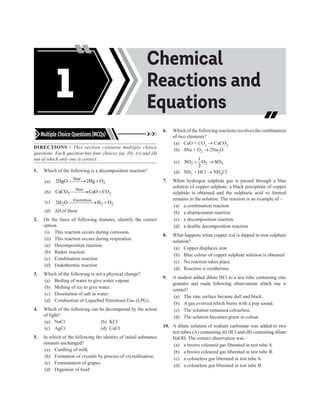
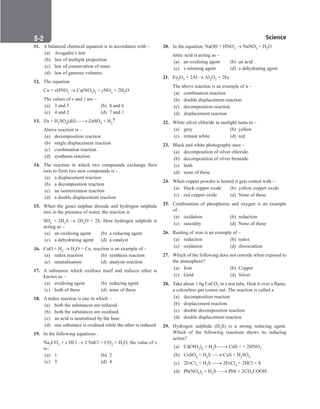
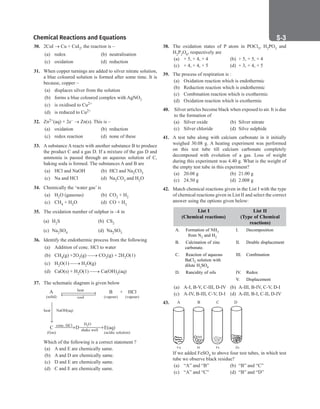
![S-4 Science
DIRECTIONS : Study the given case/passage and answer the
following questions.
Case/Passage - 1
The reaction between MnO2 with HCl is depicted in the
following diagram. It was observed that a gas with bleaching
abilities was released . [From CBSE Question Bank-2021]
MnO (s)
2
Reactants
HCl (aq)
Products
44. The chemical reaction between MnO2 and HCl is an
example of:
(a) displacement reaction
(b) combination reaction
(c) redox reaction
(d) decomposition reaction.
45. Chlorine gas reacts with _____ to form bleaching powder.
(a) dry Ca(OH)2
(b) dil. solution of Ca(OH)2
(c) conc. solution of Ca(OH)2
(d) dry CaO
46. Identify the correct statement from the following:
(a) MnO2 is getting reduced whereas HCl is getting
oxidized
(b) MnO2 is getting oxidized whereas HCl is getting
reduced.
(c) MnO2 and HCl both are getting reduced.
(d) MnO2 and HCl both are getting oxidized.
47. In the above discussed reaction, what is the nature of
MnO2?
(a) Acidic oxide (b) Basic oxide
(c) Neutral oxide (d) Amphoteric oxide
48. What will happen if we take dry HCl gas instead of
aqueous solution of HCl?
(a) Reaction will occur faster.
(b) Reaction will not occur.
(c) Reaction rate will be slow.
(d) Reaction rate will remain the same.
Case/Passage - 2
Chemistry in Automobiles:
For an internal combustion engine to move a vehicle down
the road, it must convert the energy stored in the fuel into
mechanical energy to drive the wheels. In your car, the
distributor and battery provide this starting energy by creating
an electrical “spark”, which helps in combustion of fuels like
gasoline. Below is the reaction depicting complete combustion
of gasoline in full supply of air:
[From CBSE Question Bank-2021]
2C8H18(I) + 25O2(g) → 16 ‘X’ + Y
49. Which of the following are the products obtained from the
reaction mentioned in the above case?
Product ‘X’ Product ‘Y’
(a) CO2 H2O2
(b) H2O CO
(c) CH3OH H2O
(d) CO2 H2O
50. Identify the types of chemical reaction occurring during
the combustion of fuel:
(a) Oxidation Endothermic reaction
(b) Decomposition Exothermic reaction
(c) Oxidation Exothermic reaction
(d) Combination Endothermic reaction
51. On the basis of evolution/absorption of energy, which of
the following processes are similar to combustion of fuel?
(i) Photosynthesis in plants
(ii) Respiration in the human body
(iii) Decomposition of vegetable matter
(iv) Decomposition of ferrous sulphate.
(a) (ii) (iii) (b) (i) (ii)
(c) (iii) (iv) (d) (ii) (i)
52. ‘A student while walking on the road observed that a
cloud of black smoke belched out from the exhaust stack
of moving trucks on the road.’ Choose the correct reason
for the production of black smoke:
(a) Limited supply of air leads to incomplete combustion
of fuel.
(b) Rich supply of air leads to complete combustion of
fuel.
(c) Rich supply of air leads to a combination reaction.
(d) Limited supply of air leads to complete combustion
of fuel.
53. ‘Although nitrogen is the most abundant gas in the
atmosphere, it does not take part in combustion’. Identify
the correct reason for this statement.
(a) Nitrogen is a reactive gas
(b) Nitrogen is an inert gas
(c) Nitrogen is an explosive gas
(d) Only hydrocarbons can take part in combustion](https://image.slidesharecdn.com/x-science-1700objectives-chaperwise1-250221092901-98cb0b3f/85/X-Science-1700-objectives-Chaper-wise-pdf-6-320.jpg)
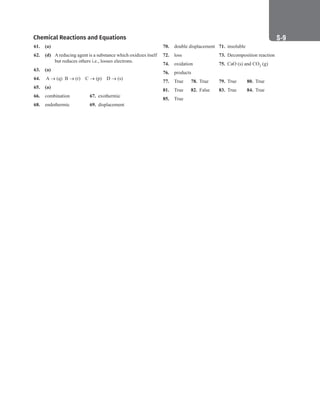
![S-12 Science
33. An element X reacts with dilute H2SO4 as well as with
NaOH to produce salt and H2(g). Hence, it may be
concluded that:
I. X is an electropositive element.
II. oxide of X is basic in nature.
III. oxide of X is acidic in nature.
IV. X is an electronegative element.
(a) I, II, III (b) IV, I, II
(c) III, IV, I (d) II, III, IV
34. The turmeric solution will turn red by an aqueous solution
of -
(a) potassium acetate (b) copper sulphate
(c) sodium sulphate (d) ferric chloride
35. The correct order of increasing pH values of the aqueous
solutions of baking soda, rock salt, washing soda and
slaked lime is
(a) Baking Soda Rock Salt Washing Soda Slaked
lime
(b) Rock Salt Baking Soda Washing Soda Slaked
lime
(c) Slaked lime Washing Soda Rock Salt Baking
Soda
(d) Washing Soda Baking Soda Rock Salt Slaked
lime
36. You are provided with aqueous solutions of three salts —
A, B and C, 2-3 drops of blue litmus solution, red litmus
solution and phenolphthalein were added to each of these
solution in separate experiments. The change in colours
of different indicators were recorded in the following
table:
Sample With blue
litmus
solution
With red
litmus
solution
With
phenolphtha-
lein
solution
A No change No change No change
B Turns red No change No change
C No change Turns blue Turns pink
On the basis of above observations, identify A, B, and C
from the following options:
(a) A = NH4 Cl, B = NaCl, C = CH3COONa
(b) A = NH4 Cl, B = CH3 COONa, C = NaCl
(c) A = NaCl, B = NH4 Cl, C = CH3 COONa
(d) A = CH3 COONa, B = NH4 Cl, C = NaCl
37. Aqua regia is the mixture of conc. HCl and conc. HNO3
in the ratio:
(a) 1 : 3 (b) 2 : 3
(c) 3 : 1 (d) 3 : 2
38. The chemical formula of ‘Plaster of Paris’ is
(a) 4 2
1
CaSO . H O
2
(b) CaSO4.2H2O
(c) CaSO4.H2O (d) 4 2
3
CaSO . H O
2
39. A solution turns red litmus blue. Its pH is likely to be –
(a) 2 (b) 4
(c) 5 (d) 10
40. A solution reacts with crushed egg-shells to give a gas
that turns lime water milky. The solution contains –
(a) NaCl (b) HCl
(c) LiCl (d) KCl
41. 10 mL of a solution of NaOH is found to be completely
neutralised by 8 mL of a given solution of HCl. If we take
20 mL of the same solution of NaOH, the amount of
HCl solution (the same solution as before) required to
neutralise will be –
(a) 4 mL (b) 8 mL
(c) 12 mL (d) 16 mL
42. Which of the following type of medicines is used for
treating indigestion ?
(a) Antibiotic (b) Analgesic
(c) Antacid (d) Antiseptic
43. Which of the following reaction does not results in the
evolution of H2 gas?
(a) dilute sulphuric acid reacts with zinc granules.
(b) dilute hydrochloric acid reacts with magnesium ribbon.
(c) dilute sulphuric acid reacts with aluminium powder.
(d) dilute hydrochloric acid with diute sodium hydroxide
solution.
DIRECTIONS : Study the given case/passage and answer the
following questions.
Case/Passage - 1
Marble’s popularity began in ancient Rome and Greece, where
white and off-white marble were used to construct a variety
of structures, from hand-held sculptures to massive pillars and
buildings.
[From CBSE Question Bank-2021]](https://image.slidesharecdn.com/x-science-1700objectives-chaperwise1-250221092901-98cb0b3f/85/X-Science-1700-objectives-Chaper-wise-pdf-14-320.jpg)
![Acids, Bases and Salts S-13
44. The substance not likely to contain CaCO3 is
(a) Dolomite (b) A marble statue
(c) Calcined gypsum (d) Sea shells.
45. A student added 10g of calcium carbonate in a rigid
container, secured it tightly and started to heat it. After
some time, an increase in pressure was observed, the
pressure reading was then noted at intervals of 5 mins
and plotted against time, in a graph as shown below.
During which time interval did maximum decomposition
took place?
1.25
1.00
0.75
0.50
0.25
Pressure
(atm)
(a) 15-20 min (b) 10-15 min
(c) 5-10 min (d) 0-5 min
46. Gas A, obtained above is a reactant for a very important
biochemical process which occurs in the presence of
sunlight. Identify the name of the process -
(a) Respiration (b) Photosynthesis
(c) Transpiration (d) Photolysis
47. Marble statues are corroded or stained when they
repeatedly come into contact with polluted rain water.
Identify the main reason.
(a) decomposition of calcium carbonate to calcium
oxide
(b) polluted water is basic in nature hence it reacts with
calcium carbonate
(c) polluted water is acidic in nature hence it reacts with
calciumcarbonate
(d) calcium carbonate dissolves in water to give calcium
hydroxide.
48. Calcium oxide can be reduced to calcium, by heating
with sodium metal. Which compound would act as an
oxidizing agent in the above process?
(a) sodium (b) sodium oxide
(c) calcium (d) calcium oxide
Case/Passage - 2
Frothing in Yamuna:
The primary reason behind the formation of the toxic foam is
high phosphate content in the wastewater because of detergents
used in dyeing industries, dhobi ghats and households.
Yamuna’s pollution level is so bad that parts of it have been
labelled ‘dead’ as there is no oxygen in it for aquatic life to
survive.
[From CBSE Question Bank-2021]
49. Predict the pH value of the water of river Yamuna if the
reason for froth is high content of detergents dissolved in
it.
(a) 10-11 (b) 5-7
(c) 2-5 (d) 7
50. Which of the following statements is correct for the water
with detergents dissolved in it?
(a) low concentration of hydroxide ion (OH– )and high
concentration of hydronium ion (H3O+)
(b) high concentration of hydroxide ion (OH–)and low
concentration of hydronium ion (H3O+)
(c) high concentration of hydroxide ion (OH–) as well
as hydronium ion (H3O+)
(d) equal concentration of both hydroxide ion (OH–)
and hydronium ion (H3O+).
The table provides the pH value of four solutions P, Q, R
and S
Solution pH value
P 2
Q 9
R 5
S 11
51. Which of the following correctly represents the solutions
in increasing order of their hydronium ion concentration?
(a) P Q R S (b) P S Q R
(c) S Q R P (d) S P Q R
52. High content of phosphate ion in river Yamuna may lead to:
(a) decreased level of dissolved oxygen and increased
growth of algae
(b) decreased level of dissolved oxygen and no effect of
growth of algae](https://image.slidesharecdn.com/x-science-1700objectives-chaperwise1-250221092901-98cb0b3f/85/X-Science-1700-objectives-Chaper-wise-pdf-15-320.jpg)
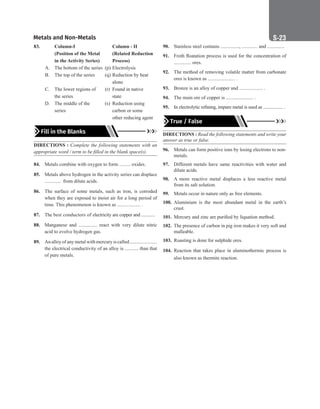
![Science
S-28
27. The diagram below represents a group of organs in the
human body. Urine leaves the urinary bladder by passing
through this structure labelled
A
B
C
D
(a) A (b) B
(c) C (d) D
28. Given alongside is a sketch of a leaf partially covered with
black paper and which is to be
used in the experiment to show
that light is compulsory for the
process of photosynthesis. At the
end of the experiment, which one
of the leaf parts labelled I, II and
III will become black when
dipped in iodine solution?
(a) I only (b) II only
(c) I and III (d) II and III
29. The phenomenon of normal breathing in a human being
comprises.
(a) an active inspiratory and a passive expiratory phase.
(b) a passive inspiratory and an active expiratory phase.
(c) both active inspiratory and expiratory phases.
(d) both passive inspiratory and expiratory phases.
30. Filteration unit of kidney is
(a) ureter (b) urethra
(c) neuron (d) nephron
31. A column of water within xylem vessels of tall trees does
not break under its weight because of:
(a) Tensile strength of water
(b) Lignification of xylem vessels
(c) Positive root pressure
(d) Dissolved sugars in water
32. Roots play insignificant role in absorption of water in:
(a) Pistia (b) Pea
(c) Wheat (d) Sunflower
33. Which of the following statements is not correct?
(a) Goblet cells are present in the mucosa of intestine
and secrete mucus.
(b) Oxyntic cells are present in the mucosa of stomach
and secrete HCl.
(c) Acini are present in the pancreas and secrete
carboxypeptidase.
I
II
III
(d) Brunner’s glands are present in the submucosa of
stomach and secrete pepsinogen.
34. Human urine is usually acidic because
(a) excreted plasma proteins are acidic.
(b) potassium and sodium exchange generates acidity.
(c) hydrogen ions are actively secreted into the filtrate.
(d) the sodium transporter exchanges one hydrogen ion
for each sodium ion in peritubular capillaries.
35. Which one of the following animals has two separate
circulatory pathways?
(a) Lizard (b) Whale
(c) Shark (d) Frog
36. Cow has a special stomach as compared to that of a lion
in order to
(a) absorb food in better manner.
(b) digest cellulose present in the food.
(c) assimilate food in a better way.
(d) absorb large amount of water.
37. Which of the following is not an enzyme?
(a) Lipase (b) Amylase
(c) Trypsin (d) Bilirubin
38. Pancreatic juice contains more than one enzyme. Which
among the following combination is correct?
(a) Pepsin and Lipase
(b) Amylase and Pepsin
(c) Pepsin and Trypsin
(d) Trypsin and Lipase
39. Observe the experimental sets [A] [B].
Observe the test tube A B. From the list given below,
choose the combination of responses of shoot and root
that are observed in B.
Test tube
Water
Cotton
Plug
Plant
(A) (B)
Day 1
Day 5
(a) Positive phototropism and positive geotropism
(b) Negative phototropism and positive geotropism
(c) Positive phototropism and negative geotropism
(d) Only negative phototropism](https://image.slidesharecdn.com/x-science-1700objectives-chaperwise1-250221092901-98cb0b3f/85/X-Science-1700-objectives-Chaper-wise-pdf-30-320.jpg)
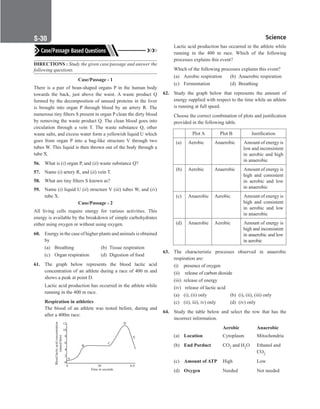
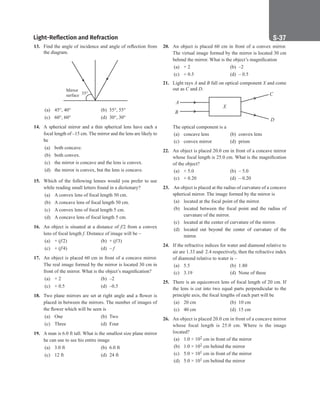
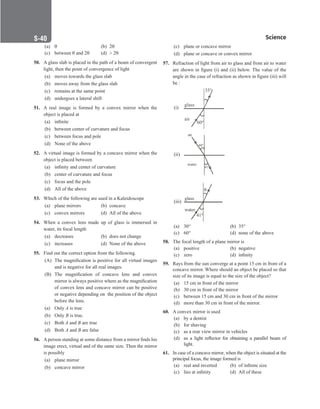
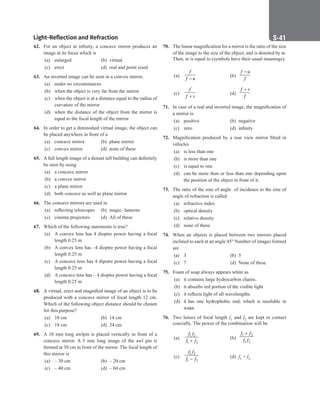
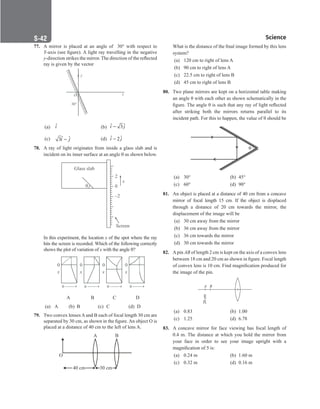
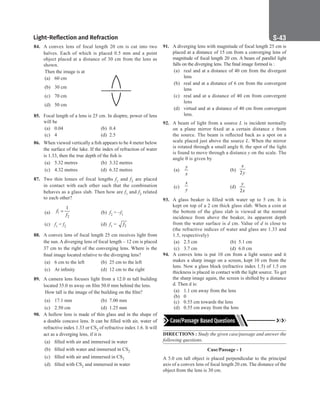
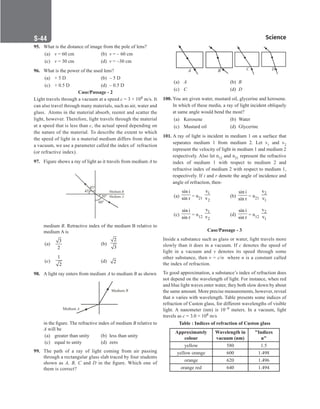
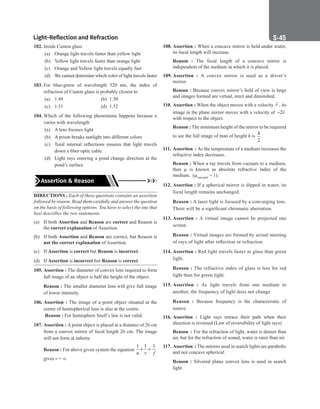
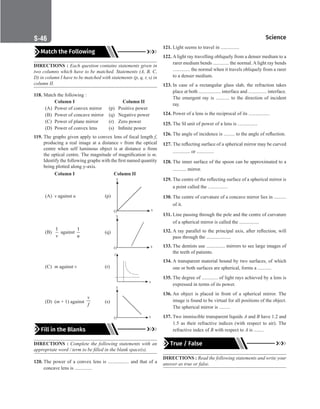
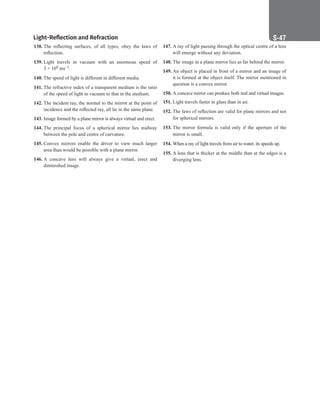
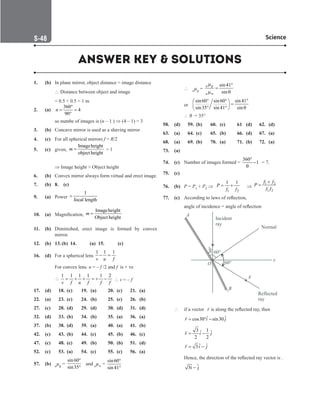
![Light-Reflection and Refraction S-49
78. (a) Angle of incidence, i = 90° – θ, decreases with
increase in θ upto angle of incidence i = critical
angle reflection takes place so x is positive and
beyond the critical angle refraction takes place so x
is negative.
Hence graph ‘A’correctly depicts variation of x with
the angle θ.
79. (c) For lens A,
1 1 1
–
f v u
=
⇒
1 1 1
– –
30 40
v
=
40 cm 30 cm
O
A B
⇒
1 1 1
30 40
v
= +
=
4 – 3 1
120 120
= or, v = 120 cm.
For lens B, u = 90 cm[u = 120 – 30]
1 1 1
–
f v u
= ⇒
1 1 1
–
30 90
v
=
1 1 1
30 90
v
= + =
3 1
90
+
or, v = 22.5 cm
Which is positive so that it is 22.5 cm from lens B.
80. (d) Two mirrors are inclined at an angle, θ = ?
According to question, emergent ray is parallel to
incident ray
∴ deviation angle δ = 180°
But δ = 360° – 2θ
or, 360° – 2θ = 180°
or, 2θ = 180°
∴ θ = 90°
81. (b)
O 40 cm
f = 15 cm
Using mirror formula,
1
1 1 1
f v u
= +
1
1 1 1
–
15 v u
= + ⇒
1
1 1 1
–15 40
v
= +
∴ v1 = –24 cm
When object is displaced by 20 cm towards mirror
Now, u2 = –20
So,
2 2
1 1 1
f v u
= +
2
1 1 1
–
–15 20
v
= ⇒
2
1 1 1
–
20 15
v
=
∴ v2 = –60 cm
Therefore image shifts away from mirror by
= 60 – 24 = 36 cm
82. (c) For the end B, image distance of end B will be,
f = 10 cm
uB = –18 cm
vB = image distance of end B
As we know,
1
f
=
1 1
B B
v u
−
1
B
v =
1 1
B
f u
+
1
B
v =
1 1 8
10 18 180
− =
vB =
180
8
⇒ 22.5 cm
Similarly, for the end A, image distance of end A
will be,
f = 10 cm
uA = –20 cm
vA = image distance of end A
1
f
=
1 1
A A
v u
−
1
A
v
=
1 1
A
f u
+
1
A
v
=
1 1 1
10 20 20
− =
vA = 20 cm
So, length of image A’B’ = (vB – vA)
= 22.5 – 20 = 2.5 cm
So magnification, m =
A B
AB
′ ′
⇒
2.5
2
= 1.25
83. (c) 5 5
v
v u
u
+ =
− ⇒ =
−
Using ⇒
1 1 1
v u f
+ = ⇒
1 1 1
5 0.4
u u
−
+ =
−
∴ u = – 0.32 m.](https://image.slidesharecdn.com/x-science-1700objectives-chaperwise1-250221092901-98cb0b3f/85/X-Science-1700-objectives-Chaper-wise-pdf-51-320.jpg)
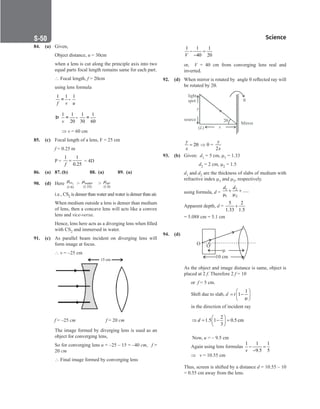
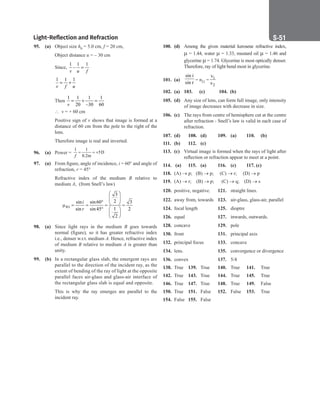
![Multiple Choice Questions (MCQs)
DIRECTIONS : This section contains multiple choice
questions. Each question has four choices (a), (b), (c) and (d)
out of which only one is correct.
1. The human eye possesses the power of accommodation.
This is the power to :
(a) alter the diameter of the pupil as the intensity of
light changes
(b) distinguish between lights of different colours
(c) focus objects at different distances
(d) decide which of the two objects is closer.
2. How does the eye change in order to focus on near or
distant objects?
(a) The lens moves in or out
(b) The retina moves in or out
(c) The lens becomes thicker or thinner
(d) The pupil gets larger or smaller
3. Which of the following changes occur when you walk out
of bright sunshine into a poorly lit room?
(a) The pupil becomes larger
(b) The lens becomes thicker
(c) The ciliary muscle relaxes
(d) The pupil becomes smaller
4. A person got his eyes tested. The optician’s prescription
for the spectacles reads:
Left eye : – 3.00 D Right eye : – 3.50 D
The person is having a defect of vision called :
(a) presbyopia (b) myopia
(c) astigmatism (d) hypermetropia
5. A student sitting on the last bench in the class cannot read
the writing on the blackboard clearly but he can read the
book lying on his desk clearly. Which of the following
statement is correct about the student?
(a) The near point of his eyes has receded away.
(b) The near point of his eyes has come closer to him.
(c) The far point of his eyes has receded away.
(d) The far point of his eyes has come closer to him.
6. Aman driving a car can read a distant road sign clearly but
finds difficulty in reading the odometer on the dashboard
of the car. Which of the following statement is correct
about this man?
(a) The near point of his eyes has receded away.
(b) The near point of his eyes has come closer to him.
(c) The far point of his eyes has receded away.
(d) The far point of his eyes has come closer to him.
7. Which of the following is not caused by the atmospheric
refraction of light?
(a) Twinkling of stars at night
(b) Sun appearing higher in the sky than it actually is
(c) Sun becoming visible two minutes before actual
sunrise
(d) Sun appearing red at sunset
8. The sky appears dark to passengers flying at very high
altitudes mainly because : [CBSE 2020]
(a) Scatterings of light is not enough at such heights.
(b) There is no atmosphere at great heights.
(c) The size of molecules is smaller than the wavelength
of visible light.
(d) The light gets scattered towards the earth.
9. A near sighted person cannot see distinctly beyond 50 cm
from his eye. The power in diopter of spectacle lenses
which will enable him to see distant objects clearly is
(a) +50 (b) –50
(c) +2 (d) –2
Acids, Bases and
Salts
The Human
Eye and the
Colourful World
6](https://image.slidesharecdn.com/x-science-1700objectives-chaperwise1-250221092901-98cb0b3f/85/X-Science-1700-objectives-Chaper-wise-pdf-54-320.jpg)
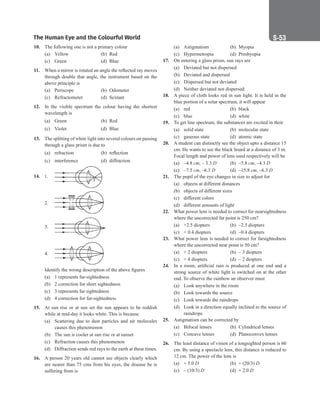
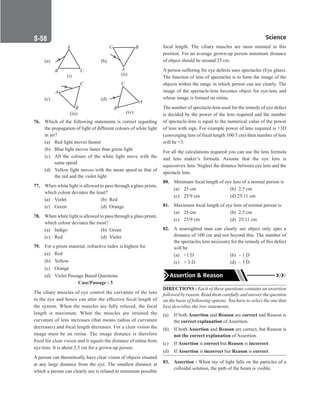
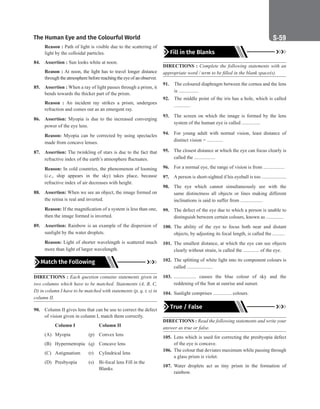
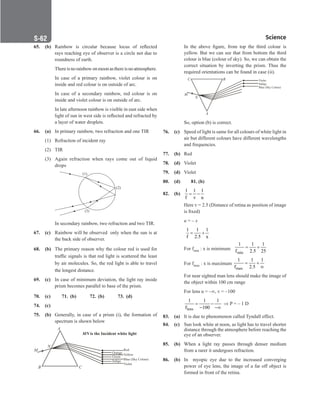
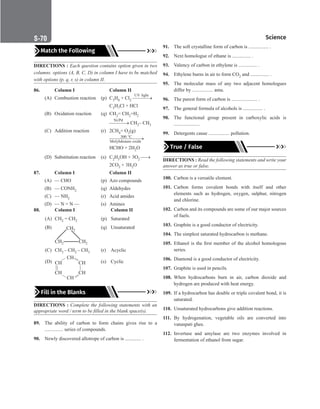
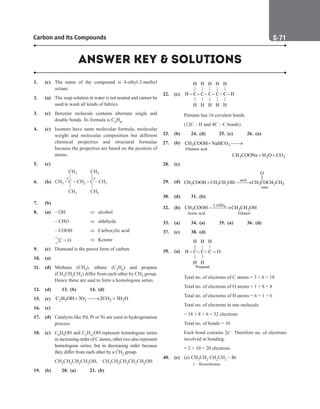
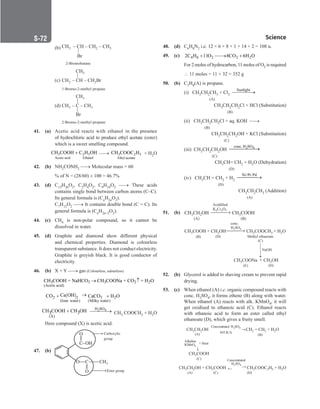
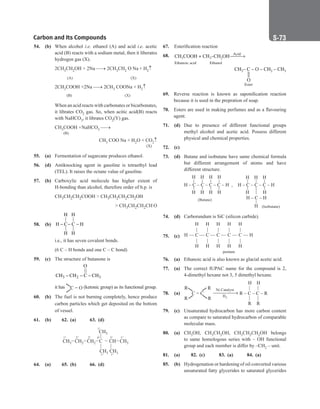

![Periodic Classification of Elements S-79
72. Consider the elements A, B, C and D with atomic
numbers 11, 12, 16 and 17, respectively. Which among
the following statements regarding these elements are
correct?
I. The element C will gain electron more easily than
element D.
II. The element B tends to lose electron more readily
than C.
III. The oxide of A will be least basic while that of D
will be most basic.
IV. The energy required to remove an electron from
outermost shell from A will be minimum while that
from D will be maximum.
(a) I and III only (b) I and IV only
(c) II and III only (d) II and IV only
73. Which of the following is the correct order of reactivity
of metals?
(a) Mg Al Zn Fe
(b) Mg Zn Fe Al
(c) Al Mg Zn Fe
(d) Mg Zn Al Fe
74. The following is the correct decreasing order of the ionic
radii-
(a) K+ Ca2+ S2– Cl–
(b) K+ Ca2+ Cl– S2–
(c) Ca2+ K+ Cl– S2–
(d) S2– Cl– K+ Ca2+
75. Electro-negativity of the following elements increase in
the order:
(a) C, N, Si, P (b) Si, P, C, N
(c) P, Si, N, C (d) N, Si, C, P
76. Which of the following statements is not a correct
statement about the trends when going from left to right
across the periods of periodic table.
(a) The elements become less metallic in nature.
(b) The number of valence electrons increases.
(c) The atoms lose their electrons more easily.
(d) The oxides become more acidic.
77. Element X forms a chloride with the formula XCl2,
which is a solid with a high melting point? X would
most likely be in the same group of the periodic table
as :
(a) Na (b) Mg
(c) Al (d) Si
DIRECTIONS : Study the given case/passage and answer the
following questions.
Case/Passage - 1
Metallic Character The ability of an atom to donate electrons
and form positive ion (cation) is known as electropositivity
or metallic character. Down the group, metallic character
increases due to increase in atomic size and across the period,
from left to right electropositivity decreases due to decrease
in atomic size. Non-Metallic Character The ability of an atom
to accept electrons to form a negative ion (anion) is called
non-metallic character or electronegativity. The elements
having high electro-negativity have a higher tendency to gain
electrons and form anion. Down the group, electronegativity
decreases due to increase in atomic size and across the period,
from left to right electronegativity increases due to decrease in
atomic size.
300
Li(152)
Na(186)
K(231) Rb(244)
Cs(262)
F(72)
Cl(99) Br(114)
I(133)
250
200
150
100
50
Atomic number (Z)
Atomic
radius/pm
78. Whichofthefollowingcorrectlyrepresentsthedecreasing
order of metallic character of Alkali metals plotted in the
graph? [CBSE Sample Issued 2021]
(a) Cs Rb Li Na K
(b) K Rb Li Na Cs
(c) Cs Rb K Na Li
(d) Cs K Rb Na Li
79. Hydrogen is placed along with Alkali metals in the
modern periodic table though it shows non-metallic
character
(a) as Hydrogen has one electron readily loses
electron to form negative ion
(b) as Hydrogen can easily lose one electron like alkali
metals to form positive ion
(c) as Hydrogen can gain one electron easily like
Halogens to form negative ion
(d) as Hydrogen shows the properties of non-metals
80. Which of the following has highest electronegativity?
(a) F (b) Cl
(c) Br (d) I](https://image.slidesharecdn.com/x-science-1700objectives-chaperwise1-250221092901-98cb0b3f/85/X-Science-1700-objectives-Chaper-wise-pdf-81-320.jpg)
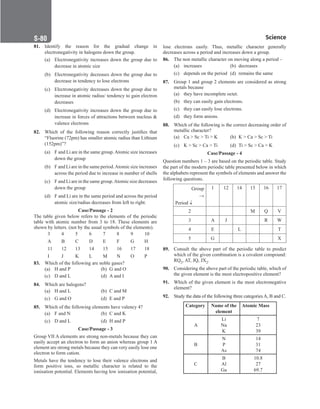
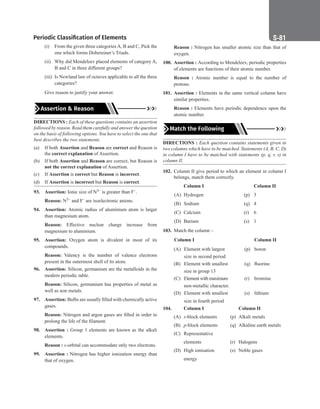
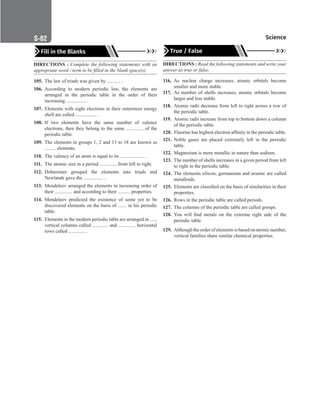
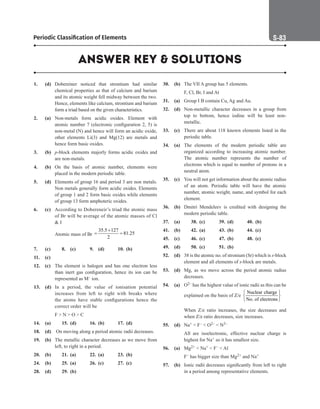
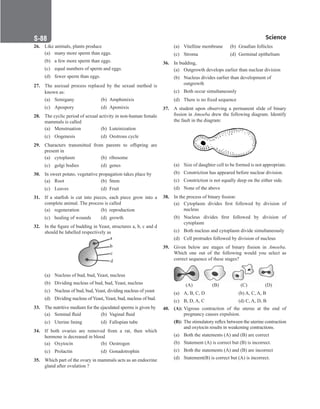
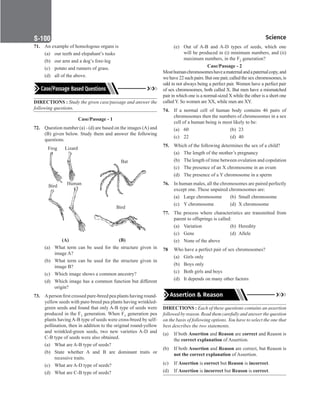
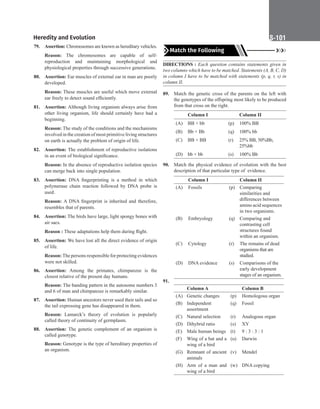
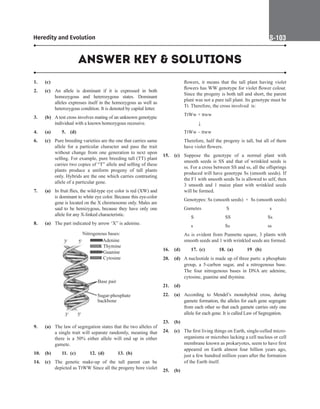
![Multiple Choice Questions (MCQs)
DIRECTIONS : This section contains multiple choice
questions. Each question has four choices (a), (b), (c) and (d)
out of which only one is correct.
1. The charge of 150 coulomb flows through a wire in one
minute. What is the electric current flowing through it?
(a) 2.5 A (b) 3.5 A
(c) 4.5 A (d) 5.5 A
2. Find the current I flown in the circuit
(a) 0.05 A
(b) 5 A
(c) 50 A
(d) 500 A
3. A current of 10 A flows through a conductor for 2
minutes. What is the amount of charge passed through the
conductor?
(a) 1200 C (b) 150 C
(c) 18 C (d) 1.8 C
4. Acurrent of 10Aflows through a conductor for 2 minutes.
Find the total number of electrons flowing through the
conductor.
(a) 75 × 1020 (b) 70 × 1015
(c) 60 × 1015 (d) 11 × 1012
5. A metal wire 80 cm long and 1.00 mm2 in cross-section
has a resistance of 0.92 ohm. It’s resistivity is:
(a) 0.000 115 ohm m (b) 0.0 115 ohm m
(c) 1.15 ohm m (d) None of these
6. 1 Ampere is equivalent to:
(a)
1coulomb
1sec
(b)
1volt
1sec
(c)
1volt meter
1sec
(d) None
30
I
1.5 V
7. Device used to measure electric current is:
(a) Ammeter (b) Voltmeter
(c) Galvanometer (d) Generator
8. Reciprocal of resistance is called:
(a) Inductance (b) Conductance
(c) Resistivity (d) None of these
9. Find the equivalent resistance between A and B of
following circuit:
5 6
C
5
6 D
B
A
(a)
6
2
Ω (b)
5
2
Ω
(c)
11
2
Ω (d)
1
2
Ω
10. The maximum resistance which can be made using four
resistors each of resistance
1
2
W is [CBSE 2020]
(a) 2W (b) 1 W
(c) 2.5 W (d) S W
11. A current of 1 A is drawn by a filament of an electric bulb.
Number of electrons passing through a cross section of
the filament in 16 seconds would be roughly
(a) 1020 (b) 1016
(c) 1018 (d) 1023
12. The proper representation of series combination of cells
(Figure) obtaining maximum potential is
(i)
(ii)
Acids, Bases and
Salts
Electricity
11](https://image.slidesharecdn.com/x-science-1700objectives-chaperwise1-250221092901-98cb0b3f/85/X-Science-1700-objectives-Chaper-wise-pdf-109-320.jpg)
![Science
S-108
(iii)
(iv)
(a) (i) (b) (ii)
(c) (iii) (d) (iv)
13. A cylindrical conductor of length l and uniform area of
crosssection A has resistance R. Another conductor of
length 2l and resistance R of the same material has area
of cross section [CBSE 2020]
(a) A/2 (b) 3A/2
(c) 2A (d) 3A
14. If ‘i’ is the current flowing through a conductor of
resistance ‘R’ for time ‘t’. then the heat produced (Q) is
given by
(a)
2
i R
t
(b)
2
iR
t
(c) i2Rt (d) iRt2
15. An electric kettle consumes 1 kW of electric power when
operated at 220 V. A fuse wire of what rating must be
used for it?
(a) 1 A (b) 2 A
(c) 4 A (d) 5 A
16. A cylindrical rod is reformed to twice its length with no
change in its volume. If the resistance of the rod was R,
the new resistance will be
(a) R (b) 2R
(c) 4R (d) 8R
17. What is the current through a 5.0 ohm resistor if the
voltage across it is 10V
(a) zero (b) 0.50 A
(c) 2.0 A (d) 5.0 A
18. The length of a wire is doubled and the radius is doubled.
By what factor does the resistance change
(a) 4 times as large (b) twice as large
(c) unchanged (d) half as large
19. Resistance of a metallic conductor depends on _______.
(a) its length (b) its area of cross section
(c) its temperature (d) All the above
20. A 24V potential difference is applied across a parallel
combination of four 6 ohm resistor. The current in each
resistor is
(a) 1 A (b) 4 A
(c) 16 A (d) 36 A
21. Three resistances of 2Ω, 3Ω and 5Ω are connected in
parallel to a 10V battery of negligible internal resistance.
The potential difference across the 3Ω resistance will be
(a) 2 V (b) 3 V
(c) 5 V (d) 10 V
22. Two unequal resistances are connected in parallel. Which
of the following statement is true
(a) current in same in both
(b) current is larger in higher resistance
(c) voltage-drop is same across both
(d) voltage-drop is lower in lower resistance
23. You are given n identical wires, each of resistance R.
When these are connected in parallel, the equivalent
resistance is X. When these will be connected in series,
then the equivalent resistance will be
(a) X/n2 (b) n2X
(c) X/n (d) nX
24. A piece of wire of resistance R is cut into five equal
parts. These parts are then connected in parallel. If the
equivalent resistance of this combination is R’, then the
ratio R/R’ is
(a) 1/25 (b) 1/5
(c) 5 (d) 25
25. 2 ampere current is flowing through a conductor from a
10 volt emf source then resistance of conductor is
(a) 20 Ω (b) 5 Ω
(c) 12 Ω (d) 8 Ω
26. Charge on an electron is 1.6 × 10⁻¹⁹ coulomb. Number of
electrons passing through the wire per second on flowing
of 1 ampere current through the wire will be
(a) 0.625 × 10⁻¹⁹ (b) 1.6 × 10⁻¹⁹
(c) 1.6 × 10⁻¹⁹ (d) 0.625 × 10¹⁹
27. 20 coulomb charge is flowing in 0.5 second from a point
in an electric circuit then value of electric current in
amperes will be
(a) 10 (b) 40
(c) 0.005 (d) 0.05
28. In this circuit, the value of I2 is
(a) 0.2 A
(b) 0.3 A
(c) 0.4 A
(d) 0.6 A
29. A letter ‘A’ is constructed of a uniform wire of resistance
1 ohm per cm. The sides of the letter are 20 cm and the
cross piece in the middle is 10 cm long. The resistance
between the ends of the legs will be
(a) 32.4 ohm (b) 28.7 ohm
(c) 26.7 ohm (d) 24.7 ohm
10
I1
I2
I3
1.2A 15
30](https://image.slidesharecdn.com/x-science-1700objectives-chaperwise1-250221092901-98cb0b3f/85/X-Science-1700-objectives-Chaper-wise-pdf-110-320.jpg)
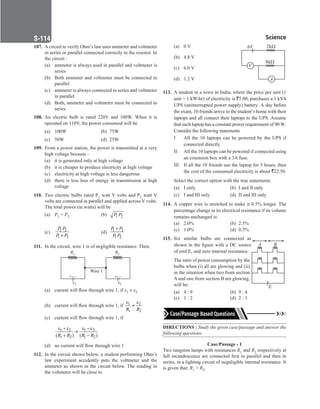
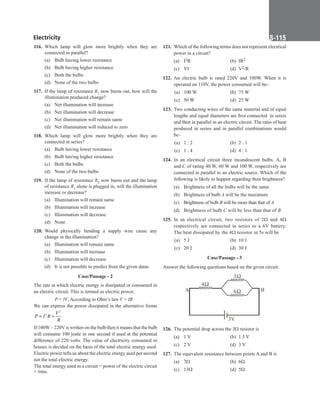
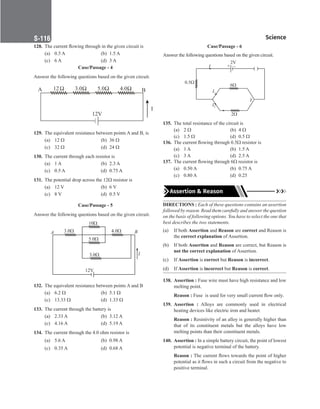
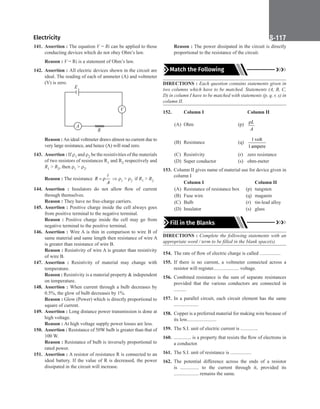
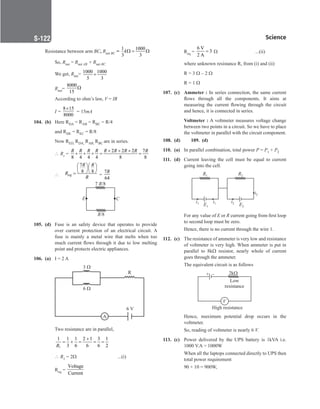
![Electricity S-123
So battery (UPS) can provide power to all laptops.
If all laptops are used for 5 hours, then cost of
electricity consumed as the cost of electricity is
`5.00 per unit.
= 6
900 5 3600
3.6 10
× ×
×
× 5 = 22.5
114. (c) Resistance, R
A
ρ
=
2
R
A V
ρ
=
ρ × =
[Q Volume (V) = Al]
Since resistivity and volume remains constant
therefore % change in resistance
2
2 (0.5) 1%
R
R
∆ ∆
= =
× =
115. (b) When all bulbs are glowing
R
R
R
R
R
R
i/3
i/3
i/3
i/3
i/3
E
i/3
2
3 3 3
eq
R R R
R = + =
Power (Pi )
2 2
3
R 2
eq
E E
R
= = …(i)
When two from section A and one from section B
are glowing, then
E
R i
R
R
i/2
i/2
3
2 2
eq
R R
R R
= + =
Power (Pf)
2
2
3
E
R
= …(ii)
Dividing equation (i) by (ii) we get
2
2
3 3
9 : 4
2 2
i
f
P E R
P R E
= =
116. (a) When the lamps are connected in parallel, then
potential difference V across each lamp will be
same and will be equal to potential necessary for
full brightness of each bulb. Because illumination
produced by a lamp is proportional to electric power
consumed in it, and power consumed,
2 2
1 2
1 2
V V
P P
R R
= =
Hence, illumination produced by 2nd bulb will be
higher than produced by lst bulb, i.e., bulb having
lower resistance will shine more brightly.
117. (b) When R1 burns out, then power is dissipated in R2
only. Because internal resistance is quite low in
lighting circuit, potential difference is still equal to
V, hence, power dissipated in 2nd lamp, i.e.,
2 2 2
2 1 2
V V V
R R R
+
i.e., net power consumed initially. In other words,
net illumination will now decrease.
118. (b) When two lamps are connected in series, the
potential difference across each lamp will be
different but current I flowing through each lamp
will be same.
Hence, P1 = I2R1 I2R2 = P2
i.e., illumination produced by lst lamp will be higher
as compared to that produced by 2nd lamp, i.e., lamp
having higher resistance will glow more brightly.
119. (b) When lamp of resistance R2 burns out and only
lamp of resistance R1 is connected in the circuit
then current flowing the circuit will change. Let
new current be I´. Because potential difference still
remains same (due to low internal resistance), hence
I´R1 = I (R1 + R2)
or 1 2
1
( )
I R R
I
R
+
′ =
If P´ is the power consumed, then
2 1 2 1 2
1
1
( )( )
2
R R R R
P I R I
R
+ +
′ ′
= =
When both the lamps were present then total power
consumed was given by:
PS= P1 + P2 = I2 (R1 + R2), i.e., P´ PS
i.e., illumination gets increased when only one bulb
is used.](https://image.slidesharecdn.com/x-science-1700objectives-chaperwise1-250221092901-98cb0b3f/85/X-Science-1700-objectives-Chaper-wise-pdf-125-320.jpg)
![Science
S-124
120. (a) If a water pipe is given bend at some points, then it
definitely reduces the flow of water in the pipe but
this is not true in case of an electric current flowing
in a conductor because electric current is established
in a conductor due to drift motion of electrons in
it along the line of the potential gradient. Hence,
illumination is not affected due to bending along the
length of supply wires.
121. (b) P = VI = V2/R = I2R
122. (d)
2
V
P
R
= ⇒ R =
2
V 220 220
484
P 100
×
= = Ω
2
V
P
R
= =
110 110
25W
484
×
=
123. (c) RS = R1 + R2 = R + R = 2R
P 1 2
1 1 1
R R R
= + =
1 1 2
R R R
+ =
RP = R/2
2
1 P
2
2 S
H V R
H R V
= =
P
S
R R 1
1: 4
R 2 2R 4
= = =
× .
124. (c) The bulb with the highest wattage glows with
maximum brightness. Brightness of bulb B (100 W)
is maximum.
Correct order of brightness will be,
Bulb of 100 W Bulb of 60 W Bulb of 40 W.
125. (c) Given, resistors, R1 = 2Ω and R2 = 4Ω
Voltgage, V = 6 V
2 4
6V
I
Equivalent Resistance,
=
R1 + R2 = 2 + 4 = 6Ω [Series combination]
Current,
6
1A.
6
= = =
V
I
R
Heat dissipated in 4Ω Resistor
=
I2Rt = 1 × 4 × 5 = 20 J
[∵ I = 1A, R = 4Ω, t = 5 sec.]
126. (b) Equivalent resistance of 3Ω and 6Ω =
3 6
2
3 6
×
= Ω
+
as they are in parallel they have same p.d.
3 1
6 2
i= =
P.D. across 1
3 3 1.5 volt
2
Ω= × =
3 V
4 2
127. (b) 128. (a)
129. (d) Given : R1 = 12Ω, R2 = 3.0Ω, R3 = 5.0Ω, R4 = 4.0Ω,
All four resistors are in series combination, so
Rs = R1 + R2 + R3 + R4
= 12W + 3.0W + 5.0W + 4.0W = 24W
130. (c) The current through all resistors in series is the same
12
0.50
24
s
V V V
I A
R R
= = = =
Ω
131. (b) Potential drop across, 12Ω resistor
V = IR = 12Ω (0.5A)
or V = 6V
132. (b) Here we have a variety of series-parallel
combinations.
We follow the general procedures outlined in the text.
The 10 Ω and the 5.0 Ω are in parallel
1
(10 ) (5.0 )
3.33
10 5.0
p
R
Ω Ω
= = Ω
Ω + Ω
A B
I
12 V
3.0 3.3 4.0
3.0
(i) The circuit reduces to figure (a)
Now the 3.33 Ω and the 4.0 Ω are in series.
1
s
R = 3.33W + 4.0W = 7.33W
The circuit reduces to figure (ii)
A B
I
12 V
3.0 7.33
3.0](https://image.slidesharecdn.com/x-science-1700objectives-chaperwise1-250221092901-98cb0b3f/85/X-Science-1700-objectives-Chaper-wise-pdf-126-320.jpg)
![Electricity S-125
(ii) The 7.33 Ω and the 3.0 Ω are in parallel.
2
(7.33 ) (3.0 )
2.13
7.33 3.0
p
R
Ω Ω
= = Ω
Ω + Ω
A B
I
12 V
3.0 2.13
(iii) The circuit reduces to figure (iii).
Finally, the 2.13 Ω and the 3.0 Ω are in series.
2
2.13 3.0 5.13 5.1
= = Ω + Ω
= Ω
= Ω
s
R R
A B
I
12 V
5.13
(iv) The circuit reduces to figure (iv).
133. (a) From Ohm’s law, 12
2.33 2.3
5.13
V V
I A A
R
= = = =
Ω
134. (d) To find the current through the 4.0 ohm resistor, we
need to expand the combinations.
In figure (iii), the current through the 2.13 Ω and 3.0
Ω is the same as the total current, 2.33 A.
The voltage across the 2.13 Ω is then V2.13 = (2.13
Ω) (2.33 A) = 4.96 V.
In figure (ii), the voltage across the 7.33 Ω and 3.0
Ω is the same as that across the 2.13 Ω, 4.96V.
So, the current through the 7.33 Ω is
7.33
4.96
0.677
7.33
V
I A
= =
Ω
In figure (i), the current through the 3.33 Ω and the
4.0 Ω is the same as the current through the 7.33 Ω
Therefore, I4.0 = 0.68 A.
135. (a) E.m.f. of the battery = 2V
Effective resistance of the parallel resistors is given
by R1.
1
1 1 1 1 3 4 2
6 2 6 6 3
R
+
= + = = = ⇒ 1
3
1.5
2
R= = Ω
Total resistance of the circuit, R = 1.5 + 0.5 = 2Ω
136. (a) Main current
2
1
2
V
I A
R
= = =
Current flowing through 0.5Ω resistor = 1A
137. (d) P.D. across the junctions :
V1 = IR1 = 1 × 1.5 = 1.5V
Hence current I1, flowing through 6Ω resistor
1
1
1.5
0.25
6 6
V
I A
= = =
138. (c)
139. (c) Alloys are used in electrical heating device because
they have high resistivity or resistance as compared
to pure metals and high melting point.
140. (c) It is clear that in a battery circuit, the point of lowest
potential is the negative terminal of battery.
and current flows from higher potential to lower
potential.
141. (c) It is common error to say that V = Ri is a statement
of Ohm’s law. The essence of Ohm’s law is that the
value of R is independent of the value of V. The
equation V = Ri is used for finding resistance of all
conducting devices, whether they obey Ohm’s law
or not.
142. (d) (A) will read zero but (V) will read E
143. (d) ρ is the characteristic of the material of resistors. It
does not depend on the length and cross-sectional
area of resistors. But R depends on the length and
the cross-sectional are of the resistor.
So, R1 may be greater than R2 even when r1 ≤ r2.
144. (a) 145. (d)
146. (c) Resistivity is a material property.
147. (c) r = r0(1 + aDT)
148. (b) Glow = Power (P) = I2R
2 2 0.5 1%
dP dI
P I
= = × =
149. (a) Power loss = i²R =
2
P
R
V
[P = Transmitted power]
150. (b)
2
V
P
R
= ;
1
R
P
∝ (same rated voltage)
151. (c) Here,
2
E
P
R
= , so P ∝ R only when I is constant.
Here I increases as R is decreased. Hence the reason
is wrong.](https://image.slidesharecdn.com/x-science-1700objectives-chaperwise1-250221092901-98cb0b3f/85/X-Science-1700-objectives-Chaper-wise-pdf-127-320.jpg)
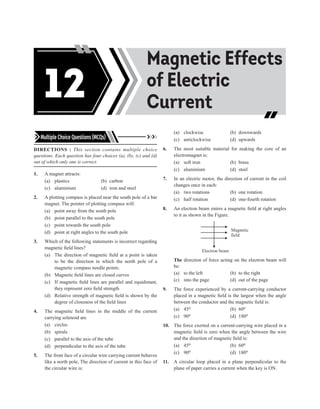
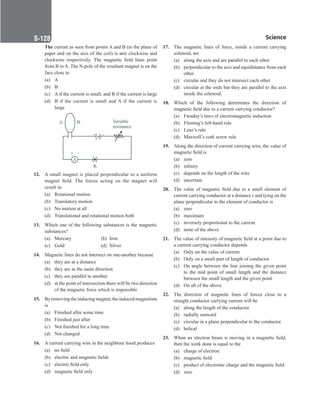
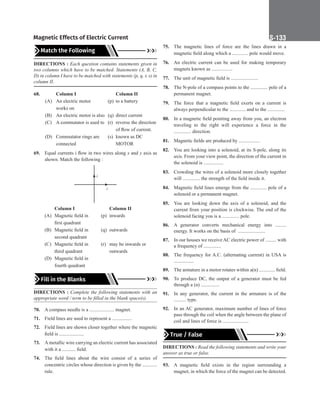
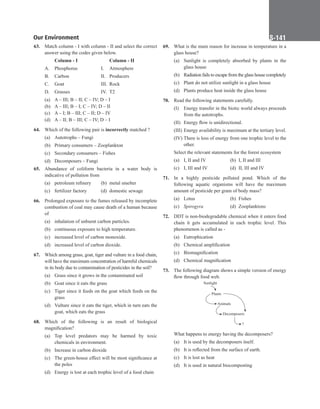
![Science
S-142
74. Whichofthefollowinggroupscontainonlybiodegradable
items ?
(a) Grass, flowers and leather
(b) Grass, wood and plastic
(c) Fruit-peels, cake and lime-juice
(d) Cake, wood and grass
75. Which of the following constitute a food-chain?
(a) Grass, wheat and mango
(b) Grass, goat and human
(c) Goat, cow and elephant
(d) Grass, fish and goat
76. Which of the following are environment-friendly practices?
(a) Carryingcloth-bagstoputpurchasesinwhileshopping.
(b) Switching off unnecessary lights and fans.
(c) Walking to school instead of getting your mother to
drop you on her scooter.
(d) All of the above.
77. Organisms which synthesise carbohydrates from
inorganic compounds using radiant energy are called
(a) decomposers (b) producers
(c) herbivores (d) carnivores
78. Which of the statement is incorrect?
(a) All green plants and blue-green algae are producers.
(b) Green plants get their food from organic compounds.
(c) Producers prepare their own food from inorganic
compounds.
(d) Plants convert solar energy into chemical energy.
79. Which of the following limits the number of trophic
levels in a food chain?
(a) Decrease in energy at higher trophic levels.
(b) Deficient food supply.
(c) Polluted air.
(d) Water.
80. In the given diagram, the various trophic levels are shown
in a pyramid. At which trophic level is maximum energy
available?
(a) T4 (b) T2
(c) T1 (d) T3
81. What will happen if deer is missing in the food chain
given below?
Grass → Deer → Tiger
(a) The population of tiger increases.
(b) The population of grass decreases.
(c) Tiger will start eating grass.
(d) The population of tiger decreases and the population
of grass increases.
DIRECTIONS : Study the given case/passage and answer the
following questions.
Case/Passage - 1
Food chains are very important for the survival of most species.
When only one element is removed from the food chain it can
result in extinction of a species in some cases. The foundation
of the food chain consists of primary producers.
Primary producers, or autotrophs, can use either solar energy
or chemical energy to create complex organic compounds,
whereas species at higher trophic levels cannot and so must
consume producers or other life that itself consumes producers.
Because the sun’s light is necessary for photosynthesis, most
life could not exist if the sun disappeared. Even so, it has
recently been discovered that there are some forms of life,
chemotrophs, that appear to gain all their metabolic energy
from chemosythesis driven by hydrothermal vents, thus
showing that some life may not require solar energy to thrive.
[From CBSE Question Bank-2021]
Food Webs
Secondary
carnivores
Primary
Herbivores
Carnivores](https://image.slidesharecdn.com/x-science-1700objectives-chaperwise1-250221092901-98cb0b3f/85/X-Science-1700-objectives-Chaper-wise-pdf-144-320.jpg)
![Our Environment S-143
82. If 10,000 J solar energy falls on green plants in a
terrestrial ecosystem, what percentage of solar energy
will be converted into food energy?
(a) 10,000 J
(b) 100 J
(c) 1000 J
(d) It will depend on the type of the terrestrial plant.
83. If Ravi is consuming curd/yogurt for lunch, which
trophic level in a food chain he should be considered as
occupying ?
(a) First trophic level (b) Second trophic level
(c) Third trophic level (d) Fourth trophic level
84. The decomposers are not included in the food chain.The
correct reason for the same is because decomposers:
(a) Act at every trophic level of the food chain
(b) Do not breakdown organic compounds
(c) Convert organic material to inorganic forms
(d) Release enzymes outside their body to convert
organic material to inorganic forms
85. Matter and energy are two fundamental inputs of an
ecosystem. Movement of
(a) Energy is bidirectional and matter is repeatedly
circulating.
(b) Energy is repeatedly circulation and matter is
unidirectional.
(c) Energy is unidirectional and matter is repeatedly
circulating.
(d) Energyismultidirectionalandmatterisbidirectional.
86. Which of the following limits the number of trophic
levels in a food chain?
(a) Decrease in energy at higher trophic levels
(b) Less availability of food
(c) Polluted air
(d) Water
Case/Passage - 2
The diagram below shows a food web from the sea shore
dogfish
dogwhelk
mussel peri
barnacle
microscopic animals
crab
[From CBSE Question Bank-2021]
87. The mussel can be described as
(a) Producer (b) Primary consumer
(c) Secondary consumer (d) decomposer
88. Which trophic level is incorrectly defined?
(a) Carnivores – secondary or tertiary consumers
(b) Decomposers – microbial heterotrophs
(c) Herbivores – primary consumers
(d) Omnivores – molds, yeast and mushrooms
89. The given figure best represents:
(a) Grassland food chain (b) Parasitic food chain
(c) Forest food chain (d) Aquatic food chain
90. Why do all food chains start with plants?
(a) Because plants are easily grown
(b) Because plants are nutritious
(c) Because plants can produce its own energy
(d) Because plants do not require energy
91. In the food web, what two organisms are competing for
food?
E
G
D
F
B
C
A
(a) A and B (c) A and C
(b) D and F (d) B and D
92. Consider the following statements concerning food
chains:
(i) Removal of 80% tigers from an area resulted in
greatly increased growth of vegetation
(ii) Removal of most of the carnivores resulted in an
increased population of herbivores.
(iii) The length of the food chains is generally limited to
3 – 4 trophic levels due to energy loss
(iv) The length of the food chains may vary from 2 to 8
trophic levels
Which two of the above statements are correct?
(a) (i), (iv) (b) (i), (ii)
(c) (ii), (iii) (d) (iii), (iv)](https://image.slidesharecdn.com/x-science-1700objectives-chaperwise1-250221092901-98cb0b3f/85/X-Science-1700-objectives-Chaper-wise-pdf-145-320.jpg)
![Science
S-144
93. Which of the following group of organisms are not
included in ecological food chain?
(a) Carnivores (b) Saprophytes
(c) Herbivores (d) Predators
Case/Passage - 3
Biosphere is a global ecosystem composed of living organisms
and abiotic factors from which they derive energy and nutrients.
And ecosystem is defined as structural and functional unit of
the biosphere comprising of living and non-living environment
that interact by means of food chains and chemical cycles
resulting in energy flow, biotic diversity and material cycling
to form a stable, self-supporting system
[From CBSE Question Bank-2021]
94. Which trophic level is incorrectly defined?
(a) Carnivores – secondary or tertiary consumers
(b) Decomposers – microbial heterotrophs
(c) Herbivores – primary consumers
(d) Omnivores – molds, yeast and mushrooms
The diagram below shows a food web from the sea shore
dogfish
dogwhelk
mussel peri
barnacle
microscopic animals
crab
95. The mussel can be described as
(a) Producer
(b) Primary consumer
(c) Secondary consumer
(d) decomposer
96. The given figure best represents:
(a) Grassland food chain (b) Parasitic food chain
(c) Forest food chain (d) Aquatic food chain
Assertion Reason
DIRECTIONS : Each of these questions contains an assertion
followed by reason. Read them carefully and answer the question
on the basis of following options. You have to select the one that
best describes the two statements.
(a) If both Assertion and Reason are correct and Reason is
the correct explanation of Assertion.
(b) If both Assertion and Reason are correct, but Reason is
not the correct explanation of Assertion.
(c) If Assertion is correct but Reason is incorrect.
(d) If Assertion is incorrect but Reason is correct.
97. Assertion: In an ecosystem, the function of producers is
to convert organic compounds into inorganic compounds.
Reason: Green plants, the producers, transduce solar
energy.
98. Assertion: Ecology is study of relationship between
living organisms and their environment.
Reason: The biotic community and non-living environment
of an area function together to form an ecosystem.
99. Assertion: Animals adopt different strategies to survive
in hostile environment.
Reason: Praying mantis is green in colour which merges
with plant foliage.
100. Assertion: Abiotic component of an ecosystem involves
cycling of material and flow of energy.
Reason: This is essential to keep biotic factors alive.
101. Assertion: The crown fires are most destructive as they
burn the tree top.
Reason: Due to crown fire, the temperature of that area
may rise upto 700°C.
102. Assertion: Trophic levels are formed by only plants.
Reason: Food chains and webs are formed due to linked
organisms on the basis of their nutrition.](https://image.slidesharecdn.com/x-science-1700objectives-chaperwise1-250221092901-98cb0b3f/85/X-Science-1700-objectives-Chaper-wise-pdf-146-320.jpg)