
APUSH REVIEW: KEY
CONCEPT 4.3
(REVISED, 2015
EDITION)
EVERYTHING YOU NEED TO KNOW
ABOUT KEY CONCEPT 4.3 TO
SUCCEED IN APUSH
KEY CONCEPT 4.3
▸“The U.S. interest in increasing foreign trade and expanding its
national borders shaped the nation’s foreign policy and
spurred government and private initiatives.”
▸Page 50
▸Big Idea Questions:
▸What was the message of, and impact, of the Monroe
Doctrine?
▸How did westward expansion lead to conflicts over
slavery?
KEY CONCEPT 4.3, I
▸ “Struggling to create an independent global presence,
the United States sought to claim territory throughout
the North American continent and promote foreign
trade.” pf. 50
▸ A) Post-LA Purchase, US sought to increase influence
through:
▸ Exploration: Lewis and Clark
▸ Sought to find a waterway to the Pacific
▸ Gained immense knowledge about the
environment and Natives
▸ Military Actions:
▸ “Aroostock War” - settled ME-Canada boundary
▸ American Indian Removal:
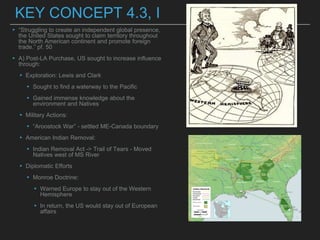
▸ Indian Removal Act -> Trail of Tears - Moved
Natives west of MS River
▸ Diplomatic Efforts
▸ Monroe Doctrine:
▸ Warned Europe to stay out of the Western
Hemisphere
▸ In return, the US would stay out of European
affairs
KEY CONCEPT 4.3, I
▸B) Those living on the frontier tended to favor expansion:
▸More land available for farming
▸Resistance by Native Americans:
▸Black Hawk War (IL) - 1832:
▸Native Americans sought to gain land ceded from 1804 back
▸Seminole Wars (series of wars in early-mid 19th century)
▸1st - Seminole Natives in FL were forced to move to Central
Florida
▸2nd - Federal government sought to remove Seminoles from
Florida
KEY CONCEPT 4.3, II
▸ “The United States’ acquisition of lands in the West gave
rise to contests over the extension of slavery into new
territories.” pg. 51
▸ A) Spread of plantation slavery west of Appalachians:
▸ Deep South - “Cotton Belt” - MS, AL, LA
▸ Many slaveholders moved to more fertile land (cotton,
like tobacco exhausted land)
▸ B) Antislavery efforts increased in the North:
▸ Women’s Rights and Abolitionism were closely linked
▸ Lydia Maria Child - abolitionist and women’s rights
advocate
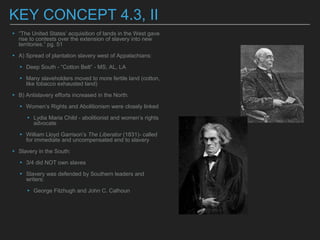
▸ William Lloyd Garrison’s The Liberator (1831)- called
for immediate and uncompensated end to slavery
▸ Slavery in the South:
▸ 3/4 did NOT own slaves
▸ Slavery was defended by Southern leaders and
writers:
▸ George Fitzhugh and John C. Calhoun
KEY CONCEPT 4.3, II
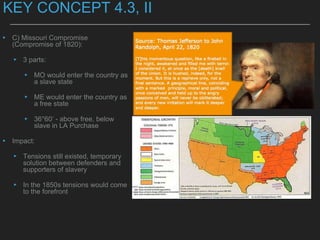
▸ C) Missouri Compromise
(Compromise of 1820):
▸ 3 parts:
▸ MO would enter the country as
a slave state
▸ ME would enter the country as
a free state
▸ 36°60’ - above free, below
slave in LA Purchase
▸ Impact:
▸ Tensions still existed, temporary
solution between defenders and
supporters of slavery
▸ In the 1850s tensions would come
to the forefront
TEST TIPS
▸Multiple-Choice and Short Answer:
▸Examples of US seeking dominance of North America and
Western Hemisphere (Monroe Doctrine)
▸Conflicts with Native Americans
▸Missouri Compromise
▸Essay Questions:
▸Impacts of westward expansion on:
▸Natives
▸Tensions between the North and South

Apush review-key-concept-4.3-revised-2015-edition1

  • 1.
    APUSH REVIEW: KEY CONCEPT4.3 (REVISED, 2015 EDITION) EVERYTHING YOU NEED TO KNOW ABOUT KEY CONCEPT 4.3 TO SUCCEED IN APUSH
  • 2.
    KEY CONCEPT 4.3 ▸“TheU.S. interest in increasing foreign trade and expanding its national borders shaped the nation’s foreign policy and spurred government and private initiatives.” ▸Page 50 ▸Big Idea Questions: ▸What was the message of, and impact, of the Monroe Doctrine? ▸How did westward expansion lead to conflicts over slavery?
  • 3.
    KEY CONCEPT 4.3,I ▸ “Struggling to create an independent global presence, the United States sought to claim territory throughout the North American continent and promote foreign trade.” pf. 50 ▸ A) Post-LA Purchase, US sought to increase influence through: ▸ Exploration: Lewis and Clark ▸ Sought to find a waterway to the Pacific ▸ Gained immense knowledge about the environment and Natives ▸ Military Actions: ▸ “Aroostock War” - settled ME-Canada boundary ▸ American Indian Removal: ▸ Indian Removal Act -> Trail of Tears - Moved Natives west of MS River ▸ Diplomatic Efforts ▸ Monroe Doctrine: ▸ Warned Europe to stay out of the Western Hemisphere ▸ In return, the US would stay out of European affairs
  • 4.
    KEY CONCEPT 4.3,I ▸B) Those living on the frontier tended to favor expansion: ▸More land available for farming ▸Resistance by Native Americans: ▸Black Hawk War (IL) - 1832: ▸Native Americans sought to gain land ceded from 1804 back ▸Seminole Wars (series of wars in early-mid 19th century) ▸1st - Seminole Natives in FL were forced to move to Central Florida ▸2nd - Federal government sought to remove Seminoles from Florida
  • 5.
    KEY CONCEPT 4.3,II ▸ “The United States’ acquisition of lands in the West gave rise to contests over the extension of slavery into new territories.” pg. 51 ▸ A) Spread of plantation slavery west of Appalachians: ▸ Deep South - “Cotton Belt” - MS, AL, LA ▸ Many slaveholders moved to more fertile land (cotton, like tobacco exhausted land) ▸ B) Antislavery efforts increased in the North: ▸ Women’s Rights and Abolitionism were closely linked ▸ Lydia Maria Child - abolitionist and women’s rights advocate ▸ William Lloyd Garrison’s The Liberator (1831)- called for immediate and uncompensated end to slavery ▸ Slavery in the South: ▸ 3/4 did NOT own slaves ▸ Slavery was defended by Southern leaders and writers: ▸ George Fitzhugh and John C. Calhoun
  • 6.
    KEY CONCEPT 4.3,II ▸ C) Missouri Compromise (Compromise of 1820): ▸ 3 parts: ▸ MO would enter the country as a slave state ▸ ME would enter the country as a free state ▸ 36°60’ - above free, below slave in LA Purchase ▸ Impact: ▸ Tensions still existed, temporary solution between defenders and supporters of slavery ▸ In the 1850s tensions would come to the forefront
  • 7.
    TEST TIPS ▸Multiple-Choice andShort Answer: ▸Examples of US seeking dominance of North America and Western Hemisphere (Monroe Doctrine) ▸Conflicts with Native Americans ▸Missouri Compromise ▸Essay Questions: ▸Impacts of westward expansion on: ▸Natives ▸Tensions between the North and South