APS 1015: Social Entrepreneurship
Class 9: Managing for Social Impact
Wednesday, July 3, 2013
1
Instructor:
Norm Tasevski (norm@socialentrepreneurship.ca)
Karim Harji (karim@socialentrepreneurship.ca)
© Norm Tasevski & Karim Harji
Agenda
•  Assignment review
•  Managing for Social Impact
•  Preparing your enterprise presentations
•  Next Week
2
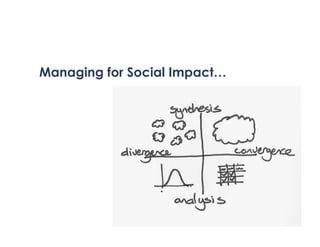
Managing for Social Impact…
3
© Norm Tasevski & Karim Harji
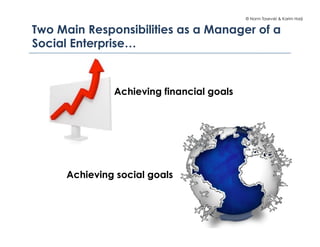
Two Main Responsibilities as a Manager of a
Social Enterprise…
4
Achieving social goals
4
Achieving financial goals
© Norm Tasevski & Karim Harji
5
© Norm Tasevski & Karim Harji
Achieving Financial Goals
66
Key Concepts
•  Focus on your mission
•  Know when to say “no”
•  Build a business independent of yourself
•  Test (prototype) often, and fail fast
The Market or the Mission? (Brinckenhoff)
•  The market is always right
•  The market is not always right for you
•  The mission should be your organization’s ultimate
goal
Achieving Social Goals…
7
© Norm Tasevski & Karim Harji
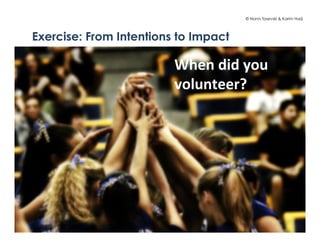
Exercise: From Intentions to Impact
8
When	
  did	
  you	
  
volunteer?	
  
© Norm Tasevski & Karim Harji
Exercise: From Intentions to Impact
How do you know you made an impact?
9
© Norm Tasevski & Karim Harji
Impact vs Net Impact
Is your effort better than what would have happened
anyways?
10
© Norm Tasevski & Karim Harji
Impact vs Net Impact
Is your effort better than what would have happened
anyways?
NET IMPACT is what matters
11
© Norm Tasevski & Karim Harji
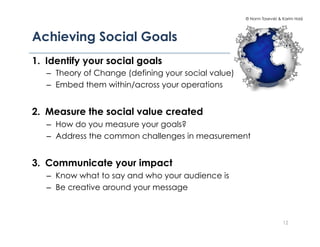
Achieving Social Goals!
1212
1.  Identify your social goals
–  Theory of Change (defining your social value)
–  Embed them within/across your operations
2.  Measure the social value created
–  How do you measure your goals?
–  Address the common challenges in measurement
3.  Communicate your impact
–  Know what to say and who your audience is
–  Be creative around your message
© Norm Tasevski & Karim Harji
Step 1: ID Your Social Goals!
1313
•  What Social Benefit are you creating?
•  How do you decide?
© Norm Tasevski & Karim Harji
14
© Norm Tasevski & Karim Harji
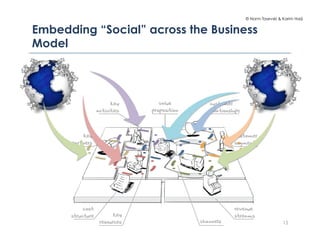
Embedding “Social” across the Business
Model
1515
© Norm Tasevski & Karim Harji
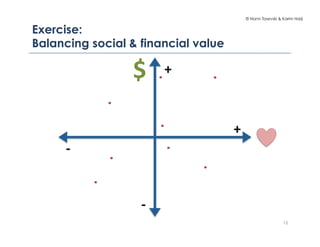
Exercise:
Balancing social & financial value
16
+	
  
+	
  
-­‐	
  
-­‐	
  
$	
  
© Norm Tasevski & Karim Harji
Step 2: Measure the Social Value
Created!
1717
Why Measure, and for Whom?
•  Management
–  Performance management (meeting needs/
objectives)
–  Organizational sustainability, attract new investment
–  Demonstrate the value created by organization
•  Social Investors (inc. funders)
–  Impact of grants, mission alignment
–  Accountability measures
–  Assess organization value, relate to risk/return (of
investment)
•  Government Programs/Policy
–  Make the case for investment in organization/
approach
–  Accountability measures
© Norm Tasevski & Karim Harji
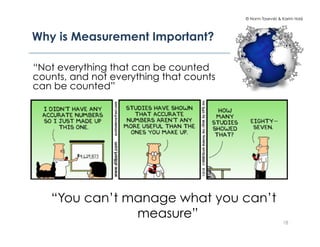
Why is Measurement Important?!
1818
“Not everything that can be counted
counts, and not everything that counts
can be counted”
“You can’t manage what you can’t
measure”
© Norm Tasevski & Karim Harji
Challenges in Measurement!
1919
•  Outputs vs. Outcomes
•  Attribution vs. Contribution
•  Qualitative vs. Quantitative
•  Prove vs. Improve
•  Rigour vs. feasibility
“Metrics and evaluation are to development
programs as autopsies are to health care: too late
to help, intrusive, and often inconclusive.” (Trelsad)
© Norm Tasevski & Karim Harji
A Note on SROI!
2020
•  Discounted, monetized value of the
social value that has been created,
relative to the value of the investment.
•  Pioneered by Roberts Enterprise
Development Fund (REDF) and Jed
Emerson
•  Various uses for, and approaches to, SROI
•  Despite “hype” around SROI, it can be
resource-intensive, and issues around
feasibility, replication, reporting still
remain.
© Norm Tasevski & Karim Harji
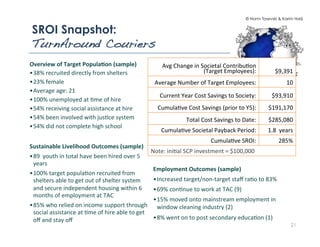
SROI Snapshot:
TurnAround Couriers!
Avg	
  Change	
  in	
  Societal	
  Contribu3on	
  	
  
(Target	
  Employees):	
   $9,391
Average	
  Number	
  of	
  Target	
  Employees: 10
Current	
  Year	
  Cost	
  Savings	
  to	
  Society:	
   $93,910
Cumula3ve	
  Cost	
  Savings	
  (prior	
  to	
  Y5): $191,170
Total	
  Cost	
  Savings	
  to	
  Date: $285,080
Cumula3ve	
  Societal	
  Payback	
  Period: 1.8	
  	
  years
Cumula3ve	
  SROI: 285%	


Note:	
  ini3al	
  SCP	
  investment	
  =	
  $100,000	
  
21
Overview	
  of	
  Target	
  Popula;on	
  (sample)	
  
• 38%	
  recruited	
  directly	
  from	
  shelters	
  
• 23%	
  female	
  
• Average	
  age:	
  21	
  
• 100%	
  unemployed	
  at	
  3me	
  of	
  hire	
  
• 54%	
  receiving	
  social	
  assistance	
  at	
  hire	
  
• 54%	
  been	
  involved	
  with	
  jus3ce	
  system	
  
• 54%	
  did	
  not	
  complete	
  high	
  school	


Employment	
  Outcomes	
  (sample)	
  
• Increased	
  target/non-­‐target	
  staff	
  ra3o	
  to	
  83%	
  	
  
• 69%	
  con3nue	
  to	
  work	
  at	
  TAC	
  (9)	
  
• 15%	
  moved	
  onto	
  mainstream	
  employment	
  in	
  
window	
  cleaning	
  industry	
  (2)	
  
• 8%	
  went	
  on	
  to	
  post	
  secondary	
  educa3on	
  (1)	
  
Sustainable	
  Livelihood	
  Outcomes	
  (sample)	
  
• 89	
  	
  youth	
  in	
  total	
  have	
  been	
  hired	
  over	
  5	
  
years	
  
• 100%	
  target	
  popula3on	
  recruited	
  from	
  
shelters	
  able	
  to	
  get	
  out	
  of	
  shelter	
  system	
  
and	
  secure	
  independent	
  housing	
  within	
  6	
  
months	
  of	
  employment	
  at	
  TAC	
  
• 85%	
  who	
  relied	
  on	
  income	
  support	
  through	
  
social	
  assistance	
  at	
  3me	
  of	
  hire	
  able	
  to	
  get	
  
off	
  and	
  stay	
  off	
  	
  
© Norm Tasevski & Karim Harji
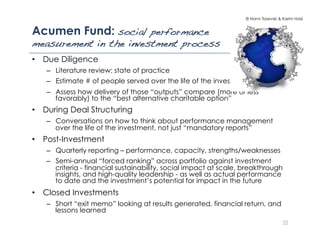
Acumen Fund: social performance
measurement in the investment process!
•  Due Diligence
–  Literature review: state of practice
–  Estimate # of people served over the life of the investment
–  Assess how delivery of those “outputs” compare (more or less
favorably) to the “best alternative charitable option”
•  During Deal Structuring
–  Conversations on how to think about performance management
over the life of the investment, not just “mandatory reports”
•  Post-Investment
–  Quarterly reporting – performance, capacity, strengths/weaknesses
–  Semi-annual “forced ranking” across portfolio against investment
criteria - financial sustainability, social impact at scale, breakthrough
insights, and high-quality leadership - as well as actual performance
to date and the investment’s potential for impact in the future
•  Closed Investments
–  Short “exit memo” looking at results generated, financial return, and
lessons learned
22
© Norm Tasevski & Karim Harji
Simple Measures for Social Enterprise:
Lessons from the Acumen Fund!
23
•  Culture matters far more than systems
–  Tolerance for / learning from failure
•  If you build systems, start with a pencil and paper
–  Start simple; technology is an enabler not the solution
•  Think on the margin
–  Performance is always relative to what you had been doing
before (past), to what your competition did over the same
time period (peers), and to what you should have done
(projections)
•  Count outputs and then worry about outcomes
–  “the conclusions you can draw from these outputs may not be
made with scientific rigor, but they can inform businesslike
decisions and raise important policy questions”
•  Don’t confuse information with judgment
–  Balance qualitative and quantitative
–  Use informed judgment, hold oneself accountable (to them)
© Norm Tasevski & Karim Harji
Step 3: Communicating Your
Social Impact!
2424
How?
© Norm Tasevski & Karim Harji
25
Break
26
Your Investment Pitches…
27
© Norm Tasevski & Karim Harji
Elements Important to the “Social Investor”
28
•  Overview and mission
•  Management and
Advisors
•  Problem
–  social issue being
addressed
•  Size of the problem
–  how big is the social issue
•  Solution
–  Here’s how it works…
•  Value proposition
–  Inc. social benefit
•  Business model
•  Competitive advantage
•  Collaboration/
partnerships
•  Marketing and Sales
•  Financial projections
•  Financial requirements
© Norm Tasevski & Karim Harji
An Example…
29

APS1015 Class 9: Managing for Social Impact

  • 1.
    APS 1015: SocialEntrepreneurship Class 9: Managing for Social Impact Wednesday, July 3, 2013 1 Instructor: Norm Tasevski (norm@socialentrepreneurship.ca) Karim Harji (karim@socialentrepreneurship.ca)
  • 2.
    © Norm Tasevski& Karim Harji Agenda •  Assignment review •  Managing for Social Impact •  Preparing your enterprise presentations •  Next Week 2
  • 3.
  • 4.
    © Norm Tasevski& Karim Harji Two Main Responsibilities as a Manager of a Social Enterprise… 4 Achieving social goals 4 Achieving financial goals
  • 5.
    © Norm Tasevski& Karim Harji 5
  • 6.
    © Norm Tasevski& Karim Harji Achieving Financial Goals 66 Key Concepts •  Focus on your mission •  Know when to say “no” •  Build a business independent of yourself •  Test (prototype) often, and fail fast The Market or the Mission? (Brinckenhoff) •  The market is always right •  The market is not always right for you •  The mission should be your organization’s ultimate goal
  • 7.
  • 8.
    © Norm Tasevski& Karim Harji Exercise: From Intentions to Impact 8 When  did  you   volunteer?  
  • 9.
    © Norm Tasevski& Karim Harji Exercise: From Intentions to Impact How do you know you made an impact? 9
  • 10.
    © Norm Tasevski& Karim Harji Impact vs Net Impact Is your effort better than what would have happened anyways? 10
  • 11.
    © Norm Tasevski& Karim Harji Impact vs Net Impact Is your effort better than what would have happened anyways? NET IMPACT is what matters 11
  • 12.
    © Norm Tasevski& Karim Harji Achieving Social Goals! 1212 1.  Identify your social goals –  Theory of Change (defining your social value) –  Embed them within/across your operations 2.  Measure the social value created –  How do you measure your goals? –  Address the common challenges in measurement 3.  Communicate your impact –  Know what to say and who your audience is –  Be creative around your message
  • 13.
    © Norm Tasevski& Karim Harji Step 1: ID Your Social Goals! 1313 •  What Social Benefit are you creating? •  How do you decide?
  • 14.
    © Norm Tasevski& Karim Harji 14
  • 15.
    © Norm Tasevski& Karim Harji Embedding “Social” across the Business Model 1515
  • 16.
    © Norm Tasevski& Karim Harji Exercise: Balancing social & financial value 16 +   +   -­‐   -­‐   $  
  • 17.
    © Norm Tasevski& Karim Harji Step 2: Measure the Social Value Created! 1717 Why Measure, and for Whom? •  Management –  Performance management (meeting needs/ objectives) –  Organizational sustainability, attract new investment –  Demonstrate the value created by organization •  Social Investors (inc. funders) –  Impact of grants, mission alignment –  Accountability measures –  Assess organization value, relate to risk/return (of investment) •  Government Programs/Policy –  Make the case for investment in organization/ approach –  Accountability measures
  • 18.
    © Norm Tasevski& Karim Harji Why is Measurement Important?! 1818 “Not everything that can be counted counts, and not everything that counts can be counted” “You can’t manage what you can’t measure”
  • 19.
    © Norm Tasevski& Karim Harji Challenges in Measurement! 1919 •  Outputs vs. Outcomes •  Attribution vs. Contribution •  Qualitative vs. Quantitative •  Prove vs. Improve •  Rigour vs. feasibility “Metrics and evaluation are to development programs as autopsies are to health care: too late to help, intrusive, and often inconclusive.” (Trelsad)
  • 20.
    © Norm Tasevski& Karim Harji A Note on SROI! 2020 •  Discounted, monetized value of the social value that has been created, relative to the value of the investment. •  Pioneered by Roberts Enterprise Development Fund (REDF) and Jed Emerson •  Various uses for, and approaches to, SROI •  Despite “hype” around SROI, it can be resource-intensive, and issues around feasibility, replication, reporting still remain.
  • 21.
    © Norm Tasevski& Karim Harji SROI Snapshot: TurnAround Couriers! Avg  Change  in  Societal  Contribu3on     (Target  Employees):   $9,391 Average  Number  of  Target  Employees: 10 Current  Year  Cost  Savings  to  Society:   $93,910 Cumula3ve  Cost  Savings  (prior  to  Y5): $191,170 Total  Cost  Savings  to  Date: $285,080 Cumula3ve  Societal  Payback  Period: 1.8    years Cumula3ve  SROI: 285%         Note:  ini3al  SCP  investment  =  $100,000   21 Overview  of  Target  Popula;on  (sample)   • 38%  recruited  directly  from  shelters   • 23%  female   • Average  age:  21   • 100%  unemployed  at  3me  of  hire   • 54%  receiving  social  assistance  at  hire   • 54%  been  involved  with  jus3ce  system   • 54%  did  not  complete  high  school     Employment  Outcomes  (sample)   • Increased  target/non-­‐target  staff  ra3o  to  83%     • 69%  con3nue  to  work  at  TAC  (9)   • 15%  moved  onto  mainstream  employment  in   window  cleaning  industry  (2)   • 8%  went  on  to  post  secondary  educa3on  (1)   Sustainable  Livelihood  Outcomes  (sample)   • 89    youth  in  total  have  been  hired  over  5   years   • 100%  target  popula3on  recruited  from   shelters  able  to  get  out  of  shelter  system   and  secure  independent  housing  within  6   months  of  employment  at  TAC   • 85%  who  relied  on  income  support  through   social  assistance  at  3me  of  hire  able  to  get   off  and  stay  off    
  • 22.
    © Norm Tasevski& Karim Harji Acumen Fund: social performance measurement in the investment process! •  Due Diligence –  Literature review: state of practice –  Estimate # of people served over the life of the investment –  Assess how delivery of those “outputs” compare (more or less favorably) to the “best alternative charitable option” •  During Deal Structuring –  Conversations on how to think about performance management over the life of the investment, not just “mandatory reports” •  Post-Investment –  Quarterly reporting – performance, capacity, strengths/weaknesses –  Semi-annual “forced ranking” across portfolio against investment criteria - financial sustainability, social impact at scale, breakthrough insights, and high-quality leadership - as well as actual performance to date and the investment’s potential for impact in the future •  Closed Investments –  Short “exit memo” looking at results generated, financial return, and lessons learned 22
  • 23.
    © Norm Tasevski& Karim Harji Simple Measures for Social Enterprise: Lessons from the Acumen Fund! 23 •  Culture matters far more than systems –  Tolerance for / learning from failure •  If you build systems, start with a pencil and paper –  Start simple; technology is an enabler not the solution •  Think on the margin –  Performance is always relative to what you had been doing before (past), to what your competition did over the same time period (peers), and to what you should have done (projections) •  Count outputs and then worry about outcomes –  “the conclusions you can draw from these outputs may not be made with scientific rigor, but they can inform businesslike decisions and raise important policy questions” •  Don’t confuse information with judgment –  Balance qualitative and quantitative –  Use informed judgment, hold oneself accountable (to them)
  • 24.
    © Norm Tasevski& Karim Harji Step 3: Communicating Your Social Impact! 2424 How?
  • 25.
    © Norm Tasevski& Karim Harji 25
  • 26.
  • 27.
  • 28.
    © Norm Tasevski& Karim Harji Elements Important to the “Social Investor” 28 •  Overview and mission •  Management and Advisors •  Problem –  social issue being addressed •  Size of the problem –  how big is the social issue •  Solution –  Here’s how it works… •  Value proposition –  Inc. social benefit •  Business model •  Competitive advantage •  Collaboration/ partnerships •  Marketing and Sales •  Financial projections •  Financial requirements
  • 29.
    © Norm Tasevski& Karim Harji An Example… 29