Concept and
Distinctions
Social Entrepreneurship
Social Entrepreneurs
 J. Gregory Dees
 Social entrepreneurs play the role of change
agents in the social sector, by:
 • Adopting a mission to create and sustain social
value (not just private value),
 • Recognizing and relentlessly pursuing new
opportunities to serve that mission,
 • Engaging in a process of continuous innovation,
adaptation, and learning,
 • Acting boldly without being limited by resources
currently in hand, and
 • Exhibiting a heightened sense of accountability to
the constituencies served and for the outcomes
created.
Social Entrepreneurs
 This is clearly an “idealized” definition. Social
sector leaders will exemplify these characteristics
in different ways and to different degrees. The
closer a person gets to satisfying all these
conditions, the more that person fits the model of
a social entrepreneur. Those who are more
innovative in their work and who create more
significant social improvements will naturally be
seen as more entrepreneurial. The truly
Schumpeterian social entrepreneurs will
significantly reform or revolutionize their
industries
Social Entrepreneurs
 Jerr Boschee and Jim McClurg
 A social entrepreneur is any person, in any
sector, who uses earned income strategies to
pursue a social objective, and a social
entrepreneur differs from a traditional
entrepreneur in two important ways:
Traditional Vs Social
Entrepreneurs
Traditional entrepreneurs frequently act in a socially
responsible manner: They donate money to nonprofits;
they refuse to engage in certain types of businesses;
they use environmentally safe materials and practices;
they treat their employees with dignity and respect. All of
this efforts are only indirectly attached to social
problems.
Social entrepreneurs are different because their earned
income strategies are tied directly to their mission: They
either employ people who are developmentally disabled,
chronically mentally ill, physically challenged, poverty-
stricken or otherwise disadvantaged; or they sell
mission-driven products and services that have a direct
impact on a specific social problem (e.g., working with
potential dropouts to keep them in school,
manufacturing assistive devices for people with physical
disabilities, providing home care services that help
elderly people stay out of nursing homes, developing
Traditional Vs Social
Entrepreneurs
 Secondly, traditional entrepreneurs are ultimately
measured by financial results: The success or
failure of their companies is determined by their
ability to generate profits for their owners. On the
other hand, social entrepreneurs are driven by a
double bottom line, a virtual blend of financial and
social returns. Profitability is still a goal, but it is
not the only goal, and profits are re-invested in
the mission rather than being distributed to
shareholders.
Non-Profit Vs Social
Entrepreneurs
 The nonprofit sector has traditionally been driven by a
“dependency” model, relying primarily on philanthropy,
voluntarism and government subsidy, with earned income
a distant fourth. But social entrepreneurs have turned that
formula on its head: Philanthropy, voluntarism and
government subsidy are welcome, but no longer central,
because the dependency model has been replaced by two
others.
 In the nonprofit world, “sustainability” can be achieved
through a combination of philanthropy, government
subsidy and earned revenue. It’s a wonderful thing,
sustainability, but for many nonprofits it’s only a way
station. “Self-sufficiency,” on the other hand, can be
achieved only by relying completely on earned income,
 The Institute for Social Entrepreneurs, based in
USA , defined social enterprise as an entity that
uses earned revenue to reach poor people either
in a private sector or non-profit business or as a
significant part of a nonprofit’s mixed revenue
stream which includes philanthropy and
government subsidies.
 see :
http://www.socialent.org/Social_Enterprise_Termi
nology.html.
Social Business
 As described by Dr. Yunus (2007, 2010), a social
business is a non-loss, non-dividend company
designed to address a social objective within the
highly regulated marketplace of today.
 In a social business, the investors/owners can
gradually recoup the money invested, but cannot
take any dividend beyond that point. Purpose of
the investment is purely to achieve one or more
social objectives through the operation of the
company; no personal gain is desired by the
investors.
 The company must cover all costs and make profit,
at the same time achieve the social objective, such
as, healthcare for the poor, housing for the poor,
Social Business
 Dr. Yunus ( 2008 a) proposed that a social business
should follow seven principles:
 Business objective will be to overcome poverty, or
one or more problems (such as education, health,
technology access, and environment) which threaten
people and society; not profit maximization
 Financial and economic sustainability
 Investors get back their investment amount only. No
dividend is given beyond investment money
 When investment amount is paid back, company
profit stays with the company for expansion and
improvement
 Environmentally conscious
 Workforce gets market wage with better working
conditions
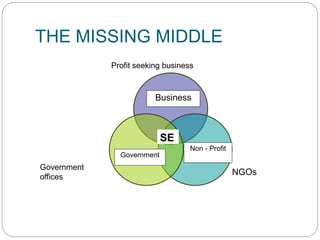
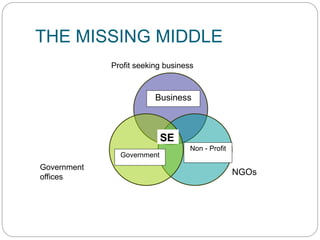
THE MISSING MIDDLE
Profit seeking business
NGOs
Government
offices
Business
Non - Profit
Government
SE
Social Business – or social media
applying in business?
 Do not get confused
 IBM , MIT– they call
themselves social
business
 They are increasing in
number
 Believe in BOP marketing
 Only look for profit
maximizing
Confusions
 Profit or Income?
 High or low salary?
 Subsidy in loan?
 What is recoup of investment?
Charity? CSR? NGO?
NO
 SB does not depend on charity, its profit
making business or non- loss non-
dividend business
 SB is not CSR, it’s a complete business,
will have complete organizational structure
and sustainability
 Its not an NGO , because it gets no fund
from others, but others company or
investors can invest and can recoup
investment
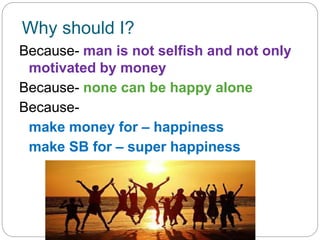
Why should I?
Because- man is not selfish and not only
motivated by money
Because- none can be happy alone
Because-
make money for – happiness
make SB for – super happiness
THE MISSING MIDDLE
Profit seeking business
NGOs
Government
offices
Business
Non - Profit
Government
SE
Social Business – or social media
applying in business?
 Do not get confused
 IBM , MIT– they call
themselves social
business
 They are increasing in
number
 Believe in BOP marketing
 Only look for profit
maximizing
Confusions
 Profit or Income?
 High or low salary?
 Subsidy in loan?
 What is recoup of investment?
Charity? CSR? NGO?
NO
 SB does not depend on charity, its profit
making business or non- loss non-
dividend business
 SB is not CSR, it’s a complete business,
will have complete organizational structure
and sustainability
 Its not an NGO , because it gets no fund
from others, but others company or
investors can invest and can recoup
investment
Why should I?
Because- man is not selfish and not only
motivated by money
Because- none can be happy alone
Because-
make money for – happiness
make SB for – super happiness
Example
 MANILA , Philippine
Suburb : Payata
 Waste-fill site, slum area,
 unemployment and health hazards
 Severe male -nutrition
 150 people die from waste landslide
Solution??????
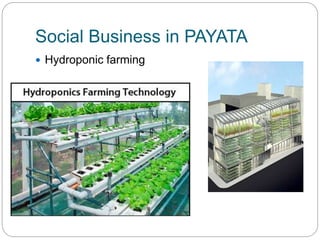
Social Business in PAYATA
 Hydroponic farming
Solutions
 Employment
 Hygiene maintenance and waste
management
 Fight male-nutrition
 Environment protection
 Innovative and attractive
 Local business
 Small but sustainable
Business Ideas
 1. Own skills, talent, passion, experience
 2. Current events , trends and business
opportunities
 3. Inventions and innovations
 4. Add value to an already existing product
 5. Customers complaints
 6. Market surveys , Media, Trade shows
 Social Business Ideas---
 1. Own philosophy and passion
 2. Solutions to current social problems
 3. Creation of Social wealth
 4. Social innovation
Rumana Parveen, University of Dhaka
Social Business Ideas---
additional motivations and sources
 1. Own philosophy and passion
 2. Solutions to current social problems
 3. Creation of Social wealth
 4. Social innovation
Rumana Parveen, University of Dhaka
Planning and decision making in
social business
 Social business has a social goal to achieve.
 A business plan for a social enterprise is different
from that of a traditional business as it must address
both the social and economic components of the
organization .
 Example: shakti doi
 It is iterative in nature because social goals are
dynamic in nature and thus while goals are changing
the planning should pass through repetitive evolution.
While one version of the business plan should be
completed prior to the startup of the social enterprise,
a business plan is a working document and will
require updates and changes throughout the
development process.
 Example: shakti doiRumana Parveen, Assistant Professor, University of Dhaka
Planning and decision making in
social business
 It involves multiple parties: managers, and investors
of the business.
 Jago foundation : one child one sponsor
 Social business managers must develop a close
working relationship with the potential beneficiaries or
consumers to develop a contextual understanding of
the demand and supply of the product.
 Woman empowerment
 Jago foundation : Online school
 Social business managers should also work with
investors to develop an emotional commitment and
attachment to the area of potential investment, and
helping to shape an investment proposal.
 Veolia water
Rumana Parveen, Assistant
Professor, University of Dhaka
Human resource management in
Social Business
 Selection
 Recognize that all personnel, whether they are
heading up your organization's annual fundraising
drive or lending a hand for a few hours every other
Saturday, have an impact on the group's
performance.
 Be formal and critical, if you are disciplined and well
organized, you will often attract more qualified people.
 Do not compromise quality
 Focus more on detailed personal information and
history to assess motivation and commitment of
applicants.
 Try to emphasize people who want job for legitimate
reasons (professional development and/or
advancement, genuine interest in your group's
mission) and ignore people who want job for personal
reason (loneliness, corporate burnout etc.)
Rumana Parveen, Assistant Professor,
University of Dhaka
Human resource management in Social
Business
 Compensation
 Focus more on benefits and deferred payments.
Insurance, sick leave with pay, pension fund etc.
 To retain sophisticated and talented people, be
competitive in salary structure., no profit is taken by
investors and owners, so salary can be normal.
 Non- financial incentives like feelings of satisfaction and
achievement are necessary.
 For social business companies, the understanding and
practice of leadership are critical for their organization’s
long-term success.
 They also must overcome myriad challenges, including
the constant balancing act to protect the social mission
while striving for growth and commercial success, the
combination of volunteers and paid staff within the same
organization, and the high expectations from a wide
variety of stakeholders regarding their integrity,
accountability and openness for stakeholder participation .Rumana Parveen, Assistant Professor, University of Dhaka
Leadership for Social Business
 Social enterprises mainly rely on ethical leadership, transformational
and participative leadership.
 Ethical leadership is characterized by trustworthy leaders, who
serve as ethical role models and enforce clear standards for ethical
behavior among followers, and also conduct their personal life in
an ethical manner. Ethical leaders also have the best interest of
employees in mind and listen to what they have to say.
 Transformational leaders inspire followers with their vision and
stimulate them to challenge themselves and their way of thinking
while uniting them around a common vision and core values.
 Participative leadership includes aspects such as encouraging
independent action, self-development of the employee and
mutually agreed performance goals, and is key to unleashing their
followers’ potential, engagement and creativity. ethical,
empowering and transformational leadership actually does
increase the followers’ job satisfaction, commitment and intention
to stay. Also, followers show higher levels of intrinsic motivation
when these leadership styles are stronger.Rumana Parveen, Assistant Professor,
University of Dhaka
Leadership for Social Business
 The key leadership challenge consists of two
related aspects, delegation and succession.
Succession was reported to be more challenging
than delegation from the perspective of the social
entrepreneurs.
 Creating a succession plan
 Step 1: Define the critical leadership capacities
needed to fulfil your organization’s mission in the
next three to five years.
 Step 2: Asses the potential of your staff (current
and future leaders) to take on greater
responsibility.
 Step 3: Create a clear plan for what leadership
Rumana Parveen, Assistant Professor,
University of Dhaka

SMALL ENTERPRISES OF BD

  • 1.
  • 2.
    Social Entrepreneurs  J.Gregory Dees  Social entrepreneurs play the role of change agents in the social sector, by:  • Adopting a mission to create and sustain social value (not just private value),  • Recognizing and relentlessly pursuing new opportunities to serve that mission,  • Engaging in a process of continuous innovation, adaptation, and learning,  • Acting boldly without being limited by resources currently in hand, and  • Exhibiting a heightened sense of accountability to the constituencies served and for the outcomes created.
  • 3.
    Social Entrepreneurs  Thisis clearly an “idealized” definition. Social sector leaders will exemplify these characteristics in different ways and to different degrees. The closer a person gets to satisfying all these conditions, the more that person fits the model of a social entrepreneur. Those who are more innovative in their work and who create more significant social improvements will naturally be seen as more entrepreneurial. The truly Schumpeterian social entrepreneurs will significantly reform or revolutionize their industries
  • 4.
    Social Entrepreneurs  JerrBoschee and Jim McClurg  A social entrepreneur is any person, in any sector, who uses earned income strategies to pursue a social objective, and a social entrepreneur differs from a traditional entrepreneur in two important ways:
  • 5.
    Traditional Vs Social Entrepreneurs Traditionalentrepreneurs frequently act in a socially responsible manner: They donate money to nonprofits; they refuse to engage in certain types of businesses; they use environmentally safe materials and practices; they treat their employees with dignity and respect. All of this efforts are only indirectly attached to social problems. Social entrepreneurs are different because their earned income strategies are tied directly to their mission: They either employ people who are developmentally disabled, chronically mentally ill, physically challenged, poverty- stricken or otherwise disadvantaged; or they sell mission-driven products and services that have a direct impact on a specific social problem (e.g., working with potential dropouts to keep them in school, manufacturing assistive devices for people with physical disabilities, providing home care services that help elderly people stay out of nursing homes, developing
  • 6.
    Traditional Vs Social Entrepreneurs Secondly, traditional entrepreneurs are ultimately measured by financial results: The success or failure of their companies is determined by their ability to generate profits for their owners. On the other hand, social entrepreneurs are driven by a double bottom line, a virtual blend of financial and social returns. Profitability is still a goal, but it is not the only goal, and profits are re-invested in the mission rather than being distributed to shareholders.
  • 7.
    Non-Profit Vs Social Entrepreneurs The nonprofit sector has traditionally been driven by a “dependency” model, relying primarily on philanthropy, voluntarism and government subsidy, with earned income a distant fourth. But social entrepreneurs have turned that formula on its head: Philanthropy, voluntarism and government subsidy are welcome, but no longer central, because the dependency model has been replaced by two others.  In the nonprofit world, “sustainability” can be achieved through a combination of philanthropy, government subsidy and earned revenue. It’s a wonderful thing, sustainability, but for many nonprofits it’s only a way station. “Self-sufficiency,” on the other hand, can be achieved only by relying completely on earned income,
  • 8.
     The Institutefor Social Entrepreneurs, based in USA , defined social enterprise as an entity that uses earned revenue to reach poor people either in a private sector or non-profit business or as a significant part of a nonprofit’s mixed revenue stream which includes philanthropy and government subsidies.  see : http://www.socialent.org/Social_Enterprise_Termi nology.html.
  • 9.
    Social Business  Asdescribed by Dr. Yunus (2007, 2010), a social business is a non-loss, non-dividend company designed to address a social objective within the highly regulated marketplace of today.  In a social business, the investors/owners can gradually recoup the money invested, but cannot take any dividend beyond that point. Purpose of the investment is purely to achieve one or more social objectives through the operation of the company; no personal gain is desired by the investors.  The company must cover all costs and make profit, at the same time achieve the social objective, such as, healthcare for the poor, housing for the poor,
  • 10.
    Social Business  Dr.Yunus ( 2008 a) proposed that a social business should follow seven principles:  Business objective will be to overcome poverty, or one or more problems (such as education, health, technology access, and environment) which threaten people and society; not profit maximization  Financial and economic sustainability  Investors get back their investment amount only. No dividend is given beyond investment money  When investment amount is paid back, company profit stays with the company for expansion and improvement  Environmentally conscious  Workforce gets market wage with better working conditions
  • 11.
    THE MISSING MIDDLE Profitseeking business NGOs Government offices Business Non - Profit Government SE
  • 12.
    Social Business –or social media applying in business?  Do not get confused  IBM , MIT– they call themselves social business  They are increasing in number  Believe in BOP marketing  Only look for profit maximizing
  • 13.
    Confusions  Profit orIncome?  High or low salary?  Subsidy in loan?  What is recoup of investment?
  • 14.
    Charity? CSR? NGO? NO SB does not depend on charity, its profit making business or non- loss non- dividend business  SB is not CSR, it’s a complete business, will have complete organizational structure and sustainability  Its not an NGO , because it gets no fund from others, but others company or investors can invest and can recoup investment
  • 15.
    Why should I? Because-man is not selfish and not only motivated by money Because- none can be happy alone Because- make money for – happiness make SB for – super happiness
  • 16.
    THE MISSING MIDDLE Profitseeking business NGOs Government offices Business Non - Profit Government SE
  • 17.
    Social Business –or social media applying in business?  Do not get confused  IBM , MIT– they call themselves social business  They are increasing in number  Believe in BOP marketing  Only look for profit maximizing
  • 18.
    Confusions  Profit orIncome?  High or low salary?  Subsidy in loan?  What is recoup of investment?
  • 19.
    Charity? CSR? NGO? NO SB does not depend on charity, its profit making business or non- loss non- dividend business  SB is not CSR, it’s a complete business, will have complete organizational structure and sustainability  Its not an NGO , because it gets no fund from others, but others company or investors can invest and can recoup investment
  • 20.
    Why should I? Because-man is not selfish and not only motivated by money Because- none can be happy alone Because- make money for – happiness make SB for – super happiness
  • 21.
    Example  MANILA ,Philippine Suburb : Payata  Waste-fill site, slum area,  unemployment and health hazards  Severe male -nutrition  150 people die from waste landslide Solution??????
  • 22.
    Social Business inPAYATA  Hydroponic farming
  • 23.
    Solutions  Employment  Hygienemaintenance and waste management  Fight male-nutrition  Environment protection  Innovative and attractive  Local business  Small but sustainable
  • 24.
    Business Ideas  1.Own skills, talent, passion, experience  2. Current events , trends and business opportunities  3. Inventions and innovations  4. Add value to an already existing product  5. Customers complaints  6. Market surveys , Media, Trade shows  Social Business Ideas---  1. Own philosophy and passion  2. Solutions to current social problems  3. Creation of Social wealth  4. Social innovation Rumana Parveen, University of Dhaka
  • 25.
    Social Business Ideas--- additionalmotivations and sources  1. Own philosophy and passion  2. Solutions to current social problems  3. Creation of Social wealth  4. Social innovation Rumana Parveen, University of Dhaka
  • 26.
    Planning and decisionmaking in social business  Social business has a social goal to achieve.  A business plan for a social enterprise is different from that of a traditional business as it must address both the social and economic components of the organization .  Example: shakti doi  It is iterative in nature because social goals are dynamic in nature and thus while goals are changing the planning should pass through repetitive evolution. While one version of the business plan should be completed prior to the startup of the social enterprise, a business plan is a working document and will require updates and changes throughout the development process.  Example: shakti doiRumana Parveen, Assistant Professor, University of Dhaka
  • 27.
    Planning and decisionmaking in social business  It involves multiple parties: managers, and investors of the business.  Jago foundation : one child one sponsor  Social business managers must develop a close working relationship with the potential beneficiaries or consumers to develop a contextual understanding of the demand and supply of the product.  Woman empowerment  Jago foundation : Online school  Social business managers should also work with investors to develop an emotional commitment and attachment to the area of potential investment, and helping to shape an investment proposal.  Veolia water Rumana Parveen, Assistant Professor, University of Dhaka
  • 28.
    Human resource managementin Social Business  Selection  Recognize that all personnel, whether they are heading up your organization's annual fundraising drive or lending a hand for a few hours every other Saturday, have an impact on the group's performance.  Be formal and critical, if you are disciplined and well organized, you will often attract more qualified people.  Do not compromise quality  Focus more on detailed personal information and history to assess motivation and commitment of applicants.  Try to emphasize people who want job for legitimate reasons (professional development and/or advancement, genuine interest in your group's mission) and ignore people who want job for personal reason (loneliness, corporate burnout etc.) Rumana Parveen, Assistant Professor, University of Dhaka
  • 29.
    Human resource managementin Social Business  Compensation  Focus more on benefits and deferred payments. Insurance, sick leave with pay, pension fund etc.  To retain sophisticated and talented people, be competitive in salary structure., no profit is taken by investors and owners, so salary can be normal.  Non- financial incentives like feelings of satisfaction and achievement are necessary.  For social business companies, the understanding and practice of leadership are critical for their organization’s long-term success.  They also must overcome myriad challenges, including the constant balancing act to protect the social mission while striving for growth and commercial success, the combination of volunteers and paid staff within the same organization, and the high expectations from a wide variety of stakeholders regarding their integrity, accountability and openness for stakeholder participation .Rumana Parveen, Assistant Professor, University of Dhaka
  • 30.
    Leadership for SocialBusiness  Social enterprises mainly rely on ethical leadership, transformational and participative leadership.  Ethical leadership is characterized by trustworthy leaders, who serve as ethical role models and enforce clear standards for ethical behavior among followers, and also conduct their personal life in an ethical manner. Ethical leaders also have the best interest of employees in mind and listen to what they have to say.  Transformational leaders inspire followers with their vision and stimulate them to challenge themselves and their way of thinking while uniting them around a common vision and core values.  Participative leadership includes aspects such as encouraging independent action, self-development of the employee and mutually agreed performance goals, and is key to unleashing their followers’ potential, engagement and creativity. ethical, empowering and transformational leadership actually does increase the followers’ job satisfaction, commitment and intention to stay. Also, followers show higher levels of intrinsic motivation when these leadership styles are stronger.Rumana Parveen, Assistant Professor, University of Dhaka
  • 31.
    Leadership for SocialBusiness  The key leadership challenge consists of two related aspects, delegation and succession. Succession was reported to be more challenging than delegation from the perspective of the social entrepreneurs.  Creating a succession plan  Step 1: Define the critical leadership capacities needed to fulfil your organization’s mission in the next three to five years.  Step 2: Asses the potential of your staff (current and future leaders) to take on greater responsibility.  Step 3: Create a clear plan for what leadership Rumana Parveen, Assistant Professor, University of Dhaka