APS 1015
Scaling Social Innovations
Today’s class
• Guest Speaker: Eyal Rosenblum, Operation Groundswell
• Properties of scaling organizations
• Debate! Be it resolved that…
Is Scale Good or Bad?
1
2 – Properties of Scaling Organizations
Growing Pains
A Game: What Would You Do?
What Would You Do?

Help marginalized people integrate
into the workforce
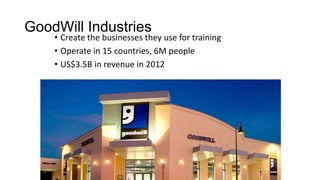
GoodWill Industries

• Create the businesses they use for training
• Operate in 15 countries, 6M people
• US$3.5B in revenue in 2012
What Would You Do?

Literacy, numeracy education
for young children
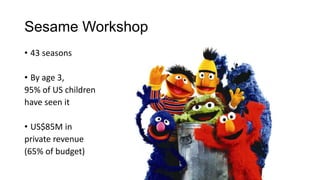
Sesame Workshop
• 43 seasons

• By age 3,
95% of US children
have seen it
• US$85M in
private revenue
(65% of budget)
What Would You Do?

Educate children about global poverty
Free• The Children | Me to We
Run a conference, trips, fashion brands
• Secured 15 real estate properties
• Launched Me to We, a social enterprise donating 50% of
profits to the charity ($1.6M in 2012)
Pattern Spotting
What do these have in common?
Pattern Spotting
What do these have in common?
•
•
•
•
•
•
•

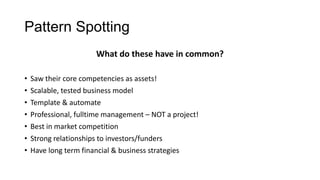
Saw their core competencies as assets!
Scalable, tested business model
Template & automate
Professional, fulltime management – NOT a project!
Best in market competition
Strong relationships to investors/funders
Have long term financial & business strategies
Definitions – What We Mean By Scale
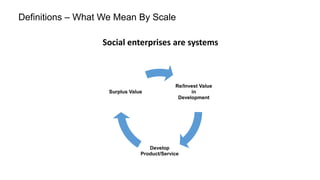
Social enterprises are systems

Surplus Value

Re/Invest Value
in
Development

Develop
Product/Service
Definitions – What We Mean By Scale
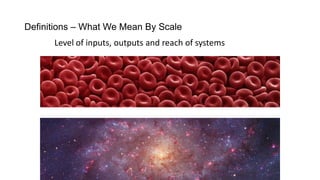
Level of inputs, outputs and reach of systems
Definitions – What We Mean By Scale
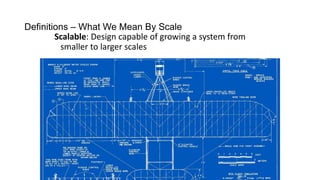
Scalable: Design capable of growing a system from
smaller to larger scales
Definitions – Scalable Design
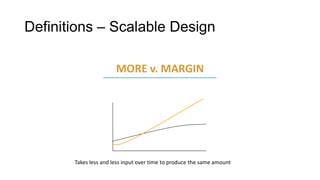
MORE v. MARGIN

Takes less and less input over time to produce the same amount
Definitions – NPO vs SE
MORE leads to novelty, clutter, lack of focus (common
NPO problem, but not exclusive to NPO)

MARGIN requires laser focus, specialization
3 – Debate!
Be it resolved that scale creates more
negative impact than positive impact
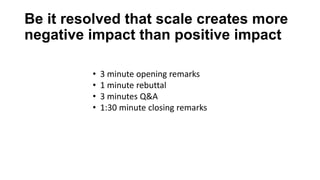
Be it resolved that scale creates more
negative impact than positive impact
•
•
•
•

3 minute opening remarks
1 minute rebuttal
3 minutes Q&A
1:30 minute closing remarks

APS1015 Class 11 - Scaling Considerations

  • 1.
  • 2.
    Today’s class • GuestSpeaker: Eyal Rosenblum, Operation Groundswell • Properties of scaling organizations • Debate! Be it resolved that…
  • 3.
  • 4.
  • 5.
    2 – Propertiesof Scaling Organizations
  • 6.
  • 7.
    A Game: WhatWould You Do?
  • 8.
    What Would YouDo? Help marginalized people integrate into the workforce
  • 9.
    GoodWill Industries • Createthe businesses they use for training • Operate in 15 countries, 6M people • US$3.5B in revenue in 2012
  • 10.
    What Would YouDo? Literacy, numeracy education for young children
  • 11.
    Sesame Workshop • 43seasons • By age 3, 95% of US children have seen it • US$85M in private revenue (65% of budget)
  • 12.
    What Would YouDo? Educate children about global poverty
  • 13.
    Free• The Children| Me to We Run a conference, trips, fashion brands • Secured 15 real estate properties • Launched Me to We, a social enterprise donating 50% of profits to the charity ($1.6M in 2012)
  • 14.
    Pattern Spotting What dothese have in common?
  • 15.
    Pattern Spotting What dothese have in common? • • • • • • • Saw their core competencies as assets! Scalable, tested business model Template & automate Professional, fulltime management – NOT a project! Best in market competition Strong relationships to investors/funders Have long term financial & business strategies
  • 16.
    Definitions – WhatWe Mean By Scale Social enterprises are systems Surplus Value Re/Invest Value in Development Develop Product/Service
  • 17.
    Definitions – WhatWe Mean By Scale Level of inputs, outputs and reach of systems
  • 18.
    Definitions – WhatWe Mean By Scale Scalable: Design capable of growing a system from smaller to larger scales
  • 19.
    Definitions – ScalableDesign MORE v. MARGIN Takes less and less input over time to produce the same amount
  • 20.
    Definitions – NPOvs SE MORE leads to novelty, clutter, lack of focus (common NPO problem, but not exclusive to NPO) MARGIN requires laser focus, specialization
  • 23.
  • 24.
    Be it resolvedthat scale creates more negative impact than positive impact
  • 25.
    Be it resolvedthat scale creates more negative impact than positive impact • • • • 3 minute opening remarks 1 minute rebuttal 3 minutes Q&A 1:30 minute closing remarks