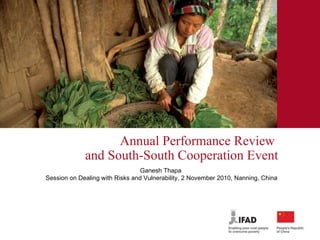
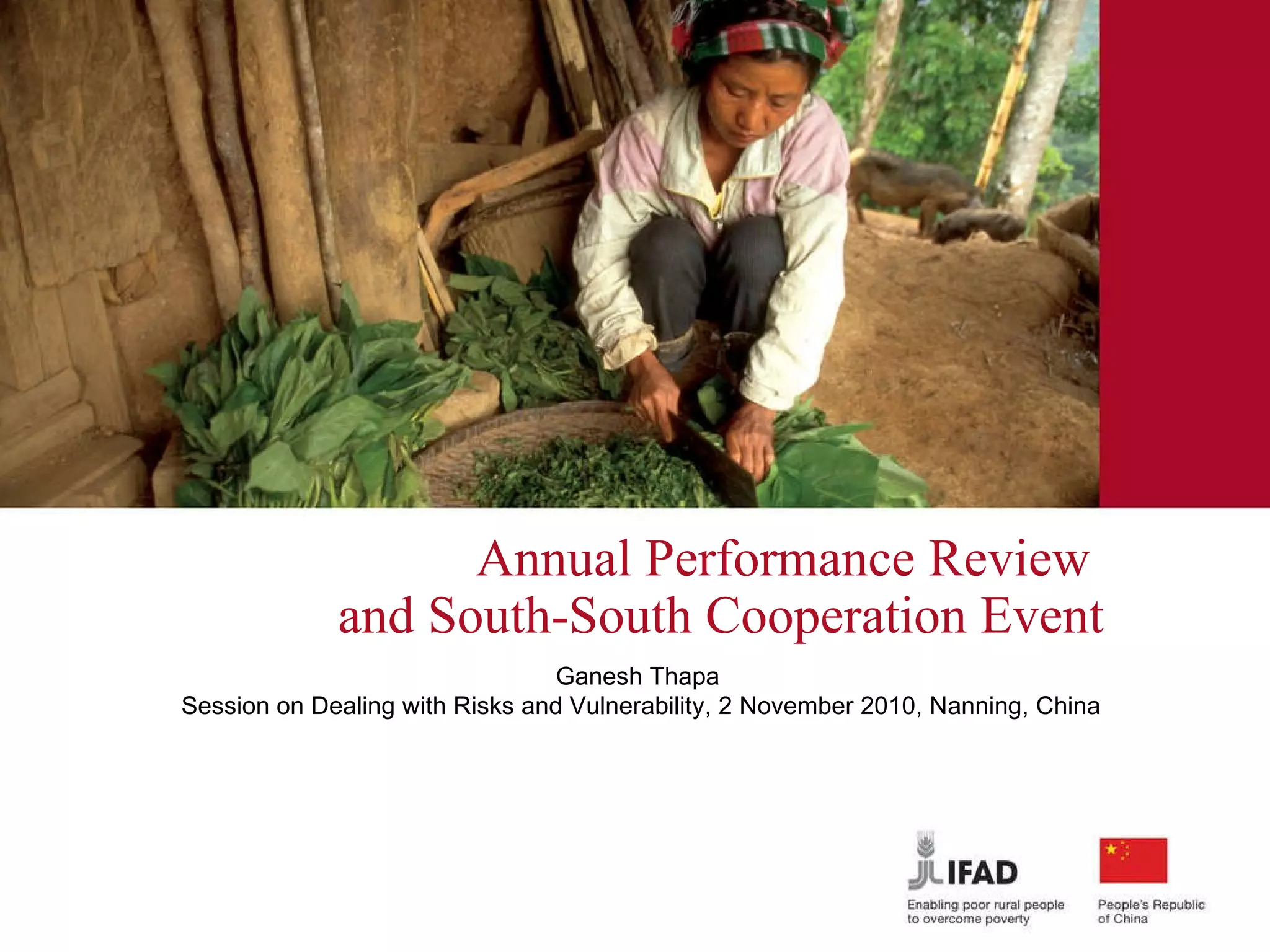
Annual Performance Review  and South-South Cooperation Event Ganesh Thapa Session on Dealing with Risks and Vulnerability, 2 November 2010, Nanning, China
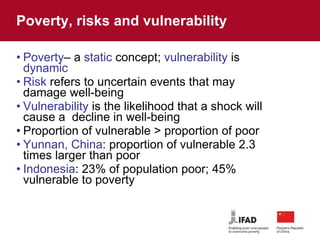
Poverty, risks and vulnerability Poverty – a  static  concept;  vulnerability  is  dynamic Risk  refers to uncertain events that may damage well-being Vulnerability  is the likelihood that a shock will cause a  decline in well-being Proportion of vulnerable > proportion of poor Yunnan, China : proportion of vulnerable 2.3 times larger than poor Indonesia : 23% of population poor; 45% vulnerable to poverty
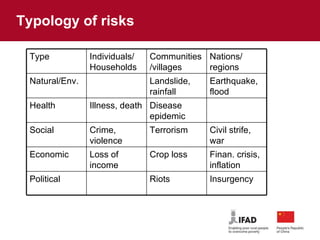
Typology of risks  Insurgency Riots Political Finan. crisis, inflation Crop loss Loss of income Economic Civil strife, war Terrorism Crime, violence Social Disease epidemic Illness, death Health Earthquake, flood Landslide, rainfall Natural/Env. Nations/ regions Communities/villages Individuals/ Households Type
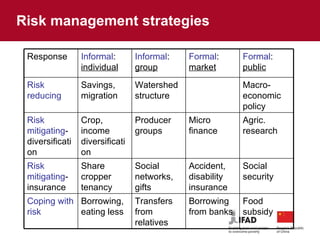
Risk management strategies Food subsidy Borrowing from banks Transfers from relatives Borrowing, eating less Coping with risk Social security Accident, disability insurance Social networks, gifts Share cropper tenancy Risk mitigating - insurance Agric. research Micro finance Producer groups Crop, income diversification Risk mitigating -diversification Macro-economic policy Watershed structure Savings, migration Risk reducing Formal :  public Formal :  market Informal :  group Informal :  individual Response
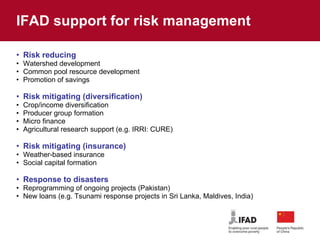
IFAD support for risk management  Risk reducing Watershed development Common pool resource development Promotion of savings Risk mitigating (diversification) Crop/income diversification Producer group formation Micro finance Agricultural research support (e.g. IRRI: CURE) Risk mitigating (insurance) Weather-based insurance Social capital formation Response to disasters Reprogramming of ongoing projects (Pakistan) New loans (e.g. Tsunami response projects in Sri Lanka, Maldives, India)

APR Workshop 2010-Dealing with Risk and Vulnerability-Ganesh Thapa

  • 1.
     Annual PerformanceReview and South-South Cooperation Event Ganesh Thapa Session on Dealing with Risks and Vulnerability, 2 November 2010, Nanning, China
  • 2.
    Poverty, risks andvulnerability Poverty – a static concept; vulnerability is dynamic Risk refers to uncertain events that may damage well-being Vulnerability is the likelihood that a shock will cause a decline in well-being Proportion of vulnerable > proportion of poor Yunnan, China : proportion of vulnerable 2.3 times larger than poor Indonesia : 23% of population poor; 45% vulnerable to poverty
  • 3.
    Typology of risks Insurgency Riots Political Finan. crisis, inflation Crop loss Loss of income Economic Civil strife, war Terrorism Crime, violence Social Disease epidemic Illness, death Health Earthquake, flood Landslide, rainfall Natural/Env. Nations/ regions Communities/villages Individuals/ Households Type
  • 4.
    Risk management strategiesFood subsidy Borrowing from banks Transfers from relatives Borrowing, eating less Coping with risk Social security Accident, disability insurance Social networks, gifts Share cropper tenancy Risk mitigating - insurance Agric. research Micro finance Producer groups Crop, income diversification Risk mitigating -diversification Macro-economic policy Watershed structure Savings, migration Risk reducing Formal : public Formal : market Informal : group Informal : individual Response
  • 5.
    IFAD support forrisk management Risk reducing Watershed development Common pool resource development Promotion of savings Risk mitigating (diversification) Crop/income diversification Producer group formation Micro finance Agricultural research support (e.g. IRRI: CURE) Risk mitigating (insurance) Weather-based insurance Social capital formation Response to disasters Reprogramming of ongoing projects (Pakistan) New loans (e.g. Tsunami response projects in Sri Lanka, Maldives, India)