Management of risk in Agriculture
Vikas Kumar, Senior Scientist
JANUARY 2024
ICAR- NATIONAL INSTITUTE OF AGRICULTURAL ECONOMICS AND POLICY RESEARCH
New Delhi
1
Index
S.no Main headings
1 Introduction
2 Risk, uncertainty and vulnerability
3 Sources of agricultural risk
4 Nature of price and production risk
5 Risk management instruments and strategies
6 Farm risk management instruments and strategies
7 Insurability of agricultural risks
8 Role of government
9 Agricultural Risk Management Process
10 References
2
Introduction
Agricultural production is subject to many uncertainties. Any farm
production decision plan is typically associated with multiple potential
outcomes with different probabilities. Weather, market developments and
other events cannot be controlled by the farmer but have a direct incidence
on the returns from farming. In this context, the farmer has to manage risk in
farming as part of the general management of the farming business. Hazards
and unforeseen events occur in all economic and business activities and are
not specific to agriculture. However, farming risk and risk management
instruments in the sector may have a certain number of specificities.
Many risks directly affect farmers´ production decisions and welfare.
In response to the potential impact of these uncertain events farmers
implement diverse risk management strategies in the context of their
production plans, the available portfolio of financial, physical and human
capital, and the degree of aversion to risk. These risk management strategies
may include decisions on-farm, changes in portfolio structure, use of market
instruments, government programs, and diversification to other source of
income. Many general agricultural support policies have risk management
implications and influence risk management decisions. Because of the
complexity of these interactions governments need to make significant
efforts to achieve coherence, particularly among different policies and
between policies and market strategies. Agricultural risk is an interrelated
―system‖ in which markets and government actions interact with risks and
farmers’ strategies. Government programs may underpin the development of
market strategies, but they may also crowd out market developments or on-
farm strategies. The result of these interactions is the set of risk management
strategies and tools that is available and used by farmers. The available
strategies are not the simple addition of government programs, market
instruments and on-farm decisions; they are mutually interdependent and
constitute a unique system.
Risk, uncertainty and vulnerability
It is often said that agriculture production is a risky business, that is, it is
subject to risk. This means that due to complexities of physical and economic
systems, the outcomes of farmers’ actions and production decisions are
uncertain, and many possible outcomes are usually associated with a single
action or production plan. The uncertainty concerning outcomes that involve
some adversity or loss that negatively affects individual well-being is
normally associated with the idea of risk. Some (e.g. Knight, 1921) make the
distinction between risk, that implies knowledge of numerical, objective
probabilities, and uncertainty, that implies that the outcome is uncertain and
the probabilities are not known. Most authors find a more useful distinction
3
between uncertainty as imperfect knowledge and risk as exposure to
uncertain unfavourable economic consequences (Hardaker et al., 2004). In
practice both concepts are very much related and are used interchangeably,
one with more emphasis on ―probabilities as the description of the
environment, and the other with more emphasis on the ―potential negative
impact on welfare. There is no risk without some uncertainty and most
uncertainties typically imply some risk.
In this context the term vulnerability is often used to define the likelihood
that a risk will result in a significant decline in well-being, that is, resilience
or lack of resilience against a given adversity. Vulnerability does not depend
only on the characteristics of the risk, but also on the household’s asset
endowment and availability of insurance mechanisms.
Risk management is part of a broader risk governance framework that
typically includes at least three stages: risk assessment and evaluation, risk
management and risk communication. These terms can be defined in
different ways (e.g. International Risk Governance Council, 2008). Risk
assessment normally refers to a systematic processing of available
information to identify the frequency and magnitude of specific events, while
risk evaluation consists of fixing priorities and defining societal ―tolerance
for some risks. Risk management is the system of measures by individuals
and organizations that contribute to reducing, controlling and regulating
risks. Risk communication is the exchange and sharing of information about
risk between decision makers and other stakeholders.
A risk management system is composed of many different sources of
risk that affect farming, different risk management strategies and tools used
and available to farmers, and all government actions that affect risk in
farming. A standard approach to analyse risk management issues will involve
three linear steps. First, measuring the risk or variability that needs to be
managed. Second, use this information to analyse the optimal risk
management tool for a given farmer, accounting for his endowments and risk
preferences. Finally, decide on appropriate government policies to improve
this risk management strategy.
Sources of agricultural risk
The risks and sources or risks that are relevant in agriculture have
different characteristics, and they can be classified in very different ways. It
is not necessary to opt for any particular classification of risk, and different
ones can be used for different purposes. Some technical characteristics of
risks apply across different classes and can be very significant in terms of
the appropriate and available strategies to deal with each risk.
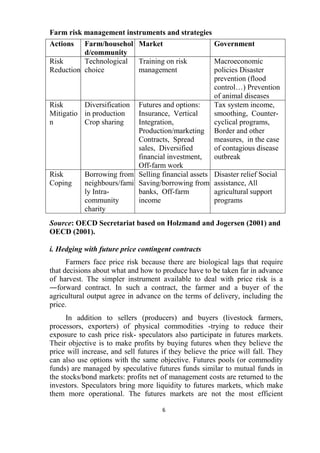
OECD (2000) differentiated between risks that are common to all
businesses (family situation, health, personal accidents, macroeconomic
4
risks…) and risks that affect agriculture more specifically: production risk
(weather conditions, pests, diseases and technological change), ecological
risks (production, climate change, management of natural resources such as
water), market risks (output and input price variability, relationships with the
food chain with respect to quality, safety, new products…) and finally
regulatory or institutional risk (agriculture policies, food safety and
environmental regulations).
Musser and Patrick (2001) and Baquet et al. (1997) and define five
major sources of risk in agriculture. Production risk concerns variations in
crop yields and in livestock production due to weather conditions, diseases
and pests. Marketing risk is related to the variations in commodity prices and
quantities that can be marketed. Financial risk relates to the ability to pay
bills when due, to have money to continue farming and to avoid bankruptcy.
Legal and environmental risk concerns the possibility of lawsuits initiated by
other businesses or individuals and changes in government regulation related
to environment and farming practices. Finally, human resources risk
concerning the possibility that family or employees will not be available to
provide labour or management.
Moschini and Henessy (2001) prefer to talk about sources of
uncertainty in agriculture, singling out four different sources.
 Production uncertainty. The amount and quality of the output that will
result from a given bundle of production decisions are not known with
certainty. Uncontrolled elements such as weather conditions play a
fundamental role in agricultural production.
 Price uncertainty. Production decisions have to be made far in advance
of realizing the final product. The price of the output is typically not known
at the time the production decisions are taken. Inelastic demand is often cited
as a main explanation for agricultural price variability.
 Technological uncertainty. The evolution of production techniques may
make quasi-fixed past investments obsolete. Research and development
efforts are typically not made at the farm level but at the input supplier firm
level.
 Policy uncertainty. Besides the general economic policies that affect
agriculture as any other sector (taxes, interest rates, exchange rates…)
agriculture is typically characterised by an intricate system of government
interventions, changes in which may create risk for agricultural investment.
In all possible classifications the boundary between different types of
risk is blurred. Price or production risk is often associated with different
singular events that are also denoted as risks.
5
Nature of price and production risk
Price and production risk are two important components or types of
farming risk. However they have different origins. Production risk is to a
great extent determined by weather conditions and animal or plant diseases.
Price risk originates in the markets for inputs and outputs and it has been
argued that it could be generated endogenously by the dynamics of markets
The farm specific price risk or basis is often stable because transportation
or storage costs associated with a single location do not change dramatically
from year to year. Production or yield risk has, in general, a larger
idiosyncratic component. In addition to systemic events (like droughts and
floods) that affect a whole region, there are also idiosyncratic ones (rain, hail,
frost…). As a result, the basis that compares individual yields or production
with more aggregate regional or national average yields can vary across
space and time depending on specific local events related to weather or
disease. It can easily occur that a farmer suffers a bad production year while
his neighbours have an average year, while it is very unlikely that a farmer
will receive a low price while his neighbours have much higher prices
(except if they were covered by risk management tools such as futures or
contracting agreements).
Price risk is relatively easier to pool with the opposite risk faced by
buyers or consumers through futures, options or other contractual
arrangements. Production risk is potentially more difficult to pool because
there is no evident group of agents inside or outside the agricultural sector
facing a risk that is negatively correlated with agricultural production risk.
Risk management instruments and strategies
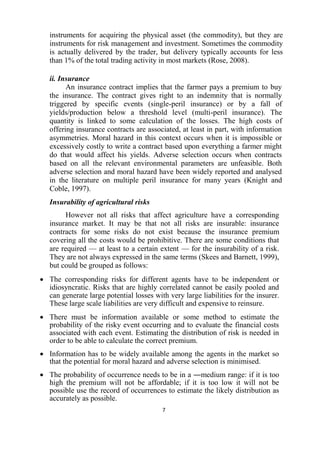
Risk management strategies can be grouped into three categories (Holzmann
and Jogersen, 2001): prevention strategies to reduce the probability of an
adverse event occurring, mitigation strategies to reduce the potential impact
of an adverse event, and coping strategies to relieve the impact of the risky
event once it has occurred. Prevention and mitigation strategies focus on
income smoothing, while coping strategies focus on consumption smoothing.
Strategies can be based on arrangements made at different institutional
levels: farm household or community arrangements, market based
mechanisms and government policies.
The farmer can choose among available instruments the combination of tools
and strategies that best fits his risk exposure and his level of risk aversion.
6
Farm risk management instruments and strategies
Source: OECD Secretariat based on Holzmand and Jogersen (2001) and
OECD (2001).
i. Hedging with future price contingent contracts
Farmers face price risk because there are biological lags that require
that decisions about what and how to produce have to be taken far in advance
of harvest. The simpler instrument available to deal with price risk is a
―forward contract. In such a contract, the farmer and a buyer of the
agricultural output agree in advance on the terms of delivery, including the
price.
In addition to sellers (producers) and buyers (livestock farmers,
processors, exporters) of physical commodities -trying to reduce their
exposure to cash price risk- speculators also participate in futures markets.
Their objective is to make profits by buying futures when they believe the
price will increase, and sell futures if they believe the price will fall. They
can also use options with the same objective. Futures pools (or commodity
funds) are managed by speculative futures funds similar to mutual funds in
the stocks/bond markets: profits net of management costs are returned to the
investors. Speculators bring more liquidity to futures markets, which make
them more operational. The futures markets are not the most efficient
Actions Farm/househol
d/community
Market Government
Risk
Reduction
Technological
choice
Training on risk
management
Macroeconomic
policies Disaster
prevention (flood
control…) Prevention
of animal diseases
Risk
Mitigatio
n
Diversification
in production
Crop sharing
Futures and options:
Insurance, Vertical
Integration,
Production/marketing
Contracts, Spread
sales, Diversified
financial investment,
Off-farm work
Tax system income,
smoothing, Counter-
cyclical programs,
Border and other
measures, in the case
of contagious disease
outbreak
Risk
Coping
Borrowing from
neighbours/fami
ly Intra-
community
charity
Selling financial assets
Saving/borrowing from
banks, Off-farm
income
Disaster relief Social
assistance, All
agricultural support
programs
7
instruments for acquiring the physical asset (the commodity), but they are
instruments for risk management and investment. Sometimes the commodity
is actually delivered by the trader, but delivery typically accounts for less
than 1% of the total trading activity in most markets (Rose, 2008).
ii. Insurance
An insurance contract implies that the farmer pays a premium to buy
the insurance. The contract gives right to an indemnity that is normally
triggered by specific events (single-peril insurance) or by a fall of
yields/production below a threshold level (multi-peril insurance). The
quantity is linked to some calculation of the losses. The high costs of
offering insurance contracts are associated, at least in part, with information
asymmetries. Moral hazard in this context occurs when it is impossible or
excessively costly to write a contract based upon everything a farmer might
do that would affect his yields. Adverse selection occurs when contracts
based on all the relevant environmental parameters are unfeasible. Both
adverse selection and moral hazard have been widely reported and analysed
in the literature on multiple peril insurance for many years (Knight and
Coble, 1997).
Insurability of agricultural risks
However not all risks that affect agriculture have a corresponding
insurance market. It may be that not all risks are insurable: insurance
contracts for some risks do not exist because the insurance premium
covering all the costs would be prohibitive. There are some conditions that
are required — at least to a certain extent — for the insurability of a risk.
They are not always expressed in the same terms (Skees and Barnett, 1999),
but could be grouped as follows:
 The corresponding risks for different agents have to be independent or
idiosyncratic. Risks that are highly correlated cannot be easily pooled and
can generate large potential losses with very large liabilities for the insurer.
These large scale liabilities are very difficult and expensive to reinsure.
 There must be information available or some method to estimate the
probability of the risky event occurring and to evaluate the financial costs
associated with each event. Estimating the distribution of risk is needed in
order to be able to calculate the correct premium.
 Information has to be widely available among the agents in the market so
that the potential for moral hazard and adverse selection is minimised.
 The probability of occurrence needs to be in a ―medium range: if it is too
high the premium will not be affordable; if it is too low it will not be
possible use the record of occurrences to estimate the likely distribution as
accurately as possible.
8
iii. Role of government
Government may have objectives other than increasing efficiency. It is
common to have redistribution objectives, especially in the case of events
that put particular economic stress on specific agents, inter alia, farmers.
The potential role for the government in reduction of agricultural risk are
given as.
a. Scope for redistribution
Economics is not only about efficiency, but also about equity. It is
well known that risk affects different producers differently, particularly
the poorest. All societies have redistribution policies linked to taxation
systems or social protection programs. Some of those are adapted to the
particular needs of special groups or activities such as farmers. Equity
considerations are the main driver of such policies which are normally
linked to the overall household or individual income or wealth, or to the
particular social situation of the household or the individual. These
policies tend to smooth the income or consumption flow of individuals or
households.
b. Market creation
All efforts by government in support of market creation or in
modifying market incentives will be, by definition ex ante measures. If
there are missing markets for risk management, the government may
have a role in helping the development of new markets. Markets,
including risk management markets for agriculture, develop much more
easily in the context of a stable macroeconomic and business
environment. Providing this environment is an important role for
government. It is known that information weaknesses are the main causes
of market failure in agricultural risk management. Government could
play a role through direct research and production of the missing
information.
On the demand side, farmers can improve their risk management
skills through training and information about the working of different risk
management instruments (including futures,options, and insurance). This
can contribute to a more stable and robust market demand and,
consequently, facilitate the development of the market. On the supply
side, enforcement of fair competition among insurance companies should
make products more attractive for farmers. In some particular markets
(such as futures and options) government may need to provide the
appropriate legislation and institutions, to facilitate the development of
the market.
It is important to define the boundaries between the government’s role
and the farmers’ responsibility for risk management. Farmers will take the
most appropriate risk management decisions, as part of a good whole
management strategy for the farm and the farm household.
9
c. Right market incentives:
In any case government action will not be able to generate a complete
set of risk markets. In this imperfect world, government may have a role in
trying to alter incentive prices – through taxes and subsidies - in order to
bring the economy to a more efficient outcome, or just to achieve some
specific risk coverage objective. It is often assumed that the absence of some
risk management markets automatically means that insurance levels are sub-
optimal. Therefore governments provide subsidies to stimulate demand for
risk management tools. The existence of these subsidies does not, however,
imply that they are well targeted to the observed market failures properly or
that they improve efficiency.
Farmers may create mutual funds to insure some types of risk. These
funds are owned by the participants. When mutual funds have a regional or
local dimension, farmers may know each other, thus reducing the scope for
moral hazard or adverse selection. Regional mutual funds may have the
disadvantage that risks are correlated among the participants.
d. Risk reduction and mitigation
Governments are sometimes seen as having some responsibility for
carrying out the appropriate works and implementing the appropriate
legislation to reduce the probability and/or the adverse impact of hazardous
events. This is often argued to be the case for catastrophic events, that is
events with low probability, but potentially large, systemic losses, and
particularly when individual actions may have negative (positive) effects on
others. Two types of government actions may be possible in this context:
direct government action and changing the incentive structure for farms. The
positive external effects of these actions, in terms of reducing the negative
impacts on other producers, are typically not internalized in individuals’
(farmers’) decision making. In this context there is potential for a role of
government in terms of legislation, public works and incentives. One
example is flood control for which there are different alternatives. In some
cases public works can help to reduce the risk of flood. Actions on the farm
to reduce water run-off can also reduce and/or mitigate flood risks. Some of
these actions may generate externalities that could require some appropriate
incentives. In the area of prevention of animal diseases possible measures
include both domestic and border measures when there is a risk of a disease
being imported from abroad.
There are many legal measures to facilitate risk reduction and
mitigation. For instance, the legal framework for farm ownership can
facilitate more appropriate risk management. For example, providing
appropriate legal form for farms allows the business risk associated with
farming to be separated from the consumption risk faced by the farm
10
household.
e. Coping with risk (consumption smoothing):
Coping with risk refers to situations in which measures are needed to
ensure minimum consumption requirements of farmers or their families and
they are, by definition, related to equity considerations. Once all available
measures or instruments to reduce or mitigate risk have been exhausted, only
consumption smoothing strategies are available to cope with any remaining
problem. Of course, all agricultural support programs contribute, to some
extent, to consumption or income smoothing. Once a risky event has
occurred, government may have strong political incentives to provide some
assistance. Ex post government actions may include social assistance,
disaster relief (payments, subsidised credit…) and/or ad hoc ex post
payments. If the purpose is to help to adjust from a hazard that may reduce
household consumption towards poverty (equity concern), the criterion for
such aid should be proximity to the poverty line, and equity considerations
would suggest that in a first best policy option all farm household income
and/or wealth should be included in the assessment.
f. Dealing with catastrophic risk:
There is no single precise way of defining a catastrophic event, in
general, and in agriculture in particular. To be catastrophic an event is very
likely to be also systemic,: it is infrequent and severe for individuals, and it
is also severe for a country or a region as a whole. From a political economy
perspective, an event is catastrophic if it triggers some special catastrophic
aid or program. The triggering threshold may be explicitly defined, but this
is very rare. Yet most governments have provided catastrophic aid at some
moment in the past. The ex post reaction of governments to ―catastrophes
is, in this sense, part of the risk management system which farmers take into
account when planning their own decisions and strategies. The explicit or
implicit definition of ―catastrophe reflected in what governments do, has an
impact on the farmers perception of the boundaries of his own risk
management responsibility.
Agricultural Risk Management Process
The basic principle of risk management process is to consider each
element as part of a system which can only be understood and the policy
implications inferred, if those links are explicitly taken into account. In
particular, policies have to be analysed on the basis their objectives,
accounting for the interactions with other sources of risk that may not be the
main focus of the policy, other risk management tools and strategies on-farm
and off-farm, and other policy instruments and support programs. The
different clusters of activities under risk management process are given
below.
11
Cluster 1: Risk assessment: information and communication
This is the first cluster of any risk management decision process. Under
this cluster the operational definition of the different types of risk including
―catastrophic risk will be explored for the country in question, in order to
be able to identify roles and actions. This risk assessment cluster will cover
all issues related to the production and availability of information about risk
in agriculture.
This cluster involves the following activities
 The identification by government or private agents of the main types of
risk (droughts, floods, diseases, prices…).
 The definition of catastrophic risk and other layers of risk and the
implications in terms of the responsibility of farmers, government or non-
government agencies.
 The communications efforts of government and private agencies to
improve risk awareness and clarify risk responsibilities among farmers.
 Available knowledge about risk perceptions and risk preferences of
farmers in the country. In particular the analysis of this cluster will try
to answer the following questions:
 What are the agencies/institutions or others agents that provide
information about the sources and distribution of risk in agriculture?
 What sources of risk have less available information and are more likely
to be affected by cognitive failure? What are the government initiatives to
tackle this issue?
 Are the main sources of risk (for crops and livestock) easy to identify and
isolate from minor sources of risk? If so, which are those? What is
specific in these countries as compared with others (with data)?
 What are the main ―risk‖ priorities for the government? Are they
expressed explicitly? How are they defined? What information is needed
and which agents participate in the process of defining priorities and
objectives?
 Are there private or public initiatives to improve farmers’ knowledge on risk
management?
 Is there any attempt to define explicitly the boundaries between the
different layers of risk, particularly catastrophic risk? What are the
implicit/de facto boundaries (in terms of the source or risk, the frequency
and the magnitude of the loss) that define a risk as catastrophic/disaster/
exceptional circumstances?
Cluster 2: Dealing with catastrophic risk
Catastrophic risk relates to low probability, high loss events and —
to a certain degree — correlated risk. The definition could relate to the
probability in the tail of the distribution (e.g. the worse events that occur
12
with a probability of 5% or every 20 years). Under this cluster the
following issues will be analysed:
 The available information about location, frequency and impacts of past
catastrophes affecting agriculture.
 The types of risks or events that are targeted by agricultural disaster aid.
 The available instruments to deal with catastrophic risk.
 The agencies, institutions and procedures involved in decision making
after a catastrophic event affecting agriculture, including all levels of
government and non governmental agencies.
 A review of interventions in response to ―disaster or ―catastrophe in
agriculture. Type of event, frequency, type of government action and
costs.
The relationship/coordination with catastrophic risk management
outside the agricultural sector, and with economy wide welfare programs.In
particular the following questions will be posed:
 For which risk or levels of risk appropriate market instruments have not
developed or, in practice, they are not insured through risk management
instruments (insurance, futures/options, contracting, co-operatives, mutual
funds)?
 What type of events is covered in practice by catastrophic/disaster/exceptional
circumstances aid?
 Are there markets/private mechanisms to cover some of these risks?
Insurance, mutual funds?
 Are there public/private partnership arrangements for insurance or other risk
management tools?
 Which agency or institution, if any, leads decision making in the case of
catastrophic events affecting agriculture? How is a catastrophic event in
agriculture identified? Are there threshold indicators and of what kind? Is it
based on weather conditions, physical losses, revenue, income?
 What are the implementation criteria of disaster aid programs in agriculture?
 Are animal related catastrophes dealt with differently from plant related
catastrophes? In what sense and why?
The specific roles, actions and options of different actors (government,
markets and farmers/community) in terms of risk reduction, risk mitigation
and risk coping will be examined.
Cluster 3: Insurable or marketable risk
This cluster studies how insurable and marketable risks are or can be
handled through instruments specifically designed for sharing farming risk:
13
insurance, futures/options, contracting, co-operatives, mutual funds...etc.
This will require an analysis of:
 The type of risks and events that are or are not traded through risk market
instruments.
 The availability of market or mutual instruments to deal with risks in this
country, including data on the degree of use of each instrument.
 The reasons why some of these instruments are absent.
 The role that government plays in the creation of these markets and
instruments.
The government intervention in subsidising these instruments and collection
of data on the following areas.
 What risks are insured by a significant proportion of farmers? Provide
available quantitative data.
 What are the market instruments and tools used by farmers? Insurance,
futures/options, contracting, co-operatives, mutual funds, other?
 What sectors and risks have the possibility of being insured? How popular
are these insurance instruments among farmers? Why?
 Are there futures markets available? How much are they used by farmers?
Why?
 Are there price support policies that smooth or truncate price fluctuations?
Are there other type of sectoral arrangements including production quotas or
market interventions?
 Does the government intervene in agricultural risk markets? How and how
much?
 What is the market structure for risk management tools such as insurance?
Are there several competing companies? How is competition ensured among
them?
 Are there consortiums or agreements among companies? What is their
purpose and scope?
 Are there public–private partnerships? How do they work?
Cluster 4: Normal risk/risk retention
This Cluster needs to be defined by default: all risks that are not in the
catastrophic or the marketable layers are de facto in the normal risk retention
layer. Farmers handle this risk and smooth income over time using
techniques and decisions on-farm and in the farm household, or using non-
sector specific instruments such as the tax system or the financial markets.
The following questions will be analysed:
 The role and provisions of the tax and social security systems for farmers.
14
Are they different than in other sectors? Are they different for big and small
farmers? Other specificities: Is income smoothing allowed? How and for
how many farmers?
 The role of banking and the financial system.
 Are farmers using non-farm income and assets for income smoothing
purposes?
 Are government general agricultural support policies an important income
smoothing mechanism?
 Is there evidence of the use of potential risk reduction techniques by
farmers, such as irrigation, pesticides or diversification?
Cluster 5: Specification
Very often policy measures in a given country are concentrated around
a specific element of one of the three axes of risk management systems
(sources of risk, tools, and government actions). This can be due to different
reasons. In those cases it can be very useful to analyse how risks,
instruments and government/private roles are articulated around this main
focus. The approach here too will be holistic, with particular attention to the
interaction with other risks, other instruments/strategies and government
actions/roles. Under this cluster one of the following will be chosen for each
specific country to be studied in detail in institutional and quantitative terms:
 Specific risk: e.g. drought, contagious diseases.
 Specific instrument: e.g. insurance, mutual funds, futures markets.
 Specific government objective: e.g. reducing information asymmetries/
transaction costs, avoiding farmers consumption falling beyond a threshold,
reducing farmers exposure to price risk.
Analysis of each Cluster
Each cluster will be analysed on the basis of the holistic conceptual
framework and set of issues developed in previous sections, and with respect
to a set of evaluation guidelines, some of them already identified in OECD
(2000). An effective and efficient risk management system in a given
country should be oriented by the following guidelines:
 Empower farmers to take their individual responsibility on risk management
as part of normal business management.
 Facilitate farmers taking advantage of negative correlations among different
types of risks, asset returns and sources of income.
 Facilitate the availability of a variety of instruments, including the
development of market instruments.
 Provide a sound business environment with competitive markets and clear
regulations.
 Facilitate the flow of information about risk, and the creation of knowledge
15
and human capital on risk management.
 Policies should be targeted to the specific objectives: well identified
market failures (asymmetric information, systemic risk, externalities…), well
identify equity concerns, or other well defined objectives.
 Policies should be cost efficient, all costs and benefits should be taken into
account including distortions and transaction costs.
The application of these principles to each of the clusters and to the
system as a whole will allow strengths and weaknesses of specific
agricultural risk management systems to be identified. These principles may
result in policy trade-offs between different guidelines and objectives.
Lessons can be learned from applying this holistic approach to the
experience in different countries, and recommendations are likely to arise in
relation to each of the five clusters and the potential trade-offs to be faced by
policy makers.
Thus we have seen that managing risk is an important part of farming and
its management is a concern for those governments which include this as one
of their agricultural policy objectives. Risk management should be analysed
as a system in which there is interaction between many elements. These
elements have been organised around three axes: the sources of risk, farmers’
strategies and government policies. A number of issues and concepts are
crucial for understanding of these interactions and reduction of risk and
improvement of income of farmers and overall development of agriculture
sector.
References
Baquet,A., R. Hambleton and D. Jose (1997) Introduction to Risk
Management, USDA Risk Management Agency.
Hardaker, J.B., R. Huirne, J.R. Anderson and G. Lien (2004) Coping
with risk in agriculture, CABI Publishing.
Harwood, J., R. Heifner, K. Coble, J. Perry and A. Somwaru (1999)
Managing Risk in Farming: Concepts
Holzman and Jorgensen (2001) Social Risk management: A New
conceptual framework for social protection, and beyond, International Tax
and public Finance, N°8, 529-556.
Knight, T.O. and K.H. Coble (1997) Survey of US Multiple Peril Crop
Insurance Literature since 1980, Review of Agricultural Economics,
N°19(1): 128-156.
Moschini, G. and D.A. Hennessy (2001) Uncertainty, risk aversion, and
16
risk management for agricultural producers, Chapter 2 in Gardner and
Rausser (2001).
Rose, F. (2008) A note on the role of investment capital in the US
agricultural futures markets and the possible effect on cash prices‖, note for
the Group on Cereals, Animal feed and sugar, internal OECD document.
Skees, J.R. and B.J. Barnett (1999) Conceptual and practical
considerations for sharing catastrophic/systemic risks‖ Review of
Agricultural Economics, N°21 (2): 424-441.
Srinivasan, P.V. and S. Jha (2001) Liberalized trade and domestic price
stability. The case of rice in India‖ Journal of Development Studies,
N°65(2001): 417-441.
Notes
International Risk Governance Council (2008) An Introduction to the
IRGC Risk Governance Framework. Geneva. www.irgc.org.
Knight, F. (1921) Risk, Uncertainty and Profit, Houghton Mifflin, Boston.
Musser, W.N. and G.F. Patrick (2001) How much does risk really matter
to farmers? Chapter 24 in Just & Pope (2002).
OECD (2000) Income Risk Management in Agriculture, OECD Paris.
World Bank (2005) Managing Agricultural Production Risk: Innovations
in Developing Countries, Washington D.C.

Agricultural risk management, e-bulletin.docx

  • 1.
    Management of riskin Agriculture Vikas Kumar, Senior Scientist JANUARY 2024 ICAR- NATIONAL INSTITUTE OF AGRICULTURAL ECONOMICS AND POLICY RESEARCH New Delhi
  • 2.
    1 Index S.no Main headings 1Introduction 2 Risk, uncertainty and vulnerability 3 Sources of agricultural risk 4 Nature of price and production risk 5 Risk management instruments and strategies 6 Farm risk management instruments and strategies 7 Insurability of agricultural risks 8 Role of government 9 Agricultural Risk Management Process 10 References
  • 3.
    2 Introduction Agricultural production issubject to many uncertainties. Any farm production decision plan is typically associated with multiple potential outcomes with different probabilities. Weather, market developments and other events cannot be controlled by the farmer but have a direct incidence on the returns from farming. In this context, the farmer has to manage risk in farming as part of the general management of the farming business. Hazards and unforeseen events occur in all economic and business activities and are not specific to agriculture. However, farming risk and risk management instruments in the sector may have a certain number of specificities. Many risks directly affect farmers´ production decisions and welfare. In response to the potential impact of these uncertain events farmers implement diverse risk management strategies in the context of their production plans, the available portfolio of financial, physical and human capital, and the degree of aversion to risk. These risk management strategies may include decisions on-farm, changes in portfolio structure, use of market instruments, government programs, and diversification to other source of income. Many general agricultural support policies have risk management implications and influence risk management decisions. Because of the complexity of these interactions governments need to make significant efforts to achieve coherence, particularly among different policies and between policies and market strategies. Agricultural risk is an interrelated ―system‖ in which markets and government actions interact with risks and farmers’ strategies. Government programs may underpin the development of market strategies, but they may also crowd out market developments or on- farm strategies. The result of these interactions is the set of risk management strategies and tools that is available and used by farmers. The available strategies are not the simple addition of government programs, market instruments and on-farm decisions; they are mutually interdependent and constitute a unique system. Risk, uncertainty and vulnerability It is often said that agriculture production is a risky business, that is, it is subject to risk. This means that due to complexities of physical and economic systems, the outcomes of farmers’ actions and production decisions are uncertain, and many possible outcomes are usually associated with a single action or production plan. The uncertainty concerning outcomes that involve some adversity or loss that negatively affects individual well-being is normally associated with the idea of risk. Some (e.g. Knight, 1921) make the distinction between risk, that implies knowledge of numerical, objective probabilities, and uncertainty, that implies that the outcome is uncertain and the probabilities are not known. Most authors find a more useful distinction
  • 4.
    3 between uncertainty asimperfect knowledge and risk as exposure to uncertain unfavourable economic consequences (Hardaker et al., 2004). In practice both concepts are very much related and are used interchangeably, one with more emphasis on ―probabilities as the description of the environment, and the other with more emphasis on the ―potential negative impact on welfare. There is no risk without some uncertainty and most uncertainties typically imply some risk. In this context the term vulnerability is often used to define the likelihood that a risk will result in a significant decline in well-being, that is, resilience or lack of resilience against a given adversity. Vulnerability does not depend only on the characteristics of the risk, but also on the household’s asset endowment and availability of insurance mechanisms. Risk management is part of a broader risk governance framework that typically includes at least three stages: risk assessment and evaluation, risk management and risk communication. These terms can be defined in different ways (e.g. International Risk Governance Council, 2008). Risk assessment normally refers to a systematic processing of available information to identify the frequency and magnitude of specific events, while risk evaluation consists of fixing priorities and defining societal ―tolerance for some risks. Risk management is the system of measures by individuals and organizations that contribute to reducing, controlling and regulating risks. Risk communication is the exchange and sharing of information about risk between decision makers and other stakeholders. A risk management system is composed of many different sources of risk that affect farming, different risk management strategies and tools used and available to farmers, and all government actions that affect risk in farming. A standard approach to analyse risk management issues will involve three linear steps. First, measuring the risk or variability that needs to be managed. Second, use this information to analyse the optimal risk management tool for a given farmer, accounting for his endowments and risk preferences. Finally, decide on appropriate government policies to improve this risk management strategy. Sources of agricultural risk The risks and sources or risks that are relevant in agriculture have different characteristics, and they can be classified in very different ways. It is not necessary to opt for any particular classification of risk, and different ones can be used for different purposes. Some technical characteristics of risks apply across different classes and can be very significant in terms of the appropriate and available strategies to deal with each risk. OECD (2000) differentiated between risks that are common to all businesses (family situation, health, personal accidents, macroeconomic
  • 5.
    4 risks…) and risksthat affect agriculture more specifically: production risk (weather conditions, pests, diseases and technological change), ecological risks (production, climate change, management of natural resources such as water), market risks (output and input price variability, relationships with the food chain with respect to quality, safety, new products…) and finally regulatory or institutional risk (agriculture policies, food safety and environmental regulations). Musser and Patrick (2001) and Baquet et al. (1997) and define five major sources of risk in agriculture. Production risk concerns variations in crop yields and in livestock production due to weather conditions, diseases and pests. Marketing risk is related to the variations in commodity prices and quantities that can be marketed. Financial risk relates to the ability to pay bills when due, to have money to continue farming and to avoid bankruptcy. Legal and environmental risk concerns the possibility of lawsuits initiated by other businesses or individuals and changes in government regulation related to environment and farming practices. Finally, human resources risk concerning the possibility that family or employees will not be available to provide labour or management. Moschini and Henessy (2001) prefer to talk about sources of uncertainty in agriculture, singling out four different sources.  Production uncertainty. The amount and quality of the output that will result from a given bundle of production decisions are not known with certainty. Uncontrolled elements such as weather conditions play a fundamental role in agricultural production.  Price uncertainty. Production decisions have to be made far in advance of realizing the final product. The price of the output is typically not known at the time the production decisions are taken. Inelastic demand is often cited as a main explanation for agricultural price variability.  Technological uncertainty. The evolution of production techniques may make quasi-fixed past investments obsolete. Research and development efforts are typically not made at the farm level but at the input supplier firm level.  Policy uncertainty. Besides the general economic policies that affect agriculture as any other sector (taxes, interest rates, exchange rates…) agriculture is typically characterised by an intricate system of government interventions, changes in which may create risk for agricultural investment. In all possible classifications the boundary between different types of risk is blurred. Price or production risk is often associated with different singular events that are also denoted as risks.
  • 6.
    5 Nature of priceand production risk Price and production risk are two important components or types of farming risk. However they have different origins. Production risk is to a great extent determined by weather conditions and animal or plant diseases. Price risk originates in the markets for inputs and outputs and it has been argued that it could be generated endogenously by the dynamics of markets The farm specific price risk or basis is often stable because transportation or storage costs associated with a single location do not change dramatically from year to year. Production or yield risk has, in general, a larger idiosyncratic component. In addition to systemic events (like droughts and floods) that affect a whole region, there are also idiosyncratic ones (rain, hail, frost…). As a result, the basis that compares individual yields or production with more aggregate regional or national average yields can vary across space and time depending on specific local events related to weather or disease. It can easily occur that a farmer suffers a bad production year while his neighbours have an average year, while it is very unlikely that a farmer will receive a low price while his neighbours have much higher prices (except if they were covered by risk management tools such as futures or contracting agreements). Price risk is relatively easier to pool with the opposite risk faced by buyers or consumers through futures, options or other contractual arrangements. Production risk is potentially more difficult to pool because there is no evident group of agents inside or outside the agricultural sector facing a risk that is negatively correlated with agricultural production risk. Risk management instruments and strategies Risk management strategies can be grouped into three categories (Holzmann and Jogersen, 2001): prevention strategies to reduce the probability of an adverse event occurring, mitigation strategies to reduce the potential impact of an adverse event, and coping strategies to relieve the impact of the risky event once it has occurred. Prevention and mitigation strategies focus on income smoothing, while coping strategies focus on consumption smoothing. Strategies can be based on arrangements made at different institutional levels: farm household or community arrangements, market based mechanisms and government policies. The farmer can choose among available instruments the combination of tools and strategies that best fits his risk exposure and his level of risk aversion.
  • 7.
    6 Farm risk managementinstruments and strategies Source: OECD Secretariat based on Holzmand and Jogersen (2001) and OECD (2001). i. Hedging with future price contingent contracts Farmers face price risk because there are biological lags that require that decisions about what and how to produce have to be taken far in advance of harvest. The simpler instrument available to deal with price risk is a ―forward contract. In such a contract, the farmer and a buyer of the agricultural output agree in advance on the terms of delivery, including the price. In addition to sellers (producers) and buyers (livestock farmers, processors, exporters) of physical commodities -trying to reduce their exposure to cash price risk- speculators also participate in futures markets. Their objective is to make profits by buying futures when they believe the price will increase, and sell futures if they believe the price will fall. They can also use options with the same objective. Futures pools (or commodity funds) are managed by speculative futures funds similar to mutual funds in the stocks/bond markets: profits net of management costs are returned to the investors. Speculators bring more liquidity to futures markets, which make them more operational. The futures markets are not the most efficient Actions Farm/househol d/community Market Government Risk Reduction Technological choice Training on risk management Macroeconomic policies Disaster prevention (flood control…) Prevention of animal diseases Risk Mitigatio n Diversification in production Crop sharing Futures and options: Insurance, Vertical Integration, Production/marketing Contracts, Spread sales, Diversified financial investment, Off-farm work Tax system income, smoothing, Counter- cyclical programs, Border and other measures, in the case of contagious disease outbreak Risk Coping Borrowing from neighbours/fami ly Intra- community charity Selling financial assets Saving/borrowing from banks, Off-farm income Disaster relief Social assistance, All agricultural support programs
  • 8.
    7 instruments for acquiringthe physical asset (the commodity), but they are instruments for risk management and investment. Sometimes the commodity is actually delivered by the trader, but delivery typically accounts for less than 1% of the total trading activity in most markets (Rose, 2008). ii. Insurance An insurance contract implies that the farmer pays a premium to buy the insurance. The contract gives right to an indemnity that is normally triggered by specific events (single-peril insurance) or by a fall of yields/production below a threshold level (multi-peril insurance). The quantity is linked to some calculation of the losses. The high costs of offering insurance contracts are associated, at least in part, with information asymmetries. Moral hazard in this context occurs when it is impossible or excessively costly to write a contract based upon everything a farmer might do that would affect his yields. Adverse selection occurs when contracts based on all the relevant environmental parameters are unfeasible. Both adverse selection and moral hazard have been widely reported and analysed in the literature on multiple peril insurance for many years (Knight and Coble, 1997). Insurability of agricultural risks However not all risks that affect agriculture have a corresponding insurance market. It may be that not all risks are insurable: insurance contracts for some risks do not exist because the insurance premium covering all the costs would be prohibitive. There are some conditions that are required — at least to a certain extent — for the insurability of a risk. They are not always expressed in the same terms (Skees and Barnett, 1999), but could be grouped as follows:  The corresponding risks for different agents have to be independent or idiosyncratic. Risks that are highly correlated cannot be easily pooled and can generate large potential losses with very large liabilities for the insurer. These large scale liabilities are very difficult and expensive to reinsure.  There must be information available or some method to estimate the probability of the risky event occurring and to evaluate the financial costs associated with each event. Estimating the distribution of risk is needed in order to be able to calculate the correct premium.  Information has to be widely available among the agents in the market so that the potential for moral hazard and adverse selection is minimised.  The probability of occurrence needs to be in a ―medium range: if it is too high the premium will not be affordable; if it is too low it will not be possible use the record of occurrences to estimate the likely distribution as accurately as possible.
  • 9.
    8 iii. Role ofgovernment Government may have objectives other than increasing efficiency. It is common to have redistribution objectives, especially in the case of events that put particular economic stress on specific agents, inter alia, farmers. The potential role for the government in reduction of agricultural risk are given as. a. Scope for redistribution Economics is not only about efficiency, but also about equity. It is well known that risk affects different producers differently, particularly the poorest. All societies have redistribution policies linked to taxation systems or social protection programs. Some of those are adapted to the particular needs of special groups or activities such as farmers. Equity considerations are the main driver of such policies which are normally linked to the overall household or individual income or wealth, or to the particular social situation of the household or the individual. These policies tend to smooth the income or consumption flow of individuals or households. b. Market creation All efforts by government in support of market creation or in modifying market incentives will be, by definition ex ante measures. If there are missing markets for risk management, the government may have a role in helping the development of new markets. Markets, including risk management markets for agriculture, develop much more easily in the context of a stable macroeconomic and business environment. Providing this environment is an important role for government. It is known that information weaknesses are the main causes of market failure in agricultural risk management. Government could play a role through direct research and production of the missing information. On the demand side, farmers can improve their risk management skills through training and information about the working of different risk management instruments (including futures,options, and insurance). This can contribute to a more stable and robust market demand and, consequently, facilitate the development of the market. On the supply side, enforcement of fair competition among insurance companies should make products more attractive for farmers. In some particular markets (such as futures and options) government may need to provide the appropriate legislation and institutions, to facilitate the development of the market. It is important to define the boundaries between the government’s role and the farmers’ responsibility for risk management. Farmers will take the most appropriate risk management decisions, as part of a good whole management strategy for the farm and the farm household.
  • 10.
    9 c. Right marketincentives: In any case government action will not be able to generate a complete set of risk markets. In this imperfect world, government may have a role in trying to alter incentive prices – through taxes and subsidies - in order to bring the economy to a more efficient outcome, or just to achieve some specific risk coverage objective. It is often assumed that the absence of some risk management markets automatically means that insurance levels are sub- optimal. Therefore governments provide subsidies to stimulate demand for risk management tools. The existence of these subsidies does not, however, imply that they are well targeted to the observed market failures properly or that they improve efficiency. Farmers may create mutual funds to insure some types of risk. These funds are owned by the participants. When mutual funds have a regional or local dimension, farmers may know each other, thus reducing the scope for moral hazard or adverse selection. Regional mutual funds may have the disadvantage that risks are correlated among the participants. d. Risk reduction and mitigation Governments are sometimes seen as having some responsibility for carrying out the appropriate works and implementing the appropriate legislation to reduce the probability and/or the adverse impact of hazardous events. This is often argued to be the case for catastrophic events, that is events with low probability, but potentially large, systemic losses, and particularly when individual actions may have negative (positive) effects on others. Two types of government actions may be possible in this context: direct government action and changing the incentive structure for farms. The positive external effects of these actions, in terms of reducing the negative impacts on other producers, are typically not internalized in individuals’ (farmers’) decision making. In this context there is potential for a role of government in terms of legislation, public works and incentives. One example is flood control for which there are different alternatives. In some cases public works can help to reduce the risk of flood. Actions on the farm to reduce water run-off can also reduce and/or mitigate flood risks. Some of these actions may generate externalities that could require some appropriate incentives. In the area of prevention of animal diseases possible measures include both domestic and border measures when there is a risk of a disease being imported from abroad. There are many legal measures to facilitate risk reduction and mitigation. For instance, the legal framework for farm ownership can facilitate more appropriate risk management. For example, providing appropriate legal form for farms allows the business risk associated with farming to be separated from the consumption risk faced by the farm
  • 11.
    10 household. e. Coping withrisk (consumption smoothing): Coping with risk refers to situations in which measures are needed to ensure minimum consumption requirements of farmers or their families and they are, by definition, related to equity considerations. Once all available measures or instruments to reduce or mitigate risk have been exhausted, only consumption smoothing strategies are available to cope with any remaining problem. Of course, all agricultural support programs contribute, to some extent, to consumption or income smoothing. Once a risky event has occurred, government may have strong political incentives to provide some assistance. Ex post government actions may include social assistance, disaster relief (payments, subsidised credit…) and/or ad hoc ex post payments. If the purpose is to help to adjust from a hazard that may reduce household consumption towards poverty (equity concern), the criterion for such aid should be proximity to the poverty line, and equity considerations would suggest that in a first best policy option all farm household income and/or wealth should be included in the assessment. f. Dealing with catastrophic risk: There is no single precise way of defining a catastrophic event, in general, and in agriculture in particular. To be catastrophic an event is very likely to be also systemic,: it is infrequent and severe for individuals, and it is also severe for a country or a region as a whole. From a political economy perspective, an event is catastrophic if it triggers some special catastrophic aid or program. The triggering threshold may be explicitly defined, but this is very rare. Yet most governments have provided catastrophic aid at some moment in the past. The ex post reaction of governments to ―catastrophes is, in this sense, part of the risk management system which farmers take into account when planning their own decisions and strategies. The explicit or implicit definition of ―catastrophe reflected in what governments do, has an impact on the farmers perception of the boundaries of his own risk management responsibility. Agricultural Risk Management Process The basic principle of risk management process is to consider each element as part of a system which can only be understood and the policy implications inferred, if those links are explicitly taken into account. In particular, policies have to be analysed on the basis their objectives, accounting for the interactions with other sources of risk that may not be the main focus of the policy, other risk management tools and strategies on-farm and off-farm, and other policy instruments and support programs. The different clusters of activities under risk management process are given below.
  • 12.
    11 Cluster 1: Riskassessment: information and communication This is the first cluster of any risk management decision process. Under this cluster the operational definition of the different types of risk including ―catastrophic risk will be explored for the country in question, in order to be able to identify roles and actions. This risk assessment cluster will cover all issues related to the production and availability of information about risk in agriculture. This cluster involves the following activities  The identification by government or private agents of the main types of risk (droughts, floods, diseases, prices…).  The definition of catastrophic risk and other layers of risk and the implications in terms of the responsibility of farmers, government or non- government agencies.  The communications efforts of government and private agencies to improve risk awareness and clarify risk responsibilities among farmers.  Available knowledge about risk perceptions and risk preferences of farmers in the country. In particular the analysis of this cluster will try to answer the following questions:  What are the agencies/institutions or others agents that provide information about the sources and distribution of risk in agriculture?  What sources of risk have less available information and are more likely to be affected by cognitive failure? What are the government initiatives to tackle this issue?  Are the main sources of risk (for crops and livestock) easy to identify and isolate from minor sources of risk? If so, which are those? What is specific in these countries as compared with others (with data)?  What are the main ―risk‖ priorities for the government? Are they expressed explicitly? How are they defined? What information is needed and which agents participate in the process of defining priorities and objectives?  Are there private or public initiatives to improve farmers’ knowledge on risk management?  Is there any attempt to define explicitly the boundaries between the different layers of risk, particularly catastrophic risk? What are the implicit/de facto boundaries (in terms of the source or risk, the frequency and the magnitude of the loss) that define a risk as catastrophic/disaster/ exceptional circumstances? Cluster 2: Dealing with catastrophic risk Catastrophic risk relates to low probability, high loss events and — to a certain degree — correlated risk. The definition could relate to the probability in the tail of the distribution (e.g. the worse events that occur
  • 13.
    12 with a probabilityof 5% or every 20 years). Under this cluster the following issues will be analysed:  The available information about location, frequency and impacts of past catastrophes affecting agriculture.  The types of risks or events that are targeted by agricultural disaster aid.  The available instruments to deal with catastrophic risk.  The agencies, institutions and procedures involved in decision making after a catastrophic event affecting agriculture, including all levels of government and non governmental agencies.  A review of interventions in response to ―disaster or ―catastrophe in agriculture. Type of event, frequency, type of government action and costs. The relationship/coordination with catastrophic risk management outside the agricultural sector, and with economy wide welfare programs.In particular the following questions will be posed:  For which risk or levels of risk appropriate market instruments have not developed or, in practice, they are not insured through risk management instruments (insurance, futures/options, contracting, co-operatives, mutual funds)?  What type of events is covered in practice by catastrophic/disaster/exceptional circumstances aid?  Are there markets/private mechanisms to cover some of these risks? Insurance, mutual funds?  Are there public/private partnership arrangements for insurance or other risk management tools?  Which agency or institution, if any, leads decision making in the case of catastrophic events affecting agriculture? How is a catastrophic event in agriculture identified? Are there threshold indicators and of what kind? Is it based on weather conditions, physical losses, revenue, income?  What are the implementation criteria of disaster aid programs in agriculture?  Are animal related catastrophes dealt with differently from plant related catastrophes? In what sense and why? The specific roles, actions and options of different actors (government, markets and farmers/community) in terms of risk reduction, risk mitigation and risk coping will be examined. Cluster 3: Insurable or marketable risk This cluster studies how insurable and marketable risks are or can be handled through instruments specifically designed for sharing farming risk:
  • 14.
    13 insurance, futures/options, contracting,co-operatives, mutual funds...etc. This will require an analysis of:  The type of risks and events that are or are not traded through risk market instruments.  The availability of market or mutual instruments to deal with risks in this country, including data on the degree of use of each instrument.  The reasons why some of these instruments are absent.  The role that government plays in the creation of these markets and instruments. The government intervention in subsidising these instruments and collection of data on the following areas.  What risks are insured by a significant proportion of farmers? Provide available quantitative data.  What are the market instruments and tools used by farmers? Insurance, futures/options, contracting, co-operatives, mutual funds, other?  What sectors and risks have the possibility of being insured? How popular are these insurance instruments among farmers? Why?  Are there futures markets available? How much are they used by farmers? Why?  Are there price support policies that smooth or truncate price fluctuations? Are there other type of sectoral arrangements including production quotas or market interventions?  Does the government intervene in agricultural risk markets? How and how much?  What is the market structure for risk management tools such as insurance? Are there several competing companies? How is competition ensured among them?  Are there consortiums or agreements among companies? What is their purpose and scope?  Are there public–private partnerships? How do they work? Cluster 4: Normal risk/risk retention This Cluster needs to be defined by default: all risks that are not in the catastrophic or the marketable layers are de facto in the normal risk retention layer. Farmers handle this risk and smooth income over time using techniques and decisions on-farm and in the farm household, or using non- sector specific instruments such as the tax system or the financial markets. The following questions will be analysed:  The role and provisions of the tax and social security systems for farmers.
  • 15.
    14 Are they differentthan in other sectors? Are they different for big and small farmers? Other specificities: Is income smoothing allowed? How and for how many farmers?  The role of banking and the financial system.  Are farmers using non-farm income and assets for income smoothing purposes?  Are government general agricultural support policies an important income smoothing mechanism?  Is there evidence of the use of potential risk reduction techniques by farmers, such as irrigation, pesticides or diversification? Cluster 5: Specification Very often policy measures in a given country are concentrated around a specific element of one of the three axes of risk management systems (sources of risk, tools, and government actions). This can be due to different reasons. In those cases it can be very useful to analyse how risks, instruments and government/private roles are articulated around this main focus. The approach here too will be holistic, with particular attention to the interaction with other risks, other instruments/strategies and government actions/roles. Under this cluster one of the following will be chosen for each specific country to be studied in detail in institutional and quantitative terms:  Specific risk: e.g. drought, contagious diseases.  Specific instrument: e.g. insurance, mutual funds, futures markets.  Specific government objective: e.g. reducing information asymmetries/ transaction costs, avoiding farmers consumption falling beyond a threshold, reducing farmers exposure to price risk. Analysis of each Cluster Each cluster will be analysed on the basis of the holistic conceptual framework and set of issues developed in previous sections, and with respect to a set of evaluation guidelines, some of them already identified in OECD (2000). An effective and efficient risk management system in a given country should be oriented by the following guidelines:  Empower farmers to take their individual responsibility on risk management as part of normal business management.  Facilitate farmers taking advantage of negative correlations among different types of risks, asset returns and sources of income.  Facilitate the availability of a variety of instruments, including the development of market instruments.  Provide a sound business environment with competitive markets and clear regulations.  Facilitate the flow of information about risk, and the creation of knowledge
  • 16.
    15 and human capitalon risk management.  Policies should be targeted to the specific objectives: well identified market failures (asymmetric information, systemic risk, externalities…), well identify equity concerns, or other well defined objectives.  Policies should be cost efficient, all costs and benefits should be taken into account including distortions and transaction costs. The application of these principles to each of the clusters and to the system as a whole will allow strengths and weaknesses of specific agricultural risk management systems to be identified. These principles may result in policy trade-offs between different guidelines and objectives. Lessons can be learned from applying this holistic approach to the experience in different countries, and recommendations are likely to arise in relation to each of the five clusters and the potential trade-offs to be faced by policy makers. Thus we have seen that managing risk is an important part of farming and its management is a concern for those governments which include this as one of their agricultural policy objectives. Risk management should be analysed as a system in which there is interaction between many elements. These elements have been organised around three axes: the sources of risk, farmers’ strategies and government policies. A number of issues and concepts are crucial for understanding of these interactions and reduction of risk and improvement of income of farmers and overall development of agriculture sector. References Baquet,A., R. Hambleton and D. Jose (1997) Introduction to Risk Management, USDA Risk Management Agency. Hardaker, J.B., R. Huirne, J.R. Anderson and G. Lien (2004) Coping with risk in agriculture, CABI Publishing. Harwood, J., R. Heifner, K. Coble, J. Perry and A. Somwaru (1999) Managing Risk in Farming: Concepts Holzman and Jorgensen (2001) Social Risk management: A New conceptual framework for social protection, and beyond, International Tax and public Finance, N°8, 529-556. Knight, T.O. and K.H. Coble (1997) Survey of US Multiple Peril Crop Insurance Literature since 1980, Review of Agricultural Economics, N°19(1): 128-156. Moschini, G. and D.A. Hennessy (2001) Uncertainty, risk aversion, and
  • 17.
    16 risk management foragricultural producers, Chapter 2 in Gardner and Rausser (2001). Rose, F. (2008) A note on the role of investment capital in the US agricultural futures markets and the possible effect on cash prices‖, note for the Group on Cereals, Animal feed and sugar, internal OECD document. Skees, J.R. and B.J. Barnett (1999) Conceptual and practical considerations for sharing catastrophic/systemic risks‖ Review of Agricultural Economics, N°21 (2): 424-441. Srinivasan, P.V. and S. Jha (2001) Liberalized trade and domestic price stability. The case of rice in India‖ Journal of Development Studies, N°65(2001): 417-441. Notes International Risk Governance Council (2008) An Introduction to the IRGC Risk Governance Framework. Geneva. www.irgc.org. Knight, F. (1921) Risk, Uncertainty and Profit, Houghton Mifflin, Boston. Musser, W.N. and G.F. Patrick (2001) How much does risk really matter to farmers? Chapter 24 in Just & Pope (2002). OECD (2000) Income Risk Management in Agriculture, OECD Paris. World Bank (2005) Managing Agricultural Production Risk: Innovations in Developing Countries, Washington D.C.