INTRODUCTION
Concept of Extension
•The original concept of extension was that of bridging the gap
between the farmers and the sources of information or
knowledge.
• Such sources included organizations or institutions generating
knowledge and technologies such as research centers,
universities and administration.
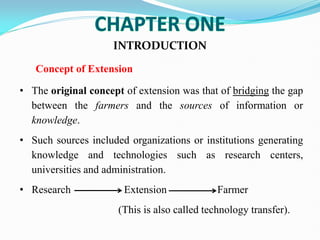
• Research Extension Farmer
(This is also called technology transfer).
4.
Principles of Extension
1.Principle of cultural difference. Extension work to be successful,
it must be carried out in harmony with the cultural pattern of the
people.
2. Grass roots principle. Extension program should start with local
groups, local situations and local problems.
3. Principle of indigenous knowledge. Instead of ignoring the
indigenous knowledge systems as outdated, the extension agent
should try to understand them and their implication in the life of the
people, before proceeding to recommend something new to them.
4. Principles of interest and needs. People‘s interest and people‘s
needs are the starting point of extension work. Extension work shall
be successful when it is based on the interest and needs of the people
as they see them.
5.
CONT…
5. Principles oflearning by doing. Learning remains far from perfect,
unless people get involved in actually doing the work. People should learn
what to do, how to do, and with what result.
6. Principle of participation. Most people of the village community
should willingly cooperate and participate in identifying the problem,
planning of projects for solving the problems and implementing the
projects in getting the desired results.
7. Family principle. Family is the primary unit of the society. The target
for extension work should, therefore, be the family. That is, developing the
family as a whole, economically and socially. Not only the farmers, the
farm women and farm youth are also to be involved in extension program.
8. Principle of leadership. Identifying different types of leaders and
working through them is essential in extension. The leaders may be trained
and developed to act as carriers of change in the villages.
6.
9. Principles ofadaptability. Extension work and extension teaching
methods must be flexible and adapted to suit the local conditions.
10. Principles of satisfaction. The end product of extension work should
produce satisfying results for the people. Satisfying results reinforce
learning and motivate people to seek further improvement.
11. Principles of evaluation. Evaluation prevents stagnation. There
should be continuous built-in methods of finding out the extent to which
the results obtained are in agreement with the objectives fixed earlier.
CONT…
7.
Extension Method
Extensionmethods may be defined as devices used to create
situations in which new information can pass freely between
the extension worker and the farming communities.
It can also be defined as the tools and techniques used to create
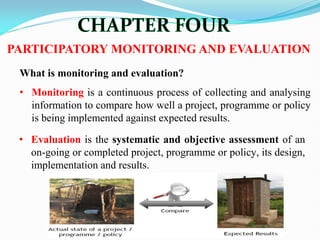
situations in which communication can take place between
the rural people and the extension workers.
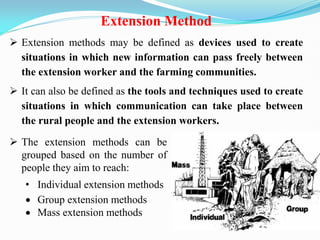
The extension methods can be
grouped based on the number of
people they aim to reach:
• Individual extension methods
Group extension methods
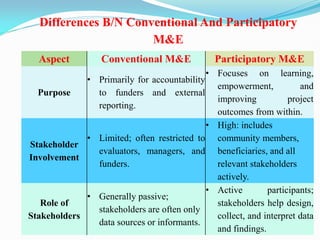
Mass extension methods
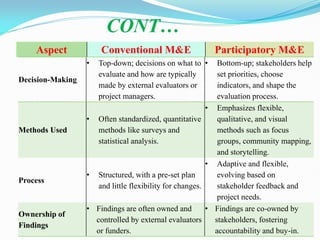
8.
• The extensionagent meets the farmer at home or on the farm
and discusses issues of mutual interest, giving the farmer both
information and advice.
• Individual meetings are probably the most important aspect of
all extension work and invaluable for building confidence
between the agent and the farmer.
Farm/Home visit
Office calls
Personal Letter
Telephone calls
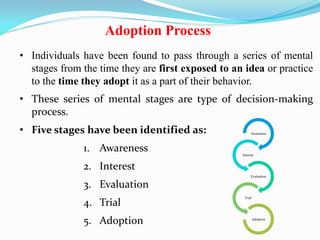
Informal contacts
1. Individual extension method
9.
Advantages of individualextension method
Immediate feedback
Freedom of speaking is high
Solving problems of investment decision,
Integration of Extension agents' information with the farmer and
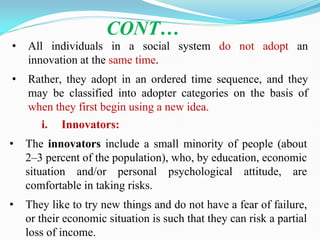
Building trust between the two parties.
Disadvantages of individual extension method
Costs are very high in terms of travel resource, etc.
Small proportion of a target group could be reached.
It is seldom a solution for promotion of collective interests
10.
2. Group extensionmethods
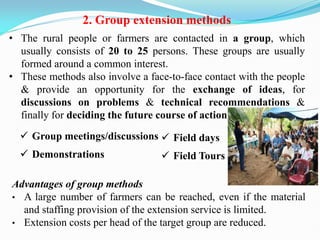
• The rural people or farmers are contacted in a group, which
usually consists of 20 to 25 persons. These groups are usually
formed around a common interest.
• These methods also involve a face-to-face contact with the people
& provide an opportunity for the exchange of ideas, for
discussions on problems & technical recommendations &
finally for deciding the future course of action.
Group meetings/discussions
Demonstrations
Advantages of group methods
• A large number of farmers can be reached, even if the material
and staffing provision of the extension service is limited.
• Extension costs per head of the target group are reduced.
Field days
Field Tours
11.
• Group methodspermit more participation by the target groups.
• Techniques of group dynamics can be used to accelerate the
spread of information and increase the willingness of the farmers
to make decisions.
Disadvantages: These include the following
• Wide diversity in the interest of group members may create a
difficult learning situation.
• Vested interests, caste groups and village factions may hinder free
interaction and decision-making by the group members
• Difficult to give attention to all members
CON’T
12.
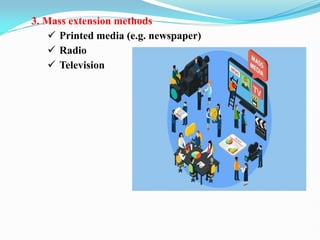
3. Mass extensionmethods
Printed media (e.g. newspaper)
Radio
Television
13.
Advantage of massextension methods:
• They reach large and varied audiences
• They reinforce individual and group contact methods by
complementing or supplementing them.
• They save time and expense in reaching large numbers.
Limitation of mass extension methods:
• Less intensive and less effective than individual and group contact
methods in bringing about changes in practices.
• Lack the advantage of ―social contacts‖ or ―personal touch‖
• The information provided may not apply to special situations or
individual needs.
• Difficult for the result to be evaluated.
• One way flow of information
• Possibility to ignore the message is high
CONT…
14.
EXTENSION APPROACHES
Definition:
• Agriculturalextension approach refers to the dominant guide
and style of action of an extension system to achieve its goals.
• It is the philosophy or the doctrine for extension system that
informs, stimulates and guides the aspects of the system like
its :
structure,
leadership,
programs,
resources,
linkages etc.
• Many extension approaches have been implemented from time
to time in different parts of the world.
15.
1. General ClienteleApproaches
2. Training and Visit Extension Approach (T&V)
3. Integrated (Project) Approach
4. Educational Institution (University-Based) Extension Approach
5. Farming Systems Research/Extension (FSR/E) Approach
6. Commodity Specialized Extension Approach
7. Participatory Extension Approach (PEA) (Client-Based and Client-
Controlled Extension)
8. Cost Sharing Approach (Extension as a Commercial Service)
CONT…
• These approaches have different objectives, but one common objective has
always been to guide and educate the farmers regarding the utilization of
improved agricultural technology so that they can raise their agricultural
productivity and can make it profitable for them.
Eight main Extension approaches are:
16.
1. General ClienteleApproaches(General Agricultural
Extension Approach)
• Assumes that technology and information are available which are
not being used by the farmers and if this available technology
could be effectively communicated to the farmers, farm practices
would be improved and the farmers could increase their per hectare
yield.
• Top-down oriented as the technology is being transferred from
extension to rural people.
• Purpose: Improve the welfare of the participants
• Program planning: This is controlled by the extension
organization.
• Implementation: The methods used are demonstrations, visit to
farmers, conducting meetings, tours, sometimes these activities are
supported by radio, posters & other publications.
• Success is usually measured by increase in the national production.
17.
Advantages
• Integrated developmentcould be achieved
• Large coverage
• It can interpret national government policies and procedures for the
farmers
• Relatively easy to control by central government.
• It provides for rapid communication from ministry level to rural
people.
Disadvantage
• It lacks two way communication
• Field staffs are not accountable to the rural people.
• Expensive and inefficient
CONT…
18.
2. Training andVisit Extension Approach (T&V)
• Assumes that extension field persons are poorly trained, not up-to-
date and not visit farmers and further anticipate that management
and supervision is not adequate.
• It also assumed that there is lack of two way communication
between research extension and farmers.
• Purpose: Is to induce farmers to increase production of specified
crops.
• Control of program planning is centralized.
• Implementation: Relies basically on visits by village level
extension workers to small group of farmers or to individual
contact farmers.
• Success is measured by increase in yields & total production of
crops being emphasized.
19.
Advantages of T&Vapproach
• Close working relationship between research, extension and farmer
• Organized extension service provision
• Because of regular training, It gives and works a guideline up-date with
timely information.
• Close supervision of extension activities
• Logistical support to extension staffs are more available.
Disadvantages T&V approach
• Lack of actual two-way communication.
• Not cost effective
• Not work in absence of good research establishment (No ready technologies )
• T & V cannot increase production unless the contemporary parts of the small
farmer development package like input supply & credit, market mechanisms
& price incentives are in place.
CONT…
20.
3. Integrated (Project)Approach
• Assumption: It assumes that large government funded approaches
are not likely to have a significant impact upon either agricultural
production and rural people, and that better results can be achieved
in a particular location during a specified time period with large
infusions of outside resources.
• sometimes it is assumed that the successful methods and
techniques, demonstrated inside the project will be replicated in
other locations throughout the country.
• Project approach has to rely on special outside funds by the donor
agencies.
• The lifetime of a project is relatively shorter and is limited to a
specific location.
21.
• Purpose: todemonstrate within the project area, what can be accomplished in a
relatively short period of time.
• To test a variety of alternative extension methods/approaches so as to learn
which are most appropriate for the particular setting.
• The program planning is usually outside the project location, with the central
government, the donor agencies or some combination as may be indicated in the
project agreement.
• Implementation: project management staff, project allowances for field staff
with better transportation, facilities, equipment, better housing than regular
government program and as well as foreign advisors for local staff.
• The project staff is exclusively responsible for the execution of the program
plans according to a set line of directions by the government and donor
agencies.
• Success is measured usually in short run achievements like the adoption of
recommended technologies by the people in the project area.
CONT…
22.
Advantages of ProjectApproach
• Quick results will be achieved in short period of time.
• New technologies and methods can be tested and experimented.
Disadvantages Project Approach
• Time too short
• Anticipates a flow of the ‗good ideas‘ in the project area to other places.
• When the supply of money ends, so does the project. i.e. The assumption
of continuity seems usually to be un warranted. Once project termination
looms, there is a running down as staff leave and the field unit straggles to
become reintegrated in to a larger national system.
• A tendency to consume a large proportion of resources on baseline
surveys & the establishment of a temporary logistic base.
• Pressures to show immediate results leading to fictitious reporting.
CONT…
23.
4. Educational Institution(University-Based)
Extension Approach
Assumption
• Colleges or schools of agriculture have technical knowledge which is relevant
& useful to farm people. And teaching staff need interaction with ‗real
farmers‘ in order to be good teachers of agriculture.
Purpose
• To help rural people learn about scientific agriculture and
• To help teachers & students at schools learn about actual farming practice.
Program planning: Program planning tends to be controlled by the educational
institutions.
Implementation is usually through non-formal instruction in groups, with
individuals and with other methods & techniques.
• Some universities have also established their own radio stations and have their
television channels for the effective transmission of the technologies
developed by them.
Measure of success: High rate of adoption of recommended practice and some
times also participation of farmers in the institutions extension activities.
24.
CONT…
Advantages of EducationalInstitution Extension Approach
It can help educational institutions in providing real world
relevant examples to their academic teaching materials.
It can bring researcher to the farmers so that they will be able to
identify the problems of farmers and provide solutions.
Disadvantages of Educational Institution Extension Approach
The tendency to the institutions to speak too academically which
could not easily understood by the farmers.
There is competition (i.e. competition which may develop
between personnel from ministry of agriculture & personnel of
ministry of education).
25.
5. Farming SystemsResearch/Extension (FSR/E)
Approach
Assumptions: Too often, agricultural extension efforts have failed because the
technology available to field extension personnel did not ‗fit‘ the local farming
systems. So, if such technology is not available, it needs to be generated locally.
Purpose: To generate more appropriate technologies for farmers and where
possible to improve policies & support services for farm production, to raise
farm families welfare & to enhance society‘s goals.
• To provide extension personnel with research results to meet the results to
meet the needs & interests of local farming system conditions.
Program planning: Control of program is shared jointly by local people,
agricultural extension & agriculture researchers.
Measures of success: It is the extent to which people adapt the technologies &
continue to use them over time.
Implementation is through the partnership of research and extension personnel
with each other and with local people/farmers, taking a ―systems approach‖ to
the farm and Extension methods such as meetings, tours and
demonstrations are used
26.
• Problem solvingin that FSR teams seek researchable problems and
opportunities to guide research & to identify ways for making local
services and national policies more attuned to the farmers needs.
• Comprehensive because FSR team consider the whole farming
activity (consumption as well as production to learn how to
improve the farmers output & welfare, to identify the flexibility for
change in the environment & to evaluate the results in terms of
both farmers & society‘s interests.
• Interdisciplinary: in that researchers & extension staff with
different disciplinary back grounds work with farmers in
identifying problems & opportunities searching for solutions
implementing the results.
• Complementary: because it offers a means for using the outputs of
other research & development organization and for giving direction
to others‘ work.
The main features of FSR/E
27.
Interactive in thatFSR teams use the results from research to
improve their understanding of the system & to design subsequent
research & implementation approaches.
Dynamic: in that often team introduce relatively modest changes in
the farmers‘ condition first & the favorable results encourage more
significant changes latter.
Responsible: to the society in that FSR team keep the long-run
interests of the general public - both present & future in mind as
well as those of the farming groups immediately affected.
CONT…
28.
FSR activities
The basicFSR activities are :
Target & research area selection,
Problem identification & development of research base,
Planning on-farm research,
On-farm research analysis &
Extension of results.
Advantages of FSR
• The messages & the technologies are ‗fit‘ to the realities of people.
• Linkage between research & extension
Disadvantages of FSR
• It is a team approach, so costs are usually too high.
• It takes time & patience to study the farming system.
• Reporting & administrative control is difficult
29.
6. Commodity SpecializedExtension Approach
• This approach tends to focus on one export crop such as coffee, sugar,
tobacco, cotton or rubber.
• The objective of this approach is to produce & market relatively high value
commodities efficiently & effectively. These commodities are generally
produced for export, as they generate foreign exchange.
• Assumption is that the way to increase productivity or production of a
particular commodity to concentrate on it.
• It is also assumed that grouping extension with such other functions as
research, input supply, marketing, credit and same time‘s price control will
make the whole system effective.
• The purpose is to increase the production of particular commodity.
• The program planning controlled by the commodity organization.
• The success of the approach is measured by the increase of the product of
given commodity.
30.
• Implementation: tendsto be in the form of instructions given to cultivators by
the extension staff.
• This is often done by word of month in face- to-face communication.
• Demonstration & printed media may also be used.
CONT…
Advantages of the Commodity Specialized approach
• The technology tends to ‗fit‘ the production problems & therefore the messages
tend to be appropriate.
• Agricultural extension tends to be efficient & effective since extension activities
tend to be coordinated with both input supply & marketing of out put.
• Better coordination with research & marketing, messages tend to be delivered
timely.
• Focus on narrow range of technical concerns, closer management &
supervision, fewer farmers for a given extension worker.
• Being smaller & more focused, it tends to be easier to monitor, evaluate &
relatively more cost effective.
31.
Disadvantages ofthe commodity specialized approach
• Interest of farmers may have less priority
• It does not provide advisory service to other aspects of farming in the case of
farmers who produce more than one commodity. e.g. Soil conservation, food
production, livestock production etc....
• Farmers may be forced with several extension workers from different agencies,
with competing advice or demands.
• Needs & potentials of the whole farm may not be considered.
• Its narrow focus means that environmental factors may be ignored.
• Extension objectives are determined by agency needs & priorities not those of
farmers.
• Only minority farmers (with particular type of soil, proximity to processing
plants, above average land holding or identified by some criteria) may be
potential beneficiaries
CONT…
32.
7. Participatory ExtensionApproach (Client-Based
and Client-Controlled Extension)
• Participation of the people involved in development programs is often seen as a
way to make these programs more successful specially for solving problems of
poor people.
• Assumption: Farming people have much wisdom regarding production of food
from their land, but their levels of living & productivity could be improved by
learning more of what is known outside.
• There is an indigenous knowledge system and while it is different from
‗scientific knowledge system‘ there is much to be gained by the interaction of the
two.
• Purpose: to increase the production of farming people & to increase the
consumption & enhance the quality of life of rural people.
• Success is measured through continuity of local extension organizations & the
benefits to the community.
• Since programs are planned locally the extent to which program goals and
objectives are achieved is also a measure of success.
33.
• Implementation withthis approach involves meetings with
small, large, specialized and general community groups.
• In addition demonstrations are typical features with this
approach.
• The farmers‘ associations and community organizations visit each
others‘ farms, plan tours to distance places to see the
recommendations being practiced successfully.
• Extension agents‘ tasks are to stimulate farmers to organize
groups and help them to work effectively for their own benefit.
CONT…
34.
Advantages
• Development ofself confidence in each participant
• Increasing the relevance of extension messages to farmers‘ needs,
• Enhancing learning through purposeful participation and group
pressure,
• Securing appropriate recommendations from researchers through
participatory feedback,
• Assisting in adjusting inputs of supplies, credit and marketing to
farmers‘ needs, and increasing efficiency and effectiveness of
agricultural extension
CONT…
Disadvantages
• Lack of control of the program,
• Difficult to manage central reporting and accounting
35.
8. Cost SharingApproach (Extension as a
Commercial Service)
• It is an extension approach where the cost of agricultural extension is
supposed to be shared between the clients & agricultural extension
system.
• The assumption with this approach is that an extension system is more
likely to achieve its goal if those who benefit from it share same part of
the cost.
• It is assumed that the program is more likely to fit local situations and
personnel are more likely to serve the interests of the clientele of the
program if the costs are shared between the ‗outside‘ sponsors of the
program & the ‗inside‘ target groups for the program.
• It also assumes that farm people are too poor to pay the whole cost. So,
central and regional government typically provides most of it.
36.
• Purpose: Helpingfarm people learn those things they need to
know for self-improvement and increased productivity.
• It is for this purpose that local people are willing to pay part of
the cost to make funding of Agricultural extension affordable &
sustainable both at the central & local levels.
• It is therefore considered as one of the most promising
approaches to financing agricultural extension.
• Control of program planning is shared by the various levels
paying the costs but must be responsive to local interests in order
to maintain ‗cooperative‘ financial arrangements. i.e. Local
people tend to have a strong voice in program planning.
• Success is measured by farm people‘s willingness and ability to
provide some share of the cost.
CONT…
37.
The advantages ofcost sharing approach include:
• Local control of program planning, which increases the relevance
of the program contents and methods to the needs and interests of
clientele, this tends to higher adoption rates
• Local people‘s influence on the recruitment and selection of
extension staff,
• Lower cost to central governments as the cost is shared by lower
levels of governments, and often by the farmers/community
organizations.
The disadvantages with this approach are:
• It is difficult to control program planning and personnel,
• Financial management and other aspects of administration tend to
be complex and difficult
CONT…
38.
PARTICIPATORY EXTENSION APPROACH
Theconcept of participatory approaches
• Participation refers people‘s involvement in decision-
making processes, in implementing programs, their
sharing in benefits of development programs and their
involvement in efforts to evaluate such programs
• The concept of participatory approaches refers to
methods and practices that actively involve stakeholders—
especially local communities—in decision-making
processes related to projects, policies, and resource
management.
39.
• Is aparticipatory learning process where farmers and
villagers are involved in identifying, prioritizing and
analyzing problems, make action plans to address these
problems, implement and monitor activities in the action
plans.
• Emphasizes the value of local knowledge and the importance
of empowering communities to take an active role in
managing their resources.
• It contrasts with top-down approaches where decisions are
made by external experts without significant input from those
directly affected.
• Implies a major, but not exclusive role for local populations
in allocating rights and responsibilities over resources.
CONT…
40.
Participatory Approaches forNatural Resource
Management
• Participatory natural resource management is a
practice that involves local communities in the decision-
making process for managing natural resources.
• Involve engaging local communities, stakeholders, and
other relevant parties directly in the management and
decision-making processes around natural resources like
land, water, forests, and wildlife.
• Focus on collaboration and shared responsibility,
ensuring that those who are most affected by natural
resource management decisions have a voice in shaping
them.
41.
Levels of participationin Natural Resource
Management
i) Manipulation: The lowest rung applies to situations of ‗none-
participation‘, where participation is contriving as the opportunity
to indoctrinate.
ii) Information: When stakeholders have informed about their
rights, responsibilities, and options, the first important step
towards genuine participation takes place.
• The main drawback at this stage is that emphasis has placed on
one—way communication, with neither channel for feedback nor
power for negotiation.
42.
iii. Consultation: Thislevel entails two—way communication,
where stakeholders have the opportunity to express suggestions
and concerns, but no assurance that their input will be used at all
or as they intended.
• Therefore, it could be said that at this level stakeholders are
‗participating in participation‘.
• The most frequent approaches to consultation are chaired
meetings where stakeholders do not contribute to the agenda,
public hearings, and surveys.
CONT…
43.
CONT…
iv. Consensus building:Here stakeholders interact in order to
understand each other and arrive at negotiated positions, which
are tolerable to the entire group.
• A common drawback is that vulnerable individuals and groups
tend to remain silent.
v. Decision—making: When consensus is acted upon through
collective decisions, this marks the initiation of shared
responsibilities for outcomes that may result.
• Negotiations at this stage reflect different degrees of advantage
exercised by individuals and groups.
44.
vi. Risk—sharing: Thislevel builds upon the preceding one but
expands beyond decisions to encompass the effects of their
results, a mix of beneficial, harmful and natural consequences.
• Things being constantly in flux, there is always the element of
risk, where even the best-intended decisions might yield the least
desired results.
• Hence, accountability is fundamental at this level, especially when
those with the greatest advantage may be the ones with the least at
risk.
vii. Partnership: This relationship entails exchange among equals
working towards a mutual goal.
• Since partnership builds upon the proceeding levels, it assumes
mutual responsibility and risk sharing.
CONT…
45.
1. Passive Participation:People participate by being told what is
going to happen or has already happened.
• It is a unilateral announcement by an administration or project
management without any listening to people‘s responses.
• The information being shared belongs only to external
professionals.
2. Participation in Information Giving: People participate by
answering questions posed by extractive researches using
questionnaire surveys or similar approaches.
• People do not have the opportunity to influence proceedings, as
the findings of the research are neither shared nor checked for
accuracy.
Typology of participation in Natural Resource
Management
46.
3. Participation byConsultation: People participate by being consulted, and
external agents listen to views.
• These external agents define both problems and solutions and may
modify these in the light of people‘s responses.
• Such a consultative process does not concede any share in decision
making, and professionals are under no obligation to take on board
people‘s views.
4. Participation for Material Incentive: People participate by providing
resources, for example labor, in return for food, cash, or other material
incentives.
• Much on-farm research falls in this category, as farmers provide the
fields but are not involved in the experimentation or the process of
learning.
• It is very common to see this called participation, yet people have no
stake in prolonging activities when the incentives end.
CONT…
47.
5. Functional Participation:People participate by forming groups to meet
predetermined objectives related to the project, which can involve the
development or promotion of externally initiated social organization.
• Such involvement does not tend to be at early stages of project cycles or
planning, but rather after major decisions have been made.
• These instructions tend to be dependent on external initiators and
facilitators, but may become self-dependent.
6. Interactive Participation: People participate in joint analysis, which
leads to action plans and the formation of new local institutions or the
strengthening of existing ones.
• It tends to involve interdisciplinary methodologies that seek multiple
perspectives and make use of systemic and structured learning
processes.
• These groups take control over local decisions, and so people have a
stake in maintaining structures or practices.
CONT…
48.
CONT…
7. Self-Mobilization: Peopleparticipate by taking initiative
independent of external institution to change systems.
• They develop contacts with external institutions for resources and
technical advice they need, but retain control over how resources
are used.
• Such self-initiated mobilization and collective action may or may
not challenge existing inequitable distribution of wealth and
power.
49.
Co-Management in NaturalResource
• Co-management is: a situation in which two or more social
actors negotiate, define and guarantee amongst themselves a
fair sharing of the management functions, entitlements and
responsibilities for a given territory, area or set of natural
resources.
• Defined as sharing of responsibilities, rights and duties between
the primary stakeholders, in particular, local communities and
the nation state.
• Co-management in natural resource management is a
collaborative approach where multiple stakeholders, including
local communities, government agencies, and sometimes
private entities, share the responsibility and authority for
managing natural resources.
50.
• Co-management involvesshared governance of natural
resources between the government and local communities.
CONT…
• Recognizes the value of combining traditional knowledge with
scientific management practices.
• Successful co-management requires clear agreements, mutual
trust, and effective communication between all parties
involved.
• A pluralist approach to managing natural resources,
incorporating a variety of partners in a variety of roles,
generally to the end goals of environmental conservation,
sustainable use of natural resources and the equitable
sharing of resource-related benefits and responsibilities.
51.
Characteristics of Co-Management
Capitalizes on multiplicity and diversity. Different social actor
possesses different capacities and comparative advantage in management,
and a partnership stress and builds upon their complementary roles.
Multi-party but also multi-level and multi-disciplinary. Processes,
agreements and institutions are inclusive rather than exclusive, they
attempt to include all the bearers of interests and concerns who wish to
participate.
Based upon a negotiated, joint decision-making approach and some
degree of power sharing and fair distribution of benefits among all
institutional actors.
Stand on the concept of common good, the trust that it is possible to
follow action that harmonizes different interests while responding, at least
to some extent, to all of them.
Part of abroad social development towards more direction and
collaborative democracy
52.
Preparatory Phase:
Assessingthe need and feasibility of co-management
Identifying stakeholders and resources
Establishing a start-up team and gathering information
Negotiation Phase
Developing a common vision and strategy
Negotiating management plans and agreements
Establishing co-management organizations.
Learning-by-Doing Phase
Implementing plans and agreements
Monitoring and evaluating progress
Adapting strategies based on feedback
Phases of Co-Management
53.
Critical assumptions underlyingthe participatory approach
1. Participatory approaches facilitate local empowerment by
creating opportunities for specific disadvantaged groups, such as
women or the landless, to have access to external resources
(training, credits) or to mobilize their own resources (organization,
knowledge, skills).
2. The use of participatory approaches will allow the integration of
local knowledge systems into local project planning and
implementation.
• Therefore, in particular during the planning process, emphasis
should put on the mutual assessment and mobilization of local
knowledge and management systems.
• Participation does not just mean getting the basic information out of
the community in order to "target" the project interventions
effectively.
54.
3. Participatory planningfacilitates a two-way learning process
between the local community and the project.
• This two-way learning process should facilitate the timely
adjustment of project support services to changing local realities.
4. participatory planning will enhance political commitment
and institutional support for local planning by building a
common understanding between institutions and local
groups.
CONT…
55.
Key Principles ofApplying Participatory Methods
Inclusion - of all people, or representatives of all groups who
will be affected by the results of a decision or a process
Equal partnership - recognizing that every person has skill,
ability and initiative and has an equal right to participate in the
process, regardless of their status.
Transparency - all participants must help to create a climate
conducive to open communication and building dialogue.
Sharing power - authority and power must be balanced evenly
between all stakeholders to avoid the domination of one party.
Sharing responsibility - similarly, all stakeholders have equal
responsibility for decisions that are made, and each should have
clear responsibilities within each process.
56.
Empowerment -participants with special skills should be
encouraged to take responsibility for tasks within their
specialty, but should also encourage others to also be involved
to promote mutual learning and empowerment.
Cooperation - is very important; sharing everybody's strength
reduces everybody's weaknesses.
CONT…
57.
What is monitoringand evaluation?
• Monitoring is a continuous process of collecting and analysing
information to compare how well a project, programme or policy
is being implemented against expected results.
PARTICIPATORY MONITORING AND EVALUATION
• Evaluation is the systematic and objective assessment of an
on-going or completed project, programme or policy, its design,
implementation and results.
58.
Definition of ParticipatoryMonitoring and
Evaluation
• Participatory monitoring & evaluation (PM&E): A process
through which stakeholders at various levels engage in
monitoring or evaluating a particular project, share control
over the content, the process and the results of the M&E
activity and engage in taking or identifying corrective
actions.
• A process of self-assessment, collective knowledge generation,
and cooperative action in which stakeholders in a program or
intervention substantively and collaboratively identify the
monitoring and evaluation issues, collect and analyse data,
and take-action as a result of what they learn through this
process.
59.
• Participatory M&Eis about engaging different stakeholders,
especially targeted beneficiaries, in monitoring and evaluation
processes.
• PM&E focuses on the active engagement of primary
stakeholders.
CONT…
The following stakeholder groups are typically involved in
PM&E:
• The end users of project goods and services, including
both men and women at the community level
• Intermediary organisations, including NGOs
• Private sector businesses involved in the project
• Government staff at all levels.
60.
Principles of ParticipatoryMonitoring and Evaluation
1. Participation: By involving people who are directly affected by
the project, PM&E ensures that these voices—often those who are
least heard—have a real influence over the program.
• It shifts the power from a top-down approach to a bottom-up
approach, which can make projects more relevant and successful.
2. Negotiation: PM&E requires open discussions between all parties
involved, such as project staff, local leaders, community
organizations, NGOs, and others.
• These discussions help define each group‘s role and
responsibilities, and they provide a chance to work through
different opinions about the project‘s focus, methods, and intended
actions.
• It‘s a way to create clear, shared expectations and to manage
conflicts in a constructive way.
61.
3. Learning: PM&Eemphasizes learning for everyone involved,
aiming to use these lessons to improve the program.
• Participants learn new skills and knowledge that help them
understand their needs, set priorities, and plan actions.
• This shared learning is beneficial for making adjustments
during the project and for applying lessons in future initiatives.
4. Flexibility: PM&E needs to be adaptable, responding to
changes in circumstances, community needs, or available skills.
5. Methodologically Eclectic: PM&E uses a wide variety of
methods and tools, often including local practices that make
sense in the project‘s context.
CONT…
62.
Relevance of ParticipatoryMonitoring and Evaluation
By involving those directly affected, a more clear picture of
what is actually happening in a program can be drawn both
successes and failures.
Key stakeholder groups may feel empowered through
participating in the process they share responsibility for the
evaluation processes and results.
There is potential to develop capacity and skills in
evaluation generally; these can then be applied to other
programs and activities.
Development practitioners identify several benefits
associated with PM&E. These are:
63.
When informationis generated as a routine part of
program operations, there is greater likelihood that this
information will be used directly to make midcourse
corrections and modifications as the program is
implemented.
There is substantial benefit for team building and
creating commitment through collaborative inquiry.
The learning associated with participating in such a
process is experiential and can bring a deep sense of
meaningfulness to the work.
CONT…
64.
Differences B/N ConventionalAnd Participatory
M&E
Aspect Conventional M&E Participatory M&E
Purpose
• Primarily for accountability
to funders and external
reporting.
• Focuses on learning,
empowerment, and
improving project
outcomes from within.
Stakeholder
Involvement
• Limited; often restricted to
evaluators, managers, and
funders.
• High: includes
community members,
beneficiaries, and all
relevant stakeholders
actively.
Role of
Stakeholders
• Generally passive;
stakeholders are often only
data sources or informants.
• Active participants;
stakeholders help design,
collect, and interpret data
and findings.
65.
Aspect Conventional M&EParticipatory M&E
CONT…
Decision-Making
• Top-down; decisions on what to
evaluate and how are typically
made by external evaluators or
project managers.
• Bottom-up; stakeholders help
set priorities, choose
indicators, and shape the
evaluation process.
Methods Used
• Often standardized, quantitative
methods like surveys and
statistical analysis.
• Emphasizes flexible,
qualitative, and visual
methods such as focus
groups, community mapping,
and storytelling.
Process
• Structured, with a pre-set plan
and little flexibility for changes.
• Adaptive and flexible,
evolving based on
stakeholder feedback and
project needs.
Ownership of
Findings
• Findings are often owned and
controlled by external evaluators
or funders.
• Findings are co-owned by
stakeholders, fostering
accountability and buy-in.
66.
CONT…
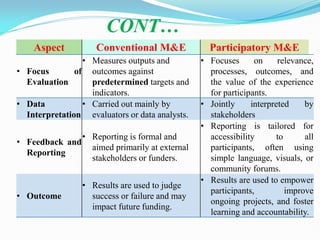
Aspect Conventional M&EParticipatory M&E
• Focus of
Evaluation
• Measures outputs and
outcomes against
predetermined targets and
indicators.
• Focuses on relevance,
processes, outcomes, and
the value of the experience
for participants.
• Data
Interpretation
• Carried out mainly by
evaluators or data analysts.
• Jointly interpreted by
stakeholders
• Feedback and
Reporting
• Reporting is formal and
aimed primarily at external
stakeholders or funders.
• Reporting is tailored for
accessibility to all
participants, often using
simple language, visuals, or
community forums.
• Outcome
• Results are used to judge
success or failure and may
impact future funding.
• Results are used to empower
participants, improve
ongoing projects, and foster
learning and accountability.
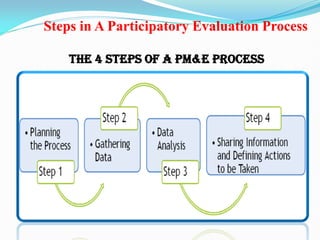
Step 1: Planningthe Process
• Identification of stakeholder groups to be involved in the
planning of the PM&E process.
• Stakeholders define the objectives of the PM&E, what will
be monitored, how and by whom.
• This step includes the identification of relevant indicators.
• In some cases, a common set of indicators is developed, while
in other instances different stakeholder groups develop their
own sets of indicators.
• This requires a lengthy process of negotiation, contestation and
collaborative decision-marking among various stakeholders.
69.
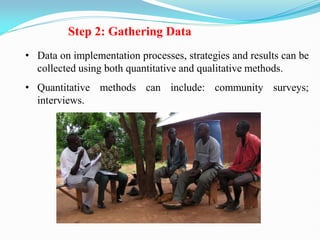
Step 2: GatheringData
• Data on implementation processes, strategies and results can be
collected using both quantitative and qualitative methods.
• Quantitative methods can include: community surveys;
interviews.
70.
CONT…
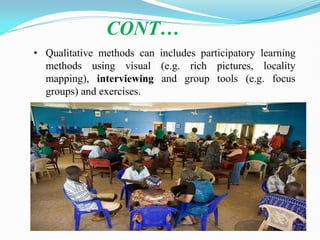
• Qualitative methodscan includes participatory learning
methods using visual (e.g. rich pictures, locality
mapping), interviewing and group tools (e.g. focus
groups) and exercises.
71.
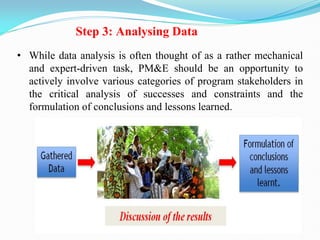
Step 3: AnalysingData
• While data analysis is often thought of as a rather mechanical
and expert-driven task, PM&E should be an opportunity to
actively involve various categories of program stakeholders in
the critical analysis of successes and constraints and the
formulation of conclusions and lessons learned.
72.
Step 4: Sharingthe Information and Defining Actions
to Be Taken
• Not all stakeholders can be involved in M&E data collection
and analysis.
• In this step the results of preceding M&E activities are shared
with other stakeholders, and
• There is discussion of appropriate actions to be taken based
on the findings.
73.
#Quiz (5%)
1. Whatis participatory monitoring & evaluation
(PM&E)? (1%)
2. Write at least three differences b/n conventional and
participatory M&E (2%)
3. List the steps involved in a participatory evaluation
process (2%)
74.
DIFFUSION AND ADOPTIONOF INNOVATION
Definition of Terms
• Innovation: is an idea, practice, methods or objects that is
perceived as new by an individual or other unit of adoption.
• Innovation is not always the result of recent research or
invention.
• Example, fertilizer is an innovation in some remote parts of
Ethiopia but it is not an innovation or new technology for
many who have been used it for many years.
• Diffusion: the spread of an innovation into the social system
from one decision making unit (individual, household,
organization) to the next overtime.
75.
• Adoption: thedecision to apply an innovation and continue
to use it for relatively long period of time.
• An individual who use a technology for a single time and
discontinue using it can not be regarded as adopter.
• Similarly an individual who adopt a part of the
recommended package of practice can not be considered as
adopters.
• An innovation adoption index indicates the proportion of
adoption by an individual from the set of recommended
practices or technologies
• Social system: referring to the group or groups of people
that an innovation diffuses through.
CONT…
76.
Adoption Process
• Individualshave been found to pass through a series of mental
stages from the time they are first exposed to an idea or practice
to the time they adopt it as a part of their behavior.
• These series of mental stages are type of decision-making
process.
• Five stages have been identified as:
1. Awareness
2. Interest
3. Evaluation
4. Trial
5. Adoption
Awareness
Interest
Evaluation
Trial
Adoption
77.
1. Awareness stage
•A person becomes aware of new idea, product, or practice for the
first time.
• He knows very little about any of its special qualities, it
usefulness, or how it is likely to work for him.
• During this stage of the process the individual has not been
inspired to find more information about the innovation.
CONT…
2. Interest stage
• A person develops interest about in the new idea or practice.
• He want to know about what it really is, what it will do, how it
will work for him.
• Needs and actively seeks additional detailed information.
78.
CONT…
3. Evaluation stage
•The prospective adopter weighs the pro and con of the new idea
or innovation, and relates it to his own situation.
• He asks himself if the idea is good for him.
• Here the individual prospective adopter has to take a decision
either to adopt or reject the innovation.
4. Trial stage
• At this stage, a person tries out the new idea or practice, usually
on a small scale to see how it fits into his situation.
• During this stage the individual determines the usefulness of the
innovation and may search for further information about it.
79.
CONT…
5. Adoption stage
•The individual decides that the new practice is good enough
for full—scale use.
• In this stage the individual finalizes their decision to continue
using the innovation and may use the innovation to its fullest
potential.
80.
Innovation-Decision Process
1. Knowledge:individuals are exposed to an innovation and an
initial idea that something might change;
2. Persuasion: more information and experiences cause the
individual to develop either a positive or negative attitude about the
innovation itself;
3. Decision: an individual decides whether and how to act. A
decision could be to not adopt, or to wait and watch the results
obtained by somebody else;
4. Implementation: people decide to adopt the innovation, even on
a small scale.
5. Confirmation: if the results are positive as expected, the
innovation is definitively accepted, but if the contrary happens, the
innovation may be rejected.
81.
Attributes of Innovationsand Rate of
Adoption
• Some innovations are adopted more rapidly than others because
the farmers perceive them to have different characteristics.
• A number of studies have analyzed the relation between
characteristics of an innovation and its rate of adoption.
1. Relative advantage: the more advantageous the change
appears to be, the more will it be adopted.
• The advantages, as well as the disadvantages, should be
communicated clearly; individuals and groups can then
ponder costs and benefits and make up their minds, even
before beginning to participate in the process.
82.
2. Compatibility: withsocio-cultural values and beliefs, with
previously introduced ideas or with farmers felt needs.
E.g. it is very difficult to introduce pig husbandry in
Christian/Muslim society even if it is very profitable enterprise.
3. Complexity: refers to the level of real or perceived difficulty of
the innovation. It is related to the concept of continuity or
discontinuity seen above.
For some people, a certain change could be very difficult to
understand or to manage, while others might find it easy. There
are cultural, generational and gender aspects that make the same
innovation appear to be more or less complex to different groups
of stakeholders; innovation often fails because they are not
implemented correctly.
CONT…
83.
CONT…
4. Trialability: afarmer will be more inclined to adopt an
innovation which he tried first on a small scale on his own farm and
which he proved to work better than an innovation he has at hand.
• This trialability may be related to ‗divisibility‘ as with fertilizers,
for example. Although large machines cannot be ‗divided‘,
some-times they can be hired before they are purchased.
5. Observability: a crop variety planted in a field is observable
than a bookkeeping or financial management techniques.
84.
• There aredifferent categories of farmers. According to Rogers
(1971), the farmers based on their innovativeness can be classified
as:
i. Innovators
ii. Early adopters
iii. Early majority
iv. Late majority
v. Laggards
Adopter Categories and their Characteristics
85.
• All individualsin a social system do not adopt an
innovation at the same time.
• Rather, they adopt in an ordered time sequence, and they
may be classified into adopter categories on the basis of
when they first begin using a new idea.
CONT…
i. Innovators:
• The innovators include a small minority of people (about
2–3 percent of the population), who, by education, economic
situation and/or personal psychological attitude, are
comfortable in taking risks.
• They like to try new things and do not have a fear of failure,
or their economic situation is such that they can risk a partial
loss of income.
86.
Characteristics of Innovators:
Have larger farms.
High net worth and risk capital.
Willing to take risks.
Usually not past middle age
Generally, well educated
Have respect and prestige in progressive communities
but not in conservative type of communities.
Mentally alert and actively seeking new ideas.
CONT…
87.
ii. Early Adopter:
•Early adopters are a more integrated part of the local social
system than innovators.
Whereas innovators are cosmopolites, early adopters are
localities.
This adopter‘s category, more than any other, has the
greatest degree of opinion leadership in most social systems.
Potential adopters look to early adopters for advice and
information about the innovation.
The early adopter is considered by many as ―the man to
check with‖ before using a new idea.
88.
• This adoptercategory is generally sought by change agents to
be a local missionary for speeding the diffusion process.
• Because early adopters are not too far ahead of the average
individual in innovativeness, they serve as a role model for
many other members of a social system.
Characteristics Early Adopter:
Younger than those who have a slower adoption rate, but not
necessarily younger than the innovators
They are not the persons who test the untried ideas but they
are quickest to use tried ideas in their own situations.
Have large farms.
Higher education than those who adopt more slowly
CONT…
89.
High income.
They participate more in the social activities of the
community and in government programs.
CONT…
Early Majority:
The early majority adopt new ideas just before the average
member of a social system.
The early majorities interact frequently with their peers, but
leadership position; are rarely held by them.
The early majority may deliberate for some time before
completely adopting a new idea.
Their innovation-decision is relatively longer than that of the
innovator and the early adopter.
90.
Characteristics of EarlyMajority :
Slightly above average in age, education and farming experience.
They take a few more farm journals and bulletins than the average.
They have medium high social and economic status.
Less active in formal groups than early adopters, but more active
than those adopting later.
In many cases, they are not formal leaders in the association
They also attend extension meetings and farm demonstrations.
They associate mainly with people of their own community.
CONT…
91.
Late Majority:
The latemajority adopt new ideas just after the average member of
a social system.
Adoption may be both an economic necessity and the answer to
increasing social pressures.
Innovations are approached with a skeptical and the late majority
do not adopt until most other in their social system have done so.
Characteristics:
have less education and are older than the early majority.
They form the major part of formal organizational membership,
although they participate less in such formal groups.
92.
They takefewer leadership roles than the earlier
adopters.
They take and read fewer papers, magazines and
bulletins, than the early majority.
They do not participate in as many activities outside the
community as do people that adopt earlier.
Unwillingness to risk scare resources
Uncertainty about innovation must be removed
before adoption
CONT…
93.
Laggards:
• Laggards arethe last to adopt an innovation.
• They possess almost no opinion leadership.
• They are the most locality in their outlook of all adopter
categories, many are near isolates.
• The point of reference for the laggard is the past.
• Decisions are usually made in terms of what has been done in
previous generations.
• This individual interacts primarily with others who have
traditional values.
• When laggards finally adopt an innovation, it may already have
been superseded by another more recent idea which the
innovators are already using.
94.
• Laggards tendto be frankly suspicious of innovations,
innovators, and change agents.
• Their traditional direction slows the innovation decision process
to a crawl.
• Adoption lags far behind knowledge of the idea.
Characteristics:
Least education.
Oldest.
Participate least in formal organizations, cooperatives and
government programs.
They hardly read farm magazines and bulletins.
CONT…