APPROACH TO PALLOR
Harmendeep Singh 012014100060
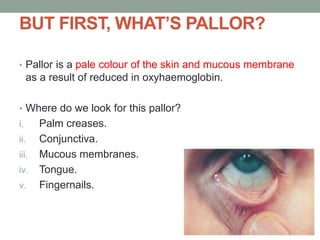
BUT FIRST, WHAT’S PALLOR?
• Pallor is a pale colour of the skin and mucous membrane
as a result of reduced in oxyhaemoglobin.
• Where do we look for this pallor?
i. Palm creases.
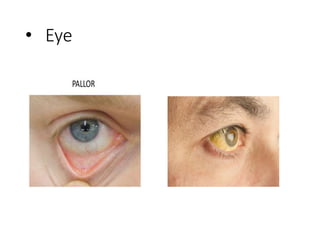
ii. Conjunctiva.
iii. Mucous membranes.
iv. Tongue.
v. Fingernails.
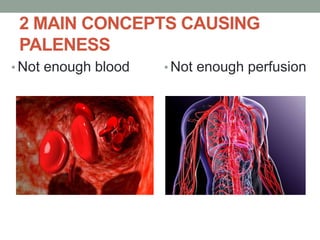
2 MAIN CONCEPTS CAUSING
PALENESS
• Not enough blood • Not enough perfusion
ITS IMPORTANT TO KNOW
• Paleness can occur suddenly and only for a
short while
• Paleness can be gradual and prolonged
• Paleness can also occur locally
• paleness can be generalized.
SUDDEN CAUSES OF PALLOR
(Within Minutes To Hours)
• Shock
• Syncope
• Cardiovascular
diseases
• Blood loss
• Dehydration
• Orthostatic
hypotension
• Migraine
• Hypothermia
• Hypoglycemia
• Side effect of medications:
• warfarin, corticosteroids, aspirin and other anti-
rheumatic drugs may cause intestinal bleeding
• iron poisoning
• Drug overdose: amphetamine, cocaine
• Chemical poisoning (pesticides), plant
poisoning (Atropa belladonna)
LONG LASTING PALENESS (Few
Weeks To Several Years)
•Anemia - iron or
vitamin B12 and folate
deficiency
• low intake: vegetarians, irregular
diet, starvation, alcoholism
• impaired absorption: Crohn’s or
celiac disease
• intestinal parasites
• intestinal bleeding: colorectal
cancer, ulcerative colitis
• heavy menstrual bleeding
• Hemolysis
• drugs phenytoin and methotrexate
• chronic kidney disease
• chemotherapy
• cancer in advanced stage
• chronic hepatitis or liver cirrhosis
• Pregnancy
• Other chronic diseases- anemia in
chronic disease
• Hypertension
• Chronic heart failure
• Side effect of medications:
• warfarin, aspirin, ibuprofen, naproxen, corticosteroids may cause
intestinal bleeding
• iron poisoning
• Drug abuse: amphetamine , cocaine
• Thrombosis and other blood clotting disorders
• Leukemia, lymphoma, Hodgkin disease
• Endocrine effect
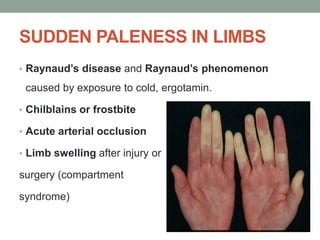
SUDDEN PALENESS IN LIMBS
• Raynaud’s disease and Raynaud’s phenomenon
caused by exposure to cold, ergotamin.
• Chilblains or frostbite
• Acute arterial occlusion
• Limb swelling after injury or
surgery (compartment
syndrome)
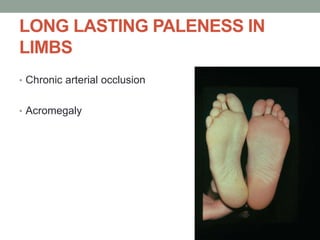
LONG LASTING PALENESS IN
LIMBS
• Chronic arterial occlusion
• Acromegaly
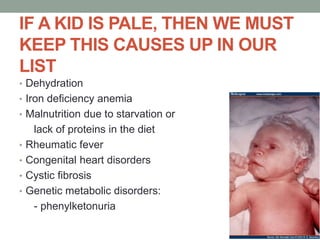
IF A KID IS PALE, THEN WE MUST
KEEP THIS CAUSES UP IN OUR
LIST
• Dehydration
• Iron deficiency anemia
• Malnutrition due to starvation or
lack of proteins in the diet
• Rheumatic fever
• Congenital heart disorders
• Cystic fibrosis
• Genetic metabolic disorders:
- phenylketonuria
Thank
you
History and physical
examination
Approach
(History)
1) symptoms of anaemia
- tiredness/fatigue
- muscle weakness
- headache
- lack of concentration
- faintness/dizziness
- dyspnoea on exertion
- palpitations
- intermittent claudication
- pica
2) The history may indicate the nature of the problem:
• Iron deficiency : inadequate diet, pregnancy, GIT loss,
menorrhagia, NSAID and anticoagulant ingestion
• Folate deficiency : inadequate diet especially with
pregnancy and alcoholism, small bowel disease
• Vitamin B12 deficiency : previous gastric surgery, ileal
disease or surgery, pernicious anaemia, selective diets
(eg: vegetarians)
Other questions:
• Malignancy – Loss of weight / appetite
• Blood loss – Menorrhagia
• Multiple pregnancy
• Surgical history / chemotherapy
• History of anaemia / blood transfusion / splenectomy
• Diet (Malnutrition / Malabsorption)
• Drugs / alcohol
• hypothyroid
• Breast feeding
• Chronic kidney disease, chronic liver disease
Physical examination
• Tachycardia (Congestive heart failure)
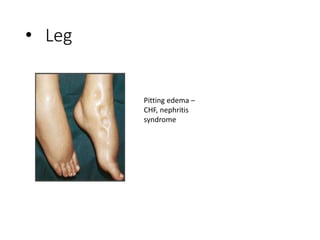
• Edema (CHF, nephritic syndrome)
• Pulse volume (shock)
• Nail changes (koilonychias, splinter haemorrhage)
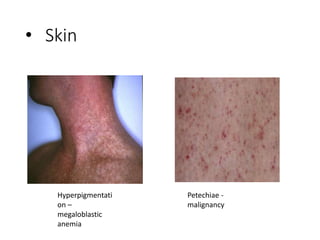
• Skin changes (hyperpigmentation, petechiae)
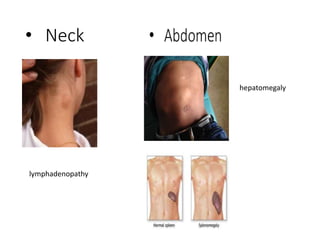
• Lymphadenopathy, hepatosplenomegaly
• Icterus (haemolytic anemia)
• Smooth shiny tongue
• Angular cheilosis
• murmur
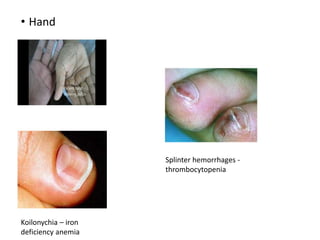
• Hand
Koilonychia – iron
deficiency anemia
Splinter hemorrhages -
thrombocytopenia
• Eye
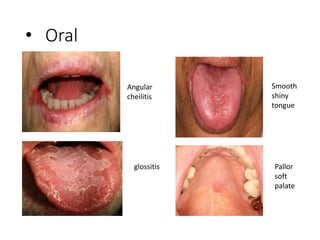
• Oral
Angular
cheilitis
glossitis
Smooth
shiny
tongue
Pallor
soft
palate
• Neck
lymphadenopathy
hepatomegaly
• Leg
Pitting edema –
CHF, nephritis
syndrome
• Skin
Hyperpigmentati
on –
megaloblastic
anemia
Petechiae -
malignancy
Investigations
• Based on the causes: haematological vs non haematological
Haematological
1. FBC
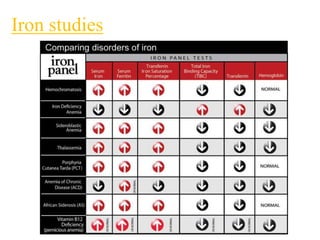
2. Iron studies
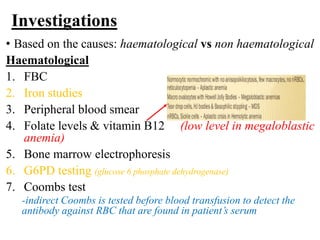
3. Peripheral blood smear
4. Folate levels & vitamin B12 (low level in megaloblastic
anemia)
5. Bone marrow electrophoresis
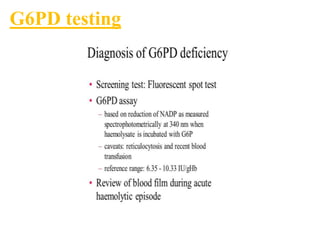
6. G6PD testing (glucose 6 phosphate dehydrogenase)
7. Coombs test
-indirect Coombs is tested before blood transfusion to detect the
antibody against RBC that are found in patient’s serum
Iron studies
G6PD testing
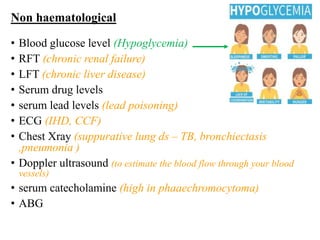
Non haematological
• Blood glucose level (Hypoglycemia)
• RFT (chronic renal failure)
• LFT (chronic liver disease)
• Serum drug levels
• serum lead levels (lead poisoning)
• ECG (IHD, CCF)
• Chest Xray (suppurative lung ds – TB, bronchiectasis
,pneumonia )
• Doppler ultrasound (to estimate the blood flow through your blood
vessels)
• serum catecholamine (high in phaaechromocytoma)
• ABG
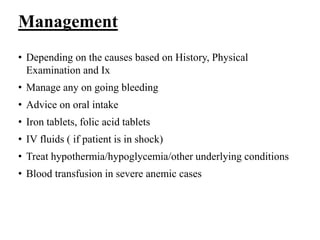
Management
• Depending on the causes based on History, Physical
Examination and Ix
• Manage any on going bleeding
• Advice on oral intake
• Iron tablets, folic acid tablets
• IV fluids ( if patient is in shock)
• Treat hypothermia/hypoglycemia/other underlying conditions
• Blood transfusion in severe anemic cases
Case Scenario
Jega Subramaniam
• A 32 year old male patient presents with chief
complaint of fatigue for the past month.
• During the history the patient says he has noticed he
gets tired very much easier than he used to when
walking up a flight of stairs. He also admits to having an
intense urge to eat ice all of the time. During
examination you note small cracks in the side of his
mouth as well as brittle looking nails that have an
upward curve to them like a spoon. You run a CBC and
these are your results: WBC 8,000, RBC 3.5,
Hemoglobin 9, hematocrit 37, MCV 75, RDW 17, MCHC
28. What other findings would you expect to find?
• You run a FBC and these are your results:
• WBC 8,000, RBC 3.5, Hemoglobin 9, hematocrit 37,
MCV 75, RDW 17, MCHC 28. What other findings
would you expect to find?
• What other findings would you expect to find?
a. Serum Iron that is high
b. Serum transferrin that is low
c. Serum ferritin that is high
d. TIBC that is high
• D : TIBC would be high because you would have
lots of binding capacity left over, since this is most
likely Iron Deficiency anemia.
•Fishy is a 28 year-old, currently in the second
trimester of pregnancy with her first child,
and though her pregnancy had been
progressing normally, recently she has
noticed that she tires very easily and is short
of breath from even the slightest exertion.
•She also has experienced periods of light-
headedness, though not to the point of
fainting. Other changes she has noticed are
cramping in her legs, a desire to crunch on
ice, and the fact that her tongue is sore.
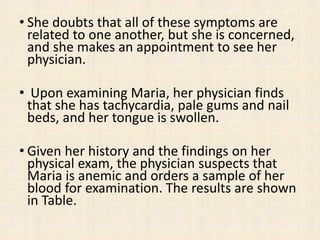
• She doubts that all of these symptoms are
related to one another, but she is concerned,
and she makes an appointment to see her
physician.
• Upon examining Maria, her physician finds
that she has tachycardia, pale gums and nail
beds, and her tongue is swollen.
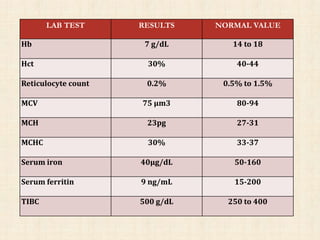
• Given her history and the findings on her
physical exam, the physician suspects that
Maria is anemic and orders a sample of her
blood for examination. The results are shown
in Table.
LAB TEST RESULTS NORMAL VALUE
Hb 7 g/dL 14 to 18
Hct 30% 40-44
Reticulocyte count 0.2% 0.5% to 1.5%
MCV 75 μm3 80-94
MCH 23pg 27-31
MCHC 30% 33-37
Serum iron 40μg/dL 50-160
Serum ferritin 9 ng/mL 15-200
TIBC 500 g/dL 250 to 400
What is your diagnosis??
Diagnosis:
Iron deficiency anemia
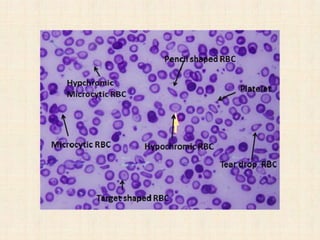
What are the expected findings
in peripheral blood smear for
this patient?
Blood film in iron deficiency anemia :
• Small (microcytic)
• Pale (hypochromic)
• Poikilocytosis (variation in size)
• Anisocytosis(variation in shape
How to manage this patient?
• Blood cross match and consider blood transfusion
• Ferous sulphate 325mg 3 times daily
• Dietary measures
• Activity restriction
• Continous monitoring
Thank you

Approach to pallor full compilation.pptx

  • 1.
  • 2.
    BUT FIRST, WHAT’SPALLOR? • Pallor is a pale colour of the skin and mucous membrane as a result of reduced in oxyhaemoglobin. • Where do we look for this pallor? i. Palm creases. ii. Conjunctiva. iii. Mucous membranes. iv. Tongue. v. Fingernails.
  • 3.
    2 MAIN CONCEPTSCAUSING PALENESS • Not enough blood • Not enough perfusion
  • 4.
    ITS IMPORTANT TOKNOW • Paleness can occur suddenly and only for a short while • Paleness can be gradual and prolonged • Paleness can also occur locally • paleness can be generalized.
  • 5.
    SUDDEN CAUSES OFPALLOR (Within Minutes To Hours) • Shock • Syncope • Cardiovascular diseases • Blood loss • Dehydration • Orthostatic hypotension • Migraine • Hypothermia • Hypoglycemia
  • 6.
    • Side effectof medications: • warfarin, corticosteroids, aspirin and other anti- rheumatic drugs may cause intestinal bleeding • iron poisoning • Drug overdose: amphetamine, cocaine • Chemical poisoning (pesticides), plant poisoning (Atropa belladonna)
  • 7.
    LONG LASTING PALENESS(Few Weeks To Several Years) •Anemia - iron or vitamin B12 and folate deficiency • low intake: vegetarians, irregular diet, starvation, alcoholism • impaired absorption: Crohn’s or celiac disease • intestinal parasites • intestinal bleeding: colorectal cancer, ulcerative colitis • heavy menstrual bleeding • Hemolysis • drugs phenytoin and methotrexate • chronic kidney disease • chemotherapy • cancer in advanced stage • chronic hepatitis or liver cirrhosis • Pregnancy • Other chronic diseases- anemia in chronic disease
  • 8.
    • Hypertension • Chronicheart failure • Side effect of medications: • warfarin, aspirin, ibuprofen, naproxen, corticosteroids may cause intestinal bleeding • iron poisoning • Drug abuse: amphetamine , cocaine • Thrombosis and other blood clotting disorders • Leukemia, lymphoma, Hodgkin disease • Endocrine effect
  • 9.
    SUDDEN PALENESS INLIMBS • Raynaud’s disease and Raynaud’s phenomenon caused by exposure to cold, ergotamin. • Chilblains or frostbite • Acute arterial occlusion • Limb swelling after injury or surgery (compartment syndrome)
  • 10.
    LONG LASTING PALENESSIN LIMBS • Chronic arterial occlusion • Acromegaly
  • 11.
    IF A KIDIS PALE, THEN WE MUST KEEP THIS CAUSES UP IN OUR LIST • Dehydration • Iron deficiency anemia • Malnutrition due to starvation or lack of proteins in the diet • Rheumatic fever • Congenital heart disorders • Cystic fibrosis • Genetic metabolic disorders: - phenylketonuria
  • 12.
  • 13.
  • 14.
    Approach (History) 1) symptoms ofanaemia - tiredness/fatigue - muscle weakness - headache - lack of concentration - faintness/dizziness - dyspnoea on exertion - palpitations - intermittent claudication - pica
  • 15.
    2) The historymay indicate the nature of the problem: • Iron deficiency : inadequate diet, pregnancy, GIT loss, menorrhagia, NSAID and anticoagulant ingestion • Folate deficiency : inadequate diet especially with pregnancy and alcoholism, small bowel disease • Vitamin B12 deficiency : previous gastric surgery, ileal disease or surgery, pernicious anaemia, selective diets (eg: vegetarians)
  • 16.
    Other questions: • Malignancy– Loss of weight / appetite • Blood loss – Menorrhagia • Multiple pregnancy • Surgical history / chemotherapy • History of anaemia / blood transfusion / splenectomy • Diet (Malnutrition / Malabsorption) • Drugs / alcohol • hypothyroid • Breast feeding • Chronic kidney disease, chronic liver disease
  • 17.
    Physical examination • Tachycardia(Congestive heart failure) • Edema (CHF, nephritic syndrome) • Pulse volume (shock) • Nail changes (koilonychias, splinter haemorrhage) • Skin changes (hyperpigmentation, petechiae) • Lymphadenopathy, hepatosplenomegaly • Icterus (haemolytic anemia) • Smooth shiny tongue • Angular cheilosis • murmur
  • 18.
    • Hand Koilonychia –iron deficiency anemia Splinter hemorrhages - thrombocytopenia
  • 19.
  • 20.
  • 21.
  • 22.
    • Leg Pitting edema– CHF, nephritis syndrome
  • 23.
  • 25.
    Investigations • Based onthe causes: haematological vs non haematological Haematological 1. FBC 2. Iron studies 3. Peripheral blood smear 4. Folate levels & vitamin B12 (low level in megaloblastic anemia) 5. Bone marrow electrophoresis 6. G6PD testing (glucose 6 phosphate dehydrogenase) 7. Coombs test -indirect Coombs is tested before blood transfusion to detect the antibody against RBC that are found in patient’s serum
  • 26.
  • 27.
  • 28.
    Non haematological • Bloodglucose level (Hypoglycemia) • RFT (chronic renal failure) • LFT (chronic liver disease) • Serum drug levels • serum lead levels (lead poisoning) • ECG (IHD, CCF) • Chest Xray (suppurative lung ds – TB, bronchiectasis ,pneumonia ) • Doppler ultrasound (to estimate the blood flow through your blood vessels) • serum catecholamine (high in phaaechromocytoma) • ABG
  • 29.
    Management • Depending onthe causes based on History, Physical Examination and Ix • Manage any on going bleeding • Advice on oral intake • Iron tablets, folic acid tablets • IV fluids ( if patient is in shock) • Treat hypothermia/hypoglycemia/other underlying conditions • Blood transfusion in severe anemic cases
  • 30.
  • 31.
    • A 32year old male patient presents with chief complaint of fatigue for the past month. • During the history the patient says he has noticed he gets tired very much easier than he used to when walking up a flight of stairs. He also admits to having an intense urge to eat ice all of the time. During examination you note small cracks in the side of his mouth as well as brittle looking nails that have an upward curve to them like a spoon. You run a CBC and these are your results: WBC 8,000, RBC 3.5, Hemoglobin 9, hematocrit 37, MCV 75, RDW 17, MCHC 28. What other findings would you expect to find?
  • 32.
    • You runa FBC and these are your results: • WBC 8,000, RBC 3.5, Hemoglobin 9, hematocrit 37, MCV 75, RDW 17, MCHC 28. What other findings would you expect to find? • What other findings would you expect to find? a. Serum Iron that is high b. Serum transferrin that is low c. Serum ferritin that is high d. TIBC that is high
  • 33.
    • D :TIBC would be high because you would have lots of binding capacity left over, since this is most likely Iron Deficiency anemia.
  • 34.
    •Fishy is a28 year-old, currently in the second trimester of pregnancy with her first child, and though her pregnancy had been progressing normally, recently she has noticed that she tires very easily and is short of breath from even the slightest exertion. •She also has experienced periods of light- headedness, though not to the point of fainting. Other changes she has noticed are cramping in her legs, a desire to crunch on ice, and the fact that her tongue is sore.
  • 35.
    • She doubtsthat all of these symptoms are related to one another, but she is concerned, and she makes an appointment to see her physician. • Upon examining Maria, her physician finds that she has tachycardia, pale gums and nail beds, and her tongue is swollen. • Given her history and the findings on her physical exam, the physician suspects that Maria is anemic and orders a sample of her blood for examination. The results are shown in Table.
  • 36.
    LAB TEST RESULTSNORMAL VALUE Hb 7 g/dL 14 to 18 Hct 30% 40-44 Reticulocyte count 0.2% 0.5% to 1.5% MCV 75 μm3 80-94 MCH 23pg 27-31 MCHC 30% 33-37 Serum iron 40μg/dL 50-160 Serum ferritin 9 ng/mL 15-200 TIBC 500 g/dL 250 to 400
  • 38.
    What is yourdiagnosis??
  • 39.
  • 40.
    What are theexpected findings in peripheral blood smear for this patient?
  • 41.
    Blood film iniron deficiency anemia : • Small (microcytic) • Pale (hypochromic) • Poikilocytosis (variation in size) • Anisocytosis(variation in shape
  • 43.
    How to managethis patient? • Blood cross match and consider blood transfusion • Ferous sulphate 325mg 3 times daily • Dietary measures • Activity restriction • Continous monitoring
  • 44.