Neurology Chapter of IAP
Dr. Arun Agrawal
MD, MNAMS, FIAP, FIAMS, MIUAT (Paris), FICMCH
• Consultant Pediatrician & Neonatologist, Ghaziabad
• National Chairperson – Neurology Chapter of IAP
• Honorary Professor of Pediatrics ICMCH
• National Convener – Community Pediatrics, Chapter of IAP
• National Vice President IAP 2004
Approach
to
Floppy Infant
Neurology Chapter of IAP
Floppy Infant
Floppy infant refers to those children
presenting with generalized hypotonia, most
often arising out of an insult incurred during
fetal or neonatal period.
Neurology Chapter of IAP
Posture
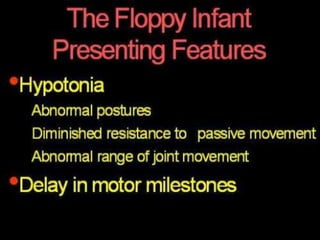
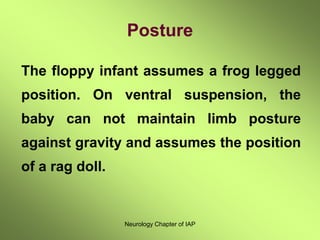
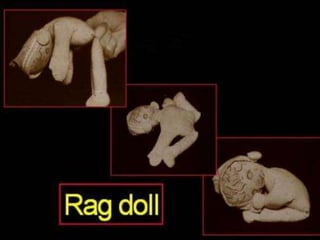
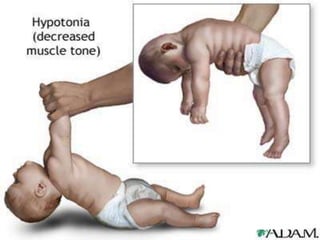
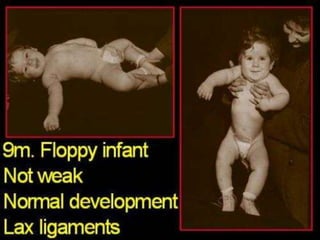
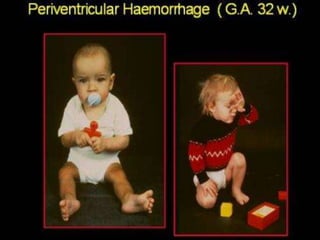
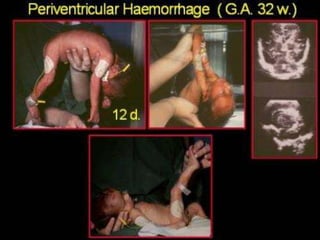
The floppy infant assumes a frog legged
position. On ventral suspension, the
baby can not maintain limb posture
against gravity and assumes the position
of a rag doll.
Neurology Chapter of IAP
Movements
The muscles appear flabby. There is
diminished resistance to passive
movement of the limbs and the range of
movement of the peripheral joints is
increased.
Neurology Chapter of IAP
Scarf Sign
Put the child in a supine position and hold one
of the infant’s hands. Try to put it around the
neck as far as possible around the opposite
shoulder. Observe how far the elbow goes
across the body. In a floppy infant, the elbow
easily crosses the midline.
Pull to sit:
When pulled up from the supine to the sitting
position, the head of the baby lags.
Neurology Chapter of IAP
Causes of Floppy Infant Syndrome
1. Central nervous system
Perinatal asphyxia, neonatal, encephalopathy, kernicterus,
cerebral palsy (atonic type), intracranial hemorrhage,
chromosomal anomalies including down syndrome and
inborn errors of metabolism e.g., aminocidurias,
mucopolysaccharidosis and cerebral lipidosis.
2. Spinal cord lesions
Anterior horn cell disease – werdnig Hoffman spinal
muscular atrophy, poliomyelitis.
3. Peripheral nervous
Acute polyneuropathy, familial dysautonomia, congenital
sensory neuropathy.
4. Myoneural junction
Neonatal myasthenia gravis, infantile botulism, following
antibiotic therapy.
Neurology Chapter of IAP
Causes of Floppy Infant Syndrome (Contd.)
5. Muscles
Muscular dystrophies, congenital myotonic dystrophies,
congenital myopathies (including central core disease and
nemalin myopathy), polymyositis, glycogen storage
disease (pompe’s), and arthrogryposis multiplex
congenital.
6. Miscellaneous
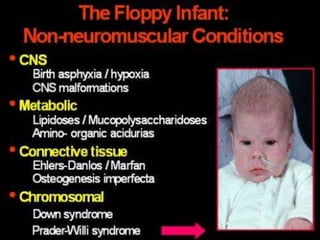
Protein energy malnutrition, rickets, prader willi syndrome,
malabsorption syndromes, Ehler-Danlos syndrome, cutis
laxa, cretinism.
Neurology Chapter of IAP
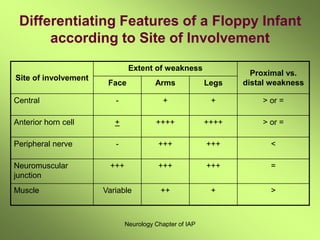
Differentiating Features of a Floppy Infant
according to Site of Involvement
Site of involvement
Extent of weakness
Proximal vs.
distal weakness
Face Arms Legs
Central - + + > or =
Anterior horn cell + ++++ ++++ > or =
Peripheral nerve - +++ +++ <
Neuromuscular
junction
+++ +++ +++ =
Muscle Variable ++ + >
Neurology Chapter of IAP
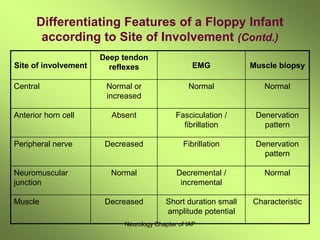
Differentiating Features of a Floppy Infant
according to Site of Involvement (Contd.)
Site of involvement
Deep tendon
reflexes EMG Muscle biopsy
Central Normal or
increased
Normal Normal
Anterior horn cell Absent Fasciculation /
fibrillation
Denervation
pattern
Peripheral nerve Decreased Fibrillation Denervation
pattern
Neuromuscular
junction
Normal Decremental /
incremental
Normal
Muscle Decreased Short duration small
amplitude potential
Characteristic
Neurology Chapter of IAP
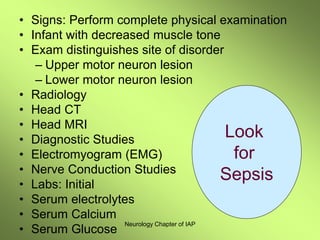
• Signs: Perform complete physical examination
• Infant with decreased muscle tone
• Exam distinguishes site of disorder
– Upper motor neuron lesion
– Lower motor neuron lesion
• Radiology
• Head CT
• Head MRI
• Diagnostic Studies
• Electromyogram (EMG)
• Nerve Conduction Studies
• Labs: Initial
• Serum electrolytes
• Serum Calcium
• Serum Glucose
Look
for
Sepsis
Neurology Chapter of IAP
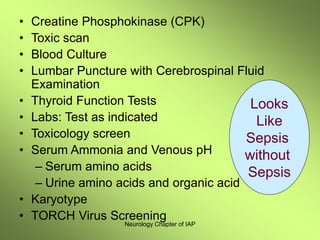
• Creatine Phosphokinase (CPK)
• Toxic scan
• Blood Culture
• Lumbar Puncture with Cerebrospinal Fluid
Examination
• Thyroid Function Tests
• Labs: Test as indicated
• Toxicology screen
• Serum Ammonia and Venous pH
– Serum amino acids
– Urine amino acids and organic acid
• Karyotype
• TORCH Virus Screening
Looks
Like
Sepsis
without
Sepsis
Neurology Chapter of IAP
Common causes of floppy infant
Cerebral Palsy
Many hypotonic children due to causes in
central nervous system are mentally retarded.
In atonic or hypotonic cerebral palsy, reflexes
are brisk in spite of generalized flaccidity.
Floppy infant due to cerebral causes is
associated with lethargy, poor feeding, and
lack of alertness, poor Moro’s reflex, and
seizures during the neonatal period.
Neurology Chapter of IAP
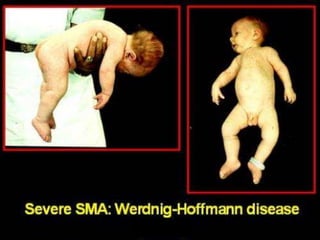
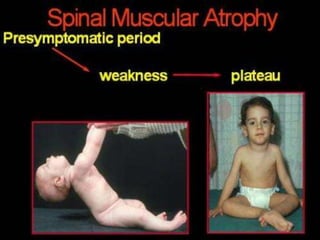
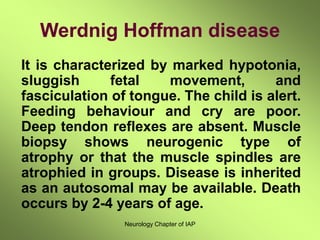
Werdnig Hoffman disease
It is characterized by marked hypotonia,
sluggish fetal movement, and
fasciculation of tongue. The child is alert.
Feeding behaviour and cry are poor.
Deep tendon reflexes are absent. Muscle
biopsy shows neurogenic type of
atrophy or that the muscle spindles are
atrophied in groups. Disease is inherited
as an autosomal may be available. Death
occurs by 2-4 years of age.
Neurology Chapter of IAP
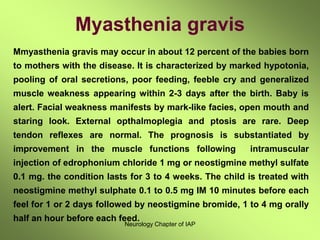
Myasthenia gravis
Mmyasthenia gravis may occur in about 12 percent of the babies born
to mothers with the disease. It is characterized by marked hypotonia,
pooling of oral secretions, poor feeding, feeble cry and generalized
muscle weakness appearing within 2-3 days after the birth. Baby is
alert. Facial weakness manifests by mark-like facies, open mouth and
staring look. External opthalmoplegia and ptosis are rare. Deep
tendon reflexes are normal. The prognosis is substantiated by
improvement in the muscle functions following intramuscular
injection of edrophonium chloride 1 mg or neostigmine methyl sulfate
0.1 mg. the condition lasts for 3 to 4 weeks. The child is treated with
neostigmine methyl sulphate 0.1 to 0.5 mg IM 10 minutes before each
feel for 1 or 2 days followed by neostigmine bromide, 1 to 4 mg orally
half an hour before each feed.
Neurology Chapter of IAP
Congenital myopathies
These are rare inherited disorders
resulting in a benign congenital
hypotonia, with generally good outlook
for normal life span. Nemaline myopathy
is the most common variant. Other
disorders of this group include the
central core disease, myotubular
myopathy and congenital fiber type
disproportion.
Neurology Chapter of IAP
Others
In polyneuritis there is symmetrical weakness of the
limbs with sensory changes. The diagnosis of Pompe’s
disease is suspected when the child has macroglossia,
cardiomegaly and generalized hypotonia. Babies with
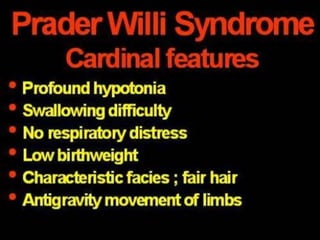
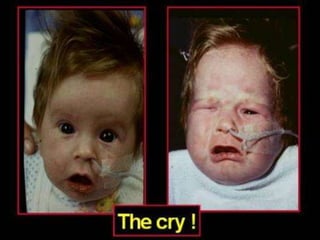
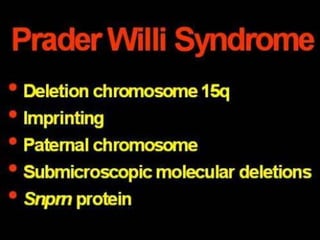
prader-willi syndrome are mentally retarded and obese;
deep tendon reflexes are diminished. Diabetes mellitus
occurs later in life. Testes may be undescended.
Ehlers-danlos syndrome is characterized by
hyperelasticity of the skin, hyperflexibility of joints and
extreme, fragility of skin. Wound healing is delayed and
there are frelly movable subcutaneous nodules. In cutis
laxa, the child has loose skin hanging in baggy folds.
Neurology Chapter of IAP
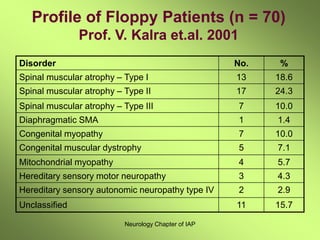
Profile of Floppy Patients (n = 70)
Prof. V. Kalra et.al. 2001
Disorder No. %
Spinal muscular atrophy – Type I 13 18.6
Spinal muscular atrophy – Type II 17 24.3
Spinal muscular atrophy – Type III 7 10.0
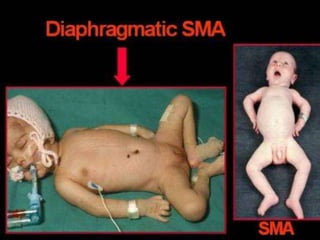
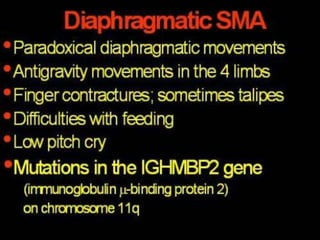
Diaphragmatic SMA 1 1.4
Congenital myopathy 7 10.0
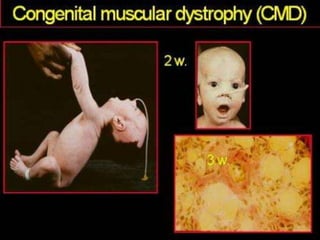
Congenital muscular dystrophy 5 7.1
Mitochondrial myopathy 4 5.7
Hereditary sensory motor neuropathy 3 4.3
Hereditary sensory autonomic neuropathy type IV 2 2.9
Unclassified 11 15.7
Neurology Chapter of IAP
Key Messages of this Study
• Spinal muscular atrophy emerged as the
commonest cause of floppy children followed by
congenital muscle disease.
• 11% of the cases still remained unclassified
despite sophisticated investigative techniques.
• EMG was a good screening modality for floppy
children.
• A low gene deletion rate (50%) was observed in
our phenotype
Neurology Chapter of IAP
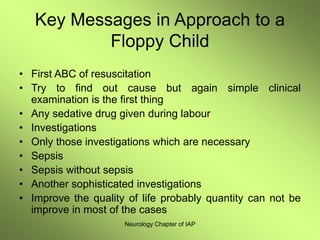
Key Messages in Approach to a
Floppy Child
• First ABC of resuscitation
• Try to find out cause but again simple clinical
examination is the first thing
• Any sedative drug given during labour
• Investigations
• Only those investigations which are necessary
• Sepsis
• Sepsis without sepsis
• Another sophisticated investigations
• Improve the quality of life probably quantity can not be
improve in most of the cases
Neurology Chapter of IAP

Approach to Floppy Infant.ppt

  • 1.
    Neurology Chapter ofIAP Dr. Arun Agrawal MD, MNAMS, FIAP, FIAMS, MIUAT (Paris), FICMCH • Consultant Pediatrician & Neonatologist, Ghaziabad • National Chairperson – Neurology Chapter of IAP • Honorary Professor of Pediatrics ICMCH • National Convener – Community Pediatrics, Chapter of IAP • National Vice President IAP 2004 Approach to Floppy Infant
  • 2.
    Neurology Chapter ofIAP Floppy Infant Floppy infant refers to those children presenting with generalized hypotonia, most often arising out of an insult incurred during fetal or neonatal period.
  • 3.
  • 4.
    Neurology Chapter ofIAP Posture The floppy infant assumes a frog legged position. On ventral suspension, the baby can not maintain limb posture against gravity and assumes the position of a rag doll.
  • 5.
  • 6.
    Neurology Chapter ofIAP Movements The muscles appear flabby. There is diminished resistance to passive movement of the limbs and the range of movement of the peripheral joints is increased.
  • 7.
    Neurology Chapter ofIAP Scarf Sign Put the child in a supine position and hold one of the infant’s hands. Try to put it around the neck as far as possible around the opposite shoulder. Observe how far the elbow goes across the body. In a floppy infant, the elbow easily crosses the midline. Pull to sit: When pulled up from the supine to the sitting position, the head of the baby lags.
  • 8.
  • 9.
    Neurology Chapter ofIAP Causes of Floppy Infant Syndrome 1. Central nervous system Perinatal asphyxia, neonatal, encephalopathy, kernicterus, cerebral palsy (atonic type), intracranial hemorrhage, chromosomal anomalies including down syndrome and inborn errors of metabolism e.g., aminocidurias, mucopolysaccharidosis and cerebral lipidosis. 2. Spinal cord lesions Anterior horn cell disease – werdnig Hoffman spinal muscular atrophy, poliomyelitis. 3. Peripheral nervous Acute polyneuropathy, familial dysautonomia, congenital sensory neuropathy. 4. Myoneural junction Neonatal myasthenia gravis, infantile botulism, following antibiotic therapy.
  • 10.
    Neurology Chapter ofIAP Causes of Floppy Infant Syndrome (Contd.) 5. Muscles Muscular dystrophies, congenital myotonic dystrophies, congenital myopathies (including central core disease and nemalin myopathy), polymyositis, glycogen storage disease (pompe’s), and arthrogryposis multiplex congenital. 6. Miscellaneous Protein energy malnutrition, rickets, prader willi syndrome, malabsorption syndromes, Ehler-Danlos syndrome, cutis laxa, cretinism.
  • 11.
  • 12.
  • 13.
  • 14.
  • 15.
    Neurology Chapter ofIAP Differentiating Features of a Floppy Infant according to Site of Involvement Site of involvement Extent of weakness Proximal vs. distal weakness Face Arms Legs Central - + + > or = Anterior horn cell + ++++ ++++ > or = Peripheral nerve - +++ +++ < Neuromuscular junction +++ +++ +++ = Muscle Variable ++ + >
  • 16.
    Neurology Chapter ofIAP Differentiating Features of a Floppy Infant according to Site of Involvement (Contd.) Site of involvement Deep tendon reflexes EMG Muscle biopsy Central Normal or increased Normal Normal Anterior horn cell Absent Fasciculation / fibrillation Denervation pattern Peripheral nerve Decreased Fibrillation Denervation pattern Neuromuscular junction Normal Decremental / incremental Normal Muscle Decreased Short duration small amplitude potential Characteristic
  • 17.
    Neurology Chapter ofIAP • Signs: Perform complete physical examination • Infant with decreased muscle tone • Exam distinguishes site of disorder – Upper motor neuron lesion – Lower motor neuron lesion • Radiology • Head CT • Head MRI • Diagnostic Studies • Electromyogram (EMG) • Nerve Conduction Studies • Labs: Initial • Serum electrolytes • Serum Calcium • Serum Glucose Look for Sepsis
  • 18.
    Neurology Chapter ofIAP • Creatine Phosphokinase (CPK) • Toxic scan • Blood Culture • Lumbar Puncture with Cerebrospinal Fluid Examination • Thyroid Function Tests • Labs: Test as indicated • Toxicology screen • Serum Ammonia and Venous pH – Serum amino acids – Urine amino acids and organic acid • Karyotype • TORCH Virus Screening Looks Like Sepsis without Sepsis
  • 19.
  • 20.
  • 21.
  • 22.
  • 23.
  • 24.
  • 25.
  • 26.
  • 27.
  • 28.
  • 29.
  • 30.
  • 31.
  • 32.
  • 33.
  • 34.
  • 35.
  • 36.
    Neurology Chapter ofIAP Common causes of floppy infant Cerebral Palsy Many hypotonic children due to causes in central nervous system are mentally retarded. In atonic or hypotonic cerebral palsy, reflexes are brisk in spite of generalized flaccidity. Floppy infant due to cerebral causes is associated with lethargy, poor feeding, and lack of alertness, poor Moro’s reflex, and seizures during the neonatal period.
  • 37.
    Neurology Chapter ofIAP Werdnig Hoffman disease It is characterized by marked hypotonia, sluggish fetal movement, and fasciculation of tongue. The child is alert. Feeding behaviour and cry are poor. Deep tendon reflexes are absent. Muscle biopsy shows neurogenic type of atrophy or that the muscle spindles are atrophied in groups. Disease is inherited as an autosomal may be available. Death occurs by 2-4 years of age.
  • 38.
    Neurology Chapter ofIAP Myasthenia gravis Mmyasthenia gravis may occur in about 12 percent of the babies born to mothers with the disease. It is characterized by marked hypotonia, pooling of oral secretions, poor feeding, feeble cry and generalized muscle weakness appearing within 2-3 days after the birth. Baby is alert. Facial weakness manifests by mark-like facies, open mouth and staring look. External opthalmoplegia and ptosis are rare. Deep tendon reflexes are normal. The prognosis is substantiated by improvement in the muscle functions following intramuscular injection of edrophonium chloride 1 mg or neostigmine methyl sulfate 0.1 mg. the condition lasts for 3 to 4 weeks. The child is treated with neostigmine methyl sulphate 0.1 to 0.5 mg IM 10 minutes before each feel for 1 or 2 days followed by neostigmine bromide, 1 to 4 mg orally half an hour before each feed.
  • 39.
    Neurology Chapter ofIAP Congenital myopathies These are rare inherited disorders resulting in a benign congenital hypotonia, with generally good outlook for normal life span. Nemaline myopathy is the most common variant. Other disorders of this group include the central core disease, myotubular myopathy and congenital fiber type disproportion.
  • 40.
    Neurology Chapter ofIAP Others In polyneuritis there is symmetrical weakness of the limbs with sensory changes. The diagnosis of Pompe’s disease is suspected when the child has macroglossia, cardiomegaly and generalized hypotonia. Babies with prader-willi syndrome are mentally retarded and obese; deep tendon reflexes are diminished. Diabetes mellitus occurs later in life. Testes may be undescended. Ehlers-danlos syndrome is characterized by hyperelasticity of the skin, hyperflexibility of joints and extreme, fragility of skin. Wound healing is delayed and there are frelly movable subcutaneous nodules. In cutis laxa, the child has loose skin hanging in baggy folds.
  • 41.
    Neurology Chapter ofIAP Profile of Floppy Patients (n = 70) Prof. V. Kalra et.al. 2001 Disorder No. % Spinal muscular atrophy – Type I 13 18.6 Spinal muscular atrophy – Type II 17 24.3 Spinal muscular atrophy – Type III 7 10.0 Diaphragmatic SMA 1 1.4 Congenital myopathy 7 10.0 Congenital muscular dystrophy 5 7.1 Mitochondrial myopathy 4 5.7 Hereditary sensory motor neuropathy 3 4.3 Hereditary sensory autonomic neuropathy type IV 2 2.9 Unclassified 11 15.7
  • 42.
    Neurology Chapter ofIAP Key Messages of this Study • Spinal muscular atrophy emerged as the commonest cause of floppy children followed by congenital muscle disease. • 11% of the cases still remained unclassified despite sophisticated investigative techniques. • EMG was a good screening modality for floppy children. • A low gene deletion rate (50%) was observed in our phenotype
  • 43.
    Neurology Chapter ofIAP Key Messages in Approach to a Floppy Child • First ABC of resuscitation • Try to find out cause but again simple clinical examination is the first thing • Any sedative drug given during labour • Investigations • Only those investigations which are necessary • Sepsis • Sepsis without sepsis • Another sophisticated investigations • Improve the quality of life probably quantity can not be improve in most of the cases
  • 44.