







Change Management 
& 
Appreciative 
Inquiry 
Brent A. Jones 
ACCJ Kansai – November 12, 2014
What is Appreciative 
Inquiry? 
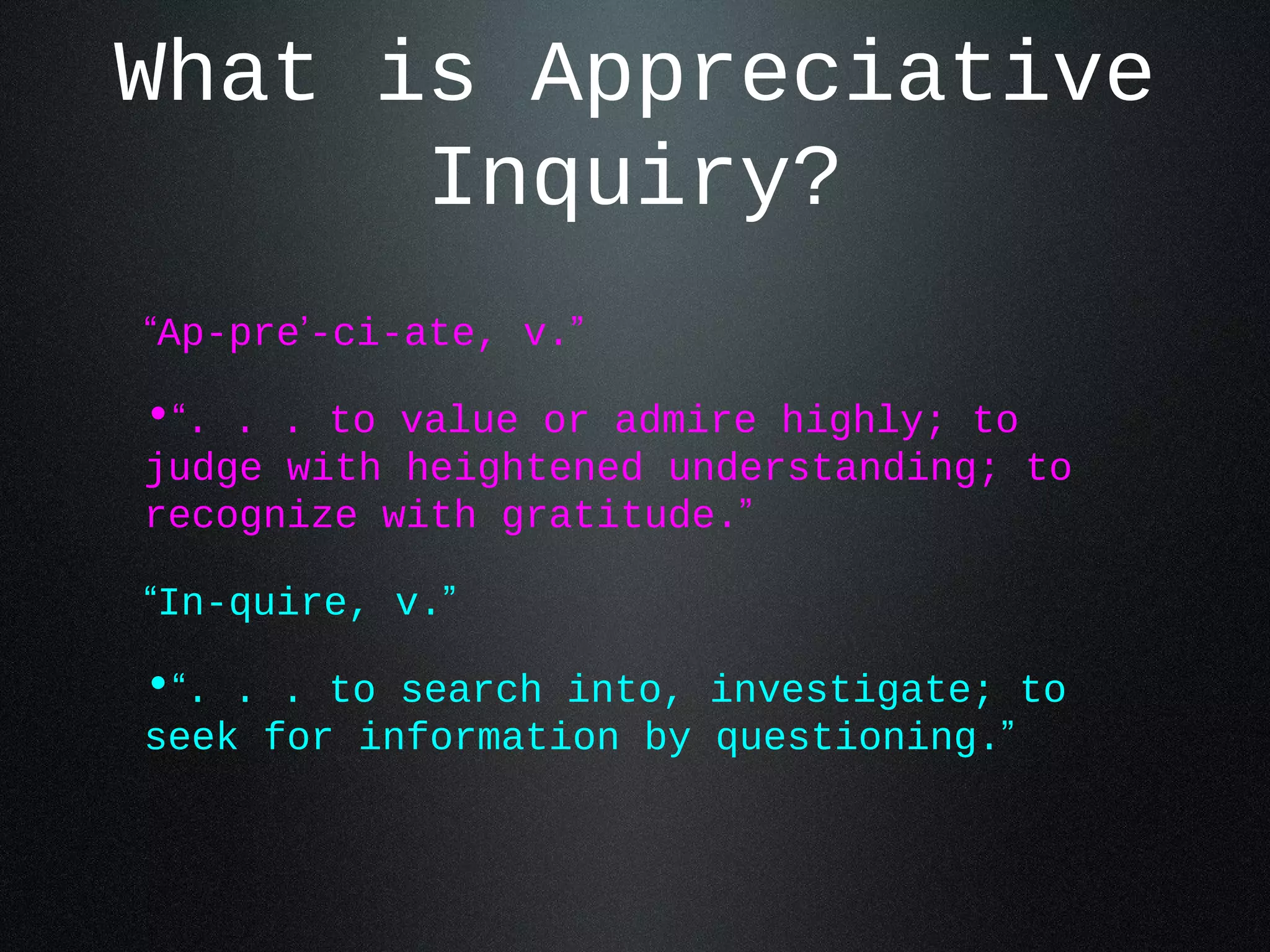
“Ap-pre’-ci-ate, v.” 
•“. . . to value or admire highly; to 
judge with heightened understanding; to 
recognize with gratitude.” 
“In-quire, v.” 
•“. . . to search into, investigate; to 
seek for information by questioning.”
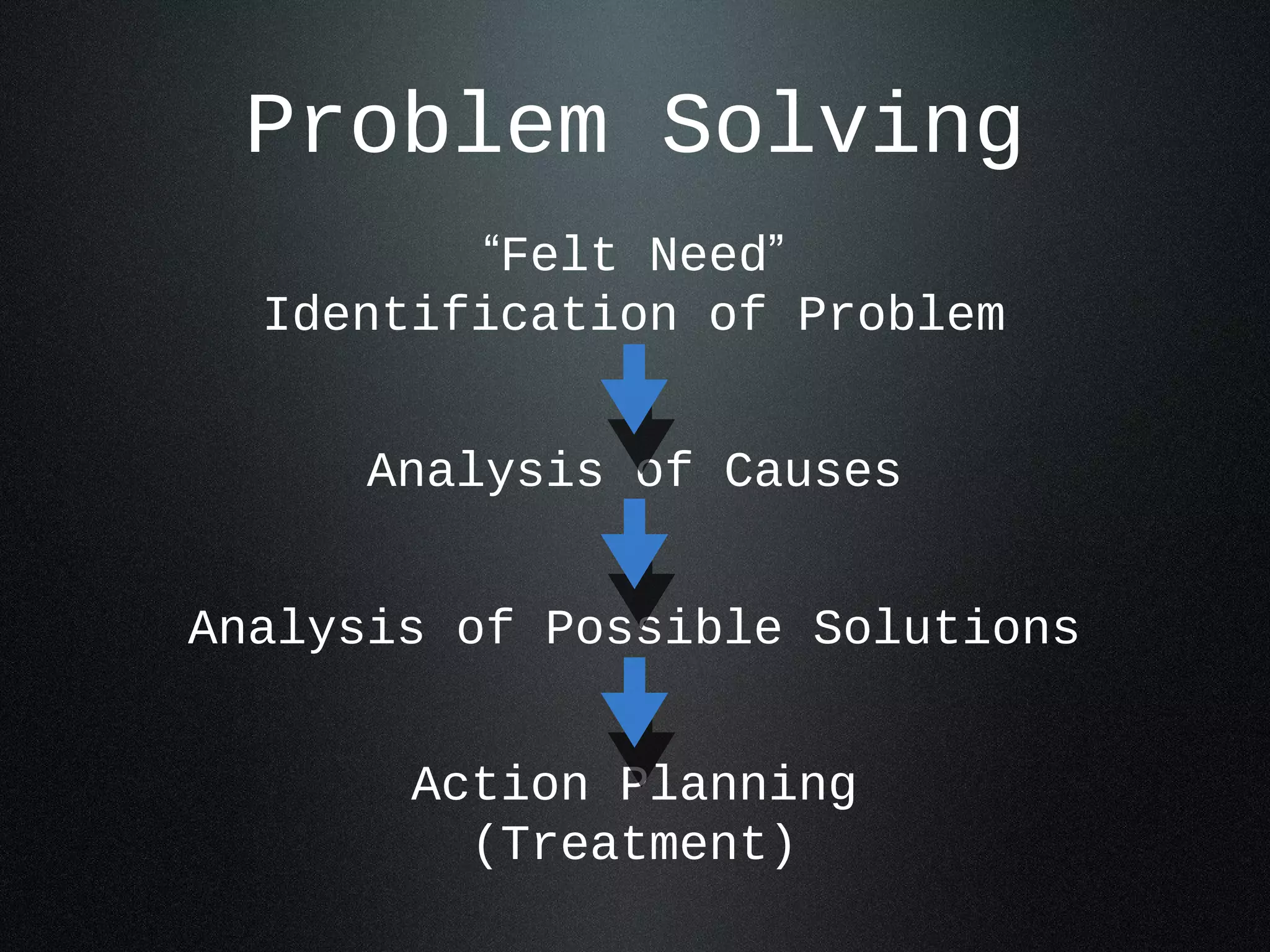
Problem Solving 
“Felt Need” 
Identification of Problem 
Analysis of Causes 
Analysis of Possible Solutions 
Action Planning 
(Treatment)
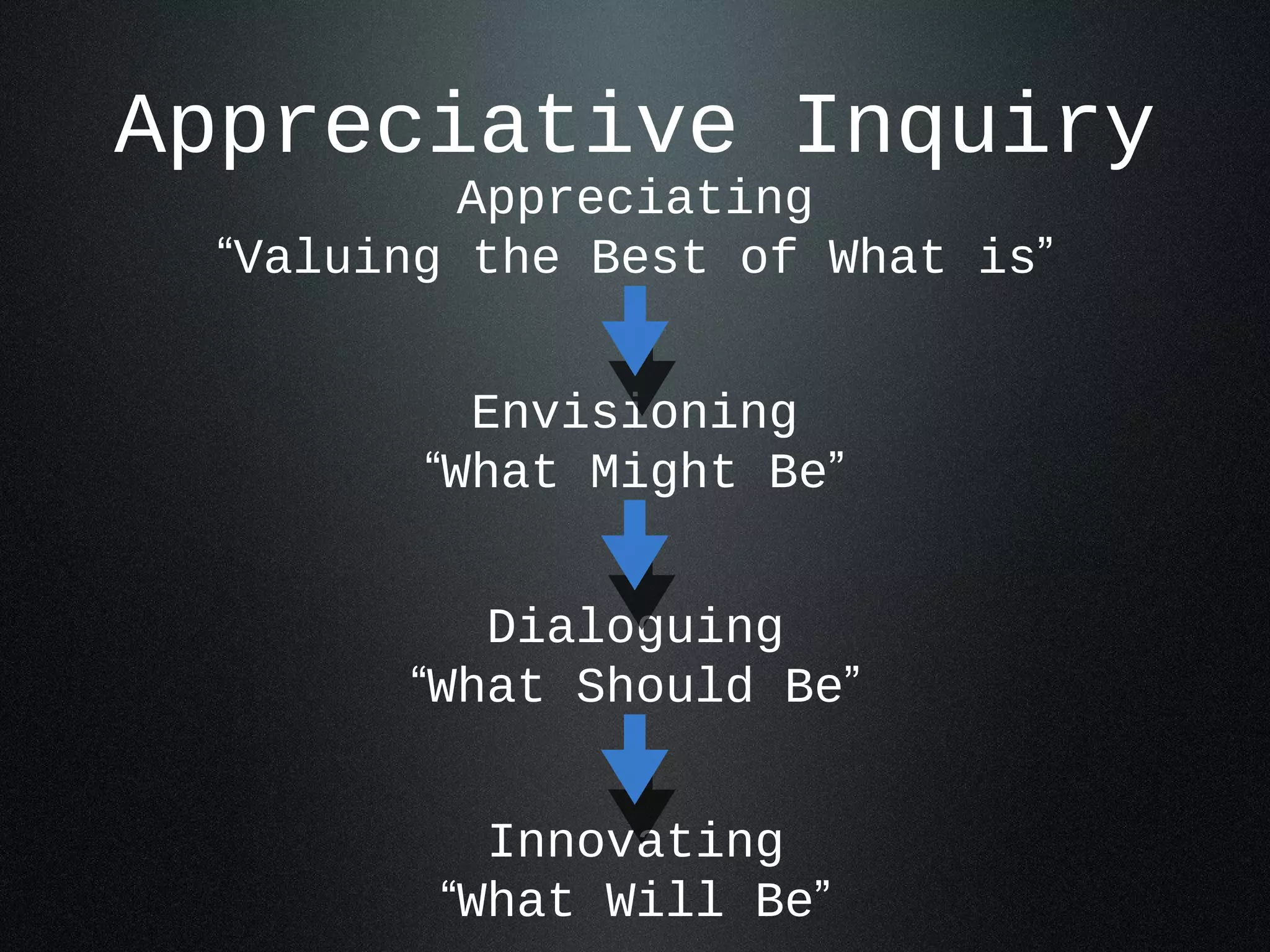
Appreciative Inquiry 
Appreciating 
“Valuing the Best of What is” 
Envisioning 
“What Might Be” 
Dialoguing 
“What Should Be” 
Innovating 
“What Will Be”
Heliotropism
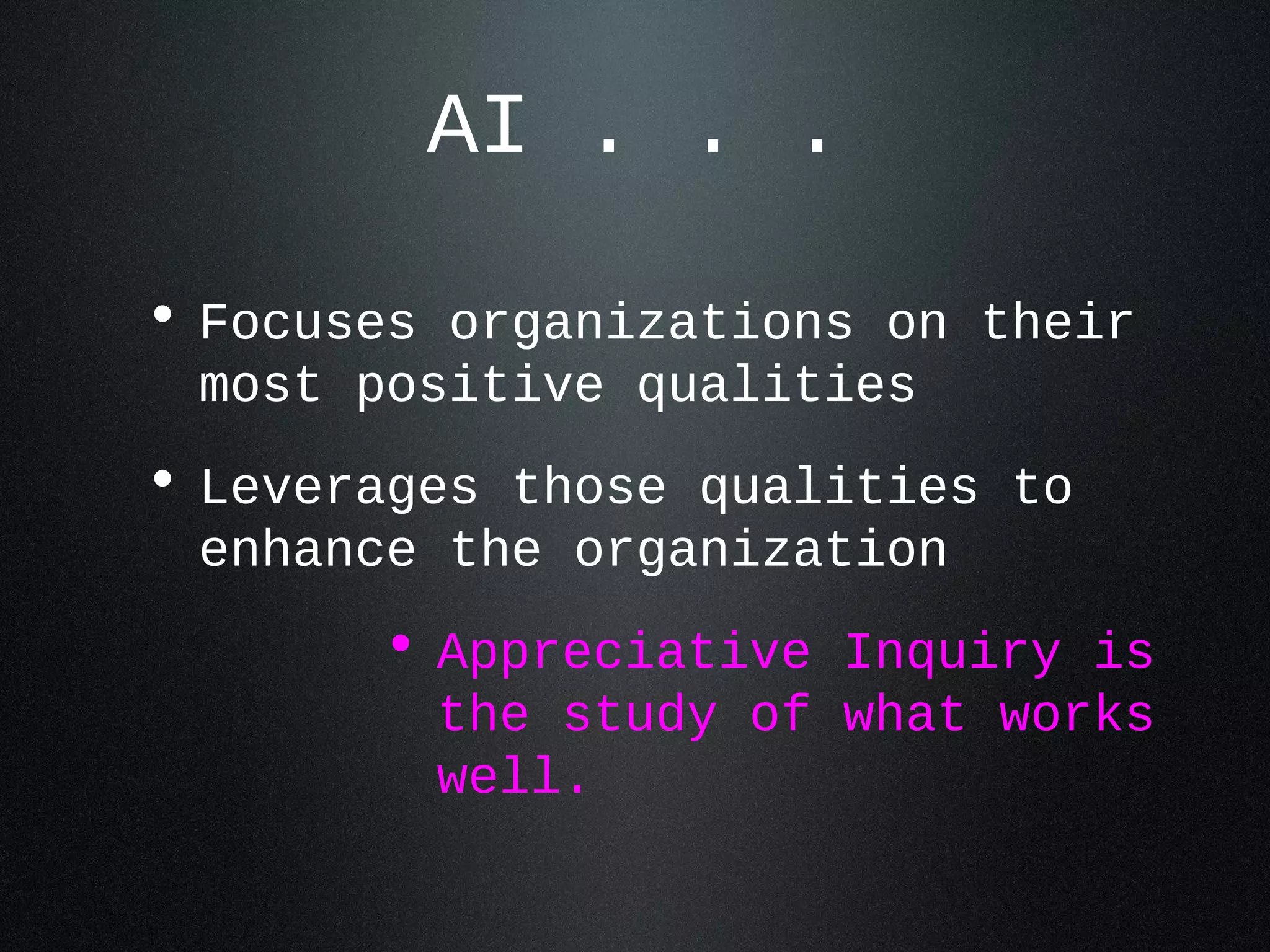
AI . . . 
• Focuses organizations on their 
most positive qualities 
• Leverages those qualities to 
enhance the organization 
• Appreciative Inquiry is 
the study of what works 
well.
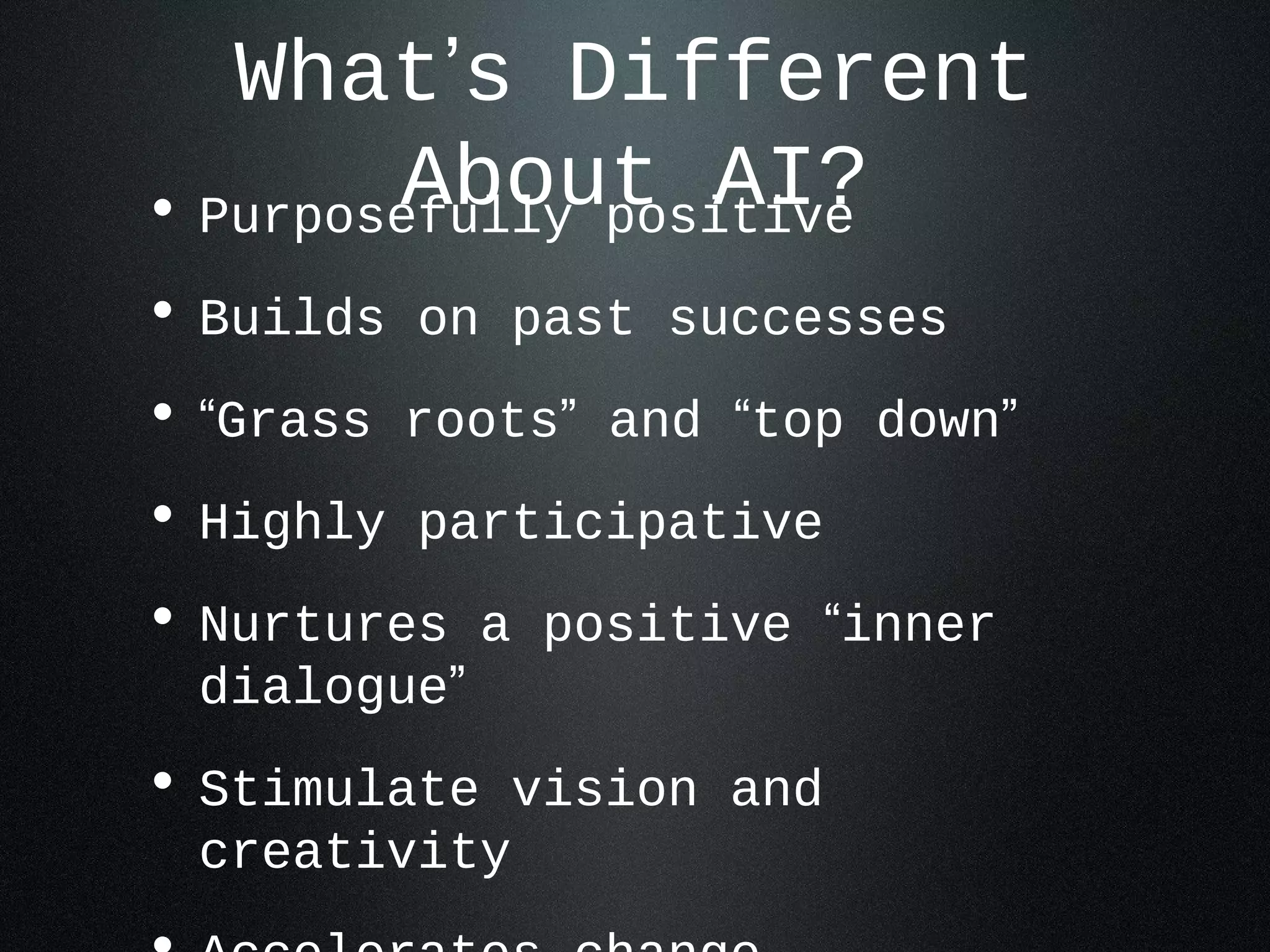
What’s Different 
• PurposeAfublolyu pto siAtiIv?e 
• Builds on past successes 
• “Grass roots” and “top down” 
• Highly participative 
• Nurtures a positive “inner 
dialogue” 
• Stimulate vision and 
creativity 
• Accelerates change
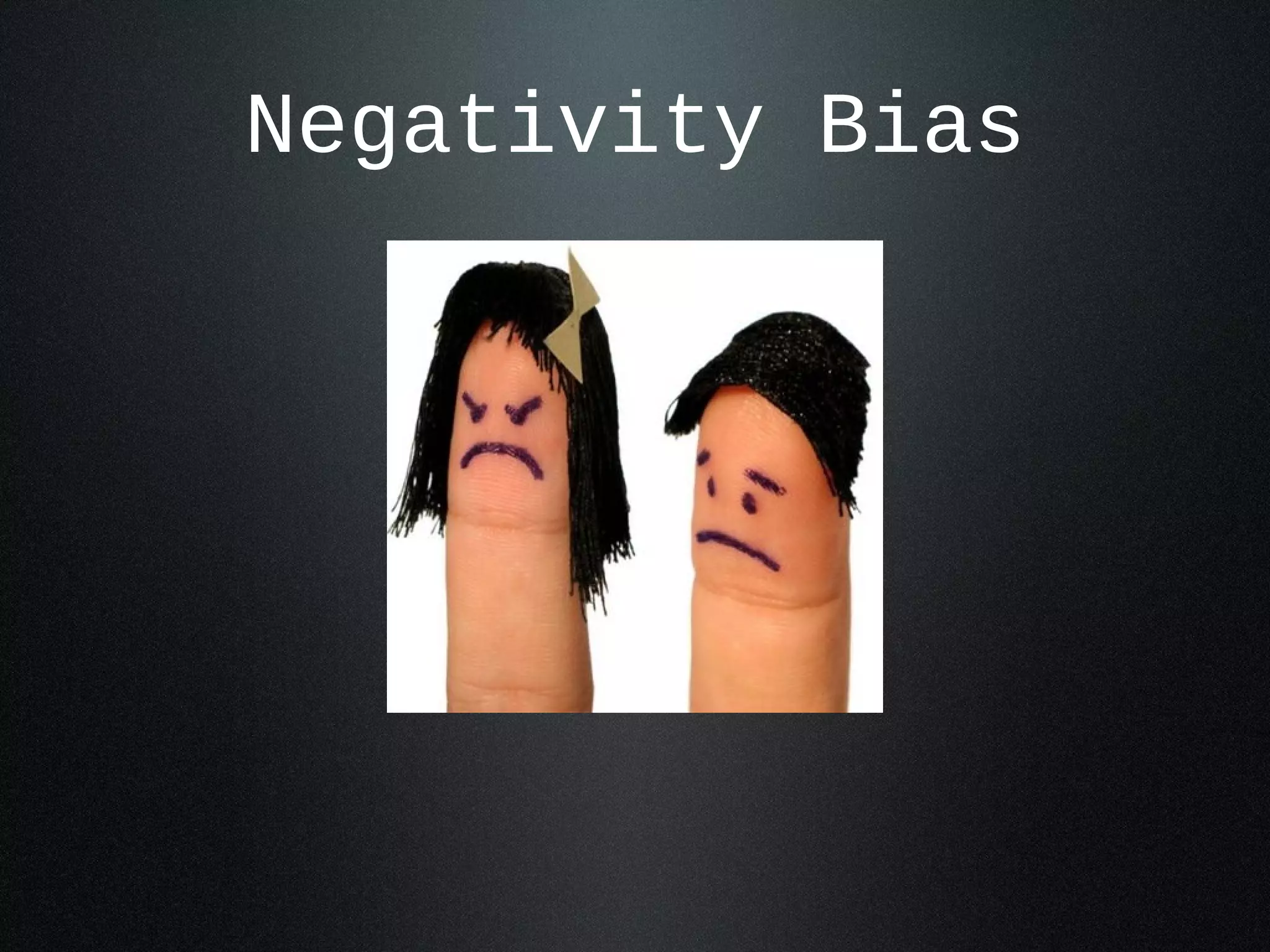
Negativity Bias
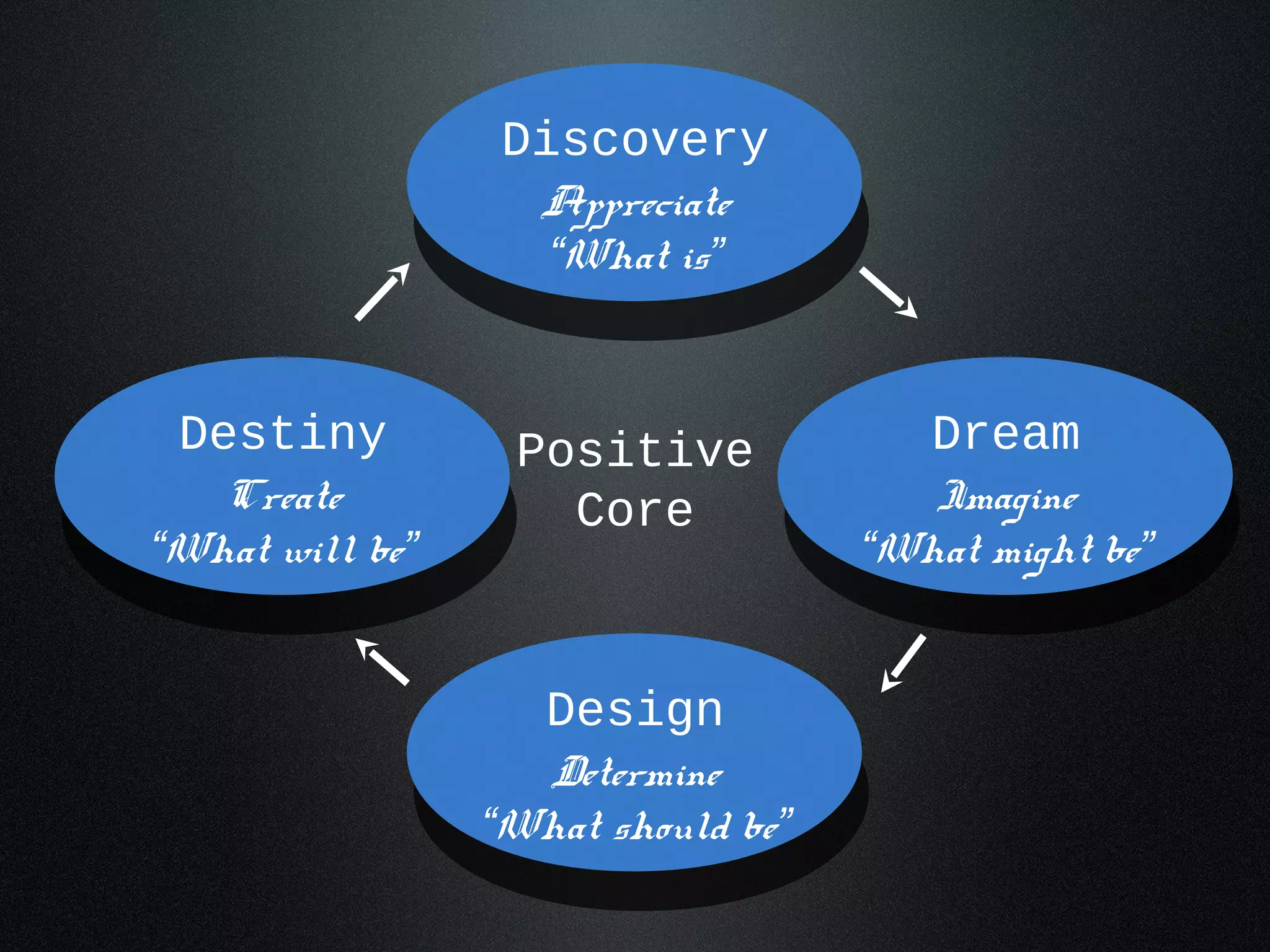
Dream 
Imagine 
“What might be” 
Discovery 
Appreciate 
“What is” 
Destiny 
Create 
“What will be” 
Positive 
Core 
Design 
Determine 
“What should be”
What would you describe as 
being a high-point experience 
in your organization, a time 
when you were most alive 
and engaged?
Constructionist
Simultaneity
Poetic
Anticipatory
Positivity
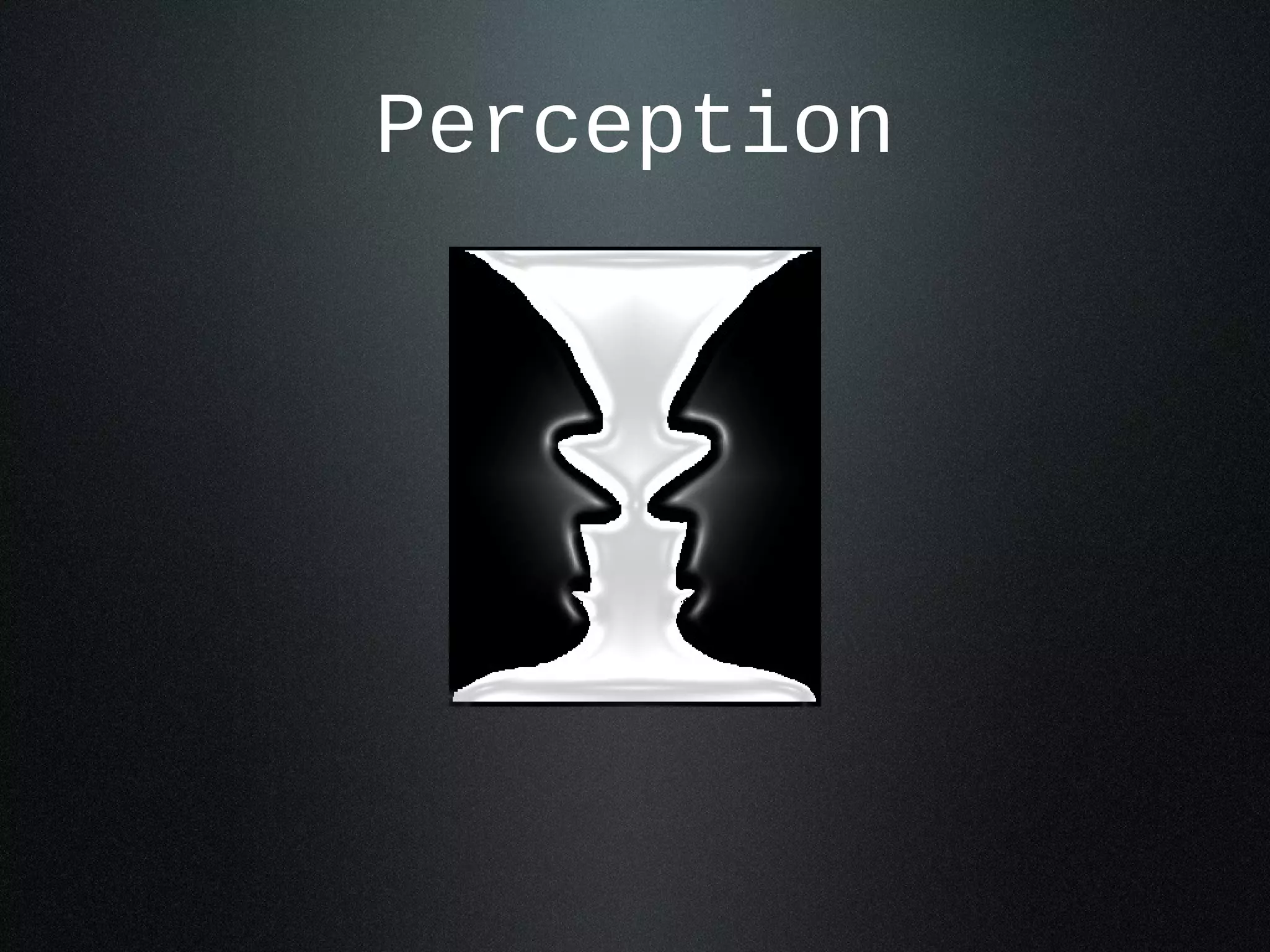
Perception
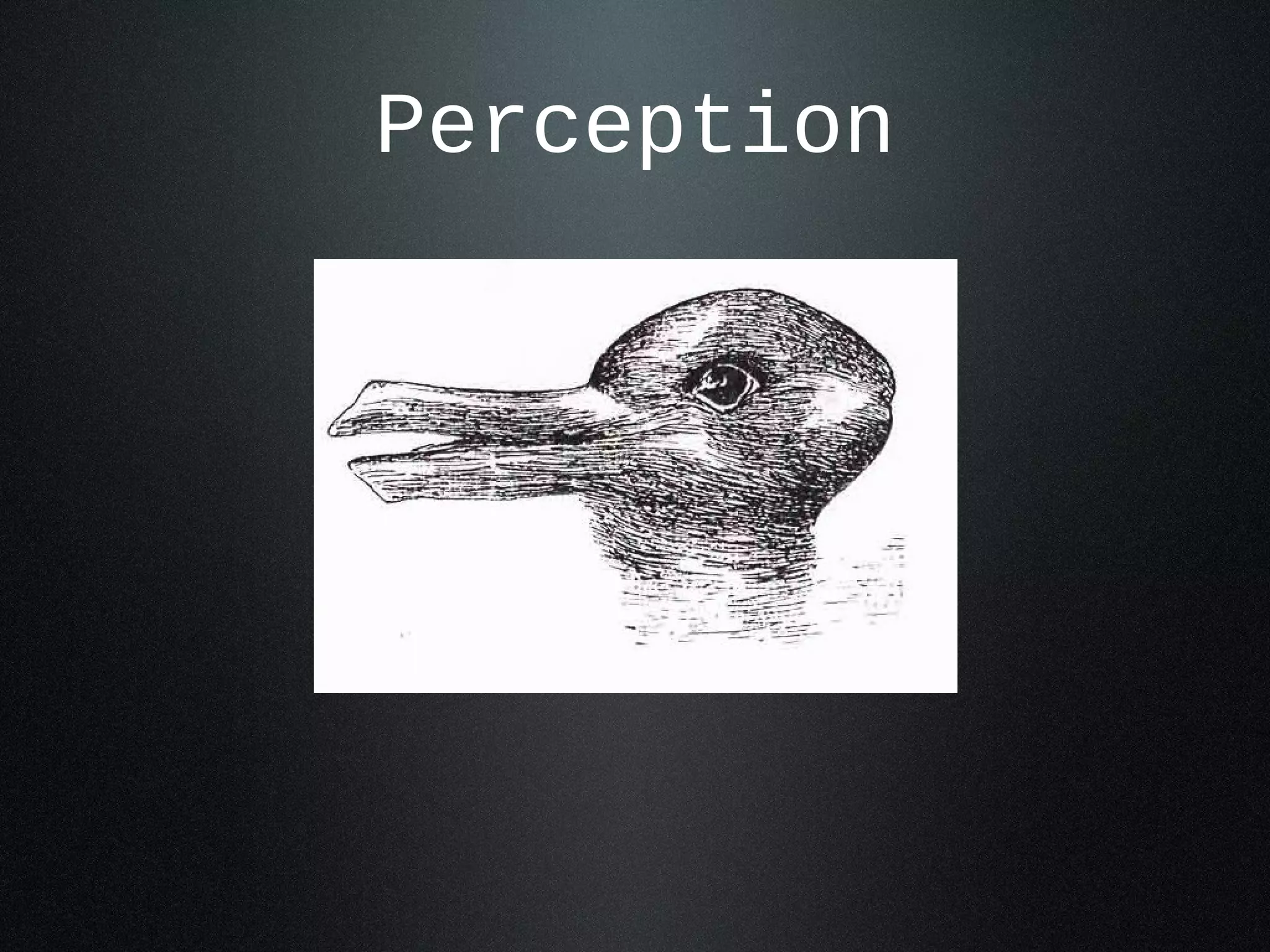
Perception
Without being modest, what 
do you value most about 
yourself, your work, and your 
organization?
What are the core factors that 
give life to your organization, 
without which the 
organization would cease to 
exist?
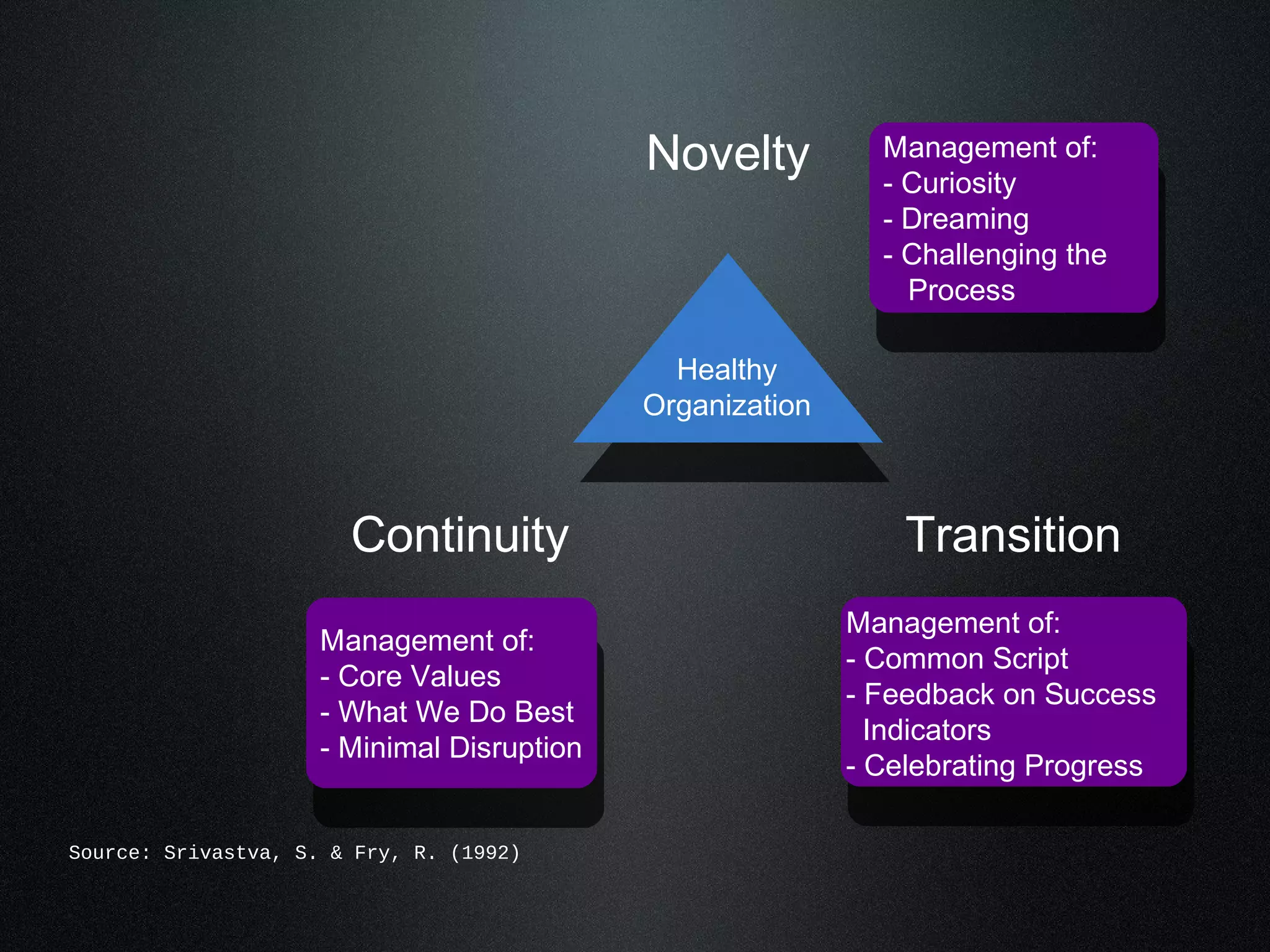
Novelty 
Healthy 
Organization 
Management of: 
- Curiosity 
- Dreaming 
- Challenging the 
Process 
Continuity Transition 
Management of: 
- Common Script 
- Feedback on Success 
Indicators 
- Celebrating Progress 
Management of: 
- Core Values 
- What We Do Best 
- Minimal Disruption 
Source: Srivastva, S. & Fry, R. (1992)
http://appreciativeinquiry.businesscatalyst.
Appreciative Inquiry & Change Management

Appreciative Inquiry & Change Management

  • 1.
    Change Management & Appreciative Inquiry Brent A. Jones ACCJ Kansai – November 12, 2014
  • 3.
    What is Appreciative Inquiry? “Ap-pre’-ci-ate, v.” •“. . . to value or admire highly; to judge with heightened understanding; to recognize with gratitude.” “In-quire, v.” •“. . . to search into, investigate; to seek for information by questioning.”
  • 4.
    Problem Solving “FeltNeed” Identification of Problem Analysis of Causes Analysis of Possible Solutions Action Planning (Treatment)
  • 5.
    Appreciative Inquiry Appreciating “Valuing the Best of What is” Envisioning “What Might Be” Dialoguing “What Should Be” Innovating “What Will Be”
  • 6.
  • 7.
    AI . .. • Focuses organizations on their most positive qualities • Leverages those qualities to enhance the organization • Appreciative Inquiry is the study of what works well.
  • 8.
    What’s Different •PurposeAfublolyu pto siAtiIv?e • Builds on past successes • “Grass roots” and “top down” • Highly participative • Nurtures a positive “inner dialogue” • Stimulate vision and creativity • Accelerates change
  • 9.
  • 10.
    Dream Imagine “Whatmight be” Discovery Appreciate “What is” Destiny Create “What will be” Positive Core Design Determine “What should be”
  • 11.
    What would youdescribe as being a high-point experience in your organization, a time when you were most alive and engaged?
  • 12.
  • 13.
  • 14.
  • 15.
  • 16.
  • 17.
  • 18.
  • 19.
    Without being modest,what do you value most about yourself, your work, and your organization?
  • 20.
    What are thecore factors that give life to your organization, without which the organization would cease to exist?
  • 21.
    Novelty Healthy Organization Management of: - Curiosity - Dreaming - Challenging the Process Continuity Transition Management of: - Common Script - Feedback on Success Indicators - Celebrating Progress Management of: - Core Values - What We Do Best - Minimal Disruption Source: Srivastva, S. & Fry, R. (1992)
  • 22.

Editor's Notes

  • #2 What if I told you there was a new way of achieving positive change in your company, school, program, department, curriculum or class? Would you be willing, . . . would you be able, . . . would you be open to learning more? Good morning. It is a pleasure to be here. Today, I hope to plant a few seeds for positive change. As educators and administrators, a big part of our job is change management. In a sense, we are Change Agents. Some of you may have heard of Appreciative Inquiry and even have experience with it. I will ask you help in catching anything I forget. I teach in a management and much of my research over the past few years has been in business, business psychology, organizational development, and change management. However, my background is in education and the lens I use is normally an educational one. I believe teachers and educational administrators have much to learn from business. Business has the money, and we can reap the benefits of their investment.
  • #3 If you are as tired as I am, of the typical problem-solving, fault-finding, mind-numbing, soul sapping work pursuits, then lend me your ears . . . and I will share with you an alternative approach to change management.
  • #4 David Cooperrider at Case Western Reserve University as well as other kindred souls around the world, have been exploring and experimenting with creative, up-lifting ways of analyzing and improving organizations. They collectively preach the gospel of Appreciative Inquiry . . . sorry, there is no cool-aid here, but you are welcome to the beverages at the bar.
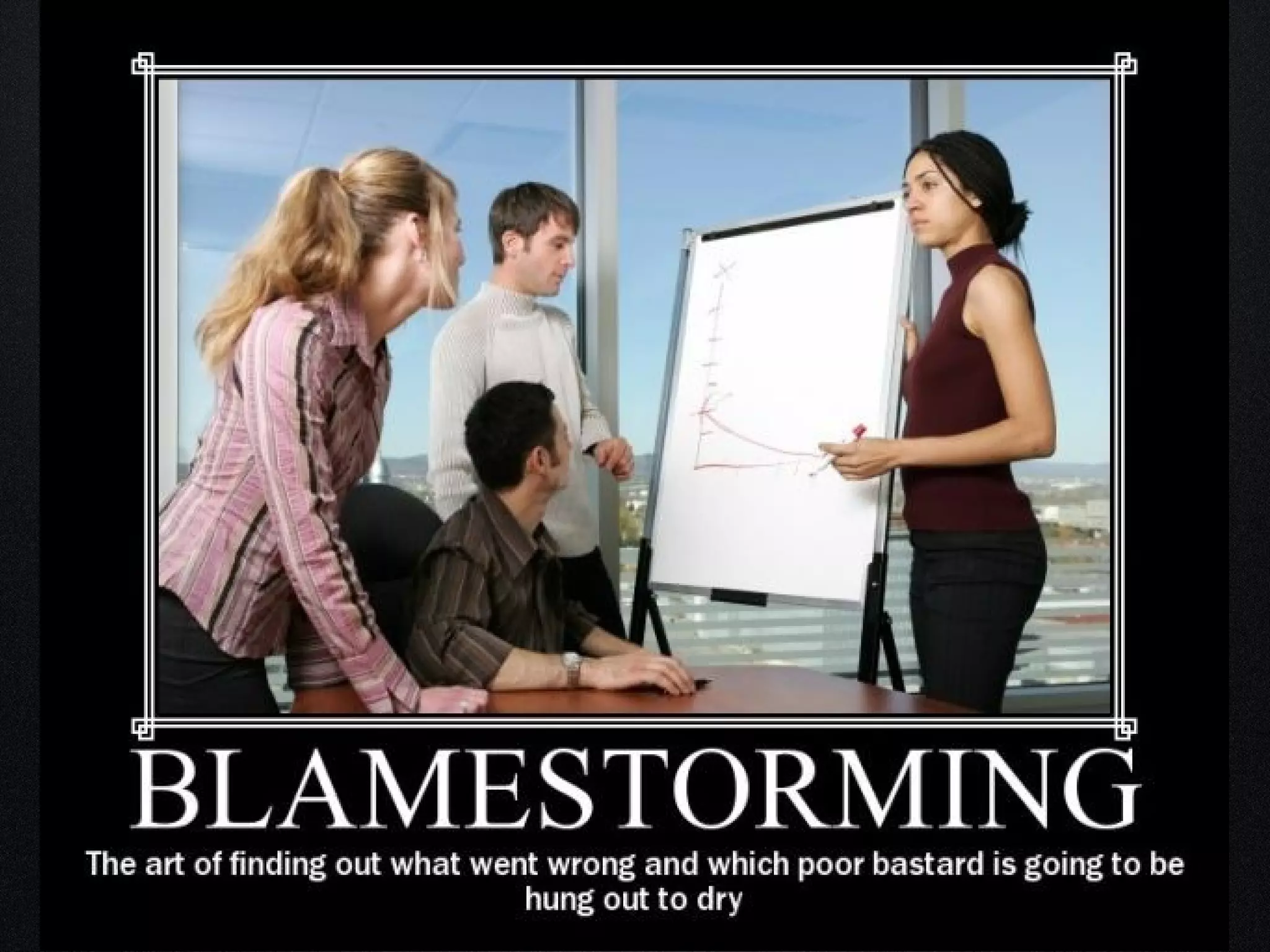
  • #5 How many times have you been led or dragged through the typical problem-solving process? There may actually times when this process even works . . . but my own experiences have not been promising.
  • #6 Conversely, the Appreciative Inquiry process breaths life into the change management endeavor. Raise your hand if your company or organization needs a breath of fresh air.
  • #7 Plants, as we all know, lean toward the light of the sun, and will follow its path from sunrise to sunset. It the same way, people are hungry for life-giving sources of energy, positive emotions and brilliance. This tendency is one of underpinnings of Appreciative Inquiry.
  • #8 Appreciative Inquiry, my friends is a paradigm shift away from the framework of finding and focusing on problems. It offers a new framework for thinking about our companies, schools, organizations, even families. A framework that focuses on what is working, what is successful, what is bright, what is promising.
  • #9 If you think about it . . . successful problem solving still only brings you back to ZERO. Keeping focused on the positive is not about blowing smoke up someone’s behind . . . It is refusing to let the negative dominate our dialogues . . . refusing to be sucked down the toilet of despair and desperation.
  • #10 According to the Nobel Prize-winning scientist Daniel Kahneman, each day we experience approximately 20,000 moments. A moment is defined as a few seconds in which our brain records an experience. The quality of our days is determined by how our brains recognize and categorize our moments—either as positive, negative, or just neutral. Rarely do we remember neutral moments. Psychologist John Gottman used the magic ratio of 5:1 ratio, to predict which newlywed couples would stay together. It appears that it takes at least 5 positive events to overcome just one negative event. Come on folks, we need to put more energy into creating positive experiences.
  • #11 So, how does Appreciative Inquiry work . . . Glad you asked. The 4D model here seems to dominate the field. The inquiry starts with a Discover phase, which aims to articulate strengths and/or best practices. This might be done through high-point interviews or collecting positive stories. The next stage is to dream or imagine best-possible scenarios. This is followed by concrete planning and preparing for that imagined future. The final step is putting this plan into action. This all revolves around the positive core of the institution.
  • #12 I would like to conclude with a few of the
  • #13 One of five Principles of AI is constructionism, the idea that reality . . . our reality, is a collaborative construct.
  • #14 The next principle is that of simultaneity. As soon as we shine the light of our attention on something, it undergoes some change.
  • #15 The Poetic Principle describes the mysticism and romanticism of human endeavor, including our companies and schools, and highlights the fact that we are still writing the ending.
  • #16 Appreciative Inquiry endeavors also involve a tension, the expectation of something special. Organisations (and people) tend to grow in the direction of their positive images of the future, like a sunflower or heliotrope grows towards the sun. Our expectations of the future - and therefore of what we believe is possible - are constantly shaped by our conversations. Repeated studies in sports psychology have shown that athletes who mentally rehearse success do better than those who don't have a clear image of success, or who psych themselves out by imagining all the things that could go wrong. Having a clear, compelling image of the desired future creates "towards" motivation. Of course, we also tend to move away from our fears and bad experiences. Moving "towards" what we want has some significant advantages over moving "away from" what we don't want.
  • #17 The Fifth Principle is that of positivity. The engine of Appreciative Inquiry is unapologetic leaning on positivity. This is not just blind optimism, but a defiant stance against the negativity bias.
  • #18 You likely recognize that this whole Appreciative Inquiry thing boils down to a question of perception . . . or where we intend to shine the light of our attention.
  • #19 Which way do you plan ?? Change this image.