APPLYING
QUALITY
STANDARDS
SUMMARY OF
LEARNING
OUTCOMES:
LO1 Assess Condition of
Received Equipment
LO2 Assess own work
LO3 Validate one’s work for
quality improvement
3
Checklist - help organize data by category
Durability - enduring; resisting wear
Flowchart - describes process in as much detail as
possible by
graphically displaying the steps in proper sequence
Hardware - refers to the electronic and mechanical
components that make a computer system.
Histogram - plots data in a frequency distribution
table
TECHNICAL TERMS
4
Hostile - being an enemy; unfriendly
ISO - International Standardization Organization
OHS - Occupational Health and Safety procedures
Pareto diagram- puts data in a hierarchical order
which allows the
significant problems to be connected first.
PPE - personal protective equipment
TECHNICAL TERMS
5
Quality - essential character nature; degree or grade
of excellence
Scatter diagram- shows how two variables are
related and is this used to test for cause and effect
relationships
.
Standards -as one serving the emblem of a nation;
something as accepted as a basis for
comparison
TECHNICAL TERMS
ASSESSMENT
CRITERIA
7
LEARNING OUTCOME #1: ASSESS
CONDITION OF RECEIVED EQUIPMENT
1. Work instruction is obtained and work is
carried out in accordance with the
standard operating procedures.
2. Received materials are checked base on the
workplace standards and
specifications.
3. Faulty materials related to work are identified
and isolated.
8
LEARNING OUTCOME #1: ASSESS
CONDITION OF RECEIVED EQUIPMENT
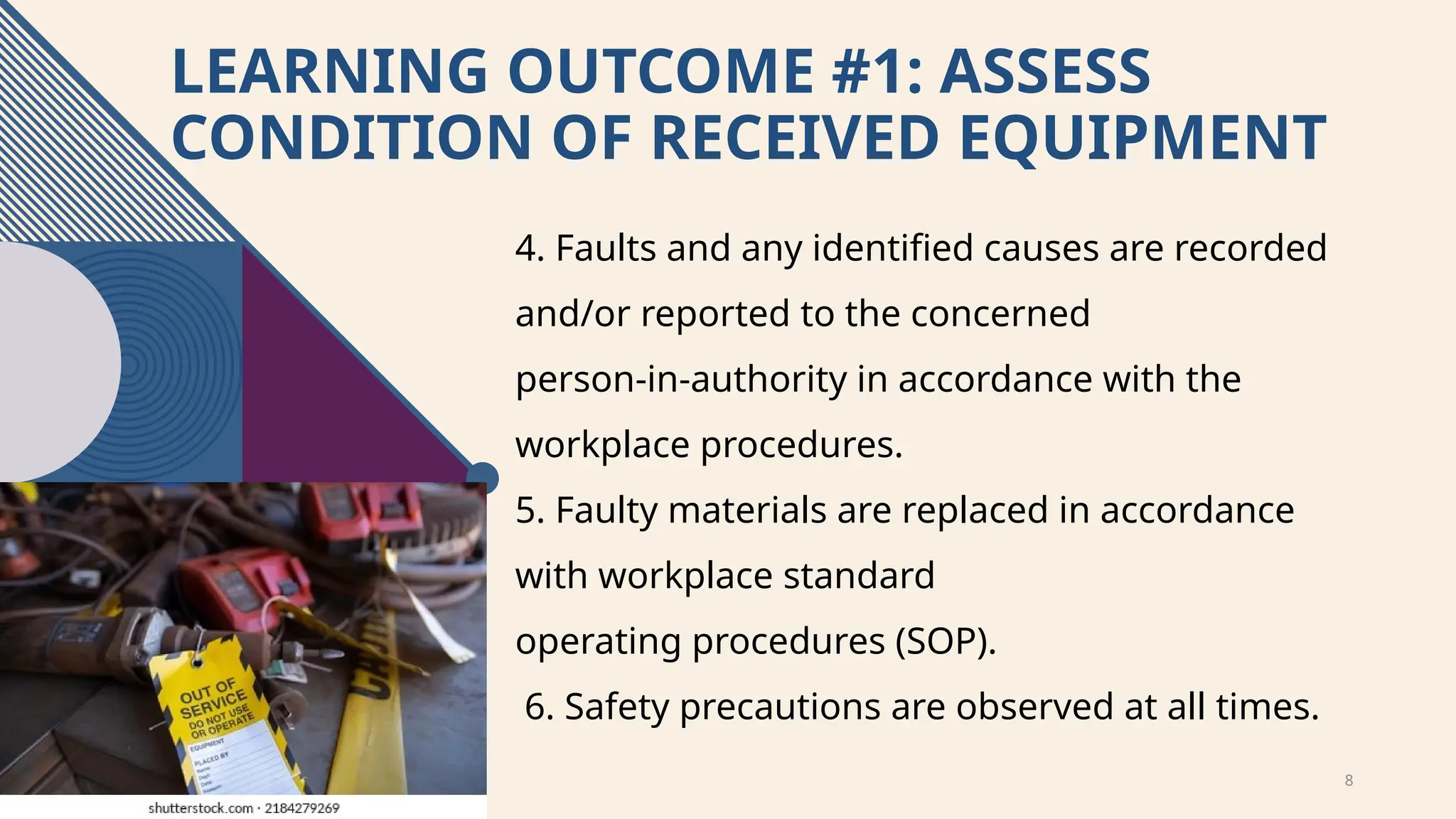
4. Faults and any identified causes are recorded
and/or reported to the concerned
person-in-authority in accordance with the
workplace procedures.
5. Faulty materials are replaced in accordance
with workplace standard
operating procedures (SOP).
6. Safety precautions are observed at all times.
CHARACTERISTICS
OF MATERIALS USED
IN SPECIFIC PROJECT
The student must relate material properties to
product and process quality. These are the
factors that must be taken into consideration
when choosing the right material for their
components and assemblies
10
1. SELECTION OF
MATERIAL
Material selection is one of the most
common tasks for design engineering. The
ability to assess the material’s impact on the
performance of a product is crucial for
reliable performance. Sometimes, buyers
are also considering the label or name of the
company which are producing great quality
of materials and are known in the market.
Examples are the name HP for printer and
Intel for some computer hardware.
11
2. TESTING OF
MATERIAL
The testing of material properties is widely
understood to be the key to obtaining data
for a project, performing failure analysis, or
understanding material interactions.
Material testing also provides information
on the quality of incoming and outgoing
products. Inspection test equipment and
techniques are demonstrated for a wide
range of materials and assemblies during
the class. This provides the participants with
both knowledge of the common failure
modes.
12
3. COST OF MATERIAL
The cost of material is also considered when
buying or selecting materials for a specific
project. The amount may vary but never
taken for granted the quality and the
reliability of the material. Will you buy
material which is less expensive but worst
quality? Will you buy material which you
cannot afford? People look for places which
can meet their standards and right cost for
materials to buy.
Characteristic of common materials for
increased security is also a great factor in the
design and planning process.
13
THE CHARACTERISTIC
OF THE MATERIALS TO
BE USED FOR SPECIFIC
PROJECT MUST BE:
 of good quality
 reliable
 suitable for the application/purposes
 low cost
14
THE CHARACTERISTIC OF THE MATERIALS TO
BE USED FOR SPECIFIC PROJECT MUST BE:
 of good quality - This is the most
important factor when choosing
materials to buy. Products with good
quality are long-lasting and safe to use
because you know that it follows certain
standards before being commercialized.
 reliable - It means that you can be
sure that it will perform its function
well, will operate safely and will give the
best it could give.
suitable for the application/purposes -
Choose the materials which are very
necessary to make the project possible.
Making a list of products/materials to
buy is a good trait of a wise consumer.
Products which are not to be used must
be crossed out.
low cost - It doesn’t mean that you will
choose for the less expensive one and
exclude the quality. Low cost means you
can afford to buy the materials without
hurting your pocket and assure of better
quality.
15
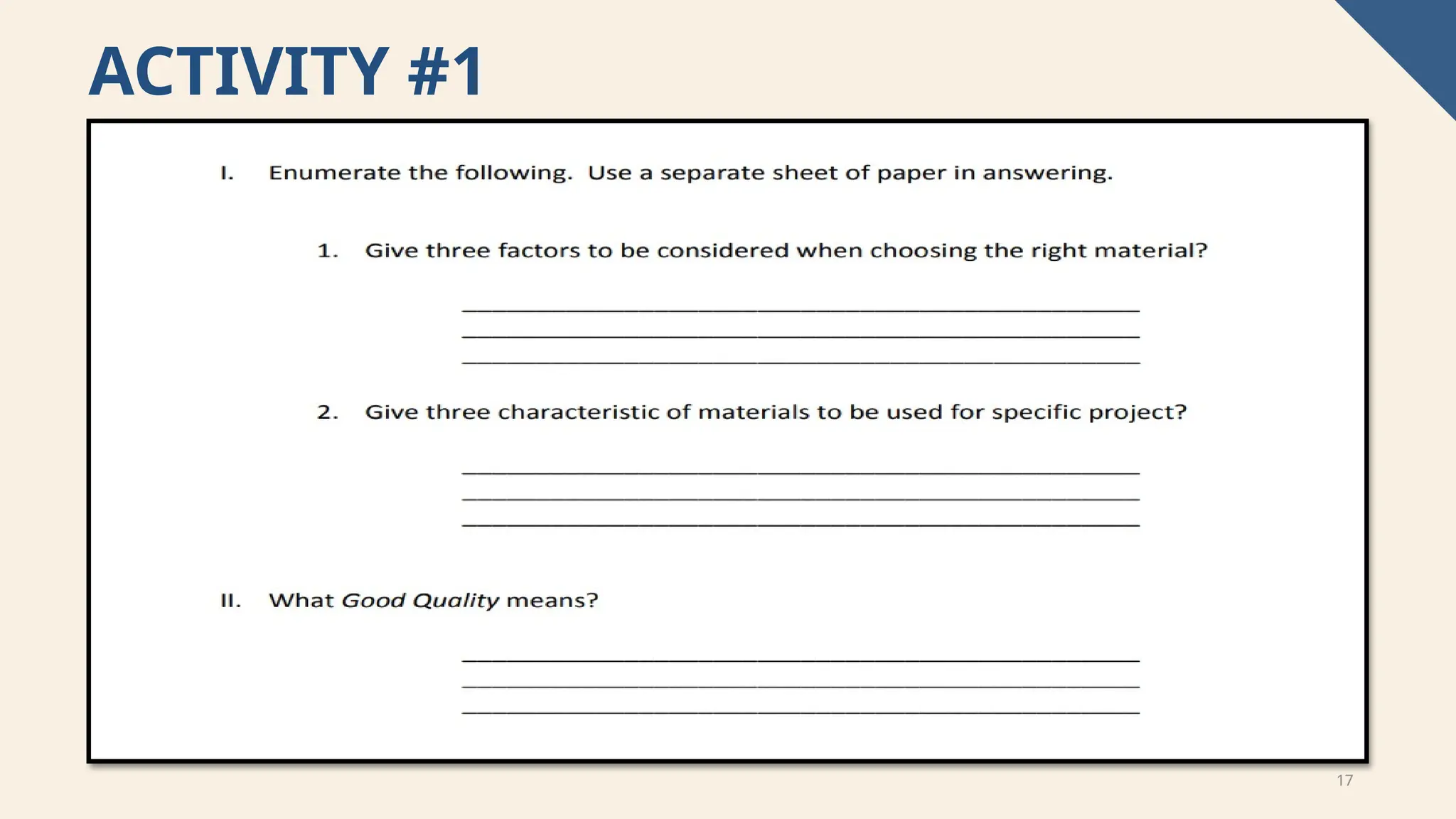
ACTIVITY #1
16
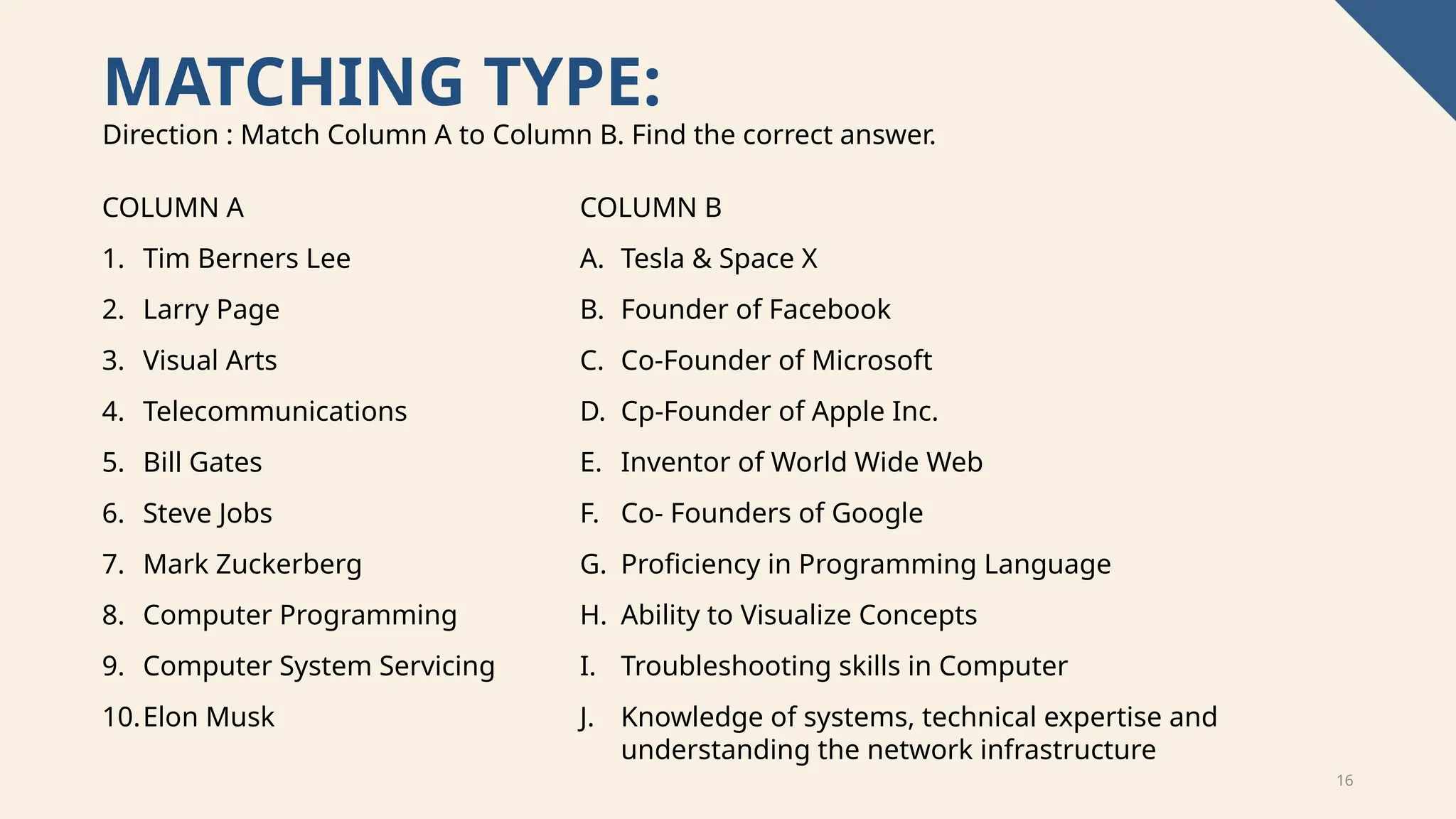
MATCHING TYPE:
COLUMN A
1. Tim Berners Lee
2. Larry Page
3. Visual Arts
4. Telecommunications
5. Bill Gates
6. Steve Jobs
7. Mark Zuckerberg
8. Computer Programming
9. Computer System Servicing
10.Elon Musk
Direction : Match Column A to Column B. Find the correct answer.
COLUMN B
A. Tesla & Space X
B. Founder of Facebook
C. Co-Founder of Microsoft
D. Cp-Founder of Apple Inc.
E. Inventor of World Wide Web
F. Co- Founders of Google
G. Proficiency in Programming Language
H. Ability to Visualize Concepts
I. Troubleshooting skills in Computer
J. Knowledge of systems, technical expertise and
understanding the network infrastructure
17
ACTIVITY #1
18
ESSAY :
19
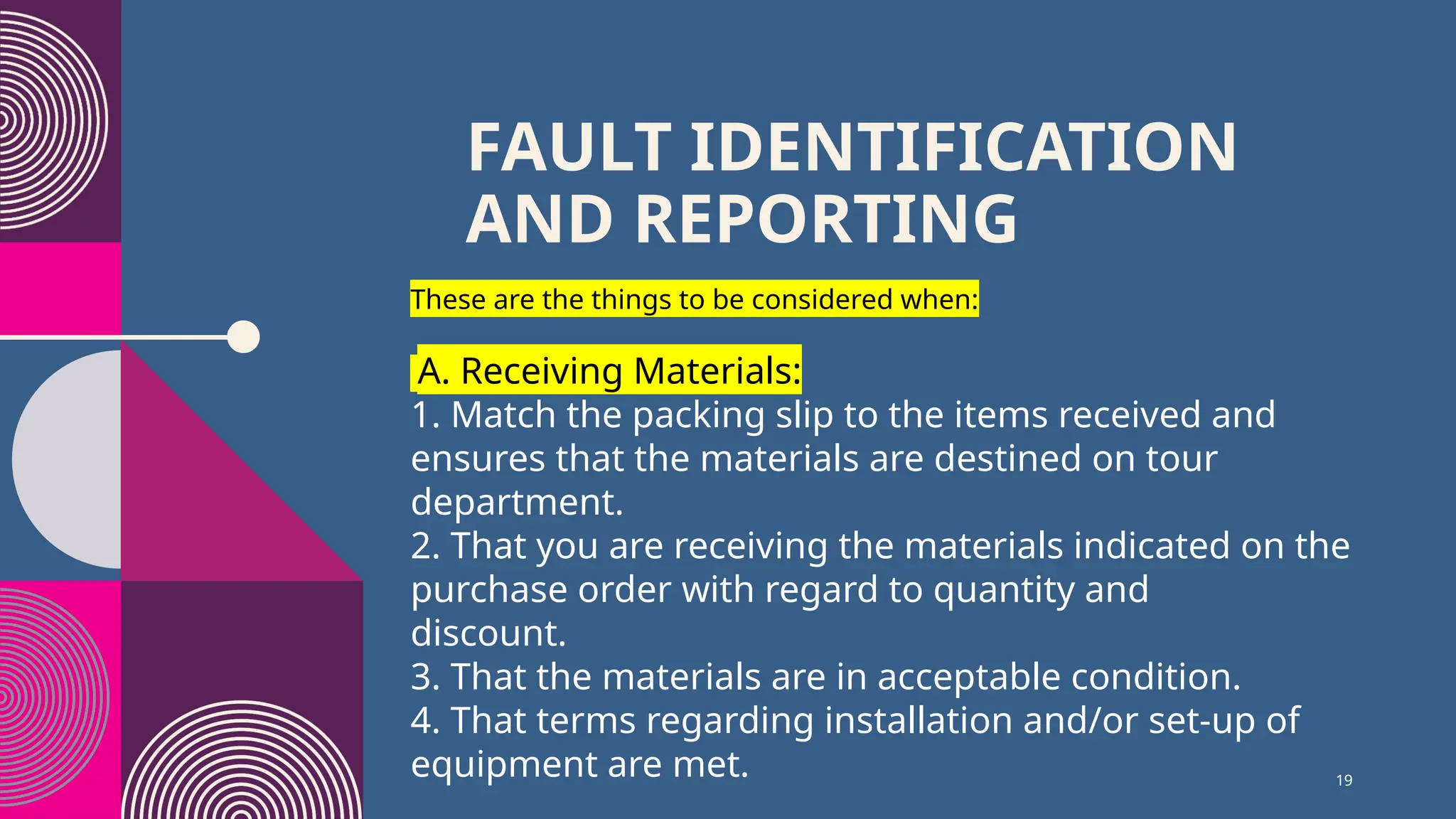
FAULT IDENTIFICATION
AND REPORTING
These are the things to be considered when:
A. Receiving Materials:
1. Match the packing slip to the items received and
ensures that the materials are destined on tour
department.
2. That you are receiving the materials indicated on the
purchase order with regard to quantity and
discount.
3. That the materials are in acceptable condition.
4. That terms regarding installation and/or set-up of
equipment are met.
20
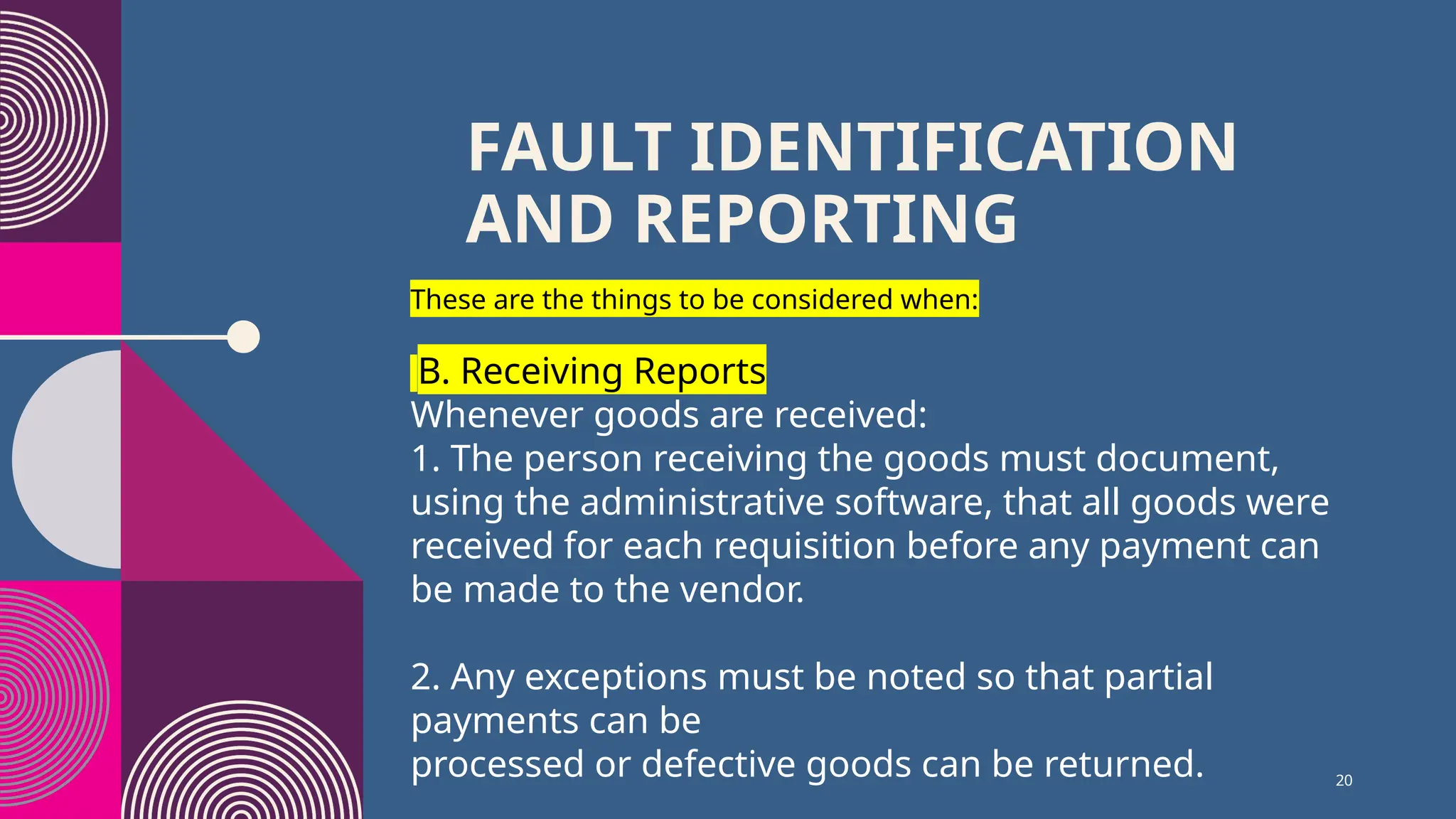
FAULT IDENTIFICATION
AND REPORTING
These are the things to be considered when:
B. Receiving Reports
Whenever goods are received:
1. The person receiving the goods must document,
using the administrative software, that all goods were
received for each requisition before any payment can
be made to the vendor.
2. Any exceptions must be noted so that partial
payments can be
processed or defective goods can be returned.
21
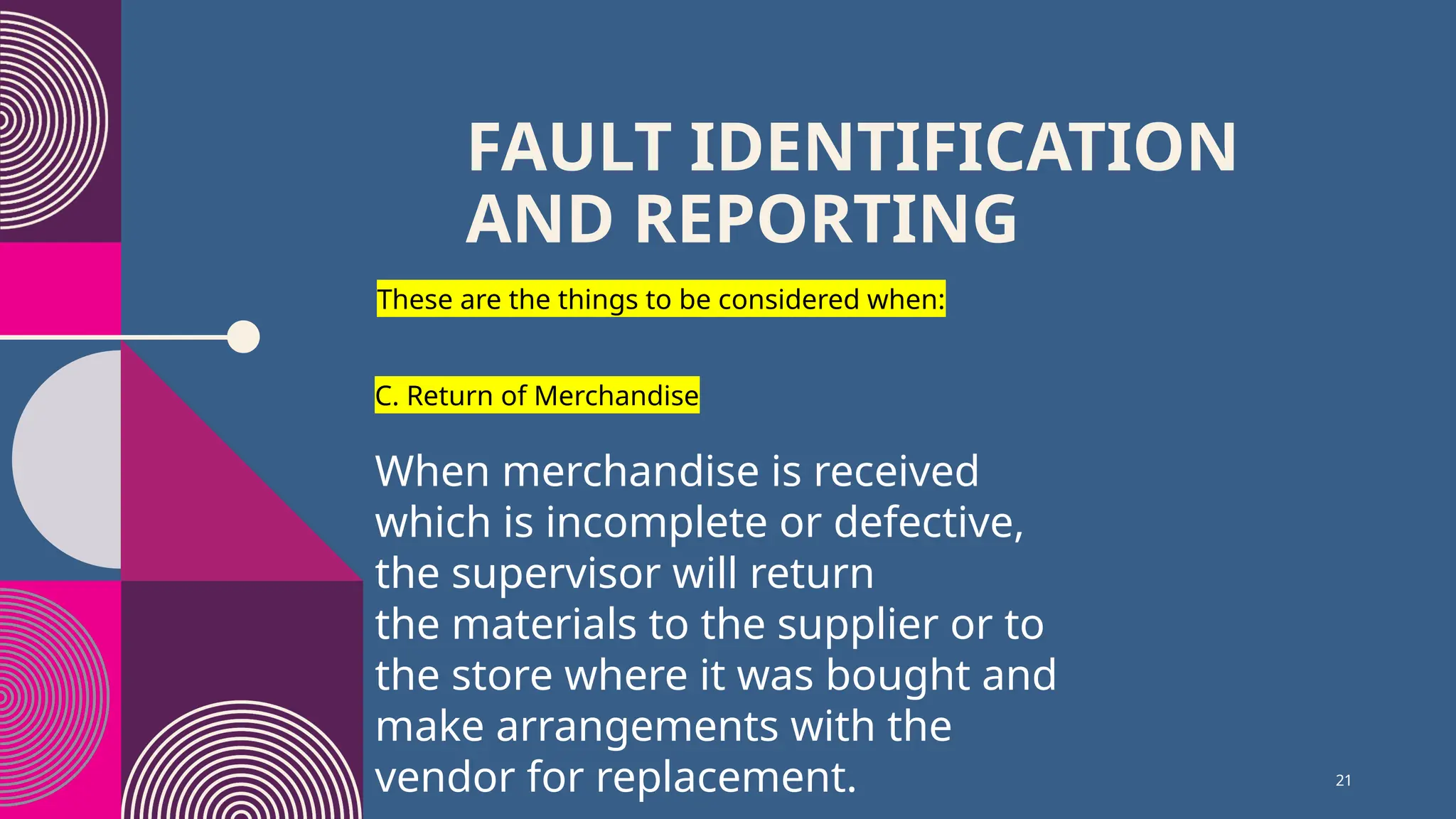
FAULT IDENTIFICATION
AND REPORTING
These are the things to be considered when:
C. Return of Merchandise
When merchandise is received
which is incomplete or defective,
the supervisor will return
the materials to the supplier or to
the store where it was bought and
make arrangements with the
vendor for replacement.
22
FAULT IDENTIFICATION
AND REPORTING
These are the things to be considered when:
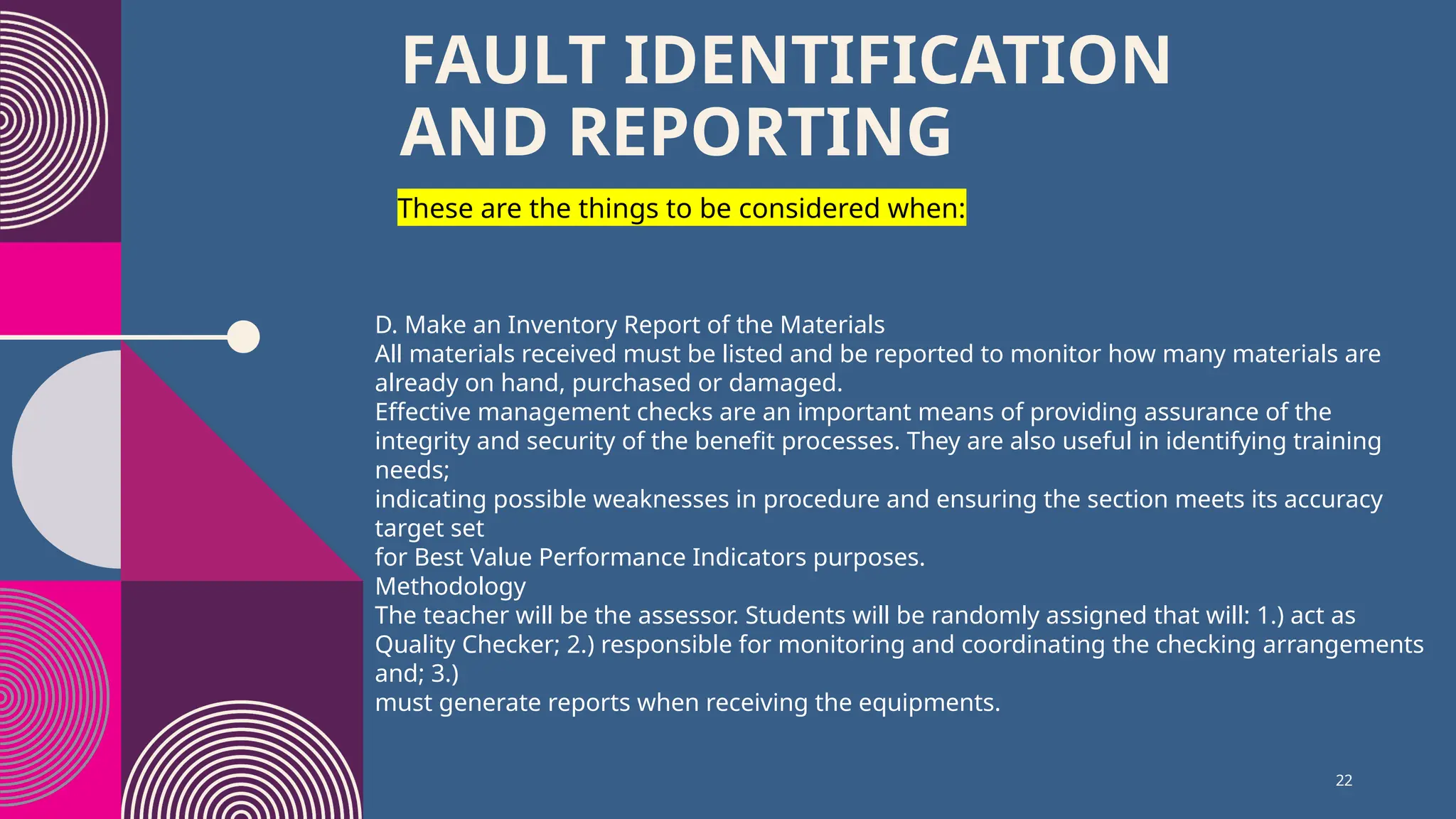
D. Make an Inventory Report of the Materials
All materials received must be listed and be reported to monitor how many materials are
already on hand, purchased or damaged.
Effective management checks are an important means of providing assurance of the
integrity and security of the benefit processes. They are also useful in identifying training
needs;
indicating possible weaknesses in procedure and ensuring the section meets its accuracy
target set
for Best Value Performance Indicators purposes.
Methodology
The teacher will be the assessor. Students will be randomly assigned that will: 1.) act as
Quality Checker; 2.) responsible for monitoring and coordinating the checking arrangements
and; 3.)
must generate reports when receiving the equipments.
23
QUALITY CHECKER
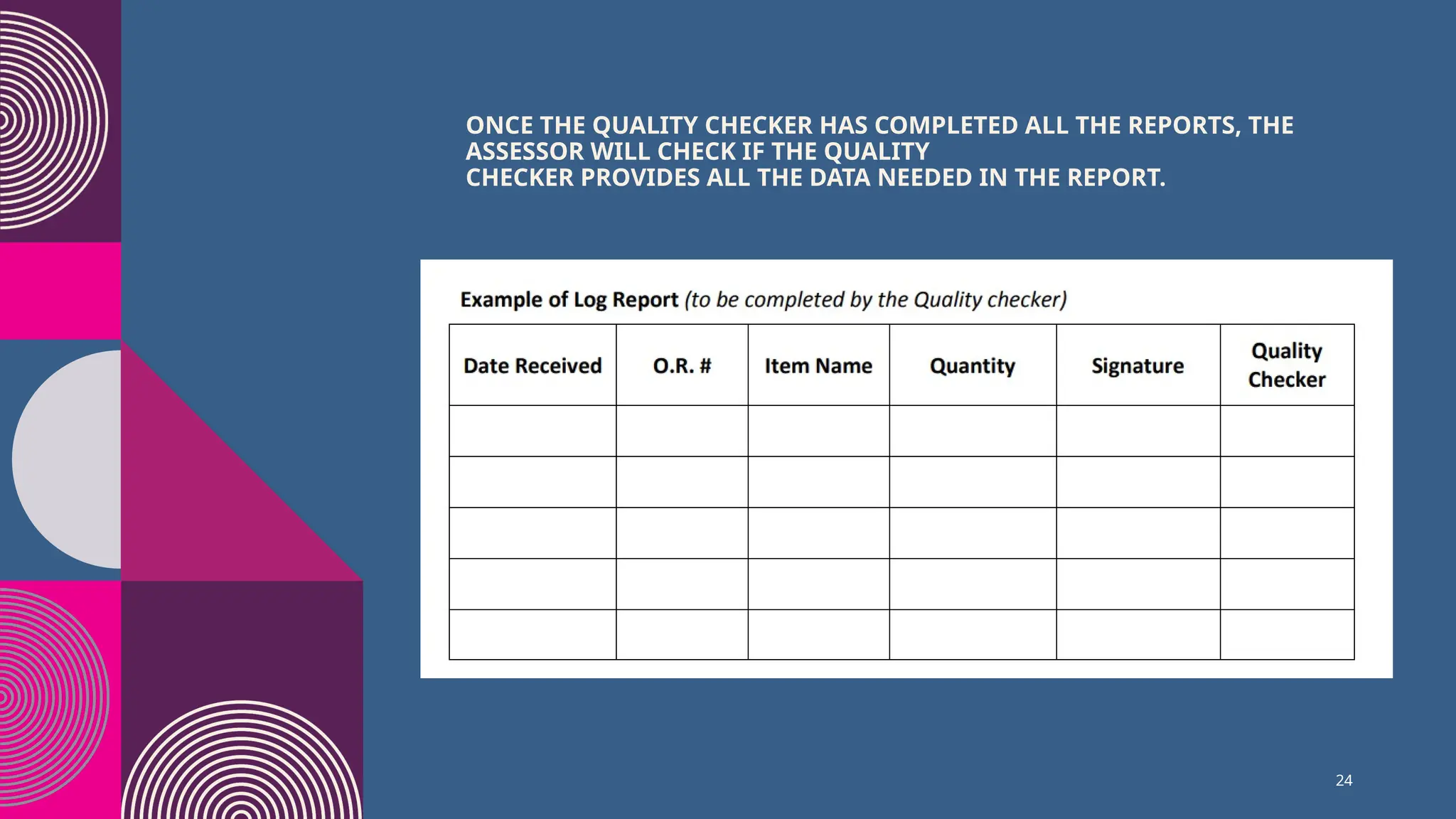
• The Quality checker will record the date of
receipt, name of the materials purchased,
quantity, official receipt number, signature of the
person who bought the materials and signed his
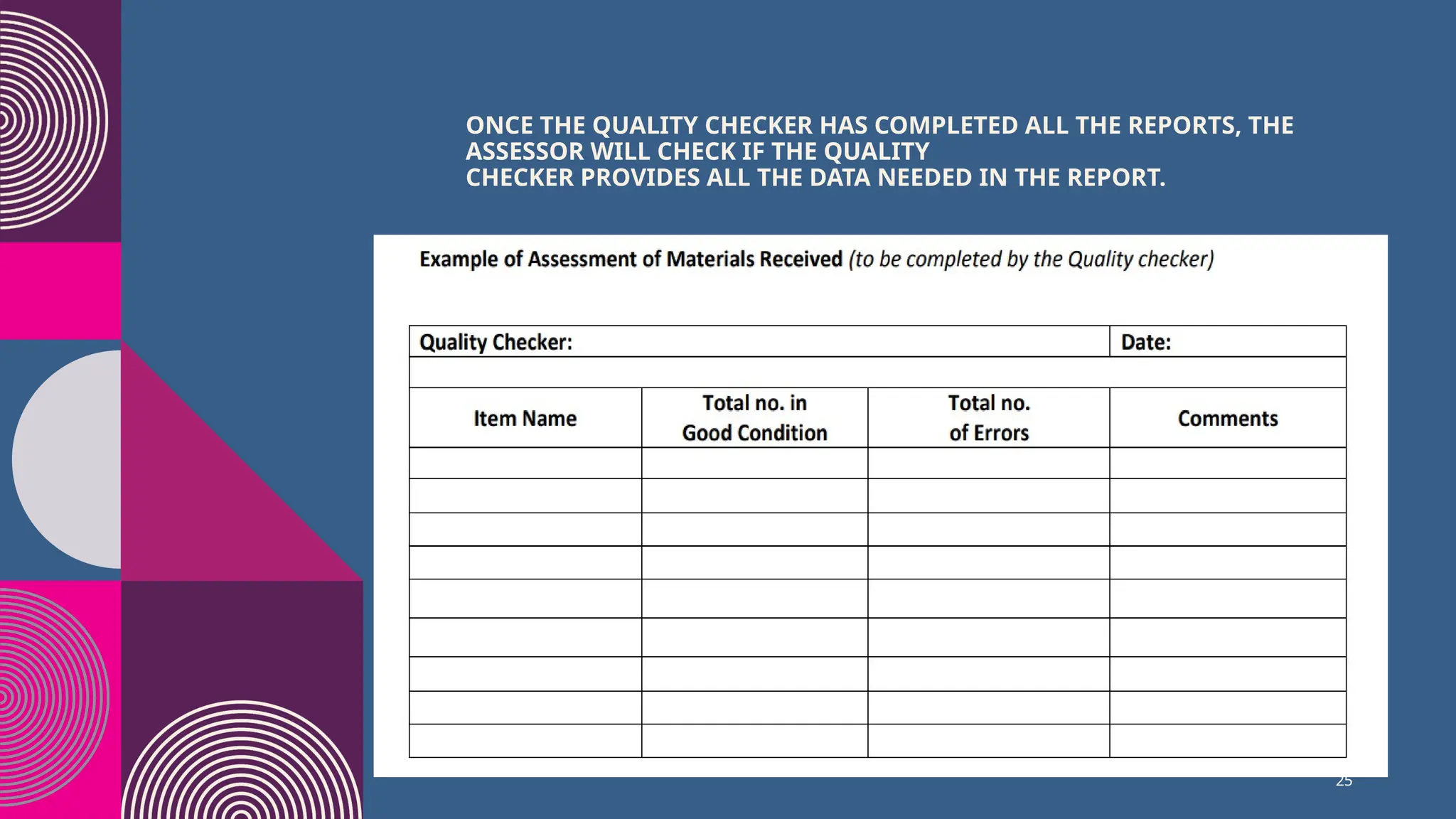
name afterwards. The Quality checker will identify
if the materials are in good condition or damage
and /or needing for replacements. This will also
be recorded on his report.
24
ONCE THE QUALITY CHECKER HAS COMPLETED ALL THE REPORTS, THE
ASSESSOR WILL CHECK IF THE QUALITY
CHECKER PROVIDES ALL THE DATA NEEDED IN THE REPORT.
25
ONCE THE QUALITY CHECKER HAS COMPLETED ALL THE REPORTS, THE
ASSESSOR WILL CHECK IF THE QUALITY
CHECKER PROVIDES ALL THE DATA NEEDED IN THE REPORT.
26
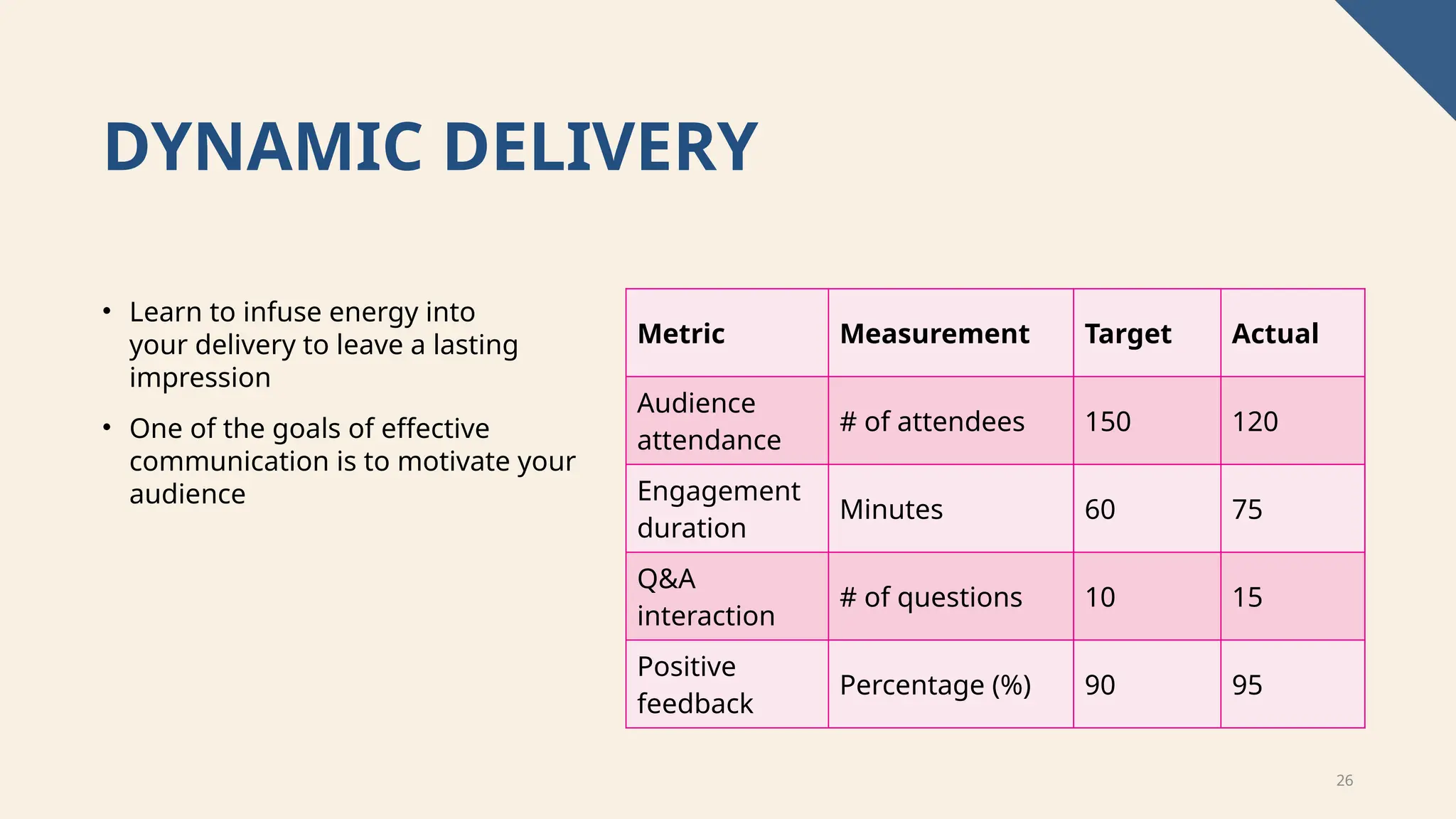
DYNAMIC DELIVERY​
• Learn to infuse energy into
your delivery to leave a lasting
impression​
• One of the goals of effective
communication is to motivate your
audience
Metric​ Measurement​ Target​ Actual​
Audience
attendance​
# of attendees​ 150​ 120​
Engagement
duration​
Minutes​ 60​ 75​
Q&A
interaction​
# of questions​ 10​ 15​
Positive
feedback​
Percentage (%)​ 90​ 95​
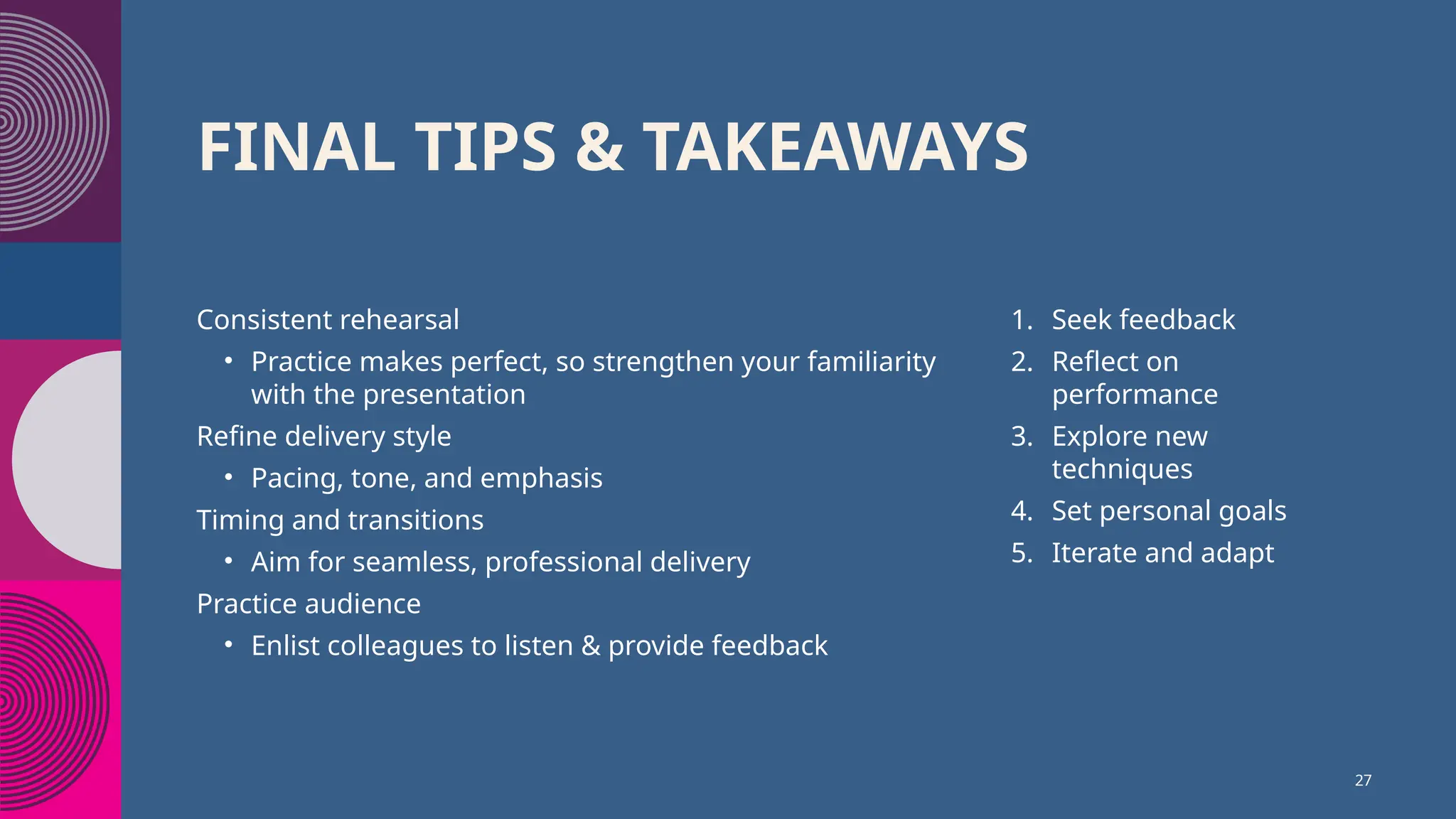
FINAL TIPS & TAKEAWAYS​
Consistent rehearsal​
• Practice makes perfect, so strengthen your familiarity
with the presentation​
Refine delivery style​
• Pacing, tone, and emphasis​
Timing and transitions​
• Aim for seamless, professional delivery​
Practice audience
• Enlist colleagues to listen & provide feedback​
1. Seek feedback​
2. Reflect on
performance​
3. Explore new
techniques​
4. Set personal goals​
5. Iterate and adapt
27
28
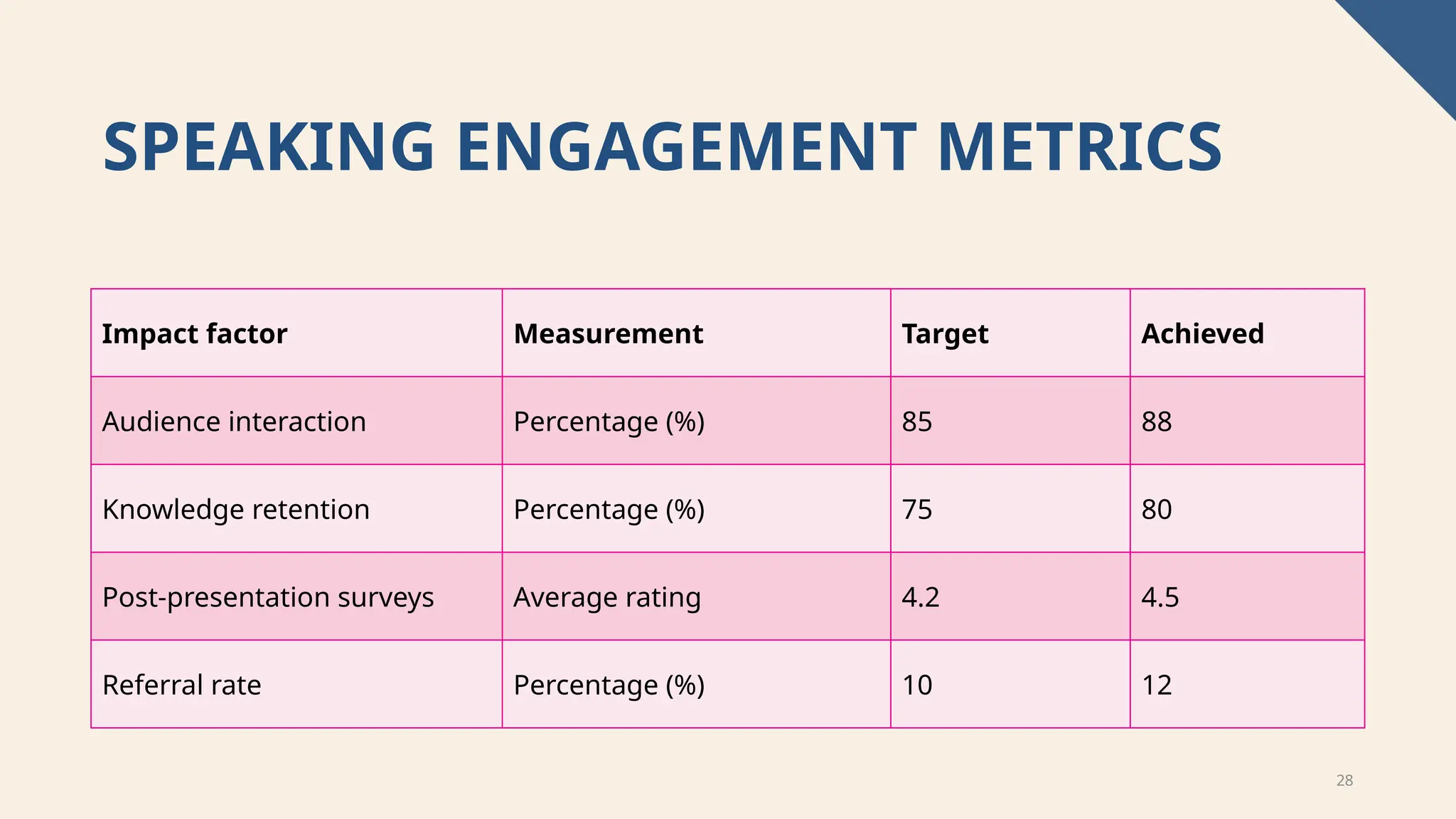
SPEAKING ENGAGEMENT METRICS​
Impact factor​ Measurement​ Target​ Achieved​
Audience interaction​ Percentage (%)​ 85​ 88​
Knowledge retention​ Percentage (%)​ 75​ 80​
Post-presentation surveys​ Average rating​ 4.2​ 4.5​
Referral rate​ Percentage (%)​ 10​ 12​
THANK YOU
Brita Tamm​
502-555-0152​
brita@firstupconsultants.com​
www.firstupconsultants.com

Applying quality standards lesson 1 .pptx

  • 1.
  • 2.
    SUMMARY OF LEARNING OUTCOMES: LO1 AssessCondition of Received Equipment LO2 Assess own work LO3 Validate one’s work for quality improvement
  • 3.
    3 Checklist - helporganize data by category Durability - enduring; resisting wear Flowchart - describes process in as much detail as possible by graphically displaying the steps in proper sequence Hardware - refers to the electronic and mechanical components that make a computer system. Histogram - plots data in a frequency distribution table TECHNICAL TERMS
  • 4.
    4 Hostile - beingan enemy; unfriendly ISO - International Standardization Organization OHS - Occupational Health and Safety procedures Pareto diagram- puts data in a hierarchical order which allows the significant problems to be connected first. PPE - personal protective equipment TECHNICAL TERMS
  • 5.
    5 Quality - essentialcharacter nature; degree or grade of excellence Scatter diagram- shows how two variables are related and is this used to test for cause and effect relationships . Standards -as one serving the emblem of a nation; something as accepted as a basis for comparison TECHNICAL TERMS
  • 6.
  • 7.
    7 LEARNING OUTCOME #1:ASSESS CONDITION OF RECEIVED EQUIPMENT 1. Work instruction is obtained and work is carried out in accordance with the standard operating procedures. 2. Received materials are checked base on the workplace standards and specifications. 3. Faulty materials related to work are identified and isolated.
  • 8.
    8 LEARNING OUTCOME #1:ASSESS CONDITION OF RECEIVED EQUIPMENT 4. Faults and any identified causes are recorded and/or reported to the concerned person-in-authority in accordance with the workplace procedures. 5. Faulty materials are replaced in accordance with workplace standard operating procedures (SOP). 6. Safety precautions are observed at all times.
  • 9.
    CHARACTERISTICS OF MATERIALS USED INSPECIFIC PROJECT The student must relate material properties to product and process quality. These are the factors that must be taken into consideration when choosing the right material for their components and assemblies
  • 10.
    10 1. SELECTION OF MATERIAL Materialselection is one of the most common tasks for design engineering. The ability to assess the material’s impact on the performance of a product is crucial for reliable performance. Sometimes, buyers are also considering the label or name of the company which are producing great quality of materials and are known in the market. Examples are the name HP for printer and Intel for some computer hardware.
  • 11.
    11 2. TESTING OF MATERIAL Thetesting of material properties is widely understood to be the key to obtaining data for a project, performing failure analysis, or understanding material interactions. Material testing also provides information on the quality of incoming and outgoing products. Inspection test equipment and techniques are demonstrated for a wide range of materials and assemblies during the class. This provides the participants with both knowledge of the common failure modes.
  • 12.
    12 3. COST OFMATERIAL The cost of material is also considered when buying or selecting materials for a specific project. The amount may vary but never taken for granted the quality and the reliability of the material. Will you buy material which is less expensive but worst quality? Will you buy material which you cannot afford? People look for places which can meet their standards and right cost for materials to buy. Characteristic of common materials for increased security is also a great factor in the design and planning process.
  • 13.
    13 THE CHARACTERISTIC OF THEMATERIALS TO BE USED FOR SPECIFIC PROJECT MUST BE:  of good quality  reliable  suitable for the application/purposes  low cost
  • 14.
    14 THE CHARACTERISTIC OFTHE MATERIALS TO BE USED FOR SPECIFIC PROJECT MUST BE:  of good quality - This is the most important factor when choosing materials to buy. Products with good quality are long-lasting and safe to use because you know that it follows certain standards before being commercialized.  reliable - It means that you can be sure that it will perform its function well, will operate safely and will give the best it could give. suitable for the application/purposes - Choose the materials which are very necessary to make the project possible. Making a list of products/materials to buy is a good trait of a wise consumer. Products which are not to be used must be crossed out. low cost - It doesn’t mean that you will choose for the less expensive one and exclude the quality. Low cost means you can afford to buy the materials without hurting your pocket and assure of better quality.
  • 15.
  • 16.
    16 MATCHING TYPE: COLUMN A 1.Tim Berners Lee 2. Larry Page 3. Visual Arts 4. Telecommunications 5. Bill Gates 6. Steve Jobs 7. Mark Zuckerberg 8. Computer Programming 9. Computer System Servicing 10.Elon Musk Direction : Match Column A to Column B. Find the correct answer. COLUMN B A. Tesla & Space X B. Founder of Facebook C. Co-Founder of Microsoft D. Cp-Founder of Apple Inc. E. Inventor of World Wide Web F. Co- Founders of Google G. Proficiency in Programming Language H. Ability to Visualize Concepts I. Troubleshooting skills in Computer J. Knowledge of systems, technical expertise and understanding the network infrastructure
  • 17.
  • 18.
  • 19.
    19 FAULT IDENTIFICATION AND REPORTING Theseare the things to be considered when: A. Receiving Materials: 1. Match the packing slip to the items received and ensures that the materials are destined on tour department. 2. That you are receiving the materials indicated on the purchase order with regard to quantity and discount. 3. That the materials are in acceptable condition. 4. That terms regarding installation and/or set-up of equipment are met.
  • 20.
    20 FAULT IDENTIFICATION AND REPORTING Theseare the things to be considered when: B. Receiving Reports Whenever goods are received: 1. The person receiving the goods must document, using the administrative software, that all goods were received for each requisition before any payment can be made to the vendor. 2. Any exceptions must be noted so that partial payments can be processed or defective goods can be returned.
  • 21.
    21 FAULT IDENTIFICATION AND REPORTING Theseare the things to be considered when: C. Return of Merchandise When merchandise is received which is incomplete or defective, the supervisor will return the materials to the supplier or to the store where it was bought and make arrangements with the vendor for replacement.
  • 22.
    22 FAULT IDENTIFICATION AND REPORTING Theseare the things to be considered when: D. Make an Inventory Report of the Materials All materials received must be listed and be reported to monitor how many materials are already on hand, purchased or damaged. Effective management checks are an important means of providing assurance of the integrity and security of the benefit processes. They are also useful in identifying training needs; indicating possible weaknesses in procedure and ensuring the section meets its accuracy target set for Best Value Performance Indicators purposes. Methodology The teacher will be the assessor. Students will be randomly assigned that will: 1.) act as Quality Checker; 2.) responsible for monitoring and coordinating the checking arrangements and; 3.) must generate reports when receiving the equipments.
  • 23.
    23 QUALITY CHECKER • TheQuality checker will record the date of receipt, name of the materials purchased, quantity, official receipt number, signature of the person who bought the materials and signed his name afterwards. The Quality checker will identify if the materials are in good condition or damage and /or needing for replacements. This will also be recorded on his report.
  • 24.
    24 ONCE THE QUALITYCHECKER HAS COMPLETED ALL THE REPORTS, THE ASSESSOR WILL CHECK IF THE QUALITY CHECKER PROVIDES ALL THE DATA NEEDED IN THE REPORT.
  • 25.
    25 ONCE THE QUALITYCHECKER HAS COMPLETED ALL THE REPORTS, THE ASSESSOR WILL CHECK IF THE QUALITY CHECKER PROVIDES ALL THE DATA NEEDED IN THE REPORT.
  • 26.
    26 DYNAMIC DELIVERY​ • Learnto infuse energy into your delivery to leave a lasting impression​ • One of the goals of effective communication is to motivate your audience Metric​ Measurement​ Target​ Actual​ Audience attendance​ # of attendees​ 150​ 120​ Engagement duration​ Minutes​ 60​ 75​ Q&A interaction​ # of questions​ 10​ 15​ Positive feedback​ Percentage (%)​ 90​ 95​
  • 27.
    FINAL TIPS &TAKEAWAYS​ Consistent rehearsal​ • Practice makes perfect, so strengthen your familiarity with the presentation​ Refine delivery style​ • Pacing, tone, and emphasis​ Timing and transitions​ • Aim for seamless, professional delivery​ Practice audience • Enlist colleagues to listen & provide feedback​ 1. Seek feedback​ 2. Reflect on performance​ 3. Explore new techniques​ 4. Set personal goals​ 5. Iterate and adapt 27
  • 28.
    28 SPEAKING ENGAGEMENT METRICS​ Impactfactor​ Measurement​ Target​ Achieved​ Audience interaction​ Percentage (%)​ 85​ 88​ Knowledge retention​ Percentage (%)​ 75​ 80​ Post-presentation surveys​ Average rating​ 4.2​ 4.5​ Referral rate​ Percentage (%)​ 10​ 12​
  • 29.