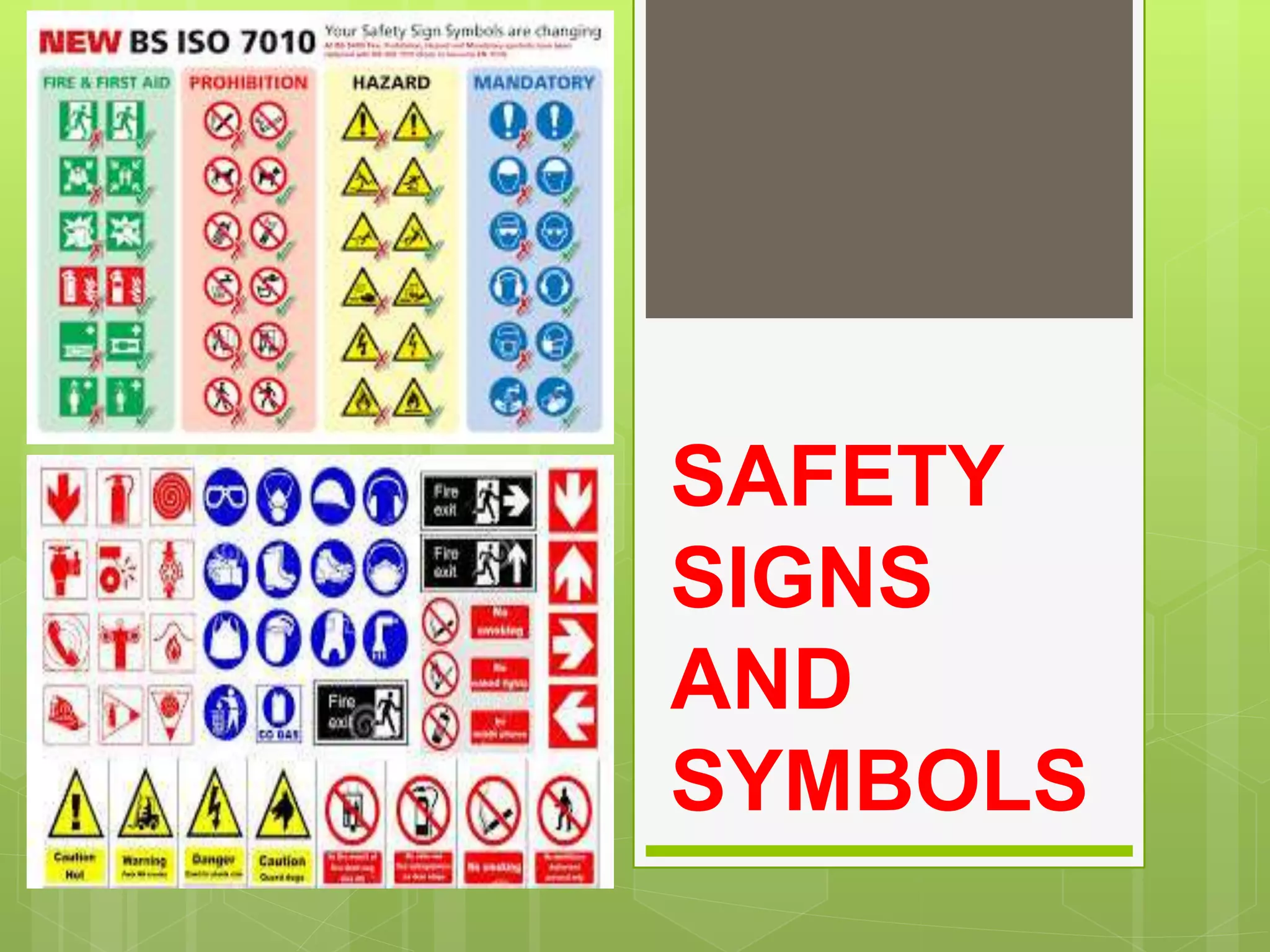
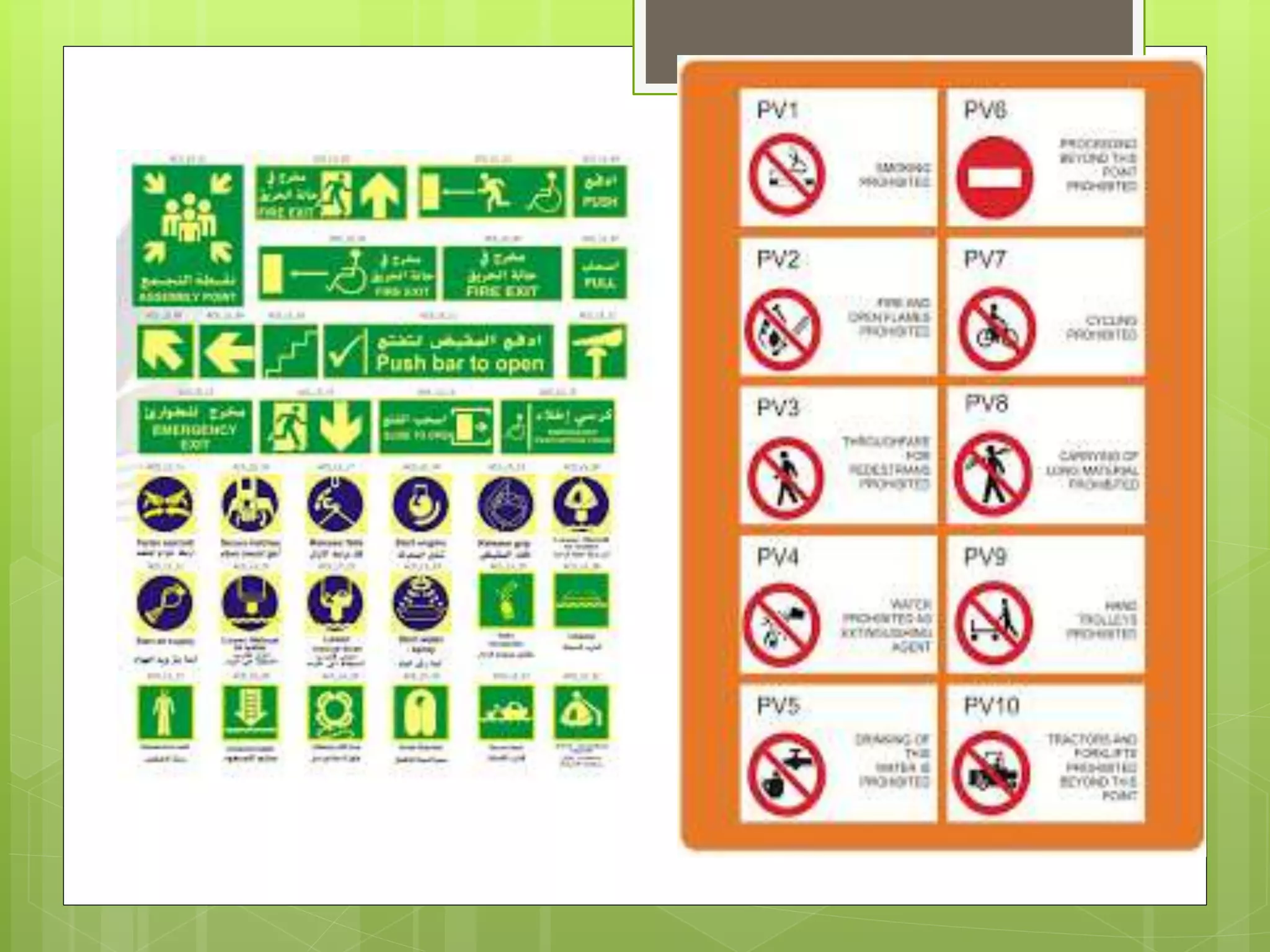
This document discusses safety signs and symbols. It explains that safety symbols are pictorial representations that provide warnings or alerts about potential hazards. The use of symbols on labels is optional but recommended because symbols can convey hazards quickly, be understood by readers and non-readers, and translate between languages. Various industries have adopted standard symbols to reduce confusion. Words on safety signs include signal words like danger, warning and caution that indicate the degree of hazard. Colors are also used on signs to draw attention and convey initial meaning before reading the text. The document outlines different types of safety signs including regulatory, warning, danger, fire, and emergency signs.
SAFETY SYMBOLS
are picturessometimes called
pictographs, pictograms, or
pictorials.
They are used in place of, or
as a supplement to written
words
Provide warnings or alert
about possible hazards
3.
The use ofsymbols on precautionary
labels is optional and is recommended
the following reasons:
Symbols may show and help to explain the
hazards quickly
Symbols can be understood by readers
and non-readers
Symbols may be multilingual and usually
translate directly into all languages.
4.
Welding and cuttingindustry
has adopted standardized
symbols and uniform methods
of use to avoid user confusion
and to supplement and
reinforce the written message
6.
WORDS
The large wordat the top of the
label is called the signal word.
Used in combination with a
specific colored background and
combined with the safety alert
symbol to indicate the degree of
potential hazard.
Colored background, the signal
word is usually the first element to
be notice.
7.
According to INTERNATIONALSTANDARD
ORGANIZATION (ISO) there are three (3) choices for a
signal word
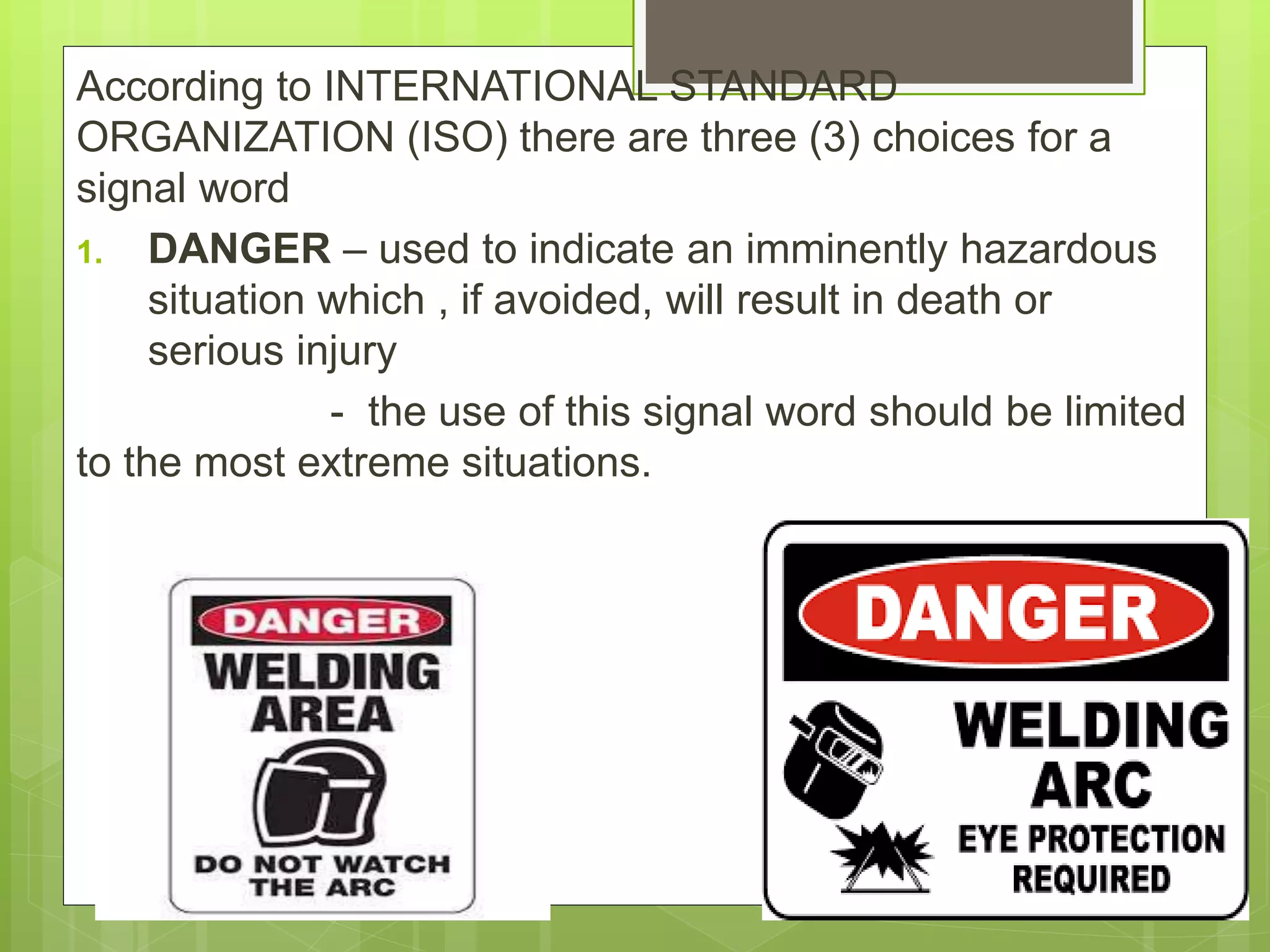
1. DANGER – used to indicate an imminently hazardous
situation which , if avoided, will result in death or
serious injury
- the use of this signal word should be limited
to the most extreme situations.
8.
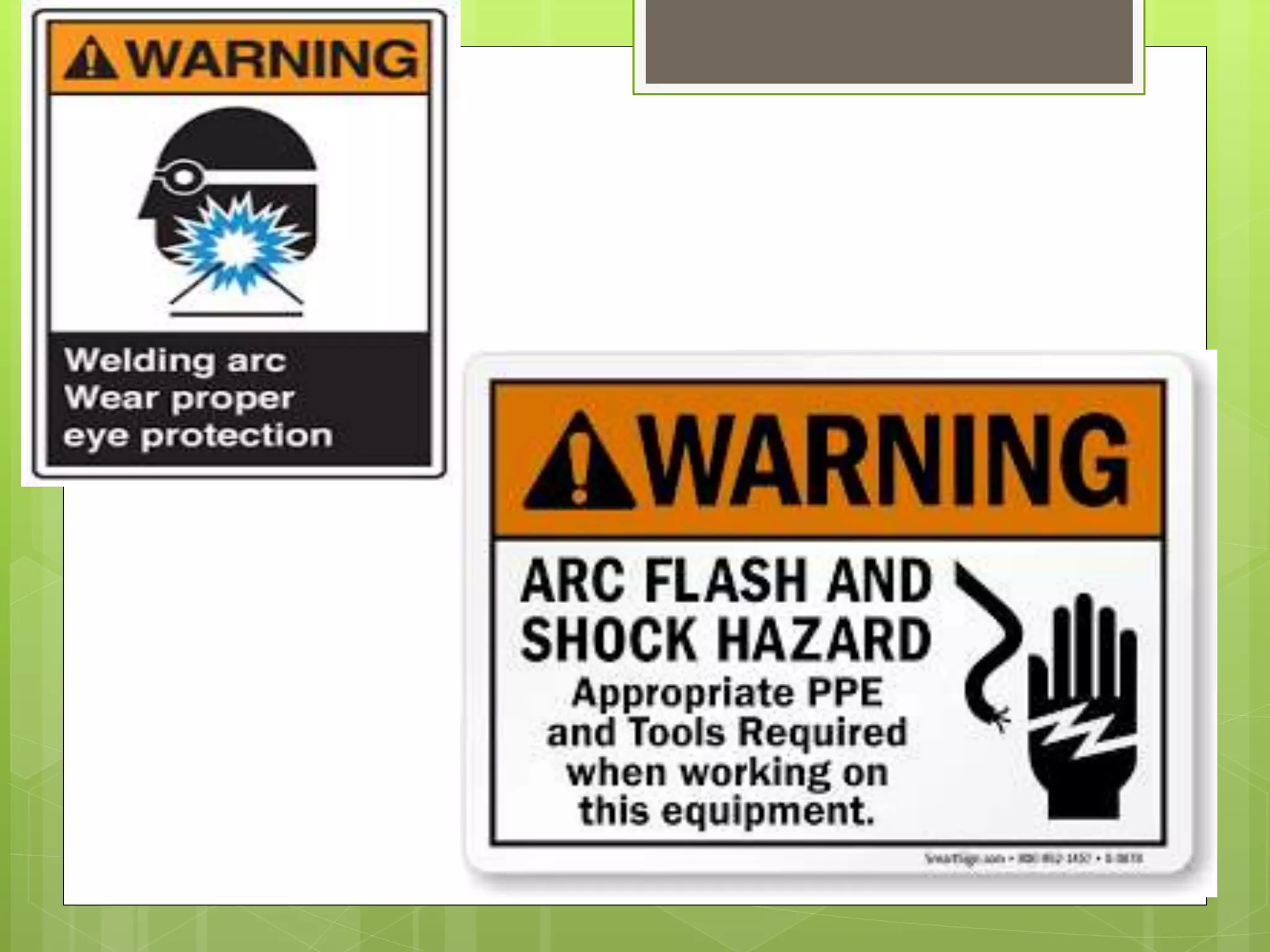
2. WARNING –this indicates a potentially
hazardous situation which , if not avoided,
could result in death of serious injury.
9.
3. CAUTION –used to indicate a potentially
hazardous situation which, if not avoided , may
result in minor or moderate injury. CAUTION
may also be used without the safety color
symbol (the triangle with exclamation mark) to
indicate a property damage only.
10.
COLOR
Since color istypically the first
thing that draws the attention of
the viewer, the color-coded
surrounding shapes act as a
first level of meaning and , as
you draw closer to the sign.
11.
Example A isan ISO “warning safety sign” this type
of hazard is (e.g. fire hazard)
Example B is an ISO “ prohibition safety sign” this
label tells about an action not to take in order to
avoid a hazard (e.g. no open fire)
Example C is an ISO “ mandatory action safety sign”
defines in action that needs to be taken to avoid the
hazard (e.g. read manual)
13.
Classification of Safety
Signs
1.REGULATORY SIGNS –
signs contain instruction.
Failure to comply with them
constitutes an offense under
law, standing orders,
company policy, etc.
14.
a. MANDATORY SIGNS– are
regulatory signs which indicate
that an instruction must be
carried out. When symbols are
used, they are white in blue
disc. Text-only mandatory signs
are black on white in a portrait
format
16.
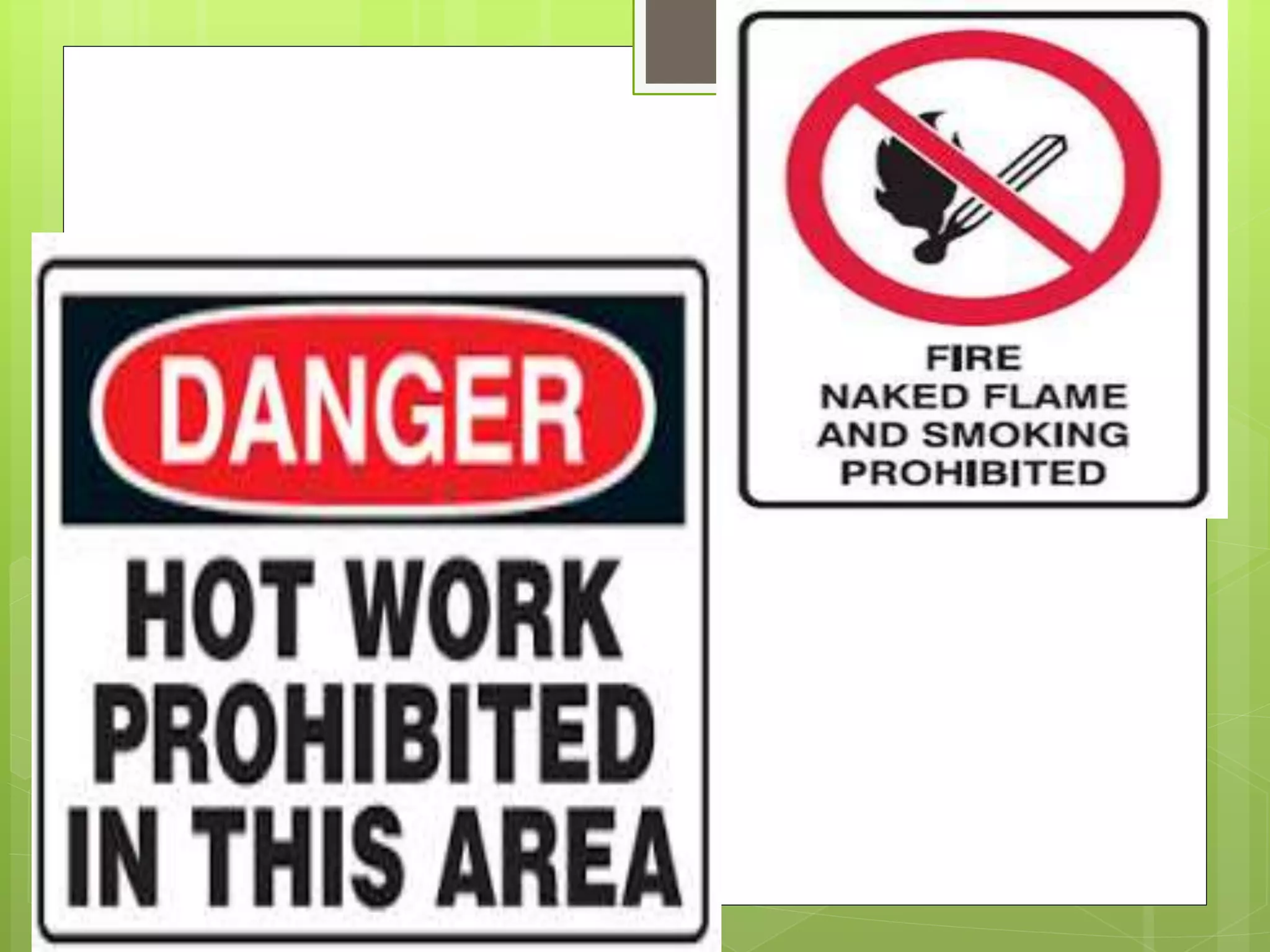
b. PROHIBITION SIGNS
–are regulatory signs
which is indicate that an action
or activity is not allowed. The
symbolic shape used on
prohibition signs is the red circle
and text with no symbol.
18.
2. WARNING SIGNS– signs which
warn of a hazardous condition that is
not likely to be life-threatening. The
symbolic shape used on warning signs
is black triangle with yellow interior and
black symbol.
- the word warning is not required
to print on the sign although it is often
used for added impact.
20.
3. DANGER SIGNS
-signswhich warn of a
hazard or hazardous condition
is likely life-threatening. It is
recommended that symbols not
to be used on danger signs.
22.
4. FIRE SIGNS
–advice the location of fire
alarms and firefighting
equipment. Fire signs contain a
white symbol and/or text on a red
background.
24.
5. EMERGENCY
INFORMATION SIGNS
–indicate the location of, or
direction to, emergency –
related facilities (exits, first aid,
safety equipment, etc. ) these
signs feature a white symbol
and/ or text on a green
background.
26.
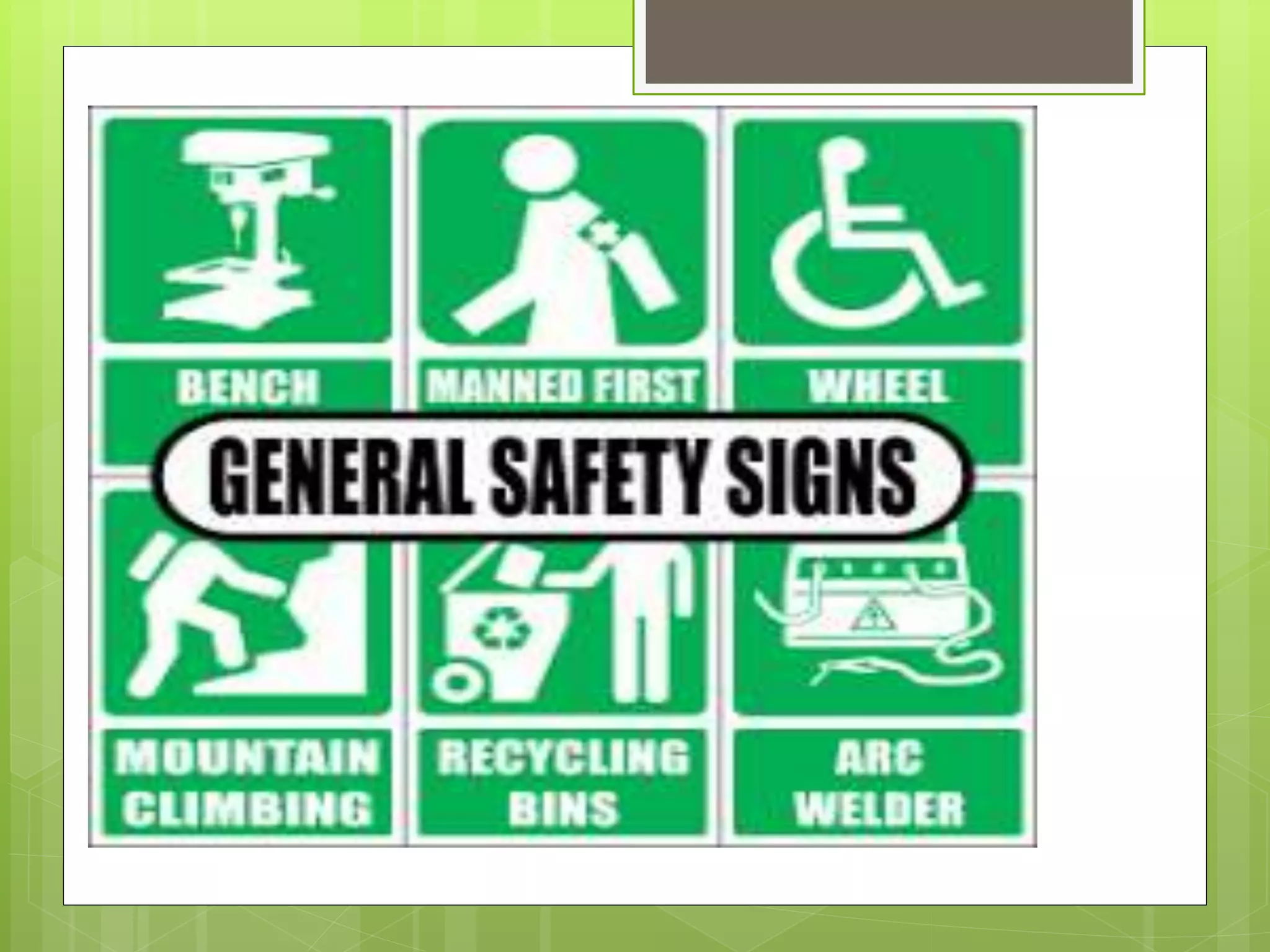
6. GENERAL
INFORMATION SIGNS
-communicate information
of a general nature in order to
avoid misundestanding or
confusion. These signs often
refer to housekeeping, company
practices and logistics