Improve practice
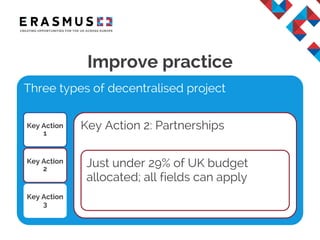
Three types of decentralised project
Key Action
1
Key Action
2
Key Action
3
Key Action 2: Partnerships
Just under 29% of UK budget
allocated; all fields can apply
What can you do?
• Organisations can work together to address
policy objectives, challenges and needs
• Projects can focus on one field alone or on a
cross-field basis
• Priority topics for 2018 are in the Programme
Guide – your application must address at least
one!
• Flexibility in terms of size and scale of project
and funding
What can you do?
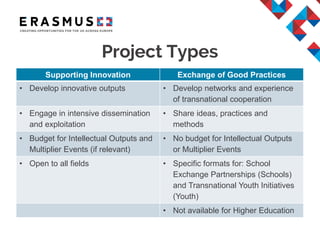
Supporting Innovation Exchange of Good Practices
• Develop innovative outputs • Develop networks and experience
of transnational cooperation
• Engage in intensive dissemination
and exploitation
• Share ideas, practices and
methods
• Budget for Intellectual Outputs and
Multiplier Events (if relevant)
• No budget for Intellectual Outputs
or Multiplier Events
• Open to all fields • Specific formats for: School
Exchange Partnerships (Schools)
and Transnational Youth Initiatives
(Youth)
• Not available for Higher Education
Project Types
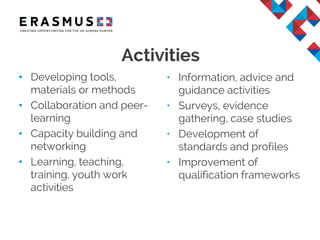
Activities
• Developing tools,
materials or methods
• Collaboration and peer-
learning
• Capacity building and
networking
• Learning, teaching,
training, youth work
activities
• Information, advice and
guidance activities
• Surveys, evidence
gathering, case studies
• Development of
standards and profiles
• Improvement of
qualification frameworks
• Training, teaching or learning activities of
individuals can take place within a project
• Must be explicitly linked to project’s aims and
objectives
• Can cover staff, youth workers and learners
• Eligible activities are different for each field
Mobility within Strategic
Partnerships
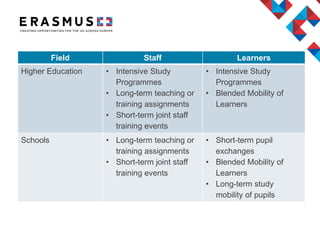
Field Staff Learners
Higher Education • Intensive Study
Programmes
• Long-term teaching or
training assignments
• Short-term joint staff
training events
• Intensive Study
Programmes
• Blended Mobility of
Learners
Schools • Long-term teaching or
training assignments
• Short-term joint staff
training events
• Short-term pupil
exchanges
• Blended Mobility of
Learners
• Long-term study
mobility of pupils
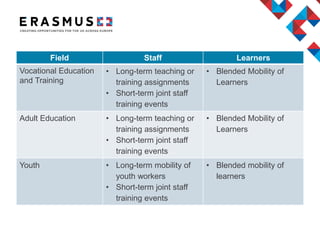
Field Staff Learners
Vocational Education
and Training
• Long-term teaching or
training assignments
• Short-term joint staff
training events
• Blended Mobility of
Learners
Adult Education • Long-term teaching or
training assignments
• Short-term joint staff
training events
• Blended Mobility of
Learners
Youth • Long-term mobility of
youth workers
• Short-term joint staff
training events
• Blended mobility of
learners
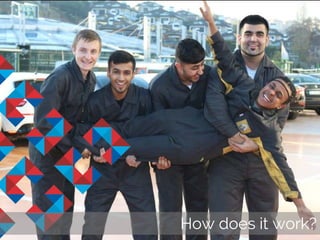
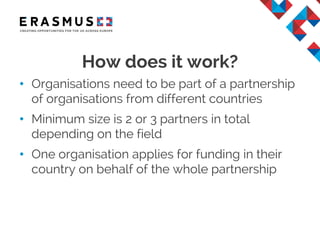
How does it work?
• Organisations need to be part of a partnership
of organisations from different countries
• Minimum size is 2 or 3 partners in total
depending on the field
• One organisation applies for funding in their
country on behalf of the whole partnership
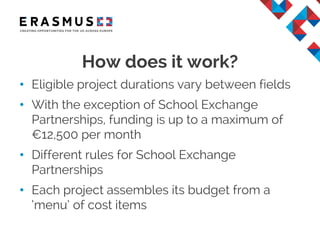
How does it work?
• Eligible project durations vary between fields
• With the exception of School Exchange
Partnerships, funding is up to a maximum of
€12,500 per month
• Different rules for School Exchange
Partnerships
• Each project assembles its budget from a
‘menu’ of cost items
How does it work?
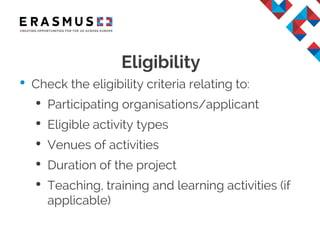
Eligibility
• Check the eligibility criteria relating to:
• Participating organisations/applicant
• Eligible activity types
• Venues of activities
• Duration of the project
• Teaching, training and learning activities (if
applicable)
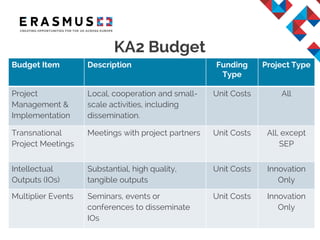
KA2 Budget
Budget Item Description Funding
Type
Project Type
Project
Management &
Implementation
Local, cooperation and small-
scale activities, including
dissemination.
Unit Costs All
Transnational
Project Meetings
Meetings with project partners Unit Costs All, except
SEP
Intellectual
Outputs (IOs)
Substantial, high quality,
tangible outputs
Unit Costs Innovation
Only
Multiplier Events Seminars, events or
conferences to disseminate
IOs
Unit Costs Innovation
Only
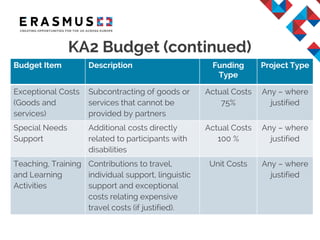
KA2 Budget (continued)
Budget Item Description Funding
Type
Project Type
Exceptional Costs
(Goods and
services)
Subcontracting of goods or
services that cannot be
provided by partners
Actual Costs
75%
Any – where
justified
Special Needs
Support
Additional costs directly
related to participants with
disabilities
Actual Costs
100 %
Any – where
justified
Teaching, Training
and Learning
Activities
Contributions to travel,
individual support, linguistic
support and exceptional
costs relating expensive
travel costs (if justified).
Unit Costs Any – where
justified
Improve policy
Improve policy
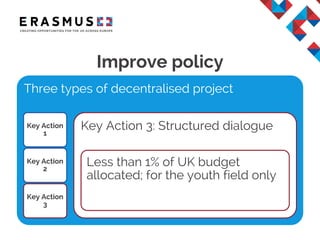
Three types of decentralised project
Key Action
1
Key Action
2
Key Action
3
Key Action 3: Structured dialogue
Less than 1% of UK budget
allocated; for the youth field only
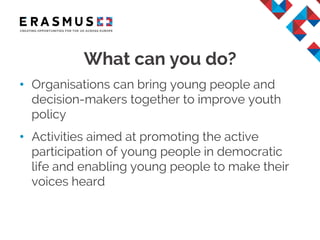
• Organisations can bring young people and
decision-makers together to improve youth
policy
• Activities aimed at promoting the active
participation of young people in democratic
life and enabling young people to make their
voices heard
What can you do?
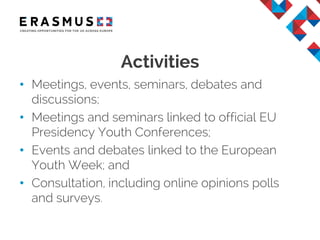
• Meetings, events, seminars, debates and
discussions;
• Meetings and seminars linked to official EU
Presidency Youth Conferences;
• Events and debates linked to the European
Youth Week; and
• Consultation, including online opinions polls
and surveys.
Activities
• Organisations can apply for funding for
national or transnational meetings
• Young people must be involved in all stages
of the project
• Emphasis on non-formal learning principles
and practices
How does it work?
Eligibility
Eligible organisation types:
• Public body at local or regional level
• Non-profit organisation, association and NGOs
• European Youth NGO
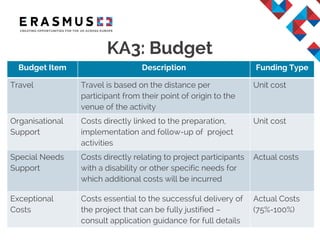
KA3: Budget
Budget Item Description Funding Type
Travel Travel is based on the distance per
participant from their point of origin to the
venue of the activity
Unit cost
Organisational
Support
Costs directly linked to the preparation,
implementation and follow-up of project
activities
Unit cost
Special Needs
Support
Costs directly relating to project participants
with a disability or other specific needs for
which additional costs will be incurred
Actual costs
Exceptional
Costs
Costs essential to the successful delivery of
the project that can be fully justified –
consult application guidance for full details
Actual Costs
(75%-100%)
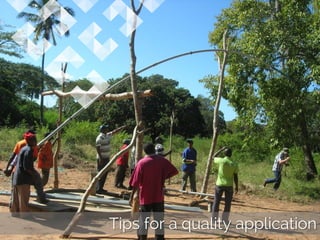
Tips for a quality application
Quality Criteria
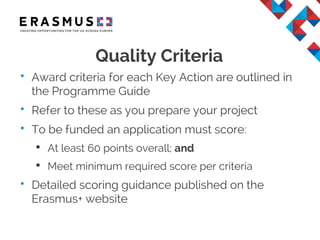
• Award criteria for each Key Action are outlined in
the Programme Guide
• Refer to these as you prepare your project
• To be funded an application must score:
• At least 60 points overall; and
• Meet minimum required score per criteria
• Detailed scoring guidance published on the
Erasmus+ website
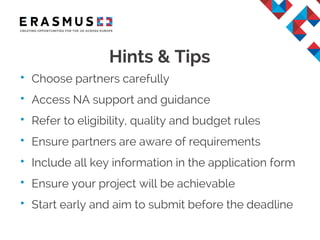
Hints & Tips
• Choose partners carefully
• Access NA support and guidance
• Refer to eligibility, quality and budget rules
• Ensure partners are aware of requirements
• Include all key information in the application form
• Ensure your project will be achievable
• Start early and aim to submit before the deadline
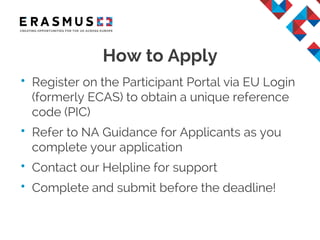
• Register on the Participant Portal via EU Login
(formerly ECAS) to obtain a unique reference
code (PIC)
• Refer to NA Guidance for Applicants as you
complete your application
• Contact our Helpline for support
• Complete and submit before the deadline!
How to Apply
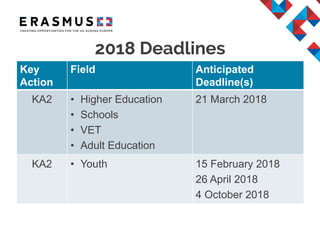
2018 Deadlines
Key
Action
Field Anticipated
Deadline(s)
KA2 • Higher Education
• Schools
• VET
• Adult Education
21 March 2018
KA2 • Youth 15 February 2018
26 April 2018
4 October 2018
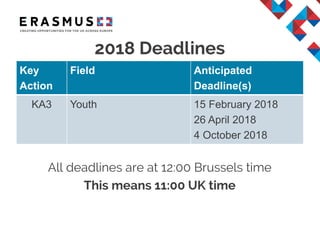
2018 Deadlines
Key
Action
Field Anticipated
Deadline(s)
KA3 Youth 15 February 2018
26 April 2018
4 October 2018
All deadlines are at 12:00 Brussels time
This means 11:00 UK time
Contact Us
For general enquiries you can contact either the
British Council or Ecorys UK as follows:
British Council
T: 0161 957 7755
erasmusplus.enquiries@britishcouncil.org
Ecorys UK
T: 0121 212 8947
erasmusplus@ecorys.com
Erasmus+ is the European Union programme for education, training, youth and sport.
The Erasmus+ UK National Agency is a partnership between the British Council and Ecorys UK.
Website: www.erasmusplus.org.uk
@erasmusplusuk
ukerasmusplus
erasmusplusuk

Applying for Key Action 2&3 in 2018

  • 2.
    Improve practice Three typesof decentralised project Key Action 1 Key Action 2 Key Action 3 Key Action 2: Partnerships Just under 29% of UK budget allocated; all fields can apply
  • 3.
  • 4.
    • Organisations canwork together to address policy objectives, challenges and needs • Projects can focus on one field alone or on a cross-field basis • Priority topics for 2018 are in the Programme Guide – your application must address at least one! • Flexibility in terms of size and scale of project and funding What can you do?
  • 5.
    Supporting Innovation Exchangeof Good Practices • Develop innovative outputs • Develop networks and experience of transnational cooperation • Engage in intensive dissemination and exploitation • Share ideas, practices and methods • Budget for Intellectual Outputs and Multiplier Events (if relevant) • No budget for Intellectual Outputs or Multiplier Events • Open to all fields • Specific formats for: School Exchange Partnerships (Schools) and Transnational Youth Initiatives (Youth) • Not available for Higher Education Project Types
  • 6.
    Activities • Developing tools, materialsor methods • Collaboration and peer- learning • Capacity building and networking • Learning, teaching, training, youth work activities • Information, advice and guidance activities • Surveys, evidence gathering, case studies • Development of standards and profiles • Improvement of qualification frameworks
  • 7.
    • Training, teachingor learning activities of individuals can take place within a project • Must be explicitly linked to project’s aims and objectives • Can cover staff, youth workers and learners • Eligible activities are different for each field Mobility within Strategic Partnerships
  • 8.
    Field Staff Learners HigherEducation • Intensive Study Programmes • Long-term teaching or training assignments • Short-term joint staff training events • Intensive Study Programmes • Blended Mobility of Learners Schools • Long-term teaching or training assignments • Short-term joint staff training events • Short-term pupil exchanges • Blended Mobility of Learners • Long-term study mobility of pupils
  • 9.
    Field Staff Learners VocationalEducation and Training • Long-term teaching or training assignments • Short-term joint staff training events • Blended Mobility of Learners Adult Education • Long-term teaching or training assignments • Short-term joint staff training events • Blended Mobility of Learners Youth • Long-term mobility of youth workers • Short-term joint staff training events • Blended mobility of learners
  • 10.
  • 11.
    • Organisations needto be part of a partnership of organisations from different countries • Minimum size is 2 or 3 partners in total depending on the field • One organisation applies for funding in their country on behalf of the whole partnership How does it work?
  • 12.
    • Eligible projectdurations vary between fields • With the exception of School Exchange Partnerships, funding is up to a maximum of €12,500 per month • Different rules for School Exchange Partnerships • Each project assembles its budget from a ‘menu’ of cost items How does it work?
  • 13.
    Eligibility • Check theeligibility criteria relating to: • Participating organisations/applicant • Eligible activity types • Venues of activities • Duration of the project • Teaching, training and learning activities (if applicable)
  • 14.
    KA2 Budget Budget ItemDescription Funding Type Project Type Project Management & Implementation Local, cooperation and small- scale activities, including dissemination. Unit Costs All Transnational Project Meetings Meetings with project partners Unit Costs All, except SEP Intellectual Outputs (IOs) Substantial, high quality, tangible outputs Unit Costs Innovation Only Multiplier Events Seminars, events or conferences to disseminate IOs Unit Costs Innovation Only
  • 15.
    KA2 Budget (continued) BudgetItem Description Funding Type Project Type Exceptional Costs (Goods and services) Subcontracting of goods or services that cannot be provided by partners Actual Costs 75% Any – where justified Special Needs Support Additional costs directly related to participants with disabilities Actual Costs 100 % Any – where justified Teaching, Training and Learning Activities Contributions to travel, individual support, linguistic support and exceptional costs relating expensive travel costs (if justified). Unit Costs Any – where justified
  • 16.
  • 17.
    Improve policy Three typesof decentralised project Key Action 1 Key Action 2 Key Action 3 Key Action 3: Structured dialogue Less than 1% of UK budget allocated; for the youth field only
  • 18.
    • Organisations canbring young people and decision-makers together to improve youth policy • Activities aimed at promoting the active participation of young people in democratic life and enabling young people to make their voices heard What can you do?
  • 19.
    • Meetings, events,seminars, debates and discussions; • Meetings and seminars linked to official EU Presidency Youth Conferences; • Events and debates linked to the European Youth Week; and • Consultation, including online opinions polls and surveys. Activities
  • 20.
    • Organisations canapply for funding for national or transnational meetings • Young people must be involved in all stages of the project • Emphasis on non-formal learning principles and practices How does it work?
  • 21.
    Eligibility Eligible organisation types: •Public body at local or regional level • Non-profit organisation, association and NGOs • European Youth NGO
  • 22.
    KA3: Budget Budget ItemDescription Funding Type Travel Travel is based on the distance per participant from their point of origin to the venue of the activity Unit cost Organisational Support Costs directly linked to the preparation, implementation and follow-up of project activities Unit cost Special Needs Support Costs directly relating to project participants with a disability or other specific needs for which additional costs will be incurred Actual costs Exceptional Costs Costs essential to the successful delivery of the project that can be fully justified – consult application guidance for full details Actual Costs (75%-100%)
  • 23.
    Tips for aquality application
  • 24.
    Quality Criteria • Awardcriteria for each Key Action are outlined in the Programme Guide • Refer to these as you prepare your project • To be funded an application must score: • At least 60 points overall; and • Meet minimum required score per criteria • Detailed scoring guidance published on the Erasmus+ website
  • 25.
    Hints & Tips •Choose partners carefully • Access NA support and guidance • Refer to eligibility, quality and budget rules • Ensure partners are aware of requirements • Include all key information in the application form • Ensure your project will be achievable • Start early and aim to submit before the deadline
  • 26.
    • Register onthe Participant Portal via EU Login (formerly ECAS) to obtain a unique reference code (PIC) • Refer to NA Guidance for Applicants as you complete your application • Contact our Helpline for support • Complete and submit before the deadline! How to Apply
  • 27.
    2018 Deadlines Key Action Field Anticipated Deadline(s) KA2• Higher Education • Schools • VET • Adult Education 21 March 2018 KA2 • Youth 15 February 2018 26 April 2018 4 October 2018
  • 28.
    2018 Deadlines Key Action Field Anticipated Deadline(s) KA3Youth 15 February 2018 26 April 2018 4 October 2018 All deadlines are at 12:00 Brussels time This means 11:00 UK time
  • 29.
    Contact Us For generalenquiries you can contact either the British Council or Ecorys UK as follows: British Council T: 0161 957 7755 erasmusplus.enquiries@britishcouncil.org Ecorys UK T: 0121 212 8947 erasmusplus@ecorys.com
  • 30.
    Erasmus+ is theEuropean Union programme for education, training, youth and sport. The Erasmus+ UK National Agency is a partnership between the British Council and Ecorys UK. Website: www.erasmusplus.org.uk @erasmusplusuk ukerasmusplus erasmusplusuk