INTRODUCTION TO UCT LIBRARIES
Presented by Jen Eidelman
2017
jen.eidelman@uct.ac.za
Assisted by: Awot Gebregziabher
Awot.Gebregziabher@uct.ac.za
Telephone: 021 650 2773 OR 021 650 3774
This work is licensed under a Creative Commons Attribution-
NonCommercial-ShareAlike 3.0 Unported License.
1
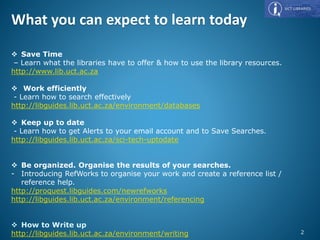
What you can expect to learn today
 Save Time
– Learn what the libraries have to offer & how to use the library resources.
http://www.lib.uct.ac.za
 Work efficiently
- Learn how to search effectively
http://libguides.lib.uct.ac.za/environment/databases
 Keep up to date
- Learn how to get Alerts to your email account and to Save Searches.
http://libguides.lib.uct.ac.za/sci-tech-uptodate
 Be organized. Organise the results of your searches.
- Introducing RefWorks to organise your work and create a reference list /
reference help.
http://proquest.libguides.com/newrefworks
http://libguides.lib.uct.ac.za/environment/referencing
 How to Write up
http://libguides.lib.uct.ac.za/environment/writing 2
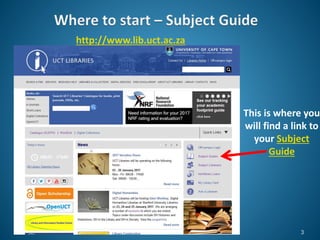
http://www.lib.uct.ac.za
This is where you
will find a link to
your Subject
Guide
3
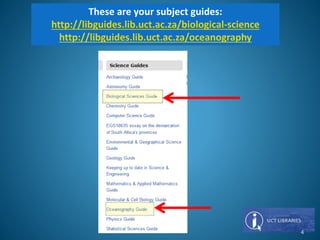
These are your subject guides:
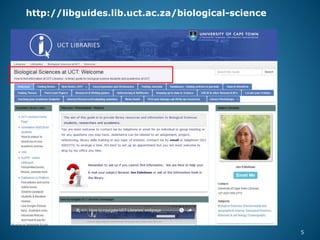
http://libguides.lib.uct.ac.za/biological-science
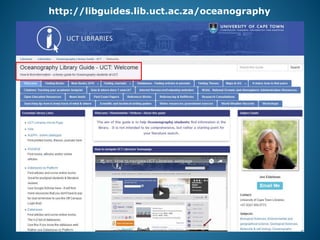
http://libguides.lib.uct.ac.za/oceanography
4
http://libguides.lib.uct.ac.za/biological-science
5
http://libguides.lib.uct.ac.za/oceanography
6
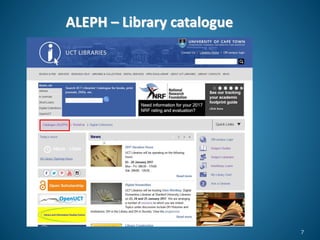
ALEPH – Library catalogue
7
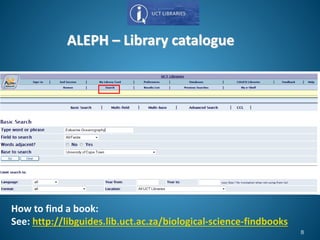
How to find a book:
See: http://libguides.lib.uct.ac.za/biological-science-findbooks
ALEPH – Library catalogue
8
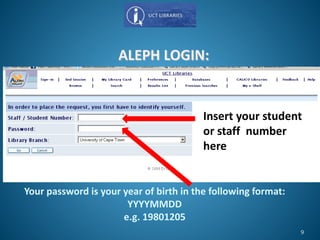
Insert your student
or staff number
here
Your password is your year of birth in the following format:
YYYYMMDD
e.g. 19801205
9
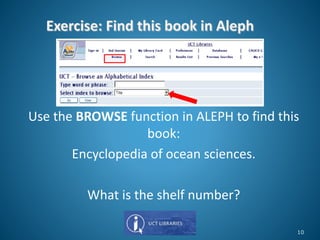
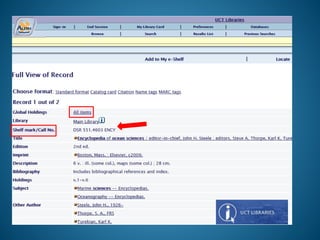
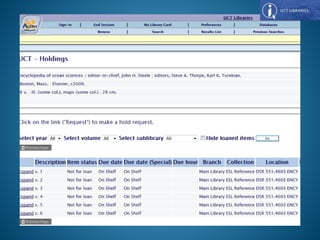
Use the BROWSE function in ALEPH to find this
book:
Encyclopedia of ocean sciences.
What is the shelf number?
10
11
12
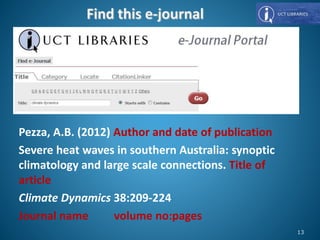
Pezza, A.B. (2012) Author and date of publication
Severe heat waves in southern Australia: synoptic
climatology and large scale connections. Title of
article
Climate Dynamics 38:209-224
Journal name volume no:pages
13
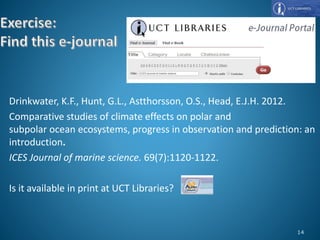
Drinkwater, K.F., Hunt, G.L., Astthorsson, O.S., Head, E.J.H. 2012.
Comparative studies of climate effects on polar and
subpolar ocean ecosystems, progress in observation and prediction: an
introduction.
ICES Journal of marine science. 69(7):1120-1122.
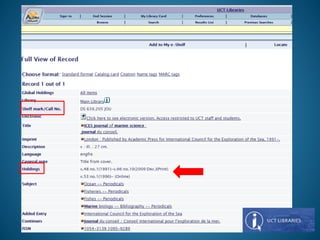
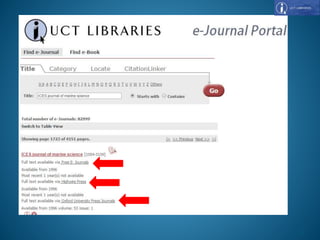
Is it available in print at UCT Libraries?
14
15
16
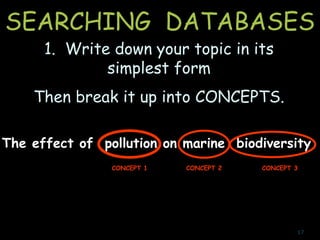
SEARCHING DATABASES
The effect of pollution on marine biodiversity
CONCEPT 2 CONCEPT 3CONCEPT 1
1. Write down your topic in its
simplest form
Then break it up into CONCEPTS.
17
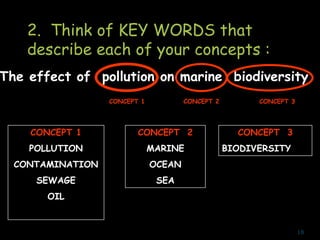
The effect of pollution on marine biodiversity
CONCEPT 2 CONCEPT 3CONCEPT 1
2. Think of KEY WORDS that
describe each of your concepts :
CONCEPT 1
POLLUTION
CONTAMINATION
SEWAGE
OIL
CONCEPT 2
MARINE
OCEAN
SEA
CONCEPT 3
BIODIVERSITY
18
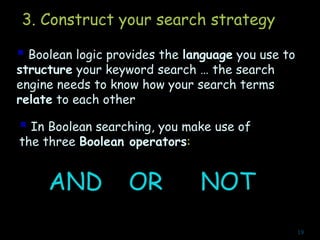
3. Construct your search strategy
 Boolean logic provides the language you use to
structure your keyword search … the search
engine needs to know how your search terms
relate to each other
 In Boolean searching, you make use of
the three Boolean operators:
AND OR NOT
19
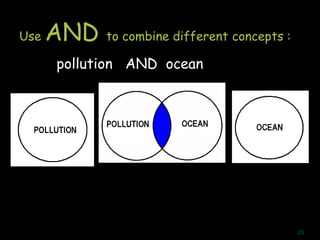
Use AND to combine different concepts :
pollution AND ocean
20
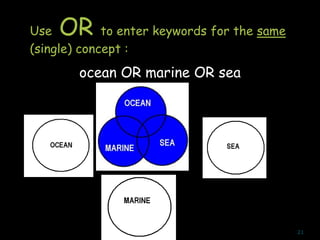
Use OR to enter keywords for the same
(single) concept :
ocean OR marine OR sea
21
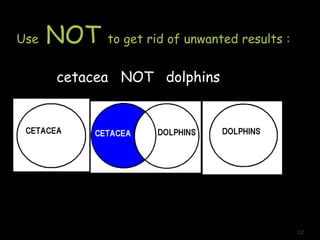
Use NOT to get rid of unwanted results :
cetacea NOT dolphins
22
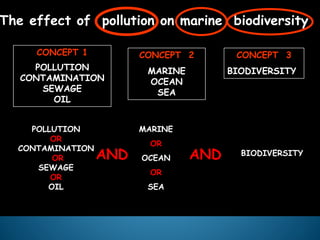
POLLUTION
OR
CONTAMINATION
OR
SEWAGE
OR
OIL
MARINE
OR
OCEAN
OR
SEA
BIODIVERSITYAND
CONCEPT 1
POLLUTION
CONTAMINATION
SEWAGE
OIL
CONCEPT 2
MARINE
OCEAN
SEA
CONCEPT 3
BIODIVERSITY
The effect of pollution on marine biodiversity
AND
23
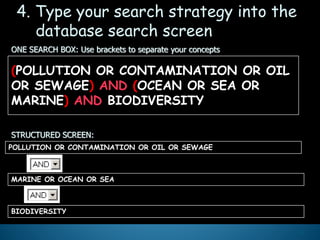
ONE SEARCH BOX: Use brackets to separate your concepts
STRUCTURED SCREEN:
POLLUTION OR CONTAMINATION OR OIL OR SEWAGE
MARINE OR OCEAN OR SEA
BIODIVERSITY
(POLLUTION OR CONTAMINATION OR OIL
OR SEWAGE) AND (OCEAN OR SEA OR
MARINE) AND BIODIVERSITY
4. Type your search strategy into the
database search screen
24
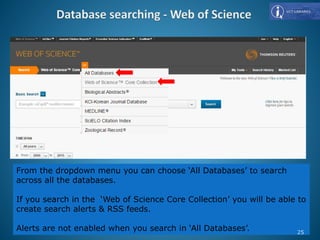
From the dropdown menu you can choose ‘All Databases’ to search
across all the databases.
If you search in the ‘Web of Science Core Collection’ you will be able to
create search alerts & RSS feeds.
Alerts are not enabled when you search in ‘All Databases’. 25
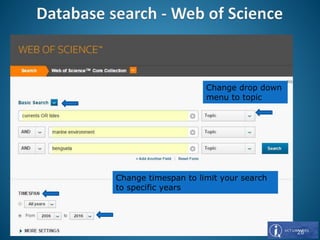
Change drop down
menu to topic
Change timespan to limit your search
to specific years
26
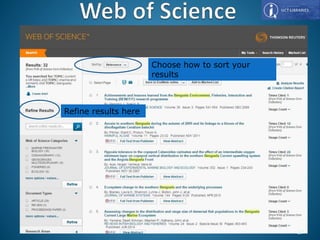
Refine results here
Choose how to sort your
results
27
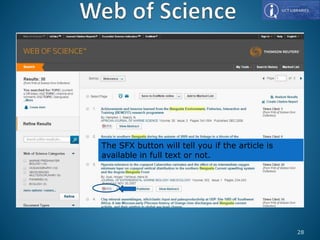
The SFX button will tell you if the article is
available in full text or not.
28
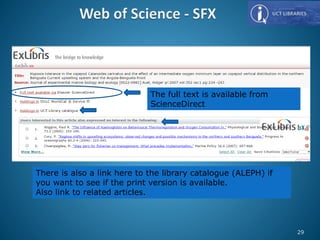
There is also a link here to the library catalogue (ALEPH) if
you want to see if the print version is available.
Also link to related articles.
The full text is available from
ScienceDirect
29
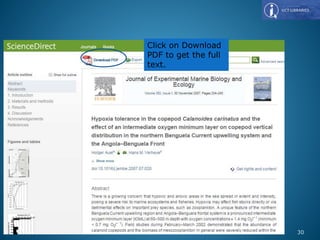
Click on Download
PDF to get the full
text.
30
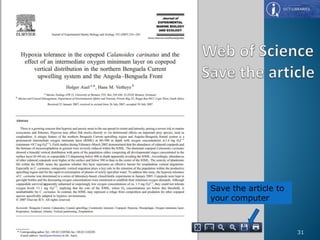
Save the article to
your computer
31
32
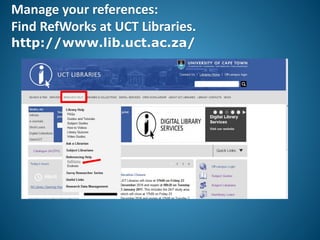
Manage your references:
Find RefWorks at UCT Libraries.
http://www.lib.uct.ac.za/
33
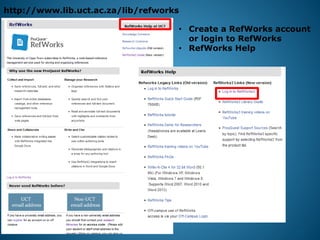
http://www.lib.uct.ac.za/lib/refworks
• Create a RefWorks account
or login to RefWorks
• RefWorks Help
34
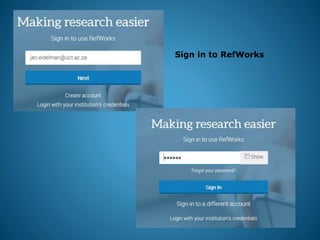
Sign in to RefWorks
35
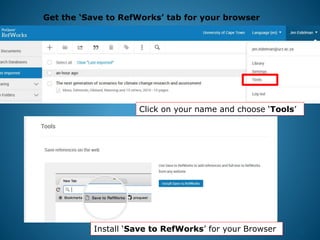
Get the ‘Save to RefWorks’ tab for your browser
Install ‘Save to RefWorks’ for your Browser
Click on your name and choose ‘Tools’
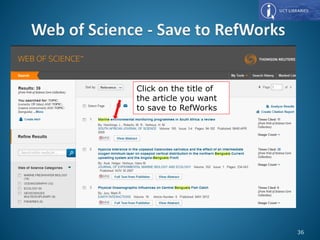
Click on the title of
the article you want
to save to RefWorks
36
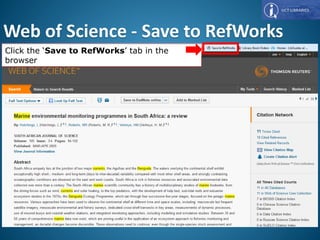
Web of Science - Save to RefWorks
Click the ‘Save to RefWorks’ tab in the
browser
37
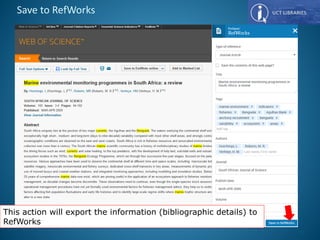
Save to RefWorks
This action will export the information (bibliographic details) to
RefWorks
38
39
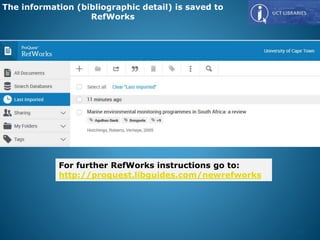
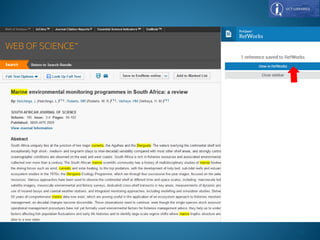
The information (bibliographic detail) is saved to
RefWorks
For further RefWorks instructions go to:
http://proquest.libguides.com/newrefworks
40
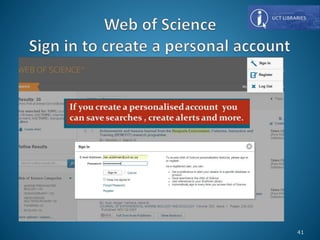
41
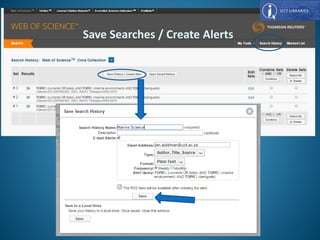
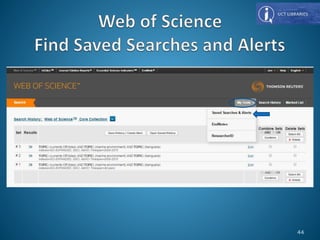
Save Searches / Create Alerts
42
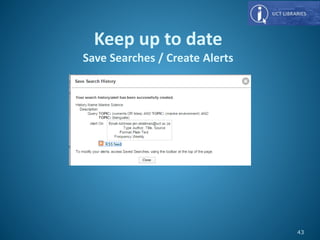
Keep up to date
Save Searches / Create Alerts
43
44
45
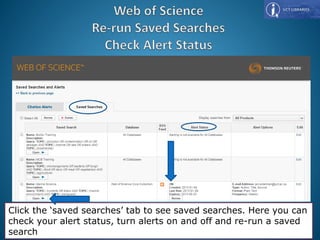
Click the ‘saved searches’ tab to see saved searches. Here you can
check your alert status, turn alerts on and off and re-run a saved
search
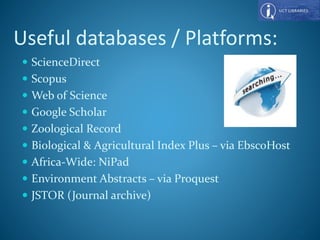
Useful databases / Platforms:
 ScienceDirect
 Scopus
 Web of Science
 Google Scholar
 Zoological Record
 Biological & Agricultural Index Plus – via EbscoHost
 Africa-Wide: NiPad
 Environment Abstracts – via Proquest
 JSTOR (Journal archive)
46
If you are OFF CAMPUS you can still
access
• UCT Libraries Catalogue
• Databases
• RefWorks
• And other resources from the
library page
OFF CAMPUS LOGIN
http://www.theipinionsjournal.com/2006/06/gone-fishing/
47
Finding material in UCT Libraries – Summary :
ALEPH (library catalogue), E-Journal portal, Subject Guides
Doing your literature search : DATABASES (Boolean searching)
Retrieving materials: SFX; ALEPH, Interlibrary Loans
Organising your results : RefWorks.
See: http://proquest.libguides.com/newrefworks
Writing help :
See: http://libguides.lib.uct.ac.za/biological-science-writing
Referencing help.
See: http://libguides.lib.uct.ac.za/biological-science-referencing
Keeping up to date : Current Awareness; Alerting services.
See: http://libguides.lib.uct.ac.za/sci-tech-uptodate
Off-campus access: Use the button on the library page
48
Thank you!
This slideshow is available at:
http://libguides.lib.uct.ac.za/oceanography/workshops2017
49

Applied marine science 2017

  • 1.
    INTRODUCTION TO UCTLIBRARIES Presented by Jen Eidelman 2017 jen.eidelman@uct.ac.za Assisted by: Awot Gebregziabher Awot.Gebregziabher@uct.ac.za Telephone: 021 650 2773 OR 021 650 3774 This work is licensed under a Creative Commons Attribution- NonCommercial-ShareAlike 3.0 Unported License. 1
  • 2.
    What you canexpect to learn today  Save Time – Learn what the libraries have to offer & how to use the library resources. http://www.lib.uct.ac.za  Work efficiently - Learn how to search effectively http://libguides.lib.uct.ac.za/environment/databases  Keep up to date - Learn how to get Alerts to your email account and to Save Searches. http://libguides.lib.uct.ac.za/sci-tech-uptodate  Be organized. Organise the results of your searches. - Introducing RefWorks to organise your work and create a reference list / reference help. http://proquest.libguides.com/newrefworks http://libguides.lib.uct.ac.za/environment/referencing  How to Write up http://libguides.lib.uct.ac.za/environment/writing 2
  • 3.
    http://www.lib.uct.ac.za This is whereyou will find a link to your Subject Guide 3
  • 4.
    These are yoursubject guides: http://libguides.lib.uct.ac.za/biological-science http://libguides.lib.uct.ac.za/oceanography 4
  • 5.
  • 6.
  • 7.
    ALEPH – Librarycatalogue 7
  • 8.
    How to finda book: See: http://libguides.lib.uct.ac.za/biological-science-findbooks ALEPH – Library catalogue 8
  • 9.
    Insert your student orstaff number here Your password is your year of birth in the following format: YYYYMMDD e.g. 19801205 9
  • 10.
    Use the BROWSEfunction in ALEPH to find this book: Encyclopedia of ocean sciences. What is the shelf number? 10
  • 11.
  • 12.
  • 13.
    Pezza, A.B. (2012)Author and date of publication Severe heat waves in southern Australia: synoptic climatology and large scale connections. Title of article Climate Dynamics 38:209-224 Journal name volume no:pages 13
  • 14.
    Drinkwater, K.F., Hunt,G.L., Astthorsson, O.S., Head, E.J.H. 2012. Comparative studies of climate effects on polar and subpolar ocean ecosystems, progress in observation and prediction: an introduction. ICES Journal of marine science. 69(7):1120-1122. Is it available in print at UCT Libraries? 14
  • 15.
  • 16.
  • 17.
    SEARCHING DATABASES The effectof pollution on marine biodiversity CONCEPT 2 CONCEPT 3CONCEPT 1 1. Write down your topic in its simplest form Then break it up into CONCEPTS. 17
  • 18.
    The effect ofpollution on marine biodiversity CONCEPT 2 CONCEPT 3CONCEPT 1 2. Think of KEY WORDS that describe each of your concepts : CONCEPT 1 POLLUTION CONTAMINATION SEWAGE OIL CONCEPT 2 MARINE OCEAN SEA CONCEPT 3 BIODIVERSITY 18
  • 19.
    3. Construct yoursearch strategy  Boolean logic provides the language you use to structure your keyword search … the search engine needs to know how your search terms relate to each other  In Boolean searching, you make use of the three Boolean operators: AND OR NOT 19
  • 20.
    Use AND tocombine different concepts : pollution AND ocean 20
  • 21.
    Use OR toenter keywords for the same (single) concept : ocean OR marine OR sea 21
  • 22.
    Use NOT toget rid of unwanted results : cetacea NOT dolphins 22
  • 23.
  • 24.
    ONE SEARCH BOX:Use brackets to separate your concepts STRUCTURED SCREEN: POLLUTION OR CONTAMINATION OR OIL OR SEWAGE MARINE OR OCEAN OR SEA BIODIVERSITY (POLLUTION OR CONTAMINATION OR OIL OR SEWAGE) AND (OCEAN OR SEA OR MARINE) AND BIODIVERSITY 4. Type your search strategy into the database search screen 24
  • 25.
    From the dropdownmenu you can choose ‘All Databases’ to search across all the databases. If you search in the ‘Web of Science Core Collection’ you will be able to create search alerts & RSS feeds. Alerts are not enabled when you search in ‘All Databases’. 25
  • 26.
    Change drop down menuto topic Change timespan to limit your search to specific years 26
  • 27.
    Refine results here Choosehow to sort your results 27
  • 28.
    The SFX buttonwill tell you if the article is available in full text or not. 28
  • 29.
    There is alsoa link here to the library catalogue (ALEPH) if you want to see if the print version is available. Also link to related articles. The full text is available from ScienceDirect 29
  • 30.
    Click on Download PDFto get the full text. 30
  • 31.
    Save the articleto your computer 31
  • 32.
    32 Manage your references: FindRefWorks at UCT Libraries. http://www.lib.uct.ac.za/
  • 33.
    33 http://www.lib.uct.ac.za/lib/refworks • Create aRefWorks account or login to RefWorks • RefWorks Help
  • 34.
    34 Sign in toRefWorks
  • 35.
    35 Get the ‘Saveto RefWorks’ tab for your browser Install ‘Save to RefWorks’ for your Browser Click on your name and choose ‘Tools’
  • 36.
    Click on thetitle of the article you want to save to RefWorks 36
  • 37.
    Web of Science- Save to RefWorks Click the ‘Save to RefWorks’ tab in the browser 37
  • 38.
    Save to RefWorks Thisaction will export the information (bibliographic details) to RefWorks 38
  • 39.
  • 40.
    The information (bibliographicdetail) is saved to RefWorks For further RefWorks instructions go to: http://proquest.libguides.com/newrefworks 40
  • 41.
  • 42.
    Save Searches /Create Alerts 42
  • 43.
    Keep up todate Save Searches / Create Alerts 43
  • 44.
  • 45.
    45 Click the ‘savedsearches’ tab to see saved searches. Here you can check your alert status, turn alerts on and off and re-run a saved search
  • 46.
    Useful databases /Platforms:  ScienceDirect  Scopus  Web of Science  Google Scholar  Zoological Record  Biological & Agricultural Index Plus – via EbscoHost  Africa-Wide: NiPad  Environment Abstracts – via Proquest  JSTOR (Journal archive) 46
  • 47.
    If you areOFF CAMPUS you can still access • UCT Libraries Catalogue • Databases • RefWorks • And other resources from the library page OFF CAMPUS LOGIN http://www.theipinionsjournal.com/2006/06/gone-fishing/ 47
  • 48.
    Finding material inUCT Libraries – Summary : ALEPH (library catalogue), E-Journal portal, Subject Guides Doing your literature search : DATABASES (Boolean searching) Retrieving materials: SFX; ALEPH, Interlibrary Loans Organising your results : RefWorks. See: http://proquest.libguides.com/newrefworks Writing help : See: http://libguides.lib.uct.ac.za/biological-science-writing Referencing help. See: http://libguides.lib.uct.ac.za/biological-science-referencing Keeping up to date : Current Awareness; Alerting services. See: http://libguides.lib.uct.ac.za/sci-tech-uptodate Off-campus access: Use the button on the library page 48
  • 49.
    Thank you! This slideshowis available at: http://libguides.lib.uct.ac.za/oceanography/workshops2017 49