Conventional Well Log
Interpretation
By
Hayder A. Jumaah
2 Intro to Well Logging Restored
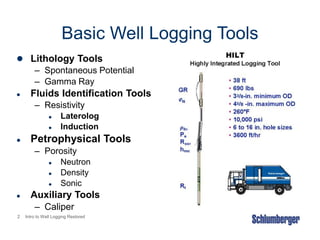
Basic Well Logging Tools
 Lithology Tools
– Spontaneous Potential
– Gamma Ray
 Fluids Identification Tools
– Resistivity
 Laterolog
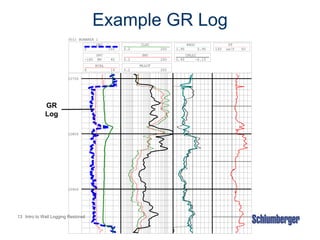
 Induction
 Petrophysical Tools
– Porosity
 Neutron
 Density
 Sonic
 Auxiliary Tools
– Caliper
3 Intro to Well Logging Restored
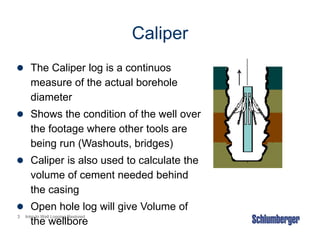
Caliper
 The Caliper log is a continuos
measure of the actual borehole
diameter
 Shows the condition of the well over
the footage where other tools are
being run (Washouts, bridges)
 Caliper is also used to calculate the
volume of cement needed behind
the casing
 Open hole log will give Volume of
the wellbore
4 Intro to Well Logging Restored
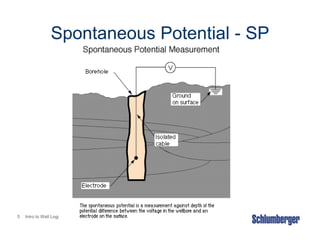
Spontaneous Potential - SP
 Measures the electrical potential in the formation
caused by the salinity difference between the
drilling mud and the formation water
 Generally an indicator of permeability
 Generally mimics the GR curve
5 Intro to Well Logging Restored
Spontaneous Potential - SP
6 Intro to Well Logging Restored
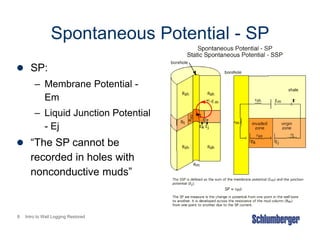
Spontaneous Potential - SP
 SP:
– Membrane Potential -
Em
– Liquid Junction Potential
- Ej
 “The SP cannot be
recorded in holes with
nonconductive muds”
7 Intro to Well Logging Restored
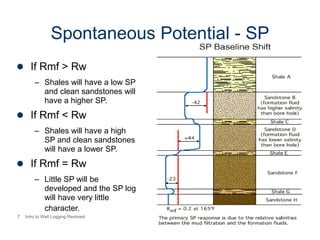
Spontaneous Potential - SP
 If Rmf > Rw
– Shales will have a low SP
and clean sandstones will
have a higher SP.
 If Rmf < Rw
– Shales will have a high
SP and clean sandstones
will have a lower SP.
 If Rmf = Rw
– Little SP will be
developed and the SP log
will have very little
character.
8 Intro to Well Logging Restored
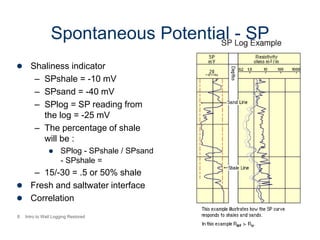
Spontaneous Potential - SP
 Shaliness indicator
– SPshale = -10 mV
– SPsand = -40 mV
– SPlog = SP reading from
the log = -25 mV
– The percentage of shale
will be :
 SPlog - SPshale / SPsand
- SPshale =
– 15/-30 = .5 or 50% shale
 Fresh and saltwater interface
 Correlation
9 Intro to Well Logging Restored
SP Log Response
Shale
Impervious
nonshale
Impervious
nonshale
Reservoir
bed
Reservoir
bed
Shale
SP
10 Intro to Well Logging Restored
SP Log
GRC
0 150
SPC
MV
-160 40
ACAL
6 16
ILDC
0.2 200
SNC
0.2 200
MLLCF
0.2 200
RHOC
1.95 2.95
CNLLC
0.45 -0.15
DT
us/f
150 50
001) BONANZA 1
10700
10800
10900
SP
Log
11 Intro to Well Logging Restored
Gamma Ray
Gamma Ray Tools detect the naturally
occurring radiation within the rock
Radioactive elements tend to
concentrate in clays and shales
Potassium (K)
Uranium (U)
Thorium (Th)
12 Intro to Well Logging Restored
Gamma Ray
 In sedimentary formations, the
GR log reflects the clay or
shale content
 Clean formations, such as
sandstones or limestones,
usually have a very low level of
radioactivity
 In general, the lower the
Gamma Ray reading, the
cleaner the sand
 Gamma Ray logs can be run in
cased holes, but the data will
be suppressed
13 Intro to Well Logging Restored
Example GR Log
GRC
0 150
SPC
MV
-160 40
ACAL
6 16
ILDC
0.2 200
SNC
0.2 200
MLLCF
0.2 200
RHOC
1.95 2.95
CNLLC
0.45 -0.15
DT
us/f
150 50
001) BONANZA 1
10700
10800
10900
GR
Log
14 Intro to Well Logging Restored
Resistivity Tools
 Induction Tools
– Run in nonconductive or low-conductivity muds
– Dual Induction - DIL: Is the earlier version of induction tool
which read a Shallow (SFL) and deep measurement
– Phasor Induction - DIT-E: Is an enhanced Induction tool
giving Shallow, Medium, and Deep measurements
– Array Induction - AIT: Is the newer generation of Induction
tools giving 5 curves with set depths of investigation: 10”
(shallow), 20”, 30”, 60”, 90”.
 Laterolog Tools
– Run in highly conductive muds (salt based)
– HRLA
15 Intro to Well Logging Restored
Resistivity
 Resistivity of the salt
water is low (highly
conductive)
Resistivity of the Oil is high
(Poor conductor)
16 Intro to Well Logging Restored
Resistivity
 Dry, nonmetallic minerals (rock matrix) have a very
high resistivity
17 Intro to Well Logging Restored
Resistivity
 The resistivity of a rock is a measurement of the
resistivity of the rock matrix as well as the
resistivity of the fluid within the porous volume of
the rock.
18 Intro to Well Logging Restored
Induction
19 Intro to Well Logging Restored
Borehole
Effects
on
Resistivity
Logs
20 Intro to Well Logging Restored
Resistivity Profiles
 Depth of Investigation:
– Logging tools are designed to
measure resistivity at different depths
radially from the wellbore to
determine the resistivity of the
flushed zone and the virgin zone.
– Flushed zone - is closest to the
wellbore and has been invaded by
drilling fluids (original fluids have
been flushed out).
– Virgin zone - is farthest from the
wellbore and has not been invaded
by drilling fluids. Clients will want to
use Virgin zone measurements
21 Intro to Well Logging Restored
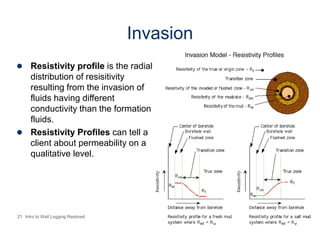
Invasion
 Resistivity profile is the radial
distribution of resisitivity
resulting from the invasion of
fluids having different
conductivity than the formation
fluids.
 Resistivity Profiles can tell a
client about permeability on a
qualitative level.
22 Intro to Well Logging Restored
Laterolog
 Laterolog
Principle:
– Measuring the
voltage difference
between two
electrodes is the
fundamental idea
behind laterolog
devices.
23 Intro to Well Logging Restored
Example Log With Resistivity
GRC
0 150
SPC
MV
-160 40
ACAL
6 16
ILDC
0.2 200
SNC
0.2 200
MLLCF
0.2 200
RHOC
1.95 2.95
CNLLC
0.45 -0.15
DT
us/f
150 50
001) BONANZA 1
10700
10800
10900
Resistivity
Log
24 Intro to Well Logging Restored
Porosity
 Porosity Tools
 Density
 Neutron
 Sonic
 Magnetic Resonance
25 Intro to Well Logging Restored
Density a 1 / Porosity
Density
 Measuring the number of gamma rays and their
energy levels at a given distance from the source,
the electron density of the formation can be
predicted
26 Intro to Well Logging Restored
Bulk Density
Matrix Fluids
  






 f
ma
b 1
27 Intro to Well Logging Restored
Porosity From Density Log
 Porosity equation
 The fluid density equation
 
xo
h
xo
mf
f S
1
S 





f
ma
b
ma








28 Intro to Well Logging Restored
Bulk Density Log
GRC
0 150
SPC
MV
-160 40
ACAL
6 16
ILDC
0.2 200
SNC
0.2 200
MLLCF
0.2 200
RHOC
1.95 2.95
CNLLC
0.45 -0.15
DT
us/f
150 50
001) BONANZA 1
10700
10800
10900
Bulk Density
Log
29 Intro to Well Logging Restored
Example Solution Density Log
GRC
0 150
SPC
MV
-160 40
ACAL
6 16
ILDC
0.2 200
SNC
0.2 200
MLLCF
0.2 200
RHOC
1.95 2.95
DPHISS
dec
0.45 -0.15
DT
us/f
150 50
001) BONANZA 1
10700
10800
10900
DPHI
30 Intro to Well Logging Restored
Neutron
 Neutron tools emit high energy
neutrons from either a
chemical source or a neutron
generator device (minitron)
and measure the response of
these neutrons as they
interact with the formation
31 Intro to Well Logging Restored
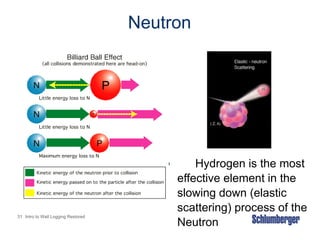
Neutron
 Hydrogen is the most
effective element in the
slowing down (elastic
scattering) process of the
Neutron
32 Intro to Well Logging Restored
Density - Neutron
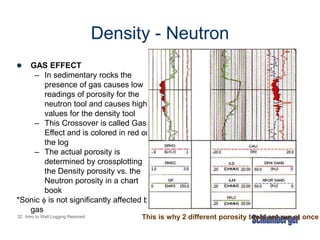
 GAS EFFECT
– In sedimentary rocks the
presence of gas causes low
readings of porosity for the
neutron tool and causes high
values for the density tool
– This Crossover is called Gas
Effect and is colored in red on
the log
– The actual porosity is
determined by crossplotting
the Density porosity vs. the
Neutron porosity in a chart
book
*Sonic  is not significantly affected by
gas
This is why 2 different porosity tools are run at once
33 Intro to Well Logging Restored
Example Compensated Neutron Log
GRC
0 150
SPC
MV
-160 40
ACAL
6 16
ILDC
0.2 200
SNC
0.2 200
MLLCF
0.2 200
RHOC
1.95 2.95
CNLLC
0.45 -0.15
DT
us/f
150 50
001) BONANZA 1
10700
10800
10900
Neutron
Log
34 Intro to Well Logging Restored
Sonic
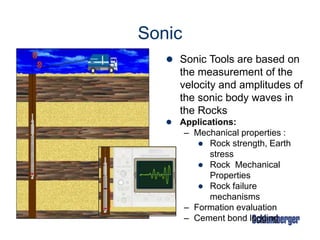
 Sonic Tools are based on
the measurement of the
velocity and amplitudes of
the sonic body waves in
the Rocks
 Applications:
– Mechanical properties :
 Rock strength, Earth
stress
 Rock Mechanical
Properties
 Rock failure
mechanisms
– Formation evaluation
– Cement bond logging
35 Intro to Well Logging Restored
Sonic - Formation Evaluation
 The speed of sound depends
principally upon the rock matrix
material and the porosity.
 The measurement of
compressional and shear wave
slowness can help us estimate:
– Primary porosity
– Lithology
– Presence of natural gas
Gas Effect
in Sonic
Log
36 Intro to Well Logging Restored
Sonic Log
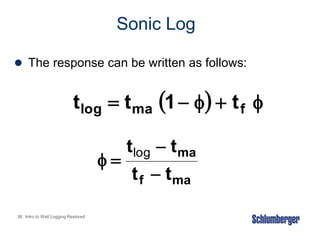
 The response can be written as follows:
  



 f
ma
log t
1
t
t
ma
f
ma
t
t
t
t




log
37 Intro to Well Logging Restored
Sonic Log
GRC
0 150
SPC
MV
-160 40
ACAL
6 16
ILDC
0.2 200
SNC
0.2 200
MLLCF
0.2 200
RHOC
1.95 2.95
CNLLC
0.45 -0.15
DT
us/f
150 50
001) BONANZA 1
10700
10800
10900
Sonic
Log
38 Intro to Well Logging Restored
Example Solution Sonic Log
GRC
0 150
SPC
MV
-160 40
ACAL
6 16
ILDC
0.2 200
SNC
0.2 200
MLLCF
0.2 200
CNLLC
0.45 -0.15
RHOC
1.95 2.95
DT
us/f
150 50
SPHISS
dec
0.45 -0.15
001) BONANZA 1
10700
10800
10900
SPHI
39 Intro to Well Logging Restored










t
m
w
n
w
R
R
a
S
Formation Water Resistivity
40 Intro to Well Logging Restored
Determining Rw
 Directly
– From measured water sample
– This is the most accurate Rw reading
 Indirectly
– From openhole well logs
 SP logs
 Pickett plots
 Rwa technique
41 Intro to Well Logging Restored
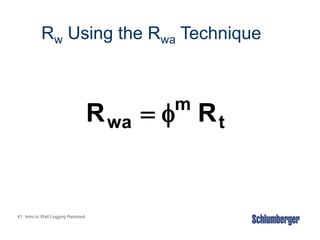
Rw Using the Rwa Technique
t
m
wa R
R 

42 Intro to Well Logging Restored
Mechanical Properties from Logs
 From sonic data the mechanical
properties of the rock can be calculated
giving a continuous stress and
mechanical properties profile, but it
needs to be calibrated with external,
data either from core test or DataFRAC
 Dipole Sonic is an Array tool which
gives Mechanical Properties. Geoquest
will process the data and create a
FracHite log and Mechanical Properties.
43 Intro to Well Logging Restored
Sonic - CBL
 Cement Bond
Logging
– Cement bond logs (CBL)
are used to evaluate the
quality of the cement
that was put in place
during the well
completion process
– An Amplitude gives a
quantitative reading and
the VDL (Variable
Density Log) shows the
quality of the bond
44 Intro to Well Logging Restored
CMR - Combinable Magnetic
Resonance
 CMR Gives information on:
– Grain size and distribution
– Permeability
– Free-fluid porosity
– Bound-fluid porosity
 Helps client determine how much water will
actually flow out of the formation, and how much
is irreducible
45 Intro to Well Logging Restored
CMR
T2 Distribution
MDT Perm
plotted on top
of CMR Perm
47 Intro to Well Logging Restored
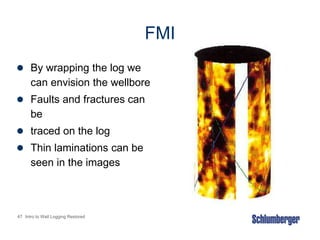
FMI
 By wrapping the log we
can envision the wellbore
 Faults and fractures can
be
 traced on the log
 Thin laminations can be
seen in the images

Intro_Logging.ppt

  • 1.
  • 2.
    2 Intro toWell Logging Restored Basic Well Logging Tools  Lithology Tools – Spontaneous Potential – Gamma Ray  Fluids Identification Tools – Resistivity  Laterolog  Induction  Petrophysical Tools – Porosity  Neutron  Density  Sonic  Auxiliary Tools – Caliper
  • 3.
    3 Intro toWell Logging Restored Caliper  The Caliper log is a continuos measure of the actual borehole diameter  Shows the condition of the well over the footage where other tools are being run (Washouts, bridges)  Caliper is also used to calculate the volume of cement needed behind the casing  Open hole log will give Volume of the wellbore
  • 4.
    4 Intro toWell Logging Restored Spontaneous Potential - SP  Measures the electrical potential in the formation caused by the salinity difference between the drilling mud and the formation water  Generally an indicator of permeability  Generally mimics the GR curve
  • 5.
    5 Intro toWell Logging Restored Spontaneous Potential - SP
  • 6.
    6 Intro toWell Logging Restored Spontaneous Potential - SP  SP: – Membrane Potential - Em – Liquid Junction Potential - Ej  “The SP cannot be recorded in holes with nonconductive muds”
  • 7.
    7 Intro toWell Logging Restored Spontaneous Potential - SP  If Rmf > Rw – Shales will have a low SP and clean sandstones will have a higher SP.  If Rmf < Rw – Shales will have a high SP and clean sandstones will have a lower SP.  If Rmf = Rw – Little SP will be developed and the SP log will have very little character.
  • 8.
    8 Intro toWell Logging Restored Spontaneous Potential - SP  Shaliness indicator – SPshale = -10 mV – SPsand = -40 mV – SPlog = SP reading from the log = -25 mV – The percentage of shale will be :  SPlog - SPshale / SPsand - SPshale = – 15/-30 = .5 or 50% shale  Fresh and saltwater interface  Correlation
  • 9.
    9 Intro toWell Logging Restored SP Log Response Shale Impervious nonshale Impervious nonshale Reservoir bed Reservoir bed Shale SP
  • 10.
    10 Intro toWell Logging Restored SP Log GRC 0 150 SPC MV -160 40 ACAL 6 16 ILDC 0.2 200 SNC 0.2 200 MLLCF 0.2 200 RHOC 1.95 2.95 CNLLC 0.45 -0.15 DT us/f 150 50 001) BONANZA 1 10700 10800 10900 SP Log
  • 11.
    11 Intro toWell Logging Restored Gamma Ray Gamma Ray Tools detect the naturally occurring radiation within the rock Radioactive elements tend to concentrate in clays and shales Potassium (K) Uranium (U) Thorium (Th)
  • 12.
    12 Intro toWell Logging Restored Gamma Ray  In sedimentary formations, the GR log reflects the clay or shale content  Clean formations, such as sandstones or limestones, usually have a very low level of radioactivity  In general, the lower the Gamma Ray reading, the cleaner the sand  Gamma Ray logs can be run in cased holes, but the data will be suppressed
  • 13.
    13 Intro toWell Logging Restored Example GR Log GRC 0 150 SPC MV -160 40 ACAL 6 16 ILDC 0.2 200 SNC 0.2 200 MLLCF 0.2 200 RHOC 1.95 2.95 CNLLC 0.45 -0.15 DT us/f 150 50 001) BONANZA 1 10700 10800 10900 GR Log
  • 14.
    14 Intro toWell Logging Restored Resistivity Tools  Induction Tools – Run in nonconductive or low-conductivity muds – Dual Induction - DIL: Is the earlier version of induction tool which read a Shallow (SFL) and deep measurement – Phasor Induction - DIT-E: Is an enhanced Induction tool giving Shallow, Medium, and Deep measurements – Array Induction - AIT: Is the newer generation of Induction tools giving 5 curves with set depths of investigation: 10” (shallow), 20”, 30”, 60”, 90”.  Laterolog Tools – Run in highly conductive muds (salt based) – HRLA
  • 15.
    15 Intro toWell Logging Restored Resistivity  Resistivity of the salt water is low (highly conductive) Resistivity of the Oil is high (Poor conductor)
  • 16.
    16 Intro toWell Logging Restored Resistivity  Dry, nonmetallic minerals (rock matrix) have a very high resistivity
  • 17.
    17 Intro toWell Logging Restored Resistivity  The resistivity of a rock is a measurement of the resistivity of the rock matrix as well as the resistivity of the fluid within the porous volume of the rock.
  • 18.
    18 Intro toWell Logging Restored Induction
  • 19.
    19 Intro toWell Logging Restored Borehole Effects on Resistivity Logs
  • 20.
    20 Intro toWell Logging Restored Resistivity Profiles  Depth of Investigation: – Logging tools are designed to measure resistivity at different depths radially from the wellbore to determine the resistivity of the flushed zone and the virgin zone. – Flushed zone - is closest to the wellbore and has been invaded by drilling fluids (original fluids have been flushed out). – Virgin zone - is farthest from the wellbore and has not been invaded by drilling fluids. Clients will want to use Virgin zone measurements
  • 21.
    21 Intro toWell Logging Restored Invasion  Resistivity profile is the radial distribution of resisitivity resulting from the invasion of fluids having different conductivity than the formation fluids.  Resistivity Profiles can tell a client about permeability on a qualitative level.
  • 22.
    22 Intro toWell Logging Restored Laterolog  Laterolog Principle: – Measuring the voltage difference between two electrodes is the fundamental idea behind laterolog devices.
  • 23.
    23 Intro toWell Logging Restored Example Log With Resistivity GRC 0 150 SPC MV -160 40 ACAL 6 16 ILDC 0.2 200 SNC 0.2 200 MLLCF 0.2 200 RHOC 1.95 2.95 CNLLC 0.45 -0.15 DT us/f 150 50 001) BONANZA 1 10700 10800 10900 Resistivity Log
  • 24.
    24 Intro toWell Logging Restored Porosity  Porosity Tools  Density  Neutron  Sonic  Magnetic Resonance
  • 25.
    25 Intro toWell Logging Restored Density a 1 / Porosity Density  Measuring the number of gamma rays and their energy levels at a given distance from the source, the electron density of the formation can be predicted
  • 26.
    26 Intro toWell Logging Restored Bulk Density Matrix Fluids           f ma b 1
  • 27.
    27 Intro toWell Logging Restored Porosity From Density Log  Porosity equation  The fluid density equation   xo h xo mf f S 1 S       f ma b ma        
  • 28.
    28 Intro toWell Logging Restored Bulk Density Log GRC 0 150 SPC MV -160 40 ACAL 6 16 ILDC 0.2 200 SNC 0.2 200 MLLCF 0.2 200 RHOC 1.95 2.95 CNLLC 0.45 -0.15 DT us/f 150 50 001) BONANZA 1 10700 10800 10900 Bulk Density Log
  • 29.
    29 Intro toWell Logging Restored Example Solution Density Log GRC 0 150 SPC MV -160 40 ACAL 6 16 ILDC 0.2 200 SNC 0.2 200 MLLCF 0.2 200 RHOC 1.95 2.95 DPHISS dec 0.45 -0.15 DT us/f 150 50 001) BONANZA 1 10700 10800 10900 DPHI
  • 30.
    30 Intro toWell Logging Restored Neutron  Neutron tools emit high energy neutrons from either a chemical source or a neutron generator device (minitron) and measure the response of these neutrons as they interact with the formation
  • 31.
    31 Intro toWell Logging Restored Neutron  Hydrogen is the most effective element in the slowing down (elastic scattering) process of the Neutron
  • 32.
    32 Intro toWell Logging Restored Density - Neutron  GAS EFFECT – In sedimentary rocks the presence of gas causes low readings of porosity for the neutron tool and causes high values for the density tool – This Crossover is called Gas Effect and is colored in red on the log – The actual porosity is determined by crossplotting the Density porosity vs. the Neutron porosity in a chart book *Sonic  is not significantly affected by gas This is why 2 different porosity tools are run at once
  • 33.
    33 Intro toWell Logging Restored Example Compensated Neutron Log GRC 0 150 SPC MV -160 40 ACAL 6 16 ILDC 0.2 200 SNC 0.2 200 MLLCF 0.2 200 RHOC 1.95 2.95 CNLLC 0.45 -0.15 DT us/f 150 50 001) BONANZA 1 10700 10800 10900 Neutron Log
  • 34.
    34 Intro toWell Logging Restored Sonic  Sonic Tools are based on the measurement of the velocity and amplitudes of the sonic body waves in the Rocks  Applications: – Mechanical properties :  Rock strength, Earth stress  Rock Mechanical Properties  Rock failure mechanisms – Formation evaluation – Cement bond logging
  • 35.
    35 Intro toWell Logging Restored Sonic - Formation Evaluation  The speed of sound depends principally upon the rock matrix material and the porosity.  The measurement of compressional and shear wave slowness can help us estimate: – Primary porosity – Lithology – Presence of natural gas Gas Effect in Sonic Log
  • 36.
    36 Intro toWell Logging Restored Sonic Log  The response can be written as follows:        f ma log t 1 t t ma f ma t t t t     log
  • 37.
    37 Intro toWell Logging Restored Sonic Log GRC 0 150 SPC MV -160 40 ACAL 6 16 ILDC 0.2 200 SNC 0.2 200 MLLCF 0.2 200 RHOC 1.95 2.95 CNLLC 0.45 -0.15 DT us/f 150 50 001) BONANZA 1 10700 10800 10900 Sonic Log
  • 38.
    38 Intro toWell Logging Restored Example Solution Sonic Log GRC 0 150 SPC MV -160 40 ACAL 6 16 ILDC 0.2 200 SNC 0.2 200 MLLCF 0.2 200 CNLLC 0.45 -0.15 RHOC 1.95 2.95 DT us/f 150 50 SPHISS dec 0.45 -0.15 001) BONANZA 1 10700 10800 10900 SPHI
  • 39.
    39 Intro toWell Logging Restored           t m w n w R R a S Formation Water Resistivity
  • 40.
    40 Intro toWell Logging Restored Determining Rw  Directly – From measured water sample – This is the most accurate Rw reading  Indirectly – From openhole well logs  SP logs  Pickett plots  Rwa technique
  • 41.
    41 Intro toWell Logging Restored Rw Using the Rwa Technique t m wa R R  
  • 42.
    42 Intro toWell Logging Restored Mechanical Properties from Logs  From sonic data the mechanical properties of the rock can be calculated giving a continuous stress and mechanical properties profile, but it needs to be calibrated with external, data either from core test or DataFRAC  Dipole Sonic is an Array tool which gives Mechanical Properties. Geoquest will process the data and create a FracHite log and Mechanical Properties.
  • 43.
    43 Intro toWell Logging Restored Sonic - CBL  Cement Bond Logging – Cement bond logs (CBL) are used to evaluate the quality of the cement that was put in place during the well completion process – An Amplitude gives a quantitative reading and the VDL (Variable Density Log) shows the quality of the bond
  • 44.
    44 Intro toWell Logging Restored CMR - Combinable Magnetic Resonance  CMR Gives information on: – Grain size and distribution – Permeability – Free-fluid porosity – Bound-fluid porosity  Helps client determine how much water will actually flow out of the formation, and how much is irreducible
  • 45.
    45 Intro toWell Logging Restored CMR T2 Distribution MDT Perm plotted on top of CMR Perm
  • 46.
    47 Intro toWell Logging Restored FMI  By wrapping the log we can envision the wellbore  Faults and fractures can be  traced on the log  Thin laminations can be seen in the images

Editor's Notes