Computers in Clinical
Pharmacy
Presented by: Dr.Wajiha Ishtiyak
(Pharm.D),(M.Phil. Clinical Pharmacy)
Lecturer
Lahore Pharmacy College of
Lahore Medical & Dental College (Pakistan)
Computers and Pharmacy
•Right now computers and pharmacy go hand in
hand.
•Drug and patient database management; order
entry systems; drug information; billing;
purchasing; automated dispensing units; and on
and ON!
•Today we can exchange health information and
provide services across geographic, time and
social boundaries.
Advantages
• Pharmacy plays crucial role in
patient care.
• Requires huge management and
manpower
• Effective use of computer started
in Pharmacy started in 1980.
• Advantages like reduction in time,
accuracy, reduction in man power,
speed, multitasking, non-
Use of internet in
Pharmacy
• Internet is collection of huge data
which is accessible with few clicks.
• Availability of soft copies of books
has made it more useful for
pharmacists.
• Access to huge amount of research
journals published online has
made very useful tool for literature
survey.
Computer in Retail
Pharmacy
• Accounting functions
• Managerial functions
• Purchasing and Inventory control
• Drug Information
Hospital and Clinical
Pharmacy and Computer
• Hospital pharmacy performs the
function of receiving and allotment
of drugs and other professional
items. Dispensing and
manufacturing are also integral
parts.
• Patient record maintenance
• Purchase and inventory control
• Therapeutic Drug monitoring
Computers in Pharmaceutical
Analysis
• Analytical instruments use
computer designed software.
• Data storage and processing
• Building up libraries
• HPLC, MS, GLC ,
spectrophotometers and all other
instruments
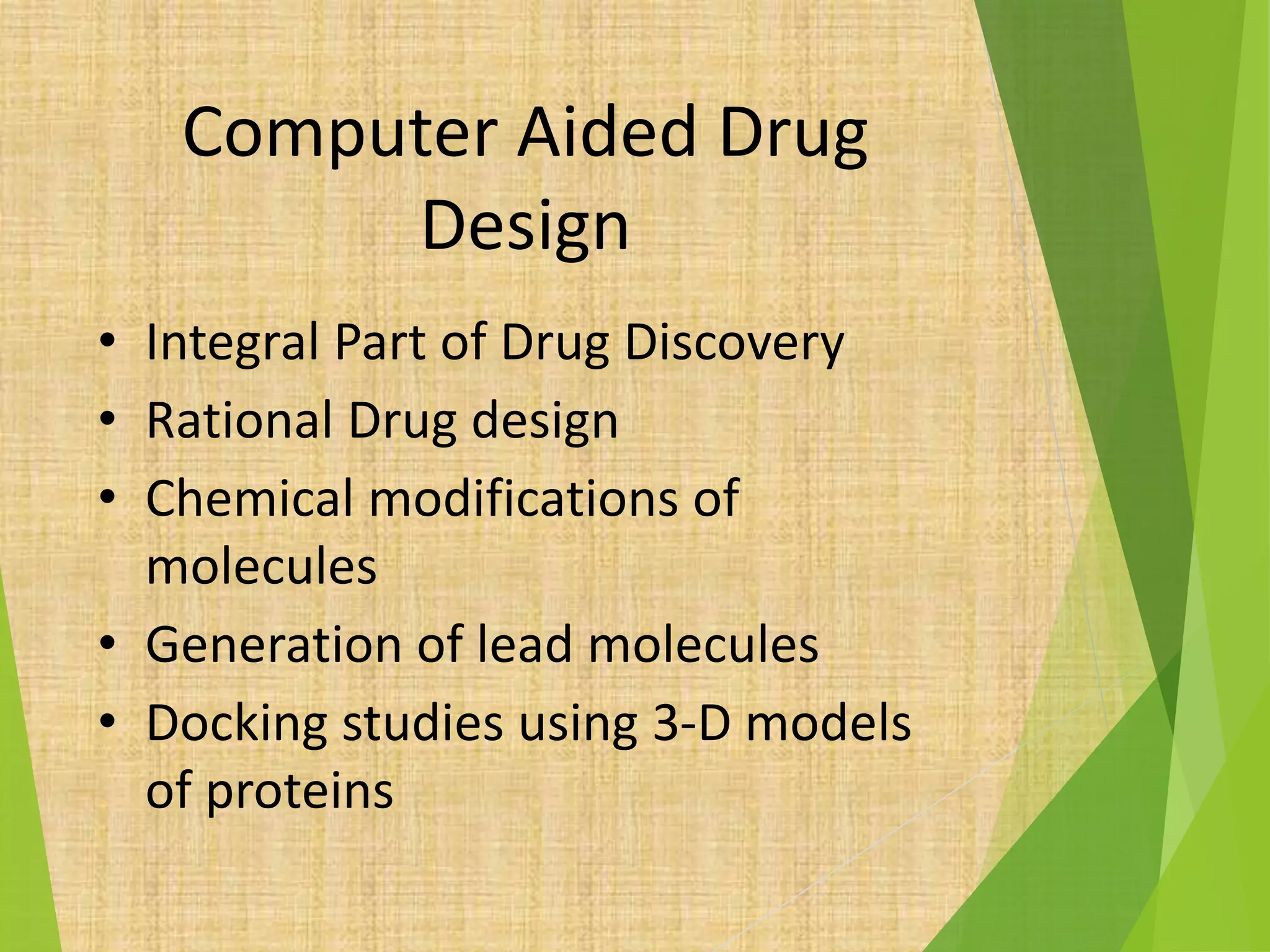
Computer Aided Drug
Design
• Integral Part of Drug Discovery
• Rational Drug design
• Chemical modifications of
molecules
• Generation of lead molecules
• Docking studies using 3-D models
of proteins
Computers in Publications
• Versatile and effortless writing
• Ease of editing, reviewing and
modifications
• Micrsoft word, wordpad, notepad
for writing pruposes
• Microsoft Excel, Access for
presentation of data
• Endnote for referencing
• Internet for publishing
Computers in Education
• From “ Chalk to talk” to “Display
and Deliver”
• Computer aided learning “CAL”
• Hypertext video chats, web based
education, multimedia based
education, digital libraries,
simulation laboratories, tele-
education
• E-learning
• Digital libraries
Simulations
• Because medicine involves hands-on work,
medical students need to practice procedures
before they do the procedure for real on a
patient. Use computer programs that simulate
surgery and other procedures to meet this
need.
Pharmacy informatics
• Bio-medical and Pharmacy informatics
• An integral part of pharmacy education
• use and integration of data, information,
knowledge, and technology involved with
medication use processes
• informatics have ranged from improving
pharmaceutical care in oncology, to providing
clinical decision support (CDS) for
antimicrobial stewardship and
pharmacokinetics, to containing costs in
managed care
Drug Information Services
• Pharmaceutical companies are responsible for
providing updated, relevant information on
the efficacy, safety and quality of drugs.
• This system is incorporated into an on-line
network system, and can be directly accessed
by thousands of people all over the world.
• Moreover, Drug and poison centers can work
on the basis of same principal which may
respond to queries regarding drugs.
• DPIC, UVAS, Lahore.
Telepharmacy
• Provides pharmaceutical care at a distance to
patients in rural and medically underserved
areas
• Licensed pharmacists at a central pharmacy
site can supervise a registered pharmacy
technician at a remote site via
teleconferencing
• The technician prepares the prescription for
dispensing, while the pharmacist
communicates face-to-face in real time with
both the technician and the patient
Internet Pharmacies
• Since about the year 2000, Internet
pharmacies have been established
worldwide
• similar to community pharmacies
• The primary difference is the method by
which the medications are requested
and received.
• Internet pharmacies (also known as
Online Pharmacies) are also
recommended to some patients by their
physicians if they are homebound.
THANK YOU 

Applications computers in field of Pharmacy.pptx

  • 1.
    Computers in Clinical Pharmacy Presentedby: Dr.Wajiha Ishtiyak (Pharm.D),(M.Phil. Clinical Pharmacy) Lecturer Lahore Pharmacy College of Lahore Medical & Dental College (Pakistan)
  • 2.
    Computers and Pharmacy •Rightnow computers and pharmacy go hand in hand. •Drug and patient database management; order entry systems; drug information; billing; purchasing; automated dispensing units; and on and ON! •Today we can exchange health information and provide services across geographic, time and social boundaries.
  • 4.
    Advantages • Pharmacy playscrucial role in patient care. • Requires huge management and manpower • Effective use of computer started in Pharmacy started in 1980. • Advantages like reduction in time, accuracy, reduction in man power, speed, multitasking, non-
  • 5.
    Use of internetin Pharmacy • Internet is collection of huge data which is accessible with few clicks. • Availability of soft copies of books has made it more useful for pharmacists. • Access to huge amount of research journals published online has made very useful tool for literature survey.
  • 6.
    Computer in Retail Pharmacy •Accounting functions • Managerial functions • Purchasing and Inventory control • Drug Information
  • 7.
    Hospital and Clinical Pharmacyand Computer • Hospital pharmacy performs the function of receiving and allotment of drugs and other professional items. Dispensing and manufacturing are also integral parts. • Patient record maintenance • Purchase and inventory control • Therapeutic Drug monitoring
  • 8.
    Computers in Pharmaceutical Analysis •Analytical instruments use computer designed software. • Data storage and processing • Building up libraries • HPLC, MS, GLC , spectrophotometers and all other instruments
  • 9.
    Computer Aided Drug Design •Integral Part of Drug Discovery • Rational Drug design • Chemical modifications of molecules • Generation of lead molecules • Docking studies using 3-D models of proteins
  • 10.
    Computers in Publications •Versatile and effortless writing • Ease of editing, reviewing and modifications • Micrsoft word, wordpad, notepad for writing pruposes • Microsoft Excel, Access for presentation of data • Endnote for referencing • Internet for publishing
  • 11.
    Computers in Education •From “ Chalk to talk” to “Display and Deliver” • Computer aided learning “CAL” • Hypertext video chats, web based education, multimedia based education, digital libraries, simulation laboratories, tele- education • E-learning • Digital libraries
  • 12.
    Simulations • Because medicineinvolves hands-on work, medical students need to practice procedures before they do the procedure for real on a patient. Use computer programs that simulate surgery and other procedures to meet this need.
  • 13.
    Pharmacy informatics • Bio-medicaland Pharmacy informatics • An integral part of pharmacy education • use and integration of data, information, knowledge, and technology involved with medication use processes • informatics have ranged from improving pharmaceutical care in oncology, to providing clinical decision support (CDS) for antimicrobial stewardship and pharmacokinetics, to containing costs in managed care
  • 14.
    Drug Information Services •Pharmaceutical companies are responsible for providing updated, relevant information on the efficacy, safety and quality of drugs. • This system is incorporated into an on-line network system, and can be directly accessed by thousands of people all over the world. • Moreover, Drug and poison centers can work on the basis of same principal which may respond to queries regarding drugs. • DPIC, UVAS, Lahore.
  • 15.
    Telepharmacy • Provides pharmaceuticalcare at a distance to patients in rural and medically underserved areas • Licensed pharmacists at a central pharmacy site can supervise a registered pharmacy technician at a remote site via teleconferencing • The technician prepares the prescription for dispensing, while the pharmacist communicates face-to-face in real time with both the technician and the patient
  • 16.
    Internet Pharmacies • Sinceabout the year 2000, Internet pharmacies have been established worldwide • similar to community pharmacies • The primary difference is the method by which the medications are requested and received. • Internet pharmacies (also known as Online Pharmacies) are also recommended to some patients by their physicians if they are homebound.
  • 17.