Application
Security Guide
for Beginners.
INTRODUCTION
This beginner’s guide to application
security focuses on the main concepts
and keywords used in the Application
Security domain.
This guide is divided into the following
categories:
Code
2
ApplicationSecuritySolutions
CodeDevelopmentMethodologies
Commonthreatsandtheir impacts
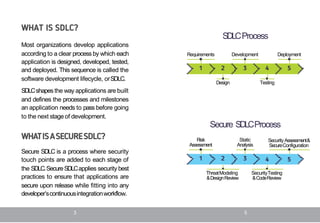
WHAT IS SDLC?
Most organizations develop applications
according to a clear process by which each
application is designed, developed, tested,
and deployed. This sequence is called the
software development lifecycle, orSDLC.
SDLCshapesthe way applications are built
and defines the processes and milestones
an application needs to pass before going
to the next stageof development.
WHATISASECURESDLC?
Secure SDLC is a process where security
touch points are added to each stage of
the SDLC.SecureSDLCapplies security best
practices to ensure that applications are
secure upon release while fitting into any
developer’scontinuousintegrationworkflow.
Secure SDLCProcess
1 32
Risk
Assessment
ThreatModeling
&DesignReview
Static
Analysis
SecurityTesting
&CodeReview
SecurityAssessment&
SecureConfiguration
4 5
SDLCProcess
1 32 4 5
Requirements
Design
Development
Testing
Deployment
3 5
STATIC APPLICATION SECURITY
TESTING WITH SECURE SDLC
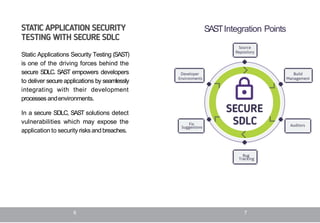
Static Applications Security Testing (SAST)
is one of the driving forces behind the
secure SDLC. SAST empowers developers
to deliver secure applications by seamlessly
integrating with their development
processes andenvironments.
In a secure SDLC, SAST solutions detect
vulnerabilities which may expose the
application to security risksandbreaches.
6 7
SASTIntegration Points
<CODE DEVELOPMENT
METHODOLOGIES/>
Processfor planning, creating, testing and
deploying anapplication.
Software Development
Life Cycle (SDLC)
Alternative to traditional project management
wherethe emphasisisplaced onempowering
people to collaborate and make team
decisions in addition to continuous planning,
testing andintegration.
AGILE Model
10 11
Sequential design process, used in software
development processes, in which progress is
seen as flowing steadily downwards (like a
waterfall) through the phasesof requirement,
design, development andtesting.
Waterfall Model
Development method that uses minimal
planning in favor of rapid prototyping. A
prototype is equivalent to a component of
theproduct.
Rapid Application
Development (RAD)
12 13
<CODE/>
Collectionof sourcecodethat isusedto build
a particular software system, application or
softwarecomponent.
Codebase (or code base)
Frameworksarefairly largepre-madepieces
of code. Thedevelopers write their code on
top of the framework.
Notableexamples:
Struts
Telerik
GWT
Frameworks
16 17
Atool designed to automate the process of
program compilation. Build systems come
in various forms and are used for a variety
of software buildtasks.
Notableexamples:
Jenkins
AnthillPro
Build Systems
(or Build Server, Build Automation)
File archive or web hosting facility where
large amounts of software source code are
kept either publicly or privately.
Archived files may also beversioned.
Notable examples:
Source Code Repository
18 19
TFS
GIT
Perforce
SVN
Software application that keeps track of
reported bugs, issuesor tasks ina project.
Notableexamples:
TFS
Jira
HP-QC
Bug Tracking Systems
(Issue Tracking Systems)
Modern interpretation of service-oriented
architectures used to build distributed
software systems.Processesthat communicate
with eachother over the network in order to
fulfill atask.
Example: Microservices can be found in
Facebookor LinkedIn; someparts of the GUI
havedowntimefor updatesandsomedon’t.
Micro Services
20 21
The artifact created after compiling and
building source code for C++ and other
Microsoft codinglanguages.
DLL (Dynamic Link Library)
The artifact created after compiling and
building source code for Java coding
language.
JAR (Java Archive)
22 23
Development is built around predefined
code test cases.This means that only after
the test cases have been created, the
developers can start writing the code.
Test Driven Development
(TDD)
24
<APPLICATION
SECURITY
SOLUTIONS/>
Security testing which analyzes an
applications source code or binary code
to determineif securityvulnerabilitiesexist.
SAST solutions analyze the application
‘from the inside-out’, in many cases SAST
solutions do need compiledcode.
Static Application
Security Testing (SAST)
Security experts trying to find and exploit
vulnerabilities that an attacker could
use. The testing is done with or without
dedicated hackingtools.
Penetration Testing
(AKA Pen Testing)
28 29
Detect conditions of a security vulnerability
in an application in its running state.
Dynamic Application Security testing
generates automated attacks which may
be used by realattackers.
Dynamic Application
Security Testing (DAST)
Security technology that is built or linked
into an application or application runtime
environment and is capable of detecting
and preventing real-timeattacks.
Runtime Application Self-
Protection (RASP)
30 31
List of software weakness. List is created
by community cooperation.
Software weaknesses are errors that can
lead to software vulnerabilities.
Common Weakness
Enumeration (CWE)
A publicly available and free to use list
or dictionary of standardized identifiers
for common computer vulnerabilities
and exposures.
Common Vulnerabilities
and Exposures (CVE)
32 33
Community which creates freely-available
methodologies, tools, standards and
technologies in the field of application
security.
Open Web Application
Security Project (OWASP)
Combines elements of SAST and DAST
simultaneously. It is typically implemented
as an agent within the test runtime
application or environment that observes
attacks and identifiesvulnerabilities.
IAST determines whether a vulnerability
is exploitable with increased accuracy,
and can identify where specifically the
vulnerability is located in the code.
Interactive Application
Security Testing (IAST)
34 35
When a security scanner indicates that
a vulnerability exists (for example, SQL
Injection), while in reality it doesn’t exist.
False Positive
Whena vulnerability exists and the security
scanner doesn’t detect it. Therefore the
userisnot notified about the vulnerability.
False Negative
36 37
Protects web applications by monitoring
and controlling its input and output and the
accessto and from the application.
Running as an appliance, server plug-in
or cloud-based service, a WAF inspects
monitors, filters or blocks malicious traffic
to and from a Webapplication.
Web Application Firewall
(WAF)
BinaryAnalysisisaformof StaticApplication
Security testing based on analysis of a
compiled code-base rather than the raw
sourcecode. Abinary is a machine readable
file which can be executed and run.
Binary Analysis
38 39
Agreement offered by many websites and
software development companies by which
individuals can receive recognition and
compensation for reporting bugs, exploits
andvulnerabilities.
Bug Bounty Program
Security practice where after the code is
written it issentto securityexpert to undergo
inspection after which the developer needs
to alter the code accordingly.
Security Gate
40 41
<COMMON THREATS
AND
THEIR IMPACTS />
OWASP TOP 6
THREAT:
Code injection technique used to attack
data-driven applications, in which
malicious SQLfragment are inserted into
an entry field for execution.
SQL Injection
IMPACT:
May reflect sensitive information,
plant information or damage data
May be used to reveal customer’s
credit card numbers or any other
personal data stored on the DB
Attacker could change system
administrator credentials forthe
databaseserver
Can affect public image of the
company resulting in profit loss
44 45
THREAT:
Vulnerability typically found in web
applications enabling attackers to inject
client-side scripts into web pages viewed
by other users.
Cross Site Scripting
(XSS)
IMPACT:
May gain access touser’s identity
and act on their behalf
Ability to spread web worms or Trojans
Possible business impact ofpublic
exposure aboutvulnerability
Attacker may gain access to all the
end-user information kept on the
Client Server (cookies, session IDand
Client identity)
46 47
THREAT:
Attacker uses multiple transparent layers
to trick a user into clicking on a button
or link that is not the originally intended
target area. Therefore, the attacker is
rerouting (hijacking) the user to another
page, likely owned by another application.
Keystrokes can also be hijacked using the
samemethod.
Clickjacking
(UI redress attack)
IMPACT:
Can be used to utilize the computer's
microphone andcamera
May activate print screen to capture
sensitiveinformation
48 49
THREAT:
Attack that forces an end user to execute
unwanted actions on a web application
in which they're currently authenticated.
Inherits the identity and privileges of the
victim to perform an undesired function
on the victim'sbehalf.
Cross Site Request
Forgery (CSRF)
IMPACT:
If the victim is an administrative
account, can be usedto force the user
to perform state changing requests
like transferring funds, changing their
email address, and soforth.
Can compromise the entireweb
application
50 51
THREAT:
Exploit which allows attackers to access
restricted directories and execute
commands outside of the web server's
intendeddirectory.
Path Traversal
(Directory Traversal)
IMPACT:
Can be used to access to restricted
areas and files causing a critical
information leak
52 53
THREAT:
Vulnerability that permits an attacker
to hijack a valid user session. The attack
explores a limitation in the way the
web application manages the session
ID and specifically the vulnerable web
application.
Session Fixation
(dot-dot-slash)
IMPACT:
Canbe used to hijack the user-
validated sessionby utilizing the
knowledge of thesessionID
54 55
www.checkmarx.com
Thanks for reading!
Learn more at:

Application Security Guide for Beginners

  • 1.
  • 2.
    INTRODUCTION This beginner’s guideto application security focuses on the main concepts and keywords used in the Application Security domain. This guide is divided into the following categories: Code 2 ApplicationSecuritySolutions CodeDevelopmentMethodologies Commonthreatsandtheir impacts
  • 3.
    WHAT IS SDLC? Mostorganizations develop applications according to a clear process by which each application is designed, developed, tested, and deployed. This sequence is called the software development lifecycle, orSDLC. SDLCshapesthe way applications are built and defines the processes and milestones an application needs to pass before going to the next stageof development. WHATISASECURESDLC? Secure SDLC is a process where security touch points are added to each stage of the SDLC.SecureSDLCapplies security best practices to ensure that applications are secure upon release while fitting into any developer’scontinuousintegrationworkflow. Secure SDLCProcess 1 32 Risk Assessment ThreatModeling &DesignReview Static Analysis SecurityTesting &CodeReview SecurityAssessment& SecureConfiguration 4 5 SDLCProcess 1 32 4 5 Requirements Design Development Testing Deployment 3 5
  • 4.
    STATIC APPLICATION SECURITY TESTINGWITH SECURE SDLC Static Applications Security Testing (SAST) is one of the driving forces behind the secure SDLC. SAST empowers developers to deliver secure applications by seamlessly integrating with their development processes andenvironments. In a secure SDLC, SAST solutions detect vulnerabilities which may expose the application to security risksandbreaches. 6 7 SASTIntegration Points
  • 5.
  • 6.
    Processfor planning, creating,testing and deploying anapplication. Software Development Life Cycle (SDLC) Alternative to traditional project management wherethe emphasisisplaced onempowering people to collaborate and make team decisions in addition to continuous planning, testing andintegration. AGILE Model 10 11
  • 7.
    Sequential design process,used in software development processes, in which progress is seen as flowing steadily downwards (like a waterfall) through the phasesof requirement, design, development andtesting. Waterfall Model Development method that uses minimal planning in favor of rapid prototyping. A prototype is equivalent to a component of theproduct. Rapid Application Development (RAD) 12 13
  • 8.
  • 9.
    Collectionof sourcecodethat isusedtobuild a particular software system, application or softwarecomponent. Codebase (or code base) Frameworksarefairly largepre-madepieces of code. Thedevelopers write their code on top of the framework. Notableexamples: Struts Telerik GWT Frameworks 16 17
  • 10.
    Atool designed toautomate the process of program compilation. Build systems come in various forms and are used for a variety of software buildtasks. Notableexamples: Jenkins AnthillPro Build Systems (or Build Server, Build Automation) File archive or web hosting facility where large amounts of software source code are kept either publicly or privately. Archived files may also beversioned. Notable examples: Source Code Repository 18 19 TFS GIT Perforce SVN
  • 11.
    Software application thatkeeps track of reported bugs, issuesor tasks ina project. Notableexamples: TFS Jira HP-QC Bug Tracking Systems (Issue Tracking Systems) Modern interpretation of service-oriented architectures used to build distributed software systems.Processesthat communicate with eachother over the network in order to fulfill atask. Example: Microservices can be found in Facebookor LinkedIn; someparts of the GUI havedowntimefor updatesandsomedon’t. Micro Services 20 21
  • 12.
    The artifact createdafter compiling and building source code for C++ and other Microsoft codinglanguages. DLL (Dynamic Link Library) The artifact created after compiling and building source code for Java coding language. JAR (Java Archive) 22 23
  • 13.
    Development is builtaround predefined code test cases.This means that only after the test cases have been created, the developers can start writing the code. Test Driven Development (TDD) 24
  • 14.
  • 15.
    Security testing whichanalyzes an applications source code or binary code to determineif securityvulnerabilitiesexist. SAST solutions analyze the application ‘from the inside-out’, in many cases SAST solutions do need compiledcode. Static Application Security Testing (SAST) Security experts trying to find and exploit vulnerabilities that an attacker could use. The testing is done with or without dedicated hackingtools. Penetration Testing (AKA Pen Testing) 28 29
  • 16.
    Detect conditions ofa security vulnerability in an application in its running state. Dynamic Application Security testing generates automated attacks which may be used by realattackers. Dynamic Application Security Testing (DAST) Security technology that is built or linked into an application or application runtime environment and is capable of detecting and preventing real-timeattacks. Runtime Application Self- Protection (RASP) 30 31
  • 17.
    List of softwareweakness. List is created by community cooperation. Software weaknesses are errors that can lead to software vulnerabilities. Common Weakness Enumeration (CWE) A publicly available and free to use list or dictionary of standardized identifiers for common computer vulnerabilities and exposures. Common Vulnerabilities and Exposures (CVE) 32 33
  • 18.
    Community which createsfreely-available methodologies, tools, standards and technologies in the field of application security. Open Web Application Security Project (OWASP) Combines elements of SAST and DAST simultaneously. It is typically implemented as an agent within the test runtime application or environment that observes attacks and identifiesvulnerabilities. IAST determines whether a vulnerability is exploitable with increased accuracy, and can identify where specifically the vulnerability is located in the code. Interactive Application Security Testing (IAST) 34 35
  • 19.
    When a securityscanner indicates that a vulnerability exists (for example, SQL Injection), while in reality it doesn’t exist. False Positive Whena vulnerability exists and the security scanner doesn’t detect it. Therefore the userisnot notified about the vulnerability. False Negative 36 37
  • 20.
    Protects web applicationsby monitoring and controlling its input and output and the accessto and from the application. Running as an appliance, server plug-in or cloud-based service, a WAF inspects monitors, filters or blocks malicious traffic to and from a Webapplication. Web Application Firewall (WAF) BinaryAnalysisisaformof StaticApplication Security testing based on analysis of a compiled code-base rather than the raw sourcecode. Abinary is a machine readable file which can be executed and run. Binary Analysis 38 39
  • 21.
    Agreement offered bymany websites and software development companies by which individuals can receive recognition and compensation for reporting bugs, exploits andvulnerabilities. Bug Bounty Program Security practice where after the code is written it issentto securityexpert to undergo inspection after which the developer needs to alter the code accordingly. Security Gate 40 41
  • 22.
  • 23.
    THREAT: Code injection techniqueused to attack data-driven applications, in which malicious SQLfragment are inserted into an entry field for execution. SQL Injection IMPACT: May reflect sensitive information, plant information or damage data May be used to reveal customer’s credit card numbers or any other personal data stored on the DB Attacker could change system administrator credentials forthe databaseserver Can affect public image of the company resulting in profit loss 44 45
  • 24.
    THREAT: Vulnerability typically foundin web applications enabling attackers to inject client-side scripts into web pages viewed by other users. Cross Site Scripting (XSS) IMPACT: May gain access touser’s identity and act on their behalf Ability to spread web worms or Trojans Possible business impact ofpublic exposure aboutvulnerability Attacker may gain access to all the end-user information kept on the Client Server (cookies, session IDand Client identity) 46 47
  • 25.
    THREAT: Attacker uses multipletransparent layers to trick a user into clicking on a button or link that is not the originally intended target area. Therefore, the attacker is rerouting (hijacking) the user to another page, likely owned by another application. Keystrokes can also be hijacked using the samemethod. Clickjacking (UI redress attack) IMPACT: Can be used to utilize the computer's microphone andcamera May activate print screen to capture sensitiveinformation 48 49
  • 26.
    THREAT: Attack that forcesan end user to execute unwanted actions on a web application in which they're currently authenticated. Inherits the identity and privileges of the victim to perform an undesired function on the victim'sbehalf. Cross Site Request Forgery (CSRF) IMPACT: If the victim is an administrative account, can be usedto force the user to perform state changing requests like transferring funds, changing their email address, and soforth. Can compromise the entireweb application 50 51
  • 27.
    THREAT: Exploit which allowsattackers to access restricted directories and execute commands outside of the web server's intendeddirectory. Path Traversal (Directory Traversal) IMPACT: Can be used to access to restricted areas and files causing a critical information leak 52 53
  • 28.
    THREAT: Vulnerability that permitsan attacker to hijack a valid user session. The attack explores a limitation in the way the web application manages the session ID and specifically the vulnerable web application. Session Fixation (dot-dot-slash) IMPACT: Canbe used to hijack the user- validated sessionby utilizing the knowledge of thesessionID 54 55
  • 29.