STREAK PLATE
METHOD
PRESENTED BY : JYOTSNA VERMA
M.Sc(P) BIOCHEMISTRY
STREAKING:
 The streak plate method is a rapid qualitative
isolation method.
 It is essentially a dilution technique used for
isolation of discrete colonies and requires that the
number of organisms in the inoculums be reduced.
PRINCIPLE
 The sample/inoculum is diluted by streaking it across
the surface of the agar plate.
 While streaking in successive areas of the plate, the
inoculum is diluted to the point where there is only one
bacterial cell deposited every few millimeters on the
surface of the agar plate.
 When these lone bacterial cells divide and give rise to
thousands and thousands of new bacterial cells, an
isolated colony is formed.
PROCEDURE:
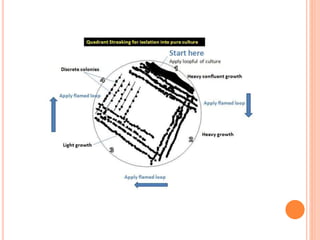
 Sterilize the inoculating loop in the bunsen burner by putting the loop
into the flame until it is red hot. Allow it to cool.
 Pick an isolated colony from the agar plate culture and spread it over
the first quadrant (approximately 1/4 of the plate) using close parallel
streaks or Insert your loop into the tube/culture bottle and remove
some inoculum.
 Immediately streak the inoculating loop very gently over a quarter of
the plate using a back and forth motion .
 Flame the loop again and allow it to cool. Going back to the edge of
area 1 that you just streaked, extend the streaks into the second
quarter of the plate (area 2).
 Flame the loop again and allow it to cool. Going back to the area that
you just streaked (area 2), extend the streaks into the third quarter of
the plate (area 3).
 Flame the loop again and allow it to cool. Going back to the area that
you just streaked (area 3), extend the streaks into the center fourth of
the plate (area 4).
 Flame your loop once more.
 Results:
 Streaked plate are incubated at 37°C for 24 hours.
Examine the colonies grown in the plate carefully.
 All colonies should have the same general
appearance.
 If there is more than one type of colony, each type
should be streaked again on a separate plate to
obtain a pure culture.
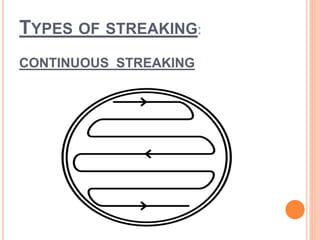
TYPES OF STREAKING:
CONTINUOUS STREAKING
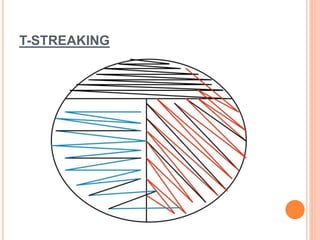
T-STREAKING
POOR STREAKING
In the plate on the left, no
isolated colonies are
present.
This can happen when
either more than one
loopful of bacterial
culture are taken or the
loop wasn’t flamed
between each group.
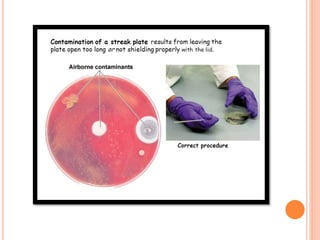
Isolated colonies are
produced but large fuzzy
white colonies indicate
contamination.
This can happen when
the lid is lifted for a long
time.
APPLICATION OF STREAKING:
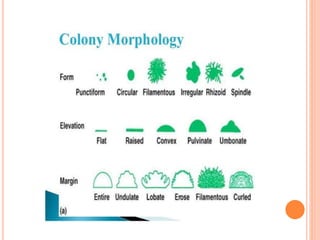
 To produce isolated colonies of an organism (mostly
bacteria) on an agar plate. This is useful when we need to
separate organisms in a mixed culture (to purify/isolate
particular strain from contaminants) or when we need to
study the colony morphology of an organism.
 To identify the organism: biochemical tests to identify
bacteria are only valid when performed on pure culture.
 Whether a culture is viable, i.e. able to grow (perhaps a
"stock" culture kept for some time in the fridge).
THINGS TO REMEMBER:
 Use only a small amount of inoculum.
 When sterilizing the inoculating loop, make sure that
the entire loop turns orange before using on the agar
plates.
 Streak lightly so that you do not gouge the agar.
 Flame the loop after you streak each quadrant.
 Make sure surface of the plate is free of droplets of
condensed moisture.
 After streaking, the plates are incubated in 37˚C for 24
hours.
 The parts of the sterile pipette that will be put into
cultures must not touch any unsterile surface, e.g.
clothing, outside of test tubes/bottles, surface of the
working area etc.
 Make sure surface of the plate is free of droplets of
condensed moisture.
 After streaking, the plates are incubated in 37˚C for 24
hours.
 Precautions should be taken to ensure that you don't
inhale, ingest, or allow these germs to touch your skin.
 Bacterial plates should be kept closed and secured with
tape while incubating.
 Any unwanted bacterial plates should be disposed of
properly by placing them in an autoclave to kill the
bacteria before discarding them.
THANK YOU

Application of streaking

  • 1.
    STREAK PLATE METHOD PRESENTED BY: JYOTSNA VERMA M.Sc(P) BIOCHEMISTRY
  • 2.
    STREAKING:  The streakplate method is a rapid qualitative isolation method.  It is essentially a dilution technique used for isolation of discrete colonies and requires that the number of organisms in the inoculums be reduced.
  • 3.
    PRINCIPLE  The sample/inoculumis diluted by streaking it across the surface of the agar plate.  While streaking in successive areas of the plate, the inoculum is diluted to the point where there is only one bacterial cell deposited every few millimeters on the surface of the agar plate.  When these lone bacterial cells divide and give rise to thousands and thousands of new bacterial cells, an isolated colony is formed.
  • 4.
    PROCEDURE:  Sterilize theinoculating loop in the bunsen burner by putting the loop into the flame until it is red hot. Allow it to cool.  Pick an isolated colony from the agar plate culture and spread it over the first quadrant (approximately 1/4 of the plate) using close parallel streaks or Insert your loop into the tube/culture bottle and remove some inoculum.  Immediately streak the inoculating loop very gently over a quarter of the plate using a back and forth motion .  Flame the loop again and allow it to cool. Going back to the edge of area 1 that you just streaked, extend the streaks into the second quarter of the plate (area 2).  Flame the loop again and allow it to cool. Going back to the area that you just streaked (area 2), extend the streaks into the third quarter of the plate (area 3).  Flame the loop again and allow it to cool. Going back to the area that you just streaked (area 3), extend the streaks into the center fourth of the plate (area 4).  Flame your loop once more.
  • 5.
     Results:  Streakedplate are incubated at 37°C for 24 hours. Examine the colonies grown in the plate carefully.  All colonies should have the same general appearance.  If there is more than one type of colony, each type should be streaked again on a separate plate to obtain a pure culture.
  • 6.
  • 8.
  • 9.
    POOR STREAKING In theplate on the left, no isolated colonies are present. This can happen when either more than one loopful of bacterial culture are taken or the loop wasn’t flamed between each group. Isolated colonies are produced but large fuzzy white colonies indicate contamination. This can happen when the lid is lifted for a long time.
  • 12.
    APPLICATION OF STREAKING: To produce isolated colonies of an organism (mostly bacteria) on an agar plate. This is useful when we need to separate organisms in a mixed culture (to purify/isolate particular strain from contaminants) or when we need to study the colony morphology of an organism.  To identify the organism: biochemical tests to identify bacteria are only valid when performed on pure culture.  Whether a culture is viable, i.e. able to grow (perhaps a "stock" culture kept for some time in the fridge).
  • 13.
    THINGS TO REMEMBER: Use only a small amount of inoculum.  When sterilizing the inoculating loop, make sure that the entire loop turns orange before using on the agar plates.  Streak lightly so that you do not gouge the agar.  Flame the loop after you streak each quadrant.  Make sure surface of the plate is free of droplets of condensed moisture.  After streaking, the plates are incubated in 37˚C for 24 hours.  The parts of the sterile pipette that will be put into cultures must not touch any unsterile surface, e.g. clothing, outside of test tubes/bottles, surface of the working area etc.
  • 14.
     Make suresurface of the plate is free of droplets of condensed moisture.  After streaking, the plates are incubated in 37˚C for 24 hours.  Precautions should be taken to ensure that you don't inhale, ingest, or allow these germs to touch your skin.  Bacterial plates should be kept closed and secured with tape while incubating.  Any unwanted bacterial plates should be disposed of properly by placing them in an autoclave to kill the bacteria before discarding them.
  • 15.