Physics is very important part in our life. we
used physics everyday in many purposes.
without physics it is impossible to do any
activities in textile sector. physics is the
scientific study of matter and energy and how
they interact with each other. This energy can
take the form of motion, light, electricity,
radiation, gravity etc.
 Spinning Section
 Weaving Section
 Knitting Section
 Dyeing Section
 Apparel Section
Weaving is a method of fabric production in
which two distinct sets of yarns or threads
are interlaced at right angles to form a fabric
or cloth. The other methods are knitting,
lace making, felting, and braiding or plaiting.
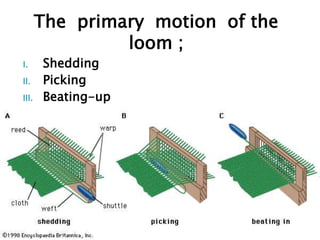
The primary motion of the
loom ;
I. Shedding
II. Picking
III. Beating-up
The secondary motion of the loom :
Let off Motion: where the warp is let off the
warp beam at a regulated speed to make the
filling even and of the required design
Take up Motion: Takes up the woven fabric in a
regulated manner so that the density of filling
is maintained
Knitting is considered to be the second most frequently
used method of fabric construction, after weaving.
Knitting is one kind of fabric manufacturing process in
which fabric is produced by inter looping among loops
formed by single or several yarn feeding simultaneously.
Knitted fabrics produced with stitch formation. The
stitch consists of a head ,two legs ,two feet and upper&
lower connection point.
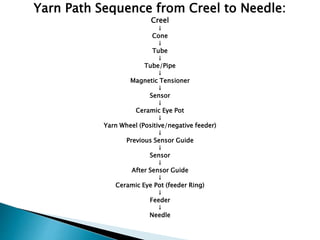
Yarn Path Sequence from Creel to Needle:
Creel
↓
Cone
↓
Tube
↓
Tube/Pipe
↓
Magnetic Tensioner
↓
Sensor
↓
Ceramic Eye Pot
↓
Yarn Wheel (Positive/negative feeder)
↓
Previous Sensor Guide
↓
Sensor
↓
After Sensor Guide
↓
Ceramic Eye Pot (feeder Ring)
↓
Feeder
↓
Needle
Dyeing is the process of adding color to textile products
like fibers, yarns, and fabrics.Dyeing is normally done in a
special solutioncontaining dyes and particular chemical
material.There are some parts is related with physics in dying
section and they are :
 Heat setting: Heat-setting is a heat treatment by which shape
retention, crease resistance, resilience and elasticity are imparted to
the fibres
 Color strength: A measure of the ability of a
dye to impart color to other materials. Color
strength is evaluated by light absorption in the
visible region of the spectrum.
 Fast or Fastness: A fast color will not fade due
to exposure to light or washing.
 Fixation: The process of setting a dye after
dyeing of printing, usually by steaming or other
heart treatment.
 Hydrophilic: Having strong affinity for or the
ability to absorb water.
 Hydrophobic: Lacking affinity for or the ability
to absorb water.
 Absorbency: The ability of one material to
take up another material.
 Absorption: The process of gases or liquids
being taken up into the pores of a fiber,
yarn, or fabric.
 Affinity: Chemical attraction; the tendency of
two elements or substances to unite or
Combine together, such as fiber and
dyestuff. Affinity is usually expressed in
units of joules per mole.
After receive the garments components from
cutting section, all the garments parts are
joined and sewn as sequentially. Obviously all
the components are sewn respects on buyer
requirement.
Sewing section is the most important
department of a garment manufacturing
industry.
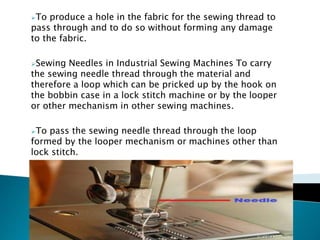
To produce a hole in the fabric for the sewing thread to
pass through and to do so without forming any damage
to the fabric.
Sewing Needles in Industrial Sewing Machines To carry
the sewing needle thread through the material and
therefore a loop which can be pricked up by the hook on
the bobbin case in a lock stitch machine or by the looper
or other mechanism in other sewing machines.
To pass the sewing needle thread through the loop
formed by the looper mechanism or machines other than
lock stitch.
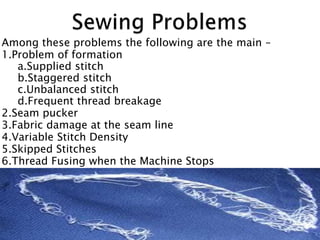
Among these problems the following are the main –
1.Problem of formation
a.Supplied stitch
b.Staggered stitch
c.Unbalanced stitch
d.Frequent thread breakage
2.Seam pucker
3.Fabric damage at the seam line
4.Variable Stitch Density
5.Skipped Stitches
6.Thread Fusing when the Machine Stops
Problem of formation:
1.Supplied stitch : Causes
• Loop size of needle is small
• Bent needle
• Tension variation of looper and needle
thread
2.Staggered stitch: Causes
•Bent needle
•Wrong needle point
•Improper needle adjust
Application of physics in textile sector

Application of physics in textile sector

  • 2.
    Physics is veryimportant part in our life. we used physics everyday in many purposes. without physics it is impossible to do any activities in textile sector. physics is the scientific study of matter and energy and how they interact with each other. This energy can take the form of motion, light, electricity, radiation, gravity etc.
  • 3.
     Spinning Section Weaving Section  Knitting Section  Dyeing Section  Apparel Section
  • 5.
    Weaving is amethod of fabric production in which two distinct sets of yarns or threads are interlaced at right angles to form a fabric or cloth. The other methods are knitting, lace making, felting, and braiding or plaiting.
  • 6.
    The primary motionof the loom ; I. Shedding II. Picking III. Beating-up
  • 7.
    The secondary motionof the loom : Let off Motion: where the warp is let off the warp beam at a regulated speed to make the filling even and of the required design Take up Motion: Takes up the woven fabric in a regulated manner so that the density of filling is maintained
  • 8.
    Knitting is consideredto be the second most frequently used method of fabric construction, after weaving. Knitting is one kind of fabric manufacturing process in which fabric is produced by inter looping among loops formed by single or several yarn feeding simultaneously. Knitted fabrics produced with stitch formation. The stitch consists of a head ,two legs ,two feet and upper& lower connection point.
  • 9.
    Yarn Path Sequencefrom Creel to Needle: Creel ↓ Cone ↓ Tube ↓ Tube/Pipe ↓ Magnetic Tensioner ↓ Sensor ↓ Ceramic Eye Pot ↓ Yarn Wheel (Positive/negative feeder) ↓ Previous Sensor Guide ↓ Sensor ↓ After Sensor Guide ↓ Ceramic Eye Pot (feeder Ring) ↓ Feeder ↓ Needle
  • 10.
    Dyeing is theprocess of adding color to textile products like fibers, yarns, and fabrics.Dyeing is normally done in a special solutioncontaining dyes and particular chemical material.There are some parts is related with physics in dying section and they are :  Heat setting: Heat-setting is a heat treatment by which shape retention, crease resistance, resilience and elasticity are imparted to the fibres
  • 11.
     Color strength:A measure of the ability of a dye to impart color to other materials. Color strength is evaluated by light absorption in the visible region of the spectrum.  Fast or Fastness: A fast color will not fade due to exposure to light or washing.  Fixation: The process of setting a dye after dyeing of printing, usually by steaming or other heart treatment.  Hydrophilic: Having strong affinity for or the ability to absorb water.  Hydrophobic: Lacking affinity for or the ability to absorb water.
  • 12.
     Absorbency: Theability of one material to take up another material.  Absorption: The process of gases or liquids being taken up into the pores of a fiber, yarn, or fabric.  Affinity: Chemical attraction; the tendency of two elements or substances to unite or Combine together, such as fiber and dyestuff. Affinity is usually expressed in units of joules per mole.
  • 13.
    After receive thegarments components from cutting section, all the garments parts are joined and sewn as sequentially. Obviously all the components are sewn respects on buyer requirement. Sewing section is the most important department of a garment manufacturing industry.
  • 14.
    To produce ahole in the fabric for the sewing thread to pass through and to do so without forming any damage to the fabric. Sewing Needles in Industrial Sewing Machines To carry the sewing needle thread through the material and therefore a loop which can be pricked up by the hook on the bobbin case in a lock stitch machine or by the looper or other mechanism in other sewing machines. To pass the sewing needle thread through the loop formed by the looper mechanism or machines other than lock stitch.
  • 15.
    Among these problemsthe following are the main – 1.Problem of formation a.Supplied stitch b.Staggered stitch c.Unbalanced stitch d.Frequent thread breakage 2.Seam pucker 3.Fabric damage at the seam line 4.Variable Stitch Density 5.Skipped Stitches 6.Thread Fusing when the Machine Stops
  • 16.
    Problem of formation: 1.Suppliedstitch : Causes • Loop size of needle is small • Bent needle • Tension variation of looper and needle thread 2.Staggered stitch: Causes •Bent needle •Wrong needle point •Improper needle adjust