The paper discusses the application of autonomic computing principles in managing complex and heterogeneous IT infrastructures, particularly in virtualized environments. It emphasizes the need for self-management capabilities, encompassing self-configuration, self-optimization, self-healing, and self-protection, to automate virtual machine management without relying heavily on system administrators. The proposed system aims to automatically handle resource allocation and manage live migration of virtual machines to enhance efficiency and security.
![Natarajan Meghanathan, et al. (Eds): ITCS, SIP, JSE-2012, CS & IT 04, pp. 203–208, 2012.
© CS & IT-CSCP 2012 DOI : 10.5121/csit.2012.2118
APPLICATION OF AUTONOMIC COMPUTING
PRINCIPLES IN VIRTUALIZED ENVIRONMENT
Anala M R1
and Dr.Shobha G2
1
Department of CSE, RVCE, Bangalore
anala_m_r@yahoo.co.in
2
Dean PG Studies (CSE & ISE), RVCE, Bangalore
shobhatilak@rediffmail.com
ABSTRACT
The infrastructure of IT-sector is heterogeneous and complex. It is difficult for a system
administrator to manage these complex systems. This led to complex, unmanageable and
insecure systems. A new approach to solve this problem is the IT infrastructure automation.
Autonomic computing is the solution to manage complex infrastructure which provides "must
have" solutions for the problems above. The increased resource utilization in IT made the
enterprises to use the costly physical servers. These physical servers were under-utilized.
Virtualization is a technology with efficient and better utilization of resources. Virtualization and
autonomic computing are of major importance for the IT-sector and could be successfully
combined to reach the ideals of the autonomic computing. This paper addresses the design issues
in automating live migration of virtual machines in virtualized environment using autonomic
computing.
KEYWORDS
Virtualization, autonomic computing, Self-management and live migration.
1. INTRODUCTION
1.1 AUTONOMIC COMPUTING
The heterogeneous infrastructures such as hardware and software applications, services and
networks, directed towards the complex, unmanageable and insecure systems. The system
administrator will not be able to manage alone such a complex computing system. Therefore
these complex computing systems are managed by autonomic computing. Autonomic computing
is the technique of managing the computing environment by computing systems themselves based
on the policies decided by the system administrator. Self-management is the core of autonomic
computing [1] and represents the process by which computing systems manage themselves. There
are four aspects of self-management:
• Self-configuration: The property in which the computing systems will automatically configure
itself by sparing the system administrator with respect to high-level policies. Any new
components added to the system are incorporated seamlessly. It can dynamically adapt to](https://image.slidesharecdn.com/csit2118-180130063042/85/APPLICATION-OF-AUTONOMIC-COMPUTING-PRINCIPLES-IN-VIRTUALIZED-ENVIRONMENT-1-320.jpg)
![Natarajan Meghanathan, et al. (Eds): ITCS, SIP, JSE-2012, CS & IT 04, pp. 203–208, 2012.
© CS & IT-CSCP 2012 DOI : 10.5121/csit.2012.2118
APPLICATION OF AUTONOMIC COMPUTING
PRINCIPLES IN VIRTUALIZED ENVIRONMENT
Anala M R1
and Dr.Shobha G2
1
Department of CSE, RVCE, Bangalore
anala_m_r@yahoo.co.in
2
Dean PG Studies (CSE & ISE), RVCE, Bangalore
shobhatilak@rediffmail.com
ABSTRACT
The infrastructure of IT-sector is heterogeneous and complex. It is difficult for a system
administrator to manage these complex systems. This led to complex, unmanageable and
insecure systems. A new approach to solve this problem is the IT infrastructure automation.
Autonomic computing is the solution to manage complex infrastructure which provides "must
have" solutions for the problems above. The increased resource utilization in IT made the
enterprises to use the costly physical servers. These physical servers were under-utilized.
Virtualization is a technology with efficient and better utilization of resources. Virtualization and
autonomic computing are of major importance for the IT-sector and could be successfully
combined to reach the ideals of the autonomic computing. This paper addresses the design issues
in automating live migration of virtual machines in virtualized environment using autonomic
computing.
KEYWORDS
Virtualization, autonomic computing, Self-management and live migration.
1. INTRODUCTION
1.1 AUTONOMIC COMPUTING
The heterogeneous infrastructures such as hardware and software applications, services and
networks, directed towards the complex, unmanageable and insecure systems. The system
administrator will not be able to manage alone such a complex computing system. Therefore
these complex computing systems are managed by autonomic computing. Autonomic computing
is the technique of managing the computing environment by computing systems themselves based
on the policies decided by the system administrator. Self-management is the core of autonomic
computing [1] and represents the process by which computing systems manage themselves. There
are four aspects of self-management:
• Self-configuration: The property in which the computing systems will automatically configure
itself by sparing the system administrator with respect to high-level policies. Any new
components added to the system are incorporated seamlessly. It can dynamically adapt to](https://image.slidesharecdn.com/csit2118-180130063042/75/APPLICATION-OF-AUTONOMIC-COMPUTING-PRINCIPLES-IN-VIRTUALIZED-ENVIRONMENT-1-2048.jpg)
![204 Computer Science & Information Technology (CS & IT)
changing environments. Such changes could include the deployment of new components or the
removal of existing ones, or dramatic changes in the system characteristics
• Self-optimization: The computing system will continuously try to improve its performance by
dynamically changing its parameter at run-time. It can monitor, allocate and tune resources
automatically. The tuning of resources means reallocation of resources in response to
dynamically changing workloads in order to improve overall utilization. Without self-optimizing
functions it is difficult to effectively use the computing resources when an application does not
completely use its allocated resources.
• Self-healing: the property of a computing system to detect, diagnose and repair local problems
caused either by software of by hardware failures. It can discover, diagnose and react to
disruptions. Self-healing components can detect system malfunctions and initiate policy-based
corrective action without disrupting the IT environment.
• Self-protecting: the ability of a computing system to secure itself from a malicious attack. The
self-protected computing system is capable of predicting possible problems based on logs and
reports. It can anticipate, detect, identify and protect against threats from anywhere.
1.1 Virtualization
Virtualization [2] is a technique of separating the resources of computer into multiple execution
environments. Virtualization techniques create multiple partitions which are isolated with each
other called virtual machines. A virtual machine is a software implementation of a physical
machine where an isolated operating system is installed within the operating system of a physical
machine. The desire to run multiple operating systems was the original motivation for virtual
machines. Virtualization is a technology with efficient and better utilization of resources.
Migrating operating system instances across distinct physical hosts is a useful tool for
administrators of data centers and clusters. It allows a clean separation between hardware and
software, and facilitates fault management, load balancing, and low-level system maintenance.
By carrying out the majority of migration while OSes continue to run, we achieve impressive
performance with minimal service downtimes. Migration can be conducted offline (where the
guest is suspended and then moved) or live (where a guest is moved without suspending).
An offline migration suspends the guest then moves an image of the guest’s memory to the
destination host. The guest is resumed on the destination host and the memory the guest used on
the source host is freed. The time an offline migration depends on the network bandwidth and
latency. A guest with 2GB of memory should take several seconds on a 1G bit Ethernet link. A
live migration keeps the guest running on the source host and begins moving the memory without
stopping the guest. Migration is useful for
• Load balancing – Guests running in source host can be moved to some other host when
guest doesn’t get sufficient resources at source host.
• Hardware failover – When source machine’s hardware fails, for the continued services
guests can be safely moved to new host.
• Energy saving – During lower usage of a host system in order to save power guests can
be reallocated to other hosts and host systems are powered off.
• Geographic migration – To minimize the latency guests can be moved to another
location in serious circumstances.](https://image.slidesharecdn.com/csit2118-180130063042/85/APPLICATION-OF-AUTONOMIC-COMPUTING-PRINCIPLES-IN-VIRTUALIZED-ENVIRONMENT-2-320.jpg)
![Computer Science & Information Technology (CS & IT) 205
2. VIRTUALIZATION AND AUTONOMIC COMPUTING- A LITERATURE
The heterogeneous infrastructure used in IT-sector is difficult to be managed by a system
administrator. Similarly in a virtualized environment the difficult task is management of running
virtual machines, balancing of load in virtual machines and availability of virtual machines. It is a
complex task to manage all the virtual machines by a system administrator. Therefore it is
necessary to design a fully autonomic virtual machine-based environment. In this the system
needs to be able to manage itself, with no or little interference from the system administrator.
Unfortunately, virtual machine-based environments nowadays are manually managed by system
administrators using GUI-based management tools that do not provide any automation
capabilities. Yet virtualization itself can be used to split a complex system in multiple
homogenous virtual machines which can be easily managed and physically moved around the
system, thus simplifying the autonomic task.
The lack of such solutions shows that the self-management of virtual machine-based
environments is a field of research where there is still a lot of work is to be done. This subsection
presents a survey of preliminary academic work related to the self-management of virtual-
machine based environment [3]. There are different approaches used to manage resources in
virtualized environment- policy based, Control theory based and it can be based on utility
functions. This section details the study of these techniques.
1.1 Policy-based approach:
This approach is a popular way of managing resources by a computing system in a virtualized
environment. Using this approach in [4], they developed a system called VIOLIN. The VIOLIN
is a virtual computational environment deployed on nanoHUB infrastructure, designed and
developed using Xen virtual machines. VIOLIN is capable of connecting multiple virtual
machines by a virtual network. The autonomic adaptation of virtual environment in VIOLIN is
driven by two factors, the availability of resources and the resource needs of each application
running inside the VIOLIN. The VIOLIN system supports live migration of virtual machines on
unavailability of resources in source physical machine.
Another policy-based approach has been used by Grit et al. [5]. Here, the authors used Shirako, a
Java-based toolkit for resource leasing services for what they refer to as an autonomic
orchestration. Shirako system leases networked resources on-demand basis. The Shirako system
uses Java toolkit for leasing the resources on the basis of SHARP framework. Shirako focuses
on orchestrating hosting of Xen VMs as a basis for secure adaptive, on-demand resource sharing
in federated cluster. The mapping of application services onto a shared server network is known
as orchestration. The resource leasing of Shirako is dynamic and renewable. The leasing and the
contract mechanisms are common for all the resources but the space of contract attributes and
values is resource specific. The specific attribute sets selected for each contract is a policy choice.
1.1 Control theory
This is another approach used for the dynamic allocation of resources in virtual environments. In
[6], To manage infrastructure pool used by multiple application, it is required to have a control
system that can dynamically allocate resources to applications in real time. Initially the static
allocation technique was used. Due to the varying workload of running virtual machine it is
necessary to use the dynamic resource allocation techniques. This paper addresses the overhead
of dynamic allocation over static allocation.](https://image.slidesharecdn.com/csit2118-180130063042/85/APPLICATION-OF-AUTONOMIC-COMPUTING-PRINCIPLES-IN-VIRTUALIZED-ENVIRONMENT-3-320.jpg)
![206 Computer Science & Information Technology (CS & IT)
In paper [7] a new concept called friendly virtual machine was introduced where VM themselves
are adaptable. In this paper [8] they present a grey prediction control model used for dynamic
allocation of resources in virtual machines. The dynamic adjustment of resources to an
application depends on the local resource demands of a node that hosts the application. There are
many techniques to allocate resources dynamically but this paper is based on control theory.
Predictive control technique uses the historical data to allocate resources. The grey prediction
control is accurate under the environment when the usage of resource in each VM is random.
1.1 Utility functions
The paper [9] demonstrates the effectiveness of utility functions for web based transactional
workloads running on Linux. An autonomic computing system optimizes the high-level guidance
from humans. This high-level guidance is converted to low-level actions to achieve the objective
of desired optimizations using utility functions. This utility function is designed by the
administrators. The utility functions allow the on-the fly identification of best feasible state.
In paper [10] the autonomic computing was used to allocate CPU resources dynamically for VMs
by optimizing utility functions. The first utility function used to allocate resource is based on
CPU share and priority based models explained in[10]. This paper addressed the technique used
to dynamically allocate resources to various virtual machines with respect to varying workloads.
It is based on the dynamic CPU priority allocation by allocating CPU shares to virtual machines.
The self – organised and self-tuned technique is designed which is based on the combined use of
combinatorial search techniques and analytical queuing network models. The global utility
function is optimized under varying workload levels. The results are obtained through simulation.
3. PROPOSED SYSTEM DESIGN
The proposed work is to design and implement an autonomic system to manage virtual
environment automatically without the involvement of system administrator. The designed
system automatically identifies the failure of running virtual machine. The failure may be because
of insufficient resource allocation for running virtual machine and hardware failure. An
appropriate destination physical machine with sufficient resource is identified. The source
physical machine indicates the failure information to destination machine. The destination
physical machine after identifying the failure will configure a new virtual machine and installs the
same. The running source virtual machine will start migrating to destination physical machine.
Once the complete memory image of source VM is copied to destination, the source VM is
stopped and the VM at destination takes over.
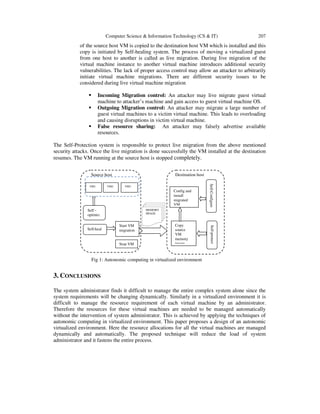
There are different phases in designing an autonomic system in a virtualized environment as
shown in figure 1. The source host runs two Self-management aspects the Self-Optimization and
the Self-healing. Similarly the destination host has two different Self-management aspects the
Self-Configuration and Self-Protection.
1. Initially the source host VMs will be efficiently executing the applications by Self-
optimizing the resources. The resources are optimized by frequently monitoring the
available resources, status of the hardware and power consumption. The self-
optimizing system will tune the resources allocated to all the virtual machines.
2. Due to unavailability of resources or higher power consumption or hardware failure,
VM in source host may fail to continue. This point of failure is identified by the Self-
healing system and it will initiate the migration by indicating the failure information
to destination host.
3. The destination host after receiving failure information will self-configure a new VM
but with the same IP address as the source VM and installs. Then the memory image](https://image.slidesharecdn.com/csit2118-180130063042/85/APPLICATION-OF-AUTONOMIC-COMPUTING-PRINCIPLES-IN-VIRTUALIZED-ENVIRONMENT-4-320.jpg)
![208 Computer Science & Information Technology (CS & IT)
REFERENCES
[1] Kephart, J. O. ; Chess, D. M.: The Vision of Autonomic Computing. In: Computer 36 (2003), S. 41–
50
[2] P. Barham, B. Dragovic, K. Fraser, S. Hand, T. Harris, A. Ho,R. Neugebauer, I. Pratt, and A.
Warfield, “Xen and the art of virtualization,” Symposium of Operating Systems Principles, 2003
[3] Dan Marinescu, Reinhold Kr¨oger: “State of the art in autonomic computing and virtualization”,
September 2007
[4] Ruth, P. ; Rhee, Junghwan ; Xu, Dongyan ; Kennell, R. ; Goasguen, S.: Autonomic Live Adaptation
of Virtual Computational Environments in a Multi-Domain Infrastructure. In: Autonomic Computing,
2006. ICAC ’06. IEEE International Conference on, 5–14
[5] Grit, Laura ; Irwin, David ; Yumerefendi, Aydan ; Chase, Jeff: Virtual Machine Hosting for
Networked Clusters: Building the Foundations for Autonomic Orchestration
[6] Wang, Zhikui ; Zhu, Xiaoyun ; Padala, Pradeep ; Singhal, Sharad: Capacity and Performance
Overhead in Dynamic Resource Allocation to Virtual Containers. (2007)
[7] Zhang, Yuting ; Bestavros, Azer ; Guirguis, Mina ; Matta, Ibrahim ;West, Richard: Friendly virtual
machines: leveraging a feedback-control model for application adaptation. In: VEE ’05: Proceedings
of the 1st ACM/USENIX international conference on Virtual execution environments. ACM Press. –
ISBN 1595930477.
[8] Xianghua Xu, Yanna Yan, Jian Wan : Grey Prediction Control of Adaptive Resources Allocation in
Virtualized Computing System , 2009 Eighth IEEE International Conference on Dependable,
Autonomic and Secure Computing.
[9] Walsh, W. E. ; Tesauro, G. ; Kephart, J. O. ; Das, R.: Utility functions in autonomic systems. In:
Autonomic Computing, 2004. Proceedings. International Conference on, 70–77
[10] Menasce, Daniel A. ; Bennani, Mohamed N.: Autonomic Virtualized Environments. In: ICAS ’06:
Proceedings of the International Conference on Autonomic and Autonomous Systems. Washington,
DC, USA : IEEE Computer Society, 2006. – ISBN 0–7695–2653–5, S. 28.
Anala M R., Asst.Professor in the department of Computer Science and Engineering,
RVCE. She has completed her M.Tech from Visveswaraya technological University in
the year 2007 in the field of Computer Network and Engineering. She is pursuing her
Ph.D in Visveswaraya technological University .She has 6 Years of academic
experience in R.V.C.E. She is a member of CSI and ISTE. Her area of research
includes Networking , virtualization and computer architecture.
Dr. Shobha G., Professor in the Department of Computer Science & Engg, RVCE. She has been awarded
Ph.D for her thesis titled “Knowledge Discovery in Transactional Database Systems”
from Mangalore University, Mangalore. She obtained her M.S. degree in Software
Systems. From BITS, Pilani and BE in Computer Science from Gulbarga University.
Her research interests are Data Mining, DBMS, Operating Systems & Networking. She
has guided more than 35 undergraduate and 15 post graduate projects. Currently she is
teaching courses on DBMS, Data Mining, Networks & Operating System. She has
presented and published papers at national and International journals / conference.](https://image.slidesharecdn.com/csit2118-180130063042/85/APPLICATION-OF-AUTONOMIC-COMPUTING-PRINCIPLES-IN-VIRTUALIZED-ENVIRONMENT-6-320.jpg)


